Antigua, Guatemala – Snow Birds in Paradise

img_0920Paradise is such a subjective feeling and if you don’t require a turquoise blue sea and white sand beaches, Antigua, Guatemala just might fit the bill.  This charming colonial city with its ever spring-like weather was perfect for our two-month stay. img_6117We arrived in Antigua at the end of October so that we could attend the Sumpango Giant Kite Festival held every year on November 1st, All Saints Day.  That spectacularly colorful event and a religious procession that burst forward from La Merced Church on October 28th would prove to be representative of the people and life in Guatemala we experienced.

Settling into our spacious two-bedroom Airbnb on Alameda Santa Lucia, with views of the three volcanos surrounding Antigua, was a breeze after living in two studio apartments and a boat cabin in Ecuador. At first, we thought the cost of living in Guatemala was going to be considerably higher than that of Ecuador, but that was due to eating dinner out the first couple of days before we got fully settled.  The dinner restaurants in Ecuador are considerably less expensive than those in Guatemala, but once we started shopping in the central market our food expenses dropped dramatically. We were delighted with the freshness and quality of the local produce. img_9629On Mondays, Thursdays and Saturdays the market tripled in size when the outdoor portion was open, and farmers brought in truckloads of fruits and vegetables from the surrounding villages. There we experienced one of the best markets going, set in a bustling, dusty lot with Volcans Agua, Fuego and Acatenango touching the sky in the background.  Most produce was sold in quantities of 5 quetzals (60 cents) so bring lots of small bills, as vendors didn’t usually have change for anything larger than 10Q.  The flavor of the locally grown vegetables was amazing. Being backyard gardeners ourselves, we were duly impressed.  Twenty quetzals would buy enough vegetables for a week.

On Sundays we would walk to Caoba Farm, just on the outskirts of town, for their organic produce and stay for their brunch, which featured live music in a beautiful outdoor setting.  They have mastered the farm-to-table restaurant concept.img_8874Shopping at the local supermarket, La Bodegona, was a wonderfully hectic experience.  At times it could feel like you were shopping from a conga line, weaving up and down aisles, afraid to leave the line for fear of not being able to enter it again and being stuck in dairy for eternity.  Numerous store employees lined the aisles offering samples of cookies, deli meats, drinks and other temptations to keep the energy level of the beast alive. It was a hoot! We had to psych ourselves up, like players before the big game, to shop there because it was so hectic and required a certain mental and physical stamina.  I will confess though to dancing in the checkout line to blaring Latino Christmas music – the mood was contagious. img_0714 On the same block D&C Cremas, a Walmart affiliate, offered a more sedate shopping experience. Both supermarkets had excellent poultry, which was more tender and tastier than back in Pennsylvania.  We were also fortunate that a pork butcher opened a new shop a half block away and offered fresh meat and sausage daily.  We enjoyed all the different varieties of Guatemalan sausage he made and found them to be very flavorful and lean, with almost no fat.

Antigua was a delight to explore on foot.  Charm, color and textures greeted us around every corner.  Every open doorway revealed something of interest.  Old colonial doorknockers featuring various faces, animals or hands graced many of the doors and we became intrigued by their artistry.  There are still several metalsmiths in town that cast and forge these works of art.

Most folks greeted us with a “Buena Dia” as they passed us on the sidewalk, though navigating the sidewalk hazards could be challenging at times.  Our early weeks were spent exploring the ruins of convents and cathedrals destroyed in a 1773 earthquake. This cataclysmic event led to Antigua being abandoned as Guatemala’s capital and left as a forgotten backwater to evolve unchanged into a charming UNESCO heritage site. Today Antigua is a very cosmopolitan, old colonial city with sophisticated dining and museums, yet still retains a quaint authenticity with its Spanish architecture and cobblestone streets which haven’t changed for centuries.  Many local women still wear traditional, locally woven blouses – guipils, created from the textiles for which Guatemala is renowned, which adds tremendously to the cultural atmosphere of the community.  Antigua had a genuine character that we hadn’t experienced to this extent before.

Finding our new favorite spots was a fun quest we eagerly embarked upon. There were many choices: our favorite coffee café is Fernando’s; a roof-top bar with the best view is Café Sky; there were five wonderful panaderias, bakeries, among which we rotated.  Six years ago, when we first visited Guatemala and Antigua, it was difficult to find a good cup of coffee. Instant coffee was served nearly everywhere, since the good beans were saved to be exported, and cappuccinos were unheard of.  Now the barista culture is firmly embraced, and cappuccinos have become a competitive art form.

Our calendar for November and December filled quickly with fun and interesting activities to attend.  The city sponsors many free events such as concerts on the central plaza; an annual Flower Festival, November 17th, which runs along the same street as the iconic arch; and the annual Waiters Race (Carrera de las Charolas) that starts early in the morning, so no one misses work. On November 14th. hundreds of waiters and waitresses filled the starting lines at the central plaza and, for cash prizes, zoomed around several city blocks to the cheers from a mostly local crowd.  Saturday afternoons found us heading to the Santa Catalina Arch to watch wedding parties pose for photographs amidst admiring spectators under the iconic symbol of Antigua.

December 1st brought the first music concert of the Christmas season. It was held in the ruins of Antigua’s first cathedral, behind Iglesia de la Escuela de Cristo, just off the central plaza. The musicians and audience sat under arches now open to the stars.  Christmas carols reverberated off the ancient walls which provided amazing acoustics.  The concert ended with fireworks bursting over the open domes. And then the spectacular and noisy religious festivals and processions of December began.  Guatemalans love their FIREWORKS!! And I swear every family has an arsenal of them at home, under the beds.  Some peaceful religious events resembled imagery seen on the nightly news, of war-torn streets filled with smoke and the sound of large explosions.  The smell of gunpowder was ever present and filled the air.  It was difficult to find a comprehensive list of local events, but InGuat, the Guatemalan tourism agency, compiles a list of events that changes every day and it is available on their Facebook page.  OkAntigua.com proved to be a good resource for upcoming events, also.  Around town shops and restaurants hung posters announcing activities too.

For a change of pace, we rented a car from Renta Autos de Guatemala, that went very well.  The cobblestoned streets of Antigua quickly changed to smooth pavement as we headed to Santa Maria de Jesus which is high up on the slope of Volcan Agua. In the evenings we could see the lights of this village from our rooftop.  They don’t get many visitors up there, so this village was a wonderful destination for a very authentic market day. After getting directions at the communal laundry basin we found everything you could imagine on sale in front of the church: hand crafted guipils, cooking utensils, fruit, fresh fish from the Pacific and Lake Atitlan, and rabbit hutches to name a few. Fried iguana was available for the willing.  Horses carried jugs of water for home delivery and hay for animals out in distant fields down the streets around the market.  And women carried those rabbit hutches home on top of their heads.

Lower on the slope of Volcan Agua, San Juan del Obispo offered the colonial era Bishop’s Palace and a chance to taste some wine made from locally grown nispero fruit, for which the town is famous.  Knock loudly on the door so the nuns can hear you and usher you inside for a tour.  The plaza behind the former bishops’ residence has a beautiful church and a nice view of Antigua.  Just uphill and around a corner from the palace is Casa Museo Luis De Lion.  This is a small family-run museum dedicated to the Guatemalan poet who celebrated his country in verse.  Today it doubles as a child care center for children displaced from their homes by the frequent eruptions of Volcan Fuego.  Musicians travel from as far as Guatemala City to give these young children free music lessons. It’s a wonderful program run by dedicated staff.

Most of the beautiful textiles you see for purchase in Antigua are crafted in San Antonio Aguas Calientes, so we decided to check out the source.  At Mercado de la Artesanía, we watched women create intricate weavings on their back-strap looms as they sat on the floor in front of their stalls.  Upstairs the sales pressure was less intense, and we found Anna, a delightful weaver who pleasantly shared her life with us.  I turned away for moment only to find Donna fully clad in traditional clothing when I turned backed.

Pastores offered handmade leather boots and shoes, for unbelievable prices, in shops that lined both sides of the road.  A week later we returned, via Uber, to pick up our custom fitted boots. Cost $40.00 per pair. On our way back, we diverted to Finca Filadelfia, a quiet coffee plantation, to review our shopping expedition and plan further adventures with our wheels.img_1797The next day we a followed a serpentine mountain road, second gear all the way, up to Santo Domingo del Cerro, a beautiful sculpture and art park with museums, walking trails and a restaurant that overlooks Antigua.  Plan on spending at least a half day there, because it is a beautiful setting for a restful day or afternoon. Casa Santo Domingo offers a free hourly shuttle to the park from the hotel in town.

For the nine days before Christmas, Las Posadas de Navidads proceeded through the neighborhoods of Antigua. Each evening smaller processions, led by fireworks and accompanied by a band and carolers bearing torches, carried a small float of the Holy Family door to door to a different home, re-enacting their search for shelter as they traveled to Bethlehem. Arriving at the predetermined host for the night they sing, “In the name of God, we ask for shelter, for my beloved wife cannot walk.” (En el hombre del cielo, os pido posada, pues no puede andar mi esposa amada.)  It is considered a great honor and blessing to be a host, and the family provides the participants in the procession with traditional food and drink after the statues are brought into the home.  Home town Saint Hermano Pedro started this tradition in 1663.

On Christmas Eve we watched from our rooftop as the surrounding countryside exploded in a spectacular display of fireworks.  All around us our neighbors and families near and far, lit the night sky for at least two hours.  The night’s fireworks displays rivaled July 4th celebrations in the states.  Instead of our usual cold northeast weather and a large family gathering, our first Christmas away from home was celebrated with weather in the high 70’s, blue skies and shirtsleeves.  It was odd because we had broken a tradition and we were a little blue because of it.  Then again it was warm and sunny, Feliz Navidad!! I think we have quickly become snowbirds. img_2637Antigua filled early with people in all their finery on New Year’s. Vendors selling textiles the day before were now offering party hats and all sort of 2019 memorabilia. Concerts were held in Plaza Mayor and under El Arco.  Firework launchers were being setup amidst the crowds in the streets. Families were picnicking in the park and folks were staking their spots early to watch the fireworks later.  At midnight a loud and colorful display filled the night sky. We could hear the roar of an appreciative crowd from our rooftop.  We heard random explosions throughout the night to sunrise.  Guatemalans love their fireworks!
Two days later we boarded a tourist shuttle to San Pedro La Laguna for our last week in Guatemala.

Till next time,

Craig & Donna

Olon – A Beach Paradise – Head Here Before it’s too Late!

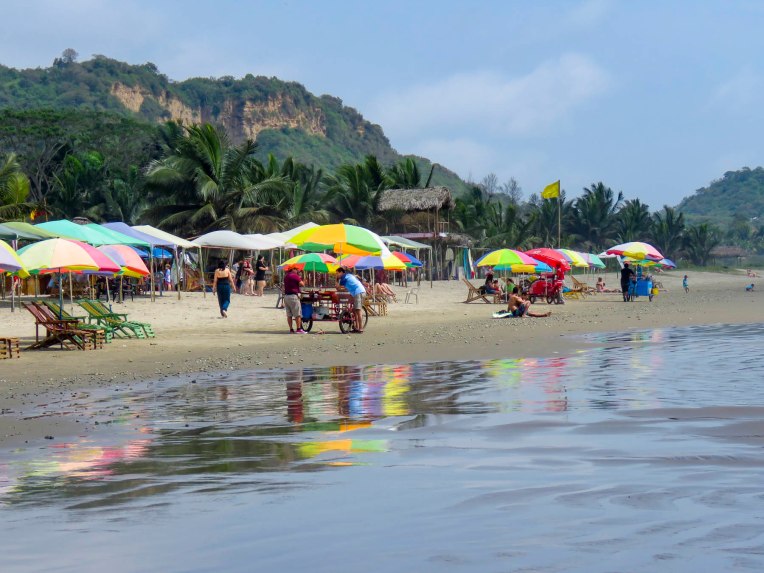
IMG_0157Our quest for eternal Spring-like weather has brought us to Olon, a rustic beach town on Ecuador’s southern Pacific coast with a wide, flat sandy beach that stretches for nearly five miles without a high-rise to been seen. Think San Juan del Sur in Nicaragua fifteen years ago, before it was discovered, or Costa Rica thirty years before it became a top tourist destination.

It’s ideal for long solitary walks along the beach collecting shells, especially near the Mirador del Olon cliffs that rise dramatically from the ocean.  On the other end of town, the Rio Olon runs through a nature preserve, where we have entertained ourselves photographing various birds and listening to their calls. It’s amazing how small birds seem to have such loud songs that carry for a long distance.  The river doesn’t have enough flow to reach the sea this time of year and is separated from it by a berm of sand, but one night after a heavy rain the river breached the sand dune and carved its way into the sea.

Change is coming slowly to Olon. The roads in town were only bricked three years ago. So, there is still a wonderful, authentic undeveloped rawness to the town, with a small number of hotels and surf schools mixed in amongst local homes, many in an unfinished state.

It’s off season now in October, mostly cloudy with a light mist every morning, but the water is still warm, perfect conditions for the handful of surfers and us. Although the waves can reach 12ft at times, beginning surfers prefer the less crowded, smaller wave conditions in Olon over those of Montañita, which can be more treacherous.

The seafood cabanas along the beach are only open on the weekend this time of year, when it seems to get slightly busier. Our favorite is the last one down by the fishing boats, Mar del Sol, run by Rosa.  You can’t beat her stuffed calamari, ceviche or various seafood salads.

At times teams of fishermen can still be seen setting seine nets from the shore and hauling their catch in by hand. Other fishermen fight the waves to launch skiffs through the rough surf from the beach.

Sometimes the beach is a corridor of commerce with freshly caught fish being delivered by motorcycle from small villages further up the coast. Fathers can be seen taking their kids to school on the handlebars of their motorcycles, gently splashing through the incoming tide, hurrying to get there.  Outside of the small school every morning it’s like New York’s Times Square for ten minutes, with all the coming and going of motorbikes.  One morning a parade of open bed, stake trucks carrying school children dressed in different team colors honked and cheered its way, through town, to the school for a day of field activities.  Every evening there is a well-attended, robust soccer game on the beach. Just imagine the memories these kids will have!  Outside our hotel, a group of young men play marbles in the dirt road under a dim streetlight, using the light from their cell phones to help find stray ones hidden in the foliage along the road. In the morning we passed our neighbor, singing softly to herself as she gardened.

Our budget friendly and relaxing short-term rental at Rincon d’Olon included a very nice breakfast on the rooftop terrace prepared by the gregarious innkeeper, Chris.  He emigrated from the Netherlands to Ecuador six years ago after volunteering in the Andes and vacationing on the coast.  He is a great source of information for all things local and arranged several transfers and an excursion for us.

By ten o’clock each evening the streets are empty.  From our apartment at night we can hear the waves crashing onto the beach, along with roosters crowing – they start at one in the morning, seemingly on a campaign to discourage tourism – and dogs barking to each other. There is no traffic in this tiny four block square village.  Everyone walks in the middle of the road, roosters, dogs and cats included.  Restaurant owners and musicians will wave to you if they remember your visit from the day before.  Every day pushcart vendors wheel their offerings of fruit, eggs, cheese, clothing, kitchen supplies, etc. through town, each peddler singing out a different sales pitch. Sometimes the loudspeakers around the usually sleepy plaza blare: community news, music or appeals for donations to help a family pay funeral expenses.  One Saturday, families gathered to pay their respects at a memorial service on the plaza.  Later, the pallbearers hoisted the casket onto their shoulders, and solemnly carried it through town to the cemetery. A small marching band followed the coffin, playing El Condor Pasa, If I Could, by Simon and Garfunkle.

For a change of scenery, we took a day cruise out of Puerto Lopez to Isla de la Plata, an uninhabited island twenty-three miles off the coast, which is part of Machalilla National Park.  It is also referred to as the “budget Galapagos,” where we had a chance to see nesting blue-footed boobies and frigate birds.   Fifty dollars per person included shuttle transportation, boat ride, snorkeling gear, lunch, a three-hour hike with a licensed guide, and most importantly, the chance to see humpback whales. IMG_7650 Puerto Lopez hosts the largest fishing fleet on this part of the Ecuadorian coast.  Lacking a protected harbor, all the fishing boats beach on the shoreline to unload their fresh catch.  It is a hectic scene of never-ending activity that is reminiscent of an earlier era.

At Olon’s outdoor fish market, vendors sell a wonderful selection of fresh seafood caught locally at stalls set up along Ruta del Spondylus, named after a thorny shell used by the Incas in religious ceremonies.  The stalls are closed by noon, so we try to get there early for the best choices.  Two kilos of fresh large shrimp set us back six dollars.  After dark small tiendas fire up their street-side charcoal grills, offering chicken, pork or sausage shish-kababs to go, or you can stay and eat at tables set up in the street.  Several doors down from our hotel, at a little house with a barbeque made from an old fifty-gallon oil drum, two plates of fresh grilled fish with a beer cost five dollars for dinner.

For a tiny place, this village also has a surprising number of refined, small niche eateries, most of them created by foreign surfers, (Swedish, Dutch, Brazilian, Argentinian, Venezuelan, Austrian, Russian) who fell in love with the waves here and never left. Wonderful and inexpensive empanadas ($1.00) along with the best papas fritas (French fries) can be consumed at Bahio which offers Argentinian fast food.  Next door, La Churreria has good coffee and desserts which rival any French bakery in Paris.  For more refined though still very casual dining, try the eclectic menus at Momo or Cotinga’s across the main road.  Cotinga’s might be the only restaurant in Ecuador where you can get home-made borscht accompanied by a shot of vodka, prepared by Olga, a Russian expat.

The only thing Olon really needs is a French inspired chef whose specialty is Coq au Vin.  Roosters, you’ve been warned!

Till later,

Craig & Donna

Vilcabamba: Fountain of Youth or Old Hippies, Horses & a Dog Parade

IMG_4211A vacation from vacation? Yes, its’s tiring work having fun every day!  Where to? Vilcabamba had been on our radar for a while, having read about its reputation as the “Valley of Longevity,” with mineral rich spring water and crisp mountain air.  That along with its location in Ecuador’s Southern Andes Mountains at an elevation of 5000ft, a setting which provides continuous spring-like conditions, has attracted a growing expat population of greying hippies, new agers, and backpackers seeking the fountain of youth and inexpensive housing.  We had to check it out!

Hostal Izhcayluma was recommended as the place to stay. Their $15.00 per person shuttle from their sister hostal, La Cigale, which was only a block from our apartment, as well as a line from their website (Izhcayluma is NOT a place for perpetually grouchy people) cinched the deal.  Hostal Izhcayluma, promotes itself as a “luxury resort spa priced for backpackers” and truly has to be one of the best travel values in Ecuador or all of South America.IMG_4389With a bed in the dorm room going for $9.50 and luxury private cabins starting at just $39.00, the resort has a reputation as the place to go to “relax, enjoy, forget time and stay awhile.”  Free morning yoga classes, a wonderful restaurant with some German dishes, and super affordable spa treatments (90 minute, deep tissue massages for $24.00, we both indulged) definitely promoted well-being.  Bird calls filled the air and the distinctive face of 6,000ft high Cerro Mandango, god lying down, watched over the valley.  Three thousand feet lower in altitude and much farther south, Vilcabamba was about 10 degrees warmer, which was a much-needed reprieve from the chilly days and nights we were experiencing in Cuenca.

At the reception desk are numerous brochures for off-site activities in the valley.  For reasons unknown I’ve become attracted to horseback riding later in life. With naïve enthusiasm I was immediately drawn to the five-hour ride on “galloping horses” to Cascada El Palto high in the surrounding mountains.  I’ve been riding about a dozen times, mostly on mountain trails, and the horses walked, occasionally trotted short distances, but never galloped.  Thinking this was hyperbole from the corral, I was reassured by the sign-up sheet that asked for your riding experience.  A family of five marked inexperienced. I thought this was a good sign and that the group would saunter slowly through the countryside for the novices. They must have been a family of vacationing gauchos from Argentina, because as soon as our guide shouted VAMANOS! we galloped out of Vilcabamba, into the mountains, and back.  I walked liked a saddle-sore cowboy for a week after that.

A disc-jockey blasted “You can’t always get what you want” from loud-speakers setup on the steps of the church across from the plaza as we walked along vendors’ craft tables in the street.  Trophies were visible on the DJ’s table as were bags of dog food under it.  To our delight, Vilcabamba was having its Best Dressed Dog competition today and later in the afternoon a Paso Fino, fine step, horse show.  About twenty proud and good-humored dog owners entertained a large crowd through several rounds of judging.  Several dogs had cheering sections in the crowd.  One or two ran away out of embarrassment, I think.  Trophies and bags of dog food were presented to the winners by a tiara and sash wearing Miss Vilcabamba.

IMG_5723

Immediately after the awards were presented the crowd rushed to the other side of the plaza where the horse show was ready to start.  Horsemen with perfect posture, dressed in immaculate white shirts, pants and hats, paraded their mounts up and down the dusty street to the sound of lively Spanish music.

The restaurant porches around the plaza were full of aging gringos, drinking beer, sipping wine, observing from afar.  Occasional a whiff of pot floated down the street.  “My friend is really good at colonics, she’ll be here soon” was an odd conversation snippet we overheard.

We were glad we visited Vilbamba for a long weekend, but were relieved we hadn’t committed to spending more time there.  Thoroughly relaxed we headed back to Cuenca.

El Barranco – Cuenca’s Most Interesting Neighborhood in Ecuador’s Renaissance City

With a vibe and cultural scene reminiscent of Florence, Italy, Cuenca continues to reap tourism awards as a hot new destination in South America. The city is investing heavily in infrastructure with a new tram line opening soon, but with all this positive press the streets are still mostly filled with Cuencanos (people of Cuenca) going about their daily lives.  Masses of flag-led tour groups are unheard of, as are masses of tourists in general.  We have been in Cuenca for five weeks and have never felt the crush of tourist season descending upon us.Parque de San Sebastian_001The city does a wonderful job supporting its craftspeople who still use traditional, made by hand, methods to create exceptional pieces in jewelry, textile, ceramic, wrought-iron, tin and copper workshops located across the city.  Toquilla straw weavers in the villages around Cuenca who carry unfinished sacks of Panama Hats into the city’s sombrero (hat) factories also need to be included into this group.  There are also several traditional felt hat tallerias (workshops) that cater to the indigenous women who live in the rural areas around Cuenca. The fine arts scene is also well represented with galleries and artists’ studios often next to traditional crafts workshops. To get the broadest experience of this vibrant arts and crafts community a tour through Cuenca’s most interesting neighborhood, El Barranco (the cliffs), and along its busiest street Calle Larga, is a must.  The colonial buildings that front Calle Larga back onto the cliff which overlooks Rio Tomebamba and the newer southern part of Cuenca. Wide stairs in several parts lead down to Paseo 3 de Noviembre, a shaded pedestrian walkway and bike path that follows the river for several miles.Coronel Guillermo Talbot Stairs_001This route actually starts several blocks west of Calle Larga at Cuenca’s Museo de Arte Moderno (Museum of Modern Art) across from Parque de San Sebastian which has a large fountain and several nice places to eat. Casa Azul, which has rare sidewalk tables that face the quiet plaza, and Tienda Café are good choices.  Most of the workshops won’t have business signs over their doors or street numbers, might open by ten, but will reliably close between one and three for lunch.

Just around the corner from the Museo Municpal de Arte Moderno at 7-49 Coronel Guillermo Talbot is the unimposing metal embossing workshop of Carlos Bustos. With his workbench by the door to take advantage of the daylight and his finished pieces hanging behind him, he works until the sun sets.  Still keeping the traditions of his family alive he offers embossed decorative pieces which can be traditional or whimsical.  At the end of the street a mural-lined staircase will take you down to the Rio Tomebamba; instead make a left onto Presidente Cordova and then veer right at the Y in the road onto Bajada del Valo. A few doors down is the felt hat Sombrereria of Camilo M.  Hanging from his walls are dozens of white felt hats in various stages of completion with name of the person who ordered it pinned into the brim.  Ask permission to take photos and you will be greeted with a smile.  Just past the hat maker,  Plazoleta Cruz del Vado merges with Mirador del Barranco.  This small plaza has several whimsical sculptures, largest of which depicts the traditional festival game Palo Ensebado (the teaching stick – climbing a greased pole) and a religious cross which celebrates the founding of Cuenca in 1557.

Walking along this scenic overlook, open doors reveal artists’ studios and Casa Museo La Condamine, a museum/antique store that houses an interesting menagerie of long forgotten Cuenca furnishings and antiquities.  Next door to them is the Prohibido Centro Cultural, an alternative museum that displays sculptures and art that could have been inspirational for your worst nightmare or an award winning sci-fi/horror film, depending on how you look at things.  It has a café. Further along the balustrade, musical chords waft from an instrument maker’s workshop, drawing you in, as the craftspeople test their work . Stairs from this scenic overlook lead down to Calle la Condamine and several coppersmiths.

Rounding the corner onto Calle Larga is like returning from the Amazon to New York City. It’s tenfold busier, with the Mercado 10 de Agosto (Cuenca’s central market) accounting for most of the activity in the first block.  This a great short detour to get some exotic fruits or fresh bread and rolls from the numerous panaderias that surround it.  Diagonally across the street is the Museum del Sombrero de Paja Toquilla (free), a still operating panama hat factory where you can watch the manufacturing process and try on the finished product.  They have a lovely rooftop café, the only one in Cuenca, that overlooks the Rio Tomebamba and park below.  They offer you a free cup of coffee when you purchase a hat.  From the rooftop here you can see the jewelry workshop and store of Andrea Tello on Av 12 de Abril across the river. One of Cuenca’s finest silversmiths, having created filigree masterpieces that are in museum collections around the world, she earned the UNESCO Award of Excellence in Handicrafts in 2010.  Just a few doors away is the wide alley Bajada del Padron where you will find the workshop of an ironsmith who makes Pucara, a symbol given as a gift to bring good fortune and prosperity. The sculpture incorporates the Christian cross with images of the Sun and Moon to honor Pachamama.

Continuing east along Calle Larga you will cross the intersection of Benigno Malo. For the next several blocks the restaurant choices are tremendous, with options for Arab and Indian cooking to gourmet Ecuadorian cuisine and everything else in between.  El Mercado and El Jardin offer fine dinning experiences that are very enjoyable. For a more casual environment try Goza Espresso Bar which has outside table facing a small park. The lower level of Museo Remigio Crespo Toral (free) offers the Café del Museo, which is truly an oasis of calm in this bustling city, has terraced outside dining that looks over the lush greenery along the Rio Tomebamba and Paseo 3 de Noviembre. The museum itself is worth exploring to see how Cuenca’s gentry lived at the end of the 19th century.  Or you can head to the Wunderbar Café on the Francisco Sojos Jaramillo stairway that leads to the Centro Interamericano de Artes Populares (CIDAP – free) which offers changing, monthly craft exhibits.

Back on Calle Larga the Museo de las Culturas Aborigenes looks unimpressive from its entrance, but the museum upstairs has an enthralling collection of 8,000 indigenous artifacts that spans 15,000 years and 20 pre-Columbian cultures, stone-age to bronze-age. Downstairs there is a very good, no-pressure gift store with excellent pricing. Next door is the fascinating studio of metal sculptor Julio Machado who creates hummingbirds and other animals in bronze and aluminum.  Stay straight on Calle Larga when you come to the fork in the road at Todos los Santos Church; this will lead you to a store front painter’s studio where his favorite subject seems to be the church you just passed.

At the end of Calle Large at what once was the Inca city of Tomebamba, its terraced gardens still home to grazing llama, now stands Museo Pumapungo (free), one of Ecuador’s finest museums. The first floor offers changing contemporary art exhibits as well as a fascinating collection of artifacts discovered on site here. Upstairs features exhibits which represent all of Ecuador’s diverse cultural groups and their historic way of life.  Topping it off, there is an unusual exhibit of shrunken heads, tzantzas, along with how-do instructions in Spanish and English from the Shuar people of the Amazon.

Across the river from the Museo Pumapungo is Las Herrerias, the street of the iron forges, where several workshops create utilitarian and decorative works; to locate the workshops, just follow the sounds of hammers striking anvils. Plaza del Herrero, at the end of the street, has a very interesting monumental sculpture dedicated to the ironworkers who helped build Cuenca.  Be sure to try Tortilla de Choclo, a scrumptious corn pancake that is pan-fried on large griddles along the street in this neighborhood.

Artisans not in the Barranco neighborhood, but definitely worth the effort to visit, are ceramicist Eduardo Vega (internationally recognized for his decorative arts.) His workshop and home are a short walk downhill from the Mirador de Turi. Located on the new tram-line that runs through the historic potters’ Barrio Convencio Del 45, at 2-90 Mariscal Lamar, is the traditional, ceramic workshop of Jose Encalada where he and his son Ivan still form every piece using a potter’s kick-wheel. A few blocks over on Vega Munoz is the contemporary, ceramic studio of Eduardo Segovia where he creates whimsical decorative pieces influenced by South American traditions. Closer to the historic central part of Cuenca is the Mama Quilla silversmith shop on Luis Cordero. Here, Harley-riding Ernesto creates fine filigree pieces that reflect the cultures of the Andes.

We enjoyed walking through El Barranco, and specifically Calle Larga.  The route we suggest here provides a wonderful overview of life and art in Cuenca.

Till later,

Craig & Donna

A Month with Friends

Tonight finds us at a hotel just a few minutes away from the Jacksonville  International Airport, taking account, sorting and repacking one last time before our flight to Ecuador and the beginning of our two year adventure.  We’ve been on the road for exactly thirty days, traveling down the eastern seaboard, visiting friends and family that our preretirement schedules prohibited us from seeing as frequently as we should have.  They have so graciously opened their homes, shared meals with us and entertained us.  And they have been the most wonderful local tour guides, highlighting the best of their communities and opening our eyes to the beauty of this region.  It has been several decades since Donna or I had undertaken an extensive road trip and we were thrilled to see the natural grandeur that abounds in this country.

Our first Sunday away from home we celebrated with a New York Times newspaper, a long forgotten ritual, and lattes outside under towering pines at our friend Janet’s house,  a few blocks from the ocean in Dewey Beach, DE.   That first week of official retirement we just chilled.

In Rockville, Maryland we stayed with Sue and Kent in the center of town.  They had moved down to the DC area several years prior.  Rockville is such a great example of what urban living should be like.  Homes above shops and restaurants, with a small city park to anchor it all, creates a thriving community.  A day exploring the National Portrait Gallery with Sue was a real treat and it is so much more than just a collection of paintings of old white guys.

Driving through the mountains of West Virginia, we headed to Parkersburg which sits on the mighty Ohio River.  Cheryl and George, who held their wedding reception in the backyard of the parsonage, live in the Julia-Ann Square Historic District, which features several blocks of lovingly restored homes of local industry titans, from the 1860’s through early 1900’s.  A trip down the Ohio River on a sternwheeler paddle boat along with Martini Monday were highlights of that happy stay.

Our son Bob has lived in Charlottesville, Virginia since graduating college and has fallen in love with this town and surrounding region.  We had great time with Bob and Samantha, visiting several wineries on the Jefferson Wine Trail and later walking along the lively pedestrian mall in the center of this wonderfully diverse university town.  Sadly as we walked back to the car one night we happened across the curbside memorial to Heather Heyer who was killed by a car purposely driven into a group counter-protesting against white supremacists.

Lynn and Mike graciously let us stay in their future retirement home in South Carolina, which they’ve hardly had the chance to enjoy just yet. Lynn’s suggestion of a day trip to Greenville was a delightful experience.  Greenville has to be one of the prettiest small cities in the United States.  The city park encompasses a river which flows through the center of town and has a pedestrian suspension bridge over it.  Once bordered by industrial revolution-era factories, these buildings have now been revitalized into restaurants, hotels and chic shopping stores.

Off the beaten track in St. Marys, Georgia, we chilled with Mare and Bob, retired pastors and friends since Donna’s days at seminary, as the heat index hit 104F.  We did venture out to eat seafood, explore the waterfront and find a decommissioned nuclear submarine thrusting forward from the earth.  A visit to a gun range turned out be surprisingly enjoyable.  It helped that I was able to hit the target.  Finally I tried some Gator and it doesn’t “taste like chicken”, but it’s just as tasty with its own more distinctive flavor that is quite enjoyable.

“There is so much more to Daytona Beach than the 500 race and Spring Break” as Donna and Jeff, old friends and migrants from Doylestown, say.  And they are right! From St. Augustine to Cape Canaveral, this part of Florida was a delight to explore.  A boat ride along the intercoastal waterway was especially fun, with sightings of manatees and dolphins, as were visits to the Marine Science and Rescue Center at Ponce Inlet, to view sea turtles being rehabilitated, and The Kennedy Space Center (NASA.)

Thanks again to all our friends for a wonderful month of experiences and memories.  Our journey begins today as we board our flight to Quito, Ecuador!

Till later,

Craig & Donna

Ayvalik, Turkey: A FISHING VILLAGE

Narrow Lanes of Ayvalik
“Ayvalik! How do you know of Ayvalik? This is where the Turks go to vacation” And “You must go to Cunda!” is a phrase we heard proudly repeated more than once.

This post was written about our trip to Ayvalik, Turkey in 2013.

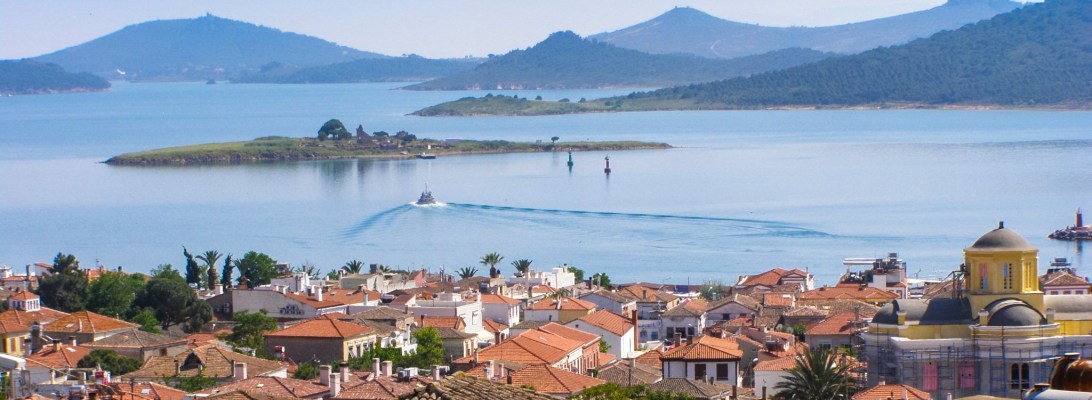
A Mount Rushmore sized, carved stone profile of Atatürk loomed over the highway and filled the front windshield as my wife and I sped north, round a bend on the E87, escaping the Izmir airport. “I will be getting married in three weeks” our taxi driver Ozzie joyfully announced, then softer and more ambivalently “there are so many preparations to make ready before our wedding, we have to buy a refrigerator, stove and bed for our new apartment.” “About half way there we will break at this rest stop that makes the best homemade yogurt.  Mama likes the yogurt with mild green peppers (yogurtlu biber) marinating in it, I always stop here on the way back to buy some for her.  It reminds her of the way grandma used to make it.” Ozzie continued, “just last week there was a newspaper editorial lamenting the demise of fresh yogurt and how the store-bought yogurt now lasts forever and never goes bad!”  And so began our journey to Ayvalik and a week on the northern Aegean coast of Turkey last May.  Located two hours by taxi (four hours by bus) north of Izmir, on the southern shore of the Bay of Edremit, Ayvalik is fortunately just a little too far north and off the usual tour circuit, a full day’s drive away from the buses full of tourists that visit Ephesus then descend onto the beaches of Turkey’s Southern Aegean or Western Mediterranean coasts.  “Ayvalik! How do you know of Ayvalik? This is where the Turks go to vacation” And “You must go to Cunda!” is a phrase we heard proudly repeated more than once.

ayvalik_turkey_2013_039.jpg
A view across Ayvalik.

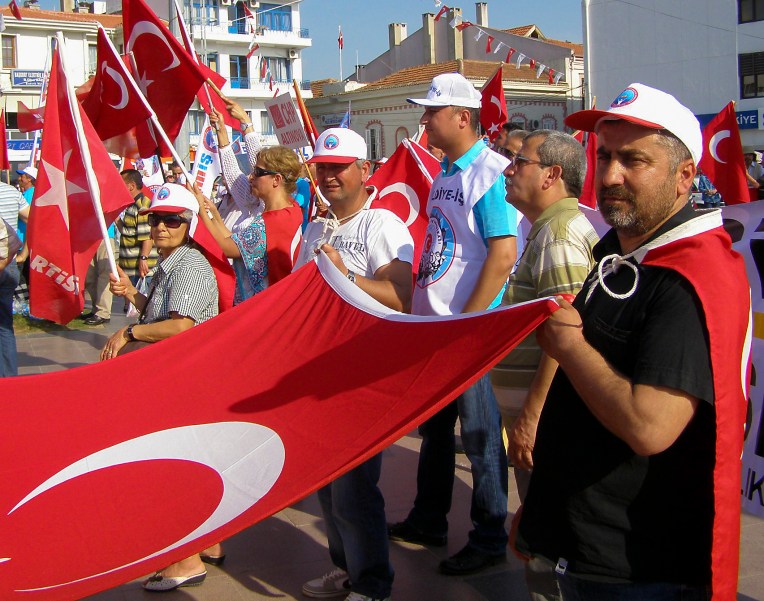
As we approached Ayvalik, salt evaporating ponds lined one side of the road as gentle Mediterranean waves rolled onto the narrow beach across the way.  Turning off the highway, the road rose gently through acres upon acres of olive groves, ruins of an old stone Greek Church flashed by, its roof gone, leaving only the bell tower to pierce the silver-green canopy of the olive trees.  As the road crested, a quick glimpse of Ayvalik flashed by, red tiled roofs and minarets set against the sparkling, turquoise blues of the Aegean.  And across the bay were the low hills of Cunda Island in the distance.  The May Day celebrations were in full swing on the palm tree lined waterfront, and in front of the ubiquitous statue of Atatürk a sea of labor unionists chanted and waved crimson Turkish flags aloft as our taxi passed. May Day Celebration
Erinç our hostess smiled to us from the door of Eolya Konukevi as Ozzie jumped the low stone wall with our bags in hand to show off his youth.  The salt air and Mediterranean diet had not worked its wonders yet, so we walked the long way around to greet her.  “Please wear these slippers when you enter, it is our custom.” Four years earlier Erinç escaped the urban crush of Istanbul and opened Eolya Konukevi, a small four room boutique inn in a three story, 120 year old Greek townhome she lovingly renovated, keeping its historical ambience and charm.  The bedrooms were on the small side so we opted for room #7, the only one with a private terrace.   The terrace was too hot to use during the unseasonably warm ninety degree mid-day heat, but wonderful early in the morning or later in the day when the sun was lower and a perfect spot to enjoy a bottle of Turkish wine bought from the local grocery store.  In early May we were the only guests for most of the week.  Nevertheless each morning Erinç presented, in the sunken, high-walled courtyard a bountiful variety of fresh baked breads or pastries with homemade jams, honey, tomatoes, cucumbers, a wonderful assortment of olives, local cheeses, Turkish egg dishes and the delicious Turkish staple, Cevizli biber – a meze prepared with red pepper paste, hot red pepper flakes, onion, walnuts and cumin mixed to a moldable consistency and used to garnish many recipes.  “You will see gallons of it in the weekly market on Thursday, the town gets crazy full, vendors fill the street and villagers from all around come into town to shop,”  Erinç told us.

Fishermen
Fishermen tending to their nets along the quay in Ayvalik.

Embracing the pace of village life we walked everywhere, and hoped to stay thin. Along the quay, boat hands dangled over the side of excursion boats, busy sanding and varnishing them into pristine shape for the coming high season.  Some fishermen sat atop their moored boats mending nets, and others tinkered noisily with engines.  Lined with boats, palm trees and seafood restaurants the waterfront of Ayvalik, though much quieter and laidback, resembles many others fishing villages along the coast.  The charm of Ayvalik is that it has no major attractions, just the wonderful ambiance of a once prosperous commercial fishing and olive oil processing center, now mostly forgotten and lost in time. Far away from any major historical sites, the townspeople here are just going about their lives, and wonderfully so, not catering to a substantial tourist infrastructure.  There was only one short block with several bars, just off the waterfront that looked like it would be a noisy spot during high season.   With tables and chairs outside that further narrowed the already thin lane there were more cats and dogs asleep under the tables than patrons the night we passed.

Horse Drawn Carriage
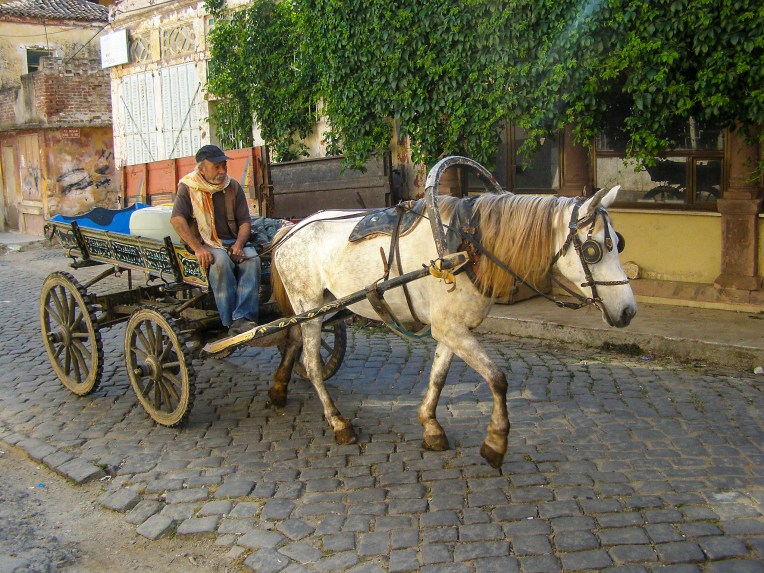
Horse drawn carriages can easily navigate the narrow lanes of Ayvalik and are still used for a variety of delivery jobs.

Meandering, cobbled lanes and back alleys led us slowly up the hill away from the waterfront and it seemed into an earlier century.  Slowly crumbling pastel colored homes in various stages of decline lined both sides of the streets. Missing sections of stucco revealed still solid stone construction underneath ignored exteriors. Many homes had their doors chained shut decades ago, the locks heavily rusted over from neglect or abandonment (recall pictures of Havana, Cuba).   Offset occasionally by a rare renovation in progress , the early signs of gentrification were beginning to edge in.  Horse drawn wagons are still used by vegetable and fruit vendors to ply their trade and to deliver refrigerators, stoves and other large household items through lanes too narrow for modern trucks to navigate.  The vignettes of everyday live abounded  – the world’s oldest newspaper delivery man carefully balancing an ancient moped between stops, ringing the doorbell and sharing news for a few moments before sputtering away to another door further down the bumpy lane.  The lone cow tied to a bright , orange slide in a vacant children’s playground.  Fresh fish and Octopus taken from the sea just hours earlier, for sale on the pier early in the morning.  School children in their uniforms, playfully headed home for lunch. Lambs’ heads, beef hearts and other organs hung in the butcher’s window.  Piles of freshly baked Simit (a bread ring covered with sesame seeds all over) just taken from the baker’s oven and displayed on the ledge of his open window to cool. The candied apple seller walking the streets, hawking his caramelized treats from a tree like structure. A painter carrying his buckets, brushes and large extension ladder to work, carefully, dipping it under low hanging telephone lines as he walked.  Men crushing, weighing and bagging coal just off the main square, covered head to toe in black dust. Stacks of split wood – used to fire so many grills and ovens – and impart that distinctive flavoring.   Scarfed women, walking together their arms linked in camaraderie.  A farmer racing by on his garden tractor, pulling his wife bouncing all over in a small wagon behind him, with a death grip on its sides she held her face high into the morning sun. Her head scarf blew straight out behind her.

The Minaret and clock tower of Saatli Camii mosque were just visible through the fabric and clothing which dangled from the shade awnings strung over the streets on market day.  (A thriving Greek Orthodox cathedral until the Turkish War of Independence ended in 1923. The resulting peace treaty forced a population exchange between Turkey and Greece.  Where Ottoman Greeks on the Turkish mainland where forced to leave their homes and move to the Greece and Turks living in Greece where forced to relocate to Turkey.  Many churches were abandoned and left to ruin. Others were deconsecrated and with the installation of a minaret and minbar pointing towards Mecca from which the Mullah preached, repurposed as mosques.) Overnight, the local merchants had emptied the contents of their shops onto the streets and itinerant traders erected temporary stands to display their wares.  Transforming what seemed to be all of Ayvalik into a vast outdoor shopper’s metropolis offering everything for the home and farm.  The village was full of families from the outlying smaller villages that had taken buses to Ayvalik for this weekly event. The women wore traditional baggy pants, brightly colored with floral prints. And various, clashing mix matched tops and scarfs edged with intricate embroidery, created an ever changing, beautiful kaleidoscope of color and patterns as they flowed up and down the lanes, and shopped for more exuberant  fabrics to sew at home.Pazar Yeri - the Thursday Bazaar in Ayvalik
Just off At Arabacilan Meydani (the Horse Carts square) the lane was full of chickens, lambs and goats for sale.  Sun dried farmers chatted and laughed with each other while they sat in the doorframes of buildings along the lane, or sent text messages as they waited to make a sale.  A block over was the Koy Pazari (weekly farmers market), with baskets full of artichokes, eggplants, fava beans, mulberries, onions, quince, squash, strawberries and grape leaves, stalls full of cheeses and more varieties of olives than I have ever seen in one place. Bottles of pomegranate and grape dressing were stacked high.  Herbs and spices!  Saffron and Cardamom were amazingly affordable (we should of bought more) And displays of the Turkish Spice blend of Red Pepper, Oregano, Paprika, Garlic, Cumin, Cilantro, Salt and Black Pepper abounded. Each herb poured separately upon the other into plastic bags creating an attractive rainbow package. Numerous five gallon tins of Cevizli biber with their tops shaped to pyramids lined the aisles.

Seytananin Kahvesi (The Devils Cafe)
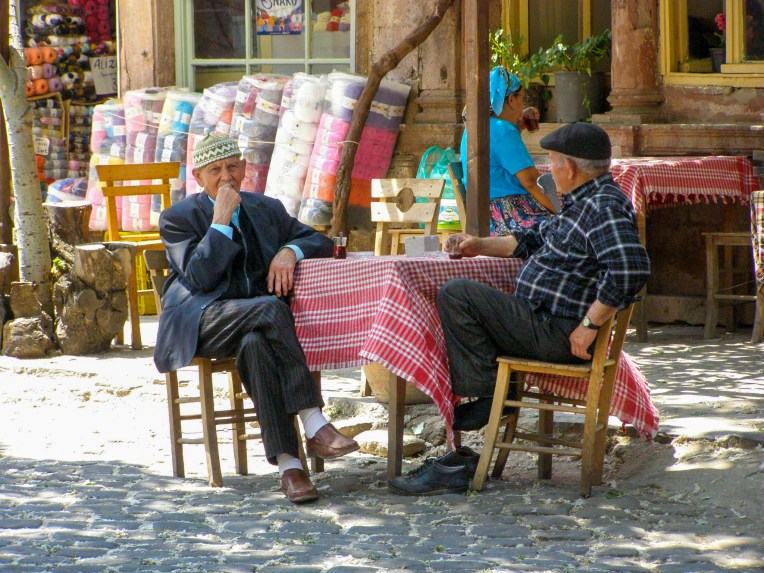
Old men resting and drinking tea in front of Seytanın Kahvesi,(the Devils Café) tea house.

As the day got warmer and the crowds thickened we decided to escape the frenzy and headed to Seytanın Kahvesi  (the Devils Café), a teahouse we had found the day before.  Very hot apple cay (.50TL) served in tulip shaped glasses soothed use as we rested under the shade of a large tree in front of the cafe and people watched.  Even in the mid-day heat the old men wore the traditional sweater vest under a heavy suit jacket.  Some rubbed prayer beads as they chatted with friends, while others read papers and sipped tea.  One pulled his feet from his slippers and cooled them against the paving stones.  At another table, a man with crutches pulled x-rays from a large envelope and held them up to sky to show the pins in his leg to his friends.  In the small cross-roads,  opposing drivers negotiated which tractor would give way.  From the front door tea runners ran down the lane balancing trays of cay to merchants in the market.  Above our table hung a sign with carved out and painted, dancing stick figures spelling Cop(M)adam,(the trash  ladies) the woman’s cooperative next door.  Established to give women who have never worked for pay outside the home or farm, a chance for some economic independence.  They create wonderful, contemporary handbags, pocketbooks and other fashion accessories out of thrown away materials. The small shop was full of chatter and laughter as the women worked together. An exotic aroma from the communal lunch being prepared drifted through the shop from the stove in the back room.  We chose several items and negotiated lively with an occasional raised eyebrow or thumbs down along with their handy calculator.
With a picnic dinner in our bags from shopping at the bazaar we headed back along a different route further up the hill to find the once grand (and never converted) orthodox cathedral, Taksiyarhis.  Situated alone in the center of an overgrown square, the ruins sadly dominated the neighborhood.  Large, untamed fig trees sprouted from the foundation.   With part of its portico collapsed and the rear of the apse caved in we peered inside to see fallen rafters and small sections of walls with fading designs barely visible, were all that remained of its former glory.

ayvalik_turkey_2013_054.jpg
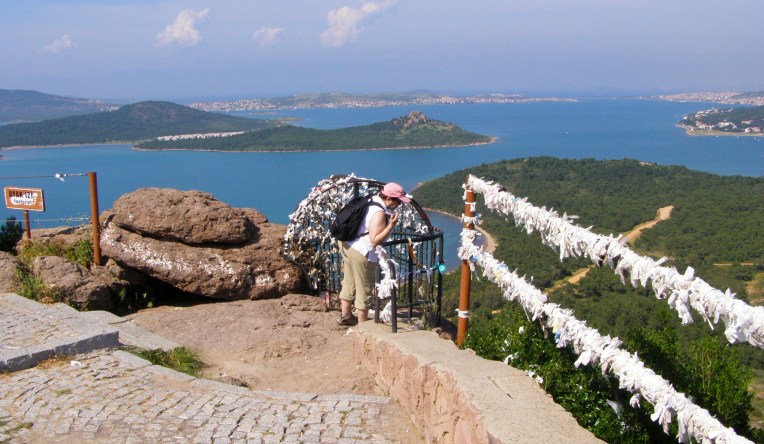
Looking north from Seytan Sofrasi (the Devils Table) towards Cunda Island on the horizon.

“Have you gone to Cunda yet? Erinç inquired. “Not yet, each time we walk past the ferry there is no activity. We might have to take a Dolmus (shared) Taxi over for the day.” I replied.  “With it being so hot this Spring they might start ferry service earlier this year,” Erinç offered. Instead, we hired a taxi and headed to Seytan Sofrasi  (the Devils table) a rock formation located in a state park a few miles south of town.  Narrow, winding roads followed the shoreline around the smaller coves of the bay, revealing thin strips of sandy beaches round each curve.  Only a few families were out, some fathers fished as their kids plunged knee deep into the shallow water, and shivered with glee as they raced back to shore.  We passed several roadside stands with various flavors and shades of local honey for sale under beach umbrellas.  Eventually the road started to rise gently through a forest. The trees thinned to expose the summit and its panoramic overview to the north of two small bays below, then Ayvalik and the large island of Cunda beyond, surrounded by twenty smaller islands.  Lesbos, Greece hazily dominated the western horizon in the afternoon light.  Prayer notes tied to safety railings fluttered in a refreshing breeze against a flawless sky.  Ignoring the railing some people still climbed over to snap a picture from the edge, no guards were there to discourage them or save them from their selves if needed.  Though a sturdy iron cage protected an oval, foot like depression in the rock that local folklore says Satan left behind as he leapt to party across the water in Lesbos for some crazy reason. It’s difficult to believe but it seems the Devil spent a bit of time in Ayvalik, if you go by the number of things that include his name, and the volume of ruined churches, monasteries and mosques built nearby to dilute his influence.

Fish Restaurants along the Quay in Cunda.
Fish restaurants line the dock in Cunda. Behind them stone lanes lead to Takisyarhis Kilisesi church and The Sevim Kent Library cresting the hill above the village.

We were in luck when we realized a short line was forming for the ferry to Cunda as we exited the taxi.  Storm clouds built over Ayvalik as the boat pulled away with only a handful of passengers aboard for the short journey. The weather threatened only for a brief time but did not deliver.   (During high season ferries from Ayvalik run to Lesbos, Greece and Assos, Turkey.  Diving trips to nearby deep, red coral reefs can also be taken, along with swimming boat charters to the islands around Cunda). A long line of seafood restaurants fronted Cunda’s quay.  Several blocks inland and on a slight rise, the cupola of the old Greek Orthodox Taksiyarhis Kilisesi church (same name but a different church) rose above the surrounding homes, was finally being restored as a museum and center for cultural events after years of neglect.  A candied apple seller braved the sun and walked the streets, hawking his caramelized treats from a tree like structure. The shade of the buildings offered some relief from the sun for three older villagers and their donkey called “Donkey” who had a weathered, wooden saddle tied to its back and us as we continued our walk  uphill to find a windmill that we had spotted from the ferry.  The windmill with a pretty veranda and small adjacent chapel now restored as The Sevim and Necdet H. Kent Library (Kent was a Turkish diplomat stationed in France during World War II who saved the lives of many Jews by providing them Turkish identity papers) are all that are left of an ancient monastery complex that sat upon the crest of the hill and overlooked Cunda and the waters surrounding it.  The library’s shaded cafe (free WiFi) provided the perfect spot to rest our blisters and appreciate the views, before heading back into the village for dinner.

Restaurants on Cunda
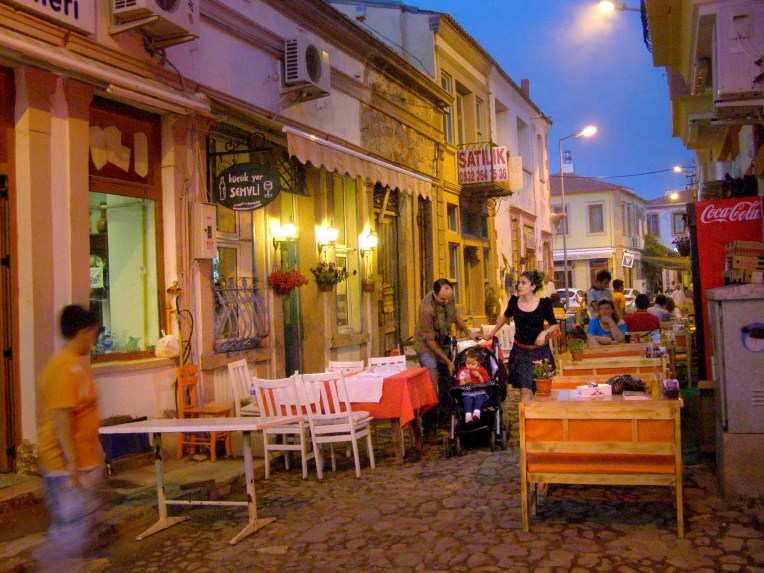
Many restaurants line the back lanes of Cunda with tables and chairs to enjoy an evening meal.

We rewarded our efforts later that evening with wonderfully prepared Cretan (Turks from Crete came to Cunda during the population exchange) dishes at Lal Girit Mutfagi, a small restaurant set in a rustic stone building with an outside patio across the cobbled lane.  Difficult choices tempted us:  which mezes to try from the mouthwatering assortment on display?  Since the night was warm, we were seated under the grape vines of the patio.  Occasionally the waiter hoisted a watering can and sprinkled water onto the cobblestone lane to keep down the dust from passing tractors as farmers slowly drove home through the village from their fields or orchards.   The restaurant did not have a paper menu; rather, Emine the owner/chef enthusiastically talked us through what she was cooking that night.  The pace of the meal was delightfully relaxed, no rushing, everything from the kitchen freshly prepared and delicious.  Soft cheese with wild spring herbs; mussels stuffed with spicy rice served on the half shell; grilled octopus; fresh anchovies in a light tomato sauce plated artfully in a spiral; artichokes with dill and stuffed grape leaves; and shredded vegetables with cheese and herbs wrapped in papery thin phyllo dough and baked to a golden brown; our meal appeared before us one exquisite dish after the next, as we enjoyed each of the chef’s creations.  Folks filled the lanes as dusk fell and brought in a refreshing breeze. The restaurant livened as the evening lengthened, a boisterous atmosphere reflected much laughter and heartiness.  Good Turkish wine, Raki!, a fine night, and a great meal still remembered.  Serife!  (Days later, Emine greeted us warmly as she shopped amongst the tables of fresh produce at Rormutauk Bazaar (the Sunday farmers market) in Sirinkent , just north of Ayvalik).

Shepherd
A shepherd with young lambs in Cennet Tepesi (Heaven Tower Park) above Ayvalik.

A lone crenulated tower spotted from the Dolmus taxi on the way back from Cunda looked worth another uphill hike.  Giant century plants and their towering seed stalks leaned over the path toward Cennet Tepesi (Heaven Tower Park) above the bay.   We followed the path through a slowly thickening pine forest to the tower I had glimpsed the night before.  An unattended flock of sheep quietly grazed in grassy undergrowth. From behind the tower the sound of more sheep bah-ing slowly moved closer.  We waited expectantly to see another flock arrive but were amused when only a lone shepherd, baa-ing, emerged carrying two young lambs in his arms. He baa-ed tenderly as if to convey his love for his flock and reassure the lamb’s mother that they would be reunited soon.

Hidirellez ( a May 5th celebration of Sping).
Some villagers still light bonfires, dance and jump over the flames in celebration of Spring.

At breakfast the next morning Erinç excitedly asked if we had heard of Hidirellez.  ”It’s still celebrated here in Ayvalik.  Today, every May 5th some of the families build bonfires in the streets in front of their homes. They play music, dance and cheer for each other and their neighbors to jump over the flames in a celebration of spring.” It’s not organized and fewer families do it than years ago.  You’ll have to wander the lanes farther up the hill, but I’m sure there will be some bonfires.”  Later that evening after a long siesta we headed back into the ancient backstreets. Two drummers, carrying big bass drums along with a cymbalist, noisily led a bride in a white gown and pink sneakers and groom in a tux, followed by a small group of raucous revelers in Halloween makeup.   Momentarily surrounded, we posed for photos with the party, and then they left in the direction from which they came.  Not the fire jumpers we were looking for, but encouraged nevertheless we continued our search.  A few blocks over, the homes and people gathered on the street in front of them were cast in the amber warmth of several small fires centered in the middle of the lane.  Some revelers danced to traditional music blasted from a CD player.  Couches and chairs were brought outdoors for older partiers to settle into. Behind them a few parents supervised young arsonists in training making small smoky fires.   We watched as the fires popped and blew sparks skyward when any burnable material was thrown in to encourage higher flames.   And with a running start, young and old jumped, when their nerves permitted, as best they could through the flames as everyone clapped and cheered them on.  Thankfully we did not witness any self-immolations that night.

As we walked back to our guesthouse, the square on the waterfront was surprisingly full of triumphant soccer fans, victoriously waving the team colors.  The Ayvalik team had won the state playoffs!  It seemed as if everyone who owned a scooter or car (not too many people do), overloaded it with flag-waving friends and raced down Ataturk Caddesi (the only two way street in town) several blocks, did a K turn and then speed back through town multiple times that evening.  The horns were still blaring when our heads hit the pillow.
The smell of smoke lingered in the air very early the next morning when Ozzie picked us for the trip back to the airport.  We offered him our best wishes for his quickly approaching wedding and changing life.  And wished for ourselves, that Ayvalik would not change at all, or at least very slowly.