
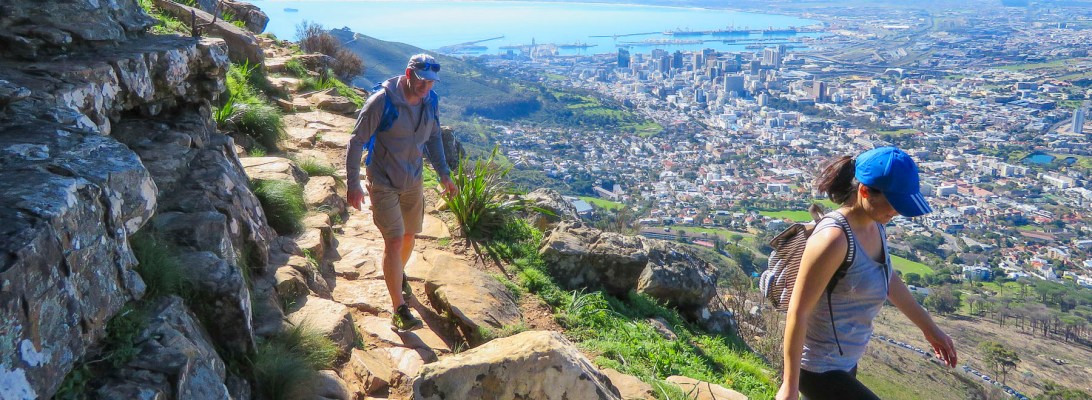
After spending a month in Bulgaria, we headed to South Africa at the end of May, to continue our pursuit of budget-friendly and interesting places with moderate weather to avoid the heat and humidity of a European summer. The seasons are reversed in the southern hemisphere, so we stayed for three months to take advantage of their mid 60sF (16C) winter weather, which is extremely mild in comparison to the winters of the northeast United States. So temperate in fact that most homes and apartments are not built with central heat, relying instead on small, portable electric heaters. Mostly, folks just layered up, and on those gale force, windy days we were amused to see people in fur-trimmed hooded parkas, more suitable for the Alaskan wilderness, than walking around Cape Town. 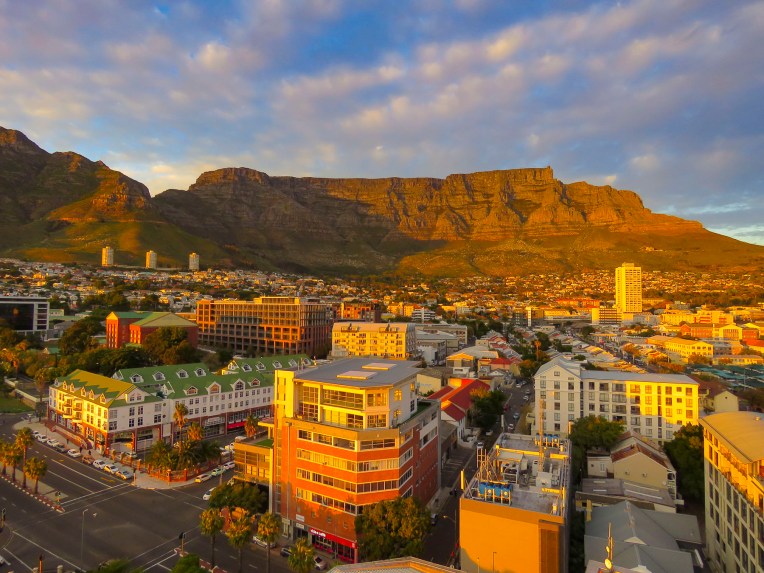 This would be Donna’s fourth trip to Cape Town and my first. Back in 1993 she visited friends she had made while attending Princeton Seminary, and a year later in 1994 she volunteered to be an International Observer for the first free and fair democratic elections in South Africa. In 2016 she returned to a city humming with positive energy and a growing economy. Unfortunately, this situation did not continue, and by 2019 the governance and economy of South Africa and its neighboring countries had stalled. The city was still beautiful and growing as a tourist destination, an amazing coffee culture had been born, but shuttered construction projects and an increasing homeless population were evident, and across many different socioeconomic groups, people were feeling disenfranchised. A multi-year drought exasperated many infrastructure problems that were being neglected. Fortunately, exceptional winter rains broke the severe drought and replenished the city’s nearly depleted reservoirs.
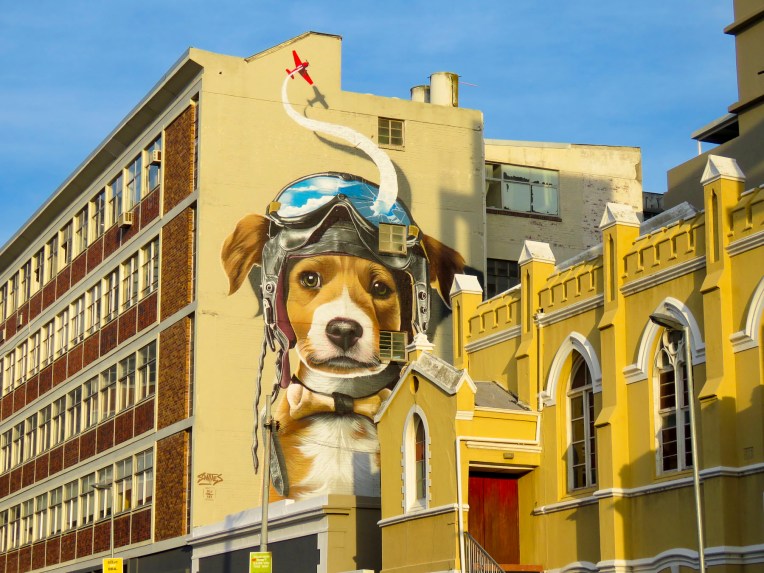 We immersed ourselves quickly into the neighborhood around our first apartment on Buitenkant Street, just a few blocks away from the District Six Museum, steam punk themed Truth Coffee and the Jason Bakery. One block over we followed Harrington Street, past some great street art, to Bootleggers for more coffee and the best peri-per chicken livers in CPT.


A little further along, Nude Foods sold everything by weight and encouraged us to reuse our bags and refill our olive oil and balsamic vinegar bottles. Around the corner Charly’s Bakery, an institution in CPT with an interesting creation story, would make our sweet tooth ache. We had a memorable evening beginning with dinner at Dias Tavern, a Portuguese restaurant, followed by a performance of Kinky Boots at the Fugard Theatre across the street. 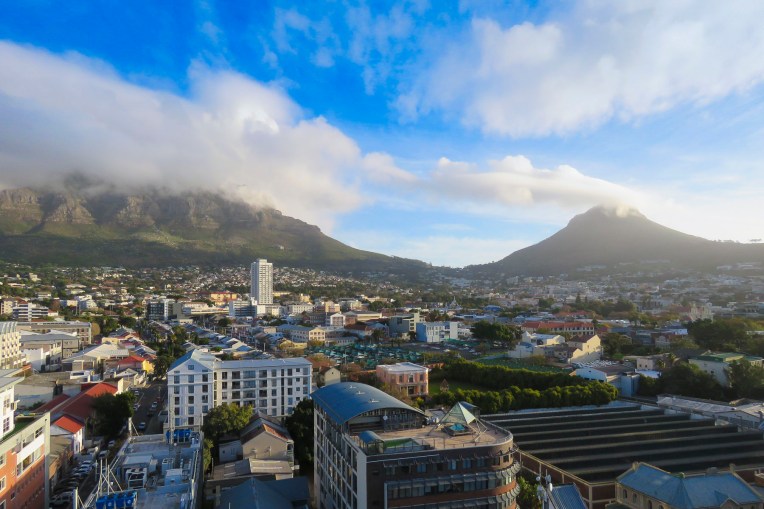 On the edge of the City Bowl and Zonnebloem districts, formerly District Six, our high-rise apartment building had a rooftop gym with fantastic views of the city, a 24hr doorman, gated parking and balconies with beautiful views of Table and Lion’s Head mountains. But the area immediately around us was in transition, without enough residential housing to call it a neighborhood.


After work everyone vanished and the streets were nearly deserted. The multistory construction project adjacent to our balcony was abandoned. While this offered privacy it had an unsettling, post-apocalyptic vibe that deterred our enjoyment of an otherwise sunny space. First world whining, we know, but we felt the Airbnb host was deceptive for several reasons regarding the apartment and surrounding area. Around the corner folks were sleeping rough on the street. We made a habit of carrying our loose change in our coat pockets to easily give it to the unofficial “car guards” and panhandlers. We had a nice room to enjoy nightly, and plenty to eat. How could we just pass them by? We walked all over the city, even at night, and never felt unsafe during our time in Cape Town, but using common sense is in order. During the weeks that we didn’t have a rental car we utilized Uber, which was very affordable, to cover greater distances around town.


We liked to joke that “you know you’re a local when you sign-up for the supermarket discount card.” Part of our weekly ritual was walking up Buitenkant Street towards Oranjezicht, an upscale neighborhood, with many fine examples of Cape Dutch architecture, to The Gardens, a multi-story shopping and residential complex with Pick-n-Pay and Woolworths grocery stores. On Prince Street the Hurling Swaaipomp Pump House still stands. Slaves pumped spring water for the surrounding homes here until the mid-1800s.
![IMG_7861[42783]](https://i0.wp.com/2suitcasesfor2years.com/wp-content/uploads/2020/02/img_786142783.jpg?w=272&h=363&ssl=1 "IMG_7861[42783]")

The cost of groceries and dining out in Cape Town was extremely favorable. Grocery items generally cost half of what they would typically cost in the states. A dinner for two with wine, dessert and coffee would run less than $40.00. Seafood was abundant, as you would expect in a coastal city, and inexpensive as well. We took full advantage of this, enjoying grilled octopus, sword fish, mussels and the best oysters on multiple occassions. Sautéed ostrich filets were a tasty meal we prepared for ourselves. Disappointingly, wild game was only available at restaurants. The Western Cape Winelands, around Stellenbosch, just outside Cape Town, covers a vast area and produces some exceptional vintages that are budget friendly. Winery tours of the area are a must and with over 200 vineyards the possibilities are endless.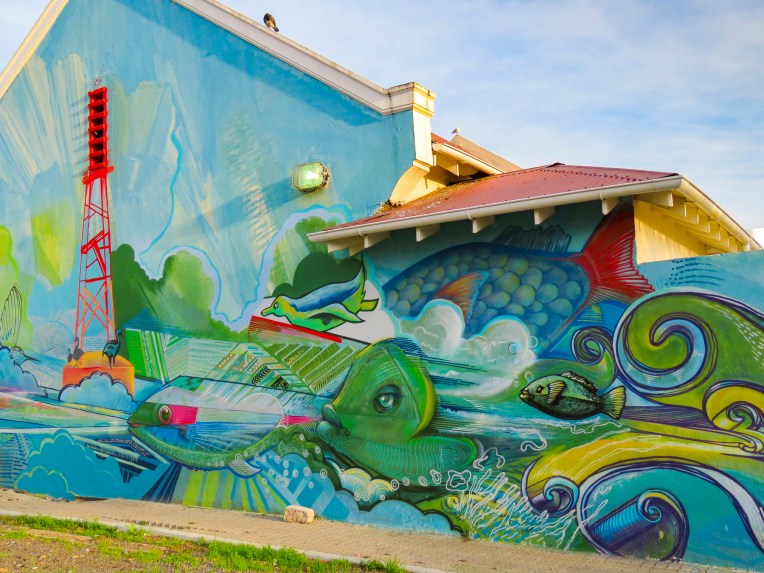 We had to find a dentist also, as just before our flight into Cape Town one of my crowns broke. Fortunately, South Africa is recognized for good medical and dental care and is slowly becoming a medical tourism destination. I found Dr. Ramjee on Google Maps, checked his reviews and made an appointment at his office which was within walking distance of our apartment. With his jovial and comforting manner, I instantly felt at ease. Though only a one dental chair office he had a state-of-the-art digital x-ray machine, a dental assistant and a receptionist. Besides the broken crown, I needed a root canal as well – what fun! My experiences with Dr. Ramjee were excellent and I raved so much about him Donna decided to use his services when the need arose for an emergency root canal and crown also. Unexpected expenses that in the states would be costly, even with insurance, were much more affordable and payable out of pocket here. The savings were tremendous.


Avoiding the past is difficult in Cape Town, with remnants of slavery’s legacy scattered about the city, even on the way to the dentist’s office. Just across from his door a concrete medallion marks the spot of the Old Slave Tree, where slaves were sold until their emancipation was declared in 1834. Around the corner the second oldest building in Cape Town – the Slave Lodge, a euphemism for a small pox-plagued, prison like structure for 500 slaves, still stands. It was built in 1679 to house the slaves owned by the Dutch East India Company that worked in the Company’s Garden, a farm. Today its mission as a museum is to explore the history “Slaves at the Cape: Oppression, Life and Legacy.”
 You just can’t walk enough miles along the coast or up and down Loin’s Head to keep the calories off in this foodie-oriented city. The Saturday- and Sunday-only food markets didn’t help, but they are a treasured tradition, throughout the region, that brings family, friends and tourists together to enjoy live music and good food.


Our favorite in Cape Town was the Oranjezicht City Farm Market down by the V&A waterfront. There’s also The Neighbourgoods Market, located at the Old Biscuit Mill in Woodstock. The Bay Harbour Market in Hout Bay, Blue Bird Garage Food and Goods Market in Muizenberg, the Elgin Railway Market in Grabouw and the Root 44 Market in Stellenbosch. All were enjoyable destinations beyond the city. On the lower end of Buitenkant Street, the Castle of Good Hope, a 17th century pentagon-shaped stone bastion fortress, stands surrounded by city streets, its cannons now pointing toward skyscrapers instead of enemy ships. It was originally built on the water’s edge of Table Bay by the Dutch to protect the harbor from the British. After a massive waterfront reclamation project in the 1930s and 1940s reshaped Cape Town’s waterfront, the castle now stands far inland.


It houses a military and ceramic museum along with the William Fehr Collection. This is a controversial exhibit today because the collection only depicts colonial history with no representation of the indigenous KhoiSan people who were the true first inhabitants of the western cape long before the Portuguese stepped ashore, followed later by the Dutch and British. It’s been 25 years since the first genuinely representative government of South Africa has been elected and only four statues of early indigenous leaders who fought colonization, and were imprisoned in the fortress, stand outside. Yet the lopsided narrative of this collection has not been addressed and many wonder why. In early June the castle hosted the 2019 Cape Town Coffee Festival which celebrated all things caffeinated with growers from across the continent, barista workshops and pop-up coffee stands. If you ever wanted to see thousands of folks ricocheting off the walls from too much free coffee, this was the place to be.


One of our favorites was a Senegalese coffee prepared by Khadim, a pleasant and engaging expat. It’s a strong sweet coffee, served with a long dramatic pour. We enjoyed it so much that we visited his shop, Khadim’s Coffee, repeatedly. So good was the java and food prepared by Khadim that his shop became our de facto rendezvous point for meeting friends in the city.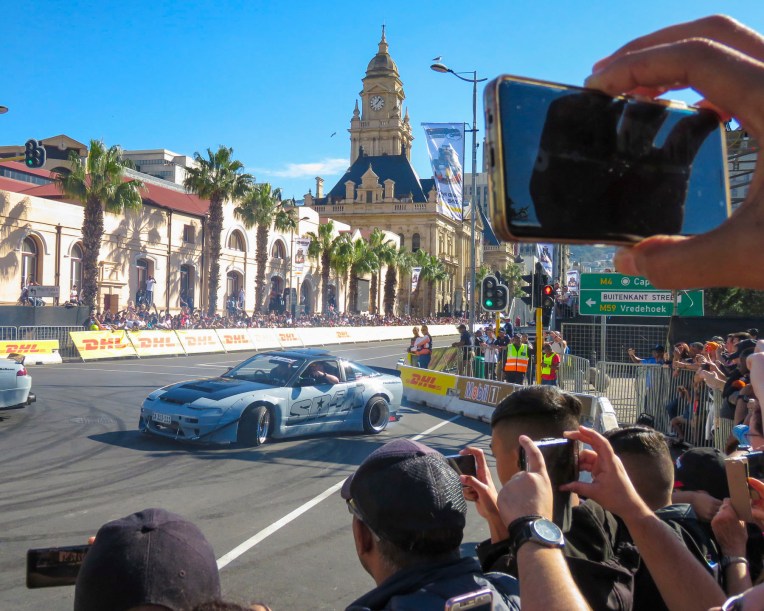 The coffee festival coincided with the Red Bull Cape Town Circuit where their F1 Aston Martin Red Bull racing car roared down Darling Street at over 150mph, passing the spot where Nelson Mandela addressed the nation upon his release from Robben Island, and turning the stretch in front of city hall, lined with bleachers, into a high-speed drag strip. At the intersections, souped-up street cars burned rubber and spun donuts while the Red Bull Air Force performed aerial acrobatics over the city. It was a raucous day that we could hear from our apartment.


Closer to the city center the District Six Museum tells the story of an atrocity, an afront to dignity that should never be forgotten. In 1867 the sixth district in Cape Town was formed as a neighborhood of immigrants, merchants, artisans, laborers and freed African and Asian slaves. It was close to the port and provided the muscle Cape Town needed to grow. It was home to ten percent of Cape Town’s population and thrived as a community for decades until 1966 when the apartheid government, seeing prime real estate under Table Mountain, declared it a whites only area. The district’s 60,000 residents were forcibly relocated with superficial notice into segregated townships 15 miles away, or further, from central Cape Town. 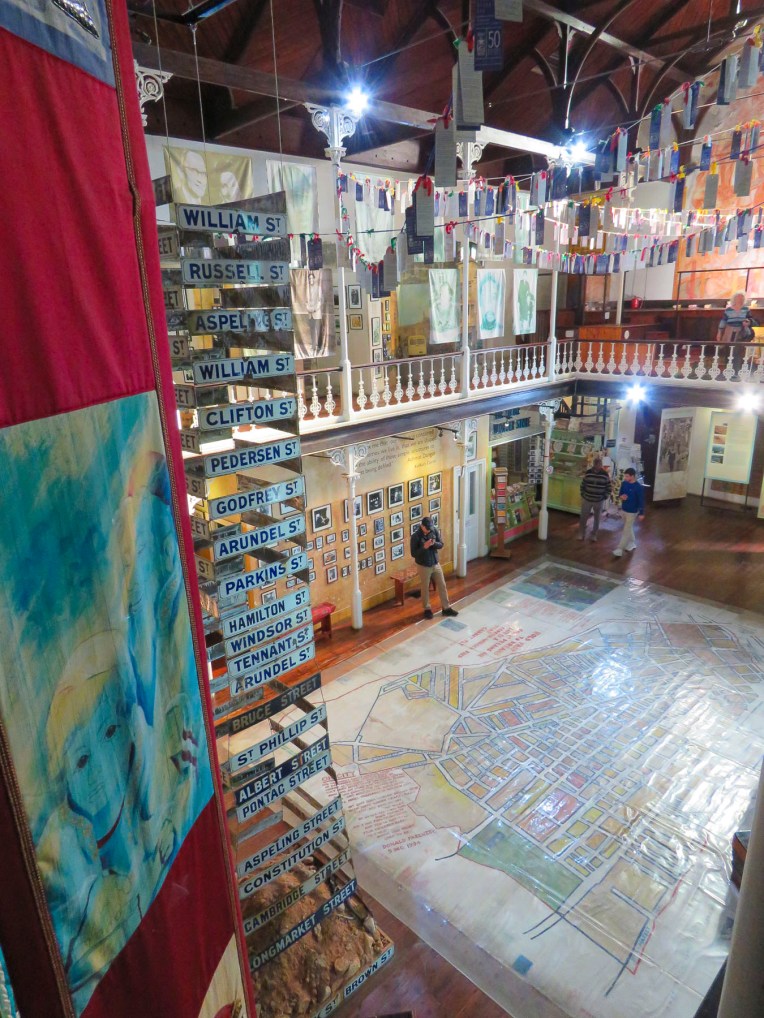 Families and neighbors were intentionally sent to different communities to break the spirit of the people. The apartheid government was so vile it “regarded the district as both physically and morally tainted by miscegenation, wholly unfit for rehabilitation” and flattened every building except for Churches. Even the original streets were destroyed, and new roadways were created so folks couldn’t find their homes, now vacant lots, that they legally owned. Much of the area still remains abandoned. The District Six Museum commemorates this tragedy and the lasting heartbreak of this cruelty.


The Company’s Garden was only a few blocks away. Originally a farm that supplied passing ships with food, it now is a wonderful urban park in the city center with old growth specimen trees, gardens, and café. Adjacent to the entrance of the park, Desmond Tutu used to preach from the pulpit of St. George’s Cathedral, an Anglican Church. And across the street a section of the Berlin Wall stands in remembrance of the struggles people are willing to make for freedom around the world.


At the far end of the gardens two museums grace the grounds and are perfect for a rainy-day exploration. The Iziko South African Museum is a natural history and science museum with a planetarium. It has wonderful collection of early aboriginal tools and rock paintings along with a large compendium of pre-historic fossil remains. There is something for everyone here and we found it to be fascinating. Outside, various street performers entertained visitors to the park.


Across the way the South African National Gallery has an eclectic collection of contemporary and tribal art from South Africa and the rest of the continent. The art scene is thriving in Cape Town with many galleries providing exhibit space to young, talented artists. The museum’s collection reflects this vibrant art scene. Despite our apartment’s faults, we enjoyed our time on Buitenkant Street. Watching the brilliant sunrises and the flat clouds – the tablecloth of Table Mountain – cover the summit and then spill down the side like a waterfall. The street life below spanned the gamut from groups of tutu-clad race walkers one day to noisily protesting sex workers or Fridays for Future demonstrators the next.


It would be superficial of us not to address the painful past of this relatively young democracy; apartheid and race are still underlying issues. Despite this, Cape Town, South Africa, was a wonderful experience: at once contemporary and traditional; challenging, progressive, and hope-filled, it captivated us for three months.
Stay tuned for more as we work our way across the southern tip of the continent.
Till next time,
Craig & Donna

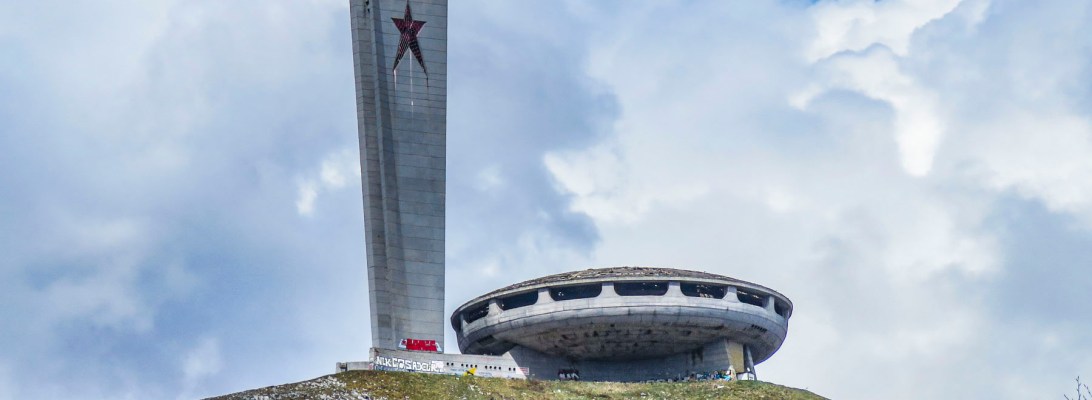
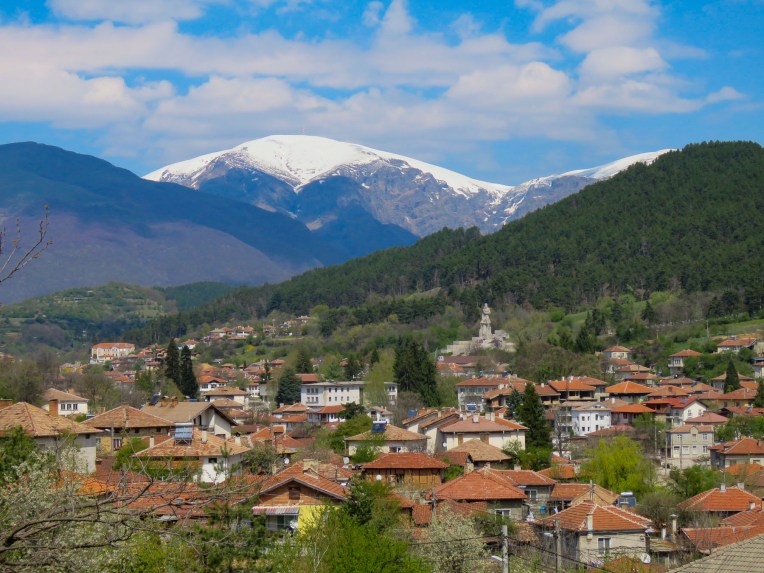 Heading north on Routes 64 and 6 we drove past fallow farmlands waiting for their Spring tilling, and forgotten industrial sites as we worked our way north towards Stara Planina, the Balkans Mountain range that runs east to west for 348 miles and divides Bulgarian into northern and southern regions.


 Turning down the long driveway of the
 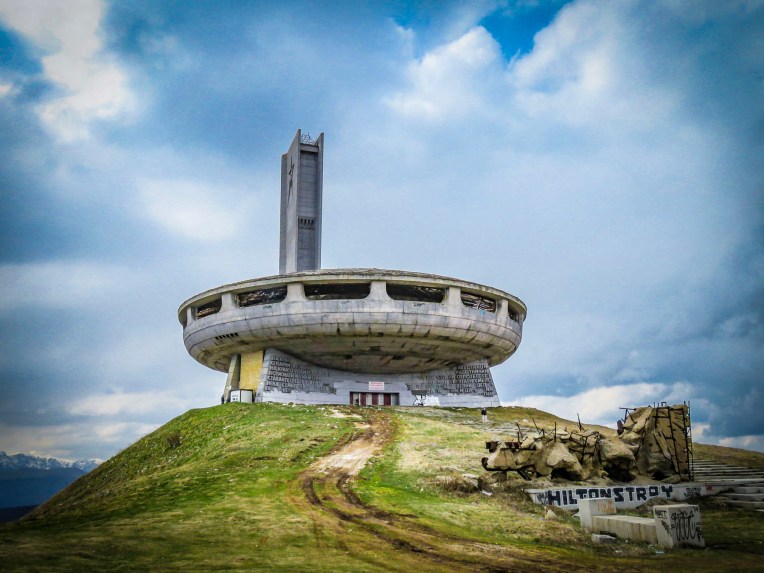 On a wintry, cloudy afternoon the silhouette of

 At the opening ceremony in 1981, tribute was paid to those who had gathered there ninety years earlier. “Let the work of sacred and pure love that was started by those before us never fall into disrepair.” Buzludzha was a huge success and a point of national pride for eight years, hosting communist party congresses and educational events. Schools and businesses booked tours for their students and employees. Foreign delegations were paraded through to witness socialism’s success. But then in 1989 the Berlin Wall fell and communism collapsed like a fighter jet breaking through the sound barrier. The monument to socialism was suddenly ironic, irrelevant and abandoned. In 1999 the security guards protecting it were removed and the building was left open to the public and it was looted. Anything of value quickly disappeared, and the rest was left to vandals and frustrated citizens who were known to take their anger out on the building with sledgehammers or spray paint. The red stars in the tower were shattered by gun shots. Soon the glass skylights broke and water damage from rain and the winter elements hastened its structural decline, and the building was eventually shut tight to protect folks from injury. The day we visited there was a lone security guard, suffering as he made his rounds in the bitter wind, protecting this crumbling modern ruin from a handful of visitors.

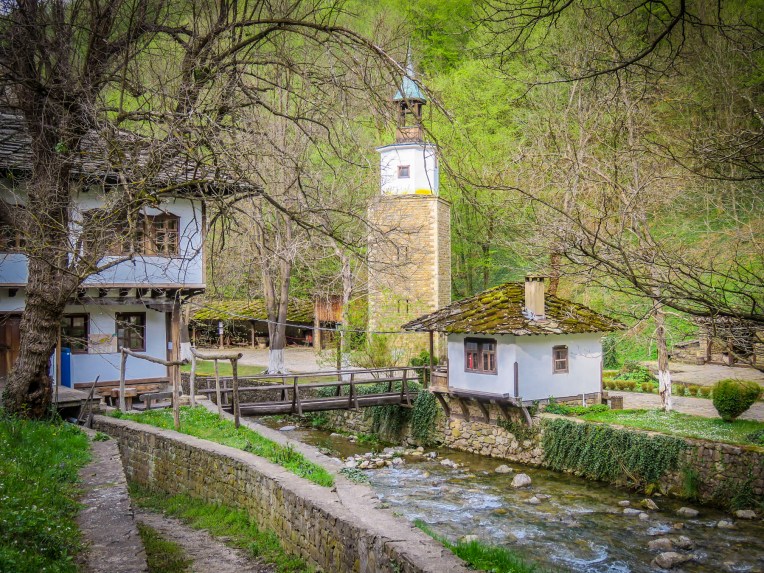 As we continued our journey north through the mountains on Route E85, the picturesque
  Woodcarvers, weavers and other craftspeople dressed in period outfits helped further to transport us to a simpler era at the beginning of the Bulgarian industrial revolution. We visited on a quiet day, but the museum has an extensive twelve-month calendar of events with many festivals listed that would have been nice to observe.
  Traveling along an isolated background road we worked our way towards Sokolski Monastery, known for its cliffside chapel overlooking the northern slope of the Balkan Mountain range. We weren’t disappointed; the church is stunning with its colorful exterior frescoes contrasting with the natural environment surrounding it.
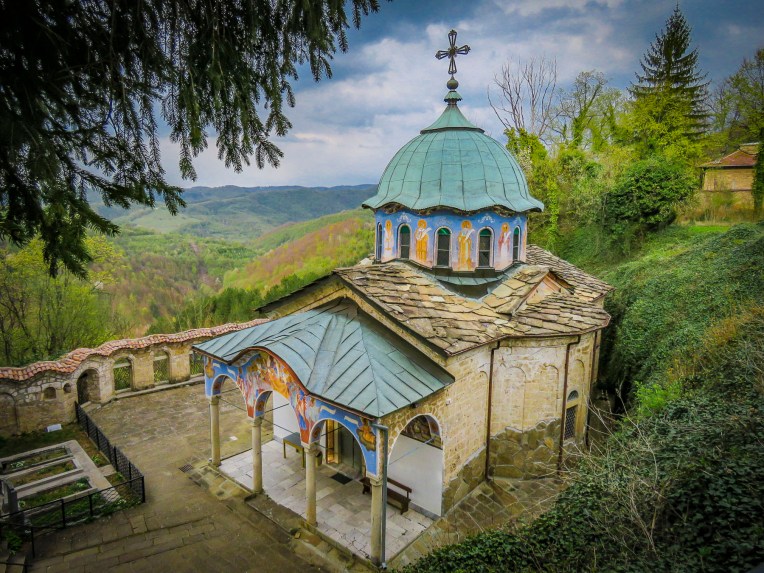 Built in 1833, the monastery has played an important role in Bulgarian history. During the April Uprising of 1876 eight freedom fighters took sanctuary there. Later captured by the Ottoman army, they were thrown to their deaths from the cliff behind the chapel. The short-lived April Rebellion was brutally repressed, but a year later Russia would help the Bulgarian rebels defeat the Turks at Shipka Pass and begin the march towards freedom. In the courtyard of the monastery an octagon-shaped water fountain was built with eight spouts to commemorate those fallen heroes. Legend states the fountain has never run dry and its cool water holds healing powers.
  We made it to Tryavna just in time to have dinner at the restaurant next to our hotel. Enjoying a hot meal after a long chilly day, we were entertained by the waitress trying to keep a determined stray cat from entering the restaurant every time the front door was opened.
 Generations of skilled woodworkers have lived in the Tryavna River Valley, turning trees harvested from the deciduous forests on the slopes of the Balkan Mountains into furniture and ornate wood carvings.

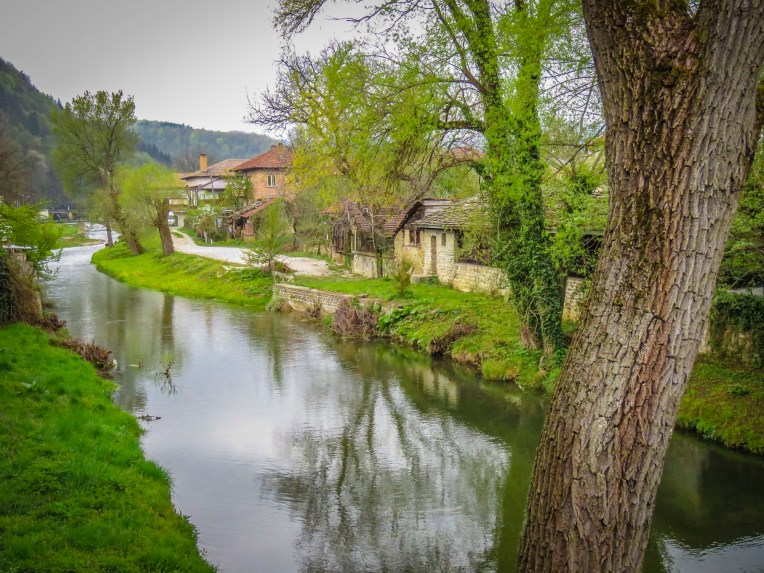 Crossing the footbridge over the Tryavna River at the clock-tower, the pleasant whiff of wood smoke came to us on a chilly Spring morning. Large woodpiles are essential in this region and we saw plenty of homes with the winter’s firewood neatly stacked, as we wandered around the village, with its parks filled with sculpture and tulips in bloom.


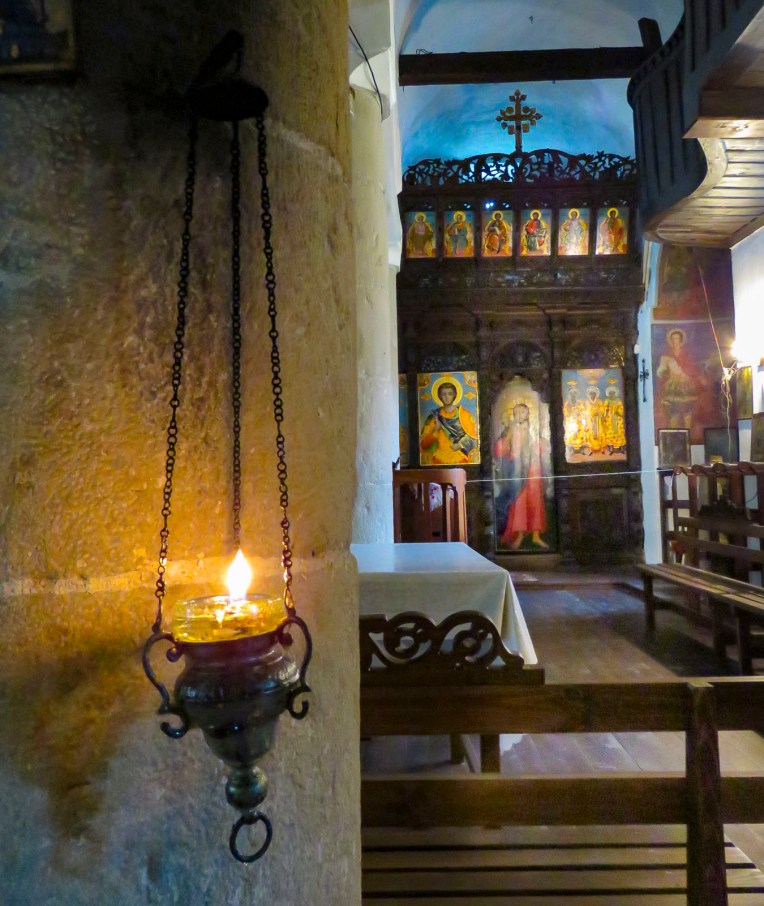
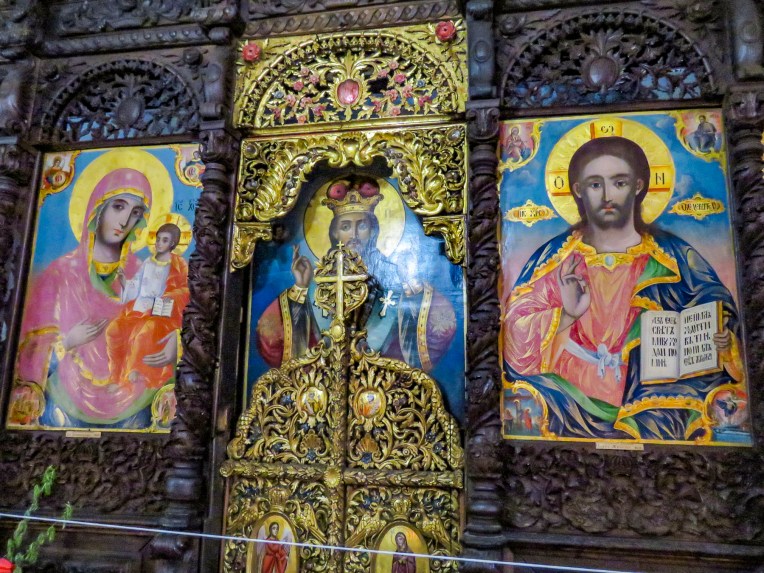 Over the centuries Saint Archangel Michael Church has been reconstructed several times. Its most recent incarnation dates from 1853 when the tall wooden belfry was added. Inside, the interior is richly ornamented with elaborate 19th century woodcarvings and iconography created by members of the Vitan family, famous throughout Bulgaria for generations of skilled artisans. The carved bishop’s throne is an exquisite masterpiece.
 The safest way to order your cup of java in parts of Bulgaria is to ask for a traditional coffee, not wanting to offend anyone by calling it Turkish. The fact is Greek, Albanian, Bosnian, Persian, Turkish andthe same, plus or minus cardamom or a local spice. But here in Tryavna at the Renaissance Café the coffee was brewed on a very traditional sand stove. A shallow pan filled with sand was heated over an open flame, and a long handled, brass cezve was filled with coffee and water, then partially buried in the hot sand to brew. With diligent attendance our coffee was brought to a frothy boil three times before being moved to the top of the sand where it stayed warm while the grounds settled. The ritual of the event definitely enhanced our enjoyment of the brew.
 We only just scratched the surface of this lovely country. There’s so much to see here, especially in its vast countryside. Hopefully one day we’ll get a chance to return.
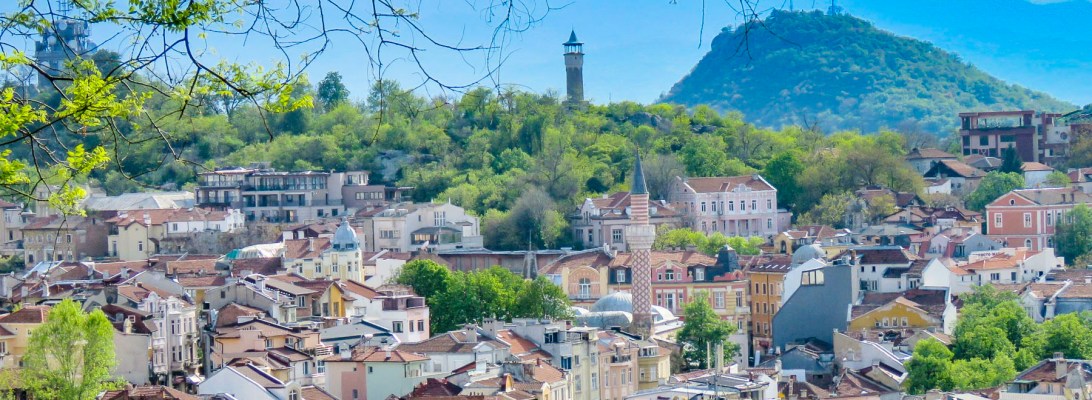
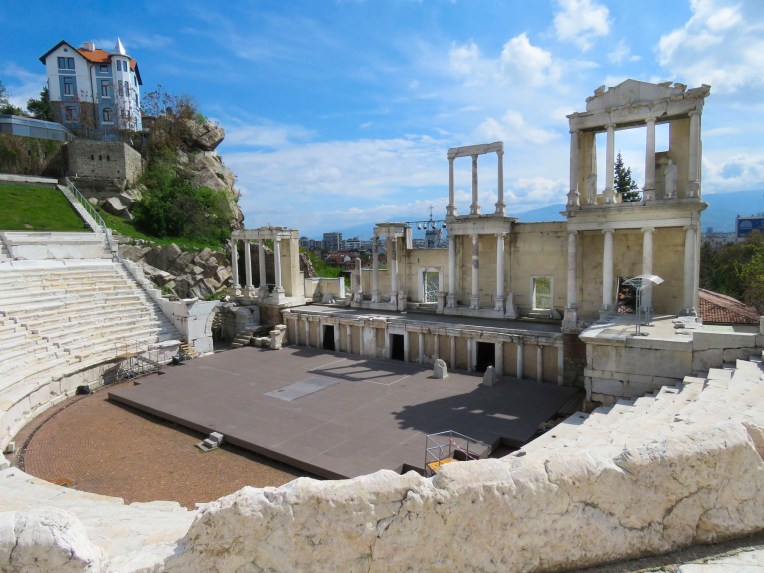 Just outside Old Town Plovdiv,


 At just over a mile long the pedestrian mall in the center of Plovdiv is the longest in Europe, running from the Stefan Stambolov Square along Knyaz Alexander I, and Rayko Daskalov Street before ending at the footbridge lined with shopping stalls that crosses the Maritza River.


 But the jewel of the mall area was the curved ruins of the Ancient Stadium of Philipopolis, with its fourteen tier seating area, unearthed in 1923. Situated below street level and surrounded by modern buildings at Dzhumaya Square, the ruins provided a dramatic juxtaposition of the ancient and contemporary, where you can actually see the layering of history and how the city was built over earlier civilizations. From this excavated section, archeologists have determined that the stadium was a huge 790 feet long and 165 feet wide and could seat nearly 30,000 spectators.
 Across the square the Dzhumaya Mosque is the main Friday Mosque for Muslims in Plovdiv. Constructed in 1421, it replaced an earlier mosque built in 1363 on the foundations of a Bulgarian Church destroyed during the Ottoman conquest. It is one of the oldest and largest Muslim religious buildings in the Balkans. At the café in front of it we enjoyed some sweet Turkish tea and pastries in the warm afternoon sun.


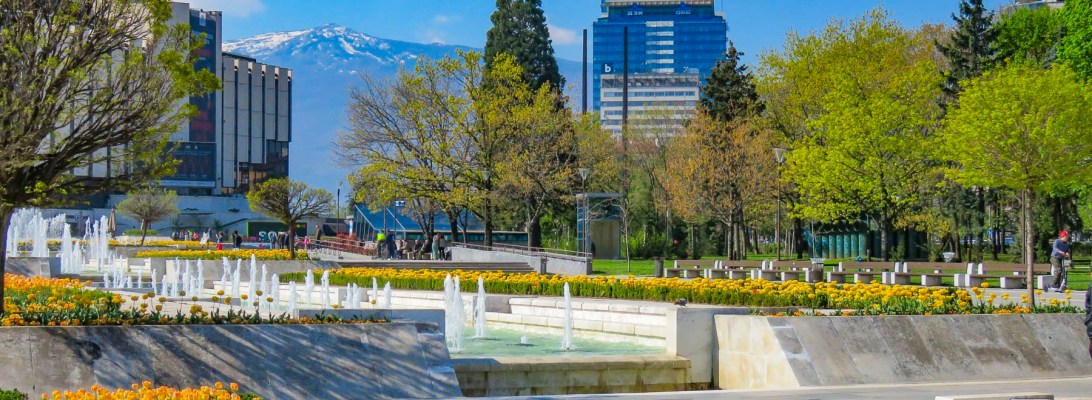
 From Portugal we were to go to England for three months of pet sitting in various locales to save some funds for our push into Africa later in the year.
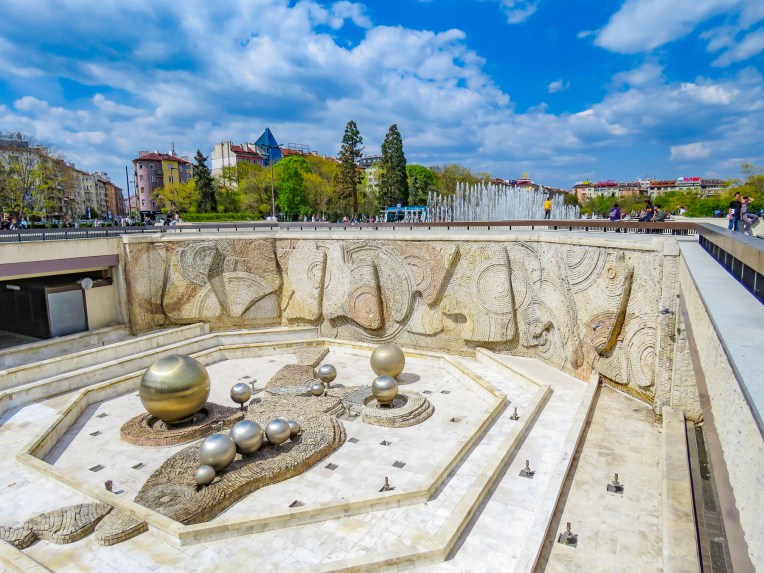

![IMG_4216[35050]](https://i0.wp.com/2suitcasesfor2years.com/wp-content/uploads/2019/12/img_421635050.jpg?w=178&h=237&ssl=1 "IMG_4216[35050]")
![IMG_4487[35046]](https://i0.wp.com/2suitcasesfor2years.com/wp-content/uploads/2019/12/img_448735046.jpg?w=178&h=237&ssl=1 "IMG_4487[35046]")

![IMG_5015[35024]](https://i0.wp.com/2suitcasesfor2years.com/wp-content/uploads/2019/12/img_501535024-e1577548338172.jpg?w=214&h=237&ssl=1 "IMG_5015[35024]")


 Weekends were especially rewarding when it was more likely we’d come across a street market or dance class in a park.


![IMG_4736[35121]-2](https://i0.wp.com/2suitcasesfor2years.com/wp-content/uploads/2019/12/img_473635121-2.jpg?w=245&h=184&ssl=1 "IMG_4736[35121]-2")


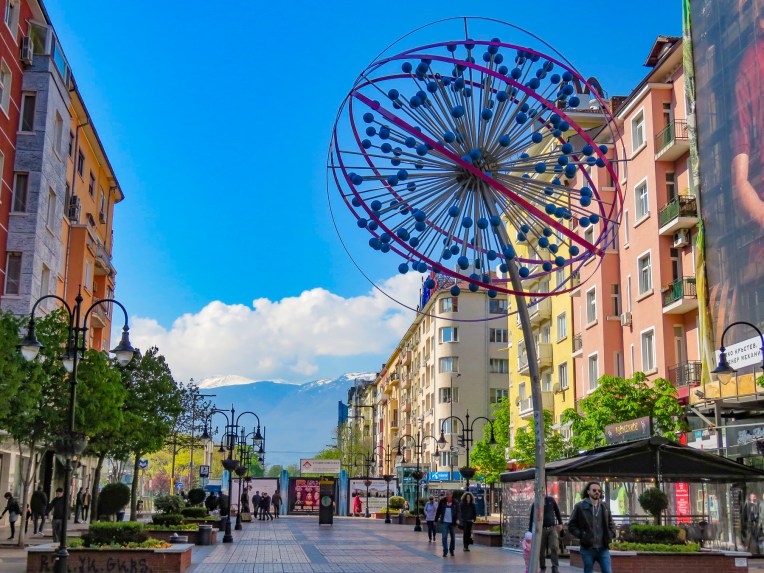 The cost of living in Bulgaria was very favorable with most items in the bakeries costing just one dollar and a nice dinner for two with wine, dessert and coffee costing under $40.00. A visit to a local dentist, recommended by our Airbnb host, to have a cavity filled cost $20.00. The x-ray needed cost $5.00 from a different facility around the corner.
 ![IMG_4282[36950]-2](https://2suitcasesfor2years.com/wp-content/uploads/2019/12/img_428236950-2.jpg?w=764) Our lovely, large one-bedroom apartment with living room, dining table and small balcony, just two blocks away from the popular pedestrian mall, cost less than $800.00 for the month. (We found it amusing that the two-burner electric cook top was kept in a drawer in the kitchen, but we made it work for us.) A 90¢ USD subway fare got us to the airport for our $10.00 per day car rental, with unlimited miles, for our road trips. There were some oddities though.
Our lovely, large one-bedroom apartment with living room, dining table and small balcony, just two blocks away from the popular pedestrian mall, cost less than $800.00 for the month. (We found it amusing that the two-burner electric cook top was kept in a drawer in the kitchen, but we made it work for us.) A 90¢ USD subway fare got us to the airport for our $10.00 per day car rental, with unlimited miles, for our road trips. There were some oddities though.


![IMG_4122[35061]-2](https://i0.wp.com/2suitcasesfor2years.com/wp-content/uploads/2019/12/img_412235061-2.jpg?w=199&h=265&ssl=1 "IMG_4122[35061]-2")
![IMG_4286[35051]](https://i0.wp.com/2suitcasesfor2years.com/wp-content/uploads/2019/12/img_428635051.jpg?w=272&h=363&ssl=1 "IMG_4286[35051]")


 After you crouch to enter through a low door and then look up in this intimate space, the WOW element of

 Our main destination was


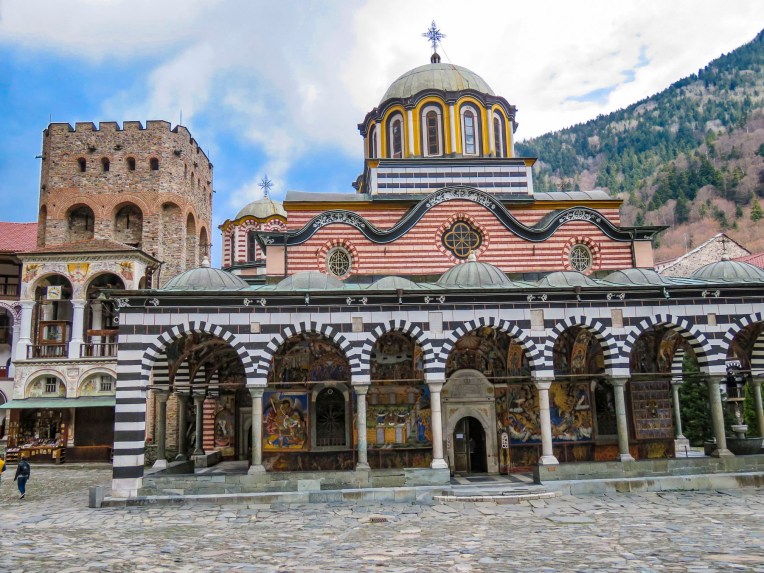 This is the only monastery to survive during the centuries of Ottoman domination over Bulgaria, when it was rebuilt in defiance of the Turks. The Bulgarian people have great affection for this monastery, as a symbol of their religion and culture during those turbulent centuries.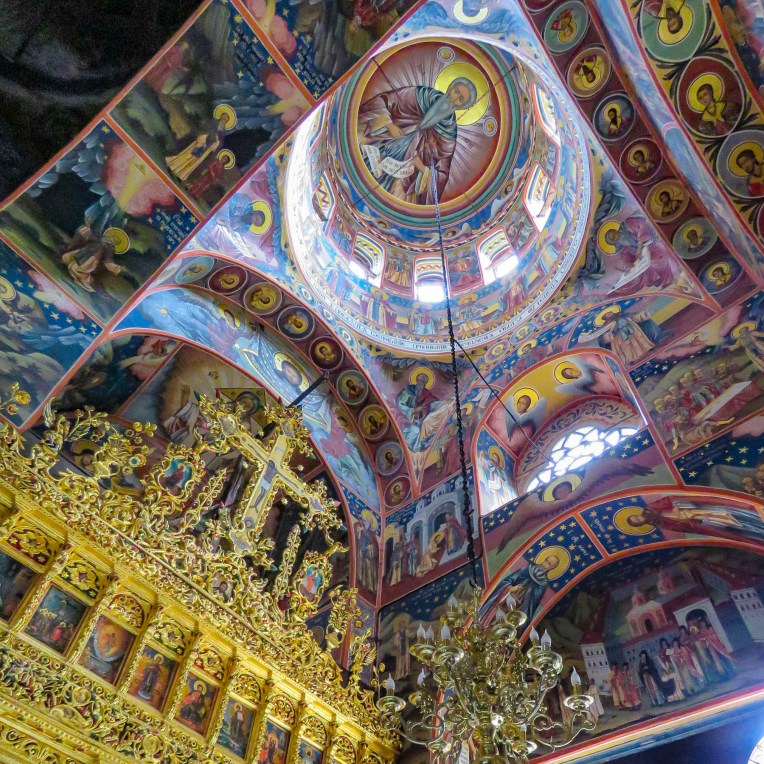


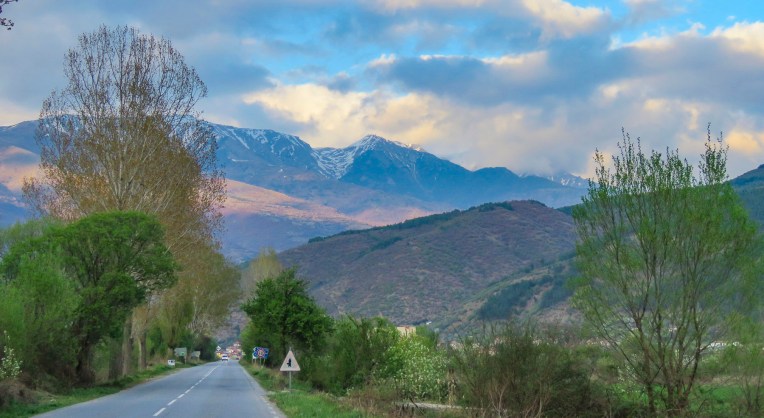 Thirteen miles from the monastery, on a side street in the town of Rila, we spotted a church with three small cupolas, that called for a quick stop. The church “St. Nicholas the Wonderworker Mirikliyski” was a surprising find with its cracked bell tower and muraled covered entrance porch, complete with woodpile.
 The painter of these hell fire and brimstone murals might have gotten his inspiration from the tortured works of Dutch painter Hieronymus Bosch. Unfortunately, the church was closed and we haven’t been able to find any other information about this off-the beaten-path treasure.


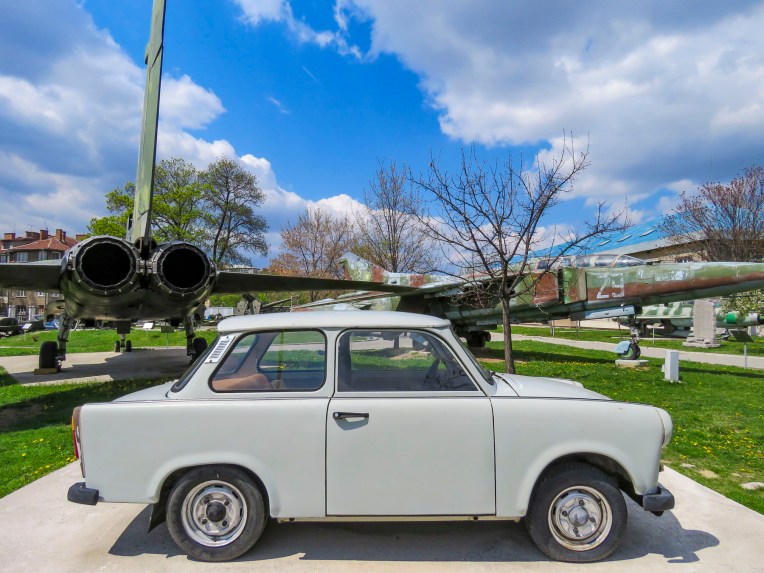
 The Unofficial Junk Museum is a vast, rusty and dusty collection of whatever the owner deemed representative of Bulgarian culture under communism. Radios, tv’s, typewriters, farming equipment, cars, motorcycles, household items and busts of Stalin are stacked everywhere. It’s fascinating! And of all the places to buy a bottle of homemade


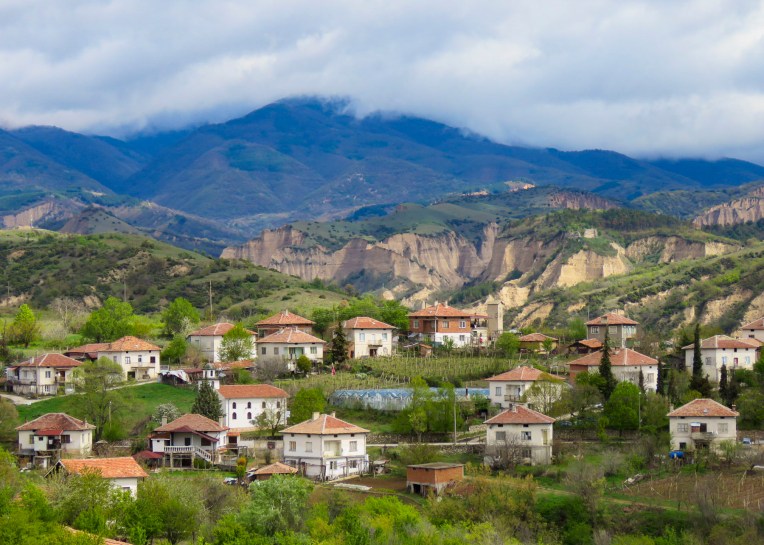 In the morning we followed Rt. 1 south for a while as it hugged the Struma River, which would eventually reach the Aegean Sea, before we turned off and headed in to the Pirin Mountains.


 Melnik is situated in a wide gorge under striking sandstone rock formations, called hoodoos, that tower hundreds of feet high, created from millennia of erosion. Locals refer to these geological phenomena as Melnik Earth Pyramids. The village has been renown for making strong wine since 1346 from a regional red grape varietal, Shiroka Melnishka, and wine cellars still line its main street.
 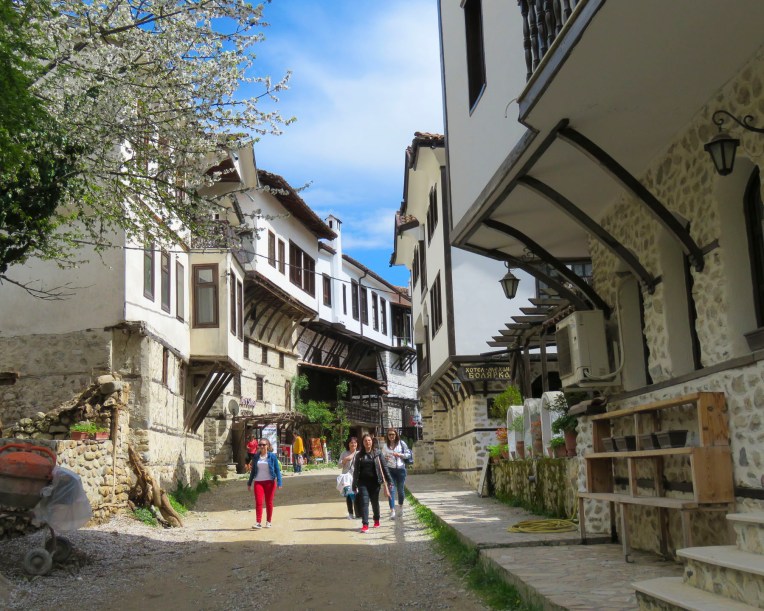 Once a thriving village with one thousand residents, today it is now home to fewer than three hundred. The village was a delight to explore with its cobbled streets meandering between the whitewashed stone and timber homes built in the Bulgarian Revival style. Ninety-six of the village’s houses are historically protected. Any new construction in town adhered to that aesthetic.
  From the ruins of Bolyarska kŭshta, high on a hill above the Church of St. Anthony, we spotted the dome of what looked like a hammam, a Turkish bath, nestled between the traditional homes below, and went to explore.
 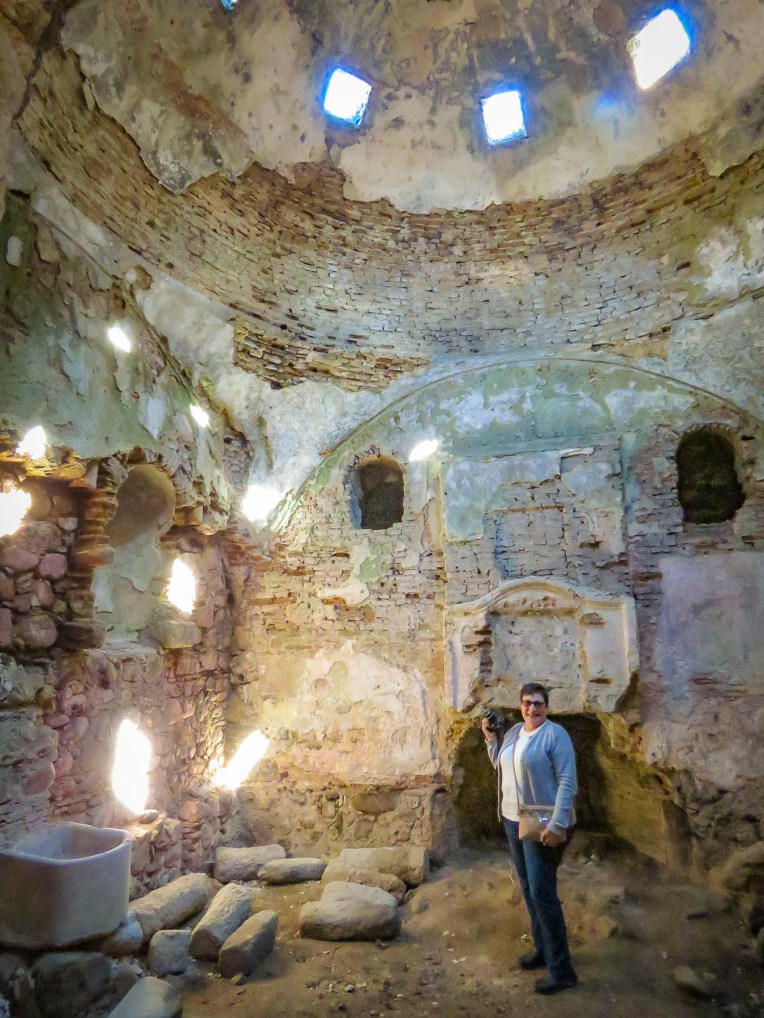 With the help of a kind woman, who somehow knew what we were looking for, we found the ruins of a small Roman era spa in a small side alley. Its dome was fully intact and the substructure of its once heated floor remained. There is also a single arched old roman bridge, near the parking lot, that you can still walk across. Before continuing to Kovachevitsa, we relaxed at one of the sunny cafes in the center of the village.
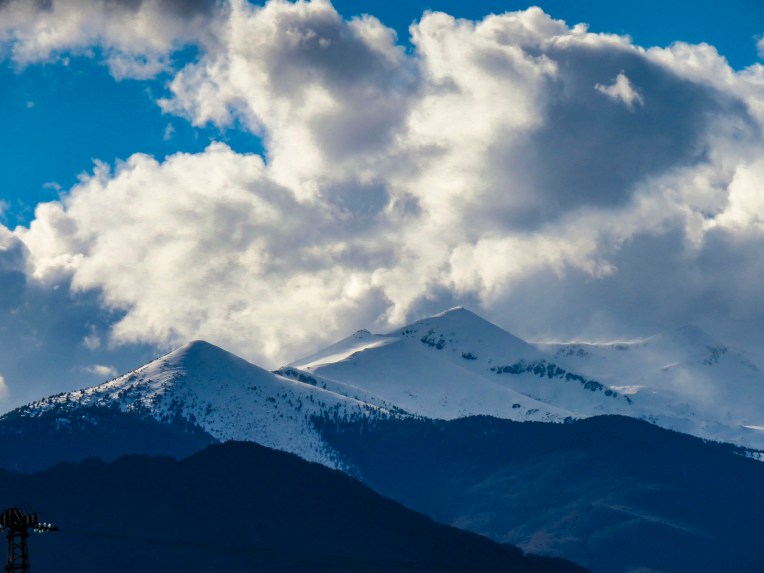 Kovachevitsa, an isolated, rustic stone village in the Rhodope mountains, was only 52 miles away near the border with Greece. However, it took us the bulk of the afternoon to reach because “someone stops every hundred yards to take a photo.” And stop we did as we were awed by the beauty of the border region as we drove through the mountains. So close were we to the border that our phones binged with a “Welcome to Greece” message from our cell phone carrier.
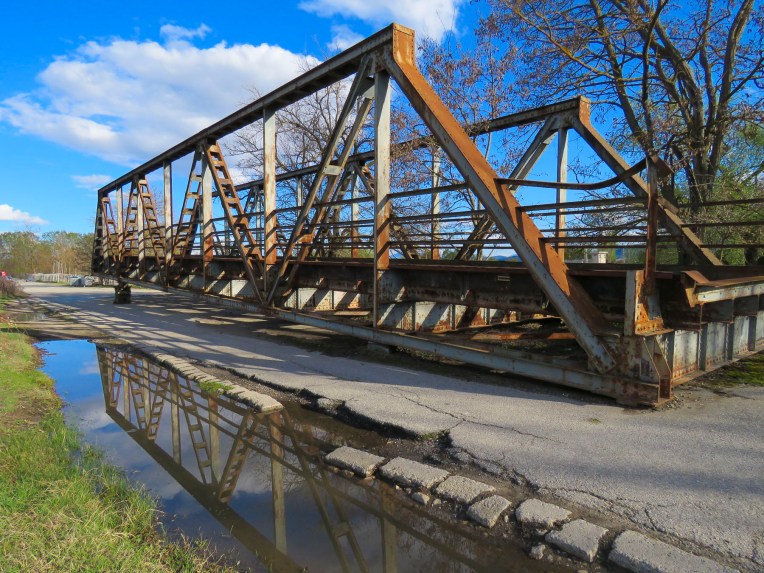 At one point we stopped to photograph a complete section of an iron truss bridge, just rusting away on the side of the road, only to have our car suddenly surrounded by a flock of bah-ing sheep.

 So, we knocked on the ancient door of the closest building only to be greeted by loud barking. Retreating back to the car we pondered what to do when a voice behind us said “hello.” That was the only word of English our host spoke until he said “goodbye” two days later. The barking dog turned out to be a gentle giant, who welcomed us to the inn. In fact, all the dogs of the village were St. Bernard-size, and they must all have been related, because they closely resembled one another. Fortunately, they were good-natured.


 Bulgarians fleeing religious persecution and the forced conversion policies of the Ottoman Empire sought refuge in the rugged Rhodope mountains and established Kovachevitsa in 1656. Agriculture and stockbreeding in the area thrived during the 1800s and the homes still standing in the village date from that time. The tall stone homes of Kovachevitsa are stunning and unique in an organic way.

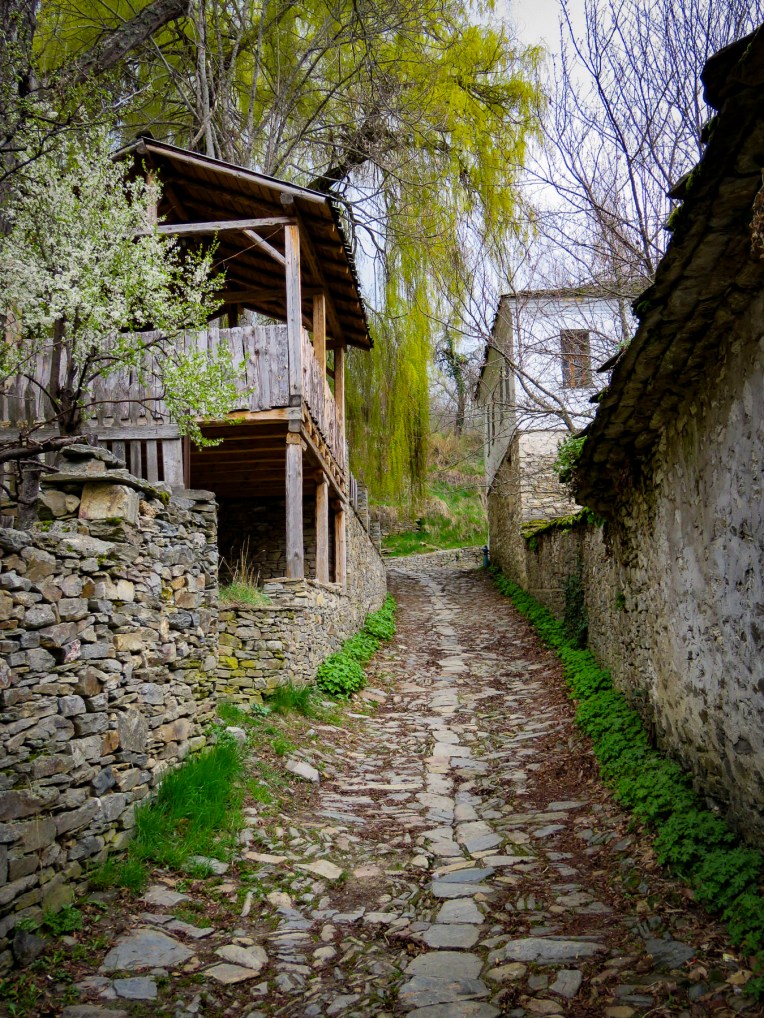 At breakfast the next morning Google Translate nicely bridged our communications barrier with the innkeeper’s wife. Loading the Cyrillic keyboard into the app for our hostess to use, Donna’s phone was passed back and forth repeatedly during a lively conversation about family, each other’s lives, the village and our travels. Our hosts’ children live with their grandparents in one of the larger towns off the mountain as there isn’t a school in the village anymore.
 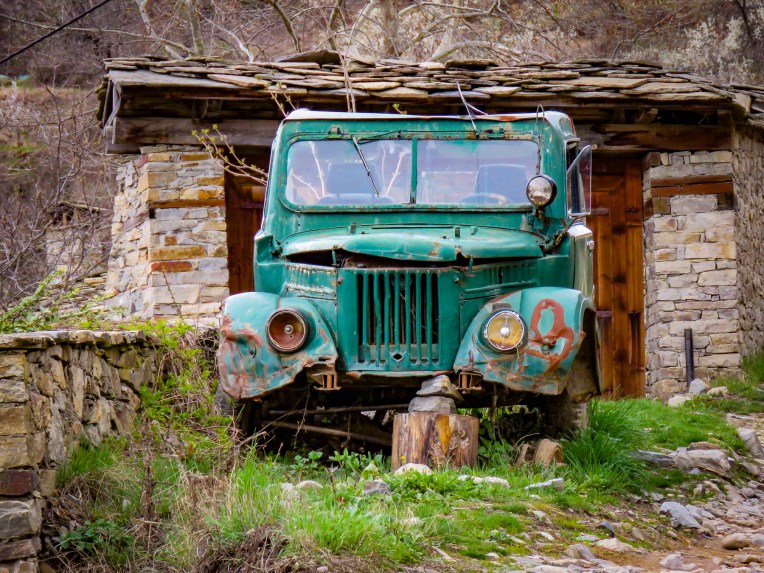 Most of the young families have moved away to find work, leaving only 28 year-round residents looking after the village till the tourist season starts. Strolling under blossoming elderberry trees, we had the narrow lanes to ourselves as we worked our way towards St. Nikolas Church.

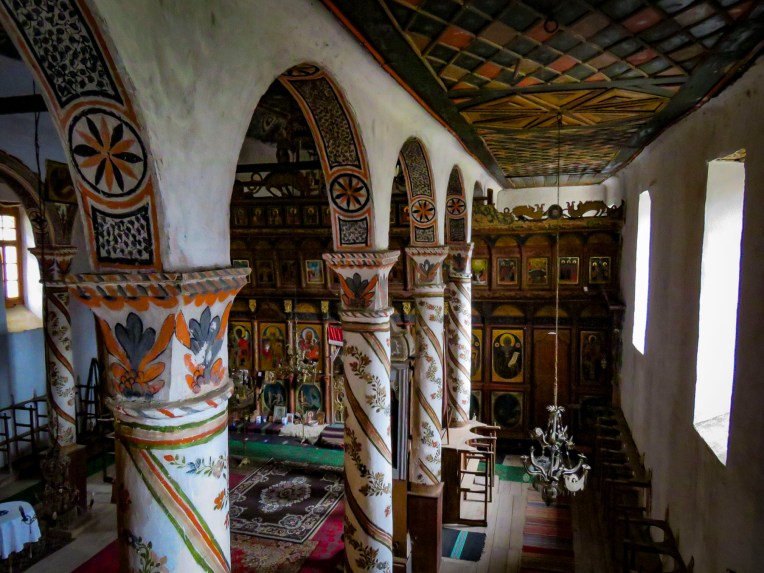 On the way back to our inn we stopped to admire the woolen creations knitted by a lone street vendor with a toothless smile who was bundled under layers of clothing to ward off the mountain chill. Her prospects for a profitable day seemed slim as the street was nearly deserted. When we expressed interest in only one pair of socks, she assertively pantomimed that we needed more. Looking up from readying our payment we could only smile and chuckle when we found she had filled our bag with two extra pairs of socks. They were well made and a bargain, so we caved to her sales pressure. I’m wearing a pair now as I write this, and my toes are happy we she insisted. I wouldn’t have been surprised if we were her only sale of the day.
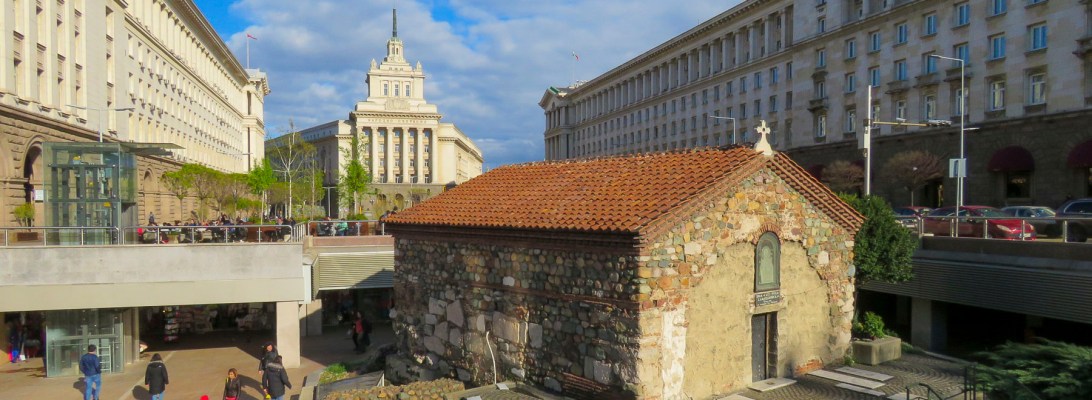
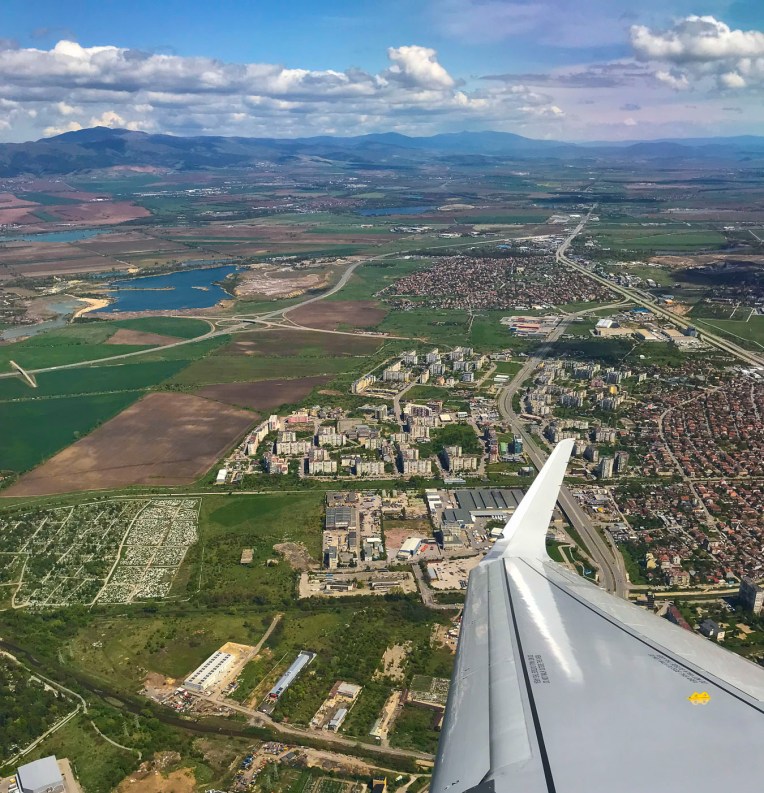 In the airport, at the tourist information kiosk, multiple large screen tv’s played flashy videos promoting Bulgaria’s culture, tourism, and natural beauty. We asked the woman staffing the desk for a map of Sofia and directions on how to transfer into the city. “Follow the line,” she snapped. Not fully understanding I asked again. “Follow the line!” she barked firmly a second time. She scowled in the direction of the arrows painted on the floor and turned away. Her previous career, I’m speculating, was a prison guard in the now closed gulags. She was obviously better suited commanding prisoners to “assume the position” than to being the first friendly face welcoming visitors to her country. I’m sure she was hiding handcuffs and would have used them if I asked another question. But that’s how it was, one day you’re communist and the next day you’re taking customer service courses and trying to embrace a free market economy. And for some the promise of a better life hasn’t been realized. Later, one of our hosts would express, “some folks prefer the old way, they’re still communists.” “Come and keep your comrade warm,” another refrain from the Beatles song, didn’t ring true. We weren’t feeling the love just yet. Aside from that rocky start, we had very enjoyable time in Bulgaria.
  The line led to a modern subway station adjacent to the airport terminal and for 1.60 BGN, about 90¢ USD, we rode the
 We emerged onto the pedestrian only Vitosha Boulevard filled with folks enjoying a warm Spring day and an incredible vista of Vitosha Mountain towering over the city. Inviting outdoor cafes lined the street and we quickly chose which one we’d return to after meeting our Airbnb host. We stayed on Knyaz Boris just two blocks parallel to Vitosha Boulevard and as majestic as the pedestrian mall was, the side streets, though tree lined and harboring small shops and restaurants, were slightly dismaying with wanton graffiti tags on every apartment building door and utility box. There was a lack of pride in ownership.
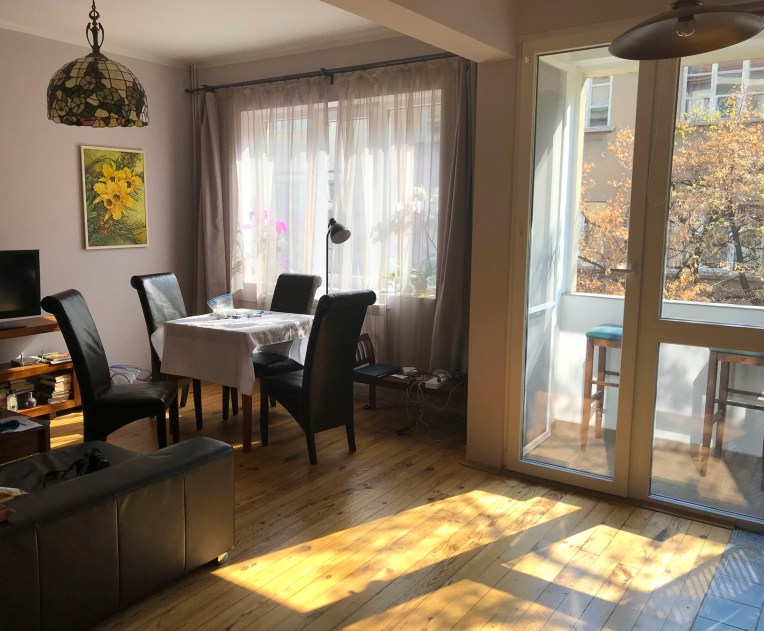
 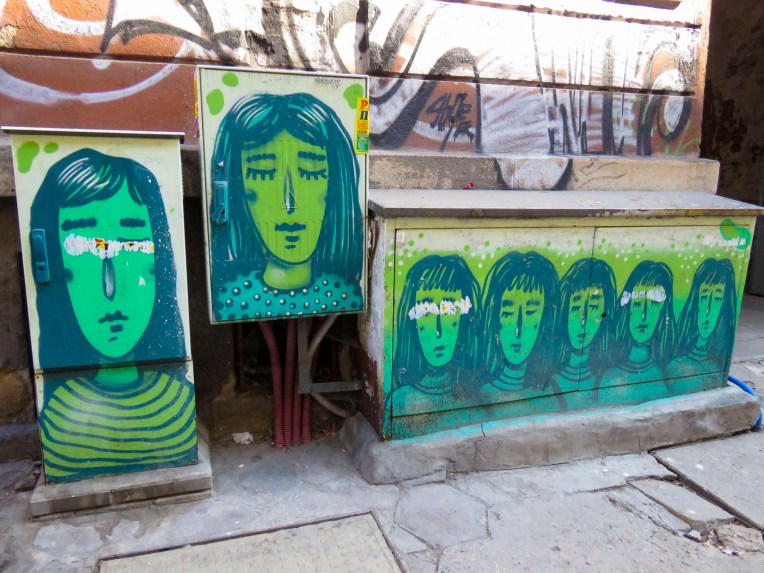 The idea that’s it’s not my responsibility is a leftover from the communist era, when the government owned and was responsible for everything. The front door to our building was no different, but our third-floor walkup apartment was an oasis with a sun-drenched living room and tiny balcony that we would call home for a month. And to our delight, but to our waistlines’ detriment, there was a baklava bakery across the street!
  Long at the crossroads of expanding empires, Bulgaria has had a contentious past with Thracian, Persian, Greek, Roman, Byzantine, Ottoman and communist influences. The First Bulgarian Empire, 681-1018, has been deemed the Golden Age of Bulgarian Culture, with the adoption of Christianity as the official religion in 865 and the creation of the Cyrillic alphabet. Independent for only short periods of time during the medieval age, the National Revival period between 1762-1878 brought Bulgaria to finally throw off the yoke of Ottoman domination that had lasted from 1396. Sadly, there were only six decades of self-government before the proud people of Bulgaria became a satellite regime of communist Russia at the end of WWII and fell behind the Iron Curtain.
 Today Sofia is transforming itself into one of the most beautiful, cosmopolitan cites in Europe with its pedestrian malls, extensive park system and tram lines that weave throughout the city. But the past is always present and just around the corner in Sofia. Walking north along Vitosha past the end of the pedestrian mall there is a three block stretch that displays a vast stretch of that history on the way to the Central Market Hall, where we were headed to stock our pantry. We got sidetracked.
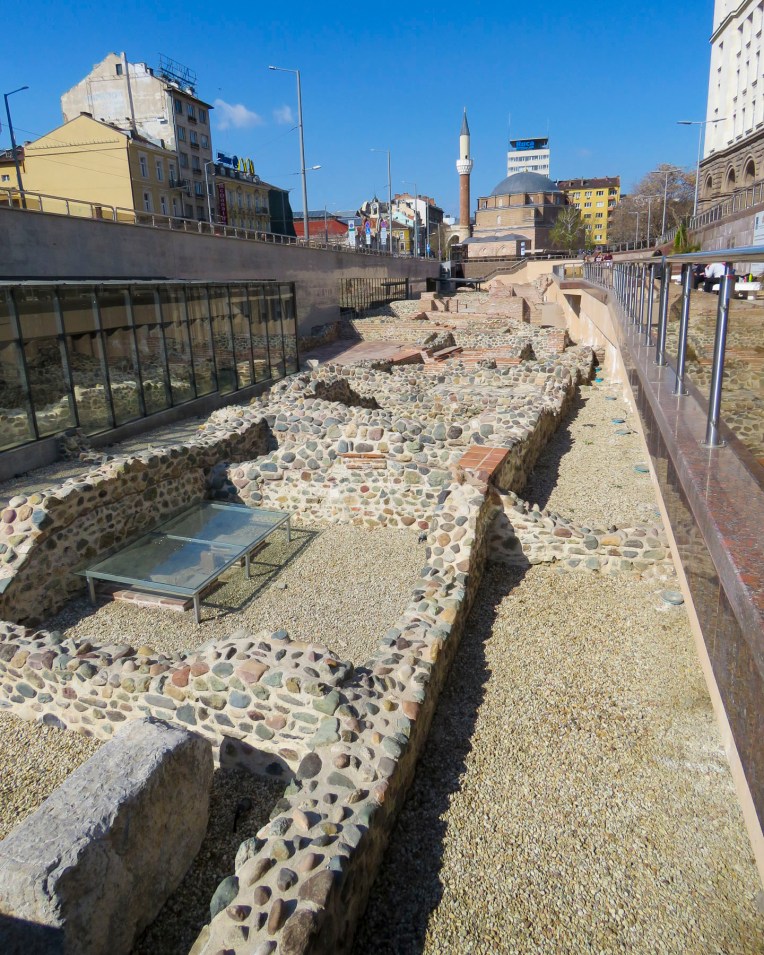 Seven millennia ago, put down the first foundations of what we now call Sofia. The construction of Sofia’s modern subway system in the 1990’s revealed multiple layers of antiquity and many of the amazing artifacts unearthed are displayed, in museum cases, on the subway platforms in the Serdika station and National Archeology Museum nearby.


 Tragically in a 1925 bombing, the Bulgarian Communist Party attempted to kill the King of Bulgaria and other members of the government who were attending a funeral at this church – one hundred-fifty people died, and the cathedral’s dome was razed. Excavations behind the church in 2015 uncovered early ruins and a treasure of 3,000 Roman silver coins from the 2nd century AD.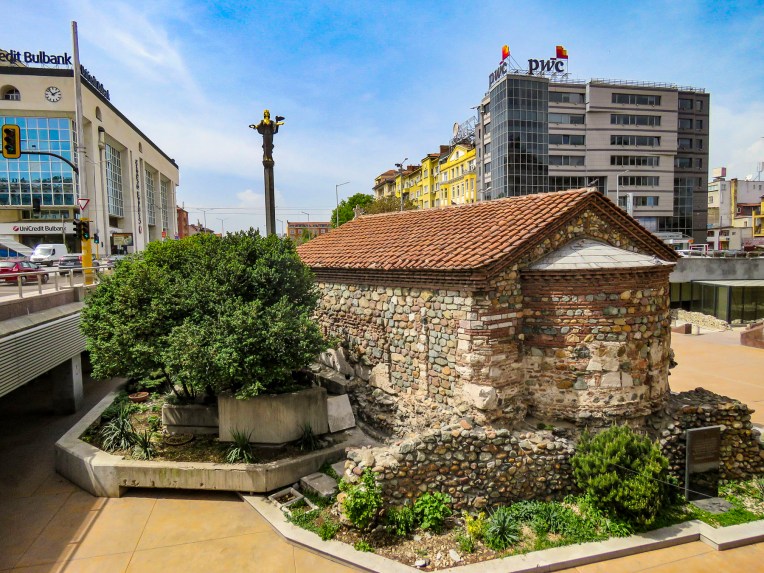


 It ends just short of Banya Bashi, an Ottoman mosque built in the 16th century. The towering statue of St. Sofia is also visible just beyond the subway station. Ancient walls found during the renovation of the Central Market Hall can also be seen in the lower level of that building.
 Nearby the oldest building in Sofia, the Church of Saint George, built by the Romans in the 4th century, has early Christian frescoes which were painted over by the Ottomans when it was used as a mosque, but they were rediscovered in the 1900s and restored. It stands surrounded by modern buildings in a courtyard behind the President of the Republic of Bulgaria building, within earshot of the Changing of the Guard.


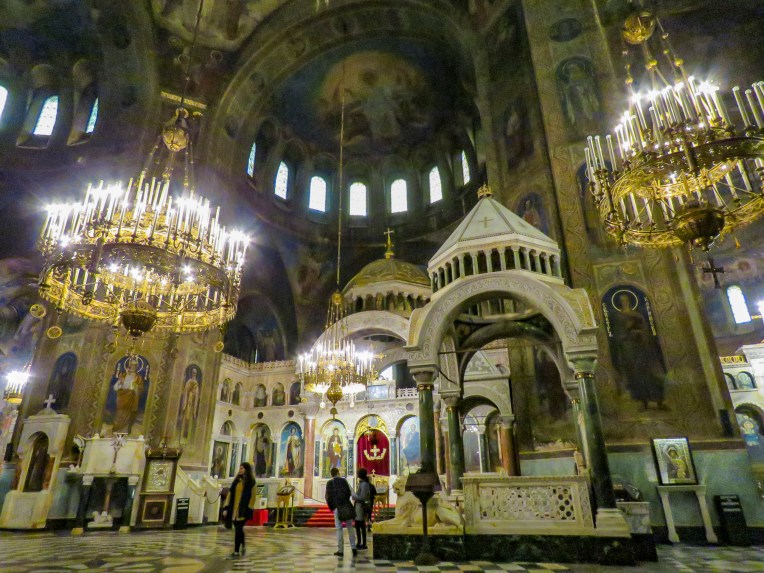 In the crypt of the cathedral a small, state of the art museum showcases the development of Bulgarian orthodox iconography over the centuries.
  Nearby, the five gilded spires of the Russian Church, officially known as the Church of St Nicholas the Miracle-Maker, can be seen from the steps of Cathedral Saint Aleksandar Nevski. Built in 1914 on the site of a mosque that was torn down after the liberation of Bulgaria, it served has the official church for the Russian Embassy and the Russian community in Sofia. The religious murals that cover the interior of the church were created by Vasily Perminov’s team of talented icon painters, who were also responsible for the iconography in Cathedral Saint Aleksandar Nevski. Darkened by decades of candle smoke, the fresco paintings in the dome were restored in 2014.


 In 2001 an early Christian mausoleum was unearthed near the American Embassy and it’s fantastic that things are still being discovered in 2019.


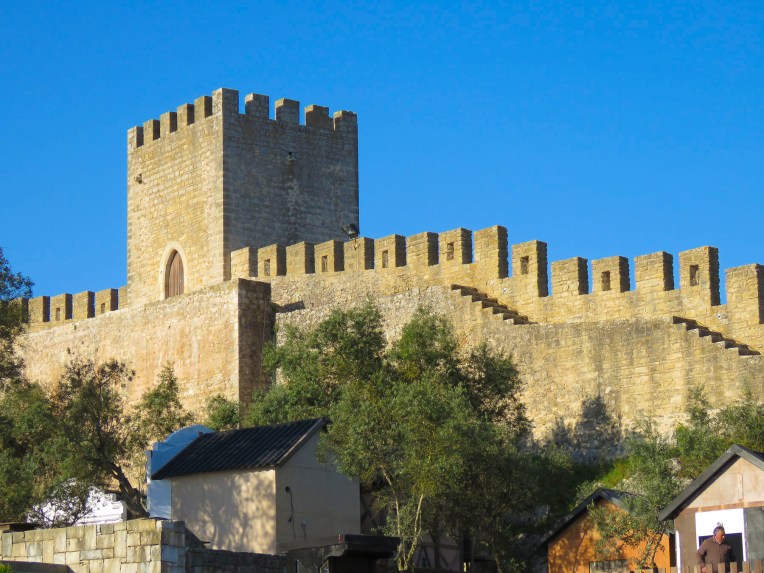 We had spent a wonderful day cruising from Aveiro to Nazare, but now twilight was fast turning to darkness as we drove along an extremely narrow lane at the base of the formidable fortress wall that encircled Obidos. We had arrived at our hotel
  Admittingly Donna is the more accomplished linguist of the two of us. I according to my loved one have been known to torture a language. So, she eagerly sought advice from the only person we had passed. From a short distance away, I watched the conversation unfold with the gentleman flailing his arms every which way for what seemed an inordinate amount of time.
  Smiling, Donna returned to the car. “About the only thing I got from that was we should continue following the lane until the next hole in the wall. He was very insistent about that.” “Did he know the hotel?” I asked. “Never heard of it, but I think he was intoxicated! My luck,” she laughed. The lane narrowed even more as we drove forward. Finally, there was an ancient portal, the size of a single door, through the wall that led to a short set of steps. Abandoning our car for few minutes we climbed the stairs to an inner lane in search of our hotel. After we finally found the place, the receptionist explained to continue driving along the wall until you reach an old city gate, enter there and follow the inner lane back to us and park anywhere you can. OK, piece of cake now, we thought.
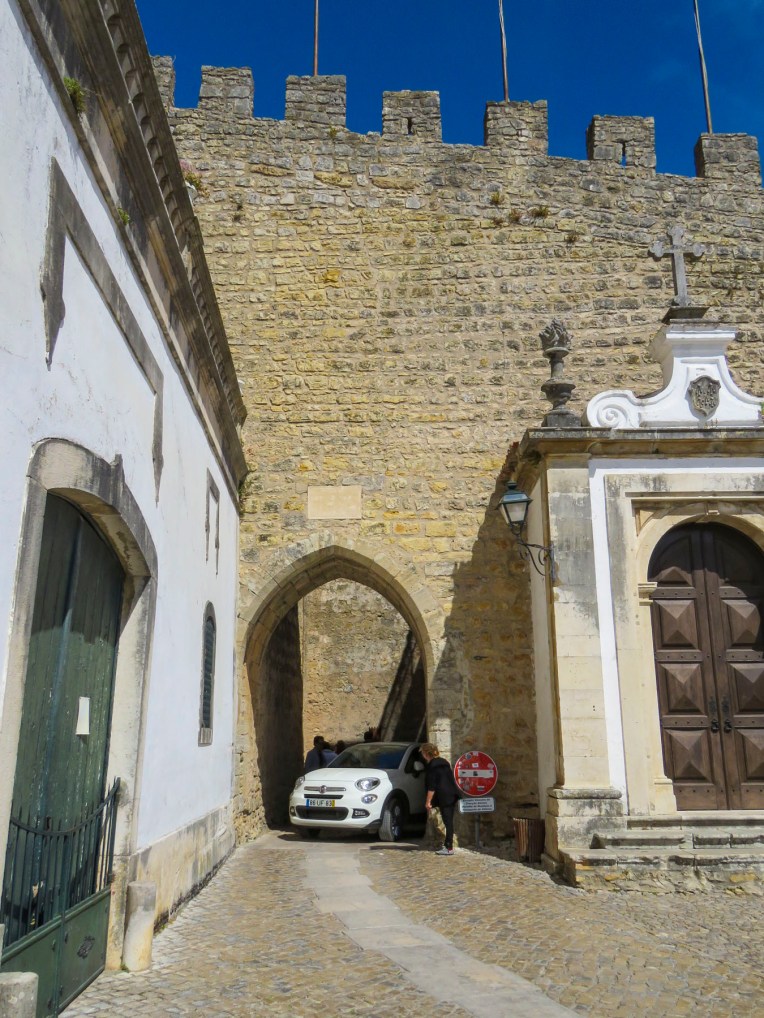
 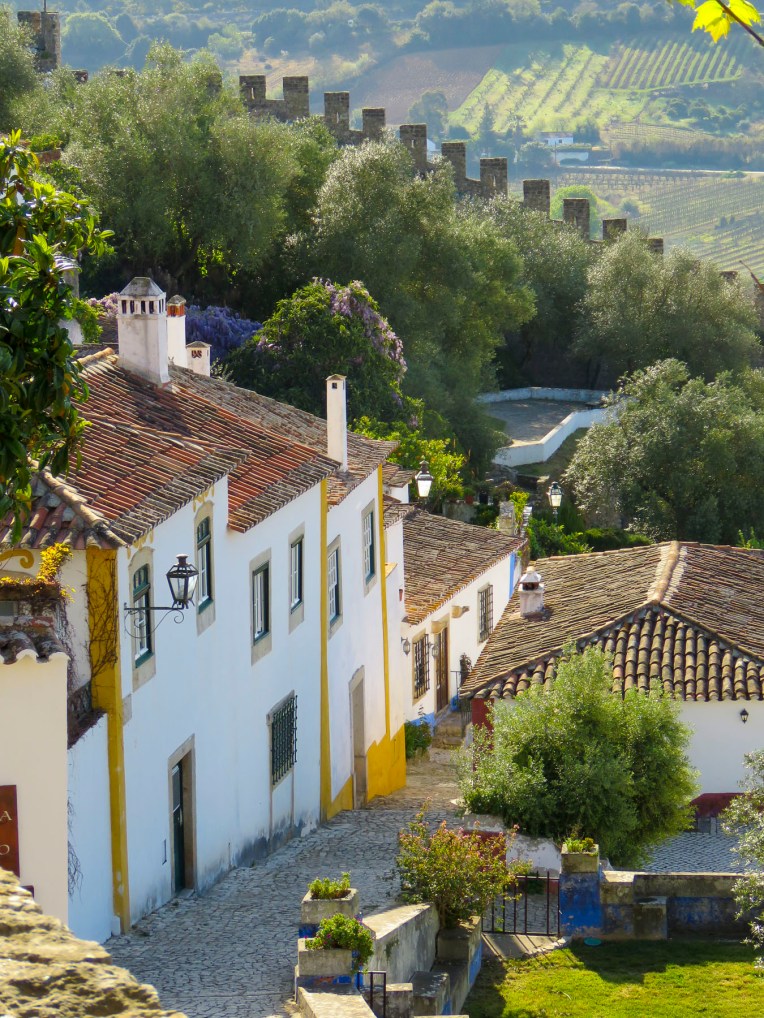 Inhabited since the 4th century BC by the Lusitanos, then the Romans and Visigoths, the city wasn’t fortified until the 8th century by the Moors. Bent entrances, with a quick turn and an additional, heavy inner gate were used in many Arab fortifications. In peacetime they were easy to navigate with pack animals, and during sieges provided a killing zone for the defenders of the city. Remember, these bent gates were built long before cars were envisioned. Obidos had two of them and tonight we had to navigate through one. Porta do Vale ou Senhora da Graça was a drive through chapel dedicated to Our Lady of Grace. In 1727 the old gate was renovated into an oratory chapel with sacristy, altarpiece, gallery, choir, and chancel by a local magistrate to commemorate his daughter’s death. You actually transit through the nave to reach the interior street. The gate was narrow, and it required a sharp k-turn just to line the car up to approach it correctly. Donna was driving and I hopped out to judge just how much room we had around the car. Driving up a slight slope on flagstones worn smooth from centuries of travelers, the tires spun with no traction as the car got halfway through the gate. Backing-up and then gunning the car forward through the gate Donna only had the length of our Fiat 500 to turn sharply right and exit the inner gate. It was do-able but nerve-wracking.


 With only two main lanes that ran the length of village, interconnected by a labyrinth of stairs and smaller alleys, Obidos was the perfect size, only slightly larger than Marvao, to explore for two days and relax before driving back to the airport in Lisbon for our flight to Sofia, Bulgaria.
 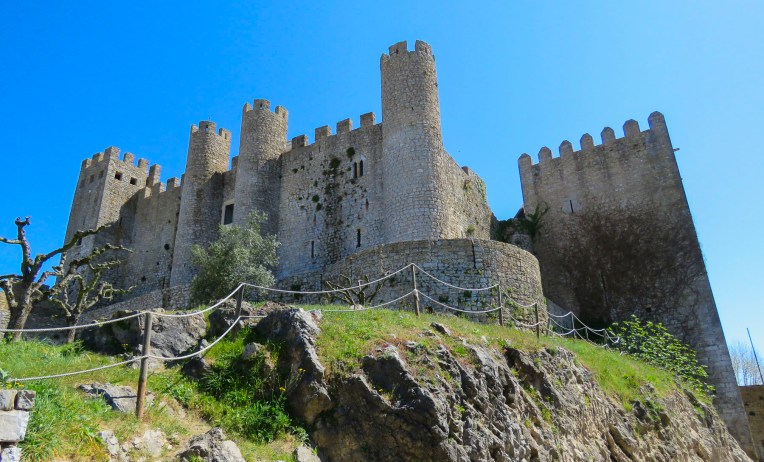 The next morning, enjoying deserted lanes lined with flowering wisteria, calla lilies, and other interesting details we weaved our way to the


 We eventually made our way through the main gate of the walled city. Porta da Vila de Óbidos is another bent entrance that did double duty as a chapel to Nossa Senhora da Piedade, the Virgin Mary, patron of the village. Be sure to look up as you walk through, as Azulejos tiles from the 1700’s line the interior balcony.
 Across the street we walked below remnants of a three-kilometer-long aqueduct built in the 16th century to supply water to the fortress.
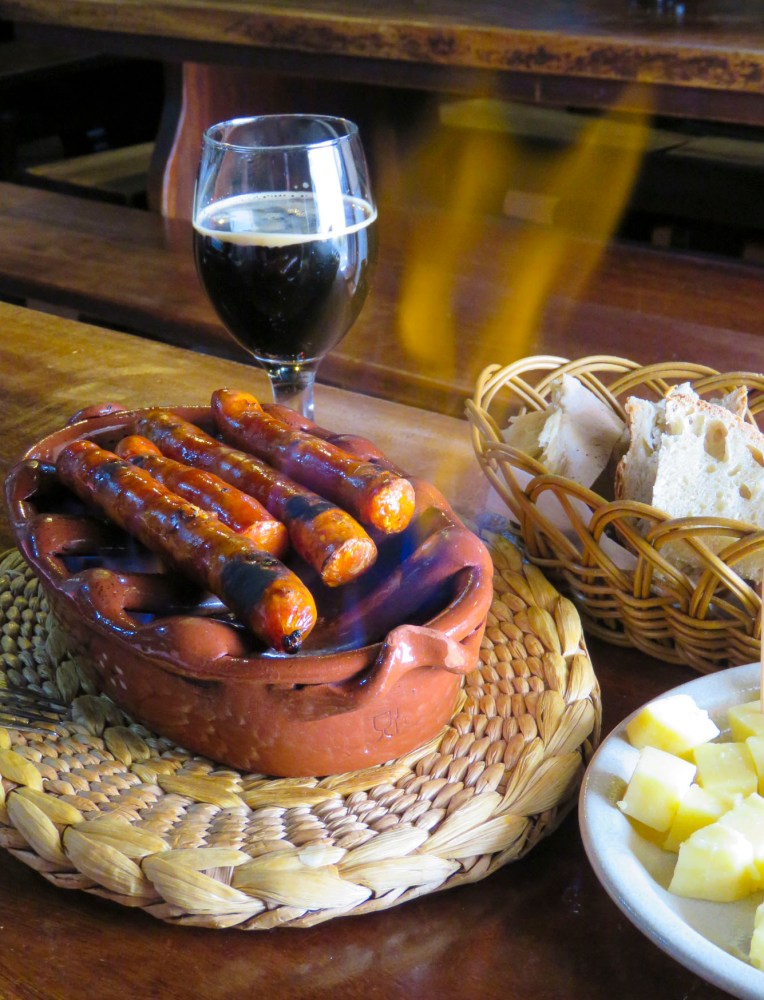
  Dinner that night was a simple meal of bread, cheese and local sausages cooked uniquely on a ceramic hibachi, fueled with grappa, placed on our table at Bar Ibn Errik Rex. As flames danced from our mini grill, the waiter would return to our table occasionally and turn the sausages to ensure their perfection. It was an entertaining evening. A few good Portuguese beers helped.
 With our GPS App still set to avoid toll roads, we drove through the Porta da Vila de Óbidos and headed towards Lisbon, less than two hours away if we didn’t stop. But, if you’ve been following our blog you’ll know that’s nearly impossible, there is always a quick glimpse of something that calls for a detour.
 Torres Vedras with its aptly named citadel caught our eye. With a historical time-line similar to Obidos, the hilltop in the old historic district was continually fortified against waves of early invaders. Knowing a good piece of real estate when they saw it, the castle was seized during the Christian reconquest in 1148 and used by a succession of Portuguese Kings until it was heavily damaged in the catastrophic 1755 earthquake that hit central Portugal and Lisbon. Built just after the reconquest, Igreja de Santa Maria do Castelo stands just below the castle walls. The church’s bell cast in the 16th century continues to ring today.

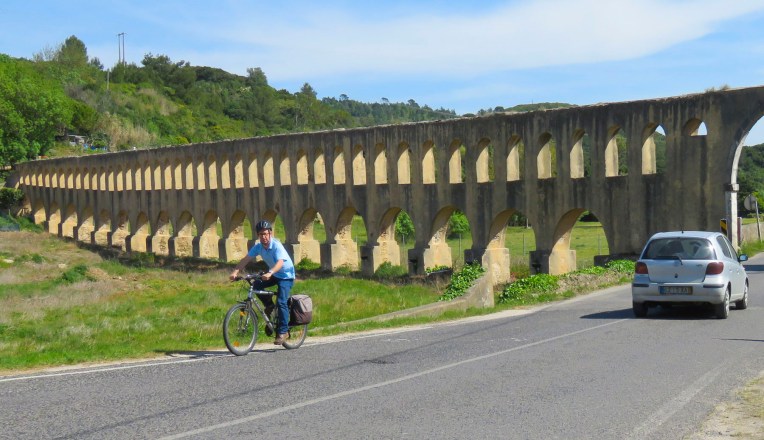 Along the Sizandro River on the outskirts of town, an impressive two-kilometer stretch of a 16th century aqueduct with double arches still stands. Driving under the aqueduct we followed the river south along the R374. The high-density new developments around Torres Vedras quickly gave way to a landscape of vineyards and pastures. Finding a restaurant for a late lunch, though, didn’t seem promising along this rural stretch of road, dotted with the occasional roadside café with a farm tractor parked out front, until we caught a quick peripheral glimpse of a larger establishment, across a small bridge, down a side lane. It would take another mile before we could find a suitable place to perform a U-turn. With nothing else around for miles


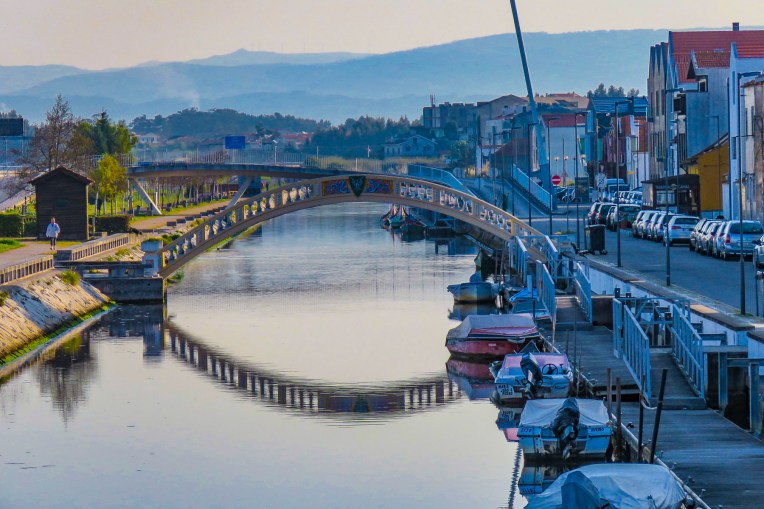


 While the Algarve coast in southern Portugal gets the most hype with its azure waters and rock formations, Portugal’s Silver Coast, the Costa de Prata, starting near Lisbon, runs north for nearly 150 uninterrupted miles to the Douro River in Porto. Lightly developed, it’s a majestic stretch of wild, wide and flat sandy beaches and dunes that feels undiscovered and is worthy of further exploration.
 It was mid-afternoon when we arrived at Miradouro do Suberco towering 350 feet above Nazare’s beautiful, crescent shaped Praia da Nazaré beach. Surprisingly, for such a beautiful spot we were able to find free parking nearby above the Nazare lighthouse. The only caveat, an ominous sign warning that if our car some how managed to go over the cliff edge we would still be liable for the €25,000 wreckage removal. You definitely need to know where reverse is on the stick shift here! Some of the world’s tallest waves crash onto the rocks in front of the Nazare lighthouse between October and March. Every year in November the Nazare Challenge attracts suicidal, thrill seeking surfers looking to ride the biggest waves. Thousands of onlookers line the hill above the action to watch their death-defying feats. A record 80-foot wave was ridden in 2017 by Brazilian Rodrigo Koxa and outside the competition, in December 2018, a 100-foot tall monster was surfed by Tom Butler of the United Kingdom. We can’t imagine the raw fury of those size waves. Unfortunately, the day we arrived the ocean was calm.


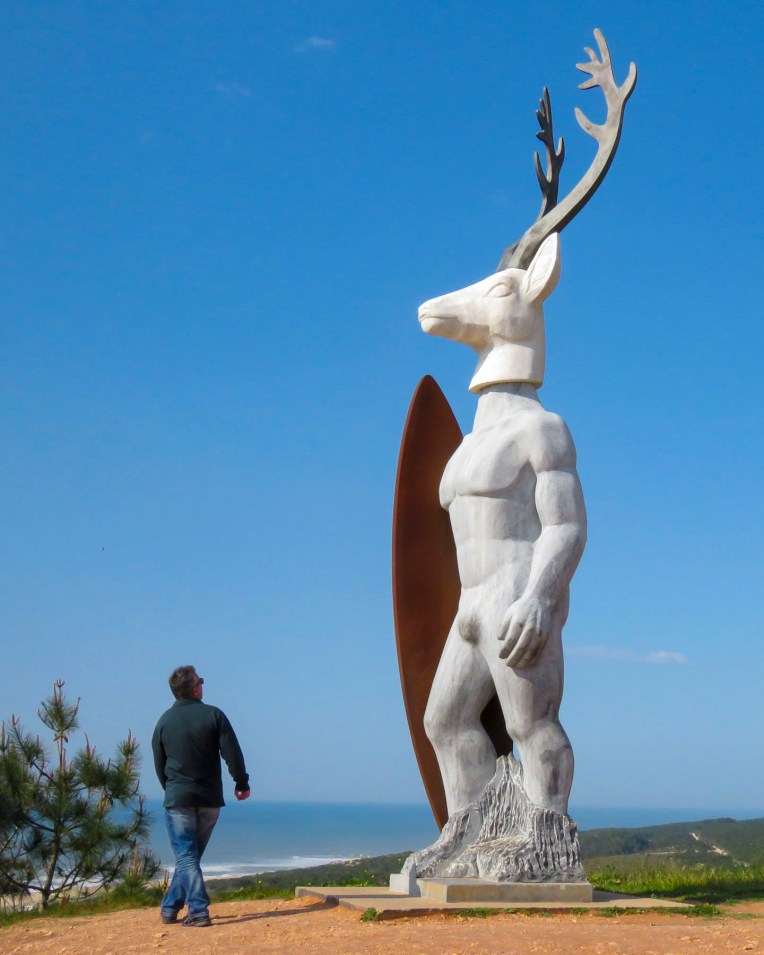 Not far away, just above the Nazare lighthouse, Portuguese artist Adalia Alberto has created a whimsical, deer-headed surfer sculpture called Veado that pays tribute to Nazare’s old legend and today’s legendary wave riders. This contemporary piece has to be one of the most unusual sculptures in Portugal and is worth finding when visiting Nazare.

 Coimbra is a city for walkers. Ancient lanes crisscross the historic district, weaving their way steeply up the hillside until you eventually reach the University of Coimbra, which crowns this charming city. But the journey there is so rewarding, with arched alleys, cathedrals and numerous shops and restaurants all vying for exploration.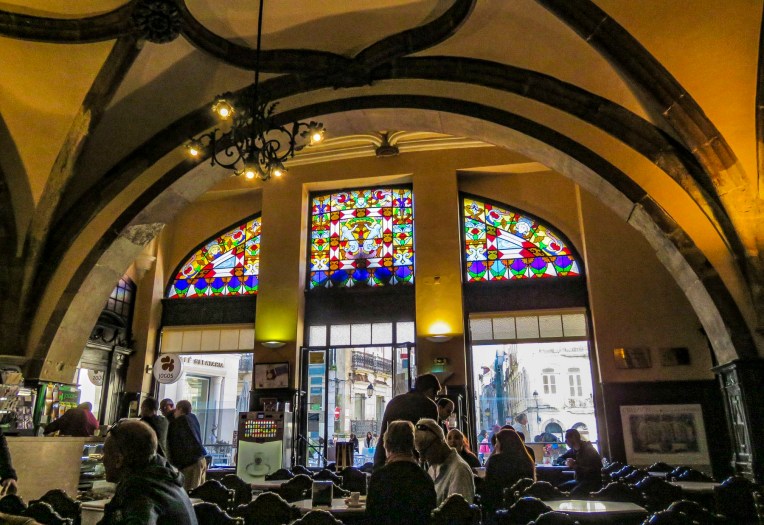


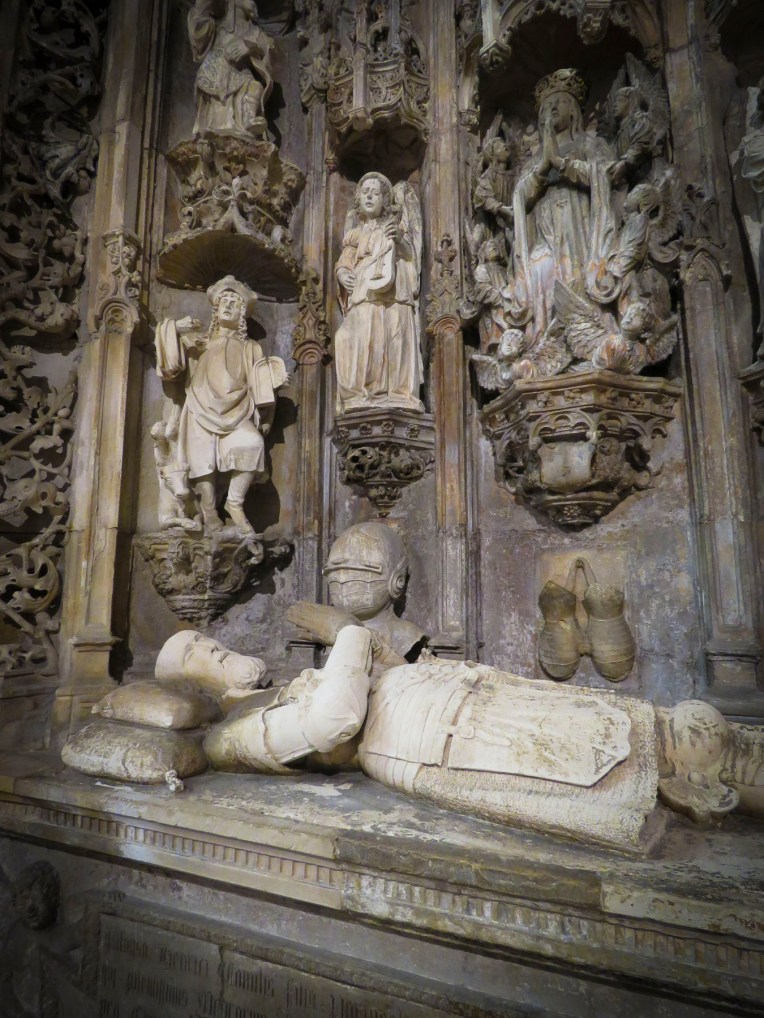 Deceptively, many of the marble columns and surrounds of the altar are actually wood, painted to imitate marble. The cathedral aged poorly in its early centuries as the result of repeated Spring flooding from the Mondego River. In the 1700s Azulejos tiles were added to the walls to cover severely water-damaged early fresco paintings. A spectacular and huge four thousand pipe organ hangs precariously from the wall of the sanctuary. Apparently, it’s so difficult to play only three people know how. The monastery is huge with many interesting rooms and intriguing details to explore.


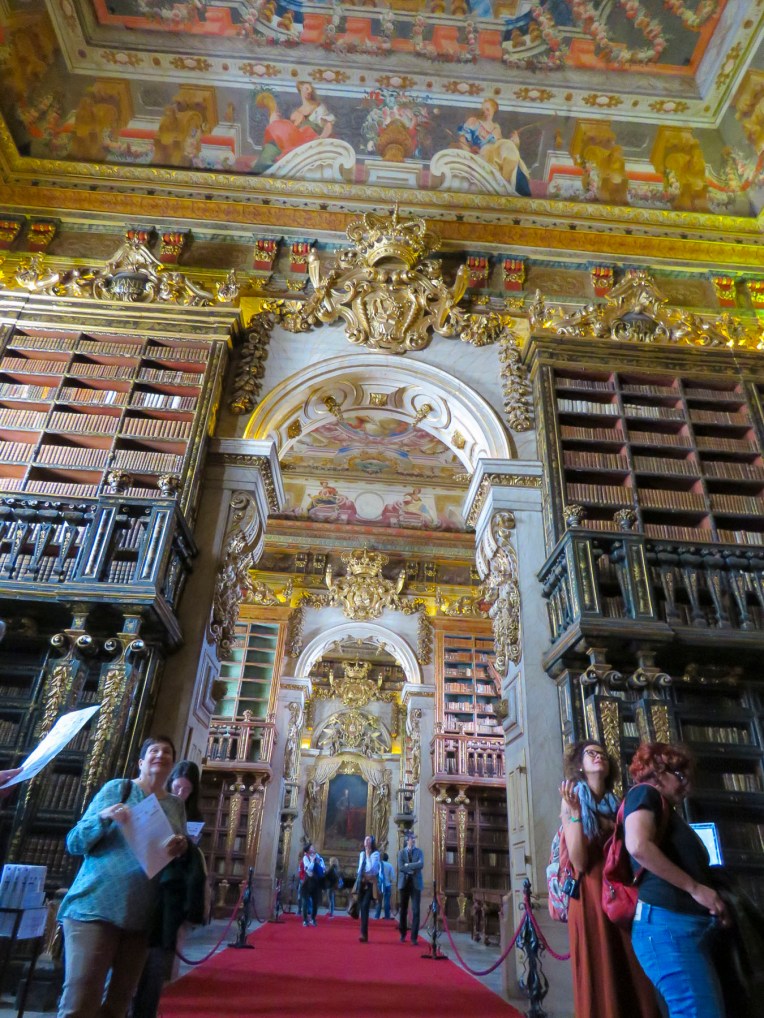


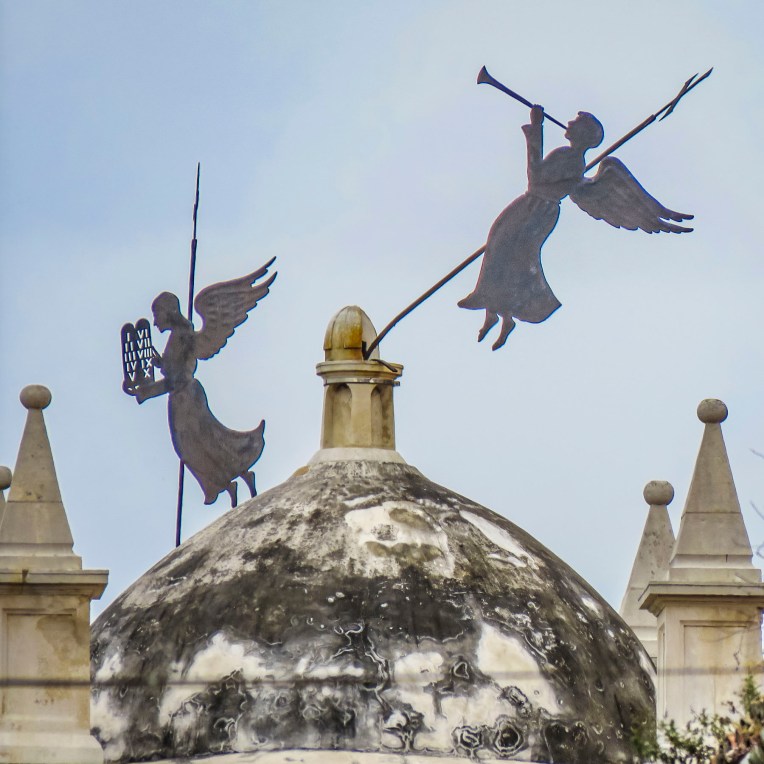


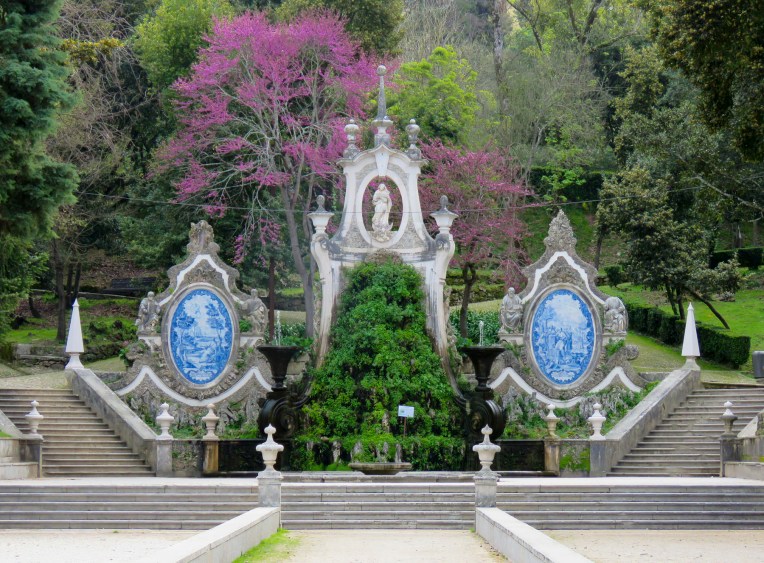 Azulejo tile murals edged with religious statues framed the sculpted fountain. At the top of the fountain water gurgled from under a statue of the Virgin Mary, symbolically giving life to the waterfall. Symmetrical stairways on either side led deeper into the heavily shaded park.


 2 Suitcases for 2 years