
The lyrics to the Beatles’ “Back in the USSR “played through my mind as the wing of our plane dipped to reveal an early Spring landscape blanketing the countryside, with fresh shades of vibrant greens, as we were about to land in Sofia. The Berlin Wall fell on November 9, 1989 and Bulgaria, a Soviet satellite country, ousted their communist party at the same time. But I’m a child of the cold war and Eastern Europe seemed as exotic and as full of mystery as the lost kingdom of Tibet, and the Beatles’ tune stuck.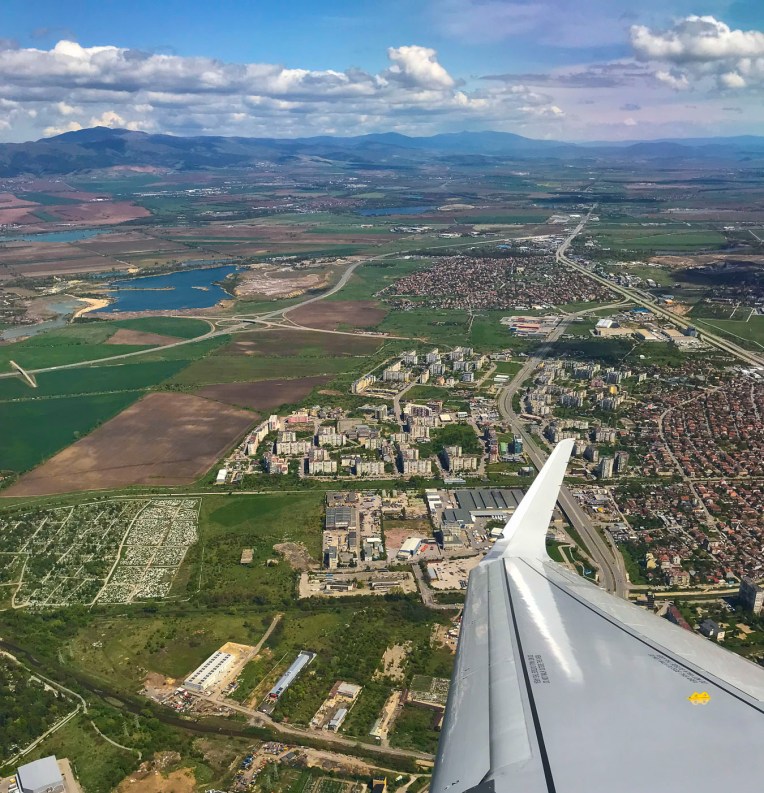 In the airport, at the tourist information kiosk, multiple large screen tv’s played flashy videos promoting Bulgaria’s culture, tourism, and natural beauty. We asked the woman staffing the desk for a map of Sofia and directions on how to transfer into the city. “Follow the line,” she snapped. Not fully understanding I asked again. “Follow the line!” she barked firmly a second time. She scowled in the direction of the arrows painted on the floor and turned away. Her previous career, I’m speculating, was a prison guard in the now closed gulags. She was obviously better suited commanding prisoners to “assume the position” than to being the first friendly face welcoming visitors to her country. I’m sure she was hiding handcuffs and would have used them if I asked another question. But that’s how it was, one day you’re communist and the next day you’re taking customer service courses and trying to embrace a free market economy. And for some the promise of a better life hasn’t been realized. Later, one of our hosts would express, “some folks prefer the old way, they’re still communists.” “Come and keep your comrade warm,” another refrain from the Beatles song, didn’t ring true. We weren’t feeling the love just yet. Aside from that rocky start, we had very enjoyable time in Bulgaria.
  The line led to a modern subway station adjacent to the airport terminal and for 1.60 BGN, about 90¢ USD, we rode theM2 line past sad remnants of soviet era block housing, before it descended deeply underground, for a twenty minute ride to the National Palace of Culture station.
  We emerged onto the pedestrian only Vitosha Boulevard filled with folks enjoying a warm Spring day and an incredible vista of Vitosha Mountain towering over the city. Inviting outdoor cafes lined the street and we quickly chose which one we’d return to after meeting our Airbnb host. We stayed on Knyaz Boris just two blocks parallel to Vitosha Boulevard and as majestic as the pedestrian mall was, the side streets, though tree lined and harboring small shops and restaurants, were slightly dismaying with wanton graffiti tags on every apartment building door and utility box. There was a lack of pride in ownership.
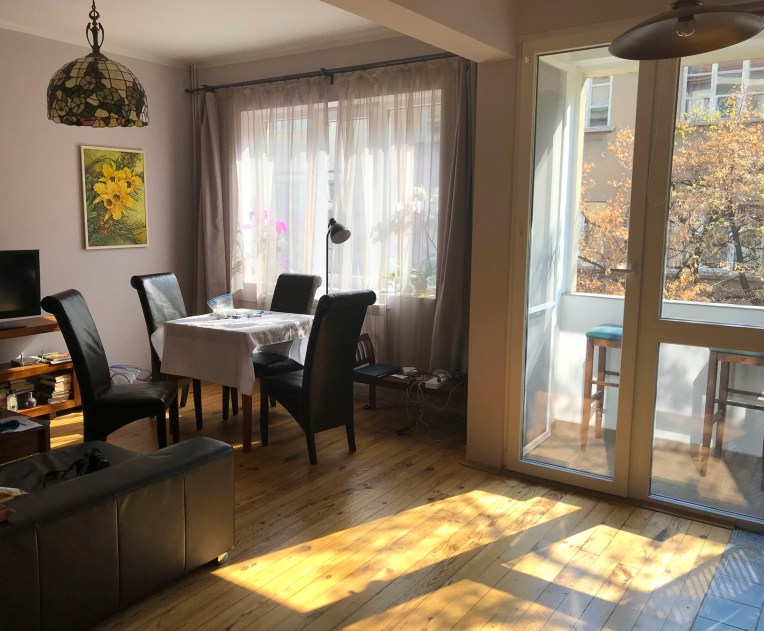
 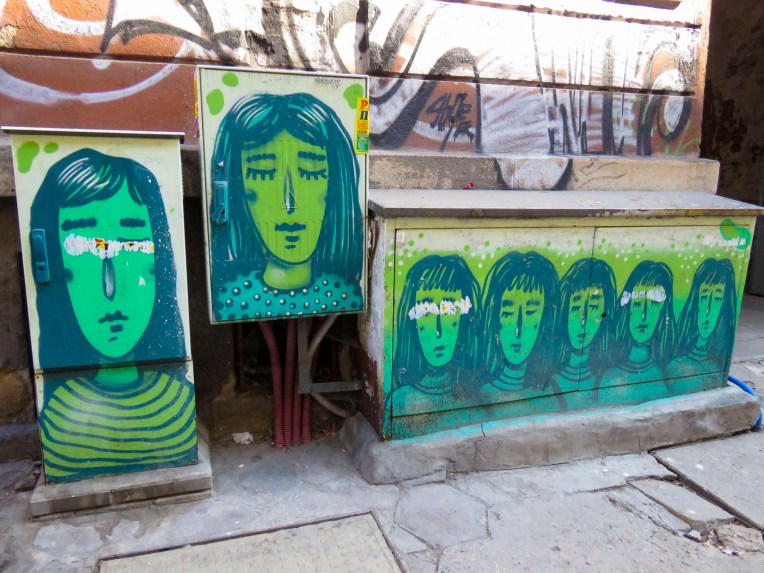 The idea that’s it’s not my responsibility is a leftover from the communist era, when the government owned and was responsible for everything. The front door to our building was no different, but our third-floor walkup apartment was an oasis with a sun-drenched living room and tiny balcony that we would call home for a month. And to our delight, but to our waistlines’ detriment, there was a baklava bakery across the street!
  Long at the crossroads of expanding empires, Bulgaria has had a contentious past with Thracian, Persian, Greek, Roman, Byzantine, Ottoman and communist influences. The First Bulgarian Empire, 681-1018, has been deemed the Golden Age of Bulgarian Culture, with the adoption of Christianity as the official religion in 865 and the creation of the Cyrillic alphabet. Independent for only short periods of time during the medieval age, the National Revival period between 1762-1878 brought Bulgaria to finally throw off the yoke of Ottoman domination that had lasted from 1396. Sadly, there were only six decades of self-government before the proud people of Bulgaria became a satellite regime of communist Russia at the end of WWII and fell behind the Iron Curtain.
 Today Sofia is transforming itself into one of the most beautiful, cosmopolitan cites in Europe with its pedestrian malls, extensive park system and tram lines that weave throughout the city. But the past is always present and just around the corner in Sofia. Walking north along Vitosha past the end of the pedestrian mall there is a three block stretch that displays a vast stretch of that history on the way to the Central Market Hall, where we were headed to stock our pantry. We got sidetracked.
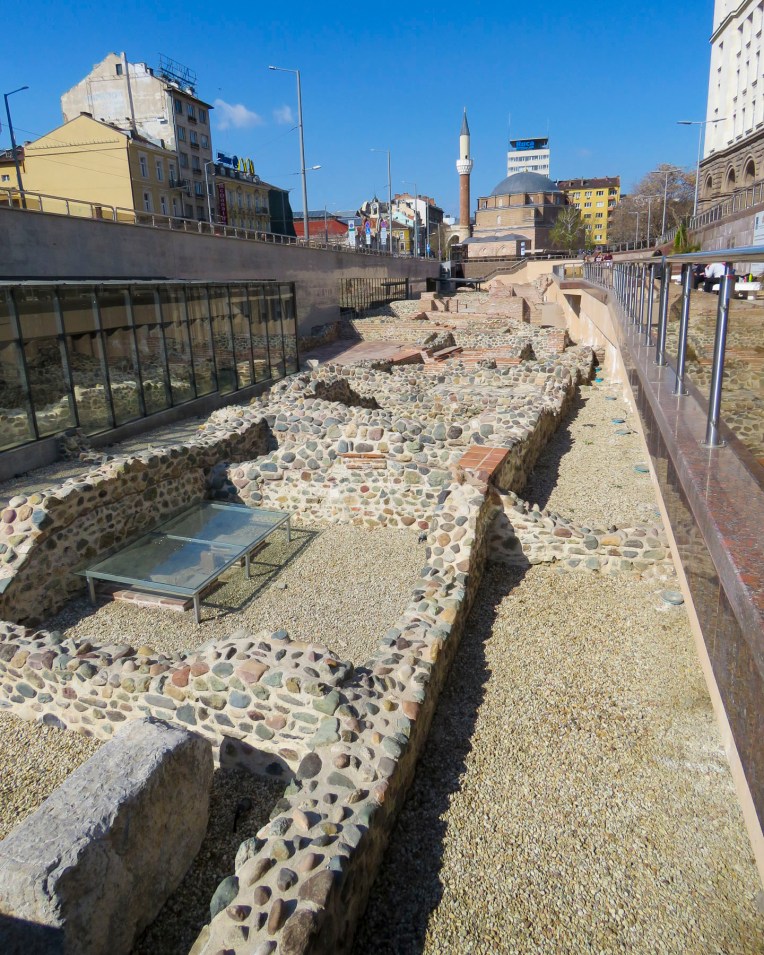 Seven millennia ago, put down the first foundations of what we now call Sofia. The construction of Sofia’s modern subway system in the 1990’s revealed multiple layers of antiquity and many of the amazing artifacts unearthed are displayed, in museum cases, on the subway platforms in the Serdika station and National Archeology Museum nearby.


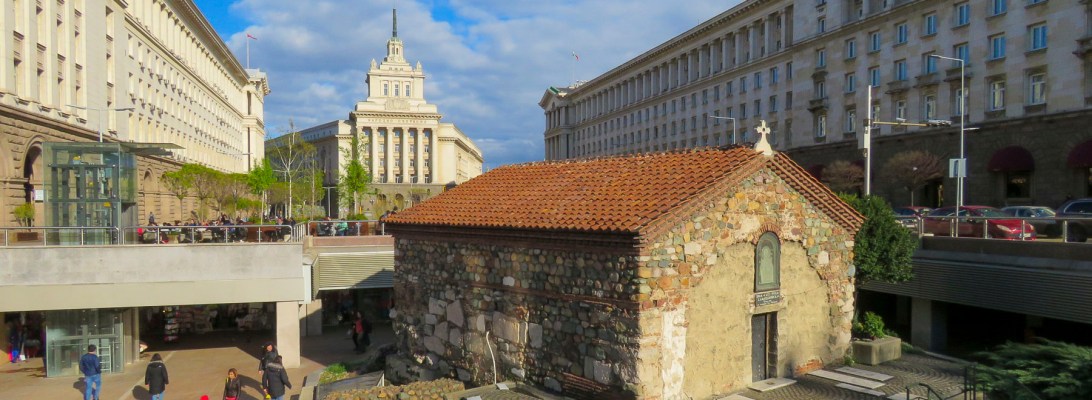
This is ground zero for history in Sofia as so many interesting sites are nearby. Some larger stone columns and decorative capitals discovered have been placed in the Doctors’ Garden near Cathedral Saint Aleksandar Nevski. A tram passed by quietly as we approached St Nedelya Church, surrounded by trees in a small plaza. The 19th century structure in front of us replaced a wooden structure that dated to the 10th century. The inside of the domed church is spectacular with religious murals covering every surface.
  Tragically in a 1925 bombing, the Bulgarian Communist Party attempted to kill the King of Bulgaria and other members of the government who were attending a funeral at this church – one hundred-fifty people died, and the cathedral’s dome was razed. Excavations behind the church in 2015 uncovered early ruins and a treasure of 3,000 Roman silver coins from the 2nd century AD.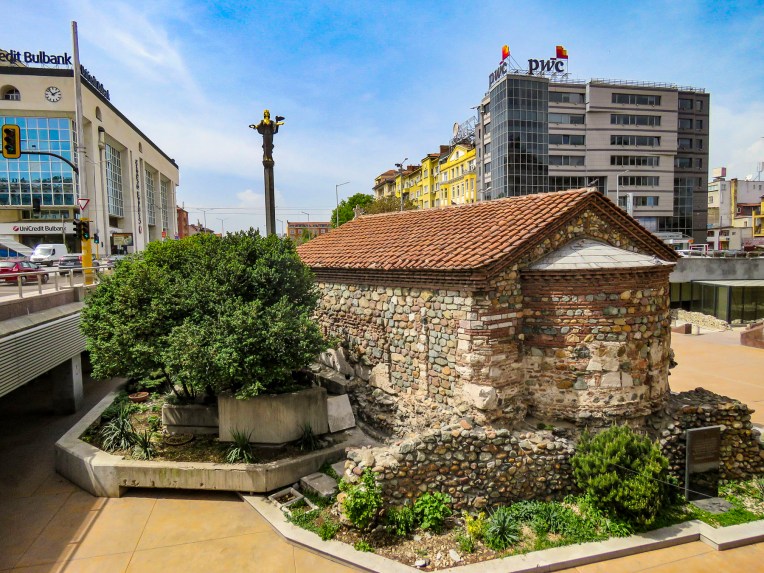


The Church of St. Petka stands in the center of Sofia adjacent to the Serdika Metro Station. Built during Ottoman rule in the 14th century, its entrance was placed below ground level, so that the church’s total height did not exceed that of a cavalry soldier on horseback. This was an odd condition the Ottomans had imposed on the construction of churches at the time. From the entrance of the church you can see the archeological excavation of an old Roman road and the buildings that lined it, complete with mosaic floors and plumbing. It ends just short of Banya Bashi, an Ottoman mosque built in the 16th century. The towering statue of St. Sofia is also visible just beyond the subway station. Ancient walls found during the renovation of the Central Market Hall can also be seen in the lower level of that building.
 Nearby the oldest building in Sofia, the Church of Saint George, built by the Romans in the 4th century, has early Christian frescoes which were painted over by the Ottomans when it was used as a mosque, but they were rediscovered in the 1900s and restored. It stands surrounded by modern buildings in a courtyard behind the President of the Republic of Bulgaria building, within earshot of the Changing of the Guard.


Across town, our journey back through history continued at St. Sophia Church. During the reign of Emperor Justinian, when Bulgaria was part of the Byzantine Empire, the cathedral we see today was built atop the ruins of a smaller 4th century church that was centered in an ancient necropolis. Many of Sofia’s elite found their final resting place in the church’s crypt. Early Christian frescoes gracing the interior were destroyed and minarets were added when the Ottomans converted it to a mosque in the 16th century. The minarets and some walls collapsed during the 1858 earthquake and the mosque was abandoned due to the extensive damage, left to be used as a warehouse until the early 1900s when restoration began. Today its cavernous interior, revealing its amazing brick construction and catacombs with ancient mosaic floors and tombs can be toured. In the park in front of the cathedral The Sveta Sofia Underground Museum Necropolis has a fascinating display of discoveries from the area surrounding the church.


More recently the Cathedral Saint Aleksandar Nevski, standing adjacent to St. Sofia, was designed in 1884 to commemorate all the brave Bulgarian and Russian soldiers that died during the Russo-Turkish War of 1877-1878 and freed Bulgaria from Ottoman rule. However, the building was delayed repeatedly due to regional conflicts and not finished until 1924. Its magnificent interior features gilded domes, chandeliers from Munich, Brazilian onyx, Indian alabaster, Italian marble and walls covered with beautiful iconography. It is the most important orthodox church in Bulgaria. 
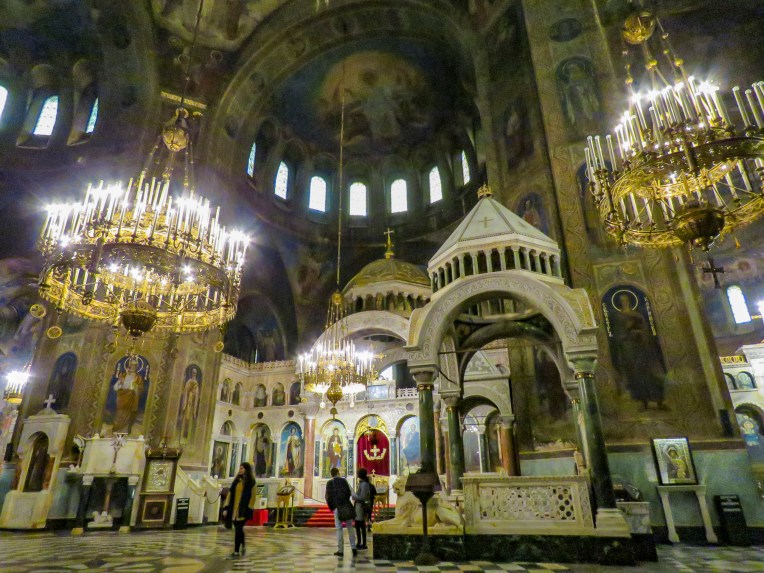 In the crypt of the cathedral a small, state of the art museum showcases the development of Bulgarian orthodox iconography over the centuries.
  Nearby, the five gilded spires of the Russian Church, officially known as the Church of St Nicholas the Miracle-Maker, can be seen from the steps of Cathedral Saint Aleksandar Nevski. Built in 1914 on the site of a mosque that was torn down after the liberation of Bulgaria, it served has the official church for the Russian Embassy and the Russian community in Sofia. The religious murals that cover the interior of the church were created by Vasily Perminov’s team of talented icon painters, who were also responsible for the iconography in Cathedral Saint Aleksandar Nevski. Darkened by decades of candle smoke, the fresco paintings in the dome were restored in 2014.


In an outlying area, far from the city center, the Museum of Socialist Art displays forty-five years (1944-1989) of socialist themed art from the former People’s Republic of Bulgaria, a not too distant communist past that has been collected from every town across the country. Most impressive is the statue park with monumental sculptures of Lenin, Stalin, Che Guevara, along with statues of farm workers and industrial laborers celebrating the communal. At the time of its inauguration Georgi Lozanov, a noted Bulgarian educator, said, “Bulgaria must have a museum of communism that will tell new generations the story of a period that should never again become reality.”


Closer in town, the National Museum of Military History displays an array of deadly modern weaponry, jets, tanks and missile launchers that are slowly rusting away. Also included is a noble little Trabant 601 automobile, the Soviet equivalent to the Volkswagen Beetle, the significance of which we’re not sure.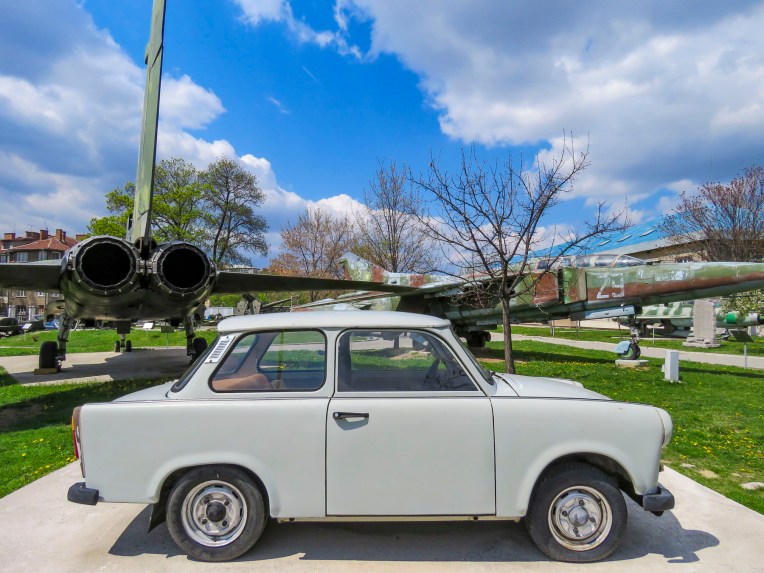 In 2001 an early Christian mausoleum was unearthed near the American Embassy and it’s fantastic that things are still being discovered in 2019.


It seems you can’t build or conduct any street repairs in Sofia without uncovering an ancient layer of history.
Till next time, Craig & Donna

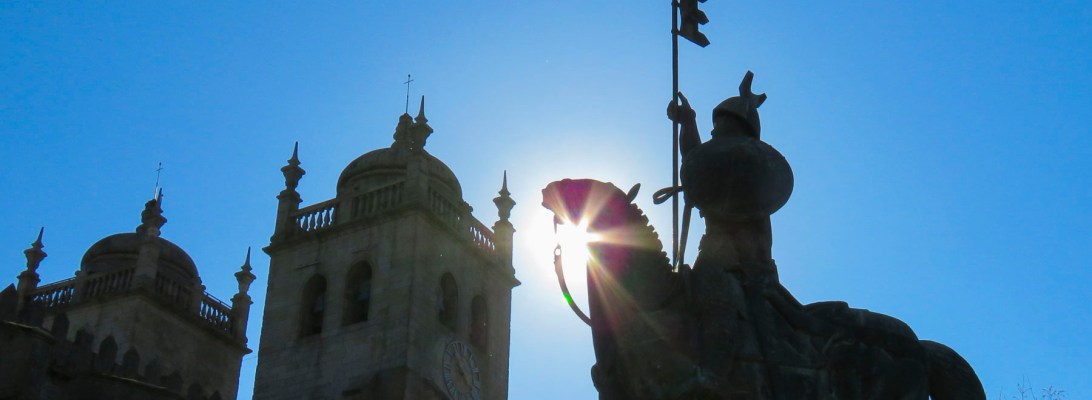
 Later that morning the courtyard of the church was filled with mourners as we walked to the Porto Cathedral, Sé do Porto. Not far from the old towers and ramparts of Muralha Fernandina, the cathedral commands the highest point in Porto. The building outwardly reflects Porto’s turbulent past, with crenels capping its massive shape, when it was the last point of refuge while the city was under siege.
 Building started in the 1100s, then continued over the centuries. The cathedral combines Romanesque, Gothic and Baroque features, like so many of the other churches in Porto.


 Exiting the museum, the Pillory of Porto centers the vast plaza in front of the Cathedral. Criminals once hung from hooks, still visible, on this graceful Manueline column. It struck us as such a disturbing juxtaposition, this instrument of punishment and humiliation, prominent in front of the cathedral, constantly reminding the good citizens of Porto not to stray from a righteous path. Today tourists lounge on its steps and soak in the surrounding views of Porto.

 Narrow alleys spurred left and right off the steep stairways. Taking one we came across a lavadouro público (communal laundry) that appeared to be recently rebuilt with new wash basins and roof.

 Eventually our route merged onto the quay near Fonte do Cubo, a modern sculpture installed upon the ruins of a 17th fountain by the late José Rodrigues, who made his home in Porto. Behind the square a three-story high fountain covers one wall. At its center is a 21st century statue of St John the Baptist, done in a primitive style, by João Cutileiro, another famous Portuguese sculptor. Surrounded by lively, outdoor cafes and throngs of tourists, this is ground zero for the Ribeira waterfront.
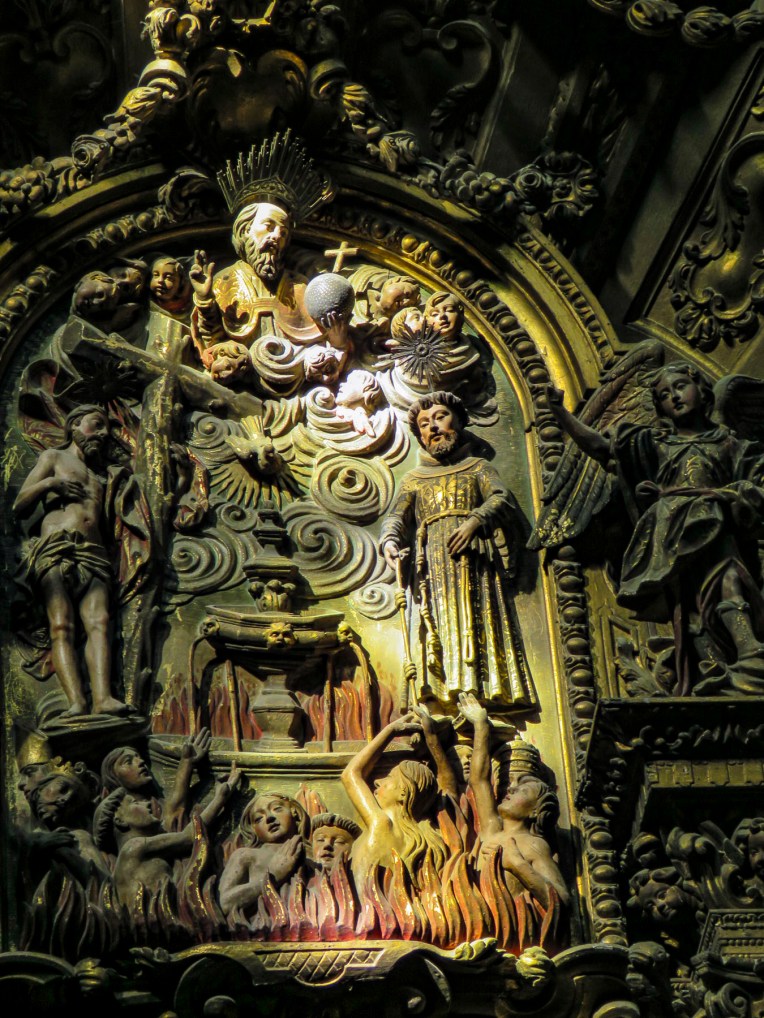
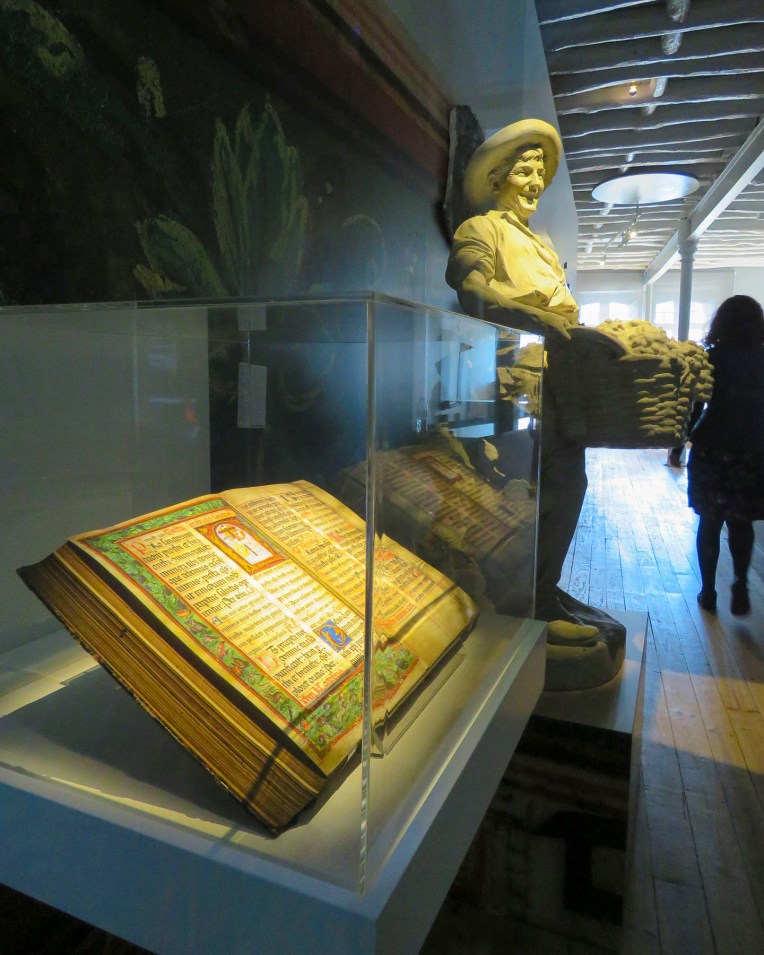 Walking past the Museu do Vinho do Porto on Rua da Reboleira, we headed to Igreja Monumento de São Francisco, also known as the gold church, to check out its ornate, gilded interior and crypt.


 The church was plundered during the Napoleonic Invasions and used as a stable by French occupying forces. Then later that century during the Portuguese Civil War the city was bombarded and the cloisters burnt to the ground, never to be rebuilt. The large crypt under the church was the final resting spot for many of Porto’s famous and wealthy citizens and, as catacombs go, is worth a short visit.
 It was time for a change of pace. Being so close to the Atlantic Ocean we decided to take


 Just shy of our destination the route was blocked by a disabled truck on the tracks. With no quick remedy in sight we decided to jump ship and head to lunch at the nearest restaurant, which happened to be in Jardim de Sobreiras, right next to our roadblock.


 We used an Uber ride to head back to our apartment. It was only slightly more expensive than our tram tickets would have been.

 Set back on Batalha Square, at the top of a wide set of stairs, the beautiful Church of Saint Ildefonso with its Azulejo tile covered exterior and twin bell towers commands attention. Built in the early 1700’s on the site of an older church, the building has gone through many alterations after suffering severe storm damage one year, then cannon fire from Napoleon’s troops during the siege of Porto in 1833. Eleven thousand Azulejo tiles depicting stories from the Gospels and the life of Saint Ildefonso were a late addition to the façade in 1932.


 The blue-tiled Chapel of Souls can be found a little further along. Added in 1929, the two-story high Azulejo tile mural covering the front and side dramatically depicts scenes from the life of Saint Catherine and Saint Francis of Assisi.
 Back tracking, we turned down Rua de 31 de Janereio which would take us to Porto São Bento, the inter-city train station, then Clérigos Church & Clérigos Tower. This beautiful French Beaux-Arts styled station was constructed in 1900. Between 1905 and 1916, artist Jorge Colaço designed and installed 20,000 Azujelo tiles in this lobby, which illustrate significant moments in Portugal’s history. It is a dramatic, cavernous space especially when sunlight pours through its tall windows across the tiles. Jorge Colaço also designed the tiles on the exterior of the Church of Saint Ildefonso.
 Just past the train station is Praça da Liberdade with its grand sculptures. There are also many fine architectural details on the surrounding buildings, so look up!


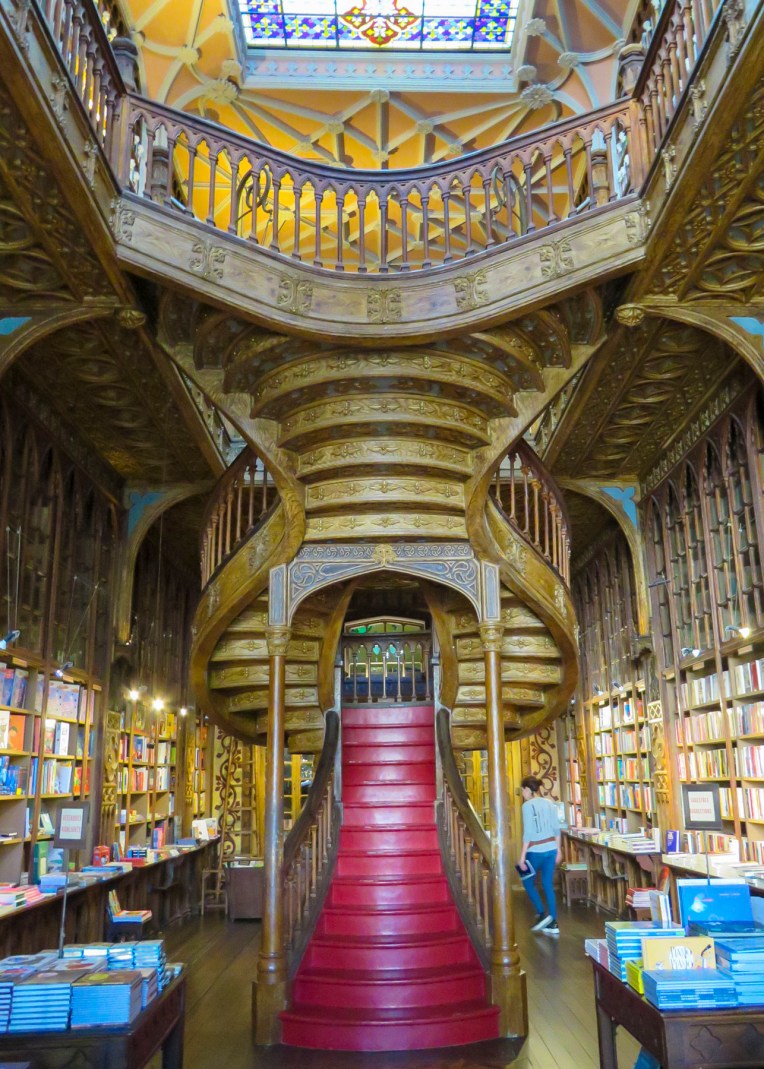 At the top of the street in a small plaza with palm trees we found Fonte dos Leões, with its four lion statues.
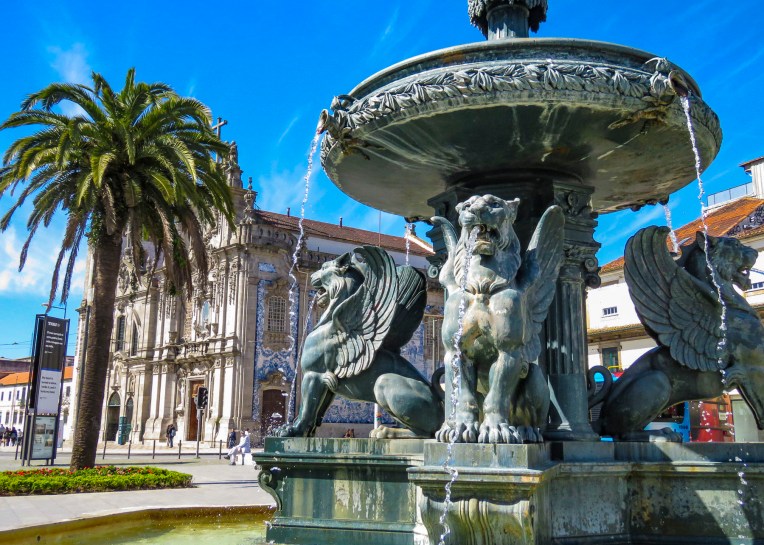 Behind it the cathedrals Igreja dos Carmelitas and Igreja do Carmo stand next to each other.
 They are only separated by the width of a discreet door to an extremely narrow house which was the home of church workers until the 1980s. Recently it was opened as a museum. Igreja do Carmo was built for the people and has an ornate exterior with sculpted statues of Santa Ana and the prophets Elijah and Elisha alongside sculptures of the four evangelists Matthew, Mark, Luke and John on its front façade and a large tile mural portraying the churches founding on the side wall.


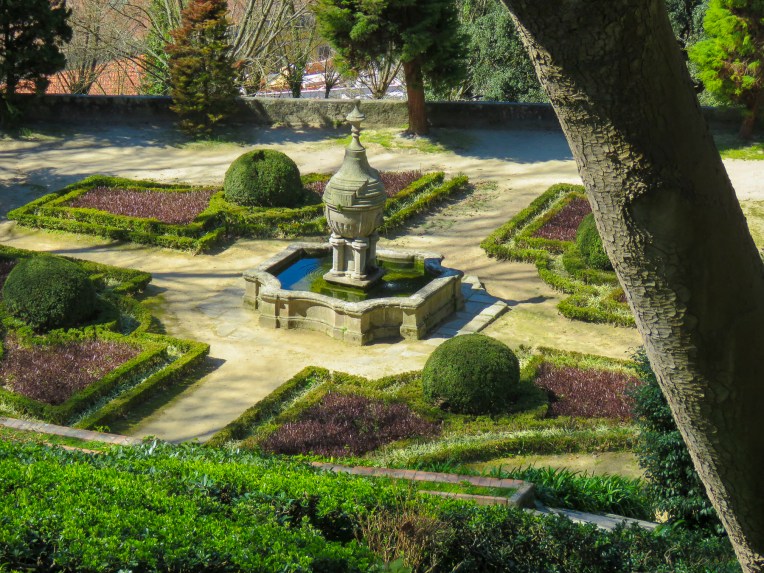 It was a brilliant, warm day and


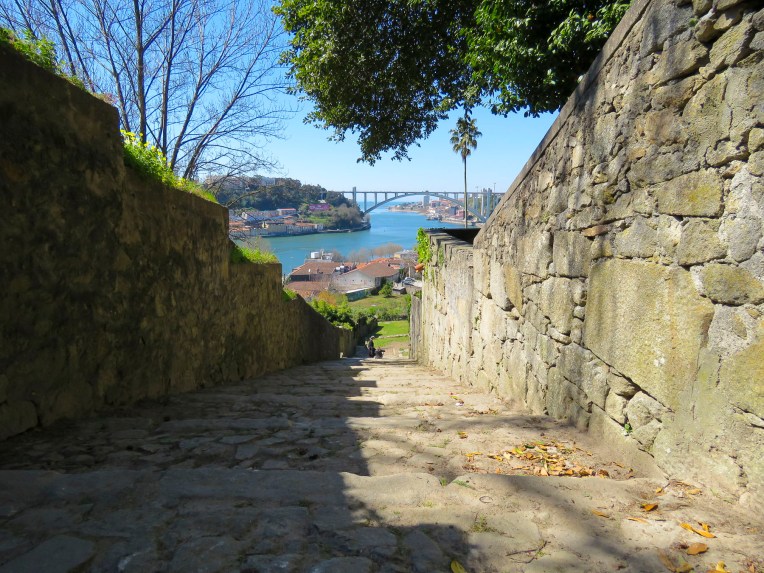 Along the quay the umbrella-ed tables of
  Tram 1 runs along the waterfront here, so we followed the tracks past Igreja do Corpo Santo de Massarelos, Church of the Brotherhood of the Holy Souls and Bodies, looking for the next station. The original church was founded in 1394 by a brotherhood of seamen to honor those lost at sea. Hometown hero Prince Henry the Navigator was a member of this fraternity in the 1400’s and the large azulejo tile mural on a wall of the church facing the river features him.
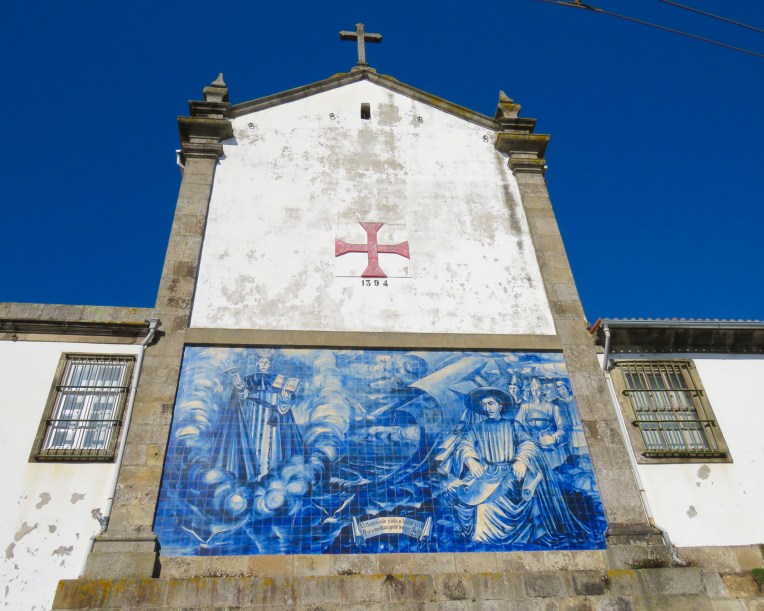 Just around the corner from the church Trams 1 and 22 shared a stop and we hopped aboard the #22, to save our legs from a long uphill walk, to start our journey home for the day.
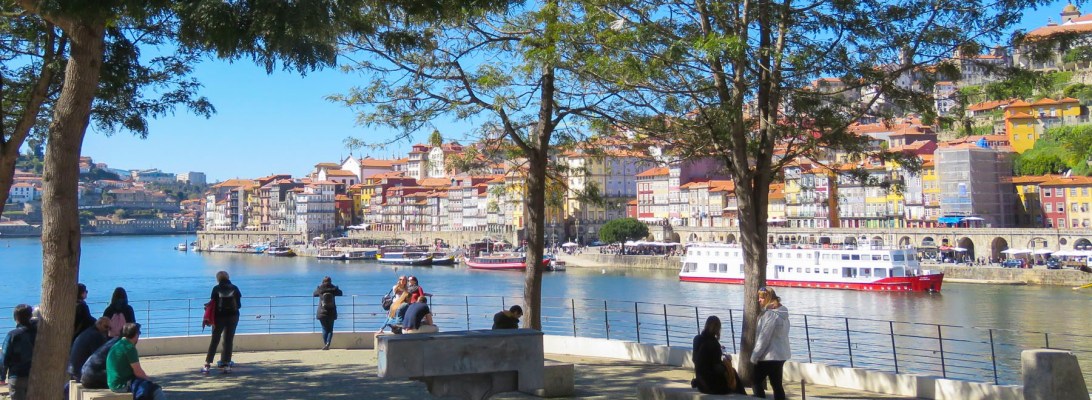
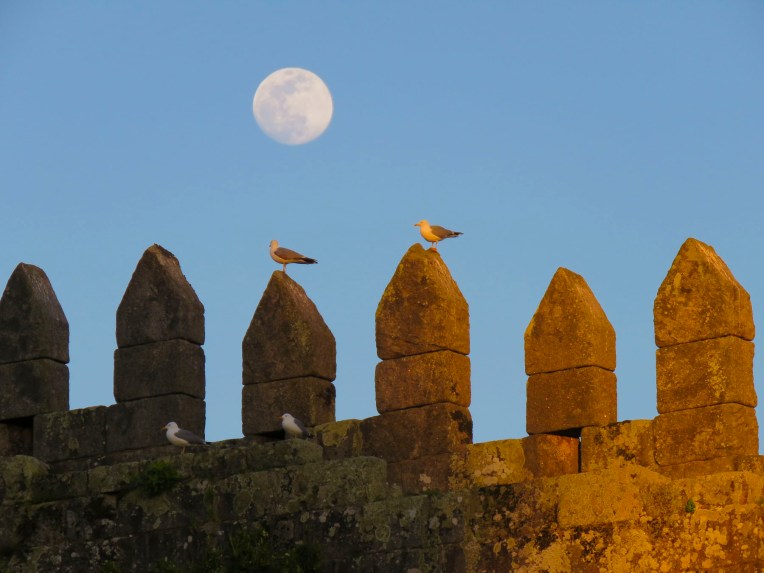

 But the city really needs to be explored on foot to truly savor its charm and intrigue. Porto escaped the massive 1755 earthquake and tsunami that devasted Lisbon. Consequently, the city’s historic architectural gems, many dating as far back as the thirteenth century, still stand unscathed, and its ancient cobbled lanes still meander every which way, untouched by urban planning. With this in mind we decided to weave our way over to the Ponte Luís I bridge and eventually make our way down to the picturesque south bank of the Douro River as our destination for the day, stopping to explore what interested us along the way.

 The armour-clad equestrian statue of Vímara Peres guards the approach to the Ponte Luis I bridge across the River Douro and some contemporary street art, that we’re not sure he would appreciate.

 For nine-hundred years pontoon bridges and small boats were the major ways to cross the breath of the Douro River before the advent of iron construction. Designed by Théophile Seyrig, a former colleague of Eiffel,
  Across the bridge we worked our way up to Mosteiro da Serra do Pilar for the views. This spot and Jardim do Morro, the park at its base, are popular places to watch the sunset from.
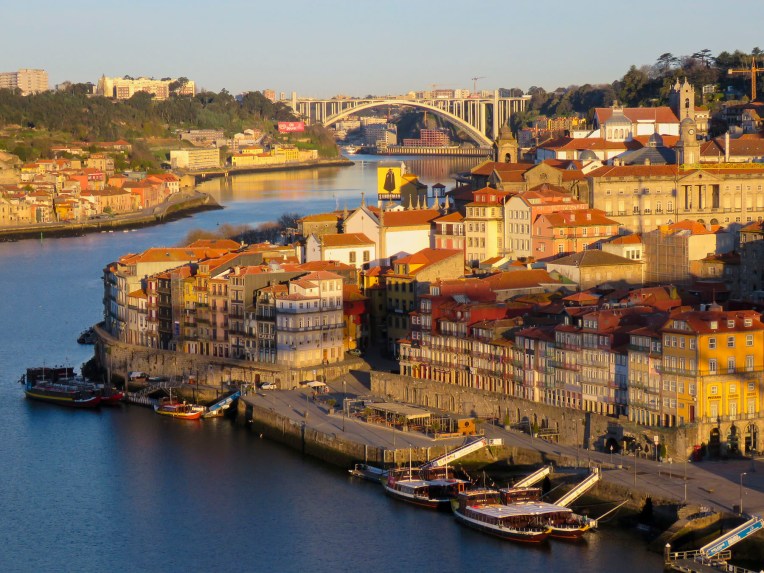 We opted not to take the aerial tram down to the Gaia riverfront and continued our walk, looking for the right restaurant set amidst the fifty port cellars that line the waterfront. Perched atop the port cellar Espaço Porto Cruz, the Terrace Lounge 360º fit the bill.
 The day was beautiful, lunch was delightfully slow paced and of course we enjoyed some wine. We’ve found the restaurants in Portugal never rush you to leave. The table is yours for however long you wish to stay. We soaked in the warm sun, breathed in the crisp Spring air and absorbed the good life surrounding us.


 Coimbra is a city for walkers. Ancient lanes crisscross the historic district, weaving their way steeply up the hillside until you eventually reach the University of Coimbra, which crowns this charming city. But the journey there is so rewarding, with arched alleys, cathedrals and numerous shops and restaurants all vying for exploration.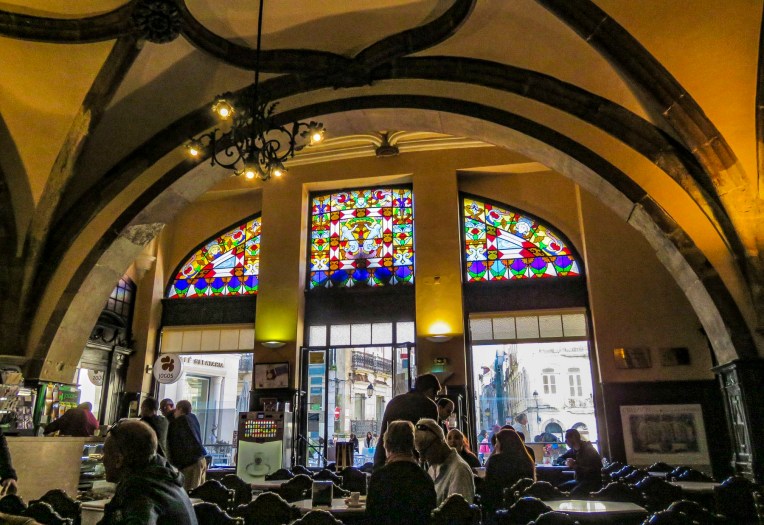


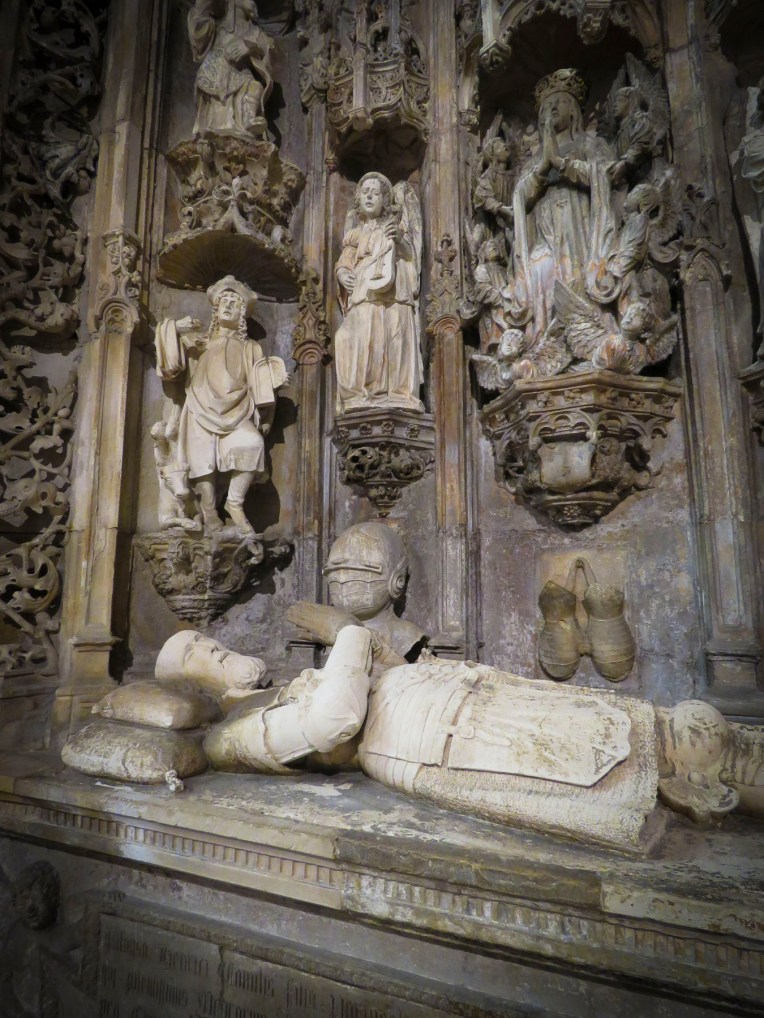 Deceptively, many of the marble columns and surrounds of the altar are actually wood, painted to imitate marble. The cathedral aged poorly in its early centuries as the result of repeated Spring flooding from the Mondego River. In the 1700s Azulejos tiles were added to the walls to cover severely water-damaged early fresco paintings. A spectacular and huge four thousand pipe organ hangs precariously from the wall of the sanctuary. Apparently, it’s so difficult to play only three people know how. The monastery is huge with many interesting rooms and intriguing details to explore.


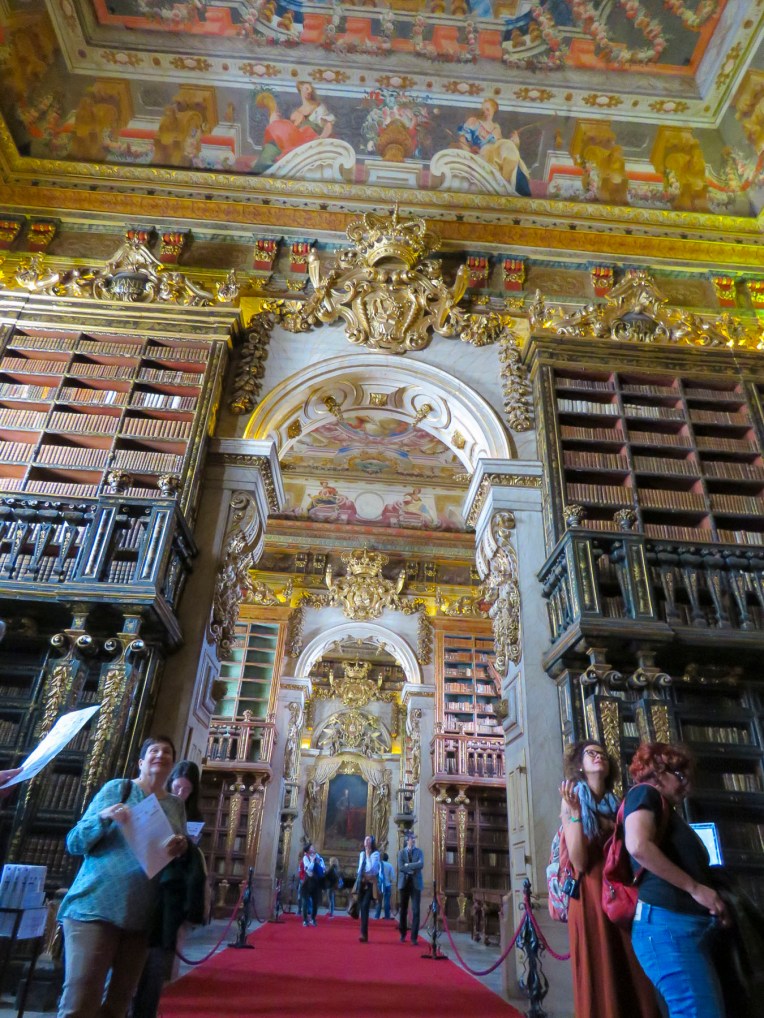


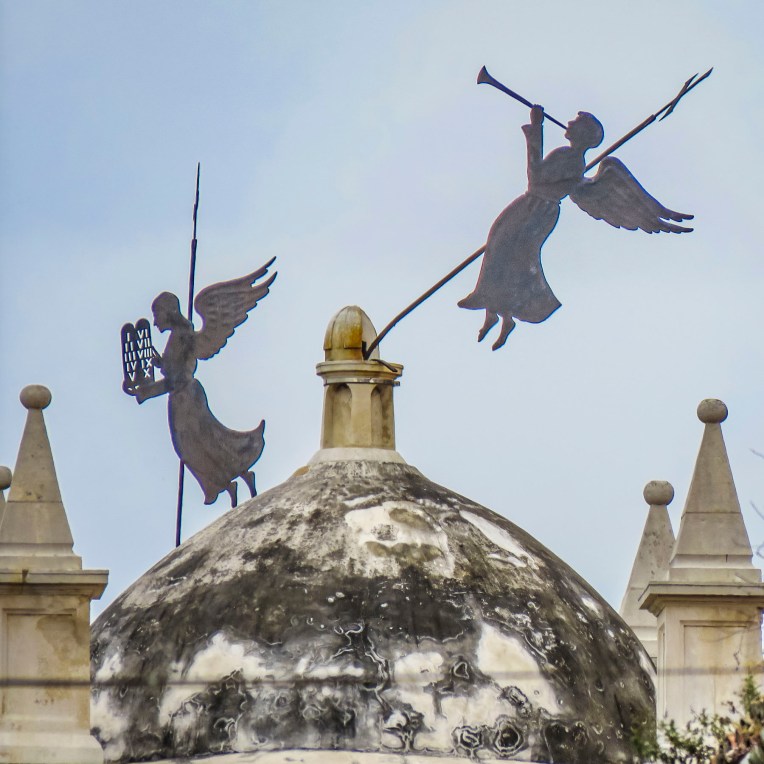


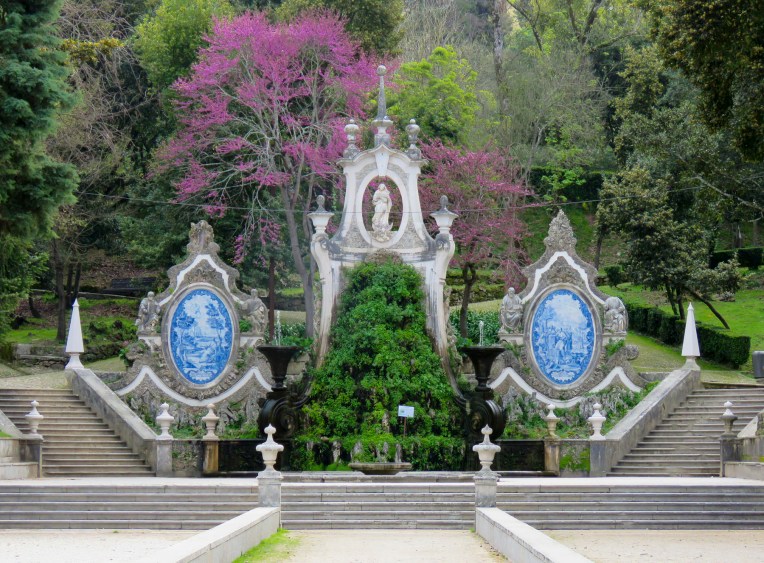 Azulejo tile murals edged with religious statues framed the sculpted fountain. At the top of the fountain water gurgled from under a statue of the Virgin Mary, symbolically giving life to the waterfall. Symmetrical stairways on either side led deeper into the heavily shaded park.




![IMG_8406[41116]](https://i0.wp.com/2suitcasesfor2years.com/wp-content/uploads/2019/07/img_840641116.jpg?w=279&h=210&ssl=1 "IMG_8406[41116]")

![IMG_8535[41117]](https://i0.wp.com/2suitcasesfor2years.com/wp-content/uploads/2019/07/img_853541117.jpg?w=279&h=209&ssl=1 "IMG_8535[41117]")

![IMG_4442[41105]-2](https://i0.wp.com/2suitcasesfor2years.com/wp-content/uploads/2019/07/img_444241105-2.jpg?w=484&h=363&ssl=1 "IMG_4442[41105]-2")
![IMG_4328[41104]-2](https://i0.wp.com/2suitcasesfor2years.com/wp-content/uploads/2019/07/img_432841104-2.jpg?w=272&h=363&ssl=1 "IMG_4328[41104]-2")
 When we retired early, a year ago, we had to choose health insurance or travel. We made the decision to go without U.S. health insurance, because it’s too damn unaffordable and wouldn’t cover us outside the U.S. anyway. We chose travel insurance instead, with medical evacuation, and we pay out of pocket for wellness care and dentistry. Our two years on the road will bridge us until age 65 when we qualify for Medicare. And it’s surprising how affordable excellent healthcare is in other countries. We’ve paid $25.00 for an emergency room visit to a private hospital and $5.00 for the prescriptions in Ecuador to treat high altitude sickness. Our travel insurance paid fully for a visit to an ENT specialist in Lisbon to treat a persistent sinus infection. I’ve visited dentists in Cuenca, Ecuador for a tooth extraction and bridge; Sofia, Bulgaria for a broken filling; and Cape Town, South Africa for a root canal. The care has been excellent and extremely inexpensive compared to pricing in the United States. Though when we are in the United States travel insurance only covers us if we are one hundred miles away from our previous home in Pennsylvania.
 We plan on purchasing a home when we return to the United States. Right now, though, our budget is plus/minus $1000.00 per month for an apartment. One thousand per month for housing goes much further overseas than in the states and allows us to live in unique and interesting locales.
![IMG_3666[31053]](https://i0.wp.com/2suitcasesfor2years.com/wp-content/uploads/2019/07/img_366631053.jpg?w=226&h=301&ssl=1 "IMG_3666[31053]")
![C9307CA4-72DA-4D6B-8838-8D3B4A103C88[35084]](https://i0.wp.com/2suitcasesfor2years.com/wp-content/uploads/2019/07/c9307ca4-72da-4d6b-8838-8d3b4a103c8835084.jpg?w=301&h=301&crop=1&ssl=1 "C9307CA4-72DA-4D6B-8838-8D3B4A103C88[35084]")
![IMG_3677[31056]](https://i0.wp.com/2suitcasesfor2years.com/wp-content/uploads/2019/07/img_367731056.jpg?w=225&h=301&ssl=1 "IMG_3677[31056]")
![IMG_3463[31065]](https://i0.wp.com/2suitcasesfor2years.com/wp-content/uploads/2019/07/img_346331065.jpg?w=378&h=284&ssl=1 "IMG_3463[31065]")
![IMG_3140[31166]](https://i0.wp.com/2suitcasesfor2years.com/wp-content/uploads/2019/07/img_314031166.jpg?w=378&h=284&ssl=1 "IMG_3140[31166]")
![IMG_3737[35074]](https://2suitcasesfor2years.com/wp-content/uploads/2019/07/img_373735074.jpg?w=764)
 We’ve rented cars in Ecuador, Guatemala, Portugal, Bulgaria and South Africa. Near the Schist villages in the mountains of central Portugal we gave a lift to two hikers, who were exhausted from a long trek without water. We ended up having a delightful afternoon and lunch with them. Aside from the deeply rutted dirt roads of the Andes Mountain range in Ecuador, South Africa with its driving on the left has proven to be the most difficult. We find that a pilot plus navigator system works well, with the latter reminding the pilot to stay left and make very wide right-hand turns. Interesting traffic signs dot the roads here: Caution Tortoise and Baboons Share this Road Too, Watch for Stray Cattle. I chuckled to myself when I passed a sign that I thought said Zebras Humping, only to realize a moment later it was a speed bump when I hit it at a pretty good clip. Caution High Winds – Parents Hold Your Children Firmly by the Hand as there is Mortal Danger of Them Blowing Off, greeted us in the parking lot of a scenic and windy overlook. South Africa has a well deployed and concealed electronic camera system and we’ve received our first notice of a traffic violation from the rental car company.


![IMG_6810[39428]-2](https://i0.wp.com/2suitcasesfor2years.com/wp-content/uploads/2019/07/img_681039428-2.jpg?w=492&h=369&ssl=1 "IMG_6810[39428]-2")
![IMG_4520[41112]-2](https://i0.wp.com/2suitcasesfor2years.com/wp-content/uploads/2019/07/img_452041112-2.jpg?w=264&h=369&ssl=1 "IMG_4520[41112]-2")


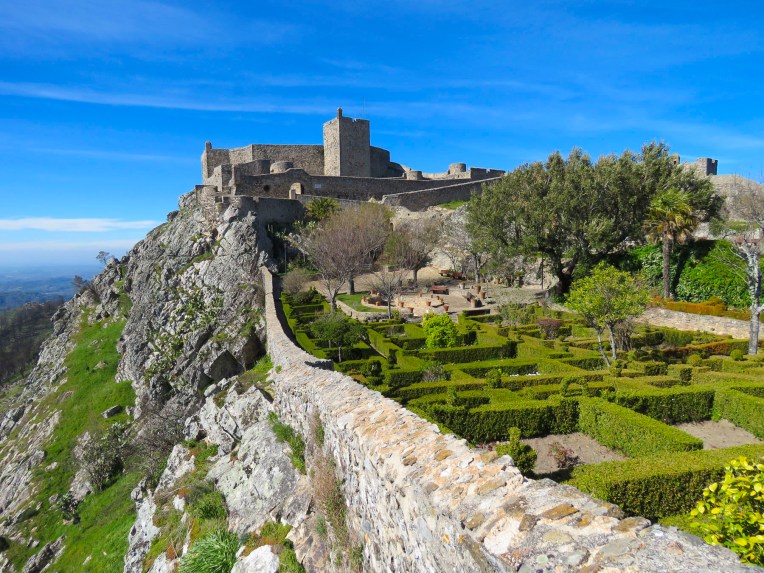


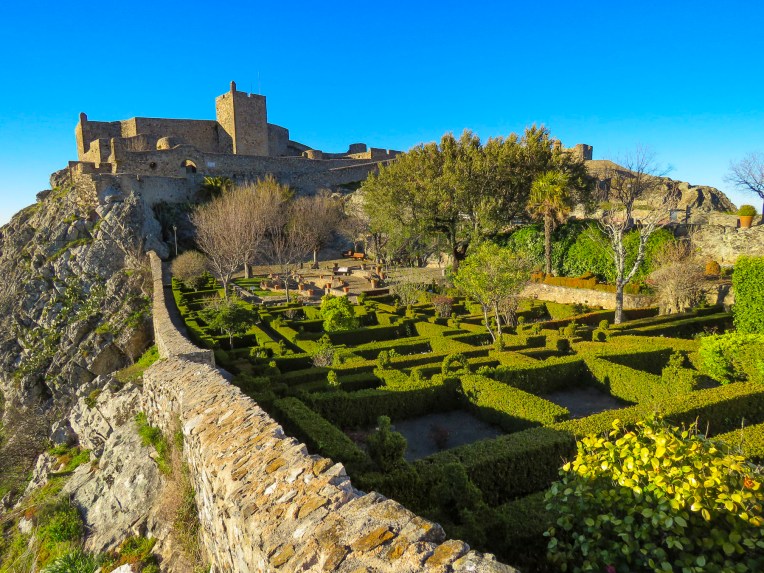
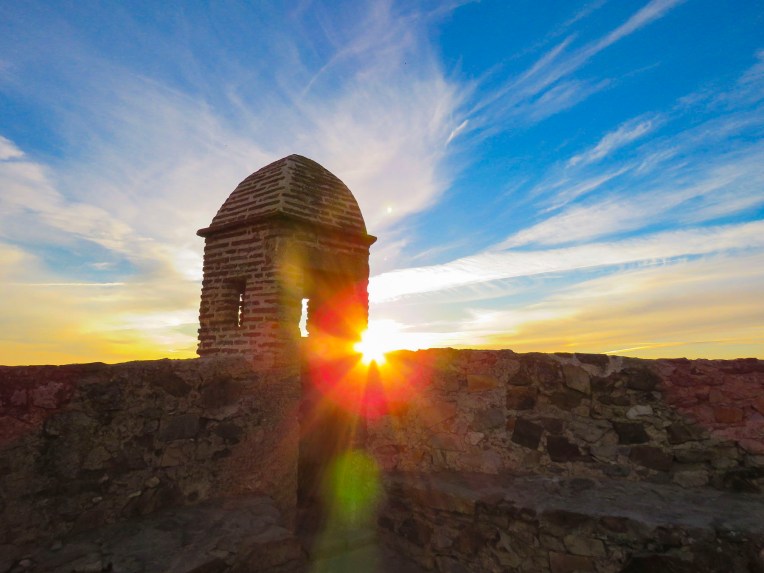 The cold wind chilled us to our bones, but we found warmth by the fireplace in the tavern across from our inn. After dinner, as we stood on the ramparts behind our hotel, the darkness offered us a view of the stunning star-filled sky above and the twinkle of village lights far below. With a stiff breeze in our faces, we felt like we were flying. The glorious sunrise the next morning cast a beautiful light on the panoramic view of the flat plains that run all the way into Spain, while the rugged mountains and valleys to the west stayed covered in an early morning mist.


 Walking along the river towards Cais do Sodré by the Ministério da Defesa Nacional – Marinha building you can see remnants of a stone wharf in the reflecting pool; landlocked now, it’s all that remains of an extensive old navy quay. There are many places to dine in this area, but we preferred to continue onto Av. 24 de Julho to check out the street art in the area and then stop at The Time Out Market.


 One of the nicest Sundays we enjoyed was spent at the


![IMG_3140[31166]](https://i0.wp.com/2suitcasesfor2years.com/wp-content/uploads/2019/06/img_314031166.jpg?w=484&h=363&ssl=1 "IMG_3140[31166]")


![IMG_3170[31169]](https://i0.wp.com/2suitcasesfor2years.com/wp-content/uploads/2019/06/img_317031169.jpg?w=272&h=363&ssl=1 "IMG_3170[31169]")


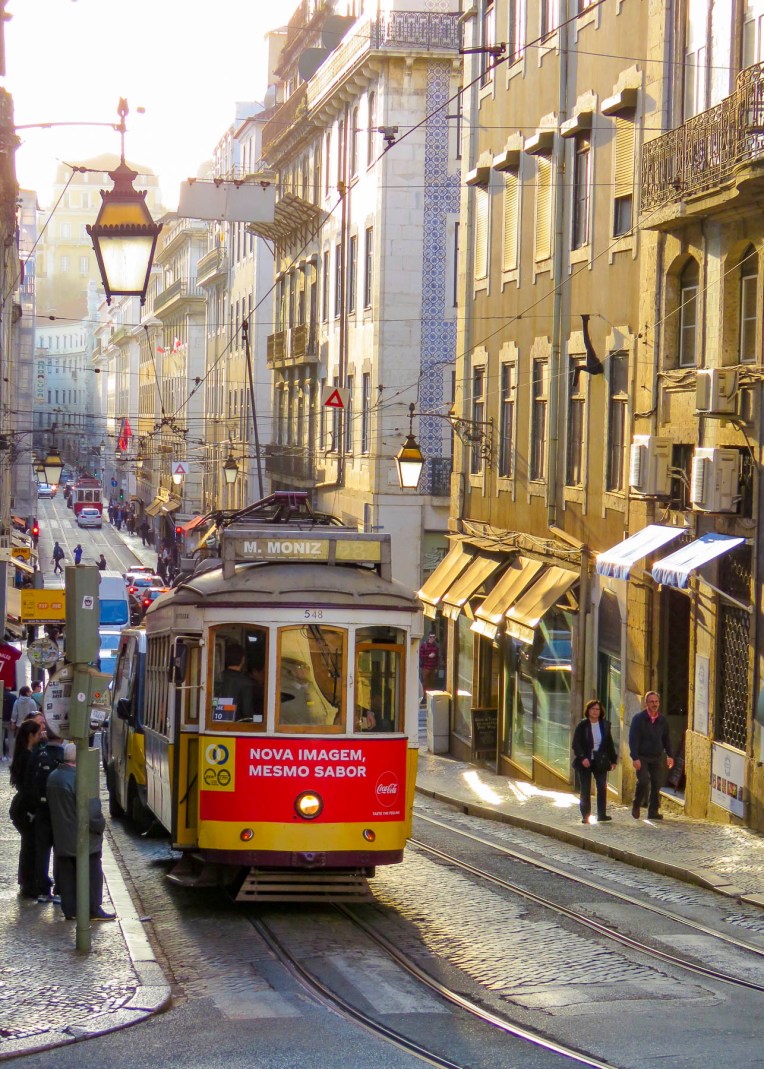 As if guarding the plaza,


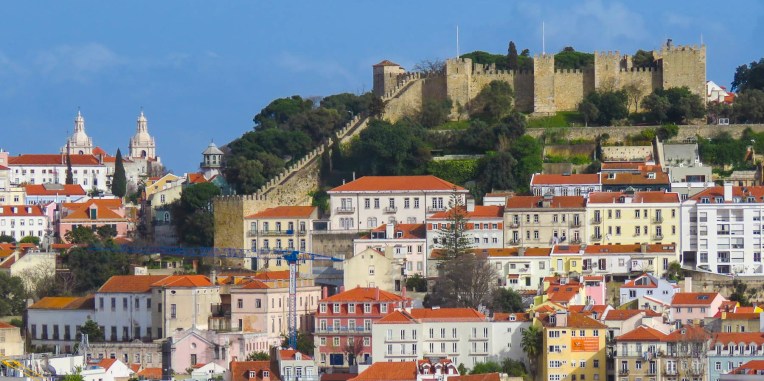 Shady Miradouro de São Pedro de Alcântara overlooks this colorful chaos and has splendid views of Lisbon below. From the miradouro it’s a gentle uphill walk into Bairro Alto. Fortunately, there’s no lack of places to rejuvenate yourself along the way. For lunch we found


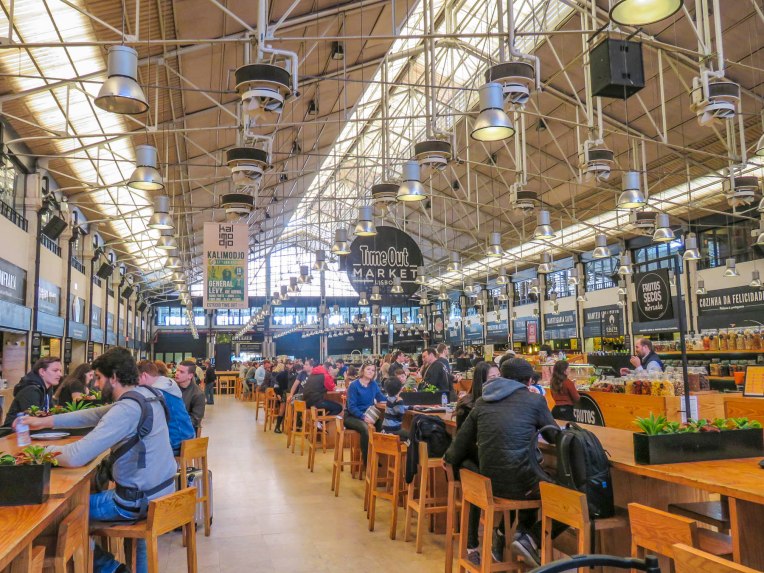 Set in a historic 1890s building in Cais do Sodré, this is a huge, lively food court with numerous restaurant choices that is very popular with Lisboans. Whatever you are craving at the time, you’ll find something satisfying here. Next door, during the week, Mercado da Ribeira operates a central market with fish, meat and produce vendors offering Portugal’s finest products. Brightly painted Pink Street, popular for its club scene, is nearby.


 Heading west, tram 28 weaves through a very narrow section similar to parts of its route in Alfama, before reaching the open area around Assembleia da República. The parliament of Portugal is headquartered in a neoclassical building that was first used as a convent in the sixteenth century. Formal gardens behind the parliament building, hidden by an imposing wall, can be seen from tram 28 or if you stand on your tip-toes and peer over. Never immune from criticism, the politicians must endure a large satirical wall mural, painted on a nearby building, as they head to work each day.


 2 Suitcases for 2 years