Portugal Road Trip – Part 2: For the Love of Guardrails

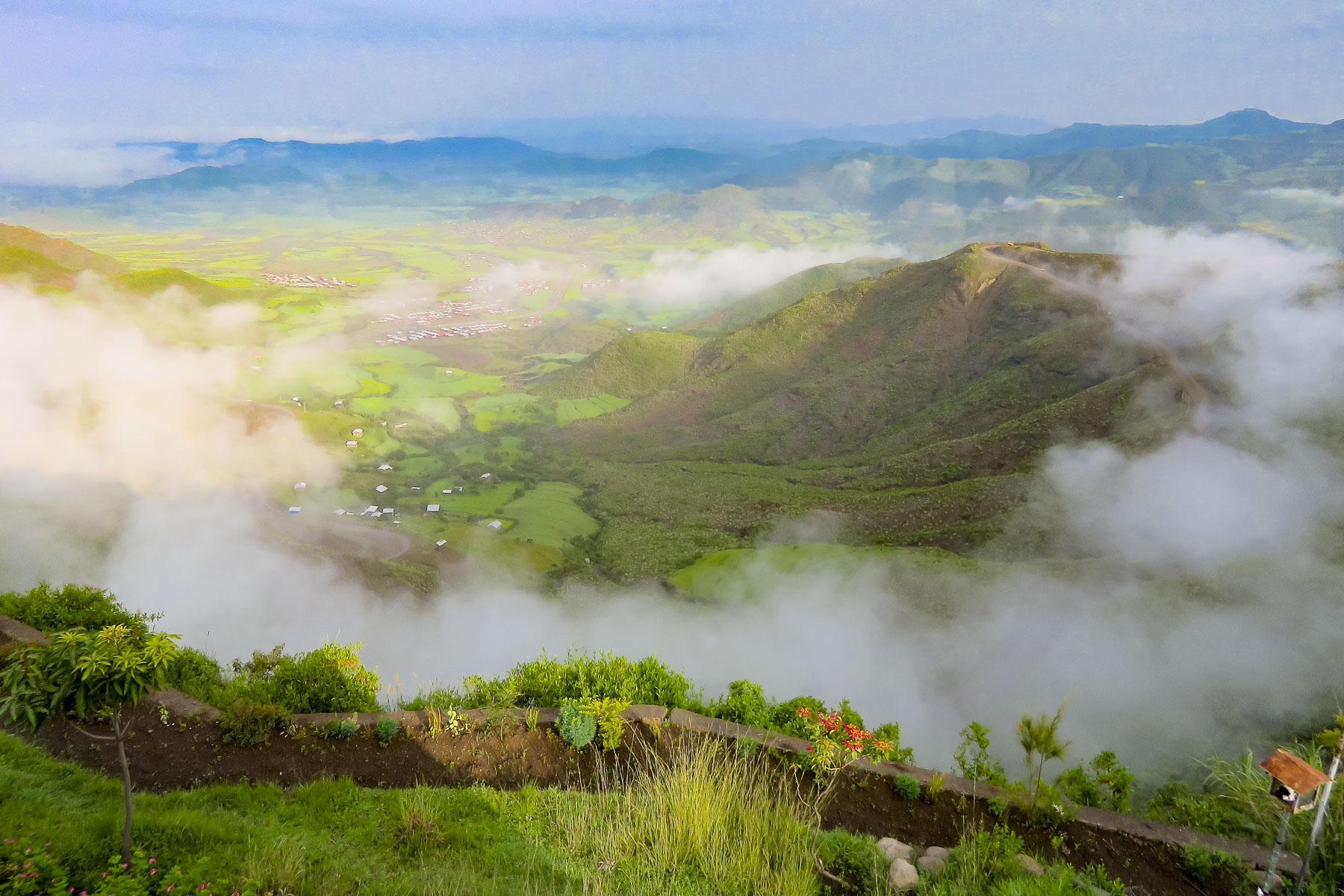
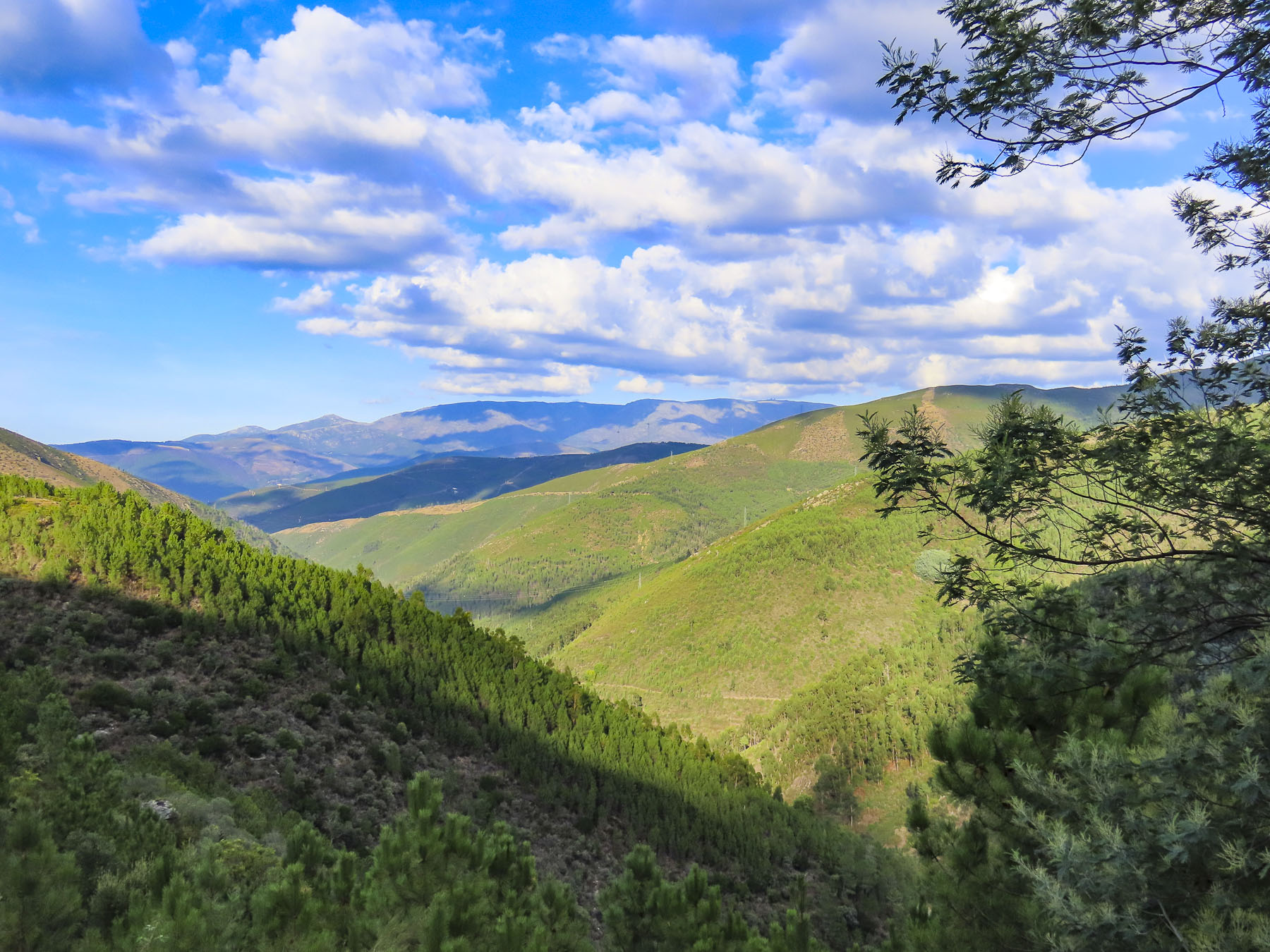
To misquote RWE, “It’s the journey, but an interesting destination helps.” We left Tomar, destined for Piodão, one of the 27 Aldeias do Xisto, Schist villages, in the mountainous central part of Portugal. Only two and a half hours from Tomar, we rarely passed another car as we drove. Our route quickly transitioned to serpentine roads traversing rolling hills covered in eucalyptus and pine forest. Then the higher above the tree line we drove, an expansive vista of shrublands fielding heather, broom, carqueja and rosemary were revealed. Hair raising, twisting and turning roads would truthfully be a better description, made all the more unsettling because there seemed to have been a transportation department budget crisis, as in, they forgot to install guardrails on most of those mountainous roads! My wife’s knuckles were white from tightly grasping the “Oh Jesus” handle above her door. With all the gorgeous panoramas, they could have planned more miradouros for folks to safely enjoy the views from.

We are not novice mountain drivers, having taken many switchback roads to remote places on several continents, which has reinforced or belief in and appreciation for a nice sturdy guardrail when we see one.
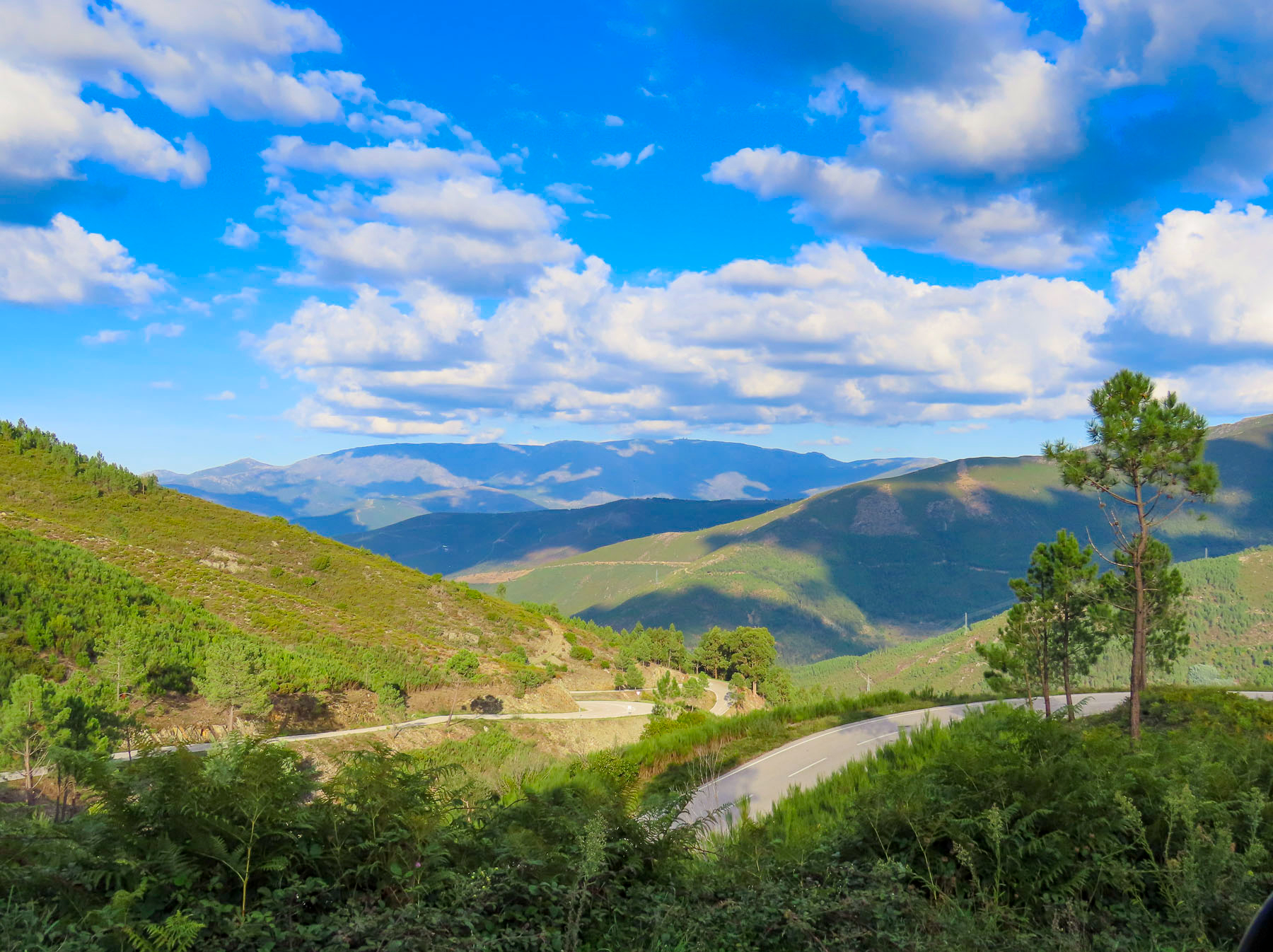
This was also the day our moody rent-a-wreck of a car went psychotic, every warning light on the dashboard blinking violently in Portuguese, requiring us to pull over to check the vehicle. Reluctant to turn off the engine in such a remote area, we listened closely for any sounds of motor distress. The car sounded fine. We drove on. With a quick, blind left turn and an “Oh God!” we descended a steep single lane road on the far side of the village that eventually led us across terraced slopes to Casa da Padaria for the night.

With warm greetings and help with our bags Gorete, the innkeeper, showed us to our room. For many years, decades before its renovation, the inn served as the town’s bakery run by Gorete’s father in-law. She and her husband returned to the village and remodeled the original building into a small four-bedroom guesthouse. The bakery’s large brick oven still takes up one whole wall of the breakfast room, which also displays a huge dough trough and long wooden bread peels used to take the loaves out of the wood fired oven.

Schist, schist, schist, everywhere schist! Walls, roofs, cobbled lanes, terraces, everything in the village is built with this durable brown and grayish stone, from a distance giving it the appearance that it has grown organically from the earth of the box canyon that shelters cradles it.  Everyone’s blue doors and window frames are not the result of superstition to ward off demons or to bring good fortune, but a shop keeper buying many years’ worth of paint in only one color. It became tradition.  

Channeled narrow rivulets of cold mountain water run quickly between homes, under doorsteps and along the edges of walkways before cascading downhill into irrigation trenches for the terraced crops below the village.  Small fountains throughout the hamlet offer spring water for drinking and washing for some of the older homes that still might not have plumbing.   

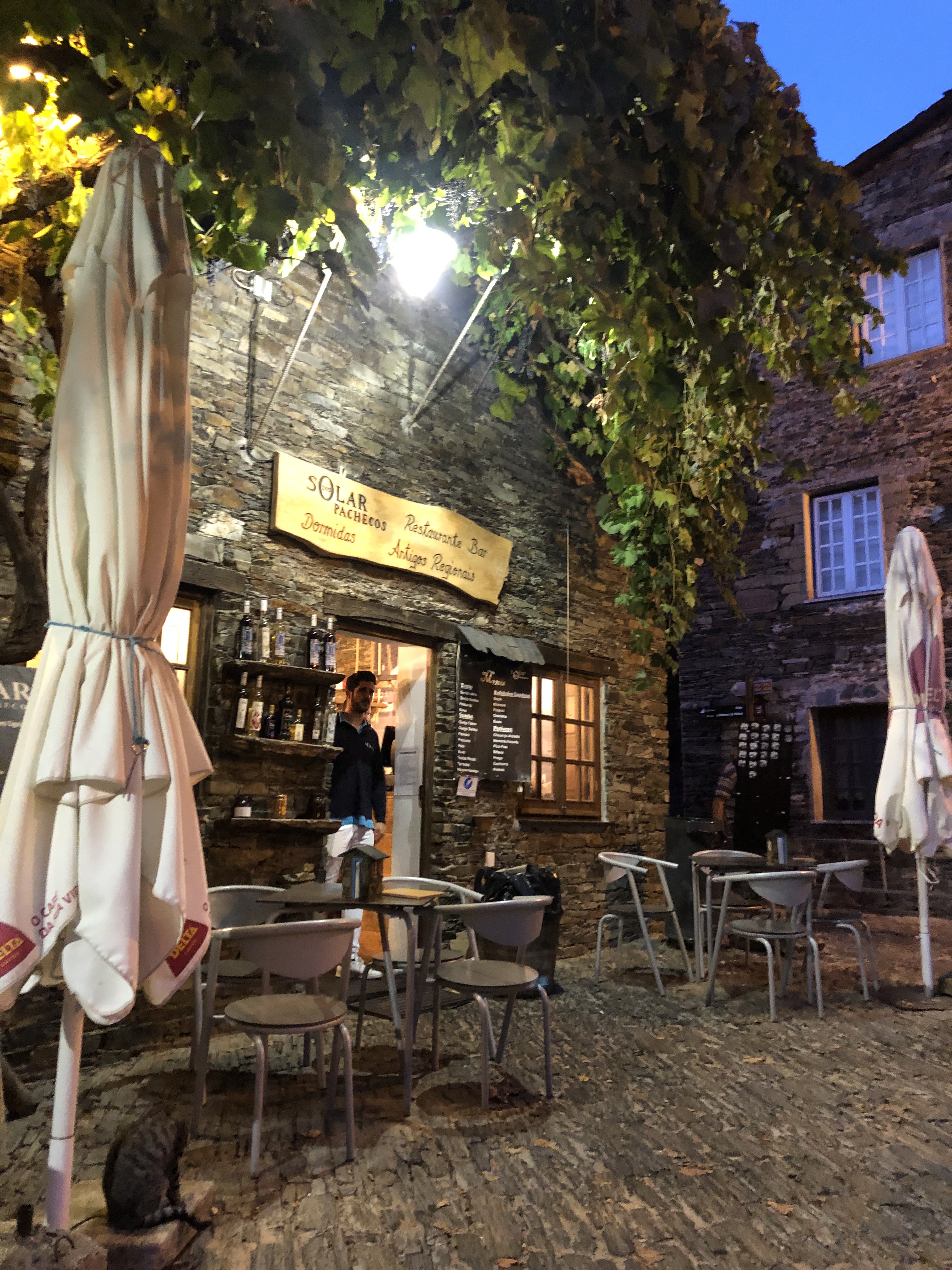
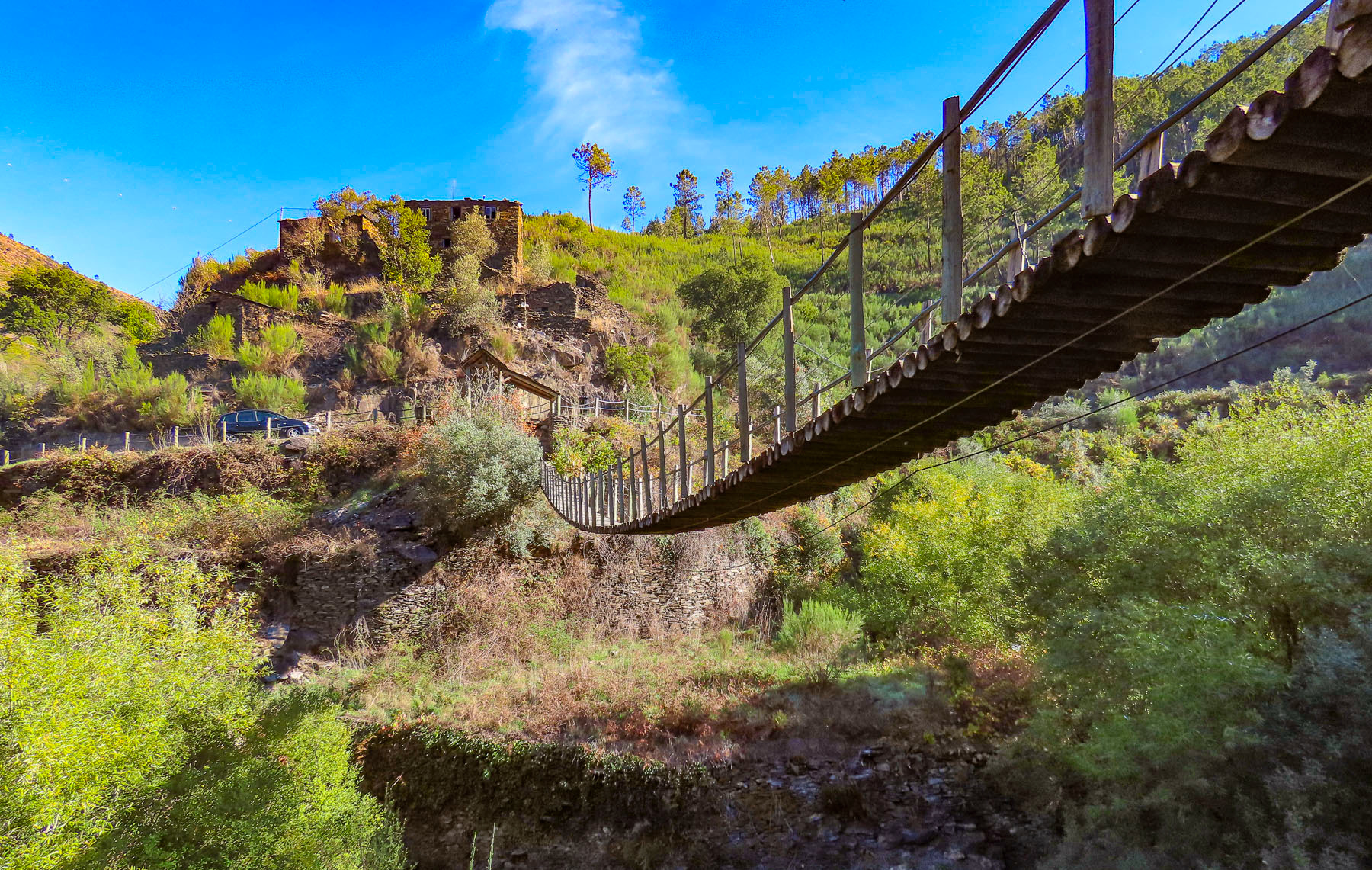
Slowly exploring the village, we made our way to its central plaza for dinner at O Solar dos Pachecos and enjoyed delicious bowls of Moelas Guisadas a Portuguesa, stewed chicken gizzards. This dish might not be for everyone, but it is truly one of Portugal’s culinary treasures. The owner enthusiastically shared tidbits of information and pointed across the way to the only mailbox in this unique village for the 120 full-time residents left here. Pity the poor postman otherwise trying to figure out the twist, turns and stairways of the hamlet’s ancient lanes. Surely everyone gets to know one another this way with the mailbox strapped to a tree on the main square in front of the village’s only white-washed building, the church.  Before leaving he suggested we enjoy some of the hiking trails the area is known for with a short trek through the valley to Praia Fluvial de Foz d’Égua, a scenic spot with a suspension bridge over a stream that widens into a natural swimming hole. Later for coffee and dessert we watched part of a soccer game on the TV above the bar at O Fontinha.
Piodão owes its unadulterated charm to the fact that it was pretty much forgotten and slowly abandoned until the 1970’s when the donkey and horse trails leading to the village were replaced with roads carved into the isolating mountains of the Serra do Açor that surround it. It is located not far from Parque Natural da Serra da Estrela and continental Portugal’s highest peak, Torre at 6,539ft. Difficult terrain lured fugitives, seeking to escape justice, to the isolated villages of the area. Allegedly one of the assassins of D. Inês de Castro, the mistress of Pedro l, sought refuge here in the late 1300s. Other than that interesting historical footnote and mention in a 1529 census, folks got by on a subsistence economy of farming, grazing sheep and goats, along with wood and stone cutting for centuries.

Its rediscovery and revitalization in the 1980’s brought the isolated village built with the abundant local schist stone recognition as one of the “most Portuguese villages of Portugal,” with a Galo de Prata “silver rooster” award.  
Waking during the night to close the window against the mountain chill, I observed a full moon illuminating a single arched stone bridge over a babbling brook at the bottom of the valley. The mountain songbirds were loud enough to encourage an early wakening as the sun rose over the ridge behind the village. The next morning Gorete’s homemade jams, pastries and a neighbor’s artisanal cheese nourished us before we explored the village and moved on.

The drive to Praia Fluvial de Foz d’Égua was through forest thick with oak, chestnut and laurel cherry and arbutus trees. Arriving, we understood immediately why this beautiful area is such an out of the way tourist magnet. Traveling during the fall shoulder season, we were fortunate to experience the tranquility of this serene spot in solitude.
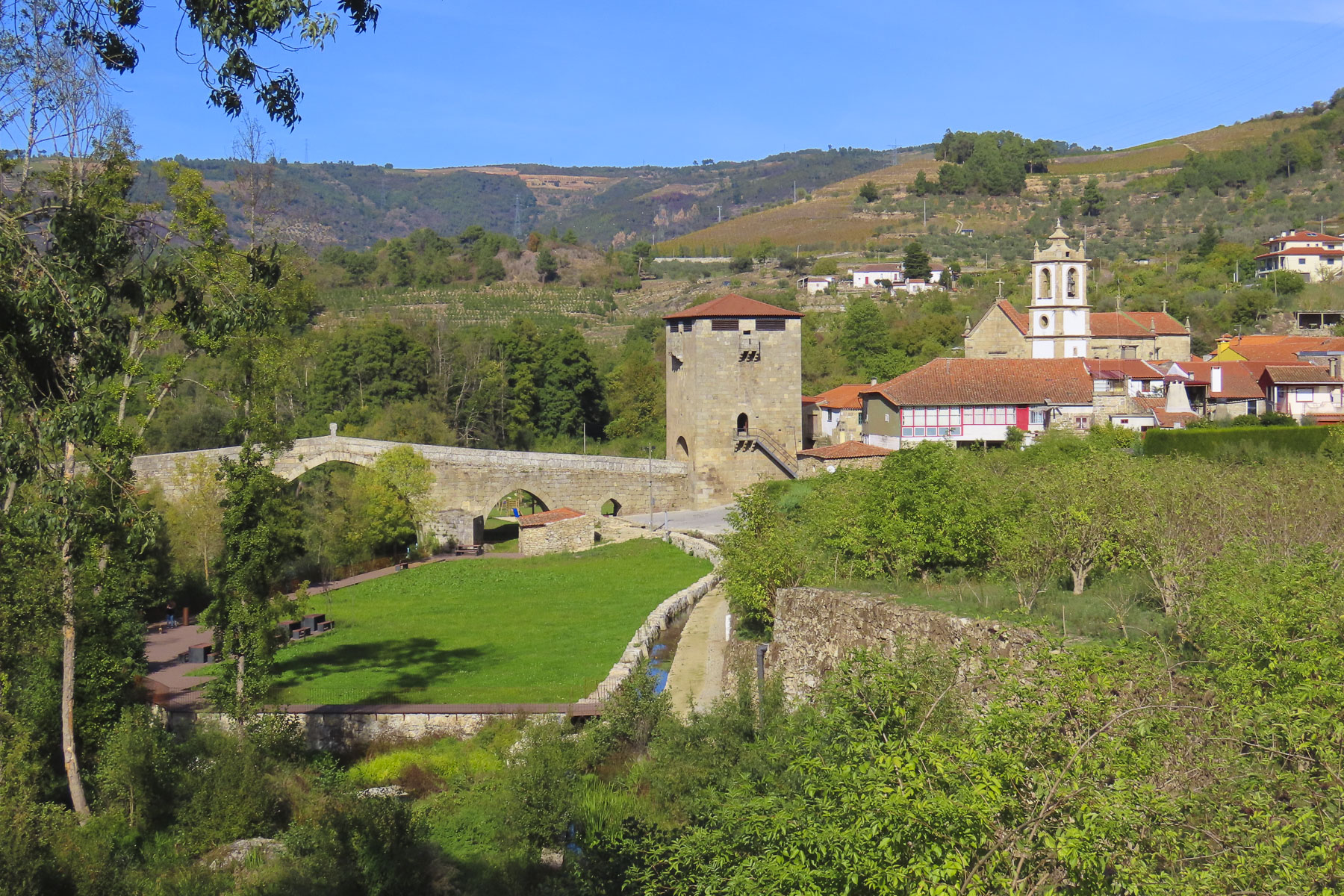
Continuing the next day, we headed north to Ucanha for its old Roman bridge with fortified tower that spans the Rio Varosa. In the off-season not as many restaurants are open, but we were fortunate to find Casa da Eira near the bridge still welcoming folks for a splendid meal.
The walk to it was down a lane bounded with high walls draped with bunches of grapes dangling beneath, the vines sporting brilliant fall foliage. Just before reaching the restaurant, we peeked through the broken shutters of a long-abandoned church, its wedding cake altar and walls stripped of any religious embellishments.

After lunch we strolled across the bridge and under its tower which served as a toll booth for travelers crossing the river and gateway to the vast land holdings of the Mosteiro de Santa Maria de Salzedas in the 1400s, and further on to the Portuguese frontier.  

The bridge we crossed is thought to have replaced an earlier Roman structure from the first century AD. Through the tower’s archway we followed the lane up to the village’s parish church, Igreja de S. João Evangelist, that dates from 17th century.

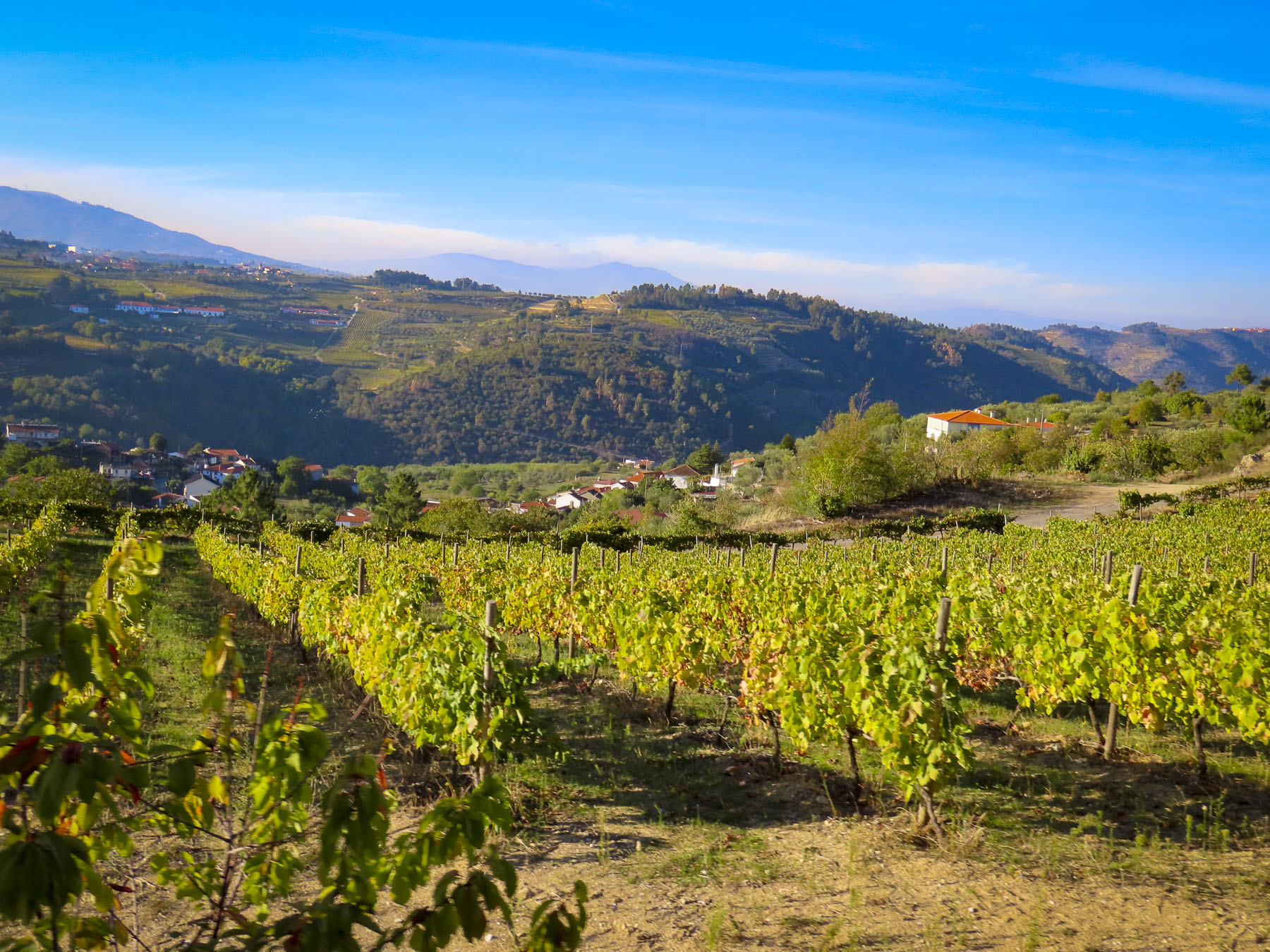
It was surprising to learn about the ancient Roman presence here in central Portugal, but we had already noticed signs for the old Roman route as we drove through the area and tried to find two ancient bridges nearby, the Ponte Românica de Vila Pouca de Salzedas and Ponte Romana without any success while on our way to Salzedas. In searching for them, we did however thoroughly enjoy an afternoon ride through tiny hamlets, vineyards, olive groves, and apple orchards, where the tastiest apples were plucked from a tree within reach of our car window.
Reaching Salzedas we parked and walked towards the monastery across a small bridge over a dry riverbed. Stopping across from the monastery to take a photo, we spotted the most unusual statue along the watercourse’s retaining wall: a carved stone sculpture of a naked man sitting with a huge serpent-head phallus bursting forth from between his legs. Its location across from the monastery was all the more bewildering, but we had to laugh. Odd, just really odd, some of the things you discover when you travel.

Shorter opening hours are one of the disadvantages of travel during the shoulder season as by the time we were done exploring the Mosteiro de Santa Maria de Salzedas the small cathedral next to it was closed. Having paid fully for our entry tickets, we were startled by the guard’s request request for coins. “Do you have any foreign coins? I don’t travel, it’s my hobby and I ask all the foreign visitors if they don’t mind sharing.”  Having collected foreign money ourselves we could relate to this desire to touch something of the outside world. “We have some somewhere in our suitcase. I’ll check before we go,” I replied. The attendant replied with a subtly disappointed, “okay.” We were sure he thought we were just giving an excuse as we climbed the stairs to the exhibition.

From its placement in 1155 near the Torno River, in keeping with the sect’s requirements that its buildings be near watercourses, this was one of the largest and wealthiest Cistercian monasteries in Portugal, having been gifted extensive land holdings, by a royal patron, with the express duty of exploiting the land for profit. A century later it was consecrated after the monastic complex was finished. Over the centuries it continued to be financed by various members of succeeding royal dynasties, perhaps seeking divine intervention or to influence the politics of the almighty Catholic church. Like all things old, it underwent several significant renovations during the 16th and 17th centuries. The addition of a second larger cloister in the 18th century left the façade of the monastery we saw today.

“Enough is enough, we’ve had enough,” could have been the chant of the Liberal government after their victory over the Absolutists at the end of the Portuguese Civil War, 1828 -1834, a war fought for basic human rights and to reverse centuries of disenfranchisement from autocratic monarchies and their allies, namely the Catholic church. Reforms started by the enlightened Marquês de Pombal in the mid-1700s to restrict the powers of old aristocratic families and the church with the expulsion of the Jesuits from the Portuguese Empire had stalled. In 1834 the new minister of justice, Joaquim António de Aguiar, enacted a law, The Extinction of the Religious Orders, requiring the dissolution of “all monasteries, convents, colleges, hospices and any other houses of the regular religious orders.” Their properties and moveable assets were to be nationalized and sold, the profits to be entered into the National Exchequer. Convents were allowed to stay open until the last nun died. Joaquim António de Aguiar earned the nickname, O Mata-Frades, “The Friar-Killer,” because of the anti-ecclesiastical spirit of this law. Over 500 monasteries were closed. Urban buildings were easily sold and repurposed, but many monasteries and convents in the rural areas were abandoned. Their religious art and iconography was redistributed to local parish churches, sold into private collections or “lost.” The Santa Maria de Salezadas Monastery sat abandoned and left to ruin for over 160 years until renovation work started in 2002 and culminated in the reopening of the cloisters in 2011 as a museum with displays of the monastery’s medieval and renaissance religious art and treasures recollected from afar.

With a wave and “thank you,” we left the monastery and headed to our car. “Wait, I’ve got to find those coins for you to take him.” Returning to the car with a smile on her face, Donna relayed that he was delighted that we remembered. A small connection.

It’s the journey. We headed to the Douro Valley. 

Till next time, Craig & Donna

Portugal Road Trip – Part 1: Searching for Templar Castles

“It’s okay, you can just ignore that caution light on the dashboard. It never goes off.” “Do you have another car?” “No.” All rental cars appear equally perfect when you are making comparisons and a final selection from a website. Staying within our budget, we chose an off-airport car rental agency with good reviews, that picked us up at the arrivals terminal and sped us away to our awaiting wheels, for €12.50 a day.  The Fiat Panda assigned to us had been driven hard and put away wet, you might say. Reviewing the preexisting body blemishes with the rental agent resulted in a cartoon of the car that looked like it had been ambushed in a gangster movie and sprayed with machine-gun fire, including the roof. Nevertheless, the engine sounded fine, and our twelve-day journey began, driving in a large figure-eight, north to south route, around Portugal. Our first destination – Castelo de Almourol, before arriving in Tomar. But by the afternoon of day three we were referring to our car as the Portuguese version of the American rent-a-wreck concept. When driving through the mountains, on the way to a schist village, every warning light on the dashboard started blinking violently in Portuguese. If we had been flying an airplane, we would have donned parachutes and bailed out.  The engine sounded fine, so we flew on.

Not being sure what is open during the week in the off season, we headed for the Miradouro do Almourol, an overlook above the island that the castle commands. Located on the south side of the Tagus River, it’s not particularly easy to get to. But my wife and I enjoy the off the beaten track routes that take us through less traveled countryside. Crossing the Tagus River, we followed the N118 north into the Alentejo (beyond the Tagus) Region through flat farmlands and wine estates dating back to the 1700’s. The red wines of the area vinted with the Portuguese varietals Castelão, Trincadeira, and Touriga Nacional are acquiring international recognition now, as are the regions white wines made with Antão Vaz, Arinto, and Fernão Pires grapes.

The drive was slowed occasionally by tremendously large John Deere combines, the width of the entire road, as farmers drove them between different fields waiting to be harvested. Seasonal spring floods that replenish the soil have made this river plain an important area for cereal crops and wheat since the Roman times. Our walk a little then café philosophy quickly transformed into drive a little then café when we did our first U-turn of the trip as we passed a small place that had a tractor parked in front. Our espressos only €.70 each. It was nice to be back in Portugal.

The wetlands of the Tagus River valley are ideal for bird watchers looking for black-winged stilt, marsh harrier, purple heron, pratincole and Kentish plover. Occasionally we spotted storks atop centuries-old chimneys of abandoned homes, resting in new nests that were stacked like pancakes atop older ones before continuing their winter migration south to Africa. Quiet lanes, faded sun-bleached pastels, and centuries old weather-worn buildings dotted the landscape. Bullrings, Praça de Touros, still stand in Chamusca and Salvaterra de Magos, and the latter’s traffic circle has a large sculpture of a cavaleiro and bull to celebrate the tradition. Though interest in bullfighting has been waning since Queen Maria II of Portugal banned the spectacle in 1836 with the argument that it was “unbefitting for a civilised nation,” it regained popularity in the Alentejo region after the fights were reinstated in 1921, and the climatic killing of the bull was outlawed in 1928.

Before we reached the castle, we stopped for lunch along the riverfront in Arripiado at the ABC Bar Café. It was a tranquil spot with a boardwalk that had a view of the Tagus River and the small village of Tancos across the water. Small boats offer rides to Almourol Castle from the Arripiado riverbank here.

With its striking island location, just below the junction of the Zezere and Tagus rivers at Constância, Almourol Castle is one of the most picturesque medieval fortresses in Portugal.

Constância was once an important fishing village during the Middle Ages where it was said the rivers there were “two-thirds fish and one-third water.”

As with most things ancient on the Iberia Peninsula, the castle’s history started with an early tribe. The Lusitanians built a small fortress on the island as protection against the Romans in the first century B.C.E. Visgoths, Vandals, Alans and Moors followed until it was captured by the Portuguese during the Reconquista in 1129 and subsequently entrusted to the Knights Templar to rebuild for defense of the frontier border at the time.  It eventually lost its strategic relevance and was consequently abandoned. Various phases of reconstruction began in the mid-1900s. 

Train service to Tancos, Castelo de Almourol and the hilltop village of Constância is available from the Santa Apolónia Station in Lisbon. The trip takes about an hour and a half.   

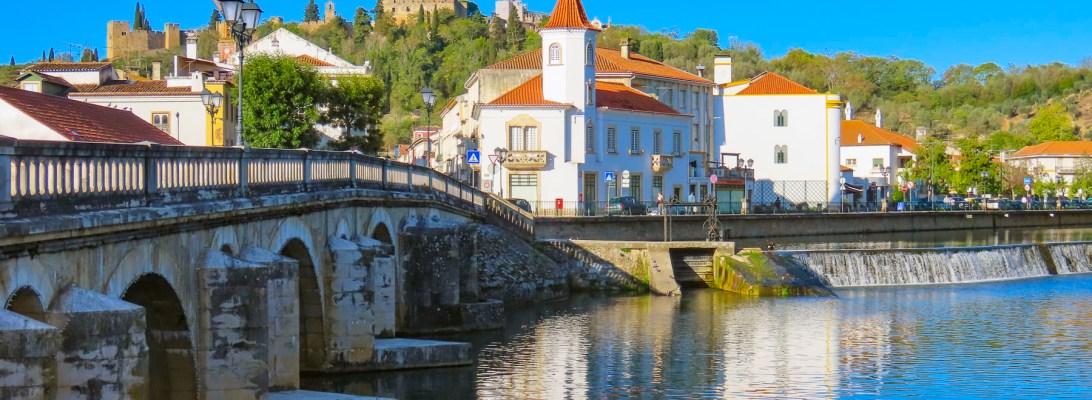
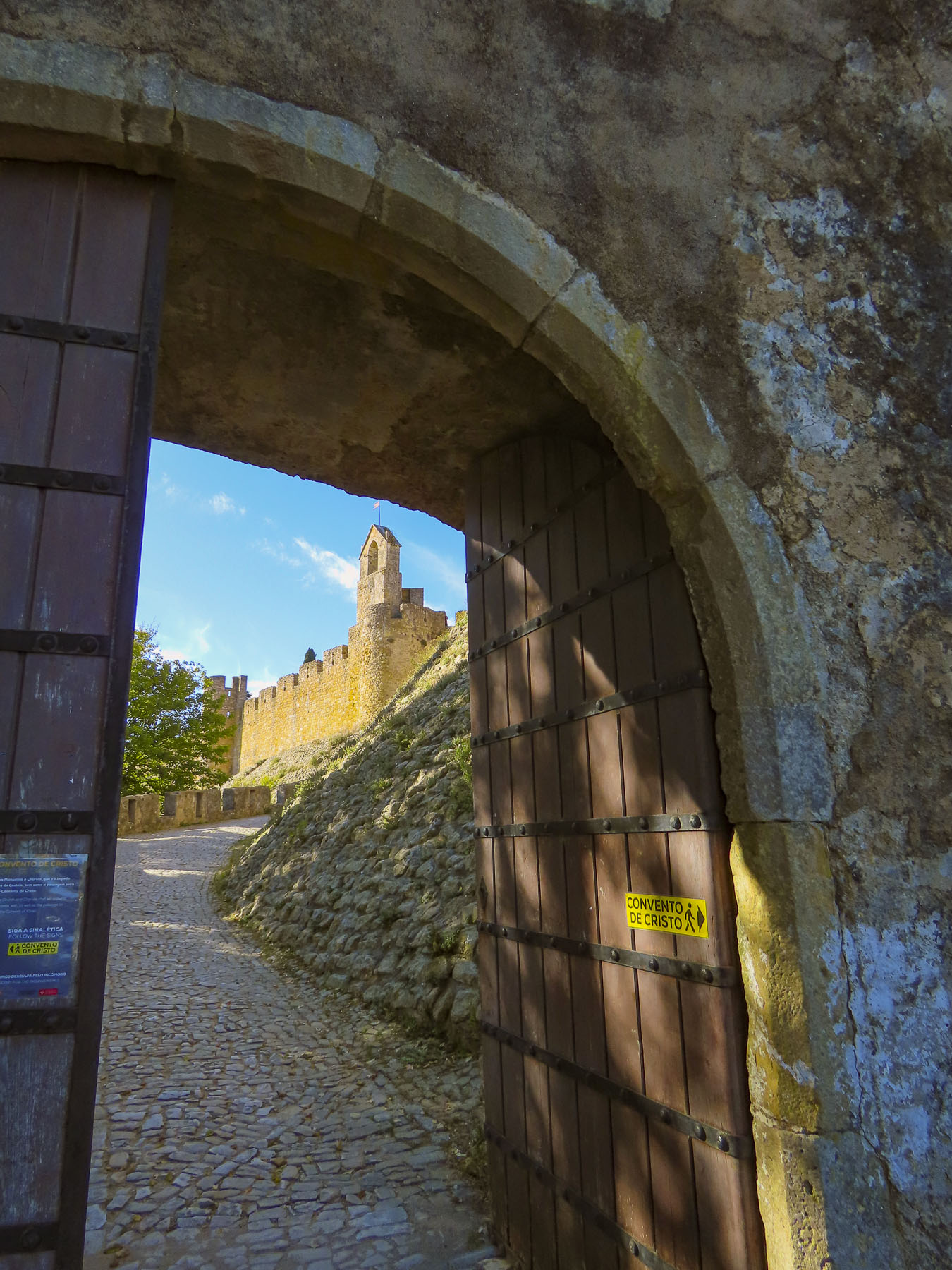
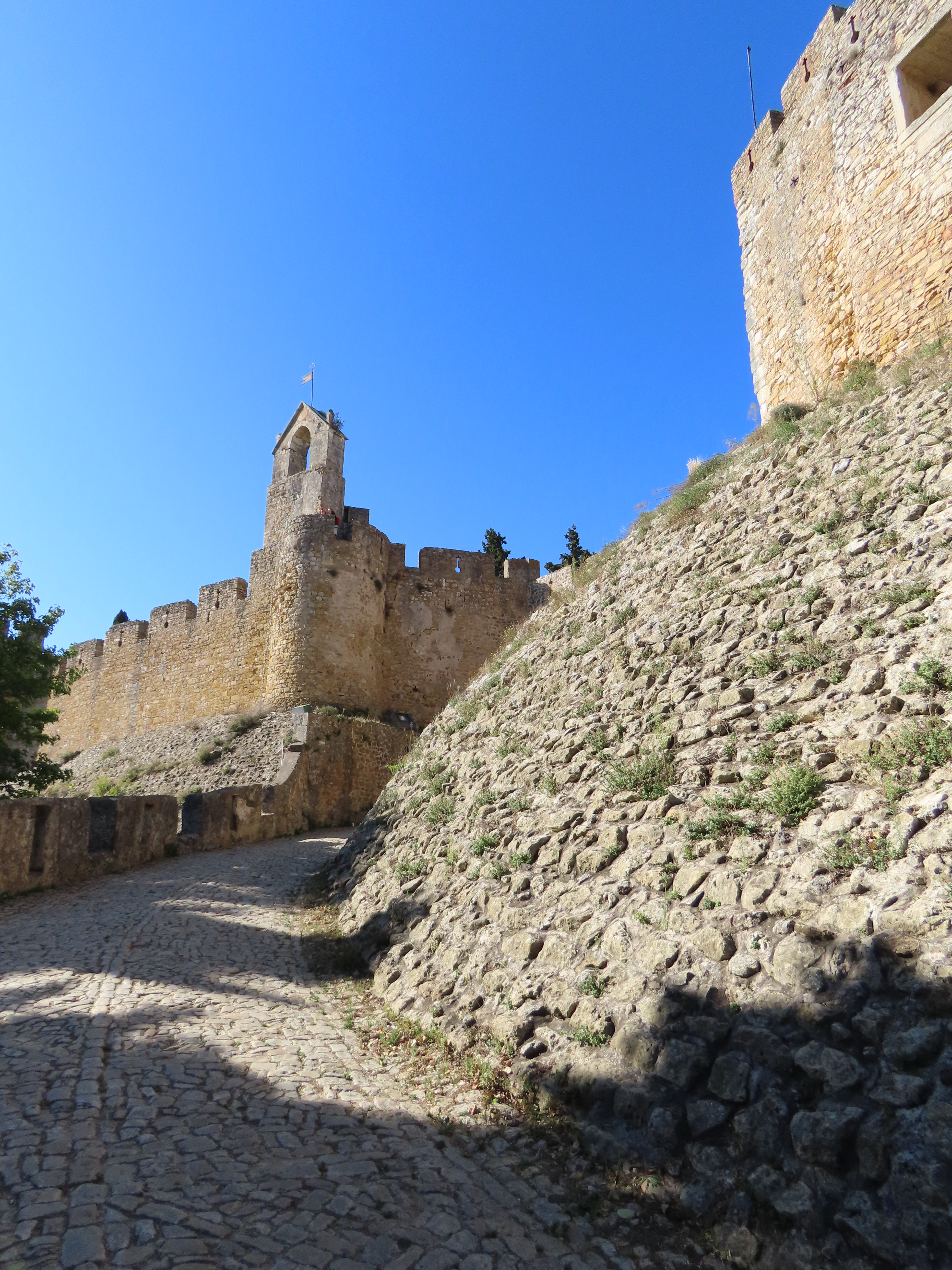
We arrived in Tomar just as the late autumn sun was low in the sky and beginning to cast lengthening shadows on the forested slope that led to the jewel that crowns this quaint village.  We followed the winding cobbled lane to Castelo de Tomar and only got a brief glimpse of the castle through its outer gate as the heavy wooden door was closed for the day with an echoing clang. The castle combined seamlessly with the Convento de Cristo next to it and creates an immense structure that’s best observed from a distance to appreciate its scale. Admiring the expansive view from the miradouro in front of the castle, we made plans to return the next day via a tuk-tuk taxi, from the town square.

This beguiling medieval village with its narrow lanes and tranquil riverside location discreetly hides its outsized contribution to the history of Portugal.

It starts with those mysterious Knights Templar when in 1159 the first King of Portugal, D. Afonso Henriques, granted land to Gualdim Pais, the fourth Grand Master of the Knights Templar in Portugal as reward for their military prowess and religious zeal during the Portuguese wars for independence and the subsequent Reconquista. When the town was first founded, the population was so minuscule, most of the villagers lived behind the castle’s defensive walls.

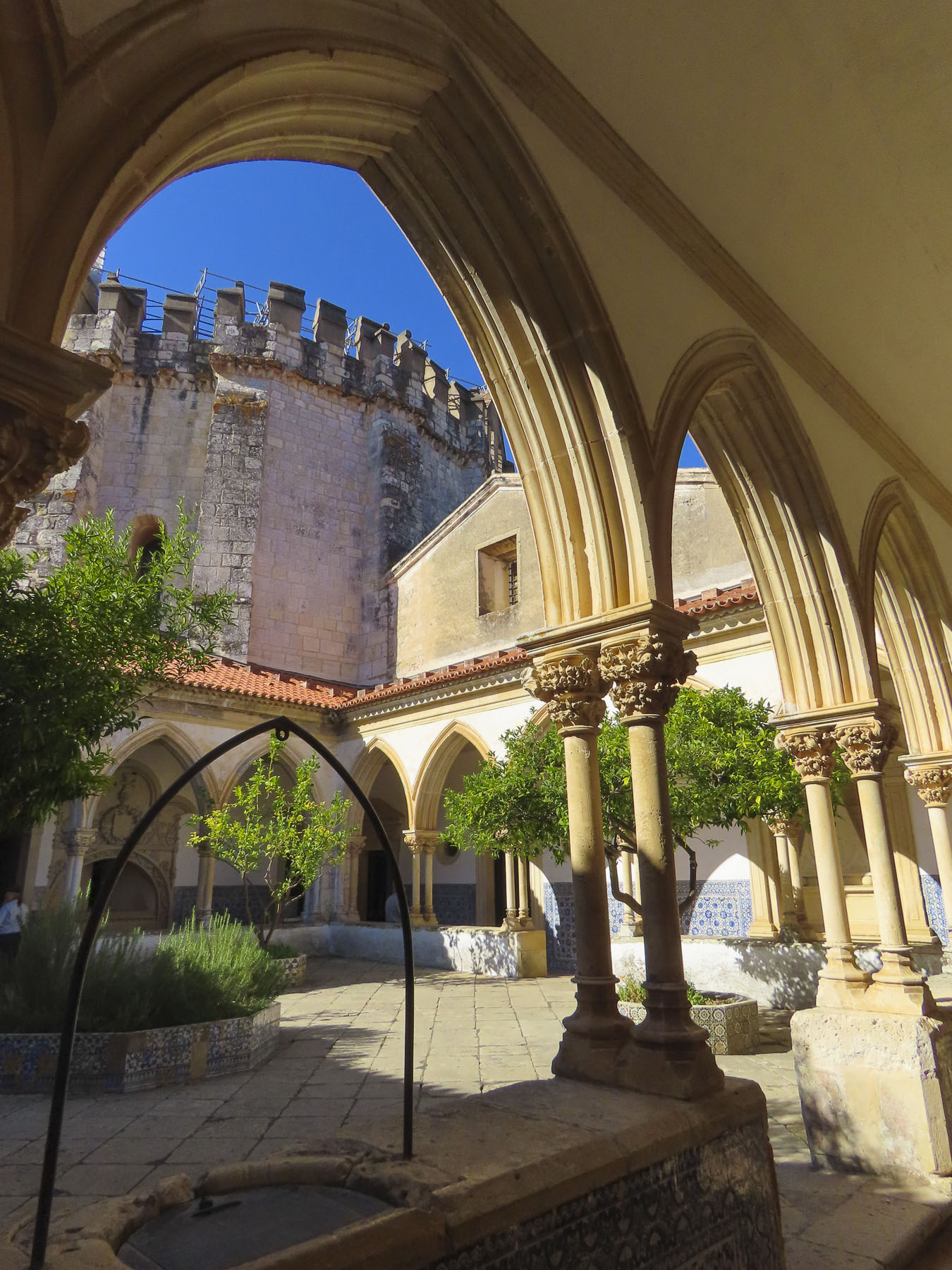
In 1160 Gualdim Pais order the construction of a monastery and fortified citadel that would be known as the Convent of Christ, a combination of a fortress and a monastery, that is sometimes referred to as the Convent of Christ Castle. The convent’s most interesting feature is a round sanctuary with an ornate ceiling soaring over a central altar, its design said to be influenced by the Church of the Holy Sepulcher in Jerusalem.  Legend states that the knights attended mass on horseback here, the open circular design facilitating the horse’s easy entrance and exit. Famously in 1190, outnumbered Templars defeated a larger Muslim army after their six day siege of Castelo Tomar failed.

Founded in 1118 and slowly gaining recognition from their vowed mission to protect pilgrims journeying to the Holy Lands, the Knights received Papal endorsement in 1139. Pope Innocent II’s Papal Bull sanctioned the Templars as “an army of God,” and provided them special rights that included exemption from paying taxes, allowed them to build their own oratories, immunity from local laws, freedom to cross borders, and obedience only to the Pope. With this blessing Pope Innocent ll made the first papal monetary gift to the Templars. Now a church-endorsed charity, they began receiving land, money, businesses and young nobles from wealthy families who were enthusiastic to find glory in the crusades and willingly donated their assets in order to take the vows of poverty, chastity, piety, and obedience.

Today the Templars most likely would have been charged with running a racketeering enterprise which forced pilgrims and others to pay for protection services they have not requested. This protection was usually from the very people who were demanding the money in the first place.

Things were going well for the Templars across Europe until 1307 when King Philip lV, heavily indebted to the Templars from a war against England, lobbied the Holy Church to disband the Knights Templar as it was a state within a state with its own military, preached heresy and practiced idolatry.

The Templars’ fatal day (eerie music, please) was Friday, the 13th of October 1307. Early that morning all the Templars in France were arrested as enemies of God. Upon torture many falsely confessed and were burned at the stake.  A month later Pope Clement V, a relative of King Philip, decreed that the rest of the Catholic kingdoms in Europe should arrest the remaining Templars and seize their properties. All complied except Portugal!

King Dinis of Portugal did not believe the charges leveled against the Templars, remembering instead their service to a fledging country, and offered sanctuary to knights that had escaped capture.  He then persuaded Pope Clement to support the creation of a new organization, the Order of Christ, into which he transferred all the Templars’ wealth and holdings. The new Order’s mission was now the liberation of the Iberian Peninsular from the Moors and wars against Islam in Africa.

Same group with a new name, but to ensure that the deception of the Pope succeeded, the headquarters of the new order were established, almost in exile, 210 miles away in Castro Marim, a frontier town on the Guadiana River, that serves as the border with Spain.

One hundred years later Dom Henrique of Portugal, Duke of Viseu, better known as Prince Henry the Navigator, allowed the Templars/Order of Christ to return to their former seat of influence in Tomar.  Here they now helped Prince Henry the Navigator establish a medieval think tank: a research institute dedicated to developing navigational tools for a ship to determine its accurate position at sea, relying on the Arabic studies of astronomy, mathematics, trigonometry, which were farther advanced than European knowledge at the time.

The Order of Christ succeeded the Knights Templars as the country’s banker and financed building the fleets of ships needed at the beginning of Portugal’s nautical age of discovery. As rewards, fleets of caravels with white billowing sails boldly embellished with the distinctive red cross of the Order (perhaps the first attempt at global branding) carried explorers down the west coast of Africa and around the Cape of Good Hope into the Indian Ocean in 1487. Portugal’s age as an expanding empire had begun!

Wandering the cobbled lanes of the old town in mid-October, we seemed to have the whole village to ourselves. Later, as the day was perfect, we walked along the Nabao River, crossing a small footbridge in Parque do Mouchão. The view back toward the village was sublime with ducks slowly trailing ripples through the mirrored reflections of the buildings in the water.

Till next time, Craig & Donna

Lodging: Casa dos Ofícios Hotel

Dining: Restaurant Beira Rio and Sabores ao Rubro

Havana, Cuba: Beautiful in neglect

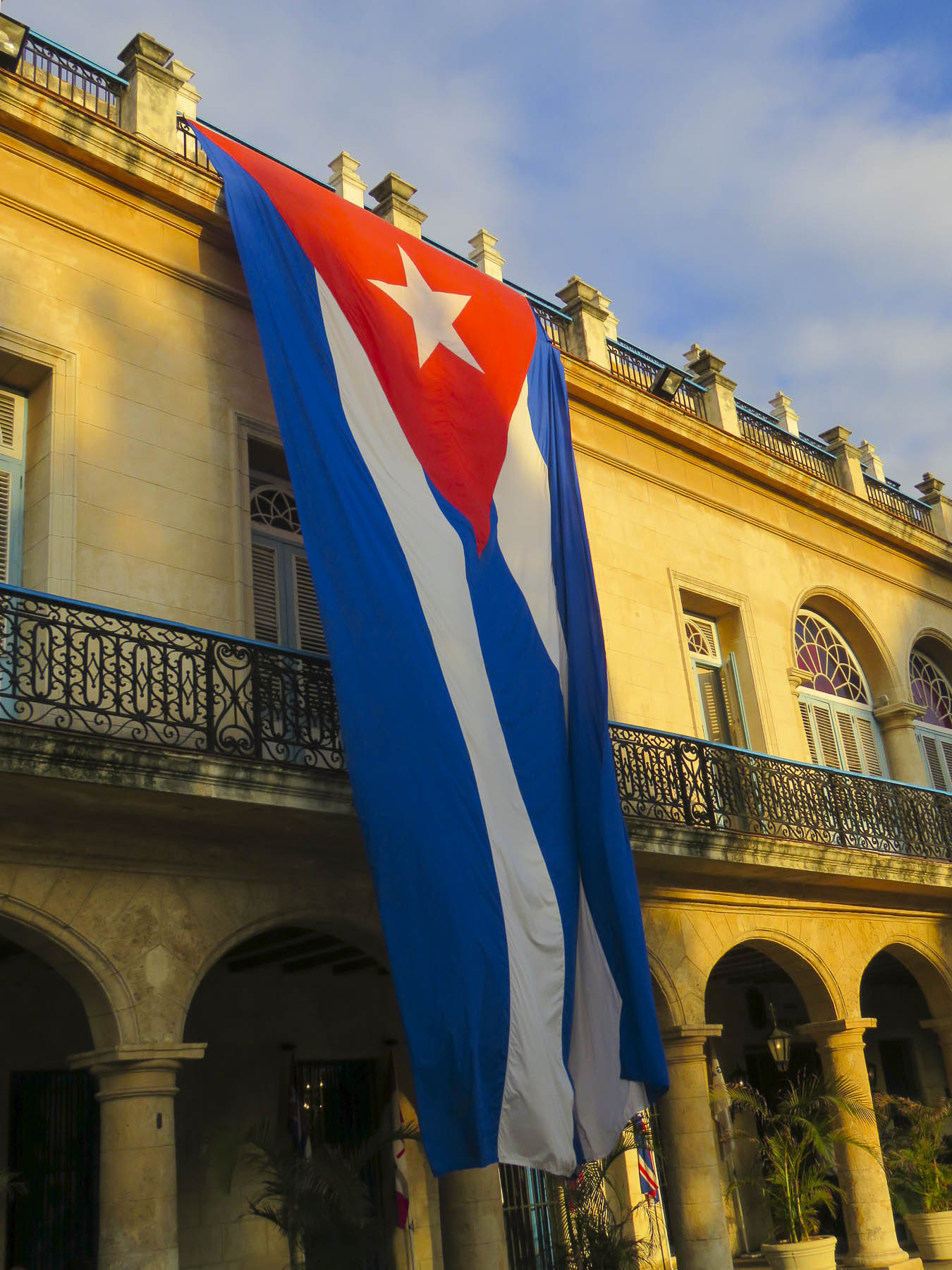
The amber glow of sunrise warmed the waterfront as our ship docked.  Its upper deck provided us a view of the port as if we were seagulls soaring above the first commuter ferries of the day crossing the harbor.  Along the water, buildings wore a tired facade of montage color and aged textures. Beautiful in neglect. These were our first impressions of Havana. The few buildings under renovation were easy to spot with their fresh coats of paint. The domes of the Russian Catedral Ortodoxa Nuestra Señora de Kazán, built to celebrate Soviet – Cuban friendship glistened in the sunrise, its onion shaped domes an odd juxtaposition, accented the balmy Caribbean skyline.  We’d be spending two full days in Havana.

By the time Nevada legalized gaming in 1931, Havana, once nicknamed “the Paris of the Caribbean” was already a well-established tropical get-away for gambling, especially if you lived in the wintry northern parts of the United States.  Havana’s balmy weather and swaying palms contrasted nicely against Las Vegas’ dusty strip in the desert where tumbleweeds blew across the sidewalks. In the 1950s, fifty dollars could purchase a three-day package tour to a Havana casino that included airfare, entertainment, food and hotel. Cruises to Havana from Miami were also possible aboard ships like the 725 passenger S.S. Florida for $46.00. For an additional $35.00 you could take your car along if you wanted to explore the “700 miles of Cuban highways,” a travel brochure from the time advertised. Cruise ships arriving at night were occasionally treated to displays of fireworks over the centuries old Castillo De Los Tres Reyes Del Morro and the highrise apartments along the Malecon as they entered the harbor. It was city of Jazz clubs, high rollers, zoot suits, large finned Cadillacs and mobsters. Headliners like Frank Sinatra, Dizzy Gillespie, Eartha Kitt, and Nat King Cole drew folks to the casinos controlled by New York, Chicago, and Miami crime syndicates.

Mafia payoffs to the rampantly corrupt regime of Cuban dictator Fulgencio Batista and his associates allowed their casinos, brothels and drug running operations to flourish unimpeded. As flashy as the casinos were, the sugar industry dominated ninety percent of the rural Cuban economy for decades and was the largest employer in the countryside until sugar prices collapsed.  That along with government policies that ignored its impoverished citizenry bred increased discontent as the disparity of wealth between the rural poor and the Havana elite grew intolerable. The jungled mountains of the islands’ interior sheltered Fidel Castro and his armed revolutionaries. 1959 was their year. Batista and his cronies fled to the Dominican Republic. Afterwards all homes, properties, businesses, and cars were nationalized.  An exodus of the Cuban middle class followed with approximately 1.4 million people heading to the United States to reestablish their lives.

While Europeans and Canadians have long traveled to Cuban government-run tourists’ resorts along the coast, we were visiting the island on a cruise during that first window of opportunity which opened to Americans between 2016 – 2019, before access was unfortunately tightened again.  Recently the travel restrictions to Cuba have once again been loosened.

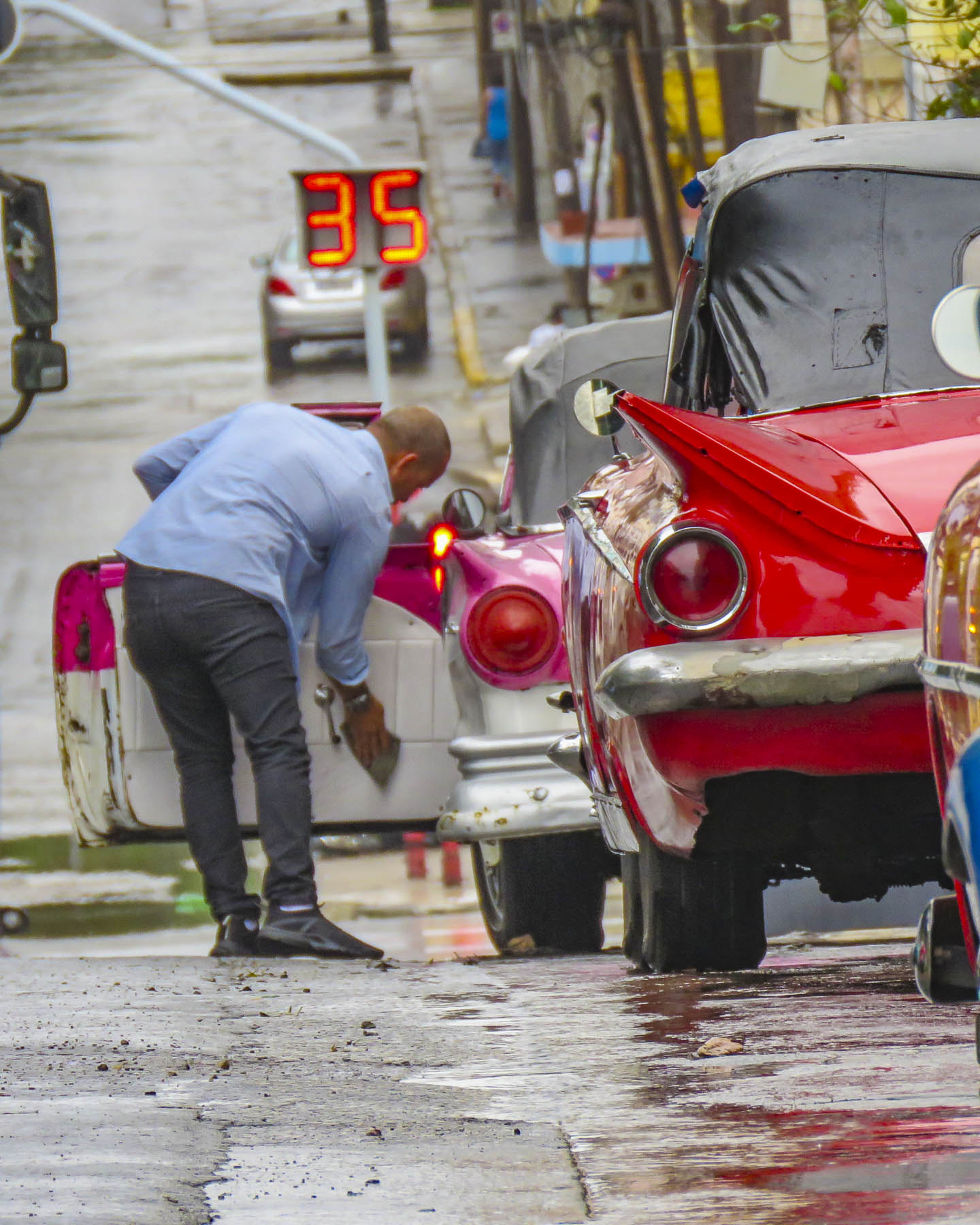
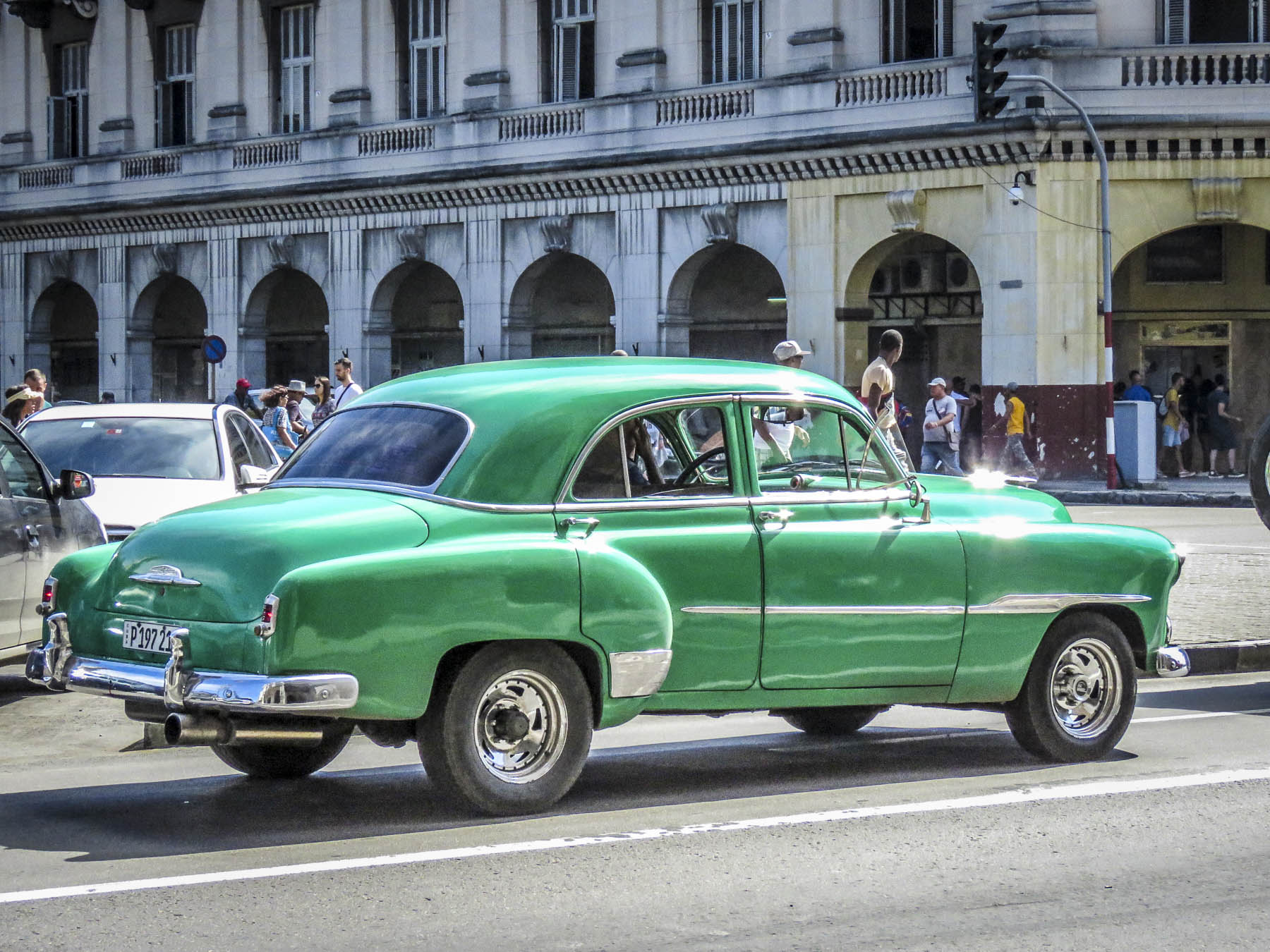
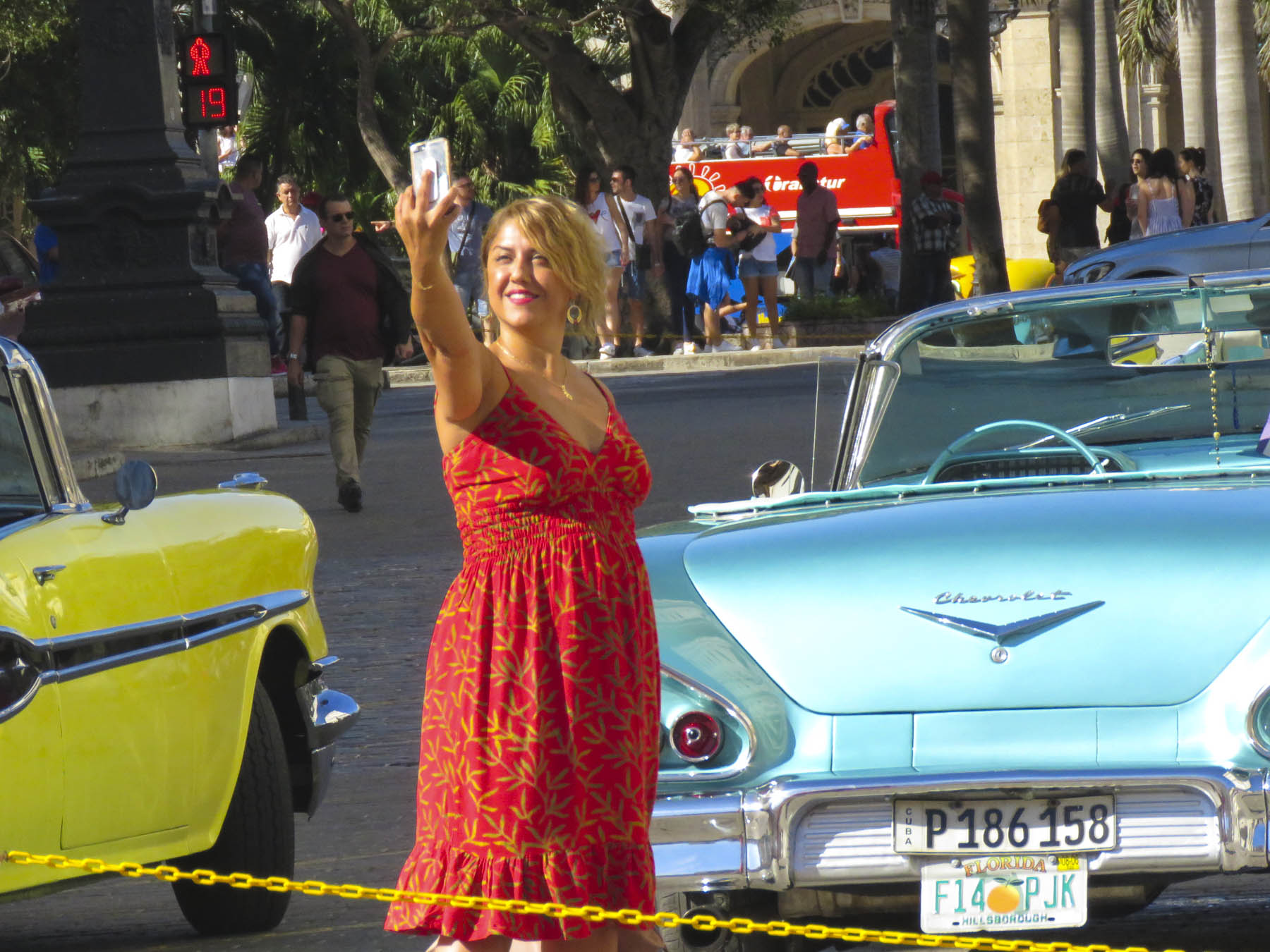
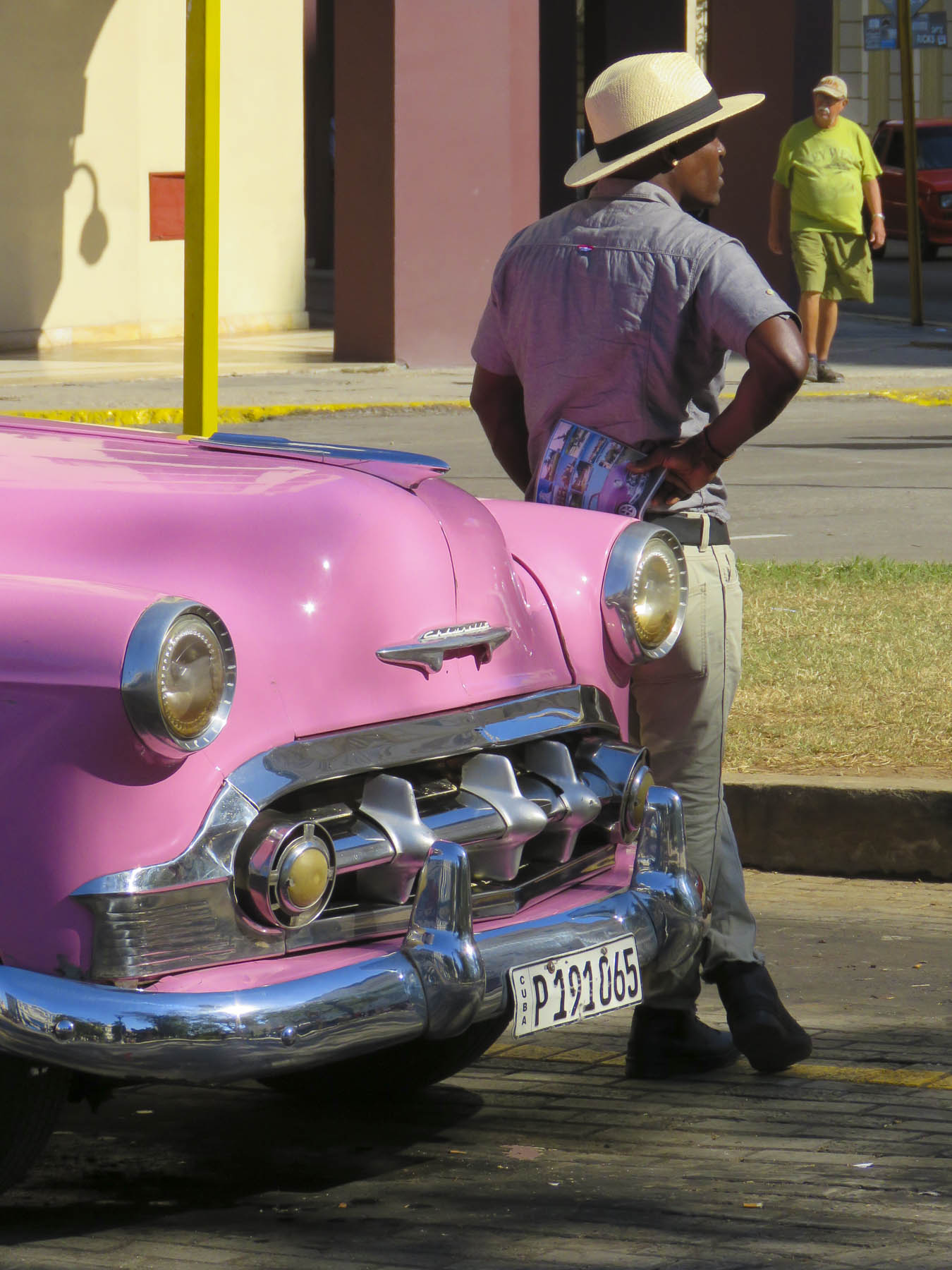
Rush hour in Havana happens whenever the cruise ships disgorge their passengers onto the waterfront to walk into the city center, catch their bus tours or to snag a ride in one of those classic cars from the late 1950s. There are literally thousands of antique cars still on the roads in Cuba, jury-rigged to keep running and often repainted with house paint that reflects the bright ambience of the Caribbean. 

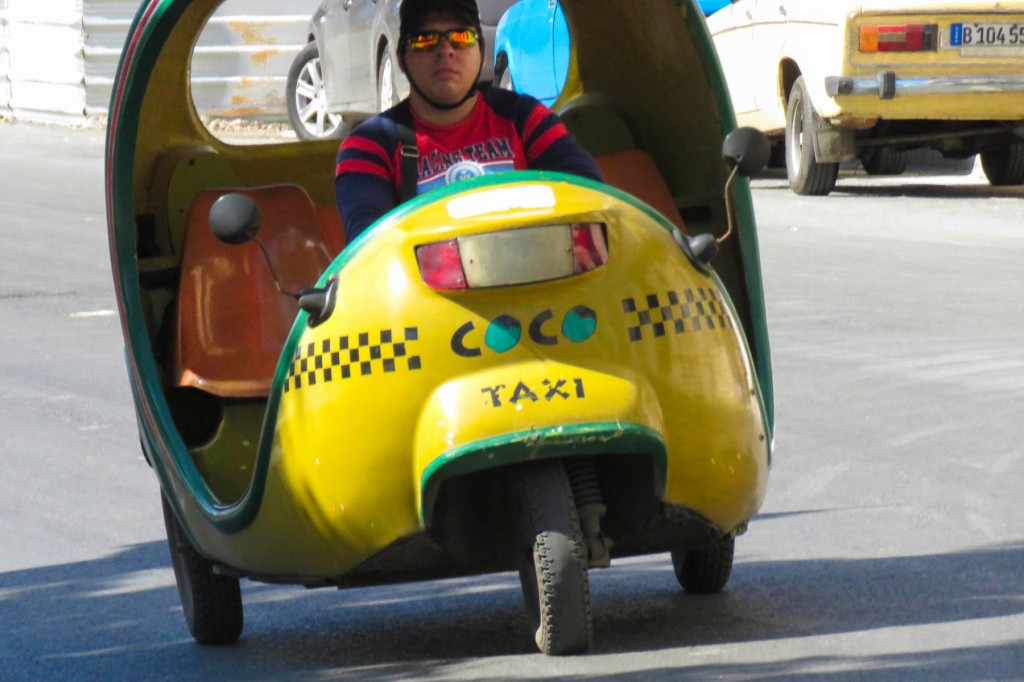
Depending on where you are in the disembarking queue these beautiful classics, especially the convertibles, might already be tooting around Havana with other tourists and you might have to opt for a coco taxi.  These entertaining rickshaw type taxis are covered in a bright yellow, fiberglass shell and have seating for three across the rear axle. When it rains, you are going to get soaked as we did when we got caught in a downpour. The return ride was definitely more comfortable after several Cuba Libre cocktails. 

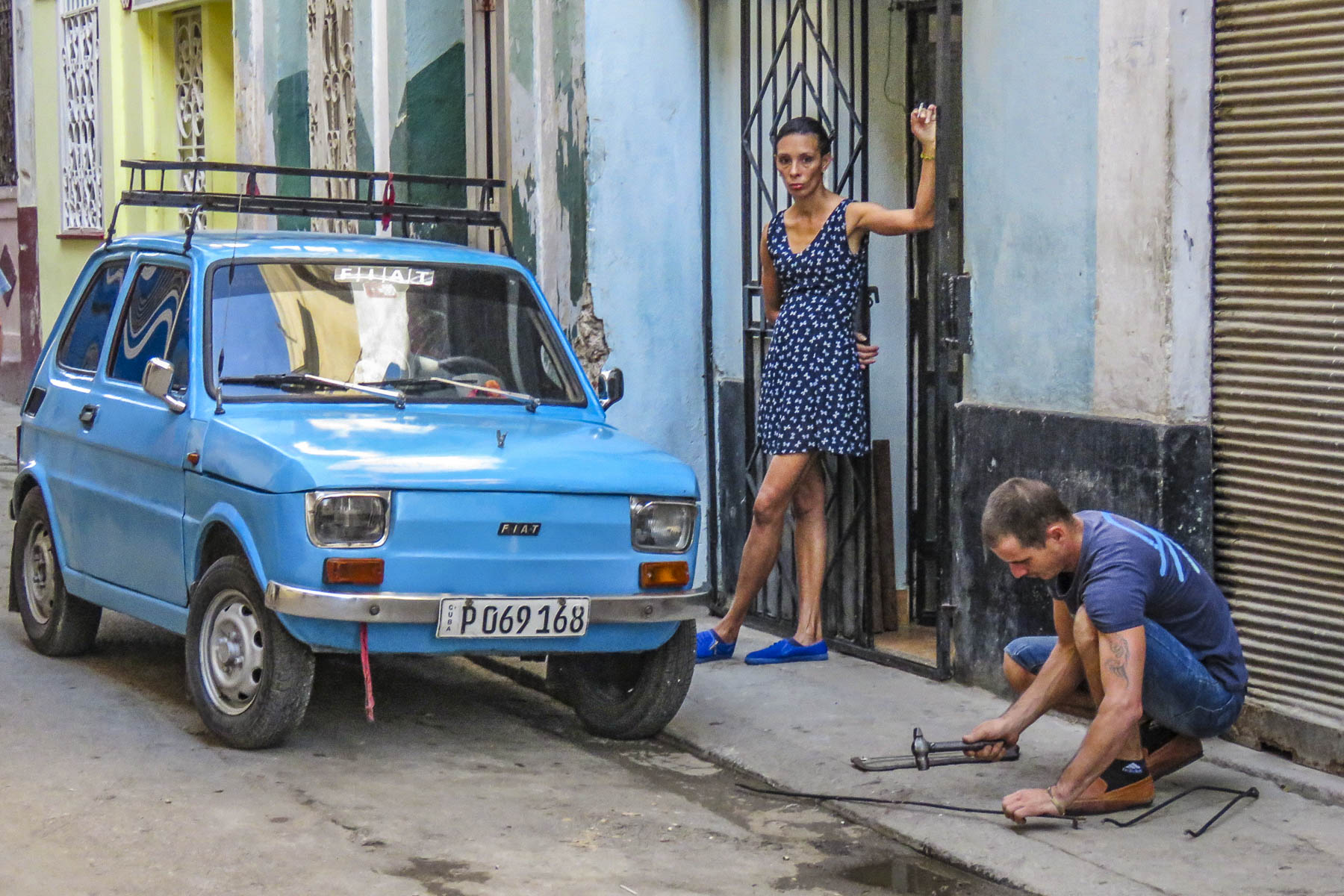
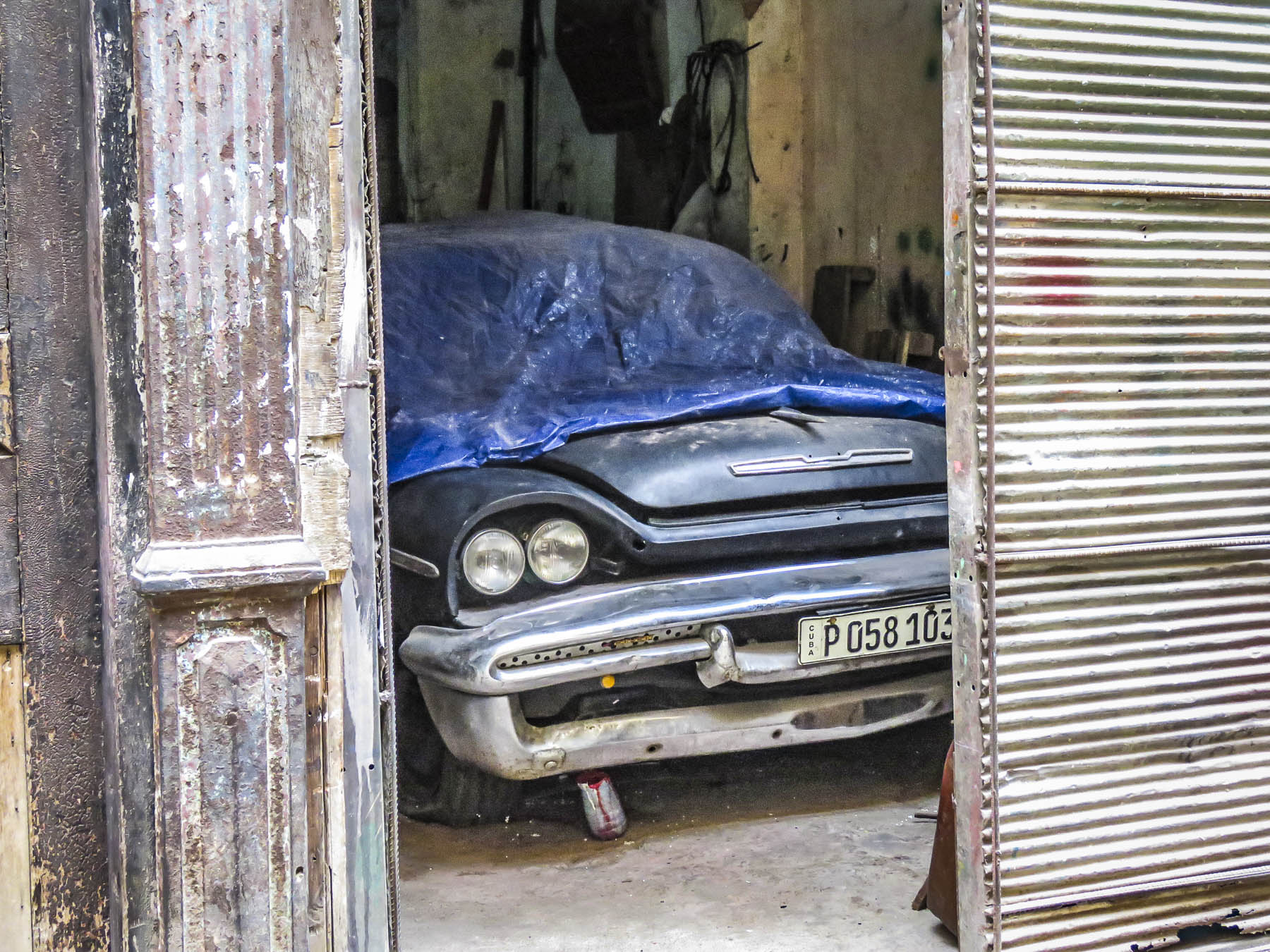
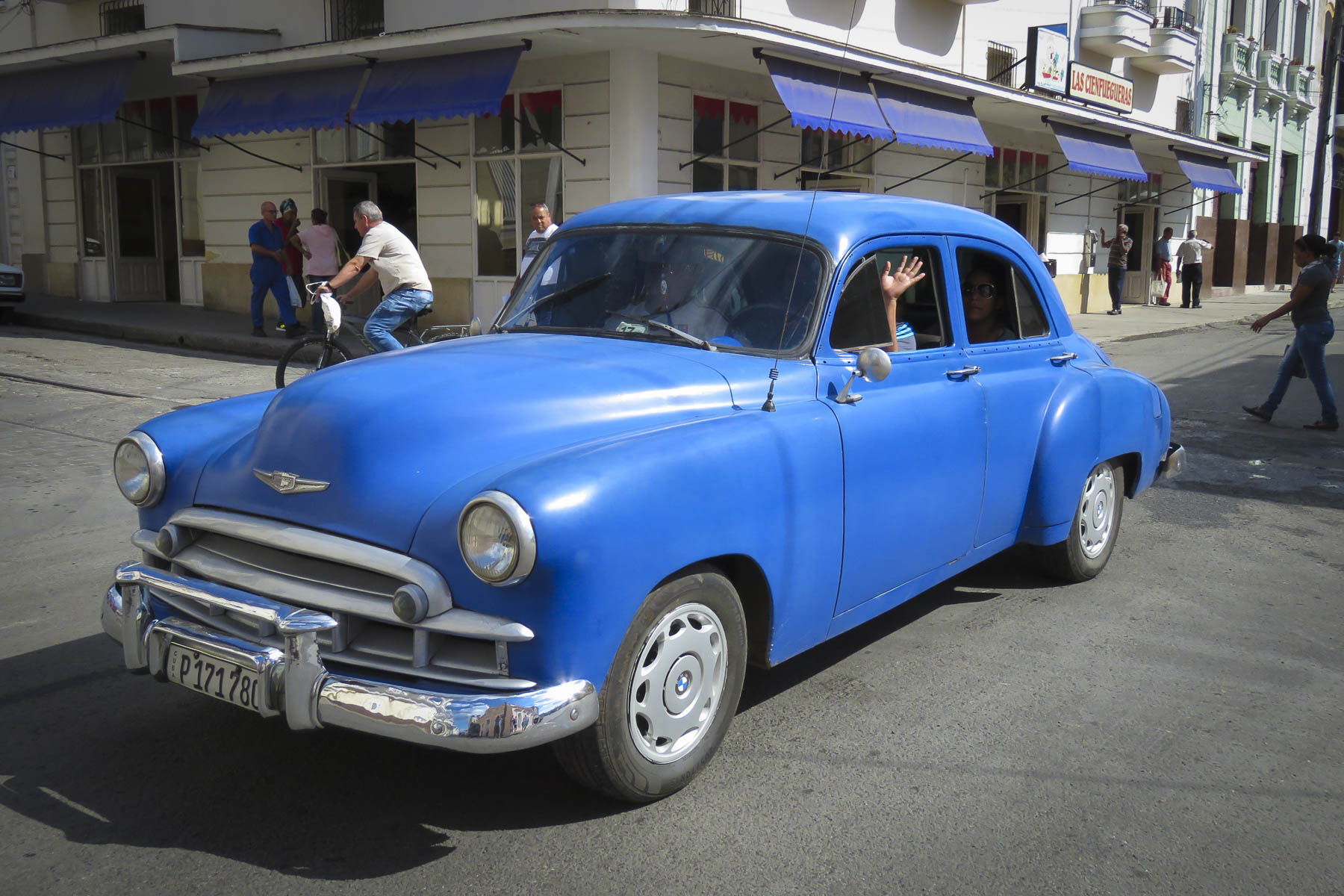
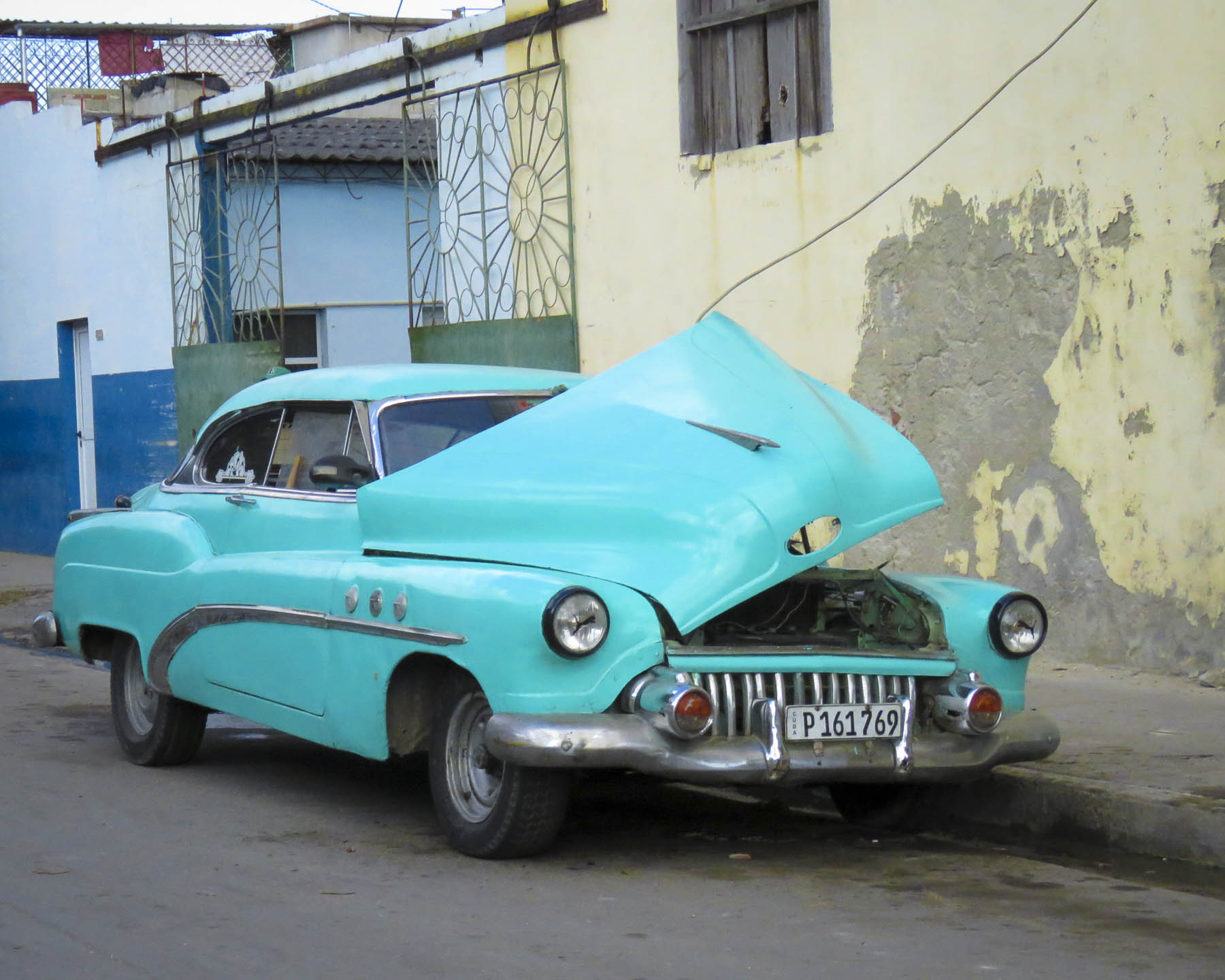
Down the side streets of the city, it wasn’t unusual to see these vintage cars raised on cinderblocks, their hoods open as amateur mechanics tinkered away to keep their classic beauties running. There are about 60,000 old American cars still on the road in Cuba. Most date from the 1950s, but there are still Packards, Cadillacs, Dodges, Chevys, Studebakers and Fords from the 1940s and 30s that are still road worthy.  This is an amazing testament to the talent of Cuban mechanics that have been “MacGyvering” the repairs with makeshift parts since the revolution ended in 1959, when the U.S. trade embargo began and Cuba banned the import of American products. While some cars look to be in mint condition, often the interiors are taped together, door handles are missing, and the windows don’t roll up. Engines don’t last forever and it’s not uncommon to swap engines between the American makes and models. Sometimes even the motors from Russian Volgas and Ladas work their way under the hood of Fords and Chevys. Fiats and Peugeots were imported after the revolution but proved to be not as durable as the American models. 

With the nationalization of property in 1959 the nicer cars of the wealthy who fled were assigned to government officials, doctors, renown celebrities and famous athletes. Regulations prohibiting the ownership of cars were eventually changed to allow Cubans to freely purchase older cars brought to the island before the revolution. Often cars are family heirlooms that have been handed down from generation to generation, with fathers teaching sons the intricacies of keeping the cars running. It’s extremely rare to find new automobiles in Cuba as the government imposes very high taxes on car imports, rendering them highly unaffordable for the vast majority of Cubans.

The ingenuity of Cuban mechanics can surely teach us a thing or two about sustainability. Wonderfully many of these resourceful home mechanics have kept these automotive treasures alive and have created an income for their family by offering rides in their classic cars to tourists. “There are no junkyards in Cuba; everything is still driven.”

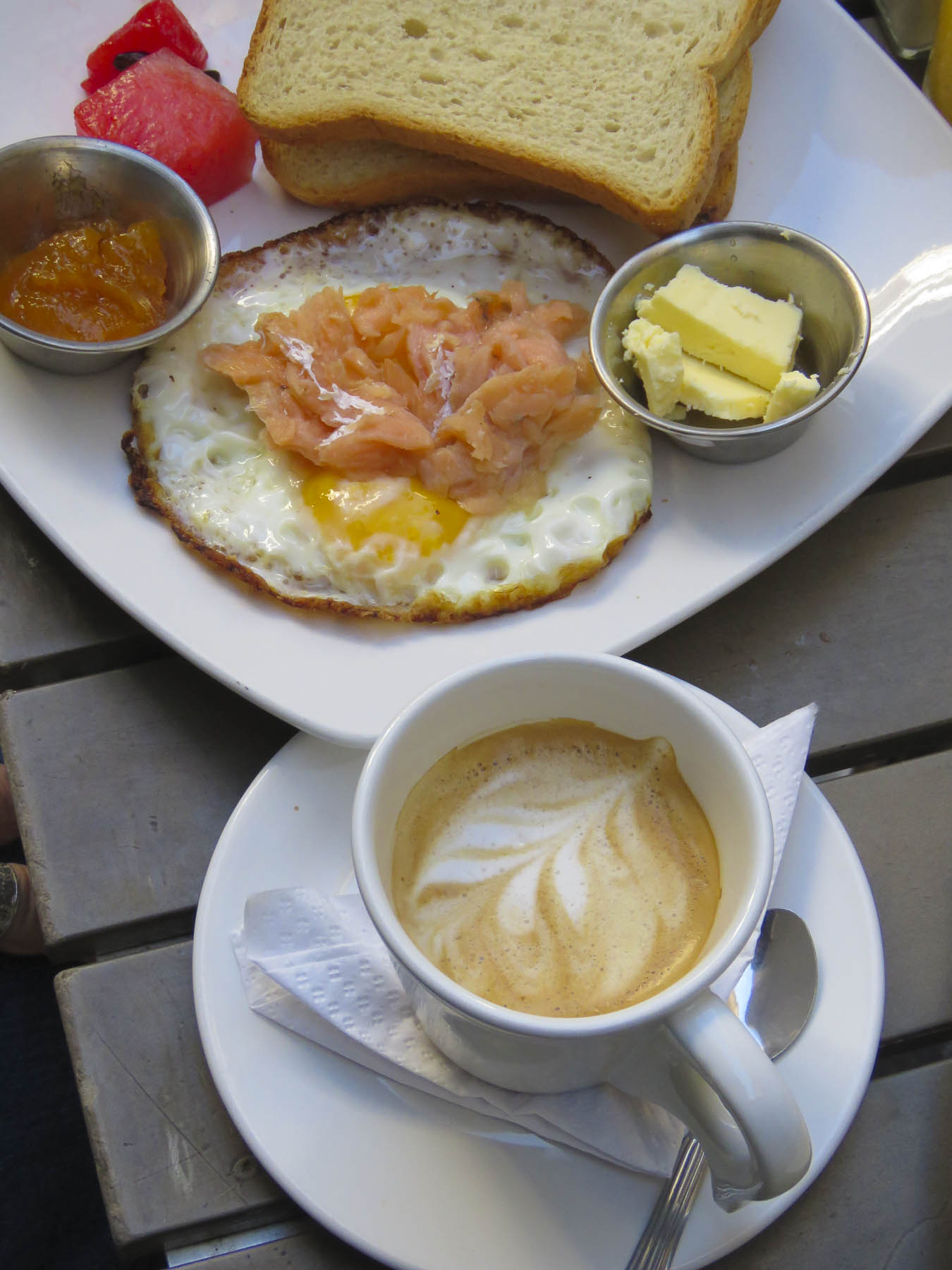
Flagging down a Cadillac convertible, we took a ride along the Malecon seafront before breakfast at a paladare recommended on TripAdvisor.  Paladares are small privately run restaurants, usually operated out of the chef’s home, that have been allowed to open as Cuba relaxes its ban on private enterprise in the country.  Typically, their menus change daily depending on what is available at the markets.

After breakfast, our original plan was to walk to Havana’s Central Park to join a tour of the city with a Guruwalk guide. Unfortunately, we arrived late and missed the group. Unfazed, we decided to wander on our own around the city.

Parque Central is the nucleus of a daily classic car show with the old cars neatly lined up for tourists to choose which nostalgic Ford or Chevy they want to cruise around the city in.  Length of the trip and price can be bargained for with each driver.

Across from the park, sparkling from the completion of a recent renovation, the ornate baroque façade of the Gran Teatro de La Havana drew our attention. Built in 1838, it’s a cavernous structure that can seat 1,500 people and is home to the Cuban National Ballet Company.  President Obama addressed the Cuban people from its stage in 2016 and the biennial International Ballet Festival of Havana is hosted here.

While many hotels and historic public buildings immediately surrounding Havana’s Central Park have been pristinely renovated, you need only to walk a half block down any side street and it’s obvious that the maintenance of the city has been neglected for decades. With many of the buildings in central Havana dating from the 1800’s, most are severely showing their age. Signs of structural neglect were endemic.

This quote I found sums up concisely the housing situation. “In Cuba, everything belongs to everyone and no-one at the same time and if a building is ‘collectively-owned’, it’s understood that the State is the one responsible, but the government doesn’t have the resources for maintenance.”

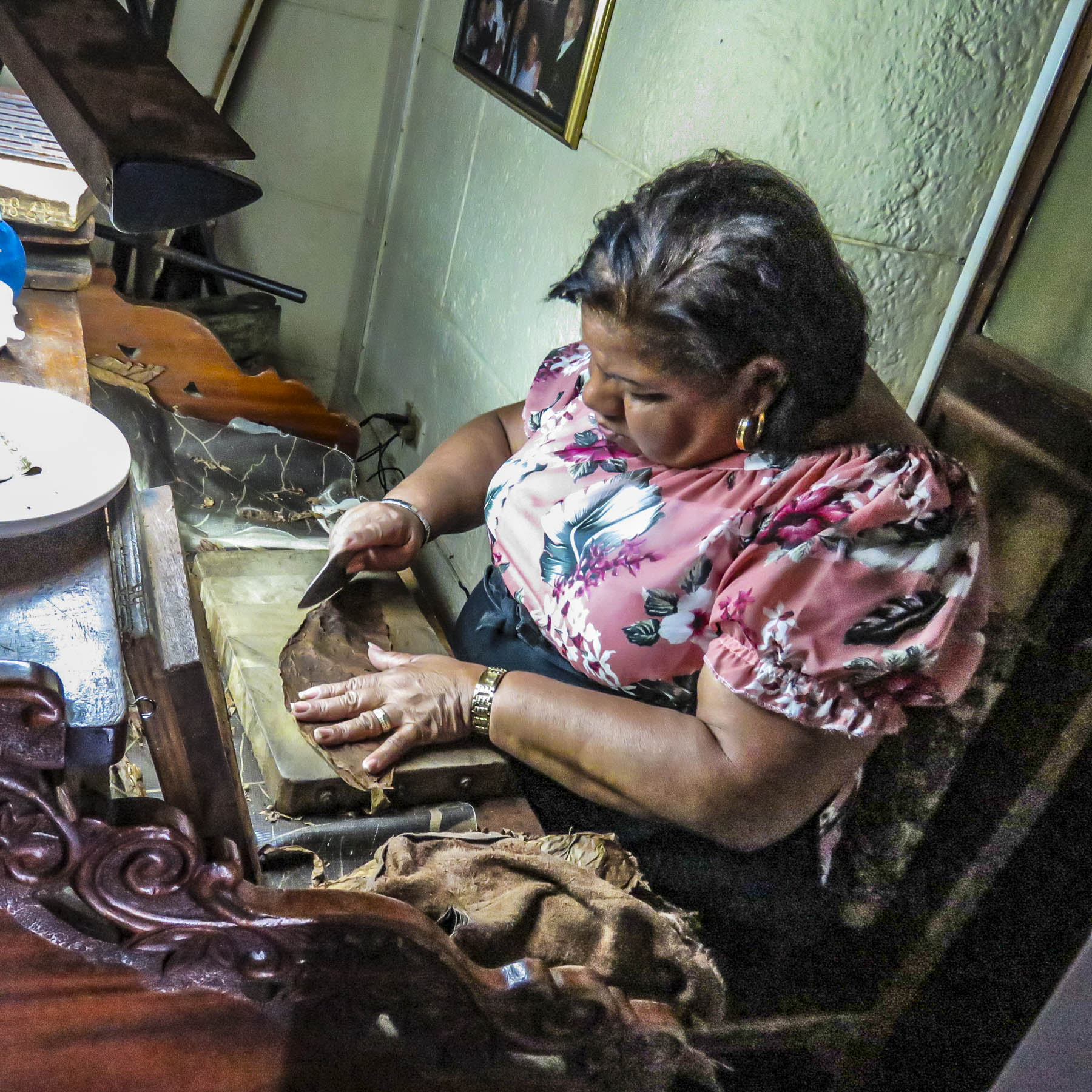
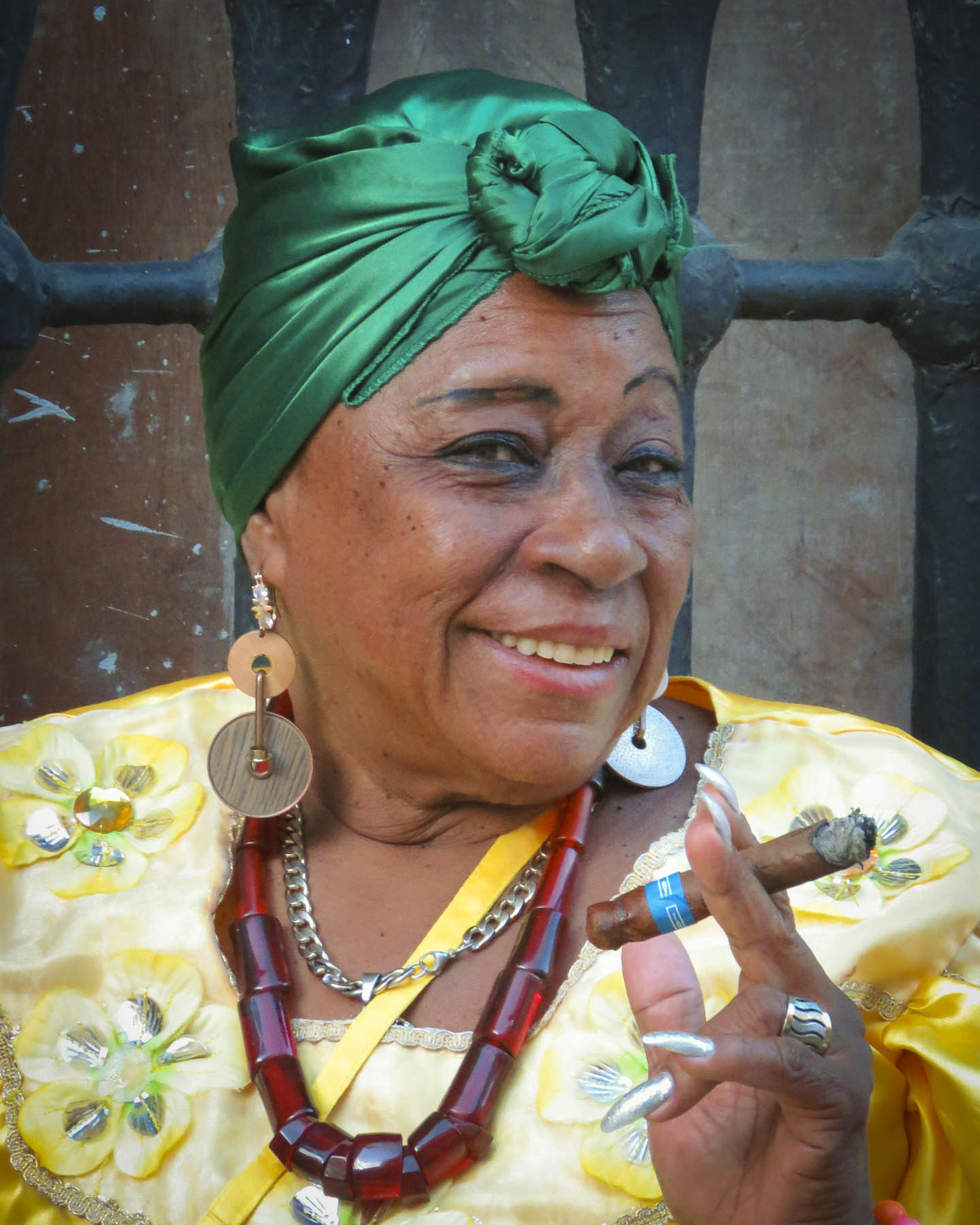
We worked our way towards Real Fábrica de Tabaco Partagas, a historic cigar shop and factory dating to 1845, located behind the Capitolio Nacional de Cuba, a near replica of the United States’ capital building, only larger and with a higher dome. A tour of the cigar factory, where 500 people sort, grade and roll tobacco leaves into world famous habanos, cigars, was not available the day we visited, but we were able to watch a cigar rolling demonstration.

Asking for a recommendation for a place to eat enroute back to the harbor the salesman at the cigar shop suggested Tablao de Pancho, Grupo El Guajirito. Along the way a pleasant young woman, sensing we might be lost, spoke to us in excellent English and offered to guide us to the restaurant. She declined a tip for her assistance, so we asked her to join us for lunch instead. She quietly saved half her meal to take home to her child, because her ration card did not provide for enough food.

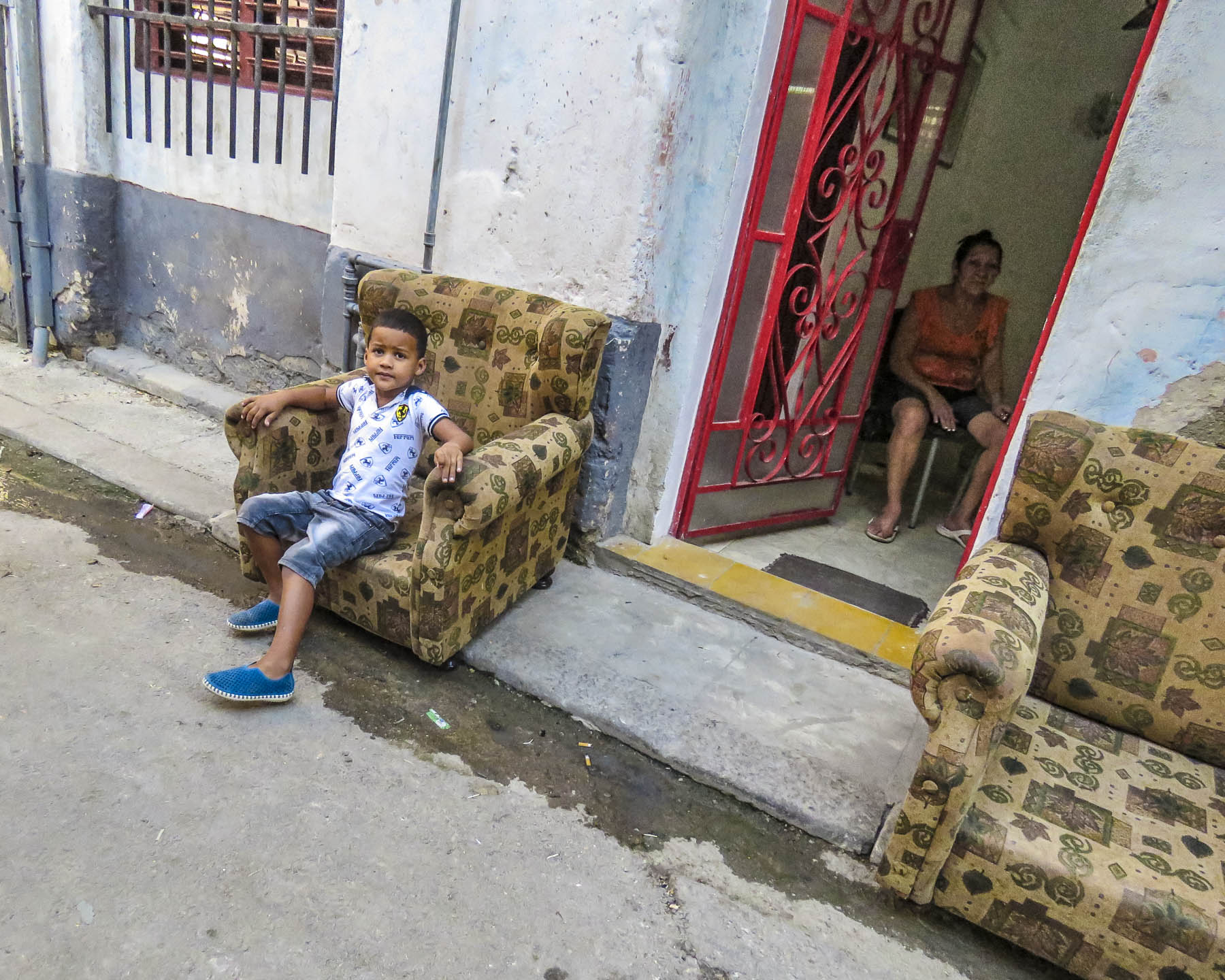
Life and business are conducted on the streets of the neighborhood with most doorways and shallow balconies harboring tenants trying to stay cool. A mattress maker refurbished rusted bedsprings on the sidewalk. Vegetable cart vendors pushed their wagons around the blocks. The scarcity of some the smallest luxuries and basic necessities is visible and there was a sense of waiting, but what for was difficult to determine. The hardships of life that the residents of the city endure under a failed socialist revolution are still very much in evidence in the forgotten, gritty side streets of the capital.

The cigar chomping aficionado in our group was determined to purchase the legal limit of Cuban habanas that were permissible to bring back to the states at the time, so three of us crammed into a coco taxi, a not particularly macho ride to cruise in along the Malecon.

Our destination was the Hotel Nacional de Cuba for a smoke and a glass of rum. A historic 1930s hotel and casino, before the revolution it attracted American celebrities like Erroll Flynn, Gary Cooper, Rita Hayworth, Fred Astaire, Ava Gardner, Marlon Brando, and Walt Disney. Now the hotel annually hosts the Festival de Cine Nuevo Iberoamericano and claims Michael Keaton, Francis Ford Coppola, Leonardo DiCaprio, and Steven Spielberg as past attendees.

Later that afternoon, behind the 1500s era Castillo de la Real Fuerza, a star shaped fortress that protected the colonial harbor, we wandered through the Old Havana district, still lively since the days when treasure laden Spanish galleons from the New World stopped in Havana before voyaging back to Spain.

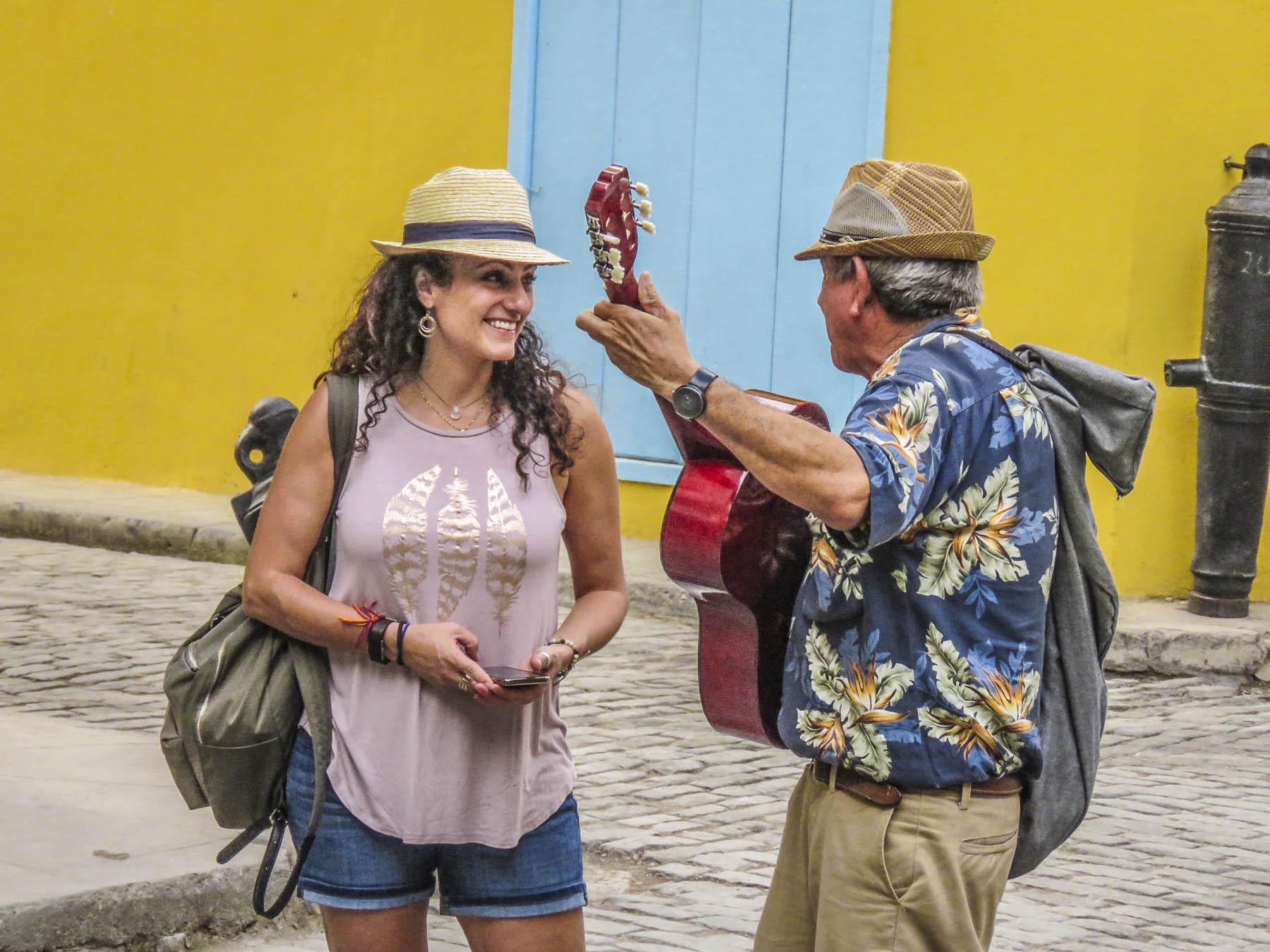
Latin music filled Obispo Street and Calle O’Reilly, the two main boulevards, the later named to honor Alejandro O’Reilly, an Irish born soldier who fought for Spain during the British siege of Havana in 1762. This neighborhood is alive with street buskers and has an entrepreneurial spirit that’s visible in many the restaurants, galleries and shops that line the sidewalks here.

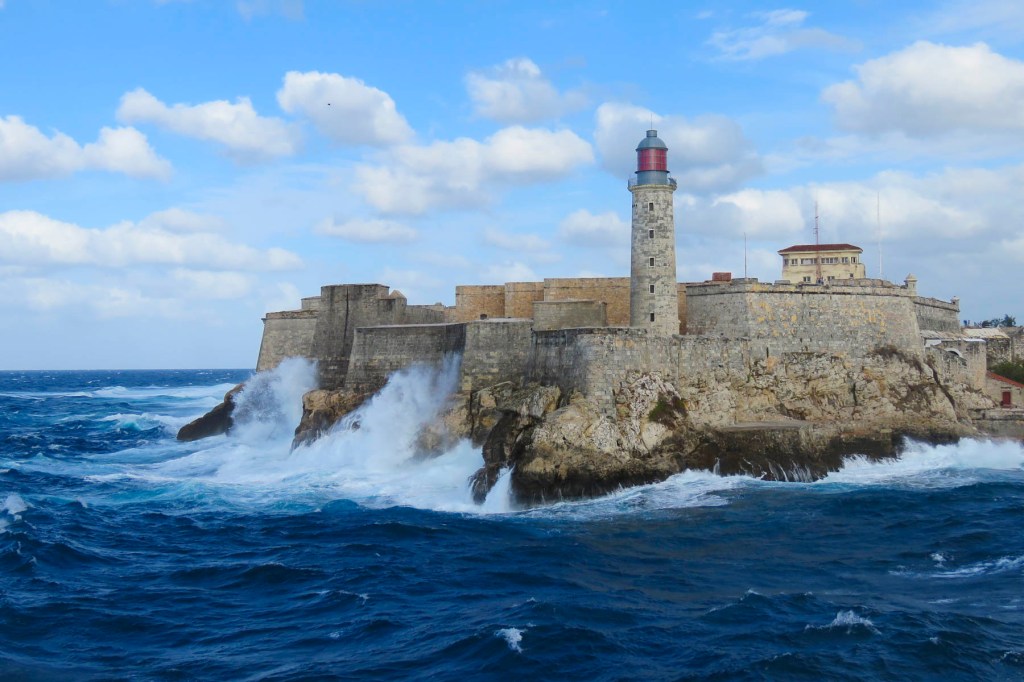
Our ship listed heavily as gale force winds churned the sea as we left the shelter of the harbor and passed the solid stone walls of the Castillo De Los Tres Reyes Del Morro.

Across the water large waves crashed against the seawall that protects the Malecon from collapsing into the sea.

It’s all too easy to romanticize poverty in an exotic destination that’s veiled by swaying palm trees and a pristine Caribbean sky.  The people of Cuba deserve better from their government. Watching the skyline of Havana fade in the twilight we wondered if Cuba’s sea change was coming.

Till next time,

Craig & Donna

Cienfuegos, Cuba – A Caribbean Time Capsule 

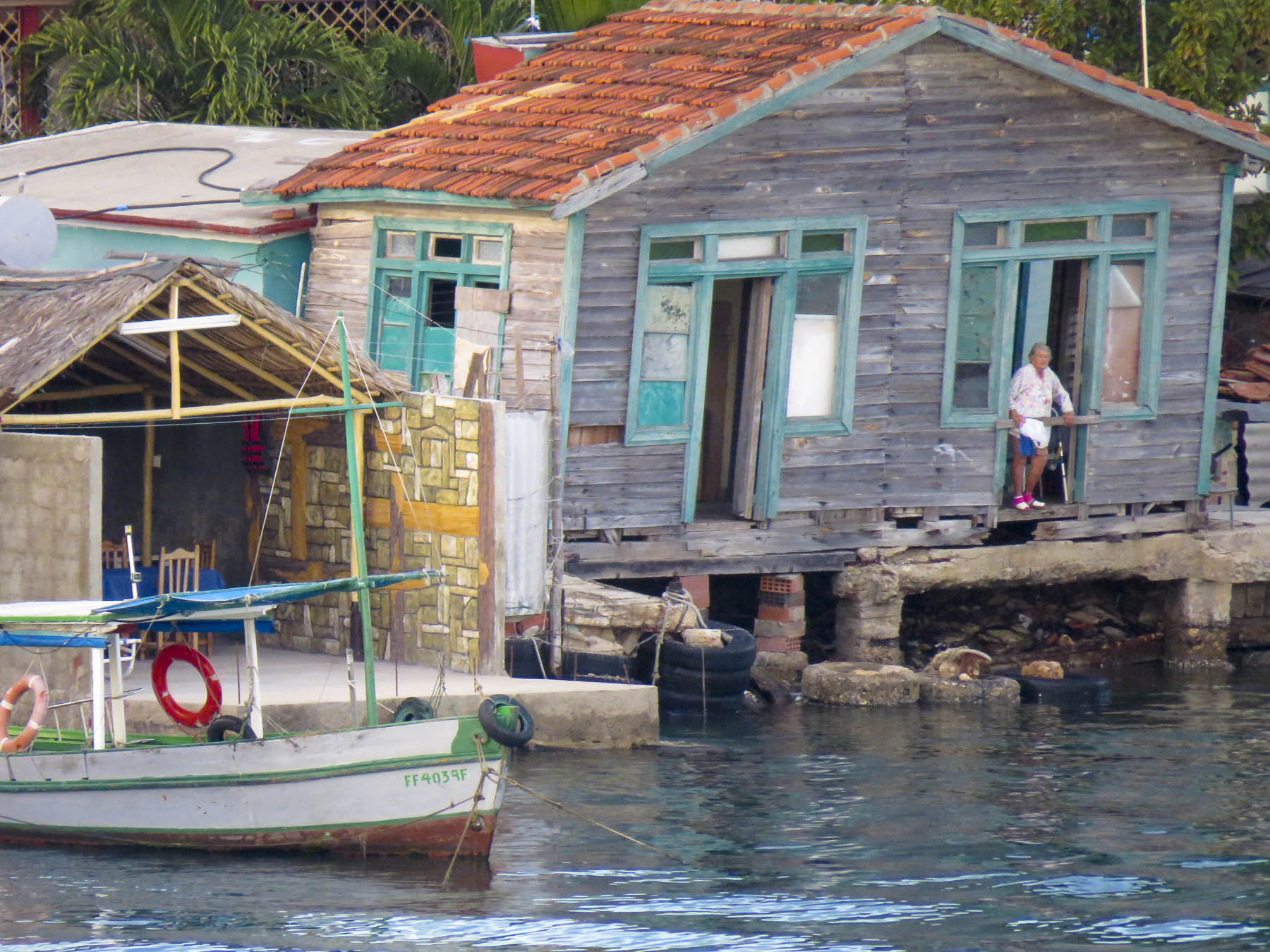
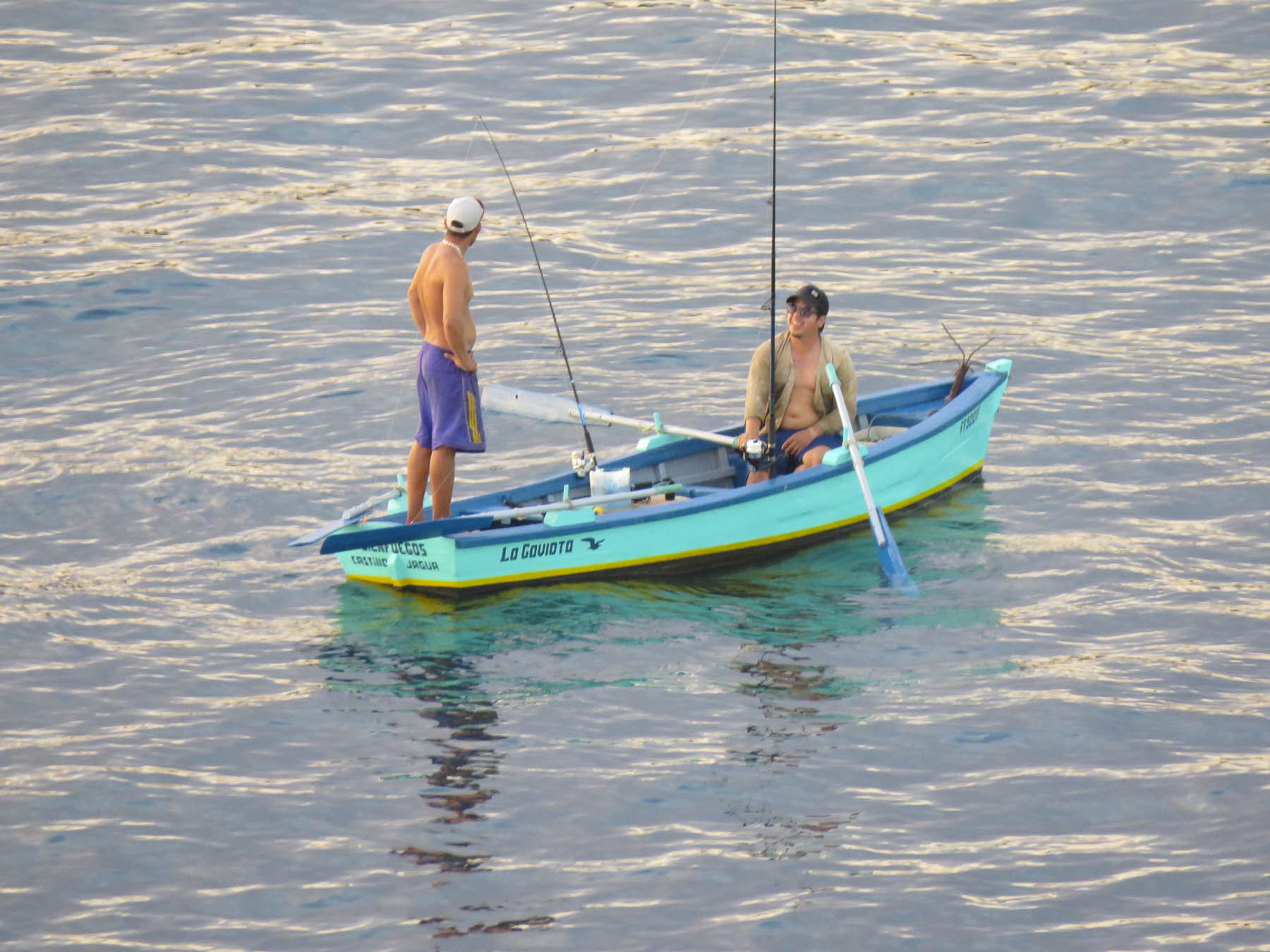
The sun was still below the horizon as men rowed small wooden fishing boats, laden with nets and poles, against the waves as we entered the narrow channel that would eventually widen into the Bahia de Cienfuegos, Cienfuegos Bay. Not much appears to have changed since the old man battled his Marlin in Hemingway’s 1951 novella. Farther along, listing boats were tied to beaten docks in front of weathered homes, their pastel colors muted in the predawn. They faced the inlet under the battlements of Castillo de Jagua, a stone fortress that has guarded this stretch of water leading to the bay since 1745.

The bay was encountered by Christopher Columbus while on his second voyage to the new world in 1494 and noted as a spectacular natural harbor, located at the end of a long narrow inlet, a perfect sheltered anchorage to weather the gales and hurricanes that blow across the Caribbean. However, closer to the gold of the new world, Havanna, on Cuba’s north coast, became the island’s dominant harbor and city. Mostly, Cienfuegos Bay was a forgotten backwater, without a permanent settlement, on the south coast of Cuba, a perfect location for the notorious British pirates Francis Drake and Henry Morgan to launch their raids on the Spanish Main and plunder the treasure fleets that voyaged from Havanna back to Seville, until the fortress ruined a good pirating gig.

The area grew slowly until the early 1800’s when an influx of French migrants fleeing the slave revolt in Haiti founded the city in 1819. Flattened during an 1825 hurricane, the city was rebuilt with a modern cosmopolitan grid pattern. The fertile region surrounding Cienfuegos supported prosperous tobacco, coffee and sugar plantations and continued to attract French immigrants from Louisiana, Bordeaux and Quebec. By the mid-1800s, a railway funneled goods from across the region to the port for export, and a steamship line connected Cienfuegos to Charleston and New York City. The city’s prosperity was reflected in its stately mansions, elegant civic architecture, wide boulevards and parks reminiscent of New Orleans and Paris, earning it the nickname “La Perla del Sur,” the Pearl of the South.

The Cuba of the 2020s still looks very much like it did during Hemingway’s life, as if it was stuck in time, a perpetual movie set. This is a result of the political decisions made during the 50-year reign of the country’s communist dictator, Fidel Castro, who ruled from the revolution in 1959 until 2008, and other communist leaders since then.  Consequently, the United States imposed and still maintains a trade embargo against the Cuban government that visually appears to have frozen the country in the 1960s.

Europeans and Canadians have long traveled to the government-run tourist resorts along the pristine coast. Previously, an inland tourism infrastructure didn’t exist, but with the introduction of the internet to the country and encouraging private enterprise reforms things are slowly beginning to change. We were visiting Cuba on a cruise during that first window of opportunity that was open to Americans between 2016 – 2019, before access was unfortunately tightened again.  Recently the travel restrictions to Cuba have been loosened again.

Across from the pier a horse drawn cart with several wooden benches, car tires for wheels and a sun bleached canopy stood idle. It wasn’t meant for the tourist trade, but instead was the cheapest mode of transportation for local folks to use to move about town. And it was our introduction to how self-reliant Cubans are and how slowly change happens in Cuba. Then we noticed the cars.

Earlier an email confirmed our rendezvous, “Ten is good. Meet at the statue of Benny Moré, a beloved Cuban singer, songwriter and band leader, at the intersection of Paseo El Prado and the pedestrian only San Fernando. Ciao.”

We had decided to skip any ship organized tours of Cienfuegos and instead opted for a tour of the city with a Guruwalk guide we found online.

With introductions made, our small group of four followed our guide through Cienfuegos as they pointed out various sites and their significance. Other stops included the government shoe store where the limited styles were only available in black, and a government bodega.

Here food is acquired with the use of La Libreta, a government issued ration book used to tally your monthly allocation. allowance or allotment Typically the monthly allowance per person is 5 eggs, 1 liter of cooking oil, 1 pound of spaghetti, 3 pounds of refined or white sugar, 3 pounds of unrefined or dark sugar, 6 pounds of white rice, 20 ounces of black beans, 2 packets of “mixed coffee”, daily bread (dinner rolls). Fresh produce not available at the government bodegas is sold at state sponsored farmers markets.

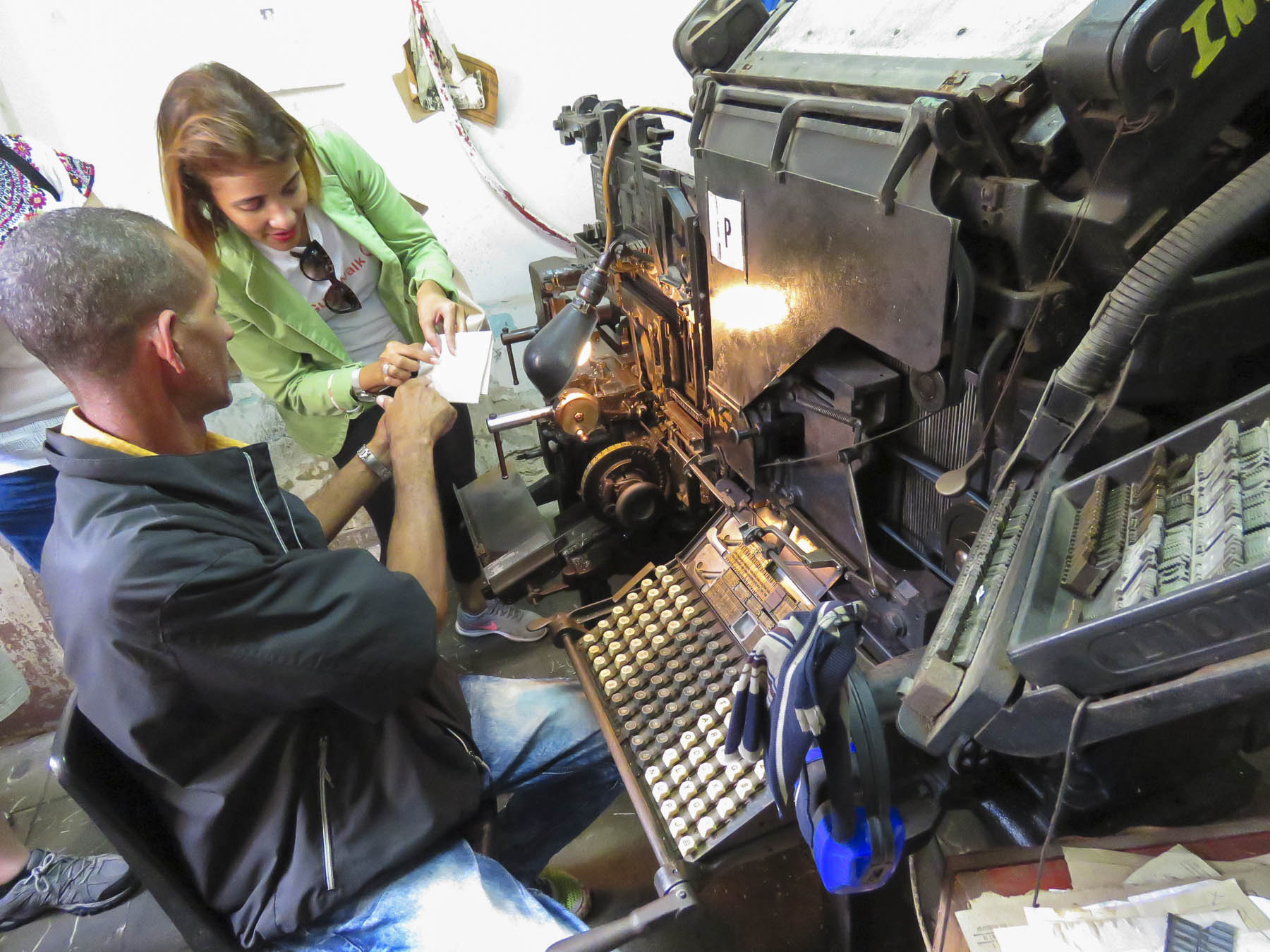
Stopping at a large print shop, we watched the printer set lead type by hand as he assembled each word and sentence for the document he was preparing from a large tray of metal vowels, consonants and punctuation marks. There were not any computers, laser printers or copy machines in sight, only the shop’s heavy German Heidelberg printing presses, which have been meticulously maintained since 1959.

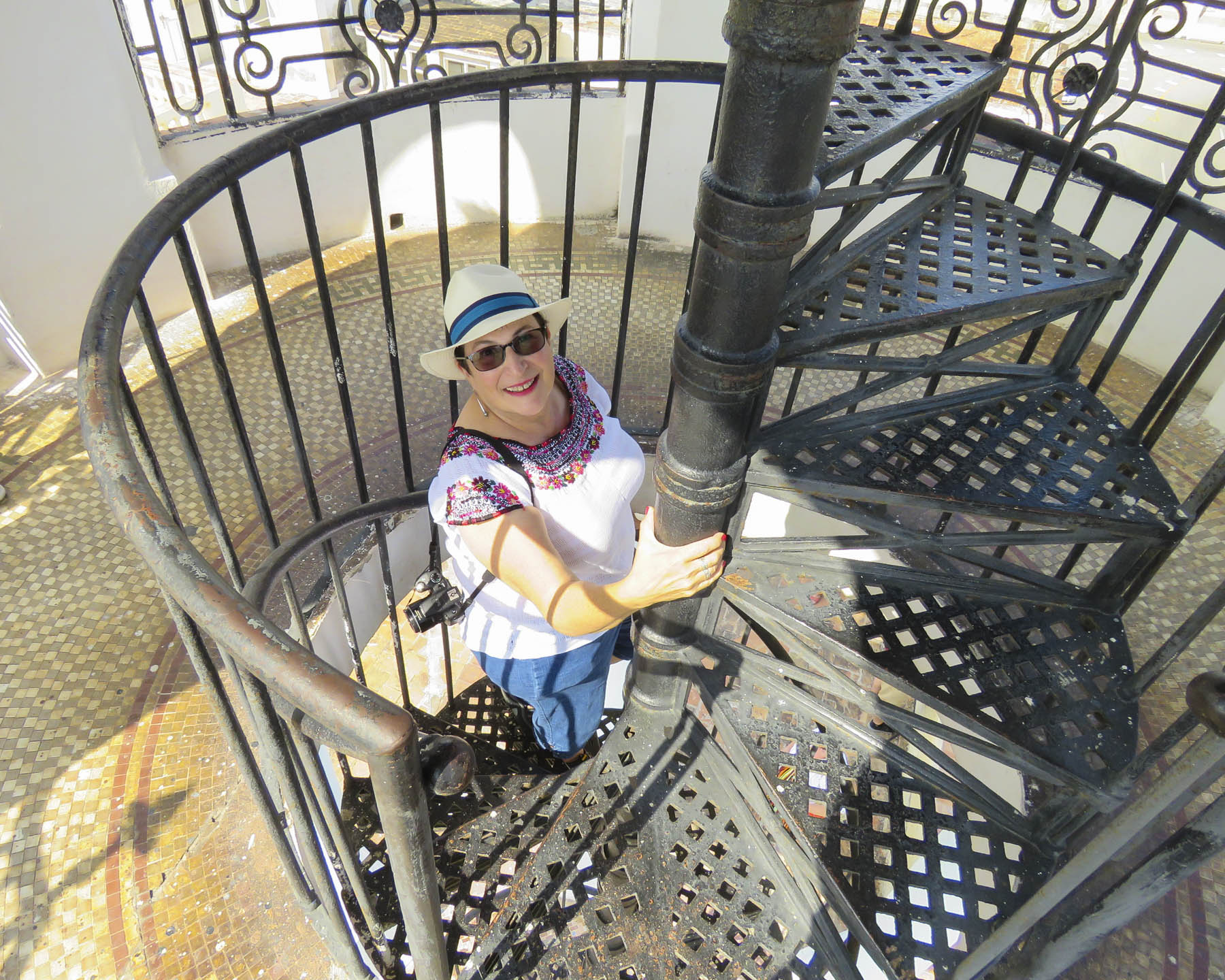
From the top of Hotel La Union, the highest point in the city’s center, we surveyed Cienfuegos, today a sprawling city of 150,000. 

“So, you’ve noticed the old cars on the street?” Our guide turned the talk at lunch away from any political questions we were eager to ask about life in a communist country.

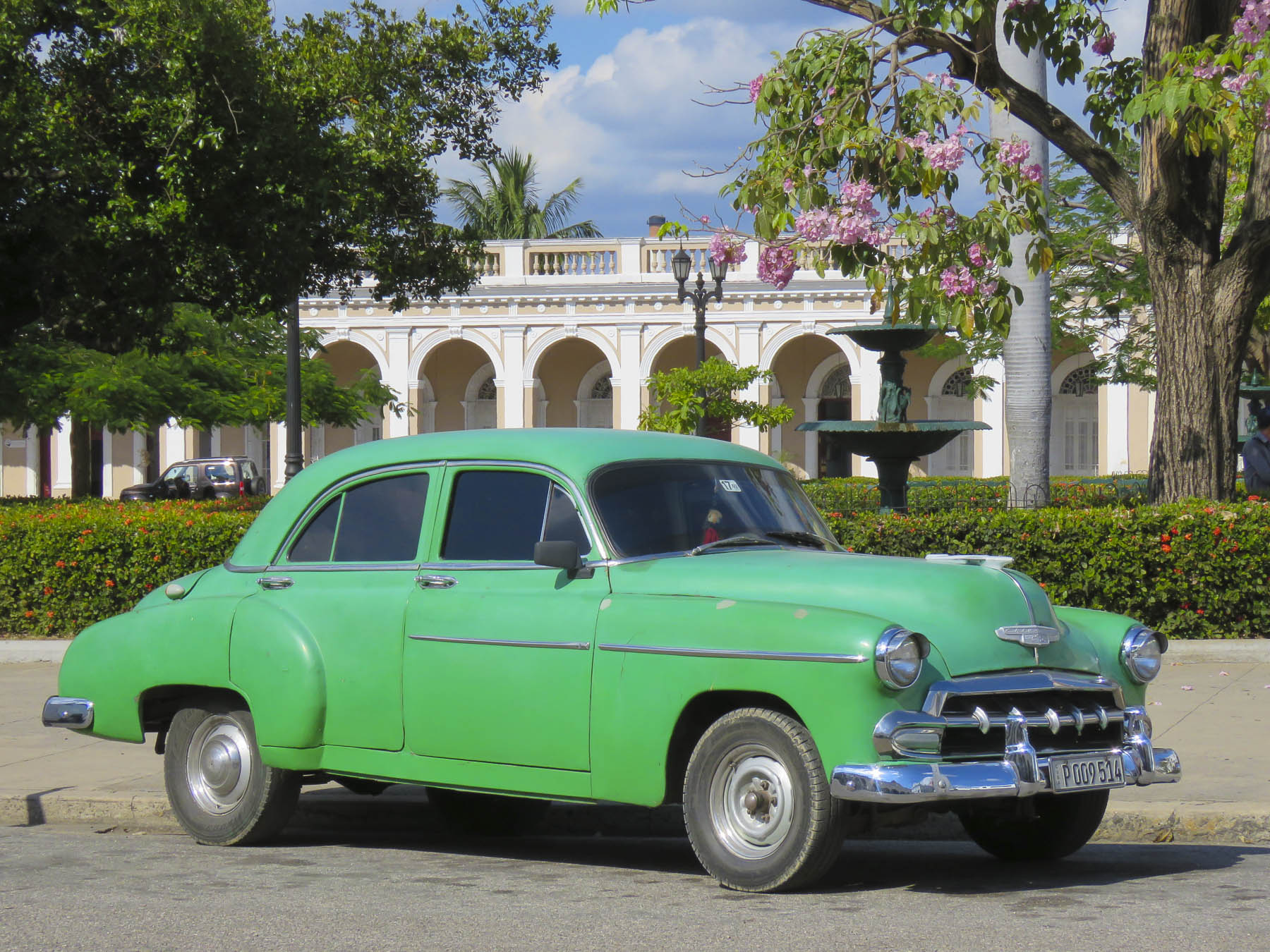
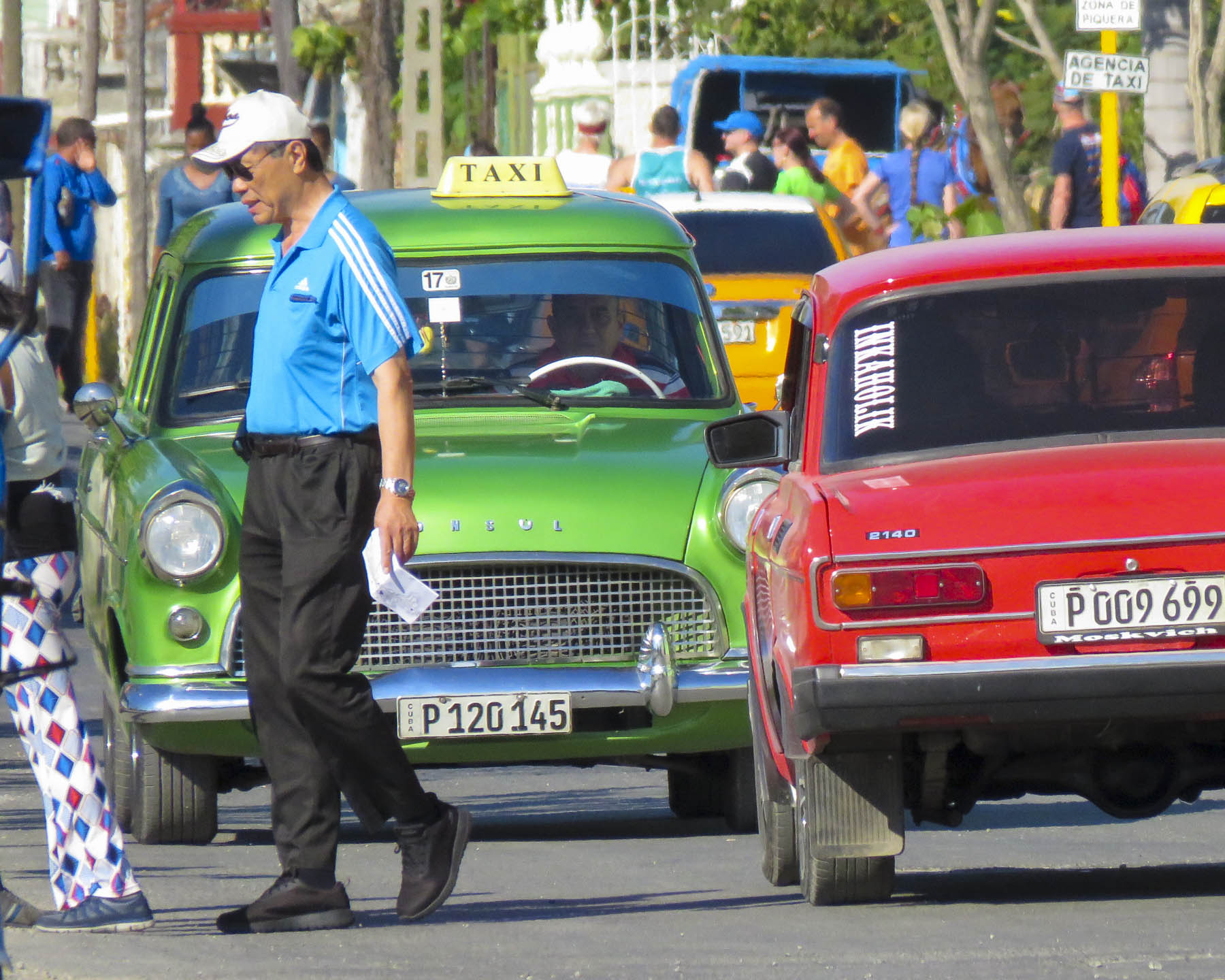
There are about 60,000 old American cars still on the road in Cuba. Most date from the 1950s, but there are still Consuls, Packards, Cadillacs, Dodges, Chevys, Studebakers and Fords from the 1940s and 30s that are still road worthy.  This is an amazing testament to the talent of Cuban mechanics that have been “MacGyvering” the repairs with makeshift parts since the revolution ended in 1959, when the U.S. trade embargo began, and Cuba banned the import of American products. While some cars look to be in mint condition, often the interiors are taped together, door handles are missing, and the windows don’t roll up.

Engines don’t last forever and its not uncommon to swap engines between the American makes and models. Sometimes even the motors from Russian Volgas and Ladas work their way under the hood of Fords and Chevys. Fiats and Peugeots were imported after the revolution but proved to be not as durable as the American models.  With the nationalization of property in 1959 the nicer cars of the wealthy who fled were assigned to government officials, doctors, renown celebrities and famous athletes. Regulations prohibiting the ownership of cars was eventually changed to allow Cubans to freely purchase older cars brought to the island before the revolution. Since then, often cars are family heirlooms that have been handed down from generation to generation. Fathers teaching sons the intricacies of keeping the cars running. It’s extremely rare to find late model cars on the roads as the government imposes very high taxes on new car imports, making them highly unaffordable for the majority of Cubans.

“There are no junkyards in Cuba, everything is still driven.” The ingenuity of Cuban mechanics can surely teach us a thing or two about sustainability. Wonderfully many of these resourceful home mechanics have kept these automotive treasures alive and have created an income for their family by offering rides in their classic cars to tourists.

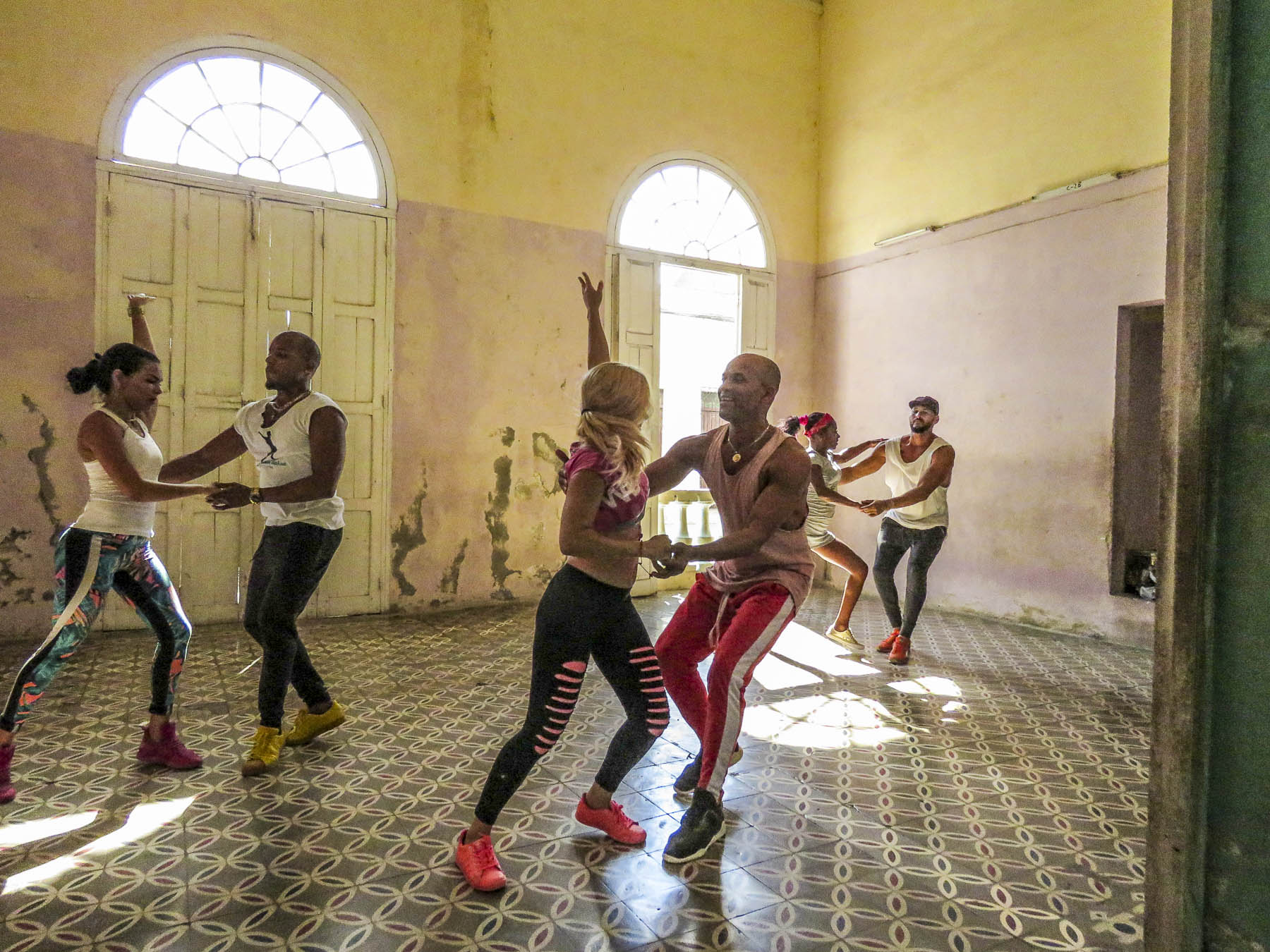
After lunch we watched dancers rehearse in an old colonial building now used as a community center, and we stopped in several art galleries along the park that featured many talented Cuban artists.  With the government tightly controlling the economy along with the print and electronic media in the country, creative self-expression through art, dance and music are treasured venues as long as the views expressed don’t “run counter to the objectives of the socialist society.”

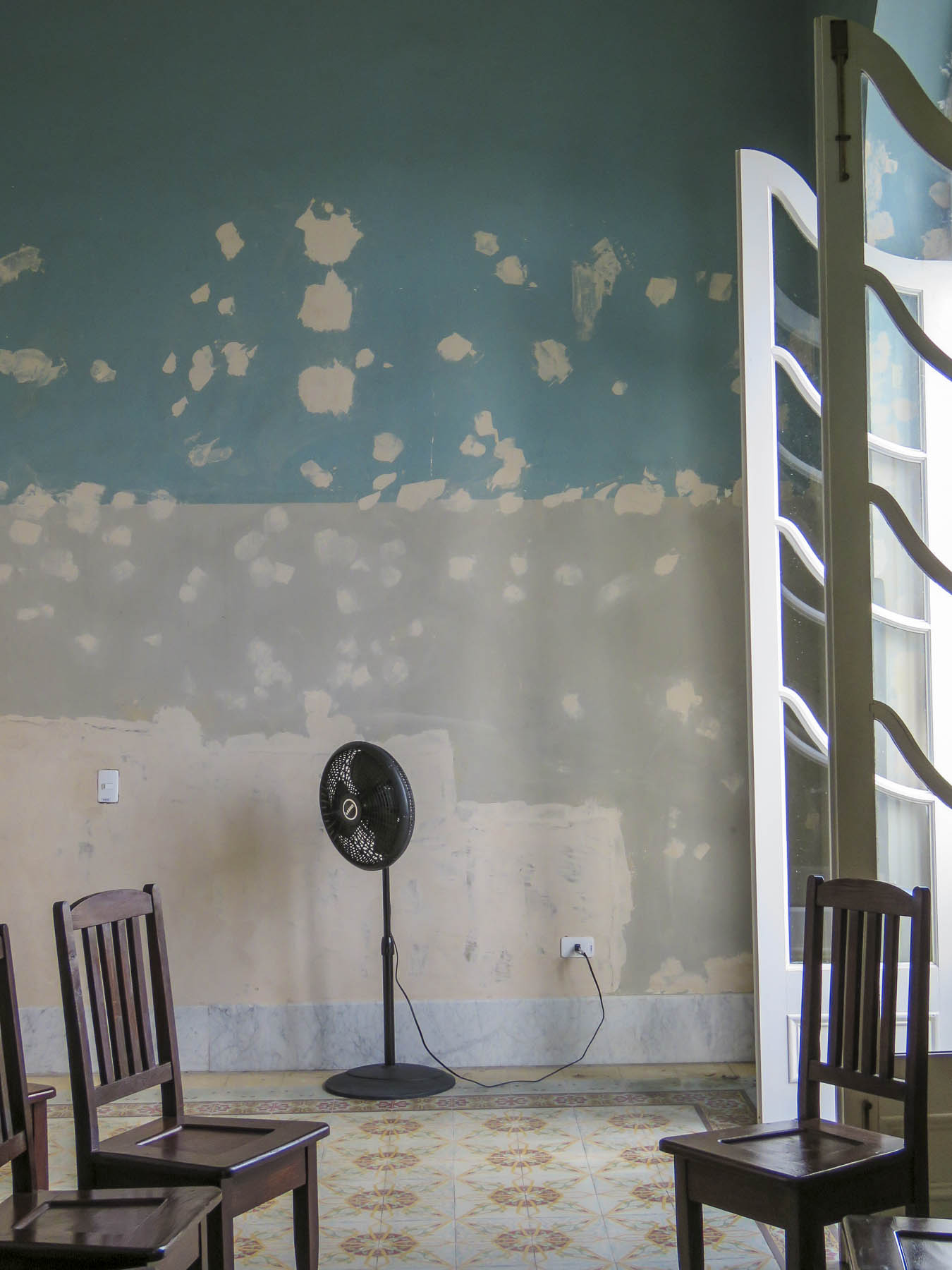
While the center of the city is well maintained, and many of the old mansions and civic edifices recently renovated. The homes and buildings along the side streets show decades of neglect from a failed socialist system.

Pride in ownership is a difficult concept in Cuba, and since wages are so very low, buying paint is the last thing anyone is thinking about. Low wages necessitate most families to spend any extra funds at the free markets to buy the goods that aren’t covered with the La Libreta rations card.

This quote I found sums up concisely the housing situation. “In Cuba, everything belongs to everyone and no-one at the same time and if a building is “collectively-owned”, it’s understood that the State is the one responsible, but the goverment can’t afford the maintenance.”

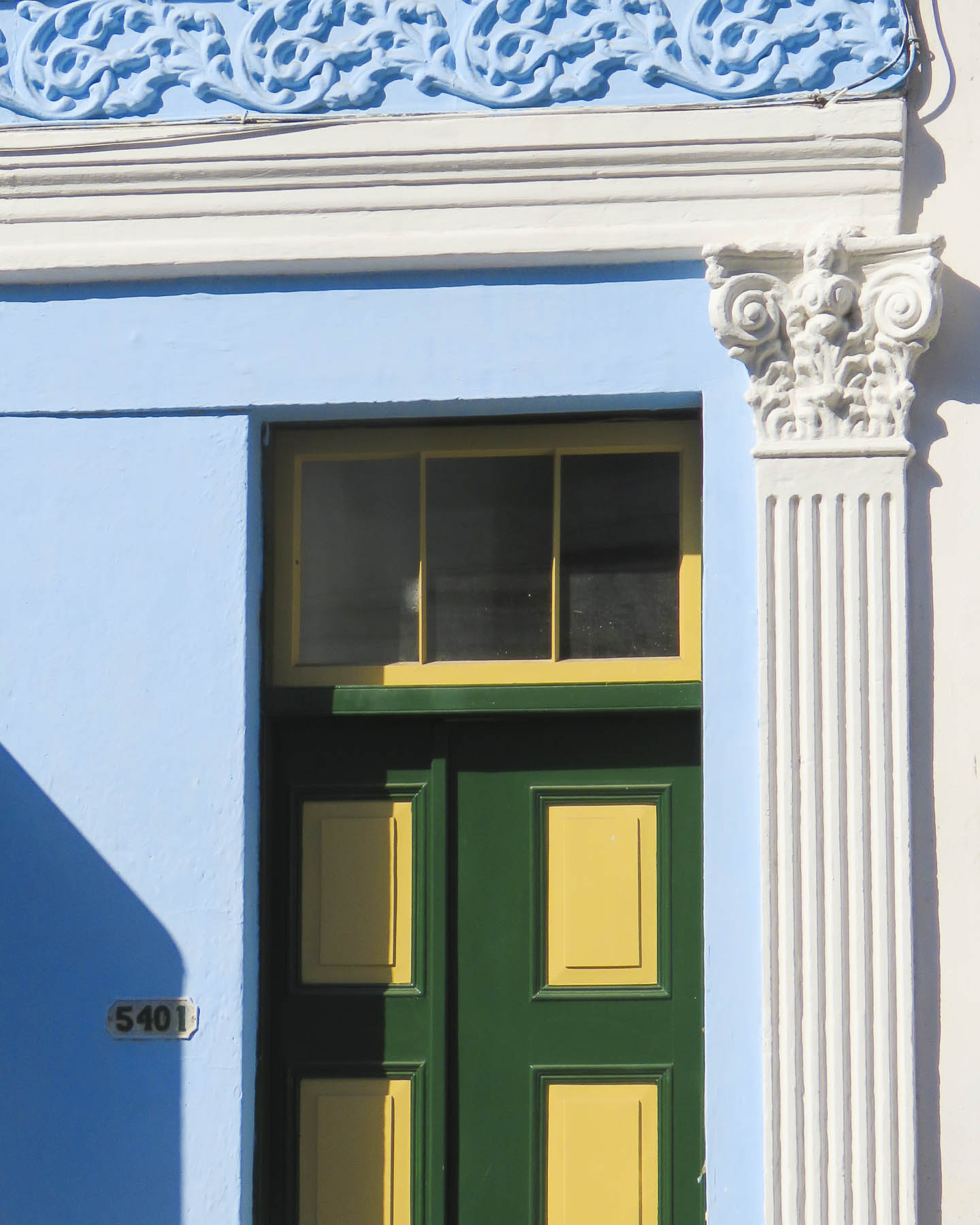
Down the side streets, past glories are now sadly intriguing in their neglect, the homes and buildings wearing a texture carved from storms and hot unrelenting sunshine, revealing ancient layers of paint that gives the neighborhoods a weathered patina, a faded elegance.

Till next time,

Craig & Donna

Seville Part 5 – Road trip to Olvera & Setenil de las Bodegas

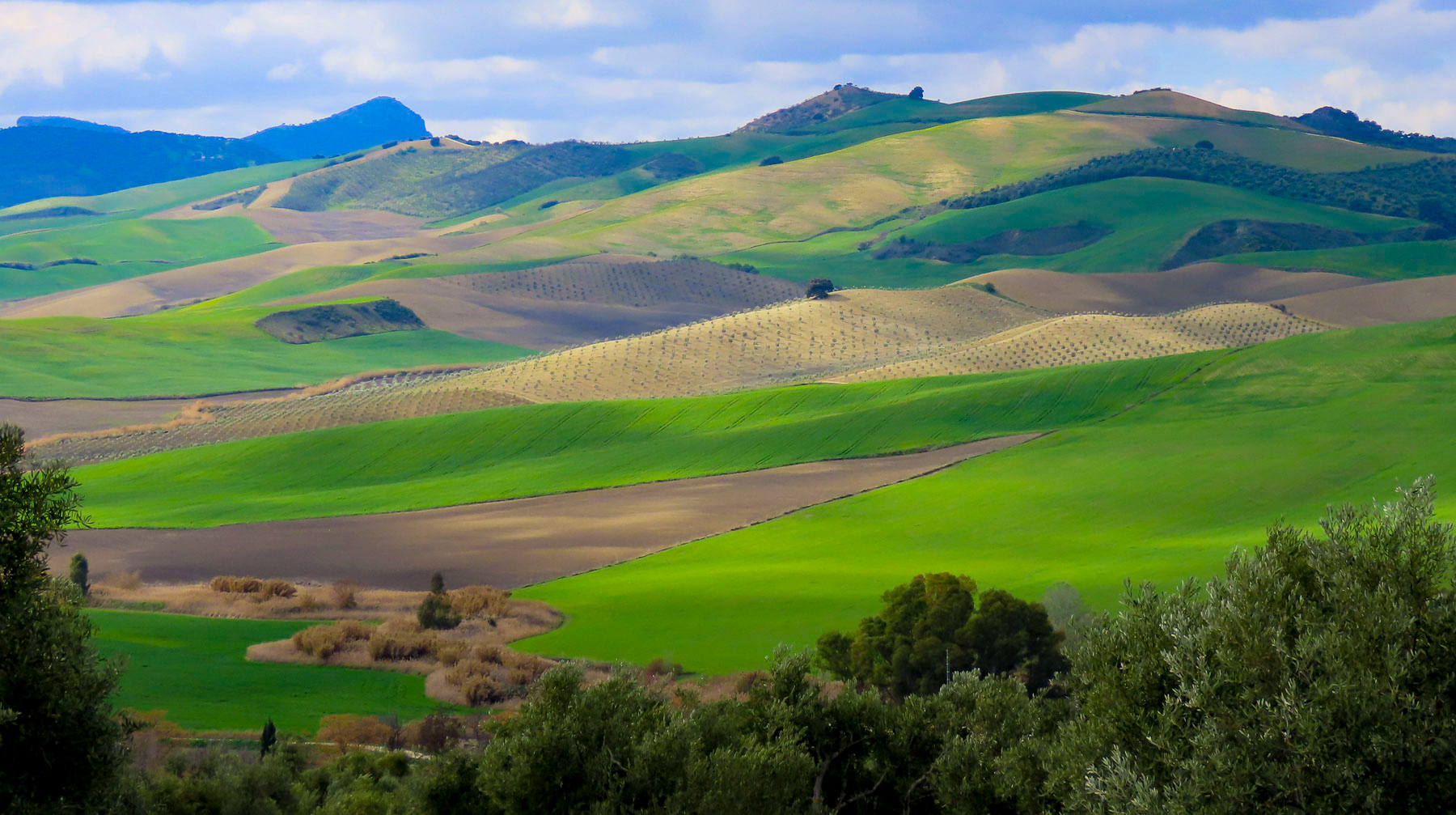
The countryside on the way to Olvera was more verdant than the earth toned landscape we traversed on our way to Zahara de la Sierra at the beginning of our road trip.  Now the hillsides were a mosaic of greens, light and soft, dark and vibrant, signaling the arrival of spring. 

As the road curved, Olvera’s Castle and the belltowers of the town’s church broke the horizon. We are never quite sure where to park in small villages.  Worried about getting fined for a parking violation, we always opt to play it safe and find a car lot.  But the parking in Olvera was at the bottom of a steep incline below the historic castle and we just didn’t have the oomph that morning to walk from there uphill and then continue higher to the top of the tower.  With some persistence we navigated the town’s labyrinth of narrow one-way lanes into the Plaza de la Iglesia. At the apex of the village, the plaza straddles the area between Olvera’s citadel and the town’s majestic church, Our Lady of the Incarnation Parish.  Since it was still the off-season, we were in luck and found the last, barely viable parking spot on the plaza. It was a narrow space that required the driver’s side door to be parked tightly against a wall. Fortunately, I’m still limber enough to climb over the car’s center console and stick shift, with a limited amount of grunting and moaning.

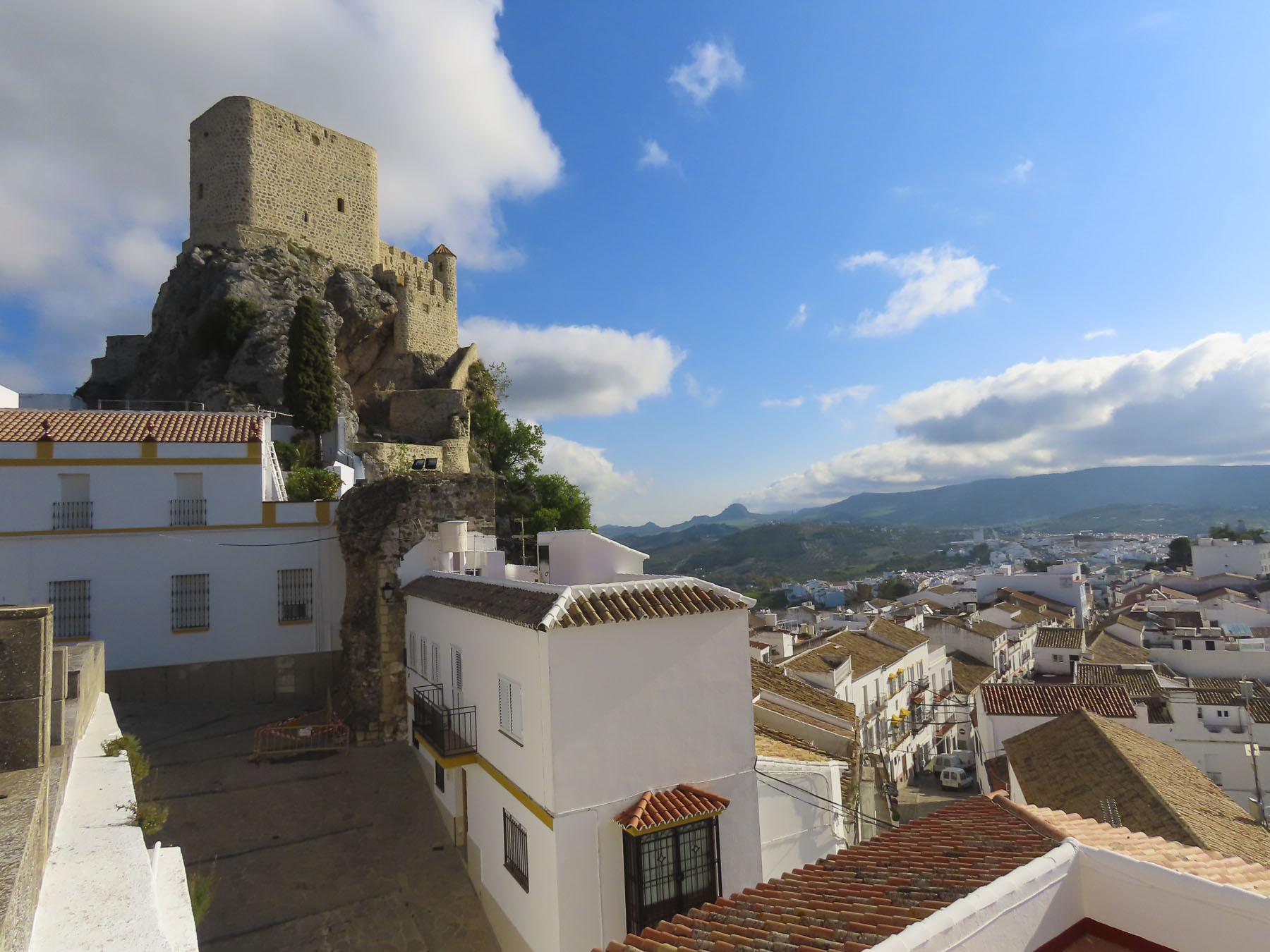
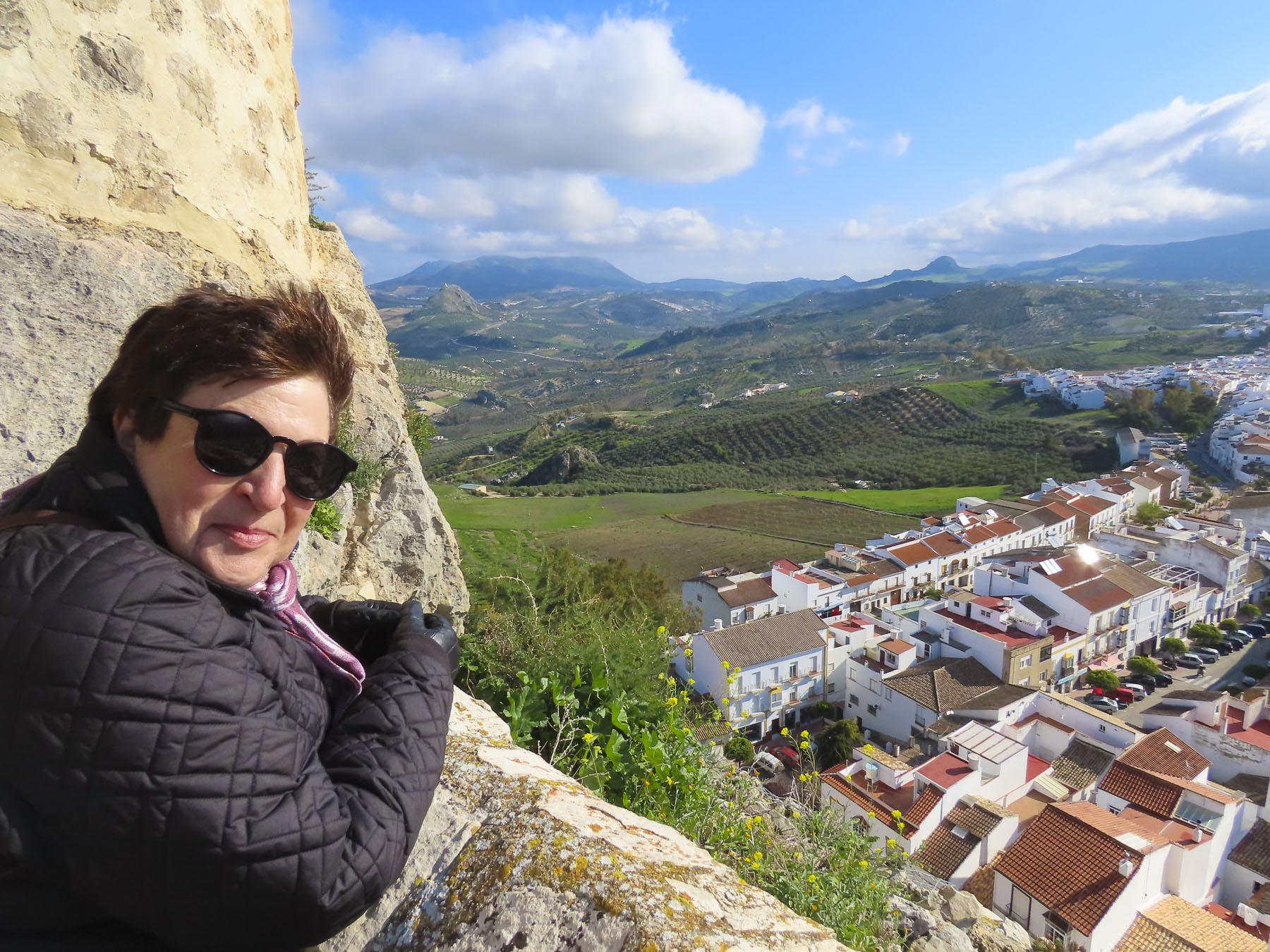
The view from the mirador at the edge of the plaza was wonderful.  Incredibly, the views across the village continued to get better and better as we climbed the different levels to the top of the Castillo de Olvera, perched atop a rocky outcrop at an altitude of 2000 feet. The climax was a spectacular view of the cathedral and panorama of whitewashed homes with red tiled roofs backed by a shimmering sea of silver green foiliage. Outside the village, the surrounding olive groves harbor nearly two million trees.

Constructed in the 12th century, the castle was part of a line of signal towers along the Moorish frontier in southern Spain. The castle was expanded in the 14th century when it was captured by King Alfonso XI during the Reconquista. The castilo is one of five in proximity to each other on The Castles Route, Witnesses of the Spanish Reconquest through the Moorish Strip, a no-man’s land that separated the ancient Christian Andalusia frontier from the Arab Kingdom of Granada. The other castles on the circuit are Castillo de las Aguzaderas, Castillo de Cote, Castillo de Morón de la Frontera, and the Castillo del Hierro.

With its size and architectural presence, Our Lady of the Incarnation Parish looks more like a cathedral than just a church. The neoclassical church was started in 1823 on the foundation of an earlier dismantled, gothic- mudéjar style church and dramatically counterbalances the castle on ridge above the village.  Ordered built by The Dukes of Osuna, the feudal lords over Olvera, the vaulted interior is lined with marble imported from Italy and has many interesting religious icons. To fulfill this extravagance the Dukes diverted the town’s taxes, away from improving the village, to pay for it.  They were the last feudal lords over Olvera and declared bankruptcy in 1843 when the church was completed. Then fled, never to be seen again.

A cloudless morning in Olvera turned overcast by the time we arrived in Setenil de las Bodegas only thirty minutes later. While considered a pueblo blanco, it’s totally different from Olvera and Zahara de la Sierra where the homes ascend the steep slopes under their town’s hilltop fortress.  In Setenil de las Bodegas, whitewashed homes front caves under large stone overhangs which line both sides of a gorge, created eons ago from the erosion caused by the swift moving water.

The homes along the gorge use the mammoth natural stone ledge as their roofs. The once raging Rio Trejo is now a quiet stream in the narrow gorge, which widens into a shallow ravine where an ancient Moorish castle still guards the approach to the village.  When the Romans colonized the area two thousand years ago folks had already been dwelling in the natural caves along the gorge for several millennia. Over the centuries the cave fronts were enclosed to create the unique village that still survives.

Before touring the village, we checked into the Hotel El Almendra to drop our bags, just oustside the historic district, with the intent of driving back and finding parking closer to the gorge.  We were just about to pull out of the hotel parking lot when a group of police cars with lights flashing and sirens wailing roared past. A slower patrol car parked and blocked the hotel driveway. Folks were beginning to gather on the sidewalk. We had no idea why until a motorcycle carrying a cameraman facing backward led the first wave of bicycle racers that were a blur of pedaling color as they sped by. A continual surge of racers crested the knoll of the road and coursed downhill towards the village. The race was one leg of the annual Vuelta a Andalucia – Ruta del Sol. A five-day, 500 mile cross-country cycling event that summits 17 mountain passes in the region and attracts 600 riders. Leaving the car at the hotel, we decided to walk the half mile into the village.

By the time we reached Cuevas del Sol, Caves of the Sun, the narrow one-way road through the gorge lined with small taverns and inns, the sun was brightly shining again.  Even though the road is open to cars, it was filled with folks walking and was almost pinched closed by tables from the restaurants narrowing its width.  We found a table and enjoyed both the lunch and the warmth of the February sun.

Afterwards we walked the length of the lane through the deep chasm until a set of stairs led to the Mirador del Carmen and the small 18th century chapel Ermita de Ntra. Sra. Del Carmen.  The view from the overlook encompassed a sweeping vista of the valley filled with whitewashed pueblos stacked atop one another filling the valley to its rim. 

The Nazari Castle, the town’s 12th century Moorish fortress, still stands vigilantly on the edge of the valley, the invaders now camera-wielding tourists.  Across from it the Gothic style Church of Our Lady of the Incarnation, itself an imposing fortress-like structure, was ordered built by the Spanish Crown. It was constructed in 1505, above the town’s previous mosque, to celebrate the liberation of the village from centuries of Arab rule.  We walked back to our hotel along a lane above the gorge lined with newer buildings. 

Heading back to Seville before sunrise the next morning we stopped high above the village on the road that followed the ridge opposite the Cuevas del Sol, in one last attempt to capture the iconic pueblos of the village as dawn cast its first rays of light across the gorge.

Till next time, Craig & Donna

PS. Our 226-mile weekend roundtrip from Seville only used slightly more than a half tank of gasoline.

Ronda Road Trip – The Pueblos Blancos or Blinded by the Light

Needing a break from city life we rented a car at the Santa Justa train station and within minutes we were out of Seville heading south to Ronda, one of Andalucia’s many “Pueblos Blancos,” the white villages, so called because of their uniformly whitewashed houses.  Although it was less than two hours from Seville, it took us all day due to the number of planned stops and spontaneous detours we made.

Lime paint was introduced to the region when Rome controlled the Iberian peninsular. Its use was greatly expanded during the mid-1300’s when a bubonic plague pandemic swept through the Mediterranean countries.  Residents of villages were required yearly to cover the outside and the interiors of their homes and churches with a limewash, known for its natural anti-bacterial and insecticidal properties, in an effort to reduce the spread of disease. Community inspections were done, and folks were fined for noncompliance. This mandated conformity was eventually appreciated as an aesthetically pleasing look and a symbol of meticulous tidiness. Fortunately, the custom stayed and has become an iconic signature of southern Andalusia.

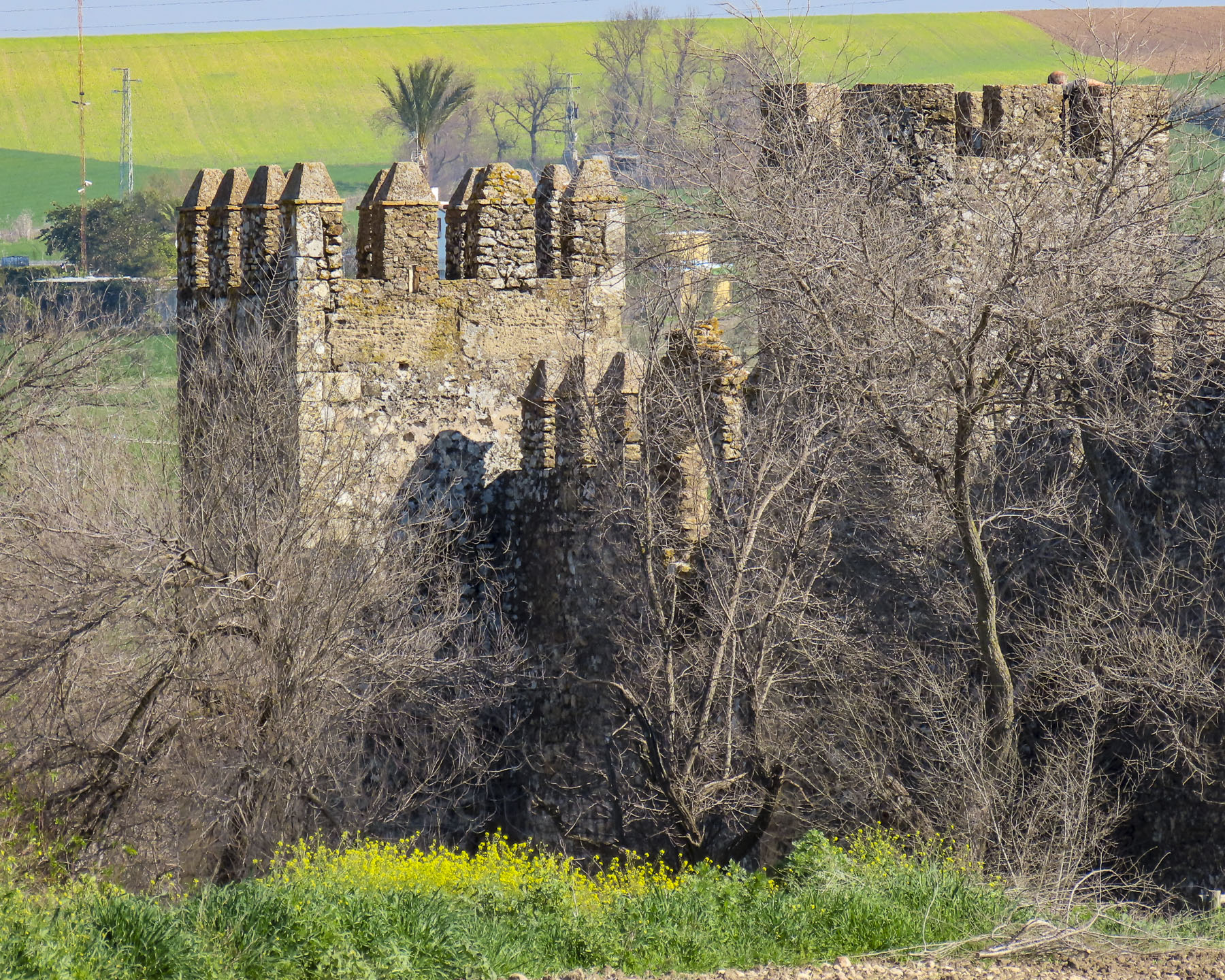
Cresting a low hill on the A-375, we spotted a small castle with crenellated walls and towers in a shallow valley not far from the road. Turning towards it we followed a dirt track through farmland not yet ploughed for the Spring planting to a small intersection where the castle stood next to a narrow, babbling brook.  The history of the Castillo de Las Aguzaderas isn’t really known, but it is thought to have been built in the 1300’s by the Moors as they retreated from advancing territorial gains made by the Spanish during the Reconquista. 

Of Spain’s 2500 castles this is the only one that does not sit atop the high ground of a hill or mountain to command the surrounding terrain, but according to its historical placard, stands in a hollow to protect the spring that emerges from the earth outside its wall. With no attendant and an open gate, we were free to scramble around the walls and climb stairs in a terrible state of disrepair to the top of the castle keep for views all around. In the distance an ancient stone watchtower, Torre del Bollo, dominated a hill.

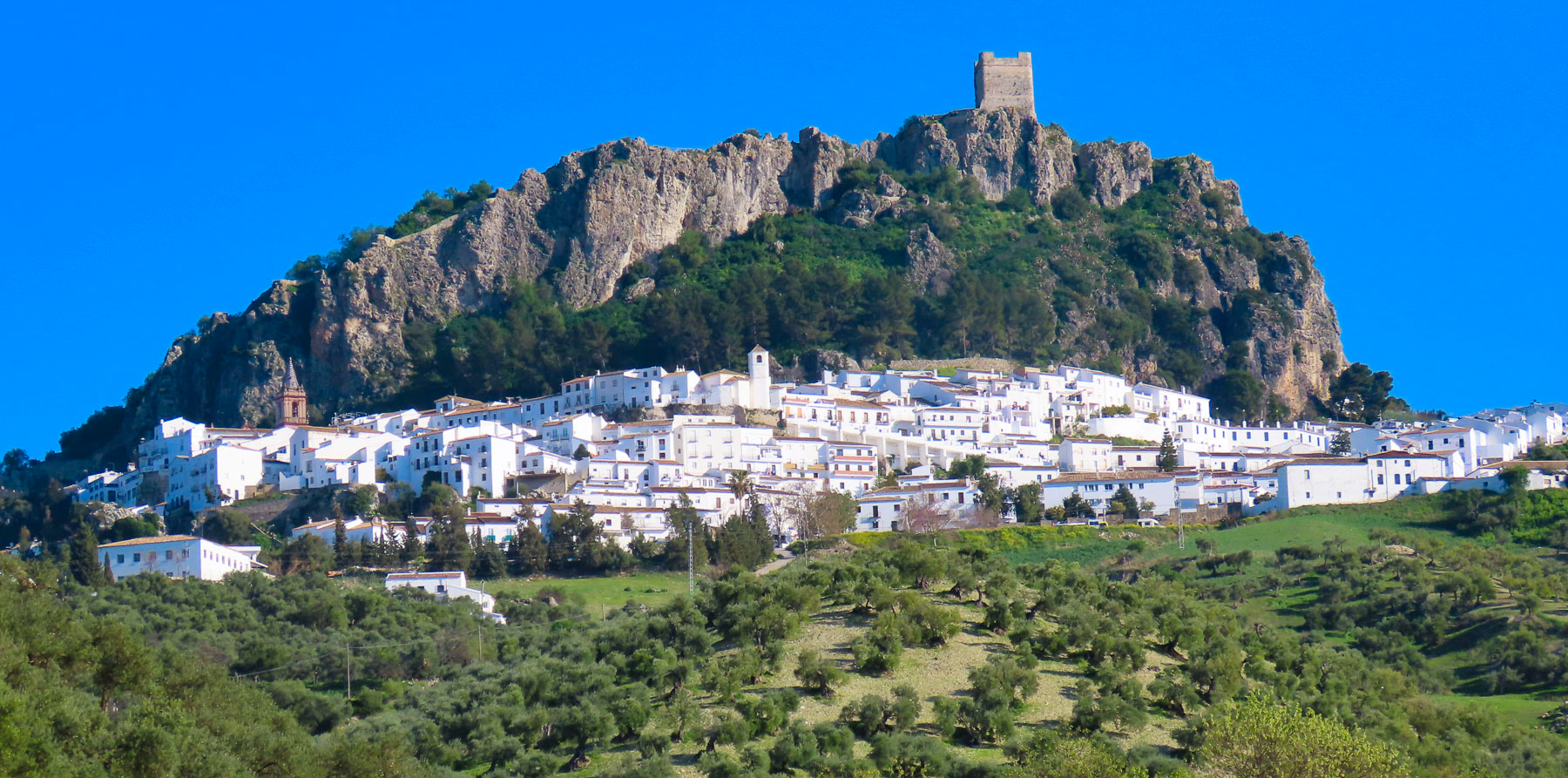
From afar the whitewashed casas of Zahara de la Sierra brilliantly reflected the sunlight like polished marble.  The homes, stacked like building blocks, rose up the hillside until they met a sheer butte. A square tower crowned the butte’s summit.

We followed the long ring road that circles the mount through the village and decided to have lunch at Meson Oñate where we were drawn to the outdoor patio that overlooks the Zahara-El Gastor Reservoir and the rolling farmland that surrounds it. 

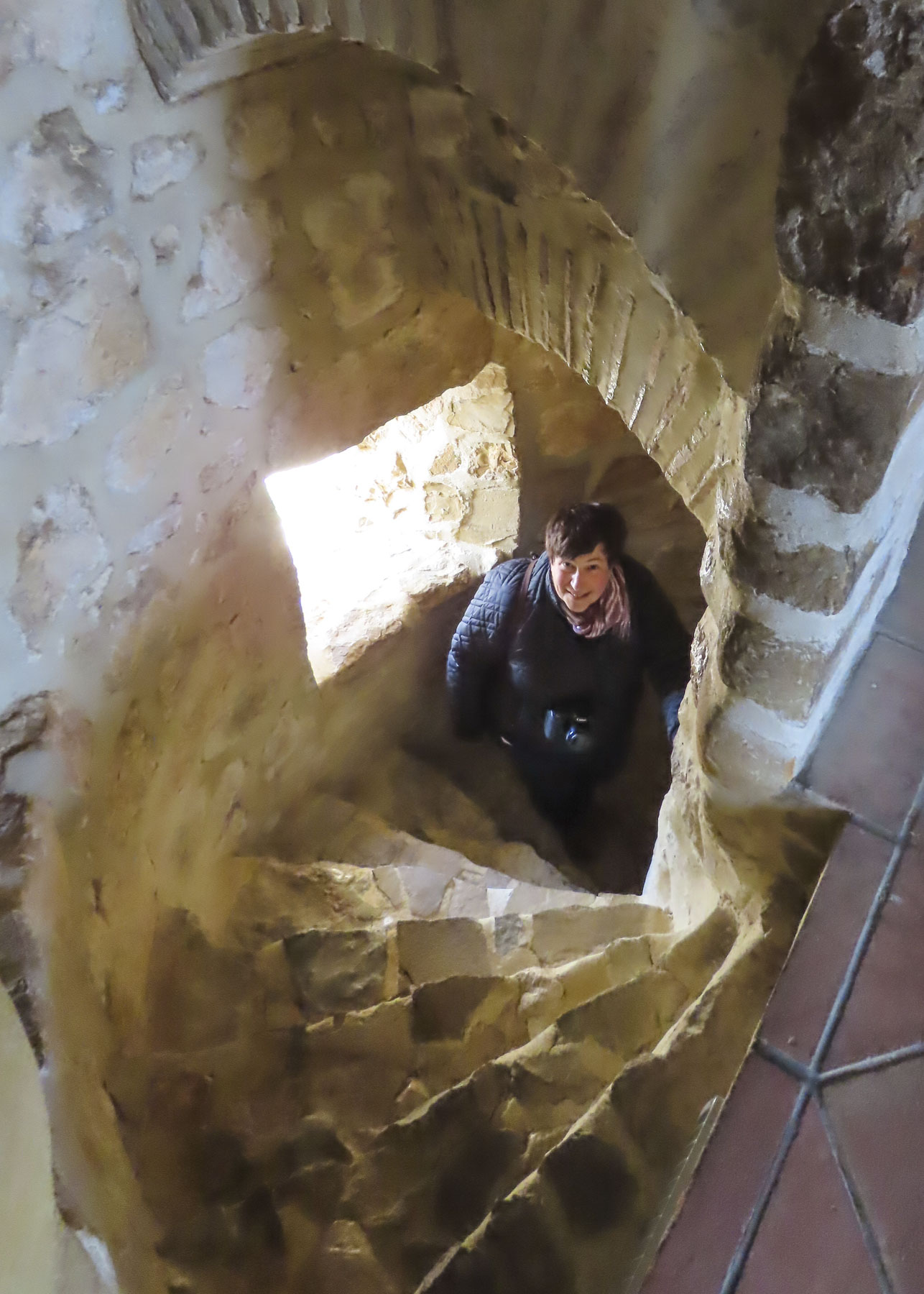
After lunch, to work off our delicous meal, we hiked to the Castillo de Zahara, which crowns the mountaintop above the village. It was a well paved steep path at the start, but soon the slope decreased to a manageable incline that zigzagged up the mountain.  For our effort we were rewarded with stunning bird’s eye views over the red tiled roofs of the village and to the distant lake below. A tower is all that is left of a larger Moorish castle from the 13th century that was built over the ruins of a small Roman settlement that once called the mountaintop home. Barely accessible, it provided a safe haven during times of trouble. The castle had a turbulent history with its control passing back and forth several times between the Moors and Spanish. Even French troops once commanded its summit through Napoleon’s conquest of Spain during the Peninsular War that raged in the early 1800’s.

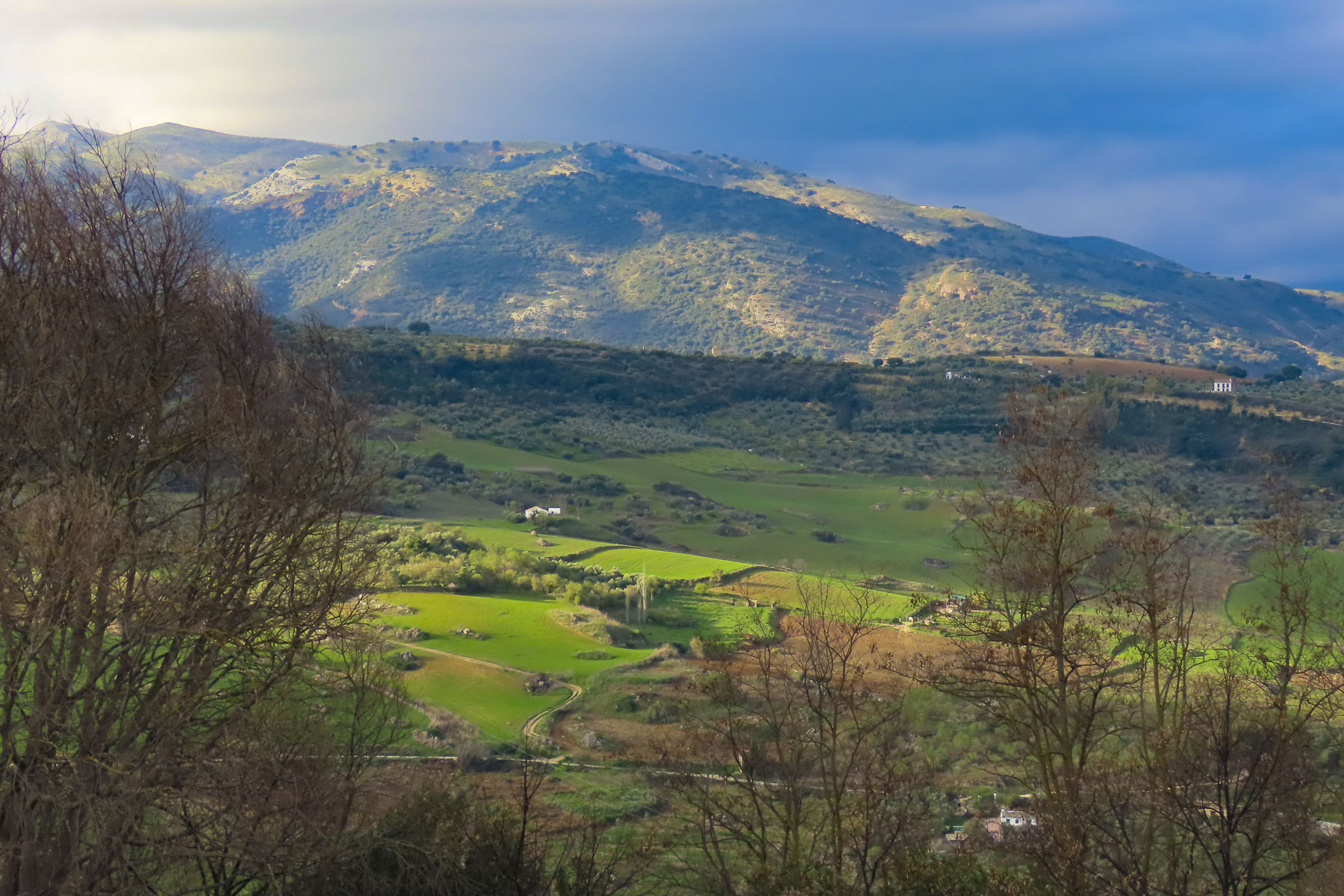
With a last-minute decision to take a longer route to Ronda, we headed into the mountains outside of Zahara de la Sierra on CA-9104, a serpentine road with steep slopes that took us into the Sendero La Garganta Verde, a rugged and wild scenic area that is known for its population of Griffon vultures, and Monte Prieto.  The wind was insanely whipping around us when we parked the car at the Puerto de las Palomas (4500ft above sea level) mountain pass and walked to an observation deck in hope of viewing some vultures.  Griffons are large birds of prey that have wing spans up to nine feet across. We were fortunate to spot some, far off in the distance before we ran back to the car, chilled to the bone.

The sun sets early when you are on the eastern side of the steep Sierra del Pinar mountain range.  The last rays of sunlight still illuminated Grazalema as we drove into the village, but the temperature dropped along with the vanishing light of a February afternoon.

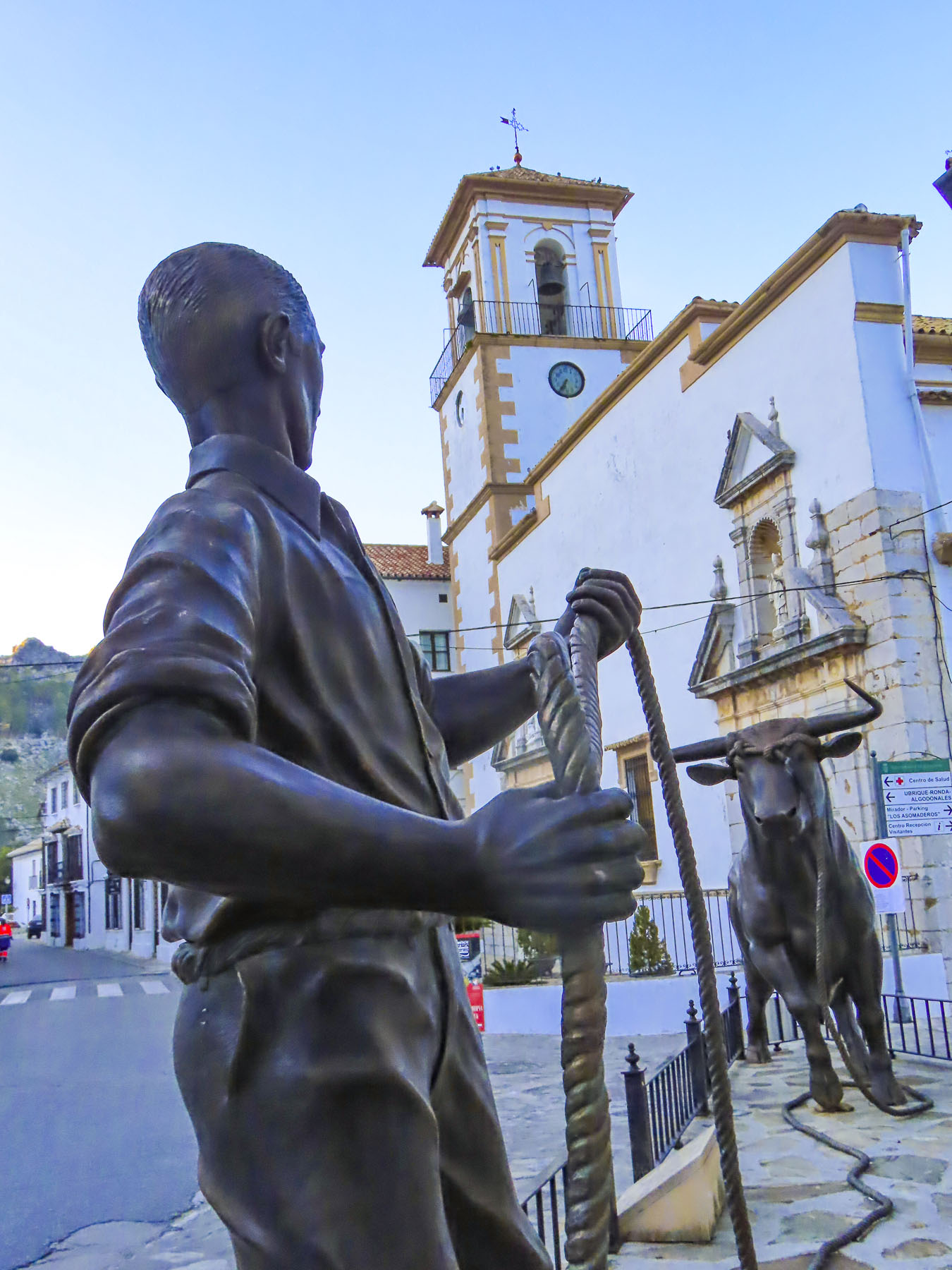
We sat in the plaza and had café across the sidewalk from an interesting statue of a bull being roped.  The statue commemorates the ancient practice of hunting wild bulls. The tradition continued through the Romans and Arabs and was Christianized by the church into the feast of the bull to celebrate the Virgen del Carmen. During the festival, three times a day, a bull is released to run through the village for an hour with the men chasing after, in hopes of roping it. The beginning and end of each bull’s run is announced with fireworks throughout the day.  Sections of an old Roman road that led up into the village are still visible from the mirador on the edge of town.

Enjoying the freedom and spontaneity a rental car offers is a big plus when developing itineraries. Finding convenient and affordable hotels that have free or inexpensive onsite parking was another whole issue.  It was dark by the time we reached Ronda and we were having difficulty finding the hotel’s parking. With one last call to the hotel receptionist the garage door to their secret lair, that was our parking space, was magically revealed to us on a back alley, under the Hotel Plaza de Toros. Only big enough for six cars, our tiny Fiat 500 easily fit in its tight confines.

The next morning revealed that the hotel was in an excellent location, just a block from the town’s famous bullring, Plaza de Toros de la Real Maestranza de Caballería de Ronda, built in 1784. Aside from bullfights it has been used as an armory and calvary training grounds by the Real Maestranza de Caballería de Ronda, a noble order of horsemen in the 18th and 19th centuries.

The promenade next to bullring is dedicated to famous literary talents who were enamored with the “Ciudad Sońada” or “Dreamed City,” as Ronda is also called. While Don Quixote didn’t tilt at any windmills in Ronda, his creator Miguel de Cervantes certainly drew inspiration from the area as he traveled between villages for his day job as Royal Tax Collector. Washington Irving found inspiration in the rugged landscape of southern Spain when he traveled through Ronda in 1828 prompting him to write, “There is something in the austere presence of this Spanish landscape that wounds the soul with a feeling close to the sublime.” He also romanticized the brigands, who some saw as Robin Hood figures that lived in the mountainous terrain surrounding Ronda, and Irving was disappointed in not encountering any on his journey through Andalusia, ignoring the poverty and repressive feudal system that forced many into a life of crime. Ernst Hemingway was drawn to the machismo and pageantry of bullfighting in Ronda, where the sword and red muleta cape were first introduced into the ring by the legendary matador Francisco Romero in 1726.  Orson Welles explained bullfighting as “an unjustifiable yet irresistible, three-act tragedy.” Wells was so fascinated with this quintessential Andalusian village that he chose to be buried here on the hacienda of a bullfighter friend – “A man does not belong to the place he was born in, but to the place he chooses to die.” Spanish poet, José Agustín Goytisolo summed it up best for us with, “We sighted Ronda. It was raised up in the mountains, like a natural extension of the landscape, and in the sunlight it seemed to me to be the most beautiful city in the world.”

The mirador beyond the park overlooked olive groves and spring fields still dormant.  Past them distant mountains faded into the horizon.  The path through the mirador led to the Puente Nuevo bridge that connects the younger old town to the ancient village across the steep sided El Tajo (The Deep Cut) gorge, carved out eons ago by the rushing waters of the Rio Guadalevín.  Finished in 1793 after 34 years of construction, the new bridge isn’t so new anymore, but it was an engineering feat when it was constructed across the shear 390ft deep chasm that divided the village. It replaced a poorly built 1735 bridge that tragically collapsed after only six years’ use, killing fifty people.

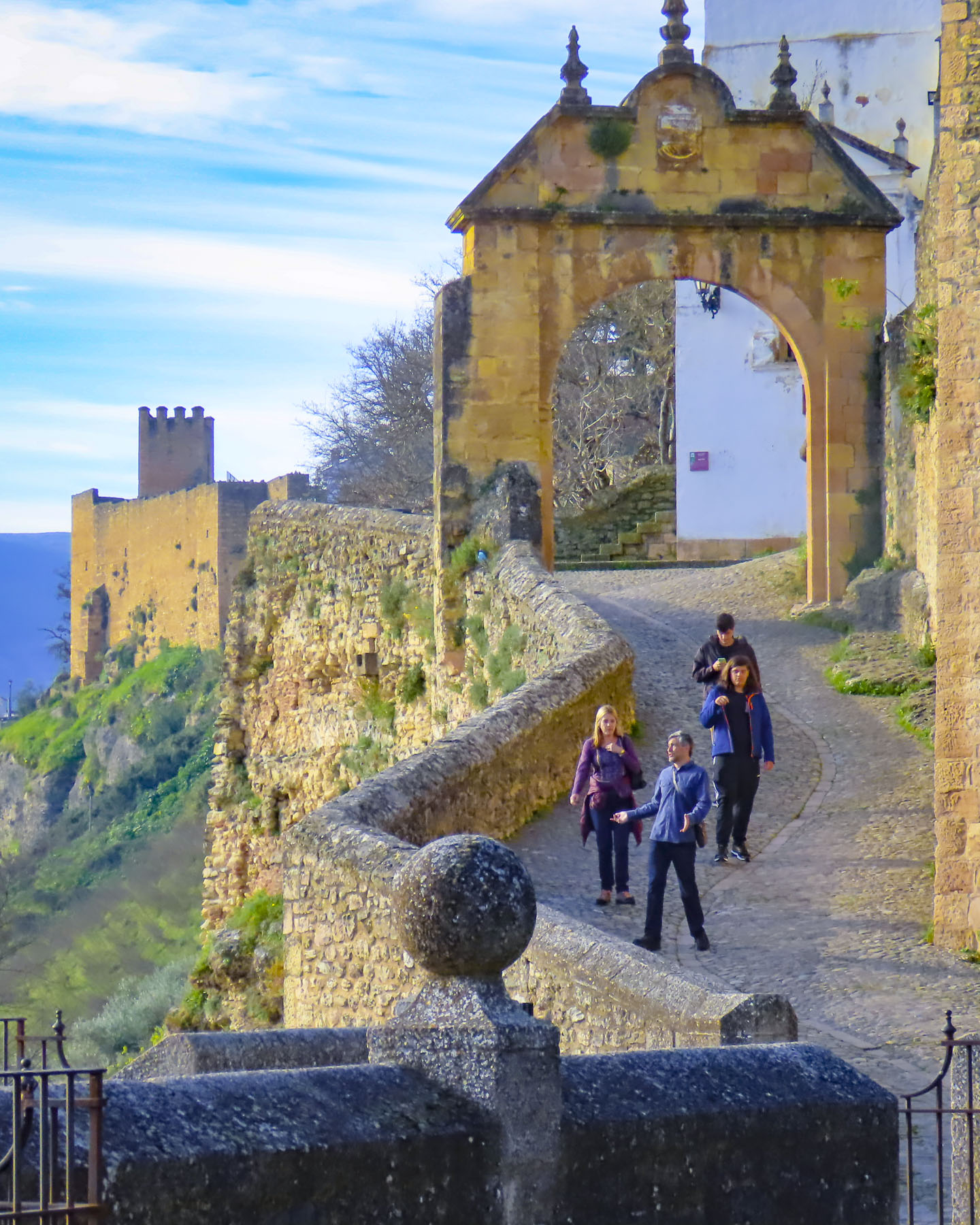
Ronda is a fabulous city for walking and as we continued across the bridge into La Ciudad, Ronda’s old-town quarter, we stopped in awe, to photograph the iconic whitewashed houses that are tenuously perched atop the walls of the gorge. Precarious to the point that if their front door slammed too hard the back of the house might fall into the gorge! 

We worked our way to Plaza Duquesa de Parcent in the center of the historic district for lunch. Passing architectural details from Ronda’s Moorish and Spanish past still evident on some of the ancient buildings.

In the off-season not all of the restaurants were open, but it was a beautiful day and we didn’t mind waiting for a table in the fascinating historical surroundings. A few minutes later we were seated at a table in the sun, caddy corner between the Convento de Clarisas de Santa Isabel de los Ángeles and the Convento De La Caridad, both built in the 16th century. The classic symmetry of Ronda’s Town Hall with its two-tier colonnade anchored the far side of the plaza.  

Adjacent to the town hall the Iglesia de Santa María la Mayor is the real draw to this side of the historic district.  With two rows of covered balconies next to an adjoining former minaret turned belltower, it’s a unique façade for a church and it’s built on the foundation of a 14th century mosque. Ronda and Granada were the last Moorish strongholds in Andalusia, and the mosque was ordered destroyed after Ronda surrendered in 1485. King Ferdinand and Queen Isabel immediately ordered that a Gothic church be built upon the spot. 

The balconies on the front were added during the reign of King Felipe II in the 1500s for the well-to-do and nobles of the city to watch maestranza tournaments in the plaza, before the Plaza de Toros de la Real Maestranza de Caballería de Ronda was built. A century later the church was partially destroyed in an earthquake and the rebuilding over the next two centuries embraced a mishmash of Gothic, Renaissance and Baroque styles that sends architectural purists into a frenzy of “how could they.” Though smaller than the churches in Seville, we found the Iglesia very refreshing with its lofty interior and fabulous religious art.

Just inside one of the side entrances, a worn stone stairwell led up to a walled catwalk that wrapped around the side and back of the building. The views from it over the red tiled roofs of the old quarter seemed not to have changed for centuries.

Later that evening we explored the new town and found Grabados Somera, Shallow Engravings, a wonderful workshop and gallery filled with etchings of matadors, senoritas and Ronda, all the creations of master printmaker engraver Pedro Somera Abad. Writing this now we regret not purchasing a print as a souvenir of our time in Spain.

We eventually came across La Casa de Jamon, a gourmet store and Iberian Ham bar that will leave any carnivorous epicure salivating. Here a leg of the best jamon to take back to your casa will dent your wallet an extravagant 600€.  We never realized those acorn fed porkers could command such a price. Along with jamon, they have locally sourced sausages, wine and cheese from the Andalusia region. We decided to order a charcuterie board for dinner and we were not dissappointed with the tasty assortment presented.

The next morning we walked through the Jardines De Cuenca along a walled path that traced the course of the Rio Guadalevín through El Tajo gorge far below. Across the chasm the hanging gardens of the old palatial homes that lined the cliff edge were redolent with color. The path through the park slowly descended to the Puente Viejo; built in 1616, it is the oldest stone bridge over the river.

Across the bridge the route split to go back into La Ciudad, the old town, through the Renaissance era Puerta de Carlos V, where taxes were once levied on the wares merchants brought into the city.  Or we could go downhill to the impressive arched ruins of the Baños Arabes, a 13th century Moorish bathhouse on the outskirts of the city, that provided heated water, an impressive feat 800 years ago.

Along the river that supplied water to the Arab baths, grist mills once stood just inside Ronda’s double ring of fortress walls that protected this side of La Ciudad.  The mills ground wheat harvested from the surrounding countryside. The stones of the outer wall were repurposed long ago. Now only remnants of the massive inner wall, the last line of defense before entering the city still stands, causing us to pause and imagine its former glory. Walking under the last vestiges of Ronda’s mighty defenses, we headed back.

It was lightly raining as we strolled along Carrera Espinel in search of an interesting place for dinner.  Most of the inside tables at the restaurants we passed were taken with diners escaping the damp evening chill.  But the aroma of savory clams drew us to an outside table at Restaurante Las Maravillas, where the waiter was attentive and refueled the tower heater next to our table to help keep us warm. The dinner and wine were delicious.

Plans to visit Olvera and Setenil de las Bodegas the next day were made over dessert and coffee. It had been a long satisfying day, our “walk a little then café” evolved to “walk a little more, then bed.”

Till next time, Craig & Donna

Follow 2suitcasesfor2years on Instagram!

Belize – When Iguanas Fall from Trees, Head South

“Welcome aboard, folks. Our flight time to Belize is two hours and ten minutes. The weather is expected to be a balmy 80 degrees Fahrenheit today when we land,” the pilot announced as we were buckling in. Then continued with “As you know the National Weather Service has issued the very rare ‘Beware of Falling Iguanas Weather Alert’ for Miami and South Florida this morning.”  As funny as this sounds, it actually happens when the temperature dips into the thirties in Florida.  Cold blooded animals, the iguanas slowly stiffen as the temperature drops and eventually lose their grip on the tree branches they have been sleeping on and fall to the ground, stunned, where they lay immobile until the temperature rises.  Iguanas can grow quite large and may cause serious injury or death if you are unlucky enough to get struck by one of the falling frozen reptiles. It sounds like something out of a zombie apocalypse movie – be careful out there. We were delighted to be heading south again to a warmer climate after a cold and rainy November and December in Italy, which was followed by a warm-hearted, but very frigid Christmas with our kids in New Jersey.

On our final approach for landing the wing of the plane dipped to reveal a beautiful azure sea outlined with dense green jungle and brilliantly white sand beaches – and not much else – as far as the eye could see.  It was still much like it was several millennium ago when a prosperous Mayan civilization flourished, supporting an estimated population of 500,000 – 1,000,000 in the region. Columbus sailed by without stopping and landed in Honduras during his last voyage to the Americas in 1502.  Navigator Juan Diaz de Solis did not mention a landfall or discovery during his expedition in 1507 sailing from Panama to the Yucatan. Several theories suggest that the 190-mile-long Belize Barrier Reef, the largest in the northern hemisphere, was too difficult to navigate through so the Spanish fleets sailed past. We witnessed this difficulty once from the deck of a cruise ship as the captain left a snaking wake as he steered a serpentine route through the underwater obstacle course.

The first European to arrive in Corozal literally washed ashore as a survivor of a 1511 Spanish shipwreck. To stay alive, conquistador Gonzalo Guerrero offered his skills as a soldier to Mayan Chief Na Chan Kan at Chactemal, (now Santa-Rita, Corozal Town). He proved his skill as a warrior and married the chief’s daughter, Princess Zazil Há. The children from their union are recognized as the first Mestizos of Central America; theirs was the first Mayan liaison recorded by Bernal Diaz de Castillo in his memoir “The True History of the Conquest of New Spain,” written in 1568.

Guerrero defended his adopted homeland against conquest in 1531 when he helped Chief Na Chan Kan defeat the Spanish army in a battle near the Rio Hondo. Today the river is still Belize’s northern border with Mexico.  Spain never established any permanent settlements in Belize.  Gold and silver were discovered next door in Guatemala and Honduras. Belize was absorbed into the Spanish empire of Central America by its proximity to its larger neighbors, but was never colonized until the British subversively entered the territory.

The riches of the new world didn’t go unnoticed for long, but by the time English and Scottish pirates arrived on the scene in the mid-1600s, the treasure-laden flotillas destined for the Spanish crown from central America had been replaced by shipments of logwood.  Native to northern Central America, logwood or bloodwood was used by the indigenous tribes of the region to produce a vibrant red-orange dye. Mixed with other ingredients, a full spectrum of colors was possible. It grew abundantly and was exported to Spain where the cheap natural resource revolutionized the textile industry and afforded commoners a chance to have colorful wardrobes, which before was only afforded by the nobility. Gone were the days of fabrics dyed gray with soot. 

Gold or wood – it didn’t matter. Pirates were pirates and willing to steal your cargo regardless of its content, as long as there was a profit to be made, and the English textile mills were demanding logwood.  After plundering large Spanish merchant ships that sailed across the Gulf of Honduras, the pirates found safe refuge for their smaller vessels in the shallow waters behind the Belize Barrier Reef amidst its 450 cays and atolls, where they could hunt for food, get fresh water, and repair their boats.  In 1670 England and Spain signed a treaty banning piracy in the Caribbean.  The days of the infamous pirates of Belize, Edward Lowe, Captain Charles Johnson, Bartholomew Sharp, Captain Henry Morgan, and Blackbeard, were waning.  By this time English pirates had discovered Belize was full of logwood and many ex-privateers became legitimate and wealthy logwood cutters and exporters after buying African slaves to work in the miserable conditions of the mosquito-infested jungles.  Though Spain considered all of Central America as part of their empire and occasionally harassed the British logwood camps trying to evict them, the Spanish crown never established any settlements in Belize. 

In 1763 Spain signed another treaty allowing English subjects the “privilege of wood-cutting,” but still retained sovereignty over the region. Possession is nine-tenths of the law and Belize finally became the English colony of British Honduras in 1862. Mahogany had replaced logwood as the major export. Conflict with the Mayans escalated as settlers moved farther into the interior exploiting the regions mahogany forests, and forced the indigenous population from their lands by burning their villages and crops. The giant cut logs were floated down the country’s rivers to the coast and where rivers didn’t exist, small logging railroads were built to satisfy the European demand for this beautiful hardwood that was favored for fine cabinetry, furniture and shipbuilding.

Disenfranchised and oppressed, the Mayan revolted in what is called the Caste War against their colonizers. Led by Marcus Canul, a Mayan chief,  his people demanded the British pay for the crops they burnt and for the land they occupied.  In northern Belize, Canul’s freedom fighters attacked and occupied the garrison town of Corozal. The movement lost its momentum when Canul was killed during an unsuccessful assault on Orange Walk in 1872.  Long considered a rebel and criminal, he is now regarded as a Belizean hero who fought against ethnic cleansing. The deforested jungles were replaced by sugar cane, ranching and agriculture plantations.

Belize finally became independent in 1981, though The British Army still maintains a jungle warfare training facility in the country to help deter Guatemalan aggression in an unresolved border issue. Aldous Huxley once wrote, “If the world had any ends, British Honduras (Belize) would certainly be one of them. It is not on the way from anywhere to anywhere else. It has no strategic value. It is all but uninhabited.”

Today the tiny country of 400,000 supports a diverse culture descended from Mayans, Mestizos, African slaves, Garifunas, Europeans and more recently immigrants from Lebanon, Germany, the East Indies, Asia and North America with an economy centered on tourism and agriculture.  English is the official language of Belize, but it is not the first language of many with Spanish, Belizean Creole and Q’eqchi’ Maya primarily spoken, depending on what part of the country you are in.

The barrier Islands and cays where pirates might have hidden treasure now sport popular resorts on their white sand beaches. Scuba divers can explore shipwrecks, the Great Blue Hole (a marine sinkhole that is visible from space,) and the exceptional marine life found along the Belize Barrier Reef which is now a marine reserve and UNESCO World Heritage site.  Ashore the jungles and mountains continue to reveal the extent of the Mayan civilization in Belize with over 600 known archeological sites discovered so far, ranging from ceremonial caves to towering stone pyramids.

We are on the other end of the tourist spectrum and wanted something very lowkey, inexpensive and relaxing for a month. We headed to Corozal! Located on Chetumal Bay, it is the northern most city in Belize and only 16 miles from Chetumal, Mexico. It was founded in 1848 by Mestizo refugees from Mexico fleeing Mayan retribution from the Caste Wars there. It prospered exporting mahogany logs when there were still enough trees to support the timber industry. Sugarcane now fuels the economy. 

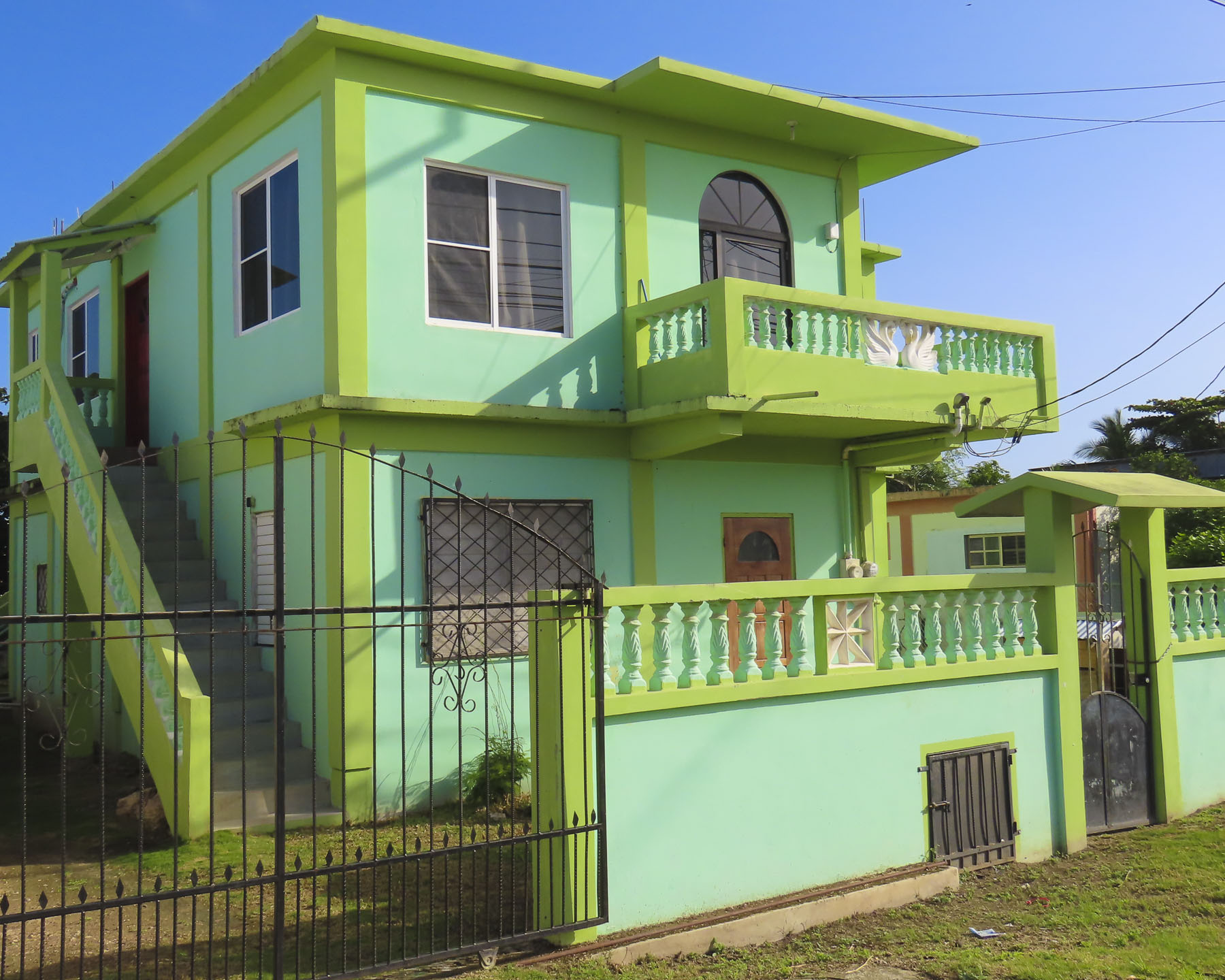
In 1955 Hurricane Janet, a category 5 storm with winds of 175mph, flattened ninety-five percent of Corozal and left 8,000 people homeless.  Surprisingly one of the few buildings left standing on the waterfront, fully intact, was the home of lumber baron John Carmichael.  It was built in the 1880’s using only mahogany.  The house is still used today as a Catholic mission. The pre-1955 wooden structures have been replaced with concrete block houses now, mostly two stories high, except the four-story Mirador Hotel, the tallest building in town.

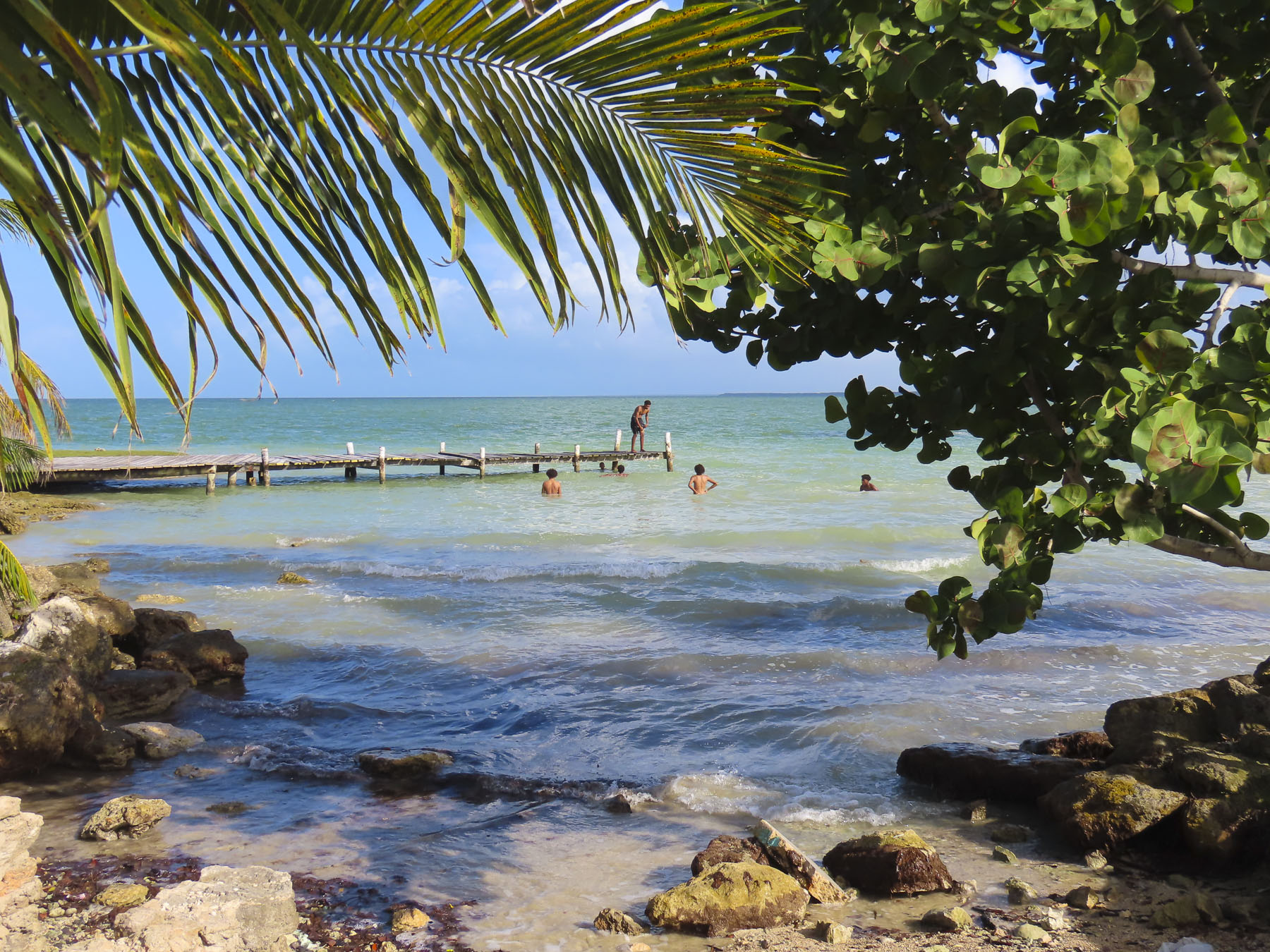
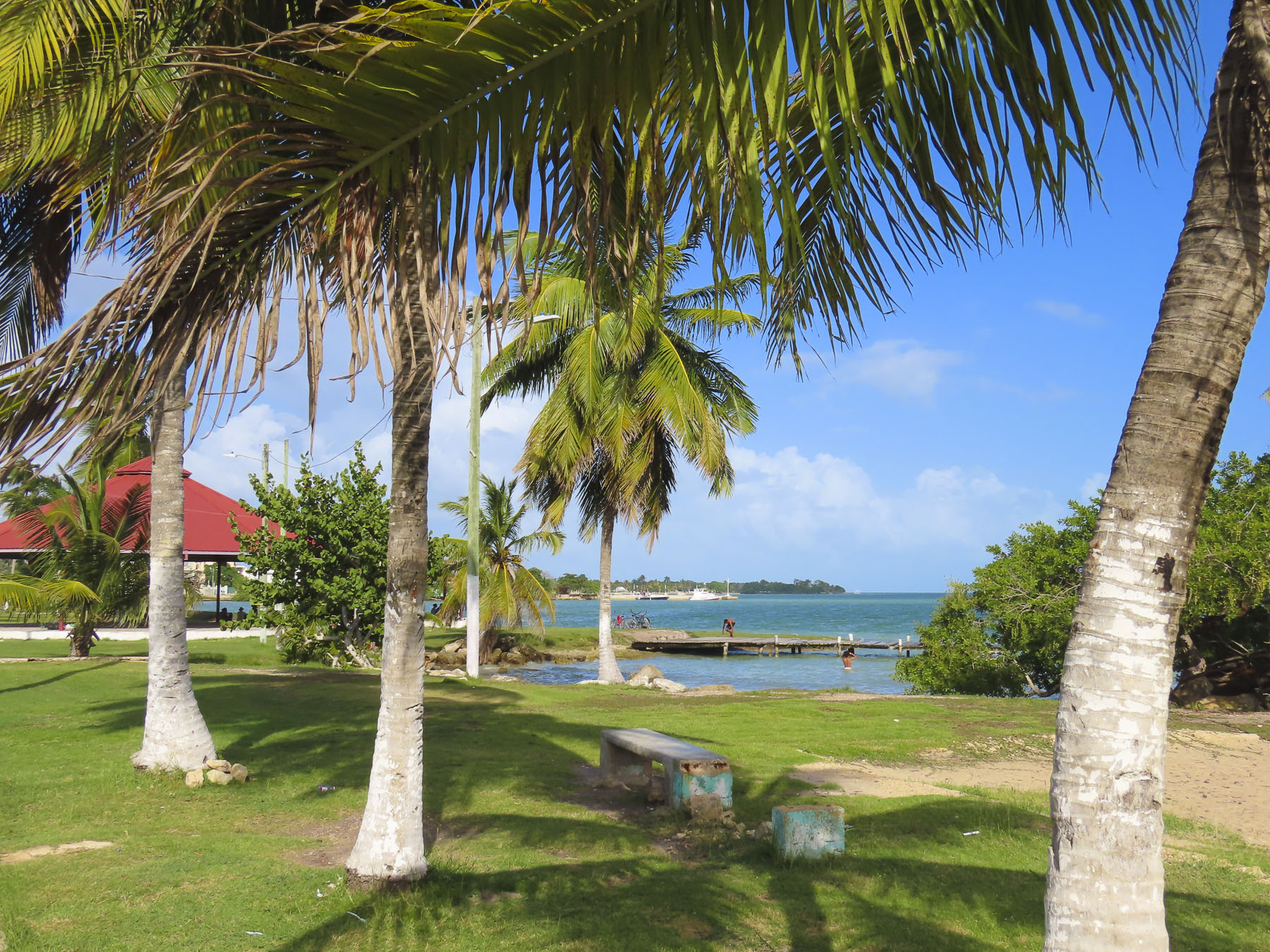
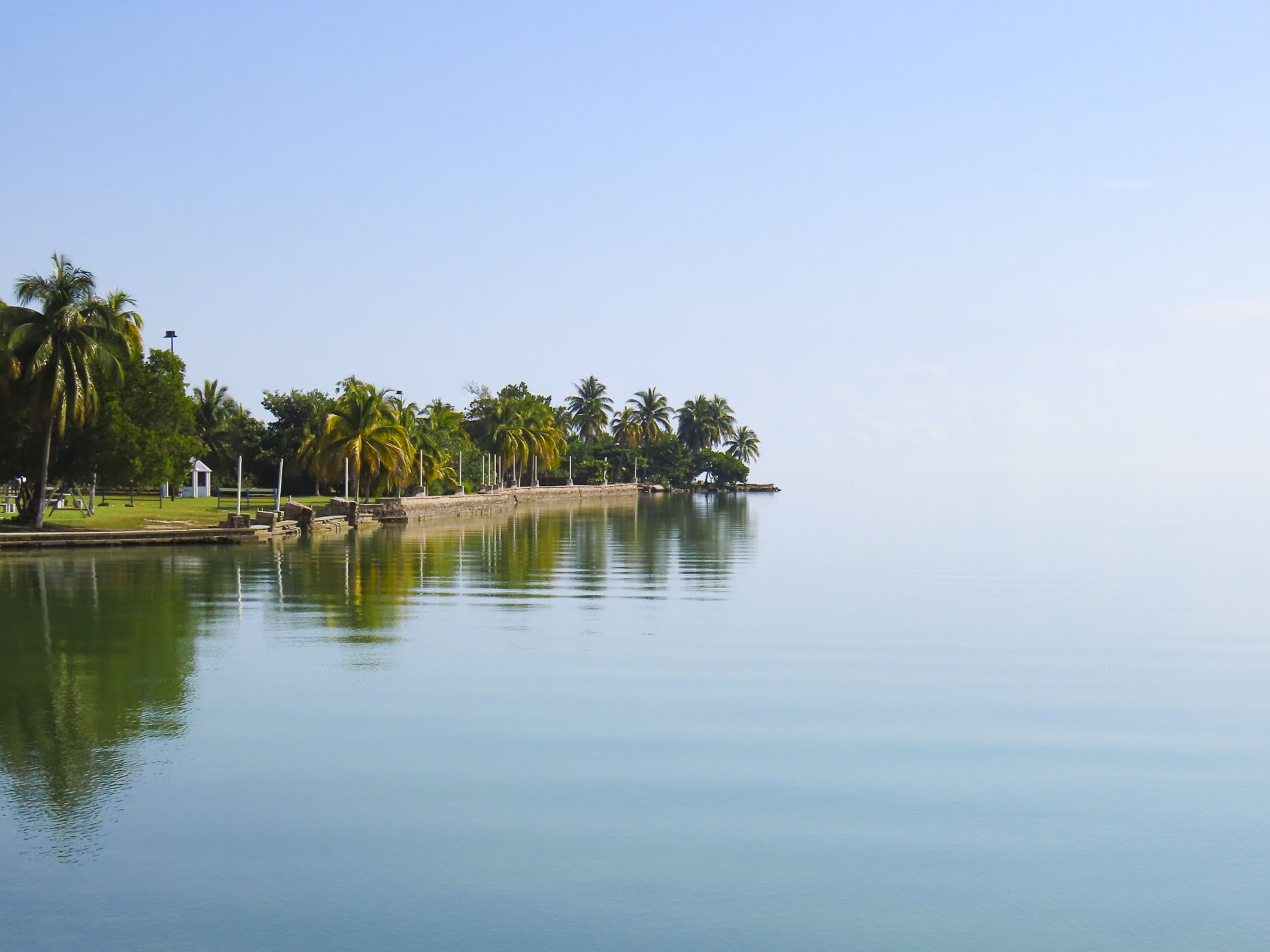
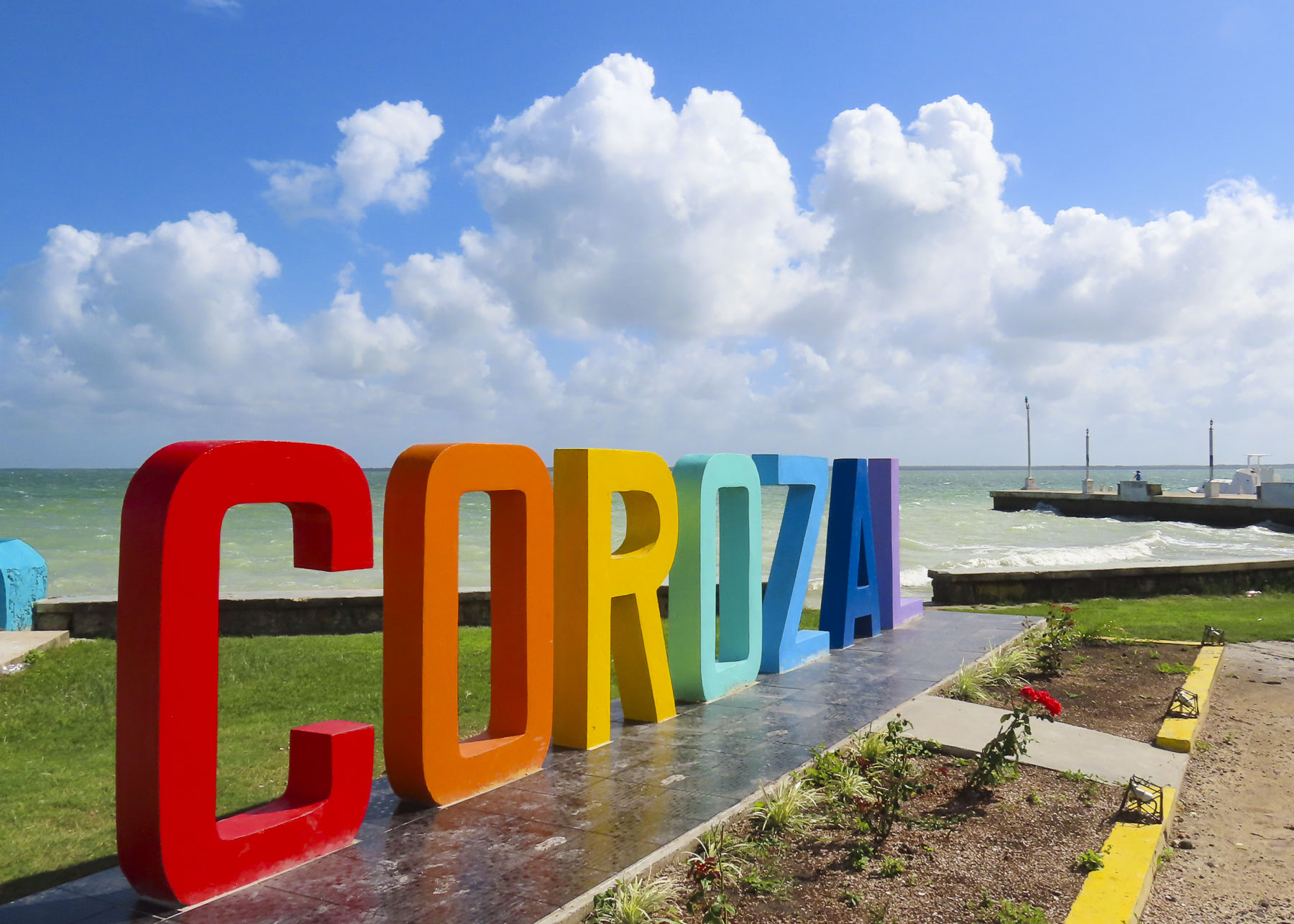
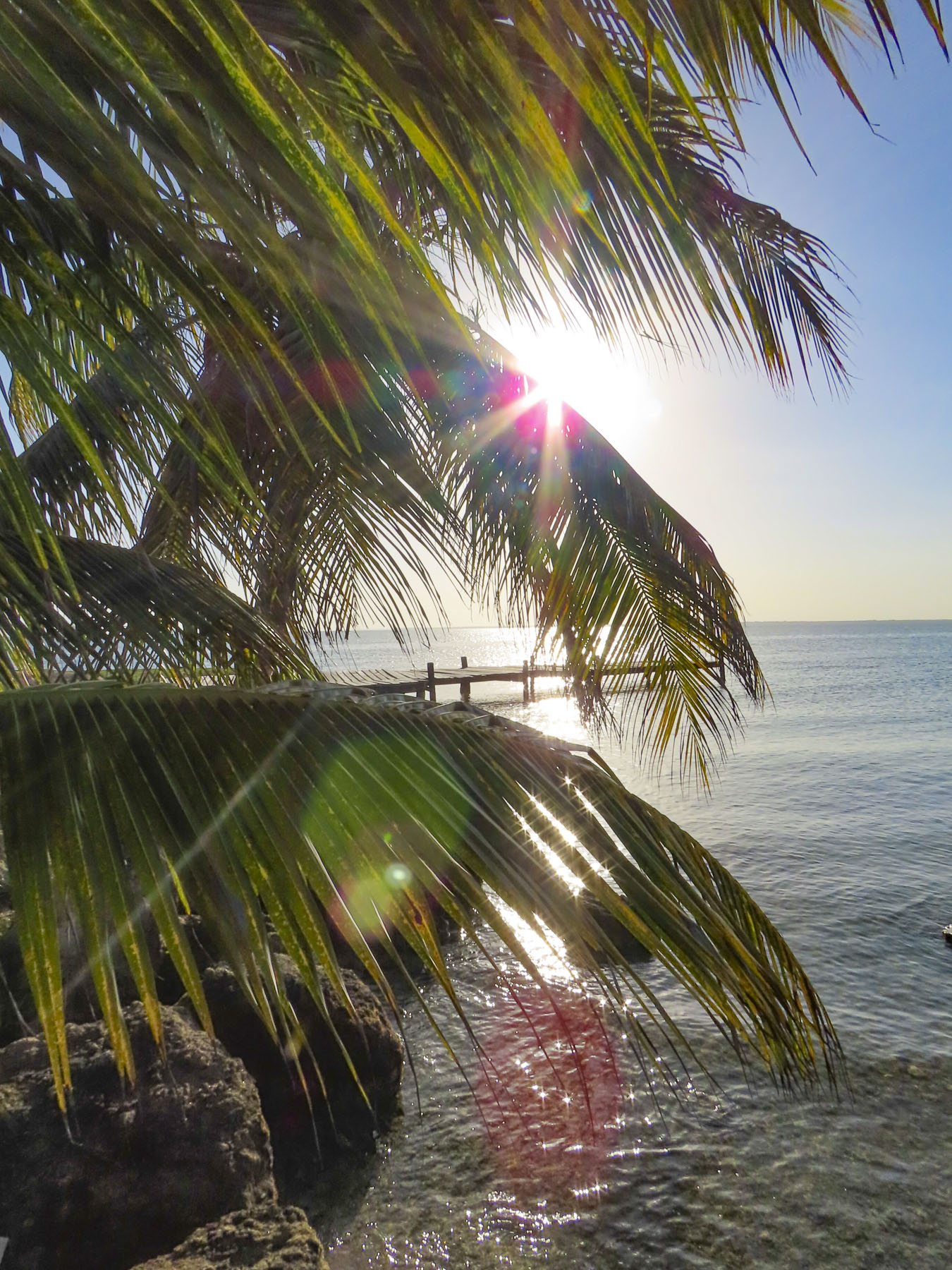
Our ah-ha moment happened after the two-hour, inland drive from the airport, when we entered Corozal and saw the enticing turquoise waters of Corozal Bay on our way to our Airbnb rental. We drove a mile along a still bay bordered by a low battered seawall and numerous public parks dotted with palm trees.

Turning onto 2nd St. North our driver stopped in front of a flowering bougainvillea-covered wall, less than 200ft from the water, that hid the Villa Imperial Loft Apartment, our home for the next four weeks.  Our host Oscar wasn’t home at the time, but had made arrangements with Sue, another guest, who graciously led us through the flowering garden, complete with a resident mama cat and her kitten, and up the back stairs to our studio apartment. She enthusiastically answered our first questions about Corozal.

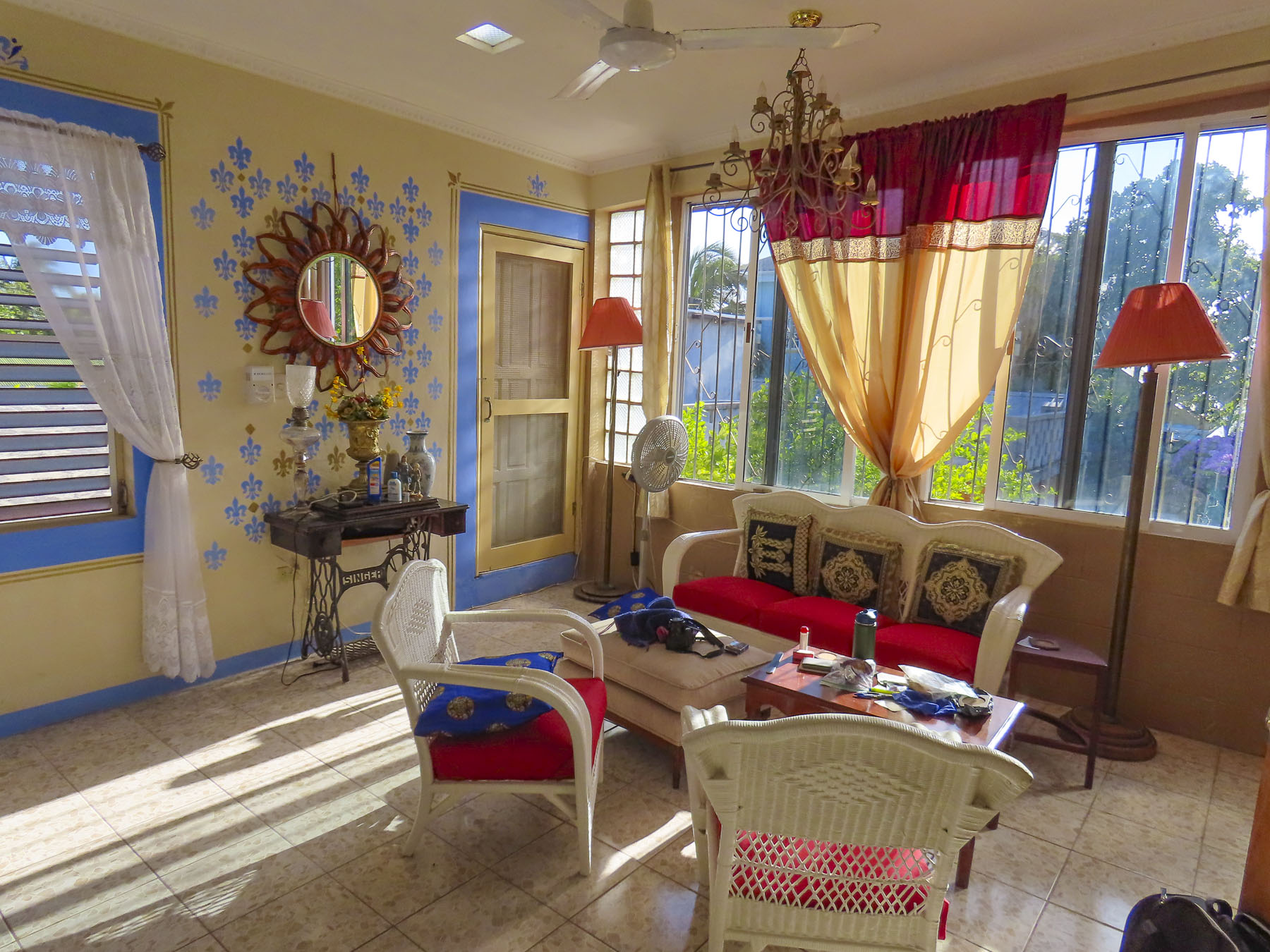
The large room was brightly painted and pleasantly decorated with an eclectic mix of antiques, reminiscent of visiting our grandparents.  A wall of windows facing east offered a glimpse of the bay, and any storms approaching, through the neighbor’s tree. Best was the kitchen across the landing at the top of the stairs. It was enclosed on three sides with just screened windows, covered with louvered shutters. In stark contrast to the apartment, it was very rustic with the feel of an old lake cabin. But we soon realized it was the perfect spot to observe the wide varieties of birds that visited the trees in the backyard, and we thoroughly enjoyed cooking and eating there.  Birding over the next month while walking along the waterfront was one of the highlights of our stay in Corozal. Spotting just a few of the 590 bird species in Belize, we saw sandpipers, great kiskadee, white-collared manakin, yellow-throated euphonia, tricolored heron, kingfisher, lineated woodpecker, great egrets, couch’s kingbird, crimson-collared tanager, black and white warbler, and the outrageously raucous plain chachalaca, which you’ll hear well before seeing them.

For many travelers visiting northern Belize, Corozal is just a brief stop on their way to or from Mexico or Guatemala, or a transfer point to catch the two-hour Thunderbolt Ferry or a flight on Tropic Air from the Corozal Airport (CZH) to San Pedro, on the barrier island, Ambergris Caye.  The town doesn’t have a beach, which has probably helped keep it off the beaten path for most tourists that visit Belize. Access to the shallow water is from stairs in the 1.5 mile long stone seawall that has not fared well against the surges of the ocean. We had read that the district has a sizeable expat community, that likes to avail themselves of all the big city options, mainly a Walmart and Sam’s Club that are across the border in Chetumal, Mexico.  But from our experiences we only encountered a handful of North Americans, surely not surging numbers that would indicate it was a sizzling hot spot for vacationing or retirement that would change the character of the town. And that’s a good thing. The joy of Corozal for us was its tranquility; there really was not much to do there aside from chilling and the occasional dip in the gentle waves of the bay.  The serenity of the seascapes compensated for the lack of activities.

We were enjoying the tropical 80-degree weather of Corozal and re-embracing our slow travel philosophy by immersing ourselves in the daily flow of life in this small coastal town. It was wonderful to see parents accompanying their uniform clad children to school every morning. Some parents drove, others walked along or bicycled with their kids. Routinely at the end of the school day an older couple pedaling a three-wheeler sold homemade popcorn to the kids or the youngsters lined up for ice cream on the porch of a home that doubled as an ice cream parlor. The kids waved to us if they noticed us bobbing in the bay across the street.

Our daily walks led to discoveries all across town, mostly culinary in nature. We were eager to find the best places to buy groceries, interesting places to eat and quench our thirst.  Most importantly, our craving for good coffee was easily satisfied directly across the street at the top of a colorful flight of tiled stairs. Here Oscar’s nephew Rudi runs the LVDM Coffee Stop on the porch of his home and makes what are easily the best cappuccinos in Corozal. He also rents two rustic villitas in his backyard. 

In town there were any number of Asian-owned grocery stores that all offered the same staples. We tended to prefer a shop called the Central Supermarket, because they were the closest place to carry our recyclable beer bottles. Diagonally across the street the city’s daily market had numerous fruit and vegetable stands, an open-air butcher, and clothing vendors. A twice weekly farmers market was held outside of town, across from the cemetery.  Fortunately, this location did not reflect negatively upon the quality of produce sold there. At a much greater walking distance, it didn’t offer any real advantage over the produce sold for the same price at the daily market. Shopping there was an early morning event and the atmosphere was very vibrant. It was here we got the first glimpse of the country’s Mennonite farming community, easily identifiable by their conservative dress and spoken Pennsylvania German. Since 1958 when they were invited to settle in Belize by the first Premiere of the country, George C. Price, the community has grown to 10,000, and they have contributed immensely to Belize’s agriculture self-reliance.

Surprisingly, even though Corozal is located right on the bay, we could not find fresh fish and had to purchase locally caught frozen fish, conch and lobster from Frank’s, a great butcher shop that makes their own sausage and offers a wide assortment of fresh beef, pork and poultry.  Directly across from Frank’s on the other side of the civic center field we found Vivi’s for wonderful meat pies.

On one of our walks, we did meet a young brother and sister team carrying a five-gallon bucket on the handlebar of their bicycle. It was full of lobster and conch, caught by their father earlier that morning.  They were going door to door in the neighborhood, selling it so they could buy their school uniforms.  Of course, we purchased some, and it was delicious.

The town does not have a marina for boats, but there are spots along the bay where fishermen pull out their ancient mahogany boats for repairs.  Called sandlighters, many of these traditional sailing vessels were built across the bay in the fishing community of Sarteneja and are over eighty years old.

There were several small bakeries in town, each offering different specialties.  The Y Not Bakery, to the detriment of our waistlines, was the closest and created the best temptations. Another favorite was Caramelo Bakery across from the high school and down the street from Belcuisine, a spice factory that produces flavorful Belizean Recados mixes.

Corozal really was a rewarding foodie’s destination with numerous small taquerias and enterprising folks offering roadside barbeque. Many businesses were operated from the windows of homes, like Ruby’s, who prepared delicous ceviche then sold it through her living room window for take-away.

The only option for eating out was casual dining. We found June’s Kitchen and Mar’s Caribbean Garden for homecooked meals.  Directly across from the bay, Scotty’s Crocodile Cove was a relaxing spot with thatched roofs; it was an enjoyable place for a refreshing Belizean brewed Belikin beer and large burritos that could easily feed three people.  The Tortuga Grill, across from the waterfront Rainbow Park, and the Wood House Restaurant, adjacent to Miami Beach, both offered good food and views of the bay.

Corozal enthusiastically supports its art community and one Saturday a month, in the town’s Central Park, holds the Art in the Park event where local artists and craftspeople display and sell their work. It was a fun time, with live music and delicous Belizean food. It’s held between 5pm – 9pm to avoid the heat of the day.  If City Hall is open make sure to check out the fantastic wall mural depicting the history of Corozal, painted by Belizean-Mexican artist Manual Villamor.

The blank concrete block walls of homes and businesses across from Miami Beach were the canvases for street artists invited to participate in the Corozal Graffiti Festival. In 2020 street mural artists from Belize, Cuba, El Salvador and Mexico were invited to enliven the walls with an “Ancient Chactemal” theme. It was a lively event with a music stage, art and crafts for sale, body painting and food vendors. On the beach, the Corozal sailing club was offering catamaran rides on the gentle waters of the bay.

There is an abundance of civic pride displayed in this small, well-kept community on Corozal Bay that is endearing. We barely scratched the surface of places to explore in Belize and were perfectly content “Snow Birds” with our choice of Corozal for a month’s worth of lazy rest and relaxation.  We’d definitely return to explore the surrounding area more fully.

Till next time, Craig & Donna

Verona – Courtesans, Hermits and Grappa

Occasionally, I will suggest we return to a place we have visited before, to relive that good time and explore the things we missed previously, or if it was a super affordable destination.  “The world is so big. I’d rather go someplace new,” is often Donna’s response, said with a sweet smile.  But “the rule” doesn’t apply to Italy! – the land of her people.  I’ve lost count of the number of times Donna has been there, but I maintain I’ve followed along often enough to receive honorary citizenship. Let’s face it, Italy is a great place to explore, which led us to Verona, again, for a night. Anyway, it was sort of on our roundabout way to Milan.

It was late afternoon when we arrived at the budget friendly Accommodation Verona, (yes, that is the correct name) on the edge of the historic district. We double parked while the proprietor took our bags upstairs. He then hopped in the passenger seat to show the way to the underground car park and the hotel’s newly purchased garage spaces, with overhead doors to totally secure your wheels, which he was immensely proud of. It was a bit of a hike from the hotel, but the car was safe in the parking garage equivalent of Fort Knox.

The sun was brilliant on Verona’s ancient colosseum while we sipped Aperol spritzes and shared a pizza at an outdoor restaurant on Piazza Bra, as shoppers strolled amidst the nearby Christmas market. Gone were the fake gladiators and other street entertainers who left when the weather turned colder.

It was a vastly different dining experience compared to our first dinner in Verona years ago.  Travel novices then, we were constantly referencing a travel guide by an American, that recommended sights, hotels and restaurants. With book in hand that suggested the restauranteur would treat us well and offer special prices to loyal readers of said guide, we found a delightful place on a quiet lane lined with outdoor tables and twinkling lights.  “Who?” was the response when we mentioned the guidebook. A large antipasto, charcuterie board, wine and “special price” were all agreed upon. Or so we thought.

It was one of those long, delightful European dining experiences, where the table was ours for the evening. The dinner and ambiance were great! Eventually our amiable host, carrying the largest bottle of grappa we’ve ever seen, presented a small wooden box containing the bill. “Please enjoy as much of the grappa as you like.” Drink this to ease the shock of the bill, would have been a more accurate invitation.  Grappa is a regional pomace brandy, distilled from the seeds, stems and skins left over from the winemaking process. Production is centered nearby around the aptly named village of Bassano del Grappa. This is strong stuff that, in a pinch, Italian farmers have used to fuel their tractors. A good dent was put into that bottle of grappa, as we were eventually the last to leave. Fortunately, our hotel was a short, though not very straight, giggly walk away.  Sleep was unjustly cut short the next morning when at sunrise, the glass recycling truck in the alley under our hotel window loudly emptied a dumpster of wine bottles to haul away.  The brash rattling sound of glass bottles crashing was excruciating and reverberated off the narrow alleyway’s walls for what seemed an eternity.  Thank God for espresso and Saint Drogo, the patron saint of coffee baristas. (I do not make these things up!)    

Normally hidden in deep shadows, Renaissance era wall paintings decorating ancient buildings were now revealed in the last of the afternoon’s light. Likewise, the lowering sun highlighted the fine relief sculptures adorning many of the city’s ancient buildings.

By dusk we were standing along the Adige riverfront watching the last rays of the day’s sun color the sky above the arched 14th century Castelvecchio Bridge.  Attached to the Castelvecchio fortress, the bridge was intended as an escape route for the feudal lords to flee across in case of a popular uprising or coup d’état to seek safety in the Tyrol mountains, north of the city, and for the prince’s courtesans to discreetly exit the castle.

The lights of the city’s Christmas tree shined brightly through the twin arches of the Porta Borsari; built by the Romans in the 1st century AD, it was the main entrance to this once walled city. Nearby, Caffè Borsari beckoned, with its extensive list of creative coffee beverages. Maestros of the espresso machine, the baristas here are artists.

The next morning was overcast as we drove across the Adige River and made our way up a serpentine road through a forested hillside, to the esplanade in front of Castel San Pietro for the panoramic view of Verona, and its iconic Ponte Pietra bridge below.  A wonderful feat of ancient engineering first crossed in 100 BC, it has had a troubled existence, with multiple collapses caused by flooding over the centuries, and intentional destruction by the retreating Germany army in WWII. Through the various reconstructions, the builders have remained faithful to the original Roman design of five different sized arches with apertures above the pilings. The present castle on the hill was built by the Austrians in 1851 as a barracks, replacing a 400-year-old fortress blown up by Napoleon’s army in 1801. For the hearty, there are stairs from the bridge that lead to the mirador, or the Funicolare di Castel San Pietro that will whisk you to the top of the hill, should you wish to avoid the muscle aches.

The dull sun barely broke through the clouds, but the filtered light created a serene scene reminiscent of an impressionist painter’s pastel hued landscape, soft and atmospheric.

Rounding a curve on the SS12, as we headed north, we caught our first glimpse of a snow-capped Mt. Baldo, brilliantly white against a clear blue sky. Our destination was the remote and isolated Santuario Madonna della Corona.  A pilgrimage site since 1522, legend holds that on the eve of the Ottoman invasion of Rhodes, with 400 warships and 100,00 troops, the sanctuary’s statue of the Madonna was carried miraculously by an angel from the Mediterranean island to a shallow cave on a Mount Baldo cliff edge, home to a hermitage for holy men, for safe keeping.

Spiazzi, the village above the sanctuary, was nearly a ghost town when we arrived mid-week in November. We found the empty parking lot for the church and high-season shuttle bus that was not running, but aside from that there was no other signage pointing the way. Taking a guess, we turned down a very narrow country lane and headed down hill, stopping when we reached a farm stand where a stoic woman, bundled up against the cold, was selling alpaca wool, sheared and spun from her flock which was corralled nearby.  Stopping, we asked if we were headed the right way and how long she would be open. A little farther on we came to the first Passion of Christ station on the Sentiero del Pellegrino, the Pilgrim’s Path.  The series of life-sized bronze sculptures depicting the stations of the cross took the devoted Italian sculptor Raffaele Bonente thirty years to create.  Whether you walk along or drive the paved road or hike the steep staired path, the stations are positioned where the routes intersect. 

In the off-season, without any other vehicles on the road, it was easy to stop and take photos of the church that tenaciously clings to the cliffside, between heaven and earth, 2539ft above the Adige Valley. In high season the turn-around at the church is reserved for the shuttle bus, but off season we parked next to one other visitor.

The original dangerous path along the cliff edge has been obscured over time through multiple improvements and the approach to the terrace in front of the church is now through a rough-hewn tunnel carved into the cliff. Tranquility reigns here. The views across the valley were phenomenal and accompanied only by the sound of a gentle wind rustling through the forest below.  The spiritual devotion and shear physical effort to build a church in such a difficult spot attests to the deep faith and dedication of the builders. For hikers, the Sentiero del Pellegrino continues down the slope, through the valley to the village of Brentino.

Following the same route back to Spiazzi, we stopped at the alpaca farm and purchased some much-needed heavy weight alpaca wool socks, to help keep our feet warm.  Early on in our two-year journey Donna decided to start crocheting in the evenings. Wool has been purchased for various projects, mostly gifts, in Ecuador, Guatemala, Portugal, South Africa and now Italy, from an off-the beaten-path farm stand on a remote mountainside.  It was late afternoon now, but fortunately the Albergo Trattoria Speranza, located at the crossroads of Spiazzi was still serving food and has rooms if you want to stay overnight in the hamlet.  A good meal restored us for the drive to Lake Garda.

With night drawing in earlier now we reached the lakeside village of Garda at twilight.  Sunset colors lingered in the sky as we walked along the marina. A few fishermen were still casting, hoping for that last bite, and small boats gently rocked on the ripples of Lake Garda. 

The lights of a Christmas market set up along the lakefront drew us further down the promenade.  Wonderful aromas drifted from the various food stalls, making what to choose for dinner even more difficult. Mulled wine and porchetta sandwiches capped the evening.

Till next time, Craig & Donna

Lalibela Part 2: Holy Water and Thumbprints

There is not a definitive count, but it’s thought that there are nearly two hundred rock churches scattered about the remote northern highlands of Ethiopia. The highest concentration of eleven in one locale, collectively known as the “Rock Churches of Lalibela,” is the most famous. In the immediate rural area surrounding Lalibela there are several additional rock churches and ancient monasteries worth seeking out.  Asheten Mariam Monastery is perched at 11,500 ft on a lower ridge of Mount Abuna Yosef, (at 14,000 ft Ethiopia’s sixth highest mountain) and St. Na’akuto La’ab Monastery behind a waterfall, both located southeast of Lalibela. Farther afield, to the north of Lalibela, St. Yemrehana Krestos and Bilba Kirkos Church lie in remote farmlands.  All four required a little more physical effort to get to, but were well worth the effort.IMG_5573We started our day listening to bird calls and watching the morning clouds burn off from the valley below our hotel as the sun rose higher into the sky. The Mountain View Hotel Lalibela was the perfect spot on the outskirts of town, with extensive views and a wonderful variety of birdlife in the trees outside our room.  Farther along the ridgeline was an odd, futuristic structure that looked like it was a tower for a water ride in an amusement park.
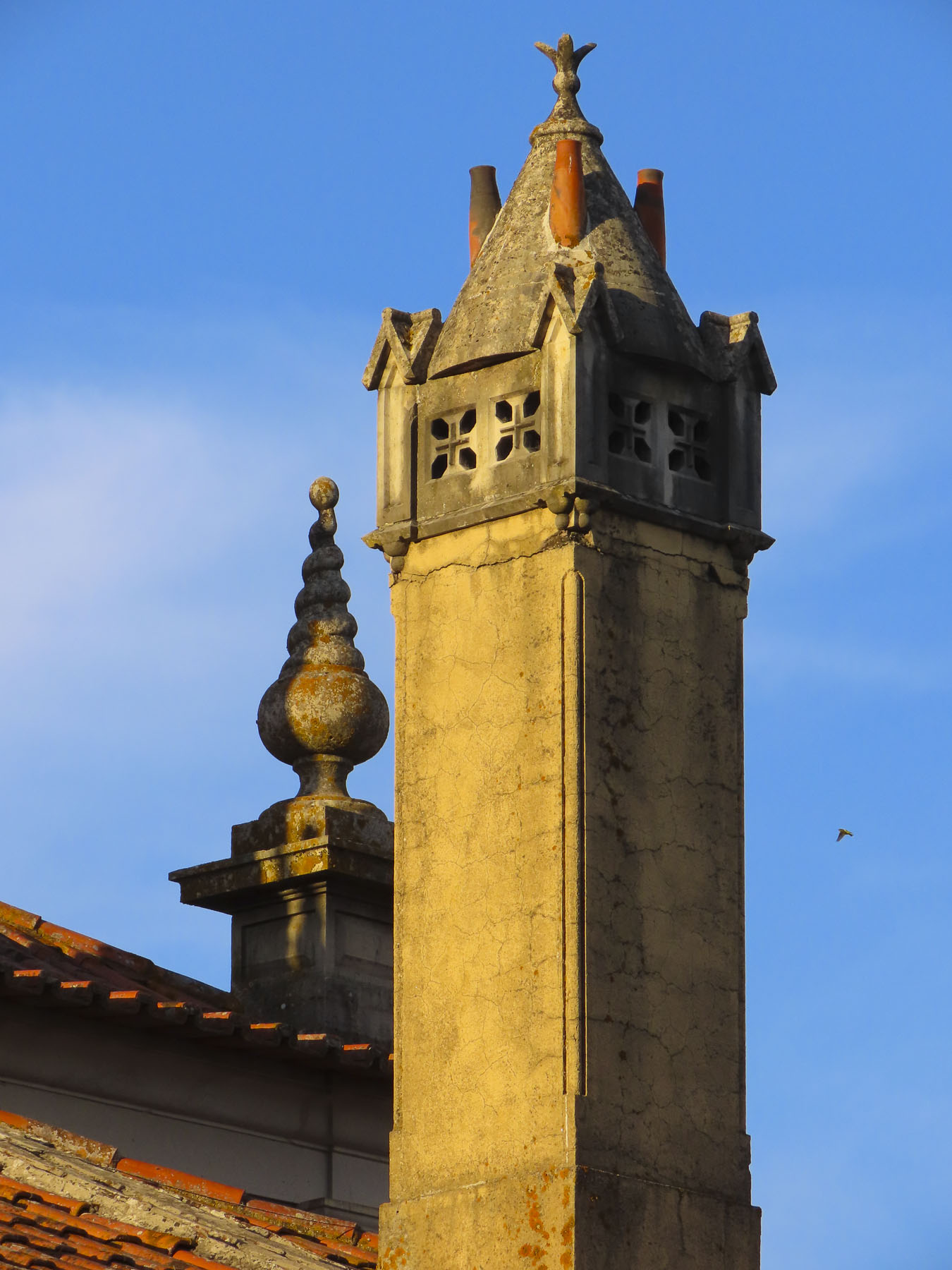
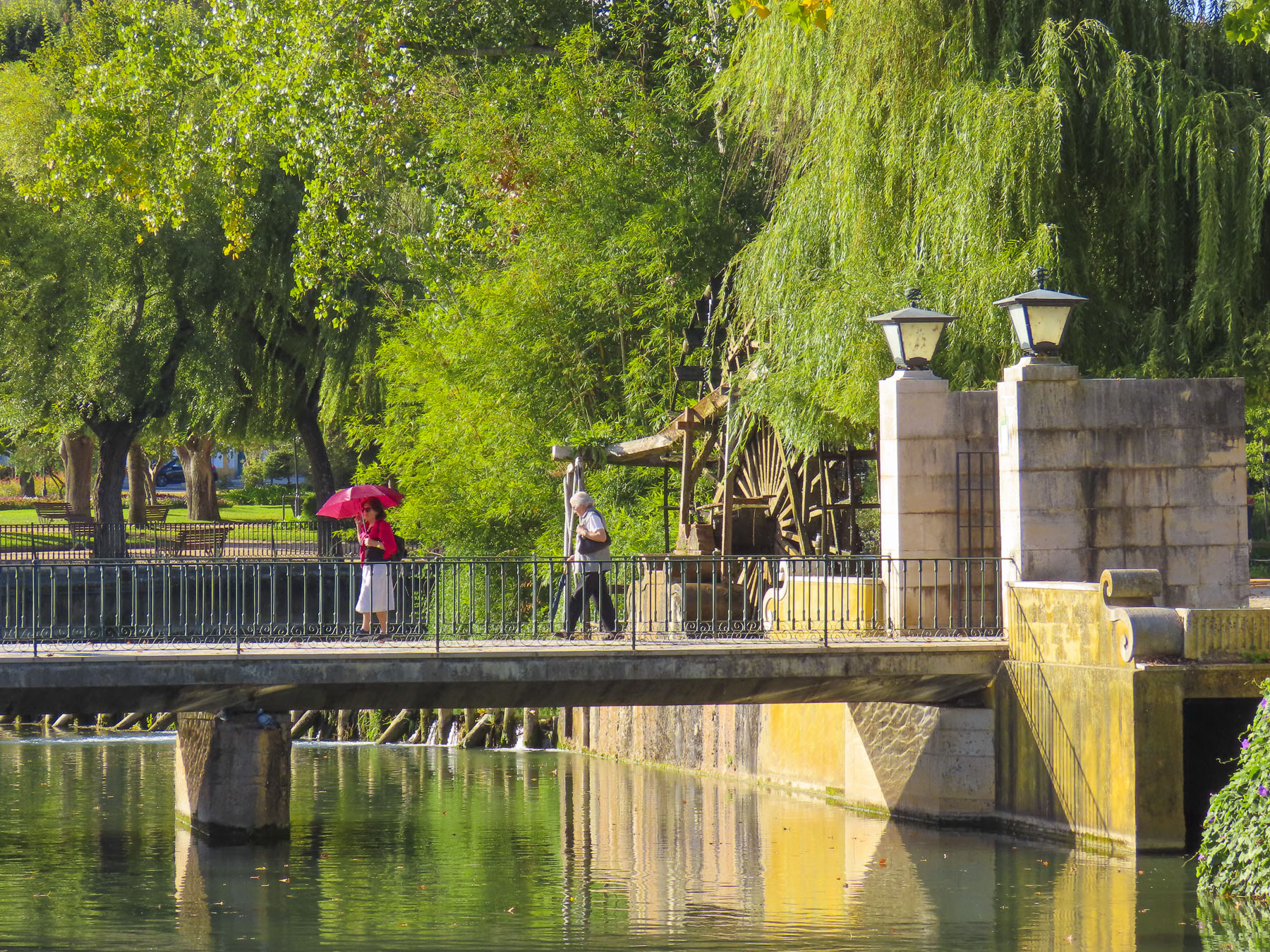
The day before after touring the Lalibela churches, our guide suggested we hire a driver with an SUV to take us into the mountains. “We can drive to the end of the dirt track, but then it’s another forty-minute hike to the monastery,” Girma explained. “How difficult is the trek?” “It’s a gradual climb until the end and then there is a short steep section,” he replied. IMG_4869The shops were busy, and the roadside Ping-Pong games were in full swing as we departed Lalibela. The road into the mountains rose quickly from Lalibela into a semi-forested landscape. Too steep for crops, the land was used for cattle, which grazed on clumps of wild grasses on the hillside.  We stopped at one clearing for the view and noticed a herder gently nudging his cows away from recently planted tree seedlings.  “This is part of our government’s commitment to reverse deforestation and help mitigate climate change. It’s called the Green Legacy Initiative,” Girma shared. IMG_4923“On July 29th Ethiopians planted 350 million trees in a single day, a world record!” he proudly shared.  “The farmers know how important this is and help shoo the cattle away, but the government has also chosen a tree seedling that doesn’t taste good.” This annual Ethiopian project is part of the African Union’s Great Green Wall initiative to reclaim arid lands that border the Sahara Desert with a living wall of trees.  This belt of greenery will stretch from the Atlantic Ocean to the Gulf of Aden. IMG_5198The road deteriorated after this, with deep mudded ruts tossing us from side to side regardless of how slowly we navigated through, over or around them. Our “rattled tourist syndrome” is the most appropriate way to describe the ride, while optimists might refer to it as an an “African deep tissue massage.” We were the only truck to park at the trailhead to the Asheten Mariam Monastery and were greeted with children selling handicrafts, and young men renting walking sticks and offering to accompany us on the hike.IMG_4883 Confident in our abilities we declined, but they tagged along anyway. This was a good thing. What our guide had forgotten to mention was that there was a short steep section at the beginning of the hike, before it leveled off. Within minutes, between the altitude and the terrain, our hearts were pumping and my wife, who struggles with asthma, was gasping for breath. We are unfortunately not the 7 second 0-60mph vroom, vroom of a 1964 Corvette anymore, but more like the putt-putt of a classic Citroën 2CV. We get there, eventually. So, our guide, forgetting his youth and our age, led the way from a distance, as if he was channeling Shambel Abebe Bikila, Ethiopia’s famous marathon runner. IMG_4983It was at this point that my wife spoke up. “Girma, you must think of me as the same age as your mother.” Instantly, his attitude became very solicitous, and he smilingly offered her a hand or other assistance at every opportunity. We marveled at the agility of the local kids. They nimbly scampered up and down the trail, easily outdistancing us, in order to set up their little trailside displays of carvings and beadednecklaces. When we didn’t purchase at first, they simply packed up and reappeared further up the trail. We had to reward such perseverance with a couple of purchases.IMG_4987Meanwhile, we regained our pace as the trail leveled off and tracked along the base of a cliff face that fell away to terraced farmland far below.  The incline of the trail continued to rise; the walking sticks were now invaluable in helping us steady our footing on the rough path.  Around a curve the trail abruptly narrowed at a sheer rock wall broken by a vertical chasm, slightly wider than our shoulders.
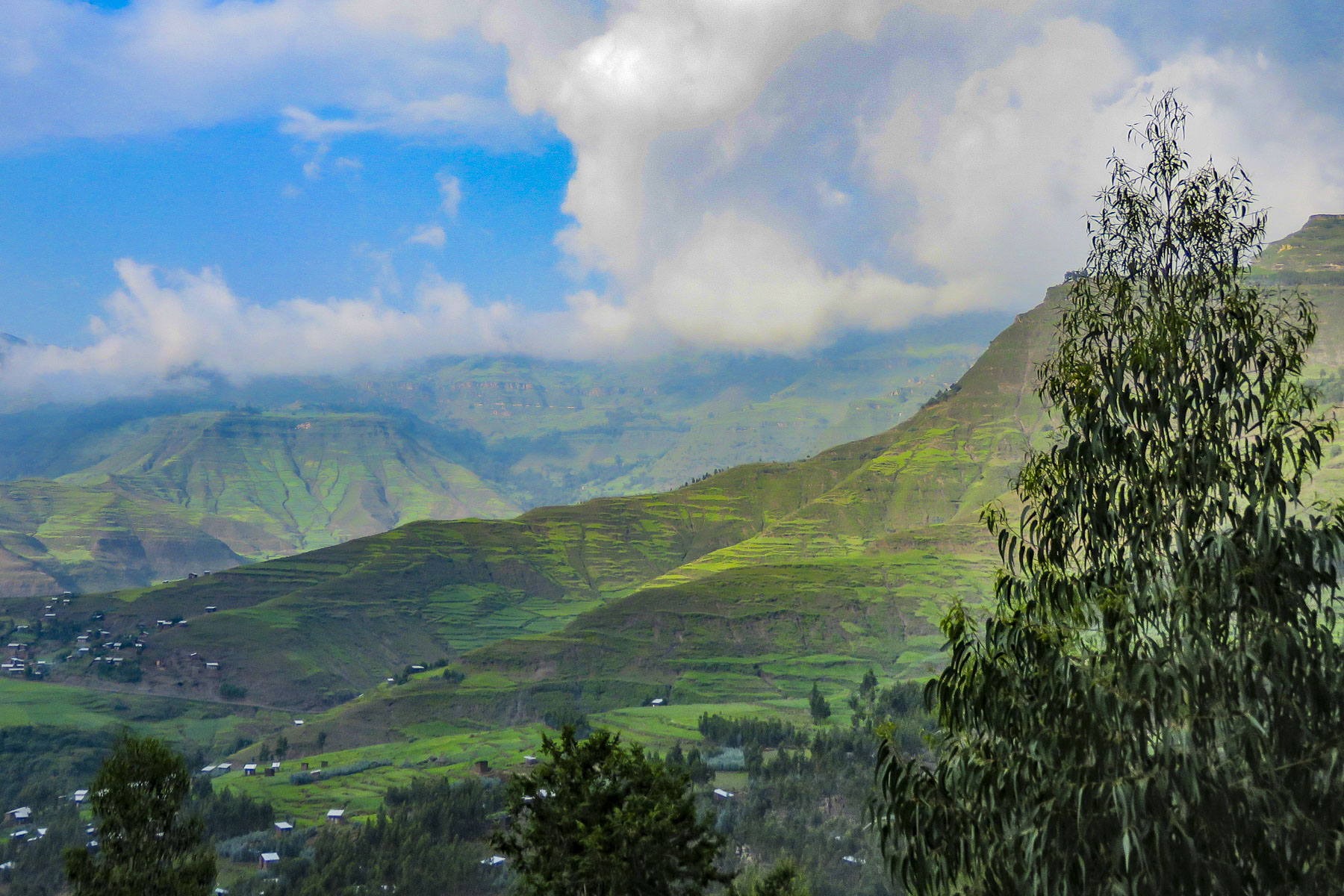
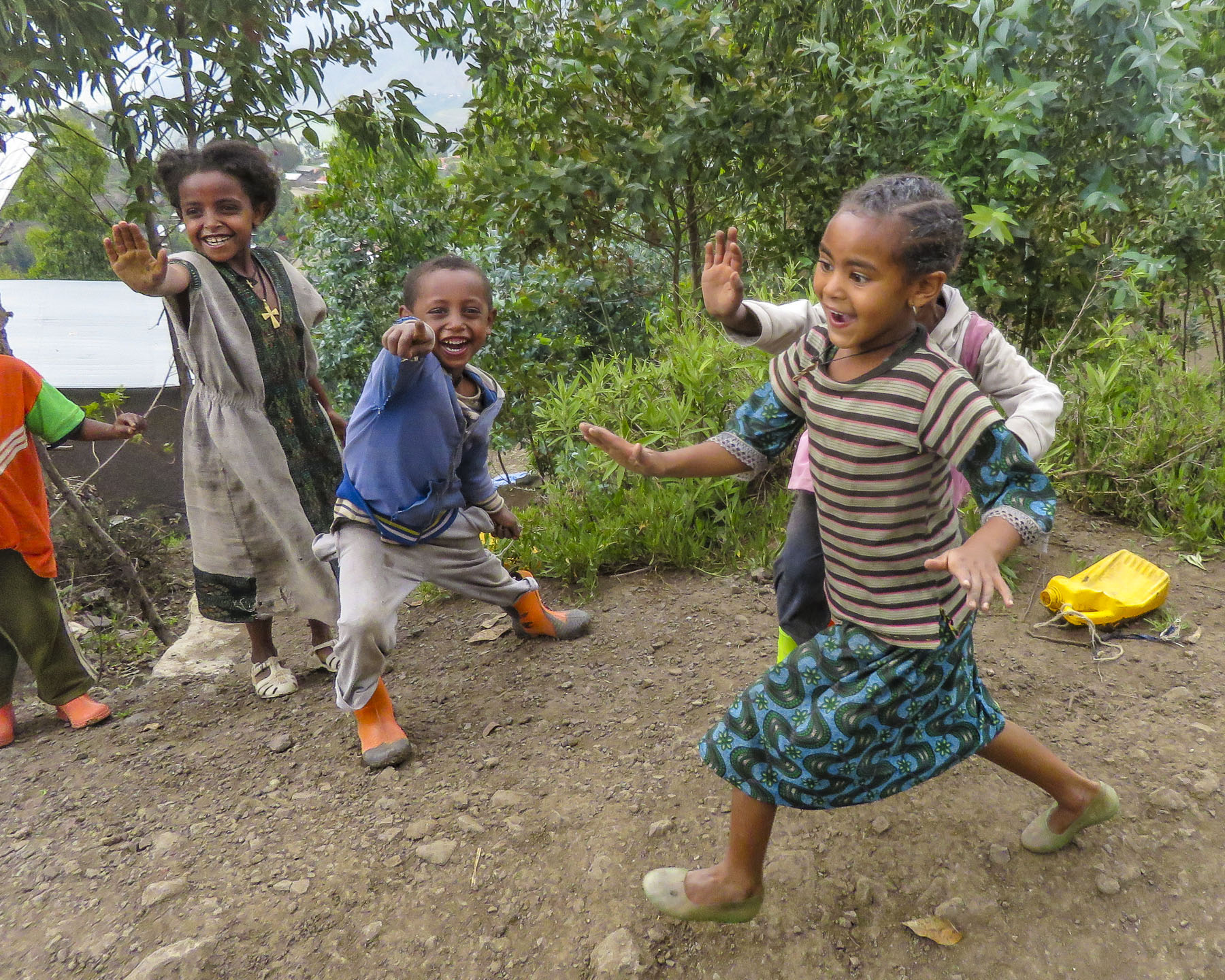
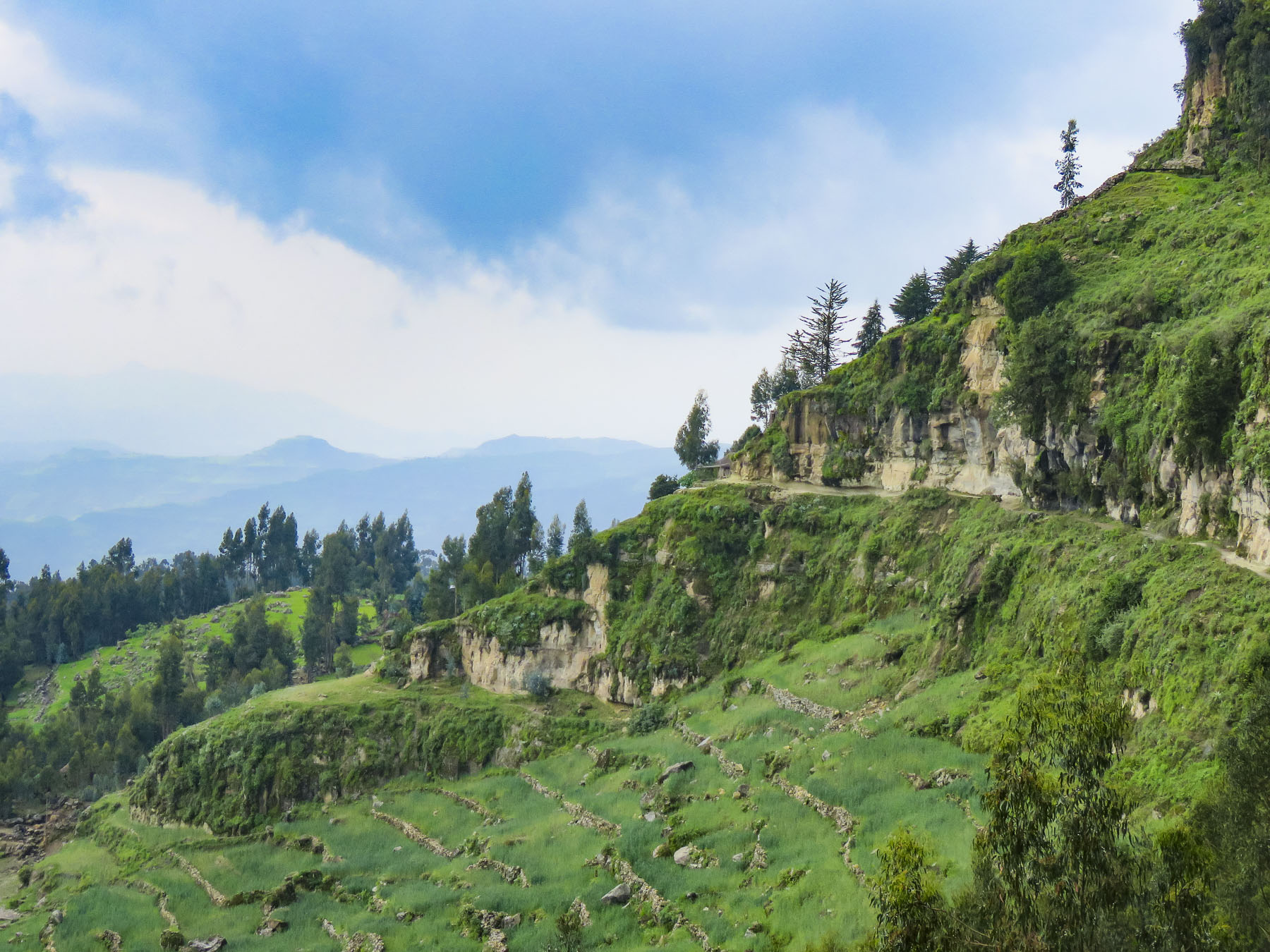
Occasionally we had to plaster ourselves to the rock wall to make room for descending parishioners to pass. It took a moment for our eyes to readjust to the brilliant sunlight after emerging from the darkness of the tunnel as we exited onto a plateau above the highlands. 

A young priest answered our knock, greeted us and led us into a small chamber lit only by the light of the open door. The priest proceeded to show us the treasures of the church: a large ebony cross, 900-year-old parchment manuscripts, elegant processional crosses and illuminated Bibles, as well as iconography. IMG_5069Imprinted at the bottom of a page in one ancient text were the thumbprints of the ten scribes who helped copy the book. Legend has it that it was the first church ordered built by King Lalibela during his reign in the twelfth century and that his successor, Na’akueto La’ab, who only ruled for a short time, is buried there.

The way the church is cut from the mountain made it difficult to get an overview as part of it is obscured by protective roofing. The real rewards of this endurance trek were the fantastic panoramic views over the Lalibela highlands.  Awareness of your surroundings are vital here as there are not any safety railings at the cliff edge. The walk back was slightly less difficult, but the young men who tagged along and assisted truly earned their payment. Back at the trailhead, parked next to our truck was a tiny blue, Fiat Panda, a sub-compact car with extremely low road clearance. How it managed to traverse the same rutted road we drove hours earlier remains a mystery to us.

Our guide suggested we lunch at Ben Abeba, a curious lunch spot that turned out to be that futuristic building visible from our hotel.  Its spiral ramps led to various dining platforms from which we watched raptors soaring along the updrafts of the ridge.  The food was exceptionally good. But there was a quirky feature of the restaurant that we found very amusing. The restrooms were something out of a science fiction movie, with cylindrical stalls that resembled cryogenic tubes. It was definitely a Lalibela oddity.

St. Na’akuto La’ab Monastery was closer to town. As with many rural communities, Lalibela included, the cluster of development ended abruptly, and we were instantly in the countryside. Villagers in robes walked purposefully to church along the road that bordered their fields, as we made our way to the hermitage. IMG_4722 Coming to the end of the road, we could see the monastery dramatically situated behind a small waterfall, in a long shallow cave at the bottom of a cliff.

It was an easy short walk, from where we parked, down a trail with noisy birdlife. The buildings behind the entrance wall to the cave are not particularly unique; it’s their location that’s inspiring. The oneness with the natural environment.IMG_4325Stone bowls smoothed from centuries of use sat in various places on the rough floor to collect the water seeping from the cave’s ceiling one drip at a time. It gets blessed by the priest and used as Holy water, continuing a tradition from the 12th century when King La’ab ordered the monastery’s creation.

“Miraculously the water has never stopped flowing since the monastery was built,” the priest shared as our guide interpreted. Outside doors to the monks’ cells lined the exterior wall as it narrowed into the cliff face.  IMG_4369In the learning area, layers of carpet attempted to smooth an uneven, rocky floor where the novitiates sit to learn the ways of the orthodox church. In the corner rested several large ceremonial drums used during worship services. Picking one up our guide beat out a rhythm that would normally accompany liturgical chanting, or Zema, by the young monks. We’ve noticed that the treasures of the Ethiopian churches are not determined by their monetary value and locked securely away, only to be used on religious holidays, but by their spiritual connection.  Precious, irreplaceable, ancient bibles and manuscripts, lovingly worn and torn as they are, continue to be used every day, as they have been for the last nine-hundred-years.IMG_4560 It is well worth the effort to visit these remote churches and monasteries. The physical strength required and hardships endured to build these remote churches as a testament of faith continues to be inspiring.

Till next time, Craig & Donna