Hawaii – Road Tripping Around the Big Island or Black Sand, Sea Turtles and Snowbirds in Paradise

There’s a saying in the low country, that “summer in Georgia is like living on Hell’s front porch.” Our winters here are usually very mild, and our neighbors tell us a dusting of snow falls about once every 13 years, and it melts away in hours. But this year 3 inches of snow fell and stayed frozen on the ground for 4 days. The counties along the coast and in southern Georgia can’t cope with this type of “unusual weather phenomenon,” and declared a state of emergency. Schools were closed, and folks were advised to stay off the roads. Traffic came to a standstill on Interstate 95 due to the icy roadway and was shut down for 2 days. State Police rescued stranded truckers by using ATVs. Our neighbors shared, “When it snows like this in Georgia, you know Hell has frozen over!”

Fortuitously, months earlier four of us from our lake community had booked a flight to Hawaii that departed the same day the runways at the Savanna Airport were cleared of ice and ready for business again.  

The balmy air was a welcome reprieve as we descended the stairs from the plane onto the runway in Kailua-Kona, on Hawaii Island or as the local folks like to say, The Big Island. But we were overdressed and overheated by the time we reached the baggage claim area and headed to the restrooms to strip off layers of now unseasonably warm clothing.

When we arrived at the Budget Car Rental office the queue was already out the door, and we watched our first Hawaiian sunset from the waiting line as the sun’s dying rays silhouetted the palm trees. This was not the romantic drinks-on-the-beach sunset we had envisioned for our first night on the island. The problem was a severely understaffed rental counter which gave priority to members of the company’s Fastbreak Program. We finally figured this out after waiting two hours, with more than one hundred other folks in a queue that now wrapped around the building. Donna realized we could download their app and take advantage of the expedited checkout program, and signed us up on the spot. As we switched lines, we shared our tip with folks around us, and we were headed out to our car within minutes. Donna acknowledges a twinge of guilt as we sashayed past all the other poor folks still stuck in that dreadful line. We’ve used Budget Car Rental flawlessly many times, but this was a horrendous experience. Fortunately, our lodging for the week at a Hilton property in Waikoloa was only a 30-minute drive north on Rt19.

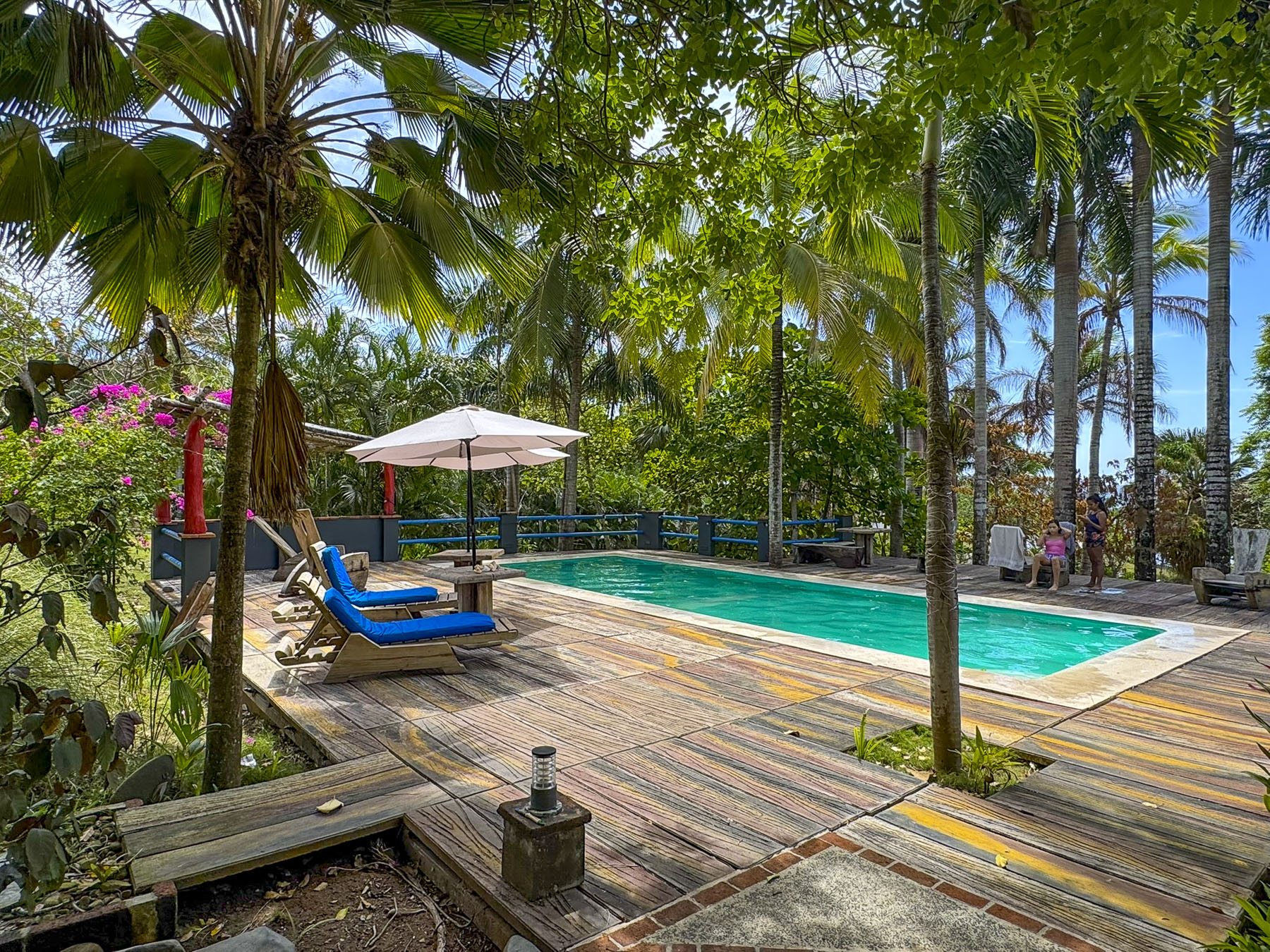
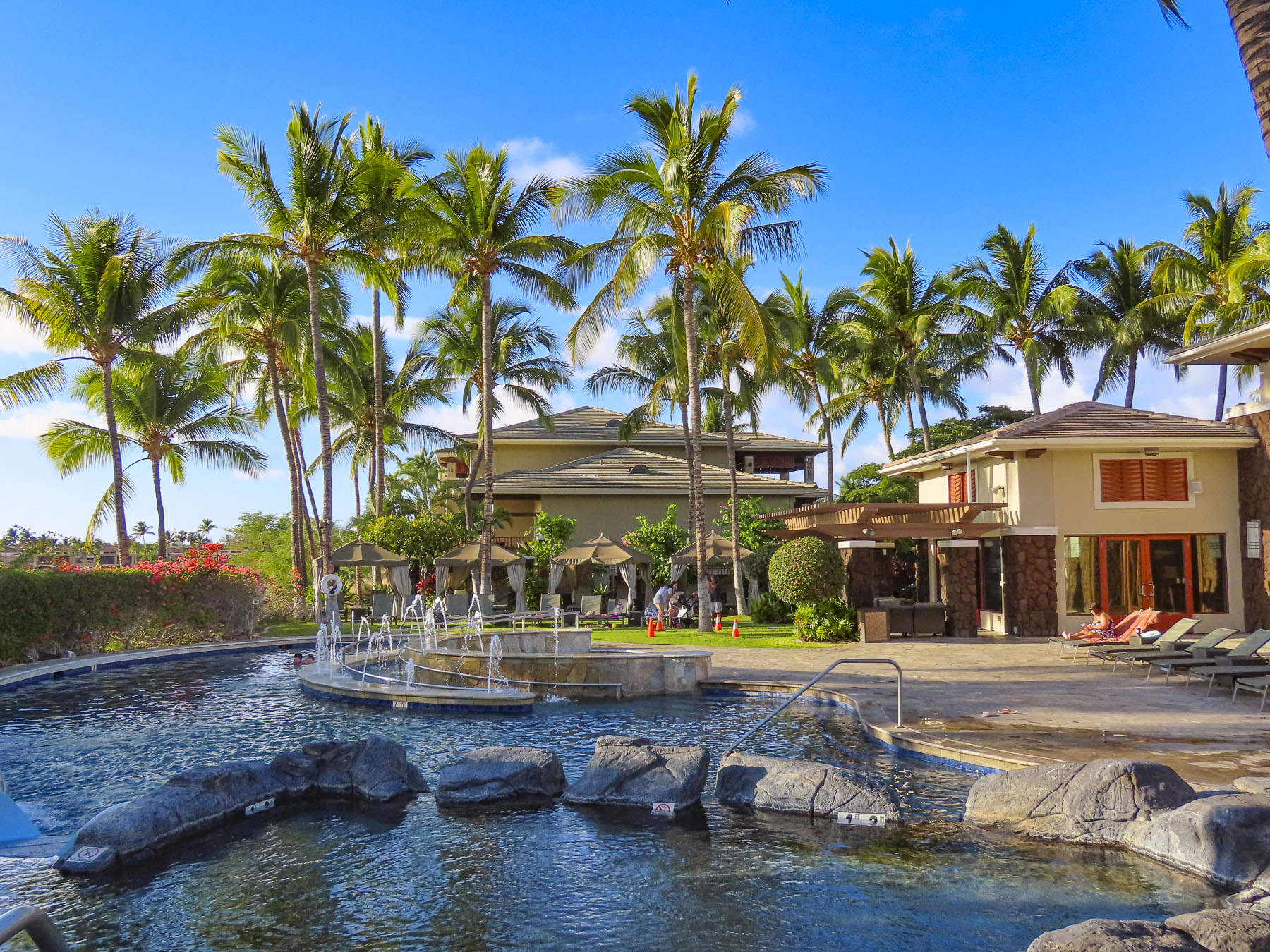
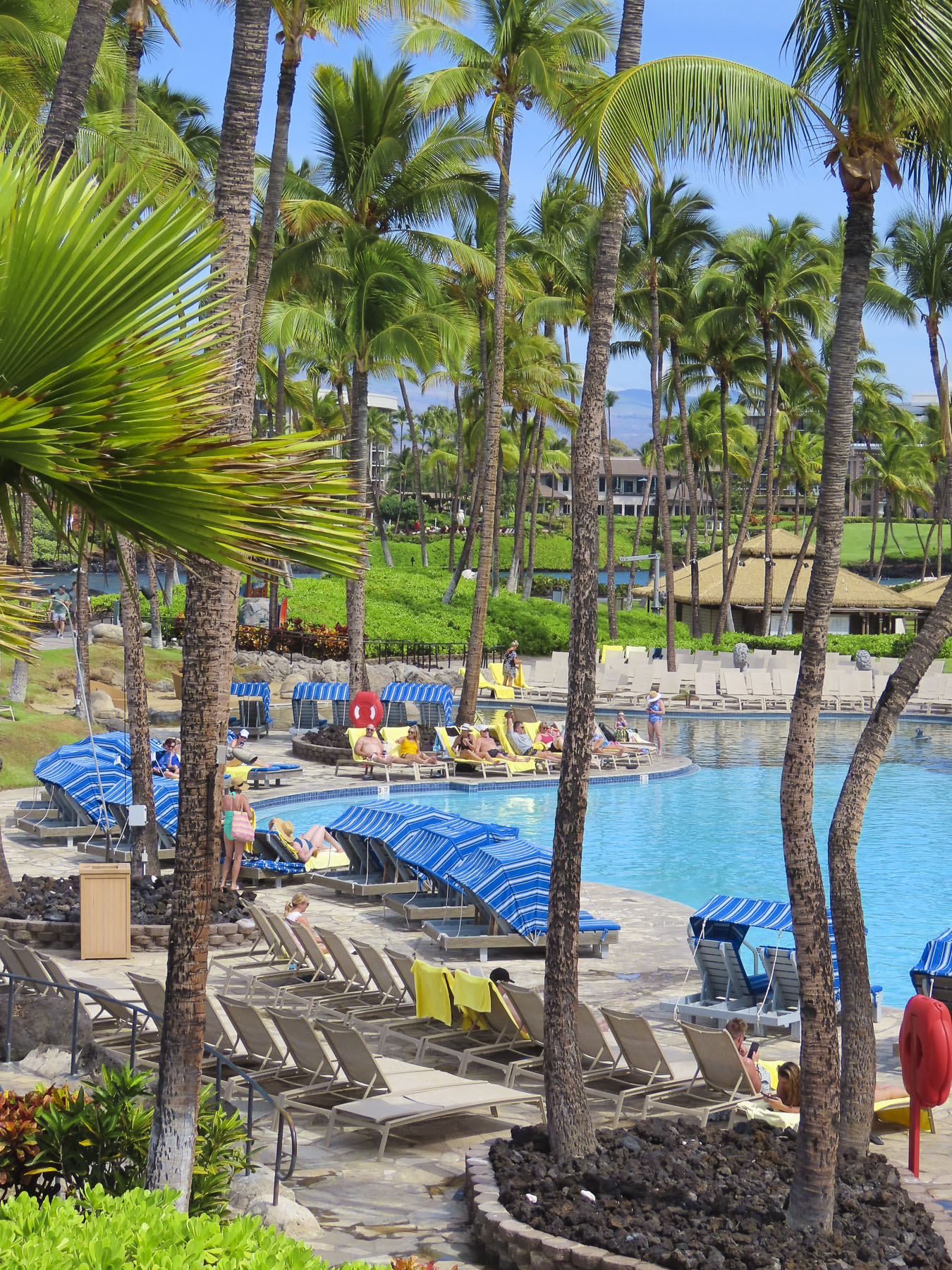
Beyond the reception desk, the dancing patterns of light off the ripples of the hotel’s dramatically lit pool looked enticing. But after a long day of flying we needed a good night’s sleep.

The next morning we were up with the sunrise and out for a walk after a quick cup of coffee. The day was beautiful and there were many other like-minded couples out and about following the sidewalk that looped between the buildings of the sprawling resort.

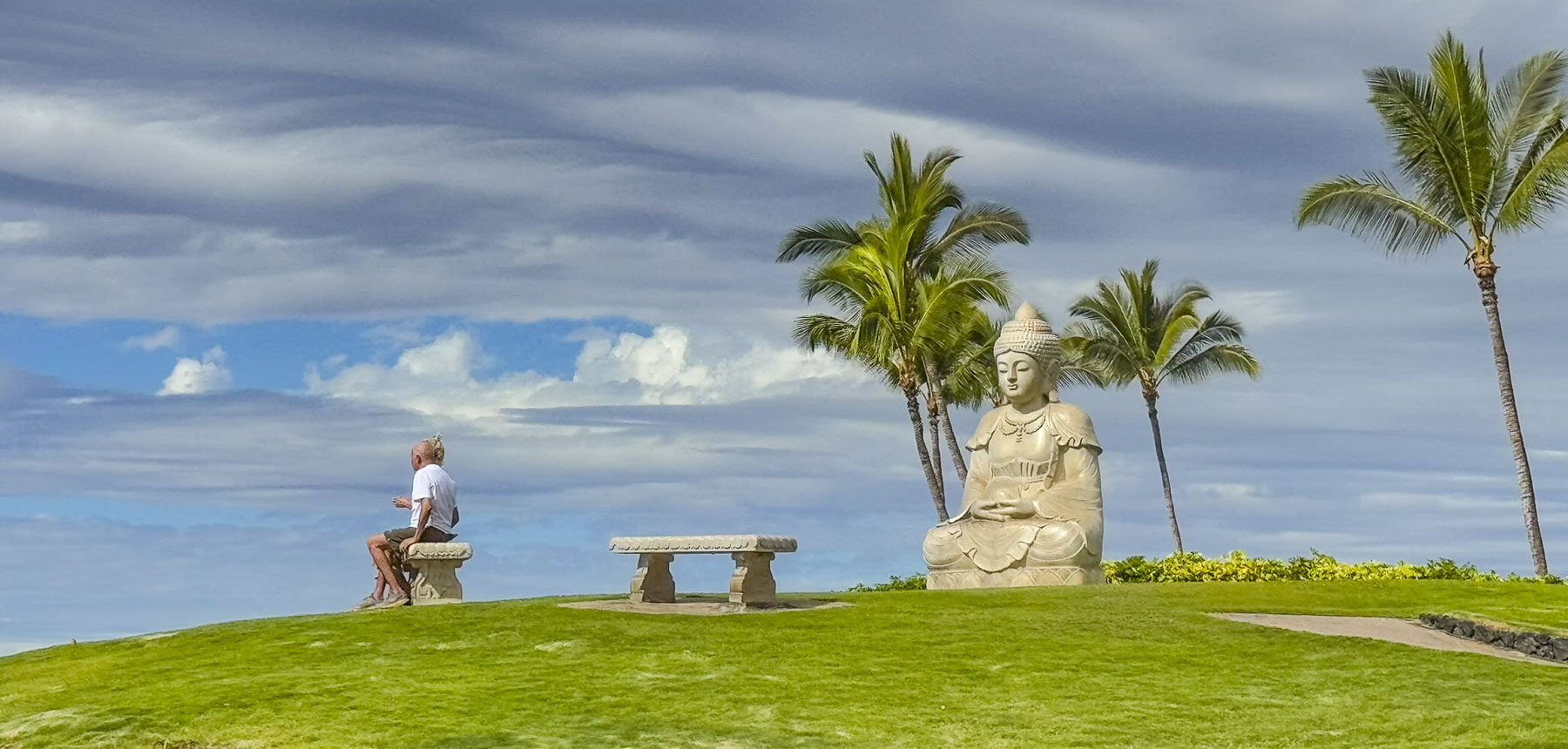
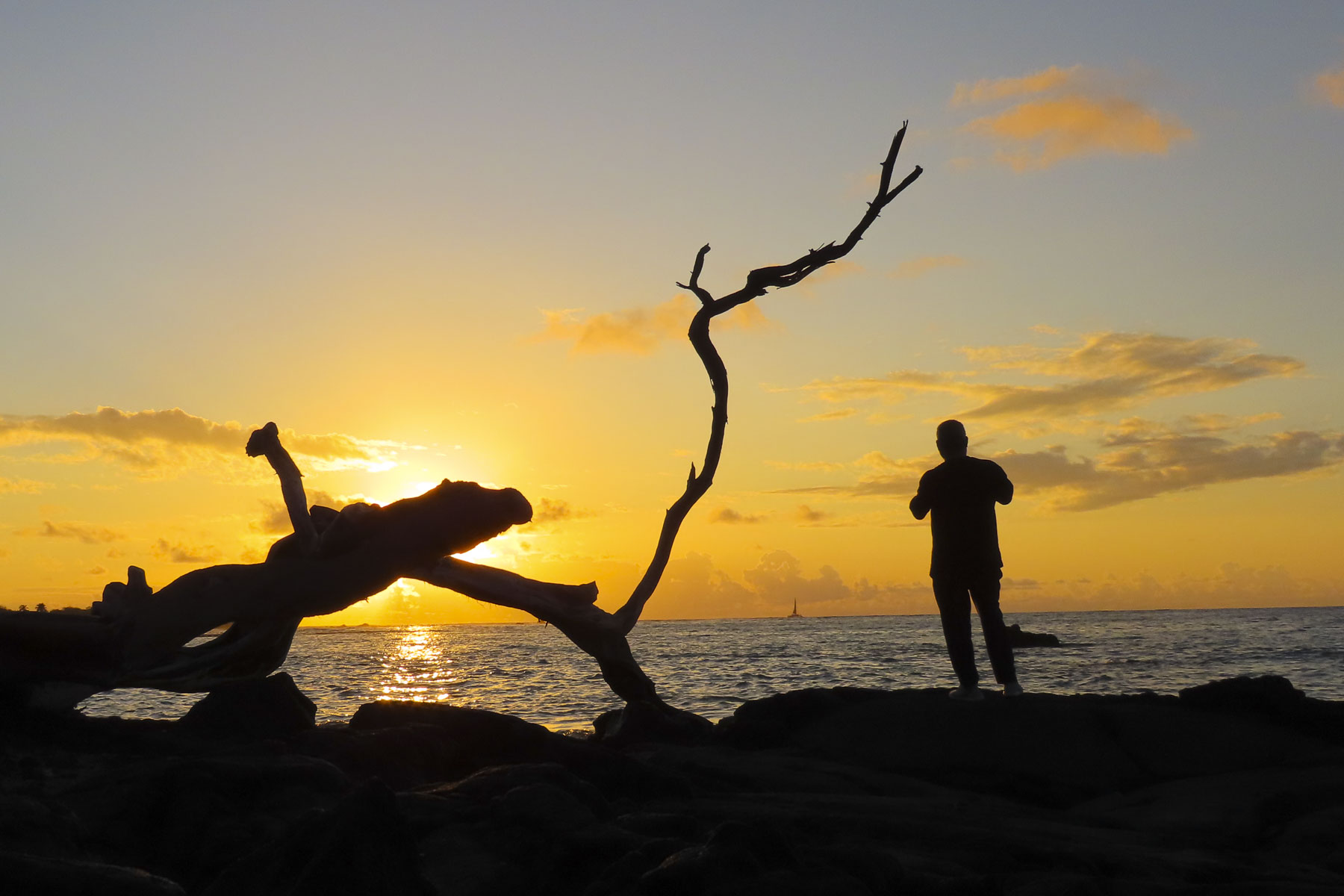
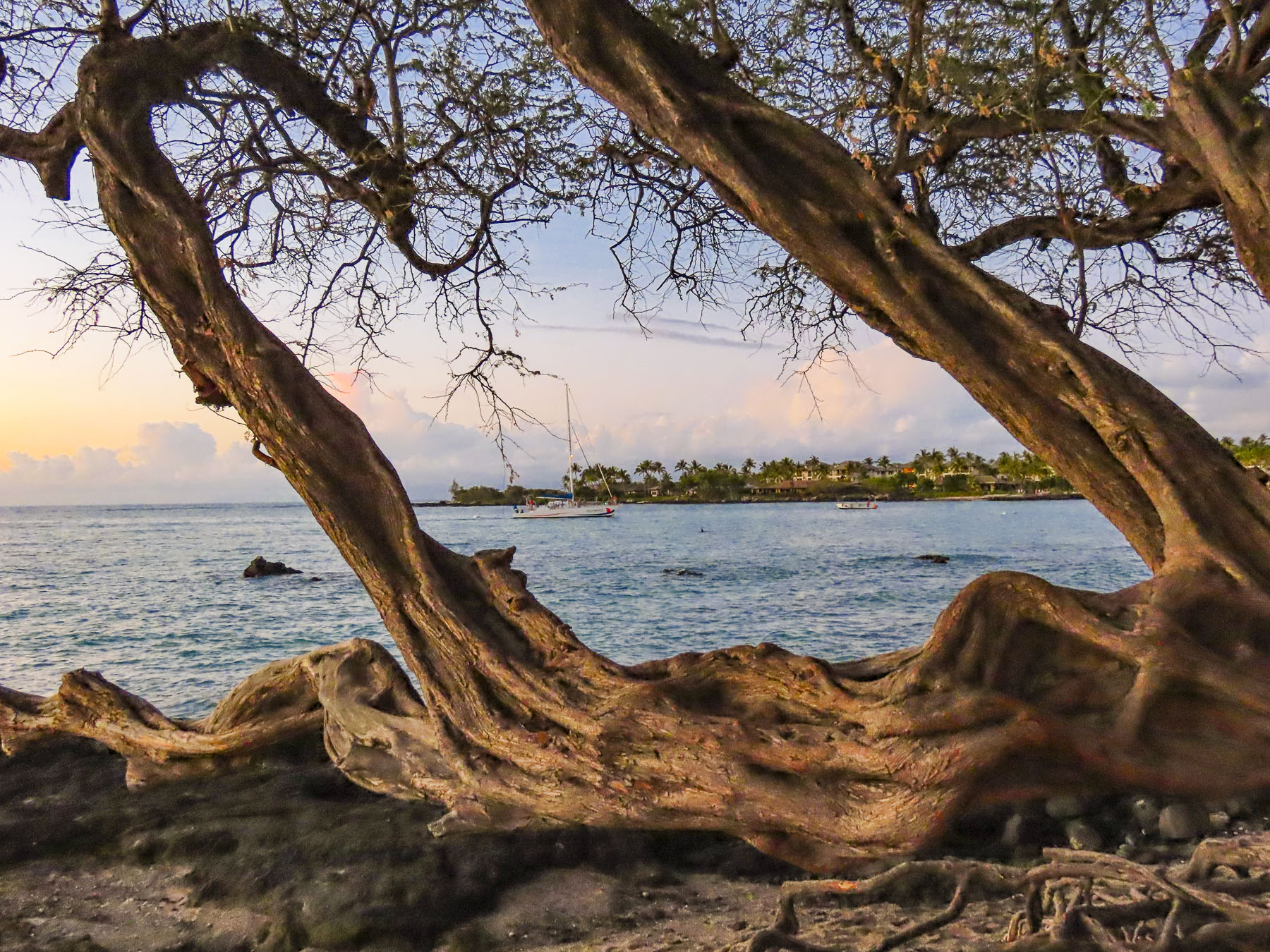
Budha Point, a tranquil scenic spot on Waiulua Bay, that overlooked the vast expanse of the Pacific Ocean, was our destination. We visited here several times over the week and spotted whales breaching offshore a number of times.

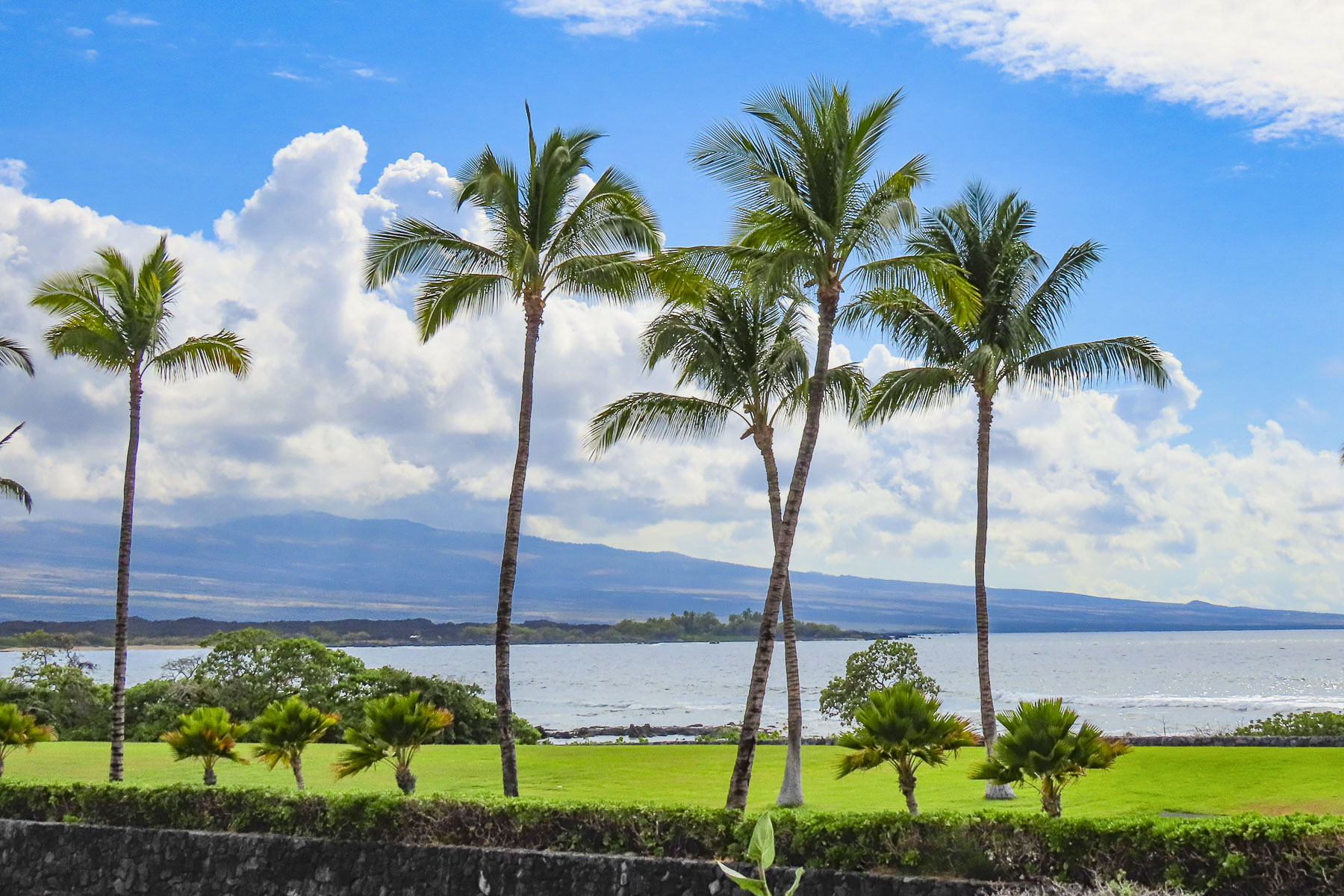
It was less than a mile walk from our room through the beautifully manicured landscaping which coursed through the jagged lava fields that surrounded the Hilton Waikoloa Village, a sprawling complex with a tramway and footpaths connecting several towered hotels and pools along the seafront and the site’s lagoon.

Hawaiians have a great reverence for the ocean, and one of the wonderful things about the state are its laws that guarantee folks have a right of access along the beaches and shorelines, and that private property owners cannot obstruct access to it.

A little segway here: Hawaii is costly – think San Franciso or NYC expensive! The cost of parking is outrageous across the island, with residents parking for free and rental car drivers paying a high hourly rate at parking kiosks. Hilton guests staying in their premiere hotels around the resort’s lagoon or visitors wanting to attend the Legends of Hawaii Luau are charged $48 per day or $8 hourly for self-parking, and $55 per day for valet parking. Fortunately, the hotel we were staying in was farther away from the action and included free parking.

There was also a free shuttle bus that connected the hotels, shopping and restaurant courtyard within the complex. Several small free Beach Access Parking lots, which are closed to overnight parking, are across from excessively expensive Waikoloa Village parking lot.

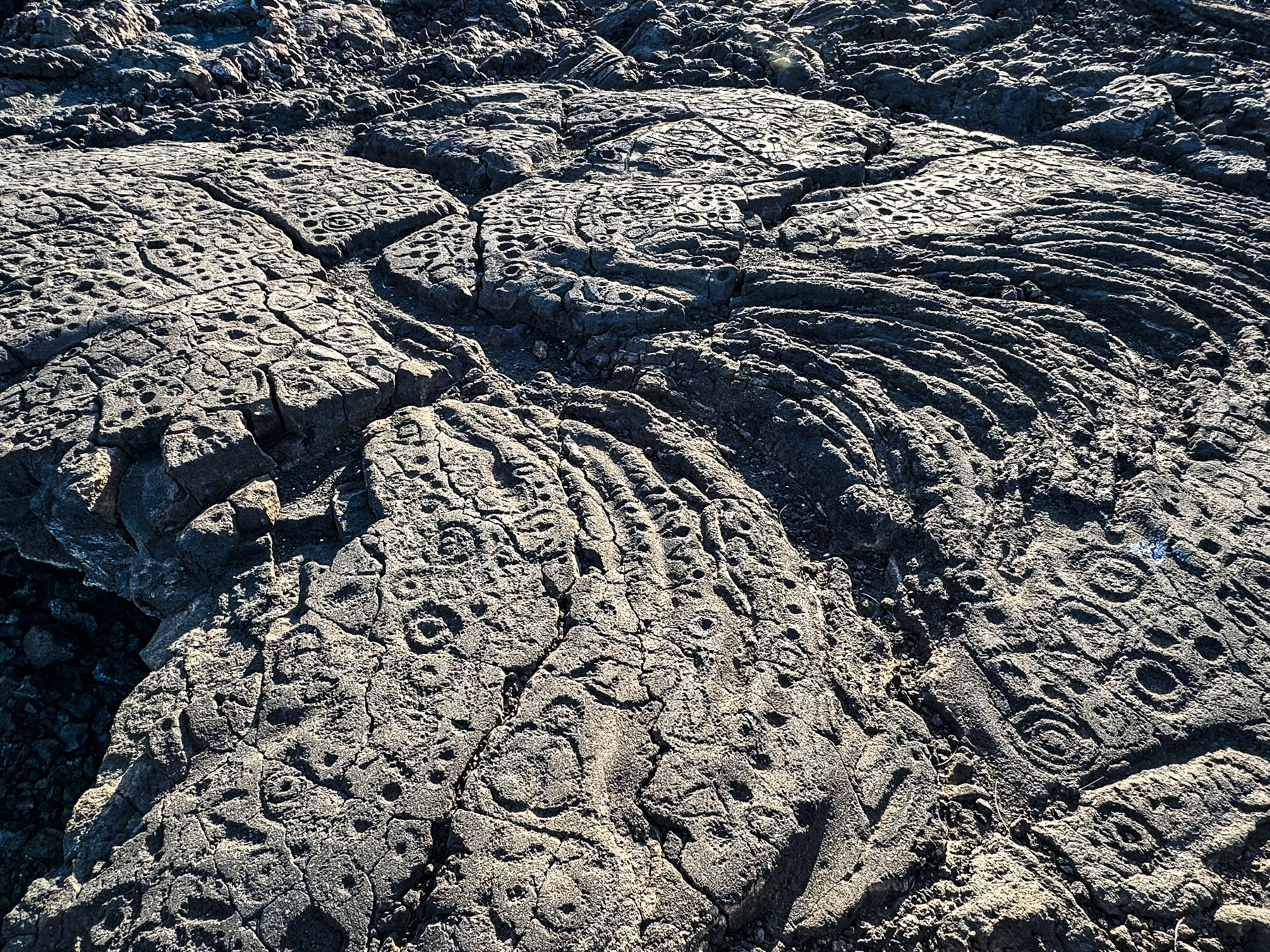
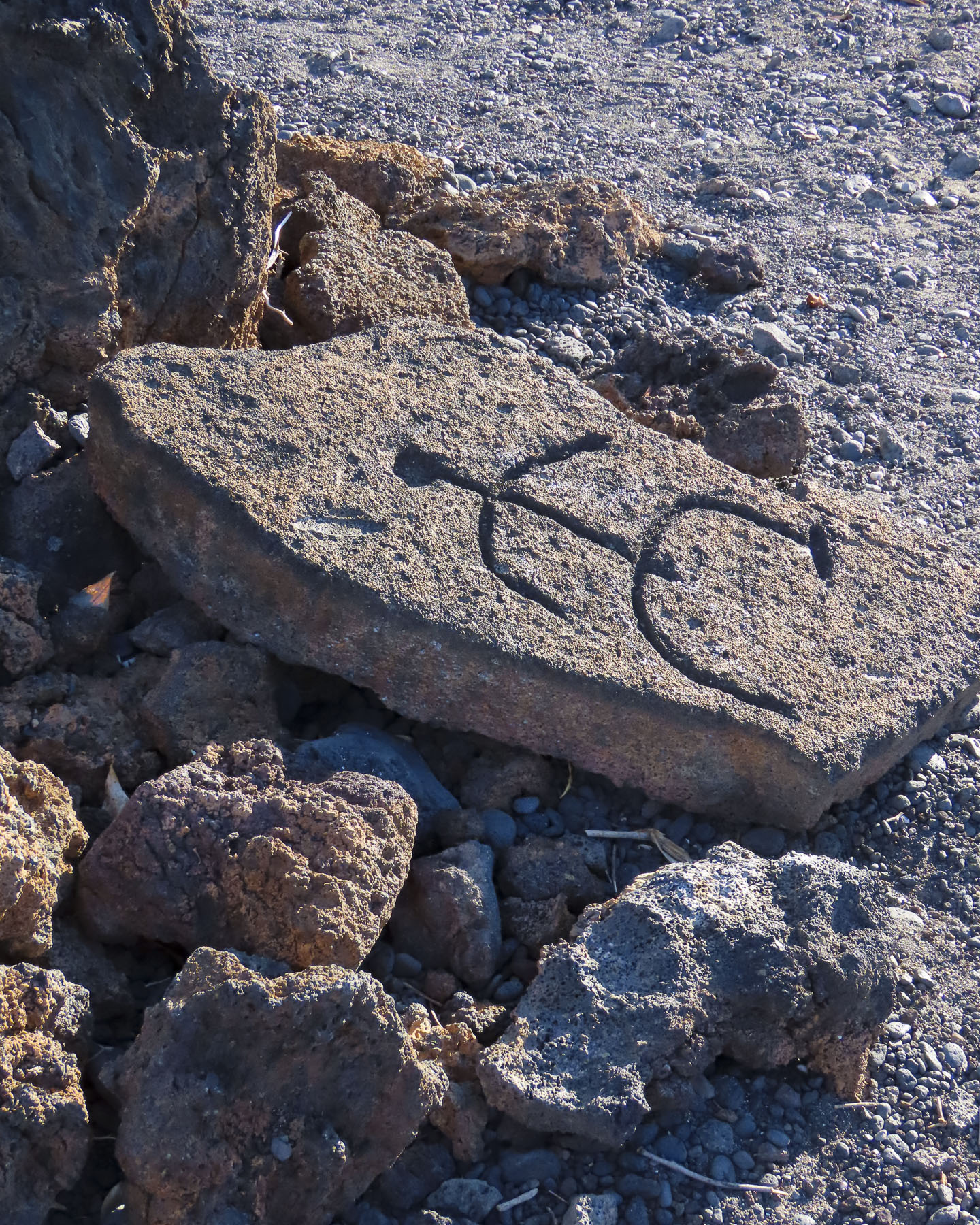
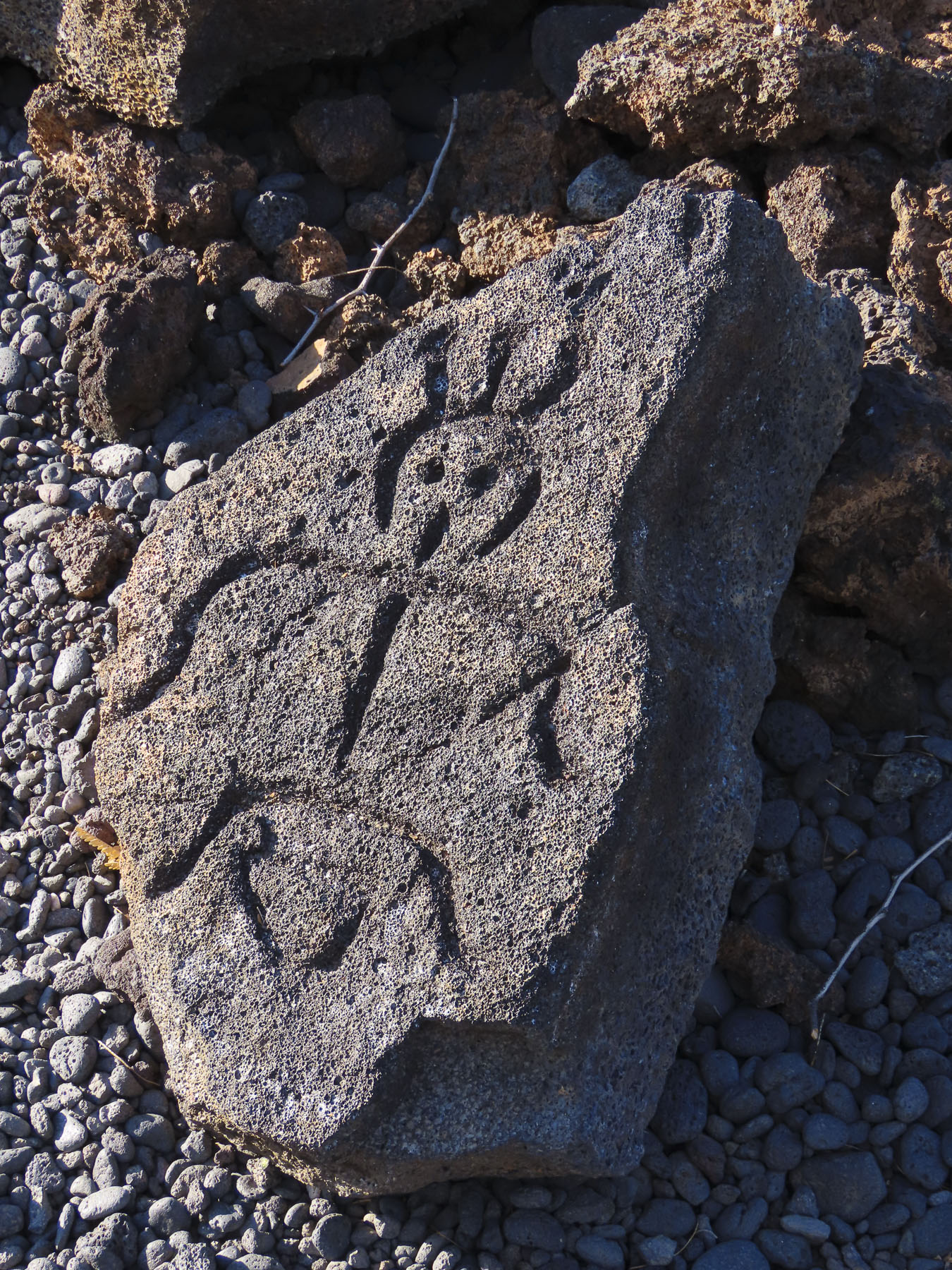
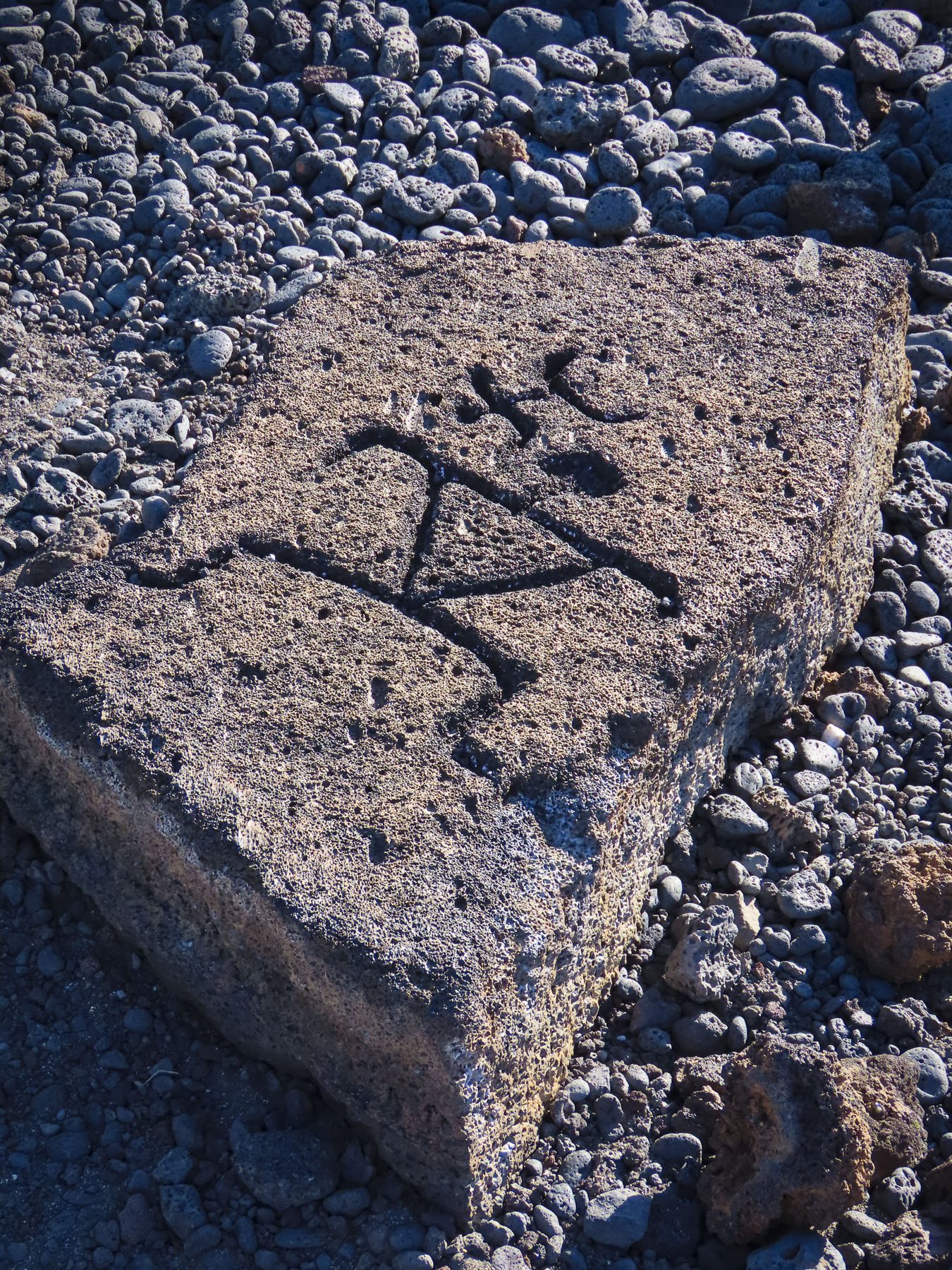
Continuing our loop around the resort we came upon the Kings Highway Foot Trail, part of the Ala Kahakai National Historic Trail, a 175-mile narrow footpath that follows an ancient trading and communications route, through rough lava beds. Starting at the farthest spot north on the island, Upolu Point, the trail which dates from the 1500s, connected the ancient Polynesian fishing villages and religious sites along the western and southern coast of Hawaii island to the farming villages in the highlands. In places like the Waikōloa Petroglyph Reserve, ancient messages were carved into the lava stones.

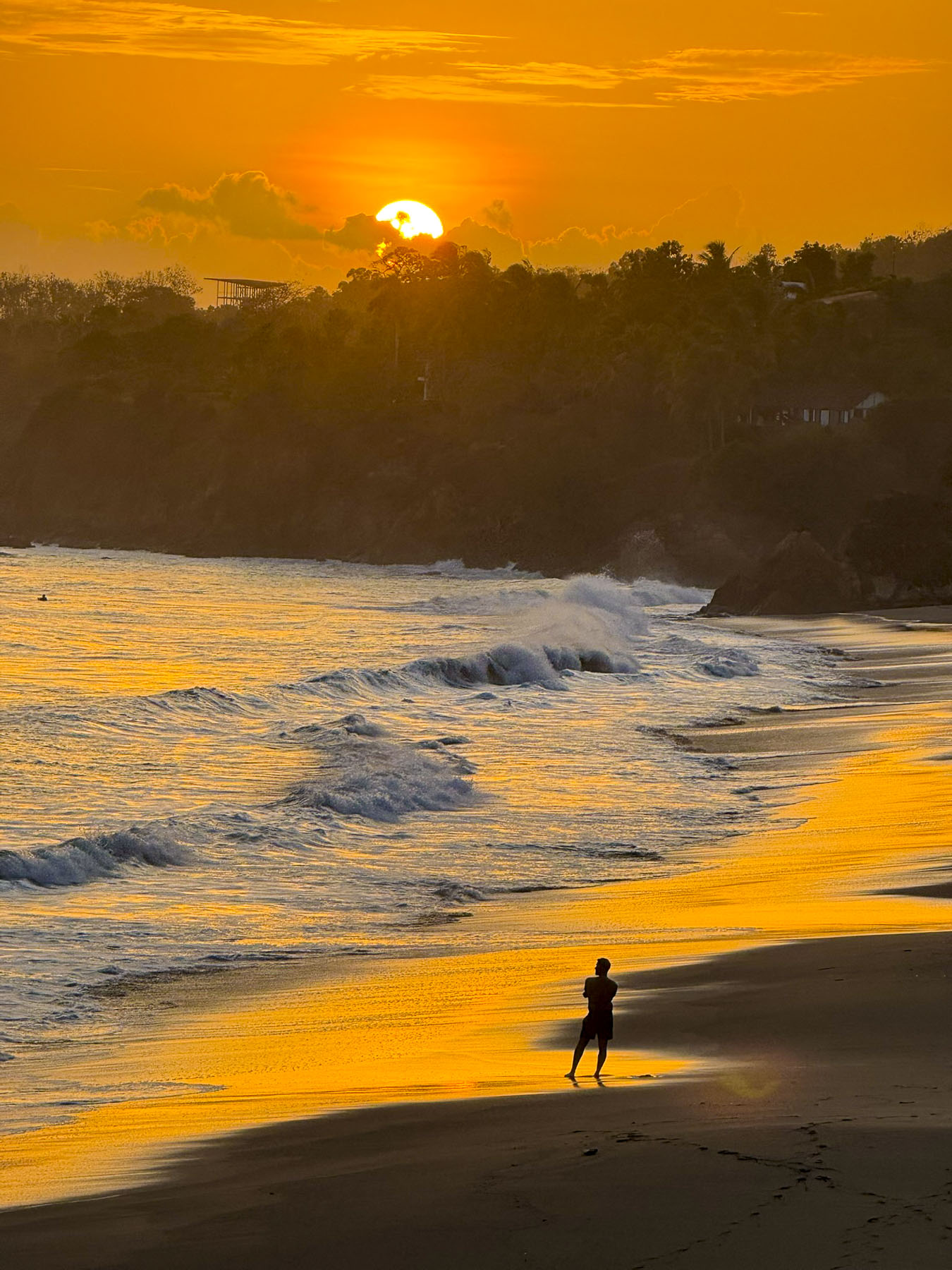
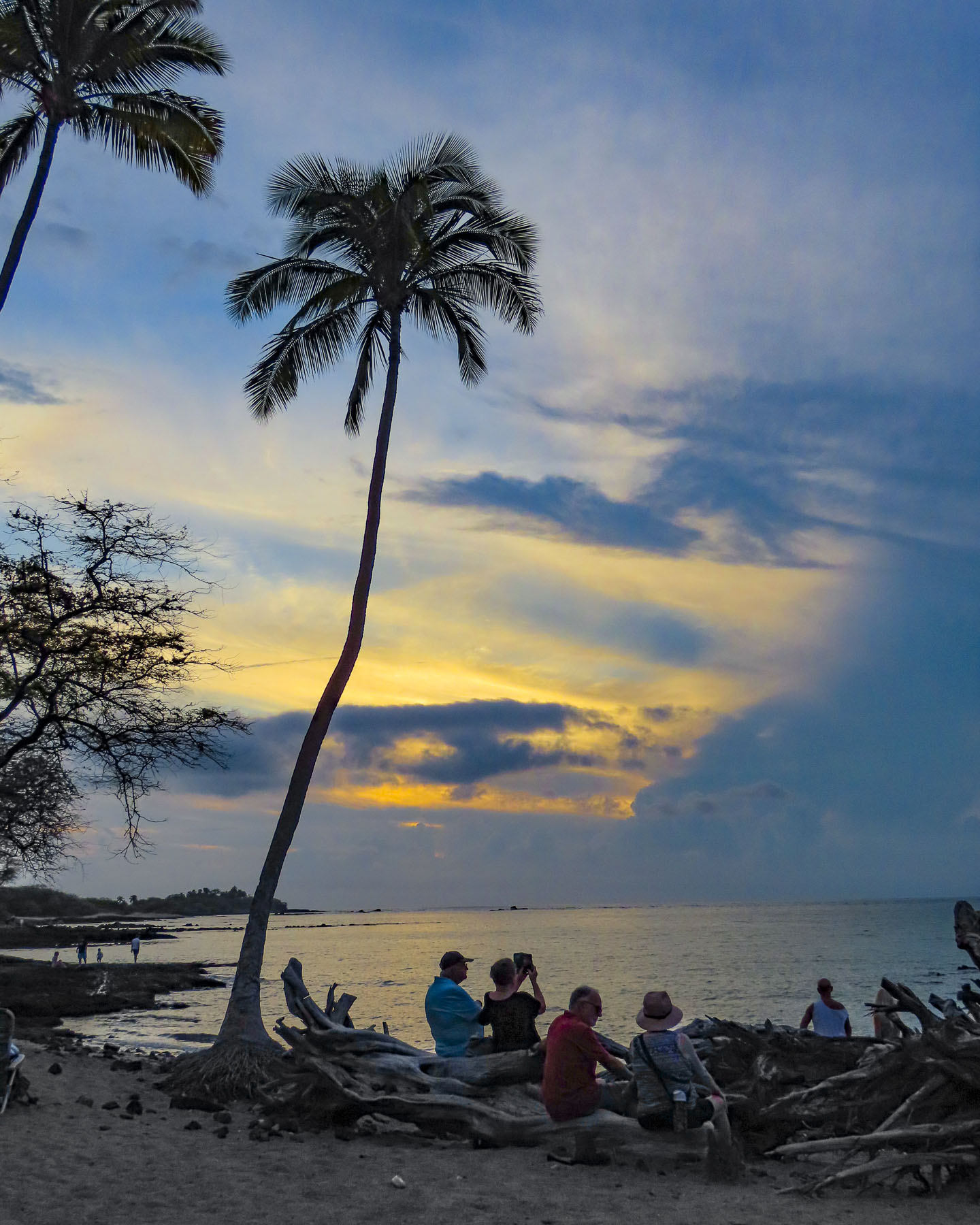
Dinner and watching the sunset from the Lava Lava Beach Club on ʻAnaehoʻomalu Bay is a pleasant nightly ritual for many who visit the area.

We could have spent the entire week lounging by the pool, but that’s not really us, so we planned several road trips around the island. We had driven to the hotel in the dark two days earlier, and the area around the resort was a mix of verdant greenery and sporadic patches of lava. Exiting the hotel complex onto Rt19 revealed an immense Martian-like terrain of arid inhospitable lava fields that stretch for dozen of miles down from the 4205m (13,786 ft) tall snowcapped summit of the dormant volcano Mauna Kea, and Mauna Loa, the world’s largest active volcano that sits 4170m (13,680ft) above sea level. They represent just one of the 11 climate zones found on the island. Which means when you circumnavigate the diverse landscapes of the island, you can experience everything from lush rainforests to arid deserts.

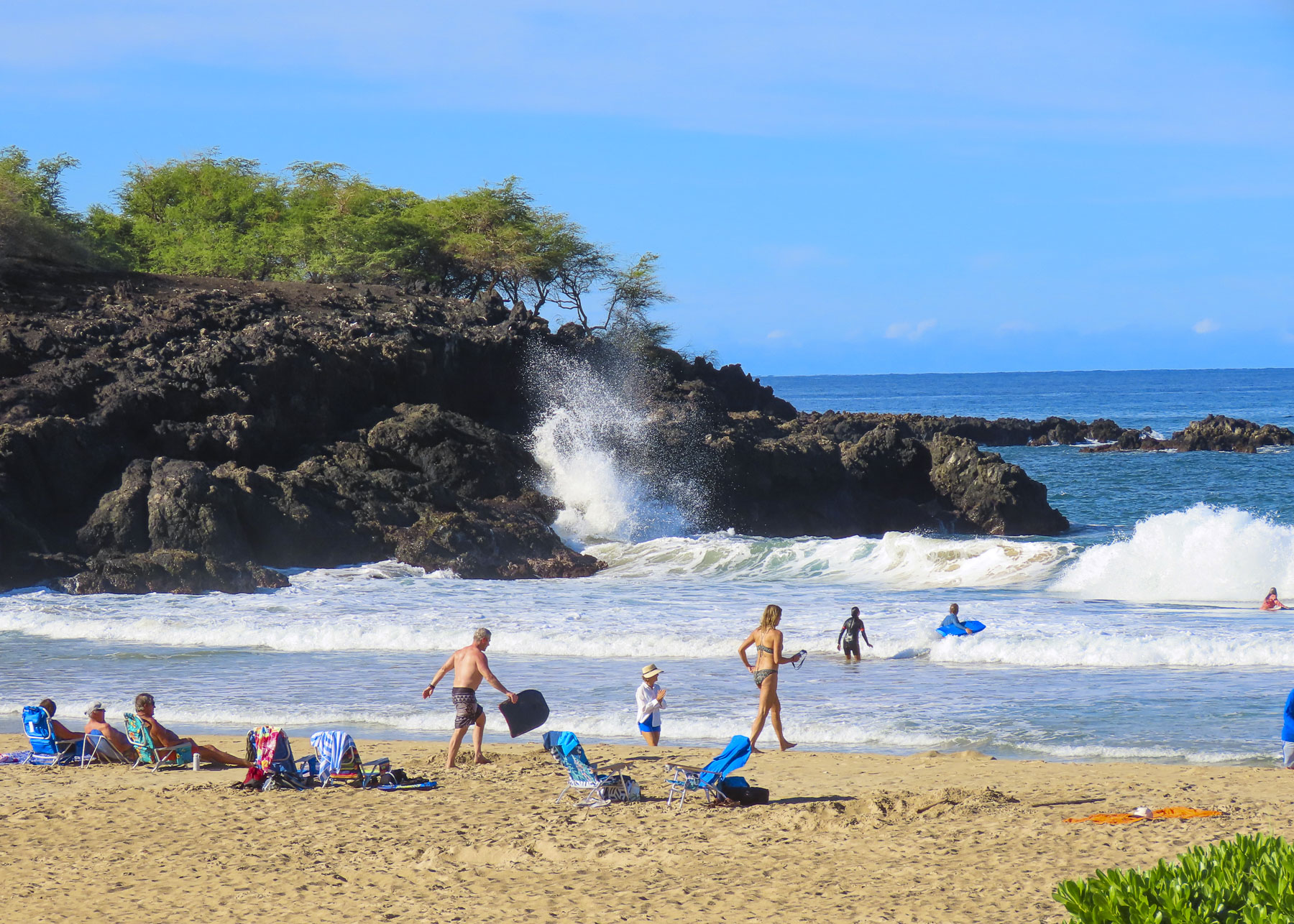
A short part of our drive that morning was through a landscape that reminded us of the American Southwest as we headed toward Hapuna Beach, the longest and widest stretch of white sand on the island. It consistently gets ranked as “one of world’s best beaches.”

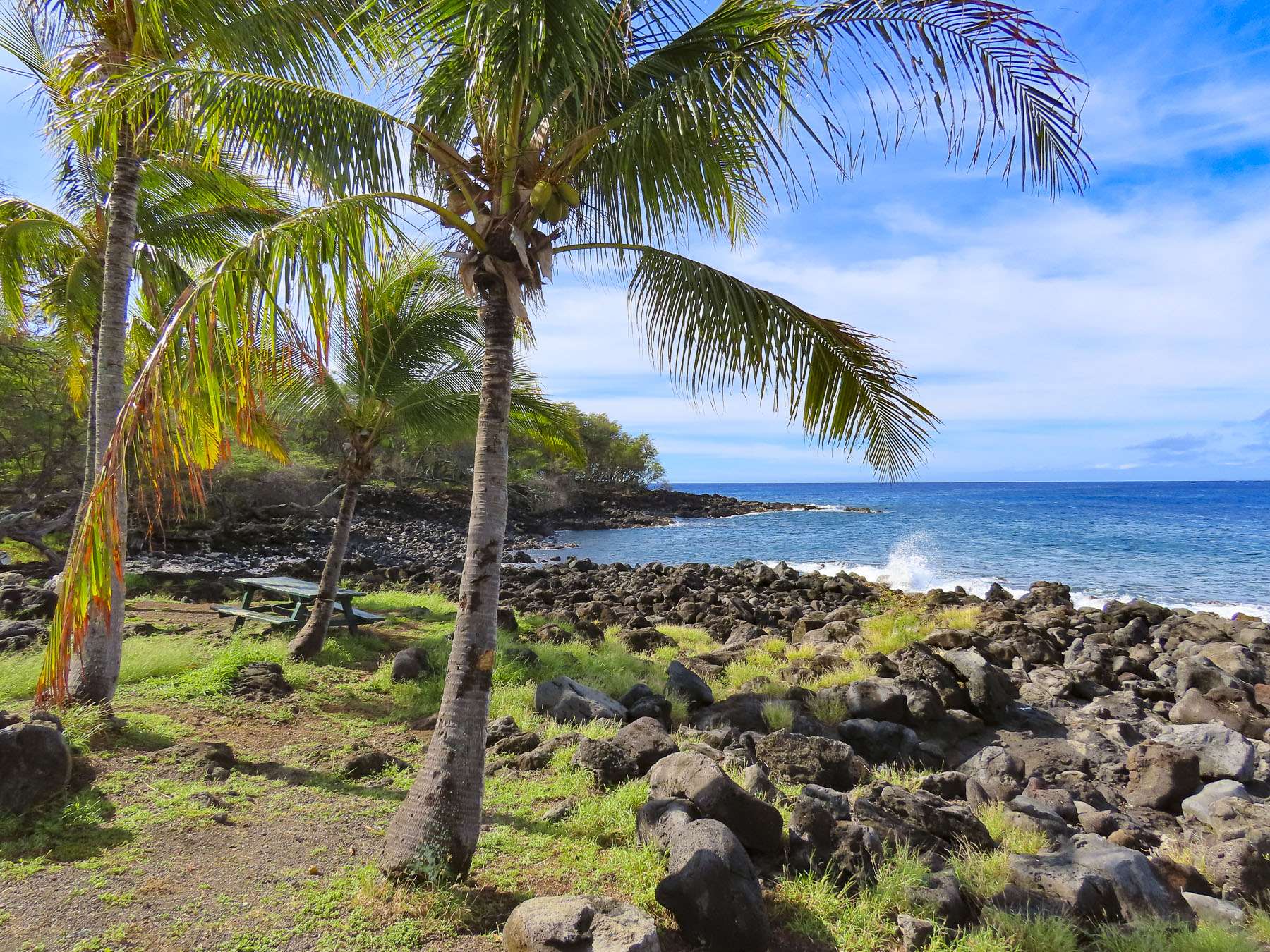
The boulders of ancient lava, from the now extinct Mt Kohala, carpeted the shoreline at Kapa’a Beach Park. An estimated one million years old, it’s the oldest of the Big Islands’ six volcanoes, and last erupted 120,000 years ago.

Rain clouds threaten us as we stopped for coffee at the Kohala Coffee Mill, in the small town of Hawi, to indulge in our “drive a little then café,” philosophy. Rain poured for a few minutes as we sipped our coffees at tables under a covered sidewalk, and waited for the shower to pass. It’s a quiet one street town with a few small shops, galleries and artwork along the street. Away from the large resorts on the Kona coast a little bit of “old Hawaii,” shined through here.

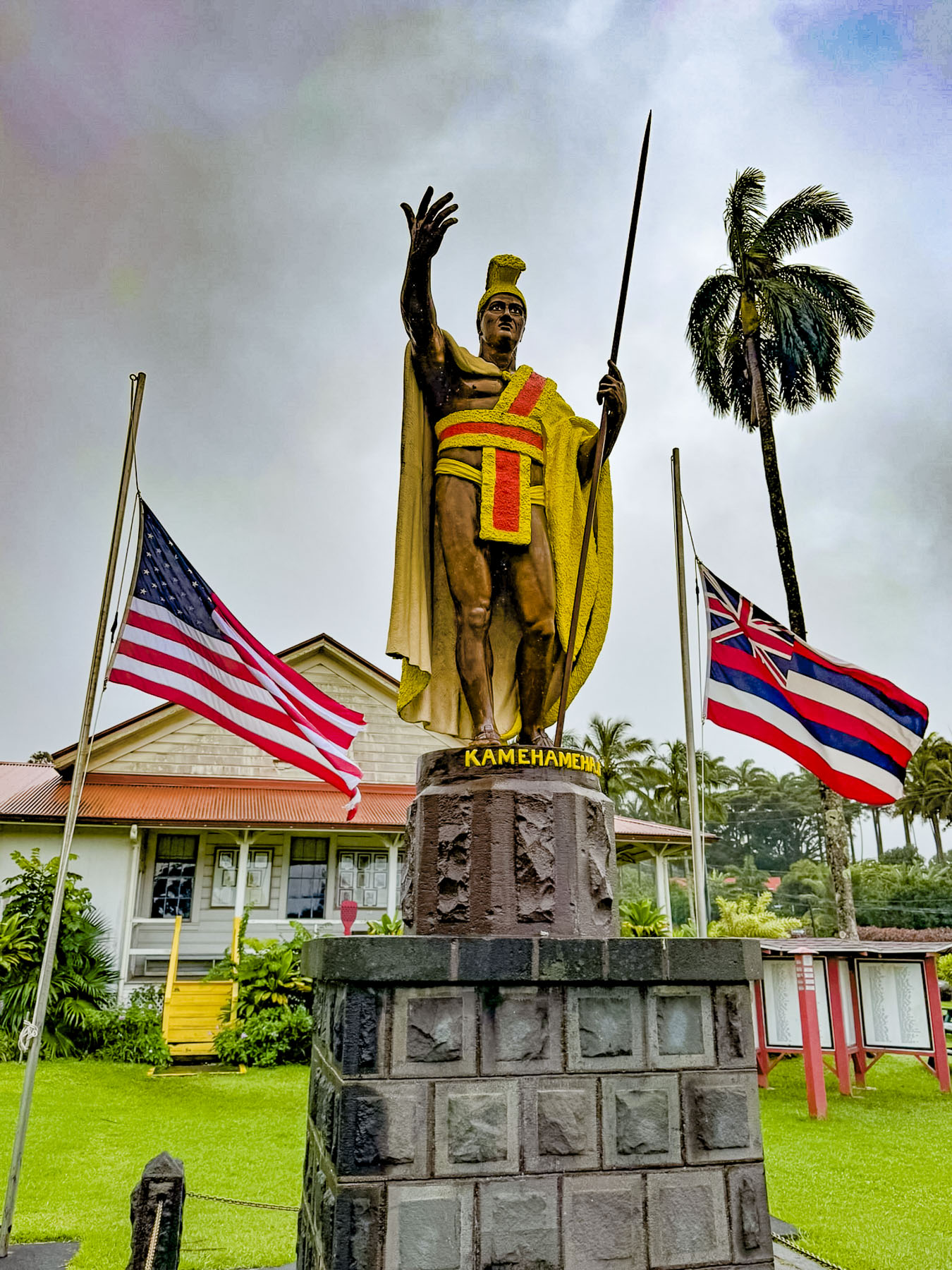
A few minutes farther up the road we stopped in Kapaau at the Statue of King Kamehameha that commands the slope in front of the Old Kohala Courthouse. Ancient Hawaiian legends had foretold, “a light in the sky with feathers like a bird would signal the birth of a great chief.” Halley’s comet passed over the isalnds in 1758, the year Hawaiians believe Kamehameha was born. For centuries warfare between clans and inter-island raids were widespread throughout the Hawaiian archipelago. Kamehameha with an army of warriors on hundreds of peleleu, double-hulled 70ft long war canoes, sailed between the islands. In a series of battles he defeated the opposing chiefs on Hawaii, Oahu, Maui, and Molokai and united the islands into the Kingdom of Hawaiʻi in 1795. By 1810 the islands of Lanai, Kauai, and Niihau voluntarily joined the kingdom.

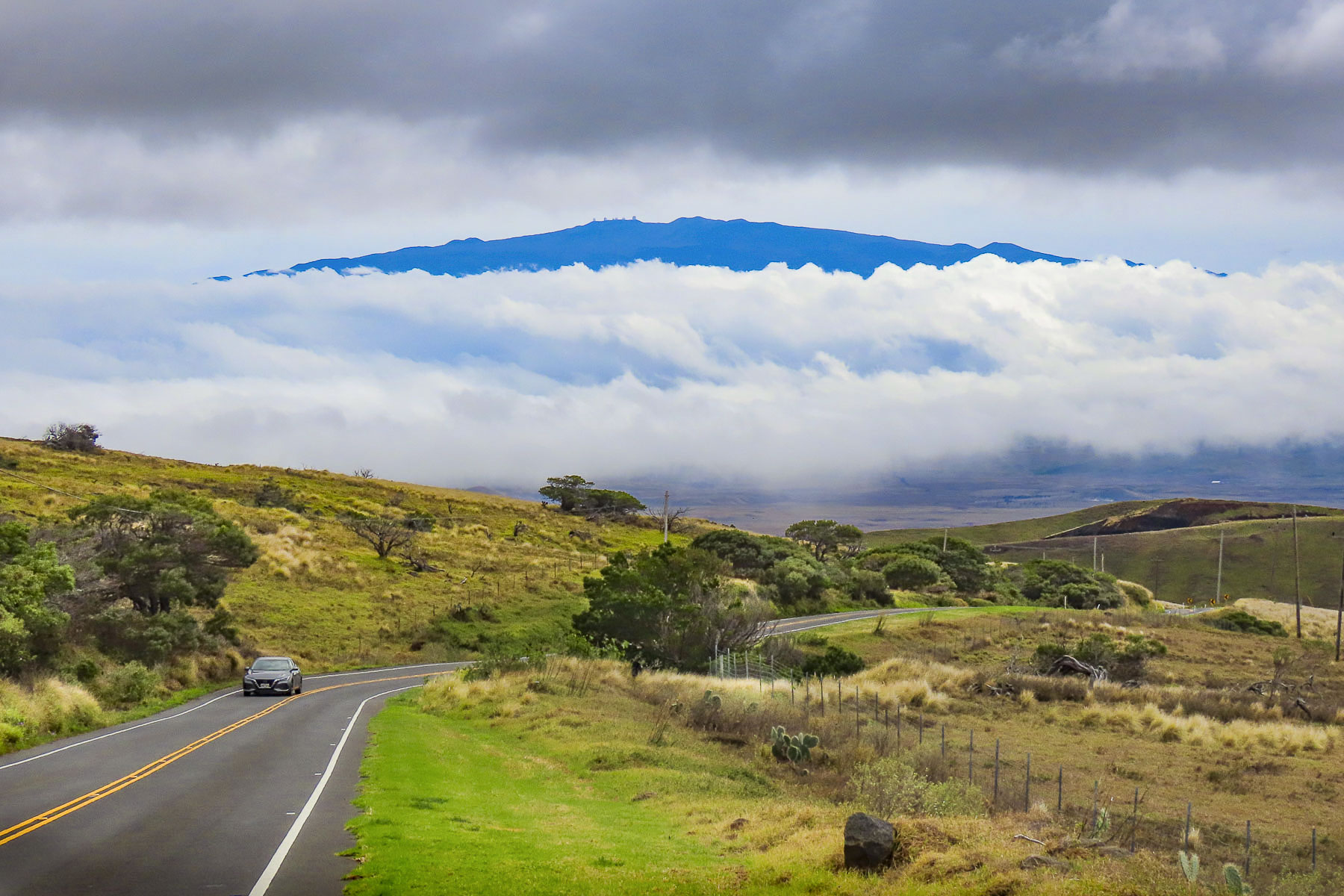
Leaving Kapaau we followed Rt 250 up into the Waimea highlands beneath Mt Kohala, a vast grasslands atop a long ridge, and home to the 135,000-acre Parker Ranch, one of the oldest and largest cattle ranches in the United States. From the road distant views of the west coast of the island were abundant. As we descended into Waimea the summit of the dormant volcano Mauna Kea poked through the clouds.

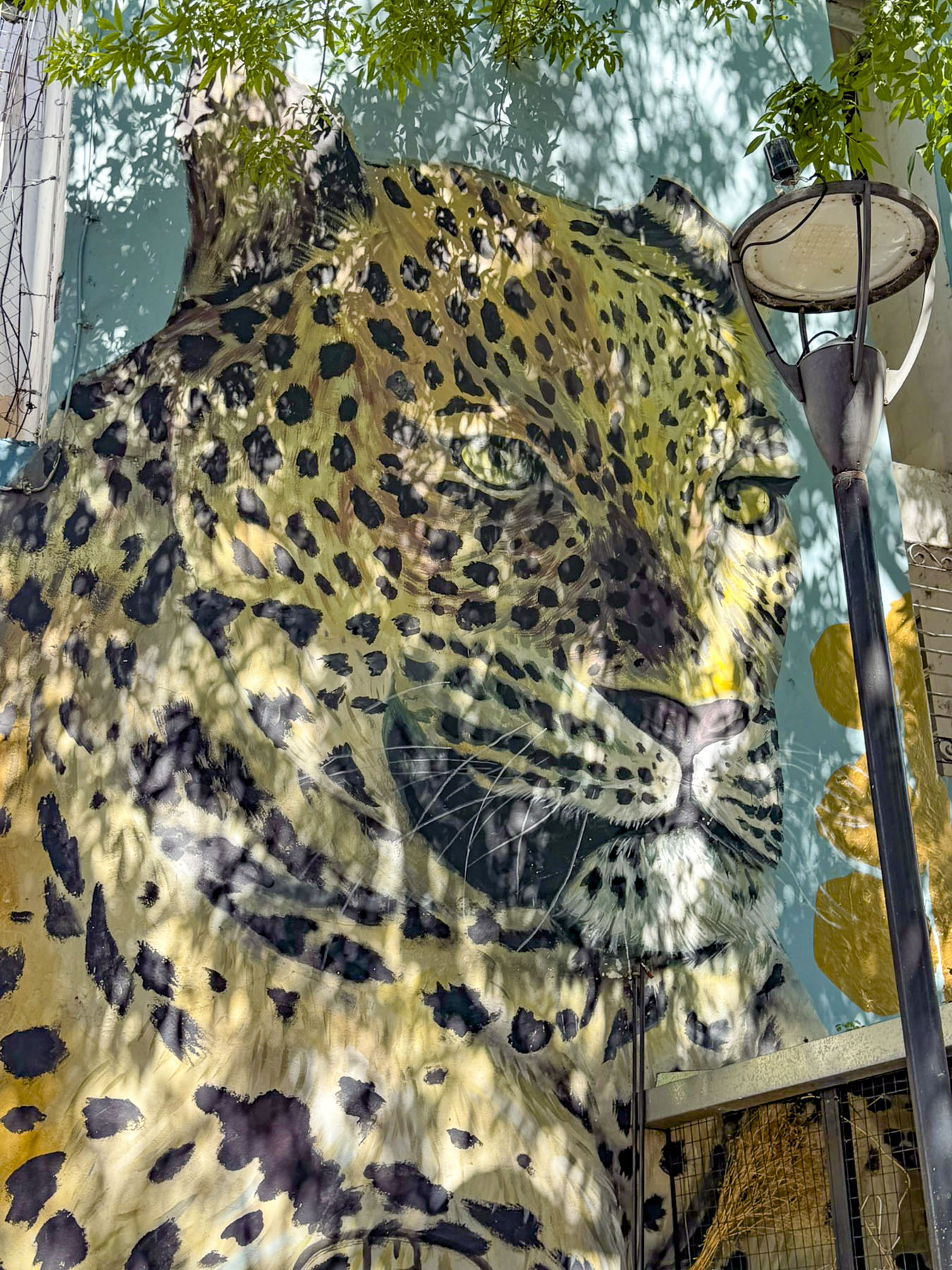
Waimea is the center of the Big Islands’ paniolo (Hawaiian cowboy) country. It’s a large pretty town, with several old historic churches, colorful street murals and a tall cowboy boot marking the entrance to a shopping center. The first cattle on the island, 11 cows and 1 bull, were given to King Kamehameha by the British Naval Officer, Captain George Vancouver, in 1793. The king prohibited the islanders from slaughtering them and the small herd was left to freely roam the highlands.

In 1803 King Kamehameha received, from an American trader, the first horses to arrive on the island. The king invited vaqueros from Spanish California to the Big Island to teach some islanders cattle herding and roping skills. Eventually, the taboo against killing the cattle was lifted in 1830 by King Kamehameha III, when an estimated 25,000 wild cattle became troublesome as they destroyed farmer’s crops. Some of the cattle would be herded into the sea where they were swum out and then lifted onto waiting freighters and transported to the other islands. Hawaiian paniolos grew to be accomplished riders and over the years, have competed in numerous rodeos and world steer-roping championships. In 1999, Parker Ranch paniolo Ikua Purdy was inducted into the National Cowboy Hall of Fame. We had hoped to attend a Paniolo BBQ at Kahua Ranch for a night of good food and cowboy stories, but the weather the week we were on the island was just too iffy for us to commit to it.

Oustide of Waimea on the Mamalahoa Hwy, the ring road, we headed to the eastern, or windward side of the island and traveled through verdant landscapes of thick forests and jungles, the beneficiaries of the 130 inches of rain that this side of the island annually receives from the tradewinds that bring moisture in from the Pacific Ocean.  It’s a sharp contrast to the arid western, or leeward side of the island that receives only 18 inches of rain.

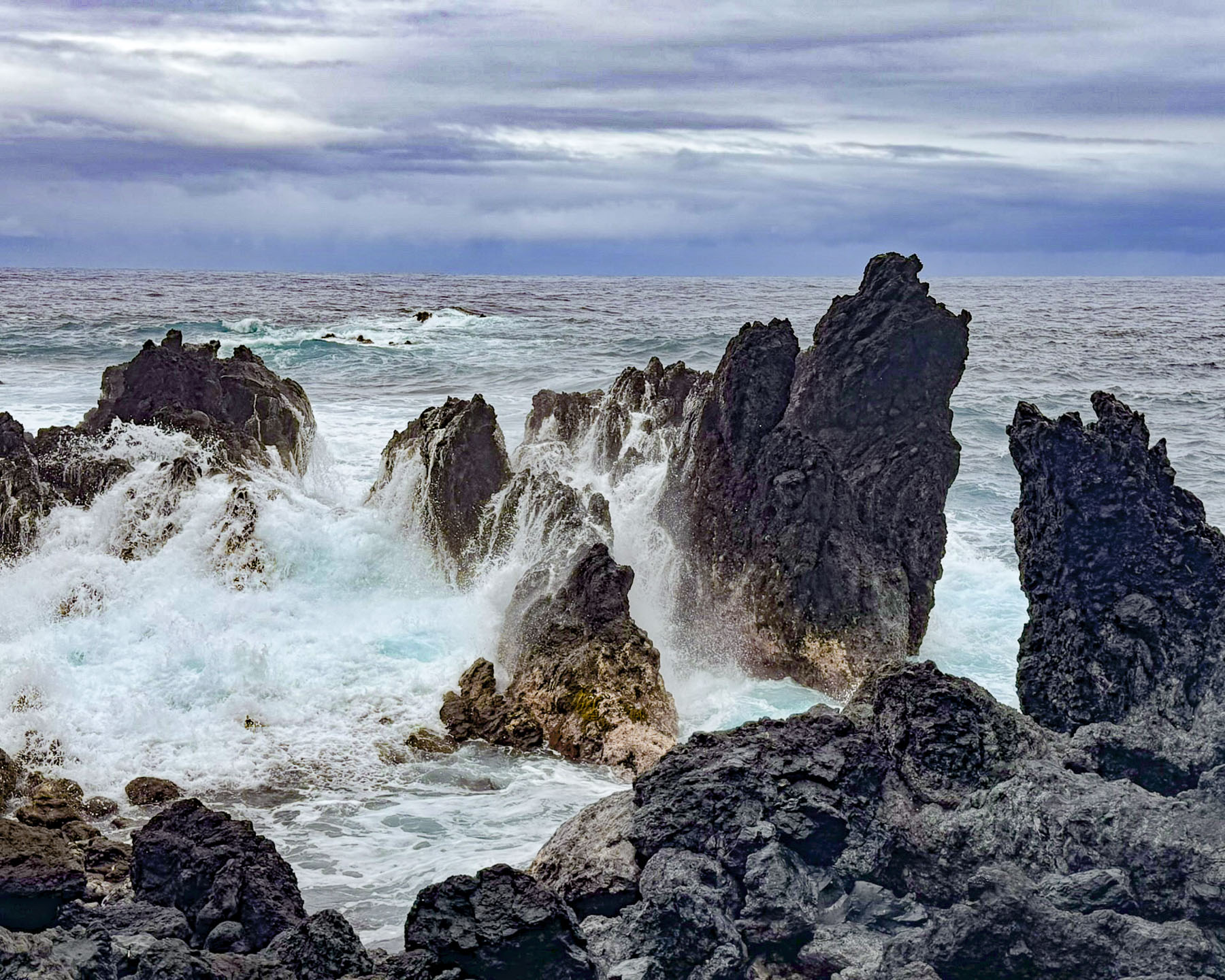
The overcast sky persisted as we drove down a twisting road through a rainforest to Laupāhoehoe Point. It’s a small, beautiful peninsula, with a rough lava rock coastline. The ocean swelled and crashed against the coast with a ferocity that the beaches on the west side of the island don’t experience, unless there’s a storm.

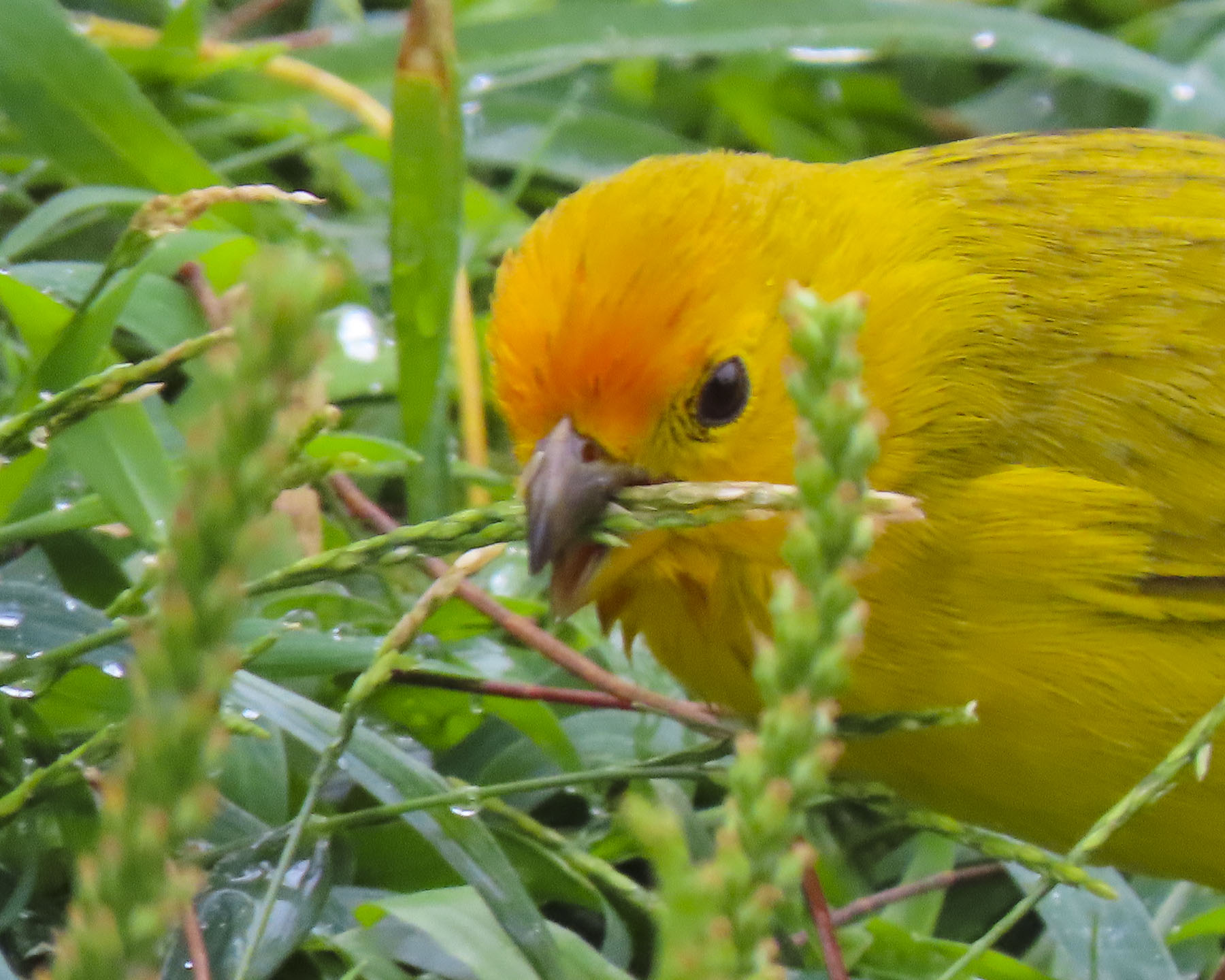
Saffron finches scooted around the undergrowth near the water’s edge. Over the horizon Baja, Mexico was 2,000 miles away. Things are not always wonderful in paradise and a memorial commemorates the tragic deaths of 20 schoolchildren and 4 teachers who drowned as their school was swept away in the giant waves of a tsunami that pounded the northeastern shores of the Big Island on April 1, 1946. Farther south in Hilo 159 people drowned and 1,300 homes were swept away.

The Big Island has over 100 waterfalls with the tallest, Waihilau Falls at a lofty 792m (2,600ft) tall, hidden away in the remote Waimanu Valley. Some serious trekking through the rainforest is required to reach them, while there are others that are way easier to view. As much as I liked the idea of an expedition through the tropical forest with my crew to see this spectacular waterfall, they can be a mutinous car full towards happy hour. So, we opted to seek out some of the more readily accessible ones during our week on the island.

Continuing south on the Mamalahoa Hwy we stopped to view the cascading Triple-Tier Umauma Falls, thundering loudly from all the rain that had fallen lately. It’s on private property, so there was an admission fee, but they did have really tasty coconut, pineapple and mango ice-cream.

We ended our day with drinks and dinner at Jackie Rey’s Ohana Grill in Hilo. It’s interestingly set in an old bank building across from some street murals. Our dinners from the happy hour menu were delicious and quite filling. In our opinion it was one of the best values on the island, and we did in fact eat there twice. Occasionally, a feral goat or donkey would be illuminated by the car’s headlights as we followed Saddle Road across the center of the island. At one point we reached an elevation of 2,021m (6,632ft) as we passed between the summits of Mauna Kea and Mauna Loa. On the downhill side we could have coasted all the way back to the hotel.

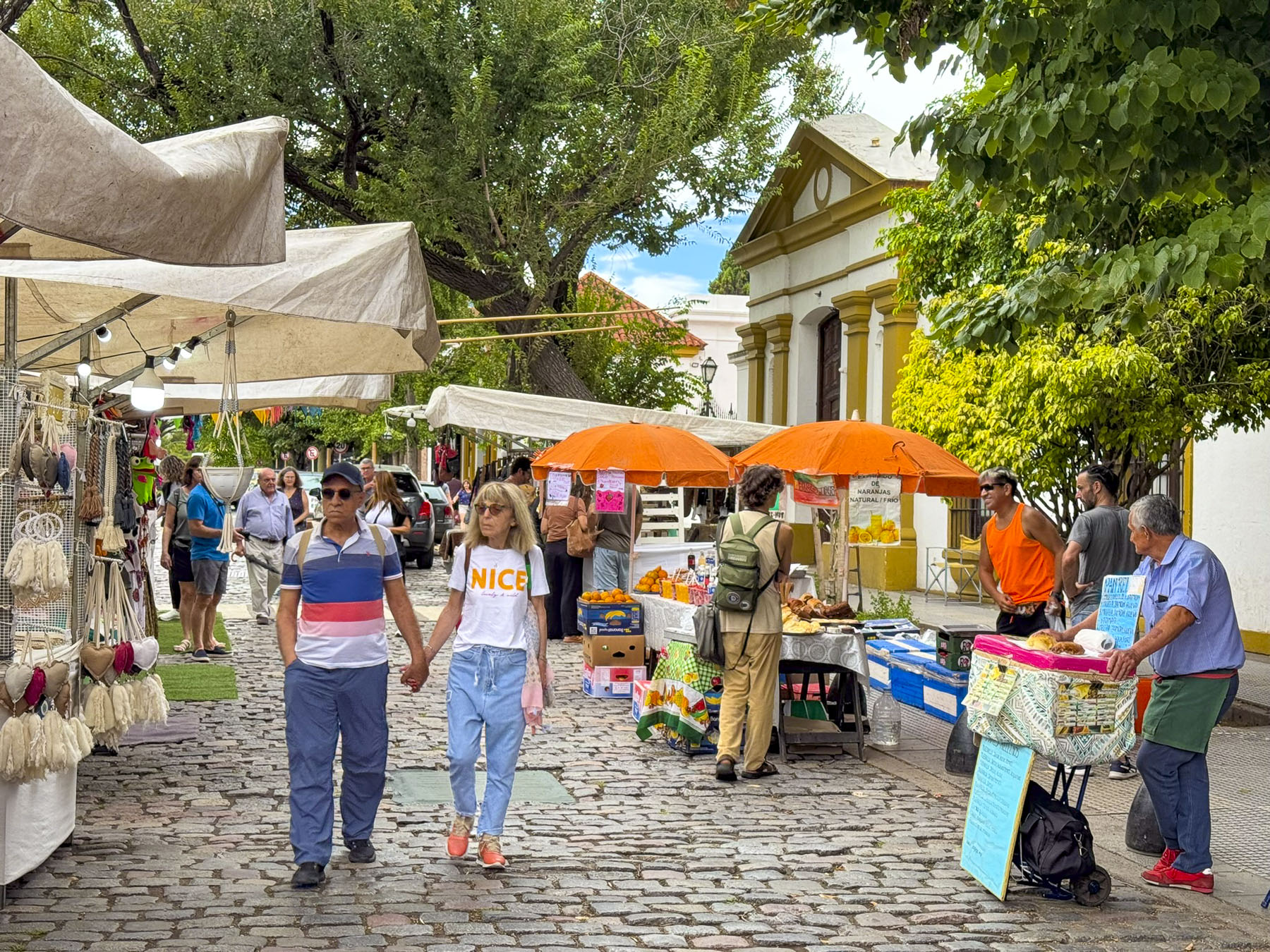
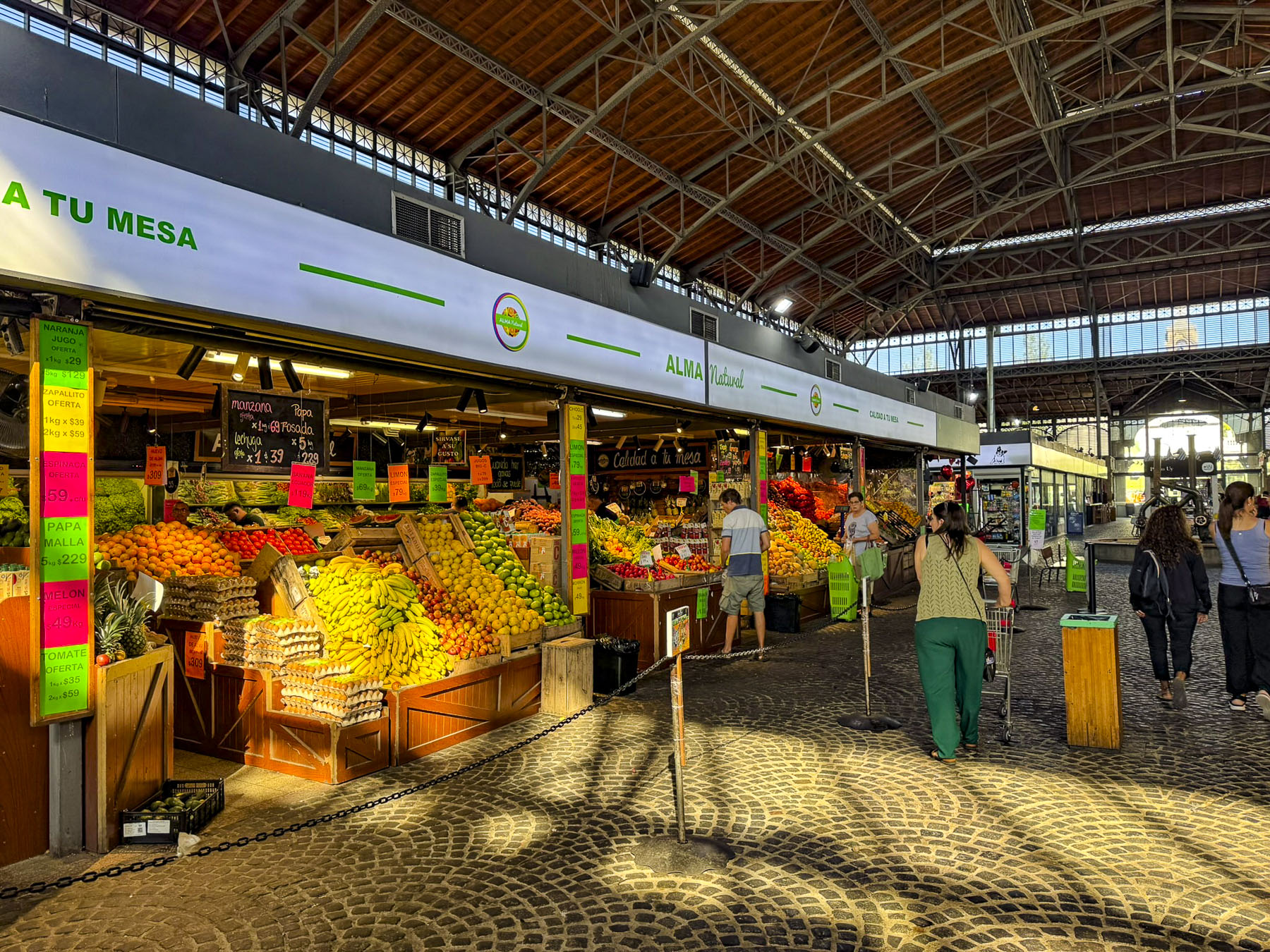
Two days later we headed to Kona for their Farmer’s Market. We very much enjoy wandering about the stands at a good street market. Sadly, the Kona market was a huge disappointment, with only a handful of vendors selling tourist souvenirs and clothing. Only one stand sold local fruit and vegetables, which we did purchase to enjoy back at the hotel. Across the street we had breakfast at Papa Kona Restaurant & Bar, which had a spectacular second-story balcony perched right above the rocky oceanfront, where fishermen were casting into the surf.

Our ambitious plan for the day was to follow the Hawaiʻi Belt Road, Rt11, to the Hikiau Heiau temple on the opposite side of Kealakekua Bay from which Captain Cook landed in 1779, then hit a number of other interesting spots as we continued south to Ka Lae, or South Point as it is also known, before swinging around to the eastern side of the island, and ending our day on the volcanic black sand of Punaluʻu Beach.

Cook happened to sail into Kealakekua Bay during a Makahiki festival, a religious festival to appease the Hawaiian deity Lono, who in legend returns to the islands on a large ship. Timing is everything! Cook lucked out, his skull could have hung with other victims who had been sacrificed to appease the wrath of their deity, amidst the towering fierce tikis which portrayed Lono. The High Chief of the island ceremoniously welcomed the captain and lavished him with gifts of feathered capes, helmets, lei, and tapa cloth along with hogs, taro, sweet potatoes, and bananas. The bay is a tranquil spot now, but during Cook’s visit it would have been filled with hundreds of islanders on wa’a, outrigger canoes, and surfboards.

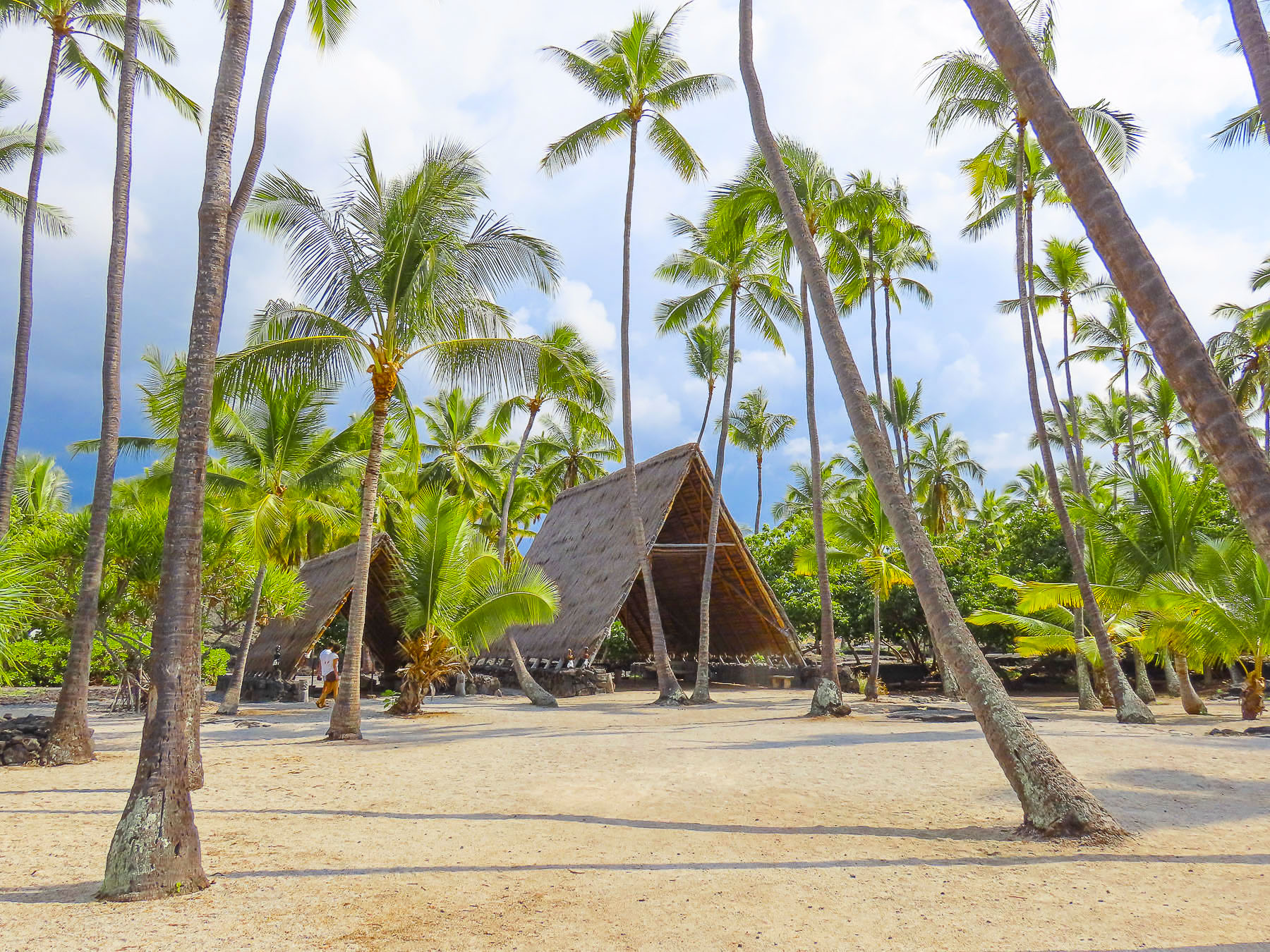
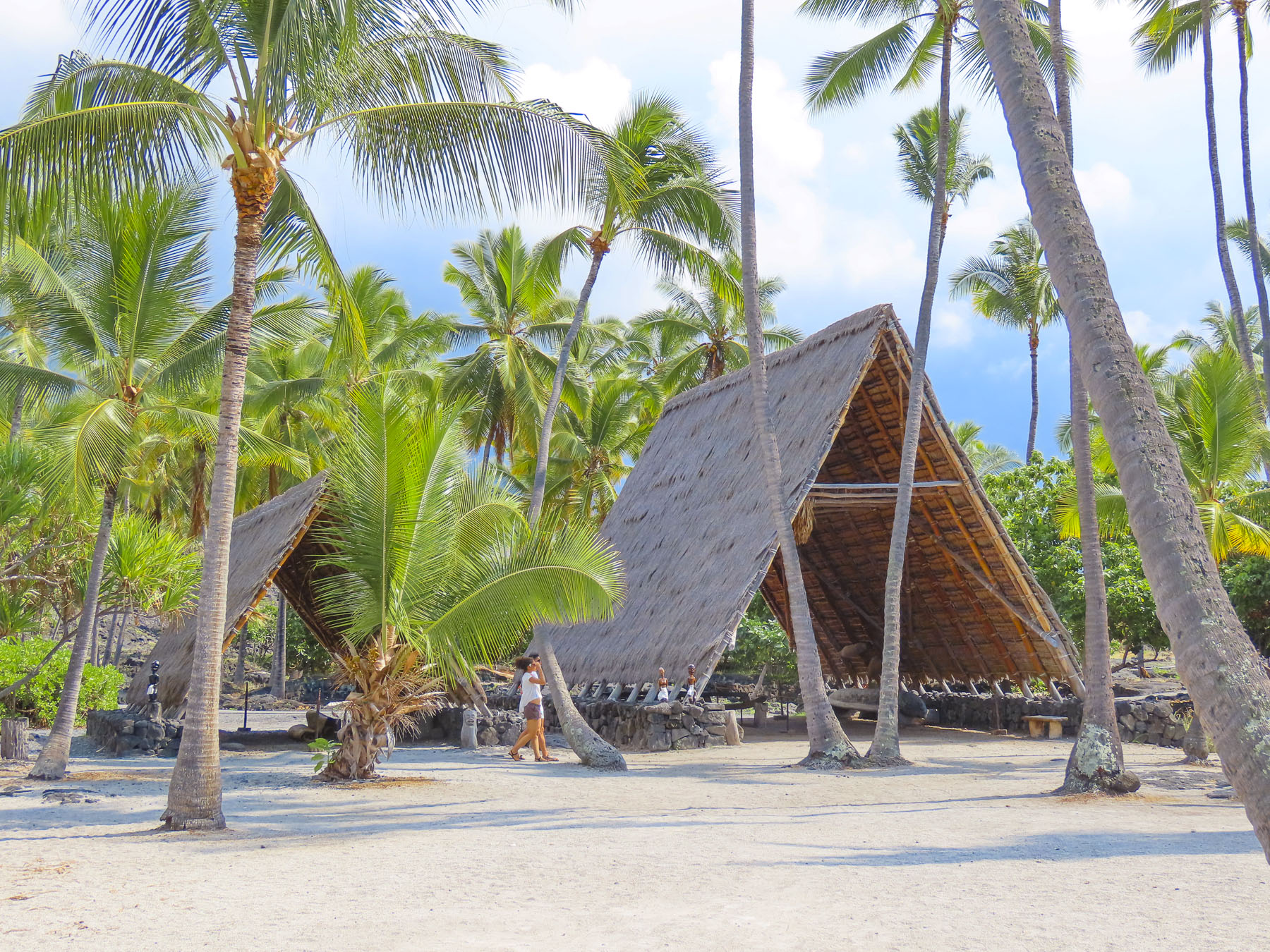
Continuing south we reached the Pu’uhonua O Honaunau National Historical Park, site of an ancient religious sanctuary. Few spots on the Big Island resemble paradise more than Pu’uhonua O Honaunau, with its brilliant white sandy beach lined with swaying palm trees, along a cove with clear blue water. For centuries before the Christianization of the island started with the first arrival of protestant missionaries in the 1820s, it was also known as the City of Refuge, where islanders who broke a kapu, an ancient law, could flee to safety to escape the death penalty their action incurred. Here an offender of the ancient ways would seek absolution from a high priest and be free to return to their village. Villagers and defeated warriors could also seek sanctuary here during periods of inter-chiefdom wars.

The most important structure on the site is Hale o Keawe, a stone and thatch royal mausoleum that contained the remains of 23 deified high chiefs. Around it, fierce looking tiki statues serve as guardians of the dead, and embody the spiritual power of the kapu.

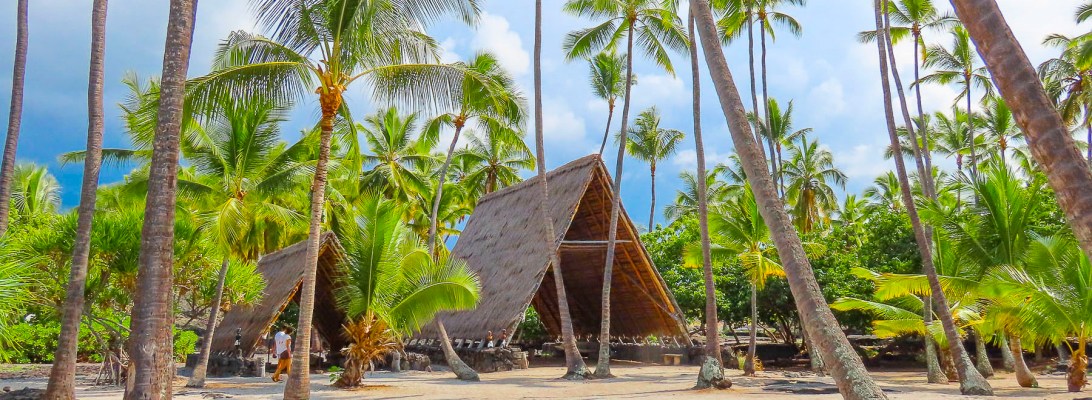
The site also has two Hawaiian hale houses, open sided bamboo and palm frond or pili grass covered structures. Multiple hale houses were built in a village for specific uses: men’s meeting house, cooking house, separate eating houses for men and women, workshop and canoe house, and a menstruation house.

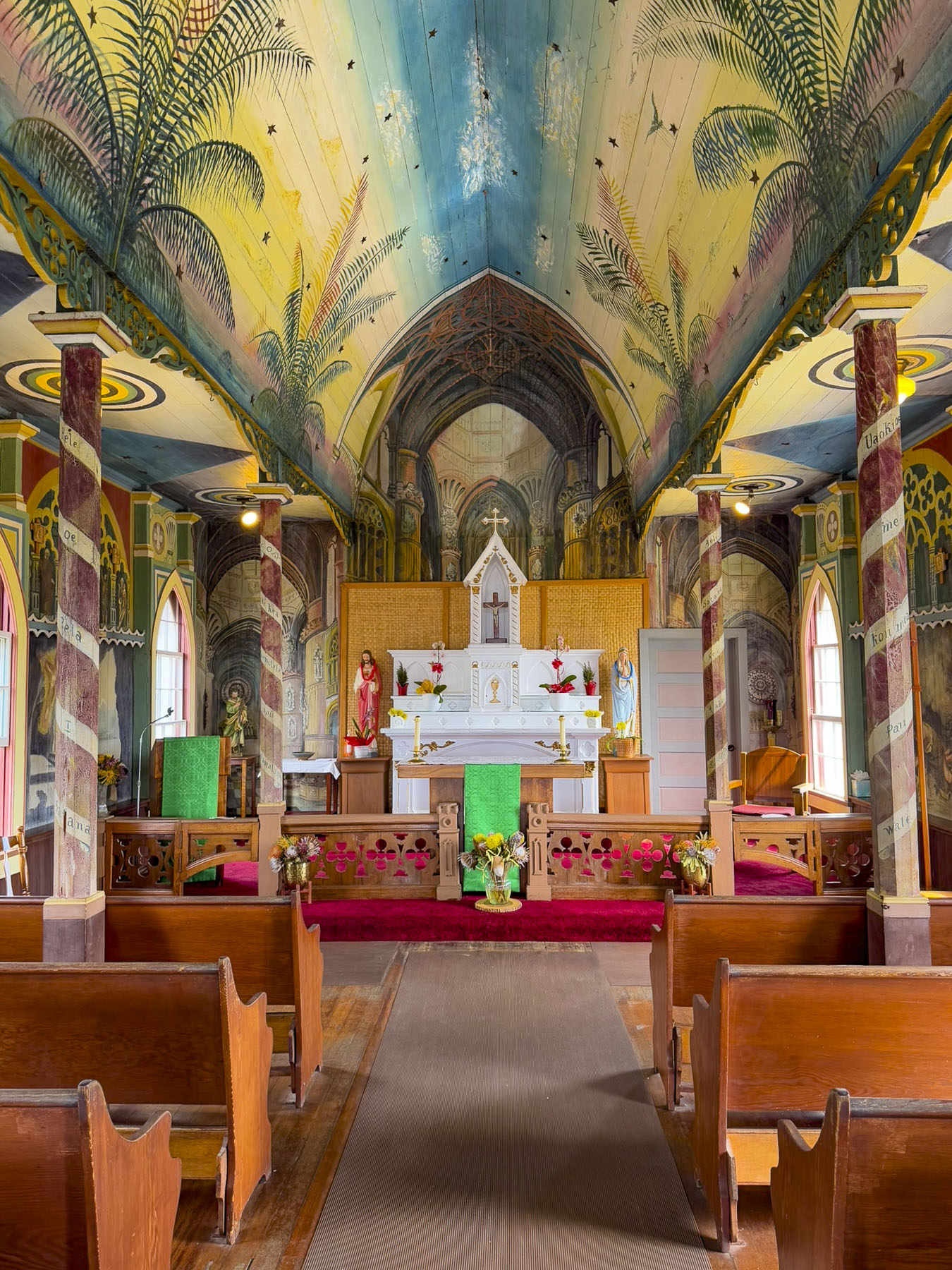
Uphill from Pu’uhonua O Honaunau we visited the Painted Church, aka St Benedict Catholic Church. It’s a simple wooden church that dates from the 1880’s, and easy enough to just drive by unless you know it has a spectacularly painted interior.

While it’s not Michelangelo’s Sistine Chapel, the message is the same with every surface of the interior illustrated with stories from the bible. It was all the work of one creative Belgian priest, Father Jean Berchmans Velghe. He painted these religious murals between 1899 – 1902 for his, largely illiterate congregation.

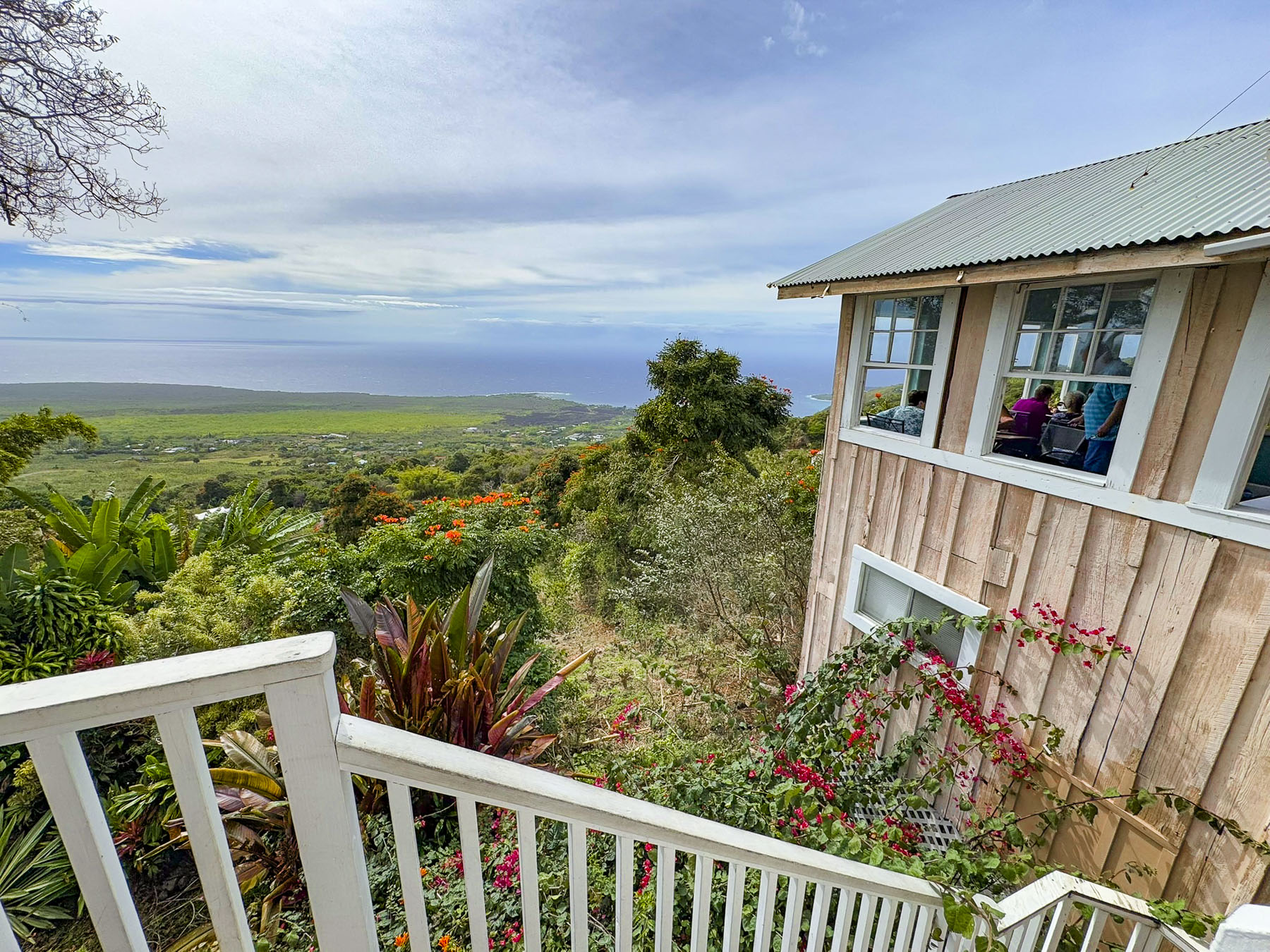
The Coffee Shack,  a laidback breakfast and lunch restaurant on Rt11 in Honaunau-Napoopoo, was recommended to us as a nice place to eat. Parking was a little difficult in their small lot, and the place doesn’t look like much from the outside, but inside they have a lanai, an open sided porch, with panoramic views over the hills leading down to the Kona coast and Kealakekua Bay. We had just gotten seated when the power went out, something that we were told happens quite frequently across the island, and the server informed us “the cook doesn’t open the refrigerator when this happens, so we only have pastries, and the coffee is still hot.” It wasn’t much of a sacrifice to content ourselves with coffee and luscious pastry.

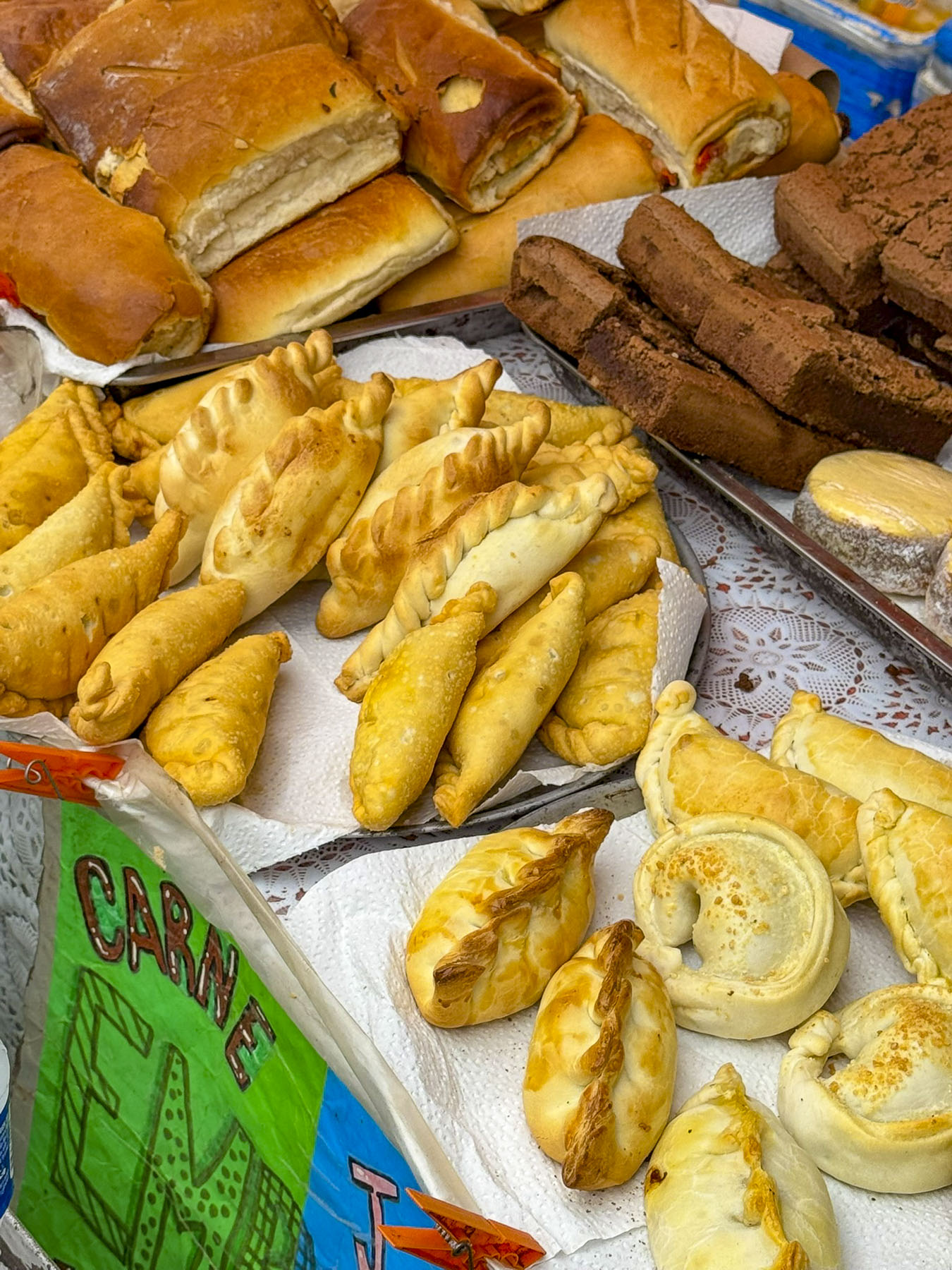
After a snack we optimistically continued south in search of an open restaurant, and we were not having much luck. Talk of mutiny was fomenting in the back seat. This whole southern coast lies in the shadow of the Mauna Loa volcano. Past the town of Ocean View the road crossed scars of ancient lava flows that stretched from the volcano’s summit to the sea. Fortunately, we came upon the El Encanto Food Truck, which had its own generator, and was busily serving a long line of hungry patrons at its window. Our lunches were delicious! The mutiny was postponed.

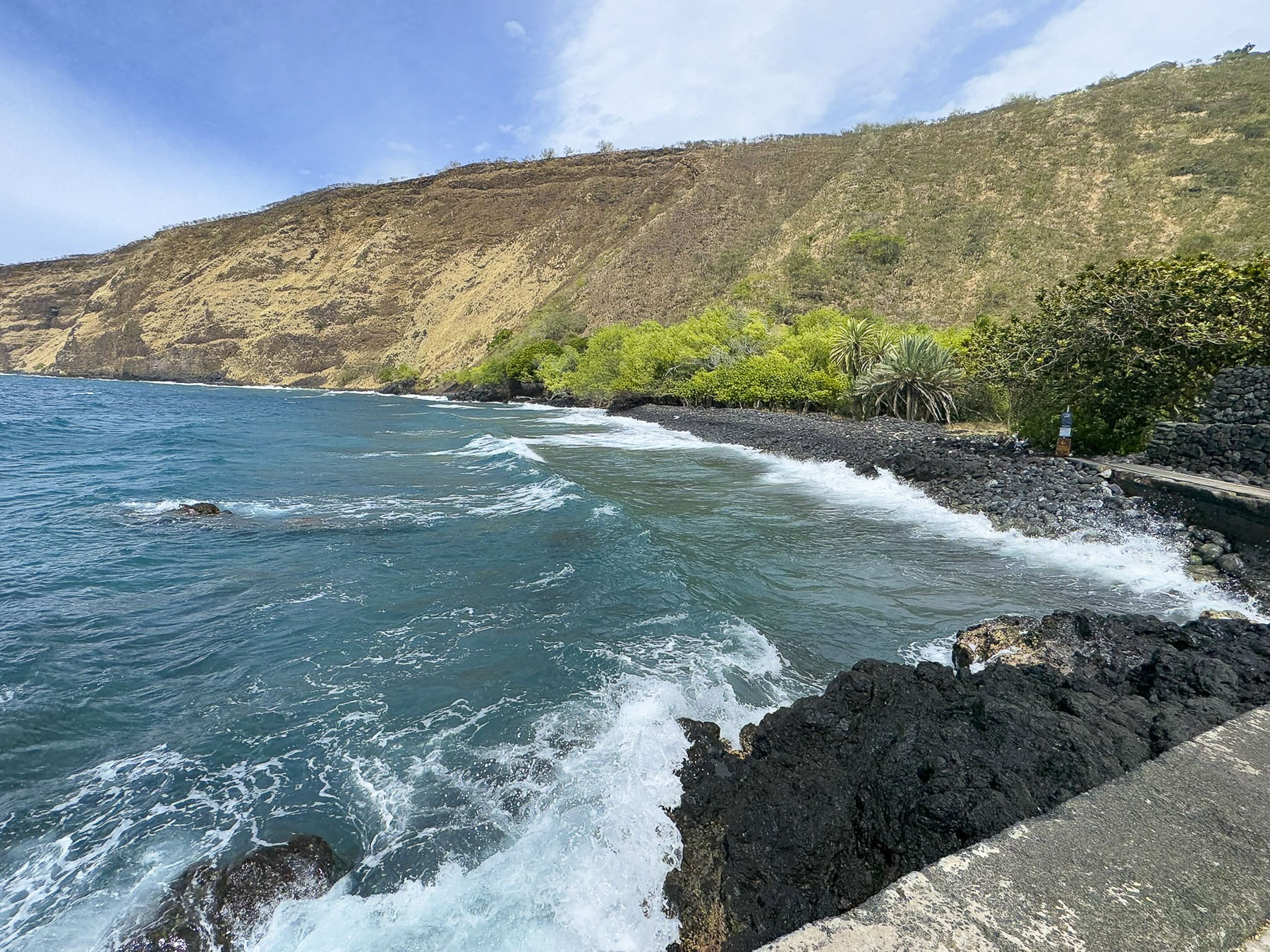
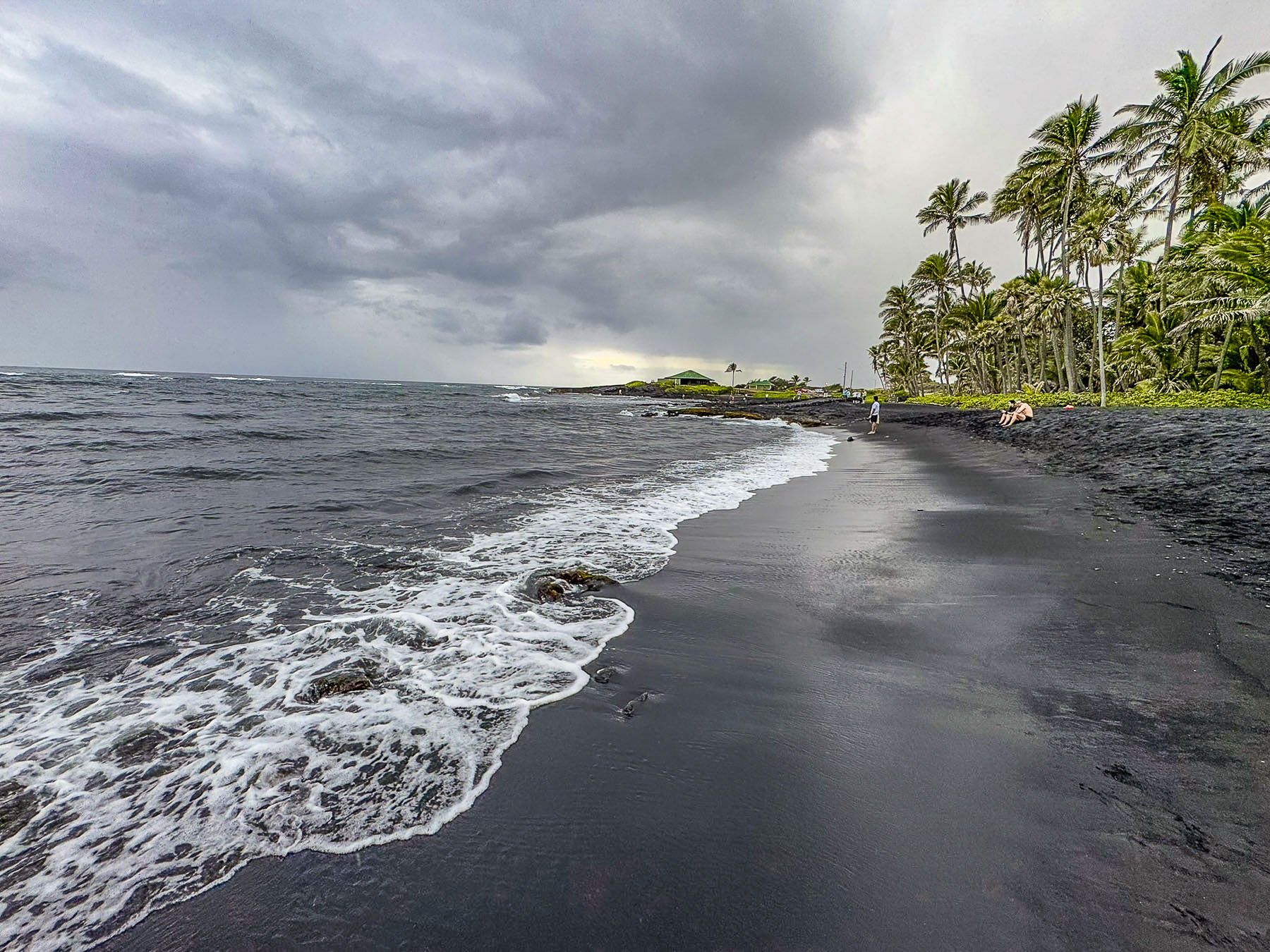
The power outage also affected gas stations along our route. With the afternoon sky darkening we decided to forego visiting South Point and continue on to Punaluʻu Beach. It’s a graceful crescent shape, and we are sure on a sunny day its volcanic black sand beach lined with coconut palms would be stunning, but this afternoon it looked foreboding with a gray sea sweeping its shore, more apropos for the scene of a novel’s fictional shipwreck, than a place to sunbath.

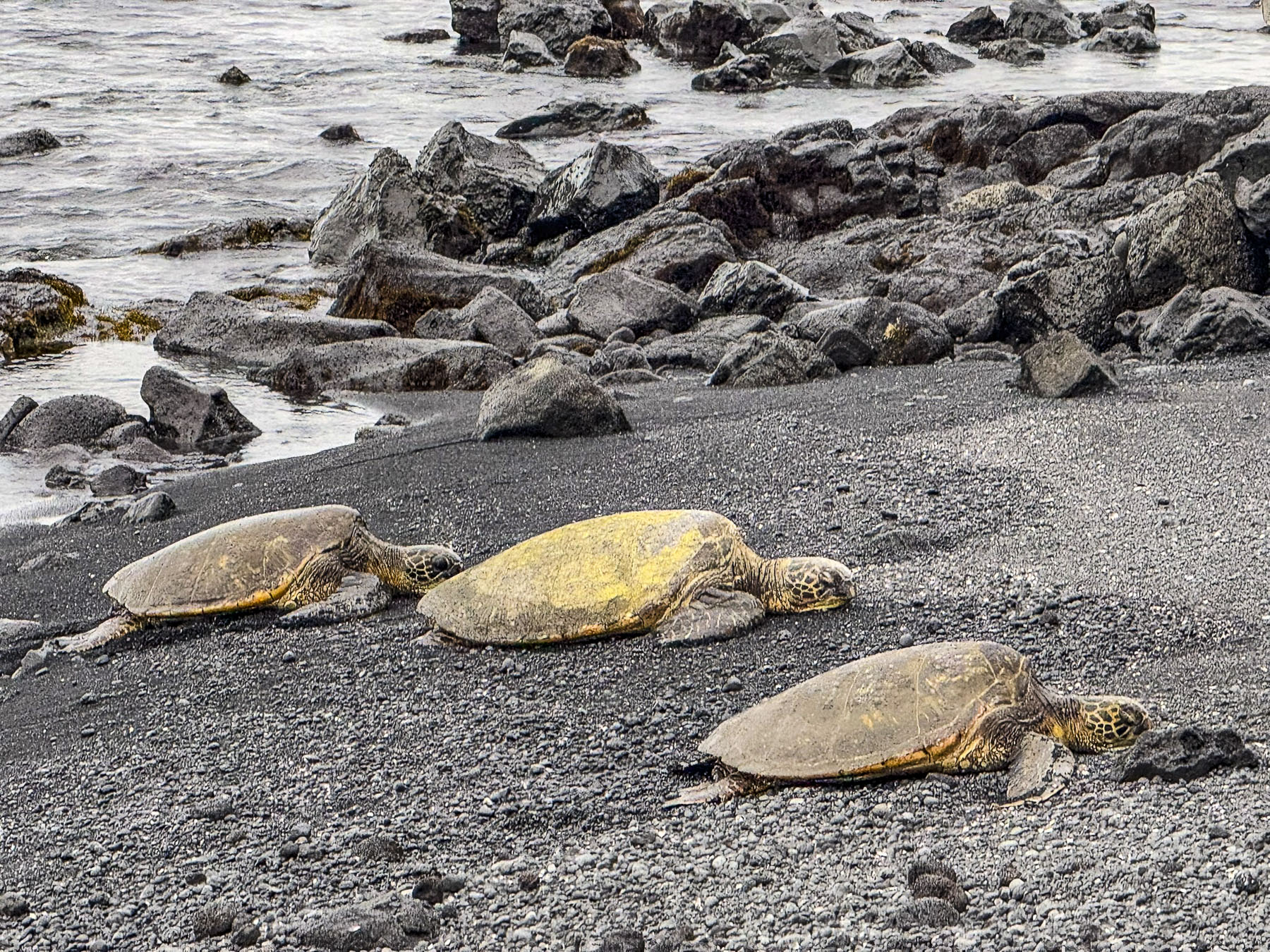
Rain was threatening now, but as we walked back to the car, Donna was waving excitedly to us. On the beach were three large green sea turtles in a roped off nesting area. Native to the Hawaiian archipelago, they are the largest sea turtle that nests on the islands and are symbols of good luck, wisdom, and protection. It was such a pleasure to see them.

The Hawaiian legend of Kauila, tells of a mystical turtle born on the black sands of Punalu’u, who had the ability to shapeshift into a human to play with the islander’s children that came to the beach, and to protect them from the dangers of the ocean. Heavier rain sent us hurrying back to the car. It was a long but rewarding day; we agreed that the spotting of the turtles was a real highlight of the trip.

Our pursuit of waterfalls continued the next day. Recrossing the mountains during the day cast a new light on the arid windswept heights as we ascended the road under snowcapped Mauna Kea then descended towards Hilo and into verdant greenery of the eastern side of the Big Island. It was a contrast equivalent to night and day, like our two drives across the island.

Roaring from all the recent rain, Wai’ale Falls was easily seen from the bridge over the Wailuku River. There’s not any official parking, so folks just park along the side of the road and walk out onto the bridge. There is also a rough trail, through thick undergrowth, up and over the road embankment that leads to the upper falls. We followed the footpath for a while until it narrowed along the edge of a fall-off, and we decided to turn back. Though some younger, more adventurous folks had reached the top of the 17m (55ft) high falls and were fearlessly jumping into the pool below.

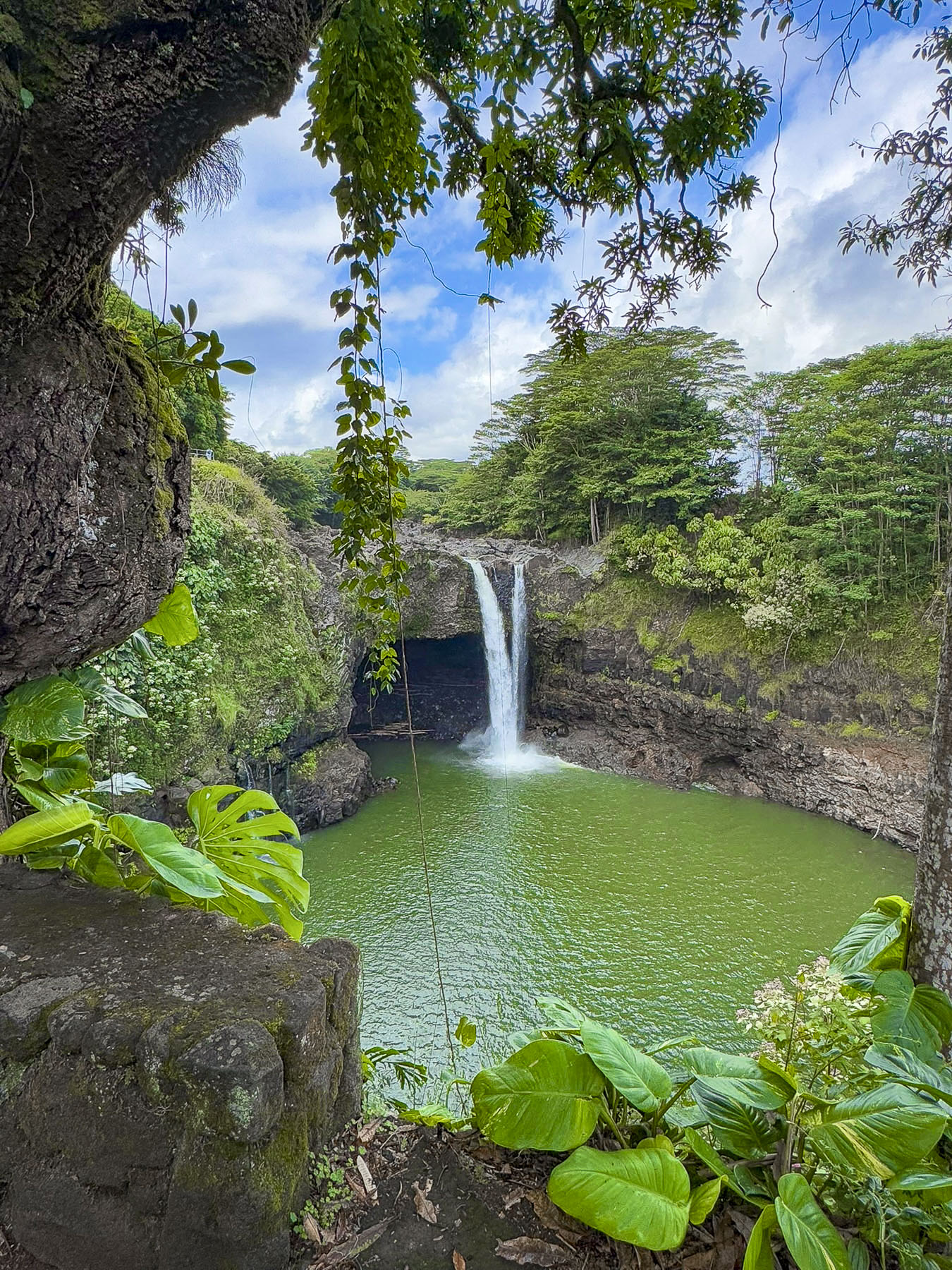
Downriver, Rainbow Falls, in Wailuku River State Park, was a short drive away. It’s known for, you guessed it, rainbows that frequently appear when the light is just right. The riverside park is quite pretty and has paved trails that overlook the falls where the river’s cascading water veils a shallow cave as it drops 24m (80ft) into a large stone basin created over the ages by erosion. “Legends say that the cave beneath the waterfall was the home of Hina, mother of the Hawaiian demigod, Maui.”

Our next “drive a little then café,” moment was satisfied at Coffee Girl, a cute café in a Hilo strip mall, on the way to Makuʻu Point.

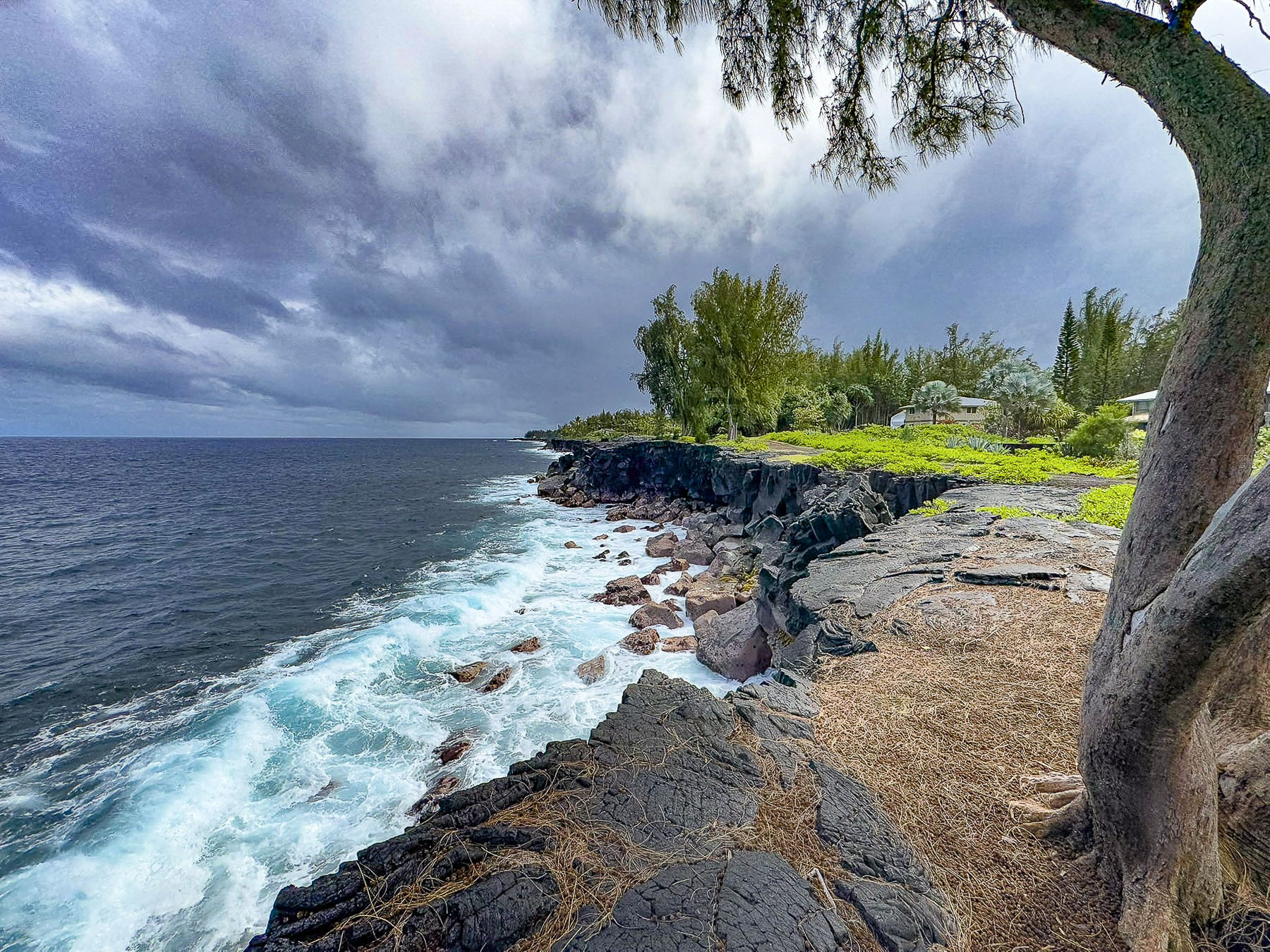
Turbulent seas churned from storms blowing across the Pacific along with volcanic activity have prevented the creation of beaches on eastern coast of the Big Island. Dramatic volcanic cliffs and lava outcroppings line the windward coastline instead.

The next morning, we set out to find more ancient stone inscriptions at the Puakō Petroglyph Park, in nearby Waimea. The trail started in Holoholokai Beach Park, where there is a unique beach of black lava rocks mixed with white coral, and soon led to a gathering of petroglyphs.

The symbols were quite interesting, but it was obvious that the carvings were reproductions of ones that the trail led to. We followed what started out as a well-worn trail through a primeval forest full of twisted trees, until the trail seemed to vanish. It was a hot day, and we were concerned about getting lost, so we backtracked and turned our attention to discovering some of the smaller beaches near the resort.

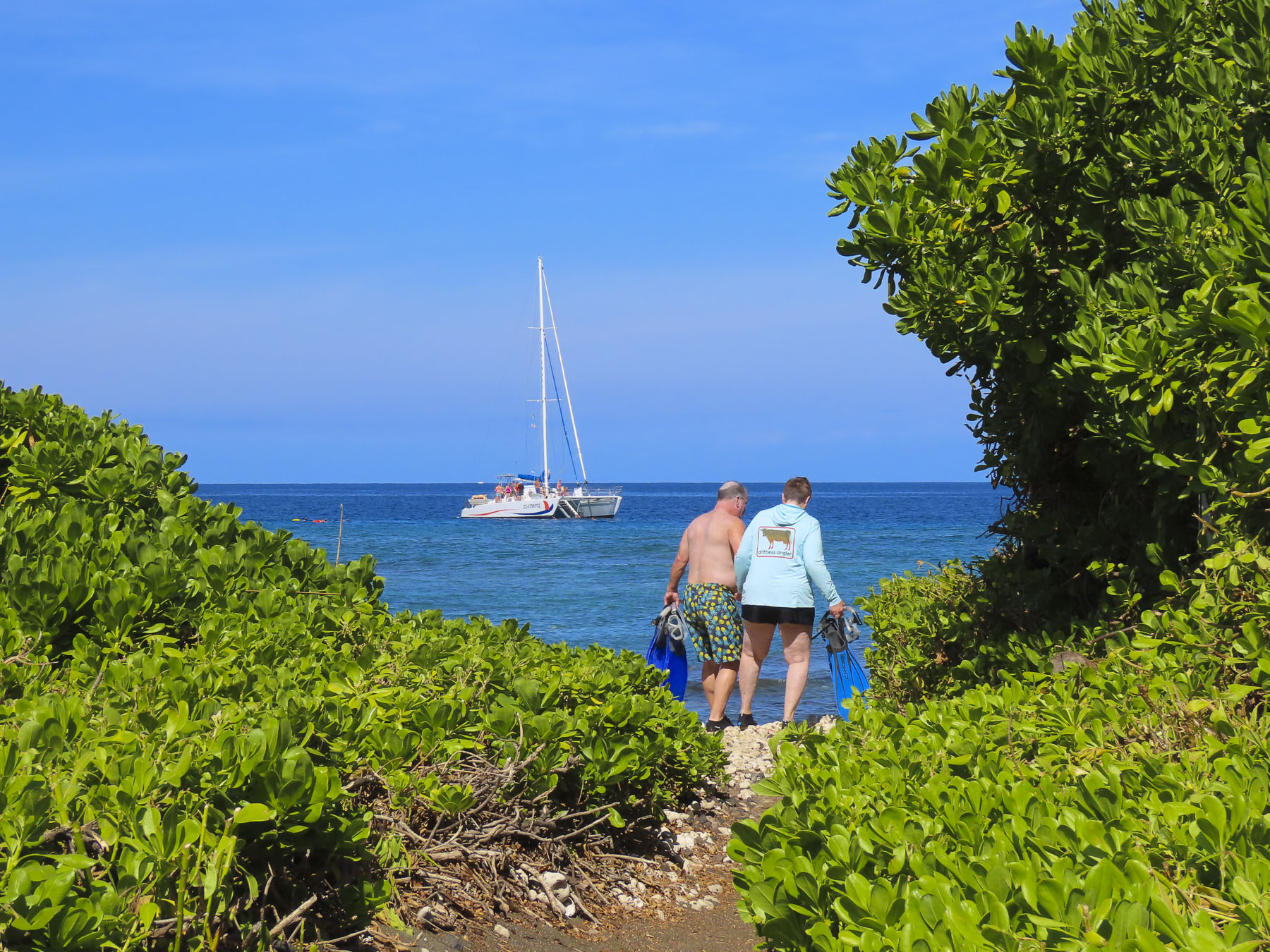
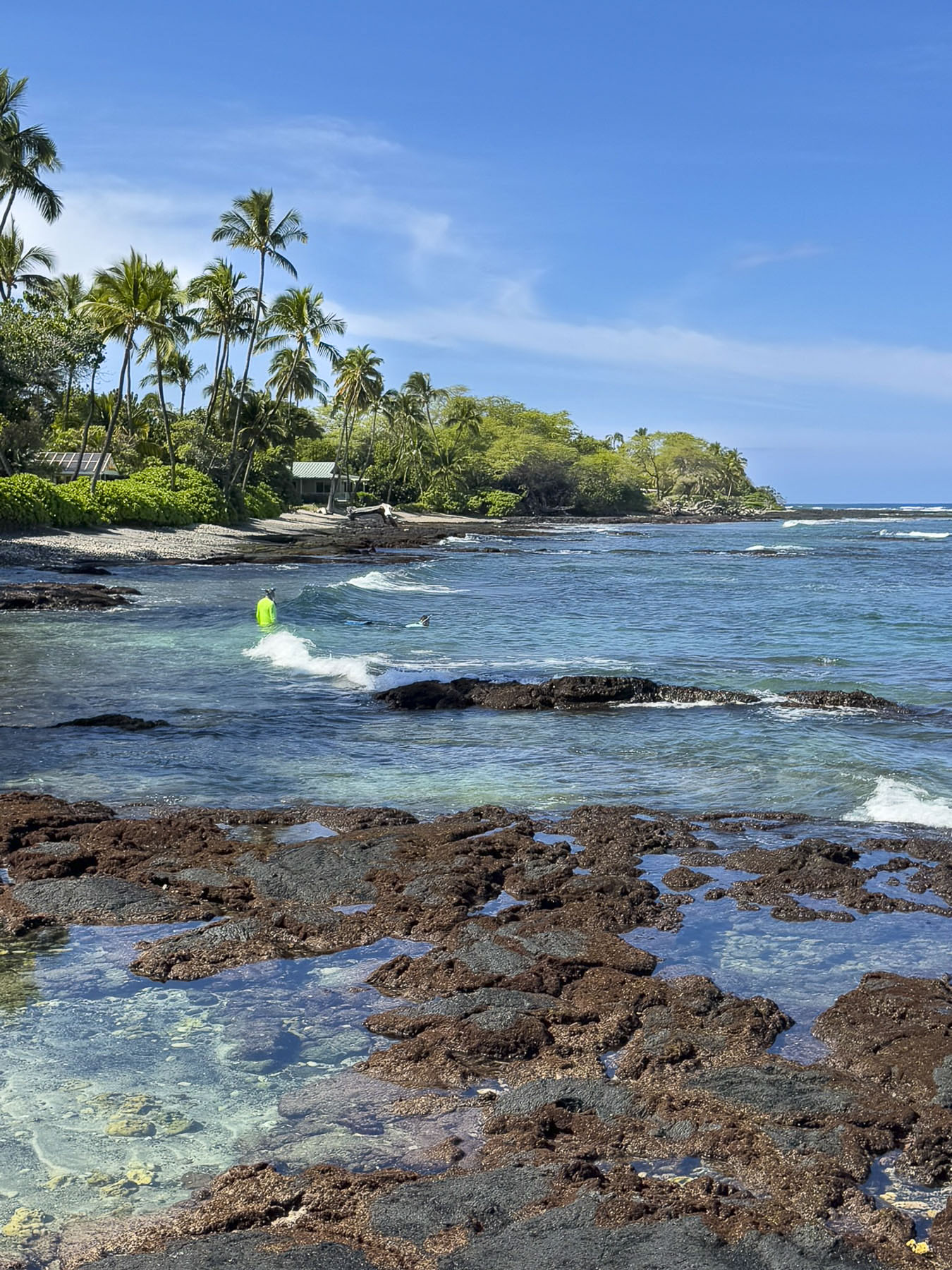
Puako Bay is a few minutes south of Hapuna Beach, the island’s largest stretch of sand, which we had visited earlier in the week. It’s a tranquil bay with many public access trails from the road to small sandy beaches, and rocky coves, that folks like to snorkel in.

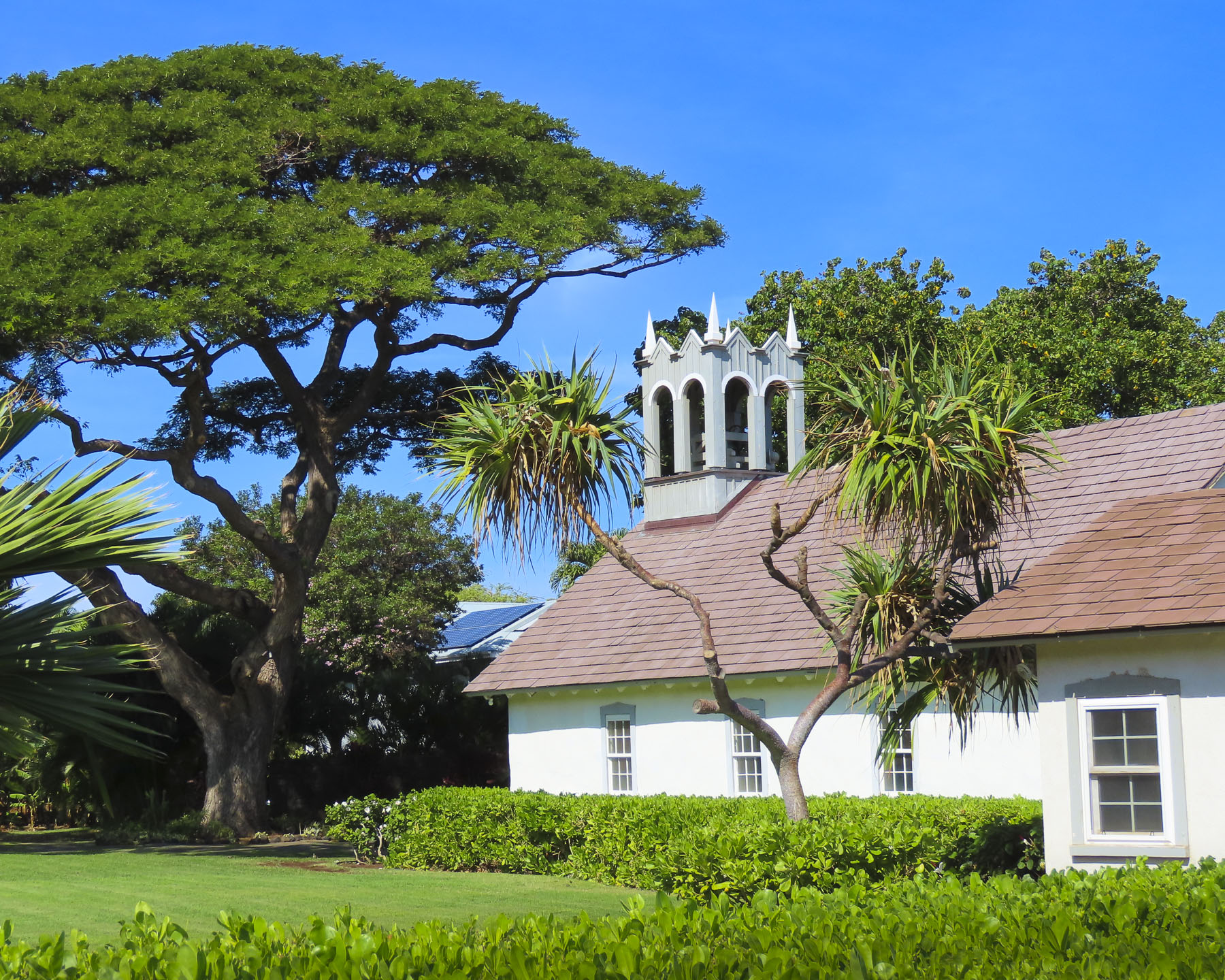
There was a small beach next the Hokuloa Church that offered a nice view of the bay with Mauna Kea in the distance. The church was built with lava rock and then whitewashed in the late 1850s.

Kikaua Point Park was south of our resort and access to it was, surprisingly, through a gated community. Where folks are allowed access to the beach after getting a parking permit from the security guard. A long concrete walkway led from the parking lot through a boulder strewn lava field to a lovely palm treed beach. Folks were enjoying the breeze in the shade of the trees and swimming in the warm water of an almost completely circular and shallow sandy bottom cove. It was the perfect spot to spread our towels out and go for a swim.

We only scratched the surface of this big, beautiful island. And if we ever return we would definitely go to see the array of telescopes at the observatory atop Mauna Kea. The cost of living is very high on the island, with even locally caught fish, fruit and vegetables being expenses. Folks always say eat at the food trucks; while less expensive, their prices are steep too. So, if we ever return to the island – Donna furrows her eyebrows when I say this – we are packing snacks, several bottles of wine, a jar of spaghetti sauce and pasta, along with a couple of frozen steaks that should be perfectly thawed by the time our flight lands.

Till next time,

Craig & Donna
Driving Through the Baltics: Part 11 – Lake Peipus or Old Believers, Onions, and Honey

Gently undulating farmlands soon flanked the road as we departed Tartu for a day trip to the Old Believers villages that dot the southern shoreline of Lake Peipus, Estonia’s largest lake which creates part of the country’s border with Russia. The villages are also part of the Onion Route, a 30km (19mi) tourist drive that promotes the area’s culture and “Estonia’s most celebrated onions, the Peipsi sibul, a golden variety known for their long storage life and flavor,” which the Old Believers have cultivated in the sandy soil of the region for several centuries.

The group’s name stems from a schism with the Russian Orthodox Church in the 17th century, in which they did not abide with the reforms Orthodox clergy patriarchates were initiating, and wow, wow, wow regarded the reforms which curled the beards of its elders, “as a corruption of their faith which was heralding the End of Days, and as such the Russian church and state were servants of the Antichrist.” Their dissent wasn’t allowed, and during The Russian Orthodox Synod of 1666-1667 the church and Tsar Alexis sanctioned their persecution. The group’s oppression was so severe that some ardent followers self-immolated in the ultimate act of protest. Thousands of Old Believers chose to escape their persecution and fled across Lake Peipus for refuge, and established a series of farming and fishing communities, in then Swedish-controlled Estonia, in which they prided themselves on their self-sufficiency.

We passed more farm tractors than cars that morning, but it was still a surprise when a large John Deere tractor pulled up alongside us in the gas station to refuel. Varnja is the southernmost village and the gateway to outdoor activities in the Peipsiveere Nature Reserve, which protects the fish and wildlife of the Emajõgi delta.

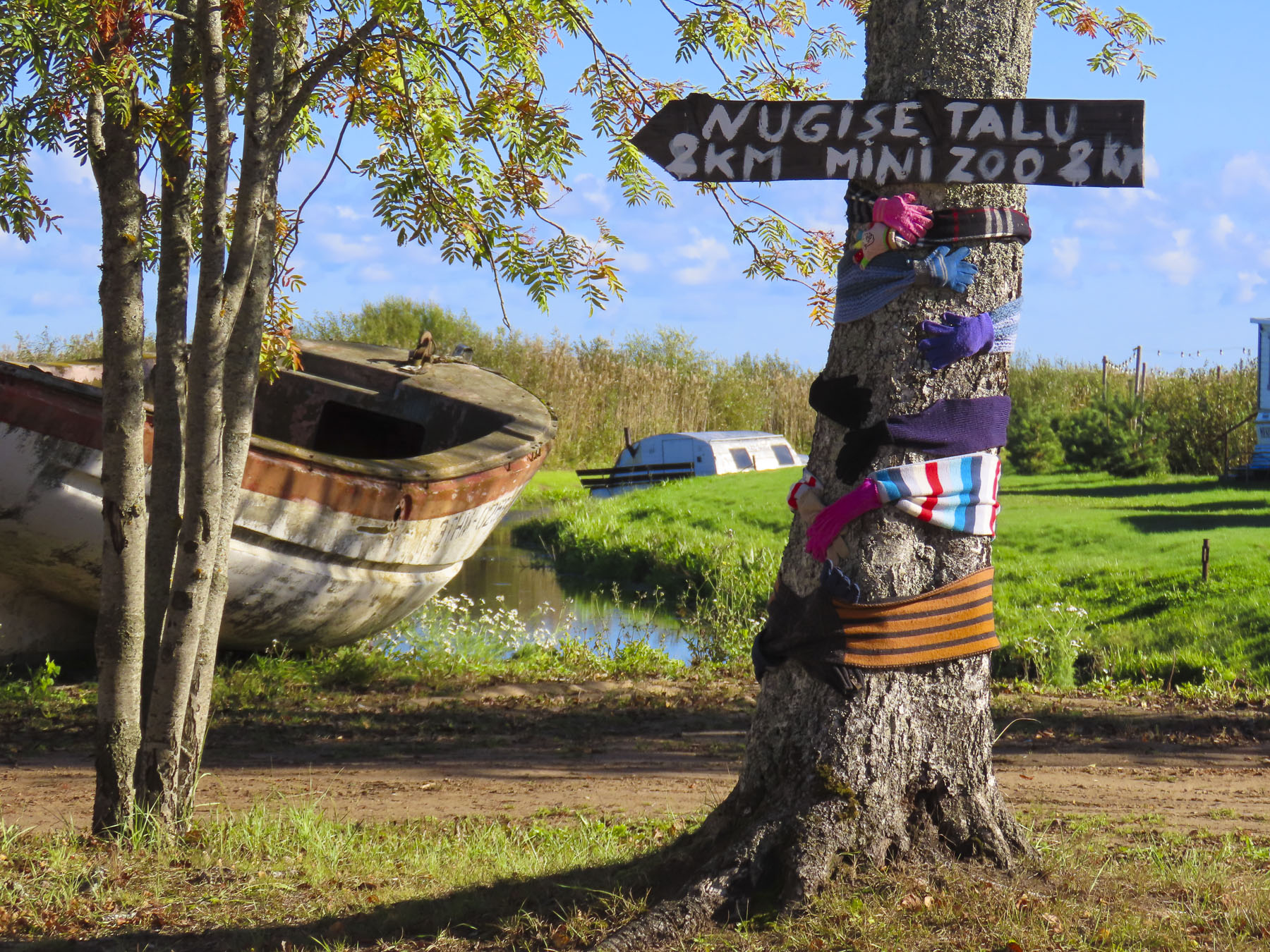
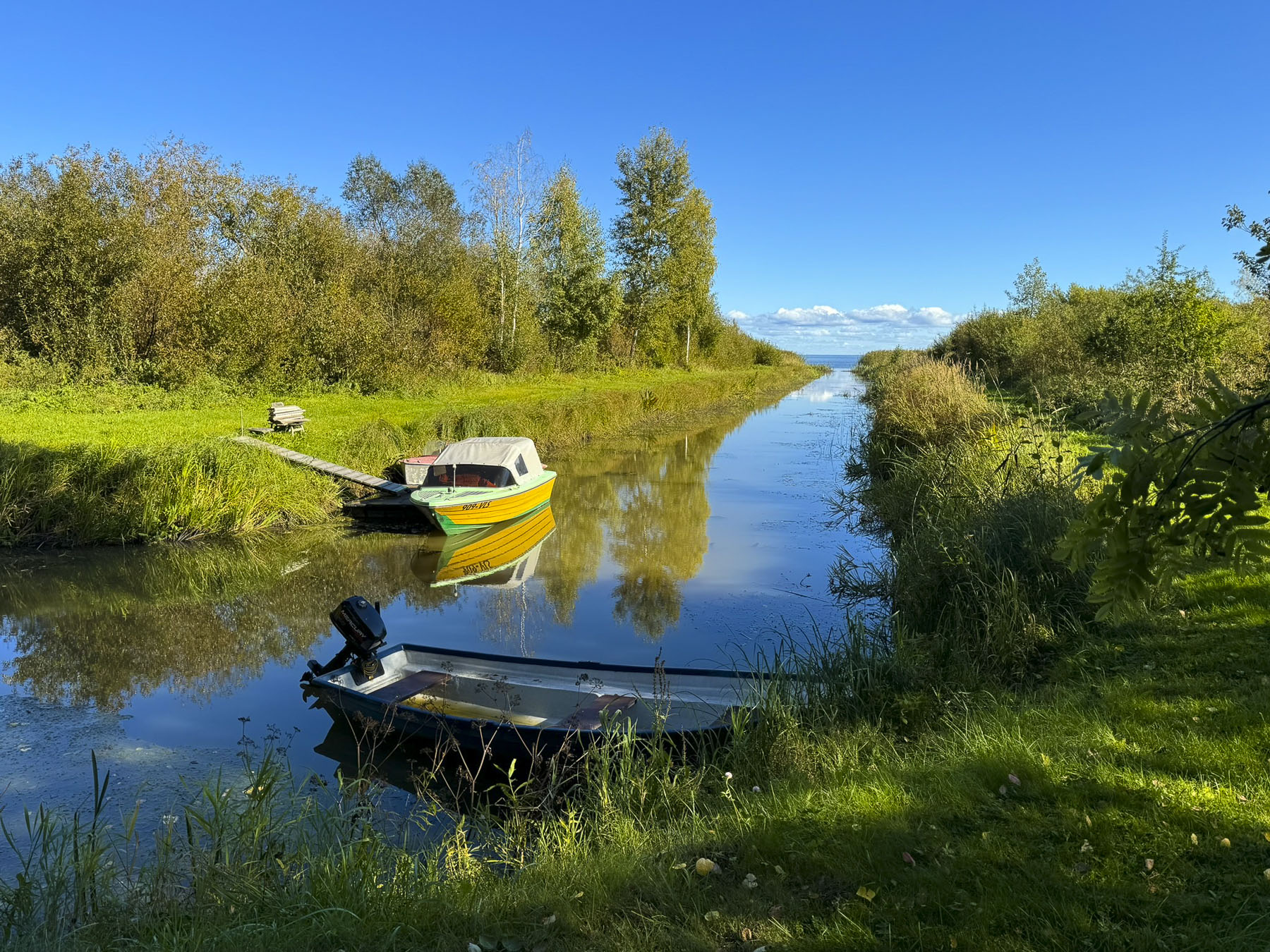
It’s a beautiful area, and was nearly deserted mid-week at the beginning of October. Fishing was once a viable livelihood, but only a few boats go out nowadays. Instead, some folks have converted them into niche rentals, like the owners of Mesi Tare who have creatively repurposed several small boats into maritime bungalows, both floating and permanently beached.

There wasn’t a soul about in the village, only an idle tractor in front of a barn with bundles of onions hanging from its rafters, or a plume of smoke from a chimney, and the lone dog sunning obliviously in the middle of the lane. Winter preparations were underway with large free-standing globe shaped piles of freshly split wood stacked along the lane or piled in cords neatly along the sides of houses.

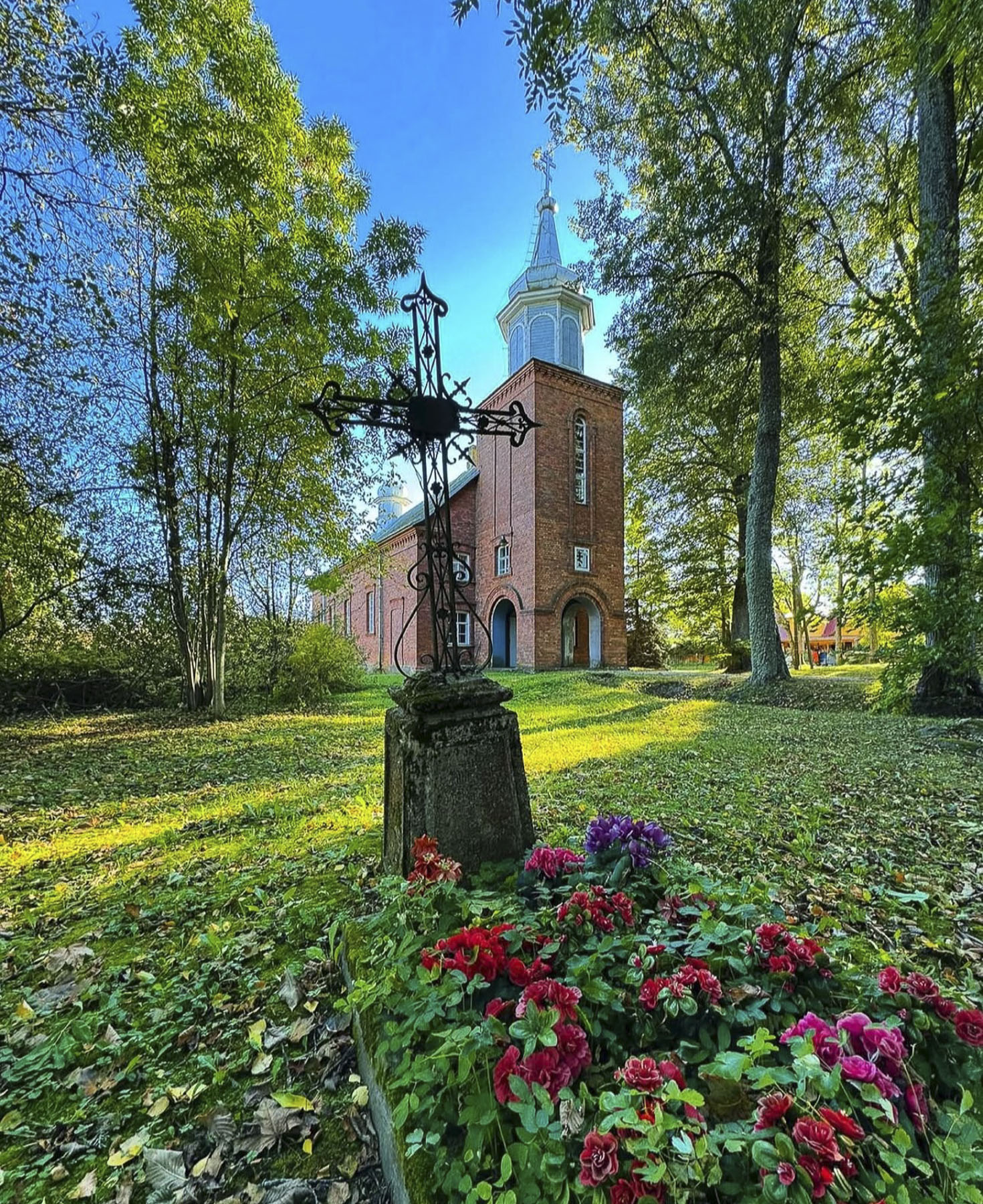
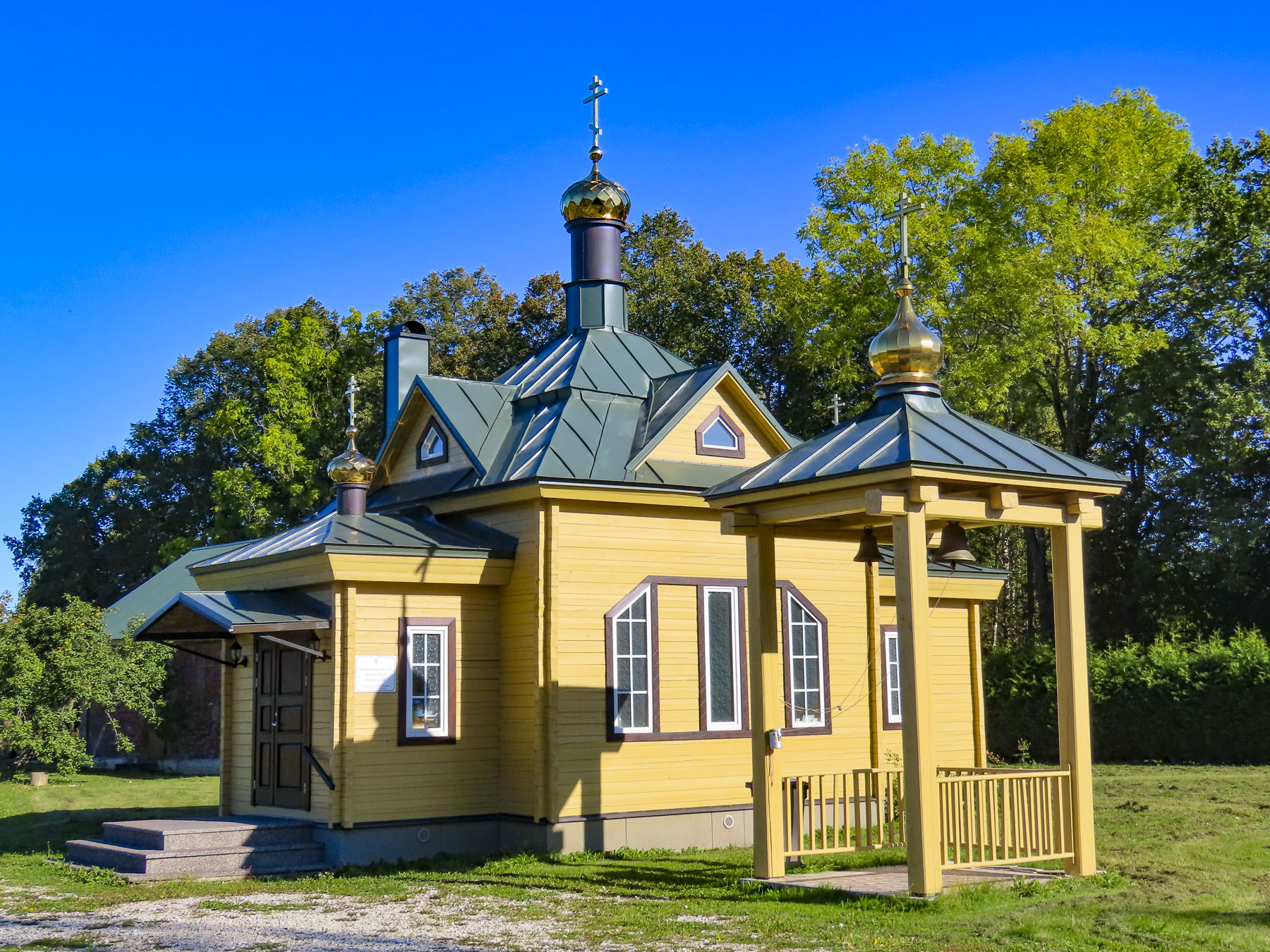
As we left the hamlet and headed north on Kesk Tn, the main road connecting all the settlements along the lake, we stopped at Varnja’s Old Believers Prayer House, a red brick structure built between 1928 and 1930, and the nearby Issanda Templisseviimise, the town’s youngest Old Believers chapel constructed in 2015.

As we headed farther north, long narrow inlets, like the fingers on our hands, stretched from the roadside into the lake. Baskets, bowls and buckets of apples were in front of homes with backyard orchards that had what is commonly called in Estonia, “the apple flood.” This abundance is shared with the community, and the apples are free. It’s a long-standing tradition that reflects a spirit of sharing and generosity within Estonian culture. Occasionally, an abandoned stork’s nest crowned a telephone pole along the road, their yearly winter migration to southern Africa had already started in August.

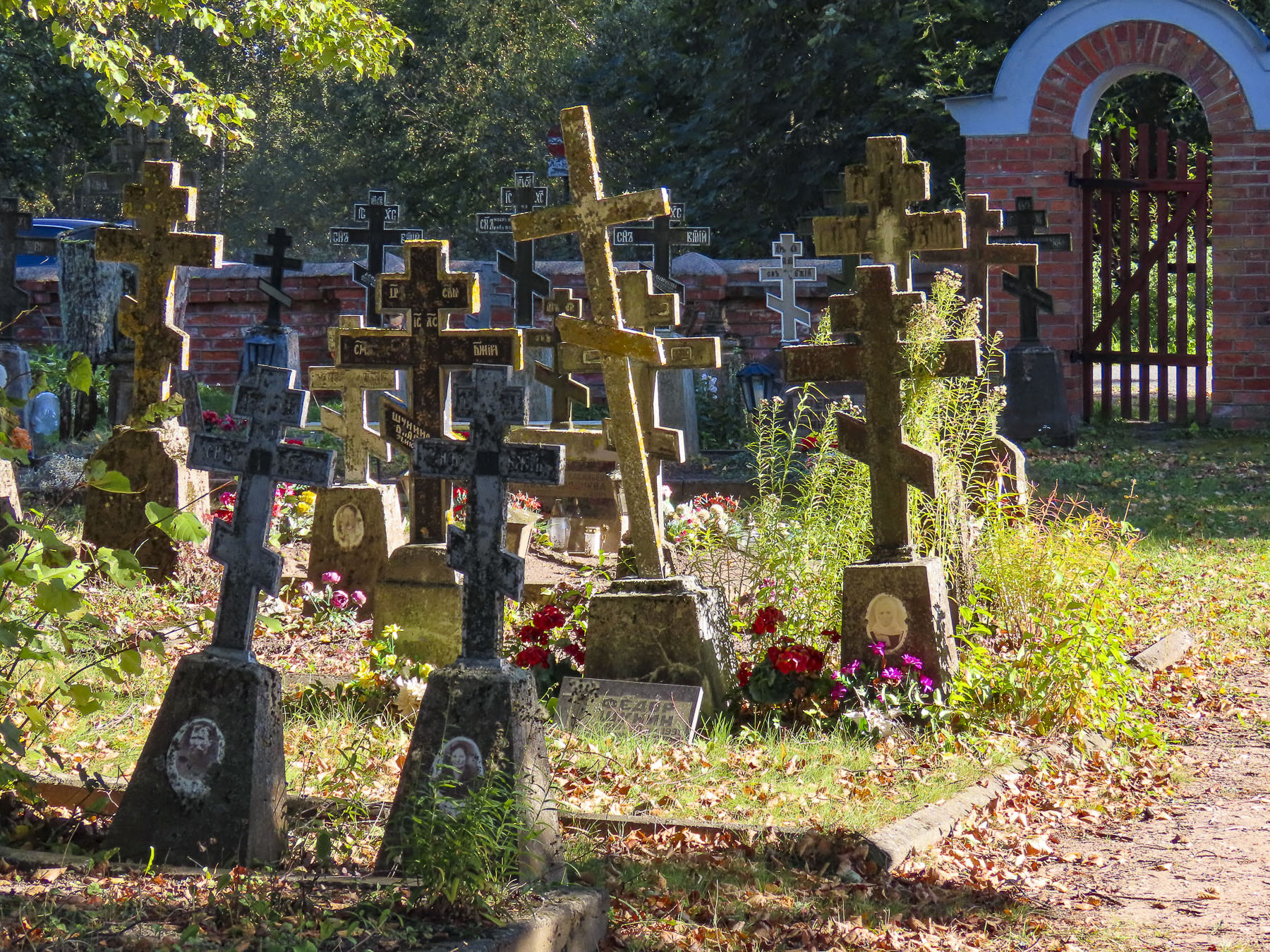
We turned off the main road at every sign that pointed to the way to a kirk, church. The Kasepää Old Believers Church and Cemetery were particularly interesting.  The current 1862 sanctuary sits atop the foundation of a building that is thought to be the site of one of the group’s earliest churches after their exodus from Russia. Graves in the cemetery were marked with the traditional three horizontal-bar Orthodox cross. The configuration dates from the 6th century in which the Top Bar represents the inscription ordered by Pontius Pilate, The Middle Bar, the main beam where Christ’s hands were nailed, and Bottom Slanted Bar symbolizes the footrest and its slant reflects the fate of the two thieves crucified alongside Jesus – upward towards the repentant thief (St. Dismas) and downward towards the unrepentant one.

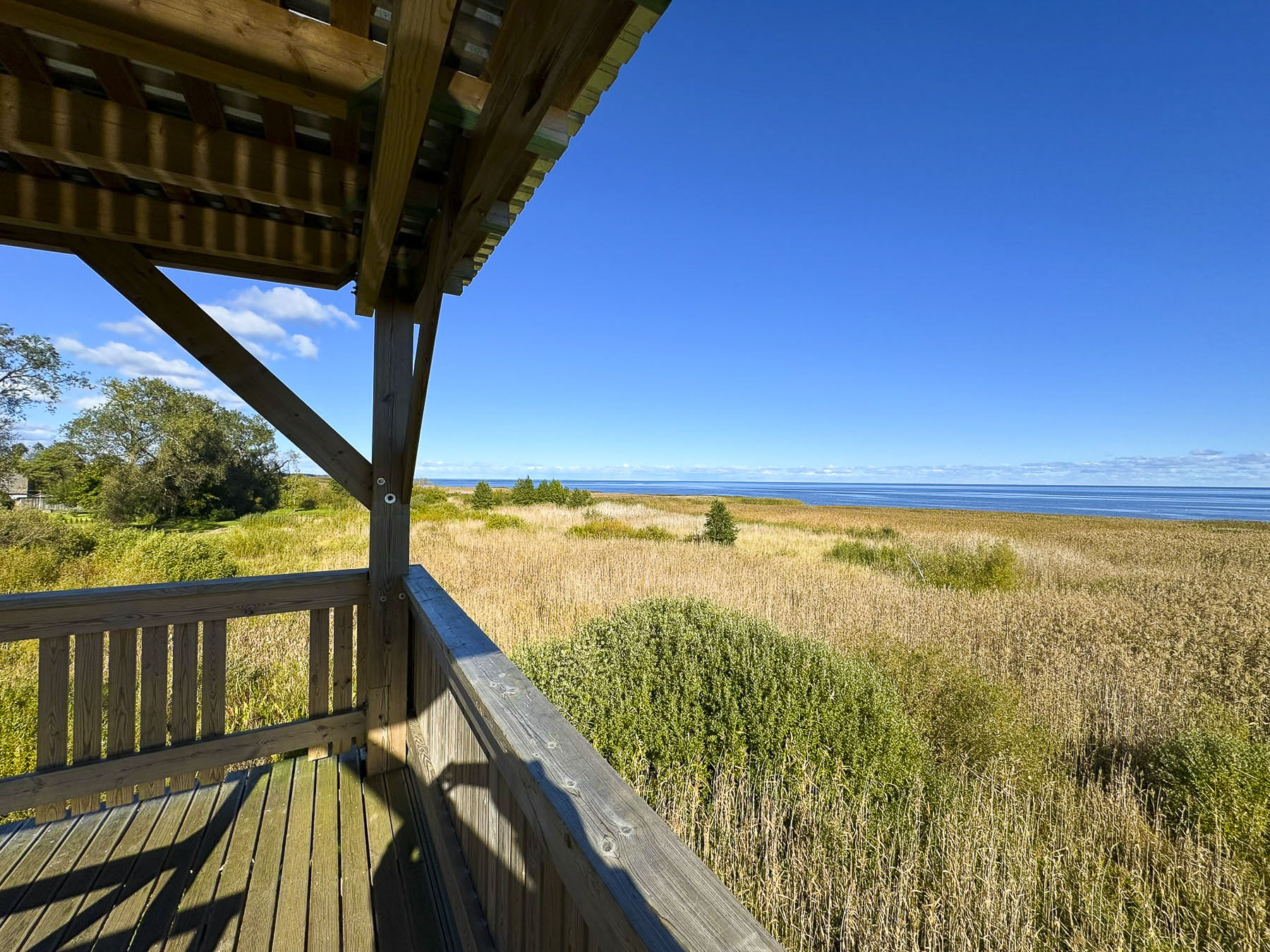
In Kolkja, a village first mentioned in historical records of 1592, we climbed the Vaatetorn bird-watching tower for an expansive view across the marshes and 3,555km2 (1,373 sq mi) Lake Peipus. The 219km (136mi) long lake has an average width of 82km (51mi), and is surprisingly very shallow, with an average depth of 7m (23ft). At its northern end the lake feeds into the Narva River between the Estonian border city of Narva and the Russian city of Ivangorod into the Gulf of Finland. Ice fishing is a popular winter activity on the lake which typically stays frozen from November to March. Small ice flows remain on the northern part of the lake until early May. Though with the recent climate change folks living along Lake Peipus have noticed a shortening of the ice season.

Afterwards, we stopped at Suur-Kolkja Vanausuliste Palvemaja, an Old Believers house of worship that was constructed in 1883, and its cemetery which was down the lane.

As we left the village an enterprising older woman, with a babushka covering her head, was unloading bags of onions, loaves of bread, and jars of jam from the trunk of a taxi and arranging them on a foldable card table she had already set up along the road. We had assumed the area was nearly deserted, but maybe there was an end-of-day rush hour as people returned home from work.

Although several museums, cafes and restaurants were shown on Google Maps, they were only open on the weekends during shoulder season. Our search for coffee took us to the larger town of Alatskivi, where we were able to satisfy our “drive a little, then café,” philosophy with a good lunch at Kivi kõrts, a bright eclectically decorated tavern, including a restroom decorated in a quirky theme.

We drove farther to Kallaste, a still larger village on the shore of Lake Peipus, but were discouraged from investigating the town in depth by the number of roadwork closures that hindered our travel.

On our return route to Tartu we passed through Alatskivi again and purchased honey from an automated vending machine near beehives in front of a local beekeeper’s home. We enjoy the simplest of things and found this combination of ancient practice and modern technology delightful. The machine even accepted credit cards.

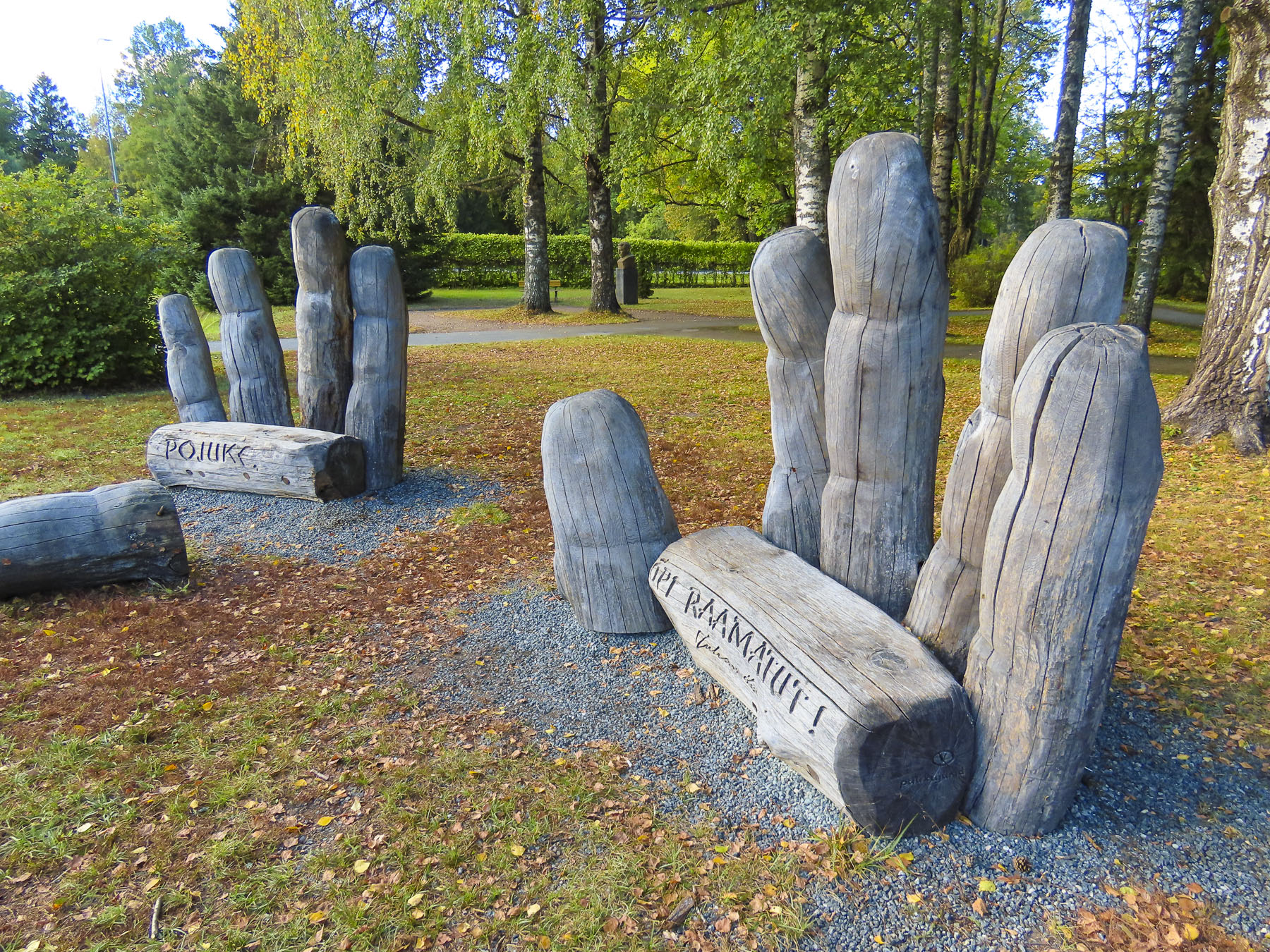
At the roundabout in town, we circled twice to figure out how to reach the town’s library, which had a large wooden sculpture of two hands, with fingers carved from tree trunks, protruding from the ground in front of the building.

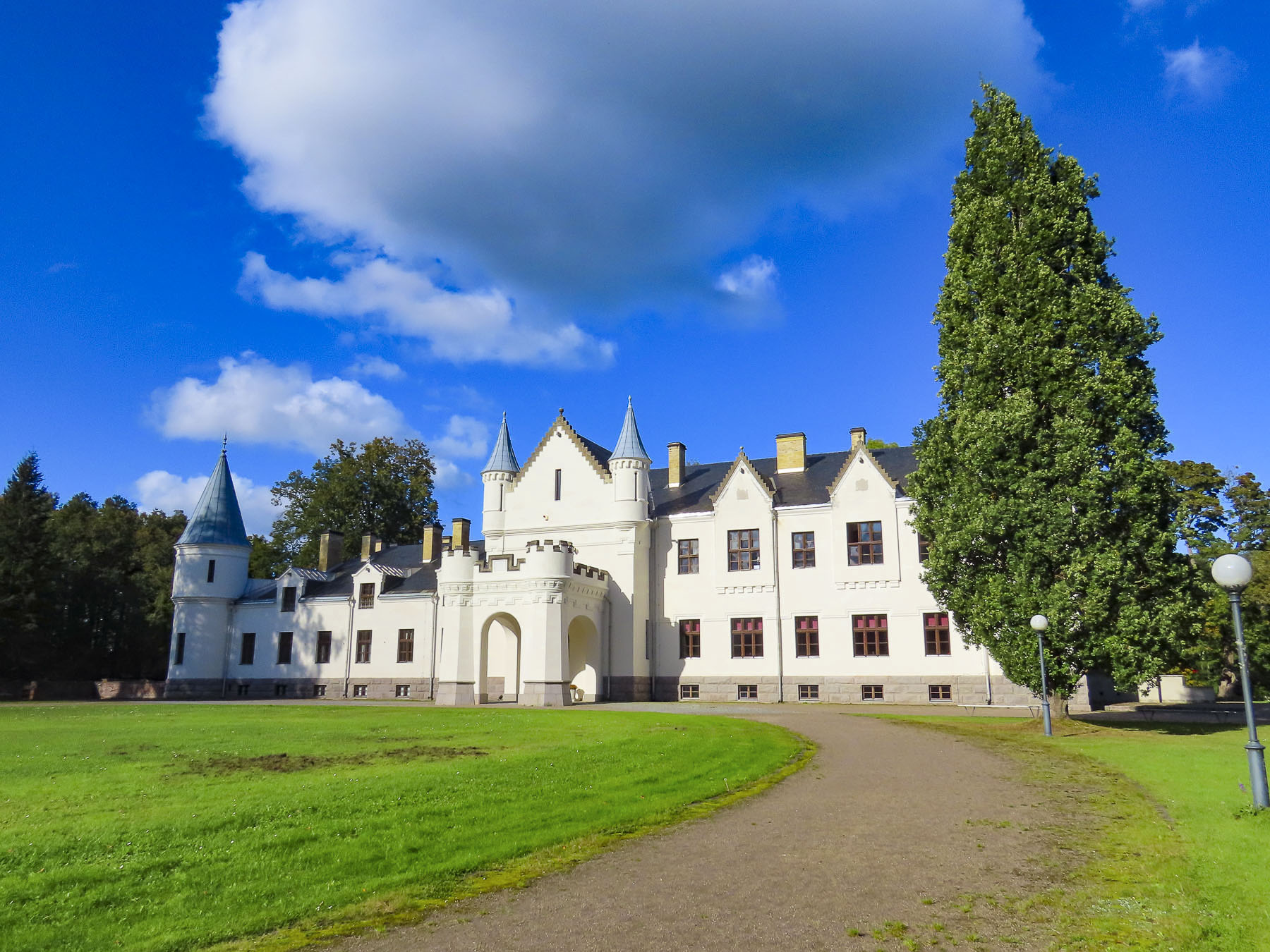
Earlier, the server at the tavern suggested we visit Alatskivi Castle,an old Baltic German feudal estate with vast land holdings, that was first mentioned in the historical records of the early 1600s. In 1885 Baron Arved von Nolcken, a widely traveled aristocrat, purchased the estate and reconstructed the old manor house in a Scottish baronial style, that is said to closely resemble Balmoral Castle, which he had recently visited. The von Nolcken family lived in the manor house for twenty years before they left for Germany with all their possessions, including the manor’s silk wallpaper, at the beginning of the Estonian Peasant Revolution in 1905. During the Soviet occupation of Estonia the lands of the estate were a state-controlled collective farm, and the castle was used as school, cinema, and library. Today, after extensive renovations the manor features a fine-dining restaurantand 4 suites available for booking directly through the castle, along with offering  a ceramic studio and workshop in the cellar. There is also a wax museum featuring figures of the manor’s servants; a butler, lady’s maid, cook, baker, groomsman, stable hands, and laundry maid are just a few of the various trades depicted. The exterior of the castle is totally white, and during the winter, with snow on the ground, must shine brilliantly on a sunny day. Or vanish totally from view during an Estonian tuiskav lumi, a blizzard. We wondered – if the walls of the castle could speak, what tales would they tell?

We had a great time exploring the cultures and complex histories of Estonia, Latvia, and regrettably only a small part of Lithuania during our three week-long road trip through these fascinating Baltic countries.

Till next time,

Craig & Donna

Driving Through the Baltics: Part 10 – Tartu, Estonia or Wandering through a University Town

The street was alive with activity. Three buskers with drum, sax, and tuba were jazzily rendering Bruno Mars’ “Marry You” on the pedestrian mall full of folks strolling and bicyclists weaving amidst a food fair and participants readying their wacky go-cart entries for a Red Bull event later that afternoon.

There’s a long tradition in Estonia of student rock bands in the 70s and 80s transcribing western songs heard via Radio Free Europe broadcasts to countries behind the “Iron Curtain,” including Estonia. Soviet censors viewed any foreign influence, especially rock ’n roll as a threat to communist ideology, and these street musicians were upholding a long-standing musical tradition.

Tartu has been a university town since the 17th-century, and today 14,000 students give the city, Estonia’s second largest with only a population of 104,000, an energetic youthful vibe. They are an important part of the town’s character and are playfully acknowledged on the café-lined cobblestone plaza in front of Tartu’s City Hall with the ‘The Kissing Students’ sculpture and fountain.

The University of Tartu’s students also played a crucial role in Estonia’s expression of national identity and resistance to Soviet rule in the late 1980’s. Their support of the “Five Patriotic Songs” by Alo Mattiisen led to spontaneous mass singing demonstrations at the Tartu Pop Festival in May 1988. These musical protests spread to Tallin, then Latvia and Lithuania. These peaceful protests culminated in the The Baltic Way, a human chain of two million people which spanned from Tallinn, Estonia to Vilnius, Lithuania in August of 1989. The popularity of these peaceful movements strengthened the determination of Estonians to redeclare their independence from the Soviet Union in 1991. Latvia and Lithuania followed suit soon after.

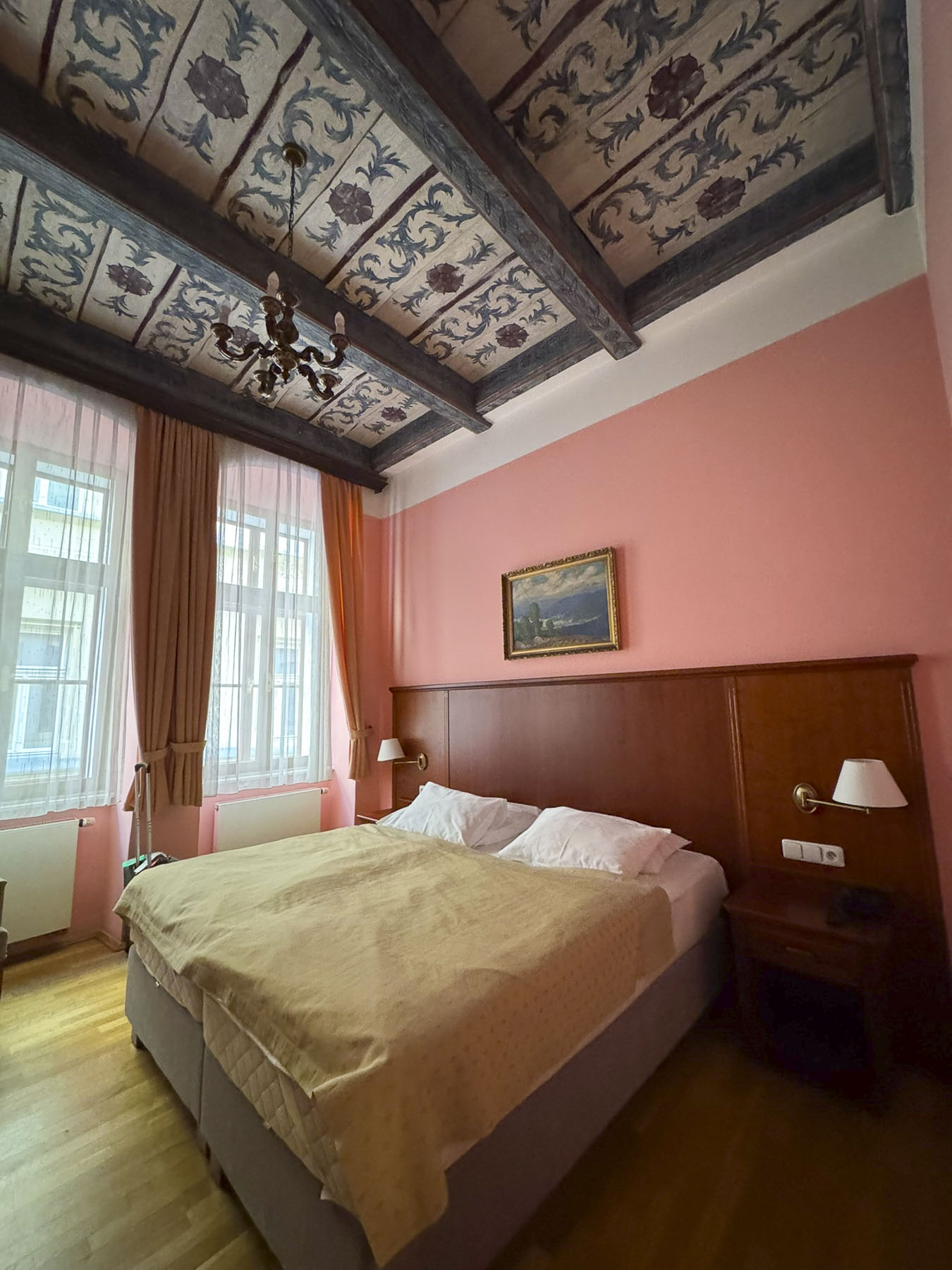
The Kissing Students’ fountain is really the center of activity in Tartu, a splendidly walkable city. Its car-free center extends north along Küüni tn from the modern Kvartal shopping mall, with an array of nice shops, and an excellent Coop supermarket, past the central plaza all the way to the Botanical Garden of the University of Tartu. And there were numerous points of interest just off this route that we explored during our five-night stay at the Art Hotel Pallas, a boutique hotel nicely located across from the Kvartal mall, with views from our hotel room of the spires atop the town’s city hall and churches. It also had convenient free parking, and a scrumptious breakfast buffet. The pickled herring, yes for breakfast, was really good. It was the perfect spot to get some much-needed R&R after driving through Estonia, Latvia, and Lithuania for three weeks.

One of the nicest things we’ve encountered during our road trip through the Baltics is the extensive amount of public art that graces the region’s cities and small towns. Few are of a historical nature. The sculptures of Lenin and Stalin that the Soviet Union installed during their fifty years of occupation to erase the Estonia’s history were quickly removed from all public spaces, and sent to the scrap yard. The current sculptures now honor influential writers, poets, and folk heroes or are simply artistic inspirations without any political messaging.

Along Küüni there was a sculpture of Irish playwright Oscar Wilde and Estonian writer Eduard Vilde depicted in an imaginary encounter between the literary heavyweights. Though the two never met, Wilde did give a lecture at the university in 1892.

Nearby was the sculpture “Father and Son,” by the Tartu native Ülo Õun (1944-1988). The Visit Tartu website explains the work represents the sculptor with his 18-month-old son, and “is a symbol of the relationship between different generations, where children are increasingly growing apart from their parents.” A side note – the Visit Tartu website has an extensive calendar of events page. In a park they had a pop-up information tent, and detrimentally to our waistlines, it was across from the Kalev Chocolate Shop and cookie store. This Estonian brand makes, in our opinion, some of the best store-bought snacks. You can buy them in grocery stores across the Baltics, but they surprisingly cost less in their own stores.

A diagonal walk through the park took us to Tartu Turuhoone, the town’s old market hall where a large sculpture of “Siga Roosi,” a pig, advertises the building’s entrance and the products available inside. If you have visited Riga’s large market, this wanes in comparison, but the pig immortalized in bronze appears to be smiling.

From here a very pleasant walk along the riverfront promenade that follows the Emajõgi River leads to the Kaarsild, an arched footbridge that spans the river to Ülejõe Park and the neighborhoods east of the historic center.

The approach to the bridge was a perfect spot to admire the beautiful buildings surrounding the town’s plaza which represent an eclectic assortment of architectural styles from the 13th to 17th centuries, when the town was a prominent member of the Hanseatic Merchant League.

At the foot of the plaza the Tartu Kunstimuuseum, a museum of art, occupies a 1793 building that is often referred to as Tartu’s Tower of Pisa. The three-story building’s 5.8 degree of tilt is actually greater than the famous tower in Italy. The tilt was a result of one side of the building being constructed on the medieval footing of the ancient defensive wall that once encircled the town, and the other side was erected above loose soil. As the decades passed, the structure slowly sank into the ground. Polish engineers successfully stabilized the building during the communist era, and it was determined safe enough to house the museum since 1988.

In the other direction there was the reflection of the growing city’s modern skyline reflected on the rippling water of the river. These views were beautiful and equally enchanting in the early evening twilight as we watched the murmurations of European starlings swooping over the river, before they noisily roosted in the park.

Just behind Town Hall and across from a large street mural of the University of Tartu was café/restaurantWerner, an excellent establishment with a nice vibe, that’s popular with both students and professionals; we dined there several times during our stay in the city.

Afterwards we took the long uphill walk to the ruins of Tartu’s immense 13th century cathedral, now on the grounds of the University of Tartu. Construction of the Gothic style church started shortly after the Brothers of the Sword subjugated the pagan tribes around Tartu in the early 1200s and lasted nearly 400 years before it was destroyed during the Livonian Wars that ravished the region. It was never rebuilt.

We chose not to, but it’s possible to climb its towers to a viewing platform above the ruins for a panoramic view of the school’s campus and Tartu. The choir end of the cathedral has been restored and since 1981 houses The University of Tartu Museum.

Heading back to the old town we passed under the Angel Bridge, built in 1838 to ease students’ efforts getting across campus. The scenic spot has a bit of a lovers’ lane reputation, as well as having several legends associated with it. The most popular one being “when you cross the bridge for the first time you should make a wish, and if you can hold your breath until you reach the other side your wish will come true.”   

Just off the lane was the Gunpowder Cellar built into the side of a hill, it’s a rustic tavern set in a cavernous old 18th century munitions warehouse with an arched brick ceiling. It’s a popular beer hall and is known for its tasty Gunpowder Red beer, while also hosting frequent band appearances.

Later in the week after having lunch at the Café Werner a second time, we turned right and wandered down Ülikooli tn towards the neoclassic columned façade of the University of Tartu’s main building. It is Estonia’s oldest and largest university and the pride and joy of Tartu. The school was originally founded 1583 as a Jesuit institution during Poland’s brief rule of the country, but most of the credit is given to the Swedish King Gustave II Adolph when he upgraded the school to a university in 1632. It was forced to close several times over the centuries due to regional wars, but was later reopened by Russian Czar Alexander I in 1802 and was again reopened by the Soviet Union after World War II, where it became an important contact spot for Soviet academics to meet their western counterparts during the Cold War era.

Farther along some of the buildings near Tartu’s St. John’s Church had unique details. Archeological evidence suggests the church dates back to the late 1100s, and could be the first “Christian church building in Estonia before the 13th-century conquest and great Christianization of the country.”  The basic form of the current church dates from the beginning of the 13th century. Due to the region’s conflicts, the church has been reconstructed several times over the centuries. Unfortunately, the church was closed when we visited the area.

At the end of Ülikooli tn a short walk to the right led us to the Botanical Garden of the University of Tartu. Though in early October it was evident that Estonia has a short growing season and most of the plants were past their prime, but we still enjoyed exploring the various oases of greenery with a number of other couples and families, and imagined how beautiful the gardens must look in the Spring and Summer.

We followed Ruutli tanav, one of Tartu’s oldest streets, back towards the historic center of the town. During the Middle Ages when the winter snows melted during the spring thaw  – “mud season” or Estonia’s “fifth season” – traveling about the countryside was quite difficult. In the larger towns like Tartu the thoroughfares were lined with logs laid perpendicularly across the road to ease the life of the townsfolk and facilitate merchant trade with the Hanseatic League through the town’s riverside port on the Emajõgi. Evidence of these ancient timbered roads is still occasionally discovered whenever there is any infrastructure improvement required in the city. Cobblestones weren’t used for the lanes through town until the 15th century.

We made a short detour off our route to the Virgin Mary’s Dormition Cathedral, an Estonian Apostolic Orthodox Church. The beautiful Russian baroque style church was built in 1840 atop the foundations of an earlier wooden church that was burnt down during the 1775 Great Fire of Tartu, a devastating inferno which destroyed almost all the old wooden medieval era buildings in the central part of Tartu.

As we reached the central plaza it was evident that the weekend’s festivities were Tartu’s last big event for the summer high season. The weather was now noticeably colder with morning temperatures of 36F (2C) warming only to 54F (12C), and the outdoor café tables and chairs that lined the square were being taken down and sent into storage, until needed again next Spring. But the season is not over until the buskers stop playing and the trio of musicians from the other day were still entertaining folks around the Kissing Students fountain in the warm afternoon sun.

On our walks through the town, we came across some interesting and creative street murals. All were in well-chosen places that enhanced the wall, none were of the loud bubblegum type, though some were of a political nature. After all, our hotel was named for the Pallas Art School, which existed from 1919 to 1944 in Tartu, and was influential in establishing the aesthetic values of the newly independent country, but was closed during the communist occupation of the country.

Today the school’s artistic legacy continues at the  Pallas University of Applied Sciences which opened in 2000, and features ongoing exhibits in the Pallas Gallery.

The Gray House, now the KGB Cells museum, was uphill from the gallery, just three doors down from a busy intersection, on a street that leads to university housing. It was a non-descript door with buzzers for the three-story apartment building above it, and one for the museum. In the 1940s and 1950s the upper floors served as offices for the Soviet’s secret police. We buzzed and a voice released the door lock for us to enter the lobby, where an arrow pointed to a heavy metal door to the basement, and a set of intimidating stairs that descended to a flickering fluorescent lit hallway. It’s a small space with a dozen prison cells and several interrogation rooms in which the brutality of the Soviet years is documented. Notoriously, on July 8th & 9th, 1941, 173 men and 20 women were summarily executed and buried in the building’s courtyard. Mass deportations of 45,000 Estonians to the Soviet gulags in Siberia continued until 1953. For many it was a death sentence, and few ever returned to their homeland. Across the country the KGB is believed to have murdered nearly 60,000 political prisoners between 1940 -1991. It’s a reminder of the danger of authoritative regimes and sadly is still relevant today.

We discovered another street mural just around the corner from our hotel as we headed to dinner at Restoran Spargel. Over an enjoyable evening, we discussed plans to take advantage of the nice weather predicted for the next day by exploring the small fishing villages along the shoreline of Lake Peipus.

We thoroughly appreciated Tartu’s mix of history and youthful enthusiasm for the future. It’s a city but felt like a small town that we could see ourselves quite comfortably living in and enjoy experiencing all of its cultural events throughout the year.

Till next time,

Craig & Donna
Driving Through the Baltics: Part 9 – Sigulda, Latvia to Tartu, Estonia or Spires, Onion Domes and a Neat Cafe

Mornings with overcast skies, which cleared by noon, had prevailed for the past two days. We hoped that this weather pattern would continue as we headed north from Sigulda to Tartu under a gunmetal gray sky. It would be less than a three-hour drive if we drove directly there, but that’s not our modus operandi. Over wine the night before we had scoured the map along our tentative route and highlighted some picturesque and fascinating stops for further exploration in the region.

After a short 20-minute drive from Sigulda we stopped at Lielstraupe Castle. It was originally constructed in the later part of the 13th century as a crusader fortress by Voldemar von Rosen, a Teutonic knight and vassal to the Archbishop of Riga, who had initiated a crusade into the region to forcibly convert the area’s pagan tribes to Christianity. The thriving medieval village of Straupe grew around the castle and was a merchant town within the Hanseatic League. It was totally destroyed during the Polish – Swedish wars in the early 1600s and never rebuilt. The castle, now a substantial manor home after being rebuilt from ruins after the wars of the 17th century, remained sporadically in the possession of the von Rosen family, through centuries of the region’s conflicts, until 1939. During the Soviet era the manor was used as the Lielstraupe Tractor Station, with its rooms and stables being used for classrooms, workshops, and dormitories. In the 1960s the estate was used as a psychiatric hospital. Since 2023 the castle has been owned by the Municipality of Cēsis, which has opened it to tourists as it undergoes renovations. Unfortunately, we were unable to tour the interior of the manor, since we stopped by before its opening time.

Our “drive a little then café” instincts took us to Valmiera, the largest town in the Vidzeme region with a population of about 51,000. Like Cēsis and Sigulda, its founding is tied to the Northern Crusade in the 13th century. Parking was conveniently located across from Valmiera’s St. Simon Church. Amazingly, the medieval building, which dates to 1283, is believed to have survived the centuries without any major alterations. Russian Czar Ivan the Terrible ruled during the Livonian War (1558-1583), a conflict which included the medieval superpowers Sweden, Denmark, and the Polish-Lithuanian Commonwealth fighting for control of Latvia. Several cannon balls fired by Russian troops into the church’s walls are on display in the church’s narthex as testimony to the strength of its construction. It was a Catholic church until Martin Luther’s Protestant Reformation was brought to Latvia with the signing of the Truce of Altmark in 1629, which ended the Polish-Swedish War (1600-1629).

A short walk from the church were the 13th century ruins of a Livonian Order Castle. As ruins go, these were not very impressive, with only a small L-shaped wall section still standing. However, there was a very interesting 3D relief map of old Valmiera in the courtyard in front of the Museum of Valmiera which showed that the town was ringed with defensive fortifications, which signified the town’s importance within the Hanseatic League, second only to the town of Cēsis in the Vidzeme region. The ramparts stood until they were destroyed in the Russian Empire’s shelling of the city during the Great Northern War in 1702. After the war the castle’s ruins were used as a quarry to rebuild the villagers’ homes destroyed during the conflict. The church was easily located on the map and was a good reference point for understanding how the old town was laid out.

From the castle grounds we then followed a pretty path downhill to the bank of the Gaujas River before succumbing to our call for coffee. We stumbled upon Café Kekss totally by accident. They have several unique small greenhouses, with tables and chairs for 4 people in each enclosure, outside their small cafe. It was a chilly and windy day when we visited, but sitting in one of the glass houses was perfect. The staff was very nice and the barista who took our order delivered everything to our table.

We really enjoyed our experience there, and the greenhouses are a great way to extend the season. Before returning to the car we spent a little bit of time strolling along the Dzirnavu ezeriņa promenade in the park downhill from the café.

It was the last Saturday in September, and unexpectedly we had the road to ourselves, only occasionally seeing another car whiz by. As hoped for, the sun brightened the sky later that morning as we continued our drive through a mostly semi-rural landscape, dotted with farms, towards the Latvia/Estonia border.

Only a short distance away from the border we paused to stretch our legs at Valka-Lugaži’s Evangelical Lutheran Church, our last stop in Latvia. The church’s name first appears in medieval documents of 1477. Prominent nobles were patrons of the church since much of the congregation were the poor serfs who farmed the land of their lords during the feudal era, which unfortunately lasted in Latvia and Estonia well into the late 19th century. Church history notes that the Baron von Wrangell family rebuilt the church many times over four calamitous centuries which saw the region engulfed in wars. The last descendant offered to repair the church in 1910 when a fire collapsed the belltower into the church. With the Lord’s good graces and the steady hand of a bomb disposal expert, an unexploded WW2 bomb, ignored by the communist regime for fifty years, was finally removed from the belltower after Latvia regained its independence in 1991. We crossed over the waters of the Pedeli River into Valga, Estonia. Interestingly Valka and Valga were one town until their separation at the end of World War I. With the collapse of Imperial Russia, Estonia and Latvia declared their independence and a new border was determined which split the town in half down the center of the river. A spirit of unity still remains between the two towns, as extended families now travel freely across the border since the countries joined the Schengen Area, and even share a professional basketball team, the BC Valga-Valka/Maks & Moorits, along with the slogan “One Town, Two Countries.”

A few minutes outside of Valga we turned and followed a secondary road to Sangaste Castle in rural Otepää Parish. More manor home than castle, the estate’s history began in 1866 when F. G. M. von Berg (1845–1938), the last Lord of Sangaste, inherited the property from his uncle Count von Berg, a decorated Russian Field Marshal, and dreaming big decided to build his family a 99-room English style mansion. Its size was only curtailed by an imperial rule that permitted no homes with over 100 rooms unless they were built for the Czar. Von Berg was a successful agriculturalist, having developed a new rye variety, along with establishing a prized dairy herd with milk “so good that it was sold in the markets of St Petersburg.”  Though located deep in the rural countryside, the manor had all the modern conveniences available at the beginning of the 20th century, with a telephone line installed in 1896 and electric lights in 1907.

With Estonia’s independence from Russia at the end of the First World War the new government started to seize the lands and manor houses of Baltic Germans. The government however acknowledged von Berg’s contributions to Estonian agriculture and allowed the aging Baron to stay in his home until his death in 1938. During the communist occupation of Estonia, the castle was used as a Young Pioneer Camp and its interior was altered to have 146 rooms. Somewhere along the line someone determined that the manor was composed of 1.45 million red bricks, or one brick for every Estonian.

In the crossroads village of Sangaste, in front of its church, a lone tree showed off its spectacular yellow leaves, signaling Autumn was finally here.

Four miles beyond Sangaste we glimpsed the onion shaped domes of (EAÕK) Ilmjärve Jumalailmumise, an Estonian Apostolic Orthodox Church, amidst a clearing. The red brick and stone facade of the 1873 church was brilliant in the afternoon sun. Unfortunately, the church was closed, though we were able to peek at the interior through an old-fashioned skeleton lock, and even take a picture. A placard in front of the building noted that the church’s two large bells were donated by the Russian Czar Alexander II. The church suffered during WW2, but its spirit was wounded the most when thieves in 1979 stole the church’s silver treasures used for communion.

We hadn’t expected restaurants in the area to be so scarce and far apart. Many were already closed for the season, though the weather, now cooler in late September, was still very comfortable. Our hope rose when we approached a restaurant across from the ski lift, that was now carrying mountain bike riders to the summit for a thrilling downhill ride, at the Munamägi Ski Center, outside of Otepää, the “winter capital of Estonia.”

But as we neared an employee flipped the sign hanging in the door to CLOSED! It was only mid-afternoon, had we missed the lunch hours? With our stomachs now rumbling we breezed quickly through the town and regretfully bypassed the opportunity to visit the ruins of Otepää’s ancient hill fort from the Viking era, and the remains of a Bishop’s castle where the oldest known firearm in Europe was discovered. We also missed Otepää kirik, the town’s historic church, which in modern times is historically connected to the country’s flag, when in 1884 the blue, black and white flag of the Estonian Student Union was consecrated there during “Estonia’s Awakening.” The Student Union’s design became the flag of Estonia in 1991.

We eventually had a very nice late lunch at Pangodi kalarestoran, a fish restaurant, before  our last excursion to Luke Mõis, an ancient feudal estate that dates from the 13th century. The manor house is an unassuming building that now hosts events and weddings. But the real interests here were the cascading ponds and the Gardener’s Cottage. The estate’s head horticulturalist must have been highly regarded judging by the beauty of his ornately trimmed petite home, in a lovely bucolic setting along one of the ponds. If we had planned better this would have been the perfect spot for an afternoon picnic. It’s a very pretty spot that’s worth detouring to if you are driving from Riga to Tartu.

Tartu was only 30 minutes from Luke Mõis and we arrived to find Estonia’s 2024 Capital of Culture alive with activity as we checked into the Art Hotel Pallas, a creatively decorated boutique hotel, ideally located on a pedestrian mall that led into the town’s historic center.

After dinner we enjoyed a leisurely stroll over the Kaarsild, an arched bridge that spans the Emajõgi River, an important trade route since the Viking era that connects Lake Võrtsjärv to Lake Peipus and is still navigable all the way to the Baltic Sea. We wondered if a Viking ever imagined the bright lights of the bridge and Tartu’s growing skyline reflecting upon the river’s water.  

Till next time,

Craig & Donna

A Latvian Road Trip: Part 8 – Aristocrats, Soviet Propaganda & the Mountains of Vidzeme or on the Road to Sigulda

Šiauliai, the Hill of Crosses, and the rustic wooden Chapel of Jakiškiai were our only stops in Lithuania. All three were incredibly interesting, and an art filled Šiauliai was a fantastic discovery that we hadn’t expected but thoroughly enjoyed wandering through. The city of Vilnius, Latvia’s capital, required a time-consuming loop to the east that we chose to forgo, but hope to have a chance of visiting in the future.

It was a beautiful fall day as we recrossed the border into Latvia. Our route took us through the Zemgale Plain, Latvia’s agricultural heartland, an area flat to the horizon as far as our eyes could see. The country’s most fertile region, it’s often called the breadbasket of Latvia. Farmers ploughing their fields revealed dark rich soil ready for the planting of winter wheat.

We don’t do a lot of research before a trip, just enough to determine that we will probably enjoy where we are headed. We find spots along our intended route, to break up the drive, by examining Google maps the evening before the next morning’s departure. That’s how we discovered the Rundāle Palace, an exquisitely restored 18th-century baroque manor with ornamental gardens and museum highlighting the history of the Dukes of Courland, and their thoroughbred stud farms that were renown throughout the Baltics and Russia for the horses they supplied for the equestrian pursuits of various royal courts.

The interior of the palace was splendidly restored with period furniture and elaborate stucco decorations in every room. It was one of the nicest estate type homes we have visited in Europe, and was well worth the price of admission, something we can’t say for some of the other “palaces” we’ve toured.

Being gardeners, we enjoyed the extensive formal landscape plantings that have been described as the “Versailles of Latvia.”

Ten minutes down the road, Bauska Castle stood strategically on a small hill above the confluence of the Mūša and Mēmele rivers where they merge to form Lielupe River, a vital trade route in ancient times through southern Latvia. It was the highest point of land we had encountered in several days. Originally it was a hill fortress built with timber by the Semigallians, a pagan tribe noted for their strong resistance to the Livonian Order of Teutonic Knights during the Northern Crusades, before their subjugation in the last years of the of the 13th-century. In the early 1400s the knights constructed the first stone castle on the hill. It became one of the main residences of the Dukes of Courland, before the Rundāle Palace was built, when the castle was given to the Dukes after the Livonian Order collapsed in 1562.

A long path through dense woods led to a vast field dominated by five towering brutalist, as in the Soviet style, depictions of prisoners. The field was once Salaspils Camp (1941-1944) built by the Nazis as a “detention center,” for political prisoners and a “labor correction camp,” for Latvians who resisted the forced labor demanded of them by the occupying German army during World War 2. It was later used as a “transit and collection camp” for Jews before they were sent to concentration camps in Poland and Germany. One thousand Jews were brought from Austria, Czechoslovakia, and Germany, to build the camp, and died from exposure during the brutally cold winter of 1941/1942. Two walls of barbed wire and six towers with machine guns, search lights and sirens that wailed at any sign of escape surrounded the field.

It’s estimated that over the camp’s three years of operation, 23,000 people, half of them ordinary citizens captured during special campaigns against civilians in Belarus, Russia and Latgale, a region of eastern Latvia, were imprisoned behind its barbed wire. Trainloads were sent as forced laborers to Germany, and roughly two-thousand men were forcibly conscripted to fight for the German army.

In the museum a video displays historical footage of the camp when it was liberated by the Russian Red Army, including survivor testimonies as documentation of the brutality the Nazis inflicted upon the people of Latvia. Many in Latvia believe the Soviet Union built the Salaspils Camp Memorial in 1967 during the communist occupation of Latvia as propaganda to divert attention away from their policies of deporting Latvians to Siberia and Ukraine, while depicting themselves as great liberators who also suffered at the hands of the Nazis. The communist regime ignored the fact that the Soviet Union’s 1939 Molotov-Ribbentrop Pact, a non-aggression treaty with Nazi Germany, contained a secret amendment that allowed the USSR to forcibly annex Latvia, Estonia and Lithuania, while Germany invaded Poland, starting World War 2. The irony of our visit to this somber site on a sunny fall day was not lost on us. We can only hope for a better future.

The flat farmlands slowly changed to rolling hills then mountains as we drove into the Gauja National Park, Latvia’s largest nature preserve, which surrounds the small town of Sigulda, and straddles both sides of the picturesque Gauja River valley, as it flows through the Vidzeme region. An area filled with steep ravines and historic medieval castles, which is often referred to as the “Switzerland of Latvia.” It’s an outdoor enthusiast’s paradise with over 560km (350 miles) of hiking trails and 320km (200 miles) of cycling paths, all of which are popular with the cross-country skiers during the winter months.

There might be a little bit of wishful thinking along the lines of “one country’s mountains are another country’s hills,” as the highest point in the Gauja National Park is 160 meters (525ft) tall. Though that’s the equivalent of 52 story building and a significant height if you had to climb the stairs to the top, especially if you are from the lowlands around Riga. During the winter months the region is a snowy wonderland with several ski resorts and a bobsleigh, luge & skeleton track that twists down a Sigulda mountainside for 1.2 km and has 16 curves. It’s a challenging course successfully used by the Latvian National Team to train ten Winter Olympics medalists since Latvia’s independence in 1999. One team won a gold medal in the four-man bobsled event at the 2014 Sochi Olympics, in Russia.

The Emperor’s Chair was not far from the sports complex and offered a nice view of the Gauja River flowing through its valley, which was just beginning to show the first signs of autumn color in late September. Sigulda is a quaint town without a center as the buildings along its treelined streets are very far apart. Now late in the afternoon, we checked into the Hotel Sigulda, a beautiful older ivy-covered building. The front houses the restaurant, with rooms above which hide a modern wing that faces the parking area. The hotel would be our home for the next two nights while we explored the surrounding area.

The next morning was very overcast as we entered the grounds of Sigulda’s New Castle and Old Castle. Partially restored stone ruins are all that remain of an older fortress that was built in the 13th century by Order of the Sword Brothers over the spot where an 11th century log fortress built by the Livonians of Gauja advantageously overlooked the river and Turaida Castle across the valley to the north.

By the late 1700s the von der Borch family had acquired the ruined castle and its surrounding lands. A century later a von der Borch daughter, Olga, married Prince Dmitry Kropotkin of Russia and the estate was passed to him as part of her dowry.

Construction of the Sigulda New Palace, a neo-gothic style manor house, began in 1878 with masons reusing stones taken from the older ruins; the best local woodworkers were hired to craft the fine interior. Princess Kropotkin was instrumental in getting the new railway line from Riga to Pskov, which then branched to St Petersburg and Moscow, to run through the town, and promoted Sigulda area as a burgeoning resort area. Her son Prince Nikolai Kropotkin followed her civic mindedness and built the first bobsleigh and luge track in Latvia and the Baltics.

The interior of the manor style castle is full of highly polished wood and stained-glass windows. But we thought the best part was being able to climb the circular stairs of the building’s tower to the catwalk at the top.

Even on a rainy day it offered a spectacular panoramic view of the old castle and the refurbished outbuildings of the estate that now host workshops and craftspeople selling their wares.

It was from this lookout that we spotted the aerial tram that crosses the river valley from Sigulda to the Turaida Museum Reserve.

We drove there instead as we thought it was too windy for us to take the aerial lift, after a pleasant lunch at Kaķu Māja, the Cat House, which also operates as a bed & breakfast inn. It is a very pretty restaurant that has a nice vibe. The food is served cafeteria style and was surprisingly very delicious, while also being extremely budget friendly.

The Turaida reserve is a large 42 hectares (104 acres) park with a partially restored medieval castle, period buildings and Dainu Kalns, which translates as “I sing the mountain,” but is commonly referred to as Folk Song Park, a tremendous rolling field with over 25 large stone sculptures inspired from Latvian folktales by the artist Indulis Ranka.

Dainu Kalns was constructed in 1985 to celebrate the 150th anniversary of Krišjānis Barons, a Latvian folklorist who collected and transcribed over 30,000 of the country’s folk songs that had been passed down through the generations, and is recognized as being an important contributor to Latvia’s National Awakening in the mid-19th century. Folk Song Park also hosts various folk festivals throughout the summer months.

You have to admire the gumption of the city of Cēsis, a forty minute drive through a beautiful landscape from Sigulda, for declaring themselves the Latvian Capital of Culture 2025, the first in the country, after losing the title of European Capital of Culture 2027 to the Baltic port city of Liepāja . This was on top of an earlier disappointment in 2014, when  Riga won the honor. Not wanting to see all their efforts of planning fall by the wayside, city officials designed a year-long celebration with numerous historical and art exhibitions, dance performances, theatre, and concerts with the motto – “Culture in minds, castles, and yards.”

Cēsis is considerably larger than Sigulda and has a well-established old town with Rīgas iela, a pedestrian mall running for several blocks through its core. We arrived to the Cēsis Castle late in the afternoon, as the sun was painting the rough castle walls in its golden glow.  It shares a similar history with the castles of Sigulda. Construction of this castle started in 1209 and in 1279 Teutonic knights rode from the castle into battle carrying a red-white-red banner, first noted in the 13th-century Livonian Rhymed Chronicle.

Legend believes this banner was made from the bed of a knight fatally wounded in an earlier battle. The colors became the Latvian flag. By the mid-1400s the castle was the permanent base of the Livonian Order of Teutonic Knights, and the growing town’s location near the Gauja River made it a key trading hub, which led to its membership in the Hanseatic League in the early 1500s.

Crossing a creaky drawbridge over a dry moat, we entered the courtyard of the castle and were greeted by a Latvian maiden, a costumed reenactor, who offered us two glass lanterns holding lighted candles to illuminate our way through the dark passages of the fortress.  I was about to decline, but Donna convinced me otherwise with “come on, this will be fun,” and it was! We carried them up and down the narrow tower stairs and through various cavernous halls with only the ambient light from small windows providing a little bit of illumination.

The third floor of the tower hall hosted the immersive Multimedia Story of Cēsis Castle, that used surround sound and digital technologies to project an engaging animated film onto the castle’s  walls.It was very well produced and contributed greatly to our understanding of the history of the area and life in a medieval castle. It was really surprising how such a simple prop as a lantern could enhance our experience so much. We had a great time, and it was well worth the modest admission price.

On the way out of town we stopped in the park below the castle to photograph Cēsis’ pretty Byzantine style Enlightenment of Christ Orthodox Church, which dates from the mid-1800s.

On our way into Cēsis earlier an old cemetery caught our attention. We had time to stop and wander through it now as we drove out of the city. The cemetery was interesting but very neglected with overgrown bushes and roots covering toppled headstones. It’s named Vācu kapi, though it’s also referred to as the German Cemetery, as it contains 371 graves bearing the Iron Cross, identifying German soldiers killed in Latvia during WW2.

But there are also the graves of Ottoman Empire soldiers who died in Cesis as prisoners of war during the Russo-Turkish War of 1877-1878. The Turks weren’t really incarcerated – “First they lived in Cēsis under supervision, but afterwards, as they were so far away from their motherland, their regime became freer – they could traverse the city, go to the pub, the sauna. After a while some went back to their homes, while others struck root in Cēsis.” But it’s also believed the cemetery contains the graves of Latvian Germans, Russian atheist, and some Jewish citizens of Cēsis. Most of the vandalism to the cemetery is thought to have occurred during the communist occupation of Latvia. It’s an interesting side note to the history of a complex part of the world.

In hindsight, staying in the larger town of Cēsis might have been a better choice, as it has a compact historic center with cobbled streets and shops that would have been interesting to explore had we stayed there.

Till next time,

Craig & Donna
Road Tripping Through the Baltics: Part 7 – Riga to Šiauliai, Lithuania or Crosses, Churches and Towns Filled with Art

There are always several dilemmas with a road trip: how far to drive, do we drive straight through or look for interesting stops along our route? We tend to make stops, multiple stops to the point of my trusted co-pilot advising that, “we’ll never make it there at this rate,” but there’s a fear of possibly missing something. Fortunately, our “walk a little, then café,” philosophy easily converts to “drive a little, then café,” and in pursuit of those cups of coffee we’ve happened upon some laid back, interesting places.

The Hill of Crosses in northern Lithuania was our destination as we headed south on the A8/12 from Riga. Only two hours (78 miles/126 km) from Riga, many folks choose to do it as a day trip out of the Latvian capital. Which would have worked for us, but we have this quirky rule that we don’t put a pin in our wall map unless we’ve actually stayed overnight in the country. So, with that in mind, we booked two nights’ accommodation in Šiauliai, the town just beyond the Hill of Crosses.

Craving a cappuccino, we detoured into Jelgava for what we thought would be a short stop to satisfy our caffeine addiction. As we crossed over the Lielupe River we spotted the Jelgava Palace on a large island. It called for a stop. A wooden fortress was first erected here in the 13th century as part of the Livonian Order’s conquest of the pagan Zemgalian tribe that inhabited the region. Today’s beautiful 18th century Baroque style palace with 669 rooms is touted as being the largest in the Baltic states. It is actually a reconstruction of the palace which was burned down during WW2. During its apex it was the seat of the Duchy of Courland and Zemgale, and an important diplomatic post between Russia and Poland. Famously, the exiled French King Louis XVIII, to save his head from the guillotine, inhabited the palace from 1798 – 1807. Part of the palace houses a small museum with the Family Vault of the Dukes of Courland and Semigalla being the main attraction. The rest of the building is occupied by the Latvia University of Agriculture and Latvia’s University of Life Sciences and Technologies.

Across from the palace was Pasta Sala, a smaller island with an interesting art park that hosts the annual Jelgava International Sand Sculpture Festival every June and an International Ice Sculpture Festival every February. Unfortunately, traveling in the late September shoulder season we missed it. But we did enjoy wandering along a walking path through an installation of Chamotte fired-clay sculptures.

Between the palace and the park, we were now smitten with the impromptu stop and were enticed to follow a graceful modern footbridge, the Mītavas Gājēju, that tilts over the river into the town center, which was surprisingly quiet for a Tuesday in late September, considering that the university town is Latvia’s fourth largest city, with a population of roughly 60,000.

It’s unusual for only half a church to be left standing, but Jelgava’s Holy Trinity Church (1574) is a stark reminder of the devastation the city suffered during Soviet Union and Nazi Germany sieges and occupations of the city during WW2, which left ninety percent of Jelgava in ruins and all its Jewish citizens lost to the Holocaust. Its belltower above the town’s tourist information office was opened in 2010 as an observation deck after extensive reconstruction.

That promise of a morning coffee wasn’t forgotten as we walked along a pedestrian mall past a small daily street market to Konditoreja Silva, a bistro and patisserie where the coffees were very good and the selection of tasty pastries was mouthwatering.

Back on the road, we continued our drive south and crossed the border into Lithuania. We zoomed by a small roadside marker that pointed to the Jakiškiai Chapel, one of the last wooden churches from the 17th century remaining in Lithuania. We u-turned in order to find it. Passing through a small hamlet, we located the church situated on a low knoll, surrounded by fields and pasturelands.

It’s also known as the St Ignatius of Loyola Cemetery Chapel, named for the founder of the Jesuits, who were active in the region at the time. It’s a fine example of rustic folk sacral architecture.

The graveyard surrounding the chapel was full of interesting old headstones. Some were carved from logs and were well weathered and split from age and the elements, while the more recent graves were marked with stone or marble memorials with the deceased’s portrait etched into the surface. There was a caretaker working on the grounds who wouldn’t acknowledge our presence, so we contented ourselves with peering through the dusty windows into the sanctuary the best we could.

The Hill of Crosses was only 20 minutes farther south, just off the A12. The precise history of the hill is not known, but it is believed to have started as a way to commemorate Lithuanian rebels who never returned after uprisings against Imperial Russia’s rule in 1831 and 1836.  From a distance the hill is only speck on the horizon. It wasn’t until we were walking the long approach path that the hill slowly grew, and its monumental scale became apparent.

Not really in height, it’s a modest hill with stairs to its apex, but in girth and the sheer number of crosses, from tiny store-bought ones to large crosses handcrafted I imagine with sweat and tears. It’s estimated that there are now 200,000 crosses and crucifixes spread across the half hectare (1 acre) site. All are mingled together haphazardly and are treated equally in their importance, and they stand as testimony to the character and faith of the Lithuanian people who created this spectacular monument. The crosses were bulldozed and razed repeatedly during the Soviet era but were always rebuilt by the people. The hill stands as a sign of quiet resistance to the Soviet Union’s atheist communist occupation.

The fifty years of oppression which started with the Soviet Union’s annexation of Lithuania in 1940 ended in 1990 with the Act of the Re-Establishment of the State of Lithuania. A dream realized after the Baltic Way, a human chain of approximately two million peaceful protesters joining hands along a route that stretched from Vilnius, Lithuania through Riga, Latvia to Tallinn, Estonia in August 1989. Lithuanian was the first of fifteen Soviet republics to declare independence, which forced the collapse of the Soviet Union in 1991. Since Pope John Paul II’s visit to the Hill of Crosses in 1993 it has become a popular pilgrimage site.

During the 13th-century Christianity was not enthusiastically embraced by the pagan Lithuanian tribes of the region who rallied to decisively defeat the onslaught of the crusader Knights of the Livonian Brothers of the Sword in the1236 Battle of the Sun/Saulė, the victory from which Šiauliai takes its name and the year of its founding. It would be another two centuries before the first wooden church in the town was built on a small rise overlooking Lake Talkša.

The graceful Church of Saints Peter and Paul with its soaring belltower and brilliant white façade replaced the earlier 1445 church in 1617. It was our first stop. The church became Šiauliai Cathedral when Pope John Paul II elevated its status when the Diocese of Siauliai was created in 1997.

After checking into the hotel Turnė (free parking) for two nights, we walked a short distance into the center of Šiauliai to stroll along its nearly mile long pedestrian mall, Vilniaus g. One of the first things we noticed about the town was the amount of public art displayed along this street.

It’s an interesting variety of wall murals, and contemporary sculptures that enhance the walkway. As it was getting late we only walked the southern end of the mall to have dinner at Žemaitis Restoranas, located in the Hotel Šiauliai. The Lithuanian specialties – cepelini, homemade dumplings, Kedainiai potato pancakes, Karka with stewed cabbage – were so good and reasonably priced that we dined there twice.  

By the time we had finished dinner it was dark outside and upon leaving the restaurant we spotted the spectacularly lit dancing water fountain “Trys paukščiai,” Three Birds, designed by the Lithuanian artist Kestutis Kasparavicius. Its ballet of synchronized water jets and colored lights totally mesmerized us as we watched its performance several times. The quality of the installation was amazing and equal to the best fountains you’d find in NYC, Paris or Madrid.

The next morning, in pursuit of breakfast, we walked the northern part of Vilniaus Street, which we discovered was the first pedestrianized boulevard in Lithuania when it prohibited cars in 1975, and is the third oldest pedestrian street in Europe. A nice feather in the town’s cap for an off-the-radar-destination.

As we worked our way towards the Prezo Kepyklėlė café, the street was full of university students walking to morning classes in the buildings of Vilnius University and Šiauliai State University of Applied Sciences scattered across town.

Much of the contemporary public art at this end of the mall is sponsored by the Šiauliai Art Gallery with a mission statement to encourage within the community the free expression of art.

A narrow alley next to the gallery led to an almost hidden away St. Ignatius Loyola Church. It’s not very old as churches go, but its uniqueness stems from its roots as an ordinary home before the Jesuits bought it in 1930 and converted it to a church. At the end of WW2 communist authorities imprisoned two of its priests and sent a third to exile in Siberia. The sanctuary was closed and used as a warehouse, then a gym. In 1986 the local government deceptively requested funds from Soviet authorities to renovate the building into a concert hall but instead restored the church. After Lithuania declared its independence in March of 1990 the church was reconsecrated in December, just in time to celebrate Christmas Mass. A statue of Pope John Paul II in the church’s courtyard commemorates his stay in the small rectory when he visited the Hill of Crosses in 1993.

In the parking lot of an apartment building next to the church we noticed a defiant wall mural depicting a young woman in traditional dress lighting a Molotov cocktail held by a partisan resistance fighter. It testifies to the resilient character of Lithuanians. Lithuania did not submit easily to communist rule after WW2 and had an organized resistance movement into the early 1950s, with some individual partisans fighting on in the 1960s. Unfortunately, a car was parked too close to the wall for me to get a clear photo of the mural.

We found Šiauliai to be wonderfully walkable as we made our way across town to Lake Talkša, first stopping at Saulės Laikrodžio Aikštė, Sundial Square, where a brilliant golden archer stands atop an 18m (59ft) tall gnomon which casts its shadow across the numbers 1-2-3-6, the year of the town’s founding, in the plaza at its base.

Two paths from the sundial led to the lake. One was a direct shorter route, but we chose the longer way through the neighboring cemetery to the lakeshore. It was a perfect fall afternoon with puffy white clouds sailing across the bluest sky. On the far shore only a subtle hint of yellow suggested autumn colors would soon appear.

A path along the shore led to a children’s playground and outdoor fitness area before reaching a large stone labyrinth where a lone woman seemed to be deep in a meditative walk.

Beyond the labyrinth stood a large metal sculpture called Geležinė Lapė, the Iron Fox. In 2009 the local artist Vilius Puronas crafted 7 tons of steel into this whimsical monument that’s 15m (49ft) long and 6.6m (22ft) tall to celebrate the 1000th anniversary of the earliest mention of Lithuania as a country. In a 1009 chronicle called Annals of Quedlinburg, a writer described in Latin, “in confinio Rusciæ et Lituæ a paganis capite plexus,” which translates as, on the border of Rus’ and Lithuania, the pagans have their heads covered with plexuses. It’s not the most notable introduction to the world at large, but I will say during our short time in Lithuanian the country made a great first impression upon us! One day we hope to return and make it to Vilnius.

Till next time,

Craig & Donna

An Estonian Road Trip: Part 5 – Pärnu to Riga or A Hidden Gem and Rocky Beaches

Decisions, decisions, decisions: where to go, what to see, which hotel to choose, how far to drive? An hour earlier we had driven from the ferry port in Virtsu, after spending three days on Saaremaa Island, and arrived in Pärnu.

A long 4-hour drive to Riga, Latvia, at the end of the day, which would have had us navigating the city after dark, did not appeal to us. Instead, we opted for a one-night stay in Pärnu, a popular summer resort town, with a long, wide, sandy beach. The northern end of the beach has low dunes and the Muuli boardwalk that parallels the Pärnu River and leads to a breakwater that extends far out into the waters of Pärnu Bay and the Gulf of Riga. In the wide middle section of the beach there is the Purskkaev, an illuminated, dancing fountain at the beginning of a long walkway that follows the edge of the sand farther south. While the beach that September afternoon was a little too chilly for us to enjoy, we did find the historic center of Pärnu to be a wonderful, sleepy gem of a destination, with intriguing architecture. A pleasant surprise that fully exceeded our expectations, instead of the boring overnight stay that we had anticipated.

Valli Park with the last section of moat that once encircled a Hanseactic League fortress, and the 17th-century old Tallinn Gate, the only surviving monumental rampart gate in the Baltics, was our first stop. Its ancient drawbridge once connected the citadel to the old Postal Road that ran from Riga to Tallinn. Originally the town was founded on the right bank of Pärnu River in the early 13th-century, during the Northern Crusades, by the bishop of Ösel-Wiek, as a base to Christianize the indigenous pagans of ancient Estonia. After local tribes raided and destroyed much of old Pärnu, the decision was made to establish new Pärnu as a citadel across the river. New Pärnu prospered under the Hanseactic League, the powerful Germanic merchant guild that influenced the growth of many of the port cities along the Baltic Sea. A succession of rulers – the Teutonic Knights, Lithuania, and Poland – have left their marks on the city. But most notable was the Swedish Empire’s construction of the moat and earthen ramparts in the 1670s to defend the city from being engulfed by the Russian Empire’s desire to expand west into the Baltic.

A walk across town to Punane Torn, Red Tower, revealed a cornucopia of wonderful 17th, 18th, and 19th century architectural styles that included painted doors, timbered buildings, stucco facades, orthodox church domes, and protestant steeples.

The tower, once part of the city’s defensive wall, was constructed in the 15th century, during the tenure of the Teutonic Knights, as a prison with a 6-meter-deep prisoner pit. It is the oldest preserved structure in Pärnu and houses a branch of the city’s museum. A block from the tower is the Seegi Maja Almshouse, first built in the13th-century to help Parnu’s destitute and disabled; it was rebuilt in 1658 and is now used as the restaurant for the St. Peterburg Hotel.

Rüütli Tänav, a pedestrian mall with several side alleys, runs for several blocks through the old town and is the center of activity. It boasts an array of coffee houses, shops, and restaurants featuring international menus. Later that evening we had a great dinner at Kolhethi, a Georgian restaurant, which we highly recommend.

On the edge of Old Town, the streets around the Hotel Victoria still hosted interesting architecture and a variety of street murals and graffiti.

The hotel, with its distinctive mansard roof, was built in 1926 and opened as the Grand Hotel with a café in 1931, “where the great soloists from Tallinn performed.” During the Soviet era it was known as the Hotel Voit and it was the only sanctioned hotel in Pärnu that westerners were allowed to stay in when visiting the city. But the café’s music tradition continued with a small orchestra that performed twice a day. The building was renovated after Estonia’s independence in 1991 and reopened as the Hotel Victoria with the Grand Café.

As we were checking in a celloist, an older gentleman, was playing in the lobby. We commented on how splendid his playing was, and the receptionist responded, “he practices in the lobby every time he stays with us, and he’s been coming here for many years.” Unaware of the hotel’s history then, we now wonder, was he old enough to have been an echo of the Soviet era orchestra?

The next morning, we continued to Riga. After entering Latvia, our search for a place to stop for a morning coffee break (there were few opportunities) took us to Saulkrasti, a small seaport along the rugged Baltic, where we found the Ostmala Café, in the lower level of the Saulkrasti Cultural Center. The café is a wonderful little hidden gem and the perfect spot to relax for a while on the way from Pärnu to Riga. It’s nicely decorated with paintings by local artists and seemed to have only two employees – our friendly and helpful waitress/cashier, and the talented chef in the kitchen. The restaurant had a simple menu with some tasty Latvian dishes and was very budget friendly. Afterwards we followed the walkway from the cafe along the harbor for a short way, and watched logging trucks bring their cut trees to the port for export. Afterwards we headed to nearby Saulkrasti beach for a walk along a dramatic stretch of boulders and sand.

Closer to Riga we stopped at Carnikavas Pludmale, a picturesque and inviting wild beach that stretched for miles along the Baltic coast, north and south, as far as our eyes could see. A strong breeze off the water lifted the soft golden sand into the wind and tingled our skin. Latvia’s pristine coastline is the unintended result of Joseph Stalin’s paranoia that the western alliance was going to stage an amphibious landing along the coast. Do defend the USSR against this threat, the communists razed all the homes along the seacoast for 300km (186mi) and heavily guarded it against attack and preventing escape from behind the Iron Curtain.

Riga’s Brīvības Piemineklis, Freedom Monument, greeted us later that day as we arrived in the city.

Till next time, Craig & Donna

An Estonian Road Trip: Part 3 – Hiiumaa Island: Ghost Ships, Churches and Fog

Only the red hull of a fishing trawler tied against the breakwater was visible through the fog that cloaked the coast in its grey mist. We had just set sail from the port of Rohuküla, on the Estonian Mainland. Our destination, the village of Heltermaa on Hiiumaa Island, a short one hour crossing on the Praamid Car Ferry. We had spent the previous day exploring the charming town of Haapsalu. Fortunately, it was only a 15-minute drive to the ferry terminal, which left us with plenty of time to watch the fog-veiled activities of the port before our 8:30am sailing. Our ultimate destination at the end of the day would be a hotel in Kuressaare on the island of Saaremaa. We had debated going directly there, but thought three full days on Saarema would be too long, so we opted instead to spend a day investigating the southern part of its smaller neighbor, the island of Hiiumaa, before catching a late ferry from there to Saarema.

The fog seemed thicker as we disembarked and headed to the Pühalepa kirik, the oldest stone church on the island. We used to be fair weather photographers but have come to embrace the moody light that inclement days offer. The fog that morning provided us with numerous opportunities to hone our skills. Some fall colors were just beginning to show.

Archeological evidence found on the island’s Kõpu Peninsula date the first traces of habitation on Hiiumaa to nomadic seal hunters over 7000 years ago. Its early history is vastly unknown, but it is believed folks lived on the island seasonally, but there might have been small hamlets, as the island was near a Viking trading route. But curiously enough, the first written mention of Hiiumaa in a 1228 document by the Archbishop of Riga, creating the island as a Bishopric to Bishop Gottfried, refers to it as ‘Some empty island named Dageida.”

This might help explain why the island’s new Germanic settlers felt the need to build Pühalepa kirik, surprisingly without a steeple, as a safe haven fortress church in the early 1200s, since the indigenous pagan tribes across ancient Estonia were resisting foreign rule and the imposition of Christianity upon them. The early German influence on Hiiumaa faded after the island was conquered by the Swedish Empire in the late 1500s.

The small red roofed building next to the church is the 16th century crypt of the von Stenbocks, a noble Swedish family that had extensive land holdings on the island and played a significant role in the island’s economy at the time. The current shape of the church dates from an extensive 18th century renovation which added the steeple.

Suuremõisa Manor on the von Stenbock’s largest estate was nearby. The imposing Baroque-Rococo style country home featured a large central building with a wing on either side of a formal courtyard, where guests would arrive by carriage. Years later the property was acquired by Baron Otto Reinhold Ludwig von Ungern-Sternberg, a shipping magnate. Things didn’t go well for the Baron, and in 1803 he was accused of murdering one of his ship’s captains, racketeering, piracy, and multiple kidnappings. He was convicted of murder and sent to prison in Siberia.

Miraculously the building survived both world wars and the Soviet occupation of Estonia. Today the preserved manor house is used by two schools, one a technical college, the other a local primary school. The site maintains a very low-key approach toward visitors. After a receptionist signed us in we were able to visit several rooms where there were some amazing pieces of antique furniture featuring finely carved religious motifs. Even though the building has a contemporary use, we thought it still retained a grand understated elegance.

It was still foggy as we drove to our next destination: Kassari Chapel, nine miles away, along the island’s southern coast. After driving through a lushly forested landscape, we chuckled when turning onto a side road we saw a barn painted with palm trees. We speculated about how harsh the winters on the island might be and what tropical islands the painter dreamed of.

Much smaller than the Pühalepa kirik, the Kassari Chapel sits on the edge of a forest that backs to the waters of Õunaku Bay. A wooden church built in the 16th century stood on this site until it was replaced with this unique stone church, still covered with a thatch roof, in the early 1800s. All the worship services in the church take place by candlelight as the sanctuary has never had electricity. The quaint graveyard is almost lost in the woods, with headstones covered in moss and leaves. Many of the island’s notable poets, artists, teachers, and other island characters (a manor’s swineherd), along with several wealthy landholders are buried in the graveyard. Noticeably the wealthier folks had headstones made from imported marble, while the less well-off had iron crosses crafted by the local blacksmith.

At the crossroads nearby in the hamlet of Kassari stood a tall statue of the giant Leiger, carrying a large boulder on his shoulder, with two small islanders atop it. Leiger is an Estonian folk hero, and relative of Suur Tõll, with incredible strength, who lived on Hiiumaa. The sculpture captures the essence of one of the giant’s legendary feats when he built a bridge for the islanders across the waters of the Soela Strait that separate Hiiumaa from the island of Saaremaa, which lies to the south. According to legend, Säare Tirp, a long narrow, tail-like strip of land that protrudes from the mainland into the strait, is all that remains from his endeavor.

A place to break for coffee was difficult to find mid-week during the September shoulder season. While many eateries were noted on the map, they unfortunately were only open on the weekend. But luckily, Rannu Pubi in the village of Käina was open mid-week for lunch. Miraculously it seemed by the time we parked the car, the clouds parted, and we were able to eat outside in bright sunshine on the restaurant’s terrace. The food was delicious, and the coffee was welcomed.

The town of Käina was also an interesting stop with the ultra-modern Tuuletorn Experience Center, “a bit of a museum, a bit of a science center and a bit of a play world,” was a main attraction, along with the ruins of Martin’s Church. When it was built in the 16th century it was the largest church on the island, and could hold 600 people. Unfortunately, the church began to settle into the soil unevenly and in 1850 the corners were buttressed to prevent its collapse. During WWII the building was hit by an incendiary bomb, the resulting fire burned through the roof, and destroyed the interior.

Our stops earlier in the day were only minutes apart, so with the sun gloriously shining we returned to Pühalepa kirik and Suuremõisa Manor to take a few more outside shots on a now beautiful day before heading to catch the 4PM ferry from Sõru to Triigi, on Saaremaa.

The Rudolf Tobias House Museum, a centuries old farmstead, and the 1873 birthplace of the famous Estonian composer and organist, was on our route. The museum was closed, though we were able to walk around the grounds. Across the road we plucked some fruit from some wild apple trees.

First noted in 1254, Sõru was for centuries an important fishing harbor and its waterfront was lined with fish processing sheds. A ferry has run from the inlet since the time of Swedish rule, when two energetic young men first offered the service. The village’s ship builders used the plentiful pine and oak timber from Hiiumaa’s forests to construct vessels up until 1939, when Estonia’s last large, ocean-going wooden boat, the three-masted motor merchant ship Alar was launched, with the crack of a champaign bottle across its bow. Efforts are underway to fully restore the historic vessel after it was found in Denmark, after sailing the seas under several different flags. Today, Sõru is a small quiet harbor with a limited number of berths, a campground, and nautical heritage museum.

The ferry boat from Sõru to Triigi was much smaller than the morning ferry from the mainland, and only sails twice a day, so if you are traveling via car a reservation is highly recommended.

We boarded the 4PM ferry and struck up a conversation with a young woman who had spent several months bicycling camping her way from Paris through the Nordic countries and was now returning to Europe through the Baltic states. “It’s been a tremendous journey, but now that the weather is changing, it’s time to head south.” It was only mid-September, but there was a definite chill in the air, and we also wondered how many fair-weather days lay ahead.

Over the course of seven hours, and driving about 55 miles, we had a thoroughly delightful, leisurely day exploring the southern part of Hiiumaa Island. It was confirmation that our decision to detour through Hiiumaa, instead of heading directly to Saaremaa Island, was a good choice for us.

Till next time, Craig & Donna
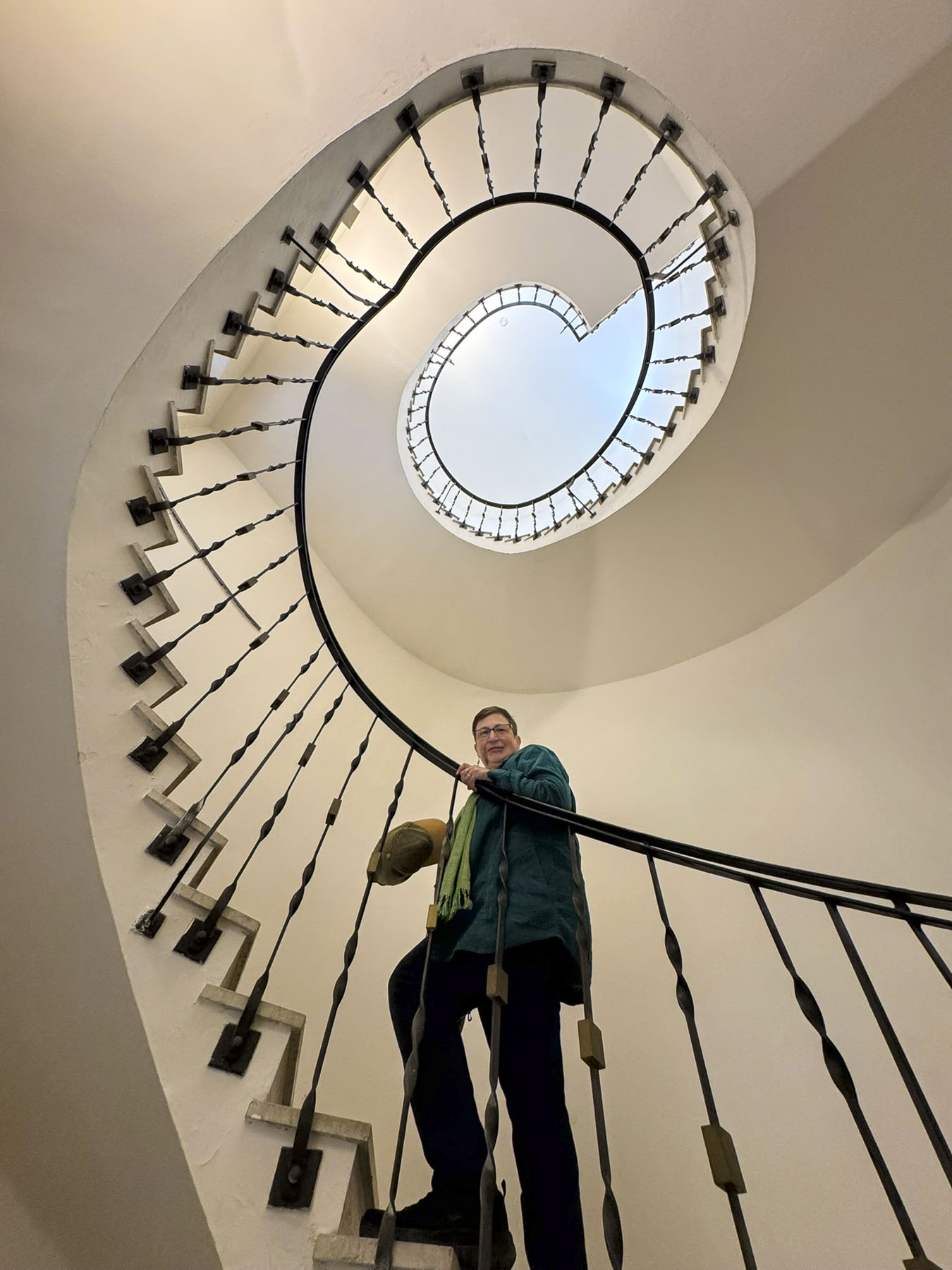
Estonia Part 1: Tallinn – Captivating, Charming & Caffeinated

Why Estonia? We are sure folks can relate, our pockets aren’t as deep as we’d like, but that doesn’t keep us home. A low budget, off-season destination is more attuned to our lifestyle anyway. So, when an under $400, September fare from New York City to Tallinn, Estonia popped up in our email we jumped at it after some research confirmed we could find some very nice hotels from $50 to $100 per night, often with breakfast included. Exploring the lesser visited Baltic countries of Estonia, Latvia, and Lithuania also fulfilled our desire to extend our travels beyond western Europe, which previously had been very Mediterranean-centric. Living in the very hot and humid southern United States is also affecting our decisions concerning vacation destinations, as we are now seeking alternative destinations as a result of climate change. The heat of a southern summer often continues into September and October, with temperatures at home in Georgia often in the high nineties. Estonia offered a wonderful reprieve from the sweltering summer heat with a daily high average of 14°C (57°F).

The history museum at Maarjamäe Castle was an unusual first stop for us after picking up our rental car at the airport. But it was the closest we’d be to it during our three-week road trip through Estonia, Latvia, and Lithuania. The museum is in a renovated 17th-century chateau, which was left to ruin for decades during the communist Russia occupation of Estonia. It is beautifully set on a bluff across from Tallinn Bay, and was built by the Brotherhood of Black Heads, a professional association of unmarried ship owners, merchants and foreigners dating from the 14th century, as a summer retreat.

Today the museum’s permanent exhibit, My Free Country, explores 100 years of modern Estonia’s history, from its 1918 declaration of independence from Russia, and the following War of Liberation, through twenty years as a sovereign nation before being invaded by Nazi Germany and communist Russia during the Second World War. The fifty years of brutal Russian occupation after World War II and communist propaganda are also covered, up to Estonia’s 1991 second declaration of independence from Russia, which was overwhelmingly supported by 78 percent of Estonians. It’s a difficult mission to reconcile the terror of the communist years into a bright, hopeful future, but historical research, as well as oral histories, document forced resettlements to Siberia and imprisonment in labor camps during the Soviet reign of terror, when Estonians were prisoners within their own country and shot if they tried to escape. The exhibit highlights a proud history of an unrelenting desire for freedom, which prevailed under the worst conditions. A history that, it is hoped, the younger generation of Estonians, who have not experienced communism, never forgets. As one quote on an exhibit referring to Russia said, “Nothing good ever comes from the east.”

After the 1991 independence, colossal, large-scale Russian propaganda sculptures, which once dominated prominent public spaces across the country, were removed from view but not destroyed, as they are part of Estonia’s history. However, they were erected behind the museum in a space fittingly called, with Estonian humor, “the Soviet Statue Graveyard.”

Our first lunch in Estonia was at the museum’s café, Maarjamäe Resto, an unexpected culinary delight, which could be considered a destination in and of itself.

It was still too early to check in to our hotel in Tallinn, so we headed nearby to the Tallinn Botanic Garden, a large park with an extensive greehouse. The grounds were quite pleasing with their plantings, and the greenhouse with its various collections of tropical plants was very interesting. Though in the section filled with cactuses from around the world, Donna, ouch!, accidently brushed one with her hand and imbedded some spines into her skin. Not a huge issue when you are home and have the proper tools to pluck the pesty spines from your skin and relieve the discomfort, but when you are traveling, it’s another issue entirely.

Fortunately, the barista operating the café in the greenhouse had dealt with this before, and he ran out to his car to fetch a roll of good old-fashioned duct tape to grasp those microscopic thorns. He was very nice, a 30ish Italian man who during conversation jokingly related that being a part time medic was not part of his job description when he was hired, and visitors getting pricked with cactus thorns happens more often than you would think.  We were curious how a warm-blooded southerner ended up in the northern Baltics. “You know there is always a woman to blame, and I followed my love back to her Estonian homeland.” We asked if he missed the warm Mediterranean weather and la dolce vita. Yes, the weather is nicer, so we visit my family, but life is better here in Estonia as there are more opportunities for those willing to work and get ahead. Estonia is leaps and bounds ahead of the other European countries in embracing digital technologies. So much so that the government considers internet access a fundamental right and ensures that everyone across the country, even on the smallest islands, has reliable internet, and offers digital literacy programs for the technology challenged. The government also endorses working from home remotely, and offers an Estonian Digital Nomad Visa. “Estonia is very big in cybersecurity, and this enables every person, business, and government institution to be connected. We are one of the most digitally advanced countries, and we can even vote securely online in Estonia.” This digital future contrasted with as well as complemented the vibrant centuries-old walled city of Tallinn.

Despite not having particular plans for Tallinn, we knew we would enjoy exploring the city as soon as we saw the ancient architecture along the way to our hotel. Having a rental car and finding a hotel with free parking is difficult in any city, but we scored big withTaanilinna Hotell. The hotel was in an excellent location, just on the opposite side of the old town’s historic ramparts, and a short walk from the 14th-century stone towers of the Viru Gate’s flower market.

Google Maps got us close, but the hotel was a little difficult to find, and we mistakenly drove through a pedestrian only area; fortunately, there were few people about. In order to find the hotel, we parked and walked down the street, when we spotted the hotel’s sign, which was set back from the lane. It’s a modest hotel, and the staff was very nice. We enjoyed a quiet 4-night stay.

With Tallinn’s old defensive wall only a stone’s throw away, history surrounded around us, and we quickly set out to explore and to find a place for dinner as twilight descended on the old town. Our wandering took us down various lanes, past distinctive centuries-old 4 to 5 story tall buildings that served, as was the medieval custom of the time, as the multifunctional home/warehouse/offices of wealthy merchants.

Lights twinkled on and illuminated the cobblestones in a golden glow. I know it’s cliché, but our first impressions of Raekoja Plats, the Town Hall Square, anchored with its soaring 64M (300FT) tall 13th-century watch tower, were beautiful, charming and magical. We were disappointed to learn that the tower is only open from the beginning of June to the end of August. We love a good tower climb!

Still retaining its original footprint, Tallinn is one of Europe’s best preserved medieval cities, with 26 watchtowers along its ancient ramparts and city gates, topped with distinctive cone-shaped red roofs.  The walled city still encircles a vibrant and active community, which supports a lively arts scene, along with a robust nightlife.

Its preservation seems surprising for a city that has stood at the crossroads of conflict since it was founded by a Danish King in the early 1200s. In addition to the Danes, Tallinn has been ruled by the Brotherhood of the Sword, the Teutonic Order, the Holy Roman Empire, the Swedish Empire, Czarist Russia, Nazi Germany, and the Soviet Union. The city’s prosperity and resilience throughout the centuries is testimony to the strong spirit of the Estonian people. 

One of the nice things we enjoy about staying in one place for several days is the opportunity to experience the locale as it quietly awakens with the sun. Whether it is cloudless blue skies or a place cloaked under clouds with folks huddled under umbrellas to ward off the rain, a place breathes and its mood changes by the hour, from day to day. The destinations on our walks were always different, but we often crossed the same lanes and stopped to photograph something different that caught our eye, which we hadn’t noticed before.

Old town Tallinn is mostly flat and is a wonderfully walkable city. There is a short uphill stretch to Toompea Hill (the upper city), where we visited the Kiek in de Kök Museum, the Bastion Tunnels, and Neitsitorn, the Maiden’s Tower. During the 1700s when the towers lost their military significance they were often repurposed as private apartments, with a craftperson’s workplace on the lower level, and rooms above. During both world wars the tunnels were used as air raid shelters. While the towers were lived in continually, most famously by the Estonian painters and twin brothers, Kristjan and Paul Raud, until the 1960s, when the city deemed them unsafe for habitation.  Abandoned, the towers became a destination for homeless squatters and Estonia’s emerging counterculture. The extensive tunnels were an area the police refused to go. A popular, unlicensed bar opened in the tower on New Year’s Eve in 1980. Unfortunately, it didn’t survive the economic turmoil of the era as the Soviet Union began its descent into a failed state.

After an extensive multiyear renovation, the Kiek in de Kök Museum opened in 2005. The Maiden’s Tower now hosts a new Neitsitorn café, which has a nice view out over the Danish King’s Garden, and the ghostly blackened bronze statues of three monks named Ambrosius, Bartholomeus, and Claudius. Legend holds that they occasionally appear spectrally in the garden, though the only thing that appeared the morning we visited was a sleek red Ferrari 296 GTB that was the center of a photo shoot. The tower also has the re-created art studio of the twins, Kristjan and Paul Raud. The tunnels under the ramparts have been creatively reenvisioned and now house a variety of interactive digital multimedia and historical exhibits.

A walkway along the ramparts between the towers at the museum led to an exhibit about Tallinn’s café culture. Though the first coffee house opened in the town of Narva in 1697, Tallinn didn’t get its first café until 1702 when one opened on Town Hall Square. The oldest still-operating café dates from 1864, when the renown marzipan bakery, Maiasmokk, decided to offer coffee to go along with their tasty, sweet treats. After 160 years the Maiasmokk Café, even surviving nationalization during the Soviet occupation, is still open and a beloved cultural institution in Tallinn. Most of the exhibits address Tallinn’s café culture during the repressive communist era, when going to a café to share a coffee was one of the few recreational activities people could afford. With our “walk a little then café” philosophy for exploring a city, we felt we had found kindred spirits in Tallinn.

Decades later Estonian’s infatuation with coffee continues. This cultural obsession was fully on display when Estonian singer Tommy Cash performed “Espresso Macchiato,” during the finals for Estonia’s 2025 Eurovision contest and came in third place! Though in Italy some humorless Italians didn’t like the caffeinated cliches and called for the song’s banning.

Other points of interest on the hill included the onion-shaped spires of the Russian Orthodox Alexander Nevsky Cathedral. It’s across the street from the pink building that houses the Estonian Parliament. (A very good eye-level view of the cathedral can be seen, on the uphill walk, from the restored bell tower of the mid-1400s St. Nicholas’ Church.

He was the patron saint of merchants and seafarers. It was formerly one of the wealthiest churches in Tallinn until it was severely damaged by WWII bombing. Fortunately, many of its fine ecclesiastical art works, acquired from the art capitals of Europe during the Hanseatic era, had been removed from the church for safekeeping at the start of World War II.  Now restored after a 30-year long renovation, the church serves as the Niguliste Muuseum, and exhibits the works that survived that cataclysmic war. Fortunately, the 105 meters, 345 ft, tall spire has an elevator that whisked us to the viewing deck.)

Farther along in one of Tallinn’s oldest churches, the 13th century St Mary’s Cathedral, there is a unique private worship box, totally enclosed with shaded windows, built directly across from and on the same level as the pulpit. Jokingly, we speculated it was designed for a wealthy patron so he could fall asleep and snore, without embarrassment, as the priest orated endlessly.

The hill also has the best vantage point for cityscapes of Tallinn’s historic skyline, the Patkuli Viewing Platform, and a mysterious red gorilla, that seems incongruously out of place. But we will leave him for you to find.

Stairs from the viewing platform ascended back toward the lower town, and we were close to Balti Jaama Turg, the Baltic Station Market. It was Tallinn’s first train station constructed in the 1860s, and became a market hall in 1993. A major renovation in 2017 totally revamped the three-level market, which has become a magnet for residents and tourists seeking a lively venue filled with diverse international eateries, antiques vendors, clothing shops, and food stores.

The next day, closer to our hotel, we wandered about, climbed more towers, walked along arched and tunneled alleyways, and descended into a cellar or two. Our walk along Müürivahe Street to the Hellemann Tower and Town Wall Walkway was quite interesting. The real prize was the view from the tower window towards Town Hall Square – it was a panorama filled with red tiled roofs and steeples.

Across from it was the Dominican Convent built in 1246. It was the oldest monastery in Tallinn and supported the adjacent St. Catherine’s Church which was completed in the early 1300’s. The convent couldn’t exist solely on the alms it collected, but the friars were an industrious group who supported themselves as farmers, and traders of fish, while also operating a brewery that sold four different kinds of beer, while they spread the gospel. “The monastery also drew profit from the veneration of relics,” and at one time, records suggest, they had “twelve silver reliquaries containing the heads of saints, with each head reputed to cure a different set of diseases.”

But everything came to an abrupt end during the Protestant Reformation in 1524 when a Lutheran mob ransacked the church and monastery, and the friars were expelled from Tallinn. A partial restoration was undertaken in 1954, and it’s now a museum, which also hosts art exhibits. Its rough stone chambers and some fine carved stone works were intriguing. We didn’t notice any fireplaces, which left us wondering how difficult living within these spartan walls must have been.

Next to the monastery is Katariina käik, St. Catherine’s Passage, an old medieval lane that separates the church from the surrounding buildings. Today it’s lined with restaurants offering Estonian cuisine, and artisanal crafts shops, featuring the talented women of the Katariina Gild who craft jewelry, weavings, ceramics, blown glass, and leatherwork. At the far end of the lane, under the arched entrance off Vene Street we found the Restaurant Munga Kelder to be a nice place to dine.

Within earshot of a town crier’s call was the Masters’ Courtyard. It similarly has unique craft vendors, but also has a restaurant that fills the courtyard with rustic tables covered with colorful tablecloths, which gives the courtyard a joyful, boisterous look.

Marzipan lovers, we had to stop one afternoon at the Maiasmokk Café. The ambiance in the front room was very old school with an ornate ceiling, and mirrored walls with polished wood trim and newspaper hooks! When’s the last time you’ve actually seen a newspaper? Their colorful back room is a temple to marzipan with display cases showcasing the sweet crafted into figurines and other shapes.  The variety was just mind boggling. And if your timing is right you might be able to see them being made.

With our sugar cravings satiated, we checked out Tallinn’s Great Guild Hall, directly across from the café. It featured several floors of interesting exhibits dedicated to the city’s history and trade guilds.

Across from the guild hall and the café is the Church of the Holy Spirit. During the medieval era it was the main church for everyday folk in Tallinn, and the first chapel to offer masses in Estonian, not German or Latin as was the tradition of the other churches in Tallinn at the time. With its stark white interior and original dark wood ornamentation, it is one of Tallinn’s least altered churches.

There were several other interesting facades down the street from the Great Guild Hall.

Tallinn has a rich nautical heritage that started during the early Viking era in the 6th-century when the area that would become Tallinn was a stop on the Baltic trade route that connected Sweden to Constantinople.  The area of Tallinn traded furs and bog iron for wine, spices, glass, and jewelry. Shortly after the Danes established rule over northern Estonia in the early 1200s, Tallinn now a larger port city, joined the Hanseatic League, a confederation of medieval trading cities located along the Baltic and North Sea coasts. The Dutch, German and Swedish merchants of this association brought several centuries of prosperity to the city that’s still reflected in the fine examples of merchants’ houses and guildhalls that line Pikk Street. The league’s maritime trading also supported ship building which remained a vital industry through the Soviet Era which saw the shipyards build warships and submarines for the Russian navy.

The importance of Tallinn’s maritime history is well told with two museums in the city.  One is housed in a squat, round, 16th-century cannon tower called Fat Margaret, which once guarded the port, but now is a modern, state of the art museum, with ship models, interactive displays, and the hull of an excavated wooden shipwreck to view.   

Its sister museum is on Tallinn’s waterfront at the Lennusadam Sea Plane Harbor. It was raining heavily the day we visited, so we didn’t see the historic ships docked outside, but we did enjoy the full-size boats on display inside the old seaplane hangar. Especially the submarine Lembit, built in Tallinn and launched in 1936, which was the pride of the Estonian Navy.

The large concrete hangars themselves are noteworthy, as the three connected shells were the largest reinforced concrete domes in the world, without any central support columns when their construction started in 1912. They were ordered built by Russian Tsar Nicholas II to shelter the seaplane squadron that was part of Peter the Great’s naval forces. It’s a cavernous space with a seaplane hanging from the ceiling, and where you can actually walk under a submarine. The museum also had a nice café which overlooked the exhibits.

When the weather was inclement or the walking distance too great, we used Uber to get around. The service worked very well for us in Tallinn. Getting to Telliskivi Loomelinnak, the Telliskivi Creative City, from the Lennusadam Sea Plane Harbor was one of those occassions and it worked perfectly.

It’s an old, street-mural covered industrial site that’s been revamped into a hip entertainment and nightlife destination with theaters, galleries, restaurants, and bars. It was a fun place to explore, but I think we skewed the demographics a little bit.

 Till next time, Craig & Donna
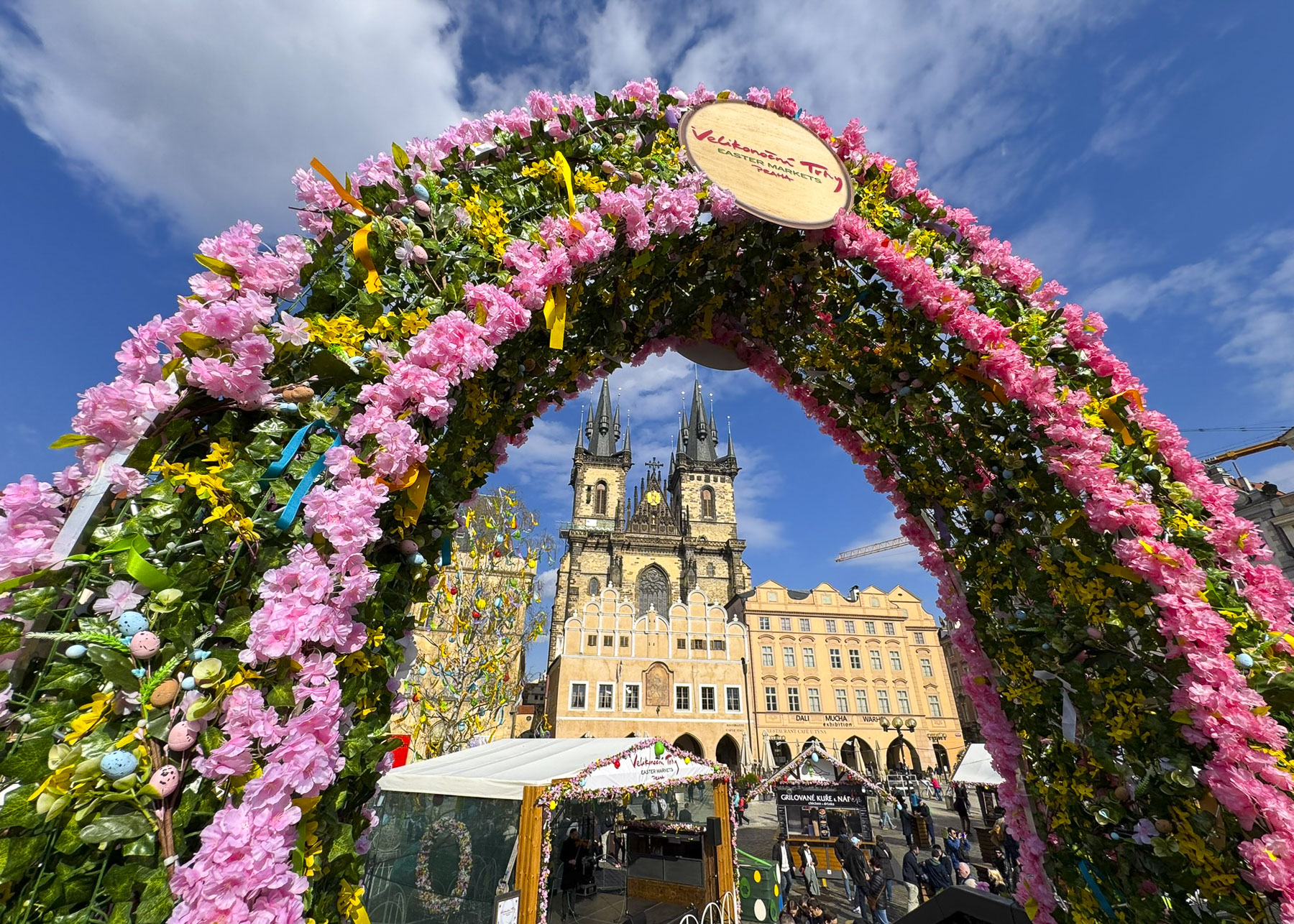
P.S. We purchased Tallinn Cards to use during our stay in the city and found it to be quite beneficial and cost effective. The card offered access to over 50 museums and attractions, free travel on public transportation, and discounts on sightseeing tours.