Tenerife Part 4: Pico del Teide, La Orotava, Puerto de la Cruz & Beyond

The silhouette of the ancient volcano mesmerized us. Even in the dark blues and blacks of the night the volcano’s majestic silhouette loomed large above Icod de Vinos. Later the moon rose and contributed a magical otherworldliness to our vista. During the winter when its 12,000 ft summit is snow covered and there is a full moon, it’s said to shine like the beacon of a lighthouse that can be seen from the coast of Morocco. The aboriginal Guanches believed Pico del Teide held up the sky and placed offerings on the volcano’s slopes to appease Guayota, an evil deity they believed responsible for its volcanic eruptions. We made our own photographic pilgrimage to Teide as we drove to the Hotel Alhambra in La Orotava, our base for the remainder of our vacation. Though not the most direct route from Icod de los Vino to La Orotava via Pico del Teide it was, I can assure you, the most interesting.

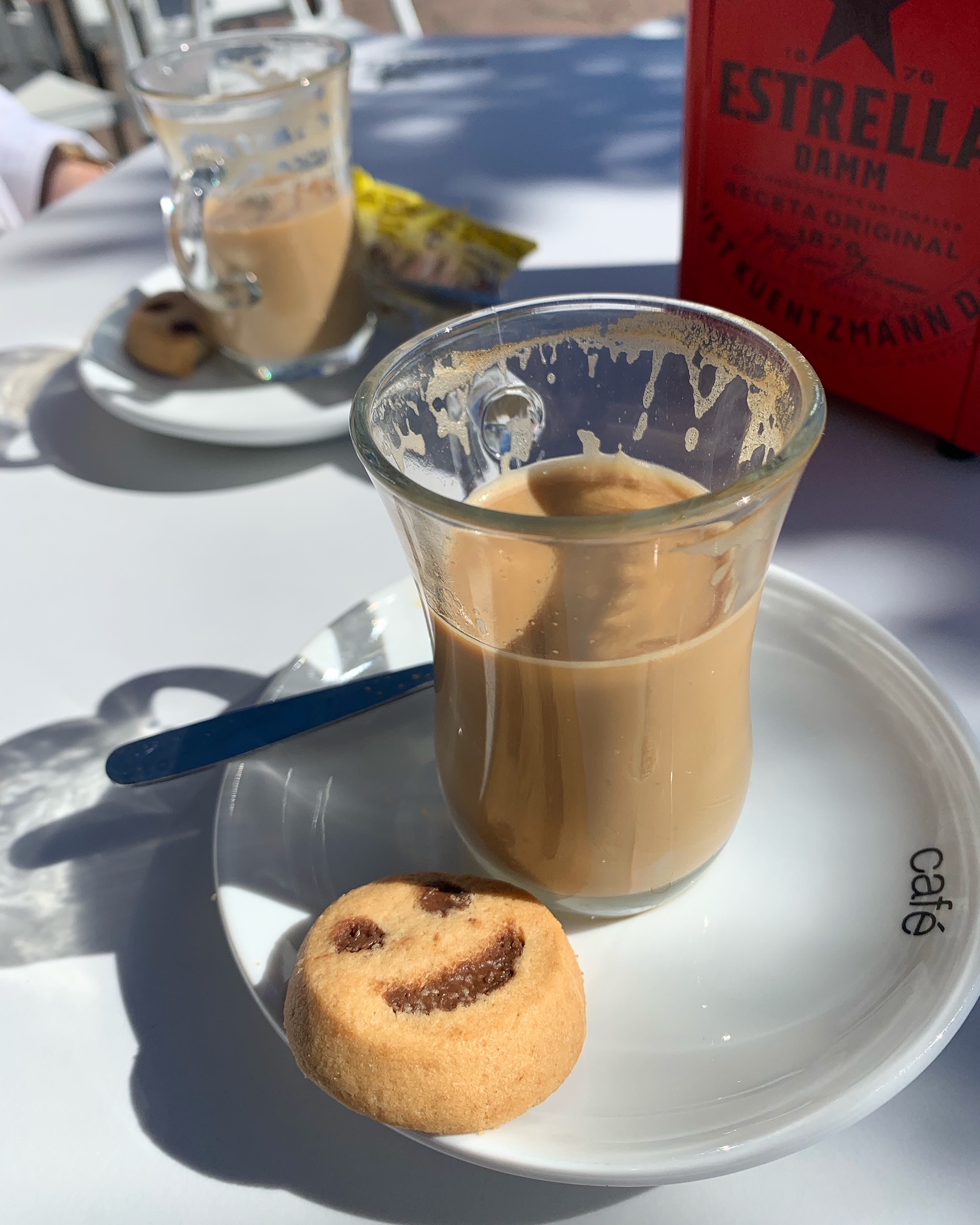
Teide is still considered an active volcano and while its cone hasn’t erupted in the last 850 years, side vents on its slopes have spewed destructive massive lava flows across its slopes in 1492, which Columbus noted in his logbook as he sailed on his maiden voyage of discovery, 1704,1705, 1706, 1798 and 1909. Our route on TF-5 cut across the lava field left from the 1909 El Chinyero vent eruption. Now over one-hundred years later new growth pines are just beginning to emerge from this carnage. Their verdant green needles, a refreshing sign of life in an otherwise barren landscape. Crossing the ridge of the mountains we descended into Santiago del Teide. The main road was lined with several inviting spots to stop for café! (We didn’t realize at the time, but this was also our last chance for lunch, as many places normally open in high season are closed or only open on the weekends in the shoulder seasons.)

After coffee we visited the town’s church, Parroquia de San Fernando Rey. It’s a small, whitewashed structure constructed in the late 1600s and has an interesting collection of religious art. Across the street stands a life-size statue called “the brave Guanche,” dedicated to Alonso Diaz, a goatherd, who in 1509 stood up for his rights and successfully petitioned Spain’s King Fernando the Catholic for justice, after 200 goats were stolen from him by a Spanish conquistador. By royal decree the goats were returned.
Venturing into the foothills, our drive continued along TF-38 and traversed an ever-changing, diverse bio-system as we left the arid shrub-covered lowlands behind and climbed into hillsides covered with pine forests. It was a well paved but narrow serpentine road, without any shoulder, that required constant vigilance. The mouths of ancient lava tunnels were visible from the road, but there was no room to pull over and stop for photos until we reached the Mirador de los Poleos. Here the raw beauty in these charcoal-colored landscapes flourished beneath the Chinyero Volcano, and we had a chance to walk across the lunar-like terrain, part of the immense lava field from its 1909 eruption. Dotted with huge boulders, it was difficult to comprehend the ferocious forces required to expel these massive rocks from their subterranean origin.

Continuing on, we had encountered what we thought was fog until, to our surprise, we emerged above the clouds at Mirador de Samara.

This area is also very popular for hiking, with many very obvious trails crisscrossing through a young forest emerging from the volcanic soil left from Pico Viejo’s last, 92 days long, eruption in 1798.

Approaching noon, we turned toward Vilaflor, the highest village, at 4600ft, on Pico del Teide’s southern slope and surrounded by vineyards. The surrounding wineries produce some of Tenerife’s best wines from Listán Negro, Malvasia, Negramoll, and Listán Blanco grapes. And are embodied with a distinctive terroir from the warm climate and fertile volcanic soil. The weather had suddenly turned gray and dreary. More frustrating though, the wineries we had planned to visit were closed mid-week during the shoulder season. Fortunately, we happened upon Mar de Nubes, a craft store and café run by a friendly young married couple from Tenerife and the States. The shop features only handicrafts made by Canarians and local wines and artisanal beers. Of course, we shopped.
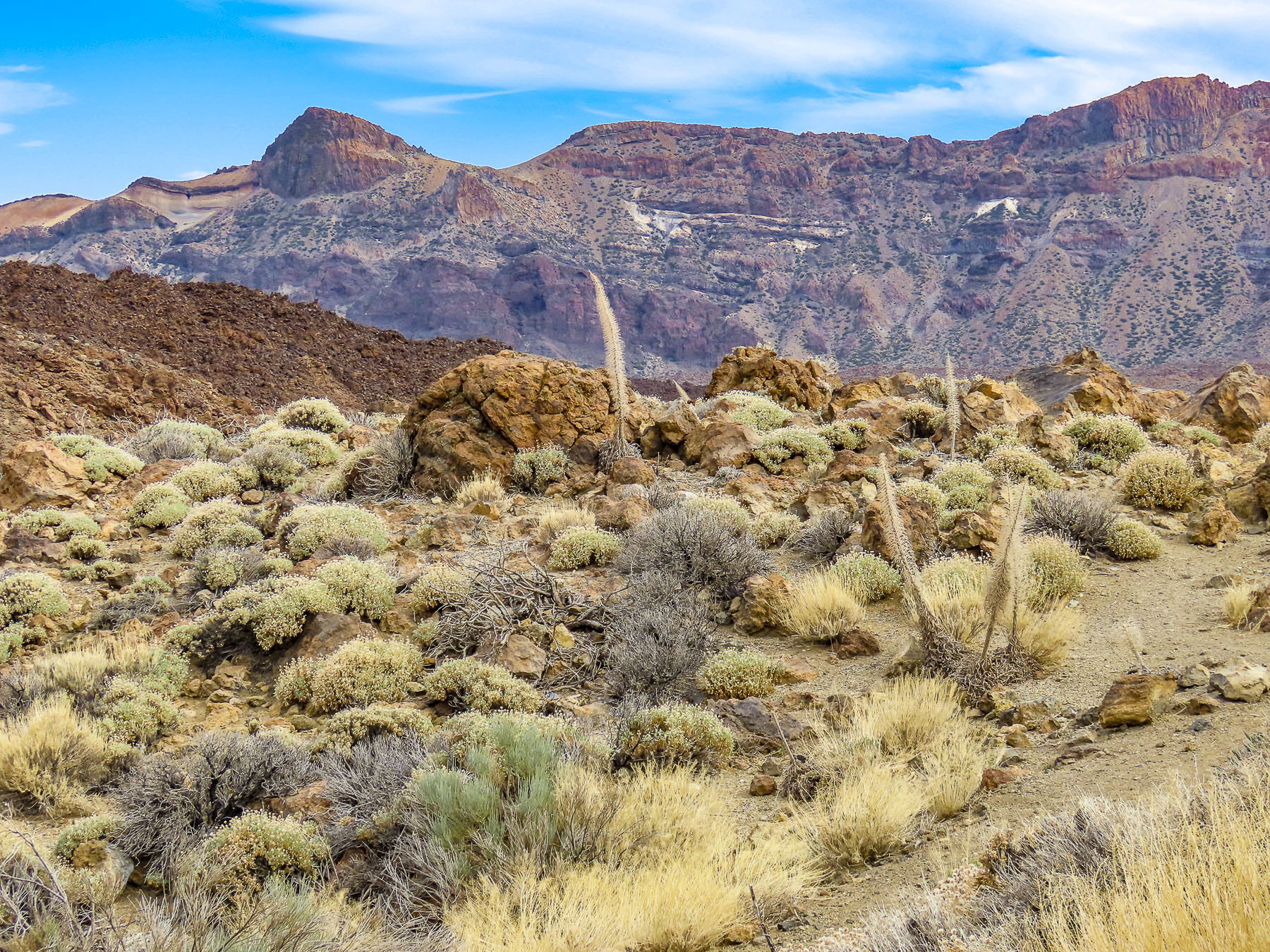
Beautiful, inhospitable, Death Valley-esque, lunar or Martian, however you choose to describe the varied topography that surrounds Pico del Teide’s, it’s enthralling and fascinating. So much so that filmmakers have used the location for scenes in several block buster films: One Million Years B.C. – 1966, Planet of the Apes – 1968, Clash of the Titans – 2010 and its 2012 sequel Wrath of the Titans, and in 2023 the Last Triala, a Star Wars fan film.  TV episodes of Doctor Who, The Dark Along the Ways and season 2 of The Lord of the Rings: The Rings of Power have incorporated Tiede’s environs into their productions.
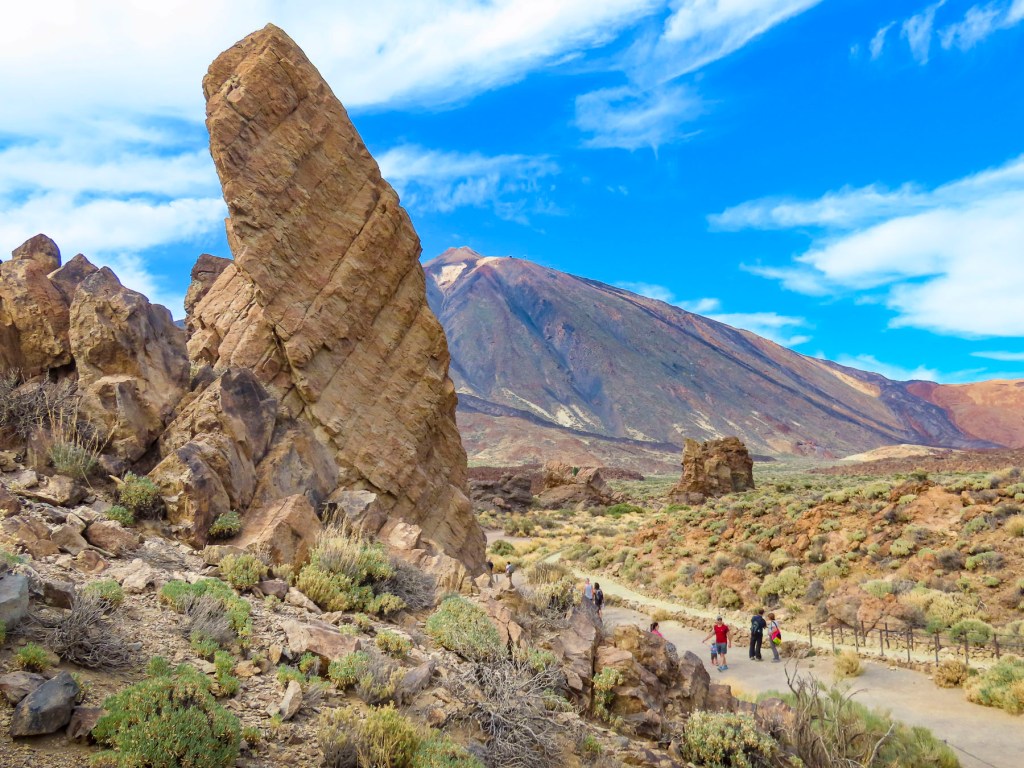
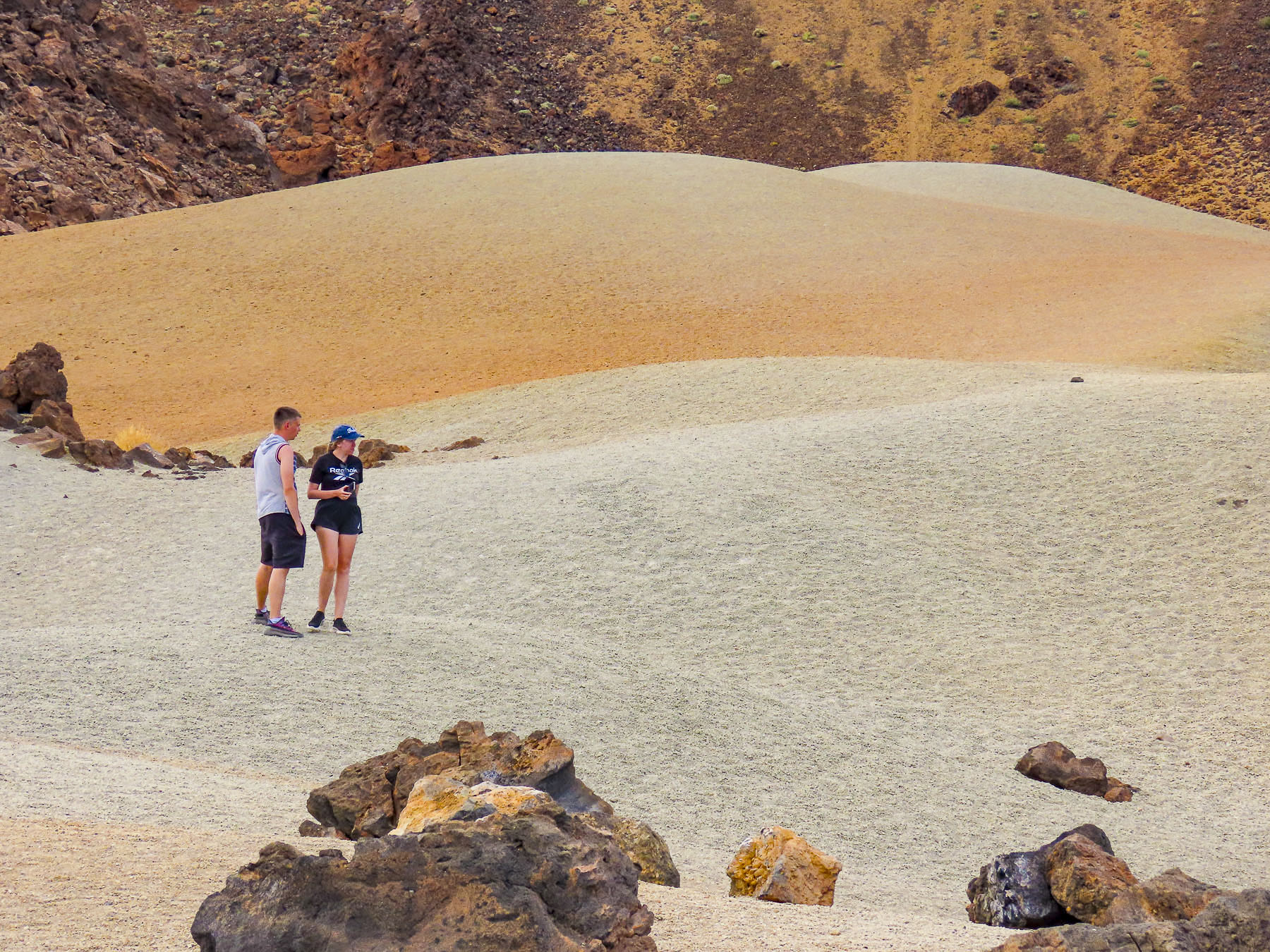
Driving back up the mountain we continued on to view the large sculptural outcroppings at the Mirador de La Ruleta and the desert-like dunes of the Siete Cañadas hiking area, before following the long downward grade of the road to La Orotava. We speculated that if you dropped a soccer ball at the top of the slope, it would bounce downhill continually until it splashed into the ocean at Puerto de la Cruz, roughly 23 miles away. Our route along TF-21 cut through forests ravaged by the wildfires of 2023. The blackened trees were the only scars in the otherwise pristine wilderness of the Tiede’s northern slope in Parque Natural Corona Forestal.
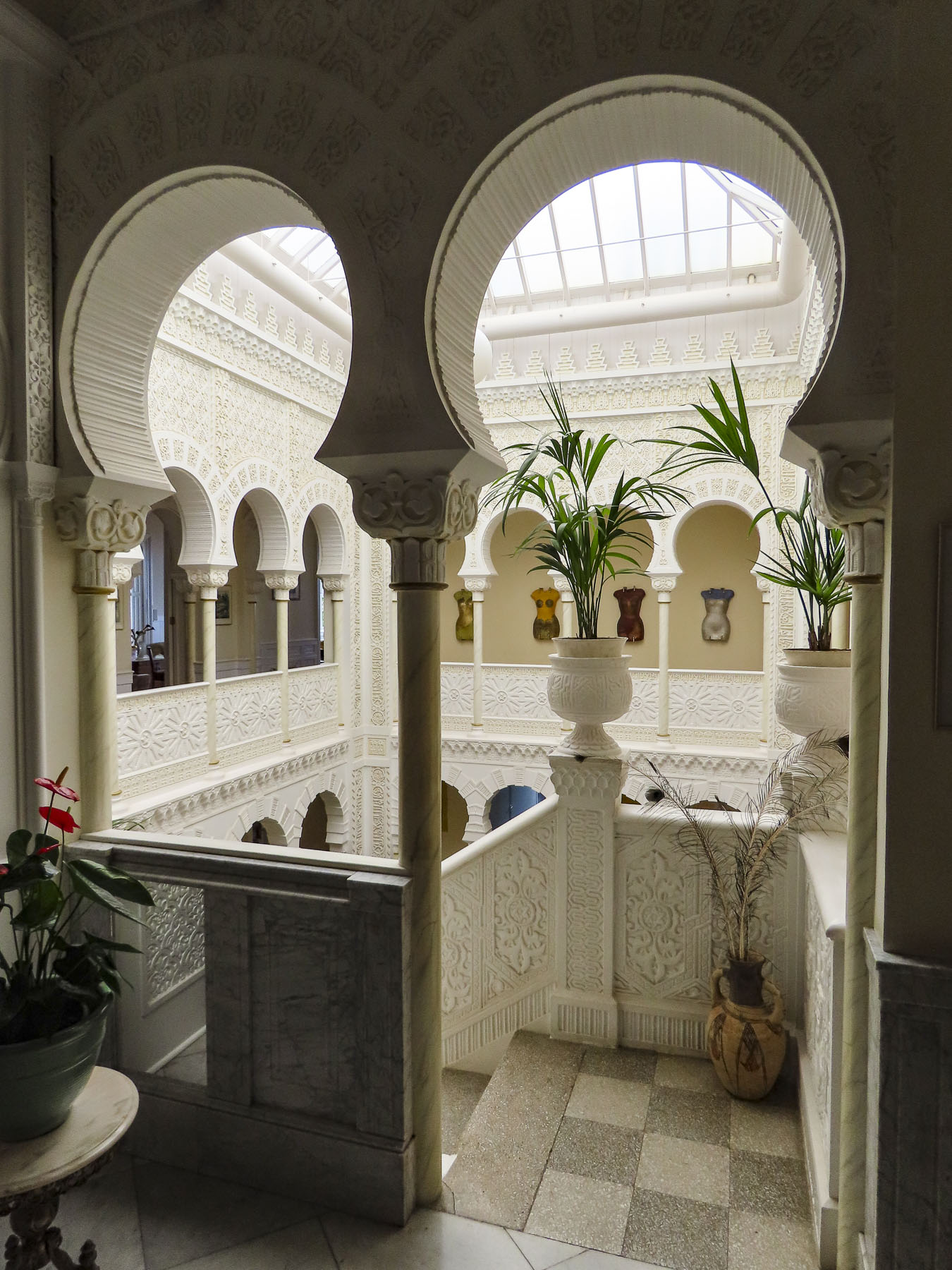
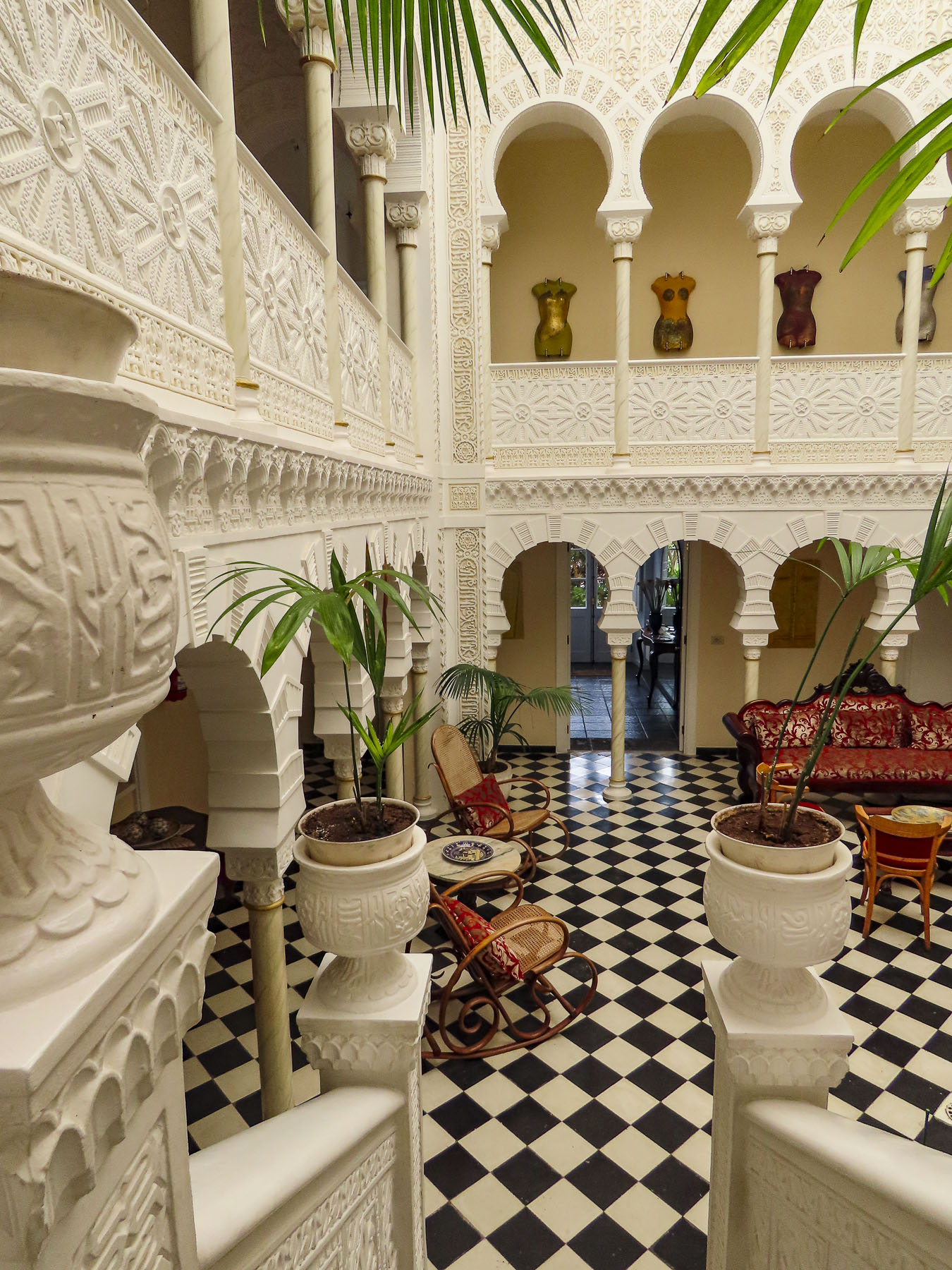
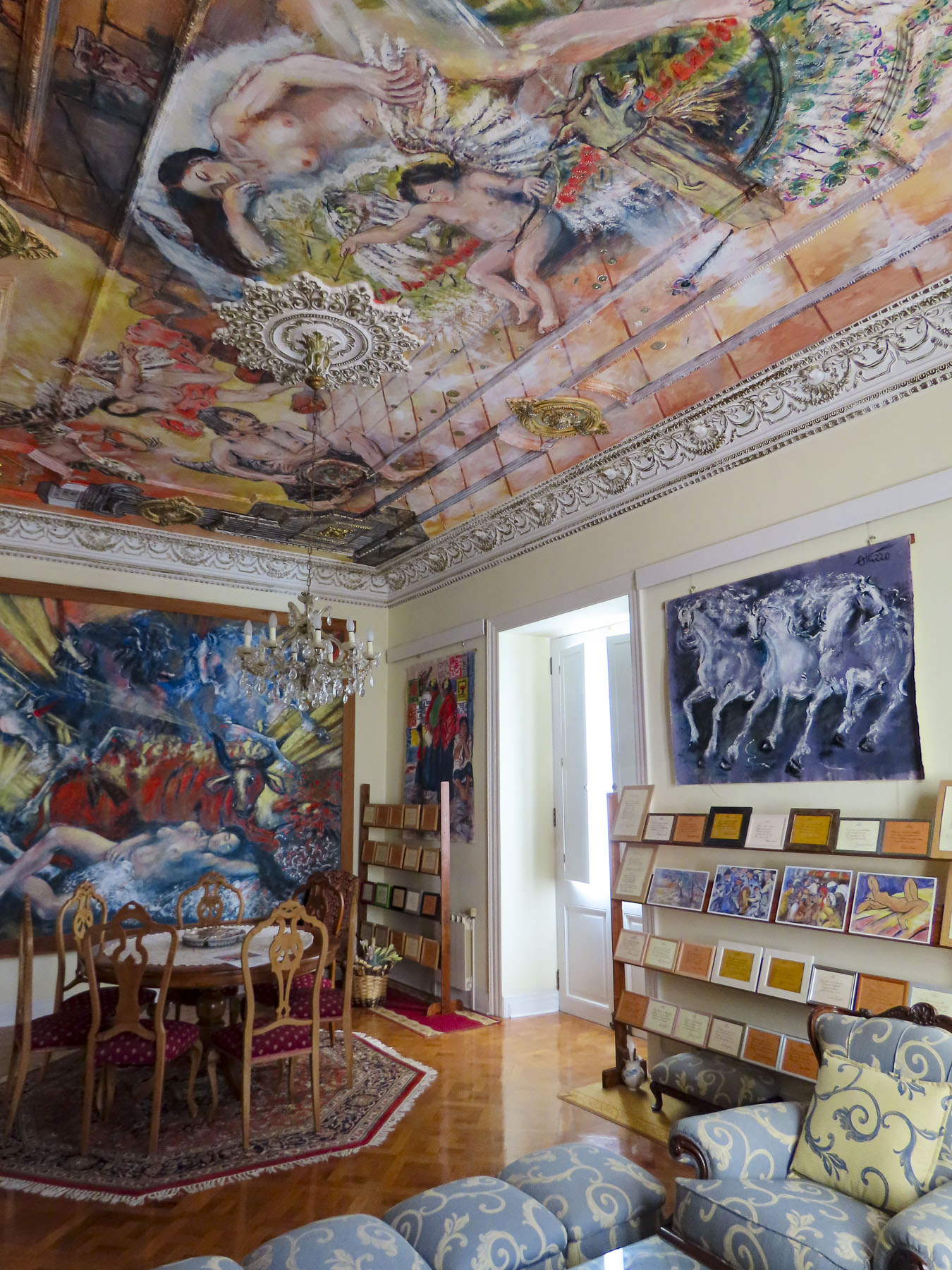
Late in the day we coasted into our parking space in front of Hotel Alhambra. Parking on the streets in La Orotava is free, but it’s a competitive sport. We chose to stay at this hotel for its distinctive architecture and location in the historic center. While the exterior of the 500-year-old dwelling is quietly classical, the interior walls of its Canarian-style courtyard were beautifully transformed in 1925 with intricate floral and geometric Nasrid art designs, created with gebs plasterwork and enclosed under a high glass roof. An eclectic decorating theme is highlighted with frescos by Maestro Antonio Otazzo, a local self-described painter, sculptor, musician, philosopher, and poet. As if being followed by a friendly giant, Pico del Teide was in our line of sight when we opened the shutters on our room’s window.
La Orotava was rather easy to walk around if we were walking across the slope, but after several days our hamstrings and calves were sore, though our butts were firmer. “Walk a little then café,” as we say was the perfect approach to exploring this wonderful town.

Along with San Cristóbal de La Laguna, it’s considered to be one of the prettiest towns on Tenerife.

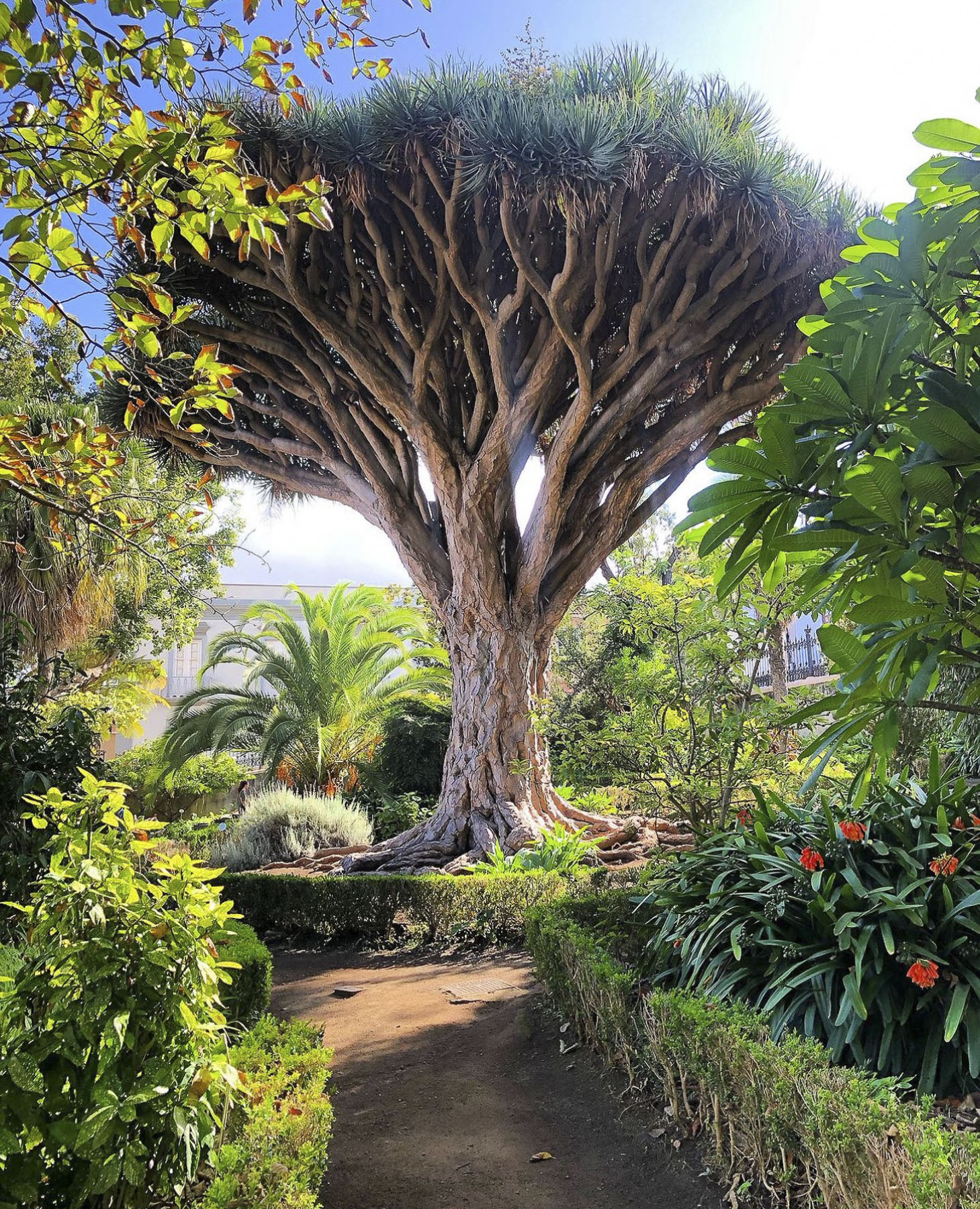
Getting to the higher points in town we asked the hotel to call for a cab, for a quick ride to the Jardines del Marquesado de la Quinta Roja. Once part of an estate, it’s named after the noble interred in the park’s marble mausoleum; as a member of the Masonic Temple his family was not allowed to bury him in the town’s catholic cemetery. Constructed in 1883, the garden is a beautiful French-style, terraced, formal garden with a view over the town and the distant sea. A smaller but older (1788) sister park next to it, the Hijuela del Botánico, features a towering dragon tree and other plantings of specimen trees collected from Spain’s former colonies.  And if you are in awe of dragon trees, as we are, the Villa de La Orotava Dragon Tree Tour might be for you.
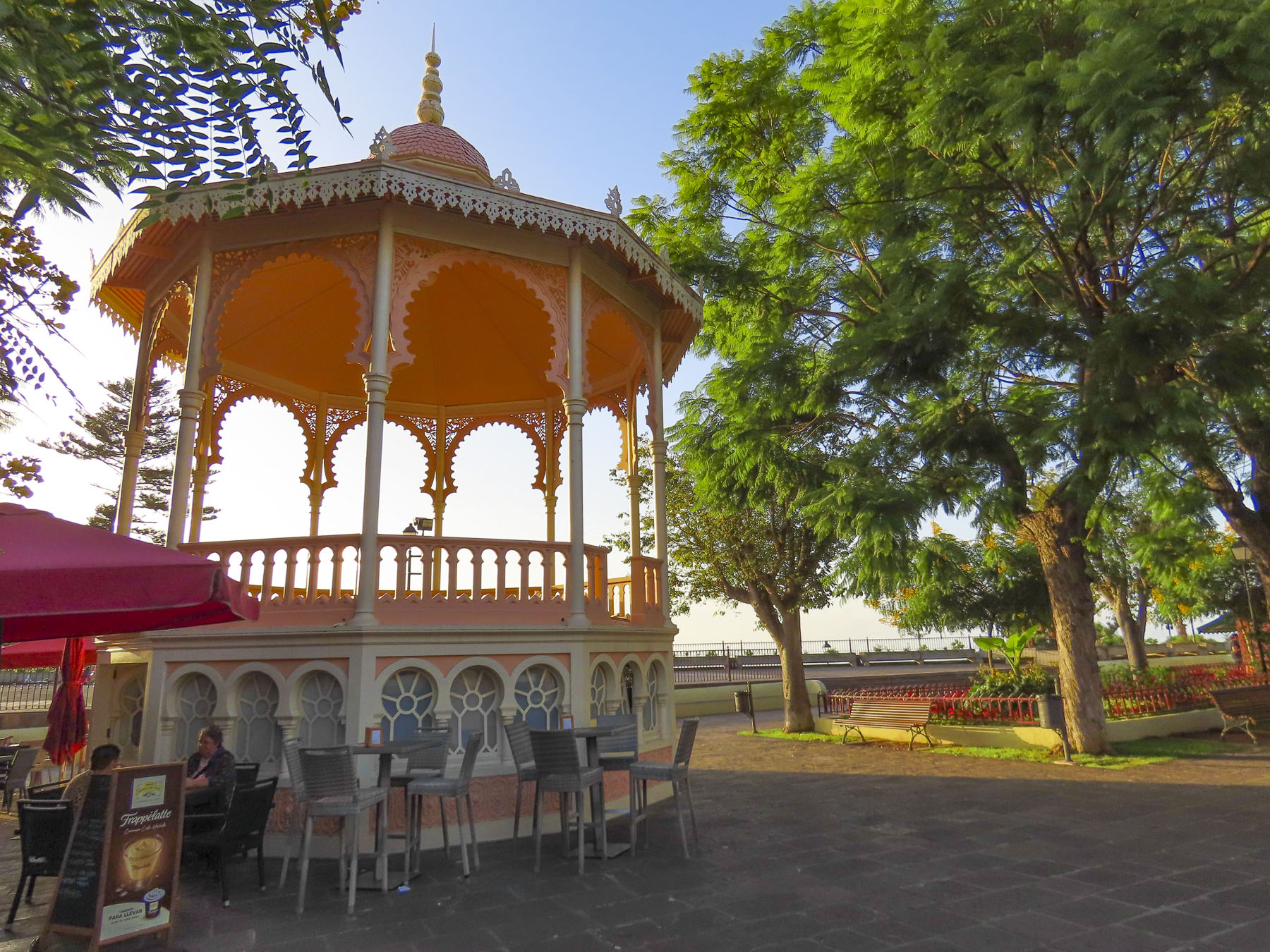
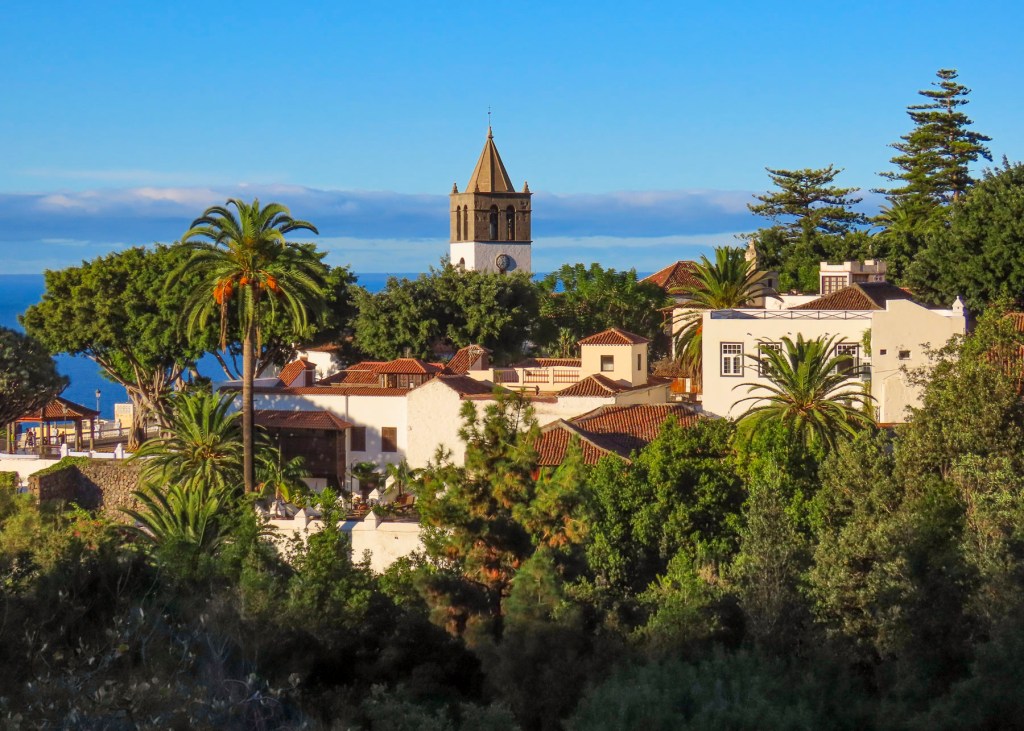
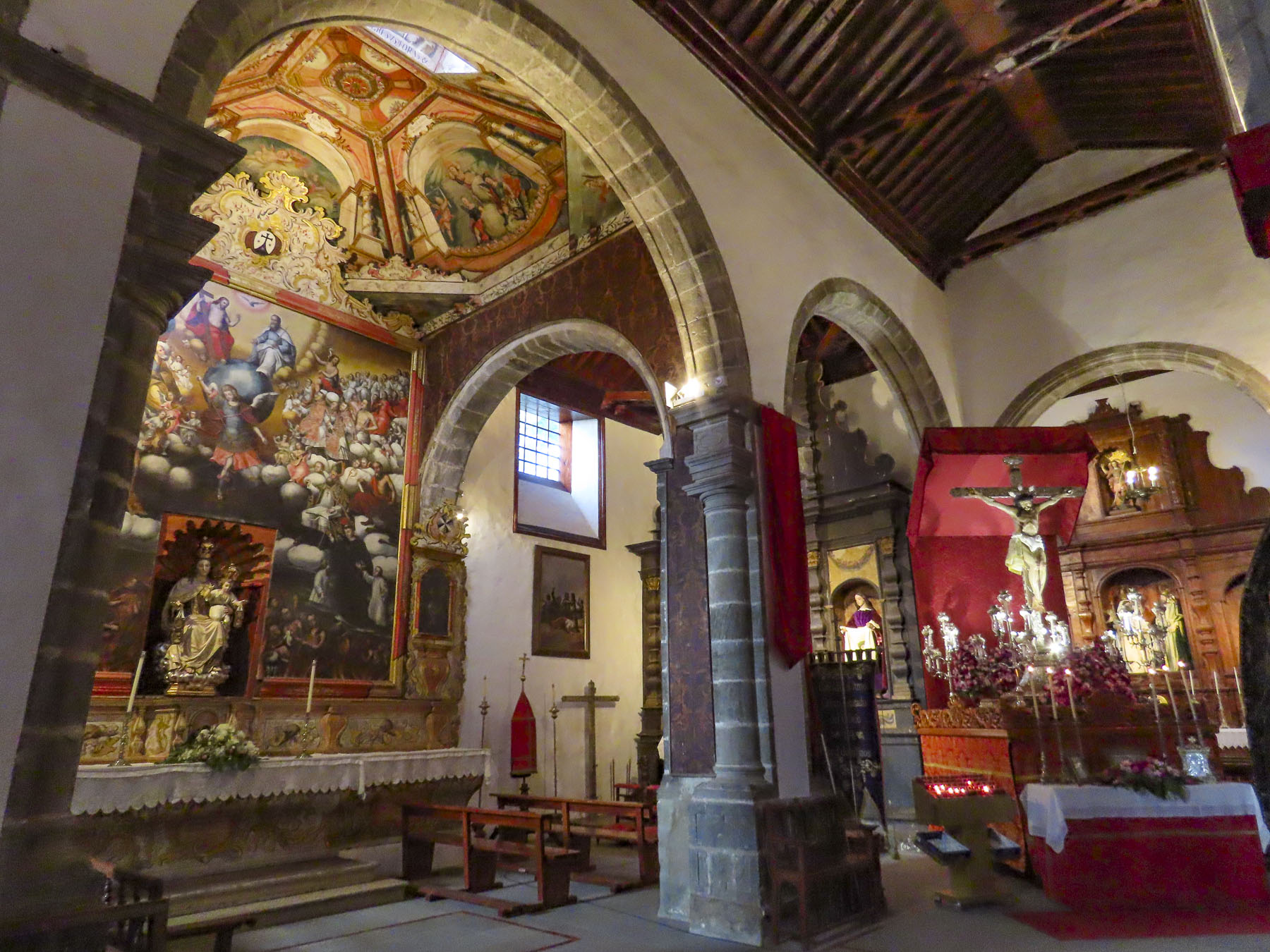
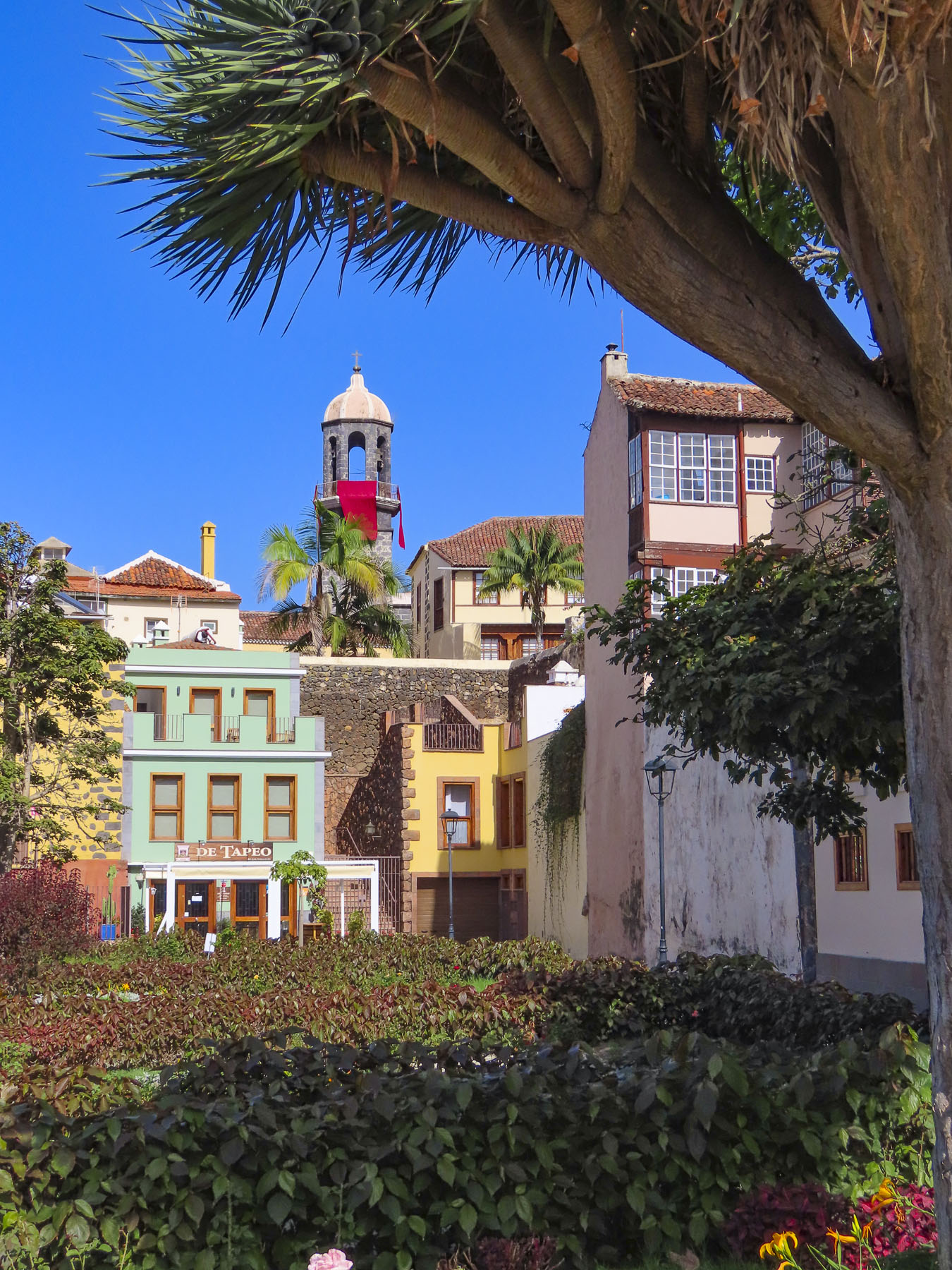
From the gardens we wandered downhill along cobbled lanes, past wonderful examples of colorful Canarian architecture, into the historic old town, which is centered around the Nuestra Señora de la Concepción. Started in 1516, it is the town’s oldest and largest church, with its colorful dome giving the town its iconic skyline.

But La Orotava’s history starts early in 1496 with the final defeat of Tenerife’s aboriginal Guanches at the battle of Aguere, after which their leader committed suicide by jumping off a cliff in nearby Tigaiga. “To the victor go the spoils,” and the fertile lands of the Guanche kingdom of Taoro were awarded to the nobles, conquistadors and financiers who participated in the Spanish victory.

The rich soil of the hillside was perfect for the cultivation of sugarcane and the steep streams from the mountain were soon harnessed to run sugar and lumber mills. Prosperity followed. Ice from Mt. Tiede chilled the drinks of the town’s wealthy.

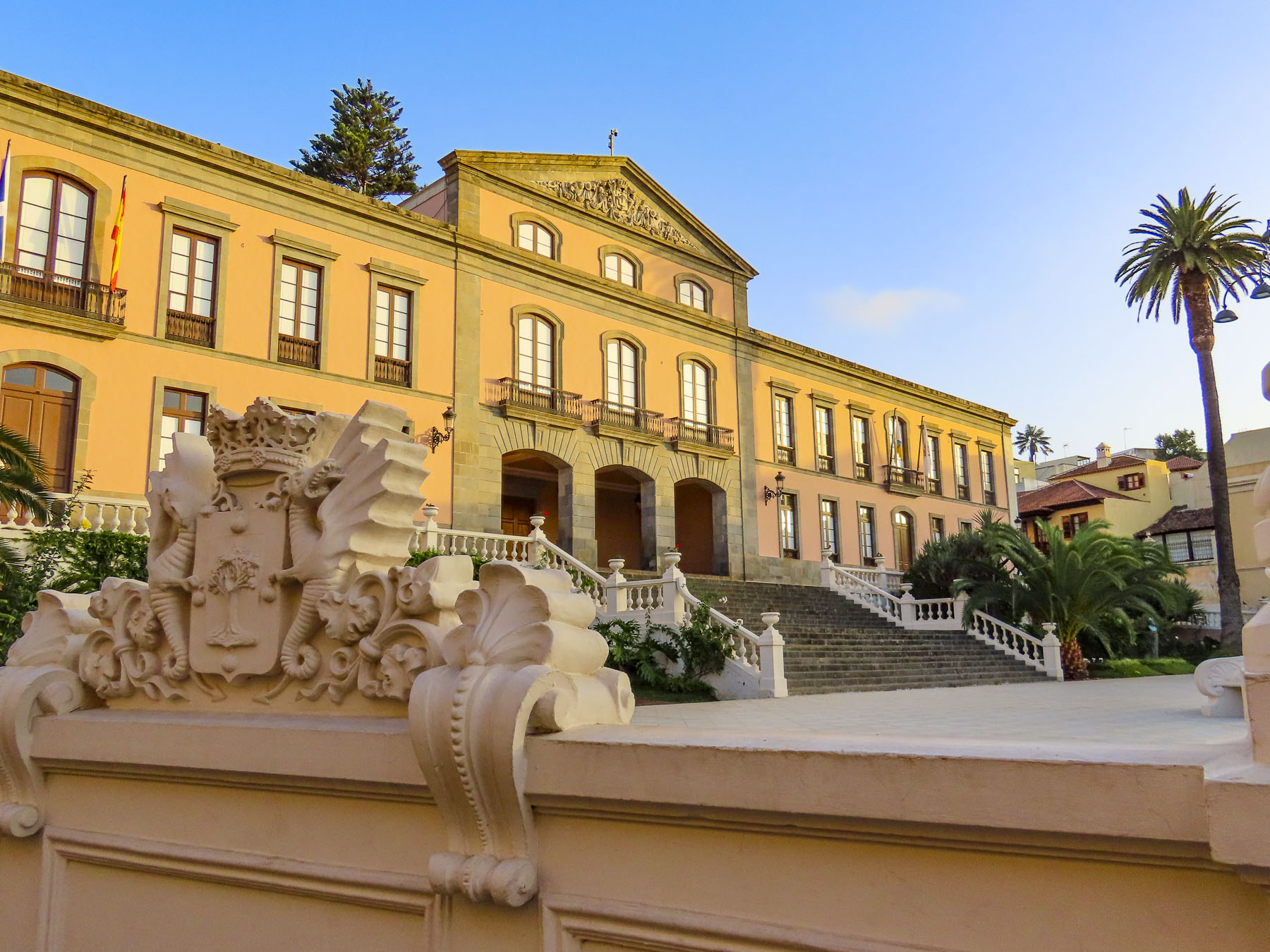
Landowners and merchants built large family mansions in a style which would become known as Canarian, which feature interior courtyards and distinctive facades with decorative wooden balconies and the family’s Coat of Arms prominently facing the street. Convents housed the daughters from families that didn’t want to diminish their wealth by paying the dowry for the girls’ wedding, as was the custom of the time. 

Vines and wine replaced sugar cane and ruled the town’s economy in the 17th century. In the mid-1800s, the textile mills of Europe were searching for different dyes, and mealybugs or cochineal were bred in cactus around La Orotava and harvested to obtain a crimson dye, produced from an acid that the bug makes to fight off predators. Since the late 1800s, vast banana plantations thriving on Tenerife’s mineral-rich volcanic soil continue to bring prosperity to the island and La Orotava, enabling the community to restore its historic buildings.
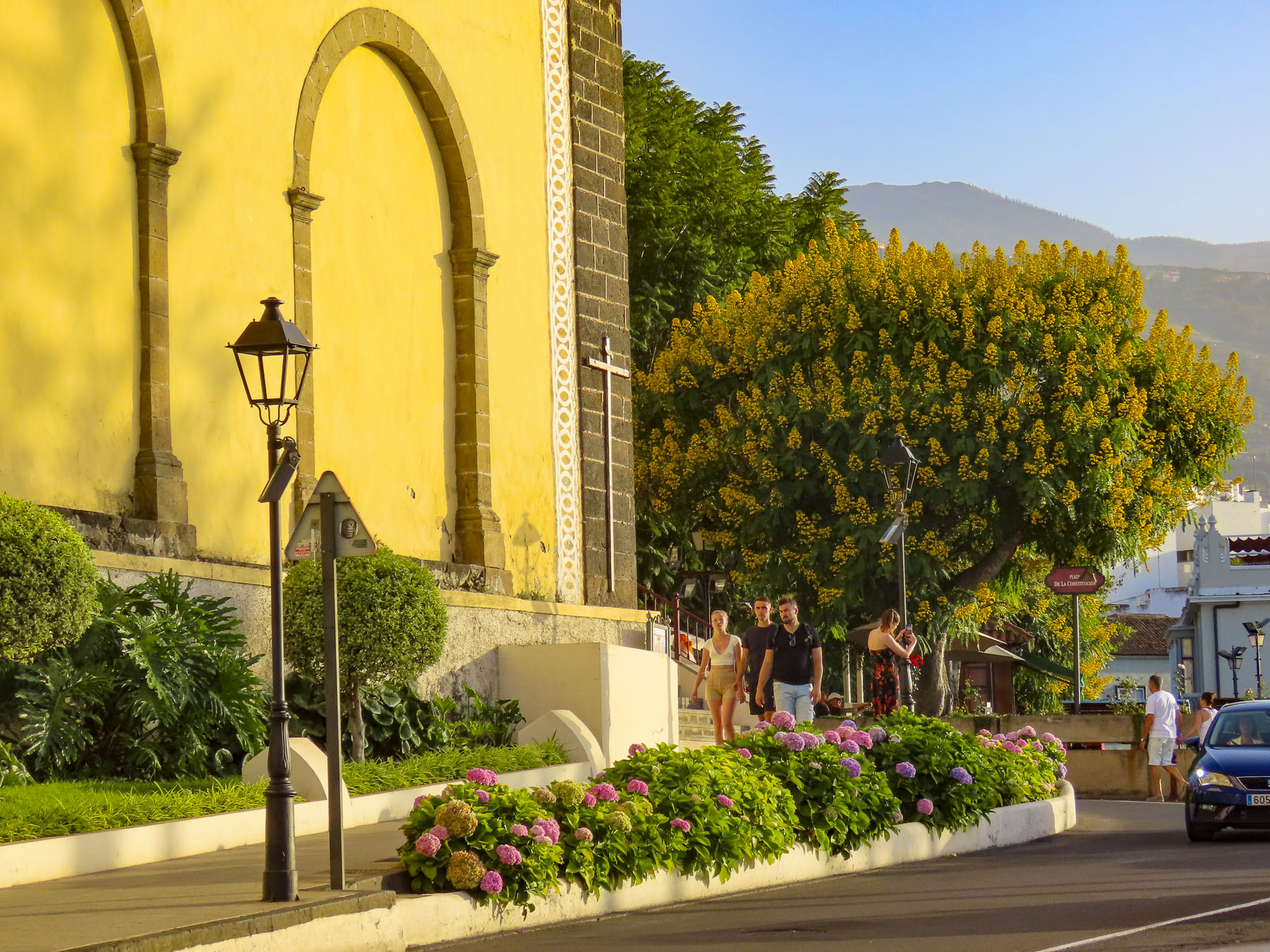
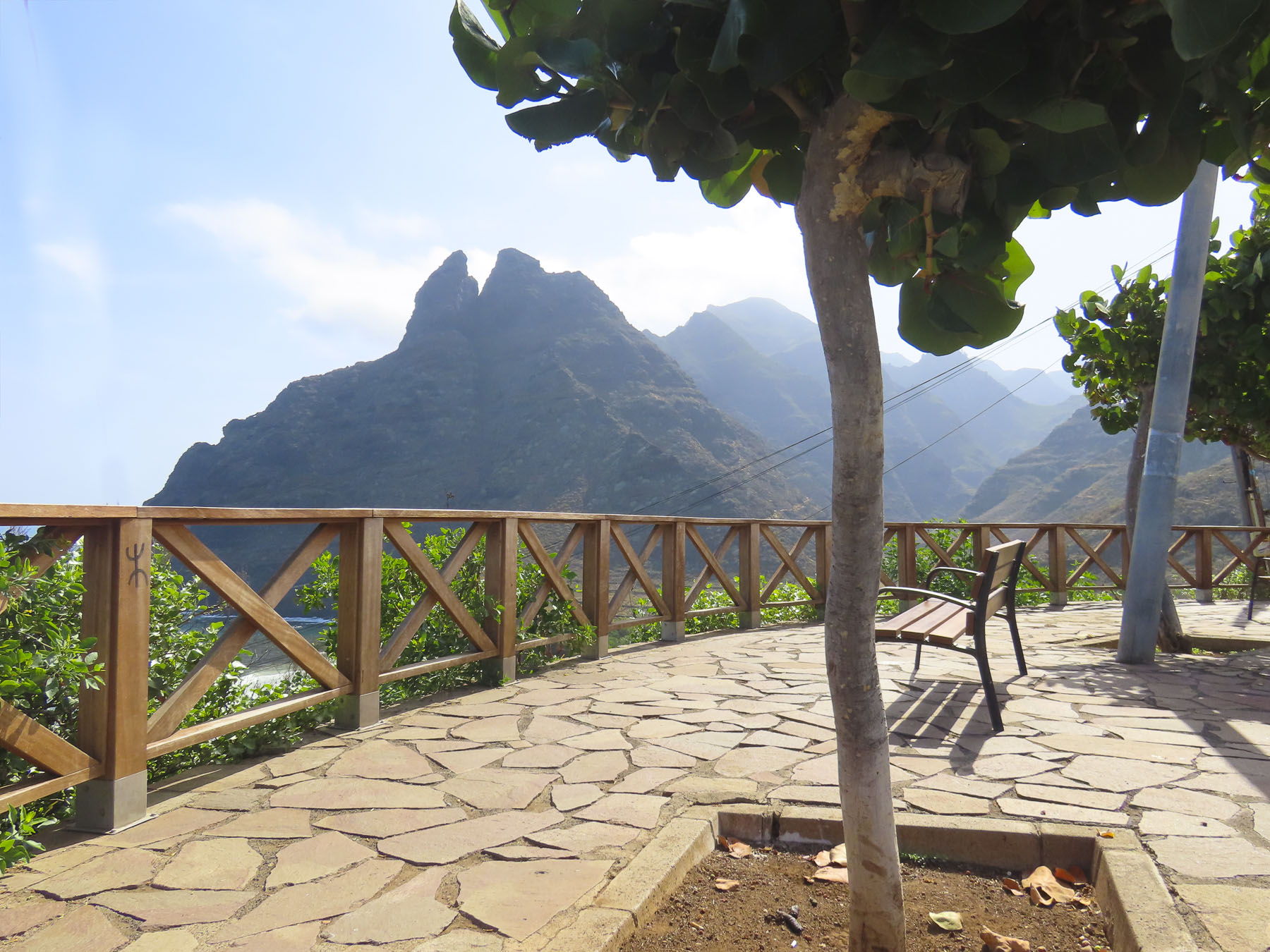
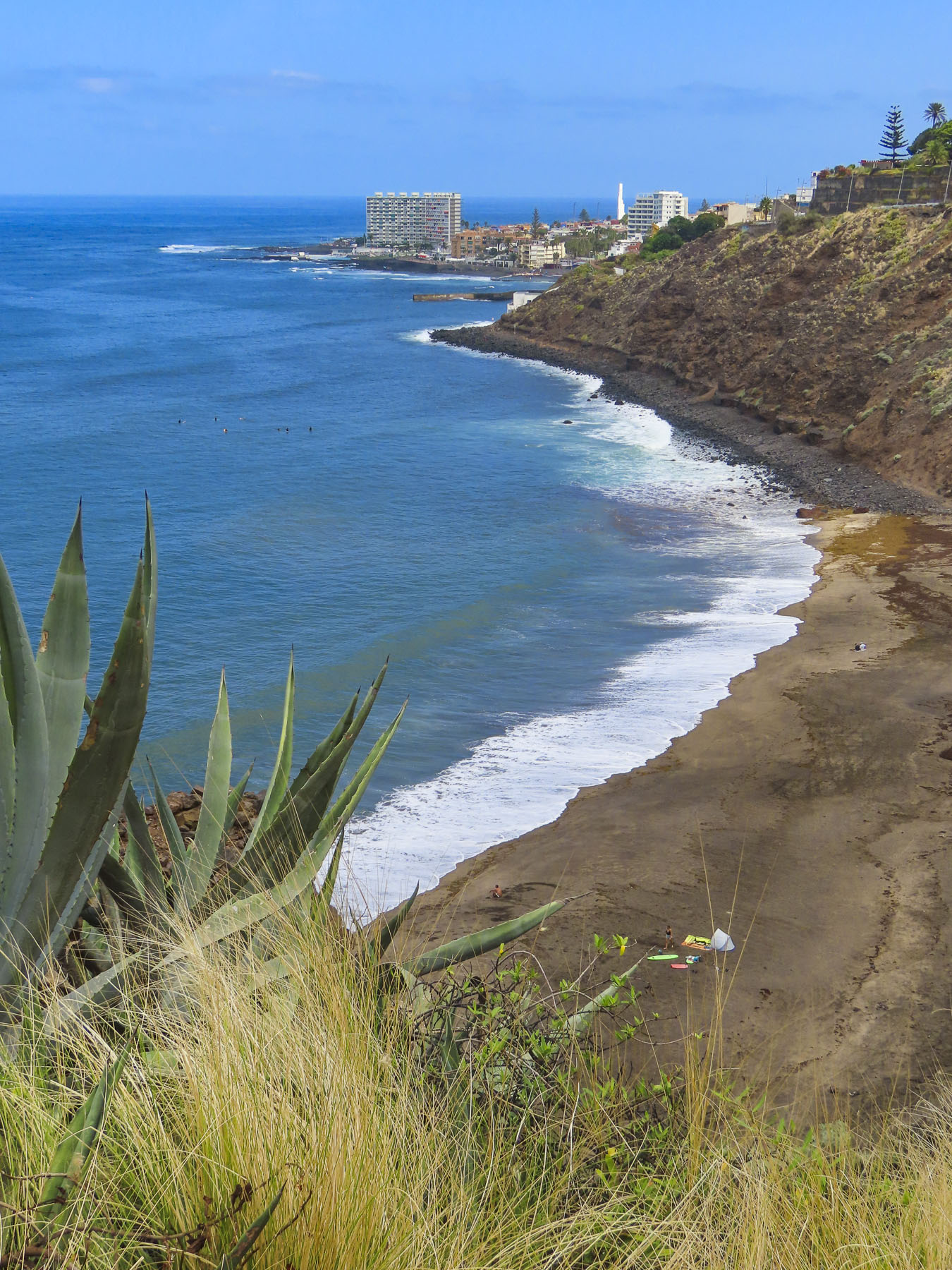
Not wanting to miss anything on Tenerife, we planned day trips from La Orotava around visiting coastal miradors and following any whims along the way. The Mirador Punta Del Hidalgo was not our favorite photographic destination, but we did enjoy stopping at the crescent shaped, black sand beach at Playa del Arenal in Bajamar, and a farmer’s market, Mercadillo del Agricultor in Tacoronte. Here we purchased some pastries for a snack and some Tuno Indio juice made from the purple fruit of the Canarian Red Prickly Pear. The cactus was brought to the Canary Islands from the Americas centuries ago and has been used in Canarian folk medicine to lower blood sugar and treat other ailments. It also has antiviral, anti-inflammatory, antioxidant, and anti-ulcerogenic properties. It tastes pretty good.
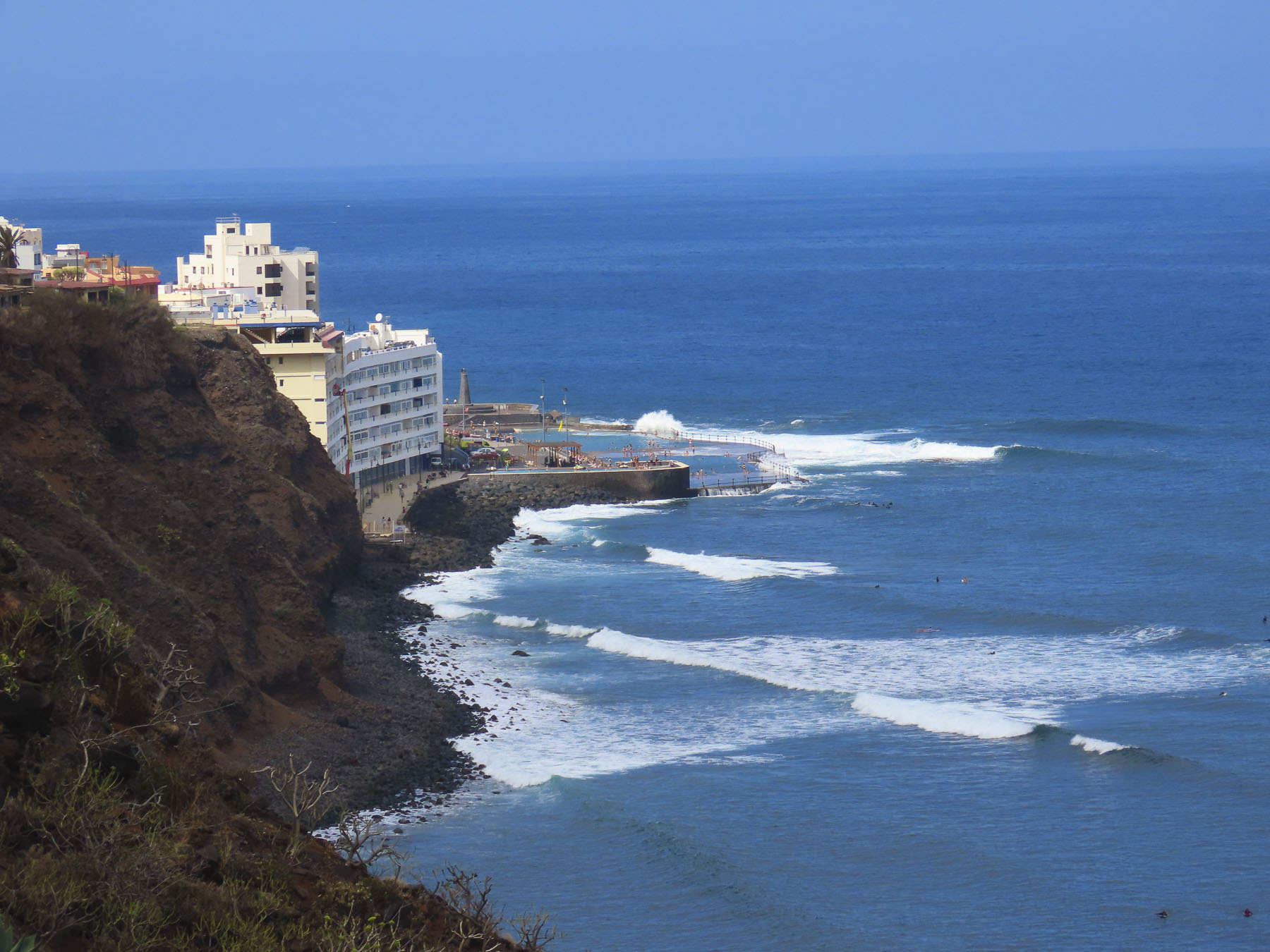
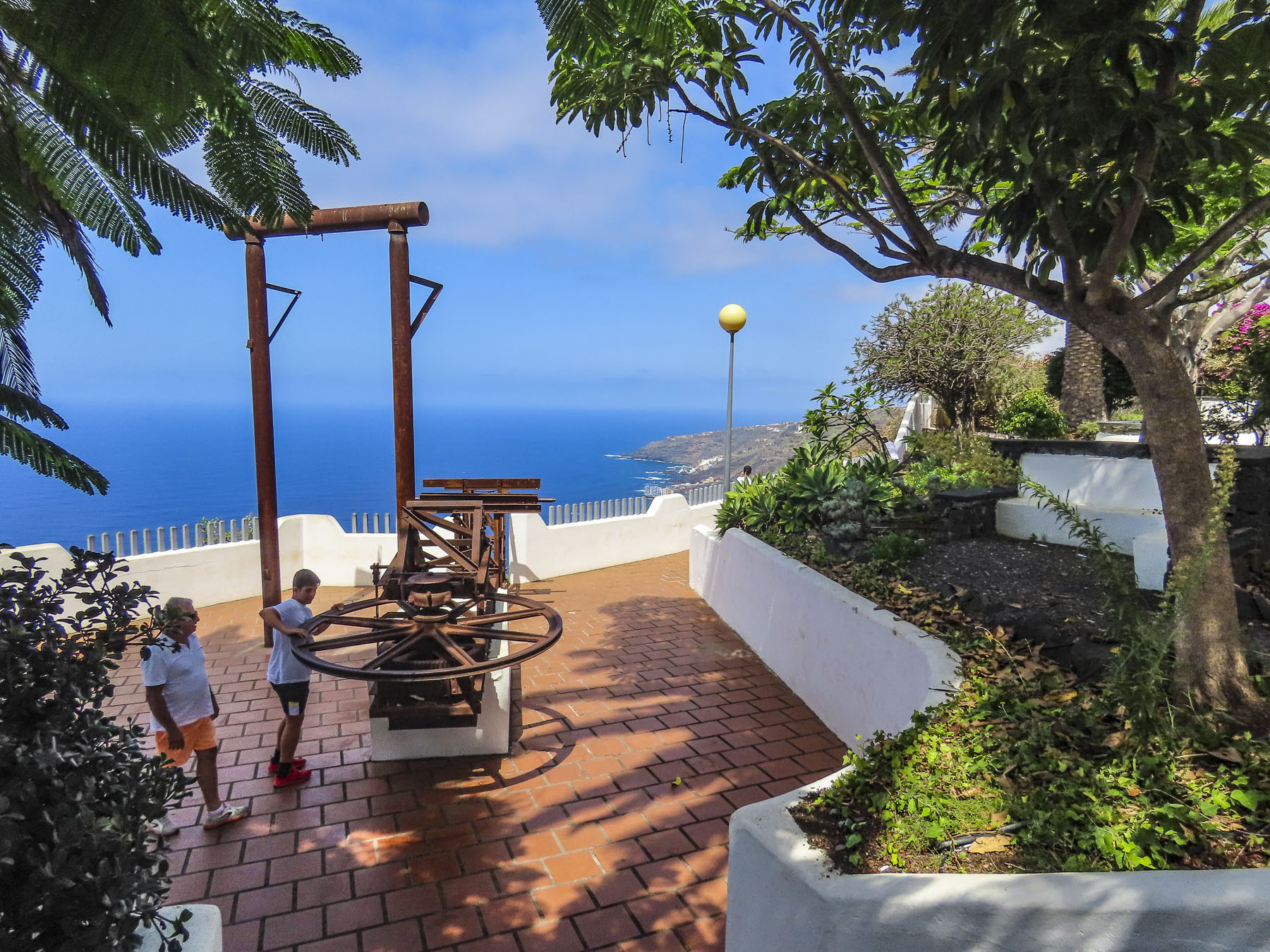
Afterwards we headed to the Mirador La Garañona in El Sauzal. Set dramatically atop a 1000ft sheer cliff, there’s a tremendous view of the coast below. And the park’s shaded paths led to a delightful small café perched at the cliff edge. We lingered and soaked in the view.
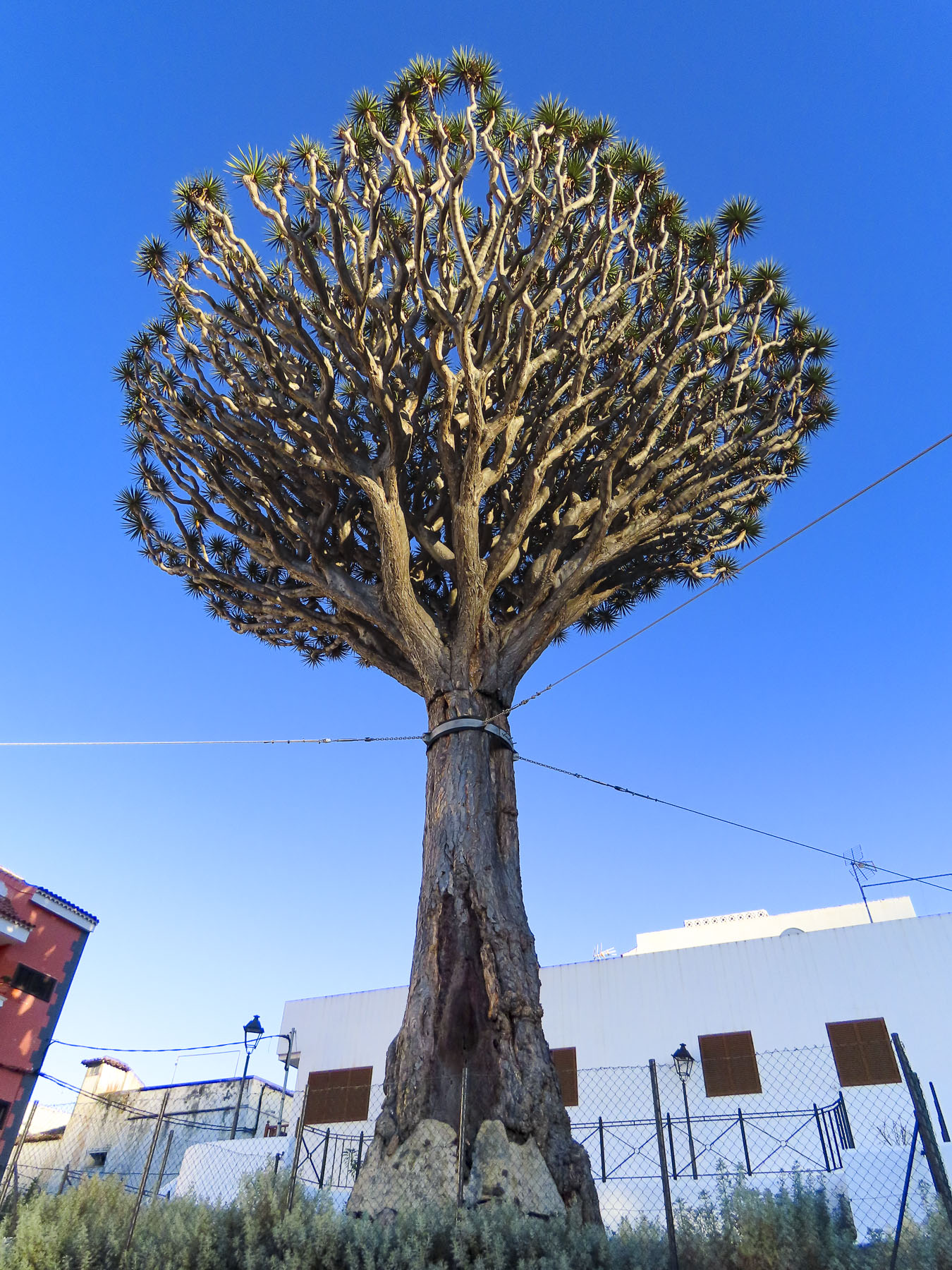
On the way to the mirador, we whizzed passed a small neighborhood restaurant set by itself on a corner, and decided to try it on our return trip. But first we had one last stop to make on the way at the Iglesia de Santa Catalina. It’s a classic, white-washed church from the early 1500s and picture perfect with its magnificent dragon tree in front.

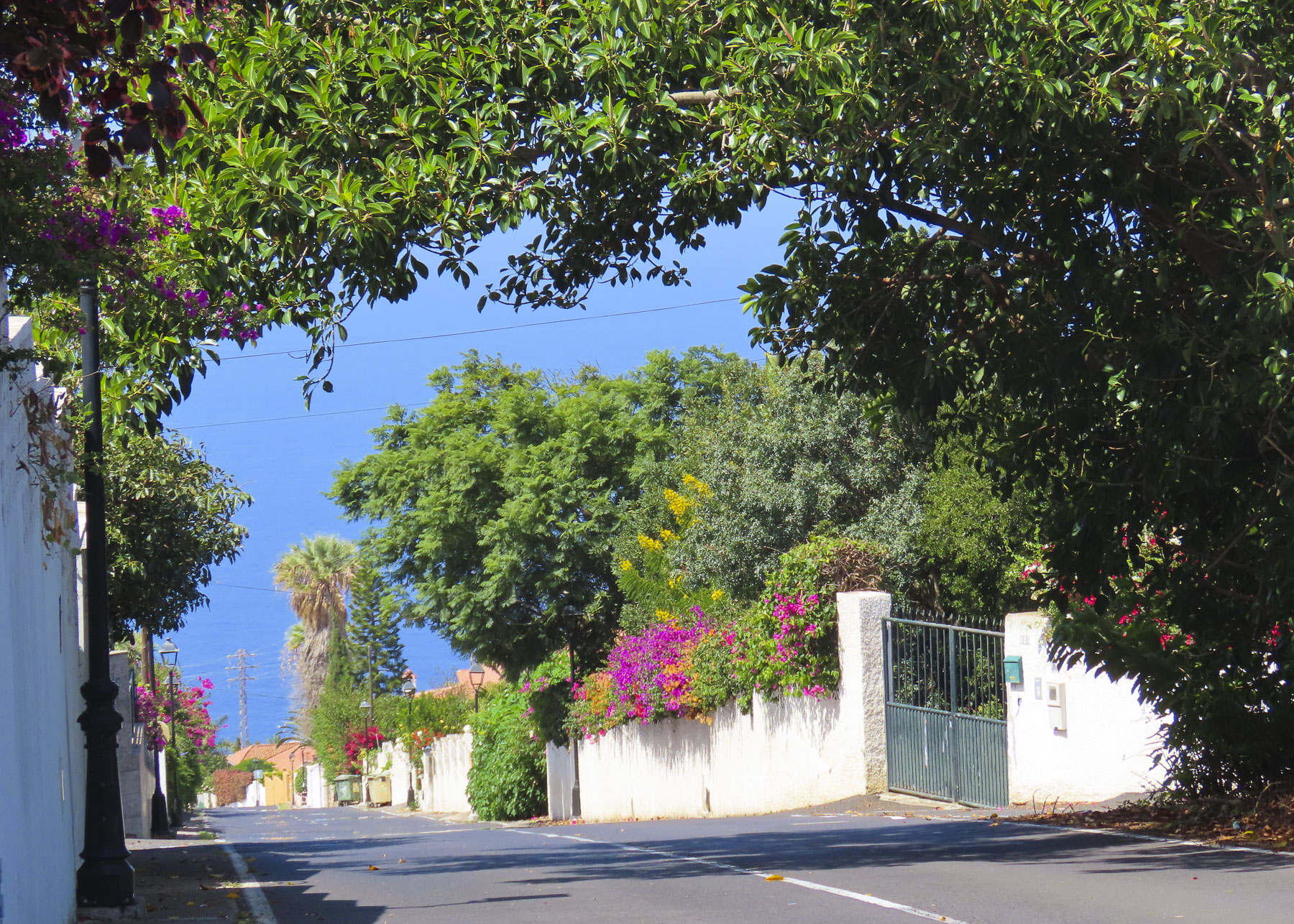
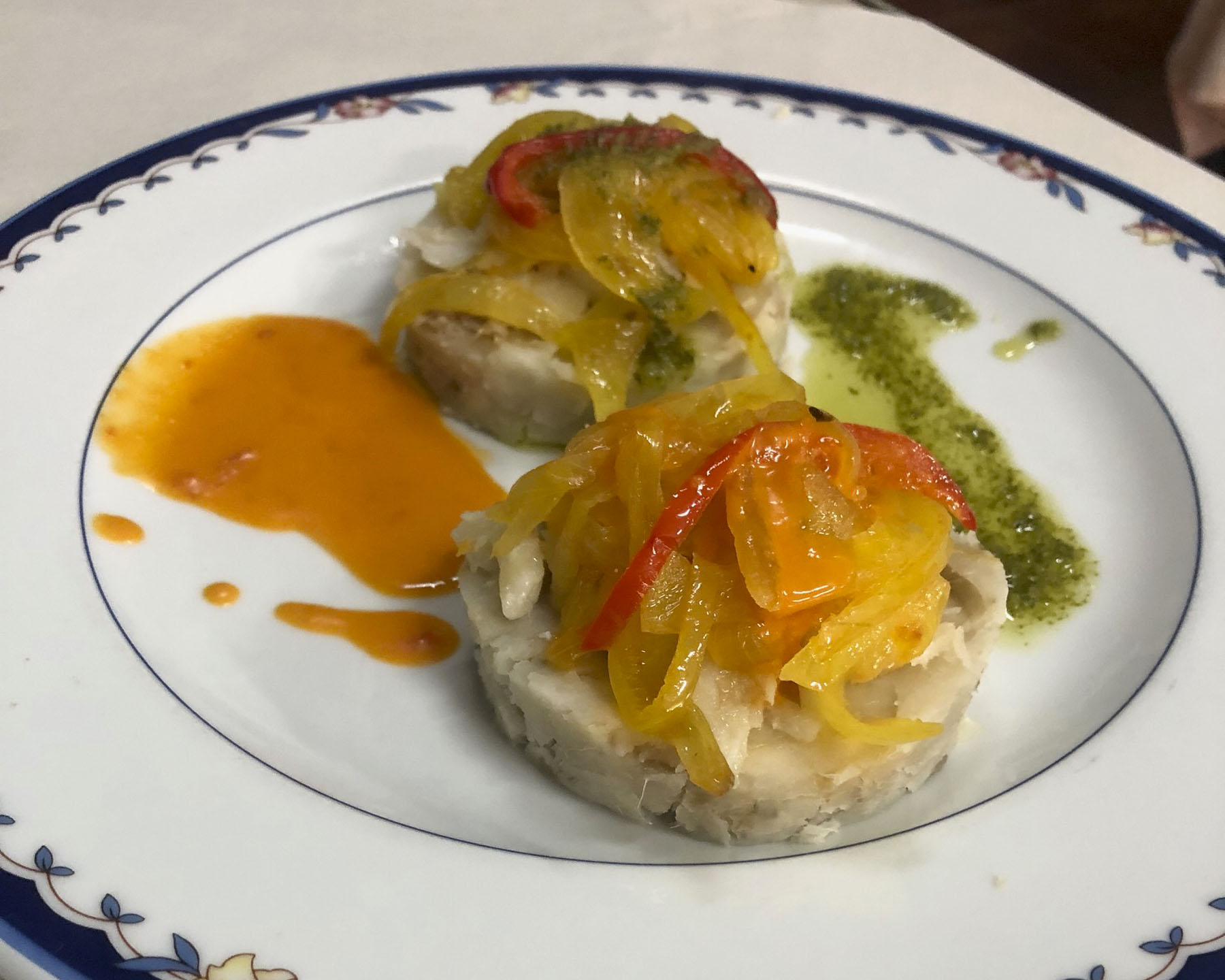
Lunch at Restaurante el Calvario was delightful, with excellent house wine and menu featuring traditional Canarian dishes. A young friendly staff, tolerant of our poor Spanish, contributed to a very enjoyable afternoon.
Puerto de la Cruz, just down the hill from La Orotava, was the destination for our last day trip. Originally a small fishing village, the town grew in importance after the main harbor on the north coast of Tenerife in Garachico was filled with lava from a 1706 volcanic eruption. Close to La Orotava, it also benefited from that town’s thriving economy, with the export of sugar, wine and bananas from its port. It has been a popular vacation spot since the Victorian era. Now it attracts visitors and expats from across Europe, drawn to its cosmopolitan vibe, wide beaches, quaint historic center, numerous parks, and vast array of restaurants.

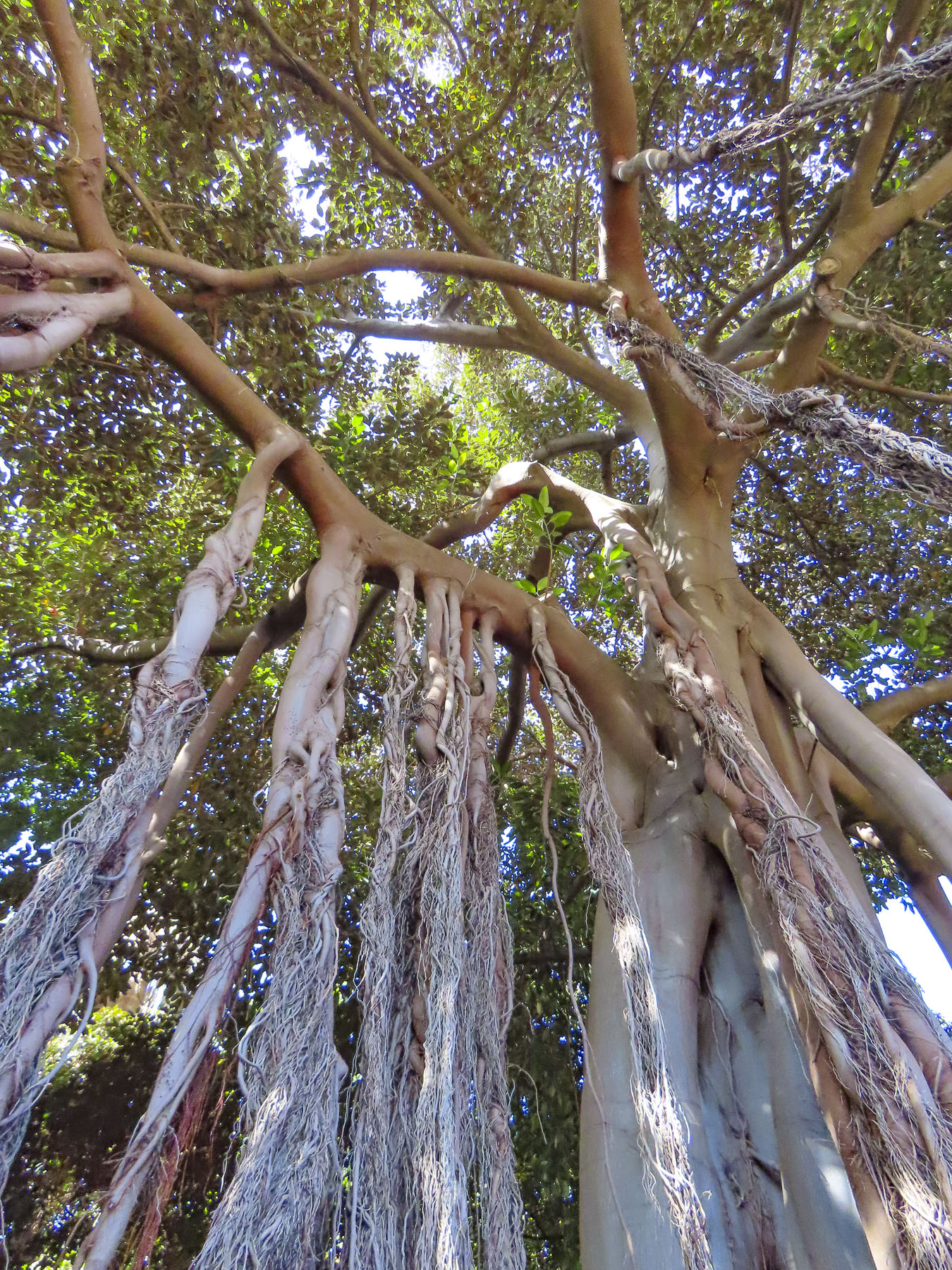
Giant three-hundred-year-old fig trees, planted when the park first opened in the 18th century, are king here. Shaded pathways thread through a cornucopia of verdant jungle, flowers, and water garden. We enviously wished that we could grow everything in our garden at home.

In the historic center we had coffee across from the majestic Iglesia de Nuestra Señora de la Peña de Francia and afterwards were able to catch a glimpse of a bride and groom taking their vows. Their antique wedding car waiting under gently swaying palm trees on the plaza in front of the church.

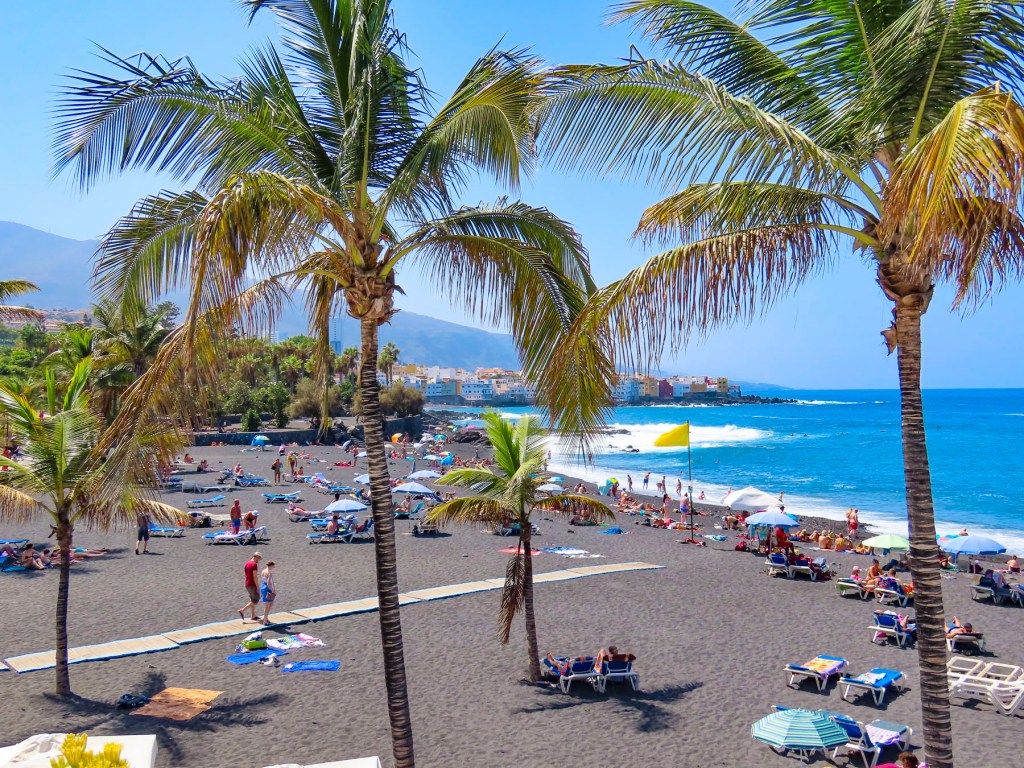
The waterfront in Puerto de la Cruz is beautiful and there are numerous beaches and tidal pools along the coast where you can swim. We strolled along the promenade above the black sand beaches at Playa Maria Jiménez, and Playa Chica to El Castillo San Felipe, a small block fortress built in the 1600s to prevent pirates or the British from landing on the beach here. We lunched along the boardwalk under umbrellas just yards from the surf.
Stopping at the Mirador Roger Piedra Gorda and Mirador Roque Grande rounded out the afternoon. Though parking was a challenge at both spots, we think the effort was worth it for the dramatic seacapes we viewed.

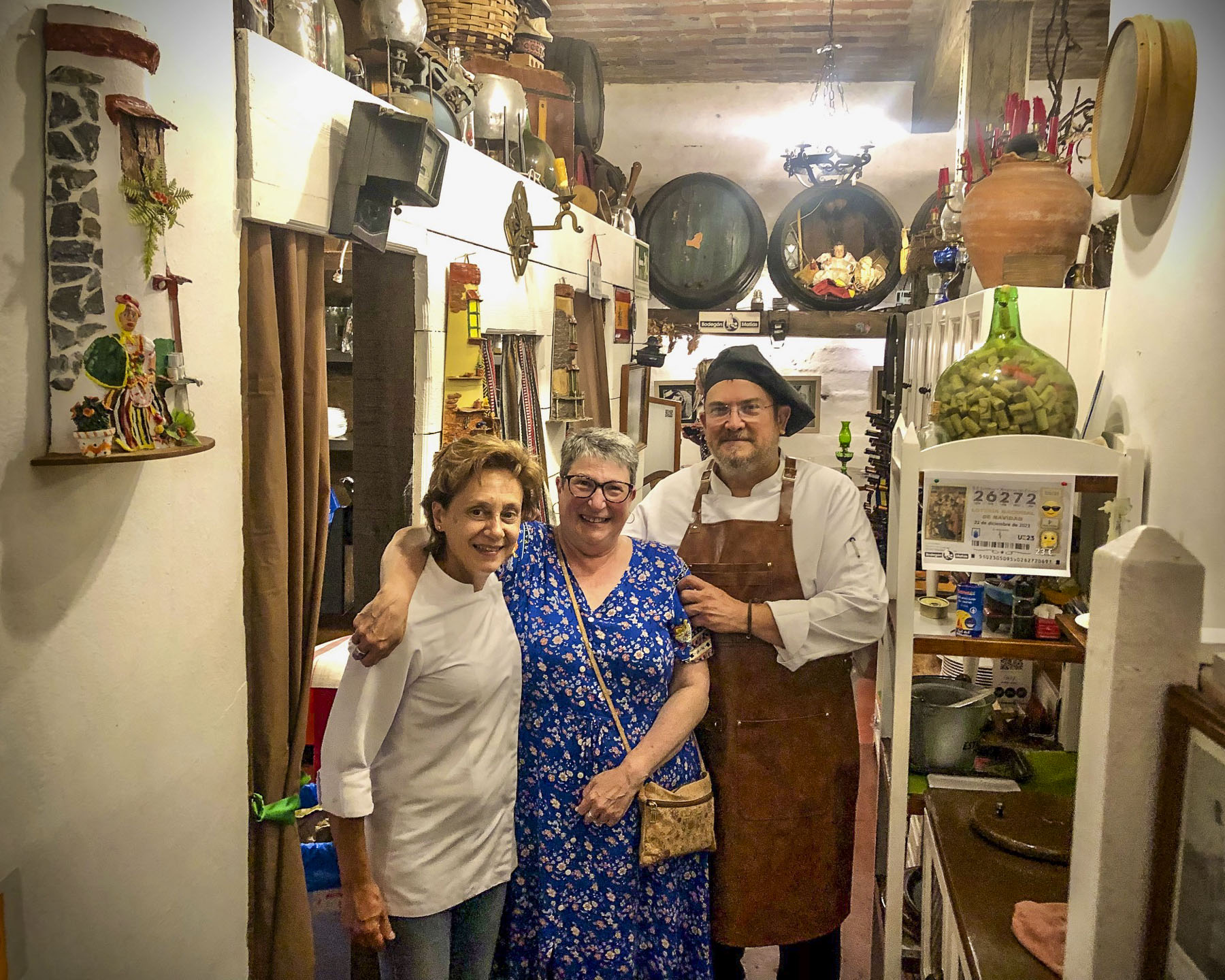
That evening we drove up into the hills above La Orotava and enjoyed a great meal at Bodegón Casa Matías. It’s a rustic establishment, decorated with wine barrels and antique farming tools to acknowledge the history of the region. The chefs and owners, a vivacious husband and wife team, are part of Tenerife’s farm to table movement, sourcing only local meats, including rabbit and goat, fish, cheeses, and seasonal vegetables for their traditional Canarian recipes.
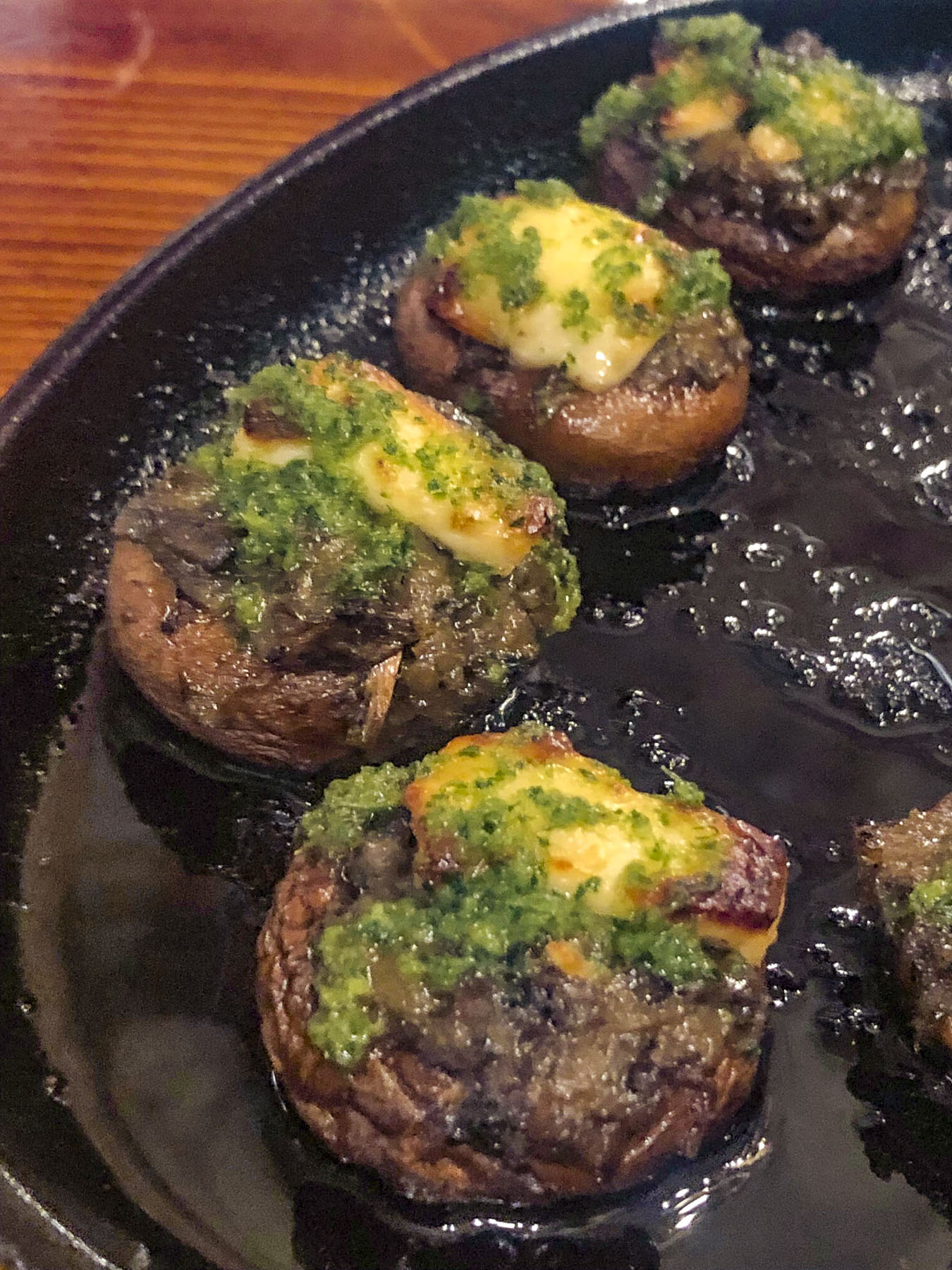
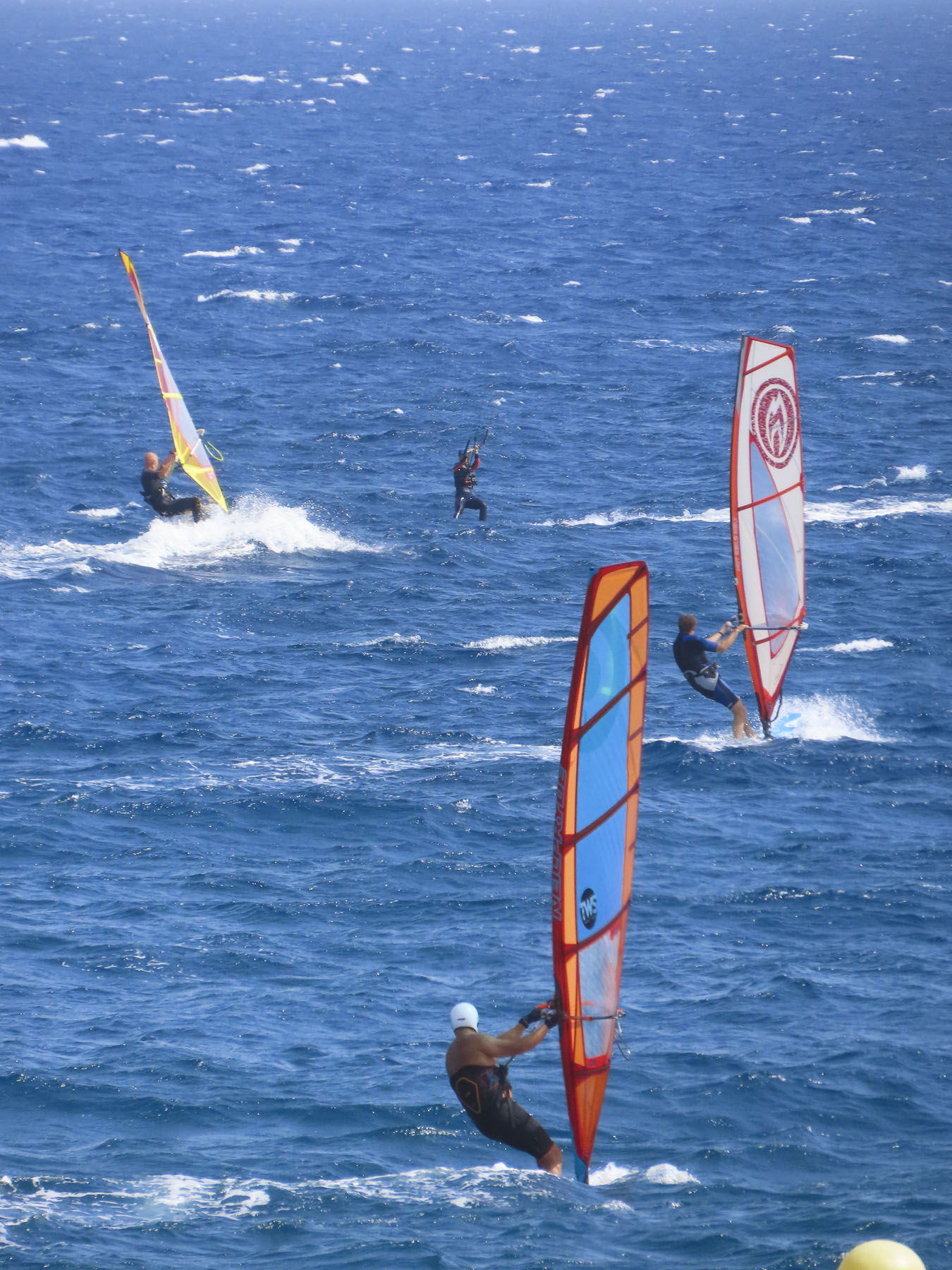
For our last full day on Tenerife, we headed to El Médano to be nearer the airport for a flight the following morning. Arriving late in the afternoon to Playa del Médano we entertained ourselves watching wind and kite surfers speed across the whitecaps. The more experienced kiters crested the waves and performed aerobatics before splashing back into the sea.
Closer to town, families favored the gentler waves, wider beach, and a view of Montaña Roja volcano on the horizon. Tables at eateries along the boardwalk were quickly filling as the golden hour approached.

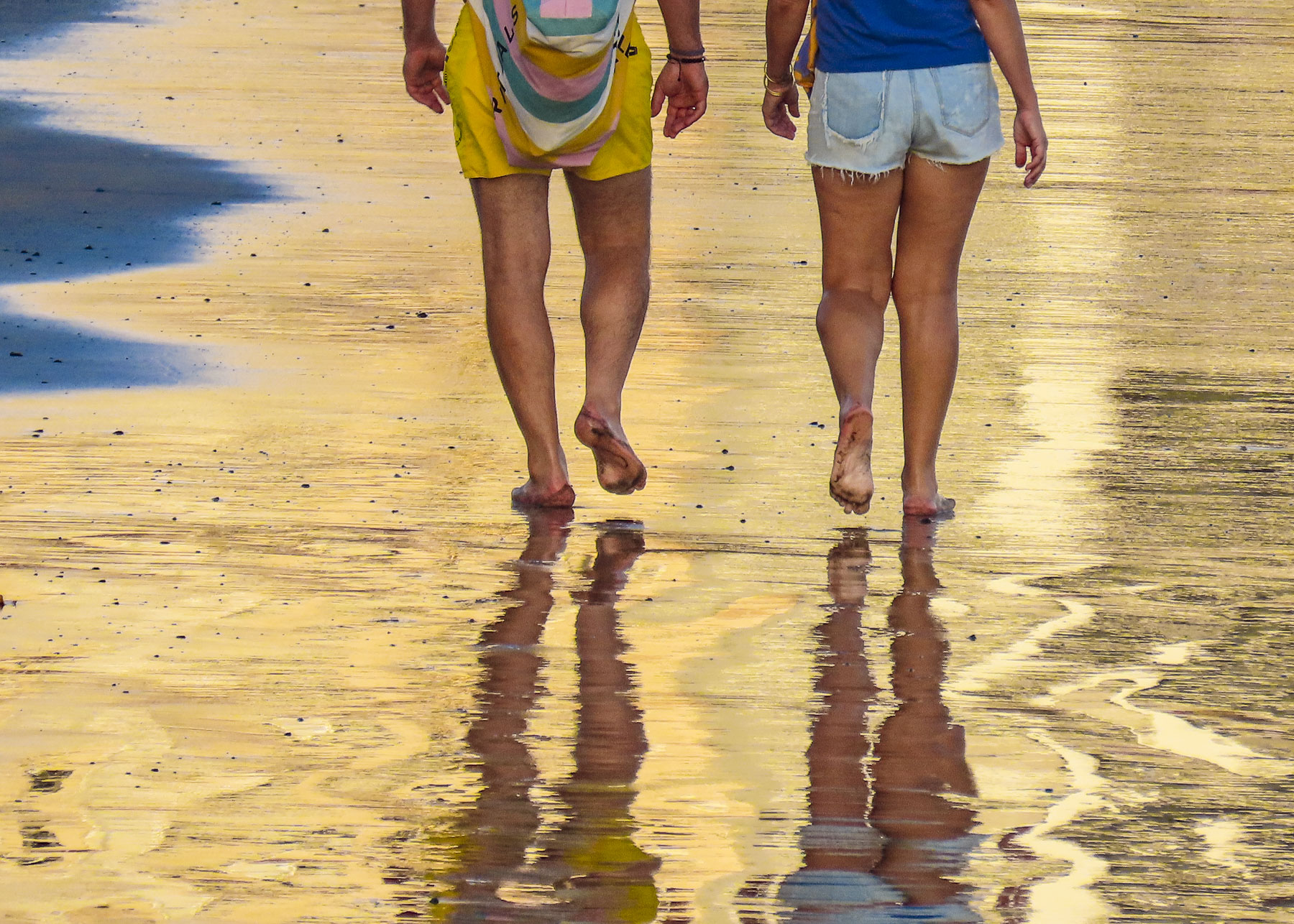
A crescent beach, gentle waves, good wine and delicious seafood – is there a better way to end the day? We’ll miss Tenerife.

Till next time, Craig & Donna

Tenerife Part 2: Icod de los Vinos or Colonial Charm, Dragon Trees, and Miradors

Departing Santa Crux de Tenerife, we drove along the TF-5 towards Icod de los Vinos, our base for the next several days as we explored the lower part of the north side of the island. A compass orientation doesn’t accurately describe how Tenerife is split into north and south regions, but Pico del Teide and its rugged highlands roughly divide the island into the dryer South, which faces Africa and catches the westerly blowing Sharqī, a hot wind from the Sahara, while the North of the island is shielded by Pico del Teide from the hot winds blowing west from Morocco, is wetter from Atlantic Ocean storms.

We are not really resort and beach people; there’s that getting sandy issue that deters us. We do enjoy a close proximity to the ocean and beautiful seascapes, both of which were easily attainable on the north side of Tenerife. We figured that the best way to do this was to chase miradors. And there wasn’t any shortage of them on the island. We figured enroute to them we’d pass other wonderful discoveries that would spur us to detour and investigate, rounding out what we saw of the island.

Set on a steep hill, the restaurant La Barada, just a short distance off the highway, was our first stop. Though technically it’s not a mirador, it is a popular place due to its glass pier that is cantilevered dramatically out over the countryside from the restaurant. It offers an amazing bird’s eye view of the coast with Pico del Teide in the distance. The food was also very good and the terrace was alive with boisterous activity the afternoon we stopped. 

We arrived late in the afternoon to our lodging at Hotel Emblemático San Marcos in iIcod de los Vinos. Located on a steep narrow street, it was a challenge to park close to the buildings on the driver’s side and still have enough room to get out of the car, but the parking was free and right in front of our hotel. Built in the early 1700s as a private mansion, it exemplified typical Canarian architecture of the period with its courtyard and meticulously crafted interior, rich with polished wood. The view from our room over the red tiled roofs of Icod extended to the sea.

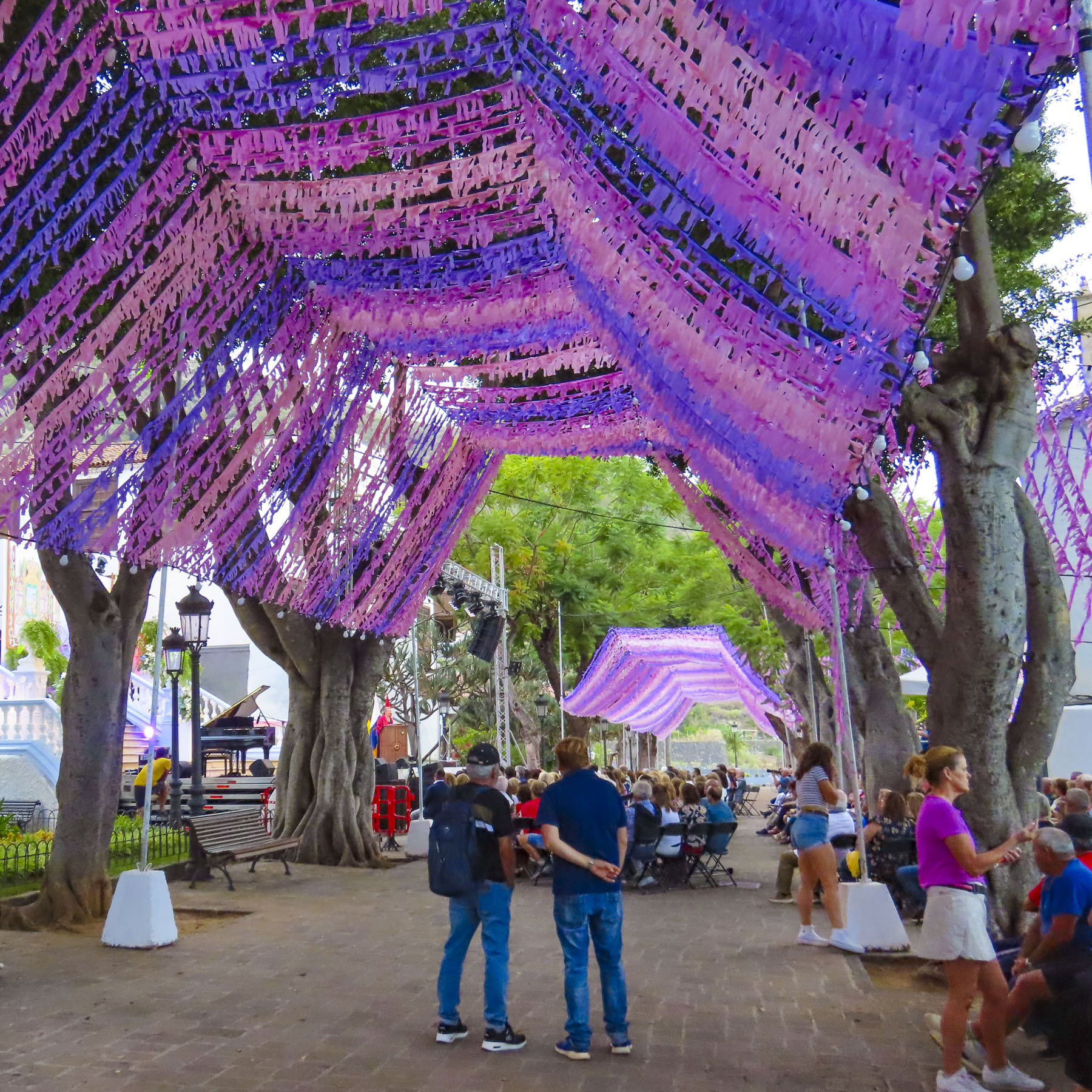
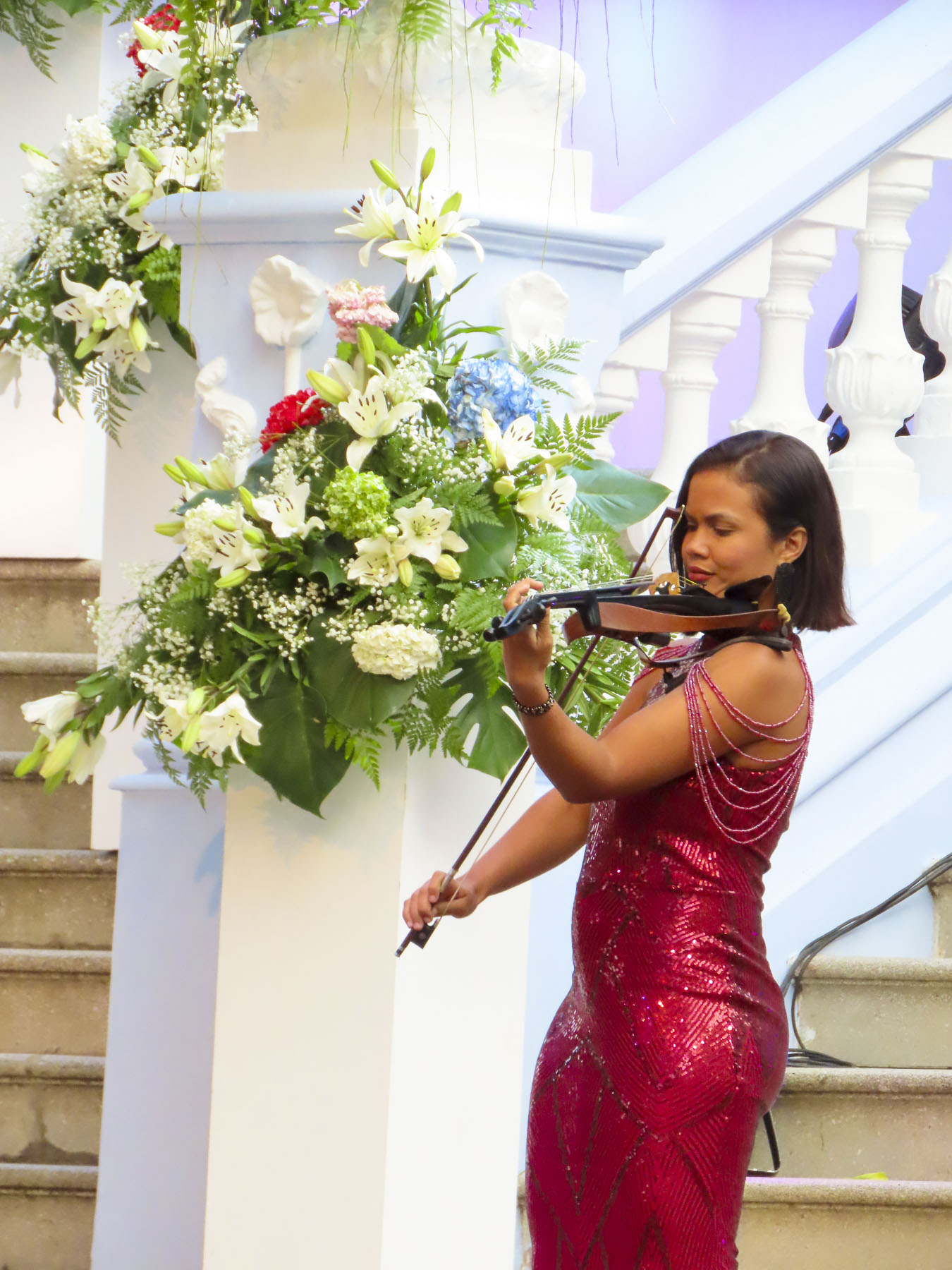
Still early in the evening, we headed uphill to explore the historic center of the town and to our delight happened across an outdoor concert in the festively decorated plaza next to the Iglesia Mayor de San Marcos. The performances were part of the town’s September’s month-long Christ of Calvary celebrations. Legend says that when the conquistadors first landed on the beach here in the late 1400s they discovered a statue of San Marcos awaiting them. A fortuitous omen that promptly required a church be built. A century later the church was beautifully expanded to what it is today.

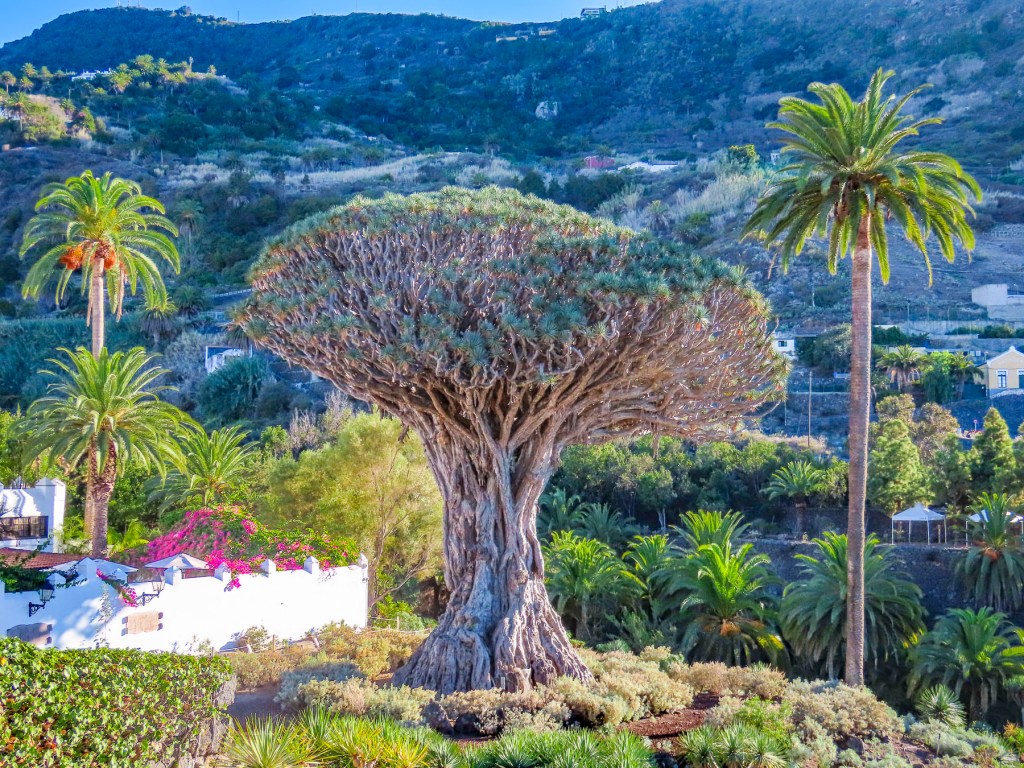
As the evening was darkening, we caught our first glimpse of El Drago Milenario. Believed to be 1000-years-old, it is the largest dragon tree on Tenerife. With over 300 branches, and a circumference of 66 feet, it’s a lofty 70 feet tall.

Beloved by the folks of Icod de los Vinos, the tree’s image is included on the town’s coat-of-arms along with Mount Tiede which also towers over municipality.

In centuries past trees harvested from the mountain’s slopes were sledded down the steep ancient roads of the old town, all the way to the harbor, where prosperous shipbuilders used them in the construction of naval vessels that participated in the ill-fated Spanish Armada of 1588. This unique sledding tradition is still kept alive every November with the La Fiesta de las Tablas, when younger folks speed down Plano Street on tablas, polished planks of wood, that often become airborne with their riders when they hit bumps in the road. Unfortunately, we did not witness this fiesta, but the video clips on YouTube are amazing. The cleared slopes around the town now host orchards, vineyards and banana plantations.

That evening we watched the climax of the festival – a spectacular fireworks display – from the balcony of our room. Throughout the night church bells continued to ring out loudly at odd times with seemingly random numbers of chimes. A curious oddity at the end of a wonderful day.

The weather was brilliant and the next morning we set out to visit the Mariposario del Drago, a large glassed enclosed tropical greenhouse that has a butterfly breeding program. Being gardens we find butterflies very entertaining. The experience here was delightful, and elicited smiles from everyone when a butterfly landed on them.

Across the street from the Mariposario, the El Drago Milenario stands behind a high walled and gated fence. The small admission fee to the park is well worth it to support the town’s effort in keeping this goliath of a tree alive. But, if you’d rather skip the expense and put it towards coffee or lunch, there’s an enticing café named Casa del Drago, with a good view, right next door. Farther uphill along Calle San Antonio there is Drago junior, a magnificent younger dragon tree that, according to legend, the town seized from its owner when he tried to cut it down in a fit of rage.

Fortunately, this part of the historic town center is relatively flat and the walking was easy as we headed back to admire the plaza around the Iglesia Mayor de San Marcos in the daylight and the church’s 16th, 17th, and 18th  century religious art.

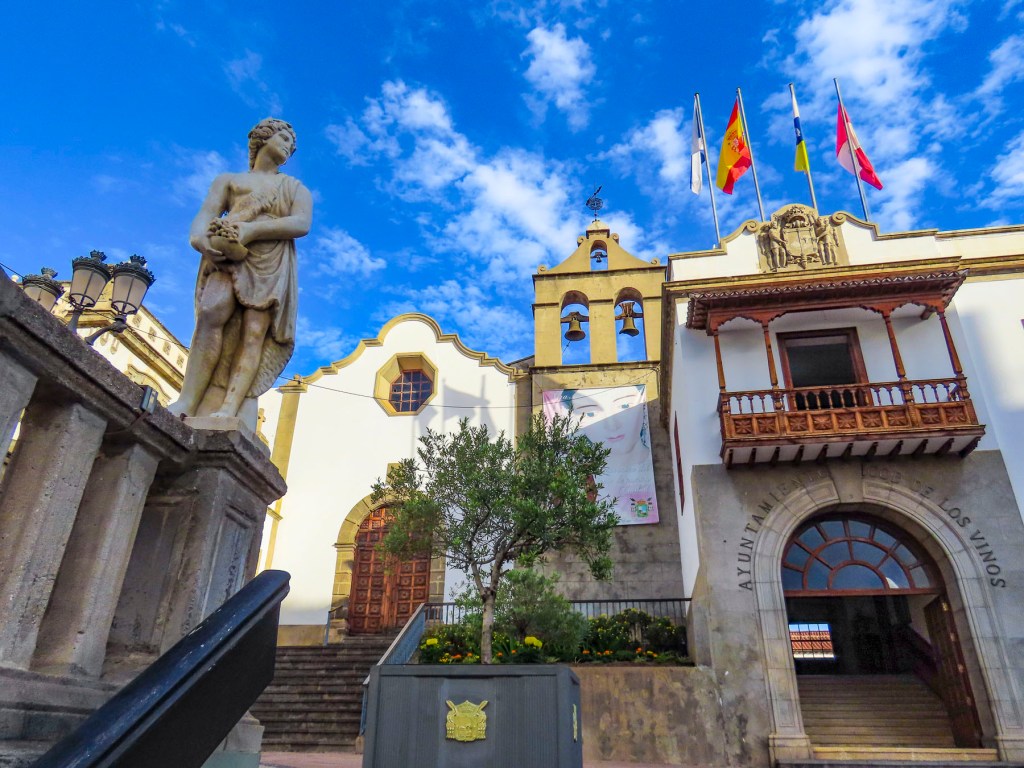
Afterwards we strolled along the town’s old lanes until we reached city hall and the Iglesia de San Agustin, both of which are dramatically set on a small plaza at the top of a set of ancient stairs. The church dates from the late 1500s and was originally part of the first convent built in the town by the order of Los Augustinos.

The road to Playa de San Marcos in the harbor of Icod is spectacular with views of the coast. It was here, in this sheltered bay, one the few natural harbors on Tenerife’s north coast, that the Saint’s venerated statue was discovered in a cave along the cove.

We found it best to just find a place to park and then walk to the vantage point that interested us. During the September shoulder season when we visited, tourists were scarce and finding parking was relatively easy.

Early the next morning we headed towards Puerto de Santiago on a route that took us to the mountain ridge above Icod. The final destination of the day would be the isolated village of Masca. A serpentine drive from Icod led to a hairpin turn that fed us into Vieja a la Vega, a very narrow steep lane, but really more like an alley lined with homes. This was one of the steepest roads we’ve ever encountered, requiring us to downshift to second gear for the long and seemingly endless ascent to the main road at the top. Fortunately, we didn’t encounter any cars coming downhill, as there was literally no room to pass. At the top we intersected the TF-5 and followed it through an old growth forest covered with stately pine trees. Continuing on, the road traversed a Martian like landscape. A huge lava field that was the result of Volcano Chinyero‘s last eruption in 1909. The terrain became noticeable drier as we crossed the mountain and descended into Santiago del Teide.

The roads to Pico del Tiede, Masca, and Puerto de Santiago converge here, making it the perfect spot for a café break before continuing down to the Mirador Archipenque to view Los Gigantes, a stretch of tall cliff face that dramatically rises straight up from the sea.

From here you can also see two of the other Canary Islands, La Gomera, and La Palma on the horizon.  For centuries Santiago was a quaint fishing village, but it has embraced tourism and now draws folks enchanted by its natural beauty and striking location along the coast. Its harbor from November to February is also a popular hub for whale watching excursions to depart from.

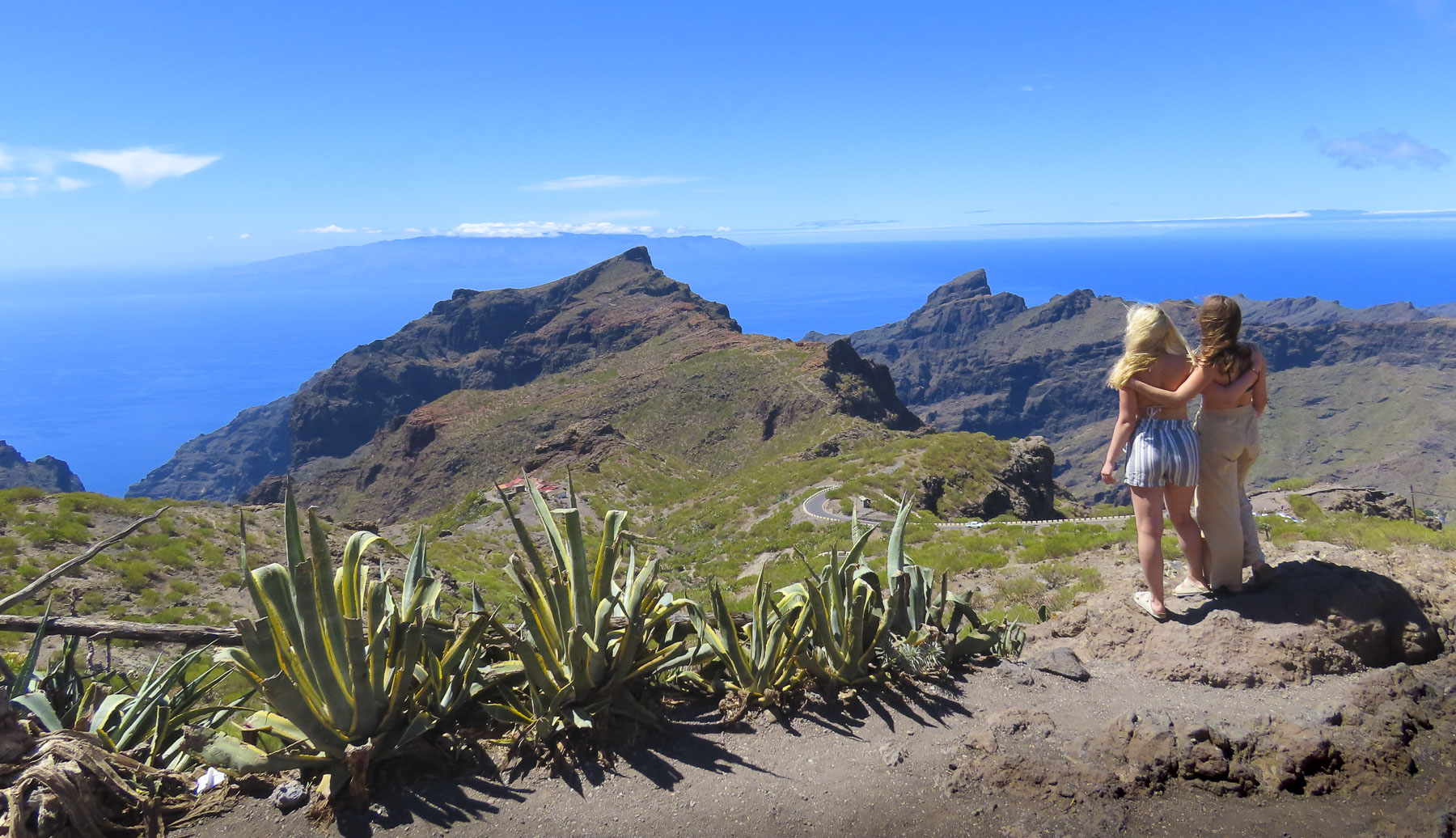
Backtracking through Santiago del Teide we turned into the mountains and followed a long stretch of twisting and turning road to the Mirador de Cherfe. Sitting atop a mountain pass, it has expansive views to the sea. It was also one of the busiest miradors, with vendors selling lava trinkets, and many tourists stopping on the way to or from Masca, like us. Oh, the thrills of driving in the mountains of Tenerife were just beginning!

The isolated hamlet of Masca seems to be a mecca for folks wanting to get into the more remote parts of Tenerife. With limited parking options, we had to wait for a space to become available only to realize after we walked into the hamlet that all the restaurants were closed on Monday. Yikes!

With growling stomachs, we continued on. Starvation was thwarted in El Palmar at the Restaurante El Rincón La Abu, a wonderful establishment where we were the only customers late in the afternoon. The house wine and our meals, pork cheeks in sauce and chicken breast stuffed with serrano ham and spinach, were excellent. We appreciated that we never felt rushed to finish, but we did notice when we were getting into our car that they were locking up for the afternoon. When home our routine finds us having lunch late in the afternoon, but this wasn’t always possible on Tenerife where many of the restaurants close at 2 or 3pm and then reopen later.

It took us awhile to adjust to this earlier lunch schedule. Continuing on we stopped to observe the Montaña Zahorra, an ancient lava dome from which its fertile soil was quarried in the 1960s, 70s and 80s. The distinctive pie shapes of the excavations represented the individual owners’ mineral rights.  

Exuberant like rally drivers, we felt victorious from a day well spent and headed back to Icod de los Vinos to enjoy a glass of local wine on the balcony of our room and watch the moon rise over the foothills above the town.

Till next time, 

Craig & Donna

Madrid: An Ambience That Ages Well

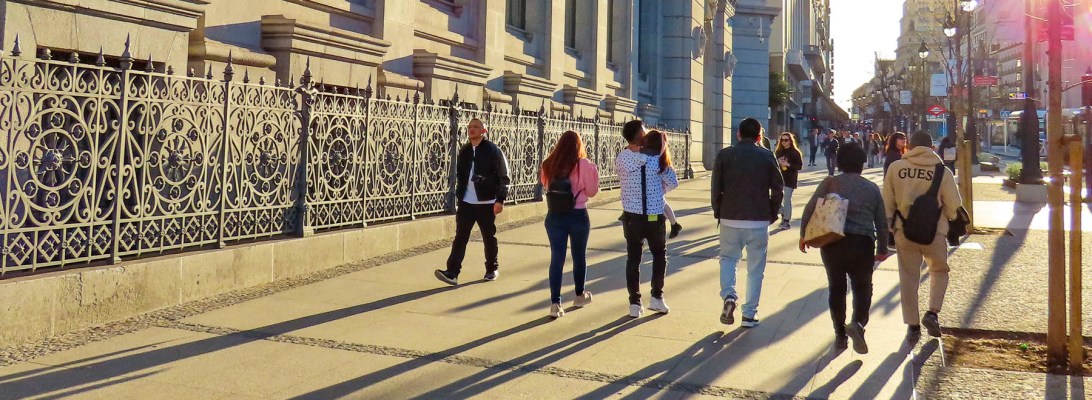
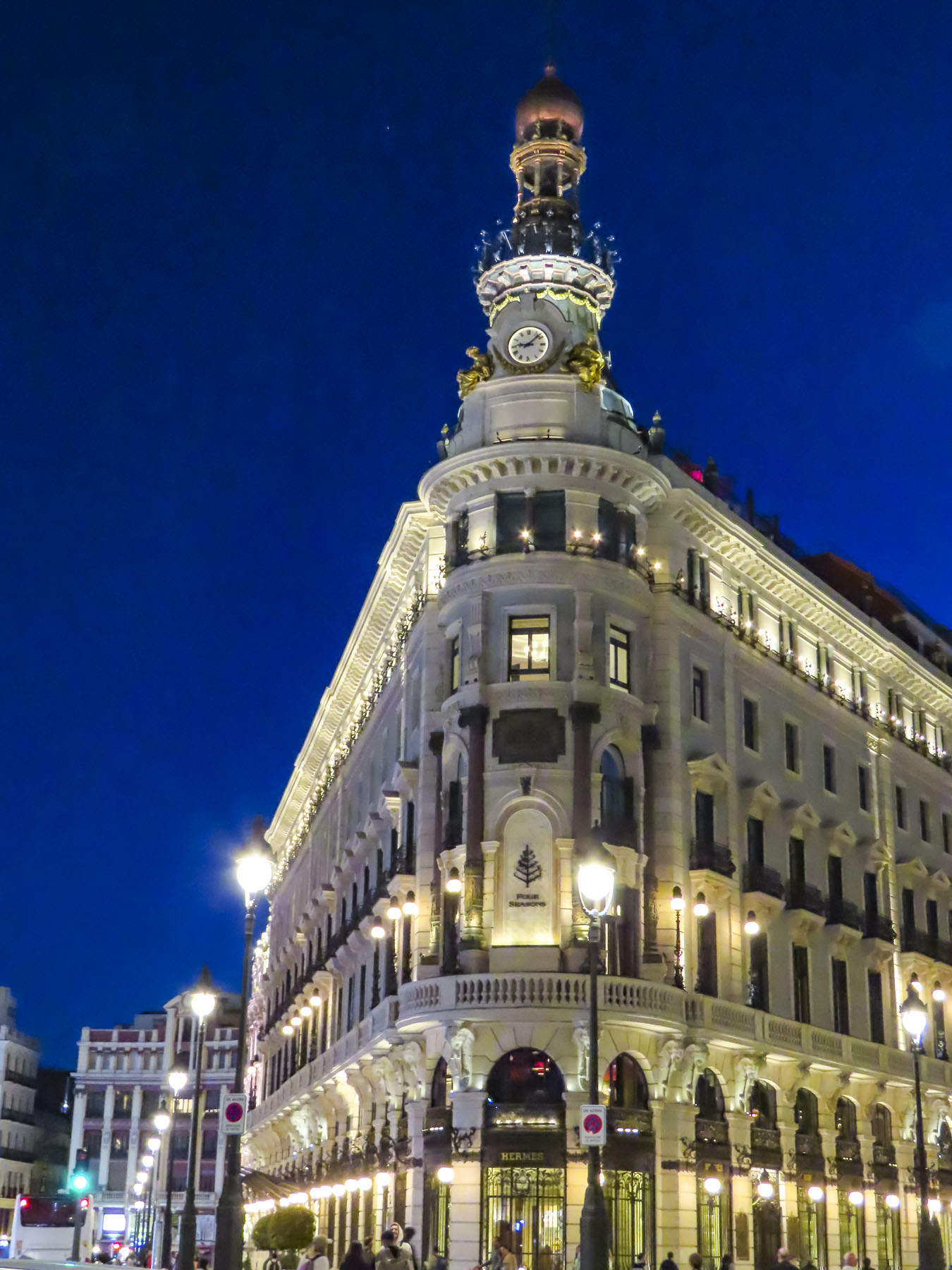
First Impression: Madrid is monumental! The minute we exited the Puerta de Atocha train station onto the sidewalk, we were struck by the beauty of the wide boulevards lined with stately trees and grand architecture, and the top of buildings graced with colossal sculptures of mythic gods.

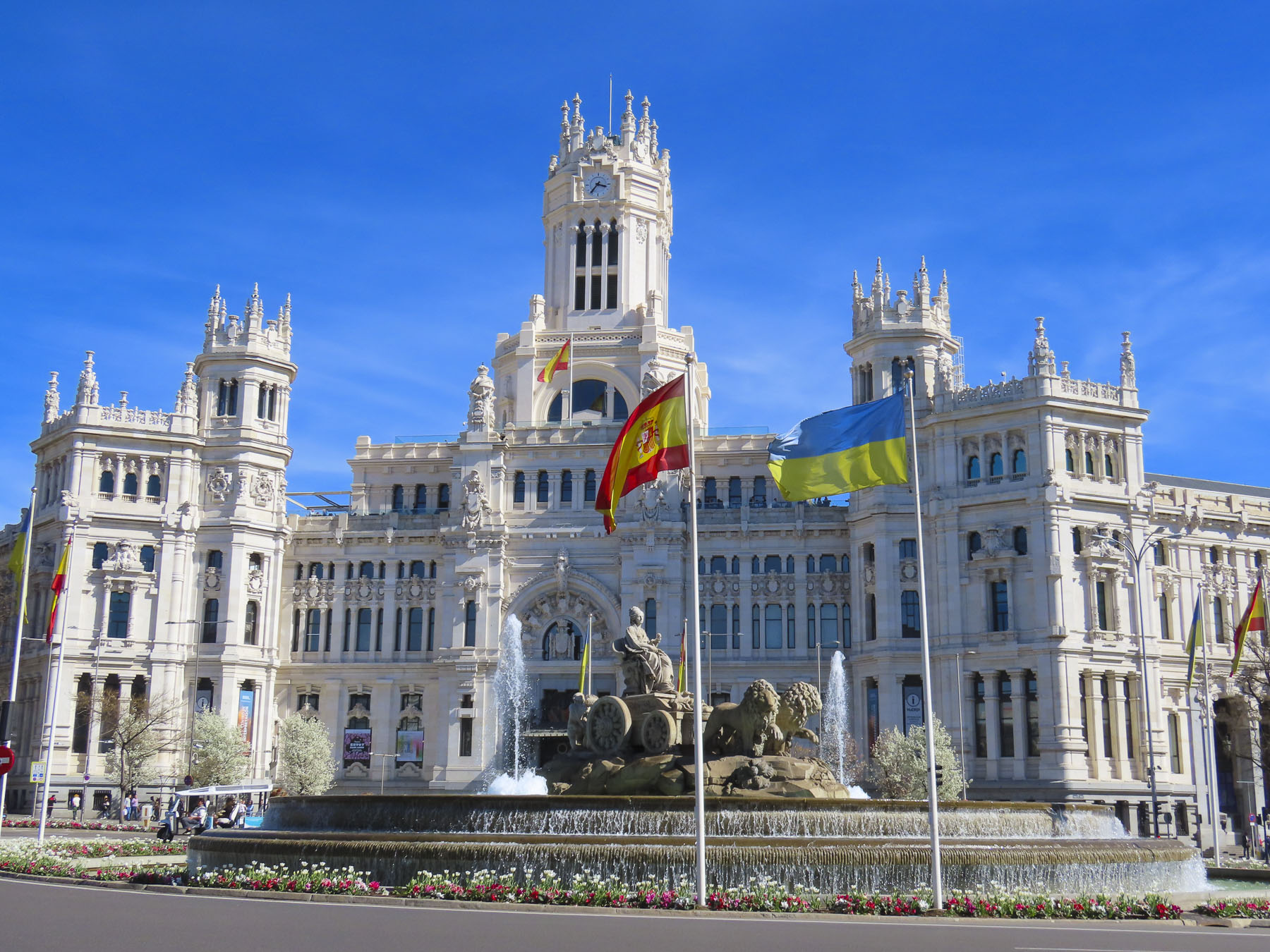
If the Paseo del Prado, the route to our hotel, could speak, it would surely boast of its famous destinations along its length: Madrid’s Museum Triangle, which includes the Reina Sofia Museum where Picasso’s Guernica hangs; the Prado Museum, which highlights the works of Diego Velázquez and Goya; as well as the Thyssen-Bornemisza Museum, which displays 13th-20th-century European masterpieces. But its bragging rights continue with the Real Jardín Botánico, the Museo Naval with its fascinating exhibits devoted to Spanish maritime history, The Glory and Pegasus sculptures atop the Ministry of Agriculture, and the famous fountain depicting the goddess Cybele’s chariot being pulled by two lions. This relatively short distance is packed with so many highlights it should be called Madrid’s marvelous mile.

Our hotel the Apart-Hotel Serrano Recoletos was just a few blocks from the iconic Cibeles Fountain, which is centered in a traffic circle you usually have to observe from a distance, but overnight the Paseo del Prado was transformed into the festive final leg of the Movistar Half Marathon, with the finish line down the street from our hotel.

With the majestic boulevard closed to traffic, folks were free to wander up to the fountain for a close view, an accessibility that rarely happens. Yesterday we hadn’t realized the median strip that runs the length of Paseo del Prado was lavishly planted with gardens and as luck would have it, the tulips and flowering trees were in bloom. Heading towards the historic center of Madrid, we observed a large group of healthcare professionals marching peacefully down the Gran Via protesting government policies. It was a busy Spring Sunday in Madrid.

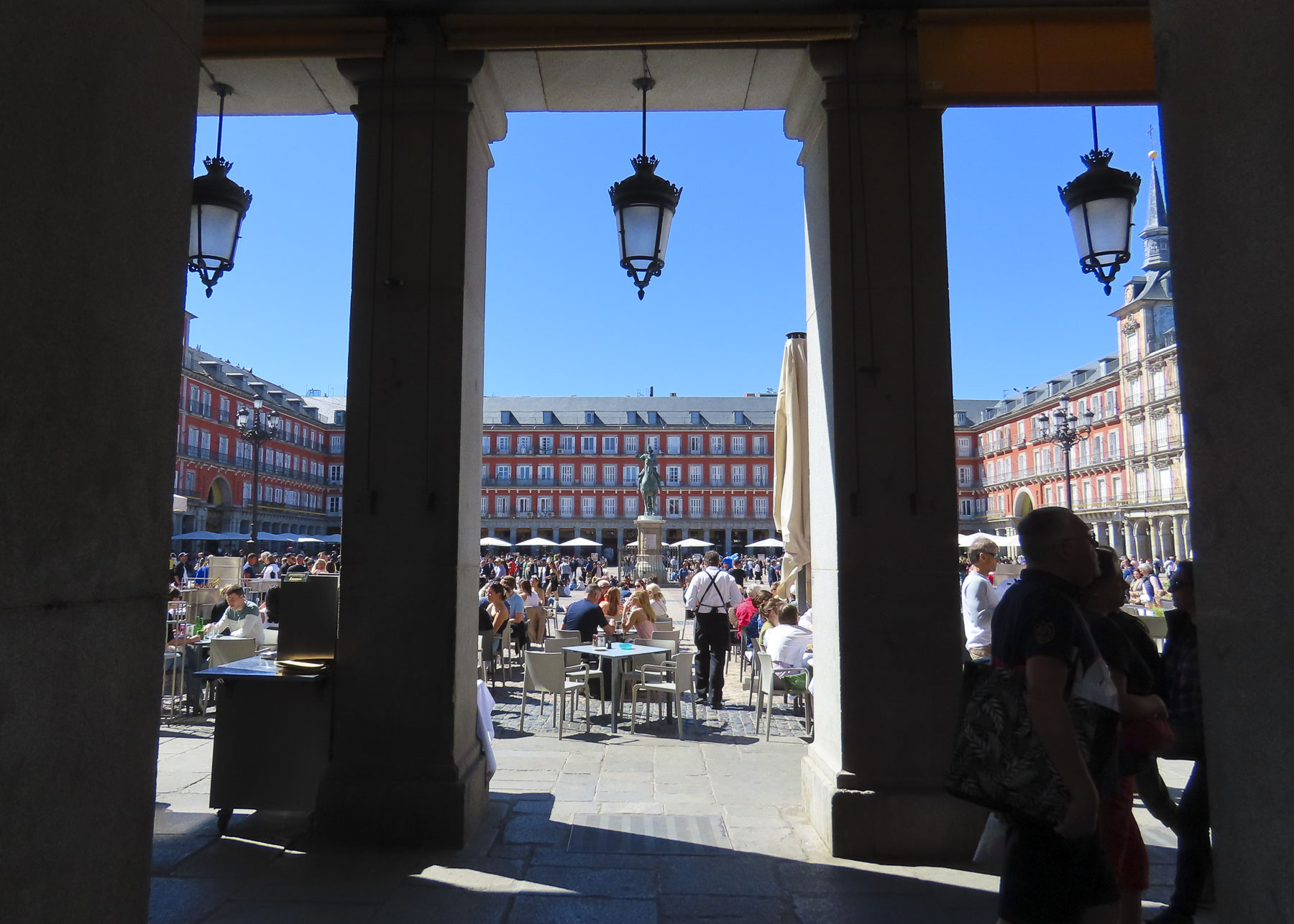
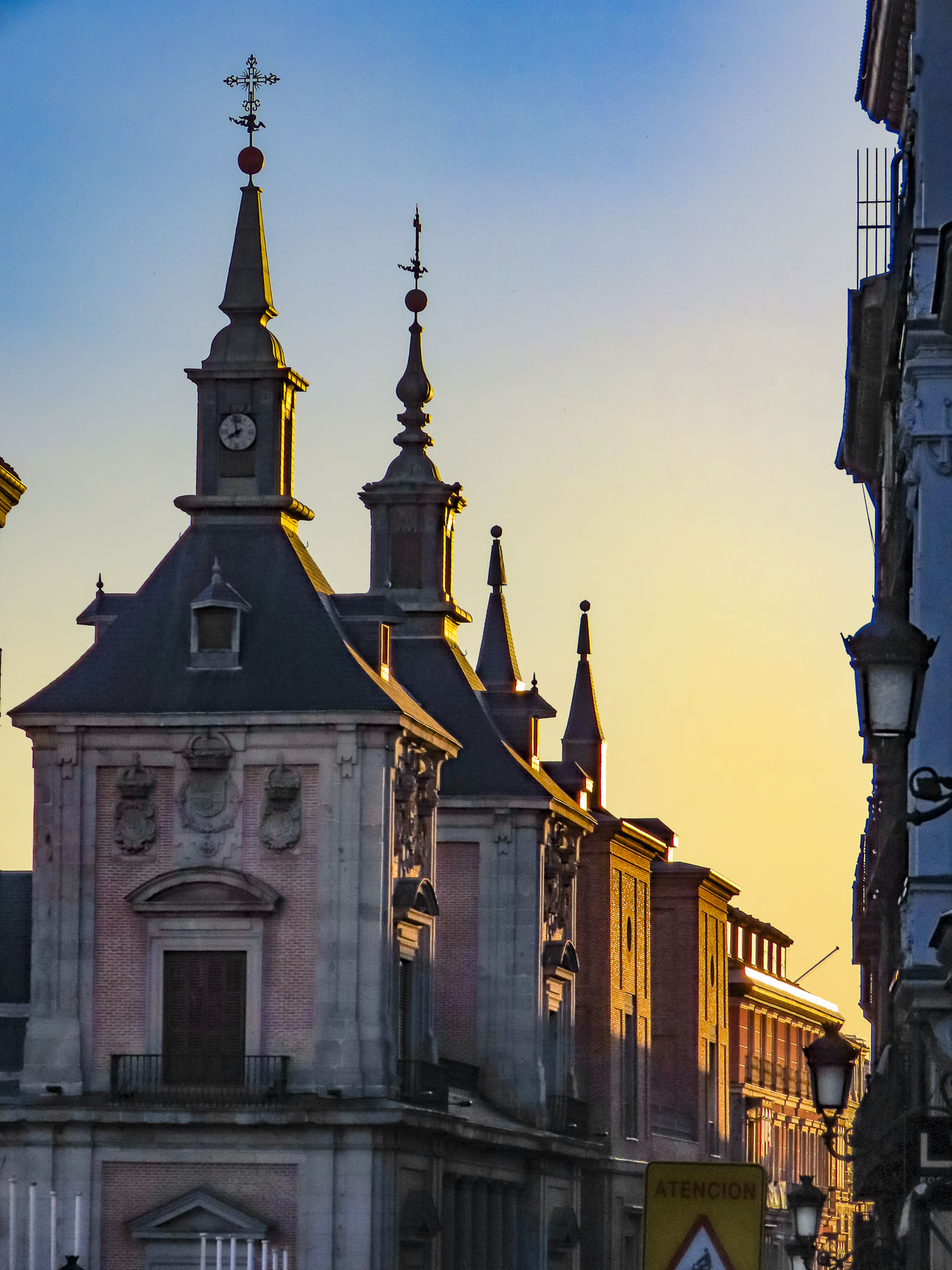
Plaza Mayor, ground zero for the historic center of Madrid, was our destination. Once the ancient city’s market area, the area was transformed by architect Juan Gómez de Mora during Philip III’s reign in 1617, and of course the King is dutifully recognized, gallantly astride an equestrian statue in the plaza’s center.

The vision of three successive architects contributed to the plaza as seen today, the result of three devasting fires in 1631, 1670 and 1790. Over the centuries it has hosted bullfights, executions during the Inquisition, Royal wedding celebrations, soccer games and Christmas markets. As an exclusive address in Madrid, many of the apartments are passed down within the same families from generation to generation.

Plaza Mayor gets hectic, but tucked away under the arcaded sidewalk, there are some hidden gems worth finding. Our favorite was La Torre del Oro. It’s an old atmospheric bar dedicated to celebrating Spain’s bullfighting traditions.

There are so many interesting destinations centered around this plaza that we often started our days here as a way to get oriented in old Madrid’s labyrinth of alleys. Treating the nine ancient gateways into the plaza as compass points, we would follow their direction into the surrounding barrios.

Our wanderings to soak up the ambience of this ancient quarter were frequently determined by a list of restaurants and cafes, along with historic sites and churches, we hoped to find. The choices were overwhelming. Since this was our first time in Madrid, we hit many of the tried-and-true spots, like Chocolatería San Ginés, famous for serving Madrileños the best hot chocolate with churros for over 125 years. There was a fast-moving queue when we arrived before 11, which suddenly evaporated and freed sidewalk tables, but it was much more interesting before the lull in activity. And El Riojano, a renowned 19th-century Pastelería with a tantalizing spinning tower of sweet temptations in its storefront window, is sure to break the will of any dieter. When you first enter, it looks like there are not any tables to sit at, but next to one of their display cases there is an opening into a large, popular back room for café. We are after all tourists.

One late afternoon by the El Oso y el Madroño sculpture, a band of buskers filled the Puerta del Sol with music. The Bear and the Strawberry Tree is a medieval heraldic emblem that has been associated with Madrid since 1222, when King Alfonso VIII used the image on a stamp to seal a royal decree.

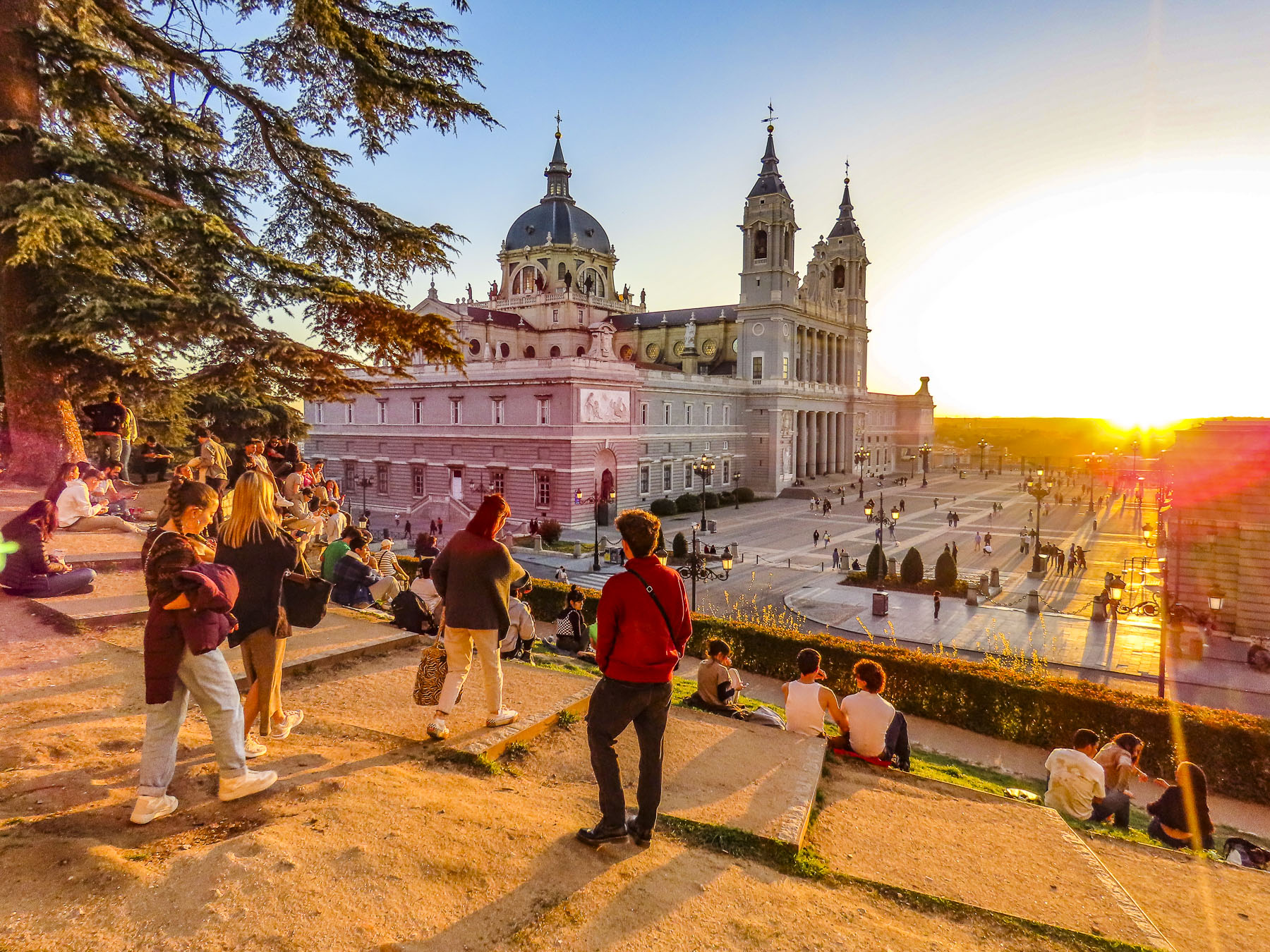
We continued past the Plaza Mayor towards the Plaza de la Armería, where the Catedral de la Almudena, (1883), and the Royal Palace of Madrid (1738), face each other. Turning onto Calle del Factor, we walked a short distance uphill to the Jardín de Larra and joined a small group of folks waiting to enjoy the sunset.

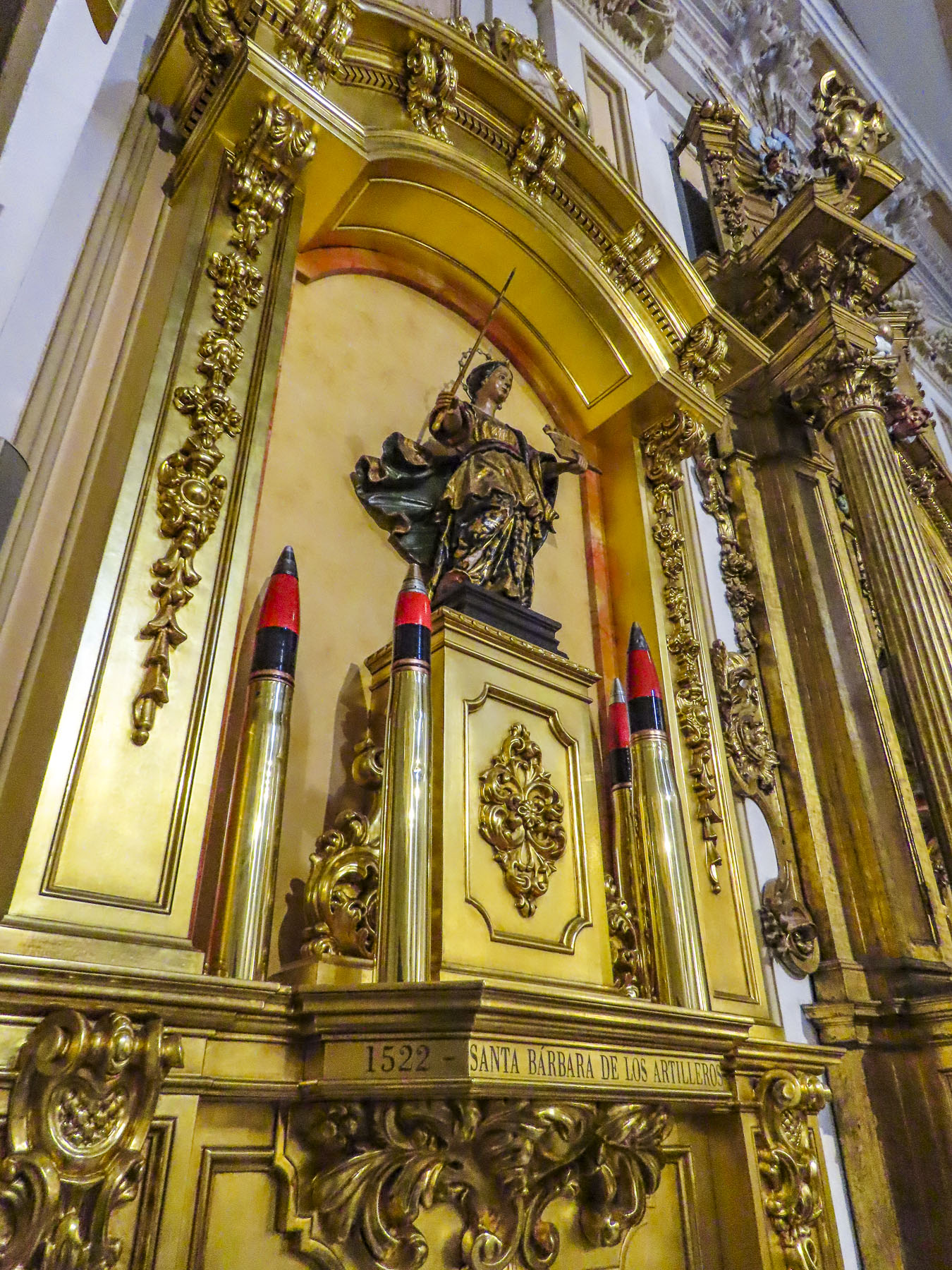
Afterwards at the bottom of the street we entered the Iglesia Catedral de las Fuerzas Armadas. It’s a small 17th century church dedicated to the Spanish armed forces. The church’s simple façade conceals a lavish marble interior with several interesting altars depicting paternalistic colonial themes.

The streets of Madrid seem even busier at night with folks bustling about after work. On the way back to our hotel, we stopped at the Mercado de San Miguel, one of Madrid’s old, covered food markets, which dates from 1916. Today it’s a gentrified, popular gastronomic destination, with tapas, tapas, and more tapas to satisfy everyone’s tastes.

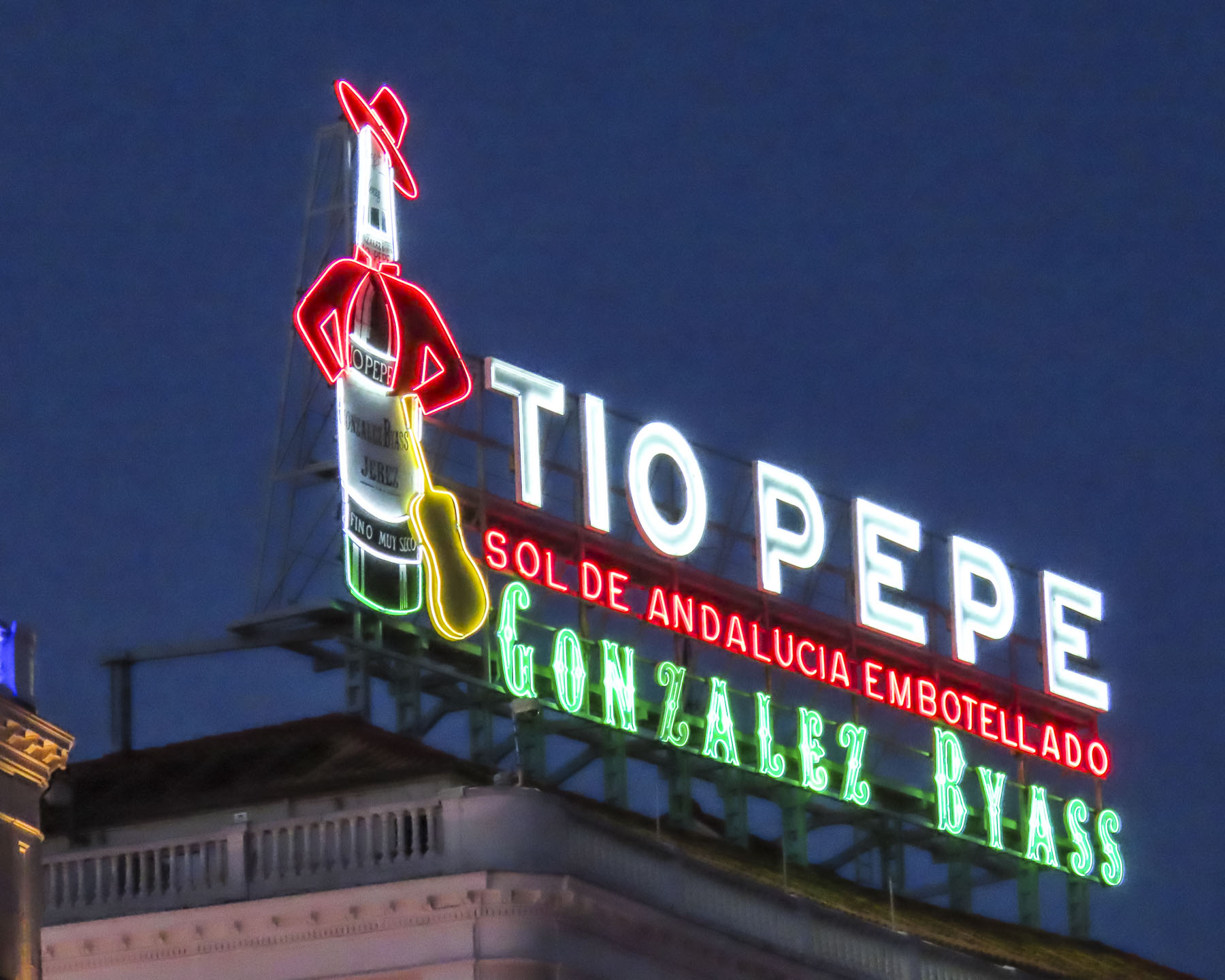
Madrid’s iconic Tio Pepe neon sign blazed brightly above the Puerta del Sol, and shops along the plaza brilliantly displayed their merchandise in dramatically lighted storefront windows. While Madrid exudes ambience during the day, the city becomes magical in the evenings.

Dinner was at La Casa del Abuelo CRUZ, a traditional tapas bar that has been run by the same family since 1906. Their specialty, gambas al ajillo (sizzling garlic prawns), while very delicous, was a terrible value for the portion size. Their vino de casa, an excellent strong red wine, was memorable and eased the pain of the excessive bill.

Spain’s empire building and wealth followed Columbus’ discovery of the Americas in 1492. A daring nautical leap of faith at the time, it set in motion an era of exploration by sea, that would expand the Spanish Empire around the globe. With that in mind, and an interest in boats, we headed to the Museo Naval on Paseo del Prado, near the Prado Museum. It’s a wonderful museum with exhibits in chronological order, which highlight exquisite ship models, nautical instruments, maps, weaponry, and paintings depicting important naval battles. The exhibits include models of the Niña, Pinta, and Santa Maria which composed Columbus’ small fleet on his epic first voyage.

Afterwards we headed into the centro historico for lunch at Casa Toni, an intimate, no-frills bar, that serves tasty seafood and offal tapas. A short line had formed for tables by the time we arrived, but it moved quickly, especially if you opted for a table upstairs, though downstairs is where all the action is with other folks, jammed into a small space, standing at the bar, and seated at some very tiny tables. It’s a friendly boisterous spot. Pig ears and fried lamb lungs might not be for everyone, but they were surprisingly very tasty. 

Gold and silver from the Americas fueled church building across Spain in the 16th – 18th centuries.While it’s possible to enjoy Madrid without visiting any churches, we’ve developed a policy of going inside if the door was open. It nicely slowed down our day and transported us back to a time when amazing buildings were constructed only using hand tools to carve stone and shape wood. And the religious paintings and iconography, while they might not be of interest to everyone, display a level of craftsmanship and imagination that’s worthy of appreciation. Unfortunately, the churches were also vast repositories of riches, donated by the wealthy and poor alike, to secure a place in heaven.

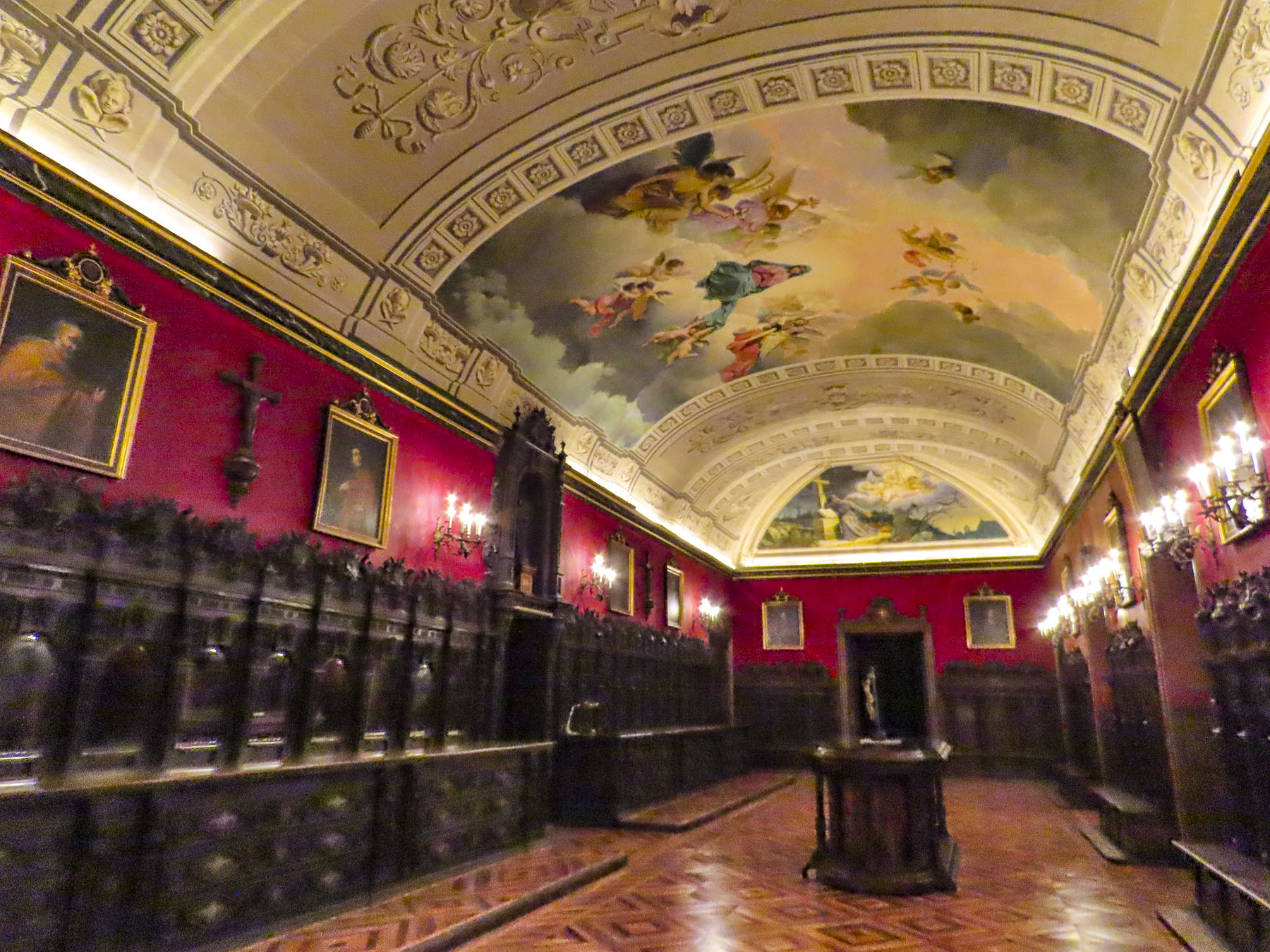
Near the San Miguel market, down from the Plaza de la Villa, on Calle de Puñonrostro, we happened upon the inconspicuous entrance to the small chapel at the Monastery of Corpus Christi las Carboneras, that dates from the early 1600s. It’s a tall, narrow, petite sanctuary. When we were turning to leave, I noticed on the second level the privacy screen across the prayer area for the sequestered nuns. It didn’t actually offer much privacy since a I spotted a seated nun watching the tourists in the chapel. I waved gently, she smiled and waved discreetly back.

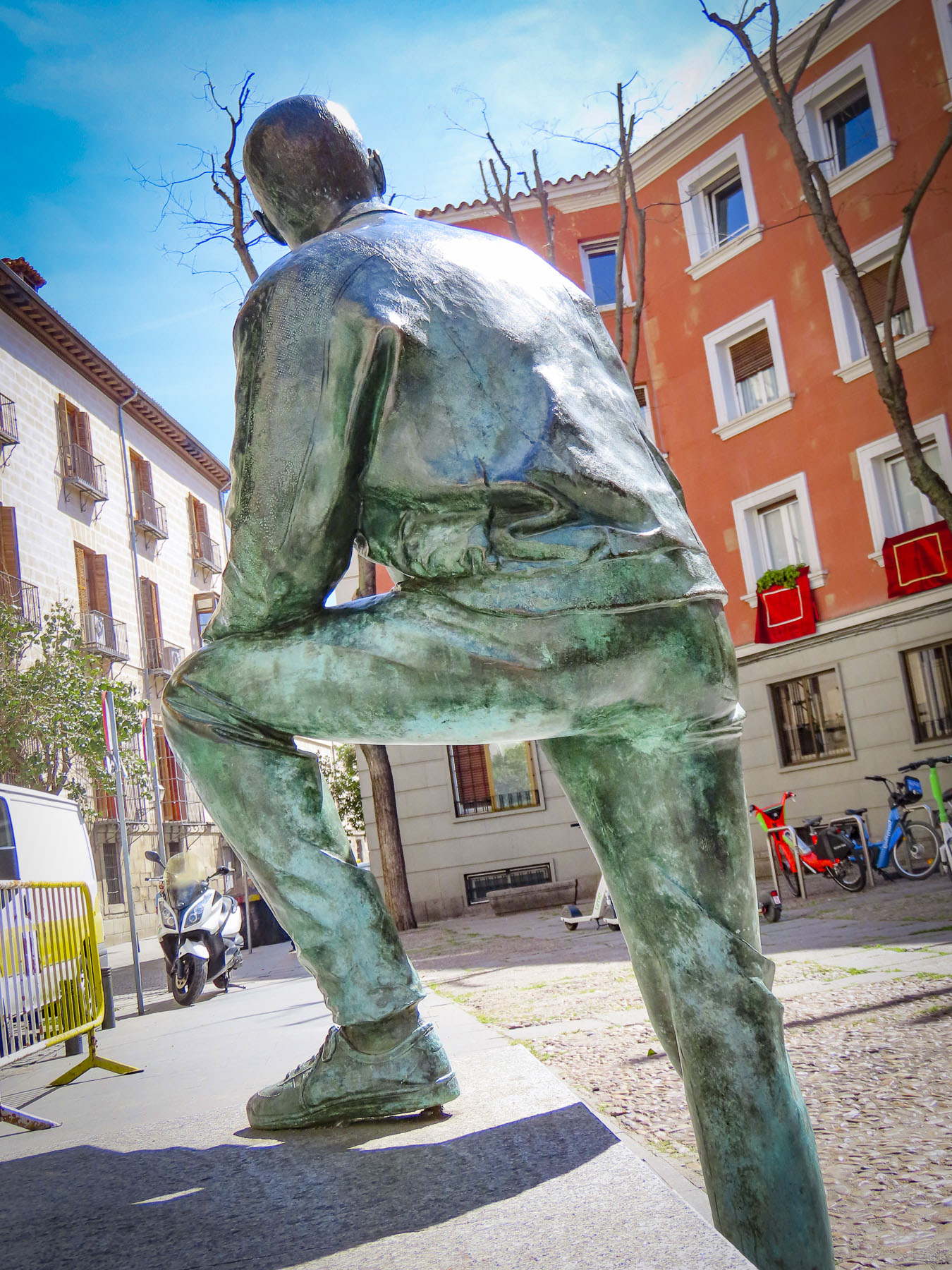
A door further along the calle leading to the convent’s dulces turno was just being locked; I could hear the click, a few minutes shy of their posted hours. The dulce turnos are a centuries-old tradition that has remarkably survived in convents across modern Spain, as a means for nuns to support themselves. The turno is essentially a lazy-susan style cabinet with doors on both sides of the wall that lets the customers purchase cookies and other baked cooked from the sequestered nuns while still maintaining the nuns’ privacy. Cookie orders are spoken through the wall. If your Spanish is insufficient, it’s handy to write out what you’d like. There is usually a list of what’s available taped to the door of the cabinets. You place your money on the shelf, the wheel turns, and cookies appear as if by magic. It’s delightful! At the bottom of the street, in front of a public library, stands a bronze statue of a man. It’s named El Lector, the reader, a tribute to Carlos Cambronero, a writer devoted to Madrid’s history. Across the street the unusual convex, baroque facade of the Basílica Pontificia de San Miguel (1739) intrigued us, and we explored more inside.

The calles go every which way in La Latina, one of Madrid’s oldest areas, where the narrow streets and plazas follow the original 9th century footprint of the Arab citadel that originally stood there. Though its buildings might be old, the area now attracts a vibrant young crowd that enjoys an immense collection of tapas bars and restaurants along Cava Baja and Cava Alta. The two nearly parallel streets have been popular since medieval times, when traveling merchants stayed at inns and taverns along the calles, and used tunnels or access holes dug at the end of the streets to enter the walled city at night when the gates were closed.

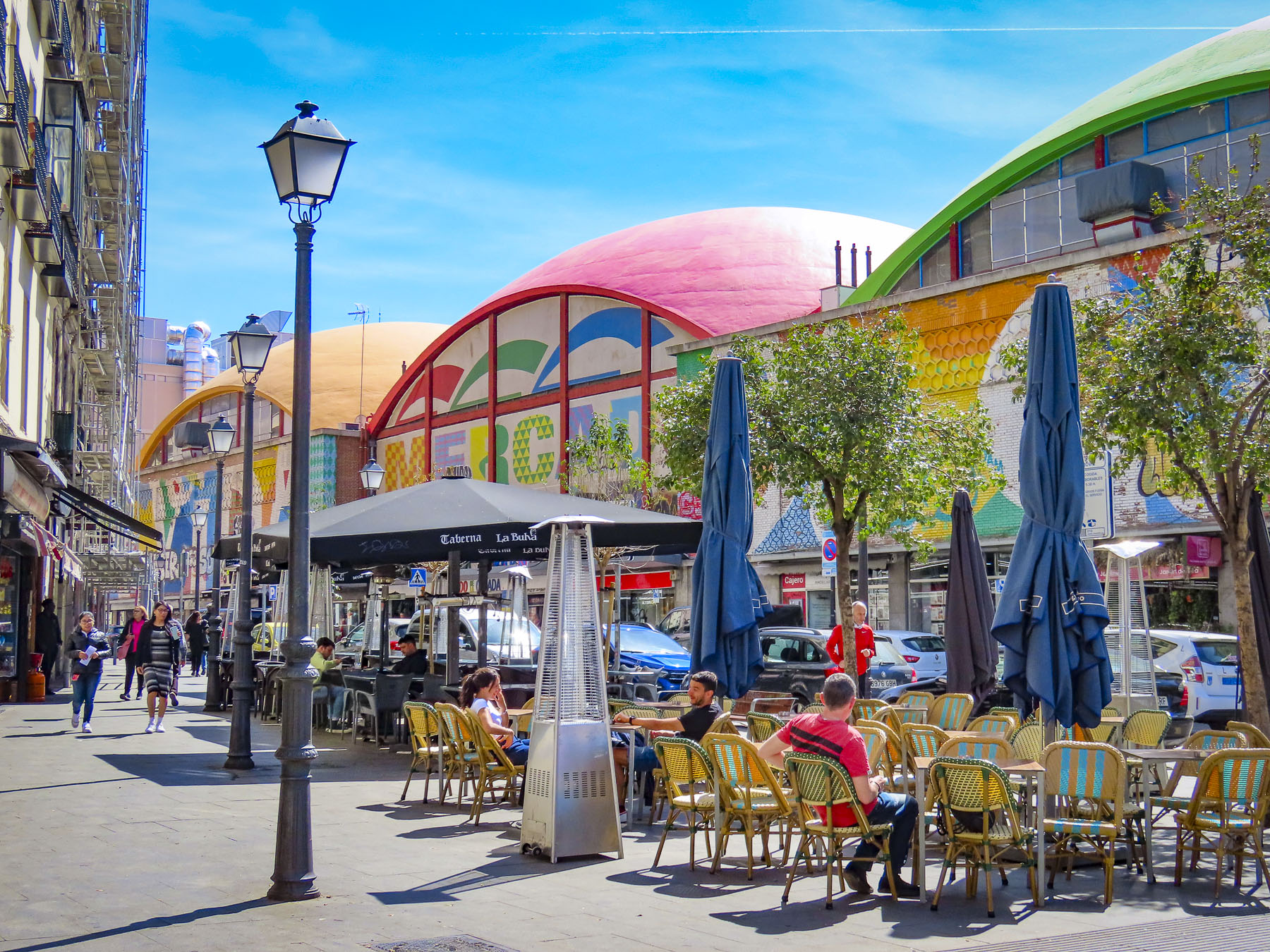
At the end of Cava Baja and Cava Alta, the colorful Mercado de la Cebada, with its distinctive wavy roof, is a modern architectural dichotomy in its surroundings. The shopping in this mercado is an authentic Madrileño experience that is not touristy at all.

From the entrance to the market, we noticed the tall silhouette of the Royal Basilica of Saint Francis the Great’s large dome, several blocks away, dominating the neighborhood, and decided to check it out.

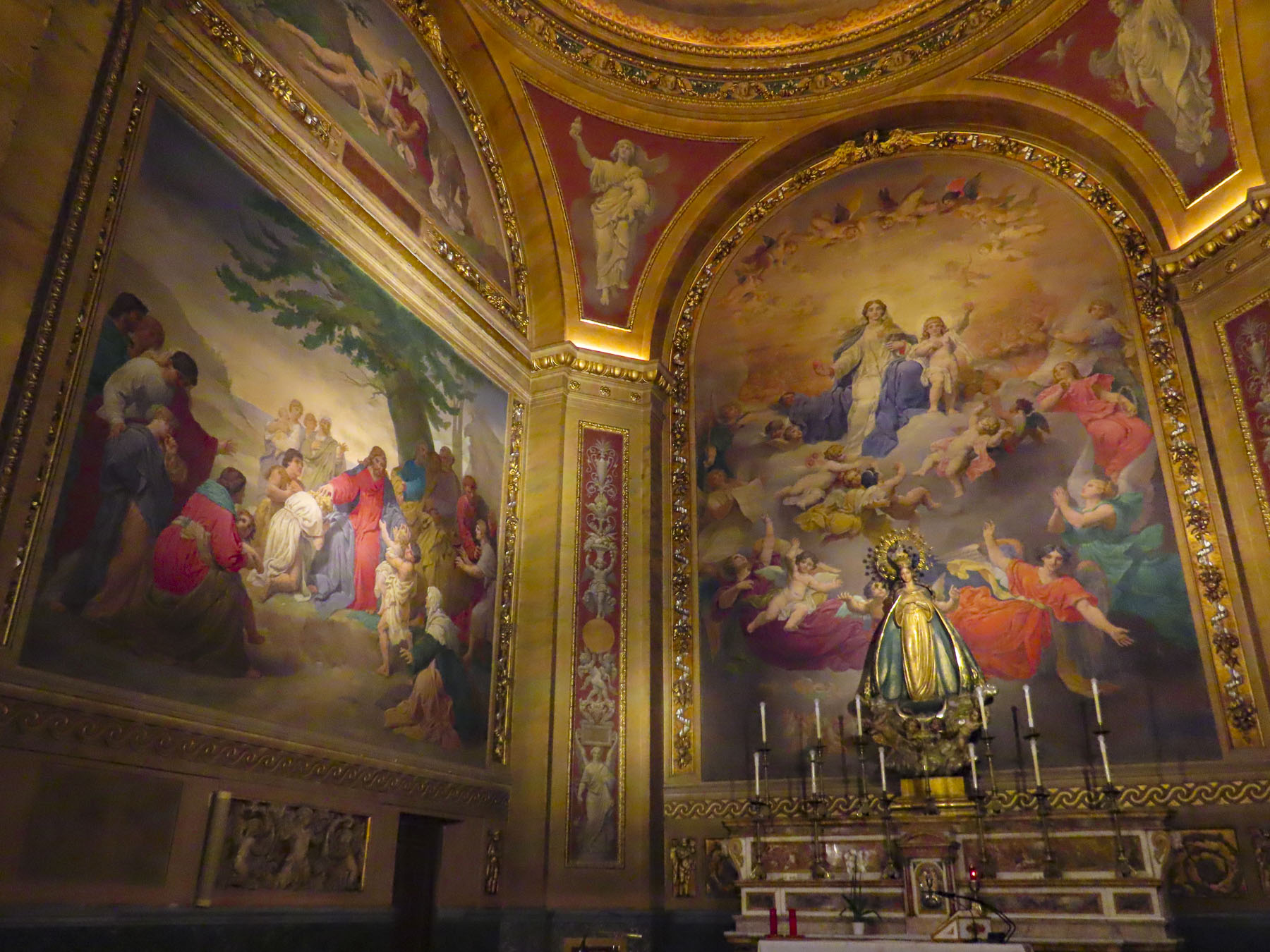
This is a mammoth, mid-18th century cathedral designed in the Neoclassic style, the size of which we did not fully realize until we were standing under its 108-foot-wide and 190-foot-high dome. Legend believes that St. Francis chose this site himself when he visited Madrid in 1214 during his pilgrimage to Santiago de Compostela. The dome is the largest in Spain and the fourth largest in Europe. It was breathtaking in scale and equally fascinating with celestial frescos by Casto Plasencia Mayor decorating the cupola, and paintings behind the altar by Manuel Dominquez and Alejandero Ferrant, illuminating biblical stories.

Six smaller but equally opulent chapels in several different architectural styles, from Baroque to Byzantine, and Renaissance to Rococo, ring the main altar, each mini museum displaying a wealth of religious art created by the Spanish masters Francisco José de Goya, Alonso Cano, Francisco Zurbarán, Antonio González Velazquez, José Moreno Carbonero, and others. This church is one of the most beautiful we’ve visited in Spain and should be on everyone’s “must do in Madrid,” lists.

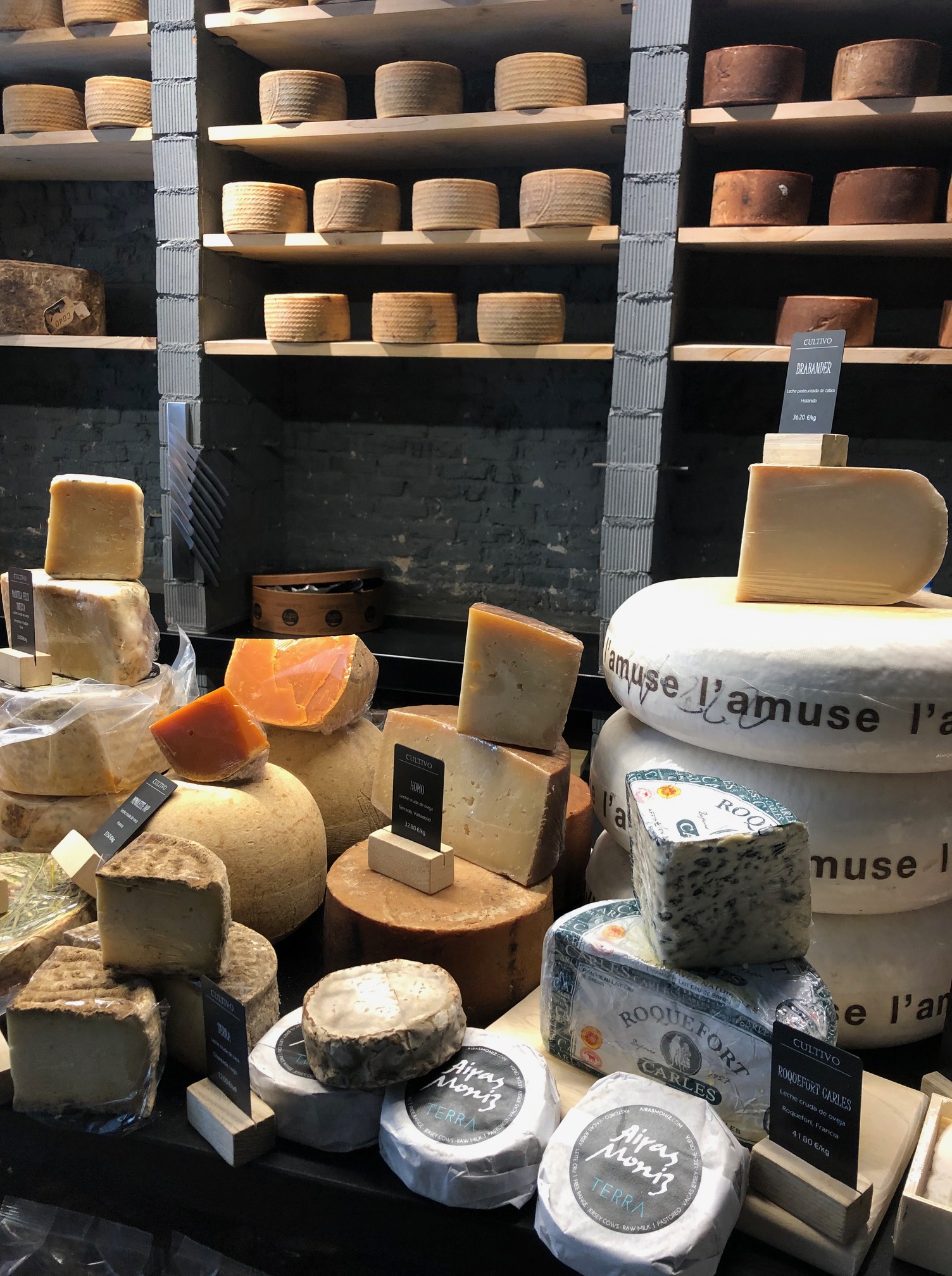
Afterwards, on Carrera de San Francisco, 14, as we started our return leg to our hotel, we happened upon two very good gastronomic discoveries. The artisanal bakery, Obrador San Francisco, was full of the wonderful aroma from fresh baked bread that was just being put out for purchase. And of course, to go along with good bread, you need good cheese. This was accomplished easily enough, right next door, at Quesería Cultivo, a cheese shop, with an amazing array of Iberian cheeses. It’s worth stopping here just for the earthy aroma that greets you when you enter the store, an experience that will have you picturing idyllic Spanish mountain pastures, full of grass-grazing and milk-producing livestock.

Being the cheese aficionados that we are, we had one more stop in mind, at Casa González.  They have been selling cheese in Madrid since 1931 and have slowly expanded to become a petite gourmet shop and small bar with a handful of tables, where they are happy to advise you on which wines to pair with each cheese.  

On our last full day in Madrid, we wandered the exhibition galleries at the Prado, viewing the museum’s vast collection of classical European art, which spans from the sixth century BC until the late 19th century. We especially enjoyed the works of Goya, Velázquez, and El Greco. Goya created over 700 paintings during his lifetime and embraced many different themes from royal portraiture, to Romanticism, to religious art, and later his dark paintings, toward the end of his life.

Around the corner from the museum, we lunched at Plenti, which served delicious and inexpensive food. We spent the rest of the afternoon exploring Real Jardín Botánico, where many of its plantings were just beginning to flower.

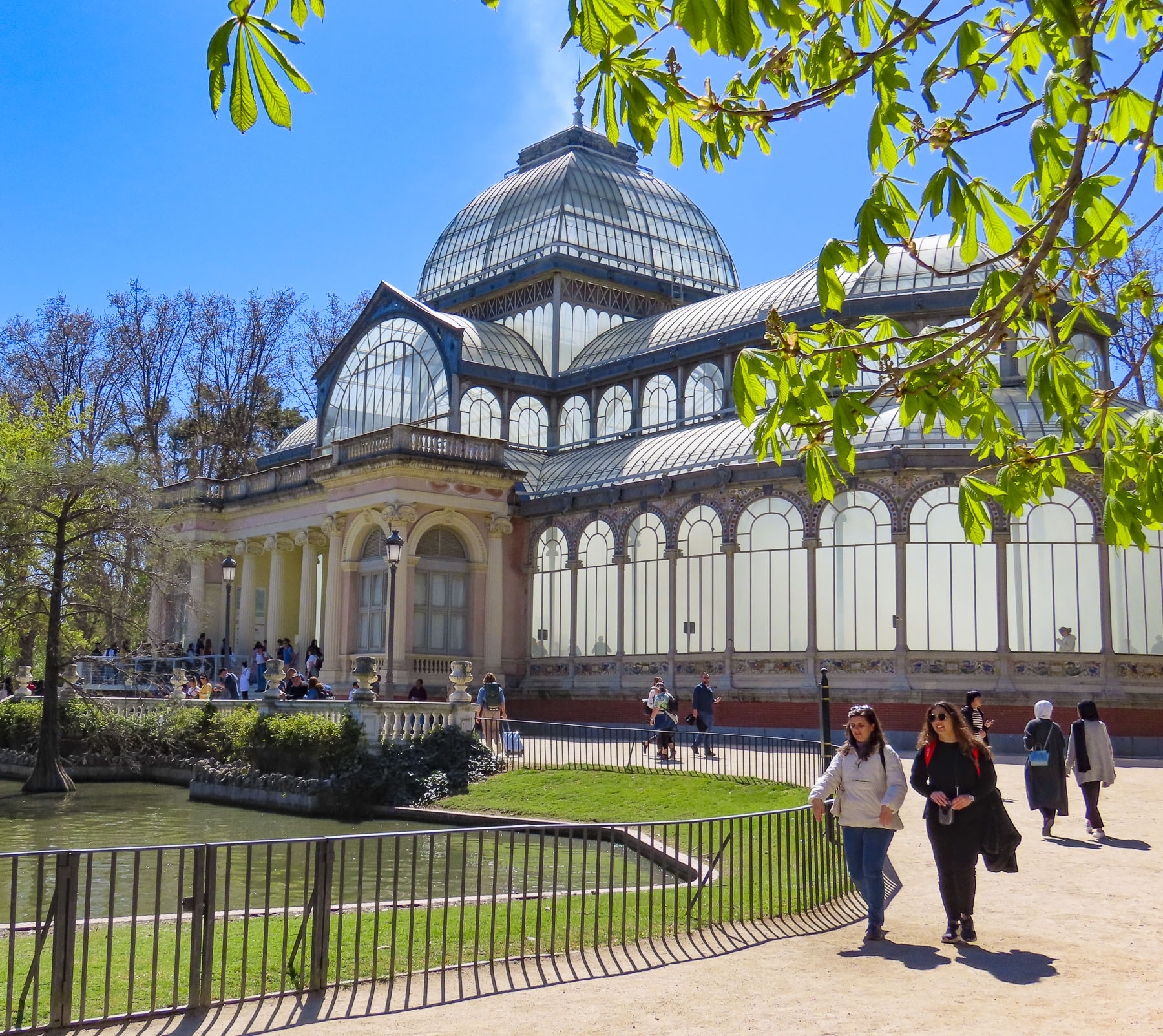
In El Retiro Park we did the classic tourist stuff, visiting the Palacio de Cristal, originally built as an exposition greenhouse, but now hosting art exhibits, and the Monument to Alfonso XII on the El Retiro boating pond. Interestingly, the park was originally created in 1630 as an exclusive sanctuary for Spanish Kings and members of the royal court, and famous naval battles were re-enacted on the boating pond for the monarchy’s entertainment.

The large 350-acre treed park, with manicured gardens, fountains and monuments was perfect for royal courtships and discreet liaisons. It was gifted by the monarchy to Madrid and permanently opened to the public in 1868, a much-needed addition to the city’s greenspace at the time.

The sun was warm for late March and folks were out and about, enjoying life. It was a perfect day.

Till next time,

Craig & Donna

Barcelona: An ancient yet modern metropolis

Usually, we shy away from large cities. I am not sure exactly why, though it’s probably anxiety about how hectic a new city might be and imaginary stress of navigating public transit, or predatory taxi drivers. But we’ve only ever heard how wonderful Barcelona was from our friends and decided to take the plunge ourselves. Boy were our pre-conceived notions way off! Starting with a trouble-free taxi ride (it’s as if the Barcelona City Council told the taxi union to treat the tourists well or we’ll allow Uber and Lyft to operate in the city) from the airport to our hotel, One Shot Aragó 257 in Barcelona’s Eixample district.

The district dates from the city’s expansion in 1855 when the Spanish Crown finally relented and permitted the demolition of the ancient defensive walls around the historic core of Barcelona. This allowed the city to expand beyond its ancient footprint to accommodate a growing population, that was literally bursting the city’s walls. A visionary plan by Ildefons Cerdà to urbanize the farmlands surrounding the old walled city was chosen.

An enlightened architect and civil engineer, he envisioned Eixample to be a model of urban living, where every citizen had enough sunlight, clean air, water and green space for a healthy lifestyle. Cerdà designed the Eixample district with short blocks to encourage “walking, mixing, and vibrant street life,” and oriented the streets to run northwest to southeast to receive maximum sunlight. The buildings on each block were no higher than seven floors and built around a central treed courtyard.

Comprised of six neighborhoods, Dreta de l’Eixample, Antiga Esquerra, Sagrada Familia, Fort Pienc, Sant Antoni, and Nova Esquerra, we can attest that Cerdà’s Eixample district and his vision for Barcelona’s future has withstood the test of time and the city continues to be a wonderful, people-friendly place to explore by foot. Today Barcelona is a sprawling city of millions; still, with most of its 19th century buildings only 7 stories tall, it never felt congested and always felt as if we were strolling through intimate neighborhoods. Of course, there were exceptions on La Rambla and the promenade along the Platja de la Barceloneta oceanfront, which were busy even in off-season March.

Today, continuing improvements to the city’s urban landscape, fostered by the concerns of climate change, are being implemented to the city’s 19th century footprint with the pioneering of Superblocks. These are 3 square block areas that will become pedestrian only with trees planted where the roadway was removed in order to expand the city’s green spaces and enhance urban living.

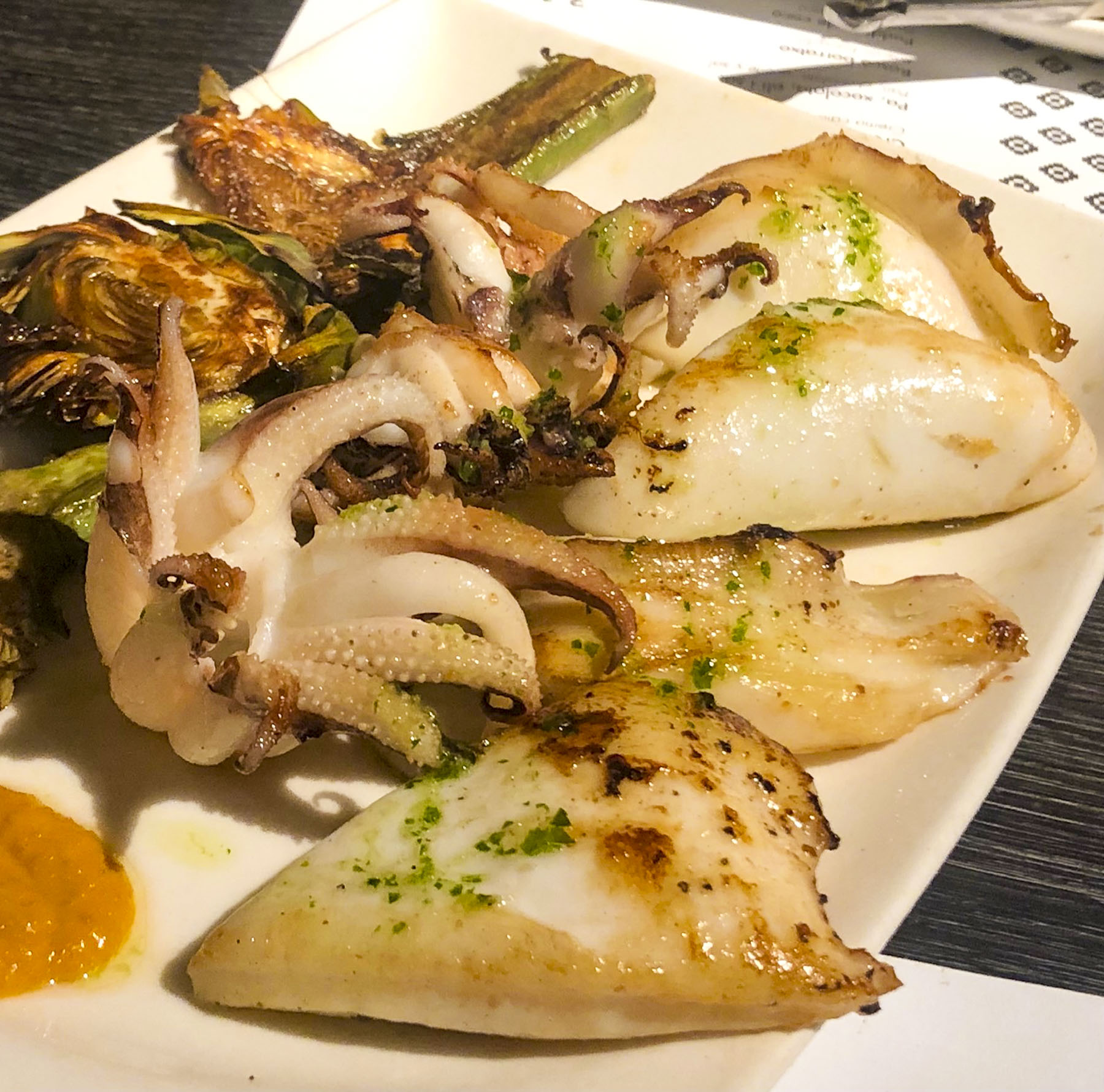
Just exploring the blocks immediately surrounding our hotel was rewarding with discoveries of cafés, tapas bars and interesting shops. Our favorite for morning coffee was the Catalan pastry shop, Casa Vives, located too easily, on the corner down the street from our hotel. The contemporary tapas at Vinitus couldn’t be beaten, and a formidable line awaited if we didn’t arrive early enough.

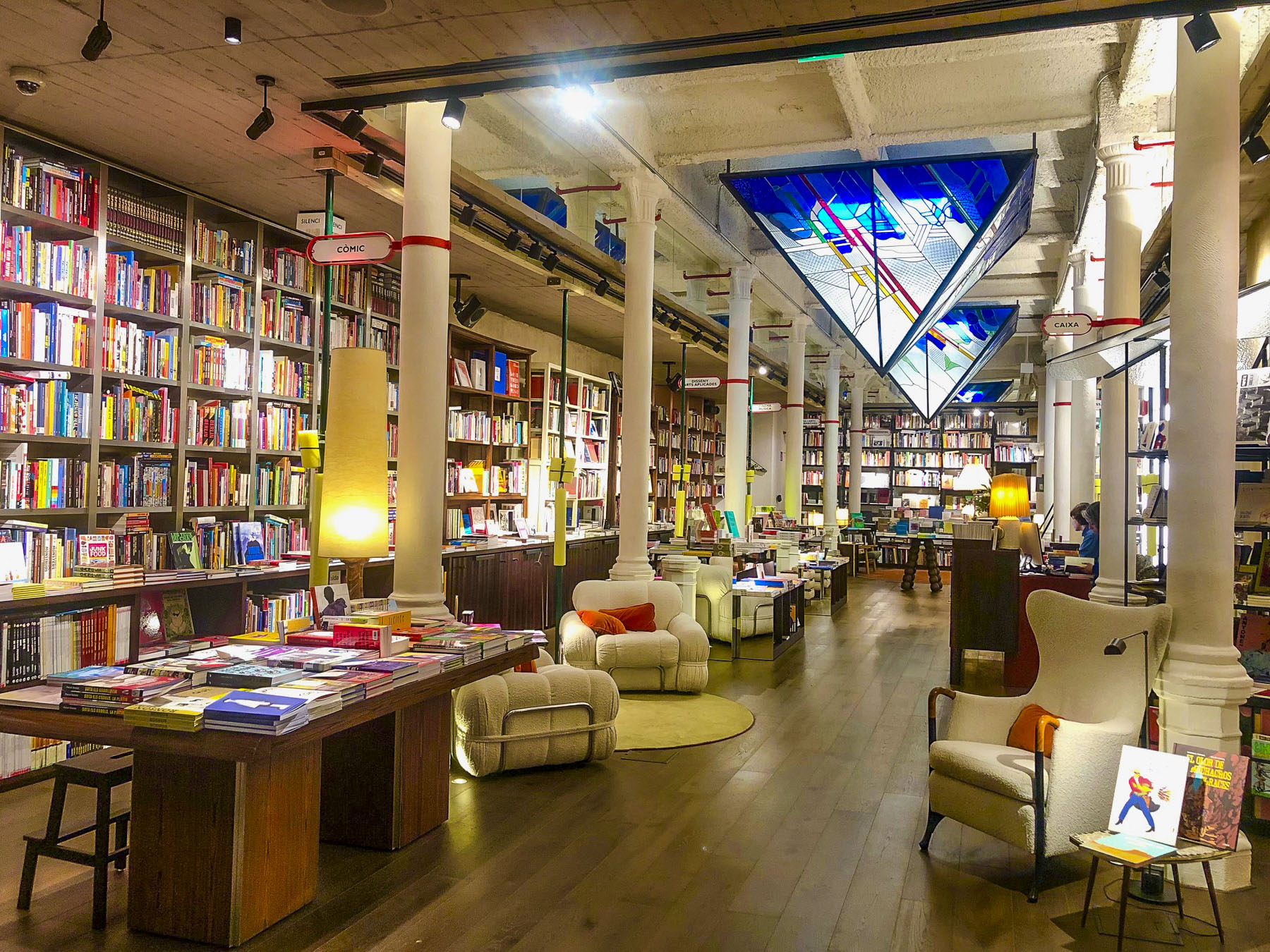
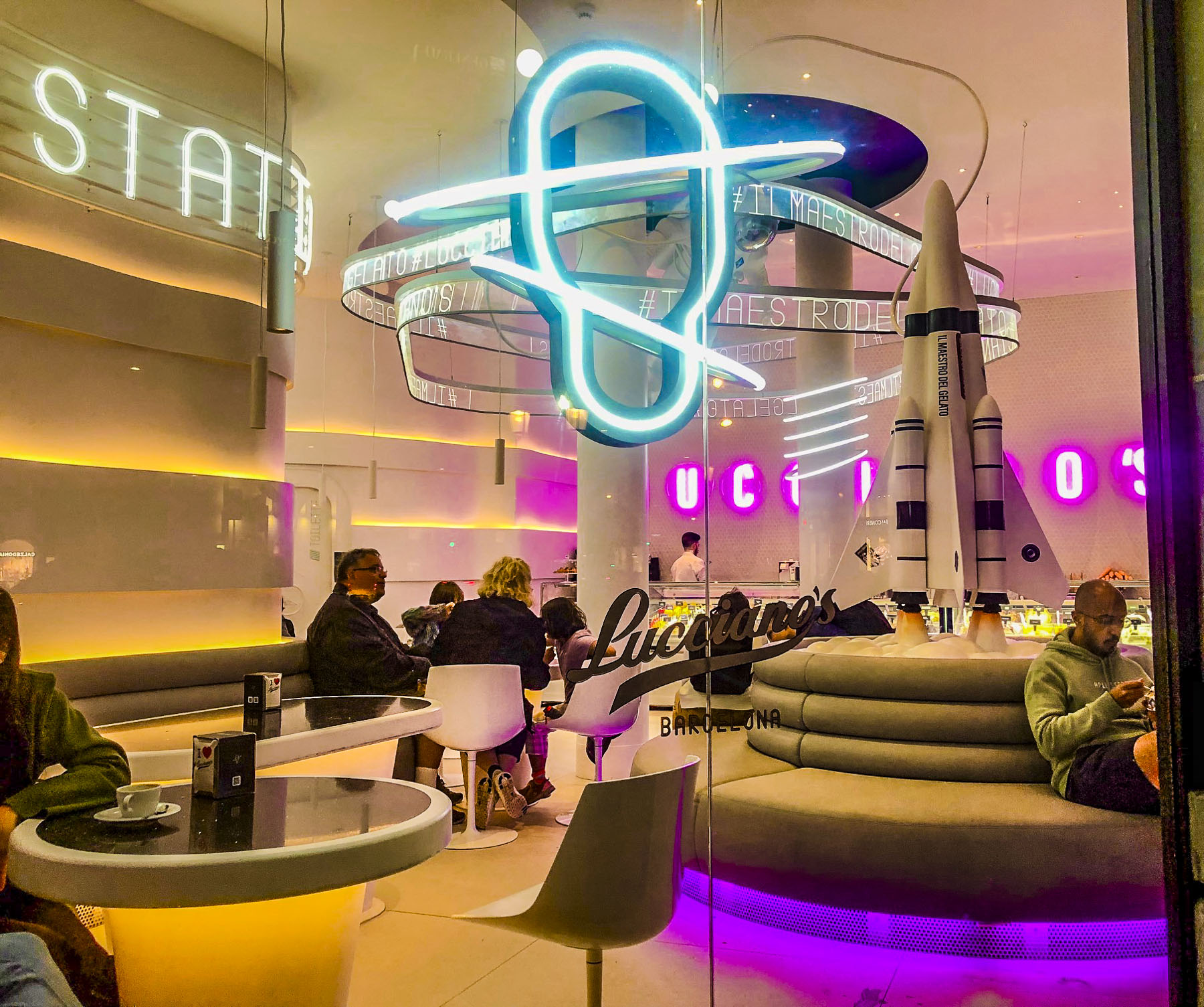
Contemporary interior design has always intrigued us, and fine examples can be found all across the city. But in our neighborhood the bookstore Llibreria Finestres and Lucciano’s Barcelona, an ice cream shop, stood out, along with Bolibar Bronzes with its vast array of fascinating architectural door hardware. We can’t imagine how much our suitcases would have weighed if we had indulged ourselves by shopping there.

Eixample also claims several buildings designed by the innovative modernista architect Antoni Gaudi. Near our hotel, on Passeig de Graçia, was the Casa Batlló, a private residence that Gaudi redesigned in 1904 with his signature use of flowing organic forms, whimsical decorative elements, and texture. Also, on Passeig de Graçia is Gaudi’s La Pedrera-Casa Milà, 1906, a private residence for his client on the lower floor and apartments above. The building is known for the undulating lines of its facade and sculptural chimneys. Sadly, we sufficed with just viewing the exteriors of these landmarks, as we felt the entrance fees were exorbitant at €30 per person at each site.

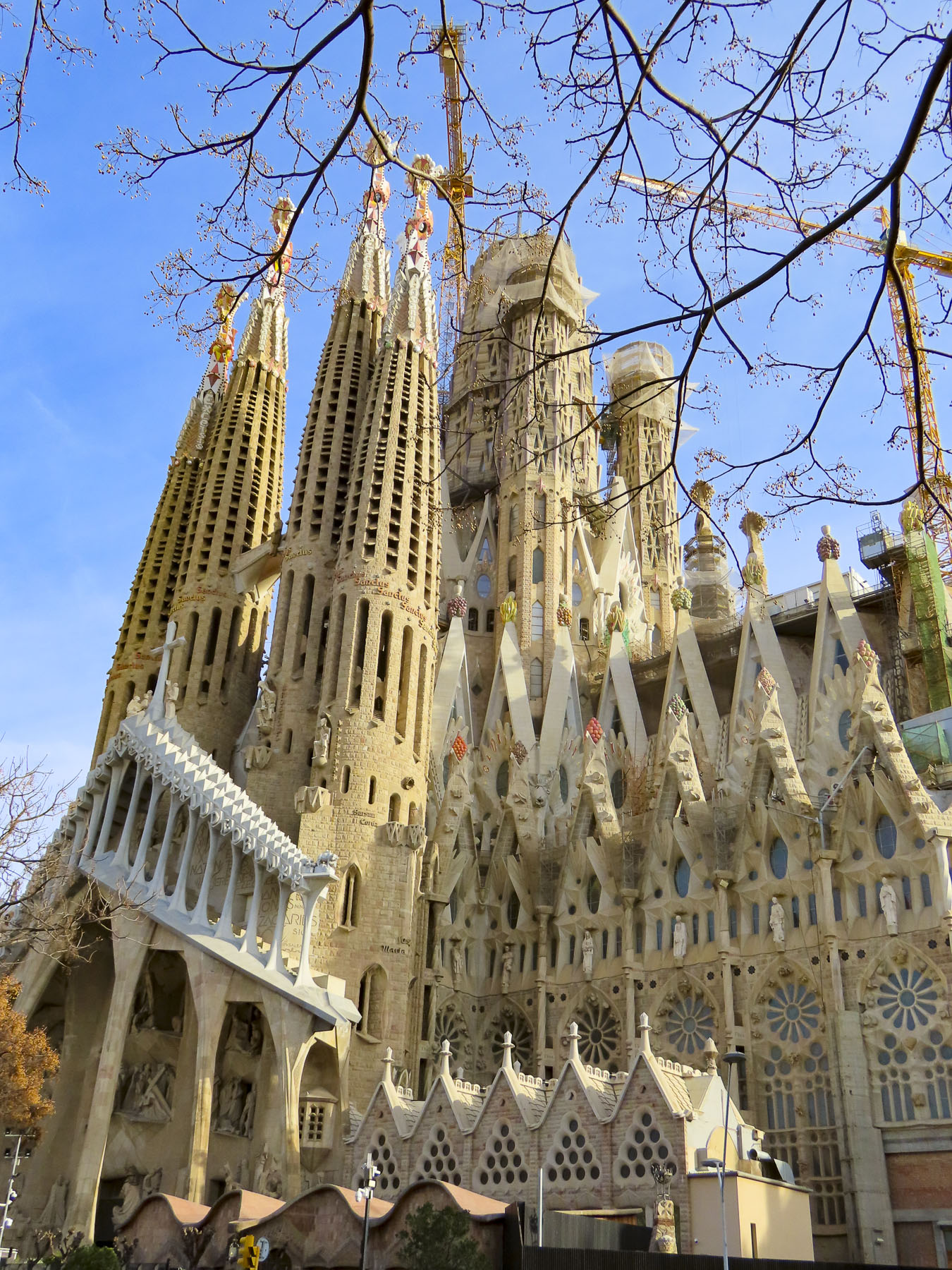
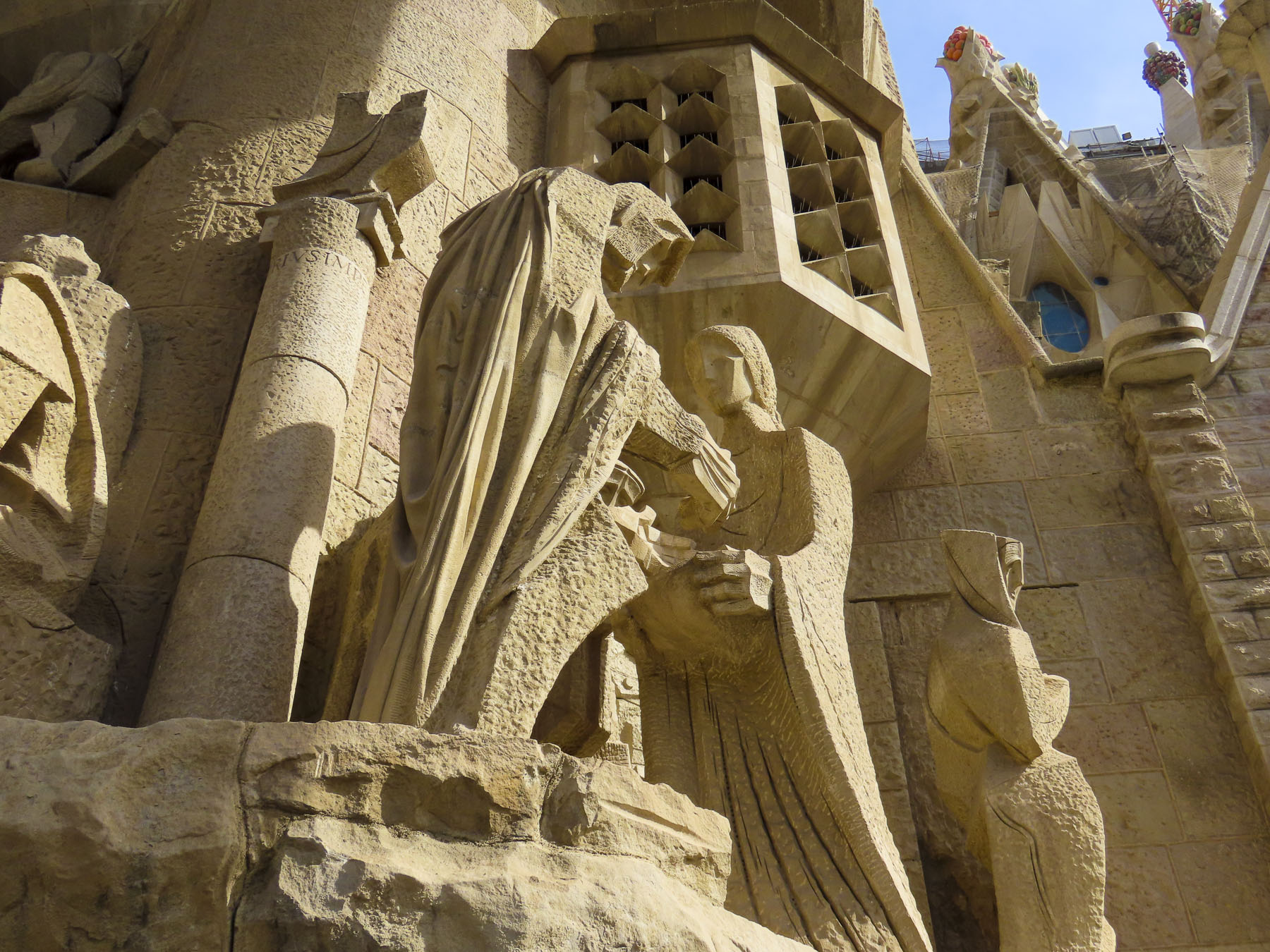
We put these savings towards the tickets for the Basílica i Temple Expiatori de la Sagrada Família, or simply the Sagrada Familia, Antoni Gaudi’s masterpiece. Like the Eiffel Tower in Paris, Big Ben in London, and Rome’s Coliseum, Gaudi’s soaring towers at the Sagrada Familia serve as Barcelona’s iconic landmark.

The cornerstone of the Sagrada Familia was laid in 1882, but Gaudi was not the first architect. He replaced a colleague who designed a more traditional church with a gothic façade, flying buttresses and a pointed bell tower. Gaudi transformed it into the enlightened, visionary structure that now graces Barcelona with eighteen spires.

Twelve of the spires are dedicated to the Apostles, while the remaining six are dedicated to the four Evangelists, the Virgin Mary and Jesus Christ. Realizing the project would outlive him, Gaudi left detailed plans and models that are still being followed, nearly 100 years after his untimely death in 1926 (he was struck by a tram and died from his injuries a few days later.) Construction of the cathedral relies on ticket sales and private donations, consequently during the pandemic, work nearly came to a stop. Currently the church’s final completion date is set for 2026, one-hundred-forty-four years after that cornerstone was laid and 100 years after its architect’s death. Talk about a lasting vision!

The Cathedral is an awe-inspiring temple that is visually uplifting and celebrates life, with its unique use of organic forms and stunning play of light from its stained-glass windows. We highly recommend purchasing your tickets and scheduling a time to visit online, well ahead of your visit to avoid the queue at this celebrated monument.

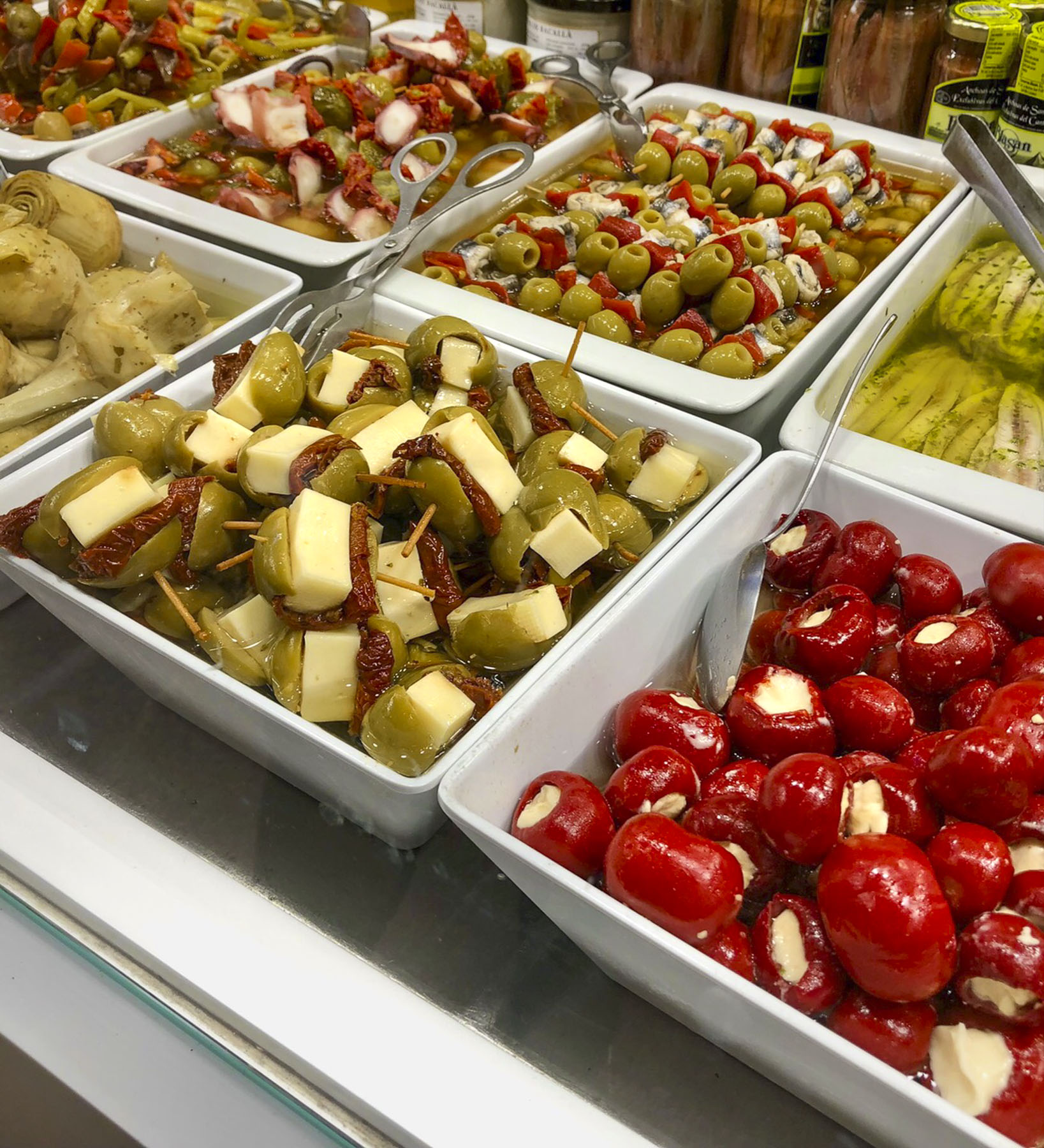
Walking between landmarks is one of the best ways to experience Barcelona and with that in mind we headed to Mercat de l’Abaceria, a traditional neighborhood mercado with multiple vendors on Pg. de St. Joan. Though much smaller than the famed Mercado de La Boqueria on La Rambla, which has sadly become gentrified and overly touristy, this mercado is a genuine neighborhood experience, where we enjoyed lunch and purchased olives, cheese, and sausages for snacking later.

Any first visit to Barcelona can’t be complete without a stroll down La Rambla, taking its name from the Arab word “ramla,” for sandy riverbed, which is how the path from the old walled city to the Mediterranean Sea started eons ago. La Rambla became a street leading to one of city’s ancient gates in the 1400s when a riverbed was filled in and folks trekked to an open-air market in an area known as Pla de la Boquería. It eventually became the main thoroughfare to the port and was lined with several convents.

The market wasn’t officially recognized as La Boqueria until the 1840s and didn’t exist in a covered structure until 1914 and now famously hosts 200 food stalls and millions of visitors every year. Flowers have always been a tradition along La Rambla and it started with La Boqueria’s market stall owners, centuries ago, giving flowers to their customers as a token of appreciation for their shopping. In 1702, 280 trees were planted along La Rambla. Streetlamps were installed along its length in 1860 and its newspaper stands remained open all night. Since then, it has been Barcelona’s most historic boulevard, the place to stroll, to be seen, to people watch.

Now three quarters of a mile long, the tree lined boulevard runs from the Columbus Monument at the harbor past the historic Gothic Quarter to Plaça de Catalunya, Barcelona’s central plaza where the old medieval city ends and the newer Eixample district begins.

Wandering through the historic old town section, we visited the Cathedral of Barcelona, a massive Gothic structure that dates from 1298, when it was built upon the ruins of an old Roman temple.

It was the city’s most important church for 600 years until the construction of the Sagrada Familia was started. The difference between the two is night and day. The cathedral is somber, while the Sagrada Familia lifts your spirit.

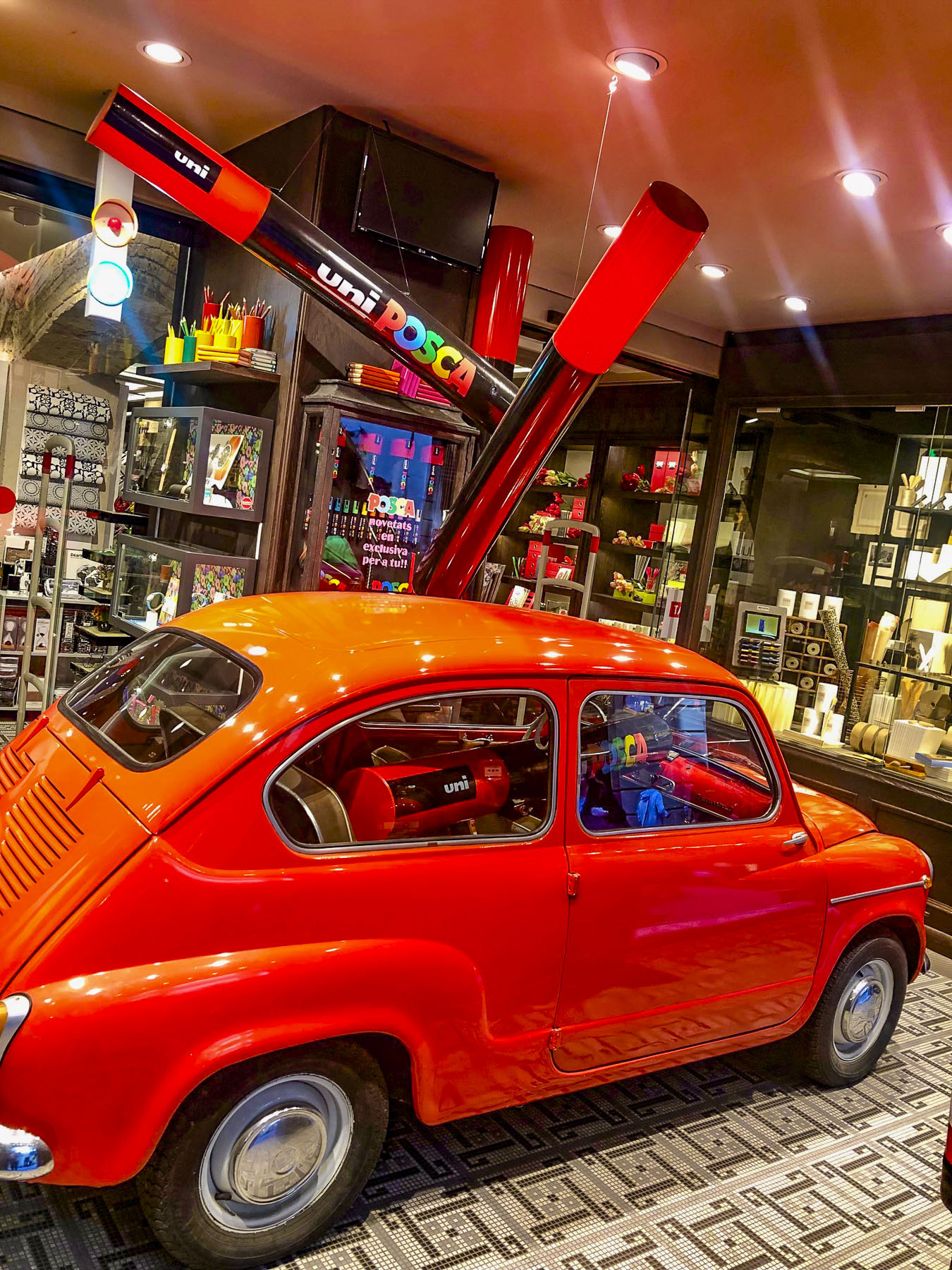
Afterwards on our way to the Palau de la Música Catalana, we stumbled upon Raima, a fantastic stationery and art supply store that is so out of place in the medieval old town, it’s wonderful. If you enjoy artful things, Raima has four floors full of visually stimulating displays and a hidden gem, a quiet rooftop café.

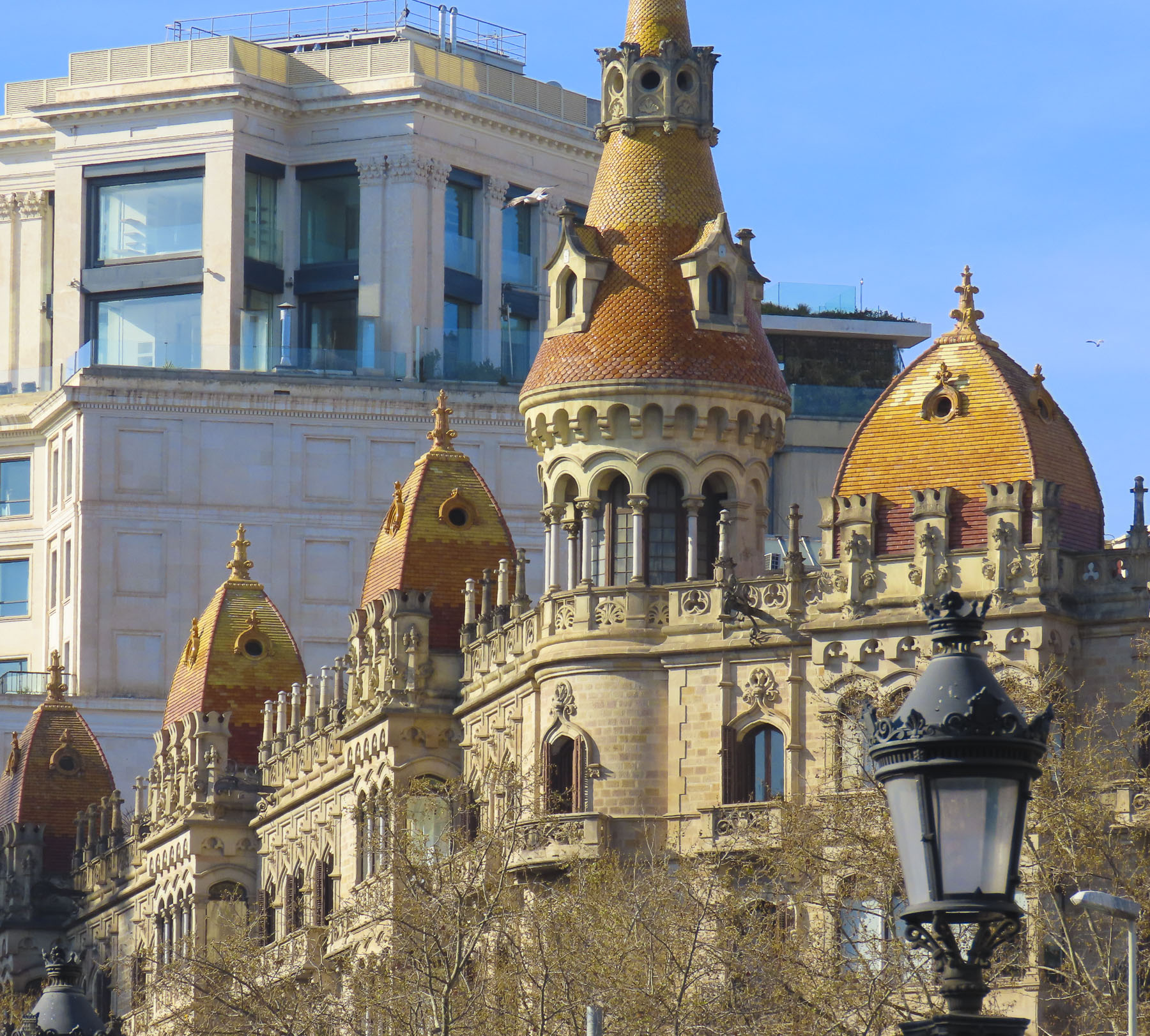
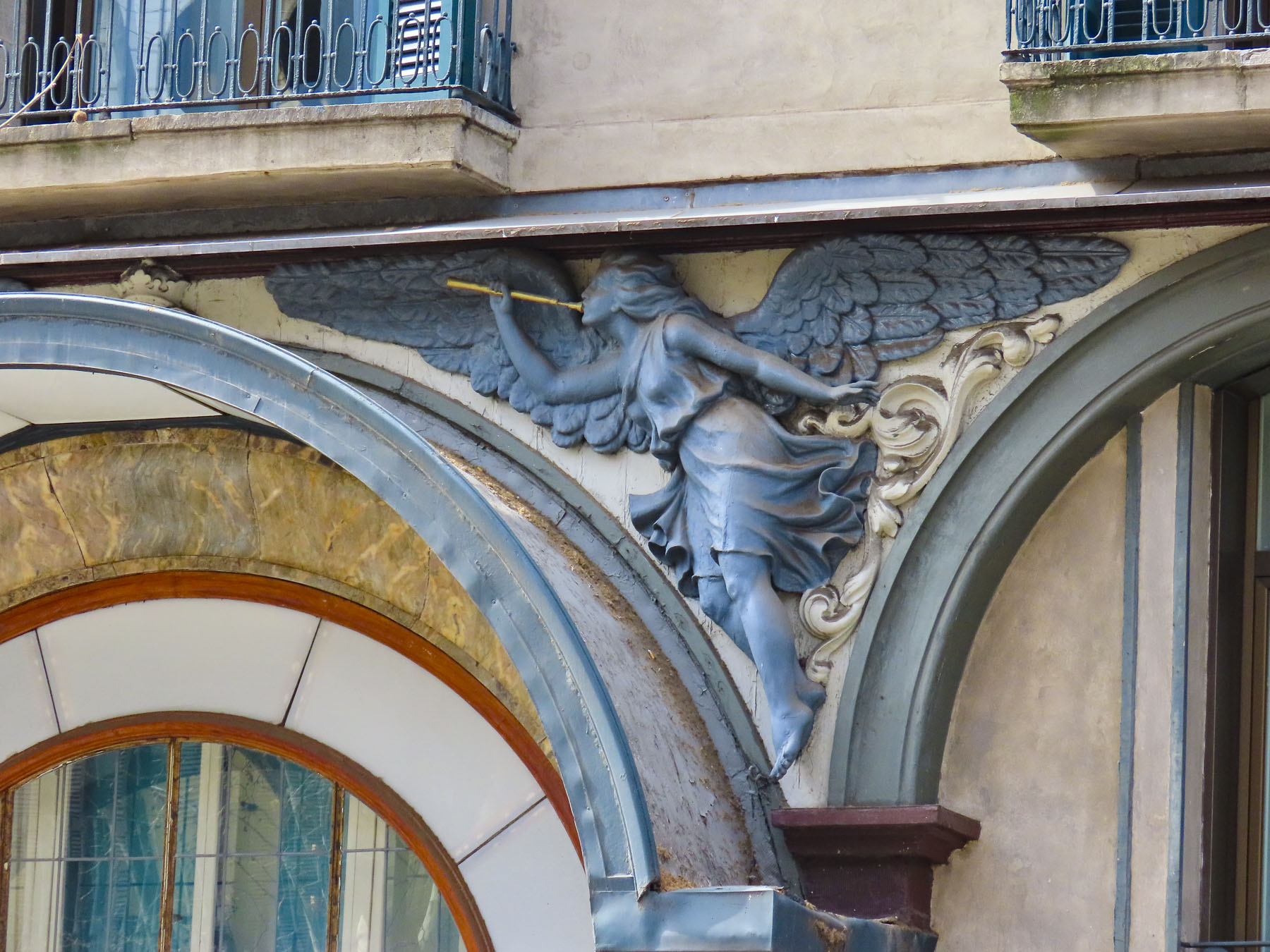
The walk through the narrow alleys of Barcelona’s ancient city center is filled with interesting architectural details fronting centuries-old buildings. Each successive generation decorated their city with sculptures and monuments, small visually intriguing vignettes, but which sadly have lost their historical significance over time. Now in many of the city’s plazas, modern art stands wonderfully juxtaposed against the ancient buildings.

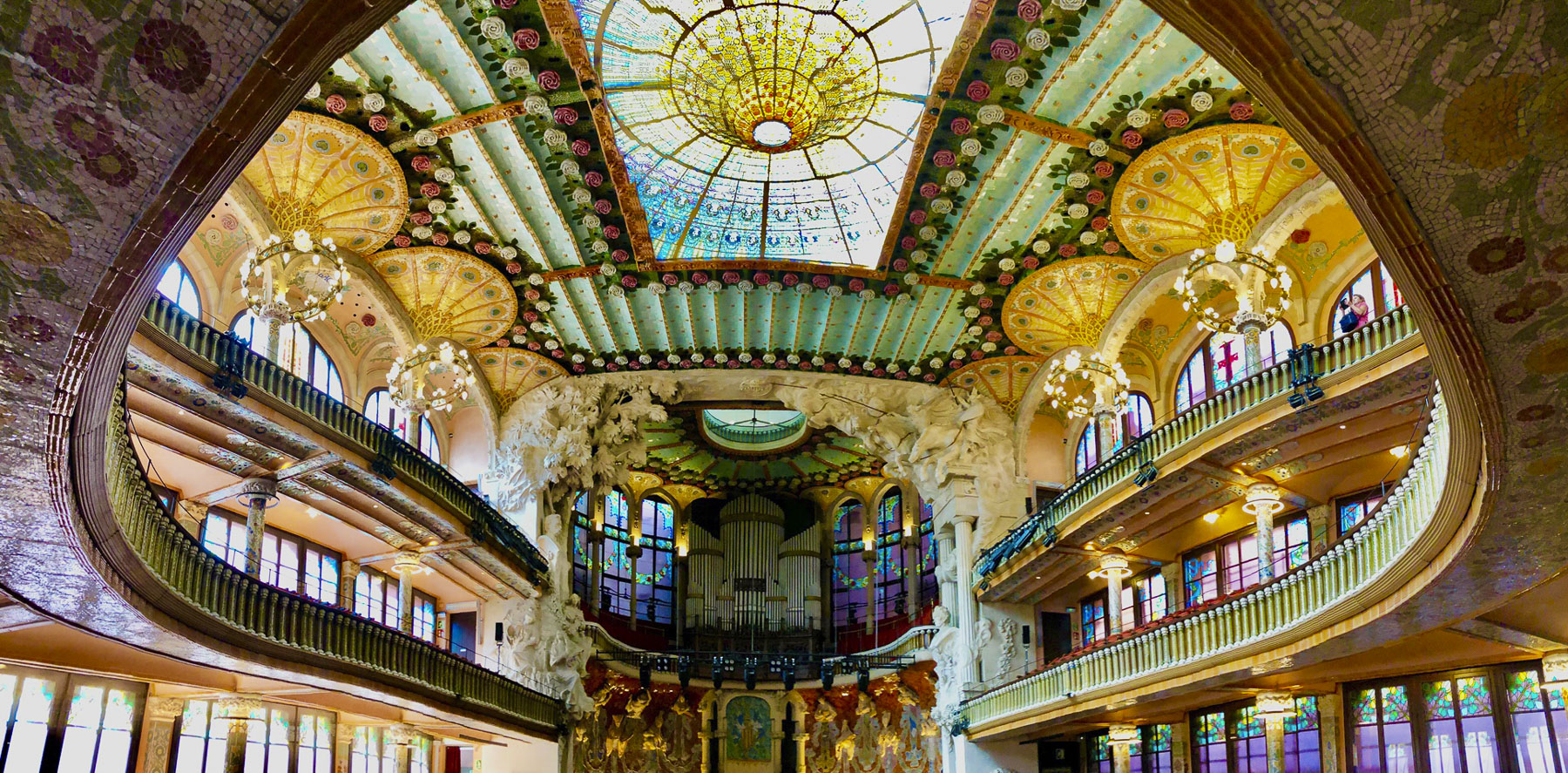
The Palau de la Música Catalana is Barcelona’s most beautiful concert hall and is often referred to as the city’s, “magical music box.” It was constructed in 1905 by a contemporary of Gaudi’s, modernist architect Lluís Domènech i Montaner, in a style that is referred to as Catalan Art Nouveau, which incorporates the decorative arts of stained glass, ironwork, mosaic, painting, and sculpture together in a project. It’s a captivating space that highlights the great craftsmanship of the era. 

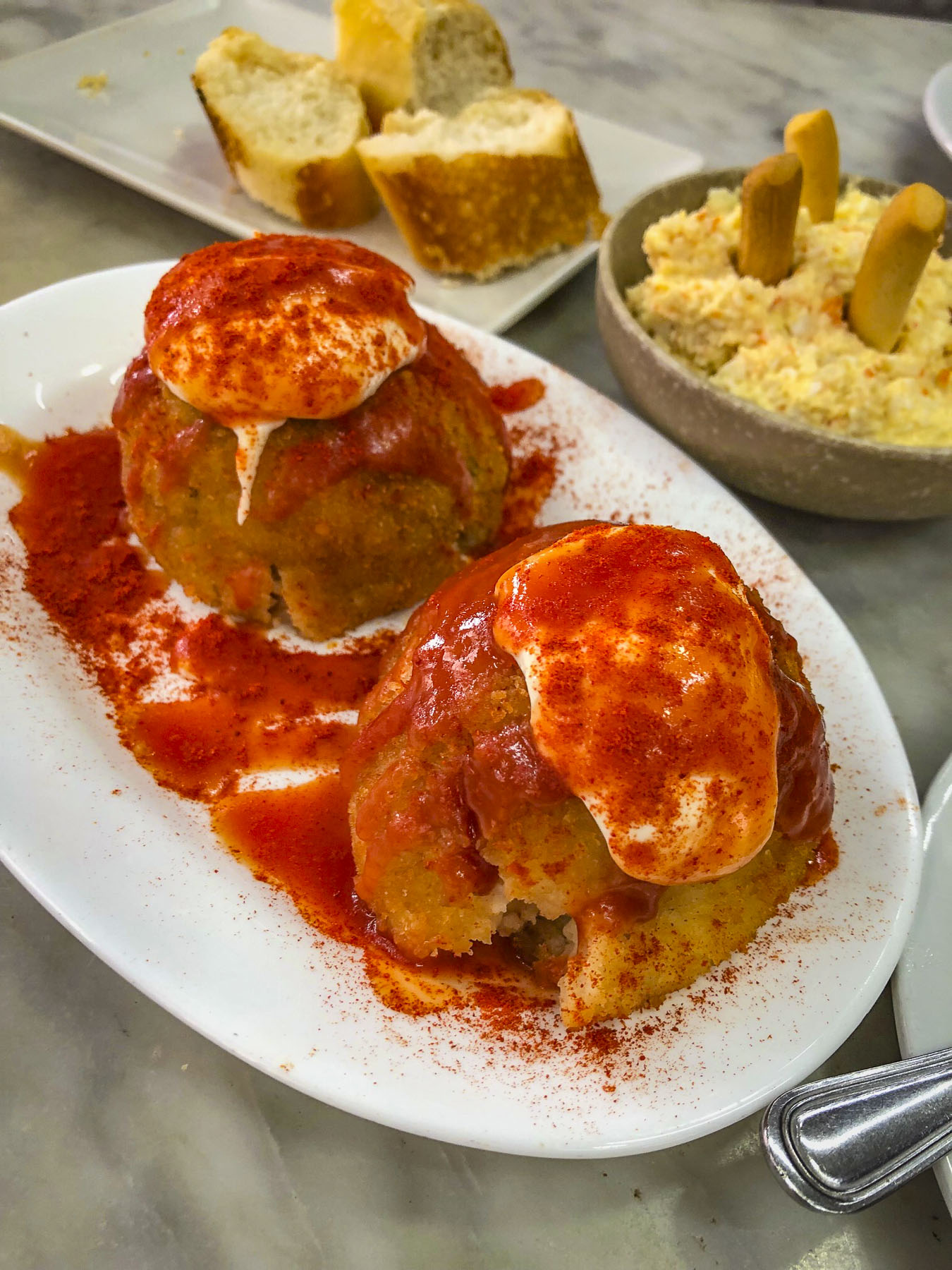
The Barcelona beaches were not tempting us, but someone during our travels suggested that we must go to the seaside district of Barceloneta and find Bar Electricitat. “Because, they have the best bombas in Barcelona.” Try saying that tongue twister three times fast! We haven’t done a lot of comparative taste testing regarding this, however the bombas, fried mashed potato balls stuffed with sauteed ground pork and beef, were delicious. And the bar itself is a friendly, delightful no-frills place with a gregarious waiter, who seemed to know everyone, and a good house wine. We cut our walk along the beach short when the wind started to kick up sand.

Unfortunately, by the time we reached Parc de la Ciutadella, our cloudless morning was becoming overcast, though that did not deter folks from relaxing on the parks expansive lawns and enjoying a warm Spring Day in mid-March. Designed in the late 19th century for the Universal Exposition of 1888, the park has an assortment of monuments dedicated to Spain’s glories, a boating lake, and life-size concrete sculpture of a woolly mammoth named Júlia. She’s been popular with generations of Barcelonian families since she was installed in the park over 100 years ago.

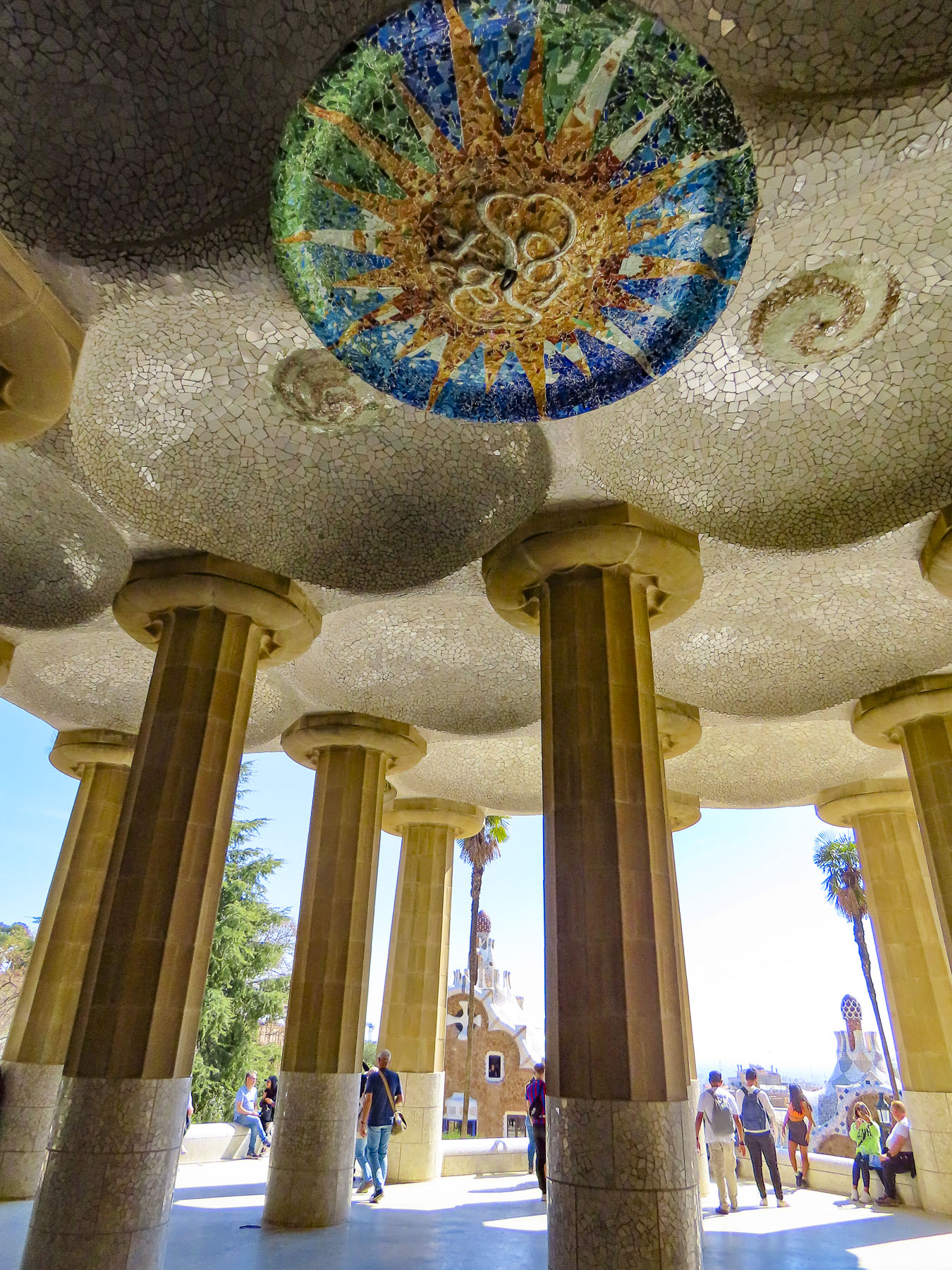
The next morning, we took a cab to Park Guell, another Antoni Gaudí creation set in the hills above Barcelona. In 1900, Eusebi Güell, a wealthy industrialist, envisioned the wooded hillside as an exclusive gated community with sixty homes and common areas designed by Gaudí.

By 1907, the whimsical entrance pavilions, viaducts, hypostyle market area, and the grand esplanade with its stairway were completed.

But the project failed to attract buyers and the hillside became Güell’s private retreat. Upon his death his heirs offered to sell the park to the city. Barcelona agreed and opened the park to the public in 1926. The park has been a UNESCO World Heritage Site since 1984 and annually attracts nine million visitors. Get your tickets online ahead of time and arrive at the park as early as possible. Even by 11AM, in March, there was a hefty crowd of folks visiting the park.

Something old, something new, there are plenty of interesting things to do and see in this dynamic, ancient yet modern metropolis. We had a great 5 days exploring Barcelona. And one of the surprising things we discovered about ourselves during our years of travel is that after having purposedly avoided living and working in cities in the United States, we actually enjoy European city life!

“Just close your eyes and let’s pretend we’re dancing in the street in Barcelona”- Ed Sheeran

Till next time, Craig & Donna

Nicaragua: The Dioromo Hipica – a Horse Parade

Celebrating the equestrian lifestyle has been a Spanish tradition since the Middle Ages and followed early Spanish colonists across the Atlantic to Central and South America in the 1500s. In Nicaragua the tradition lives on in beloved hipicas, horse parades.

There are numerous Hípica festivals, held in towns large and small, across the country throughout the year. They are usually the main event of a town’s festivities marking their patron saint’s day. By pure luck, one February, we were able to experience the Dioromo Hipica which is one of many activities held to honor La Virgen de Candelaria in the small village of Dioromo, eleven miles away from Granada.

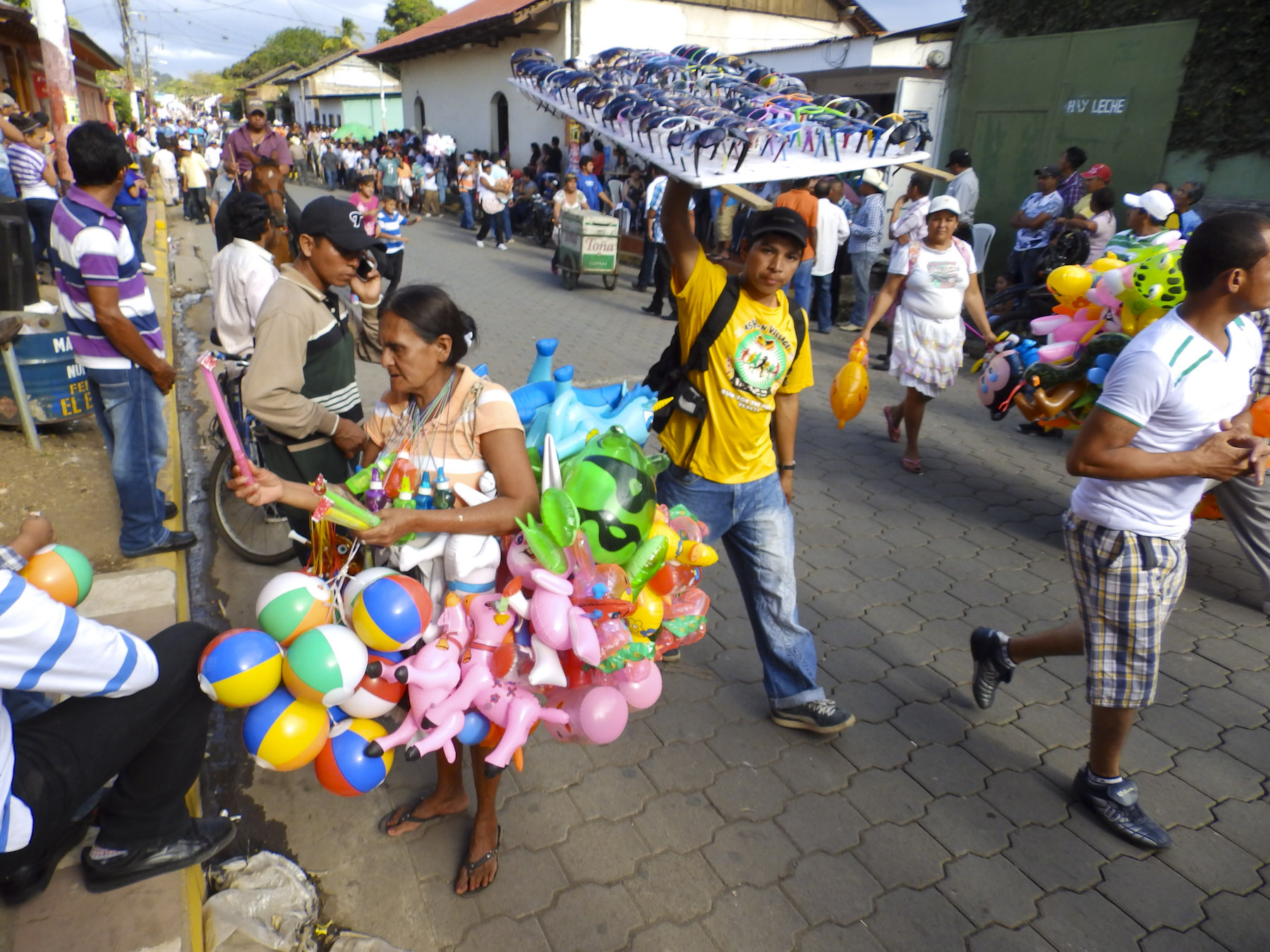
This was a wild and crazy event, with hundreds of cowboys, dancing horses, a bull riders, and pickups trucks loaded with brass bands parading through the village. The streets were crowded with onlookers.

Because we were standing close, we were occasionally smacked by a horse tail. There were life-size toy horses for kids to sit on and get their photo taken by their parents; small amusement rides and food stalls surrounded the town plaza.

Baile de Las Negras dancers in painted masks and ornate costumes performed before a large crowd in front of the church. Down the side streets a group of men carried aloft a tall statue of the Virgin door to door, to bring blessings to the households.

I think we were the only gringos there experiencing this wonderful local event.

Till next time, Craig & Donna

The Turquoise Trail: Scenic, Artsy and Quirky

We always have a wonderful time in New Mexico, but often we’ve too easily fallen into the fastest route, the Albuquerque to Santa Fe rut. Heading north on Rt25, with the Sandia Mountain Range glowing in the late afternoon light on your right and a spectacular sunset in the west is a sublime experience, worthy of inclusion into the “wonders of the world.” The sky and light out here are just awesome, especially if it’s your first time to the Southwest. Aside from traveling north through Jemez Springs, Valles Caldera and Bandelier National Monument, all great destinations admittedly, there are not many alternative routes to Santa Fe, unless you are willing to circumnavigate northern New Mexico for days and hundreds of miles, which is a great alternative and may inspire future adventures.

Instead of following the “westward ho!” from cowboy movies of our youth, we headed east out of Albuquerque eighteen miles on Interstate 40/Route 66 to the Tijeras Pueblo Archaeological Site and the beginning of the Turquoise Trail National Scenic Byway. The trail is a splendid backroad route that gracefully curves, rises and falls through the rugged foothills of the Sandia and Ortiz mountains as it follows NM14 north for 65 miles. Passing through the historic towns of Golden, Madrid, Cerrillos and San Marcos just south of Santa Fe.

Archeological evidence found at multiple sites in Tijeras Canyon traces early habitation going back 9,000 years, near the end of the last Ice Age. The Pueblos people and their first permanent dwellings date to the 10th century AD.

It’s believed that Tijeras Pueblo was built in the early 1300s and had 200 rooms in terraced buildings arranged in a U-shape pattern around a central kiva.  The settlement only flourished for about 100 years before it was abandoned in the 1400s due to extended periods of drought and raids from nomadic Plains Indian tribes.  The Spanish tried to encourage settlement of the area in 1763 with the Carnuel land grant, but that failed after repeated raids by Comanche, Kiowa, and Plains Apache Indians forced settlers to flee. Permanent resettlement didn’t occur until 1819 when the Spanish made peace with the tribes.

Sadly, today all that is left of the Tijeras Pueblo is a terribly eroded mound of rubble with a self-guided trail that winds through the ruins. There is a small museum attached to the Park Ranger Station, which is only open on weekends.

If you haven’t taken the Sandia Peak Tramway, due to the fear of heights or its expense, you can still enjoy the view with your feet firmly planted on the ground. Follow NM14 north, turn left in the village of San Antonito onto Sandia Crest Road, and follow the signs to the 10,678-ft summit. Entrance to the park is free, but there is a small parking fee at the top. The views across Albuquerque are fantastic!

Past San Antonito the desolate, sparsely populated nature of the old west returns, with open vistas and greater distances between dirt tracks that spur occasionally left or right from the road and lead who knows where.

Legends of “Seven Cities of Gold,” and treasure that was rumored to rival the Aztec’s wealth brought Francisco Vazquez de Coronado with 2000 conquistadors north from Mexico City in 1540. On the Rio Grande north of present-day Albuquerque, Coronado commandeered a pueblo as headquarters for his expedition. His men spent two years searching an unknown region that spanned from Texas and Kansas to the Grand Canyon, searching for gold. He never found any because the Pueblo tribes attributed no value to it. Turquoise was the gold they mined for. Spiritual properties attributed to the stone are courage, good fortune and protection of the wearer in battles. The stone was a valuable trading commodity and pieces of Cerrillos Turquoise have been found by archeologists at indigenous sites in Canada and Aztec and Mayan tombs in Central America. Two years later Coronado returned to Mexico empty handed, though his camp was only 30 miles from the stream where this precious mineral glittered in the water.

In 1825, decades before the California Gold Rush, when New Mexico was still part of the Spanish Empire, the mineral placer gold was discovered in Tuerto Creek which ran down from the Ortiz Mountains. Two rough mining camps grew into small villages named El Real de San Francisco and Placer del Tuerto. Built with adobe bricks in 1830, the San Francisco de Asis Catholic Church congregation sought to soften the rough mining town’s edges.

This first discovery of gold west of the Mississippi brought prosperity to the villages for several decades. The Treaty of Guadalupe Hidalgo ended the Mexican-American War in 1848 and allowed the New Mexico territory to be annexed to the United States and the villages were combined and renamed Golden. At its zenith, the town supported many businesses, several saloons, a stock exchange, school, and post office. By the mid-1890s the luster of gold had worn away and ranching had become the dominant enterprise. Folks moved away for better opportunities; the last nail in its coffin and the beginning of its transition to a ghost town was the closure of its post office in 1928.

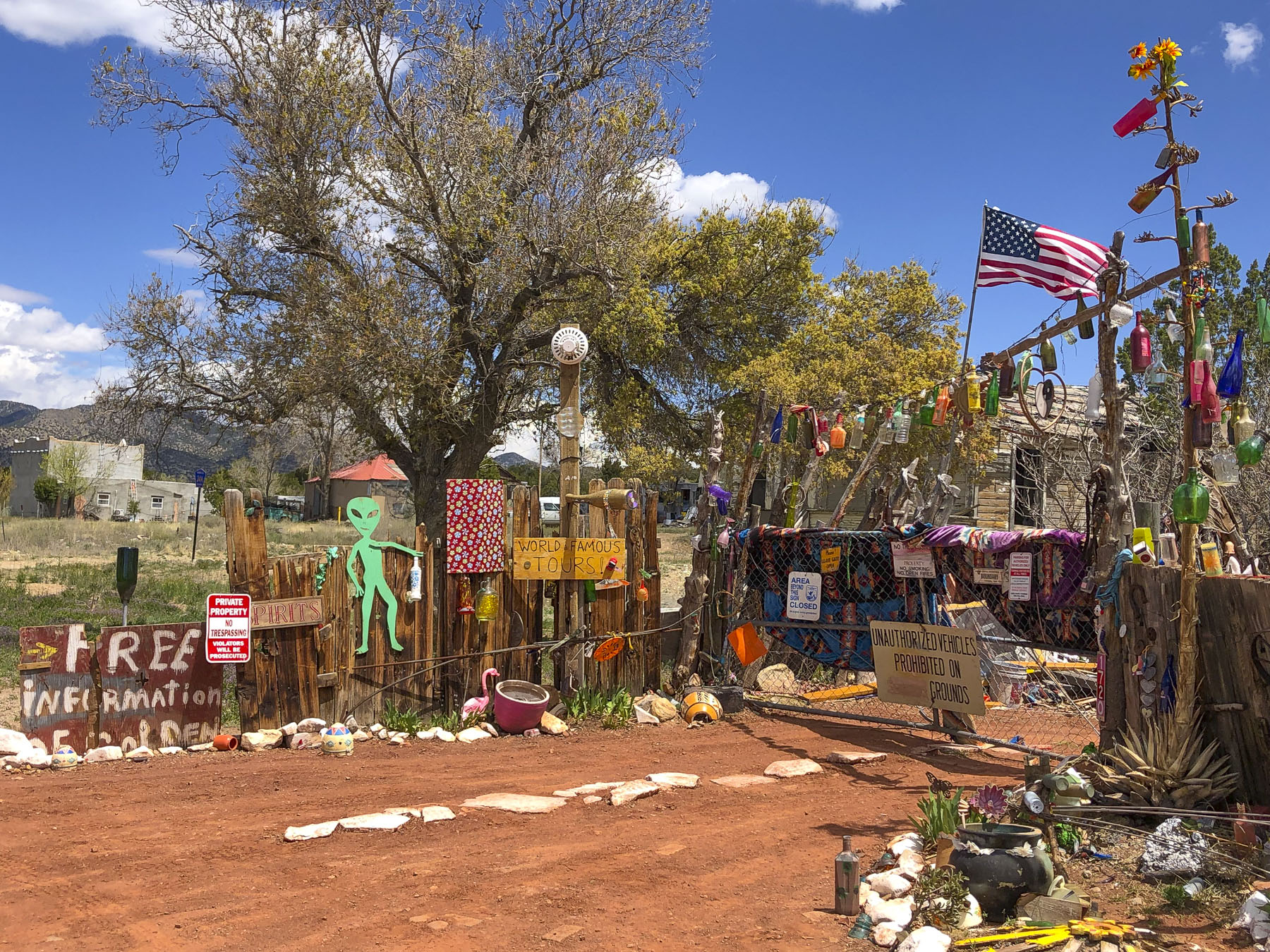
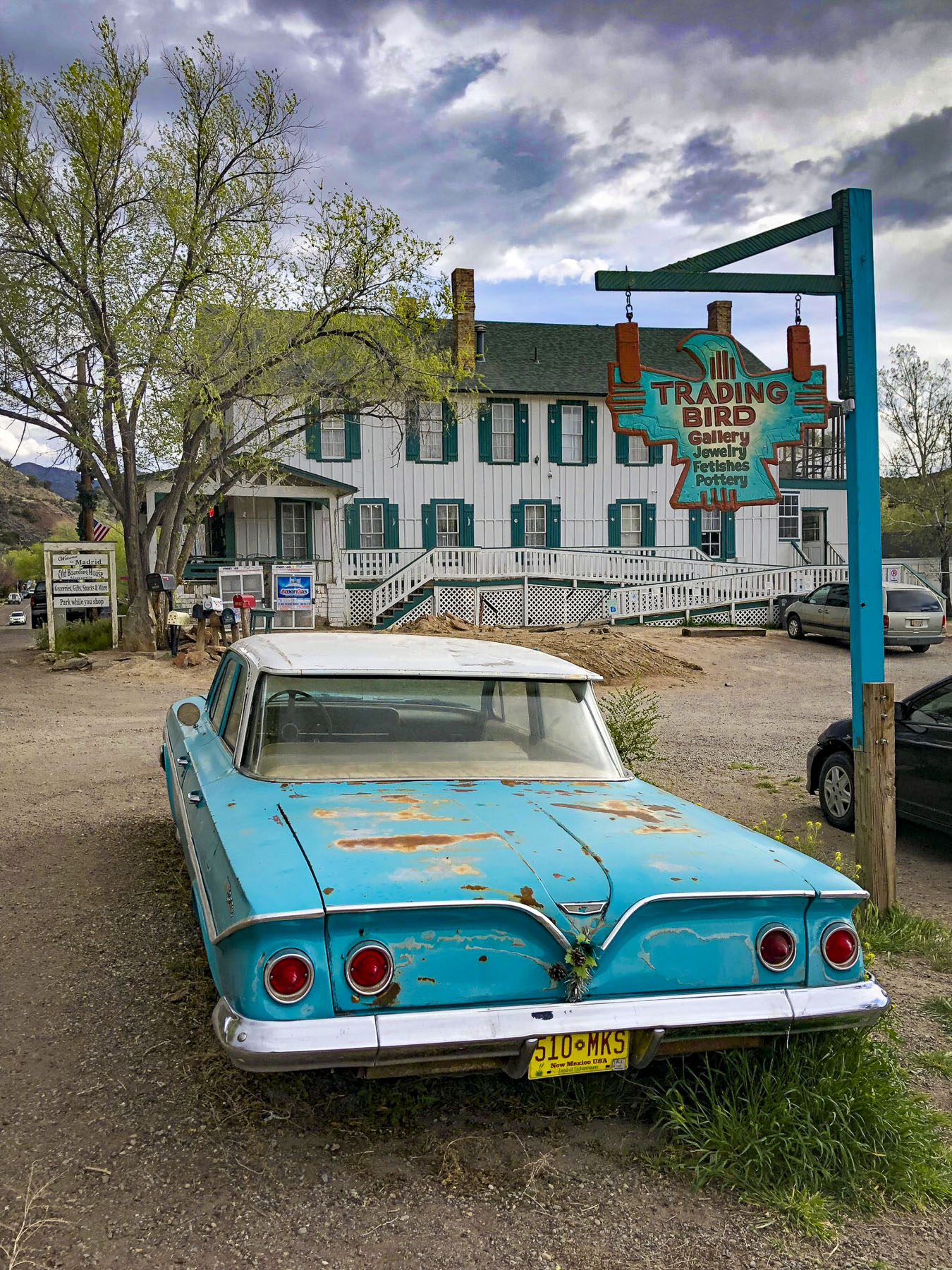
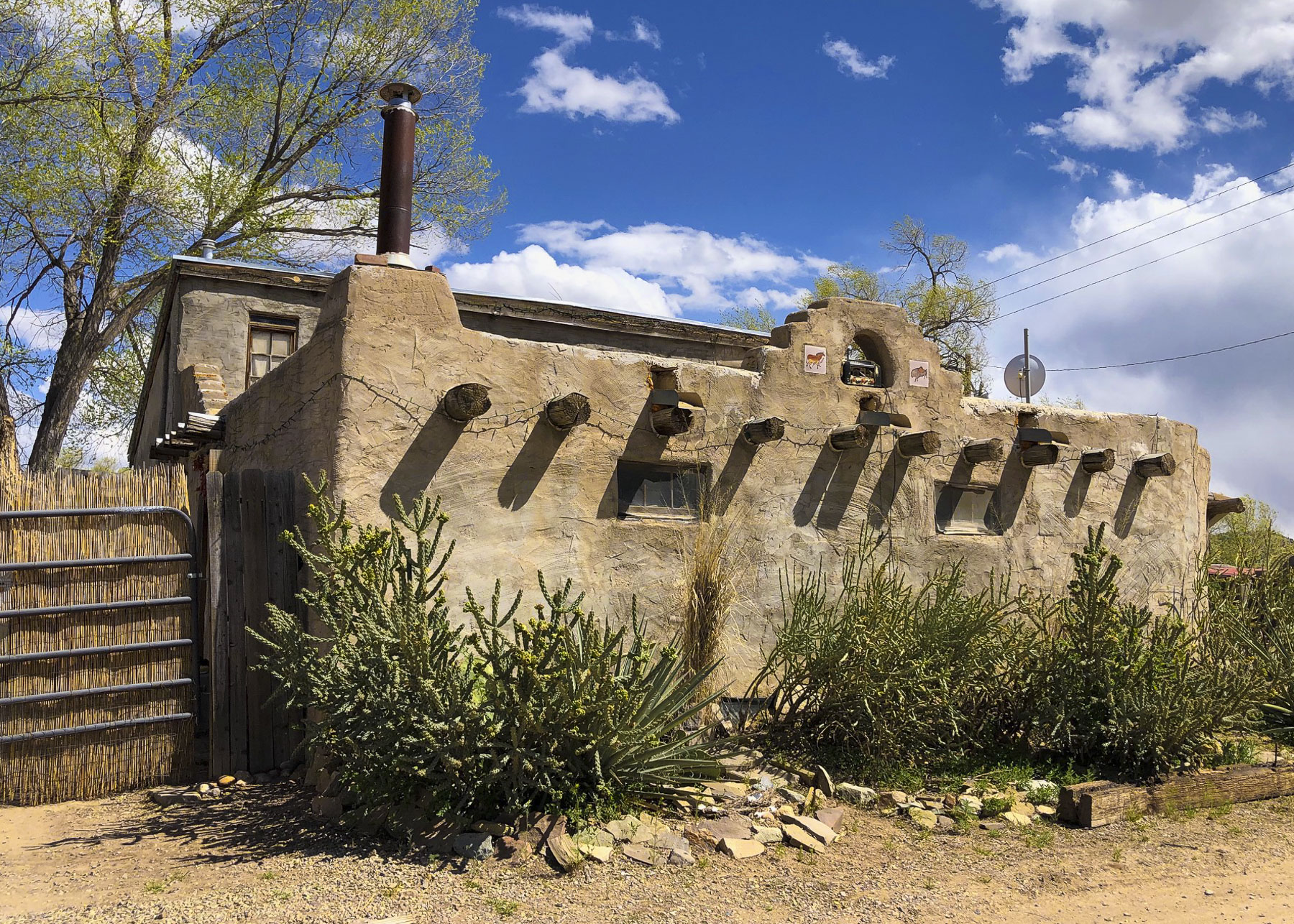
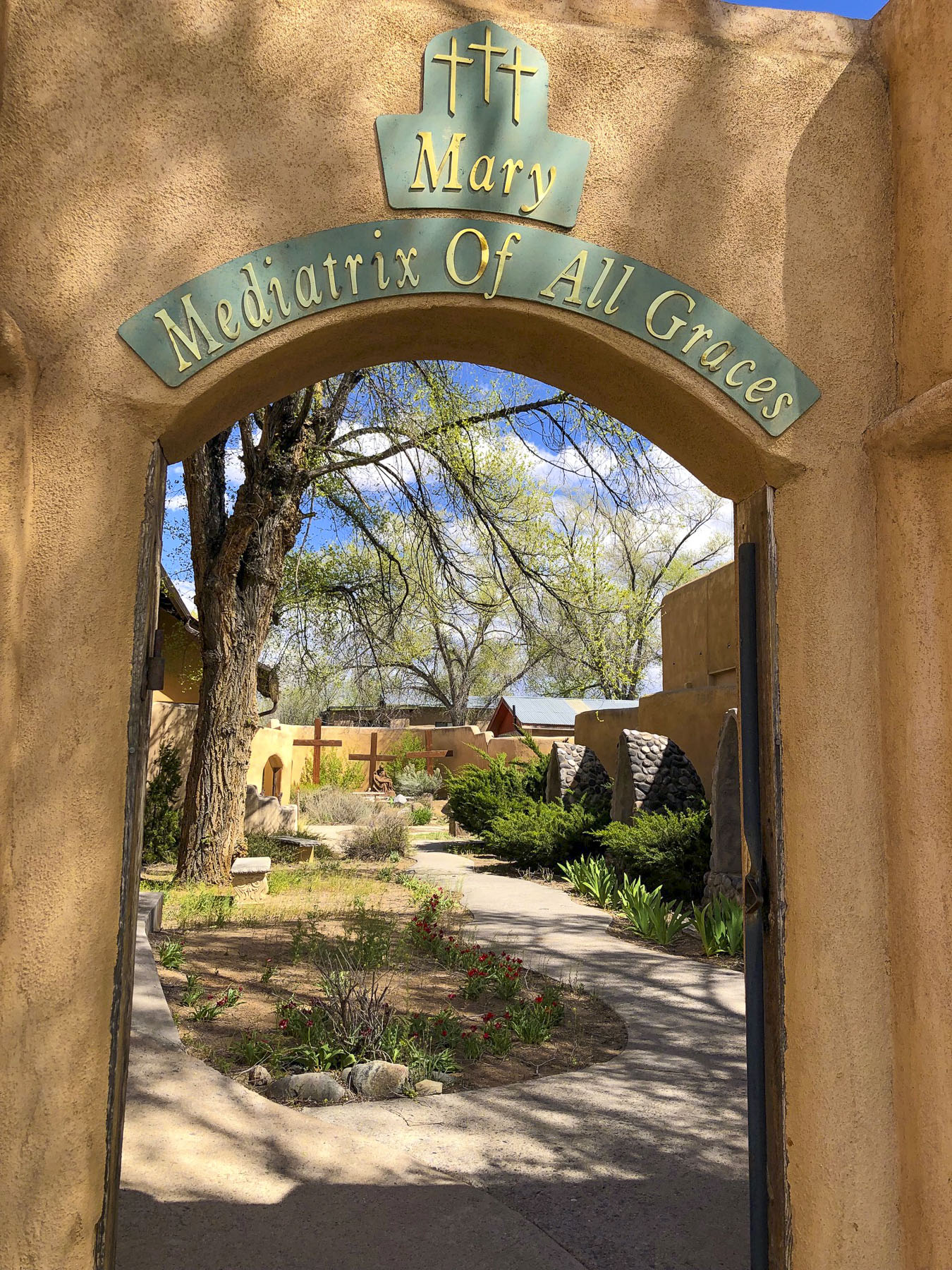
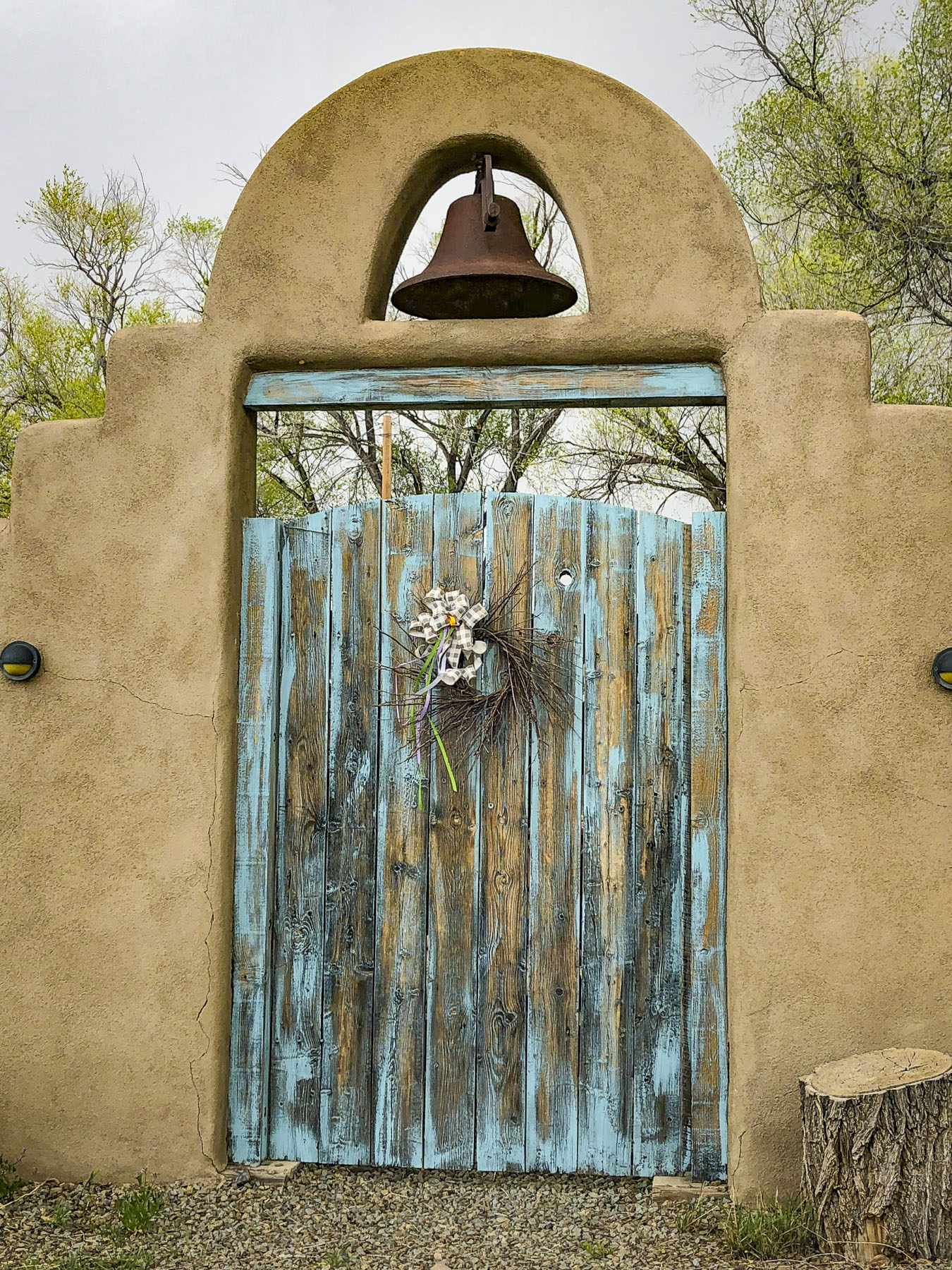
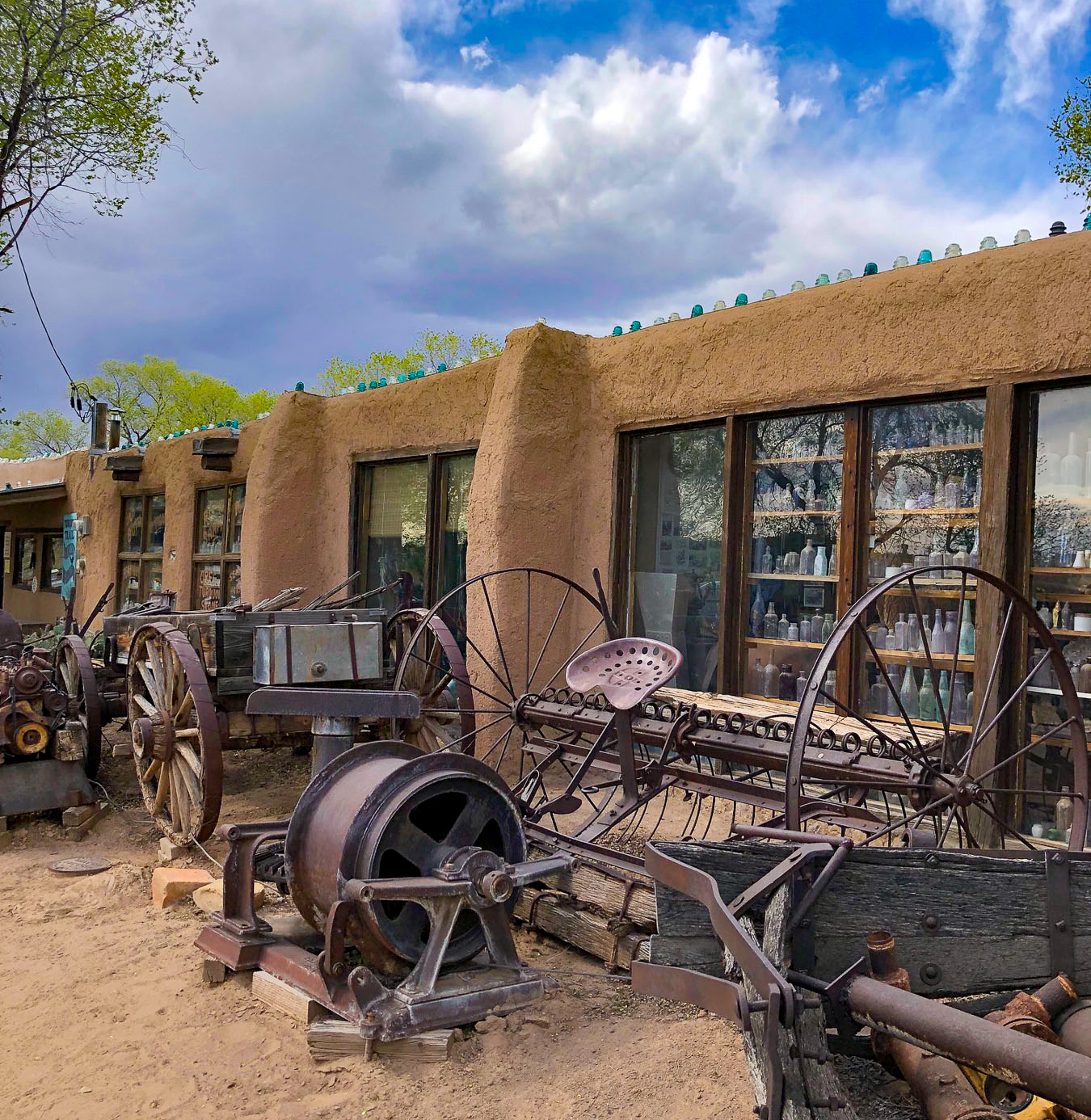
Not much has changed since then for Golden. If you blink you’ve driven through it. But the quirky Bottle House is worth a quick stop and sets the tone for the area that’s full of independent, eccentric, and colorful personalities. The towns along the Turquoise Trail all share similar once-prosperous histories followed by decades of decline, until a slow rediscovery began in the 1970s. It started to attract folks and artists drawn to the ruggedness and beauty of the terrain, those seeking an alternative lifestyle, wanting to live off-the-grid, or just wanting to be left alone. Evolution happens and of course there are now more homes, restaurants, RV parks, small museums, shops, and galleries. But fortunately, there seems to be some unspoken agreement between the old timers and newcomers to keep the area “historically quaint and Old West,” as if time has stopped. You’ll have to drive to Albuquerque to find a strip mall.

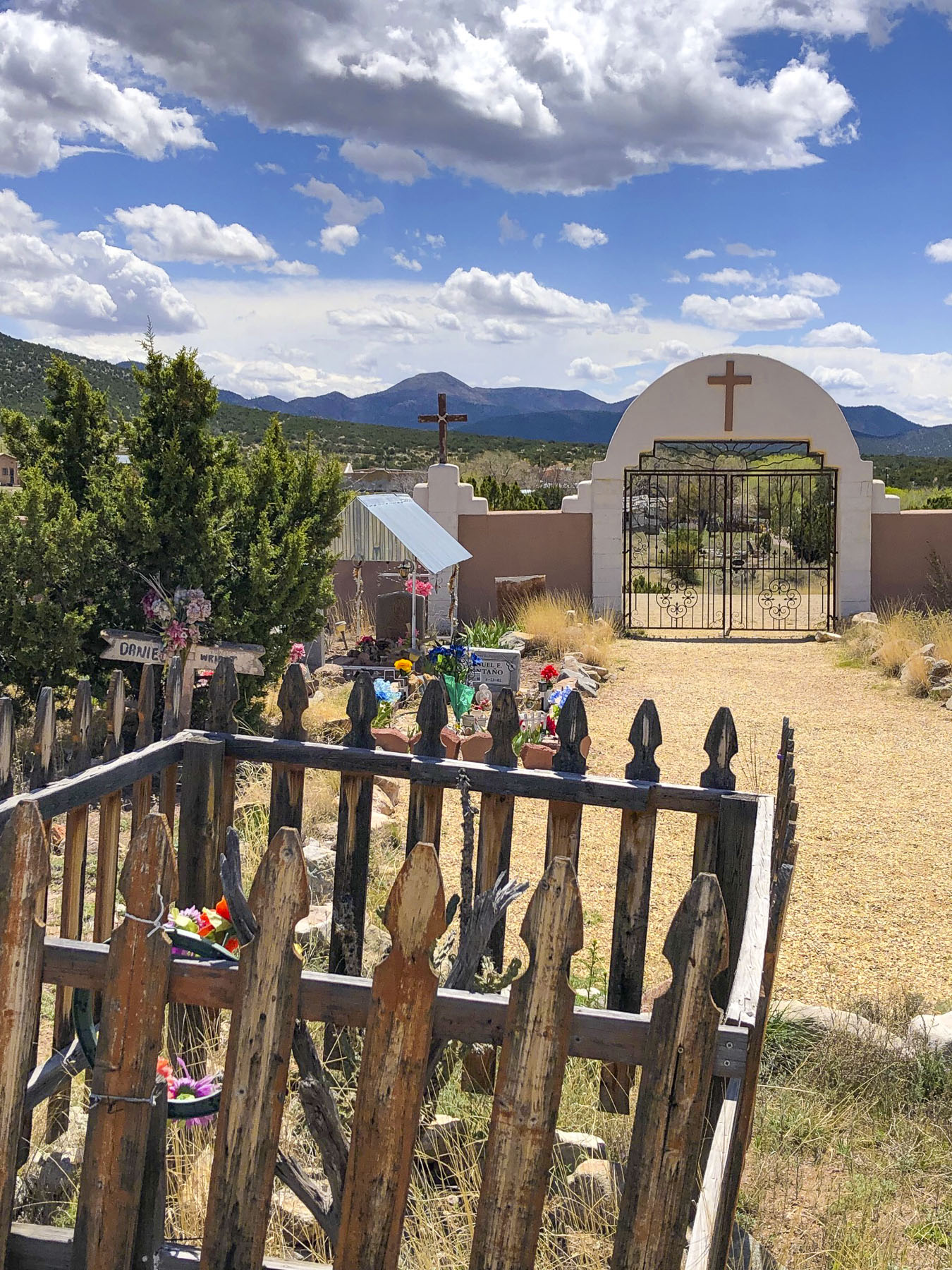
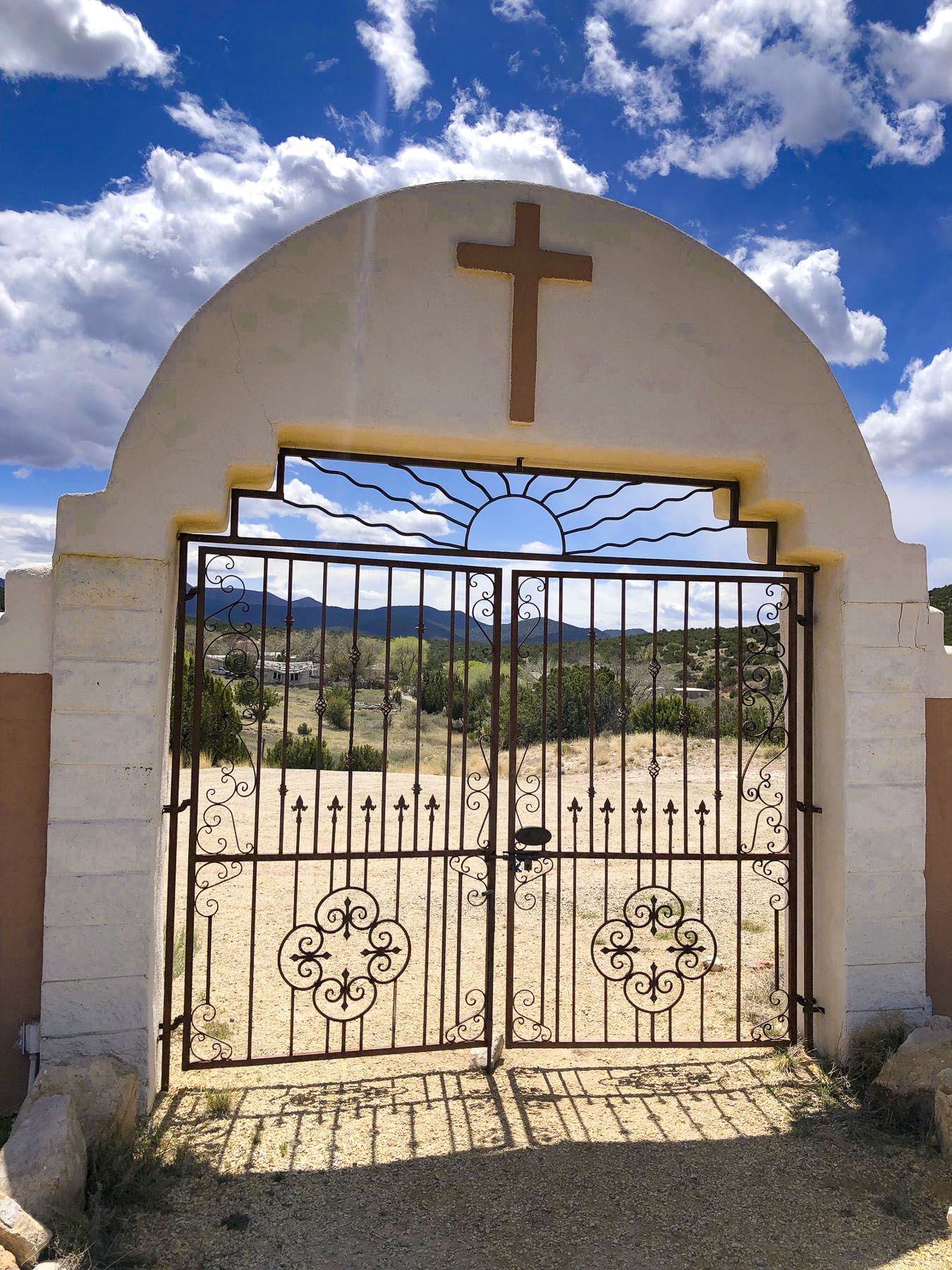
A short distance farther along, the San Francisco de Asis Catholic Church and cemetery still stand and command a small knoll above the road.  Its original adobe bricks were covered with a concrete veneer during a 1960’s restoration. But walk around the back of the church and it’s possible to see them where the veneer has broken away. The church supports a small congregation and holds mass on Saturdays at 4:00 pm.  Annually, every 1st Saturday of October, the church hosts the Fiesta de San Francisco de Assis which begins with a 11:00 am mass, followed with the blessing of the graves in the cemetery and a procession lead by Matachines dancers.

The vistas between the towns are epically endless and evoked thoughts of how folks centuries ago managed to survive on this wild frontier. Drive too fast and you’ll whiz by many interesting roadside attractions.

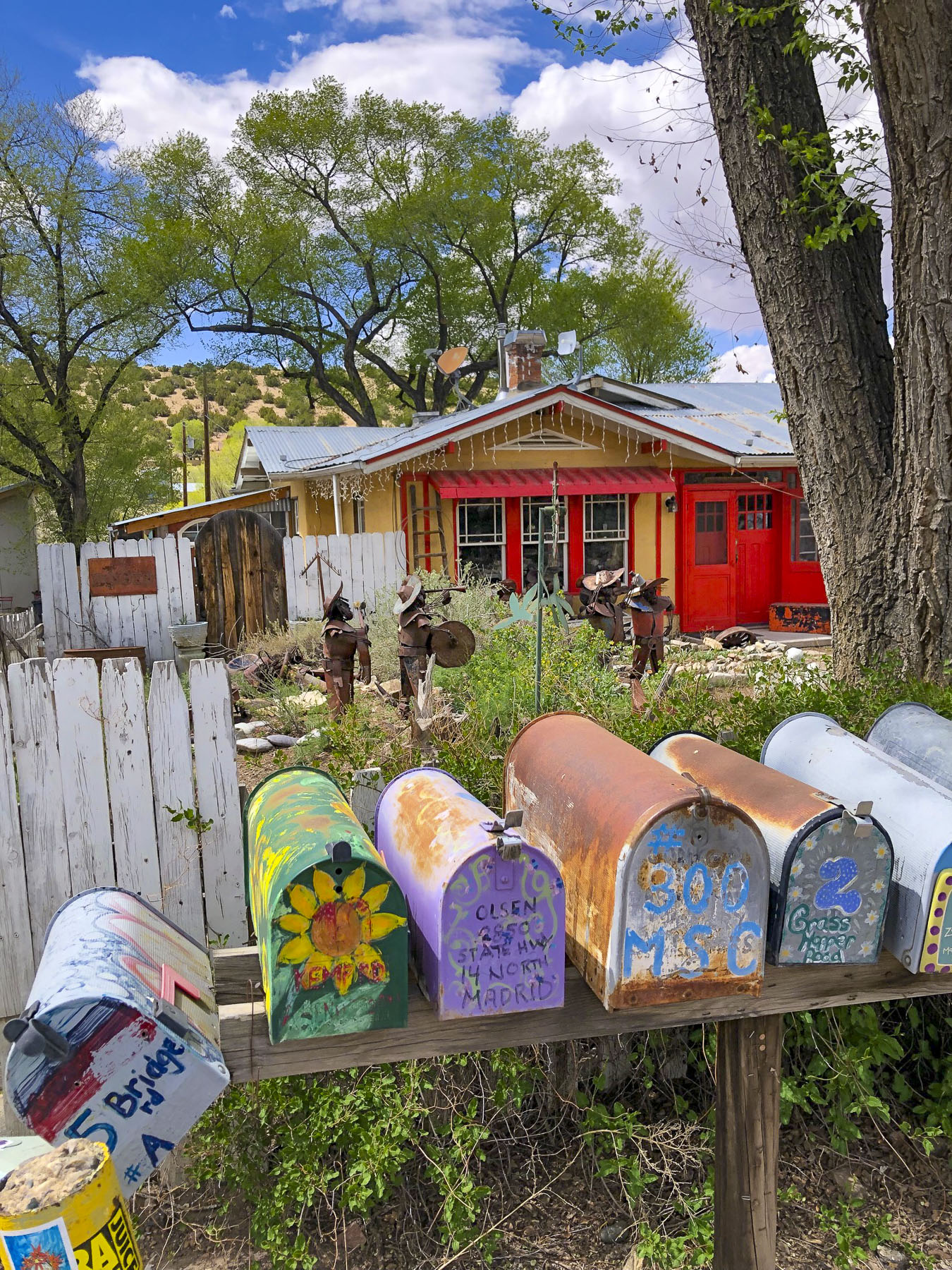
Compared to Golden, Madrid is a metropolis! Coal was discovered in the Ortiz Mountains during the mid-1800s, spurring a squatter’s camp called Coal Gulch. MAD-rid, not Ma-DRID, was founded in 1869. So much coal was being mined that the Santa Fe railroad constructed a spur down from Cerrillos into the town in 1892. We wet our whistles on the patio of the Madrid Brewing Company & Museum, in front of an ancient steam train with what we must say was one of the best craft beers we’ve tasted.

It’s difficult to believe that at its zenith the town once boasted a population greater than Albuquerque’s 3000 folks in 1906. All the small claims were eventually consolidated into the Albuquerque and Cerrillos Coal Company. It became a company town and the extraction of coal from the hills surrounding the town was king. The company provided the booming town and its employees with everything.

Houses were bought in Kanas, disassembled, and shipped on the railroad to Madrid to satisfy the demands of a growing population. The company built a community center, school, and hospital. Most importantly, after it burned down on Christmas Day in 1944, the company rebuilt the Mineshaft Tavern, with its famous 40′ long bar where miners could stretch out after a long shift hunched over underground. The first lighted baseball field west of the Mississippi was built for the town’s minor league baseball team, called the Madrid Miners. Electricity produced at the local coal fired power station ran the mines and was provided free to all the residents of the town. Free electricity encouraged extravagant Christmas light displays that drew in visitors from afar to see lights that covered every building and were strung up the mountainside.

The company brought 160,000 gallons of water daily by train tank cars into the town and legend says every home had a green lawn. The price of coal collapsed in the 1950s when natural gas was beginning to be piped into homes, and the company and town’s economy collapsed as well. In 1954 the entire town was offered for sale for $250,000.00 in the Wall Street Journal. There were not any buyers. Except for a few squatters, the town sat abandoned for twenty years until it was decided to sell the company homes one at a time. Studios, shops, museums, restaurants, and galleries now line the 20 mph main stretch. Packed with tourists on the weekends, it’s almost impossible to find a place to park. Like the rebuilt bar, the town today is a phoenix risen from the ashes.

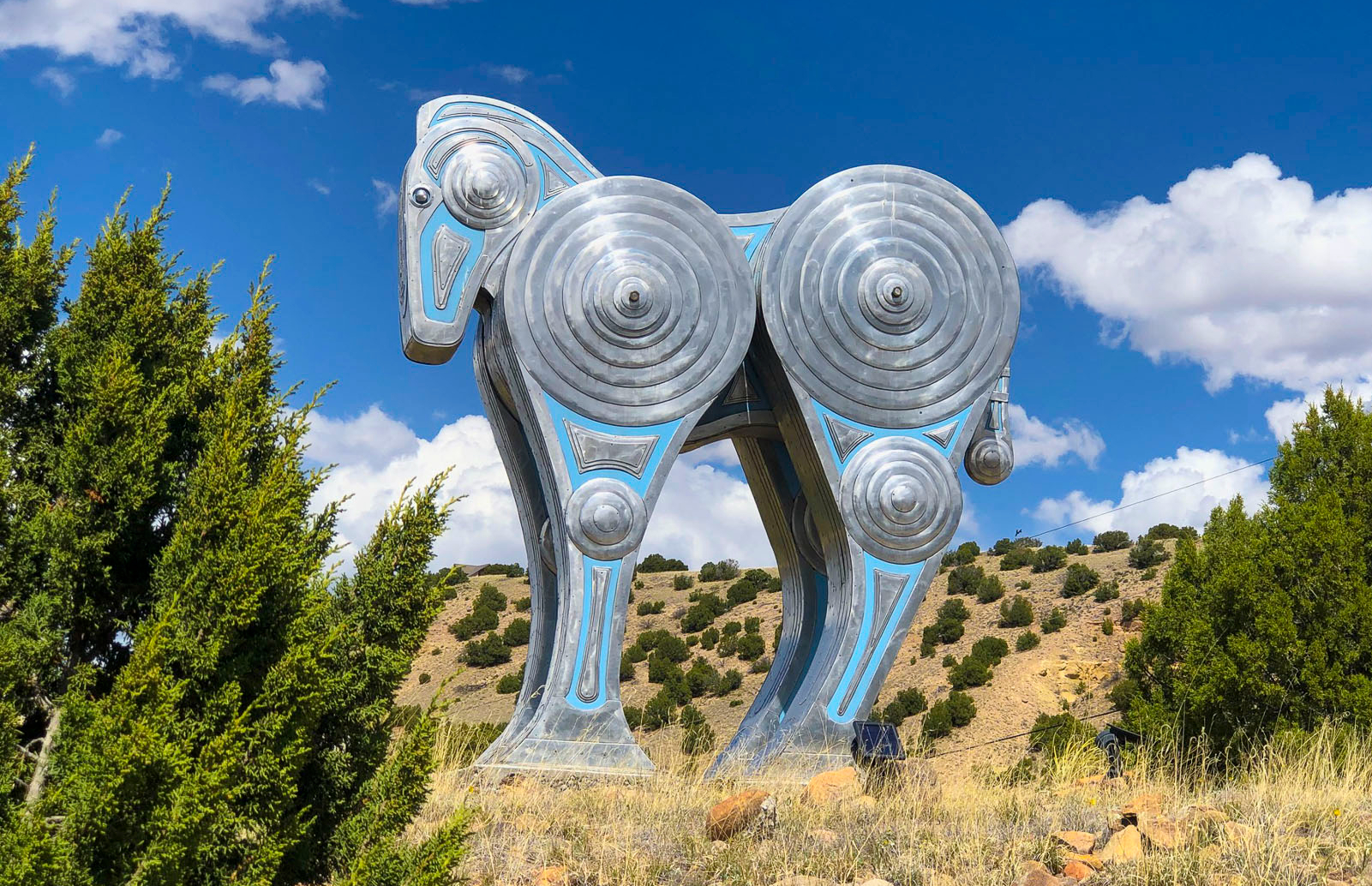
Just north of Madrid, a huge contemporary metal sculpture similar to a Trojan Horse highlights the landscape. You can’t get very close to it, as there’s no visible gate and it’s behind a rancher’s barbed wire fencing. As of this writing I haven’t been able to identify the artist. The sculpture is intriguing, and its placement is mystifying. Other artists have also placed their creations along the drive.

The turn for Cerrillos lies just beyond the bridge that crosses the over the Arroyo Viejo, a seasonal creek. It’s the only town on the Turquoise Trail that you have to turn off NM 14 to reach. That half-mile journey takes you back 150 years to a village with dusty dirt roads, wide enough to turn around a team of horses and a wagon. Cerrillos retains its old west authenticity, with many original adobe structures and 1800s era rough-hewn lumbered storefronts. It is deemed so authentic, many western movies have used the town for their location shoots, most notably the 3:10 to Yuma (2007) starring Russell Crowe and Christian Bale, along with Young Guns (1988) which had a huge famous cast that starred Jack Palance, Kiefer Sutherland, Lou Diamond Phillips, Emilio Estevez, Charlie Sheen, and a cameo appearance by Tom Cruise as a soldier shot in the climatic scene. The action comedy with Clint Eastwood Every Which Way but Loose (1978) was also filmed here. A few miles away John Wayne filmed The Cowboys (1972) in San Marcos.

Pueblo Indians had been conducting small open pit mining with hatchets on Mount Chalchihuitl, which is now part of Cerrillos Hills State Park, since the 900s. The stone was gathered for its believed sacred properties, along with lead sulfide, which was the source of glaze paint used to decorate native pottery. Spanish settlers arrived in the 1600s and mined the same hills for silver. There was an uneasy coexistence, and silver mining ceased with the Pueblo Rebellion in 1680. Small mining efforts returned to the area after the Spanish renewed efforts to live peacefully with the Pueblo tribes. New Mexico was a United States territory when gold was discovered around Cerrillos in 1879.  The railroad arrived in 1880. The boom town supported thousands of miners with 4 hotels, 5 brothels, 21 saloons, and an opera house which once hosted a performance by the famous French stage actress and singer “the Divine Sarah,” Sarah Bernhardt.

Four thousand prospecting pits, mine shafts and holes were dug in the area by 1884. The town’s prosperity and recreation attracted outlaws like the Ketchum Gang, Silva’s White Caps and Billy the Kid. Cowboys from Cerrillos were recruited to join Teddy Roosevelt’s Rough Riders for their campaign through Cuba during the Spanish American War. The president of a gold and silver mining company began promoting turquoise and silver Jewelry to visitors arriving by train. Tiffany & Co. at one point even owned their own mine to provide the stone for their booming turquoise jewelry sales that lasted into the 1900s. The St Joseph Catholic Church standing today was built in 1922 and replaced an earlier 1884 structure. A Methodist Church graced the other end of town. It was never a ghost town, but slowly, one by one, the area’s mining operations played out and closed until only several hundred people remained in the area.

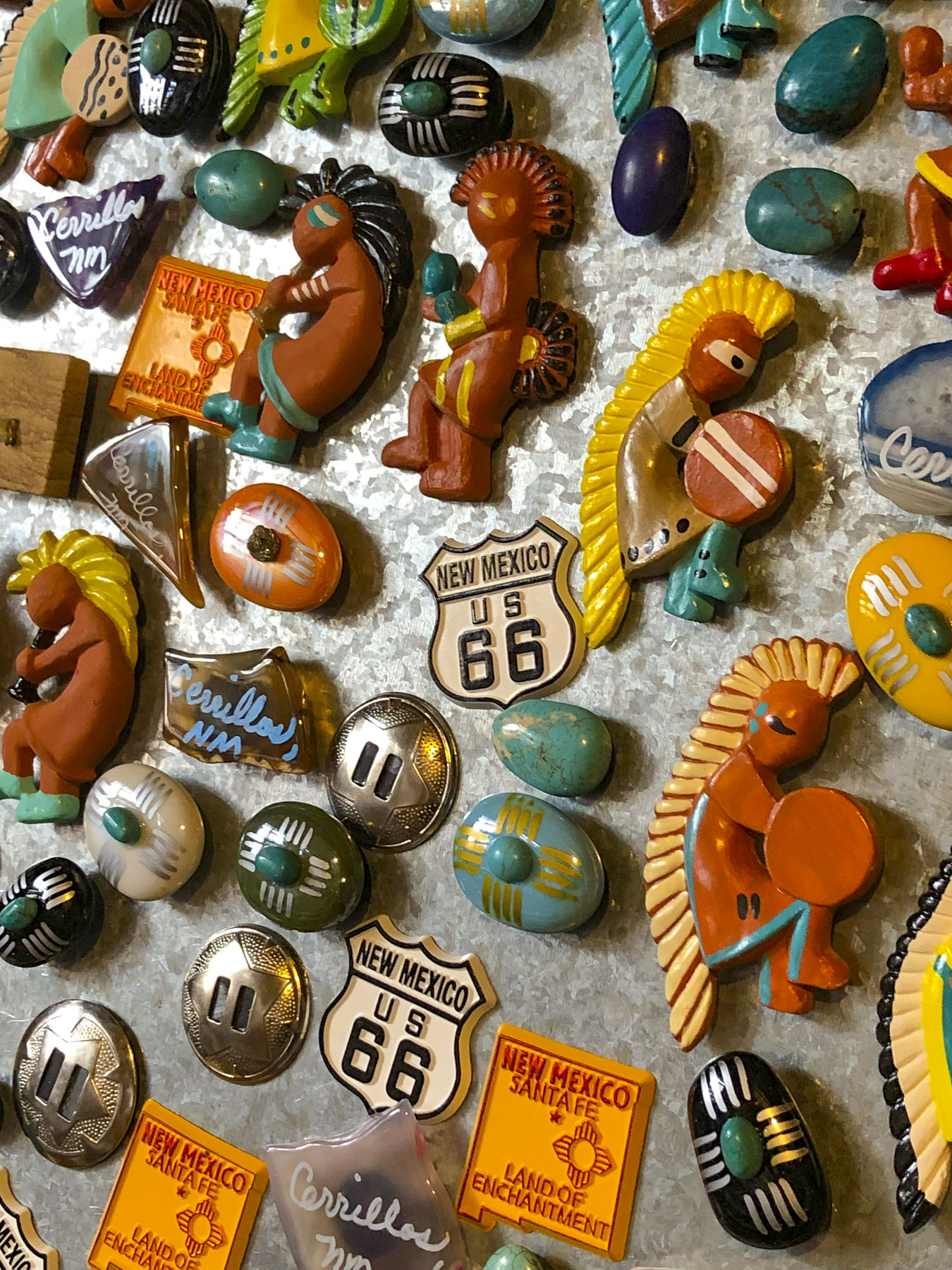
Mid-week in early spring, the only door that swung open was at the Casa Grande Trading Post and Cerrillos Turquoise Mining Museum which has a mind-boggling array of displays and trinkets. It is a large 28 room adobe hacienda that looks like it has been there for centuries. But in fact the owners, Todd and Patricia Brown, along with family and friends, started construction in the 1970s that eventually utilized 65,000 handmade adobe bricks.

Some Interesting highlights from the Cerrillos Historical Society include:

1888 – The dark stain on the floor of Dr. Palmer’s second-floor office, the relic of Black Jack Ketchum’s bullet wound, is the local must-see attraction. The first meeting of the Cerrillos Masonic Lodge is held at the Palace Hotel in their upstairs room.

February 19, 1890, 11am – Nelly Bly, the famous New York World reporter was racing back to New York on her round-the-world-in-80-days journey (she made it in 72 days, 6 hours, 11 minutes, 14 seconds). Her train stopped at Cerrillos only long enough to take on water. The 67 miles from Albuquerque to Lamy by rail was done at the breakneck speed of 46 miles an hour!

August 1892 – The new railroad spur to Coal Gulch is completed and the town of Madrid is born.

1899 – The Cochiti Gold Mining Company builds an Edison coal-fired dynamo at Madrid, which provides Cerrillos with its first electric lights. Those were the days!

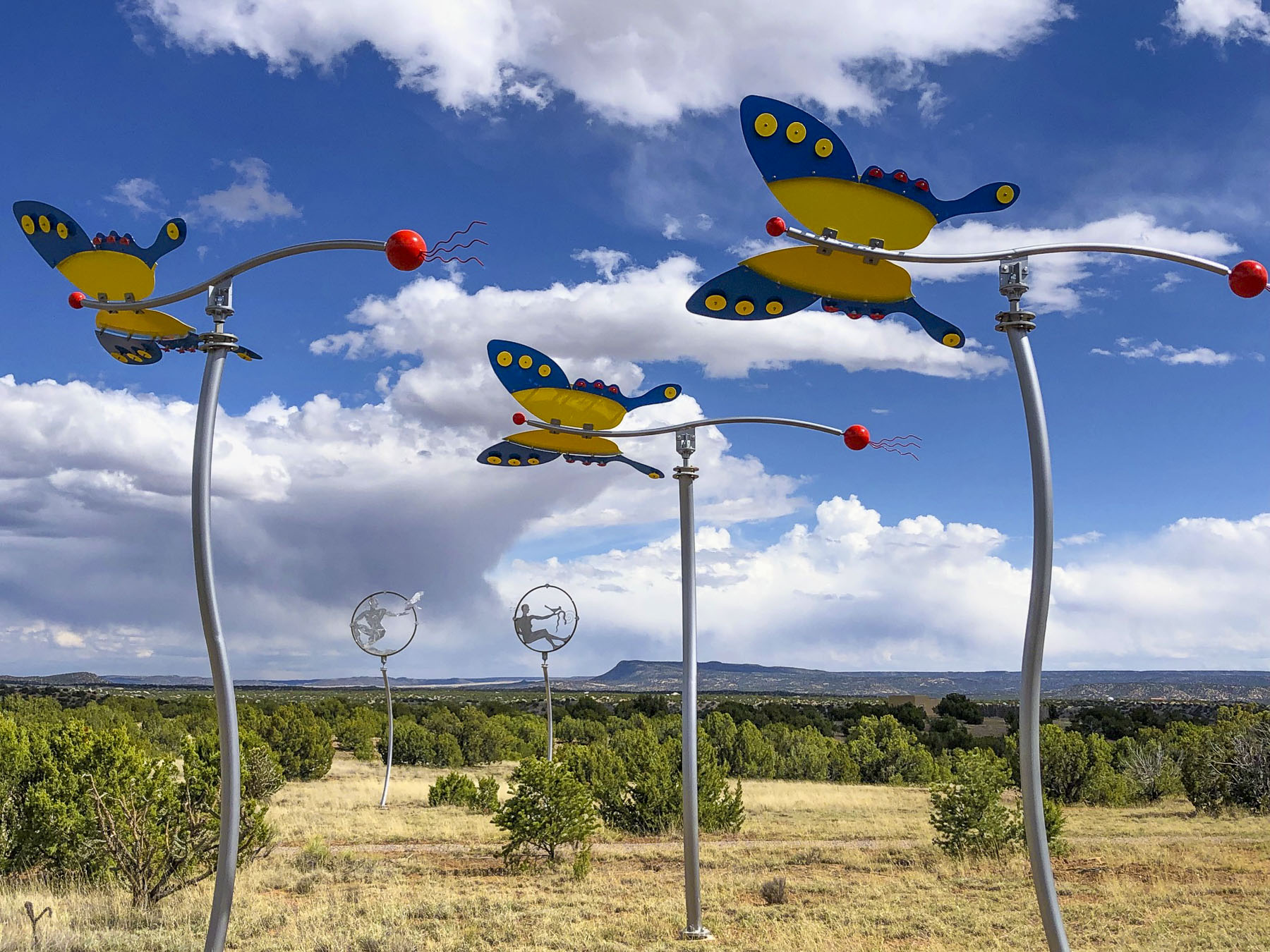
Just past an interesting geological rock formation called Garden of the Gods, we reached our farthest point north and turned around on the Turquois Trail in San Marcos at the intersection with the road that leads east to Galisteo and eventual the pueblo ruins at Pecos National Historical Park. Along the road here are some whimsical wind sculptures created by David Hickman.

We could have continued north on NM14 to Santa Fe, but we chose to return to Albuquerque via Madrid and stop for a crisp cold beer at the Mine Shaft Tavern and stretch our legs.

Till next time,

Craig & Donna

Madeira: Pico Ruivo, Santana & Faial or Summits, Valleys and Stones

We imagine it’s possible to enjoy a full week pleasantly wandering the quaint streets of old town Funchal, basking in the sun and swimming in front of Forte de São Tiago, while venturing no farther afield than the Monte Palace Tropical Garden.

But the real beauty of Madeira lies in its rugged seascapes and mountains. The mountains admittedly aren’t that tall if you compare them to the Swiss Alps or American Rockies.

The highest, Pico Ruivo, reaches 6100 feet, nearby Pico do Areeiro is a tad shorter at 5,965 feet, and you can drive to its summit. A popular though arduous trail connects the two summits that are often above the clouds. In January and February, the sub-tropical island’s peaks can be snowcapped, and parents take off from work to bring their kids into the mountains to make snowballs and snowmen. There really aren’t foothills before the mountains. They appear to have been thrust violently upward from the earth’s crust like a knife thrower targeting a loaf of bread. They are tremendously steep and majestic, and you can experience them up close through various hikes or simply driving across the island’s numerous switch-back roads. Madeira in many aspects is similar to California, with a landscape where it is feasible to experience mountains and ocean in the same afternoon. On Madeira though it’s within the same hour.

The weather constantly changes on Madeira. The opposite of what’s forecast quite often is what happens, as it was the morning we looked up at a small patch of blue sky, teasing us with a shaft of sunlight while we waited in the parking lot atop Pico do Areeiro for our small group of intrepid hikers to gather. It was also a good twenty degrees chillier than Funchal and we quickly layered up. The clouds descended. A light rain began. Rain ponchos appeared. Visibility was 100 feet. Not the best conditions, but it was a non-refundable tour and our international group of seventeen stoically set forth into the clouds.

Commonly known as the “Pico to Pico” or the PR1 hike, it’s a semi-difficult 5-mile trek with a 1000 ft altitude gain. The route balances across narrow ridgetops and follows cliffside trails, climbs steep stairs and ladders, and passes through narrow rock-hewn tunnels before summiting Pico Ruivo. It then descends to the Achada do Teixeira parking lot for the return shuttle to Funchal. The path is improved in many sections with cobbled pavers and hand railing, but in other parts it was a muddy, puddled mess.

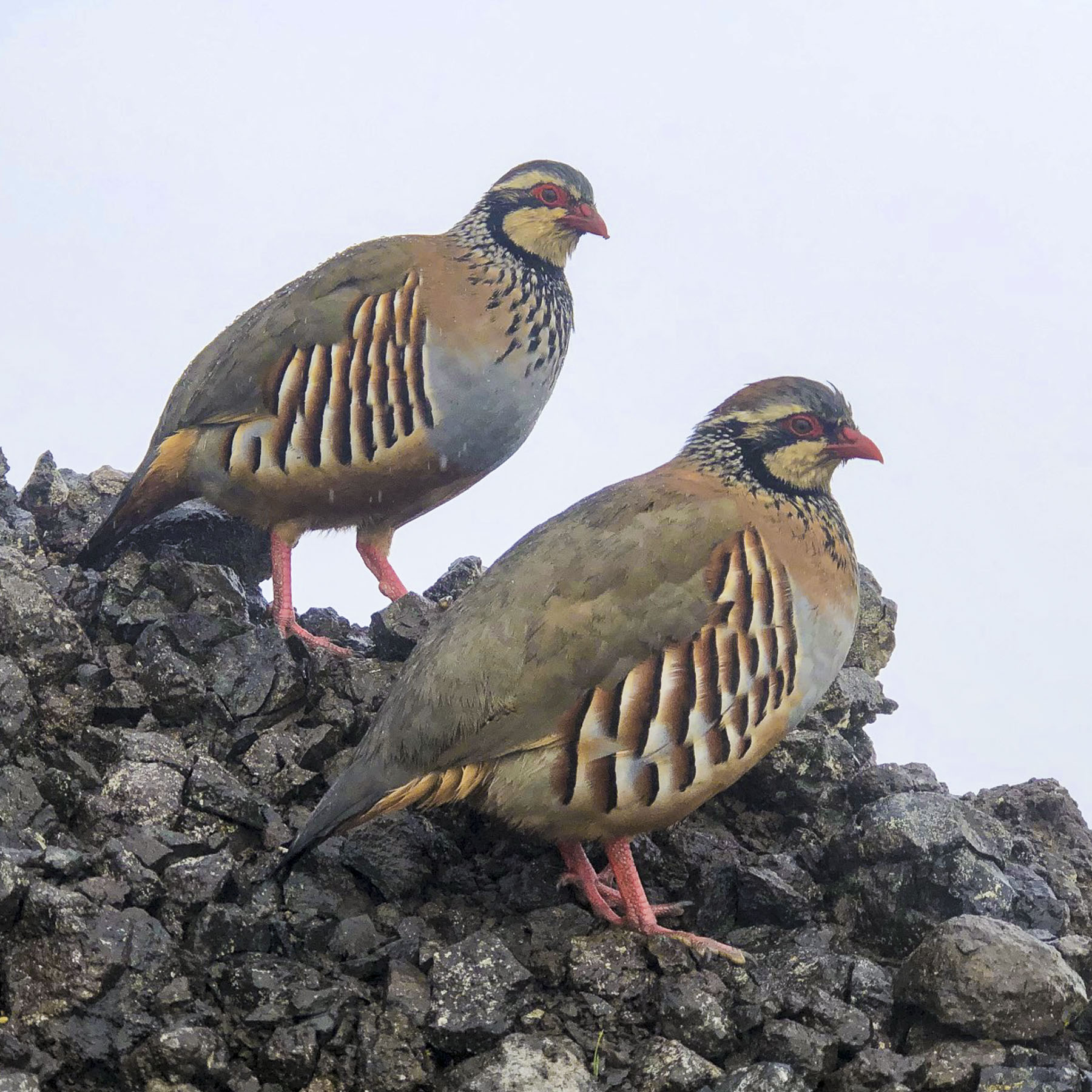
With the rain the trail was slippery and slow going. Unfortunately, the low cloud conditions didn’t allow for spectacular panoramas. But even with the dismal weather we were able to capture some photos that are evocative of the day. Spotting the well named red-legged partridge was a highlight of the trek. If you choose to do this hike, be prepared, wear sturdy shoes or hiking boots, bring extra clothing to layer up, plenty of water and lunch. Personally, I think this hike is too strenuous for older folks, especially if you are an inexperienced hiker. Back at our hotel, glasses of Madeira helped alleviate our chill.

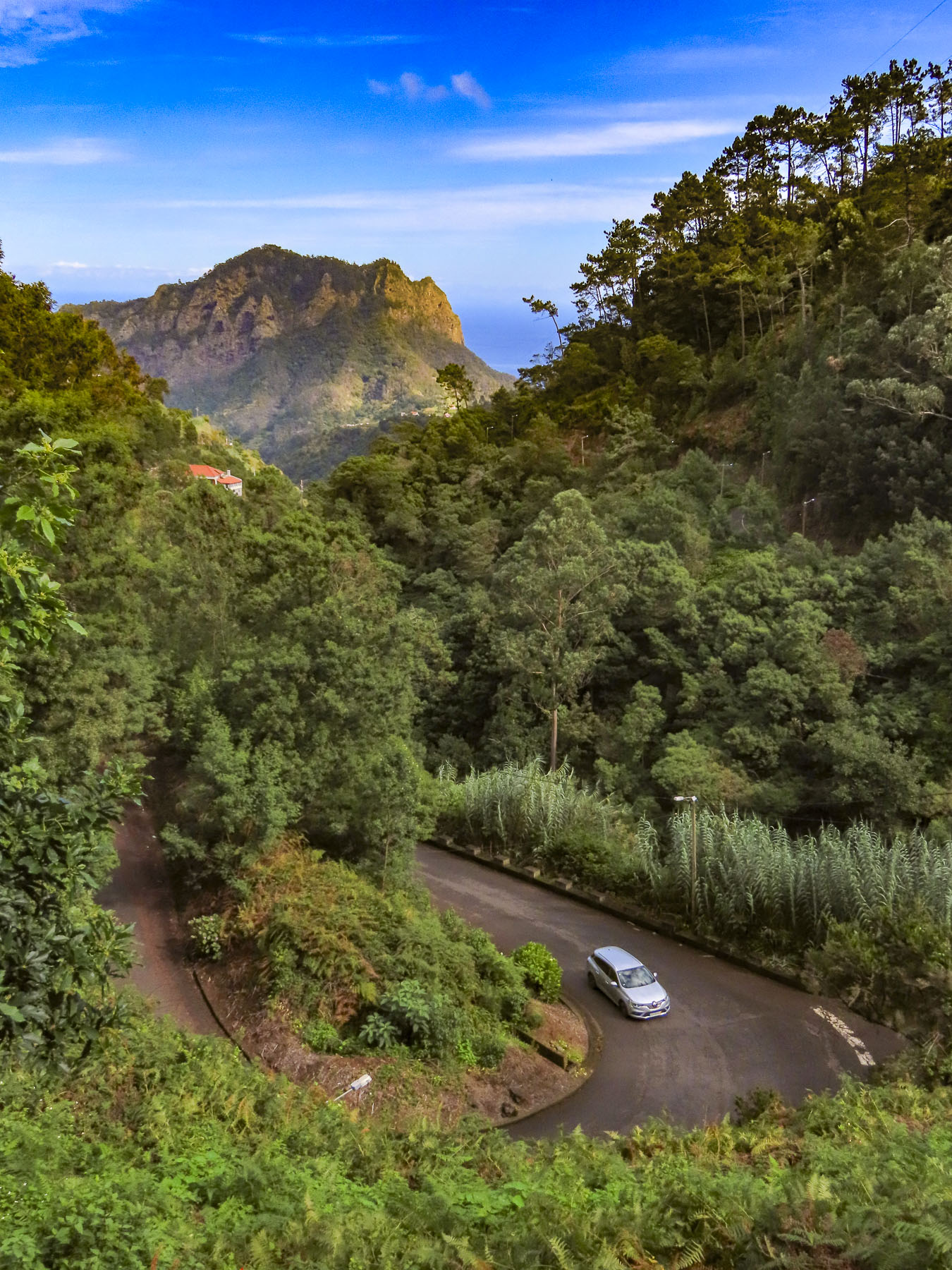
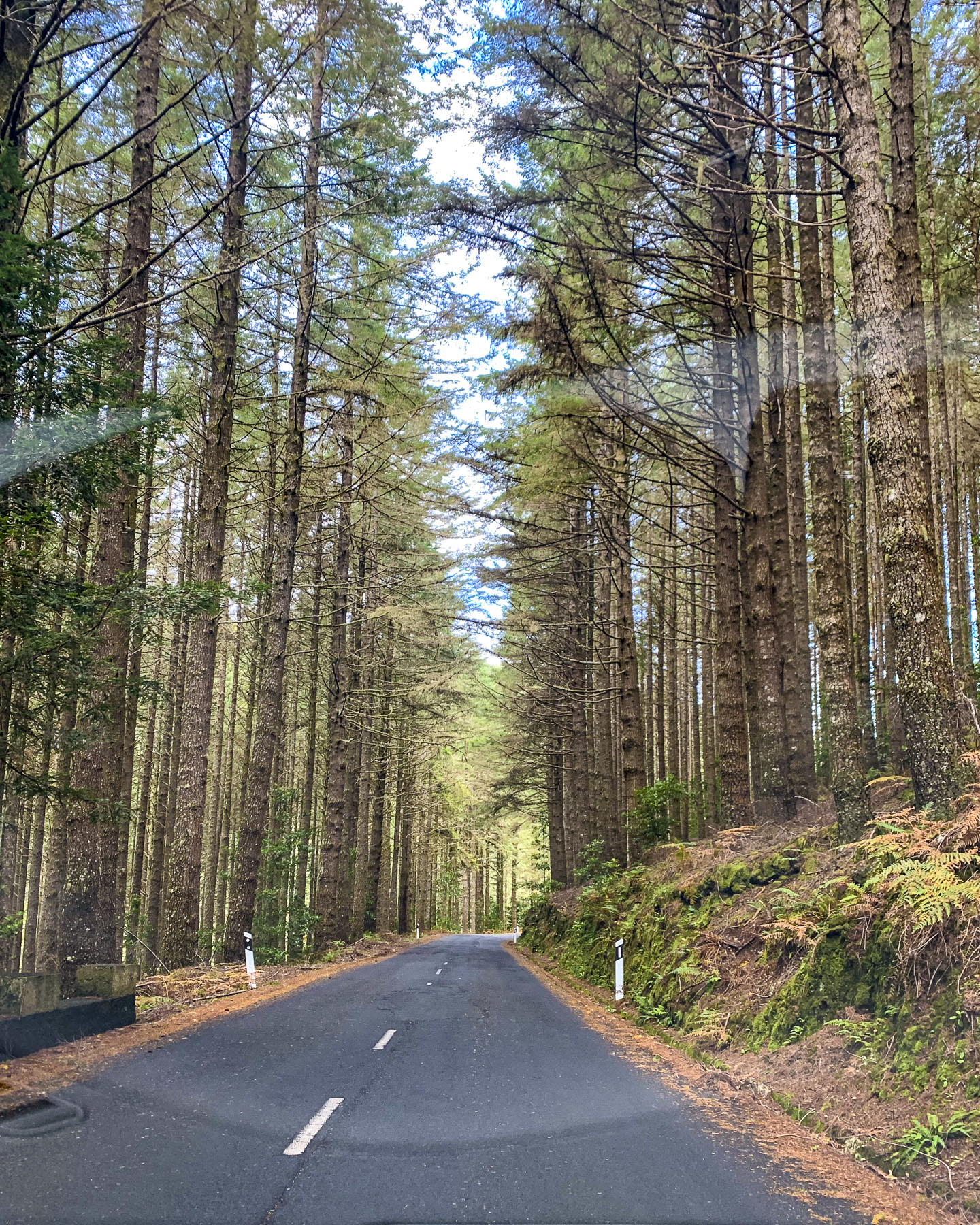
We continually drove back and forth over the mountains. Many times, we partially retraced a previous route only to turn onto narrower country lanes and zig zag to a miradouro or destination that beckoned for a photo op. As birds fly, the distances are short around the island. Not so with the roads.

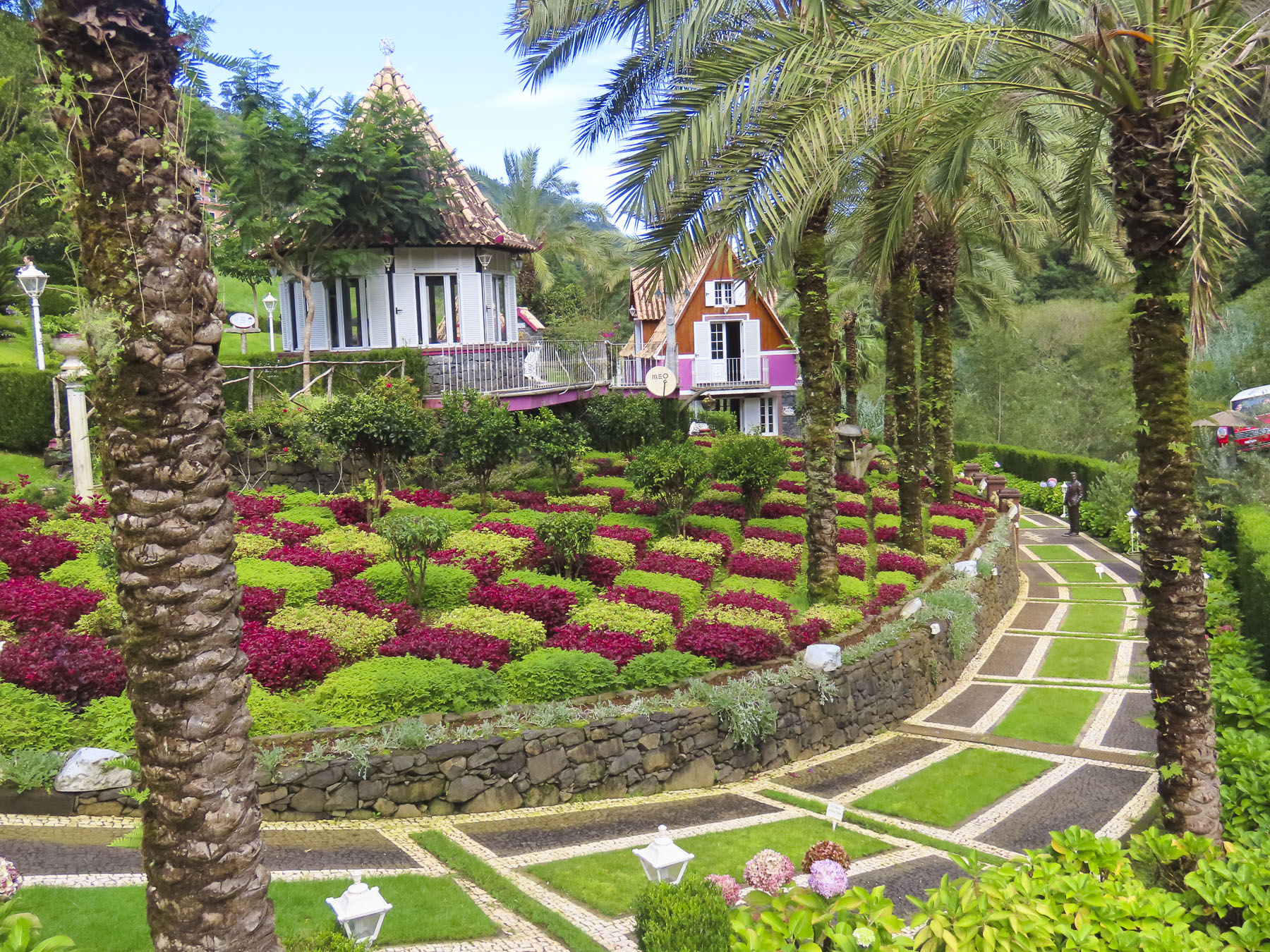
The Museu Família Teixeira was one such detour. It’s an interesting family museum that displays the older way of life on the island. One fascinating piece was the old wooden grape press on display, which looked like an ancient Roman catapult, more capable of destroying fortress walls than crushing wine grapes. The grounds of the family estate are also exquisitely landscaped as a living memorial garden to a lost son.

Afterwards we worked our way along the backroads through Faial to Santana then headed west down a long single lane road that eventually ended in the Parque Florestal das Queimadas. The full parking lot was quite the contrast to the desolate road we had just traveled.

Beyond the parking area there was a picnic area in a fairytale-like grove with two quaint thatched cottages, the smaller one serving as a snack bar. This is the trail head for the PR9 Levada do Caldeirão Verde, one of the easiest and flattest levada walks on Madeira that ends at a hundred-foot-tall waterfall cascading into a natural amphitheater. Unfortunately, we only followed the path next to the irrigation channel a short way before a sudden downpour turned us back.

Later that afternoon we drove down a well-worn track that followed the shallow Ribeira de São Jorge through a rugged narrow gorge. The road ended just before a footbridge that led to a freshwater lagoon, created by the river’s rushing water, just shy of the ocean. Above the lagoon was a restaurant with outside tables around a pool that had nice views of the surrounding hills and the sea.

Some of the first sugar mills on the island were built in this valley during the early 1500s. It was a good location with an abundant source of river water channeled into the mills to spin their grindstones. The king of crops was eventually dethroned and today all that remains are the Ruínas de São Jorge, Ruins of St. George – a few stone walls, and an arched portico that faces the sea.

Driving back to Funchal at the end of the day, the coastline at Faial called for some last photos we couldn’t resist.

There’s a countless number of miradouros on Madeira and it was so tempting to turn at each sign indicating a view. But leaving a few unexplored provides a good excuse to plan a return to this spectacular paradise.

Till next time, Craig & Donna
Madeira: Sao Vicente, Porto Moniz & the Fanal Forest – Mountains, Waterfalls and Waves

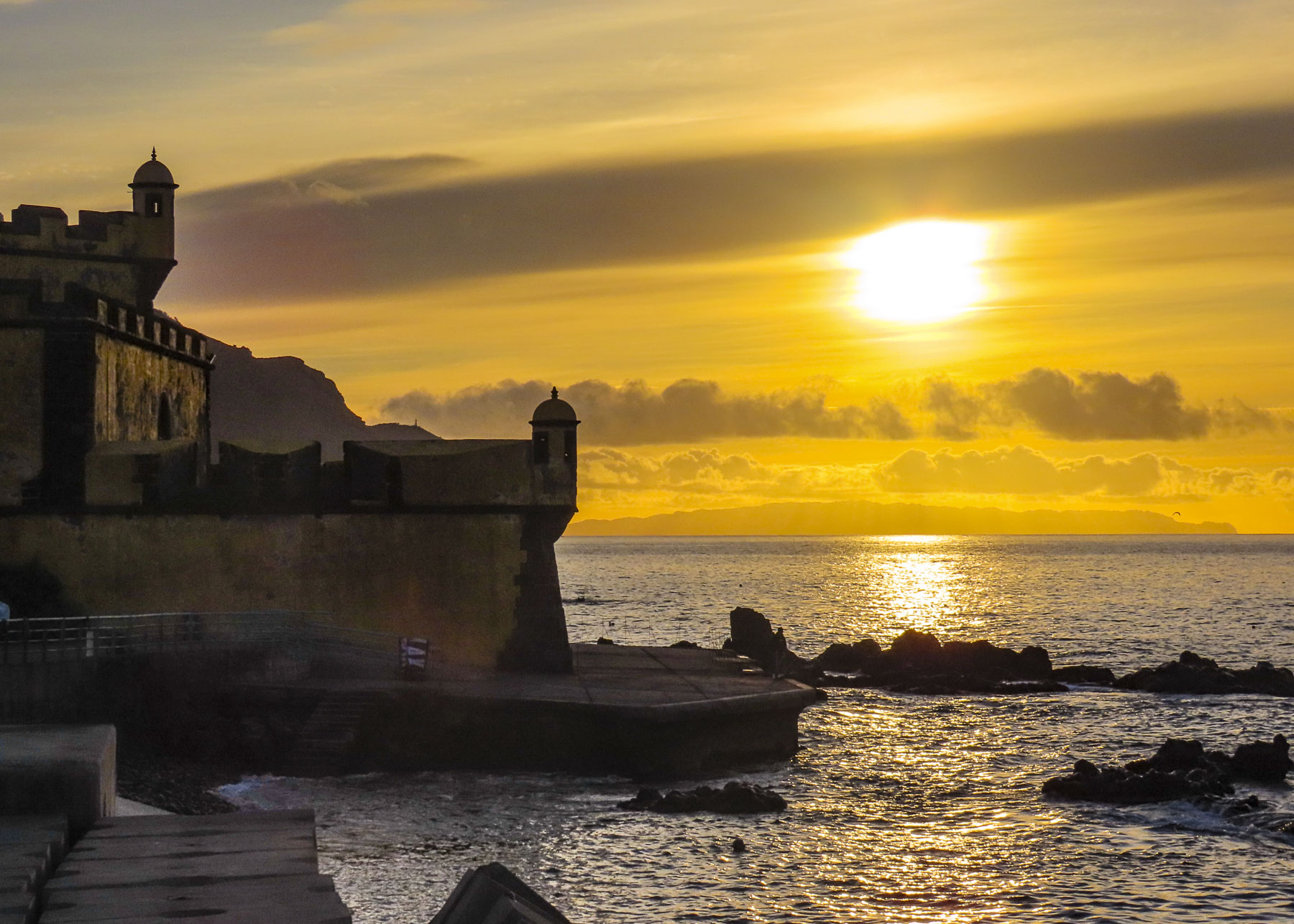
Often, we started our mornings at Forte de São Tiago on Funchal’s seafront to watch the sun rise over the ocean. But turn around and fog could be rolling down the slope of the hills above the city. The weather can be fickle on this mountainous, beautiful island. Though with its numerous microclimates created by the rugged terrain, it would usually be sunny someplace. A fifteen-minute drive in any direction and the weather could be totally different, as was often the case.

While it’s possible to enjoy an entire stay on the sunnier and dryer south side of the island, where Funchal is located, the dramatic mountains and deep valleys of the interior, which stretch the length of the island and the northern coast, are spectacular destinations.

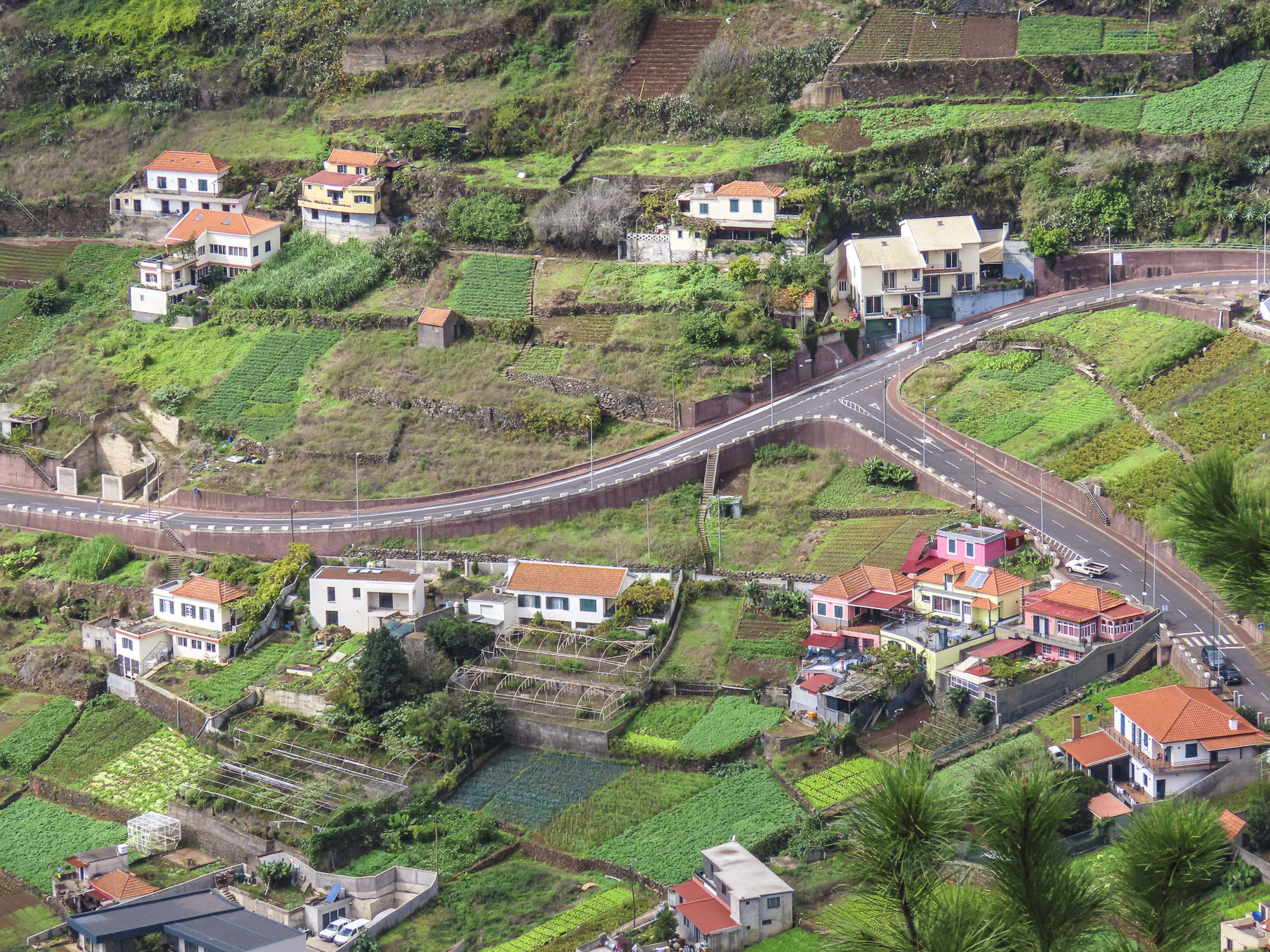
As rugged as Madeira is, man has left his mark on the landscape with terracing and irrigation channels, called levadas. They’ve been an integral part of island life since 1420 when the first settlers were recruited to the uninhabited island, and impossible to avoid. With a landscape covered with virgin forests, experienced lumbermen from the Minho region, farmers and terrace builders from the Douro valley, and fishermen from the Algarve, all seeking better fortunes, were recruited to the island by the promise of land if they worked it for five years.

With a plume of black ash rising from it, Madeira from the sea must have looked like a volcano erupting. Slash and burn fires started to clear the land reportedly lasted for seven years. By the mid-1400s, soil erosion became a problem; largescale slash and burn fires were prohibited and cleared land on the slopes had to be terraced immediately. The felled trees were a valuable export to ship builders in Europe. The enriched soil from the fires was perfect for the introduction of sugar cane, which quickly became the island’s main export. Slaves from west Africa were brought to the island to sweat out this economic expansion.

To support the expanding villages, hamlets, and agricultural terraces, narrow irrigation channels called levadas were arduously cut into the mountains to divert water around the island, from the wet northern side to the dryer southern side. Their water was also used to turn the waterwheels of the first lumber, flour, and sugarcane mills on the island. Close to five-hundred miles of levadas cover this mountainous island that is roughly thirty-four miles long and fourteen miles wide.

Madeira wine replaced sugarcane when Madeira lost market share to the larger sugarcane plantations of Brazil and the Caribbean. Madeira’s a small island with a large agricultural punch. Today it’s well-watered terraces support wine grapes, banana and flower exports to Europe, as well as the cultivation of other exotic fruits like custard apple, passion fruit, tamarillo, avocado, papaya and mango.

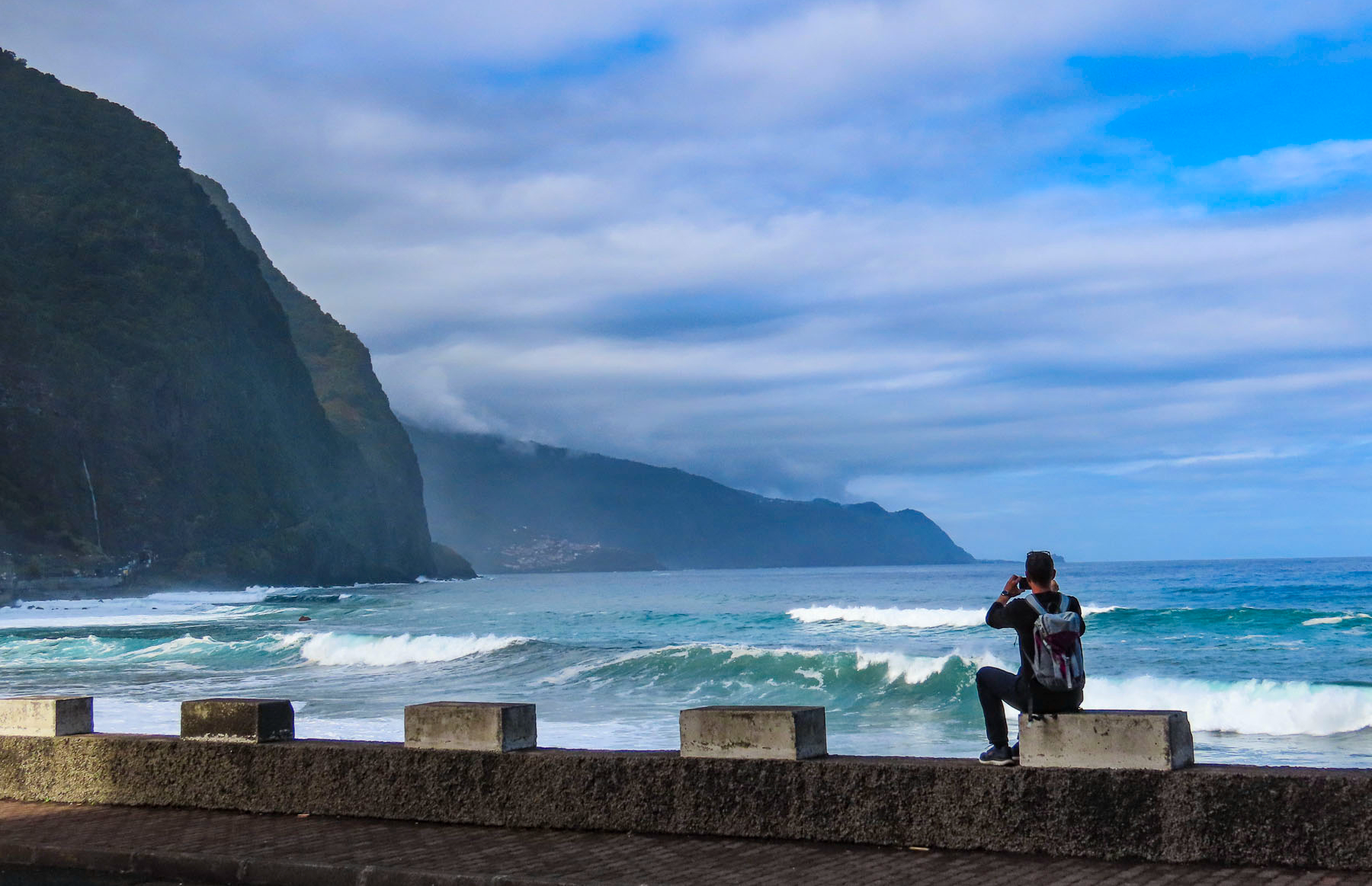
The clouds were slowly being torn apart. Shafts of light dramatically illuminated the valley as we drove north across the island to Sao Vicente. It’s a compact village centered around its church. Nearer the ocean, we explored an ancient lava tube that led down to the sea.

Surf pounded against a rocky beach across the road from a truly amazing bakery, Padaria do Calhau. Something we didn’t expect to find, but if you need an excuse to visit, a coffee and pastry at Padaria do Calhau should suffice. Heading west, just outside of town and before you enter a tunnel, the Cascata Água d’Alto tumbles down next to the road. Unfortunately, there is not any convenient parking here.

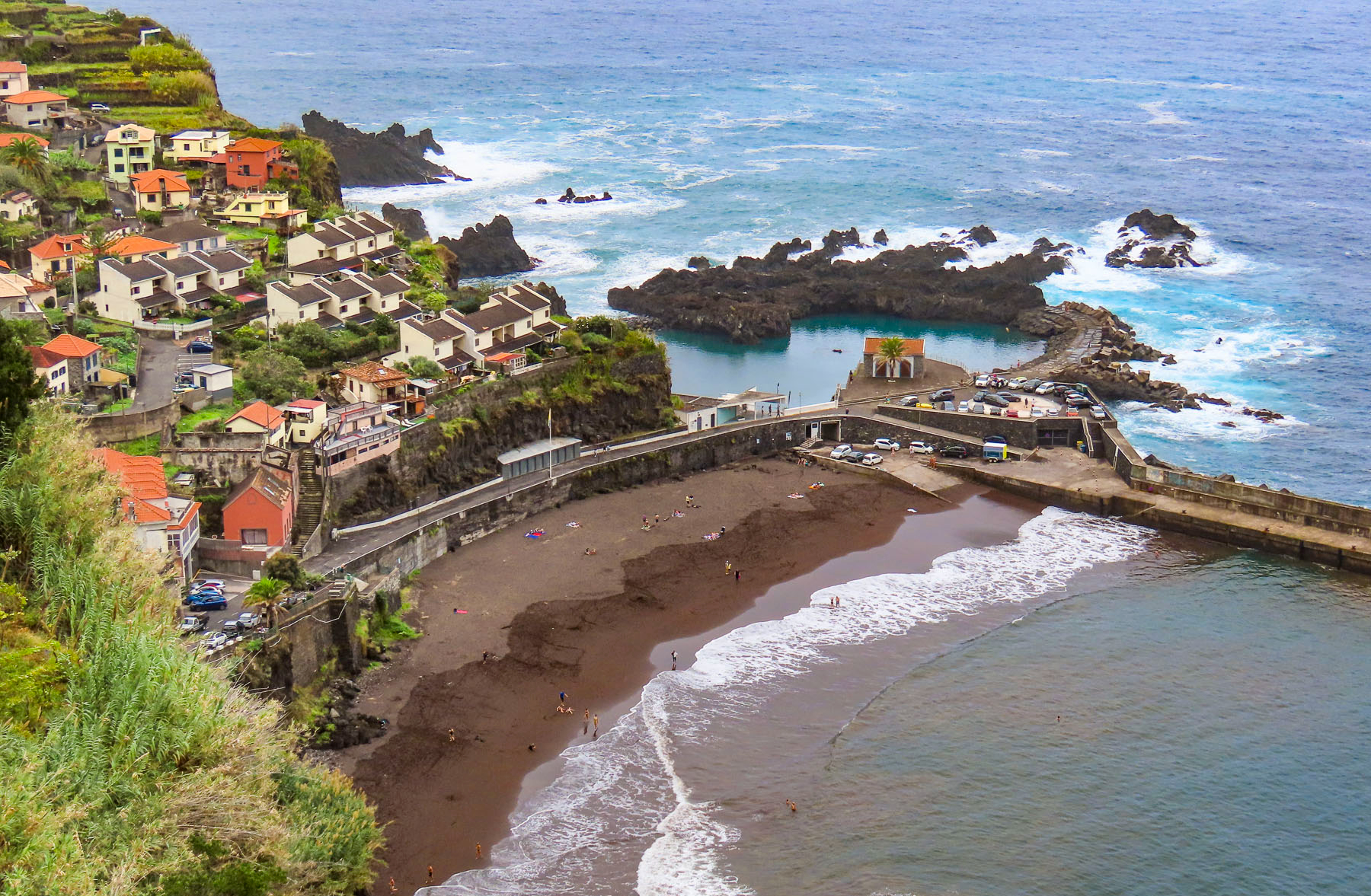
Following the ER101 west towards Porto Moniz there were a number of beautiful waterfalls on the way. First the Córrego da Furna waterfall will be on your left and has a small, unmarked parking area across from it. Then just past the picturesque village of Seixal with its black sand beach, there is the Cascata da Ribeira da Pedra Branca on an old coastal road.

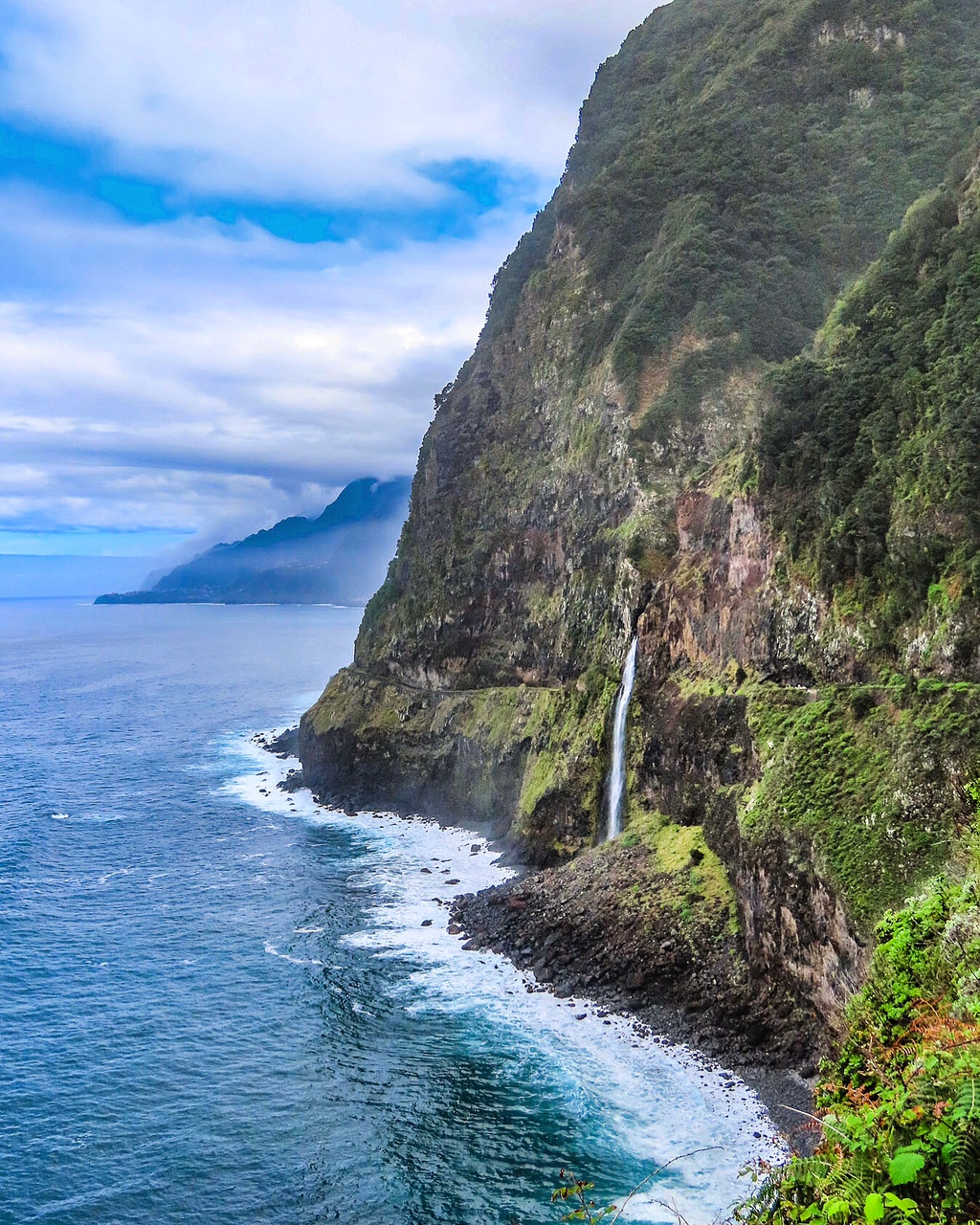
But farther along the most iconic of all of Madeira’s waterfalls is the Véu da Noiva, or bridal veil. It’s a beautiful waterfall that tumbles over a rockslide that permanently closed a section of the old coastal road. It’s a popular stop with plenty of parking, that’s perfect for lingering.

Before Porto Moniz the longest river on Madeira, the Ribeira da Janela, empties into the sea over a rocky, boulder-strewn beach. Tall, eroded sea stacks stand like sentinels amid a crashing surf only a few yards from the shore. We had lost the sun by this time, but the seascape was just as dramatic, nonetheless.

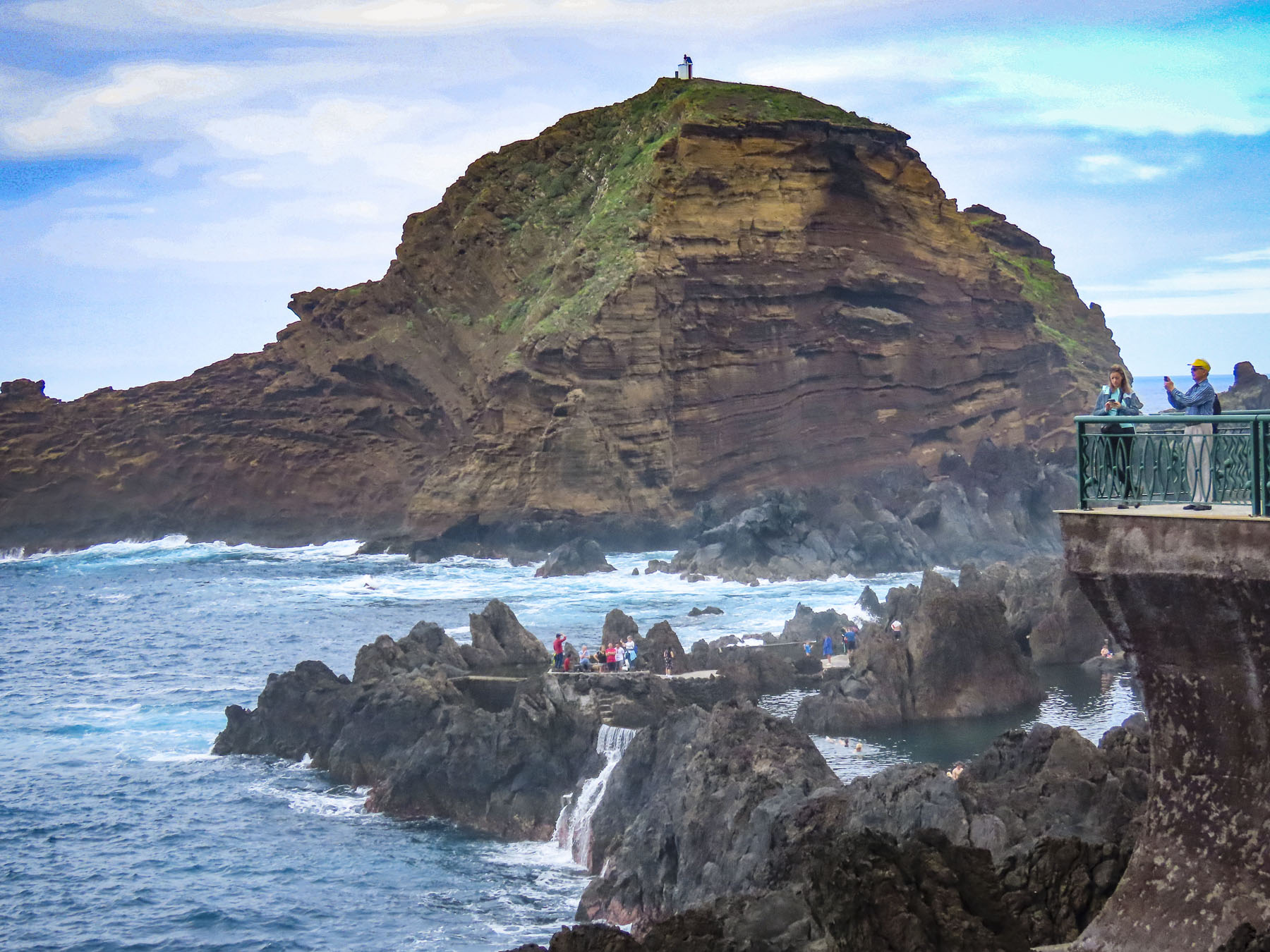
Madeira’s shoreline is very rugged; most of its beaches are pebbly rather than sandy. Then there are spots where over the eons the waves have eroded away the volcanic rock and created natural rock tidal pools along the coast.

Porto Moniz at Madeira’s northwestern tip is a popular destination for swimming safely in these coastal pools, set dramatically against a background of crashing waves. The pools have been enhanced over time, with steps into the water, sidewalks between swimming areas, and some areas being dammed to create deeper pools. There is modest entrance fee of 1.50€ per person, but it’s one of the best bargains on the island.

After a late lunch we retraced our route to Ribeira da Janela and followed a narrow secondary road over a stone bridge and through the small hamlet of pastel-colored homes set against verdant fields, into the cloud-shrouded mountains.

Whether it was cloudy or foggy we’re not sure, but it was perfectly misty as we pulled into the parking area for the Florestal do Fanal. Roughly 37,000 acres of primal laurel forest, and open woodland, the largest in Europe, it covers the mountainside 3500 feet above sea level. A short walk into the woodlands set us in an atmospheric wonderland of huge windblown trees with gnarled twisted trunks and crooked branches, covered with moss and lichens.

Other hikers and wandering cows vanished into and reappeared out of the mist as we wandered through the silent woods. Mysterious, eerie, or benignly moody are apt descriptions for this intriguing laurel forest that is a photographer’s delight.

Driving back to Funchal we crested the ridgeline of the mountains that divides northern Madeira from the south and suddenly we were driving above the clouds.

Till next time, Craig & Donna

Along the Algarve Coast – Lagos, Carvoeiro & the End of the World

Finally, the weather was improving as we headed south from Evora to the Algarve coast. We had hit an unusual week of rain in “sunny Portugal,” but the whole Iberian Peninsula had been experiencing a multi-year drought. So, it was good to know that some relief was in sight.

The sky was a refreshingly brilliant blue by the time we drove down palm-lined Av. dos Descobrimentos, along the Lagos riverfront, towards the ocean. On our left, Forte da Ponta da Bandeira stood, a silent sentinel still guarding Lagos’ fine harbor since the days of Henry the Navigator and the beginning of Portugal’s Age of Discoveries in the 1400s, when Lagos shipbuilders supplied fleets of caravels to explore the African coast, and later the Indian Ocean and beyond. In 1580,the fortress repelled the English privateer Sir Francis Drake, only to see him sail farther down the Algarve coast and sack Faro instead. Since antiquity Lagos has been an important trading port; Phoenicians established a settlement on the shore of the bay. Later Greek and Carthaginian seafarers visited and traded with the port.

The Romans came, conquered, and left the first defensive walls and a fortress along the cliff. Over the centuries its ruins have slowly fallen into the sea as the cliff face erodes. The only remnant of its existence is an arched bridge, too dangerous to cross, connecting the mainland to a rock pinnacle. Later Visigoths were succeeded by Moors until the Portuguese reconquest in 1241 permanently secured the port for Portugal. The road curved and climbed to the Miradouro Praia da Batata, where we parked and reveled in our first glimpse of the dramatically sculpted Algarve coast and its turquoise waters.

To our delight our accommodation at VI MAR – GUEST HOUSE was located within old town Lagos, just inside the massive defensive wall, which was expanded by the Moors in the tenth century and still encircles the town.

Our room was small, but it had a compact balcony that compensated for the lack of space and was the perfect spot for a morning coffee or evening glass of wine. The big plus was the location, only five minutes from the center of Lagos and just around the corner from MiMar, a great tapas restaurant, Padaria Centrala fabulous bakery, and MarLe Café for excellent coffees and a quiet place to chill. Our host recommended Casinha do Petisco, a small friendly and lively, family run restaurant famous for its cataplana de marisco (a traditional Portuguese seafood stew). We were not disappointed. Arrive right when it opens at 5:30pm if you’d like to be seated without making a reservation; after 7:00pm they are must.
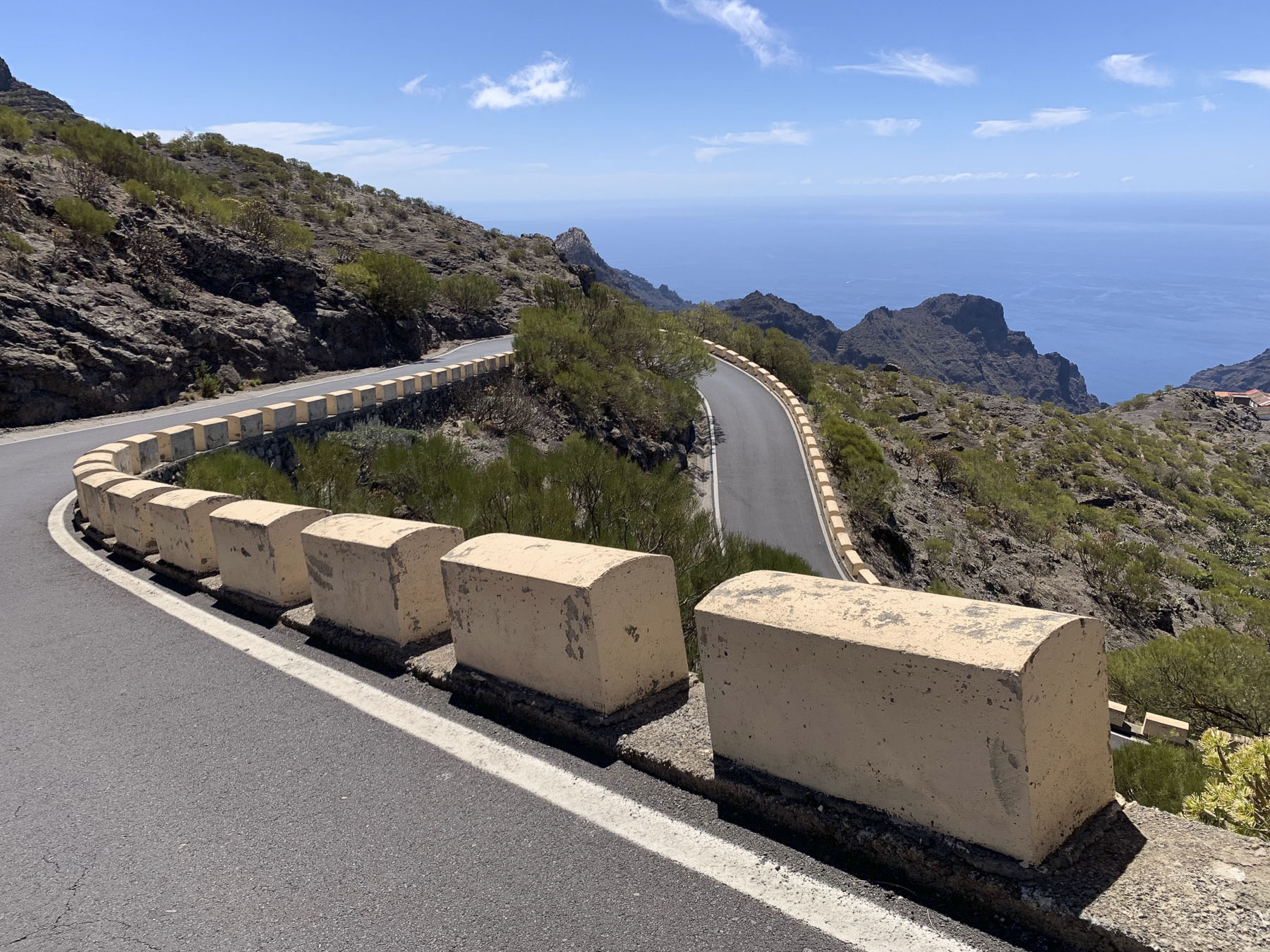
One of our main reasons for choosing Lagos as a base for our five nights’ stay was the size of the town. Small enough to be manageable, yet large enough to be interesting. A walker’s and photographer’s delight within the old town. Plus the fascinating coastal rock formations of Ponta da Piedade and Praia dos Pinheiros were an easy twenty-minute walk away. We planned day trips to explore the coast, east to Carvoeiro and west to Sagres and Cabo de São Vicente.

At the end of October Lagos was quiet and beautiful, with daytime temperatures in the 70sF. With “walk a little then café” as our mindset we explored the old walled town, riverfront and on multiple occasions the trails and boardwalks along the ocean. The coastal rock formations were fascinating and kept revealing different fissures and crevices as the light kept changing throughout the day, though we thought the afternoon light was the nicest for photography.

The cobbled lanes of the historic district were uncrowded during the shoulder season and the ambience was wonderful amidst the palm trees and tiled facades of the buildings.

At the old Mercado Municipal de Lagos we were tempted by the bounty on display to buy “the catch of the day,” beautiful tuna from the fish mongers. On the top level a quaint small café overlooks the waterfront.

Farther along excellent street art decorated a store front awaiting reincarnation near a laundromat we were happy to use after washing clothes in various sinks for two weeks. It wasn’t Portuguese, but Poké Lagos served a delicious bowl of food as we waited for our laundry to finish.

In the evenings buskers performed in several plazas. One misty night a guitarist enthusiastically worked an appreciative crowd that kept growing and tossing coins into his guitar case. He must have sung for 90 minutes, breaking only to quench his thirst with a beer offered by a local waiter. Several times he announced it would be his last song. But the night was electrifying, and he played on. He proudly acknowledged his wife and young child in the crowd, playing for them as much as he was for us. He was, I imagine, in the ultimate musician’s groove, giving one of his best performances, and the folks who circled around watching and listening loved it as much as he did.

After several days of rough water, the wind and ocean finally calmed, and we spontaneously opted for a boat tour along the cliffs. Expertly timing the surge of the waves, our boatsman safely navigated us through tunnels and between rock formations.

At one point he looked high up the cliff face, waved and then yelled “hey Antonio!” to a lone fisherman wedged precariously on a ledge very high above the water. When asked why folks fish from the dangerous cliffs, our boatsman explained that only certain species of fish inhabit the zone where the bluffs meet the sea and that “Antonio, my cousin, thinks they taste better.” We saw this activity in several other places along the coast. Antonio wasn’t the only loco, maluco, fisherman.

The seaside town of Carvoeiro, with its homes built on cliffs encirling a small crescent beach and a boardwalk which follows the rugged coastline, was a destination one morning. One of the things we appreciate about Portugal is that, while gasoline is expensive, parking is free in most places. Even along the beautiful coast.

Parking near the Forte de Nossa Senhora da Encarnação we followed the Passadiços do Carvoeiro boardwalk atop the cliffs and back into town, stopping often along the way to take photos of the seascape before lunch at a shaded café. Although the temperature was comfortably cool, the sun was strong and frequent escapes to shady spots were required.

Afterwards we headed to Ferragudo, a small town, across from the busy port of Portimão, where the Arade River widens and meets the Atlantic Ocean. Two beautiful, wide sandy beaches with calm waters, the Praia Grande and the Praia da Angrinha front the tidal Arade River here. There are three relaxing restaurants along this stretch of sand to grab a beer and find some shade. The dividing point between the two beaches is the Castelo de São João do Arade. The castle was built in the 1500s to protect the important inland city of Silves from pirates, as the upper reaches of the Arade River were still navigable at the time. Over the centuries the fortress lost its relevance and was eventually abandoned and later auctioned off in 1896 to the Portuguese writer Joaquim José Coelho de Carvalho (1855-1934), who restored the cool digs into his summer residence. Years later the town of Ferragudo was unable to fund its transformation into a cultural center. Since 1998, the unique summer home has been owned by the Portuguese businessman Vasco Pereira Coutinho, who continues to use it as a private residence.

Just beyond the castle and the Praia da Angrinha the river juts to the right into a small, sheltered cove that fishermen have used for safe anchor since the Phoenicians. The harborside village, with whitewashed homes and narrow alleys that gently follow the contour of the hill, first appears on a Portuguese map of the Algarve coast in 1560.

It’s a picturesque harbor with boats bobbing softly on wind-blown waves. Quayside fishermen still piled their nets and pots, reminding us of its roots as a working village, but gentrification is slowly happening.

Driving home later that day we were delighted to spot storks resting in their nests before migrating further south to winter over on the African continent. Spontaneously we turned down a country road in search of more birds. We didn’t find any, but we happened across a historic moinho de vento, windmill, in Odiáxere. A nice surprise and something we would have missed if we had stayed on the main road.

Only an endless sky and sea filled the western horizon as we stood on the cliffs next to the Lighthouse of Cabo de São Vicente. The Atlantic Ocean stretched infinitely before us. In the time of Prince Henry the Navigator, this was the last frontier and filled with legendary monsters. Knowing the coast of North Africa can be seen from southern Spain, Henry sent his explorers south to follow the west coast of the African continent in the early 1400s, and later, when blown off course during a storm, Brazil. There was a high mortality rate amongst the sailors who ventured into the unknown. Fewer ships returned than set out.

But there was always the promise of riches and fame to be found. In 1484, in a plea to the Portuguese crown, Christopher Columbus pitched his idea of sailing due west, but maritime officials rejected it because they thought his estimate of distance to India was incorrect. In 1492 Spain was eager to match Portugal’s discoveries and accepted Columbus’ idea. One hundred and fifty miles east along the Algarve coast, just across the border with Spain, Columbus set sail from the river port of Palos de la Frontera.  For many millennia this barren land’s end, where the horizon swallowed the sun, was considered sacred. Today, near the lighthouse, a witty food truck vendor markets the “last hotdog before America.”

Fifteenth century fortresses dot the Algarve coast at every seaside port. While the Moors retreated from Portugal after their defeat during the Reconquista, Barbary pirates from Morocco, Algiers, Tunisia and Tripoli often raided ships and towns along the coast, taking mercantile goods and hostages. As a defense, Prince Henry ordered the unique Fortaleza de Sagres be constructed upon a narrow cliff-faced peninsula that protrudes like an index finger from the coast. From here you can look west and see the lighthouse of Cabo de São Vicente. The peninsula is flanked on both sides by two sandy beaches, Prainha das Poças and popular with surfers, Praia do Tonel. Only the entrance to the fort that divides the peninsula from the mainland is fortified across the narrow width of this windswept headland. The unscalable cliffs provided the bulk of the fort’s defense, or so it was thought. Though some how that thorn in every sailor’s side (if you weren’t English), Sir Francis Drake, returned to the Algarve Coast in 1587 when Portugal was under Spanish rule and raided the fort!

Without any natural harbor, the fishermen in the old village of Salema used to push their boats across the beach and launch their sturdy craft into the crashing surf, hop aboard and row further out into smoother waters.

Fortunately, lifting glasses of sangria to our lips was the only exertion required to enjoy the beach today. The once sleepy whitewashed village has transformed itself into popular tourist destination with many new villas built along the coast that take advantage of the gorgeous seascape.

Trails going east and west from the town’s central Praia da Salema lead to small isolated beaches. From the top of an actively eroding cliff face the ruins of Forte de Almádena loom over the crescent shaped Praia da Boca do Rio below. We freely roamed the ancient ruins, but well away from the roped off precipice that had already swallowed parts of the castle into the ocean. 

The weather along the Algarve coast changes quickly and our sunny day was cut short as we were mesmerized by a fog bank that slowly blanketed the coast. We took this as our  signal to return to Lagos and back our bags for the next part of our journey to Maderia Island.

Till next time,

Craig & Donna