

Yesterday, from the tower of Castelo e Muralhas Castelo Branco we saw a distant line of snowcapped mountains glistening under a brilliant Spring sun. Tonight, we’d rest our heads in Coimbra, noted for its historic university and preserved medieval old town. Though only one and half hours from Castelo Branco by highway, it would take us all day as we decided to take the back roads through the Serra da Estrela mountains to Castelo da Lousa and Talasnal, one of the abandoned Schist villages. Schist is a shiny, earth-toned local stone that is very durable and was used extensively in the region for building.


Below Torre, mainland Portugal’s highest peak at 1,993m (6,539 ft), the headwaters of three rivers, the Zezere, the Mondego and the Alva, emerge from the range and flow to the Atlantic coast. 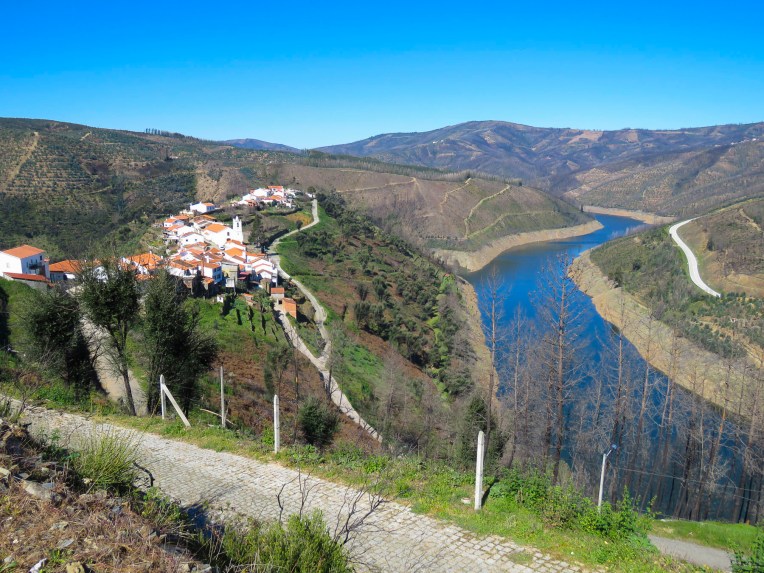 We crisscrossed these serpentine estuaries multiple times during the day as we drove through verdant pine forests along roads that hugged the curves of the land. Isolated, whitewashed villages dotted the mountainside.


Heads turned in Foz Giraldo, Oleiros, Alvaro, Maria Gomes, Alvares and Lousa when we parked to wander around. Early birds, we were way ahead of the summer crowds that rush to these mountains to escape the heat of the city and urban life.


Foresters, shepherds and cheesemakers squeeze a livelihood from the land in this sparsely inhabited region. Queijo Serra da Estrela is Portugal’s most unique cheese. It’s a strong flavored, soft, raw sheep’s milk cheese still made by hand from a 2,000-year-old traditional recipe. Firm on the outside, the wheels of cheese are lusciously creamy on the inside when young; as the cheese matures the center firms to a sliceable semi-soft texture.


We arrived at Castelo da Lousa around noon, hoping to explore the castle and nearby chapels after lunch at a restaurant adjacent to it. Midweek and off-season, unfortunately both were closed, but we enjoyed our time walking around the base of the castle. This small castle, dwarfed by surrounding mountains, was once a strategic stronghold along the Mondego line, a series of defensive fortresses along Portugal’s 11th century border south of Coimbra after it was captured from the Moors, deterring them from retaking that city. The knights Templar are credited with constructing its Keep and Glacis, a ramped lower wall, along the base of the castle, designed to impede scaling ladders and ramming. By the early fourteenth century, as the Portuguese border expanded south, the castle lost its importance and was forgotten.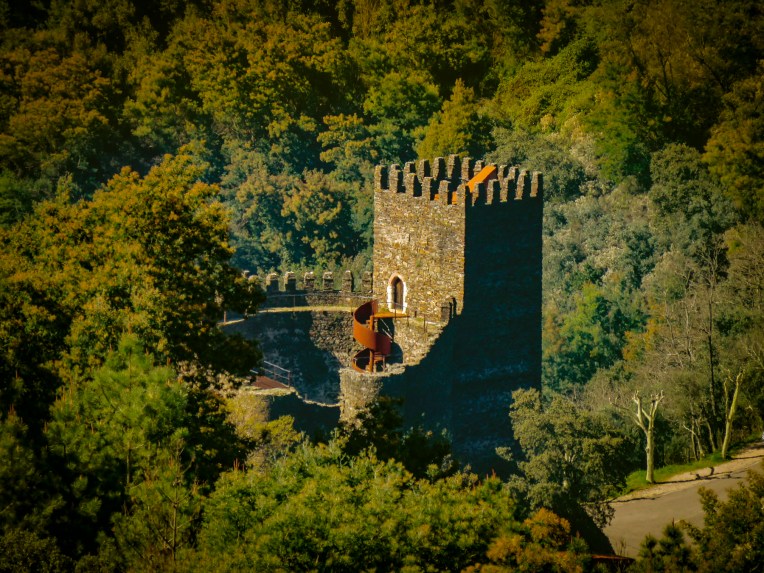 As Donna was waiting for me at the foot of the castle while I went to get the car, she was approached by two weary trekkers, without water, who had just hiked down from a mountain hamlet above the castle and were expecting to lunch and relax at the closed restaurant before hiking back up the steep trail. As crows fly, the distance from the village to the castle wasn’t far, but the return hike looked daunting without water or food. We quickly agreed to give them a lift back when they asked if we could help them. Our compact rental car was packed pretty full, but we pulled the seats forward and piled some bags on Donna’s lap to make room for Catia, Alain and his large backpack. ( Always wildy speculating, I wondered if they found the lost treasure of a local legend: King Arounce, who fled ancient Coimbra with his daughter and hid his riches in the mountains above the castle.) A Portuguese/ French couple, they were on a weekend getaway from Lisbon and his backpack was full of photography gear.


As it turned out they were staying where we were headed, in Talasnal, one of the three Schist villages above the castle. The four of us spent the rest of the afternoon at Ti Lena chatting away; their English was much better than our non-existent Portuguese. This rustic tavern served wonderful, traditional Portuguese cuisine typical of the region, and good local wine. This delightful, serendipitous encounter was one of the highlights of our road trip. Along with Catarredor and Casal Novo, Talasnal was slowly abandoned over the years as younger generations moved away to find work. With the rise of ecotourism these rustic villages, with their beautiful stonework, have been rediscovered by folks who want to reconnect with nature and a simpler pastoral life, if even for short periods of time.
 With the help of government grants, many of the near-collapsing structures are in the process of being updated and authentically restored, using traditional building materials and techniques, into restaurants, small inns, workshops, galleries and private homes to support a growing tourist infrastructure and revitalize the area. Across the mountainous central region of Portugal there are twenty-seven Aldeias do Xisto (Schist Villages) that can be explored.
Till nex time,
Craig & Donna

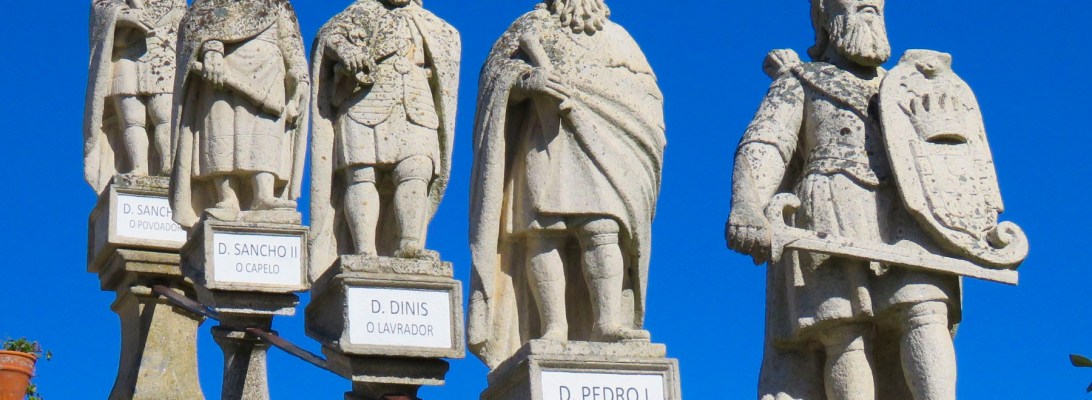


 Fortifying the high ground was the rule centuries ago and the last remnant of Castelo e Muralhas Castelo Branco, the white castle, still commands the skyline above the old historic district of the town. Much isn’t known of the history of Castelo Branco before 1182, when it is first mentioned in a royal document decreeing land to who else, but those prolific castle builders the Knights Templar. Only 18km (11 miles) from the Spanish border, the fortified village quickly grew into an important center of commerce and line of defense to protect the Portuguese frontier. Today only two towers and a wide section of the ramparts are all that remained to remind us of this once mighty fortress and walled city. Igreja de Santa Maria do Castelo is thought to be the first church built in the village, when it was constructed within the castle walls on the foundations of a ruined Roman temple. The church had a turbulent history: destroyed in 1640 during the Portuguese Castile war, burnt down in 1704 and then used by the French as a stable when they invaded. It was left in ruins until it was rebuilt in the 19th century. It now sits peacefully in the park, atop the hill, with a view of the surrounding countryside.


 Monsanto


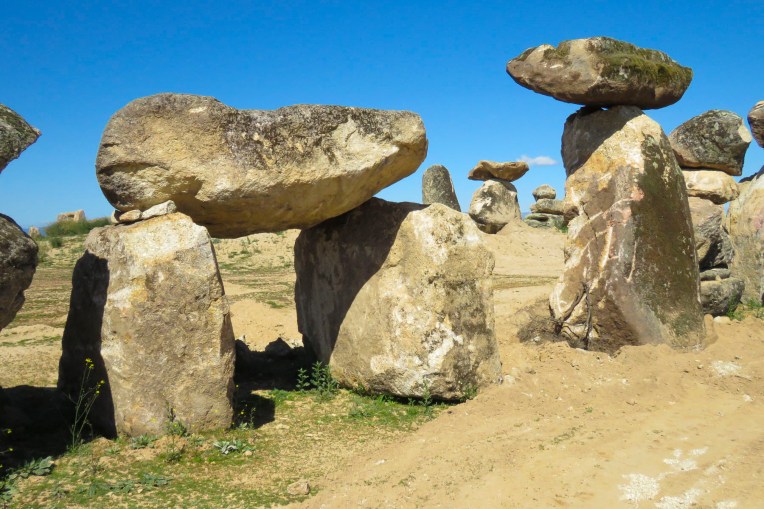
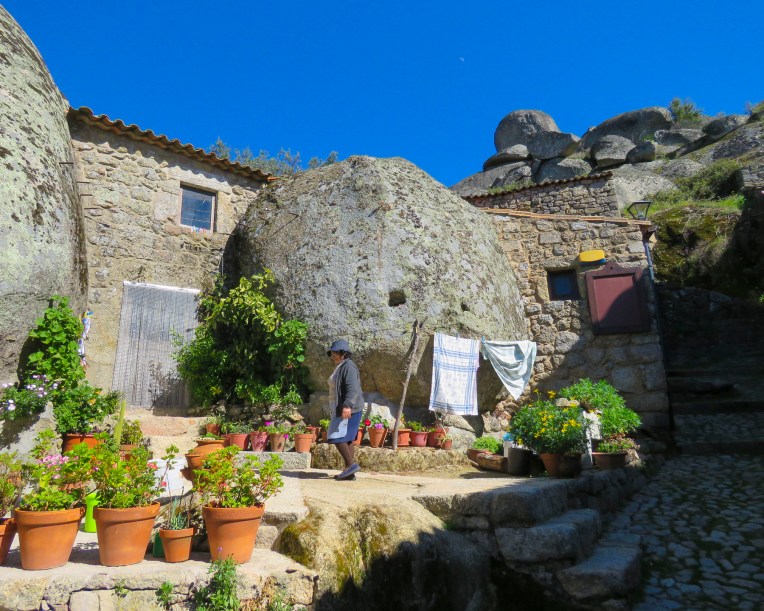 Monsanto


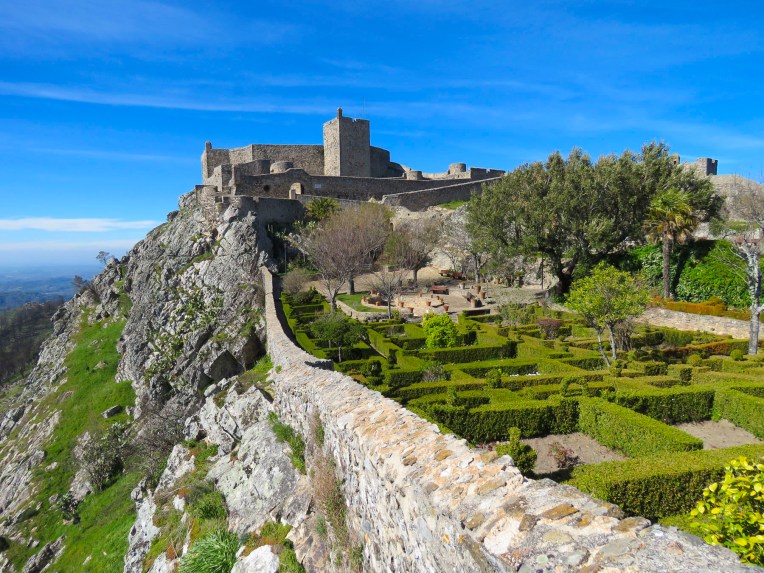


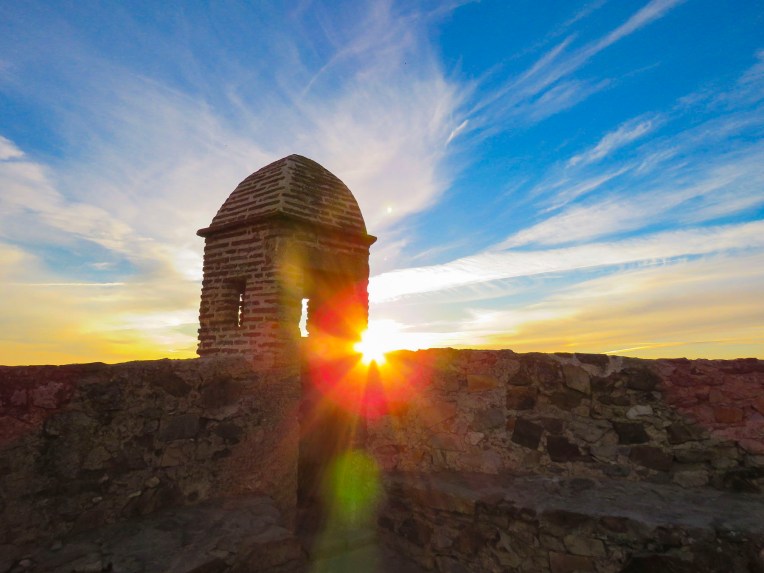 The cold wind chilled us to our bones, but we found warmth by the fireplace in the tavern across from our inn. After dinner, as we stood on the ramparts behind our hotel, the darkness offered us a view of the stunning star-filled sky above and the twinkle of village lights far below. With a stiff breeze in our faces, we felt like we were flying. The glorious sunrise the next morning cast a beautiful light on the panoramic view of the flat plains that run all the way into Spain, while the rugged mountains and valleys to the west stayed covered in an early morning mist.


 The scenery along the drive to Lake Atitlan, along roads that continued to climb higher, was spectacular with verdant greenery and distant volcanos appearing then disappearing again with each twist of the serpentine route.
 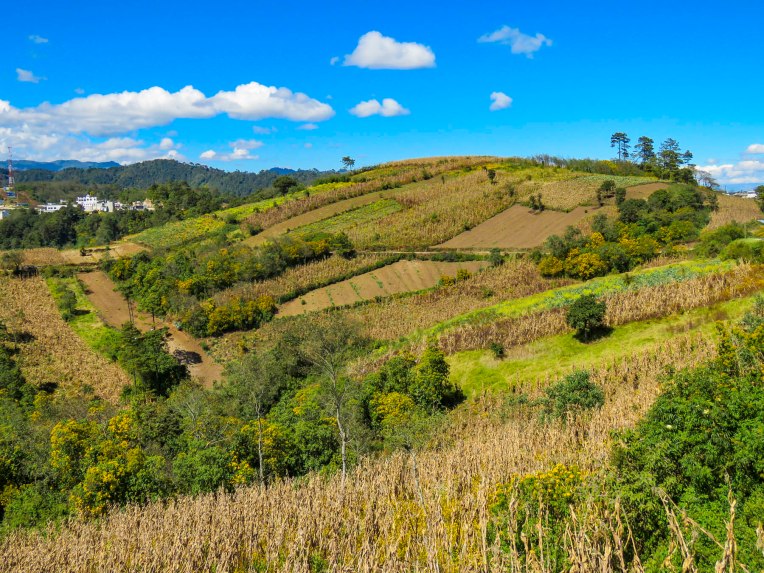 Arriving in San Pedro we thought we were on a movie set for a sequel to Mad Max or Water World. Down by the Panajachel dock dreadlocked travelers, wearing eccentric attire, filled the streets along the lakeshore. Feeling as if we had time traveled, we were relieved to find our Airbnb far out of town on a dead-end road that ran along the lake. According to Google maps the road was unnamed. Our host said “tell the tuktuk drivers you are staying on Calle Finca,” which referred to a distant and abandoned coffee farm, about an hour’s walk from the trail head at the end of the road.
 Our new home for our last week in Guatemala had a wonderful porch with great view of Lake Atitlan and tranquility. A relaxing change of pace was called for after the Christmas and New Year’s Day celebrations in Antigua. Bird calls or the soft Mayan chatter of coffee pickers, harvesting ripe beans right outside our door, were the only sounds that filled the air. Fortunately, we were much closer to town than the abandoned coffee finca and were able to walk to the daily outdoor market, along streets where we could see women washing clothing in the distant lake, and make-shift scales were set up to buy coffee beans hauled down from the slopes of Volcan San Pedro.


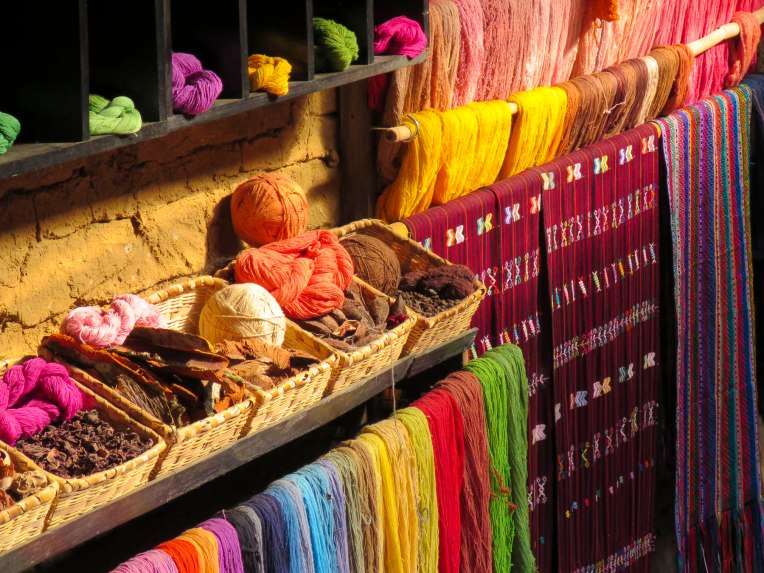
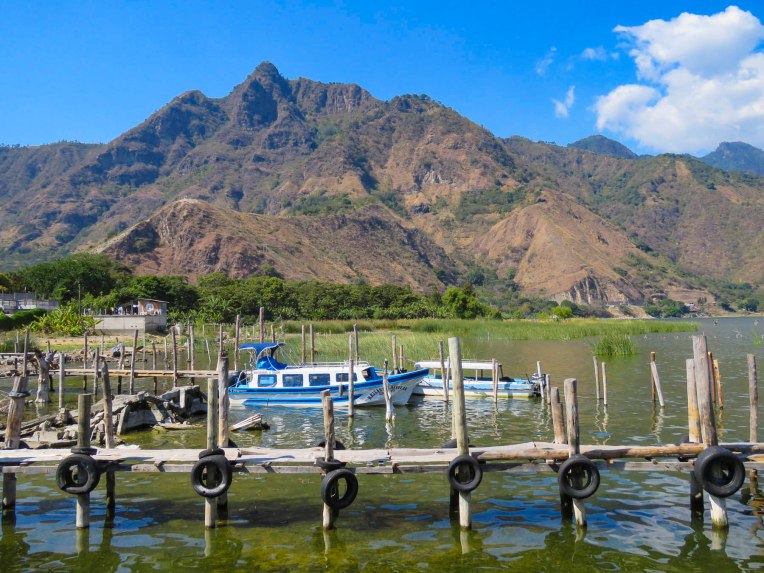 A short ferry ride took us to San Juan La Laguna, a weavers and artists village that visually celebrates its Mayan heritage with colorful street murals. The steep walk uphill from the boat dock to the center of town was lined with art galleries.


 Six years ago, when we first visited the lake, we stayed at Posada de Santiago in Santiago de Atitlan and met Carolina, an American expat who has been in Guatemala going on thirty years now. We’ve stayed in touch over the years. Being so close by, a reunion was in order.
 It’s a long ferry ride to Santiago de Atitlan and even longer when the wind churns up whitecaps on the water, and the small boat we were in rocked side-to-side for the duration of the crossing. We silently said our prayers when the local folks stated to reach for the life preservers. Fortunately, we were never too far from shore and know how to swim. It is a breathtaking view coming into the boat dock at Santiago with its namesake volcano towering over the town and Volcan San Pedro just an avocado toss away, across the water.


 Enjoying the stars from our porch we were surprised when fireworks celebrating Epiphany lit up the night sky above villages across the lake, their colorful bursts reflected brilliantly on the water. With magical moments like this, still fresh in our memories, Guatemala tugged at our hearts as we packed for our next adventure.
 We’ve been on the road for more than 100 days now; previously, our longest trip was just shy of three weeks, with carry-on luggage only. So, we felt fully prepared to tackle this challenge (insert wink here.) Needless to say, there is a learning curve, but we have the right mind set. In late October, we move north to Guatemala, followed by a cruise to Cuba. The first part of 2019 will see us in Europe, and after that, who knows? We’ve discussed heading to South Africa, then working our way north and through East Africa, trying to have as many big game safari experiences as possible. This has been a dream of mine since I unwrapped my first National Geographic magazine and was enthralled by the spectacular images of the great migration across the Serengeti. Winning this


![IMG_5946[12490]](https://i0.wp.com/2suitcasesfor2years.com/wp-content/uploads/2018/10/img_594612490.jpg?w=378&h=504&ssl=1 "IMG_5946[12490]")

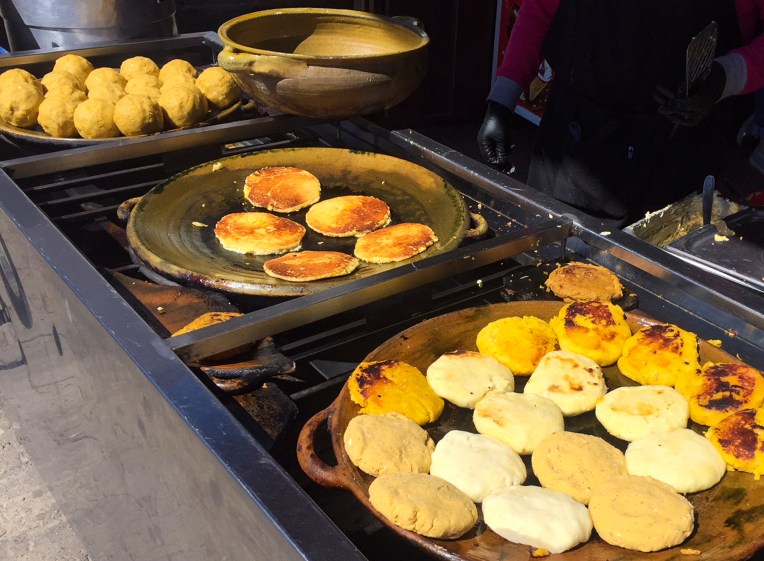 One of our favorite snacks was Tortilla de Choclo, eighty cents, a corn pancake that was grilled on a large ceramic plate, curbside, as you waited. Often, coffee and dessert cost more than lunch itself.

 One of the reasons we chose Cuenca for our first short term rental was so that I could take advantage of their dental tourism offerings. I had put off getting things done in the states because of what I thought were excessive cost, even with insurance. I am extremely pleased with the dental care that I received at Finding Health in Ecuador. Tooth extraction – $35.00, cavity – $25.00, two-tooth bridge – $250.00. Our premise that we could live abroad more economically than living back in the states is so far holding true.
 Currently we are in Olon, a rustic beach town on Ecuador’s southern Pacific coast with a wide, flat sandy beach that stretches for nearly five miles without a high-rise to been seen. It’s off season, mostly cloudy, but the water is still warm, perfect conditions for the handful of surfers and us. Fishermen still launch skiffs through the surf from the beach, and fathers can be seen taking their kids to school on the handlebars of their motorcycles, gently splashing through the incoming tide. Our rent for the month of October is $730.00 with breakfast included!


![IMG_5961[12489]](https://i0.wp.com/2suitcasesfor2years.com/wp-content/uploads/2018/10/img_596112489.jpg?w=402&h=536&ssl=1 "IMG_5961[12489]")


