

Starting the second part of this magical ride through Lisbon, tram 28 leaves the Praça do Comércio area from two nearby stops on Rua da Conceição, and climbs steeply around a huge curve into the Chiado and Bairro Alto districts before traveling to its terminus at Jardim dos Prazeres in Campo de Ourique. Rebuilt after the devastating earthquake of 1755, both these districts have a totally different atmosphere than Alfama’s time capsule, reflecting a vibrant, more cosmopolitan Lisbon with fine upscale shopping, nightlife and historical monuments that often reminded us of Paris. Praça Luís de Camões is the center of all this activity and tram 28 will drop you off amidst all the fun. There are so many things to do from this location that you might want to consider coming back here more than once. 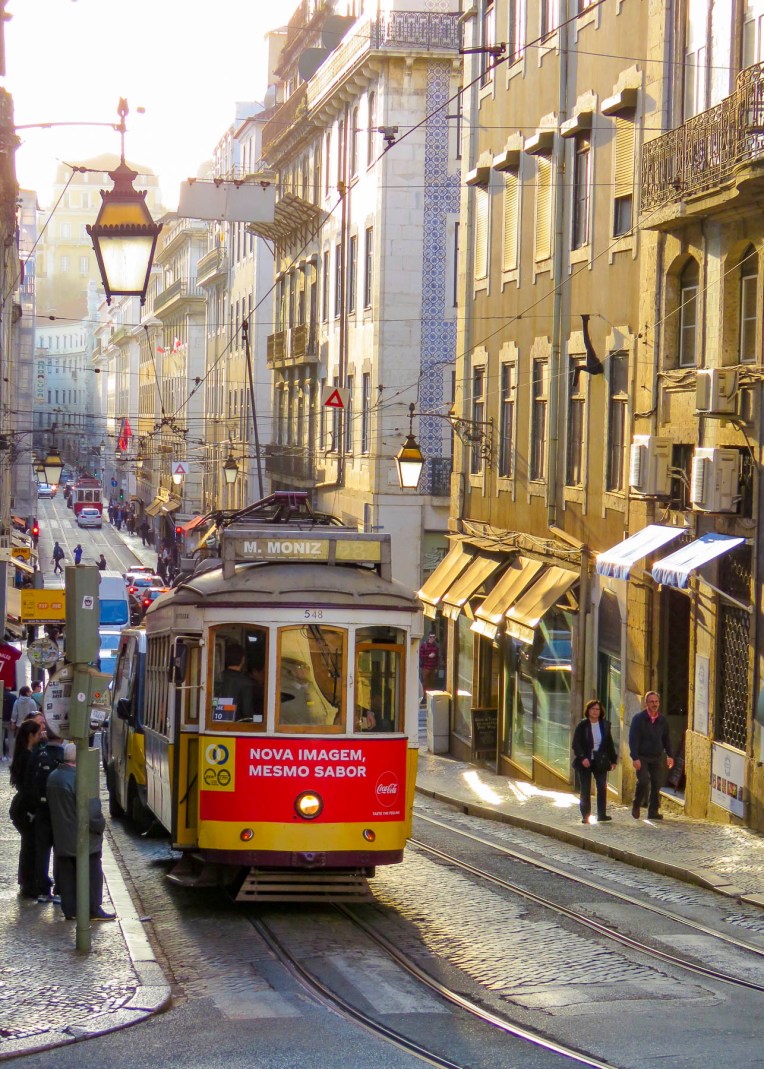 As if guarding the plaza, Igreja de Nossa Senhora do Loreto / Igreja dos Italianos, known as “the Italian Church” and Igreja de Nossa Senhora da Encarnação face each other with refined, simple exteriors. The Italian Church was built in 1518 by King John V to celebrate Lisbon’s Italian community of Genoese and Venetian merchants. The interior is lined with marble imported from Italy.


Exiting the Italian Church, you can walk right across the street into Igreja de Nossa Senhora da Encarnação to view spectacular ceiling paintings by Simon Caetano Nunes. After the 1755 disaster, reconstruction of this cathedral lasted until 1873. The cathedral also features several contemporary religious relief sculptures and a ceiling mural in a side chamber.


Once you’re back on the sidewalk, follow the sound of music to a small plaza. Here street musicians, performance artists and dance teams entertain crowds of tourists. Outdoor cafes edge the plaza, which is centered by a statue commemorating António Ribeiro, a Catholic cardinal who supported the democratic movement that lead to the toppling of the military regime in 1974. Pop into Café A Brasileira, Lisbon’s first coffee house in 1908, with its Art Deco style interior of sculpted wood, polished brass and mirrored walls. Many famous Portuguese writers and artists nutured their caffeine addiction here. Poet Fernando Pessoa visited so often, he is immortalized here with a bronze statue depicting him seated at “his” table. Immortalized in bronze, poet Fernando Pessoa sits permanently outside at “his” table.


Casa do Ferreira das Tabuletas with its ornate tile facade illustrating the sciences can be seen as you work your way to the Carmo Archaeological Museum. Set in the ruins of Lisbon’s largest cathedral before the 1755 earthquake, this small museum has a diverse collection of tombs, ceramics and mosaics along with other ancient artifacts. A few steps from its door, the viewing platform of Elevador de Santa Justa offers beautiful views of Lisbon. Walking back to Praça Luís de Camões, pass the Guarda Nacional Republicana to watch Lisbon’s less elaborate version of the changing of the guard.


From Praça Luís de Camões you can also walk or take tram 24 up Rua da Misericordia deeper into Bairro Alto. There is so much to do on this one street, you will want to return several times. If you are looking to be selective about the churches you visit in Lisbon, Igreja de São Roque and its Museu de São Roque should be at the top of the list. The highly carved gilded interior was the first Jesuit Church in Portugal. The museum exhibits an intriguing, world-class collection of Italian religious art in a contemporary setting.


Riding a funicular tram in Lisbon is a must and the street-art covered walls of the Ascensor da Glória route are just a block from Igreja de São Roque. It’s a pop culture experience to board the graffiti-painted tram and descend to Praça dos Restauradores. The walls along the route have been given to the artists of Lisbon and are covered with spectacular street murals. Older murals are painted over on a regular basis and replaced with new inspirations.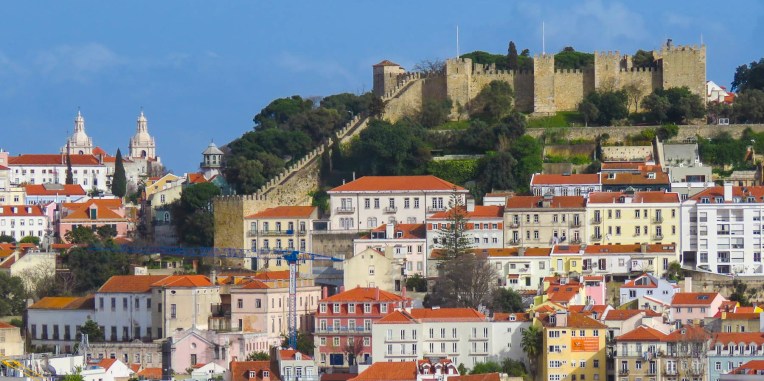 Shady Miradouro de São Pedro de Alcântara overlooks this colorful chaos and has splendid views of Lisbon below. From the miradouro it’s a gentle uphill walk into Bairro Alto. Fortunately, there’s no lack of places to rejuvenate yourself along the way. For lunch we found A Padaria Portuguesa an artisanal bakery and restaurant that we would return to several times during our stay in Alfama just to buy their delicous bread. This was especially rewarding if we combined it with buying cheese at Queijaria Cheese Shop just a few blocks away. Listening to the proprietor describe the nuances of each Portuguese variety and offering samples to tweak our palette, we usually left with the makings for a nice picnic under the towering specimen trees of Jardim Botânico da Universidade de Lisboa, just across the boulevard. Jardim do Príncipe Real, with its iconic trimmed cypress tree shaped to look like giant shitake mushrooms, was always a good alternative destination.


For dessert and coffee, we’d indulge ourselves with a sumptuous visit to Bettina & Niccolo Corallo, a wonderful artisanal chocolate and coffee shop with seating for only 6-8 people. Just down the street, in what was once an ornate, private residence, the Ribeiro da Cunha Palace has been subdivided into unique boutique stores. The lavish, original architectural detailing can still be seen in all the shops as you wander through. If you are staying late in the area, Tapas Bar 52 is a popular place for sharing delicous, small plate creations.


One stop away from Praça Luís de Camões, you can climb aboard funicular Bica and descend the steep hill into its gated ticket terminal on Rua de S. Paulo. On your way down you might catch a glimpse of a middle-aged man walking along the tracks, his pot-bellied pig on a leash. Outside the terminal you’re back on flat terrain again and only a short walk away from the Time Out Market.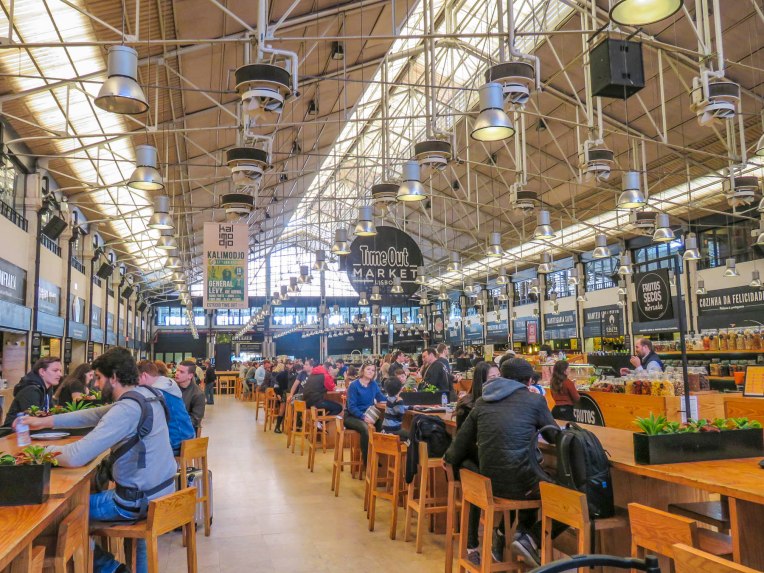 Set in a historic 1890s building in Cais do Sodré, this is a huge, lively food court with numerous restaurant choices that is very popular with Lisboans. Whatever you are craving at the time, you’ll find something satisfying here. Next door, during the week, Mercado da Ribeira operates a central market with fish, meat and produce vendors offering Portugal’s finest products. Brightly painted Pink Street, popular for its club scene, is nearby.
 Take funicular Bica back uphill, and around the corner you find tranquil Miradouro de Santa Catarina, with views of the Tagus River and Ponte 25 de Abril Bridge in the distance. The Museu da Farmácia is also located here. Also, nearby along Calcada do Combro, or just off it, are several landmarks worth quick visits.


Unimpressive from the outside, Igreja de Santa Catarina, built in 1647, has a rich, baroque style, gilded interior and impressive pipe organ. The buildings along Rua Vale frame Igreja Paroquial das Mercês sitting prominently atop a small hill at the end of the street. First constructed in 1615, a masterpiece of tile work created in 1715 and installed on a vaulted ceiling in a small room survived the 1755 earthquake. This is one of Lisbon’s hidden treasures. Credited to tile master Antonio de Oliveira Bernardes, the mural illustrates the Litanies of the Virgin Mary. Ask the church attendants to open the room for you. The rest of the church is an eighteen-century reconstruction. Down Rua Vale from the cathedral, Atelier-Museu Júlio Pomar, a small contemporary art museum, has rotating exhibits and a permanent collection of works by Júlio Pomar (1926-2018.) Some consider him to be the most influential Portuguese painter of his generation.


A mass of sun worshippers greeted us a we stepped off the elevator at Park Bar. Every chair in this oasis of lush greenery, hidden above Lisbon, was turned towards the sun to take advantage of the view on this early spring day. With a quick look at the name, you think the bar is in a park, but instead it’s on the sixth-floor rooftop of a parking garage next to Igreja de Santa Catarina. Finding the entrance was a bit challenging, since there was no signage, but once you locate the elevator or stairs inside the garage you’re set. The place gets packed at sunset and the party grows into the night with DJ’s providing the soundtrack. Heading west, tram 28 weaves through a very narrow section similar to parts of its route in Alfama, before reaching the open area around Assembleia da República. The parliament of Portugal is headquartered in a neoclassical building that was first used as a convent in the sixteenth century. Formal gardens behind the parliament building, hidden by an imposing wall, can be seen from tram 28 or if you stand on your tip-toes and peer over. Never immune from criticism, the politicians must endure a large satirical wall mural, painted on a nearby building, as they head to work each day.


Past the Assembleia da República the character of the city changes. The streets widen and some multi-storied apartment buildings dot the cityscape between historical buildings. If you are ready to picnic, Jardim da Estrela is a wonderfully landscaped park with ponds and sculptures of historic figures scattered along the walking paths. Across the boulevard, one of Lisbon’s lesser visited cathedrals, eighteen-century Basílica da Estrelaor, safeguards the tomb of Queen Mary I. She was the first monarch to rule over a united Portugal that included Brazil. She ordered the construction of the cathedral in 1761, as a religious obligation, after the birth of a male heir to the throne. Unfortunately, Queen Mary outlived her son (José – Prince of Brazil) who died of small pox at the age of 27. The cathedral also has a 500-piece nativity scene, made of cork, on permanent display.


Tram 28 ends its charming journey in the Campo de Ourique neighborhood at Jardim dos Prazeres, a small park with two cafes, in front of Cemitério dos Prazeres. Here the tram waits for several minutes before following its route all the way back to its starting point in the center of Lisbon at Martim Moniz. This tranquil cemetery is the final resting place for many of Portugal’s most notable citizens. Tombs of famous fado singers, artists, architects, doctors, writers and poets share the cypress lined lanes with politicians, nobility and a variety of songbirds. Many of the mausoleums are ornately decorated with artistic sculptures that represent the deceased’s career. Stop in the office to get a map outlining several different self-guided tours. There are numbers on the curbs in front of some of the tombs to help cross-reference the person’s contribution to Portuguese society. The far side of the cemetery offers views of the Tagus river and Ponte 25 de Abril bridge.


A few blocks away Mercado de Campo de Ourique has been revamped into a trendy food hall where organic and artisanal food purveyors share the space with small bars and restaurants. It’s a great place to rejuvenate before heading home.
Lisbon is an intriguing city with an amazing variety of activities in which to immerse yourself. There is no one “correct” way to see the city, but tram 28 offers a splendid six-mile route through this charming capitol that passes many of the top attractions. Multiple sites are close together so it’s easy to walk from one to the other and then just hop back on the tram to cover greater distances. Don’t expect to see everything along this famous route in one day; there’s just so much to explore and many wonderful diversions!
We loved Lisbon and can’t wait to return one day.
Till next time, Craig & Donna



![IMG_3433[31180]](https://i0.wp.com/2suitcasesfor2years.com/wp-content/uploads/2019/04/img_343331180.jpg?w=251&h=334&ssl=1 "IMG_3433[31180]")


![IMG_3463[31065]](https://i0.wp.com/2suitcasesfor2years.com/wp-content/uploads/2019/04/img_346331065.jpg?w=432&h=324&ssl=1 "IMG_3463[31065]")



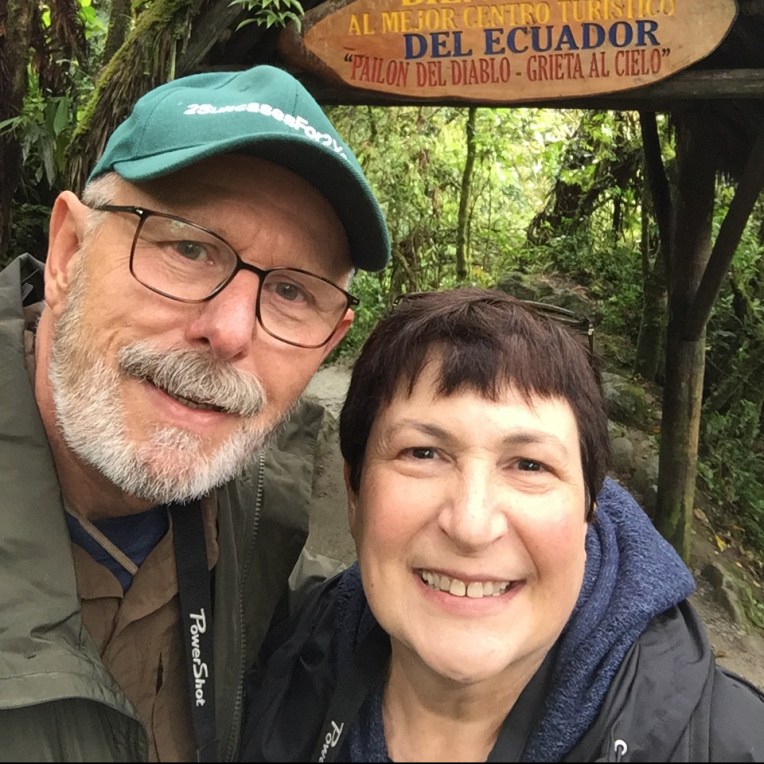 The good news is we haven’t killed each other, though there have been times that I’ve dreamt a pillow was hovering over my head. Just kidding. We have gone from the two of us working six days a week while living in an eight-room house, to being together 24/7 with only a suitcase each. Boy did we downsize! It was challenging: what not to bring, considering all the seasonal changes we have encountered. Don’t laugh, but I have thermals, wool hats and gloves packed, just on the off chance we get snowed in on a mountain pass in the French Alps, this July. Yes, there’s also a flask of medicinal whisky packed in the bags for emergencies. And to my wife’s amusement, a cheap plastic fly swatter. Tragically the backup swatter was left behind in Antigua. In Lisbon I finally caved in and bought a pair of slippers because the floors of the stone buildings just don’t retain any heat in the winter. The comfort of a pair of slippers in the evening, after a long day of walking, can’t be underestimated.
 It’s been a huge but surprisingly easy transition for us. 253 days ago (I thought I was writing this at around day 200, it’s easy to lose track of time on the road) we slammed the door shut on our storage pod, locked it, and popped open a bottle of champagne to celebrate our impending journey. We haven’t looked back. Ecuador, Guatemala, Cuba and now Portugal; I can’t imagine undertaking this adventure with anyone else.


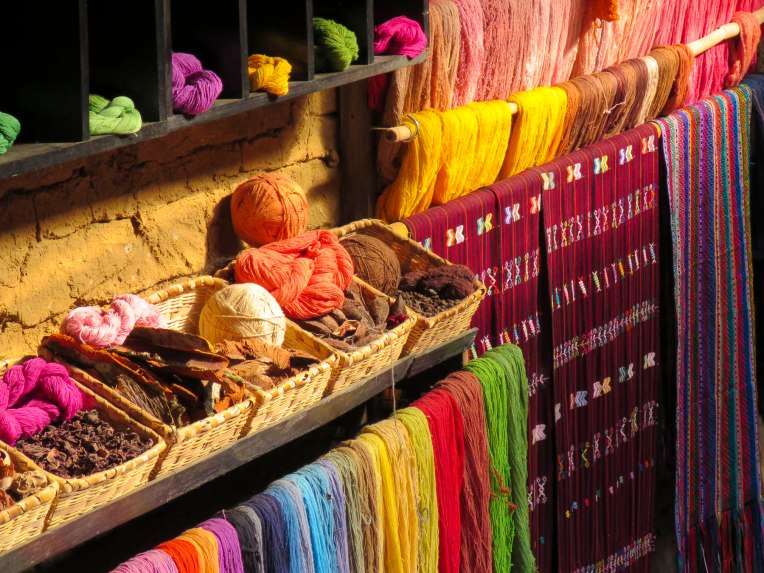 This visit also gave us an opportunity to jettison the wonderful textiles and ceramics we had purchased along the way for a home we don’t have yet. Imagine this scene from our last stop in San Pedro – the backseat of a tuk-tuk overflowing with Donna and all our suitcases, while I’m sharing the driver’s seat with the driver, one cheek on, one cheek off and a foot dangling outside the cab as we speedily snaked through the steep narrow alleys of the village.


![IMG_2836[12654]](https://i0.wp.com/2suitcasesfor2years.com/wp-content/uploads/2018/11/img_283612654.jpg?w=279&h=209&ssl=1 "IMG_2836[12654]")
![IMG_2841[12658]](https://i0.wp.com/2suitcasesfor2years.com/wp-content/uploads/2018/11/img_284112658.jpg?w=279&h=209&ssl=1 "IMG_2841[12658]")
![IMG_6276[12629]](https://i0.wp.com/2suitcasesfor2years.com/wp-content/uploads/2018/11/img_627612629.jpg?w=477&h=636&ssl=1 "IMG_6276[12629]")


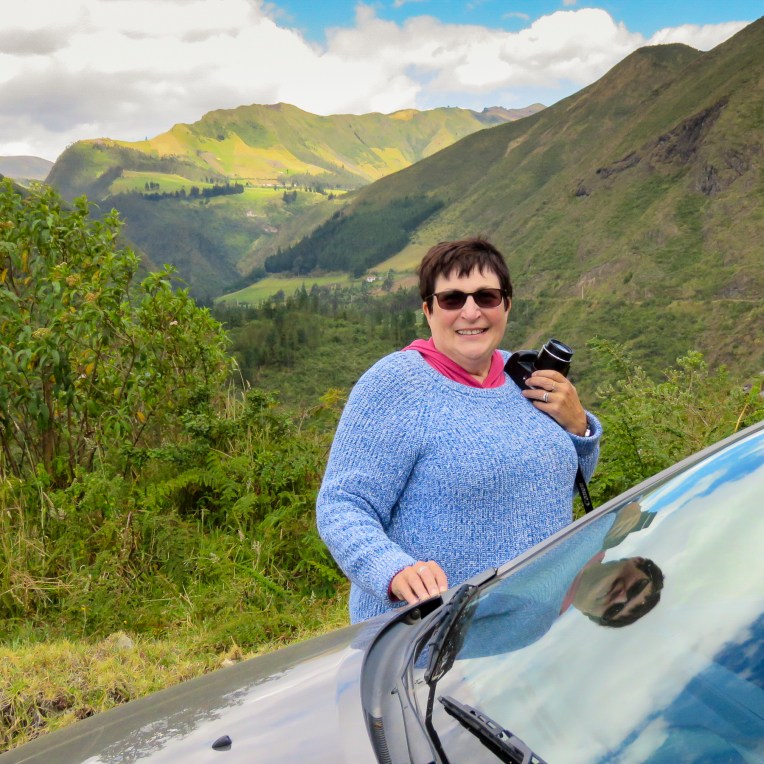

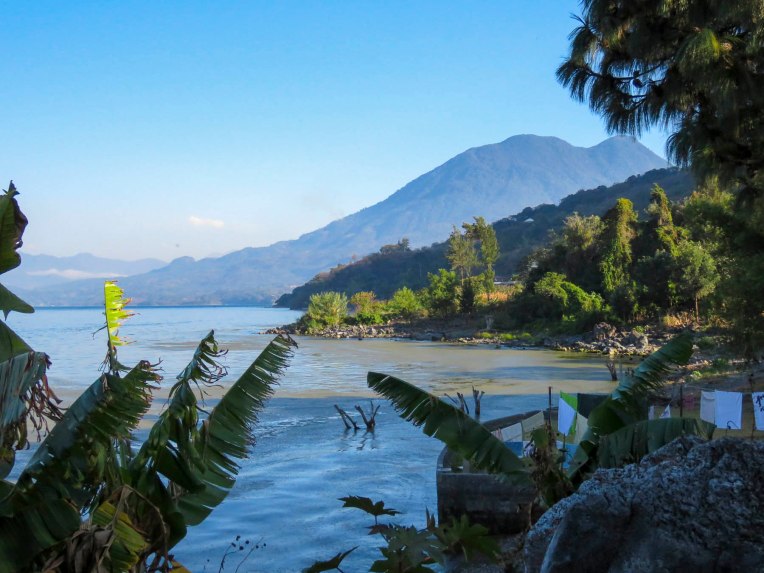


 The scenery along the drive to Lake Atitlan, along roads that continued to climb higher, was spectacular with verdant greenery and distant volcanos appearing then disappearing again with each twist of the serpentine route.
 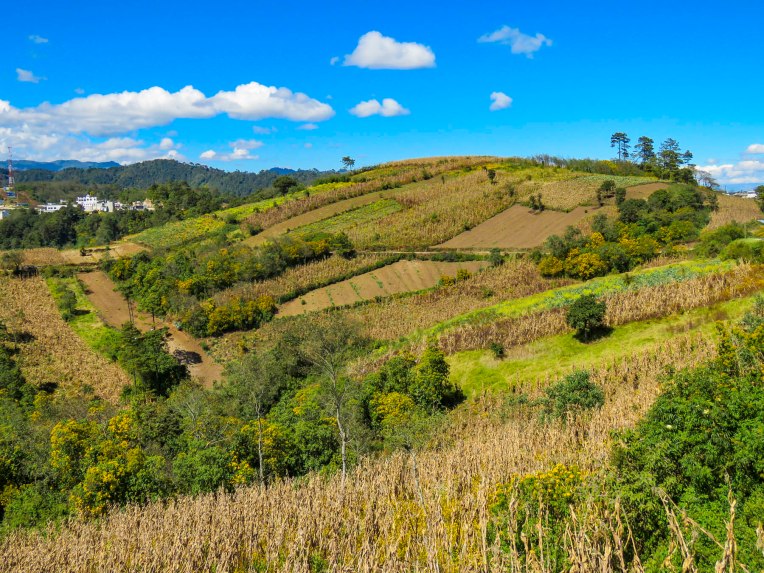 Arriving in San Pedro we thought we were on a movie set for a sequel to Mad Max or Water World. Down by the Panajachel dock dreadlocked travelers, wearing eccentric attire, filled the streets along the lakeshore. Feeling as if we had time traveled, we were relieved to find our Airbnb far out of town on a dead-end road that ran along the lake. According to Google maps the road was unnamed. Our host said “tell the tuktuk drivers you are staying on Calle Finca,” which referred to a distant and abandoned coffee farm, about an hour’s walk from the trail head at the end of the road.
 Our new home for our last week in Guatemala had a wonderful porch with great view of Lake Atitlan and tranquility. A relaxing change of pace was called for after the Christmas and New Year’s Day celebrations in Antigua. Bird calls or the soft Mayan chatter of coffee pickers, harvesting ripe beans right outside our door, were the only sounds that filled the air. Fortunately, we were much closer to town than the abandoned coffee finca and were able to walk to the daily outdoor market, along streets where we could see women washing clothing in the distant lake, and make-shift scales were set up to buy coffee beans hauled down from the slopes of Volcan San Pedro.


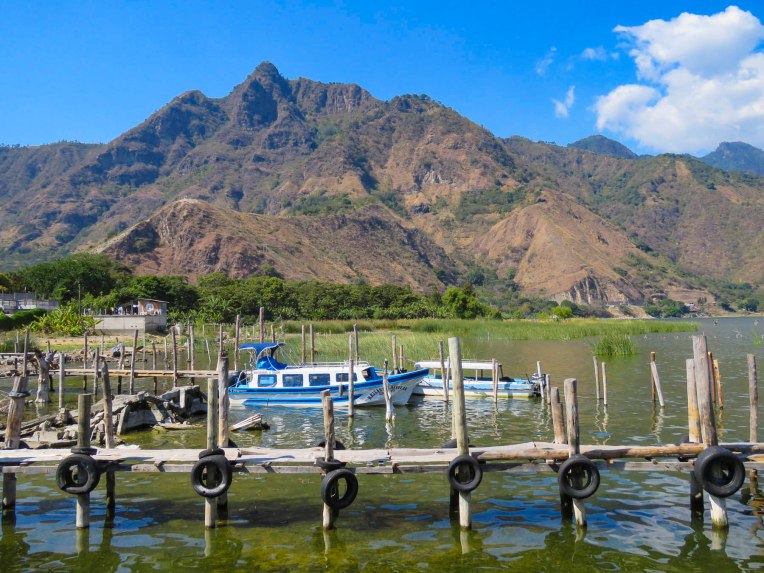 A short ferry ride took us to San Juan La Laguna, a weavers and artists village that visually celebrates its Mayan heritage with colorful street murals. The steep walk uphill from the boat dock to the center of town was lined with art galleries.


 It’s a long ferry ride to Santiago de Atitlan and even longer when the wind churns up whitecaps on the water, and the small boat we were in rocked side-to-side for the duration of the crossing. We silently said our prayers when the local folks stated to reach for the life preservers. Fortunately, we were never too far from shore and know how to swim. It is a breathtaking view coming into the boat dock at Santiago with its namesake volcano towering over the town and Volcan San Pedro just an avocado toss away, across the water.


 Enjoying the stars from our porch we were surprised when fireworks celebrating Epiphany lit up the night sky above villages across the lake, their colorful bursts reflected brilliantly on the water. With magical moments like this, still fresh in our memories, Guatemala tugged at our hearts as we packed for our next adventure.

 Paradise is such a subjective feeling and if you don’t require a turquoise blue sea and white sand beaches, Antigua, Guatemala just might fit the bill. This charming colonial city with its ever spring-like weather was perfect for our two-month stay.
  We arrived in Antigua at the end of October so that we could attend the Sumpango Giant Kite Festival held every year on November 1st, All Saints Day. That spectacularly colorful event and a religious procession that burst forward from La Merced Church on October 28th would prove to be representative of the people and life in Guatemala we experienced.


 On Mondays, Thursdays and Saturdays the market tripled in size when the outdoor portion was open, and farmers brought in truckloads of fruits and vegetables from the surrounding villages. There we experienced one of the best markets going, set in a bustling, dusty lot with Volcans Agua, Fuego and Acatenango touching the sky in the background. Most produce was sold in quantities of 5 quetzals (60 cents) so bring lots of small bills, as vendors didn’t usually have change for anything larger than 10Q. The flavor of the locally grown vegetables was amazing. Being backyard gardeners ourselves, we were duly impressed. Twenty quetzals would buy enough vegetables for a week.


 Shopping at the local supermarket, La Bodegona, was a wonderfully hectic experience. At times it could feel like you were shopping from a conga line, weaving up and down aisles, afraid to leave the line for fear of not being able to enter it again and being stuck in dairy for eternity. Numerous store employees lined the aisles offering samples of cookies, deli meats, drinks and other temptations to keep the energy level of the beast alive. It was a hoot! We had to psych ourselves up, like players before the big game, to shop there because it was so hectic and required a certain mental and physical stamina. I will confess though to dancing in the checkout line to blaring Latino Christmas music – the mood was contagious.
  On the same block D&C Cremas, a Walmart affiliate, offered a more sedate shopping experience. Both supermarkets had excellent poultry, which was more tender and tastier than back in Pennsylvania. We were also fortunate that a pork butcher opened a new shop a half block away and offered fresh meat and sausage daily. We enjoyed all the different varieties of Guatemalan sausage he made and found them to be very flavorful and lean, with almost no fat.


 The next day we a followed a serpentine mountain road, second gear all the way, up to Santo Domingo del Cerro, a beautiful sculpture and art park with museums, walking trails and a restaurant that overlooks Antigua. Plan on spending at least a half day there, because it is a beautiful setting for a restful day or afternoon. Casa Santo Domingo offers a free hourly shuttle to the park from the hotel in town.


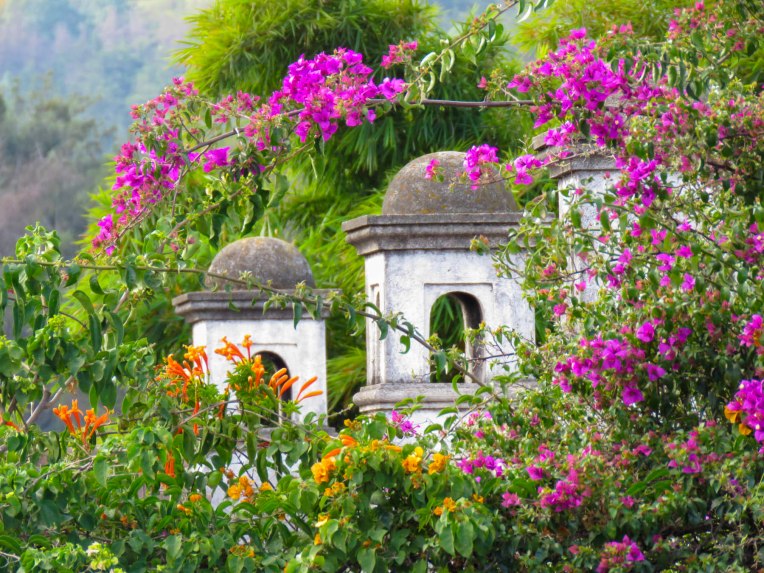 Antigua filled early with people in all their finery on New Year’s. Vendors selling textiles the day before were now offering party hats and all sort of 2019 memorabilia. Concerts were held in Plaza Mayor and under El Arco. Firework launchers were being setup amidst the crowds in the streets. Families were picnicking in the park and folks were staking their spots early to watch the fireworks later. At midnight a loud and colorful display filled the night sky. We could hear the roar of an appreciative crowd from our rooftop. We heard random explosions throughout the night to sunrise. Guatemalans love their fireworks!


 2 Suitcases for 2 years