
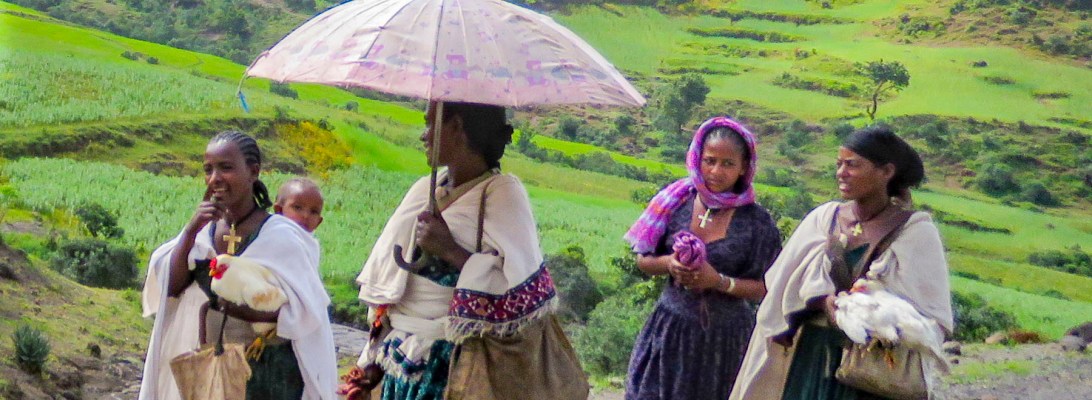
 Walking, walking, walking! The countryside is full of folks out and about on their feet. There is a rural minibus network connecting larger villages once a day, and Lalibela has tuk-tuks, of course. But mostly, whether it’s due to lack of affordability or availability, people walk to and from everywhere. Sometimes it is necessary to travel great distances to accomplish simple, everyday tasks like gathering water, heading out to tend a remote field, going to market, or even farther to visit a doctor.
 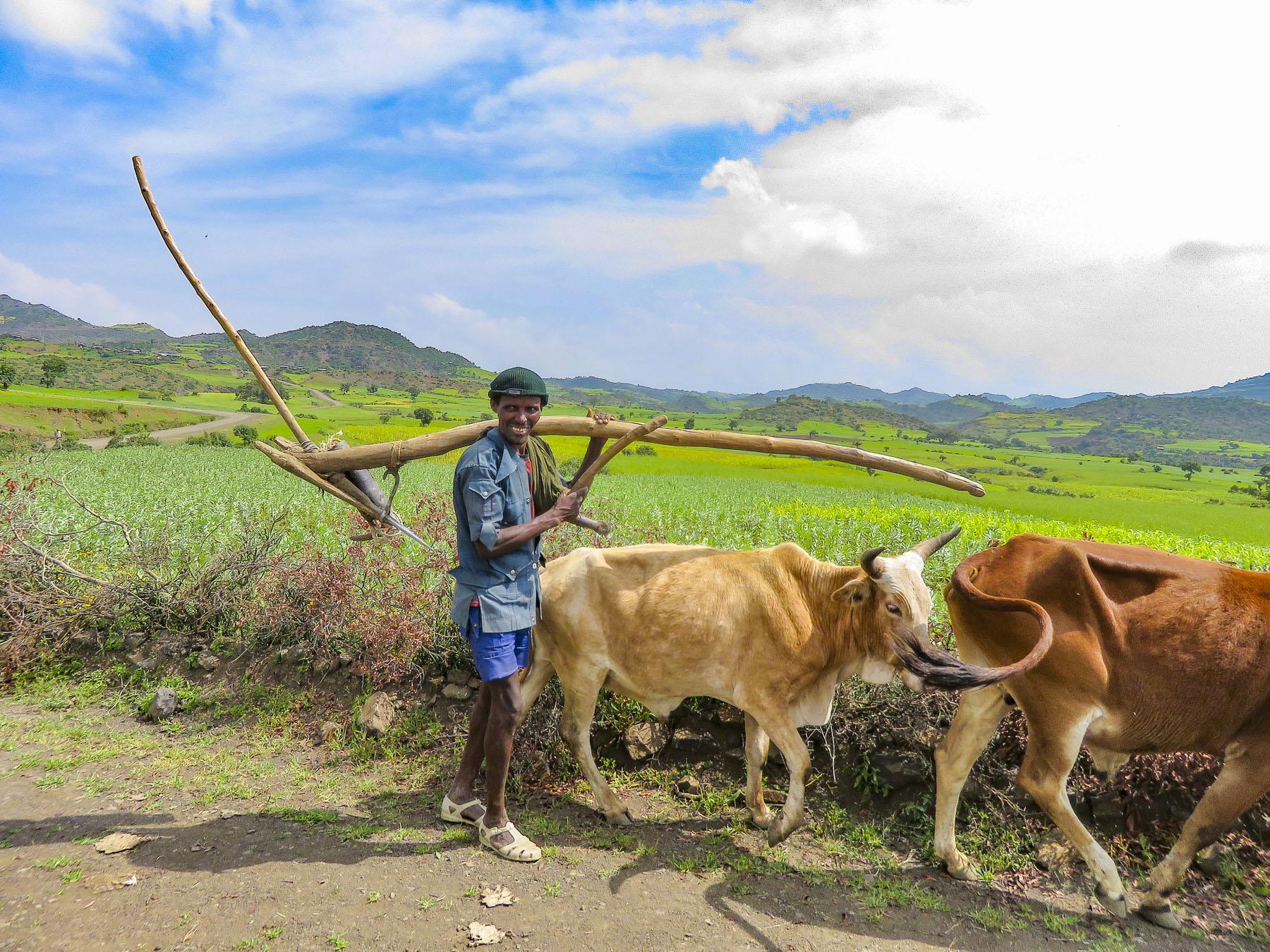 In the rugged agrarian highlands surrounding Lalibela, all the fields are tilled by farmers walking behind teams of oxen, as it has been done for centuries, on farmland passed down through a communal hereditary system called rist.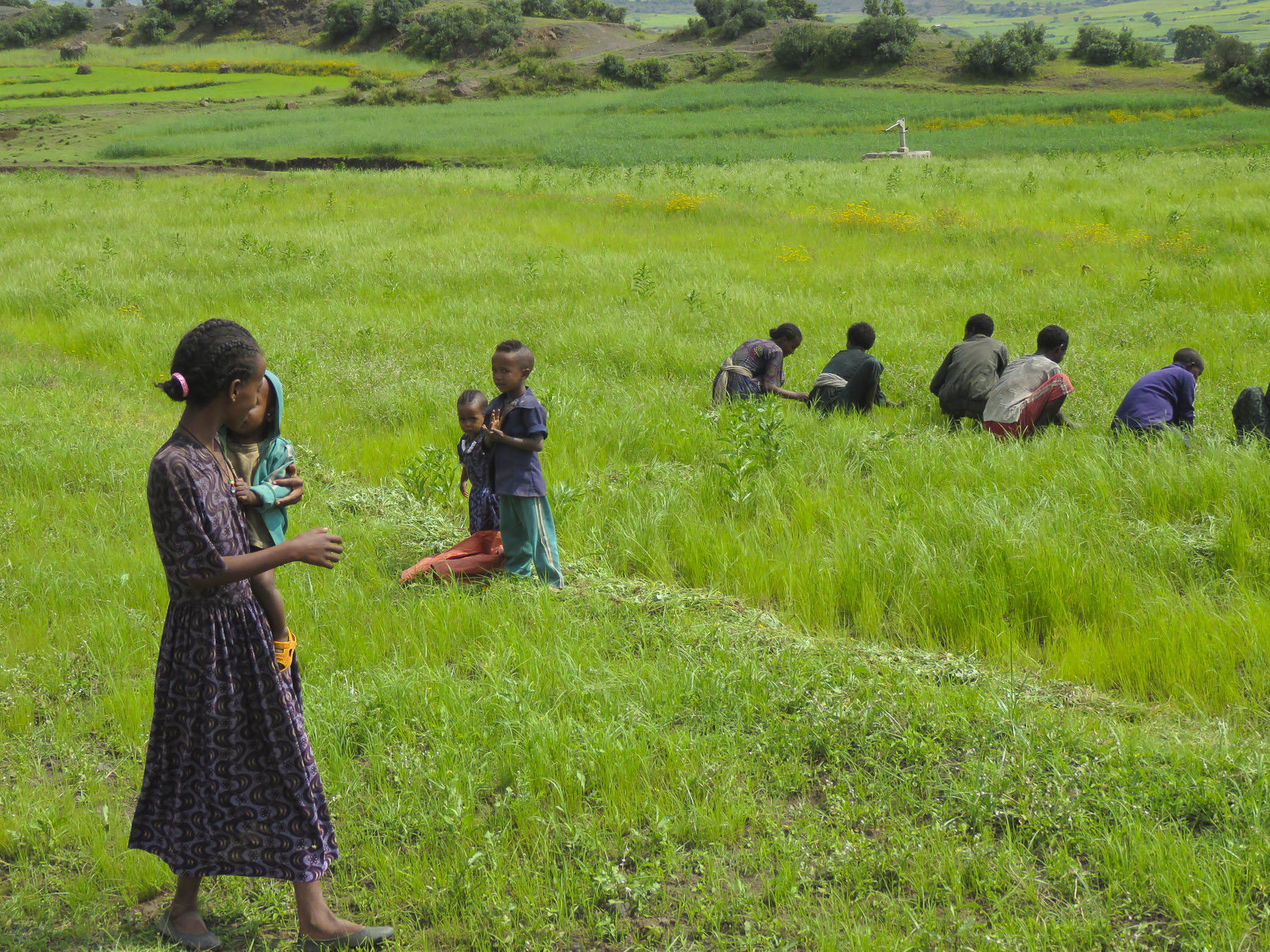

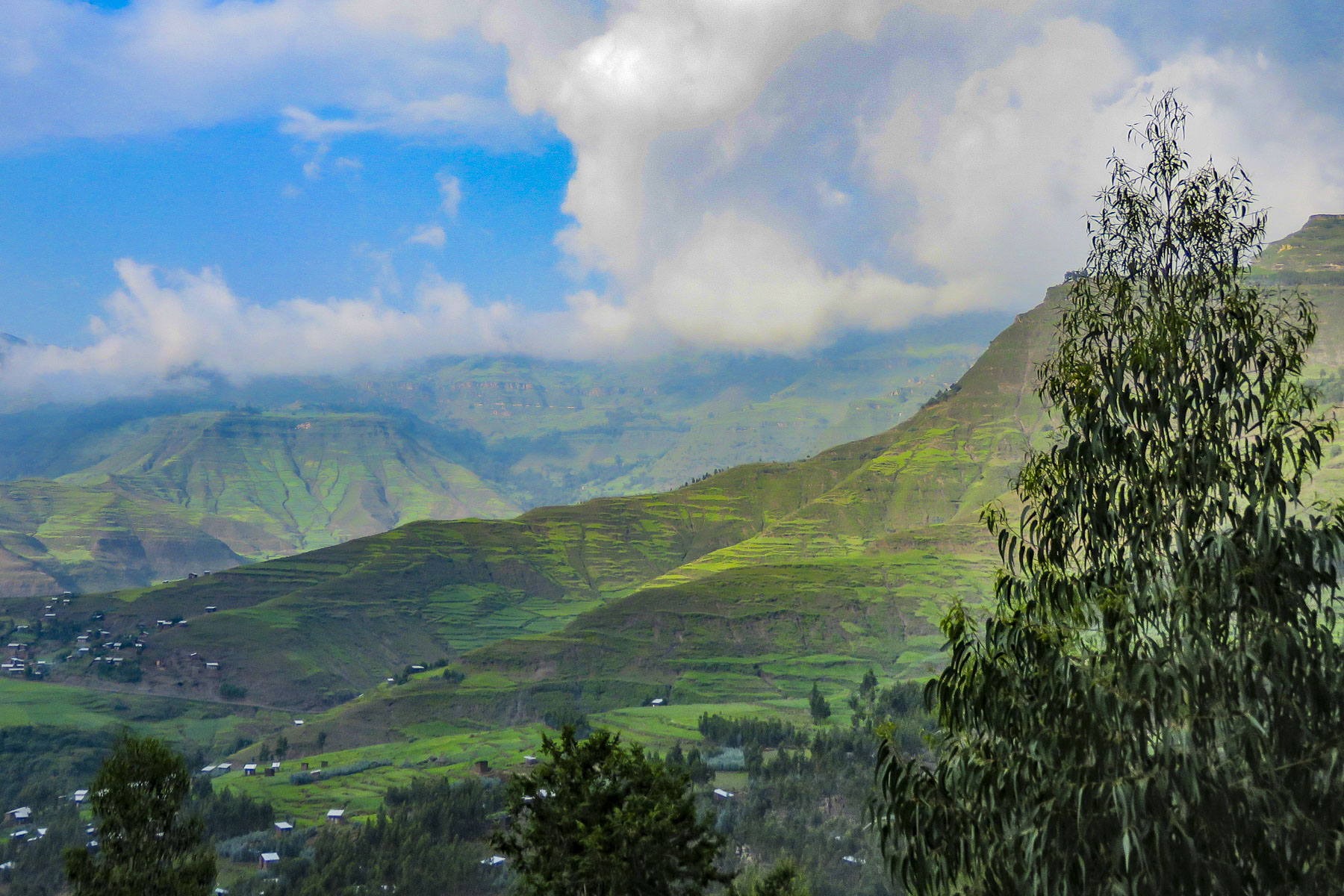
We passed many individuals and groups walking as we made our way into the beautiful highlands surrounding Lalibela to visit St. Yemrehana Krestos Church, named for the king that commissioned its construction around 1100 AD.

It’s only 12 miles from Lalibela as the crow flies, and until the road was put in not too long ago, a two-day trek from town. Now, twenty-six miles of dirt road and an hour and half later we were there, a world away from Lalibela.

The path to the church took us across a footbridge spanning a boulder-strewn stream where women were washing clothes in the rushing water below. They agilely jumped from rock to rock as they spread their laundry out to dry. As we headed uphill, we stopped at the bottom of a set of stairs to wait for a group of church elders to cautiously descend.


Situated at 8500 ft above sea level, the altitude was catching up to us and we were glad to sit for a while in front of the church to admire its setting. St. Yemrehana Krestos is not a legendary rock church, but a cave church built at the mouth of a deep cavern, behind a tall slender waterfall.

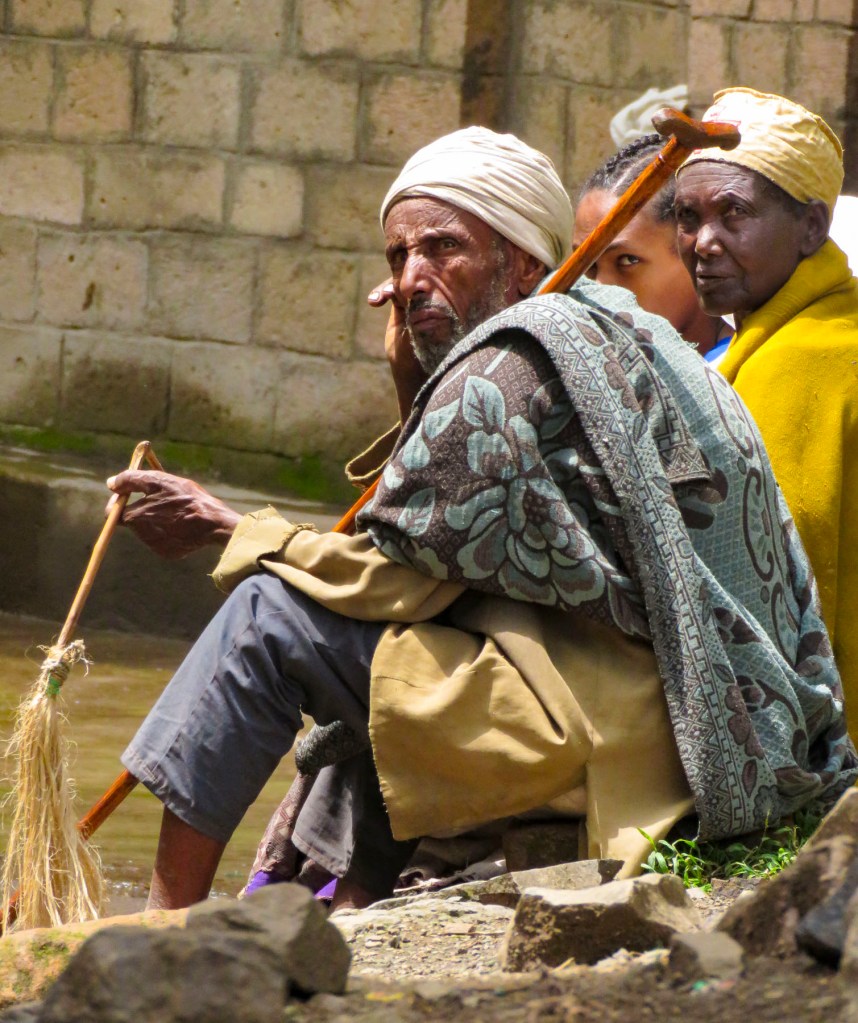
It’s constructed in a distinctive pattern of horizontal stone block, followed by a recessed layer of timber in an architectural style copied from the Aksumite Kingdom that flourished from 400 BC until the 10th century AD.

The cave is very spacious and actually contains two buildings. The second directly across from the church is thought to have been the king’s humble palace or treasury, according to our guide. The door to it was open, but it appeared to be used mostly for storage now. The floor between the buildings is covered with reed mats that hide a substructure of large olive wood beams built over a shallow spring-fed pool that can be reached by a trapdoor in front of the church.
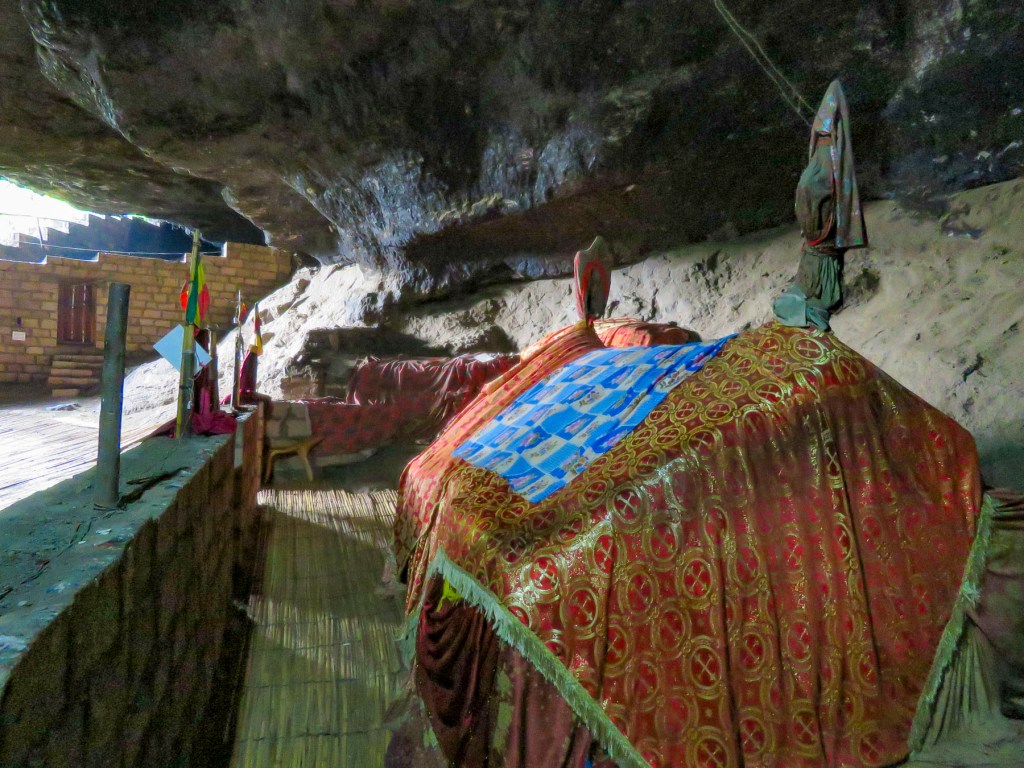
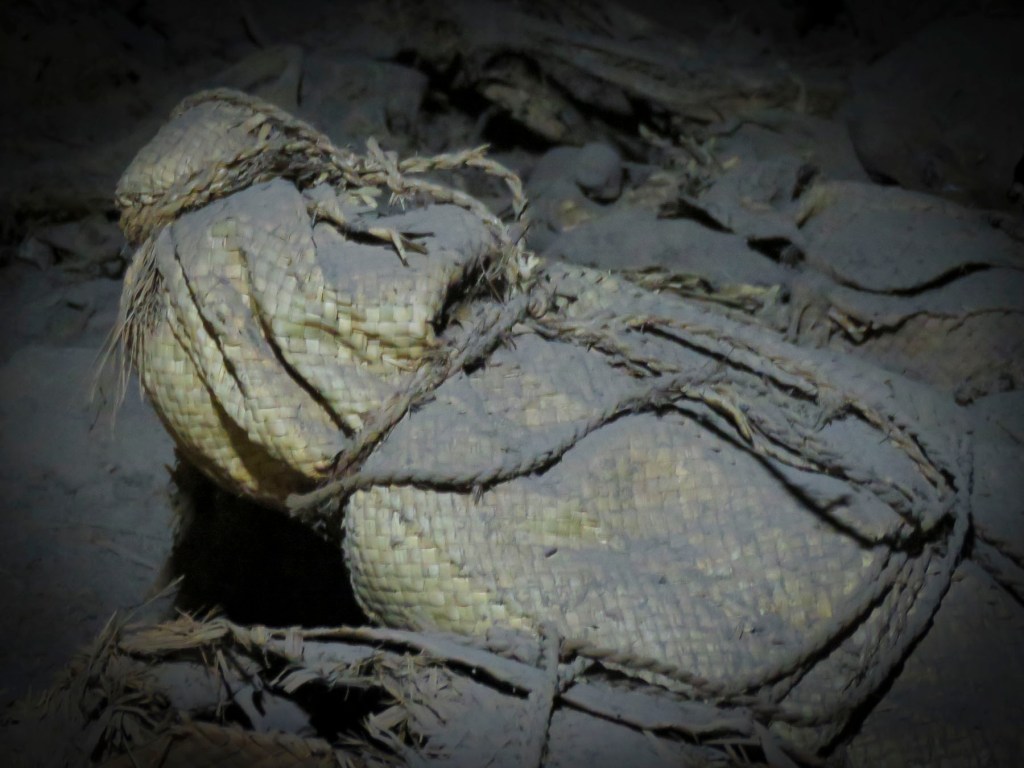
Behind the church are two tombs draped in fine cloth, to indicate their royal significance. The larger tomb is thought to be the grave of King Yemrehana Krestos and the smaller one that of his slave, Ebna. Deeper into the cave there is a mass grave of several hundred now mummified bodies, which have been piled on top of each other for centuries, the corpses of pilgrims and monks who could go no further.
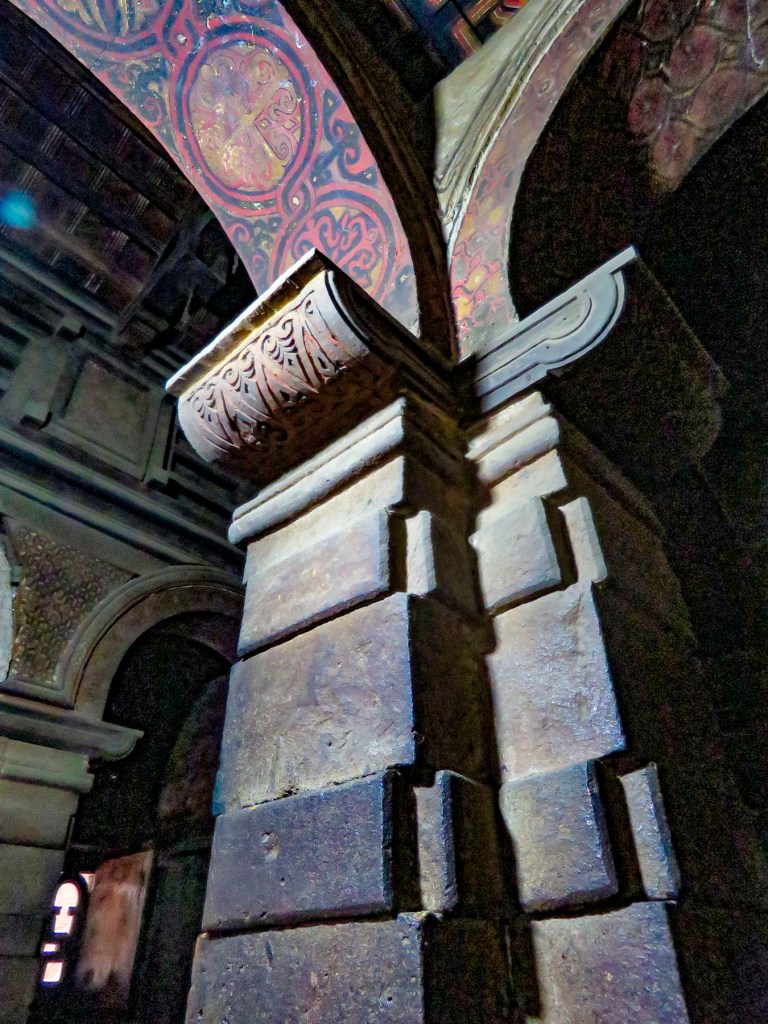
It took our eyes awhile to adjust to the dim interior of the church as we worked our way through a columned interior, the tops crowned with wood and stone carved capitals. Never restored, centuries of accumulated candle soot partially obscured an inlaid wooden ceiling with geometric designs and, on the walls, what are thought to be the oldest examples of mural paintings in Ethiopia.


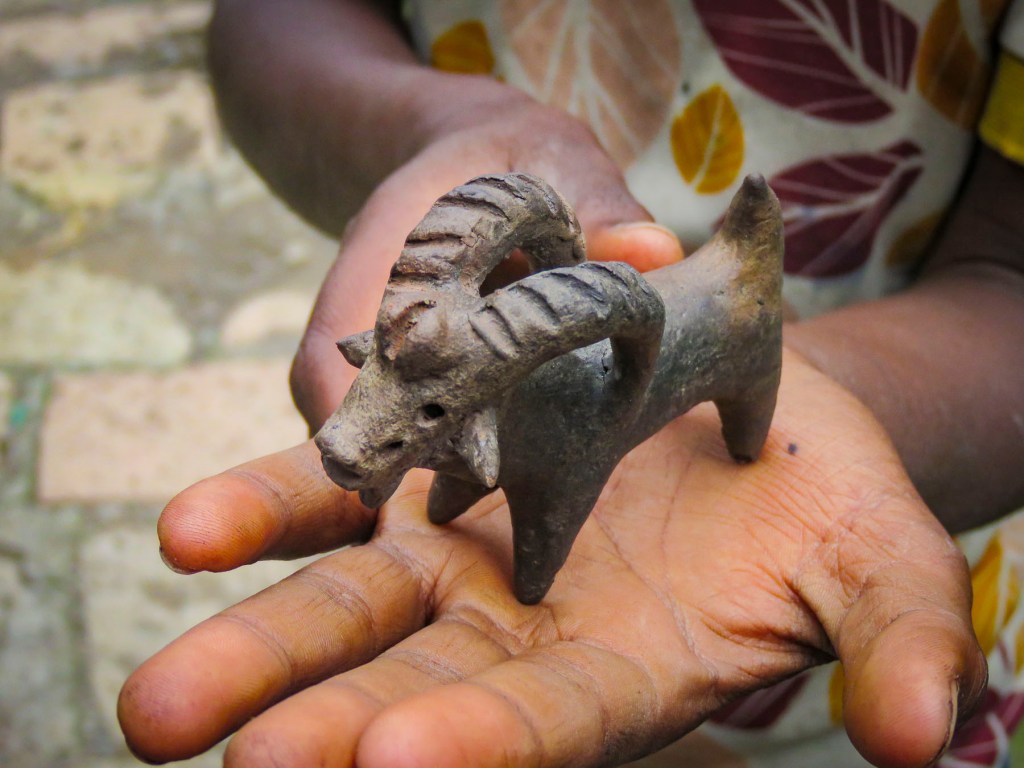
Outside a local teenager was selling small clay figurines of animals. His rendering of a Walia ibex, native to the Ethiopian Semien Mountains, caught our eye and we made his day with a purchase.
Heading back, we passed Bilbala St. George Church, a rock church built in the 5th or 6th century AD by King Kaleb. It is legendary for its sacred bees that have lived in hives in the courtyard since its founding. Their honey is renowned for its healing properties, especially for the treatment of skin problems and psychological disorders. We were crazy not to stop; in retrospect, we regret our decision.
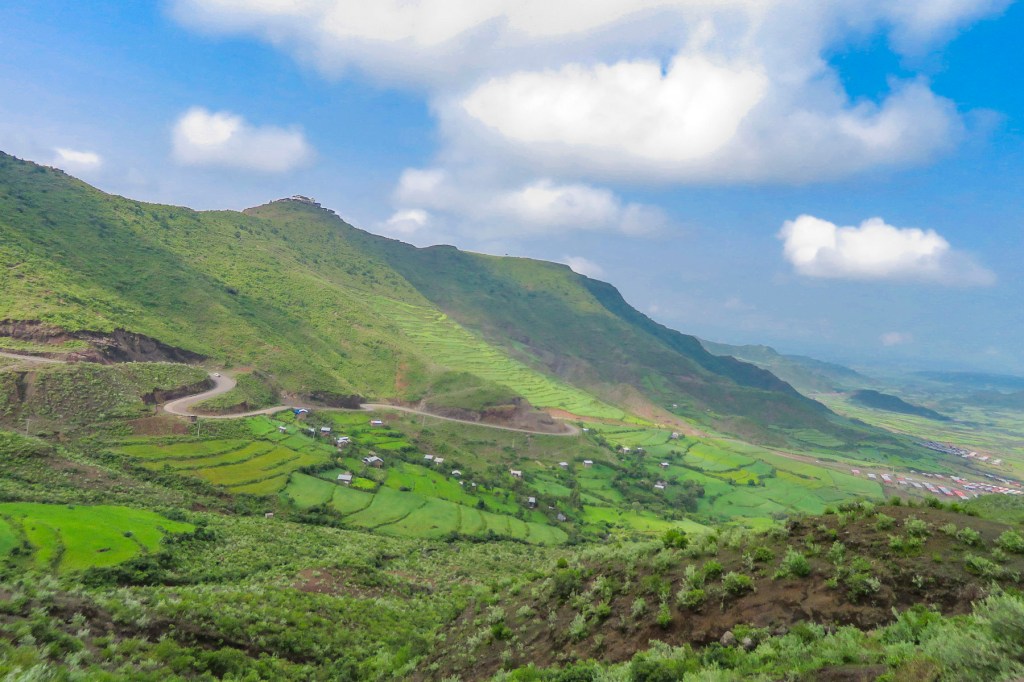
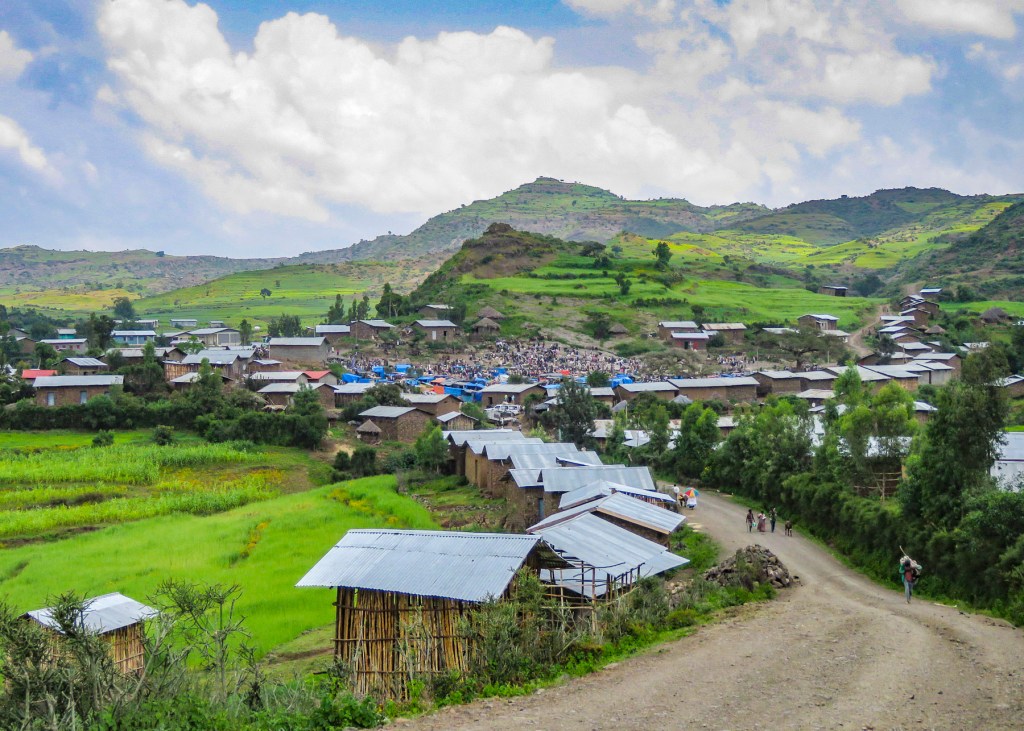
Walking, walking, walking. Coming or going, people carrying umbrellas for shade traveling along with goats or chickens, for sale or for dinner – the road was crowded with activity as we drove through the village of Bilibala on its market day.
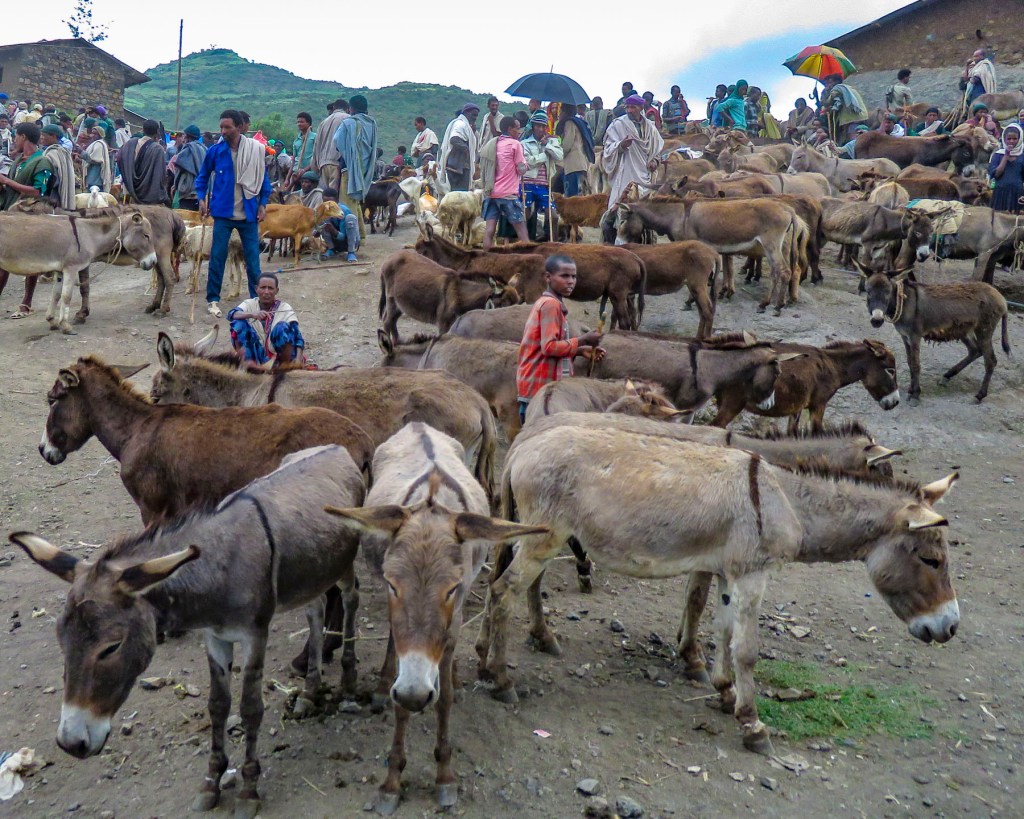
With no semblance of trying to attract tourists, we had a better chance of coming home with a donkey from the pre-owned animal auction lot than a souvenir.
Outside the village at the turn to our next stop, a magnificent ancient fig tree provided shade under its graceful canopy.

After walking briefly through a shady forest and crossing a narrow stream rock to rock we could see a large, what was once a turtle-shaped, monolithic rock rising from the ground before us, its front curve altered a millennium ago. The façade was chiseled smooth to be a high flat wall with an entry door centered in it. This was the wall to the courtyard that surrounded the church; from the outside only a small section of the upper part of Bilbala Kirkos Church peaked above the wall.

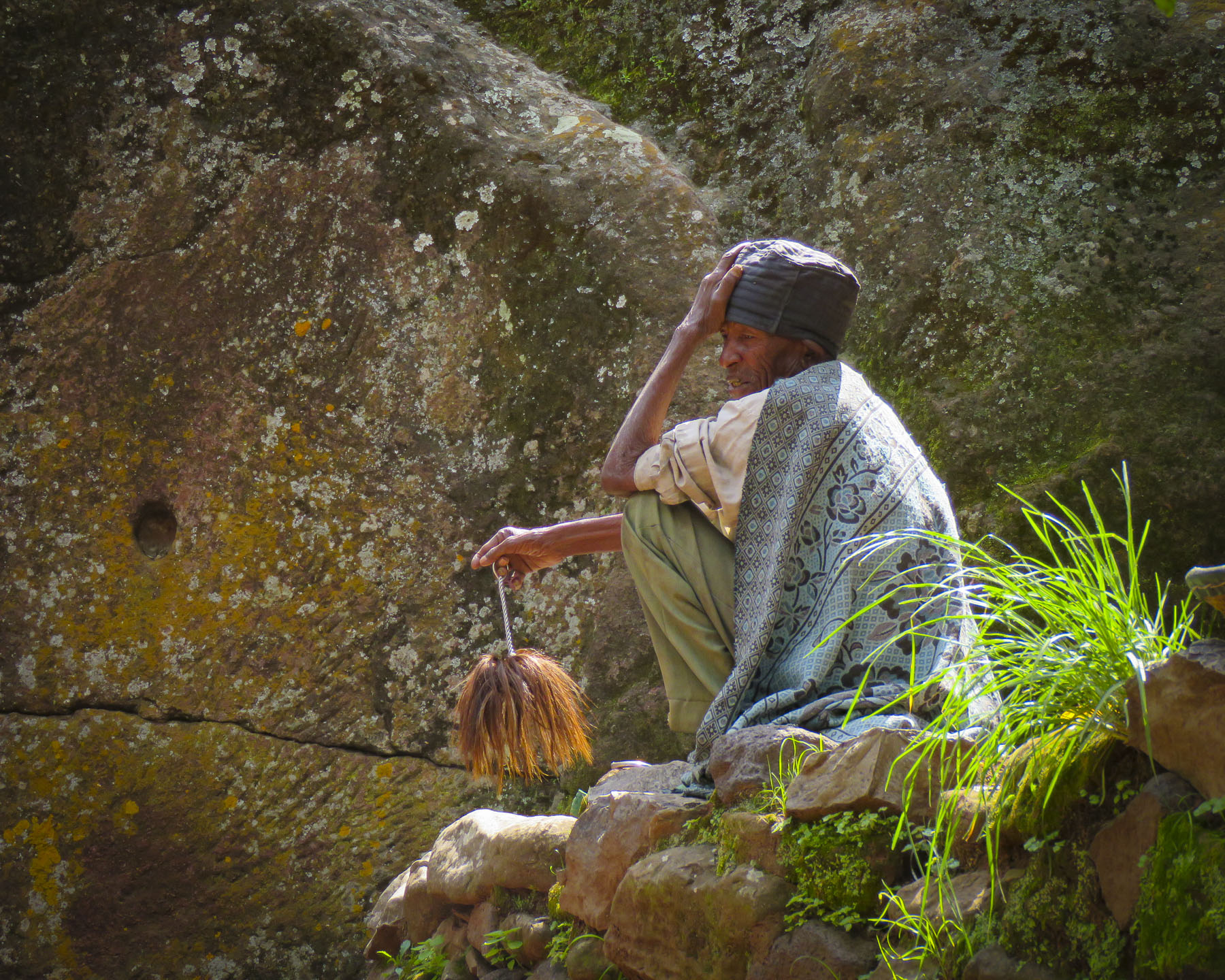
Hearing us approach, the caretaker emerged from behind his home, swishing away pests with a cow tail fly-swatter as he approached, and told us that the church was locked because the priest was away in another village to attend a funeral, but we could go into the courtyard.

Shoes off, we crossed through an ancient threshold hewn in the 6th century AD into a spongy moss-lined trench that encircled the church on three sides and served as its courtyard. The eastern wall or back of the church was still attached to the living rock. High arched windows were piled with stones to keep out birds and other critters.



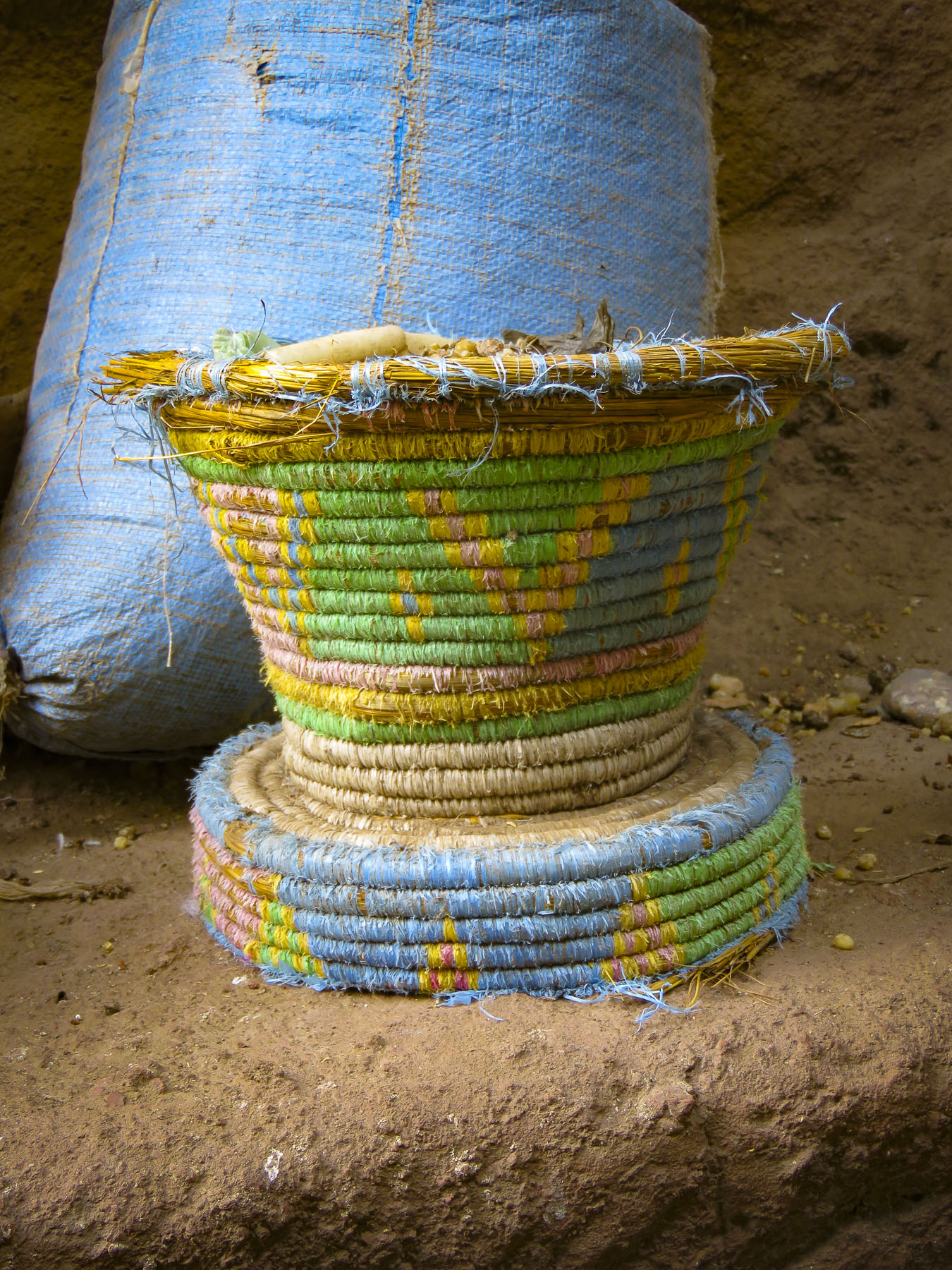
Worn entry steps testified to centuries of use. As we were getting ready to leave, the caretaker offered us tella, an Ethiopian home-brewed beer made from teff and sorghum grain and fermented with buckthorn. Out of concern for maintaining our good health, we passed on the offer, but our guide enjoyed it and shared that “tella is used for religious purposes when holy wine is not available.” Sacred bees and holy beer – we’re on to something here.
Cheers. Till next time, Craig & Donna

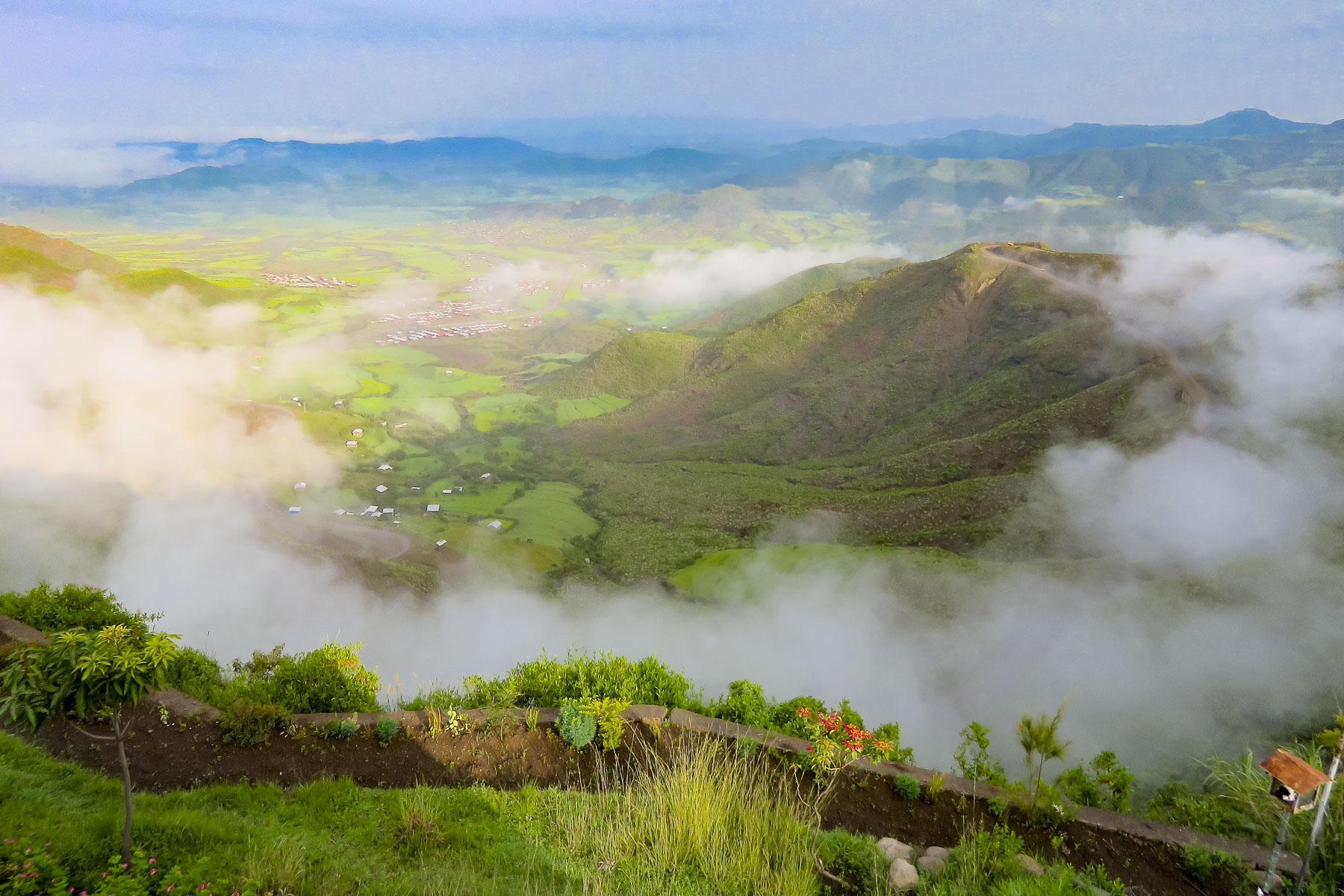 We started our day listening to bird calls and watching the morning clouds burn off from the valley below our hotel as the sun rose higher into the sky. The


 The shops were busy, and the roadside Ping-Pong games were in full swing as we departed Lalibela. The road into the mountains rose quickly from Lalibela into a semi-forested landscape. Too steep for crops, the land was used for cattle, which grazed on clumps of wild grasses on the hillside. We stopped at one clearing for the view and noticed a herder gently nudging his cows away from recently planted tree seedlings. “This is part of our government’s commitment to reverse deforestation and help mitigate climate change. It’s called the
  “On July 29th Ethiopians planted 350 million trees in a single day, a world record!” he proudly shared. “The farmers know how important this is and help shoo the cattle away, but the government has also chosen a tree seedling that doesn’t taste good.” This annual Ethiopian project is part of the African Union’s
  The road deteriorated after this, with deep mudded ruts tossing us from side to side regardless of how slowly we navigated through, over or around them. Our “rattled tourist syndrome” is the most appropriate way to describe the ride, while optimists might refer to it as an an “African deep tissue massage.” We were the only truck to park at the trailhead to the Asheten Mariam Monastery and were greeted with children selling handicrafts, and young men renting walking sticks and offering to accompany us on the hike.
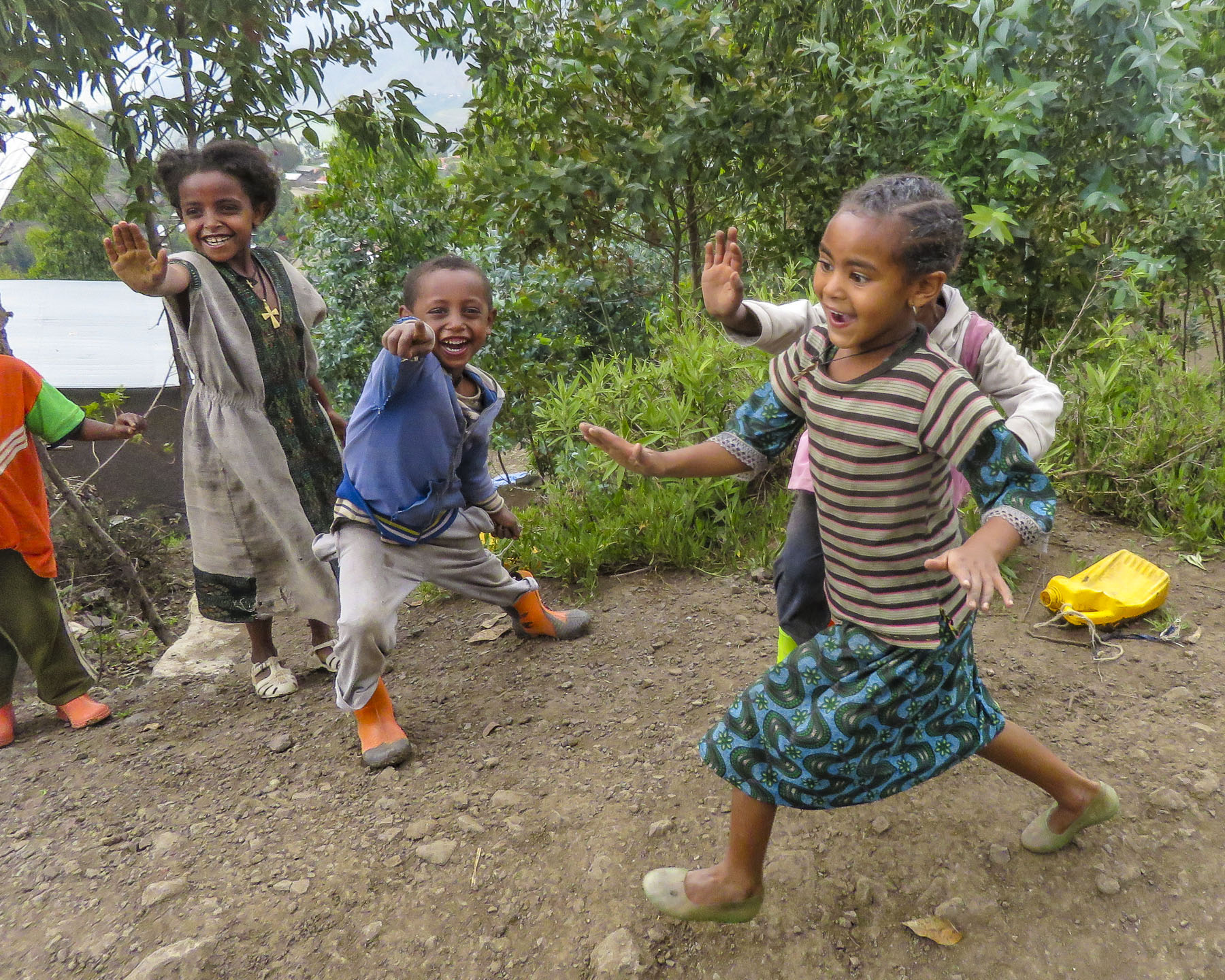 Confident in our abilities we declined, but they tagged along anyway. This was a good thing. What our guide had forgotten to mention was that there was a short steep section at the beginning of the hike, before it leveled off. Within minutes, between the altitude and the terrain, our hearts were pumping and my wife, who struggles with asthma, was gasping for breath. We are unfortunately not the 7 second 0-60mph vroom, vroom of a 1964 Corvette anymore, but more like the putt-putt of a classic Citroën 2CV. We get there, eventually. So, our guide, forgetting his youth and our age, led the way from a distance, as if he was channeling
  It was at this point that my wife spoke up. “Girma, you must think of me as the same age as your mother.” Instantly, his attitude became very solicitous, and he smilingly offered her a hand or other assistance at every opportunity. We marveled at the agility of the local kids. They nimbly scampered up and down the trail, easily outdistancing us, in order to set up their little trailside displays of carvings and beadednecklaces. When we didn’t purchase at first, they simply packed up and reappeared further up the trail. We had to reward such perseverance with a couple of purchases.
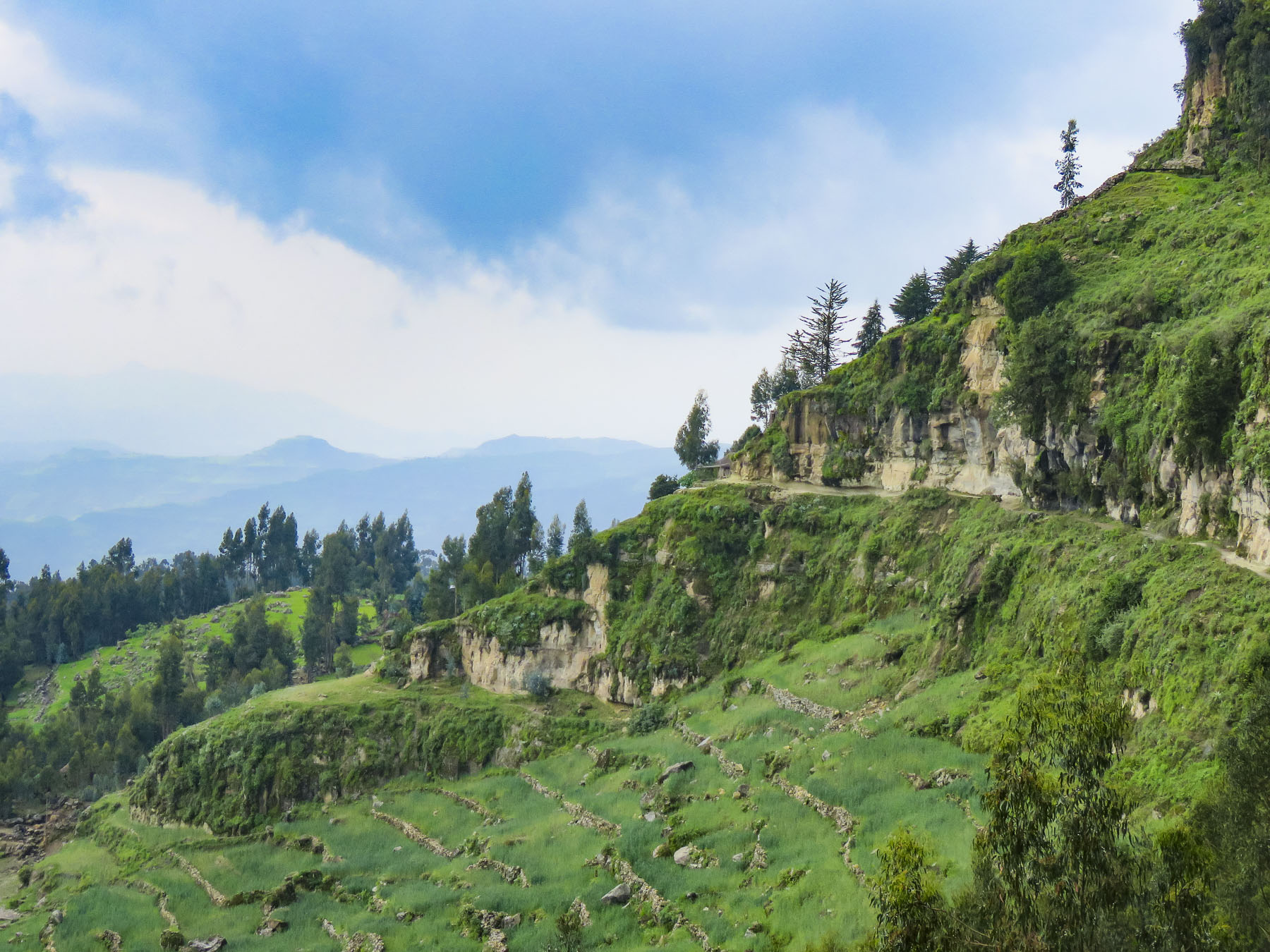 Meanwhile, we regained our pace as the trail leveled off and tracked along the base of a cliff face that fell away to terraced farmland far below. The incline of the trail continued to rise; the walking sticks were now invaluable in helping us steady our footing on the rough path. Around a curve the trail abruptly narrowed at a sheer rock wall broken by a vertical chasm, slightly wider than our shoulders.


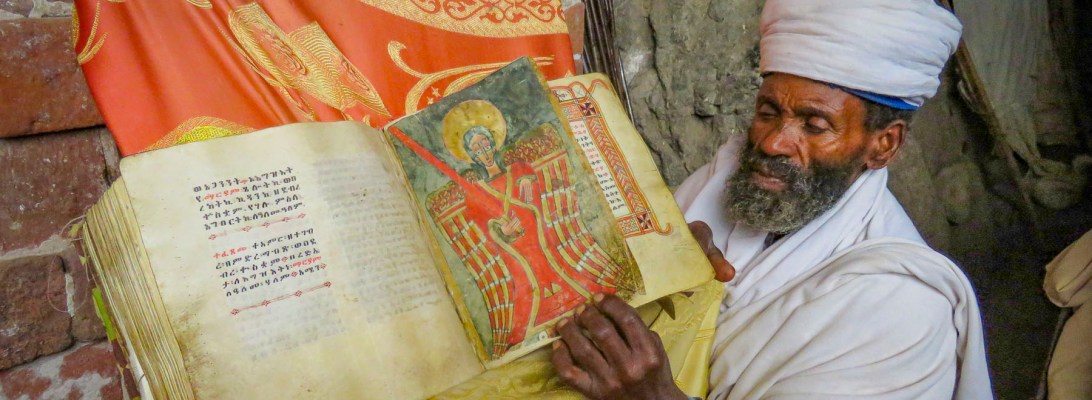
 Imprinted at the bottom of a page in one ancient text were the thumbprints of the ten scribes who helped copy the book. Legend has it that it was the first church ordered built by King Lalibela during his reign in the twelfth century and that his successor, Na’akueto La’ab, who only ruled for a short time, is buried there.


 Coming to the end of the road, we could see the monastery dramatically situated behind a small waterfall, in a long shallow cave at the bottom of a cliff.

 Stone bowls smoothed from centuries of use sat in various places on the rough floor to collect the water seeping from the cave’s ceiling one drip at a time. It gets blessed by the priest and used as Holy water, continuing a tradition from the 12th century when King La’ab ordered the monastery’s creation.


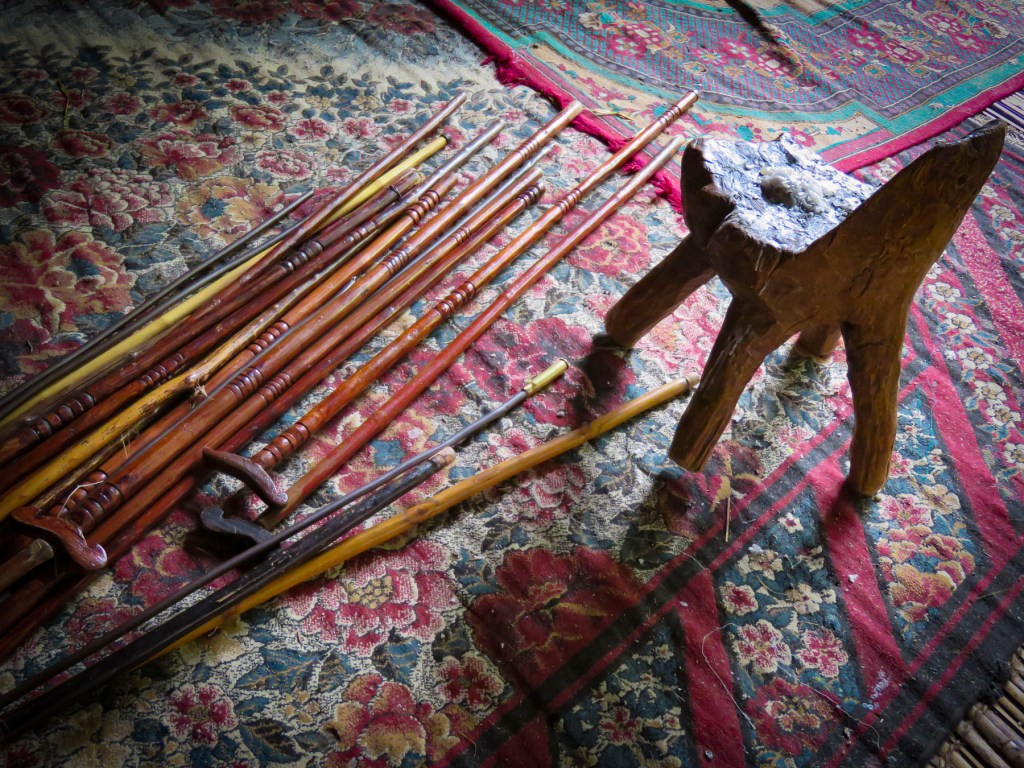
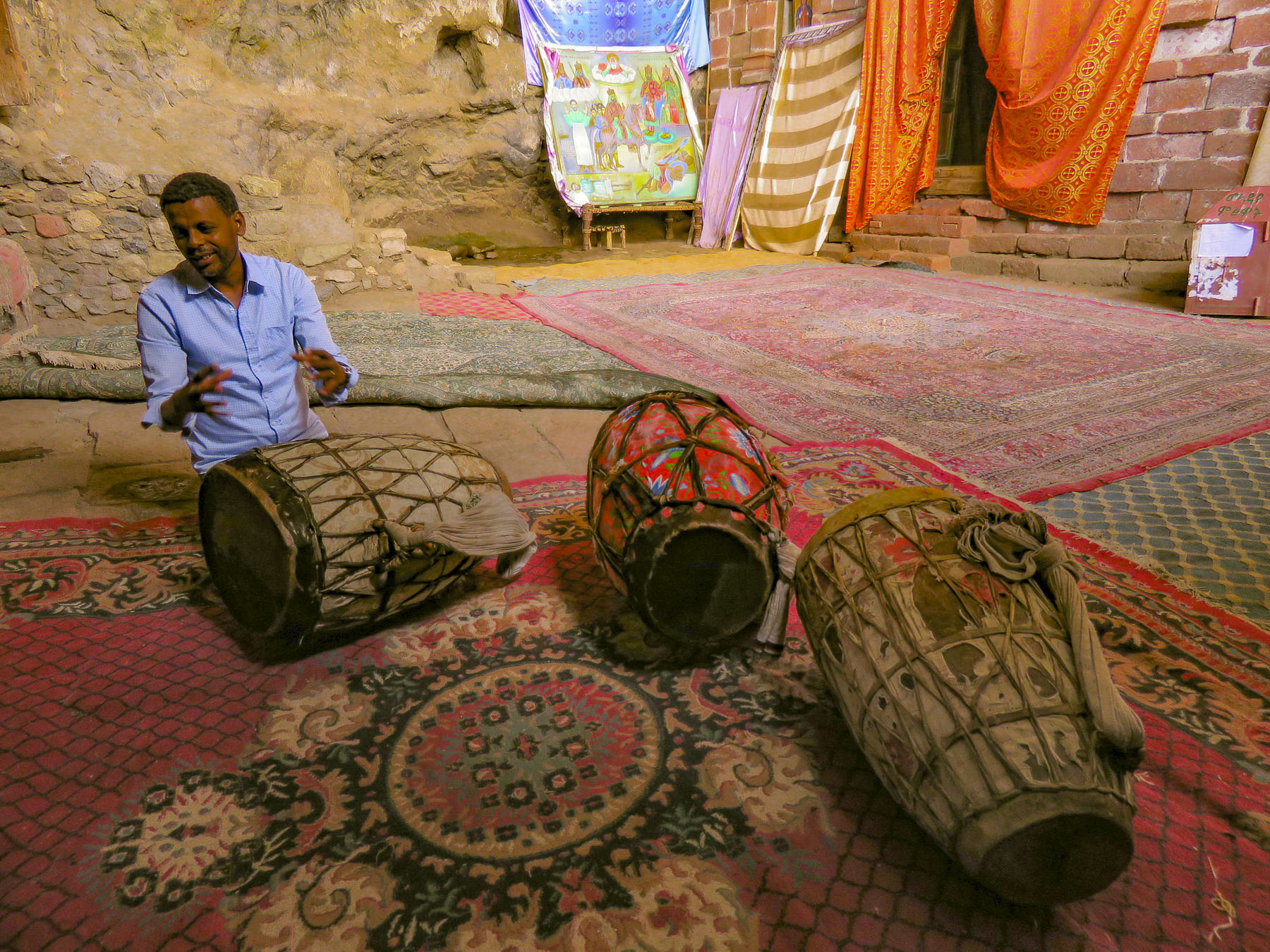 In the learning area, layers of carpet attempted to smooth an uneven, rocky floor where the novitiates sit to learn the ways of the orthodox church. In the corner rested several large ceremonial drums used during worship services. Picking one up our guide beat out a rhythm that would normally accompany liturgical chanting, or Zema, by the young monks. We’ve noticed that the treasures of the Ethiopian churches are not determined by their monetary value and locked securely away, only to be used on religious holidays, but by their spiritual connection. Precious, irreplaceable, ancient bibles and manuscripts, lovingly worn and torn as they are, continue to be used every day, as they have been for the last nine-hundred-years.
 It is well worth the effort to visit these remote churches and monasteries. The physical strength required and hardships endured to build these remote churches as a testament of faith continues to be inspiring.
 2 Suitcases for 2 years