Madeira: Pico Ruivo, Santana & Faial or Summits, Valleys and Stones

We imagine it’s possible to enjoy a full week pleasantly wandering the quaint streets of old town Funchal, basking in the sun and swimming in front of Forte de São Tiago, while venturing no farther afield than the Monte Palace Tropical Garden.

But the real beauty of Madeira lies in its rugged seascapes and mountains. The mountains admittedly aren’t that tall if you compare them to the Swiss Alps or American Rockies.

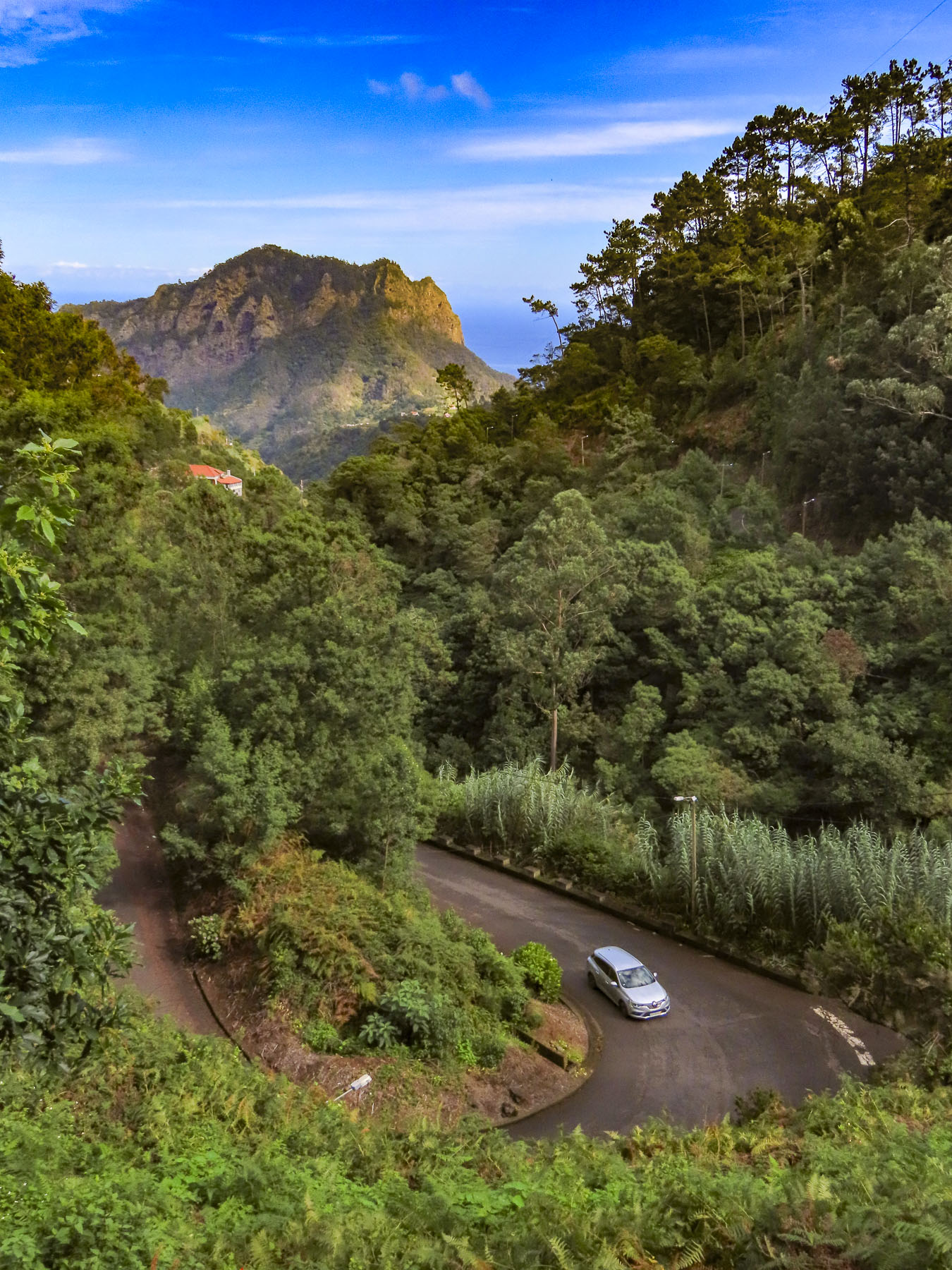
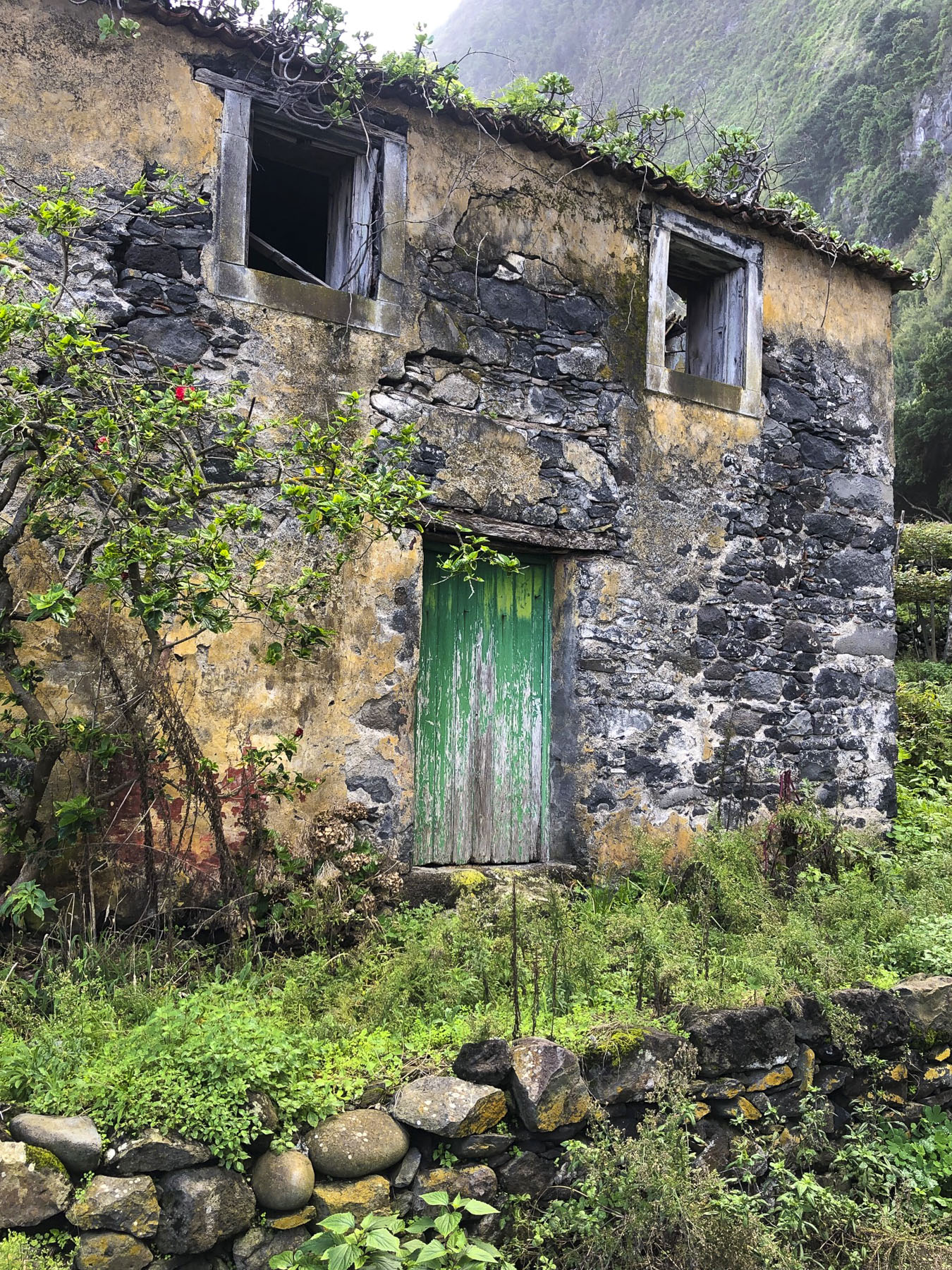
The highest, Pico Ruivo, reaches 6100 feet, nearby Pico do Areeiro is a tad shorter at 5,965 feet, and you can drive to its summit. A popular though arduous trail connects the two summits that are often above the clouds. In January and February, the sub-tropical island’s peaks can be snowcapped, and parents take off from work to bring their kids into the mountains to make snowballs and snowmen. There really aren’t foothills before the mountains. They appear to have been thrust violently upward from the earth’s crust like a knife thrower targeting a loaf of bread. They are tremendously steep and majestic, and you can experience them up close through various hikes or simply driving across the island’s numerous switch-back roads. Madeira in many aspects is similar to California, with a landscape where it is feasible to experience mountains and ocean in the same afternoon. On Madeira though it’s within the same hour.

The weather constantly changes on Madeira. The opposite of what’s forecast quite often is what happens, as it was the morning we looked up at a small patch of blue sky, teasing us with a shaft of sunlight while we waited in the parking lot atop Pico do Areeiro for our small group of intrepid hikers to gather. It was also a good twenty degrees chillier than Funchal and we quickly layered up. The clouds descended. A light rain began. Rain ponchos appeared. Visibility was 100 feet. Not the best conditions, but it was a non-refundable tour and our international group of seventeen stoically set forth into the clouds.

Commonly known as the “Pico to Pico” or the PR1 hike, it’s a semi-difficult 5-mile trek with a 1000 ft altitude gain. The route balances across narrow ridgetops and follows cliffside trails, climbs steep stairs and ladders, and passes through narrow rock-hewn tunnels before summiting Pico Ruivo. It then descends to the Achada do Teixeira parking lot for the return shuttle to Funchal. The path is improved in many sections with cobbled pavers and hand railing, but in other parts it was a muddy, puddled mess.

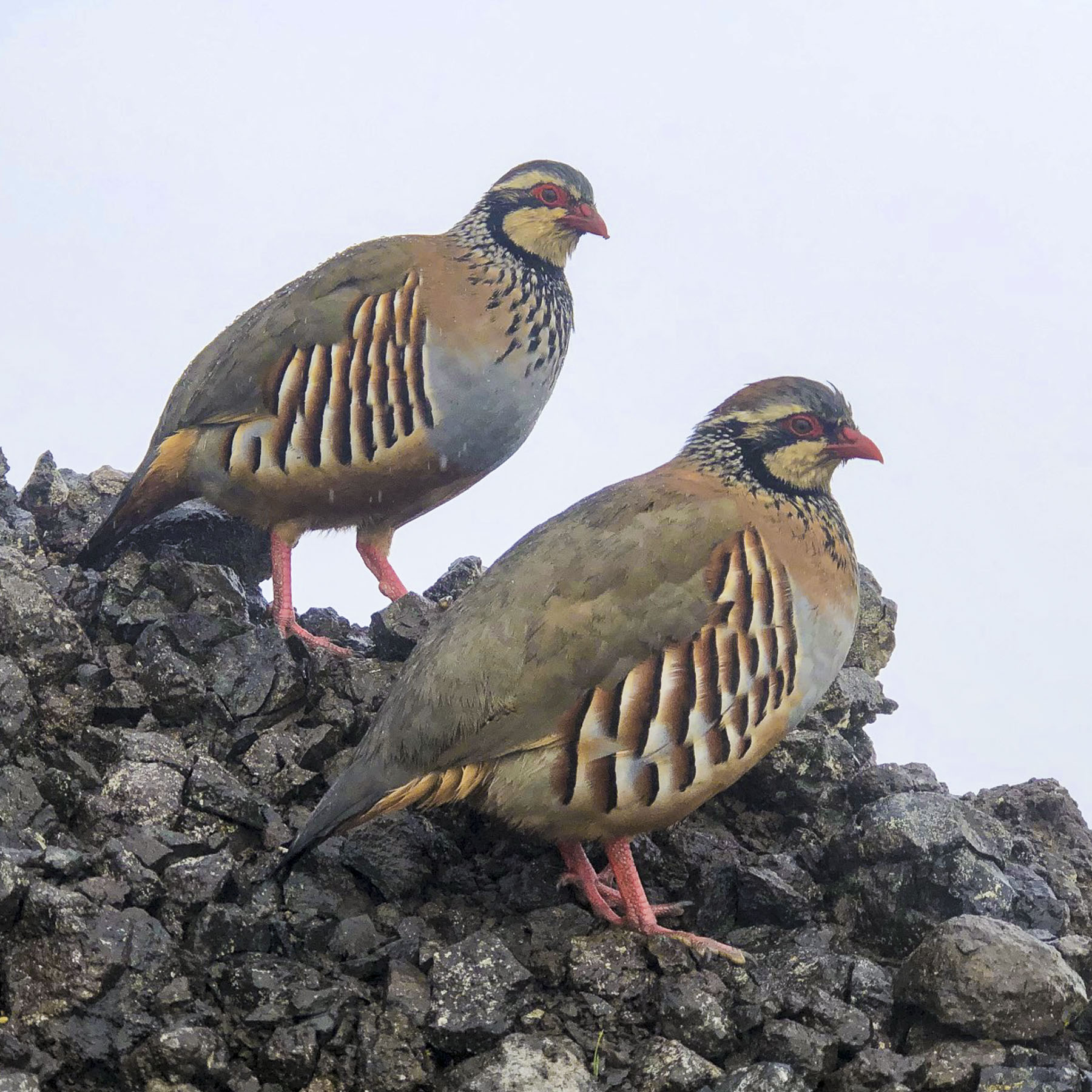
With the rain the trail was slippery and slow going. Unfortunately, the low cloud conditions didn’t allow for spectacular panoramas. But even with the dismal weather we were able to capture some photos that are evocative of the day. Spotting the well named red-legged partridge was a highlight of the trek. If you choose to do this hike, be prepared, wear sturdy shoes or hiking boots, bring extra clothing to layer up, plenty of water and lunch. Personally, I think this hike is too strenuous for older folks, especially if you are an inexperienced hiker. Back at our hotel, glasses of Madeira helped alleviate our chill.

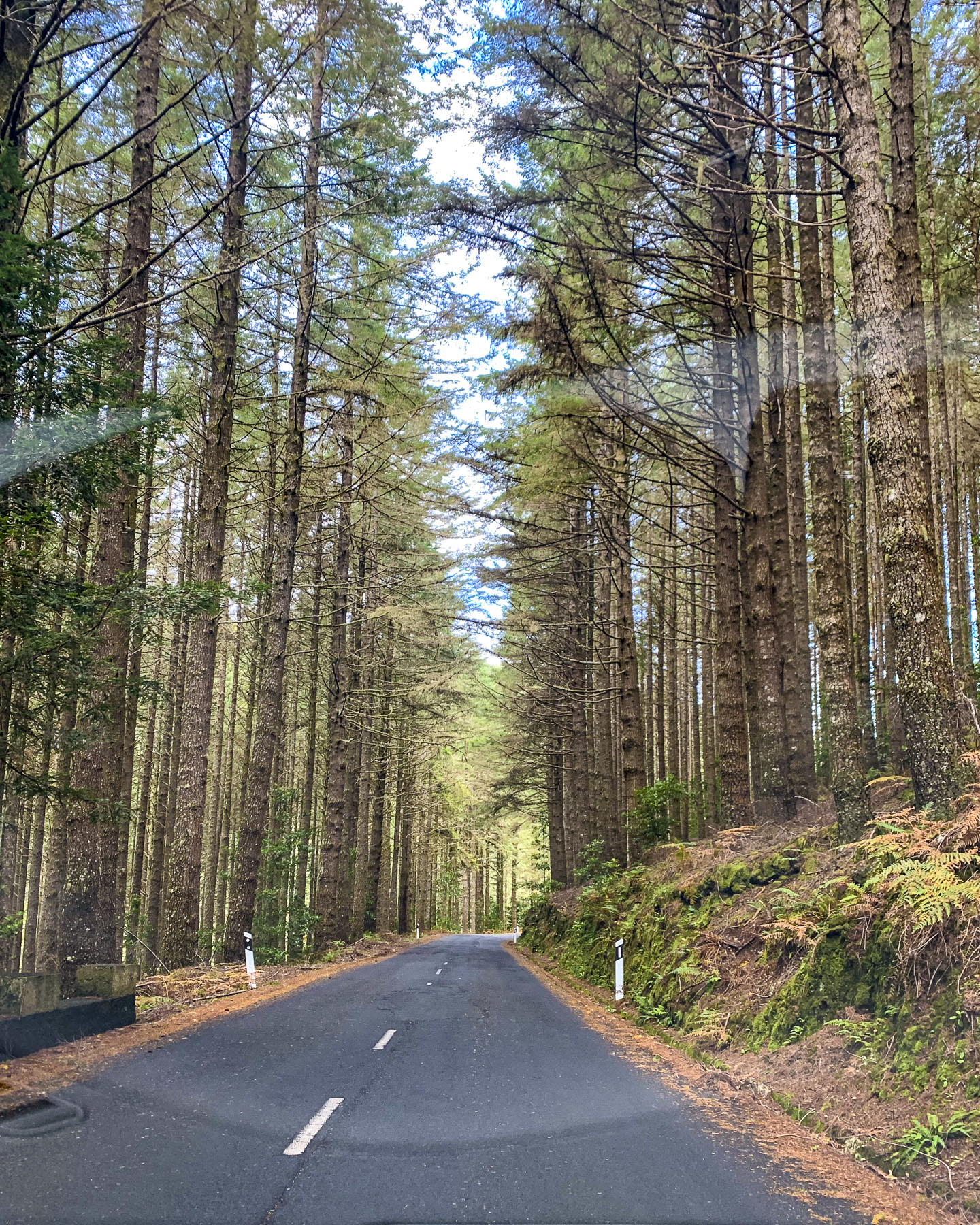
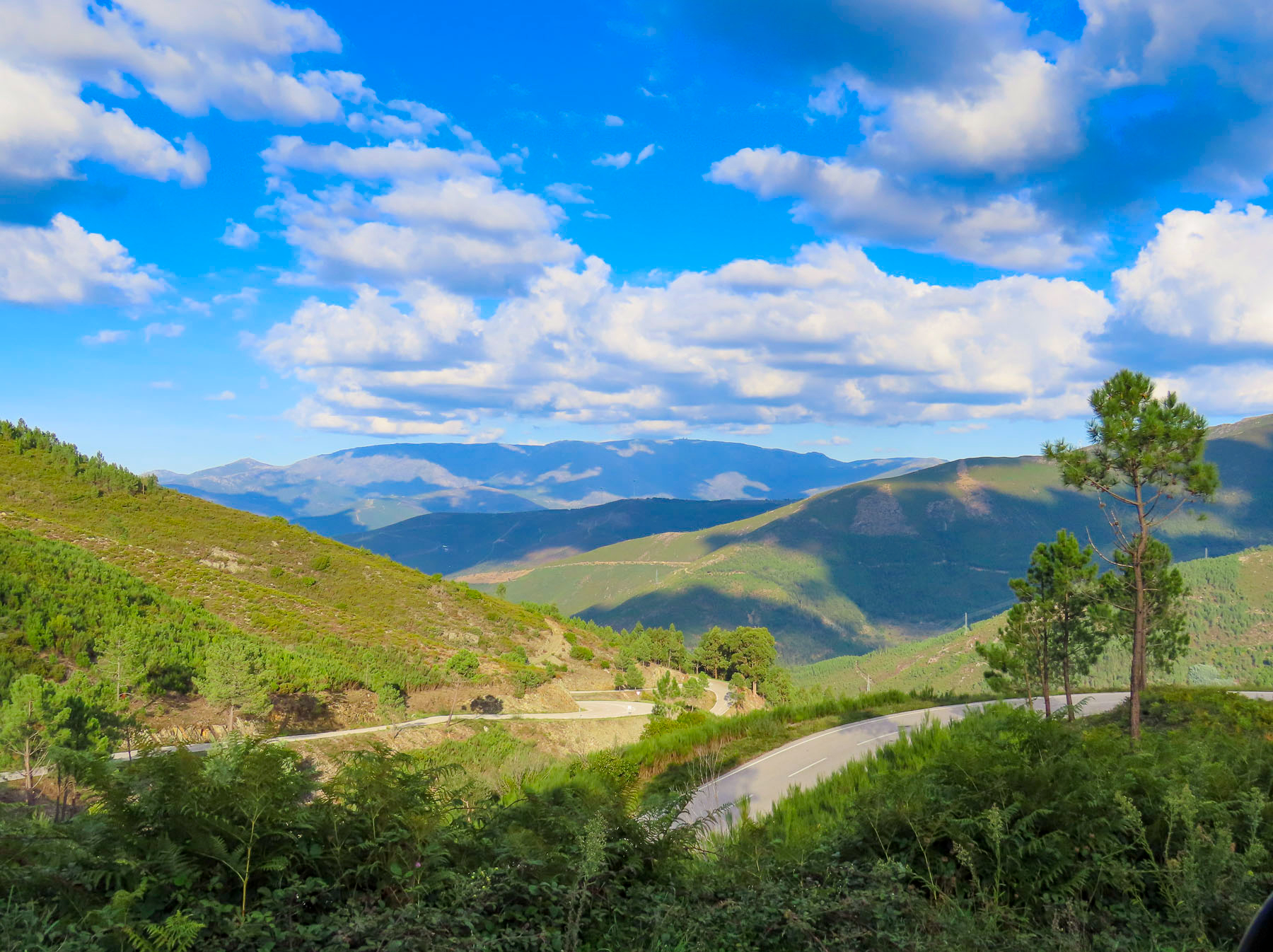
We continually drove back and forth over the mountains. Many times, we partially retraced a previous route only to turn onto narrower country lanes and zig zag to a miradouro or destination that beckoned for a photo op. As birds fly, the distances are short around the island. Not so with the roads.

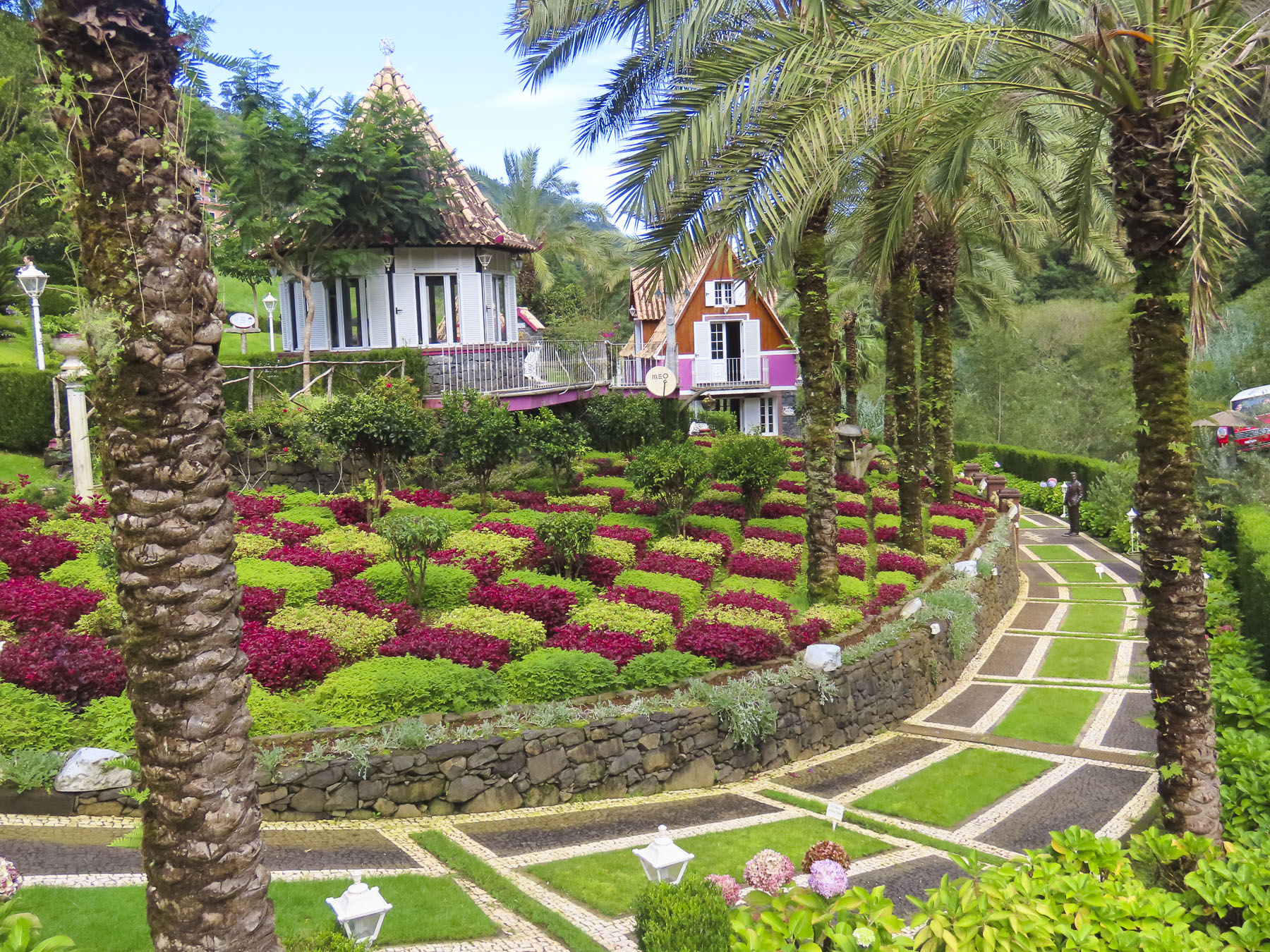
The Museu Família Teixeira was one such detour. It’s an interesting family museum that displays the older way of life on the island. One fascinating piece was the old wooden grape press on display, which looked like an ancient Roman catapult, more capable of destroying fortress walls than crushing wine grapes. The grounds of the family estate are also exquisitely landscaped as a living memorial garden to a lost son.
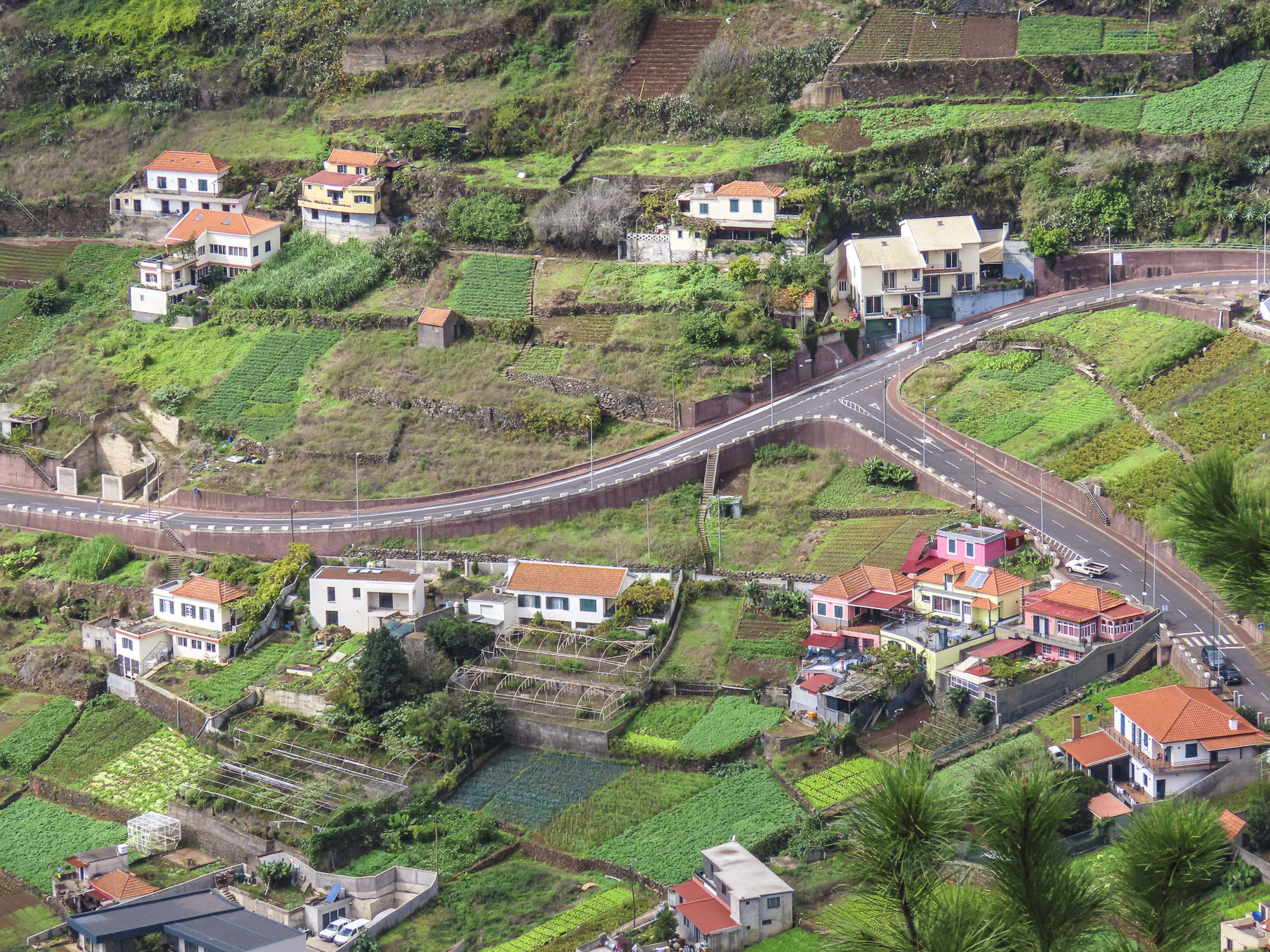
Afterwards we worked our way along the backroads through Faial to Santana then headed west down a long single lane road that eventually ended in the Parque Florestal das Queimadas. The full parking lot was quite the contrast to the desolate road we had just traveled.
Beyond the parking area there was a picnic area in a fairytale-like grove with two quaint thatched cottages, the smaller one serving as a snack bar. This is the trail head for the PR9 Levada do Caldeirão Verde, one of the easiest and flattest levada walks on Madeira that ends at a hundred-foot-tall waterfall cascading into a natural amphitheater. Unfortunately, we only followed the path next to the irrigation channel a short way before a sudden downpour turned us back.

Later that afternoon we drove down a well-worn track that followed the shallow Ribeira de São Jorge through a rugged narrow gorge. The road ended just before a footbridge that led to a freshwater lagoon, created by the river’s rushing water, just shy of the ocean. Above the lagoon was a restaurant with outside tables around a pool that had nice views of the surrounding hills and the sea.

Some of the first sugar mills on the island were built in this valley during the early 1500s. It was a good location with an abundant source of river water channeled into the mills to spin their grindstones. The king of crops was eventually dethroned and today all that remains are the Ruínas de São Jorge, Ruins of St. George – a few stone walls, and an arched portico that faces the sea.

Driving back to Funchal at the end of the day, the coastline at Faial called for some last photos we couldn’t resist.

There’s a countless number of miradouros on Madeira and it was so tempting to turn at each sign indicating a view. But leaving a few unexplored provides a good excuse to plan a return to this spectacular paradise.

Till next time, Craig & Donna

Madeira: Sao Vicente, Porto Moniz & the Fanal Forest – Mountains, Waterfalls and Waves

Often, we started our mornings at Forte de São Tiago on Funchal’s seafront to watch the sun rise over the ocean. But turn around and fog could be rolling down the slope of the hills above the city. The weather can be fickle on this mountainous, beautiful island. Though with its numerous microclimates created by the rugged terrain, it would usually be sunny someplace. A fifteen-minute drive in any direction and the weather could be totally different, as was often the case.

While it’s possible to enjoy an entire stay on the sunnier and dryer south side of the island, where Funchal is located, the dramatic mountains and deep valleys of the interior, which stretch the length of the island and the northern coast, are spectacular destinations.

As rugged as Madeira is, man has left his mark on the landscape with terracing and irrigation channels, called levadas. They’ve been an integral part of island life since 1420 when the first settlers were recruited to the uninhabited island, and impossible to avoid. With a landscape covered with virgin forests, experienced lumbermen from the Minho region, farmers and terrace builders from the Douro valley, and fishermen from the Algarve, all seeking better fortunes, were recruited to the island by the promise of land if they worked it for five years.

With a plume of black ash rising from it, Madeira from the sea must have looked like a volcano erupting. Slash and burn fires started to clear the land reportedly lasted for seven years. By the mid-1400s, soil erosion became a problem; largescale slash and burn fires were prohibited and cleared land on the slopes had to be terraced immediately. The felled trees were a valuable export to ship builders in Europe. The enriched soil from the fires was perfect for the introduction of sugar cane, which quickly became the island’s main export. Slaves from west Africa were brought to the island to sweat out this economic expansion.

To support the expanding villages, hamlets, and agricultural terraces, narrow irrigation channels called levadas were arduously cut into the mountains to divert water around the island, from the wet northern side to the dryer southern side. Their water was also used to turn the waterwheels of the first lumber, flour, and sugarcane mills on the island. Close to five-hundred miles of levadas cover this mountainous island that is roughly thirty-four miles long and fourteen miles wide.

Madeira wine replaced sugarcane when Madeira lost market share to the larger sugarcane plantations of Brazil and the Caribbean. Madeira’s a small island with a large agricultural punch. Today it’s well-watered terraces support wine grapes, banana and flower exports to Europe, as well as the cultivation of other exotic fruits like custard apple, passion fruit, tamarillo, avocado, papaya and mango.

The clouds were slowly being torn apart. Shafts of light dramatically illuminated the valley as we drove north across the island to Sao Vicente. It’s a compact village centered around its church. Nearer the ocean, we explored an ancient lava tube that led down to the sea.

Surf pounded against a rocky beach across the road from a truly amazing bakery, Padaria do Calhau. Something we didn’t expect to find, but if you need an excuse to visit, a coffee and pastry at Padaria do Calhau should suffice. Heading west, just outside of town and before you enter a tunnel, the Cascata Água d’Alto tumbles down next to the road. Unfortunately, there is not any convenient parking here.

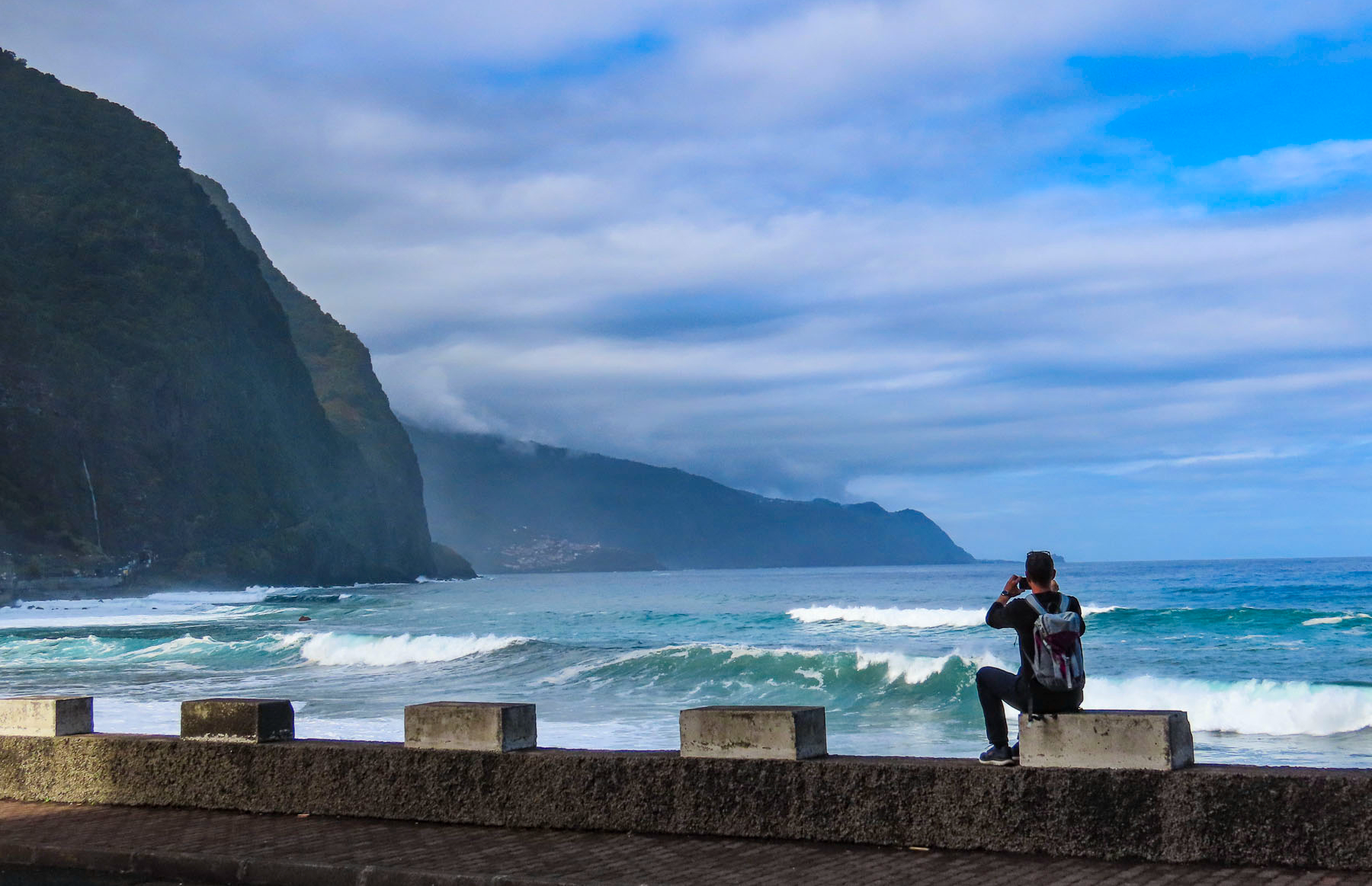
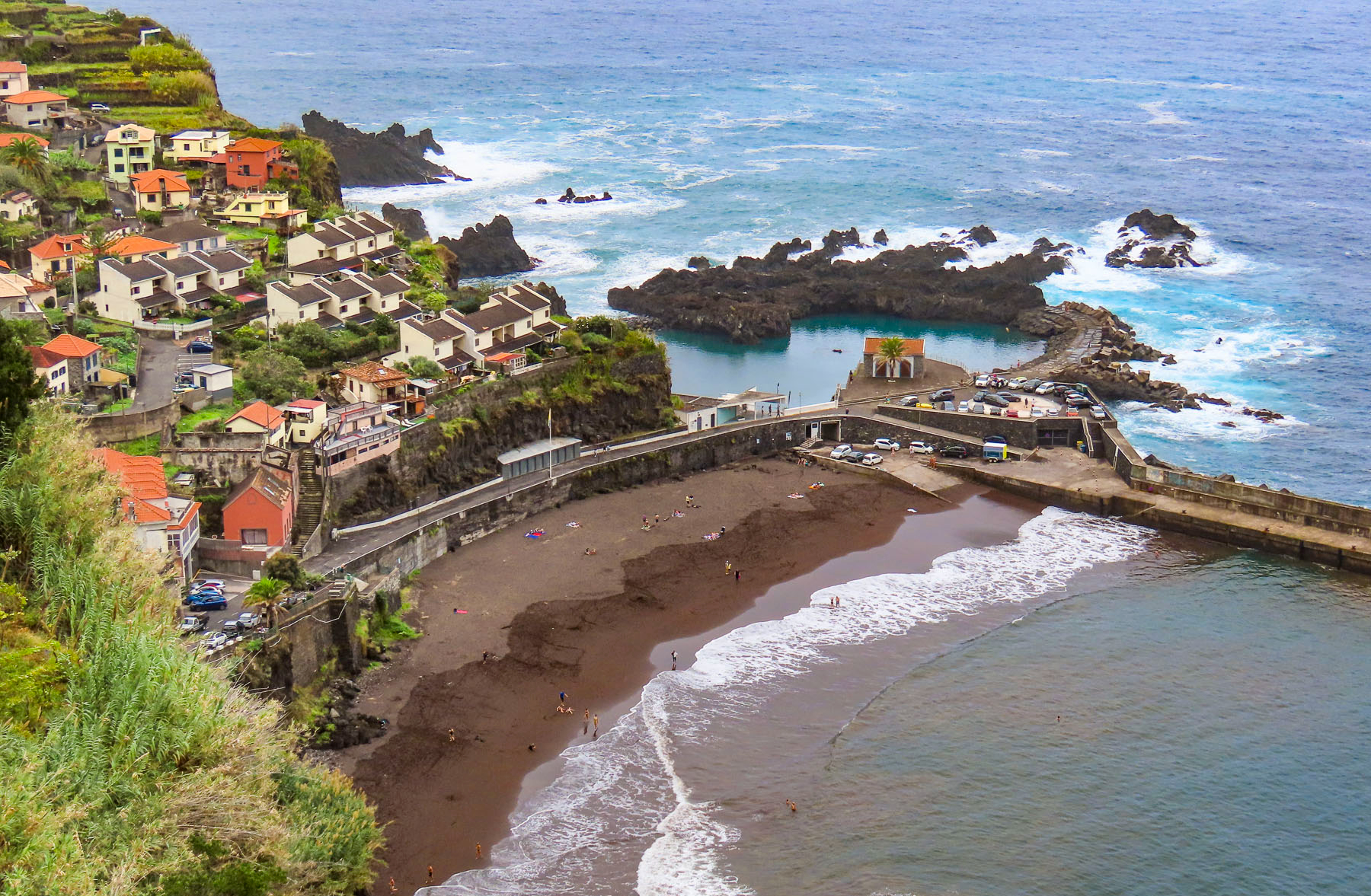
Following the ER101 west towards Porto Moniz there were a number of beautiful waterfalls on the way. First the Córrego da Furna waterfall will be on your left and has a small, unmarked parking area across from it. Then just past the picturesque village of Seixal with its black sand beach, there is the Cascata da Ribeira da Pedra Branca on an old coastal road.

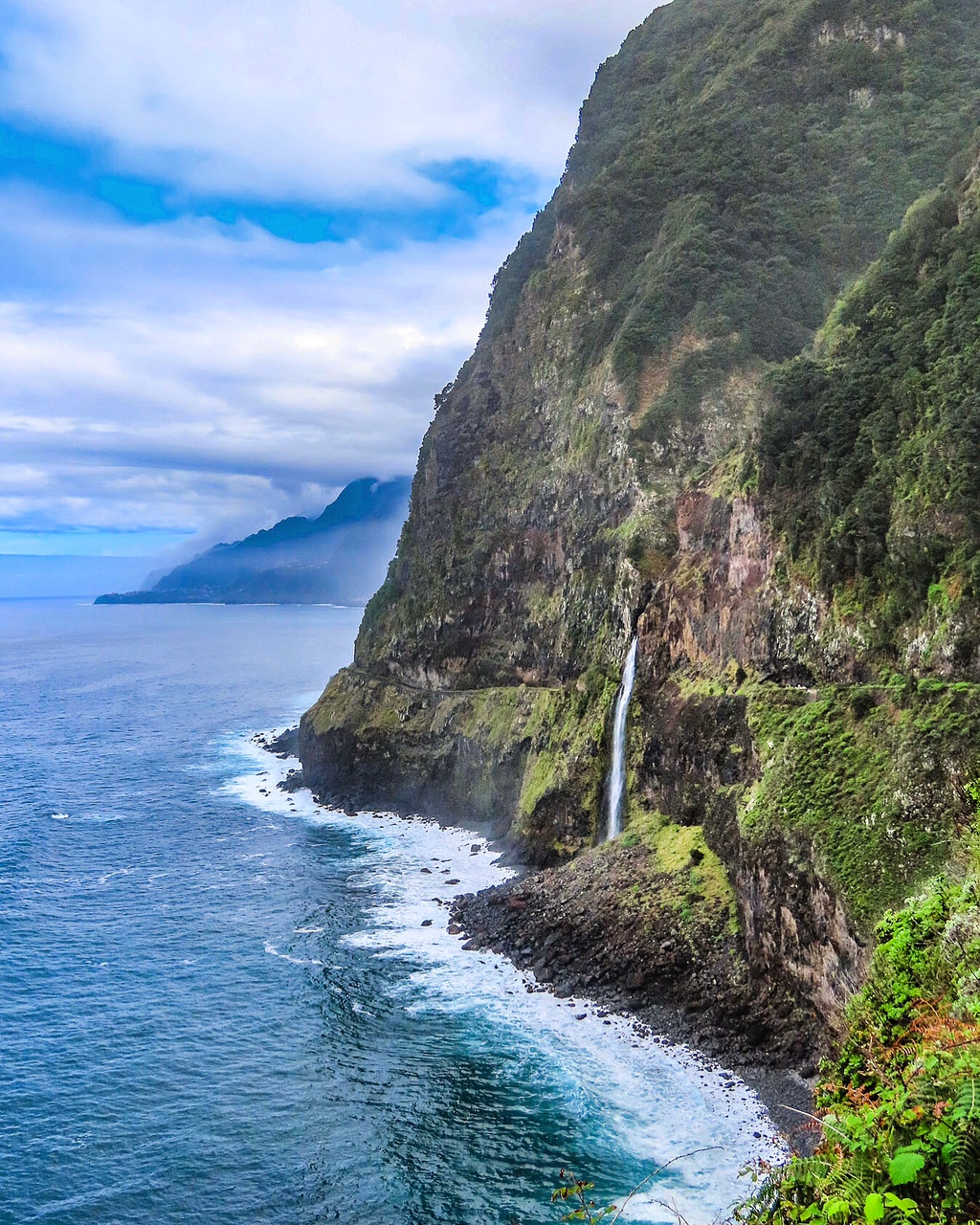
But farther along the most iconic of all of Madeira’s waterfalls is the Véu da Noiva, or bridal veil. It’s a beautiful waterfall that tumbles over a rockslide that permanently closed a section of the old coastal road. It’s a popular stop with plenty of parking, that’s perfect for lingering.

Before Porto Moniz the longest river on Madeira, the Ribeira da Janela, empties into the sea over a rocky, boulder-strewn beach. Tall, eroded sea stacks stand like sentinels amid a crashing surf only a few yards from the shore. We had lost the sun by this time, but the seascape was just as dramatic, nonetheless.

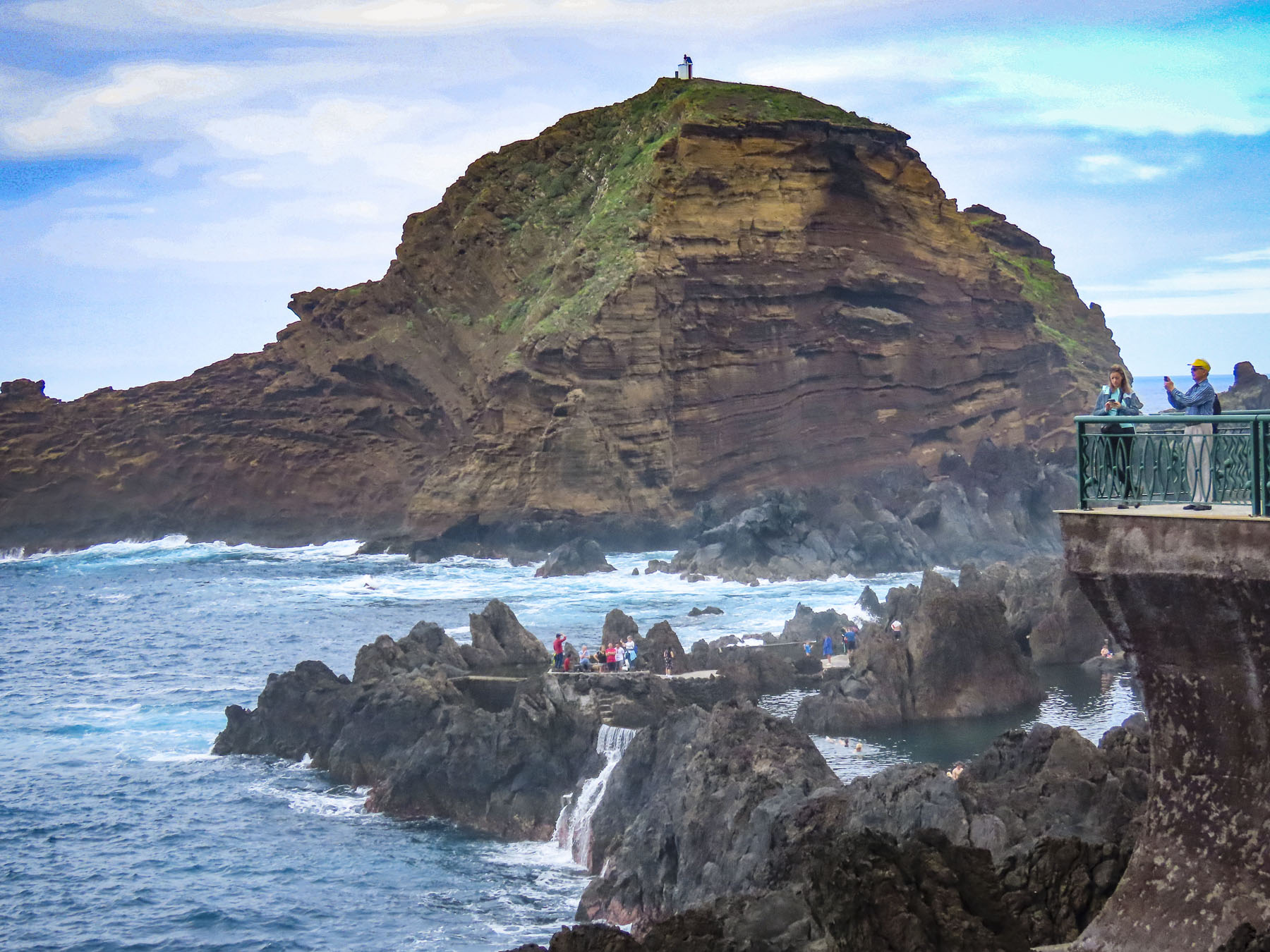
Madeira’s shoreline is very rugged; most of its beaches are pebbly rather than sandy. Then there are spots where over the eons the waves have eroded away the volcanic rock and created natural rock tidal pools along the coast.

Porto Moniz at Madeira’s northwestern tip is a popular destination for swimming safely in these coastal pools, set dramatically against a background of crashing waves. The pools have been enhanced over time, with steps into the water, sidewalks between swimming areas, and some areas being dammed to create deeper pools. There is modest entrance fee of 1.50€ per person, but it’s one of the best bargains on the island.

After a late lunch we retraced our route to Ribeira da Janela and followed a narrow secondary road over a stone bridge and through the small hamlet of pastel-colored homes set against verdant fields, into the cloud-shrouded mountains.

Whether it was cloudy or foggy we’re not sure, but it was perfectly misty as we pulled into the parking area for the Florestal do Fanal. Roughly 37,000 acres of primal laurel forest, and open woodland, the largest in Europe, it covers the mountainside 3500 feet above sea level. A short walk into the woodlands set us in an atmospheric wonderland of huge windblown trees with gnarled twisted trunks and crooked branches, covered with moss and lichens.
Other hikers and wandering cows vanished into and reappeared out of the mist as we wandered through the silent woods. Mysterious, eerie, or benignly moody are apt descriptions for this intriguing laurel forest that is a photographer’s delight.

Driving back to Funchal we crested the ridgeline of the mountains that divides northern Madeira from the south and suddenly we were driving above the clouds.

Till next time, Craig & Donna

Madeira: Pirates, Wine & Flowers or Everywhere There’s a Miradouro!

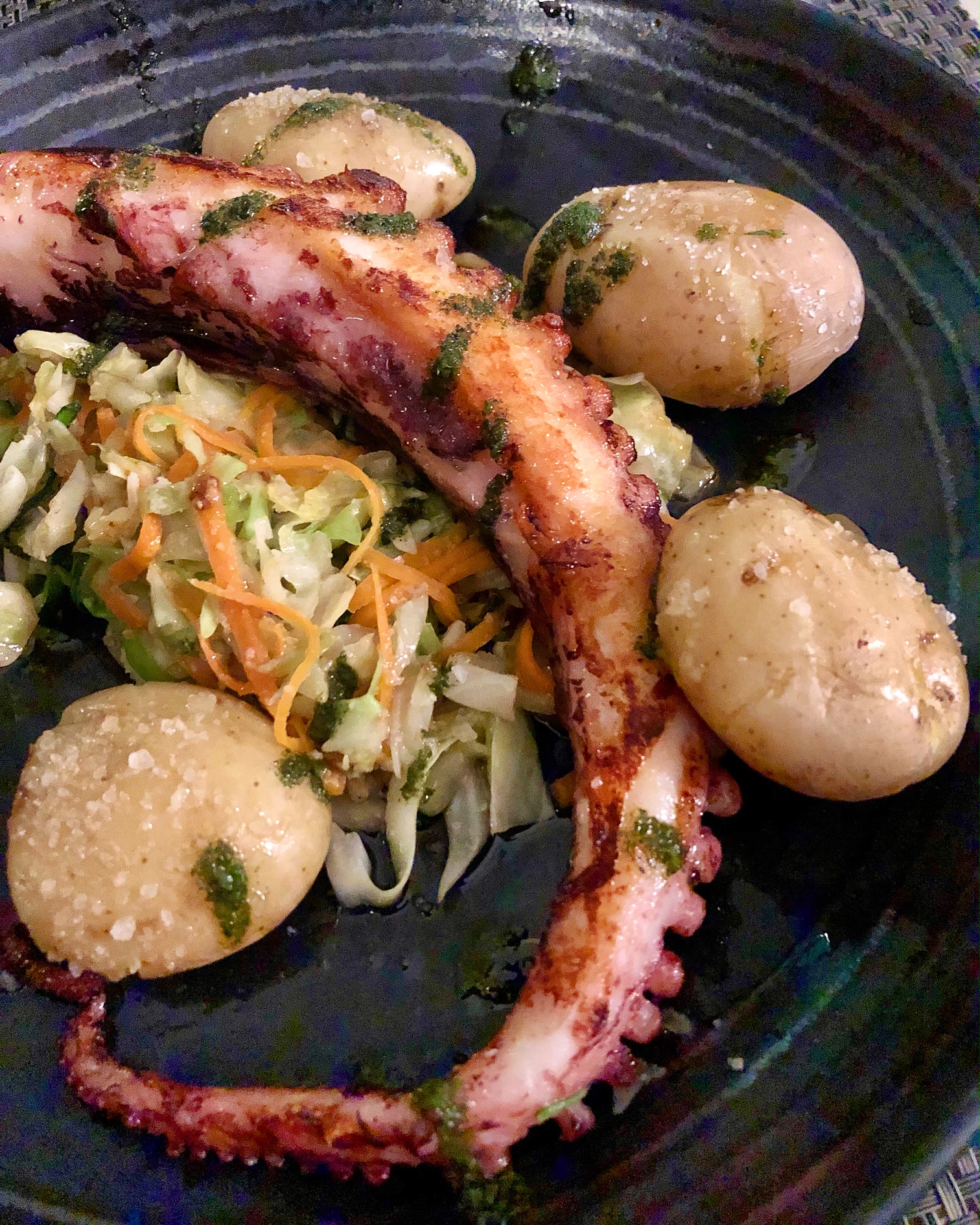
“Could you recommend any restaurants for lunch?” The young car rental agent seemed surprised, at first, that we asking her opinion. “Where are you staying. What do you like?” “In the center of Funchal. Meat, fish, we enjoy everything,” I replied. “Hah, most places in Funchal will be closed for the mid-afternoon break by the time you reach town, but nearby, though it’s in the opposite direction, there is Restaurante Snack-bar Frente Ao, one of my favorite places.” And so, our Madeira adventure began with a delicious lunch in a no-frills local place. Tasty grilled limpets in a buttery garlic sauce started our meal. A traditional Polvo a Lagareio, baked octopus with potatoes, and scabbardfish served with fried bananas followed. It was scrumptious, heavenly, you get my point, it was really GOOD!  Outside, planes flew close to the water on their final approach to FNC, across a panorama of the coast that stretched all the way to the headland of Ponta de São Lourenço.

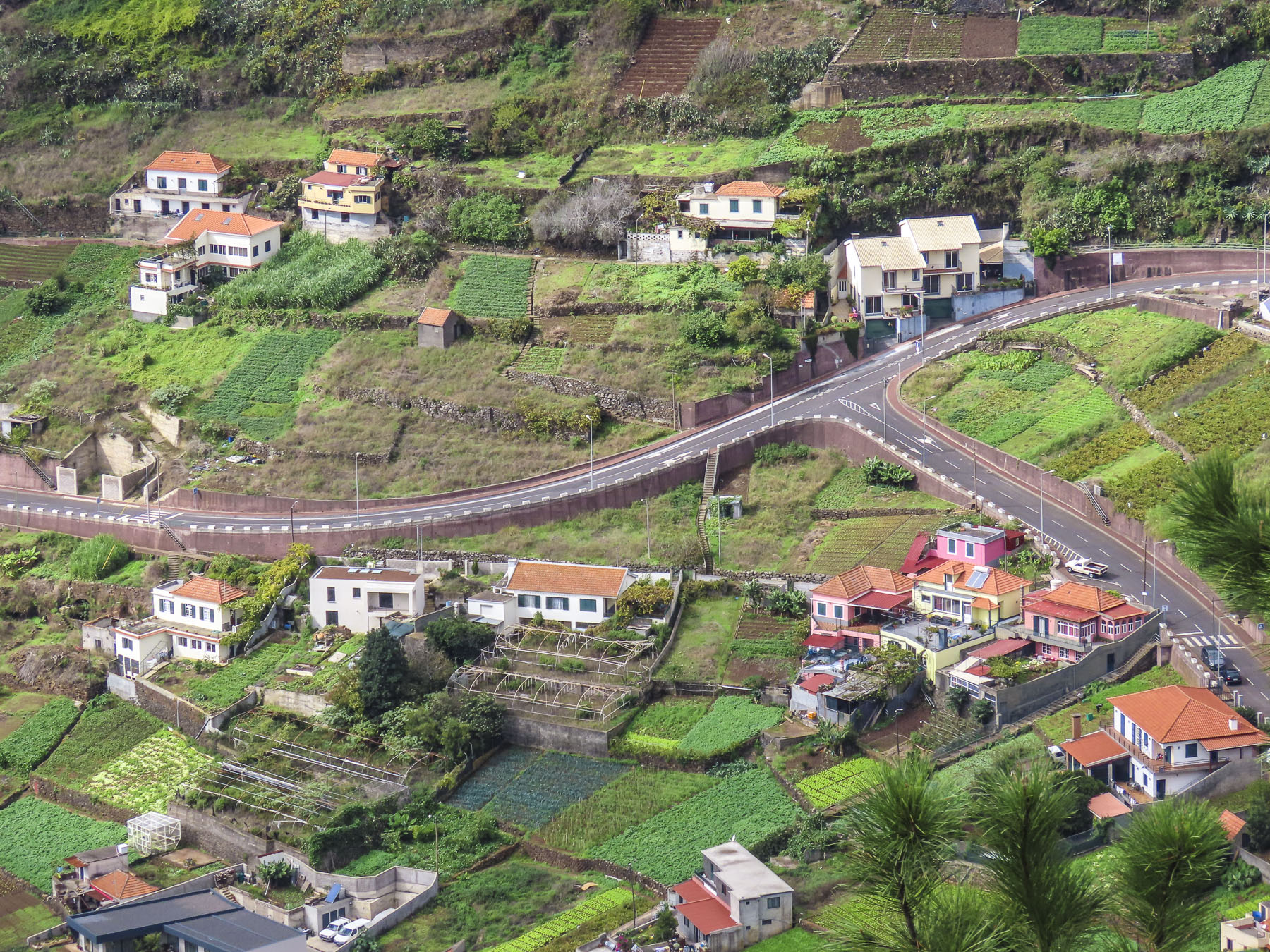
Our first short drive to the restaurant revealed a verdant, lush tropical island bursting with flowering plants, and mountainous with steep ravines that descended into the ocean, like the radial arms of a spider’s web, from a central ridge that runs the length of the island. Colorfully painted homes with red tiled roofs dotted the countryside like swathes of pigment in an impressionist painting. There are few direct, only circuitous routes, where even the bridges and tunnels, some almost 2 miles long, curve to follow the contour of the land. Banana groves large and small dotted every plot of land between the homes that covered the hillsides. Three vintage cars zoomed by.

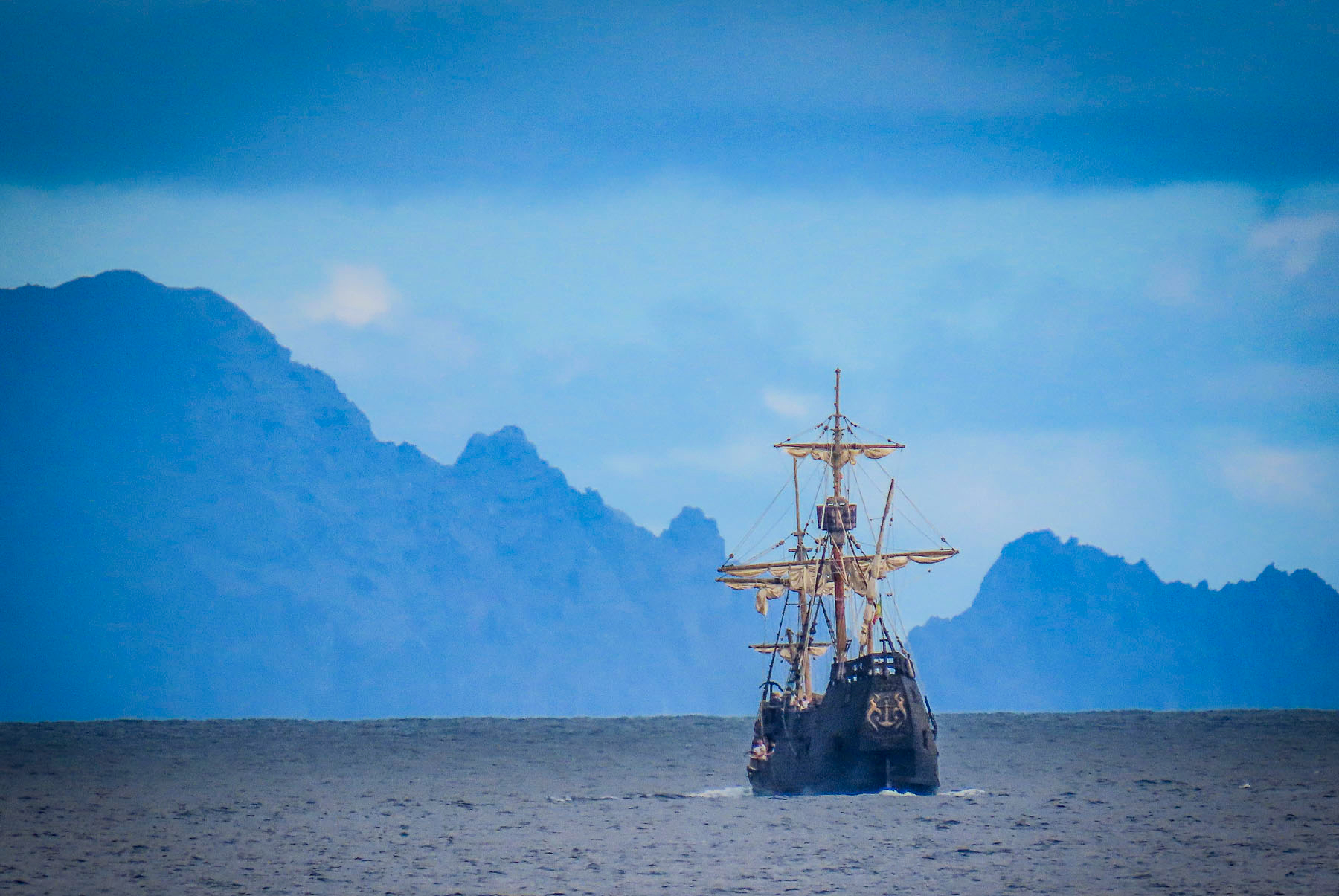
Portuguese sailors blown 300 miles off course by a violent storm as they explored the west coast of Africa in 1418 discovered a small uninhabited island, with a sheltered anchorage, where they rode out the storm. In thanks they christened the island Porto Santo, Holy Harbor. They noted in a ship’s log that on the western horizon a “dark monstrous shape loomed.” A year later they returned. Wood, madeira, from its virgin forests was the island’s first exports. The trees were so tall and straight that they allowed the Portuguese to design larger, sturdier ships, which Vasco da Gama’s fleet used to sail to India in 1497.

Felling trees for export opened the hillsides for extensive terracing of the lower slopes in the mid-1500s, when sugar cane became the prized export. Later grapes were introduced, and Madeira wine was born. Both crops thrived with irrigation provided by an extensive series of arduously cut, narrow channels called levadas, which traverse the rugged terrain and divert water from mountain streams to the agricultural terraces across the island. Their water was also used to turn the waterwheels of the first mills on the island. Close to five-hundred miles of levadas cover this mountainous island that is roughly thirty-four miles long and fourteen miles wide.

With Madeira wine came the English, who believed that fortified wines improved with age on long ocean voyages. Sailing to their various colonies in the Americas, English naval and merchant ships would sail south from England to catch the trade winds blowing west off Morocco. Fortuitously, Madeira was a well-placed port of call to resupply. With full sails and barrels of Madeira wine in the ship’s hold, they’d reach the Caribbean in a month’s time. Farther on, in their New England colonies, members of the Continental Congress toasted the signing of the Declaration of Independence in 1776 with Madeira wine. While being notoriously at odds with Spain for centuries, the Brits and the Portuguese have the world’s oldest alliance which stems from the Treaty of Windsor in 1386 and was fortified, port glasses raised, with the marriage of King John I of Portugal to a daughter of John of Gaunt, Philippa of Lancaster. This treaty of mutual support has lasted over 630 years. Cheers!

Captain Cook and Charles Darwin both visited at the beginning of their explorations. Napoleon in 1815 stopped for a final supply of Madeira wine while enroute to his permanent exile on St Helena. With the advent of steamships, Madeira became a destination for the well to do of Europe. Before the quay was constructed, historical photos show merchants rowing long boats laden with supplies out to ships anchored in the harbor, and returning with visitors to disembark on Funchal’s rocky beach. Doctors recommended its good fresh air for patients convalescing from tuberculosis. Winston Churchill visited in 1950, painted seascapes and stayed at Reid’s Palace, a Madeira institution since 1891 that still serves afternoon high tea.  He left the island with a reputation that it was for stogey old folks, that remained for decades.

But with Portugal joining the European Union in 1986, it enabled a massive investment in infrastructure that united all parts of the island that were previously inaccessible by overland routes. The small island now has over 100 tunnels and bridges, along with seven cable car routes scattered around the island. Across from the cruise terminal at the base of Santa Catarina Park, there is a relief statue set into a granite embankment that commemorates the men who toiled to build the island’s tunnels and terraces.

Flat land is a rarity on Madeira, as is landfill, the lack of which required the airport runway extension in 2000 to be uniquely expanded over the ocean on 180 concrete columns, each of which are 230-foot-tall, for a total length of 9,000 feet. It felt like we were going to land on an aircraft carrier. Fifty-eight cities in twenty-one countries now have direct flights to the island. Cruises to the island continue to be popular and in 2022 Madeira was voted by the World Cruise Awards the Best Cruise Destination in Europe. Madeira has now reinvented itself into a destination packed with outdoor activities that include sailing, whale watching, surfing, paragliding, scuba diving, and mountain hikes for all levels of fitness.

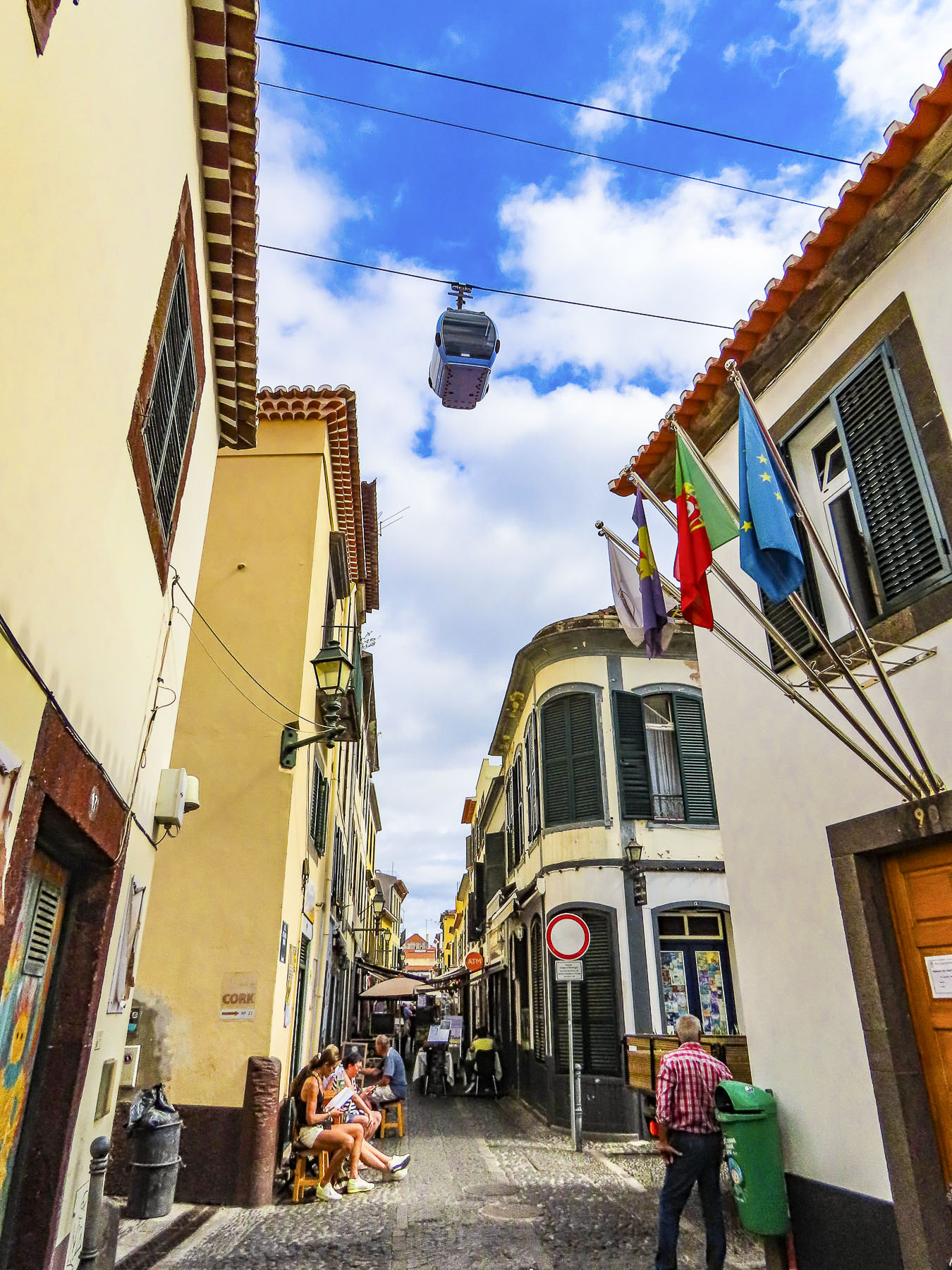
Our hotel, São Francisco Accommodation, was a modest three-star hotel centrally located in Funchal’s historic old town. The big pluses for us were its elevator, underground parking lot across the street, and its location. The most interesting parts of Madeira’s capital city were within walking distance of our lodging. We were set for the week!  We chose to stay in Funchal because it is the island’s largest city, with enough things to do locally so we wouldn’t feel the need to go elsewhere. The car was for day trips to explore the rest of the island.

One afternoon we were drawn down the street by the sound of classical music flowing from the park around the corner from the hotel. Folks casually filled a small amphitheater in the midst of a manicured garden. Next to the bandstand a small kiosk offered a table.  We ordered drinks and enjoyed the afternoon entertainment. At the bottom of the park people mingled around a line of classic cars parked along the street.

Delightfully, Madeirans out of necessity have inadvertently created a sub-culture of serious vintage car enthusiasts. Importing cars to the island has always been very expensive. Consequently, automobiles have become family heirlooms. Many of them are passionately maintained or restored and passed down through the generations. So common is the practice that over 800 vintage cars are registered on this small island. Their enthusiasm is celebrated each year with the Madeira Classic Car Revival, a three day event that culminates with a race along the Praça do Povo waterfront every May.

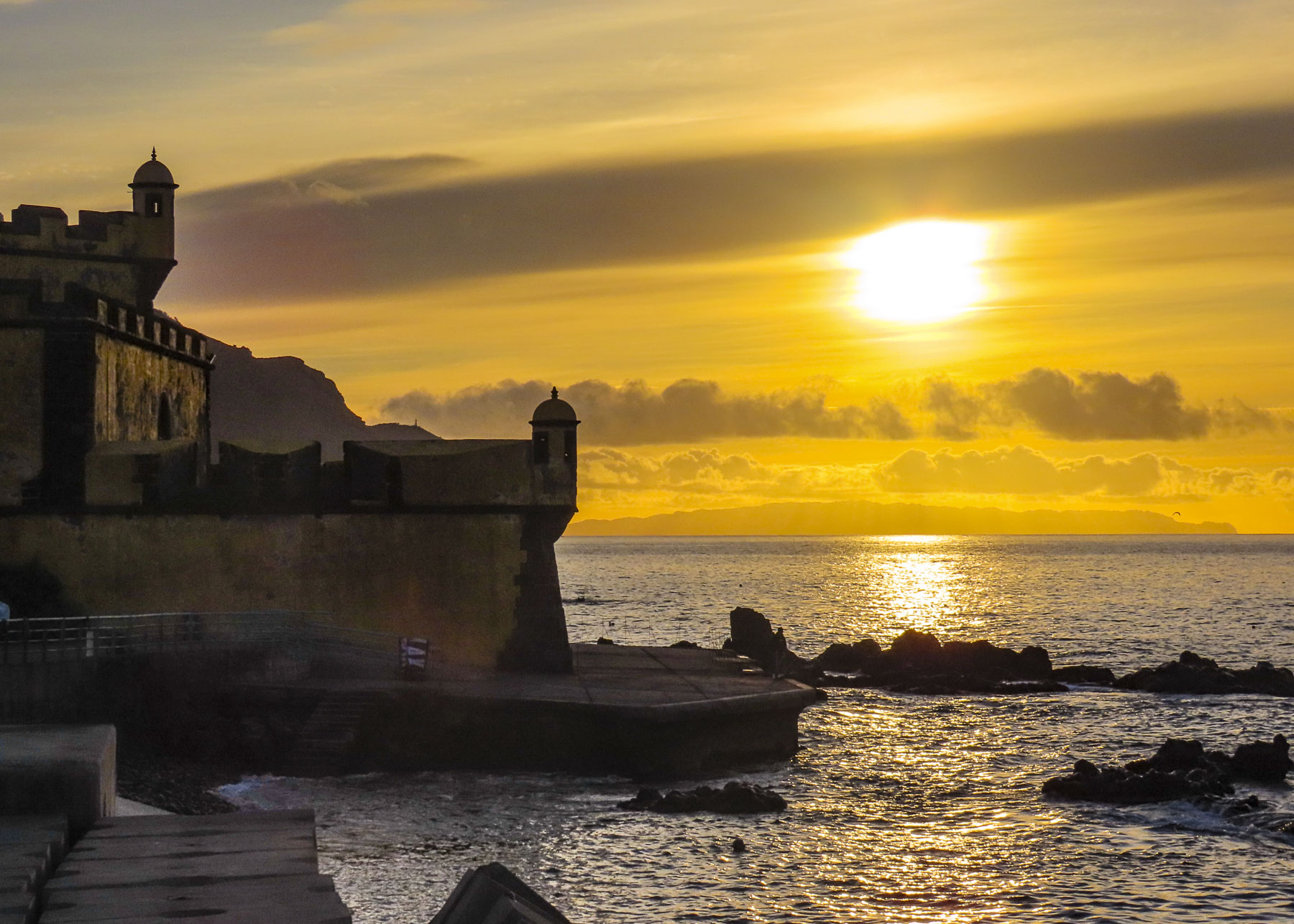
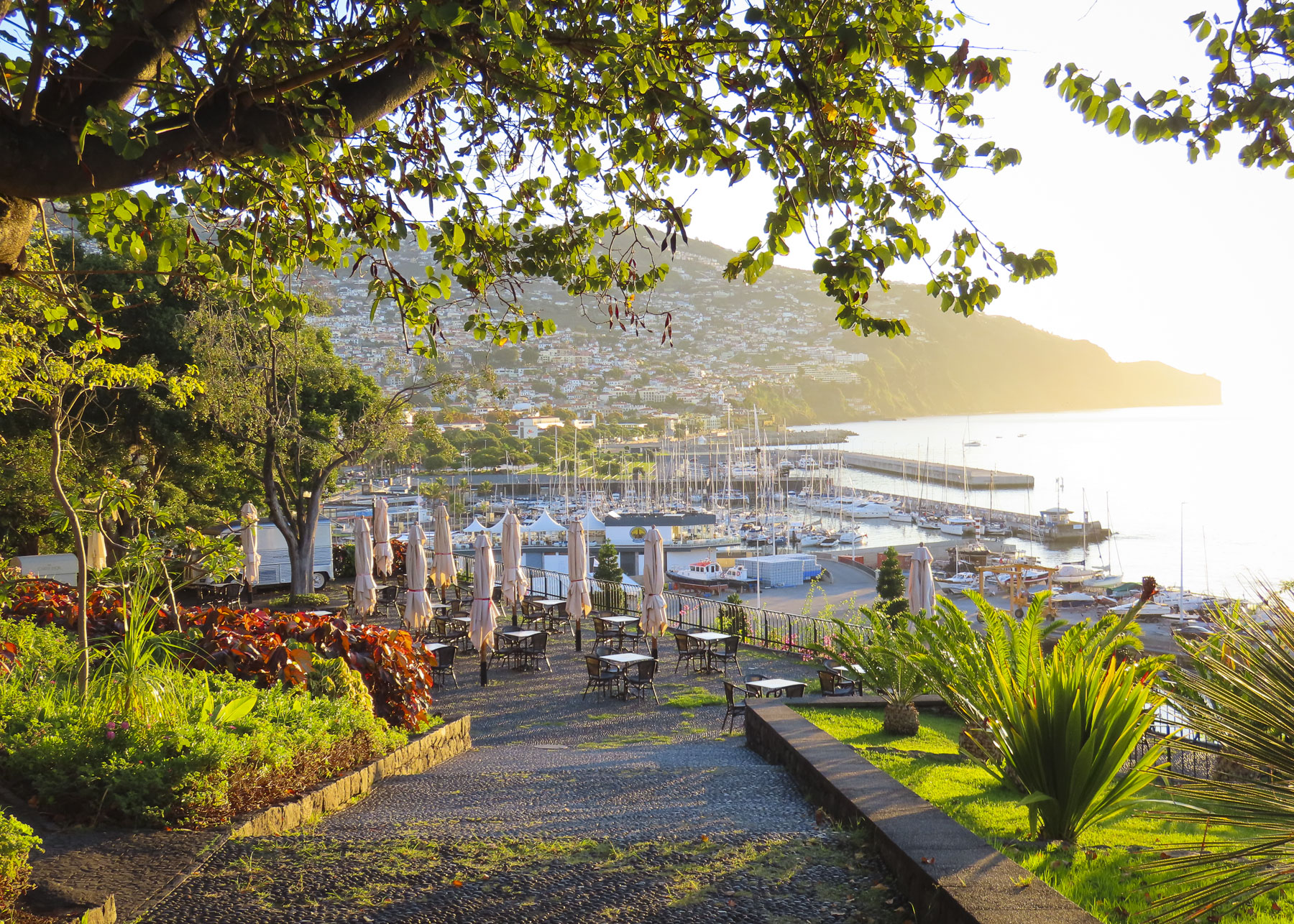
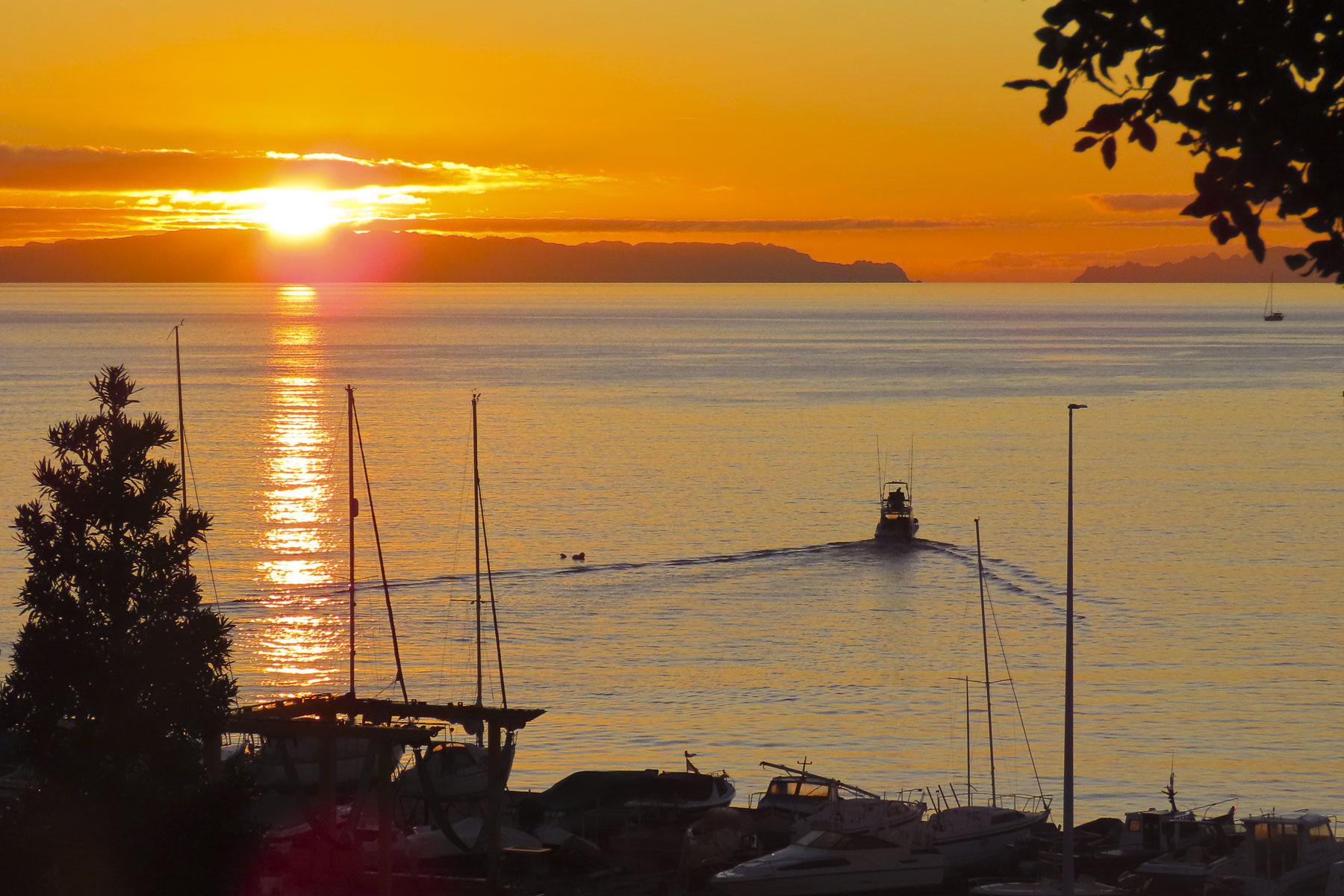
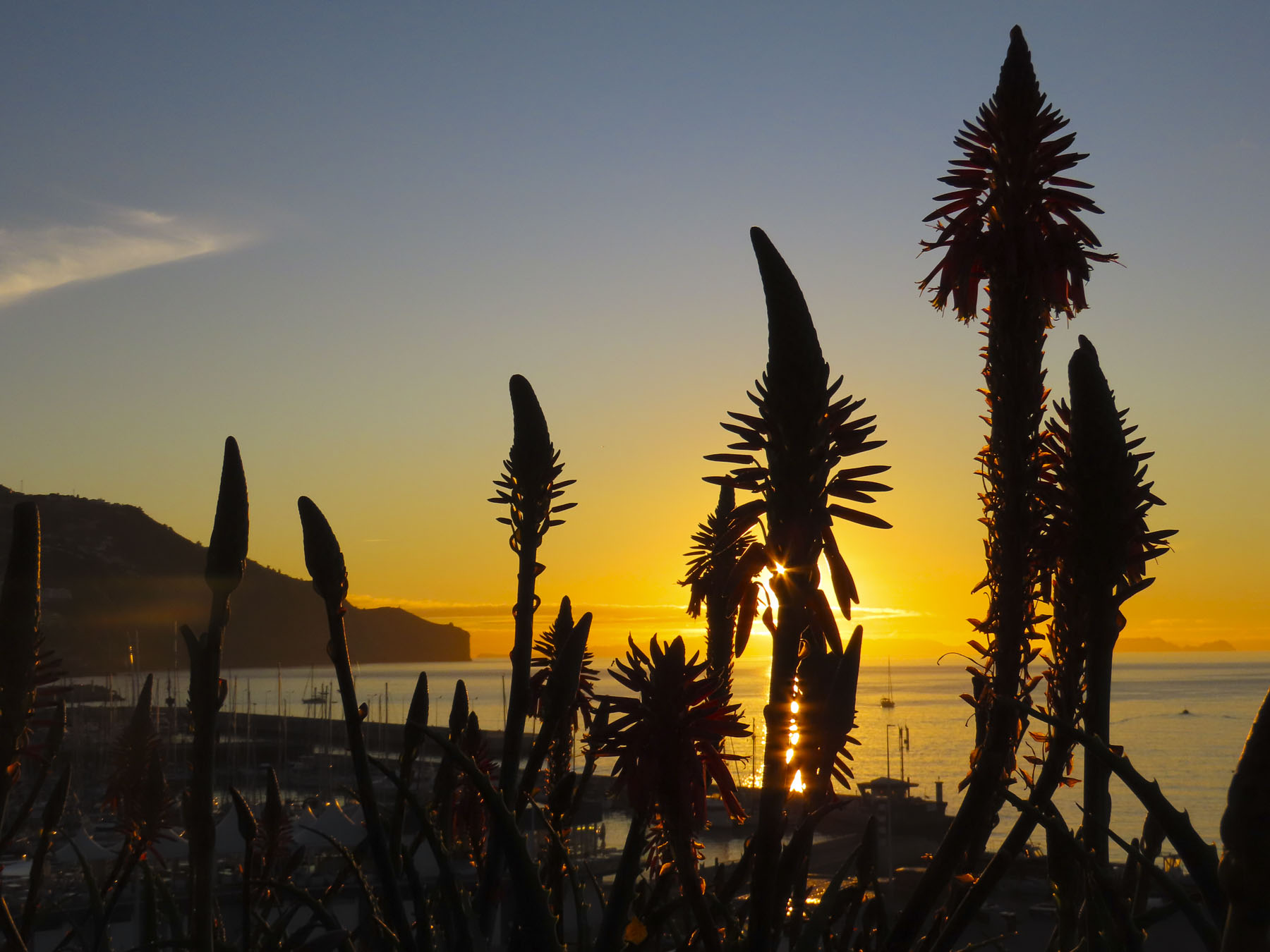
Several mornings we were up before dawn to walk along the waterfront in search of the ultimate sunrise shots with the unpopulated islands Selvagens and Desertas silhouetted on the horizon. We were not disappointed.

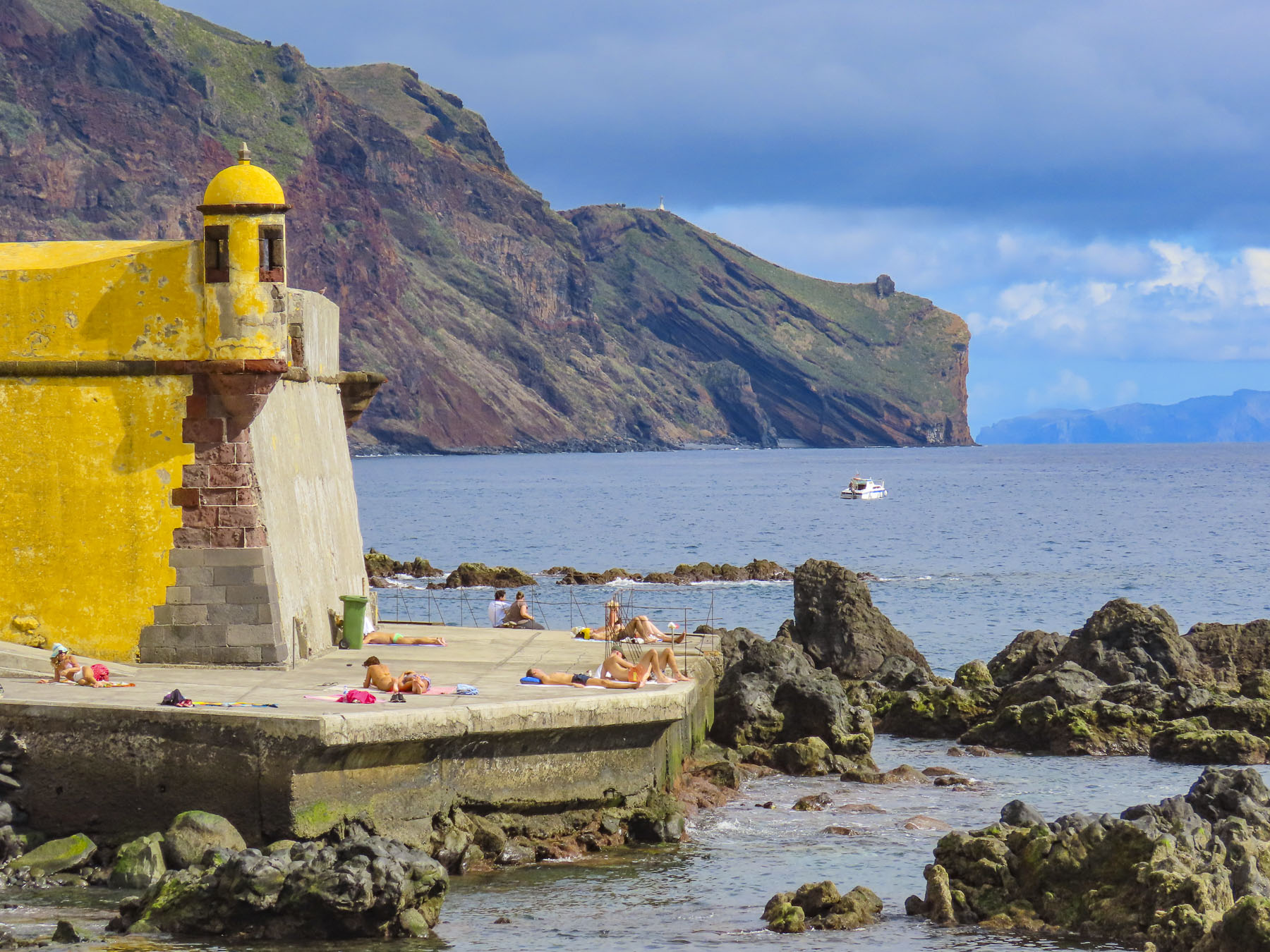
There were numerous interesting photo opportunities from the marina to Forte de São Tiago, which was built in the early 1600s in response to two brutal attacks by pirates. French pirate Bertrand de Montluc assaulted the town in 1566 with three ships. Mayhem ensued as his cut-throats   rampaged and plundered the streets for fifteen days. Then Barbary pirates with eight ships ransacked Funchal in 1617 and took 1200 people back to Algiers as slaves. Now, under the ramparts of the fort, pensioners enjoyed ritualistic morning swims along a peaceful, pebbly Praia de São Tiago.

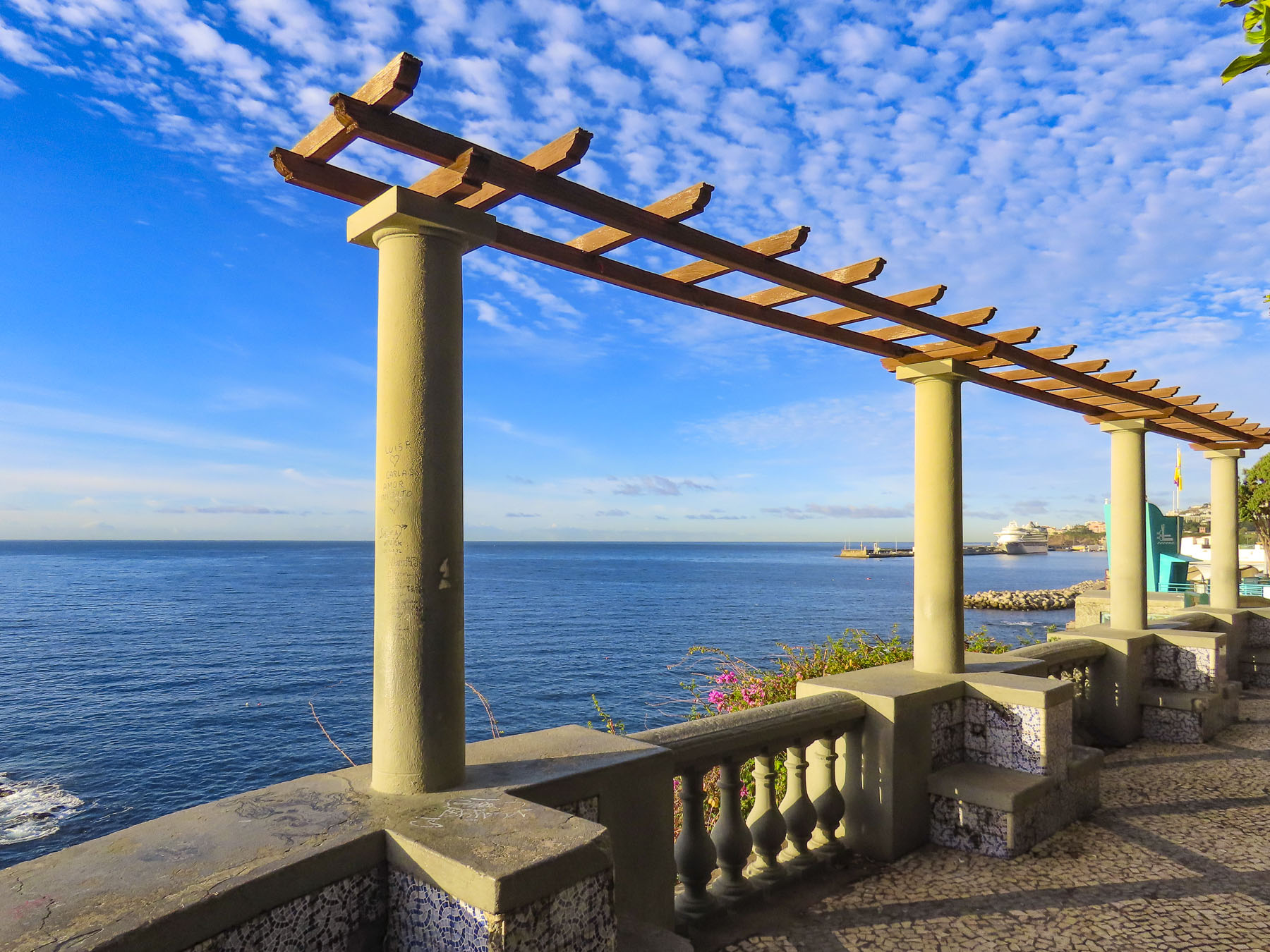
Around the corner from the fortress at the Miradouro do Socorro, a pretty arbor frames the view of the sea and the Complexo Balnear da Barreirinha, a waterfront day resort where you can rent a lounger and swim in their pool or the sea. Across the street the Igreja de Santa Maria Maior, a small parish church, serenely graces the neighborhood.

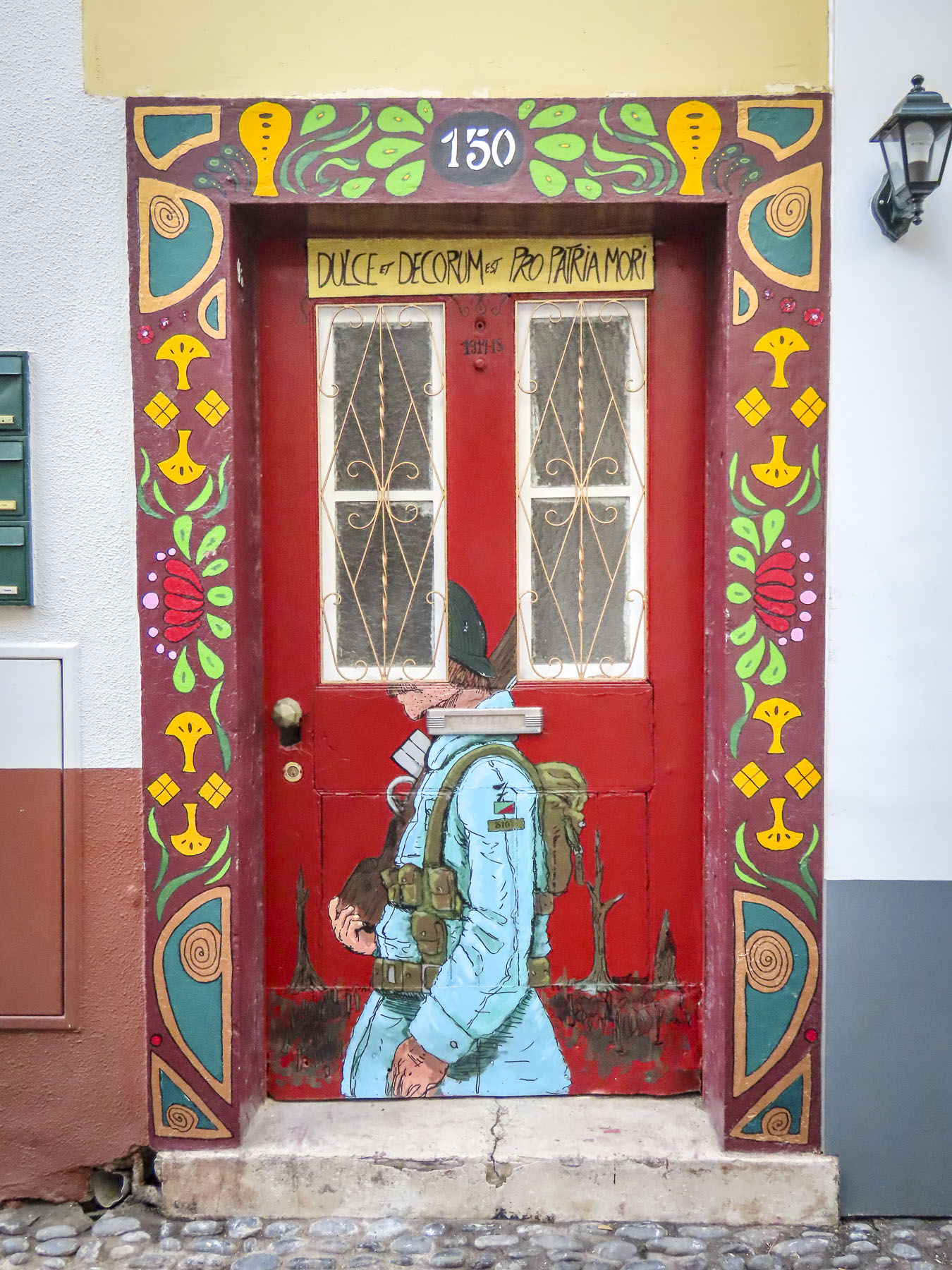
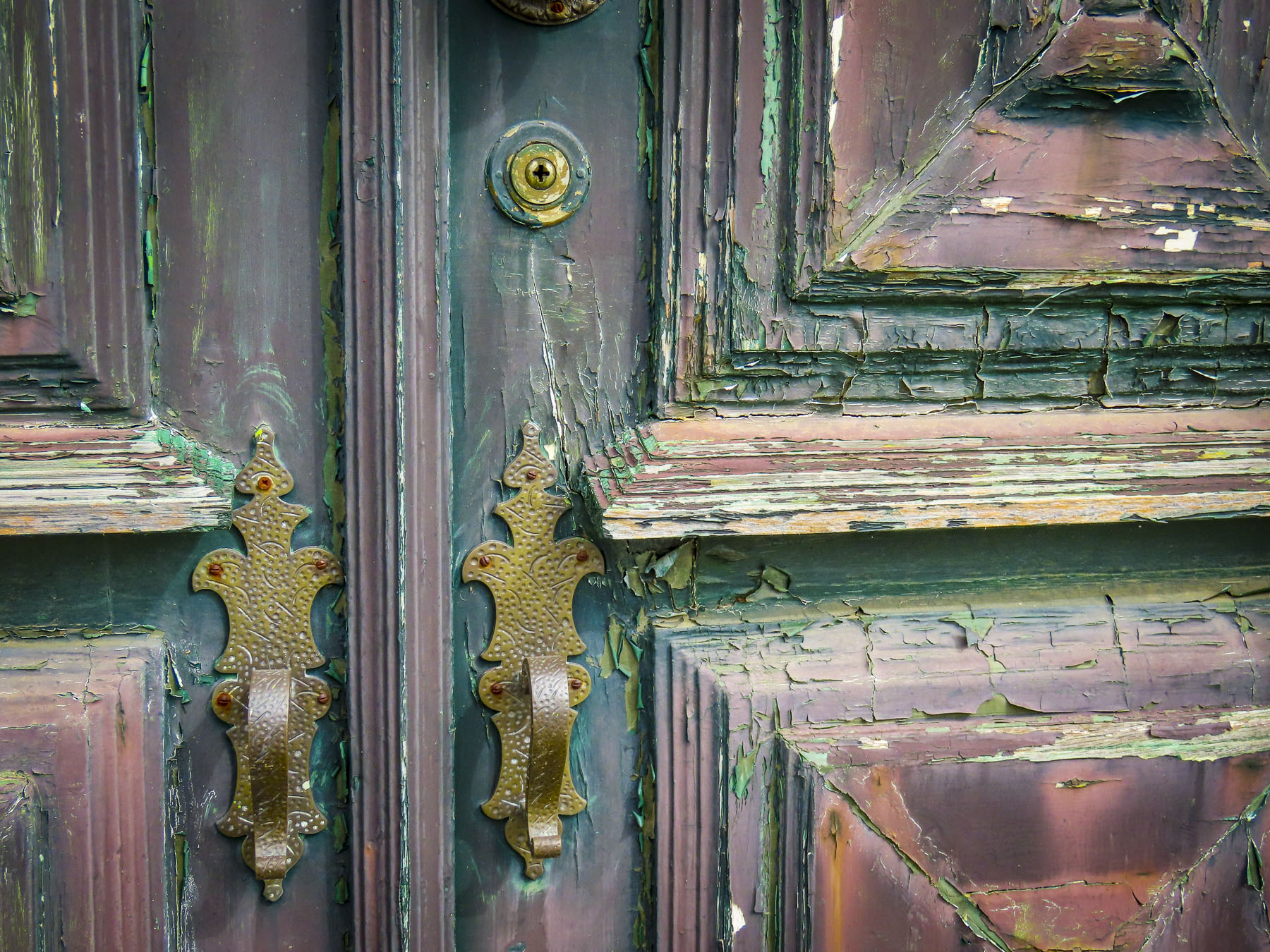
Heading back into town we walked along the Rua de Santa Maria, a narrow alley known for the uniquely painted doors on homes, galleries and restaurants that line the street.  To see many of the doors you have to visit the street early before the shops open them for the business day.

In front of the Mercado dos Lavradores, the town’s old central market, there is a bronze statue depicting a merchant driving a team of oxen pulling a flat wooden pallet loaded with barrels of wine. Versions of these toboggans fitted with wicker chairs were called Carro de Cesto. Until roads were introduced in 1904 to accommodate the first cars brought to the island, this was the preferred downhill method of public transport, as a wheeled cart might run away uncontrollably if there was a mishap.

Today, at the steps before the Nossa Senhora do Monte Church, toboggans filled with tourists are pushed downhill by two men, Carreiros, donning wicker hats and traditional white outfits. Hold on, the steep serpentine course is over a mile long and the sleds can go almost 25 miles an hour! There are no brakes, only the special, rubber-soled shoes the carreiros wear, and stopping is accomplished by dragging their feet along the road to slow the toboggan. It’s a popular activity easily combined with a cable car ride from the Funchal waterfront to the Monte Palace Tropical Garden.

Though when we visited we chose to use our car instead of taking the cable car to Monte. We didn’t realize when we started but the google map route we followed to the garden was up one of Funchal’s steepest streets. The Caminho de Ferro takes its name from the old funicular train tracks upon which the road was paved. It runs for two miles straight up a hill with a twenty-five-degree slope and gains nearly 2000ft in altitude. I was doing fine driving uphill in second gear until we encountered a semi-blind cross street that did not have a stop sign, only a large traffic mirror. This was something I hadn’t encountered before, so I came to a complete stop. The incline of the road was very steep at this point, and I had difficulty getting the car moving again without rolling back too far. Ultimately after several frustrating minutes I rolled the car back perpendicularly to the road, got the car in gear and powered slowly through the intersection. Fortunately, there is very little car traffic on the side roads in Funchal and we lucked out in finding a parking space near the garden. The return route into the city center, down streets so narrow it required pulling the mirrors in, was equally challenging.

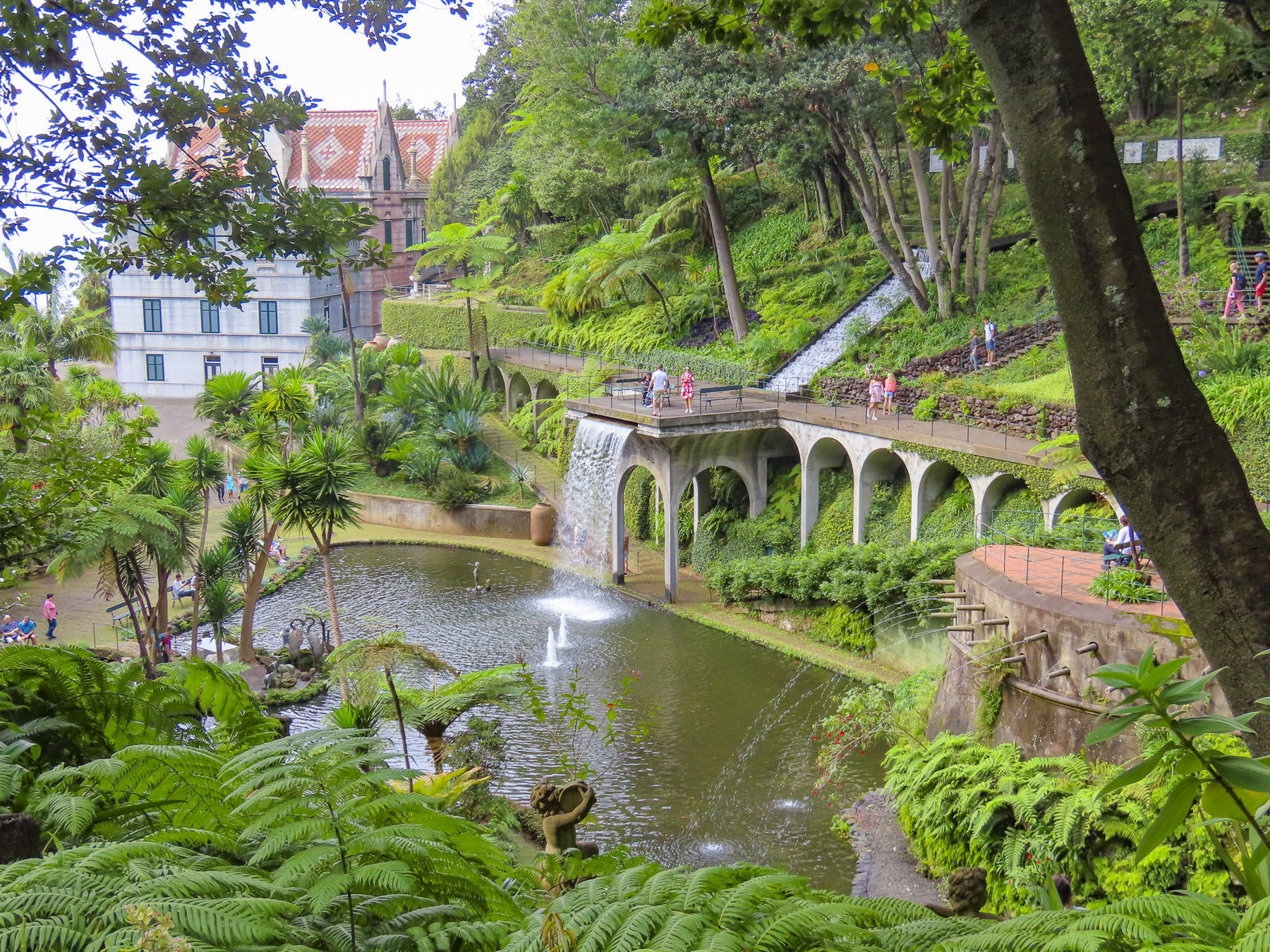
In the 1700s the hillside that the garden covers was a private estate with a small chateau. Later it functioned as a grand luxury hotel. In 1987 the entrepreneur Jose Manuel Rodrigues Berardo acquired it and transformed it into a serene Japanese themed botanical garden and opened it to the public. It’s a beautiful tranquil landscape, but it’s best to arrive early or late to avoid a crowd. There is also collection of contemporary Zimbabwean stone sculptures from the 1960s and a cave created to display a spectacular mineral collection gathered from around the world.

Slightly smaller and lower on the slope the Jardim Botânico da Madeira is also worth a visit to experience its stunning formal garden with a view of the Funchal coastline, and paths that weave through various plantings. There is also a nice cafe with a terrace that has one of the best views of Funchal.

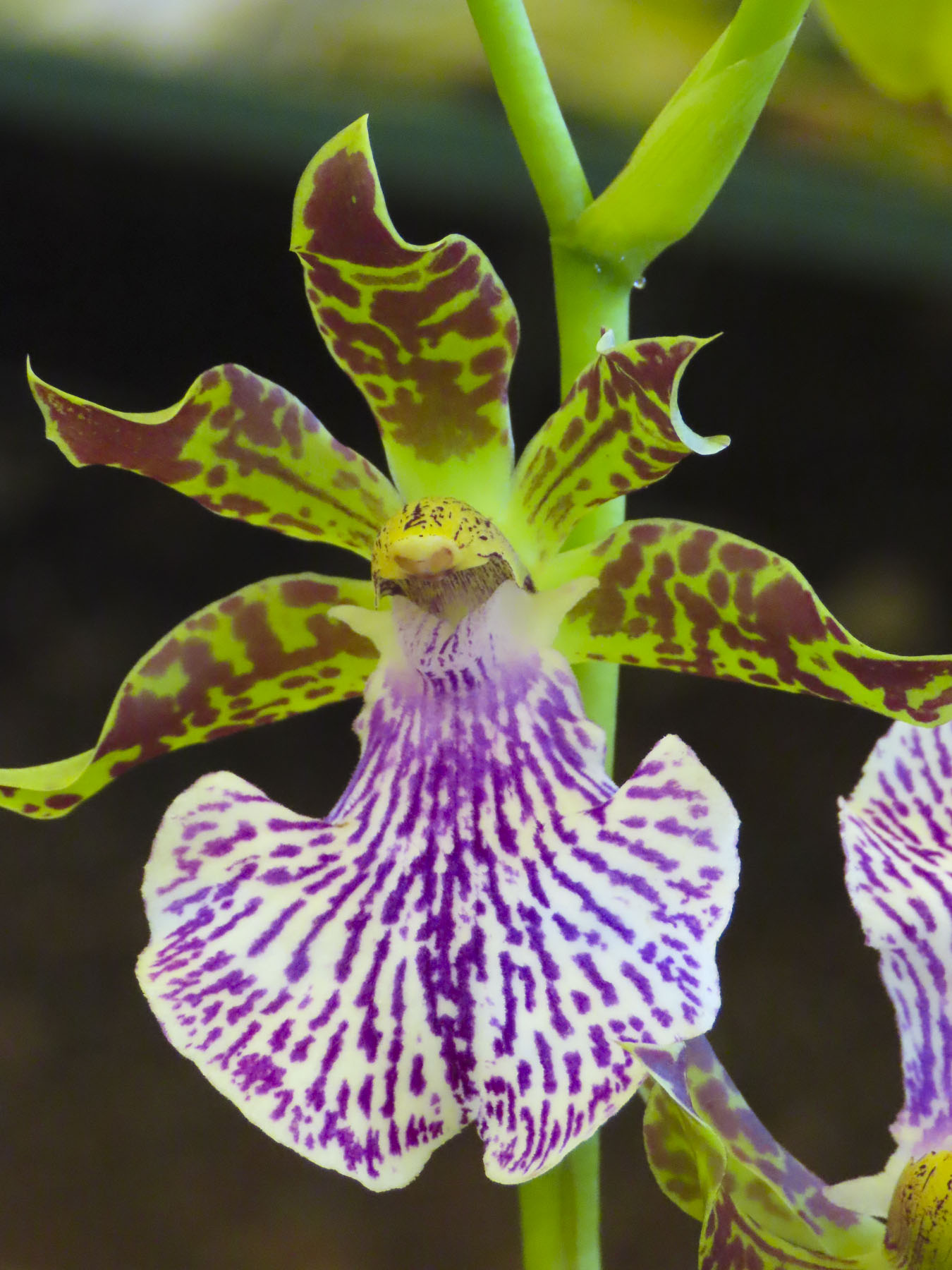
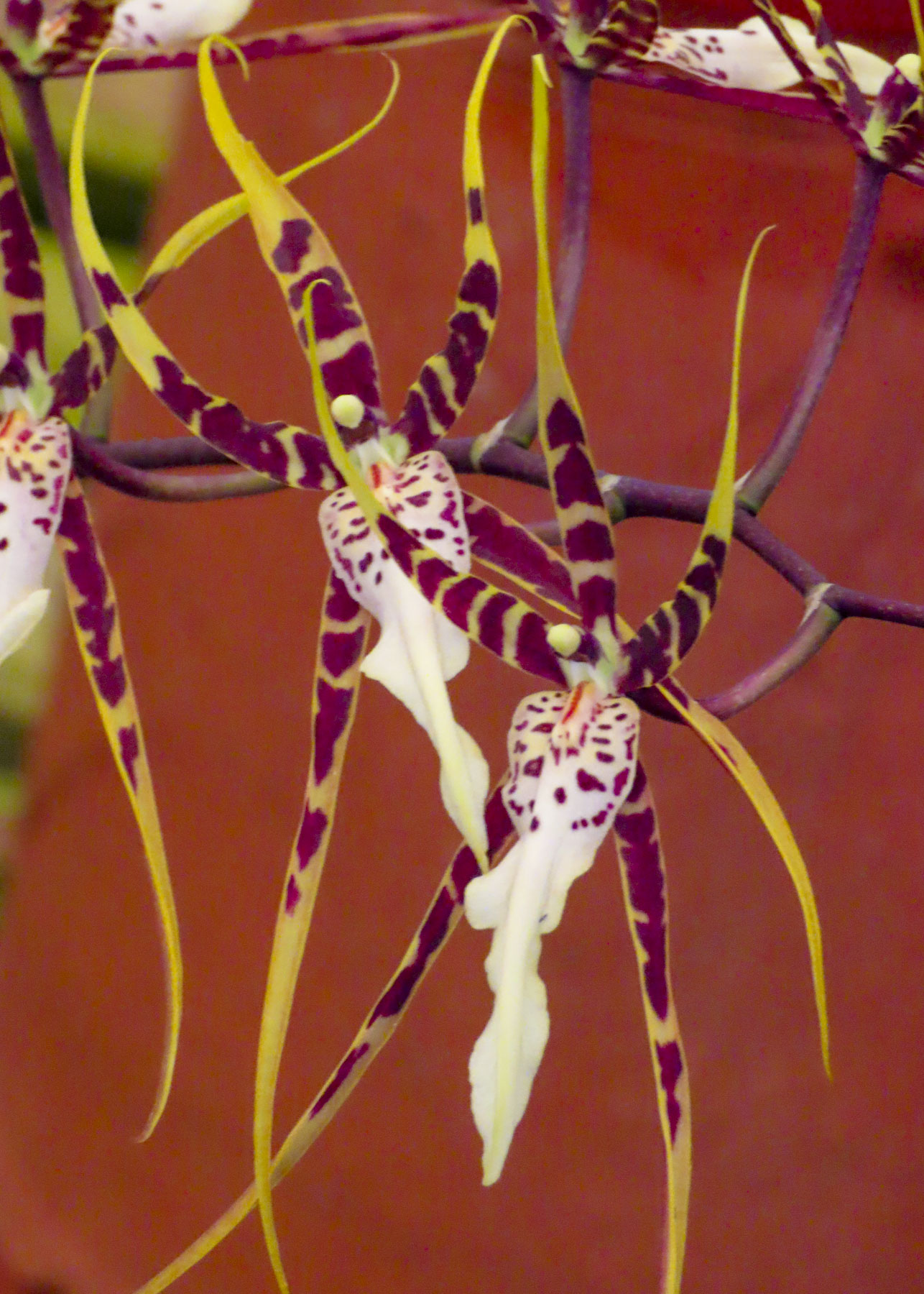
However, if you enjoy orchids the place to head is the Quinta da Boa Vista. It’s a quirky plant nursery that has been operated by several generations of the Garton family and has hundreds of different orchids. As we entered the first greenhouse, an eager attendant waved us over and encouraged us to smell a delicate plant she was holding. An Oncidium Sharry Baby, it had a delicate chocolate aroma. It was delightful. With two stunning botanical gardens in Funchal and smaller ones seeded around the island, Madeira justly earns its nickname as “The Floating Garden of the Atlantic.”

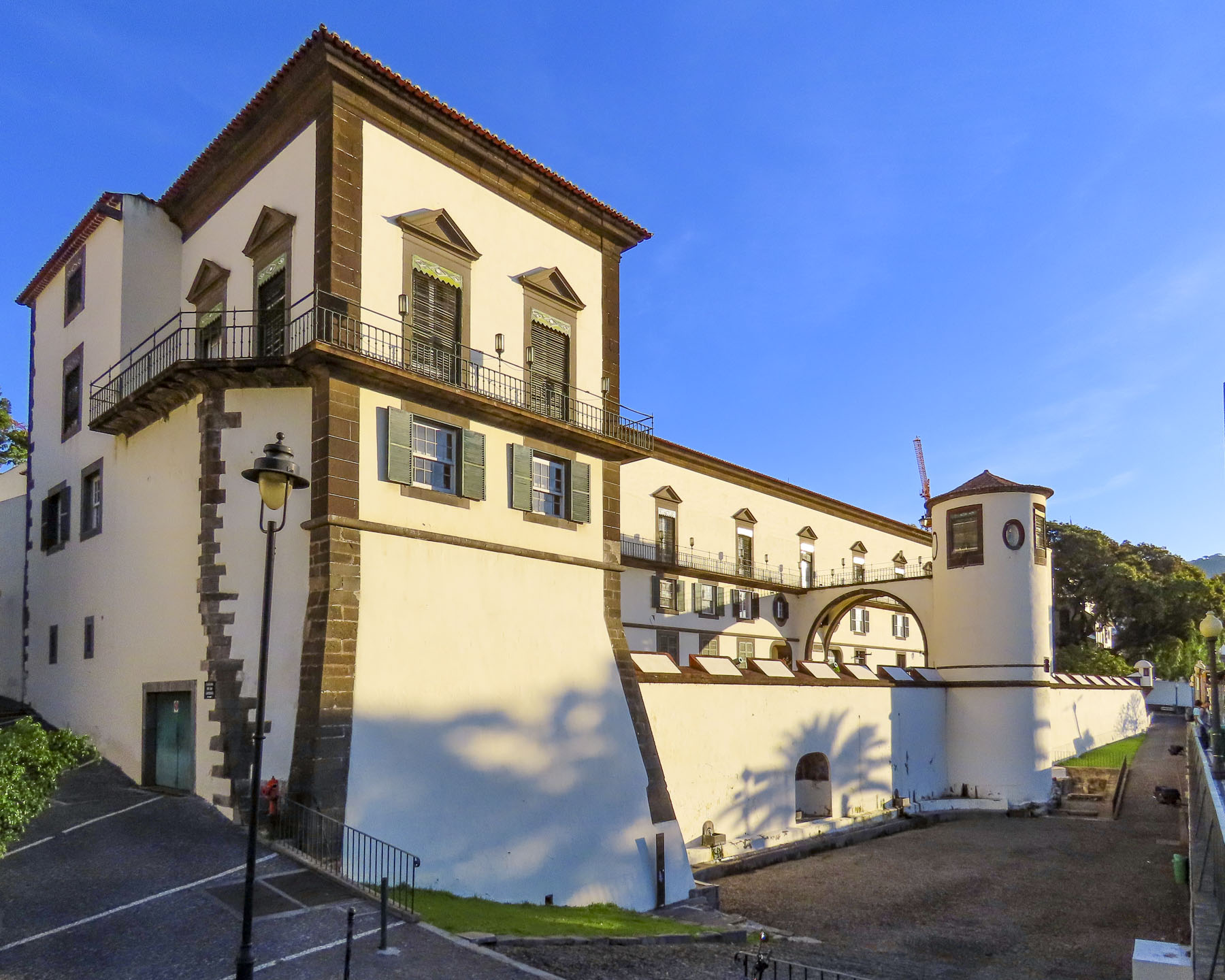
Earlier we had spotted the hulking edifice of the Fortaleza de São João Baptista do Pico. A 17th century stronghold, it was built high on a hill, 350 feet above Funchal’s waterfront to deter pirate attacks. It’s a wonderful destination within town, with a nice children’s playground and café outside the fortress battlements. The view out over the city and ocean was spectacular.

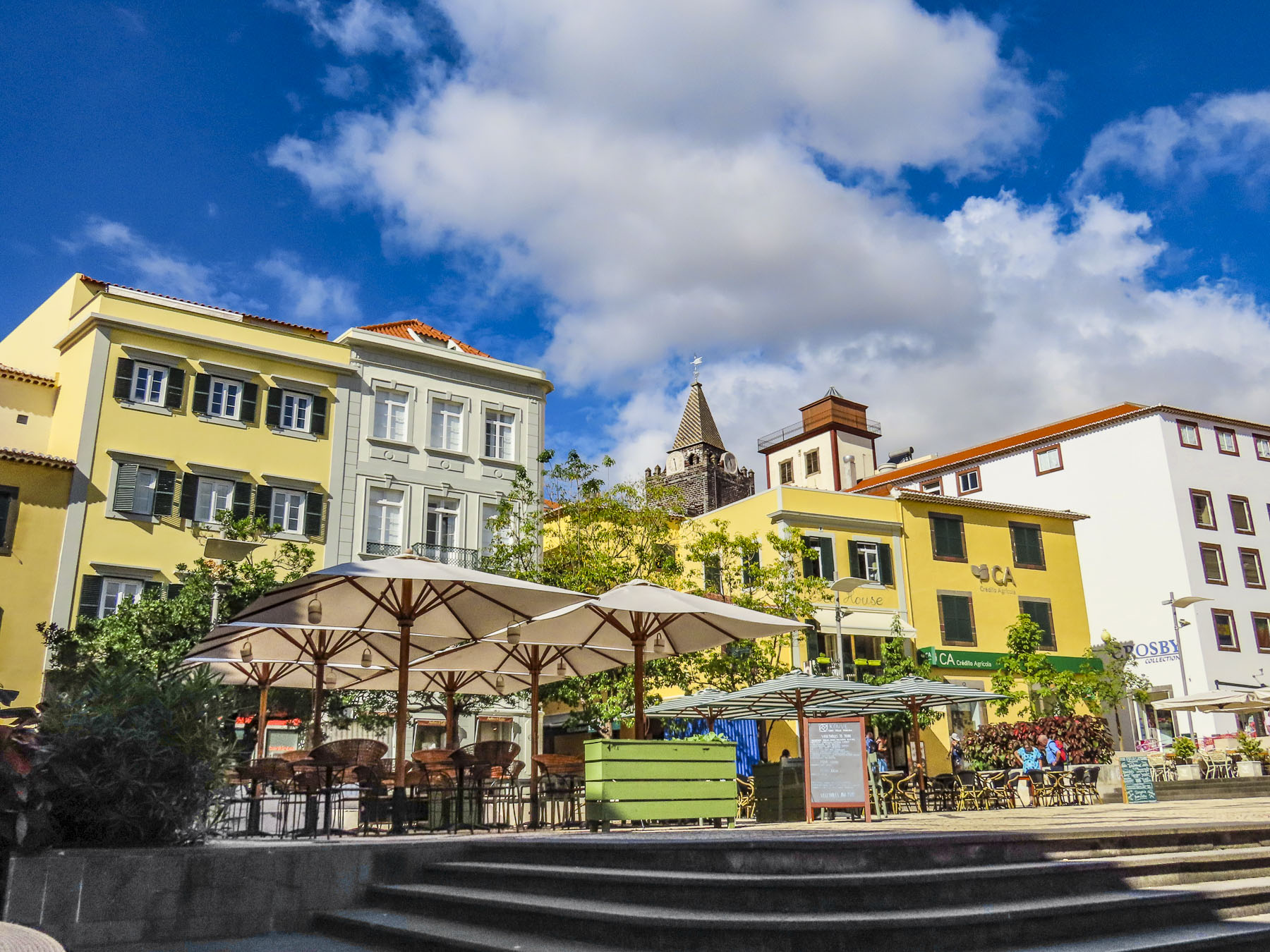
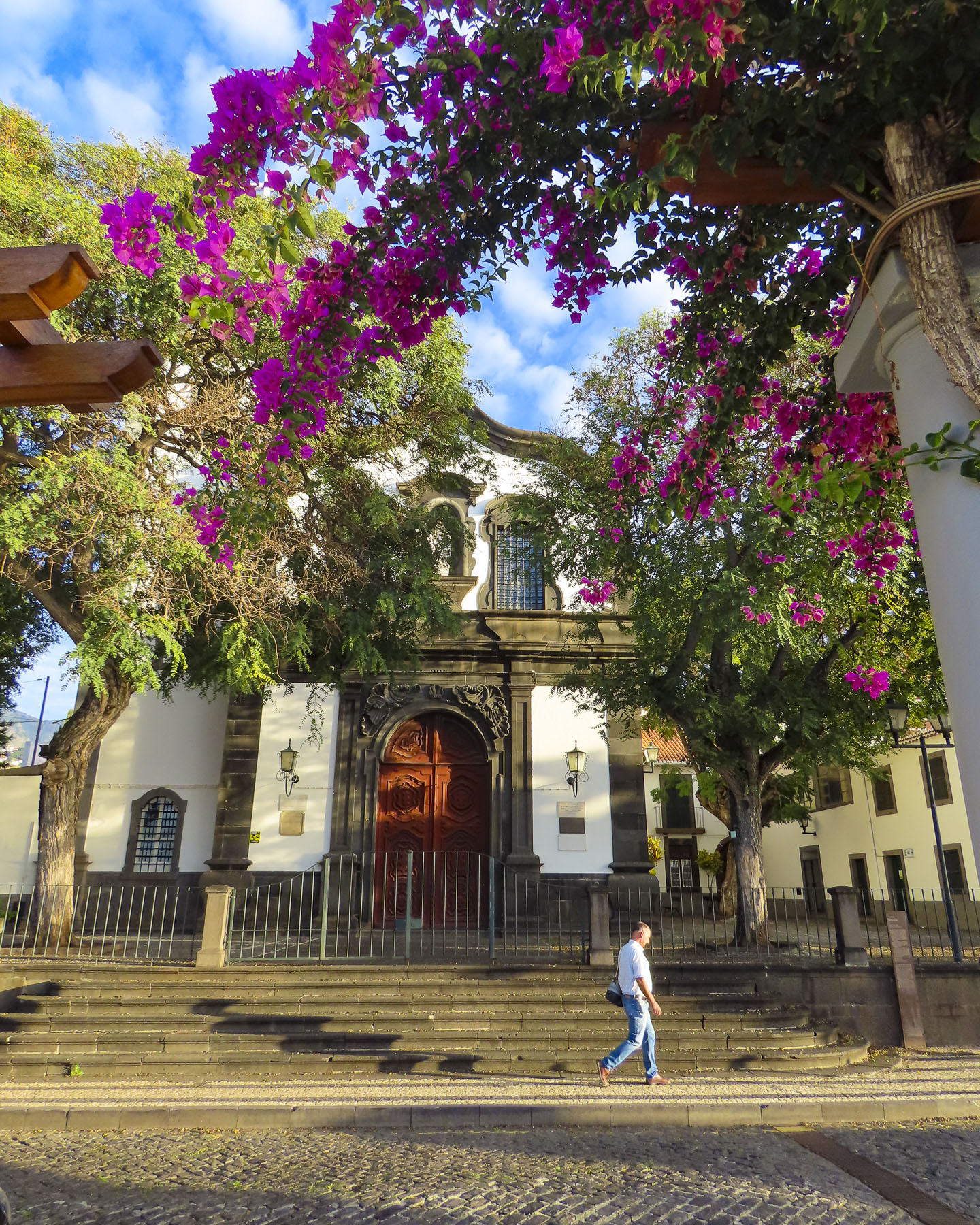
Other mornings we explored closer to home heading to the Igreja de São João Evangelista, on Funchal’s central plaza. Built by Jesuits in 1629, it is known for the fusion of its Mannerist exterior with a lavish Baroque interior.

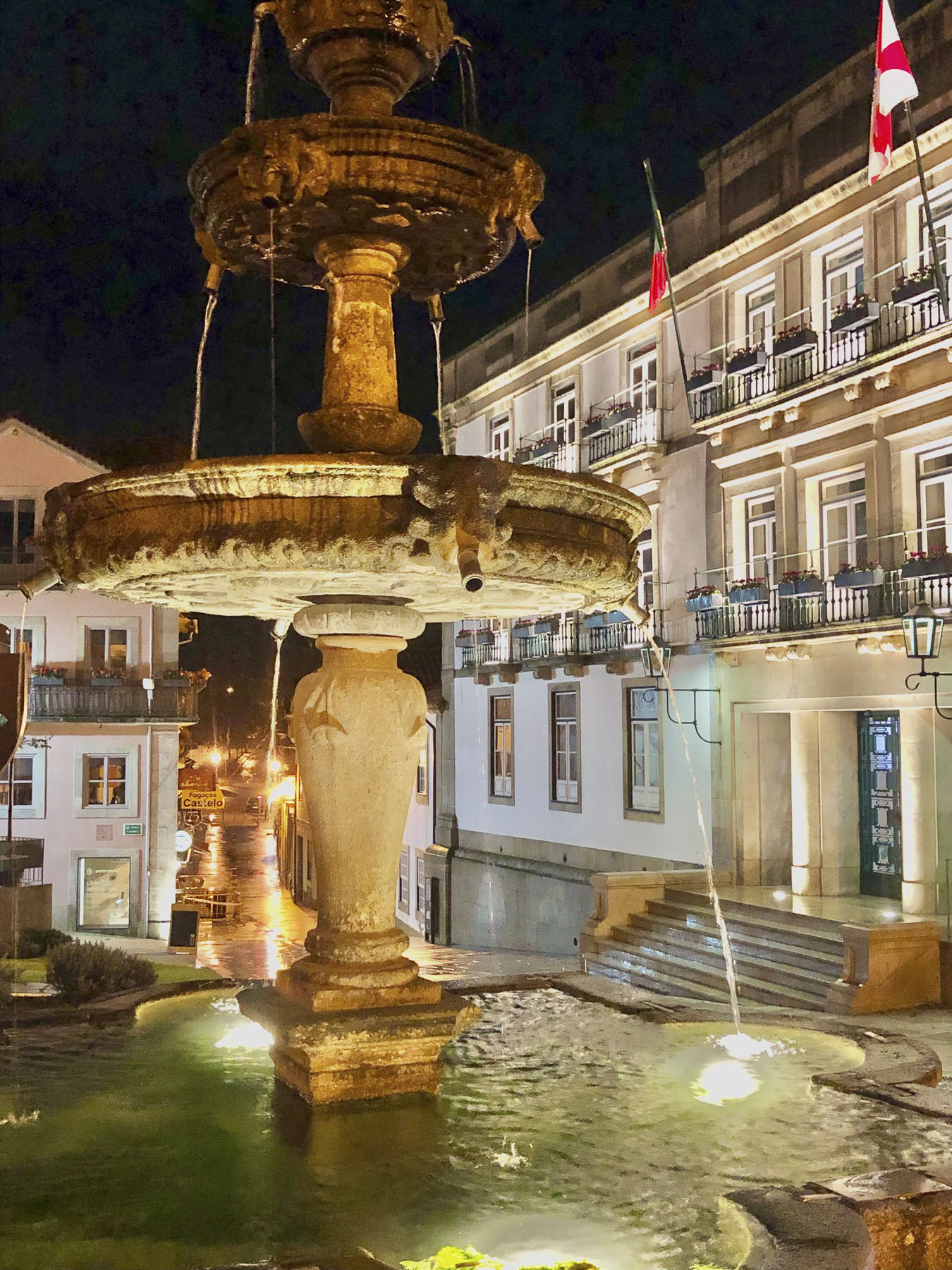
We climbed to the church’s roof for an exceptional view of the old town. Funchal’s City Hall is adjacent to the church and has a stately courtyard centered around a unique fountain depicting Leda and the Swan. An odd choice we thought for decorating a municipal building.

But Funchal is very supportive of public art and we passed many interesting sculptures along our walks. The historic old town with its cobbled lanes lined with centuries old buildings and churches was a delight to explore.

One morning we photographed small boats leaving the port at sunrise from Parque de Santa Catarina, which commands a bluff across from the cruise terminal.

From the park we walked along Rua Carvalho Araujo up into São Martinho, an upscale area anchored by Reid’s Palace. Occasionally we popped into the hotels that faced the water to check out their views.

But there is more to this island than just Funchal, so we hopped in the car for farther explorations west along the coast. Our first day trip was on a Saturday afternoon to Câmara de Lobos, famous as a favorite spot for Winston Churchill to paint. A newly married couple was taking wedding photos amid the colorful small boats pulled ashore as young children splashed and played with their dog in the shallow surf  that splashed against the boat ramp.

Parallel parking on a steep incline was challenging, but it’s a skill that’s required on Madeira, and came in handy when we reached the Cabo Girão Skywalk, one of the highest cliffs in Europe. Relatively close to Funchal, this is a popular destination and there was actually a traffic jam as cars and buses creatively parked. This glass bottomed miradouro seems to hover miraculously over fertile fields that grow grapes and tomatoes nineteen-hundred feet below. Nearby the Cabo Girão cable car, originally built to help farmers bring their crops up from the fields, can whisk you down to a secluded beach. We have a healthy fear of heights and instead continued on.

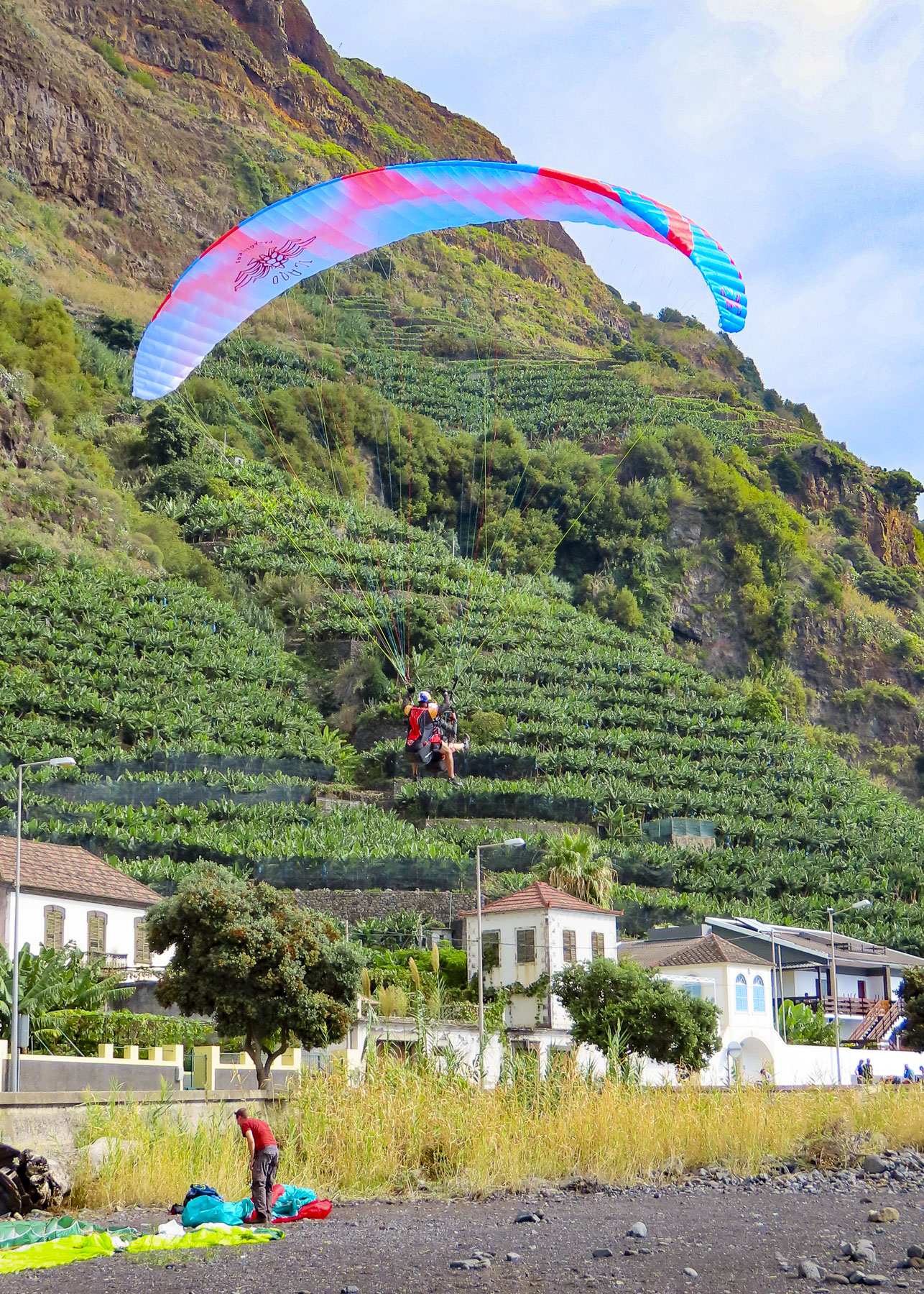
I wasn’t fast enough with my camera to grab a photo of a paraglider swooping low over our car as he landed along the stoney beach at Cais da Fajã do Mar. High above us a group of paragliders swirled on warm thermals and we waited for them to descend, but they kept floating back over the ridge.

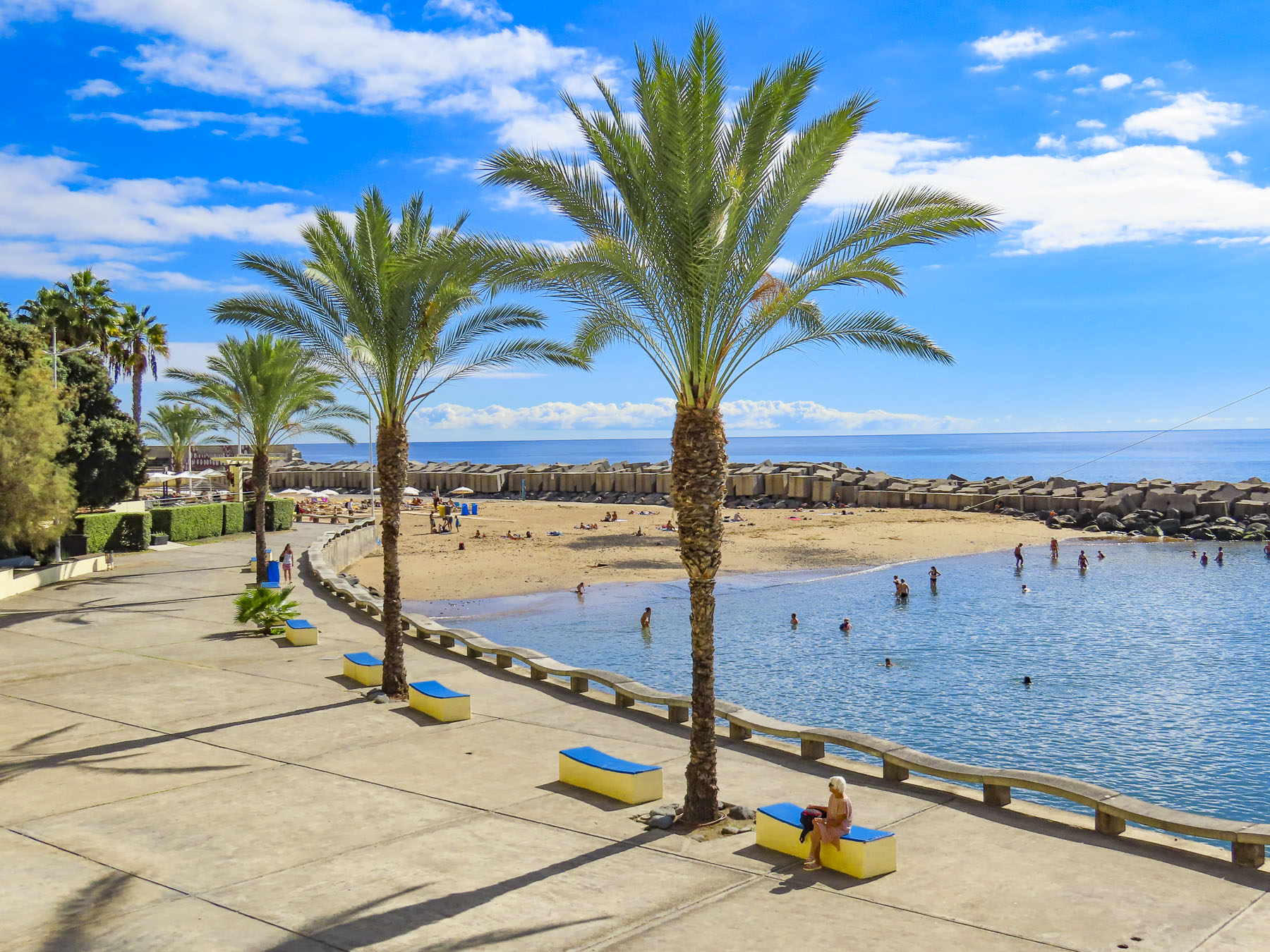
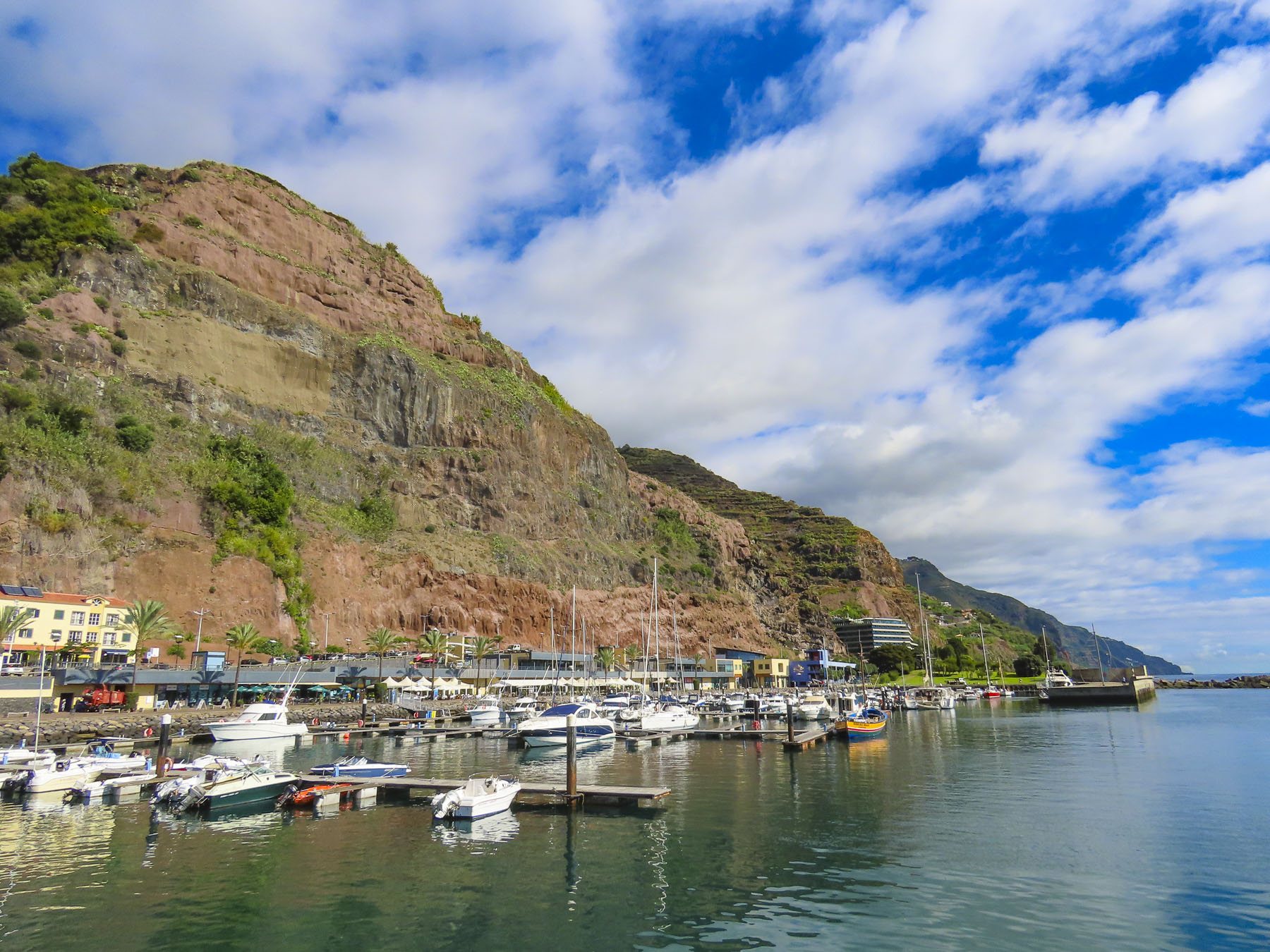
We meandered farther west to the beach and harbor, dramatically wedged between ocean and mountain, in Estreito da Calheta.  This is a largely human-altered section of the coast with a breakwater protecting Praia da Calheta, created with imported sand, and harbor next to it. We ate lunch on the promenade across from the marina.

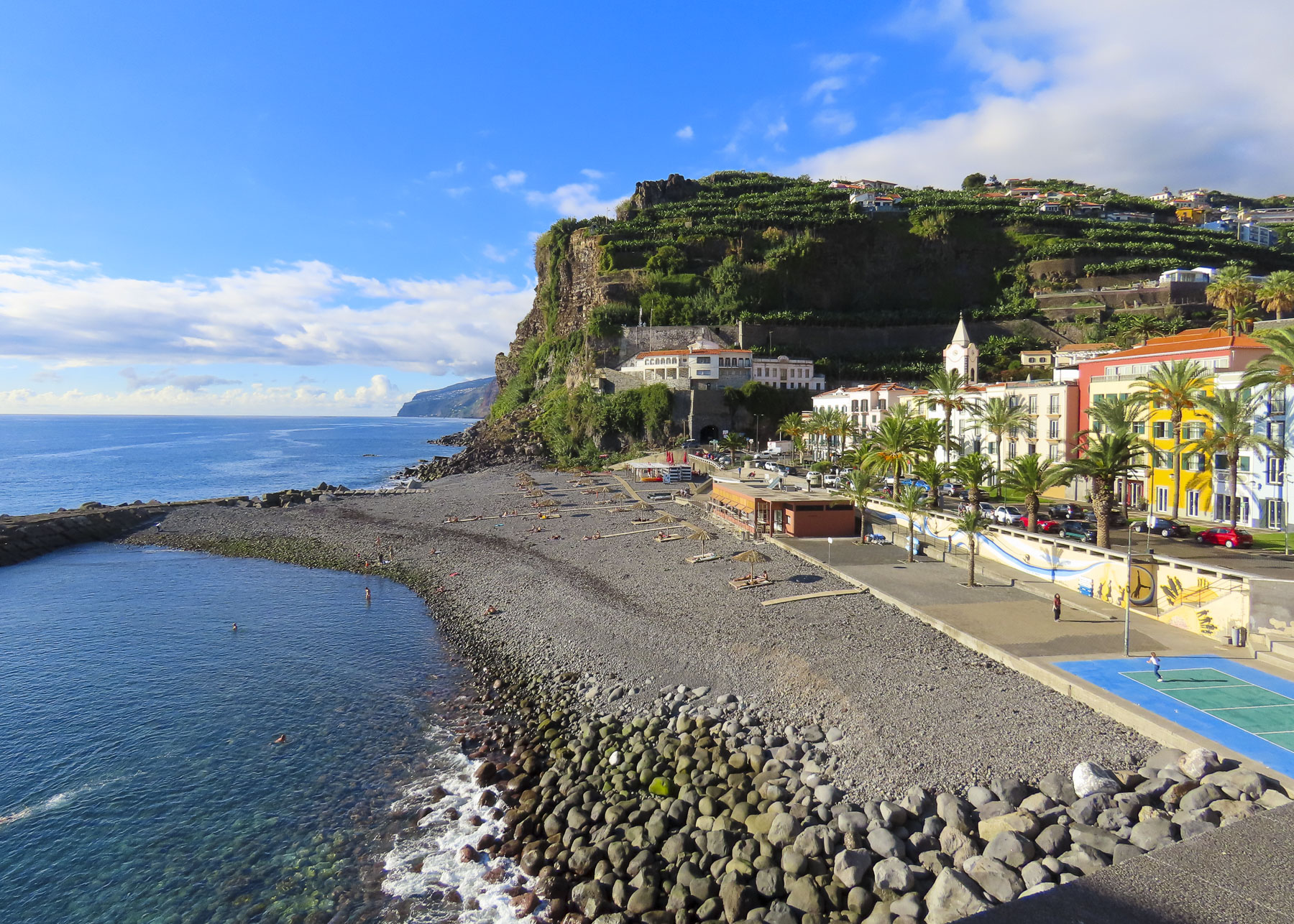
Heading back to Funchal later that afternoon we made a final stop in Ponta do Sol, and were able to find sanctioned parking in one of Madeira’s older, now decommissioned traffic tunnels. Walking out to a small headland we had late afternoon refreshments on a terrace with a brilliant view of the coastal village.

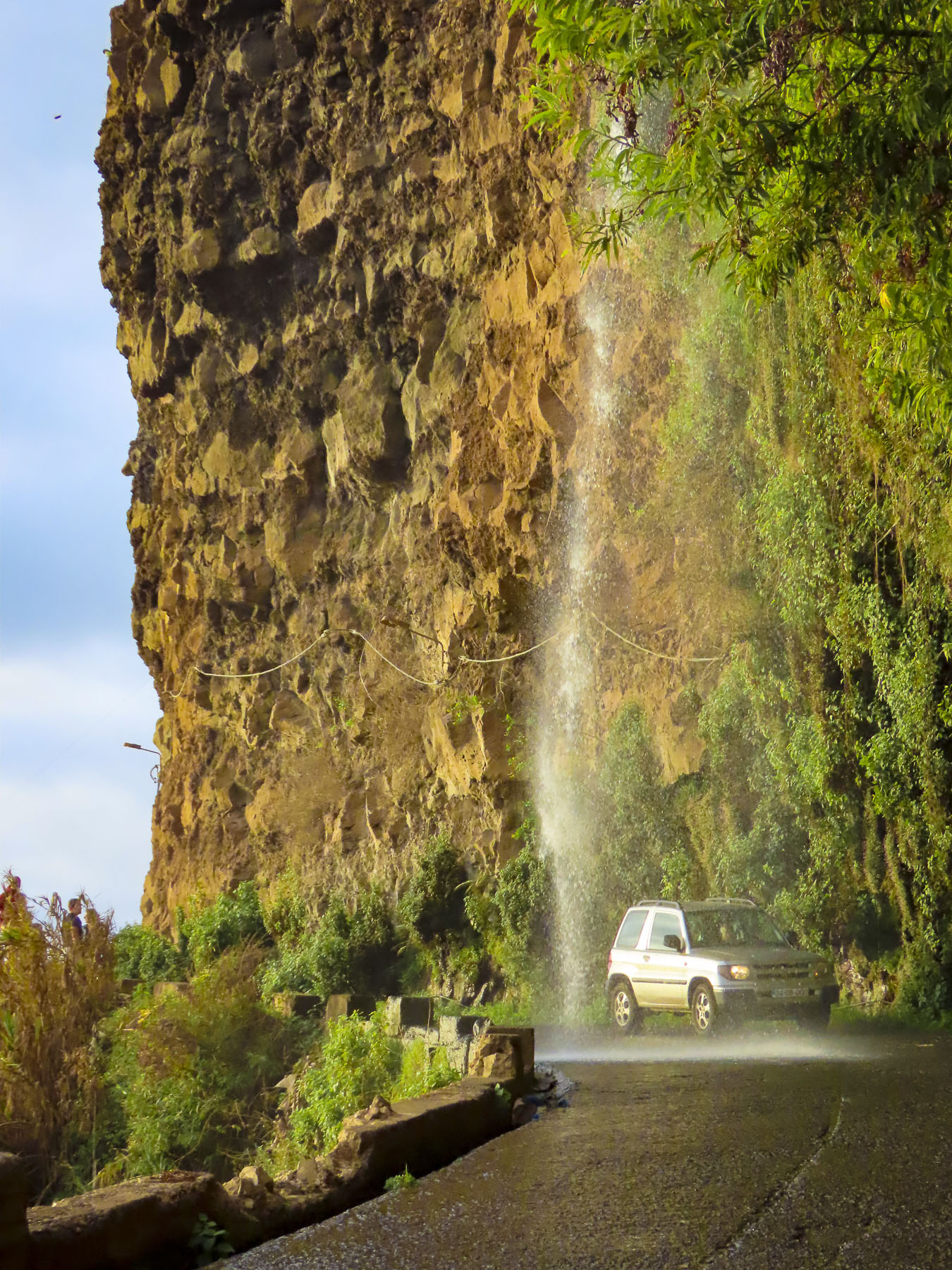
“Roll up your window.” “Wait, you’re not going to…” Yee haw! I yelled and we laughed while a thunderous cascade of water splashed off the roof of our car as we drove under the Cascade of Angels waterfall.

Till next time, Craig & Donna

Portugal Road Trip Part 6: South Along Portugal’s Frontier Castles to Evora

Let’s face it, sometimes the weather just sucks! It was so abysmal we were tempted to stay wrapped in our blankets and sip coffee, but our travel plans dictated otherwise.  We try to avoid really long drives, but sometimes you just have to. Today was one of those days. Six hours of driving from Santa Maria de Feira across the country, west to east, to the Portuguese frontier. Stopping at Castelo Mendo then heading south to Sortelha Castle before reaching Castelo de Vide, where we would spend the next two nights. We had visited this region bordering Spain several years earlier, exploring Marvão, Monsanto and Castelo Branco, and found the quiet walled villages and hilltop castles intriguing and full of fascinating history.

Normally we like to use Google Maps’ “avoid tolls” filter, because tolls along with gasoline are excessively expensive in Europe. We’ve followed its suggested routes to some off-the-beaten-path discoveries; however, this time it doubled the length of the journey. So, we kept to the highways. In Lisbon we had asked the car rental agent about paying tolls which eventually boiled down to: you need to stop at any CTT Post Office, give the agent your car registration number and pay the tolls only for the dates you have rented the car. It was actually an easy and inexpensive process.

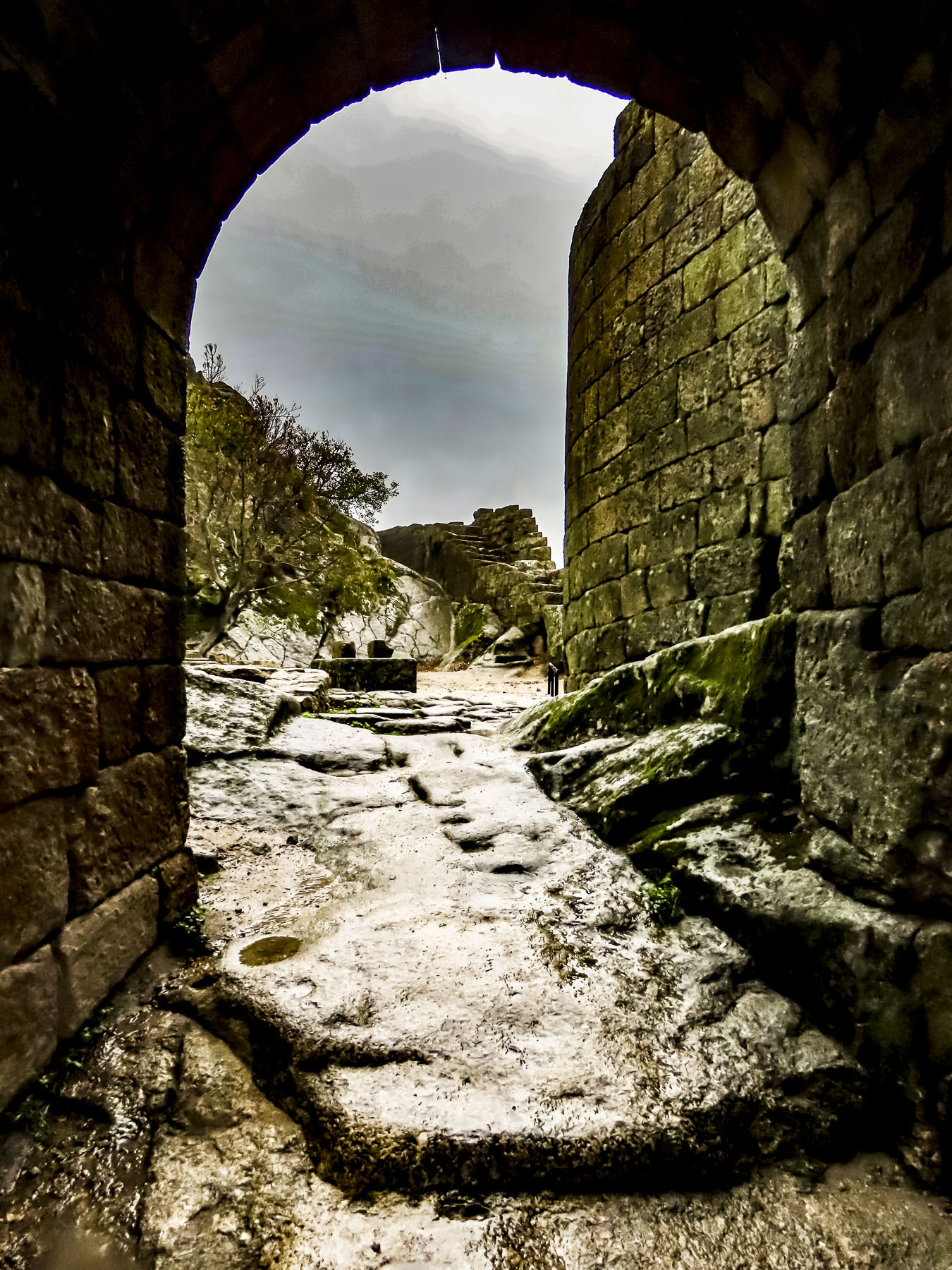
The intermittent rain had stopped, but a moody gray sky still hung over Castelo Mendo as we walked through the Portas da Vila, the ancient gate, guarded by two towers and two now well-eroded zoomorphic sculptures of wild boar, which are believed to date from an early Iron Age settlement. Solid two-story homes lined the way. The first floors, now shops closed for the off-season, were once used as barns for animals, while the upper levels were used as living space for the families. Our footsteps echoed down the hard stone alleys as we made our way to the hill where the castle once stood, we passed the communal oven, the pillory, and the portal to a foundling wheel (a turnstile where unwanted babies were anonymously placed. It was used until 1867.)

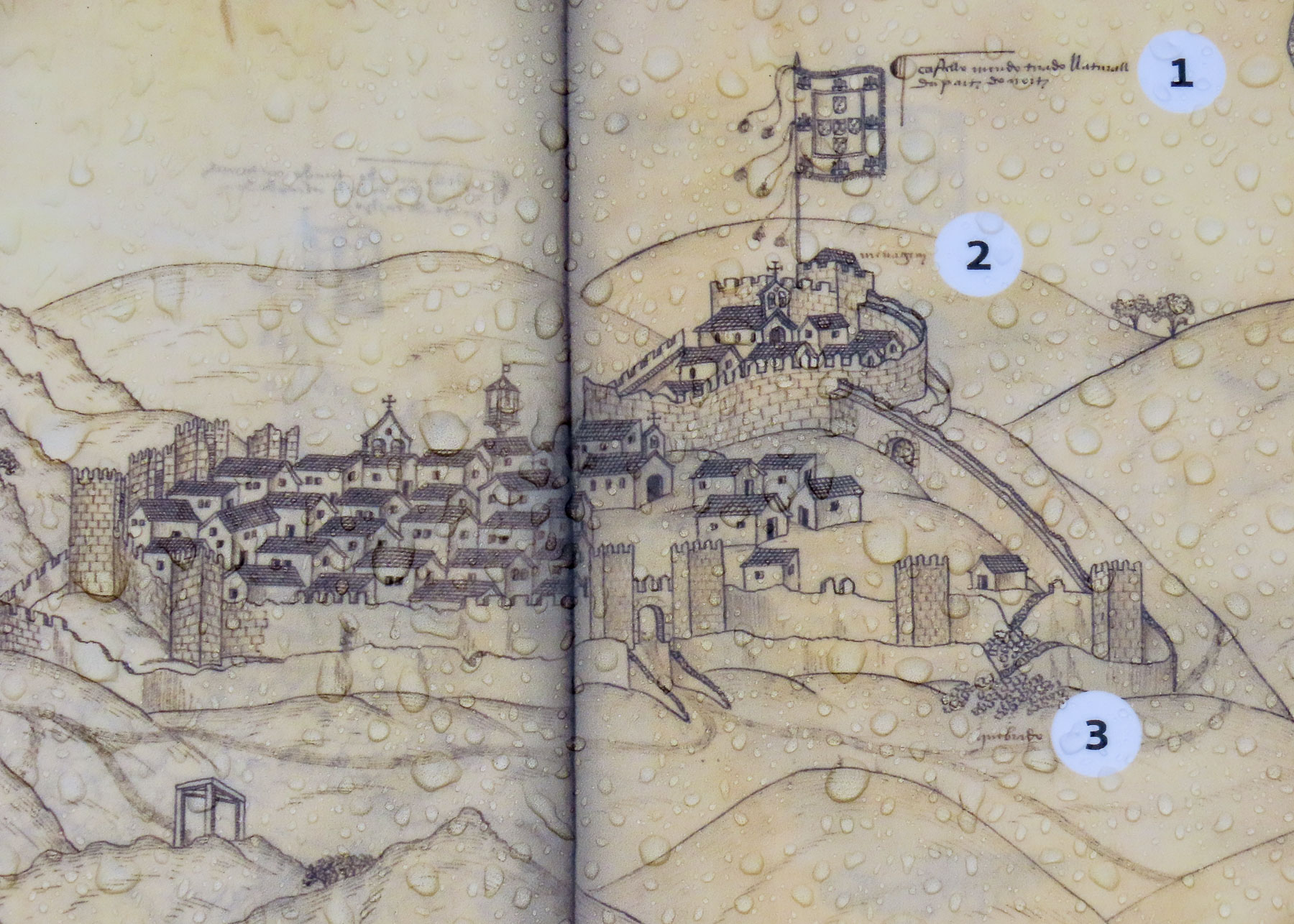
On the ruins of earlier Bronze Age and Roman fortresses a large castle, with six city gates and two rings of defensive walls and towers, was ordered built in 1229 by D. Sancho II. It must have been a sight to behold as the village was granted a charter to host an eight-day-long triannual fair. This was the first fair to be held on a regular basis in Portugal. The castle’s strategic importance was soon forgotten after the permanent border with Spain was established in 1297 with the Treaty of Alcanizes, and over time the immense walls were dismantled. The stones were carted away to build homes in the expanding and prosperous village. Now on the crest of the hill only the ruins of the citadel’s church remain standing.

We were navigating a switchback curve off of N324 which we had followed south from Castelo Mendo when we spotted the Castle of Sabugal high on knoll above the Coa River. Looking very impressive from a distance, we noted the castle for future travels. The weather too inclement to stop on the shoulder of the road to take a photo.

The storm had steadily worsened all afternoon. By the time we reached the Castelo de Sortelha it was raining “estava chovendo cães e gatos.” Fortunately, it was mid-week and every sane person was inside with their feet by the fire enjoying a glass of port. Except for this “madman,” which is how my loving wife occasionally refers to me.

I’ve always enjoyed weather and spent three years before retirement, as a mailman delivering mail in all sorts of weather. “Neither snow nor rain…” I was unfazed. Donna sat out this lunacy. But you never know if you’ll get a chance to come back! Tucking my camera deep under my coat, I ventured forth. I returned soaked. Really it was just an excuse for a double ration of Port that evening. To say the least, the photos are moody.

Fortunately, the door was quickly opened at A Burguesa Guesthouse and a friendly voice welcomed us with “Please come in, let me take your bags,” as we were ushered inside out of the rain. We know we’re getting older when the young receptionist at the guesthouse whisked our bags up the stairs two steps at a time. “Maybe I should start dying my grey?” “You might need to shave a few years off while you’re at it,” Donna replied jokingly with a smile. A few moments later the hostess returned with an umbrella and directions for parking our car which was blocking the narrow, deserted lane in front of the guesthouse.

“Follow the lane, anywhere around the plaza, the parking is free.” One of the things we’ve come to appreciate while driving through Portugal is that parking, outside of the larger cities, is relatively easy and free. Unlike Italy where you practically need to have a separate budget just to park the car. When I returned our hostess kindly offered to dry our coats for us, which we greatly appreciated. Originally a large family residence with a workspace on the lower level, A Burguesa was lovingly restored into a spacious inn featuring eight guest rooms, pool, terrace and views of the village’s castle.

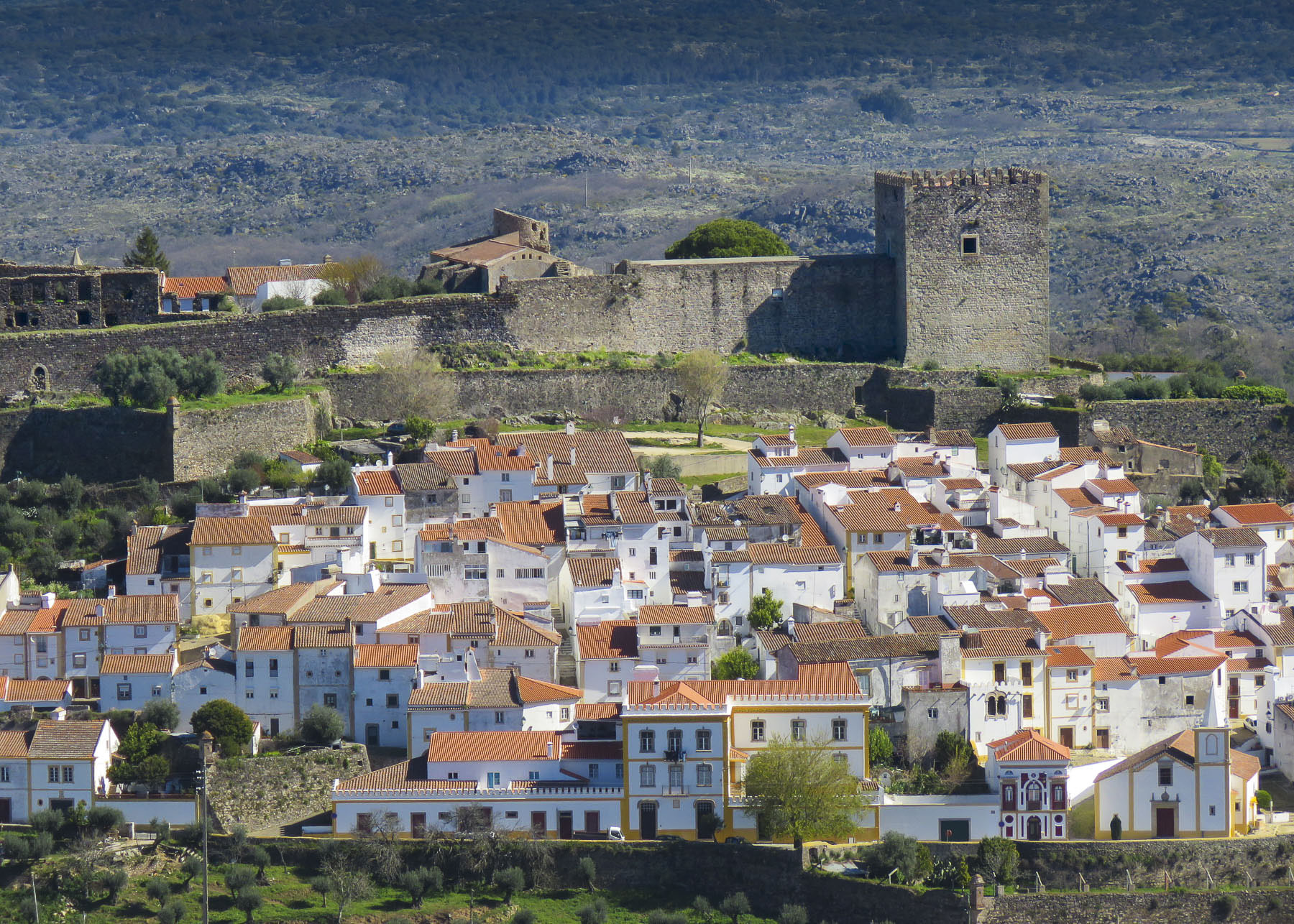
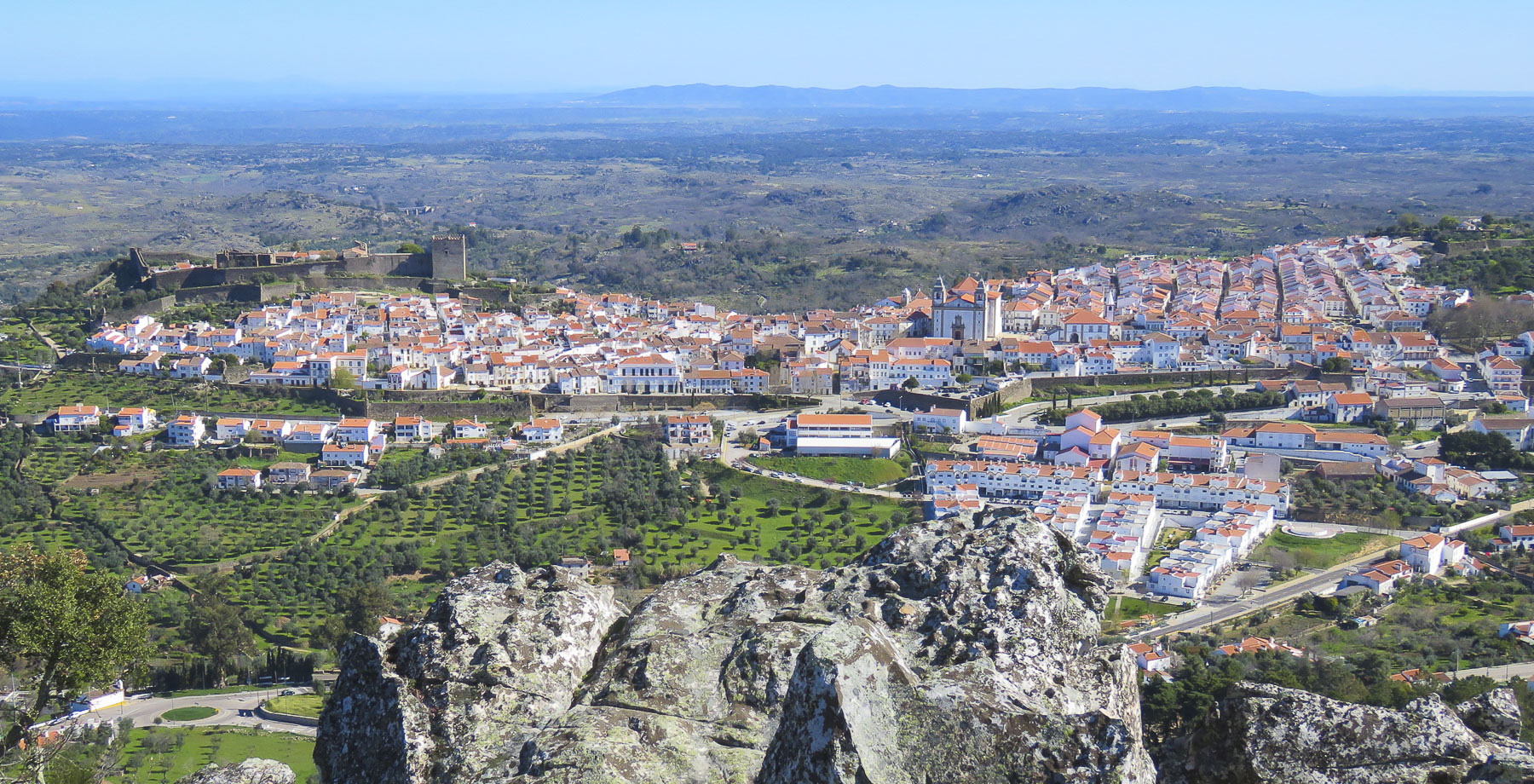
Castelo Vide first came to our attention several years ago, when we were driving north from Marvao to Castelo Branco. Its red roofed, white stuccoed buildings and prominent castle covering a hillside looked so appealing we hoped to return. We did detour at the time to the Ermida de Nossa Senhora da Penha, a small chapel in a cork forest. Located high on a ridge opposite the village, it offered an outstanding view. If the weather is nice, it’s definitely worth a visit. Farther along there is still visible on this lane a section of old Roman road that crossed this region 2000 years ago.

Vide, as it was known before its castle was built, has been an important town since the Romans settled the area in 44 BC, when it was a vital stop on the trade route between Merida, Spain and the Atlantic coast. Eventually the Moors ruled the area from the 7th until 12th century. It wasn’t until 150 years after the Reconquista in 1310 that King Dom Dinis ordered a new castle built, and the growing town became Castelo Vide.

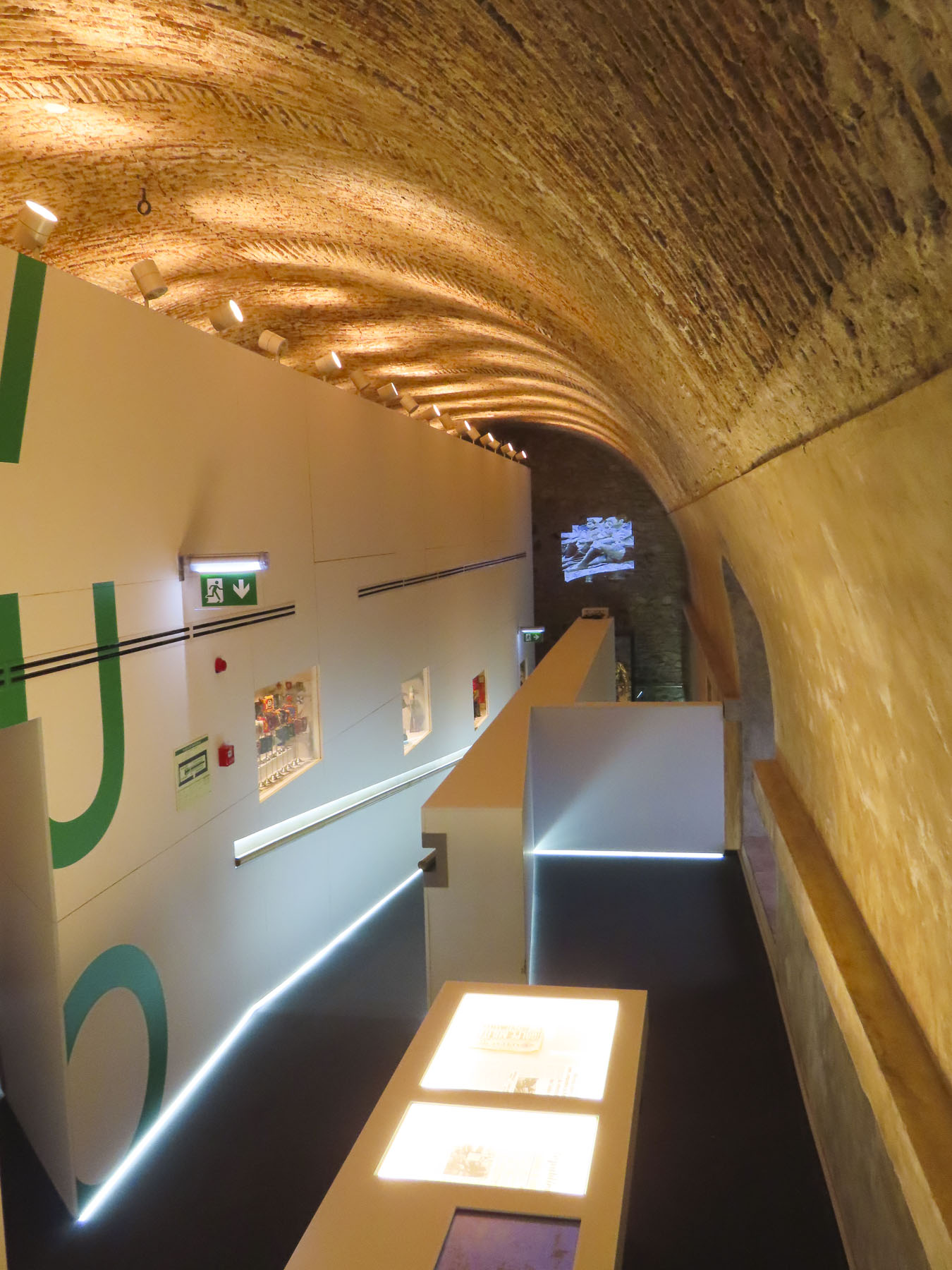
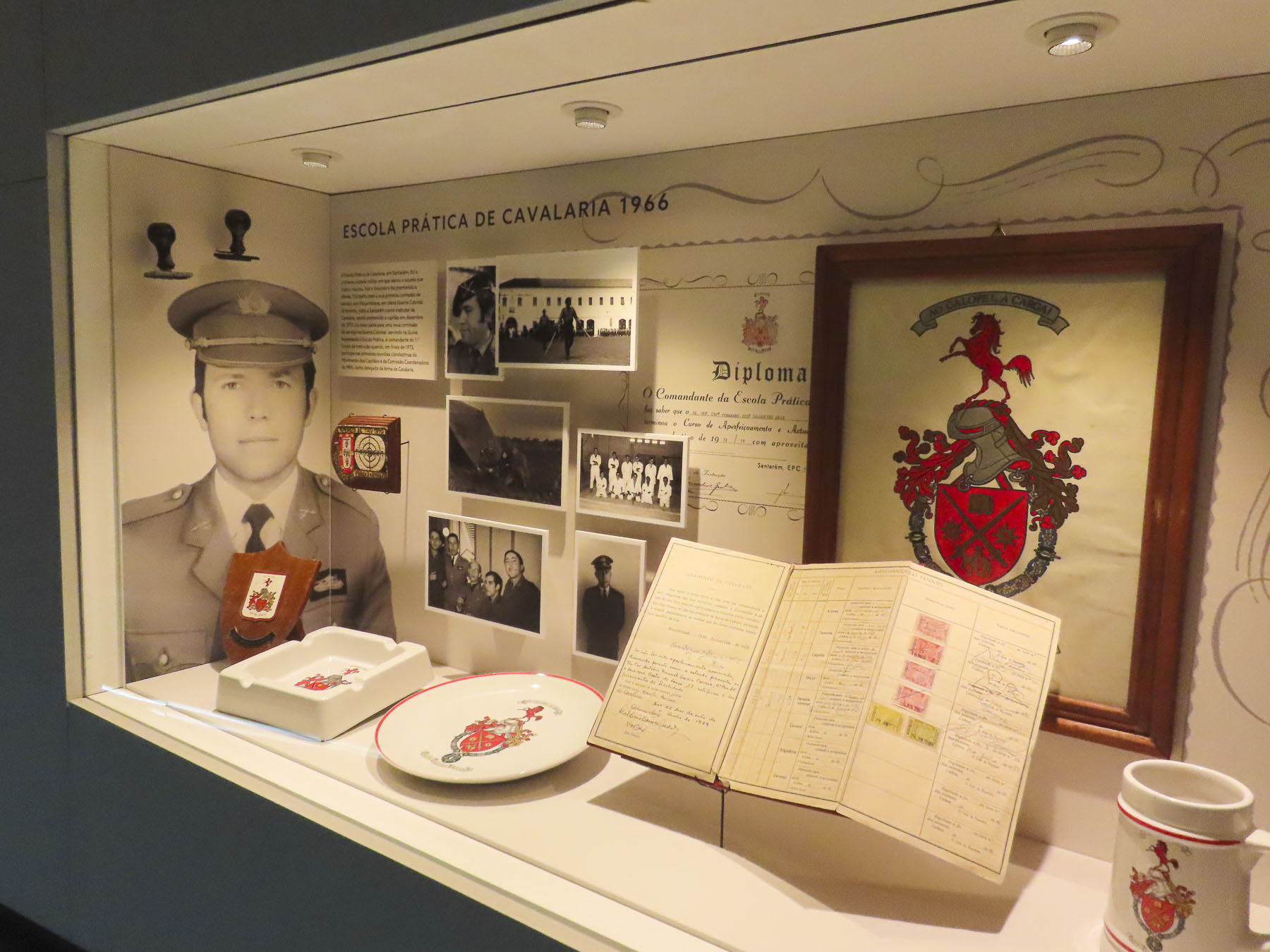
This castle is where King Dinis negotiated his marriage to his future queen, Isabel of Aragon. The castle still commands the hilltop today, though now the medieval fortress has been renovated into a museum and civic center. At the time we visited it showcased an interesting exhibit about Portugal’s Carnation Revolution in 1974, which ended a forty-year military dictatorship.

Seven hundred years ago the homes of the walled enclave that surrounded the castle keep represented a medieval who’s who of wealthy merchants influential enough to secure shelter behind the fortress walls. The intimate narrow passageways and ancient archways of this still inhabited enclave were intriguing to wander through.

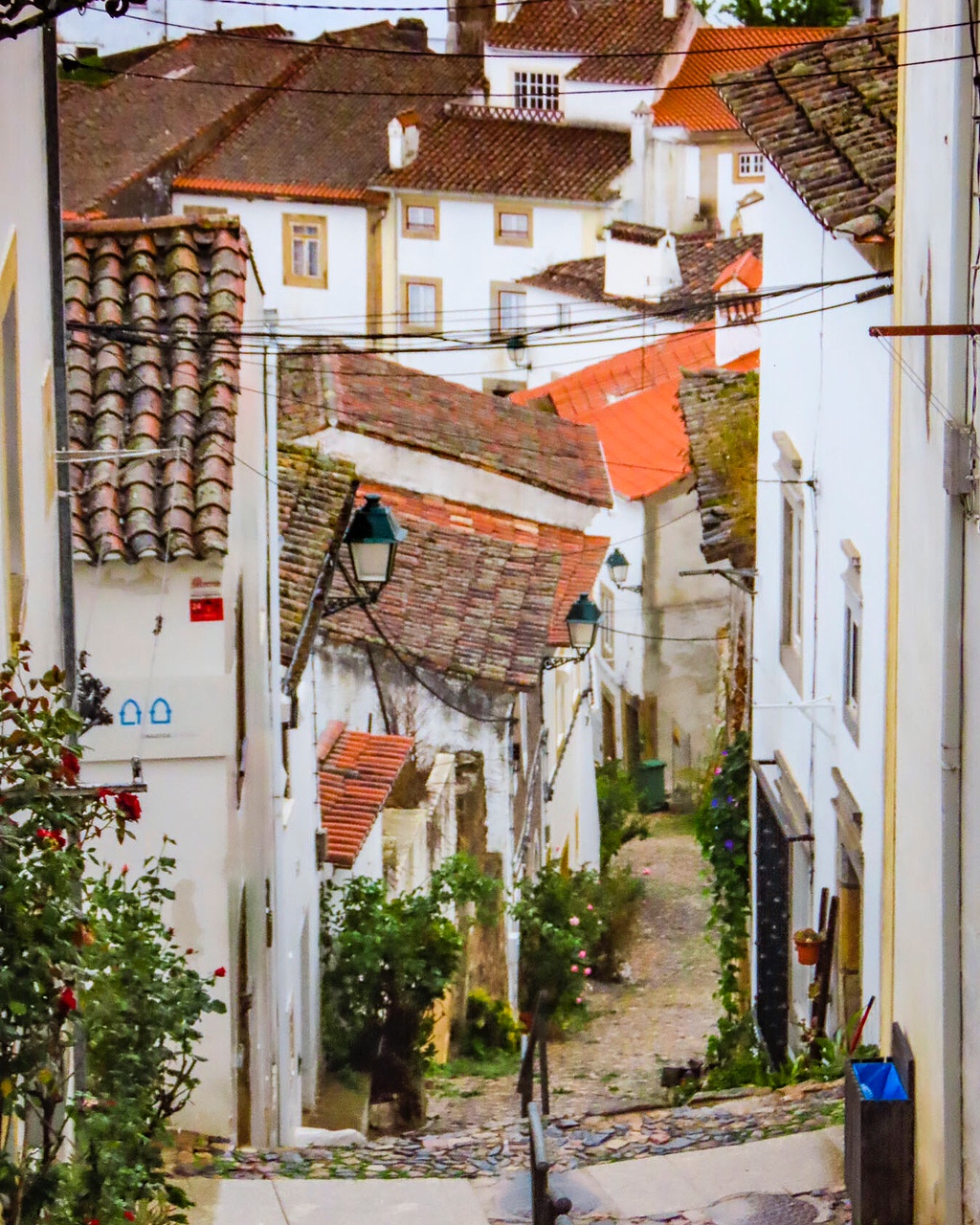
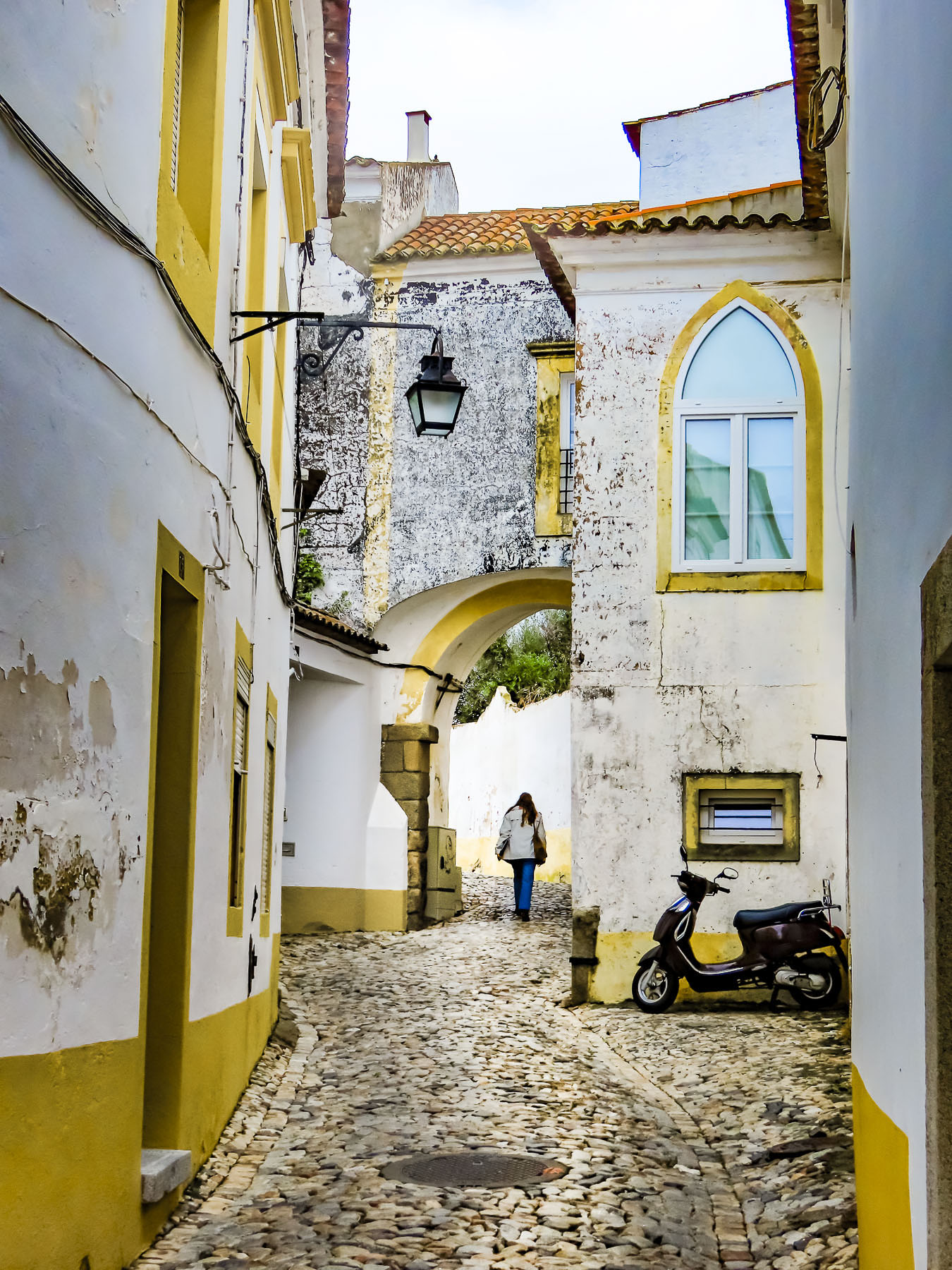
On the slope below the castle, steep alleys spiderweb down the hillside. While it was a vigorous trek to the top, the descent was equally challenging, with the concern that if we lost our balance on the wet cobblestones, we would bounce downhill like soccer balls. I exaggerate only slightly. The ambiance of this neighborhood was equally interesting – flowers seemed to grow from solid rock in the crevasses between street and homes. On homes in this neighborhood, Gothic style granite casings still survived and framed many doors and windows. Some homes left doors ajar for family pets to wander in and out, or to share their parakeets’ songs with the neighbors.

We followed a lane across the slope to Sinagoga de Castelo de Vide, a residence before its use as a modest Jewish temple. It’s thought to be one of the oldest existing pre-expulsion synagogues in Portugal, that dates from the 13th century. It’s now a museum that chronicles Jewish life in the region. Vide’s Jewish Quarter expanded significantly after Spain expelled its Jewish citizens in 1492. While Portugal was more tolerant of their religion, they were still required to live apart and encouraged to convert to Christianity.

At the bottom of the Jewish Quarter, the Fonte da Vila, a marble sixteenth century Renaissance fountain, centers the village’s old market square. The mineral water flowing from it was renowned for allegedly curing a variety of ailments from diabetes to high blood pressure.

The narrow lanes of the old town eventually funnel into the Praça Dom Pedro V, a stately plaza featuring the town hall and Igreja Matriz Santa Maria da Devesa. These “newer” historic buildings and the homes on the surrounding wider streets date from the town’s prosperous 17th and 18th centuries.

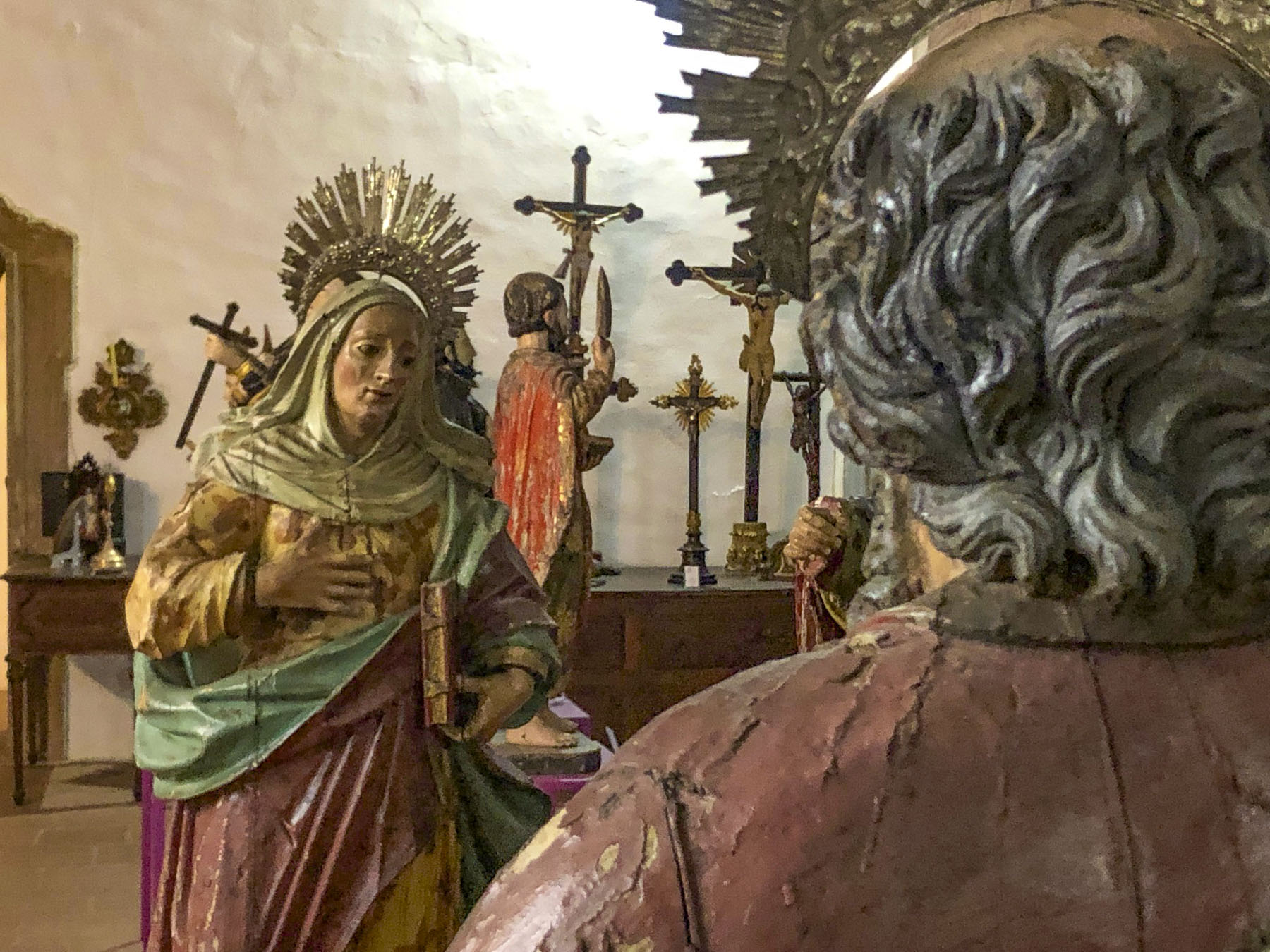
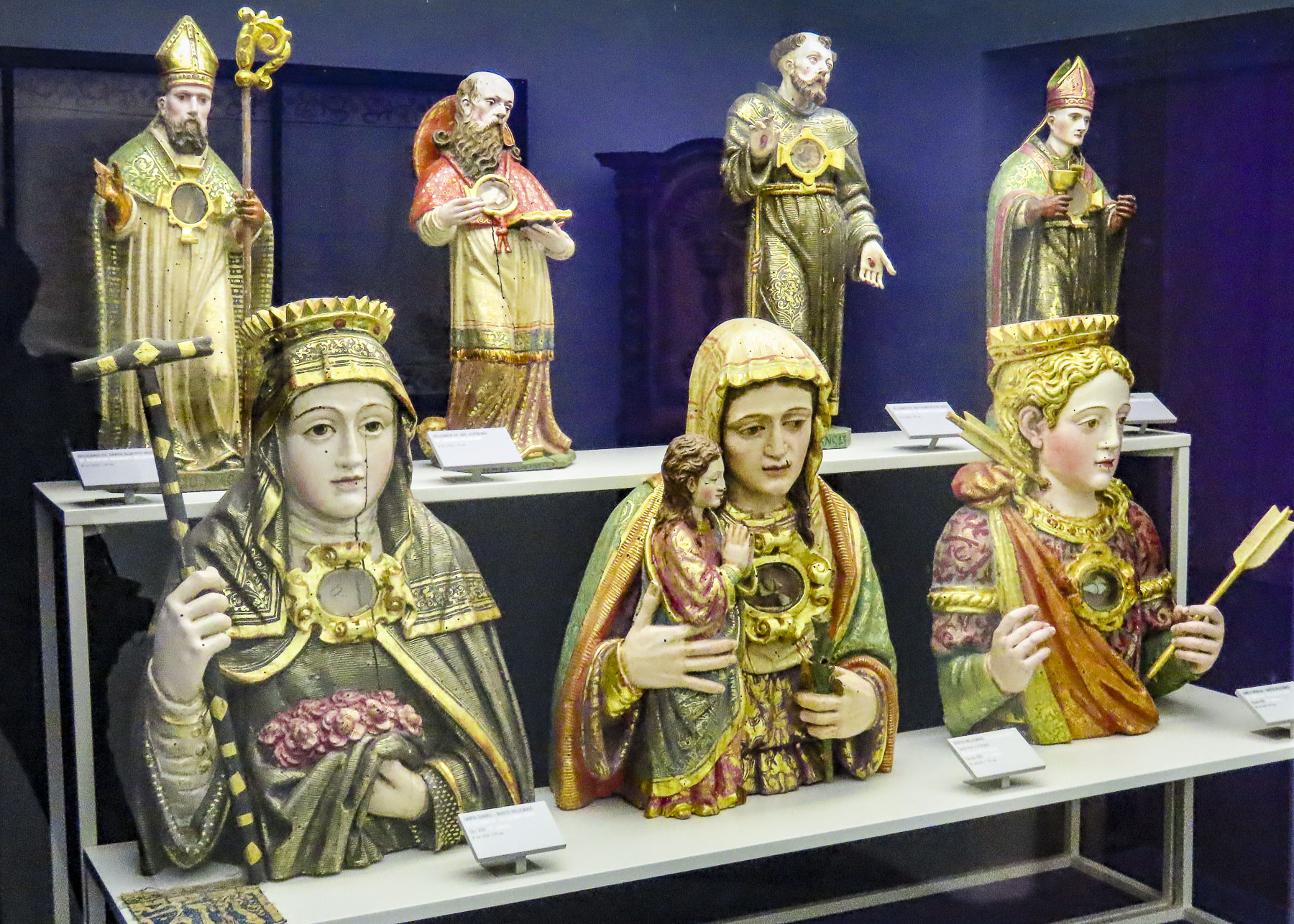
While the interior of the town’s church is very modest, the old choir loft, balconies and bell towers have been converted into a simple museum displaying a wealth of ancient religious art and sculpture. If you have ever wondered what happens to the contents of all the small, abandoned parish churches you’ve driven past, here’s your answer. Well, hopefully they end up in a splendid museum like this one that has become the religious art repository for the region. A gem of a discovery and the perfect way to spend a wet afternoon for only 1€.

The next morning a favorable weather report promising sun encouraged us as we continued south to Evora. Only a few miles out from Castelo Vide we detoured for a quick stop at the Ponte Romana da Portagem. A modest four-arched stone bridge, built in the 1400s over an earlier Roman crossing, its tranquil location spanning the Sever River obscures a turbulent past. It was here that King John II of Portugal built a tower with a tollgate in front of the bridge to collect a tax from the Jewish people expelled from Spain. A small refugee camp grew along the riverbank for those who couldn’t afford the tax. It’s believed 15,000 Jewish refugees eventually crossed the bridge.

The high arches of an ancient aqueduct, the Aqueduto da Água de Prata, spanned our route into Evora. This was a critical infrastructure project in the 1500s when King John III ordered it built to relieve the near constant drought conditions of the city that was quickly becoming a center of commerce and education in the Alentejo region, with the establishment of the Colégio del Espiritú Santo, University of Evora, in 1557. Of Lisbon’s Tower of Belém fame, military architect Francisco de Arruda was chosen to design the aqueduct. The mammoth project stretched a formidable 11 miles from the Divor River through a series of tunnels and over elevated arches, some 85 feet tall, spanning valleys and plains, before bubbling forth in the public fountains across Evora. Seems “location, location, location,” has been a housing mantra for centuries and as available land within the walled city disappeared, homes and stores were built under the aqueduct’s arches.

We knew when we planned this trip that parking in Evora would be an issue, but we were fortunate to find The Noble House which had a limited number of parking spaces available for 10€ a day. It wasn’t going to break our budget and it was well worth the convenience for two nights. The 24-room boutique hotel, as its name suggests, was in the 1400s an aristocrat’s family home. The hotel has been meticulously renovated to a historical standard that kept many of the building’s original stone arches, azulejos tiles and vaulted brick ceilings in place. For the level of comfort provided, and the convenient location, it was a tremendous value. During the shoulder season rooms are often available for under 100€ per night, breakfast included.

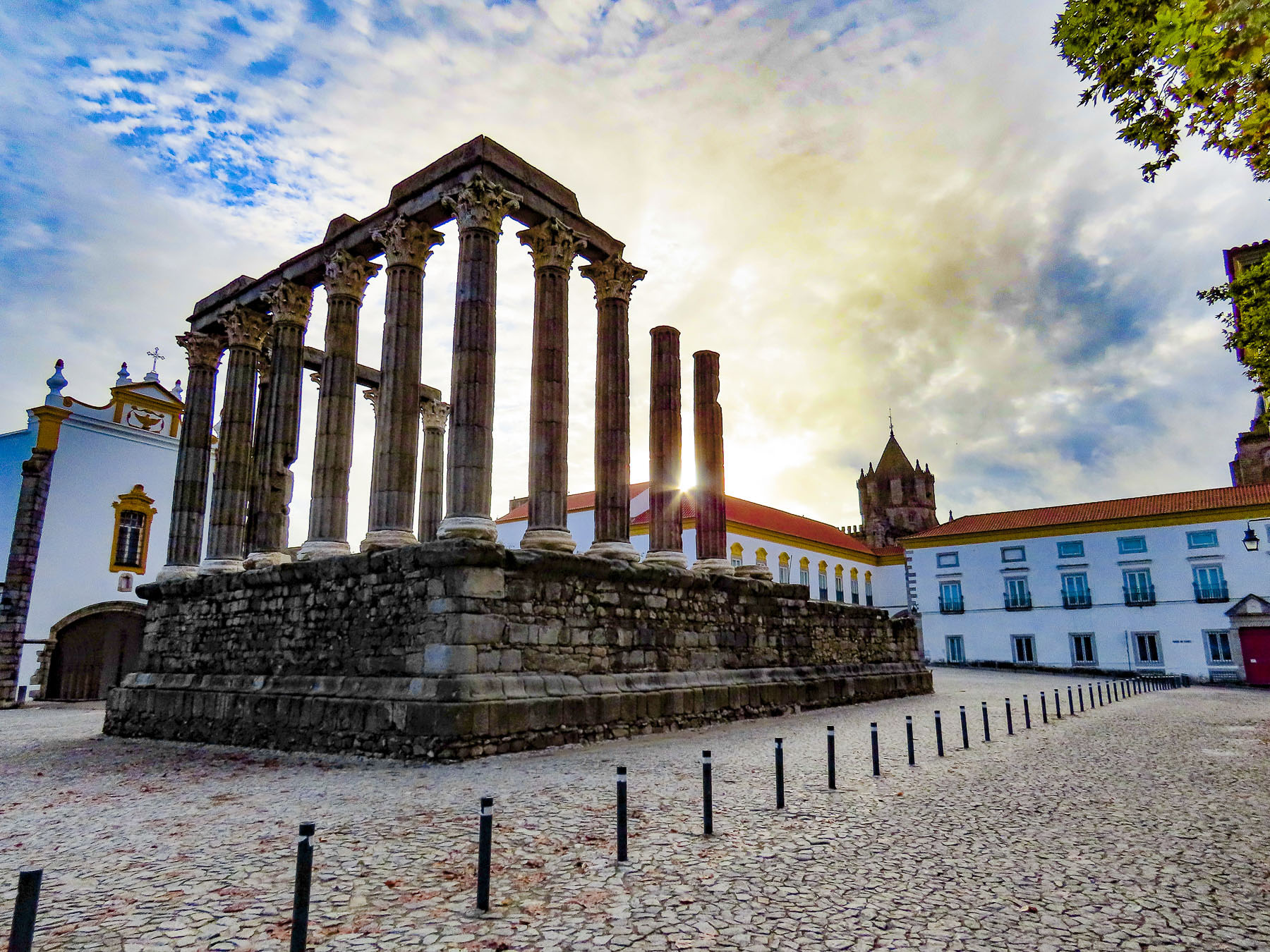
Wandering through the ancient city, we were charmed by its ambience, and the way in which archaic architectural styles harmoniously blended. At the city’s center, Roman first century ruins of the Temple of Diana share the acropolis with the 14th century gothic Catedral de Évora, the largest medieval church in Portugal.

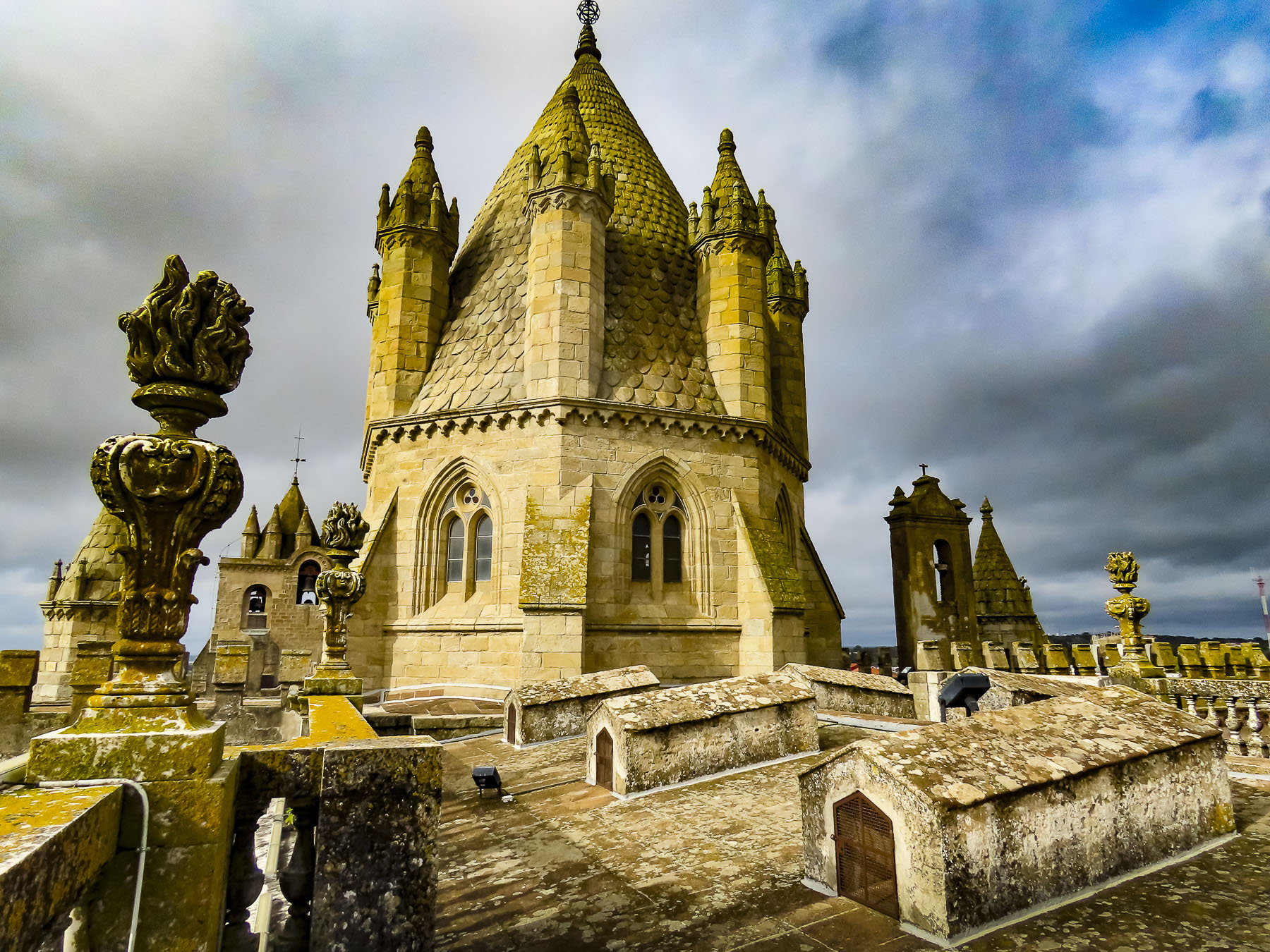
We climbed to the cathedral’s roof, the highest point in Evora, for brilliant panoramas of the city.

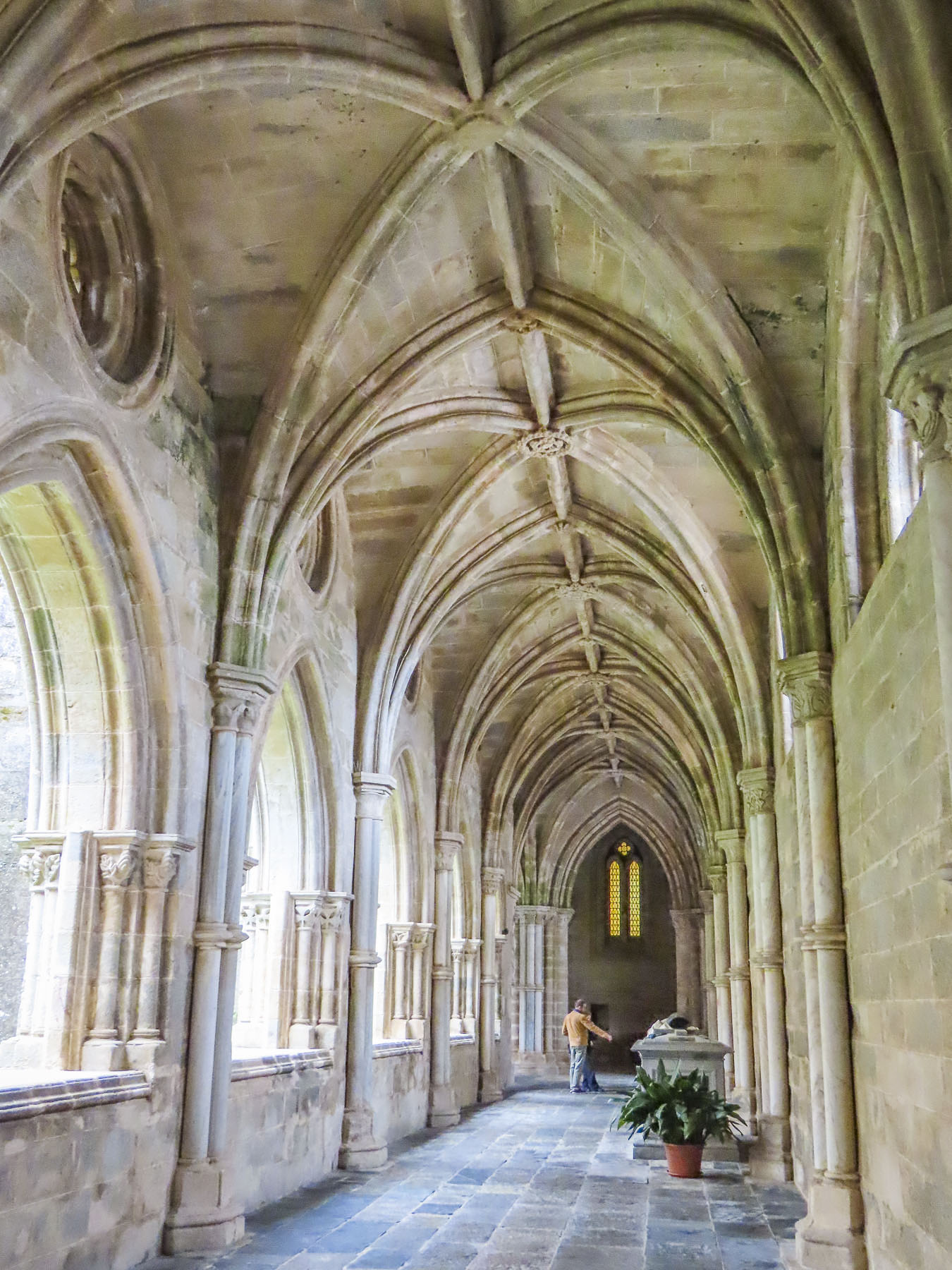
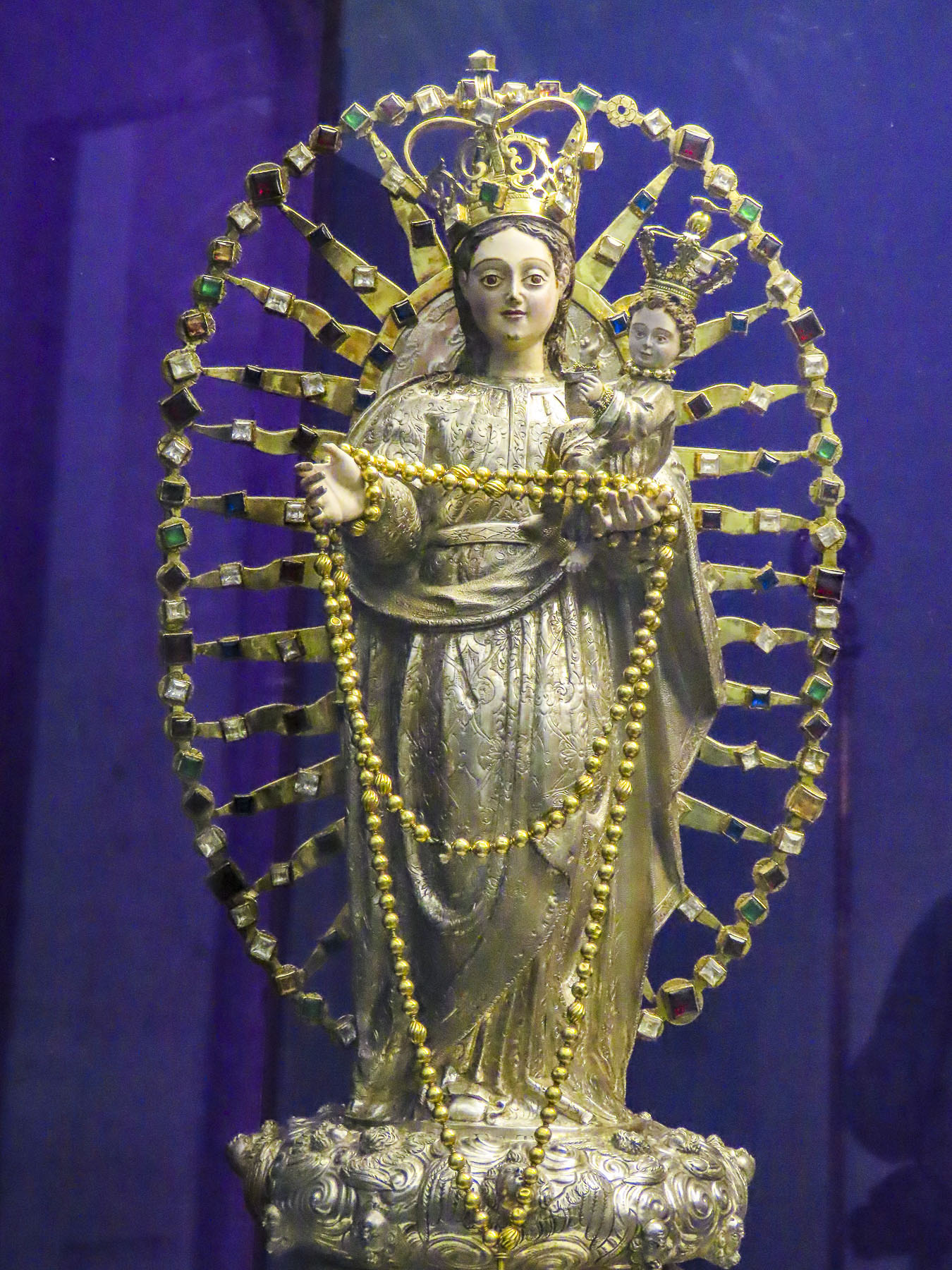
The cloister attached to the cathedral now houses a museum exhibiting the church’s ecclesiastical treasures, displayed in spaces that were once monks’ cells.

The Miradouro do Jardim Diana at the other end of the acropolis was a fine spot for a café break and also people watching.

Wine tastings featuring Alentejo vintages produced in the region surrounding Evora are a popular activity within the city. It’s not really our thing, but on the spur of the moment we stopped in the Ervideira Wine Shop, made a reservation, and returned later for a private wine tasting. Our knowledgeable host walked us through a tasting of five delightful Ervideira vintages. It was a very enjoyable experience and we purchased two bottles to accompany us to the Algarve.

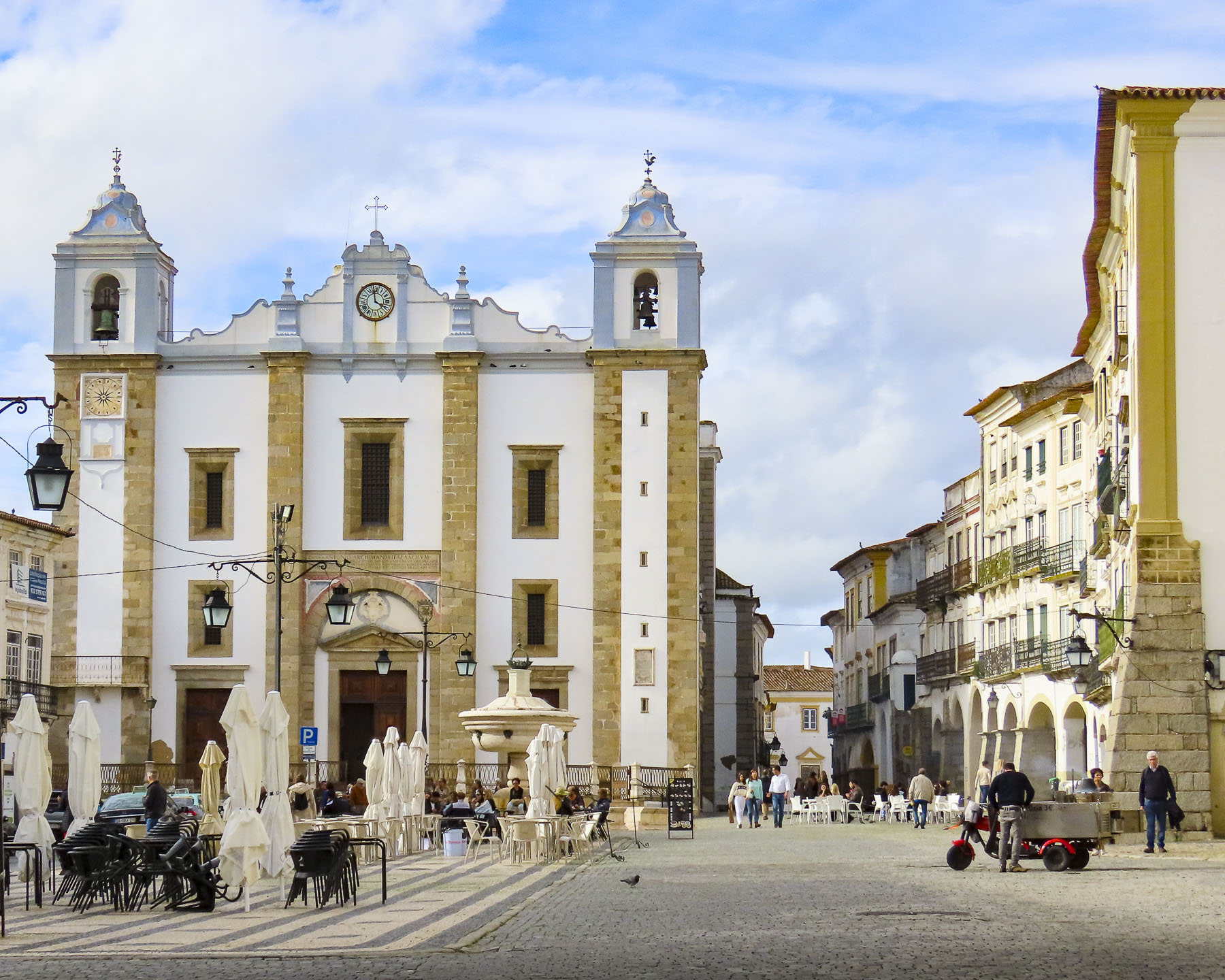
Luckily, we were strolling along the arcade covered sidewalk that parallels Praça do Giraldo when the sky burst open with a sudden downpour. The timing was perfect as we had stopped in front of the Cafe Arcada, which was packed with locals eager to take part in its sumptuous lunch buffet. It’s definitely worth checking out and very budget friendly.

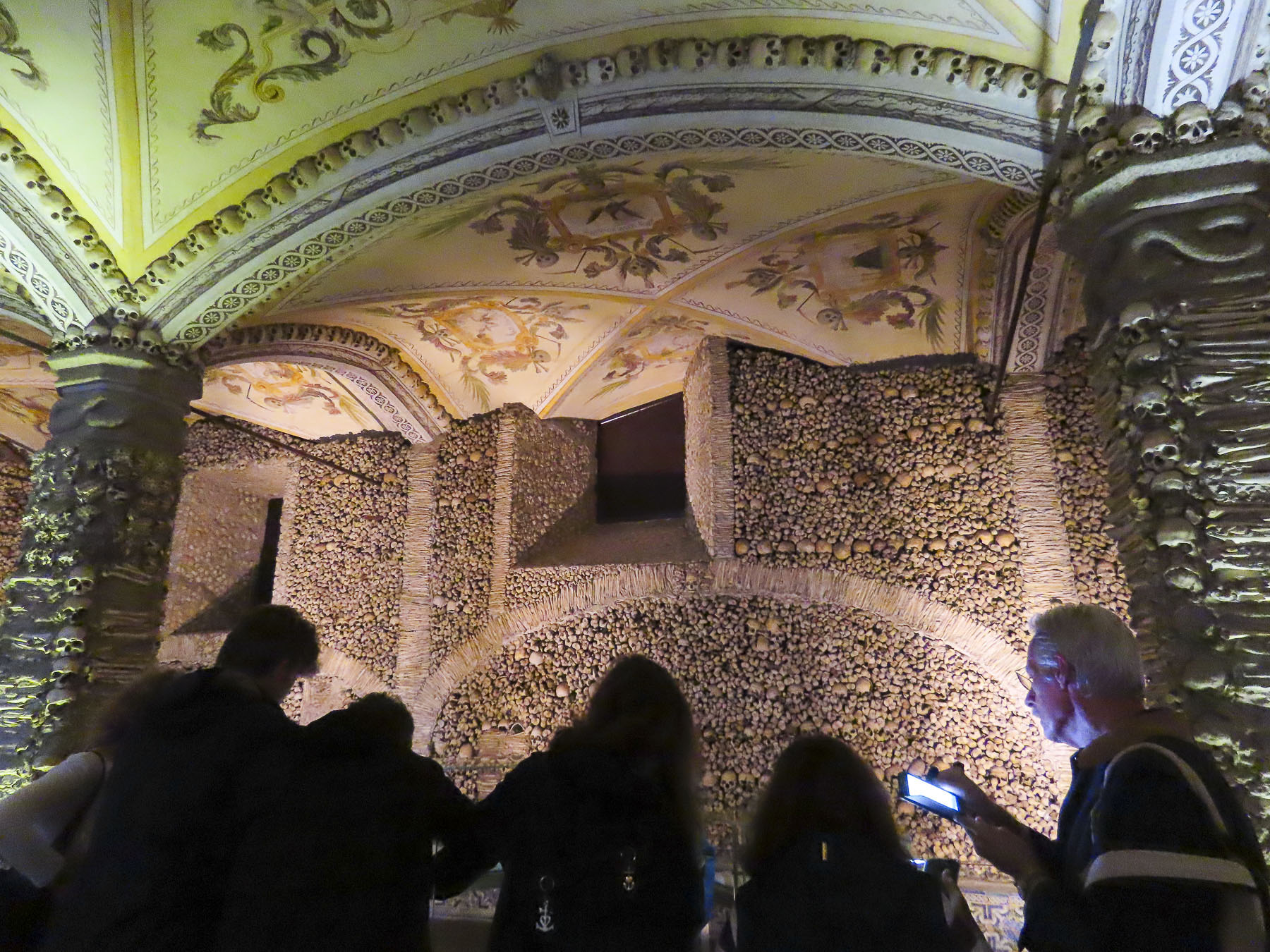
Walk a little then café is the philosophy we follow when exploring a city. With that in mind we continued the next morning to wander our way slowly towards the museum of the Igreja e Mosteiro de São Francisco and next to it – cue creepy music – the Capela dos Ossos, Evora’s Chapel of Bones.

“Nos ossos que aqui estamos pelos vossos esperamos.” It’s hoped this odd welcoming inscription, translated as “We bones that are here, for your bones we wait,” above the entrance to the ossuary will lead visitors to contemplate the ephemeral nature of life. Attached to the Mosteiro de São Francisco, the bones chapel was built by three Franciscan monks in the late 1400s as a way to respectfully reintern 5000 dead that were being exhumed from Evora’s overflowing cemeteries to make room for the newly departed. A wedding service was in progress at the Iglesia de São Francisco when we exited. Something old, something new. Life goes on.

Afterwards, we crossed to the municipal market and browsed amongst the vendors for some fruit, cheese, sausage and of course irresistible Portuguese olives for a picnic lunch in the Jardim Público de Évora, only a short walk away.

Heading back into the center of the historic district we passed the Igreja da Graça. This 16th century church has a unique façade that features four, very large-muscled Atlas figures sitting on the corners of the roof. We assumed the interior would be equally as interesting, but it’s not open to visits as it is currently used as a chapel for the Portuguese Armed Forces.

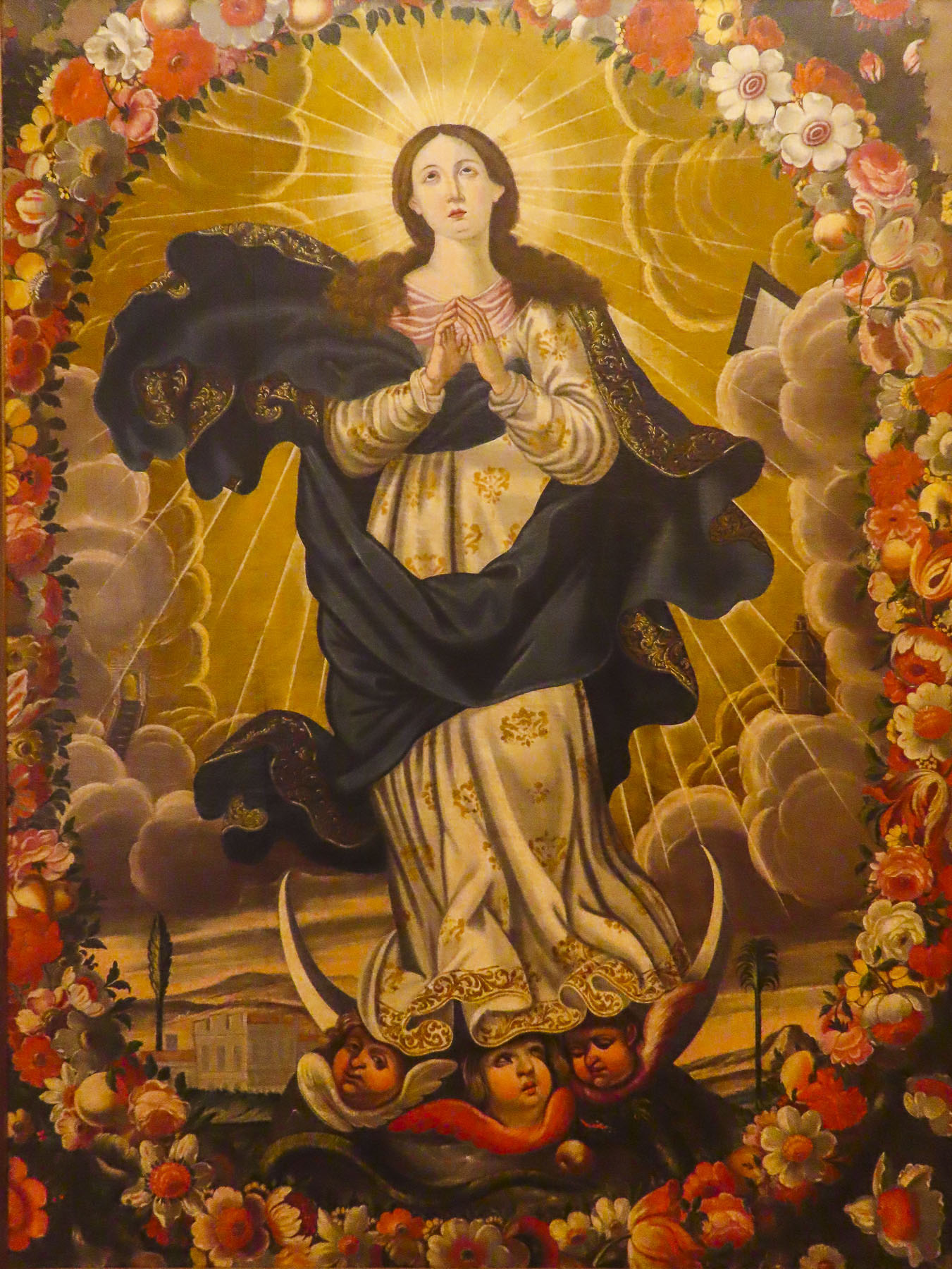
Back at the acropolis, we toured the Museum Frei Manuel do Cenáculo, named for the 18th century monk/archeologist who later became archbishop of Evora. It’s an eclectic collection featuring Roman and Visgoth antiquities gathered by Cenáculo, period furniture, and four centuries of ecclesiastical art from extinct churches of the region. It was a fascinating exhibit.

The weather was finally improving. We were ready to work on our tans. Tomorrow the Algarve.

Till next time, Craig & Donna

This website, The Historical Villages of the Portuguese Frontier might whet your curiosity to explore the region.

Portugal Road Trip – Part 5: Braga, Vila do Conde & Santa Maria de Feira

My wife and I occasionally discuss the destinations we’ve enjoyed the most and which we’d enthusiastically like to return to. We can truly say we’ve enjoyed every place we’ve chosen so far, but aside from Italy, the land of Donna’s people, being a must, Portugal and Guatemala top the list. They are both wonderfully interesting destinations with fascinating locations and cultural events to experience. With budgeting an important consideration for our travels, both Portugal and Guatemala are pocket friendly destinations. But, with the Euro currently at a favorable exchange rate, Portugal is a tremendous bargain. Throw in the fact that the weather, cities, beaches, and countryside are beautiful, along with a welcoming environment, great food and wine, well we should really emigrate there.  Alas, we’ve never really wanted to be fulltime expats. We’ve opted instead for a return visit to this splendidly diverse country when an airfare deal appeared on our travel alerts.

The city of Braga first popped onto our radar while we chatted with a PSP officer at a Tourism Police Station in Lisbon several years ago as we filed a stolen a passport and wallet report. Conversing as he speedily typed away, asking how we were enjoying Portugal. “What are your plans after Lisbon?” “Drive north to Porto for several days,” we responded. “Ah! Nobody goes above Porto. It’s as if the country stops there. The Minho region of northern Portugal is beautiful with mountains and trees, very different than south of the country and the food is better,” he joked and smiled. “You should visit Braga.” The idea stuck. Later suggestions gleaned from the blog Beyond Lisbon, written by Cátia, who espouses the lesser-known destinations, traditions and delightful quirkiness of her country, helped inspire our route through northern Portugal. Armarante, Guimaraes, Braga then farther north to Lindoso, a stone’s throw from the border with Spain, before returning to the coast above Porto. Two days later our friendly policeman emailed to notified us that the passport and wallet had been recovered. Minus the cash, of course, but we were relieved.

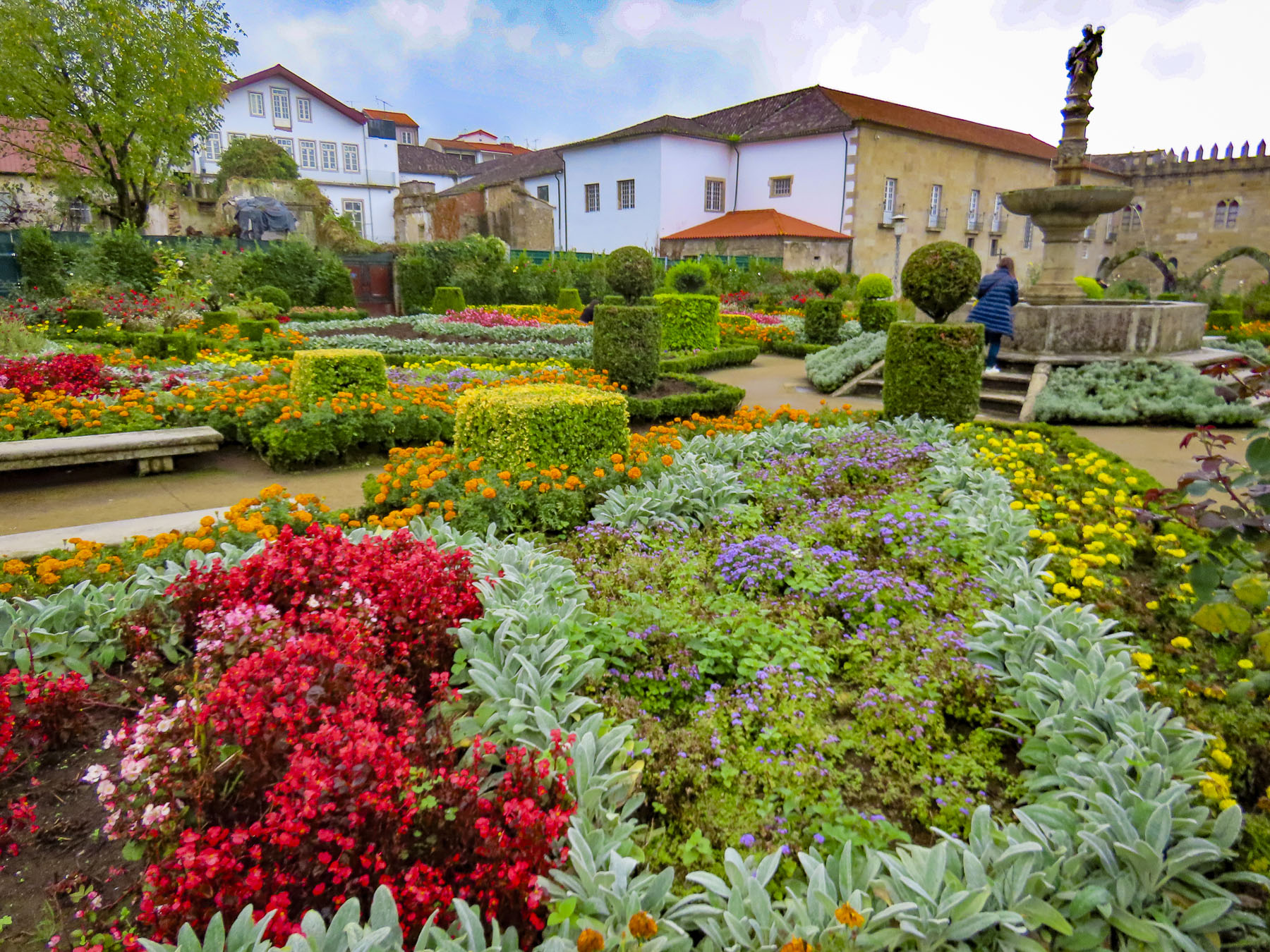
The rain had finally stopped, and the sun was beginning to break through by the time we reached Braga, encouraging us to make a short foray into the centro histórico before ending the day at Bom Jesus do Monte. Braga’s main garden, the Jardim de Santa Bárbara, was surprisingly only added to historic city’s landscape in the 1950’s. A relatively modern intervention, it benefits from its location adjacent to the crenellated walls of Archiepiscopal Palace of Braga, that dates from the 14th century.  Four stone arches are the only reminders of a larger structure with a library containing many historical documents that was lost in an 1866 fire.

Important since its founding in 16 BC, as Bracara Augusta, where five Roman roads converged, Braga today is Portugal’s fourth largest city and a vital metropolis for commerce and education. The city has had a complex relationship with country since 1112 when Count D. Henrique and Countess D. Teresa donated the city to the Catholic Church, creating an ecclesiastical fiefdom that lasted until the 1700s. 

In 1128 the city/church was given the privilege to mint its own coinage as reward for supporting D. Afonso Henriques’ revolution against his mother, the Countess D. Teresa, for Portugal’s independence from Spain. Local wars occasionally erupted between Dukes and various Archbishops over the following centuries.

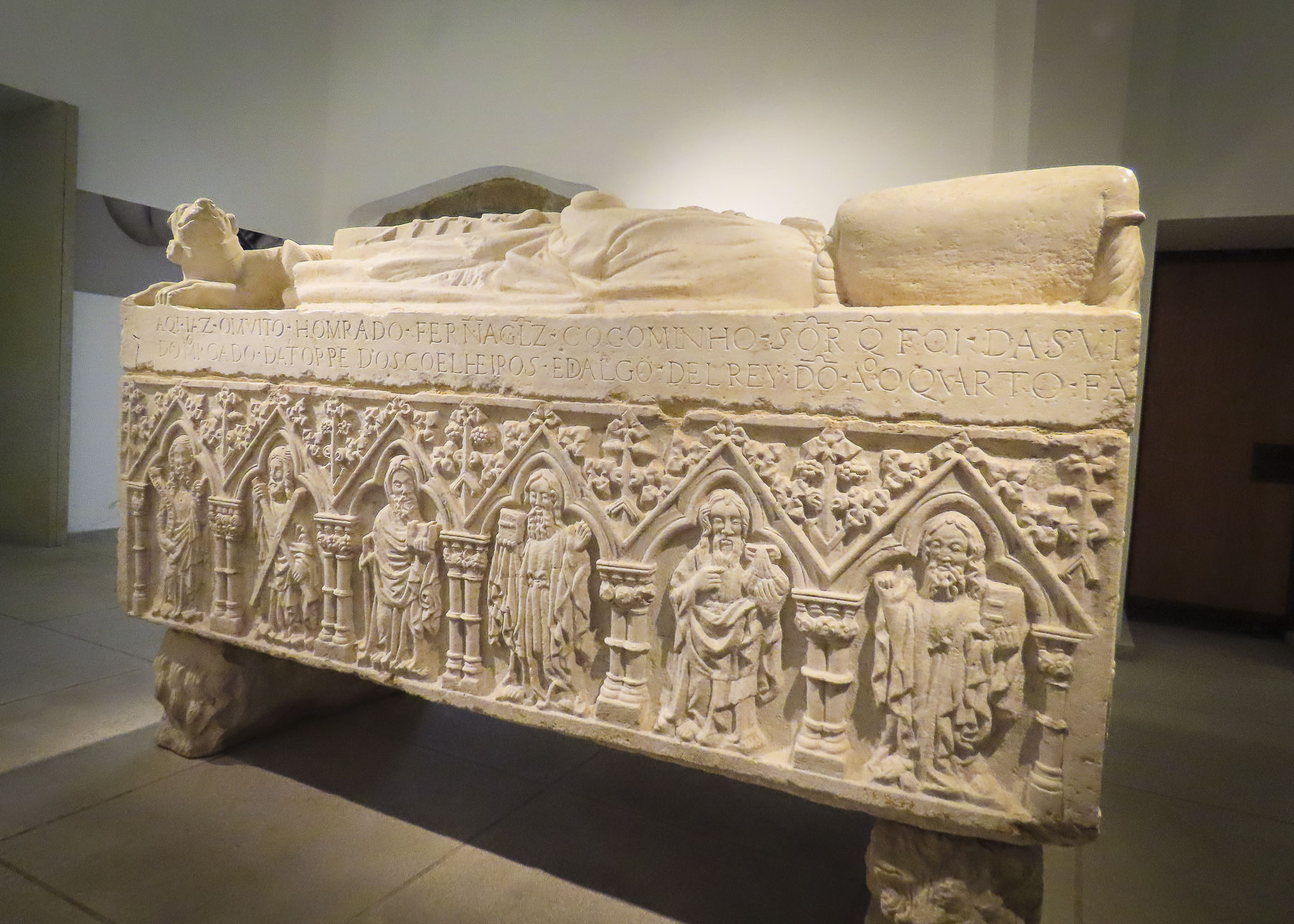
Count D. Henrique’s and Countess D. Teresa’s tombs are in the Braga Cathedral. The first cathedral built in Portugal, it was consecrated in 1089, inspiring the Portuguese expression “older than the Sé de Braga.” A courtyard scattered with centuries old architectural remnants funneled us into the Cloister of Santo Amaro, which now serves as a museum that displays the church’s vast treasury. The church’s Romanesque and Baroque styles coexist seamlessly after centuries of renovation. The interior is very transfixing with Baroque gilding and mirrored twin organs that seem to float above the central nave. 

It was approaching sunset when we arrived at Bom Jesus do Monte. The neoclassical church with its famous baroque staircase has become an iconic symbol of Braca, since its completion in 1811. Some pilgrims call it the sacred way, others the stairway to heaven. The devout will climb its 573 stairs to the sanctuary at the top on their knees. Each landing features a fountain and allegorical sculptures.

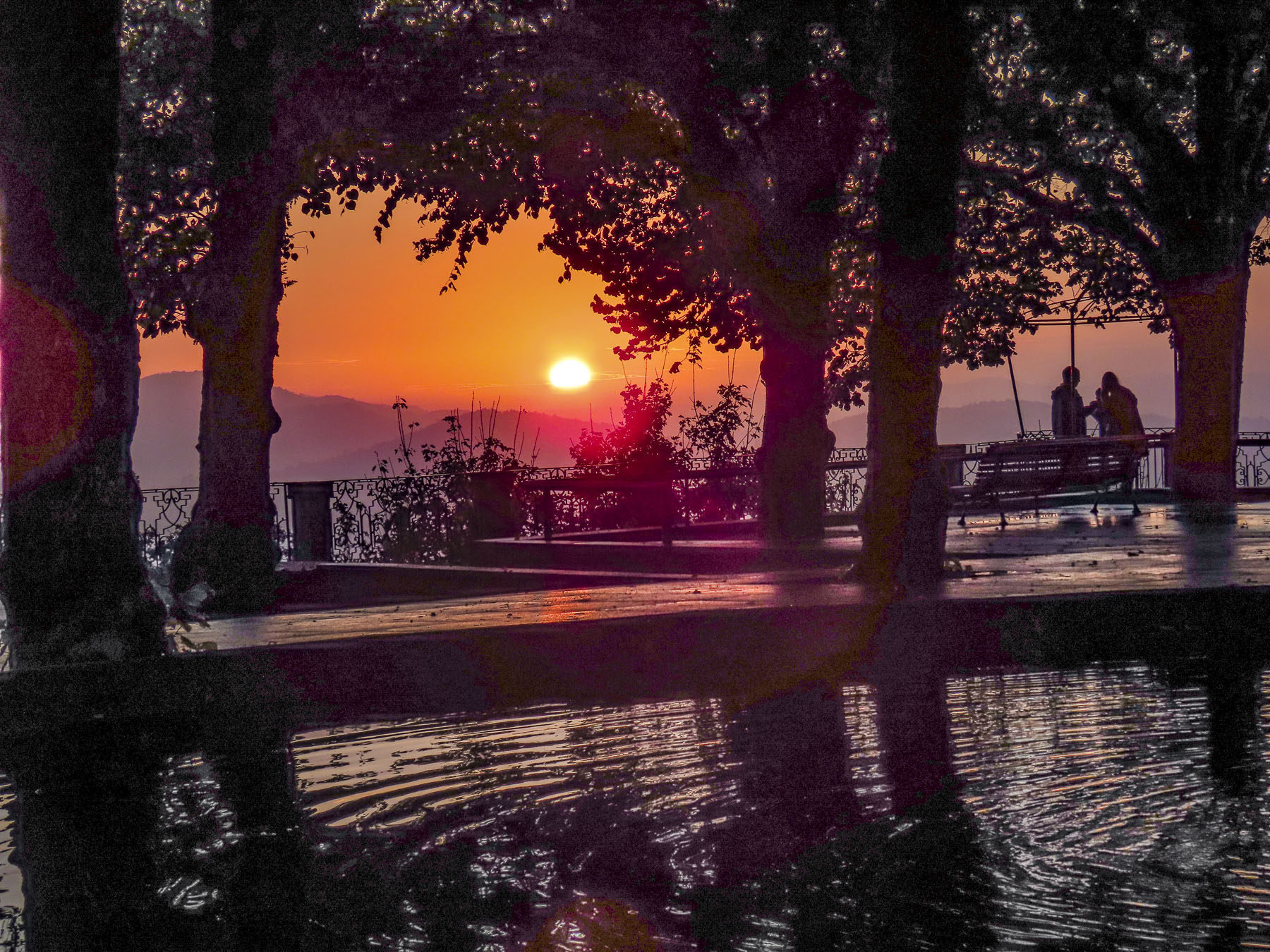
Our timing was perfect. Parking was easily available at the summit, the bus tours all gone for the day. Only a handful of folks remained, enjoying the beauty and tranquility as the sun set.

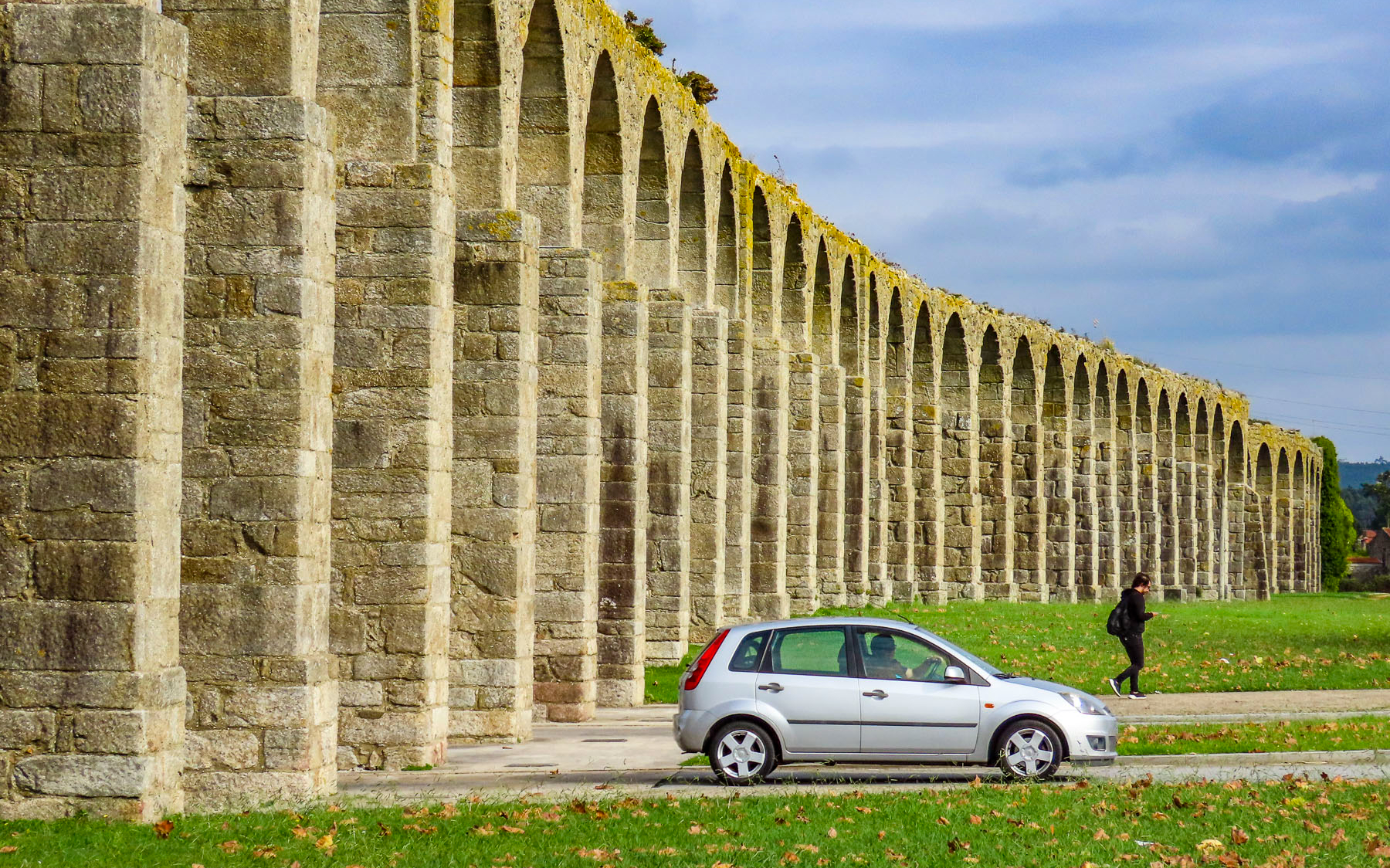
A north south transition day for us, we set off early to our first stop, the coastal town of Vila do Conde, on the Atlantic Ocean, just above Porto. As if by magic a tall stone aqueduct suddenly appeared before us, and it paralleled our route for quite a distance into Vila do Conde. We mistakenly assumed it was of Roman construction. We learned later that the 999 arches were built in the 16th and early 17th centuries to supply water to the Santa Clara monastery from a hilltop spring in Terroso, three miles away. Though the aqueduct could have benefitted from some Roman engineering after the first section was abandoned because the water flowed the wrong way. Later 46 arches collapsed during a storm.

One of the largest and wealthiest convents in Portugal, the Santa Clara monastery housed 100 nuns. It was founded in 1318 by Afonso Sanches, son of King Dinis and brother to King Afonso IV the Brave. The convent still commands a prominent hill above the city and is undergoing extensive restoration to become a Lince Hotel & Spa.

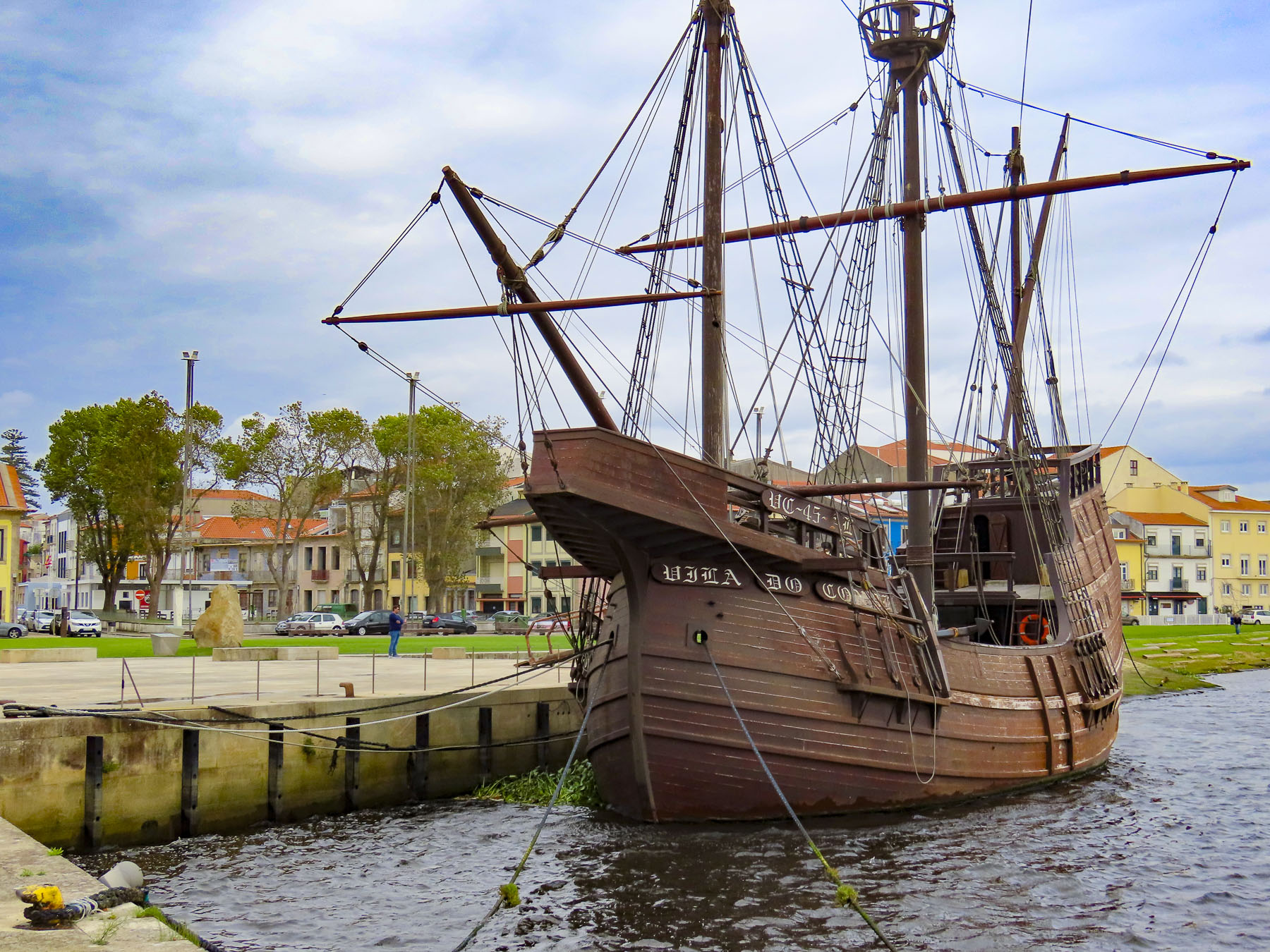
We were delighted to see the ocean again. Portugal’s lovely and easily accessible coastline is one of the reasons we enjoy the country so much. The town is graced with two beaches, Praia Azul and Praia da Senhora da Guia. Both are only a twenty-minute walk from the center of the town. But it was too cold and windy to enjoy the beach, so we walked along a riverfront park towards the old town. An ocean port city, Vila do Conde’s prosperity came from its shipbuilding industries during the Age of Discoveries.

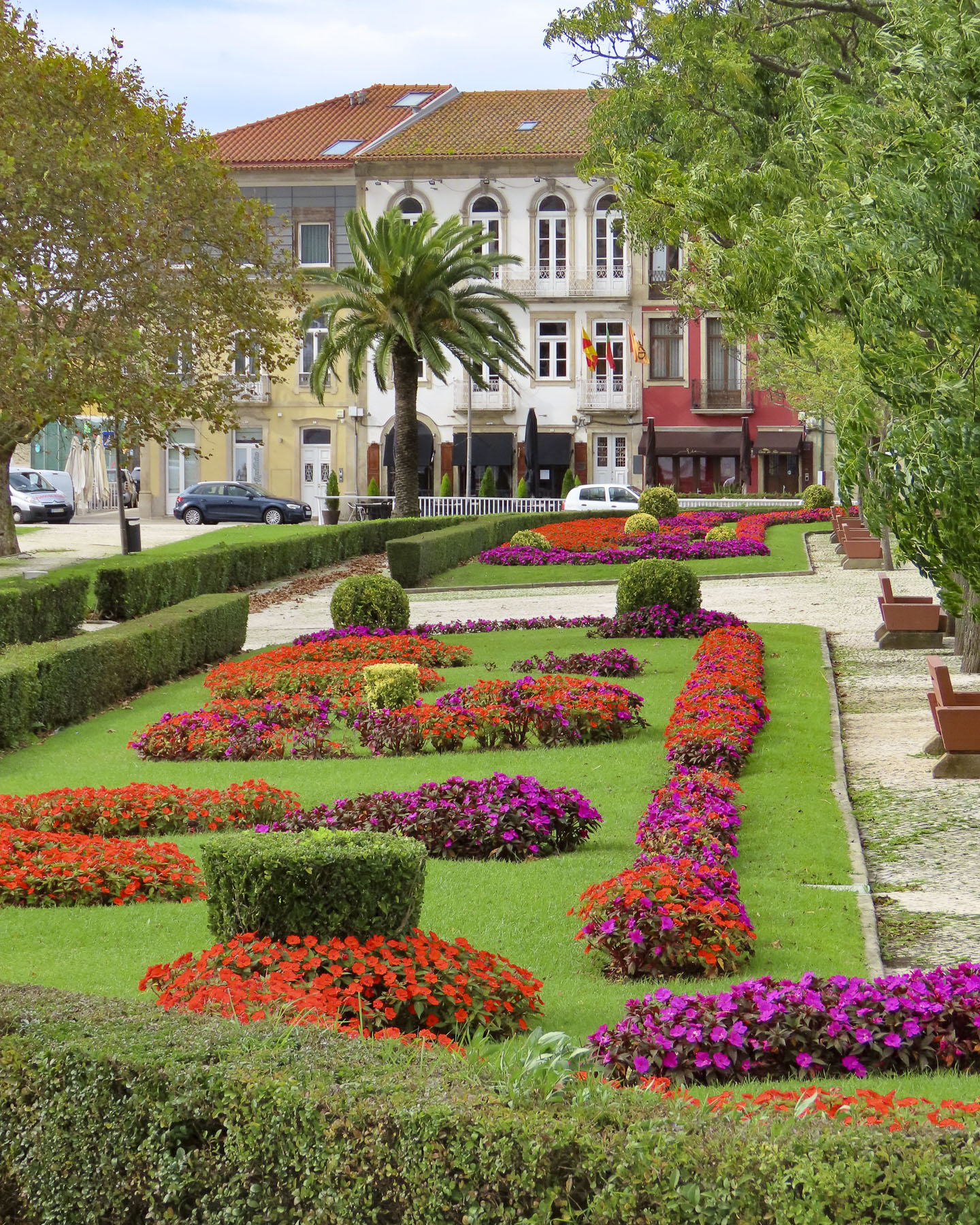
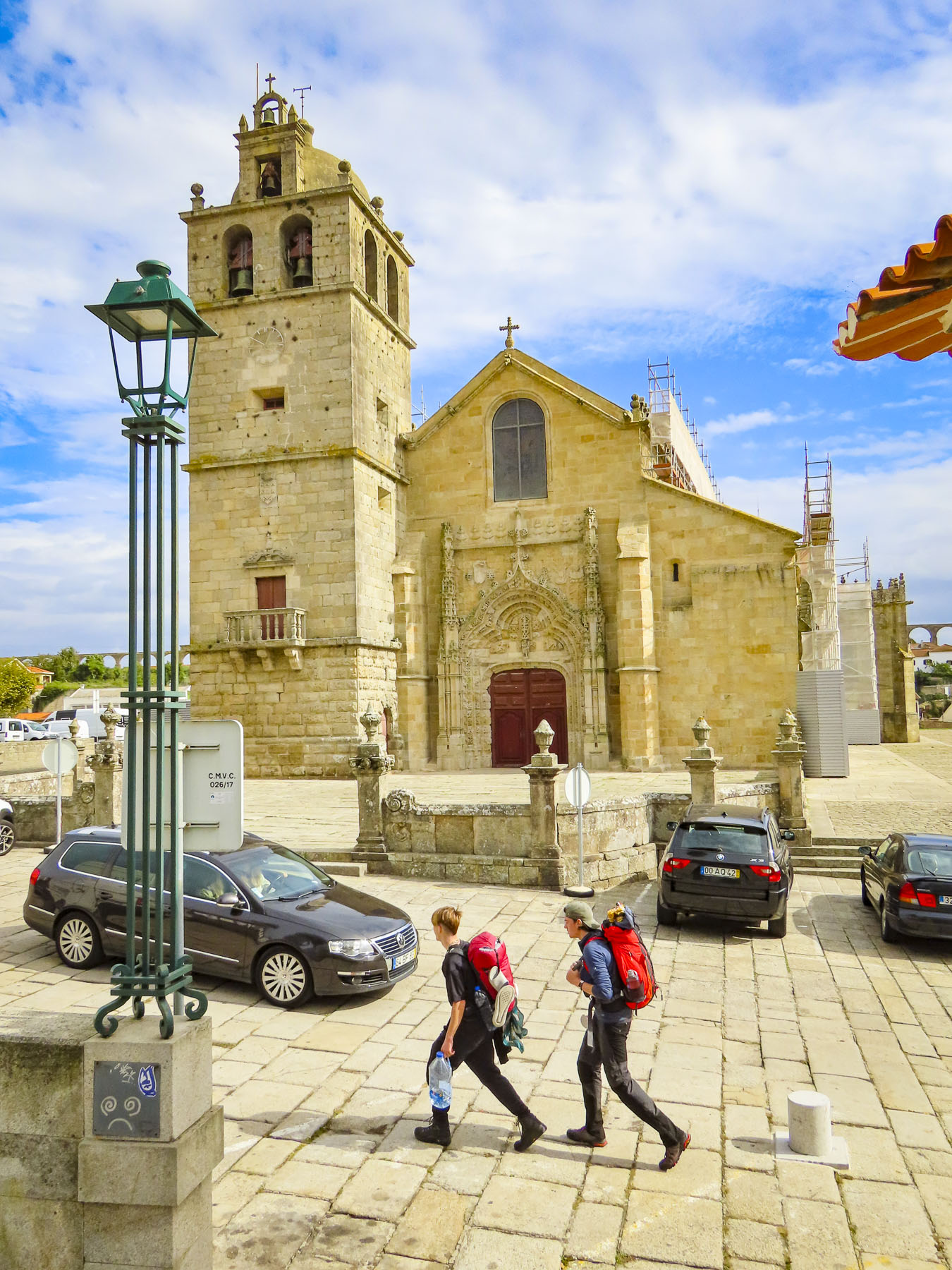
Farther along we rested at a café across from the Praça da Republica, a beautiful park with brilliant flowers still blooming in October. Following the streets inland we explored the narrow lanes around the Igreja Matriz de São João Baptista which centers a plaza atop a small knoll in the middle of the historic district.

It’s a popular resting spot for pilgrims trekking the coastal camino route from Porto or Lisbon to Santiago de Compostela, Spain. From here we spotted the final length of aqueduct that terminated at the convent. We decided to investigate. 

The aqueduct towers over homes in this neighborhood located on the slope before the convent. Beyond them the crenelated walls of the convent’s Gothic church reflect the time it was built in the 1300s when Viking raids were a recent memory and Spanish invasion was a constant threat. The view of the red roofed city and riverfront from the miradouro next to the convent was spectacular.

Years ago we used to keep magazine and newspaper articles filed away as research for future travels. That slowly evolved to email folders with links to stories and computer bookmarks for favorite travel websites. Now Google Maps and Instagram feeds spark interest for places to visit.  That’s how the Igreja Matriz de Santa Maria de Válega with its colorful tiled exterior wall came to our attention. The church’s unique beauty earning it the nickname “the Sistine Chapel of Portugal.” A half-hour south of Porto, the church is located at the crossroads of Válega, a small rural farming community.

The church was not always this stately. Its history starts in 1150, when a wealthy family built a small private chapel above the ruins of an earlier temple. From 1288 to 1583 it was part of the Monastery of São Pedro de Ferreira.  In 1756, the Diocese of Porto started renovations and building expansions that would last over 100 years. Surprisingly, the tile façade and interior were relatively modern alterations that were installed in 1959, along with a ceiling crafted from exotic Brazilian woods. The exquisite larger-than-life tiles depict stories from the life of the Virgin Mary and other biblical scenes. They were crafted by the Aleluia Cerâmicas of Aveiro, a local company that still creates unique tiles for customers around the world. 

Although it’s an off the beaten path destination, it’s worth the effort to see this truly unique church. If it helps to influence your decision, Flor De Valega is a mouthwatering pastry shop a short walk away. You won’t be disappointed!

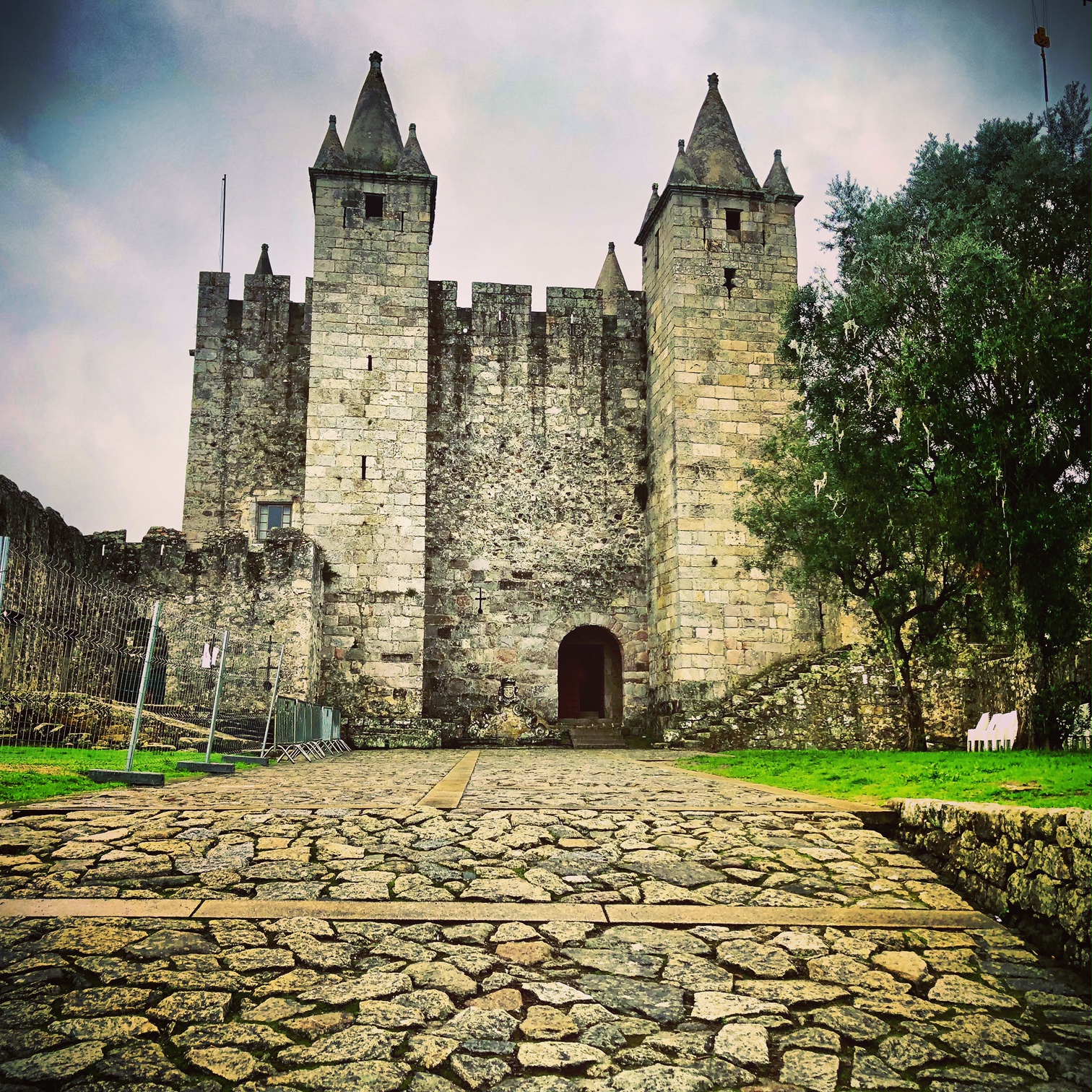
Our last stop of the day would be the Castle of Santa Maria de Feira, only twenty minutes away, before spending the night in the town below it. We arrived forty-five minutes before closing. How disappointing, because the castle looked intriguing and it was beginning to rain harder. A shortened visit would have to do. The line at the ticket counter wasn’t advancing as the lone ticket agent was busy selling souvenirs to a tour group that was just finishing a visit. Kindly, a security guard waved us along and we agreed to return in a certain amount of time and pay on the way out. The castle was fascinating.

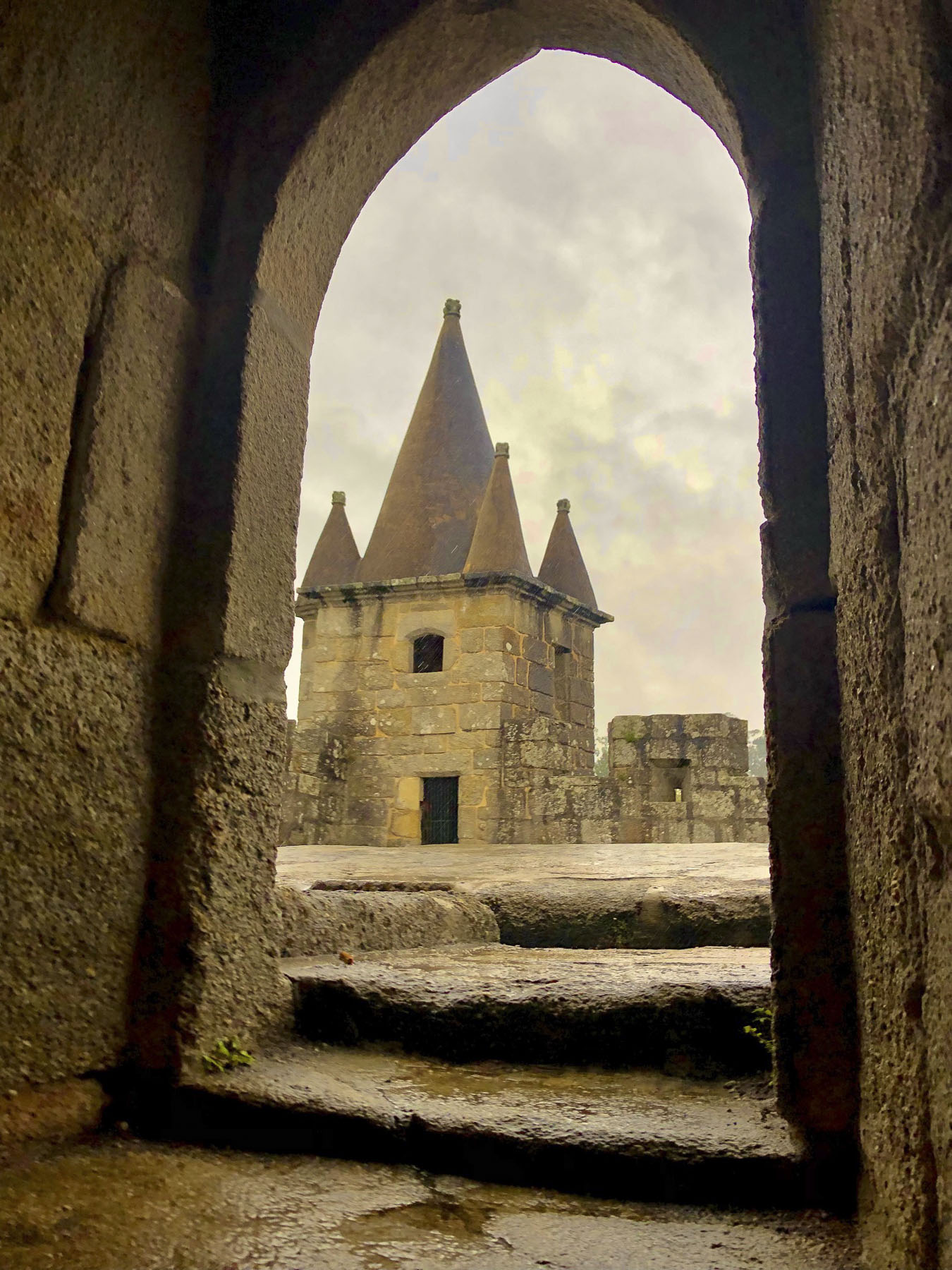
The castle sits on the apex of a now wooded hill, in a beautiful park, though back in the Middle Ages the hillside was devoid of trees, giving the soldiers in the fort a better view of any approaching enemy.  This was the frontier, a war zone between Christian Spain, later Christian Portugal and the Moors. Twice in 1100 the castle was sacked by the Moors and then liberated by Portuguese forces. This borderland saw continual conflict until the Arabs were driven decisively from Coimbra, only sixty miles away, in 1139.  Large medieval trade fairs held next to the castle earned the village the distinction of being named Santa Maria de Feira. In 1448, King D. Afonso V gave the battle-worn castle to Fernão Pereira on condition that he repair the fortifications. “Hey Fernão, do I have a deal for you.” His modifications of thickened walls, a barbican, spired towers and a large keep with fireplaces and terrace still stand, and are what visitors to the castle see today. After a fire in 1722 the castle was abandoned and left to ruin. In 1839 it was bought by a private citizen at public auction. Serious rebuilding began in the early 1900s and it was reopened to the public in 1950.

To our surprise, the gate of the barbican was locked with a heavy chain when we tried to leave. Our hearts skipped for a moment when we thought we’d be sleeping overnight on the cold stone floor of the castle’s keep. The anxiety was relieved a few moments later when the guard returned from making his final inspection to ensure nobody gets locked in. Reminding him we still had to pay he smiled and waved us away, happy to end his day a little early and get out of the rain. Every August the town and castle host a ten-day Renaissance festival called Viagem Medieval that is regarded as one of the best reenactment events in Europe.

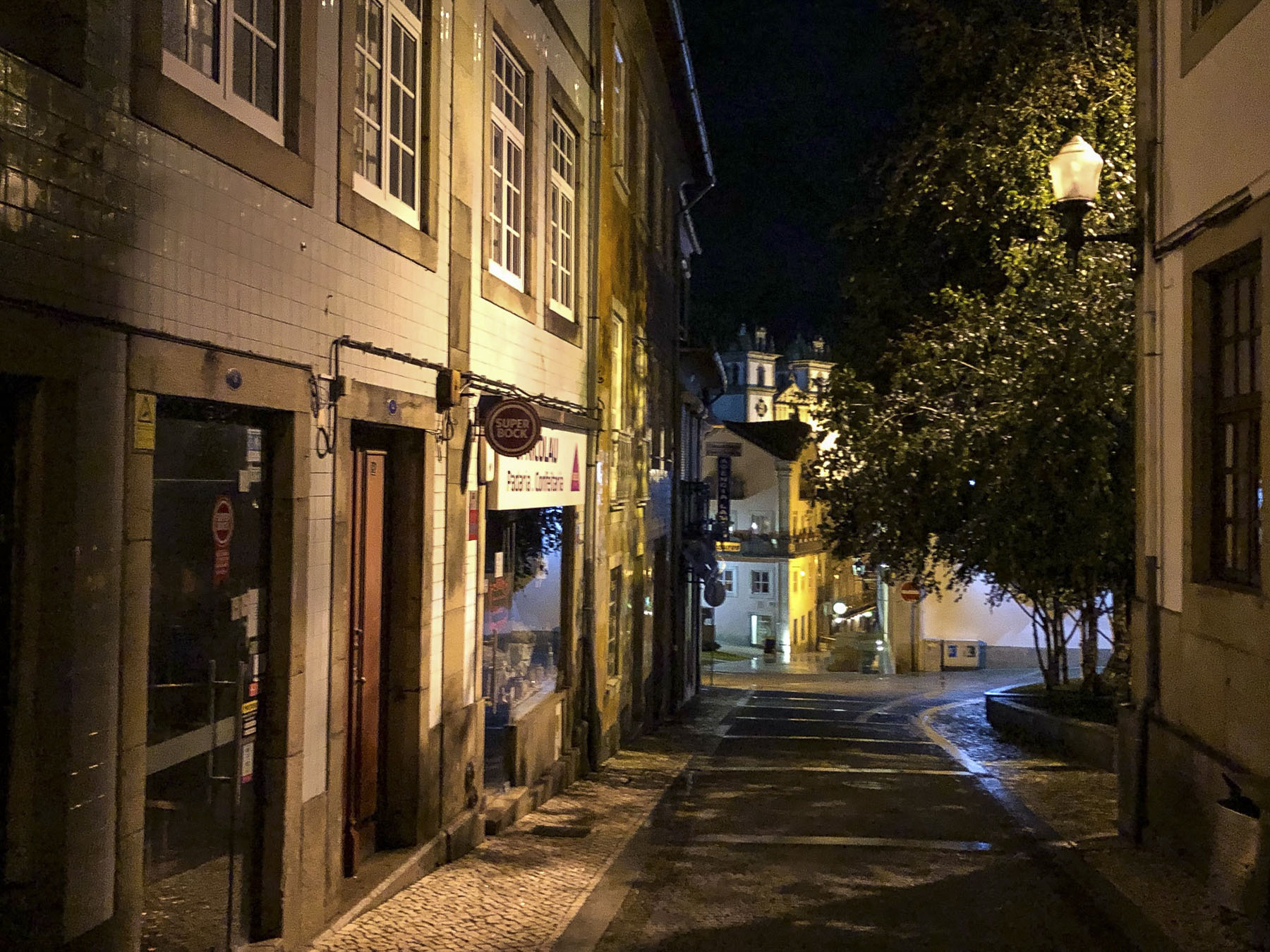
We hadn’t stayed in a hostel in years, but our private and modern room with ensuite bath at the boutique Hostel da Praça, in the historic center, was a bargain at €50. Parking was free at the municipal lot a short walk away.  As we walked across town to dinner that rainy night, the reflections from the old streetlights onto the cobblestones was evocative of the Middle Ages when the town’s nightwatchman lit torches hanging from sconces along the street.

Till next time, Craig & Donna

Portugal Road Trip – Part 4: North to Amarante (They’re Obsessed), Guimares & Soajo

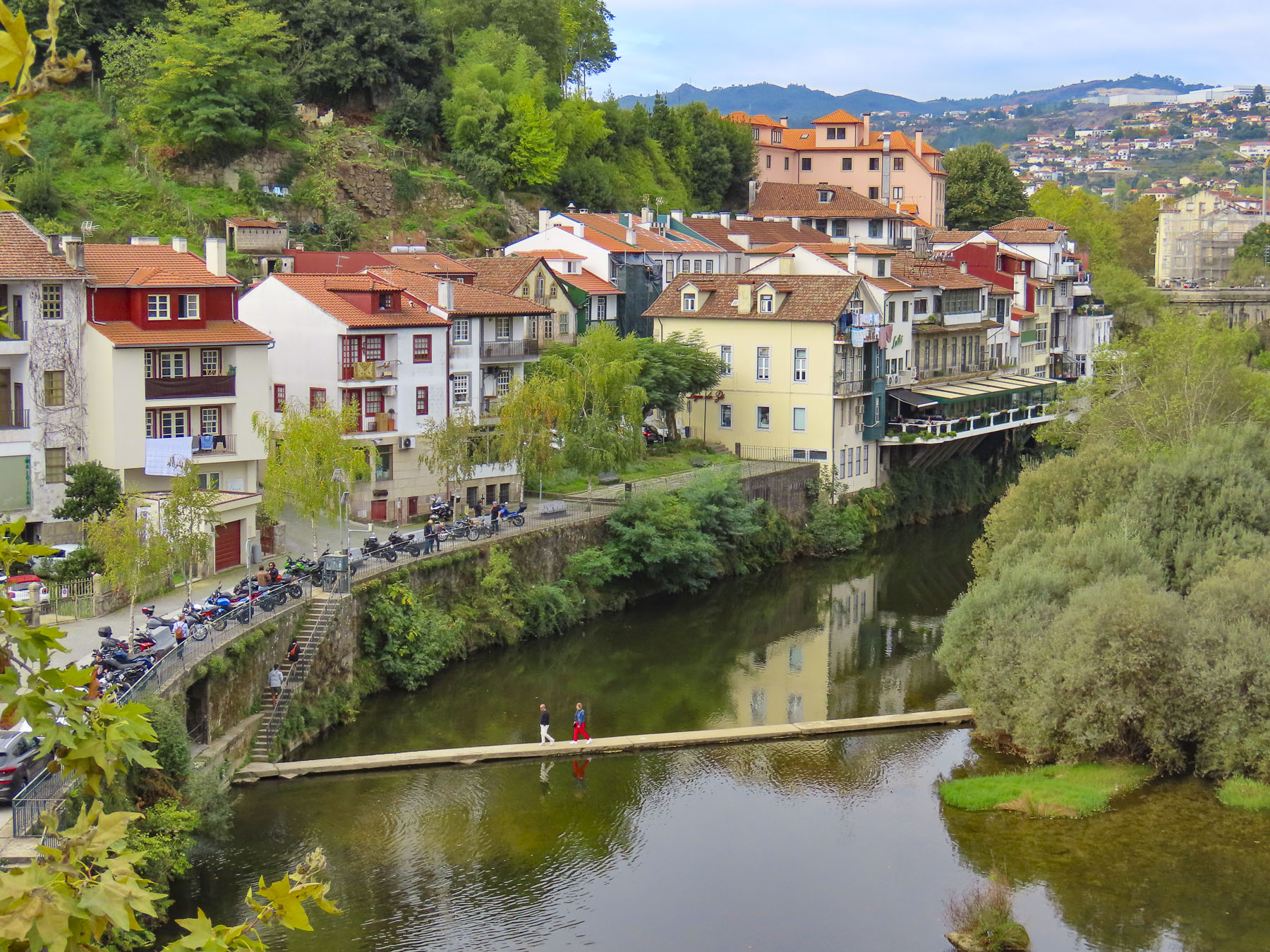
Cresting the ridgeline that overlooks Mesão Frio, we left the vineyard-covered slopes of the Douro Valley behind us and headed to Armarante on roads lined with forests and fields. Crossing the bridge over the Tâmega River we viewed a beautiful scene reminiscent of a Romanesque cityscape painted by a 16th century Dutch master, uniquely different from the other Portuguese towns we had visited so far, the ambiance and architecture more northern European than Iberian. Surprisingly for Portugal, this historic town, one of the oldest in the north of the country was never centered around a castle, even though the site has been continually inhabited since its founding in the 4th century BC.

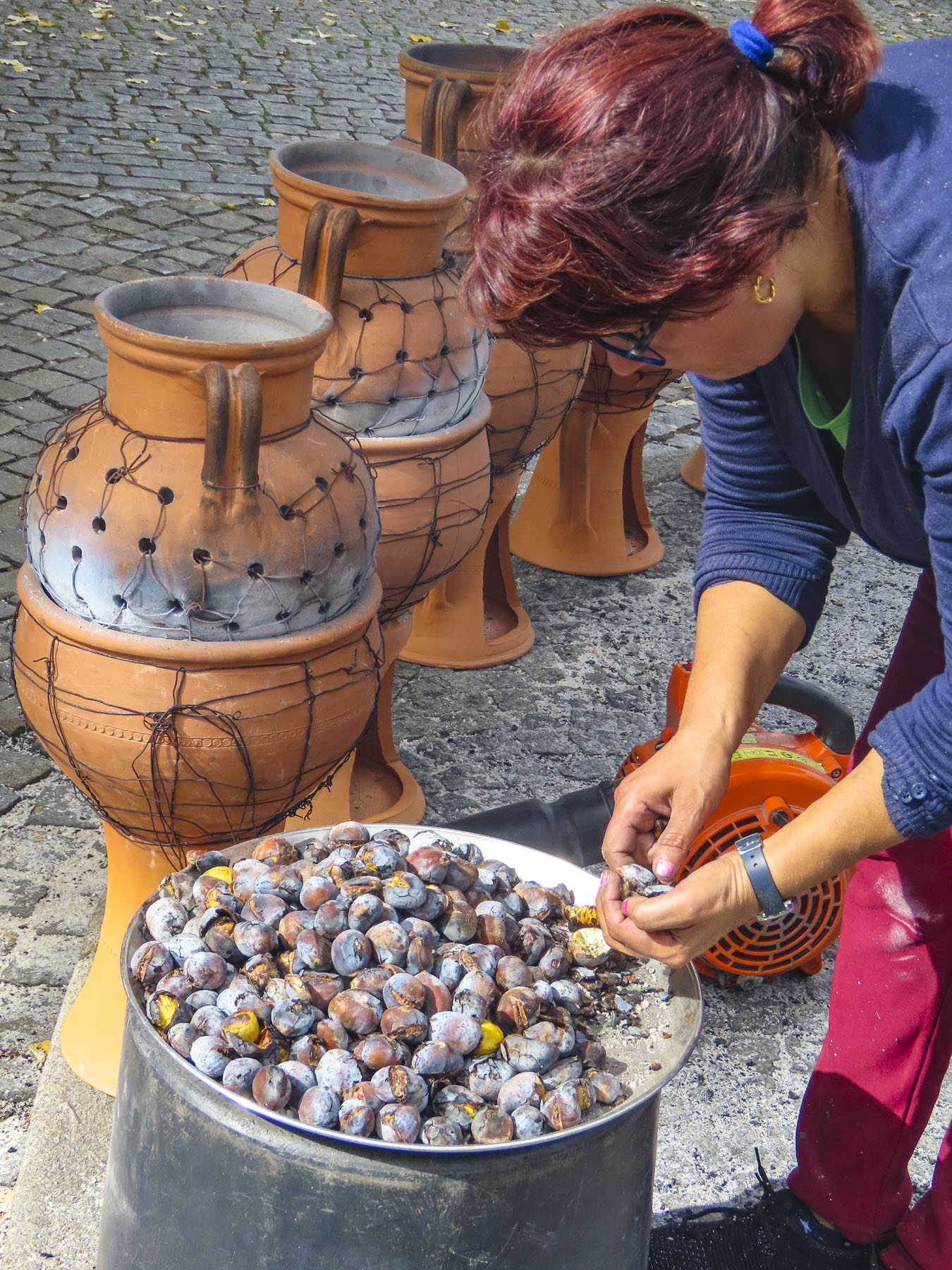
Colorful, whimsical pedal boats were beached on the riverbank, waiting for customers, as we walked along the path that followed the river into town. It ended in a parking lot full of craft vendors, at the foot of a grand triple-arched stone bridge that spanned the river. Here in 1809 the brave citizenry barricaded the bridge and repelled Napoleon’s Army for fourteen days during the Peninsular War, before their village was looted and razed. With a bag of freshly roasted chestnuts in hand, we strolled through the craft fair and came upon a grandmotherly woman with a table full of doces fálicos (literally “phallic sweets”) for sale. Bolos de São Gonçalo, Saint Gonçalo cakes were created and named after a beloved 13th century hermit, and the town’s patron saint, who slept in a forest cave for many years. Yep, boldly-sized penis-shaped baked goods! Best to just allow your imagination to run wild here and you’ll visualize them perfectly. It’s thought that this tradition originated from a pagan fertility ritual and was syncretized by the church to encourage more folks to follow Christianity. It’s nice to think some early church leaders had a good sense of humor.

I digress here, but it’s my blog and I’m occasionally irreverent. What’s the back story for such cherished tradition? While he bathed in a stream, was he happened upon by a group of women foraging for firewood? His manhood was suddenly legendary, the talk of the village. “I hear the hermit has a pretty good package.” “Yes, I saw him. He’s hung like a horse.” “Someone else said it hung to his knees!” And so, legends begin and grow. Did mothers, aunts and neighbors make idols of his manhood to encourage young newlyweds who couldn’t conceive quickly? Perhaps some women made a pilgrimage to his cave in the middle of the night in the face of their husbands’ inadequacy, thus ensuring the birth of an heir. What tales do mothers tell their daughters as they stand at their kitchen tables kneading the balls of dough? Could Amarante have been the inspiration for Chaucer’s Canterbury Tales?

At the foot of the bridge stands the grand Igreja de São Gonçalo. Yes, as if naming a pastry after him wasn’t enough, he’s also celebrated on January 10th, plus there’s a June festival in his honor. Will the sacrilege ever stop, we wondered with a smile.  Unfortunately, a military dictatorship came to rule Portugal in 1926. Not nearly as liberal as the early church leaders in Amarante, and definitely insecure in their masculinity, they outlawed the pastries and festival as “obscene and against public morals.” Like resistance fighters, the practice went underground and Bolos de São Gonçalo were made and exchanged behind bolted doors, in order to hide from the dreaded pastry police! Wait, I just make that up! The tradition was allowed again after the last dictatorship fell during the Carnation Revolution in 1974, which eventually led to Portugal becoming a democracy again. The June São Gonçalo Festival is now one of the most popular events in Portugal.

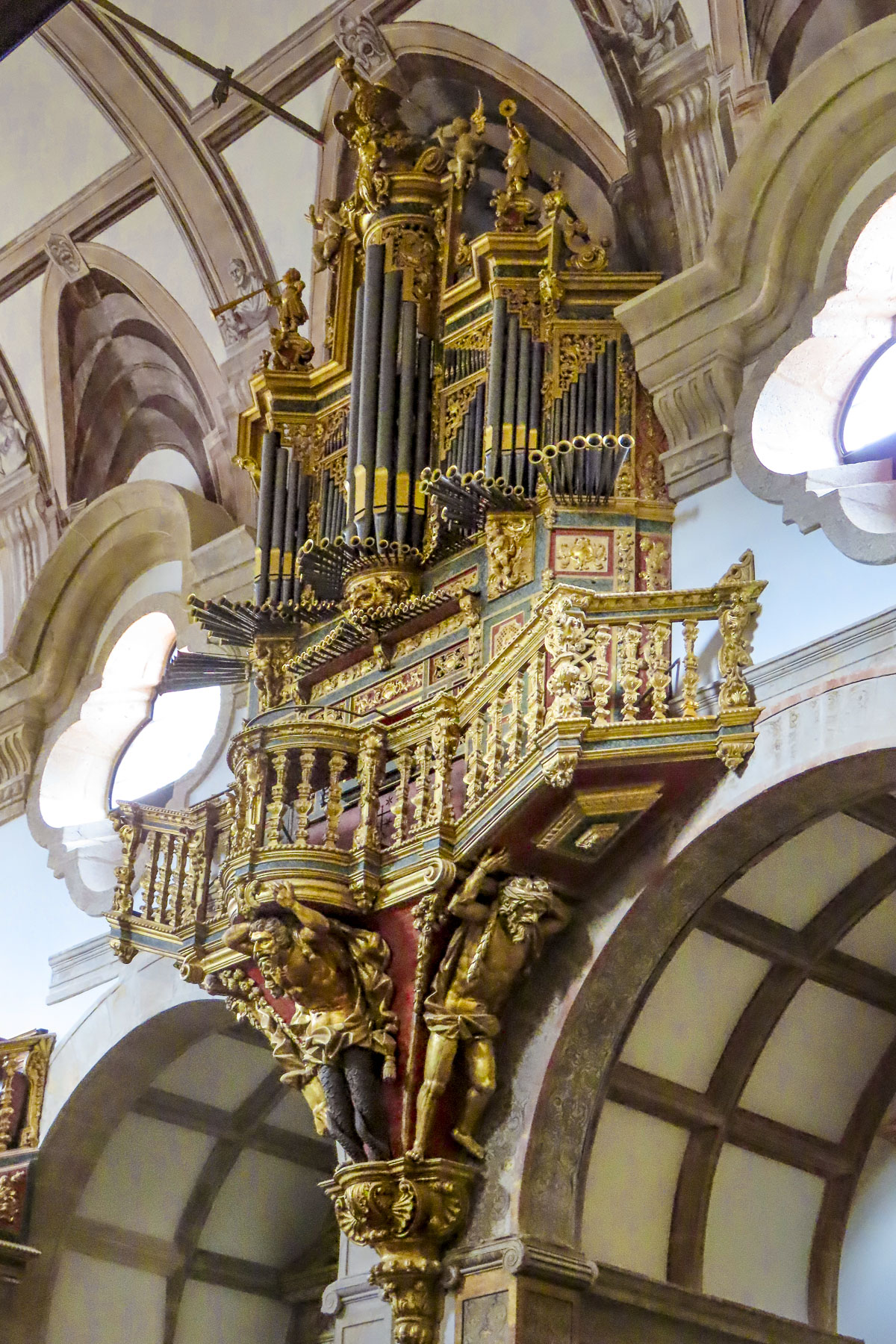
Dating from the mid-1500s, the interior of the church is known for its gilded pulpits and baroque altar. It also features an amazing organ held aloft by sculptures of fish-tailed giants. São Gonçalo’s tomb stands in a side chapel. His stone features have been rubbed smooth over the centuries by folks hopeful for love and marriage. The cloisters attached to the church have been renovated into the Museu Municipal Amadeo de Souza-Cardoso, which is dedicated to the works of many famous artists and writers born in Amarante.

Included amidst the artworks on exhibit are the “The Devils of Amarante,” two near life size, carved wooden statues of he and she devils, with exaggerated sexual features. They are thought to be of Nubian or Far East origin and gifted to the monks of the convent by a sailor or merchant returning from a Portuguese colony sometime in the 1600s. These beloved mafarricos, tricksters, were used by the monks to frighten their congregation before confession. To the horror of the monks, French soldiers dressed the devils in religious vestments and paraded them through the streets before putting the statues and the town to the torch in 1809.  The distraught friars quickly tasked a local craftsman to replace them. This troubled pair was then later ordered expelled from the walls of such a sacred institution by King D. Pedro V, The Hopeful, when he visited sometime in the mid-1800s. They were hidden away until 1870, when the Archbishop of Braga, José Joaquim de Moura, who thoroughly lacked a sense of humor, ordered them burned again! The Prior of the Convent didn’t have the heart to destroy this cherished pair, but ordered the male statue be castrated. A local wood sculptor was tasked with reshaping the she-devil to be less offensive. Somehow Alberto Sandeman, of port wine fame, discovered them and shipped them to London to promote his business. Outraged that their mafarricos were sold and their culture misappropriated, the citizens of Amarante waged a decades long campaign to have them returned. Finally, after much public anguish and through the intercession of the Portuguese Minister of Foreign Affairs, their return was celebrated with a parade through the streets and the crowd singing “Aí vem os Diabos!”, “Here come the Devils!” They are still celebrated every August 24th.

Crossing the narrow bridge, we were surprised that cars are still allowed to use it. We were in search of a café with tables overlooking the river. The cobbled lane seemed to be lined with every other shop window displaying various sizes of doces fálicos. Cocks, dicks, peckers, peters, schlongs, willies and weinies, from three feet long to bags of full of thumb sized ones for wedding shower gifts, and every size in between were proudly displayed, front and center. Does size really matter? Seems this quaint village is possessed and has been wrestling with this archaic question for centuries. Why is this religious monk associated with having a big one? Really, there must be something in the drinking water.

After our adventurous morning in Amarante, the afternoon in Guimarães seemed tame by comparison. The day was still mild, but the sky had greyed by the time we reached the Castelo de Guimarães. An impressive shield-shaped castle with eight towers and a massive keep at its center, it crowns a small hill. It was built in the mid-900s on the orders of Countess D. Mumadona Dias to protect the nearby town and monastery from Viking raids, which did torment northern Portugal in the 10th century, and Moors who were contesting the area. In 1095, when Portugal was still part of Spain, the King of León and Castile gave his daughter D. Teresa in marriage to the French nobleman, Henry of Burgundy, as a reward for his heroic efforts to drive the Moors from Northern Spain. The castle and lands extending to Porto were part of her wedding dowry. It is believed Teresa gave birth to Afonso Henriques in the castle. An advocate for Portuguese independence, he would later crown himself the first King of Portugal in 1139, establishing Guimarães as Portugal’s first capital, after defeating his mother who allied herself with the King of León and Castile, her father.

The Igreja de São Miguel do Castelo is set a short walk down the hill from the castle’s entrance. A rather austere medieval church, its floor is created of gravestones of ancient nobility. Their carved stone features have slowly been worn away over centuries by the feet of the faithful. It is also believed that Afonso Henriques was baptized here.

Farther down the hill stands the 15th century Paço dos Duques, Ducal Palace, with an exquisitely crafted cathedral ship’s hull ceiling. The former royal residence is full of exquisite renaissance era artworks, castle furnishings, and priceless items from the Far East. Large Flemish tapestries celebrating military victories hang on the walls. The collection represents the vast wealth flowing into the country from its far-flung colonies during the age of exploration. Portugal was at the time a superpower.

The Trovador City Guest House was our home for the next two nights. Set on a small square across from the historic district, it occupies three historic buildings which have been keenly modernized. For €43 a night in October it was a tremendous value, and we were able to use one of the hotel’s parking spaces on the square for free.

After dropping our bags in the room, we walked along cobbled lanes that twisted about through the old town. Narrow centuries-old buildings, many three or four stories tall with colorful Azulejo tile facades and shallow wrought iron balconies, lined our way. Our destination was the Padrão do Salado, a 14th century monument, then on to Largo da Oliveira in the Centro Histórico. It commemorates the Battle of Salado in 1340, when combined Spanish and Portuguese armies defeated a larger Muslim force in southern Spain. It’s an arched rectangular structure open on four sides. A stone roof shelters a tall cross with the Portuguese Coat of Arms at the base. 

Adjacent to it stands the Igreja de Nossa Senhora da Oliveira. In 949, the church was built as part of a Benedictine monastery financed by Mumadona Dias, the same Countess responsible for Guimarães Castle. She’s an interesting character in her own right. Refusing to remarry after her husband Count Hermenegildo González died, she ruled alone an area from the Minho River to Coimbra, which would eventually become the foundation of Portugal. Suddenly the square erupted into a cacophony of music, when a group of folk singers joined a group of accordion players and burst forth with song. We grabbed an open table on the plaza, ordered beers, and tapped along.

The next morning, we headed to see the espigueiros, stone granaries, of Soajo and Lindoso. These really are off the beaten track destinations in the far north of Portugal near the border with Spain. It’s a remote mountainous region that includes the Parque Nacional Peneda-Gerês, an area where wolves still roam. The sunny days we had at the start of our trip slowly evolved into rain showers, and then downpours. I hesitate to say unfortunately because we’ve been quite lucky over the years concerning adverse weather. It did slow us down a bit, and I do prefer blue skies in my photos, but moody works too. Oh, and there was that funky windshield wiper on our rent-a-wreck!

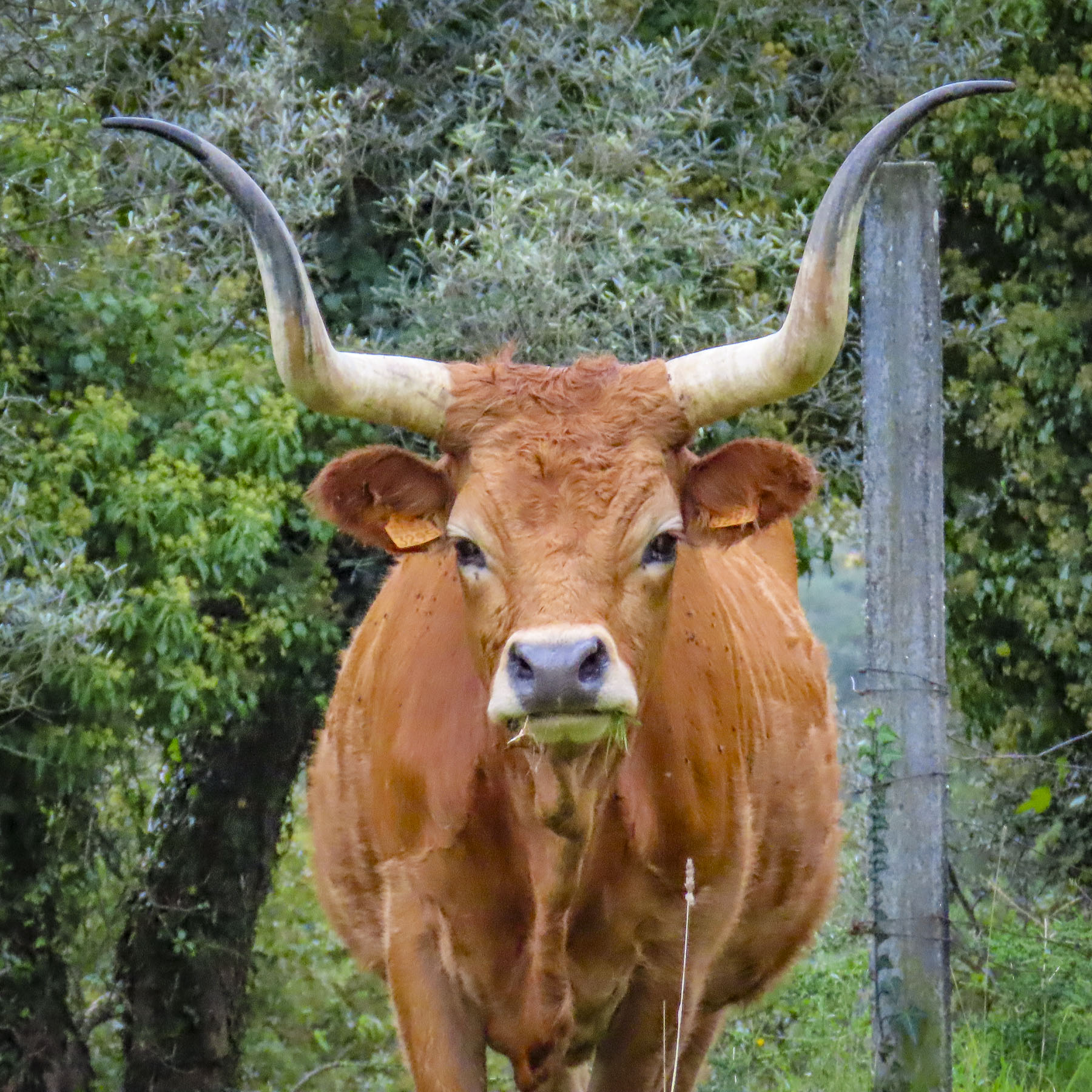
The vineyards that we became so accustomed to earlier in our trip disappeared in this corner of the Minho region. Thick forests that grew to the road’s edge were occasionally interrupted by verdant pasture lands. Turning off the N203 we followed the sign for Soajo down a narrow road that crossed the Limia River. Three loose horses grazed along the road’s edge, oblivious to our passing, their pasture and owner out of sight. Farther along, a large bull eyed us from his enclosure. Signs for hiking trails to two still-standing, ancient stone bridges, the Ponte Medieval de Ermelo and Ponte Romana, attest to the long history of the area. We parked in the municipal lot.

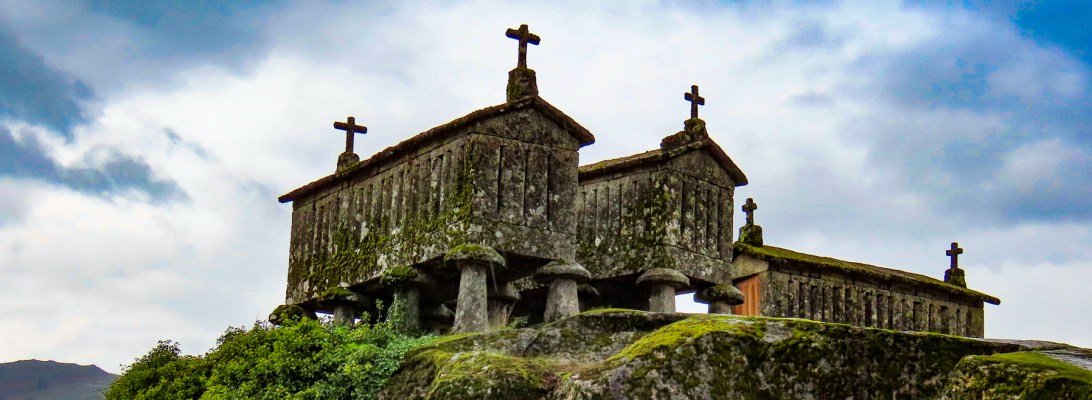
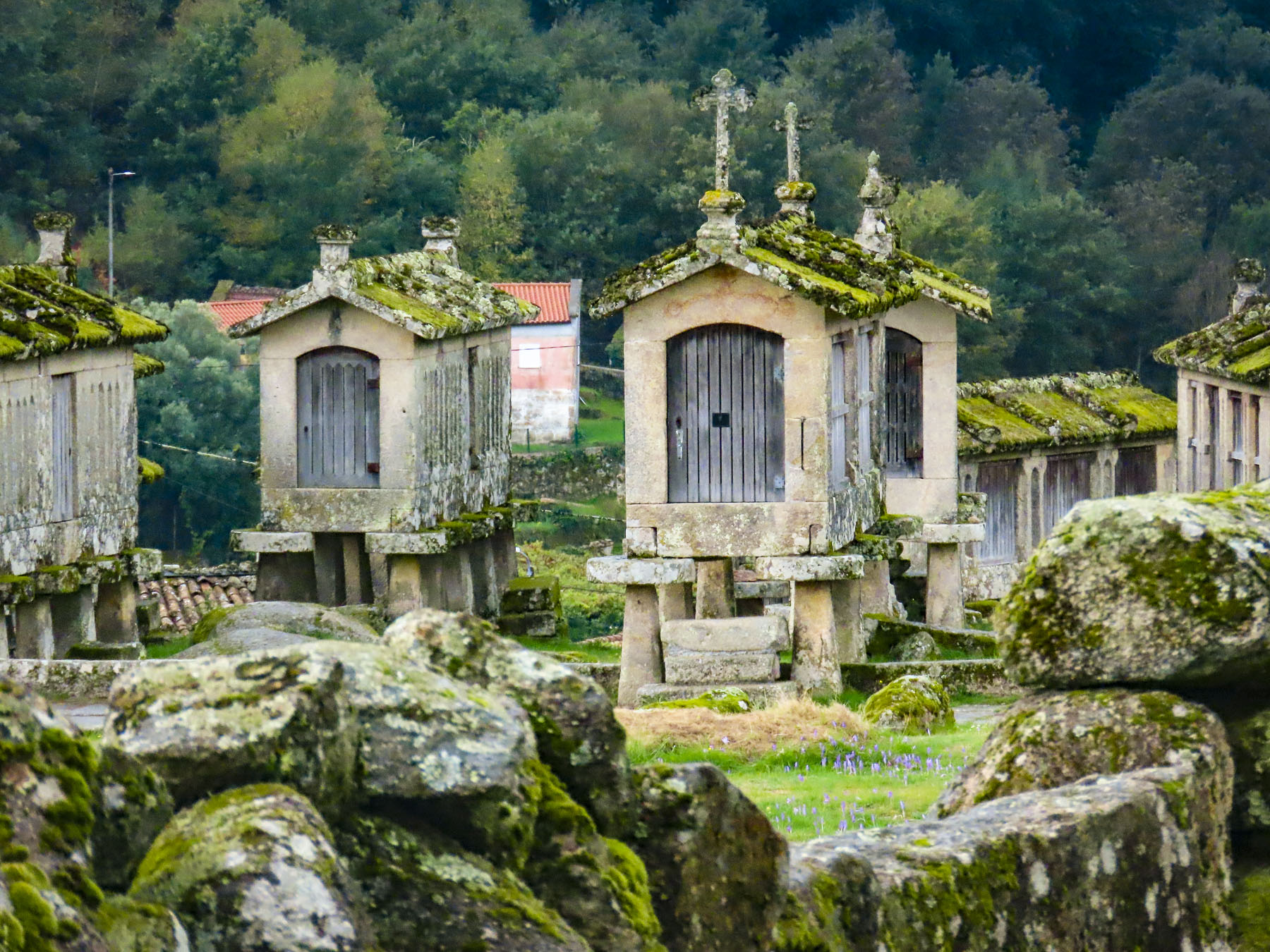
The unique stone granaries are perched dramatically atop a rocky outcrop behind the village’s school. From a distance the twenty-four stately stone structures, elevated several feet off the ground, could be confused for ancient sarcophagi of long dead Kings and Queens. The unique structures, now textured with lichen, were built to keep vermin away from farmers’ harvested crops. Evidently effective, several were still being used. Though they appear much older, the espigueiros were constructed in the 18th and 19th centuries.

The rain came down harder as we sought warmth and hot coffee at Seara Nova, the only café open mid-week during the slow season. “Ah, he’d like an Americano,” my request broadcast across the café with a smile to her pal stationed at the espresso machine. “As much as I try to convince him otherwise, he always does,” my wife apologized as she ordered a cappuccino. It’s not that I don’t enjoy an espresso, all the coffees in Portugal have been great, but they just don’t have enough liquid in them to satisfy my java cravings. And like the Brits with a proper cup of tea, I’m inspiring the uninitiated in how to serve a good cup of joe. Just top that cup of espresso off with hot water to the rim of the cup and its perfect. Smiles all around. I was not disappointed. Our two cafes and pastries came to less than €4. 

Warm again and relieved that the rain had stopped, we drove to Lindoso to see their espigueiros and adjacent castle. Here, about fifty granaries sit on a gentle slope that leads to the town’s castle. The castle’s proximity was an added bonus and we quickly scampered up the hill to investigate. It was built in the 13th century during the reign of Afonso III to defend Portugal’s northern frontier from Spanish invasion.

The border in fact is just a catapult shot away. It was renovated in the 1600s to include an outer star-shaped bastion defensive wall, with a moat and drawbridge, along with watchtowers and machicolations for pouring hot oil on any besiegers. Despite all those impressive defensive features, Spaniards captured it for a brief time. From its walls we watched a moody mist begin to fill the valley below.

We heard Braga calling.

Till next time, Craig & Donna

Portugal Road Trip – Part 3: Everywhere a Miradouro – Into the Douro River Valley

Portugal is blessed with wonderfully diverse landscapes, making it a challenge for photographers like us to actually make any forward progress in a timely manner toward our ultimate destination. As we were constantly tempted to divert and explore a photo opportunity.  Fortunately, after a time the backroads from Ucanha narrowed. Only teasing us with vistas quickly glimpsed, as if shuffling a deck of cards, between houses hugging the road that snaked down into the Douro River Valley.  Whetting our enthusiasm for the days ahead. To our surprise we occasionally passed snowflake signs warning of wintry conditions that sometimes encompass the region. Something we had difficulty reconciling with our sunny view of Portugal, especially since we were experiencing a splendidly warm stretch of fine October weather.

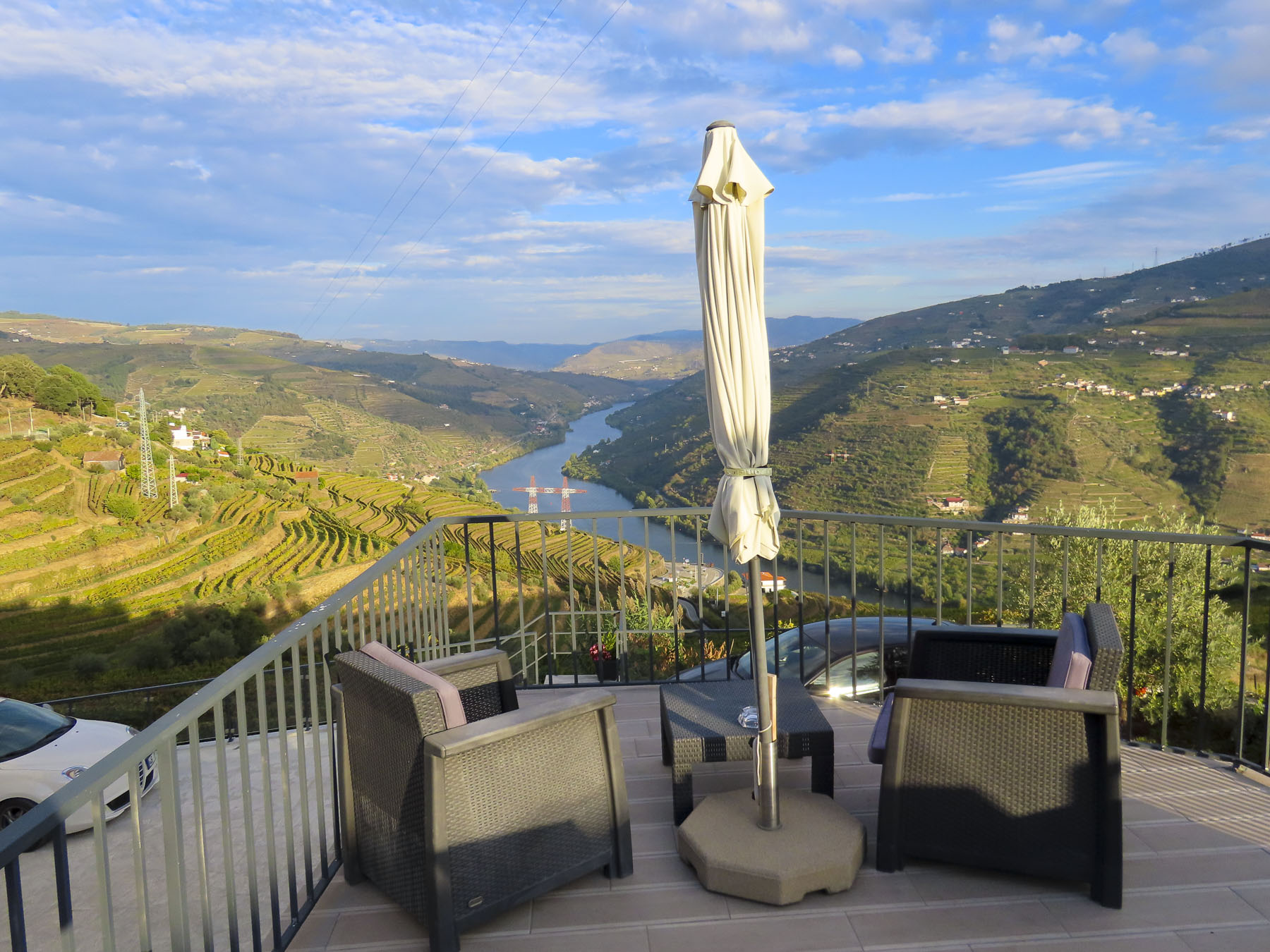
The gate to Casa Vale do Douro slowly swung open to reveal a steep long driveway, which abruptly ended atop the edge of a high retaining wall. It could have been used by Portugal’s Ski Jumping team for practice, if they had one. The view was glorious. Maneul, the charming owner, helped us with the bags to our room. Within minutes we were ensconced in chairs on our balcony. Savoring our glasses of wine and the view. One of the things we appreciate about vacationing in Portugal, during the shoulder seasons, is that it’s still possible to find marvelous accommodations for under €100 a night, that include breakfast. We’d be calling Casa Vale do Douro home for the next three nights.

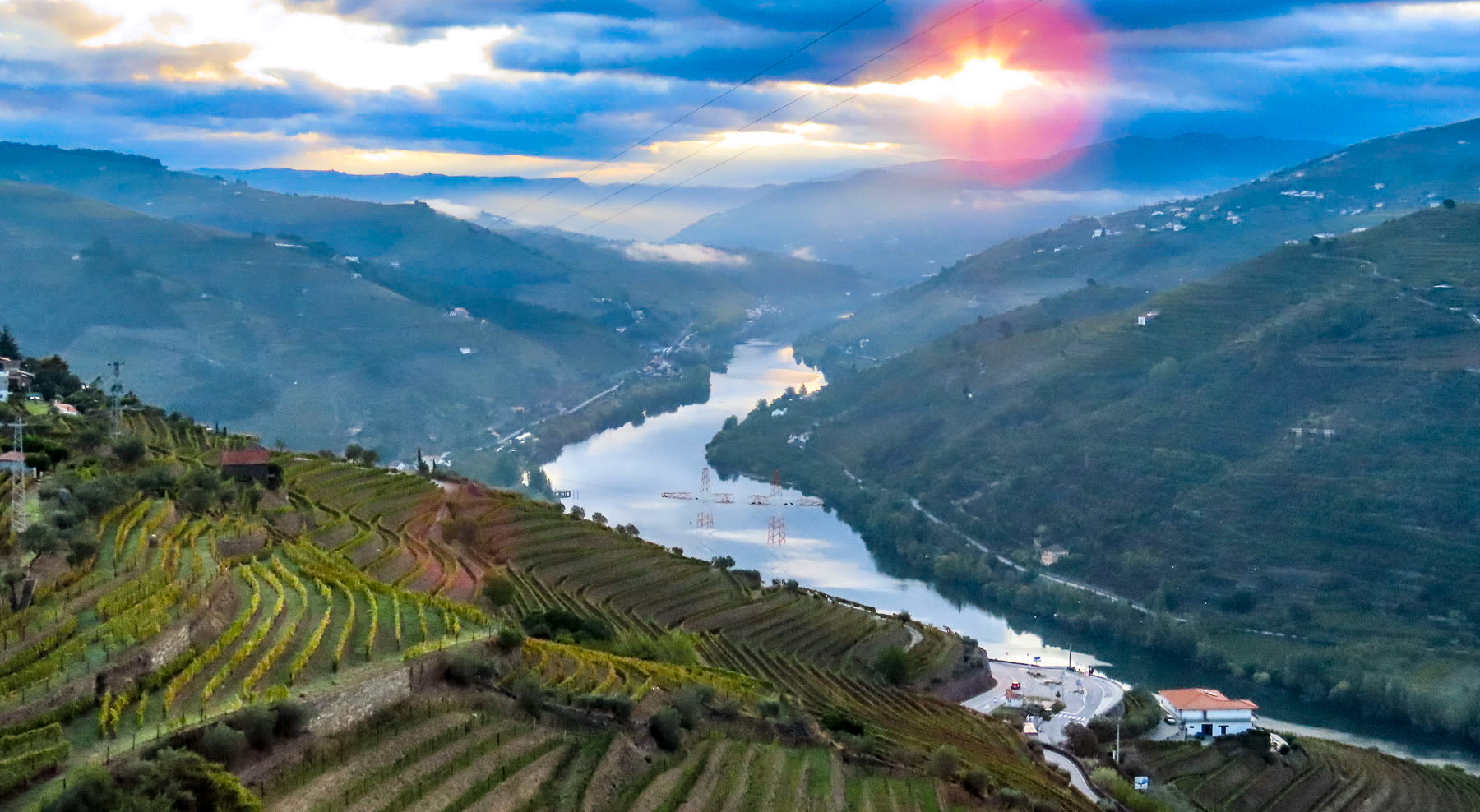
Incredible scenery attracted us to the Douro region, and we were not dissappointed, especially with the views from our room which faced due east. Brilliant sunrises transitioned to the river valley slowly being filled with fog.

Each morning we watched mesmerized as this ghostly blanket slowly engulfed buildings, vineyards and eventually us as we stood on the balcony. By ten o’clock it had usually burnt off.

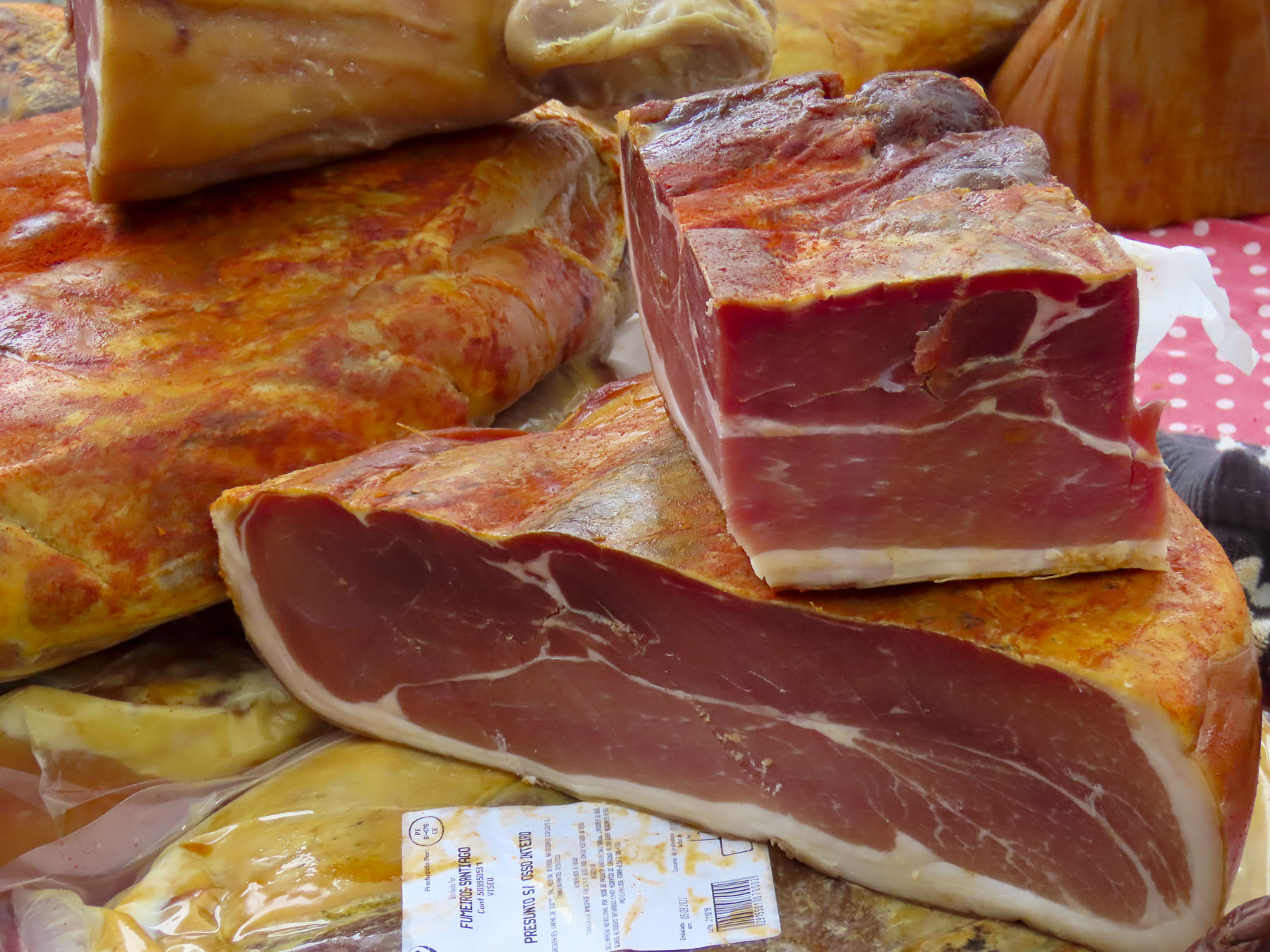
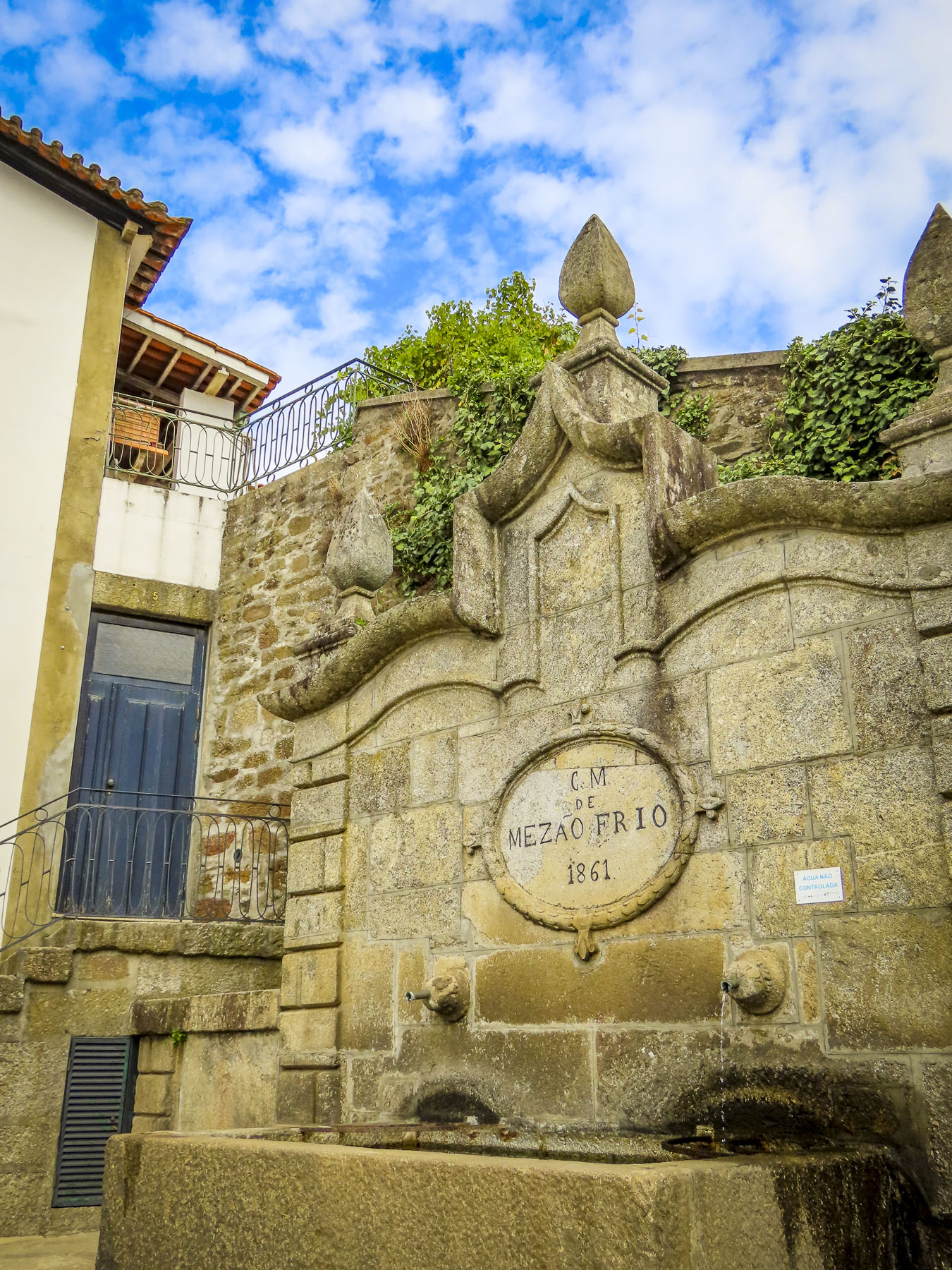
The small village of Mesão Frio was a short walk from our guesthouse and as luck would have it, market day. Being mid-October, it was a smaller affair than what we imagined takes place during the high season, but it was still interesting enough, with cheese, meat and vegetable purveyors, along with hardware tents and garden suppliers selling seedlings for fall planting. With a round of Portuguese cheese and jamon secured for a picnic lunch later it was time to enjoy our, “walk a little then café,” break. Afterwards we wandered from one end of the village to the other, along the village’s main lane bordered on one side with a wide plaza and lined with shade trees. At the far end stood the Church of São Nicolau.

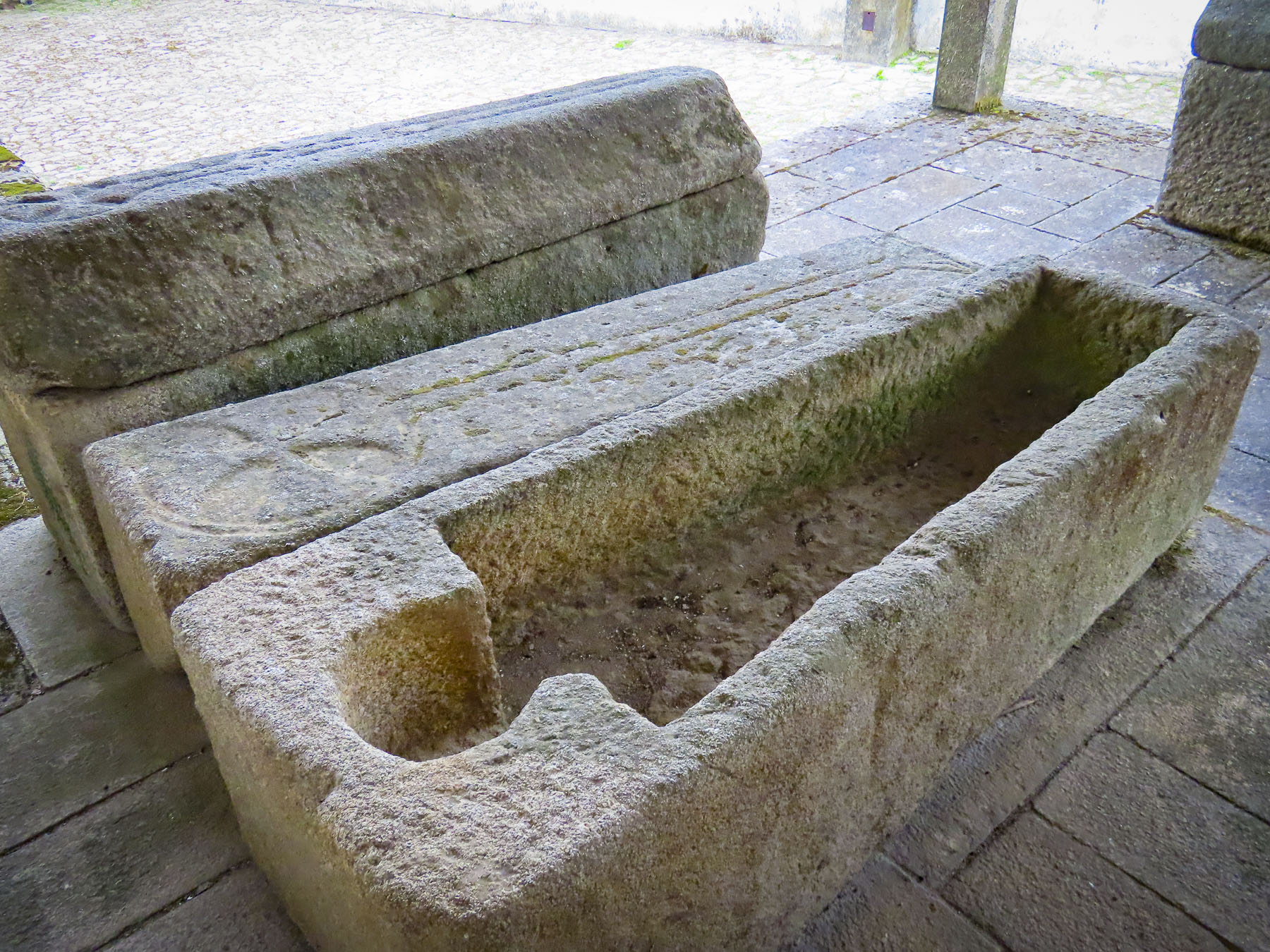
Tradition believes that the church was ordered built by Queen d. Mafalda, wife of d. Afonso Henriques in the 12th century, but the thickness of the church’s walls hint that it was constructed in the 14th century. Eighteenth century remodeling left the Baroque and Rococo character that’s visible today.  Several ancient stone sarcophagi, trapezoidal in shape, dating from the Medieval era stood under a side portico.

Heading back through the village we entered the Igreja de Santa Cristina, its interior now modestly decorated after it was looted and destroyed by Napoleon’s army during the Peninsula War of the early 1800s. Leaving only one bell tower that still stands today. It’s attached cloister, dating from 1724, was originally dedicated to Franciscan friars until 1834 when all male religious orders were banned from Portugal and their properties confiscated by the state.

Leaving many original stone details in place the building has been wonderfully repurposed as municipal offices. The most interesting detail a “janelas de vinho” or wine window from which wine used to be sold. The Regional Tourism Board located in the cloister has produced a very comprehensive 54-page Douro Tourism Guide that is a great resource and available to download for free. Listing an astonishing 120 major viewpoints, along with wineries, festivals, lodging, restaurants, and activities throughout the valley. There’s enough wonderful information in guide to encourage multiple vacations into the area.

After coffee, we drove leisurely along the north side of the river, stopping frequently to take photos. Driving through Peso da Régua to Covelinhas, where we followed the sinuous road high up into the mountains.

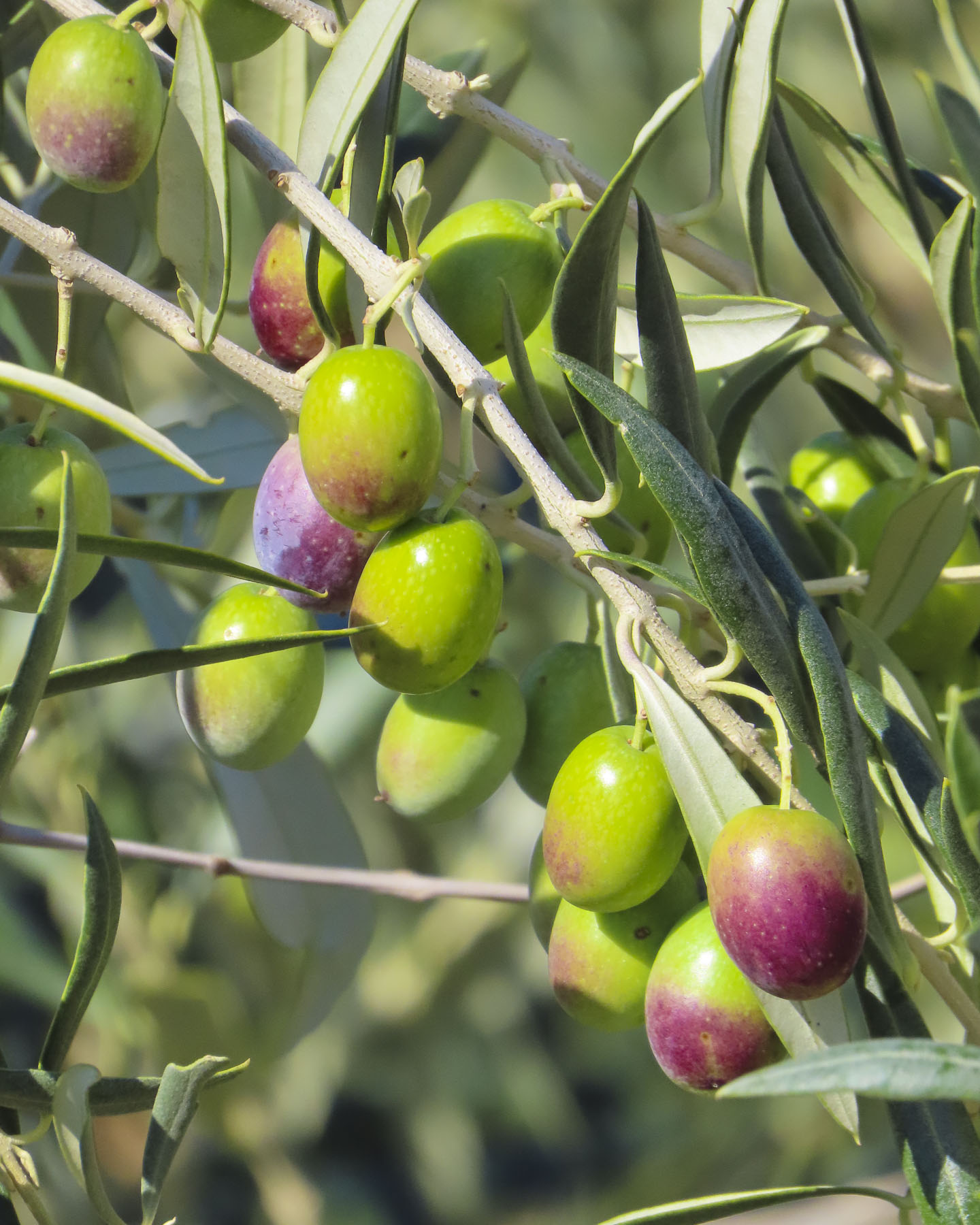
Occasionally passing olive groves and fruit orchards, their novelty highlighted by being oddities in a sea of grapes, until we reached the Miradouro São Leonardo de Galafura. At an elevation of 2100 feet it’s one of the highest viewpoints overlooking the valley.

Hawks circled on the thermal updrafts below us. As far as we could see, waves of undulating vineyards covered the hillsides, their pattern like a stone thrown into a pond. The unbroken views from the miradouro seemed if we were flying.  

Highly recommended by our host we dined each evening in Mesão Frio alternately at Tasca do Zéquinha an intimate rustic eatery with a silhouette of a wine cask hanging above the front door. Inside was a small bar packed with regulars. With a smile one pointed us upstairs when he saw our dismay that it was standing room only on the street level. Upstairs we were pleasantly greeted in a small dining room of eight tables. We enjoyed lamb chops, a rare and outrageously expensive menu item in the states, but well priced here and delicious. Fully sated, we were pleasantly pleased with how inexpensive appetizers, a house wine, dinner, dessert, and coffee were. In the Douro Valley the wine choices are infinite, or fathomless and as much as we enjoy wine, we are not knowledgeable oenophiles and are content with most restaurant’s house wines. Which in our experiences have found to be very good. 

The next night we ate at Convívio. Honestly, I can’t remember what we ordered, but we thoroughly relished the meal and the house wine. Here the house wine was a bottle of Serro d Asno, which featured a humorous illustration of a donkey’s ass. I’m not sure if the waiter was secretly a radical protesting the invasion of tourists into the Douro Valley or expressing his discontent with something I did not say, ha ha, my mind wanders. The wine was very good. Unfortunately, we haven’t been able to find it here in the states. For a change of pace we had dessert and coffee at Café Avenida, which features a tantalizing display case full of their divine homemade pastries. Staying open to 12AM, this quiet place is the ultimate experience for nightlife in Mesão Frio.

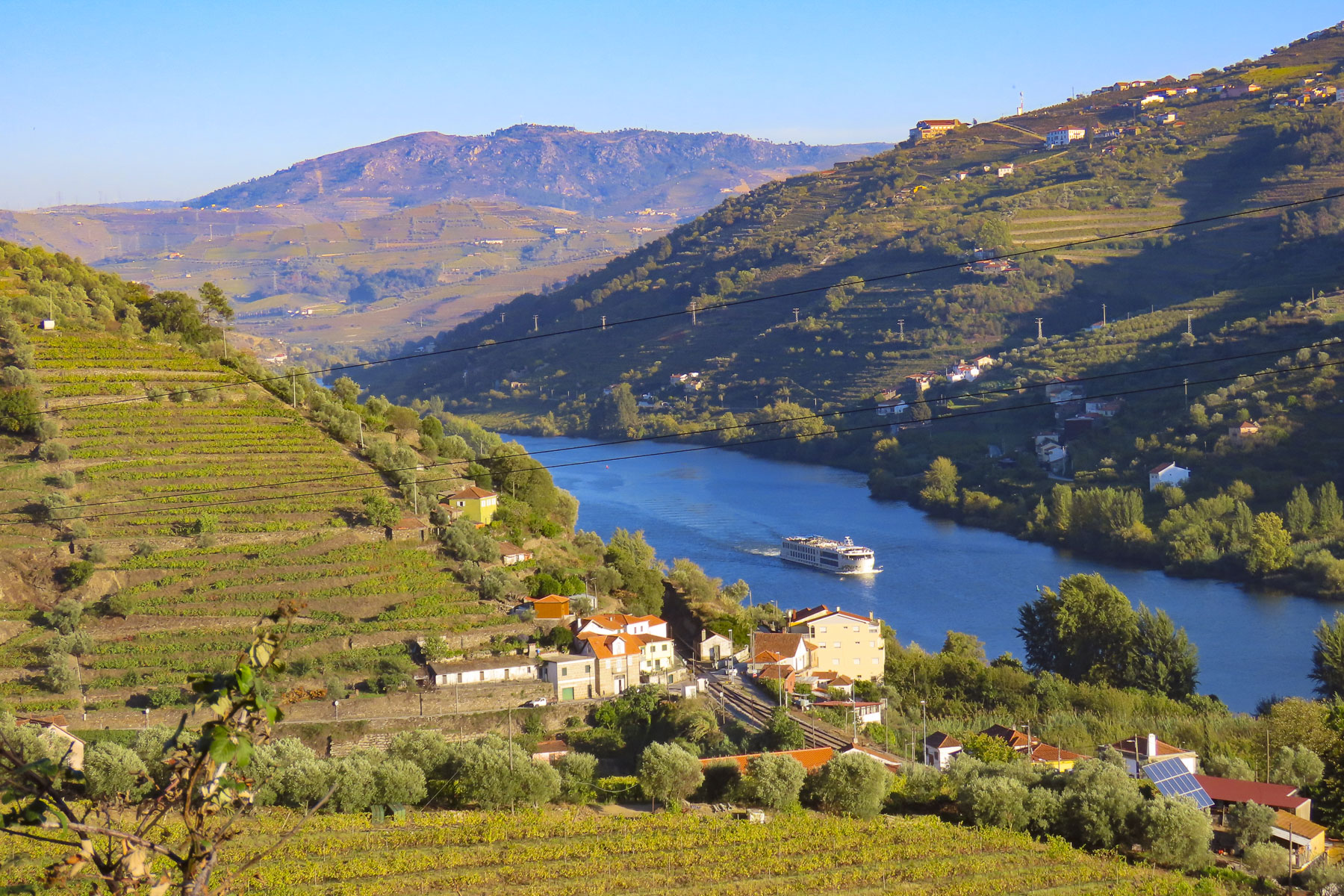
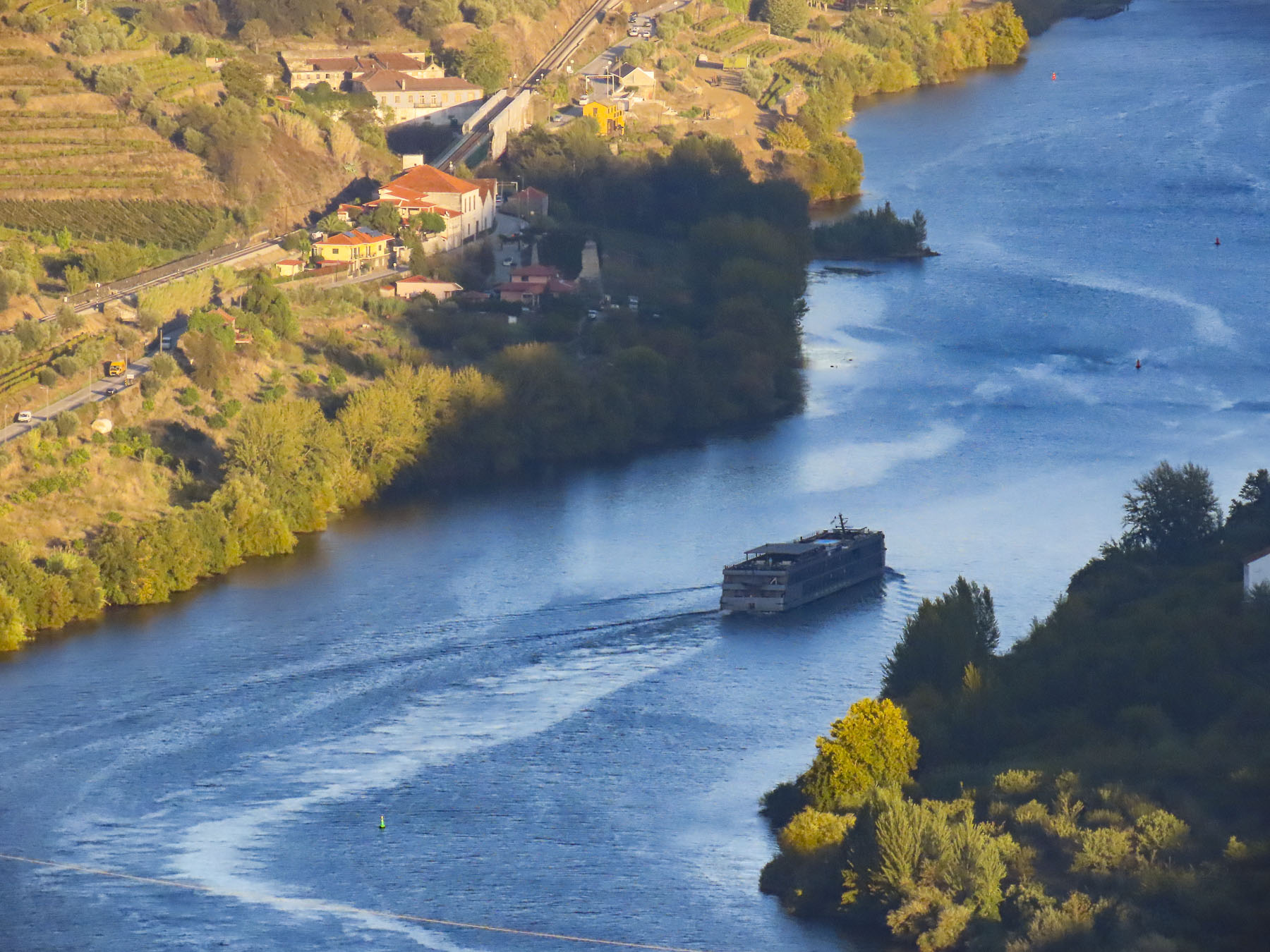
The waters of the Douro River rise in the mountains of central Spain, north of Madrid and flow of west for 557 miles before meeting the pounding waves of the Atlantic Ocean on the Portuguese coast at Porto. The famous region known for its production of Port, a fortified wine, encompasses 615,000 acres along 75 miles of river valley from the Spanish border to Mesão Frio.  

In September 1756 a Portuguese royal charter acknowledged the Douro River Valley as the exclusive region for the production of Port wine. Becoming the world’s first wine region to have a formal demarcation or DOC (Denominação de Origem Controlada).

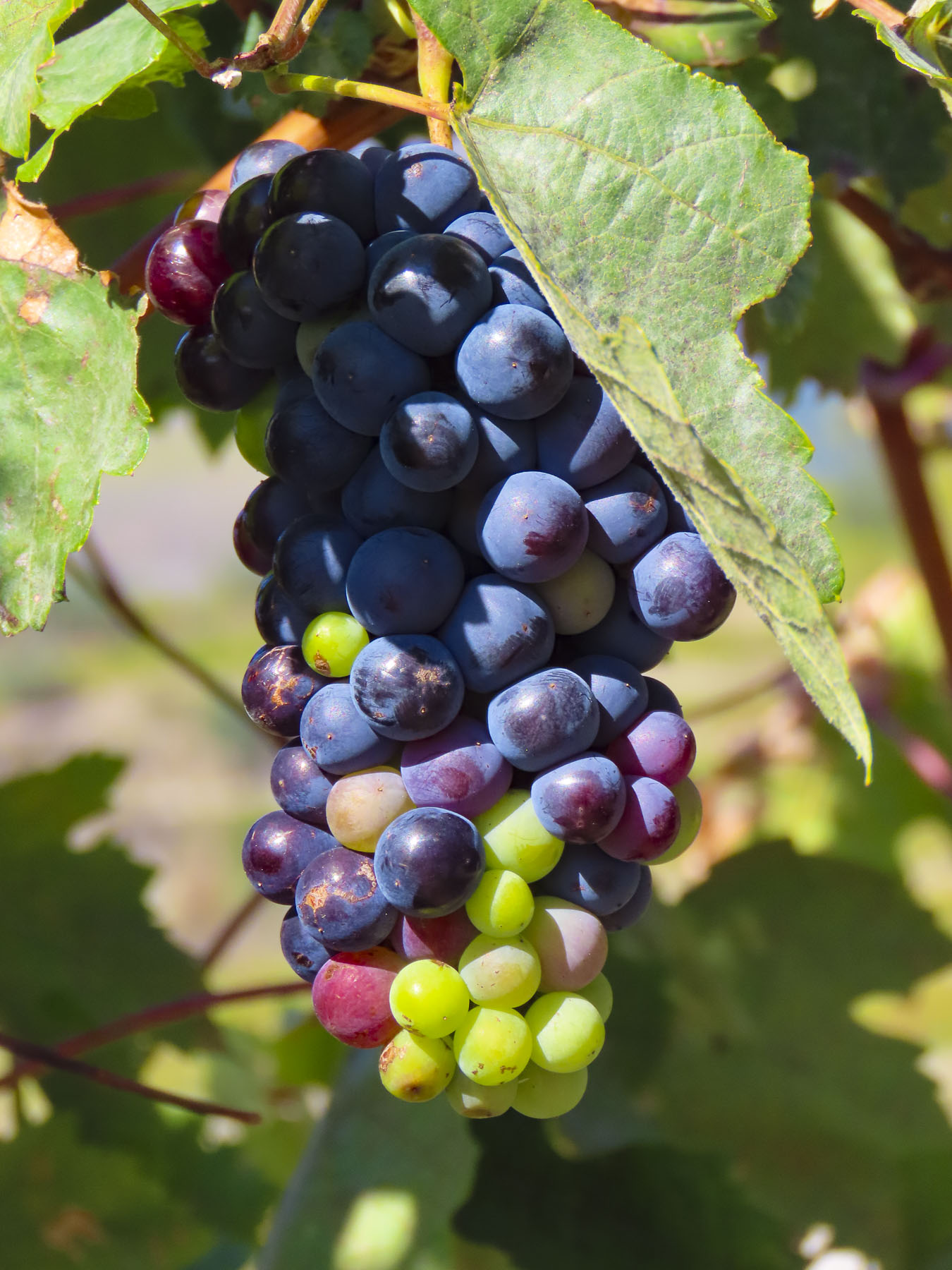
Though renowned for its Port wines, today production is evenly divided with Douro table wines, which are gaining international recognition. Eighty different grape varietals, many native to Portugal, are cultivated in the region, but by far the most popular red grape varieties are Touriga Franca, Tinta Roriz, Tinta Barroca, Touriga Nacio, nal, Tinta Cao, and Tinta Amarela. While Rabigato, Viosinho, Malvasia Fina, Donzelinho, Gouveio, and Codega are the favored white varieties. Used alone to make full-bodied reds or delicate white wines they are also blended to create the beloved Port wines of the region.  Interestingly grapes growns for Port wine are planted on rocky schist areas while grapes grown for table wines favor a looser soil. The steep terrain of the narrow-terraced hills along the valley are no match for modern harvesting equipment, dictating that every September into early October the grapes are harvested by hand.

Small hamlets with parish churches of all different sizes are speckled across the landscape of the Douro Region. Picking one out on the map we headed to Cidadelhe for the Igreja de São Vicente. Built in the 1700s the stately baroque-style church is showing its age, with its textured graceful patina along with faded and peeling wood.

The backroads through the Douro Valley offered endless vistas of rolling hills and vineyards beginning to display their fall colors around every bend of the road. Fortunately, in October there were few cars or caravans on the roads and we able to stop often. With 119 official viewpoints in the region there’s and infinite number of photography worthy panoramas available just by pulling over onto the shoulder. The landscapes were endless. The fog intriguing.

We really didn’t have any solid plans for our time in the region. No must to this or that. Instead we chose, often remote miradouros on the map for our morning and afternoon destinations. The journey to reach them an integral part of the adventure.

We just brushed the surface of this alluring Douro Valley region. Hopefully, one day we’ll get a chance to return.

Till next time, Craig & Donna

.

Portugal Road Trip – Part 2: For the Love of Guardrails

To misquote RWE, “It’s the journey, but an interesting destination helps.” We left Tomar, destined for Piodão, one of the 27 Aldeias do Xisto, Schist villages, in the mountainous central part of Portugal. Only two and a half hours from Tomar, we rarely passed another car as we drove. Our route quickly transitioned to serpentine roads traversing rolling hills covered in eucalyptus and pine forest. Then the higher above the tree line we drove, an expansive vista of shrublands fielding heather, broom, carqueja and rosemary were revealed. Hair raising, twisting and turning roads would truthfully be a better description, made all the more unsettling because there seemed to have been a transportation department budget crisis, as in, they forgot to install guardrails on most of those mountainous roads! My wife’s knuckles were white from tightly grasping the “Oh Jesus” handle above her door. With all the gorgeous panoramas, they could have planned more miradouros for folks to safely enjoy the views from.

We are not novice mountain drivers, having taken many switchback roads to remote places on several continents, which has reinforced or belief in and appreciation for a nice sturdy guardrail when we see one.

This was also the day our moody rent-a-wreck of a car went psychotic, every warning light on the dashboard blinking violently in Portuguese, requiring us to pull over to check the vehicle. Reluctant to turn off the engine in such a remote area, we listened closely for any sounds of motor distress. The car sounded fine. We drove on. With a quick, blind left turn and an “Oh God!” we descended a steep single lane road on the far side of the village that eventually led us across terraced slopes to Casa da Padaria for the night.

With warm greetings and help with our bags Gorete, the innkeeper, showed us to our room. For many years, decades before its renovation, the inn served as the town’s bakery run by Gorete’s father in-law. She and her husband returned to the village and remodeled the original building into a small four-bedroom guesthouse. The bakery’s large brick oven still takes up one whole wall of the breakfast room, which also displays a huge dough trough and long wooden bread peels used to take the loaves out of the wood fired oven.

Schist, schist, schist, everywhere schist! Walls, roofs, cobbled lanes, terraces, everything in the village is built with this durable brown and grayish stone, from a distance giving it the appearance that it has grown organically from the earth of the box canyon that shelters cradles it.  Everyone’s blue doors and window frames are not the result of superstition to ward off demons or to bring good fortune, but a shop keeper buying many years’ worth of paint in only one color. It became tradition.  

Channeled narrow rivulets of cold mountain water run quickly between homes, under doorsteps and along the edges of walkways before cascading downhill into irrigation trenches for the terraced crops below the village.  Small fountains throughout the hamlet offer spring water for drinking and washing for some of the older homes that still might not have plumbing.   

Slowly exploring the village, we made our way to its central plaza for dinner at O Solar dos Pachecos and enjoyed delicious bowls of Moelas Guisadas a Portuguesa, stewed chicken gizzards. This dish might not be for everyone, but it is truly one of Portugal’s culinary treasures. The owner enthusiastically shared tidbits of information and pointed across the way to the only mailbox in this unique village for the 120 full-time residents left here. Pity the poor postman otherwise trying to figure out the twist, turns and stairways of the hamlet’s ancient lanes. Surely everyone gets to know one another this way with the mailbox strapped to a tree on the main square in front of the village’s only white-washed building, the church.  Before leaving he suggested we enjoy some of the hiking trails the area is known for with a short trek through the valley to Praia Fluvial de Foz d’Égua, a scenic spot with a suspension bridge over a stream that widens into a natural swimming hole. Later for coffee and dessert we watched part of a soccer game on the TV above the bar at O Fontinha.

Piodão owes its unadulterated charm to the fact that it was pretty much forgotten and slowly abandoned until the 1970’s when the donkey and horse trails leading to the village were replaced with roads carved into the isolating mountains of the Serra do Açor that surround it. It is located not far from Parque Natural da Serra da Estrela and continental Portugal’s highest peak, Torre at 6,539ft. Difficult terrain lured fugitives, seeking to escape justice, to the isolated villages of the area. Allegedly one of the assassins of D. Inês de Castro, the mistress of Pedro l, sought refuge here in the late 1300s. Other than that interesting historical footnote and mention in a 1529 census, folks got by on a subsistence economy of farming, grazing sheep and goats, along with wood and stone cutting for centuries.

Its rediscovery and revitalization in the 1980’s brought the isolated village built with the abundant local schist stone recognition as one of the “most Portuguese villages of Portugal,” with a Galo de Prata “silver rooster” award.  

Waking during the night to close the window against the mountain chill, I observed a full moon illuminating a single arched stone bridge over a babbling brook at the bottom of the valley. The mountain songbirds were loud enough to encourage an early wakening as the sun rose over the ridge behind the village. The next morning Gorete’s homemade jams, pastries and a neighbor’s artisanal cheese nourished us before we explored the village and moved on.

The drive to Praia Fluvial de Foz d’Égua was through forest thick with oak, chestnut and laurel cherry and arbutus trees. Arriving, we understood immediately why this beautiful area is such an out of the way tourist magnet. Traveling during the fall shoulder season, we were fortunate to experience the tranquility of this serene spot in solitude.

Continuing the next day, we headed north to Ucanha for its old Roman bridge with fortified tower that spans the Rio Varosa. In the off-season not as many restaurants are open, but we were fortunate to find Casa da Eira near the bridge still welcoming folks for a splendid meal.

The walk to it was down a lane bounded with high walls draped with bunches of grapes dangling beneath, the vines sporting brilliant fall foliage. Just before reaching the restaurant, we peeked through the broken shutters of a long-abandoned church, its wedding cake altar and walls stripped of any religious embellishments.

After lunch we strolled across the bridge and under its tower which served as a toll booth for travelers crossing the river and gateway to the vast land holdings of the Mosteiro de Santa Maria de Salzedas in the 1400s, and further on to the Portuguese frontier.  

The bridge we crossed is thought to have replaced an earlier Roman structure from the first century AD. Through the tower’s archway we followed the lane up to the village’s parish church, Igreja de S. João Evangelist, that dates from 17th century.

It was surprising to learn about the ancient Roman presence here in central Portugal, but we had already noticed signs for the old Roman route as we drove through the area and tried to find two ancient bridges nearby, the Ponte Românica de Vila Pouca de Salzedas and Ponte Romana without any success while on our way to Salzedas. In searching for them, we did however thoroughly enjoy an afternoon ride through tiny hamlets, vineyards, olive groves, and apple orchards, where the tastiest apples were plucked from a tree within reach of our car window.

Reaching Salzedas we parked and walked towards the monastery across a small bridge over a dry riverbed. Stopping across from the monastery to take a photo, we spotted the most unusual statue along the watercourse’s retaining wall: a carved stone sculpture of a naked man sitting with a huge serpent-head phallus bursting forth from between his legs. Its location across from the monastery was all the more bewildering, but we had to laugh. Odd, just really odd, some of the things you discover when you travel.

Shorter opening hours are one of the disadvantages of travel during the shoulder season as by the time we were done exploring the Mosteiro de Santa Maria de Salzedas the small cathedral next to it was closed. Having paid fully for our entry tickets, we were startled by the guard’s request request for coins. “Do you have any foreign coins? I don’t travel, it’s my hobby and I ask all the foreign visitors if they don’t mind sharing.”  Having collected foreign money ourselves we could relate to this desire to touch something of the outside world. “We have some somewhere in our suitcase. I’ll check before we go,” I replied. The attendant replied with a subtly disappointed, “okay.” We were sure he thought we were just giving an excuse as we climbed the stairs to the exhibition.

From its placement in 1155 near the Torno River, in keeping with the sect’s requirements that its buildings be near watercourses, this was one of the largest and wealthiest Cistercian monasteries in Portugal, having been gifted extensive land holdings, by a royal patron, with the express duty of exploiting the land for profit. A century later it was consecrated after the monastic complex was finished. Over the centuries it continued to be financed by various members of succeeding royal dynasties, perhaps seeking divine intervention or to influence the politics of the almighty Catholic church. Like all things old, it underwent several significant renovations during the 16th and 17th centuries. The addition of a second larger cloister in the 18th century left the façade of the monastery we saw today.

“Enough is enough, we’ve had enough,” could have been the chant of the Liberal government after their victory over the Absolutists at the end of the Portuguese Civil War, 1828 -1834, a war fought for basic human rights and to reverse centuries of disenfranchisement from autocratic monarchies and their allies, namely the Catholic church. Reforms started by the enlightened Marquês de Pombal in the mid-1700s to restrict the powers of old aristocratic families and the church with the expulsion of the Jesuits from the Portuguese Empire had stalled. In 1834 the new minister of justice, Joaquim António de Aguiar, enacted a law, The Extinction of the Religious Orders, requiring the dissolution of “all monasteries, convents, colleges, hospices and any other houses of the regular religious orders.” Their properties and moveable assets were to be nationalized and sold, the profits to be entered into the National Exchequer. Convents were allowed to stay open until the last nun died. Joaquim António de Aguiar earned the nickname, O Mata-Frades, “The Friar-Killer,” because of the anti-ecclesiastical spirit of this law. Over 500 monasteries were closed. Urban buildings were easily sold and repurposed, but many monasteries and convents in the rural areas were abandoned. Their religious art and iconography was redistributed to local parish churches, sold into private collections or “lost.” The Santa Maria de Salezadas Monastery sat abandoned and left to ruin for over 160 years until renovation work started in 2002 and culminated in the reopening of the cloisters in 2011 as a museum with displays of the monastery’s medieval and renaissance religious art and treasures recollected from afar.

With a wave and “thank you,” we left the monastery and headed to our car. “Wait, I’ve got to find those coins for you to take him.” Returning to the car with a smile on her face, Donna relayed that he was delighted that we remembered. A small connection.

It’s the journey. We headed to the Douro Valley. 

Till next time, Craig & Donna

Portugal Road Trip – Part 1: Searching for Templar Castles

“It’s okay, you can just ignore that caution light on the dashboard. It never goes off.” “Do you have another car?” “No.” All rental cars appear equally perfect when you are making comparisons and a final selection from a website. Staying within our budget, we chose an off-airport car rental agency with good reviews, that picked us up at the arrivals terminal and sped us away to our awaiting wheels, for €12.50 a day.  The Fiat Panda assigned to us had been driven hard and put away wet, you might say. Reviewing the preexisting body blemishes with the rental agent resulted in a cartoon of the car that looked like it had been ambushed in a gangster movie and sprayed with machine-gun fire, including the roof. Nevertheless, the engine sounded fine, and our twelve-day journey began, driving in a large figure-eight, north to south route, around Portugal. Our first destination – Castelo de Almourol, before arriving in Tomar. But by the afternoon of day three we were referring to our car as the Portuguese version of the American rent-a-wreck concept. When driving through the mountains, on the way to a schist village, every warning light on the dashboard started blinking violently in Portuguese. If we had been flying an airplane, we would have donned parachutes and bailed out.  The engine sounded fine, so we flew on.

Not being sure what is open during the week in the off season, we headed for the Miradouro do Almourol, an overlook above the island that the castle commands. Located on the south side of the Tagus River, it’s not particularly easy to get to. But my wife and I enjoy the off the beaten track routes that take us through less traveled countryside. Crossing the Tagus River, we followed the N118 north into the Alentejo (beyond the Tagus) Region through flat farmlands and wine estates dating back to the 1700’s. The red wines of the area vinted with the Portuguese varietals Castelão, Trincadeira, and Touriga Nacional are acquiring international recognition now, as are the regions white wines made with Antão Vaz, Arinto, and Fernão Pires grapes.

The drive was slowed occasionally by tremendously large John Deere combines, the width of the entire road, as farmers drove them between different fields waiting to be harvested. Seasonal spring floods that replenish the soil have made this river plain an important area for cereal crops and wheat since the Roman times. Our walk a little then café philosophy quickly transformed into drive a little then café when we did our first U-turn of the trip as we passed a small place that had a tractor parked in front. Our espressos only €.70 each. It was nice to be back in Portugal.

The wetlands of the Tagus River valley are ideal for bird watchers looking for black-winged stilt, marsh harrier, purple heron, pratincole and Kentish plover. Occasionally we spotted storks atop centuries-old chimneys of abandoned homes, resting in new nests that were stacked like pancakes atop older ones before continuing their winter migration south to Africa. Quiet lanes, faded sun-bleached pastels, and centuries old weather-worn buildings dotted the landscape. Bullrings, Praça de Touros, still stand in Chamusca and Salvaterra de Magos, and the latter’s traffic circle has a large sculpture of a cavaleiro and bull to celebrate the tradition. Though interest in bullfighting has been waning since Queen Maria II of Portugal banned the spectacle in 1836 with the argument that it was “unbefitting for a civilised nation,” it regained popularity in the Alentejo region after the fights were reinstated in 1921, and the climatic killing of the bull was outlawed in 1928.

Before we reached the castle, we stopped for lunch along the riverfront in Arripiado at the ABC Bar Café. It was a tranquil spot with a boardwalk that had a view of the Tagus River and the small village of Tancos across the water. Small boats offer rides to Almourol Castle from the Arripiado riverbank here.

With its striking island location, just below the junction of the Zezere and Tagus rivers at Constância, Almourol Castle is one of the most picturesque medieval fortresses in Portugal.

Constância was once an important fishing village during the Middle Ages where it was said the rivers there were “two-thirds fish and one-third water.”

As with most things ancient on the Iberia Peninsula, the castle’s history started with an early tribe. The Lusitanians built a small fortress on the island as protection against the Romans in the first century B.C.E. Visgoths, Vandals, Alans and Moors followed until it was captured by the Portuguese during the Reconquista in 1129 and subsequently entrusted to the Knights Templar to rebuild for defense of the frontier border at the time.  It eventually lost its strategic relevance and was consequently abandoned. Various phases of reconstruction began in the mid-1900s. 

Train service to Tancos, Castelo de Almourol and the hilltop village of Constância is available from the Santa Apolónia Station in Lisbon. The trip takes about an hour and a half.   

We arrived in Tomar just as the late autumn sun was low in the sky and beginning to cast lengthening shadows on the forested slope that led to the jewel that crowns this quaint village.  We followed the winding cobbled lane to Castelo de Tomar and only got a brief glimpse of the castle through its outer gate as the heavy wooden door was closed for the day with an echoing clang. The castle combined seamlessly with the Convento de Cristo next to it and creates an immense structure that’s best observed from a distance to appreciate its scale. Admiring the expansive view from the miradouro in front of the castle, we made plans to return the next day via a tuk-tuk taxi, from the town square.

This beguiling medieval village with its narrow lanes and tranquil riverside location discreetly hides its outsized contribution to the history of Portugal.

It starts with those mysterious Knights Templar when in 1159 the first King of Portugal, D. Afonso Henriques, granted land to Gualdim Pais, the fourth Grand Master of the Knights Templar in Portugal as reward for their military prowess and religious zeal during the Portuguese wars for independence and the subsequent Reconquista. When the town was first founded, the population was so minuscule, most of the villagers lived behind the castle’s defensive walls.

In 1160 Gualdim Pais order the construction of a monastery and fortified citadel that would be known as the Convent of Christ, a combination of a fortress and a monastery, that is sometimes referred to as the Convent of Christ Castle. The convent’s most interesting feature is a round sanctuary with an ornate ceiling soaring over a central altar, its design said to be influenced by the Church of the Holy Sepulcher in Jerusalem.  Legend states that the knights attended mass on horseback here, the open circular design facilitating the horse’s easy entrance and exit. Famously in 1190, outnumbered Templars defeated a larger Muslim army after their six day siege of Castelo Tomar failed.

Founded in 1118 and slowly gaining recognition from their vowed mission to protect pilgrims journeying to the Holy Lands, the Knights received Papal endorsement in 1139. Pope Innocent II’s Papal Bull sanctioned the Templars as “an army of God,” and provided them special rights that included exemption from paying taxes, allowed them to build their own oratories, immunity from local laws, freedom to cross borders, and obedience only to the Pope. With this blessing Pope Innocent ll made the first papal monetary gift to the Templars. Now a church-endorsed charity, they began receiving land, money, businesses and young nobles from wealthy families who were enthusiastic to find glory in the crusades and willingly donated their assets in order to take the vows of poverty, chastity, piety, and obedience.

Today the Templars most likely would have been charged with running a racketeering enterprise which forced pilgrims and others to pay for protection services they have not requested. This protection was usually from the very people who were demanding the money in the first place.

Things were going well for the Templars across Europe until 1307 when King Philip lV, heavily indebted to the Templars from a war against England, lobbied the Holy Church to disband the Knights Templar as it was a state within a state with its own military, preached heresy and practiced idolatry.

The Templars’ fatal day (eerie music, please) was Friday, the 13th of October 1307. Early that morning all the Templars in France were arrested as enemies of God. Upon torture many falsely confessed and were burned at the stake.  A month later Pope Clement V, a relative of King Philip, decreed that the rest of the Catholic kingdoms in Europe should arrest the remaining Templars and seize their properties. All complied except Portugal!

King Dinis of Portugal did not believe the charges leveled against the Templars, remembering instead their service to a fledging country, and offered sanctuary to knights that had escaped capture.  He then persuaded Pope Clement to support the creation of a new organization, the Order of Christ, into which he transferred all the Templars’ wealth and holdings. The new Order’s mission was now the liberation of the Iberian Peninsular from the Moors and wars against Islam in Africa.

Same group with a new name, but to ensure that the deception of the Pope succeeded, the headquarters of the new order were established, almost in exile, 210 miles away in Castro Marim, a frontier town on the Guadiana River, that serves as the border with Spain.

One hundred years later Dom Henrique of Portugal, Duke of Viseu, better known as Prince Henry the Navigator, allowed the Templars/Order of Christ to return to their former seat of influence in Tomar.  Here they now helped Prince Henry the Navigator establish a medieval think tank: a research institute dedicated to developing navigational tools for a ship to determine its accurate position at sea, relying on the Arabic studies of astronomy, mathematics, trigonometry, which were farther advanced than European knowledge at the time.

The Order of Christ succeeded the Knights Templars as the country’s banker and financed building the fleets of ships needed at the beginning of Portugal’s nautical age of discovery. As rewards, fleets of caravels with white billowing sails boldly embellished with the distinctive red cross of the Order (perhaps the first attempt at global branding) carried explorers down the west coast of Africa and around the Cape of Good Hope into the Indian Ocean in 1487. Portugal’s age as an expanding empire had begun!

Wandering the cobbled lanes of the old town in mid-October, we seemed to have the whole village to ourselves. Later, as the day was perfect, we walked along the Nabao River, crossing a small footbridge in Parque do Mouchão. The view back toward the village was sublime with ducks slowly trailing ripples through the mirrored reflections of the buildings in the water.

Till next time, Craig & Donna

Lodging: Casa dos Ofícios Hotel

Dining: Restaurant Beira Rio and Sabores ao Rubro