
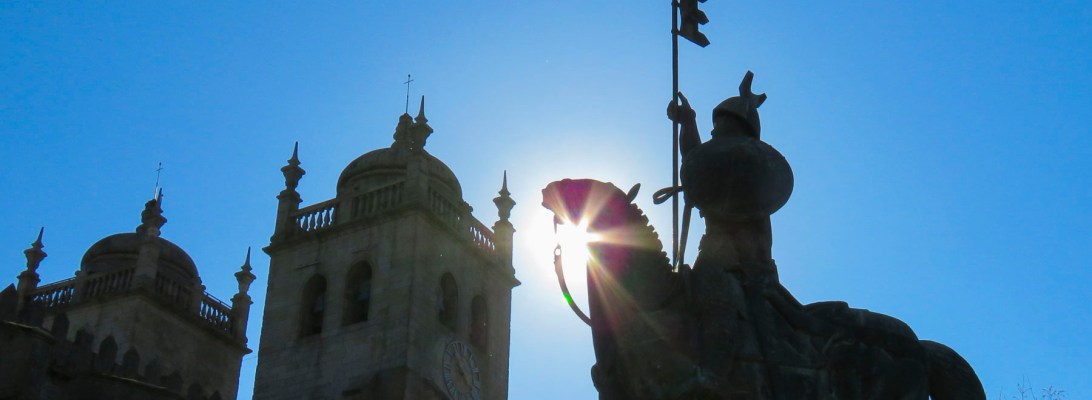
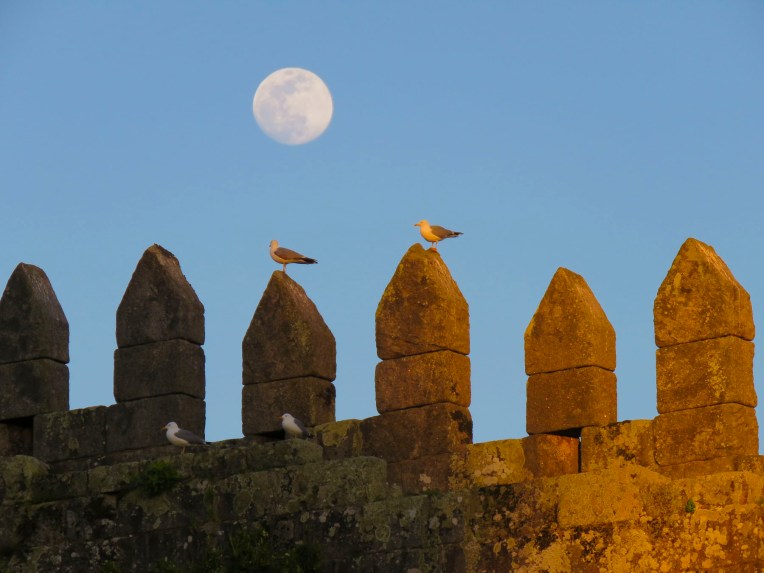
All week long the gate to Capela dos Alfaiates had been locked with no sign of activity, whenever we passed. This morning as I headed to our favorite pastelaria to secure breakfast, the gate and the doors of the church were opened wide. Nothing unusual, just limited hours, I thought. As I opened the inner door to the sanctuary and turned, the sweet aroma of lilies was in the air. And as my eyes adjusted to the light I suddenly faced a delicately shrouded open casket, by itself in a small elegant chapel. I quickly left, embarrassed for intruding. Outside the church nothing indicated that a funeral would begin. It was not how I expected to start the day. Later that morning the courtyard of the church was filled with mourners as we walked to the Porto Cathedral, Sé do Porto. Not far from the old towers and ramparts of Muralha Fernandina, the cathedral commands the highest point in Porto. The building outwardly reflects Porto’s turbulent past, with crenels capping its massive shape, when it was the last point of refuge while the city was under siege.
 Building started in the 1100s, then continued over the centuries. The cathedral combines Romanesque, Gothic and Baroque features, like so many of the other churches in Porto.


It has a beautiful sanctuary and magnificent colonnaded cloisters lined with the blue and white Azulejo tiles along its walls. The cathedral’s museum complex next door displays a fascinating wealth of ancient religious items.  Exiting the museum, the Pillory of Porto centers the vast plaza in front of the Cathedral. Criminals once hung from hooks, still visible, on this graceful Manueline column. It struck us as such a disturbing juxtaposition, this instrument of punishment and humiliation, prominent in front of the cathedral, constantly reminding the good citizens of Porto not to stray from a righteous path. Today tourists lounge on its steps and soak in the surrounding views of Porto.


Following steps, we descended towards the river to Chafariz do Pelicano, an elegant old 16th century public fountain built into one of the supporting walls of the cathedral’s plaza above. Flanked by sculpted female figures, water pours from a hole in the pelican’s chest into a lower reservoir before flowing out of the mouths of carved faces.  Narrow alleys spurred left and right off the steep stairways. Taking one we came across a lavadouro público (communal laundry) that appeared to be recently rebuilt with new wash basins and roof.


No one was using it when we walked by, but drying laundry hung from the rafters. The alley was a contrast of old and new. At the street level modern galleries, boutiques and restaurants sporadically lined the flagstone lane, while above neighbors chatted effortlessly across its narrow width.  Eventually our route merged onto the quay near Fonte do Cubo, a modern sculpture installed upon the ruins of a 17th fountain by the late José Rodrigues, who made his home in Porto. Behind the square a three-story high fountain covers one wall. At its center is a 21st century statue of St John the Baptist, done in a primitive style, by João Cutileiro, another famous Portuguese sculptor. Surrounded by lively, outdoor cafes and throngs of tourists, this is ground zero for the Ribeira waterfront.
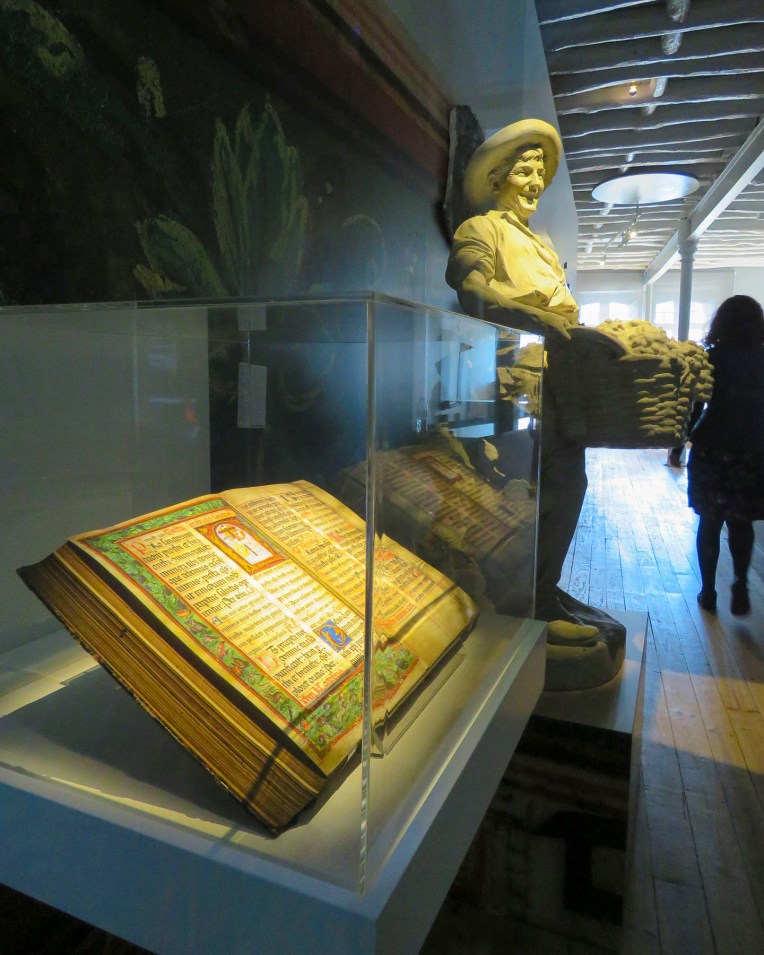 Walking past the Museu do Vinho do Porto on Rua da Reboleira, we headed to Igreja Monumento de São Francisco, also known as the gold church, to check out its ornate, gilded interior and crypt.


The church sits atop a steep set of stairs that rise from Rua Nova da Alfândega, giving it a commanding view of the river. Started by the Franciscans in the 13th century, what was once a small church to support their attached convent was expanded and reconfigured over time into the magnificent monument you see today. Romanesque, Gothic, Baroque and Neoclassical styles blend harmoniously to create an awe-inspiring sanctuary. There is so much going on inside it’s difficult to decide where to look. It was not always this overly ornate.


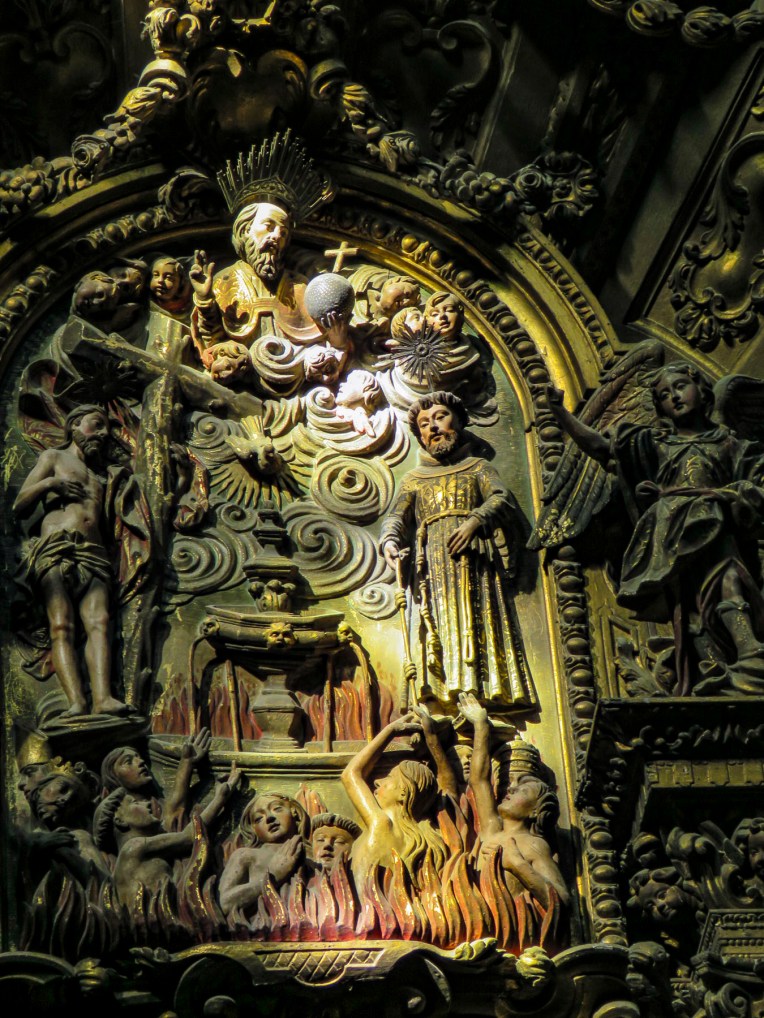
The Portuguese woodcarvers covered every inch of the interior with exuberant sculptures in the early 1700s and then an estimated 400 kilos, 880 pounds, of Brazilian gold dust was used to cover them. The “Tree of Jesse,” a polychrome sculpture depicting the family tree of Jesus, is a notable example of the technique that is also widely used to decorate the walls. The extravagant display of wealth was too much for the poverty-stricken neighborhood surrounding the church and in protest it was closed for several years.  The church was plundered during the Napoleonic Invasions and used as a stable by French occupying forces. Then later that century during the Portuguese Civil War the city was bombarded and the cloisters burnt to the ground, never to be rebuilt. The large crypt under the church was the final resting spot for many of Porto’s famous and wealthy citizens and, as catacombs go, is worth a short visit.
 It was time for a change of pace. Being so close to the Atlantic Ocean we decided to take Tram Line 1, which conveniently had a stop in front of the cathedral, all the way out to the Foz district, where the mouth of the Douro River empties into the Atlantic Ocean. There was a short queue waiting for the tram, but fortunately with the arrival of a second tram we able to snag a seat for the journey.


This is the longest tram route in the city and follows the serpentine riverfront for a rattling twenty minutes past a scenic array of Port warehouses, churches, shops, museums and discotheques, before traveling under the Ponte da Arrábida bridge and ending near the Felgueiras Lighthouse at Jardim do Passeio Alegre.  Just shy of our destination the route was blocked by a disabled truck on the tracks. With no quick remedy in sight we decided to jump ship and head to lunch at the nearest restaurant, which happened to be in Jardim de Sobreiras, right next to our roadblock. Fuga Restaurante & BarFuga Restaurante & Bar with its outside deck was a perfect spot to enjoy some seafood and wine for lunch.


This part of Porto has a more relaxed atmosphere, without the multi-storied buildings of the historic center and significantly fewer tourists, which made it a nice reprieve. After lunch we followed the pedestrian bike and footpath along the river into Jardim do Passeio Alegre and walked around its fountains before continuing to Felgueiras Lighthouse. For thousands of years what lay beyond the western horizon was unknown and the curiosity about it would spur Portugal’s Age of Discovery. We used an Uber ride to head back to our apartment. It was only slightly more expensive than our tram tickets would have been.
Till next time, Craig & Donna


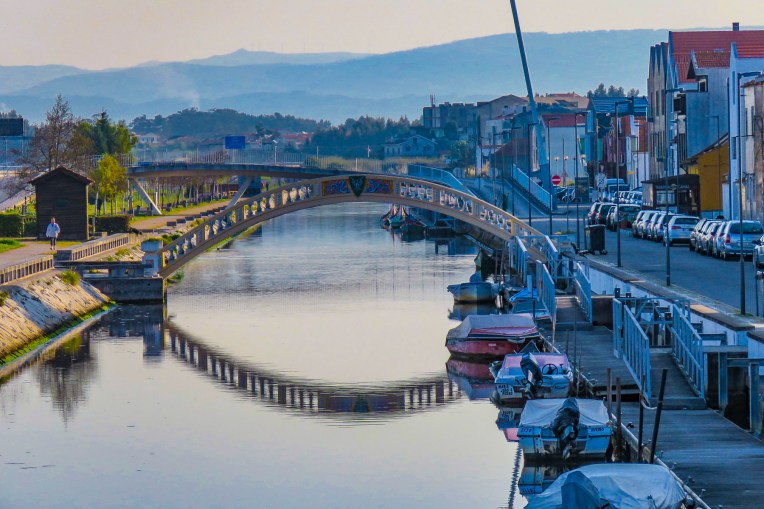


 While the Algarve coast in southern Portugal gets the most hype with its azure waters and rock formations, Portugal’s Silver Coast, the Costa de Prata, starting near Lisbon, runs north for nearly 150 uninterrupted miles to the Douro River in Porto. Lightly developed, it’s a majestic stretch of wild, wide and flat sandy beaches and dunes that feels undiscovered and is worthy of further exploration.
 It was mid-afternoon when we arrived at Miradouro do Suberco towering 350 feet above Nazare’s beautiful, crescent shaped Praia da Nazaré beach. Surprisingly, for such a beautiful spot we were able to find free parking nearby above the Nazare lighthouse. The only caveat, an ominous sign warning that if our car some how managed to go over the cliff edge we would still be liable for the €25,000 wreckage removal. You definitely need to know where reverse is on the stick shift here! Some of the world’s tallest waves crash onto the rocks in front of the Nazare lighthouse between October and March. Every year in November the Nazare Challenge attracts suicidal, thrill seeking surfers looking to ride the biggest waves. Thousands of onlookers line the hill above the action to watch their death-defying feats. A record 80-foot wave was ridden in 2017 by Brazilian Rodrigo Koxa and outside the competition, in December 2018, a 100-foot tall monster was surfed by Tom Butler of the United Kingdom. We can’t imagine the raw fury of those size waves. Unfortunately, the day we arrived the ocean was calm.


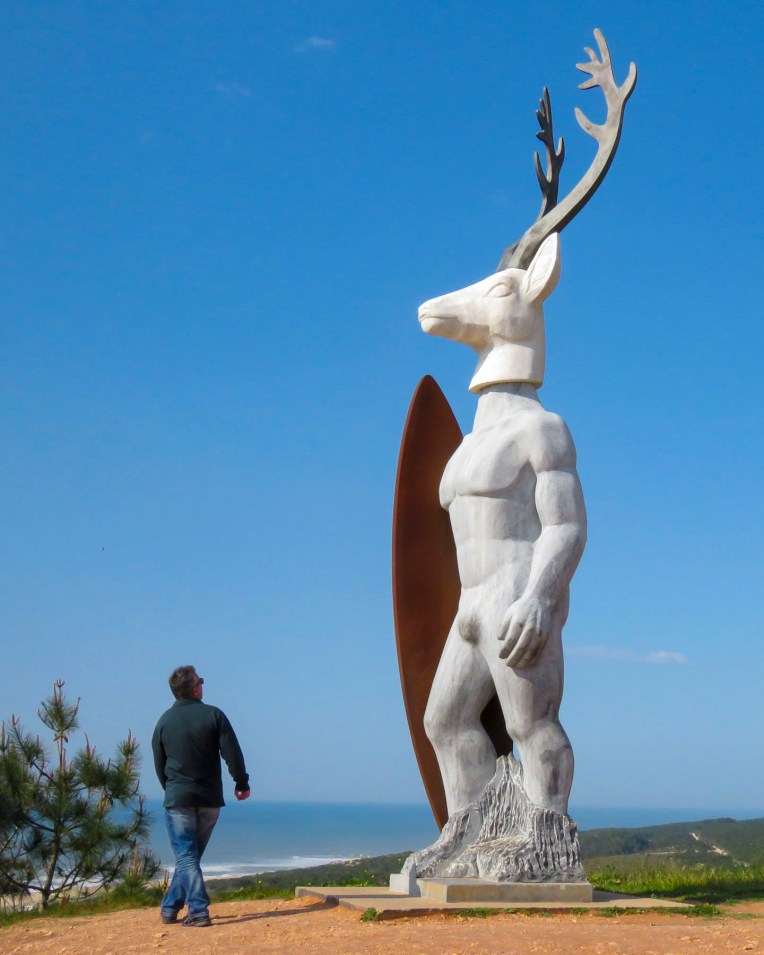 Not far away, just above the Nazare lighthouse, Portuguese artist Adalia Alberto has created a whimsical, deer-headed surfer sculpture called Veado that pays tribute to Nazare’s old legend and today’s legendary wave riders. This contemporary piece has to be one of the most unusual sculptures in Portugal and is worth finding when visiting Nazare.

 Set back on Batalha Square, at the top of a wide set of stairs, the beautiful Church of Saint Ildefonso with its Azulejo tile covered exterior and twin bell towers commands attention. Built in the early 1700’s on the site of an older church, the building has gone through many alterations after suffering severe storm damage one year, then cannon fire from Napoleon’s troops during the siege of Porto in 1833. Eleven thousand Azulejo tiles depicting stories from the Gospels and the life of Saint Ildefonso were a late addition to the façade in 1932.


 The blue-tiled Chapel of Souls can be found a little further along. Added in 1929, the two-story high Azulejo tile mural covering the front and side dramatically depicts scenes from the life of Saint Catherine and Saint Francis of Assisi.
 Back tracking, we turned down Rua de 31 de Janereio which would take us to Porto São Bento, the inter-city train station, then Clérigos Church & Clérigos Tower. This beautiful French Beaux-Arts styled station was constructed in 1900. Between 1905 and 1916, artist Jorge Colaço designed and installed 20,000 Azujelo tiles in this lobby, which illustrate significant moments in Portugal’s history. It is a dramatic, cavernous space especially when sunlight pours through its tall windows across the tiles. Jorge Colaço also designed the tiles on the exterior of the Church of Saint Ildefonso.
 Just past the train station is Praça da Liberdade with its grand sculptures. There are also many fine architectural details on the surrounding buildings, so look up!


 At the top of the street in a small plaza with palm trees we found Fonte dos Leões, with its four lion statues.
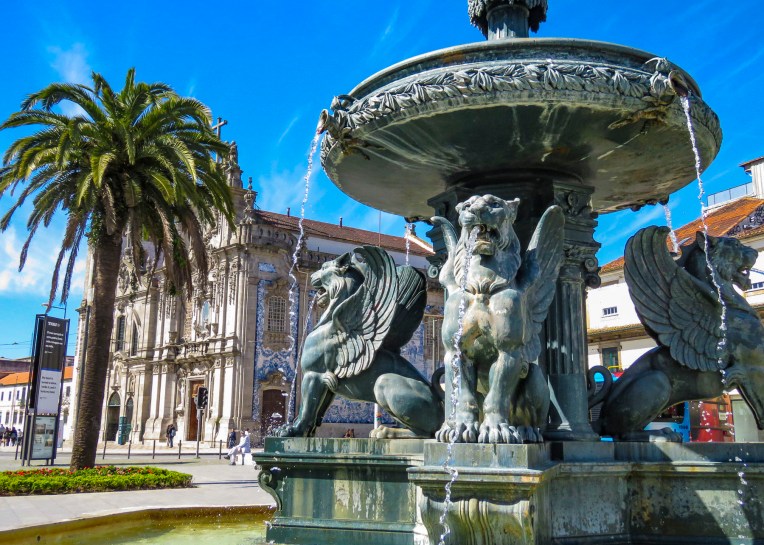 Behind it the cathedrals Igreja dos Carmelitas and Igreja do Carmo stand next to each other.
 They are only separated by the width of a discreet door to an extremely narrow house which was the home of church workers until the 1980s. Recently it was opened as a museum. Igreja do Carmo was built for the people and has an ornate exterior with sculpted statues of Santa Ana and the prophets Elijah and Elisha alongside sculptures of the four evangelists Matthew, Mark, Luke and John on its front façade and a large tile mural portraying the churches founding on the side wall.


 It was a brilliant, warm day and


 Along the quay the umbrella-ed tables of
  Tram 1 runs along the waterfront here, so we followed the tracks past Igreja do Corpo Santo de Massarelos, Church of the Brotherhood of the Holy Souls and Bodies, looking for the next station. The original church was founded in 1394 by a brotherhood of seamen to honor those lost at sea. Hometown hero Prince Henry the Navigator was a member of this fraternity in the 1400’s and the large azulejo tile mural on a wall of the church facing the river features him.
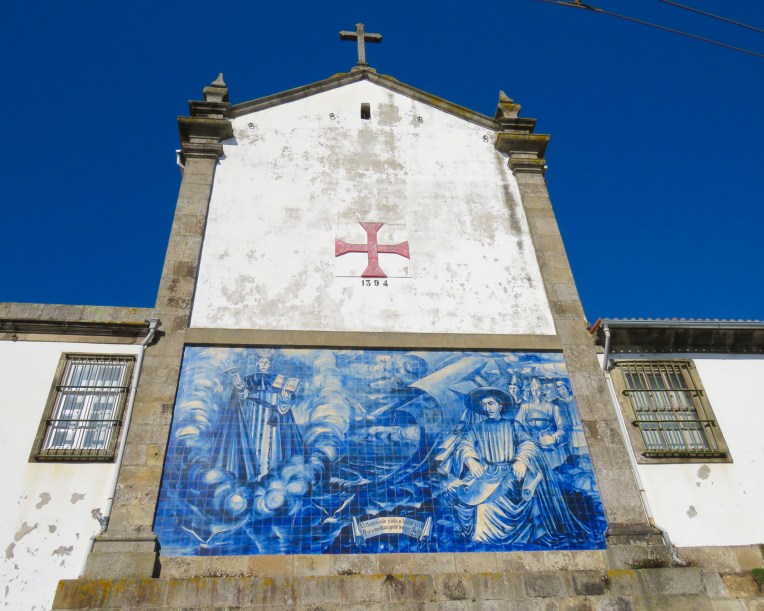 Just around the corner from the church Trams 1 and 22 shared a stop and we hopped aboard the #22, to save our legs from a long uphill walk, to start our journey home for the day.
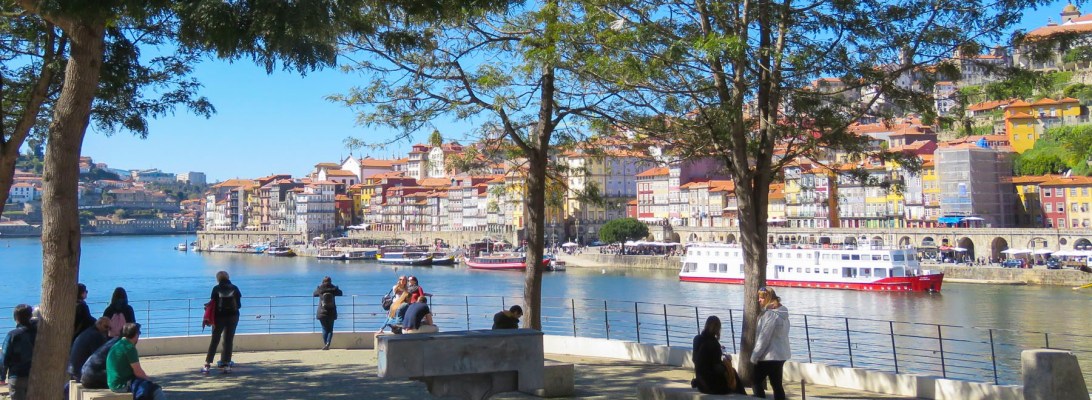

 But the city really needs to be explored on foot to truly savor its charm and intrigue. Porto escaped the massive 1755 earthquake and tsunami that devasted Lisbon. Consequently, the city’s historic architectural gems, many dating as far back as the thirteenth century, still stand unscathed, and its ancient cobbled lanes still meander every which way, untouched by urban planning. With this in mind we decided to weave our way over to the Ponte Luís I bridge and eventually make our way down to the picturesque south bank of the Douro River as our destination for the day, stopping to explore what interested us along the way.

 The armour-clad equestrian statue of Vímara Peres guards the approach to the Ponte Luis I bridge across the River Douro and some contemporary street art, that we’re not sure he would appreciate.

 For nine-hundred years pontoon bridges and small boats were the major ways to cross the breath of the Douro River before the advent of iron construction. Designed by Théophile Seyrig, a former colleague of Eiffel,
  Across the bridge we worked our way up to Mosteiro da Serra do Pilar for the views. This spot and Jardim do Morro, the park at its base, are popular places to watch the sunset from.
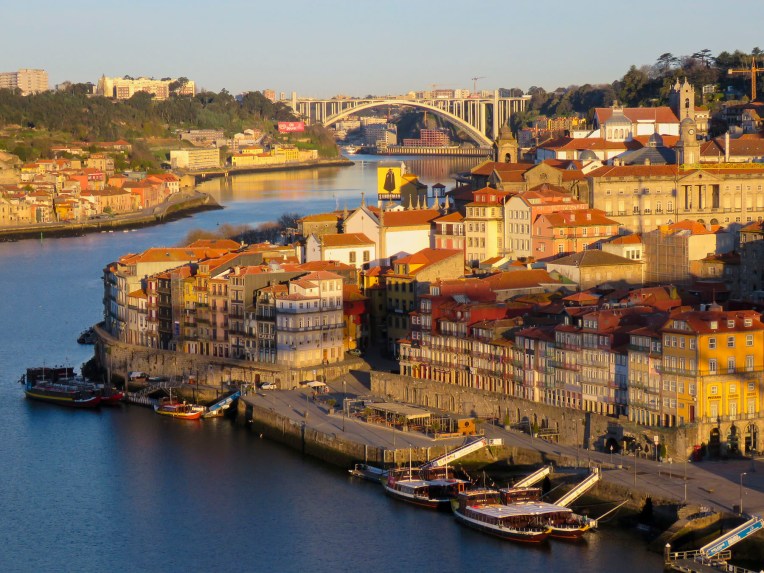 We opted not to take the aerial tram down to the Gaia riverfront and continued our walk, looking for the right restaurant set amidst the fifty port cellars that line the waterfront. Perched atop the port cellar Espaço Porto Cruz, the Terrace Lounge 360º fit the bill.
 The day was beautiful, lunch was delightfully slow paced and of course we enjoyed some wine. We’ve found the restaurants in Portugal never rush you to leave. The table is yours for however long you wish to stay. We soaked in the warm sun, breathed in the crisp Spring air and absorbed the good life surrounding us.


 2 Suitcases for 2 years