Christmas in Milan – A Monumental Cathedral, Cemetery and Horse

Snow started falling as we brewed the morning’s first cups of coffee on the stove using a traditional Italian Moka coffee pot.  Invented by Alfonso Bialetti in 1933, Italians readily accepted it as an easy way to make espresso at home, and it quickly became symbolic of “la dolce vita,” the sweet life and for us a pleasant morning ritual. The day before had been warmer, and bundled up we were able to take our coffee outside on the balcony of our fourth-floor Airbnb rental and enjoy a great sunset view.  This morning though, the tracks of the tram line melted through the thin blanket of freshly fallen snow and left two parallel lines, as if someone had drawn them on this new white canvas with a pencil.

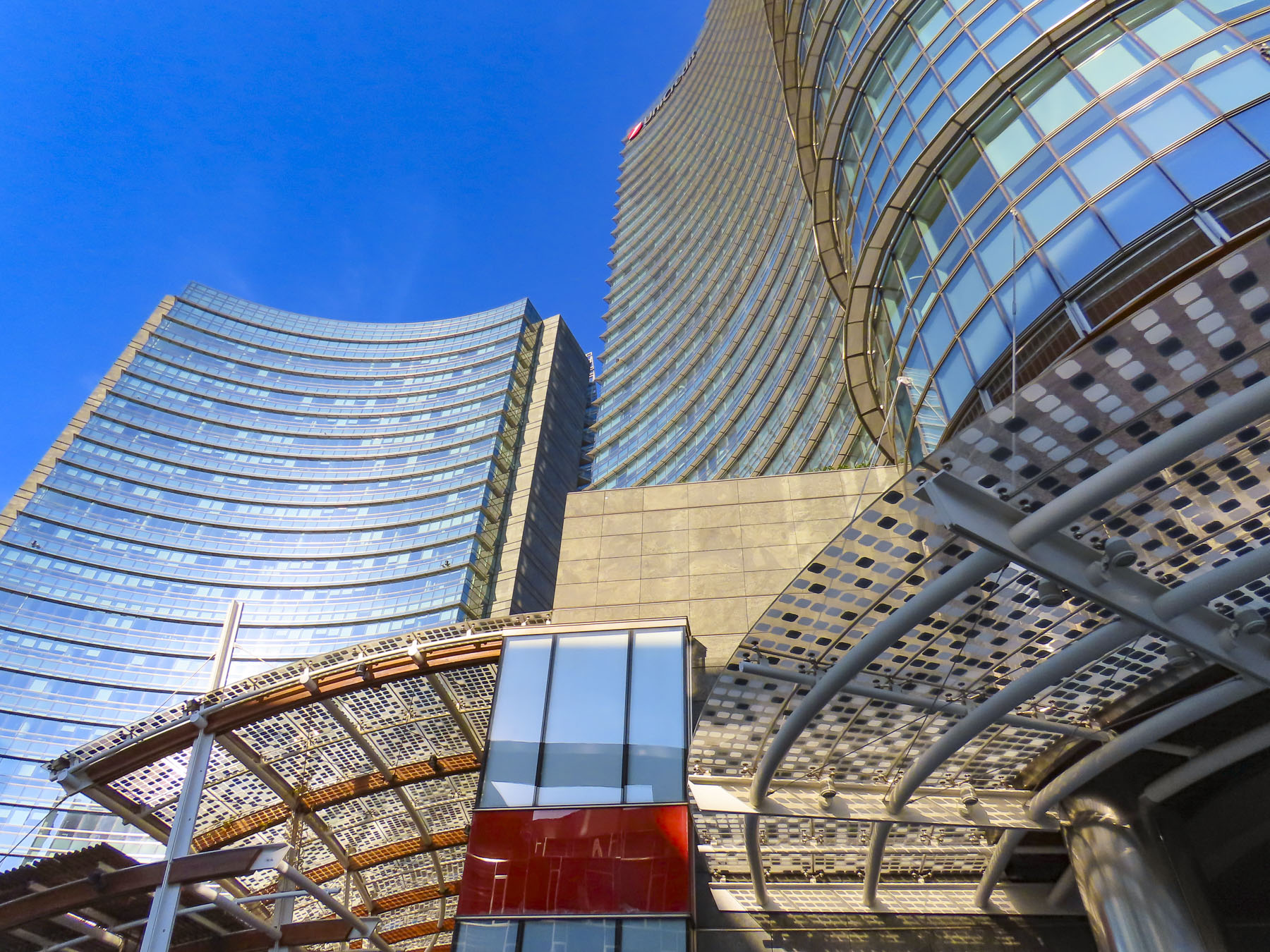
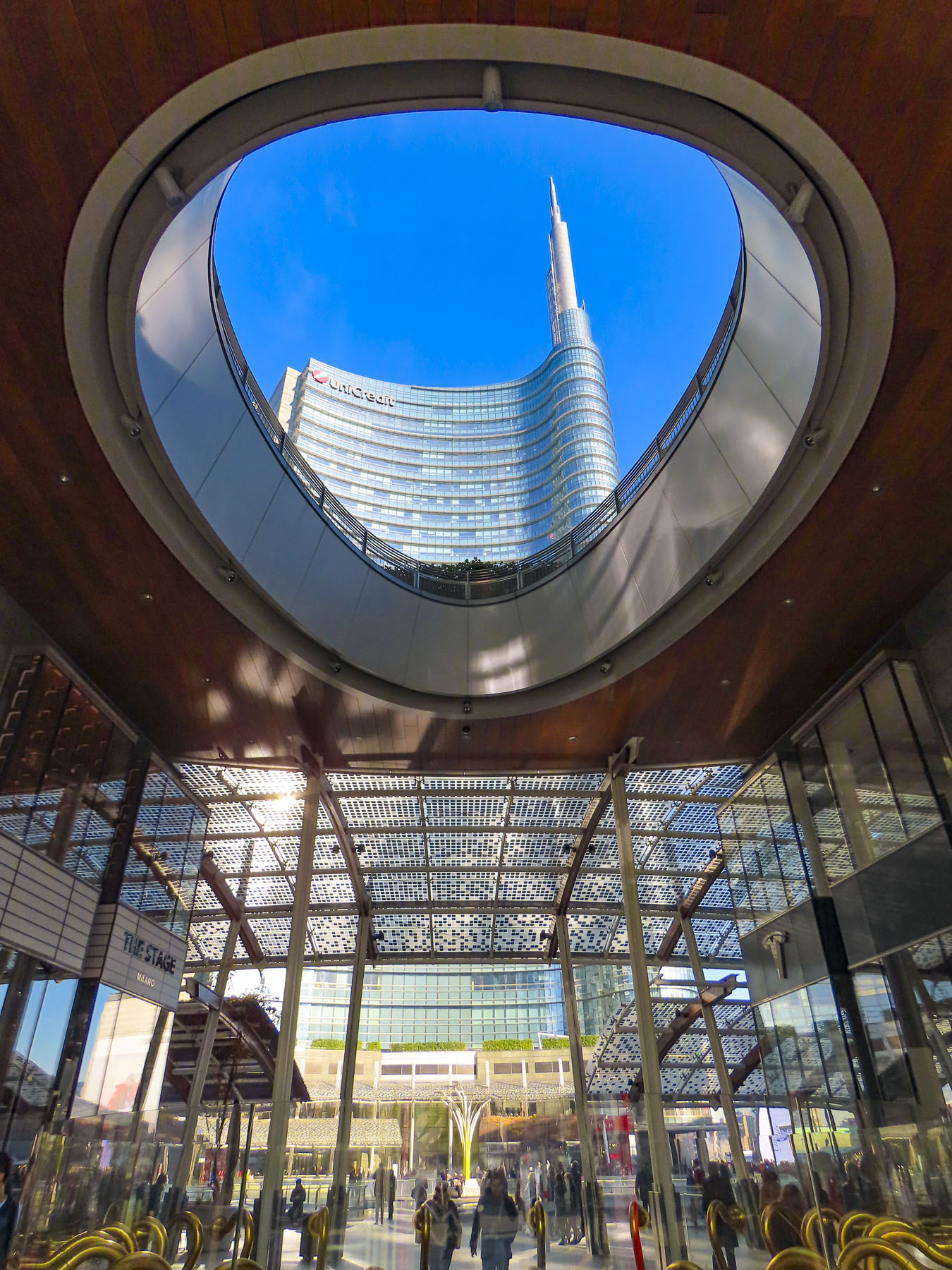
Continuing with our philosophy of slow, immersive travel, we had opted for an apartment in the Isola neighborhood.  Though far away from Milan’s city center, it was situated near the Porta Garibaldi train station and the recently built modern skyscraper complex that surrounds Piazza Gae Aulenti. The illy Caffè here was a frequent stop for comsmopolitan people-watching and excellent coffee.

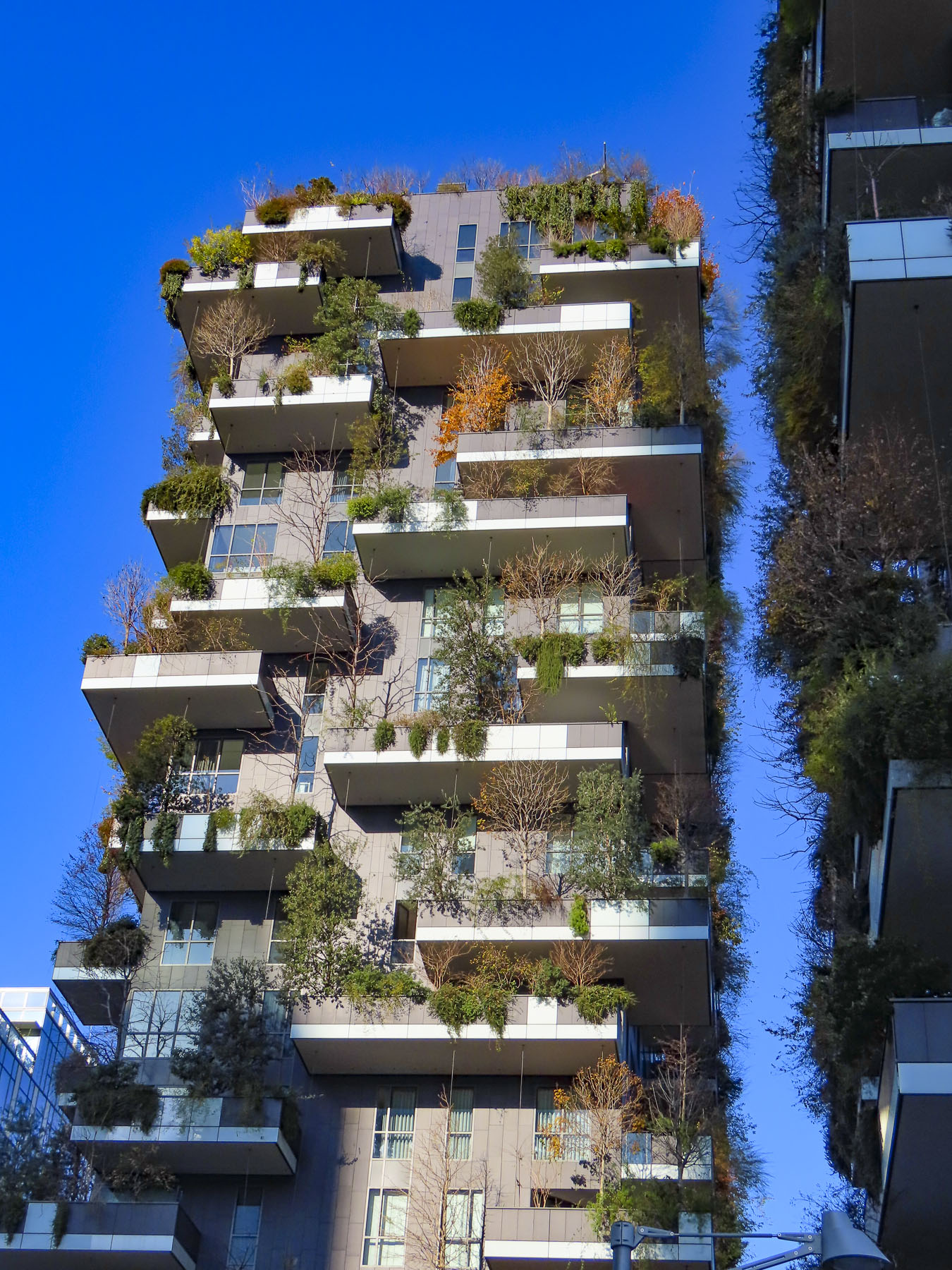
Nearby were the twin apartment towers of Boeri’s Bosco Verticale, Vertical Forest, famous for their lush foliage-covered balconies, and the Isola and Zara subway stations. The latter was only seven quick stops from the Milan Duomo.
The neighborhood also had numerous tram lines traversing it, but it was impossible to find a hardcopy map of this very extensive system while we were in Milan, though we were able to find this online map of the Milan Tram System while writing this. Ultimately, we relied on our phone’s mapping App to view our tram trips in real time and determine where to change lines to continue our journeys across the city.

Two blocks away, the bi-weekly outdoor food market closed the streets around Piazza Tito Minniti for the bulk of the day while families shopped the stalls for fresh vegetables, cheese, meat and seafood along with socks, pants, dresses and blouses. We enjoyed this aspect of Italian life after learning its subtle nuances – for example, only the vendor touches the fruits and vegetables. There is also a protocol of queueing. Sometimes though our schedule required us to shop around the corner at La Pastaia for fresh pasta or the Penny Market grocery store, where we signed up again for another shopper club card.  We’ve done this in every city where we have stayed long term – Cuenca, Antigua, Lisbon, Cape Town and Kotor. It seems silly, but those small savings do add up and jokingly it helps us feel more like a local.

Emerging from the darkness of the subway station onto the Piazza del Duomo, we were momentarily blinded by the bright sun reflecting off the monumental cathedral that towered before us. Breathtaking in its size and capable of holding 40,000 worshippers, the cathedral is the second largest in Europe, following Saint Peter’s Basilica in Vatican City, and the third largest in the world.  Designed in 1386, the ornate and dramatic Gothic façade of the cathedral is covered with 3,400 statues and spires, which required the recruitment of hundreds of stone masons and artisans from across Europe. 

The opulent exterior belies the cathedral’s spartan interior.  While massive in scale, the interior’s gray stone walls and towering columns are cold and austere even with the soft, filtered light of beautiful stained-glass windows illuminating the space. Most moving was a ghastly sculpture by 16th century Italian sculptor Marco d’Agrate of Saint Bartholomew holding his flayed skin, depicting how he was punished for converting an Armenian King to Christianity in the first century AD.

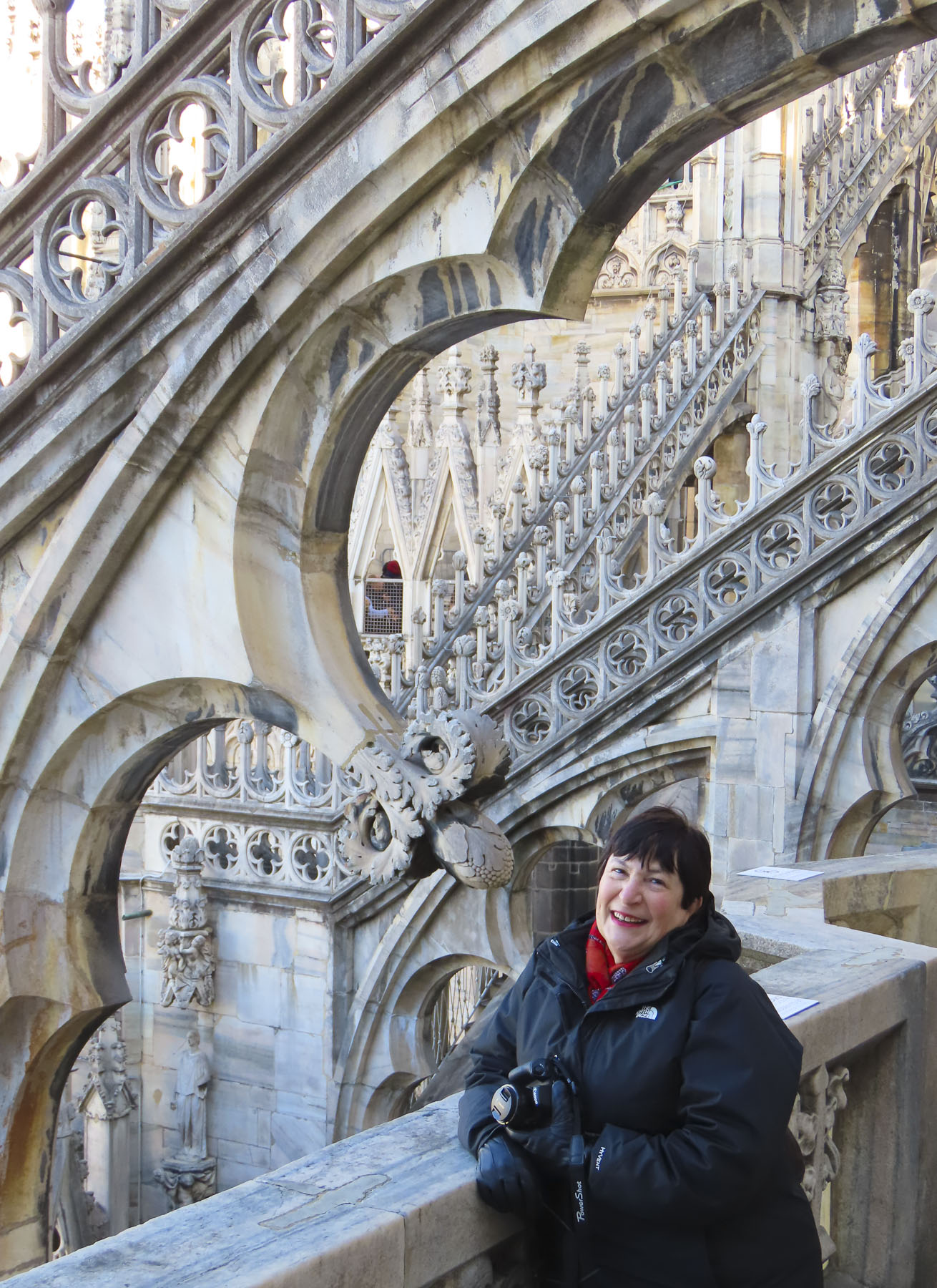
Wandering around the flying buttresses and sculpted spires on the roof of the church was the highlight of our visit to the Duomo. The day was crystal clear, and the panoramic view stretched from the Milanese skyline to the snowcapped Italian Alps. It was spectactular.

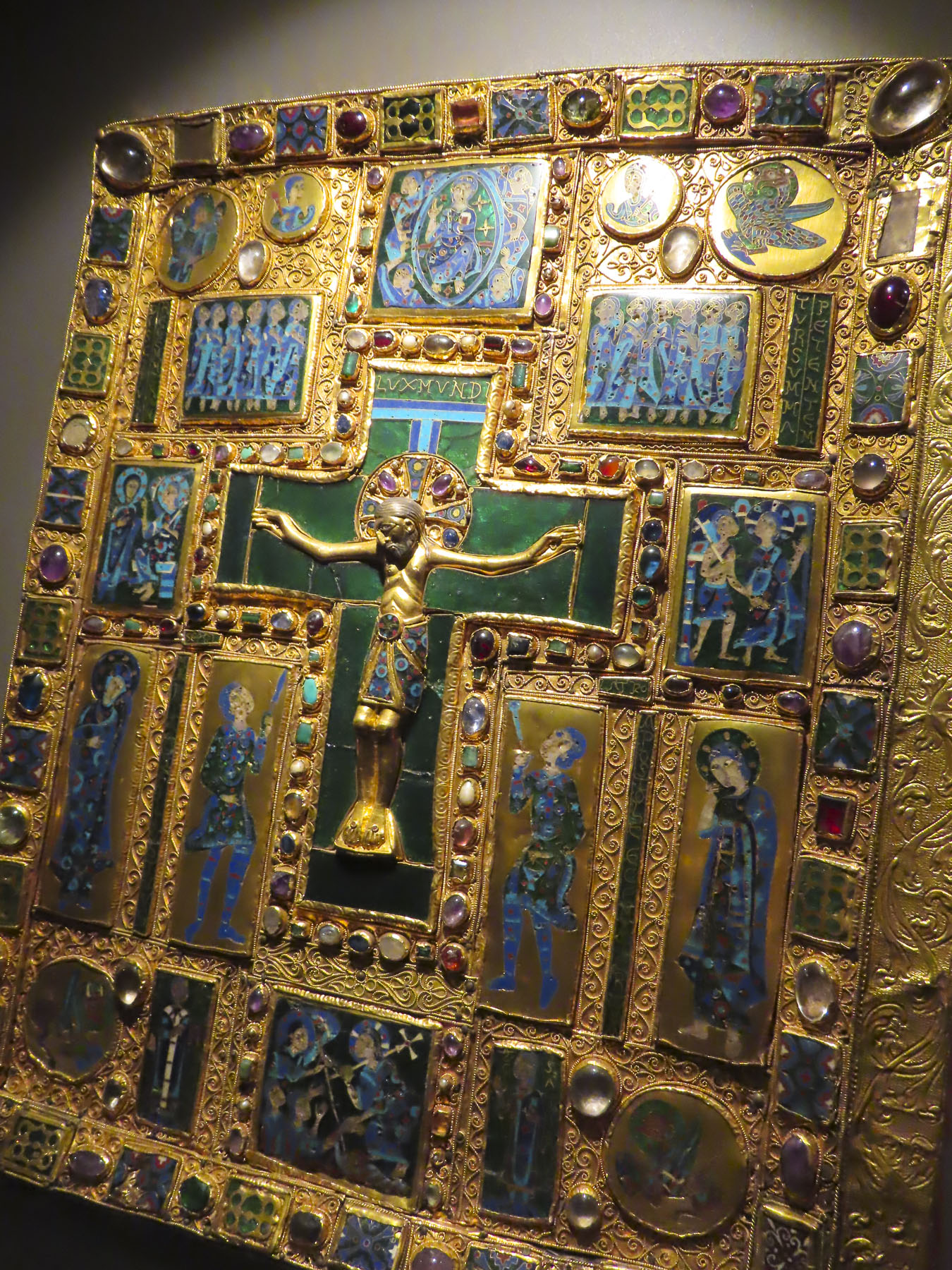
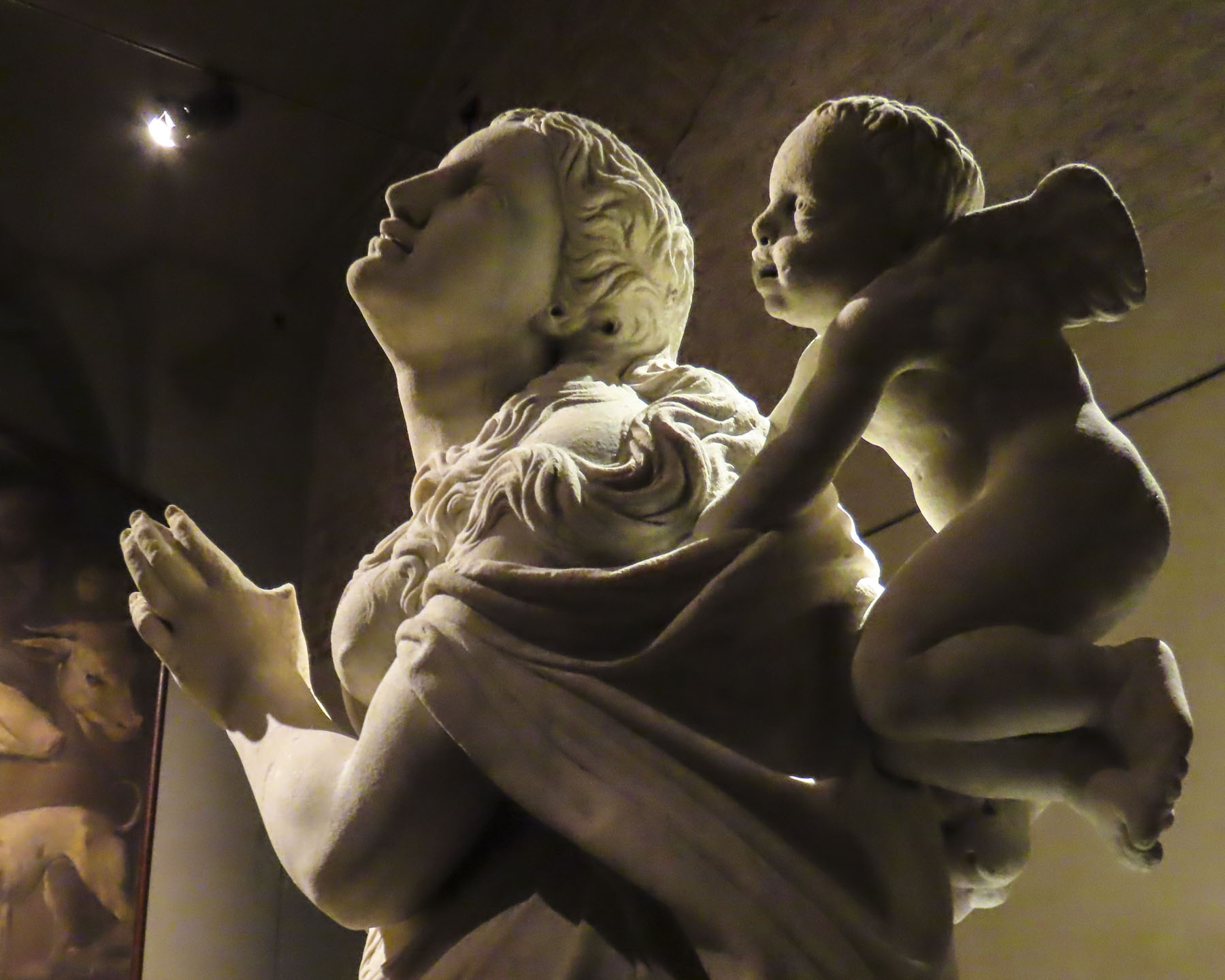
Across the plaza the Museum of the Milan Cathedral has an extensive and interesting collection of art and sculpture that at one time or another was part of the Duomo.

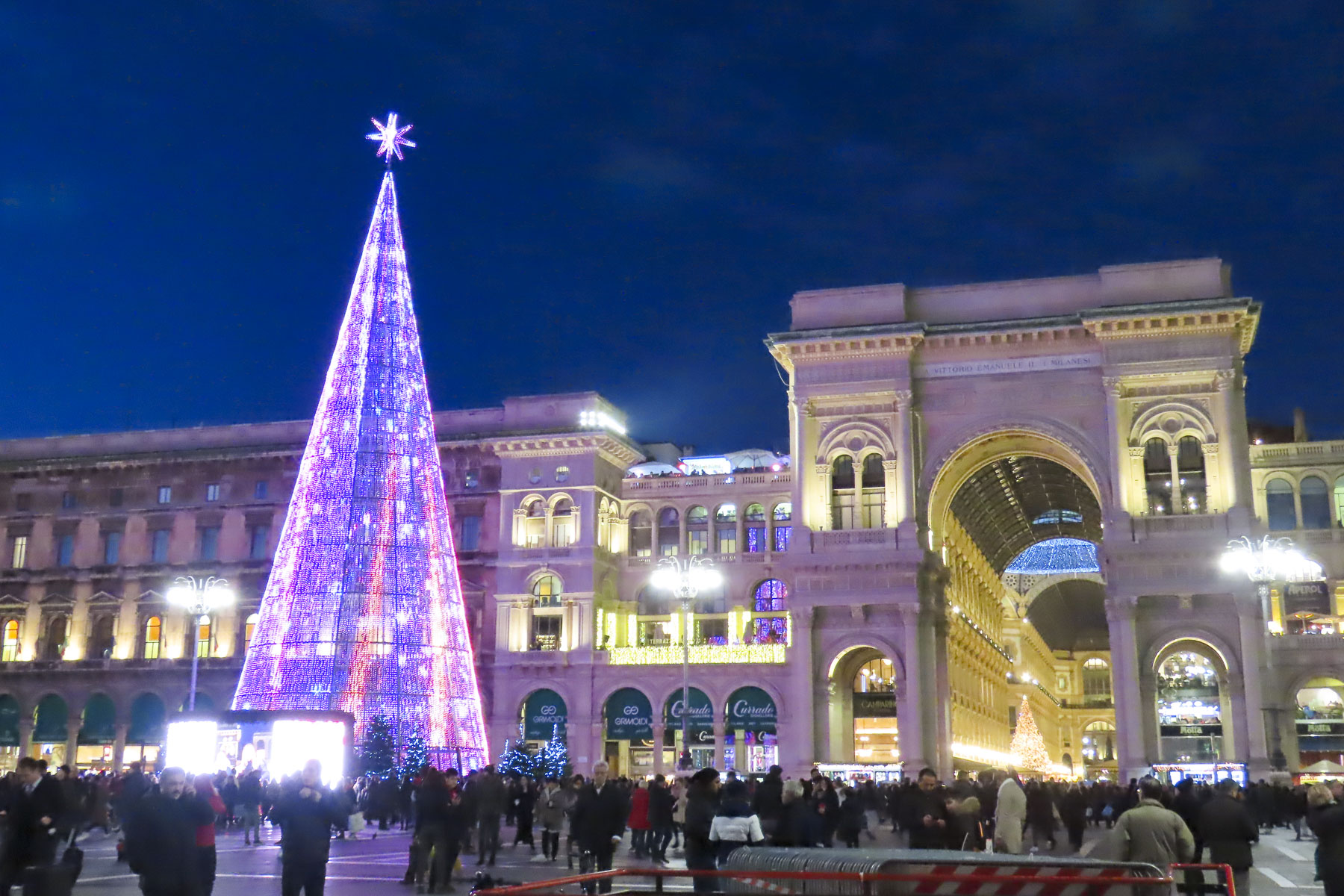
On the other side of the plaza stood Milan’s official Christmas tree, a modern conically shaped metal structure covered with thousands of multi-colored changing lights. Beyond the tree was the famous Galleria Vittorio Emanuele II, where four-story tall buildings and the promenade between them are covered with a spectacular vaulted glass ceiling.  It is considered the world’s first indoor shopping mall, built shortly after the unification of the Italian peninsular into the Kingdom of Italy in the 1860s when Vittorio Emanuele II was named king.  Lovingly nicknamed “il Salotto di Milano,” or “the living room of Milan” by the Milanese, the phrase acknowledges it’s the place to meet friends and be seen.

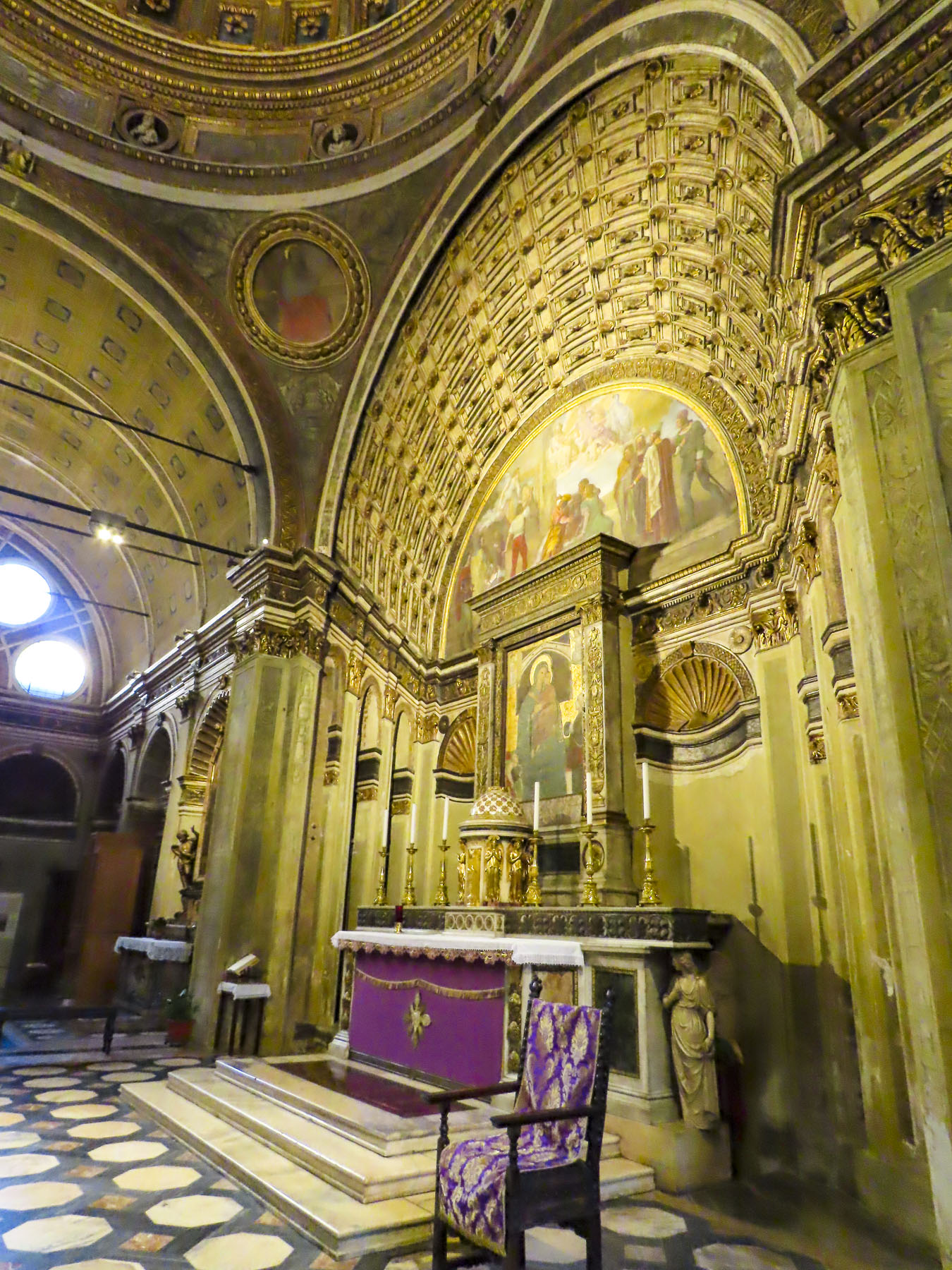
Wanting to stay in the city center till night fell, so that we could fully appreciated the Christmas lights on the tree in front of the Duomo, we wandered farther afield until we found the Chiesa di Santa Maria presso San Satiro. First built in the 9th century, the present church dates to the Italian Renaissance and  features a gilded interior and a rare example of Trompe-l’œil in a church. This painter’s effect utilizes a forced perspective to create an illusion of depth behind the altar.

After dark the plaza in front of the Duomo continued to fill with people eager to enjoy the festive mood of the Christmas season.  The Christmas tree was stunning, and its modernity nicely complimented the historic buildings surrounding the piazza.

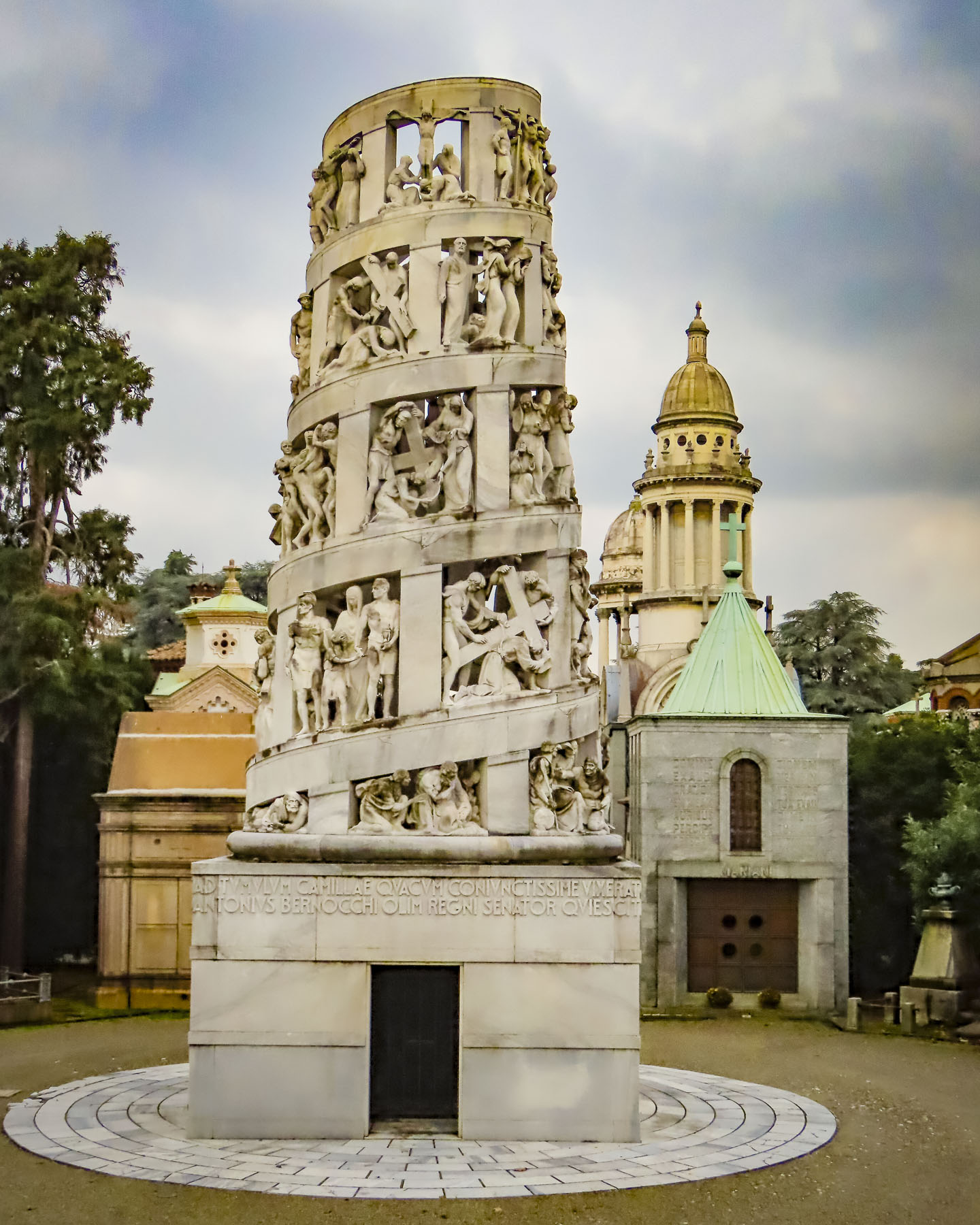
From our balcony we could see the silhouette of Tomba di Manzoni, the grand entranceway and “Hall of Fame” mausoleum for the noteworthy, though not as wealthy, Milanese who are interned at the Cimitero Monumentale. 

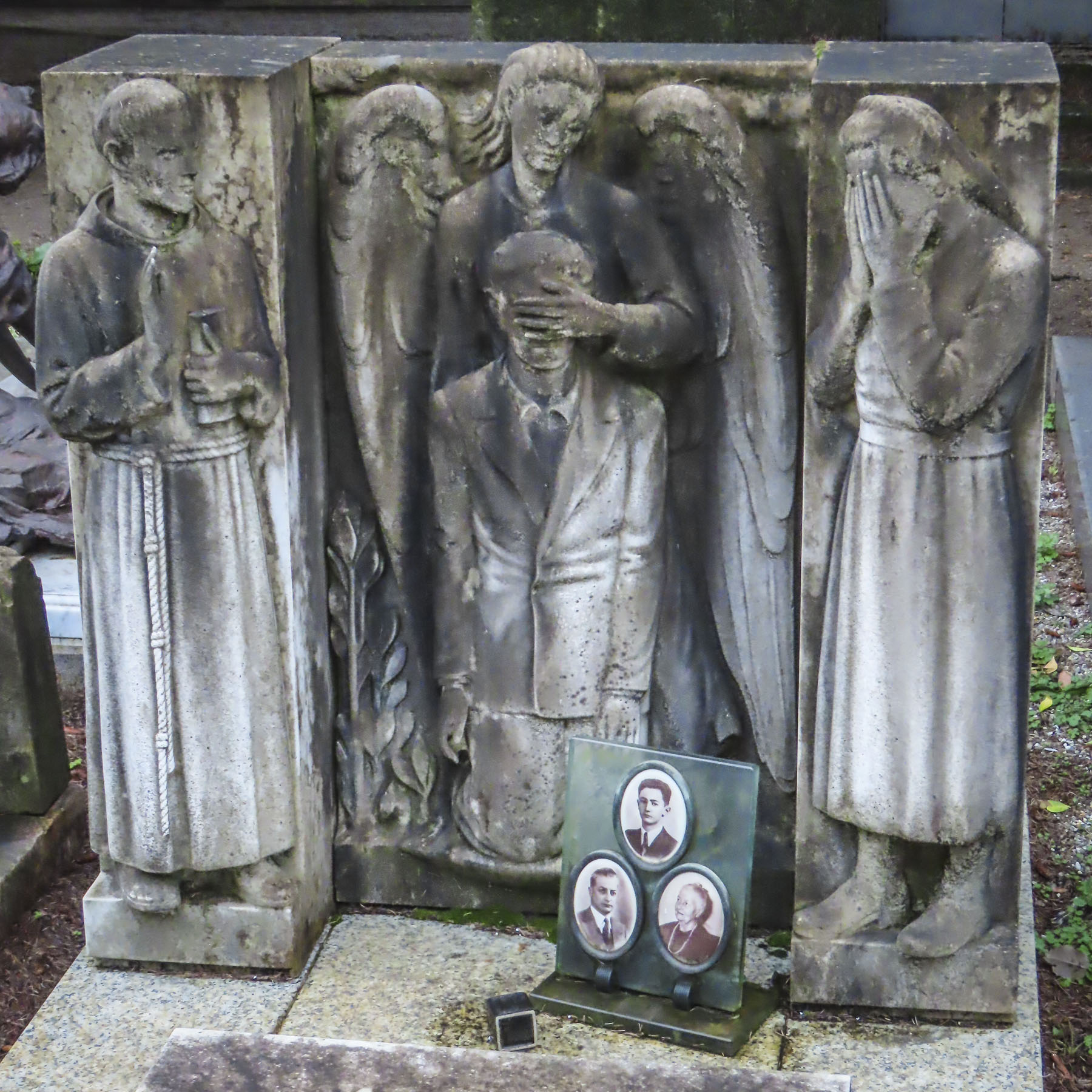
As we wandered farther into the cemetery, we realized that monumental might be an understatement. It was difficult not to confuse this extraordinarily extravagant place of entombment for an outdoor sculpture garden with memorials created by a who’s who list of famous 19th and 20th century Italian artists and architects for prominent Milanese families. 

The family names on the mausoleums also adorn roads, parks, tram and subway stations across the city. There seemed to be an afterlife version of one upmanship in play here with each monument more grandiose than the last.  As if competition or success in life was not enough and had to continue till your final committal.  It was a fascinating place to explore. Plan on spending most of the day.
Donna’s mom had passed away the year before and one of our reasons for staying in Milan was to revisit a project her mother was instrumental in as a member of the United State’s Italian American Heritage Foundation and Leonardo da Vinci’s Horse Foundation. She helped for fifteen years in the 1980s and 90s to raise 2.5 million dollars to the see Leonardo da Vinci’s 24ft tall Il Cavallo recreated. The sculpture was finally realized by American sculptor Nina Akamu

Da Vinci was commissioned by the Duke of Milan in 1482 to create, at the time, what was the largest equestrian statue in the world, as tribute to his late father, Francesco Sforza.  The full-size clay sculpture was completed in 1491 and was waiting for its terracotta mold to be made and enough bronze amassed for its casting when the French invaded in 1499. Subsequentially, the clay model was totally destroyed by French crossbowmen who used it for target practice.
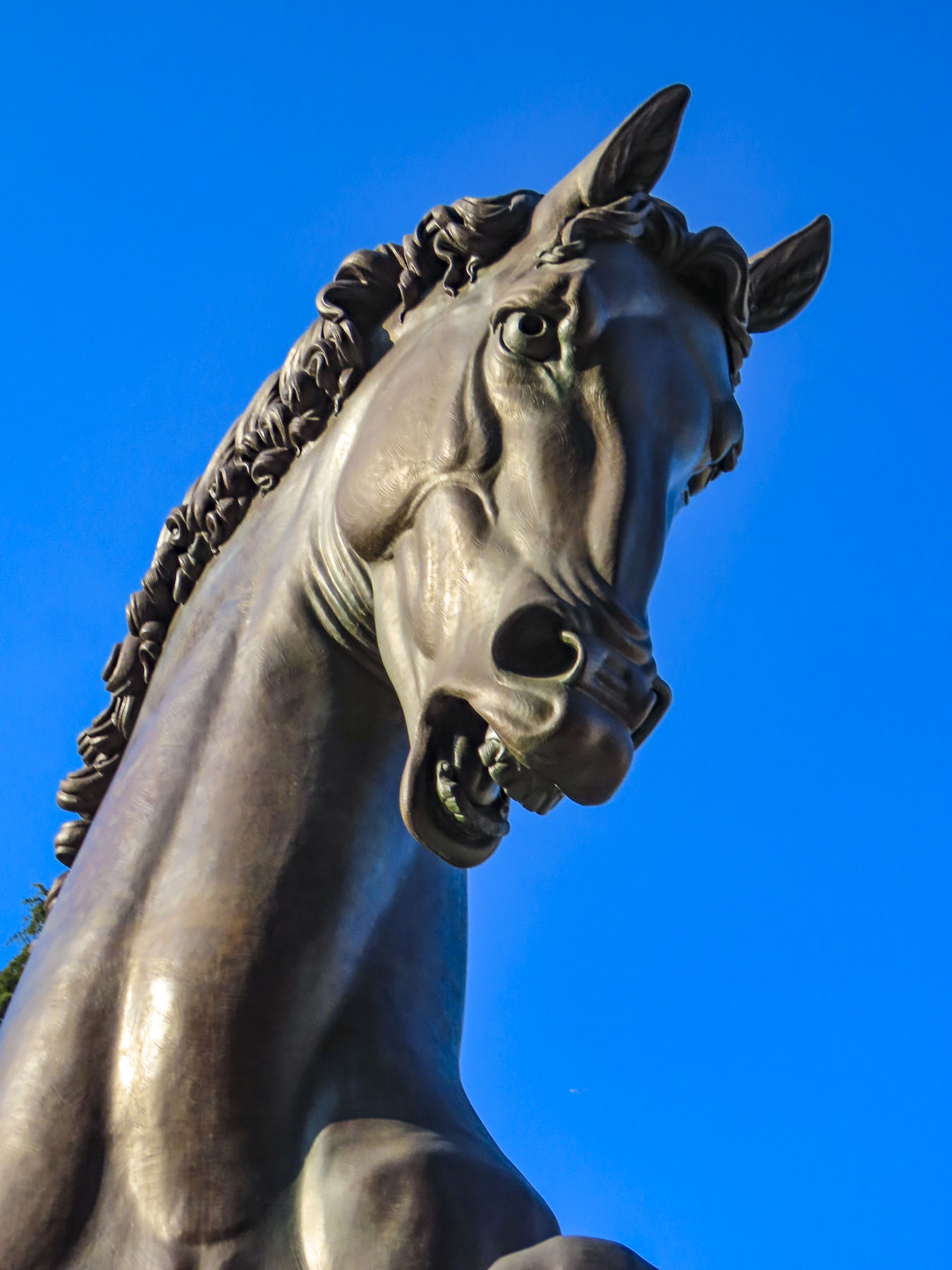
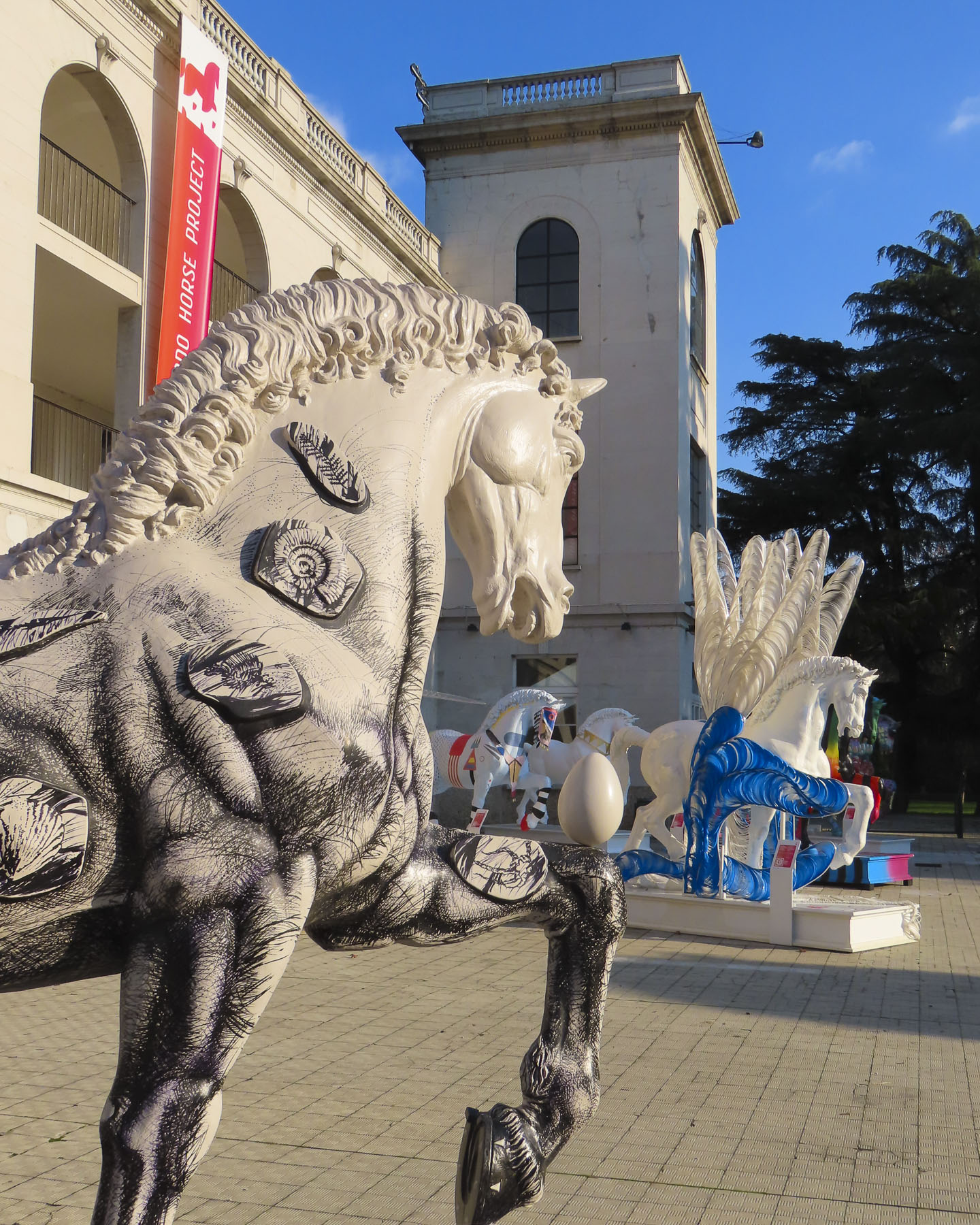
On its 500th anniversary, da Vinci’s Il Cavallo was unveiled outside the Ippodromo Snai San Siro, Milan’s famous horse racing track. Smaller artistic interpretations of Il Cavallo stand in the plaza behind it. This being modern Italy though a horse just can’t be a horse, and many were psychedelically painted and wore tutus or unicorn horns. Wonderfully whimsical, they definitely made us smile. 

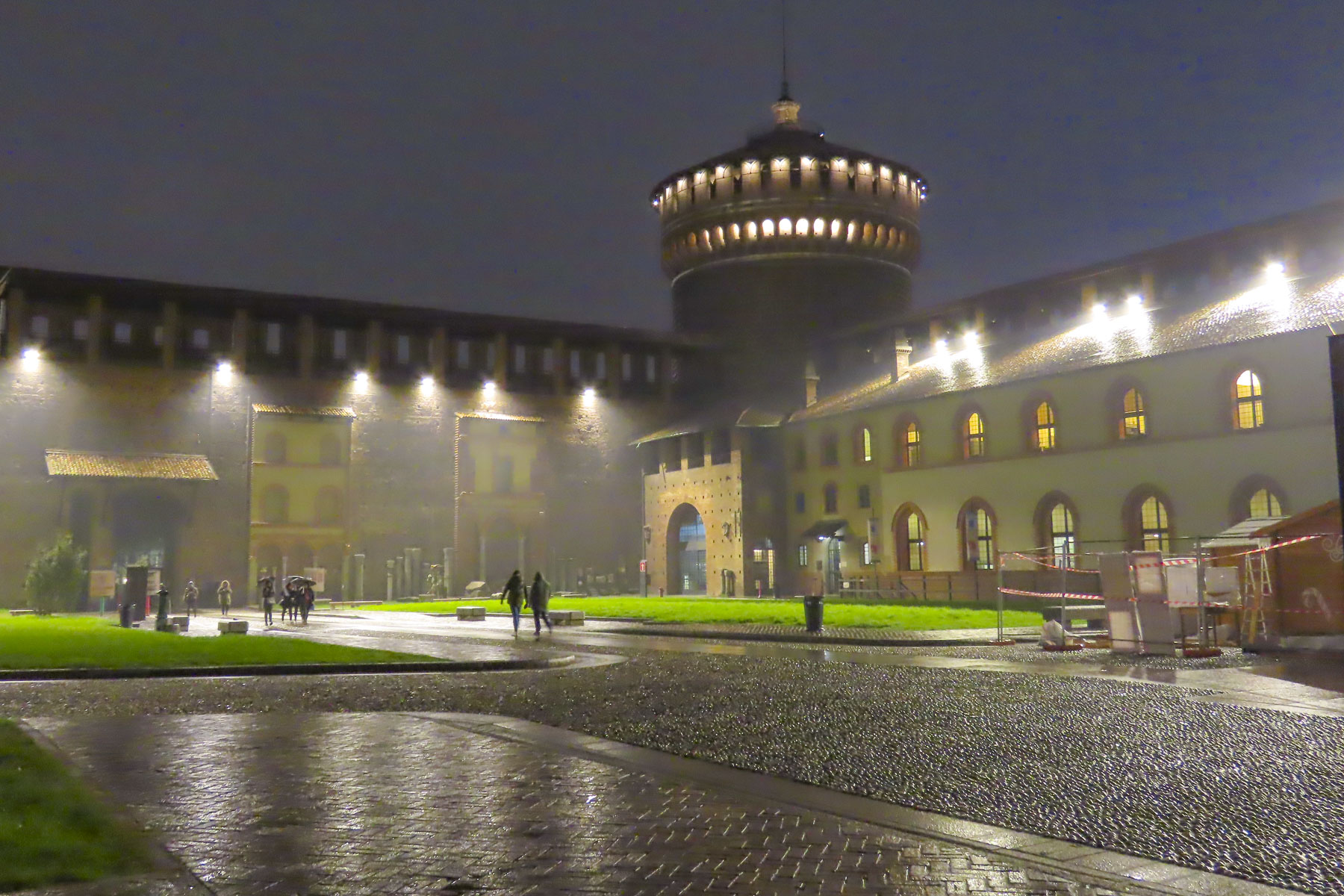
One rainy afternoon we took the tram to the 15th century Sforzesco Castle, seat of power for the Sforza dynasty that lasted only 100 years. But in that time the fortress/palace was expanded to be one of the largest citadels in Europe and filled with works of art by numerous Italian Renaissance artists.  Leonardo da Vinci, Michelangelo, Bramante, Correggio, Bernardino Zenale and Bernardino Butinone were commissioned to adorn the walls and ceilings and sculpt pieces to fill the vast space. Today the castle houses several of the city’s museums and art collections where the artists’ contributions to the palace can still be seen. A heavy fog had blanketed the citadel by closing time and was evocative of the moods cast in the historical fiction novels set in Renaissance Italy by Sarah Dunant. Later that evening we attended an Anglican Lessons and Carols service as a prelude to Christmas, then headed back to our apartment humming Christmas tunes as we window shopped.
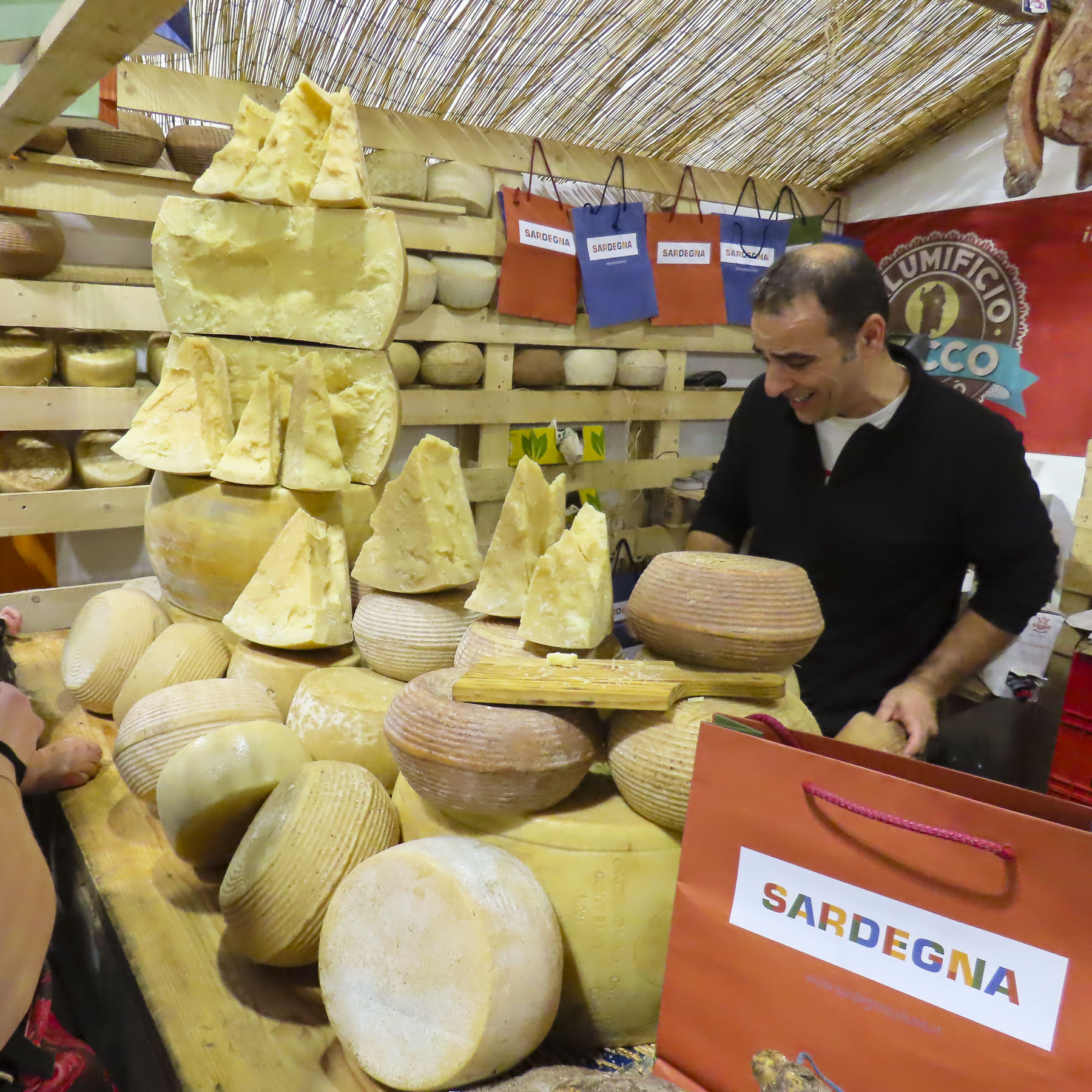
Signs for Artigiano in Fiera, the Fair, dotted our route into Milan when we first arrived from Bergamo and piqued our interest.  We hadn’t heard of it before, but with a quick internet search realized it was the shopping event of the Christmas season in Milan. While in line to enter the center we noticed many people pulling large suitcases. Toward the end of our shopping spree, laden with purchases, we realized the bags on wheels were pure genius, and allowed the seasoned pros to carry their holiday shopping with ease. The Fiera is a tremendously popular annual, nine-day event that draws over one million visitors to the Fiera Milano, Europe’s largest exhibition center, located in Rho, just outside Milan. Folks shop for home furnishings, fashion, jewelry, arts and crafts, along with artisanal foods, wines and liquor. The sites’ nine cavernous exhibition halls were filled with vendors from 100 countries, though displays from the twenty regions of Italy occupied ninety percent of the space. Plan on spending the whole day if you hope to see everything. It was all very interesting and entertaining and truly a marathon event. From Milan it’s an easy trip on the M1 subway, which stops right at the venue.

Wanting to make our last night in Milan special, we made dinner reservations at a highly reviewed restaurant, only to be turned away into a rainy night because we arrived early as the staff was enjoying their pre-work communal meal together. (The later you dine out in Italy the more you’ll feel like a local. Though this does take some getting used to and we haven’t mastered this yet.) “Okay, we will have a drink at the corner bar and return,” we agreed.

To our delight, our aperitives were accompanied by small sandwiches with chips and olives.  We had every intention of heading back to the restaurant, but our waiter was engaging, and the Aperol spritzes were very good. We spent the time watching folks fight the wind with their umbrellas through the bar’s rain-pelted window. The specular highlights from the streetlights added magic to the scene. Occasionally some groups popped inside seeking a warm reprieve from the downpour outside, shook out their umbrellas and found a seat.  Recapping our adventures, tentatively planning the next six months, and talking about Christmas with our kids back in the states, the evening flew by until the waiter said they were closing. Umbrellas up! We headed home.

Till next time, Craig & Donna

PS – The Artigiano was canceled in 2020 due to the Corona virus lock down in Italy. Hopefully, it will be allowed 2021.

Lake Como – Natural Beauty, Swiss Olives and Pliny the Elder

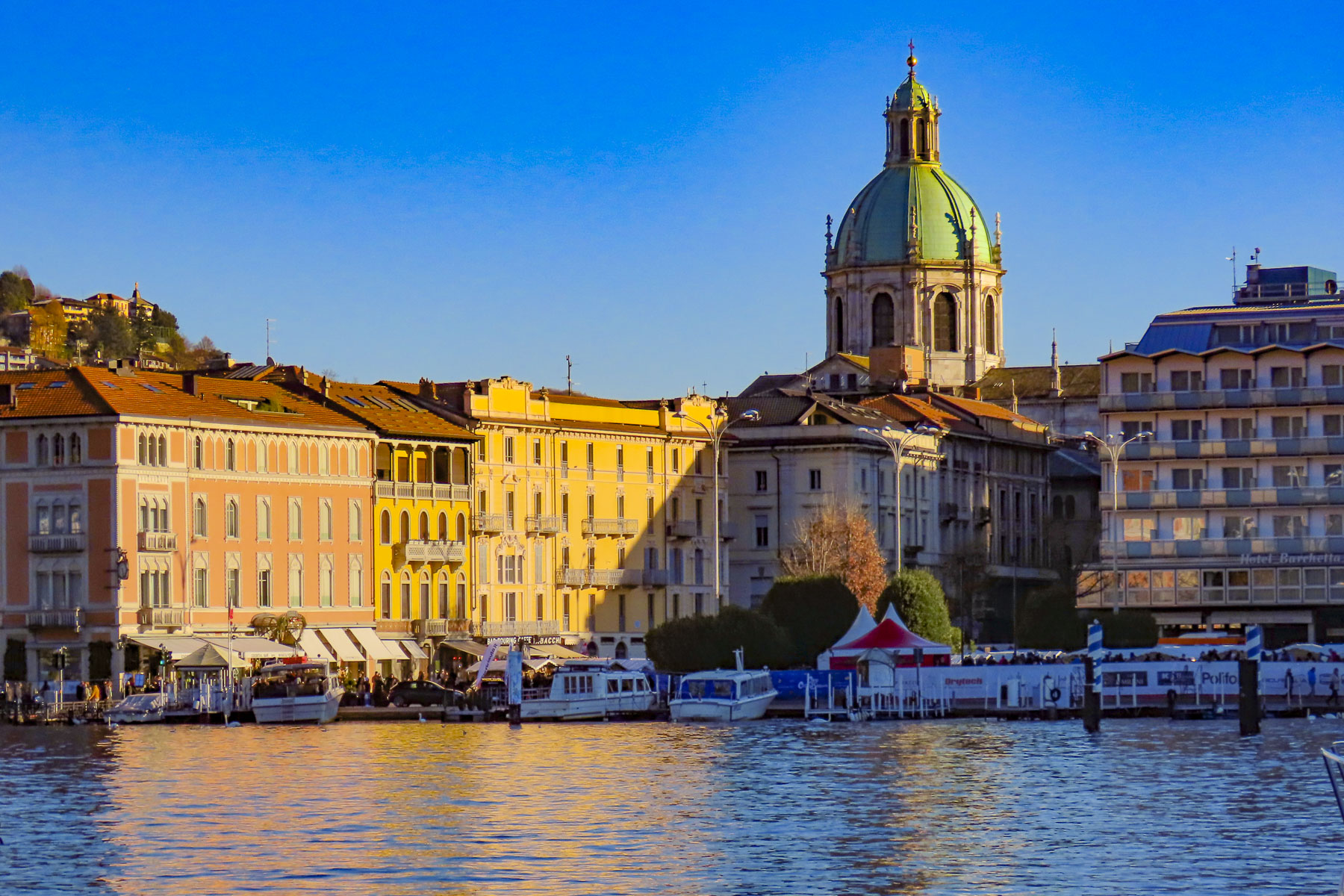
We had only been settled into our Milan rental for a few days when, upon checking the long-term weather forecast, we decided to take the train to Lake Como the next day.  The days were solidly cold now in northern Italy, but still very pleasant if the sun was shining. By the end of the week, it was expected to rain for a while. What we didn’t expect was a dusting of fresh snow along the route.  In the distance the snowcapped Italian Alps were a blur as the train sped along, delivering us to the town of Como in an hour, the last stop in Italy before Chiasso, Switzerland.  Unsure of where we were heading, we followed the flow of day trippers into the town center past a blend of Gothic, Renaissance and 18th century architecture.

The famous inverted “Y” shaped lake was created by receding glaciers, 10,000 years ago, during the last Ice Age. Since the 1st century, Roman naturalist Pliny the Elder wrote about it as an “A list” destination for poets and writers. Today artists and celebrities continue to be mesmerized by its natural beauty. The Goths, Ostrogoths, French, Spanish and Austrians have all contributed to its convoluted history until the region was united into the Kingdom of Italy by Giuseppe Garibaldi’s troops in 1859.  Even Mussolini visited one last time as he tried to flee Italy in April 1945 and cross the border into neutral Switzerland, but he was captured by Italian partisans in Dongo, a small village on Lake Como. He was executed the next day.

It was an especially sunny day and the town’s Christmas market on Piazza Cavour across from the lakefront was thriving with folks enjoying the weather and shopping amidst all the stalls for the quickly approaching holiday. At the restaurants lining the piazza, outdoor dining was still in full swing, but was only bearable if you found a table in the sun and used the provided lap blankets to help ward off the winter chill.

Aside from the usual cheese, jam, sausage and porchetta sandwich stalls, there was an olive vendor with an incredible variety of olives for purchase.  One of his most surprising offerings was Lugano olives which originate from the Italian speaking part of Switzerland! – south of the Alps, on the shores of Lake Lugano, just over the hills from Como.

The Passeggiata Amici di Como, a lakefront promenade, was busy with tourist watching swans bob about on the water and folks queuing for the various ferry boats still offering tours.  We followed the walkway as it spurred onto a long pier that extended almost two thirds of the way across the lake and culminated at a large, futuristic monument called Life Electric. Designed by internationally acclaimed architect Daniel Libeskind in 2015, the highly polished chrome sculpture brilliantly reflects the sun, sky and water surrounding it and changes continually with the light, evoking continuous motion. It is dedicated to hometown physicist Alessandro Volta who is credited with the invention of the electric battery in 1800.

From here we also watched and listened to a continuous flow of seaplanes roar across the water from the Aero Club where one can book an aerial tour of Lake Como and surrounding mountains.  It’s been a popular activity since it was first offered in 1913.

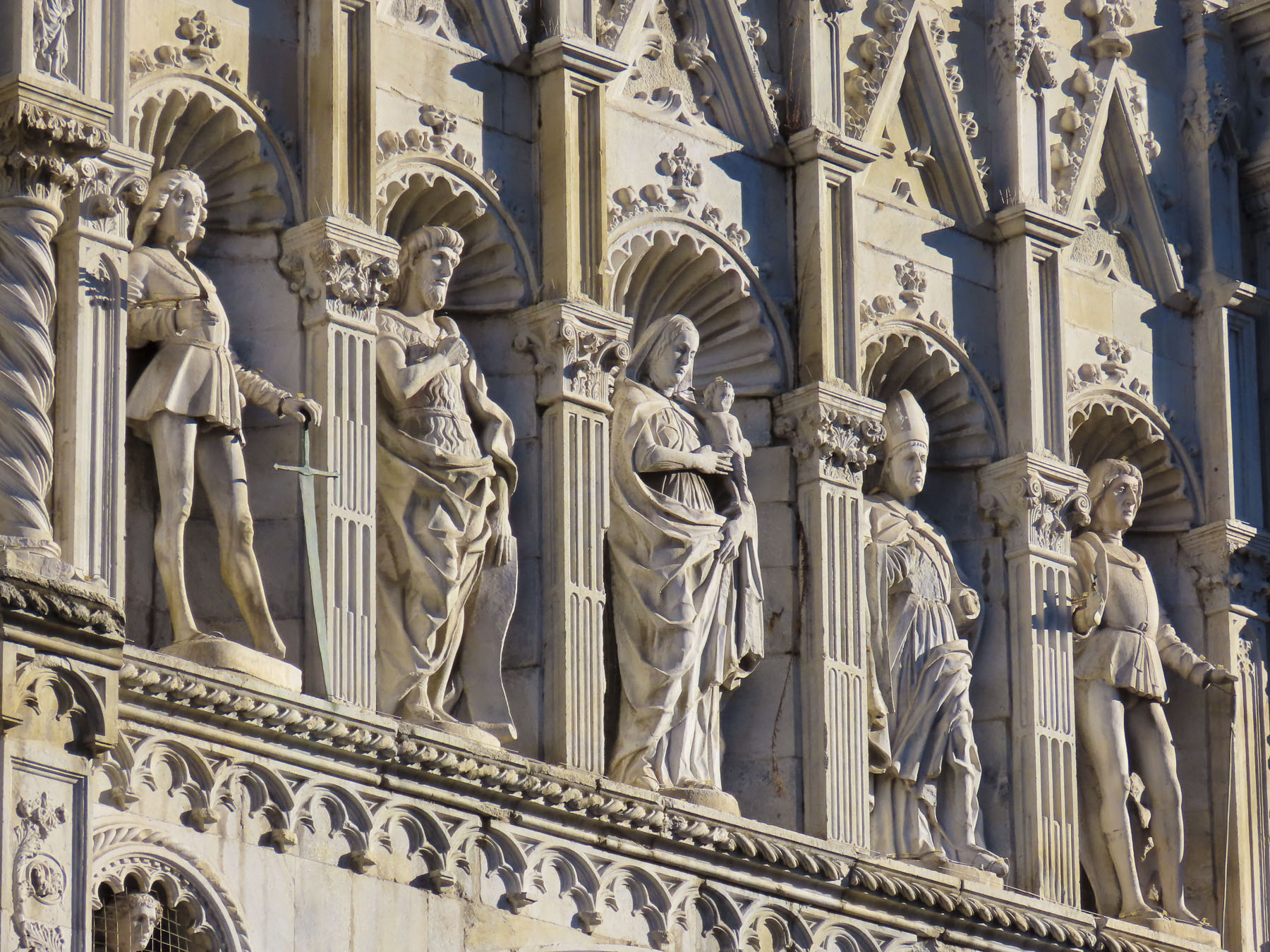
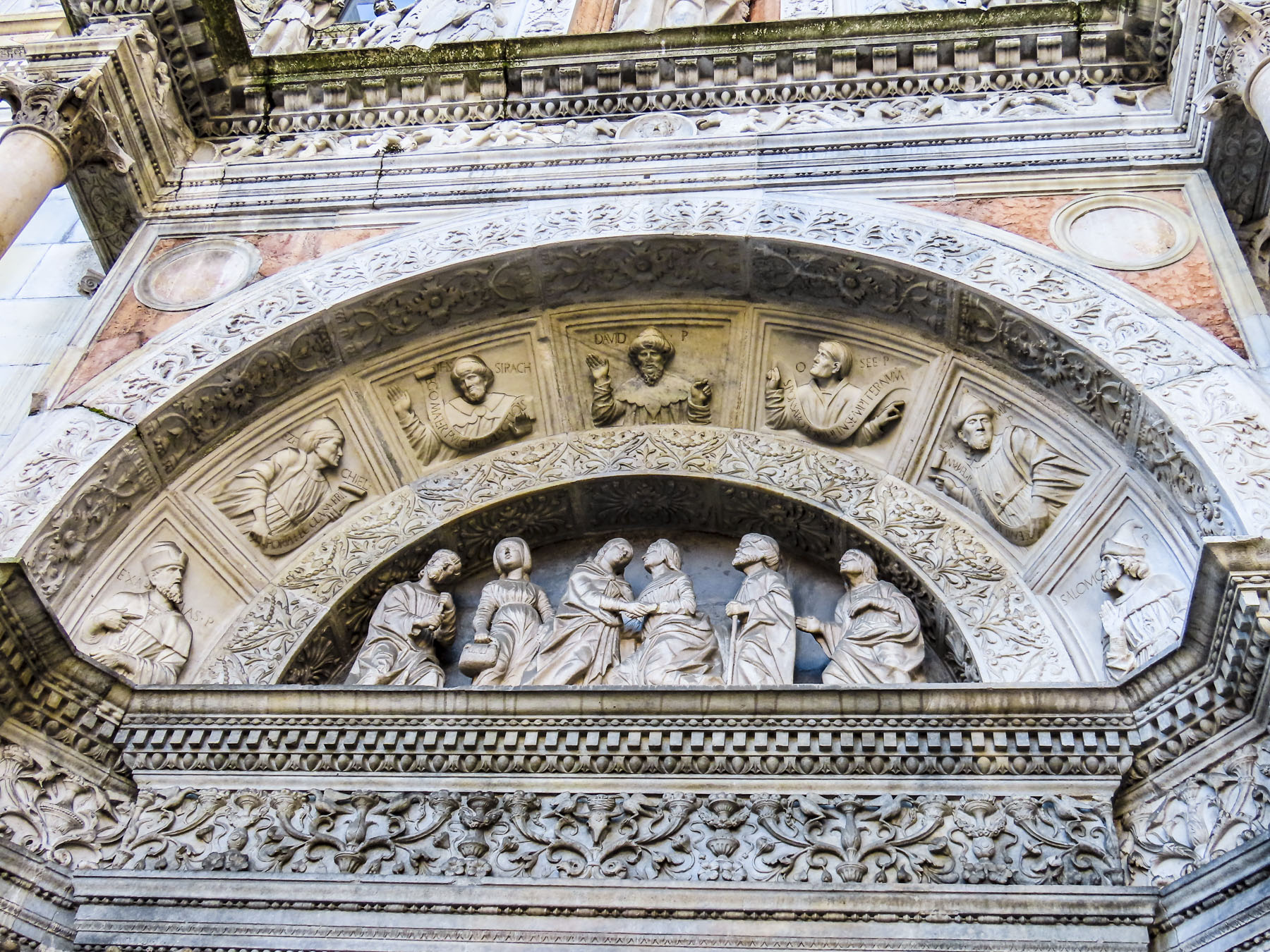
Back in the historic center we headed to the Cattedrale di Santa Maria Assunta-Duomo di Como. The façade is an exquisite example of Gothic architecture and includes sculptures of hometown stars Pliny the Elder and his nephew, Pliny the Younger, which flank either side of the church’s rose window. 

The interior is decorated with antique tapestries made in Antwerp, Florence and Ferarra during the 16th and 17th centuries. The church’s construction was started in 1396, but wasn’t completed until almost 400 years later in the later part of the 18th century, due to legendary Italian bureaucracy, civil unrest and a stone cutters strikes. (I’m just speculating here, but in 1629 the bubonic plague halved the population of Northern Italy and brought economic hardship to the area that lasted for decades afterward.)

Farther along, the Basilica di San Fedele commanded the other side of the street.  Substantially altered in the 12th century, it incorporated some architectural elements from a 5th century church that originally occupied the site. Entering the church, we were confronted with a terrifying hand-carved wooden sculpture of hundreds of sinners, painted red, being consumed by flames – it’s reminiscent of Hieronymus Bosch’s Vision of Hell. We imagine it was a highly effective teaching tool in the middle-ages.  By late afternoon only a dim light was filtering through the church’s ancient windows as an organist dutifully labored to get the right pitch from the ancient pipes.

Darkness fell early as we walked back through town. Many of the buildings were colorfully illuminated with Christmas holiday projections. It was magical.

Till next time, Craig & Donna

Bergamo – Cathedrals, a Flat Tire and a Bell Tower

Somewhere along our route on the A4 motorway to Bergamo the tire blew. It wasn’t an obvious blowout, the car still handled well, but the car felt different.  Our dilemma was, if we stop on the shoulder of the highway to call for assistance how do we explain our location in our non-existent Italian, or do we keep driving to the next exit. We kept going. In the time it took to stop and pay the toll the tire totally deflated, and we limped off the highway on three wheels. Luck was with us we when we rolled into the gas station at the top of the exit ramp.  They didn’t offer any repair services, but did have a small café, and it being Italy, they served excellent cappuccino and pistacchio pasticcino.  With the barista’s help our exact location was given to the roadside assistance agent, and we settled in for what we thought would be a very long wait. Surprisingly, we were back on the road again in less than one hour.

Bergamo was a well-established ancient village before it became a Roman town in 49 BC and today is a hub of industrialization in the Lombardy region.  The newer portion of the city, Citta Bassa, or lower city, is a smart looking collection of contemporary buildings along tree-lined boulevards and pedestrian malls worthy of exploration. Though we were here to wander around the narrow lanes and ancient churches within the 16th century Venetian defensive walls of the Città Alta, the high city. The historic upper center of Bergamo was strategically located on a rock promontory with commanding views of the surrounding region.

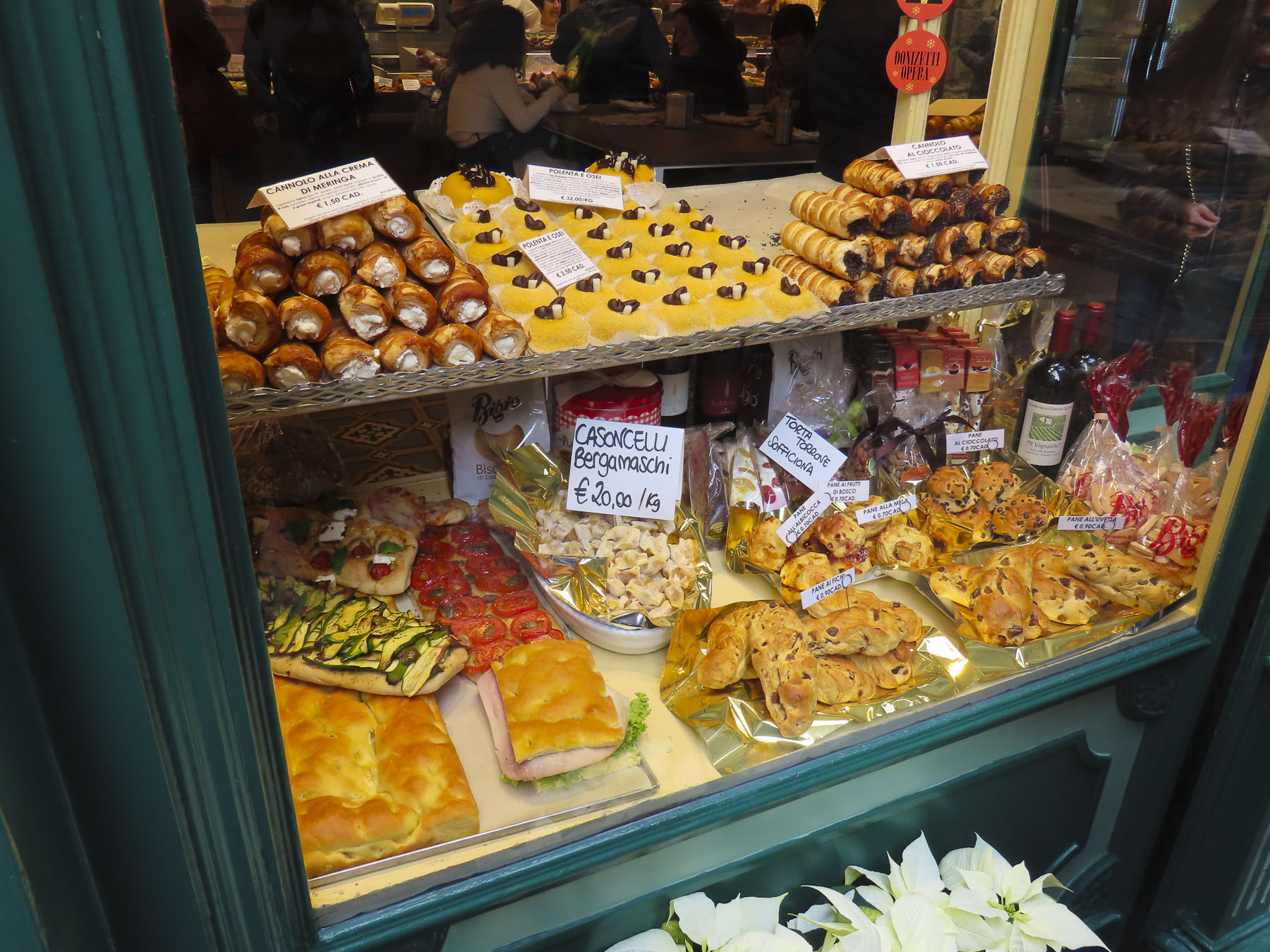
Completely pedestrian only, the old town is connected to the new town by a funicular  that runs up the side of a steep hill through an ivy-covered channel. We knew the old town would be full of history, but soon realized it was an unexpected foodie’s delight when we were faced with a gauntlet of gourmet food stores that started as soon as we got off the funicular.

With each shop window more tempting than the previous, it was a challenging task walking along Via Gombito to Piazza Vecchia, the historic center of Bergamo.  It was the last week of November now and even though the days were sunny there was a definite chill to the air. Fortunately, the cafes on the piazza were still in full swing with outdoor dining and had heavy lap blankets available to ward off the chill.  The ambiance of the old town is wonderful and there’s plenty to absorb just by wandering around, but if you are short on time concentrating on the historic buildings that line Piazza Vecchia is rewarding.

Dominating the piazza is the Campanone, the town’s clock and bell tower. When it was built in the 12th century it was the private residence of the wealthy and influential Suardi family.  With admission there is an elevator that will take you most of the way to the top.  Interestingly at ten o’clock every evening the town keeps an ancient Venetian tradition alive by chiming the bells of the clock tower 100 times to signal the closing of the city gates. It was cloudy after lunch so we decided to delay our tower visit till later, hoping that the weather would change, and the sun would come out. Next to the tower stands the Palazzo del Podestà e Museo del Cinquecento a wonderful, high-tech, multimedia and interactive museum housed in a Renaissance era palazzo that highlights Bergamo’s history.

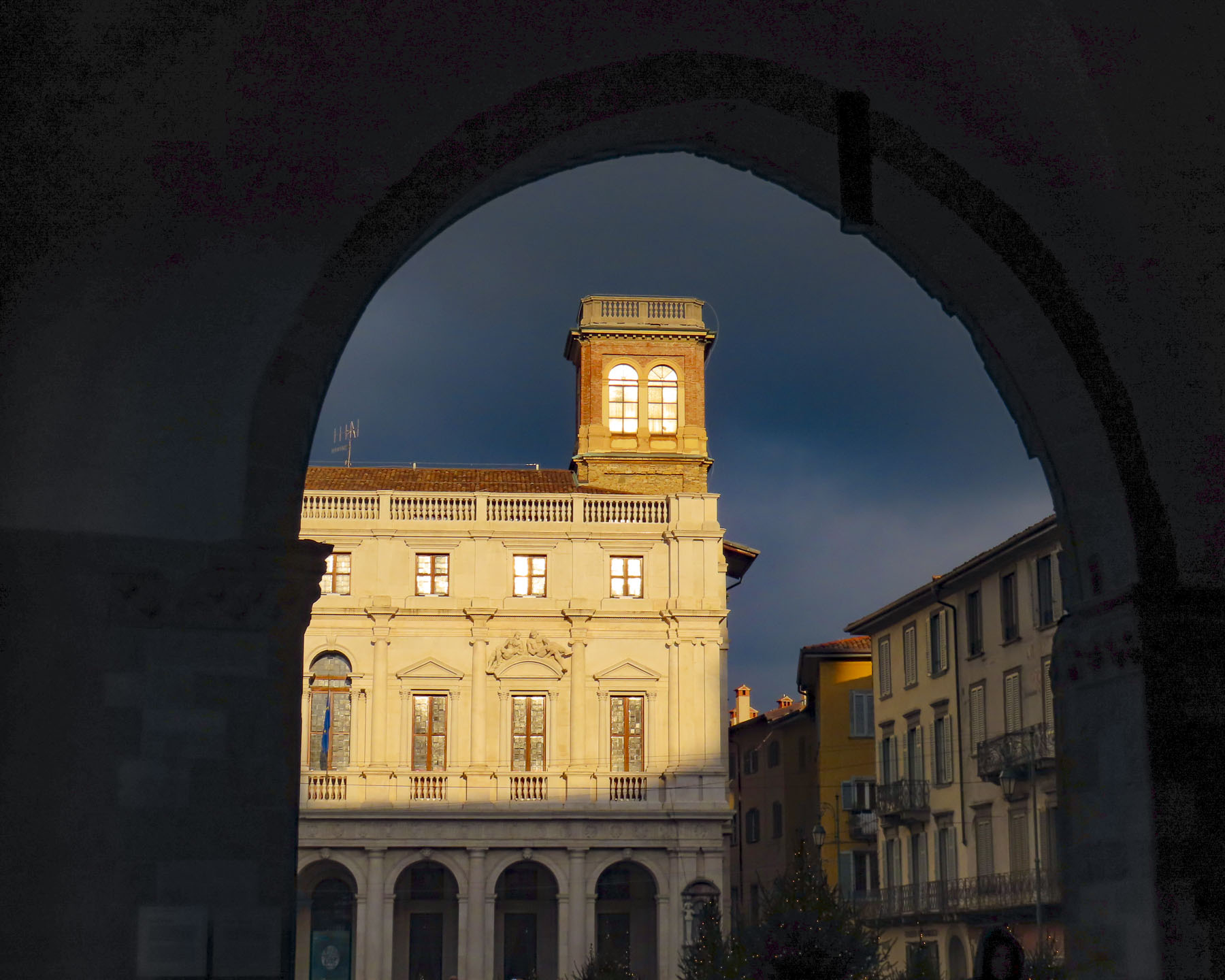
The Cattedrale (duomo) di Sant’Alessandro, the Bergamo Cathedral, is almost hidden away behind the arched portico that separates the Piazza Vecchia from the Piazza Duomo.  Majestic in scale, the duomo dates from the 1400s and has undergone many alterations over the centuries that has evolved the church into a treasured, religious art-filled sanctuary that is the Bishop of Bergamo’s seat.  An important center for Christianity since the religion was accepted by the Roman Empire in the third century, Bergamo has had a bishop since the fourth century. Underneath the Presbytery the Bishops’ Crypt of The Cathedral Of Bergamo holds, in a semi-circle, twelve tombs of bishops who guided the See in the 19th, 20th and 21st centuries.  Strikingly, the façade of the crypt, in my opinion, could pass as the entrance to a retro café; it just had that feel.

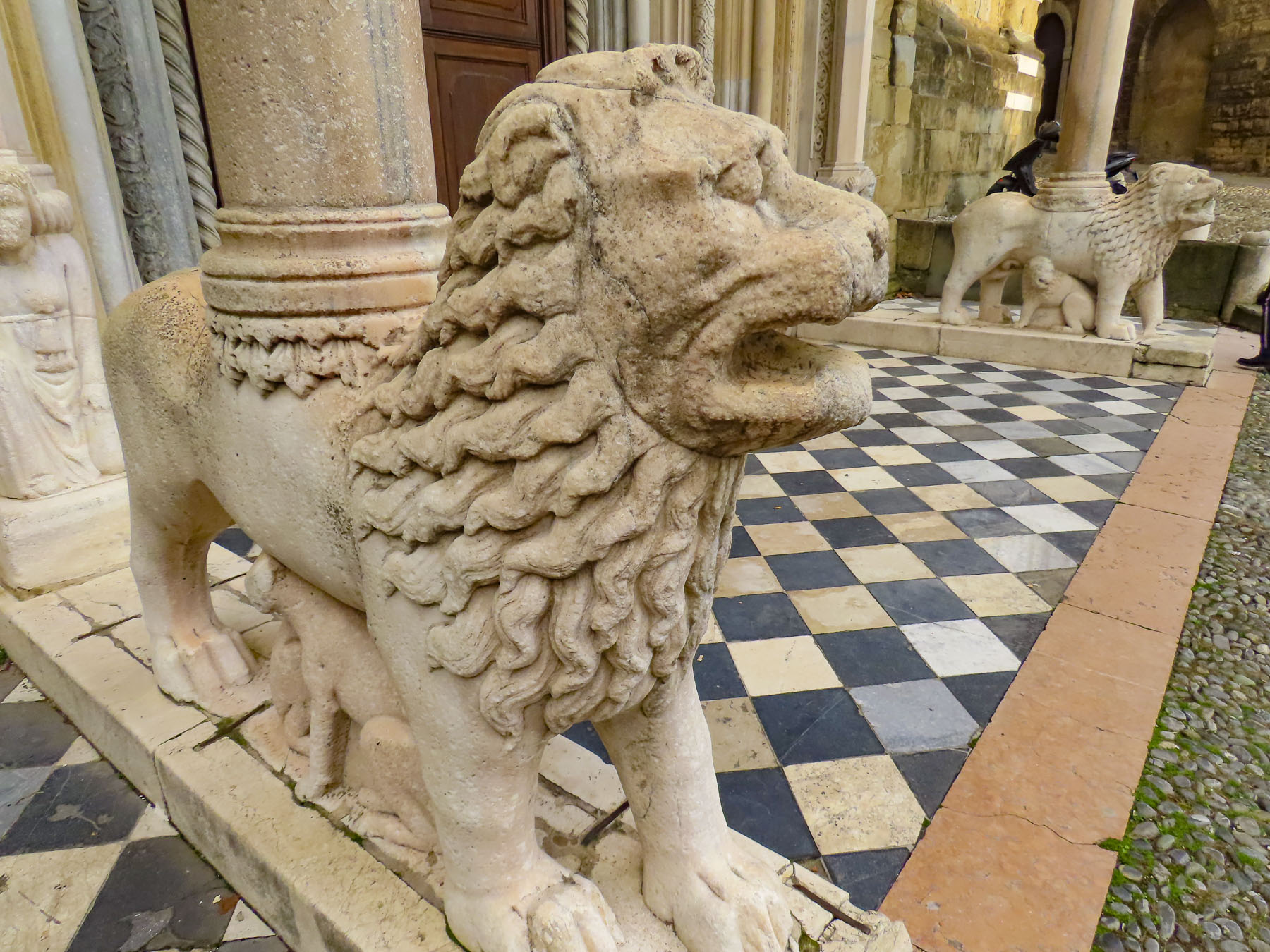
The highlight for us on Piazza Duomo was the Romanesque Basilica di Santa Maria Maggiore with its intricately designed marble façade and ornate gilded interior, and the Cappella Colleoni, a separate 15th century funerary chapel with a frescoed ceiling that seamlessly stands next to it. Founded in 1137, like so many other churches in Italy, it was built over the ruins of an earlier 8th century church and an older Roman temple. 

To our delight the church organist was practicing during our visit, and we stayed for twenty minutes and enjoyed this impromptu concert.

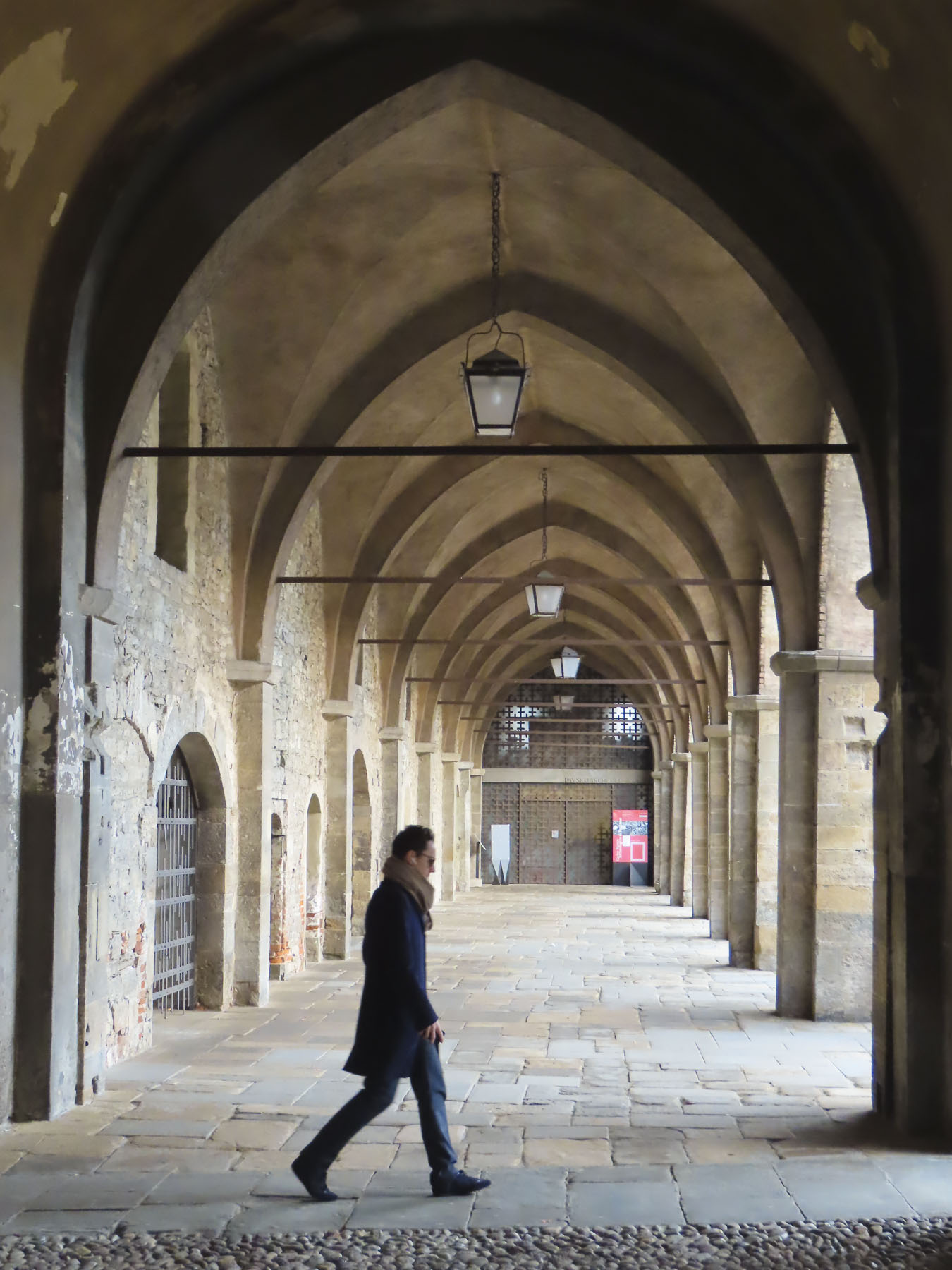
Just wandering around, we eventually arrived at the Torre della Campanella, the bell tower and arched gate entrance to Piazza Mascheroni and the Visconti Citadel which guarded the western entrance of the city from invasion, and protected the Visconti family from civil rebellion. The citadel is now home to the Civic Archaeological Museum and the Bergamo Science Museum. 

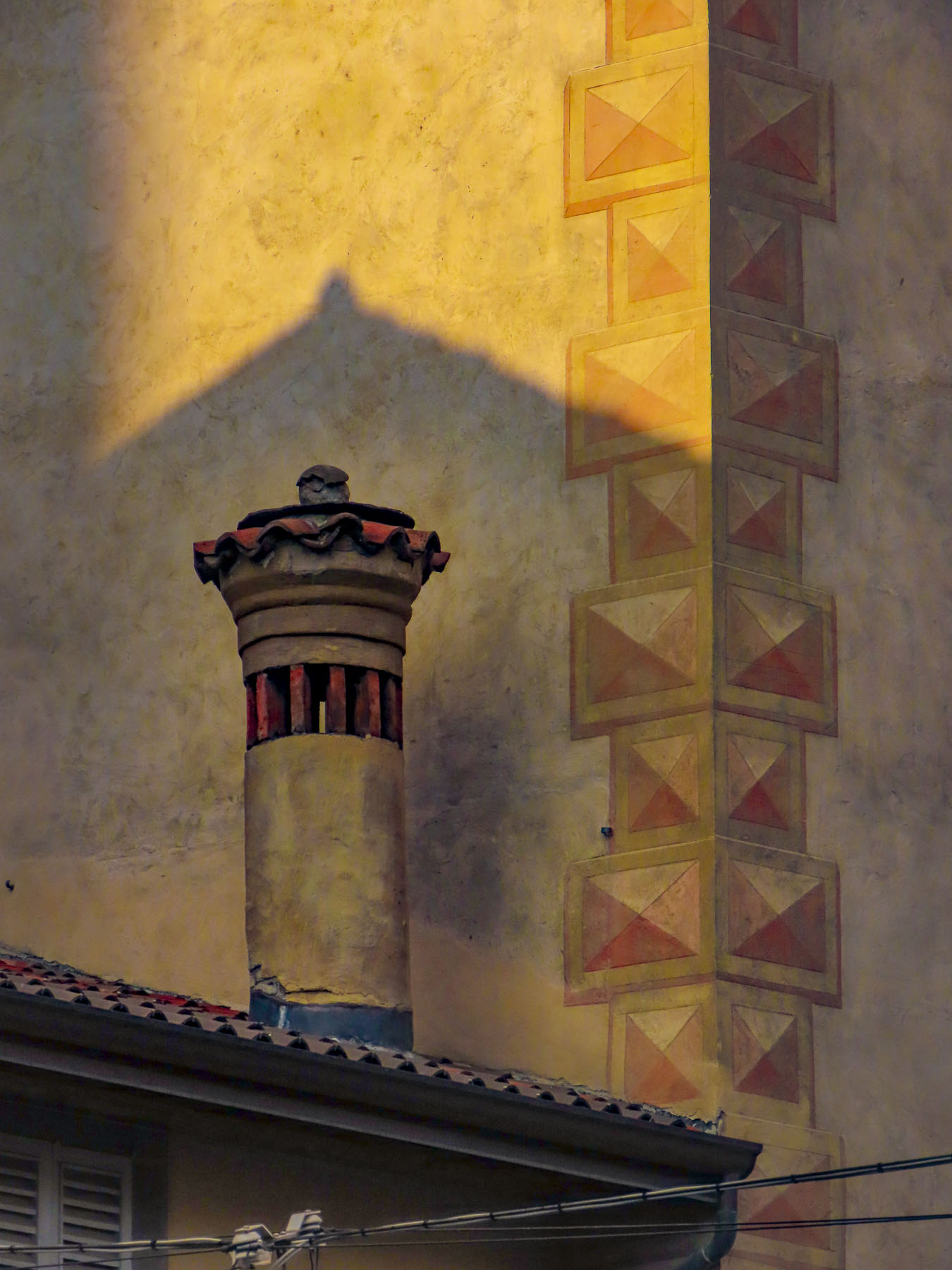
Remarkably, the buildings adjacent to the gateway still have faded remnants of renaissance era frescoes adorning their exterior walls.

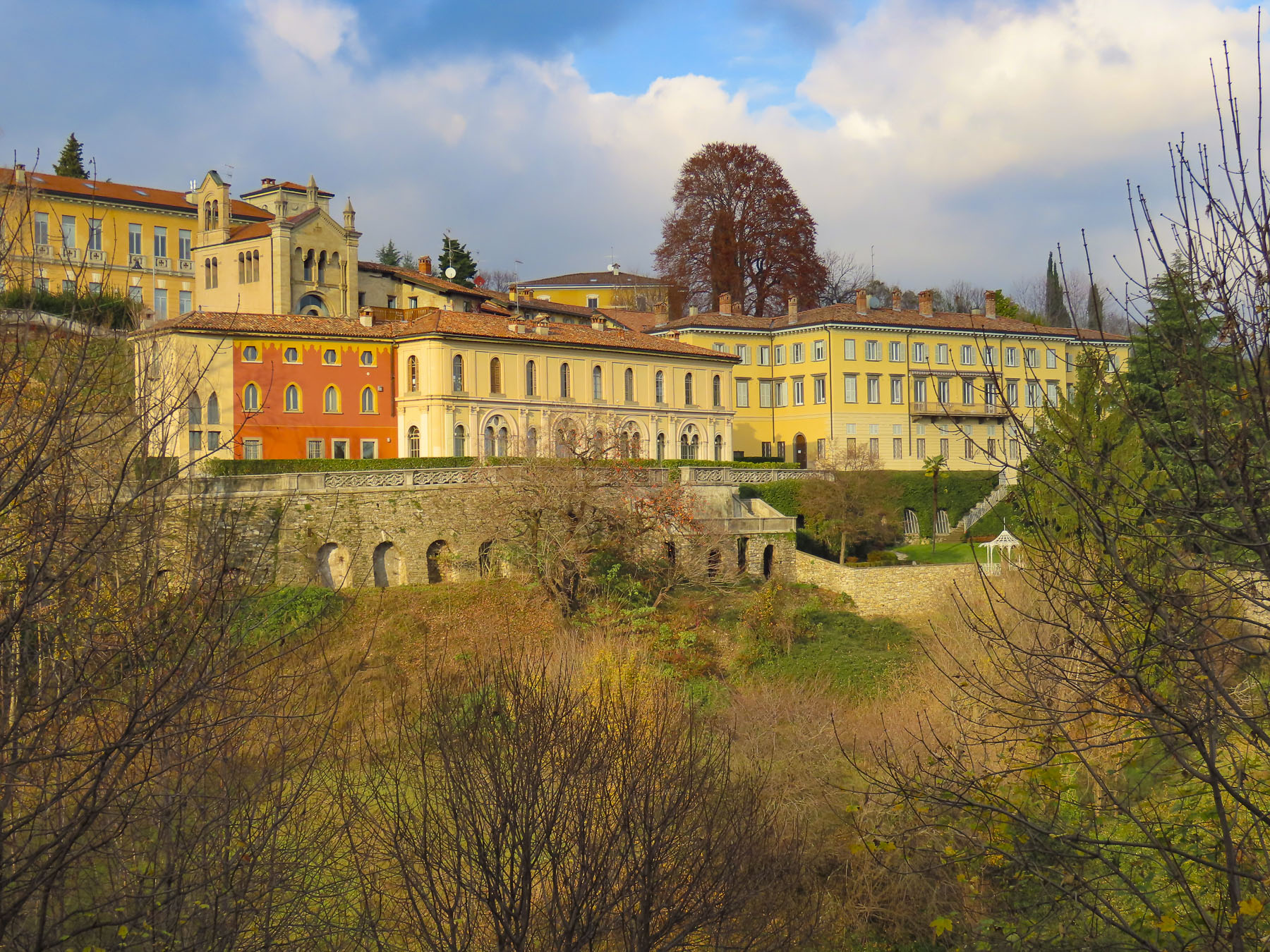
Outside the city walls, the landscape opened to vistas of rolling hills, still holding the fading colors of fall.

Back at Piazza Vecchia the afternoon sun was beginning to break through the clouds when we decided to head to the top of the Campanone. 

The elevator stopped short of the top and we had to navigate a narrow passage to reach the highest level.

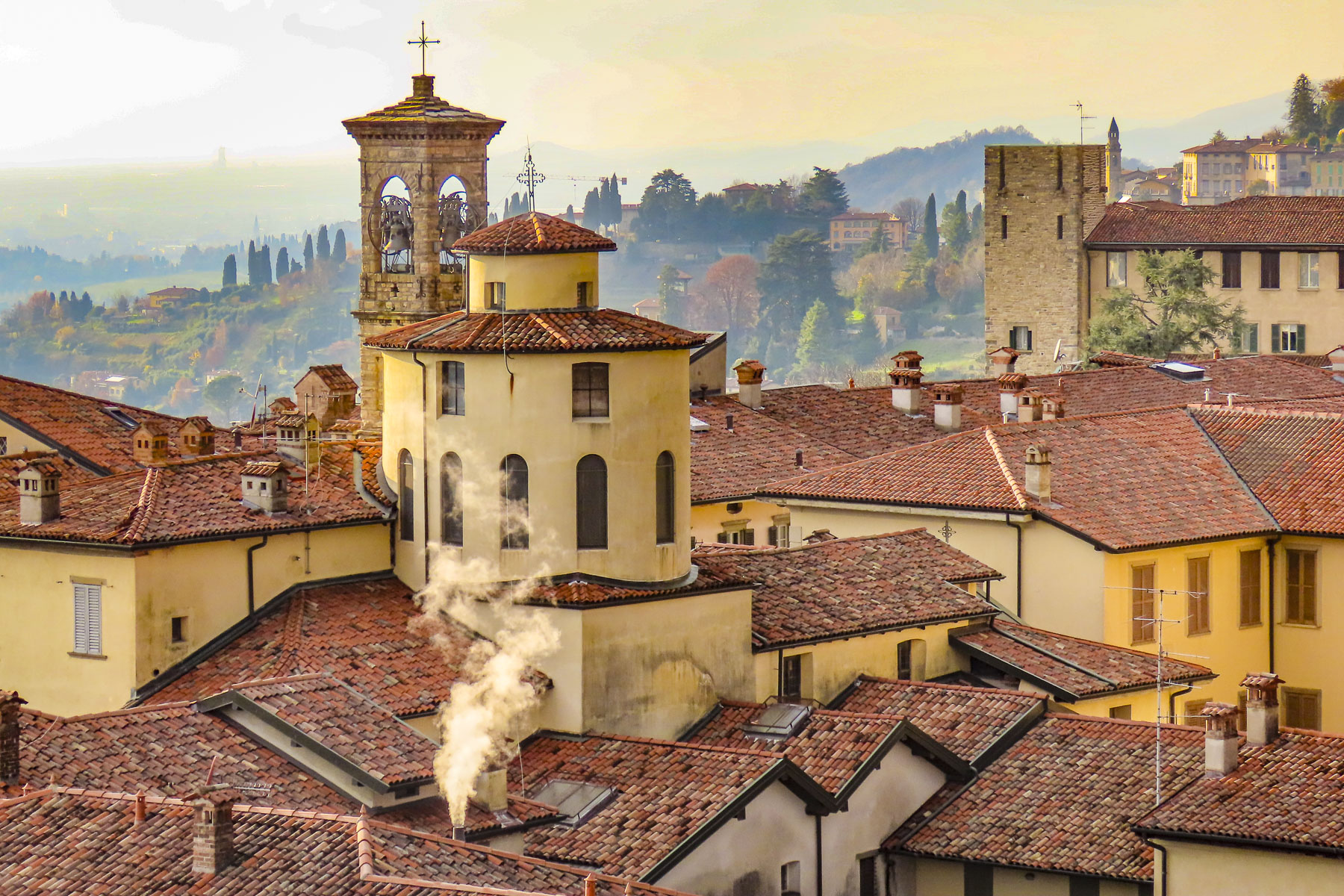
Each corner of the tower offered an amazing bird’s eye perspective of the ancient city, from soaring above the cathedrals on Piazza Duomo, to cityscapes of red tiled rooftops with smoke wafting from their chimneys, to distant still green hills.

The city is full of potential, and you won’t be disappointed if you spend two nights here to fully explore the Città Alta. But Old Town Bergamo is the perfect size to entertain you for four or five hours, on your way to or from Milan or Verona, either by train or car, without feeling you might have missed something.

Till next time, Craig & Donna

Ravenna and San Marino – Golden Tiles & Mountain Vistas

A curtain of fog blanketed our route as we traversed the Po River Valley and crossed into the Emilia-Romagna region on our way to Ravenna. The purpose – to see some of the finest Byzantine mosaics outside of Constantinople, present day Istanbul, which was once the seat of the Eastern Roman Empire. Not to be outdone, Ravenna’s golden mosaics rival Constantinople’s and were created in the 5th century when Ravenna was the capital of the Western Roman Empire after Rome’s demise. Eight churches have been recognized by UNESCO for their cultural significance as “Early Christian Monuments of Ravenna.”  Most of them are credited to a building boom by Justinian I after a reconquest of the city from the Ostrogoths in 535 that solidified Byzantine power on the Italian Peninsula along the Adriatic coast.

The valley had been the breadbasket of Northern Italy for several millennia when the Etruscans and Romans first started to drain the wetlands to expand areas for cultivation to support a growing populace aligned with city-states of the region. The spring floods from the snow melt of the Alps, Apennines and Dolomite mountain ranges replenish the valley’s fertile soil every year before pouring into the Northern Adriatic Sea.

With the belief that the valleys are always greener on the other side of the Alps, invading armies contested the area for centuries. French kings, German tribes, Galls, Hannibal with eighty war elephants, Goths, Attila the Hun, Papal armies, and Napoleon have all wanted this green acreage, and were willing to shed blood for it.

The fog had lifted, but it was still a moody day as we entered the Basilica di San Vital. The unique octagonal church was one of Justinian’s first commissions to celebrate Christianity in the city on a grand scale. The splendor of its lofty mosaics that rise from the floor, on all sides, to encompass the domed ceiling are dazzling. The golden tiles warmly reflecting the ambient light even on a dreary day.

Byzantine mosaics evolved from the Greek use of different colored river stones to create sturdy designs in ancient roads. Durable marble was preferred for its vast array of colors and was used for interiors floors in palaces.  Lasting centuries, these intricate designs are often referred to as “eternal pictures.”

The Byzantine artists’ innovation was to use physically lighter and more fragile material such as different colored glass pieces and mother of pearl, along with incorporation of gold and silver leaf. The color palette expanded with the refinement of glazed tiles.

A short distance behind the basilica stands the Mausoleo di Galla Placidia, intended as the final resting place for Teodosius the Great’s daughter. It was never used as a tomb, as she died in Rome.  The small, modest brick structure is designed in the shape of a Latin cross and is inspirationally decorated as a “prelude to paradise.” A surprisingly intimate and tranquil space, it is one of the oldest religious monuments in Ravenna dating to 430 AD.

A short walk across town, the Cattedrale della Risurrezione di Nostro Signore Gesù Cristo or Duomo of Ravenna, the Baptistery of Neon, and the Archiepiscopal Museum of Ravenna all share the same campus. Though considerably newer, the 18th century Duomo is built over the ruins of an early fourth century church and retains several early side chapels and fifth century sarcophagi.

Behind the cathedral the former bishop’s residence has been converted into a museum displaying a diverse collection of religious relics. The highlight though was the exquisitely mosaiced sanctuary, the Chapel of St. Andrew.  It was built in 495 AD for the private use of Ravenna’s archbishops.

The museum directly behind the cathedral was also interesting. with its diverse collection of religious relics and an exquisite private chapel for the bishop.

The real reward for the trek across town was the early fifth century Baptistry of Neon.  The octagon-shaped brick building appears to have settled into the ground, but in actuality, centuries’ worth of construction detritus from earlier settlements in Ravenna have raised the surrounding terrain ten feet since the structure was built. This necessitates the occasional raising of the entrance.

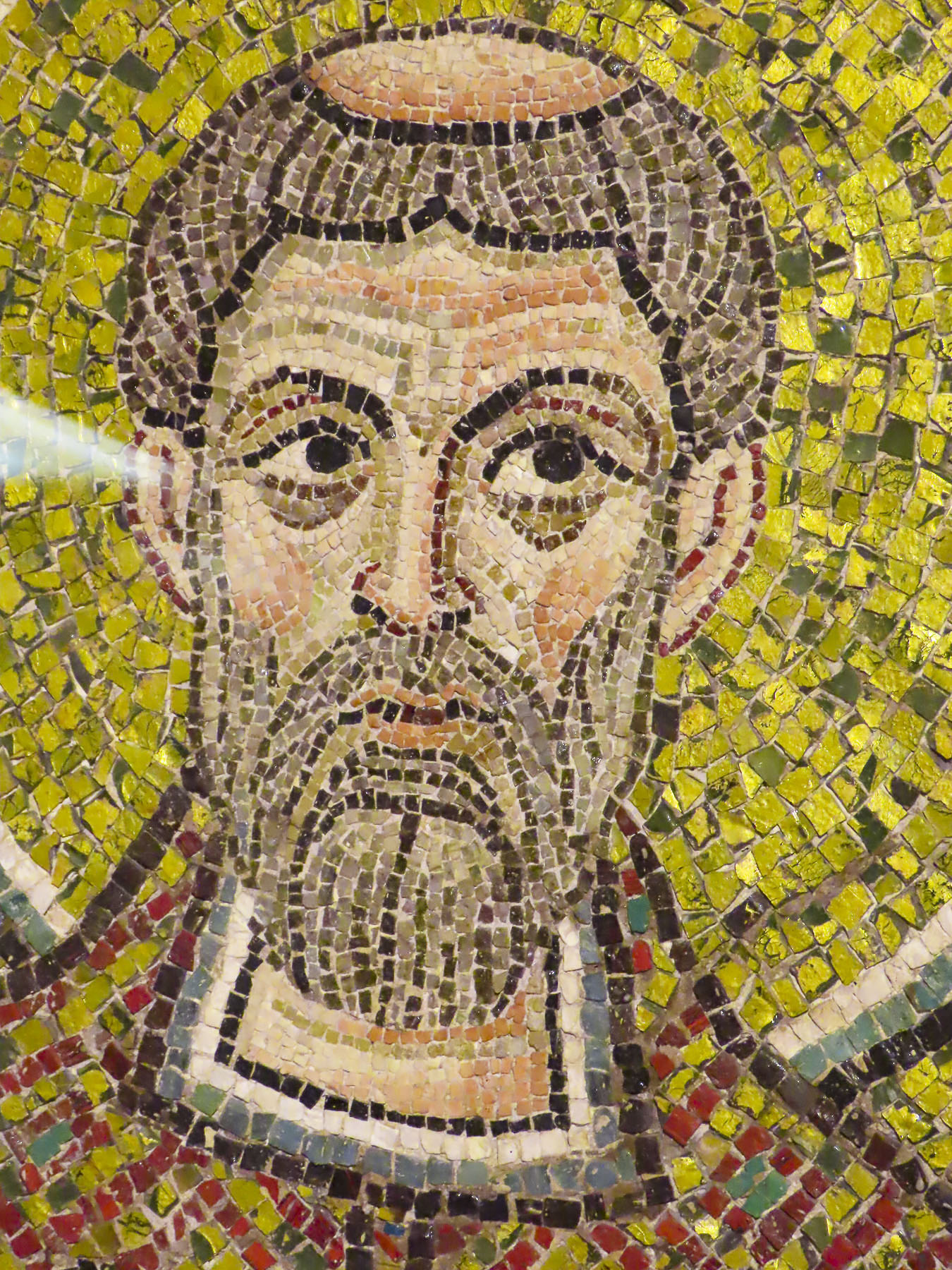
At the baptistry it’s all about the magnificent mosaics that adorn the dome. Above arched windows, the center medallion features John the Baptist christening Jesus in the River Jordan, followed by an encircling outer ring that depicts the twelve apostles. Astonishingly, most of the original mosaic work survives and is still intact. During a minor 19th century restoration, a mosaic artist freelanced with creative license and added the bowl that St. John is using to pour water – a scandal at the time.

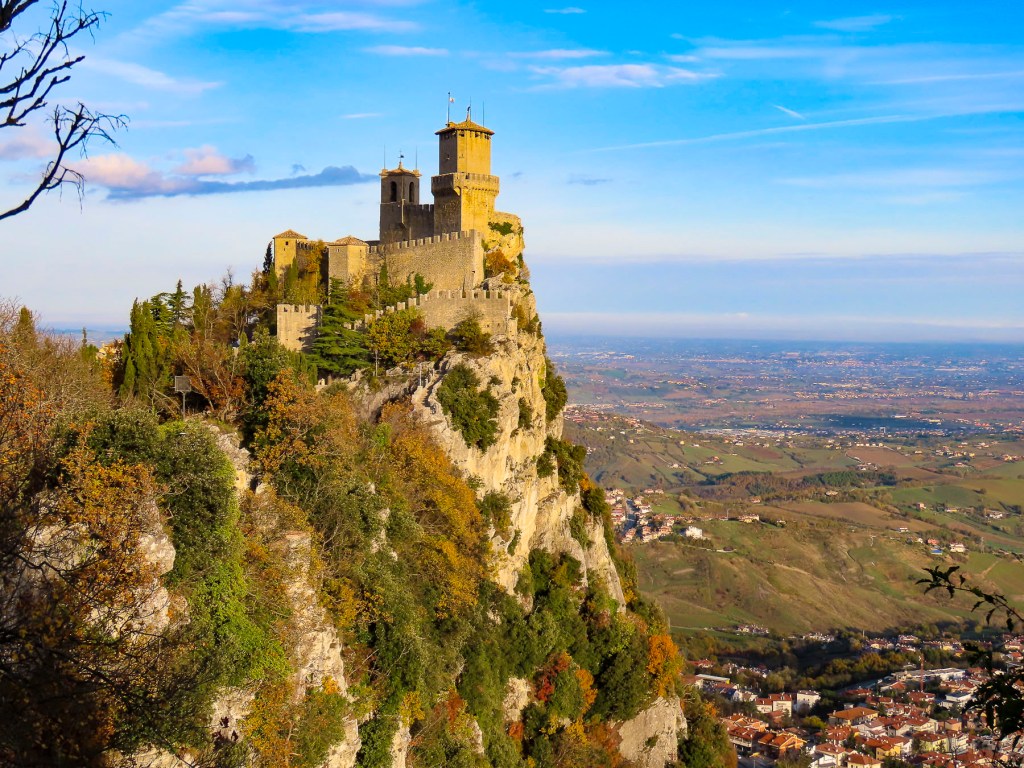
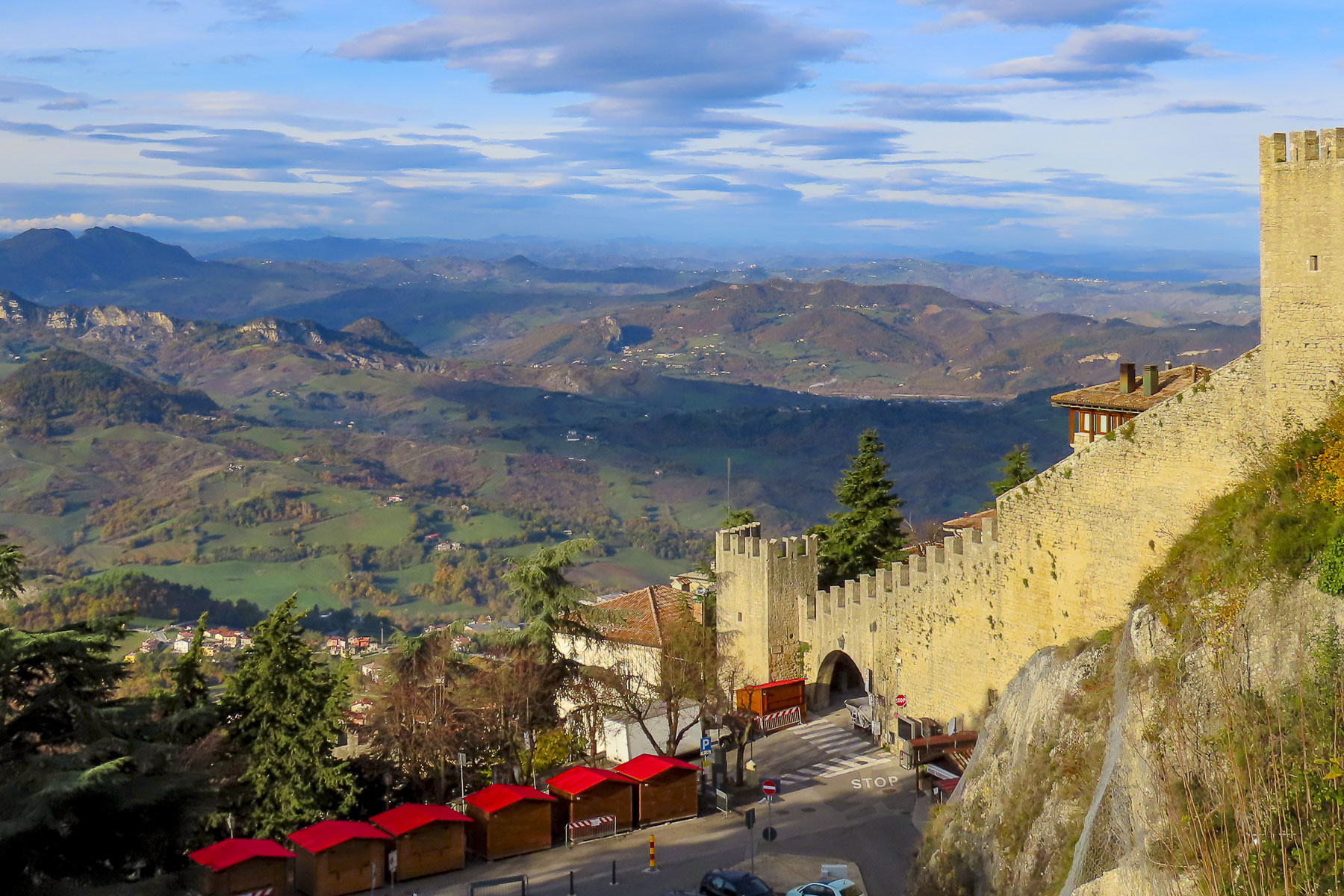
The tall ridge of Monte Titano rose above the gentle hills of the Emilia-Romagna countryside surrounding San Marino like a tall ship’s white sail on the ocean; its three fortress towers mimicked the crow’s nest atop a schooner’s mast.  The towers served the same purpose: as lookout posts, to spot any approaching threat. They have served the Republic well since its founding in 301 AD, when the Christian stonemason Marinus, who was later beatified as San Marino, fled Rimini to avoid the Diocletianic Persecutions.  Also known as the Great Persecution, it was the last and harshest repression of Christianity in the Western Roman Empire before it was accepted as the state religion in 313 AD.  The rugged terrain of the mountain provided safe refuge for the small community of followers who built a small chapel and monastery. As the community grew, a governing system evolved that included representation of each family by the head of the household in an assembly called the Arengo.  Representatives were summoned to the meetings by the ringing of the church bell. This eventually changed to a Grand and General Council which elected two Captains Regents for six-month terms. In 1861 the tiny constitutional republic bestowed honorary citizenship on Abraham Lincoln. In his acceptance letter he wrote, “Although your dominion is small, your State is nevertheless one of the most honored, in all history. It has by its experience demonstrated the truth…that Government founded on Republican principles is capable of being so administered as to be secure and enduring.” On the 150th anniversary of Lincoln’s death, in 2015, San Marino minted a ten-euro commemorative coin that highlights the great orator’s words to the tiny republic: “Great and Good Friends.”

Giuseppe Garibaldi and a band of followers received refuge in San Marino before the tide of the unification movement turned in his favor. In the 1870’s, San Marino was asked to join with the rest of the Italian peninsula. However, the good will engendered by their gracious treatment of Garibaldi prevented the tiny republic from suffering invasion after they politely declined.

Along with Andorra, Monaco and Liechtenstein, San Marino is a surviving example of a medieval city-state that was once quite common throughout Europe and especially the Italian peninsula. In such esteemed company, one would expect the place be expensively exclusive. That would have held true if we had visited during the high season. But that’s not the case in November when cold winds whip across Monte Titano. With some internet sleuthing, Donna found us a great rate at Hotel Rosa San Marino.

The last vestiges of autumn colors still clung to the trees that lined our serpentine route up the mountain that ended at one of the ancient city gates through a crenelated wall.  The hotel had assured us that parking was available on site when we made the reservation several months prior, but a traffic sign warned that vehicles were prohibited and to proceed no farther.  With a quick phone call to the hotel they confirmed that they would register our car with the city and that we could drive through the gate and into the historic district without any worries. 

With a few tight turns between buildings, we drove higher and literally parked beneath the Guaita Tower, San Marco’s first tower and iconic fortress built in the 11th century.  Only a few steps from the paths along Monte Titano’s ridgeline, the hotel was in an ideal location to explore the mountaintop city and had wonderful views from its balcony.

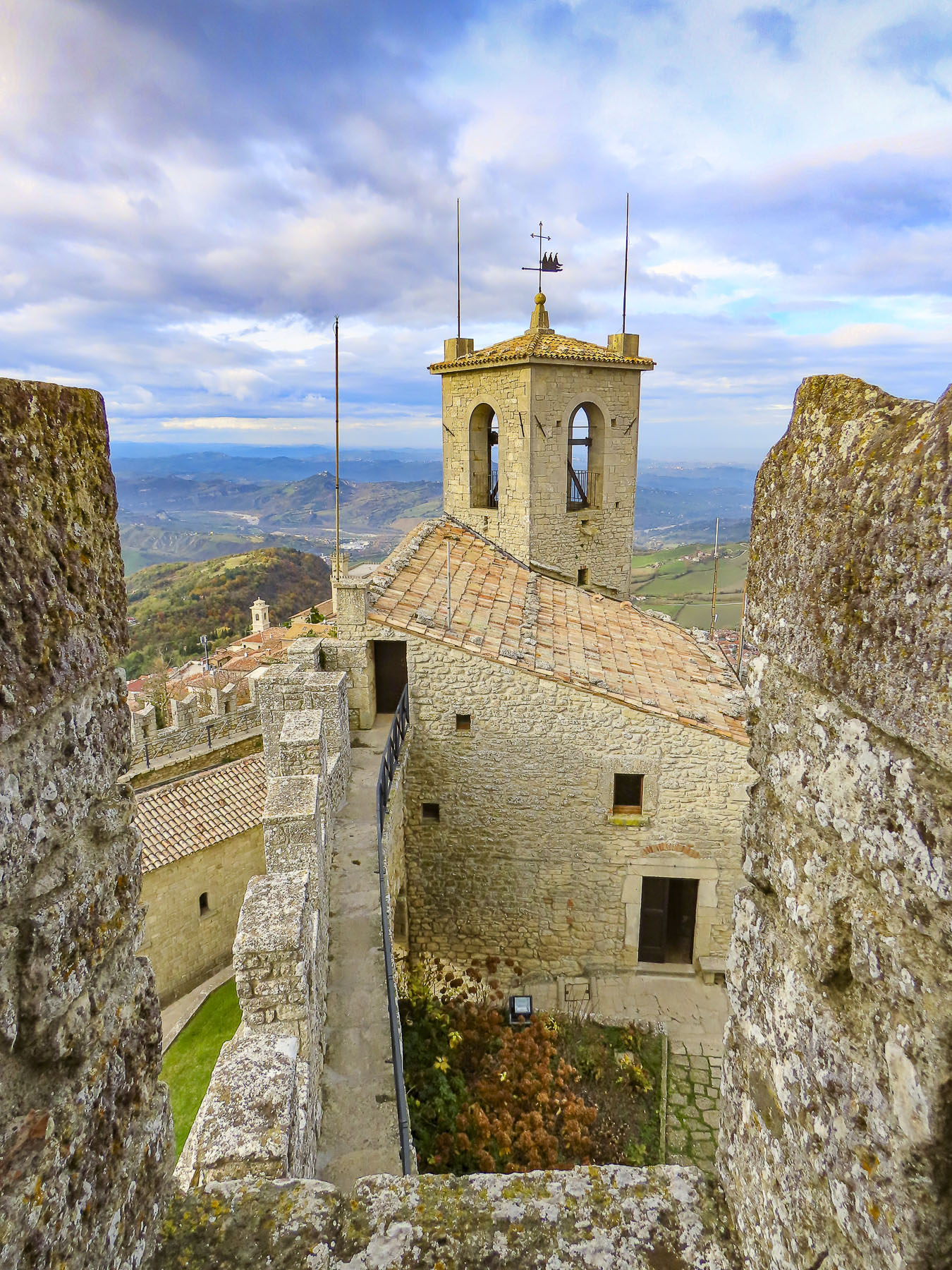
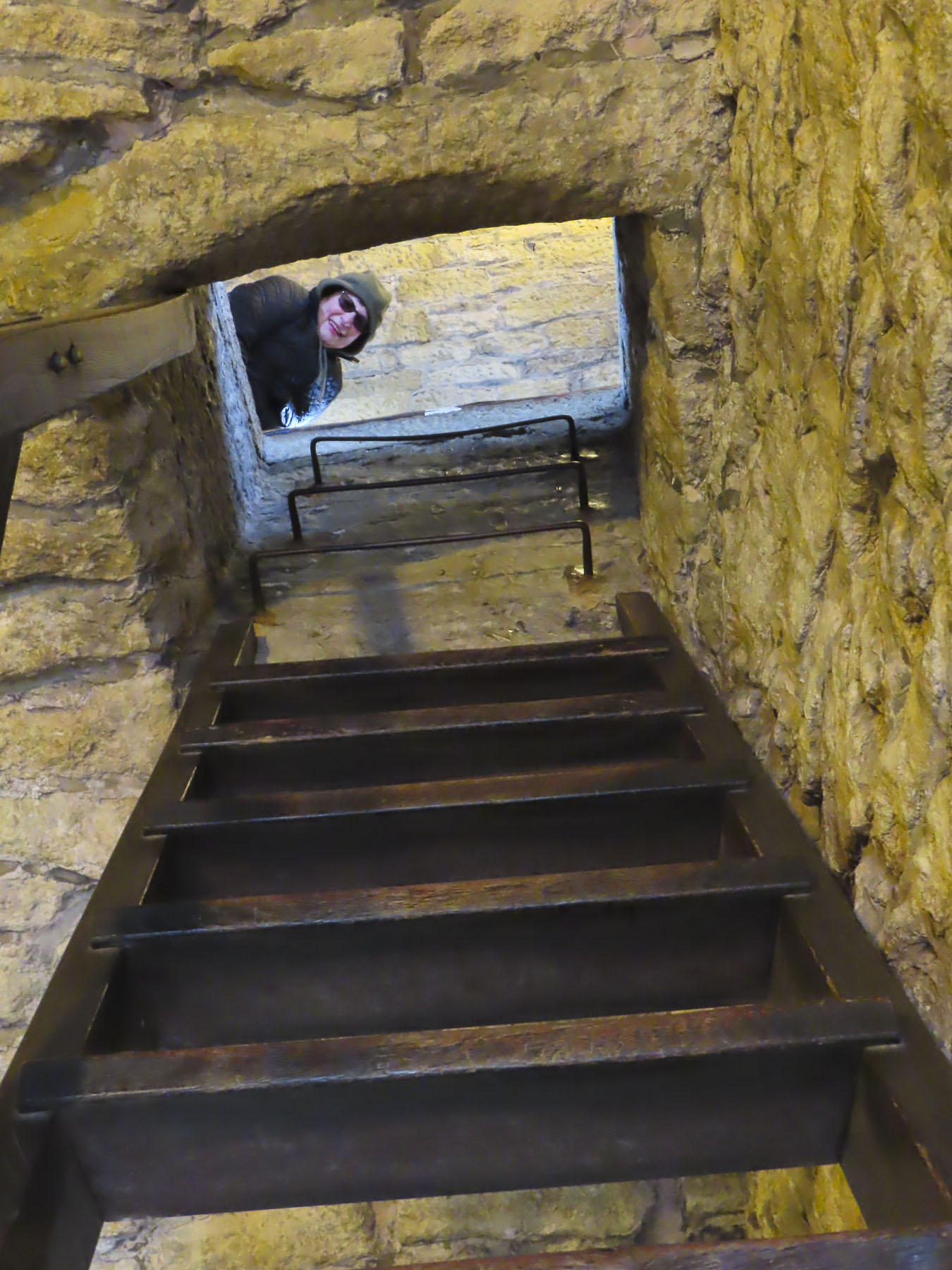
The next morning, we braved the chill wind and climbed to the top of the tower. Donna loves these vertical expeditions. Steep ladders, crumbling fortress walls, and cliffside trails don’t intimidate her. I on the other hand have a healthy fear of heights and am only emboldened with a camera in hand in order to pursue the best photo ops. Spots along the ridge trail connecting the towers were challenging for me, but extremely rewarding for the views.

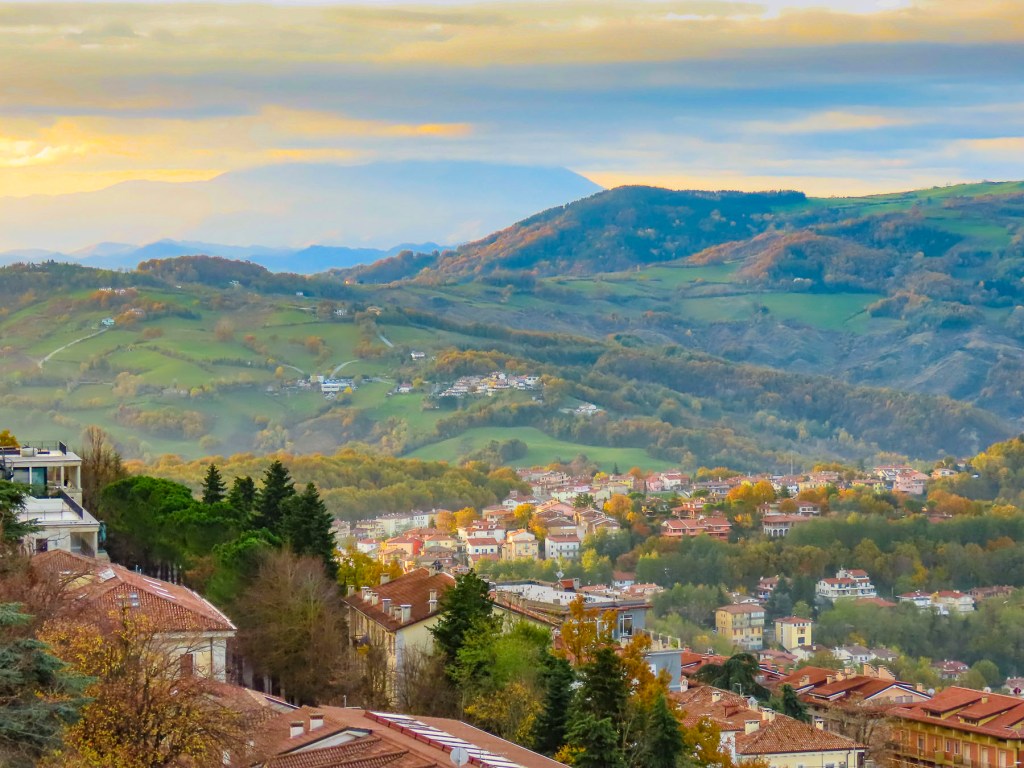
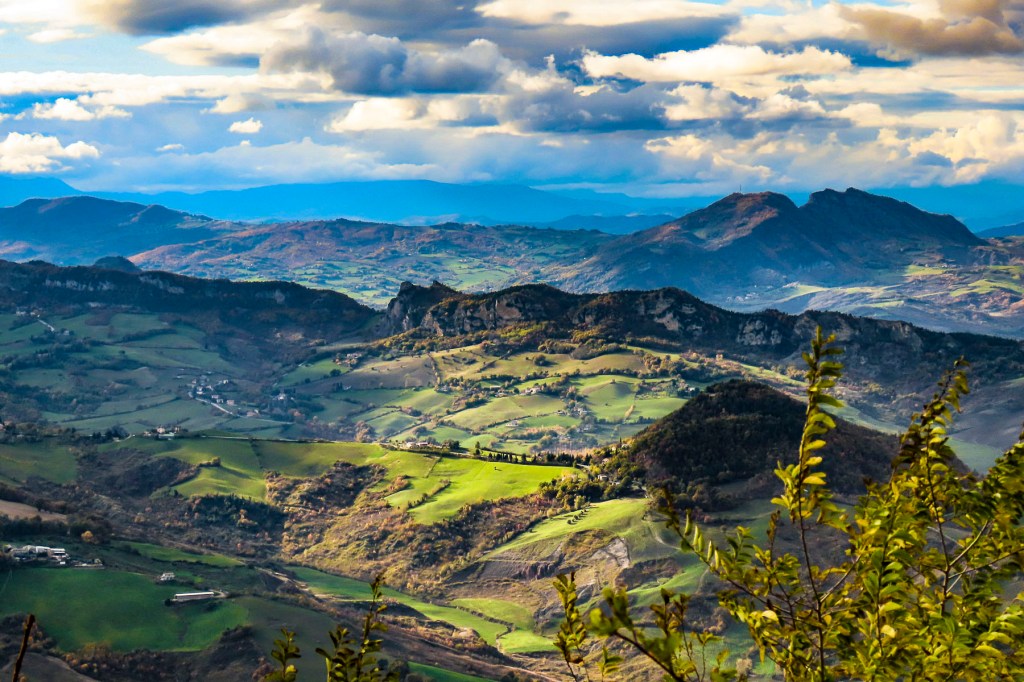
The panoramic, birds-eye-views from the tower were phenomenal and well worth my shaky knee syndrome while on the ladder to the top. The region of Montefeltro spread out below us toward all the compass points. Northward and south the gentle valleys and hills of Emilia-Romagna were saturated with the earthen tones of autumn. To the east the Adriatic coastline near Rimini shimmered on the horizon and it’s said on the best days you can see the mountains in Croatia.  To the west the borders of Tuscany, Marche and Umbria straddled the rugged Appenine mountains around the Regional Natural Park of Sasso Simone and Simoncello.  During the day the towers were manned by lookouts for signs of any approaching armies and at night to spot their campfires.

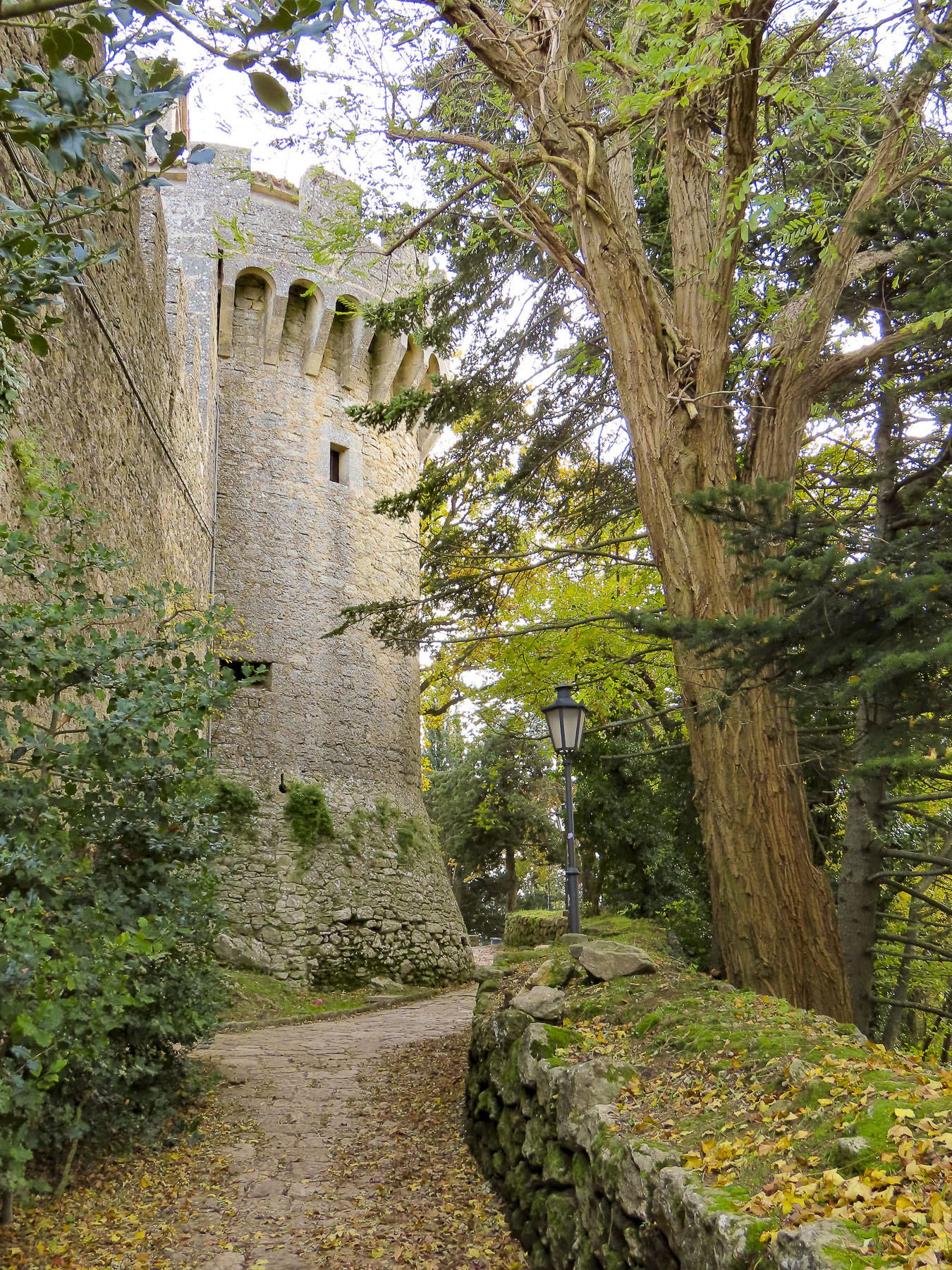
To get to the second and third towers we had to pass through defensive wall that protected the core of ancient village and cross an arched stone bridge, called the Witches Path, Passo delle Streghe, above a deep gorge that divides the ridge. It gets its name from the howling winds that whip through the high, narrow gorge and sound like voices. Allegedly, during the Dark Ages a coven of witches practiced their black magic here. More accurately though, suspected witches in San Marino were thrown to their deaths from the cliff edge. Falesia, the 13th century second tower, was built on the highest point of the ridge (2,425 ft) and used to house a garrison of crossbowmen. It now houses a military museum that showcases ancient weaponry, but was unfortunately closed for repairs during our November visit.

A small door through the Falesia’s outer wall connected to a rugged cobbled path that continued to Terza Torre, the third tower or Montale. The slender 14th century tower stands alone in a wooded area on the bow of the ridge. Built as a lookout tower and prison, the only door to the structure is twenty feet off the ground where prisoners were thrown into one large pit in the tower’s foundation.  This tower has never been open to tourists, but the scenery along the trail makes it well worth the visit.  Challenging trails off this path circumnavigate Monte Titano and eventually lead to the valley below.  The early morning and sunset light on the mountain are totally different and enhance a romantic ambience that is especially rewarding for photographers.

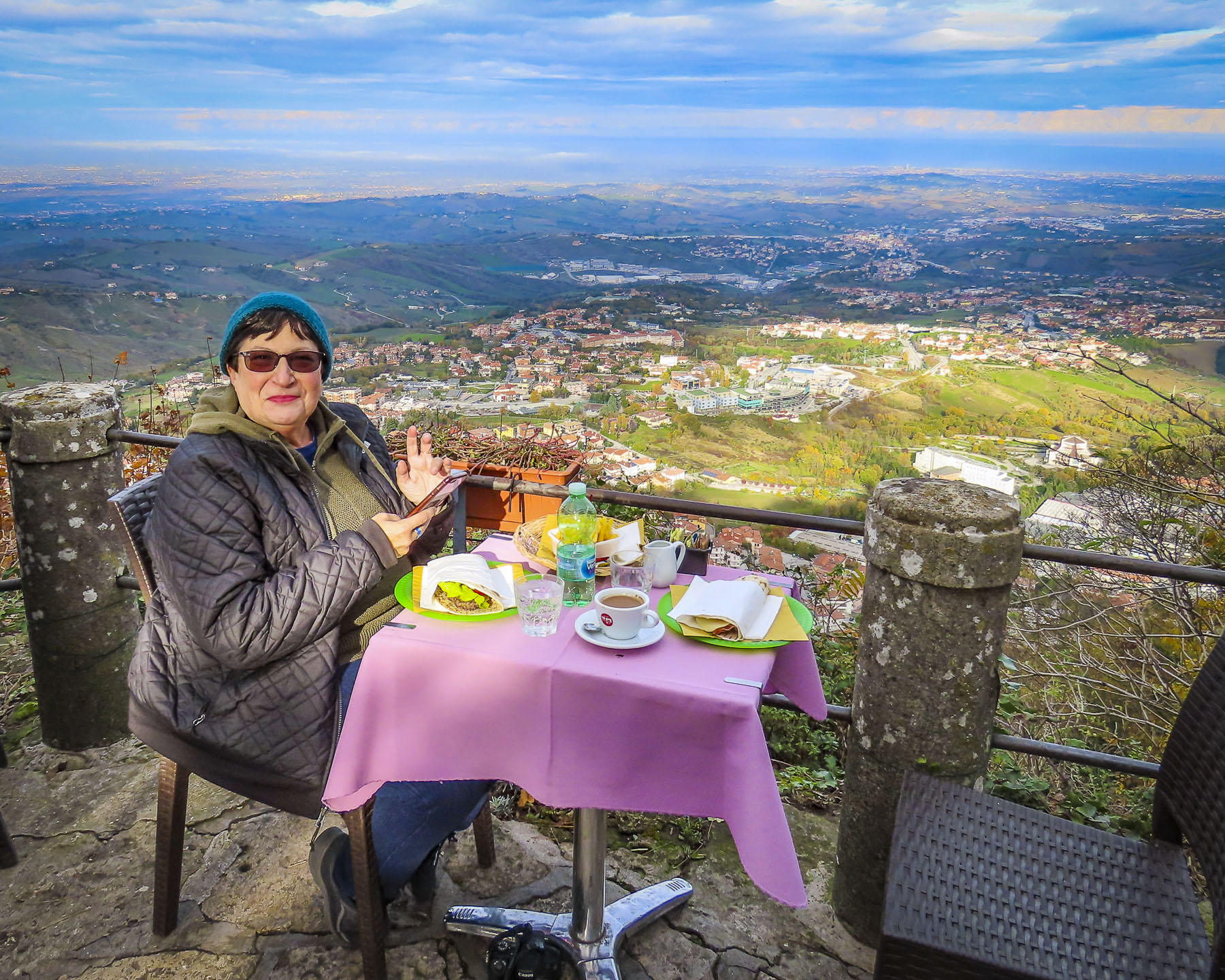
Fortunately, at the other end of the tower path there were many restaurants with indoor and outdoor seating.  Opting to eat outside on a breezy day, so that we could continue to enjoy the view, we lucked out and were able to get a table along the cliff edge that was out of the wind. Another advantage to November travel is that merchants are gearing up for Christmas. The town was very pretty with its holiday decorations, and we were just a bit early for the Christmas market, although the cute little cottages were already set up. Donna had fun browsing the shops, and found a nice commemorative: a roof tile with a miniature Christmas scene built into it.

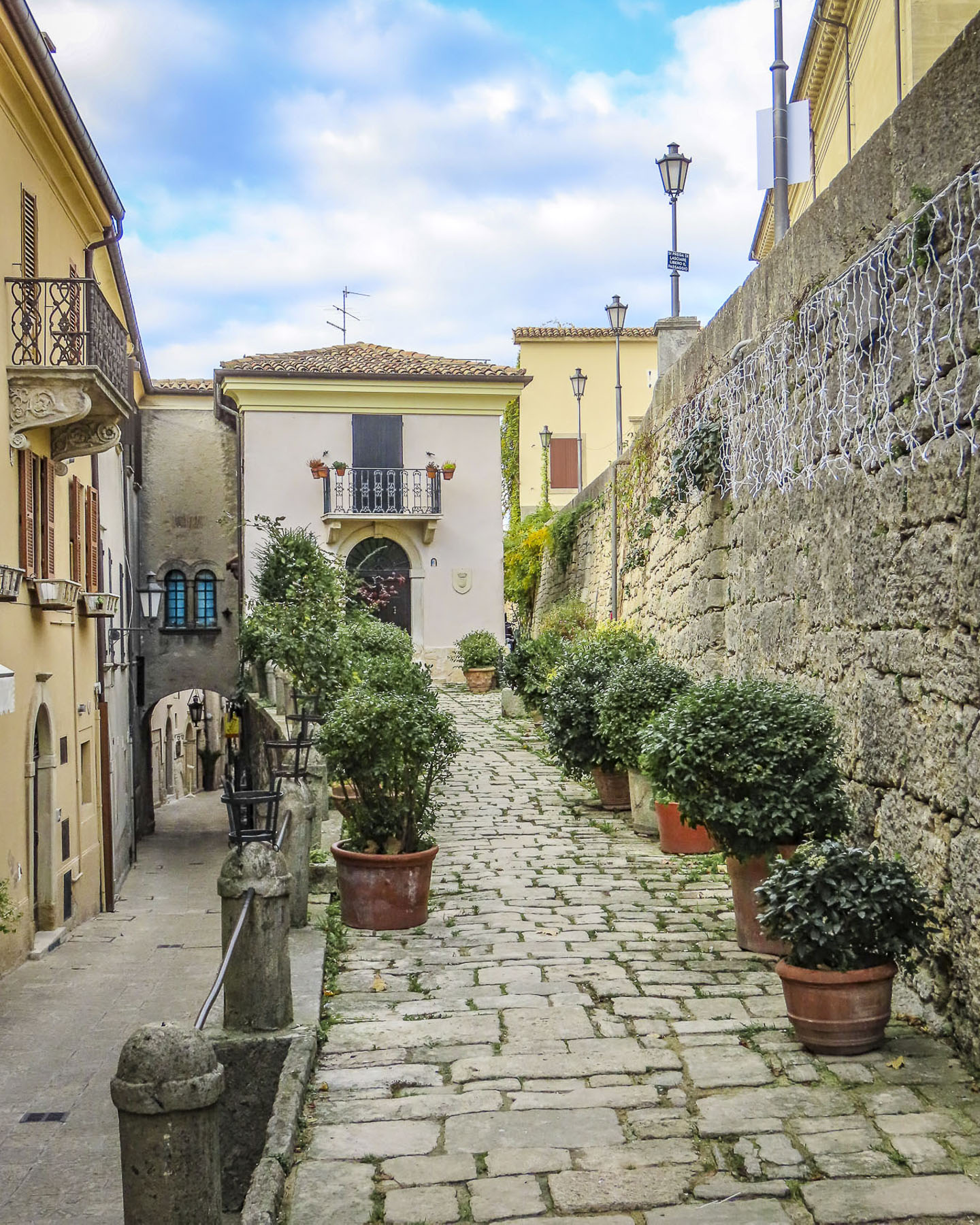
The next morning it almost seemed easier to walk the ridge trail than the steep streets of San Marino’s historic center that were giving our calf muscles a workout.

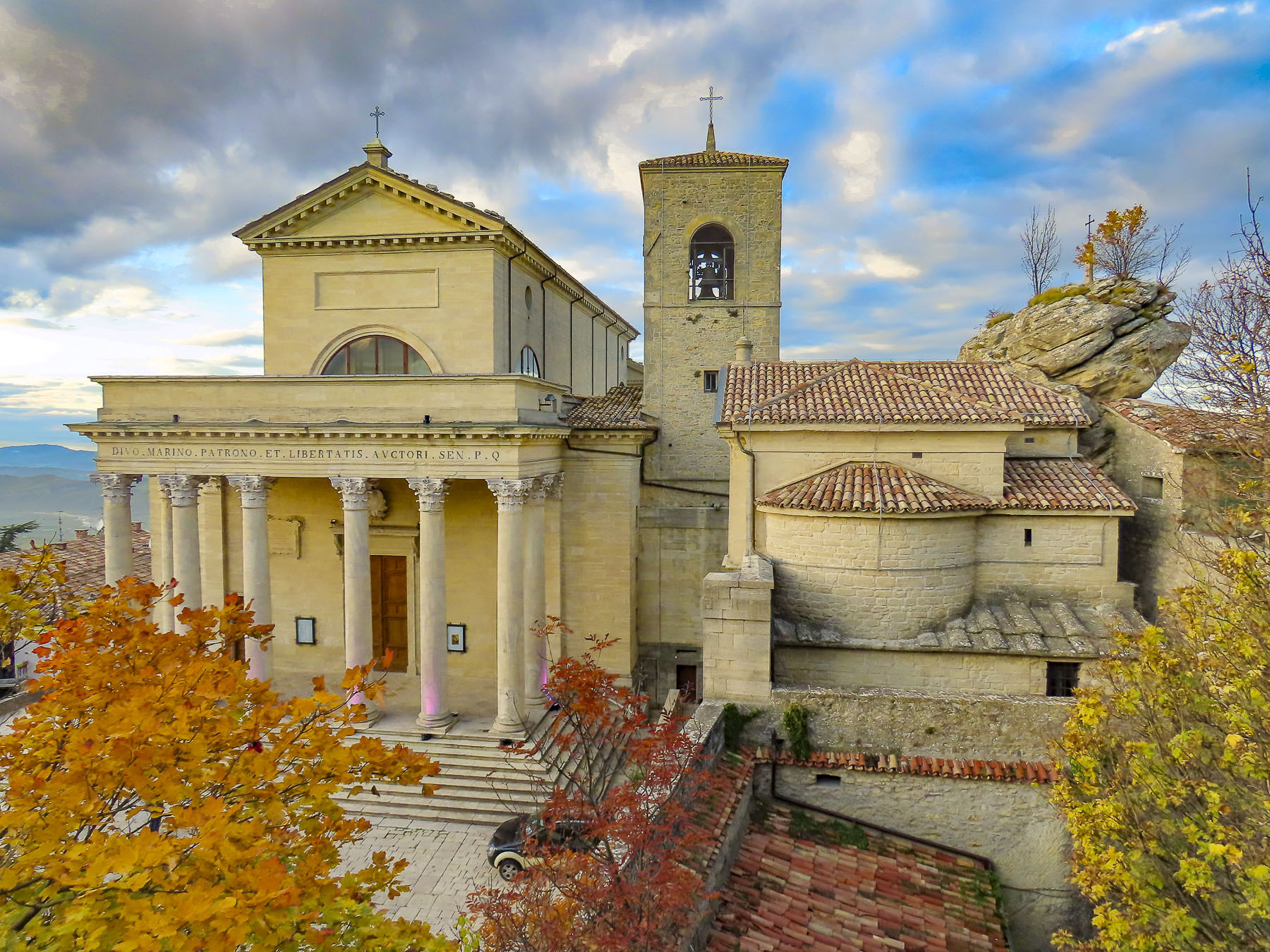
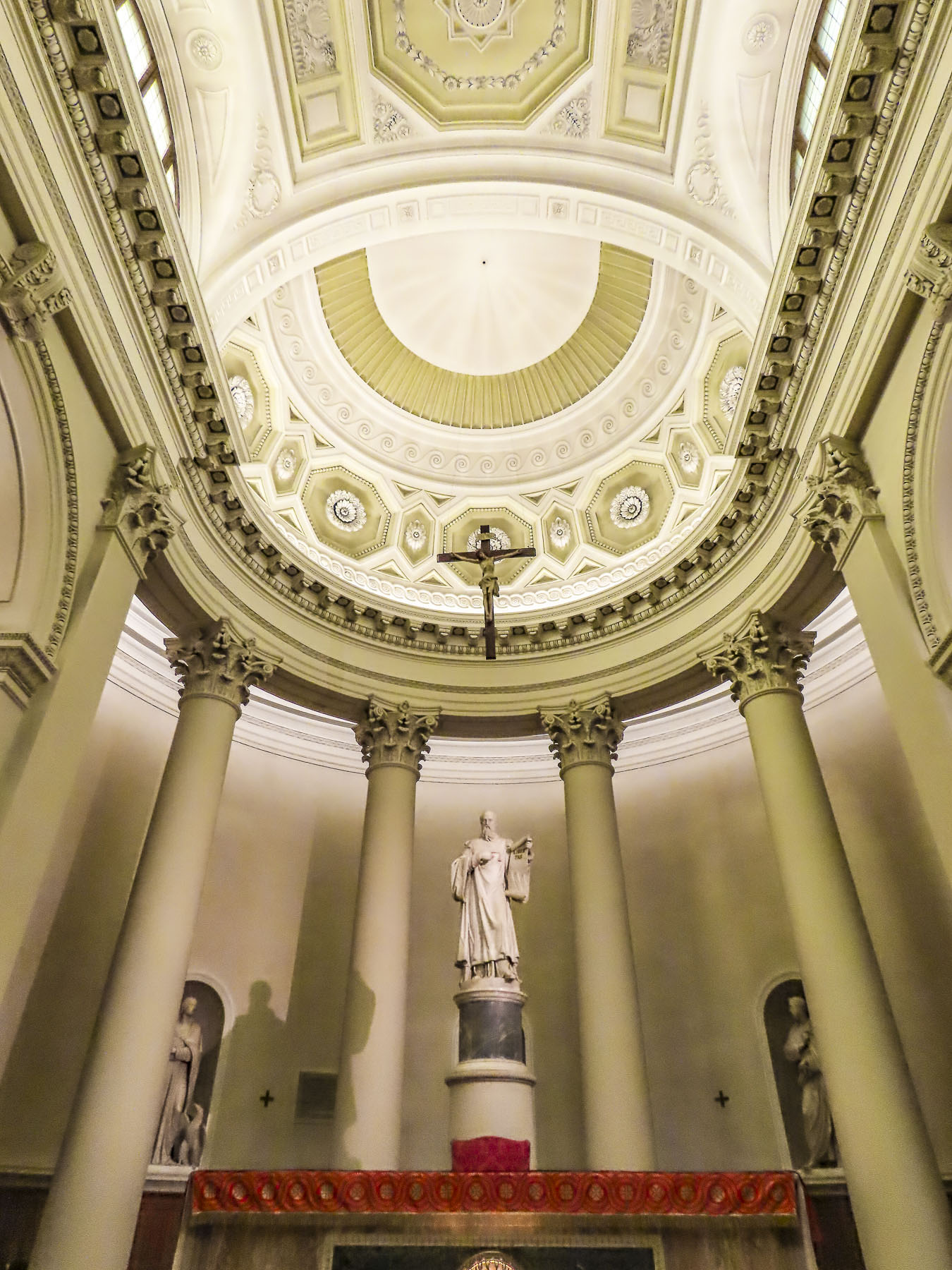
The Basilica di San Marino and the much smaller Chiesa di San Pietro stand next to each other on Piazzale Domus Plebis.  Encompassing the mountain into its structure, Chiesa di San Pietro originally dates to the 600s and has a carved stone recess that legend believes was San Marino’s bed when he first sought sanctuary on the mountain.  The basilica was rebuilt in 1826 in a Neoclassical style over the ruins of an earlier 4th century church. In the church, relics of San Marino are safely kept under the altar.

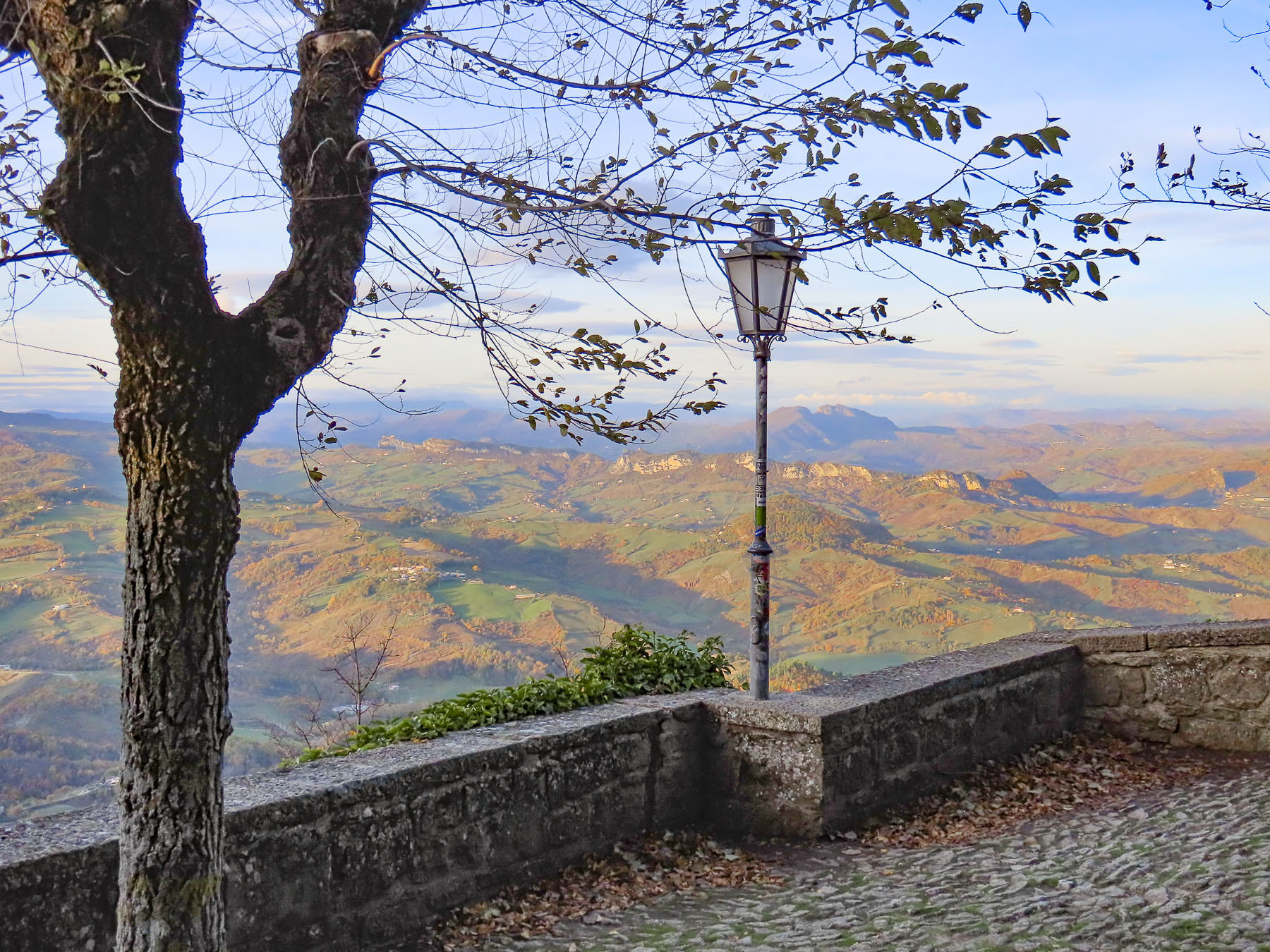
Following narrow lanes we came to the Funivia · Città (Libertà), a cable car, that can whisk tourists up or down the mountain in two minutes, to the parking lot by the Castle of Borgo Maggiore. At this end of the city the wide terrace of Contrada del Pianello offered different yet equally enthralling vistas of the surrounding countryside. The panoramas were especially dramatic late one afternoon, when the sun broke through the cloud cover and cast dramatic shadows cross the countryside.

There is no passport control when you enter San Marino from Italy, which is disappointing if you enjoy getting those passport stamps as reminders of your travels, but for diehards like us, the San Marino Tourist Office, located by the cable car station, will stamp your book for five euros.

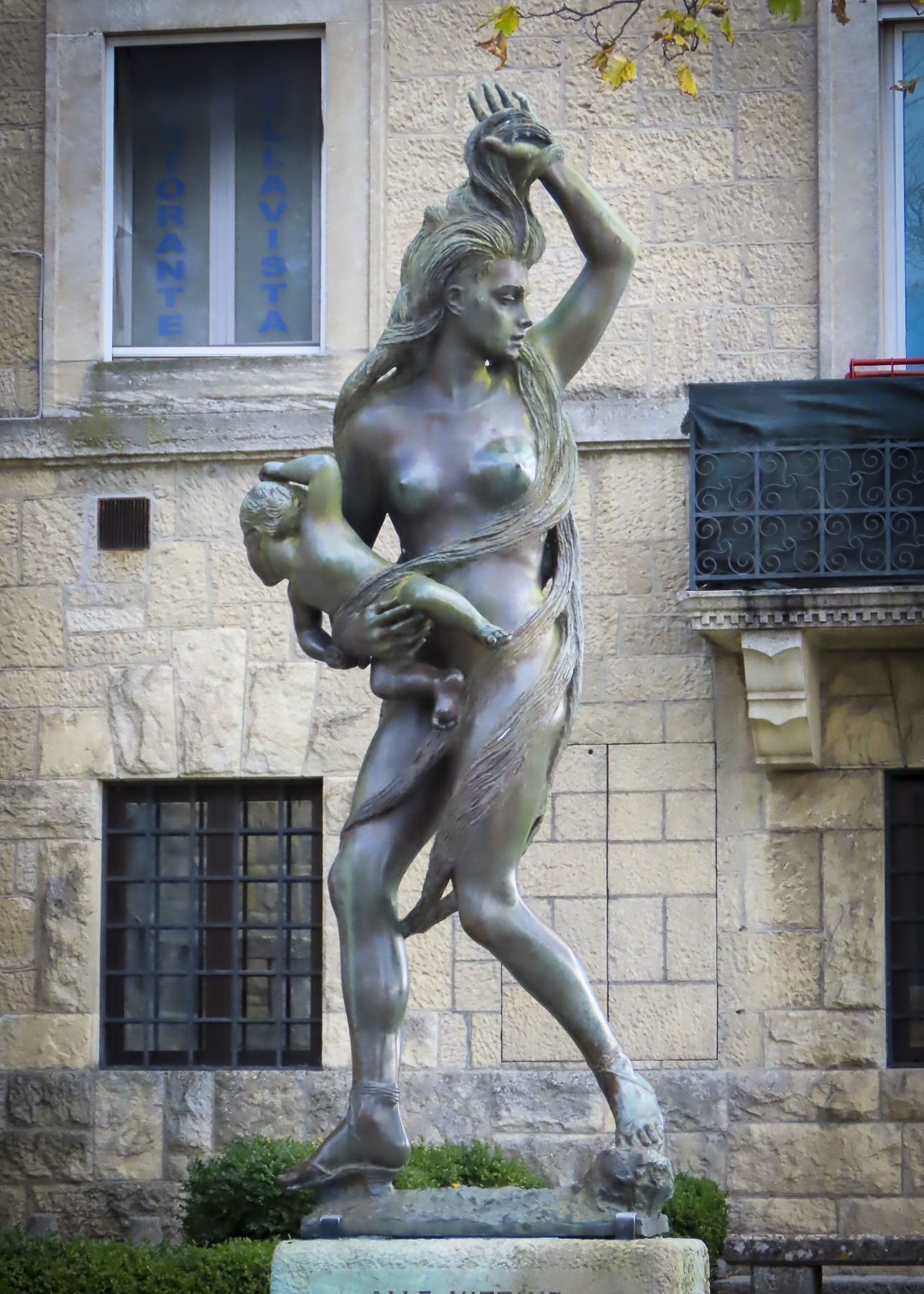
San Marino has some interesting public sculpture and the first piece we encountered was in a small park plaza across from the tourist office. The Alle Vittime Del Bombardament, depicts a young woman rescuing a small child. It commemorates the bombing of the country, a neutral territory, in June 1944 when allied forces mistakenly believed the German Army had retreated onto Monte Titano. Two hundred sixty-three Sammarinese were killed during that air raid.

Working our way to the Museo di Stato, the National Museum, we passed the old stone quarry where the country’s crossbowmen, a military unit formed in 1295, once trained. It’s still used by The San Marino Federation of Crossbowmen, a group of ceremonial crossbowmen, musicians and flag-wavers who now entertain at festivals in Renaissance dress. Further along, just before the Palazzo Pubblico, San Marino’s capital building where the Captains Regents and the Grand Council conduct the business of the country, more whimsical sculptures graced a small area with benches. 

Piazza della Libertà in front of the Palazzo Pubblico gets its name from San Marino’s own version of Lady Liberty. Sculpted from brilliant white Carrara marble, the Statua della Libertà depicts a striding female warrior, carrying a flag-draped spear and extending a hand in peace, with the three towers of Monte Titano as her crown. It was donated to the country in 1876 by German Countess Otilia Heyroth Wagener, a former Berlin ballerina, who married an Italian nobleman. This was ten years before the French Statue of Liberty was finished in New York harbor.

Adjacent to the entrance of the National Museum, the Grande Statua Nudo Femminile or the “Great Female Nude Statue,” (this title creates such an unflattering visualization for a tranquil figure and anyway the sculpture is only 5.5ft tall) by Italian sculptor Francesco Messina stands in front of the Cassa di Risparmio della Repubblica di San Marino, a bank. The bronze was purchased to celebrate the bank’s 100th anniversary.  I can just imagine the discussion around the board of directors table, “Profits are up this year, we should invest.” “Yeah, big nude sculptures are symbolic of banking success, financial stability!” “One would look good in front of the building.” “Okay, let’s vote.” I’m being sarcastic, of course, though San Marino does have liberal banking regulations and welcomes offshore accounts from wealthy individuals looking to hide their assets.

The Museo di Stato, the National Museum, has an interesting collection of archeological items discovered on Monte Titano and its surrounding territory that spans its early history, along with art and religious items.  We were not aware of it at the time, but San Marino offers a museum pass for 8€ that allows you visit all seven of the country’s national museums. It is a very good value.

It was a long uphill walk back to our hotel, but well worth it to enjoy the quaint lanes of this unique republic one last time before our departure the next morning. If you are looking for an aerial experience over the Italian countryside without renting a helicopter, a trip up Mount Titano in San Marino might fit the bill.

Till next time, Craig & Donna