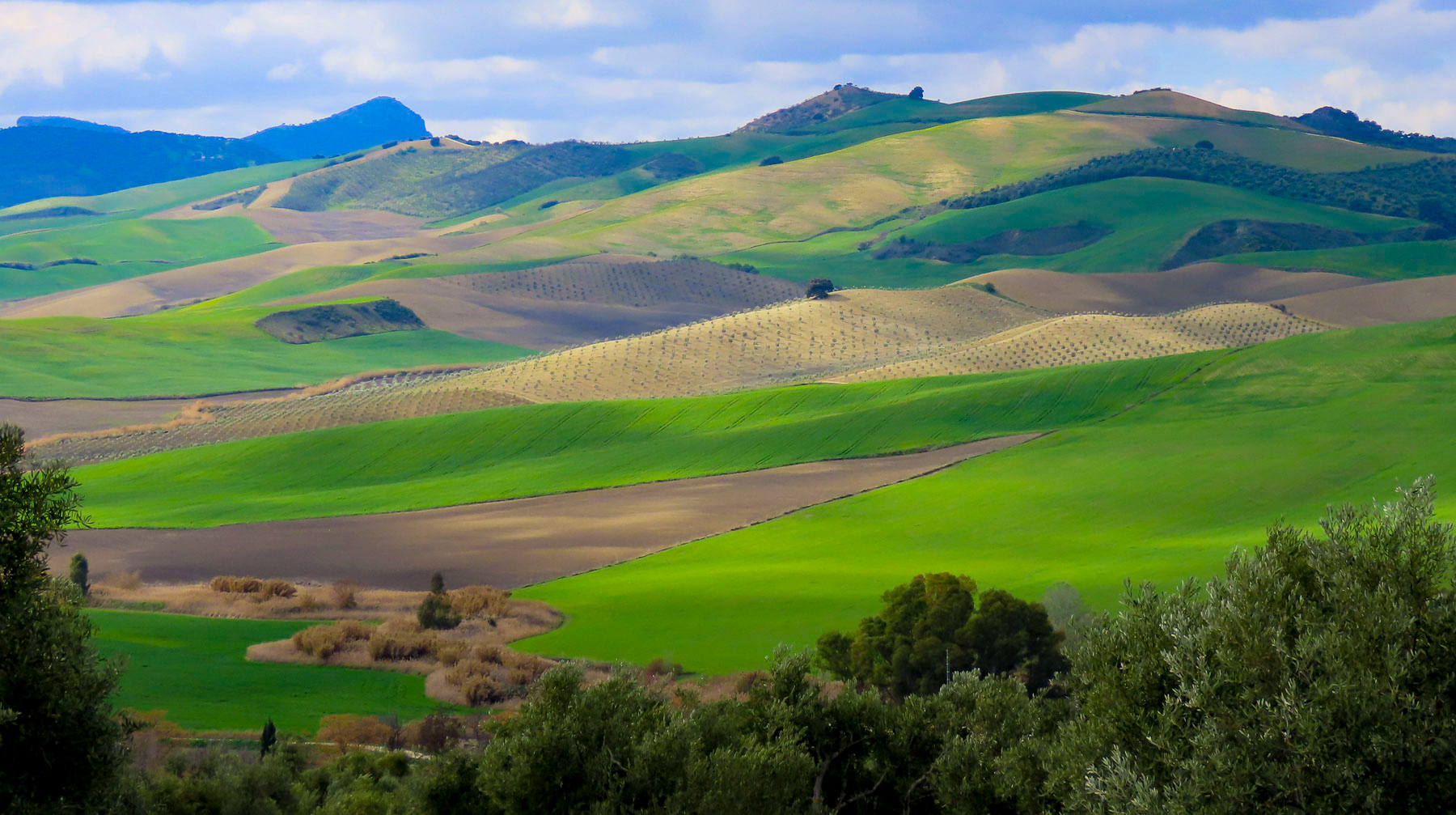
France: Road Tripping Through Normandy – Fecamp, Yport & Étretat

Overnight showers had cleansed the air, the morning was brilliant with sunshine, and the deep blue sky was checkered with fair weather clouds. We were road tripping west through flat farmlands and pasturelands, which were lined with rows of beech trees to protect the land from the ferocious winds of winter storms. The landscape was dotted with Normande, a breed of dairy cow descended from the cattle that the Vikings brought with them when they settled in the area during the 9th century. A white cow, speckled with brown patches, this breed is favored for its milk’s high fat content, which lends itself perfectly for making CHEESE! More specifically the PDO (Protected Designation of Origin) Camemberts, Livarots, Pont-l’Evêques and Neufchâtels that the Normandy region is famous for. Small signs for fromage and cider pointed down many dirt lanes that spurred off our route.

We were heading to the white cliffs of Fecamp and Yport, in the Seine-Maritime department of Normandy, on the English Channel. While planning this trip we read about high season – over-tourism running rampant across France. Crowds don’t appeal to us, so we’ve been planning our travels to coincide with a destination’s shoulder season for a while now. The articles also suggested visiting places off the usual tourist radar, which is how we came across Fecamp and Yport, our stops before reaching Étretat. In hindsight we should have planned a full afternoon or overnight stay in Fecamp, as the quick glimpses of the Palais Ducal, now ruins, and the Holy Trinity Abbey, as we drove through the historic center, revealed a pretty town and looked intriguing, worthy of further exploration.

Our “walk a little then café,” becomes “drive a little then café,” when we have wheels, and by the time we entered Fecamp it was time to satisfy that late morning craving. Parking in unfamiliar towns is always a challenge, and on a busy Saturday even more so, but we lucked out and found both a parking space and great café near the harbor. The sunny outside tables at Le Coffee de Clo were empty so we were surprised when we entered to see a lively shop nearly full of people busily enjoying the decadent sweet creations we had stumbled across. More muffin than pastry, the baked goods and excellent coffee here are the only excuse you need to detour to Fecamp.

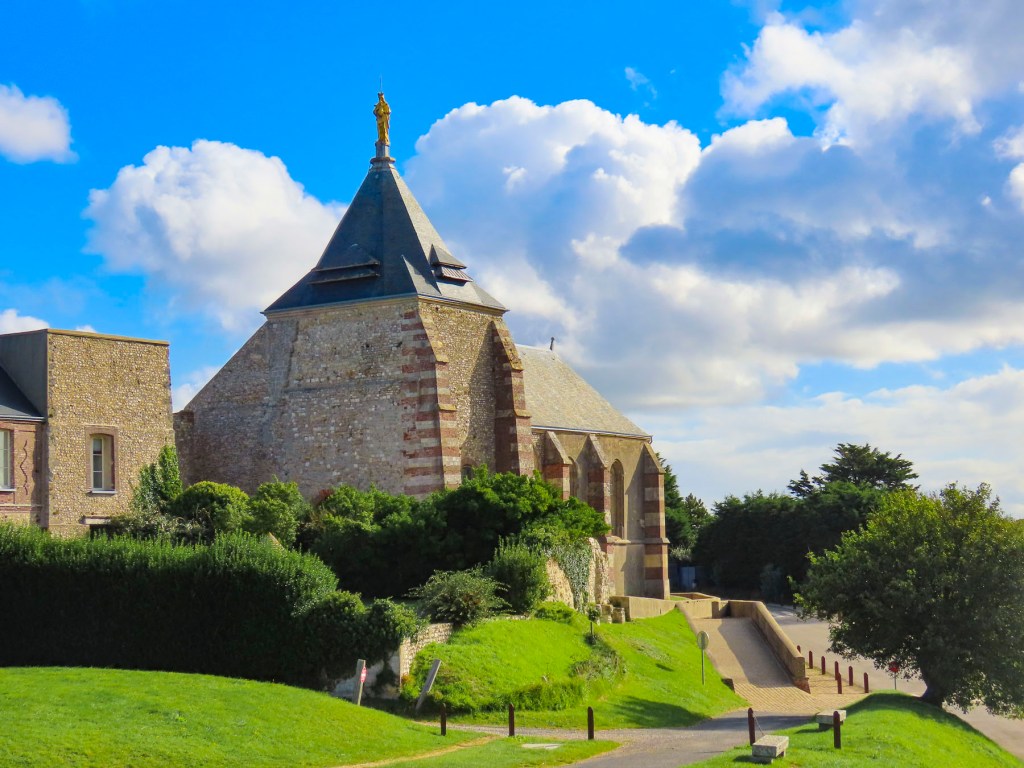
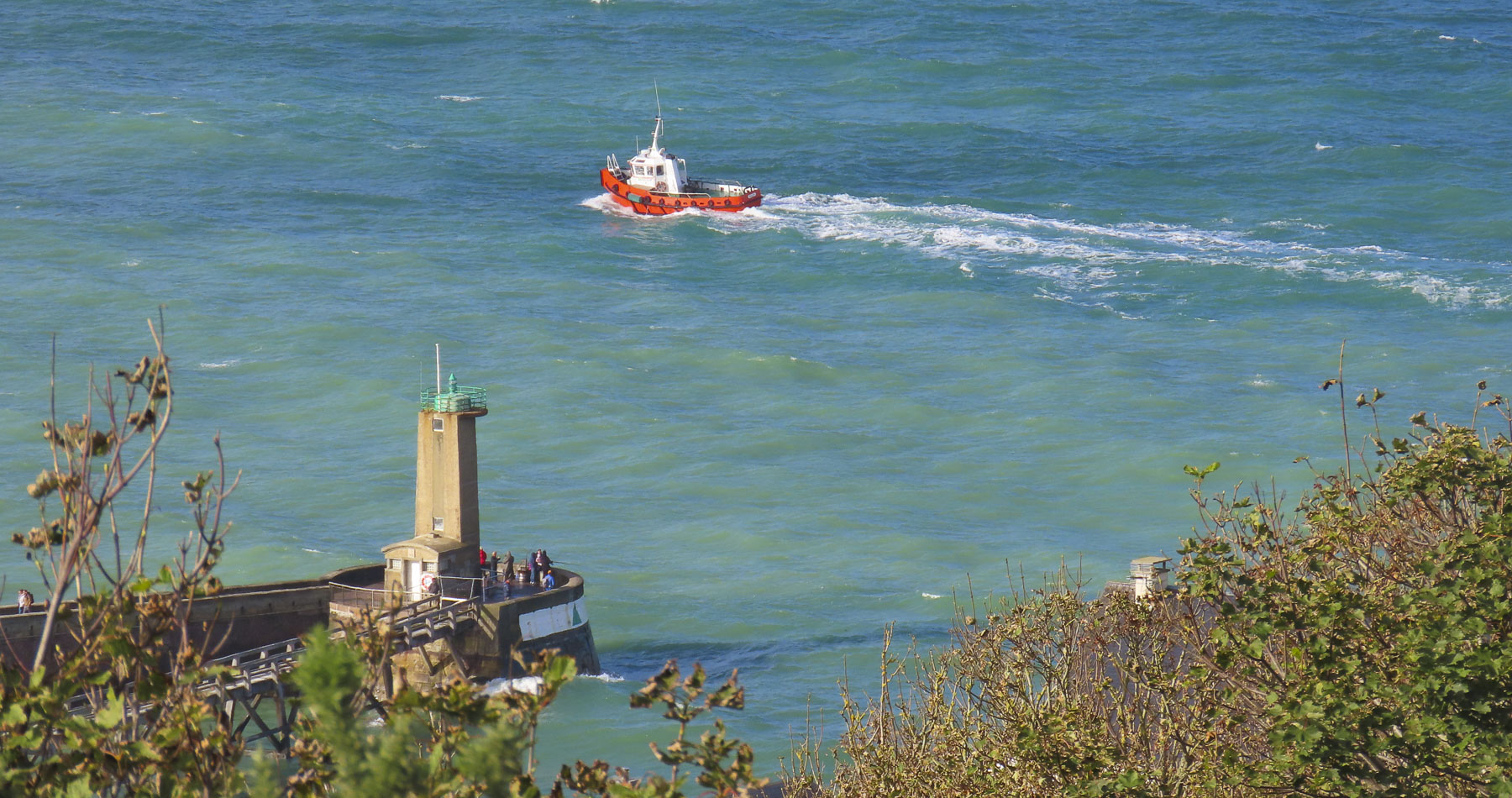
Walking back to the car, we spotted the Chapelle Notre-Dame du Salut, across the harbor, high atop Cap Fagnet. It’s believed that Robert the Magnificent, an 11th century Duke of Normandy, constructed the church in thanks to God for surviving a shipwreck in the waters below the white cliffs of Cap Fagnet. It’s been a pilgrimage site for fishermen, sailors, and their families ever since.

The views from the terrace in front of the church of Fecamp’s harbor, and the southern half of La Côte d’Albâtre, the Alabaster Coast, take in an 80-mile stretch of white cliffs between Etretat and Dieppe on the Normandy coast, that mirrors the distant White Cliffs of Dover across the channel. Locally the cliffs around Fecamp are known as le Pays des Hautes Falaises, high cliff country.

In 1066, William of Normandy set sail from Fecamps’ harbor with a fleet of more than 700 ships, partly financed by the Abbott of Fecamp, to claim the Crown of England, which he had inherited, but this was being contested by Harold, a pretender to the throne.  The issue was settled at the Battle of Hastings when the former became King William the Conqueror. It was also reassuring to learn that the Fecamp monks transitioned away from being international arms merchants, and segued into a more appropriate occupation –  running a distillery in the 16th century, that produced a 27-herb flavored liqueur that would become popular in the mid-1800s and sold as Le Grand Bénédictine.

Eight hundred seventy-eight years after William set sail, on June 6, 1944, during WWII German fortifications along the Côte d’Albâtre failed against an allied amphibious invasion fleet of over 7000 ships and landing craft. It was the beginning of the end of WWII. Scrambling to the top of an abandoned bunker provided us with the perfect vantage point for photos of the coast.

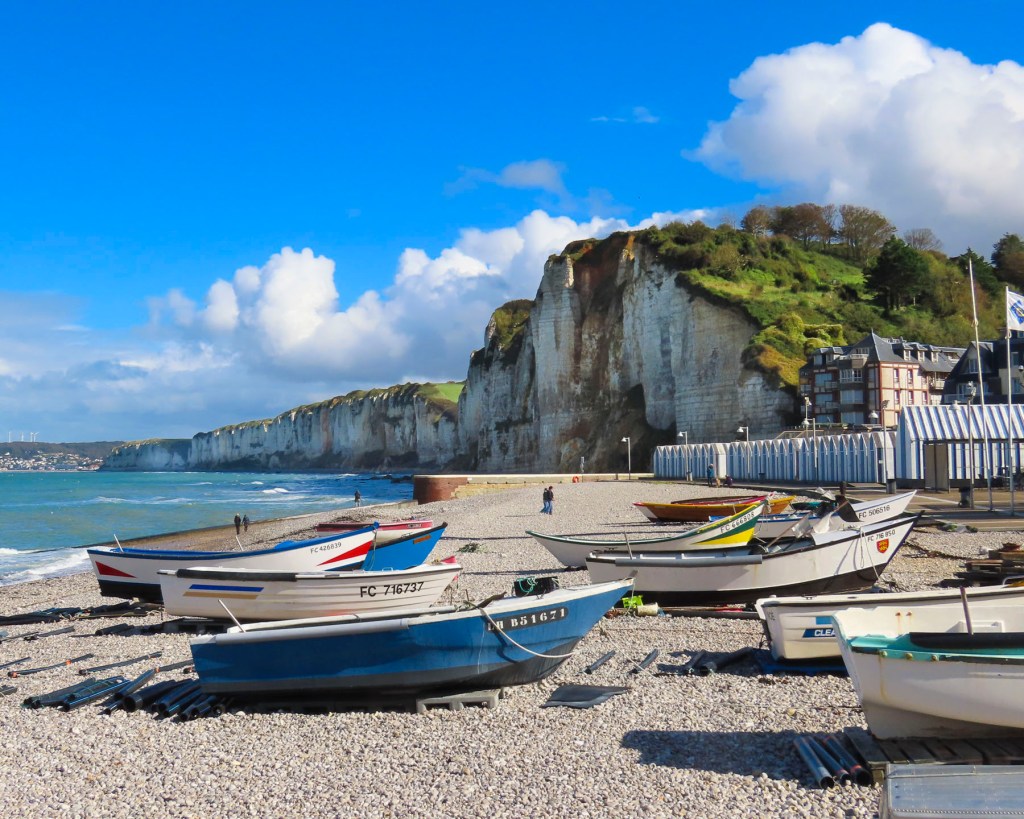
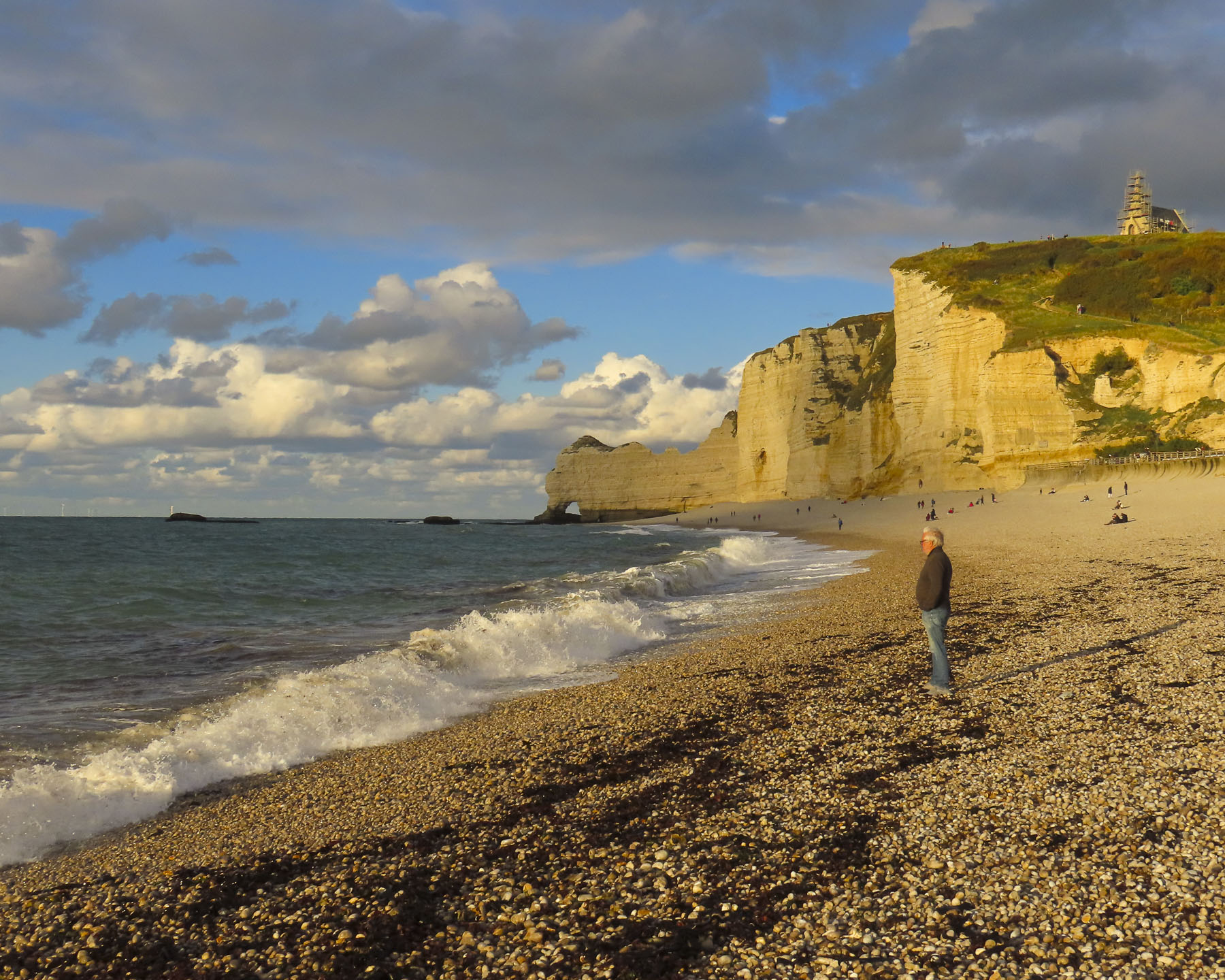
By the time we arrived in Yport the clouds had thickened and were threatening to rain. To our dismay, it poured just as we were parking by the beach promenade. Fortunately, it was an intense but brief shower that cleared into a cloudless sky and revealed a quaint picturesque hamlet and shining white cliffs towering above the sea.

The cliffs along the seafront have been eroding for eons, creating in certain spots deep, long ravines that funneled torrents of water, laden with sand and stone through the cliff face to the ocean, which created beaches in certain places over the ages. These narrow valleys are called valleuses, and the small coastal fishing village of Yport started in one during the Neolithic era.

Without a harbor, fishermen pushed their small boats across a pebbled beach and rowed out through the waves to pursue their livelihood. They repaired their boats and mended their nets on the beach at the foot of the town. This way of life supported the villagers for centuries. Only the invention of the small outboard motor in the early 1900s eased their physical effort, until the 1960s when tourism and a small casino replaced fishing as the town’s driving economic force.

In 1838, the tightly knit community decided to build a church. Men, women, and children gathered tons of smooth stones from the beach, carted them 500m inland, and proudly worked together to mix cement and build the center piece of their town. Horizontally striped with alternating layers of colored beach stones, the façade of the church is beautiful, and unique in Normandy. It is a true testament to the power of community spirit.

By the mid-1800s Parisians seeking a more relaxing retreat than Etretat were frequenting the quiet fishing village. The French painters Monet, Renoir, Schuffenecker, and Vernier visited and painted there, while the 19th century French writer Guy de Maupassant set his novel, ‘Une Vie,’ in Yport. Paths from the center of the town and from behind the casino lead to the cliff tops and join the popular GR21 trail that can be followed north to Fecamp or south to Etretat.

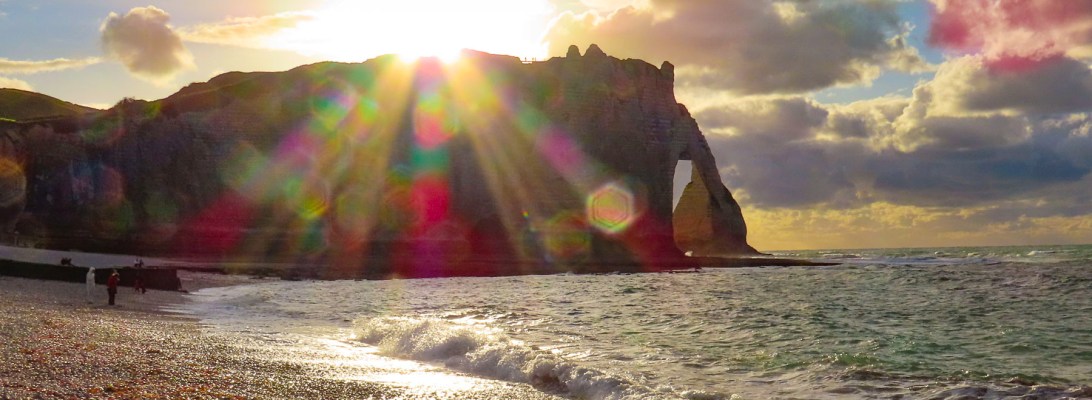
Regardless of how beautiful photos of the Falaise d’Aval are, they don’t rival the physical reality of the calling gulls, wind-swept hair, the whistling wind and the relentless sound of the surf crashing against the stoney beach.

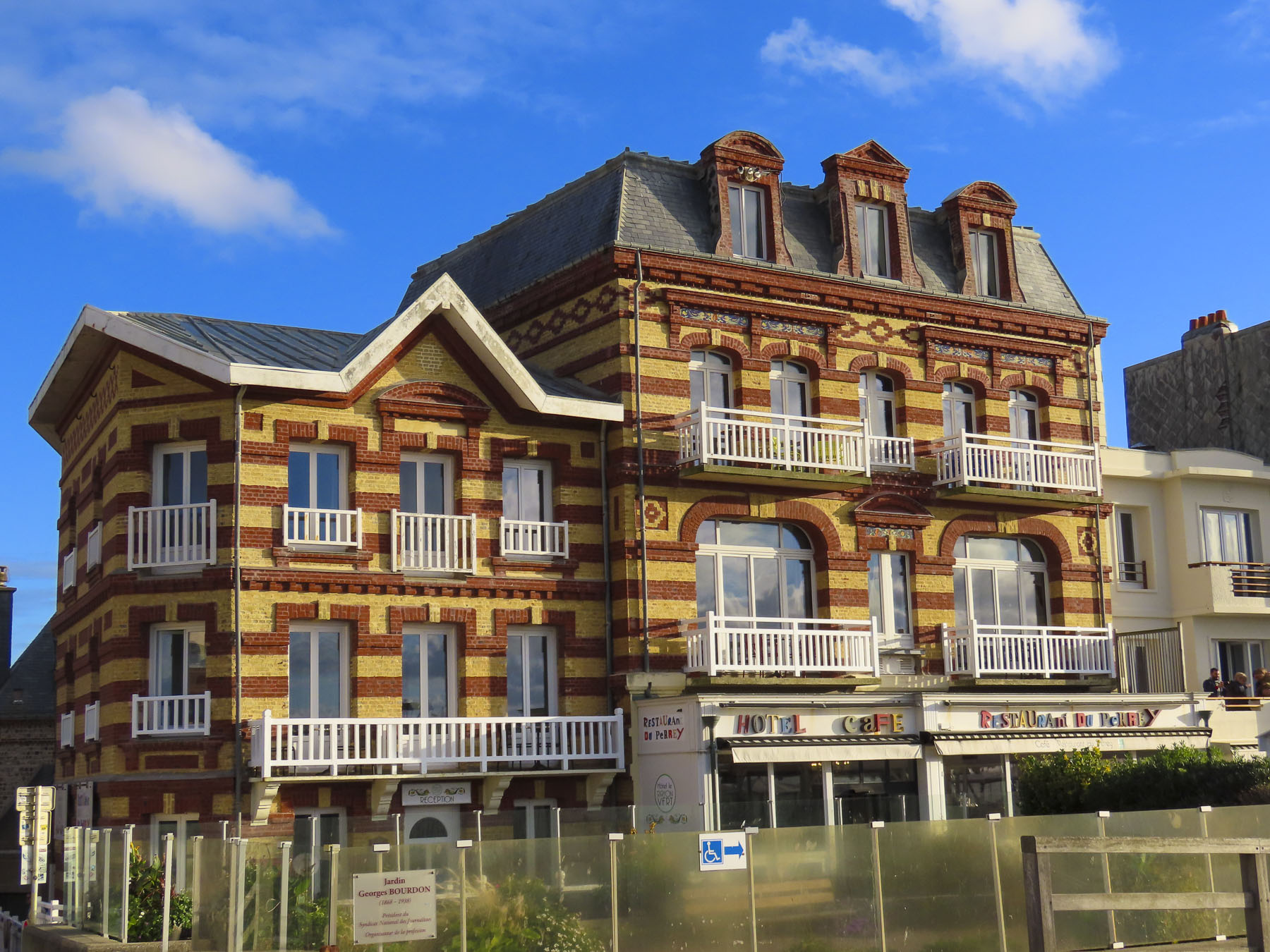
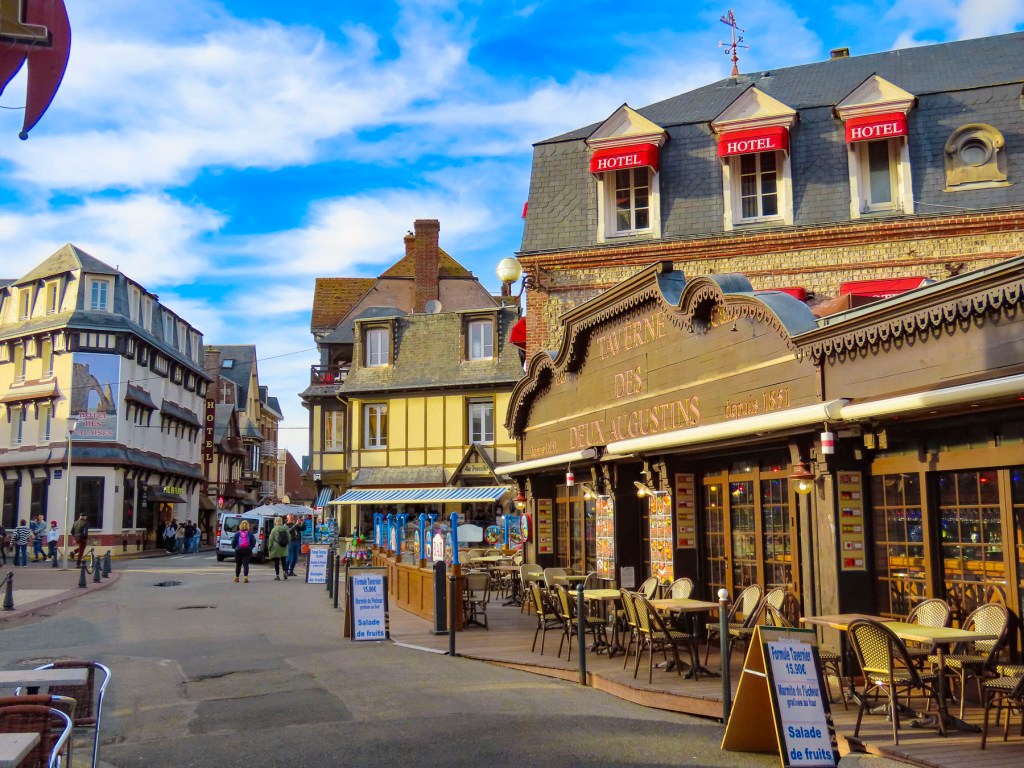
Arriving late on a Saturday afternoon in mid-October, we were surprised Étretat was jammed with tourists. Parking is extremely limited here and finding a space is almost a competitive sport that ultimately just required us to sit in a row and wait for someone to return to their car. It sorted itself quickly enough and luckily, we were only a short walk from one of Étretat’s first lodgings, the Hotel Le Rayon Vert, which to our delight was directly across from the beach and Étretat’s promenade. After checking in, we headed to the top of the towering 300ft high cliffs for sunset, the first of many walks along this beautiful stretch of coast and the perfect way to work up an appetite.

If you have been following this blog, you’ll know my superpower is the ability to find a great pâtisserie, pastelería or pastry shop. It’s a great talent when the hotel wants 16€ per person for breakfast. In Etretat, the boulangerie patisserie “Le Petit Accent” exceeded all expectations!

Set high above the town, it was a steep uphill walk to the Jardins d’Etretat. This whimsical topiary garden, with playful faces as “Drops of Rain,” by the Spanish artist Samuel Salcedo, more so than the Falaise d’Aval, was the catalyst for visiting this seaside resort.

This magical spot has its roots over 100 hundred years ago when a villa and garden were built here by Madame Thébault, a Parisian actress, and friend of the impressionist painter, Claude Monet. Madame Thébault cultivated a circle of creative folks as friends, and Monet along with other painters and writers were her frequent guests. It was from a patio in this garden that Monet found repeated inspiration to capture the essence Les Falaises à Étretat.  His love of the area is evident in the nearly 90 canvases he painted depicting various scenes along the Normandy coast. But the Jardins d’Etretat today are a relatively new botanical masterpiece reopening in 2017 after an expansive reinterpretation led by the landscape architect, Alexander Grivko.

Across from the entrance to the garden, a tall soaring monument pointing skyward, elegant in its simplicity, commands a view out over the cliffs and the ocean beyond. This tribute commemorates the last sighting from French soil of the pilots Charles Nungesser and François Coli on May 8th, 1927. They were flying their biplane L’Oiseau Blanc, The White Bird, from Paris to New York in an attempt to be the first non-stop flight across the Atlantic Ocean and win the Orteig Prize of $25,000. But they disappeared somewhere along their route. It’s believed they made it across the Atlantic, but crashed into the dense wilderness forest of Nova Scotia or Maine. Wreckage of L’Oiseau Blanc has never been found and their disappearance remains an unsolved aviation mystery, that rivals Amelia Earhart’s story.  If Nungesser and Coli had succeeded, they would have beaten Charles Lindbergh in the Spirit of St. Louis by twelve days.

The Notre Dame de la Garde stands alone on the slope below the Monument “L’Oiseau Blanc,” isolated on the cliffs like a small boat surrounded by a vast ocean, its spire like a lighthouse’s guiding beacon, visible far out at sea. It offers a welcome sign for the fishermen and sailors returning home. Unfortunately, it was undergoing renovation when we visited in mid-October.

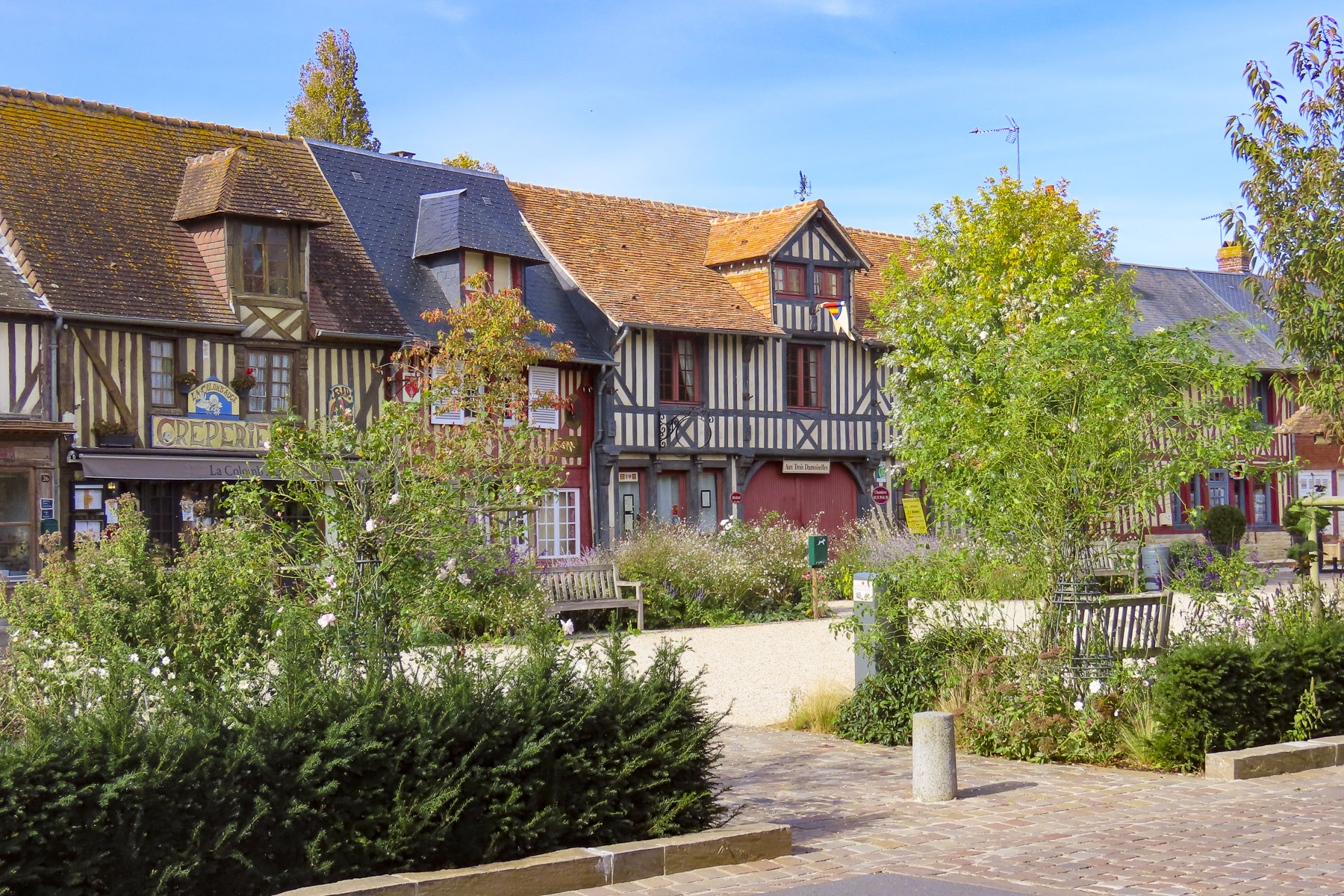
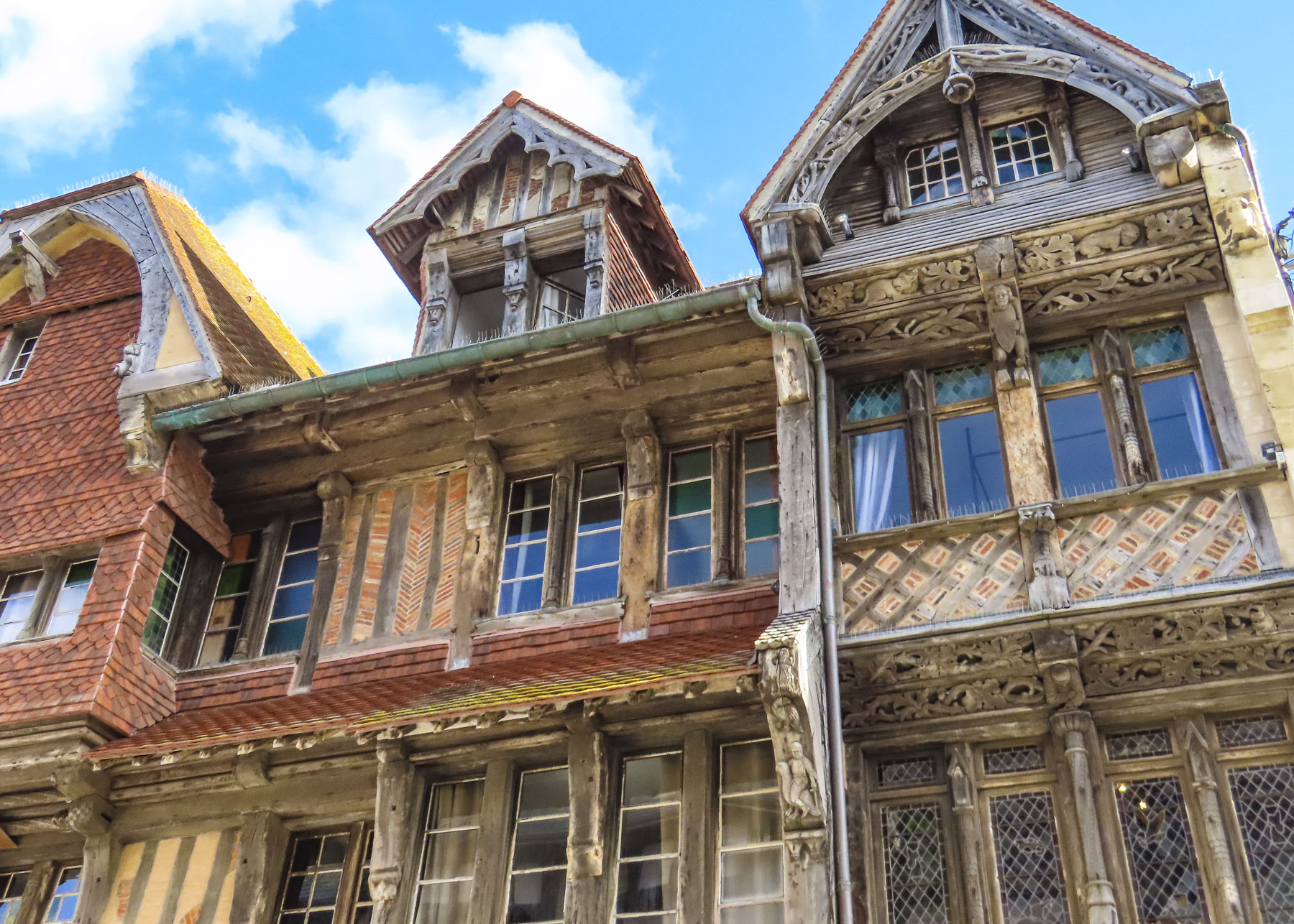
Walking back through the village we found the Normandy architecture in Etretat intriguing. It encompasses many different styles and runs the gamut from ancient half-timbered buildings embellished with ornate wood carvings, to 18th and19th century designs utilizing the local hard flintstone and incorporating steep pitched slate roofs and turrets into their designs. All fascinating.    

Etretat has been a popular destination since rail service began between the port city of Le Havre and Paris in 1847. Swimming or a day at the beach later became common place with the latest fashion, the full body bathing suits. While society folks were sunbathing on the stoney beach, there was a cottage industry of locals, called pebblers. They collected the beach stones for their high silicone content, which were then pulverized and used for various industrial purposes. It’s now illegal to remove any pebbles from the beach as they are vital natural protection against storm surges and marine submersion of the promenade built across the top of the beach, which is much easier walk on than trekking across the pebbly beach, where each footstep sinks into the loose stones and is exhausting to cross.

The classic 19th seaside resort continues to draw visitors, with the success of the French Netflix series Lupin, based on the writer Maurice Leblanc’s character, Arsène Lupin, the gentleman burglar. Leblanc’s former summer home, where he wrote some of his books, is now the Le Clos Arsène Lupin Museum. Some scenes were filmed locally, motivating a whole new generation to discover the white cliffs. The other French writers and composers who enjoyed their time in the quaint village include Victor Hugo, Guy de Maupassant, and Jacques Offenbach, all of whom are remembered with streets named in their honor.

We also enjoyed our time along the Côte d’Albâtre, but just seemed to scratch the surface of this beautiful part of Normandy.

Till next time, Craig & Donna
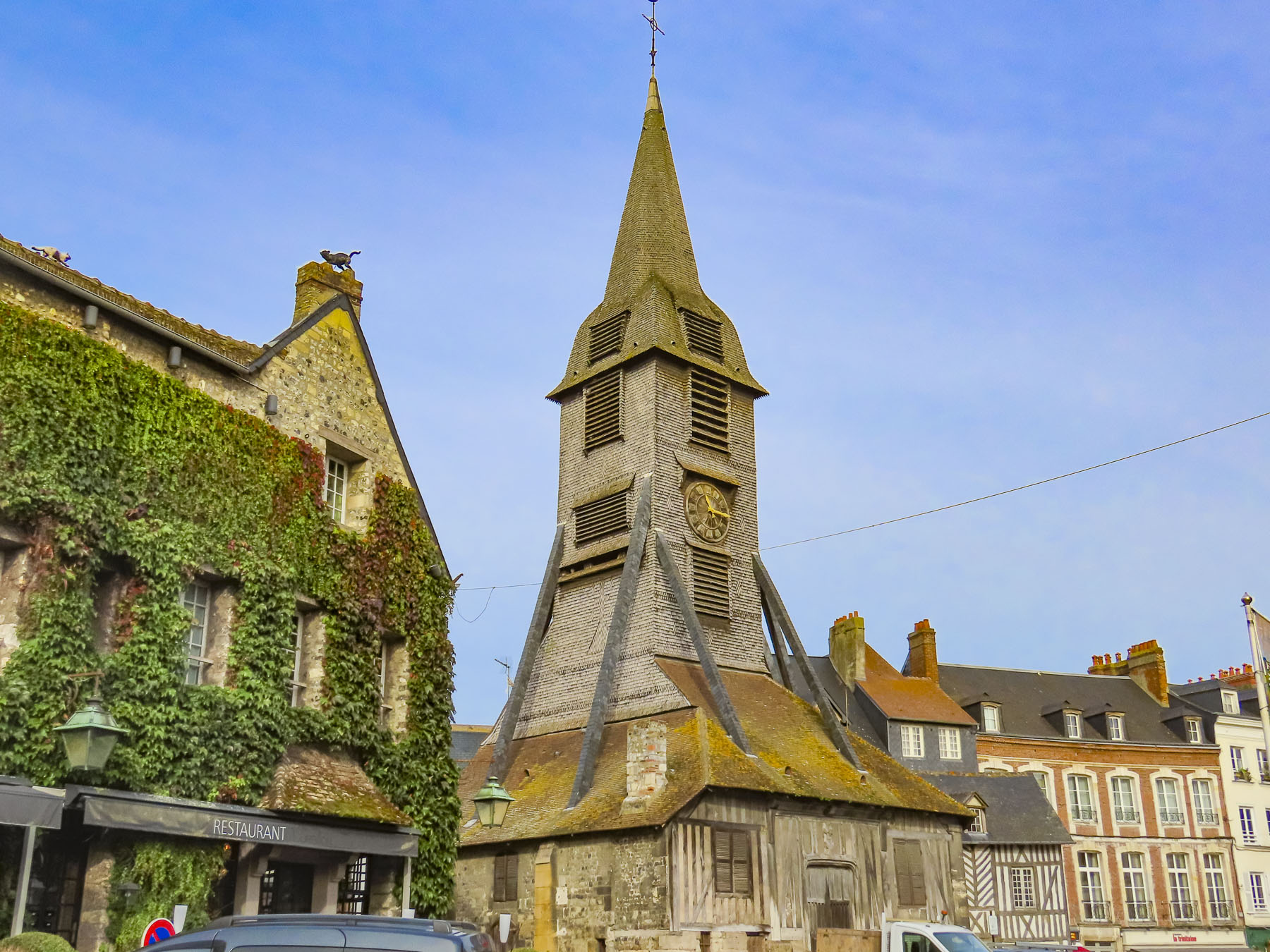
Road Tripping Through Andalucia: The Pueblos Blancos of Ubrique, Villaluenga del Rosario and Arcos de la Frontera

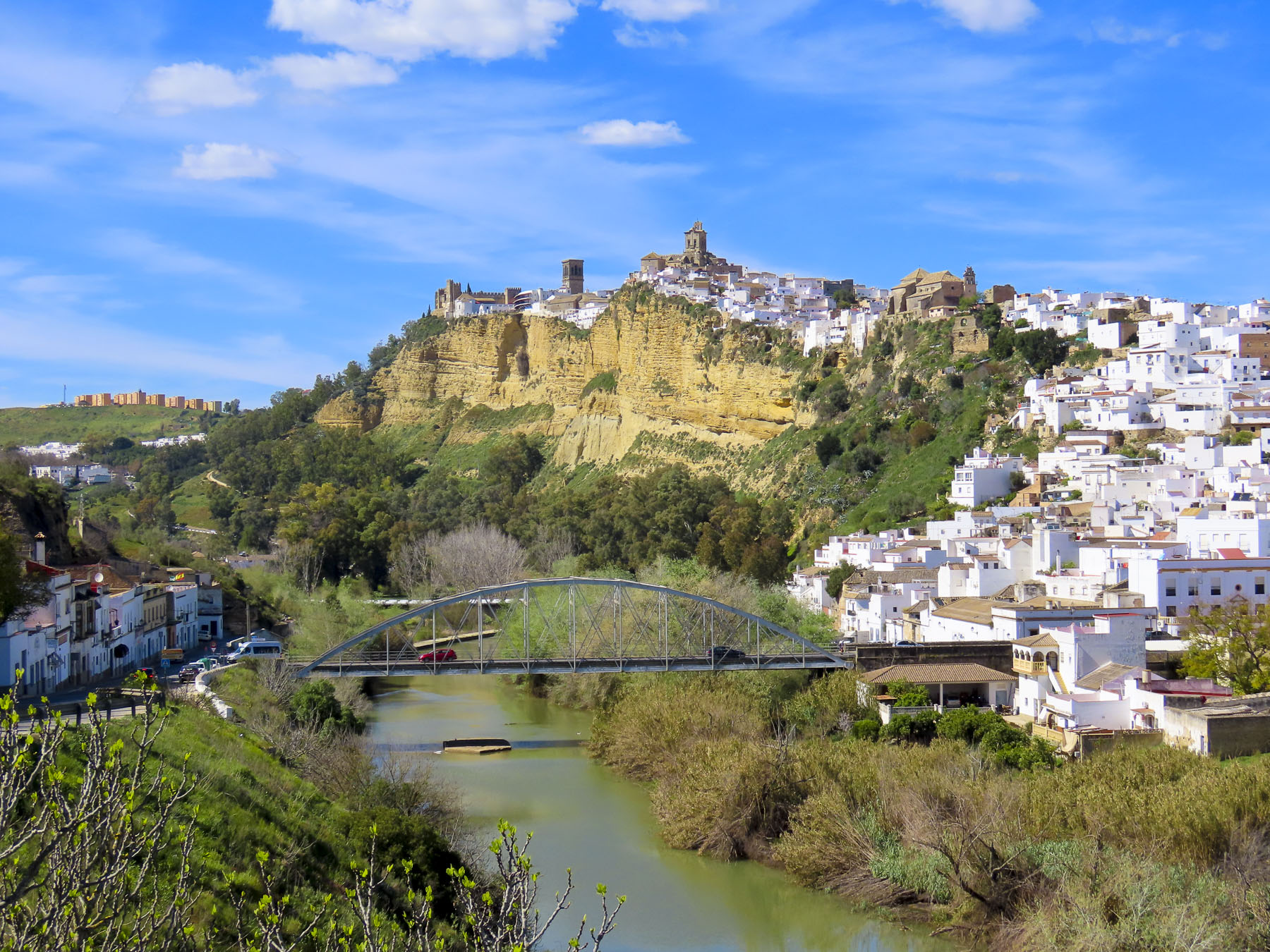
Just below the northern horizon, a white brushstroke highlighted the verdant canvas before us as we savored the view from the top of the castillo in Castellar de Frontera one last time. That swath of white slowly changed into Jimena de la Frontera as we drove closer. One of Andalucia’s famed Pueblos Blancos, the village is set on the hillside below the ruins of its ancient castle which once protected it.

In ancient times the homes in villages featured roughhewn stone masonry. Lime paint was a luxury, until its use was greatly expanded during the mid-1300’s when a bubonic plague pandemic swept through the Mediterranean countries. Residents of villages were required yearly to cover the outside and the interiors of their homes and churches with a limewash, known for its natural anti-bacterial and insecticidal properties, in an effort to reduce the spread of disease. Community inspections were done, and folks were fined for noncompliance. This mandated conformity was eventually appreciated as an aesthetically pleasing look and a symbol of meticulous tidiness. Fortunately, the custom stayed and has become an iconic signature of southern Andalusia.

Villaluenga del Rosario was our ultimate destination for the day, but before that we would be driving through the expansive forests of Parque Natural Sierra de Grazalema and stopping along the way in Ubrique, and Benaocaz. All pueblos blancos, though all different in size, setting and atmosphere. According to our maps app the trip would take 2 hours. But it was a glorious 58-mile sinuous route through the mountains, and with several stops it took us most of the day.

The vast 130,000-acre Parque Natural Sierra de Grazalema, with peaks reaching 5400 feet, is one of the wettest areas in Spain, receiving almost 80 inches of rain a year. This is surprising, considering that many areas in Andalucia are often used to replicate the American southwest for European filmmakers. These wet conditions over many millennia have created a dramatic karstic landscape of shear mountains, lush valleys and caves, especially Pileta Cave with its 30,000 year old prehistoric paintings. The park’s lower elevations feature forests of cork oak, carob, hawthorn, and mastic. Higher slopes transition to a landscape of gall oaks and Spanish fir, a tree species that survived the last Ice Age. This ecosystem supports a diverse fauna that contains 136 species of birds, most notably a large population of griffon vultures, and 42 mammal species, that include foxes, badgers, roe deer, otters, and Spanish ibex. And in ancient times it was the refuge of wild, now extinct, aurochs, the ancestor of the famous Spanish Fighting Bulls, toro bravo. The park has been a UNESCO Biosphere Reserve since 1977.

Farmers still harvest cork and olives amidst the rocky terrain and graze cattle, sheep, and goats within the park. This practice made for an interesting encounter when we rounded a curve and faced a VERY LARGE BULL standing in the middle of the road, adjacent to some pasture. We stopped, looked around for his farmer, but there was no one in sight. It was obvious he was the king of this domain, with no intention of moving aside until he felt like it. Slowly we inched forward and watched him eye us until he decided to saunter across the road and let us pass.

Ubrique is a large thriving town with 17,000 inhabitants set in a valley surrounded by tall peaks and steep scree slopes, its homes built above and around boulders too large to move. The town’s prosperity comes from its fine leather workshops, which account for 60% of the townspeople being employed directly or indirectly in the creation of leather products. It started simply enough with leather cases and pouches to carry tobacco and the Precise, a heavy-duty strap that allowed workers to safely carry silex stones and iron bricks.

By the mid-1700s their fine leather products and artisanal craftsmanship was recognized across Europe which fueled an export industry. The good fortunes of the town continued to grow until the mid-2000 when clients seeking higher profit margins moved their leather goods production to China and other Asian countries. Fortunately, their exodus did not last long, and they returned to Ubrique when they realized that the excellent craftsmanship in this small Andalucian town could not be rivaled by cheap labor. Today Ubrique is considered the “artisanal leather capital, “ for high-end fashion brands like Chloe, Gucci, Hermes and Louis Vuitton. “So many stores, so little time.” Of course, we shopped! The decision-making process was painful, but Donna managed to select one single beautiful purse to take home.

In March the twisting roads, higher into the mountains, were nearly void of traffic. Occasionally a campervan passed. Reaching Benaocaz, we parked and strolled through a nearly empty town square in search of coffee. It was a quiet weekend afternoon in the shoulder season, and few people were about, but luckily, we happened to come across Restaurante Nazari, a rustic restaurant with outside tables that had a view of the valley below the town.

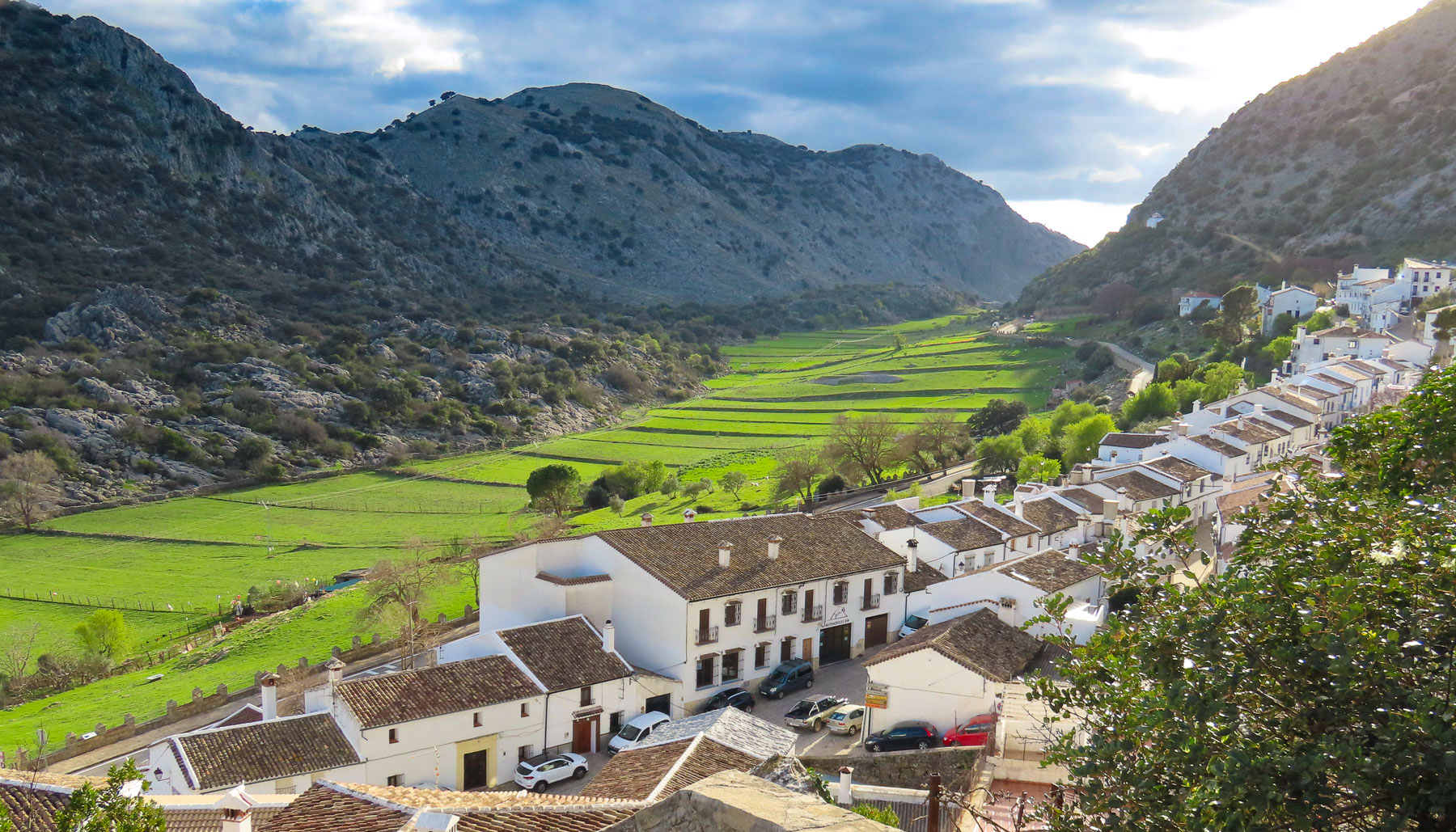
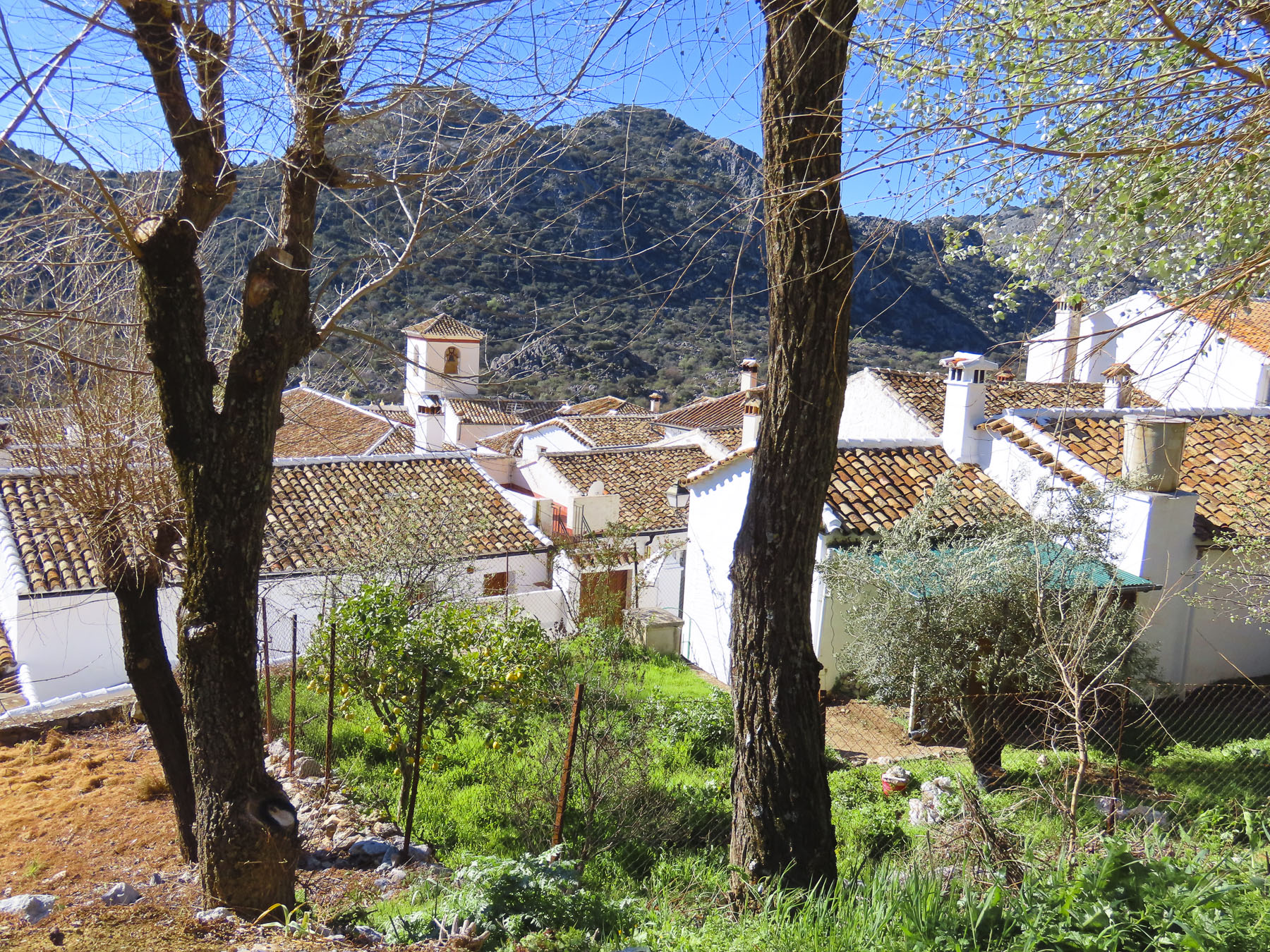
Villaluenga del Rosario was only a little farther, and higher into the mountains. The village is dramatically set along one side of a narrow green valley at the base of a sheer mountain massif. The lane to our inn, the Tugasa La Posada, looked too narrow to drive down, and I was concerned about getting to a point that required backing up. A difficult task in an alley barely wider than our rental car, and there was plenty of parking above the village.  La Posada wonderfully reflects the typical inn of centuries past, with a large tavern, featuring regional recipes, on the ground level and a handful of rooms above.

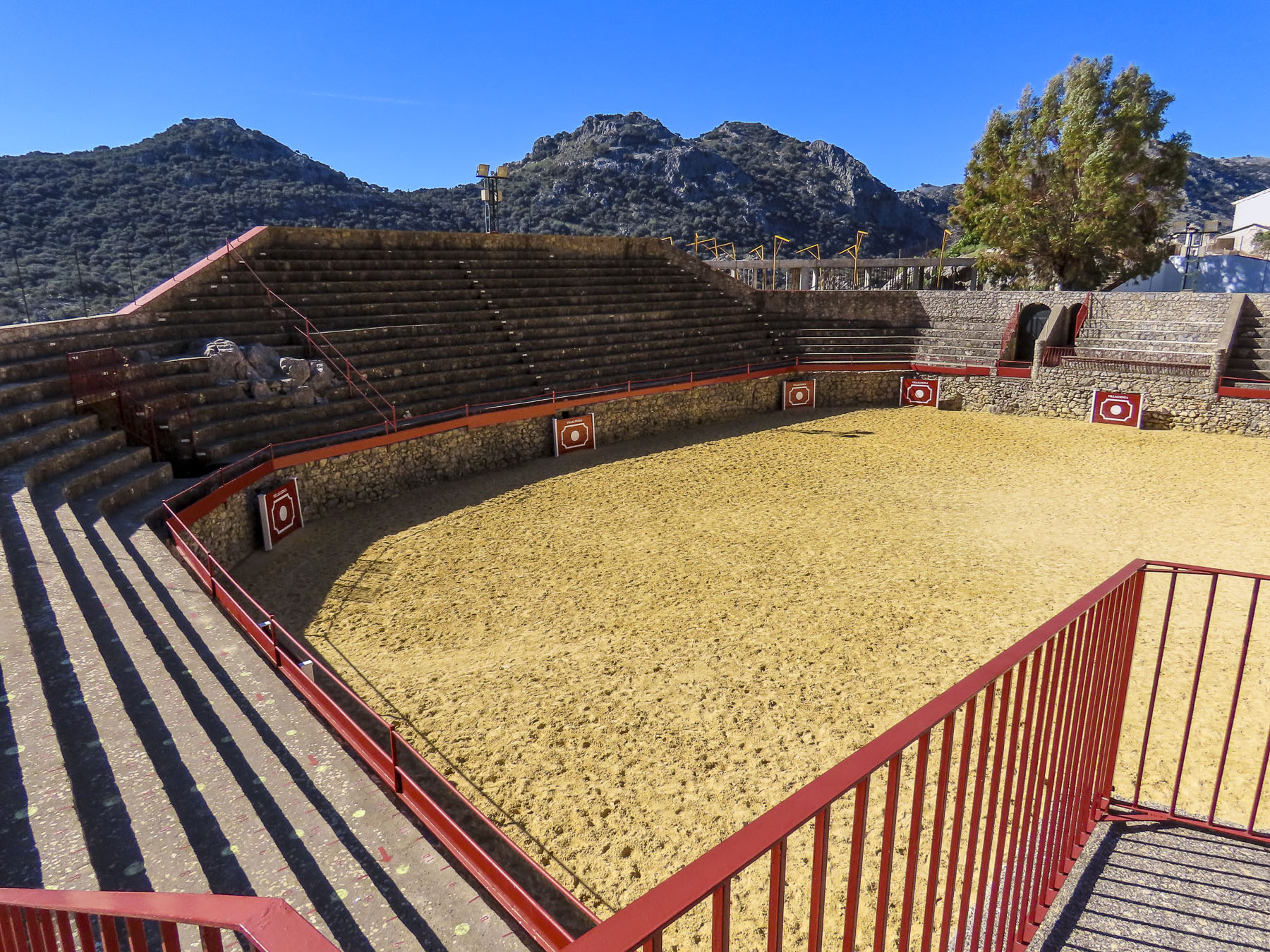
Several things are unique to this pueblo: Snowy winters are common in the Sierra de Grazalema Natural Park’s highest village, situated at an elevation of 2800ft. It is also the smallest village in the Province of Cadiz, with only 438 residents. And the village has a unique octagon shaped bullring, built around a natural rock formation, that is the oldest in Cadiz Province, dating from the mid-1700s. The exact year of construction for the bullring isn’t known, as the town’s archives were lost in a 1936 fire. Located on an important cattle trading route through the mountains, the bullring was also used as a corral during livestock festivals.

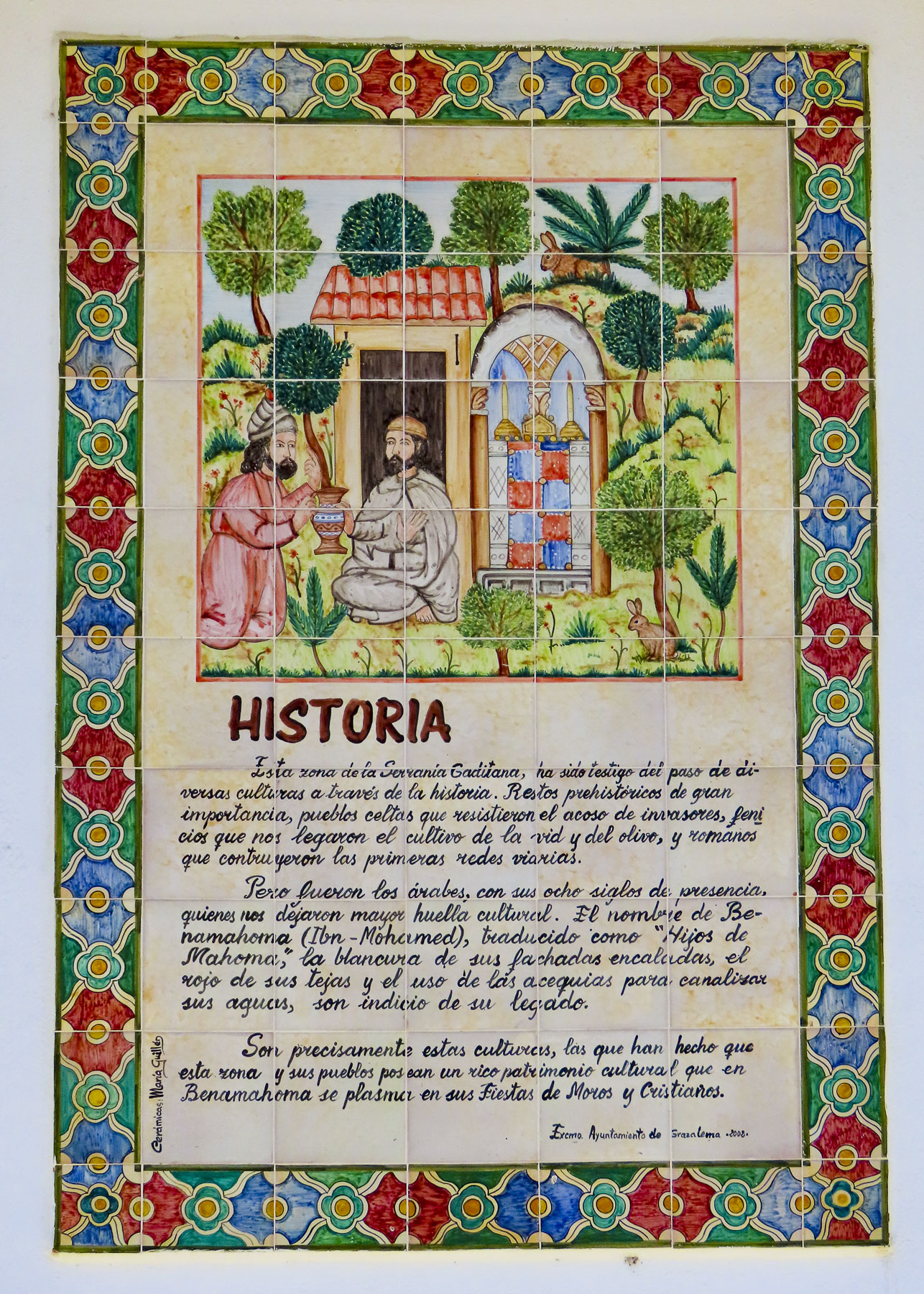
But before domestic cattle were raised in the area, prehistoric people used to pursue auroch, a wild bull that lived in the Sierra de Grazalema until it was hunted to extinction in the Middle Ages. Nearby in Cueva de la Pileta, primitive cave paintings of bulls have been dated to the Paleolithic era 27,000 years ago. The famous fighting bulls of Spain, Toro Bravo, descend from this primal auroch lineage that once roamed wild. Ancient pagan festivals often conducted a running of the wild bulls, tethered to a group of men by a long rope, through their villages before a ritual sacrifice.  “Toro de Cuerda'”(Bull on Rope) festivals, are thought to be the foundation of the modern Spanish Bull Fight, and are still held in Villaluenga del Rosario, Grazalema, and Benamahoma. With the advent of Christianity some of these pagan elements were incorporated into church celebrations of a pueblo’s patron Saint. In Grazalema the early church Christianized the practice and includes the Feast of the Bull in celebrations to the Virgen del Carmen every July. Benamahoma’s “Toro de Cuerda” is held in August during their festival to honor the town’s patron saint, Anthony of Padua.

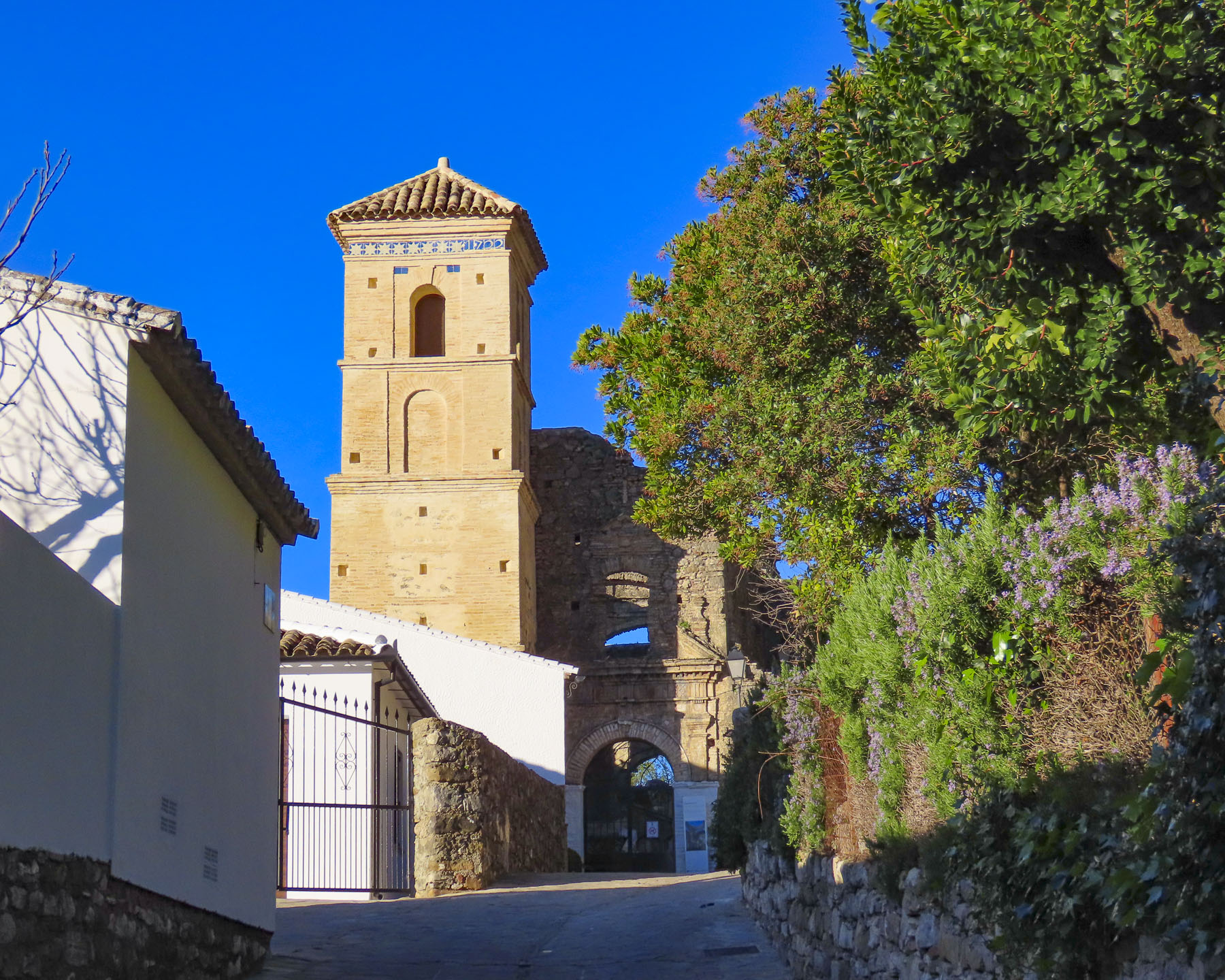
This tranquil village has gone through some turbulent times in its past. Villaluenga del Rosario, known for its woolen textiles in the 17th century, did not escape Napoleon’s destruction as his troops retreated across the mountains after they abandoned their siege of Cadiz in 1812. French troops sacked the village and torched the old Church of El Salvador. Now only the walls and roof arches remain, open to the sky. The sanctuary is now used as a cemetery.  The economy declined throughout the region in the 1800s and early 1900s, and the mountains were beset with bandits. Notoriously, José María El Tempranillo and Pasos Largos, the most infamous of the Sierra’s outlaws, would frequent the village and hideout in the surrounding caves. They are celebrated as Robin Hood bandoleros, robbing the wealthy and redistributing their stolen goods to help the poverty-stricken locals – Andalucia’s mountain justice. These same caves in the 1930s would shelter Republican resistance fighters escaping Fascist troops during the Spanish Civil War. A hiking trail, Los Llanos del Republicano, from the village to caves is named after them.

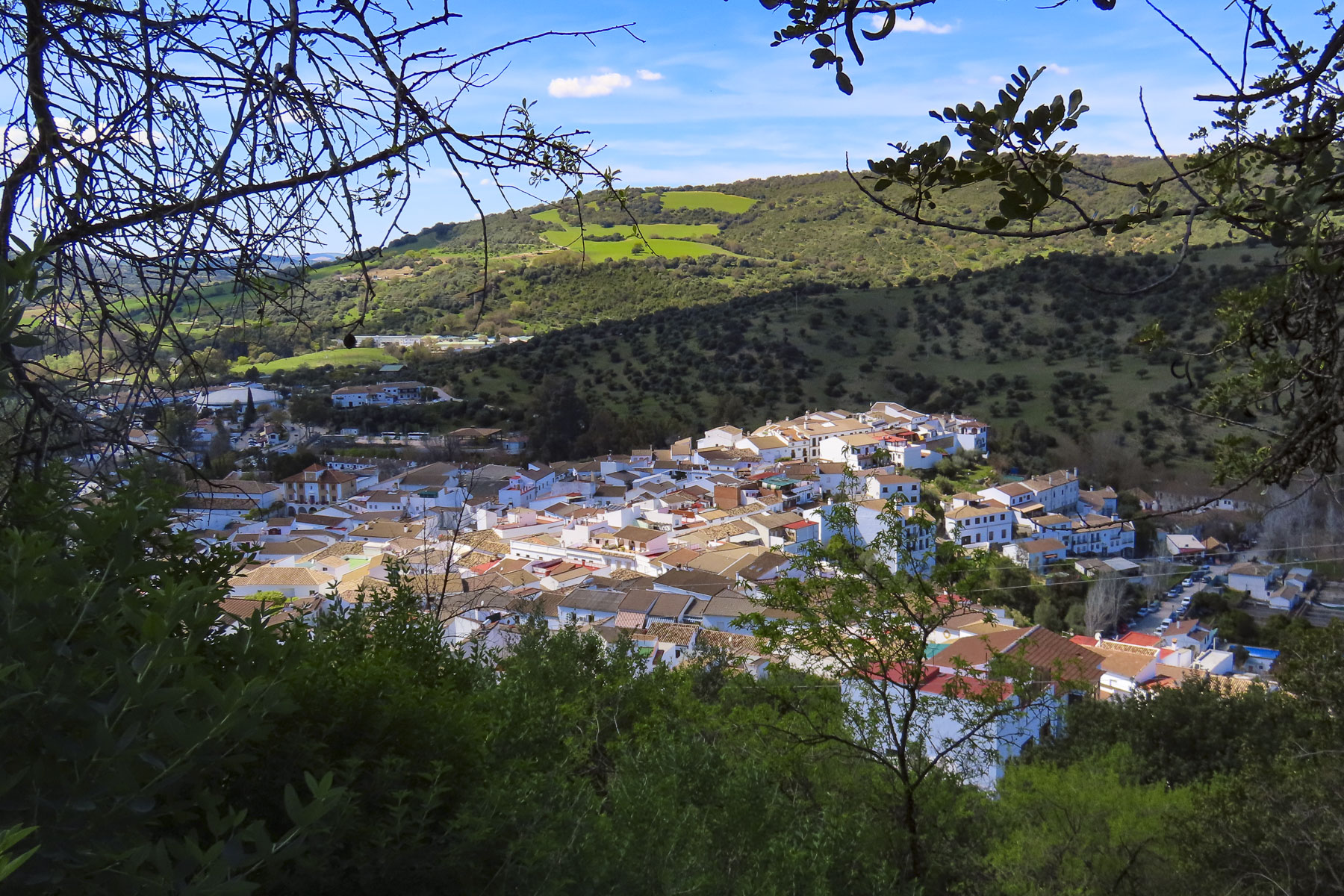
The rural population continued to emigrate, contributing to further economic deterioration until the villages’ employment prospects improved with the opening of a cheese factory, Queso Payoyo, in 1997. The Payoyo goat is an ancient breed from the Sierra de Grazalema and considered endangered. Since Queso Payoyo opened 25 years ago, its goat and sheep cheeses have received 175 national and international awards. Thirty-five farms now supply Payoyo goat and Merina grazalemeña sheep milk to the cheesemaker. Their shop just across the road from the village seems to be a Mecca for cheese aficionados. Open seven days a week, we were surprised to find it packed with customers early on a Sunday morning, when we stopped to buy some cheese before we headed to Benamahoma.

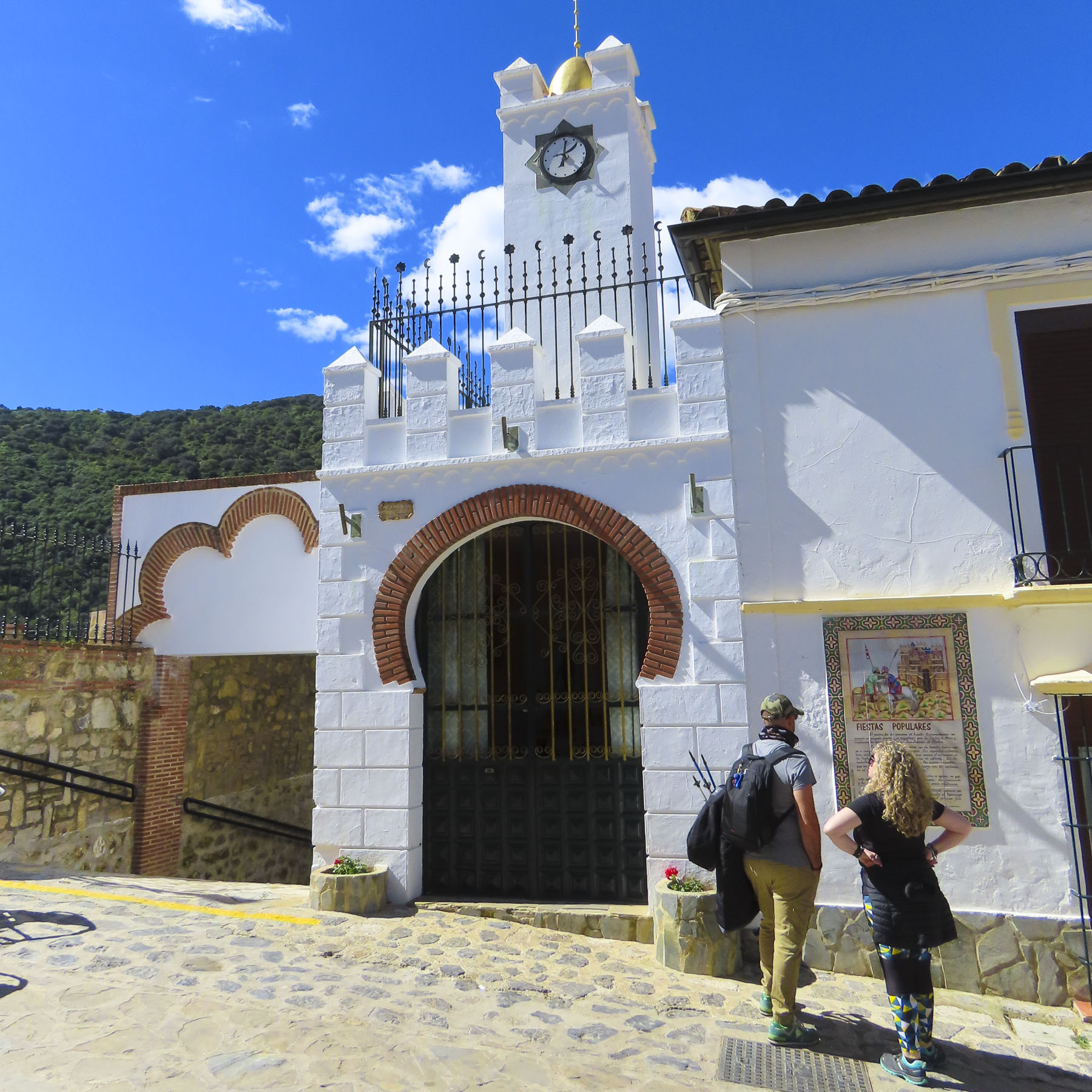
It was a beautiful crisp spring day, and we enjoyed a slow walk uphill into the village. Next to the Plaza de las Huertas the façade of the Ermita/mezquita de San Antonio, a church/mosque, visually represents Benamahoma’s complex cultural identity, with Moorish horseshoe-shaped arches and three golden spheres topped by with a gold crescent, typically seen on minarets, atop its tower.

This region in Spain has a very complicated history, beginning with Alfonso X’s Reconquista which started in the mid-1200s, paused, then continued for the next 400 years with his successors. Benamahoma was the last Moorish village in the mountains to have its inhabitants expelled from the region in 1609, eighteen years after Grazalema’s Muslim villagers were forced out, though the hamlets are only nine miles apart. Their reprieve was caused by the fact that although Alfonso X and later Kings achieved military victories, they did not have enough troops to garrison each village, nor sufficient numbers of willing Christian settlers from Northern Spain to repopulate the conquered towns. Consequently, to keep the economy of the area going and subjects to collect taxes from, Moors were allowed to stay as long as their local Princes swore allegiance to a Christian King and declared themselves loyal vassals.  This did not always go smoothly and there were rebellions. Most famously the Mudéjar Revolt in 1264, when the towns of Jerez, Lebrija, Arcos, and Medina-Sidonia were recaptured and occupied by Moors for several years before Christian armies secured the towns once again. 

Benamahoma’s historic, pragmatic tolerance is celebrated the first weekend every August with a Moros y Cristianos Festival. Carrying swords, shields and blunderbusses, historical reenactors dressed in period clothing parade through the village to the bullring, where they then engage in mock hand-to-hand combat. The battles are won with the capture of an image of San Antonio de Padua by the Moors on Saturday and then won by Christians on Sunday with the rescue of his image. Many of the positions in the opposing armies are hereditary, the tradition being passed down from father to son, through the generations. Benamahoma is the only village in western Andalucia which celebrates this festival.

This village’s remoteness in the Sierra de Grazalema did not protect it from the atrocities committed during the Spanish Civil War. Near the bullring, in the Parque de Memoria Historica, silhouettes stand where villagers once stood against a wall before they were massacred by Fascists. Sadly, this memorial is also near the village’s second church, the Iglesia de San Antonio de Padua.

Backtracking as we headed to Arcos de la Frontera, we stopped at a radio station above El Bosque. A trail behind its tall antenna offered the perfect vantage point to capture a photo of the village below. We did not stop in El Bosque, but after catching glimpses of the village as we drove through, in hindsight we wished we had.  But there was a time constraint, we wanted to spend the afternoon exploring Arcos de la Frontera, before flying on to Barcelona the next morning. 

The A-372 between El Bosque and Arcos de la Frontera has to be one of the prettiest stretches of highway anywhere. With the reflection of the Sierra de Grazalema in our rearview mirrors, we wished we could have lingered longer.

I’ve always loved maps for researching routes, finding obscure sites, and figuring out the best vantage point to capture a landscape from. This brought us to our first two stops at the Molino de Angorrill, an old mill, and the Mirador Los Cabezuelos, before we entered the hilltop citadel. Both places along Guadalete River had wonderful views of the ancient city.

After this our map app failed us when it suggested we head the wrong way down a one-way calle into the village. We eventually found an underground parking garage at Parque El Paseo and towed our suitcases uphill to the Parador de Arcos de la Frontera.

It was LONG walk, but of course we stopped frequently to take photos. Located next to the 500-foot-high Mirador Plaza del Cabildo and adjacent to the Basílica de Santa María de la Asunción and the Castillo de los Duques de Arcos, the hotel was a perfect base for a one-night stay. Formerly the Casa del Corregidov was an Andulcian palace before it was acquired by the government and renovated to be a parador in 1966.

Arcos has always been a favored spot, appreciated for its access to abundant water sources and its easily defensible position atop a cliff face. It has hosted settlements since the Neolithic period, Bronze Age, Tartessians, Phoenicians and Romans periods.

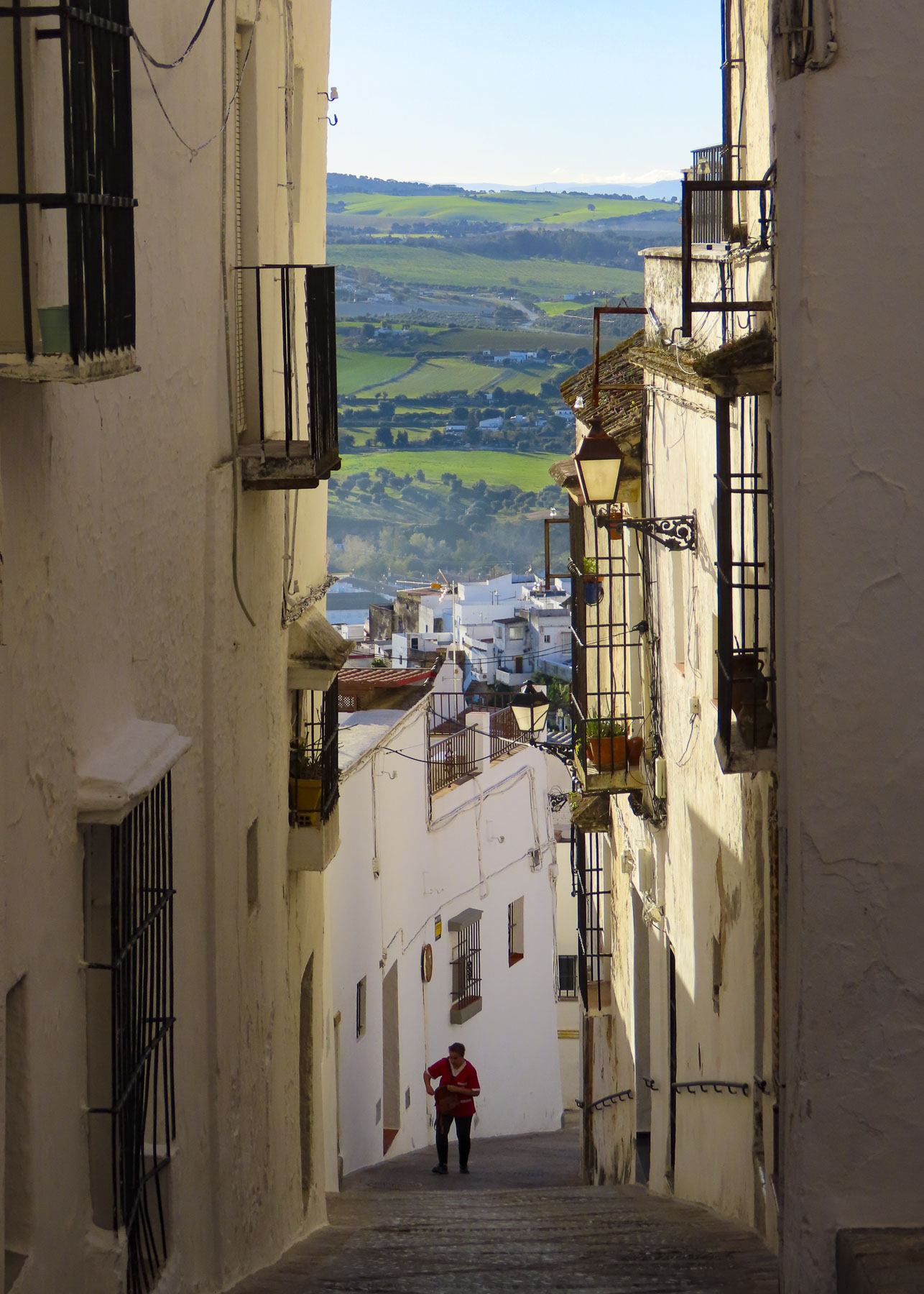
The village continued to grow under the Moors and while the facades and interior of buildings in this ancient town have changed over the centuries the original Arab footprint of the village, with its exceedingly narrow lanes has remained the same.

The view from the mirador and the hotel’s patio were phenomenal during the golden hour. As the sun was setting, a large flock of storks appeared over the bell tower of the Basilica and circled for about fifteen minutes before flying away. It was a magical experience that nicely capped our short time in Arcos.

The next morning, we watched the sun rise over the Sierra de Grazalema and the village’s church steeples from our hotel room, before wandering through the village’s ancient lanes one last time.

Till next time,

Craig & Donna

A New Mexico Road Trip: Earth, Sky, & Art

One of the things we enjoy most about traveling is picking the brains of folks we’ve had the pleasure of meeting throughout our journeys. Whether it’s a tip from a car rental agent about an isolated restaurant in the Azores or from a young Italian attorney who shared her love of Cadiz, Spain, with us, we try to follow through. Sometimes acting immediately, but mostly tucking the tips away into the deep recesses of our minds to consider in the future.

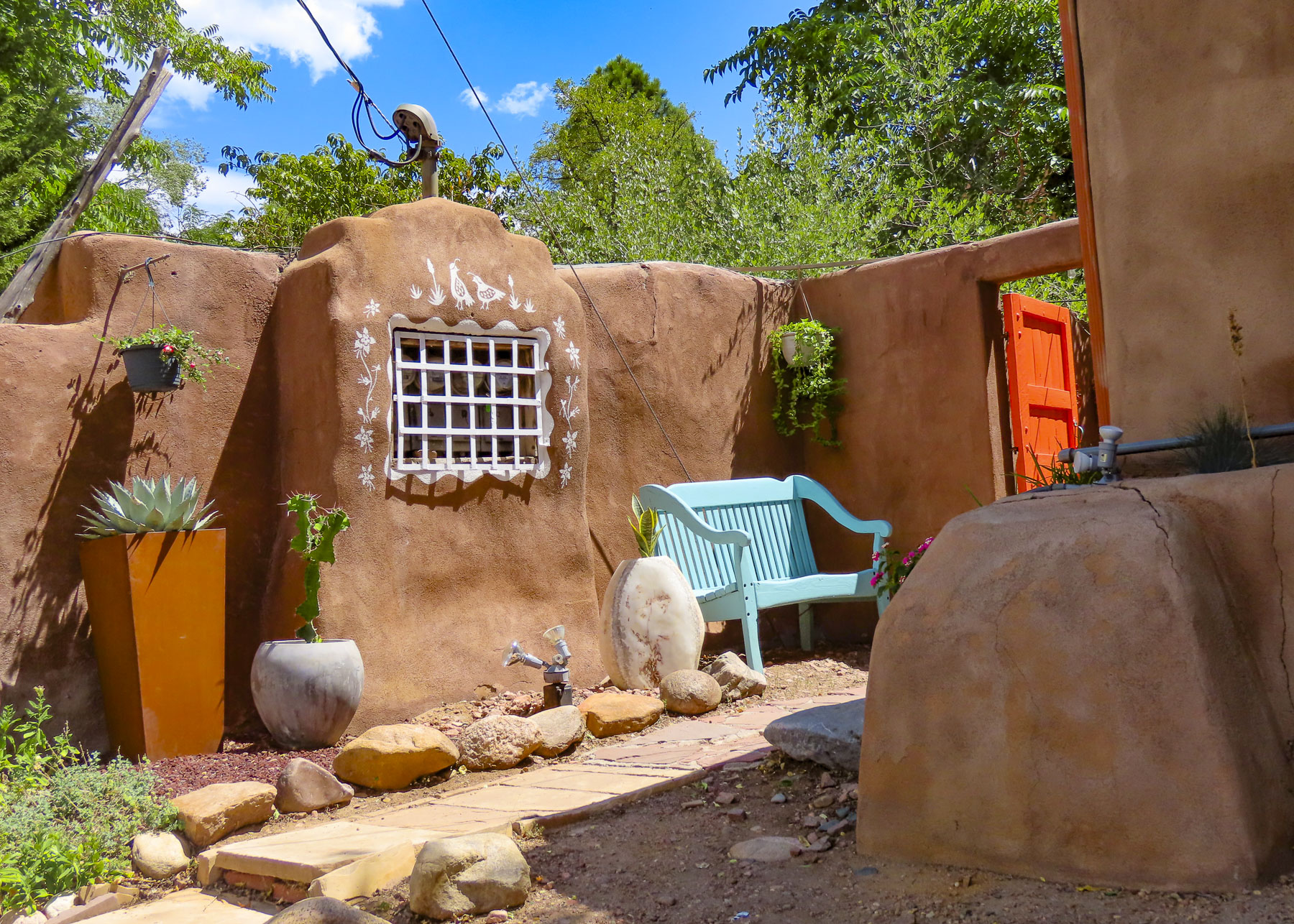
When the same question is asked of us about the best places to see in the United States, Albuquerque, Santa Fe and Toas in New Mexico immediately top our list as the most unique destination in the USA. Maybe I’m a little cynical with an over-simplified view that the United States is mostly a homogenized mass of sameness that spans 3000 miles from the Atlantic to Pacific, mostly sharing the same landscapes, urban architecture, and strip malls with the same ubiquitous retailers – Home Depot, Starbucks, Panera, Pizza Hut and McDonalds – from coast to coast. Yes, the same is true, though to a much smaller degree, of the urban sprawl that surrounds Albuquerque. Though here you’ll find Blake’s Lotaburger, frito pies, piñon coffee, frybread-style sopapillas, and pozole (a hominy dish) along with parking lots filled with roasters full of Hatch green chilies every September when the harvest comes in and that wonderful aroma fills the air. We hope these photos and this story pique your interest in New Mexico, an endlessly beautiful, culturally diverse, artistic, and quirky place that is truly the “Land of Enchantment.” And a destination we always enjoy exploring.

Start in the Petroglyph National Monument, then follow Central Ave (Old Rt66), from the original adobe buildings of Old Town, circa 1706, east across town up to the Knob Hill area around the University of New Mexico and beyond to the Tijeras Pueblo Archaeological Site and the beginning of The Turquoise Trail. You will have spanned several millennia from the oldest petroglyphs dating from 2000 BC to the present and a blending of cultures that is refreshing. It’s a remarkable stretch of history for a young country that typically dates itself to the English colonies of Jamestown – 1607, and Plymouth – 1620.

A 2013 archeological excavation in northern New Mexico unearthed stone tools used to butcher a mammoth, and radiocarbon testing dated them to be 36,000 years old. These tools are attributed to some of the first people that migrated across the Bering Sea from Asia, the ancestors of Native Americans. Jump forward 35,000 years and you have pueblo Indians living in settlements along the Rio Grande Valley and across northern New Mexico. Their first contact with Europeans comes with a back story and cast of characters worthy of the best fiction writers.

It starts with orders from the Holy Roman Emperor Charles V (Charles I of Spain) to Álvar Núñez Cabeza de Vaca (from Jerez de la Frontera, near Cadiz, from that great tip earlier) authorizing him to colonize the region between Río Soto la Marina, Mexico, and what is now Tampa, Florida, a distance of 1500 miles. Tragically believing the distance between the two was only 45 miles, Cabeza de Vaca landed north of Tampa in April 1528 with 300 men and forty horses. Unable to rendezvous with their ships, the expedition was doomed. Traveling west across the top of the gulf towards the nearest Spanish settlement of Tampico, Mexico they encountered alligators, venomous snakes, and hostile natives. They were captured, enslaved, beset by disease-bearing mosquitos; they crossed numerous creeks, swamps and rivers. By the time they reached the “Isle of Misfortune,” Galveston, Texas a year later, only 15 remained.  They crossed the Rio Grande near El Paso. With the help of friendly tribes, Cabeza de Vaca and three others, Alonso del Castillo, Andrés Dorantes de Carranza, and his slave Esteban the Moor survived an eight-year Homeric ordeal, that took them across the Mexican desert to the Pacific Ocean before being reunited in 1536 with their compatriots in Mexico City. The three Spaniards were rewarded with titles and land by the King. Cabeza de Vaca became the Viceroy of Paraguay, gained political enemies and was unjustly tried in Spain and imprisoned in North Africa. It is not known if Esteban the Moor was granted his freedom, but he was not forgotten.

De Vaca and his fellow survivors had returned with legends heard from the Indians they encountered of fabulous riches farther inland. These stories of insurmountable wealth were still fresh in everyone’s minds two years later when Friar Marcos de Niza (from Nice, France) arrived in Mexico City after leading the first groups of Franciscans into Peru with Spanish conquistadors to conquer the Inca civilization. In hope of finding the fabled “Seven Cities of Gold,” a treasure that allegedly rivaled that of the Aztecs and Incas civilizations, the Viceroy of Mexico planned an expedition headed by Friar Marcos de Niza, along with Esteban the Moor who had the most knowledge of the area’s tribes, and their customs. It seems from reading various accounts that Esteban led, and Friar Marcos followed. They both were the first foreigners, a North African slave and a European, to explore the area we now recognize as the American Southwest. This is 27 years before the founding of St. Augustine, in Florida in 1565. Friar Marcos claimed Esteban the Moor was killed near a Zuni pueblo when he reached one of the “cities of gold.” Marcos also claimed to have seen a city larger than Mexico City, with buildings nine stories high glittering on the horizon. Dream, mirage, a pueblo glowing like a sunset – a lie? Wanting to avoid Esteban’s fate, the Friar ventured no further and returned to share his exploits in Mexico City. The lust for gold was consuming and a year later, in 1540, Francisco Vázquez de Coronado led an expedition of 400 hundred soldiers with 1500 native porters and Friar Marcos north again to attain that treasure. And boy was he miffed when they reached the Zuni tribe and found nothing but a “poor pueblo.” Accusing Friar Marcos of lying, he sent him back to Mexico. Coronado’s expedition would stay in the region for two years, traveling in several smaller groups west as far as the Grand Canyon and east into Texas and Kansas. They never discovered gold though they did travel through areas where it would be discovered centuries later. They returned emptyhanded. It would be 53 years before Spaniards ventured north again.

In 1595 King Philip II of Spain chose Don Juan de Oñate to colonize the upper Rio Grande valley. In 1598 he led an expedition north that included 20 Franciscan missionaries, 400 settlers, 129 soldiers, 83 wagons, plus livestock, with the stated mission from the Pope to spread Catholicism. But there was still hope that the evasive “Seven Cities of Gold,” would finally be discovered. Fording the Rio Grande near present day El Paso, he proclaimed all the lands north of the river “for God, the Church, and the Crown.” Life in the new territory under Oñate was severe. Some settlers urged a return to Mexico when silver was not discovered, and Oñate executed the dissenters. Pueblos that refused to share winter food stocks needed for their own survival were brutally suppressed into submission. The Spanish imposed the encomendero on the pueblo tribes. This was a colonial business model that granted conquistadores or ordinary Spaniards the right to free labor and tribute from the indigenous population. In return Nuevo México encomiendas were obligated to “instruct the Indians in the Roman Catholic faith and the rudiments of Spanish civilization.” The free land and free Indian labor promised with the encomendero was also used as a recruiting tool to encourage settlers to venture north from Mexico. The pueblos did not submit willingly; any resistance was forcibly repressed until the Pueblo Revolution in 1680. Four-hundred Spaniards died, including 21 priests, but there were almost 2000 Spanish survivors. Warriors followed the fleeing refugees all the way to El Paso to ensure their expulsion from Indian territory. But by then there were three generations of intermarriage, along with shared ideas, technology and customs.

When the Spanish returned 12 years later, they did not try to reimpose the encomendero, and returning missionaries displayed more tolerance of indigenous religious beliefs. Spain instead sought to enlist the Pueblo tribes as allies to resist French and British empire expansion farther west. The vast area claimed by Coronado and Oñate became part of the United States with the Treaty of Guadalupe Hidalgo, which ended the Mexican-American War in 1848. It’s a fascinating multilayered history that continues to contribute to New Mexico’s uniqueness.

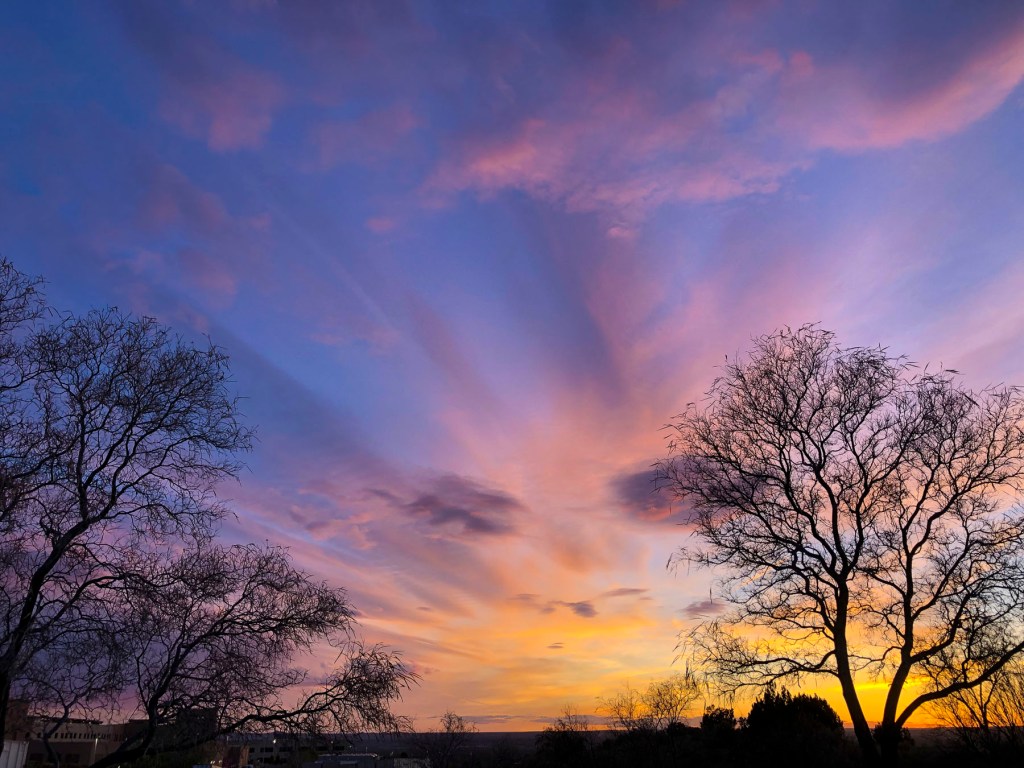
But enough about history. Land at the Albuquerque International Sunport, rent a car and hit the road. Head north on Rt25, with the Sandia Mountain Range glowing in the late afternoon light on your right and a spectacular sunset in the west. This sublime experience could be the beginning of a long love affair with the state, as it was for us. The expansive vistas and sky, along with incredible light and dramatic ever-changing weather out here are just awesome, especially if it’s your first time to the Southwest. Fair warning: the state can become addictive with endless ways to satisfy your wanderlust.

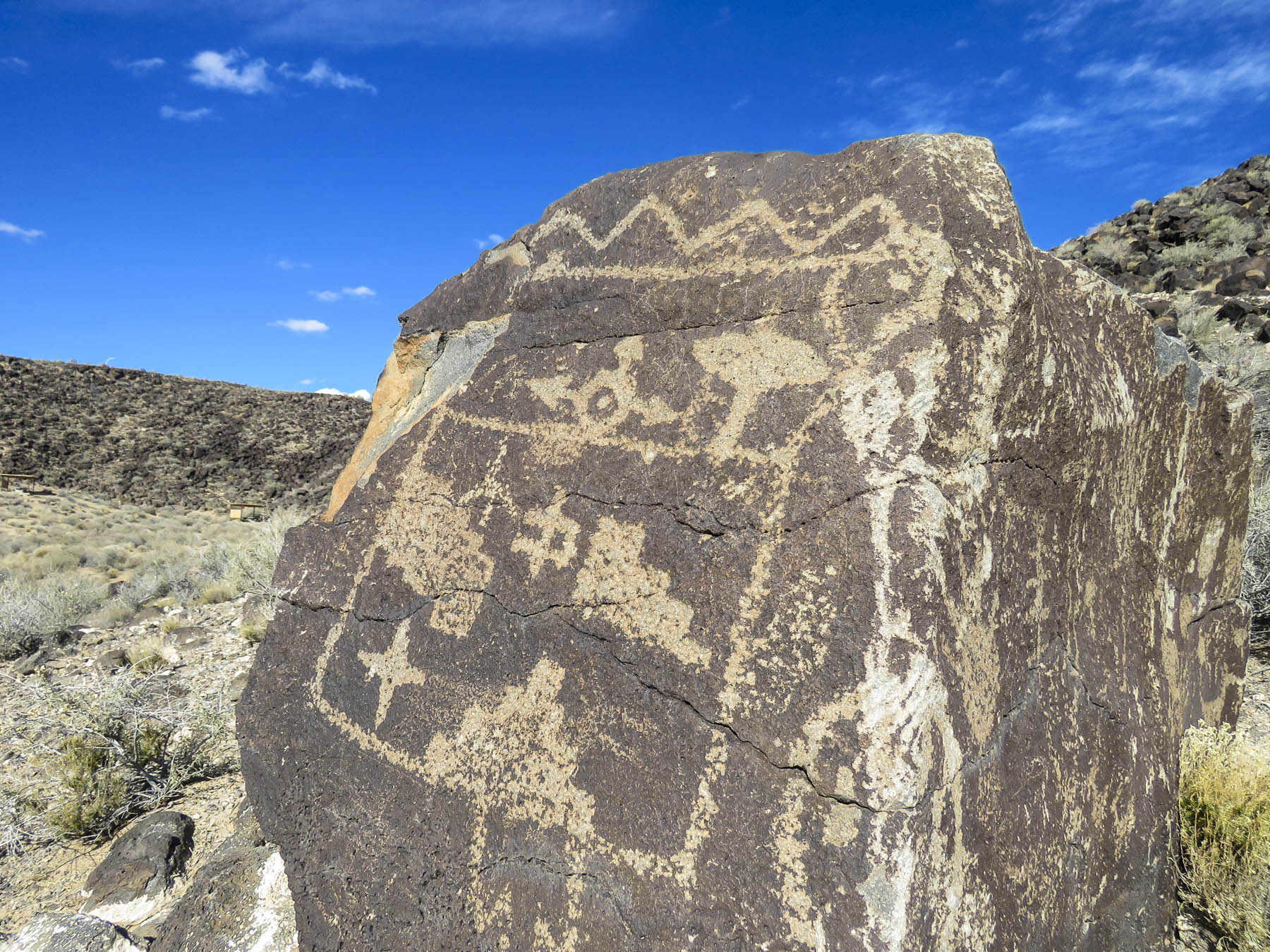
The ruins of the old Spanish missions in the Salinas Valley and Mountainair are south of Albuquerque. Route 40 East will take you to the beginning of the Turquoise Trail, a splendid backroad route that gracefully curves, rises and falls through the rugged foothills of the Sandia and Ortiz mountains as it follows NM14 north for 65 miles. Pass through the historic towns of Golden, Madrid, Cerrillos and San Marcos just south of Santa Fe. Follow Route 40 West to see the amazing rock drawings at the Petroglyph National Monument or continue farther to the Zuni Reservation, mentioned earlier.

Veer off Rt25 and head to Jemez Springs where you’ll find, red rock canyons, old logging roads and hot springs. Farther along in the Valles Caldera National Preserve you can see herds of elk grazing in a 13-mile-wide meadow that is now all that remains of a collapsed volcano cone after a massive ancient eruption.

Nearby the 11,000-year-old cliff dwellings carved into the canyon walls of Bandelier National Monument are a must stop. There are plenty of interesting detours and quirky stops to make along the way.

Santa Fe and Toas lie in the mountains farther north of Albuquerque and have been popular destinations with artists and writers since the early 1900s – D.H. Lawrence, Georgia O’Keefe and Ansel Adams and many others enjoyed the vibrant Indian and Hispanic cultures. Today Hollywood stars like Julia Roberts, Val Kilmer, Ted Danson, and Oprah Winfrey have homes in the area.

The city retains it early Spanish heritage with historic adobe buildings surrounding Santa Fe Plaza. The Indian market is still held under El Portal in front of the Palace of the Governors, the oldest continually occupied public building in the United States, since its construction in 1610.

The region continues to support artists and craftspeople with numerous galleries, festivals, and fairs. A stretch of 80 art galleries in old adobe buildings along Canyon Road belies its ancient roots as part of El Camino Real, The Royal Road, that ran 1600 miles to Mexico City. Famously Spanish settlers from Mexico introduced chili peppers into the region via this ancient trade route.

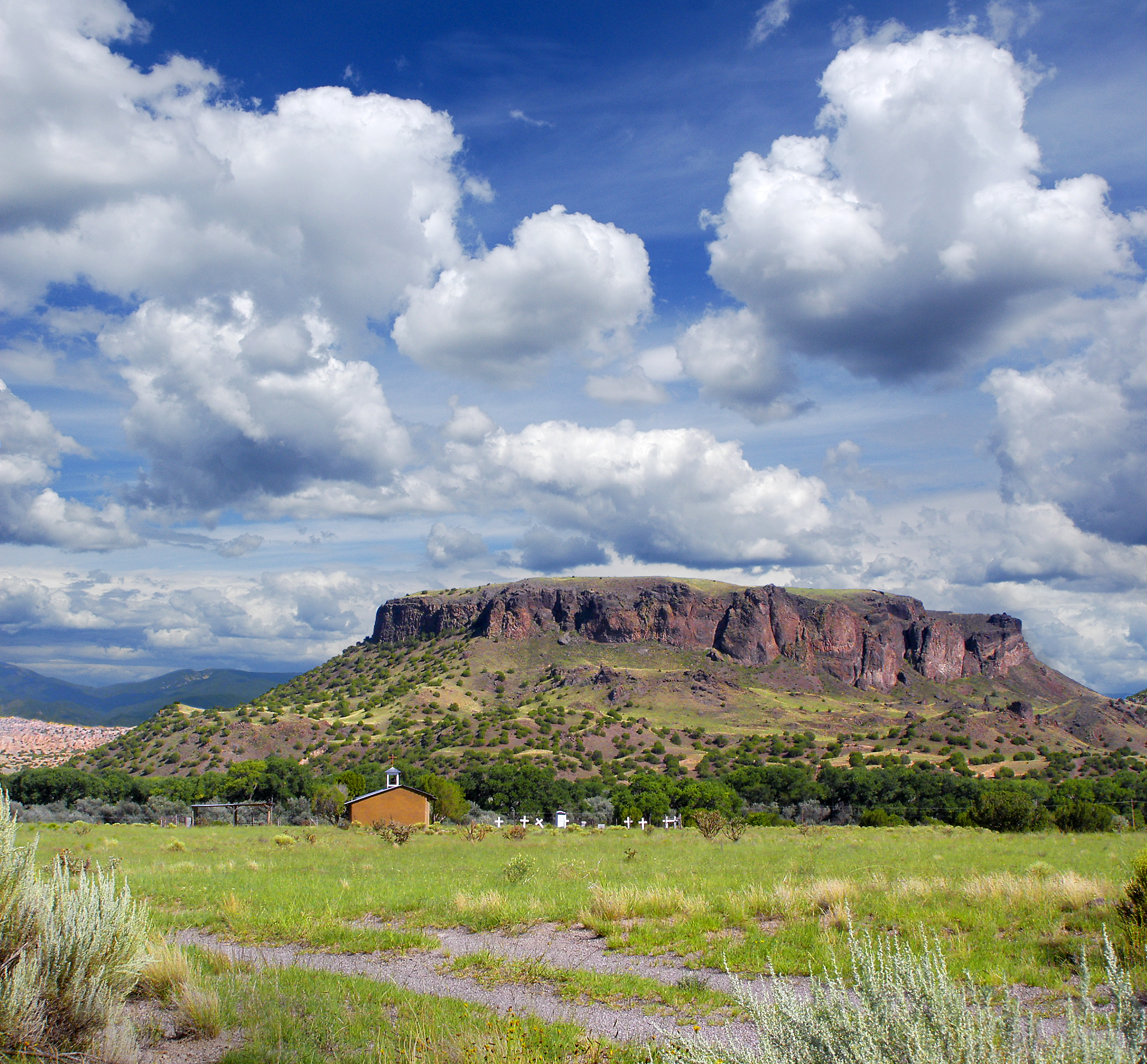
The landscapes north of Santa Fe continue to be intriguing, with Black Mesa, sacred to Native Americans, and the Puye Cliff Dwellings which run along the base of a mesa for over a mile. Stairs and paths cut into the cliff face led to adobe structures atop the mesa’s plateau. East of Espanola, the Santuario de Chimayo, built in 1816, still attracts pilgrims seeking miraculous cures from its “healing dirt.”

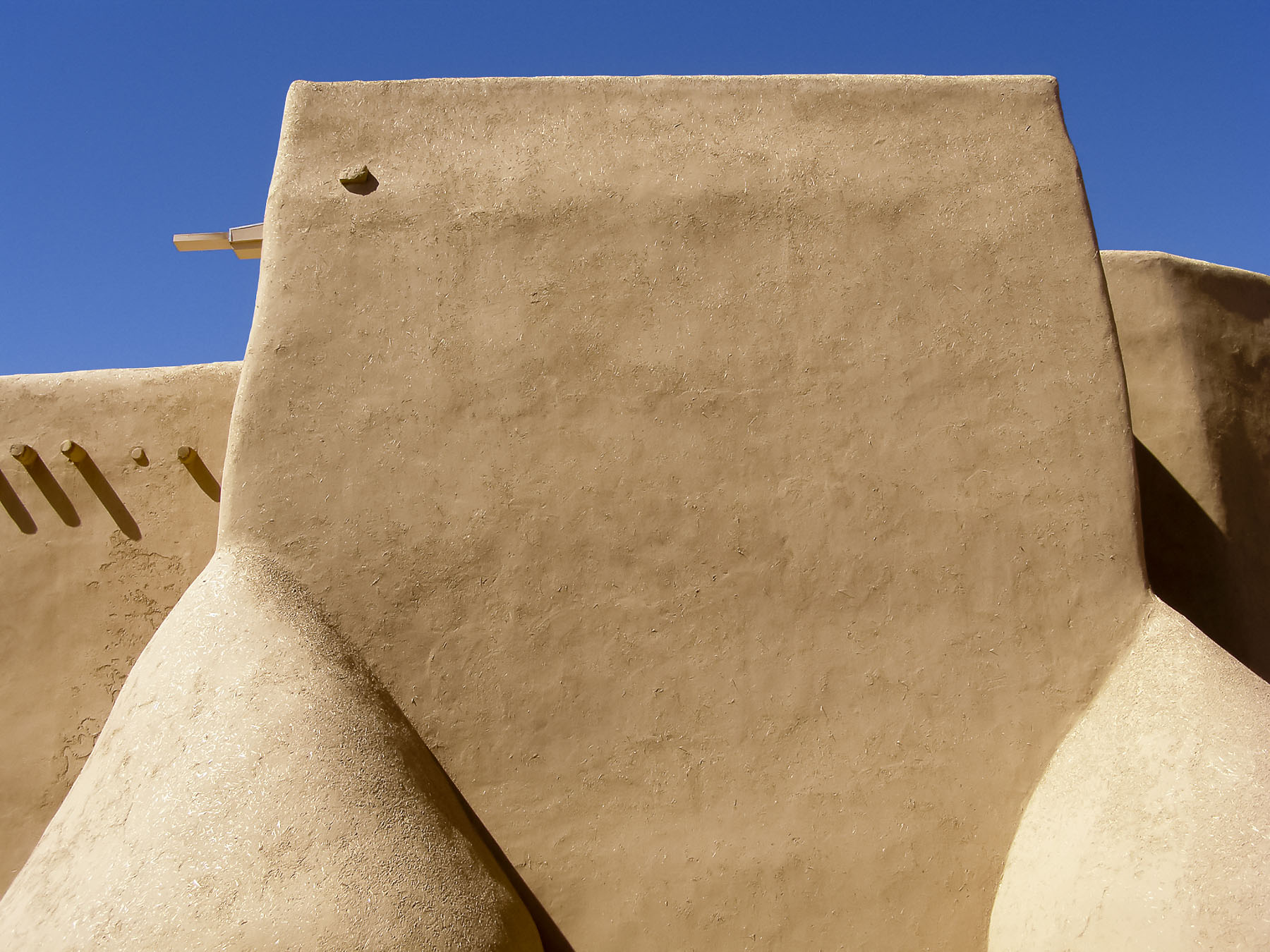
Heading into the mountains of northern New Mexico, the durability and sustainability of well-maintained adobe structures are evident in the elegant San Francisco de Asis Catholic Mission Church in Rancho de Taos, which dates from 1772.

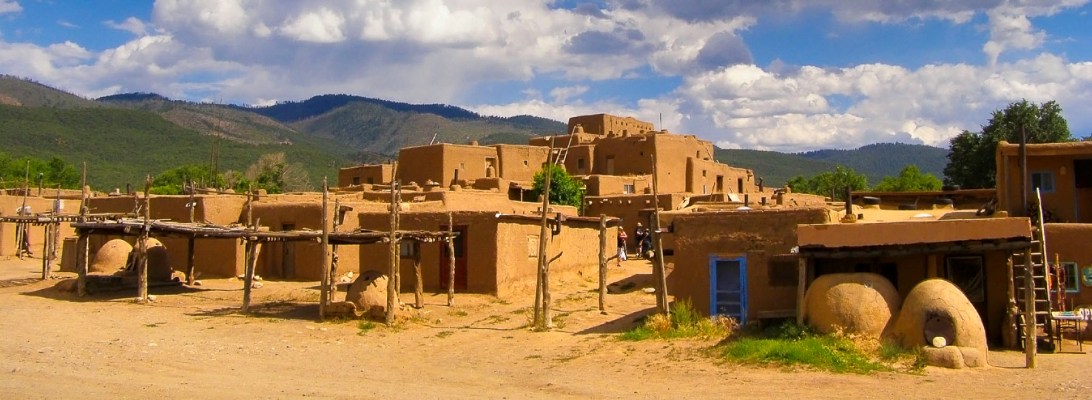
Impressive Taos Pueblo, a multi-storied residential complex, has been continually occupied since its construction in the 1400s. Today nearly 150 people continue to live traditionally in the pueblo, as their ancestors did, without running water or electricity.

Nearby the Rio Grande River Gorge fractures the earth like a lightning bolt. The view from the center of the bridge looking down into the chasm is magnificent and terrifying. Farther north as the river rises from the gorge it has a totally different character as it meanders through the high desert.

While this far north, it’s worth the effort to visit the Great Sand Dunes National Park and Preserve, located just across the state line in southern Colorado.

Over many thousands of years, sands blown across the high desert plains accumulated at the base of the Rocky Mountains here to form the tallest dunes in North America.

Wave when you see us!

Till next time, Craig & Donna

The Turquoise Trail: Scenic, Artsy and Quirky

We always have a wonderful time in New Mexico, but often we’ve too easily fallen into the fastest route, the Albuquerque to Santa Fe rut. Heading north on Rt25, with the Sandia Mountain Range glowing in the late afternoon light on your right and a spectacular sunset in the west is a sublime experience, worthy of inclusion into the “wonders of the world.” The sky and light out here are just awesome, especially if it’s your first time to the Southwest. Aside from traveling north through Jemez Springs, Valles Caldera and Bandelier National Monument, all great destinations admittedly, there are not many alternative routes to Santa Fe, unless you are willing to circumnavigate northern New Mexico for days and hundreds of miles, which is a great alternative and may inspire future adventures.

Instead of following the “westward ho!” from cowboy movies of our youth, we headed east out of Albuquerque eighteen miles on Interstate 40/Route 66 to the Tijeras Pueblo Archaeological Site and the beginning of the Turquoise Trail National Scenic Byway. The trail is a splendid backroad route that gracefully curves, rises and falls through the rugged foothills of the Sandia and Ortiz mountains as it follows NM14 north for 65 miles. Passing through the historic towns of Golden, Madrid, Cerrillos and San Marcos just south of Santa Fe.

Archeological evidence found at multiple sites in Tijeras Canyon traces early habitation going back 9,000 years, near the end of the last Ice Age. The Pueblos people and their first permanent dwellings date to the 10th century AD.

It’s believed that Tijeras Pueblo was built in the early 1300s and had 200 rooms in terraced buildings arranged in a U-shape pattern around a central kiva.  The settlement only flourished for about 100 years before it was abandoned in the 1400s due to extended periods of drought and raids from nomadic Plains Indian tribes.  The Spanish tried to encourage settlement of the area in 1763 with the Carnuel land grant, but that failed after repeated raids by Comanche, Kiowa, and Plains Apache Indians forced settlers to flee. Permanent resettlement didn’t occur until 1819 when the Spanish made peace with the tribes.

Sadly, today all that is left of the Tijeras Pueblo is a terribly eroded mound of rubble with a self-guided trail that winds through the ruins. There is a small museum attached to the Park Ranger Station, which is only open on weekends.

If you haven’t taken the Sandia Peak Tramway, due to the fear of heights or its expense, you can still enjoy the view with your feet firmly planted on the ground. Follow NM14 north, turn left in the village of San Antonito onto Sandia Crest Road, and follow the signs to the 10,678-ft summit. Entrance to the park is free, but there is a small parking fee at the top. The views across Albuquerque are fantastic!

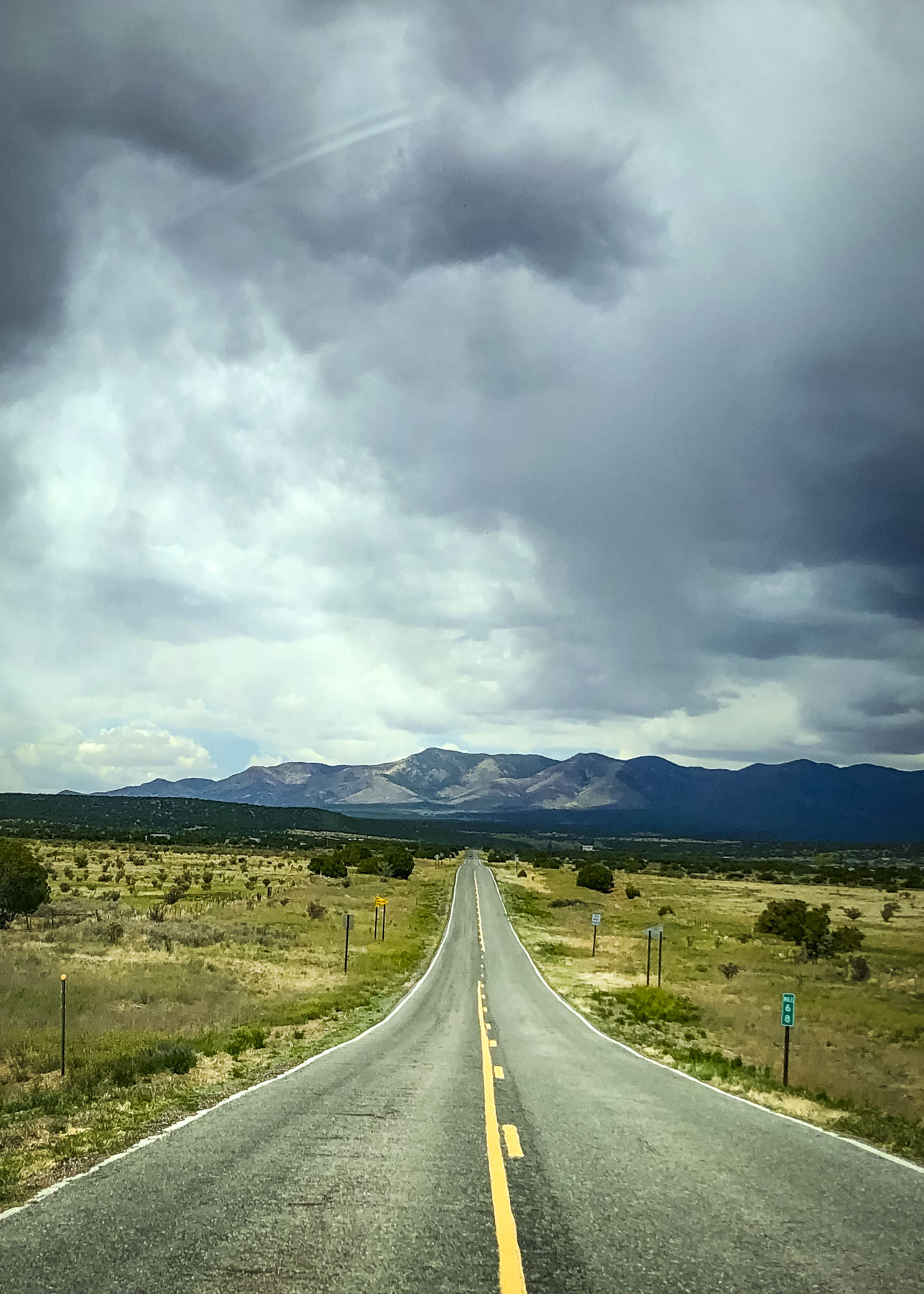
Past San Antonito the desolate, sparsely populated nature of the old west returns, with open vistas and greater distances between dirt tracks that spur occasionally left or right from the road and lead who knows where.

Legends of “Seven Cities of Gold,” and treasure that was rumored to rival the Aztec’s wealth brought Francisco Vazquez de Coronado with 2000 conquistadors north from Mexico City in 1540. On the Rio Grande north of present-day Albuquerque, Coronado commandeered a pueblo as headquarters for his expedition. His men spent two years searching an unknown region that spanned from Texas and Kansas to the Grand Canyon, searching for gold. He never found any because the Pueblo tribes attributed no value to it. Turquoise was the gold they mined for. Spiritual properties attributed to the stone are courage, good fortune and protection of the wearer in battles. The stone was a valuable trading commodity and pieces of Cerrillos Turquoise have been found by archeologists at indigenous sites in Canada and Aztec and Mayan tombs in Central America. Two years later Coronado returned to Mexico empty handed, though his camp was only 30 miles from the stream where this precious mineral glittered in the water.

In 1825, decades before the California Gold Rush, when New Mexico was still part of the Spanish Empire, the mineral placer gold was discovered in Tuerto Creek which ran down from the Ortiz Mountains. Two rough mining camps grew into small villages named El Real de San Francisco and Placer del Tuerto. Built with adobe bricks in 1830, the San Francisco de Asis Catholic Church congregation sought to soften the rough mining town’s edges.

This first discovery of gold west of the Mississippi brought prosperity to the villages for several decades. The Treaty of Guadalupe Hidalgo ended the Mexican-American War in 1848 and allowed the New Mexico territory to be annexed to the United States and the villages were combined and renamed Golden. At its zenith, the town supported many businesses, several saloons, a stock exchange, school, and post office. By the mid-1890s the luster of gold had worn away and ranching had become the dominant enterprise. Folks moved away for better opportunities; the last nail in its coffin and the beginning of its transition to a ghost town was the closure of its post office in 1928.

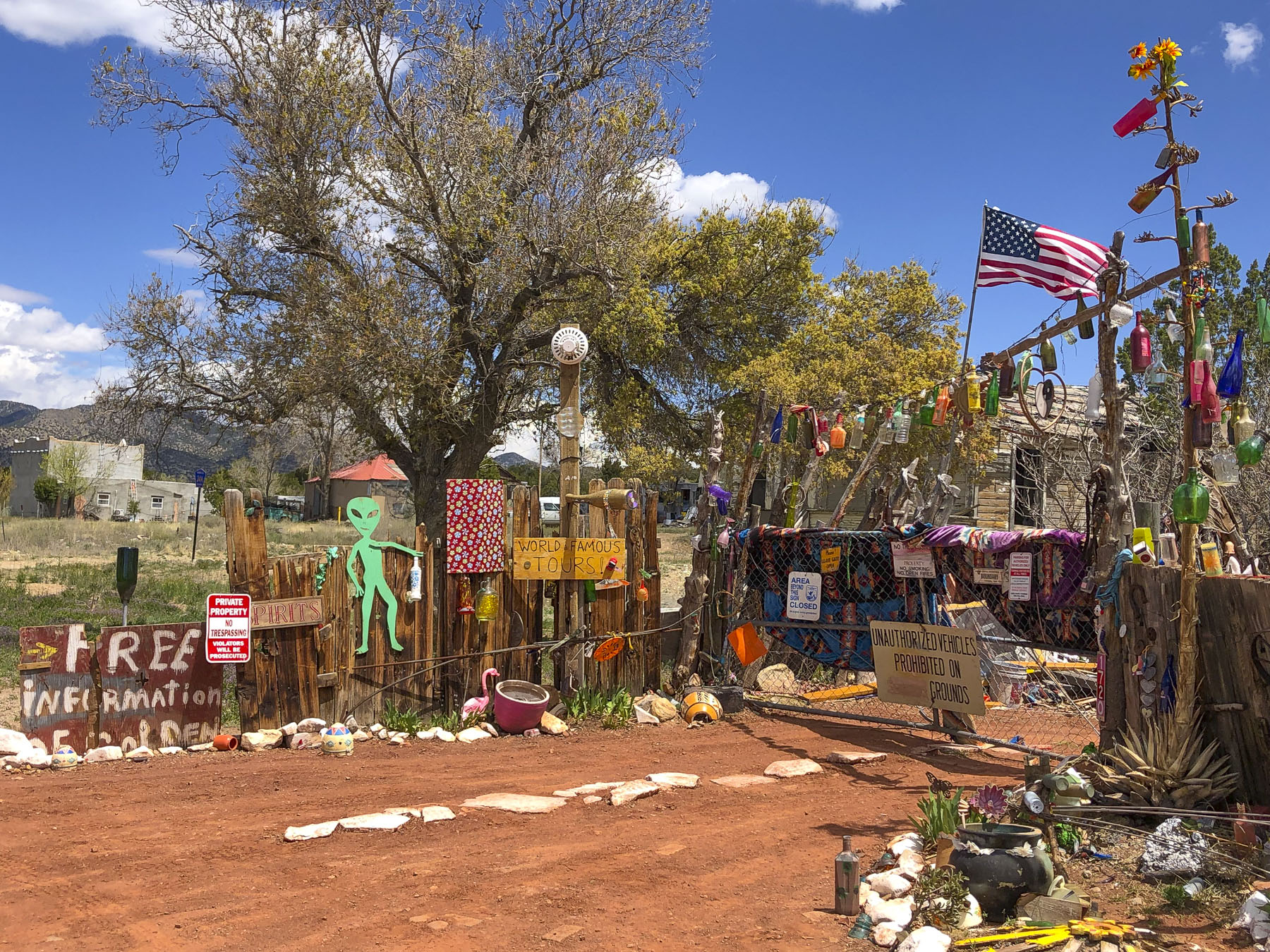
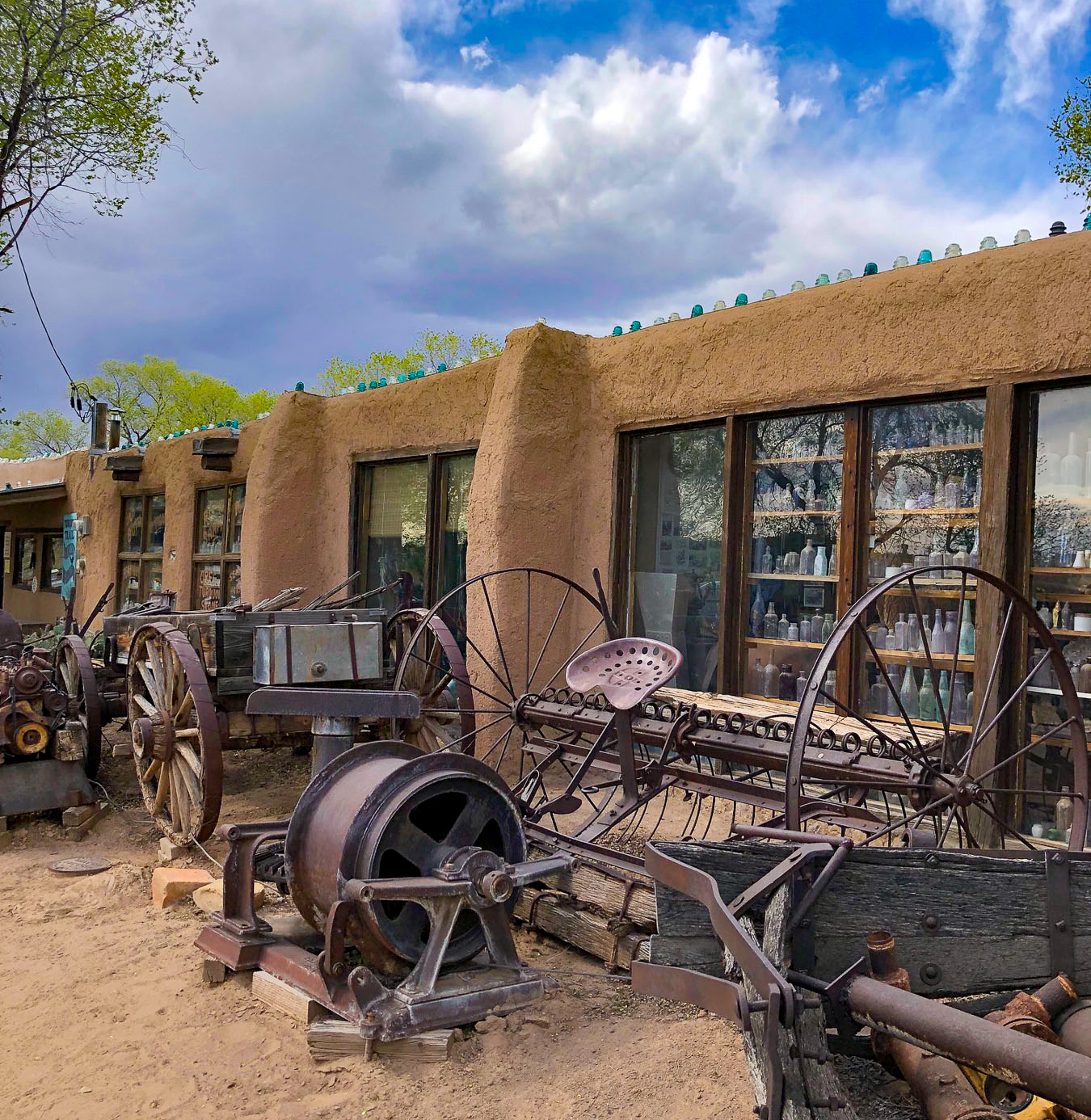
Not much has changed since then for Golden. If you blink you’ve driven through it. But the quirky Bottle House is worth a quick stop and sets the tone for the area that’s full of independent, eccentric, and colorful personalities. The towns along the Turquoise Trail all share similar once-prosperous histories followed by decades of decline, until a slow rediscovery began in the 1970s. It started to attract folks and artists drawn to the ruggedness and beauty of the terrain, those seeking an alternative lifestyle, wanting to live off-the-grid, or just wanting to be left alone. Evolution happens and of course there are now more homes, restaurants, RV parks, small museums, shops, and galleries. But fortunately, there seems to be some unspoken agreement between the old timers and newcomers to keep the area “historically quaint and Old West,” as if time has stopped. You’ll have to drive to Albuquerque to find a strip mall.

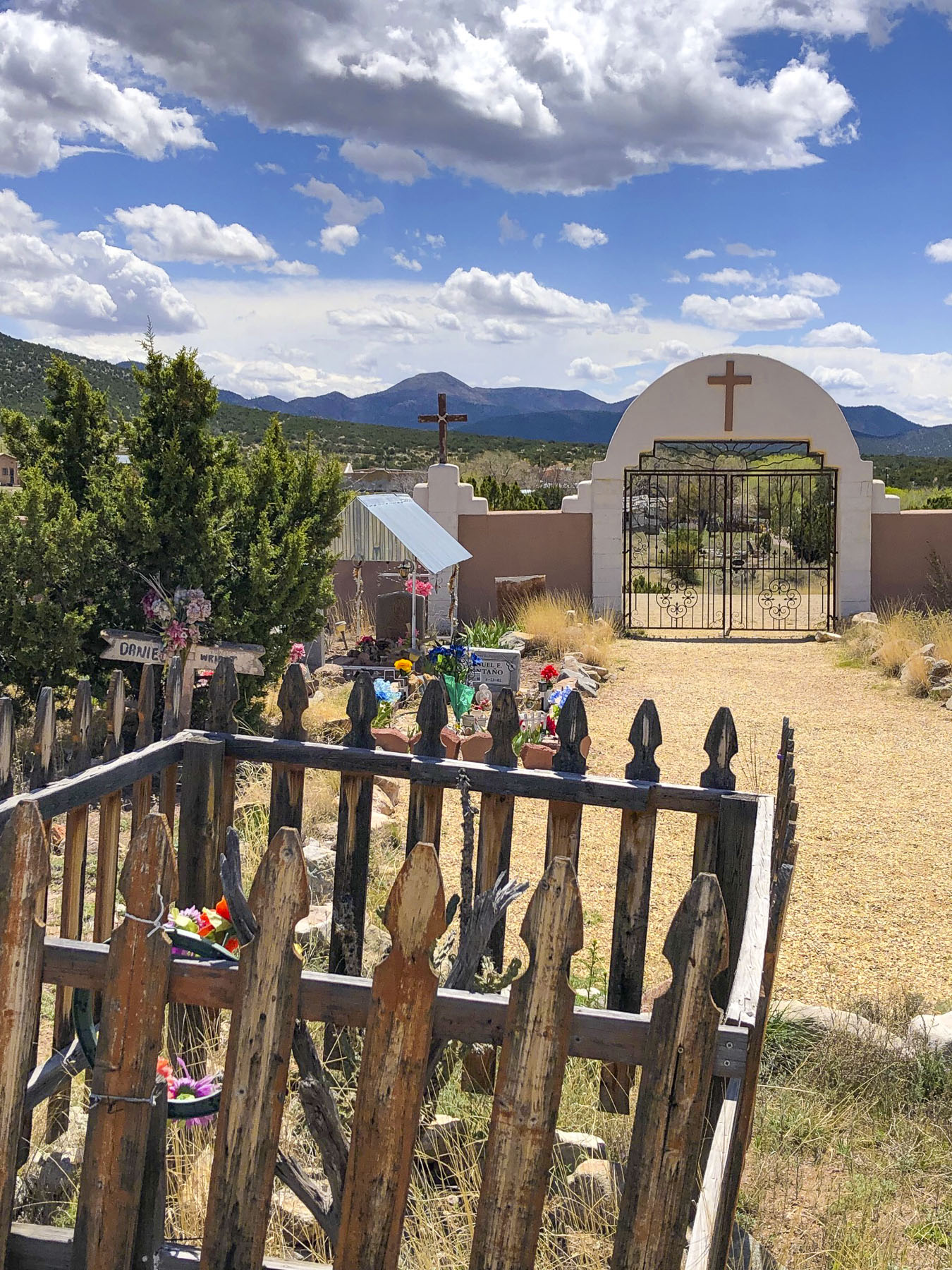
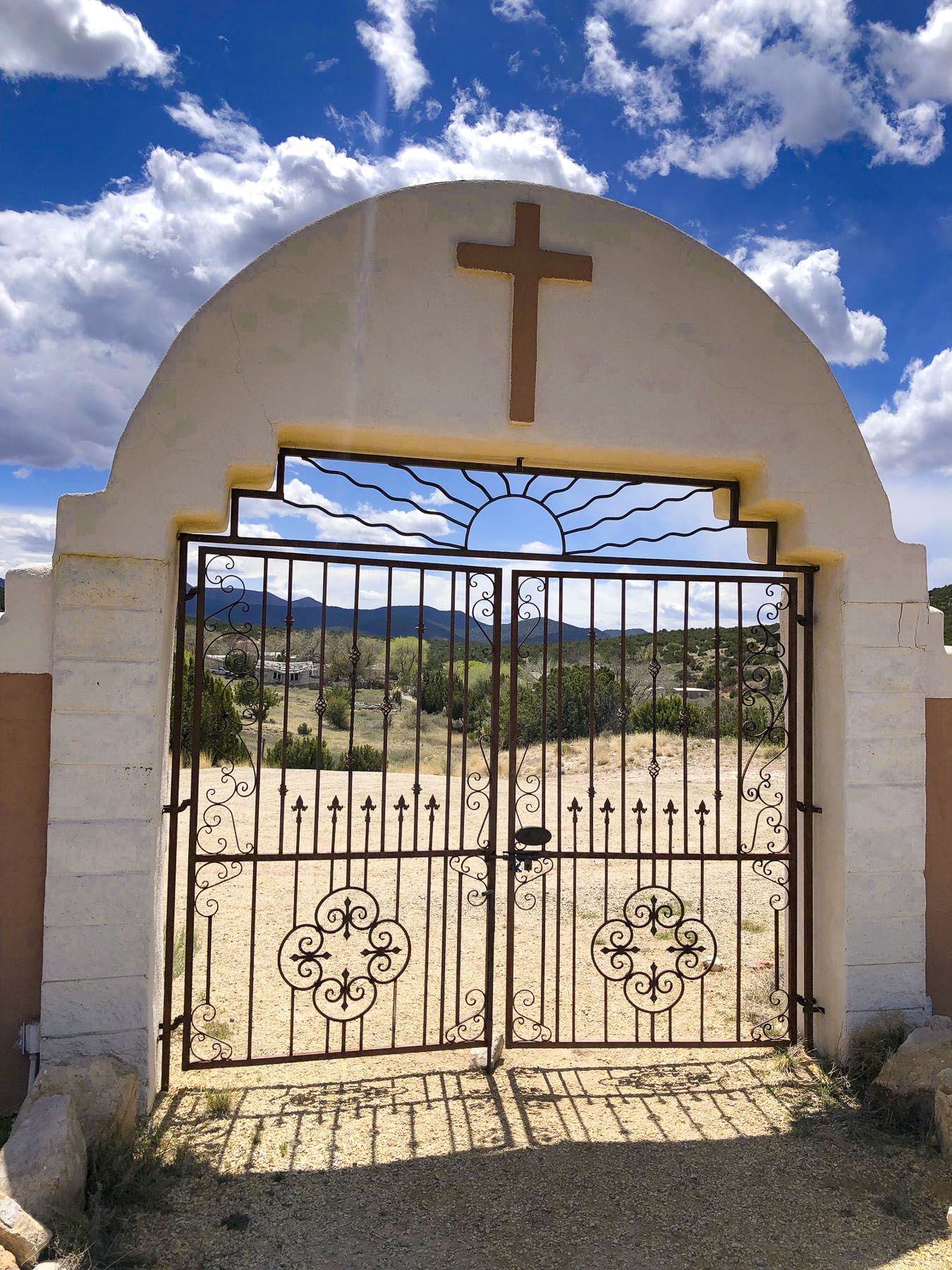
A short distance farther along, the San Francisco de Asis Catholic Church and cemetery still stand and command a small knoll above the road.  Its original adobe bricks were covered with a concrete veneer during a 1960’s restoration. But walk around the back of the church and it’s possible to see them where the veneer has broken away. The church supports a small congregation and holds mass on Saturdays at 4:00 pm.  Annually, every 1st Saturday of October, the church hosts the Fiesta de San Francisco de Assis which begins with a 11:00 am mass, followed with the blessing of the graves in the cemetery and a procession lead by Matachines dancers.

The vistas between the towns are epically endless and evoked thoughts of how folks centuries ago managed to survive on this wild frontier. Drive too fast and you’ll whiz by many interesting roadside attractions.

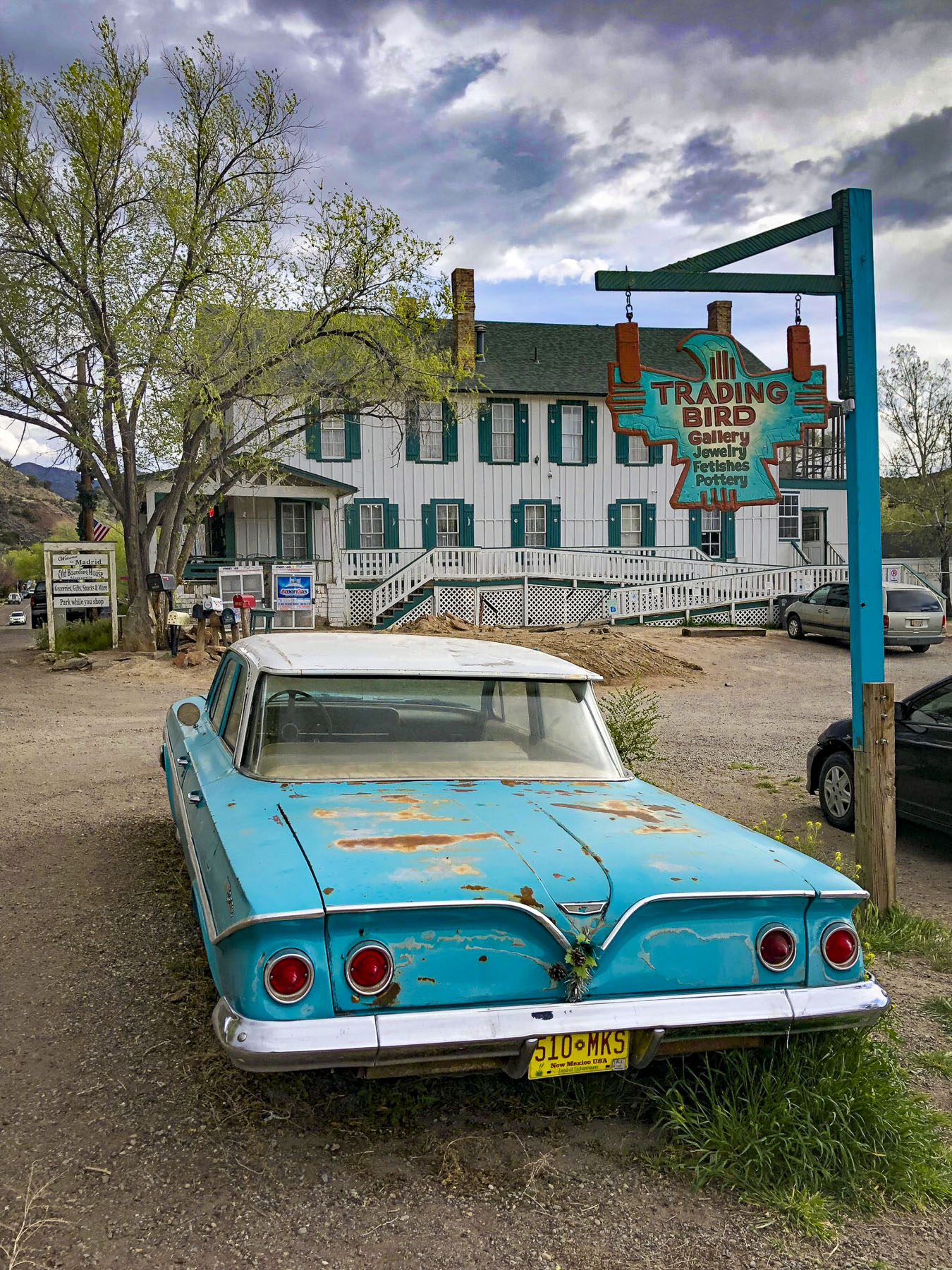
Compared to Golden, Madrid is a metropolis! Coal was discovered in the Ortiz Mountains during the mid-1800s, spurring a squatter’s camp called Coal Gulch. MAD-rid, not Ma-DRID, was founded in 1869. So much coal was being mined that the Santa Fe railroad constructed a spur down from Cerrillos into the town in 1892. We wet our whistles on the patio of the Madrid Brewing Company & Museum, in front of an ancient steam train with what we must say was one of the best craft beers we’ve tasted.

It’s difficult to believe that at its zenith the town once boasted a population greater than Albuquerque’s 3000 folks in 1906. All the small claims were eventually consolidated into the Albuquerque and Cerrillos Coal Company. It became a company town and the extraction of coal from the hills surrounding the town was king. The company provided the booming town and its employees with everything.

Houses were bought in Kanas, disassembled, and shipped on the railroad to Madrid to satisfy the demands of a growing population. The company built a community center, school, and hospital. Most importantly, after it burned down on Christmas Day in 1944, the company rebuilt the Mineshaft Tavern, with its famous 40′ long bar where miners could stretch out after a long shift hunched over underground. The first lighted baseball field west of the Mississippi was built for the town’s minor league baseball team, called the Madrid Miners. Electricity produced at the local coal fired power station ran the mines and was provided free to all the residents of the town. Free electricity encouraged extravagant Christmas light displays that drew in visitors from afar to see lights that covered every building and were strung up the mountainside.

The company brought 160,000 gallons of water daily by train tank cars into the town and legend says every home had a green lawn. The price of coal collapsed in the 1950s when natural gas was beginning to be piped into homes, and the company and town’s economy collapsed as well. In 1954 the entire town was offered for sale for $250,000.00 in the Wall Street Journal. There were not any buyers. Except for a few squatters, the town sat abandoned for twenty years until it was decided to sell the company homes one at a time. Studios, shops, museums, restaurants, and galleries now line the 20 mph main stretch. Packed with tourists on the weekends, it’s almost impossible to find a place to park. Like the rebuilt bar, the town today is a phoenix risen from the ashes.

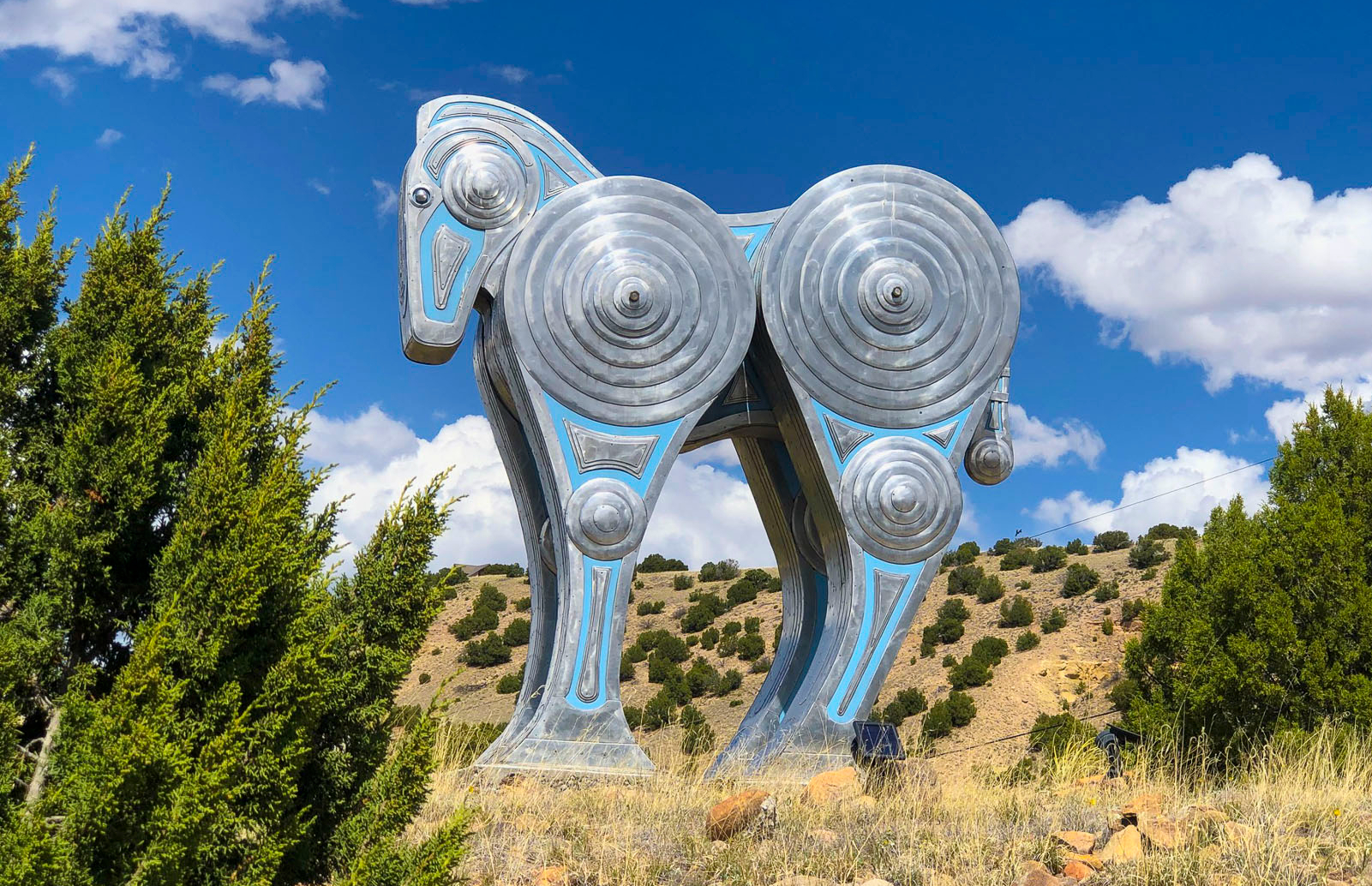
Just north of Madrid, a huge contemporary metal sculpture similar to a Trojan Horse highlights the landscape. You can’t get very close to it, as there’s no visible gate and it’s behind a rancher’s barbed wire fencing. As of this writing I haven’t been able to identify the artist. The sculpture is intriguing, and its placement is mystifying. Other artists have also placed their creations along the drive.

The turn for Cerrillos lies just beyond the bridge that crosses the over the Arroyo Viejo, a seasonal creek. It’s the only town on the Turquoise Trail that you have to turn off NM 14 to reach. That half-mile journey takes you back 150 years to a village with dusty dirt roads, wide enough to turn around a team of horses and a wagon. Cerrillos retains its old west authenticity, with many original adobe structures and 1800s era rough-hewn lumbered storefronts. It is deemed so authentic, many western movies have used the town for their location shoots, most notably the 3:10 to Yuma (2007) starring Russell Crowe and Christian Bale, along with Young Guns (1988) which had a huge famous cast that starred Jack Palance, Kiefer Sutherland, Lou Diamond Phillips, Emilio Estevez, Charlie Sheen, and a cameo appearance by Tom Cruise as a soldier shot in the climatic scene. The action comedy with Clint Eastwood Every Which Way but Loose (1978) was also filmed here. A few miles away John Wayne filmed The Cowboys (1972) in San Marcos.

Pueblo Indians had been conducting small open pit mining with hatchets on Mount Chalchihuitl, which is now part of Cerrillos Hills State Park, since the 900s. The stone was gathered for its believed sacred properties, along with lead sulfide, which was the source of glaze paint used to decorate native pottery. Spanish settlers arrived in the 1600s and mined the same hills for silver. There was an uneasy coexistence, and silver mining ceased with the Pueblo Rebellion in 1680. Small mining efforts returned to the area after the Spanish renewed efforts to live peacefully with the Pueblo tribes. New Mexico was a United States territory when gold was discovered around Cerrillos in 1879.  The railroad arrived in 1880. The boom town supported thousands of miners with 4 hotels, 5 brothels, 21 saloons, and an opera house which once hosted a performance by the famous French stage actress and singer “the Divine Sarah,” Sarah Bernhardt.

Four thousand prospecting pits, mine shafts and holes were dug in the area by 1884. The town’s prosperity and recreation attracted outlaws like the Ketchum Gang, Silva’s White Caps and Billy the Kid. Cowboys from Cerrillos were recruited to join Teddy Roosevelt’s Rough Riders for their campaign through Cuba during the Spanish American War. The president of a gold and silver mining company began promoting turquoise and silver Jewelry to visitors arriving by train. Tiffany & Co. at one point even owned their own mine to provide the stone for their booming turquoise jewelry sales that lasted into the 1900s. The St Joseph Catholic Church standing today was built in 1922 and replaced an earlier 1884 structure. A Methodist Church graced the other end of town. It was never a ghost town, but slowly, one by one, the area’s mining operations played out and closed until only several hundred people remained in the area.

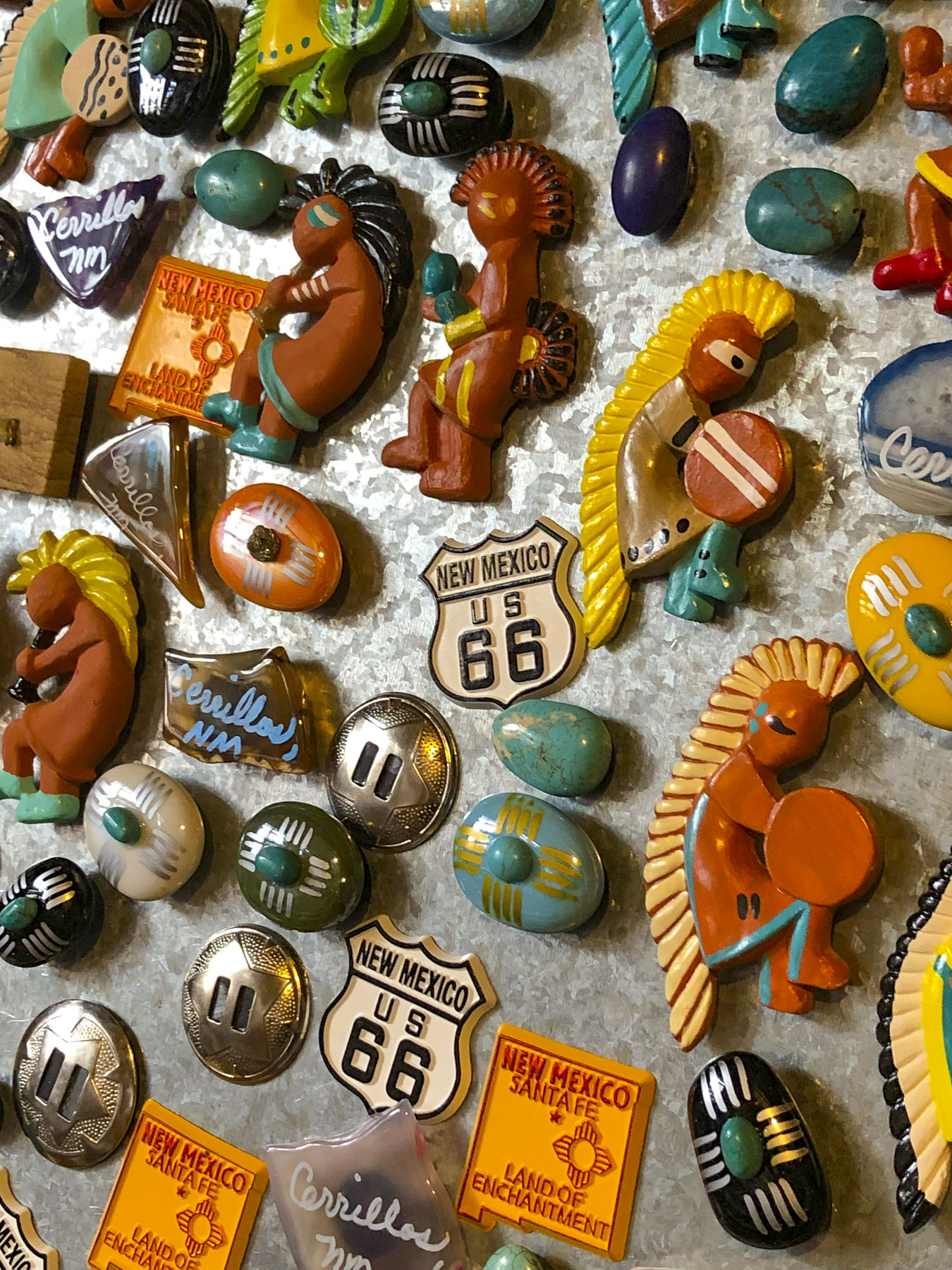
Mid-week in early spring, the only door that swung open was at the Casa Grande Trading Post and Cerrillos Turquoise Mining Museum which has a mind-boggling array of displays and trinkets. It is a large 28 room adobe hacienda that looks like it has been there for centuries. But in fact the owners, Todd and Patricia Brown, along with family and friends, started construction in the 1970s that eventually utilized 65,000 handmade adobe bricks.

Some Interesting highlights from the Cerrillos Historical Society include:

1888 – The dark stain on the floor of Dr. Palmer’s second-floor office, the relic of Black Jack Ketchum’s bullet wound, is the local must-see attraction. The first meeting of the Cerrillos Masonic Lodge is held at the Palace Hotel in their upstairs room.

February 19, 1890, 11am – Nelly Bly, the famous New York World reporter was racing back to New York on her round-the-world-in-80-days journey (she made it in 72 days, 6 hours, 11 minutes, 14 seconds). Her train stopped at Cerrillos only long enough to take on water. The 67 miles from Albuquerque to Lamy by rail was done at the breakneck speed of 46 miles an hour!

August 1892 – The new railroad spur to Coal Gulch is completed and the town of Madrid is born.

1899 – The Cochiti Gold Mining Company builds an Edison coal-fired dynamo at Madrid, which provides Cerrillos with its first electric lights. Those were the days!

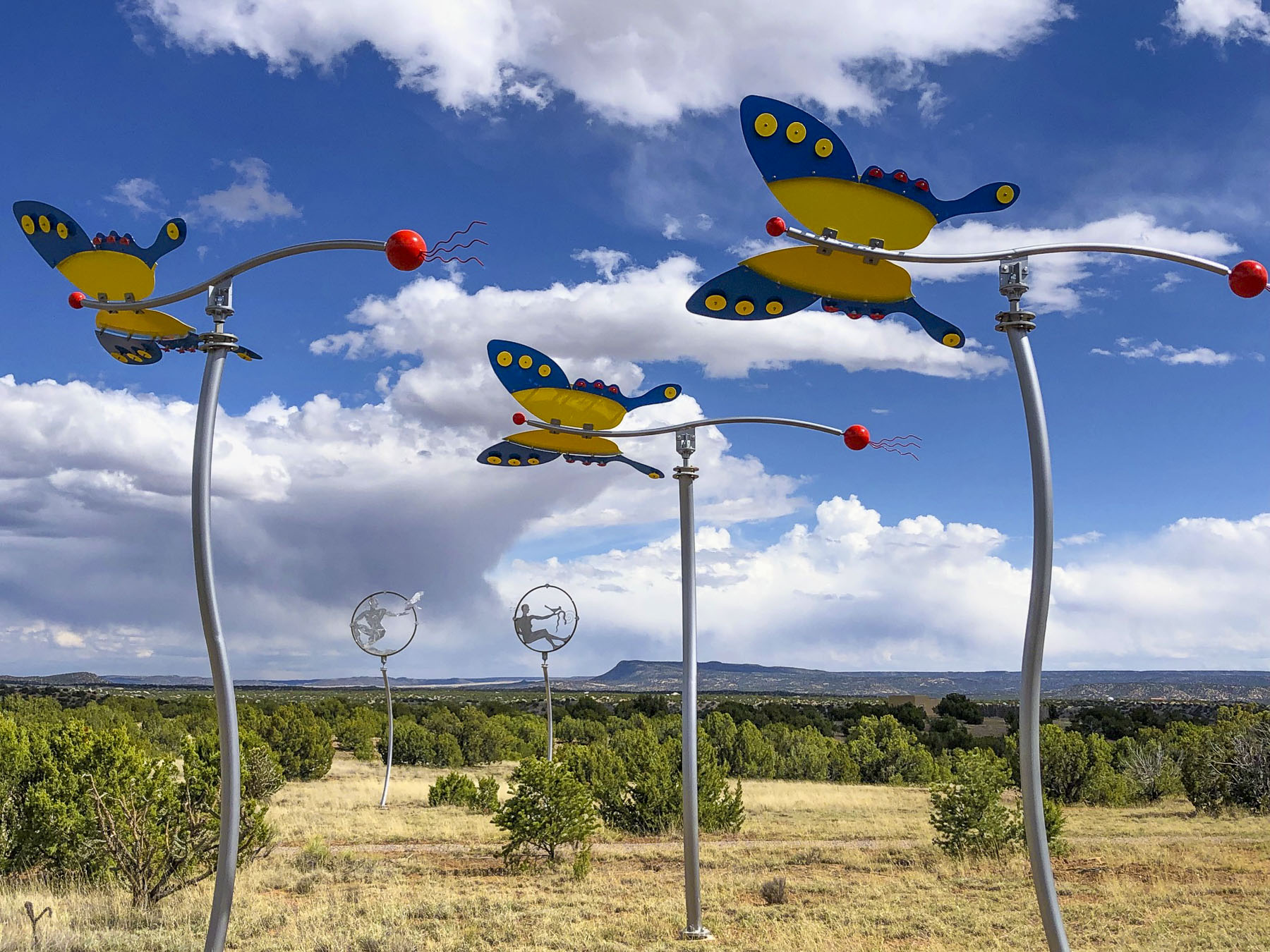
Just past an interesting geological rock formation called Garden of the Gods, we reached our farthest point north and turned around on the Turquois Trail in San Marcos at the intersection with the road that leads east to Galisteo and eventual the pueblo ruins at Pecos National Historical Park. Along the road here are some whimsical wind sculptures created by David Hickman.

We could have continued north on NM14 to Santa Fe, but we chose to return to Albuquerque via Madrid and stop for a crisp cold beer at the Mine Shaft Tavern and stretch our legs.

Till next time,

Craig & Donna

South of Albuquerque: Mountains, Missions and Bottomless Cups of Coffee

In all our previous trips to Albuquerque, we had always opted to head towards Santa Fe, never exploring south of the city. But we only had a few days to ourselves this time after attending our daughter’s wedding and decided to do day trips from the Duke City. The nickname references the city’s naming in 1706 honoring the 10th Duke of Albuquerque and/or the Albuquerque Dukes, a beloved minor league baseball team.

The pueblo ruins around Mountainair piqued our interest. We mapped out a circular route; south on I-25, east on NM-60 to Mountainair, then north on NM-55 & NM-337 to Tijeras where we would pick up I-40 West back to town. The day dawned with a crisp blue sky, and we headed south. We would have preferred a slower drive through the Rio Grande Valley nearer the stately Manzano Mountain range, but with 153 miles to go and multiple stops it would be a long day. The panoramas from I-25 were expansive.

Francisco Vazquez de Coronado’s failed mission to find the legendary “Seven Cities of Gold,” in 1540 did not discourage other explorers from trying, which brought Don Juan de Oñate onto the scene. A marriage to Doña Isabel de Tolosa Cortés de Moctezuma, granddaughter of conquistador Hernán Cortés, and the great-granddaughter of Aztec Emperor Moctezuma II, gave Don Juan de Oñate new prestige and influence. In 1595 King Philip II of Spain chose Ornate to colonize the upper Rio Grande valley. In 1598 he led an expedition that included his nine-year-old son, a nephew, 20 Franciscan missionaries, 400 settlers, 129 soldiers, 83 wagons, plus livestock, north from Mexico City, with the stated mission from the Pope to spread Catholicism. But there was also hope that riches rivaling that of the Aztecs and Incas would be found again. Fording the Rio Grande near present day El Paso, he proclaimed all the lands north of the river “for God, the Church, and the Crown.”

They eventually reached three pueblos in the Abó Pass area, which were on an ancient route between the mountains that facilitated trade between the Plains Indians of Eastern New Mexico and the Pueblo peoples that lived in the lush Rio Grande Valley. This area that at the time was thought to have a population of 10,000 talented farmers, weavers, stone masons, ceramicists, and adobe making Pueblo Indians, which the Spaniards quickly began exploiting. They eventually reached three pueblos in the Abó Pass area, which were on an ancient route between the mountains that facilitated trade between the Plains Indians of Eastern New Mexico and the Pueblo peoples that lived in the lush Rio Grande Valley.

This area that at the time was thought to have a population of 10,000 talented farmers, weavers, stone masons, ceramicists, and adobe making Pueblo Indians, which the Spaniards quickly began exploiting. Life in the new territory under Oñate was severe. Some settlers urged a return to Mexico when silver was not discovered, and Oñate executed the dissenters. Pueblos that refused to share winter food stocks needed for their own survival were brutally suppressed into submission. The most notorious crime occurred at the Acoma Pueblo, north of Albuquerque, when the inhabitants resisted seizure of their winter provisions, killing Oñate’s nephew during the upheaval. In response, soldiers under his command massacred 800 men, women, and children. The 500 surviving villagers were enslaved and by his decree every Acoma man over the age of twenty-five had his left foot amputated. Word of his atrocities eventually reached the Spanish throne, and in 1606 he was recalled to Mexico City, tried and convicted of cruelty to colonists and natives. With a slap on the wrist, he was banished from Nuevo México, and allowed passage to Spain where the king appointed him Minister of Mining Inspections.

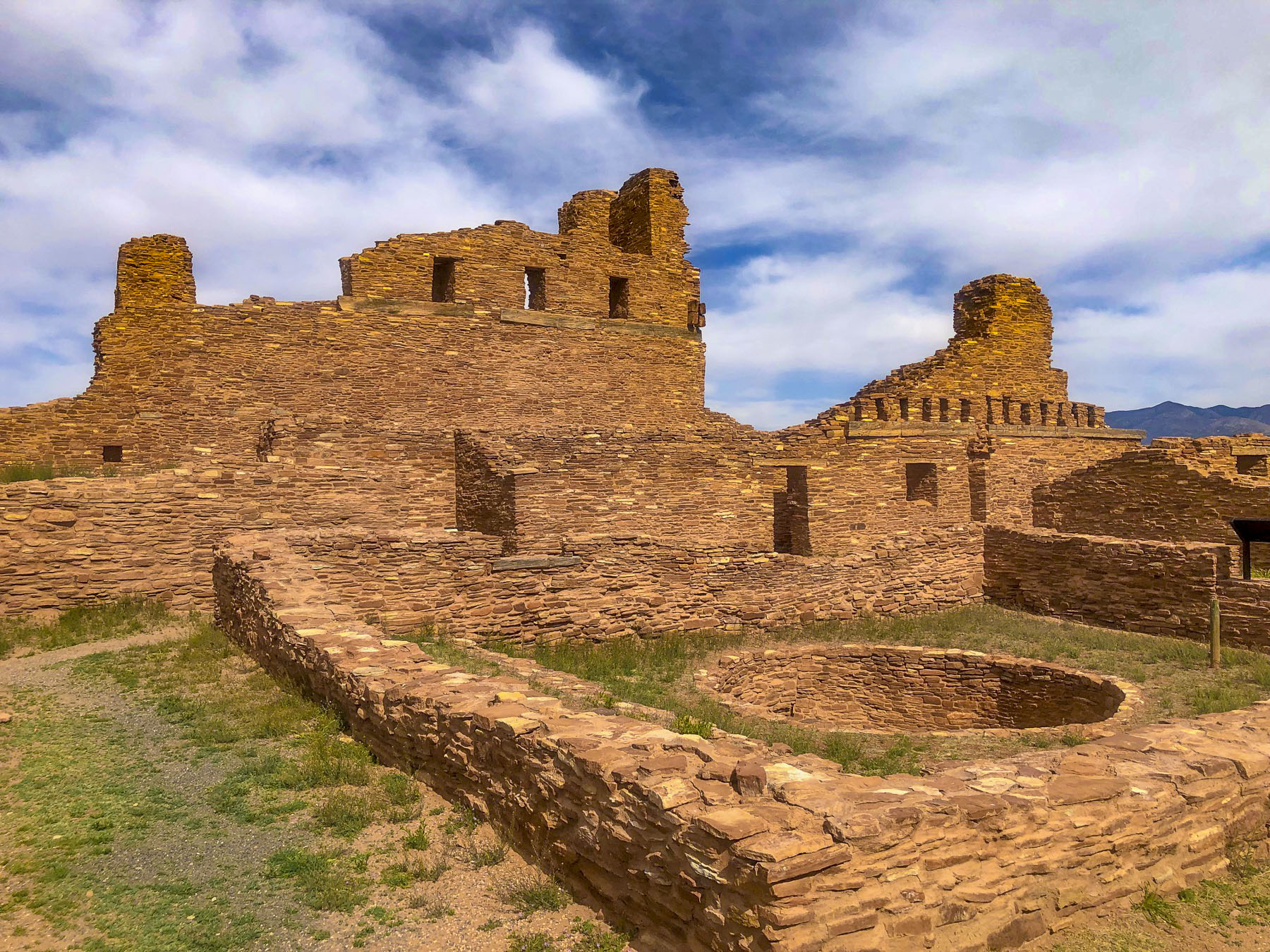
In 1621, Fray Francisco Fonte was assigned the task of building a mission at Abó Pueblo. First occupying rooms in an existing pueblo and later commandeering labor, including a large number of women, to build a separate church and convento which radically incorporated a kiva into its structure. This effort at syncretism was most likely modeled after the Catholic church’s success in Peru where Pachamama, an “Earth Mother” goddess who was celebrated to facilitate the indigenous population’s conversion to Catholicism. This  technique was adapted from Julius Caesar who allowed conquered peoples to keep their religions, as it “eased the acceptance of Roman rule.”

Two other Church missions in the Salinas Valley at Gran Quivira and Quarai pueblos were also constructed around the same time as Abo’s and also incorporate Kivas. This was a controversial practice as the Spanish Inquisition, (1478–1834), was still going strong. This threat couldn’t be used against the Puebloans, as they were not yet considered citizens of Spain without conversion. But it was a dangerous tight rope for the friars who constantly heard from the regional Spanish civil authorities that they were overly tolerant of the Indians “pagan beliefs,” and the Puebloan’s religious studies took too much time away from the encomendero. The encomendero was a colonial business model that granted conquistadores or ordinary Spaniards the right to free labor and tribute from the indigenous population. In return Nuevo México encomiendas were obligated to “instruct the Indians in the Roman Catholic faith and the rudiments of Spanish civilization.” The free land and free Indian labor promised with the encomendero was also used as a recruiting tool to encourage settlers to venture into the wilderness. The pueblos did not submit willingly; any resistance was violently suppressed. Though out-numbering the Spanish invaders, the Indians’ weapons of stone-tipped arrows and spears were no match against the Spaniards’ guns, armor, metal swords, and horses. Relations with Puebloans ultimately deteriorated when the friars, under civil pressure, refused to allow the kachina dances in the Kivas and filled them with rubble and dirt to prevent their use.

An extended period of drought and frequent raids from the plains tribes led to abandonment of the three Salinas pueblos by 1678, two years before the Pueblo Revolution in 1680 in which they surely would have participated. Four-hundred Spaniards died, including 21 of the 33 priests, but there were almost 2000 Spanish survivors. Warriors followed the fleeing refugees all the way to El Paso to ensure their expulsion from Indian territory.

When the Spanish returned 12 years later, they did not try to reimpose the encomendero and returning missionaries displayed more tolerance of indigenous religious beliefs. Spain instead sought to enlist the Pueblo tribes as allies to resist French and British empire expansion farther west. But the Salinas Valley remained deserted until Spanish shepherds returned for a few years in the early 1800s, only to be forced out by nomadic Apaches. Successful resettlement did not happen until the mid-1860s.

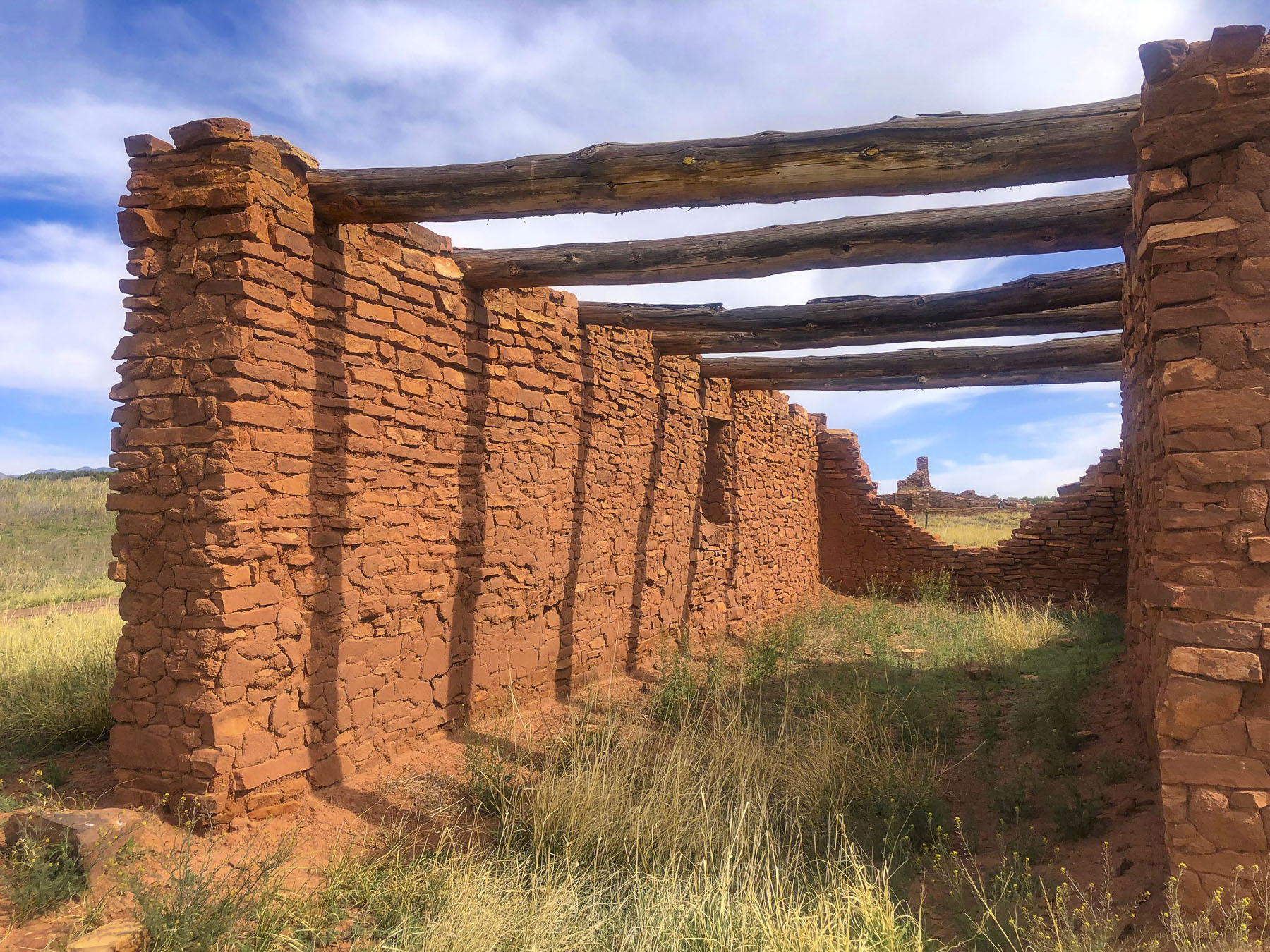
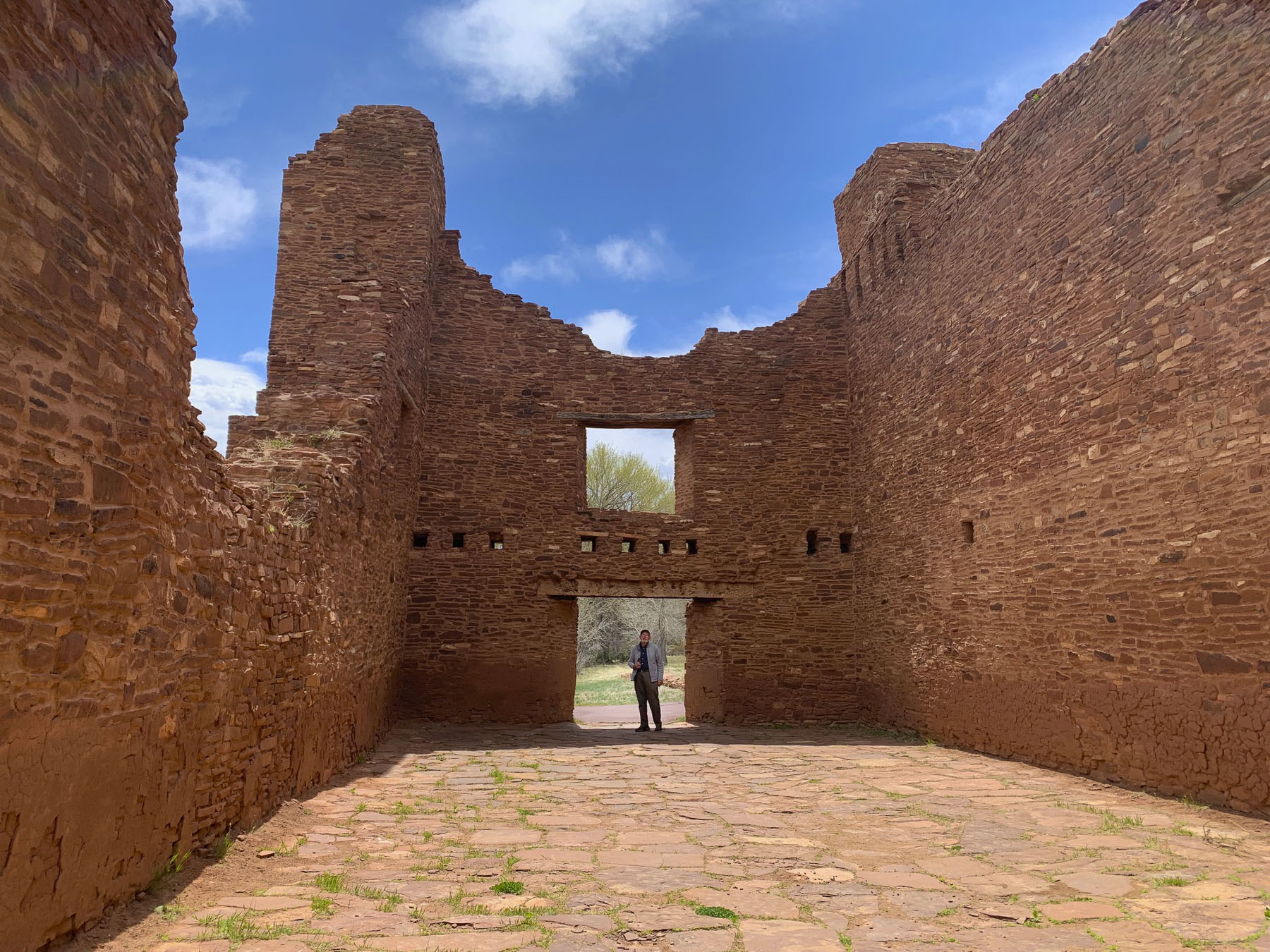
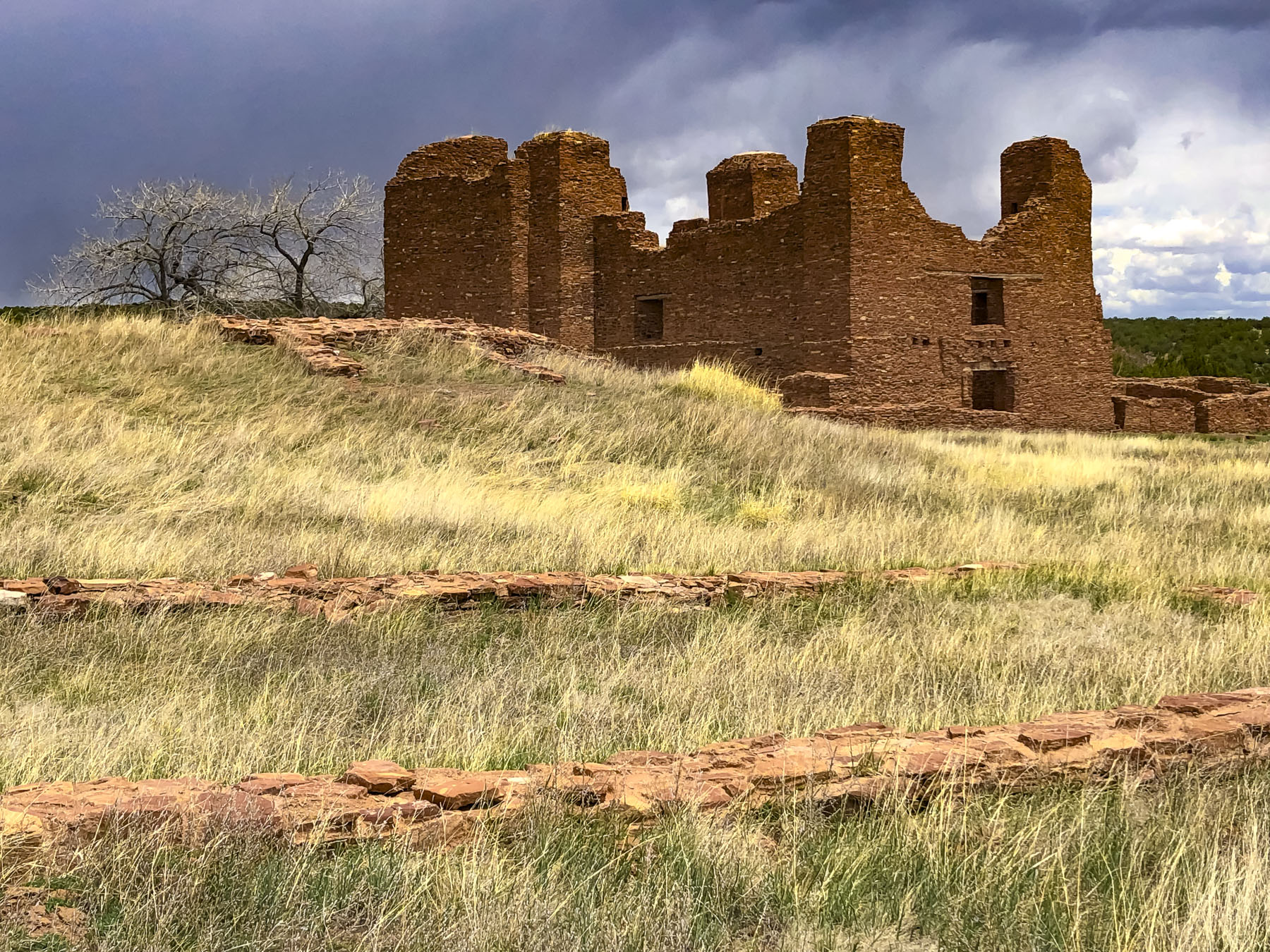
We turned off NM-60. Long ago the road was known as the Atlantic and Pacific Highway, one of the original Auto Trails in the early years of motoring. It was a route marked with colored bands on utility poles, that started in Los Angeles, California, and ended 2700 miles later in Virginia Beach, Virginia. Those were the days! We followed the single lane road into a gully and through a seasonal stream before rising to a field in which the earth-red stone ruins of the Abó mission glowed in the morning sun. The ruins of the mission church are massive. The complex must have been a wonderous sight when it was built next to the pueblos. Unfortunately, only piles of rubble remain of the pueblos themselves and I could not find a record as to why they were destroyed. But there is an entry from a Spaniard’s journal that describes the Salinas villages before the mission was constructed; “Each of these pueblos must have about 800 people, young and old. They were close to the plains and had bison-hide (acquired by bartering salt with the Apaches,) as well as cotton and deerskin garments; they had maize and turkeys; their houses were well-built, of slabs and rocks and whitewashed inside; the province was well forested with pine and juniper.”

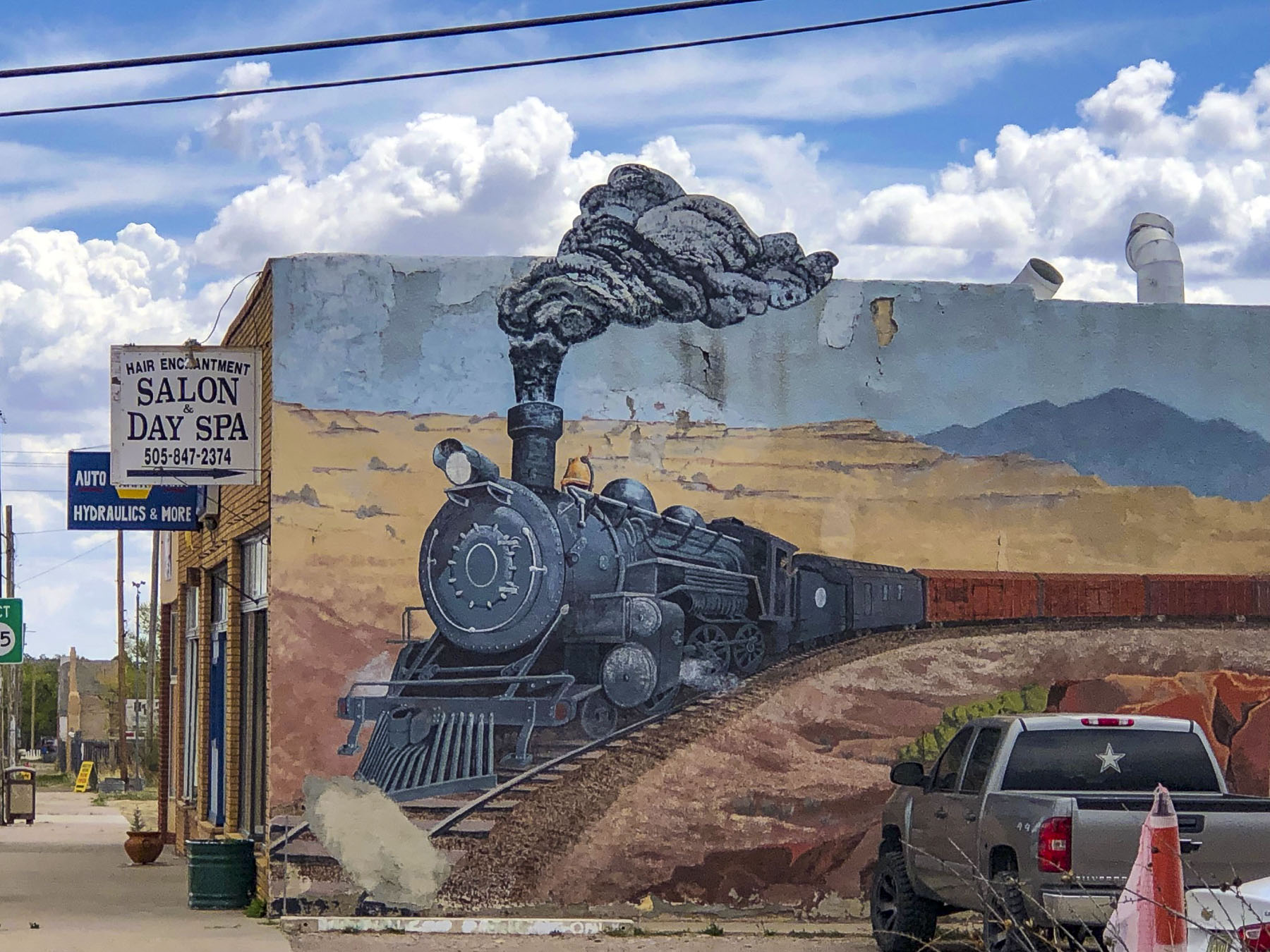
We imagined a small town nestled into the mountains. Yes, it sits on the summit of Abó Pass at an elevation of 6,500 feet, in the vast expanse of the high desert. The mountains were way behind us. Mountainair is a misnomer, though the air is crisp and the town catches the winds blowing in from the eastern New Mexico plain. It’s a quaint crossroads that keeps its frontier spirit alive. In the early 1900s it was also “The Pinto Bean Capital of the World,” when peak production filled over 750 train carloads of beans in one season. A 10-year drought in the 1940s forced farmers to become ranchers. The town had passenger rail service between 1907 and mid-1960s. The railroad is an important part of the town’s heritage and BNSF Railway now owns the old Atchison, Topeka & Santa Fe Railway depot which is on the National Register of Historic Places. It’s a good spot to watch freight trains, many over a mile long, on the Southern Transcon route, pass by.

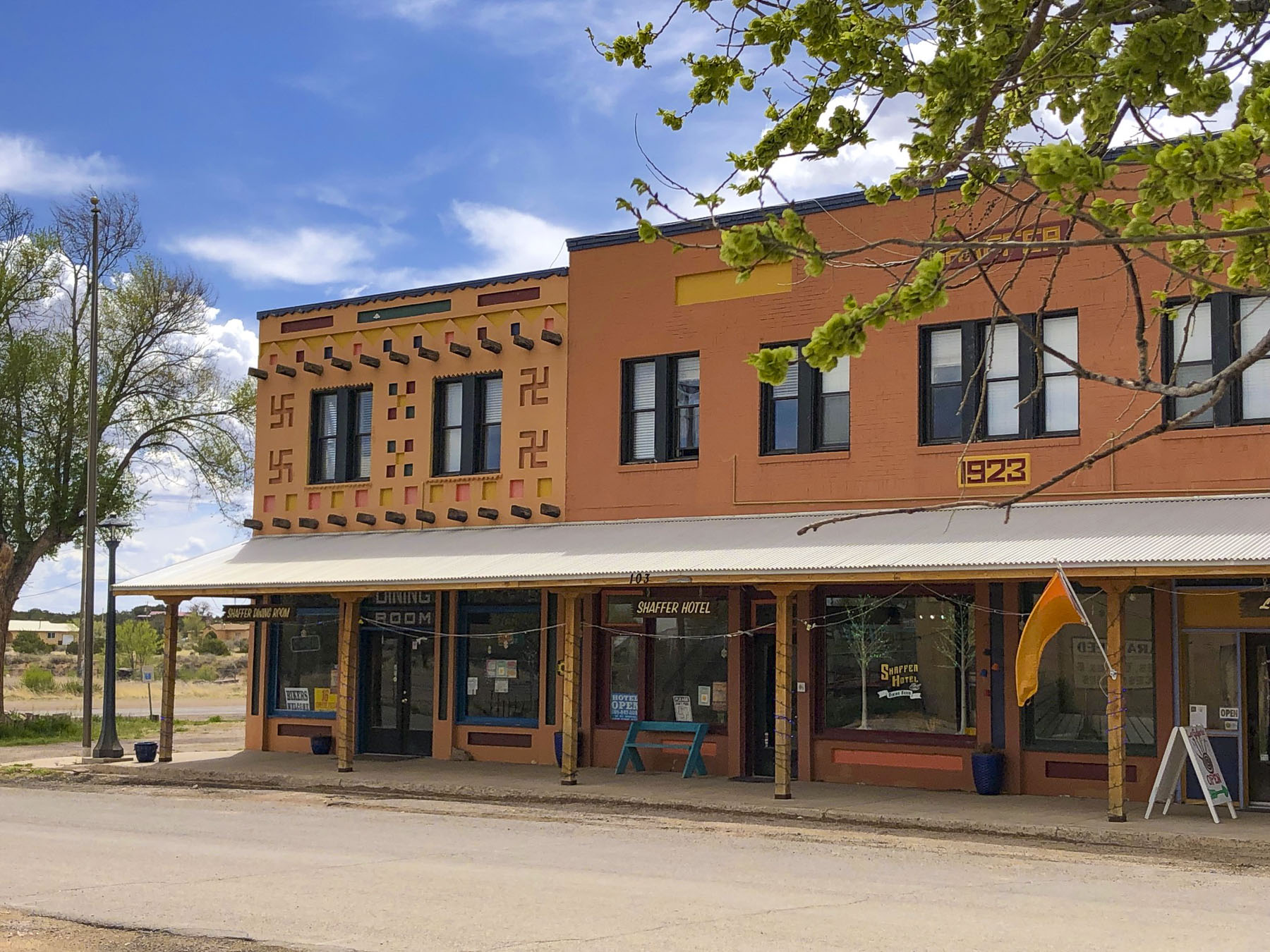
One block south of the main thoroughfare the Shaffer Hotel anchors a quiet corner. It has welcomed guests since “Mom & Pop” Shaffer built it in 1923 and decorated it with chandeliers, hand-carved vigas, and Indian art patterns painted on the walls and ceilings in bright primitive colors. The façade features four Navajo Whirling Logs, ancient symbols that represent wellbeing, good luck and protection, but unfortunately, they are often misinterpreted as nefarious swastikas. During the Depression the hotel claimed itself to be “The Most Unique Hotel in the World.” The hotel boasts a colorful history and one on legends tells of the time when Mom fired a shot at Pop when she found him in the arms of another women. She missed, but the bullet is still lodged in the ceiling above the stairs. The marriage continued. Mom died before she got to kill him.

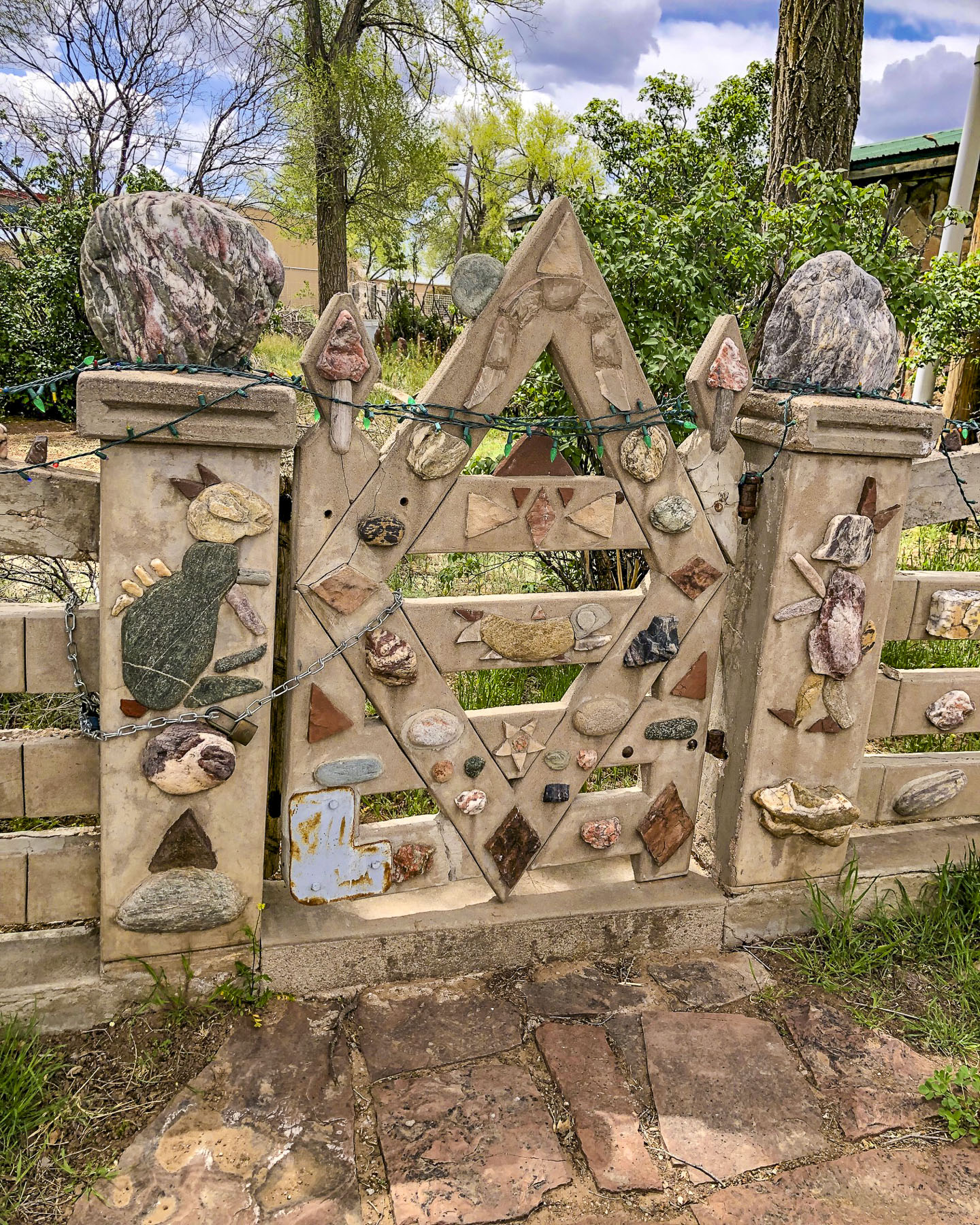
Mr. Shaffer lived on to become a well-regarded creative wood sculptor, using twisted roots and branches from local juniper trees to carve imaginary beasts. Eleanor Roosevelt arranged an exhibit of his unique folk-art in Washington, D.C. An unusual rock-inlaid fence that Pop built still surrounds the side yard of the inn. At the Mustang Diner good food and, surprisingly, bottomless cups of coffee (star****’s is a foul word in my vocabulary) were a welcome break.

Gas stations are far apart out here, and Mountainair will be your last opportunity to fill the tank for many miles. From Mountainair we could have driven south to Gran Quivira, but it would have been a sixty-mile roundtrip, so we chose to save it for another time.

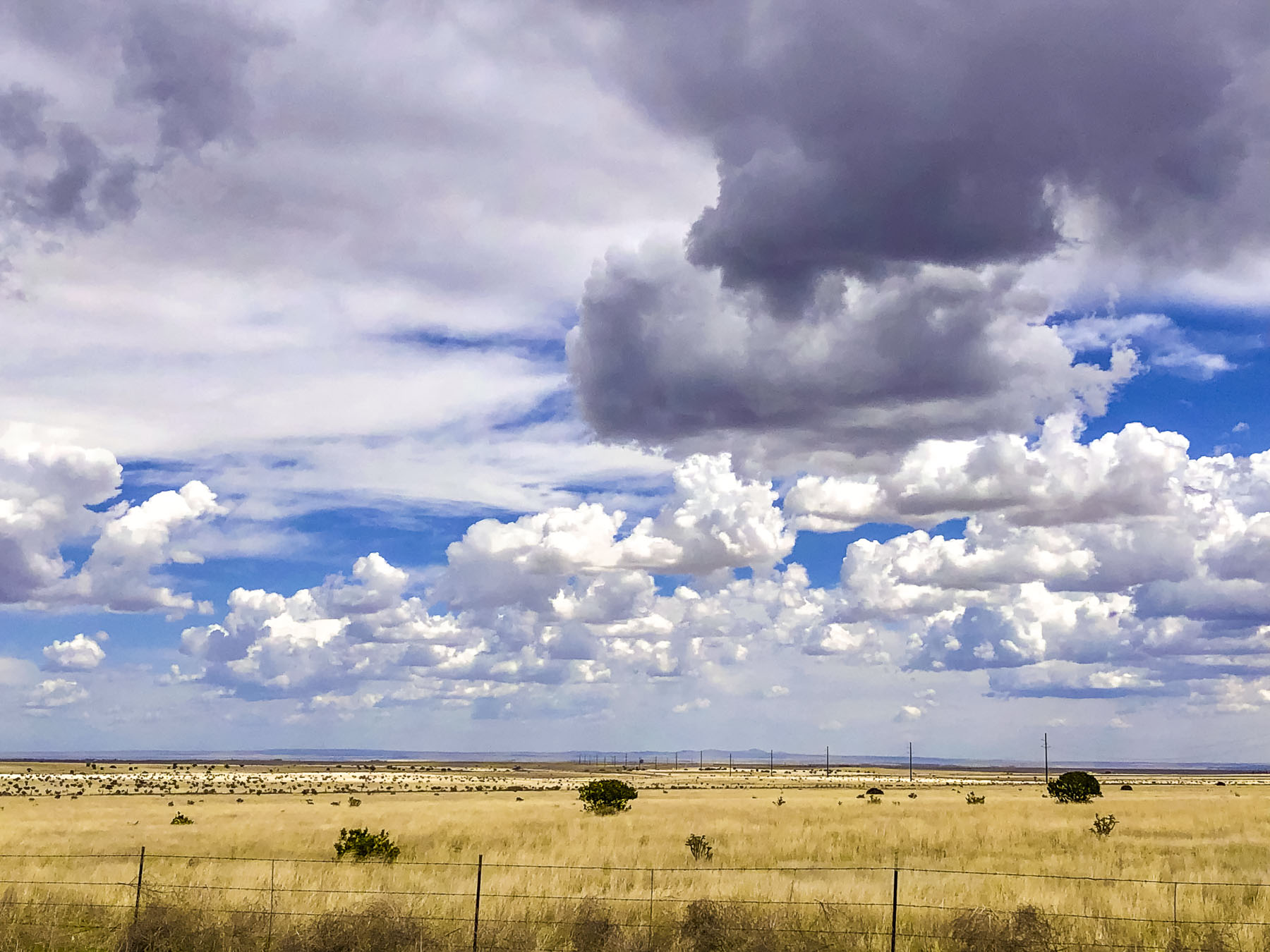
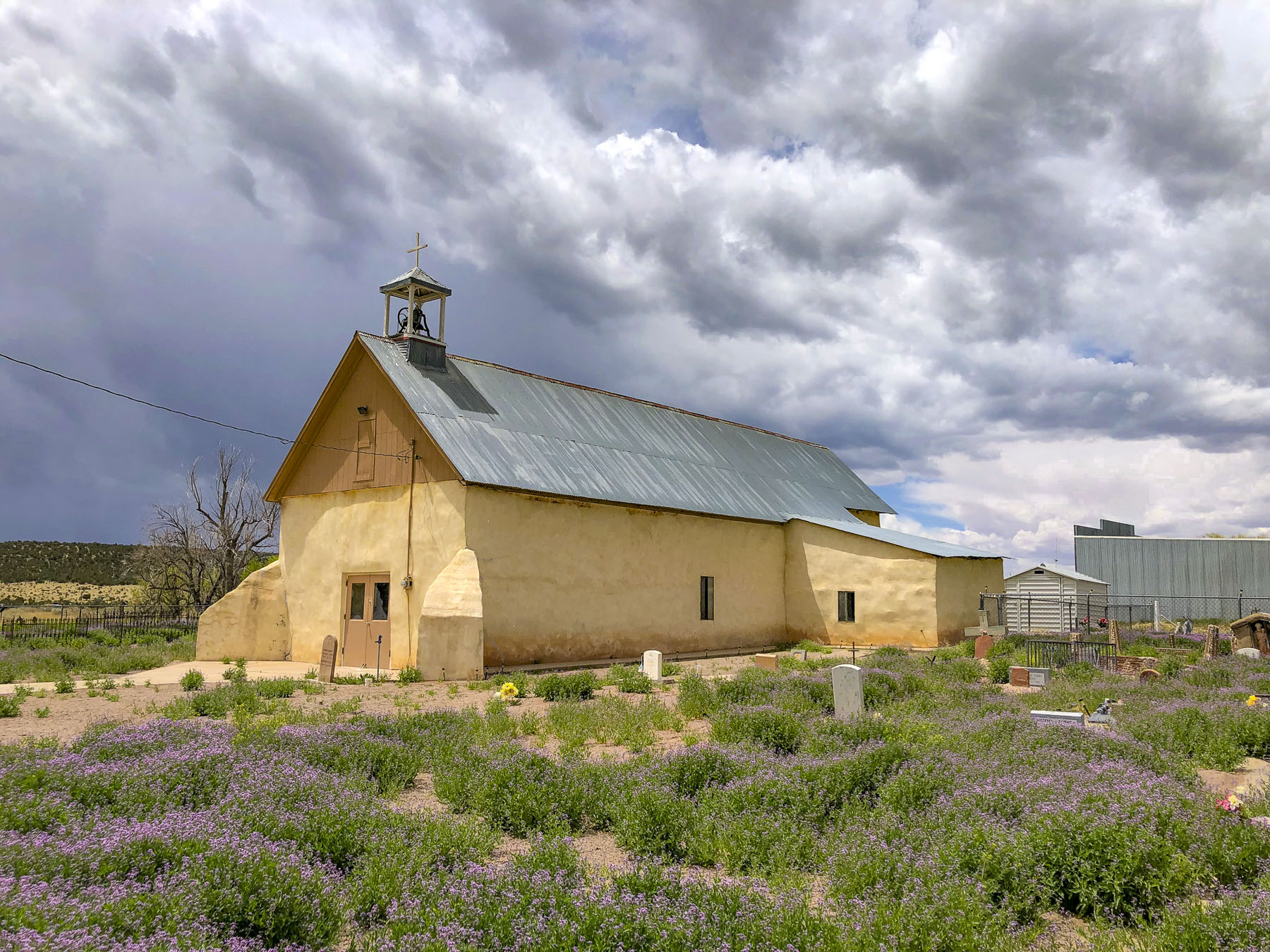
The views across the high desert were endless as we headed north on NM-55 to the Salinas Pueblo Missions National Monument Quarai Unit. To the east white puffy clouds raced across the sky. We turned west and drove into the rain. The storm was clearing by the time we stopped at an old church in Punta de Agua, not far from the Quarai mission, that dates from the 1860s.

A sign at the entrance warned visitors to stay on the paved trail to avoid rattlesnakes. It was an easy one-mile loop that took us through the church ruins and mounds of the fallen pueblos before circling back through a forest and picnic area. Four massive centuries-old logs still firmly held the weight of the thick stone wall above the church entrance. The scale of the church was immense, and the ruins towered above us.

The three Salinas Valley missions share similar histories, but there is an interesting side note to the Quarai mission. It served as the seat of the Spanish Inquisition in Nuevo México during the mid-1600s. A Spanish Inquisition panel consisting of three priests would send abusive encomenderos, (Indians did have certain rights under Spain’s complex laws), and mis-guided priests guilty of liaisons with native women, back to Mexico City for trail. The women would be sent to Santa Fe to be whipped by civil authorities.

The Quarai mission also had an unusual square kiva built within its walls, but there are not any historical references to why this shape was used. As with the one in Ado it’s thought that the kiva’s location within the walls of the mission represents the church’s syncretic approach to teaching the Puebloans the gospel. By the 1630s, there were 25 mission districts encompassing 90 pueblos in northern New Mexico, with 50 friars trying to convert nearly 60,000 Indians.

The good condition of the ruins today are the results of repairs and stabilization projects started in the 1930s by the Depression era Work Projects Administration, WPA, under the guidance of the Museum of New Mexico.

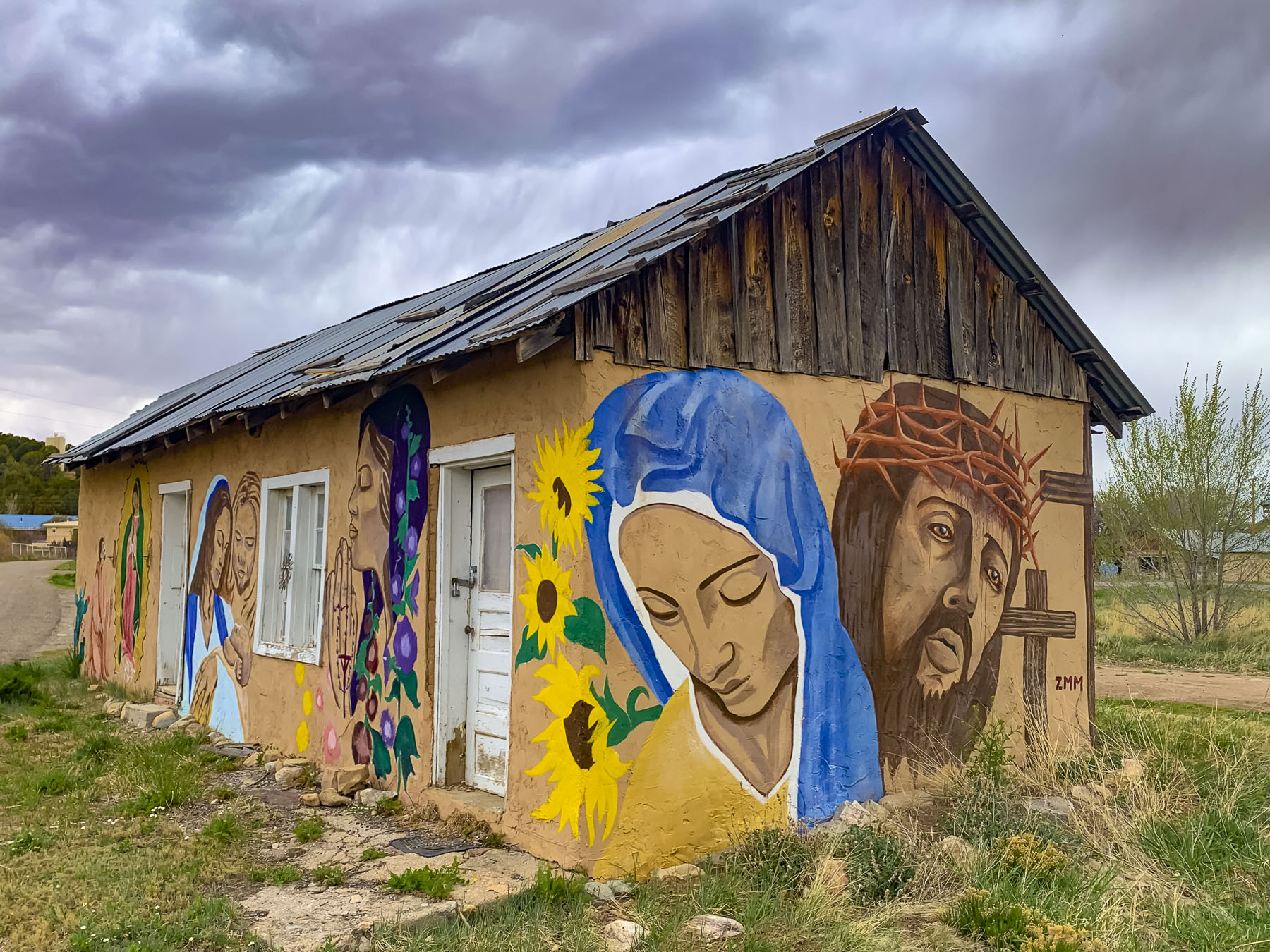
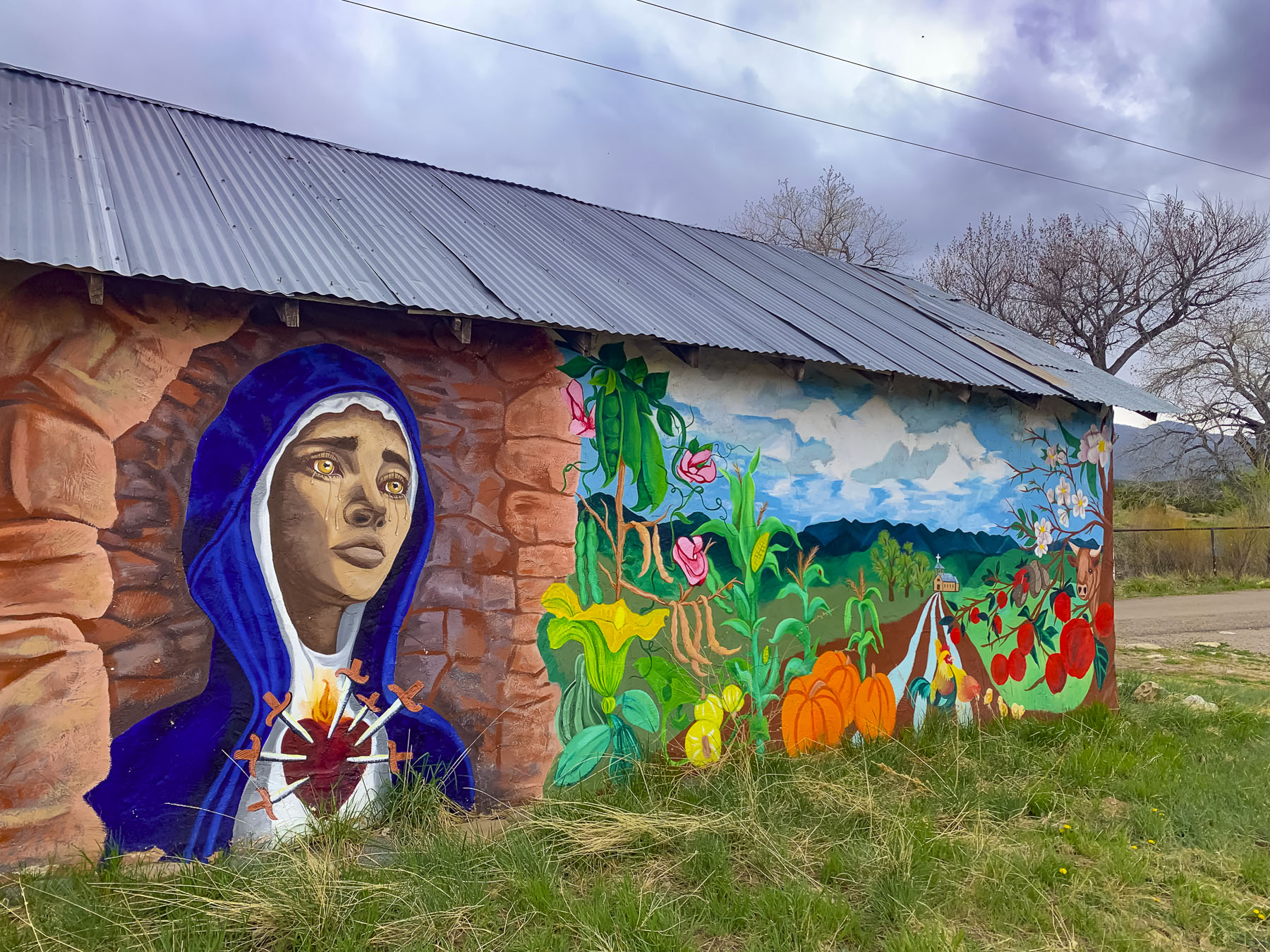
Our route back to Albuquerque traversed many isolated hamlets without many amenities. Coffee and food was a thing of the past until we reached Duke City. But we did pass several nicely done religious murals along the way in Manzano and Chilili.

The mural on the side of San Juan Nepomuceno Church in Chilili looks like it’s a scene from a Spanish Iberian village and we questioned the choice of a scenic river and bridge as a background, only to realize later that, behind the church, we had in fact crossed over a bridge that spanned the Canon De Chilili, and left centuries behind.   

Till next time,

Craig and Donna

Portugal Road Trip – Part 1: Searching for Templar Castles

“It’s okay, you can just ignore that caution light on the dashboard. It never goes off.” “Do you have another car?” “No.” All rental cars appear equally perfect when you are making comparisons and a final selection from a website. Staying within our budget, we chose an off-airport car rental agency with good reviews, that picked us up at the arrivals terminal and sped us away to our awaiting wheels, for €12.50 a day.  The Fiat Panda assigned to us had been driven hard and put away wet, you might say. Reviewing the preexisting body blemishes with the rental agent resulted in a cartoon of the car that looked like it had been ambushed in a gangster movie and sprayed with machine-gun fire, including the roof. Nevertheless, the engine sounded fine, and our twelve-day journey began, driving in a large figure-eight, north to south route, around Portugal. Our first destination – Castelo de Almourol, before arriving in Tomar. But by the afternoon of day three we were referring to our car as the Portuguese version of the American rent-a-wreck concept. When driving through the mountains, on the way to a schist village, every warning light on the dashboard started blinking violently in Portuguese. If we had been flying an airplane, we would have donned parachutes and bailed out.  The engine sounded fine, so we flew on.

Not being sure what is open during the week in the off season, we headed for the Miradouro do Almourol, an overlook above the island that the castle commands. Located on the south side of the Tagus River, it’s not particularly easy to get to. But my wife and I enjoy the off the beaten track routes that take us through less traveled countryside. Crossing the Tagus River, we followed the N118 north into the Alentejo (beyond the Tagus) Region through flat farmlands and wine estates dating back to the 1700’s. The red wines of the area vinted with the Portuguese varietals Castelão, Trincadeira, and Touriga Nacional are acquiring international recognition now, as are the regions white wines made with Antão Vaz, Arinto, and Fernão Pires grapes.

The drive was slowed occasionally by tremendously large John Deere combines, the width of the entire road, as farmers drove them between different fields waiting to be harvested. Seasonal spring floods that replenish the soil have made this river plain an important area for cereal crops and wheat since the Roman times. Our walk a little then café philosophy quickly transformed into drive a little then café when we did our first U-turn of the trip as we passed a small place that had a tractor parked in front. Our espressos only €.70 each. It was nice to be back in Portugal.

The wetlands of the Tagus River valley are ideal for bird watchers looking for black-winged stilt, marsh harrier, purple heron, pratincole and Kentish plover. Occasionally we spotted storks atop centuries-old chimneys of abandoned homes, resting in new nests that were stacked like pancakes atop older ones before continuing their winter migration south to Africa. Quiet lanes, faded sun-bleached pastels, and centuries old weather-worn buildings dotted the landscape. Bullrings, Praça de Touros, still stand in Chamusca and Salvaterra de Magos, and the latter’s traffic circle has a large sculpture of a cavaleiro and bull to celebrate the tradition. Though interest in bullfighting has been waning since Queen Maria II of Portugal banned the spectacle in 1836 with the argument that it was “unbefitting for a civilised nation,” it regained popularity in the Alentejo region after the fights were reinstated in 1921, and the climatic killing of the bull was outlawed in 1928.

Before we reached the castle, we stopped for lunch along the riverfront in Arripiado at the ABC Bar Café. It was a tranquil spot with a boardwalk that had a view of the Tagus River and the small village of Tancos across the water. Small boats offer rides to Almourol Castle from the Arripiado riverbank here.

With its striking island location, just below the junction of the Zezere and Tagus rivers at Constância, Almourol Castle is one of the most picturesque medieval fortresses in Portugal.

Constância was once an important fishing village during the Middle Ages where it was said the rivers there were “two-thirds fish and one-third water.”

As with most things ancient on the Iberia Peninsula, the castle’s history started with an early tribe. The Lusitanians built a small fortress on the island as protection against the Romans in the first century B.C.E. Visgoths, Vandals, Alans and Moors followed until it was captured by the Portuguese during the Reconquista in 1129 and subsequently entrusted to the Knights Templar to rebuild for defense of the frontier border at the time.  It eventually lost its strategic relevance and was consequently abandoned. Various phases of reconstruction began in the mid-1900s. 

Train service to Tancos, Castelo de Almourol and the hilltop village of Constância is available from the Santa Apolónia Station in Lisbon. The trip takes about an hour and a half.   

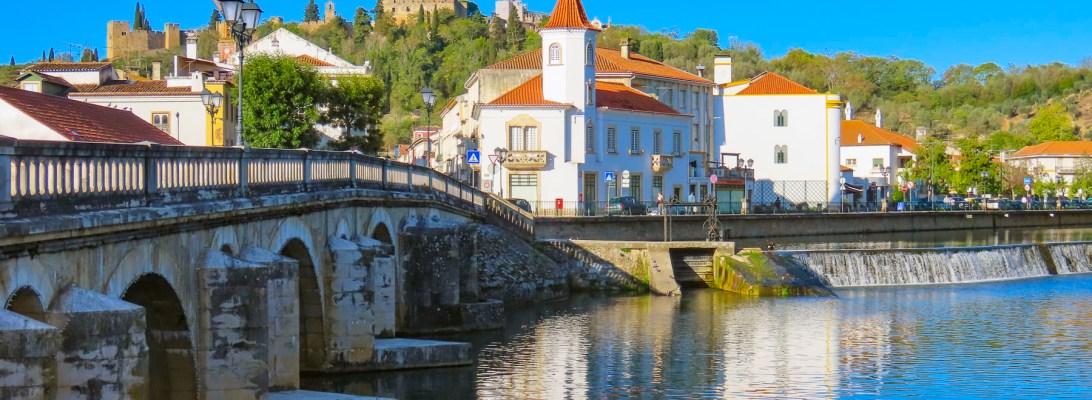
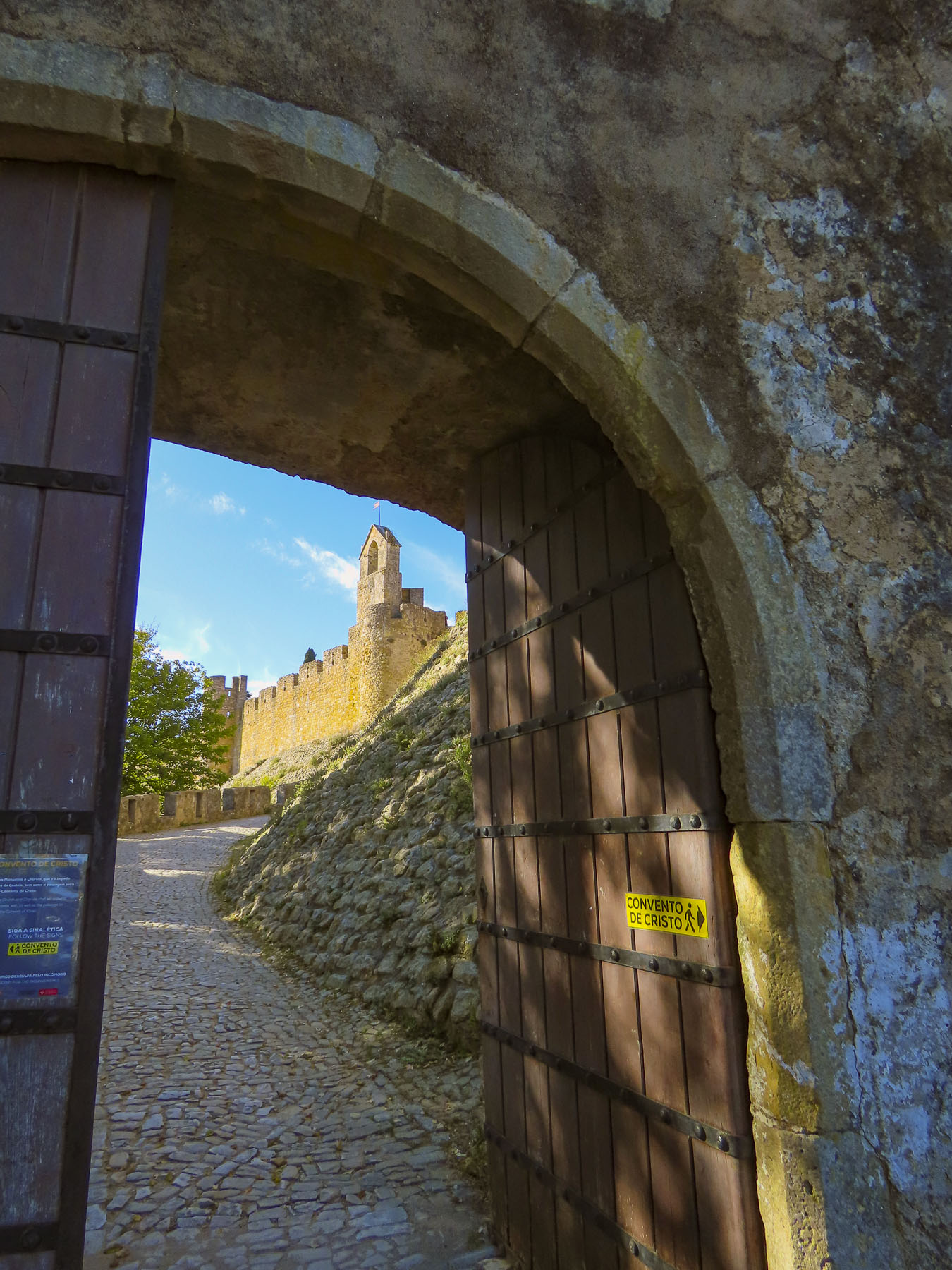
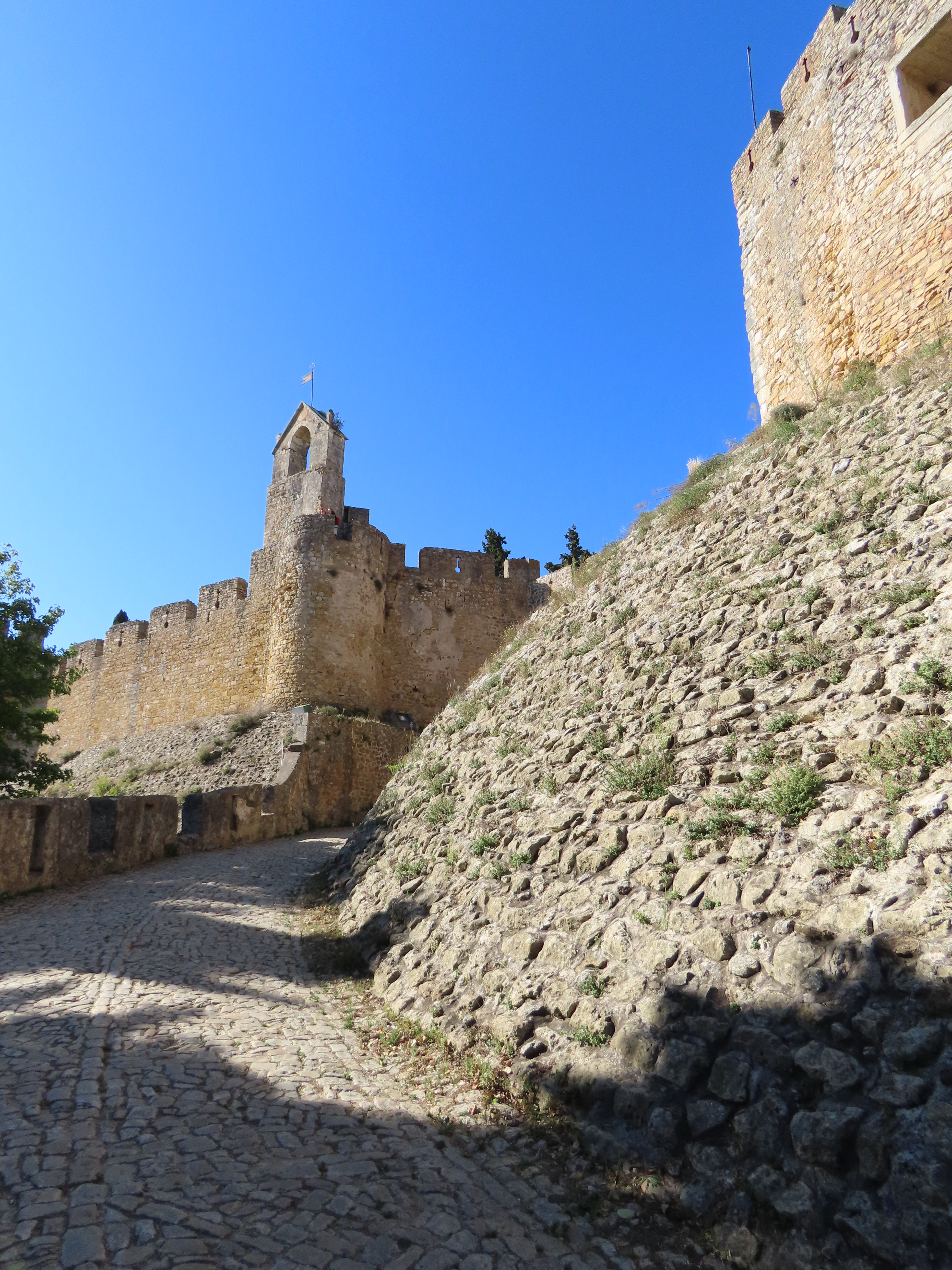
We arrived in Tomar just as the late autumn sun was low in the sky and beginning to cast lengthening shadows on the forested slope that led to the jewel that crowns this quaint village.  We followed the winding cobbled lane to Castelo de Tomar and only got a brief glimpse of the castle through its outer gate as the heavy wooden door was closed for the day with an echoing clang. The castle combined seamlessly with the Convento de Cristo next to it and creates an immense structure that’s best observed from a distance to appreciate its scale. Admiring the expansive view from the miradouro in front of the castle, we made plans to return the next day via a tuk-tuk taxi, from the town square.

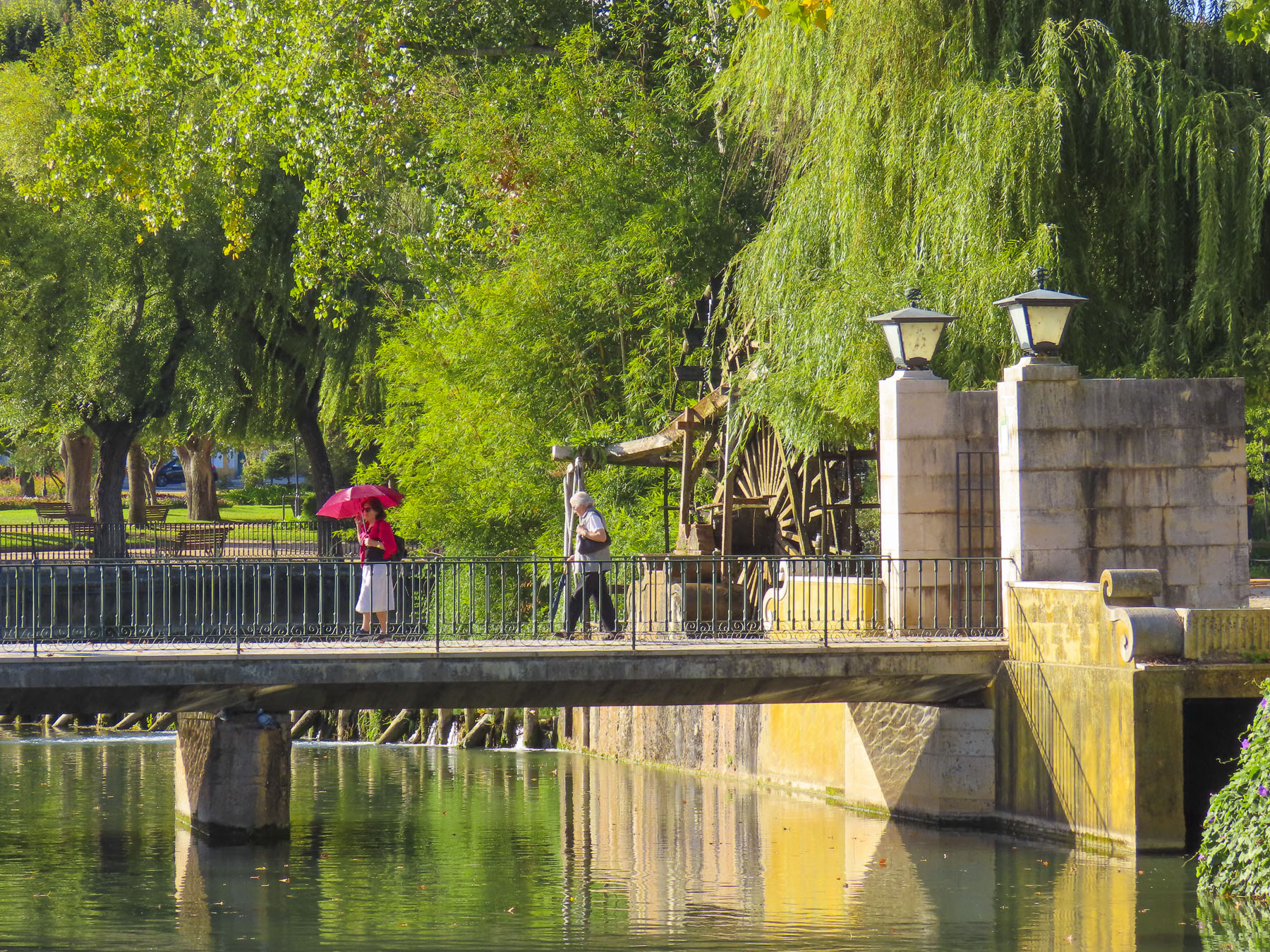
This beguiling medieval village with its narrow lanes and tranquil riverside location discreetly hides its outsized contribution to the history of Portugal.

It starts with those mysterious Knights Templar when in 1159 the first King of Portugal, D. Afonso Henriques, granted land to Gualdim Pais, the fourth Grand Master of the Knights Templar in Portugal as reward for their military prowess and religious zeal during the Portuguese wars for independence and the subsequent Reconquista. When the town was first founded, the population was so minuscule, most of the villagers lived behind the castle’s defensive walls.

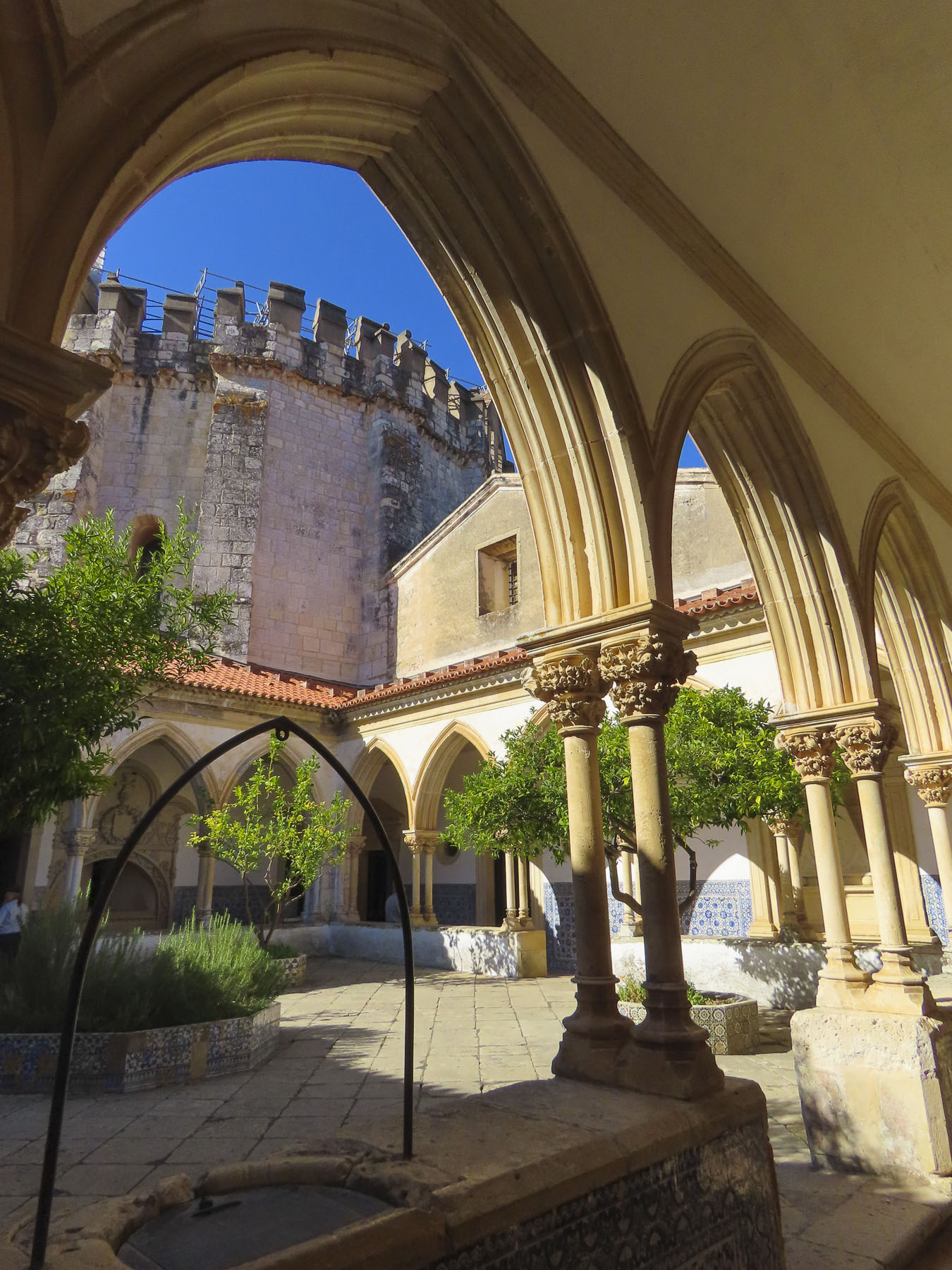
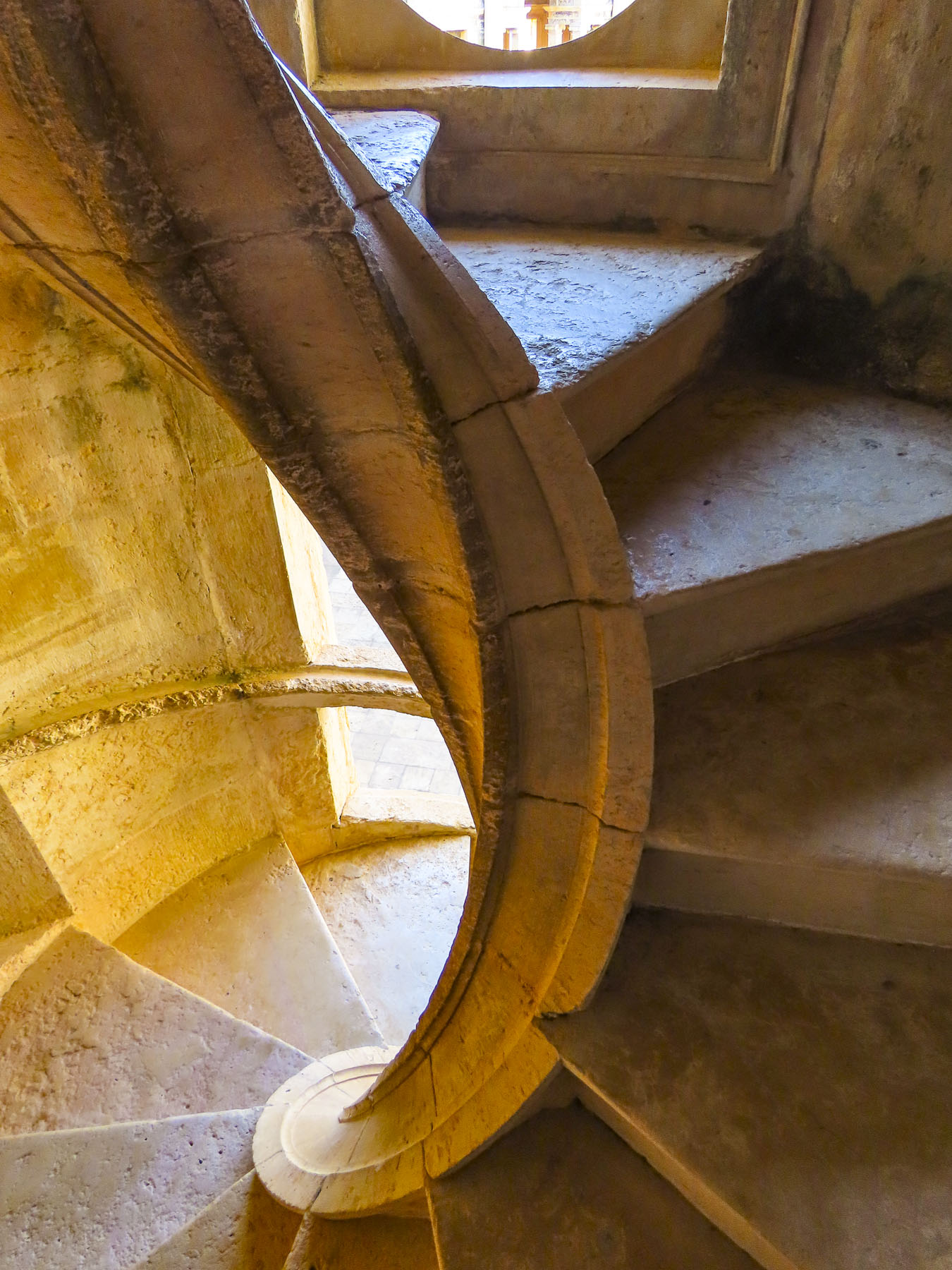
In 1160 Gualdim Pais order the construction of a monastery and fortified citadel that would be known as the Convent of Christ, a combination of a fortress and a monastery, that is sometimes referred to as the Convent of Christ Castle. The convent’s most interesting feature is a round sanctuary with an ornate ceiling soaring over a central altar, its design said to be influenced by the Church of the Holy Sepulcher in Jerusalem.  Legend states that the knights attended mass on horseback here, the open circular design facilitating the horse’s easy entrance and exit. Famously in 1190, outnumbered Templars defeated a larger Muslim army after their six day siege of Castelo Tomar failed.

Founded in 1118 and slowly gaining recognition from their vowed mission to protect pilgrims journeying to the Holy Lands, the Knights received Papal endorsement in 1139. Pope Innocent II’s Papal Bull sanctioned the Templars as “an army of God,” and provided them special rights that included exemption from paying taxes, allowed them to build their own oratories, immunity from local laws, freedom to cross borders, and obedience only to the Pope. With this blessing Pope Innocent ll made the first papal monetary gift to the Templars. Now a church-endorsed charity, they began receiving land, money, businesses and young nobles from wealthy families who were enthusiastic to find glory in the crusades and willingly donated their assets in order to take the vows of poverty, chastity, piety, and obedience.

Today the Templars most likely would have been charged with running a racketeering enterprise which forced pilgrims and others to pay for protection services they have not requested. This protection was usually from the very people who were demanding the money in the first place.

Things were going well for the Templars across Europe until 1307 when King Philip lV, heavily indebted to the Templars from a war against England, lobbied the Holy Church to disband the Knights Templar as it was a state within a state with its own military, preached heresy and practiced idolatry.

The Templars’ fatal day (eerie music, please) was Friday, the 13th of October 1307. Early that morning all the Templars in France were arrested as enemies of God. Upon torture many falsely confessed and were burned at the stake.  A month later Pope Clement V, a relative of King Philip, decreed that the rest of the Catholic kingdoms in Europe should arrest the remaining Templars and seize their properties. All complied except Portugal!

King Dinis of Portugal did not believe the charges leveled against the Templars, remembering instead their service to a fledging country, and offered sanctuary to knights that had escaped capture.  He then persuaded Pope Clement to support the creation of a new organization, the Order of Christ, into which he transferred all the Templars’ wealth and holdings. The new Order’s mission was now the liberation of the Iberian Peninsular from the Moors and wars against Islam in Africa.

Same group with a new name, but to ensure that the deception of the Pope succeeded, the headquarters of the new order were established, almost in exile, 210 miles away in Castro Marim, a frontier town on the Guadiana River, that serves as the border with Spain.

One hundred years later Dom Henrique of Portugal, Duke of Viseu, better known as Prince Henry the Navigator, allowed the Templars/Order of Christ to return to their former seat of influence in Tomar.  Here they now helped Prince Henry the Navigator establish a medieval think tank: a research institute dedicated to developing navigational tools for a ship to determine its accurate position at sea, relying on the Arabic studies of astronomy, mathematics, trigonometry, which were farther advanced than European knowledge at the time.

The Order of Christ succeeded the Knights Templars as the country’s banker and financed building the fleets of ships needed at the beginning of Portugal’s nautical age of discovery. As rewards, fleets of caravels with white billowing sails boldly embellished with the distinctive red cross of the Order (perhaps the first attempt at global branding) carried explorers down the west coast of Africa and around the Cape of Good Hope into the Indian Ocean in 1487. Portugal’s age as an expanding empire had begun!

Wandering the cobbled lanes of the old town in mid-October, we seemed to have the whole village to ourselves. Later, as the day was perfect, we walked along the Nabao River, crossing a small footbridge in Parque do Mouchão. The view back toward the village was sublime with ducks slowly trailing ripples through the mirrored reflections of the buildings in the water.

Till next time, Craig & Donna

Lodging: Casa dos Ofícios Hotel

Dining: Restaurant Beira Rio and Sabores ao Rubro

Seville Part 4 – The Pueblos Blancos – Olvera & Setenil de las Bodegas

The countryside on the way to Olvera was more verdant than the earth toned landscape we traversed on our way to Zahara de la Sierra at the beginning of our road trip.  Now the hillsides were a mosaic of greens, light and soft, dark and vibrant, signaling the arrival of spring. 

As the road curved, Olvera’s Castle and the belltowers of the town’s church broke the horizon. We are never quite sure where to park in small villages.  Worried about getting fined for a parking violation, we always opt to play it safe and find a car lot.  But the parking in Olvera was at the bottom of a steep incline below the historic castle and we just didn’t have the oomph that morning to walk from there uphill and then continue higher to the top of the tower.  With some persistence we navigated the town’s labyrinth of narrow one-way lanes into the Plaza de la Iglesia. At the apex of the village, the plaza straddles the area between Olvera’s citadel and the town’s majestic church, Our Lady of the Incarnation Parish.  Since it was still the off-season, we were in luck and found the last, barely viable parking spot on the plaza. It was a narrow space that required the driver’s side door to be parked tightly against a wall. Fortunately, I’m still limber enough to climb over the car’s center console and stick shift, with a limited amount of grunting and moaning.

The view from the mirador at the edge of the plaza was wonderful.  Incredibly, the views across the village continued to get better and better as we climbed the different levels to the top of the Castillo de Olvera, perched atop a rocky outcrop at an altitude of 2000 feet. The climax was a spectacular view of the cathedral and panorama of whitewashed homes with red tiled roofs backed by a shimmering sea of silver green foiliage. Outside the village, the surrounding olive groves harbor nearly two million trees.

Constructed in the 12th century, the castle was part of a line of signal towers along the Moorish frontier in southern Spain. The castle was expanded in the 14th century when it was captured by King Alfonso XI during the Reconquista. The castilo is one of five in proximity to each other on The Castles Route, Witnesses of the Spanish Reconquest through the Moorish Strip, a no-man’s land that separated the ancient Christian Andalusia frontier from the Arab Kingdom of Granada. The other castles on the circuit are Castillo de las Aguzaderas, Castillo de Cote, Castillo de Morón de la Frontera, and the Castillo del Hierro.

With its size and architectural presence, Our Lady of the Incarnation Parish looks more like a cathedral than just a church. The neoclassical church was started in 1823 on the foundation of an earlier dismantled, gothic- mudéjar style church and dramatically counterbalances the castle on ridge above the village.  Ordered built by The Dukes of Osuna, the feudal lords over Olvera, the vaulted interior is lined with marble imported from Italy and has many interesting religious icons. To fulfill this extravagance the Dukes diverted the town’s taxes, away from improving the village, to pay for it.  They were the last feudal lords over Olvera and declared bankruptcy in 1843 when the church was completed. Then fled, never to be seen again.

A cloudless morning in Olvera turned overcast by the time we arrived in Setenil de las Bodegas only thirty minutes later. While considered a pueblo blanco, it’s totally different from Olvera and Zahara de la Sierra where the homes ascend the steep slopes under their town’s hilltop fortress.  In Setenil de las Bodegas, whitewashed homes front caves under large stone overhangs which line both sides of a gorge, created eons ago from the erosion caused by the swift moving water.

The homes along the gorge use the mammoth natural stone ledge as their roofs. The once raging Rio Trejo is now a quiet stream in the narrow gorge, which widens into a shallow ravine where an ancient Moorish castle still guards the approach to the village.  When the Romans colonized the area two thousand years ago folks had already been dwelling in the natural caves along the gorge for several millennia. Over the centuries the cave fronts were enclosed to create the unique village that still survives.

Before touring the village, we checked into the Hotel El Almendra to drop our bags, just oustside the historic district, with the intent of driving back and finding parking closer to the gorge.  We were just about to pull out of the hotel parking lot when a group of police cars with lights flashing and sirens wailing roared past. A slower patrol car parked and blocked the hotel driveway. Folks were beginning to gather on the sidewalk. We had no idea why until a motorcycle carrying a cameraman facing backward led the first wave of bicycle racers that were a blur of pedaling color as they sped by. A continual surge of racers crested the knoll of the road and coursed downhill towards the village. The race was one leg of the annual Vuelta a Andalucia – Ruta del Sol. A five-day, 500 mile cross-country cycling event that summits 17 mountain passes in the region and attracts 600 riders. Leaving the car at the hotel, we decided to walk the half mile into the village.

By the time we reached Cuevas del Sol, Caves of the Sun, the narrow one-way road through the gorge lined with small taverns and inns, the sun was brightly shining again.  Even though the road is open to cars, it was filled with folks walking and was almost pinched closed by tables from the restaurants narrowing its width.  We found a table and enjoyed both the lunch and the warmth of the February sun.

Afterwards we walked the length of the lane through the deep chasm until a set of stairs led to the Mirador del Carmen and the small 18th century chapel Ermita de Ntra. Sra. Del Carmen.  The view from the overlook encompassed a sweeping vista of the valley filled with whitewashed pueblos stacked atop one another filling the valley to its rim. 

The Nazari Castle, the town’s 12th century Moorish fortress, still stands vigilantly on the edge of the valley, the invaders now camera-wielding tourists.  Across from it the Gothic style Church of Our Lady of the Incarnation, itself an imposing fortress-like structure, was ordered built by the Spanish Crown. It was constructed in 1505, above the town’s previous mosque, to celebrate the liberation of the village from centuries of Arab rule.  We walked back to our hotel along a lane above the gorge lined with newer buildings. 

Heading back to Seville before sunrise the next morning we stopped high above the village on the road that followed the ridge opposite the Cuevas del Sol, in one last attempt to capture the iconic pueblos of the village as dawn cast its first rays of light across the gorge.

Till next time, Craig & Donna
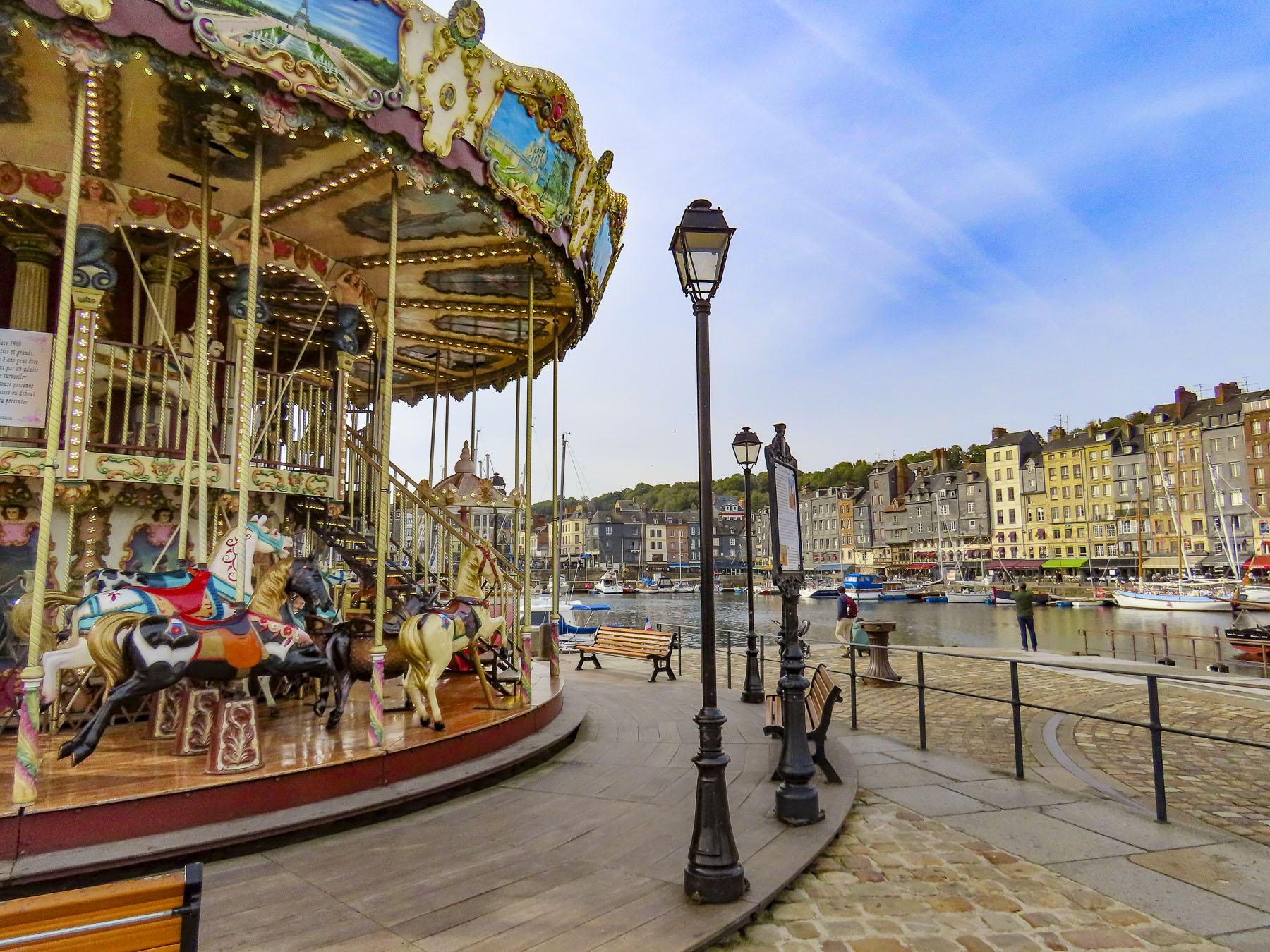
PS. Our 226-mile weekend roundtrip from Seville only used slightly more than a half tank of gasoline.

Sicily Part One: Taorima and Castiglione di Sicilia – Sunny Ancient Lands

The clickity clack of our suitcase wheels reverberated through the Porta Catania, the ancient gate through a defensive wall that once encircled the town, as we pulled them past the 14th century Duomo of Taormina, over cobblestones polished smooth by centuries of use and time.  Adorned with crenelations, the church looks more like a fortress than sanctuary and seems at odds with the playful Baroque fountain in the plaza across from it.

Lined with colorful shops Corso Umberto, barely wide enough for a horse cart, connects the two old entrances to the city and is pedestrian only. The adjoining steep, staired alleys were sized just right for the width of a donkey.

Meeting us at the corner, our young host graciously carried our bags up the passageway and to the third-floor room we had rented in a newly renovated guest house.  It was a compact space, but it would work if we sucked in our stomachs. Effortlessly, he trotted up two more flights to the rooftop where he showed us the kitchen, as well as distant views of the Teatro Antico di Taormina, the castle above town, and Mount Etna, all bathed in the last of the sun’s rays. 

The next morning, before the day became too hot, we followed a steep switch-backed trail up the side of Mount Tauro to the Chiesa Madonna della Rocca and the Saracen Castle.  The Arab fortress is believed to be built over an ancient Greek acropolis. Unfortunately, it was closed due to disrepair, but the panoramic view of Naxos on the coast with Mt Etna in the background was phenomenal.

Sicily’s history follows Mount Etna’s turbulent eruptions – quiet for long periods then thrown into turmoil by foreign invasions.  Hanging off the toe of Italy, its large land mass pinches the Mediterranean Sea to the point that the island is only 372 miles from North Africa’s Tunisian coast. For ancient mariners sailing East to West or South to North it was unavoidable, and they collided with it.  Its easy location at the crossroads of the Mediterranean brought Phoenicians, Greeks, Romans, Vandals, Ostrogoths, Byzantines, Arabs, Normans, French, Germans, British, and Spanish for varying lengths of conquest and cultural influence. It’s an interesting gene pool for sure. 

Appreciating a good beach when they found one, the Greeks rowed ashore and established their first colony, Naxos, on the island in 734 BC.  Later siding with the city state Athens in a war against Syracuse, upon defeat the city was completely destroyed in retaliation. The survivors fled to the high ground and founded Taormina.  Visitors continue to be dazzled by their vision to dramatically construct an amphitheater on the edge of a cliff towering over the sea with Mt. Etna, an active volcano, in the background.  

Finally, Piedmontese volunteers, the red shirts of Northern Italy, invaded to unite Italy. Commanded by Giuseppe Garibaldi, the army defeated the Kingdom of Sicily whose territory extended across the boot of Italy and North to Naples.

But before that Taormina with its multiculturalism was a required stop on the “Grand Tours” of the 18th and early 19th centuries once it was mentioned by Johann Wolfgang von Goethe in his Journey to Italy. Paris, Venice, Florence, Rome, Naples and Pompeii, Athens, Istanbul, Cairo and Seville were also treasured destinations.  Remember, this was the time when all land travel was by horse-drawn carriage and water crossings by sailing ships. Think of it as an extended gap year, when young aristocrats were sent abroad for two to four years to sharpen their sensibilities and further their knowledge of the arts, antiquities and the classics.  Taormina’s big draw though, over those other sophisticated cities, was its clifftop location high above the Mediterranean that caught the cool breezes blowing in from the sea during the summer.

The Nordic invasion continued with landscape painter Otto Geleng. Exhibitions of his paintings in Paris and Berlin left critics saying such landscapes couldn’t exist and that he had an “over-active imagination.” He encouraged all his doubters to see Sicily for themselves, then returned to Taormina and opened the town’s first hotel, Timeo, in a renovated palace. His vision inspired a wave of artists, writers, and actors to visit.  In the 1920s D.H. Lawrence lived there. The books In Cold Blood and Breakfast at Tiffany’s were written by Truman Capote during his stay on the island.

The town can really name drop some famous visitors: Salvador Dali, Orson Welles, Cecil Beaton, Jean Cocteau, Rita Hayworth, Greta Garbo, Elizabeth Taylor, John Steinbeck, Cary Grant and Tennessee Williams have all worked on their tans in the golden rays of the Mediterranean sun here. 

The Taormina Film Festival, now in its 67th year, still premieres movies every June on a large outdoor screen set up in the 2300-year-old Greek amphitheater.  It attracts a new generation of sunscreen-wearing A listers: George Clooney, Catherine Zeta-Jones, Nicole Kidman, Russell Crow, Leonardo DiCaprio and Salma Hayek. Imagine watching Spiderman: Far from Home there, as Mt. Etna sputters trails of lava into the night sky in the background. Aside from the film festival, the amphitheater hosts a vast number of concerts and stage productions throughout the year.

Not being on any lists, including Interpol’s or the FBI’s most wanted, we enjoyed a still warm early November day as we wandered through the Giardino Storico Ex Villa Trevelyan, now the town’s public formal garden, but once the grounds of a villa owned by a Scottish noblewoman. Lady Florence Trevelyan fled rumors of an affair with King Edward VIII, settled in Taormina and eventually married the mayor.  During our visit, intricately stoned paths along the cliff edge, with views of the sea, were still lush with blooming bougainvillea and hibiscus. Eventually they led to fanciful, ornamental architectural constructions called Victorian follies.

Rambling on, we passed an antique Rolls Royce being readied at the Grand Hotel Timeo to whisk the bride and groom away after their destination wedding. 

From the top row of seats at Teatro Antico di Taormina, the views continued to be enthralling; Mt. Etna was perfectly framed by the ancient columns of the stage. 

In the other direction, the coast toward Spisone dazzled in the afternoon sun.  Inland, the homes of Castelmola were precariously balanced to avoid sliding off their treacherous slope. 

A stay isn’t complete in Taormina without multiple strolls along Corso Umberto in the mornings for café and pistachio pastries, and later in the day for pistachio Aranchino or gelato.

The broad expanse of Piazza IX Aprile, adjacent to the Porta di Mezzo clock tower and the elegant Baroque Church of San Giuseppe draws a large crowd at sunset to admire the view, and is the perfect spot to enjoy a classic Aperol spritz. 

Located in the foothills surrounding Mt. Etna, Castiglione di Sicilia is on the list of most beautiful villages in Sicily. Less than an hour from Taormina, it beckoned us to visit. The scenic drive along SS185 through the Alcantara Valley was uneventful.  The fields were dormant now and farm tractors were parked to await the spring planting season. The multiple arches of Ponte San Cataldo, a historical railway bridge, graced one curve of the road.  It was now a bridge to nowhere, the train tracks at both ends long ago removed for scrap. Villages we passed showed barely any signs of life beyond a barking dog or two. 

Numerous signs for campgrounds and agrotourism farms along the route promised outdoor enthusiasts escape from city life.  Turning onto SP7i we eventually passed the rustic 12th century Norman Chiesa Di San Nicola, then crossed a small bridge over the Alcantara River, within sight of Castiglione di Sicilia.  Fed by snow melt from Mt. Etna and Nebrodi Mountains, the Alcantara River is one of the few rivers in Sicily that flows all year-round.  Over the millennia the cool waters of the river have carved a dramatic gorge through lava fields left from Mt. Etna’s volcanic eruptions.  Hiking trails above the gorge and swimming in its cool natural pools are popular summer activities in the region.

Commanding the high ground helped increase your chance of survival in the days when pillaging and plunder ruled the land.  Defenders hoped that attackers would tire and move on to an easier target. From the road in the valley, Castiglione di Sicilia looked formidable, with Castello di Lauria commanding the promontory like the rock of Gibraltar. 

Driving into the center of the village, mid-week in the off-season, we nearly had the whole village to ourselves. It felt deserted, almost as if the village had been sacked and the residents had been taken captive. We followed a warren of narrow alleys and stairways around the upper village until we reached Castelluccio, the ruins a of Byzantine tower, in a small park with an overview of the village. 

From here we spotted the belltowers of six ancient churches and monasteries that dot the hilltop. The oldest, Chiesa San Pietro, dates to 1105. Castelluccio, slightly lower than Castello di Lauria, would be our highest point in the village, since the castle was closed in the off-season. That’s the one disappointment we experience when traveling in the off-season – many points of interest are closed due to a lack of tourists.  It’s the old double-edged sword, less crowding versus less accessibility.  For the most part we are okay with this and enjoy wandering to soak up the ambiance of a locale.

A looping around the huge monolithic rock, Via Edoardo Pantano brought us to the foot of Castello di Lauria, the 12th century Norman fortress built upon earlier Greek and Roman battlements. The views of the Alcantara Valley were beautiful from this vantage point. Farther on the Basilica of Maria Santissima della Catena stood atop a wide staircase at the end of a quiet plaza. The patron saint of the town, she is believed to have saved Castiglione di Sicilia from the wrath of Mount Etna on many occasions.  Her feast day is celebrated every May with a procession through the village. 

It was mid-afternoon by the time we were ready for lunch, and our options had dwindled dramatically since arriving.  Only La Dispensa dell’Etna was still open with all the inside tables taken by a large party.  Interestingly, part of the floor of the restaurant has glass tiles that allow you to look down onto artifacts discovered during a renovation. It was a little chilly for outside dining, but we enjoyed, with the guidance of our waiter, several specialties of the Alcantara Valley. The addition of wonderful home-made house wines from the regional grapes, Nerello Mascalese and Carricante, native to the slopes of Mt. Etna, combined with the delicious food made this one of our most pleasurable meals in Sicily.  Following the Etna Wine Path might be the catalyst for future visits to Sicily. 

Till next time, Craig & Donna

South to Sicily: Part Two – Maratea to the Toe of the Boot

Normally in November we’d head to warmer climes south of the equator, but it was payback time for an extended stay in Africa, and the Italian homeland of Donna’s ancestors was calling.  We’d realized for awhile that Italy was going to be the most expensive part of our two-year journey.  Even with a very favorable exchange rate, traveling through Italy in the off-season was the best way for us to afford this portion of the trip. We’d keep our fingers crossed about Italy’s rainy season. Grey clouds hung low and were as thick as tiramisu as we neared Paestum.  Known for its ancient Greek temples dating from 550 BC, we had planned to stop there, but the day was just too damp and dreary. We drove on to Maratea.

The weather improved, with the sun occasionally making an appearance as we turned off the E45 and headed west, through a rural hilly landscape covered with trees and olive orchards, to the Tyrrhenian coast. Here again most hotels and restaurants were closed for the season, but we found a very nice, four-room Bed & Breakfast in Acquafredda, just above Maratea.  This part of Basilicata resembled the Amalfi Coast with its narrow cliff-hugging road and rocky coves.  It’s one of the regions where Italian families head to escape the crush of foreign tourists that descends on Italy during the summer months. It also makes Basilicata one of the few Italian provinces that borders two seas. The road narrowed to a single lane as we entered the old village.

Fortunately, Donna spotted the traffic light that dictated the direction of traffic flow through the narrow passage before an oncoming bus would have forced us to back down the lane.  We had a little difficulty finding La Giara until we realized it was down at the end of a rutted farm lane more suitable for a tractor than a sedan.  Run by a gracious older couple who patiently dealt with our rudimentary Italian, the inn was wonderful, with our upstairs room having a view of the distant sea. We were the only guests. The turquoise waters and the pebbly, black sand beach of Spiaggia Acquafredda were a short walk away from the inn. We had the shoreline to ourselves one crisp morning as we walked along its frothy surf.

The sun’s golden rays were now shining on the sea as we drove along the serpentine road into Maratea for dinner. We’ve found that even though many tourist establishments are closed in the off-season there is always someone who stays open year-round to cook for his friends and neighbors.  And with their reputations online with a discerning community we’ve found that these very local places are inexpensive and great.  Ristorante Pizzeria Sapore Di Mare did not disappoint us with its variety of fresh seafood and pasta dishes, and we ended up having three meals there over two days.  Blame it on the off-season.   There were not any streetlights or shoulders along this cliff hugging road. Fortunately, there was a solid stone guardrail and no oncoming traffic when we rounded a curve and our car’s headlights lit up a man and woman raking hedge cuttings into the middle of our right lane.  A quick zig zag avoided catastrophe as screams filled the night air inside and outside of the car. Our hearts were pounding after such a close call!

Breakfast the next morning was delicious though a little strained by our lack of Italian until the husband’s eyes widened when we expressed interest in the olive oil that was served with the homemade bread. Pridefully he brought us small tastings of different olive pressings. A large olive orchard was their true livelihood, and this time of year they were busy harvesting the first olives of the season and pressing them for this coveted golden liquid.

We hadn’t done much research on this part of our trip, only knowing that we would encounter some stunning coastline, so we were pleasantly surprised when we found ourselves in the picturesque, man-made harbor of Marina di Maratea.  A small port, with an assortment of pleasure craft and fishing boats, it embraces the coast under a towering 2113-foot-high Monte San Biagio. The mountain is topped with a statue of Christ the Redeemer that is visible for miles along the Tyrrhenian coast.
The day was brilliant and with café on the quay at the aptly named Bar Del Porto we planned our ascent of Monte San Biagio. We were relieved to find we could drive to the top of the mountain, a revered pilgrimage site that celebrates the fourth century martyr San Biagio who is credited with several miracles in Maratea, the most important of which was shielding the town from Charles VIII’s French cannon fire during an attempted invasion in the 1400s. As proof of his intervention, next to the altar in the basilica there is a cannonball with a mysterious fingerprint pressed into the iron; it is believed to be San Biagio’s, left there when he deflected the shot with his hands. Legend states that his relics arrived in Maratea in 723 when a ship carrying them from Turkey to Rome for safety was mysteriously stopped by a bright beam of light from the sky; the vessel was unable to sail forward until the relics of the saint were removed from the ship and brought to the mountaintop. A church was then built over the ruins of an ancient Greek temple dedicated to the pagan goddess Athena.  Maratea celebrates San Biagio’s feast day every May by carrying his silver statue from the basilica in a processional, on the shoulders of teams of men, down the steep mountainside trail. It is a journey of 4-5 hours into the center of town, through streets filled with the faithful, to Maratea’s oldest church, Saint Vitus, built in the 9th century. 

During the high season you are not permitted to drive all the way to the basilica. Instead, for a small fee, a shuttle bus delivers you to the church. In November luck was with us and we were able to zoom up the elevated switchbacks that seemed to float ethereally above the steep slope to the parking lot.  The only other vehicle in the lot was a truck belonging to workers repairing the church roof. Regrettably, mid-week, the church was closed.

A gentle sloped walkway led to the summit past the stone ruins of old Maratea. Founded by Greeks over two-thousand years ago, they occupied the hilltop for centuries before the lower village was built in the 11th century to accommodate an expanding populace.  The landscape around the ruins was dotted with fragrant wild fennel for which Maratea got its name (from the Greek word marathus, wild fennel.) In the mountains behind the church the clouds were almost low enough to cover the tiny Hermitage of Our Lady of the Olive Trees that sits isolated in the rugged terrain.

In 1963, Italian sculptor Bruno Innocenti was commissioned to create a statue of Christ to crown the summit.  His youthful portrayal of Jesus without a beard, made from poured concrete mixed with crushed marble from the famous quarries in Carrara, faces East, inland toward the rugged mountains and the church that holds San Biagio’s relics.  Standing 70ft high with an arm span 62ft wide, it is the fifth tallest statue of Christ in the world.

The views up and down the rugged coastline and inland were spectacular. Maratea is also known as “the Holy City of Southern Italy,” so named because the small town has 44 churches. We were excited when we spotted several tiny bell towers in the distant village from the overlook.

We spent the rest of the afternoon exploring the newer village which lines the slope of a valley that leads to the sea. Archeological evidence found in local caves reveals that the area has been inhabited since the Stone Age.

Far below the Statue of Christ the Redeemer, steep cobbled alleys branched off the main road and wove their way up the lower slope of the hill, past centuries-old homes worn by the elements.

Occasionally trees and vines sprouted through the cracked sidewalks and clutched the walls. It felt like the village was deserted. Nearing the end of the day we found a wonderful vantage point to capture the silhouette of the village and the valley against a colorful sunset.

Only a two-hour train ride from Naples, Maratea, Basilicata’s “pearl of the Tyrrhenian Sea” has stayed off the radar of foreign tourists and remains “the Amalfi without the crowds,” and one of “Italy’s best kept secrets.” It’s definitely an area worth exploring in greater depth.

The next morning, we contemplated driving 2.5 hours along the scenic coast to Lamezia Terme, where we would connect to route E45 and continue south through the Calabria region to the ferry port in Villa San Giovanni, on the toe of the boot, across from Sicily. 

Fearing I would insist on stopping too many times along the coastal route to take pictures, we opted to head inland for the drive instead.  The day got warmer as we proceeded further south through a verdant landscape of rolling hills covered with olive trees or freshly tilled fields.

Spotting the seaside town of Scilla from the highway, we decided to detour for awhile since we were making good time. Famous in Greek mythology for its legendary sea monster, Scylla, the town is set dramatically high on the cliffs that front the sea. Castello Ruffo commands a hooked promontory below the town.

Its defenses that once protected the village from invasion are now just a historic backdrop for a wide crystalline beach that sparkled brilliantly in the afternoon sun.

Back on the highway we stopped to refuel and have lunch before boarding the ferry in Villa San Giovanni to cross to Messina, Sicily.  Back in the states we would only eat at a highway rest stop if we were desperate. In Italy, we eagerly searched for them, since there we found them to be gourmet havens for travelers. They serve delicious plain or grilled panini, pizza, and of course good espresso.  They also usually have an interesting assortment of snacks for later, as well as the usual assortment of souvenirs. Yes, magnets and coffee mugs. But also a candy known as Pocket Espresso! After making our purchases, we picnicked under a tree on the edge of the parking lot which overlooked the Strait of Messina.

The powerful currents that race through this narrow strait have been legendary since the time of Homer, when Greek sailors first started to explore the unknown waters around southern Italy.  The dangerous opposing currents on either side of the strait personified in the Odyssey as the mythical sirens Scylla and Charybdis who lured unwary mariners to their deaths in their turbulent waters.  The phrase “between Scylla and Charybdis,” refers to being stuck in a difficult situation with poor options, similar to the common expression, between a rock and a hard place.

After stopping to get our ticket stamped, we drove aboard the Giuseppe Franza, operated by Caronte & Tourist, and parked on the car deck amidst a variety of large commercial and private vehicles. We stood outside on the passenger deck as the ship’s powerful engines easily pushed the 308ft ferry, capable of carrying 600 passengers and 120 cars, off the dock for the forty-minute crossing to Messina.  So different from the ancient Greek bireme that Odysseus’s men would have rowed on their journey.

Our destination was the coastal town Taormina. Fortunately, we didn’t have to row there.

Till next time, Craig & Donna