
It was after midnight when our plane landed and it felt so good upon leaving the baggage claim area to be greeted by our driver Raul, carrying a sign with our names on it. Ecuador has invested heavily recently in upgrading its infrastructure. The new airport was a model of efficiency, making transit through passport control and claiming our bags nearly effortless. And considering the high altitude and mountainous terrain, the highway system is amazing and enabled our driver to deliver us quickly and safely (though after midnight stop lights and signs seem to be suggestions) to Hotel Boutique Portal De Cantuna in Old Town, Quito for the first week of our journey.


Portal De Cantuna was a family home for over two hundred years before being converted into a boutique inn. Full of charm and antiques, with guest rooms on three floors that open on to a central courtyard that is covered by a glass dome, to protect it from the elements. The dome is enhanced with beautiful, floral metal scroll-work, that creates a wonderful ambiance. The inn’s location was perfect – just across the street from San Francisco Church and within very short walking distance of the other major attractions of Old Town. A short walking distance is really important when you are in a city as hilly as San Francisco, California, but at 9500ft altitude! It took us about four days to acclimate; we walked slowly, avoided alcoholic drinks and reduced our caffeine consumption. The last was the easiest as it took us days to find several places that served a good cup of artisanal Ecuadorian coffee. You would think that a great cup of coffee could be found on every corner, since Ecuador is a coffee producer and exporter. But surprisingly many restaurants and hotels just serve instant coffee!


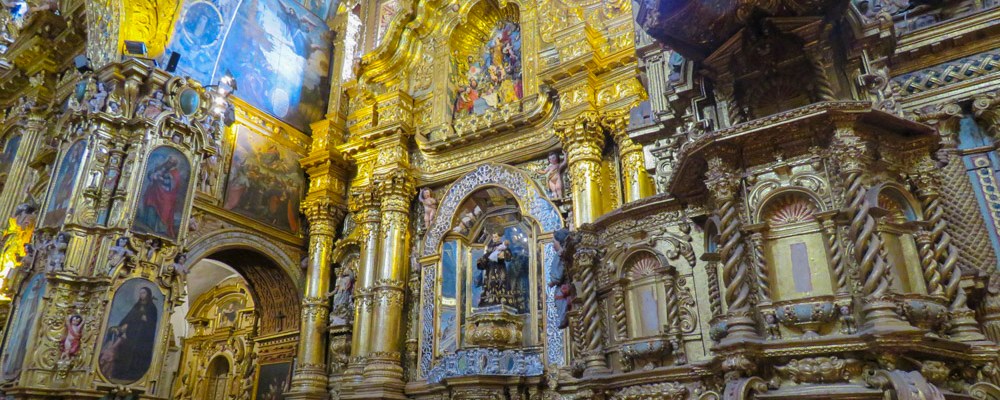
Now, if you are going to explore the churches and convents of Old Town, of which there are many, you will be attending Mass at some point. It seems there is one almost every hour. Don’t be deceived by the plain exteriors of some of these churches as they all conceal intricately decorated, gold plated, sparkling baroque interiors. We are talking high church here, with riches that will rival those found in The Vatican. The museums in the convents we visited also displayed a remarkable treasure of art from the 16th and 17th centuries, created by the indigenous artists trained by European professionals to paint religious works with local relevance to inspire the faithful. At Convento San Diego we were required to be part of a tour, even though there were only the two of us and our guide spoke only Spanish. This awkwardness soon vanished as the sweet woman who was escorting us realized our enthusiasm for what we were viewing. This prompted a behind the scenes tour to a crypt in back of the altar that was accessed through a small stone door. Later we climbed narrow stairs and squeezed through tight passages to the bell tower and the roof for some nice views of Old Town, Quito, in the distance. The City Museum, across from the Museum of Carmen Alto, was a pleasant find. It featured world class, permanent exhibits of life through the centuries in Quito since its founding.


In late afternoon the pedestrian areas around San Francisco Plaza hosted a variety of street musicians and performers who played to an appreciative, mostly local audience. Hawkers worked the gathered crowds and passed the hat, coins were tossed and applause given. We didn’t notice many other foreign travelers as we walked around Old Town and our hotel was not full. This lack of tourists was surprising, since the summer vacation season in North America and Europe.


La Ronda is the oldest street in Old Town, now lined with restaurants, stores and artisan workshops. It dates backs to pre-Inca times when it was a dirt track following a ravine, which is now a traffic tunnel. Of special interest are wood carvers and metalsmiths who keep the traditional crafts alive, replicating 16th and 17th religious and period pieces, despite intense pressure from cheap foreign imports.


A five dollar cab ride took us across the city to the base of the Teleferico cable car for a quick ascent to 16,000ft above the city for tremendous views of
Quito below and the towering mountain range that surrounds it, with ten peaks over 10,000ft.


Ecuadorians love to eat, so there were multiple choices on every block from sidewalk vendors to snack joints, coffee houses and restaurants for us to choose from. A typical Ecuadorian and delicious, three course lunch with beverage cost us about $3.50. Very good dinners were available starting at $15.00.


We had a great time in Quito, but feel that we just scratched the surface of this historic and yet cosmopolitan city.

 2 Suitcases for 2 years