Albania Road Trip: Tirana to Berat or Skyscrapers, a Pyramid, Castles & Albania’s Worse Road

Moments before we had just flown over a crescent-shaped beach, its thin strip of sand brilliantly separating the rich, inviting blues of the Adriatic Sea from the verdant land of the Albanian coast. What we didn’t expect as we continued our descent was just how mountainous the terrain was. This turned out to be a characteristic of the land that we enjoyed tremendously, after realizing there really aren’t many straight roads in the country, and we’d be spending most of our three weeks in Albania driving winding through its mountains.

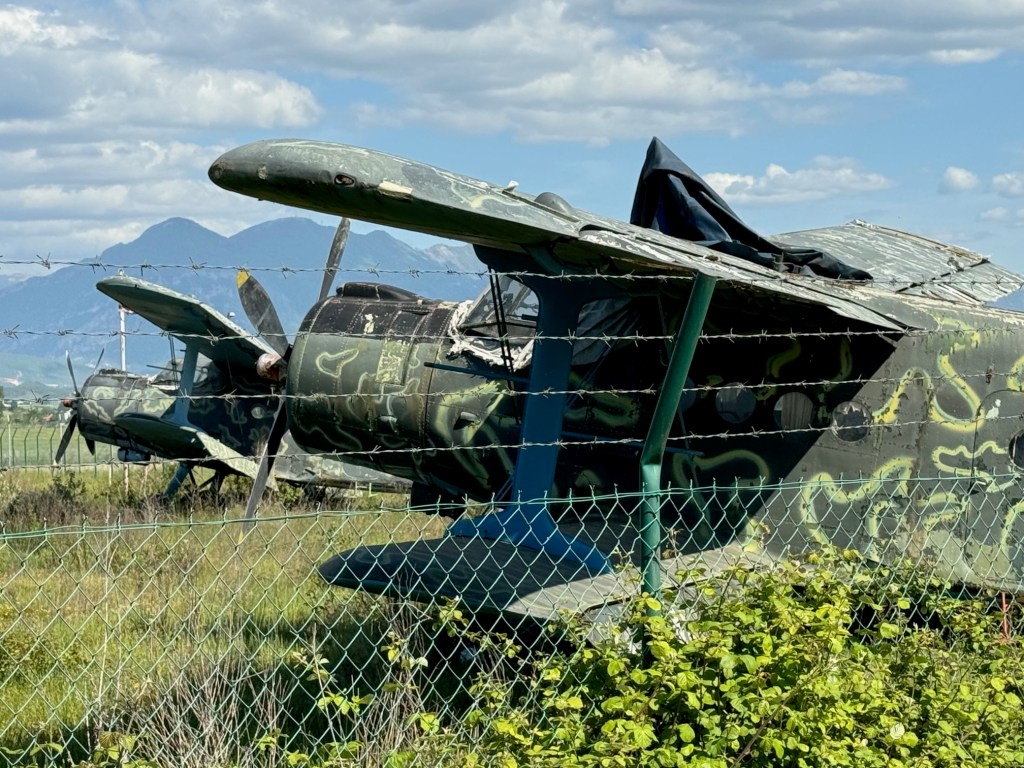
It was mid-April and 80F/26C as we sat outside the airport terminal enjoying coffees and the unseasonably warm day. “Do you really think you’ll need the thermal underwear you packed?” Donna chided, with a smile. “We’ll see,” I responded. At the rental car counter across the street, we reviewed our paperwork for the sedan and received the document we needed to drive the car into North Macedonia later on during our trip. “Now you have a city car, don’t drive on any restricted roads. The car has GPS tracking, and you will be fined if you do,” the rental agent explained. While we were aware that Albania did not have the best road infrastructure, we were not aware of road restrictions. We asked for a map showing the forbidden routes, but the agent didn’t have any, nor could he explain all the routes restricted. “Use your best judgement, if it’s a gravel road you should probably avoid it.” Which was not very helpful considering we’ve had lots of experience driving sedans to destinations that folks have said, “you’ll never make it there in that.” The rental agent also related that Albanians are very friendly, but terrible drivers. “Drive defensively!” he warned. We set off. My map app is set to default to no highways, and we followed a route along the perimeter of the airport, which also serves as an Albanian Air Force base, past a row of rusting, derelict MiG fighter jets and, for those aviation enthusiasts, several Antonov An-2, a legendary soviet bi-plane, first flown in 1947.
It was an interesting serpentine route through fields of grazing sheep, the roadway sporadically lined with irises in bloom, flowering orange trees, their scent filling the air, and fig trees laden with newly set fruit. Groups of old men sat at tables playing cards and dominos in vacant lots between mansions and shacks. A psychedelically painted, cold war era tank commanded a park along the road. As it neared the end of the workday and we got closer to Tirana, the roads became congested and wild, with drivers ignoring traffic signs and rules. Often it felt like a game of chicken with oncoming cars zipping into our lane to weave around creatively parked cars. Motorcycles were driven on sidewalks. Numerous speed bumps were the only deterrent preventing the roads from becoming the Daytona 500. In decades past, Tirana was a small town with an ancient footprint. It managed well enough during the country’s communist era when few people had the resources to buy cars. But now the city’s arteries are clogged and it’s ready for permanent gridlock due to the current number of vehicles.

With a car, there is always parking to take into consideration, and we lucked out with Lot Boutique Hotel, located on a narrow side street in the center of Tirana, because it had a small parking lot. The hotel recently had been nicely refurbished and was the perfect base for our wanderings around Tirana, the capital of Albania since 1920. Later after resting – jet lag affects us more as we age – we asked the front desk for recommendations for a traditional Albanian dinner. The young receptionist suggested two places: Ceren Ismet Shehu, a contemporary restaurant located behind the low ancient walls of Tirana Castle, in an area smartly repurposed for shopping and dining. And in the opposite direction Oda – Traditional Albanian Restaurant nearer the traditional daily market. We ended up eating at both on different nights. Each was excellent, but we preferred the simple, laid-back ambiance of Oda, its homestyle cooking, and inexpensive menu.

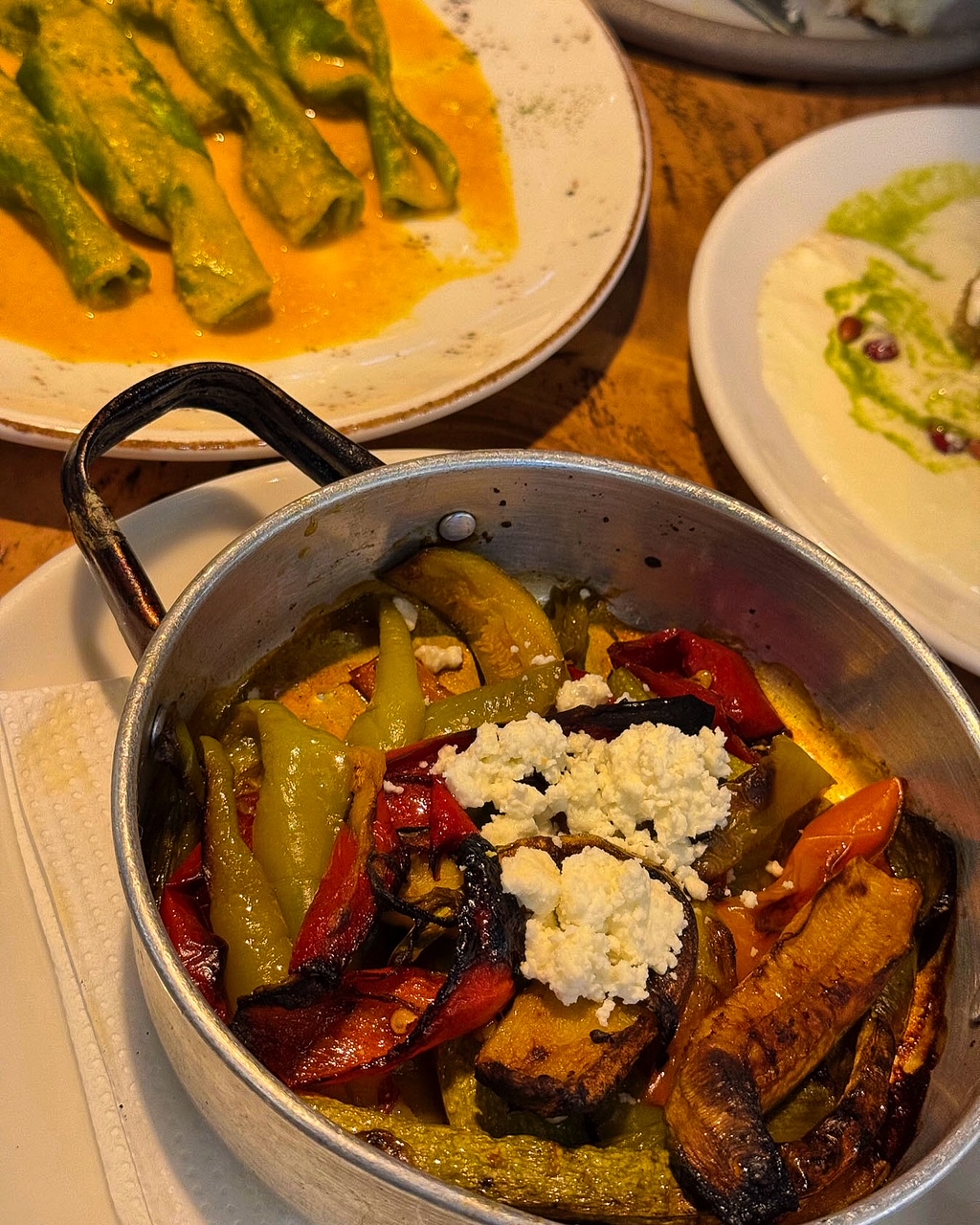
We’ve enjoyed all the cuisines of the different countries we’ve visited over the years, but surprisingly and refreshingly in Albania we found it very easy to eat a well-balanced meal. French-fried potatoes served automatically in other countries were replaced with the Albanian trilogy of lightly grilled vegetables: peppers, eggplants, and zucchini. And the customary salad of cucumbers, and tomatoes with brined cheese were always good. Grilled meats and fish were expertly prepared, though it was also easy to be a vegetarian sometimes and indulge in a variety of eggplant dishes.

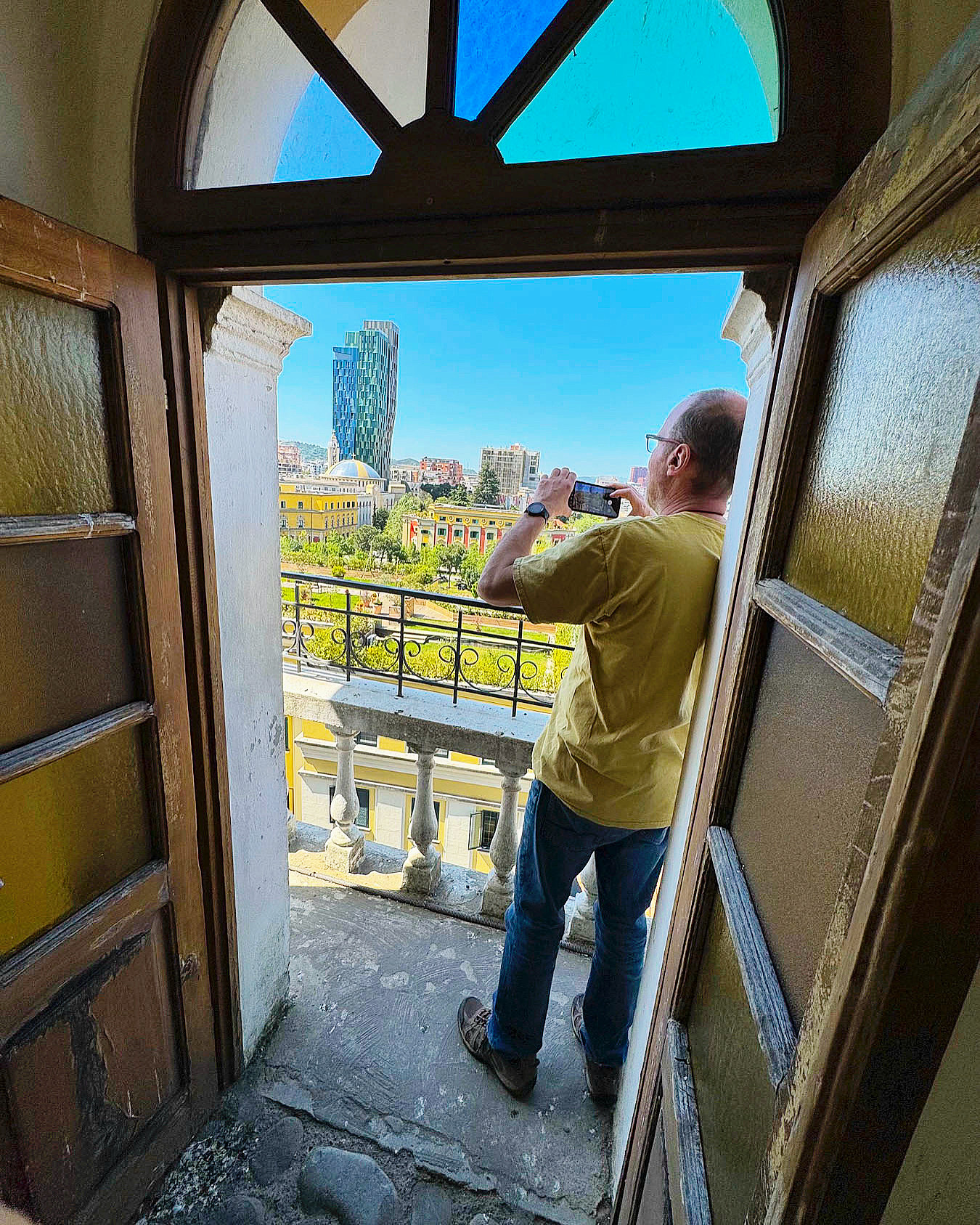
The next morning, we headed to Skanderberg Square. Next to the Et’hem Bey Mosque, built in the early 1800s, but closed during the anti-religion decades of communism, we climbed 90 steps to the top of the 115-foot-tall Clock Tower of Tirana. For decades during the 19th century, the tower was the tallest structure in Tirana. Unfortunately, its once 360-degree view has been hemmed in by the rapid construction of new buildings nearby, but it did have a view over Skanderbeg Square, and the rooftop garden atop Tirana City Hall.

Before its renovation the plaza was a traffic circle with one side hosting a larger-than-life statue of Stalin and the other side a colossal 30ft tall sculpture of Albanian’s paranoid and isolationist communist leader Enver Hoxha. The 1991 student protests on the square, along with other demonstrations across the country, helped bring an end to 46 years of repressive communist ideology and failed economic policies. Stalin’s statue was replaced with a heroic sculpture of Skanderbeg, the 15th century nobleman who rallied Albanians to repel Turkish rule and defeated 13 Ottoman reinvasion attempts.
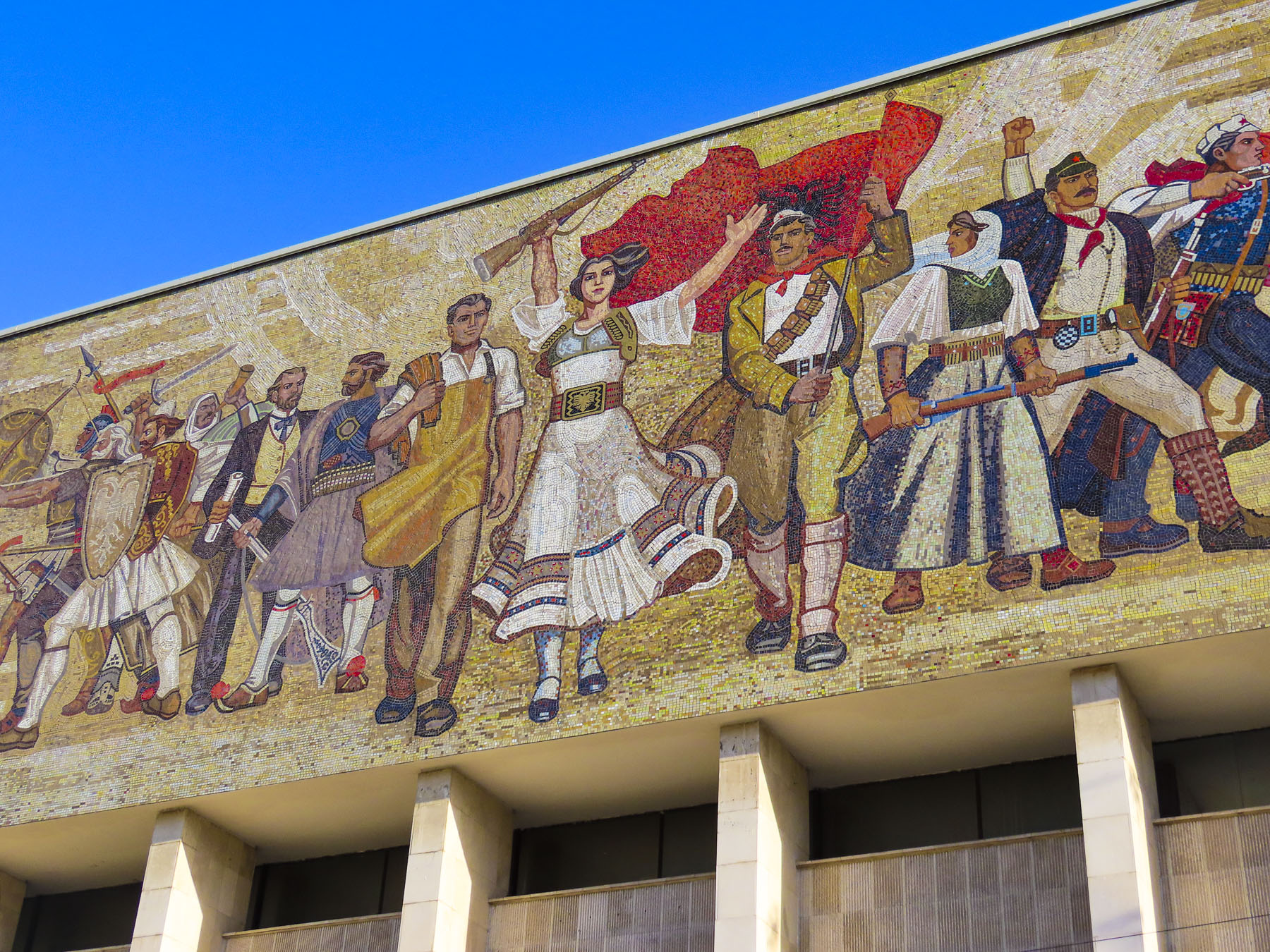
Hoxha’s statue was replaced with a public toilet. Centuries of conflict and resistance have defined Albania’s history and is reflected in a large, emotive mosaic above the entrance to the National Historical Museum. The Palace of Culture, the Opera & Ballet Theatre, and several government ministry buildings, designed by Italian architects in the 1930s, also line the square. Surrounding the plaza, an array of new construction projects are rapidly changing Tirana’s skyline. The city is having its moment as tourists rediscover this once isolated country, with its paranoia of the west, and shunned by its communist neighbors.

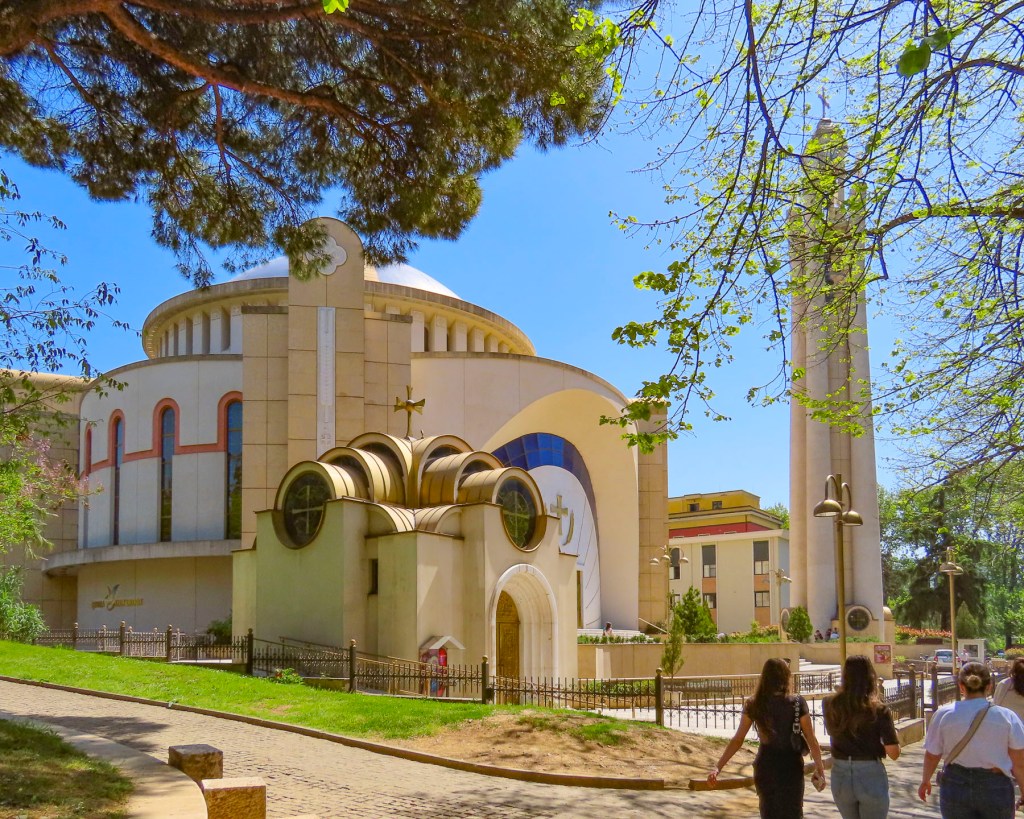
Spotting a belltower through the trees, we headed to the Resurrection of Christ Orthodox Cathedral, built between 1994 and 2002 to celebrate the revival of the Albanian Orthodox Church. It is one of the largest orthodox churches in the Balkans, and is a testament to a renewal of faith that had been outlawed under communism, when churches and mosques were destroyed or desecrated, after Hoxha proudly proclaimed Albania “the world’s first officially atheistic state.” The church is dedicated to the apostle St. Paul, who is believed to have founded the Christian community of Durrës, on the Albanian coast, during the 1st century AD.
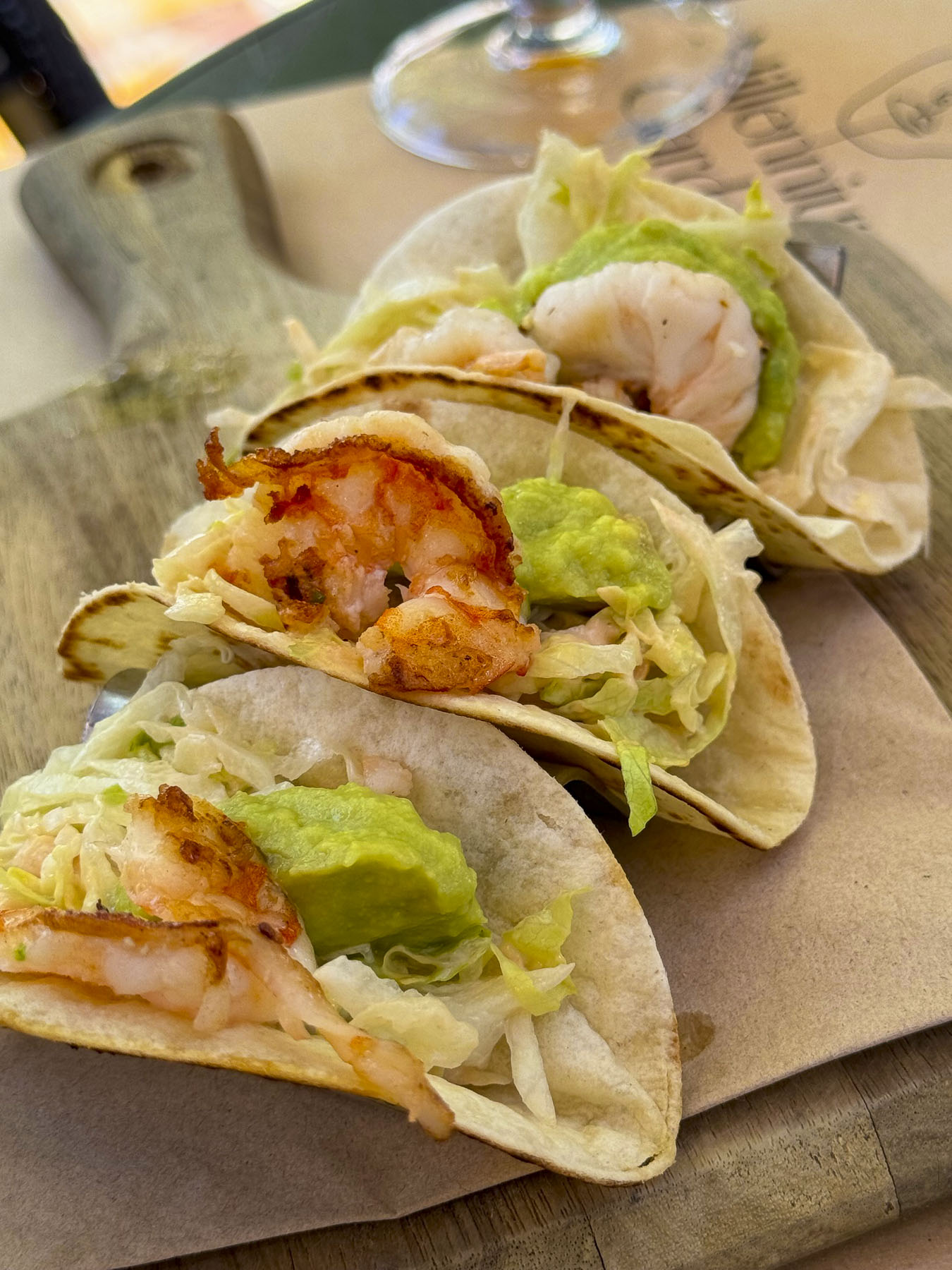
We wandered through Rinia Park, a popular green oasis in the center of the city that is known for its Taiwan Musical Fountains, which were unfortunately still winterized when we visited. Afterwards we headed to Rruga Murat Toptani, a shady, treelined pedestrian-only lane with many outdoor cafes and restaurants, offering traditional Albanian food and various international cuisines. We enjoyed a light lunch and a local craft beer under the shade of a sun umbrella at the Millennium Garden.

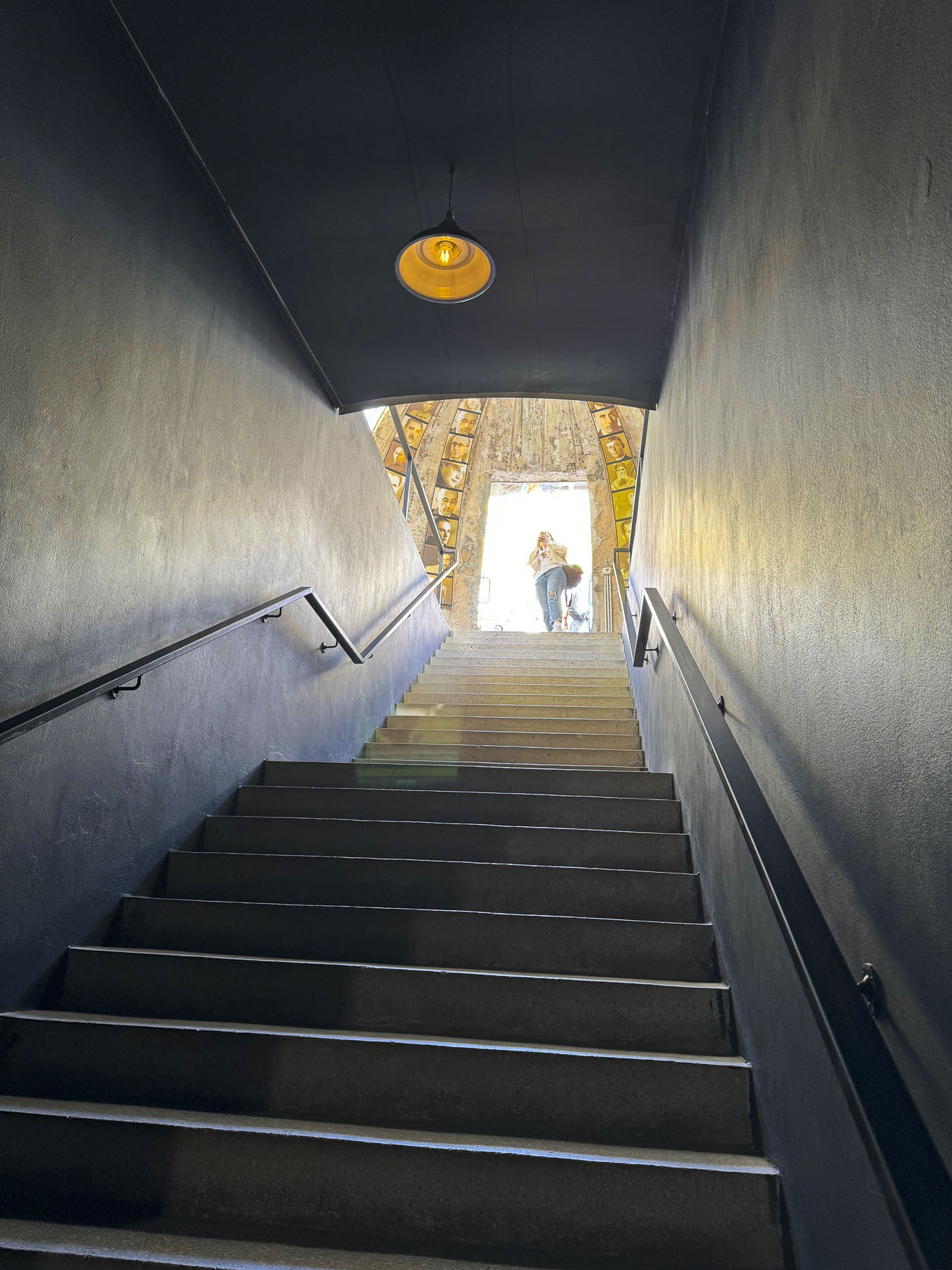
Bunk’Art2, an eye-opening reminder of the perils of the despotic leader, Enver Hoxha, and the communist police state he created in order to stay in power for forty years, was nearby. It’s a large nuclear bomb-proof bunker in central Tirana, that was connected to various government ministries with tunnels for top officials of the regime to escape through. It was also an interrogation center for the Sigurimi, Albania’s Communist-era secret police force, which spied upon the country’s citizenry, and imprisoned anyone considered an opponent to Hoxha’s policies or authoritarian rule. Across the country 23 prisons were built to imprison 17,900 political prisoners.

Thirty Thousand people were sent to internment camps, and it’s believed over 14,000 were killed, died or worked to death from forced labor, often in dangerous mines. 6,000 are still missing. Often it was not just the individual who was jailed that suffered, but his family would be surveilled for years afterward, and his children would be denied educational opportunities. In Tirana the secret police kept 4,000 people under constant surveillance. The border was heavily patrolled with guard dogs and soldiers authorized to “shoot to kill,” as anyone trying to escape the country was viewed as an enemy of the state, and punishable for treason.

Only the most loyal communist families were allowed to live along the borders. Small villages were forcefully abandoned. The villagers were sent to larger cities were it was easier for the Sigurimi to watch for dissent. The mushroom shaped dome above the entrance to Bunk’Art 2 is symbolic of Hoxha’s paranoia, which manifested as a building campaign to construct an amazing 175,000 + bunkers of various sizes, across the country.  Most of them are only big enough for 2-3 people, but they were placed in strategic spots along Albania’s borders to protect the country from foreign invasion, not only from the western powers, but also from Yugoslavia or the USSR. Others were placed in the mountains, farm fields, road intersections and parks, with the intention that Hoxha’s loyalists would man them in a time of crisis.  The irresponsible cost of building the bunkers, from which shots were never fired, diverted Albanian funds away from other needed projects and ensured Albania’s position as the poorest country in Europe.  The communist government collapsed in 1991, and in the following years, more than 700,00 Albanians emigrated to find better opportunities in Europe  or farther afield.  Remittances from the Albanian diaspora to family still in the country amount to 14% of Albania’s Gross Domestic Product.
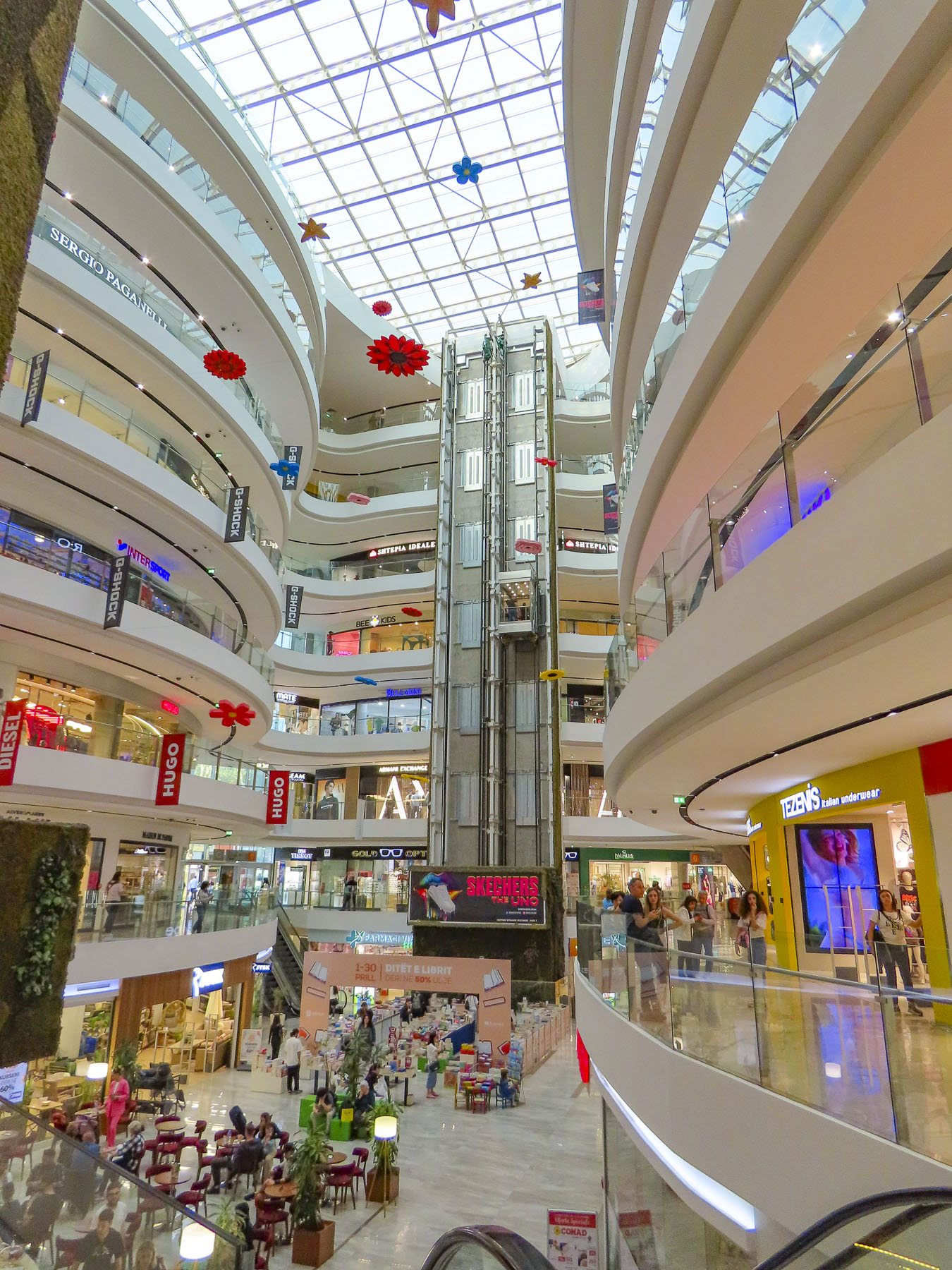
Our eyes needed a moment to adjust after resurfacing from the labyrinth of Bunk’Art 2, but if the construction boom underway in Tirana is an indication, Albania has thrown off the shackles of its communist past and is embracing the prospects of an exciting new future. Heading back to our hotel for a short rest before going to dinner we detoured into the Toptani shopping mall. A nine-story tower dedicated to the “shopping therapy” philosophy of capitalism.
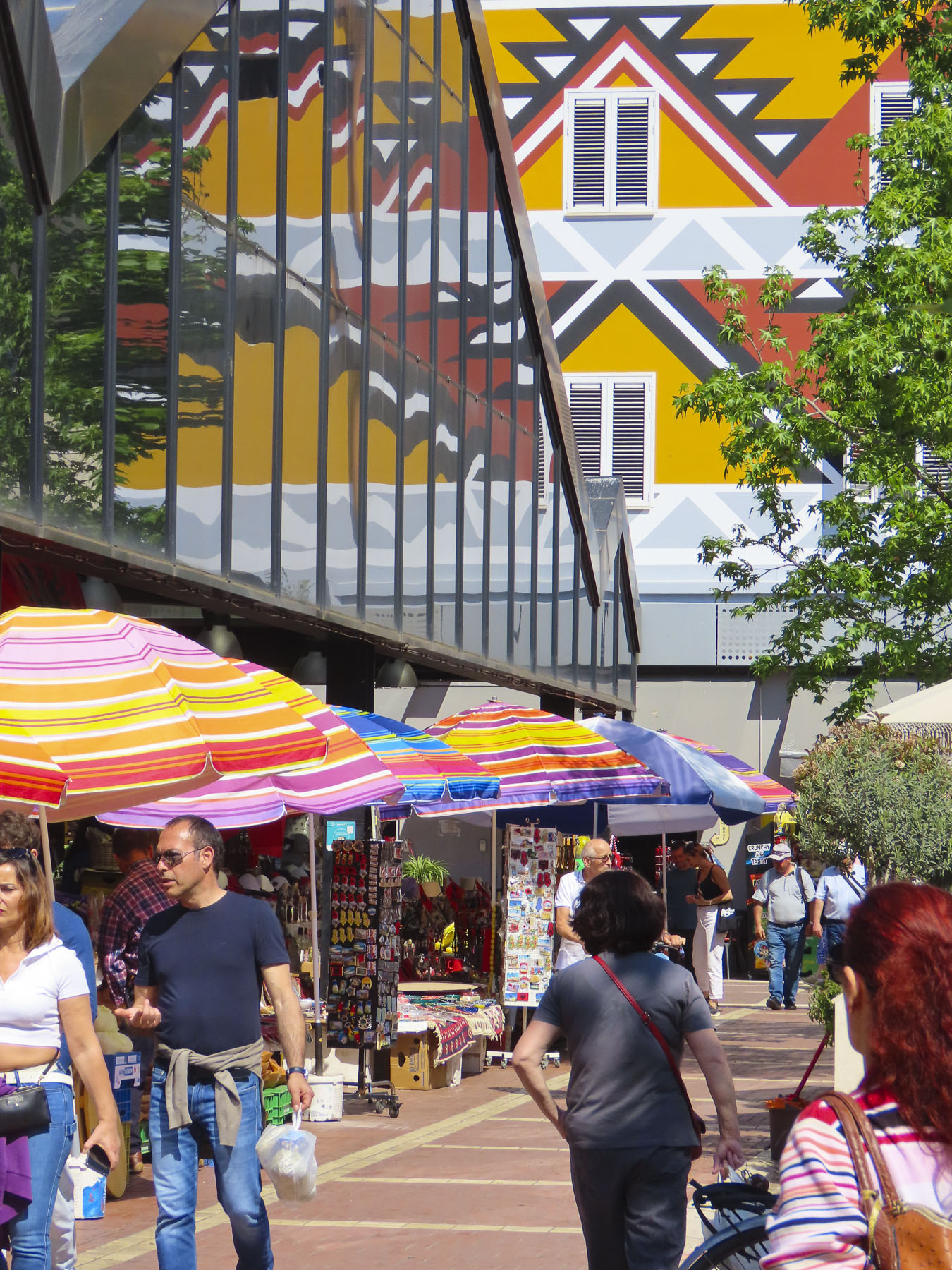
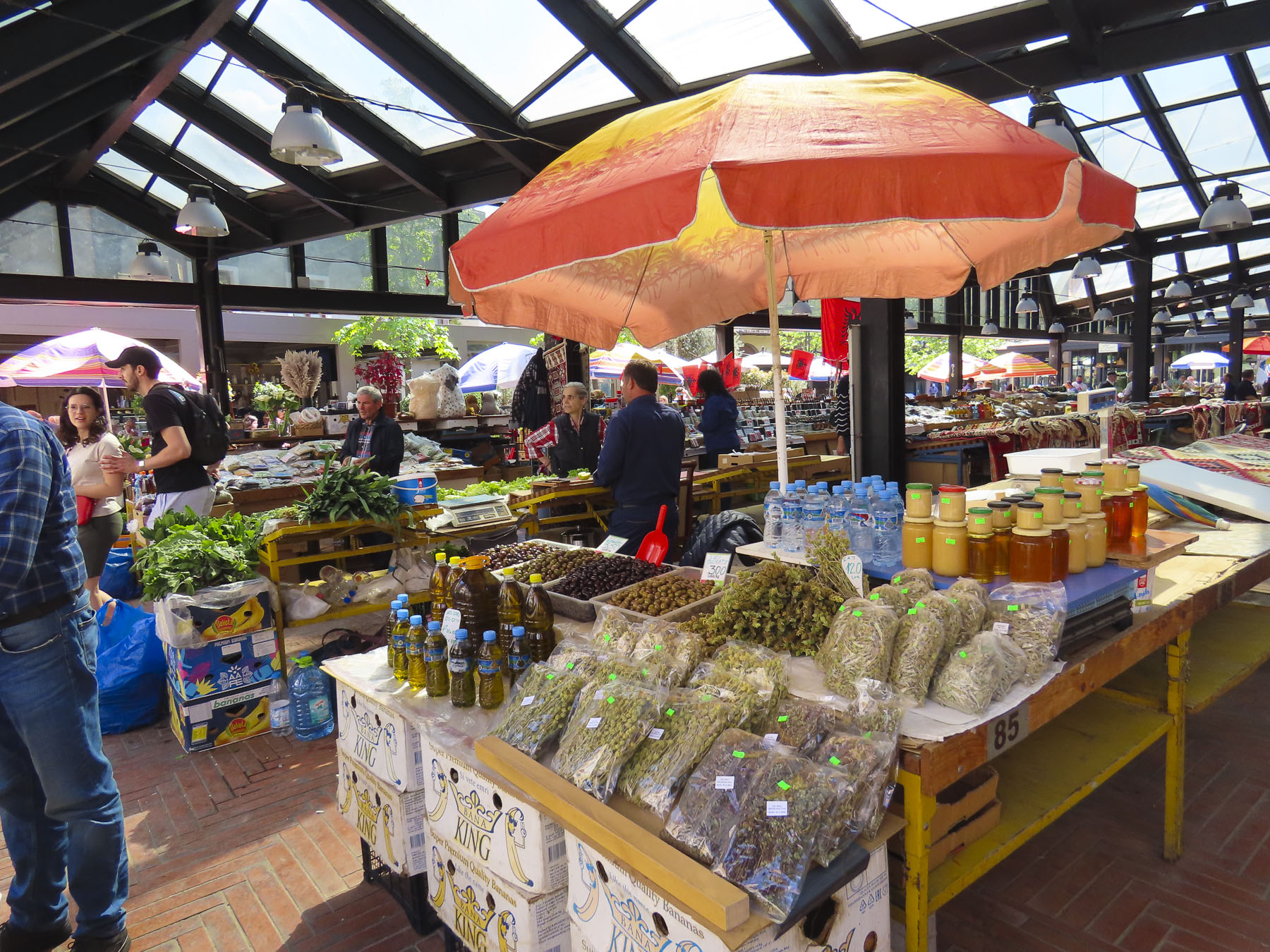
The next day we headed to the New Bazaar market area, only a five-minute walk from our hotel. On the way we passed impromptu sidewalk vendors, their crops and merchandise displayed on blankets or sheets of cardboard on the street, hoping to make sales to folks before they reached the daily market. The covered bazaar centers a plaza surrounded by restaurants, cafes, cheese shops and butcher stores. Under its roof, stands filled the space with vendors selling vegetables, olives, honey, and fruit. Women crocheted wool socks as they waited for customers. We browsed tables piled with rugs, displays of tools, pottery, vinyl records, and books, along with knickknacks, questionable antiques, and surplus Albanian army helmets. The time flew by.

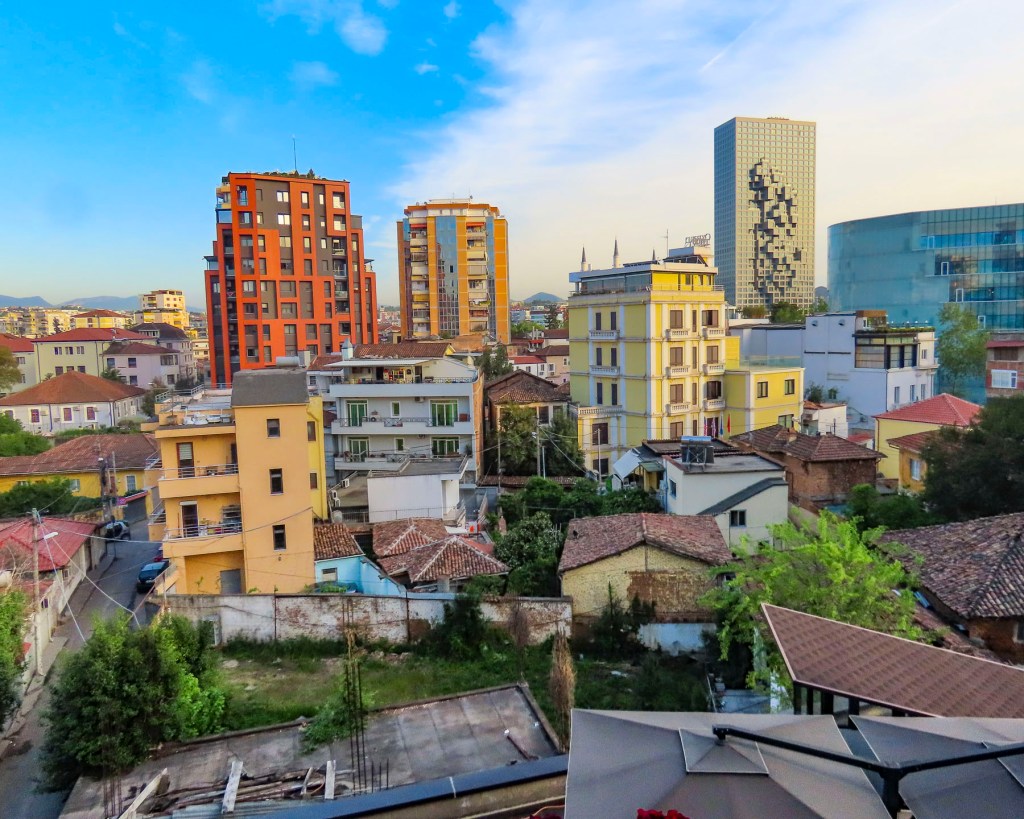
Tirana is a wonderful, midsize cosmopolitan city with a population of 375,000 people, with many parks, tree lined streets, and older buildings, mostly under five stories tall. New high-rise buildings rise from the old neighborhoods across the city. It was an interesting and delightful place to wander around.

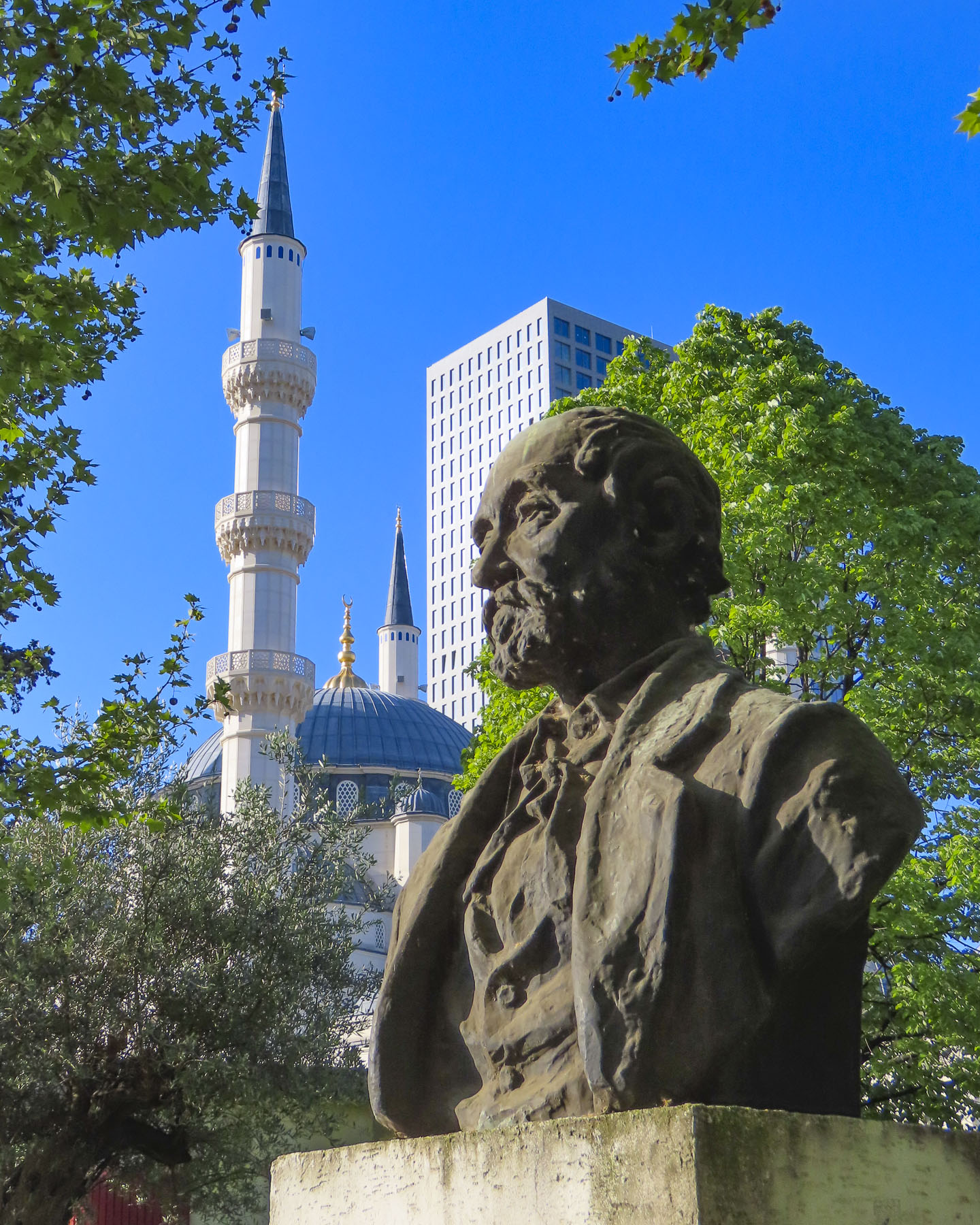
We passed ruins of Tirana Castle’s ancient defensive wall, dating to the 1300s, in the park next to Namazgah Mosque, the Great Mosque of Tirana. Completed in 2019, the mosque is currently the largest in the Balkans, and capable of holding 5,000 worshippers. The Muslim community was also persecuted under Hoxha’s anti religion policies, with many religious leaders killed or imprisoned, and 740 mosques destroyed around the country.

Nearby stood the 18th century Ottoman era Tanners’ Bridge, a stone arch across the Lana River that was used by farmers to bring produce into the city and livestock to the butcher shops and tanneries along the river. Farther away we crossed the ETC Bridge, a beautiful pedestrian only walkway over the Lana that is also a free wifi hotspot. The city’s tallest skyscraper, Downtown One, a 37 story, mixed used building with a very distinguishable cantilevered and recessed façade, stood in the background.

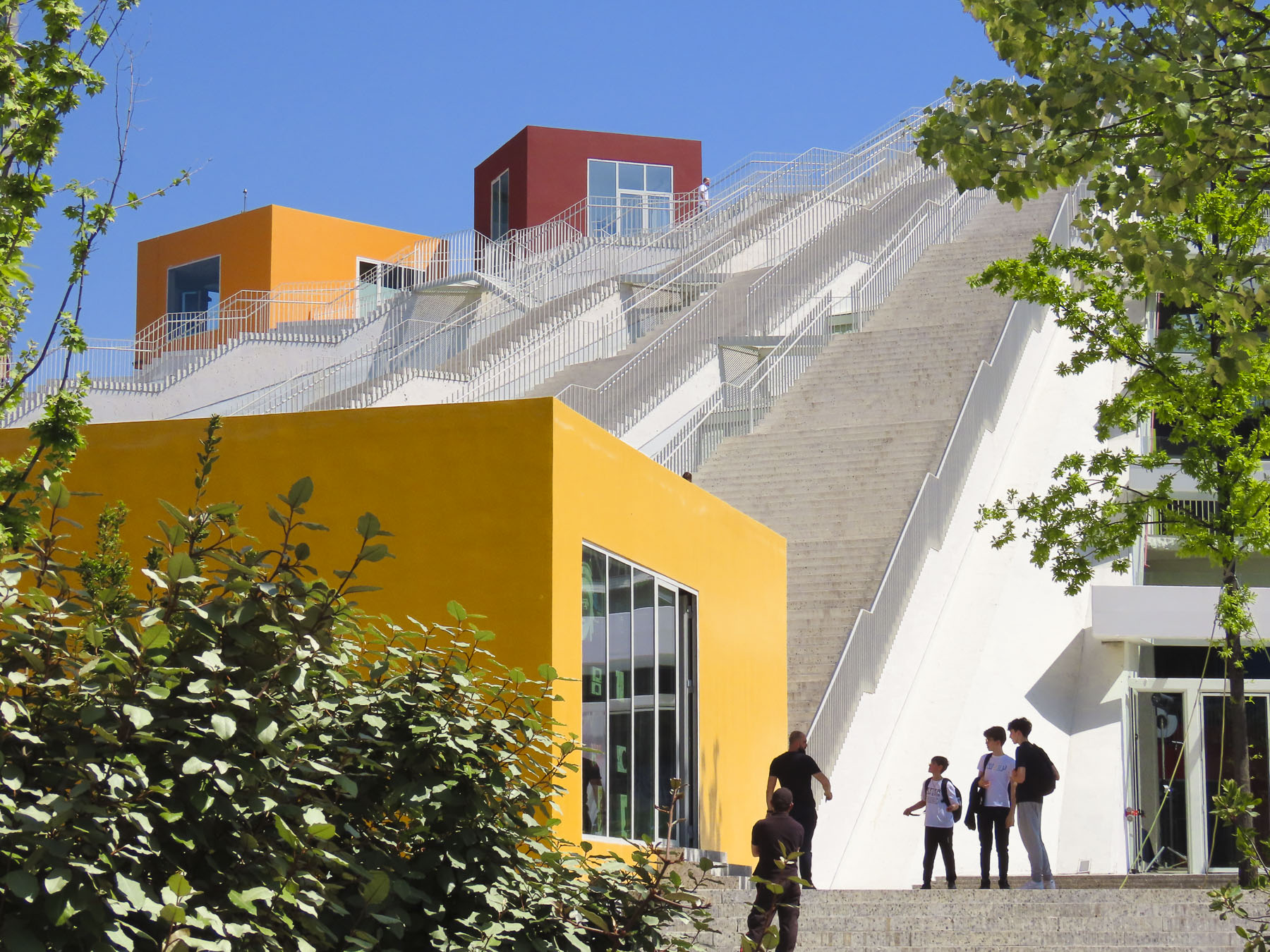
Our destination was the Pyramid of Tirana. Planned by Hoxha to be a memorial to his legacy as the Enver Hoxha Museum, covered in gleaming white marble, it opened in 1988, three years after his death. It was designed by Hoxha’s daughter and her husband and at the time of its construction thought to be the most expensive structure ever built in Albania.

Most likely forced prison labor and compulsory labor were used for parts of the project. With the collapse of the country’s last communist regime in 1991, the museum was closed and the space repurposed as a conference center, then a NATO base. It eventually fell into disuse and was vandalized, and its marble covering stripped away. It was finally reincarnated as an IT youth center with classrooms housed in colorful blocks attached on its slope, and 16 staircases leading to the viewing platform atop its 70ft high summit. We climbed to the top and enjoyed the panoramic view.

A short distance away, Hoxha lived in a modest villa in the Blloku neighborhood.  It was a secret district during the communist era, with housing reserved for the party elite, with entry forbidden to anyone else, and its road did not appear on any maps.
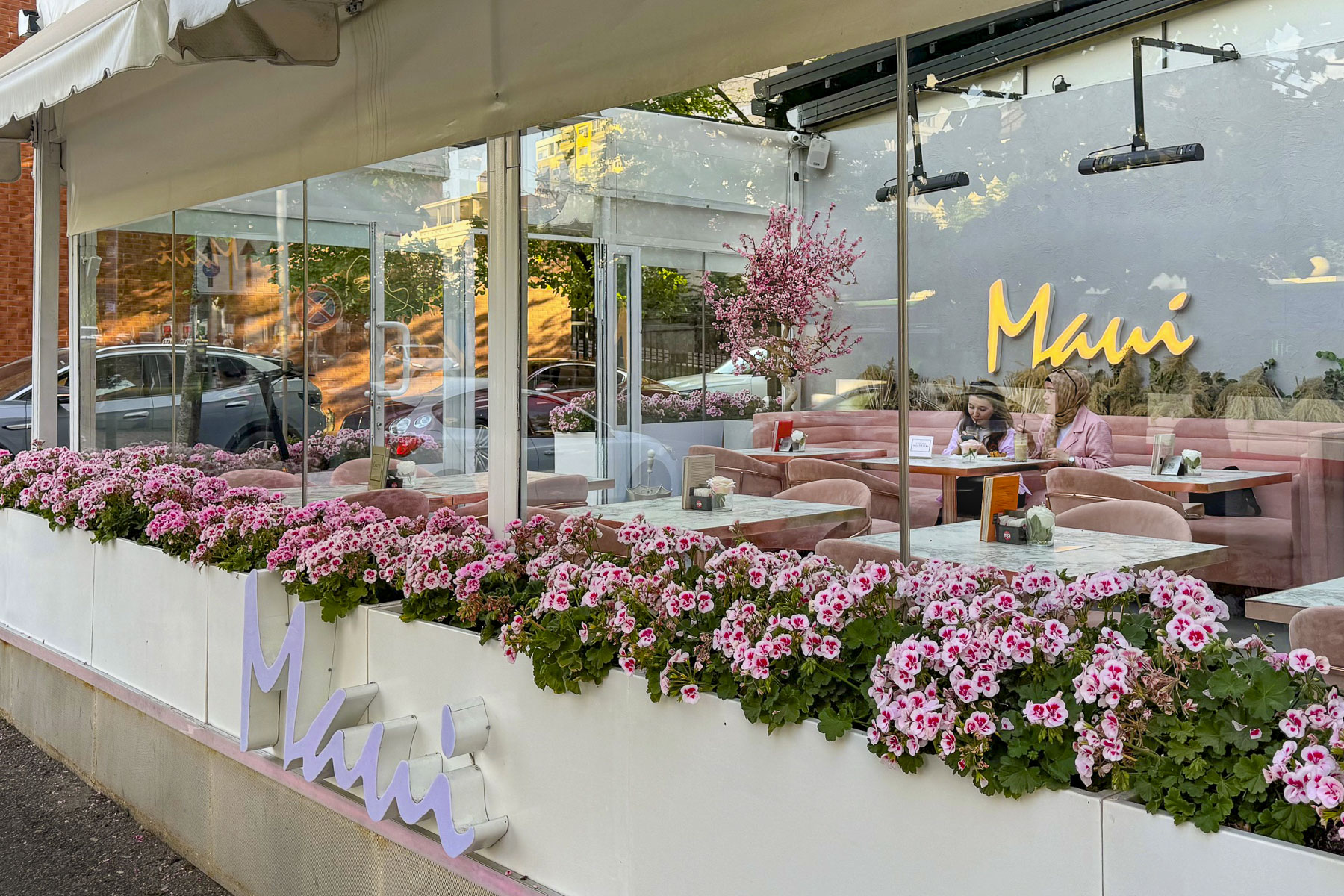
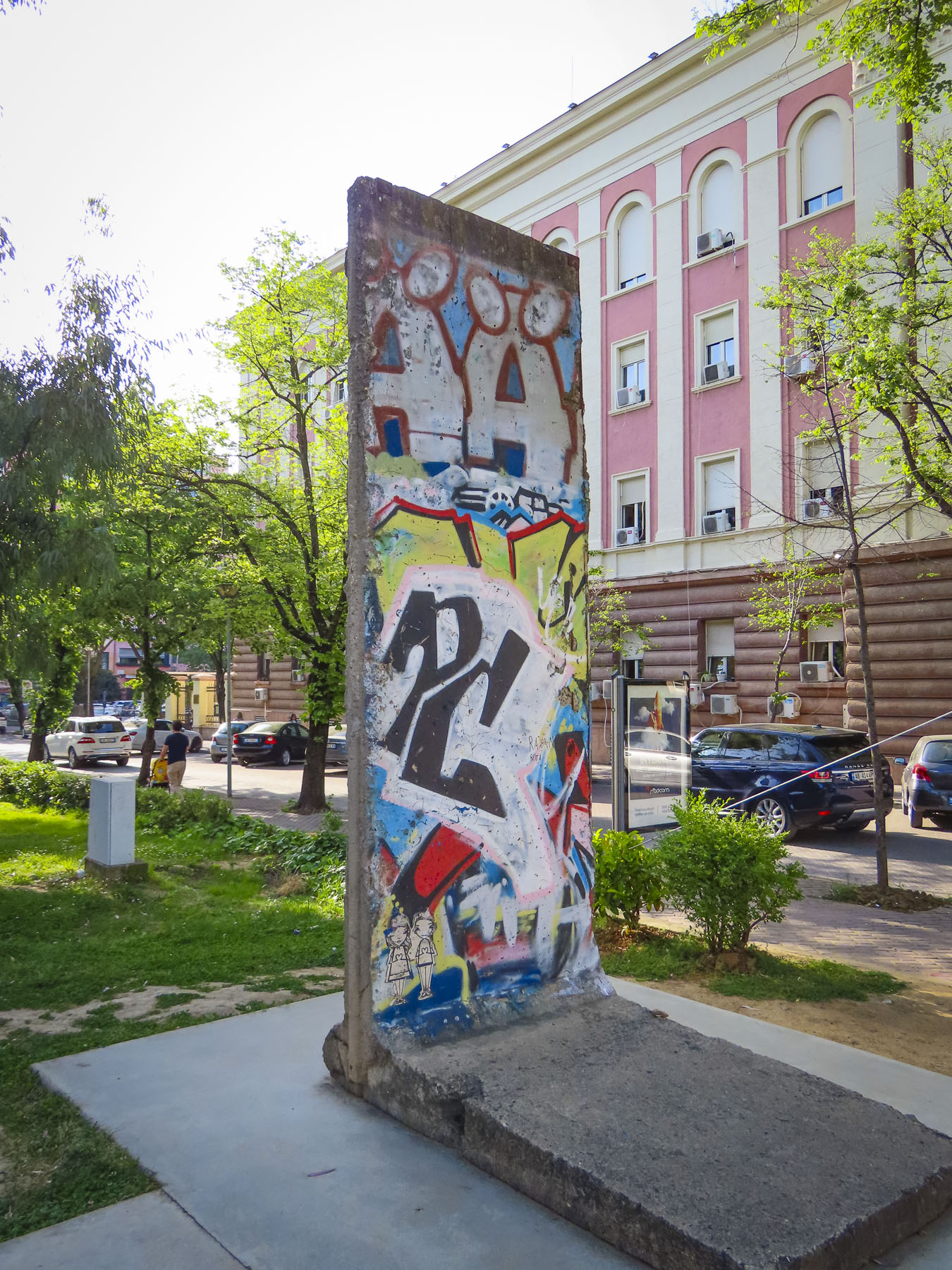
The Checkpoint memorial stands in the park down the street from his residence and features a bunker, iron mine shaft railings from the infamous Spac prison, and a section of the Berlin Wall. Subtle reminders of the brutality of communism.

For our last day in Tirana, we decided to head to the outskirts of the city to check out Bunk’Art1 before continuing into the mountains to Bovilla Lake. It’s easy to miss the turn into the long single-lane tunnel that leads to Bunk’Art1, an appropriate entrance to explore Albania’s past. After walking through a seemingly forgotten park, we entered a non-descript door in the side of an overgrown slope that hides the extensive maze of corridors and rooms of Hoxha’s secret command center.
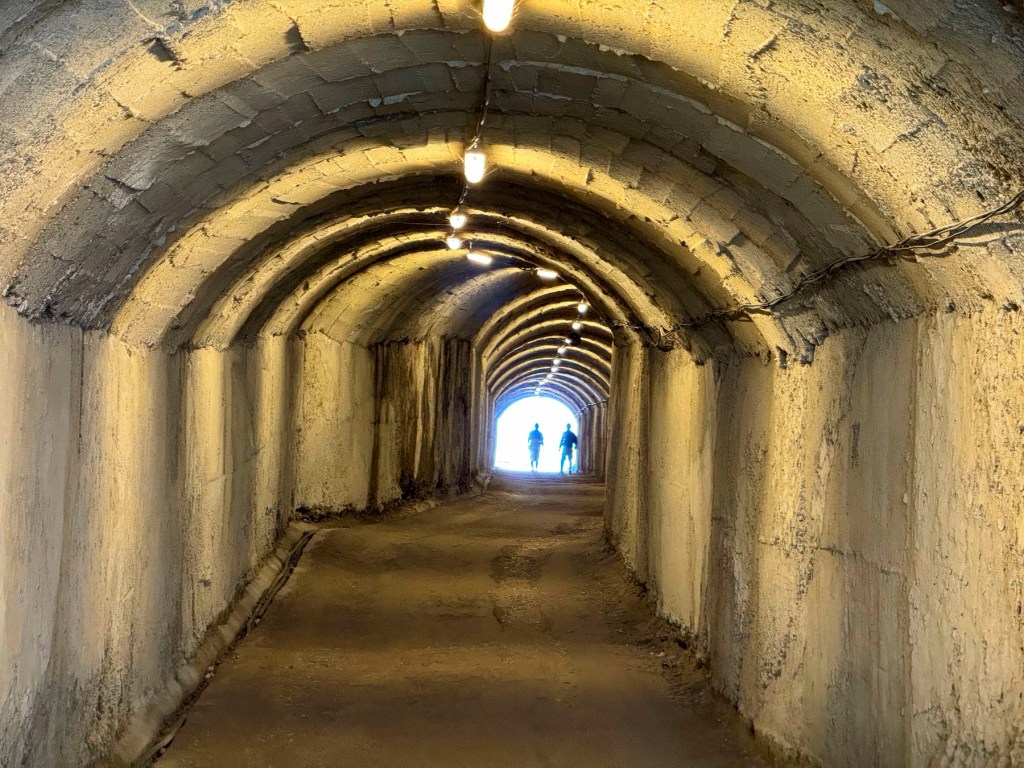
We followed a short corridor to the nuclear blast proof doors set in walls 6ft wide, and into a decontamination room. We were five stories underground in the foothills of Dajti Mountain, near the village of Linzë. There are no windows, the lights flicker, and a sign warns the power could go out at any time! It was a massive facility designed to shelter hundreds of Hoxha’s military and communist comrades, for six months, during any war.
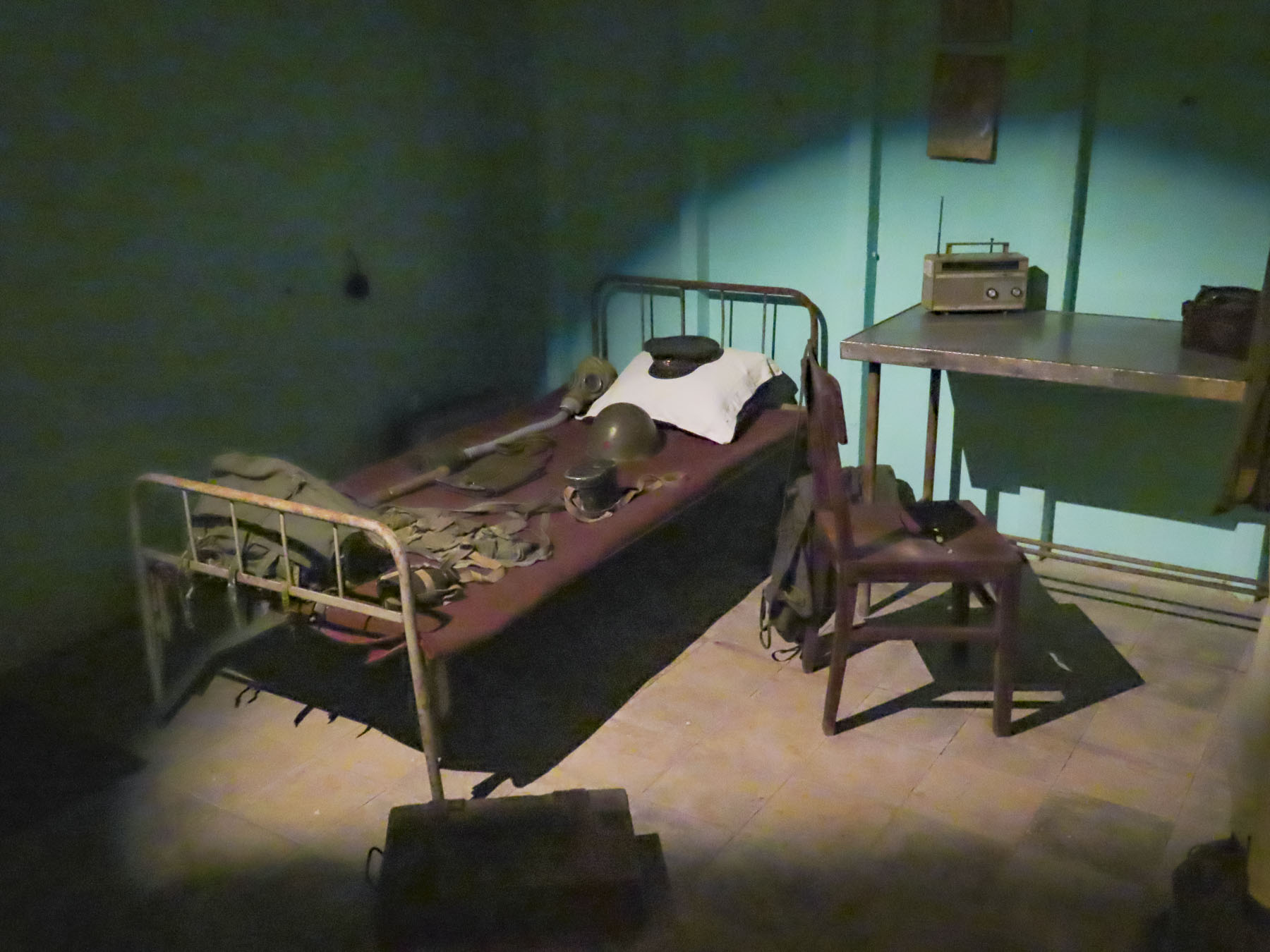
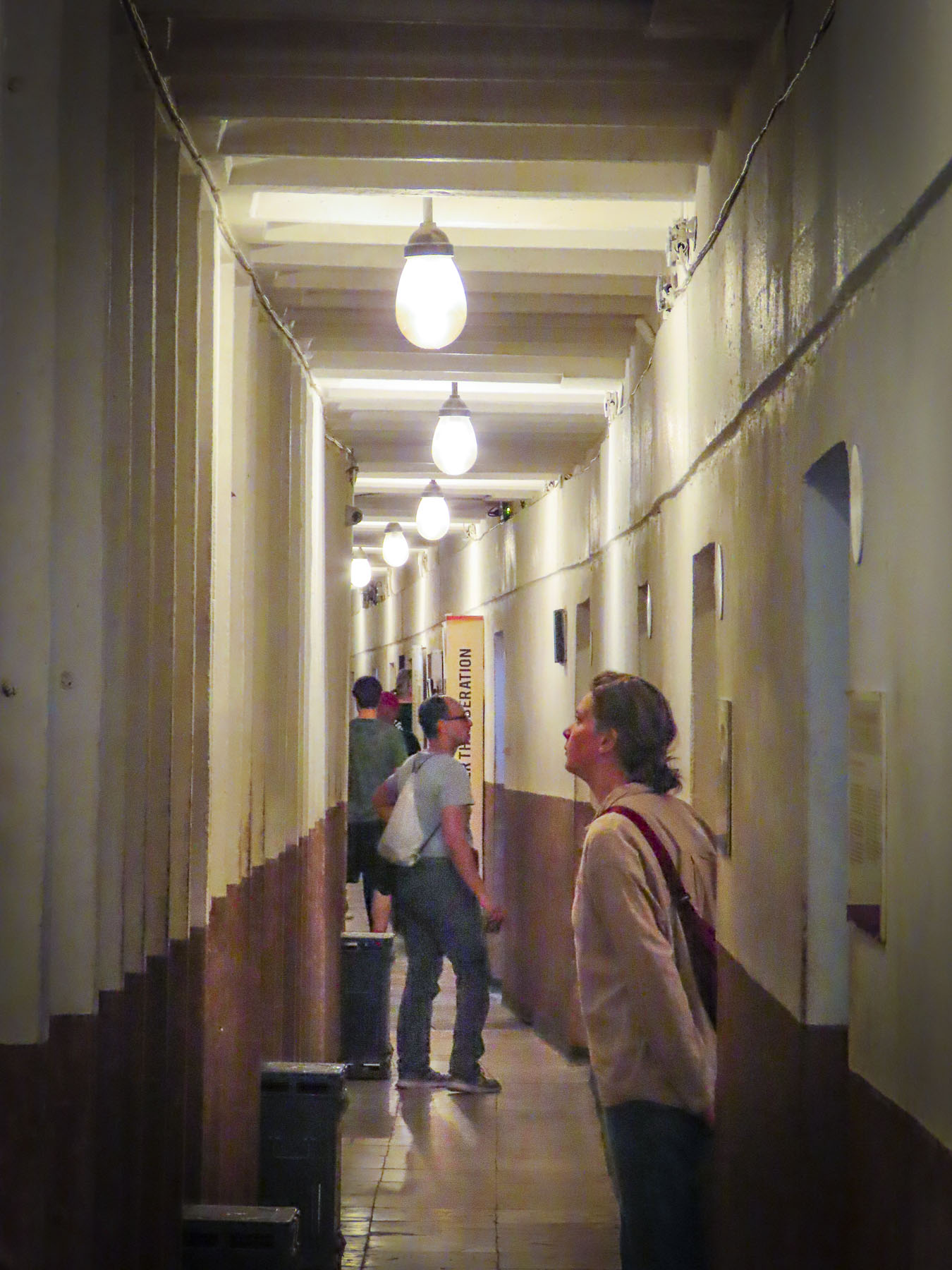
In Hoxha’s private quarters, we picked up a phone and listened to a recording of his voice. It was a sparse apartment, more prison cell than home, that lacked any warmth. Obviously, his wife wasn’t consulted. Other rooms displayed vintage equipment and weaponry. The isolation of having to live in this depressing environment would have been psychologically damaging; fortunately, the structure was never needed for war-time use and since 2014 it’s been a museum explaining Albania’s history from liberation by the partisans during WWII through Hoxha’s communist regime. The exhibits use amazing photographs and examples of nationalist propaganda from the country’s archives to great effect. The bunkers’ large meeting hall now hosts concerts and art exhibits. Emerging from the darknes,s an amazing number of different bird calls filled the air, as if welcoming us back to the present.

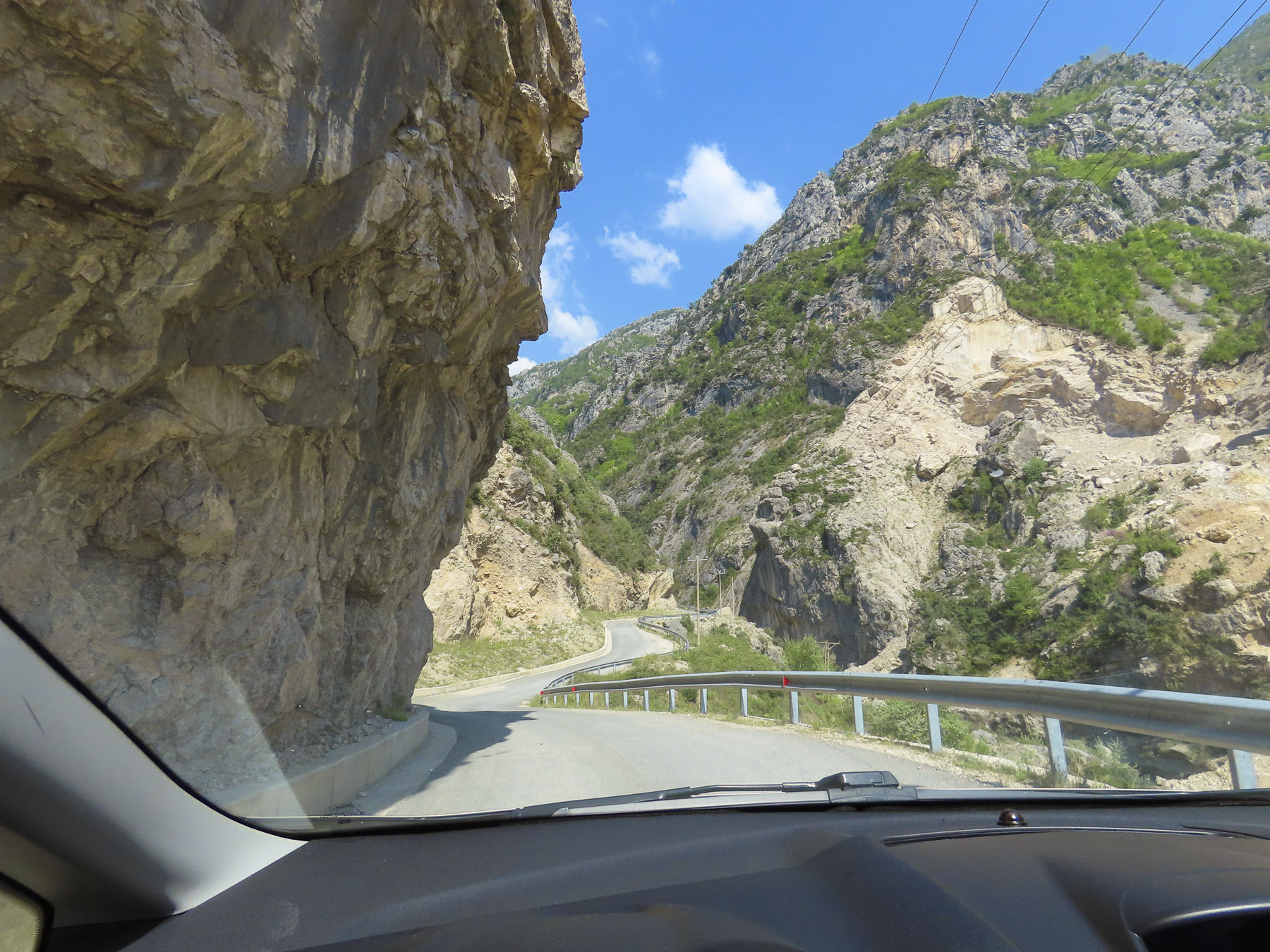
Following our map’s apps instructions we followed a confusingly serpentine route across the rolling hills outside Tirana before reaching the road, SH53, that led to Bovilla Lake. In the beginning the paved asphalt road was fine, but after a while abruptly changed to graded gravel. Nothing unusual here. Though the farther we traveled into the countryside, we passed fewer cars; rather, we saw large dump trucks, laden with stone from a quarry, headed towards Tirana, filling the air with dust. The road progressively worsened the closer to the quarry we got, as the weight of the trucks pulverized the road surface and created numerous potholes that we had to slowly navigate around. We thought several times about turning back, but we had driven through the Andes in Ecuador, with a sedan, on worse roads. While the going was slow and extremely bumpy, we did eventually make it to the lake, actually a reservoir, and more importantly, Bovilla Restaurant!

The views were astounding! The restaurant was full, with hikers and day trippers from Tirana. The food was good, the beer cold. It was a journey well worth the effort. The car rental GPS tracker did flag us, and we were fined for driving on possibly the worse road in Albania. Fortunately, when we returned the car eighteen days later, after some Albanian-style dickering, we were able to politely negotiate a reduction in the fine.

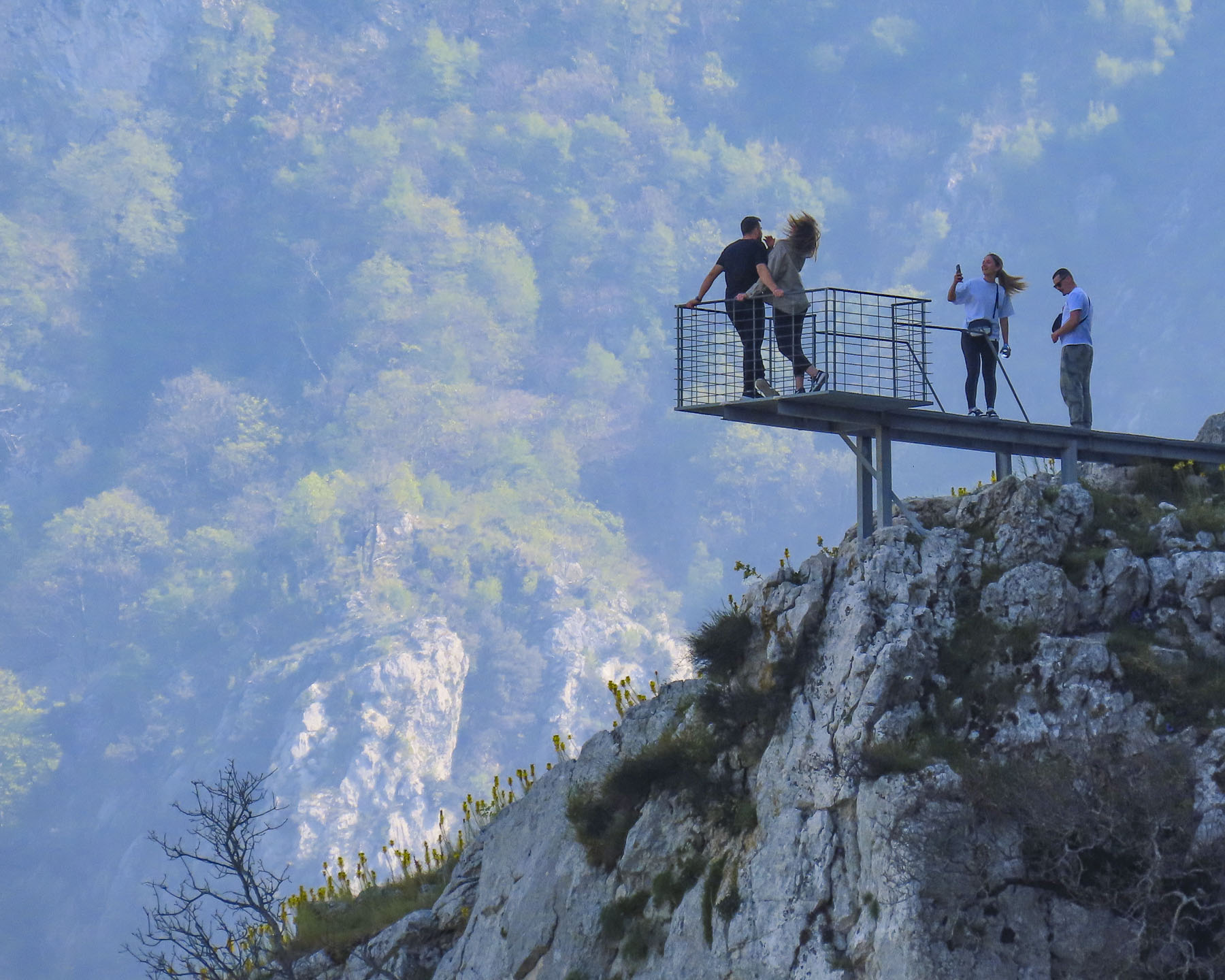
There were numerous speed traps on the highway leading out of Tirana and most of the times when we passed one, officers were writing out tickets, so we drove well below the speed limit. We were on the way to Berat and it was well past our usual morning coffee break when we spotted the colorful reflection of Bashkia Belsh’s waterfront.

After parking, we strolled along the Belshi Lake shorefront past small shops and some interesting street murals to the town’s boardwalk. Being a weekend, it was full of families with young children. To the delight of many, small rideable electric toy cars were available to rent, along with balloon, ice cream and cotton candy vendors. A small ferry boat took folks on a short cruise around the lake, while others enjoyed the fine weather and strolled along the boardwalk or sat under the umbrellaed tables of the restaurants that lined it.

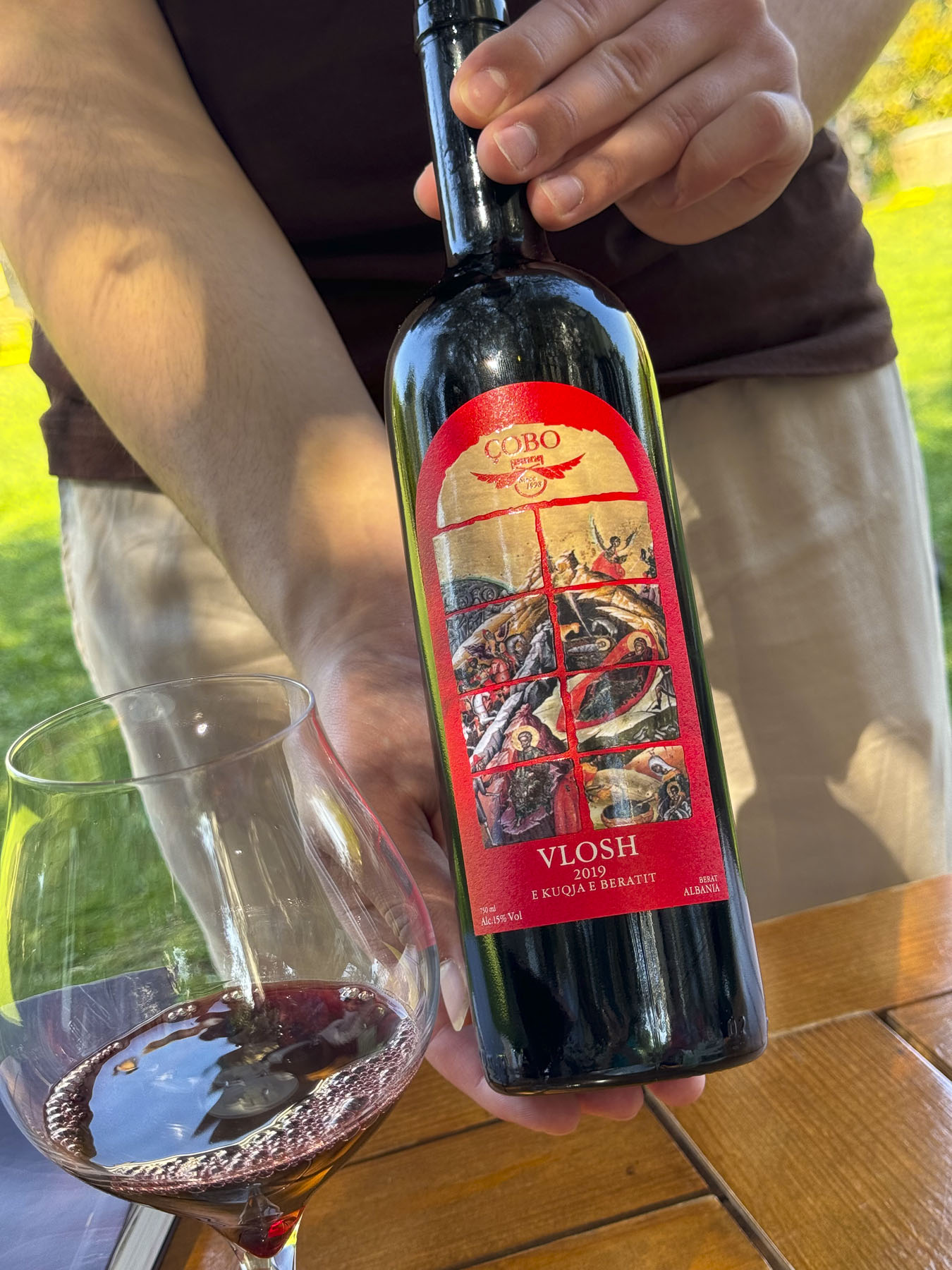
Closer to Berat we stopped at the Çobo Winery for a tasting that was accompanied by homemade cheeses and locally grown olives. Vintners of white, red, and sparkling wines and raki, they are regarded as one of the best wine producers in Albania.

It’s a small family vineyard with a 100-year tradition spanning four generations, that was sadly interrupted during the communist era, but since the 90s has grown production from 8,000 to 100,000 bottles per year. It was a nice break from our driving, and we enjoyed relaxing under the ancient olives trees in the their courtyard. The wines we tasted were very good and we purchased four to bring home in our luggage, and I’m happy to say they all made it back safely to the states.
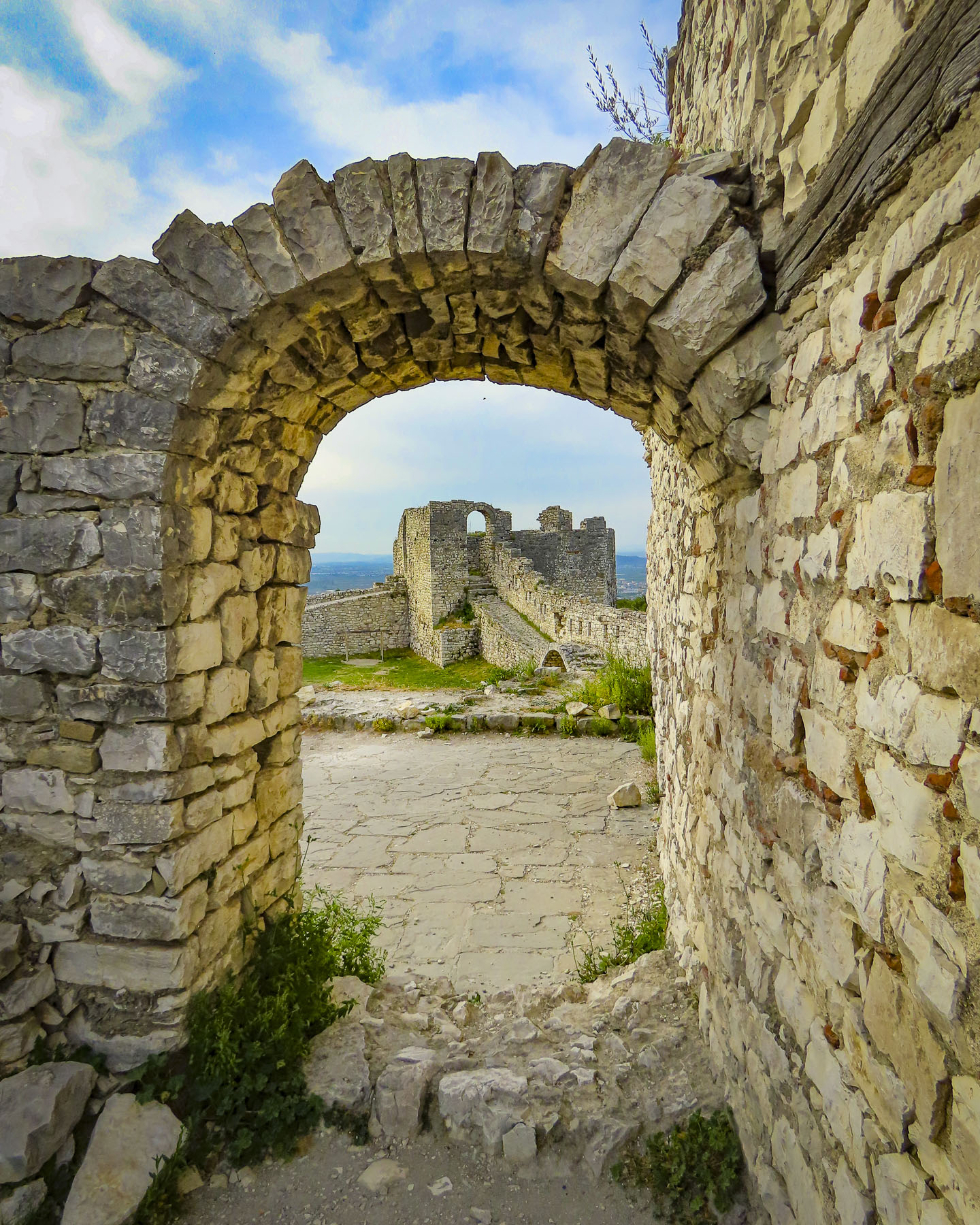
We reached Berat Castle just as the golden hour was approaching. We walked along its cobbled lanes, past homes surprisingly still occupied by about 400 people who live in 13th century citadel. But its history extends much farther back, with Roman records noting capture of the castle in 200BC. Archeological evidence shows the site has been inhabited since 2600-1800BC, making it one of the oldest settlements in Albania.
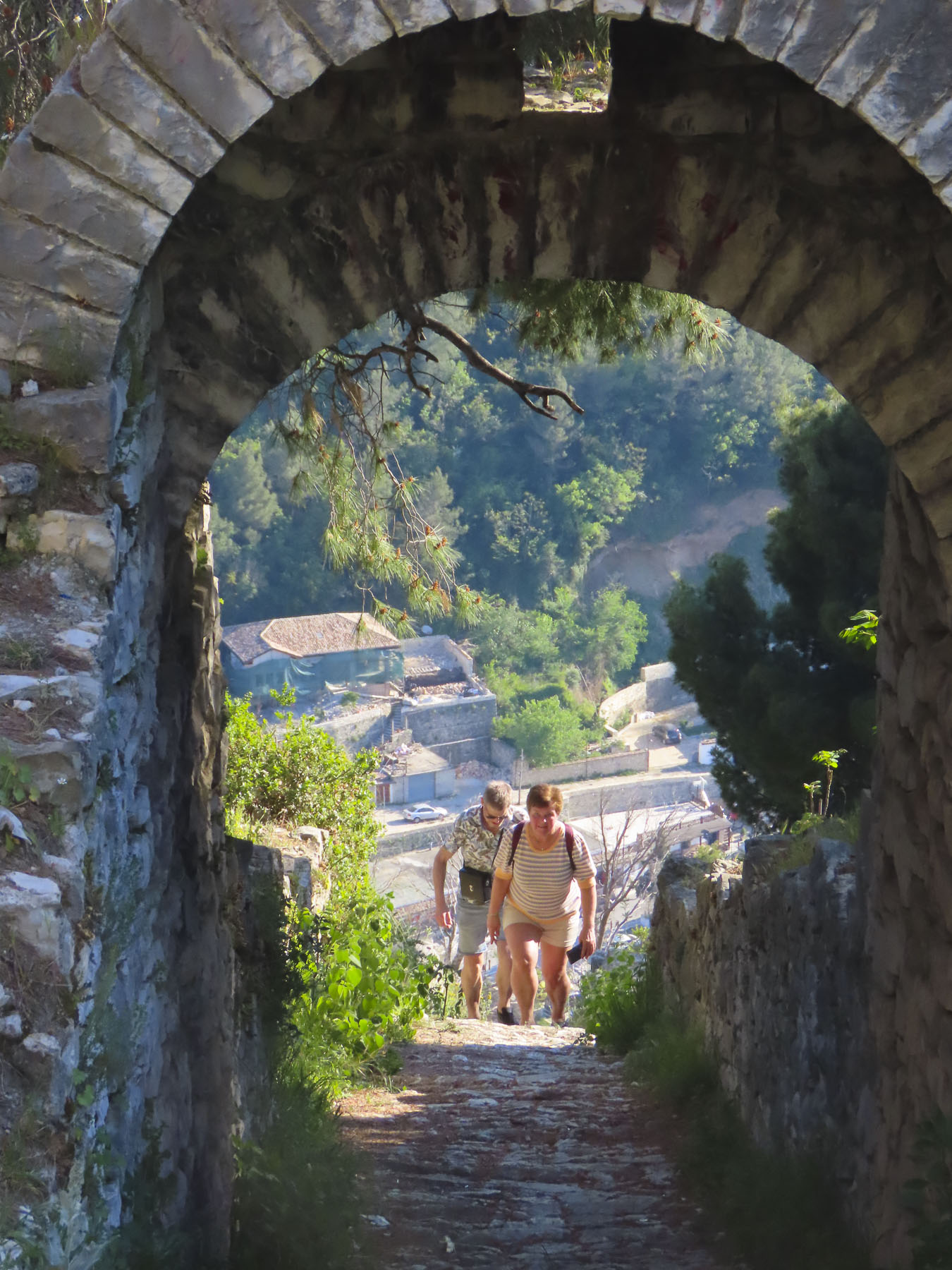
We worked our way to the overlook above Berat, passing the ruins of the Red Mosque, built in the 1400s after the Ottomans captured Berat, and Kisha e Shën Gjergjit, an orthodox church that’s been neglected since the communist ban on religion.

The panoramic view from the overlook out over Berat, the Osumi River below, and snowcapped 7900ft Mount Tomorri in the distance was stunning. Walking back along the ramparts we enjoyed watching an energetic dog race along the narrow top of the wall, chasing a stick his owner tossed up for him to retrieve multiple times. On the western slope of the castle, between the outer and inner defensive walls, Kisha Shën Triadha, a beautiful red brick, 14th century Byzantine church graces the hillside.

We wanted to stay on the “City of a Thousand Windows,” hillside under the castle, but didn’t want to drag our suitcases too far up the narrow alleys, and we had a car that needed parking. With those considerations in mind The Beratino Hotel fit our requirements perfectly and was great place to stay for two nights. Recently renovated, its stone and woodwork exemplified the best of Albanian craftsmanship. Still the shoulder season, in mid-April, I think were the hotel’s only guests.
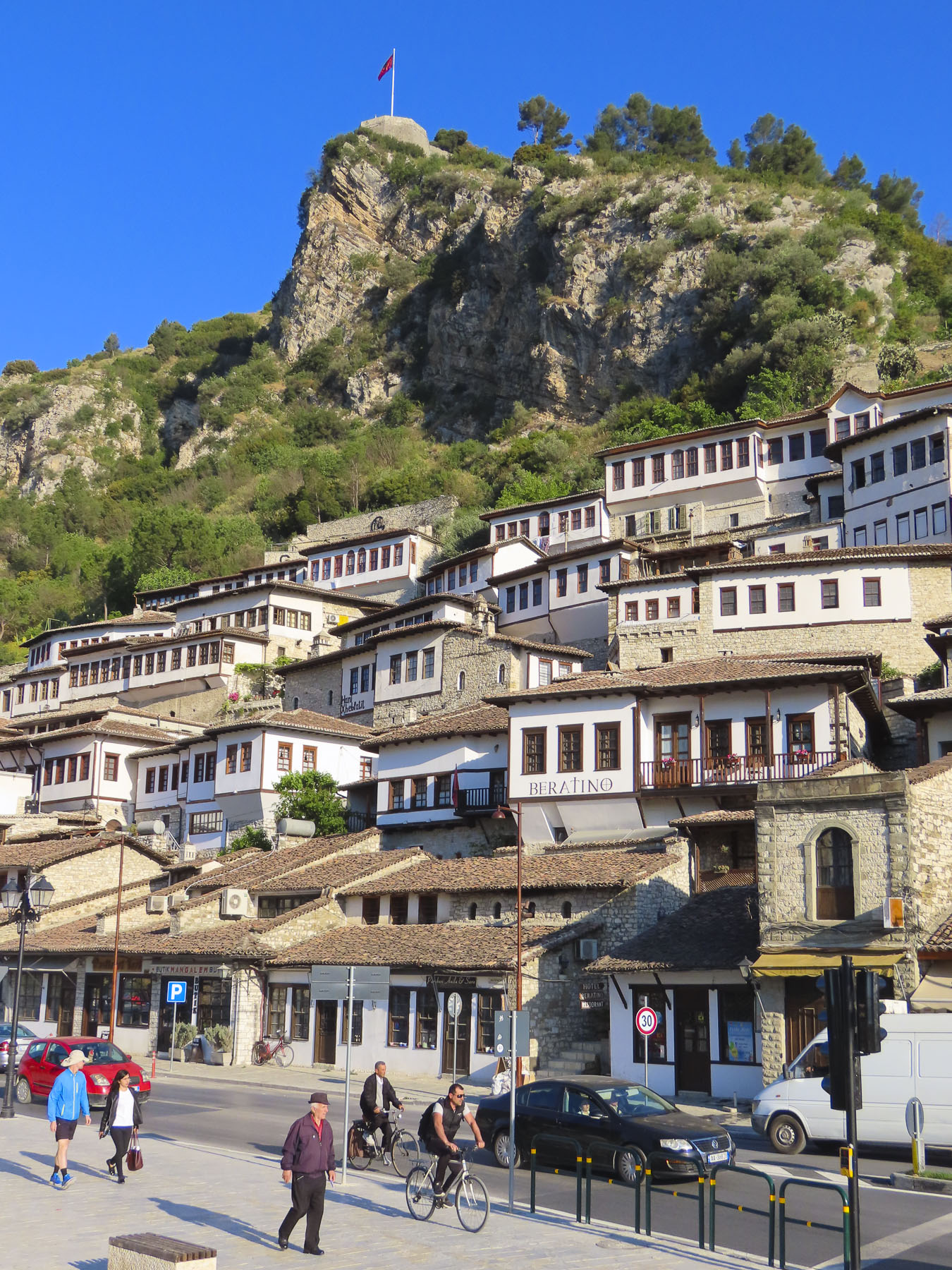
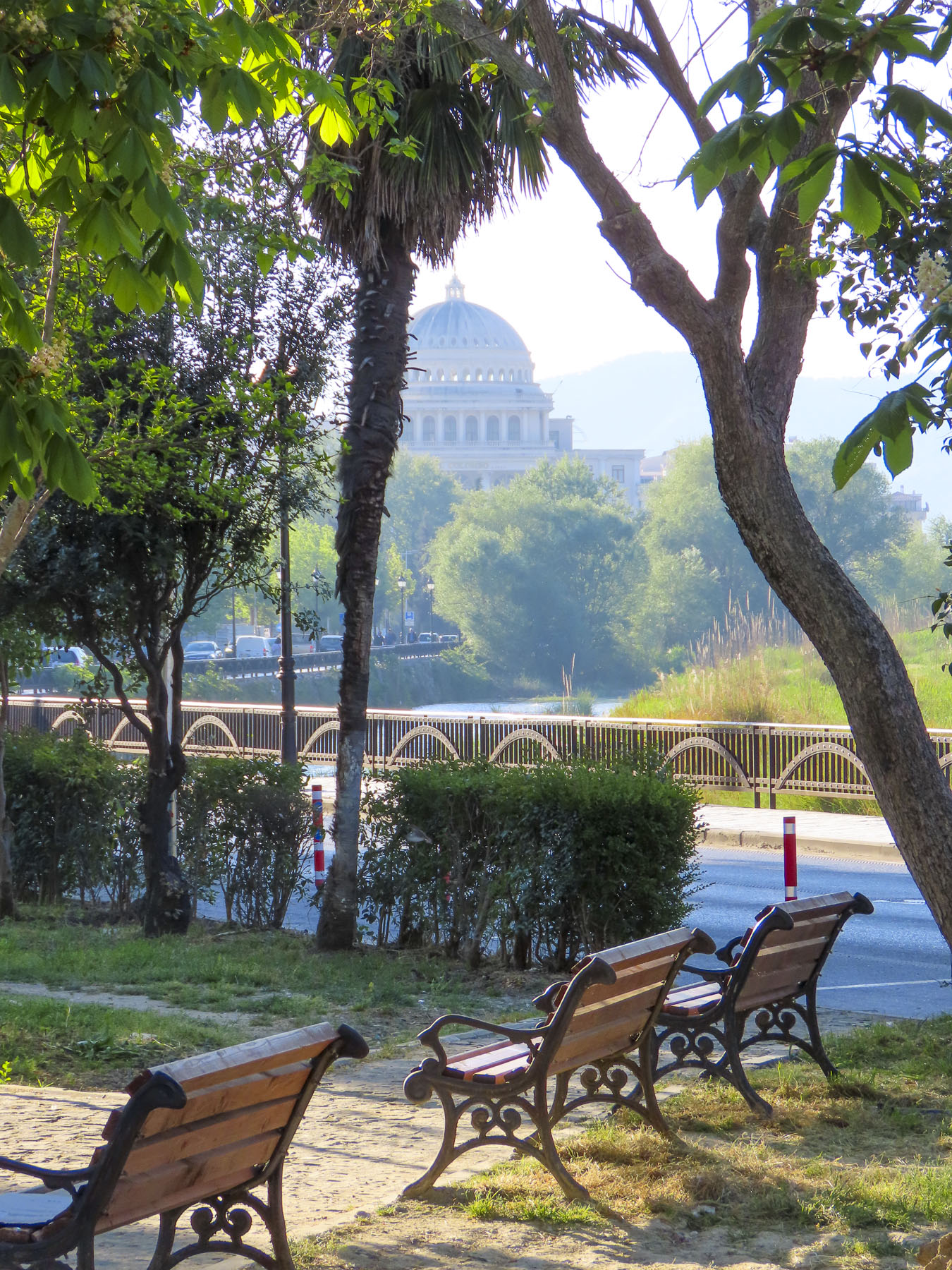
Sated from our afternoon wine tasting we walked into the newer part of Berat, now a small city of 47,000, along the pedestrian only Bulevardi Republika, next to Lulishtja park. It had a lovely Neapolitan vibe, with families enjoying the Albanian tradition of “xhiro,” to stroll with friends, relax and enjoy the outdoors after dinner. At a small shop perfectly named Bakery & Food we purchased Burek, a traditional Albanian pastry made with various meat and vegetable fillings. We purchased their spinach burek, reputed to be the best in Berat, some even say the best in Albania. The quest for the best byrek, burek, or borek in Albania might be the catalyst for a return trip to the country. Back on the balcony of our room we enjoyed a glass of wine, and the burek was delicious.

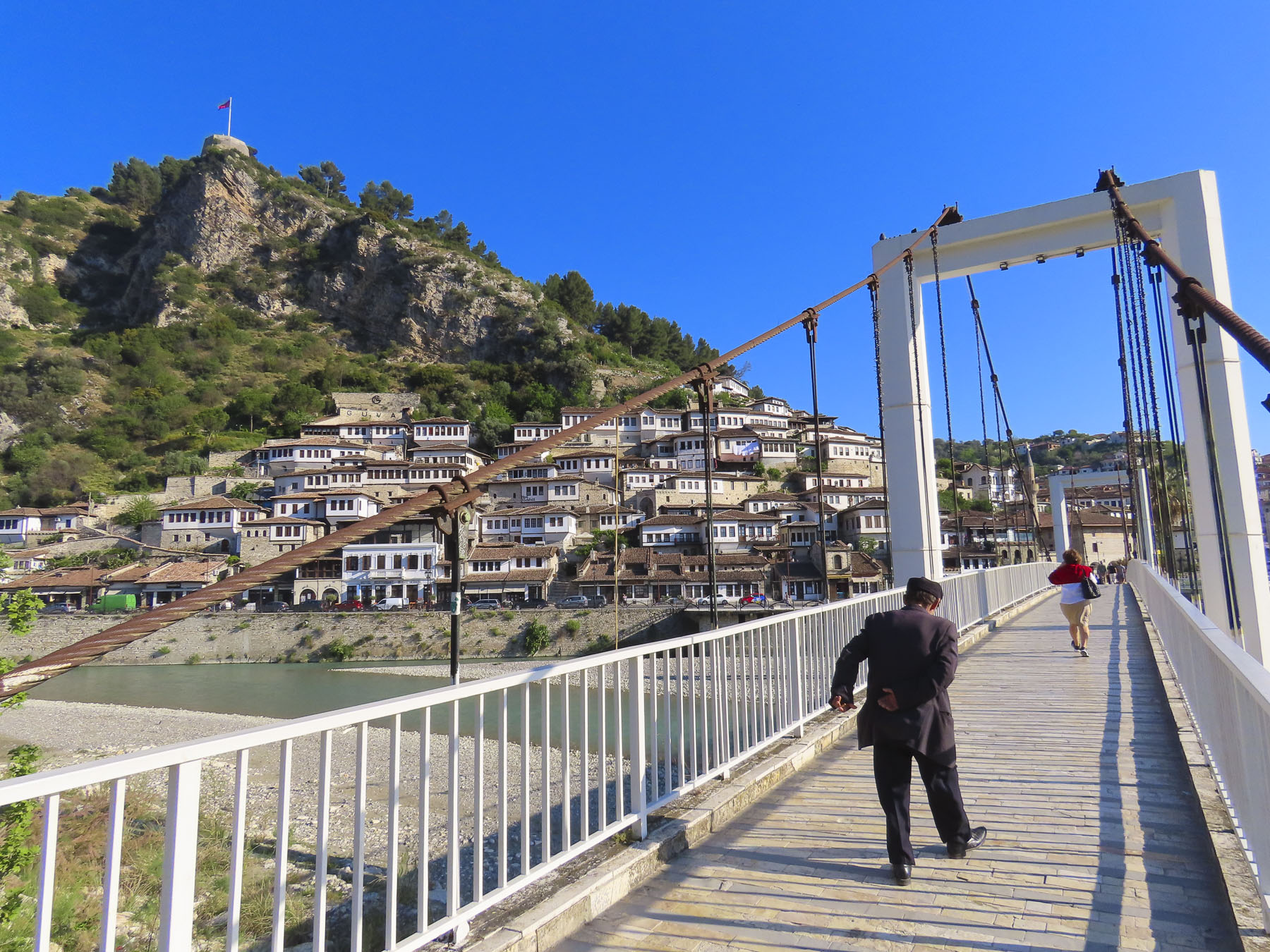
The next morning, we were up early and walked across the suspension bridge linking the old town with the southern Gorica “Little Village,” across the river. From this vantage point we spotted the Kisha e Shën Mehillit, St. Michael’s Church, an Eastern Orthodox Church, built on the steep rock face under the flag that flies above Berat. Thought to have been built in the 14th century, the setting of the red brick and stone church pricked our curiosity and we decided to hike there. The alley that led to the church was only a short distance away from our hotel but wound quickly up the hillside past homes and small inns.

We admired the strength of workers we passed carrying long wooden beams on their shoulders up the hill for a renovation project. We zigzagged higher up the hill, now looking down on the rooftops below, the trail looking like it hadn’t been trodden upon in ages. Unfortunately, the sanctuary was closed, but the views of the church with the river and mountains were well worth our effort.   

Later that morning we drove to the small town of Çorovoda, the gateway to the Osumi Canyon. It was a beautiful drive on a bright spring day, and we stopped many times along the way to photograph the scenery.

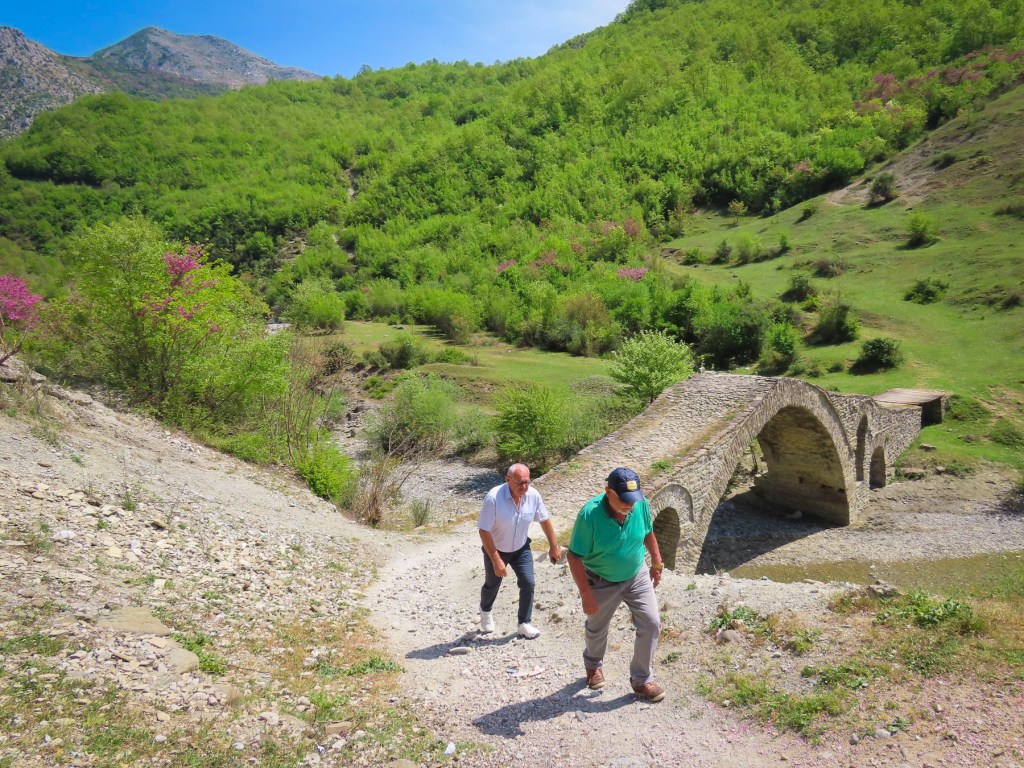
Before reaching the town, we veered off into the mountains to Ura e Kasabashit “The Bridge of Master Kasa/Kaso,” a classic high arched Ottoman era bridge constructed in 1640 across a wide stream, by the chief engineer of the Ottoman empire, at the time, Albanian architect Reis Mimar Kasemi. It was part of an ancient caravan trade route across the rugged central Albanian mountains, that connected the Adriatic Sea port of Vlorë to Berat, and Korçë before ending in the Greek city, Thessaloniki. Almost 400 years old, it surprised us that it is still standing and we followed some other tourists across it. Farther up the road from the bridge there are more abandoned military bunkers and warehouses, but we were bunkered out after Tirana and chose not to investigate them.
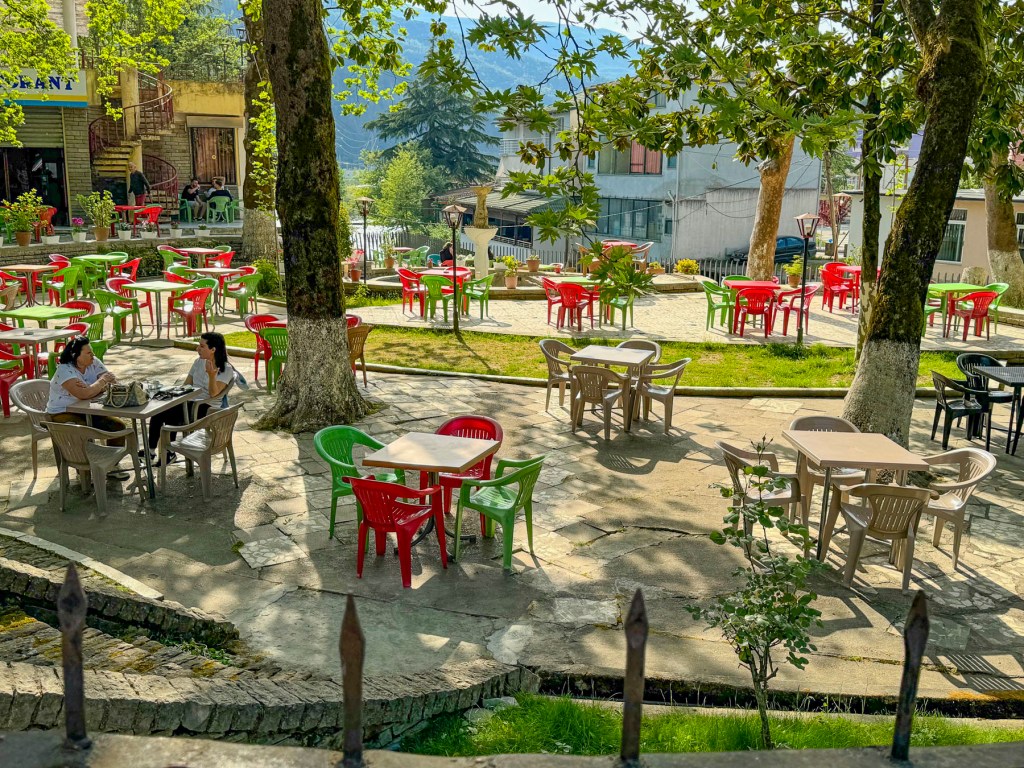
Our “drive a little, then café,” was way behind schedule when we stopped in Çorovoda at Drita e Tomorrit, a restaurant with a small park like setting.
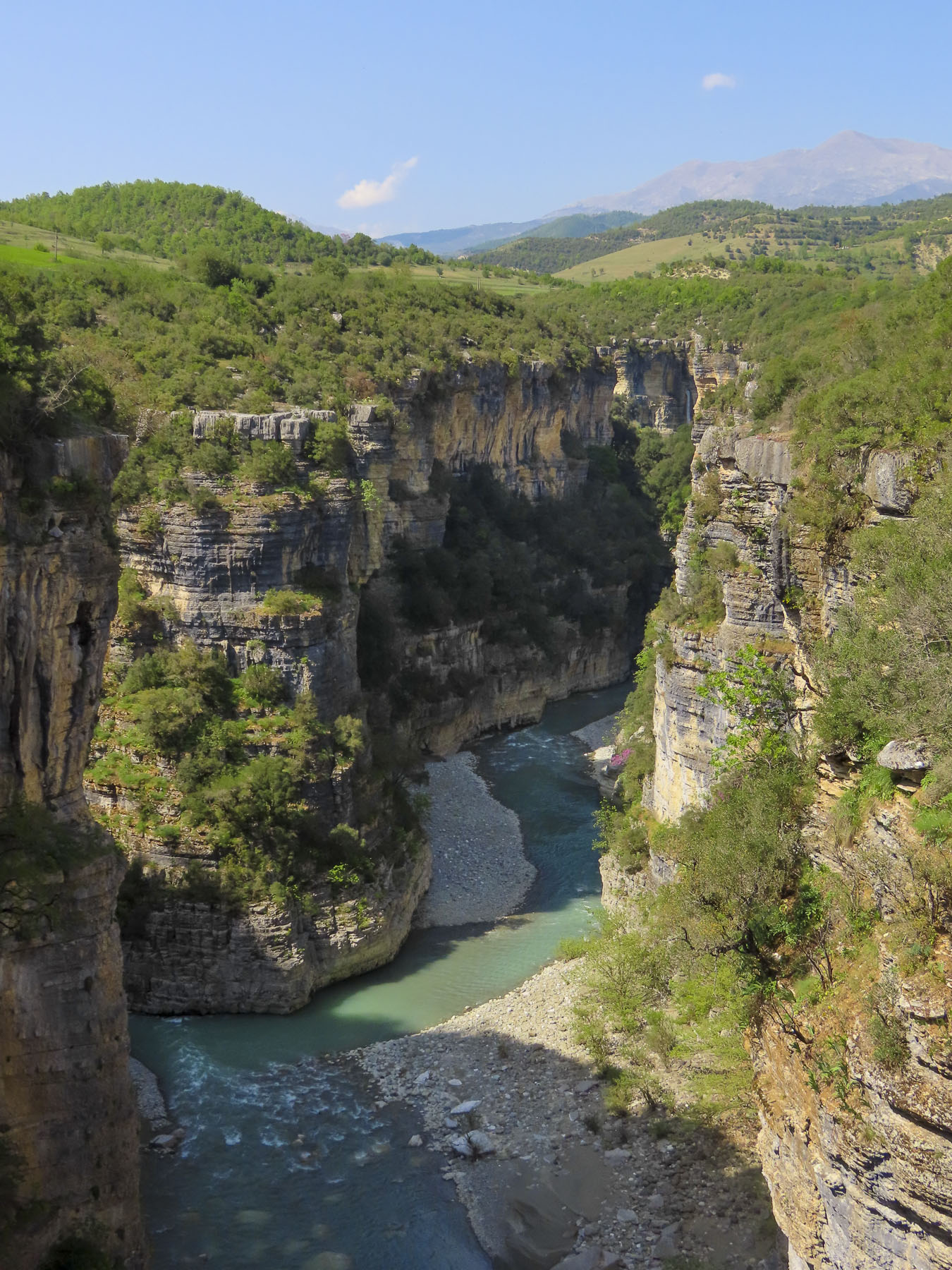
South of Çorovoda there are number of fantastic viewpoints along the Osumi Canyon. The water in the canyon is an amazing turquoise and it’s easy to see why it’s a popular area for rafting and swimming in the summer.
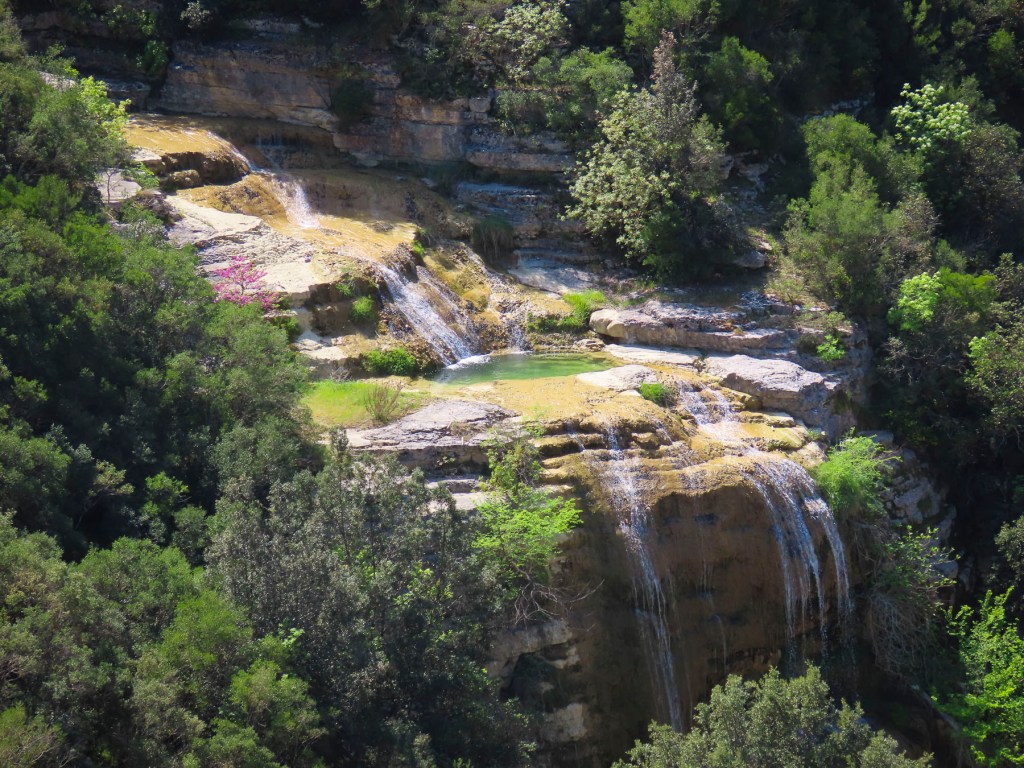
Before returning to Çorovoda for a late lunch we stopped at Gjurma e Abaz Aliut, the Footprint of Abaz Ali, a small roadside shrine believed to have in the solid rock under its canopy an impression of Ali’s foot. Made when the Albania folk hero, with legendary strength and courage, jumped across the Osumi Canyon from this spot. The depression in the stone looked very convincing to me.
Back in Çorovoda we had an early laid-back dinner at Zgara Korçare. It’s a small restaurant with nice owners across the street from where we earlier had coffee. Their mixed grill was delicious and we enjoyed our first tastes of Birra Korça. A good refreshing light beer brewed in Albania since 1928. Gëzuar, cheers!

The next day we headed to the Apollonia Archaeological Park before driving south to the semi-abandoned village of Upper Qeparo, eager to explore the rest of this interesting and stunningly beautiful counrty.

Till next time, Craig & Donna

Road Tripping Through Brittany: Saint Malo, Dinard & Dinan or For the Love of Oysters

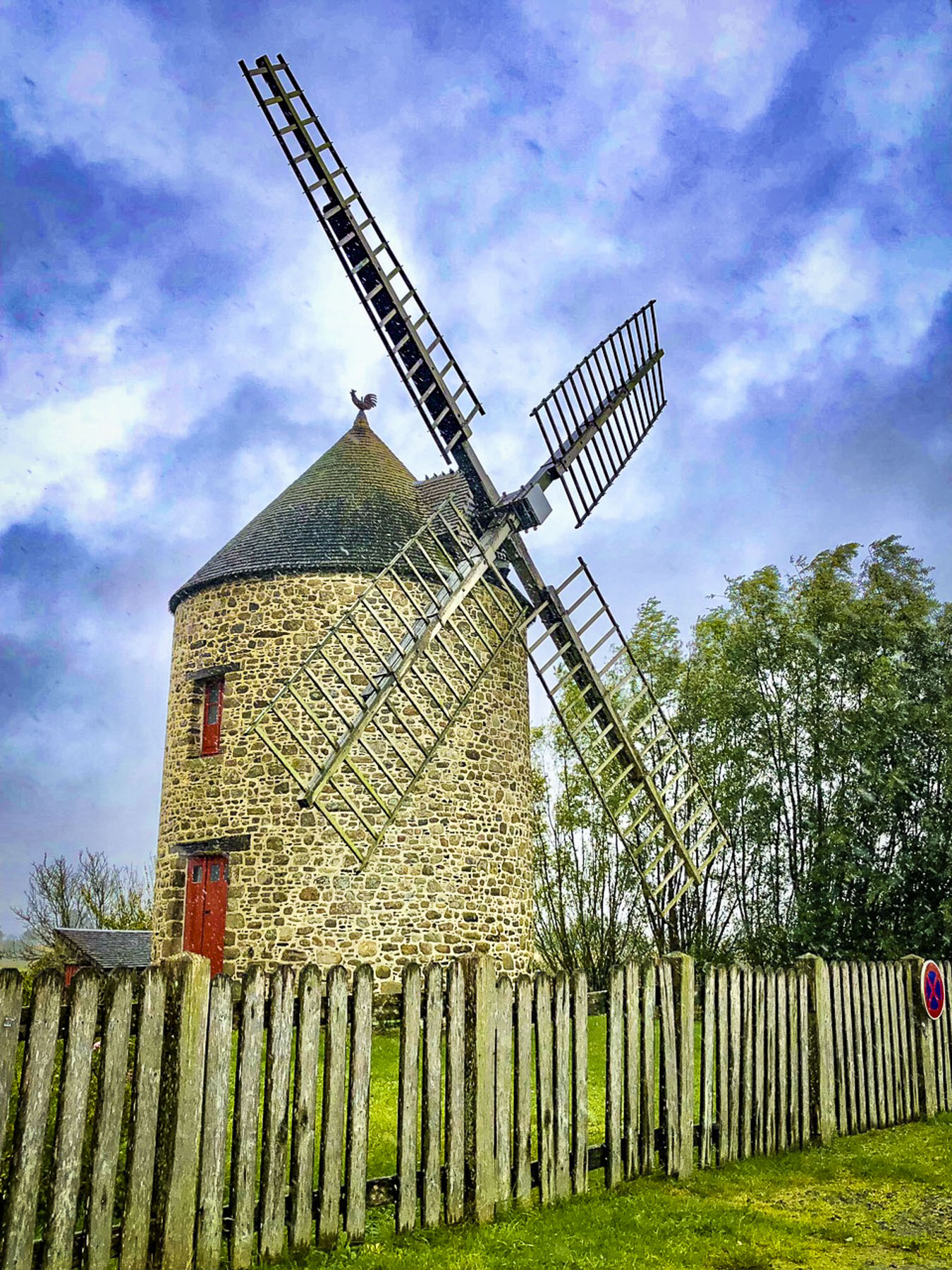
Tractors pulling wagons laden with huitres just harvested from the oyster beds of Cancale Bay now replaced the apple carts we passed two days ago in the Calvados region. Leaving Mont Saint-Michel in Normandy, we had entered Brittany in mid-October at the height of oyster season, which is traditionally considered the months that contain “r” in them, September – April. Our destination was Dinard, after stopping for lunch in Cancale, ground zero for huitres aquaculture in France. We had detoured from our route into Cherrueix to see the wide beach there that is popular for land-sailing, where specially designed three wheeled carts, outfitted with a sail, glide along the flat sand and attain high speed due to the strong winds that blow in off the ocean, filling their sails. But a windless day dampened that activity. The weather was pretty miserable that morning with intermittent squalls at times, limiting our explorations and photography. Our course diversion wasn’t a total loss as we found that the small village had several historic windmills and thatched roofed homes, which lent the town an unexpected Dutch and English feel.

Oyster connoisseurs enjoy Brittany oysters for their unique merroir. Just as wines derive a distinguishable terroir from the soil their grape vines grow in, oysters get their signature flavor from the saltiness and temperature of the seawater they are harvested from. The extreme, fast moving  tides, which Victor Hugo once described as “moving as swiftly as a galloping horse,” and cold water of Mont Saint-Michel Bay, which encompasses the ocean from Saint Malo, Brittany to the Cotentin Peninsula of Normandy, impart the oysters grown here with a sweet delicate flavor, which have won them fans the world over. Really, they are the best we’ve ever tasted, and we would order them whenever we saw them offered during our trip. They were also very affordable, which was a delight. Low tide along the coast revealed the extensive network of oyster farm pilings that support the growth of over 5,000 tons of succulent huitres a year.

Oysters have been gathered along the coast of Brittany since this region of France was part of the Roman Empire 2000 years ago. As with all ancient agrarian traditions, women have played a vital role harvesting oysters and Cancale’s town plaza hosts a bronze statue commemorating them. The day we visited, and it took us a while to figure out why, the female figures of the memorial were adorned in pink aprons. Turns out this was in recognition of France’s Breast Cancer Awareness Day, which happens every October. At lunch in a small establishment on the square, of course we slurped a dozen oysters, with just a touch of shallot mignonette sauce. They were divine. On Cancale’s waterfront there is also a daily Marche aux Huitres, surprisingly this oyster market which is open year-round. That old tradition of eating oysters only during the ‘r’ months dates back to King Louis XV in the 1700’s when refrigeration wasn’t possible, and it was unsafe to consume them during the warmer months. It’s also a matter of preference as the texture of the oyster becomes creamier during the warmer months, but today in France they are consumed year-round.

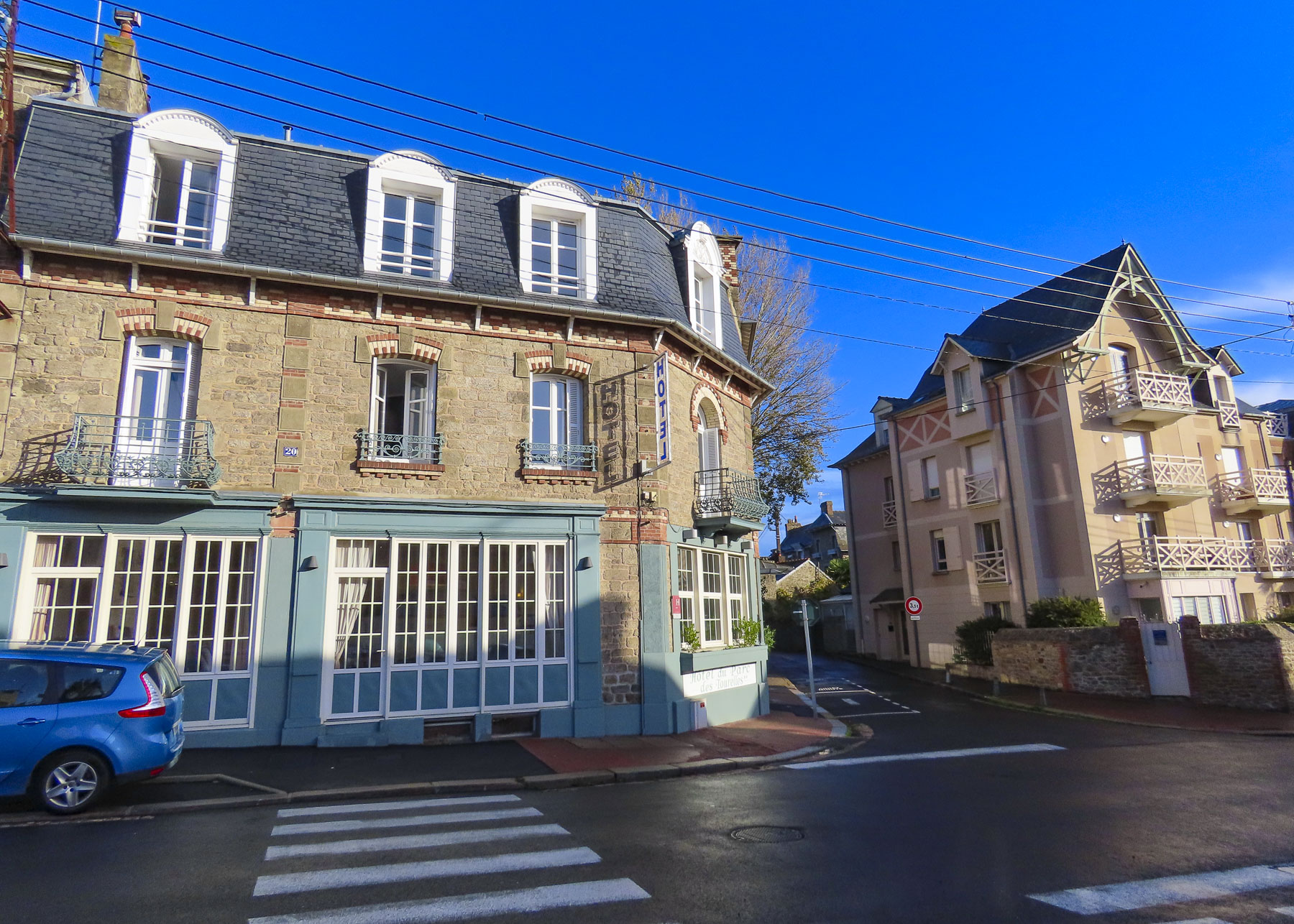
The late afternoon sun was shining brilliantly by the time we arrived in Dinard, found a free parking space on the street, and checked into the Hôtel du Parc Dinard, our home for four nights. The popular vacation spot is practically a ghost town in the fall, with most of its elegant Victorian-era homes battened down tight awaiting winter storms. The quietness was perfect for us, and the town would be our base for visiting Saint-Malo, a short distance away across the Rance Estuary, and farther inland the ancient riverport town of Dinan.

A former fishing village, Dinard was transformed into a vacation hotspot, when the French gentry, wealthy Americans, and British aristocrats discovered its picturesque beaches, and cliffside walks in the late-nineteenth century. A pleasant mild climate, influenced by the nearby warm waters of the Atlantic gulf stream helped set its reputation as “the Pearl of the Emerald Coast.” A who’s who list of celebrities – Picasso, Gary Grant, Joan Collins, Winston Churchill, and Oscar Wilde – frequented the seaside resort. The British film director Alfred Hitchcock visited often enough that the town erected a statue in his honor. Film legend believes he based the house in the film “Psycho,” on one of the town’s elegant mansions and the movie “Birds,” partly on experiences with raucous seagulls along the cliffs here. His relationship with the town led to the establishment of the Dinard Festival of British & Irish Film. Now in its 35th year, it’s held early in October. Prize winners receive a golden Hitchcock statuette.

One of France’s most “British resorts,” the town’s luster faded in the 1960’s when the “jet set” discovered the Mediterranean beaches of southern France. Fortunately, the town has been rediscovered as a holiday destination and today attracts folks looking for vacation rentals in the now sub-divided mansions, who appreciate its quite ambiance and location along the Cote d’Emeraude of Brittany.

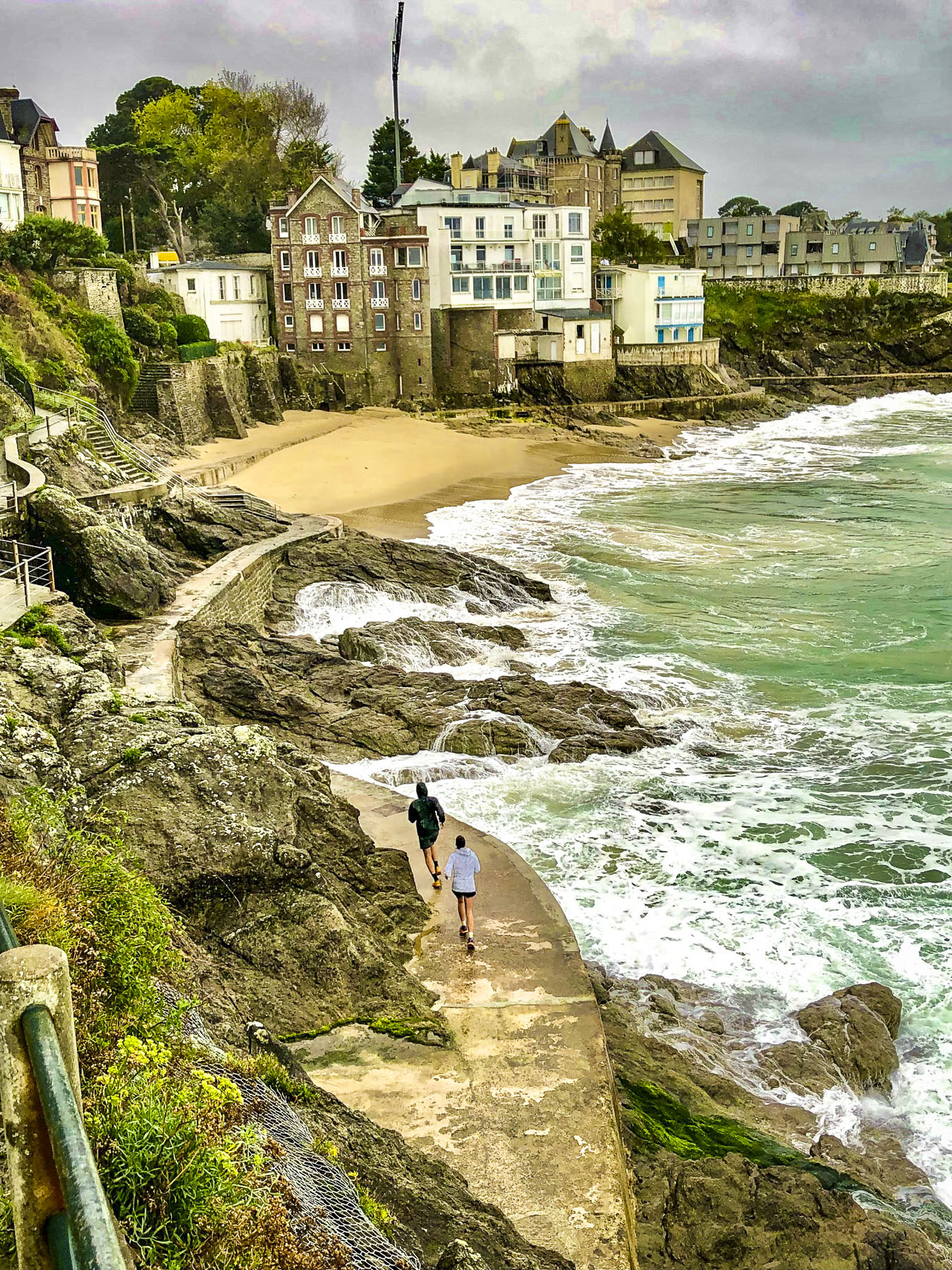
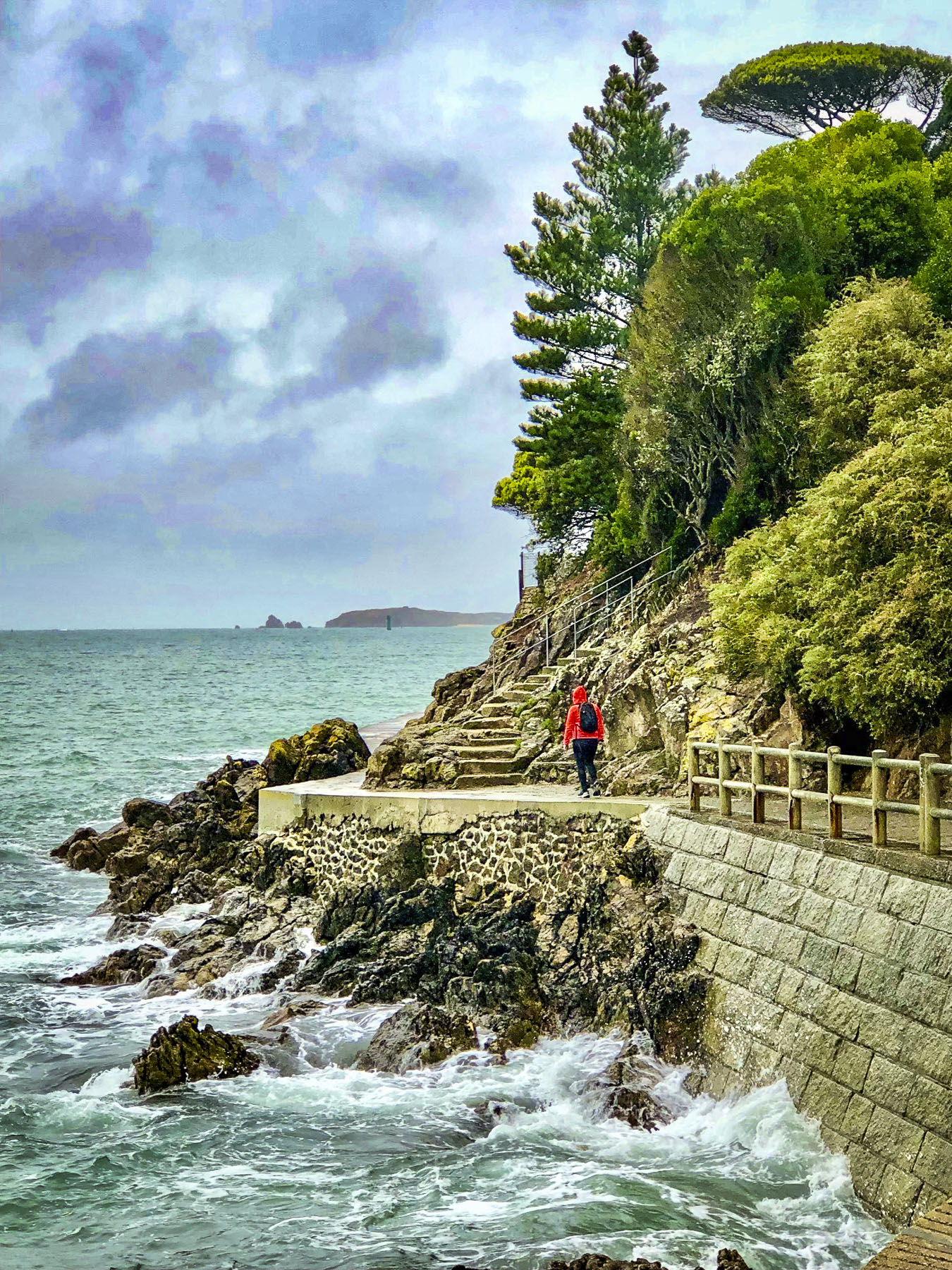
One of the best ways to enjoy the town, in any season, is to follow the Coastal Path of Dinard, a 5-mile-long improved trail that hugs the rocky coastline, passes sandy coves and fascinating old architecture. From our hotel we broke our walk into two manageable segments and included a stop at the weekly market one day to purchase supplies for a picnic lunch for later in the day. One afternoon we drove west along the backroads to Saint-Briac-sur-Mer. Here we could see the extreme tides of the Brittany coast, which left boats at their moorings high and dry at low tide.

Just across the water from Dinard the old fortress city of Saint-Malo still guards the natural harbor created by the La Rance estuary as it enters the Gulf of Saint-Malo and the English Channel.  Its ramparts have remained mostly unscathed since their first construction in the 12th century, in order to deter feared Viking attacks. Centuries later the Corsairs of Saint-Malo, French privateers serving the King of France, would pillage foreign ships sailing the English Channel, or extort a transit tax from them, then flee the scene of the crime and seek refuge from the pursuing English Navy under the cannons along Saint-Malo’s ramparts. This tactic was so annoying to the British that they launched an amphibious naval assault against the Saint-Malo corsairs in 1758, but determined the city’s ramparts were impenetrable and instead attacked the nearby town of Saint-Servan and destroyed 30 of the pirate’s ships there.

Outlaws to the English and Dutch, the corsairs of Saint-Malo had more nuanced careers and were well respected as explorers and merchants in France, enriching the town and serving the interests of several French kings over the centuries. Departing from Saint-Malo, Jacques Cartier sailed down the St. Lawerence River and claimed the discovery of Canada for France in the 16th century and sacked a few vessels along the way. Jacques Gouin de Beauchêne would lead the first French expedition into the South Atlantic, raid Rio de Janeiro, find the Falkland Islands, sail through the Strait of Magellan, visit the Galapagos Islands and return to the Atlantic Ocean by sailing west to east across the treacherous waters of Cape Horn. Other corsairs helped establish trade with ports along the west coast of Africa, Southeast Asia and the Pacific, which would evolve into French colonies. Corsair Duguay-Trouin led a Moka expedition to Yemen in the early 1700s, returned with the legendary coffee beans, and French society was changed forever: the café tradition had begun. Saint-Malo prospered.

Walking atop the ramparts that encircle the ancient citadel, it’s difficult to imagine that this beautiful city lay in ruins in September 1944. The D-Day invasion of Normandy had happened three months earlier, but well dug-in German forces, led by a commander who swore to defend the Third Reich to the last man, refused to surrender their reinforced positions in Saint-Malo. It took a relentless, months long campaign of allied aerial and artillery bombardment for the Germans to concede defeat.  The ramparts still stood, but 683 of the town’s 865 historic buildings were leveled, its 6,000 inhabitants homeless. The mayor at the time, Guy Lachambre, petitioned vigorously for the reconstruction council and its architects Marc Brillaud de Laujardière and Louis Arretche not to modernize the war-torn town, but to respect the ancient medieval character of the city and retain its maze of alleys, granite facades and steep slate roofs. It took two years to painstakingly remove the rubble, before rebuilding could start. Workers cataloged the ruins like an archaeological excavation, numbering each brick and stone, so that town’s original building materials could be reused, when possible, to authentically resurrect it from its ashes. Major reconstruction lasted until 1960; however, the Cathédrale de Saint-Malo, the final resting place for the famous Corsairs Jacques Cartier and René Duguay-Trouin, didn’t acquire its new steeple until 1971. The church’s spire, rightfully returned to its place of honor on the citadel’s skyline, was once again a welcome landmark for sailors returning from the sea. Renewed prosperity returned to Saint-Malo in the mid-1960s when folks rediscovered the seaside town as a great place to rent a vacation flat in apartments now vacated by families that moved away during the reconstruction years.

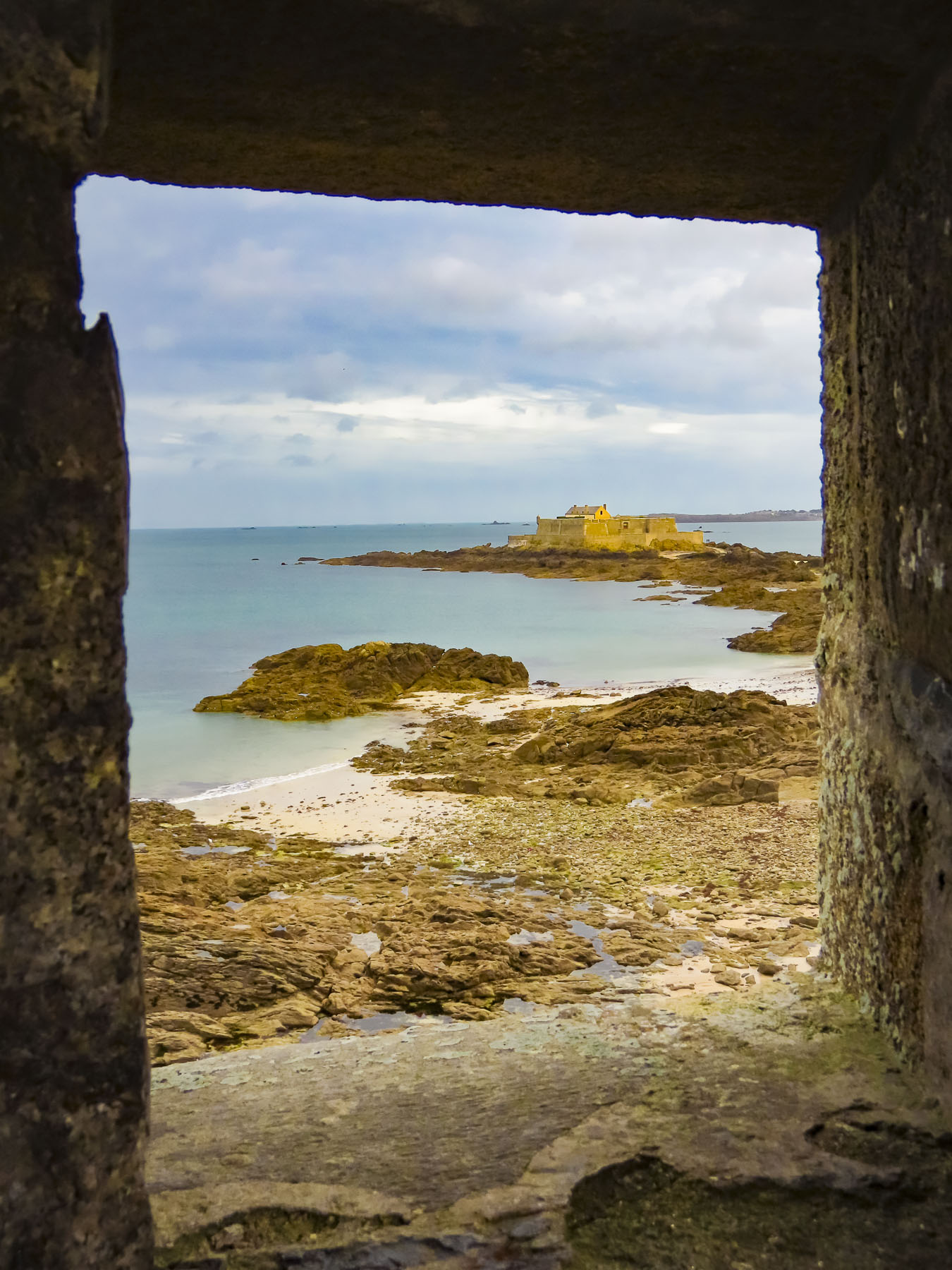
The views from atop the ramparts of the sea and the citadel were great. It’s an easy 1.4 mile loop around the ramparts, with many gateways that descend back into to the walled city or out onto the surrounding beach. At low tide it’s possible to walk across a sandy peninsula to the nearby 17th century Fort Natioinal, or to the small island Grand Bé, where the French writer François-René de Chateaubriand is buried, but be careful not to get stuck out there during an incoming high tide. Afterwards, back in town we found a rustic bar with a fire going in its stove and warmed ourselves with snifters of Calvados and café.

During the high season, parking in Saint-Malo can be problematic. However, if you are staying in Dinard it’s possible to take the small ferry across to the “The Corsair City.” If you are looking for a good read, the book All the Light We Cannot See, written by Anthony Doerr, evocatively tells an intriguing and mysterious story of life during WWII in Saint-Malo.

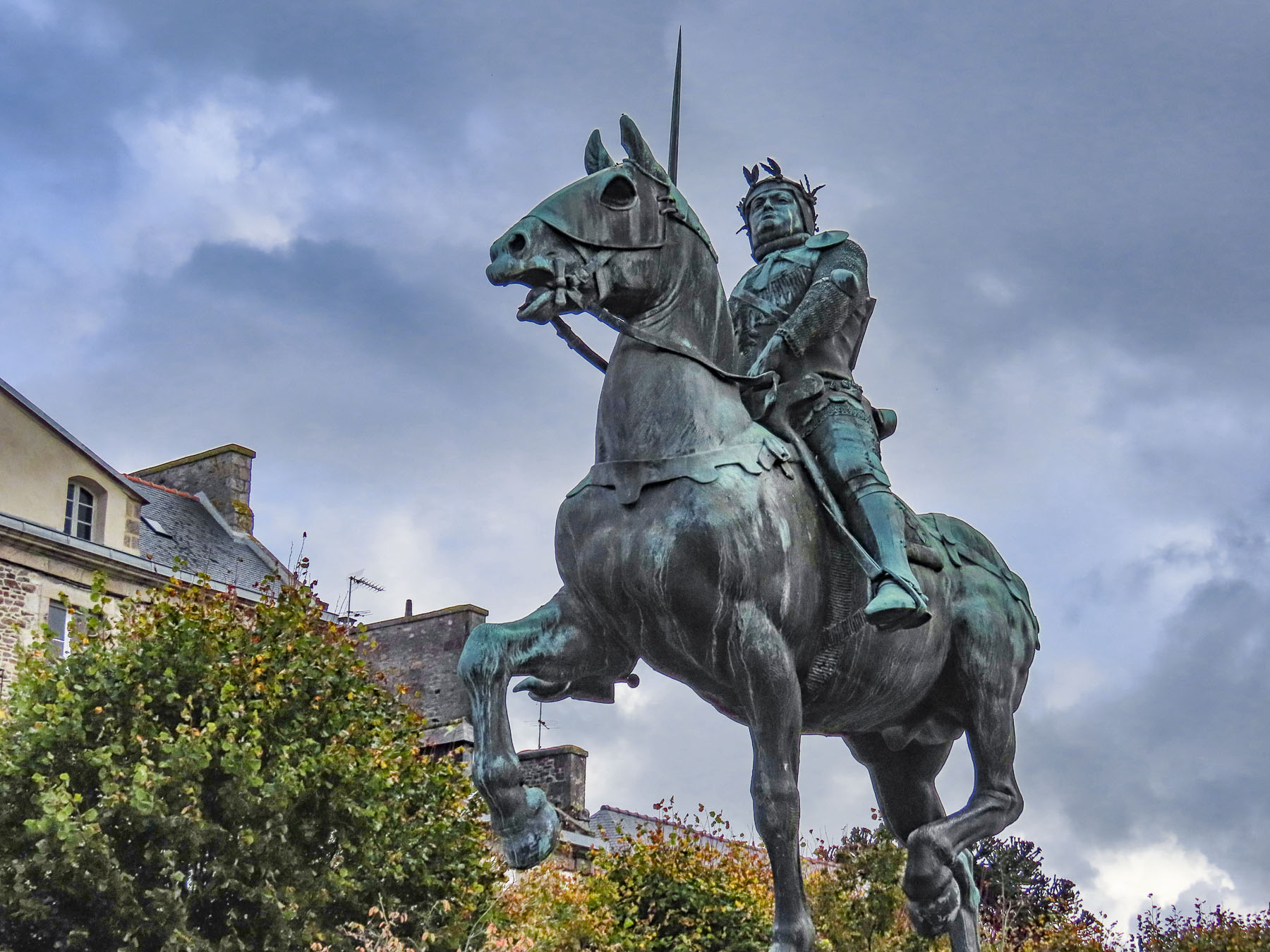
Traveling 30 minutes south from Dinard, we seemed to have arrived in the 14th century. We were greeted by an equestrian statue of the famous French general Bertrand du Guesclin, which towered above us in the car park. He was known for his many victories over the English during the Hundred Years War. He was so well regarded that upon his death, in 1380, he was given a royal funeral, his body quartered for burial, a practiced usually reserved for France’s kings. “His heart was buried in Dinan in his native Brittany, his entrails were buried in Puy, his flesh at Montferrand, and his skeleton in the tomb of St. Denis outside Paris.” We were off to an interesting start.

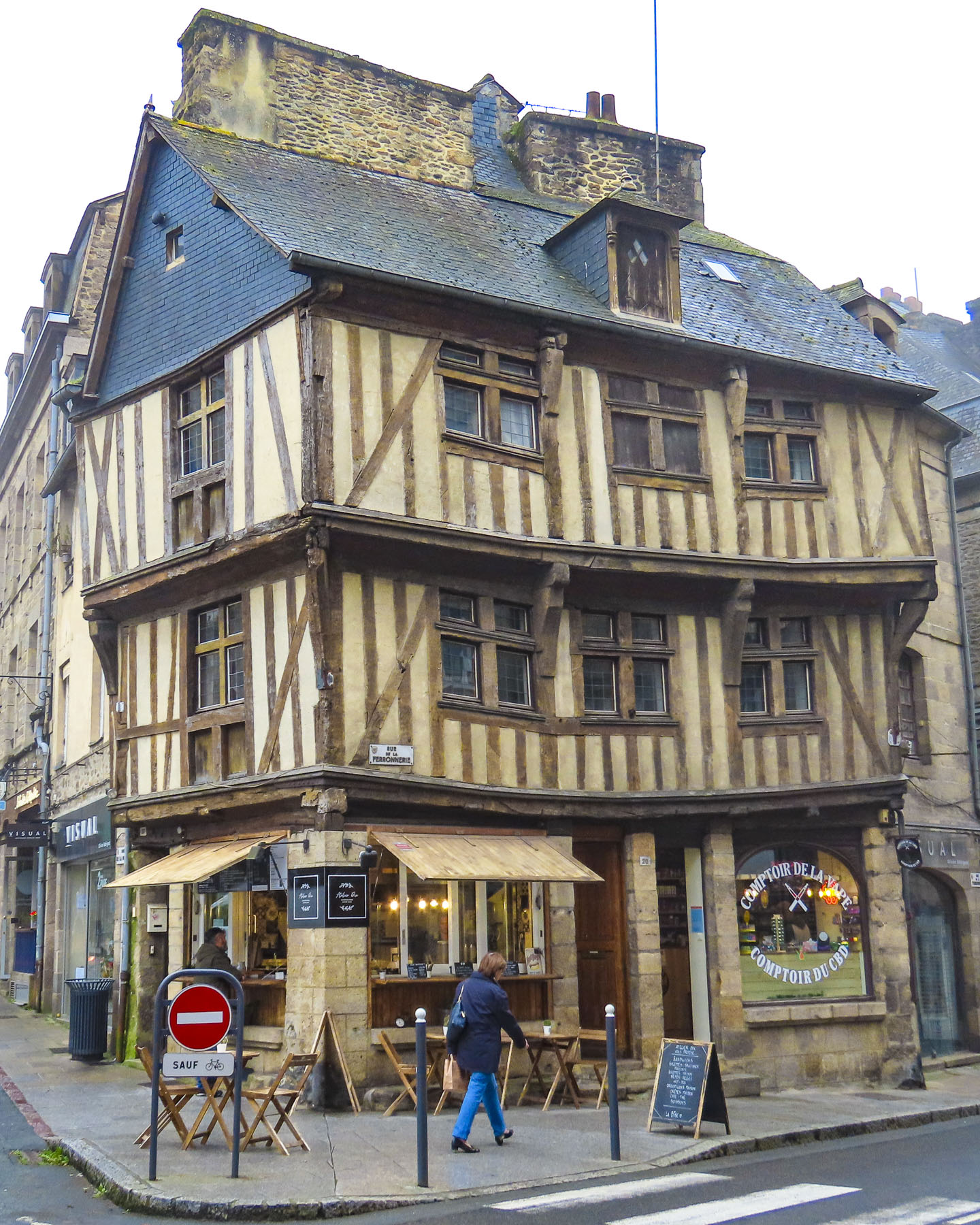
Somehow having escaped the destruction that befell Saint-Malo, Dinan’s historic center is filled with charming leaning, half-timbered medieval buildings dating from the 13th to 16th centuries, and shares an ambiance that felt more akin to Rouen than its neighbors Saint-Malo and Dinard.  This morning the narrow-cobbled alleys were busy with activity, modern shops behind the ancient facades, replacing the craftsmen and guild merchants of this market town and riverport who traded with Spain, England, Holland, and the new world colonies.

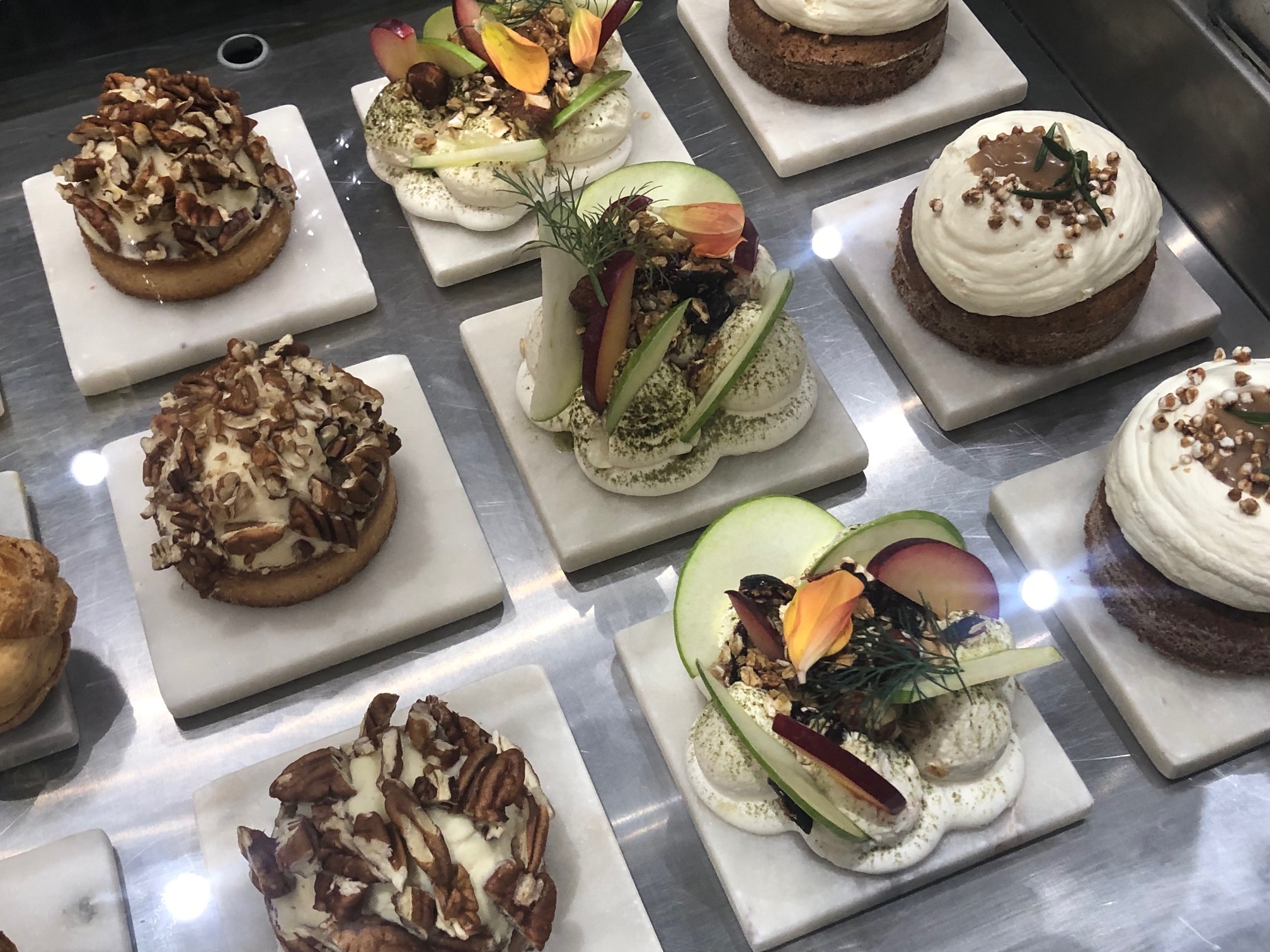
Our “walk a little, then café,” led us to Marcel, on Rue de la Cordonnerie, a delightful patisserie, where between cheerfully serving customers, the staff was photographing their artistic, mouthwatering temptations to post to the store’s Instagram page. Outside it could have been 1305 or 1673; only folks’ clothing had changed.

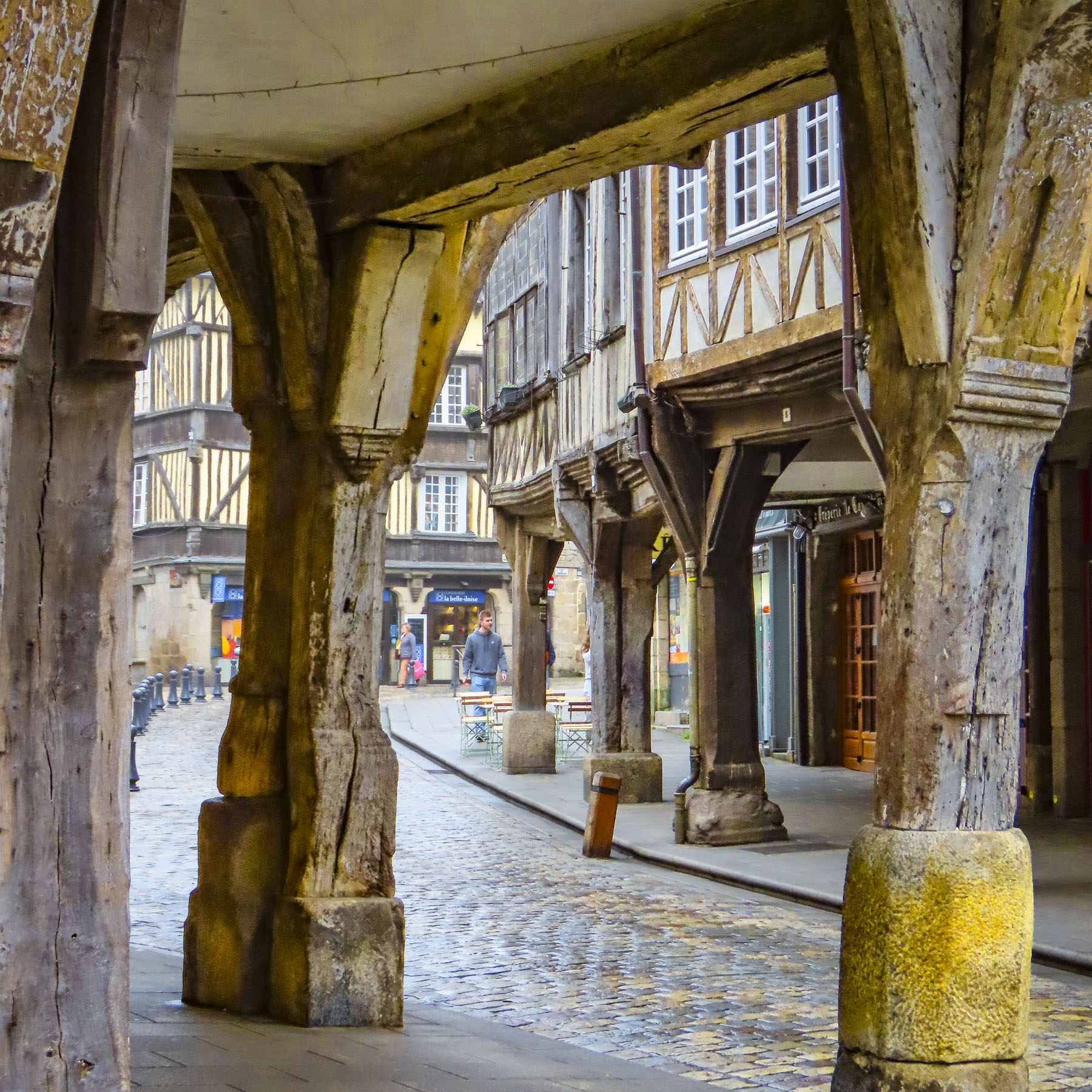
Farther along, stores had their merchandise displayed along the sidewalks under the porches of the buildings. This style resulted from the tax code at the time when merchants’ stores were taxed based on their ground floor square footage, but were allowed to expand outward on the higher floors.

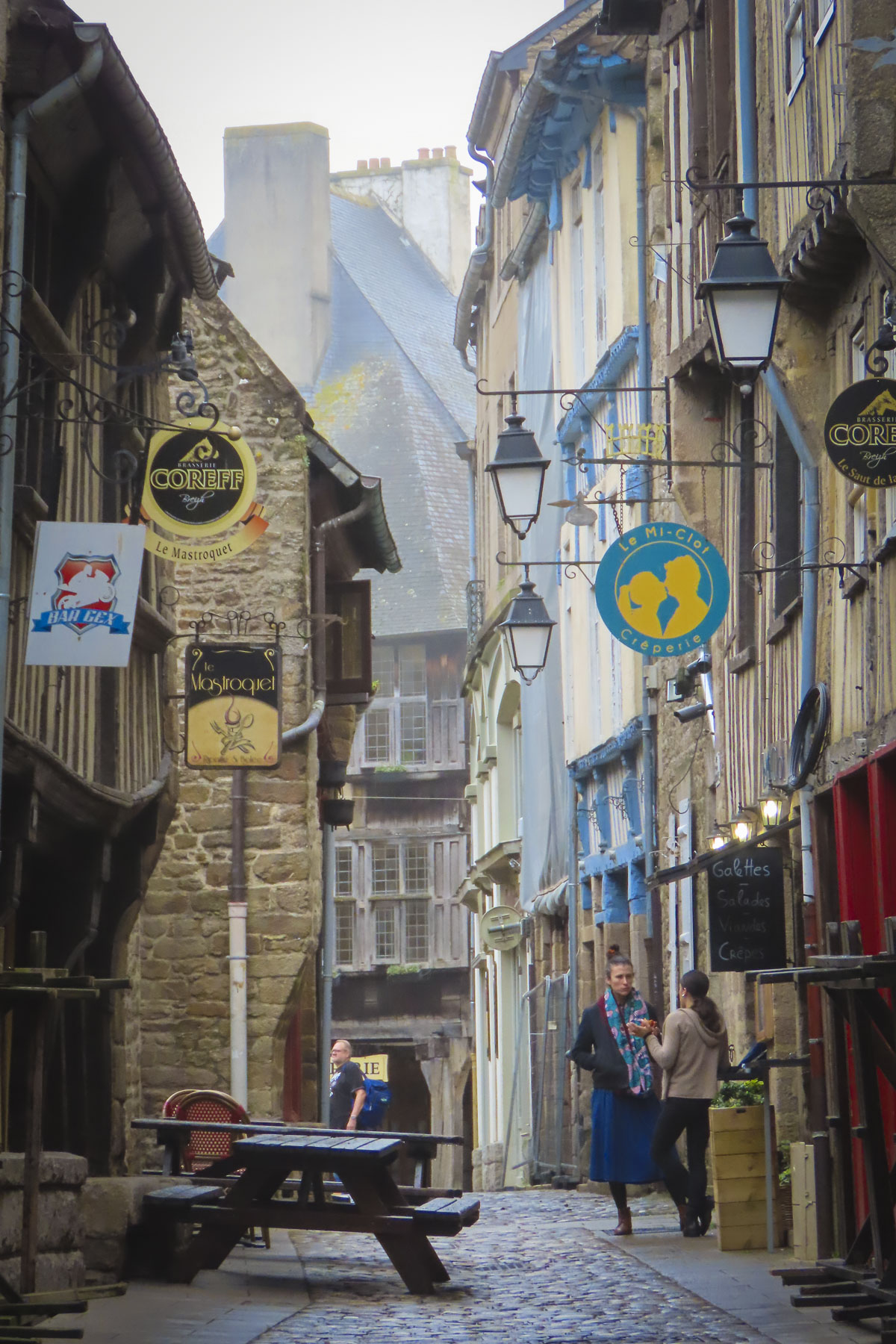
Polished from a millennium of footfalls, the cobbled lanes in Dinan glowed with different tones and hues, especially apparent on the damp overcast day we followed the long Rue du Jerzual downhill to the Port de Dinan. It’s an amazing street lined with a vast array of interesting buildings and a tower gate, which was once part of the ramparts which encircled upper Dinan.

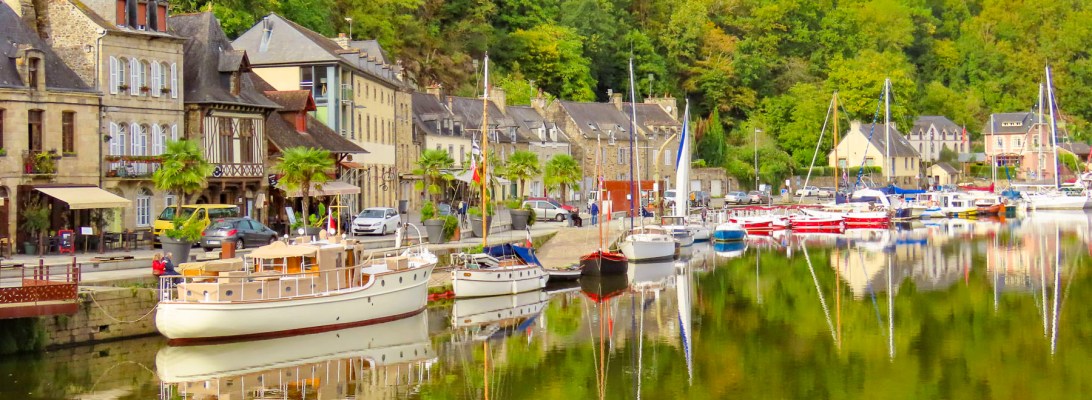
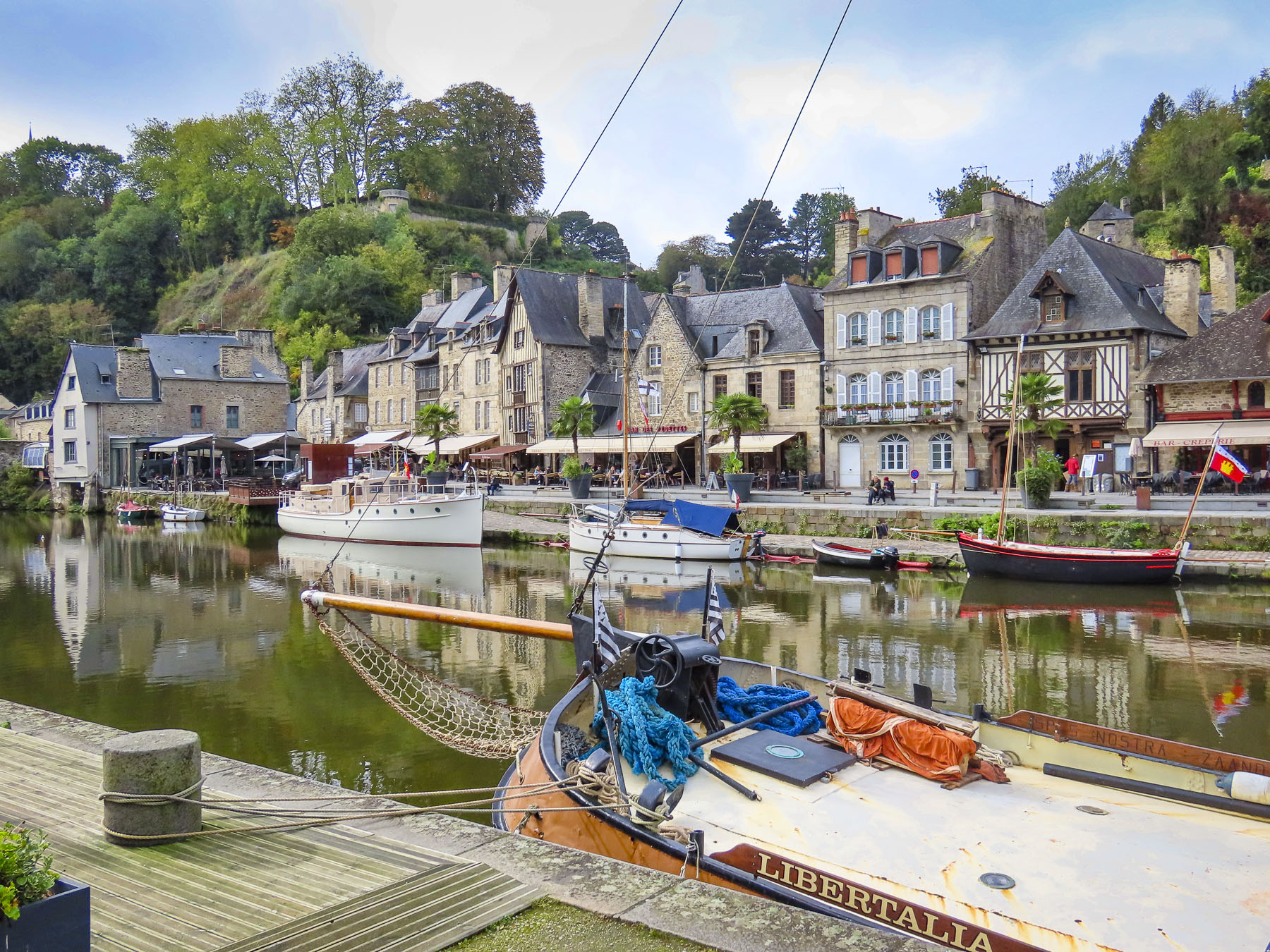
The waters of the La Rance river were calm and reflected the boats docked along the waterfront and the emerging autumn colors on the hillside above the river. Here the tributary narrows, no longer navigable for larger ships, a single arch stone bridge allowing only small recreational boats to proceed upstream to the pretty village of Léhon. A bike and footpath also follow the contour of the river to the village, only a 30 minute walk away.

We lunched outside along the quay trying some garlicky escargot and enjoyed the now-sunny afternoon. We were dreading the long uphill walk back and had asked at the restaurant to arrange for a cab, but they cheerfully informed us there was no need as a local small bus stopped just over the bridge and would take us back to the historic center.

The driver stopped at the Basilique Saint-Sauveur for us. Built in the early 1100s, it retained its Roman style façade during a 15th century expansion. But we only had a few moments for outside shots before a late afternoon thunderstorm chased us inside.

The inside has an impressive altar and artworks, while the interior architecture reflects a church renovated over several centuries. One side features Romanesque arches, though the other side displays a Gothic influence.

Rain kept us from walking through the Jardin Anglais, an English-style garden behind the town’s ramparts, with views across the La Rance river valley. We wrapped up a wonderful day in Dinan at the Château de Dinan, once a palace and fortress for the Dukes of Brittany in the 14th and 15th centuries. We seemed to have just scratched the surface of this intriguing town. And looking back it would have been a more interesting locale for a four-night stay.

Till next time,

Craig & Donna

France: Road Tripping Through Normandy – Fecamp, Yport & Étretat

Overnight showers had cleansed the air, the morning was brilliant with sunshine, and the deep blue sky was checkered with fair weather clouds. We were road tripping west through flat farmlands and pasturelands, which were lined with rows of beech trees to protect the land from the ferocious winds of winter storms. The landscape was dotted with Normande, a breed of dairy cow descended from the cattle that the Vikings brought with them when they settled in the area during the 9th century. A white cow, speckled with brown patches, this breed is favored for its milk’s high fat content, which lends itself perfectly for making CHEESE! More specifically the PDO (Protected Designation of Origin) Camemberts, Livarots, Pont-l’Evêques and Neufchâtels that the Normandy region is famous for. Small signs for fromage and cider pointed down many dirt lanes that spurred off our route.

We were heading to the white cliffs of Fecamp and Yport, in the Seine-Maritime department of Normandy, on the English Channel. While planning this trip we read about high season – over-tourism running rampant across France. Crowds don’t appeal to us, so we’ve been planning our travels to coincide with a destination’s shoulder season for a while now. The articles also suggested visiting places off the usual tourist radar, which is how we came across Fecamp and Yport, our stops before reaching Étretat. In hindsight we should have planned a full afternoon or overnight stay in Fecamp, as the quick glimpses of the Palais Ducal, now ruins, and the Holy Trinity Abbey, as we drove through the historic center, revealed a pretty town and looked intriguing, worthy of further exploration.

Our “walk a little then café,” becomes “drive a little then café,” when we have wheels, and by the time we entered Fecamp it was time to satisfy that late morning craving. Parking in unfamiliar towns is always a challenge, and on a busy Saturday even more so, but we lucked out and found both a parking space and great café near the harbor. The sunny outside tables at Le Coffee de Clo were empty so we were surprised when we entered to see a lively shop nearly full of people busily enjoying the decadent sweet creations we had stumbled across. More muffin than pastry, the baked goods and excellent coffee here are the only excuse you need to detour to Fecamp.

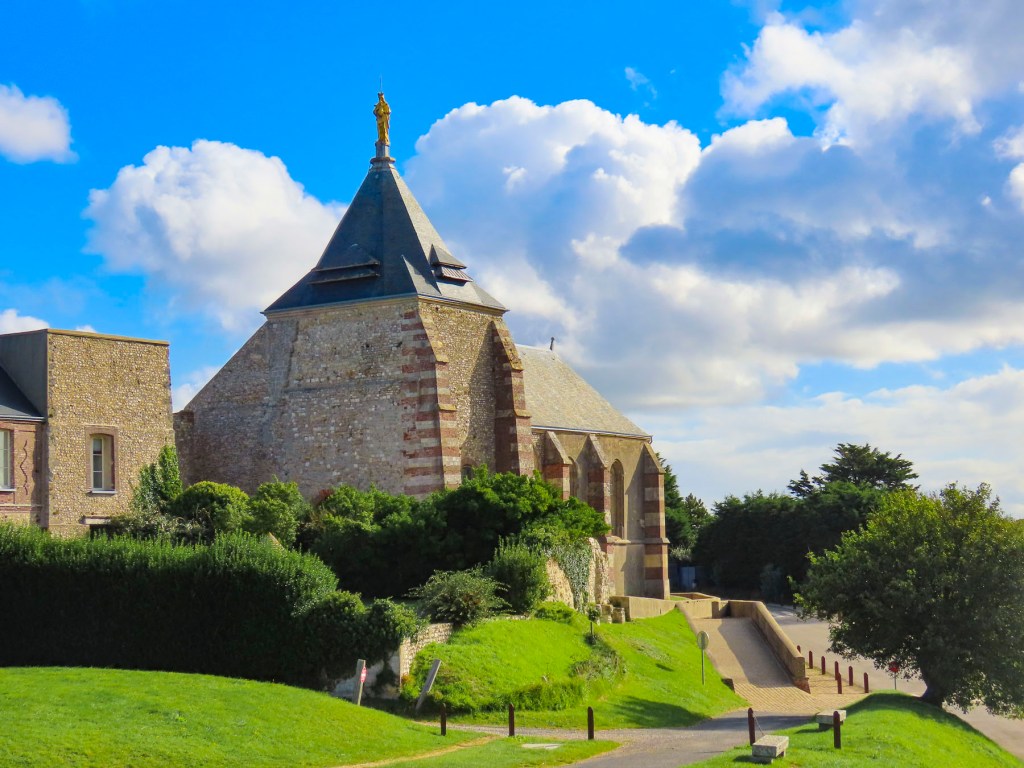
Walking back to the car, we spotted the Chapelle Notre-Dame du Salut, across the harbor, high atop Cap Fagnet. It’s believed that Robert the Magnificent, an 11th century Duke of Normandy, constructed the church in thanks to God for surviving a shipwreck in the waters below the white cliffs of Cap Fagnet. It’s been a pilgrimage site for fishermen, sailors, and their families ever since.

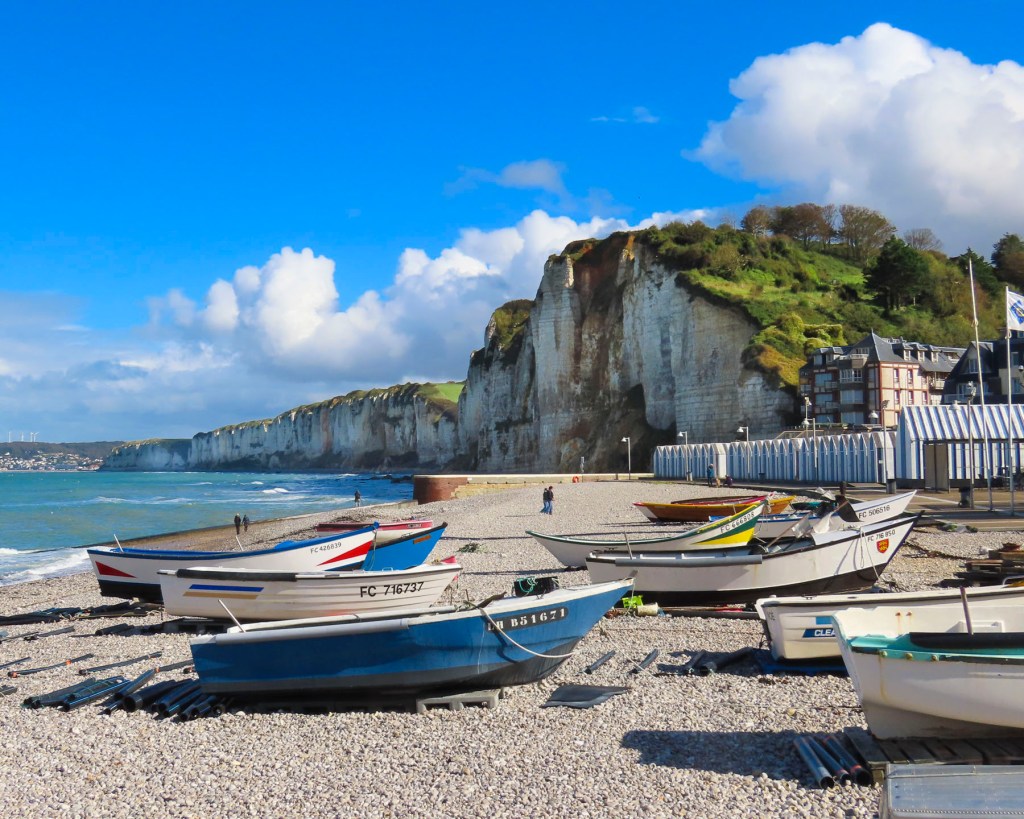
The views from the terrace in front of the church of Fecamp’s harbor, and the southern half of La Côte d’Albâtre, the Alabaster Coast, take in an 80-mile stretch of white cliffs between Etretat and Dieppe on the Normandy coast, that mirrors the distant White Cliffs of Dover across the channel. Locally the cliffs around Fecamp are known as le Pays des Hautes Falaises, high cliff country.

In 1066, William of Normandy set sail from Fecamps’ harbor with a fleet of more than 700 ships, partly financed by the Abbott of Fecamp, to claim the Crown of England, which he had inherited, but this was being contested by Harold, a pretender to the throne.  The issue was settled at the Battle of Hastings when the former became King William the Conqueror. It was also reassuring to learn that the Fecamp monks transitioned away from being international arms merchants, and segued into a more appropriate occupation –  running a distillery in the 16th century, that produced a 27-herb flavored liqueur that would become popular in the mid-1800s and sold as Le Grand Bénédictine.

Eight hundred seventy-eight years after William set sail, on June 6, 1944, during WWII German fortifications along the Côte d’Albâtre failed against an allied amphibious invasion fleet of over 7000 ships and landing craft. It was the beginning of the end of WWII. Scrambling to the top of an abandoned bunker provided us with the perfect vantage point for photos of the coast.

By the time we arrived in Yport the clouds had thickened and were threatening to rain. To our dismay, it poured just as we were parking by the beach promenade. Fortunately, it was an intense but brief shower that cleared into a cloudless sky and revealed a quaint picturesque hamlet and shining white cliffs towering above the sea.

The cliffs along the seafront have been eroding for eons, creating in certain spots deep, long ravines that funneled torrents of water, laden with sand and stone through the cliff face to the ocean, which created beaches in certain places over the ages. These narrow valleys are called valleuses, and the small coastal fishing village of Yport started in one during the Neolithic era.

Without a harbor, fishermen pushed their small boats across a pebbled beach and rowed out through the waves to pursue their livelihood. They repaired their boats and mended their nets on the beach at the foot of the town. This way of life supported the villagers for centuries. Only the invention of the small outboard motor in the early 1900s eased their physical effort, until the 1960s when tourism and a small casino replaced fishing as the town’s driving economic force.

In 1838, the tightly knit community decided to build a church. Men, women, and children gathered tons of smooth stones from the beach, carted them 500m inland, and proudly worked together to mix cement and build the center piece of their town. Horizontally striped with alternating layers of colored beach stones, the façade of the church is beautiful, and unique in Normandy. It is a true testament to the power of community spirit.

By the mid-1800s Parisians seeking a more relaxing retreat than Etretat were frequenting the quiet fishing village. The French painters Monet, Renoir, Schuffenecker, and Vernier visited and painted there, while the 19th century French writer Guy de Maupassant set his novel, ‘Une Vie,’ in Yport. Paths from the center of the town and from behind the casino lead to the cliff tops and join the popular GR21 trail that can be followed north to Fecamp or south to Etretat.

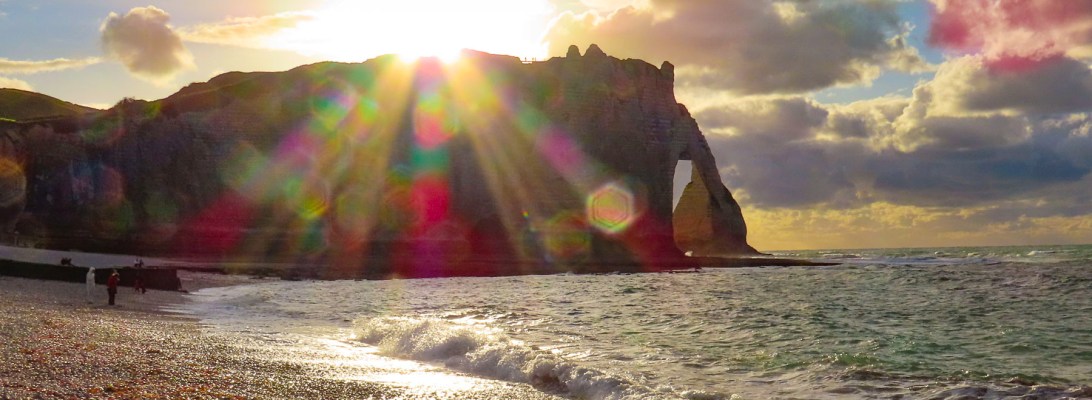
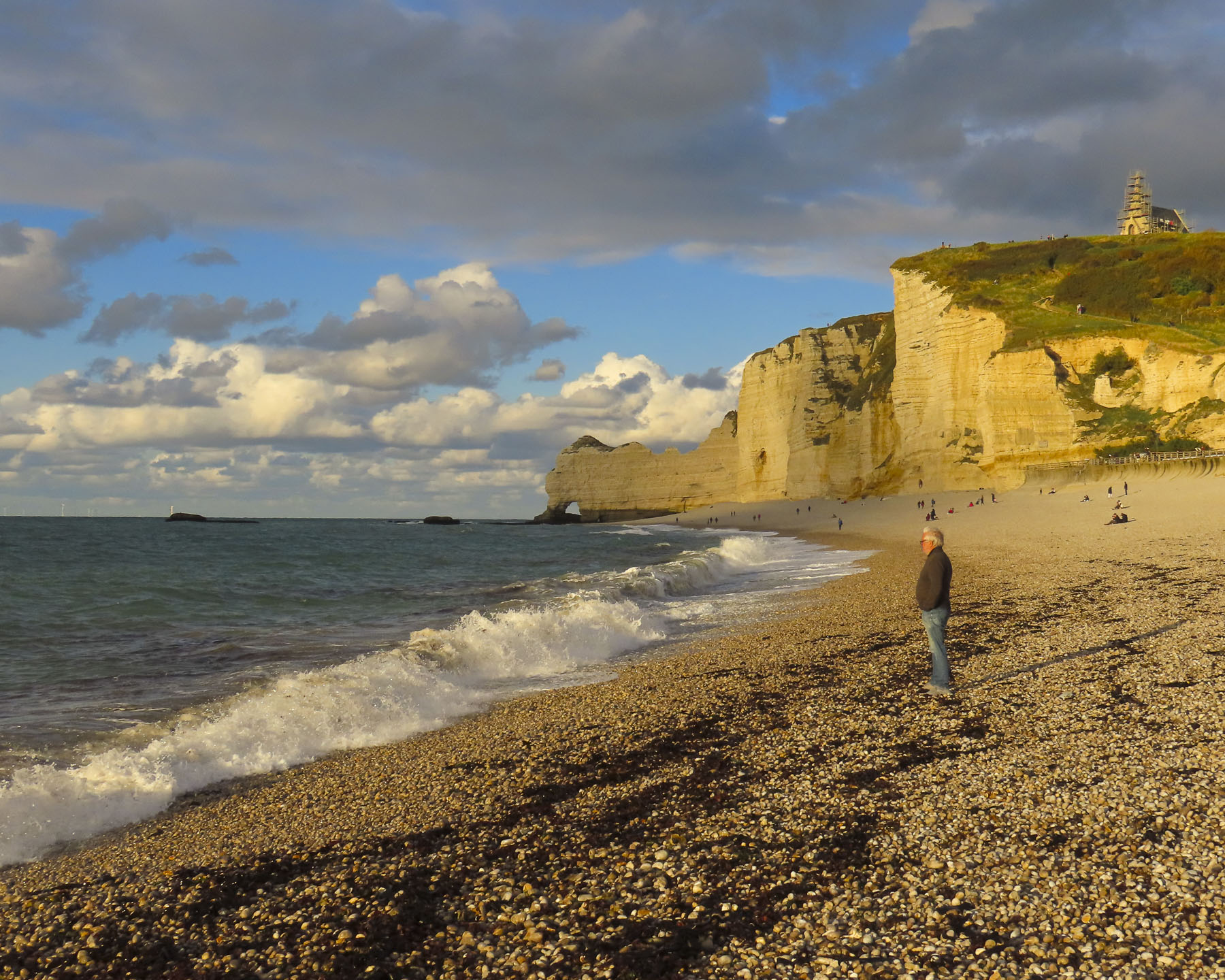
Regardless of how beautiful photos of the Falaise d’Aval are, they don’t rival the physical reality of the calling gulls, wind-swept hair, the whistling wind and the relentless sound of the surf crashing against the stoney beach.

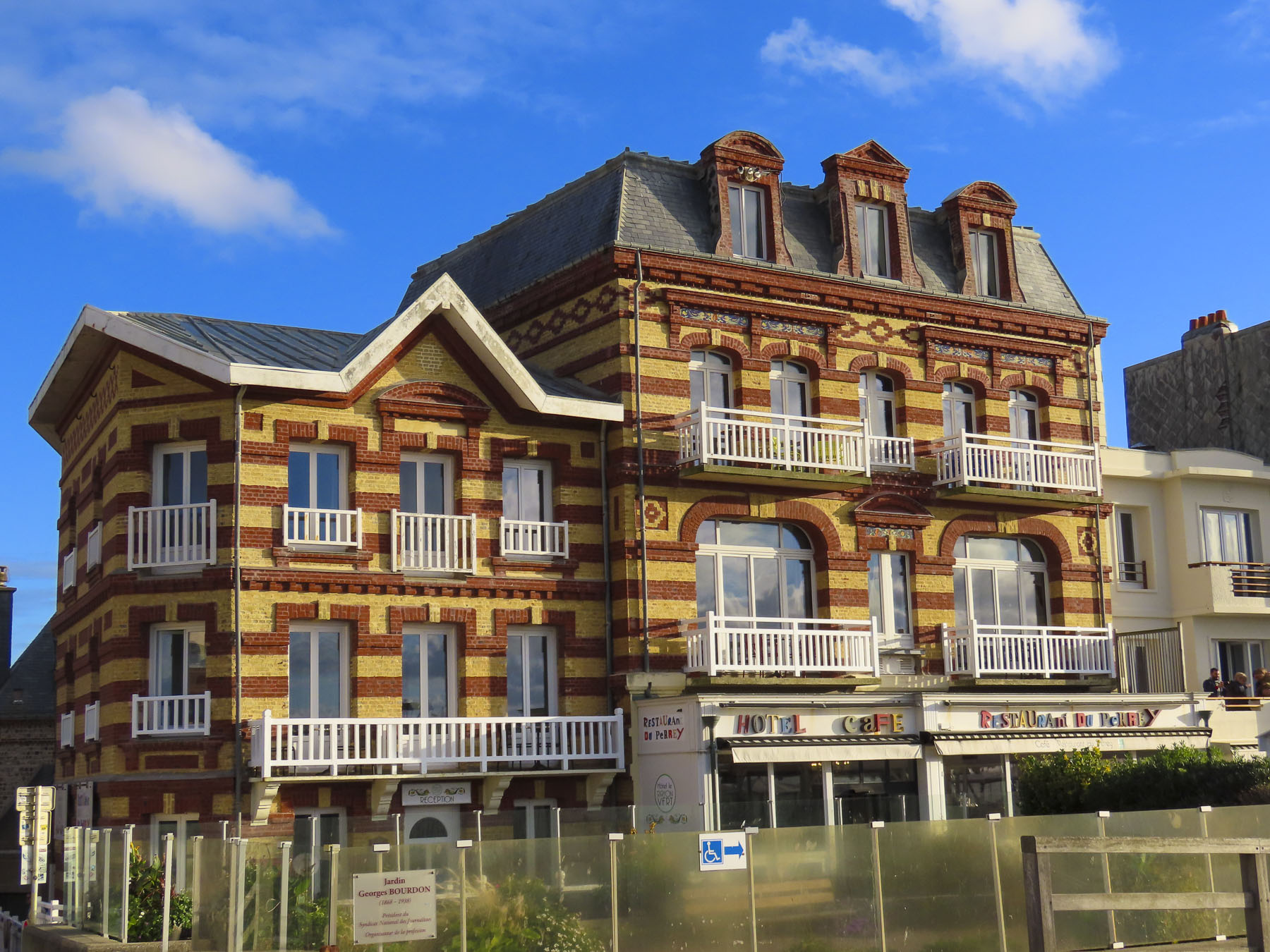
Arriving late on a Saturday afternoon in mid-October, we were surprised Étretat was jammed with tourists. Parking is extremely limited here and finding a space is almost a competitive sport that ultimately just required us to sit in a row and wait for someone to return to their car. It sorted itself quickly enough and luckily, we were only a short walk from one of Étretat’s first lodgings, the Hotel Le Rayon Vert, which to our delight was directly across from the beach and Étretat’s promenade. After checking in, we headed to the top of the towering 300ft high cliffs for sunset, the first of many walks along this beautiful stretch of coast and the perfect way to work up an appetite.

If you have been following this blog, you’ll know my superpower is the ability to find a great pâtisserie, pastelería or pastry shop. It’s a great talent when the hotel wants 16€ per person for breakfast. In Etretat, the boulangerie patisserie “Le Petit Accent” exceeded all expectations!

Set high above the town, it was a steep uphill walk to the Jardins d’Etretat. This whimsical topiary garden, with playful faces as “Drops of Rain,” by the Spanish artist Samuel Salcedo, more so than the Falaise d’Aval, was the catalyst for visiting this seaside resort.

This magical spot has its roots over 100 hundred years ago when a villa and garden were built here by Madame Thébault, a Parisian actress, and friend of the impressionist painter, Claude Monet. Madame Thébault cultivated a circle of creative folks as friends, and Monet along with other painters and writers were her frequent guests. It was from a patio in this garden that Monet found repeated inspiration to capture the essence Les Falaises à Étretat.  His love of the area is evident in the nearly 90 canvases he painted depicting various scenes along the Normandy coast. But the Jardins d’Etretat today are a relatively new botanical masterpiece reopening in 2017 after an expansive reinterpretation led by the landscape architect, Alexander Grivko.

Across from the entrance to the garden, a tall soaring monument pointing skyward, elegant in its simplicity, commands a view out over the cliffs and the ocean beyond. This tribute commemorates the last sighting from French soil of the pilots Charles Nungesser and François Coli on May 8th, 1927. They were flying their biplane L’Oiseau Blanc, The White Bird, from Paris to New York in an attempt to be the first non-stop flight across the Atlantic Ocean and win the Orteig Prize of $25,000. But they disappeared somewhere along their route. It’s believed they made it across the Atlantic, but crashed into the dense wilderness forest of Nova Scotia or Maine. Wreckage of L’Oiseau Blanc has never been found and their disappearance remains an unsolved aviation mystery, that rivals Amelia Earhart’s story.  If Nungesser and Coli had succeeded, they would have beaten Charles Lindbergh in the Spirit of St. Louis by twelve days.

The Notre Dame de la Garde stands alone on the slope below the Monument “L’Oiseau Blanc,” isolated on the cliffs like a small boat surrounded by a vast ocean, its spire like a lighthouse’s guiding beacon, visible far out at sea. It offers a welcome sign for the fishermen and sailors returning home. Unfortunately, it was undergoing renovation when we visited in mid-October.

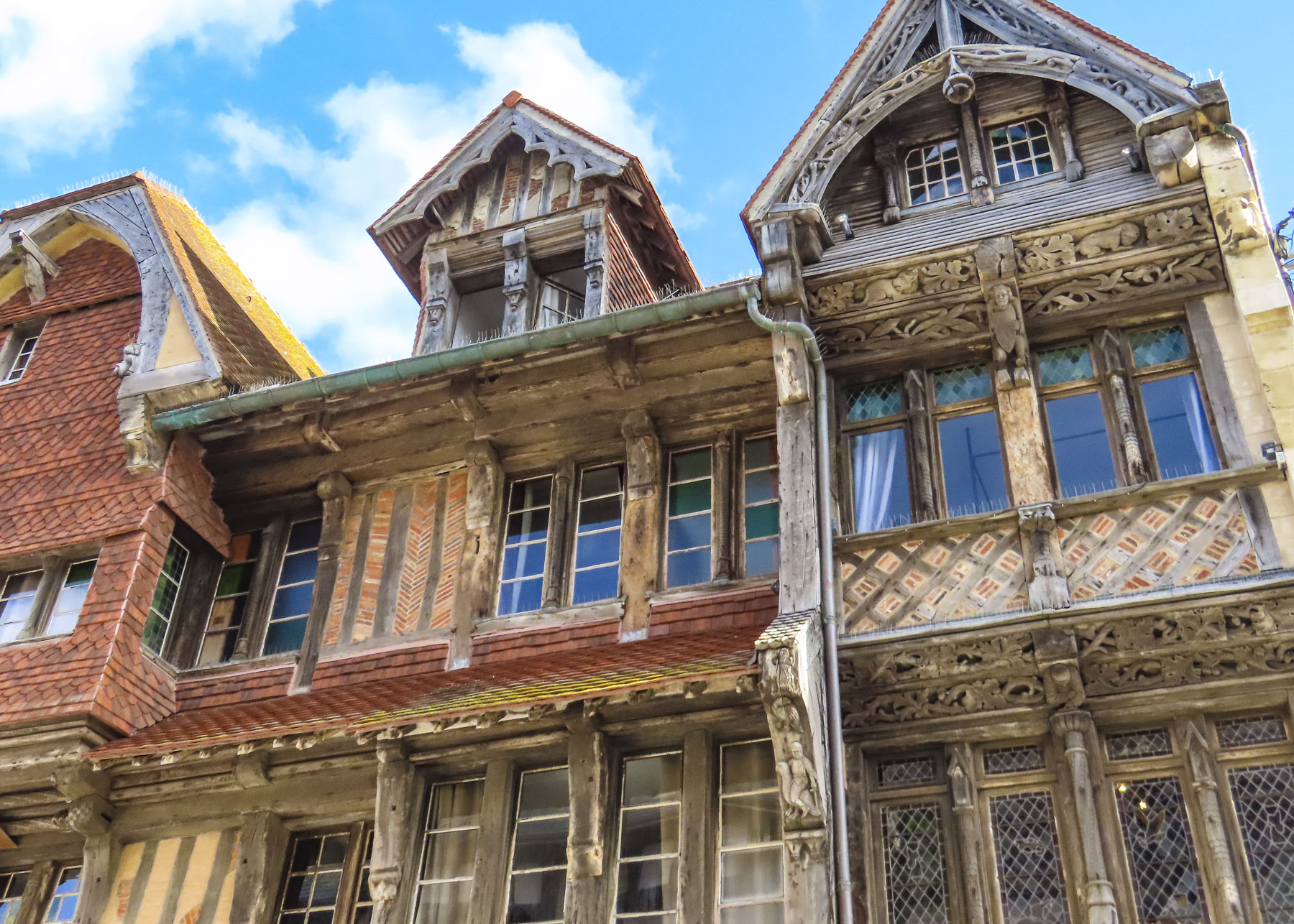
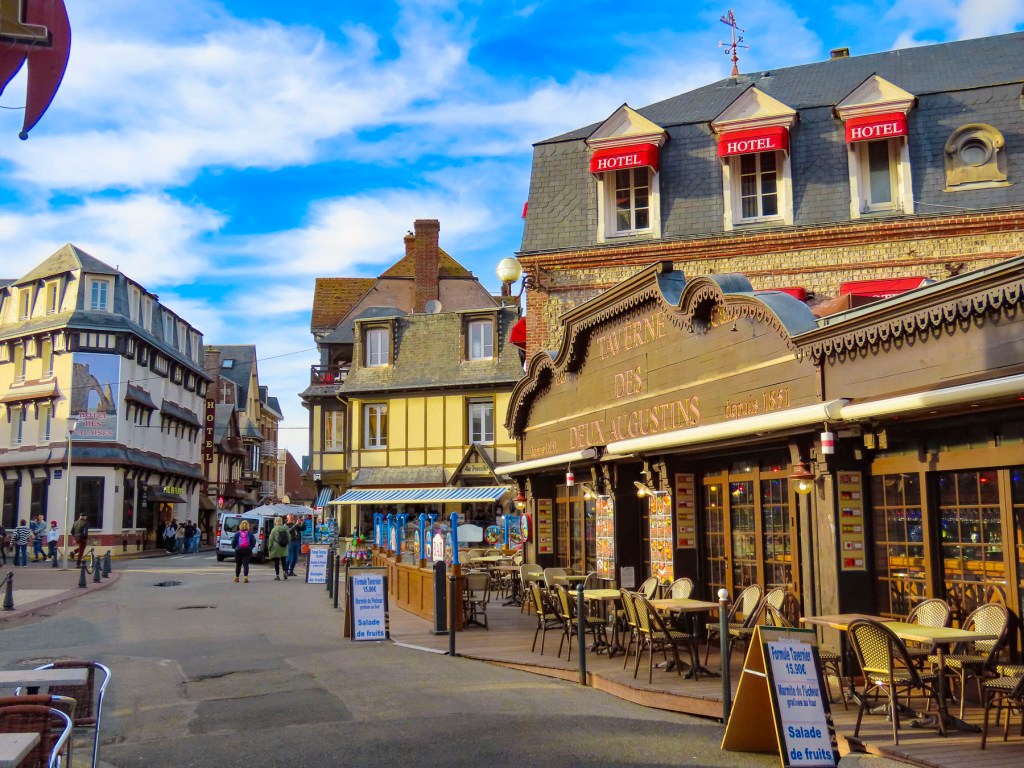
Walking back through the village we found the Normandy architecture in Etretat intriguing. It encompasses many different styles and runs the gamut from ancient half-timbered buildings embellished with ornate wood carvings, to 18th and19th century designs utilizing the local hard flintstone and incorporating steep pitched slate roofs and turrets into their designs. All fascinating.    

Etretat has been a popular destination since rail service began between the port city of Le Havre and Paris in 1847. Swimming or a day at the beach later became common place with the latest fashion, the full body bathing suits. While society folks were sunbathing on the stoney beach, there was a cottage industry of locals, called pebblers. They collected the beach stones for their high silicone content, which were then pulverized and used for various industrial purposes. It’s now illegal to remove any pebbles from the beach as they are vital natural protection against storm surges and marine submersion of the promenade built across the top of the beach, which is much easier walk on than trekking across the pebbly beach, where each footstep sinks into the loose stones and is exhausting to cross.

The classic 19th seaside resort continues to draw visitors, with the success of the French Netflix series Lupin, based on the writer Maurice Leblanc’s character, Arsène Lupin, the gentleman burglar. Leblanc’s former summer home, where he wrote some of his books, is now the Le Clos Arsène Lupin Museum. Some scenes were filmed locally, motivating a whole new generation to discover the white cliffs. The other French writers and composers who enjoyed their time in the quaint village include Victor Hugo, Guy de Maupassant, and Jacques Offenbach, all of whom are remembered with streets named in their honor.

We also enjoyed our time along the Côte d’Albâtre, but just seemed to scratch the surface of this beautiful part of Normandy.

Till next time, Craig & Donna
Tenerife Part 4: Pico del Teide, La Orotava, Puerto de la Cruz & Beyond

The silhouette of the ancient volcano mesmerized us. Even in the dark blues and blacks of the night the volcano’s majestic silhouette loomed large above Icod de Vinos. Later the moon rose and contributed a magical otherworldliness to our vista. During the winter when its 12,000 ft summit is snow covered and there is a full moon, it’s said to shine like the beacon of a lighthouse that can be seen from the coast of Morocco. The aboriginal Guanches believed Pico del Teide held up the sky and placed offerings on the volcano’s slopes to appease Guayota, an evil deity they believed responsible for its volcanic eruptions. We made our own photographic pilgrimage to Teide as we drove to the Hotel Alhambra in La Orotava, our base for the remainder of our vacation. Though not the most direct route from Icod de los Vino to La Orotava via Pico del Teide it was, I can assure you, the most interesting.

Teide is still considered an active volcano and while its cone hasn’t erupted in the last 850 years, side vents on its slopes have spewed destructive massive lava flows across its slopes in 1492, which Columbus noted in his logbook as he sailed on his maiden voyage of discovery, 1704,1705, 1706, 1798 and 1909. Our route on TF-5 cut across the lava field left from the 1909 El Chinyero vent eruption. Now over one-hundred years later new growth pines are just beginning to emerge from this carnage. Their verdant green needles, a refreshing sign of life in an otherwise barren landscape. Crossing the ridge of the mountains we descended into Santiago del Teide. The main road was lined with several inviting spots to stop for café! (We didn’t realize at the time, but this was also our last chance for lunch, as many places normally open in high season are closed or only open on the weekends in the shoulder seasons.)

After coffee we visited the town’s church, Parroquia de San Fernando Rey. It’s a small, whitewashed structure constructed in the late 1600s and has an interesting collection of religious art. Across the street stands a life-size statue called “the brave Guanche,” dedicated to Alonso Diaz, a goatherd, who in 1509 stood up for his rights and successfully petitioned Spain’s King Fernando the Catholic for justice, after 200 goats were stolen from him by a Spanish conquistador. By royal decree the goats were returned.

Venturing into the foothills, our drive continued along TF-38 and traversed an ever-changing, diverse bio-system as we left the arid shrub-covered lowlands behind and climbed into hillsides covered with pine forests. It was a well paved but narrow serpentine road, without any shoulder, that required constant vigilance. The mouths of ancient lava tunnels were visible from the road, but there was no room to pull over and stop for photos until we reached the Mirador de los Poleos. Here the raw beauty in these charcoal-colored landscapes flourished beneath the Chinyero Volcano, and we had a chance to walk across the lunar-like terrain, part of the immense lava field from its 1909 eruption. Dotted with huge boulders, it was difficult to comprehend the ferocious forces required to expel these massive rocks from their subterranean origin.

Continuing on, we had encountered what we thought was fog until, to our surprise, we emerged above the clouds at Mirador de Samara.

This area is also very popular for hiking, with many very obvious trails crisscrossing through a young forest emerging from the volcanic soil left from Pico Viejo’s last, 92 days long, eruption in 1798.

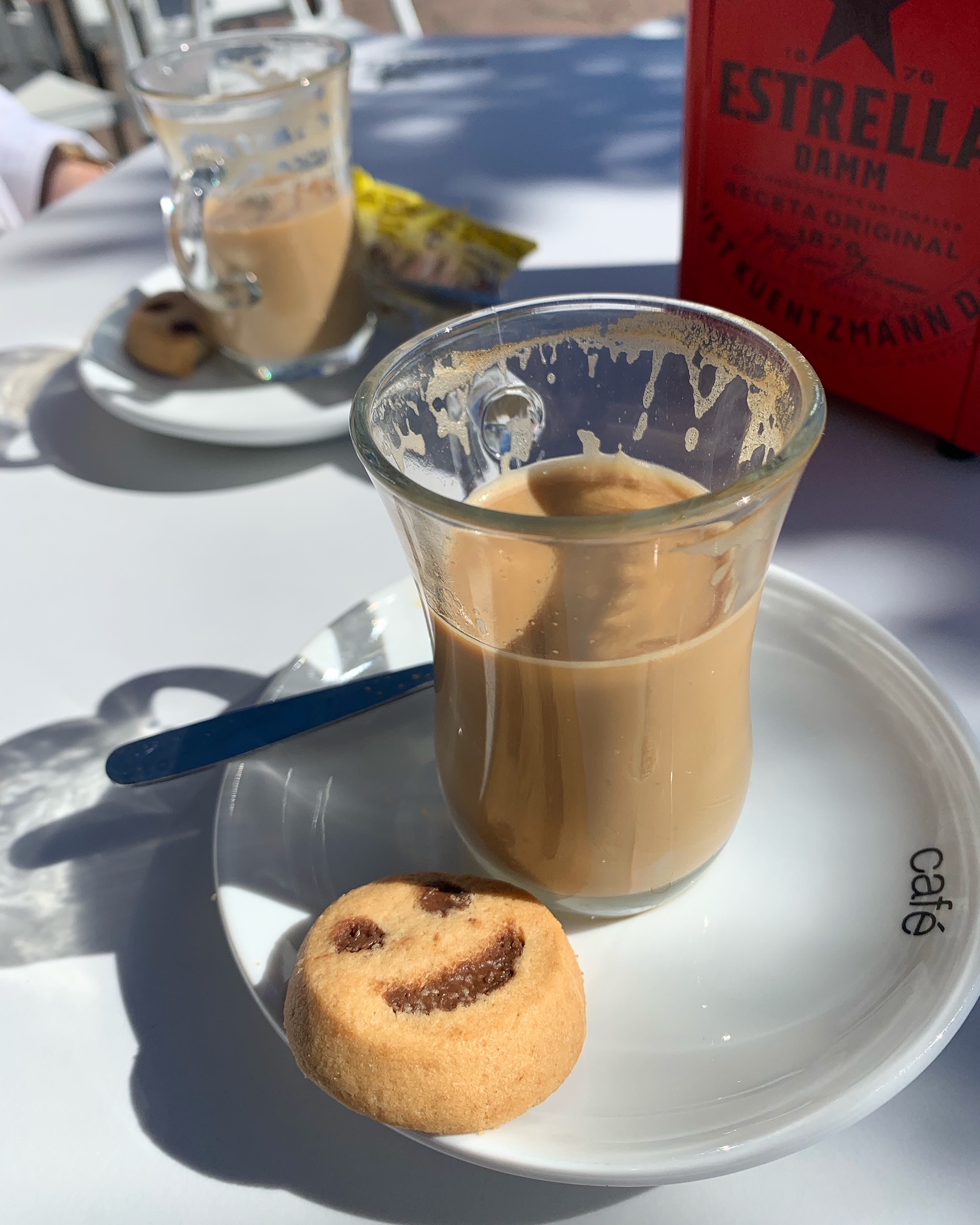
Approaching noon, we turned toward Vilaflor, the highest village, at 4600ft, on Pico del Teide’s southern slope and surrounded by vineyards. The surrounding wineries produce some of Tenerife’s best wines from Listán Negro, Malvasia, Negramoll, and Listán Blanco grapes. And are embodied with a distinctive terroir from the warm climate and fertile volcanic soil. The weather had suddenly turned gray and dreary. More frustrating though, the wineries we had planned to visit were closed mid-week during the shoulder season. Fortunately, we happened upon Mar de Nubes, a craft store and café run by a friendly young married couple from Tenerife and the States. The shop features only handicrafts made by Canarians and local wines and artisanal beers. Of course, we shopped.

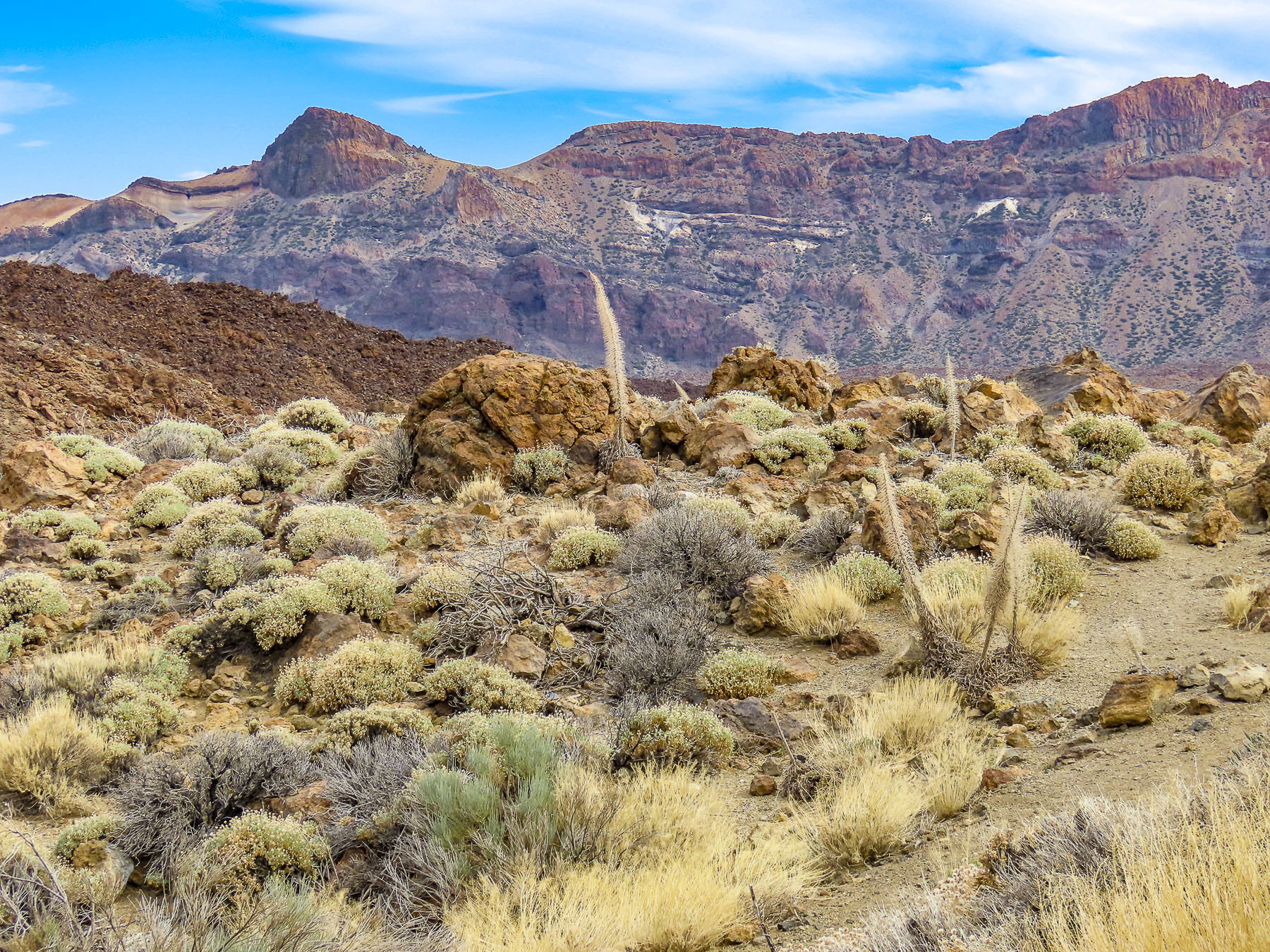
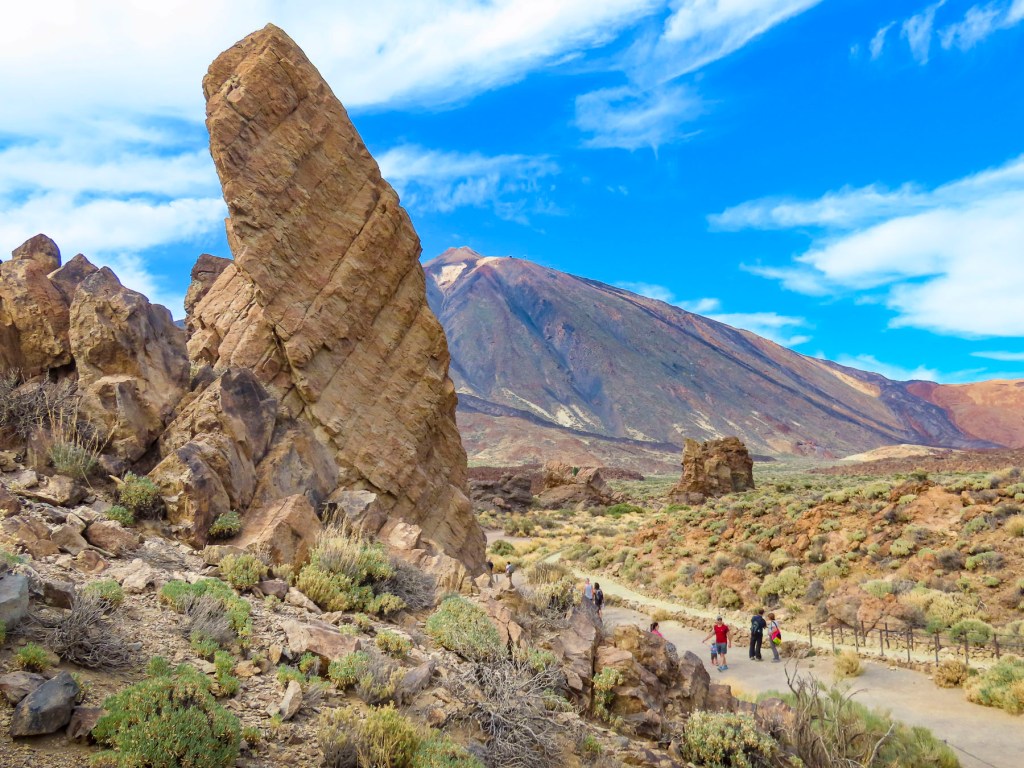
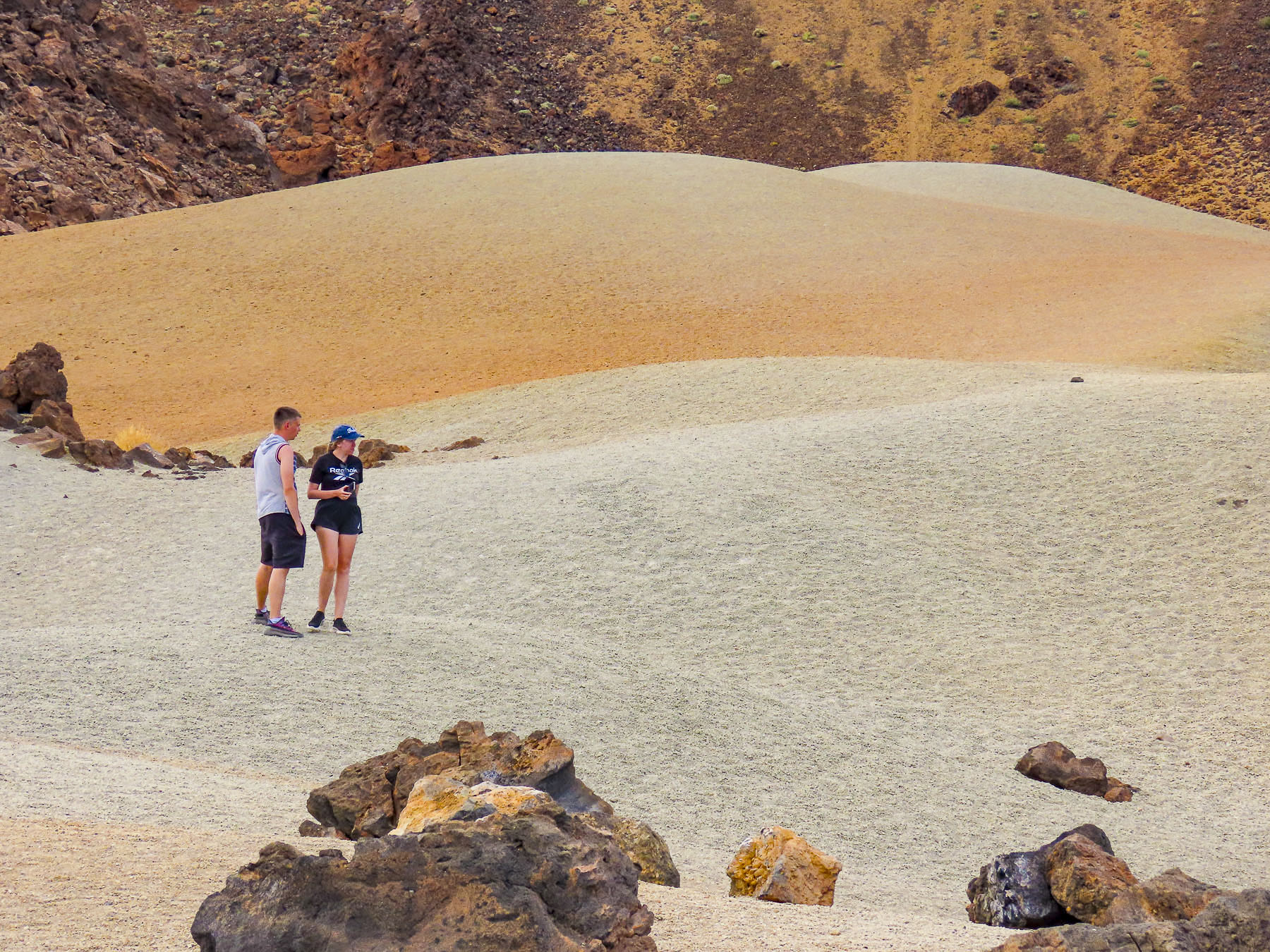
Beautiful, inhospitable, Death Valley-esque, lunar or Martian, however you choose to describe the varied topography that surrounds Pico del Teide’s, it’s enthralling and fascinating. So much so that filmmakers have used the location for scenes in several block buster films: One Million Years B.C. – 1966, Planet of the Apes – 1968, Clash of the Titans – 2010 and its 2012 sequel Wrath of the Titans, and in 2023 the Last Triala, a Star Wars fan film.  TV episodes of Doctor Who, The Dark Along the Ways and season 2 of The Lord of the Rings: The Rings of Power have incorporated Tiede’s environs into their productions.

Driving back up the mountain we continued on to view the large sculptural outcroppings at the Mirador de La Ruleta and the desert-like dunes of the Siete Cañadas hiking area, before following the long downward grade of the road to La Orotava. We speculated that if you dropped a soccer ball at the top of the slope, it would bounce downhill continually until it splashed into the ocean at Puerto de la Cruz, roughly 23 miles away. Our route along TF-21 cut through forests ravaged by the wildfires of 2023. The blackened trees were the only scars in the otherwise pristine wilderness of the Tiede’s northern slope in Parque Natural Corona Forestal.

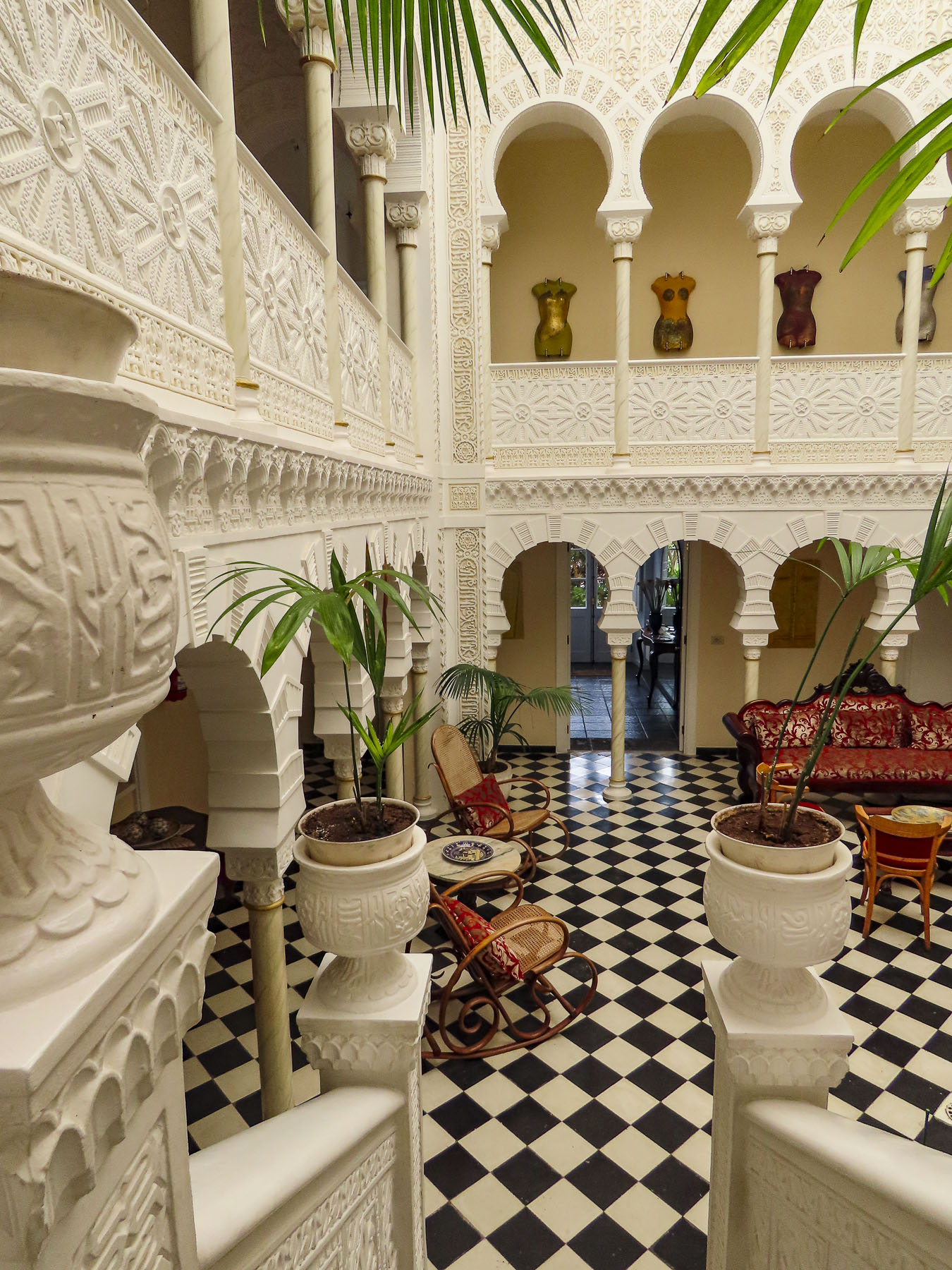
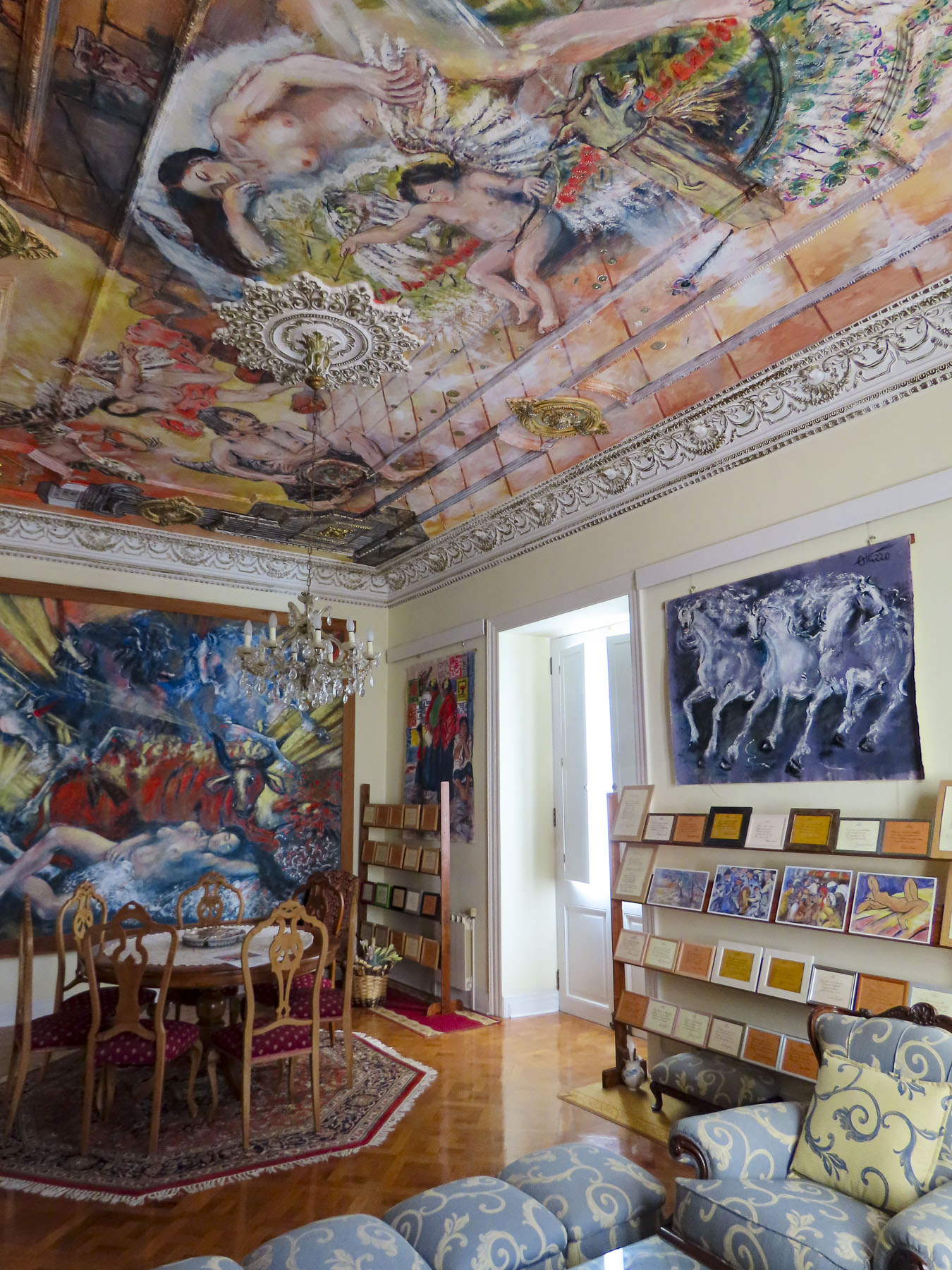
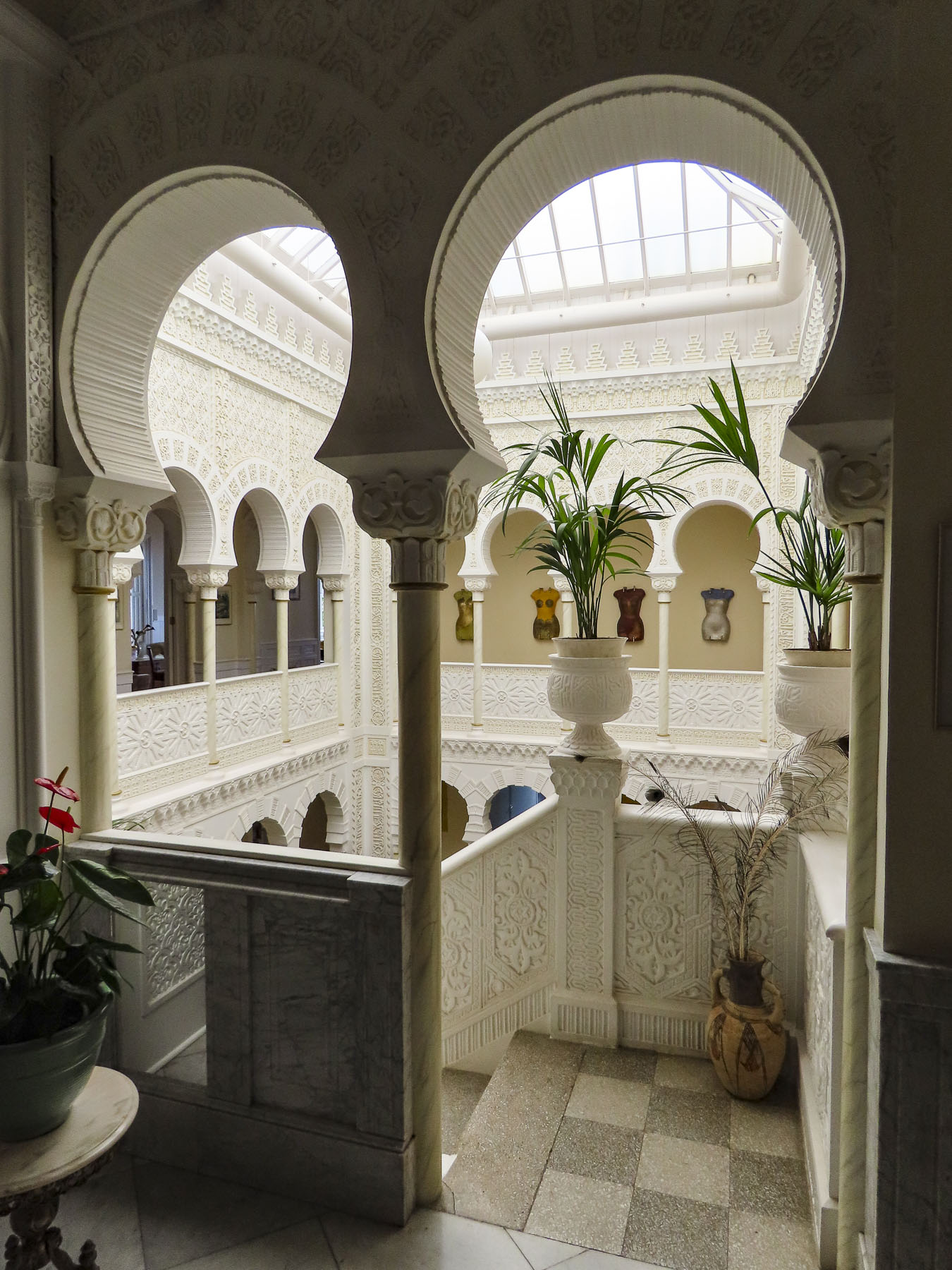
Late in the day we coasted into our parking space in front of Hotel Alhambra. Parking on the streets in La Orotava is free, but it’s a competitive sport. We chose to stay at this hotel for its distinctive architecture and location in the historic center. While the exterior of the 500-year-old dwelling is quietly classical, the interior walls of its Canarian-style courtyard were beautifully transformed in 1925 with intricate floral and geometric Nasrid art designs, created with gebs plasterwork and enclosed under a high glass roof. An eclectic decorating theme is highlighted with frescos by Maestro Antonio Otazzo, a local self-described painter, sculptor, musician, philosopher, and poet. As if being followed by a friendly giant, Pico del Teide was in our line of sight when we opened the shutters on our room’s window.

La Orotava was rather easy to walk around if we were walking across the slope, but after several days our hamstrings and calves were sore, though our butts were firmer. “Walk a little then café,” as we say was the perfect approach to exploring this wonderful town.

Along with San Cristóbal de La Laguna, it’s considered to be one of the prettiest towns on Tenerife.

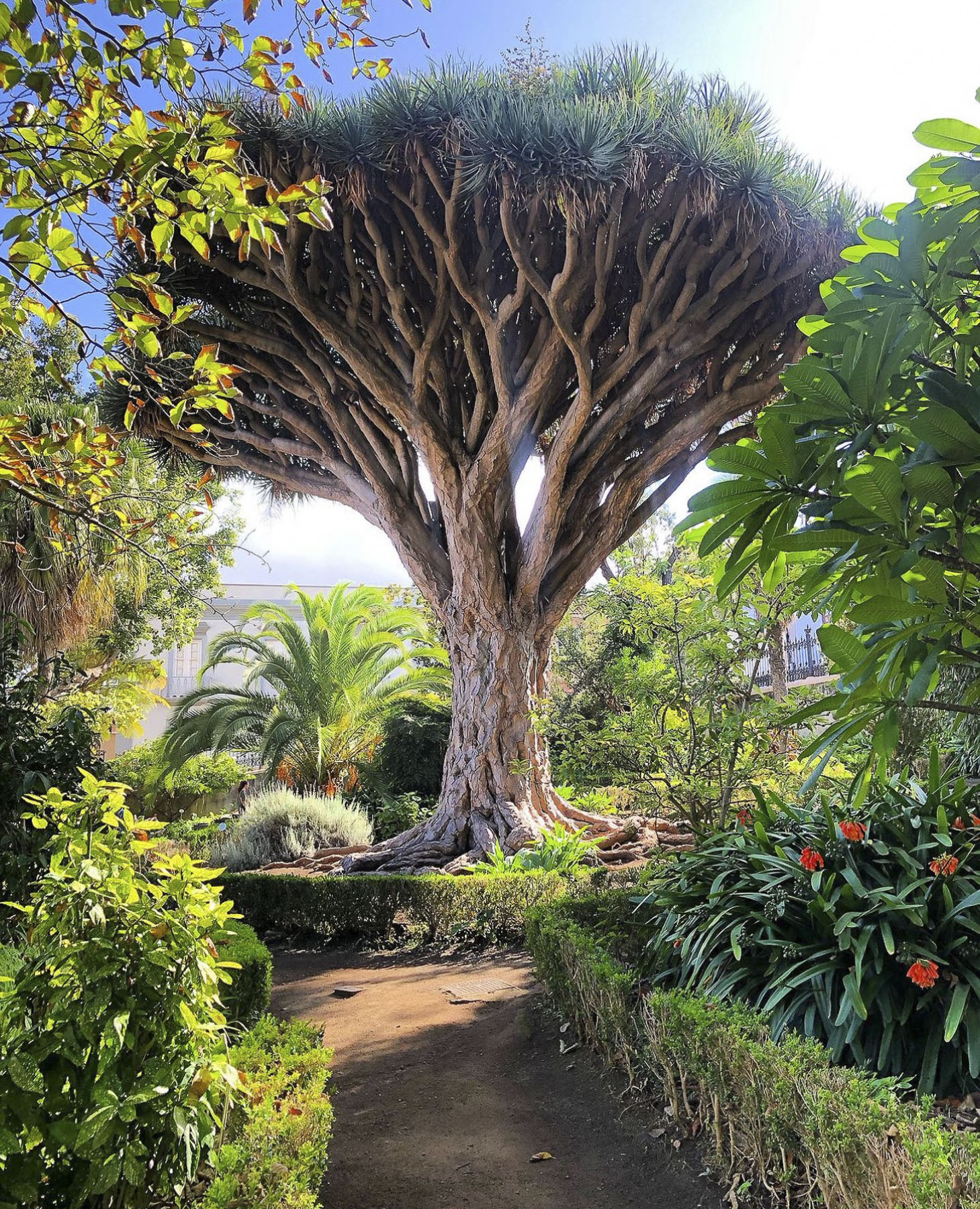
Getting to the higher points in town we asked the hotel to call for a cab, for a quick ride to the Jardines del Marquesado de la Quinta Roja. Once part of an estate, it’s named after the noble interred in the park’s marble mausoleum; as a member of the Masonic Temple his family was not allowed to bury him in the town’s catholic cemetery. Constructed in 1883, the garden is a beautiful French-style, terraced, formal garden with a view over the town and the distant sea. A smaller but older (1788) sister park next to it, the Hijuela del Botánico, features a towering dragon tree and other plantings of specimen trees collected from Spain’s former colonies.  And if you are in awe of dragon trees, as we are, the Villa de La Orotava Dragon Tree Tour might be for you.

From the gardens we wandered downhill along cobbled lanes, past wonderful examples of colorful Canarian architecture, into the historic old town, which is centered around the Nuestra Señora de la Concepción. Started in 1516, it is the town’s oldest and largest church, with its colorful dome giving the town its iconic skyline.

But La Orotava’s history starts early in 1496 with the final defeat of Tenerife’s aboriginal Guanches at the battle of Aguere, after which their leader committed suicide by jumping off a cliff in nearby Tigaiga. “To the victor go the spoils,” and the fertile lands of the Guanche kingdom of Taoro were awarded to the nobles, conquistadors and financiers who participated in the Spanish victory.

The rich soil of the hillside was perfect for the cultivation of sugarcane and the steep streams from the mountain were soon harnessed to run sugar and lumber mills. Prosperity followed. Ice from Mt. Tiede chilled the drinks of the town’s wealthy.

Landowners and merchants built large family mansions in a style which would become known as Canarian, which feature interior courtyards and distinctive facades with decorative wooden balconies and the family’s Coat of Arms prominently facing the street. Convents housed the daughters from families that didn’t want to diminish their wealth by paying the dowry for the girls’ wedding, as was the custom of the time. 

Vines and wine replaced sugar cane and ruled the town’s economy in the 17th century. In the mid-1800s, the textile mills of Europe were searching for different dyes, and mealybugs or cochineal were bred in cactus around La Orotava and harvested to obtain a crimson dye, produced from an acid that the bug makes to fight off predators. Since the late 1800s, vast banana plantations thriving on Tenerife’s mineral-rich volcanic soil continue to bring prosperity to the island and La Orotava, enabling the community to restore its historic buildings.

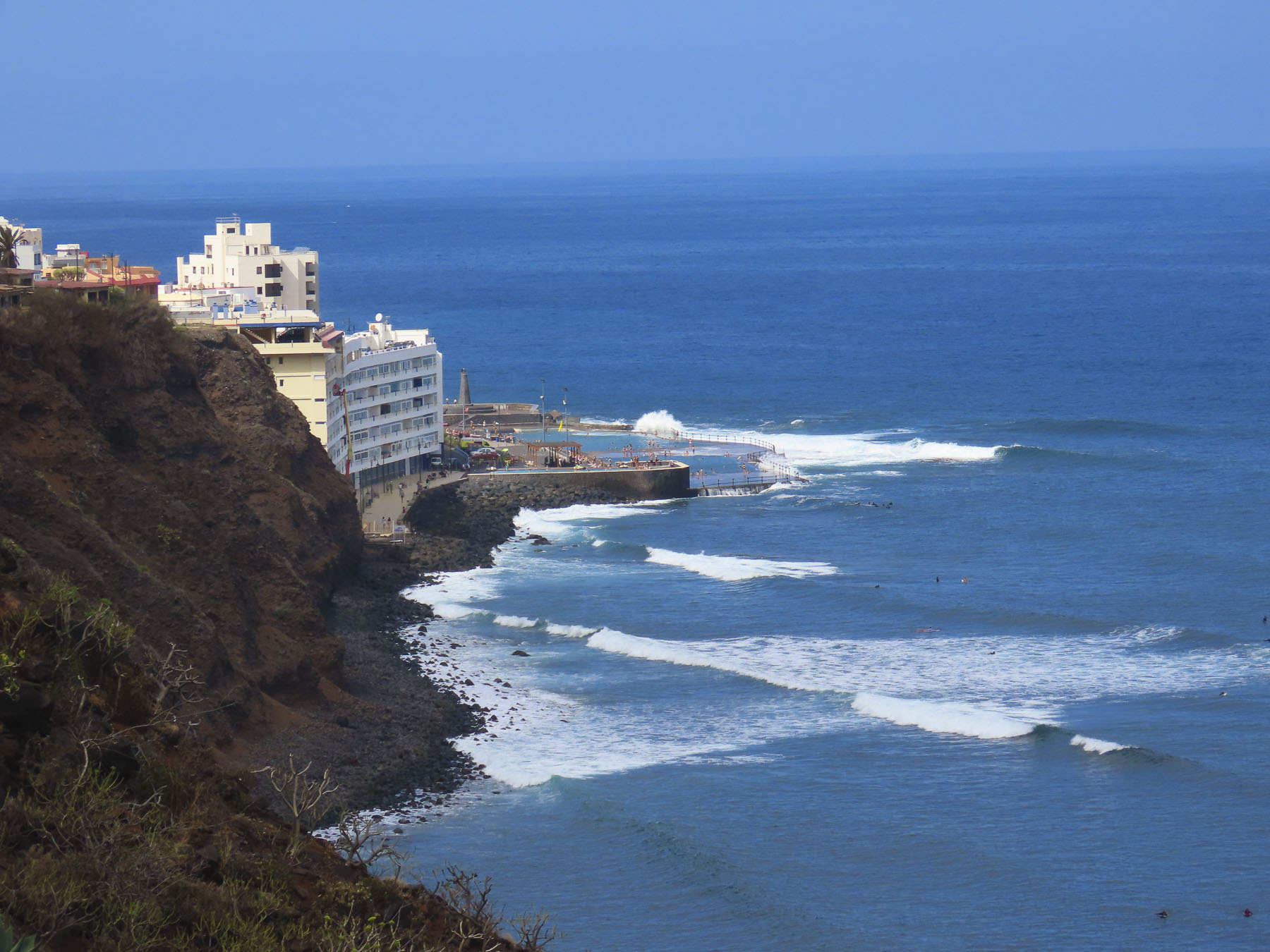
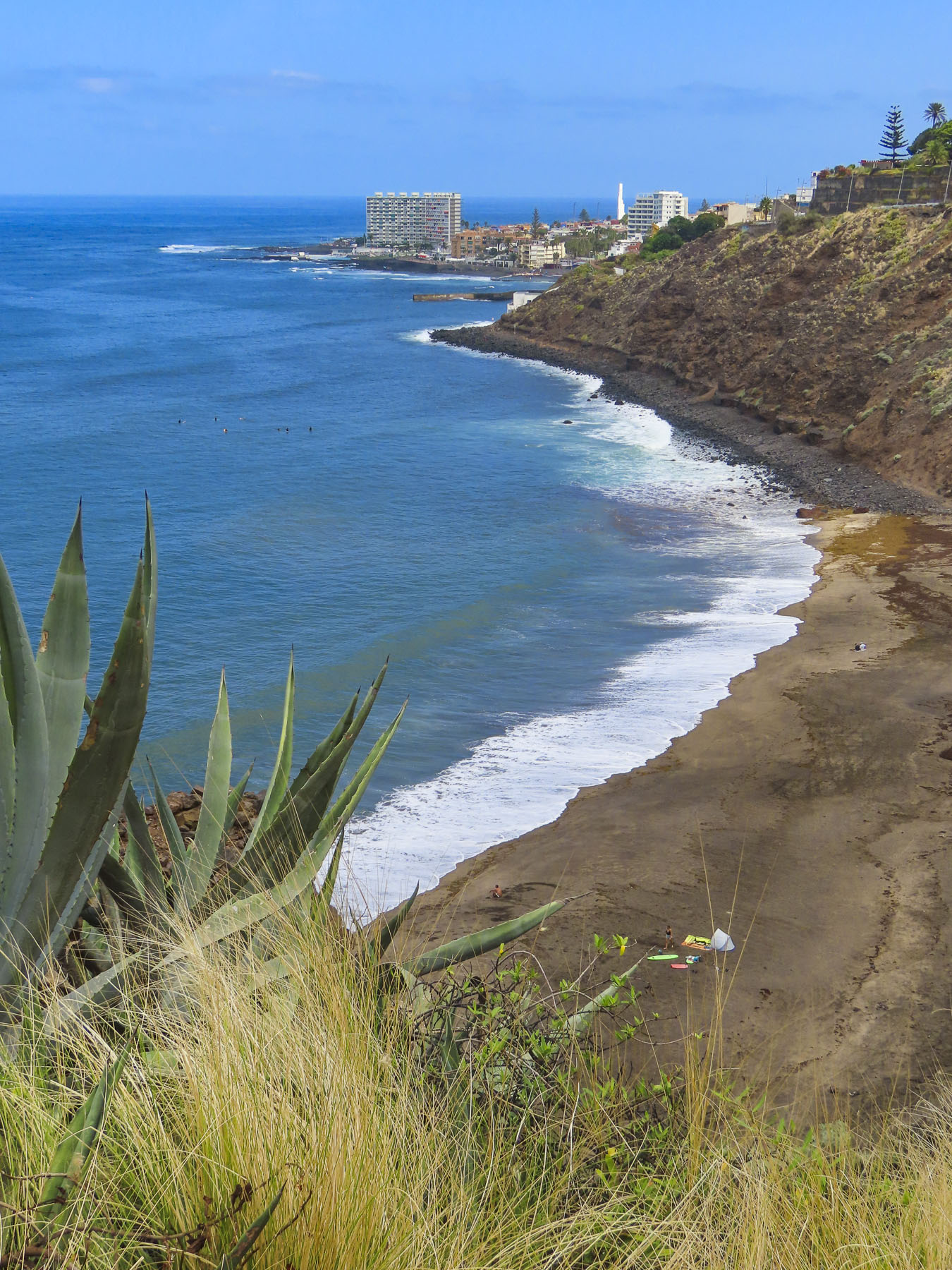
Not wanting to miss anything on Tenerife, we planned day trips from La Orotava around visiting coastal miradors and following any whims along the way. The Mirador Punta Del Hidalgo was not our favorite photographic destination, but we did enjoy stopping at the crescent shaped, black sand beach at Playa del Arenal in Bajamar, and a farmer’s market, Mercadillo del Agricultor in Tacoronte. Here we purchased some pastries for a snack and some Tuno Indio juice made from the purple fruit of the Canarian Red Prickly Pear. The cactus was brought to the Canary Islands from the Americas centuries ago and has been used in Canarian folk medicine to lower blood sugar and treat other ailments. It also has antiviral, anti-inflammatory, antioxidant, and anti-ulcerogenic properties. It tastes pretty good.

Afterwards we headed to the Mirador La Garañona in El Sauzal. Set dramatically atop a 1000ft sheer cliff, there’s a tremendous view of the coast below. And the park’s shaded paths led to a delightful small café perched at the cliff edge. We lingered and soaked in the view.

On the way to the mirador, we whizzed passed a small neighborhood restaurant set by itself on a corner, and decided to try it on our return trip. But first we had one last stop to make on the way at the Iglesia de Santa Catalina. It’s a classic, white-washed church from the early 1500s and picture perfect with its magnificent dragon tree in front.

Lunch at Restaurante el Calvario was delightful, with excellent house wine and menu featuring traditional Canarian dishes. A young friendly staff, tolerant of our poor Spanish, contributed to a very enjoyable afternoon.

Puerto de la Cruz, just down the hill from La Orotava, was the destination for our last day trip. Originally a small fishing village, the town grew in importance after the main harbor on the north coast of Tenerife in Garachico was filled with lava from a 1706 volcanic eruption. Close to La Orotava, it also benefited from that town’s thriving economy, with the export of sugar, wine and bananas from its port. It has been a popular vacation spot since the Victorian era. Now it attracts visitors and expats from across Europe, drawn to its cosmopolitan vibe, wide beaches, quaint historic center, numerous parks, and vast array of restaurants.

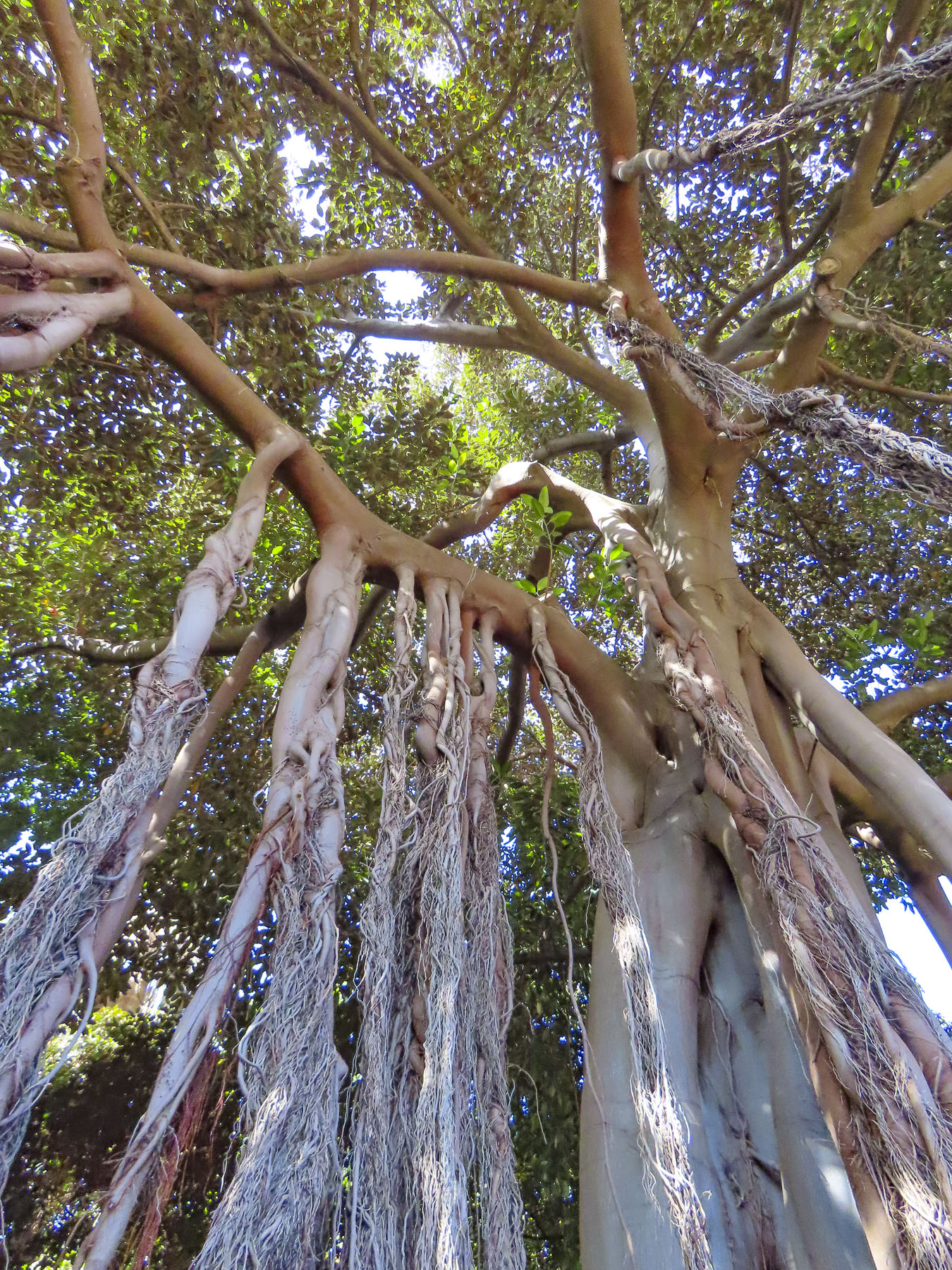
Giant three-hundred-year-old fig trees, planted when the park first opened in the 18th century, are king here. Shaded pathways thread through a cornucopia of verdant jungle, flowers, and water garden. We enviously wished that we could grow everything in our garden at home.

In the historic center we had coffee across from the majestic Iglesia de Nuestra Señora de la Peña de Francia and afterwards were able to catch a glimpse of a bride and groom taking their vows. Their antique wedding car waiting under gently swaying palm trees on the plaza in front of the church.

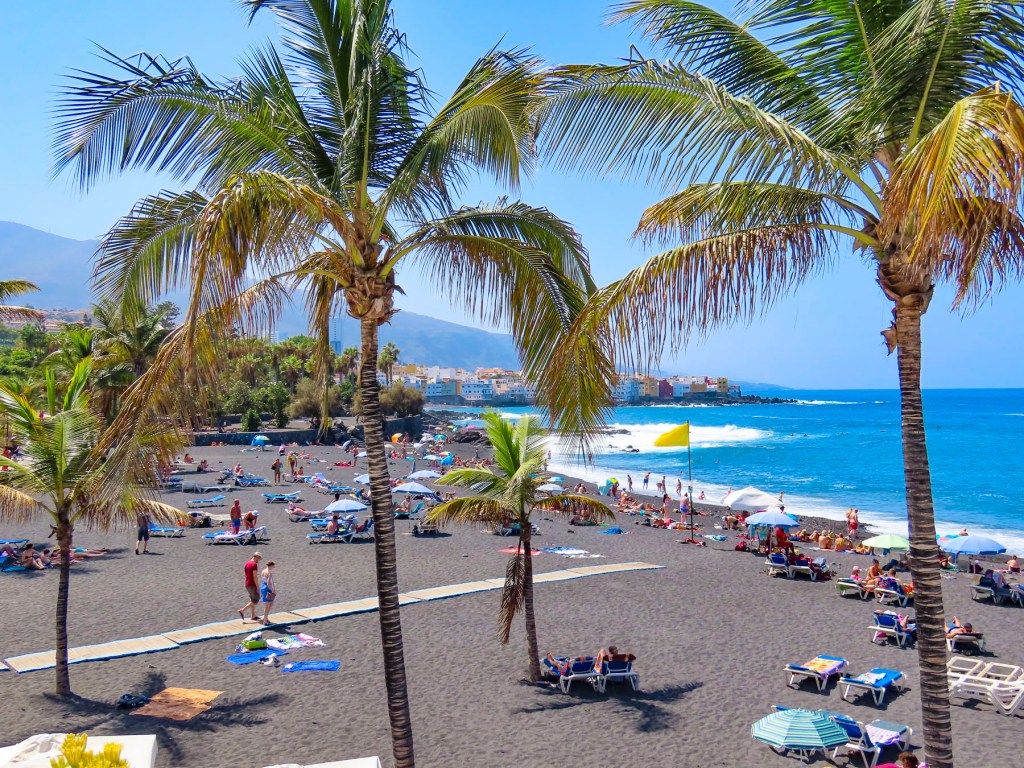
The waterfront in Puerto de la Cruz is beautiful and there are numerous beaches and tidal pools along the coast where you can swim. We strolled along the promenade above the black sand beaches at Playa Maria Jiménez, and Playa Chica to El Castillo San Felipe, a small block fortress built in the 1600s to prevent pirates or the British from landing on the beach here. We lunched along the boardwalk under umbrellas just yards from the surf.

Stopping at the Mirador Roger Piedra Gorda and Mirador Roque Grande rounded out the afternoon. Though parking was a challenge at both spots, we think the effort was worth it for the dramatic seacapes we viewed.

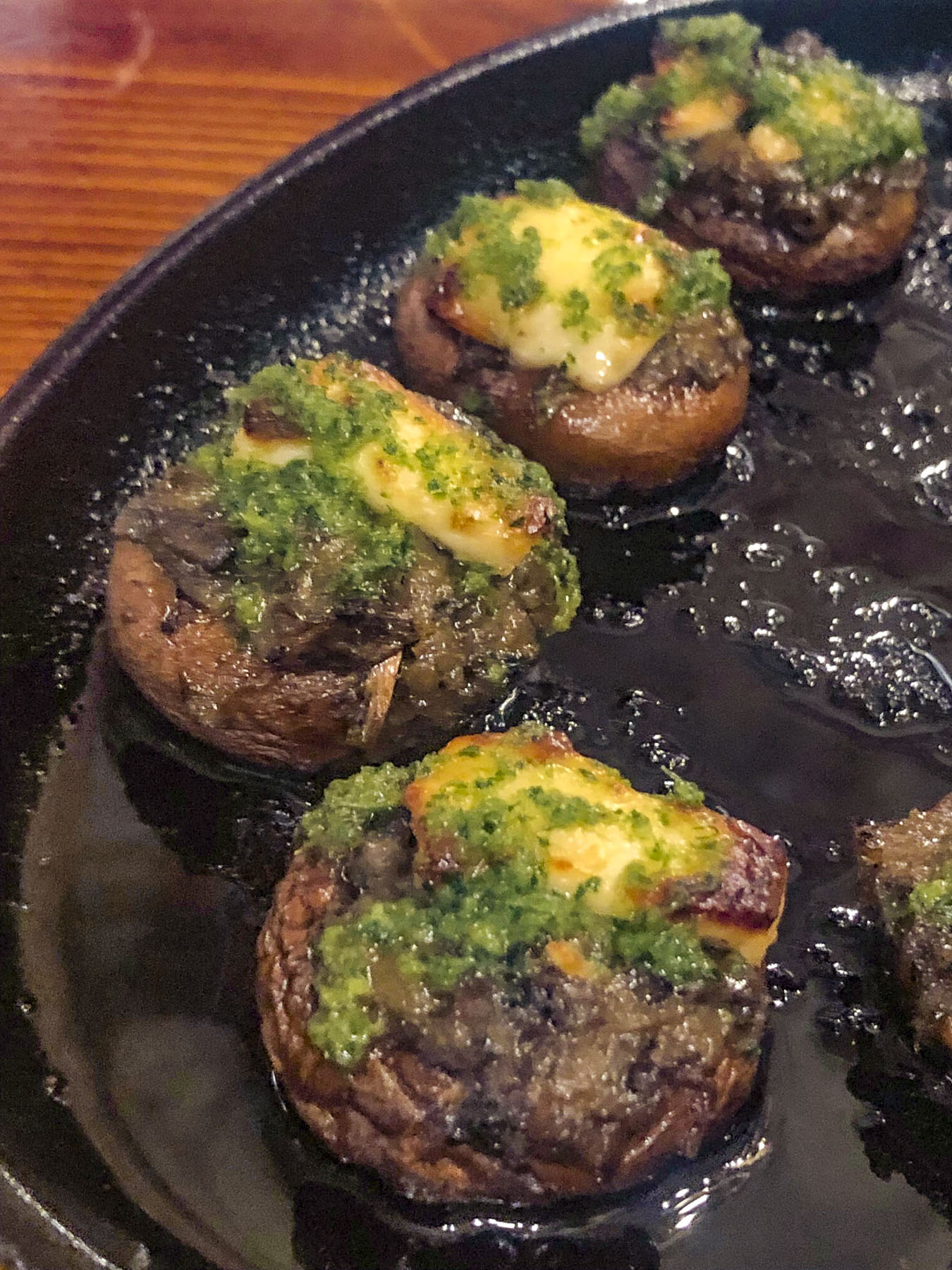
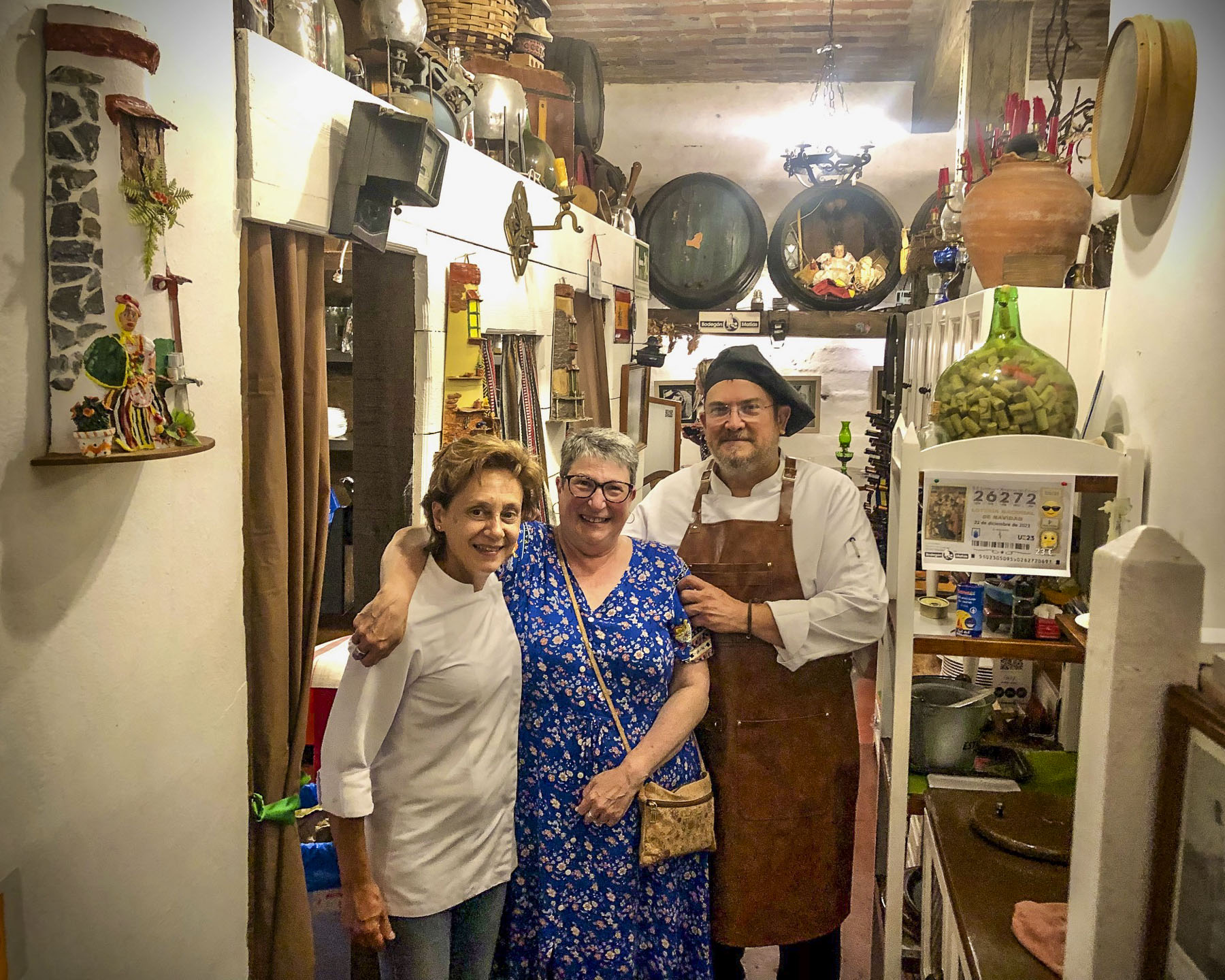
That evening we drove up into the hills above La Orotava and enjoyed a great meal at Bodegón Casa Matías. It’s a rustic establishment, decorated with wine barrels and antique farming tools to acknowledge the history of the region. The chefs and owners, a vivacious husband and wife team, are part of Tenerife’s farm to table movement, sourcing only local meats, including rabbit and goat, fish, cheeses, and seasonal vegetables for their traditional Canarian recipes.

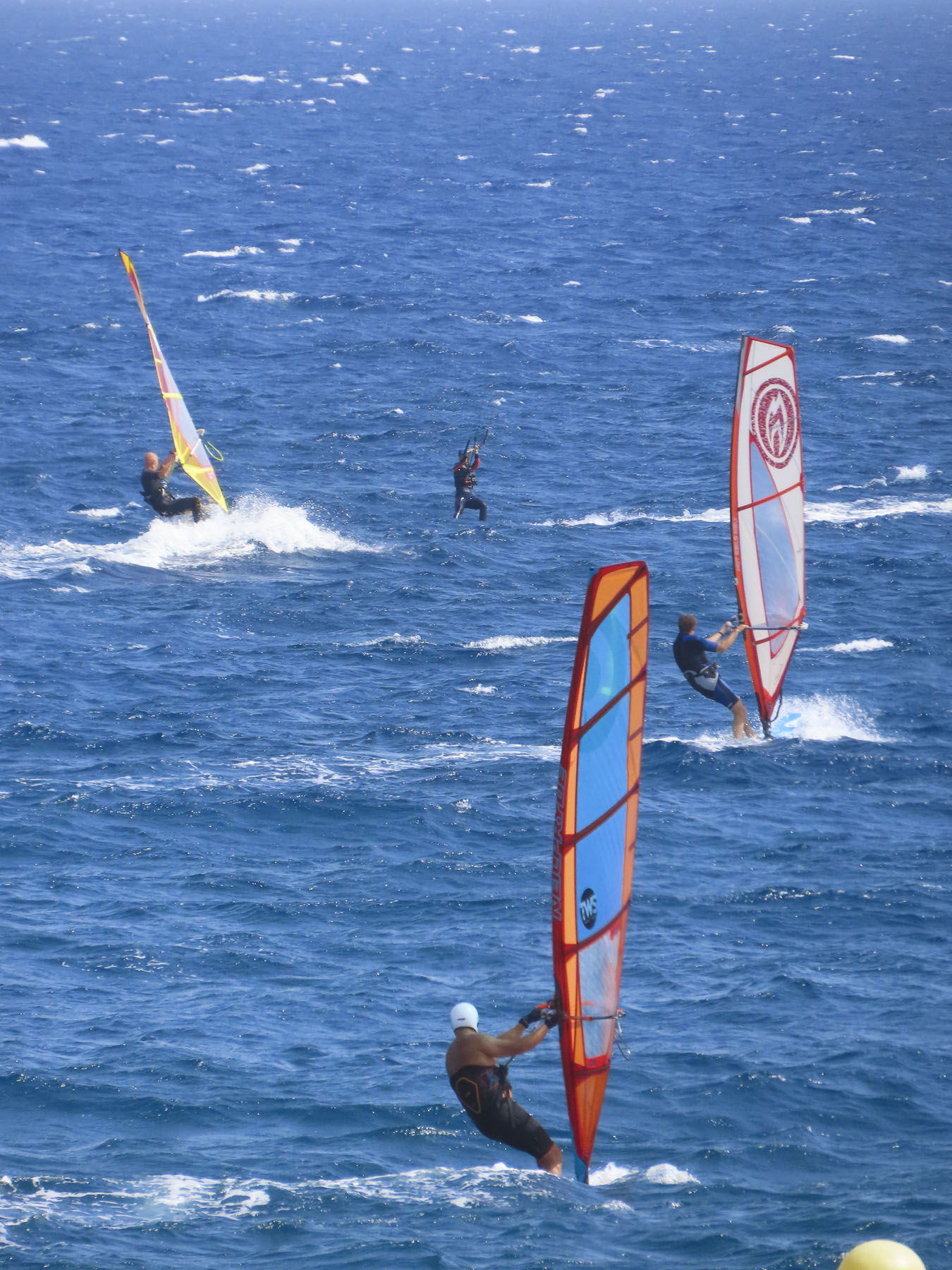
For our last full day on Tenerife, we headed to El Médano to be nearer the airport for a flight the following morning. Arriving late in the afternoon to Playa del Médano we entertained ourselves watching wind and kite surfers speed across the whitecaps. The more experienced kiters crested the waves and performed aerobatics before splashing back into the sea.

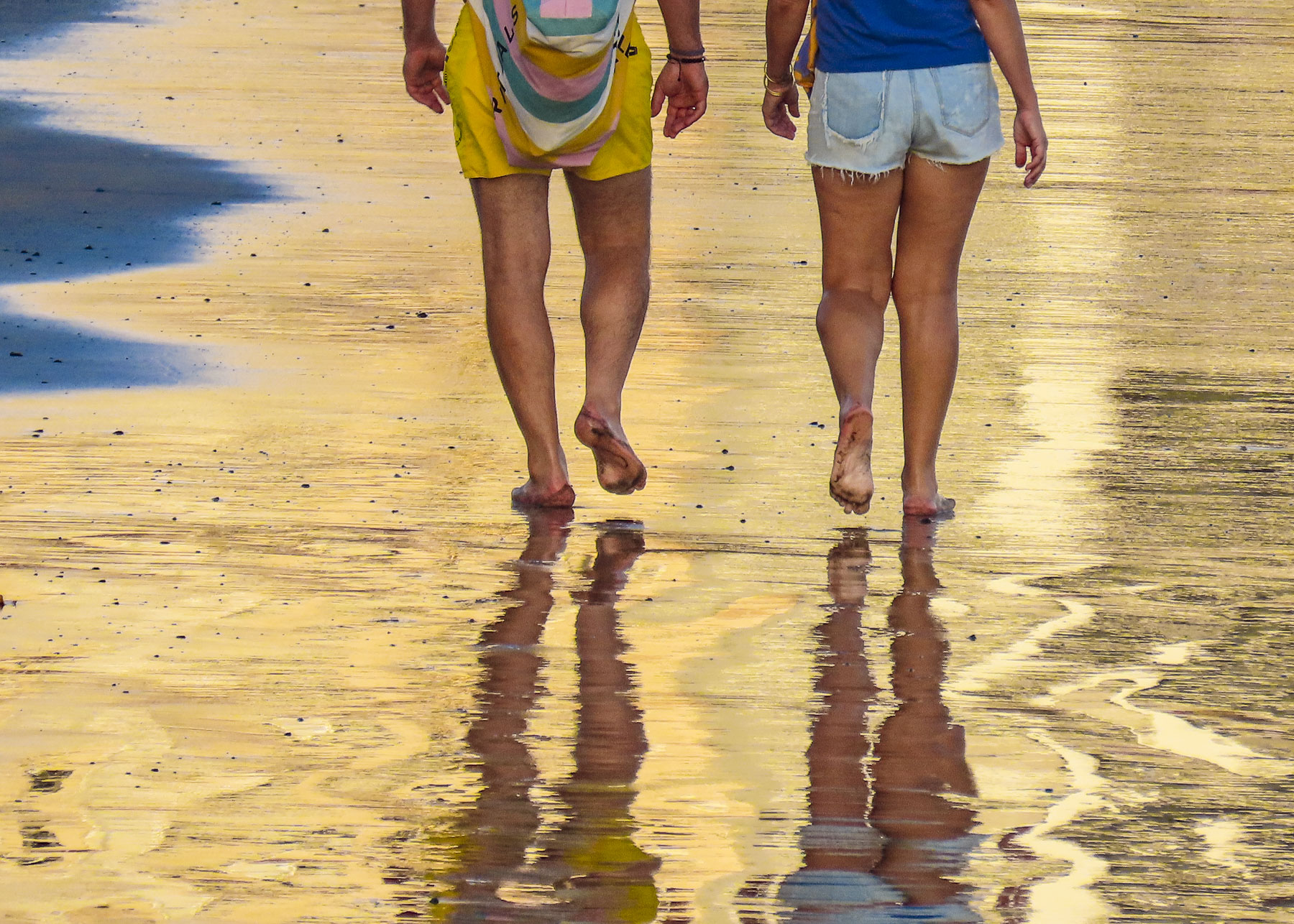
Closer to town, families favored the gentler waves, wider beach, and a view of Montaña Roja volcano on the horizon. Tables at eateries along the boardwalk were quickly filling as the golden hour approached.

A crescent beach, gentle waves, good wine and delicious seafood – is there a better way to end the day? We’ll miss Tenerife.

Till next time, Craig & Donna

Road Tripping Through Andalucia: Medina-Sidonia, Alcalá de los Gazules, & Castellar de la Frontera

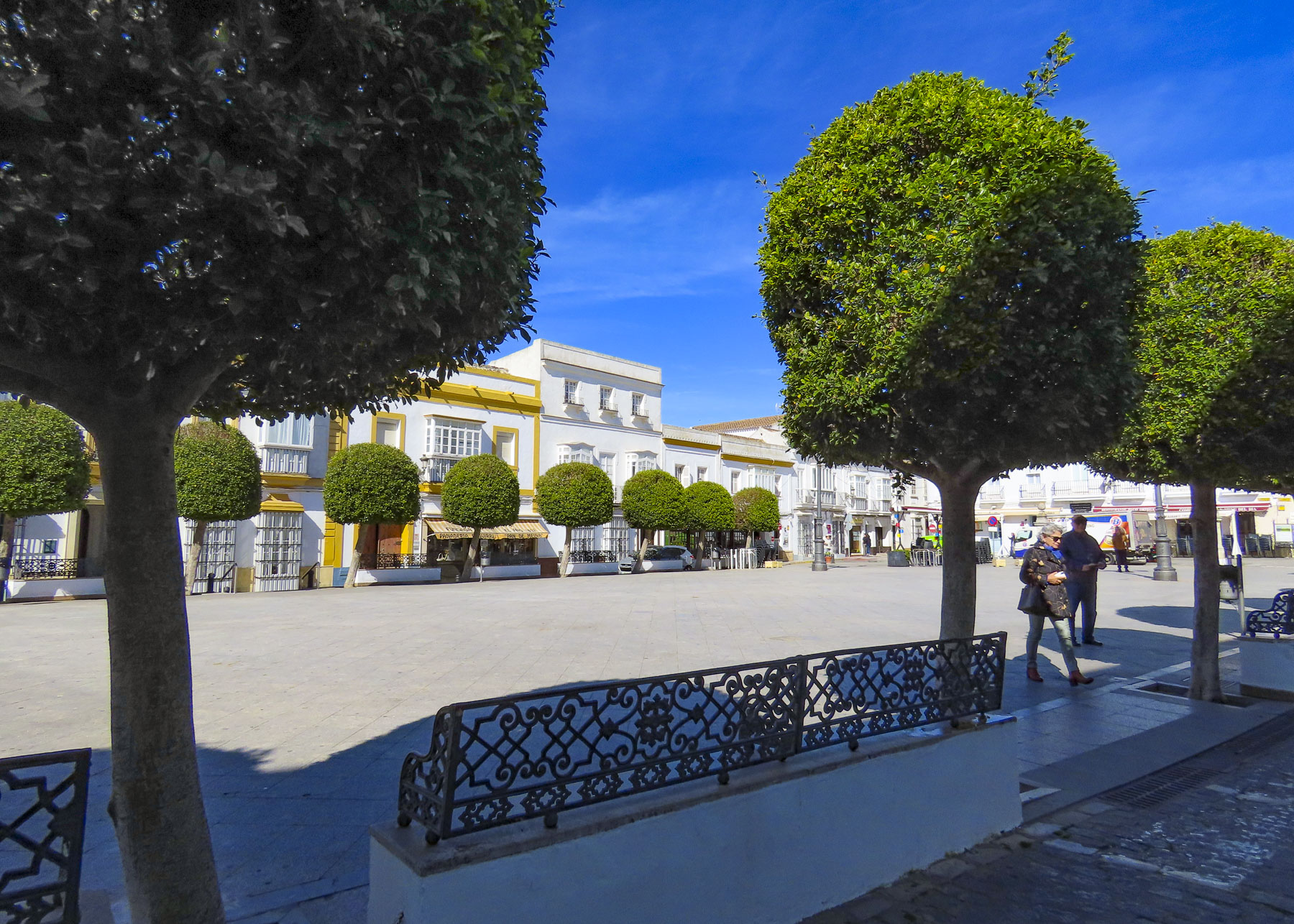
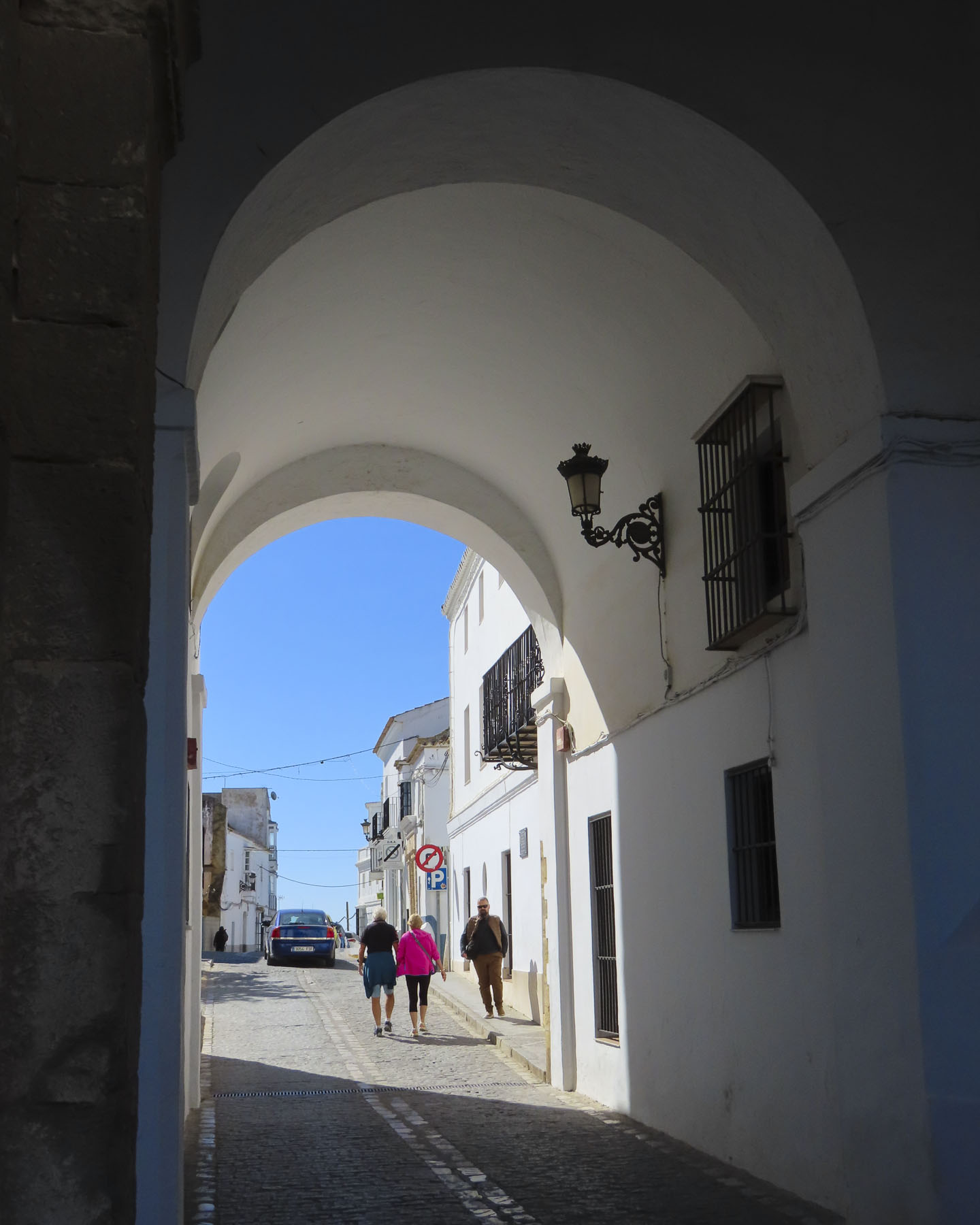
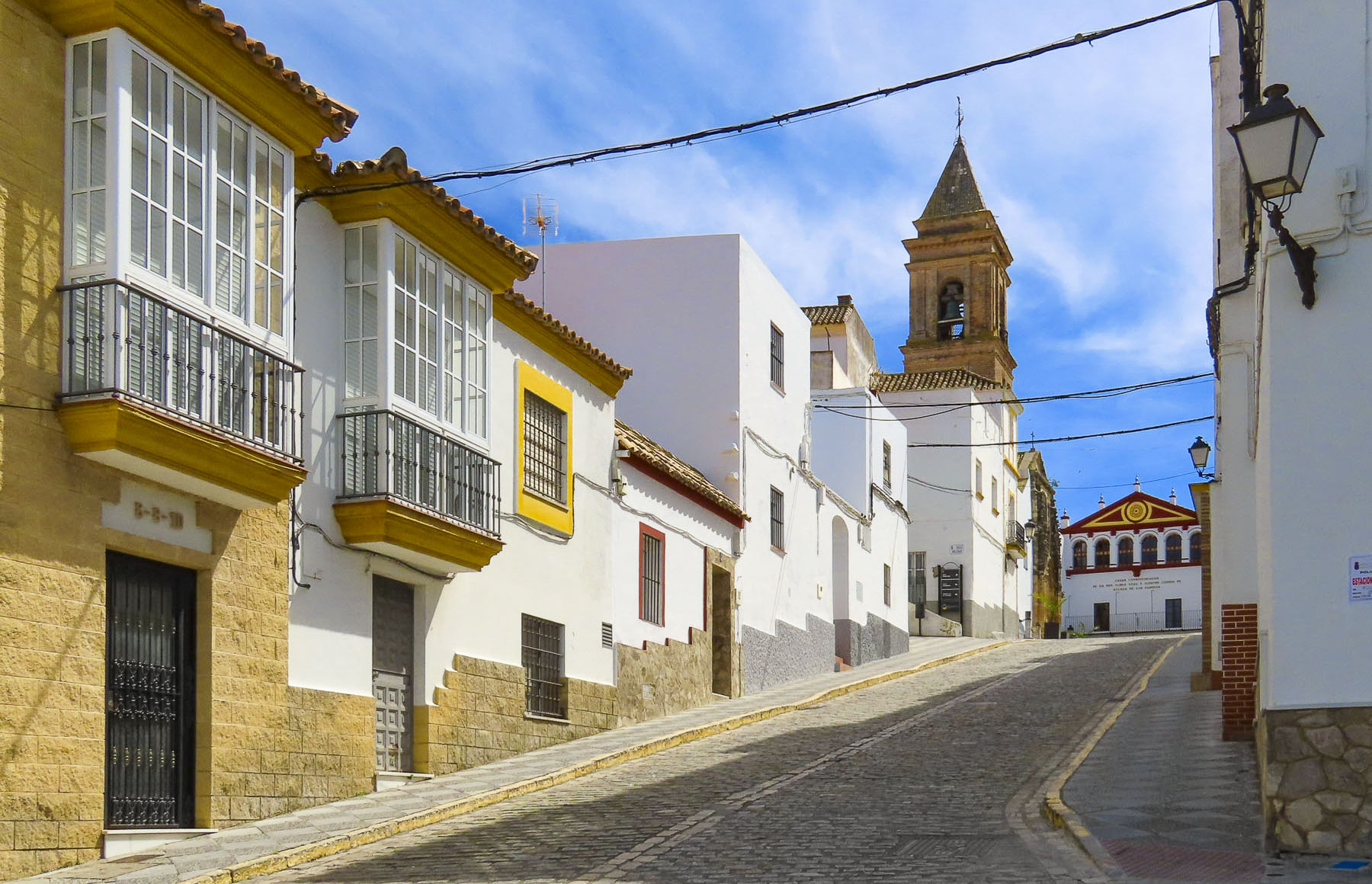
“We should tuck the mirrors in,” I said as we eyeballed the passage through the narrow arch ahead of us. We were on the Plaza de Espana in Medina-Sidonia, a forty-minute drive from Cadiz. But we couldn’t be further away, as it felt like a passage in time to centuries past as we drove into the village. Folks have lived on this hill since before the Phoenicians settled Cadiz in 1100 BC, making the village one of the oldest settlements in western Europe. But it is with the Phoenicians and later the Romans, Visgoths, Moors and finally the Spanish that the village grew. Sitting 1,000ft above the fertile rolling plains below, the highest point for miles around, the village offers incredible vistas of the surrounding countryside out to the Atlantic Ocean. The pueblo blanco we see today has its roots with the Moors in the 8th century.

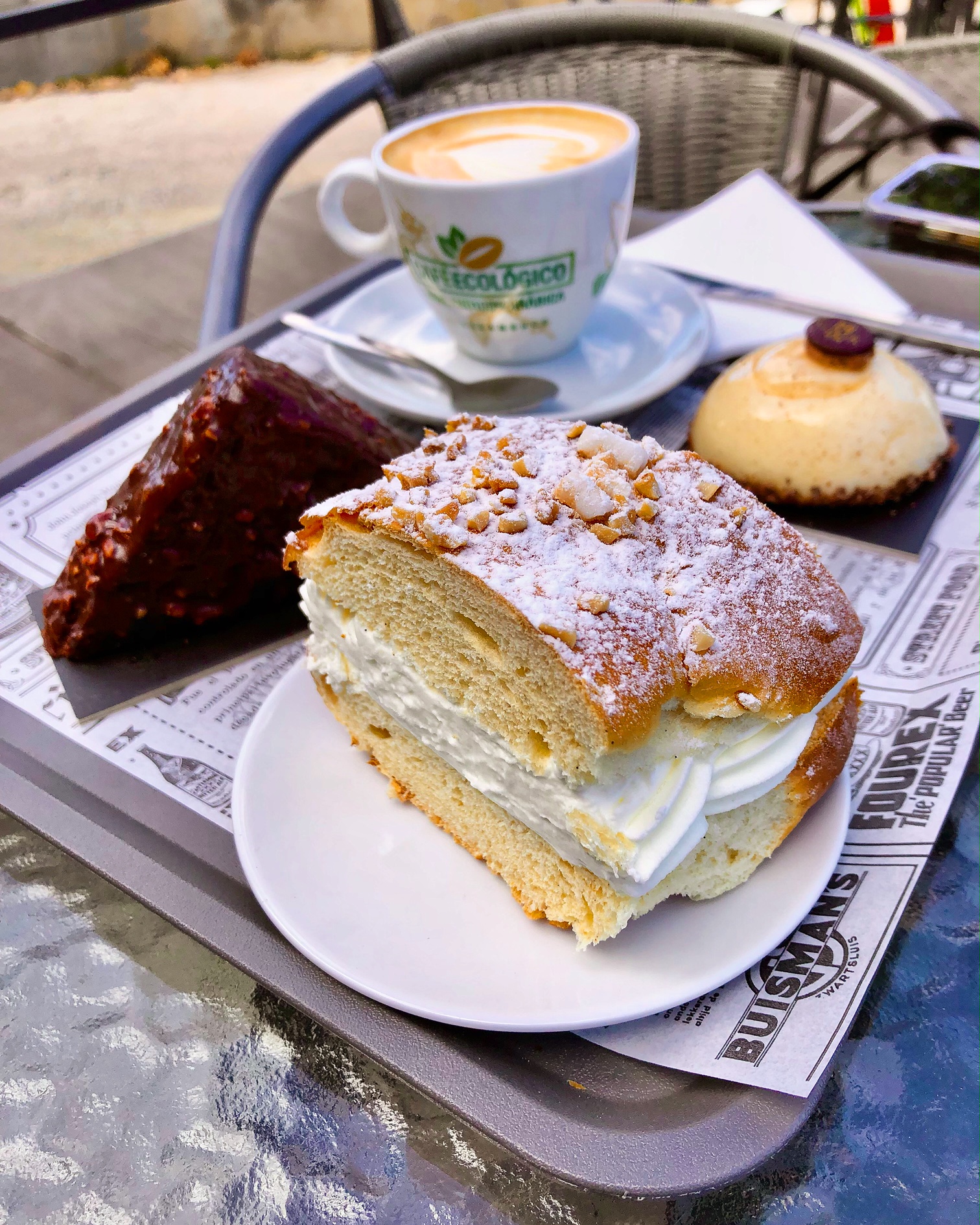
The plaza was nearly deserted when we strolled across it, mid-week in the middle of March, looking for a café. While the plaza was empty, we found a café, Restaurante Paco Ortega, bustling with activity. We ordered Tostadas de Jamón and Alfajor, a sweet gingerbread-like confectionary from the Arab period, that the town is famous for. We enjoyed the tostadas and the lively chatter of the café, but we were pointed across the plaza to Pasteleria Aromas de Medina for the Alfajor. True to its name, delicious whiffs of fresh baked pastries greeted us as we crossed the threshold of temptation. The Alfajor de Medina Sidonia was heavenly. It’s made with local honey, nuts, breadcrumbs, and a variety of spices – what’s not to like? The only question was how much to buy.

The day was really the first one of our Andalucian road-trip. Previously we had stayed for multiple days in Jerez de la Frontera and Cadiz (click to read those blogs.) Medina-Sidonia was the first of two stops, before we stayed in Castellar de la Frontera.

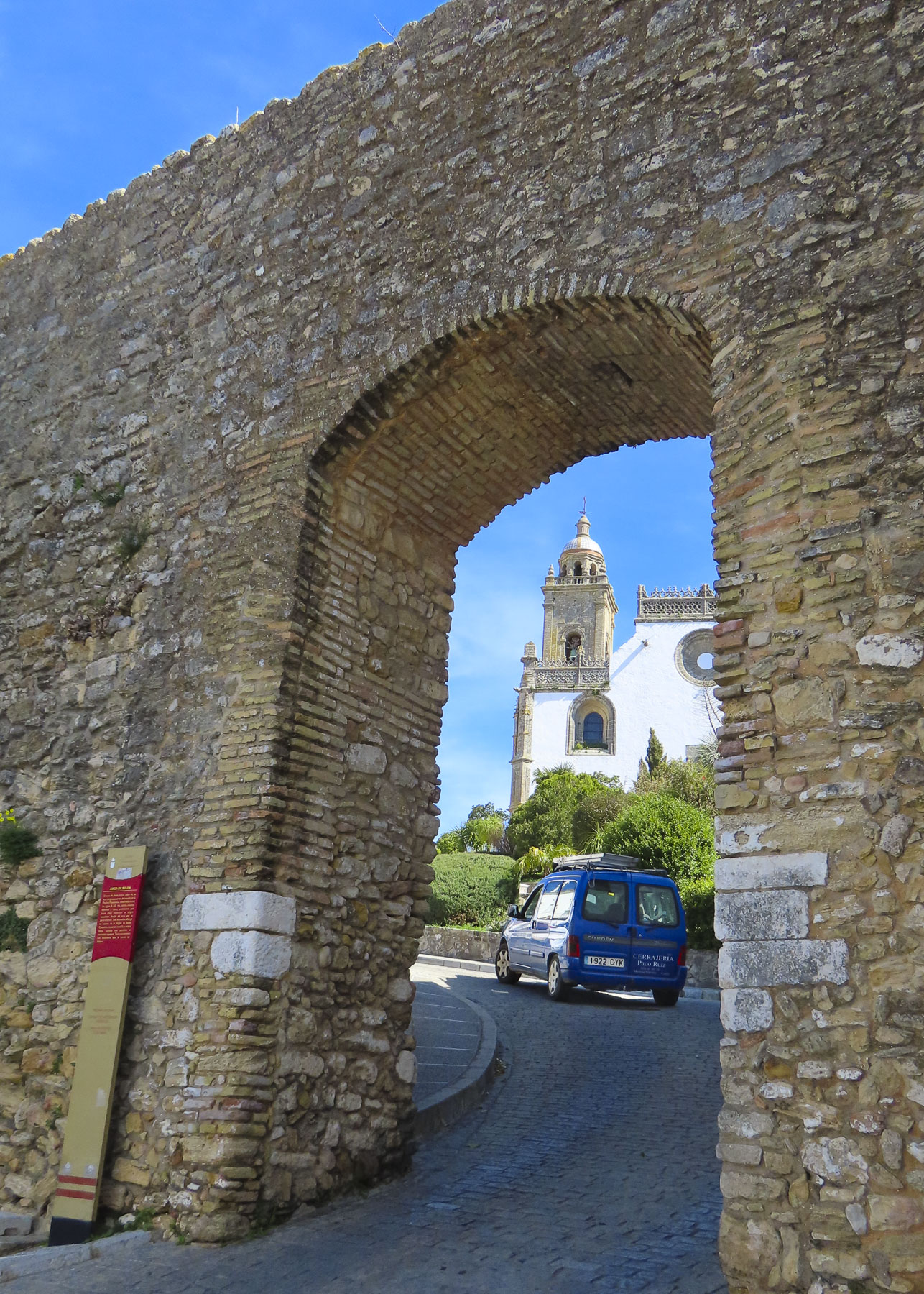
I swear the 12th century Arco de Belén, one of the original gates into the old walled Arab village, was slimmer than the one at the plaza. Located on a narrow, uphill blind curve, it took me two tries to align the car correctly for safe passage through the wall.

It’s a nice walk from the plaza in front of the cathedral to the ruins of the ancient castillo that once crowned the crest of the village. It must have been magnificent when it was the seat of the Dukedom of Medina Sidonia in the 15th century. The hereditary dukedom was one of the oldest in the kingdom of Spain and its land holdings encompassed most of Andalucia. But the castle eventually lost its significance, and its massive walls were slowly dismantled. The castle’s stones used to expand the village are now hidden behind plaster and white paint. Interestingly, the 7th Duke of Medina Sidonia was commander of the Spanish Armada that sailed to attack the south of England in 1588. Currently the 22nd Duke of Medina Sidonia resides in Madrid.

Next to the cathedral there is another set of ruins, one massive corner of which is all that is left of the Torreón de Doña Blanca, named for Doña Blanca (who was Blanche of Borbón,) the 14-year-old child bride of King Peter of Castile. They married in 1353 for King Peter to secure an alliance with France. However, there were difficulties in receiving her promised dowry. Shortly after their marriage, Peter abandoned Blanche for his lover, the Castilian noblewoman Maria de Padilla, who many believed he had married in secret before Blanche. He ordered Blanche, now officially the Queen of Castille, imprisoned in the Castle of Arevalo. In 1361 she was moved to the tower in Medina Sidonia to prevent rescue by French forces that were now battling King Peter. He ordered one of his noblemen to execute Blanche, now 22, but the knight bravely refused the king’s command, saying it was treasonous and would cause further disorder in the country. However, she was handed over to the King’s willing crossbowman, Juan Pérez de Rebolledo of Jeréz, who executed her. I can only imagine how many bags of silver changed hands. Peter only lasted another eight years on his throne until his half-brother, Henry of Trastámara, defeated him.

Built in the 16th century on the foundations of the village’s old mosque, the Iglesia de Santa María la Mayor still gracefully commands the hilltop. With Gothic and Renaissance elements inside and out, we found it to be one of the more interesting churches we had visited in Andalucia, not including Seville.

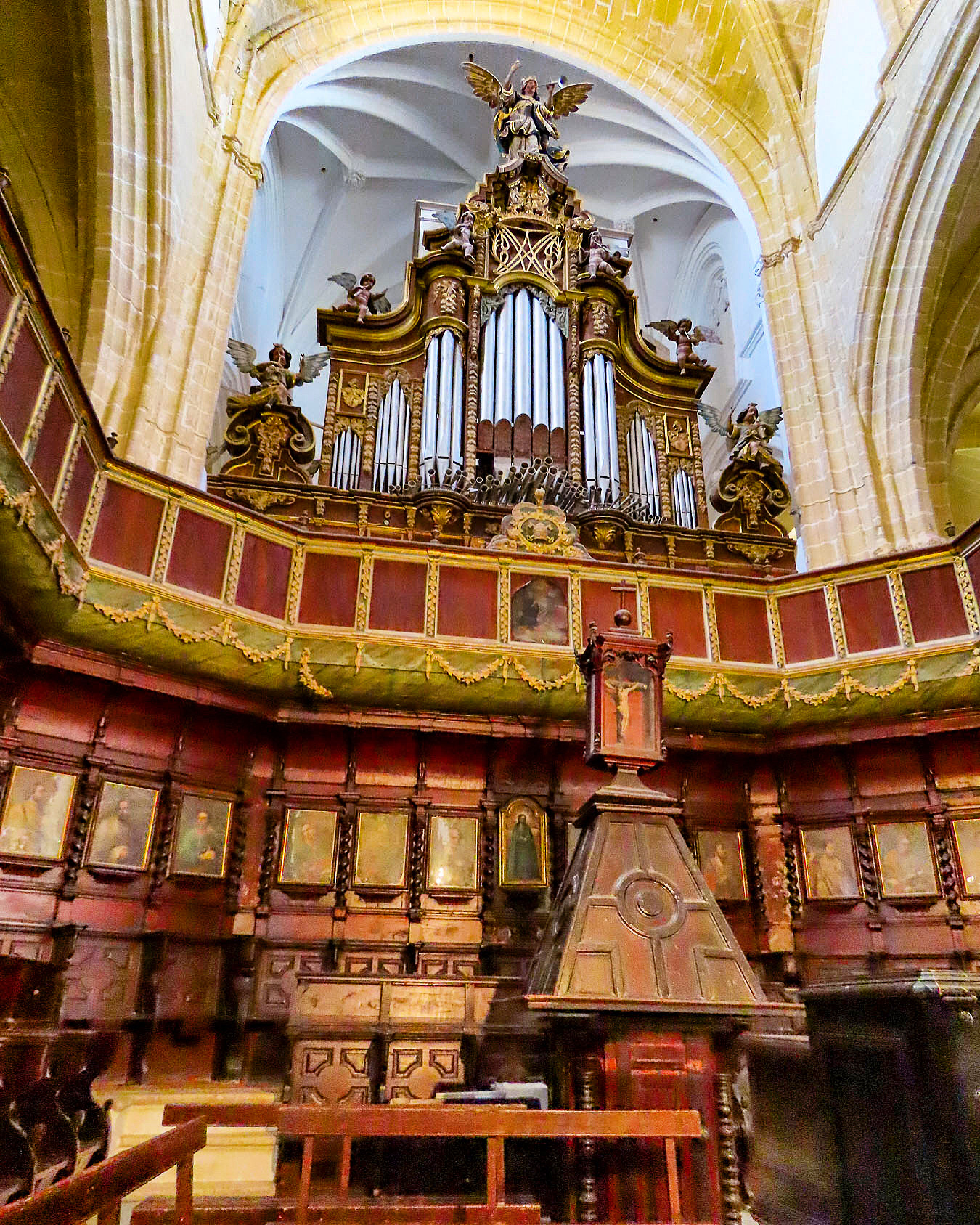
It is filled with wonderful pieces of religious art and has a very fine baroque sculpted altar, depicting stories from the Bible, and an ornate choir stall. The church also has a very nice arched cloister. The 135-foot-tall belltower, its upper portion built upon the minaret of the former mosque, was definitely worth the climb for the fantastic aerial views of the town and surrounding farmlands.

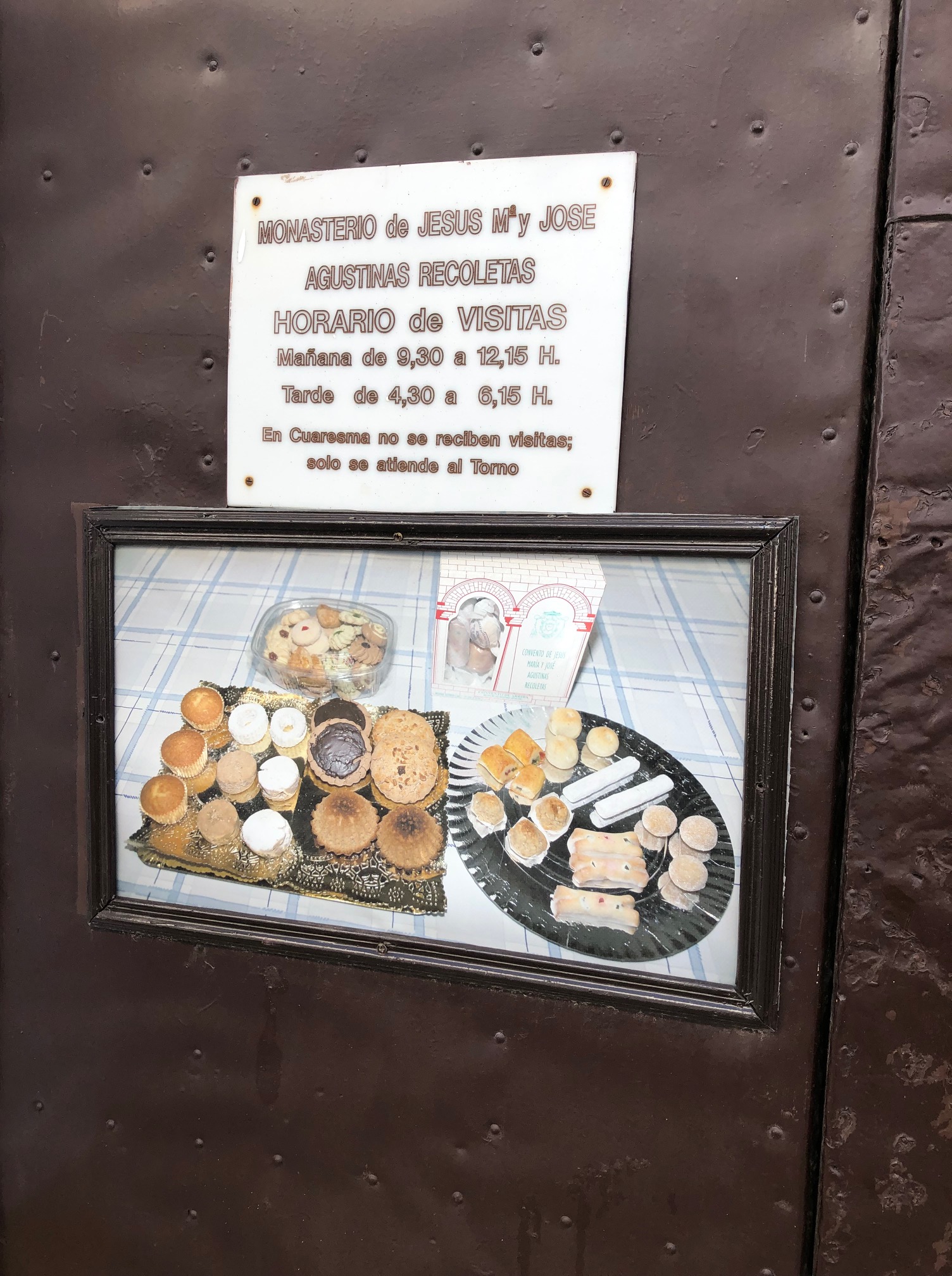
Next to the church, we were delighted to find that the Monasterio De Jesús, María Y José has a dulce turno. This is a lazy-susan type cabinet that allows you to purchase cookies and pastries made by the sequestered nuns who follow the convent’s centuries old recipes. It’s an interesting experience, talking in our inadequate Spanish through the wall to the invisible nun on the other side. We now seek out this opportunity wherever possible. The convent’s church has a noteworthy octagonal floor plan with its ceiling decorated with mural paintings.

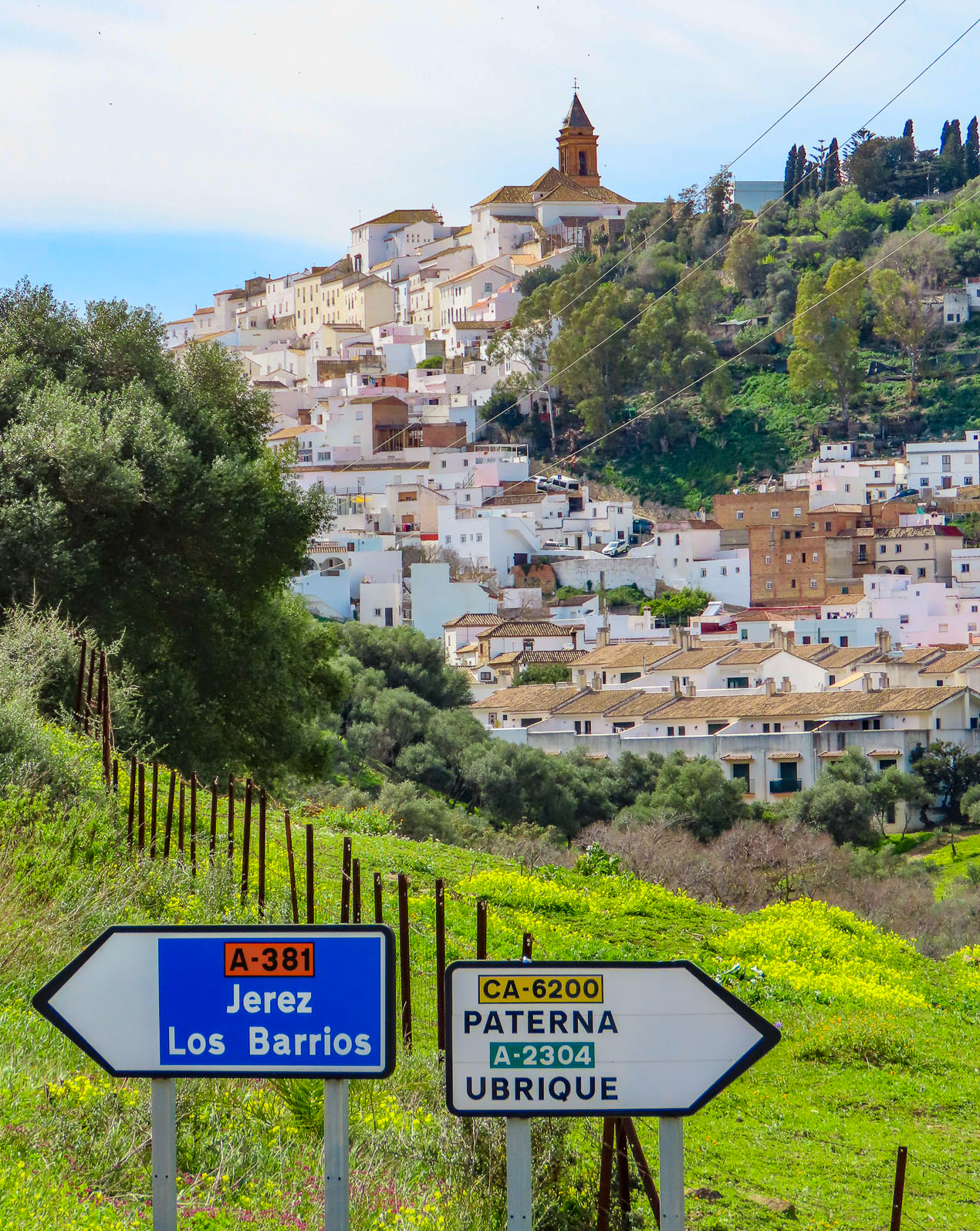
Alcalá de los Gazules, a half hour away, was our next destination. Along with Medina-Sidonia and several other pueblos blancos, it is on the Ruta del Toro. This route through the open ranges of Cadiz Province highlights the region’s equestrian traditions on large fincas that raise Spain’s famous fighting bulls for the ring, as well as for their beef. Along the roadside here the iconic Osbourne Bull billboards playfully promote their brandy.

Rounding a curve, the hillside before us glittered with impressionistic white dots, which were nearly blinding in the midday sun. As we approached, their definition improved and revealed the old Arab village.  The ancient footprint of the town hasn’t changed in centuries. The village is composed of multiple levels of terraced dwellings built above each other, along staircases, winding narrow lanes and alleys that traced the natural topography of the hill to its apex.

One of the advantages of shoulder season travel is that it is much easier to find a parking space. The disadvantage, though, is that some sites of interest have off-season hours, which was what we encountered with the Iglesia Parroquial de San Jorge and the Castillo de Alcala de los Gazules.

Since the Romans first laid stones for a fortress, the town has had a castle at its summit. It was the Moors though who built a small but substantial fortification that used the sloping wall technique, copied from the Templars, to build the Homage Tower. This impressive tower is all that is left after Napoleon’s troops blew apart the rest of the castillo as they exited following a brutal occupation of the town in 1810.

After the Reconquista, the towns’ Moorish past was erased with the construction of the Iglesia Parroquial de San Jorge above the old mosque. Its ornate gothic façade, carved from soft stone, now shows centuries of erosion. Later with the building of the Santo Domingo monastery, in 1506, the town was decreed to be a religious learning center. Although the monastery served as a training center for priests, it was also used for centuries to hold prisoners of the Spanish Inquisition.

A few minutes outside of the village, before continuing onto Castellar de la Frontera, we stopped for a late lunch/early dinner at los Corzos. It’s a large facility with a restaurant, café, grill and charcuterie shop, all featuring typical Andalusian fare. Though it appears to be geared for tourist buses that ply the route between Malaga and Cadiz, they take their cuisine very seriously and we had a splendid lunch.

The de la Frontera attached to many village names in Andalucia refers to a region officially called “Terra Nullius,” a ‘no man’s land.’ A fluctuating border area was established in the 1200s, when the first Reconquista, led by Ferdinand III of Castile-León, ran out of resources to continue their conquests farther. For two-hundred years this was an unclaimed land, in which Christian crusaders and Islamic jihadists continued to clash.

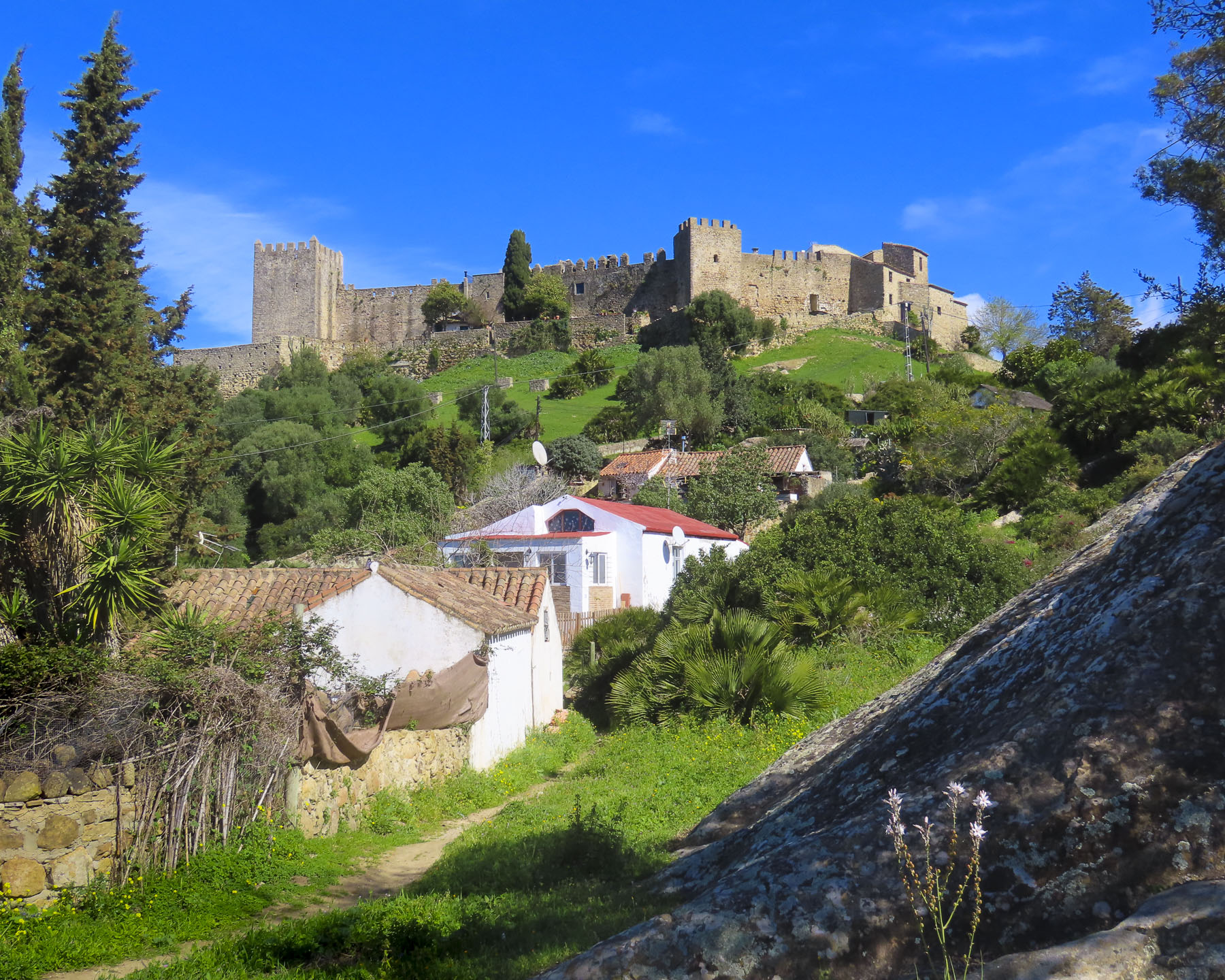
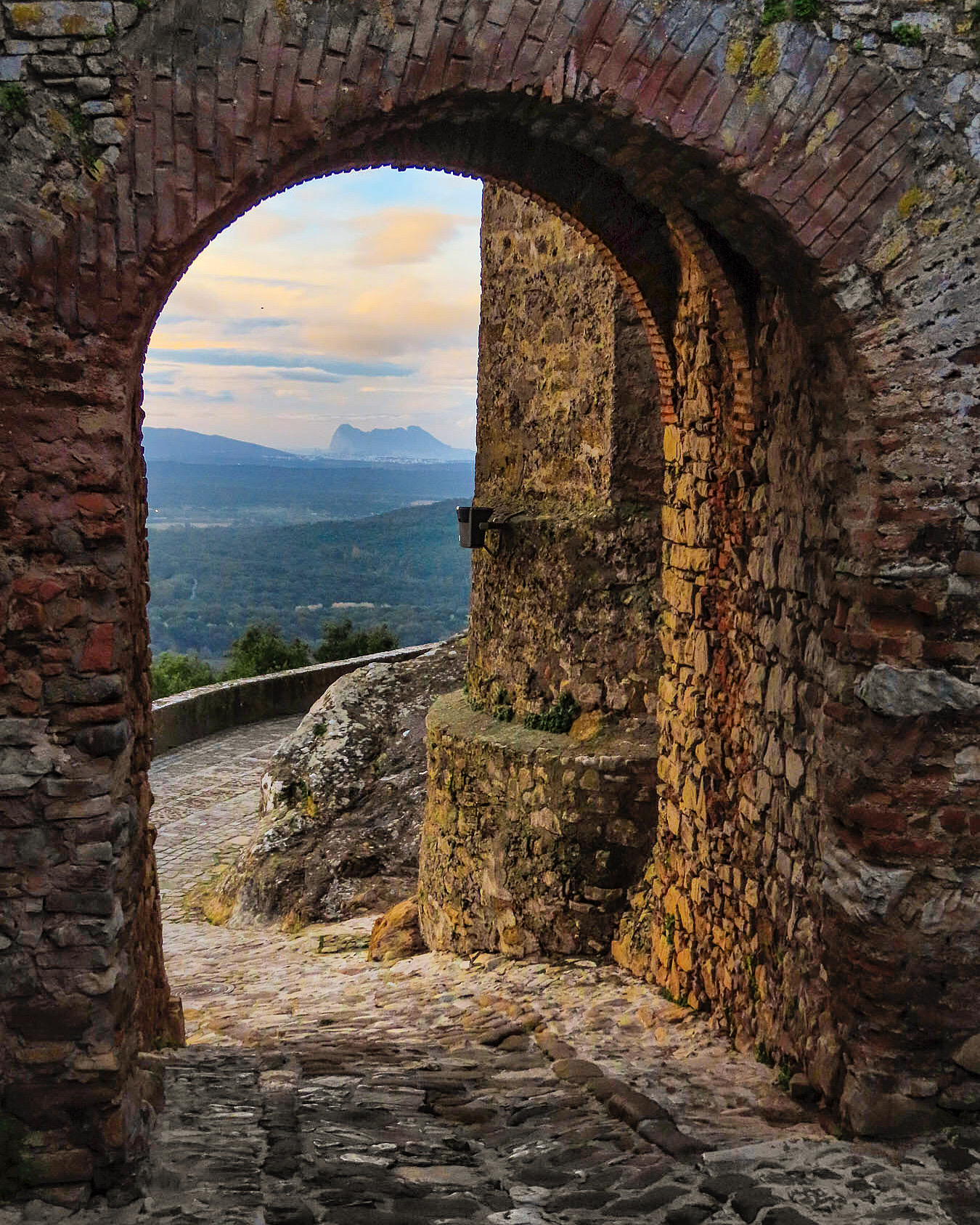
Castellar de la Frontera, still remotely isolated in the cork forests of Los Alcornocales Natural Park, truly exemplifies a wilderness fortress; with only one serpentine road in and out, it’s many miles off the main road. Today it is one of Europe’s best-preserved examples of a medieval village existing within a castle. But in the 1960’s it was a different story, when after centuries of neglect, and a dwindling population due to emigration, the remaining residents were relocated to a newly constructed town, Nuevo Castellar, ten miles away.

In the 1970s, northern European “hippies” discovered the fine Andalucian weather and the now abandoned village, squatting in some homes, and building rough shelters outside the castle walls. The old town was eventually obtained as an investment by the Rumasa Group, Spain’s largest conglomerate and the country’s leading hotel chain in the 1980’s. Later the company’s financial troubles led the Spanish Government to expropriate Castellar. They declared it a ‘Historical and Artistic Monument,’ and invested funding to restore the old castle and its village. Today rooms in the castle and several casas in the old village are reservable through Tugasa Castillo de Castellar Tugasa is a hotel organization formed by the Cadiz regional government and operates nine hotels and nine separate restaurants throughout the province.

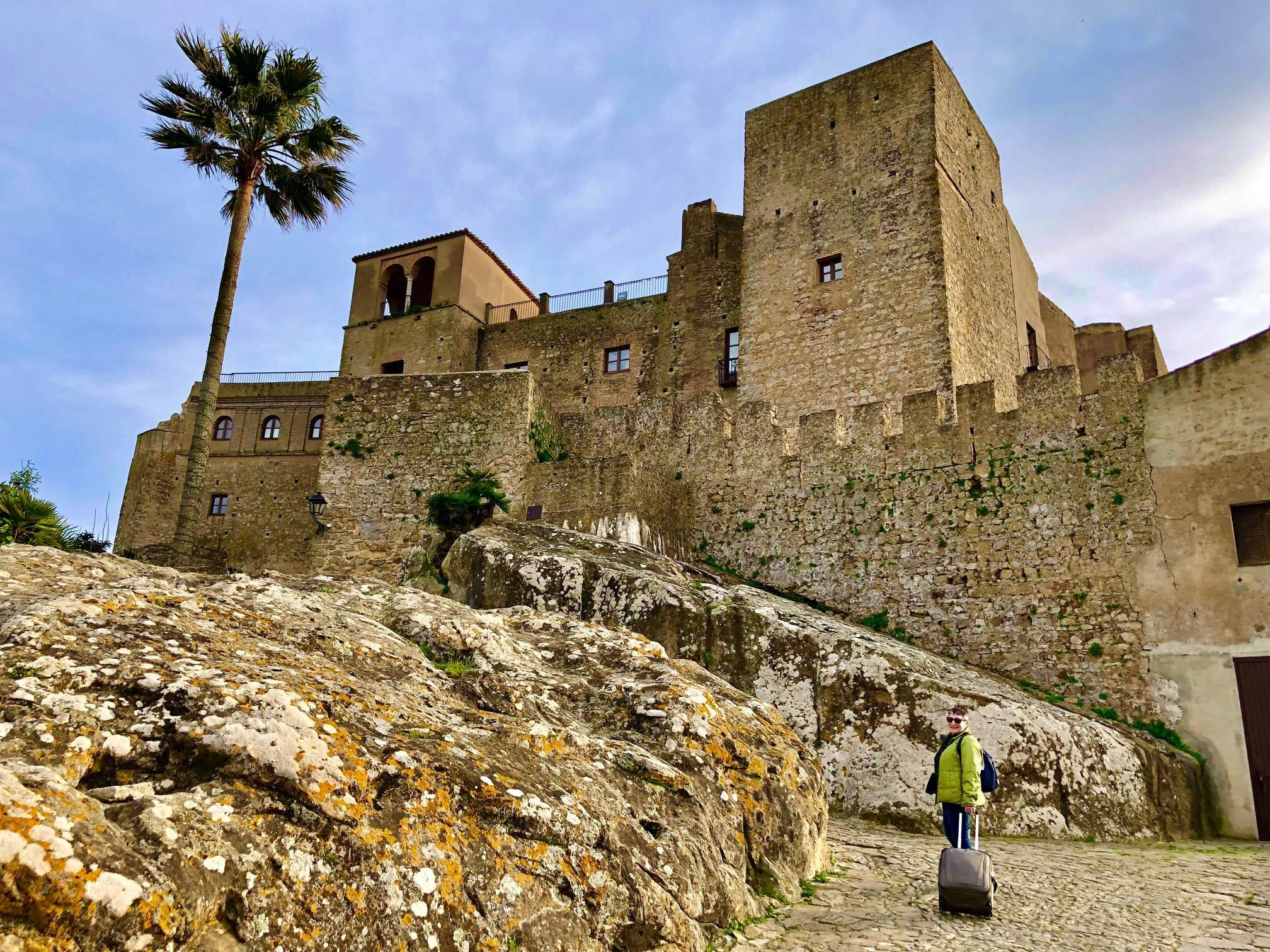
We didn’t realize our modestly priced (under €100) room would be ideally located in the Torre del Homenaje, the highest part of the castle with spectacular panoramic views. Getting to it was a bit of a challenge, even with the use of an elevator. The castle was built atop a huge multi-faceted rock protrusion, so that each ledge of the stone became one floor for rooms. While there are hallways from the elevator landings, they branch off and have short flights of stairs, up and down, to the rooms in various wings of castle. Signage was rather lacking, but after a few wrong turns we located No. 206.

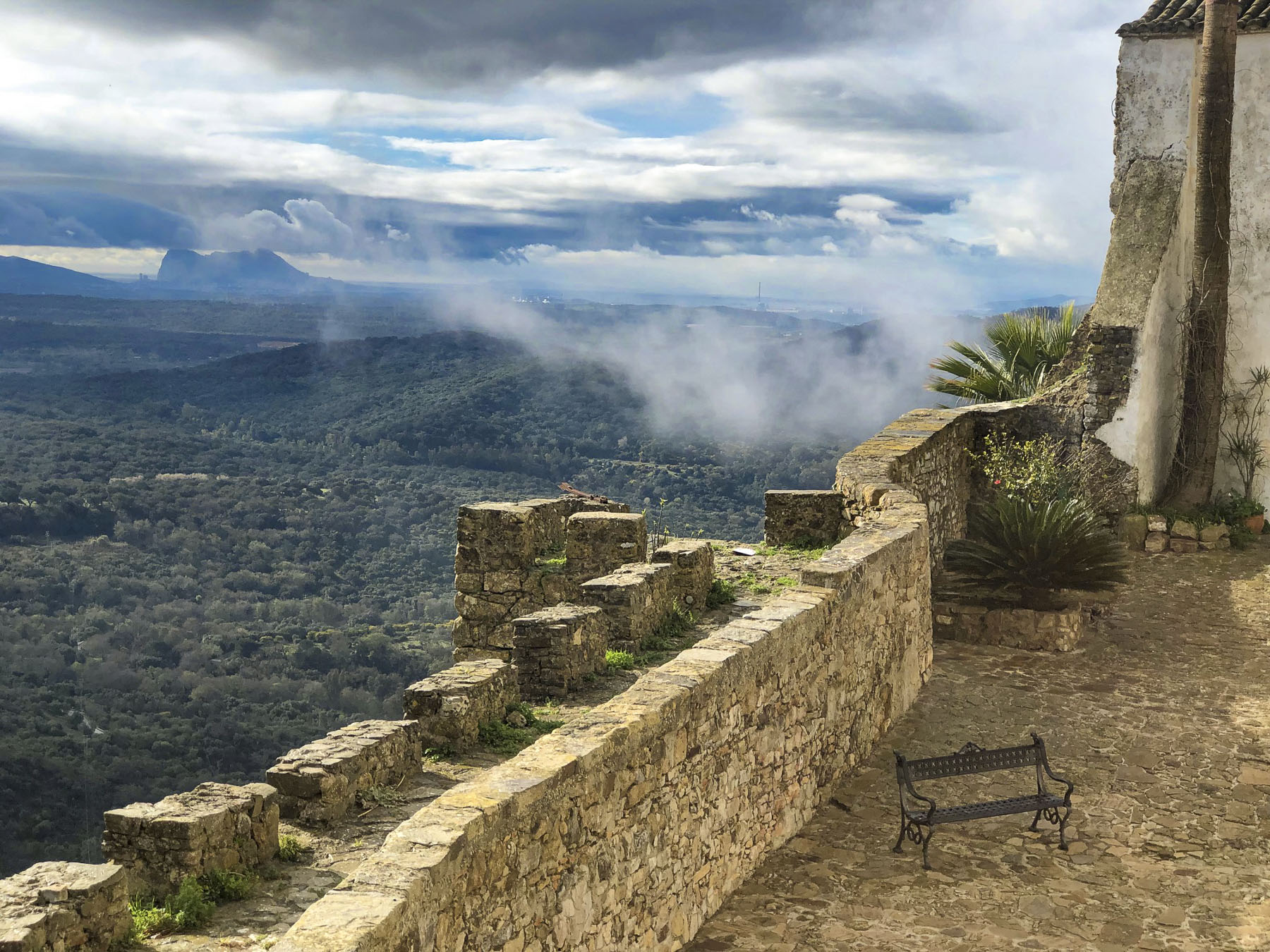
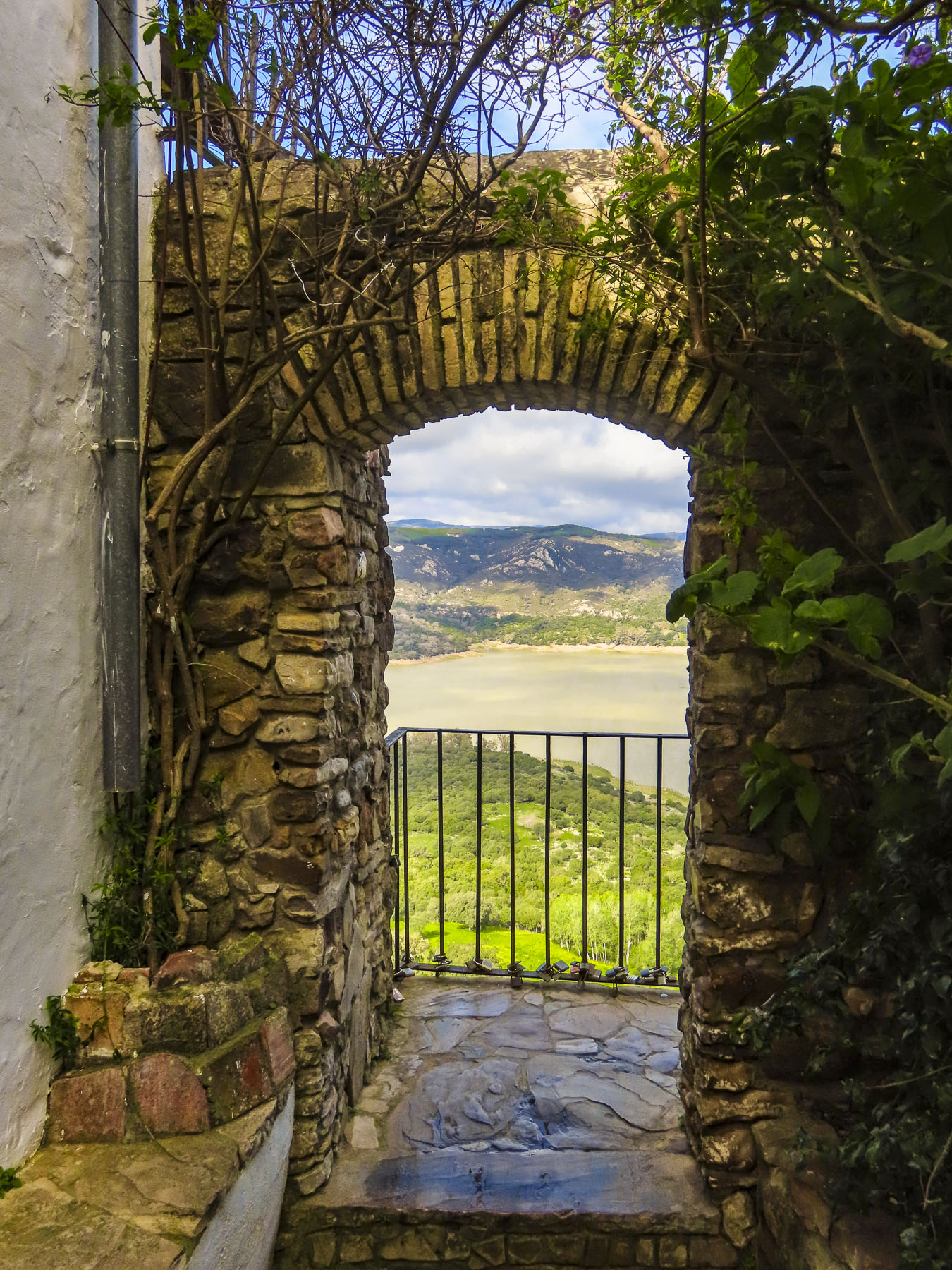
We were further surprised when we discovered that a narrow alcove in our room, with a twist and a turn, led to a sitting area with a small bedroom. Geez, if we had known we would have invited our kids. Better still, a set of stairs led to the top of the tower – our private mirador! To the manor born, for the next two days! We enjoyed incredible views: to the west over the Guadarranque reservoir, below the village, and southeast to the Rock of Gibraltar and the coast of Morocco beyond.

“Hey Rosa,” a lanky toothless patron smiled as he yelled, “tienes clientes,” you have customers, after we stood at the bar long enough to learn the gentleman was one of the original squatters of the 70’s. Two beers were all we could get from Rosa, as the kitchen was only open on weekends until the tourist season started later that Spring. Fortunately, we had purchased some bread, cheese, and sausage at los Corzos earlier, and we still had a vermut with us from Jerez de la Frontera, so we were set for a picnic dinner.

We rose for sunrise the next morning and watched kestrals zip along the castle’s walls. Over the reservoir a kettle of griffon vultures circled for a while before flying off. The medieval village within the castle’s wall is very compact and it was easy to wander through its attractive lanes. Outside the walls we spent a good bit of time walking about looking for the best vantage points to photograph this pretty village, which is recognized by Los Pueblos más Bonitos de España as being one of the nicest in Spain.

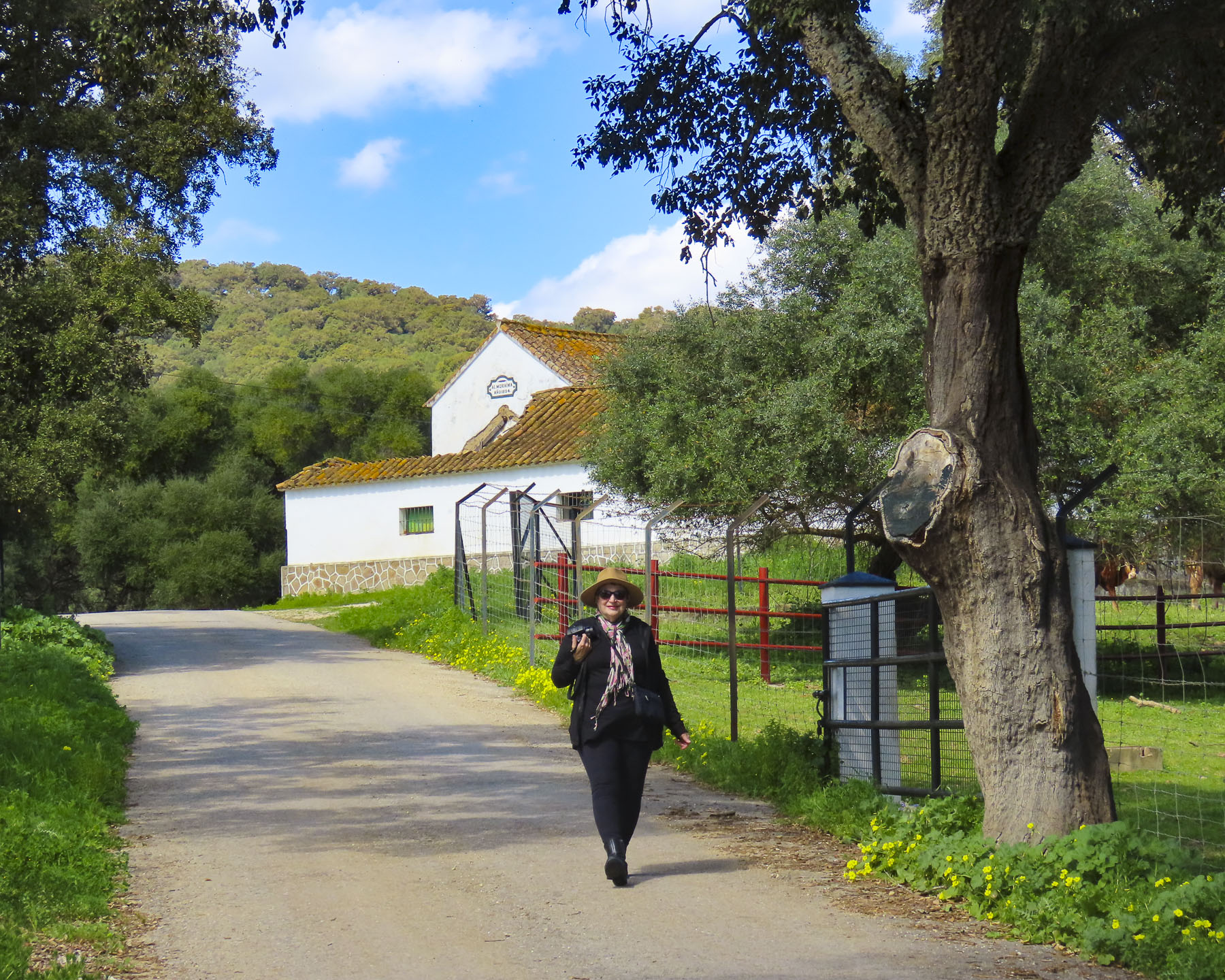
Later for coffee we stopped at the Hotel La Almoraima, located off the only road between the old town and Nuevo Castellar. The stunning hotel is set in what once was a 1600s convent and takes excellent advantage of the orange tree-filled courtyard and surrounding old cloisters, now renovated into chic rooms.  

The convent’s original chapel has also been lovingly restored and is used regularly for weddings. The history of the architecturally distinctive tower that stands next to the cloister is vague, with some thinking it was an Arab watch tower, when this was the “Terra Nullius,” and existed before the religious complex was built. The old convent and its extensive lands, a vast 34,000-acre cork forest, eventually became the property of the Dukes of Medinaceli, who turned it into a palatial hunting estate, one of the largest in Spain.

By the 1890’s it was the destination for Spanish nobles and English aristocrats from Gibraltar, who participated in Royal Equestrian Hunts, and the Duke had a private station built on Henderson’s railway for their use. In 1922 Queen Victoria Eugenie of Spain exited at the Duke’s station and then traveled by horse drawn carriage to the estate and the ancient castillo for a brief visit. The eroded cart track to the castillo was finally improved and paved in 1924. In 1973 the 18th Duchess of Medinaceli sold the estate, which included the old hilltop castle, to the Rumasa Group. It was later seized by the Spanish government in the financially troubled 2010s and the Mexican actress Salma Hayek expressed interest in acquiring it before the government decided to manage the estate itself. I find these obscure histories fascinating!

Bar el Molino, a small taberna on the edge of Nuevo Castellar’s central plaza, was a wonderful untouristy spot. With shaded outside tables, cold beer and delicious food, our lunch was perfect. In an effort to experience as many different places as possible, we’ve started to take our after lunch or dinner coffee and dessert at a different establishment.

With this in mind we found Pasteleria Gastrokook, off by itself on the edge of town. Wow! We were so fortunate to stumble across this incredible pastry shop. This gourmet pastelería is reason enough to visit Castellar de la Frontera or even Spain. It is definitely worth a detour especially if you are near Gibraltar. We quickly conferred and declared a calorie-free day! I mean, what is the point of exploring all these distant locales without enjoying their cuisine. Geez, at our home in Georgia, USA, we can’t even find artisanal bread! I did gently chide the two cyclists that pedaled over from Gibraltar for ordering only black coffee. Surely, they would have burnt off all those calories by the time they returned to the rock. Sometimes, willpower is simply deprivation by choice.

Till next time,

Craig & Donna

.

Portugal Road Trip – Part 2: For the Love of Guardrails

To misquote RWE, “It’s the journey, but an interesting destination helps.” We left Tomar, destined for Piodão, one of the 27 Aldeias do Xisto, Schist villages, in the mountainous central part of Portugal. Only two and a half hours from Tomar, we rarely passed another car as we drove. Our route quickly transitioned to serpentine roads traversing rolling hills covered in eucalyptus and pine forest. Then the higher above the tree line we drove, an expansive vista of shrublands fielding heather, broom, carqueja and rosemary were revealed. Hair raising, twisting and turning roads would truthfully be a better description, made all the more unsettling because there seemed to have been a transportation department budget crisis, as in, they forgot to install guardrails on most of those mountainous roads! My wife’s knuckles were white from tightly grasping the “Oh Jesus” handle above her door. With all the gorgeous panoramas, they could have planned more miradouros for folks to safely enjoy the views from.

We are not novice mountain drivers, having taken many switchback roads to remote places on several continents, which has reinforced or belief in and appreciation for a nice sturdy guardrail when we see one.

This was also the day our moody rent-a-wreck of a car went psychotic, every warning light on the dashboard blinking violently in Portuguese, requiring us to pull over to check the vehicle. Reluctant to turn off the engine in such a remote area, we listened closely for any sounds of motor distress. The car sounded fine. We drove on. With a quick, blind left turn and an “Oh God!” we descended a steep single lane road on the far side of the village that eventually led us across terraced slopes to Casa da Padaria for the night.

With warm greetings and help with our bags Gorete, the innkeeper, showed us to our room. For many years, decades before its renovation, the inn served as the town’s bakery run by Gorete’s father in-law. She and her husband returned to the village and remodeled the original building into a small four-bedroom guesthouse. The bakery’s large brick oven still takes up one whole wall of the breakfast room, which also displays a huge dough trough and long wooden bread peels used to take the loaves out of the wood fired oven.

Schist, schist, schist, everywhere schist! Walls, roofs, cobbled lanes, terraces, everything in the village is built with this durable brown and grayish stone, from a distance giving it the appearance that it has grown organically from the earth of the box canyon that shelters cradles it.  Everyone’s blue doors and window frames are not the result of superstition to ward off demons or to bring good fortune, but a shop keeper buying many years’ worth of paint in only one color. It became tradition.  

Channeled narrow rivulets of cold mountain water run quickly between homes, under doorsteps and along the edges of walkways before cascading downhill into irrigation trenches for the terraced crops below the village.  Small fountains throughout the hamlet offer spring water for drinking and washing for some of the older homes that still might not have plumbing.   

Slowly exploring the village, we made our way to its central plaza for dinner at O Solar dos Pachecos and enjoyed delicious bowls of Moelas Guisadas a Portuguesa, stewed chicken gizzards. This dish might not be for everyone, but it is truly one of Portugal’s culinary treasures. The owner enthusiastically shared tidbits of information and pointed across the way to the only mailbox in this unique village for the 120 full-time residents left here. Pity the poor postman otherwise trying to figure out the twist, turns and stairways of the hamlet’s ancient lanes. Surely everyone gets to know one another this way with the mailbox strapped to a tree on the main square in front of the village’s only white-washed building, the church.  Before leaving he suggested we enjoy some of the hiking trails the area is known for with a short trek through the valley to Praia Fluvial de Foz d’Égua, a scenic spot with a suspension bridge over a stream that widens into a natural swimming hole. Later for coffee and dessert we watched part of a soccer game on the TV above the bar at O Fontinha.

Piodão owes its unadulterated charm to the fact that it was pretty much forgotten and slowly abandoned until the 1970’s when the donkey and horse trails leading to the village were replaced with roads carved into the isolating mountains of the Serra do Açor that surround it. It is located not far from Parque Natural da Serra da Estrela and continental Portugal’s highest peak, Torre at 6,539ft. Difficult terrain lured fugitives, seeking to escape justice, to the isolated villages of the area. Allegedly one of the assassins of D. Inês de Castro, the mistress of Pedro l, sought refuge here in the late 1300s. Other than that interesting historical footnote and mention in a 1529 census, folks got by on a subsistence economy of farming, grazing sheep and goats, along with wood and stone cutting for centuries.

Its rediscovery and revitalization in the 1980’s brought the isolated village built with the abundant local schist stone recognition as one of the “most Portuguese villages of Portugal,” with a Galo de Prata “silver rooster” award.  

Waking during the night to close the window against the mountain chill, I observed a full moon illuminating a single arched stone bridge over a babbling brook at the bottom of the valley. The mountain songbirds were loud enough to encourage an early wakening as the sun rose over the ridge behind the village. The next morning Gorete’s homemade jams, pastries and a neighbor’s artisanal cheese nourished us before we explored the village and moved on.

The drive to Praia Fluvial de Foz d’Égua was through forest thick with oak, chestnut and laurel cherry and arbutus trees. Arriving, we understood immediately why this beautiful area is such an out of the way tourist magnet. Traveling during the fall shoulder season, we were fortunate to experience the tranquility of this serene spot in solitude.

Continuing the next day, we headed north to Ucanha for its old Roman bridge with fortified tower that spans the Rio Varosa. In the off-season not as many restaurants are open, but we were fortunate to find Casa da Eira near the bridge still welcoming folks for a splendid meal.

The walk to it was down a lane bounded with high walls draped with bunches of grapes dangling beneath, the vines sporting brilliant fall foliage. Just before reaching the restaurant, we peeked through the broken shutters of a long-abandoned church, its wedding cake altar and walls stripped of any religious embellishments.

After lunch we strolled across the bridge and under its tower which served as a toll booth for travelers crossing the river and gateway to the vast land holdings of the Mosteiro de Santa Maria de Salzedas in the 1400s, and further on to the Portuguese frontier.  

The bridge we crossed is thought to have replaced an earlier Roman structure from the first century AD. Through the tower’s archway we followed the lane up to the village’s parish church, Igreja de S. João Evangelist, that dates from 17th century.

It was surprising to learn about the ancient Roman presence here in central Portugal, but we had already noticed signs for the old Roman route as we drove through the area and tried to find two ancient bridges nearby, the Ponte Românica de Vila Pouca de Salzedas and Ponte Romana without any success while on our way to Salzedas. In searching for them, we did however thoroughly enjoy an afternoon ride through tiny hamlets, vineyards, olive groves, and apple orchards, where the tastiest apples were plucked from a tree within reach of our car window.

Reaching Salzedas we parked and walked towards the monastery across a small bridge over a dry riverbed. Stopping across from the monastery to take a photo, we spotted the most unusual statue along the watercourse’s retaining wall: a carved stone sculpture of a naked man sitting with a huge serpent-head phallus bursting forth from between his legs. Its location across from the monastery was all the more bewildering, but we had to laugh. Odd, just really odd, some of the things you discover when you travel.

Shorter opening hours are one of the disadvantages of travel during the shoulder season as by the time we were done exploring the Mosteiro de Santa Maria de Salzedas the small cathedral next to it was closed. Having paid fully for our entry tickets, we were startled by the guard’s request request for coins. “Do you have any foreign coins? I don’t travel, it’s my hobby and I ask all the foreign visitors if they don’t mind sharing.”  Having collected foreign money ourselves we could relate to this desire to touch something of the outside world. “We have some somewhere in our suitcase. I’ll check before we go,” I replied. The attendant replied with a subtly disappointed, “okay.” We were sure he thought we were just giving an excuse as we climbed the stairs to the exhibition.

From its placement in 1155 near the Torno River, in keeping with the sect’s requirements that its buildings be near watercourses, this was one of the largest and wealthiest Cistercian monasteries in Portugal, having been gifted extensive land holdings, by a royal patron, with the express duty of exploiting the land for profit. A century later it was consecrated after the monastic complex was finished. Over the centuries it continued to be financed by various members of succeeding royal dynasties, perhaps seeking divine intervention or to influence the politics of the almighty Catholic church. Like all things old, it underwent several significant renovations during the 16th and 17th centuries. The addition of a second larger cloister in the 18th century left the façade of the monastery we saw today.

“Enough is enough, we’ve had enough,” could have been the chant of the Liberal government after their victory over the Absolutists at the end of the Portuguese Civil War, 1828 -1834, a war fought for basic human rights and to reverse centuries of disenfranchisement from autocratic monarchies and their allies, namely the Catholic church. Reforms started by the enlightened Marquês de Pombal in the mid-1700s to restrict the powers of old aristocratic families and the church with the expulsion of the Jesuits from the Portuguese Empire had stalled. In 1834 the new minister of justice, Joaquim António de Aguiar, enacted a law, The Extinction of the Religious Orders, requiring the dissolution of “all monasteries, convents, colleges, hospices and any other houses of the regular religious orders.” Their properties and moveable assets were to be nationalized and sold, the profits to be entered into the National Exchequer. Convents were allowed to stay open until the last nun died. Joaquim António de Aguiar earned the nickname, O Mata-Frades, “The Friar-Killer,” because of the anti-ecclesiastical spirit of this law. Over 500 monasteries were closed. Urban buildings were easily sold and repurposed, but many monasteries and convents in the rural areas were abandoned. Their religious art and iconography was redistributed to local parish churches, sold into private collections or “lost.” The Santa Maria de Salezadas Monastery sat abandoned and left to ruin for over 160 years until renovation work started in 2002 and culminated in the reopening of the cloisters in 2011 as a museum with displays of the monastery’s medieval and renaissance religious art and treasures recollected from afar.

With a wave and “thank you,” we left the monastery and headed to our car. “Wait, I’ve got to find those coins for you to take him.” Returning to the car with a smile on her face, Donna relayed that he was delighted that we remembered. A small connection.

It’s the journey. We headed to the Douro Valley. 

Till next time, Craig & Donna

Portugal Road Trip – Part 1: Searching for Templar Castles

“It’s okay, you can just ignore that caution light on the dashboard. It never goes off.” “Do you have another car?” “No.” All rental cars appear equally perfect when you are making comparisons and a final selection from a website. Staying within our budget, we chose an off-airport car rental agency with good reviews, that picked us up at the arrivals terminal and sped us away to our awaiting wheels, for €12.50 a day.  The Fiat Panda assigned to us had been driven hard and put away wet, you might say. Reviewing the preexisting body blemishes with the rental agent resulted in a cartoon of the car that looked like it had been ambushed in a gangster movie and sprayed with machine-gun fire, including the roof. Nevertheless, the engine sounded fine, and our twelve-day journey began, driving in a large figure-eight, north to south route, around Portugal. Our first destination – Castelo de Almourol, before arriving in Tomar. But by the afternoon of day three we were referring to our car as the Portuguese version of the American rent-a-wreck concept. When driving through the mountains, on the way to a schist village, every warning light on the dashboard started blinking violently in Portuguese. If we had been flying an airplane, we would have donned parachutes and bailed out.  The engine sounded fine, so we flew on.

Not being sure what is open during the week in the off season, we headed for the Miradouro do Almourol, an overlook above the island that the castle commands. Located on the south side of the Tagus River, it’s not particularly easy to get to. But my wife and I enjoy the off the beaten track routes that take us through less traveled countryside. Crossing the Tagus River, we followed the N118 north into the Alentejo (beyond the Tagus) Region through flat farmlands and wine estates dating back to the 1700’s. The red wines of the area vinted with the Portuguese varietals Castelão, Trincadeira, and Touriga Nacional are acquiring international recognition now, as are the regions white wines made with Antão Vaz, Arinto, and Fernão Pires grapes.

The drive was slowed occasionally by tremendously large John Deere combines, the width of the entire road, as farmers drove them between different fields waiting to be harvested. Seasonal spring floods that replenish the soil have made this river plain an important area for cereal crops and wheat since the Roman times. Our walk a little then café philosophy quickly transformed into drive a little then café when we did our first U-turn of the trip as we passed a small place that had a tractor parked in front. Our espressos only €.70 each. It was nice to be back in Portugal.

The wetlands of the Tagus River valley are ideal for bird watchers looking for black-winged stilt, marsh harrier, purple heron, pratincole and Kentish plover. Occasionally we spotted storks atop centuries-old chimneys of abandoned homes, resting in new nests that were stacked like pancakes atop older ones before continuing their winter migration south to Africa. Quiet lanes, faded sun-bleached pastels, and centuries old weather-worn buildings dotted the landscape. Bullrings, Praça de Touros, still stand in Chamusca and Salvaterra de Magos, and the latter’s traffic circle has a large sculpture of a cavaleiro and bull to celebrate the tradition. Though interest in bullfighting has been waning since Queen Maria II of Portugal banned the spectacle in 1836 with the argument that it was “unbefitting for a civilised nation,” it regained popularity in the Alentejo region after the fights were reinstated in 1921, and the climatic killing of the bull was outlawed in 1928.

Before we reached the castle, we stopped for lunch along the riverfront in Arripiado at the ABC Bar Café. It was a tranquil spot with a boardwalk that had a view of the Tagus River and the small village of Tancos across the water. Small boats offer rides to Almourol Castle from the Arripiado riverbank here.

With its striking island location, just below the junction of the Zezere and Tagus rivers at Constância, Almourol Castle is one of the most picturesque medieval fortresses in Portugal.

Constância was once an important fishing village during the Middle Ages where it was said the rivers there were “two-thirds fish and one-third water.”

As with most things ancient on the Iberia Peninsula, the castle’s history started with an early tribe. The Lusitanians built a small fortress on the island as protection against the Romans in the first century B.C.E. Visgoths, Vandals, Alans and Moors followed until it was captured by the Portuguese during the Reconquista in 1129 and subsequently entrusted to the Knights Templar to rebuild for defense of the frontier border at the time.  It eventually lost its strategic relevance and was consequently abandoned. Various phases of reconstruction began in the mid-1900s. 

Train service to Tancos, Castelo de Almourol and the hilltop village of Constância is available from the Santa Apolónia Station in Lisbon. The trip takes about an hour and a half.   

We arrived in Tomar just as the late autumn sun was low in the sky and beginning to cast lengthening shadows on the forested slope that led to the jewel that crowns this quaint village.  We followed the winding cobbled lane to Castelo de Tomar and only got a brief glimpse of the castle through its outer gate as the heavy wooden door was closed for the day with an echoing clang. The castle combined seamlessly with the Convento de Cristo next to it and creates an immense structure that’s best observed from a distance to appreciate its scale. Admiring the expansive view from the miradouro in front of the castle, we made plans to return the next day via a tuk-tuk taxi, from the town square.

This beguiling medieval village with its narrow lanes and tranquil riverside location discreetly hides its outsized contribution to the history of Portugal.

It starts with those mysterious Knights Templar when in 1159 the first King of Portugal, D. Afonso Henriques, granted land to Gualdim Pais, the fourth Grand Master of the Knights Templar in Portugal as reward for their military prowess and religious zeal during the Portuguese wars for independence and the subsequent Reconquista. When the town was first founded, the population was so minuscule, most of the villagers lived behind the castle’s defensive walls.

In 1160 Gualdim Pais order the construction of a monastery and fortified citadel that would be known as the Convent of Christ, a combination of a fortress and a monastery, that is sometimes referred to as the Convent of Christ Castle. The convent’s most interesting feature is a round sanctuary with an ornate ceiling soaring over a central altar, its design said to be influenced by the Church of the Holy Sepulcher in Jerusalem.  Legend states that the knights attended mass on horseback here, the open circular design facilitating the horse’s easy entrance and exit. Famously in 1190, outnumbered Templars defeated a larger Muslim army after their six day siege of Castelo Tomar failed.

Founded in 1118 and slowly gaining recognition from their vowed mission to protect pilgrims journeying to the Holy Lands, the Knights received Papal endorsement in 1139. Pope Innocent II’s Papal Bull sanctioned the Templars as “an army of God,” and provided them special rights that included exemption from paying taxes, allowed them to build their own oratories, immunity from local laws, freedom to cross borders, and obedience only to the Pope. With this blessing Pope Innocent ll made the first papal monetary gift to the Templars. Now a church-endorsed charity, they began receiving land, money, businesses and young nobles from wealthy families who were enthusiastic to find glory in the crusades and willingly donated their assets in order to take the vows of poverty, chastity, piety, and obedience.

Today the Templars most likely would have been charged with running a racketeering enterprise which forced pilgrims and others to pay for protection services they have not requested. This protection was usually from the very people who were demanding the money in the first place.

Things were going well for the Templars across Europe until 1307 when King Philip lV, heavily indebted to the Templars from a war against England, lobbied the Holy Church to disband the Knights Templar as it was a state within a state with its own military, preached heresy and practiced idolatry.

The Templars’ fatal day (eerie music, please) was Friday, the 13th of October 1307. Early that morning all the Templars in France were arrested as enemies of God. Upon torture many falsely confessed and were burned at the stake.  A month later Pope Clement V, a relative of King Philip, decreed that the rest of the Catholic kingdoms in Europe should arrest the remaining Templars and seize their properties. All complied except Portugal!

King Dinis of Portugal did not believe the charges leveled against the Templars, remembering instead their service to a fledging country, and offered sanctuary to knights that had escaped capture.  He then persuaded Pope Clement to support the creation of a new organization, the Order of Christ, into which he transferred all the Templars’ wealth and holdings. The new Order’s mission was now the liberation of the Iberian Peninsular from the Moors and wars against Islam in Africa.

Same group with a new name, but to ensure that the deception of the Pope succeeded, the headquarters of the new order were established, almost in exile, 210 miles away in Castro Marim, a frontier town on the Guadiana River, that serves as the border with Spain.

One hundred years later Dom Henrique of Portugal, Duke of Viseu, better known as Prince Henry the Navigator, allowed the Templars/Order of Christ to return to their former seat of influence in Tomar.  Here they now helped Prince Henry the Navigator establish a medieval think tank: a research institute dedicated to developing navigational tools for a ship to determine its accurate position at sea, relying on the Arabic studies of astronomy, mathematics, trigonometry, which were farther advanced than European knowledge at the time.

The Order of Christ succeeded the Knights Templars as the country’s banker and financed building the fleets of ships needed at the beginning of Portugal’s nautical age of discovery. As rewards, fleets of caravels with white billowing sails boldly embellished with the distinctive red cross of the Order (perhaps the first attempt at global branding) carried explorers down the west coast of Africa and around the Cape of Good Hope into the Indian Ocean in 1487. Portugal’s age as an expanding empire had begun!

Wandering the cobbled lanes of the old town in mid-October, we seemed to have the whole village to ourselves. Later, as the day was perfect, we walked along the Nabao River, crossing a small footbridge in Parque do Mouchão. The view back toward the village was sublime with ducks slowly trailing ripples through the mirrored reflections of the buildings in the water.

Till next time, Craig & Donna
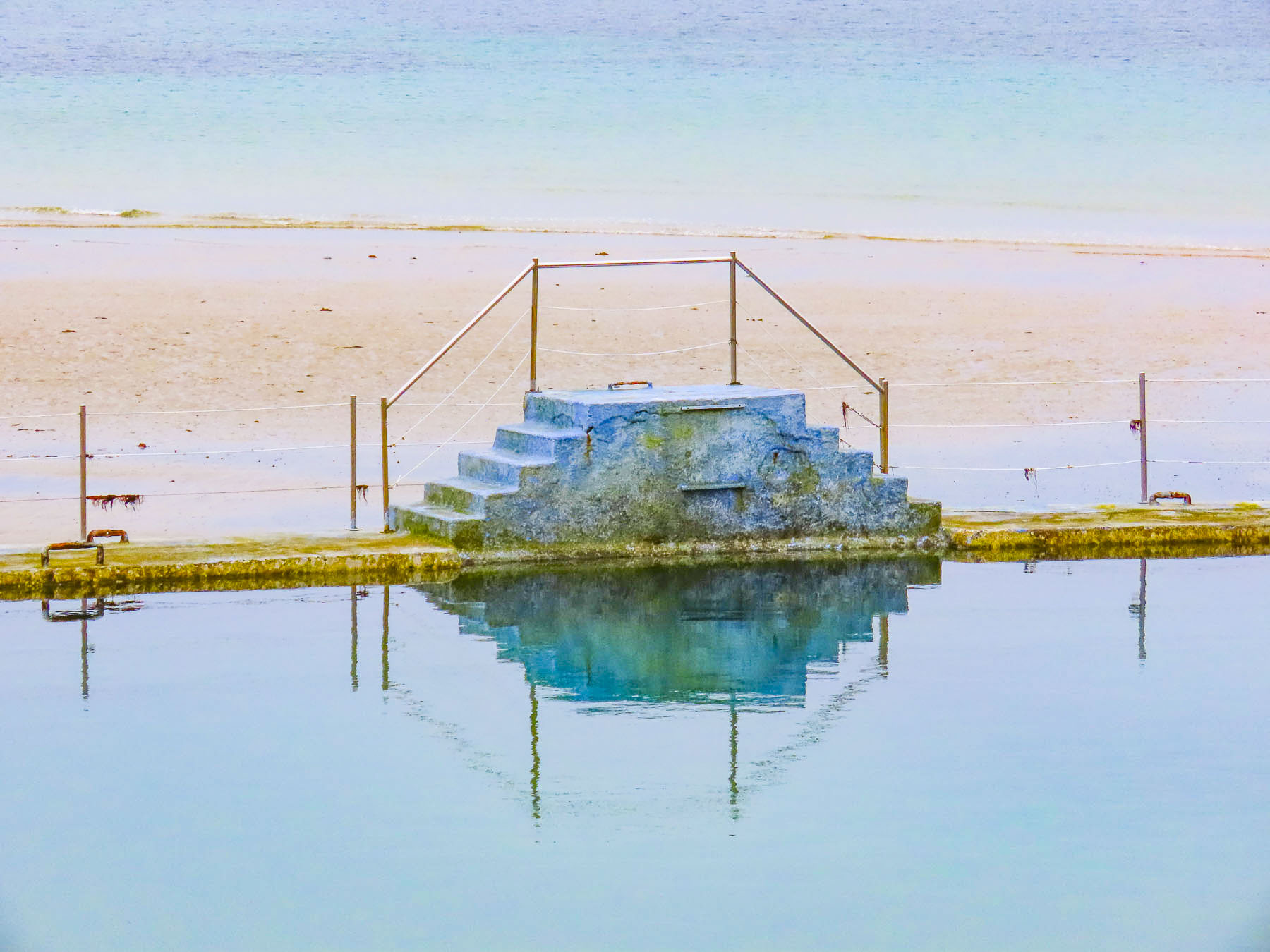
Lodging: Casa dos Ofícios Hotel

Dining: Restaurant Beira Rio and Sabores ao Rubro

Seville Part 5 – Road trip to Olvera & Setenil de las Bodegas

The countryside on the way to Olvera was more verdant than the earth toned landscape we traversed on our way to Zahara de la Sierra at the beginning of our road trip.  Now the hillsides were a mosaic of greens, light and soft, dark and vibrant, signaling the arrival of spring. 

As the road curved, Olvera’s Castle and the belltowers of the town’s church broke the horizon. We are never quite sure where to park in small villages.  Worried about getting fined for a parking violation, we always opt to play it safe and find a car lot.  But the parking in Olvera was at the bottom of a steep incline below the historic castle and we just didn’t have the oomph that morning to walk from there uphill and then continue higher to the top of the tower.  With some persistence we navigated the town’s labyrinth of narrow one-way lanes into the Plaza de la Iglesia. At the apex of the village, the plaza straddles the area between Olvera’s citadel and the town’s majestic church, Our Lady of the Incarnation Parish.  Since it was still the off-season, we were in luck and found the last, barely viable parking spot on the plaza. It was a narrow space that required the driver’s side door to be parked tightly against a wall. Fortunately, I’m still limber enough to climb over the car’s center console and stick shift, with a limited amount of grunting and moaning.

The view from the mirador at the edge of the plaza was wonderful.  Incredibly, the views across the village continued to get better and better as we climbed the different levels to the top of the Castillo de Olvera, perched atop a rocky outcrop at an altitude of 2000 feet. The climax was a spectacular view of the cathedral and panorama of whitewashed homes with red tiled roofs backed by a shimmering sea of silver green foiliage. Outside the village, the surrounding olive groves harbor nearly two million trees.

Constructed in the 12th century, the castle was part of a line of signal towers along the Moorish frontier in southern Spain. The castle was expanded in the 14th century when it was captured by King Alfonso XI during the Reconquista. The castilo is one of five in proximity to each other on The Castles Route, Witnesses of the Spanish Reconquest through the Moorish Strip, a no-man’s land that separated the ancient Christian Andalusia frontier from the Arab Kingdom of Granada. The other castles on the circuit are Castillo de las Aguzaderas, Castillo de Cote, Castillo de Morón de la Frontera, and the Castillo del Hierro.

With its size and architectural presence, Our Lady of the Incarnation Parish looks more like a cathedral than just a church. The neoclassical church was started in 1823 on the foundation of an earlier dismantled, gothic- mudéjar style church and dramatically counterbalances the castle on ridge above the village.  Ordered built by The Dukes of Osuna, the feudal lords over Olvera, the vaulted interior is lined with marble imported from Italy and has many interesting religious icons. To fulfill this extravagance the Dukes diverted the town’s taxes, away from improving the village, to pay for it.  They were the last feudal lords over Olvera and declared bankruptcy in 1843 when the church was completed. Then fled, never to be seen again.

A cloudless morning in Olvera turned overcast by the time we arrived in Setenil de las Bodegas only thirty minutes later. While considered a pueblo blanco, it’s totally different from Olvera and Zahara de la Sierra where the homes ascend the steep slopes under their town’s hilltop fortress.  In Setenil de las Bodegas, whitewashed homes front caves under large stone overhangs which line both sides of a gorge, created eons ago from the erosion caused by the swift moving water.

The homes along the gorge use the mammoth natural stone ledge as their roofs. The once raging Rio Trejo is now a quiet stream in the narrow gorge, which widens into a shallow ravine where an ancient Moorish castle still guards the approach to the village.  When the Romans colonized the area two thousand years ago folks had already been dwelling in the natural caves along the gorge for several millennia. Over the centuries the cave fronts were enclosed to create the unique village that still survives.

Before touring the village, we checked into the Hotel El Almendra to drop our bags, just oustside the historic district, with the intent of driving back and finding parking closer to the gorge.  We were just about to pull out of the hotel parking lot when a group of police cars with lights flashing and sirens wailing roared past. A slower patrol car parked and blocked the hotel driveway. Folks were beginning to gather on the sidewalk. We had no idea why until a motorcycle carrying a cameraman facing backward led the first wave of bicycle racers that were a blur of pedaling color as they sped by. A continual surge of racers crested the knoll of the road and coursed downhill towards the village. The race was one leg of the annual Vuelta a Andalucia – Ruta del Sol. A five-day, 500 mile cross-country cycling event that summits 17 mountain passes in the region and attracts 600 riders. Leaving the car at the hotel, we decided to walk the half mile into the village.

By the time we reached Cuevas del Sol, Caves of the Sun, the narrow one-way road through the gorge lined with small taverns and inns, the sun was brightly shining again.  Even though the road is open to cars, it was filled with folks walking and was almost pinched closed by tables from the restaurants narrowing its width.  We found a table and enjoyed both the lunch and the warmth of the February sun.

Afterwards we walked the length of the lane through the deep chasm until a set of stairs led to the Mirador del Carmen and the small 18th century chapel Ermita de Ntra. Sra. Del Carmen.  The view from the overlook encompassed a sweeping vista of the valley filled with whitewashed pueblos stacked atop one another filling the valley to its rim. 

The Nazari Castle, the town’s 12th century Moorish fortress, still stands vigilantly on the edge of the valley, the invaders now camera-wielding tourists.  Across from it the Gothic style Church of Our Lady of the Incarnation, itself an imposing fortress-like structure, was ordered built by the Spanish Crown. It was constructed in 1505, above the town’s previous mosque, to celebrate the liberation of the village from centuries of Arab rule.  We walked back to our hotel along a lane above the gorge lined with newer buildings. 

Heading back to Seville before sunrise the next morning we stopped high above the village on the road that followed the ridge opposite the Cuevas del Sol, in one last attempt to capture the iconic pueblos of the village as dawn cast its first rays of light across the gorge.

Till next time, Craig & Donna

PS. Our 226-mile weekend roundtrip from Seville only used slightly more than a half tank of gasoline.