Albania Road Trip:   Apollonia & Upper Qeparo – A Journey Back Through Centuries

We slowed to let a shepherd guide his flock across the road to Apollonia. An hour earlier the sky was brighter as we left Berat. Our intention for the day was to visit the Archaeological Museum of Apollonia before heading to Vlora, on the coast, and then continuing south to the Llogara Pass, for epic views of the Adriatic Coast before reaching our accommodation in Upper Qeparo, a semi-abandoned, old Albanian village, for the night. But the deepening grey sky was concerning. The sheep were now grazing on tufts of grass, growing in between parked cars, in the dirt parking lot at the foot of the hill below the archaeological park. A short uphill walk got our circulation going and brightened our mood.  A large group from a bus tour followed their pennant waving guide uphill, towards ruins still hidden from view.
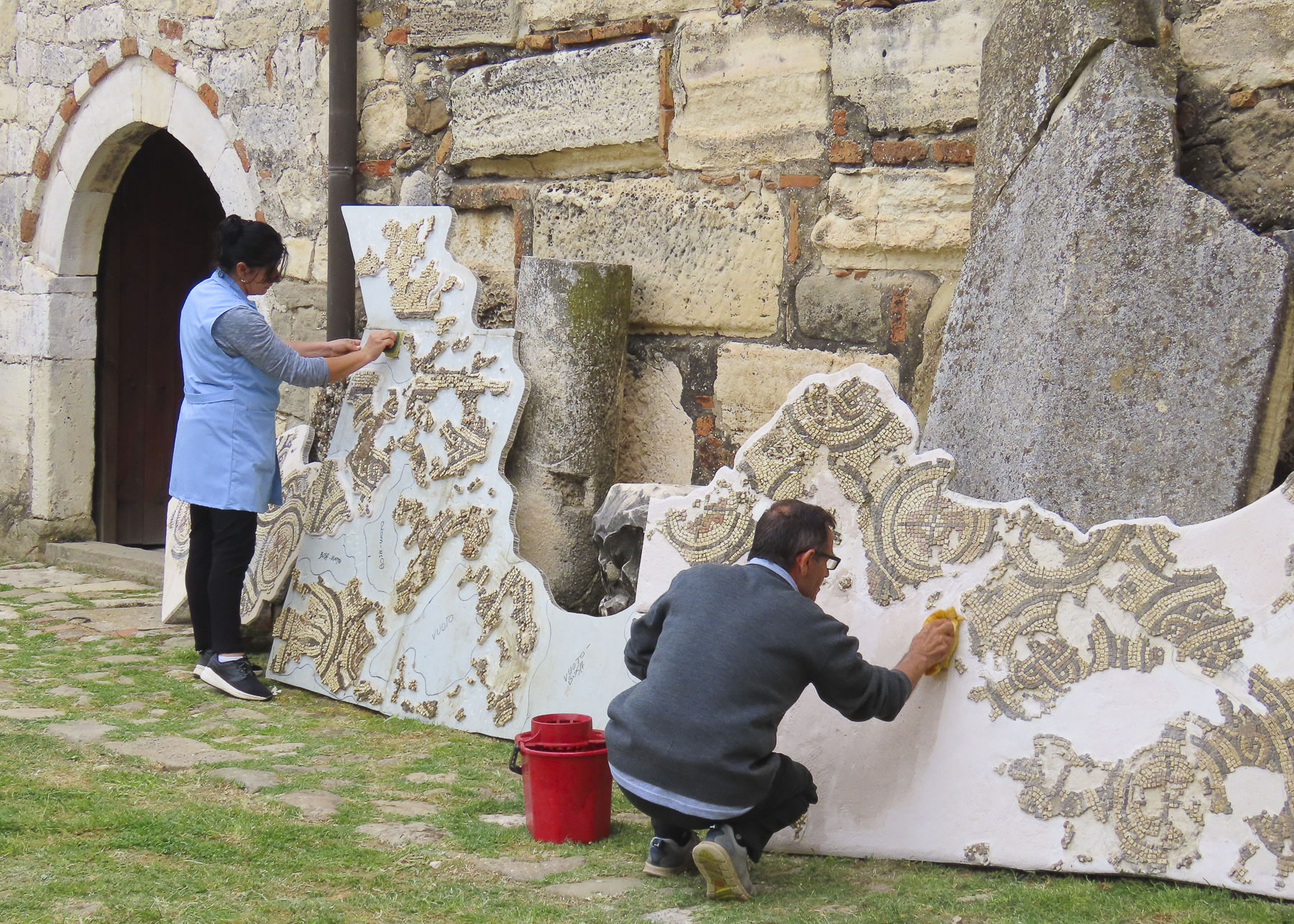
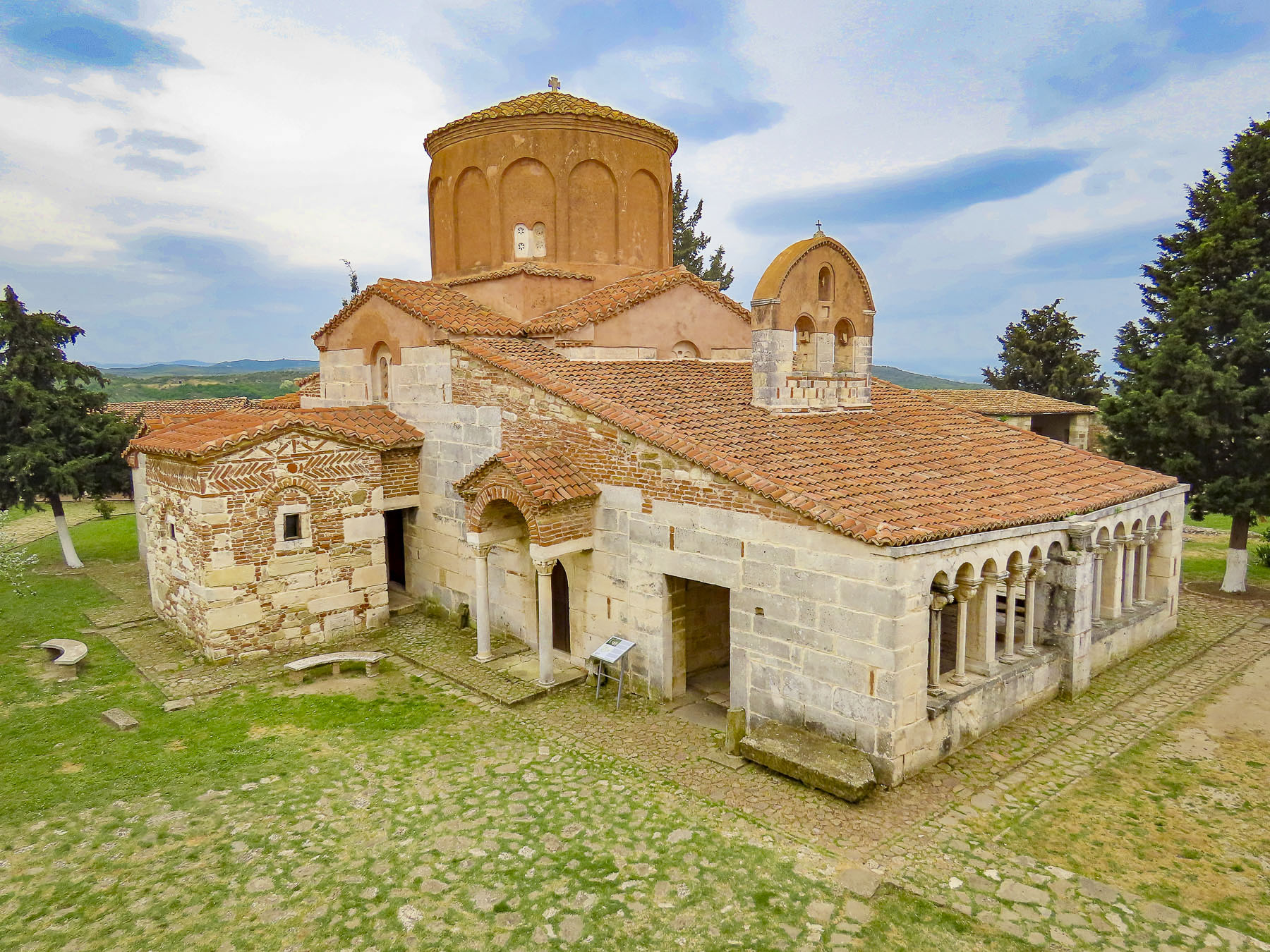
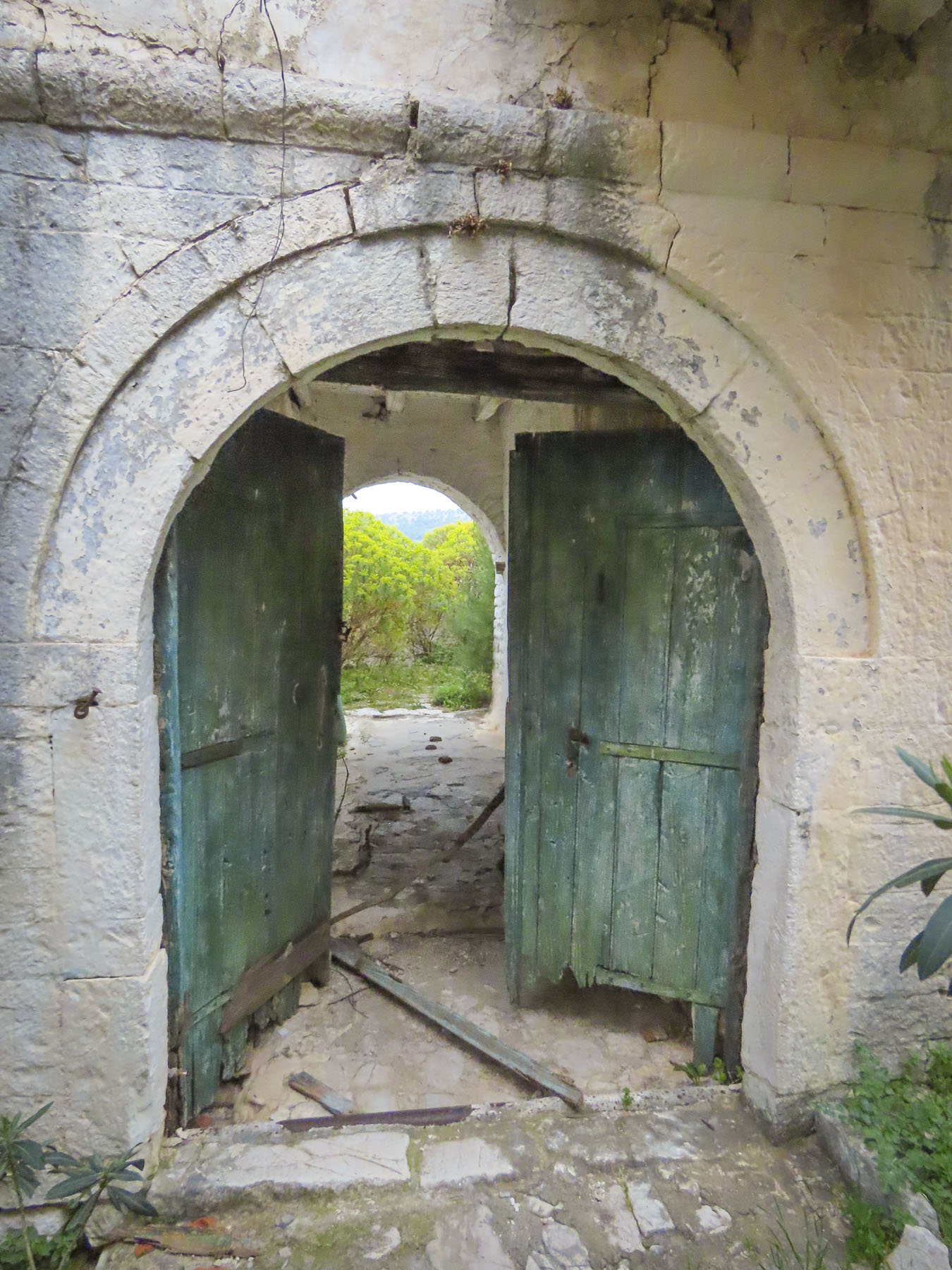
We turned in the opposite direction to investigate the Sleeping Saint Mary Church and its Ardenica Monastery, and entered its courtyard through an arched gateway with a heavy wooden door.  Outside the refectory museum, staff had propped up large sections of a mosaic floor and were cleaning them with soapy water and a scrub brush.

The church and monastery date to 1282 when the Byzantine Emperor, Andronikos II Palaiologos, ordered their construction to celebrate his army’s victory over the Angevins during the defense of Berat a year earlier. Stones for the church, monastery and the other buildings that form a large defensive courtyard were quarried from the ruins of ancient Apollina.

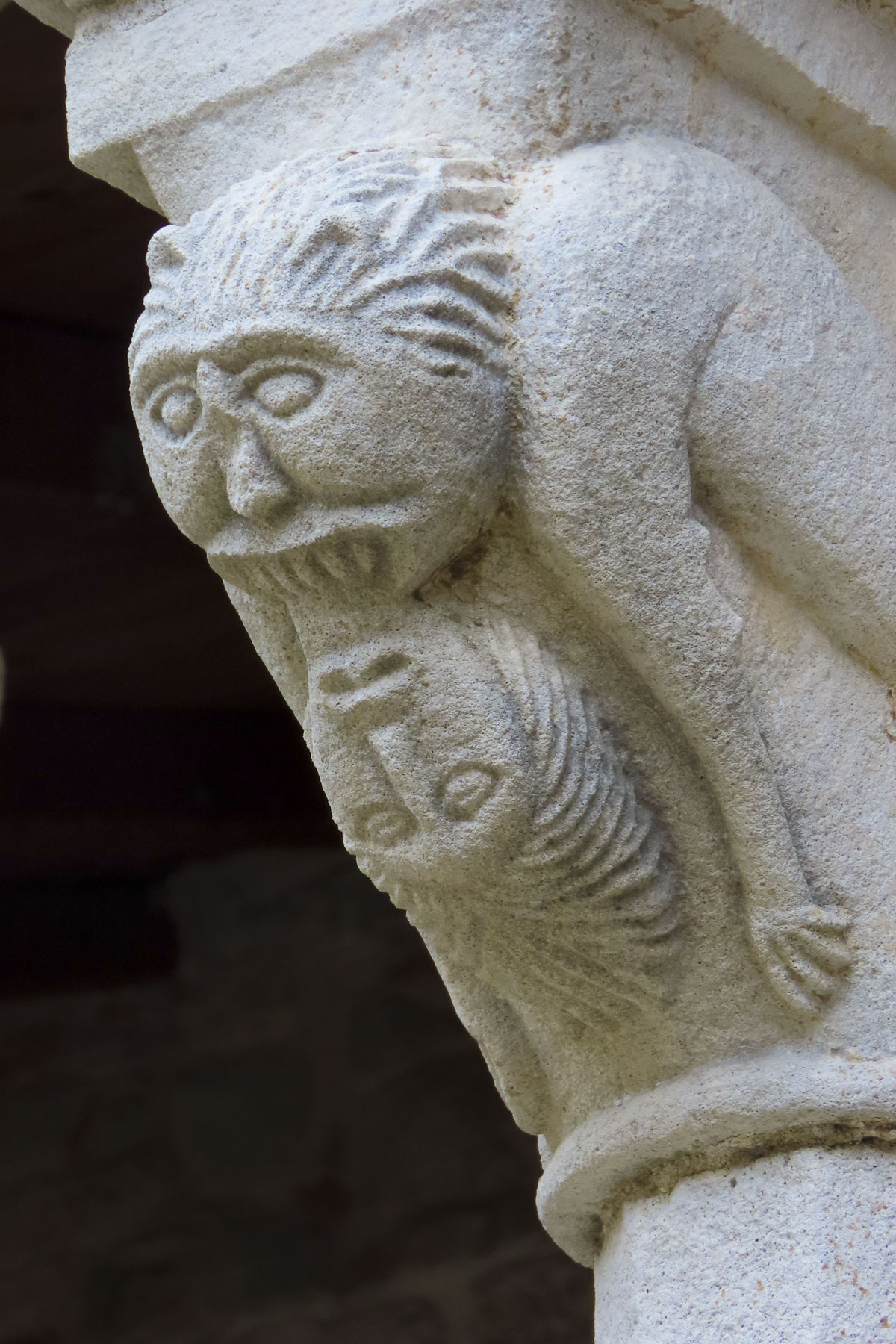
As we walked around, it was interesting to see parts of old pillars, capitals and decorative elements randomly used amongst stone blocks to build the exterior walls. The Albanian national hero Skanderbeg and his bride Andronika Arianiti celebrated their marriage vows here in 1451.

It was this historical fact, and a fast-thinking priest, in 1967, that saved the church from the communist wrecking ball of Enver Hoxha’s atheist campaign to destroy churches across the country. The monastery building now houses a fascinating collection of antiquities from Illyrian, Greek, and Roman occupants of the city.
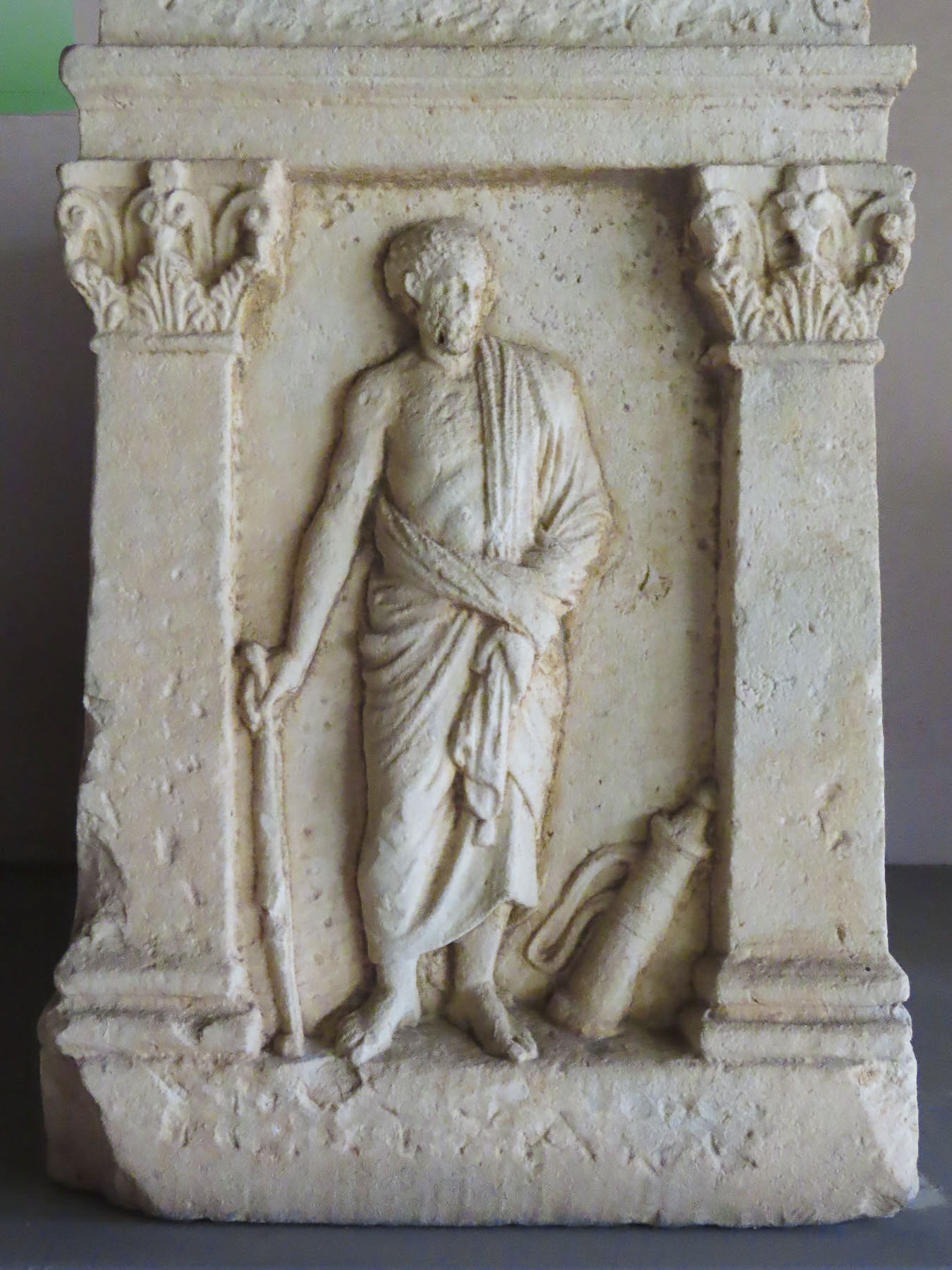
Founded in the 6th century BC, Apollonia was a prosperous seaport on the Adriatic Sea at the mouth of Vjosa River, and a strategic link on the Via Egnatia, a Roman road constructed in the 2nd century BC that connected the seaport to Constantinople, through what are now the modern countries of Albania, North Macedonia, Greece, and Turkey. The ancient city also grew wealthy from a trade route that followed the Vjosa River valley south and ended in Thessaloniki, Greece, on the Aegean Sea. At its height Apollonia was surrounded by two miles of defensive walls that protected a population of 60,000. The importance of the city slowly faded after a 243 AD earthquake altered the course of the Vjosa River and Apollina’s large harbor, which could hold 100 ships at a time, began to fill with silt. The city was eventually abandoned in the 4th century.

The archeological park is a vast site spread across rolling hills, but today the Temple of Apollo, with only its front façade intact, is the most complete ruin. Walking up the slope behind the temple, a panoramic view revealed fertile farmland separated from the Adriatic Sea by low hills, some of which had a series of doors carved into their hillside.

These are some of Hoxha’s estimated 750,000 military bunkers that the paranoid dictator built across Albania. At the top of the hill there was a very tranquil looking outdoor café/restaurant, that we pegged as the perfect spot for a break, but unfortunately it was still closed in mid-April when we visited. Fortunately, there was a second restaurant closer to the church that served excellent coffee, and was much appreciated on this chilly, damp day.

The weather refused to cooperate with our plans to explore the waterfront in Vlora, Albania’s third largest city, and we opted instead to have a quick lunch before driving on. Parking in this beach town can be particularly challenging, even in the shoulder season, and we opted for a cash-only, pay as you enter, parking lot. Surprisingly, the attendant was unable to break the bill we gave him, and he told us to wait as he disappeared around the corner at the end of the block in search of change. There were many expensive lunch options on the elegant, palm lined Rruga Aleksandër Moisiu, which hugged the beachfront in front of towering apartments. But this was lunch and it was just too dreary to sit outside. Fortunately, we stumbled across Taverna Dangëllia, a delightful place with an open grill, that was reassuringly busy on a weekday afternoon. We ordered a variety of traditional Albanian dishes, all delicious and inexpensive. Charmingly though, the one quirky thing about the place was the DJ, who fell asleep in his chair, as his music selections played on. Maybe Raki is the new melatonin.

While we were looking forward to some great views of the Adriatic from the route through the Llogara Pass, the grey day was challenging for landscape photography, and we decided to take a faster, more inland drive to Upper Qeparo along SH76. It was a more interesting drive than we had anticipated through the Shushices River Valley before crossing over the mountains to the Adriatic coast near Himarë.

We were zipping along when we suddenly passed a colossal arched memorial set back from the road. A quick U-turn brought us back to the Drashovica Monument. Erected in 1980, the monument was designed in the soviet art style that celebrates the collective effort and commemorates the Albanian resistance fighters who in 1920 liberated Vlora from the WW1 Italian occupiers who refused to leave, thereby defeating Italy’s plans to annex the country. The monument also commemorated the Battle of Drashovica in 1943, where communists and nationalist guerilla fighters united to defeat a larger German force, during a battle that lasted 20 days. Albania has a long history of fighting for its freedom, starting with Skanderbeg’s resistance to the Ottoman invasions in the 15th century and culminated with Albania liberating itself, without the help of the Allied armies, from Nazi occupation during WWII. Behind us an elderly man led a donkey down the embankment of the river toward the water.

Farther along we stopped at a narrow, suspended footbridge that hung over the river. It was a rickety lifeline to small hamlets tucked into the mountains across the river, the footbridge being their only route to the outside world. Though by the sheer number of sheep droppings at the beginning of the walkway it’s a fair assumption that shepherds move their flocks of sheep across it when they switch grazing pastures. That would have been quite a sight to see.

Just down from the bridge, set against a mountainous background, was a small cemetery with interesting headstones. Carved or etched into the granite blocks were photographic quality portraits of the deceased. Some were just tight headshots, while others were full length pictures that captured the individual in their traditional wardrobe. We found these stone tributes very moving.

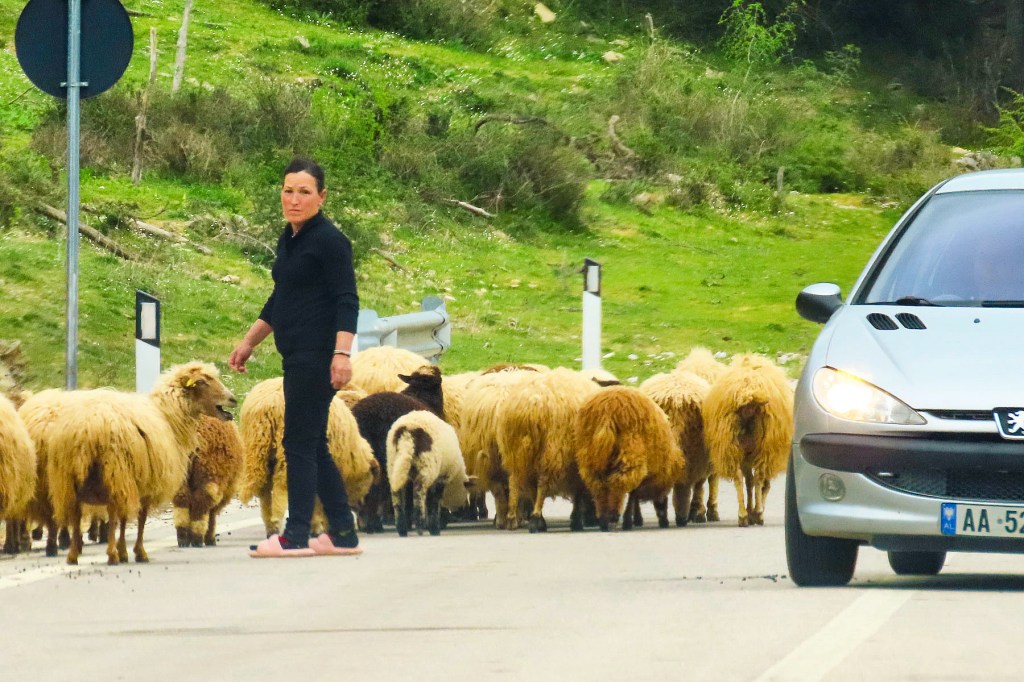
We passed several other footbridges in various stages of collapse, as if they had been caught in destructive floodwaters. There was also an ancient stone bridge in the village of Brataj that I wish we had investigated, but the footpath down to it looked a little too rough for us to navigate. Shepherds ushering their livestock across the road were frequent occurrences. Though the most memorable herder was the gal in pink slippers urging her sheep into a different pasture.
An Albanian standoff happened in the middle of a bridge as a herd of cattle stopped traffic in both directions and refused to budge from the double yellow line, their owner nowhere in sight to encourage them to mosey along.

On the coastal road a small directional sign warned of the approaching turn to Upper Qeparo. We hesitated to commit as the lane looked more like a driveway between two buildings than a road suitable to follow up into the mountains. We cautiously followed the narrow sinuous road, dotted with homes built into the steep hillside covered with ancient olive trees, uphill around blind curves. We began tooting our horn occasionally now to warn any oncoming cars of our presence, after barely avoiding a fender-bender moments earlier. It was difficult enough on this roughly paved track to reach the village and we speculated about the villagers’ hardships when they only had donkeys or horses to traverse the mountain.
Somehow the host of the small guest house we had made a reservation with overbooked, and by the time we arrived all the rooms were taken. Luckily for us, her neighbor Veronika, the owner of Te Rrapi I Veronikes restaurant across the street, also rents rooms above the tavern, and had one available for the night. The room, although basic, was immaculate, and the gleaming floors were so clean we couldn’t bear to walk on them in our dusty shoes. We left our dirty footwear at the front door, and our hostess seemed to appreciate our nod to her high standards of cleanliness.

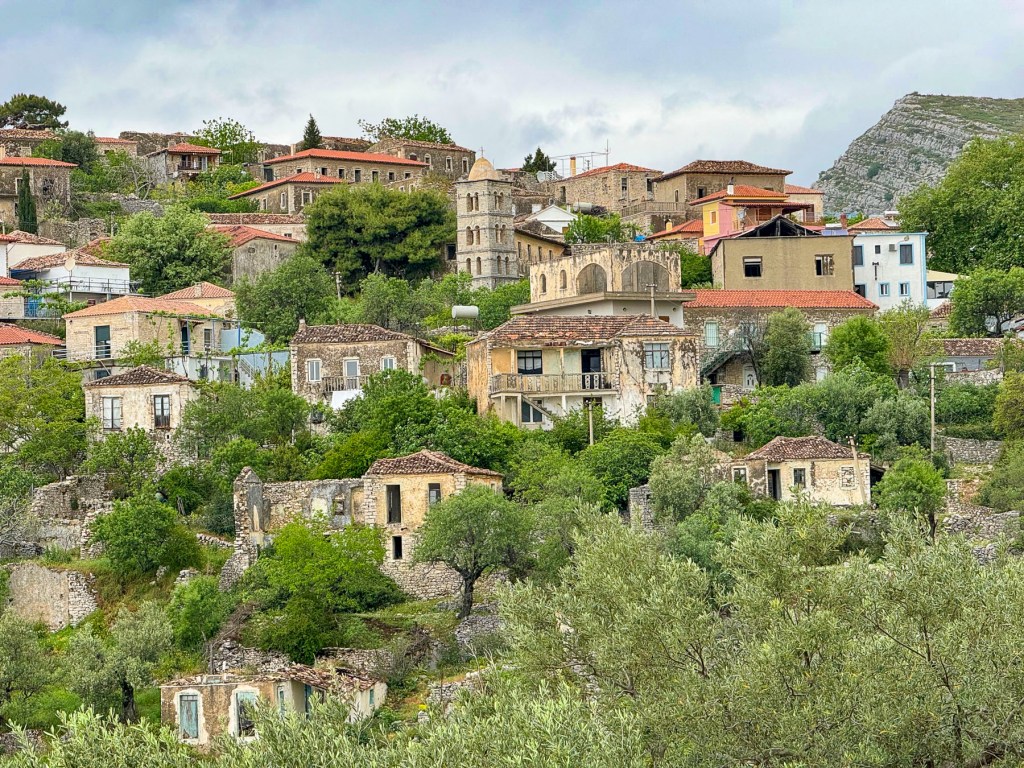
There was still plenty of time before dinner to explore, and we set off. The ancient village is set atop a 1500’ high haystack-shaped hill surrounded by steep mountains covered in scree, like an isolated volcanic island surrounded by ocean. Across the ravine on the outskirts of the village, the stone ruins of a small outpost called the Ali Pasha’s Tower, and the town’s cemetery above it, almost dissolved into the landscape in the late afternoon light. Mention of the ancient village first appears in Ottoman records of 1431, and then 1583 when it’s noted the village had 50 homes. Though archeological evidence unearthed at Karos Castle, just a short distance beyond the tower, suggests that the area has been inhabited since the Iron Age.
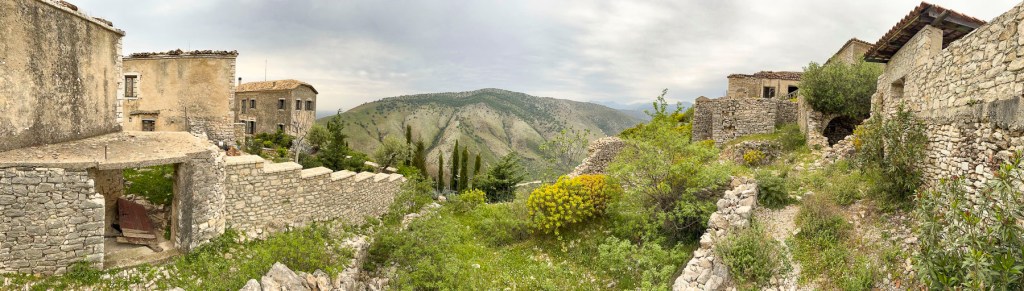
Sadly, the village has endured an exodus since the late 1950’s when the Albanian government built the road along the coast, thereby providing services and infrastructure to a new village, lower Qeparo, which boosted its residents’ economic prospects. The aftermath of Albania’s economic collapse in 1997 forced most of the remaining townspeople of Upper Qeparo to emigrate to countries in Europe or overseas for better economic opportunities. The old folks who stayed relied mostly on remittances from abroad to survive. The future prospects for Upper Qeparo are improving, with more tourists now frequently visiting this charming village, and former residents returning after years working abroad and reinvesting in it.

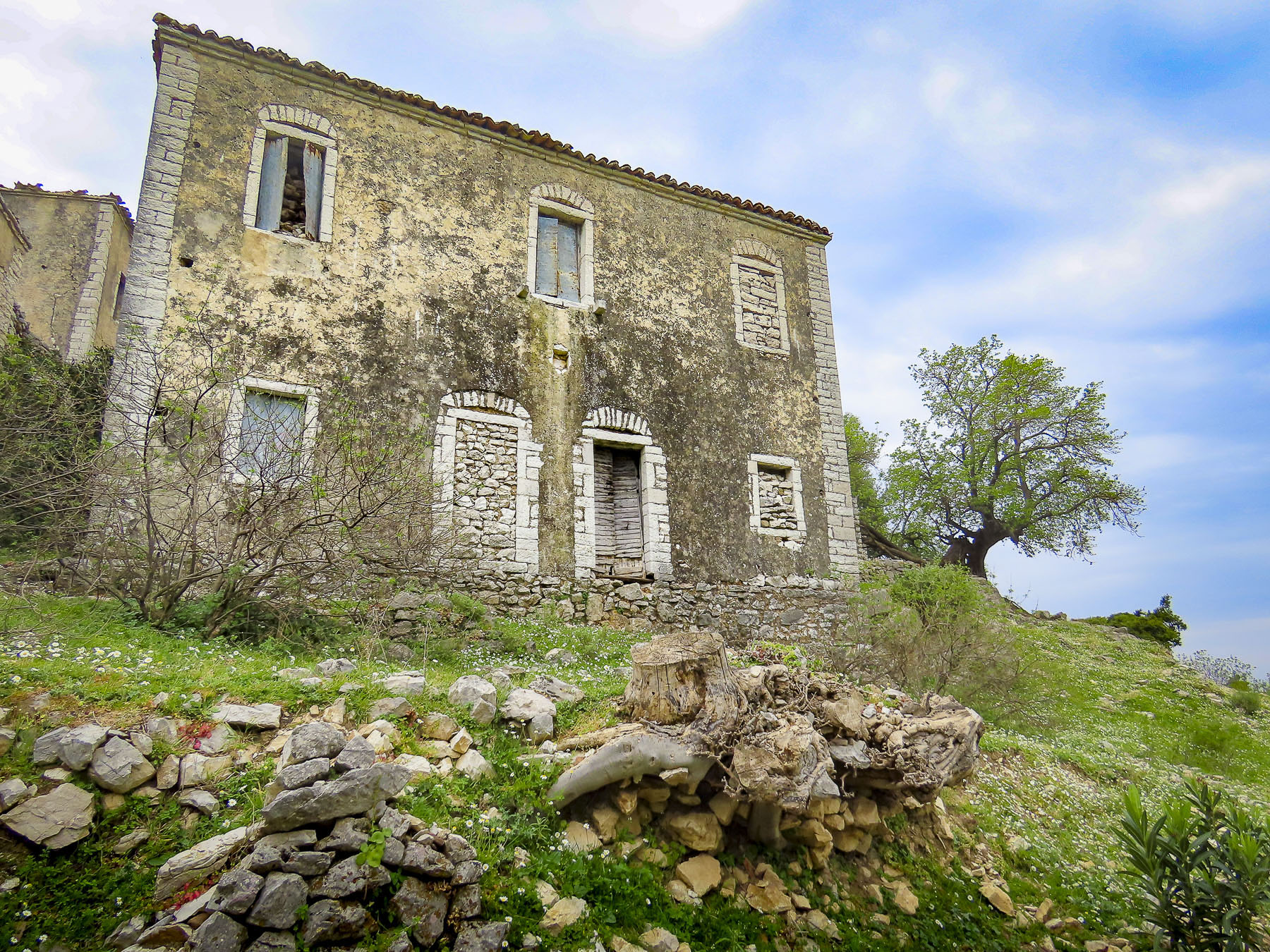
A large Billy goat commanded a boulder above us when we turned to wander the labyrinth of alleys that comprise the old town. Like a sentry, he eyed us but let us pass unchallenged. Occasionally we cut a path through abandoned homes with their roofless rooms opened to the elements, carefully placing our steps to avoid falling through any deteriorated floor beams. Sometimes we passed a freshly painted door boasting new brass hardware. A look up revealed new windows and a renovation proudly underway.

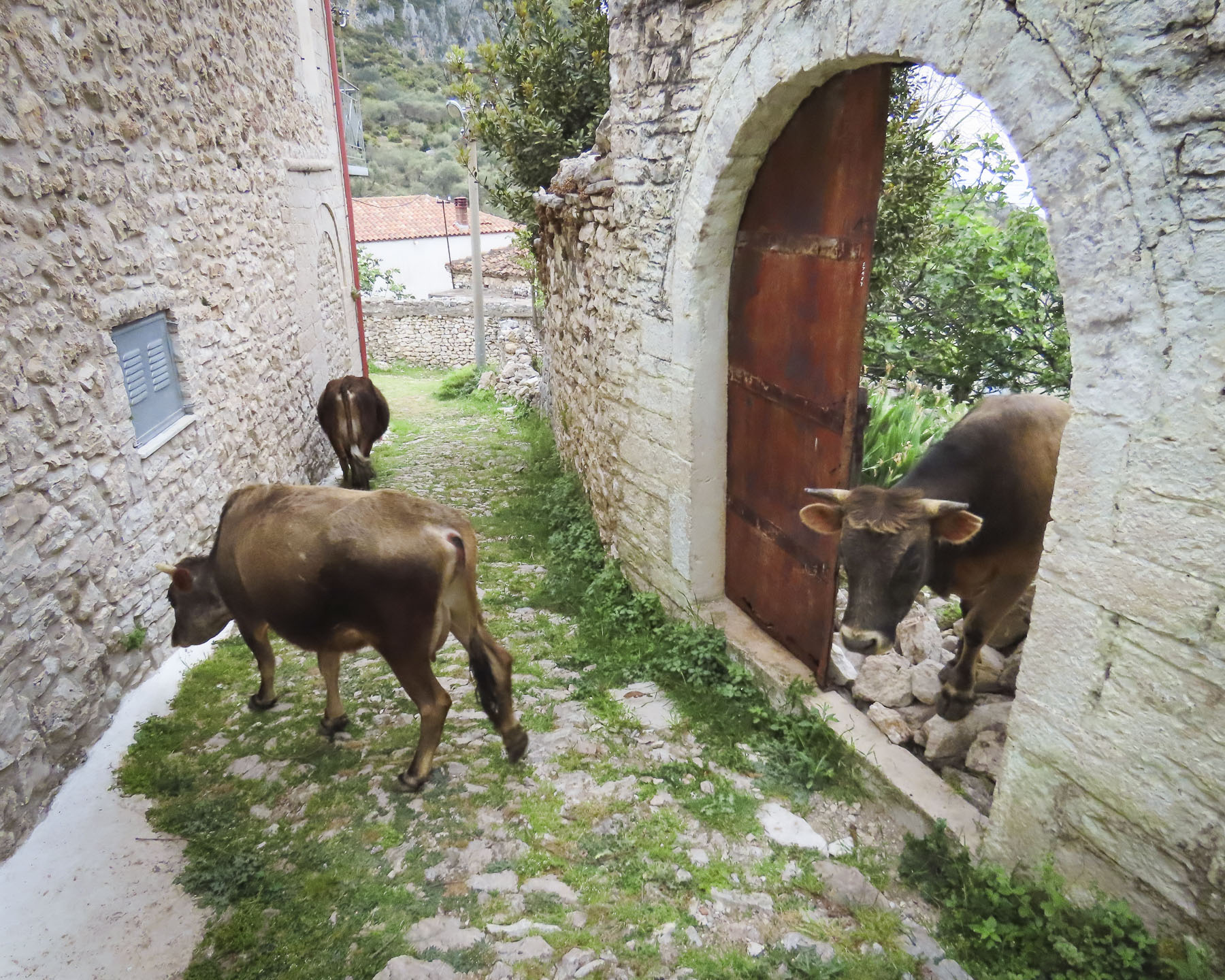
Farther along a cow, chased by her owner, entered the alleyway through the door of a long vacant home. The interior opened to the sky, and grass as thick as pasture grew where the floor used to be. Every now and then, between the buildings, we glimpsed distant views of the Adriatic Sea far below. Fig trees opportunistically grew through open windows, and untended olive trees arched over our heads. A few teenagers lazily kicked a soccer ball against the belltower base of St Mary’s Church, constructed in 1796.
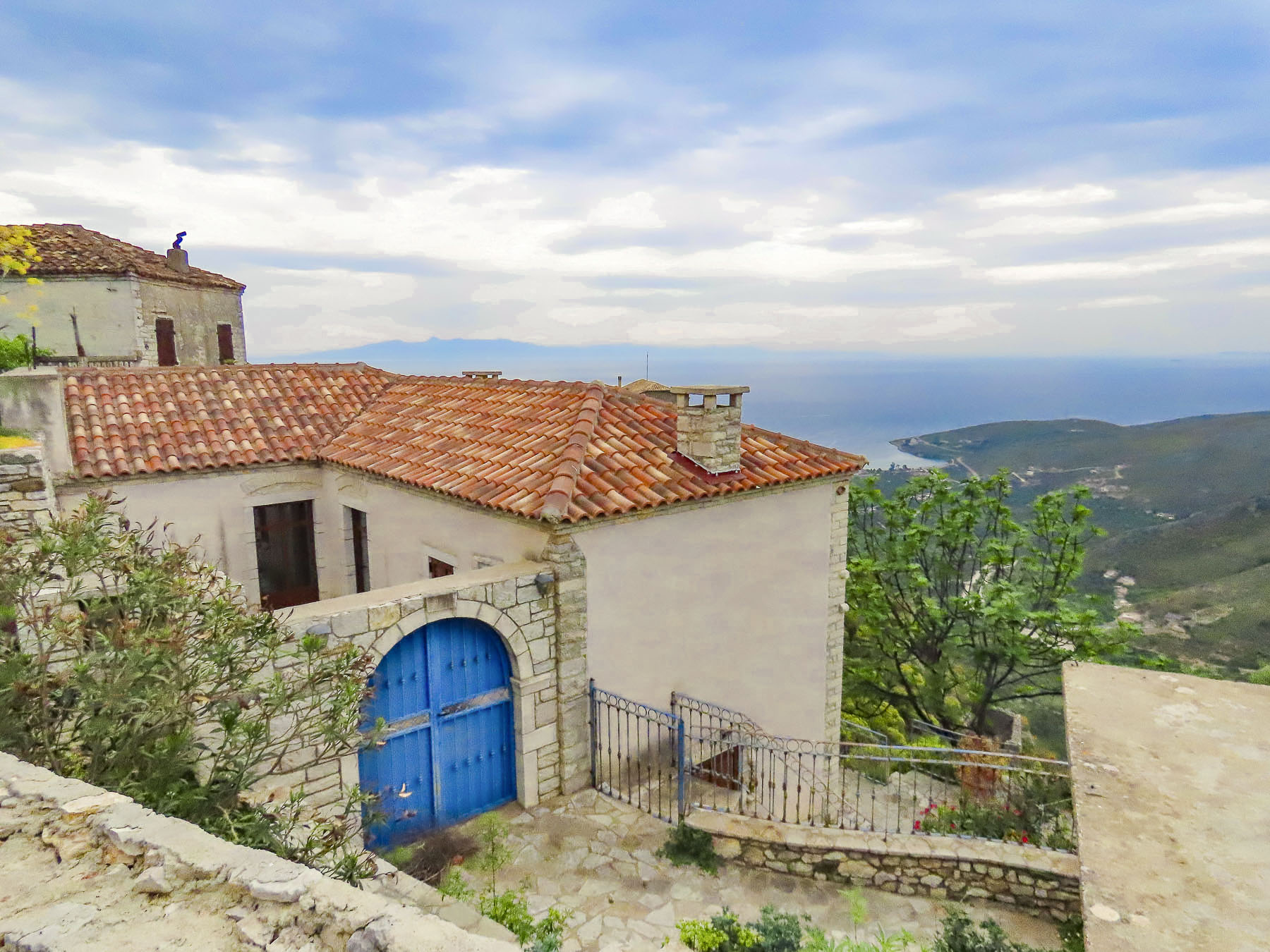
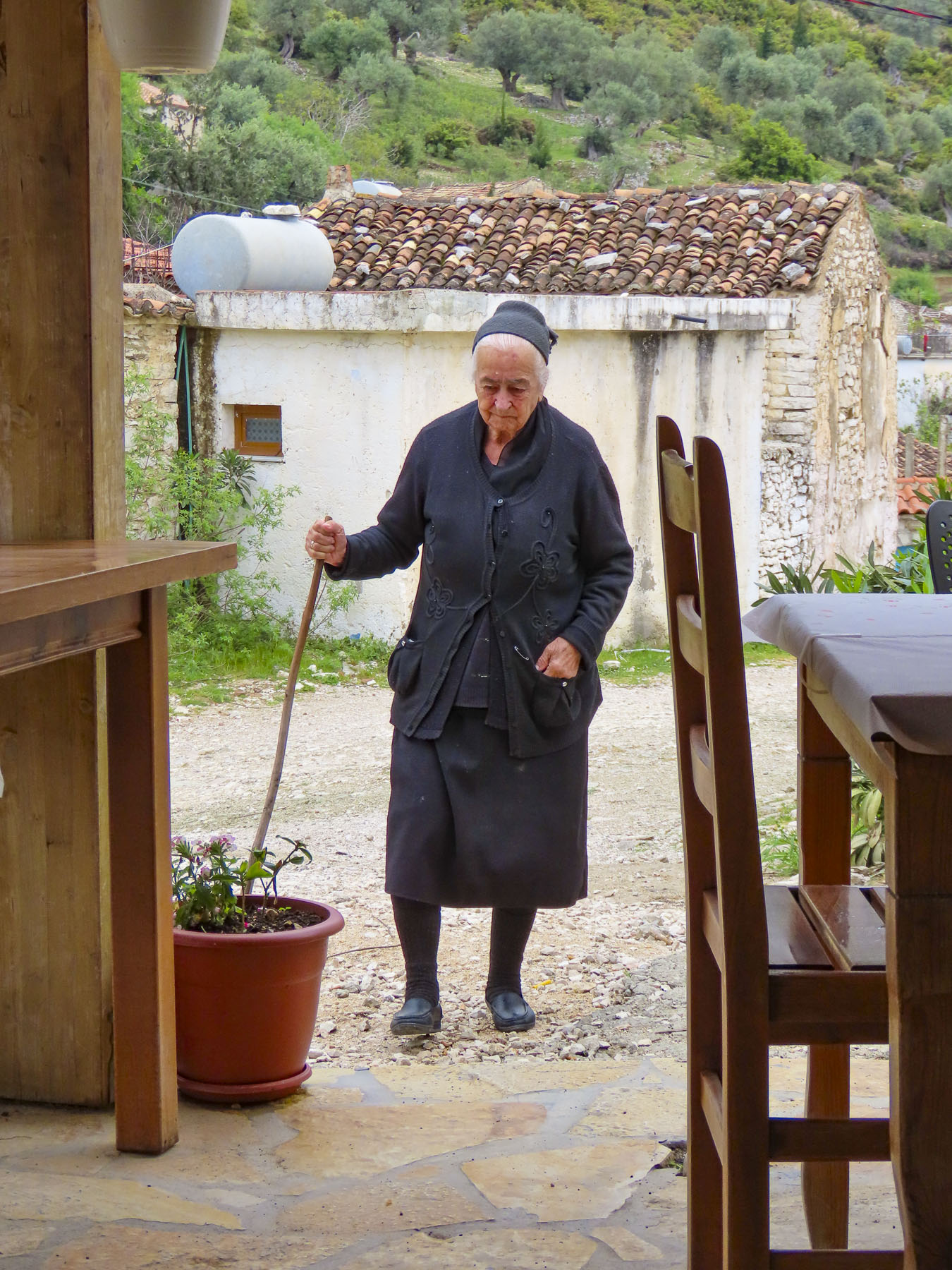
Veronika didn’t offer a menu, but she enthusiastically invited us back into her kitchen where she explained the traditional dishes that she had created that day for dinner, and we were not dissappointed. Later, on the restaurant’s veranda, we capped a great day with a splendid dinner and glasses of Veronika’s husband’s homemade raki. We slept well.

Till next time,  Craig & Donna

Puglia: Alberobello – Trulli, Troglodytes and the Sea

One of the characteristics we most appreciated about traveling through Europe was the ready availability of a cup of delicious coffee, even in the most unexpected of places. The bar on the ferry from Dubrovnik to Bari came through with two tasty cappuccinos the morning after our overnight passage in a windowless cabin. As a hazy sunrise dawned over the Adriatic Sea, we sipped our revitalizing espresso and milk while the ship docked in Bari, capping an otherwise uneventful crossing to the Puglia region – “the heel of Italy” or the “spur of the boot.” 

Behind the wheel of our rental car, we passed through verdant olive groves in the Valle d’Itria, alternately known as the Valle d’Trulli or the Valley of Ancient Olive Trees. Olives trees are celebrated for their age in the region, and several top two thousand years old.  One ancient millennarian called the Elephant is 3,000 years old. The orchards on either side of the road were busy with workers covering the ground under the trees with collection nets in preparation for the olive harvest.

A little aside – we are olive aficionados. All things olive we enjoy. We have even brined our own, ordering California olives, then scoring and soaking them for three months in salt water to remove the extremely bitter oleuropein.  As tasty as they are after this process, they are downright vile beforehand, which has always made me wonder how it was determined that they were edible.  Did a starving hunter-gatherer pluck a floating olive from a salt marsh and make the discovery of a lifetime?

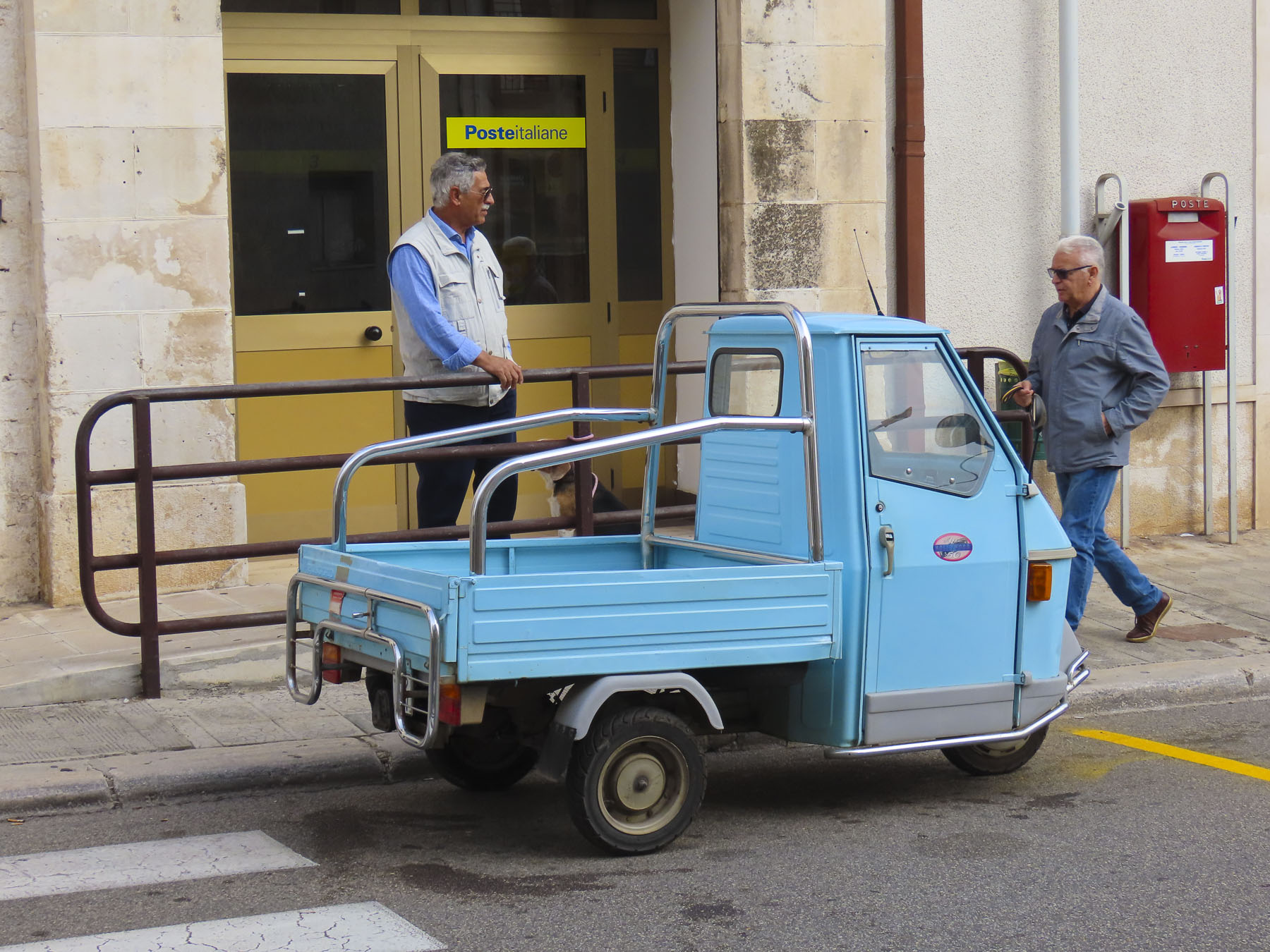
Farther along we sped past a farmer selling yellow melons from the back of his three-wheeled Piaggio Ape, a small truck that is ubiquitous throughout the farmlands of Italy. We did a quick U-turn to buy two from him, and they were delicious.  Our progress slowed through another small town as a brass band led funeral mourners across the road ahead of us.

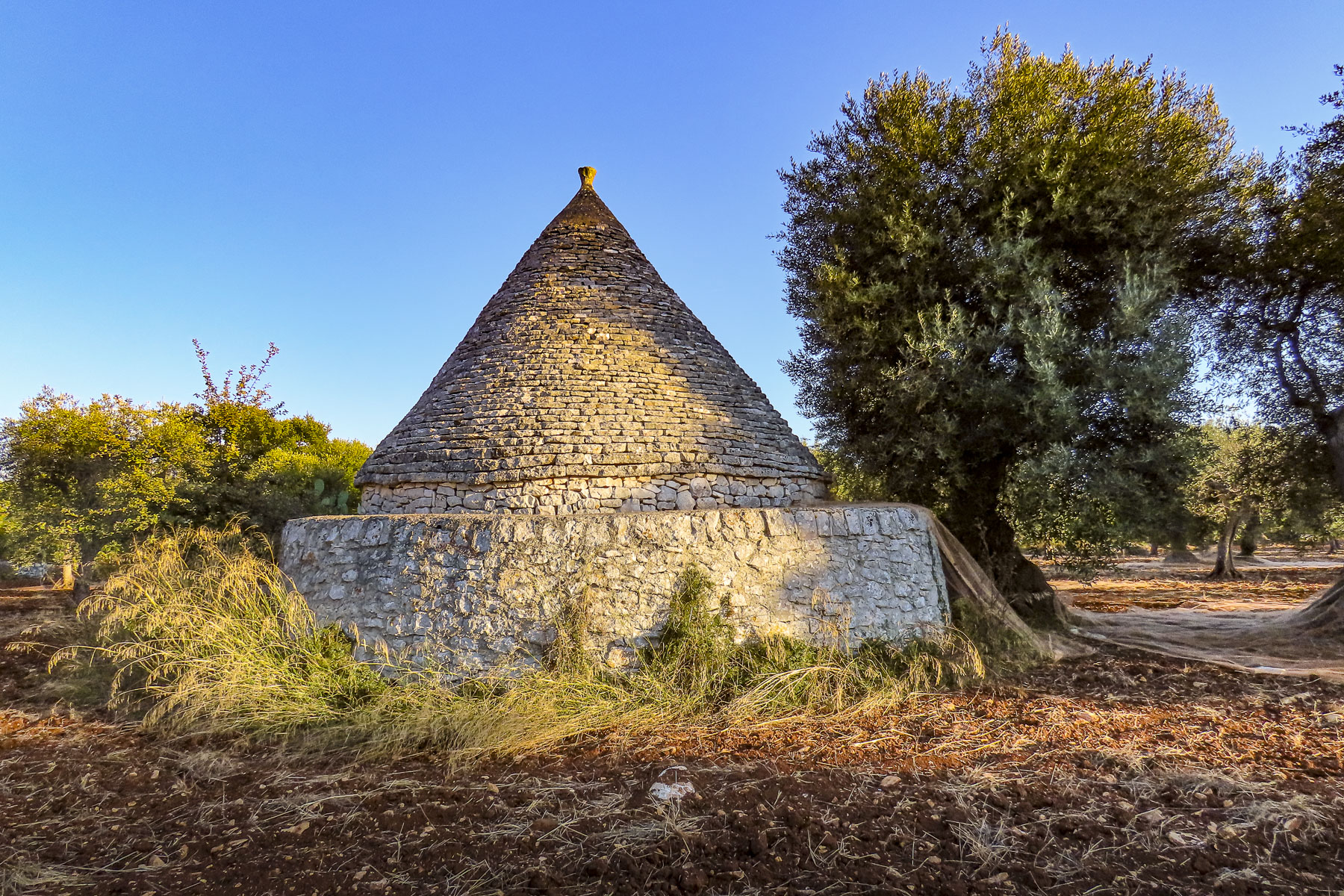
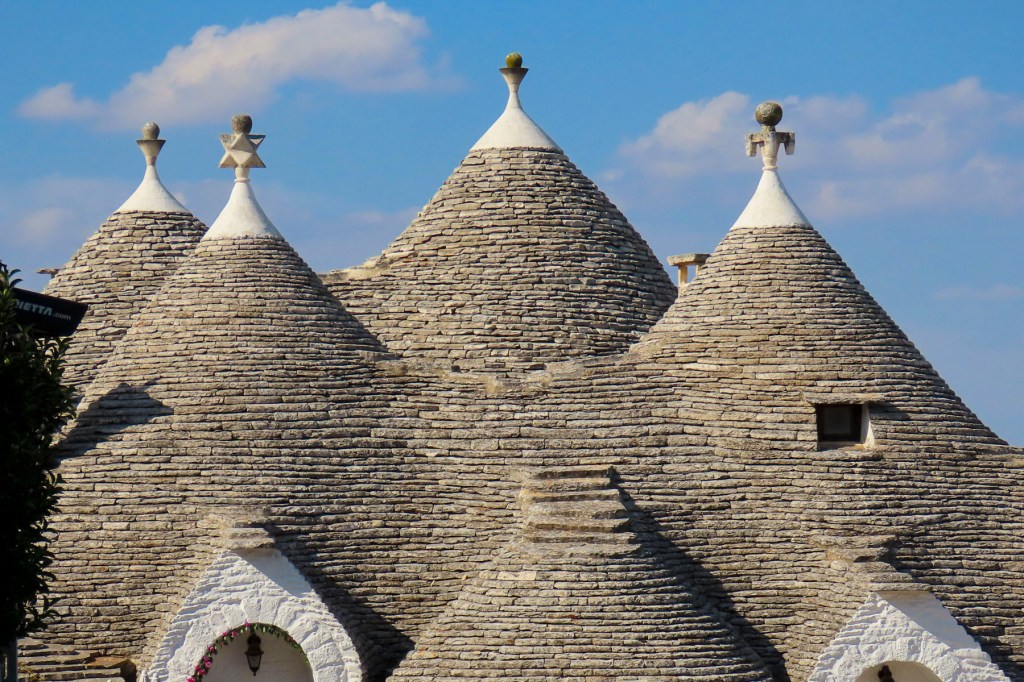
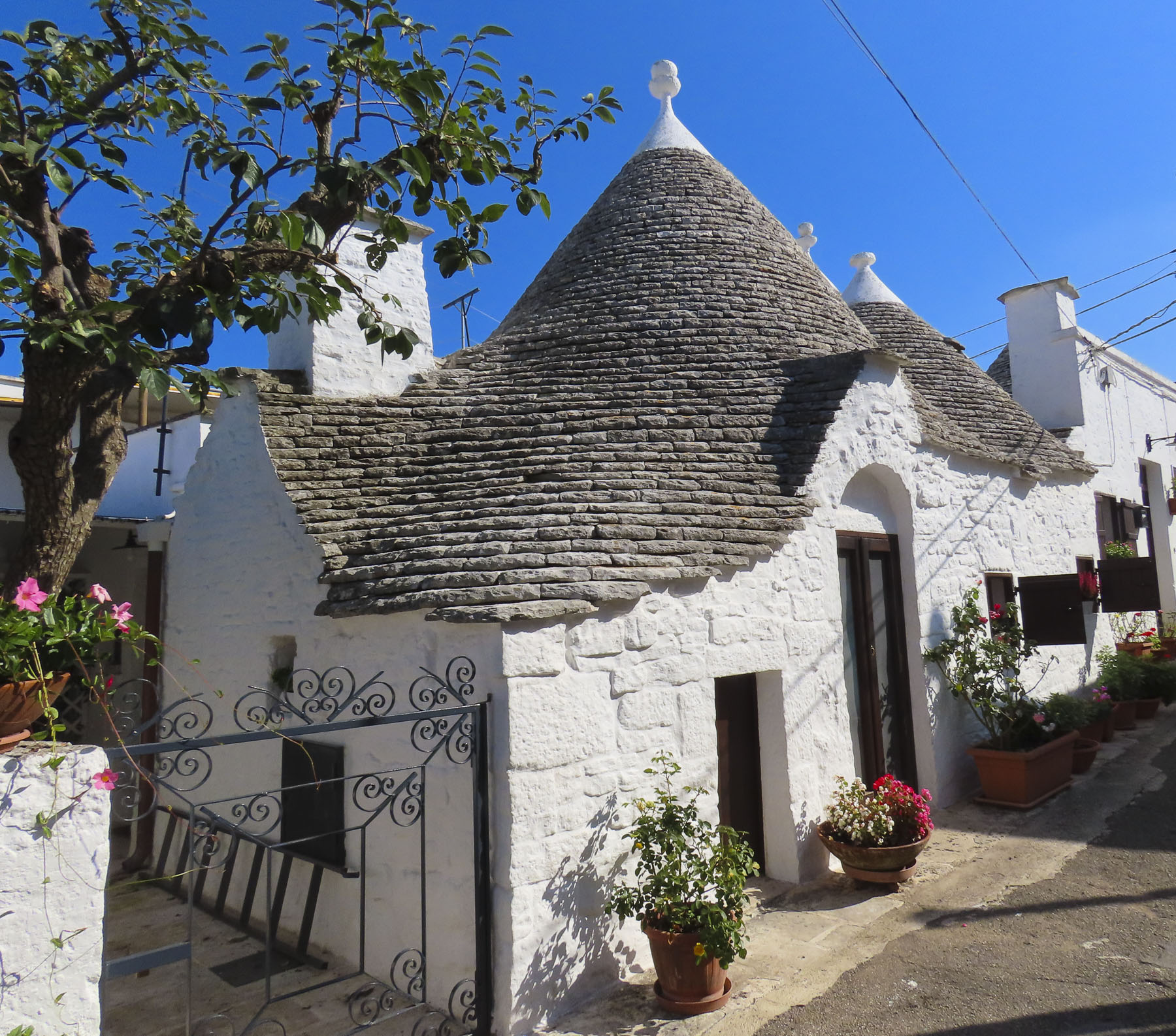
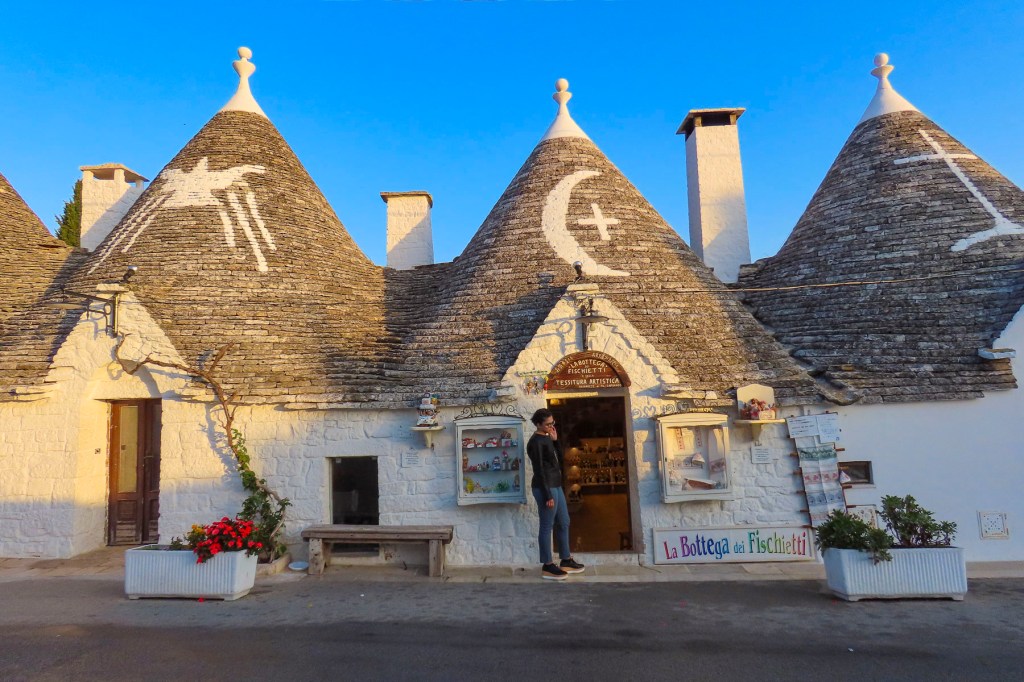
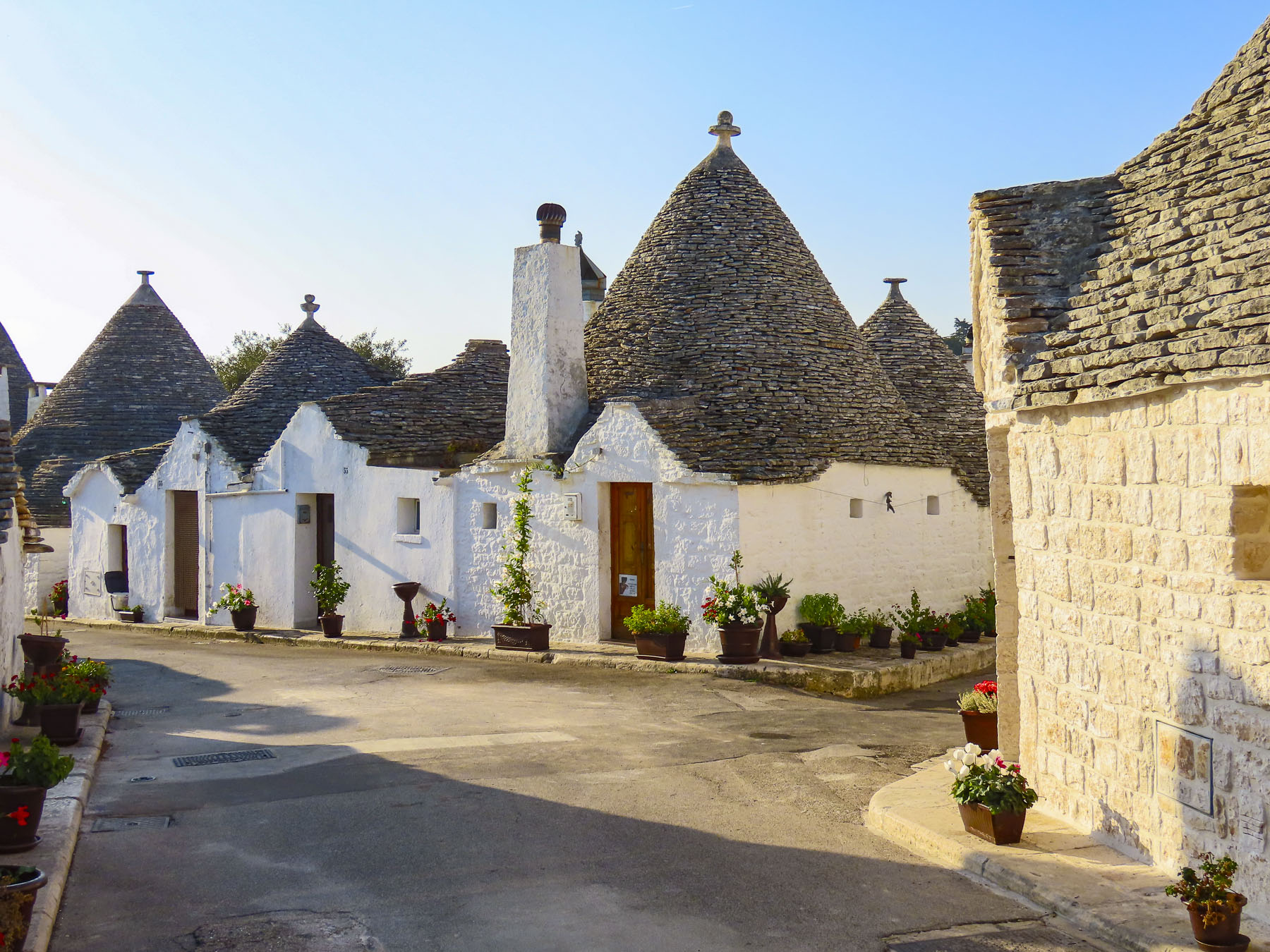
Our destination was Alberobello, to meet up with three of our sons and especially to live in a trullo for a week.  This was the culmination of a decades-long desire ever since becoming aware of these enchanting, whitewashed dwellings capped with conical-shaped stone roofs with a pinnacle at the top.

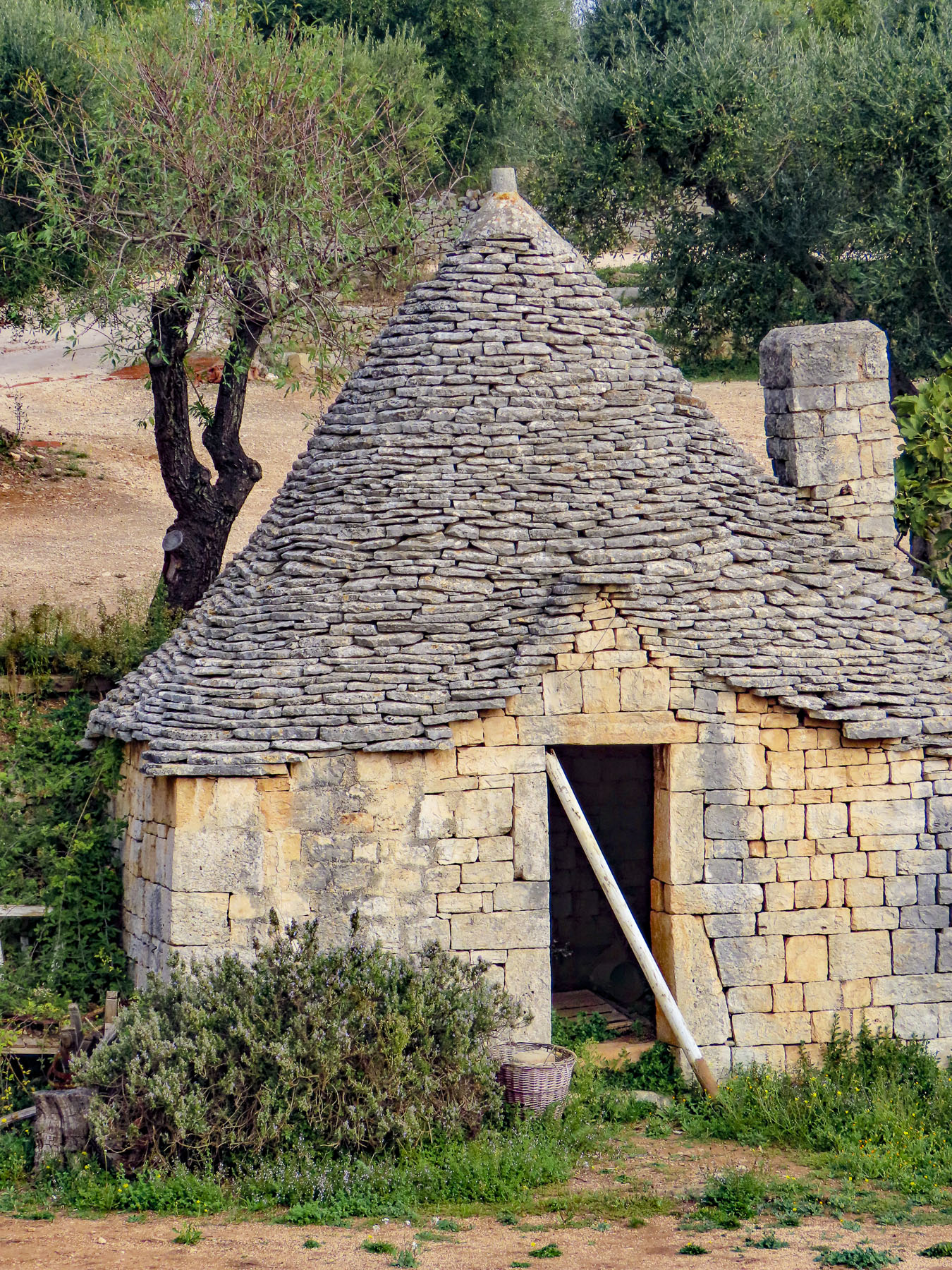
Trullo comes from the Greek word for circular domed construction, tholos.  But it is thought the “a secco” style, without mortar construction technique, was brought to Puglia by North African invaders when Sicily was under Arab rule in the mid-800s or even earlier. As the Valle d’Itria surrounding Alberobello was deforested (albero bello translates as “beautiful tree”) to make way for cultivated crops and olive orchards, the building material of choice was the abundant limestone rocks removed from the fields or the wells dug beneath their homes.  The flat stones, called chiancarelle, are precisely pitched so that rainwater runs off the roof and the interior remains dry.  Their local design was firmly entrenched in the 14th century when the King of Naples granted the desolate Alberobello region to the first Count of Conversano as reward for service during a crusade. 

In a ploy to recruit tenant farmers from neighboring regions the feudal landlord offered trulli with the caveat that when the king’s tax collector visited the area, homes would be destroyed by the count’s horsemen using a rope to pull the pinnacle, a key stone, from the roof, collapsing it.  The homes could then only be rebuilt when the tax collector was safely far away.

This miserliness inflicted upon the already hard lives of the peasant farmers was to avoid payment of “new settlement” taxes by the feudal lord.  No wonder there were constant peasant uprisings. This threat literally of “the roof coming down on your head” was used to intimidate or evict rabble rousers and farmers who didn’t pay their crop share to the landowner.  As peasants’ rights changed over the centuries the homes became more permanent, though tenant farming was common in Italy until the end of WWll.

Our Airbnb trullo was located on one of the narrow, steep lanes of the Monti district not far from the Church of Sant’Antonio with its steeples mimicking the stone roofs of the surrounding homes. It was a compact space with two small bedrooms and combo kitchen/living room area.  When the front door was closed it felt like a snug cave, but fortunately the entry had a classic beaded curtain over it as a privacy screen that let in plenty of light and air when the door was open. 

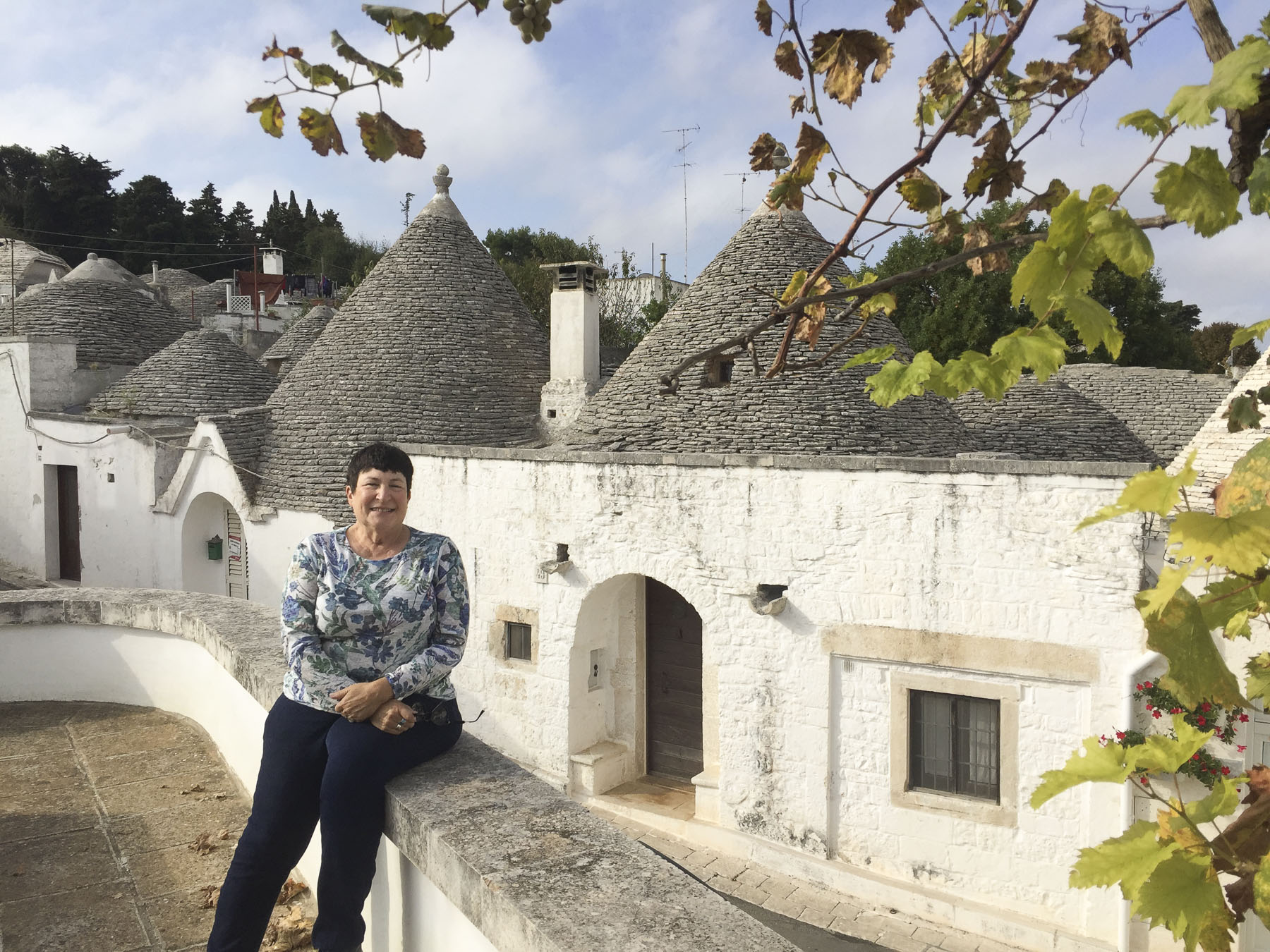
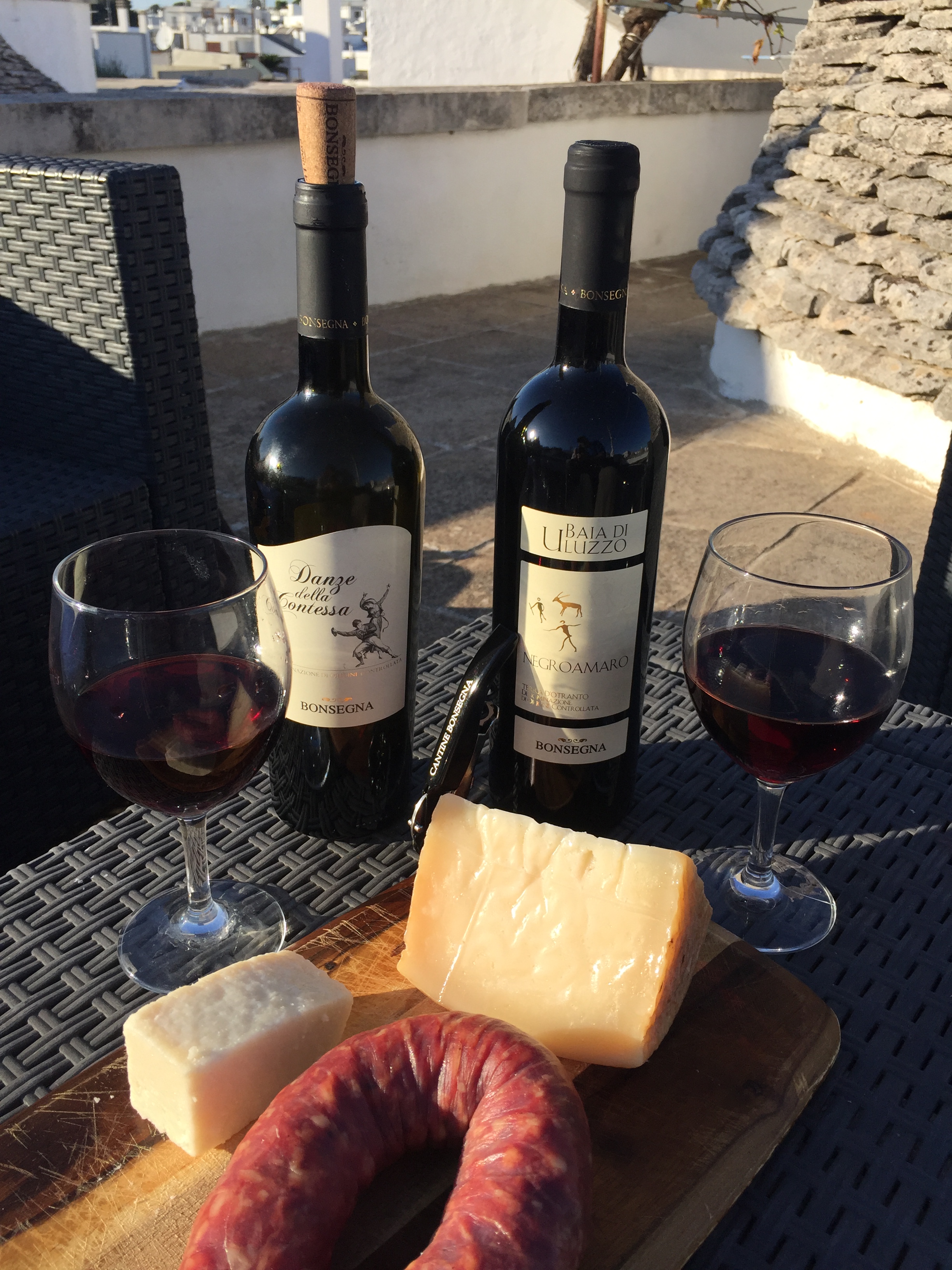
The charm here was a vertical ladder that led to a hatch which opened to a rooftop patio with a grapevine, chairs, a table, and a clothesline. It was delightful and we made daily use of it, bringing coffee up the ladder in the morning and then wine to enjoy while watching the sunset. Immersing ourselves totally in the local lifestyle, we flew our laundry from the clothesline, like a proud flag symbolizing our occupation. 

It took the better part of a day to coordinate the arrival of our tribe; Craig and Gary stayed with us, while Jack and his partner Brian stayed near Matera. The plan was to tour Alberobello, visit Matera in the neighboring Basilicata region together and then spend a day in Lecce with our friend Giulia, whom we met at the very beginning of our journey, fourteen months earlier in Ecuador.

Many visitors savor all of Alberobello’s magic in one day, but if you don’t like changing hotels frequently, like us, it was also the perfect spot to base further exploration of Puglia, which is what we intended to do.

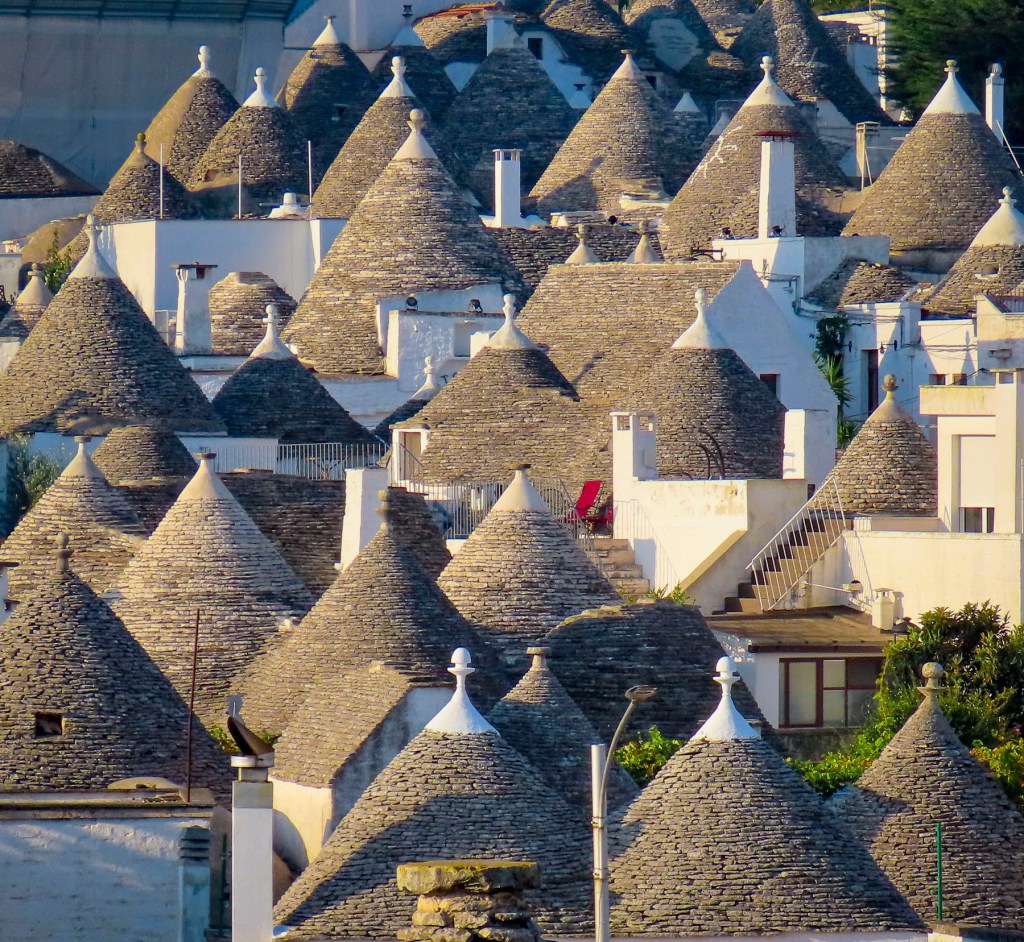
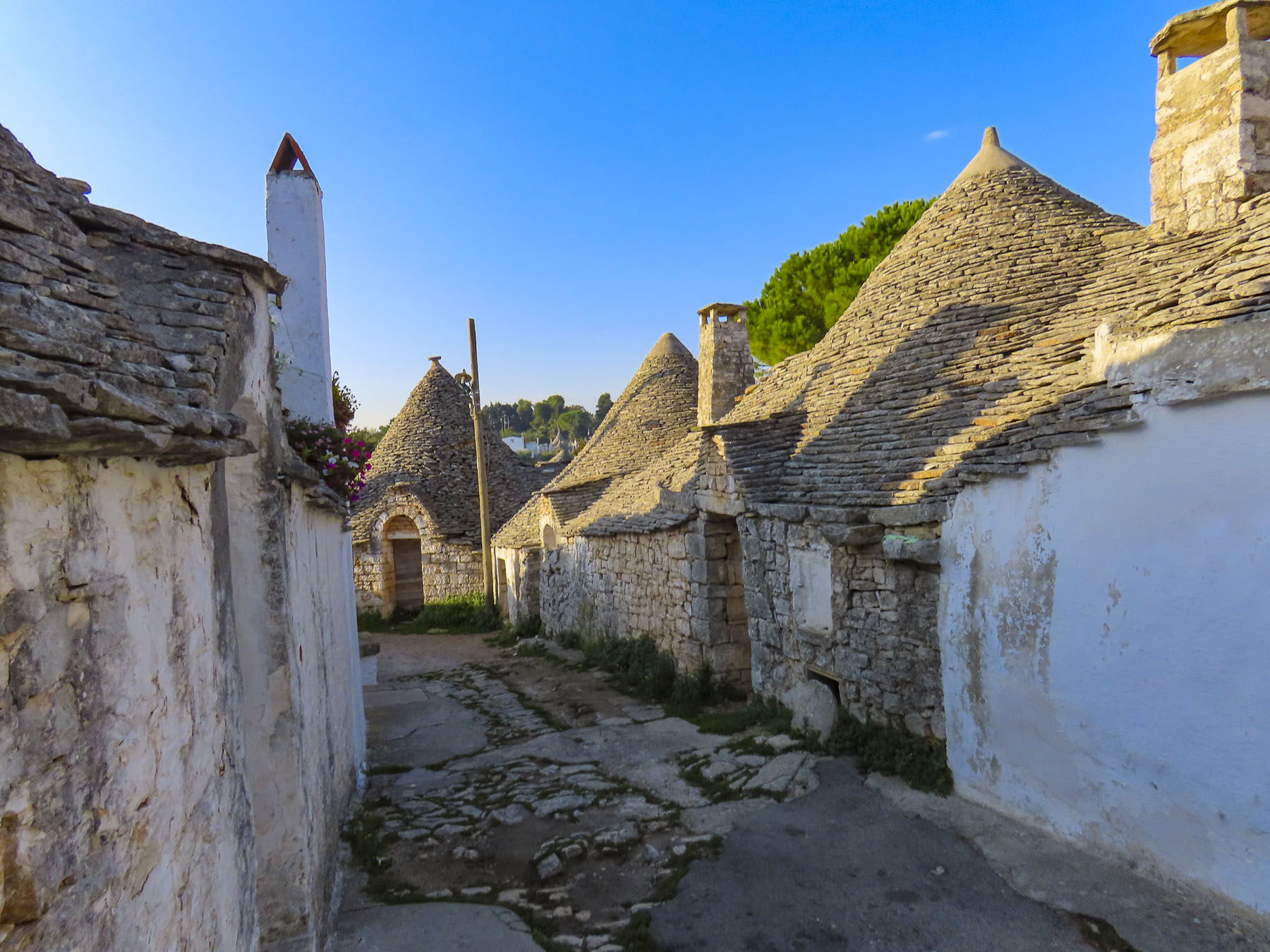
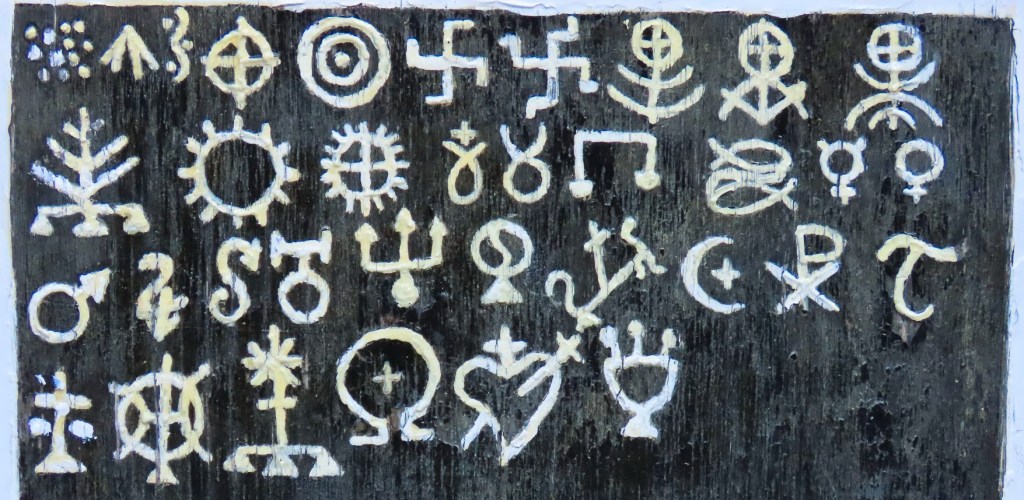
There are over one thousand trulli in the Monti district spread across seven narrow streets that twist and turn in an enchantingly confusing way, yet the area was small enough that we were never really lost.  Early in the mornings or late in the day the neighborhood had a unique ambience, with its cobbled lanes, whitewashed walls and pointed stone roofs painted with various religious, astrological, or folkloric  symbols. The latter were meant to ward off evil or ensure a bountiful harvest. Similarly, there are different thoughts about the meaning of the various shapes of the pinnacles atop the roofs. I prefer the theory that they represent the ancient stone mason’s calling card. Most of the trulli have now been converted to shops, restaurants, small inns, and rental properties. 

Across the main road at the bottom of the hill we climbed a shallow slope to a second, smaller borghi, or neighborhood, equally charming but with a more residential flavor than the Monti. The Aja Piccola is comprised of about four hundred trulli.

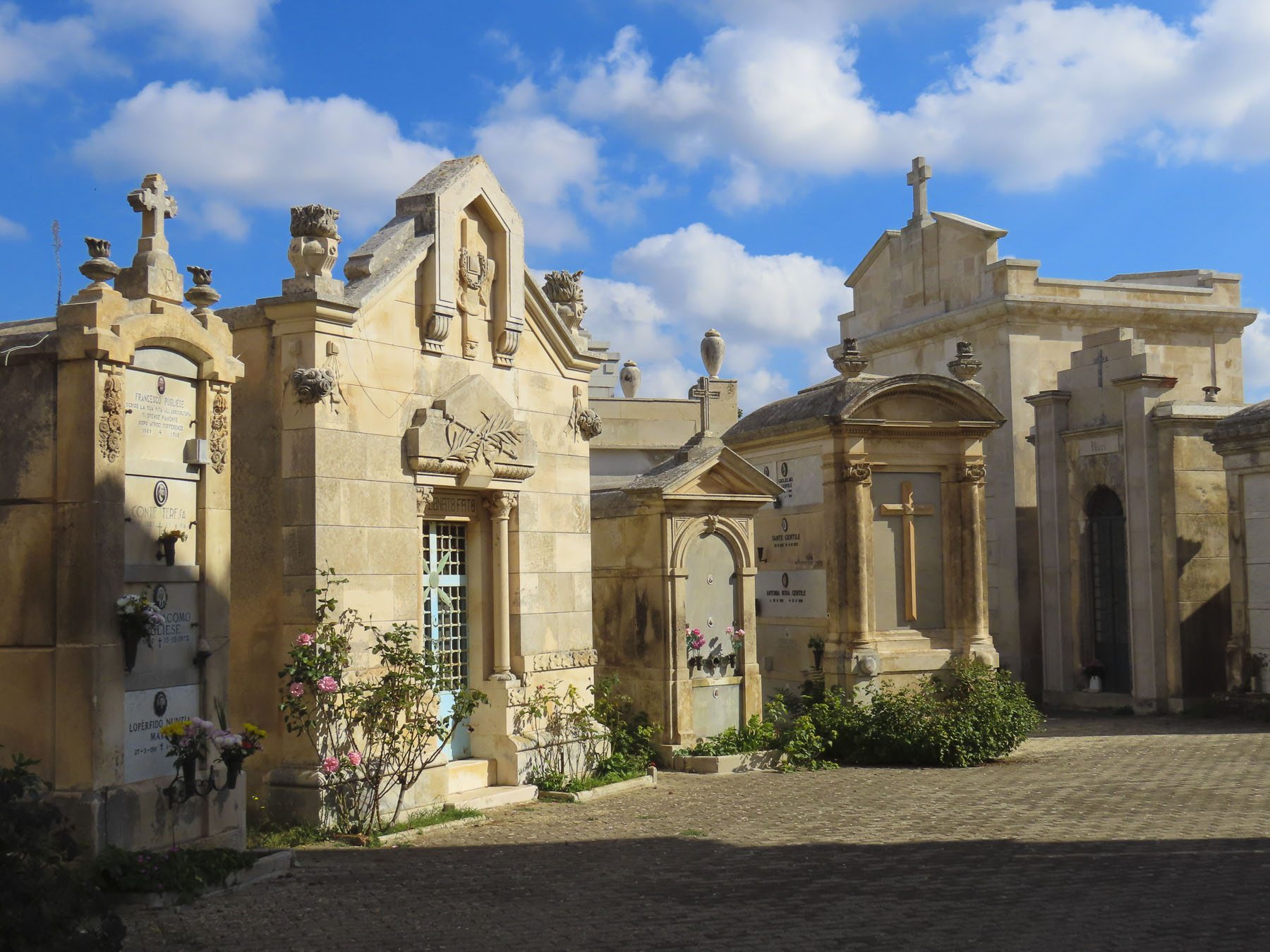
Farther afield on the outskirts of town we walked through Alberbello’s central cemetery.  Spanning centuries with classic tombs and modern mausoleums, the graveyard architecture presented a strikingly distinct dichotomy to the rustic trulli.

It was backroads through farmland most of the way to Matera, past larger trullo with multiple rooms, each represented by its conical roof. Some along the way were abandoned or used as barns, while others were pristinely refurbished and doubled as the farmer’s home or agrotourism business.

Matera sprang to notoriety in 1945, at the end of WWII, with the publication of Carlo Levi’s novel about his political exile to the region, Christ Stopped at Eboli, when Mussolini was in power.  He described the squalid conditions in which peasants lived together their farm animals: they inhabited caves, without electricity or running water, and diseases ran rampant.  The Italian government was internationally embarrassed by the neglect the sassi of Matera received, and in a restitution effort, relocated the entire population of some 16,000 cave dwellers from 1,500 sassi, small caverns, to a new town built on the plateau above the honeycomb of caves.

Archaeologists have determined through excavations that Matera grew from a series of water-eroded caves along the walls of the Gravina River canyon, which were first inhabited sporadically 9,000 years ago during the Stone Age.  Permanent populations have existed here since 3,000 BC, making it one of the oldest continuously inhabited settlements in Europe. 
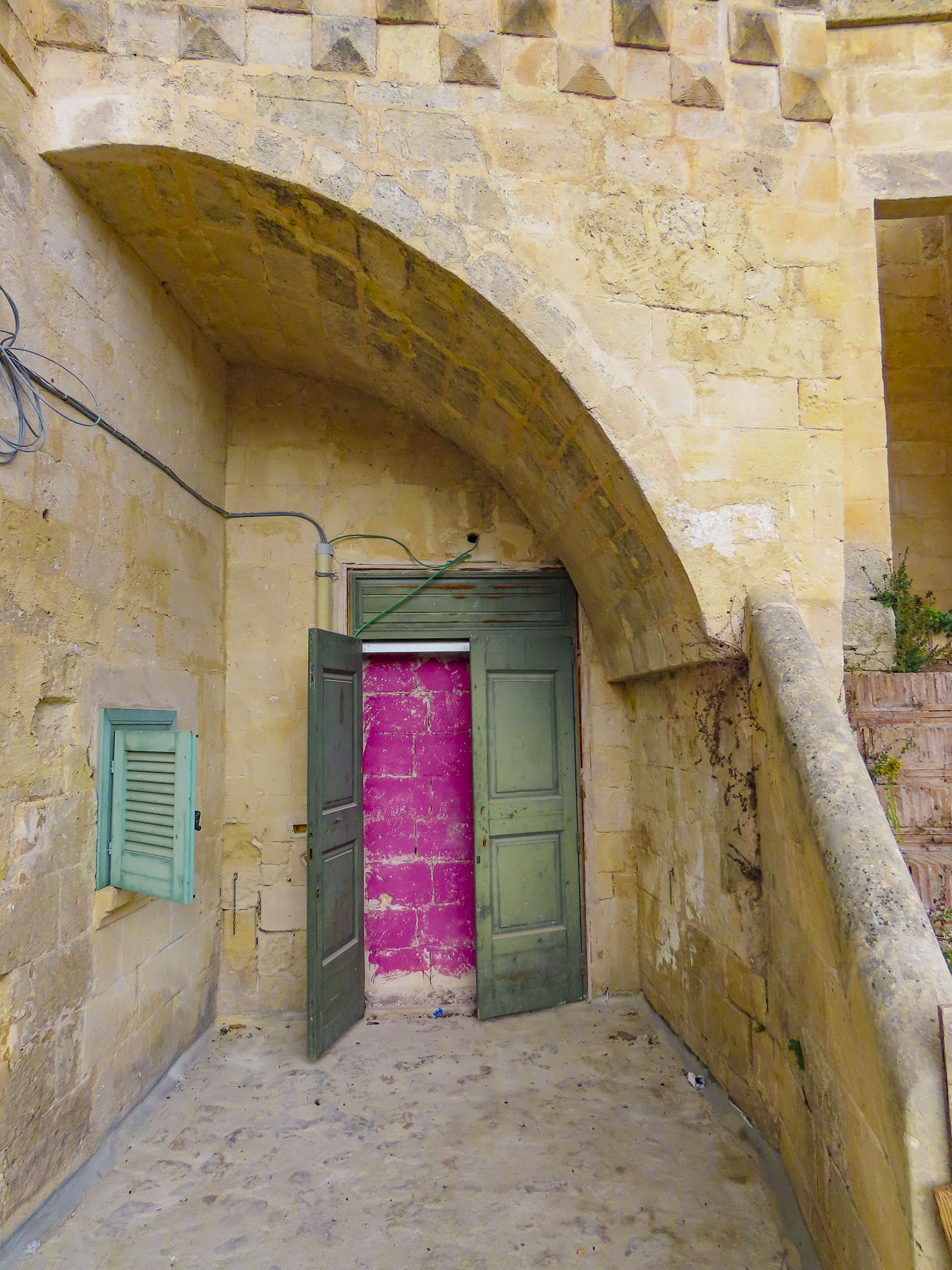
The Romans declared Matera a town in 251 BC. Centuries later the safety of cave dwellings appealed to many during the turbulent dark ages and the populace grew as folks expanded the natural caves and randomly dug new sassi, above and below their neighbors, from the soft rock of the canyon walls.  During the Middle Ages the prosperity of the city supported many churches and convents.

In the 1200s the Cathedral of Saint Mary ‘della Bruna,’ Saint Eustace, and the Church of Saint John the Baptist were built on opposite sides of the ravine.  Prosperity continued in this area into the early renaissance.  The exterior of the some of the sassi were squared off and ornately carved with columns, while others were expanded with additional rooms and vaulted ceilings.   

Political intrigue over the centuries put Matera on the losing side of several rebellions against the various Kings of Naples. The coup de grace came in 1860 after unification with the Kingdom of Italy, when many of the lands and properties owned by the church in the Basilicata region were confiscated and sold off to wealthy aristocratic families. With support from the church, peasant opposition to the broken promises of the new Italian government grew and soon the countryside was controlled by roaming bands of brigands.  The province was too dangerous to travel through, further isolating Matera even though it was the capital of Basilicata.  Many decades of governmental neglect followed and pushed Matera into major decline.

For three decades the sassi were an abandoned no-man’s-land, the caves used as drug dens and warehouses for smugglers until the first gentrifications began with several small boutique hotels in the 1980s.  During years of renovation and exploration, 150 cave churches, 90 wine cellars and numerous cisterns have been rediscovered after the removal of debris and muck from their last use as barns and stables.

The uniqueness of Matera’s “spontaneous architecture” as it is officially called was recognized in 1993 when UNESCO named it a World Heritage site.  Further interest followed, after Matera was used as a film location to double for ancient Jerusalem in several movies: The Passion of the Christ (2004), King David (2005), and The Nativity Story (2006.) Even some scenes from the 2017 Wonder Woman were filmed there. In 2019 Matera received distinction as a European City Capital of Culture.  Today sixty percent of the sassi of Matera have been restored into small hotels, shops, galleries, and digital workspaces.  

When we arrived in Matera the historic area was hidden from our view by the buildings of the new town on the plateau above the Sassi district. We made our way to Piazza Vittorio Veneto while searching for stairs down into the ancient district. There was a tremendous WOW! factor when we emerged from a narrow alley onto a scenic panorama above the old town, the city’s silhouette frozen in time.

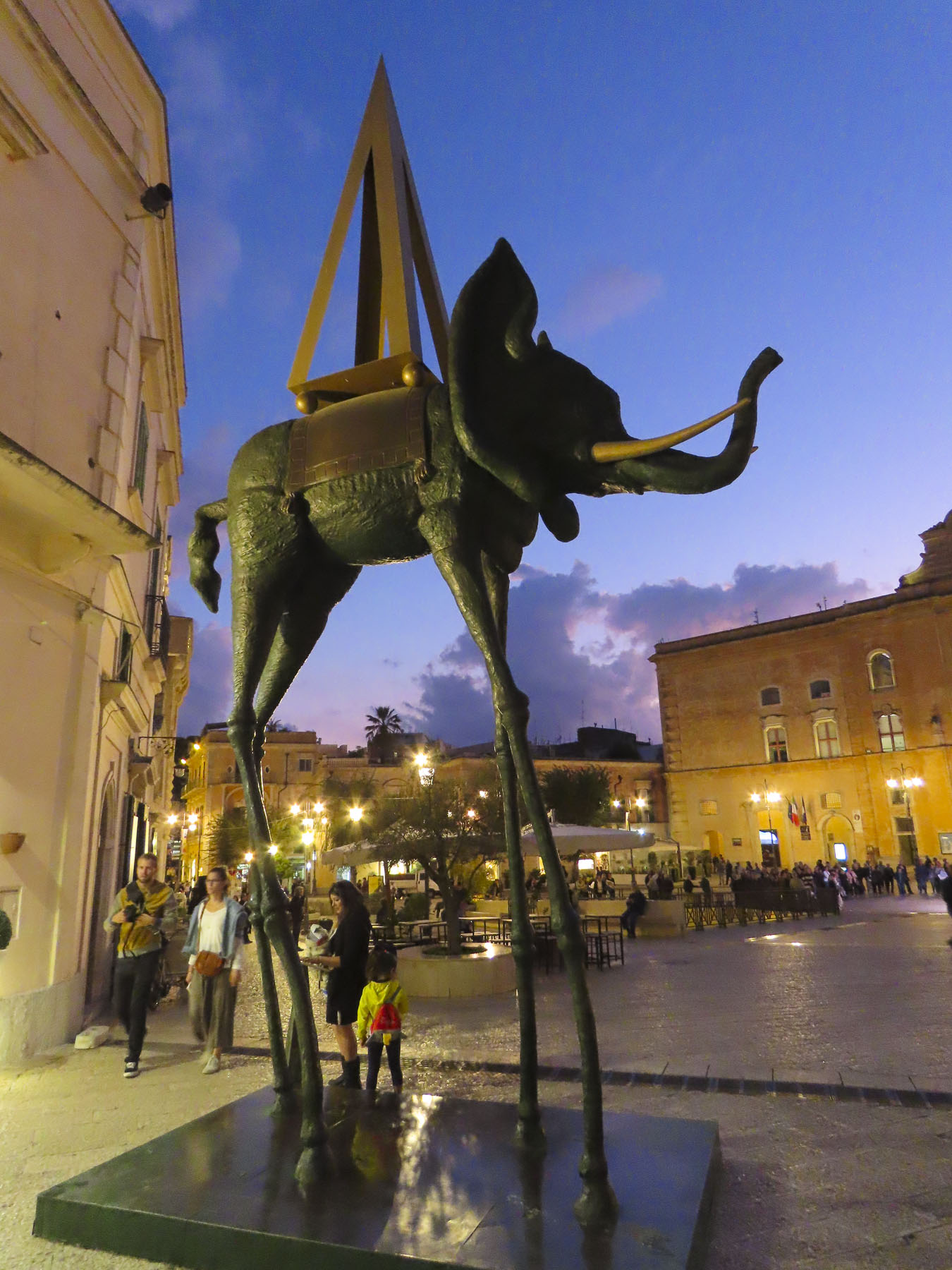
Around the city large surrealist sculptures by Salvador Dali stood in wonderful, whimsical juxtaposition to the surrounding monochromatic walls of the city. One day was not enough to uncover all the mystery that Matera had to offer. Hopefully, we will return in the future. 

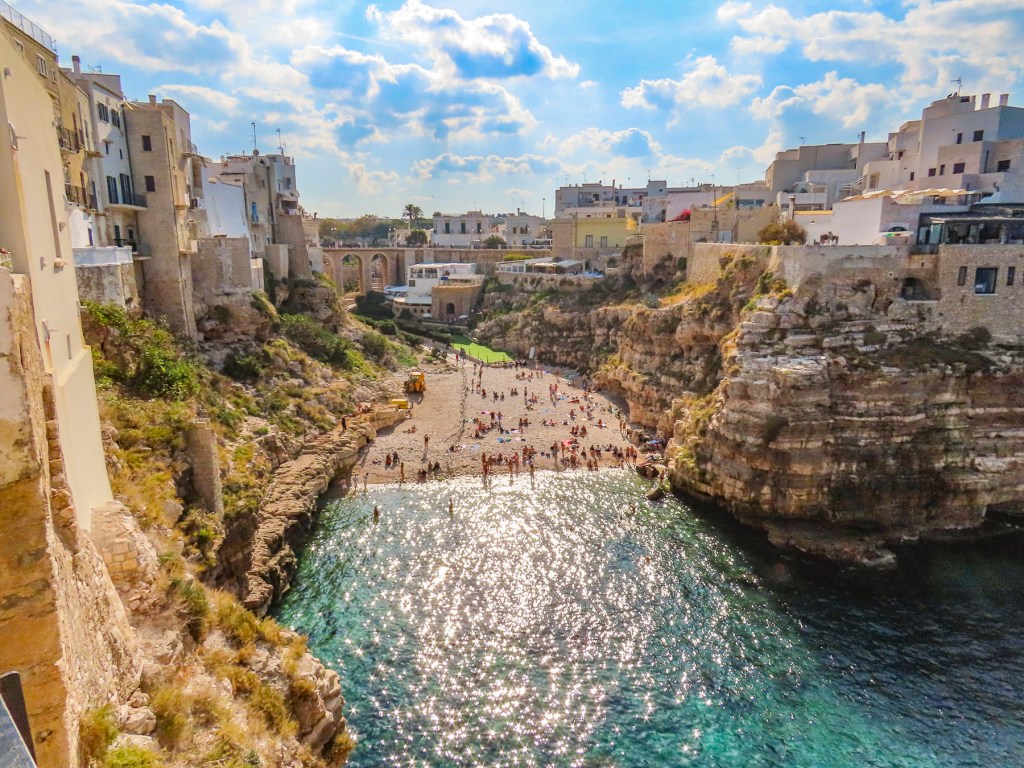
A day at the beach, more like a day on the cliff above the beach, drew us to Polignano a Mare on Puglia’s Adriatic coast.  It’s a picturesque town known for its dramatic buildings balanced on a cliff edge that follows the sea, thirty feet below. 

The rock face is incredibly soft and over time sections have fallen into the sea creating grottos, under the homes above, that can be toured by boat.  White-pebbled Lama Monachile is a classic, small Italian beach nestled between cliffs, from which the brave dive into the calm turquoise waters of the cove. 

The quaint historic district is relatively small, and homes are painted in cooling colors which echo the sea. Alleys meander to small piazzas above the water, each with a unique view of the cliff and just large enough to support a small café with a few outside tables.  It was a brilliant sunny day, pleasantly uncrowded, and the weather was gentle enough that we could dine outside in a sunny spot during our November visit. 

Till next time, Craig & Donna