Estonia Part 1: Tallinn – Captivating, Charming & Caffeinated

Why Estonia? We are sure folks can relate, our pockets aren’t as deep as we’d like, but that doesn’t keep us home. A low budget, off-season destination is more attuned to our lifestyle anyway. So, when an under $400, September fare from New York City to Tallinn, Estonia popped up in our email we jumped at it after some research confirmed we could find some very nice hotels from $50 to $100 per night, often with breakfast included. Exploring the lesser visited Baltic countries of Estonia, Latvia, and Lithuania also fulfilled our desire to extend our travels beyond western Europe, which previously had been very Mediterranean-centric. Living in the very hot and humid southern United States is also affecting our decisions concerning vacation destinations, as we are now seeking alternative destinations as a result of climate change. The heat of a southern summer often continues into September and October, with temperatures at home in Georgia often in the high nineties. Estonia offered a wonderful reprieve from the sweltering summer heat with a daily high average of 14°C (57°F).
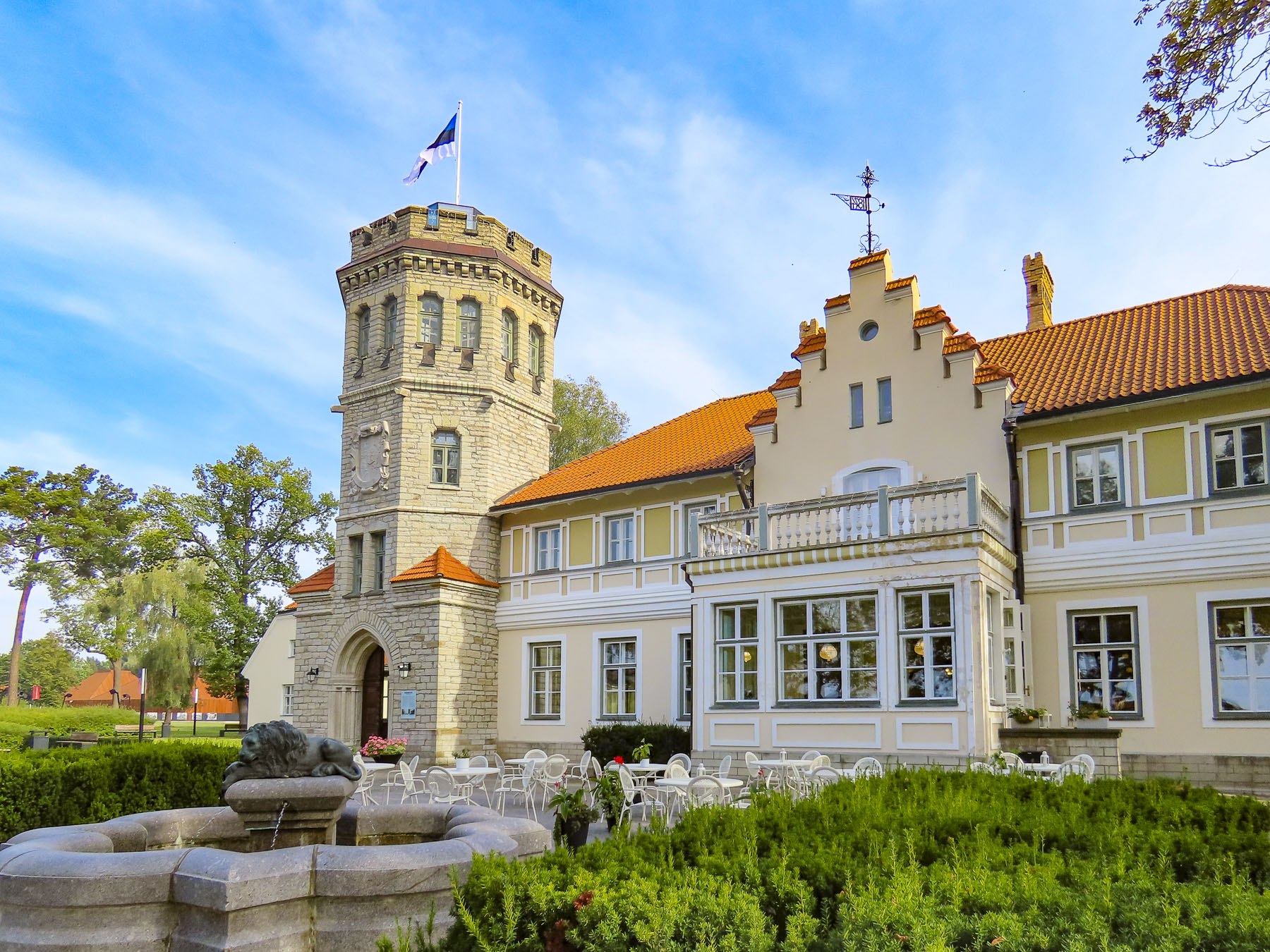
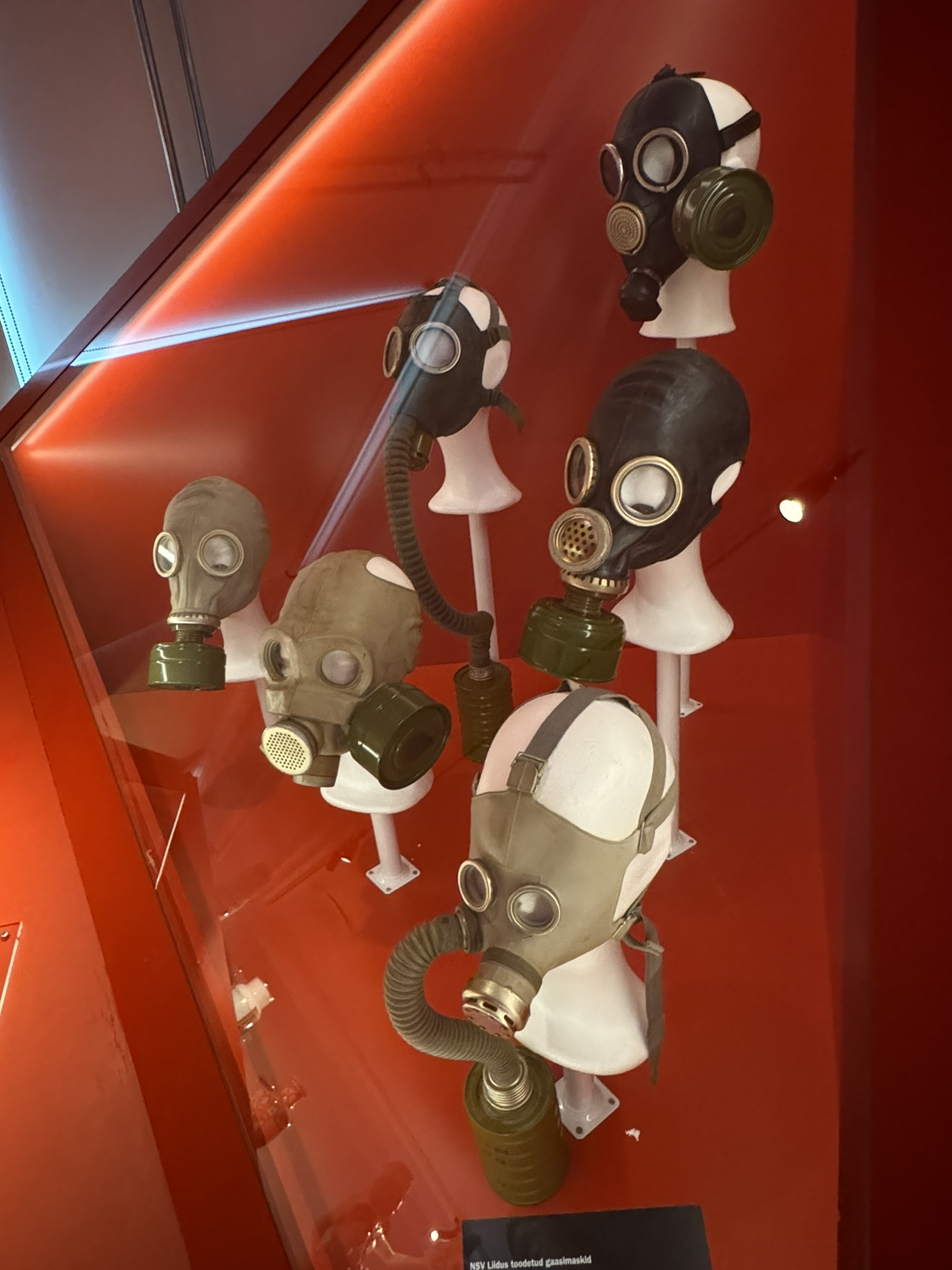
The history museum at Maarjamäe Castle was an unusual first stop for us after picking up our rental car at the airport. But it was the closest we’d be to it during our three-week road trip through Estonia, Latvia, and Lithuania. The museum is in a renovated 17th-century chateau, which was left to ruin for decades during the communist Russia occupation of Estonia. It is beautifully set on a bluff across from Tallinn Bay, and was built by the Brotherhood of Black Heads, a professional association of unmarried ship owners, merchants and foreigners dating from the 14th century, as a summer retreat.

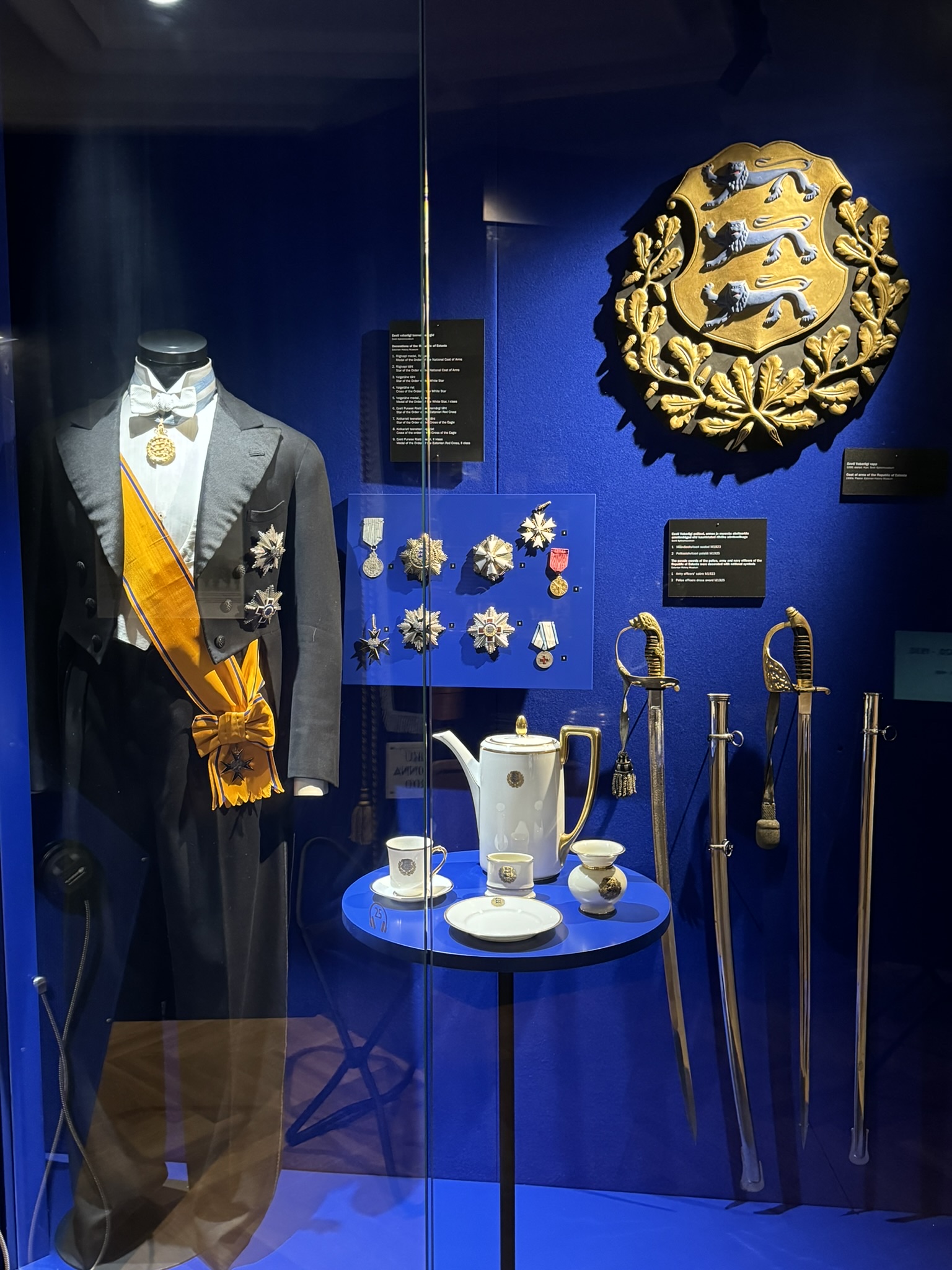
Today the museum’s permanent exhibit, My Free Country, explores 100 years of modern Estonia’s history, from its 1918 declaration of independence from Russia, and the following War of Liberation, through twenty years as a sovereign nation before being invaded by Nazi Germany and communist Russia during the Second World War. The fifty years of brutal Russian occupation after World War II and communist propaganda are also covered, up to Estonia’s 1991 second declaration of independence from Russia, which was overwhelmingly supported by 78 percent of Estonians. It’s a difficult mission to reconcile the terror of the communist years into a bright, hopeful future, but historical research, as well as oral histories, document forced resettlements to Siberia and imprisonment in labor camps during the Soviet reign of terror, when Estonians were prisoners within their own country and shot if they tried to escape. The exhibit highlights a proud history of an unrelenting desire for freedom, which prevailed under the worst conditions. A history that, it is hoped, the younger generation of Estonians, who have not experienced communism, never forgets. As one quote on an exhibit referring to Russia said, “Nothing good ever comes from the east.”

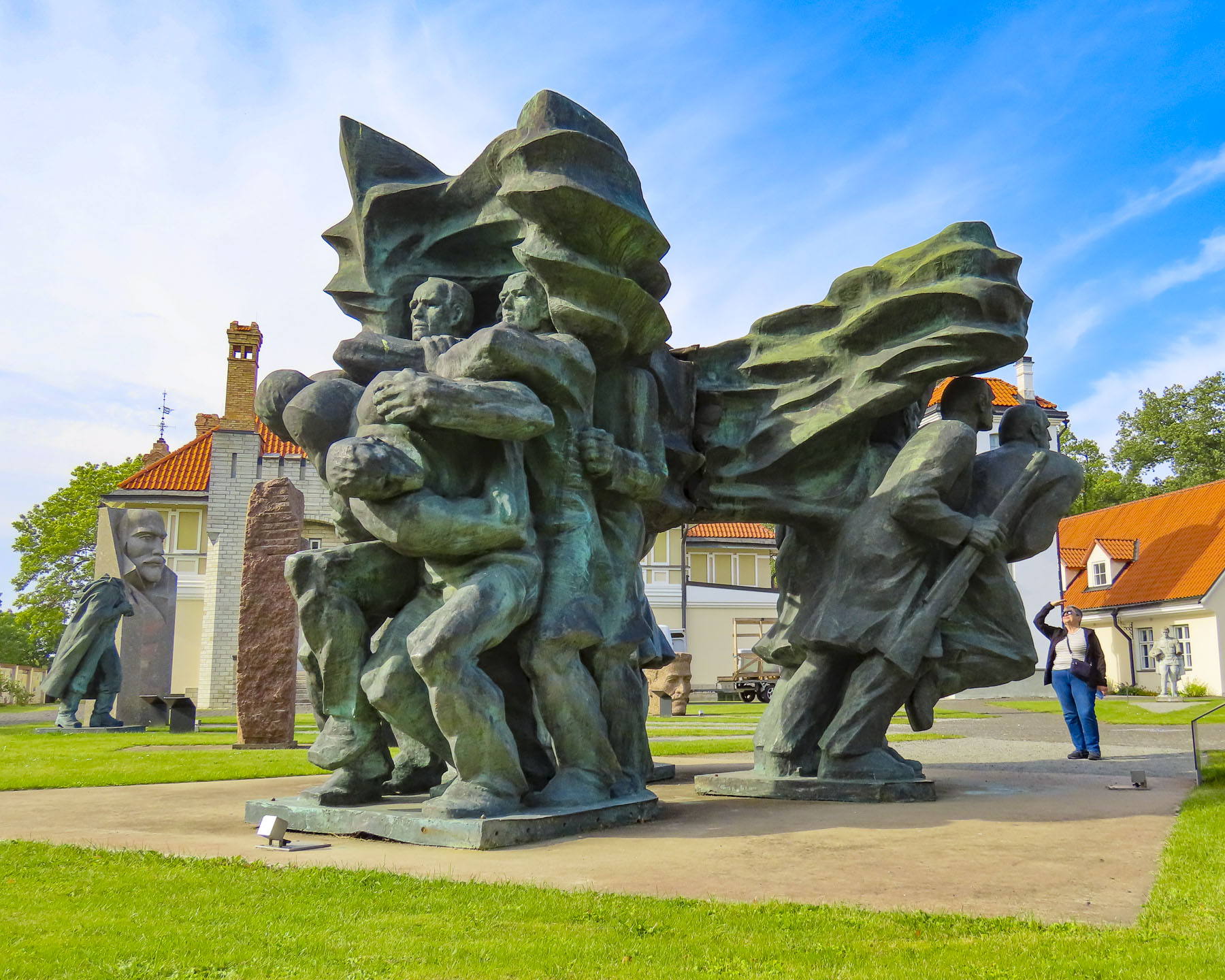
After the 1991 independence, colossal, large-scale Russian propaganda sculptures, which once dominated prominent public spaces across the country, were removed from view but not destroyed, as they are part of Estonia’s history. However, they were erected behind the museum in a space fittingly called, with Estonian humor, “the Soviet Statue Graveyard.”
Our first lunch in Estonia was at the museum’s café, Maarjamäe Resto, an unexpected culinary delight, which could be considered a destination in and of itself.

It was still too early to check in to our hotel in Tallinn, so we headed nearby to the Tallinn Botanic Garden, a large park with an extensive greehouse. The grounds were quite pleasing with their plantings, and the greenhouse with its various collections of tropical plants was very interesting. Though in the section filled with cactuses from around the world, Donna, ouch!, accidently brushed one with her hand and imbedded some spines into her skin. Not a huge issue when you are home and have the proper tools to pluck the pesty spines from your skin and relieve the discomfort, but when you are traveling, it’s another issue entirely.
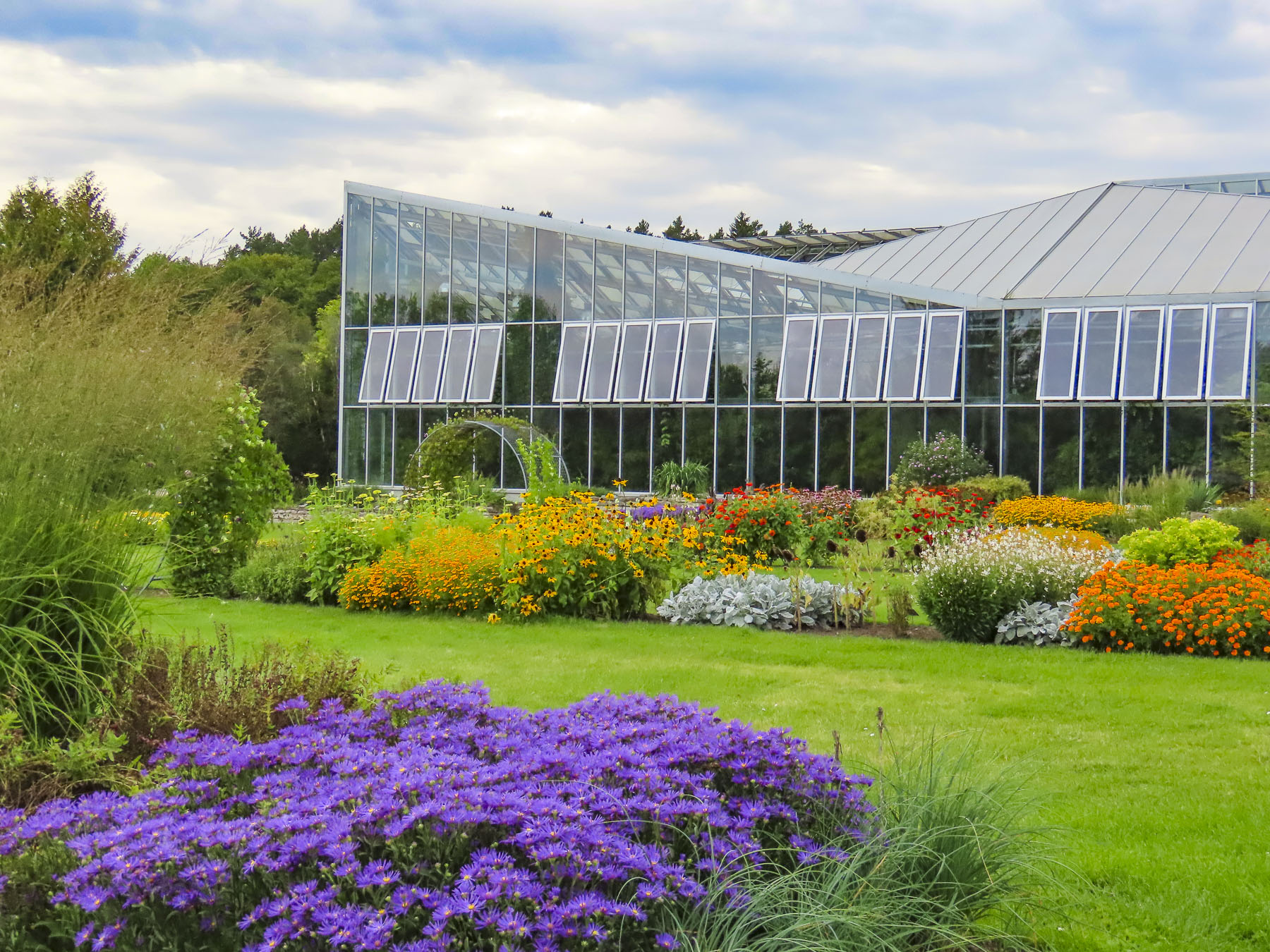
Fortunately, the barista operating the café in the greenhouse had dealt with this before, and he ran out to his car to fetch a roll of good old-fashioned duct tape to grasp those microscopic thorns. He was very nice, a 30ish Italian man who during conversation jokingly related that being a part time medic was not part of his job description when he was hired, and visitors getting pricked with cactus thorns happens more often than you would think.  We were curious how a warm-blooded southerner ended up in the northern Baltics. “You know there is always a woman to blame, and I followed my love back to her Estonian homeland.” We asked if he missed the warm Mediterranean weather and la dolce vita. Yes, the weather is nicer, so we visit my family, but life is better here in Estonia as there are more opportunities for those willing to work and get ahead. Estonia is leaps and bounds ahead of the other European countries in embracing digital technologies. So much so that the government considers internet access a fundamental right and ensures that everyone across the country, even on the smallest islands, has reliable internet, and offers digital literacy programs for the technology challenged. The government also endorses working from home remotely, and offers an Estonian Digital Nomad Visa. “Estonia is very big in cybersecurity, and this enables every person, business, and government institution to be connected. We are one of the most digitally advanced countries, and we can even vote securely online in Estonia.” This digital future contrasted with as well as complemented the vibrant centuries-old walled city of Tallinn.

Despite not having particular plans for Tallinn, we knew we would enjoy exploring the city as soon as we saw the ancient architecture along the way to our hotel. Having a rental car and finding a hotel with free parking is difficult in any city, but we scored big withTaanilinna Hotell. The hotel was in an excellent location, just on the opposite side of the old town’s historic ramparts, and a short walk from the 14th-century stone towers of the Viru Gate’s flower market.

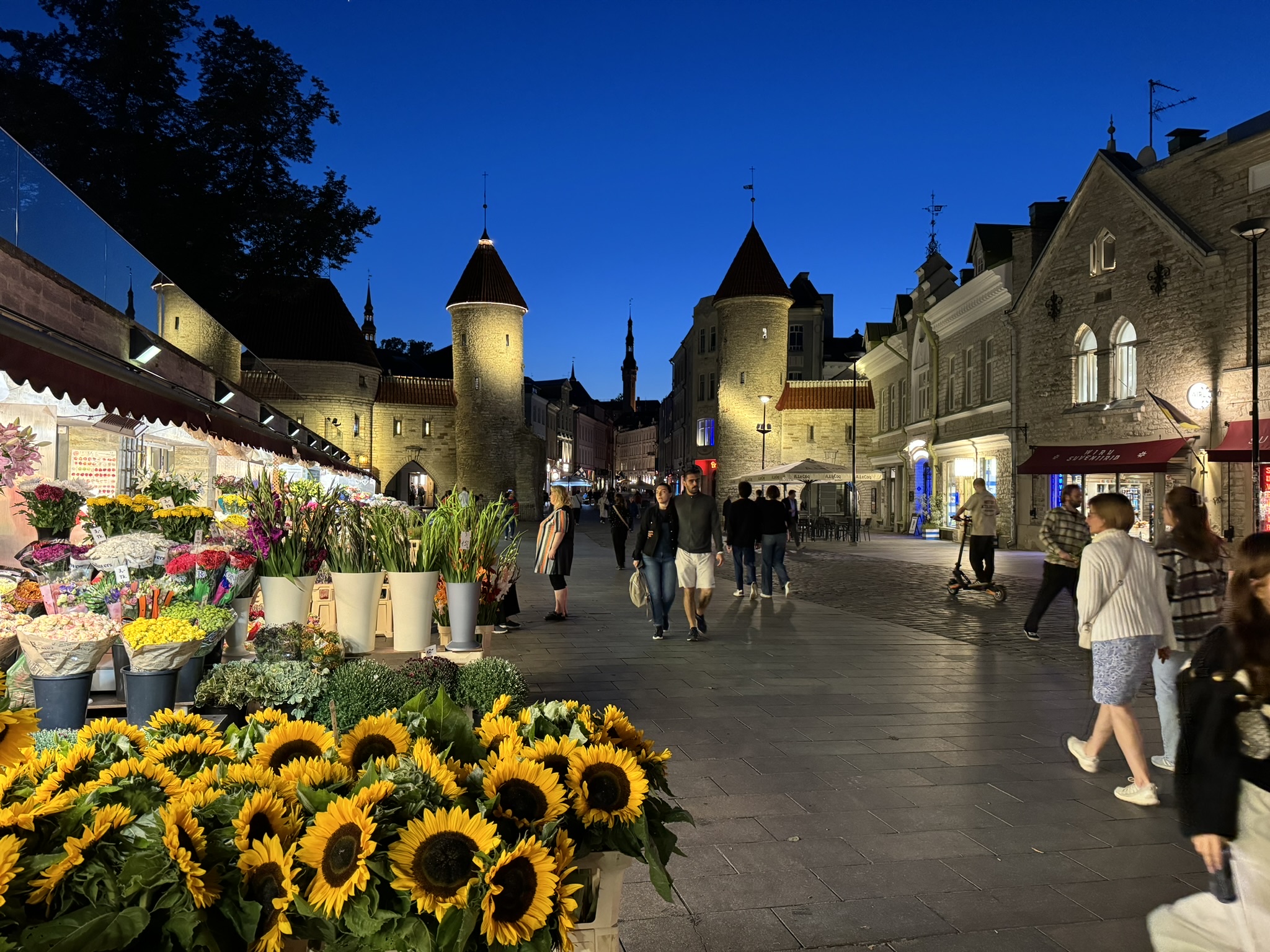
Google Maps got us close, but the hotel was a little difficult to find, and we mistakenly drove through a pedestrian only area; fortunately, there were few people about. In order to find the hotel, we parked and walked down the street, when we spotted the hotel’s sign, which was set back from the lane. It’s a modest hotel, and the staff was very nice. We enjoyed a quiet 4-night stay.
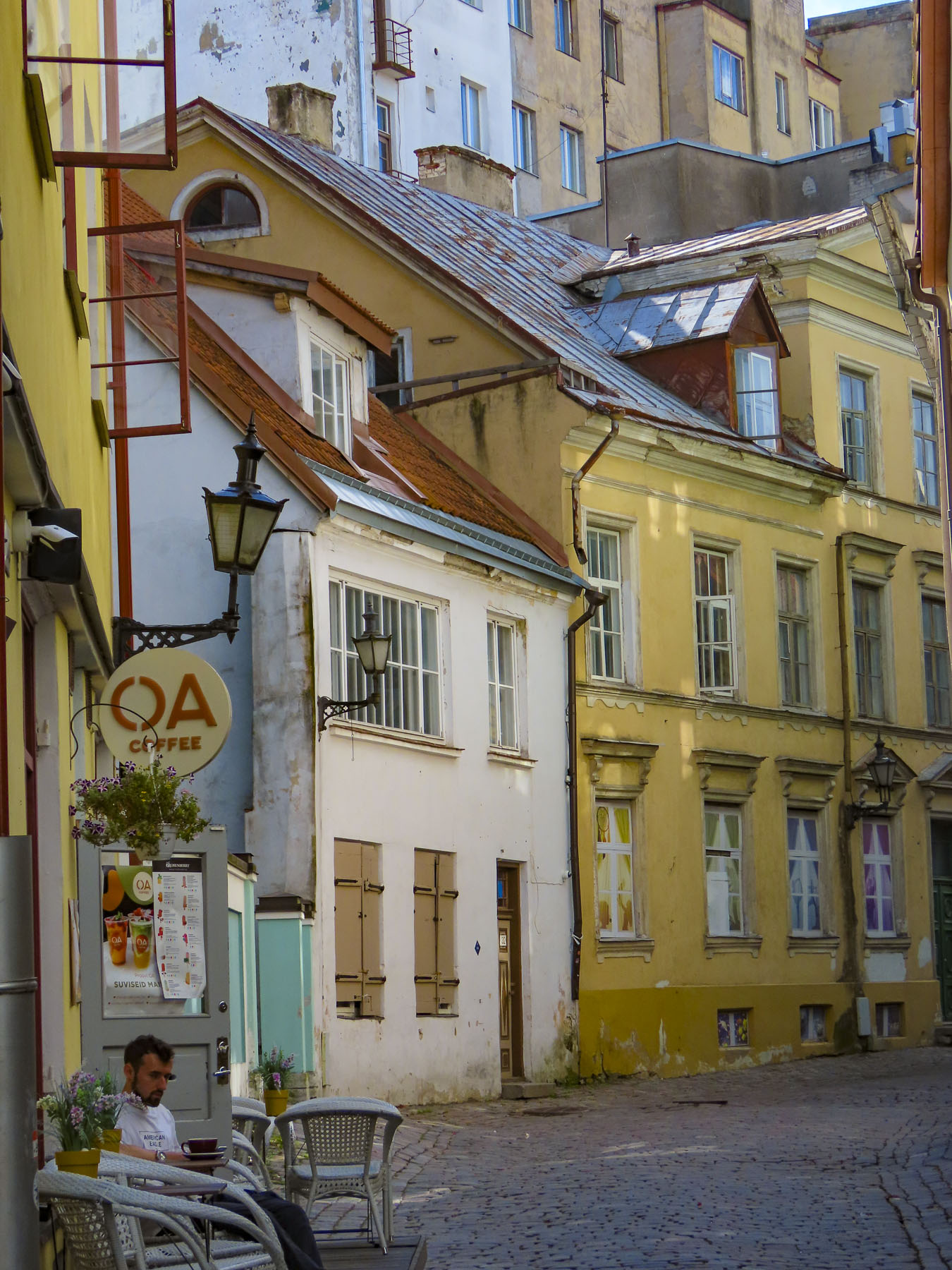
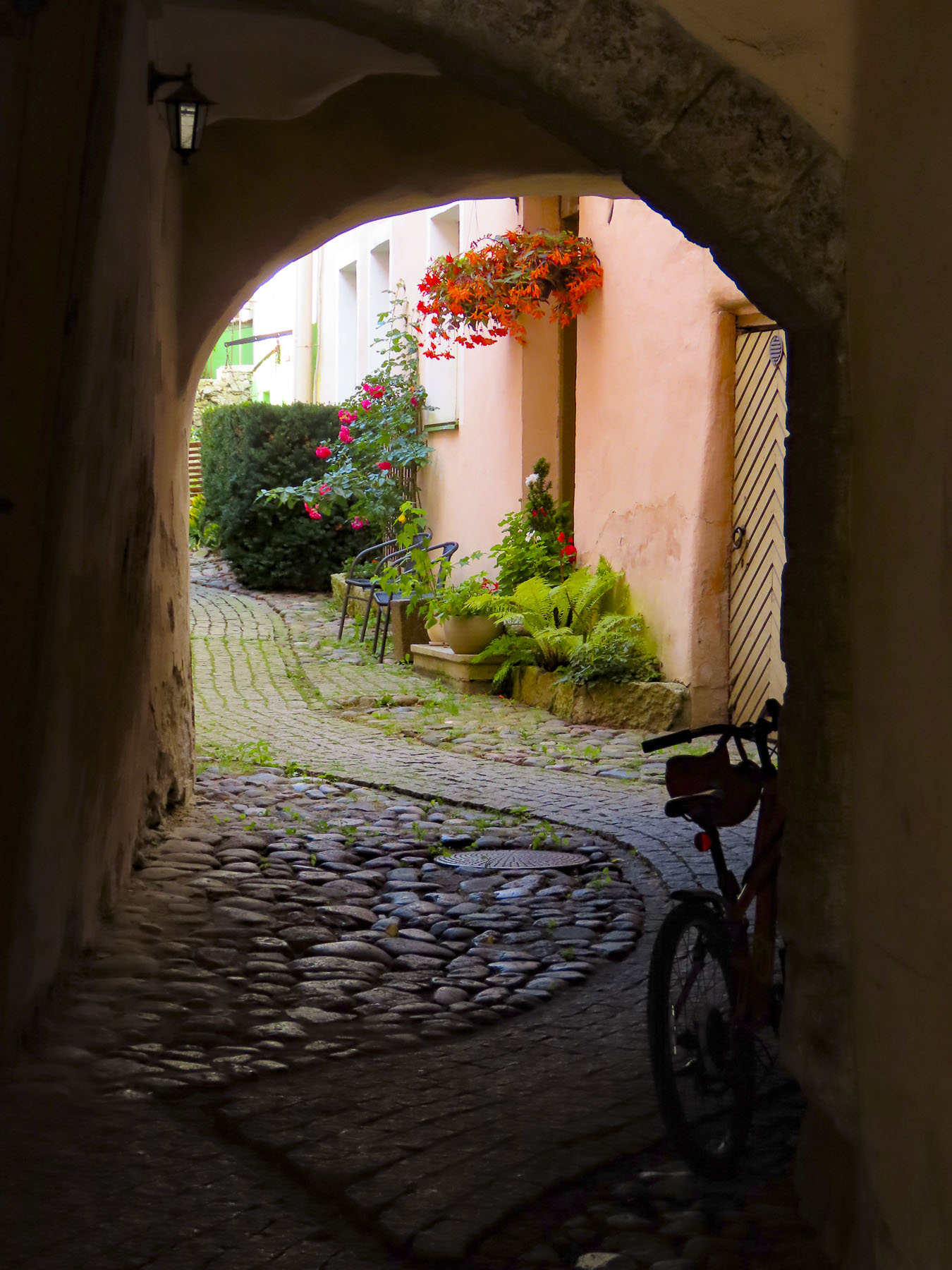
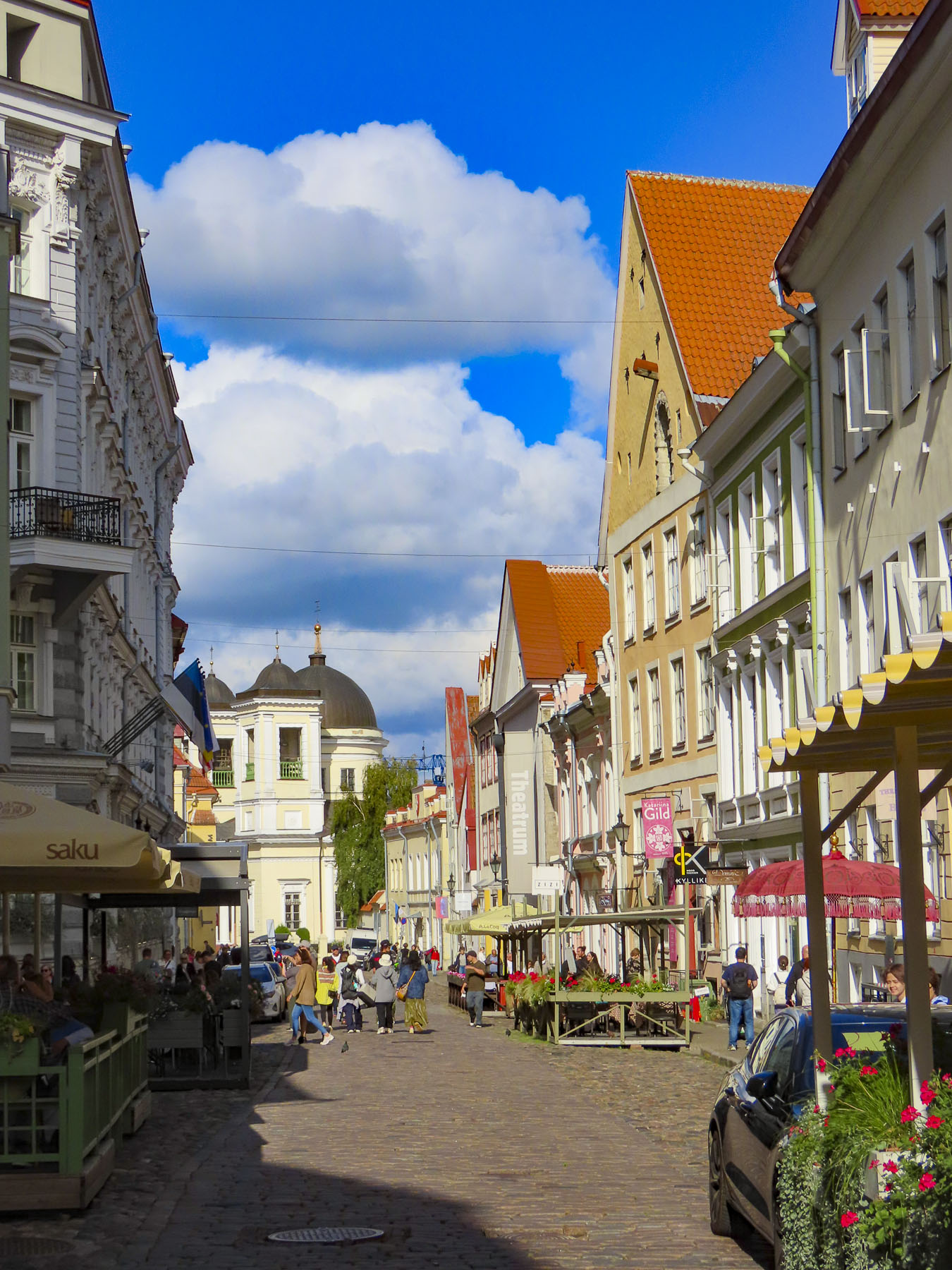
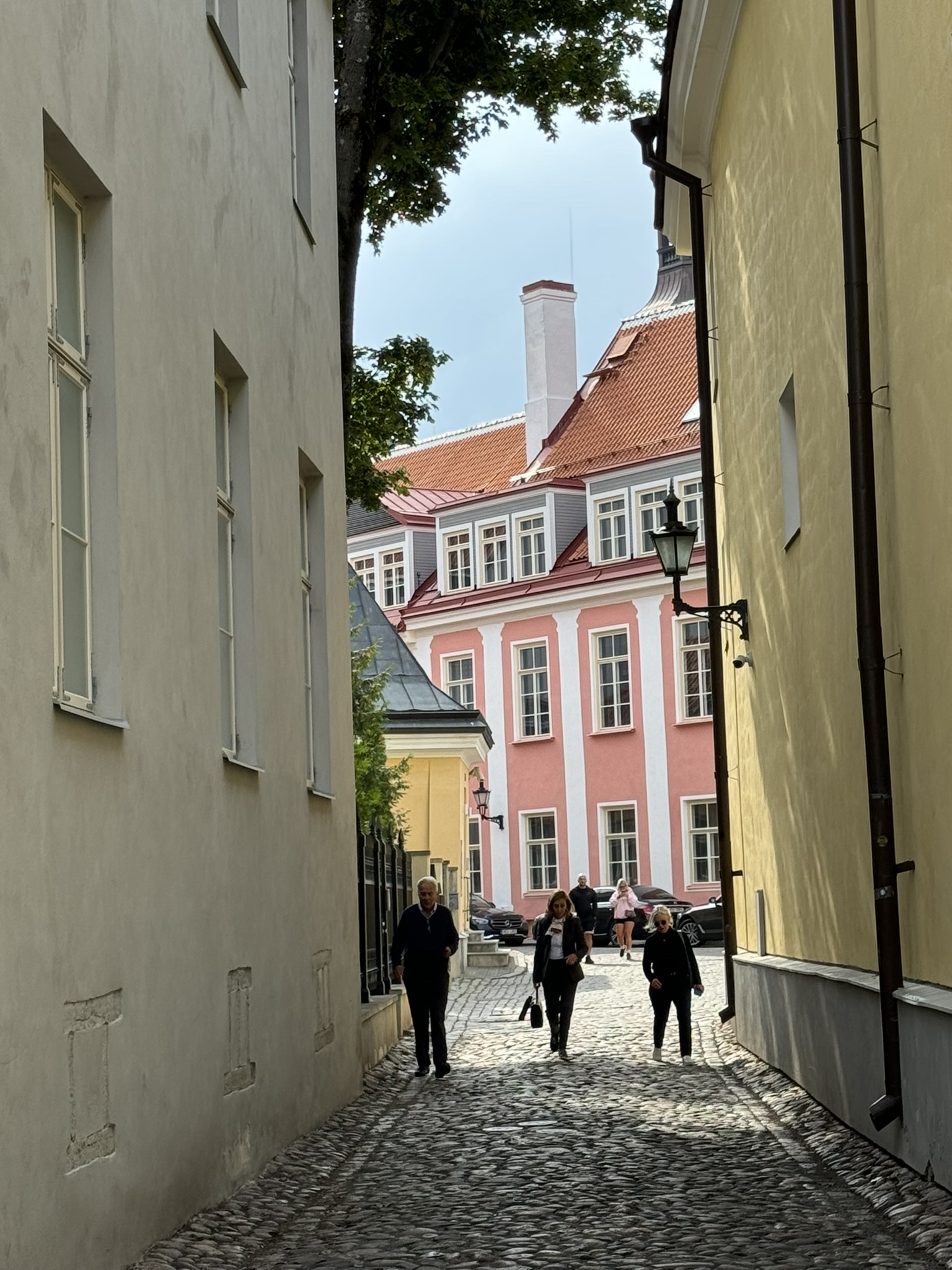
With Tallinn’s old defensive wall only a stone’s throw away, history surrounded around us, and we quickly set out to explore and to find a place for dinner as twilight descended on the old town. Our wandering took us down various lanes, past distinctive centuries-old 4 to 5 story tall buildings that served, as was the medieval custom of the time, as the multifunctional home/warehouse/offices of wealthy merchants.

Lights twinkled on and illuminated the cobblestones in a golden glow. I know it’s cliché, but our first impressions of Raekoja Plats, the Town Hall Square, anchored with its soaring 64M (300FT) tall 13th-century watch tower, were beautiful, charming and magical. We were disappointed to learn that the tower is only open from the beginning of June to the end of August. We love a good tower climb!
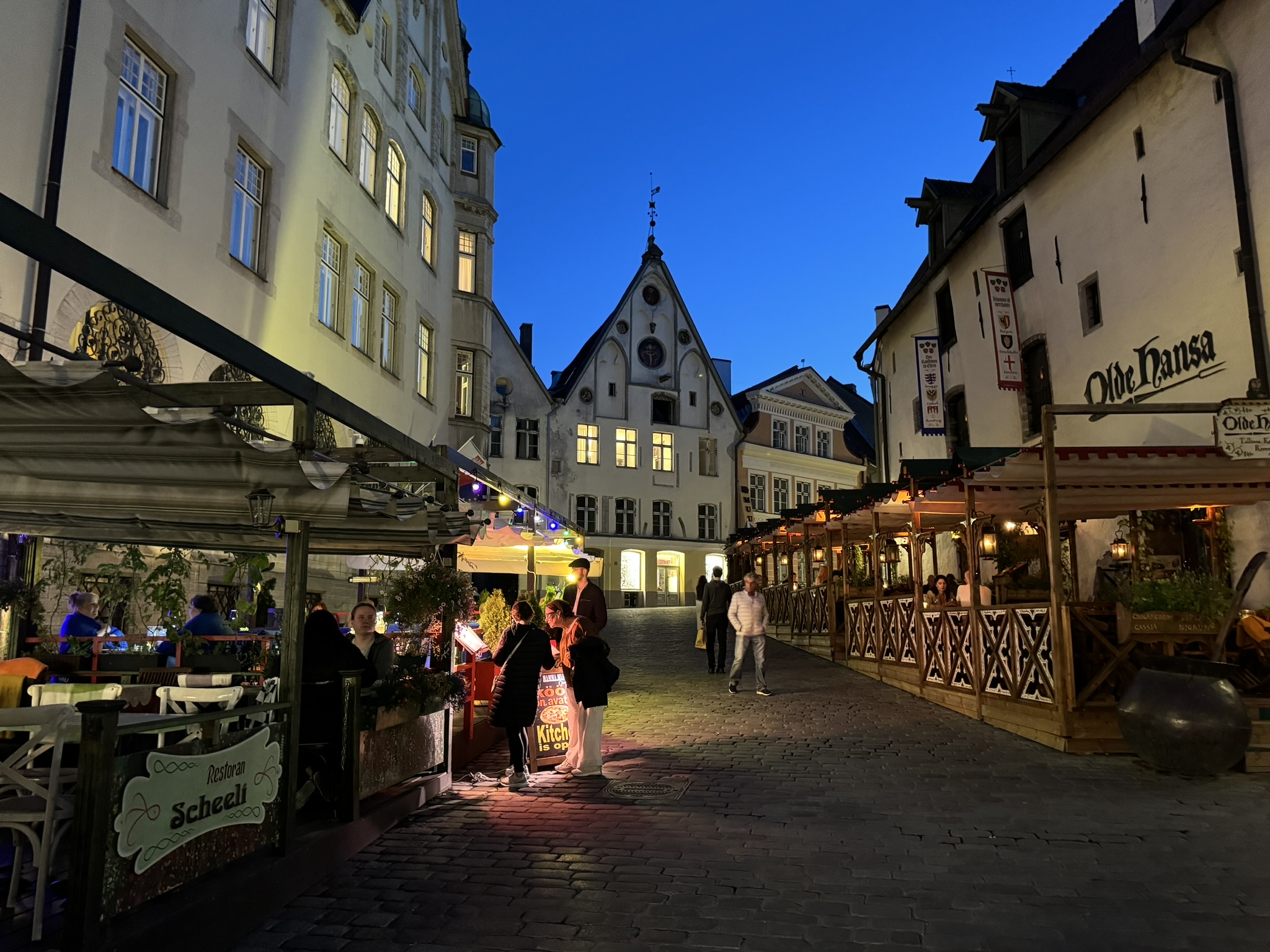
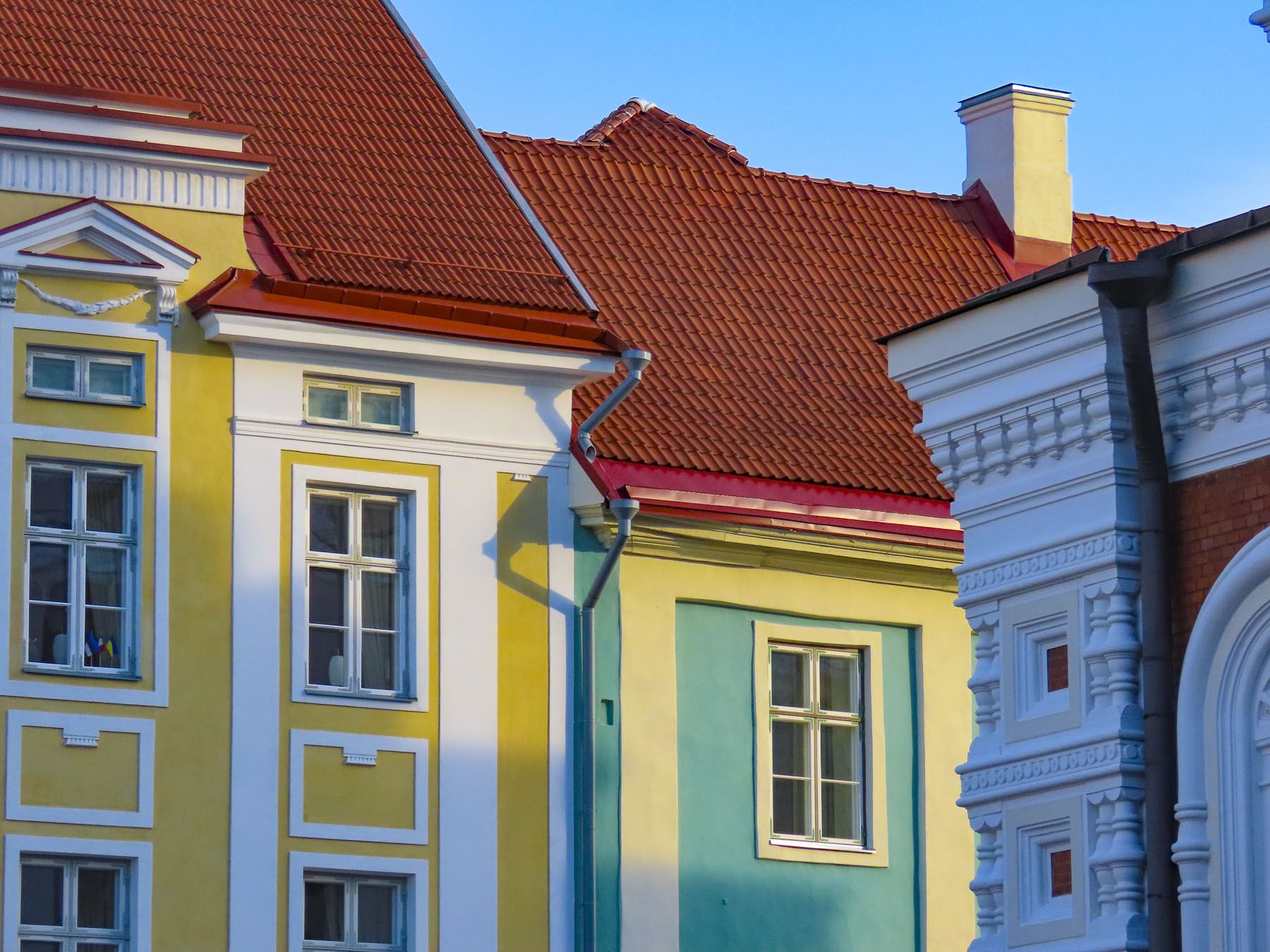
Still retaining its original footprint, Tallinn is one of Europe’s best preserved medieval cities, with 26 watchtowers along its ancient ramparts and city gates, topped with distinctive cone-shaped red roofs.  The walled city still encircles a vibrant and active community, which supports a lively arts scene, along with a robust nightlife.

Its preservation seems surprising for a city that has stood at the crossroads of conflict since it was founded by a Danish King in the early 1200s. In addition to the Danes, Tallinn has been ruled by the Brotherhood of the Sword, the Teutonic Order, the Holy Roman Empire, the Swedish Empire, Czarist Russia, Nazi Germany, and the Soviet Union. The city’s prosperity and resilience throughout the centuries is testimony to the strong spirit of the Estonian people. 

One of the nice things we enjoy about staying in one place for several days is the opportunity to experience the locale as it quietly awakens with the sun. Whether it is cloudless blue skies or a place cloaked under clouds with folks huddled under umbrellas to ward off the rain, a place breathes and its mood changes by the hour, from day to day. The destinations on our walks were always different, but we often crossed the same lanes and stopped to photograph something different that caught our eye, which we hadn’t noticed before.

Old town Tallinn is mostly flat and is a wonderfully walkable city. There is a short uphill stretch to Toompea Hill (the upper city), where we visited the Kiek in de Kök Museum, the Bastion Tunnels, and Neitsitorn, the Maiden’s Tower. During the 1700s when the towers lost their military significance they were often repurposed as private apartments, with a craftperson’s workplace on the lower level, and rooms above. During both world wars the tunnels were used as air raid shelters. While the towers were lived in continually, most famously by the Estonian painters and twin brothers, Kristjan and Paul Raud, until the 1960s, when the city deemed them unsafe for habitation.  Abandoned, the towers became a destination for homeless squatters and Estonia’s emerging counterculture. The extensive tunnels were an area the police refused to go. A popular, unlicensed bar opened in the tower on New Year’s Eve in 1980. Unfortunately, it didn’t survive the economic turmoil of the era as the Soviet Union began its descent into a failed state.

After an extensive multiyear renovation, the Kiek in de Kök Museum opened in 2005. The Maiden’s Tower now hosts a new Neitsitorn café, which has a nice view out over the Danish King’s Garden, and the ghostly blackened bronze statues of three monks named Ambrosius, Bartholomeus, and Claudius. Legend holds that they occasionally appear spectrally in the garden, though the only thing that appeared the morning we visited was a sleek red Ferrari 296 GTB that was the center of a photo shoot. The tower also has the re-created art studio of the twins, Kristjan and Paul Raud. The tunnels under the ramparts have been creatively reenvisioned and now house a variety of interactive digital multimedia and historical exhibits.

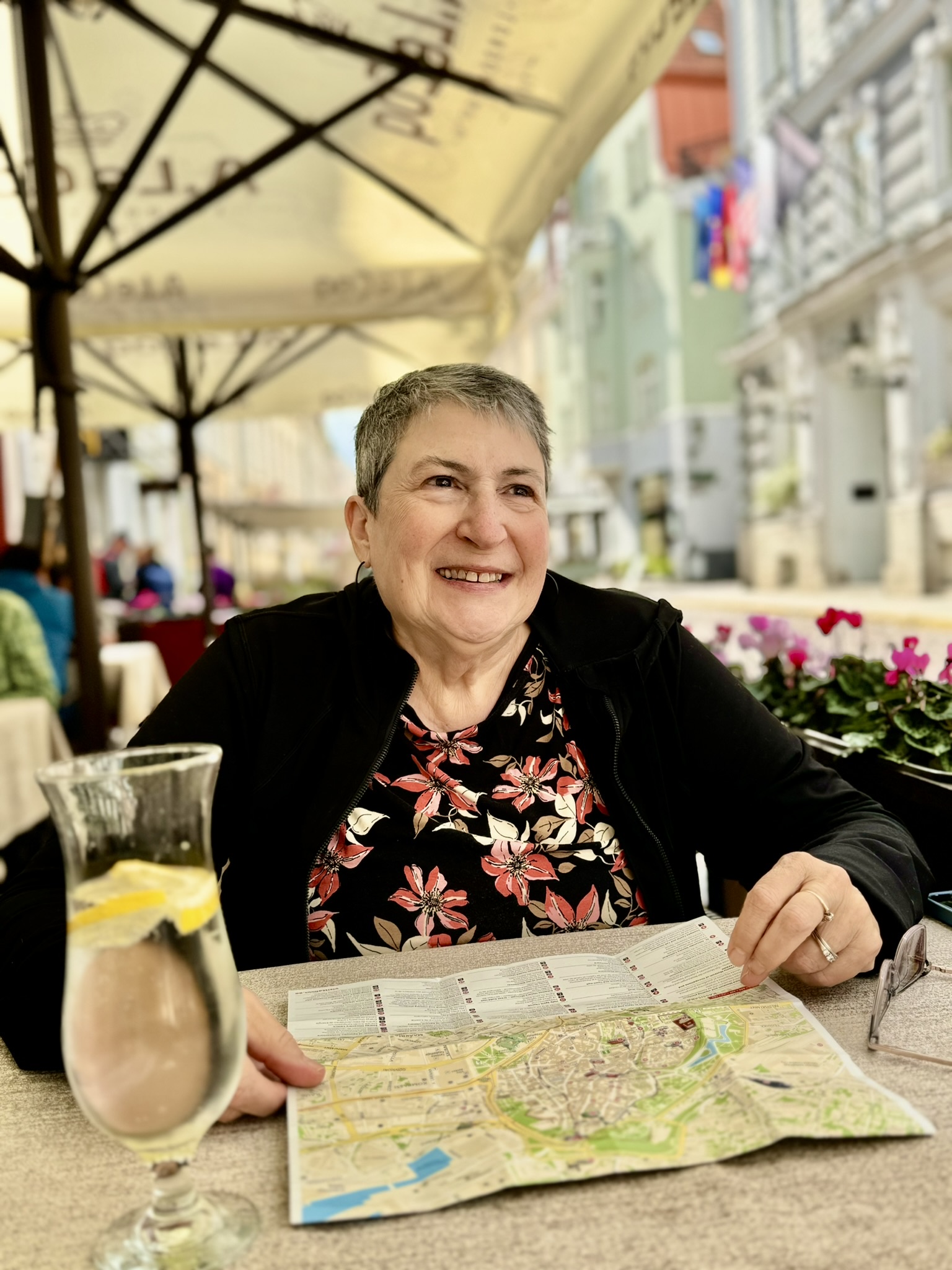
A walkway along the ramparts between the towers at the museum led to an exhibit about Tallinn’s café culture. Though the first coffee house opened in the town of Narva in 1697, Tallinn didn’t get its first café until 1702 when one opened on Town Hall Square. The oldest still-operating café dates from 1864, when the renown marzipan bakery, Maiasmokk, decided to offer coffee to go along with their tasty, sweet treats. After 160 years the Maiasmokk Café, even surviving nationalization during the Soviet occupation, is still open and a beloved cultural institution in Tallinn. Most of the exhibits address Tallinn’s café culture during the repressive communist era, when going to a café to share a coffee was one of the few recreational activities people could afford. With our “walk a little then café” philosophy for exploring a city, we felt we had found kindred spirits in Tallinn.

Decades later Estonian’s infatuation with coffee continues. This cultural obsession was fully on display when Estonian singer Tommy Cash performed “Espresso Macchiato,” during the finals for Estonia’s 2025 Eurovision contest and came in third place! Though in Italy some humorless Italians didn’t like the caffeinated cliches and called for the song’s banning.
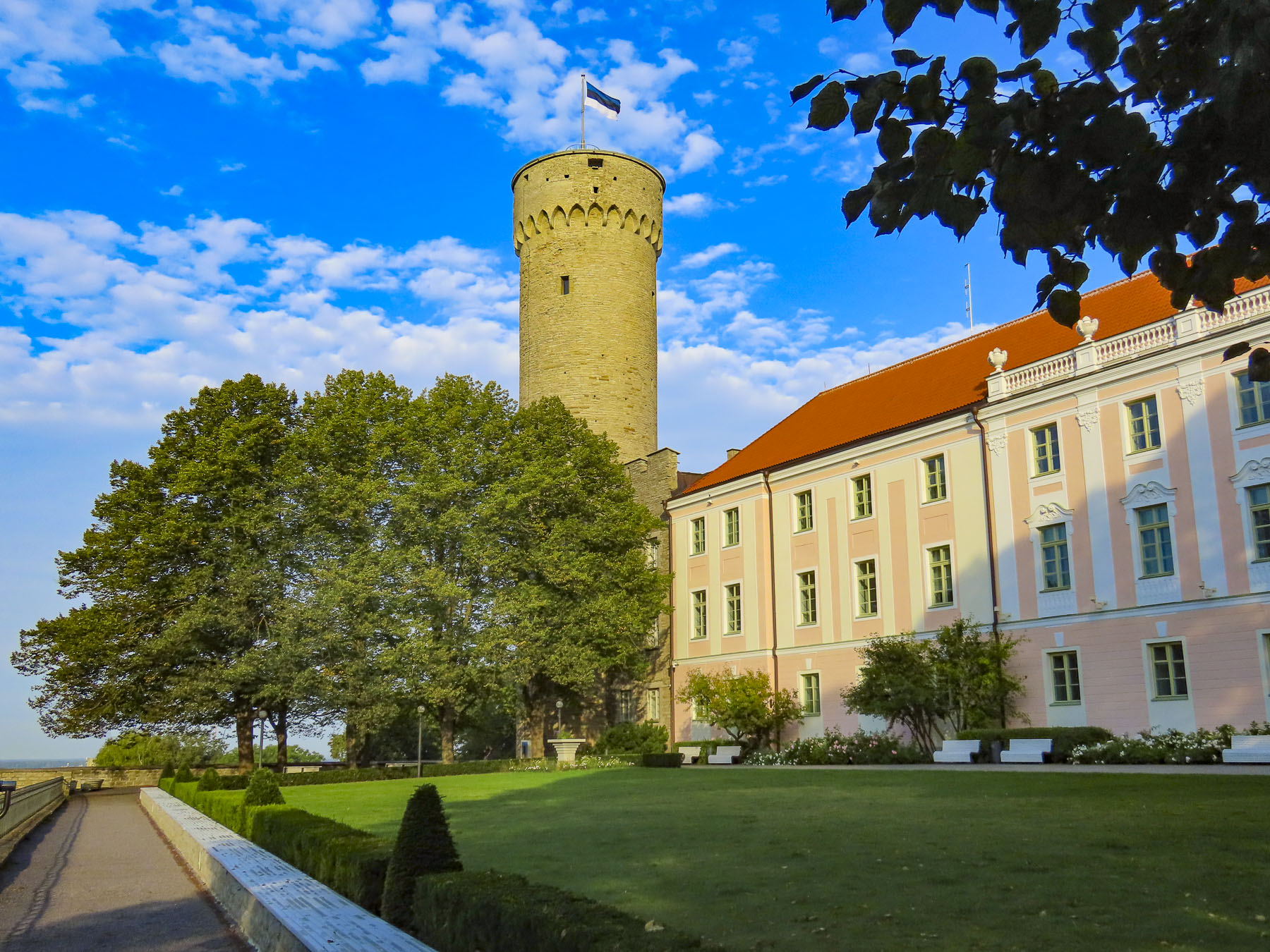
Other points of interest on the hill included the onion-shaped spires of the Russian Orthodox Alexander Nevsky Cathedral. It’s across the street from the pink building that houses the Estonian Parliament. (A very good eye-level view of the cathedral can be seen, on the uphill walk, from the restored bell tower of the mid-1400s St. Nicholas’ Church.

He was the patron saint of merchants and seafarers. It was formerly one of the wealthiest churches in Tallinn until it was severely damaged by WWII bombing. Fortunately, many of its fine ecclesiastical art works, acquired from the art capitals of Europe during the Hanseatic era, had been removed from the church for safekeeping at the start of World War II.  Now restored after a 30-year long renovation, the church serves as the Niguliste Muuseum, and exhibits the works that survived that cataclysmic war. Fortunately, the 105 meters, 345 ft, tall spire has an elevator that whisked us to the viewing deck.)

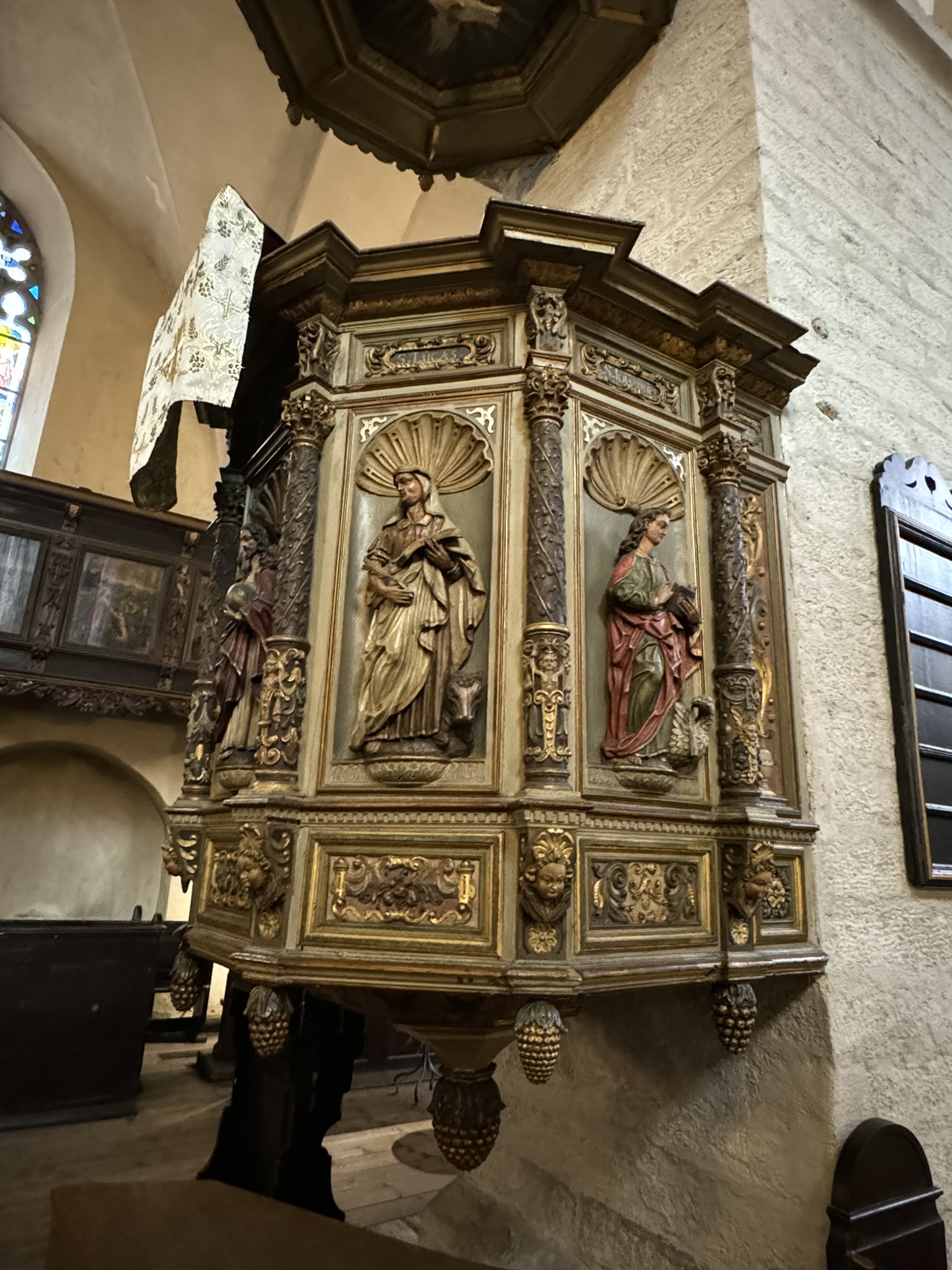
Farther along in one of Tallinn’s oldest churches, the 13th century St Mary’s Cathedral, there is a unique private worship box, totally enclosed with shaded windows, built directly across from and on the same level as the pulpit. Jokingly, we speculated it was designed for a wealthy patron so he could fall asleep and snore, without embarrassment, as the priest orated endlessly.

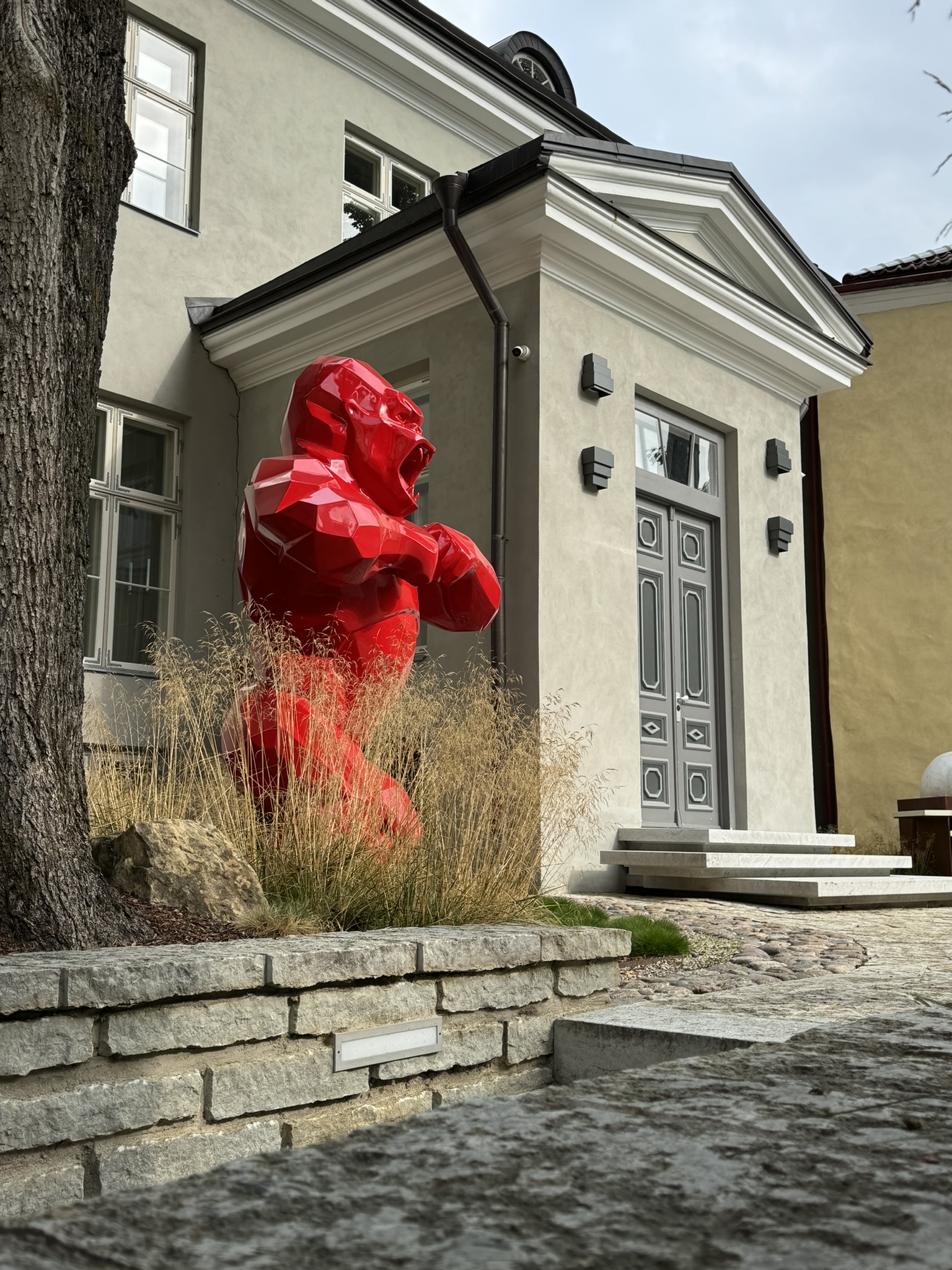
The hill also has the best vantage point for cityscapes of Tallinn’s historic skyline, the Patkuli Viewing Platform, and a mysterious red gorilla, that seems incongruously out of place. But we will leave him for you to find.
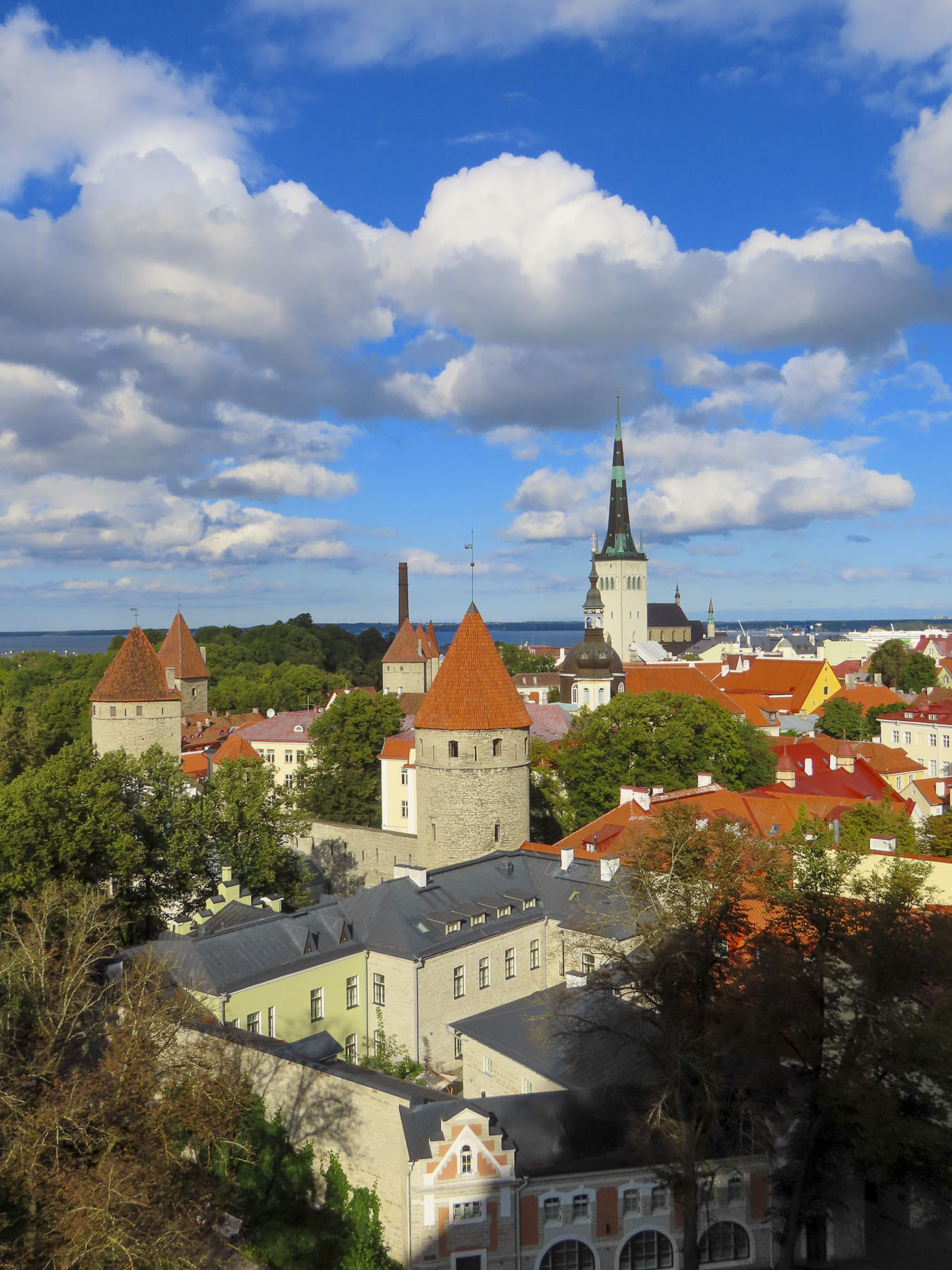
Stairs from the viewing platform ascended back toward the lower town, and we were close to Balti Jaama Turg, the Baltic Station Market. It was Tallinn’s first train station constructed in the 1860s, and became a market hall in 1993. A major renovation in 2017 totally revamped the three-level market, which has become a magnet for residents and tourists seeking a lively venue filled with diverse international eateries, antiques vendors, clothing shops, and food stores.

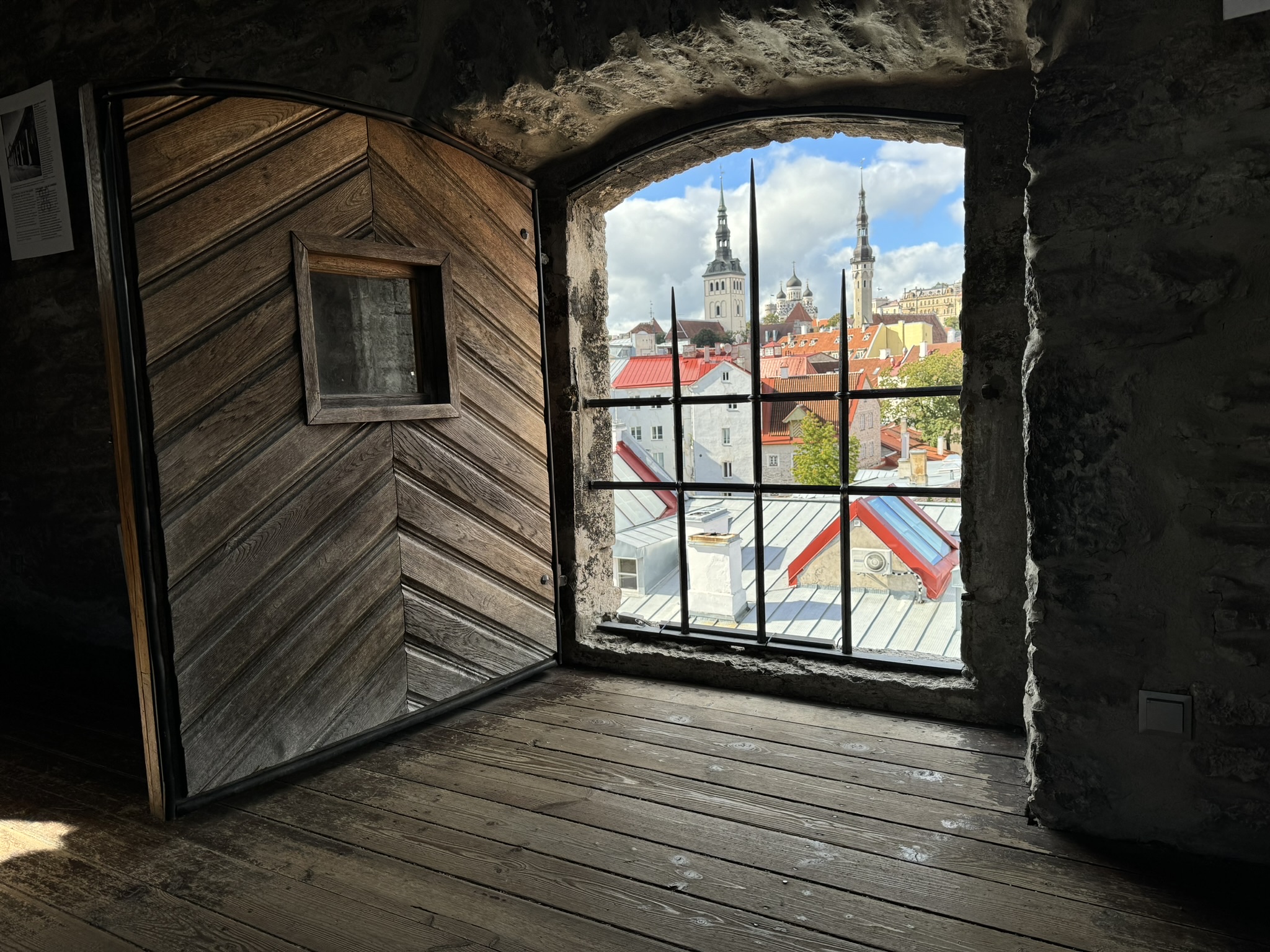
The next day, closer to our hotel, we wandered about, climbed more towers, walked along arched and tunneled alleyways, and descended into a cellar or two. Our walk along Müürivahe Street to the Hellemann Tower and Town Wall Walkway was quite interesting. The real prize was the view from the tower window towards Town Hall Square – it was a panorama filled with red tiled roofs and steeples.

Across from it was the Dominican Convent built in 1246. It was the oldest monastery in Tallinn and supported the adjacent St. Catherine’s Church which was completed in the early 1300’s. The convent couldn’t exist solely on the alms it collected, but the friars were an industrious group who supported themselves as farmers, and traders of fish, while also operating a brewery that sold four different kinds of beer, while they spread the gospel. “The monastery also drew profit from the veneration of relics,” and at one time, records suggest, they had “twelve silver reliquaries containing the heads of saints, with each head reputed to cure a different set of diseases.”
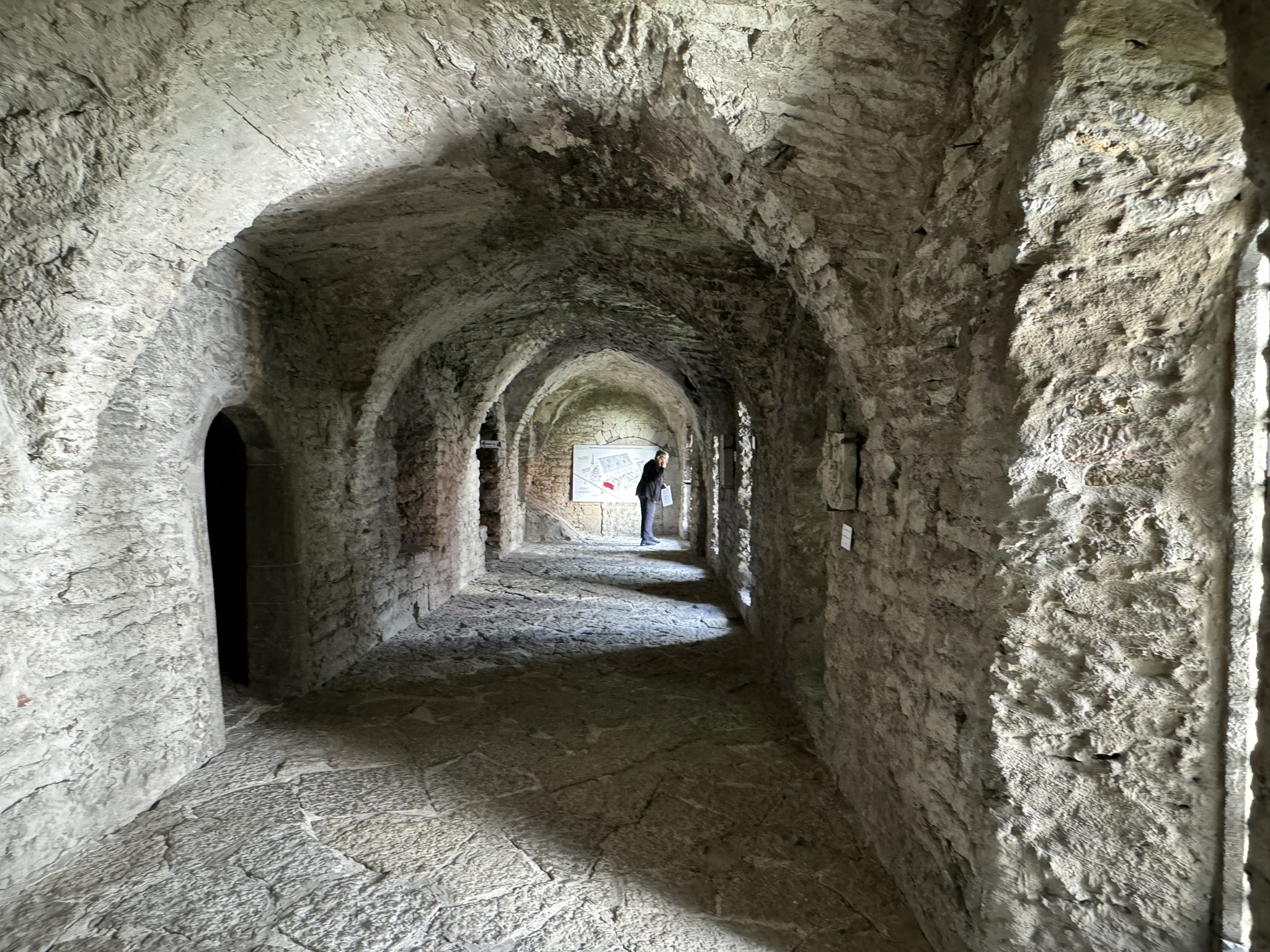
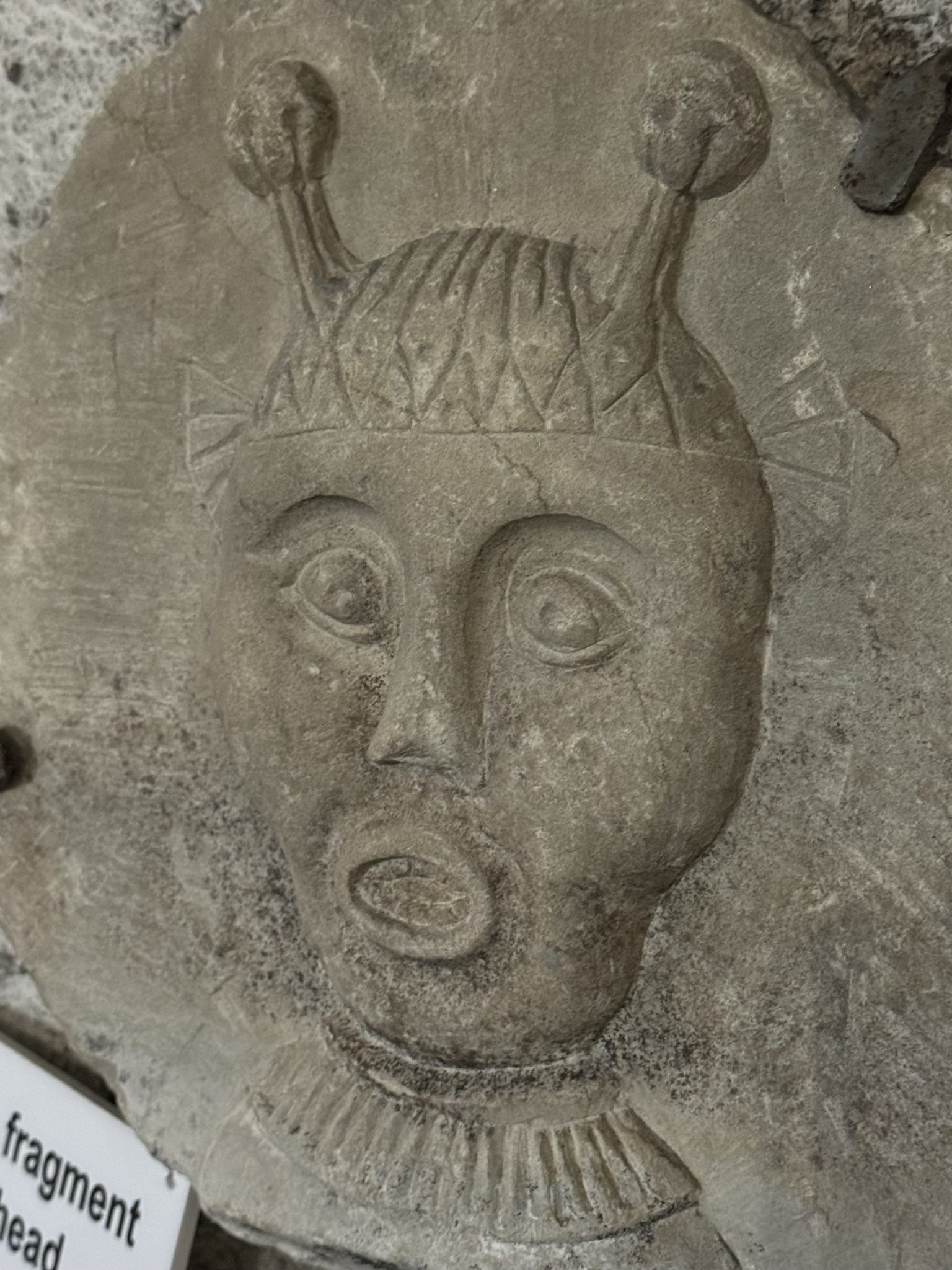
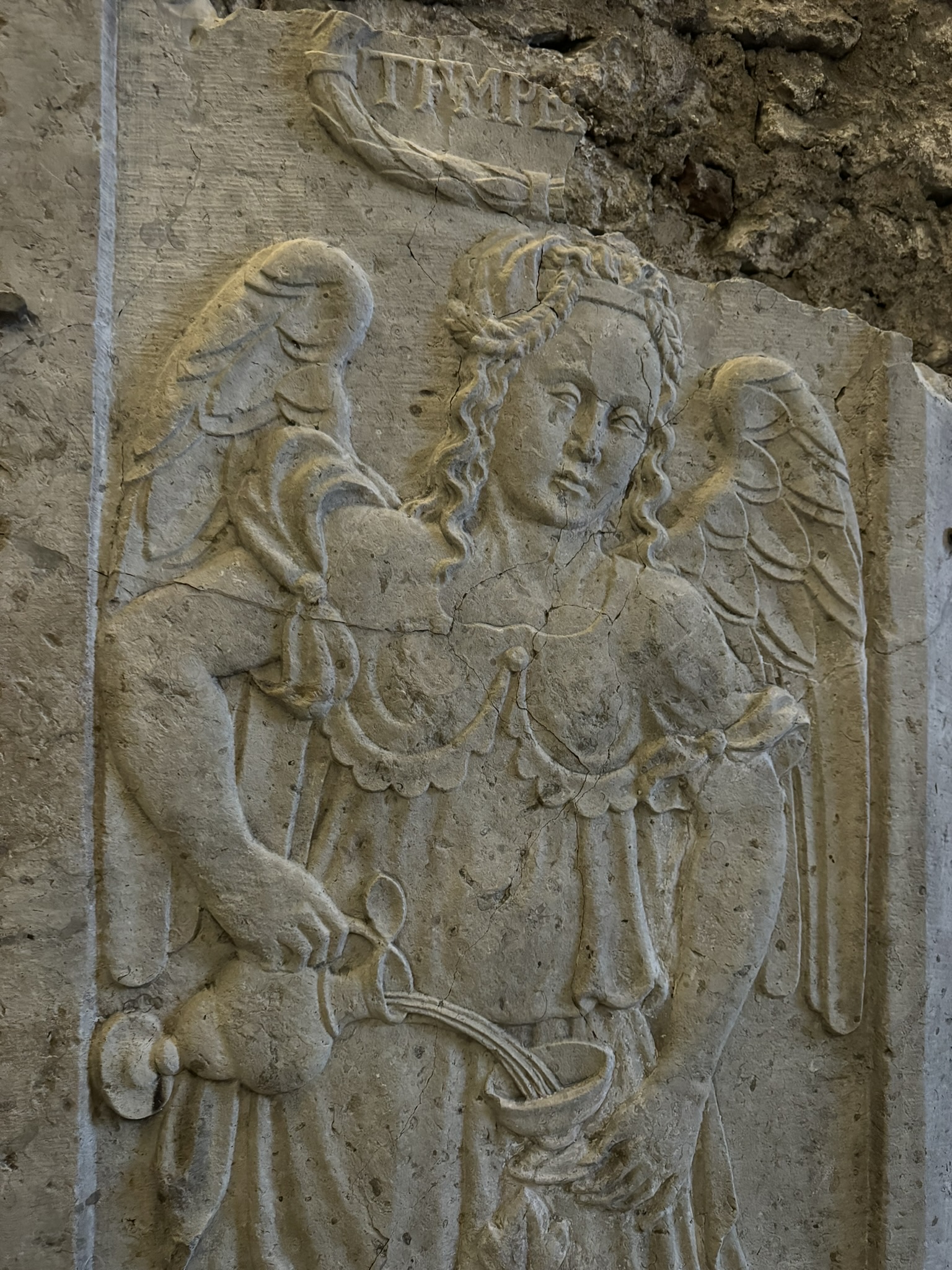
But everything came to an abrupt end during the Protestant Reformation in 1524 when a Lutheran mob ransacked the church and monastery, and the friars were expelled from Tallinn. A partial restoration was undertaken in 1954, and it’s now a museum, which also hosts art exhibits. Its rough stone chambers and some fine carved stone works were intriguing. We didn’t notice any fireplaces, which left us wondering how difficult living within these spartan walls must have been.
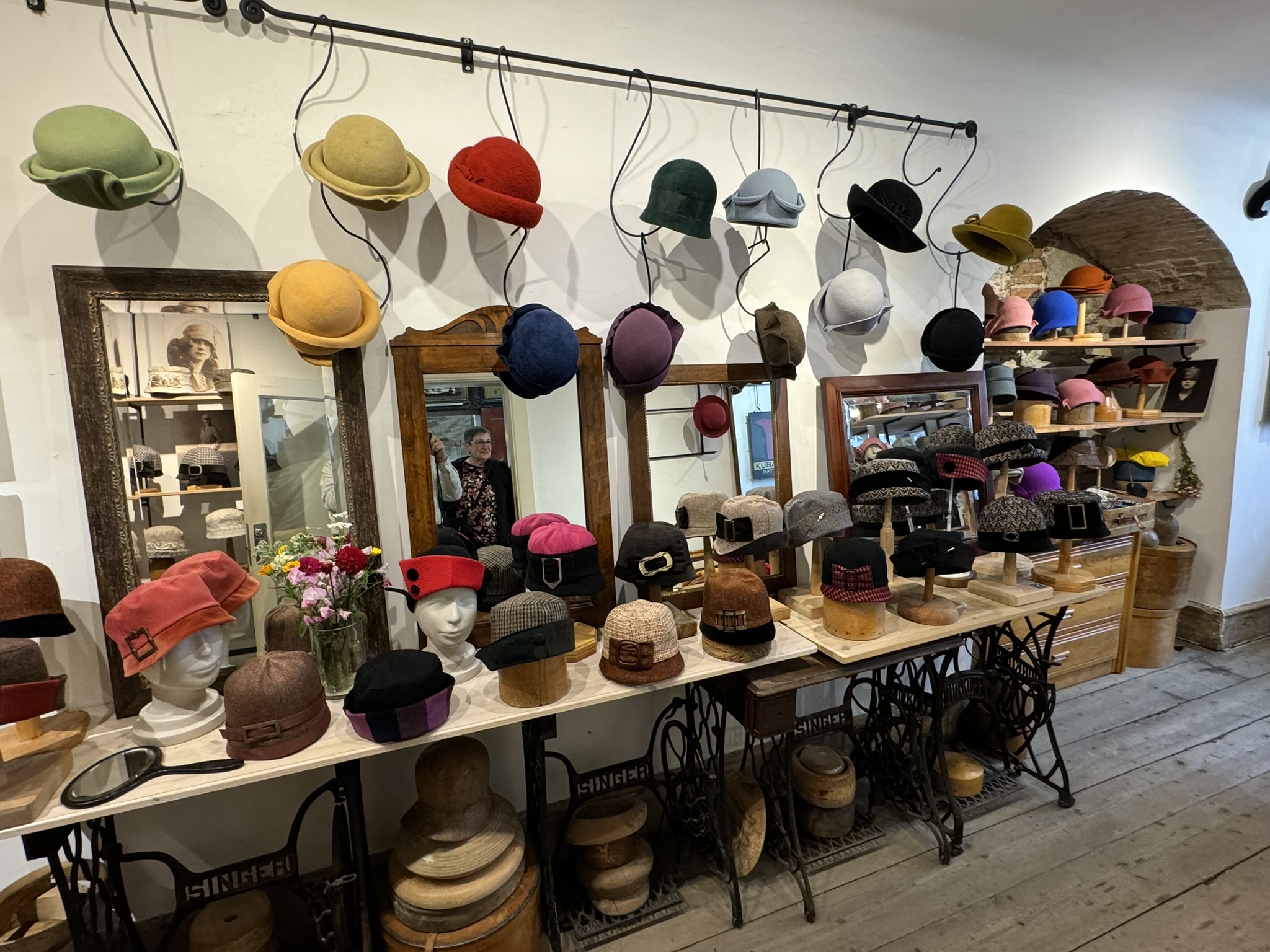
Next to the monastery is Katariina käik, St. Catherine’s Passage, an old medieval lane that separates the church from the surrounding buildings. Today it’s lined with restaurants offering Estonian cuisine, and artisanal crafts shops, featuring the talented women of the Katariina Gild who craft jewelry, weavings, ceramics, blown glass, and leatherwork. At the far end of the lane, under the arched entrance off Vene Street we found the Restaurant Munga Kelder to be a nice place to dine.

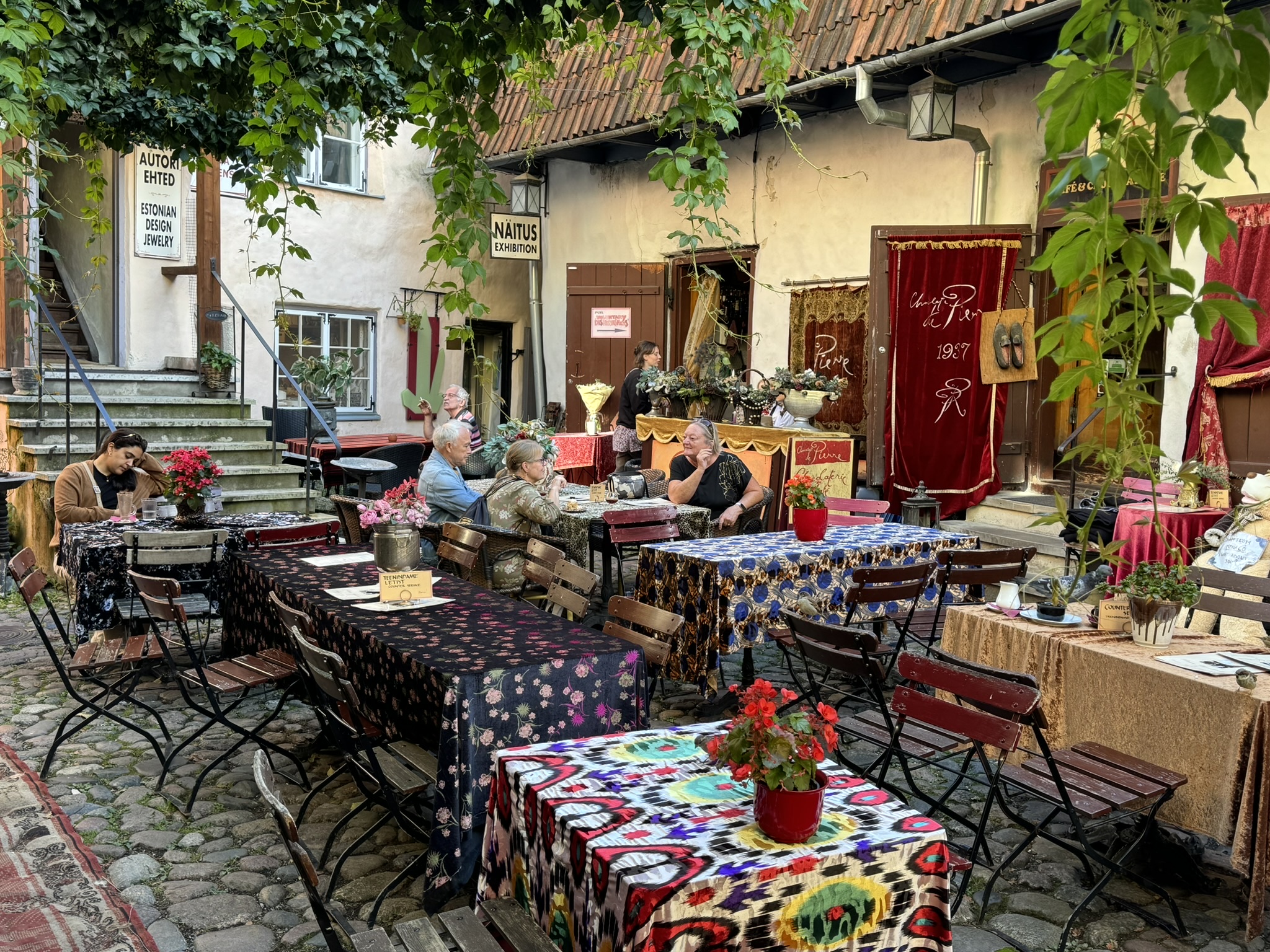
Within earshot of a town crier’s call was the Masters’ Courtyard. It similarly has unique craft vendors, but also has a restaurant that fills the courtyard with rustic tables covered with colorful tablecloths, which gives the courtyard a joyful, boisterous look.
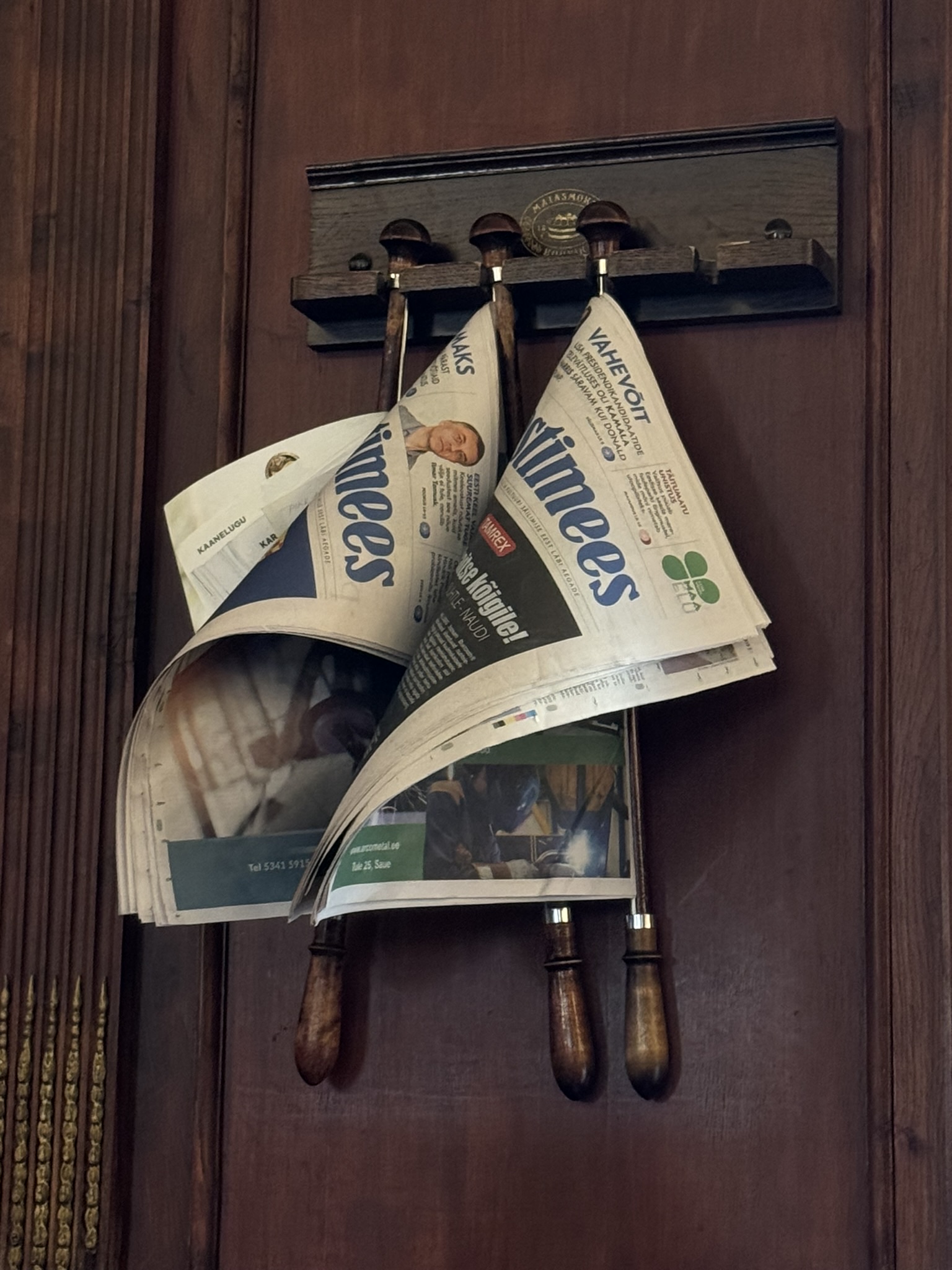
Marzipan lovers, we had to stop one afternoon at the Maiasmokk Café. The ambiance in the front room was very old school with an ornate ceiling, and mirrored walls with polished wood trim and newspaper hooks! When’s the last time you’ve actually seen a newspaper? Their colorful back room is a temple to marzipan with display cases showcasing the sweet crafted into figurines and other shapes.  The variety was just mind boggling. And if your timing is right you might be able to see them being made.

With our sugar cravings satiated, we checked out Tallinn’s Great Guild Hall, directly across from the café. It featured several floors of interesting exhibits dedicated to the city’s history and trade guilds.

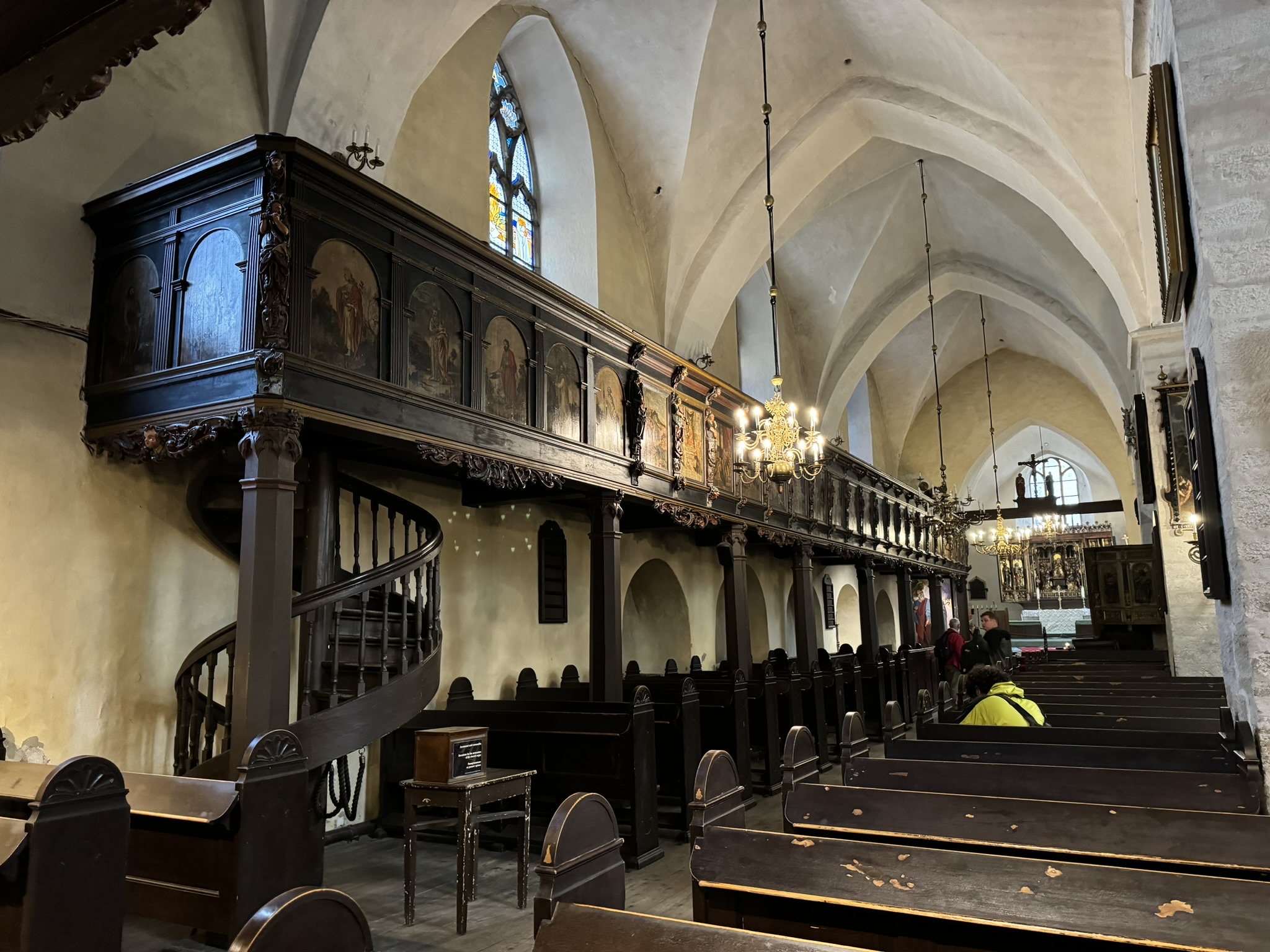
Across from the guild hall and the café is the Church of the Holy Spirit. During the medieval era it was the main church for everyday folk in Tallinn, and the first chapel to offer masses in Estonian, not German or Latin as was the tradition of the other churches in Tallinn at the time. With its stark white interior and original dark wood ornamentation, it is one of Tallinn’s least altered churches.
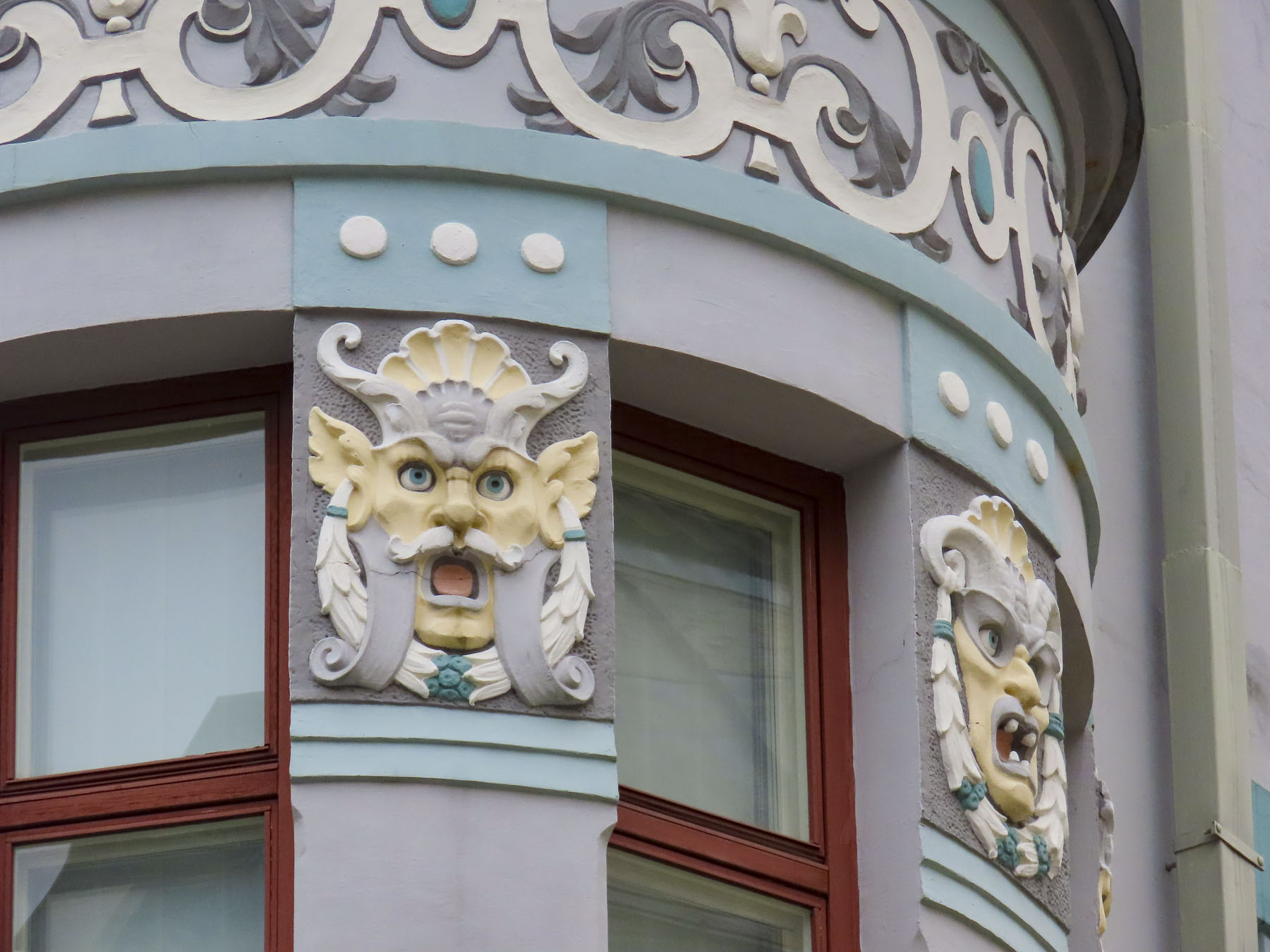
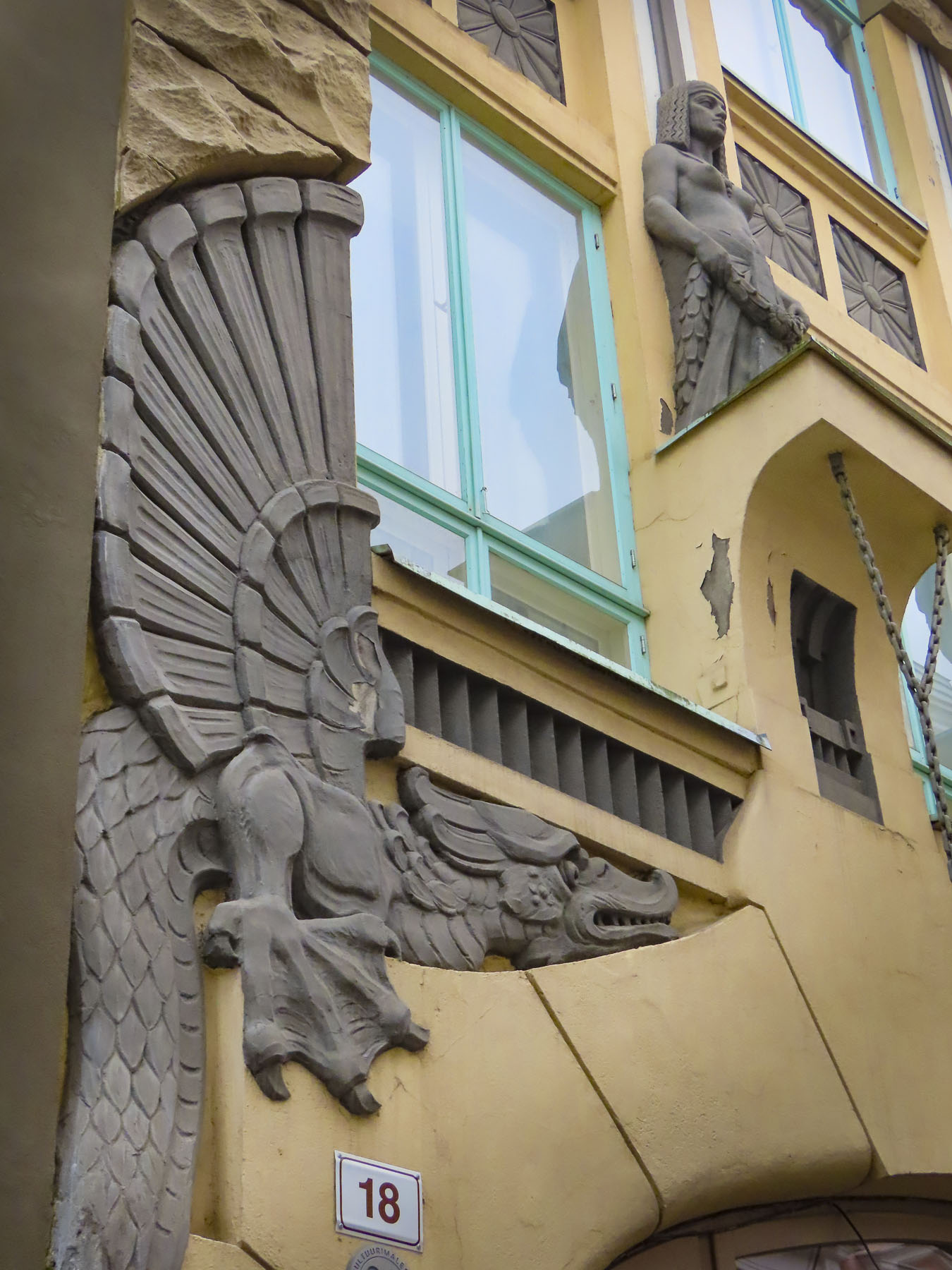
There were several other interesting facades down the street from the Great Guild Hall.
Tallinn has a rich nautical heritage that started during the early Viking era in the 6th-century when the area that would become Tallinn was a stop on the Baltic trade route that connected Sweden to Constantinople.  The area of Tallinn traded furs and bog iron for wine, spices, glass, and jewelry. Shortly after the Danes established rule over northern Estonia in the early 1200s, Tallinn now a larger port city, joined the Hanseatic League, a confederation of medieval trading cities located along the Baltic and North Sea coasts. The Dutch, German and Swedish merchants of this association brought several centuries of prosperity to the city that’s still reflected in the fine examples of merchants’ houses and guildhalls that line Pikk Street. The league’s maritime trading also supported ship building which remained a vital industry through the Soviet Era which saw the shipyards build warships and submarines for the Russian navy.

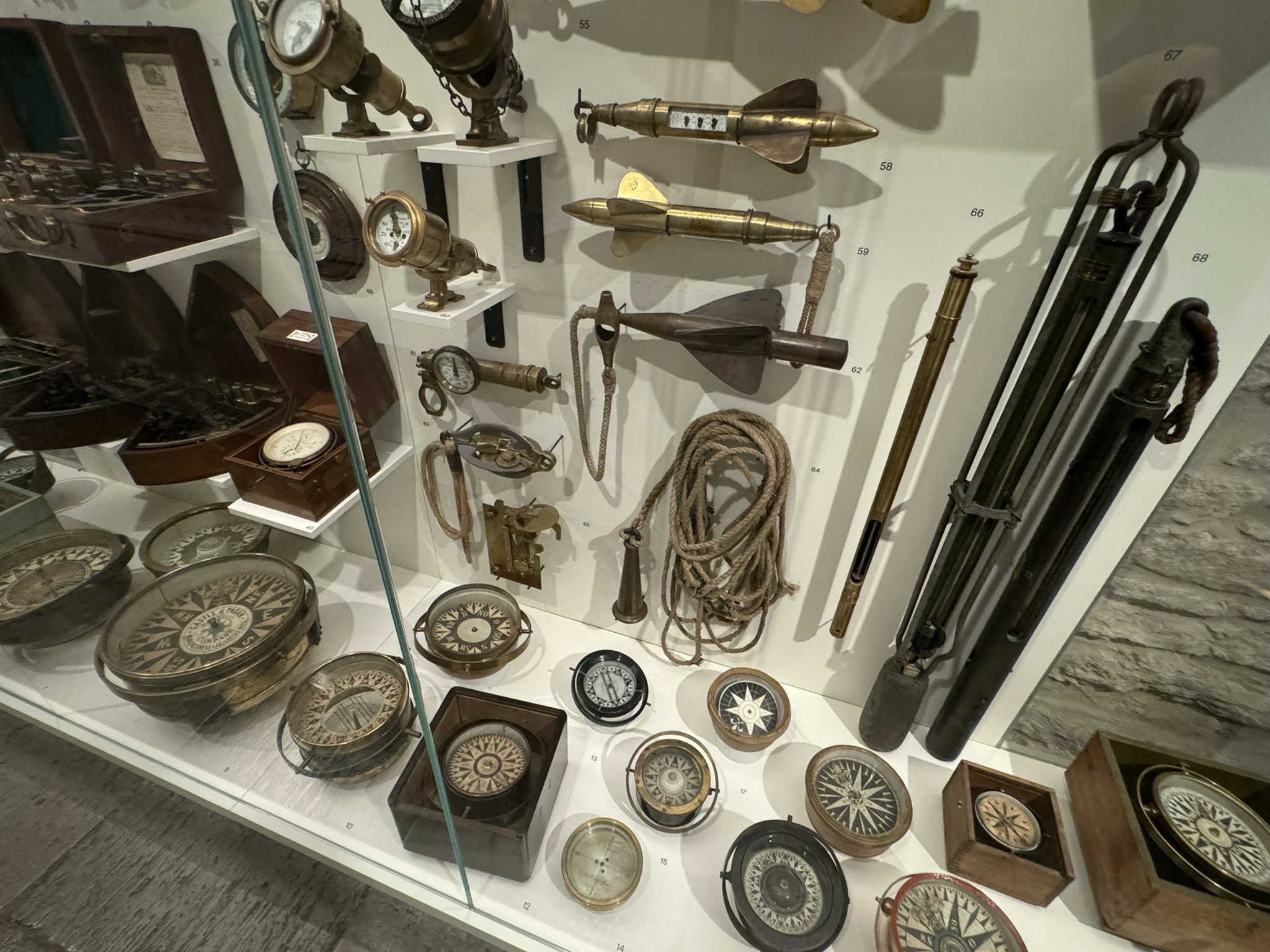
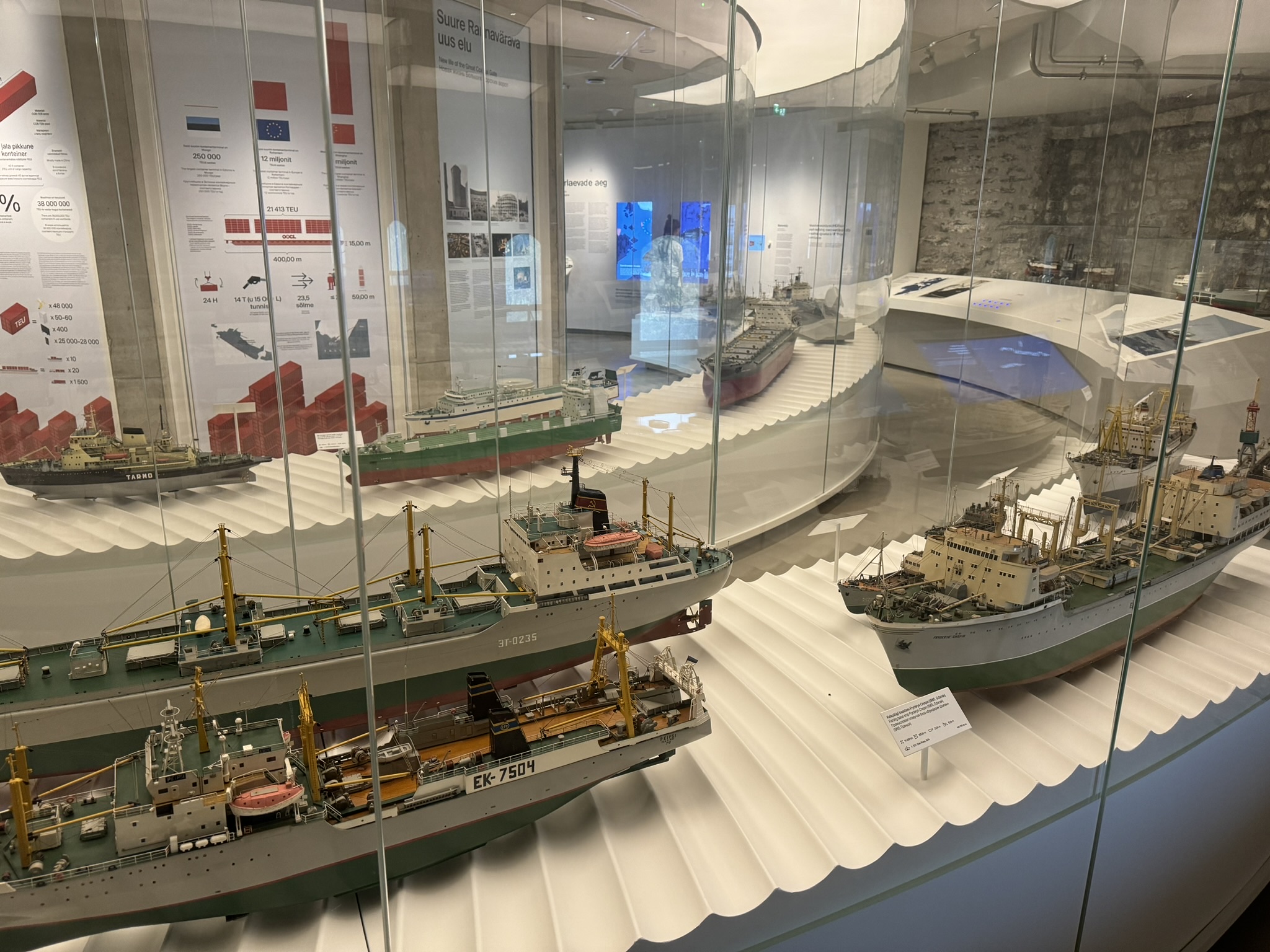
The importance of Tallinn’s maritime history is well told with two museums in the city.  One is housed in a squat, round, 16th-century cannon tower called Fat Margaret, which once guarded the port, but now is a modern, state of the art museum, with ship models, interactive displays, and the hull of an excavated wooden shipwreck to view.   

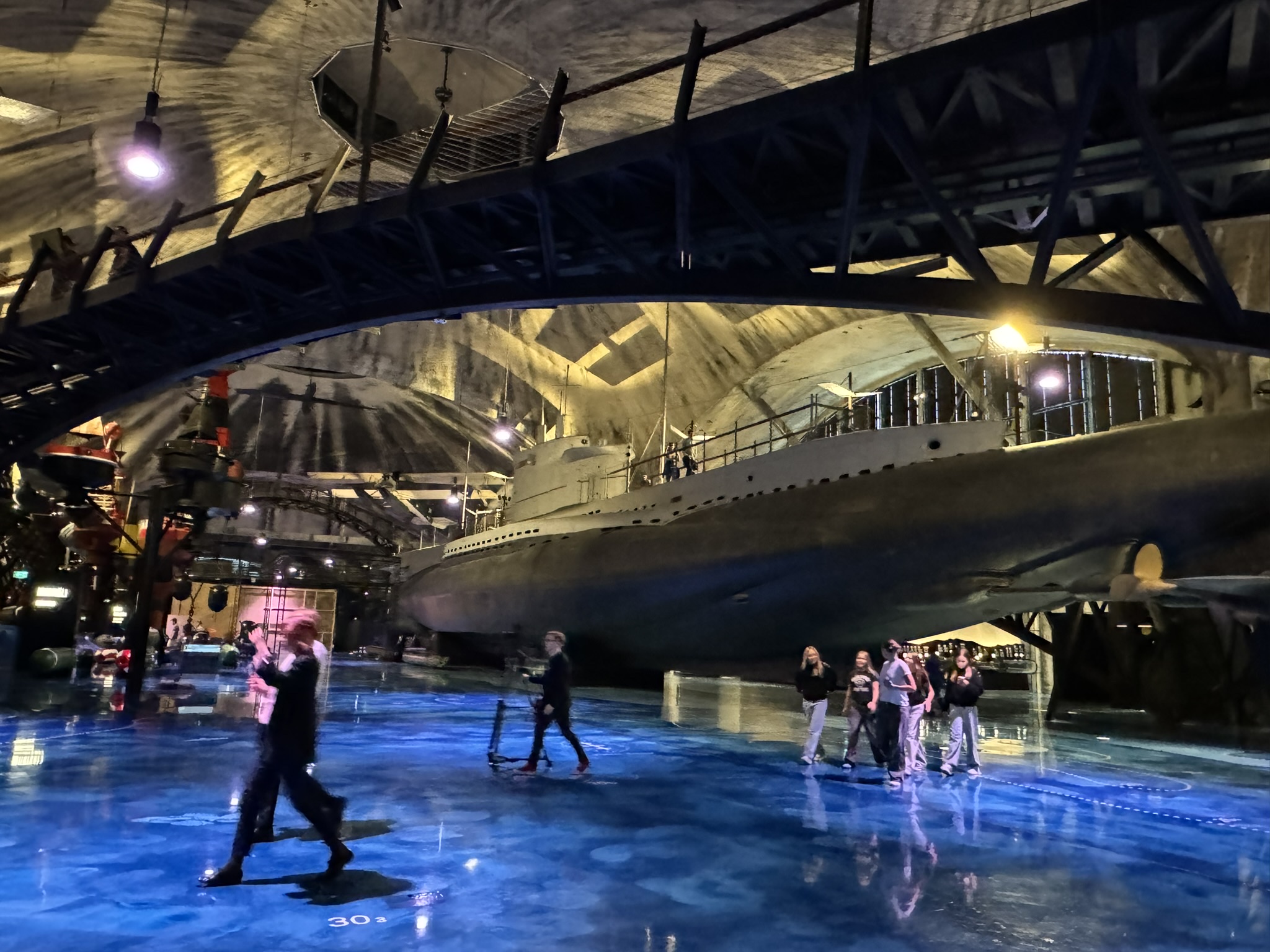
Its sister museum is on Tallinn’s waterfront at the Lennusadam Sea Plane Harbor. It was raining heavily the day we visited, so we didn’t see the historic ships docked outside, but we did enjoy the full-size boats on display inside the old seaplane hangar. Especially the submarine Lembit, built in Tallinn and launched in 1936, which was the pride of the Estonian Navy.

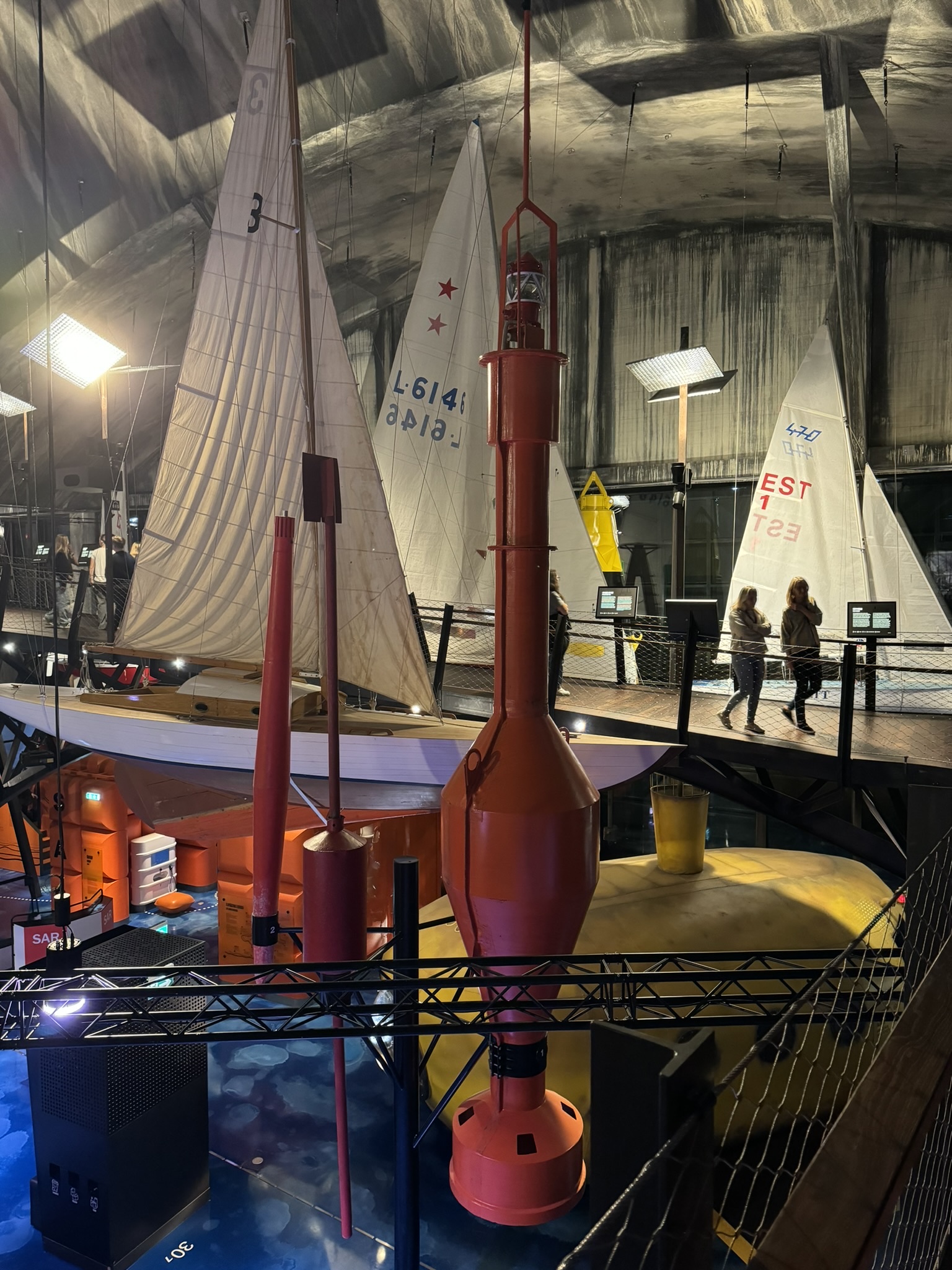
The large concrete hangars themselves are noteworthy, as the three connected shells were the largest reinforced concrete domes in the world, without any central support columns when their construction started in 1912. They were ordered built by Russian Tsar Nicholas II to shelter the seaplane squadron that was part of Peter the Great’s naval forces. It’s a cavernous space with a seaplane hanging from the ceiling, and where you can actually walk under a submarine. The museum also had a nice café which overlooked the exhibits.

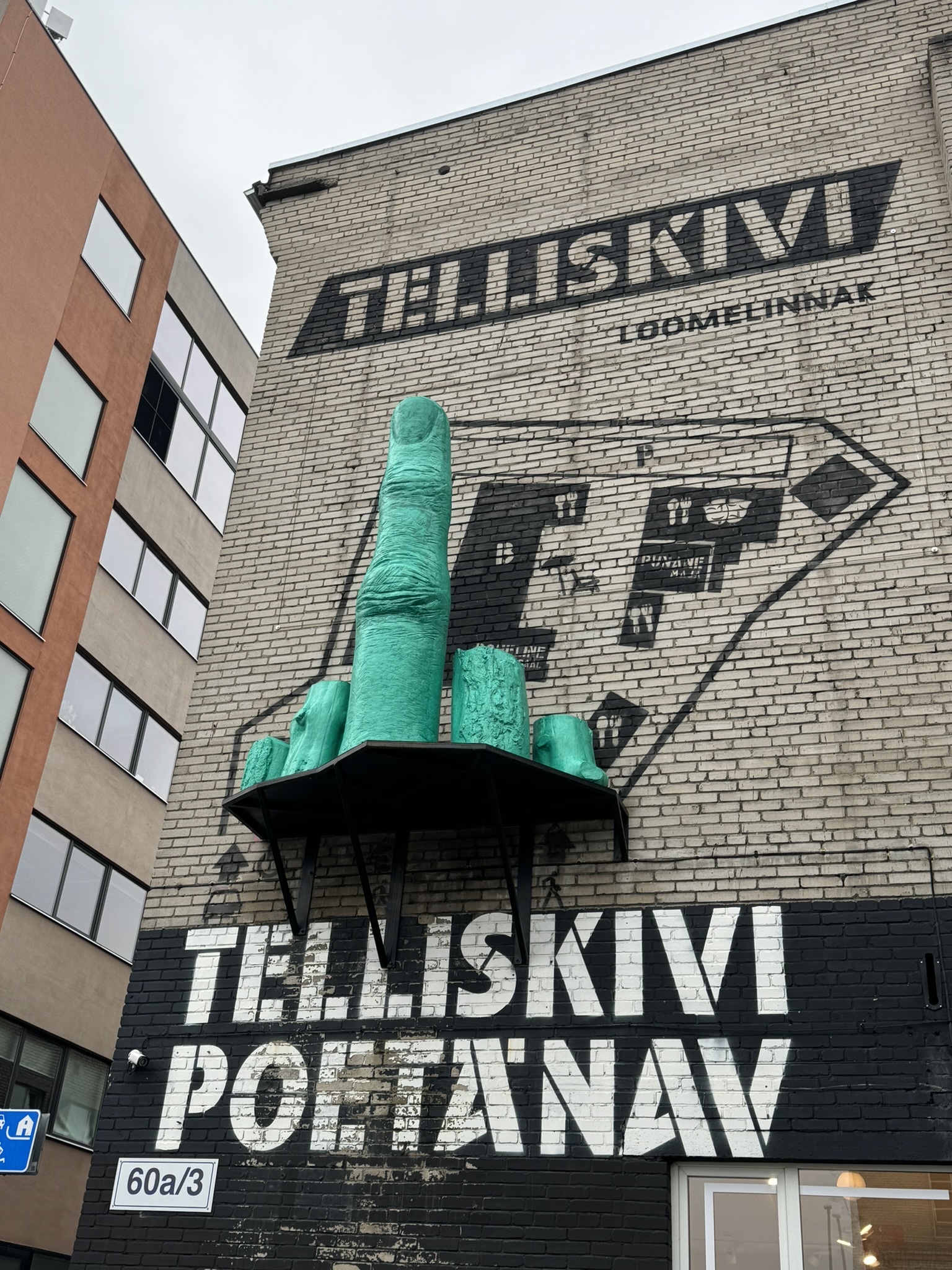
When the weather was inclement or the walking distance too great, we used Uber to get around. The service worked very well for us in Tallinn. Getting to Telliskivi Loomelinnak, the Telliskivi Creative City, from the Lennusadam Sea Plane Harbor was one of those occassions and it worked perfectly.

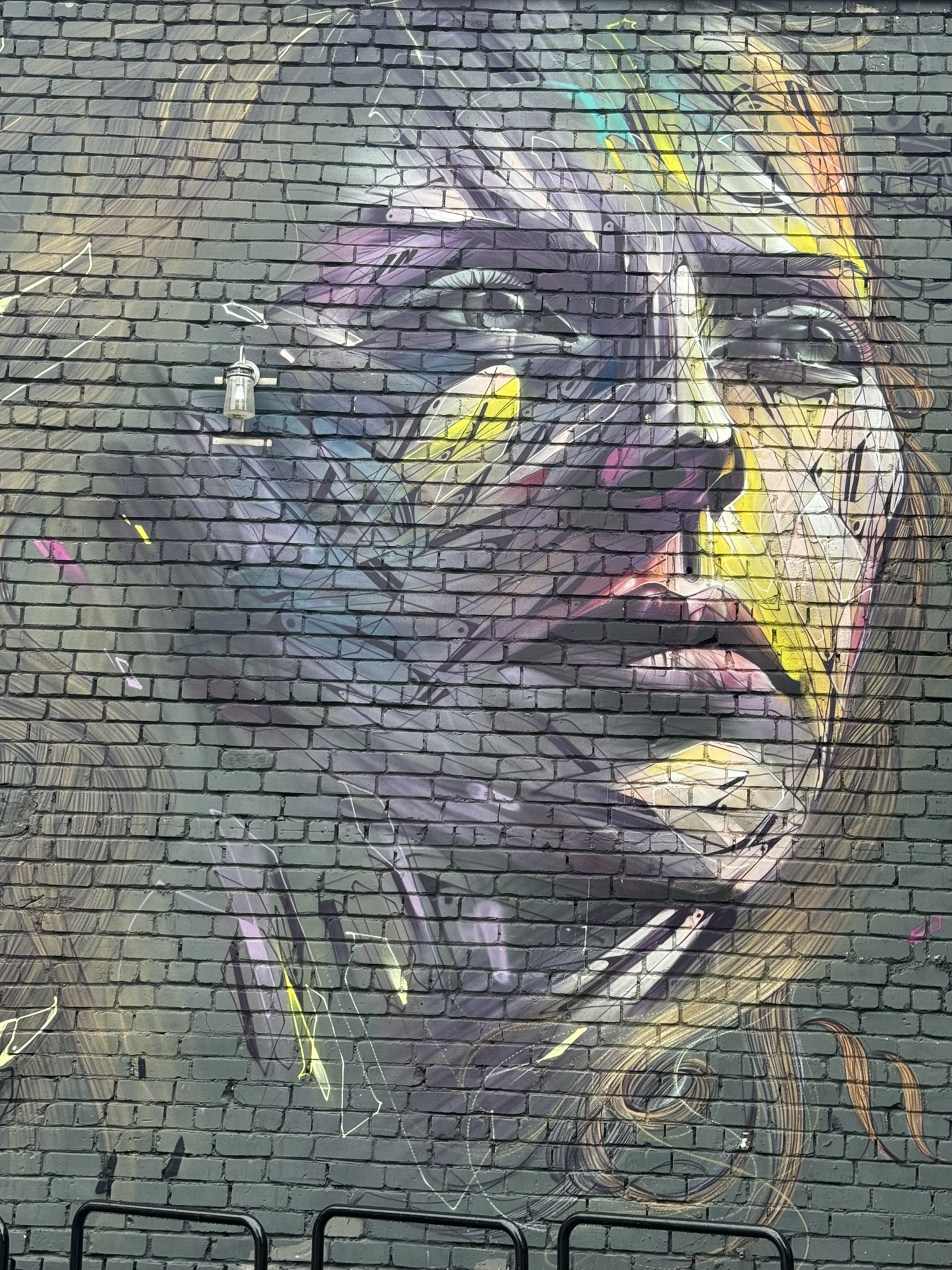
It’s an old, street-mural covered industrial site that’s been revamped into a hip entertainment and nightlife destination with theaters, galleries, restaurants, and bars. It was a fun place to explore, but I think we skewed the demographics a little bit.

 Till next time, Craig & Donna

P.S. We purchased Tallinn Cards to use during our stay in the city and found it to be quite beneficial and cost effective. The card offered access to over 50 museums and attractions, free travel on public transportation, and discounts on sightseeing tours.

Driving the North Coast 500 – Part 7: Duncansby Head Lighthouse To Loch Ness or Castles, Myths & Bagpipes

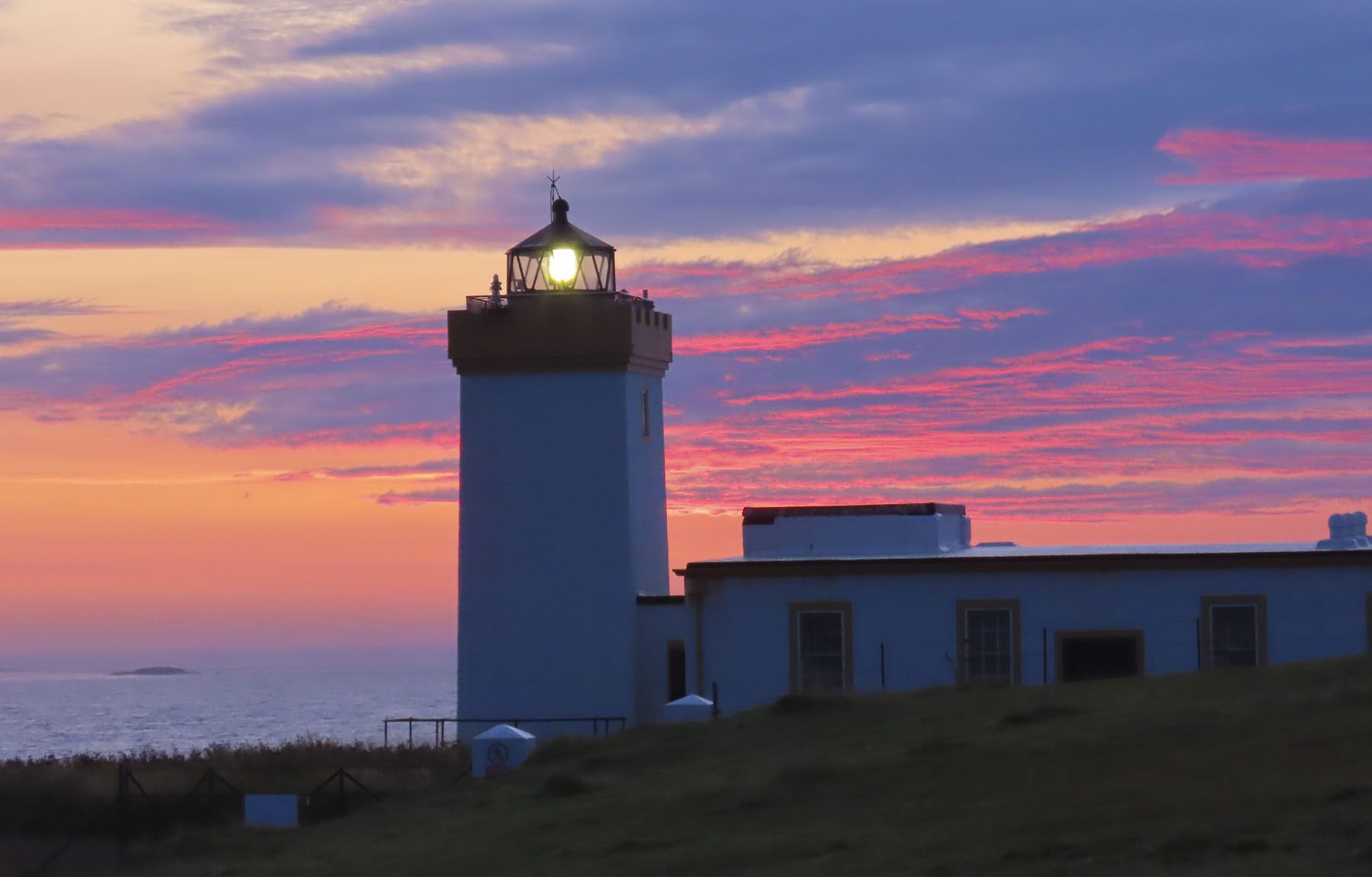
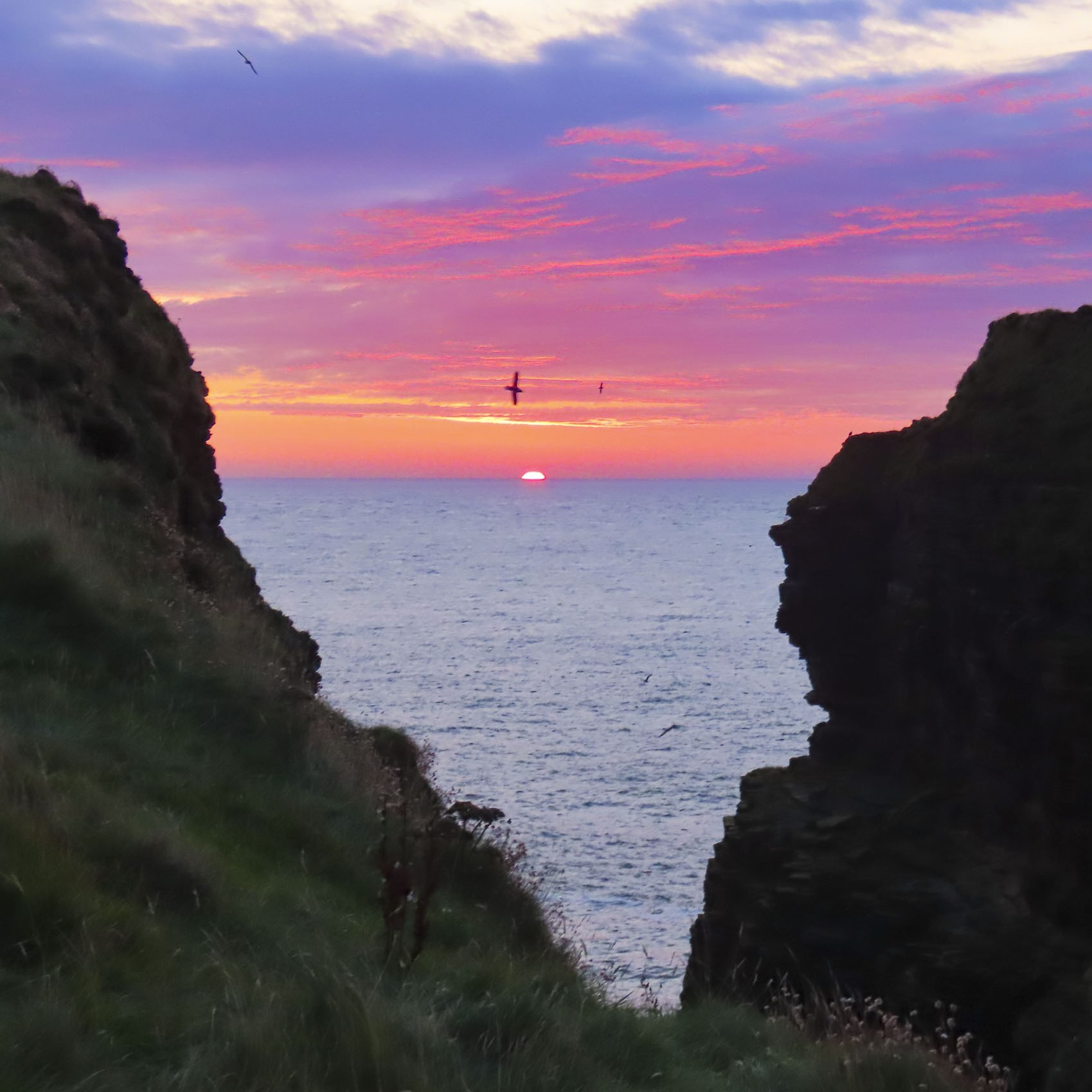
A small flock of sheep, sleeping on the tarmac, scattered when we rounded a bend to Duncansby Head Lighthouse before the crack of dawn. The pinnacle stood silhouetted against a brightening sky of pink, amber and blue, as the sun crested the horizon over the North Sea.

We followed the trail along the cliffs towards the Duncansby Stacks and passed a spot where we imagined an ancient Norse god had wielded a broadaxe and severed the bluff in two. The stacks were glowing red in the early morning light as Kittiwakes and Guillemots swooped along the cliff face, which stretched south for miles.

Following a delicious hardy breakfast, we packed our bags and said goodbye to the innkeepers at the John o’ Groats Guest House, one of our nicest stays while in the Scotland, then began the final leg of our NC500 tour and headed south along the A99 and A9 to Dunrobin Castle & Gardens, before spending the night in Strathpeffer. A pleasant distance of only 113 miles, which took us all day with all the photo stops we made. But that’s the way we roll.

There’s a debate about the best way to drive the North Coast 500 and the consensus seems to be that exploring it in a counterclockwise direction leaves the breathtaking scenery of the west coast for the last part of your trip.

We did the opposite and followed the NC500 clockwise, heading south from Inverness to Edinburgh, then west through the highlands to the Isles of Skye and Lewis & Harris before returning to the mainland and heading north to Durness and John o’ Groats, before heading south along the North Sea Coast of Scotland. We found the scenery breathtaking.

Our only complaint was the lack of official scenic pullovers, as we often had to park at the entrance to a farmer’s pasture or on a side road, and walk back along its shoulder to the spot we wanted. Fortunately, there were few cars on the road, because we stopped numerous times.

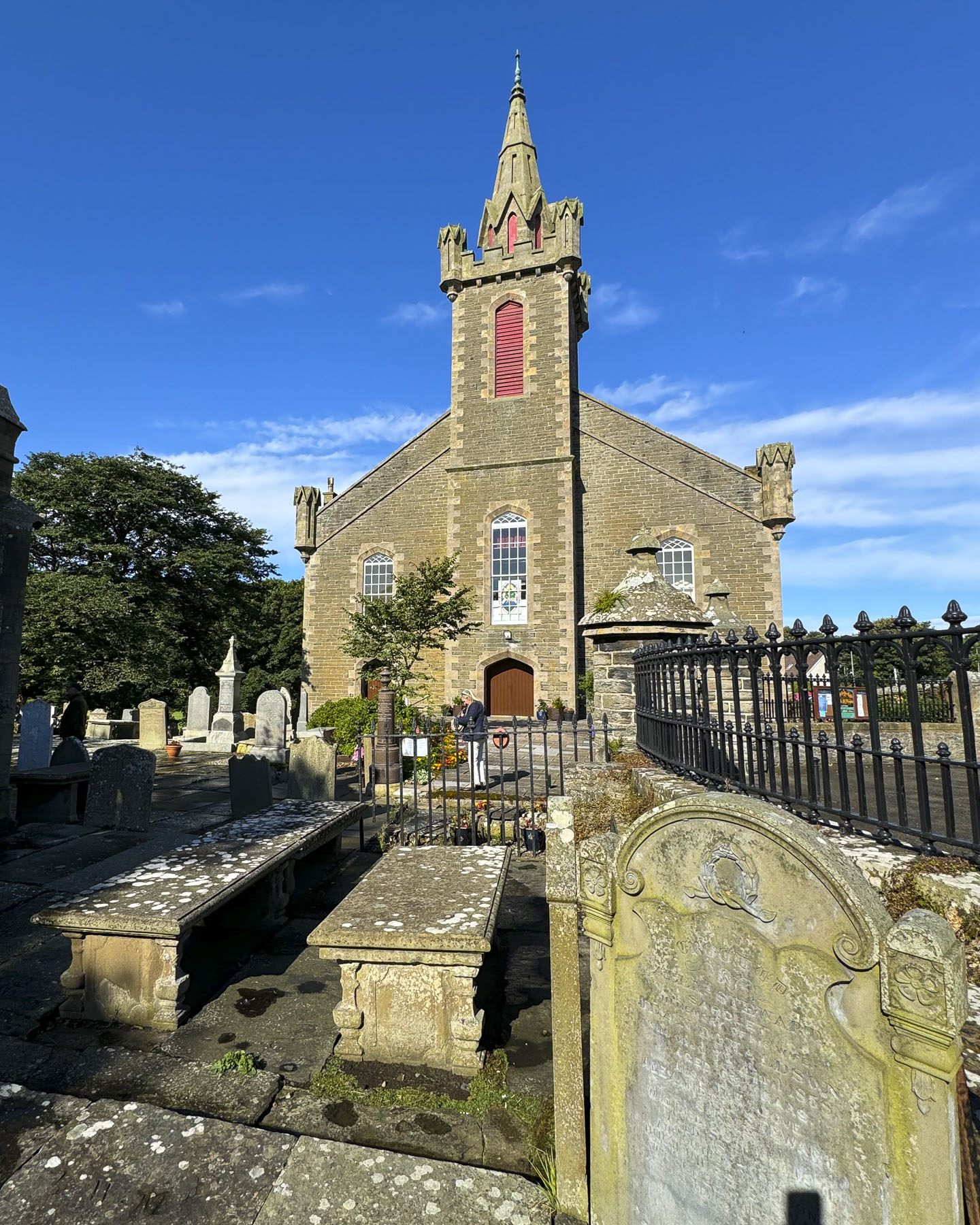
At Wick we visited the Old Parish Church and wandered amid its ancient gravestones, the oldest of which dates to 1639. The present church was built in 1862 over the foundations of two earlier churches, the earliest dating to the 12th century. A prideful lot the Wicks were, and they didn’t take kindly to anyone disparaging St. Fergus, their church’s patron saint. History tells of an Archdeacon, a noted reformer, who visited the parish in 1613 and vented his wrath on a beloved image of St Fergus in the old church, attacking and defacing it. The congregation was incensed, and the Archdeacon might have met his maker on the steps of the altar if the local sheriff hadn’t escorted him out of town. But he only got as far as the Wick River when he was ambushed and drowned.  During the following enquiry, “witnesses swore on oath that they had seen the ghost of St Fergus astride the unfortunate minister holding him down in the river.”

Clan Gunn Museum & Heritage Centre is beautifully set on the coast.

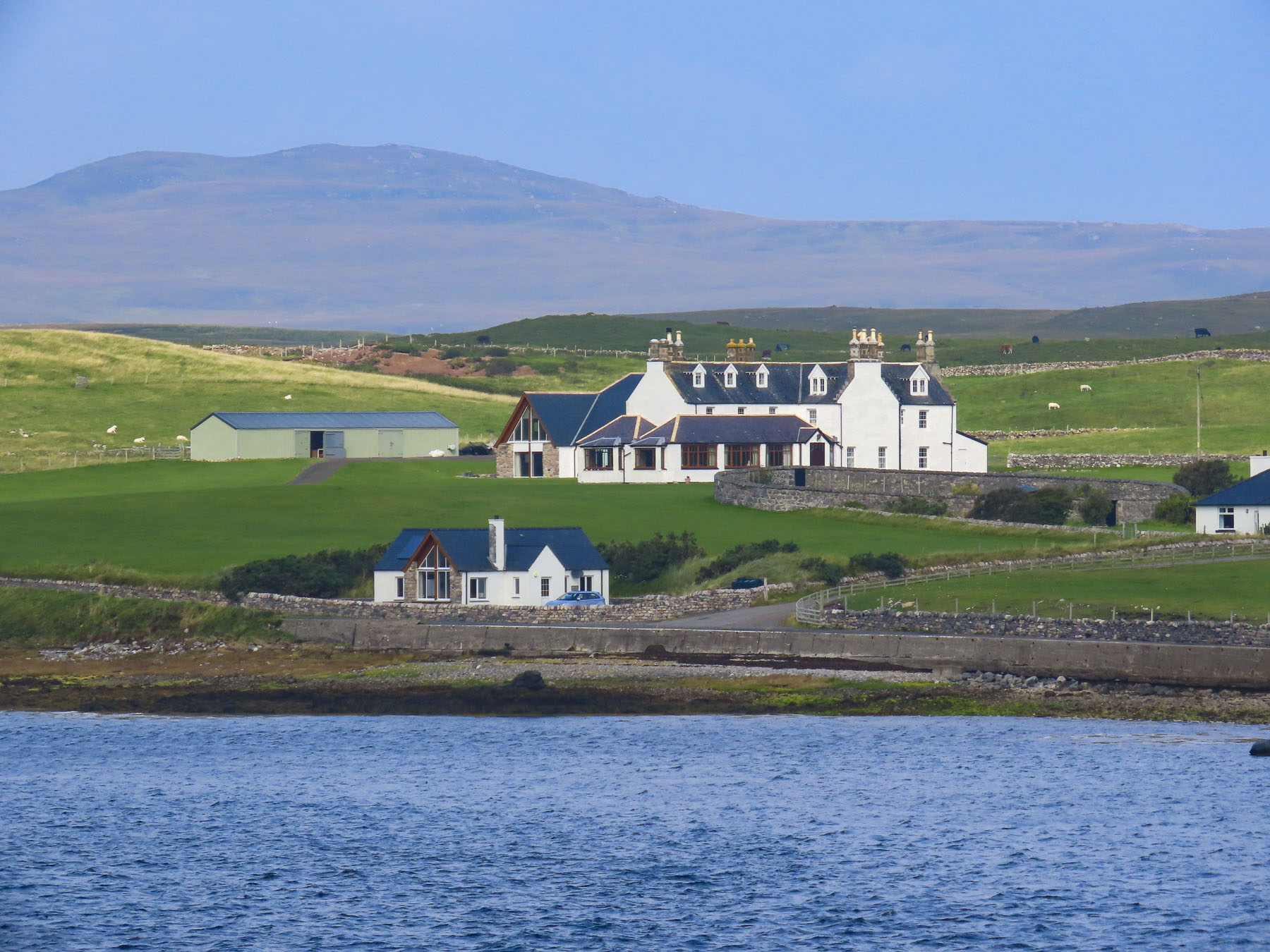
There are few natural harbors along Scotland’s North Sea coast. Ferocious storms blowing in off the sea required many villages to build stout seawalls to prevent their fishing boats from being smashed against the rocky coast. One such place was the tiny Latheronwheel Harbour. We had it all to ourselves when we visited on a Wednesday in August.

Crossing the River Helmsdale, we stopped at the Emigrants Monument which graces a hilltop that overlooks the village of Helmsdale nestled against its river and the sea. It’s a heart-rending tribute to those who were forced from their homes and livelihoods during the Clearances. The inscription on the monument, in Gaelic and English, reads:

“The Emigrants commemorates the people of the Highlands and Islands of Scotland who, in the face of great adversity, sought freedom, hope and justice beyond these shores. They and their descendants went forth and explored continents, built great countries and cities and gave their enterprise and culture to the world. This is their legacy. Their voices will echo forever thro the empty straths and glens of their homeland.”

It was commissioned by Dennis MacLeod. The son of a war-widowed crofter, he emigrated from Scotland to South Africa and made his fortune in mining.

Dunrobin Castle & Gardens was our main destination for the day, but our hopes were temporarily dampened by a sudden heavy rain. Fortunately, after we ran through the storm to the entrance, the sky cleared.

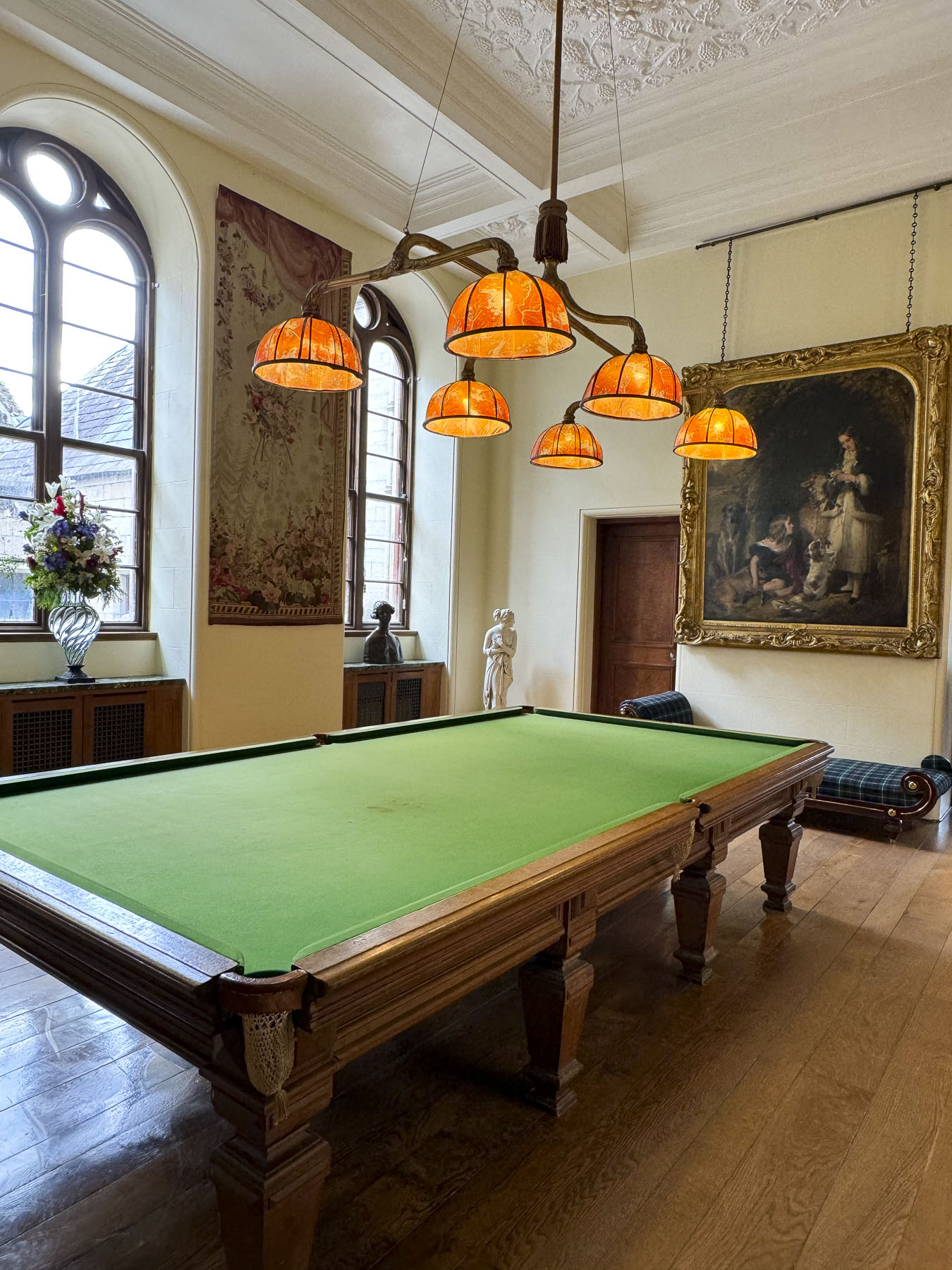
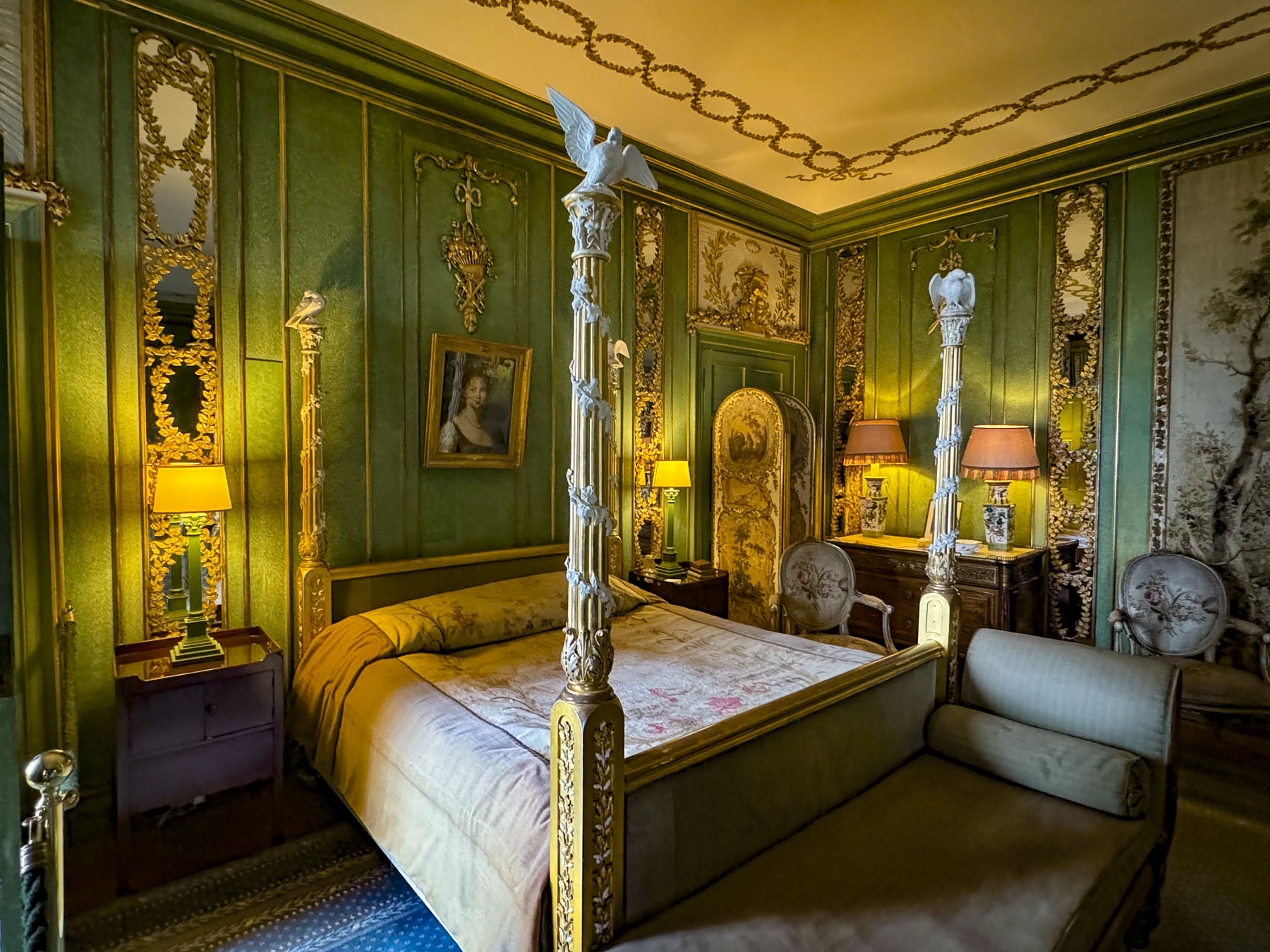
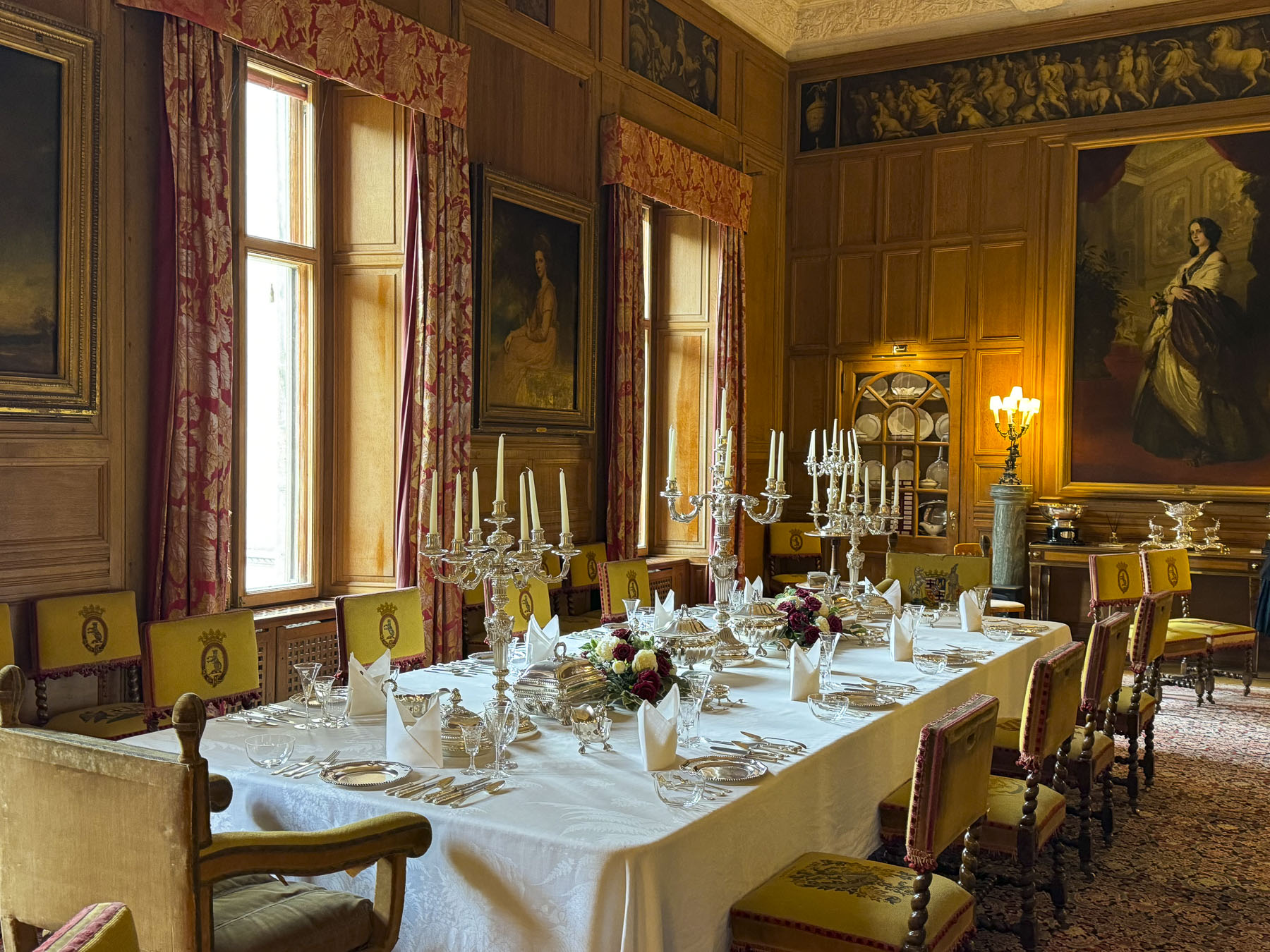
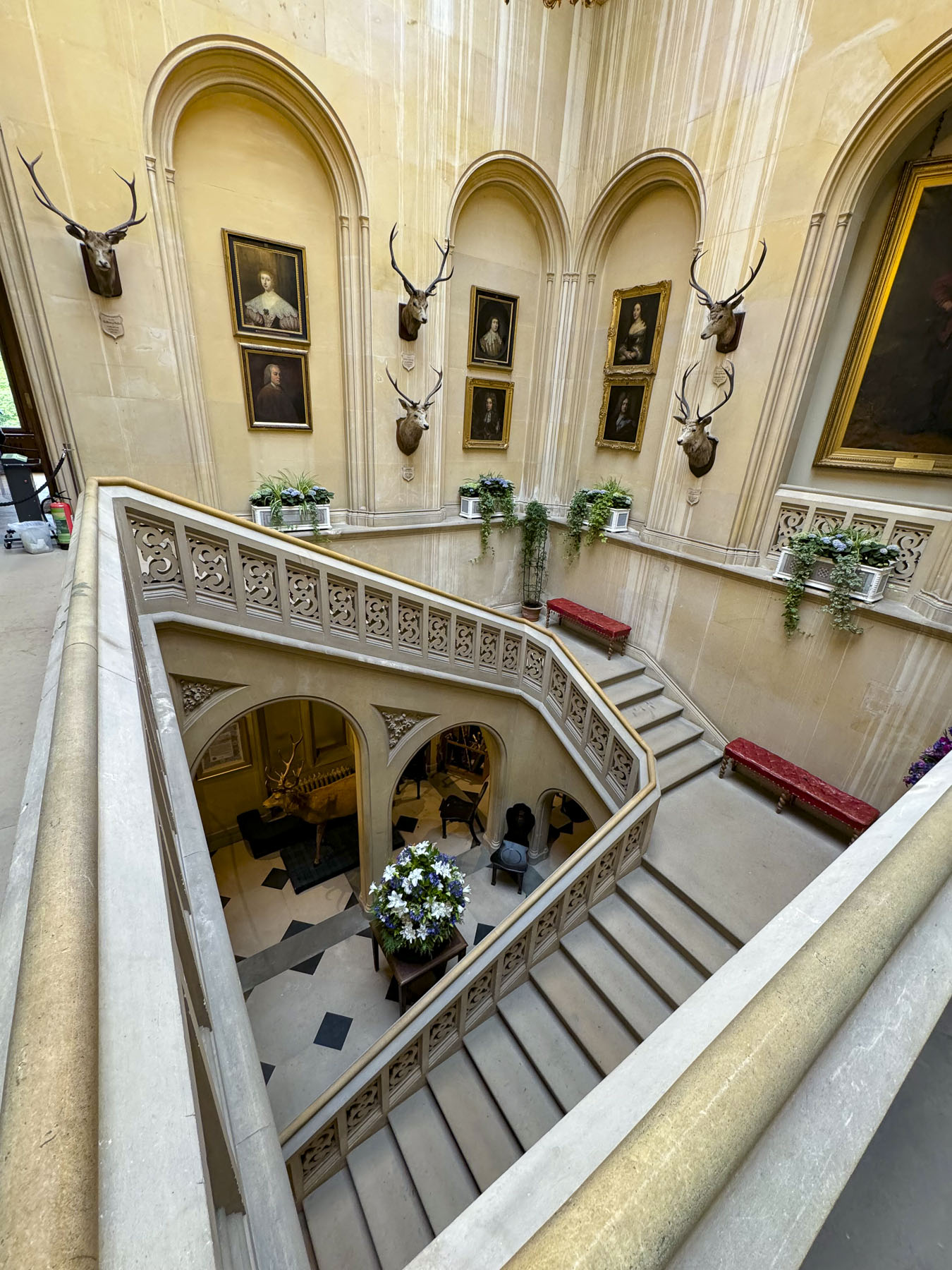
The castle is one of the best-preserved examples of how the landed nobility extravagantly lived. A castle has stood on this site overlooking the Dornoch Firth and the North Sea since the Earldom of Sutherland was created in 1235. Only a few walls of the ancient castle’s keep remained after extensive renovations and expansion in the 1700 and 1800s. The result was a French style chateau with towering conical spires and 189 rooms. Amazingly, the beautiful estate has remained the seat of Clan Sutherland for 800 years and is today owned by the 25th Earl of Sutherland.

Our self-guided tour (there were staff along the way to answer any questions) through the

exquisite rooms of this immense family home was very interesting. And it does feel like a family home, opulent but not pretentious. It was significantly nicer than the royal Palace of Holyroodhouse in Edinburgh.

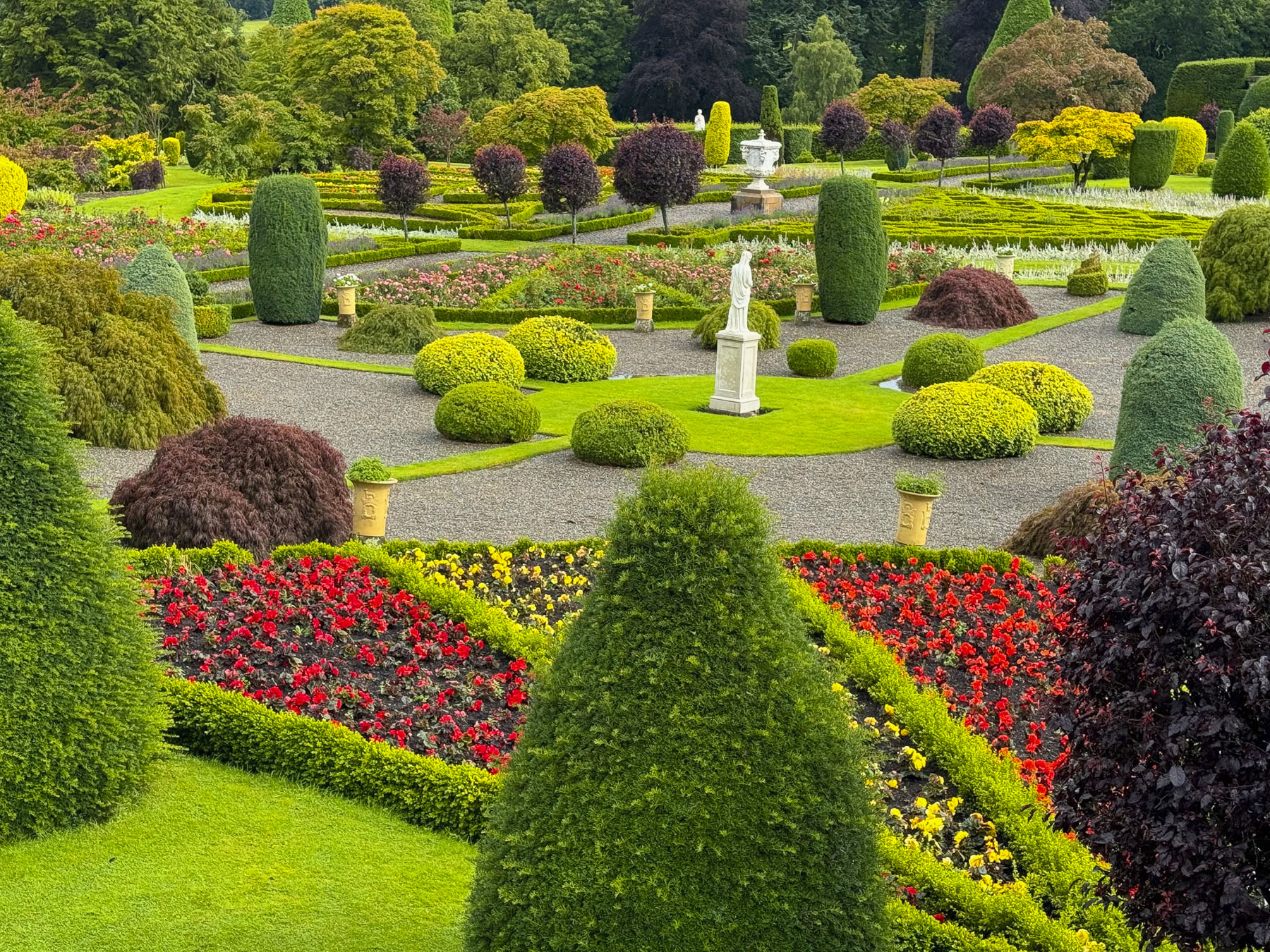
As gardeners, we delighted in wandering through the Versailles-inspired oasis of flower beds and fountains.

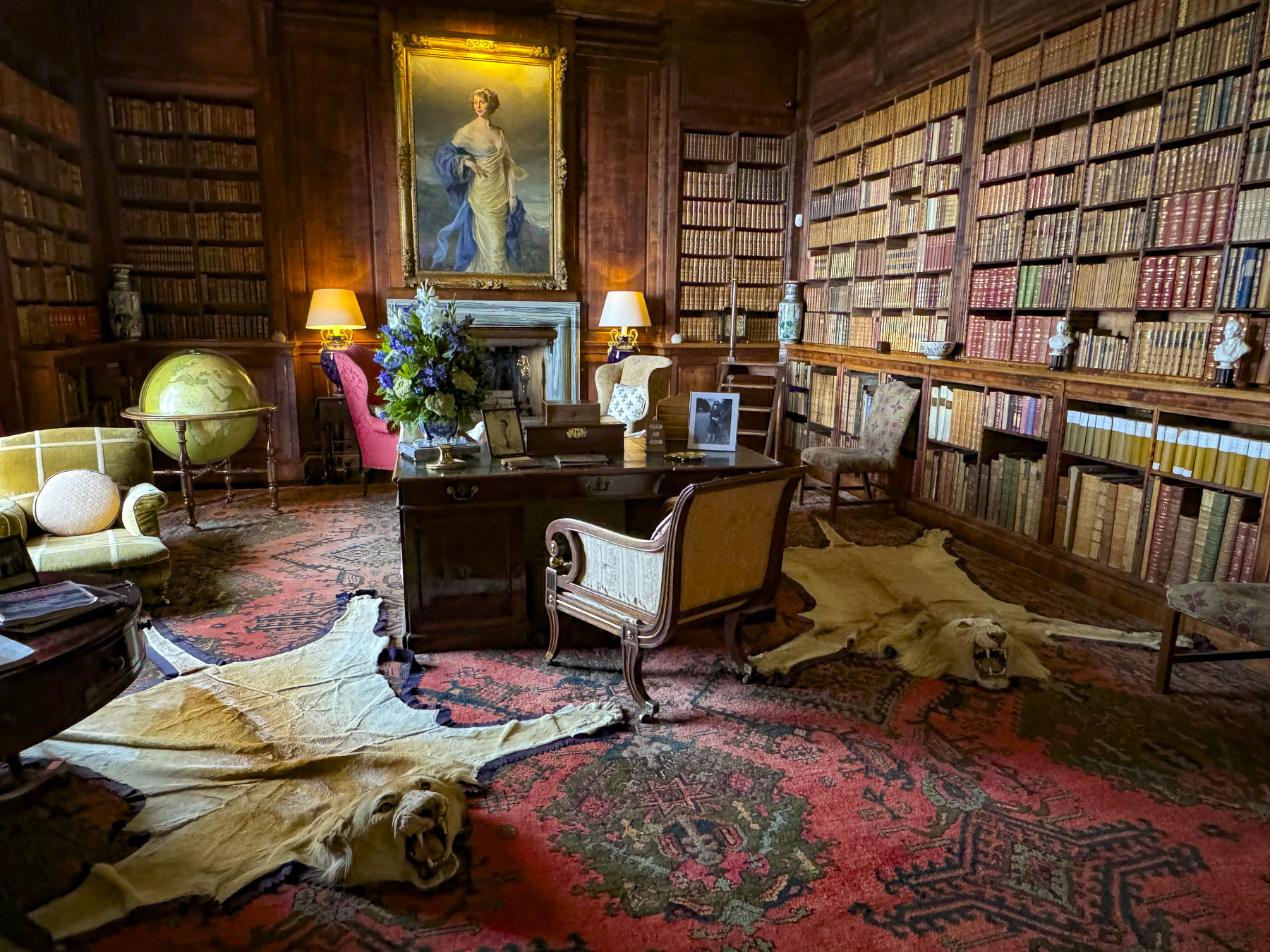
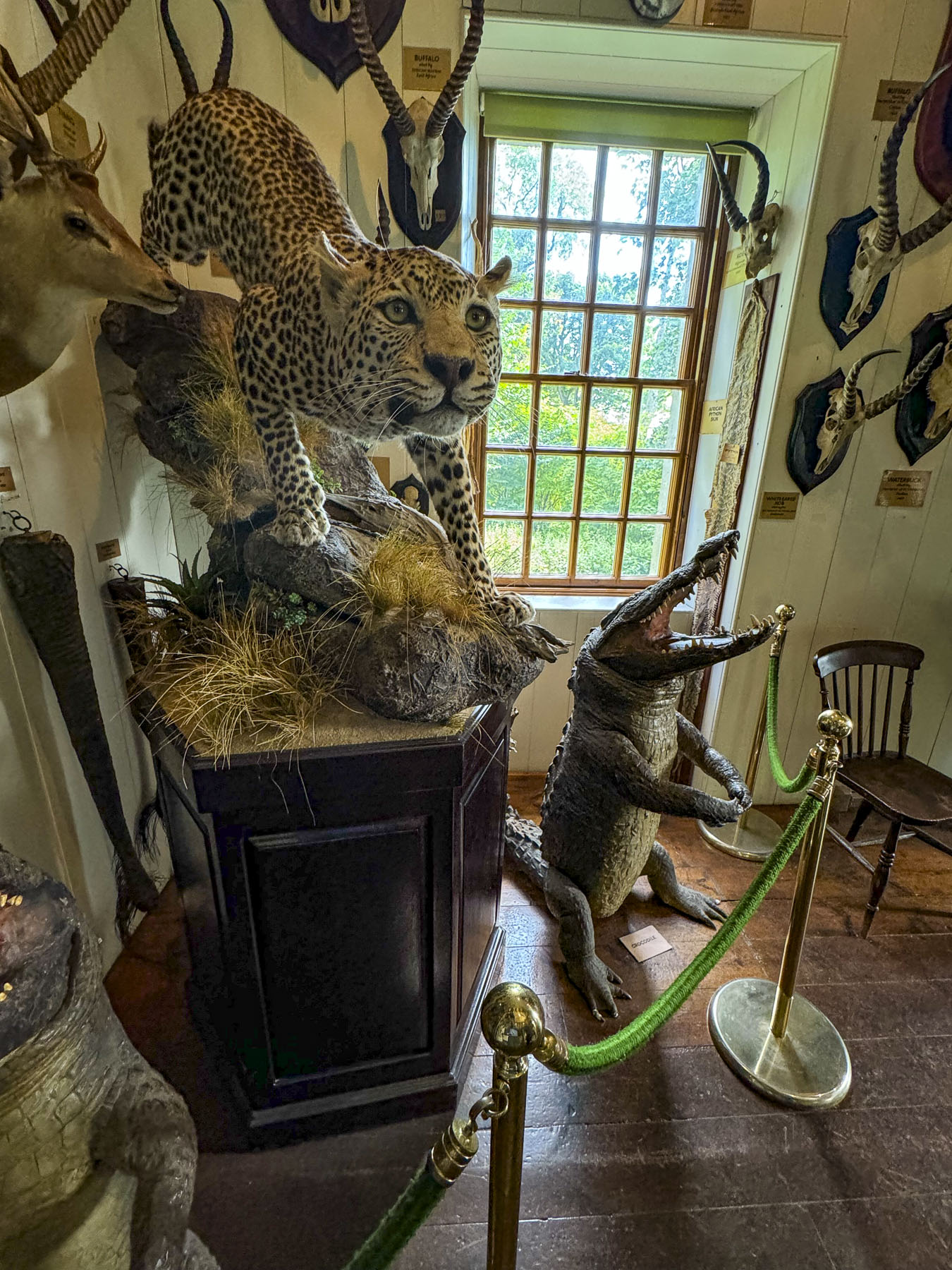
Off the garden was the estate’s former two-story summer house, now a museum that displayed a notable collection of Pictish Stones, along with a variety of ethnographic items collected from travels around the world, and animal head trophies from safaris in Africa. 

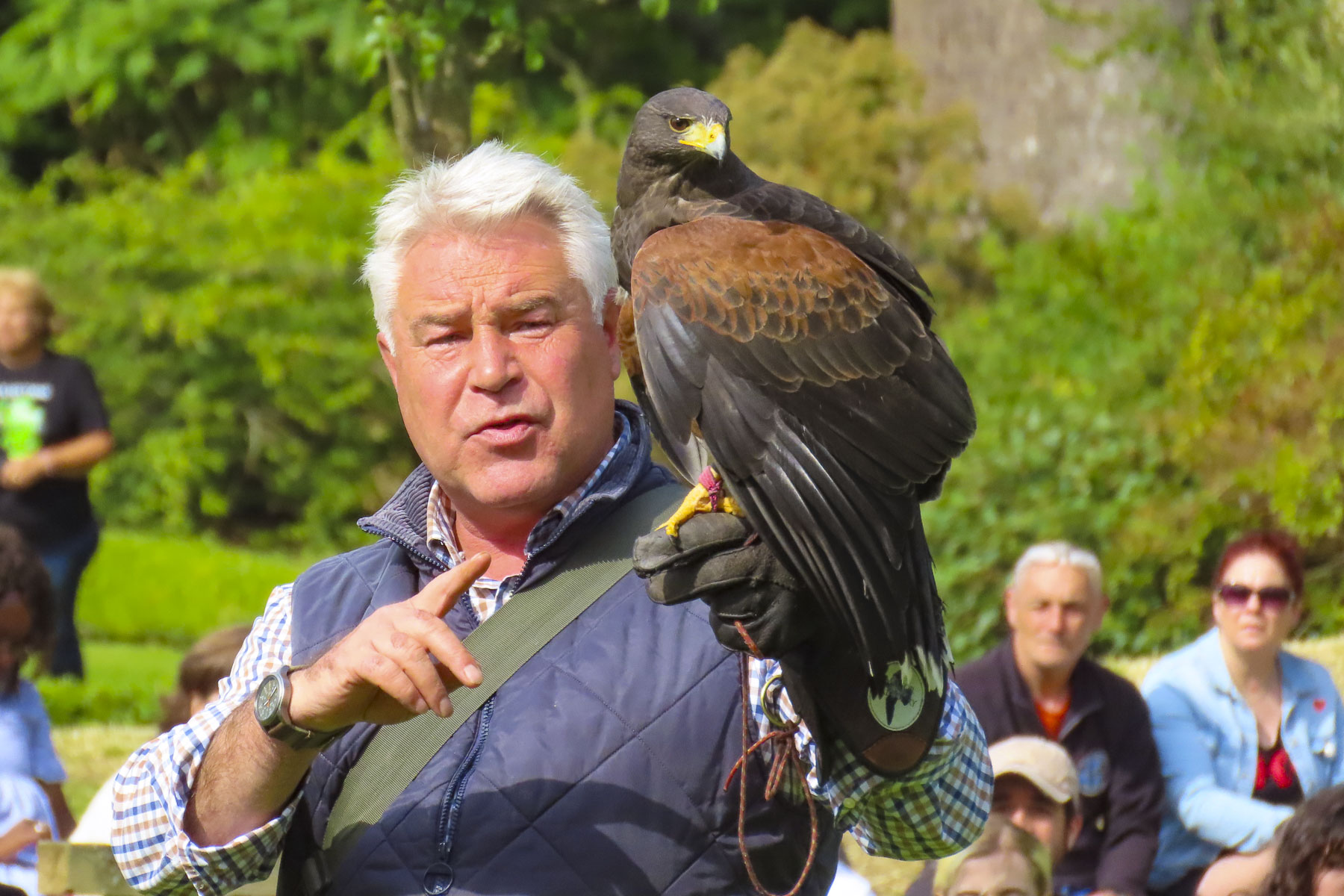
At the lower end of the garden, we watched the castle’s resident falconer demonstrate and explain the ancient art of falconry as a Harris hawk, Gyrfalcon and Peregrine swooped low over the gasping audience. It was a very entertaining and informative show.

Farther south we turned off the A9 and headed to an early dinner at the Surf and Turf in Dornoch, a small town that traces its roots back to the 8th century. We discovered the Surf and Turf through one of the Instagram feeds we follow. The reviews were quite favorable and pictures of the seafood looked delicious, but we didn’t realize it was a takeaway shop. Luckily for us, they had a long bar with stools along one wall. The fresh fried fish, calamari and mussels we ordered were excellent and all locally caught.

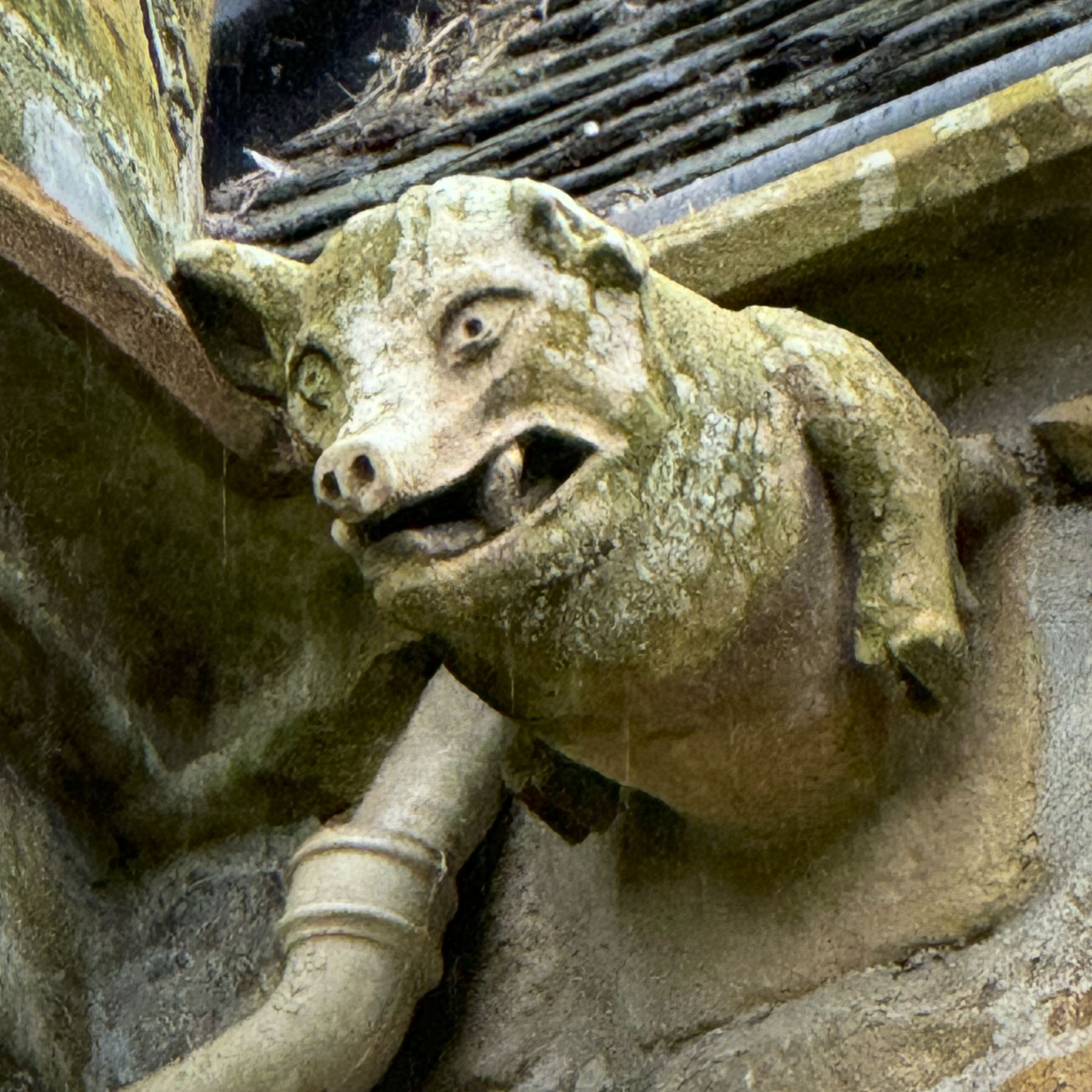
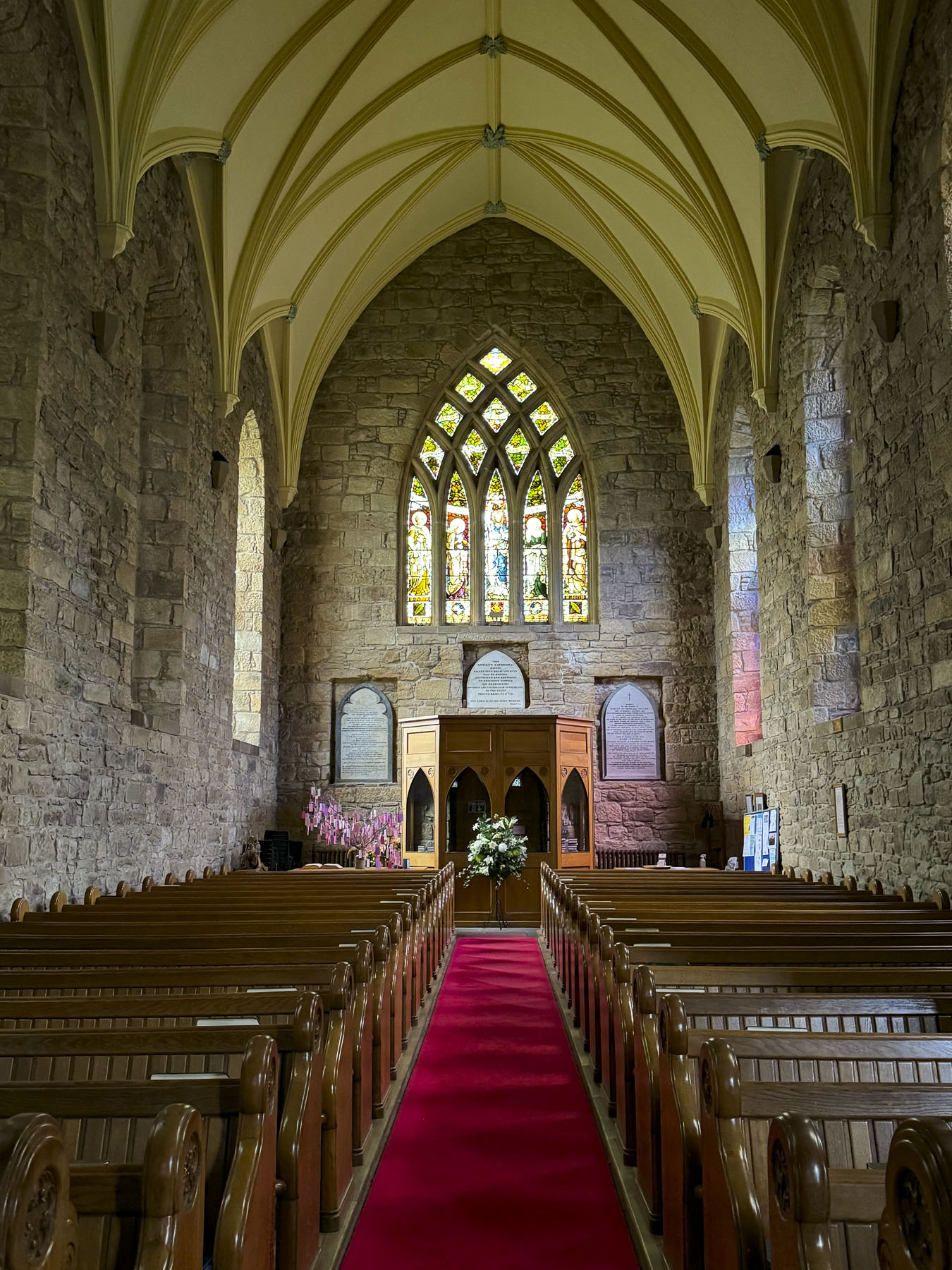
The Dornoch Cathedral was just around the corner, and we spent a while studying the grotesque ancient gargoyles and stone interior of the church, which held its first service in 1239. During the medieval era the gargoyles were believed to portray evil spirits, which were driven from the church by ringing its tower bells.

In 1245 the 1st Earl of Sutherland was buried in the cathedral, the first of many Sutherlands  to be entombed in the family vault under the sanctuary floor. Three centuries later the church was left in ruins after fire destroyed the nave and roof during a climatic feud between Clan MacKay of Strathnaver and Clan Murray of Dornoch. Fifty years later only the roof over the chancel and transept walls were replaced. The cathedral remained partially renovated for another 300 years until 1835, when the Duchess of Sutherland financed a full restoration. Light poured through 27 stained glass windows and brilliantly illuminated the church’s interior. Three of those windows, with the themes literacy, music, and peace, were donated to the church in 1926, in the memory of the famous Scottish-American industrialist, Andrew Carnegie, who summered nearby at his baronial estate, Skibo Castle.

Also of interesting note, the last burning at the stake of a witch in Scotland happened in Dornoch in 1727.  Janet Horne, a local woman, was accused of turning her daughter into a pony and riding her around the highlands to perform her witchcraft. The Scottish Witchcraft Act of 1563 was repealed in 1736. The singer Madonna had her son Rocco christened in the cathedral in 2000, before her wedding ceremony to Guy Ritchie at Skibo Castle.

We ended our day in the quaint village of Strathpeffer, a Victorian era spa town whose sulphurous spring waters were touted as a cure for many ailments. A railway line reached the town in the late 1800s, and it became an easy destination for wealthy Victorians who sought “to take the waters.” Our hotel, the Highland Hotel Strathpeffer was one of those grand, four-story wood paneled, railway hotels built to ease spa-goers’ visits to the village. It’s glory years now a distant memory, the hotel still has its original warm wood paneling, but our room was very spartan, and a far cry from what we imagined were its luxuries during its heyday. During World War I the hotel was requisitioned as a convalescent military hospital, and in the Second World War served as a naval training school.

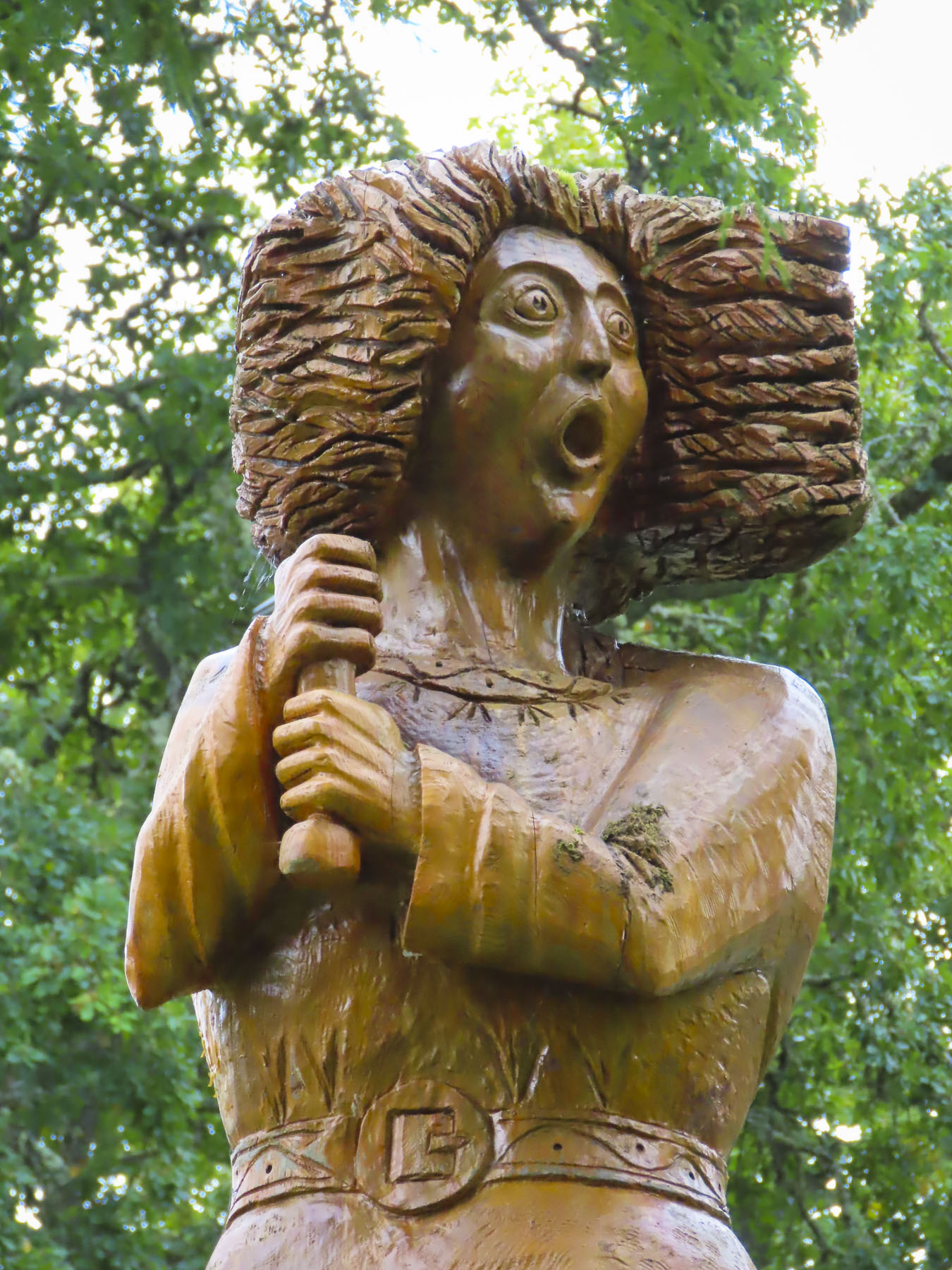
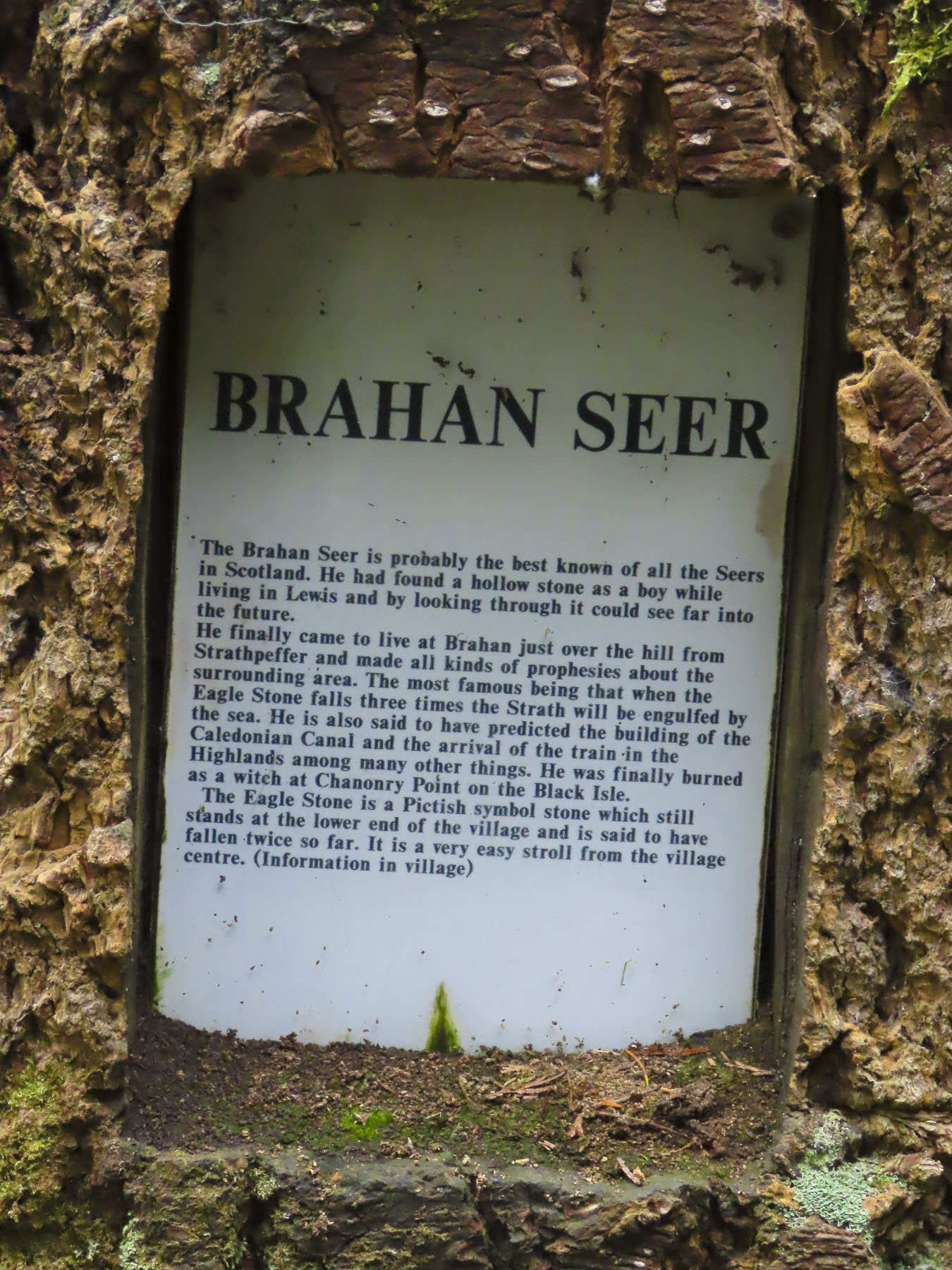
The village was very charming with a visually pleasing assortment of well-kept Victorian architecture. The old train station now hosts the Highland Museum of Childhood and a nice cafe. Across the street from our hotel the town’s original pavilion was recently renovated and once again hosts music and theater events, along with weddings, and exhibitions. Behind the pavilion is a small whimsical sculpture garden with five 13ft tall wooden sculptures of mythical figures from Celtic, Viking and Pictish legends. They were created by Allister Brebner, a local woodcarver with a workshop in the old train station, from the trunks of giant Douglas Fir trees, harvested from the Highland’s forests.

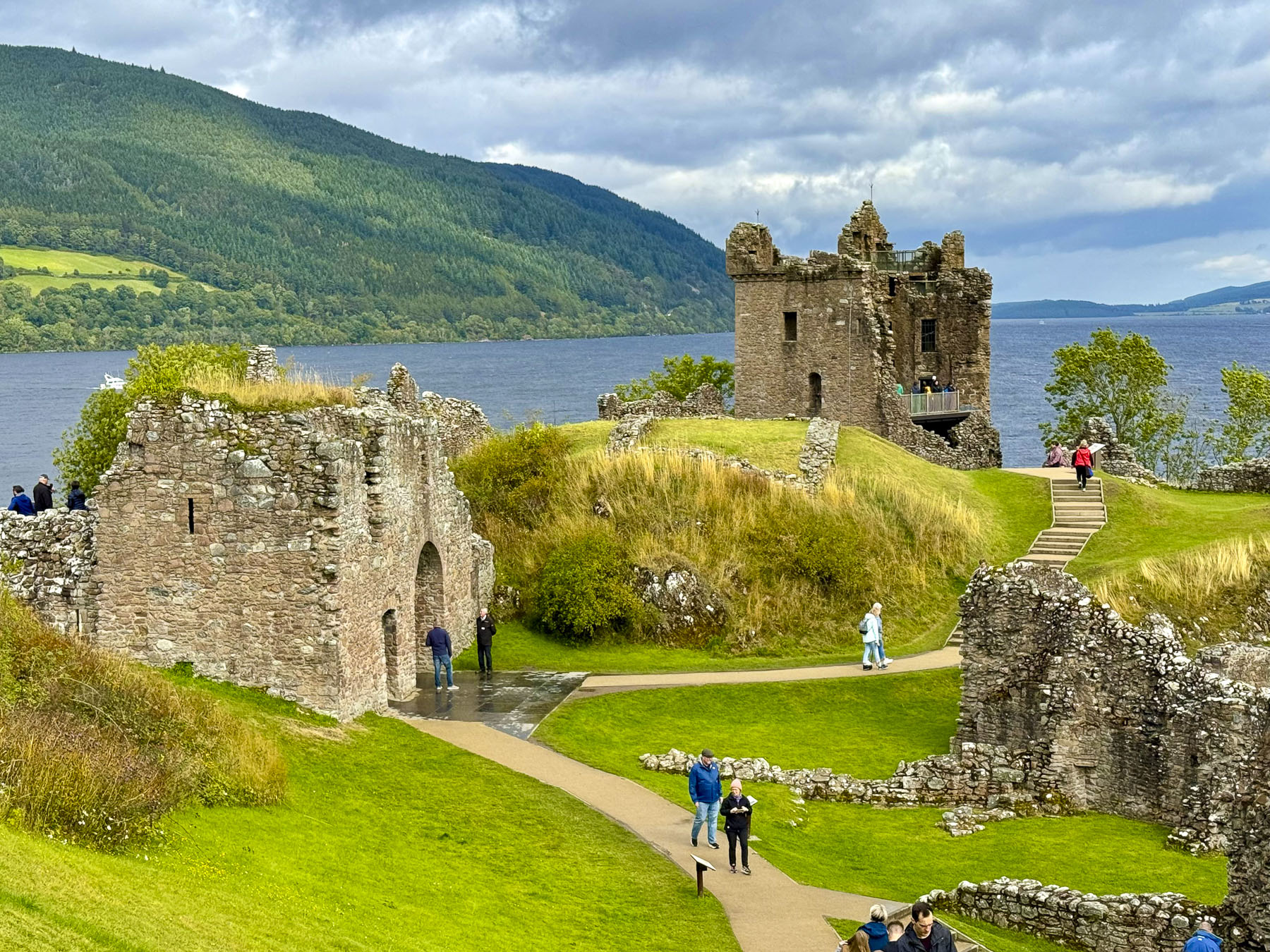
Is a tour of the Scottish Highlands really complete without visiting Loch Ness? We didn’t want to have any regrets, so on our last full day in Scotland we headed to Urquhart Castle and hoped to catch a glimpse of the fabled serpent so we could tell our young grandchildren, with our fingers crossed and a wink of the eye, that we had indeed spotted and encountered the creature and tried to wrestle it to ashore. I had his head and Donna his tail, but the slippery slimy thing was wildly thrashing about, and we lost hold of him, and in a final splash he vanished. An epic fish story about the one that got away is always good for a child’s imagination.

The castle commands a strategic point that juts out into Loch Ness, the natural geographic dividing line between the northern and southern Highlands. Built in the 13th century, it was one of Scotland’s largest fortifications and had a tumultuous 500 year history as it was captured then retaken numerous times during the Wars of Scottish Independence. Finally British soldiers blew it up in 1692 as they retreated to prevent the Jacobite army of Bonnie Prince Charlie from occupying it. On the grounds is a full-sized working recreation of a medieval trebuchet, a catapult-like siege engine that used a counterweight to hurl large stones against castle walls. Unfortunately, they were not demonstrating its use when we visited. Urquhart Castle, along with the Glenfinnan Viaduct for the Harry Potter train, were the busiest attractions we visited while in the Highlands. The rest of the time it felt like we had the Highlands mostly to ourselves. This was wonderful considering we drove the NC500 during the summer high season in August.

Our last stop before catching an evening flight from Inverness Airport was in Drumnadrochit, a crossroads village at the foot of a bridge that crosses over the River Enrick. We drove through it on the way to Urquhart Castle, earlier that morning, and thought it would be a nice place to break for lunch.

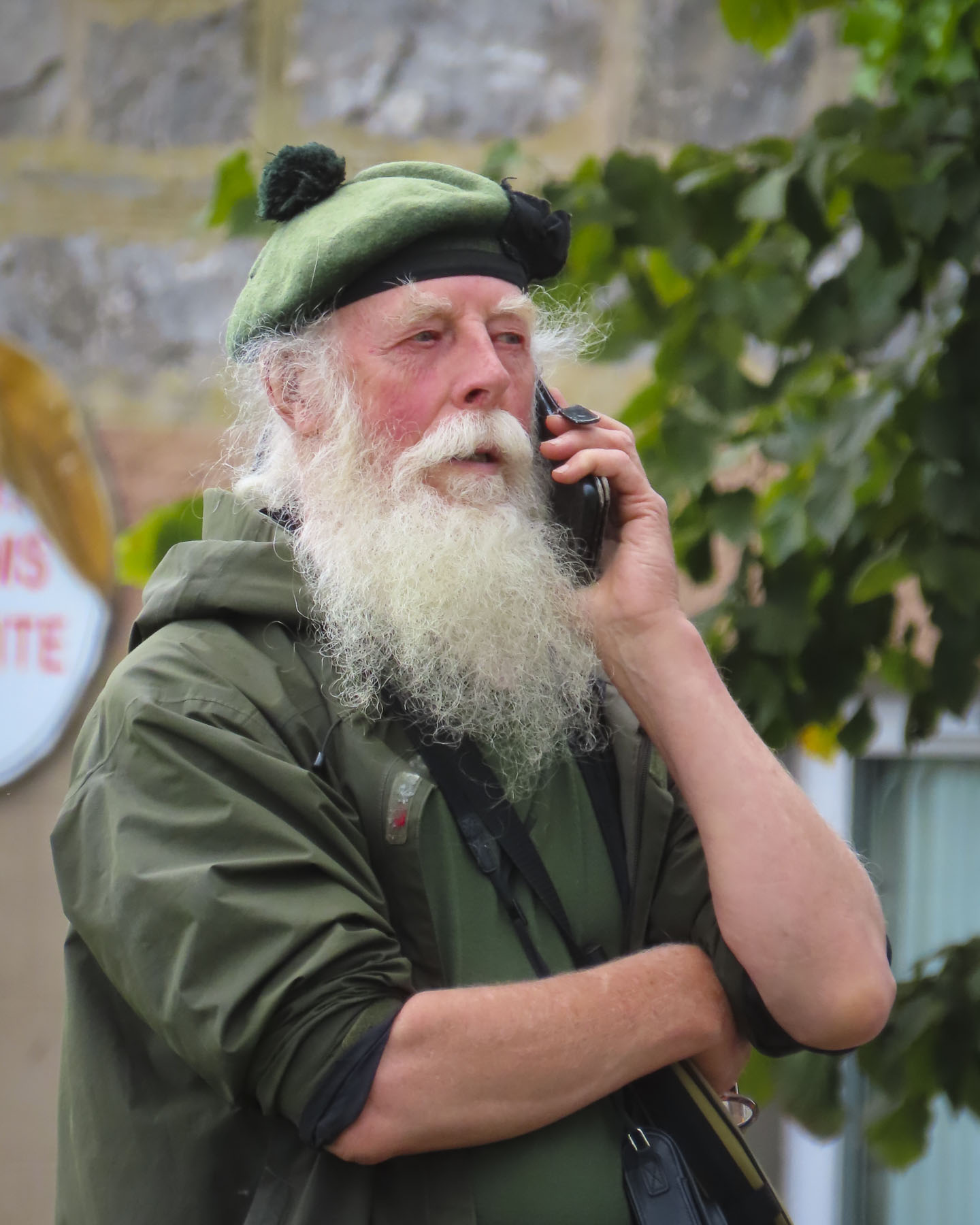
A young bagpiper commanded the village green as we settled into an outside table at The Fiddler’s Highland Restaurant to people-watch for a while. We were a little melancholic that our trip was finally coming to an end after driving a big loop around the Highlands, an area blessed with an amazing array of beautiful mountains and seascapes. The wizardly spell cast by the pipes was hard to break as we departed.

My heart’s in the Highlands, my heart is not here,

My heart’s in the Highlands, a-chasing the deer;

Chasing the wild-deer, and following the roe,

My heart’s in the Highlands, wherever I go.

The poem was written by Robert Burns

Till next time, Craig & Donna

Driving the North Coast 500 – Ullapool to John o’ Groats or Mountains, Lochs, Seas, and Midges

True to form, blustery afternoon winds were ripping the clouds apart as the CalMac ferry steamed past the Rhue Lighthouse, heading into Loch Broom and the ferry dock at Ullapool. Being one of the last cars to board the ferry, we were one of the first off in Ullapool, and decided to pull over out of everyone else’s way to get our bearings before taking a spin around the village. Ullapool isn’t a particularly large village, only a couple of blocks, but within ten minutes of folks disembarking from the ferry, there was no sign of life on the streets. Granted, it was a Sunday, but in August, which is the tourist high season, and it felt like a ghost town. Fortunately, we did find the local Tesco supermarket open, and we bought some provisions for breakfast the next morning, as where we were staying for the night, the Altnacealgach Motel on Loch Borrolan only offered dinner.

We were back on mainland Scotland and on the NC500 again, after modifying our NC500 route to include the Isles of Skye, and Lewis & Harris, for seven days of exploring those interesting islands.

Scotland is so outstandingly beautiful, and with every twist and bend in the road there always seemed to be another vista worthy of photographing. While the roads around the Highlands are in excellent condition, our one pet peeve is there are not enough designated vantage points to pull over and take pictures from. Often, we u-turned and pulled into a gated entrance to a field. Pulling over onto the hard shoulder wasn’t an option as The NC500 throughout the Highlands is mostly a two-lane road without shoulders. The narrower country roads off the NC500 have pullovers called Passing Places for when you encounter oncoming cars, but they are not to be used for parking.

Our recently refurbished room at the Altnacealgach Motel was nice and large. Most importantly it had a kettle for our early morning coffee. The motel is a modest place with 8 rooms, but it’s beautifully situated, a pebble’s toss across the road from Loch Borrolan. Dinner was simply pizza and chili, but quite good. https://www.altnacealgachmotel.co.uk/

Our 144-mile route along the NC500 to Balnakeil Beach then onward to John o’ Groats the next day was our longest drive in the Highlands. We figured as always, we’d make many other stops along the way, so planned for an early departure the next morning.
For a third day in a row, it seemed we couldn’t shake the overcast sky from the heavens and have a sunny morning. It was unusually dreary weather for a Highland August, so much so that many of the folks we encountered felt it necessary to apologize for the unusually dreary weather.

We followed the A837 north and stopped at Ardvreck Castle, once the seat of the MacLeods of Assynt, and Calda House, now ruins. The ancient 3-4 story fortified tower house dates to the late 15thcentury and is set on an island in Loch Assynt. It’s a dramatic setting, with the loch surrounded by the magnificent mountains Quinag, Ben More Assynt, and Canisp. A narrow, sandy isthmus connects the island to the mainland. Accusations of a sinister betrayal made by the MacKenzies of Wester Ross ruined the reputation of the MacLeods of Assynt and was believed to be the cause for the rapid decline of the MacLeods’ fortunes. A final battle between the clans in1672 forced the MacLeods to surrender their rule of the Assynt region to the MacKenzies. The Calda House was built in 1726 by Kenneth MacKenzie II of Assynt for his new bride who found the old fortress dreary and uncomfortable, and “much to her dislike.” Built with imported sandstone, her new mansion stood three stories high and had 14 bedrooms. As legend tells it, the joy of a new home only lasted until 1737 when a late-night celebration continued past midnight into the sabbath, and the house was struck by lightning. Only a bagpiper who refused to play on the sabbath survived. The castle stood strong until 1795 when a lightning strike also destroyed it.  It wouldn’t be proper castle ruins without a ghost and local lore obliged with the story of the daughter of the MacLeod chief, who threw herself from the tower of Ardvreck Castle when she realized her father had betrothed her to the Devil, as payment for the Devil’s help in building it.

We pulled over at several spots along the A894 in Unapool to take pictures of Loch Gleann Dubh. The views of the loch were gorgeous, and we were a little envious of the folks who owned homes above the loch and could enjoy this panoramic vista every day.

The road swerved through a mountainous landscape sprinkled with lochs. Clouds raced across the sky. Surprisingly this popular route did not have many restaurants open on a Monday. This was a near crisis situation for two under-caffeinated coffee aficionados.  Our  pursuit of coffee was almost a forgotten memory when we spotted a Spar grocery store in Scourie, adjacent to a caravan campsite overlooking Scourie Bay and a beautiful beach. Back in the car we enjoyed two cups of coffee and the view.

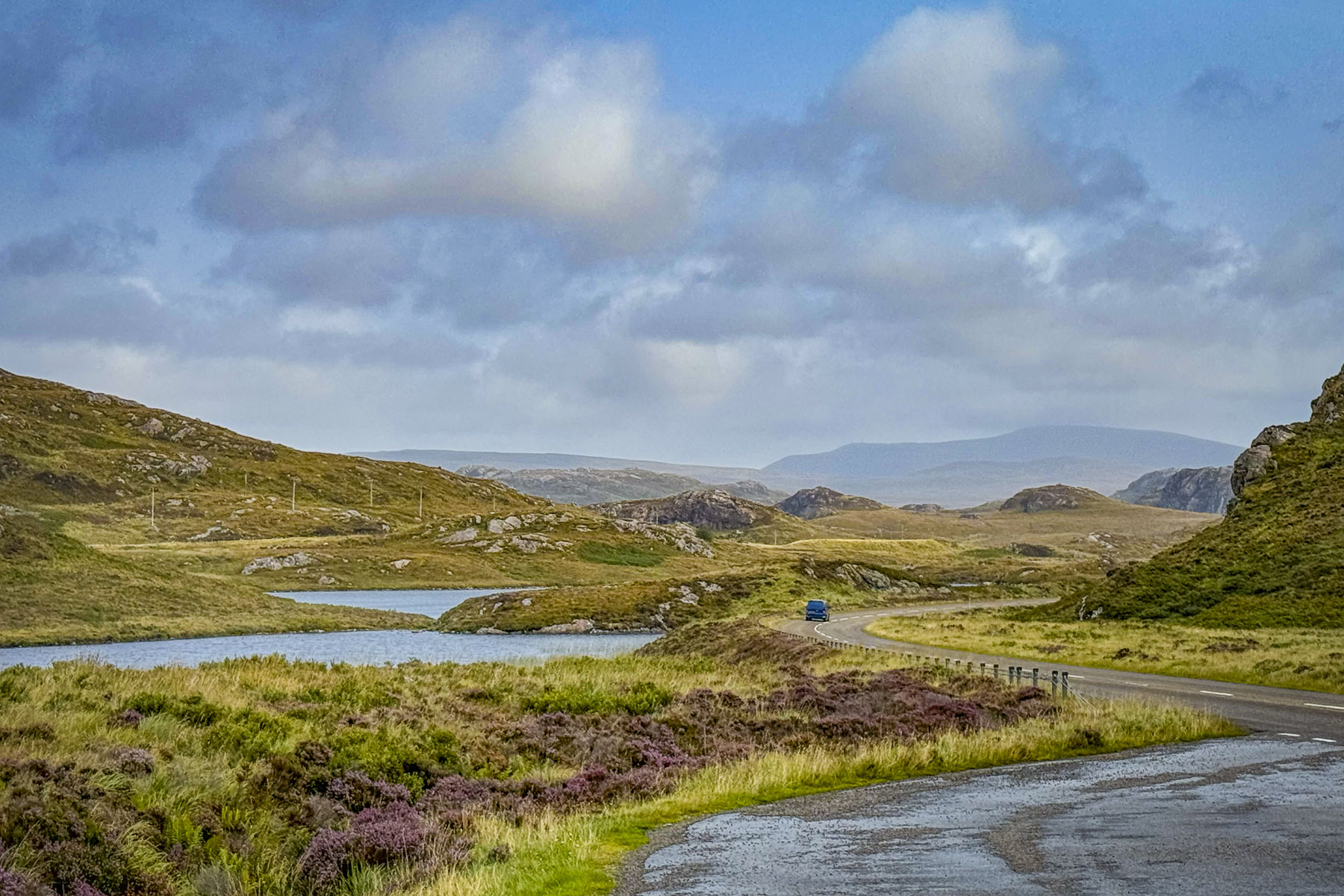
We eventually turned onto the A838 at Laxford Bridge and followed it to Rhiconich. Past the hamlet this section of the A838 narrows to a single lane track as it winds through a desolate landscape of rolling hills and heather land. It was on this stretch that we encountered oncoming “traffic,” the occasional grouping of 3 or 4 cars or caravan. The narrow road allowed two-way traffic, but in order to pass an oncoming car one vehicle has to pullover into a small bump-out called a Passing Place. These are well marked and spaced along the country roads, but you need to be on the lookout for approaching cars, as the protocol is for drivers to pull into the closest Passing Place on their side of the lane and wait for the other vehicles to pass. It took some getting used to. Surprisingly, the speed limit on these single-track roads is 60 mph, but we were only comfortable driving at half that speed. Donna says that’s because I drive like an old man.

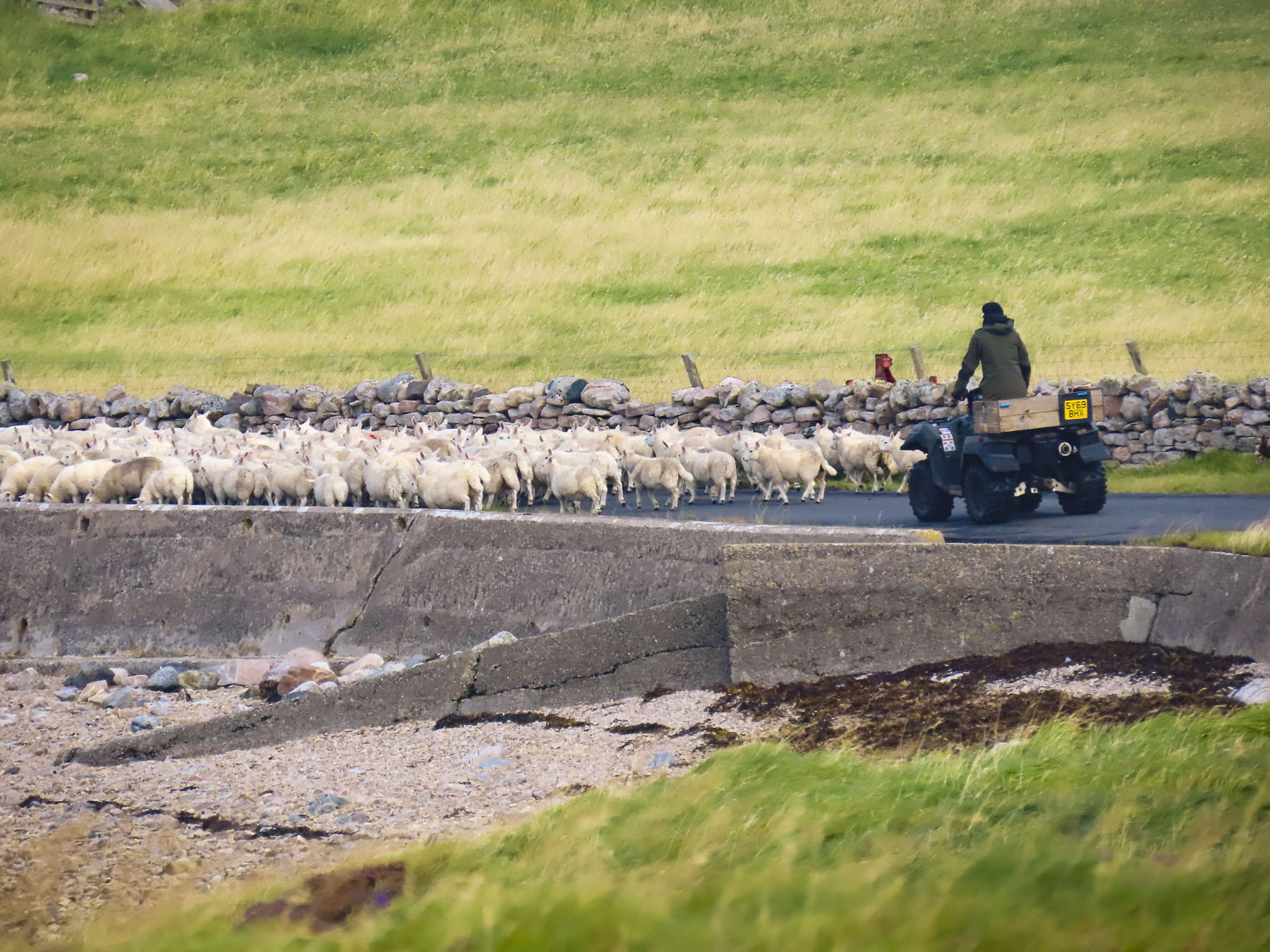
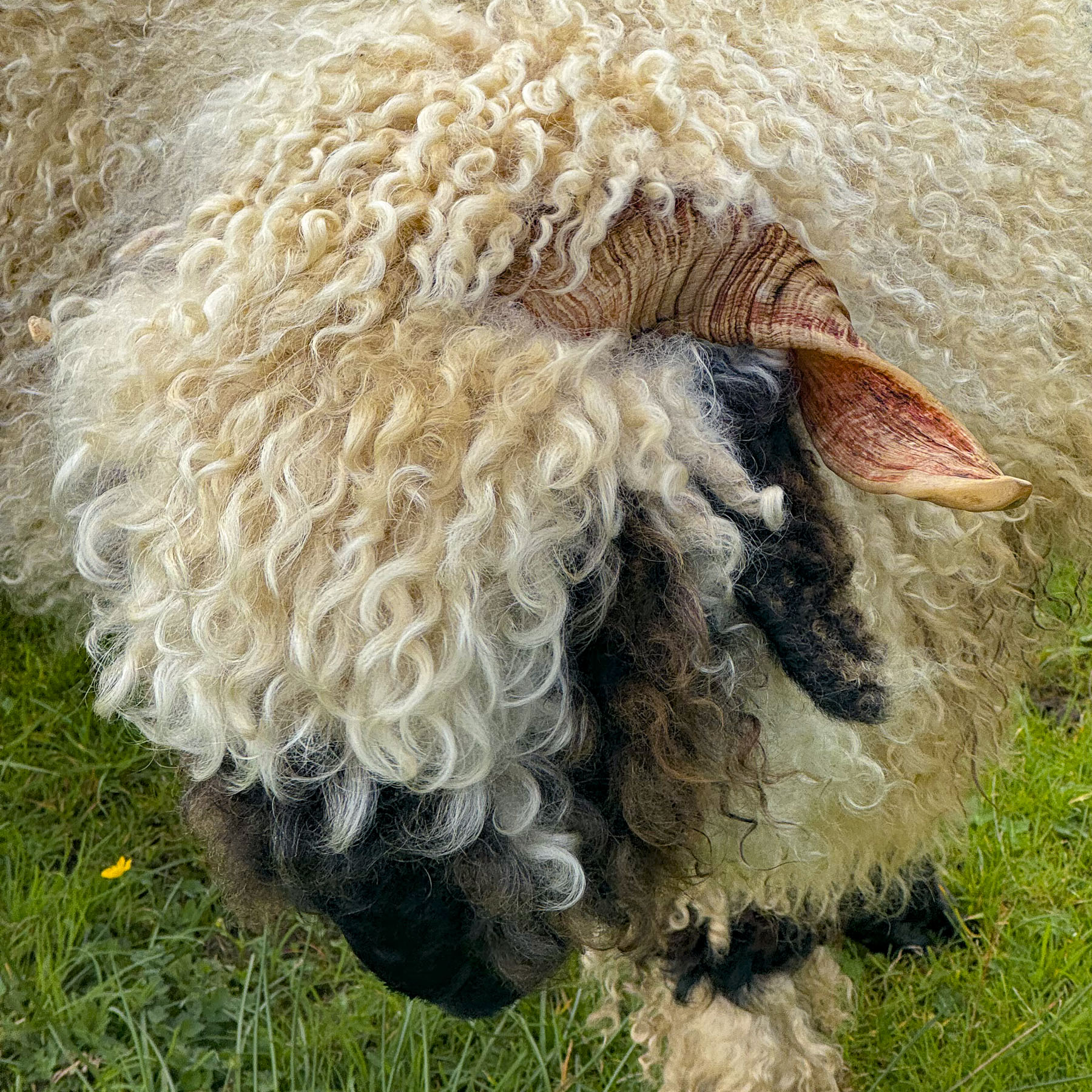
We pulled over at the Geological Information Point along the bank of Kyle of Durness, a sea loch, to read the placard and stretch our legs. Here we were fortunate to spot a shepherd on an ATV, as he and his sheep dog herded a large flock of the wooly beasts down the side road to a new pasture. The A838 continued as a single lane road all the way to the crossroad in Durness. It was suddenly a sunny day!

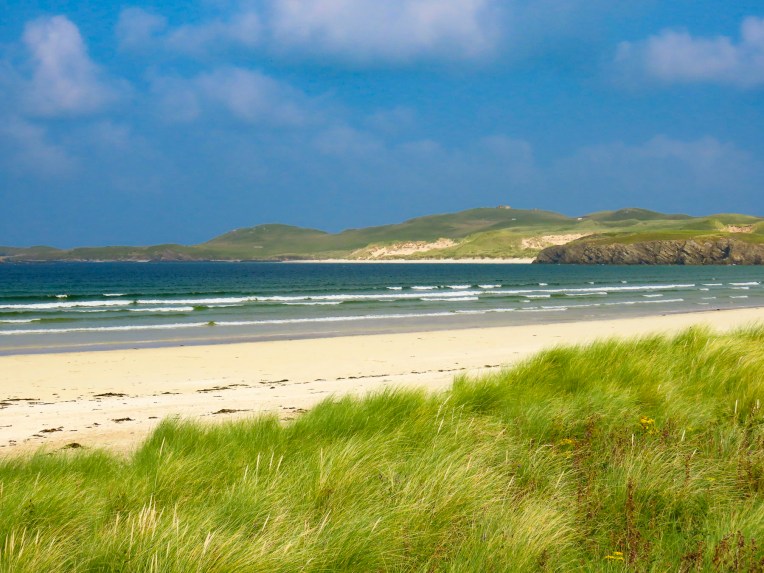
The beaches along the coast of Durness were our main destination for the day. Compared to the barren earth toned landscapes we traversed earlier in the morning, the striking Caribbean blues of the ocean off Balnakeil Beach were exotic, and for a moment we thought we might have been transported to the British Virgin Islands. The wide white sandy beach stretches for nearly a mile and is flanked by dunes covered with beach grass. Following the curve of the beach to the Faraid headland and stacks is a popular walking activity. There was a strong breeze which discouraged sunbathers, but there were a few hardy folks willing to take off their shoes and dip their toes in the chilly water of the North Atlantic, which hovers around 56F/13.5C in late August.

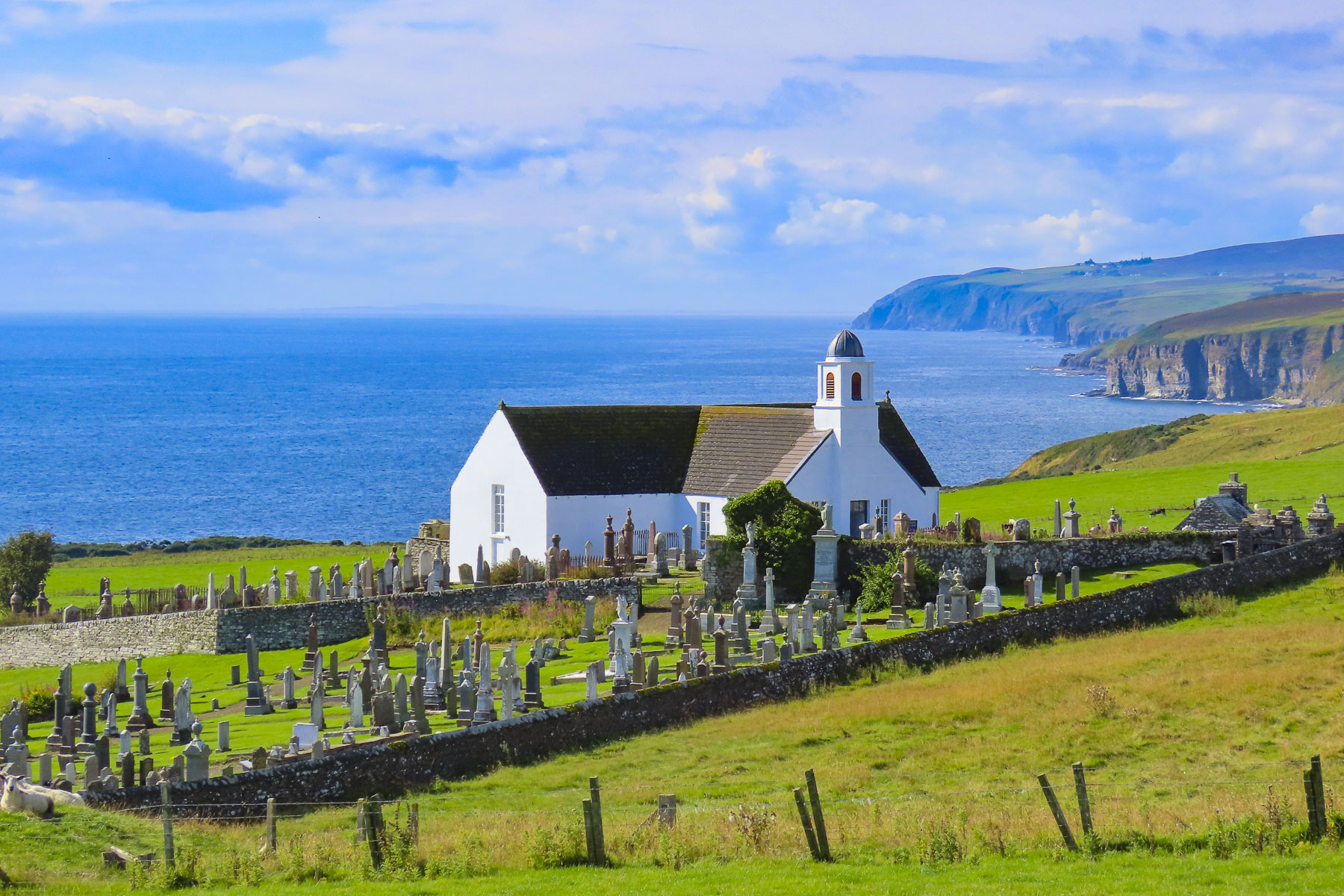
The location of the Balnakeil Church overlooking the beach and bay must have been very inspirational back in the early 1600s when it was constructed atop the ruins of an earlier 6th century Celtic monastery. Services were held in the church for about 200 years before a new place of worship was built on the southern side of the hamlet.

Today, headstones in the graveyard surrounding the ivy-covered ruins are slowly being swallowed into the peaty earth. Some interesting folks are buried in the cemetery. Notably Domhnull MacMhurchaidh, a hitman for the Clan MacKay. He is believed to have murdered 18 people and dumped their bodies into the waterfall that runs down into the caves at Smoo. “Apparently, he believed the folklore tale that the Devil lived below the falls and thence his crimes would never be discovered.” Fearing his grave would be desecrated after his death he paid a princely sum beforehand to be interned in a tomb inside the church.

A monument to the Durness born poet Rob Donn, aka, the Robbie Burns of Gaelic poetry, also stands in the churchyard. He never learned to speak English and composed in Scots Gaelic. His poems sometimes contained bawdy verse and satirical social commentary, but they were faithfully memorized and orally repeated around Scotland for 50 years before the first printed versions were available after his death.

Elizabeth Parkes, the aunt of John Lennon, is also buried in the churchyard, and he is said to have visited Durness frequently. It’s believed locally that his song In My Life, “There are places I remember,” reflects his experiences in the area.

Since the 1500s, one of the historic residences of the chiefs of Clan MacKay, Balnakeil House has commanded a prominent spot across from the ancient church, with a sweeping view of the beach. The current, bright yellow dwelling on the site dates to 1744.

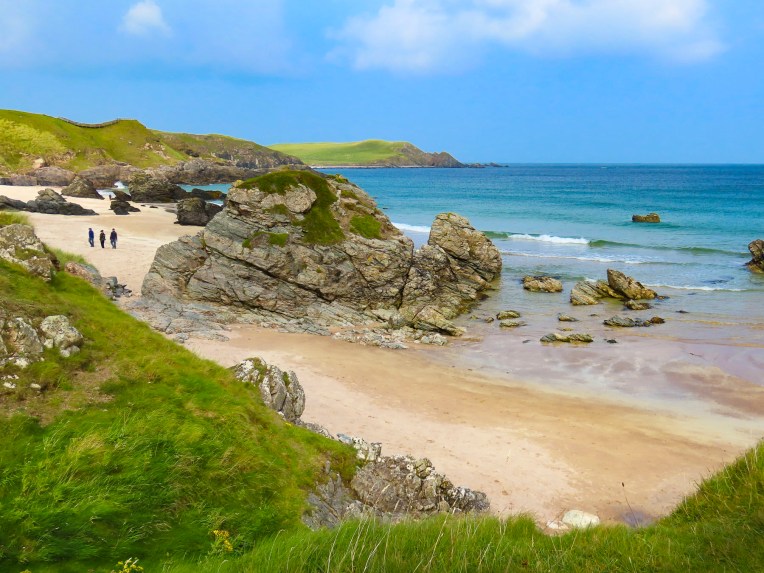
Continuing our travels east on the A838, a two-lane road again, we stopped at Durness Beach. Though much smaller than Balnakeil, its waters were still a pristine blue and the beach, which backed to a steep slope, had dramatic rock outcroppings. 

Farther along from the overlook above Ceannabeinne Beach we watched paddle boarders in wetsuits set out onto the calm waters.

With our stomachs growling, we were beginning to envision all that lamb on the hoof turned in to chops; lunch was finally procured at the Norse Bakehouse in Rhitongue. This is a fine family-owned establishment that has probably saved the lives of many tourists driving the NC 500 on a Monday. It was an excellent casual restaurant, with indoor and outdoor seating that serves sandwiches, soup and pizza. Their coffee was wonderful and the food was fairly priced. https://norsebakehouse.wixsite.com/my-site/dinner-menu

“From Land’s End to John o’Groats.” We made it! Though the expression usually relates to traveling from the tip of southern England. We had cheated and started in Inverness and headed south to Edinburgh before going west across the Highlands to the Isles of Skye and Lewis and Harris. Then returning to the mainland and driving north along the west coast to John o’Groats, traditionally considered the northernmost point on the English mainland, though the designation actually belongs to Dunnet Head, about 13 miles west. Our own expanded version of the iconic NC500!

The clouds had thickened again by the time we arrived at the famous signpost overlooking a small harbor, and the sea. That’s pretty much the main drawing card to the village, which otherwise feels like an outlet shopping center. But it’s considered a must stop for most tourists before they continue on to explore the immense beauty of the northern Highlands. That seems to be the case since 1496, when King James IV granted a license to Jan de Groot, a Dutchman, to operate a ferry between this northern-most port in Scotland to the Orkney Islands, which had recently been acquired from Norway in 1472, as the resolution of an unpaid dowry for the King of Norway’s daughter Margaret’s marriage to James III of Scotland.

Business boomed for the enterprising de Groot and he was eventually able to build a large octagonal house with eight doors, in the center of which was an eight-sided table, designed so his seven sons seated at the table would be recognized as equals, as there was not a head of the table.  Over time Jan de Groot was anglicized to John o’Groats.  A modern art installation, in front of the John o’ Groats Hotel, now occupies the spot where the family home once stood. But a nod to his legacy was incorporated into the Victorian era John o’Groats Hotel built in 1875 with the inclusion of an octagonal tower in its design. The hotel now called the ‘The Inn at John o’Groats’ underwent an extensive renovation, which included a modern Norse style extension in 2013, and now features individually unique, self-catering apartments with 1, 2 or 4 bedrooms. https://www.togethertravel.co.uk/destinations/scotland/john-ogroats?guests=1&nights=1&bedrooms=0

Outside of town Leonna and Adam, the innkeepers of the John o’ Groats Guest House, warmly greeted us when we arrived very late that afternoon, but still with enough time for a short rest before dinner. While the inn looks a little spartan from the road, our accommodation was quite large and comfortable. https://www.johnogroatsguesthouse.com/

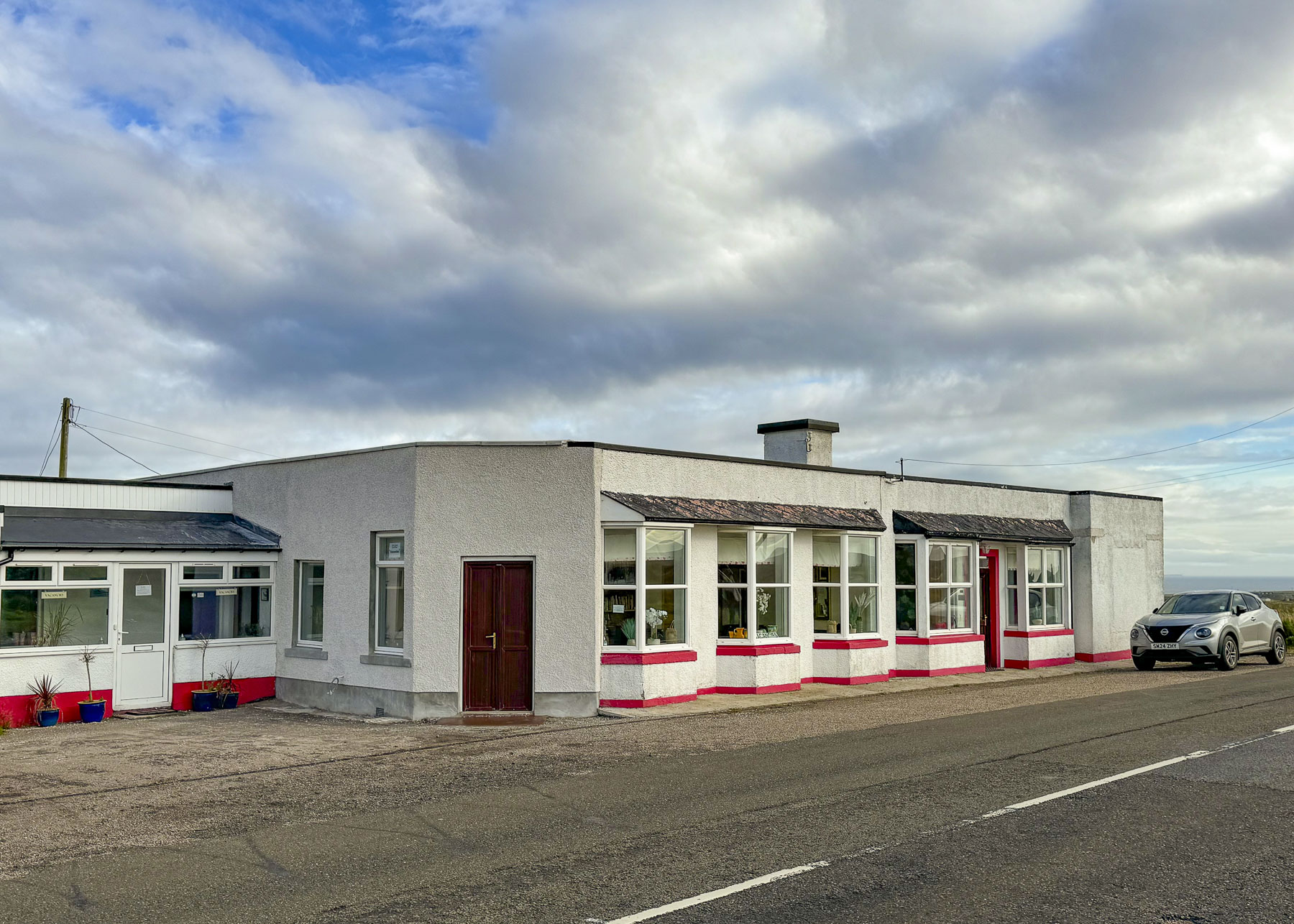
We were enjoying a whisky before dinner when Adam came into the lounge to mention that the sunset that evening, after several cloudy days, looked like it could be quite spectacular. Now, we had read about the intensity of midges during the summer months and came fully equipped to ward off the tiny nuisances with all sorts of repellents: bug sprays, lotions, insecticide wipes, and head netting. We were prepared! But in our almost two-week long trip through the highlands, we hadn’t encountered any – none, nada, zero, zip – until I spontaneously grabbed my camera and rushed outside to the corner of the building. Suddenly I was engulfed in a swarm of nearly invisible Culicoides impunctatus, the Highland Midge, Scotland’s most ferocious foe, and reportedly the reason why the Highlands remain so underpopulated. I was woefully unprepared! If anyone was watching me, I must have looked like a dancing fool with one arm frantically waving about my head as I tried to level the horizon through the viewfinder of my camera to capture the sunset. Thankfully there were still a couple of sips of whisky left to settle my nerves.

The dinners and breakfasts that Leonna and Adam created over the next two days, which showcased locally sourced provisions, were especially delicious. Their inn was one of the nicer places we stayed during our travels through Scotland. We would definitely return.

The next morning, we caught the ferry to Orkney.

Till next time, Craig & Donna

The NC500 Part 3 – Adventures on Skye: Mountains, Rain, Whisky and Oysters

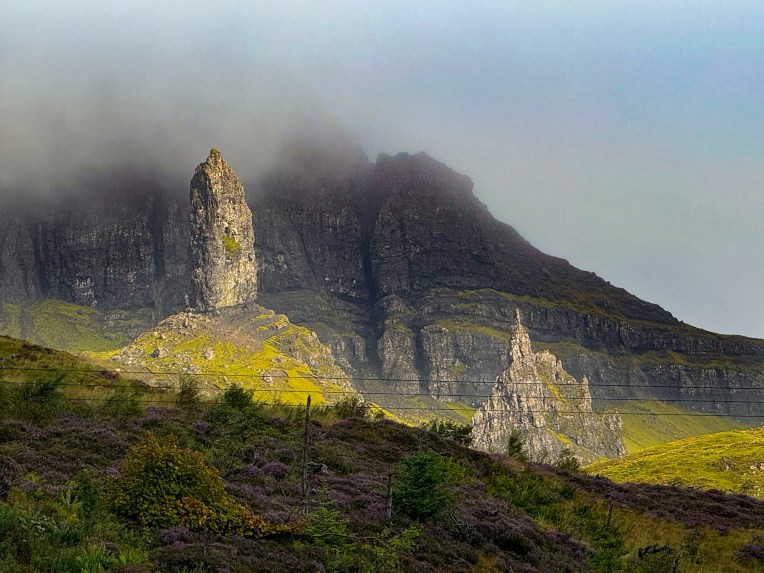
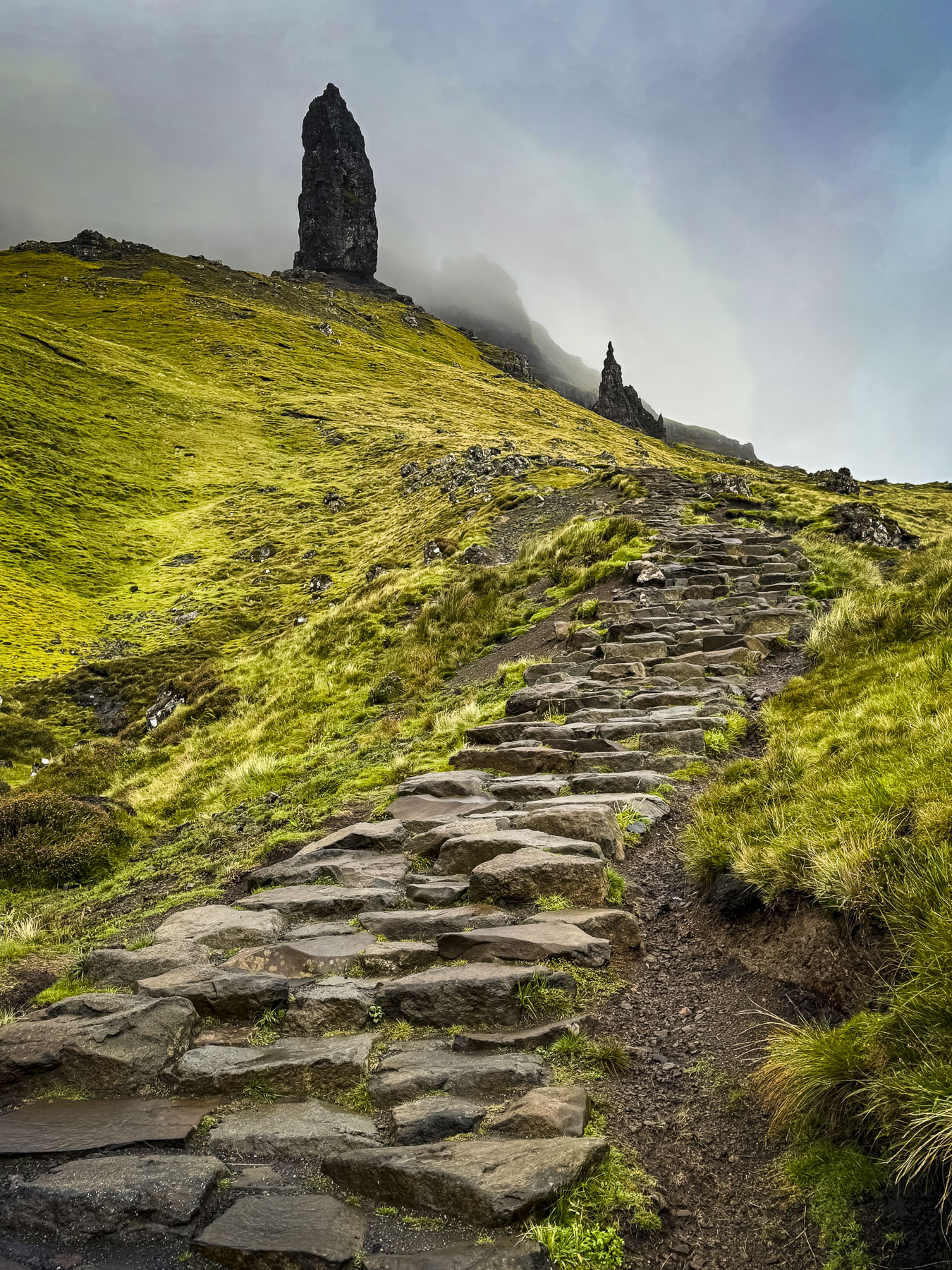
With only two full days on the Isle of Skye, the largest of the Inner Hebrides islands, we were up before dawn and headed out to hike the Old Man of Storr. We had read so much about the Old Man of Storr trail being the most popular activity on Skye that it we thought it wise to get an early start. Several cars were already parked in the lot, still wet from an overnight rain, when we got our ticket from the parking kiosk.

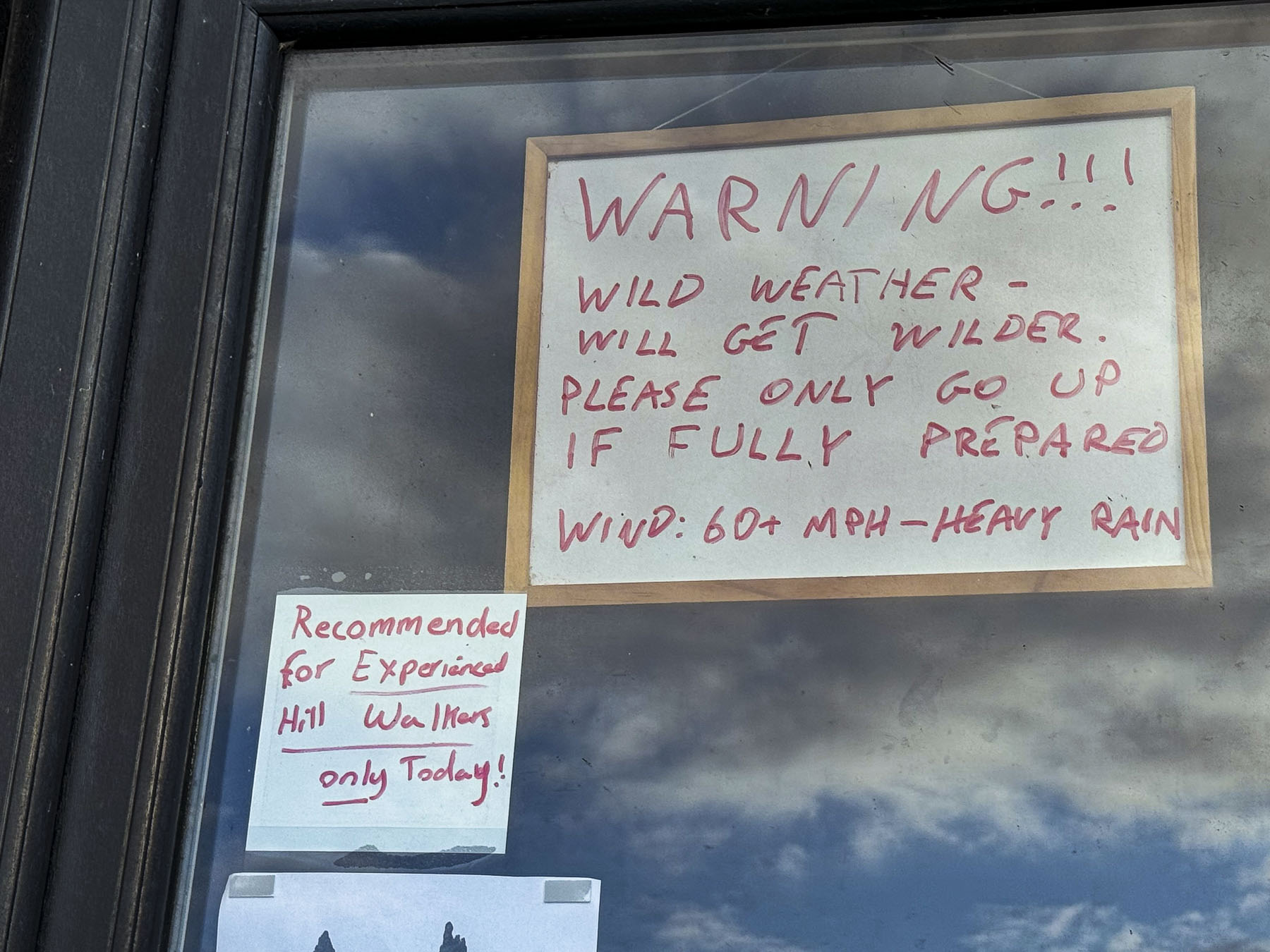
Even in places you wouldn’t expect, paid parking seems to be everywhere across Scotland, and since it’s the UK there’s video surveillance too. At the unmanned attendant’s hut a note taped to the window advised of “less than ideal wet conditions” on the mountain. We had hoped for a clear morning, but the mountain was shrouded in mist.

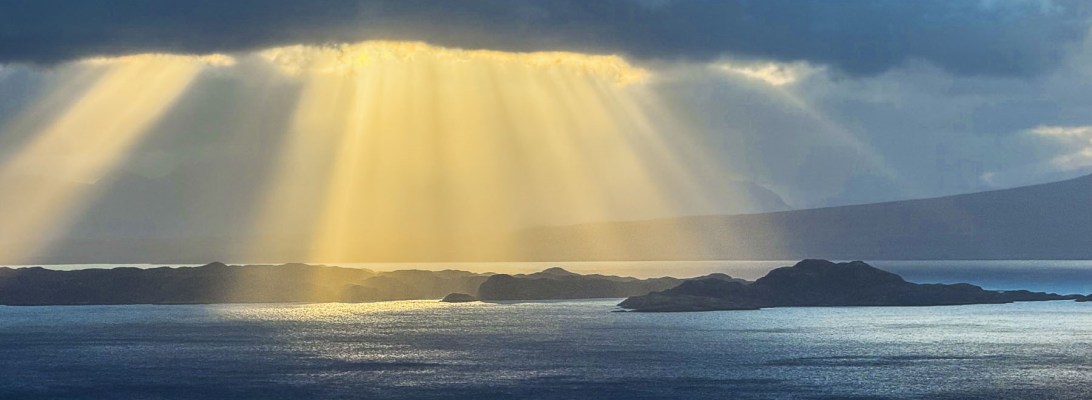
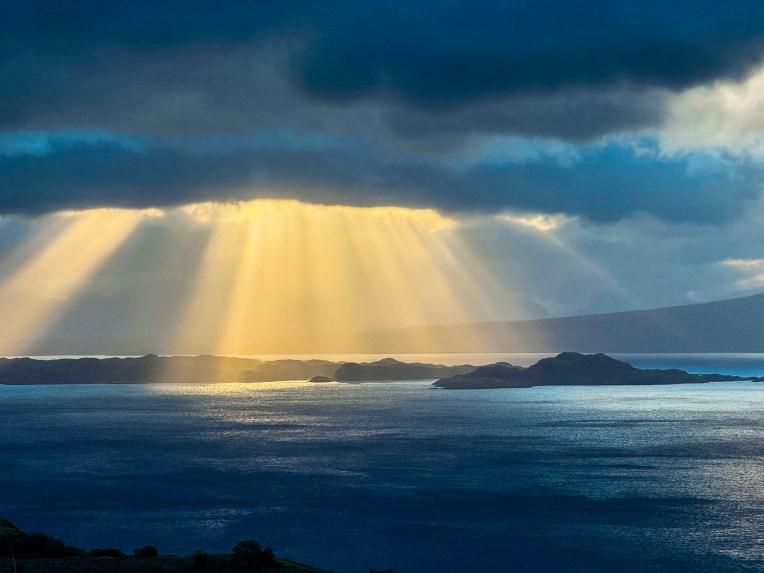
The first short stretch of the trail was moderately steep and would have been easier if our heart rates were up, though the incline soon lessened after rounding several switchbacks. When the trail leveled, we turned around to survey how far we had climbed and were rewarded with a spectacular view of morning light, in golden rays, cascading through the clouds onto the Sound of Raasay.

It began to rain by the time we reached a set of rough stone steps that would have taken us higher up the slope, but the rocks were getting slippery, and we decided to turn back.

We thought the morning was cold and had suited up with several layers under our rain gear, and were totally surprised when several guys in shorts and just t-shirts, obviously vacationers from the Artic Circle, passed us on the trail, followed by a young couple carrying a toddler.

Even though we didn’t make it as far up the mountain as we would have liked, we enjoyed the views.

By the time we returned for breakfast at The Rosedale Hotel in Portree the clouds were clearing, and we were able to admire the view of the harbor from a window table.

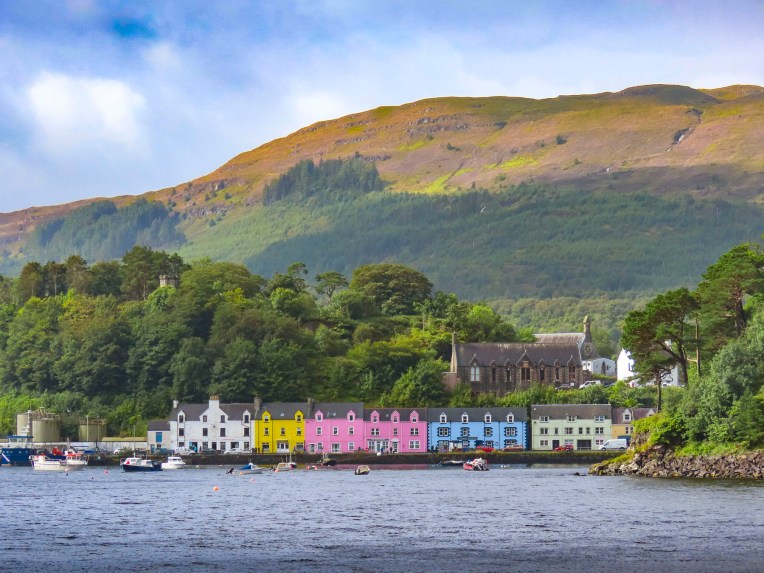
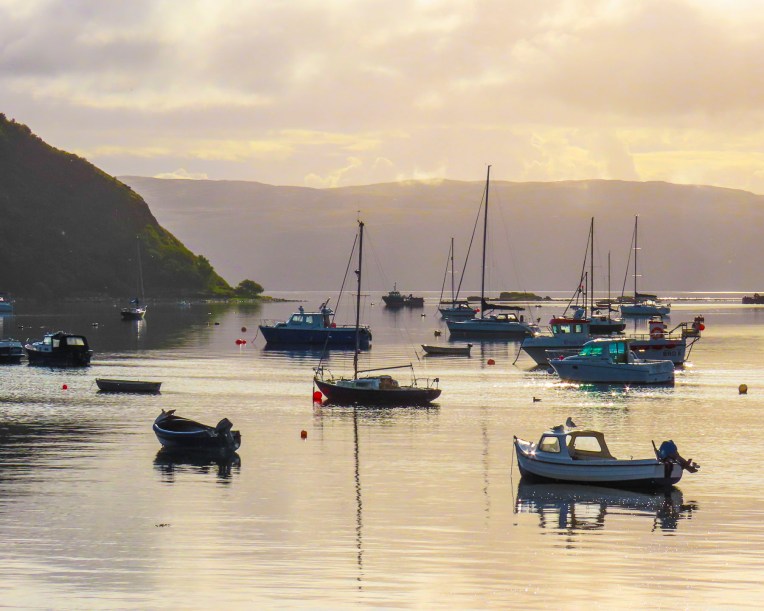
Afterwards we walked along the waterfront, where the view across Loch Portree, with boats rocking at anchor, resembled New England waterscapes from the coast of Maine, in the United States.

Our plan for the day was to make several stops at scenic sites as we headed north from Portree along the coast of Skye’s Trotternish Peninsula. We decided to look for dinosaur footprints at An Corran Beach before turning west across the highlands to Uig, then continuing a southern loop back to Portree.

This time as we approached Old Man of Storr the morning’s mist had lifted, and the mountain’s rugged peaks were clearly visible. The parking lot was also completely full.

The one good thing about all the August rain was that the rivers were high, and the waterfalls were thundering furiously. We had to wait for a few minutes for parking space at the Lealt Fall View Point. Strong winds buffeted us as we walked out onto the viewing platform.

Actually, two waterfalls can be seen from this spot: one flowing from a stream called the Ford is directly across from the platform, while the larger one to the right cascades 90 feet down from the Abhainn An Lethuillt, the River Leath.

From the ridge above the gorge carved by the falls, we followed the water flowing to the sea. The wind on this headland was extremely ferocious and we were fine as long as we had our hoods up and turned our backs to it. But as soon as we turned around a gust of wind threw my hood back and blew my baseball hat off my head. Really, it wasn’t my hat – since I had lost my own, I had borrowed Donna’s this morning, while she was still sleeping. The red hat had a long and colorful history, and was a treasured companion that she had worn on many adventures. The salt in the wound was that it settled only about 12 feet out of reach, down a very steep grassy slope, too risky of a spot to try to retrieve it. Months later I am still hearing about how untrustworthy I am as a hat borrower. I’m a lucky guy if that’s the worst of her grievances. The vistas surrounding this area were beautiful regardless of the weather.

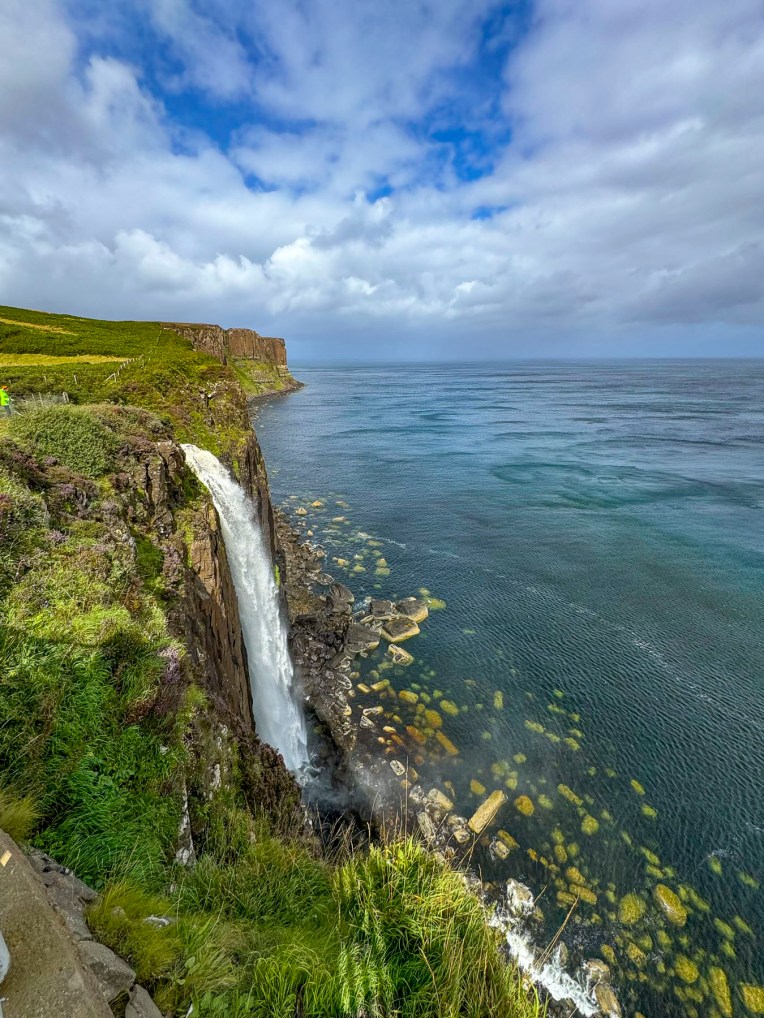
The sun was finally out when we stopped a little farther north at Mealtfalls where the waters of Loch Mealt spectacularly plunged 180 feet onto a rocky coastline and the sea, from a notch eroded into the 295 feet high cliff face of Kilt Rock. If viewed from the sea the basalt stone columns of the cliff face are said to resemble the pleads of a Scottish kilt.

The scenic drive north along the coast was stunning and we stopped many times to take photos. The sun was still shining, but the wind was blowing a “hoolie”, lifting swirling sprays of water into the air from the surf crashing onto the beach when we reached An Corran Beach.

The beach itself is very nice, but since 2002 when a local dog walker discovered the three-toed footprints of a Jurassic era Megalosaurus in rocks newly exposed after a large storm, it’s been a popular destination on Skye. We searched along the rock shelf at the water’s edge, but an incoming tide hindered our exploration.

Our hunger pangs began pinging around noon, and we stopped at several local restaurants only to be discouraged by the long waiting times for a table. We continued our drive. The issue wasn’t that the establishments were full, but that they lacked the seasonal staff to serve the customers adequately. This situation is a consequence of the Brexit maneuver that restricts foreign workers from entering the United Kingdom. This situation was mentioned to us several times by unhappy locals.

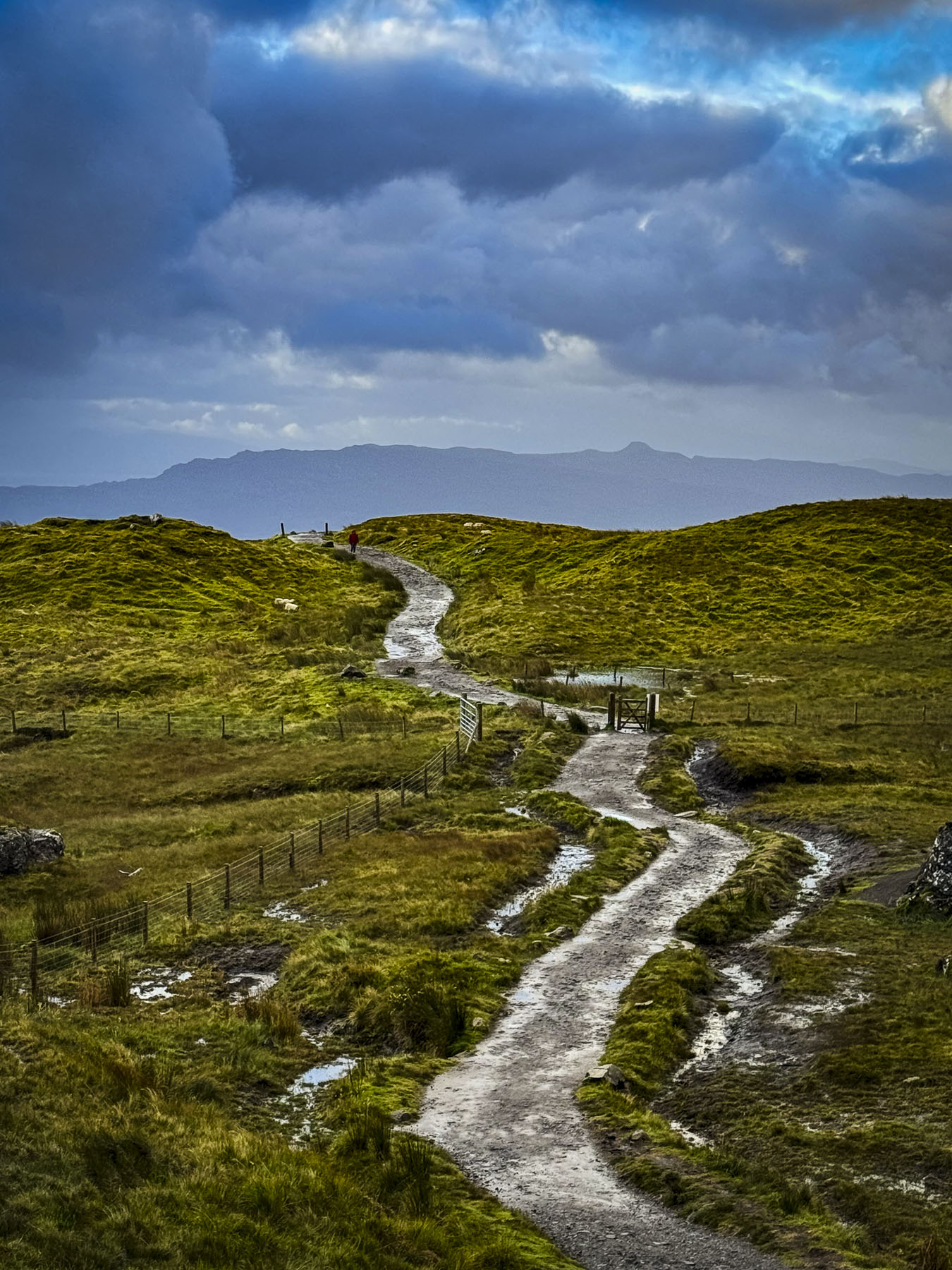
Following signs in Stenscholl for the Quiraing Pass we turned onto a serpentine single-track lane that climbed a 14% grade to an elevation of 856 feet above sea level before reaching a viewpoint.

With every fifteen miles or fifteen minutes the weather changed on the Isle of Skye, for better or worse. The deep grey sky was very forbidding and as soon as we opened the car door the rain poured down. The viewpoint and the trails leading from this scenic spot rival the Old Man of Storr’s, and are very popular for the views of the east coast of Skye and the highlands that can be seen on a clear day. It was raining too hard for us, so we continued across the highlands toward Idrigill on the west coast.

The interior sections of Skye are now vast wilderness areas with few signs of folks living in the area. But that wasn’t the case in the early 1800’s when the hills and glens of the island’s highlands supported over 20,000 crofters, tenant farmers, before the notorious “clearances” removed folks from the land to make way for large industrial scale sheep flocks. Many families emigrated to America, Canada, Australia, and New Zealand seeking better opportunities. A slow decline of Skye’s population continued into the 1970’s when it reached a low of 7,100 people. The most recent census shows the island’s population growing to 10,000 residents.

The sky was clearing once again when we reached the Idrigil Viewpoint. It was a splendid spot with panoramic views of Uig Bay and village. We finally had a late lunch at the Anchorage Cafe, across from the ferry terminal. It was nice to familiarize ourselves with the area, as we’d be taking the ferry from the Uig port to the Isle of Lewis and Harris in two days.

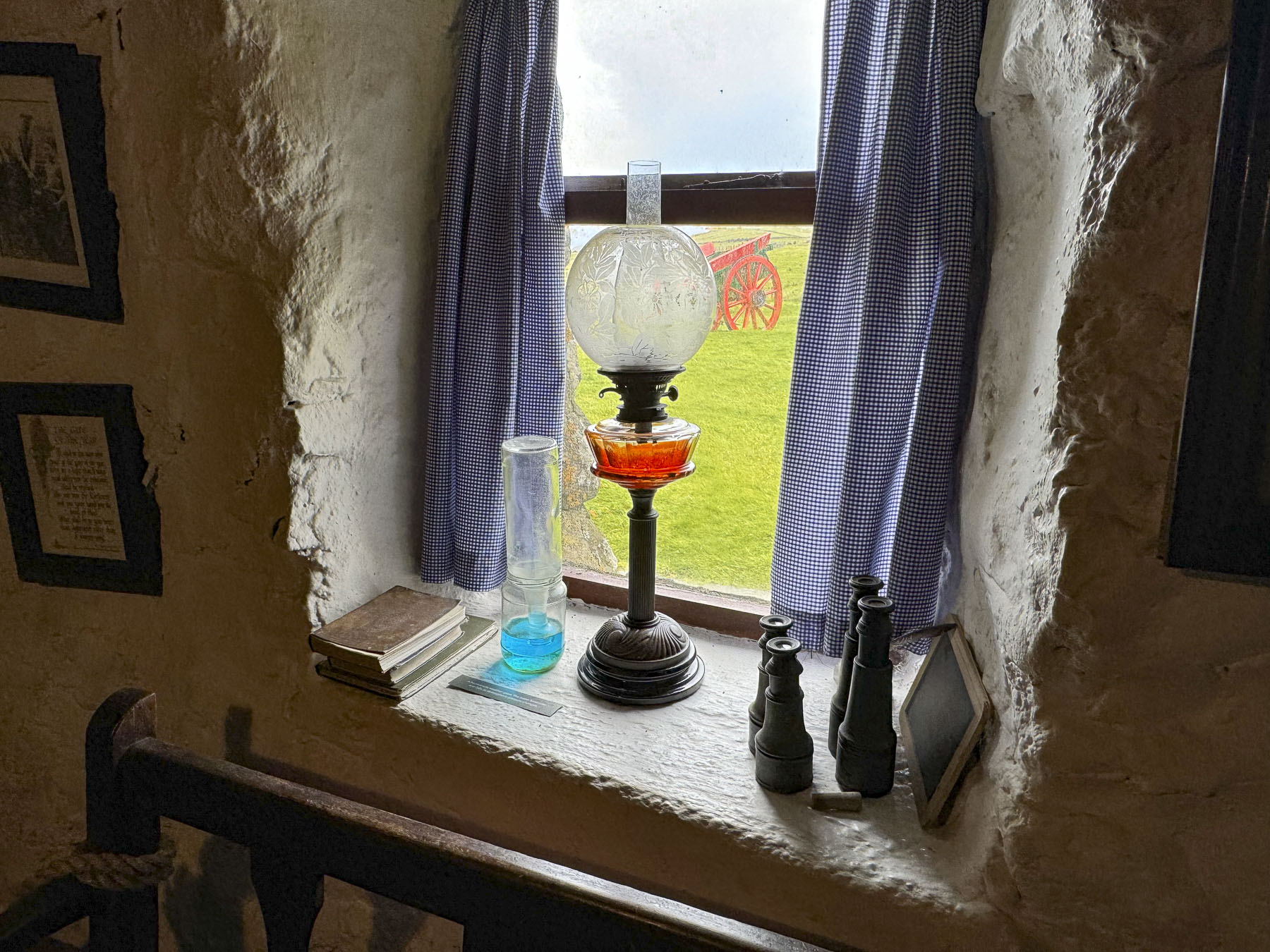
After lunch we drove up the western side of the Trotternish Peninsula to the Skye Museum of Island Life, which is a collection of thatched roofed stone cottages showcasing the way folks lived on the island centuries ago. Sheep and several hairy coos shared a bucolic pasture next to the museum when we pulled into the sunny parking area. But it was a deceptive moment of fair weather, and we were soon darting between the buildings, in the lulls between downpours, to see the interesting array of artifacts from seafaring, farming, and other trades on display.

We returned to Portree in time to snag a coveted parking space along the quay in front of our hotel and spent the rest of the late afternoon visiting the various shops in town. Our best find was in the charity shop along the waterfront where I was able to replace Donna’s hat with a warm woolen plaid cap. For the bargain price of fine pounds, she was willing to overlook a moth hole in the tweed.

We set out late the next morning to explore the western side of the Duirinish peninsula, visiting the village of Stein and Dunvegan Castle, both on the shore of Loch Dunvegan, but miles apart. Then heading back towards Portree and stopping in Carbost, on the Minginish peninsula, at the end of the day.

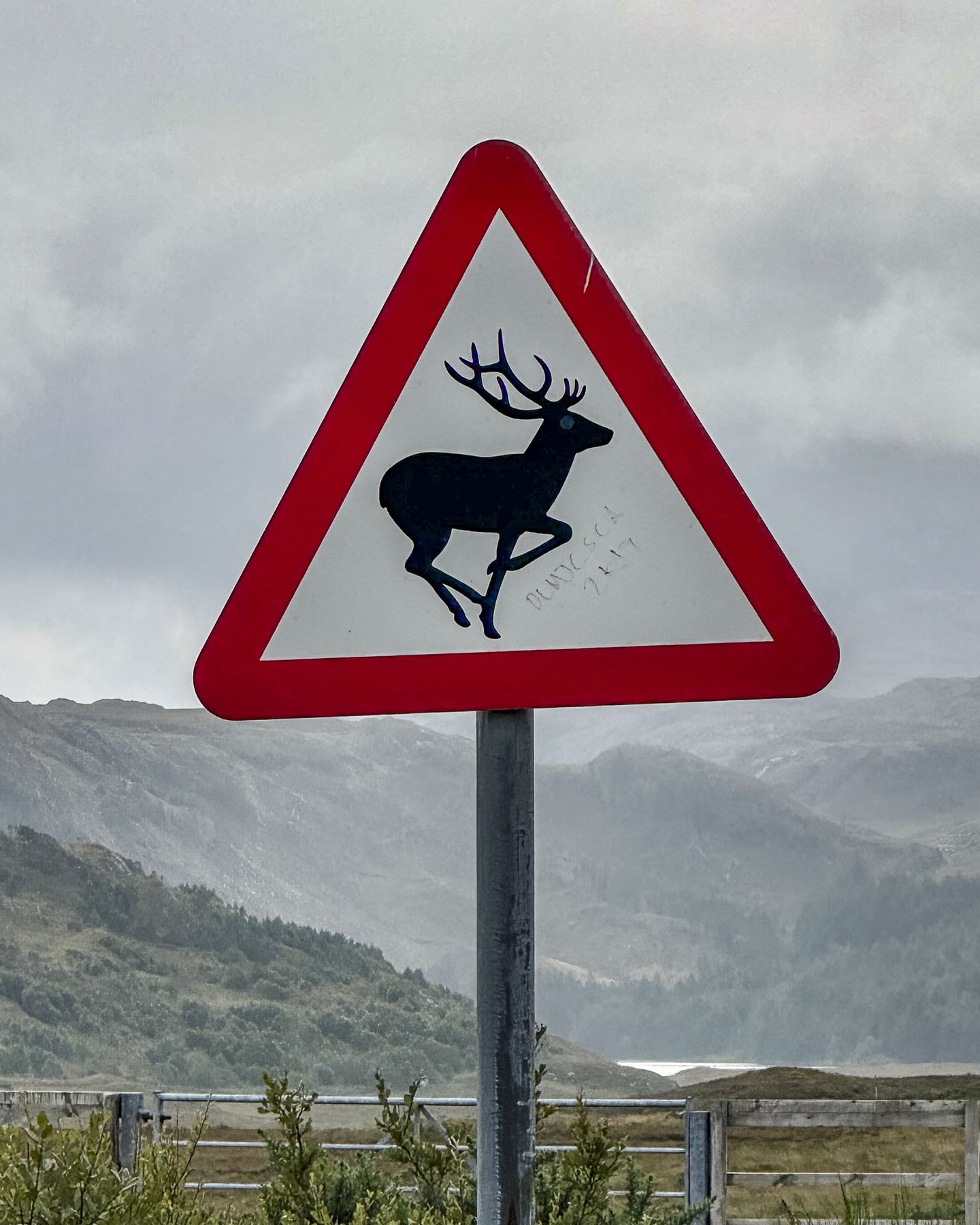
It was an overcast day from the get-go and we took the drive slowly as we followed the A850 though the countryside. At the head of Loch Greshornish we turned off the main road and followed a narrow lane into the village of Edinbane in search of a place to stop for coffee. The village was very quiet and didn’t show any sign of life, even though it was a weekday in the August high season, and several inns were shown on our map. We did encounter an unusual traffic sign that boldly warned with its red triangle that we were in a “Free Range Children” zone. It touched our hearts and made us laugh, while we remembered being kids with hours of unsupervised freedom to roam about. We’d seen many signs warning of stags, hedge hogs, and red squirrels throughout the highlands. Even a road crossing sign near a retirement complex in Edinburgh that featured the silhouette of an elderly couple using  canes, that made its point quite effectively with a touch of humor. Back on the main road the take-away coffee at the filling station didn’t appeal to us so we continued on our way.

Our approach to Stein looked like the soft edged, muted colors of an impressionist painting through the windshield, as the wipers didn’t work fast enough to whisk the heavy downpour away. The rain was too intense to get out of the car. So, we drove slowly through the village looking for a place to turn around, until the road suddenly disappeared as a boat ramp into the sea. Gloomy, wet, and unpleasant, it was definitely a “dreich” day, as the Scots like to say.

With everyone on Skye looking for an indoor activity to do, the parking area at Dunvegan Castle was full. There’s only so many castles you can see before they all begin to feel the same, and we had stopped at several earlier on the mainland, so we didn’t feel totally guilty when we decided to head to lunch instead. There are several restaurants that sit along the road through the village of Dunvegan. Dunvegan this, Dunvegan that. Of course we had lunch at The Dunvegan, a small five room inn overlooking the loch, which features a very nice restaurant along with a café, and deli for takeaway. Even though it was very busy on this inclement day, we found it relaxing, and the staff was very nice. Just down the street, a restored one-room crofter’s cottage houses the quirky Giant Angus MacAskill Museum. It’s run by a distant relative of the seven feet nine inch tall giant who was born in 1825 on the Isle of Berneray, in the Outer Hebrides. I guess that’s close enough to be considered a hometown boy, even though he spent most of his youth growing up in Nova Scotia, Canada after his parents emigrated. His height and strength eventually brought fame and fortune to the gentle giant called Gille Mór (Big Boy) when he toured the world with P.T Barnum and Tom Thumb, the world’s smallest man. Performing before Queen Victoria, she declared him the “strongest, stoutest and tallest man to ever enter the palace.” For a while he was listed in the Guiness Book of Records as the world’s strongest man. Statues of Angus and his stage partner Tom, along with his size 18 boots, and a replica of his huge coffin, fill the space. 

We arrived too late for the last tour of the distillery at Talisker in Carbost, but nevertheless we enjoyed sharing a flight of three single malt whiskies aged for 10, 18, and 25 years, while standing at the bar, as the tasting area and showroom were full of folks escaping the rainy afternoon. Our young barkeep was a well-versed whisky sommelier who described the “smoky sweetness intertwined with distinct maritime notes,” as he guided us through the subtle influences the haar, the sea mists that blow in from Loch Harport has on the aging process. He poetically used a cask full of adjectives to describe the Nose – floral seaside aromas, with gentle smoke palate; a malty creaminess and finish; sublimely spicy; a kick of cloves; an exquisite lingering saltiness.  All were very nice to sip slowly, and on a damp rainy “dreich” day like today we fully appreciated the healing properties of Scottish whisky and why some refer to it as the “water of life” in the highlands.

Just up the hill from the Talisker Distillery is The Oyster Shed. Occupying a metal farm building,

it’s a local no frills, order at the counter joint, with incredibly fair prices, that serves the freshest seafood caught locally that day. We ordered a dozen oysters and a bowl of mussels along with cans of Irn Bru, a fruity carbonated soft drink often referred to as “Scotland’s other national drink.” We sat outside around the corner of the building at a long, shared picnic table with other customers. Simple, delicious and authentic, it was a great way to cap off our day. Parking can be difficult here, so be patient; experiencing the Oyster Shed is well worth the short wait.

The next morning in Portree was beautiful and also our last day on Skye. We made the best of our time before catching the Caledonian MacBrayne ferry from Uig to Tarbert on the Isle of Lewis and Harris, in the Outer Hebrides. Overlooking Uig’s harbor we stopped at Captain Fraser’s Folly, a stone tower built in the mid 1800’s on the spot where Fraser’s Kilmuir estate Factor collected rent from the crofters that lived on the land. Fraser and his Factor were not popular during the clearances and often had to seek shelter in the tower from tenants evicted from the estate. Once in 1884 they even had to ask the Royal Navy to help secure their safety.

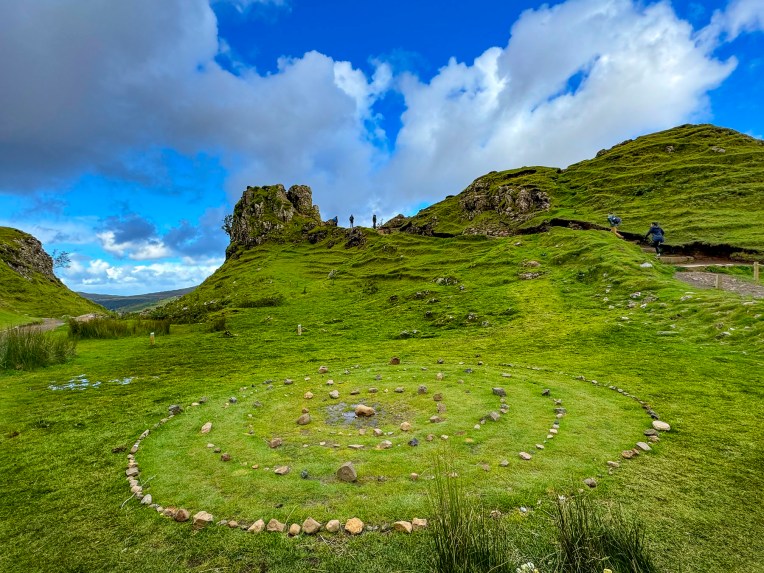
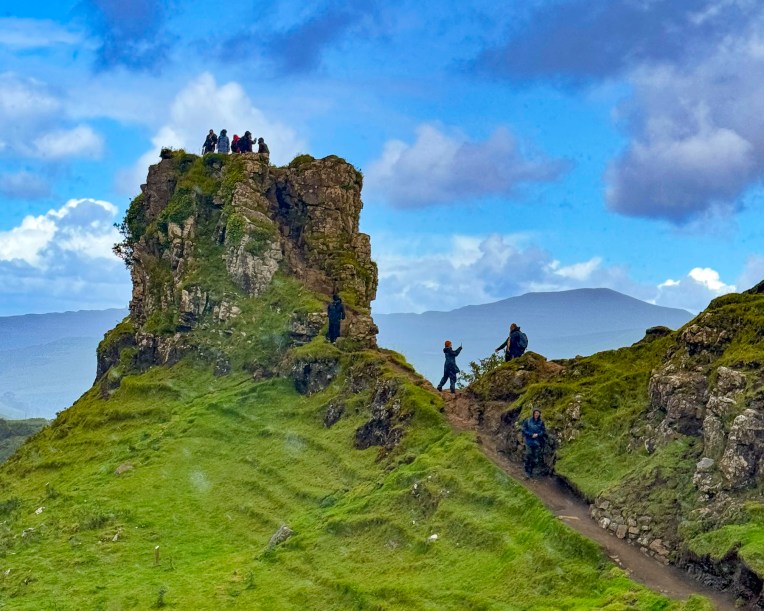
Skye’s legendary Faerie Glen, known as a place of myth and wonder, was only a short distance away from Fraser’s Folly, in the hills above Uig. It’s a magical spot, centered with concentric rings of stones, under a rocky hilltop that resembled ruins, that’s called Castle Ewen. The landscape surrounding the glen is rugged and covered with gnarled trees and heather where, according to legend, the Faeries of the glen lived. One of the ancient folk tales speaks of a Clan MacLeod chief that lived in Dunvegan Castle and married a Faerie princess. She stayed with the chief for a year before returning to her world, but left with him a Faerie flag to protect the Clan MacLeod from evil and bring victory in battles. It’s reportedly brought the clan good luck over the centuries.

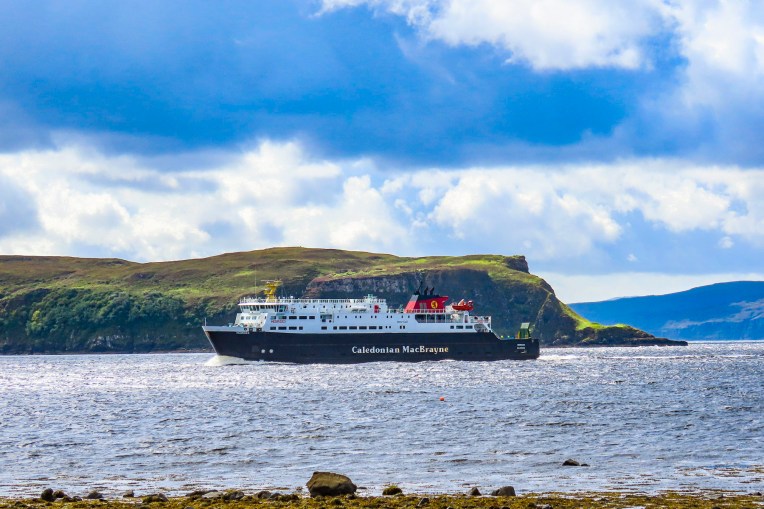
Inexperienced with car ferries, we made sure we were early in the queue at the Caledonian MacBrayne pier. We had purchased our tickets online, months before, as soon as their summer sailing schedule became available. We read that while being a last-minute walk-on isn’t a problem, car reservations during the summer high season fill quickly. There were special lanes for each category of vehicle – car, camper, truck and bus. Vehicles without reservations get driven on last or not at all depending on available space. It all worked very smoothly with a ferry attendant scanning the barcode of our printed ticket and directing us into the correct boarding lane.

Surprisingly, the ferry was very quickly loaded and with a blast of the ship’s horn we departed Uig and headed across the Minch, the body of water that separates Skye from the Isle of Lewis and Harris. 

Till next time, Craig & Donna

P.S. According to Sir William Connolly, Scotland’s favorite retired stand-up comedian, “There’s no such thing as bad weather, just the wrong clothing, so get yourself a sexy raincoat and live a little.”

The North Coast 500, kind of – Part 2: Glencoe to the Isle of Skye or Castles, Lochs and Legends

Rain pounding on the skylight woke us and revealed a grey day with not an inkling of sun in the sky. A real “drookit” of a day our innkeeper called it at breakfast. The tumultuous weather in the highlands is always a topic of conversation. “When the sun shines it’s glorious. For the other 364 days of the year we Scots amuse ourselves with over 100 Gaelic words to describe the variety of rain, and 421 words to describe the intricacies of snow.” It was a form of entertainment for our ancestors as they sat around the fire at night, in their ancient turf and creel houses, he related with a smile. With the way the weather blows in off the Atlantic Ocean, it’s possible to experience the four seasons in one day in the highlands. It’s a “dreich” day this morning – gloomy, damp, and grey – but the sun will most certainly shine later between sporadic showers. “It’s God’s way of cleaning the coos.”

True to his prediction the sun broke through clouds that were being torn apart by the wind as we stopped along Loch Lochy to photograph the multi-hued pinks, whites and magentas of the wild bush vetch growing along the side of the road. On the loch a sailboat was running downwind at a good clip with only its mainsail set. Our plan for the day was to head north from Glencoe along the A82 before following the A87 west through the highlands and across Loch Alsh to the Isle of Skye and end the day in Portree.

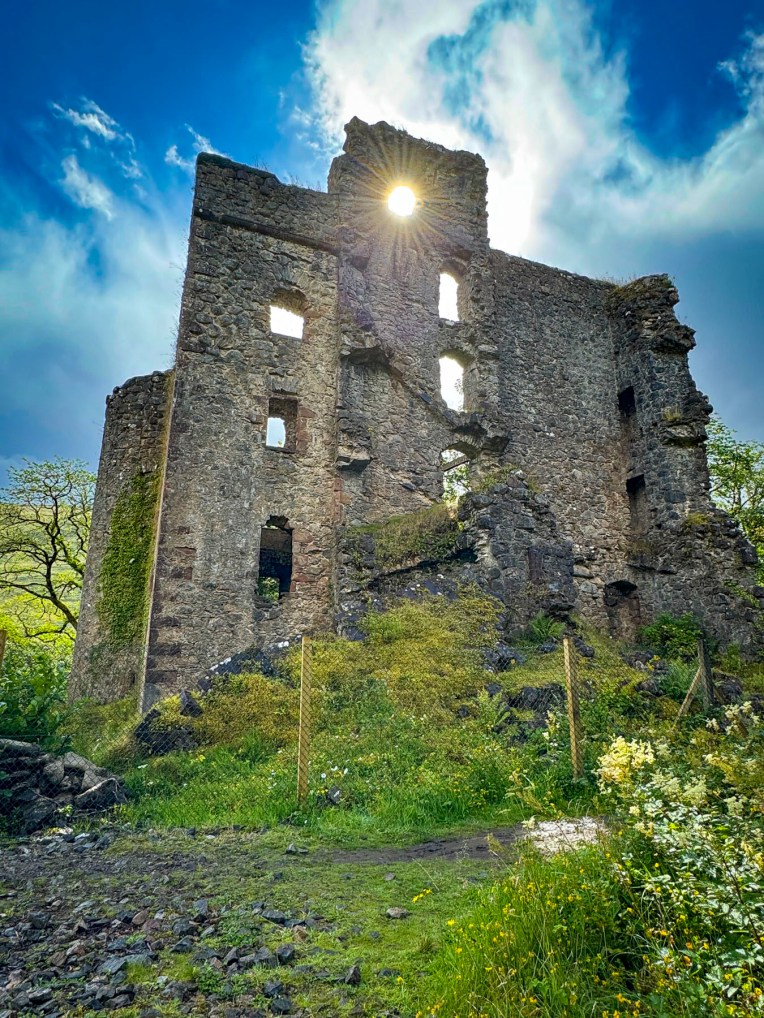
As the road turned west, we turned to the right and followed signs to Invergarry and Glengarry Castles down a narrow lane through an old growth forest. The ruins of Invergarry Castle eventually revealed itself from behind a curtain of woods. Sunlight cascaded through ruins. Only a few walls of Invergarry Castle remain, but in its glory it was a five story L-shaped structure with a six story tower, and seat of the Chiefs of the Clan MacDonell of Glengarry, a powerful branch of the Clan Donald. Clan legend believes that in the early 1600’s the stones for the castle’s construction were passed hand to hand by a chain of clansmen from the mountain Ben Tee, five miles away. The castle had a short and turbulent history. Oliver Cromwell’s troops attacked the MacDonnells for supporting King Charles I and burned the castle in 1654 during the Engilsh Civil War. Rebuilt, the MacDonnell’s castle was used by the Jacobites in the 1715 and 1745 rebellions. Bonnie Prince Charlie visited the castle after raising the Scottish flag on the shore of Loch Shiel at Glenfinnan when he returned from France, and again, to rest, after his devastating defeat at the Battle of Culloden in 1746. As part of a systematic suppression of the Highlands the castle was destroyed again, but two walls refused to fall, as if symbolizing the Scots’ refusal to yield the British crown.

The castle was abandoned, and by 1760 the chief of the Clan MacDonell was in the new Invergarry House, just a short distance away from the ruins of the castle. In 1960s Invergarry House was reborn as the Glengarry Castle Hotel.

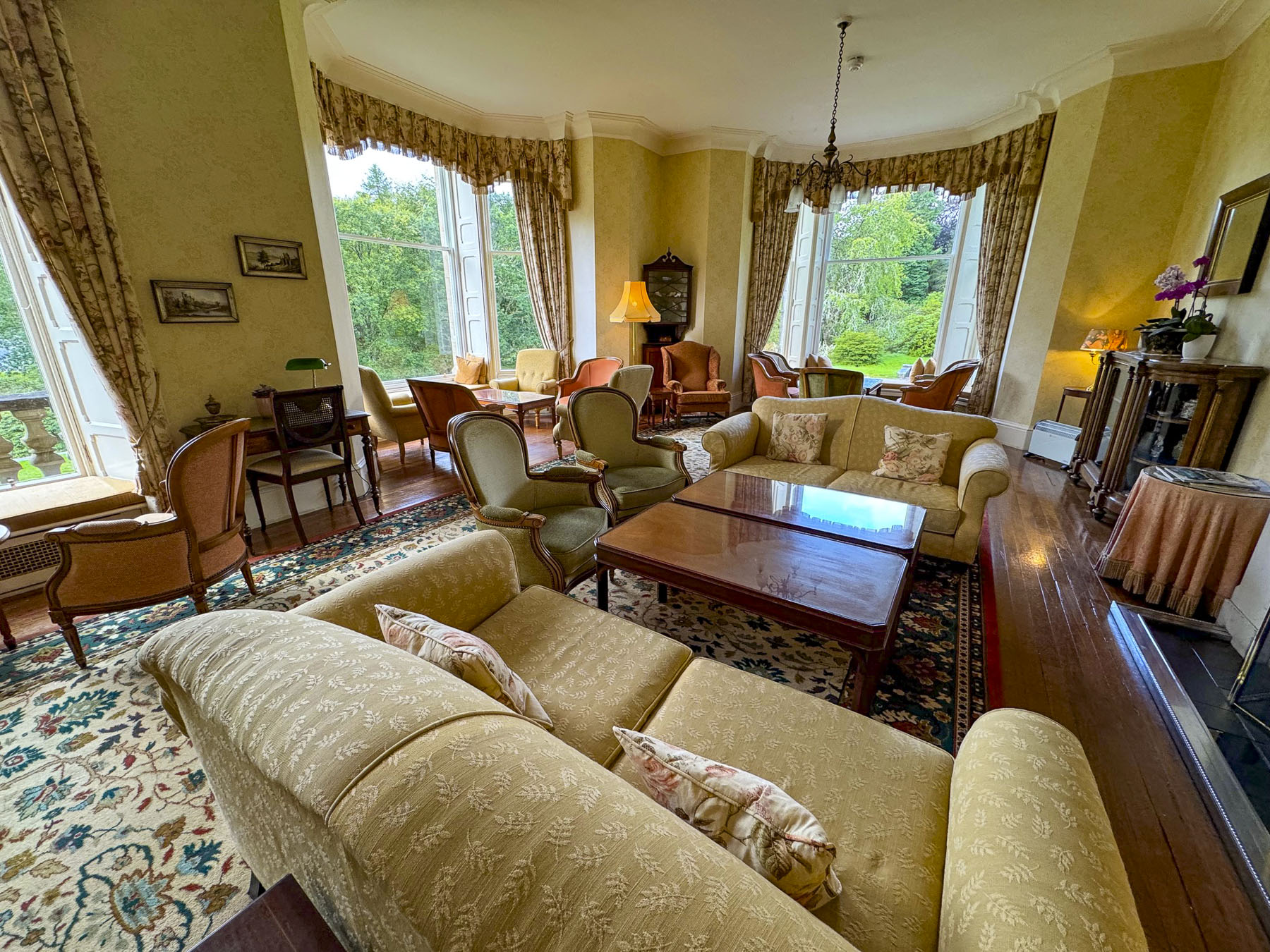
“Drive a little then café,” is our motto on road trips to break up our drives and Glengarry Castle was the perfect stop for our mid-morning caffeine compulsion. To describe Glengarry as a castle might be stretching it a little. It’s beautiful building, more accurately described as an estate home or chateau. It’s now a lovely hotel that harkened back to the reserved elegance of an earlier era. From its comfortable sitting room we enjoyed our coffees, and watched several boats motoring along Loch Oich. We lingered. From north to south the lochs Ness, Oich, Lochy, and Linnhe connect to one another via a series of locks along the Caledonian Canal which traverses the highlands to form a sixty-mile long intercoastal waterway that starts in Inverness and ends at Fort William, connecting the North Sea to the Atlantic Ocean. Conceived to give employment to highlanders displaced during the clearances, the canal was constructed in the early 1800’s and was designed to accommodate large merchant sailing ships. The canal reaches its highest point, 106 feet above sea level, at Laggan, between Loch Oich and Loch Lochy. One of the canal’s significant engineering feats is Neptune’s Staircase, a series of eight step locks near Fort William.

We rejoined the A82 for a few minutes before turning onto the A87 and followed it west along a route that paralleled the River Garry, before rising higher into the mountains and reaching the river’s source, Loch Garry. The views of Loch Garry under clearing storm clouds were spectacular, and we stopped several times, but the most rewarding photograph was taken from a farmer’s gate that led to an open field, high above the loch.

From the rocky beach at Loch Cluanie it was apparent that our luck with the weather was changing, and that “tha stoirm mhor ann,” was brewing with darkening clouds.

It was a real pish-oot by the time we sought sustenance at The Pitstop at Kintall, across the road from Loch Duich.  It’s one of the few eateries along the A87, and the folks that run it are good-humored angels. Their wings were especially visible the day we stopped. The small restaurant was full of people seeking shelter from the storm. Just inside the door, a large queue of dripping wet folks huddled, and created a loch size puddle as they waited for tables. On a nicer day the restaurant’s picnic tables outside would have easily accommodated everyone. Fortunately, the kitchen was quick, and folks didn’t linger. Their coffee was good, and the food was delicious.

The rain was lessening when we spotted the St Dubhthac’s Church on a small hill above Loch Duich and did a quick U-turn to investigate its ruins. It’s a pretty setting atop the hill with views of the loch and mountains covered in the purple heather blooms of summer. The exact date the church was built is unknown, but it’s believed to have been constructed in the 11th century shortly after Dubhthac a popular priest, and great missionary walker venerated for his evangelistic efforts, visited the area. An ancient cemetery, the Clachan Duich Burial Ground (“clachan” meaning stone or church in Gaelic) surrounds the ruins, and was the traditional burial place for many Clan Macrae chiefs over the centuries.

After the Battle of Glenshiel in 1719, the church was used to treat wounded Jacobite soldiers. Consequently, British troops later torched the church in retaliation. The church was eventually rebuilt and used into the 1850’s, but was left to neglect after the “clearances” reduced the area’s population. Today modern pilgrims can follow the St Dubhthac Way through Glen Affric via Chisholm’s Pass, along what is believed to be the evangelist’s original path through the highlands.

Fickle weather continued to plague our day, but we weren’t deterred from enjoying the moody weather when we visited Eilean Donan Castle, one of the Scottish Highland’s most iconic sites. Having invested in some good quality Gore-Tex rain gear that actually kept us dry made all the difference. And what better way to experience the harsh conditions of life in medieval Scotland than on a cold stormy afternoon in the highlands. Seems many other tourists felt the same way, and the parking lot for the castle was nearly full. https://www.eileandonancastle.com/?s=tickets

Eilean Donan means “Island of Donan” and refers to St Donan, an Irish missionary, who lived on the small island for a short time while he traveled through the western highlands and isles introducing Christianity to the Picts in the beginning of the 7th century. Later the island held an early Pict fort.

In the12th century a larger castle was built on the strategically located tidal island, situated at the confluence of three sea lochs: Loch Duich, Loch Alsh, and Loch Long, to defend the area from the frequent Viking raids that were happening at the time.

By the 14th century the castle was the western stronghold of the Clan MacKenzie and their allies Clan MacRae. Siding with Robert the Bruce, the MacKenzies granted him refuge at the castle after his defeat at the Battle of Methven in the early 1300’s, before he became the King of Scotland.

These were brutal and lawless times in the highlands and vividly illustrated in a gruesome event in 1331 when fifty “mysdoaris” (mis-doers) were gathered and executed, their heads then put on pikes along the castle’s walls to deter others from wrongdoing and assure the Warden of Scotland, who’s visit prompted this massacre, that there was law and order in the region.

During the unsuccessful Jacobite Uprising of 1719, Spanish troops allied with Bonnie Prince Charlie and exiled King James II were garrisoned in the castle. That May three Royal Navy frigates sailed into the lochs and bombarded the castle. After the Spanish forces surrendered, the British sailors used 343 barrels of gunpowder that the foreign troops left behind to blow the castle to smithereens. Some believe the ghost of a fallen Spanish soldier still haunts the isle.

The castle was left in ruins for nearly 200 years before Lt Colonel John Macrae-Gilstrap bought the island in 1911, and with the help of Farquhar MacRae set about rebuilding it over the next twenty years. Not knowing what the original castle actually looked, it’s believed Farquhar envisioned it in a dream. Surprisingly, years later when old plans of Eilean Donan were discovered in the ancient archives of Edinburgh Castle, his vision was confirmed as true to the original design. The only addition was the multi-arched stone footbridge we were about to cross above seaweed covered boulders exposed with the low tide. Wonderfully evocative on a moody rainy day, the views of the castle surrounded by water and mountains on a sunny day must be spectacular. No wonder it’s one of Scotland’s most photographed treasures.

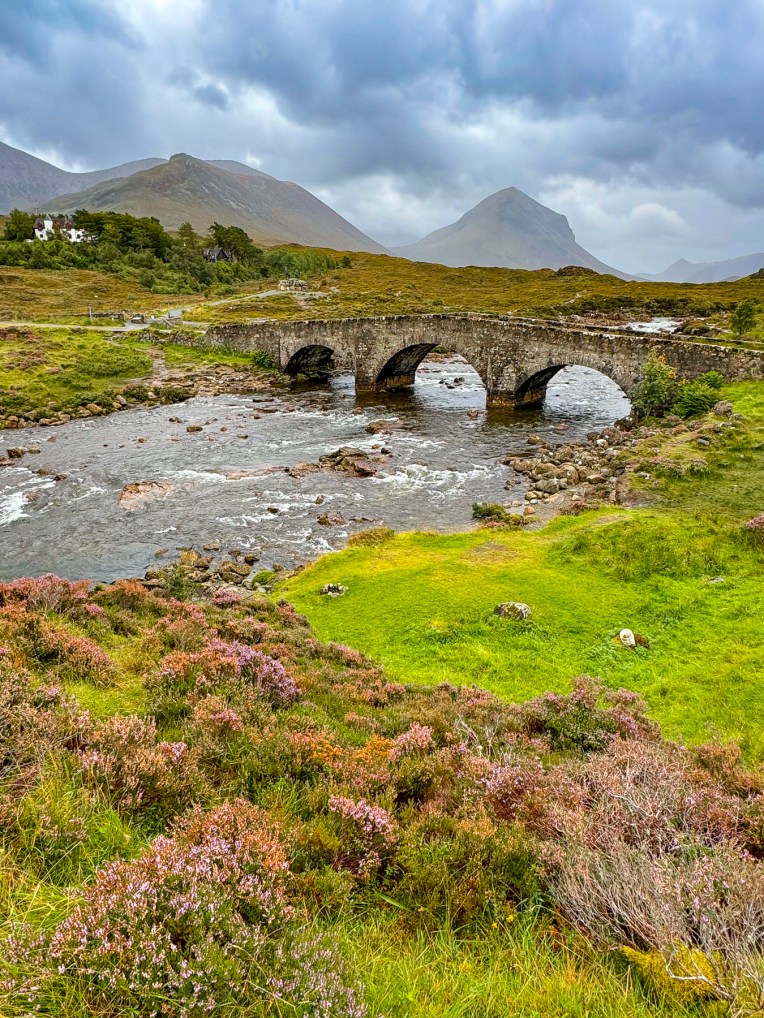
It continued to be a dreich afternoon as we followed the A87 over the Kyle of Lochalsh, the narrow strait that separates the Isle of Skye from the Scottish mainland. The Sligachan Old Bridge was our last stop of the day before reaching Portree. It was designed by the famous Scottish architect Thomas Telford, better known for Dean Bridge in Edinburgh and the locks of Neptune’s Staircase on the Caledonian Canal, and it was built in 1810 with rocks collected from the river over which it spans. There is a mystical quality to the often mist-covered landscapes on the Isle of Skye. Fabulous tales of faeries and myths of ancient warriors inhabiting the land have been passed along by oral tradition throughout the Highlands and the Hebrides Islands since primitive folks first settled the region around 7000BC.

Two legends are associated with the River Sligachan. The first is the ferocious battle between Scáthach, the chief of a tribe of skilled female warriors, who had a fearsome reputation and was said to be stronger than any man, and Cú Chulainn, an Irish hero and demi-god who sailed to Skye to prove his strength against her. The battle raged for weeks. The earth shook as their weapons struck the ground, creating rivers and mountains across Skye as they wrestled in combat.

The second legend is the tale of the magical powers of the River Sligachan, when Scáthach’s daughter, Uathach, was granted eternal beauty and wisdom by following the guidance of faeries to dip her head into the icy water of the River Sligachan, for a very specific seven seconds and then let the water on her face air dry. It’s not as easy as it sounds considering the temperature of the water and that you have to get on your hands and knees to accomplish it. But she succeeded and was given a vision that the aroma of a wonderfully cooked meal would entice Scáthach and Cú Chulainn to stop battling. It worked and the combatants, realizing they were starving, called a truce.

Afterward Scáthach agreed to train the Irishman in her ways of warfare at her “Fortress of Shadows” on a remote windswept headland on Skye’s Sleat Peninsula. But the tale doesn’t end and continues to become a juicy Iron Age soap opera with Cú Chulainn seducing Uathach and killing her husband, then having a child with Scáthach’s sister and rival Aífe. Of course there are many versions of this ancient folk tale. The ruins of Dunscaith Castle, the 14th century stronghold of the Clan MacDonald, are believed to be the setting for this epic story.

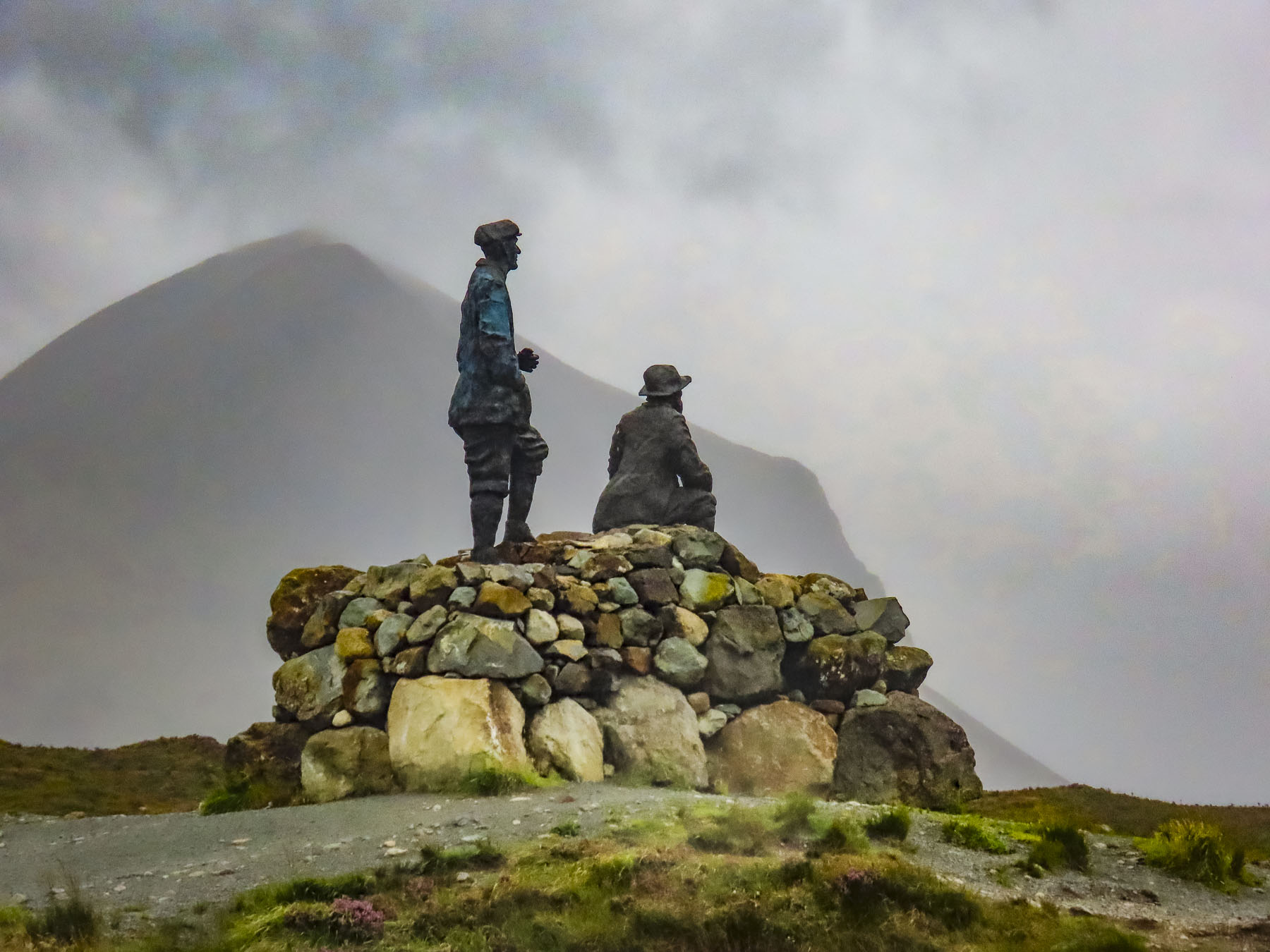
The river valley and mountains west of the old bridge are called the Cuillin, an expansive area of pristine beauty with over 20 Munros, mountains over 3,000 feet high. South of the bridge the Collie and MacKenzie Statue, marks a trailhead into the wilderness, and commemorates the mountaineer and guide who mapped hiking routes across the Cuillin range and climbed many of Skye’s rugged mountains in the late 1890’s and early 1900’s.

Winds change the weather quickly on the Isle of Skye and by the time we reached Portree and checked into the Rosedale Hotel, located along the harbor’s waterfront, the sky was clearing. It was the height of the summer season and unfortunately, we couldn’t reserve a room with a harbor view, but we were quite happy with our accommodations otherwise.

Each morning at breakfast, the sweet waitresses gave us the table with the best view of the harbor, as if in recompense for our view-less room. Free parking along the quay is possible, but it’s almost impossible to find a space. The hotel did provide directions to the free municipal lot across from Phil the Barber and the Portree Community Centre on Park Road, a short distance away, that worked out quite well.

Later, we shared a seafood platter at Sea Breezes, a small restaurant in one of the colorful 19th century buildings along the harbor front, where it’s recommended to be among the first in line when it opens at 5 PM. Our meal was delicious and featured locally sourced sea trout, mussels, and scallops harvested from the waters around Skye that morning.

https://www.rosedalehotelskye.co.uk/              https://sea-breezes-skye.co.uk/

It was long wet afternoon after we lost the morning sunshine, and we hoped for better weather in the days ahead. But as our hotelier reminded us “today’s rain is tomorrow’s whisky.”

Till next time, Craig & Donna

Three days in Edinburgh or Jugglers, Sandstone, Whisky & Thistle  

Good hosts, Shopkeepers, and restauranteurs constantly apologized for the unusually cold and fickle August weather that Scotland was experiencing. In the Outer Hebrides, on the Isle of Lewis and Harris, strong winds and high tides led to road flooding in the center of Stornoway, a destination on our itinerary. “Normally the weather is perfect this time of year,” was a frequent refrain. “Lively thunderstorms,” such a nice phrase, had delayed our flight from London to Inverness, several days earlier. Later in the month heavy rain and strong winds led to the naming of the 12th storm of the 2024 season, Storm Lilian.

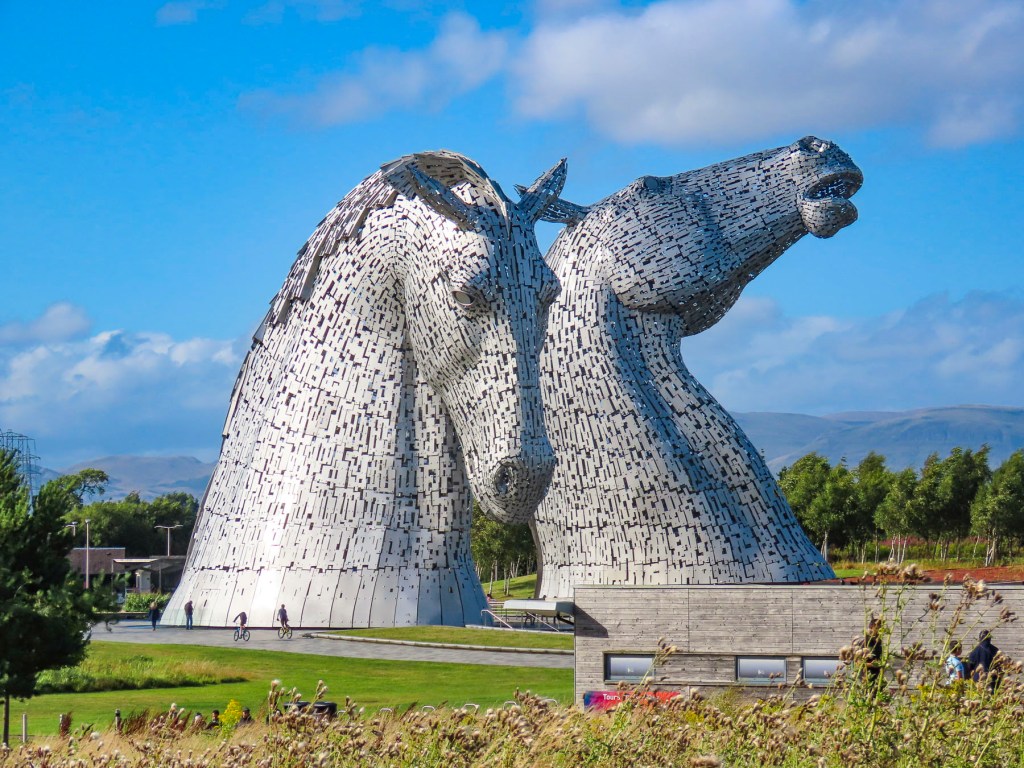
We had donned our Gore-tex rain gear for two days straight, and were thankful we made the investment in some reliable waterproof jackets. But yesterday afternoon as we visited The Kelpies while driving to Edinburgh, it was 65°F and the sun was shining. The weather was brilliant. Rain then clearing storms was the weather pattern that would repeat itself for the next three weeks, which provided many opportunities for some dramatic landscape photography.

With the weather predicted to be nice for the next several days, we planned to head to the Dugald Stewart Monument on Calton Hill for that iconic view of Edinburgh at sunrise. It didn’t go exactly as planned, as we didn’t get up early enough, underestimated the length of time our tram journey from the Holiday Inn Express Edinburgh – Leith Waterfront would take, and we overshot our stop.

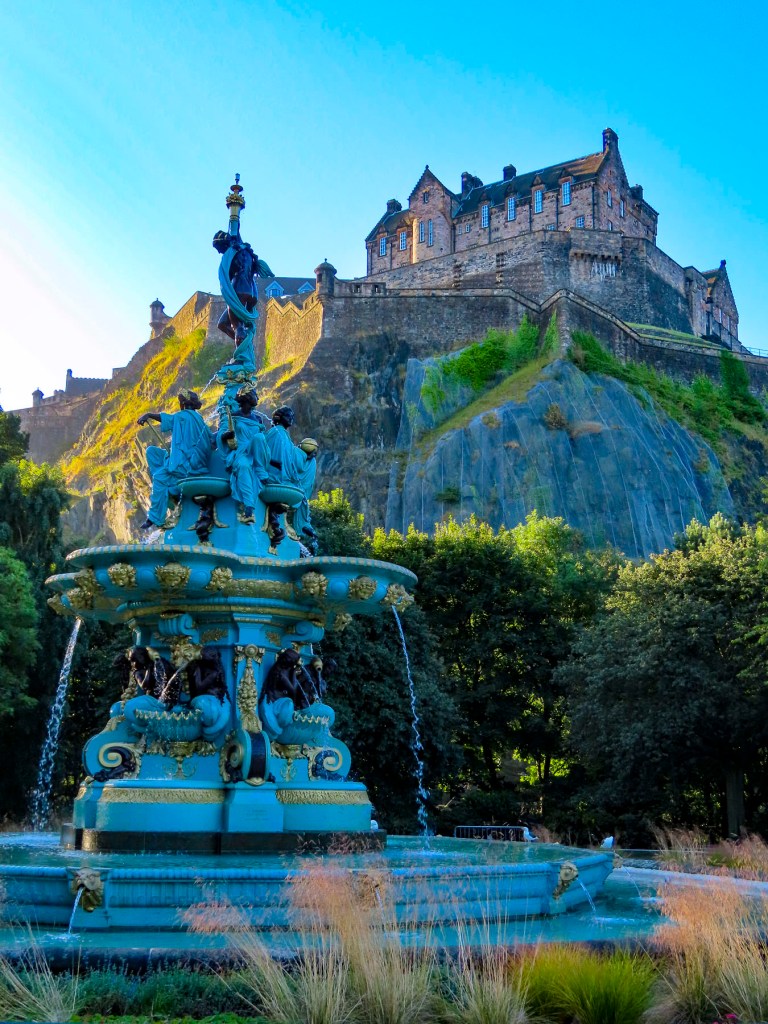
Nevertheless, we enjoyed a quiet early morning in the Princes Street Gardens, catching Edinburgh castle in early morning light from the Ross Fountain. Before walking back to Calton Hill, as the city’s streets slowly awakened, and sculptures atop buildings glowed in the morning sun.

Along our route were solid examples of buildings constructed with Craigleith sandstone. The locally quarried stone was the building material of choice for James Craig, the 18th century Scottish architect tasked with replacing the ancient city’s medieval Old Town’s unsanitary tenements and warren of alleys, with a grid of avenues, squares, and gardens. The results, James Craig’s New Town, are today treasured as  a prime example of Georgian era town planning.

An obscure alley-like entrance across the road from the stairs to Calton Hill caught our attention and we followed a forgotten walkway into the Old Calton Cemetery. Long neglected tombs and teetering headstones dotted the graveyard. In the middle was a stately monument depicting a freed slave looking skyward to a statuesque Abraham Lincoln.  

The Scottish-American Soldiers Monument, as it is called, commemorates the six Scotsmen who volunteered to fight against slavery during the American Civil War. Donations for its construction were solicited across the Scottish dispora in the United States with the American business magnates; Andrew Carnegie and John D. Rockefeller becoming major contributors. The memorial monument was erected in 1893, was the first statue of Abraham Lincoln outside of the United Sates, and continues to be the only American Civil War monument in Europe.

Even though our heart rates were up, after the walk from the center of Edinburgh, the long climb of stairs to the top of Calton hill was a challenge, though it was well worth the effort for that iconic view across The Athens of the North. The 19th century nickname references the Grecian architectural influences incorporated into some of the city’s most notable neoclassical buildings.

Atop the hill the style is most evident in the Dugald Stewart Monument, a memorial to the Scottish philosopher and mathematician; the old City Observatory; and the National Monument of Scotland, a Napoleonic Wars memorial built in remembrance of the soldiers and sailors who fought in those wars. Afterwards we walked down the opposite side of the hill towards the Omni building, a theater and entertainment center, across from the tram stop at Picardy Place. A tall statue of Scotland’s favorite detective, Sherlock Holmes, commands the plaza located a short distance away from the birthplace of the writer Sir Arthur Conan Doyle. 

Our goal now was to walk towards the Port of Leith along the Leith Way to delve into some of Donna’s family history. Here’s Donna to explain:

Before I was Donna Hammell, I was Donna Leith. My mother-in-law was a sweet Italian woman who married a Scottish fellow named John Leith. In the 1970s, they traveled to Scotland to explore the family heritage. They knew that generations back, one of the Leith men had been a sailmaker with a shop along Water Street; another had been a ship builder. Mom and Dad wandered around Leith, trying to find the shop. They were about to give up the search, when they decided to ask at a pharmacy. Turns out that was the very building the sailmaker had occupied, and the people who ran the shop were cousins, once or twice removed. The two women corresponded for decades and exchanged recipes. I just baked a batch of Eyemouth Tarts – deliciously addictive little squares of candied fruit atop a buttery crust. My children are named Sandra Leith and Ian Leith, and I was determined to bring them a souvenir with the Leith name on it. Although for obvious reasons there is some antipathy between my former and current husbands, nevertheless Craig kindly indulged me on this search for my kids’ ancestry. I think he was as pleased as I was when we hit the jackpot at a lovely little store. I cleaned her out on all things Leith.

Leith Way, is one of Edinburgh’s oldest streets, that followed the line of a now long- gone earthen rampart built to defend Edinburgh from Oliver Cromwell’s army in 1650. On either side of the road, it seemed as if every storefront we passed incorporated Leith into the name of their business: Leith Shwarma, The Dog House Leith, Leith Artisan Coffee, Leith Walk Denture Studio, Leith Barber, and Tribe Leith, a yoga studio. Nearing sensory overload, we stopped for a pint of beer at the Boundary Bar. It’s an unpretentious neighborhood pub famously known for its line painted along the floor that marked the border between Leith and Edinburgh, and most importantly allowed customers who crossed to the Leith side of the bar to party an hour longer, when the pubs in Edinburgh closed at 9 PM. Leith’s advantage ended when the two cities merged in1920. Across the street we enjoyed an inexpensive lunch at the Kukina Turkish Bakery, just down from The Wee Leith Shop, which was only twice as wide as its door. Farther along we found a very nice shop, Destined for Home, with all things Leith souvenirs. Donna was thrilled!

Leith’s history was tied to the rise of Edinburgh as the seat of the Scottish crown. Archeological discoveries along the port’s waterfront suggest an extensive wharf area that dates to the 12th century. The port thrived for centuries upon shipbuilding, whaling, fishing, and glass making, along with warehouses storing whisky and wines imported from Europe. Leith was so prosperous that it had gas street lighting in 1822, and electrified its tram network in 1905, years before the town merged with Edinburgh in 1920. Severely hard times fell on Leith after WWII when ship building declined, and the advent of mega container ships required larger, modern port facilities. Notoriously, the city was unceremoniously depicted in the 1993 novel, Trainspotting. It was a much different perspective than that of the Proclaimer’s1988 hit song, Sunshine on Leith, which the BBC hailed as a “love song to the city and Scotland.” The song became an anthem of endurance for a city once down on its luck. But since then, the dock area has undergone a transformation with new office buildings and residential towers being built along the old canals and dock area of the port, reinvigorating the area and earning the designation as the “Venice of the North.”

Later that afternoon we returned to the center of Edinburgh via the tram and walked across town to theSpace @ Surgeons’ Hall, a performing arts theater, to see a play hosted by the Fringe Festival. I Love You, You’re Perfect, Now Change was written by award-winning playwright Joe DiPietro, who happens to be the little brother of Donna’s girlfriend from grade school. The four-person performance, the second longest-running off-Broadway play, was performed in a small intimate space with seating on three sides of the stage. The play was fantastic, and the tickets were extremely inexpensive. 

At this point we need to confess that we didn’t know anything about the Edinburgh Fringe Festival, a large three-week entertainment event held every August in Edinburgh, for over 75 years. It was only after purchasing our airfare, when we tried to book a hotel, six months out, that room availability was severely limited, and we delved deeper as to why. The Fringe Festival started as an act of rebellion against the status quo in 1947 when eight theater companies, not invited to the Edinburgh International Festival, performed on the streets in Edinburgh. The event has mushroomed over the years and in 2024 “sold more than 2.6 million tickets and featured more than 51,446 scheduled performances of 3,746 different shows across 262 venues from 60 different countries.” The Edinburgh Fringe Festival website and catalog of shows was very helpful in planning what to see. Everything we read said Edinburgh would be insanely packed with tourists. But our barometer was a New York city rush hour, and Edinburgh’s streets were an oasis of calm in comparison. Not being able to find any reasonably priced hotels near the center of the city, the Holiday Inn Express Edinburgh – Leith Waterfront, located on the tram line, was the perfect alternative.

For the next morning Donna secured us tickets for the opening time at Edinburgh Castle, and we arrived to join the small queue already forming. The top of this massive rock has been a safe haven since the Iron Age when folks first sought refuge there. It was the seat of the Scottish crown for several centuries after Malcolm III Canmore, the first King of Scotland, set foot upon the Castle Rock in the 11th century, though the principal royal residence, since its construction in the 16th century has been Holyrood Palace.

I imagine the wind carries the stories of Mary Queen of Scots, James VI, Oliver Cromwell, and soldiers barracked, and prisoners of wars in its dungeons, that walked upon the rock. Noteworthy historical oddities include: the first fireworks lit the sky above the castle in 1507 to celebrate a lavish jousting tournament hosted by James IV. In 1838, the 78th Highlanders, stationed at the castle, returned from serving in Sri Lanka with an elephant in tow. The parade ground before the castle entrance hosts a spectacular event every August evening called The Royal Edinburgh Military Tattoo.

Afterwards we wandered the streets and alleys of Edinburgh’s ancient Old Town below the castle. The cheerfully painted storefronts along the bow of Victoria Street certainly brightened the day after a gloomy morning. The streets were busy with crowds gathered around entertainers performing in the squares. Eventually, we found our way to the Greyfriars Kirkyard Cemetery.

The land for the graveyard was granted to the city by Mary Queen of Scots in the mid-16th century. Soon the city started to use the graveyard for the mass burials of thousands that died during the multiple plagues that struck the city over a seventy-five year period. Though there are only several hundred headstones in the cemetery, it is thought nearly 100,000 people were buried there over a three-hundred-year period, and tour guides will have you believing it’s the most haunted cemetery in the world.

After the establishment of Edinburgh’s Medical College in the 1700s, graverobbers often exhumed the recently deceased and sold the cadavers to the school for use in their anatomy classes. The cemetery is also known for the story of Bobby, the beloved pet of John Grey. The Skye Terrier is remembered for dedicatedly guarding his owner’s grave for 14 years before his own death at age 16, in 1872. More recently, the success of JK Rowling’s Harry Potter books have drawn fans of the novels to the cemetery where the author borrowed the names of Robert Potter, Thomas Riddle (aka Lord Voldemort), William McGonagall (a famously bad poet), Elizabeth Moodie, and Margaret Louisa Scrymgeour Wedderburn off the gravestones for some of her important characters.

After lunch at the Greyfriars Bobby’s, a pub at the entrance to the cemetery, we walked across town. At the National Galleries of Scotland we stopped to watch a juggler tossing flaming torches from atop a tall teetering platform, held aloft by members of the audience.

At the Princes Street Gardens the skirl of bagpipes filled the air near the sculpture of Wojtek, an orphaned Syrian brown bear cub that Polish soldiers found in Iran, and adopted while they were serving with the British army in WWII. After the war Wojtek lived out his life in the Edinburgh Zoo.

Our destination was Dean Village, an old, though now gentrified, milling community, that once had eleven mills along the Water of Leith. It’s a tranquil bucolic area with a foot and bike path that can be followed to the Port of Leith, four miles away. Saint Bernard’s Well is along the walkway, and during the Middle Ages the water from the natural spring was believed to have curative powers.

For dinner that evening we headed back into the new town and stopped at The Black Cat pub, which was recommended as having a great selection of whisky, friendly knowledgeable bartenders, and good fairly priced food. We tried a flight of three single malt coastal whiskies. Two were from islands off Scotland’s west coast; an Arran 10 year from the Isle of Arran, and a Ledaig 10 from the Isle of Mull. The third was a Glenglassaugh 12 year distilled near Sandend Bay in northern Scotland. The young barkeep was also a well versed whisky sommelier, and guided us through the subtle influences the Atlantic and North Sea air have on the aging process.  Poetically using a cask full of adjectives to describe the Nose – floral seaside aromas, with gentle smokey palate – a malty creaminess, and finish – sublimely spicy, a kick of cloves, or an exquisite lingering saltiness, to variously describe the warm amber liquors we were enjoying. All were very nice to sip slowly, though the Ledaig 10 was a little too peaty for our taste, and we likened it to inhaling too deeply with your first cigar – it took some getting used to.

The following morning, we set off for the Palace of Holyroodhouse. It has been an official royal residence since James IV constructed the palace in1501, adjacent to the Holyrood Abbey’s cathedral that was completed in 1230. The original palace was destroyed in the 1650s when a fire consumed much of the building while it was being used as a barracks by Oliver Cromwell’s troops. Though there have been many interior alterations over the centuries, the façade of the palace today closely resembles its 1679 construction.

The Renaissance fountain in the forecourt was installed in 1850 to spiff the place up for a visit by Queen Victoria. Sadly, that seems to be the last attempt to improve the place, and our tour of the inside felt like we were walking through spartanly furnished, shabby aristocratic public housing. The Abbey’s cathedral is an ancient ruin, and the gardens surrounding the palace get much better PR than they deserve. For the exorbitant admission price, they didn’t deliver the expected enthralling experience. If you are watching your budget, we suggest skipping Holyroodhouse and visiting Stirling Castle or Dunrobin Castle with its spectacular interior and garden instead.

For our last afternoon in the city, we visited the Royal Botanic Garden, seventy acres of beautiful, manicured rolling woodland with formal gardens. We followed the signs through the park, passing under a 23ft tall hedge over 100 years old, to the Queen Mother’s Memorial Garden, that’s noted for its perennial flowers and collection of indigenous plants.

The gardens were thriving in the moist moderate weather of Scotland, and bursting with color. At the very end of the garden is a small building called The Memorial Pavilion. It’s very unique, with every square inch of the interior walls and ceiling covered with shells collected by school children all across Scotland.

Planted outside was a bed of thistle, Scotland’s national flower. Scottish folklore credits the thistle with saving an ancient village from a Viking raid, when the barefooted invaders stepped on the spiky plant. Their cries of agony alerted the sleeping warriors of the village who then defeated their enemy. It has since become an important symbol of Scottish heraldry, and being invested into the ancient chivalric order of the Most Ancient and Most Noble Order of the Thistle, is one of Scotland’s and England’s highest awards. The prickly flower was even celebrated in a 1926 poem, A Drunk Man Looks at the Thistle, by the famous Scottish poet by Hugh MacDiarmid. The epic, “stream-of-consciousness” poem touches on everything from the state of the nation and the mysteries of the universe to the joy of whisky.

Edinburgh was a fantastic destination, that requires multiple visits to fully explore.

Till next time, Craig & Donna

P.S. The Scotland Explores Pass helped with the price of admission to many sites across the country.

A Road Trip in Scotland:  Monks, Potters, Flowers, and Kelpies or A Day in the Highlands

Large swathes of sunlight graced the rolling landscape of the northern highlands as the plane began its descent toward Inverness. The change in weather was welcomed after a delayed flight from London put us two hours behind schedule, and we were landing in Inverness after all the car rental agents in the airport closed at 5 pm. It was a situation we didn’t realize until we departed London, and in the air. Being from the states where the airports stay open extremely late, we hadn’t made any contingency plans for this unexpected delay, and it, along with fretting about driving on the left side of the road, filled us with anxiety as the last car hire bus to Arnold Clark’s offsite lot ran at five. While waiting at baggage claim we somehow connected with another couple on our flight with the same dilemma and shared our worries. An audible sigh of relief was released when to our surprise an Arnold Clark agent was waiting for all of us, holding a placard with our names on it, as we exited the baggage claim area. Our cars were parked for us outside. The agent was absolutely wonderful, and prevented a rough start to our vacation. He also recommended an excellent restaurant, The Snow Goose, just minutes from the airport. Arnold Clark really went the extra mile for us, and we thanked the agent profusely.

I think driving away from any new airport is the most dangerous part of many trips. Horns blared. Stay left, look right was our mantra. Lunch had happened many hours earlier, and with a two-hour drive south to Pitlochry ahead of us, we decided to stop for dinner. First impressions of a new destination are important, and ours were pleasantly exceeded when we stopped at The Snow Goose, first with a riotous display of color from beautiful hydrangeas that lined the walkway. Then the realization that customers’ dogs are welcomed inside restaurants, pubs too, and just want the chance to wag their tails, and have their heads rubbed. This is something totally alien to the restaurant scene in the United States, but it was very nice, and all the dogs were so well behaved. Lastly, the food was great. Beetroot and Pumpkin Seed Arancini to start, followed by Seared Sea Bass and Pan-Roasted Lamb.

Grand expanses of heather covered the hillsides between forests of pine, while tufted vetch in infinite shades of purple and pink carpeted the edge of the road.

After a little difficulty finding the driveway, the hosts, a husband-and-wife team, of the Craigroyston House & Lodge greeted us as dusk was descending, and showed us our room. It was late, a friendly “See you in the morning. Good night,” was all that was called for. The Full Scottish breakfast  – bacon, sausage, black pudding, haggis, mushrooms, tomatoes, and egg was a delicious as the dinner the evening before. The small medallion of haggis that accompanied this breakfast was the perfect introduction to the national dish of Scotland that’s made with minced liver, heart, and lungs of a sheep, and mixed with mutton suet, oatmeal, then seasoned with onion, cayenne pepper, and other spices. It really was very good, and we enjoyed it many times with breakfast during our stay in the Highlands.

The Craigroyston House is a small eight-room inn, with a beautiful, terraced garden, conveniently located one block away from Pitlochry’s main thoroughfare. Colorful hanging baskets hung from many shops, and brightened a gray morning. The weather report for the week ahead showed the possibility of rain every day.

Shopkeepers apologized for the unusually cold and rainy August Scotland was having. We soon realized, though, that those dreary mornings often gave way to brilliantly sunny afternoons. Heading back to the inn we stopped at Heathergems, a shop that turns highly compressed heather stems into unique jewelry. If you are looking for a souvenir this is definitely a place to consider.

The plan for the day was to drive to the village of Dunkeld. Then continue to Drummond Castle to wander around its formal garden, before ending the day in Edinburg.

By late morning we arrived in Dunkeld and spent a while searching for parking close to the town’s ancient cathedral. It had started to rain, and it became a futile task competing with other tourists also wanting to find a parking space in the small village. We opted to park along the Tay River at the Tay Terrace Car Park, only a short walk away from the cathedral. The village has a long history that has always been tied to the early church in Scotland since 730AD, when Culdee Monks, Celtic missionaries, built a monastery there. One hundred and twenty years later the small village’s influence mushroomed when the first King of the newly united Picts and Scots, Kenneth I MacAlpin, moved the relics of Saint Columba from the Hebrides’ Isle of Iona to Dunkeld, to prevent their desecration by Viking raiders. Columba was a 6th century Irish missionary who founded an abbey on Iona, and is credited with spreading Christianity in Scotland.

In the mid 1200’s construction of a grand cathedral started above the ruins of the ancient Culdee Monastery. It was finished 250 years later in 1501, but only served in all its glory for sixty years before the altar and nave of the cathedral were seriously damaged when the roof of the cathedral was destroyed during the Protestant Reformation. At this time, the Scottish Parliament outlawed Catholicism and ended centuries of Papal authority over Scotland, which fundamentally altered the country’s cultural and social landscape. “Churches were to be stripped of their idolatrous religious art and decoration and then whitewashed, so that only God and Christ would be worshipped, and not their images, or images of the saints.” 

The choir end of the cathedral was reroofed in 1600 to serve as the parish church or kirk, but was again damaged, when most of Dunkeld was destroyed in the Jacobite Rebellion of 1689. Over time the village slowly re-emerged as a market town, and supported weaving, candle-making, tanning and brewing businesses.

Off to the side and behind the altar in the “new” parish kirk, there is an interesting small museum with sculptures and tombs. Nearby in front of the cathedral, in the town’s old market square, there is an elegant stone fountain detailed with carvings of animals, birds, and Masonic symbols. It’s dedicated to George Augustus Frederick John, the 6th Duke of Atholl, and a Grand Master of the Scottish Masons, who brought piped water to the village in the mid 1800’s.

Dunkeld, with its many nooks and crannies and architectural details, was a delight to explore. When it started to rain harder, we sought refuge and lunch at Palmerstons, a small café busy with wet tourists. They served a great hearty lunch and good coffee at a fair price.

Centuries ago a ferry was the only way to cross the Tay river to Dunkeld’s sister village, Little Dunkeld, but it was extremely dangerous when the river was running high and fast. So, with great relief and fanfare, a stone bridge across the river was built in 1809. It’s a simple seven-arch construction that has withstood the test of time. It was designed by Thomas Telford, who is more famously known for engineering the 60-mile long Caledonian Canal which joined Inverness to Fort William, essentially connecting the North Sea to the Atlantic Ocean.

The Legacy of Beatrice Potter drew us across the bridge. The author and illustrator of the widely loved children’s books, The Tale of Peter Rabbit, The Tale of Jemima Puddle Duck and The Tale of Tom Kitten spent many summers of her youth vacationing in Dunkeld and exploring the flora and fauna along the River Tay. A charming park featuring small bronze sculptures of her animal characters along a pathway through the woods is dedicated to her memory.

We abandoned the highways and drove southwest through rolling hills along the famously narrow single-track roads of the highlands. The lanes, often lined with stone walls and fencing, allow two-way traffic, but in order to pass an oncoming car one vehicle has to pullover into a small bump-out called a Passing Place. These are well marked and spaced along the country roads, but you need to be on the lookout for approaching cars, as the protocol is for drivers to pull into the closest Passing Place on their side of the lane and wait for the other vehicles to pass. It took some getting used to. Surprisingly, the speed limit on these single-track roads is 60 mph, but we were only comfortable driving at half that speed. It was also important to be on the lookout for any stray farm animals that might have escaped their pasture, or equestrians, and those adorable tiny hedgehogs that wander across the road. Fortunately, no one was behind us when Donna, my eagle-eyed co-pilot shouted, “STOP!” and was out of the car in a flash to usher a hedgehog across the lane. The one big drawback is that you are not allowed to use the Passing Places to park and take pictures of the beautiful scenery.

Just beyond Crieff we turned off the main road and followed a mile long driveway through a tunnel of ancient trees to Drummond Castle to see its Renaissance style formal gardens. It was still cloudy, but there was a hint of blue sky on the horizon as we stood in the castle’s courtyard above the gardens and readied ourselves for the walk down a long set of wide stairs into the flowering oasis, when suddenly a cloud burst above our heads and drenched us.

We scrambled back to the ticket office and asked for a refund, as we had only been there for a few minutes, but none was offered. That patch of blue above still teased us. We waited, and the sky brightened. The gardens were spectacular, as if the flowers had received a heavenly command to overcompensate for the bleak weather.

The castle’s original 15th century six-story stone keep still stands, but only the lower 2 floors are open to the public. The other chateau-like buildings were added in the 1600’s and are the private rooms of the Drummond family, which remarkably still owns the place after 500 years. In 1842 Queen Victoria is believed to have planted a beech tree in the garden, and understatedly praised the grounds in a letter to a friend, “Prince Albert and I walked in the garden, which is really very fine, with terraces, like an old French garden.”

After climbing back up the stairs we ordered two cappuccinos to ward off the day’s chill from a barista, boredly pacing in a coffee trailer parked in the courtyard. “Do the folks who own this live here?” I asked. “No, they have other castles but visit occasionally.”  We walked away with a new realization about one-percenters.

As we headed to Edinburg the sky finally cleared. Originally, I had planned our route to follow the M90 south and cross the Firth of Forth bridge into the city. But somehow, we ended up much further west, and were totally surprised when the 100ft tall steel Kelpies, shining brilliantly in the afternoon, towered above the tree line along the side of the highway. We had planned to stop there after visiting Edinburgh, but with the afternoon weather now perfect we seized the day and changed our plans. These equestrian statues are located in Helix Park at the confluence of the Clyde Canal and the River Carron. The steel horseheads are the largest in the world, and were created by the internationally acclaimed Scottish sculptor, Andy Scott. They are based on Scottish folklore where a kelpie is a dangerous shape-shifting water spirit that appears on land as a horse, who entices its unsuspecting victim to ride on their backs, only to be sped away to a watery grave. 

It was a great second day in Scotland. On to Edinburgh!

Till next time, Craig & Donna

P.S. Scottish weather is notoriously fickle and changes dramatically throughout the day. Being prepared to layer up or down and having proper waterproof rain gear and footwear was essential. We invested in some Gore-Tex rain jackets and were delighted that they kept us totally dry.

An Albanian Road Trip: Theth – Majestic Isolation in the Accursed Mountains & A Castle in Kruje

The day was crisp, the sky a clear blue, the mountains beautiful with their peaks still covered with late spring snow. We zigged and zagged our way along the infamous SH21, higher into the mountains, around many challenging blind corners and switchbacks. In spots the road narrowed to a single lane, but there were pullover areas to allow for oncoming cars to pass.  Fortunately, in late April we had the roads and the overlooks in this pristine region mostly to ourselves. The views were breathtaking. A half-hearted complaint if any, there just were not enough places to stop safely to enjoy the picturesque landscapes.

After cresting the Thore Mountain Pass, at 5,547ft the highest along the route, we stopped at the Monument commemorating Edith Durham, a British anthropologist who championed Albanian independence in the early 1900’s, and was lovingly called, “Queen of the Highlanders.” After that we could have coasted all the way into Theth, like Olympic bobsledders, but we were very judicious with braking.

Centuries ago, the inhospitable, saw-toothed mountains of northern Albania were a sanctuary for folks fleeing invaders. It’s a massive area at the southern end of the Dinaric Mountain Range, with nearly twenty mountain peaks having 9000 ft high summits, and it encompasses the border region where Albania, Montenegro, and Kosovo meet. The Dinaric Mountains are the spine of the Balkans, stretching from Slovenia through Croatia, Bosnia and Herzegovina, Serbia, Montenegro, and Kosovo before ending in Albania, where today they are called the Albanian Alps. A much friendlier name to encourage tourism than the Accursed Mountains, or “Bjeshkët e Namuna” as the original Albanian name goes.

There are three prevalent legends as to how the mountains got that original title, but hardship is at the core of each. One of the earliest legends credited the creation of the torturously steep mountains to the Devil when he escaped from Hell for a day. While there are streams and waterfalls throughout the mountains, they are not easily accessible and are often dry during the summer months. These dry conditions explained the tale of a mother fleeing her burning village. Her husband was killed in the fighting with Ottoman invaders, and she took her children into the mountains to save them from being forcibly converted to Islam. The days were hot, the terrain steep and unforgiving; her children were thirsty after three days without any water. Distraught, she cursed the mountains for causing their suffering. It’s also believed that soldiers struggling to cross the treacherous mountain terrain cursed the steep slopes, and most likely used many foul adjectives to make their point.

Footpaths and donkey trails were the only way into Theth for a millennium. The village didn’t have a school until 1917. The American Red Cross arrived in Theth in 1921 to help expand the educational opportunities in the Shala Valley. The American journalist Rose Wilder Lane tells of this school building mission in her 1922 book Peaks of Shala. Communication with the modern world didn’t expand until the first dirt track, a single lane, serpentine road that crested numerous mountain passes, was carved into the side of the masiffs that isolated the remote valley in 1936. It took another thirty years before the village received electricity in 1966.  

It is difficult to find accurate figures on the ancient population of Theth, which in some instances includes the entire Shala valley and its nine hamlets, and at other times just the village of Theth itself. But it’s thought that at the end of Albania’s Communist regime in 1991 the remote area had a population of roughly 3000 folks in 700 households, though it is much less today. Interestingly, most of these villagers claim Zog Diti as a common ancestor of the Shala tribe or clan. Oral tradition relates that the name Shala is derived from shalë, a saddle, a gift he was given by his brothers, when led his family into the northernmost reaches of the Shala Valley. They fled from the region of Pashtrik, during the Ottoman invasion of Albania in the early decades of the 15th century to preserve their Catholic faith.

A road changes everything. While it brought progress in its early years, it eventually was the route of exodus for families seeking non-agrarian jobs for themselves and better educational opportunities for their children. It was extremely difficult to recruit teachers to live in the “wilderness.” Currently Theth has about 370 summer residents that return to support the tourist season, but only a hearty, resourceful handful of residents winter over in the often snowbound valley.

Today the village, with its modest tourist infrastructure, is the jumping off spot to pursue outdoor activities in the northern Albanian park system that includes Nikaj-Mertur Regional Nature Park, Valbona Valley National Park, and Theth National Park. This vast area encompasses many diverse ecosystems that include oak and beech forests at lower elevations that transition to pine trees and scree-covered slopes the higher up the mountains you go. The region is home to over 50 bird species, including kestrels and eagles. And if you are lucky enough you can spot gray wolves, wild goats, brown bears, and roe deer.

We arrived at the Royal Land Hotel & Restaurant as the shadows were lengthening and the sun skimmed the snowy ridge across the valley from the hotel. Just a week earlier the hotel had reopened for the season, and we, along with several other couples, were some of the hotel’s first guests of the year. After checking in, we sat at picnic tables on the terrace outside, sipping glasses of their homemade red wine, and watching the inn keeper’s son rototill the fertile dark soil of a garden plot. The sky stayed light for several more hours, but the sun had disappeared behind the mountains behind us. The lodge is very rustic with fourteen cedar-planked rooms, and a glass enclosed dining area, where each table has fantastic views of the surrounding mountains. The Inn’s restaurant is open to the public, as are most of the hotel restaurants in the valley. The family that owns the hotel was very friendly and helpful. Their breakfast buffet and home cooked dinners were delicious, with many of the items on the menu homemade or locally sourced. The sky was clear that evening and the stars brilliant across the night sky. Early the next morning, moonlight filled our room.

Hiking is the main activity in the Shala Valley, and we eagerly headed down into the village to explore the valley. Many folks choose to trek the popular Theth to Valbona trail, a nine-hour hike one way, covering 11 miles that takes you through a pristine high alpine wilderness. Being the city folks we are, we stayed in the relatively flat flood plain of the Lumi i Shalës which tumults from its source in the mountains north of the village. Near the bridge that crossed the river we spotted an understated monument that upon closer inspection commemorated the schools built by the American Red Cross in the Shala Valley.

Farther along we reached Kisha e Thethit, Theth’s iconic church, and could hear music softly emanating from the Sunday service being held inside. Built in 1892, the church is a strong stone building with a steeply pitched roof, and a belltower, that looks like a small medieval castle, ready to withstand a siege. Though, during Albania’s communist era, the building was used as a health center. Nearby a sign pointed the way to the trailhead for the Theth – Valbonë hike. Sheep contentedly grazed as their shepherd checked his cell phone. Untethered horses sauntered nearby.

From the church we could see Kulla e Pajtimit, the Reconciliation Tower, or “Lock-in Tower,” and headed there. The formidable two-story stronghold, with three small windows, was built four centuries ago, and served a dual purpose; to provide shelter for the villagers in times of trouble, and to serve as the reconciliation tower, a neutral ground where disputes within the village were resolved by a council of elders. In more serious cases that involved a murder or threat of murder for revenge, the accused party would be locked in the tower for fifteen days as a cooling off period, while the elders tried to reconcile all parties affected by the crime.

This millennia old tribal custom was widespread throughout Albania and was part of the “Code of the Mountains,” that was passed down through an oral history tradition from generation to generation until it was codified in the 15th century by Lekë Dukagjini, an Albanian nobleman and contemporary of Skanderbeg, an Albanian hero. Since then, the tribal laws have been known as the Kanun of Lekë Dukagjini. The kanun has an extensive set of 1263 rules that cover everything from beekeeping to marriage and honor. It is most famously known for obligating families to partake in gjakmarrja, (blood feuds), that permitted koka për kokë (a head for a head), and hakmarrja, (vendettas), to maintain honor by seeking revenge. The heavy hand of Albania’s communist government had some success in outlawing this practice, but unfortunately, it’s still an issue for law enforcement today.

Later we stopped for lunch at the Thethi Paradise restaurant and enjoyed fresh trout, grilled lamb, and a few Korça beers, at an umbrella covered table on the patio.Surrounded by mountains from end to end, the Theth Valley was absolutely stunning and serenely tranquil in its “majestic isolation,” borrowing a phrase from Edith Durham.

The next morning, we retraced our drive across the mountains to Shkodër before continuing south to the Lezhë Castle and Kruje, where we spent the night. The drive out of the valley was just as beautiful as the drive in.

Our only companions on this quiet stretch were a flock of sheep being herded down the road, and a sow followed by her piglets crossing behind her. The drive was uneventful until the bridge over the river ahead of us was closed for road repairs, and we were directed to follow a deeply rutted farm track through the countryside for several miles. The road surface was so unforgiving that the car bottomed out several times regardless of how slowly we were going. At this point we didn’t have a cell signal, and there were no other detour signs, so we had to dead reckon our way back to the highway. The rental car company had cautioned us that they prohibited driving on dirt roads, and that we would be fined if their satellite tracking recorded us doing so. We kept our fingers crossed.

It was easy to spot Lezhë Castle, perched high on a hill, from miles away. Though getting there was a little more challenging and involved driving on some of the steepest roads we ever encountered. Think hills of San Francisco steep, but worse.

The castle had a commanding view of the surrounding terrain, though especially important was its western vista, where ships on the Adriatic Sea could be spied before they reached Albania’s shore. It was in this castle in 1444 that Skanderbeg, Albania’s national hero, rallied his countrymen to resist the occupation of the country by the Ottoman Empire. The best view of the castle was from the parking area. The area behind the walls is left in a rather rustic state with tumbled ruins and cisterns to explore. Overlooking the sea, we enjoyed a picnic lunch in the shade of the ramparts. 

The hillside town of Kruje, set high above the Tirana Valley, was our last destination in Albania. On our way to the Hotel Panorama we passed a large statue of Skanderbeg astride his steed, which commanded an overlook in a city park.

Albania’s national identify, a spirit of perseverance and resistance, is intimately linked to Skanderbeg and Kruje, his hometown. Born into the noble Kastrioti family during the early 1400’s, his parents were forced to give him to the Ottoman Empire as part of Sultan’s devşirme system. This “child tax” was to ensure a family’s loyalty to the sultan. Only one son could be taken. These children were then taught the Koran, given an education, and raised as Muslims, before being sent to serve in the Ottoman Empire’s Janissary corps, a highly trained infantry. Skanderbeg excelled as a skilled Ottoman soldier and rose through the ranks. But after a 1443 battle in Serbia he renounced Islam and escaped back to his homeland and reclaimed his title. A year later he led a league of Albanian Princes in revolt against the Ottoman occupiers. For over twenty years he rallied his fellow Albanians to repel 13 invasions, and was considered a hero throughout a Europe that feared the expansion of Islam across the continent. The citadel in Kruje was his headquarters during this time and endured three intensive sieges. Ten years after Skanderbeg’s death the castle fell and the Albanians relinquished their independence to the Ottomans for 400 years.

Its name said it all, and the Hotel Panorama’s guest rooms and rooftop terrace were the perfect spot for views out over the town’s ancient caravan market and Kruje castle. An arched stairway descended under the hotel from the main street and led to the historic bazaar, which is over 400 years old. A 16th century minaret towered above us.

It’s believed to be the most historically accurate representation of an ancient marketplace in Albania, with its cobbled street centered with a drainage divert and canvas awnings hung from the shops, to protect shoppers from the midday sun.

In centuries past it would have had a full array of merchants offering a wide assortment of ancient everyday items, and luxuries crafted in faraway lands. Today, it’s a gauntlet of tourist themed merchandise, but we found one hidden gem, the Berhami Silver shop. The proprietor and sole craftsman, specializes in unique, intricately woven filigree jewelry.

We shielded our eyes from the bright sun as we left the long, arched tunnel through the ramparts, and looked up at the Skanderbeg National Museum. Built in a historical style to reflect its surroundings, it was a majestic sight, its sandstone blocks glowing in the afternoon sun, and the red and black Albanian flag full out in the breeze.

Its exhibits feature artifacts from Skanderbeg’s era and Albania history. One of the most intriguing displays was a replica of the hero’s signature goat head-topped helmet. Albania’s flag evolved from the two headed eagle on the Byzantine Empire’s flag which flew over Albania from the 4th to 14th centuries.

The double eagle heads symbolized the unity between the Orthodox Church and the Byzantine Empire. The black eagles above the Kastrioti family coat of arms on a crimson background became the flag of rebellion when Skanderbeg raised it above Kruje in 1443. Its colors black and red represent the strength, bravery and heroism of the Albanian people.

Above the castle we rested outside at a small café with an expansive panoramic view. Unaware of castle’s closing time we headed down the slope to the Tekke of Dollma, a small Bektashi Sufi shrine that contains the tomb of the mystic leader, Baba Shemimi. We reached the gate of the tekke’s courtyard just as the caretaker was about to lock the door for the day.

Graciously, he let us stay for a few minutes. The building was still under repair from the 2019 earthquake, but still very interesting. Legend believes the ancient olive tree in the courtyard was planted by Skanderbeg. The castle was a wonderful site to explore, and if we had had more time, we would have visited its ethnographic museum.

The sun was casting a golden glow across the hillside by the time we reached the rooftop terrace of our hotel. We clinked glasses and reflected back upon a fabulous vacation exploring Albania.

Till next time, Craig & Donna

An Albania Road Trip: On the road to Shkodër or Olives, Castles, and Lamb

Ancient, gnarled olive trees covered the sharp slopes on either side of the road, along a narrow razorback ridge. Their silver-gray olive leaves undulated with light from a morning breeze. Some of the older trees are 3000 years old, and the fruit from the trees is believed to make the best olive oil in Albania, and is sought after by connoisseurs and chefs. An elderly man herded a small flock of sheep across the road, a common occurrence in rural Albania where it seems there is more four-legged traffic than cars.

We parked and walked up a short steep lane, past a school where a coed basketball game was enthusiastically underway, to the ridge’s 1300ft summit and the Preza Fortress. The stronghold was built in the mid 1400’s and played an important role in the Albanian resistance to Ottoman rule.

It was once a massive compound with commanding views of the broad plane of the Tirana Valley to the east. This valley was the favored north-south route for invaders, and was the fertile breadbasket of Albania since the Iron Age. Mid-week in late April we had the site to ourselves except for a group of older men, seemingly an old boys’ club, enjoying each other’s company, tucked away in a small outbuilding with a large glass window through which we could see them playing cards, drinking coffee, and reading the newspaper. Unfortunately, only one tall watch tower remains of the compound, but the panoramic view was fantastic.

Bar Kalaja e Prezës is the restaurant at the site and was a great place to relax with a coffee and absorb the serenity of the landscape from their terraces. There was also a very large lover’s heart perched on the overlook that was the perfect spot for an Instagram photo.

We had left Durrës earlier that morning, headed toward the northern city of Shkodër, and followed the A1 north. We had been in southern Albanian for the prior two weeks and were surprised now by the amount of traffic congestion along this main artery. It was mostly due to the construction project widening the two-lane road, and the economic activities of businesses, with parking lots right next to the road which creaed all sorts of mayhem – cars were pulling off and onto the highway. There were few traffic lights. One section of the road was lined with folks selling parrots and chickens right from the curbside, while at another point men on either side of the road carried puppies up and down the traffic, offering them for sale. Fruit and vegetable stands were a common occurrence. As we’ve mentioned in our earlier blogs, we found Albanians to be very friendly. But put them behind the wheel of a car, and there is an aggressive personality shift, where they throw the driving rules out the window. I know this is a sweeping statement, but when you experience the roads firsthand, you’ll understand, and any Albanian citizen will agree with me. Driving in Albania was a blood sport – the automotive version of rugby.

The one big plus of driving along Albania’s main roads was the superb quality of restaurants attached to gas stations. In the states these are often fast-food chains or “greasy spoons,” that serve caloric, processed foods. Albanians take their cuisine quite seriously, and we found it nearly impossible to have a bad meal in the country. The key though to these roadside restaurants is to pick one where the parking lot is almost full. It’s always a good sign that the place is busy with satisfied customers. The restaurant Autogrill Emanuel, along the SH1, in Balldren was a wonderful find, and a great place for lunch. The façade was ho-hum, it is after all located at a gas station, but the inside was pleasant, and the tables were covered with linen tablecloths.

Near closing time we arrived at Rozafa Castle, parked and started to walk around a small hill that obstructed our view of the fortress. It quickly became apparent that it was too long of a trek uphill, and it would diminish our time exploring the site. Several cars passed us coming downhill and we realized we just might get lucky finding a place to park nearer the entrance. Fortunately, that was the case, but even so it was still a strenuous walk to the center of the citadel.

The views were fantastic. We could see for miles around, especially out over Shkodra Lake where the mountains of Montenegro rose on the northern horizon. To the east the small metropolis of Shkoder spread imposingly across the flatland beneath the foothills of Albanian’s beloved Accursed Mountains. While the panorama to the south encompassed the meandering Drin River.

The first fortifications on the hill date to the Illyrian kingdom during the 4th century BC, though archeological discoveries confirm the hilltop had inhabitants since the Bronze Age. Albania folklore is full of tales of stoic women sacrificing for their country. Though the legend of how Rozafa Castle received its name is one of the more tragic and involves human sacrifice. The tale goes that construction of the castle was beset with difficulties, walls collapsed, workers died. An oracle was consulted and advised that a woman be entombed in the castle’s wall to appease the Gods. Rozafa, a young mother, was chosen, and as the legend goes, willingly participated as long as her chest was left exposed for her infant to breastfeed. For ages afterward it was believed that the liquid dripping from the limestone stalactites on the ceiling of the ancient Illyrian gateway to the fortress was the entombed mother’s milk, and that the castle was alive with her spirit.

The Roman Empire defeated the Illyrians, and over the following centuries the fortress was controlled by an ever-evolving list of rulers that included the Byzantine Empire, Kingdom of Serbia, Lordship of Zeta, Principality of Zaharia, the Venetian Empire, the Ottoman Empire, the Pashalik of Scutari, and the Kingdom of Montenegro.  T

We were taken by the beauty of the old town at the Migjeni roundabout, where an intriguing cityscape included Ebu Beker Moosque’s minarets, and Kisha Katolike Frencekane’s belltower; crenellates and fountains revealed themselves. Shkodër today is Albania’s fifth largest city with a population of 102,000. Though thriving today, the city has had a tumultuous history. Most poignantly in 1967, the Communist dictator Enver Hoxha declared Albania an atheist state and banned the practice of all religions. Churches and mosques were seized and converted to other uses or destroyed. Religious leaders were executed or imprisoned for decades in brutal labor camps and prisons to break their faith. The communist regime viewed anyone who believed in religion as an enemy of the state. Family members of the accused were victimized as well, with the denial of educational opportunities, and decent jobs. Consequently, the citizens of Shkodër who cherished their religious harmony and embraced each other’s Muslim and Christian traditions, in a city where it was not uncommon for members of the same family to practice different religions or intermarry, suffered greatly under communism.

The most poignant insult was the creation of the National Museum of Atheism, an anti-religious propaganda center, in the city. While the borders of Albania were closed to the outside world, even the cities within the country were isolated from each other, and Shkodër sat alone and inaccessible in the northern part of the country. Any news it received of events in southern Albania was heavily censored. Even folks that were “free” likened it to living in a penal colony, as the town had 23 prisons, and nearly every family had someone in jail. The Sigurimi, the communist secret police, had a heavy presence in the city, and encouraged informants to denounce anyone, even for simply wearing a religious cross. Similar to Bunk’Art 2 in Tirana, the site of the Witness and Memory Museum in Shkodër documents the atrocities the communists committed against the townsfolk, in a confiscated Catholic school that was operated as an interrogation center.

The Çoçja Boutique Hotel was only a few minutes from the roundabout, had underground parking, and most importantly was a short walk away from the pedestrian only streets Rruga Kolë Idromeno, and Rruga 28 Nëntori. We are not sure why this small 17-room hotel is only rated three-stars, but it was one of the nicest hotels we have ever stayed in. It’s a newer building that’s exquisitely well decorated, and our bathroom was a modern wonder. The staff was also very nice.

Ten thousand undergraduates attend the University of Shkodër, and the cosmopolitan city’s streets are full of students pedaling across the town’s flat roads. Their presence contributed greatly to Shkodër’s youthful contemporary vibe, that’s much different from the rest of the country. In the evenings the restaurants and cafés along the pedestrian mall were filled with their energetic enthusiasm.

We took advantage of a warm night and enjoyed eating outside on the second-floor balcony, which overlooked the mall, at Bar Restaurant San Francisco, on Rruga Kolë Idromeno. I tried the traditional Shkodër specialty, Tavë kosi, made with lamb, yogurt, eggs, garlic, and oregano, while Donna ordered baked lamb with rice. Roasted vegetables and the house wine accompanied our dinner. All were quite good. We ordered lamb frequently while traveling around Albania, as in the states it is not offered in many restaurants, and when it is it’s very expensive.  

The next morning, we strolled in the opposite direction down the shaded Rruga 28 Nëntori, where preparations were underway for the 11th annual Hemingway Jazz Fest & Swing Marathon, that’s held at the end of April. Unfortunately, we were not in Shkodër for it, but it would have been really nice to watch folks cutting loose. Towards the end of our walk, we reached Shatërvani Park, where there were several sculptures.

One was a whimsical and retro collection of towering, stylized dandelions, which I haven’t been able to find any information about. Nearby, across from the City Hall, stood the Monument Dedicated to the Victims of Communist Persecution.

A plaque near the sculpture states it’s dedicated to the sacrifices, and resistance the people of Shkodër made during the communist dictatorship. This is the first memorial of its kind in Albania and considered long overdue. Many think it is an important first step towards reconciling the atrocities of Albania’s communist past with survivors of the nightmare.

In hindsight two nights in Shkodër wasn’t enough time to adequately explore the city. An extra day would have allowed time to visit some of the museums in the city.

Till next time, Craig & Donna