
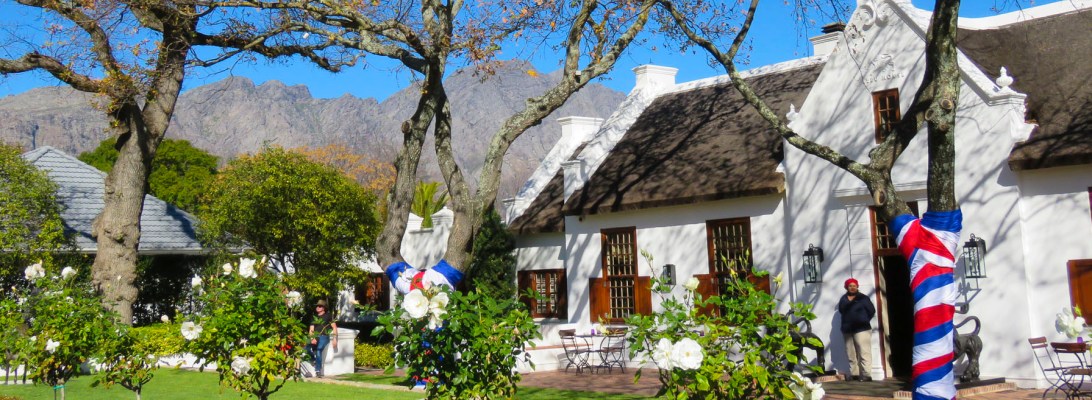
Relatively low car rental fees in South Africa encouraged us to travel farther afield. There is so much to do in the area around Cape Town, driving along a spectacular coast or heading inland into the western cape’s vast winelands, with about 300 vineyards, that starts near Stellenbosch, just 31 miles away via the N2. We planned a long weekend to celebrate Bastille Day in Franschhoek, a wine making community founded by French Huguenots in the 17th century. French roots aside, the village is full of Cape Dutch architecture and set in a valley surrounded by the Drakenstein and Groot Drakenstein mountain ranges. The lower slopes provide the vineyards in the valley with unique terroirs. Afterwards we ventured down to Hermanus on the coast to look for whales.
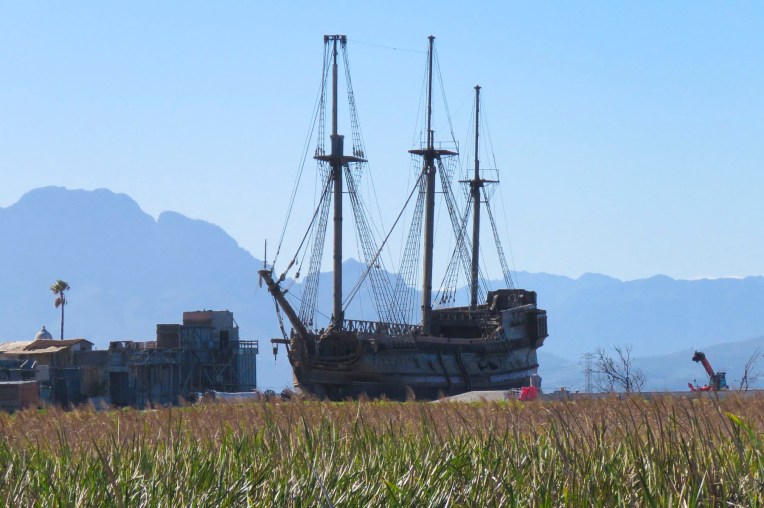 But first we had to get there. Just before our exit off the N2, the silhouettes of several tall sailing ships broke the horizon as if they were crossing an inland sea. Imagining a pirate swinging from a yardarm, we did a quick double take and followed a side road down to the entrance of Cape Town Film Studios, where a guard waved us away when we stopped to take pictures. They’ve hosted many international productions that include Doctor Who, Tomb Raider, Outlander and Mad Max Fury Road.
 Across the street from the movie studio, our wine tasting started at Vergenoegd Löw The Wine Estate. The vineyard is known for its biodiversity, sustainability and conservation efforts. It uses a flock of 1200 Indian Runner Ducks to cruise the undergrowth of the grape vines and devour snails and other pests that can destroy the harvest. Three times a day, wranglers gather the flock and parade it through the beautiful estate for the amusement of visitors. Of course, there are wine tastings and food available to encourage you to linger and enjoy the setting. It was our first of several visits; the place was just delightful.


Our travel mantra is usually “walk a little, then café, walk a little more, then café.” This changes to “drive a little, café, pitstop” when it’s a road trip. And staying true to our philosophy, we stopped at the Root 44 Market just before Stellenbosch, for a quick look. This is one of the weekend markets with live music, food and craft vendors that have become so popular in the region. We had the most sinful donuts from Desire Donuts. These truly would have become addictive if they were closer to home.


Driving through Stellenbosch we came across a large bronze sculpture of a giant octopus outside the studio/gallery of Stephen Rautenbach. It’s a nice gallery space filled with pieces that capture the spirit of the South African animals he’s sculpted.


Around the corner we enjoyed some homemade Turkish delight and Turkish coffee before continuing our drive to our B&B for two nights, Val d’Or Estate in Franschhoek. A long dirt driveway led to a pretty, naturally landscaped property with a large pond and swimming pool overlooked by the guesthouse.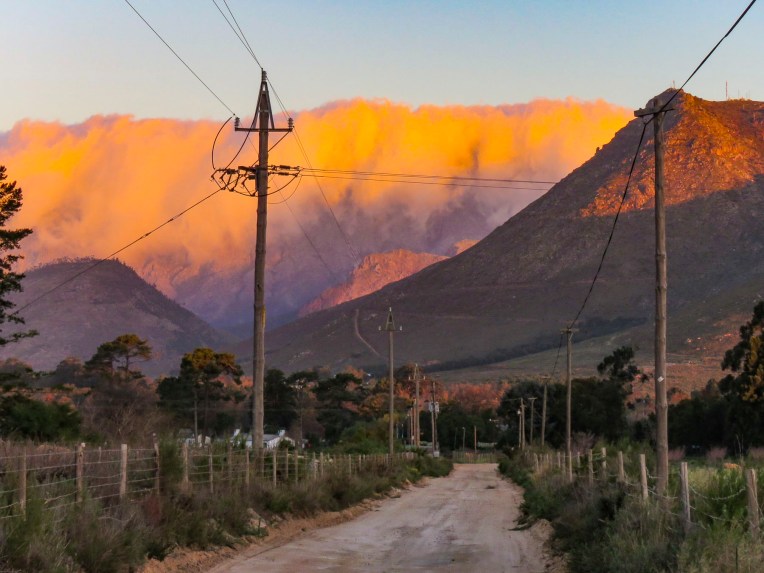 Our room was spacious and comfortable, bigger than several studio apartments we have rented. We spent a little time walking around the pond, watching the weaver birds dart in and out of their hanging nests, before the sunset.


The next morning, we passed an enormous amount of red, white and blue bunting festooning every building on either side of the street as we headed to the festival grounds at the Huguenot Monument on the far end of the village.  We followed the queue of beret wearing Francophiles draped in colors of the flag, past a vintage car show and a very competitive barrel rolling contest, to the Food & Wine Marquee, where our tickets included a live concert by South African rocker Karen Zoid, two very nice wine glasses, tasting coupons and R20 vouchers to use towards the purchase of food or bottles of wine.


Thirty vineyards poured generous samples of their white, red, and rose wines along with champagne. The crowd sang along when Karen Zoid took the stage and performed a collection of her South African hits and La Marseillaise, the French national anthem, for a nostalgic audience. She also paid tribute to rocker Johnny Clegg, who passed away earlier in July. He was the first Afrikaner singer during the apartheid era to form a band with a black man, Sipho Mchunu, called Juluka. They were hugely successful and beloved by many. It was a lot of fun sampling the wines and purchasing bottles of our favorites to enjoy in Cape Town later.


We had planned to follow R45 east through the rugged terrain of Mont Rochelle Nature Reserve to Bot River and continue on the R43 south into Hermanus, but a winter rock slide had indefinitely blocked the road and forced us to backtrack through Stellenbosch.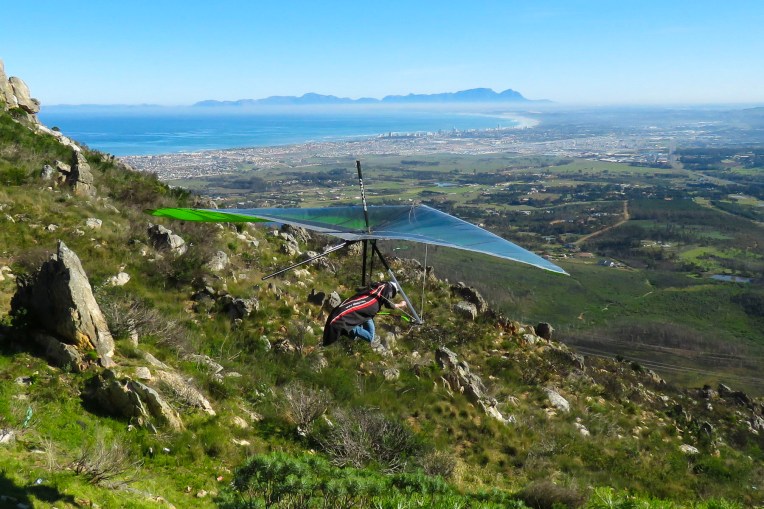 Luck was with us when we pulled into the Sir Lowry’s Pass View Point, in time to see several paragliders launch from the steep slope of the overlook. The view toward the town of Strand, on False Bay, with its long sandy crescent of beach, was incredible. Further on fruit orchards lined both sides of the road for as far as we could see. The valley’s unique climate, cooler and wetter than the surrounding region, is perfect for the local orchards to blossom. Today the Elgin region produces 65% of South Africa’s export crop of deciduous fruits.
 We were working our way to the Elgin Railway Market, another beloved Saturday/Sunday venue for Cape families, in the “Valley of Apples.” Appropriately it’s housed in a renovated railway warehouse where the region’s famous fruits were stored before being loaded onto trains and sent to Cape Town or Port Elizabeth for export. It’s a huge, two story space, with wine, food and craft vendors, a performance stage and rock-climbing wall.
  Located directly across the street from the ocean, the Windsor Hotel would be our base for the next two nights. It’s a modest old hotel, built originally as a sanatorium in 1896, then converted to a hotel in 1931. It still retains much of its original character with fireplaces in the wood paneled common areas, arched doorways and wide staircases. The breakfast room was outstanding with large picture windows facing the sea.
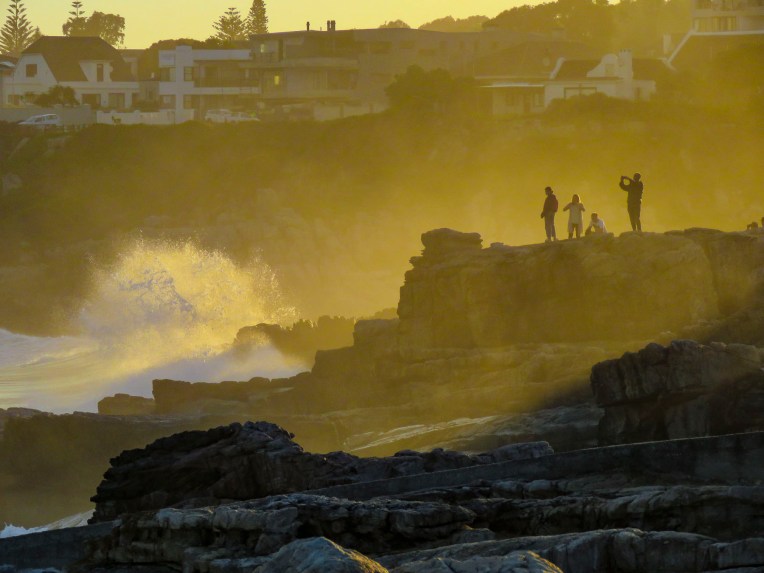
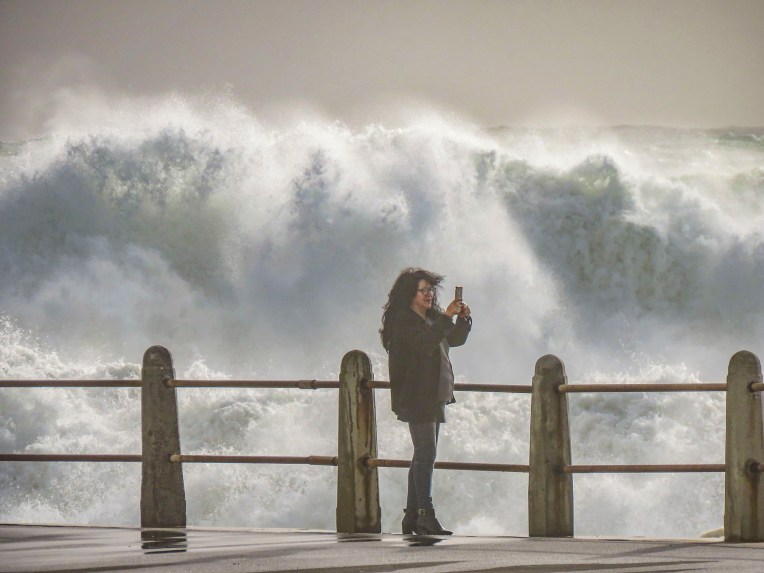
 Walker Bay’s thunderous waves crashing against the rocky coastline were spectacular with their large sprays as we walked along the Hermanus’ Cliffside Path to Gearing’s Point, a scenic overlook, hoping to spot whales. Our Cape Town friends had mentioned that it’s often possible to sight Southern Right Whales from the shore here during their June to November calving season, after which they head back to the waters of Antarctica.
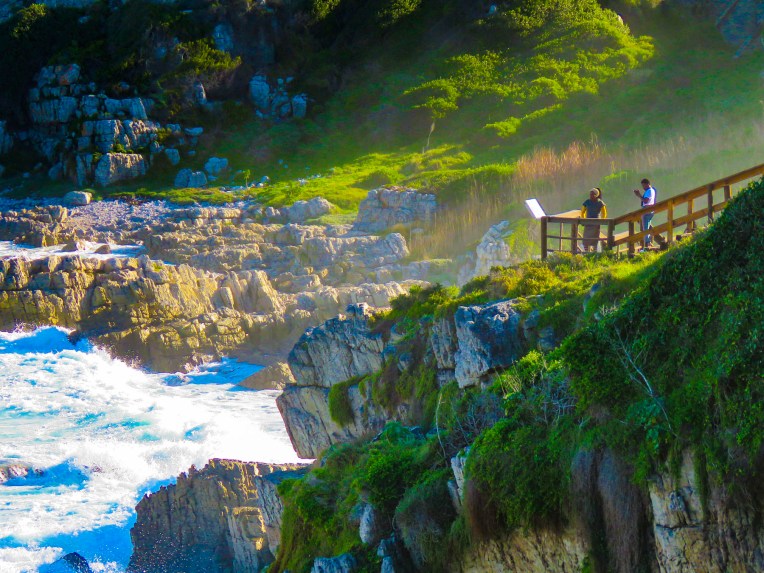 It’s a well-defined trail, with cement, dirt and boardwalk sections, that starts at the village’s New Harbor and hugs the coast for 7.5 miles, ending at the Klein River Estuary. Five miles of the path are wheelchair accessible. In some places it passes under trees twisted to grow almost parallel to the ground, by the fierce South Atlantic winds that blow in from Antarctica.


In the off-season not everything is open and we had to search awhile before finding Oskars Bakery, two blocks in from the ocean on High Street, for coffee. But with one glance at the pastry case we were hooked. We both agree it had to be one of the best bakeries in the western cape. 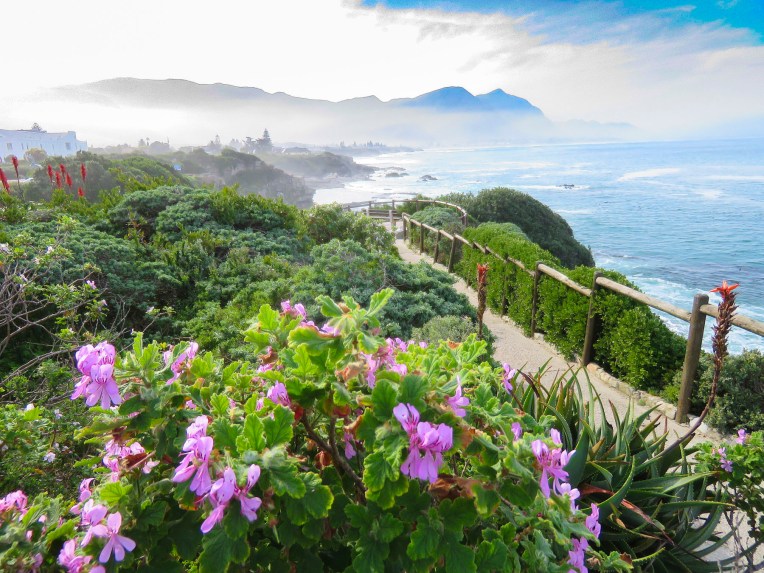 The seascapes from the cliffside path were beautiful, but we hadn’t spotted any whales and the village’s whale crier wasn’t sounding his kelp horn. Yep, what started as a publicity stunt has become tradition and Hermanus has had an official, and the world’s only, whale crier since 1992.
  In 2016 the movie The Whale Caller was adapted from South African author Zake Mda’s 2005 novel, of the same name, which has the whale crier as the central character.


Hoping for better luck, we booked a whale watching excursion operating out of the village’s new harbor. There are a number of tour operators that run excursions out of this port, but we liked the look of the Unathi, a 50ft catamaran, that Hermanus Whale Watchers uses.  With skipper Emile at the helm, the first mate tossed the mooring lines to the dock and we departed onto a gently rolling sea. Phillip, a registered naturalist with a delightful wry sense of humor shared his love of the sea with us. “There’s a good chance we’ll see Southern Rights today. We spot them by their distinctive V-shaped blow and the callosities (clusters of barnacle like growths) on their heads. We may also see Africa Penguins, Fur Seals, Dolphins, migrating Humpback Whales and resident Bryde’s Whales.” Psyched now, all eyes scanned the horizon for any telltale signs of these gigantic, yet elusive creatures.


Blows were spotted, yet the whales had dived to a greater depth before we got closer. We eventually encountered a small pod just off-shore at Die Plaat beach, a ten mile stretch of wild, rocky and sandy beach, backed by tall dunes. The captain skillfully maneuvered us as close to the beach as possible as we followed the pod of Southern Rights, that sometimes surfaced close enough to hear the puff of their blows. We were thrilled, but a little disappointed also, that there wasn’t any tail slapping or breaching. Back ashore we had a wonderful lunch of fried calamari and fresh oysters at a little place on the wharf, the Quayside Cabin. Heading back to Cape Town late the next day, we followed the scenic R44 coastal road through the seaside villages of Kleinmond, Betty’s Bay, Pringle Bay and Rooi-Els as the golden hour was approaching.
  Each turn of the road offered a dramatic view of the coast and we stopped many times for photos. We merged back onto the R2 at Gordons Bay just after sunset for the ride the rest of the way back to the city.
So many regions of the Western Cape are stunningly beautiful!
Till next time, Craig & Donna


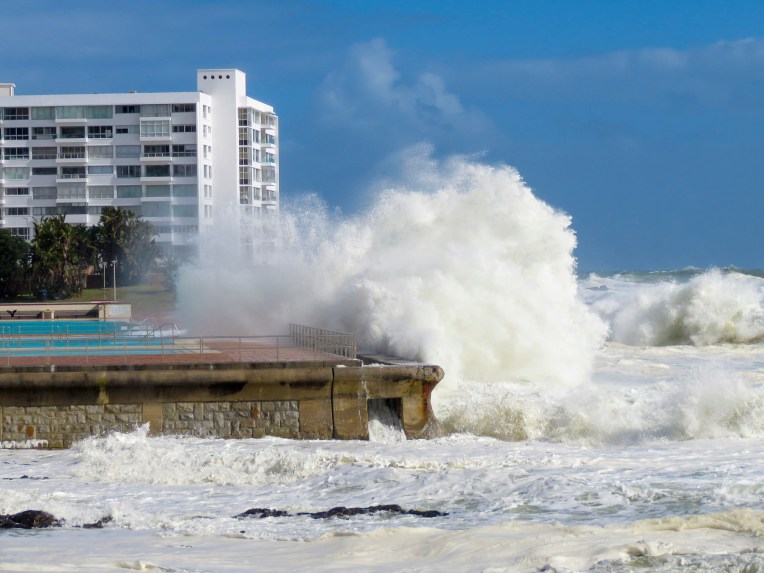 After our last apartment in the “Mother City,” on Bree Street, we moved to the Sea Point neighborhood and as its name suggests, it hugs the coastline under Signal Hill and Lion’s Head Mountain. Finding the ideal apartment for our last 30 days in Cape Town required a bit of detective work on our part though. One of the draw backs of using Airbnb is that it does not provide the specific address of a property until you actually book it. So, while the interior photos of a listing might be charming, its exact location could be anywhere within a five-block radius of a dot on the map, unless the host gives hints in the apartment description.
 In Sea Point this could mean on the water or nowhere near it. But with a little sleuthing regarding our final three choices, we were able to determine which one was right on the waterfront. Our reconnaissance of the neighborhood paid off and we booked a sixth-floor one-bedroom apartment with a terrace, that had an ocean view for dramatic sunsets and inland views of the paragliders launching from Signal Hill.
  It was the perfect location across from the Sea Point promenade. The lively Mojo Market, with numerous food stalls and live music seven nights a week, was just around the corner. Here we enjoyed the best fresh oysters and mussels in sauce at The Mussel Monger & Oyster Bar while sipping South African wine or local craft beers as the nightly band played.
 It’s actually possible to walk along the promenade from the V&A Waterfront all the way to the Camps Bay Beach. It’s a little over six miles in length, but it’s a popular stretch of sidewalk, which locals call the Prom.


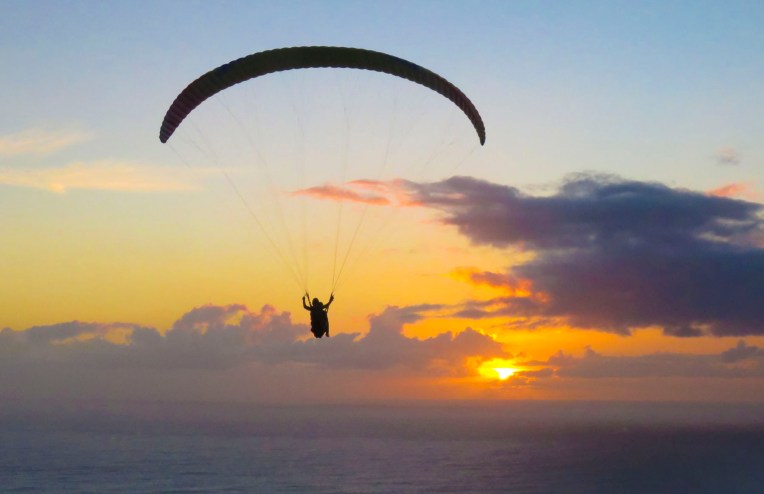
 Weather permitting, paragliders seemed to launch in rapid succession all day long from Signal Hill, first riding the thermals along the ridge towards Lion’s Head before turning back and gracefully spiraling down over the rooftops of Sea Point to land in a grassy park next to the promenade.
 We transitioned easily into our new neighborhood, finding three grocery stores and
  Cape Town artists will paint anywhere and the walls of the underground parking garage at the Pick ‘n Pay – Sea Point were the perfect canvases for some incredibly talented street muralists. Sadly, we don’t think enough folks see these hidden works of art.


 In Hout Bay, time flew by at the


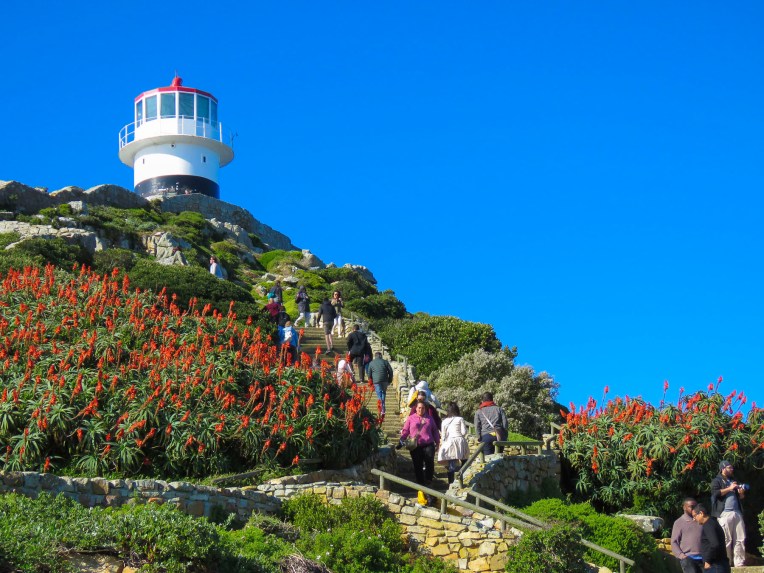 The wind was so strong it made it impossible to hold the camera steady. We soaked in the views as long as we could before the buffeting winds forced our retreat. Sitting outside at the snack bar we were astonished to witness a baboon snatch an ice-cream cone from a young boy and then gobble it up with great delight.
 We revisited the Simon’s Town area several times, because to see all the spots that interested us required more than one day. The big draw to Simon’s Town was the Boulders Penguin Colony. This is a restricted reserve where visitors must stay on the boardwalk in the viewing areas. Our timing was perfect as penguin chicks had recently hatched and could be seen at the nests snuggling against their parents for warmth. The beach was full of activity, with different groups of penguins doing their best Charlie Chaplin struts into or out of the turquoise waters of the bay.


 One morning in late July we opted to try a whale watching tour again, this time from the Simon’s Town waterfront, hoping to see some tail slapping or breaching action that was elusive in Hermanus earlier. Alas, we only viewed one tail slap on this trip. As much as the tour operators want you to believe July is a good month for viewing whales, based on our disappointing experiences we’d suggest waiting till later in August or September for more certainty when larger whale pods return to the waters of False Bay. But it was a smooth day at sea, cruising along a dramatic coast and we did get to view a large colony of sea lions on some offshore rocks.


 Once outside of Cape Town the R27 cut a desolate track through a rolling landscape of open fynbos with scarcely a tree to be seen. Every so often the head of an antelope or ostrich could be seen emerging above the bushes on either side of the road. The heather clad landscape eventually gave way to pastureland speckled with sheep and wheat fields.
 Paternoster is one of the Western Cape’s oldest fishing villages, dating from the early 1800s, and is said to have gotten its name from Portuguese sailors who evoked the Lord’s Prayer to save themselves from shipwreck off its coast. The area was first explored when Vasco da Gama landed nearby in Helena Bay, in 1497. By then the area had been inhabited by the indigenous Khoisan for thousands of years. Hunter-gatherers, they harvested dune spinach, an local vegetable, from the beaches, and shellfish from the area waters, and they left behind middens that have been estimated to be 3,000-4,000 years old. The harvesting of the ocean’s bounty continues, with fishermen still launching their small boats into the sea from the beach and returning with fish and lobsters. As you pull into the village it’s not unusual to see fishermen selling their day’s catch from five- gallon buckets at the town’s intersections, where they hoist live lobsters aloft and yell “kry hier kreef!”, Afrikaans for “get some lobster here.” Aside from the picturesque whitewashed and thatched roofed fisherman’s cottages along a white sand beach dotted with boulders, there’s not much to this sleepy fishing village, except for some reportedly excellent seafood restaurants that were unfortunately closed the winter day we visited.
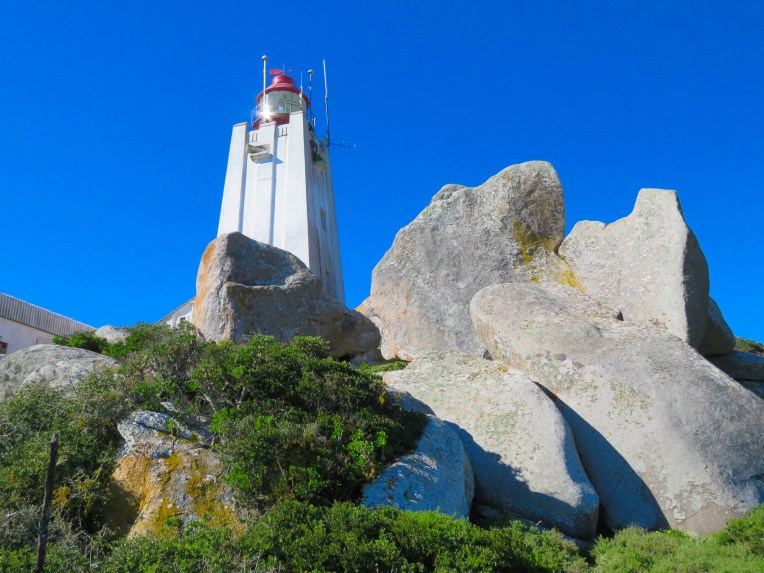 A short way out of town we followed a dirt road to the Cape Columbine Lighthouse. Built in 1936, on an outcropping of boulders called Castle Rock, it’s one of the last manned lighthouses in South Africa. “Seniors are free,” the lighthouse keeper, a senior himself, announced, as he pointed us to a set of stairs that eventually led to a very tall, steep wooden ladder. The panoramic view from the top was brilliant and, as expected, breathtaking. Getting down was a little more challenging than getting up. It was a kind of “make it or break every bone in your body if you don’t” situation. We’ve found in our travels around the world that folks in other countries can do all sorts of risky things, that in the states wouldn’t be allowed for safety concerns. Overseas it’s all about being responsible for your own safety. “See you at the bottom,” Donna said as she agilely maneuvered on to the ladder. “One way or another,” I grimaced in response. For me, with a fearful respect for height, it was all about that first step down.


 Unbeknownst to us, Bree Street is considered “Cape Town’s hippest street.” The area is in the midst of gentrification with numerous restaurants, bars and cafes scattered between high-end boutiques, art galleries, mechanic shops, plumbing supply stores, classic car and motorcycle showrooms, along with marine and industrial supply stores. And I swear all the above seem to offer luscious cappuccinos!


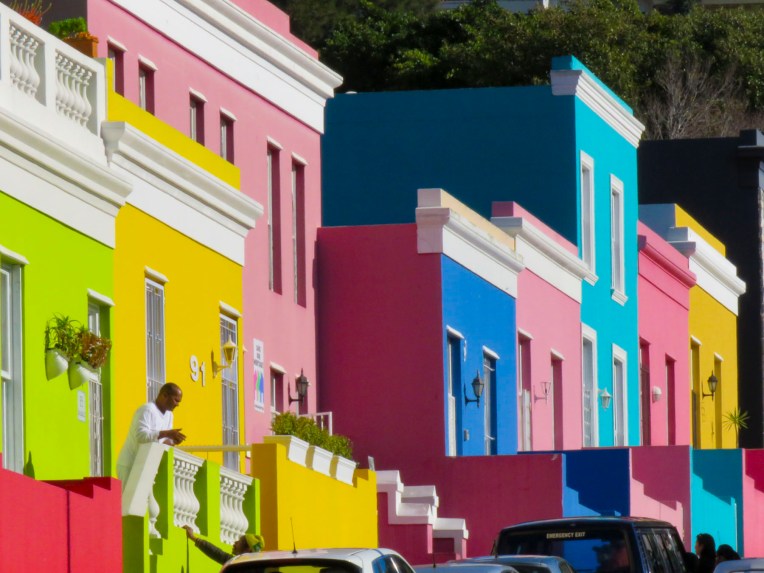 Formerly known as the Malay Quarter, the colorful homes of the Bo-Kaap neighborhood, located between Signal Hill and the city center, were only a few blocks away. One of the oldest continuously inhabited neighborhoods in the city, the first homes were built in the 1760s as housing for mostly Muslim slaves, who were brought by the Dutch from Malaysia, Ceylon and Indonesia to work. The neighborhood grew when slavery was abolished throughout the English empire in 1833. It’s said the houses were then painted bright colors as an expression of newfound freedoms. The neighborhood is home to the Auwal Mosque, the first built in South Africa in 1794 and still in use today. In 1957 the apartheid government declared Bo-Kaap a Malay Only Area and forcibly relocated everyone else. The pressure continues today under the new guise of gentrification. Bo-Kaap means “above the Cape” in Afrikaans and with its stunning location on the lower slope of Signal Hill and its close proximity to the Cape Town Business District, it has become a very desirable location. Old time residents fear the heart of Bo-Kaap will disappear and it will just become a façade of brightly painted buildings.
 We walked the hilly, cobbled streets of Bo-Kaap several times, enjoying its cityscape. One day we encountered a small flock of sheep grazing, within sight of the city’s skyscrapers, as we made our way to the Noon Gun, a naval cannon fired once a day, every day for over two-hundred years.
 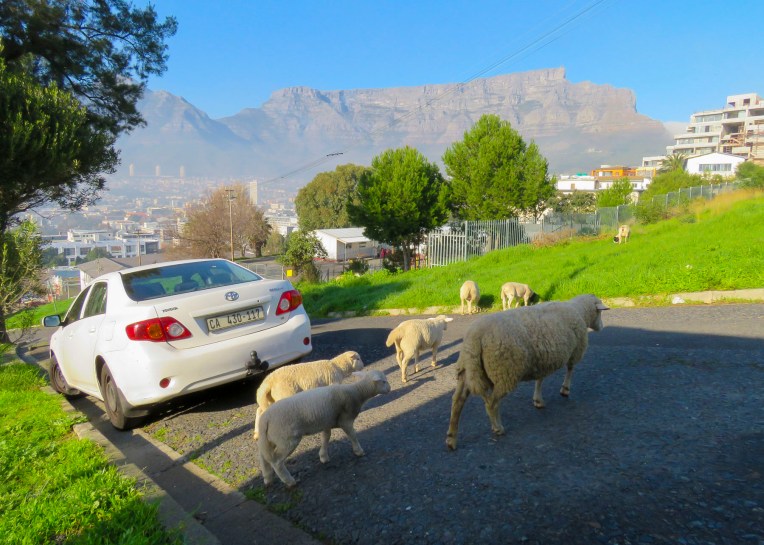 Originally it was a signal for ships in the harbor, back in the day when they used sextants to navigate, to set their chronometers which were used to help calculate longitude. Critical stuff when you are navigating around the treacherous Cape of Good Hope. It’s a tradition that has survived the Dutch, English and apartheid.
  The Cape Malay community has contributed greatly to establishing Cape Town as a foodie’s destination with a cuisine that embraces exotic spices. Cinnamon, cardamom, ginger, cloves, mustard seed, chili and roasted fenugreek seeds all flavor various curries, bobotie, biriyani, rendang, and samosa recipes that have endeared themselves to Capetonians.


 Renting a car made it easy for us to reach points farther afield in Cape Town and its outlying districts. Our day trips included taking the cable car to the top of
  One morning we walked through the


 After our morning at the botanical gardens we headed over to Woodstock for lunch at

 We returned to Woodstock to check out The Neighbourgoods Market, a Saturday only food event, at The Old Biscuit Mill, a renovated mixed-use industrial site with offices, galleries featuring local artisans, vintage shops and eateries. If you need a retail therapy fix, this is the place to head. They have an interesting photography store called

 James Michener’s play South Pacific, an appropriate story for the times about diversity and acceptance, was performing downtown at the
  “You must attend a rugby game while you are here, it’s so South African. The playoffs are next weekend.” So Vincent, Donna’s friend from seminary, took us to our first rugby match. We are not sports fans and typically avoid watching any sports on TV. But this playoff match between the hometown favorites the Stormers and the underdog Sharks from Durban was a fascinating contest of almost continuous play; there was never a dull moment. Shockingly, the underdogs pulled off a surprise victory in the final second of the game and earned themselves a spot at the Rugby World Playoffs in Canberra, Australia.

 Muizenberg beach is renowned for its gorgeous stretch of sand, colorful beach cabanas on False Bay and interesting streetmurals scattered about town.


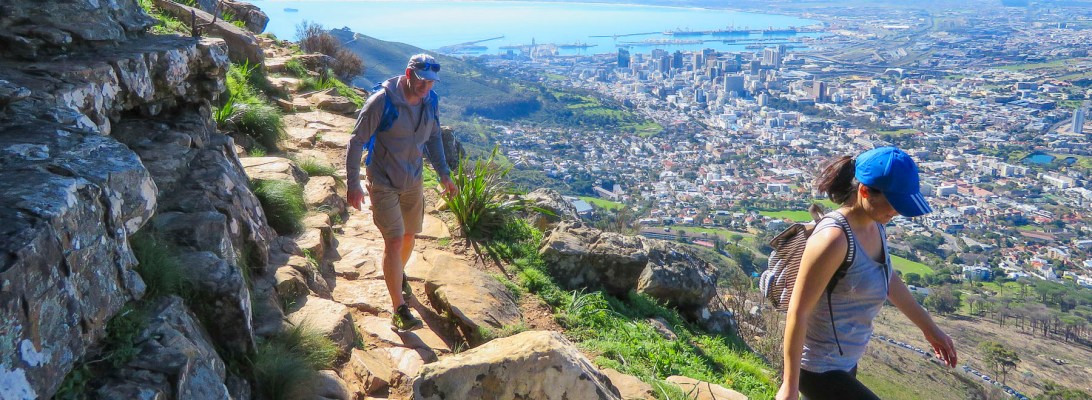
 On a cool Saturday we hiked up Lion’s Head Mountain along a trail that corkscrewed around the mountain to the top.
  The path deteriorated as we climbed higher with uneven footing that at times narrowed to the width of our feet as it edged, for short distances, along cliff tops.
  In some spots, ladders were used for short vertical climbs. If you plan to go, bring water and food. There are plenty of boulders to sit on to enjoy the 360 degree views the trail offers. We didn’t make it to the summit, with the last part a little too vertical for us, but we felt very satisfied with what we accomplished.
 We spent several afternoons on Signal Hill, watching paragliders launch into the sky above Sea Point, and then gently drifting toward the beach as the sun slowly sank below the South Atlantic horizon.
  This is a popular spot at the end of the day with many folks making a picnic of it, clinking glasses of wine as the sun sets. There are also several food trucks that provide light meals and of course cappuccino. It is, after all, Cape Town.

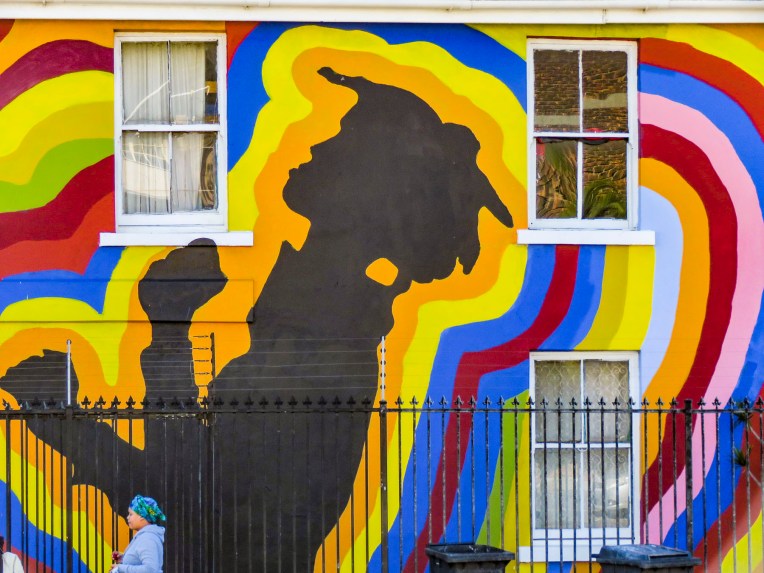
 It’s here that we first noticed the really interesting street murals that could be seen on some of the homes. Not gratuitous bubble-scripted graffiti, but pictorial or political works of art relating to freedom, equality and hope by talented artists that enhanced their surroundings.

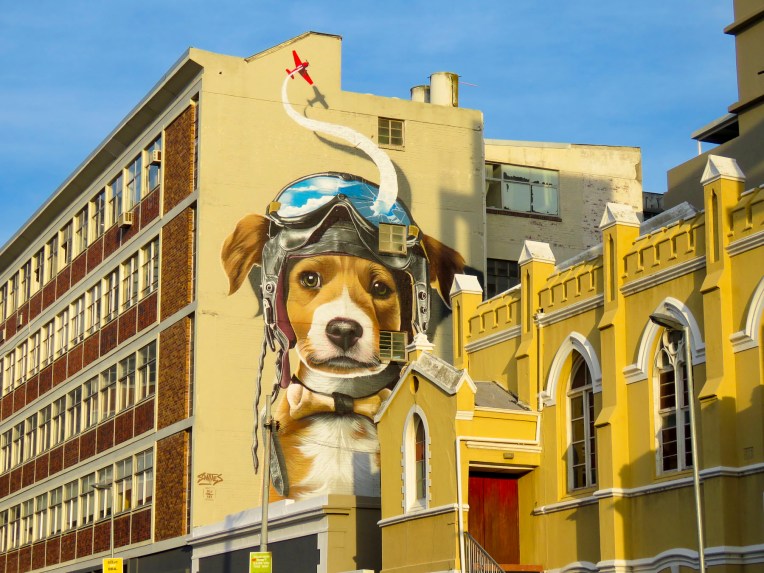
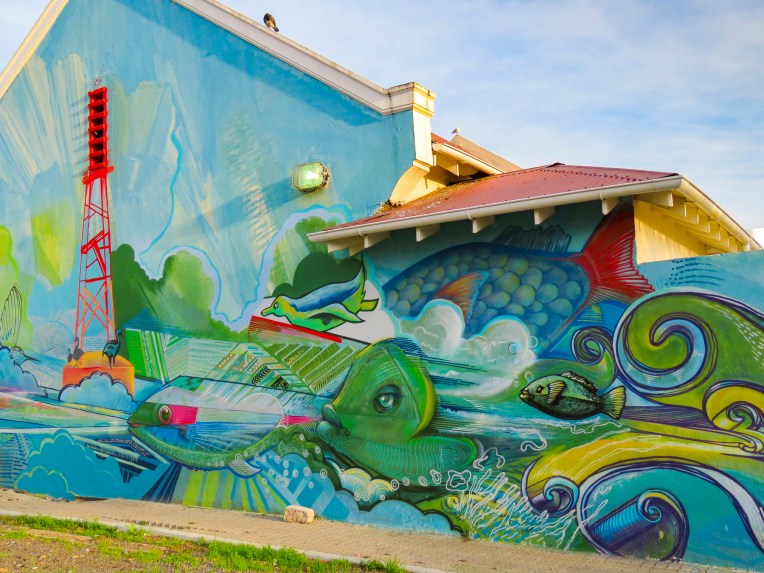
 In our exploration of Cape Town, we accidentally and to our delight, came across many wonderful murals while walking or driving about. Behind our apartment on Harrington Street a wonderfully, whimsical mural of a dog dreaming about flying, by Belgian artist
 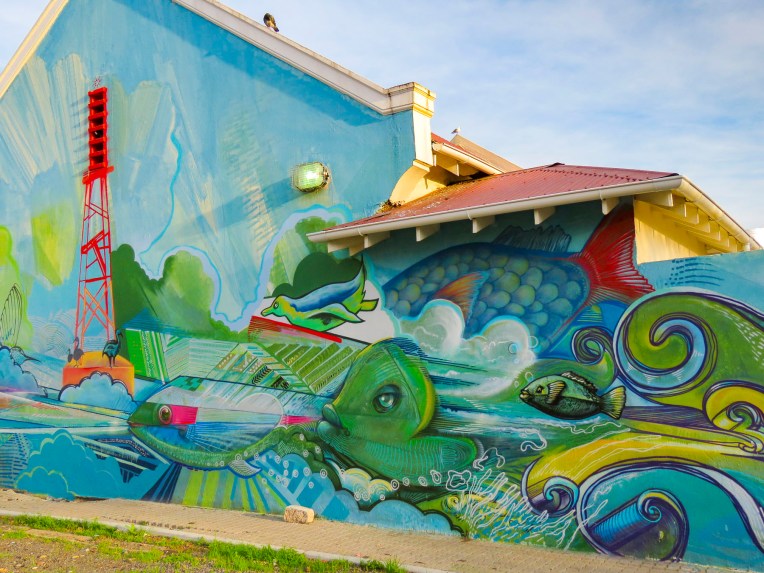 Farther down the street in District 6, across from Charlie’s Bakery, a colorful mural graced the back of a small building in a parking lot, while its front wall featured an understated portrait of Nelson Mandela by
 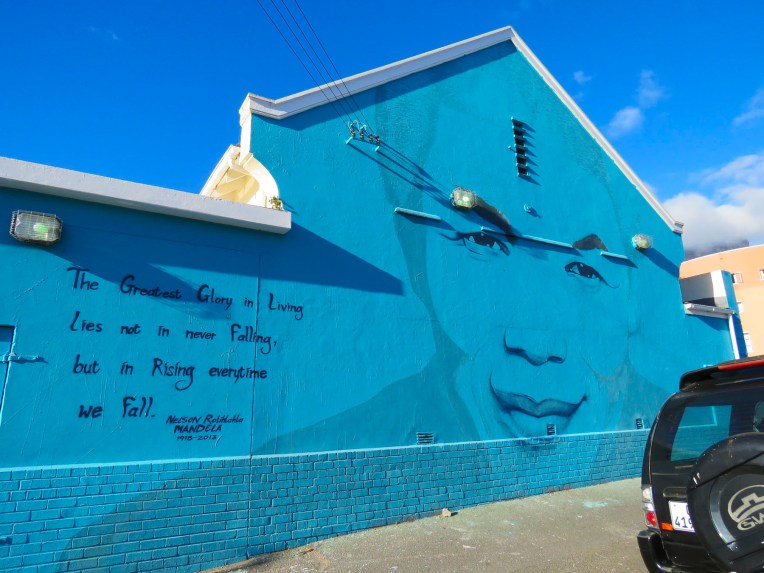 And at the bus station, under the highway, across from the Gardens Shopping Center the dismal gray walls sprang to life with imagery.


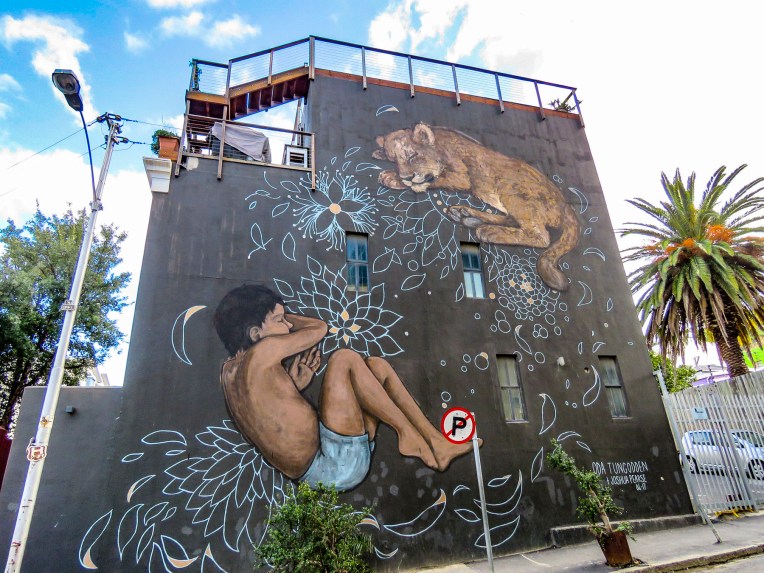


 Turns out the Woodstock and Salt River neighborhoods are ground zero for freedom of expression based on the number of street murals we discovered just by driving around. One seemed to lead to another around the corner.
 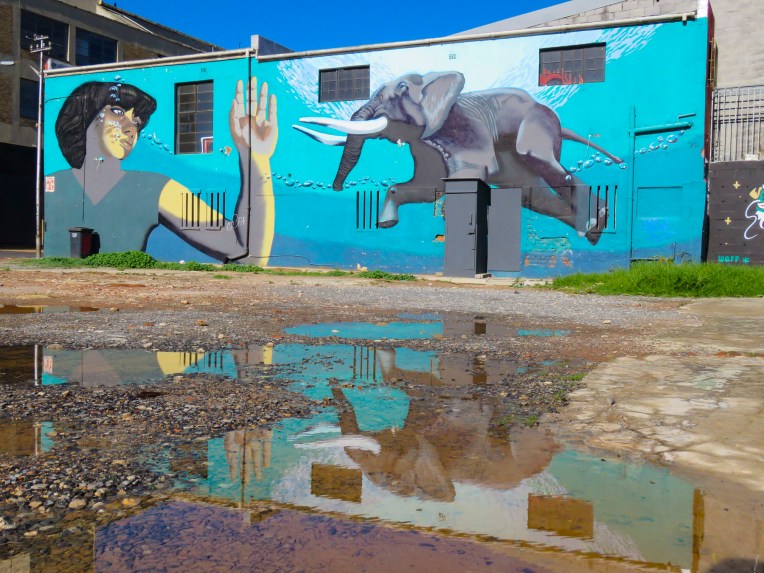 When we stopped to photograph the mural of the swimming elephant, one of the unofficial parking guards introduced himself as the “curator of street art” and offered to guide us.


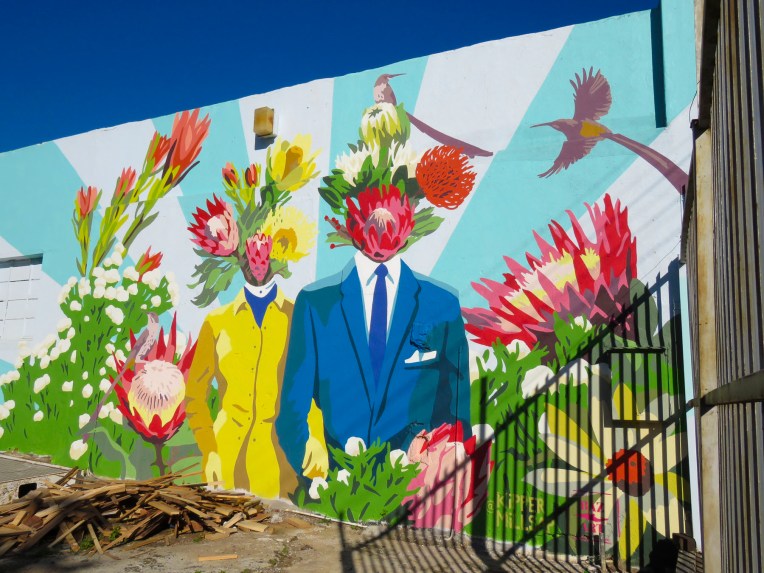


 Traveling along Victoria Road in the Salt River district, the large mural of a pangolin, painted by Belgian street artist
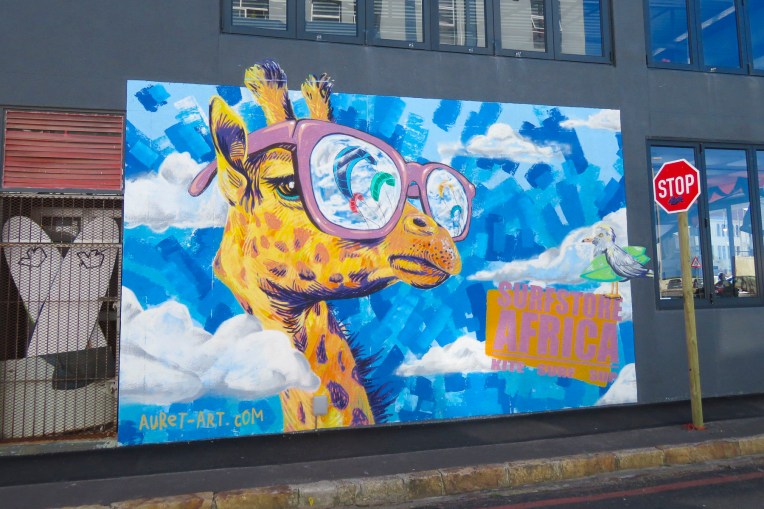
  The festival is sponsored by

 His style is very distinctive, and we recognized many of his works as we traveled around the Cape. Back in town the exterior wall of Surfstore Africa is playfully illustrated with a giraffe wearing sunglasses.
 Our most unexpected discovery happened at the indoor parking garage of the Pick N Pay grocery store in Sea Point. Here several beautiful portraits were painted on the walls of the driving ramp leading from one level to the next.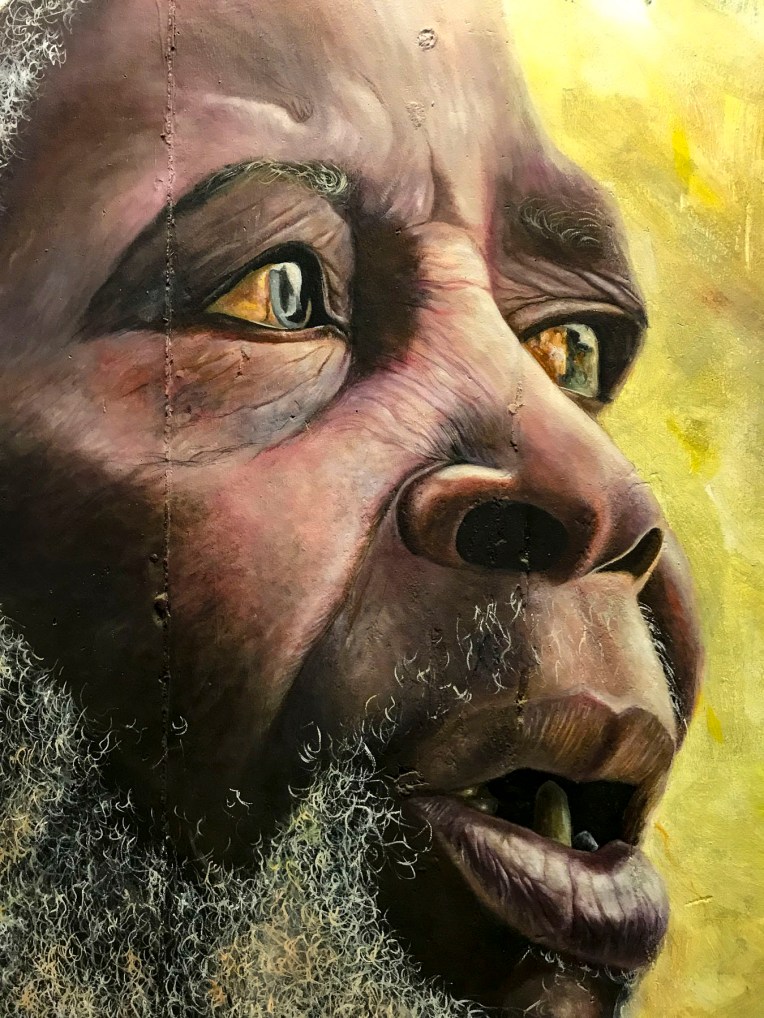




 Here gale force winds that blow in from Antarctica and colliding warm and cold currents build ferocious waves that can tower to 100 feet high. These seas have claimed over 140 ships since the Portuguese first sailed here in the 1500s. Within sight of the lighthouse, the most recent wreck of a Japanese fishing trawler from 1982 lies on the beach rusting away.
 We stayed the night at the
 Afterwards we headed toward Wilderness (the town not the idea,) along a route that traversed barren farmlands and coastal pine forests before skirting the coast again at Mossel Bay. We arrived in time to watch the sunset from our balcony at
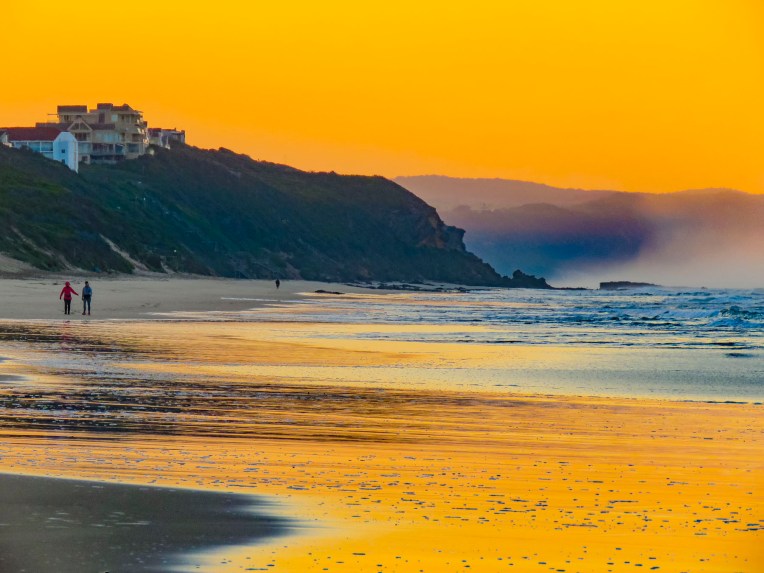
  Our room was luxurious and larger than several of the apartments we had rented on our round-the-world journey so far. We were hoping the owners, Leane & Deon, would adopt us. On our sunrise walk the next morning we only sighted a few other folks enjoying the quiet of this vast stretch of pristine beach during the winter season. We noted the considerably warmer weather, a result of the Agulhas Current which swoops warm Indian Ocean currents along the bottom of South Africa and wonderfully moderates the temperature.
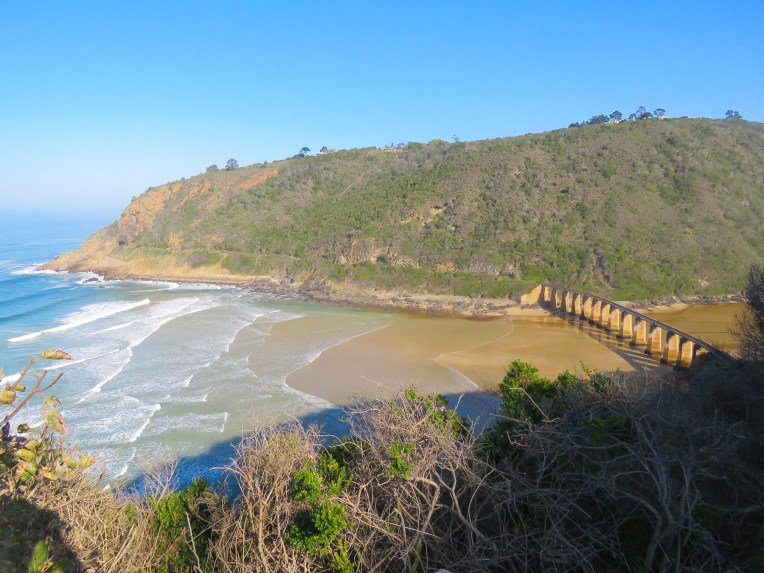
  After breakfast we backtracked on N2 to the pullover above the Kaaimans River Railway Bridge. For railroad enthusiasts this was a destination for many years to watch the Outeniqua Choo Tjoe, the last continually operating steam train in Africa, cross the tidal estuary which slowed settlers’ advance along the rugged coast. The line stopped operating in 2006 when landslides destroyed an extensive stretch of track. Today it’s an interesting photo-op.
  Further up the gorge at Map of Africa View Point, raging waters over the eons have eroded a bend in the river to resemble the African continent when viewed from the overlook on the opposite side of the chasm. The sky was empty mid-week, but across the road hundreds of paragliders launch from the grassy slope on the weekends to catch fantastic thermals and awesome views of the coast below.

 After spending hours rattling along dusty back roads we rejoiced to be on Route 2 again. A little while later we pulled over and enjoyed a late lunch and sunny afternoon on the outdoor deck of the Cruise Café, which overlooked Knysna Bay.
  We weren’t yet synched to the rhythm of life outside of Cape Town in the off-season and were surprised to find the restaurants and grocery stores in Plettenberg Bay closed when we arrived. Fortunately, we had a wonderful room with an ocean and lagoon view terrace, right on Lookout Beach, at
  The sun rose quickly the next morning from behind the Tsitsikamma Mountains, across the bay, filling our room with light. We spent the early morning slowly sipping coffee and savoring the view. Upon checkout we were delighted to find a sparkling clean car. This was a wonderful service the hotel provided for guests, and an easy way for the gardener to earn some extra money.
 We kept to a strict schedule, and limited our stops for photos today, because we needed to be at
 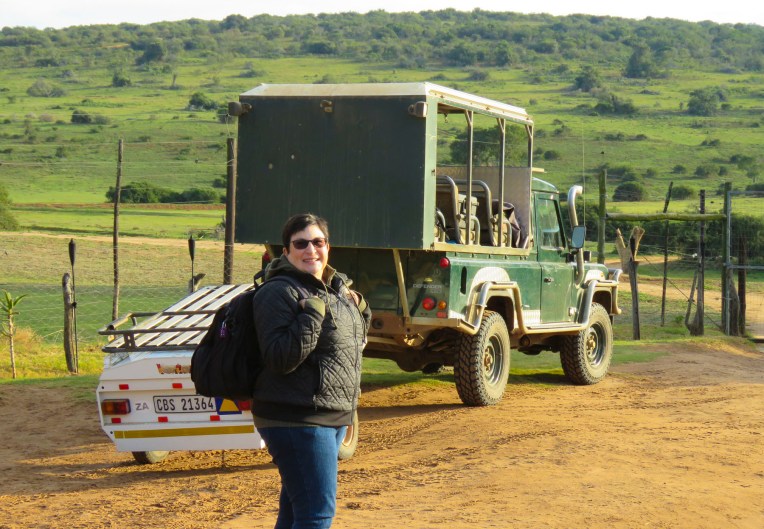 Three guides and three open-sided 4×4 Toyota safari trucks, each capable of seating 16 people, were waiting for their respective groups at the reserve’s headquarters. Wonderfully, it was mid-week in the off-season, and we had Edward, our guide/naturalist, and truck all to ourselves, while the other two trucks left with groups of six each. Schotia’s 4,000 acres of gently rolling hills, bush and forest shelter approximately 2,000 animals from 40 mammal species and its’s amazing how difficult it can be to find them.
  But that was our goal as we rattled along the rutted paths to a high vantage point within the reserve, that provided distant views of the terrain surrounding us. Scanning the vista with binoculars, Edward was searching for elephants, giraffes, antelopes and zebra. “The animals are constantly on the move. We’re never really sure where they will be,” Edward offered. He seconded with, “There’s clouds of dust being kicked up over there. Can’t tell from here what they are, but let’s go investigate.” And our overlanding began, chasing a cloud of dust that turned out to be a small herd of white faced Blesbok, a stunning antelope species we weren’t familiar with.


 Sightings of impala, kudu, wildebeest, warthogs, cape buffalo, zebra, hippos and crocodiles rounded out the afternoon.


 On the way back to the lapa we encountered the hippos we had seen earlier, now grazing far from their waterhole. Large black masses, they were barely visible when out of the headlights.
 Glasses of wine and a large, warming fire greeted us when we returned to the lapa for dinner. Inland the temperature fell quickly, and the warmth from the flames felt good.
 Darkness covered the countryside early in June, the beginning of South Africa’s winter season. Our guide had just lit the oil lamps a few minutes earlier, handed us a walkie-talkie and said, “Use this to call the owner if there’s an emergency, you’re the only folks here tonight.’’ The owner lived somewhere on the other side of this vast reserve. There were no other lights around except for the moon. The bush has a life of its own and sounds totally different in the darkness.
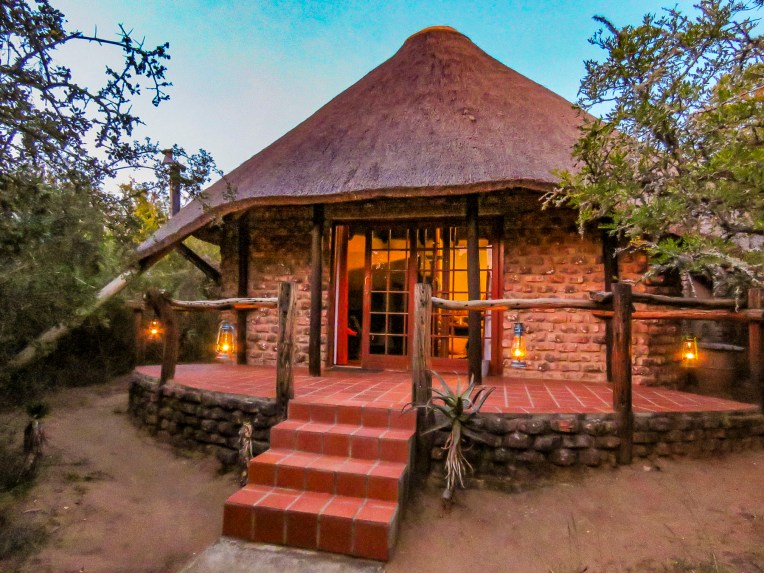 We didn’t plan on being the only folks at the game reserve during the middle of the week, but that’s one of the benefits of off-season travel. Following spring-like conditions around the globe, we’ve been able to avoid hot, humid weather and the crowds, while managing to have some wonderful experiences along the way. Tomorrow, Edward would guide us through Addo Elephant National Park.
 The eastern cape was once home to tremendous herds of elephant which were hunted by the Xhosa and the Khoe (Khoi) tribes for sustenance, and much like the American Plains Indians and buffalo it did not end well. As colonization spread across the region in the 1700 and 1800s the tribes succumbed to smallpox and were pushed into different regions, and the elephants were slaughtered to near extinction for their ivory and to protect farming interests in the region. With the killing of 1400 elephants in 1919, public opinion slowly turned. Only eleven elephants remained when Addo Park was established in 1931 with 5600 acres.
  The park was enclosed with an elephant proof fence in 1954, to protect the surrounding citrus farms from their rampages, when the size of the herd had rebounded to 22 elephants. Today the park is the third largest in South Africa and encompasses 1,700,000 acres. Home to over 600 elephants now, the reserve has expanded its mission to protect a growing number of mammal species within its borders.
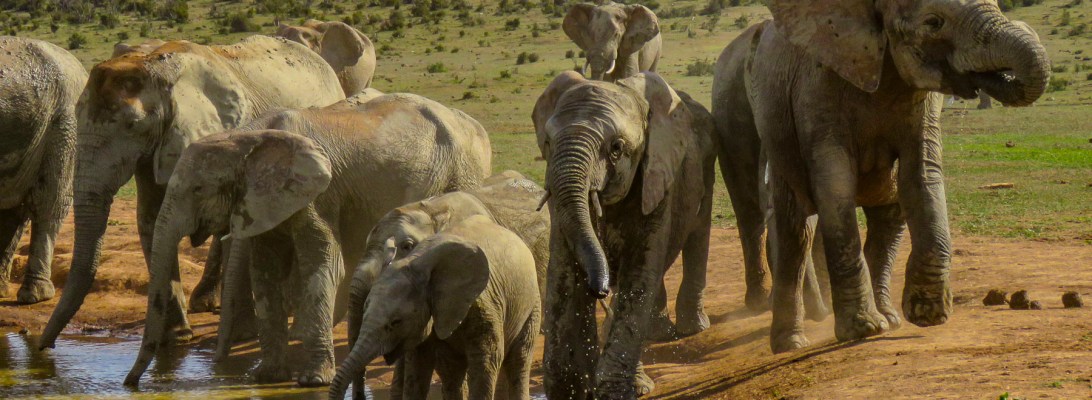
 We could have done a self-drive tour through Addo, but we thoroughly enjoyed Edward’s knowledge of wildlife and the region. It was a good decision. Sitting up high in an SUV provided better visibility into the bush, where in our small rental car we wouldn’t have been able to see much. And his timing was perfect in getting us to a waterhole just as a very large herd with calves was creating a trail of dust as it emerged from the surrounding dry bush.
 We witnessed elephants smiling as they drank. It was a tremendous experience.
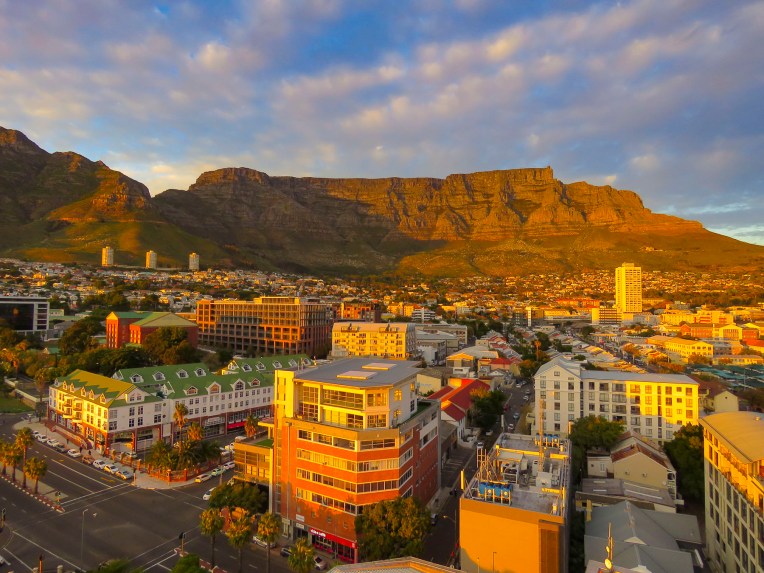 This would be Donna’s fourth trip to Cape Town and my first. Back in 1993 she visited friends she had made while attending Princeton Seminary, and a year later in 1994 she volunteered to be an International Observer for the first free and fair democratic elections in South Africa. In 2016 she returned to a city humming with positive energy and a growing economy. Unfortunately, this situation did not continue, and by 2019 the governance and economy of South Africa and its neighboring countries had stalled. The city was still beautiful and growing as a tourist destination, an amazing coffee culture had been born, but shuttered construction projects and an increasing homeless population were evident, and across many different socioeconomic groups, people were feeling disenfranchised. A multi-year drought exasperated many infrastructure problems that were being neglected. Fortunately, exceptional winter rains broke the severe drought and replenished the city’s nearly depleted reservoirs.
 We immersed ourselves quickly into the neighborhood around our first apartment on Buitenkant Street, just a few blocks away from the District Six Museum, steam punk themed


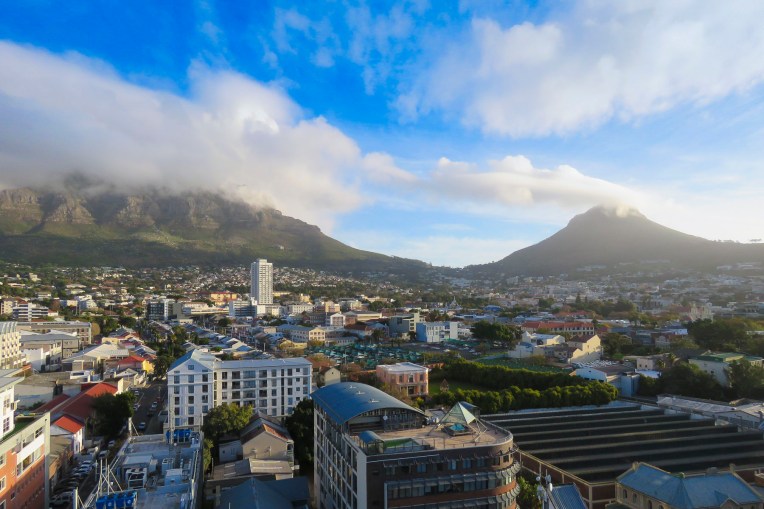 On the edge of the City Bowl and Zonnebloem districts, formerly District Six, our high-rise apartment building had a rooftop gym with fantastic views of the city, a 24hr doorman, gated parking and balconies with beautiful views of Table and Lion’s Head mountains. But the area immediately around us was in transition, without enough residential housing to call it a neighborhood.


![IMG_7861[42783]](https://i0.wp.com/2suitcasesfor2years.com/wp-content/uploads/2020/02/img_786142783.jpg?w=272&h=363&ssl=1 "IMG_7861[42783]")

 We had to find a dentist also, as just before our flight into Cape Town one of my crowns broke. Fortunately, South Africa is recognized for good medical and dental care and is slowly becoming a medical tourism destination. I found Dr. Ramjee on Google Maps, checked his reviews and made an appointment at his office which was within walking distance of our apartment. With his jovial and comforting manner, I instantly felt at ease. Though only a one dental chair office he had a state-of-the-art digital x-ray machine, a dental assistant and a receptionist. Besides the broken crown, I needed a root canal as well – what fun! My experiences with Dr. Ramjee were excellent and I raved so much about him Donna decided to use his services when the need arose for an emergency root canal and crown also. Unexpected expenses that in the states would be costly, even with insurance, were much more affordable and payable out of pocket here. The savings were tremendous.


 You just can’t walk enough miles along the coast or up and down Loin’s Head to keep the calories off in this foodie-oriented city. The Saturday- and Sunday-only food markets didn’t help, but they are a treasured tradition, throughout the region, that brings family, friends and tourists together to enjoy live music and good food.


 In early June the castle hosted the 2019 Cape Town Coffee Festival which celebrated all things caffeinated with growers from across the continent, barista workshops and pop-up coffee stands. If you ever wanted to see thousands of folks ricocheting off the walls from too much free coffee, this was the place to be.

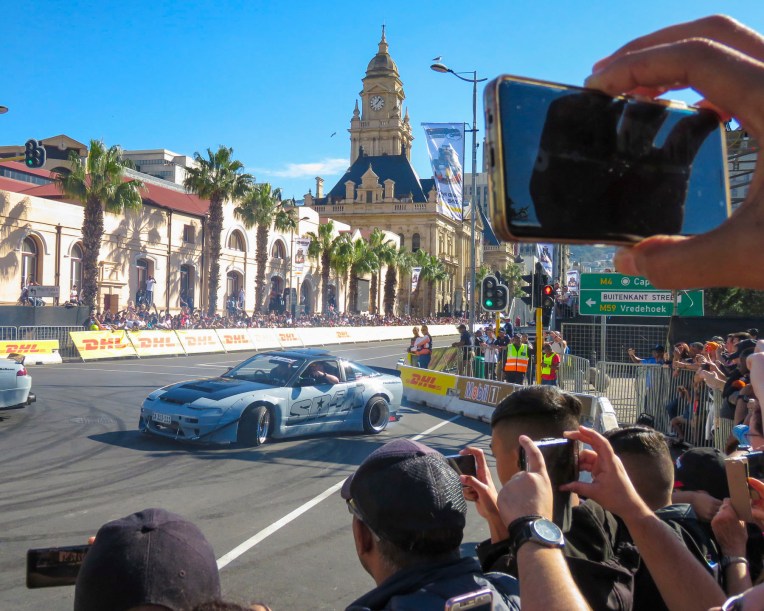 The coffee festival coincided with the Red Bull Cape Town Circuit where their F1 Aston Martin Red Bull racing car roared down Darling Street at over 150mph, passing the spot where Nelson Mandela addressed the nation upon his release from Robben Island, and turning the stretch in front of city hall, lined with bleachers, into a high-speed drag strip. At the intersections, souped-up street cars burned rubber and spun donuts while the Red Bull Air Force performed aerial acrobatics over the city. It was a raucous day that we could hear from our apartment.

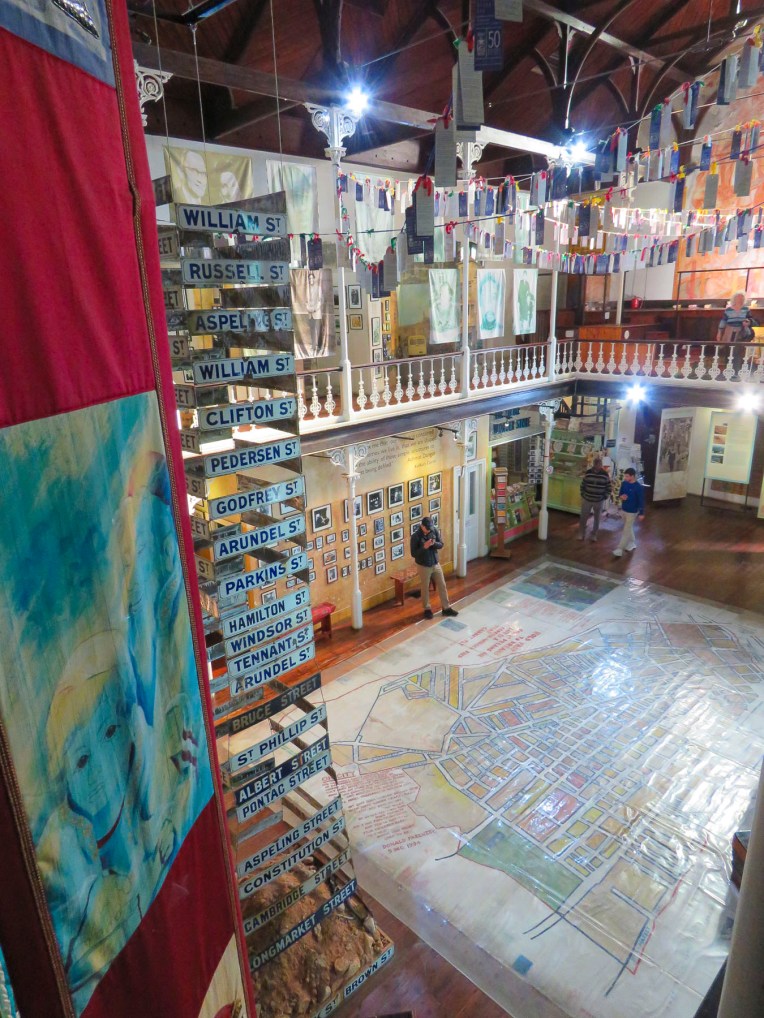 Families and neighbors were intentionally sent to different communities to break the spirit of the people. The apartheid government was so vile it “regarded the district as both physically and morally tainted by miscegenation, wholly unfit for rehabilitation” and flattened every building except for Churches. Even the original streets were destroyed, and new roadways were created so folks couldn’t find their homes, now vacant lots, that they legally owned. Much of the area still remains abandoned. The District Six Museum commemorates this tragedy and the lasting heartbreak of this cruelty.


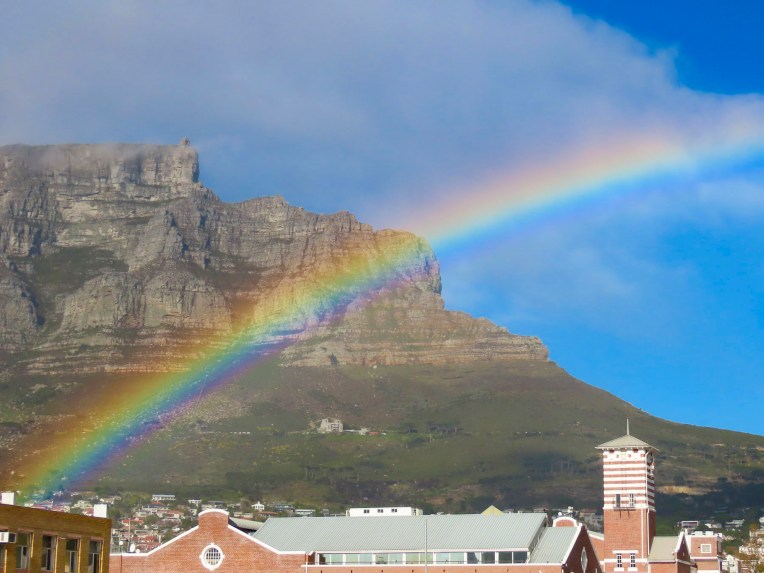
 Despite our apartment’s faults, we enjoyed our time on Buitenkant Street. Watching the brilliant sunrises and the flat clouds – the tablecloth of Table Mountain – cover the summit and then spill down the side like a waterfall. The street life below spanned the gamut from groups of tutu-clad race walkers one day to noisily protesting sex workers or Fridays for Future demonstrators the next.


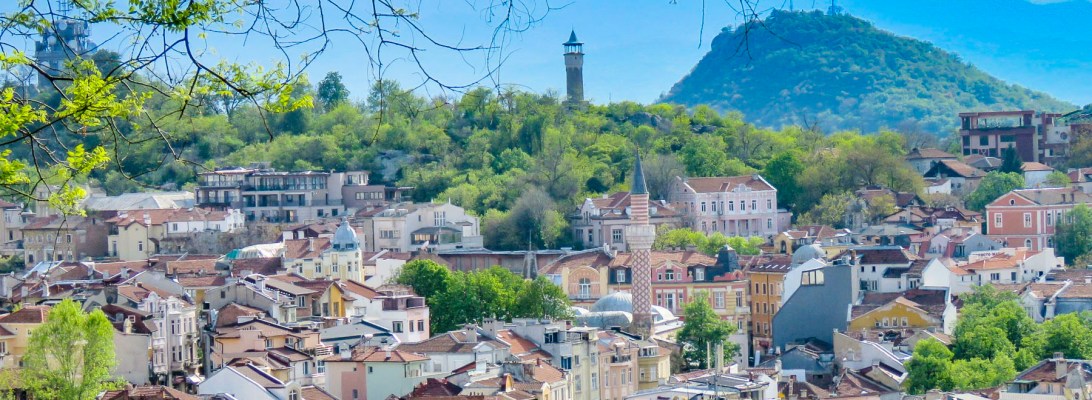
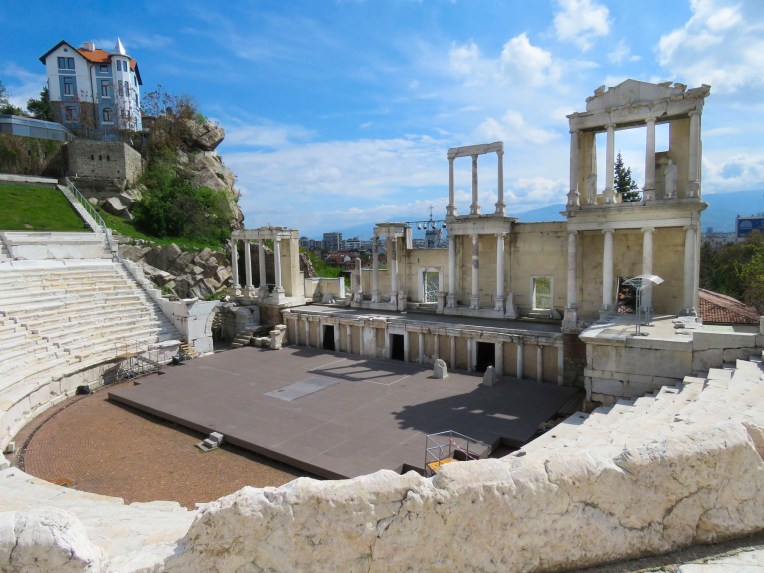 Just outside Old Town Plovdiv,


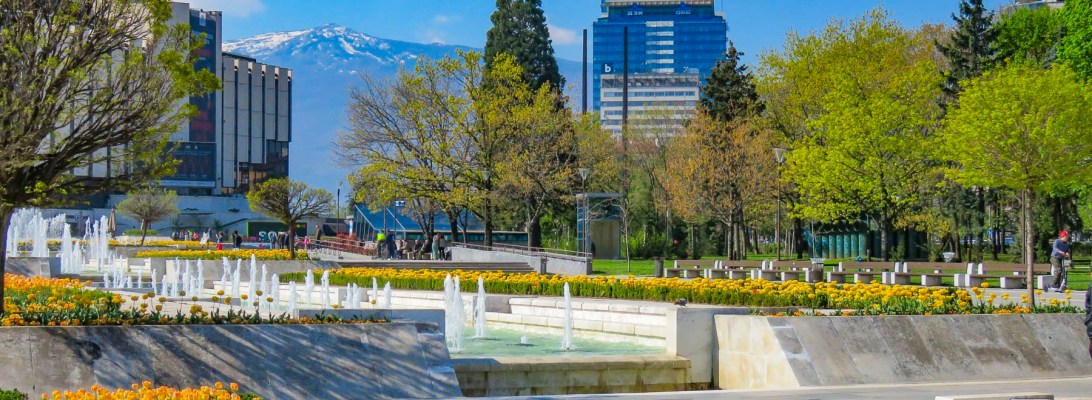
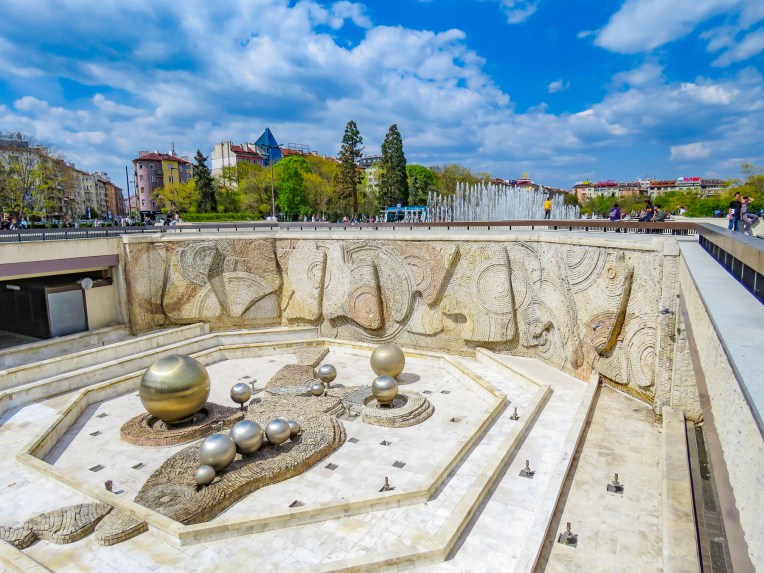
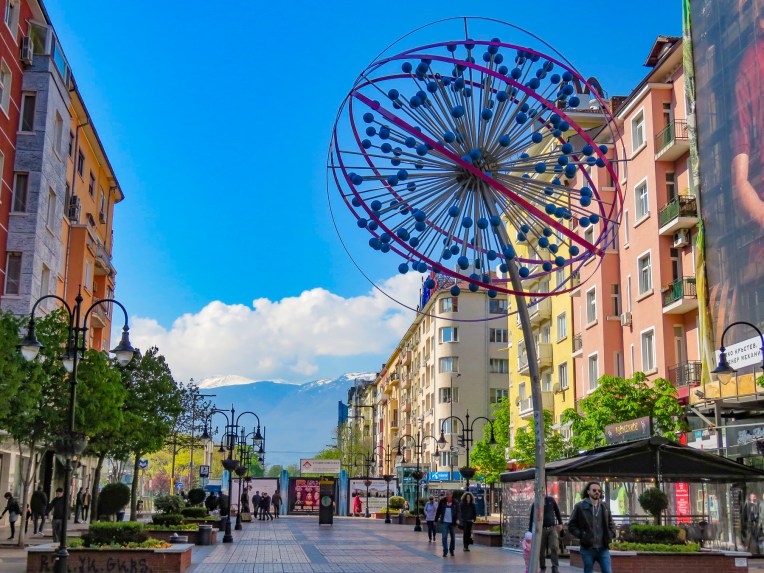
 At just over a mile long the pedestrian mall in the center of Plovdiv is the longest in Europe, running from the Stefan Stambolov Square along Knyaz Alexander I, and Rayko Daskalov Street before ending at the footbridge lined with shopping stalls that crosses the Maritza River.


 But the jewel of the mall area was the curved ruins of the Ancient Stadium of Philipopolis, with its fourteen tier seating area, unearthed in 1923. Situated below street level and surrounded by modern buildings at Dzhumaya Square, the ruins provided a dramatic juxtaposition of the ancient and contemporary, where you can actually see the layering of history and how the city was built over earlier civilizations. From this excavated section, archeologists have determined that the stadium was a huge 790 feet long and 165 feet wide and could seat nearly 30,000 spectators.
 Across the square the Dzhumaya Mosque is the main Friday Mosque for Muslims in Plovdiv. Constructed in 1421, it replaced an earlier mosque built in 1363 on the foundations of a Bulgarian Church destroyed during the Ottoman conquest. It is one of the oldest and largest Muslim religious buildings in the Balkans. At the café in front of it we enjoyed some sweet Turkish tea and pastries in the warm afternoon sun.


 From Portugal we were to go to England for three months of pet sitting in various locales to save some funds for our push into Africa later in the year.

![IMG_4216[35050]](https://i0.wp.com/2suitcasesfor2years.com/wp-content/uploads/2019/12/img_421635050.jpg?w=178&h=237&ssl=1 "IMG_4216[35050]")
![IMG_4487[35046]](https://i0.wp.com/2suitcasesfor2years.com/wp-content/uploads/2019/12/img_448735046.jpg?w=178&h=237&ssl=1 "IMG_4487[35046]")

![IMG_5015[35024]](https://i0.wp.com/2suitcasesfor2years.com/wp-content/uploads/2019/12/img_501535024-e1577548338172.jpg?w=214&h=237&ssl=1 "IMG_5015[35024]")


 Weekends were especially rewarding when it was more likely we’d come across a street market or dance class in a park.


![IMG_4736[35121]-2](https://i0.wp.com/2suitcasesfor2years.com/wp-content/uploads/2019/12/img_473635121-2.jpg?w=245&h=184&ssl=1 "IMG_4736[35121]-2")


 The cost of living in Bulgaria was very favorable with most items in the bakeries costing just one dollar and a nice dinner for two with wine, dessert and coffee costing under $40.00. A visit to a local dentist, recommended by our Airbnb host, to have a cavity filled cost $20.00. The x-ray needed cost $5.00 from a different facility around the corner.
 ![IMG_4282[36950]-2](https://2suitcasesfor2years.com/wp-content/uploads/2019/12/img_428236950-2.jpg?w=764) Our lovely, large one-bedroom apartment with living room, dining table and small balcony, just two blocks away from the popular pedestrian mall, cost less than $800.00 for the month. (We found it amusing that the two-burner electric cook top was kept in a drawer in the kitchen, but we made it work for us.) A 90¢ USD subway fare got us to the airport for our $10.00 per day car rental, with unlimited miles, for our road trips. There were some oddities though.
Our lovely, large one-bedroom apartment with living room, dining table and small balcony, just two blocks away from the popular pedestrian mall, cost less than $800.00 for the month. (We found it amusing that the two-burner electric cook top was kept in a drawer in the kitchen, but we made it work for us.) A 90¢ USD subway fare got us to the airport for our $10.00 per day car rental, with unlimited miles, for our road trips. There were some oddities though.


![IMG_4122[35061]-2](https://i0.wp.com/2suitcasesfor2years.com/wp-content/uploads/2019/12/img_412235061-2.jpg?w=199&h=265&ssl=1 "IMG_4122[35061]-2")
![IMG_4286[35051]](https://i0.wp.com/2suitcasesfor2years.com/wp-content/uploads/2019/12/img_428635051.jpg?w=272&h=363&ssl=1 "IMG_4286[35051]")


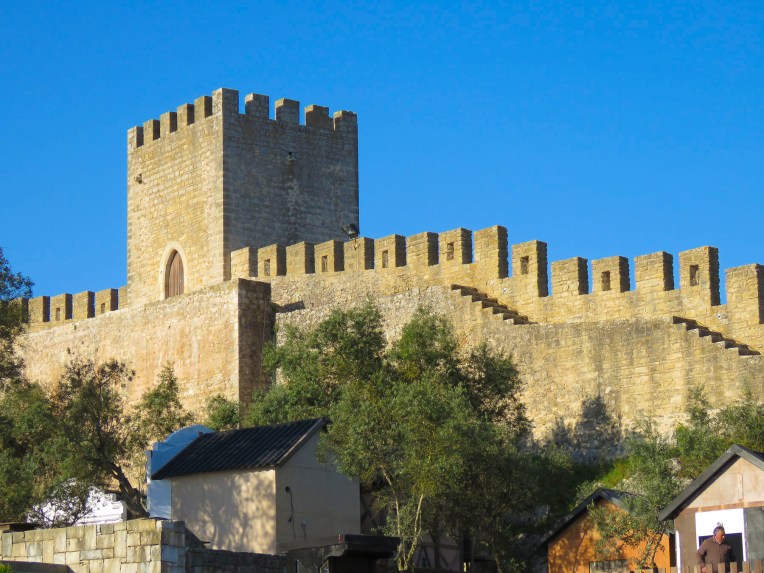 We had spent a wonderful day cruising from Aveiro to Nazare, but now twilight was fast turning to darkness as we drove along an extremely narrow lane at the base of the formidable fortress wall that encircled Obidos. We had arrived at our hotel
  Admittingly Donna is the more accomplished linguist of the two of us. I according to my loved one have been known to torture a language. So, she eagerly sought advice from the only person we had passed. From a short distance away, I watched the conversation unfold with the gentleman flailing his arms every which way for what seemed an inordinate amount of time.
  Smiling, Donna returned to the car. “About the only thing I got from that was we should continue following the lane until the next hole in the wall. He was very insistent about that.” “Did he know the hotel?” I asked. “Never heard of it, but I think he was intoxicated! My luck,” she laughed. The lane narrowed even more as we drove forward. Finally, there was an ancient portal, the size of a single door, through the wall that led to a short set of steps. Abandoning our car for few minutes we climbed the stairs to an inner lane in search of our hotel. After we finally found the place, the receptionist explained to continue driving along the wall until you reach an old city gate, enter there and follow the inner lane back to us and park anywhere you can. OK, piece of cake now, we thought.
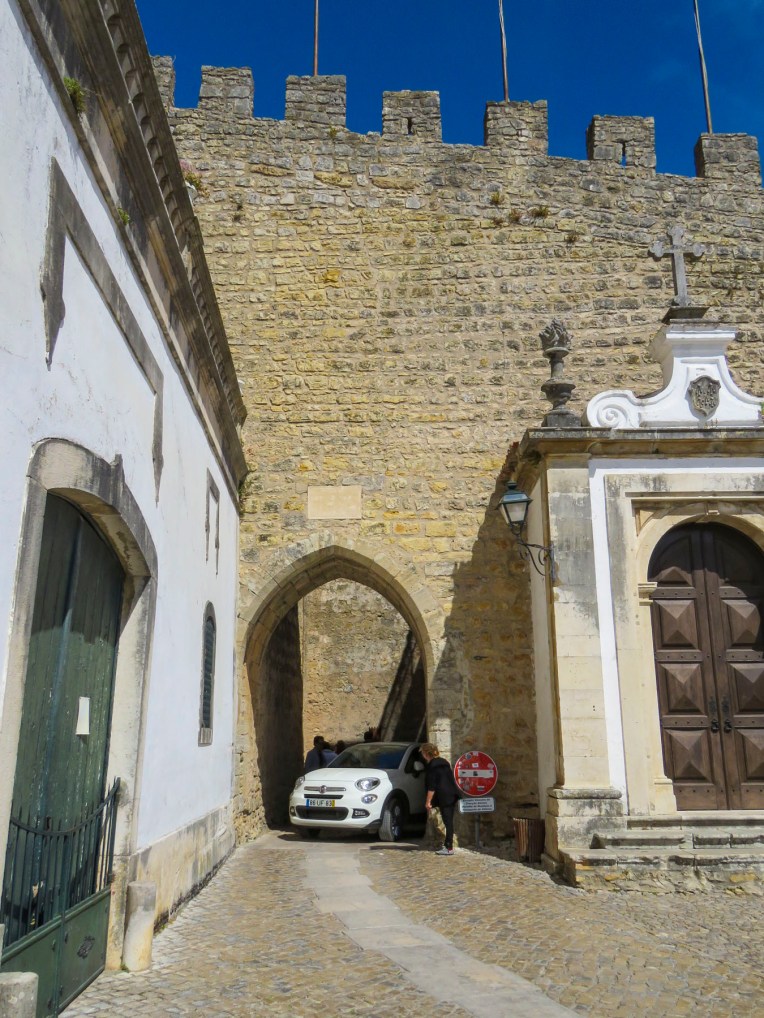
  Inhabited since the 4th century BC by the Lusitanos, then the Romans and Visigoths, the city wasn’t fortified until the 8th century by the Moors. Bent entrances, with a quick turn and an additional, heavy inner gate were used in many Arab fortifications. In peacetime they were easy to navigate with pack animals, and during sieges provided a killing zone for the defenders of the city. Remember, these bent gates were built long before cars were envisioned. Obidos had two of them and tonight we had to navigate through one. Porta do Vale ou Senhora da Graça was a drive through chapel dedicated to Our Lady of Grace. In 1727 the old gate was renovated into an oratory chapel with sacristy, altarpiece, gallery, choir, and chancel by a local magistrate to commemorate his daughter’s death. You actually transit through the nave to reach the interior street. The gate was narrow, and it required a sharp k-turn just to line the car up to approach it correctly. Donna was driving and I hopped out to judge just how much room we had around the car. Driving up a slight slope on flagstones worn smooth from centuries of travelers, the tires spun with no traction as the car got halfway through the gate. Backing-up and then gunning the car forward through the gate Donna only had the length of our Fiat 500 to turn sharply right and exit the inner gate. It was do-able but nerve-wracking.


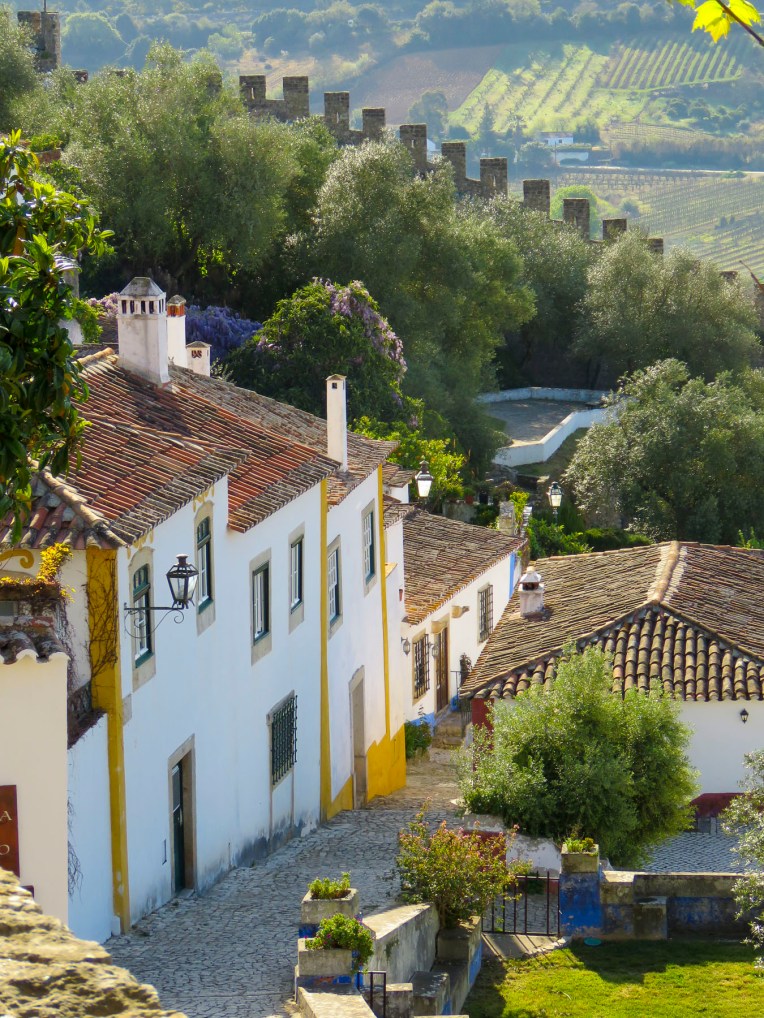
 With only two main lanes that ran the length of village, interconnected by a labyrinth of stairs and smaller alleys, Obidos was the perfect size, only slightly larger than Marvao, to explore for two days and relax before driving back to the airport in Lisbon for our flight to Sofia, Bulgaria.
 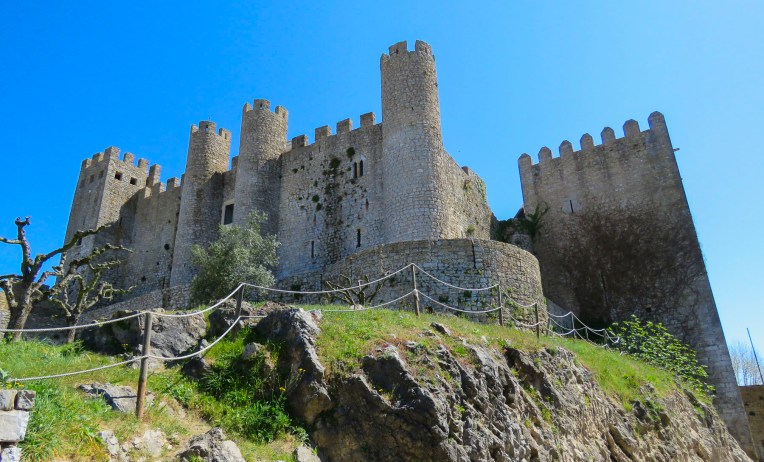 The next morning, enjoying deserted lanes lined with flowering wisteria, calla lilies, and other interesting details we weaved our way to the


 We eventually made our way through the main gate of the walled city. Porta da Vila de Óbidos is another bent entrance that did double duty as a chapel to Nossa Senhora da Piedade, the Virgin Mary, patron of the village. Be sure to look up as you walk through, as Azulejos tiles from the 1700’s line the interior balcony.
 Across the street we walked below remnants of a three-kilometer-long aqueduct built in the 16th century to supply water to the fortress.
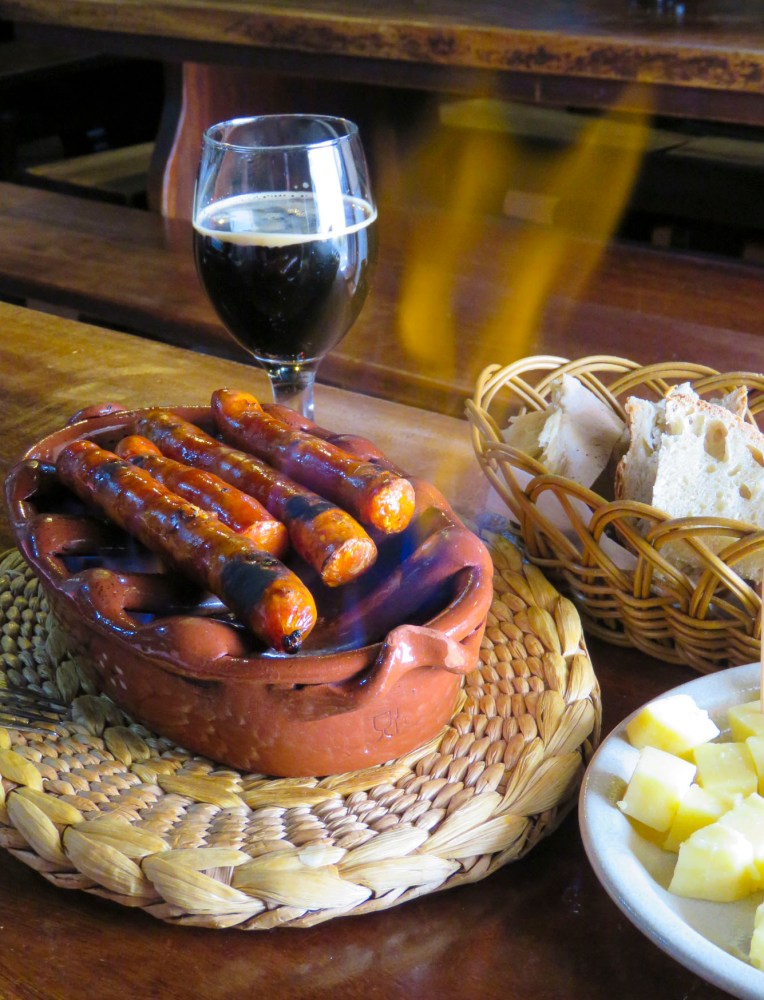
  Dinner that night was a simple meal of bread, cheese and local sausages cooked uniquely on a ceramic hibachi, fueled with grappa, placed on our table at Bar Ibn Errik Rex. As flames danced from our mini grill, the waiter would return to our table occasionally and turn the sausages to ensure their perfection. It was an entertaining evening. A few good Portuguese beers helped.
 With our GPS App still set to avoid toll roads, we drove through the Porta da Vila de Óbidos and headed towards Lisbon, less than two hours away if we didn’t stop. But, if you’ve been following our blog you’ll know that’s nearly impossible, there is always a quick glimpse of something that calls for a detour.
 Torres Vedras with its aptly named citadel caught our eye. With a historical time-line similar to Obidos, the hilltop in the old historic district was continually fortified against waves of early invaders. Knowing a good piece of real estate when they saw it, the castle was seized during the Christian reconquest in 1148 and used by a succession of Portuguese Kings until it was heavily damaged in the catastrophic 1755 earthquake that hit central Portugal and Lisbon. Built just after the reconquest, Igreja de Santa Maria do Castelo stands just below the castle walls. The church’s bell cast in the 16th century continues to ring today.

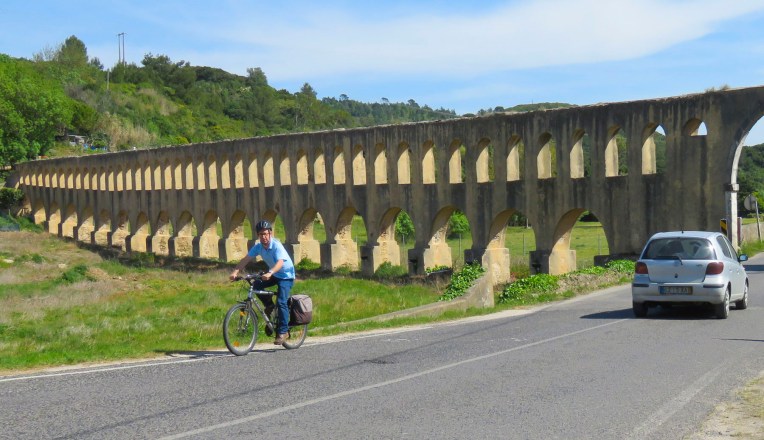 Along the Sizandro River on the outskirts of town, an impressive two-kilometer stretch of a 16th century aqueduct with double arches still stands. Driving under the aqueduct we followed the river south along the R374. The high-density new developments around Torres Vedras quickly gave way to a landscape of vineyards and pastures. Finding a restaurant for a late lunch, though, didn’t seem promising along this rural stretch of road, dotted with the occasional roadside café with a farm tractor parked out front, until we caught a quick peripheral glimpse of a larger establishment, across a small bridge, down a side lane. It would take another mile before we could find a suitable place to perform a U-turn. With nothing else around for miles
 2 Suitcases for 2 years