

Starting the second part of this magical ride through Lisbon, tram 28 leaves the Praça do Comércio area from two nearby stops on Rua da Conceição, and climbs steeply around a huge curve into the Chiado and Bairro Alto districts before traveling to its terminus at Jardim dos Prazeres in Campo de Ourique. Rebuilt after the devastating earthquake of 1755, both these districts have a totally different atmosphere than Alfama’s time capsule, reflecting a vibrant, more cosmopolitan Lisbon with fine upscale shopping, nightlife and historical monuments that often reminded us of Paris. Praça Luís de Camões is the center of all this activity and tram 28 will drop you off amidst all the fun. There are so many things to do from this location that you might want to consider coming back here more than once. 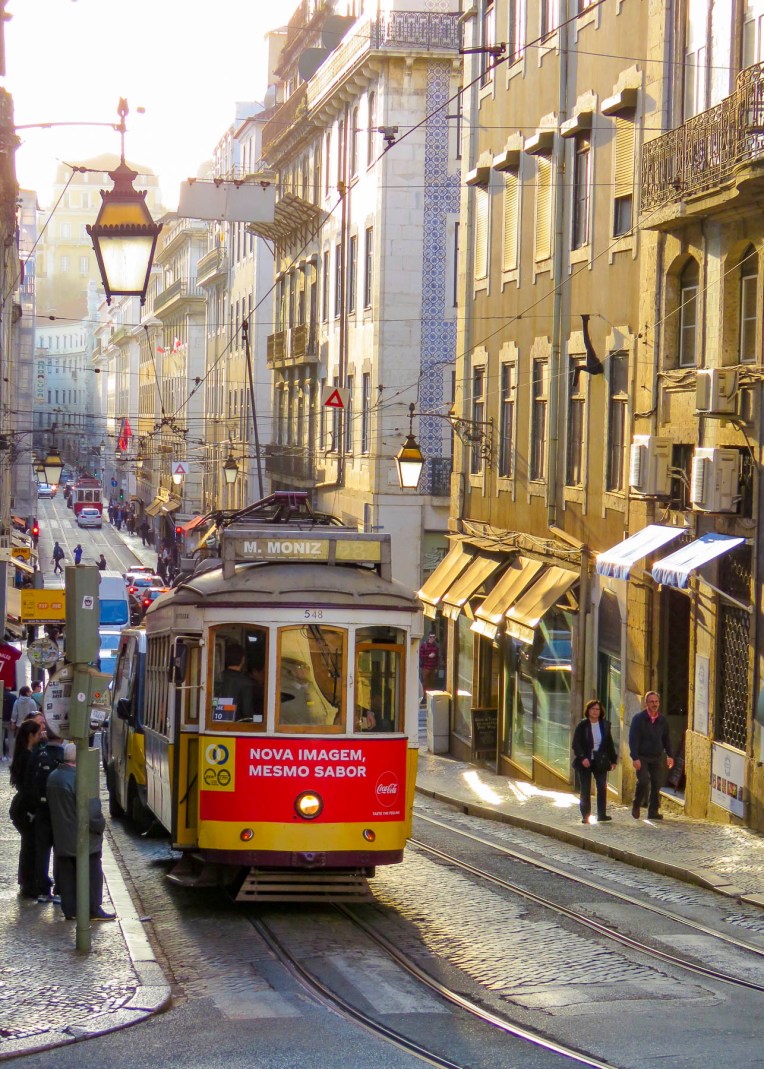 As if guarding the plaza, Igreja de Nossa Senhora do Loreto / Igreja dos Italianos, known as “the Italian Church” and Igreja de Nossa Senhora da Encarnação face each other with refined, simple exteriors. The Italian Church was built in 1518 by King John V to celebrate Lisbon’s Italian community of Genoese and Venetian merchants. The interior is lined with marble imported from Italy.


Exiting the Italian Church, you can walk right across the street into Igreja de Nossa Senhora da Encarnação to view spectacular ceiling paintings by Simon Caetano Nunes. After the 1755 disaster, reconstruction of this cathedral lasted until 1873. The cathedral also features several contemporary religious relief sculptures and a ceiling mural in a side chamber.


Once you’re back on the sidewalk, follow the sound of music to a small plaza. Here street musicians, performance artists and dance teams entertain crowds of tourists. Outdoor cafes edge the plaza, which is centered by a statue commemorating António Ribeiro, a Catholic cardinal who supported the democratic movement that lead to the toppling of the military regime in 1974. Pop into Café A Brasileira, Lisbon’s first coffee house in 1908, with its Art Deco style interior of sculpted wood, polished brass and mirrored walls. Many famous Portuguese writers and artists nutured their caffeine addiction here. Poet Fernando Pessoa visited so often, he is immortalized here with a bronze statue depicting him seated at “his” table. Immortalized in bronze, poet Fernando Pessoa sits permanently outside at “his” table.


Casa do Ferreira das Tabuletas with its ornate tile facade illustrating the sciences can be seen as you work your way to the Carmo Archaeological Museum. Set in the ruins of Lisbon’s largest cathedral before the 1755 earthquake, this small museum has a diverse collection of tombs, ceramics and mosaics along with other ancient artifacts. A few steps from its door, the viewing platform of Elevador de Santa Justa offers beautiful views of Lisbon. Walking back to Praça Luís de Camões, pass the Guarda Nacional Republicana to watch Lisbon’s less elaborate version of the changing of the guard.


From Praça Luís de Camões you can also walk or take tram 24 up Rua da Misericordia deeper into Bairro Alto. There is so much to do on this one street, you will want to return several times. If you are looking to be selective about the churches you visit in Lisbon, Igreja de São Roque and its Museu de São Roque should be at the top of the list. The highly carved gilded interior was the first Jesuit Church in Portugal. The museum exhibits an intriguing, world-class collection of Italian religious art in a contemporary setting.


Riding a funicular tram in Lisbon is a must and the street-art covered walls of the Ascensor da Glória route are just a block from Igreja de São Roque. It’s a pop culture experience to board the graffiti-painted tram and descend to Praça dos Restauradores. The walls along the route have been given to the artists of Lisbon and are covered with spectacular street murals. Older murals are painted over on a regular basis and replaced with new inspirations.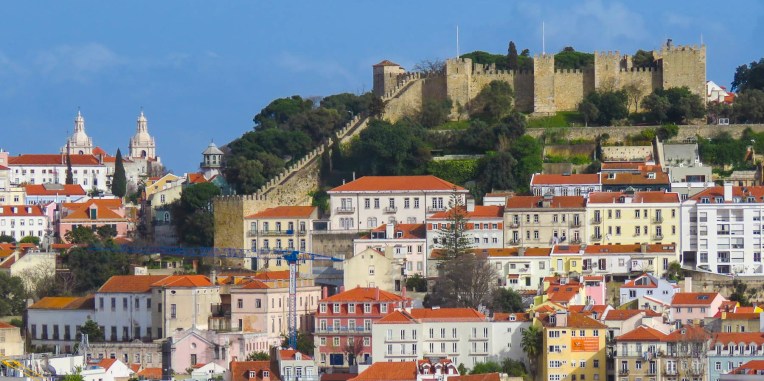 Shady Miradouro de São Pedro de Alcântara overlooks this colorful chaos and has splendid views of Lisbon below. From the miradouro it’s a gentle uphill walk into Bairro Alto. Fortunately, there’s no lack of places to rejuvenate yourself along the way. For lunch we found A Padaria Portuguesa an artisanal bakery and restaurant that we would return to several times during our stay in Alfama just to buy their delicous bread. This was especially rewarding if we combined it with buying cheese at Queijaria Cheese Shop just a few blocks away. Listening to the proprietor describe the nuances of each Portuguese variety and offering samples to tweak our palette, we usually left with the makings for a nice picnic under the towering specimen trees of Jardim Botânico da Universidade de Lisboa, just across the boulevard. Jardim do Príncipe Real, with its iconic trimmed cypress tree shaped to look like giant shitake mushrooms, was always a good alternative destination.


For dessert and coffee, we’d indulge ourselves with a sumptuous visit to Bettina & Niccolo Corallo, a wonderful artisanal chocolate and coffee shop with seating for only 6-8 people. Just down the street, in what was once an ornate, private residence, the Ribeiro da Cunha Palace has been subdivided into unique boutique stores. The lavish, original architectural detailing can still be seen in all the shops as you wander through. If you are staying late in the area, Tapas Bar 52 is a popular place for sharing delicous, small plate creations.


One stop away from Praça Luís de Camões, you can climb aboard funicular Bica and descend the steep hill into its gated ticket terminal on Rua de S. Paulo. On your way down you might catch a glimpse of a middle-aged man walking along the tracks, his pot-bellied pig on a leash. Outside the terminal you’re back on flat terrain again and only a short walk away from the Time Out Market.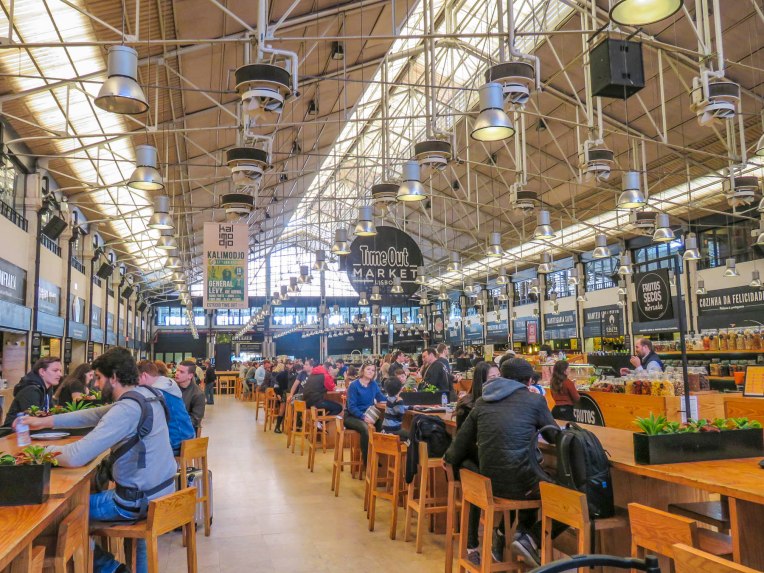 Set in a historic 1890s building in Cais do Sodré, this is a huge, lively food court with numerous restaurant choices that is very popular with Lisboans. Whatever you are craving at the time, you’ll find something satisfying here. Next door, during the week, Mercado da Ribeira operates a central market with fish, meat and produce vendors offering Portugal’s finest products. Brightly painted Pink Street, popular for its club scene, is nearby.
 Take funicular Bica back uphill, and around the corner you find tranquil Miradouro de Santa Catarina, with views of the Tagus River and Ponte 25 de Abril Bridge in the distance. The Museu da Farmácia is also located here. Also, nearby along Calcada do Combro, or just off it, are several landmarks worth quick visits.


Unimpressive from the outside, Igreja de Santa Catarina, built in 1647, has a rich, baroque style, gilded interior and impressive pipe organ. The buildings along Rua Vale frame Igreja Paroquial das Mercês sitting prominently atop a small hill at the end of the street. First constructed in 1615, a masterpiece of tile work created in 1715 and installed on a vaulted ceiling in a small room survived the 1755 earthquake. This is one of Lisbon’s hidden treasures. Credited to tile master Antonio de Oliveira Bernardes, the mural illustrates the Litanies of the Virgin Mary. Ask the church attendants to open the room for you. The rest of the church is an eighteen-century reconstruction. Down Rua Vale from the cathedral, Atelier-Museu Júlio Pomar, a small contemporary art museum, has rotating exhibits and a permanent collection of works by Júlio Pomar (1926-2018.) Some consider him to be the most influential Portuguese painter of his generation.


A mass of sun worshippers greeted us a we stepped off the elevator at Park Bar. Every chair in this oasis of lush greenery, hidden above Lisbon, was turned towards the sun to take advantage of the view on this early spring day. With a quick look at the name, you think the bar is in a park, but instead it’s on the sixth-floor rooftop of a parking garage next to Igreja de Santa Catarina. Finding the entrance was a bit challenging, since there was no signage, but once you locate the elevator or stairs inside the garage you’re set. The place gets packed at sunset and the party grows into the night with DJ’s providing the soundtrack. Heading west, tram 28 weaves through a very narrow section similar to parts of its route in Alfama, before reaching the open area around Assembleia da República. The parliament of Portugal is headquartered in a neoclassical building that was first used as a convent in the sixteenth century. Formal gardens behind the parliament building, hidden by an imposing wall, can be seen from tram 28 or if you stand on your tip-toes and peer over. Never immune from criticism, the politicians must endure a large satirical wall mural, painted on a nearby building, as they head to work each day.


Past the Assembleia da República the character of the city changes. The streets widen and some multi-storied apartment buildings dot the cityscape between historical buildings. If you are ready to picnic, Jardim da Estrela is a wonderfully landscaped park with ponds and sculptures of historic figures scattered along the walking paths. Across the boulevard, one of Lisbon’s lesser visited cathedrals, eighteen-century Basílica da Estrelaor, safeguards the tomb of Queen Mary I. She was the first monarch to rule over a united Portugal that included Brazil. She ordered the construction of the cathedral in 1761, as a religious obligation, after the birth of a male heir to the throne. Unfortunately, Queen Mary outlived her son (José – Prince of Brazil) who died of small pox at the age of 27. The cathedral also has a 500-piece nativity scene, made of cork, on permanent display.


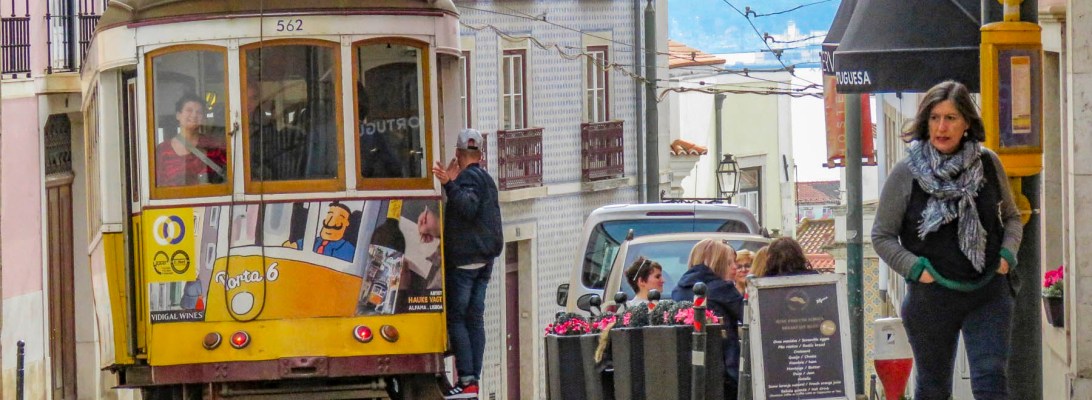
Tram 28 ends its charming journey in the Campo de Ourique neighborhood at Jardim dos Prazeres, a small park with two cafes, in front of Cemitério dos Prazeres. Here the tram waits for several minutes before following its route all the way back to its starting point in the center of Lisbon at Martim Moniz. This tranquil cemetery is the final resting place for many of Portugal’s most notable citizens. Tombs of famous fado singers, artists, architects, doctors, writers and poets share the cypress lined lanes with politicians, nobility and a variety of songbirds. Many of the mausoleums are ornately decorated with artistic sculptures that represent the deceased’s career. Stop in the office to get a map outlining several different self-guided tours. There are numbers on the curbs in front of some of the tombs to help cross-reference the person’s contribution to Portuguese society. The far side of the cemetery offers views of the Tagus river and Ponte 25 de Abril bridge.


A few blocks away Mercado de Campo de Ourique has been revamped into a trendy food hall where organic and artisanal food purveyors share the space with small bars and restaurants. It’s a great place to rejuvenate before heading home.
Lisbon is an intriguing city with an amazing variety of activities in which to immerse yourself. There is no one “correct” way to see the city, but tram 28 offers a splendid six-mile route through this charming capitol that passes many of the top attractions. Multiple sites are close together so it’s easy to walk from one to the other and then just hop back on the tram to cover greater distances. Don’t expect to see everything along this famous route in one day; there’s just so much to explore and many wonderful diversions!
We loved Lisbon and can’t wait to return one day.
Till next time, Craig & Donna



![IMG_3433[31180]](https://i0.wp.com/2suitcasesfor2years.com/wp-content/uploads/2019/04/img_343331180.jpg?w=251&h=334&ssl=1 "IMG_3433[31180]")


![IMG_3463[31065]](https://i0.wp.com/2suitcasesfor2years.com/wp-content/uploads/2019/04/img_346331065.jpg?w=432&h=324&ssl=1 "IMG_3463[31065]")


 2 Suitcases for 2 years