On the Road to Durrës, Albania: or Lady Bugs, Metallic Men and a Beautiful Seaside City

Loose gravel gently slid down from the top of the earthen embankment along the road. It was the “heads up!” prelude to a small herd of goats scurrying down the slope to cross the road ahead of us. The last to cross was a young yearling goat, unsure of his footing. It was a transition day for us. We had left Lin, on the shore of Lake Ohrid, near the border with North Macedonia, earlier that morning to drive to Durrës, on the Adriatic Sea. The journey of only 90 miles, 142 km, was our longest single drive in Albania, and can be accomplished in three hours, if so desired. But with us there is always something that piques our interest and requires a detour or U-turn.

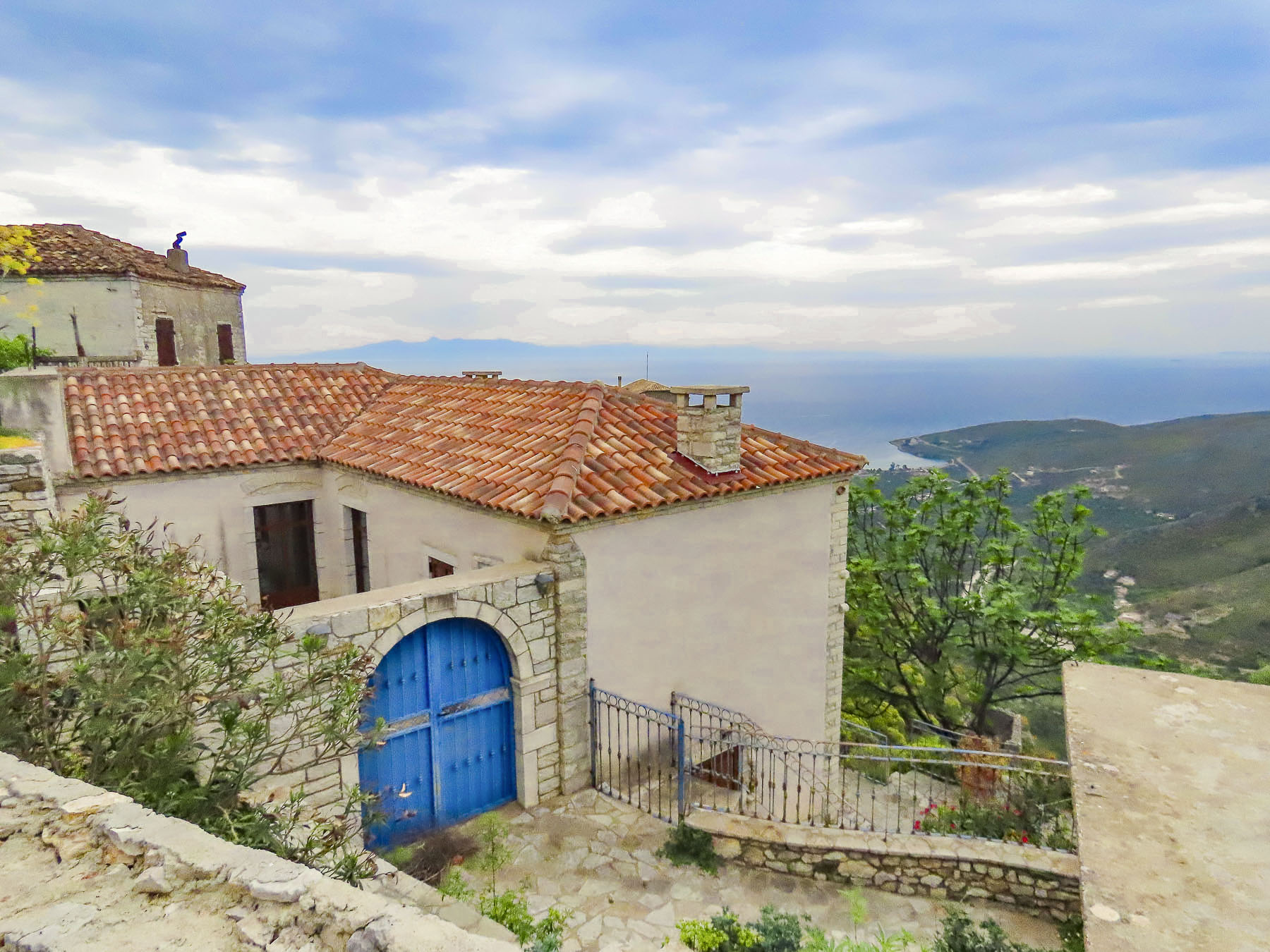
Much of the SH3 highway that connects Lin, through Elbasan, to Durrës traverses a sparsely populated remote region of Albania. Occasionally, in what seemed the middle of nowhere, we passed enterprising farmers who had set up temporary produce stands perched atop the road’s guardrails, their donkeys tied nearby. Sadly, factories abandoned after the fall of communism littered the countryside. In Prrenjas though, the artist Eljan Tanini whimsically covered the towers of a defunct nickel mine with 1,380 charming ladybugs, a symbol of good fortune and hope for the future.

On the outskirts of Elbasan we stopped for a snack at the Elita Grill, a newly opened restaurant. It was a very attractive, contemporary space, which stood as a nice counterbalance to the rustic region we had just driven through. The pastries and coffees were very good, and the prices budget friendly. Across the street, the dome of a larger-than-average Cold War era concrete bunker inched above a mechanics shop.

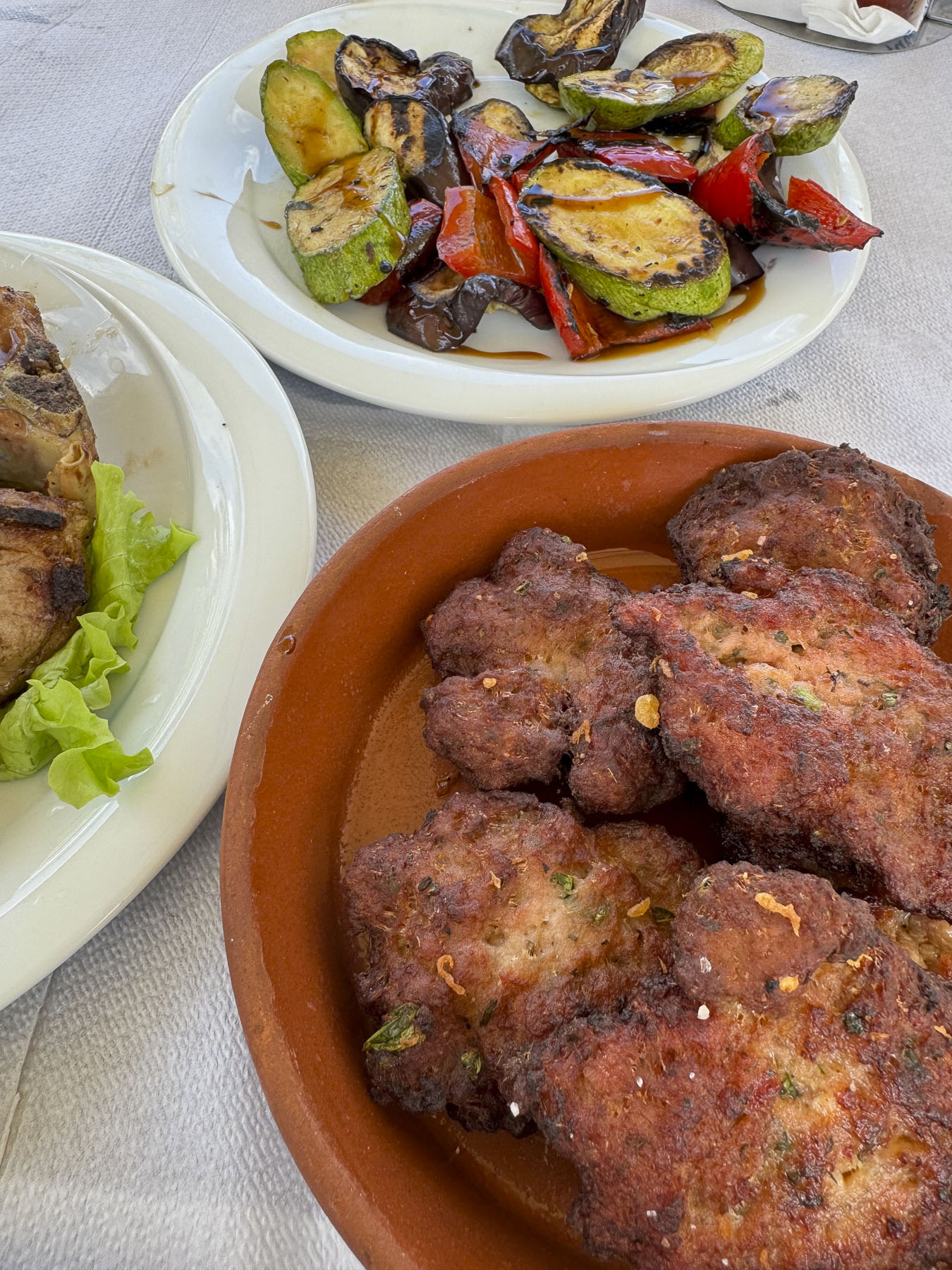
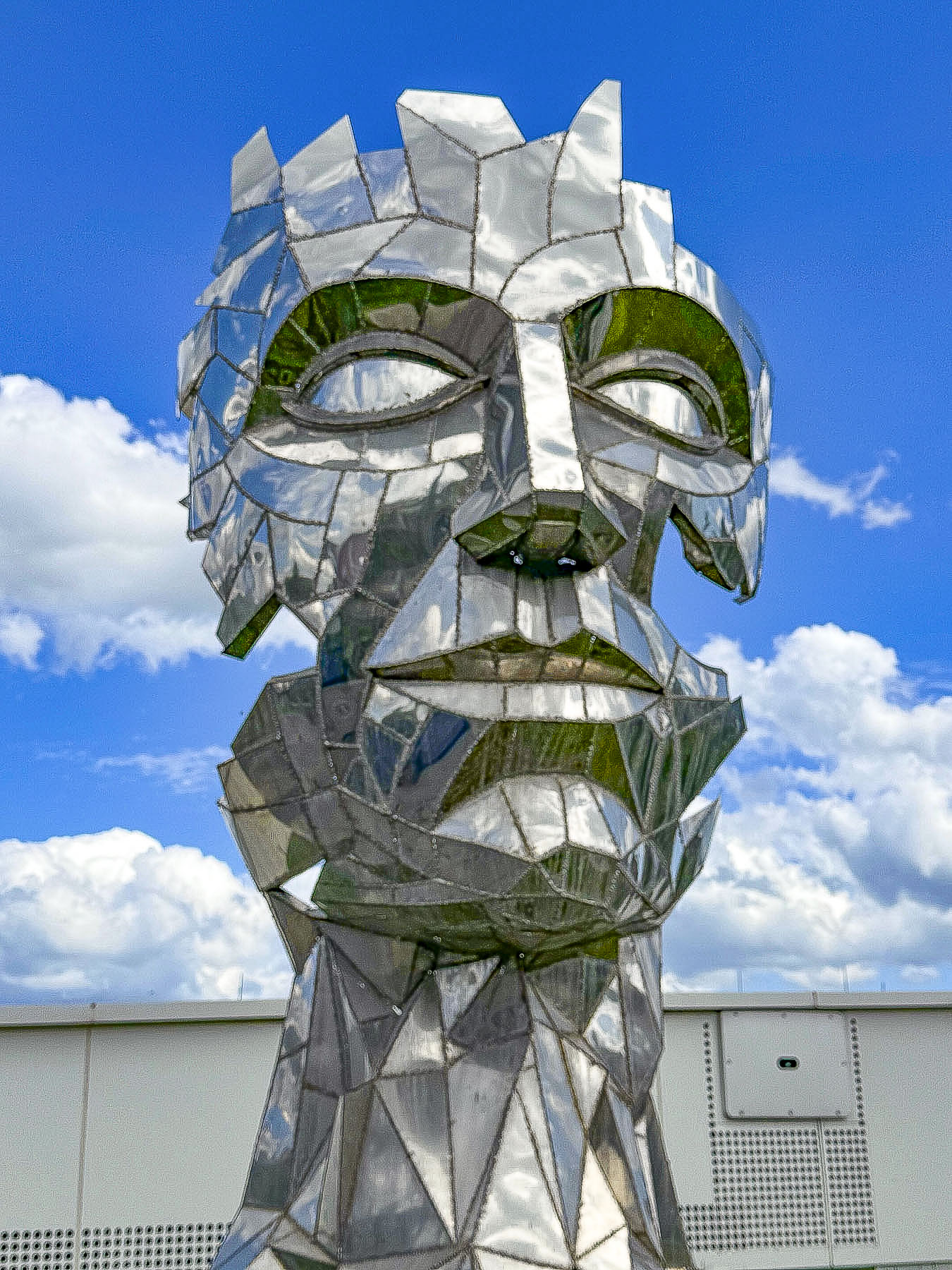
Entering Elbasan we passed the Xhamia e Nazireshës mosque. Across the street from it, a dreamy street mural of a child playfully dancing amidst clouds graced the side of an apartment building. Unfortunately, the traffic was too congested in this spot, and we didn’t stop. An abandoned train track paralleled most of our route from Prrenjas to Elbasan. The rail line once carried nickel ore to the Kombinati Metalurgjik, a huge industrial complex that was built with cooperation from Chairman Mao’s Chinese Communist Party in the 1970’s. The site, easily seen from the highway, now lies in ruins and is a popular spot for amateur industrial archeologists. But at its height it employed 12,000 people and produced the iron, steel and cement for Albania’s 173,000 military bunkers ordered built by the paranoid communist dictator Enver Hoxha, who feared invasion from everyone. We were getting hungry as we reached Tirana. While there were numerous lunch options available, we wanted something with easy on and off access, close to our route. With a quick google search we chose the restaurant Xhafa, which had an outside patio on a hillside that overlooked Tirana. From our experiences across Albania we found that the food was delicious no matter where we stopped. As it was here. Leaving the restaurant, we noticed a large futuristic metallic head in front of an office building next door. We are not sure, but we think the sculpture can be accredited to the Albanian sculptor, Ilirjan Xhixha.

We continued our westerly drive along SH3 until signs for Durrës directed us onto SH2. We wished we had been prepared with our cameras for what emerged next. Across the highway, the most unusual building crowned a small hill. It was seven stories tall, with a neoclassical birthday cake-like façade. On the multi-level corners of the building larger than life statues of the Illyrian Kings stood, as if they were surveying the landscape. Centered atop the colossal building was a mammoth sculpture of the great warrior Skanderbeg, the famous 15th century commander who united Albanians to rebel against the Ottoman Empire. This grand building, with its Las Vegas-type schmaltz, was the Amadeus Palace Hotel. If you enjoy quirky, off-beat things, this might be a place to check out.

We arrived in Durrës late in the afternoon, just in time to see a passenger ferry from Italy enter the harbor, as we drove along the waterfront. Parking with a rental car is always a concern, but we had asked the hotel, Ventus Harbor, where to park. “During the April shoulder season there is plenty of free parking available close to the hotel,” was the response. We are always skeptical of these easy answers, and there was street parking a short distance from the hotel. Though there was an informal parking assistant waving to drivers coming down the street, pointing as to where to park or wait as a cement truck driver readied a delivery to a construction site. We tipped him and hoped for the best. At the reception desk we told them where we left the car, and they said it would be okay, but we could also park on the pier which led to the floating hotel if we preferred. While that option was closer, it required driving through a small, pedestrian-filled shopping mall. The car stayed where we left it and was fine for two days.
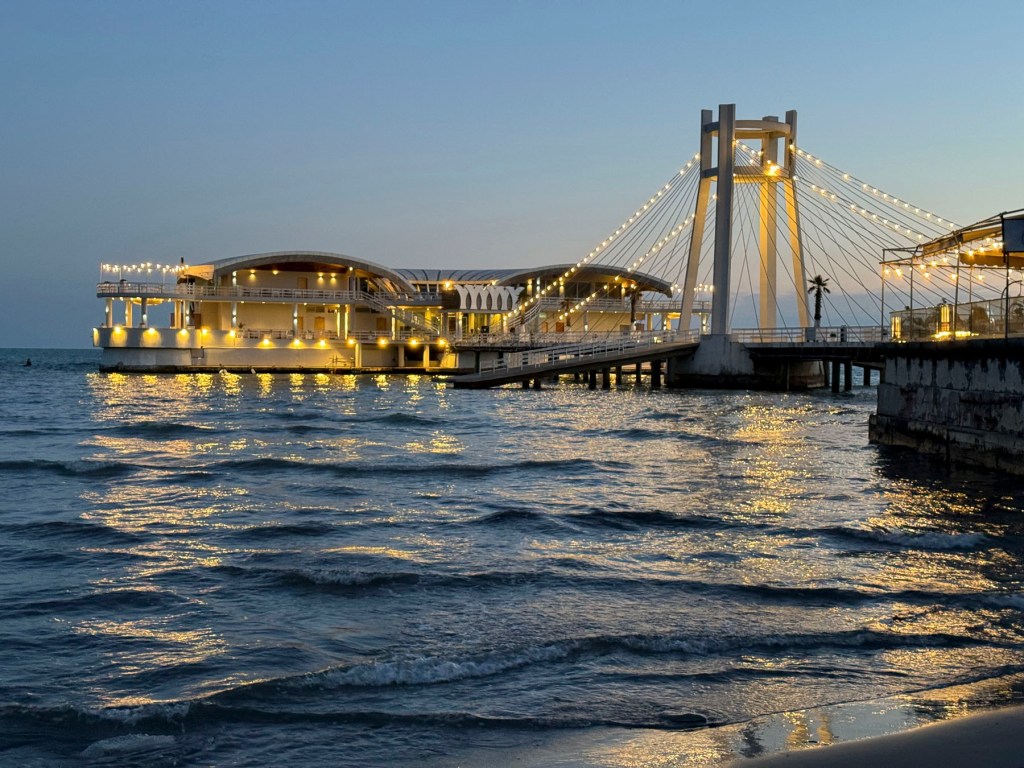
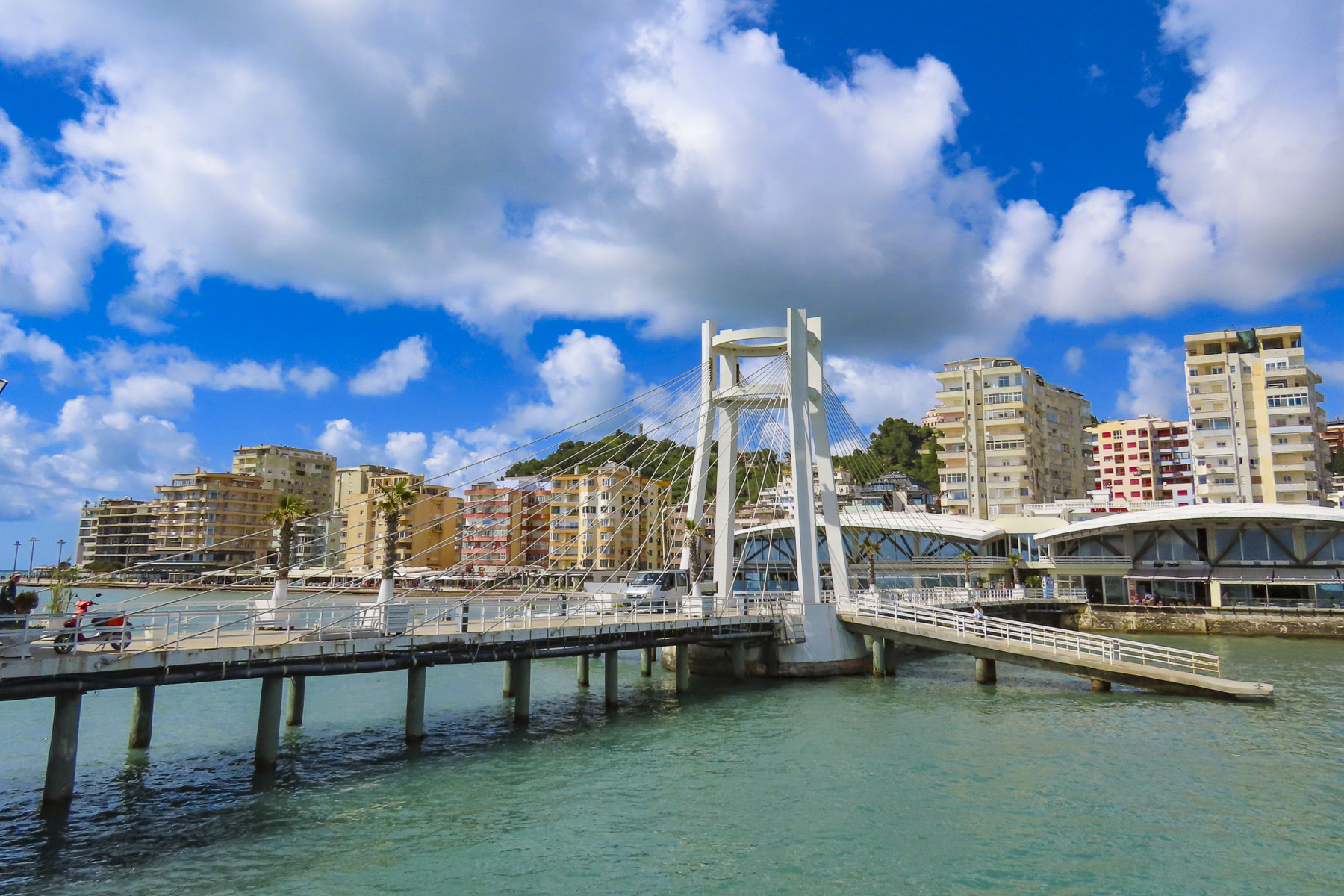
Though the futuristically designed Ventus Harbor appears to float above the Adriatic Sea like a spaceship, it is in fact built securely atop pilings pounded into the seabed and connected to shore via a narrow, 300ft long suspension bridge. The hotel’s refreshing uniqueness, which contrasts so distinctively with the stone castles and villages of rural Albania, was our main reason for choosing to stay there.
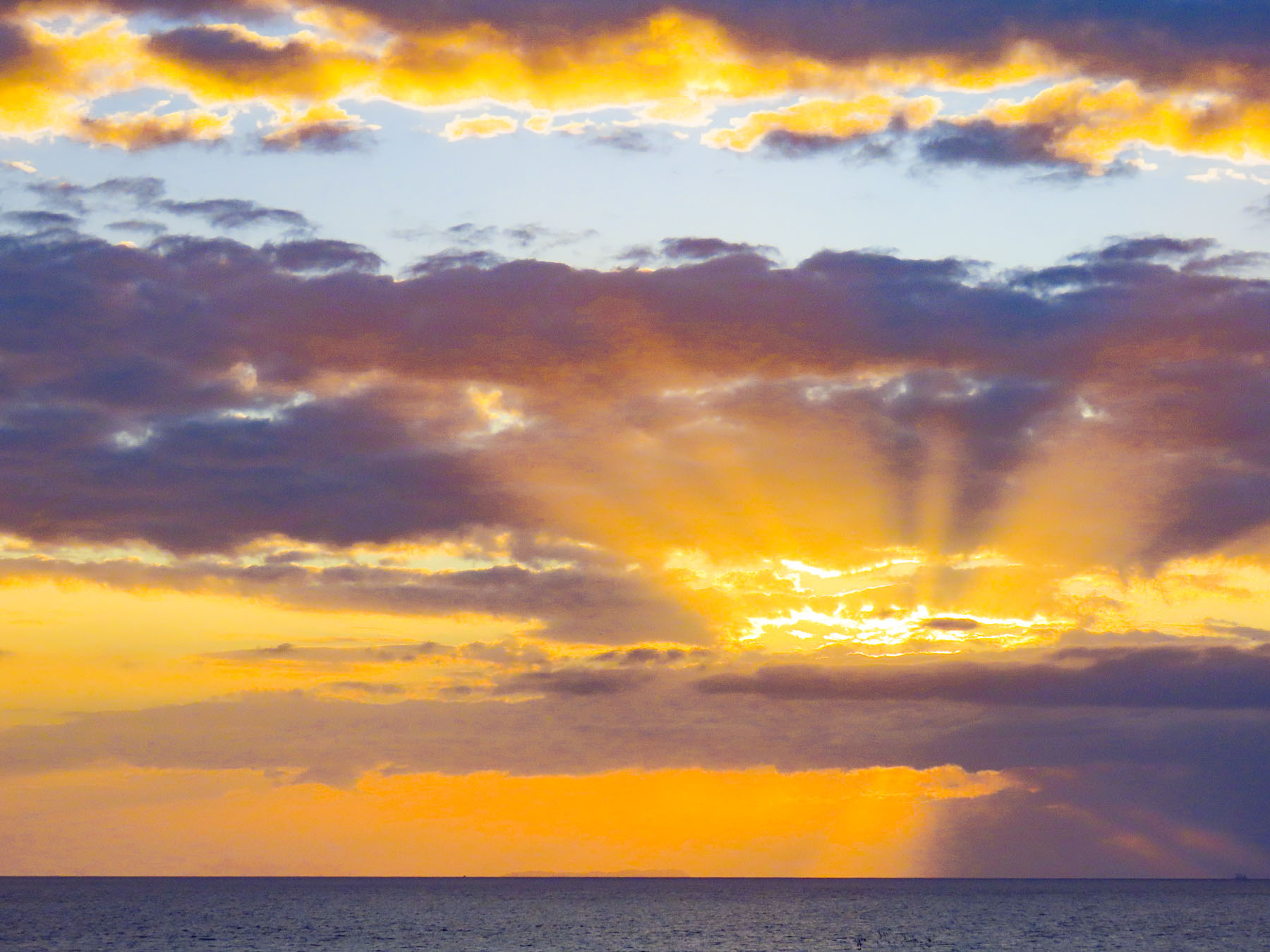
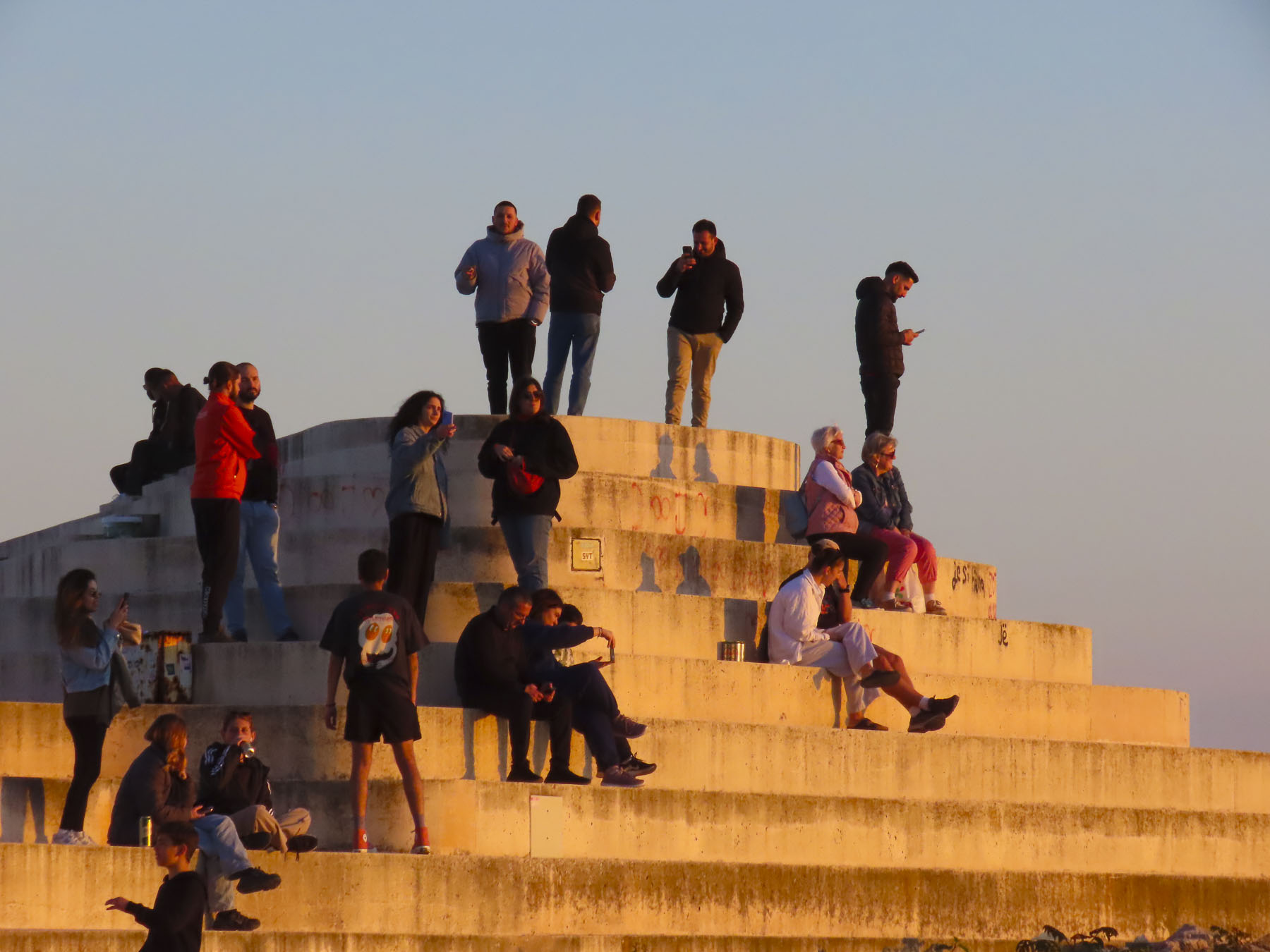
Towards sunset we headed to the promenade along the seafront and were engulfed by families and friends enjoying the xhiro, the Albanian tradition of an evening stroll to relax and socialize. Fishermen cast the last lines of the day into gentle waves as we walked towards the setting sun and the Sfinksi, a small concrete step pyramid where folks gathered to watch the sun dip below the horizon as the sky faded from a fiery orange to the blue of the evening.
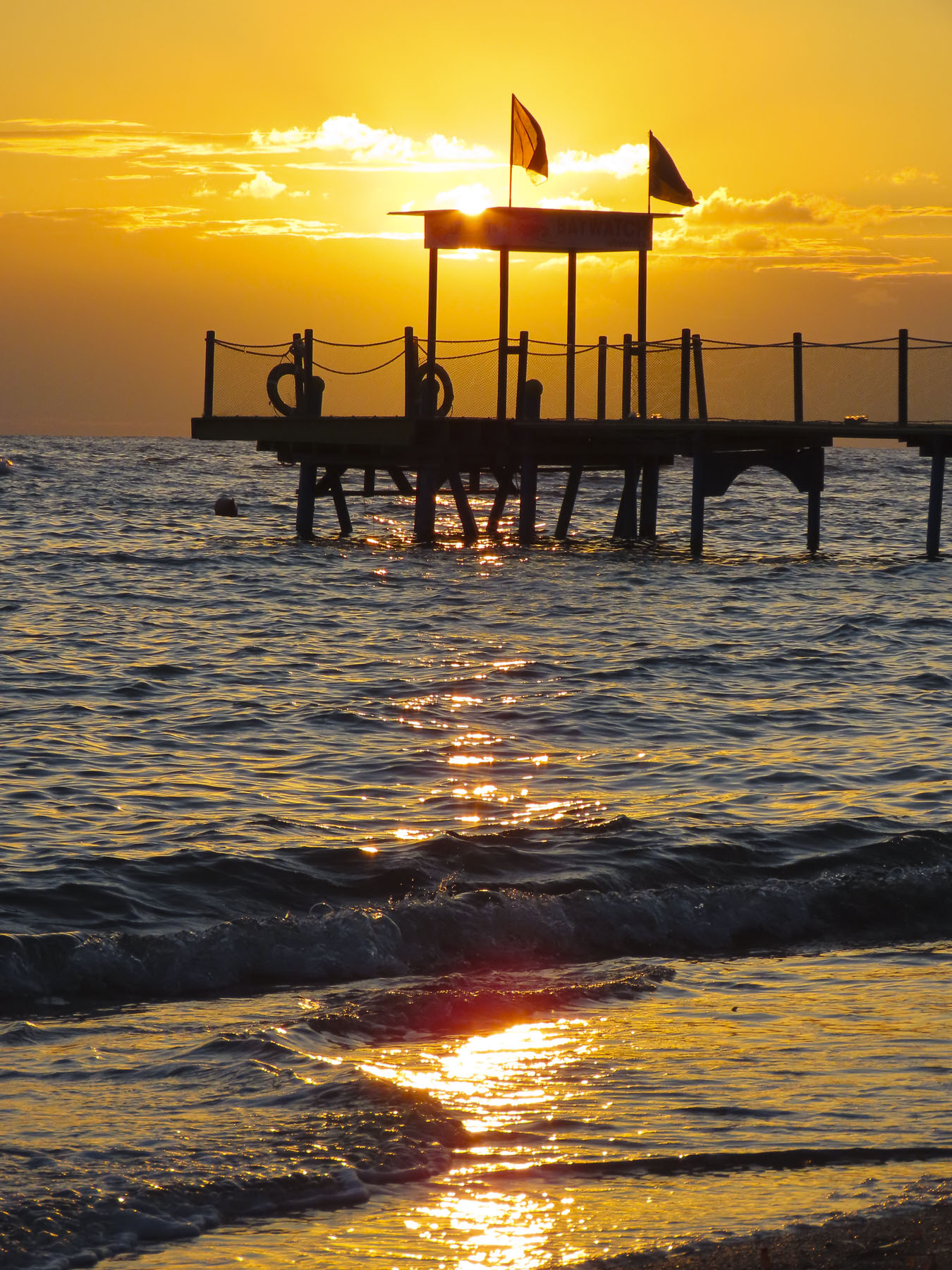
The city’s night skyline slowly awakened with lights, before the stars shined. It was a warm April evening and we slept well with the door to the balcony open, listening to the water lap against the pilings below us.

After breakfast we walked along the promenade into Durrës’ historic old town, which has been centered around the harbor since time immemorial. It has been Albania’s economic engine and vital link connecting Europe to Asia Minor since Greece established a trading colony there in 7th century BC. An Illyrian Kingdom followed in the 4th century BC. But it was the Roman Empire which left the most significant impact. The Romans turned the ancient town, now Illyricum, into a vital trade and military hub with the creation of the Via Egnatia, a cobbled road that crossed 700 miles through the rugged Balkan mountains to Thessaloníki, Greece, and Constantinople. Troops, merchants and religion flowed across its path. The Apostle Paul traveled this route to Durrës in the 1st century, a time when Christians were still thrown to the lions for entertainment in the coliseum across the Roman Empire. Upon the Western Roman Empire’s collapse in 476, the Byzantine Empire filled the void until the tumultuous Dark and Middle Ages brought a succession of invaders to the region. Visigoths, Huns, Bulgarians, Slavs, Normans, and Venetians conquered and fled until the armies of the Ottoman Empire arrived in the 15th century. Austria ruled for a time during WWI. Mussolini’s Fascist troops landed in the port at the start of WWII. The Albanian’s communist partisans defeated their opponents after WWII. In 1967, as if needing to put a sword into the heart of any remaining hope the people of Albania had, the communist dictator, Enver Hoxha, banned all religions, and proclaimed, in the city where the Apostle Paul preached, that Albania is “the first atheistic state in the world.” The city and country has had a turbulent history to say the least.
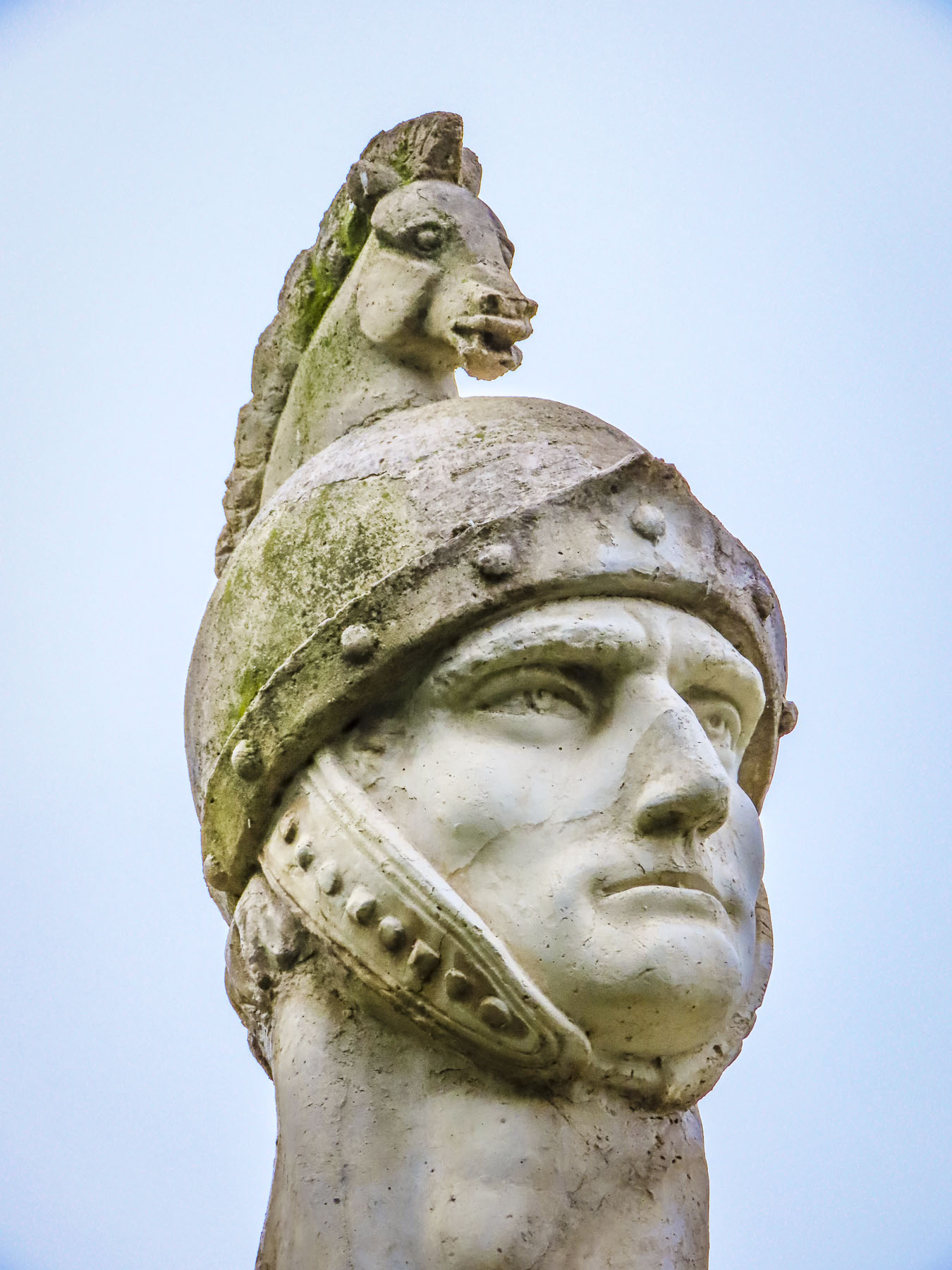
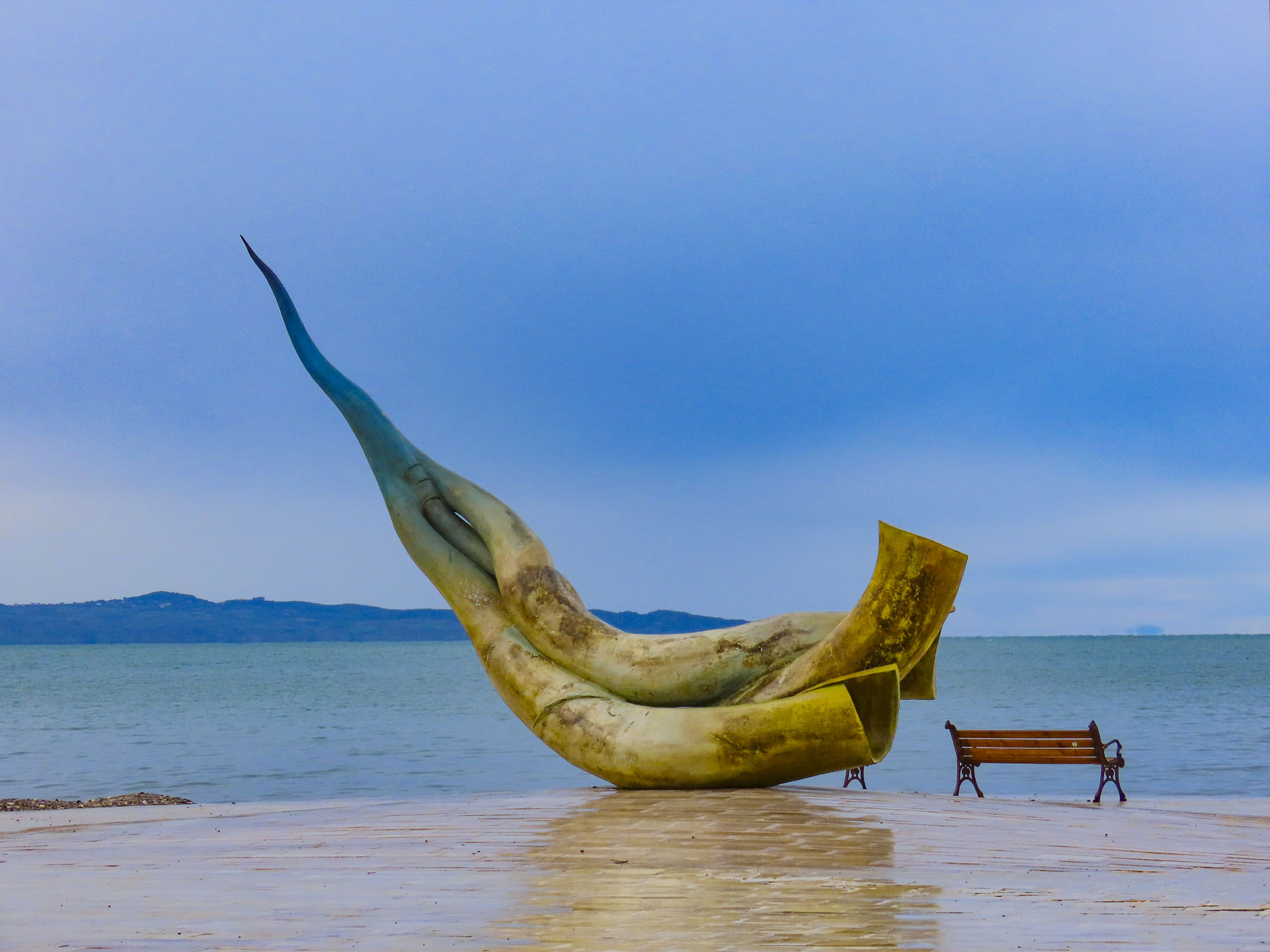
“Walk a little, and the café,” is a philosophy we like to indulge in, and after our stroll along the promenade past statues of gladiators, liberation fighters, and modern art we needed a break to savor a fine Spring day before reaching the ruins of the city’s ancient Roman amphitheater. The amphitheater was the largest in the Balkans and capable of holding 20,000 spectators.

We passed through a gate in the last remaining section of a defensive wall that once encircled the city. The city’s first ramparts, which stood 40ft tall and stretched for three miles around the core of Durrës, were built by the Byzantine Emperor Anastasius I, a native son, in the 5th century AD. The walls were later expanded and improved upon by the Venetians with stones repurposed from the amphitheater after it suffered irreparable damage from a devastating earthquake in 1267. During the Ottoman era homes were built over the site. Surprisingly, they were rediscovered in 1966 by archeologists surveying the area to identify sites that might be of interest to western tourists. Based on the size of its ruins, the amphitheater must have been magnificent. Sadly, the site has not been improved, and sits surrounded by apartment buildings, but it is on the short list of sites for future inclusion in the UNESCO World Heritage program. Oddly, archeology and building concrete bunkers across Albania were two of Enver Hoxha’s passions.
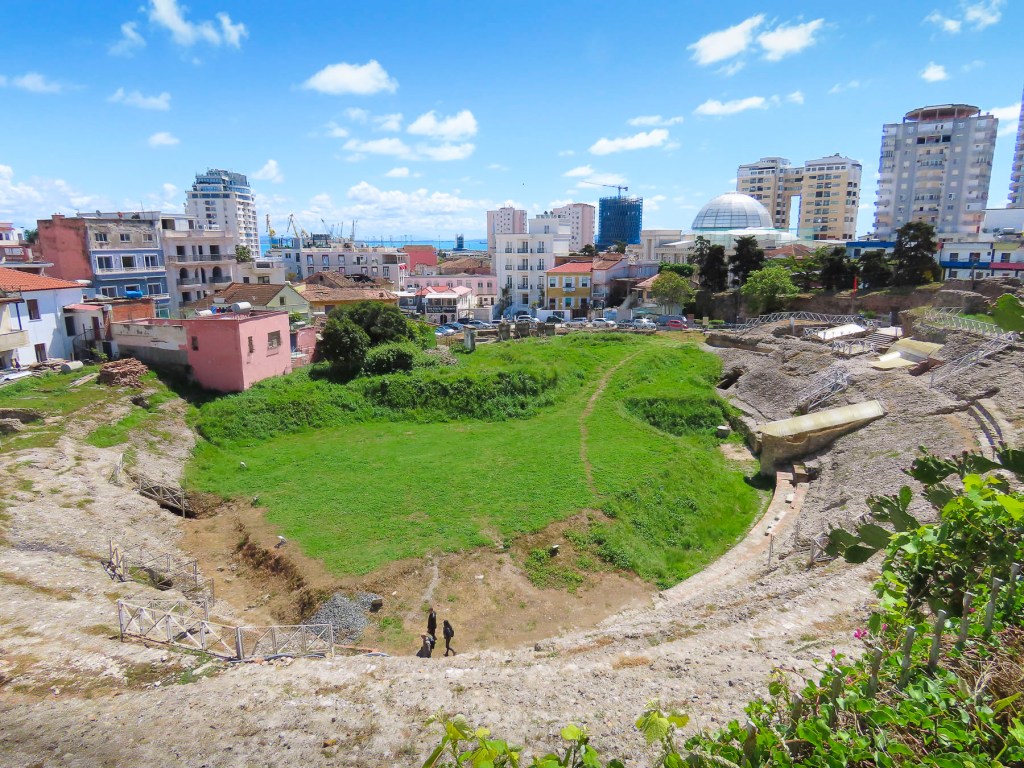
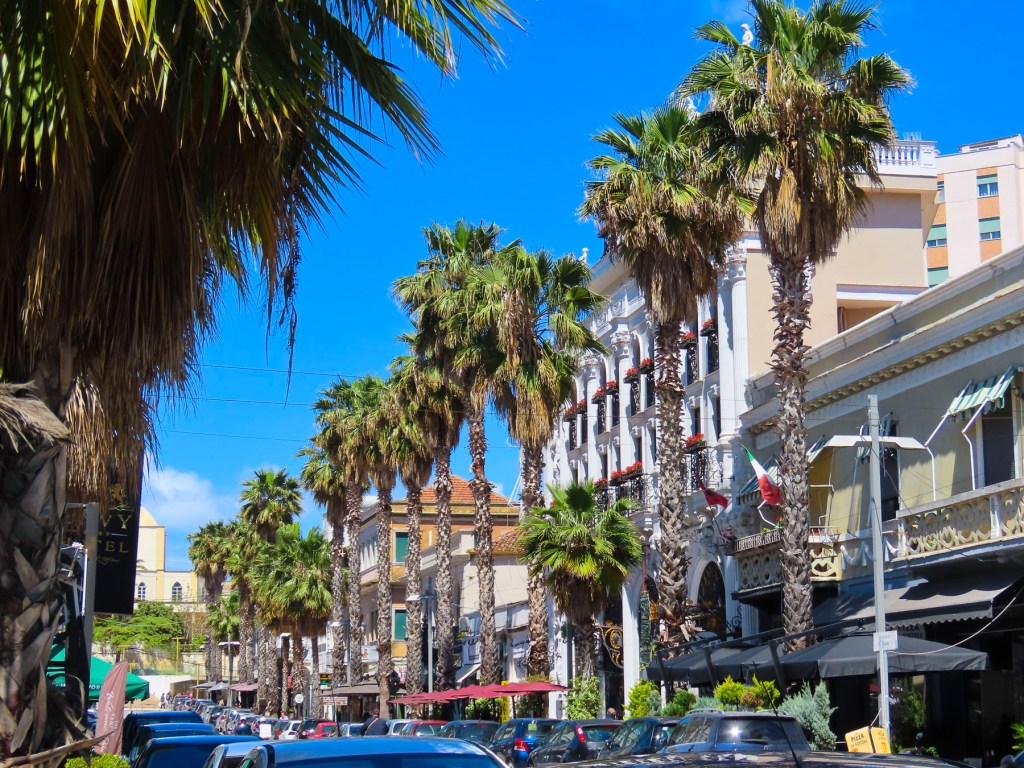
From the amphitheater it was only a short stroll to the Bulevardi Epidamn, Durrës’ prettiest avenue. It’s not a particularly long street, but its pleasant five blocks are lined with stately palm trees, that give it a splendid Costa del Sol vibe.
We followed it until we reached a well-preserved Venetian Tower, that was once part of the defensive wall that encircled the city, across from the harbor. It was an interesting plaza with more statutes commemorating partisan heroes and a gleaming metal sculpture of Redon, the Illyrian god of the sea, which was strikingly similar to the statue in Tirana. This statue, which nicely blends modern technology with the historical past through its use of materials, was also created by the Durrës-born artist, Ilirjan Xhixha.

Before returning to the waterfront, we detoured back towards the amphitheater, where earlier we had passed a tiny window-in-the-wall bakery, confidently named Bule’s Best Byrek in Town, and single handedly run by the formidable Bule. We bought several byrek and enjoyed them as we picnicked along the coast. The cheese and spinach ones were our favorites, and indeed were delicious, and so inexpensive. Go early, as they sell out quickly.

It was still the Spring shoulder season, and many restaurants stayed closed until the warmer weather in May arrives. We had crisscrossed Albania for two weeks by this time and were familiar with prices, but the night before we choose to dine at slightly upscale establishment, for a nice seafood dinner, that received good reviews. While our dinners were tasty, the portions were smaller than what’s typically Albanian. And it was the first time that we felt there was some tourist price-gouging happening.

For our last night in Durrës we decided to go no-frills. After much hemming and hawing we entered the Hepta Grill, a Greek fast-food restaurant, located at the base of the walkway that led to our hotel. The place was lively, the staff was nice, and the food was perfect. We left thinking we could enjoy living in Durrës.

Till next time, Craig & Donna

Albania Road Trip: ​​​Beaches, Icons & Ruins or Saranda, Ksamil & the Albanian Riviera

With his eyes still focused on the newspaper spread across the steering wheel of his Mercedes, the caretaker acknowledged our presence, and his ambivalence to our disturbing his quiet routine, with a slight nod. His left index finger barely raised off the steering wheel confirmed the direction through the gate. He sipped from his thermos before turning to the next page of the Gazeta Panorama.

From Upper Qeparo we had made good time driving south along the Albanian coast, only stopping occasionally, as it was a grey day, to admire the dramatic, refreshingly undeveloped coastline. And by the time we walked around the exterior of the church at Manastiri i Shën Nikollës, Monastery of Saint Nicholas, in Mesopotamia, the caretaker was unlocking the ancient door to the sanctuary.

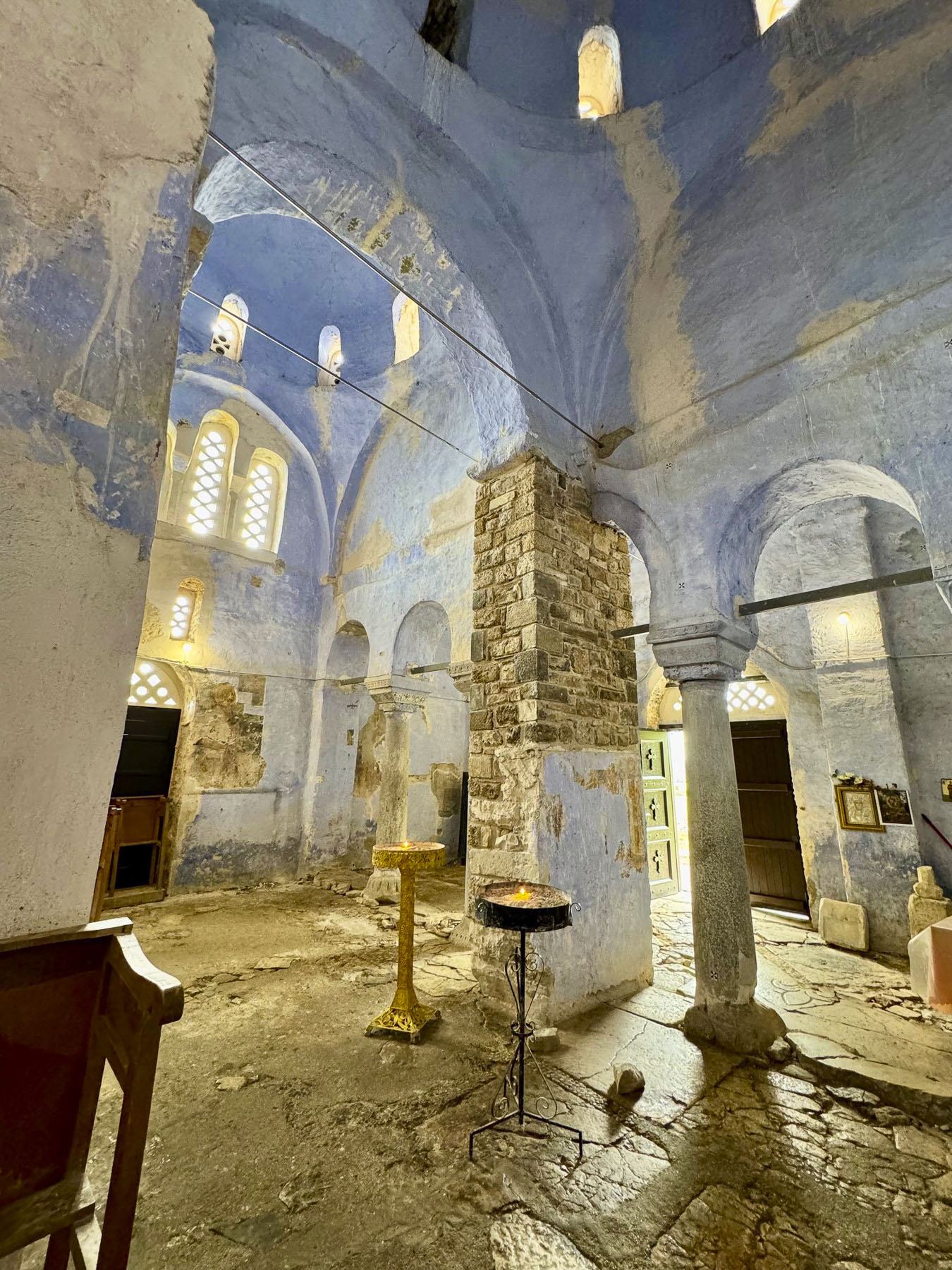
Built in 1224, above a 3rd century BC Greek temple, the church incorporated some of the ancient structure’s still-standing walls in a unique twin apse design, that accommodated Orthodox and Catholic religious services. Light cascading through pigeonhole venting high up on the exterior walls illuminated the interior and gave the wall’s ancient blue paint an ethereal patina. Sadly, the blue paint was applied over original frescoes during the Ottoman era when the church was converted to a mosque and human figures were no longer allowed in religious sites.

After 800 years the church is showing its age with cracks in the walls. A newer cinderblock column stood amid its arches to support the sagging roof. Gold and silver rimmed the icons hung on the carved wooden screen that separated the nave from a remarkable surviving frescoed altar.

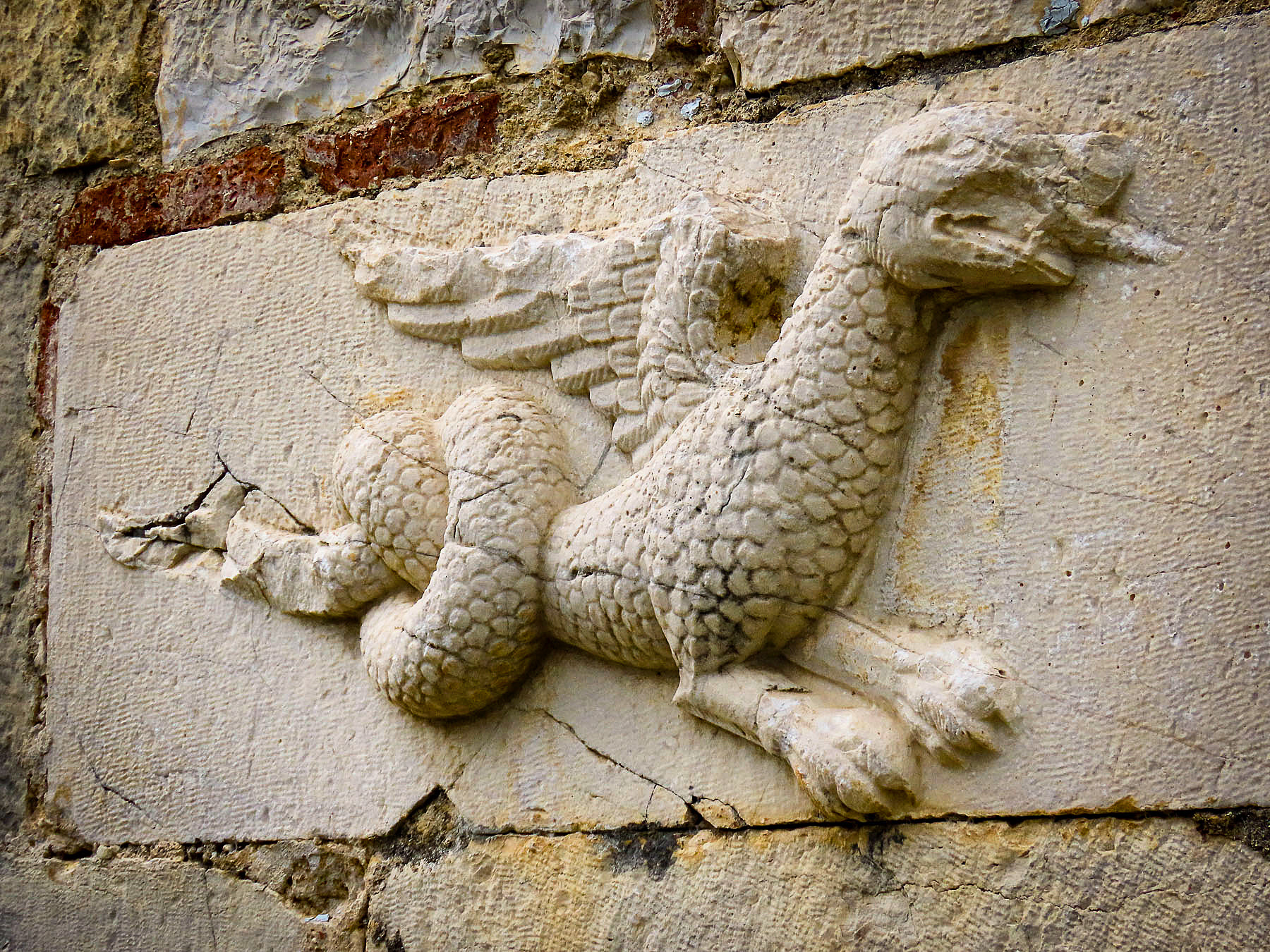
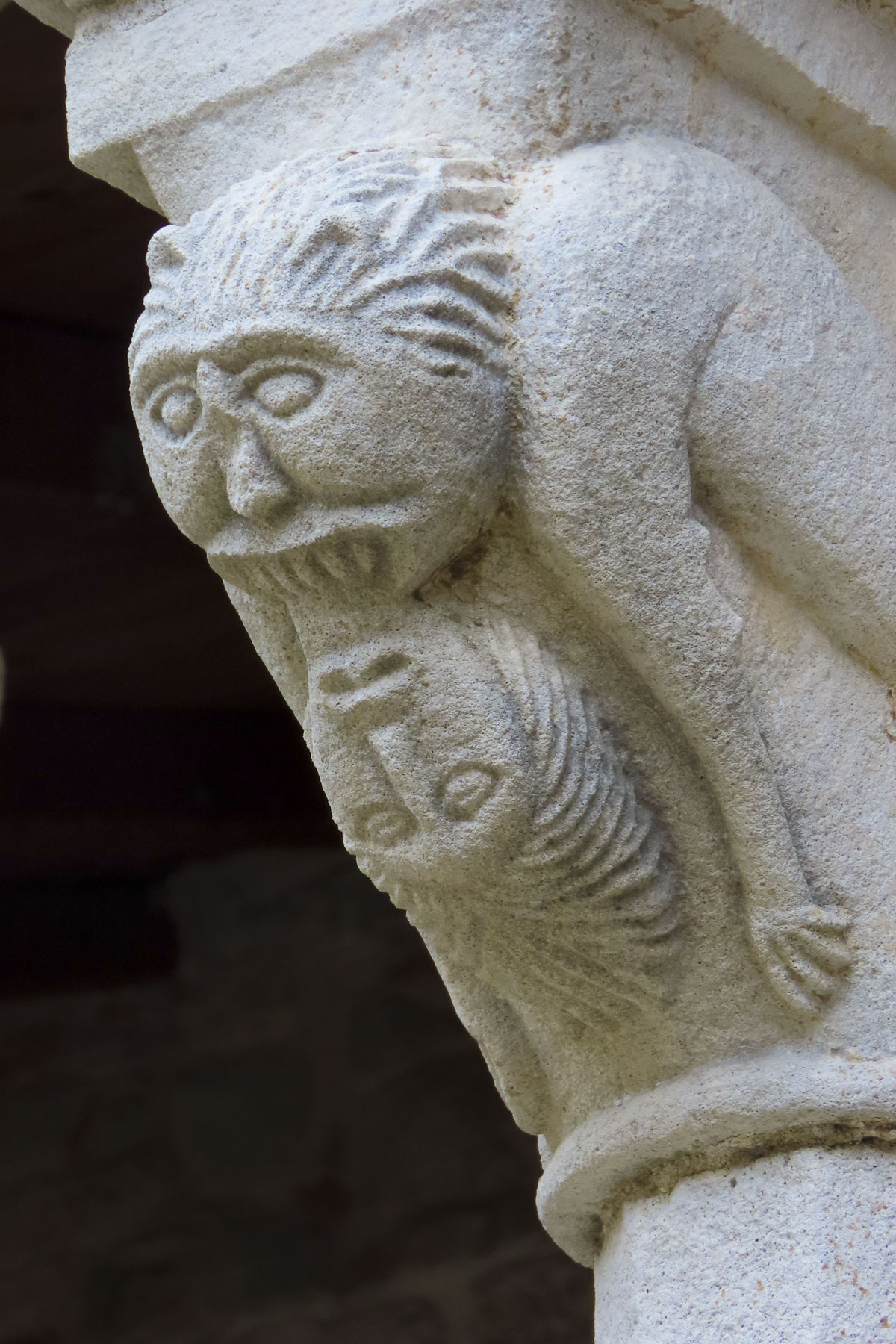
Carved stone relief sculptures on outside walls of serpent dragons with their twisting tails tied in knots, as well as a lion, are attributed to the church’s ancient Greek builders.

The church and nearby foundation ruins of the monks’ living quarters are all that remain from what was once a large monastery, surrounded by a defensive wall with seven towers. Its stones were carted away long ago to Mesopotamia, and other nearby villages. We had planned to visit the Blue Eye, a crystal clear natural spring, only 30 minutes down the road, but a darkening grey sky deterred us.

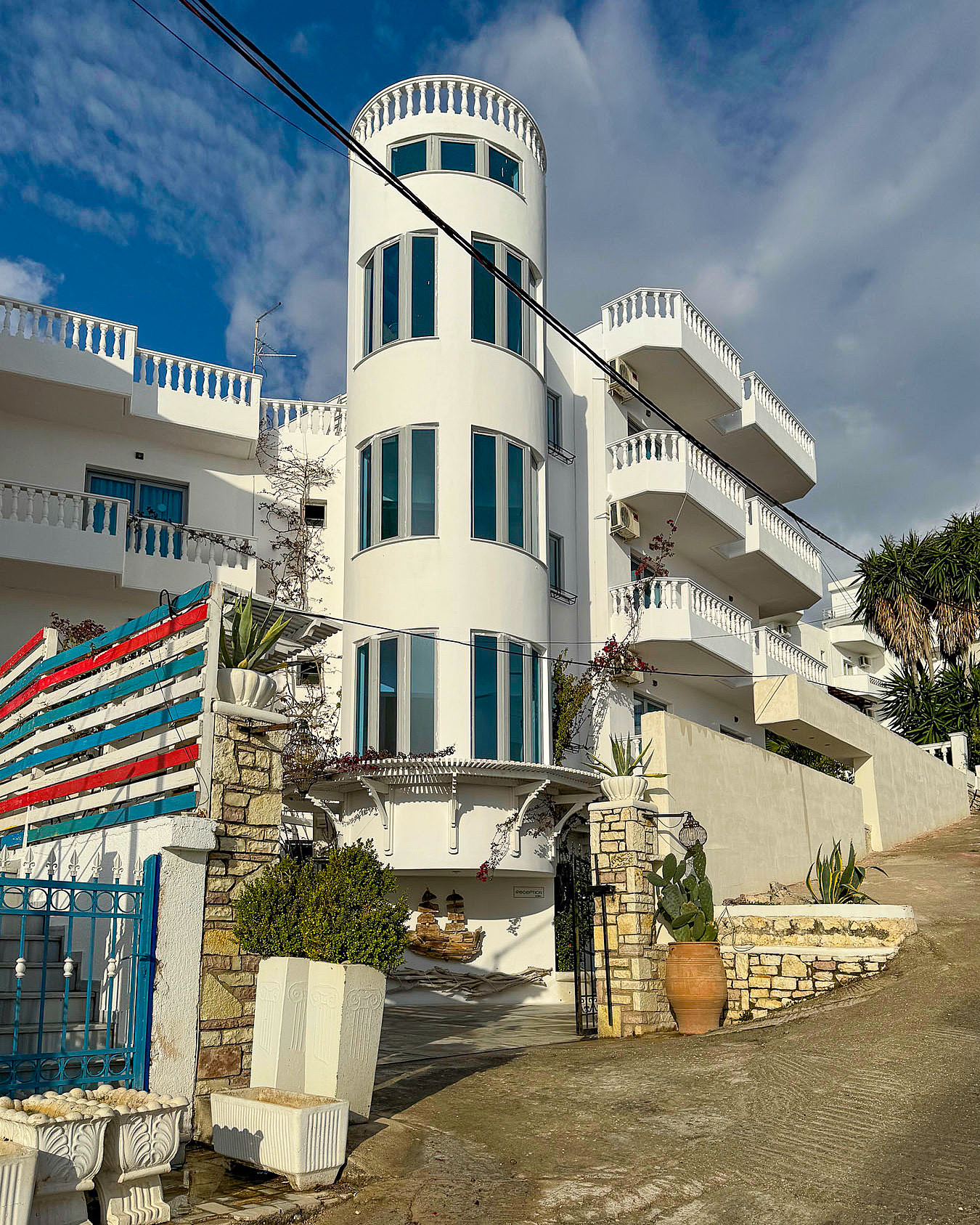
Clearing skies greeted our late afternoon arrival at the Harmony Hotel in Saranda. While the freedom a rental car offers during the day is fantastic, the rental often becomes an expensive ball and chain when considering overnight parking options.Fortunately, during the mid-April shoulder season, the Harmony Hotel had plenty of parking right out front on a street that was as steep as those in San Francisco. Concerned that if the parking brake ever failed the car would roll downhill into the Adriatic, I curbed the wheels, a concern the receptionist thought was unwarranted. The local folks never curb their wheels, and no cars have rolled away to a watery grave. Still. The hotel is run by a wonderfully enthusiastic and friendly extended family that exudes hospitality. The sister-in-law guided us upstairs and down a freshly painted hallway, touching the walls every so often to make sure the paint had dried, to a crisp, all white room, with a balcony and a distant view of Corfu, Greece, on the horizon. It was the perfect romantic spot for two nights. 

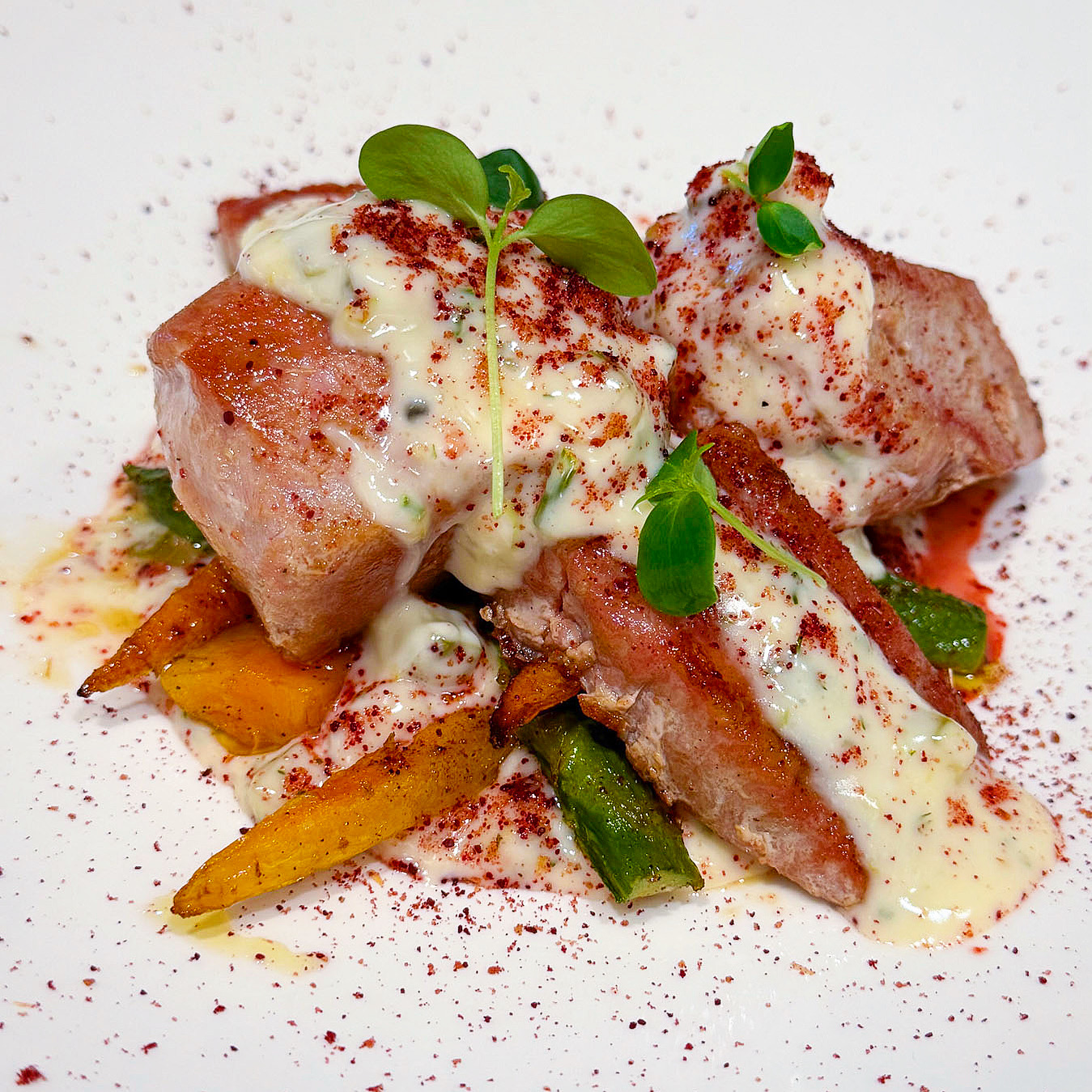
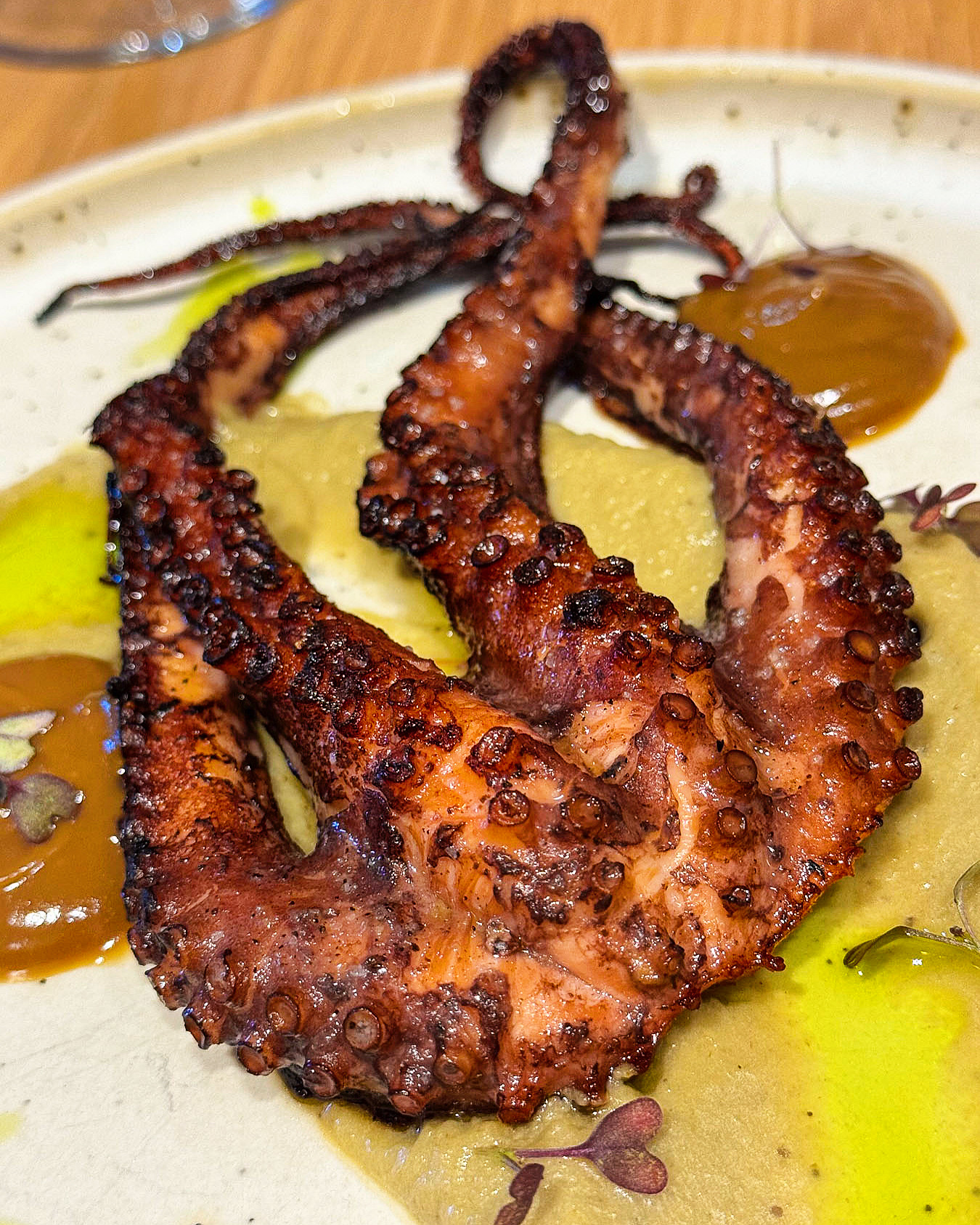
While we prefer touring in the shoulder season to avoid the crowds and heat of the summer months, one of the compromises we often encounter is the closure of many restaurants that would otherwise be open. Fortunately, the hotel’s restaurant was open, and surprisingly it was an unexpected fine dining experience that became one of the highlights of our vacation! We dined there both nights of our stay because the locally sourced seafood and vegetables were extremely flavorful, excellently prepared, totally delicious; Grilled octopus accompanied with a puree of eggplant and pistachio, Albanian Tuna with carrots and asparagus, and local Butrint mussels with fennel were beautifully presented. The restaurant deserves to be a destination in itself. We still remember these dinners as some of the best meals we’ve ever had. If you are staying in Sarande, head to the Harmony Restaurant – you won’t be disappointed! 

After dinner our gregarious host joined us.  And as we sipped raki, or rakija, together he explained this is powerful stuff with an alcohol content of 45-50%, or as high as 80%, especially if its homemade. Since it’s a traditional Albanian drink, many households pride themselves on their home distilled raki. He went on to explain that many countries have a strong distilled spirit: Mexico with its tequila, Italy has grappa, Greece ouzo, and Russia Vodka. But Albania’s raki is legendary and went on to illustrate it with a story. Three groups of friendly mice hailed from different countries. The mice from Mexico drank tequila and happily partied till morning singing Mariachi songs and dancing. The group of Russian mice, imbibing vodka all evening, became sullen, and eventually fell asleep with their heads on the table. But the Albanian mice, deep into their glasses of raki, become feisty and boisterous, and yell, BRING US THE CAT!! They proceed to chase the unlucky feline around the bar all night. There was also some speculation that Albanian raki might have fueled the first Russian space flight.

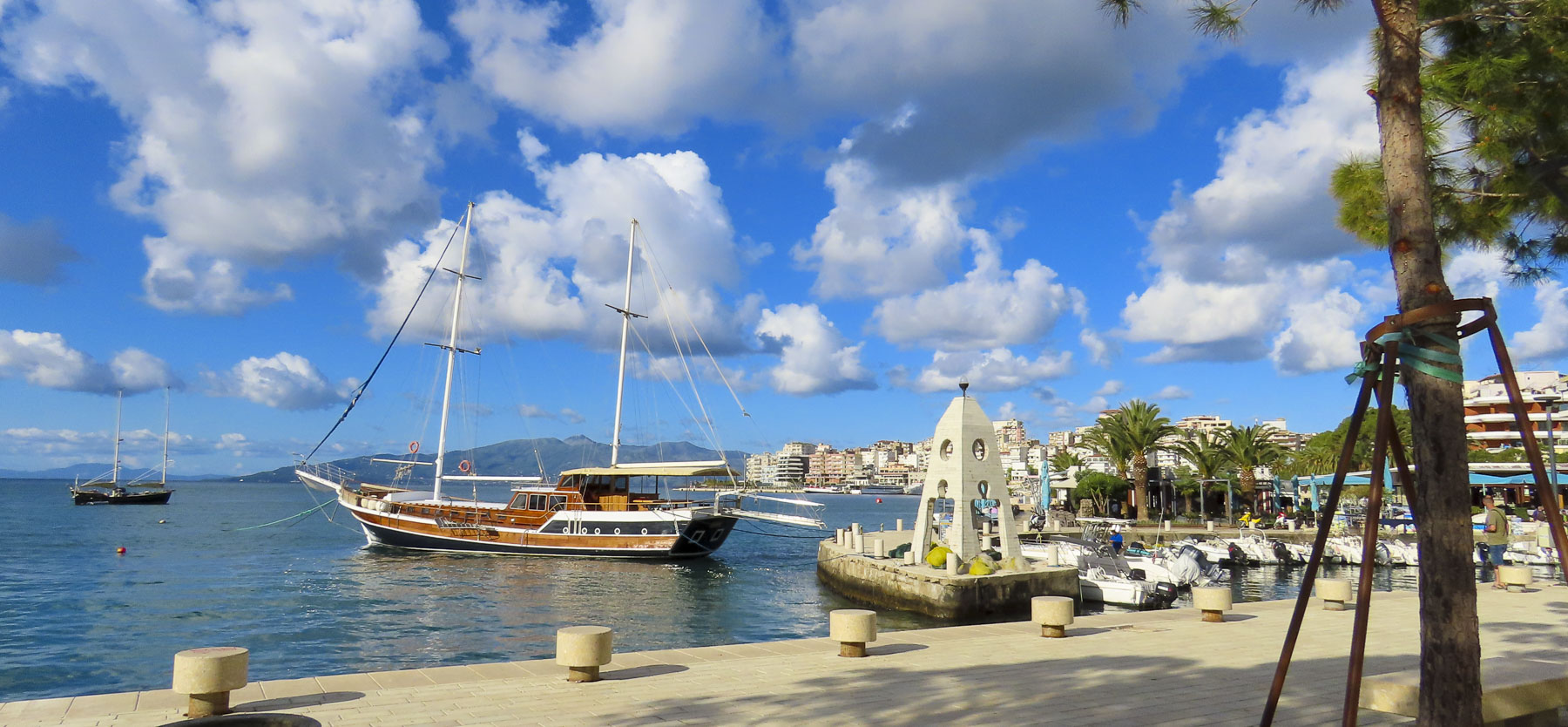
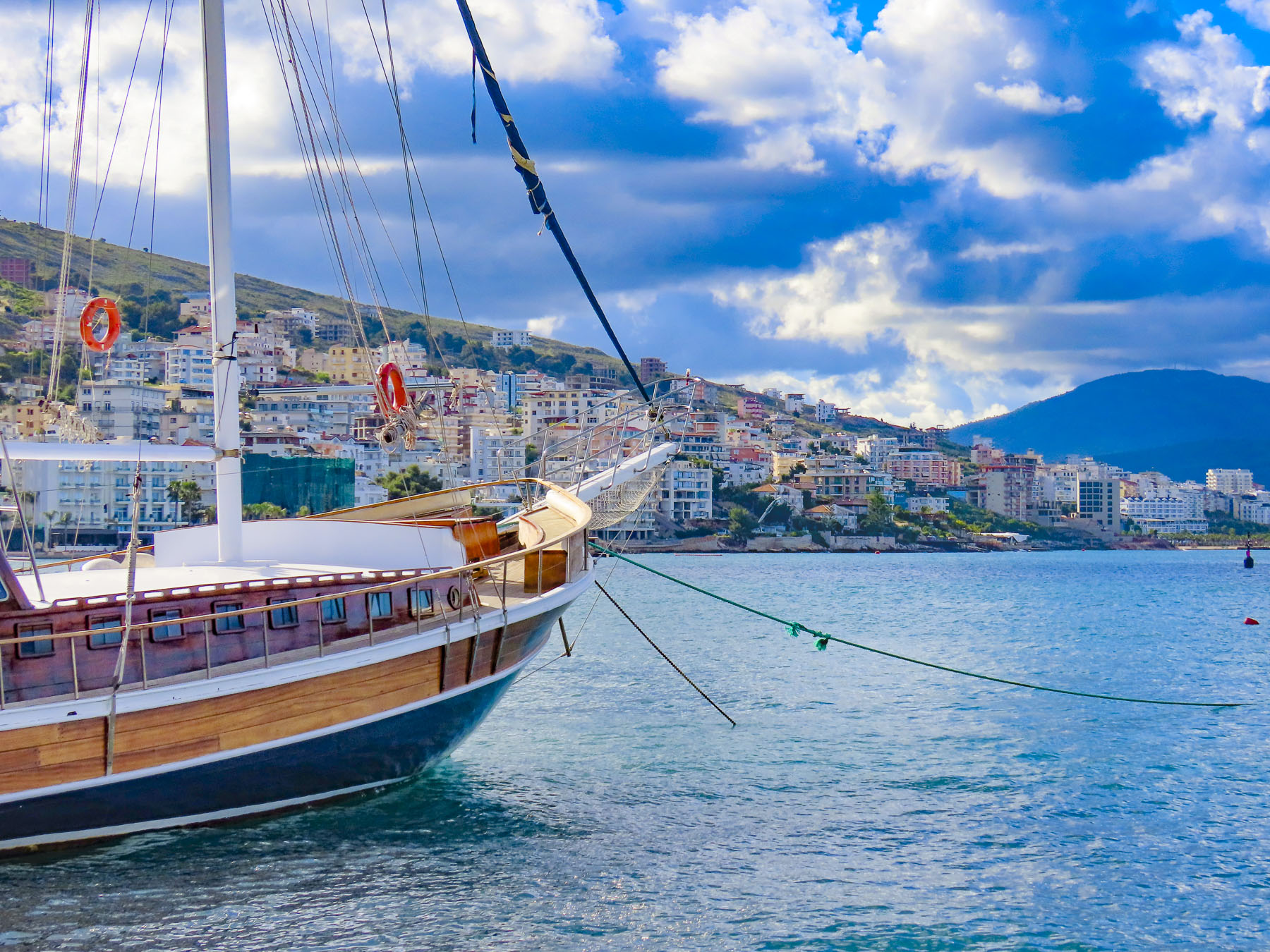
The next morning, we watched from our balcony, as the fast ferry from Corfu sped across the water as it headed to dock along the Saranda promenade. We followed it there after breakfast. The Saranda promenade is along a lovely part of the Albanian Riviera, where the coast bends like the crook of your elbow. The views of the beach, water, mountains and city were spectacular, with the sky speckled with cumulus clouds.

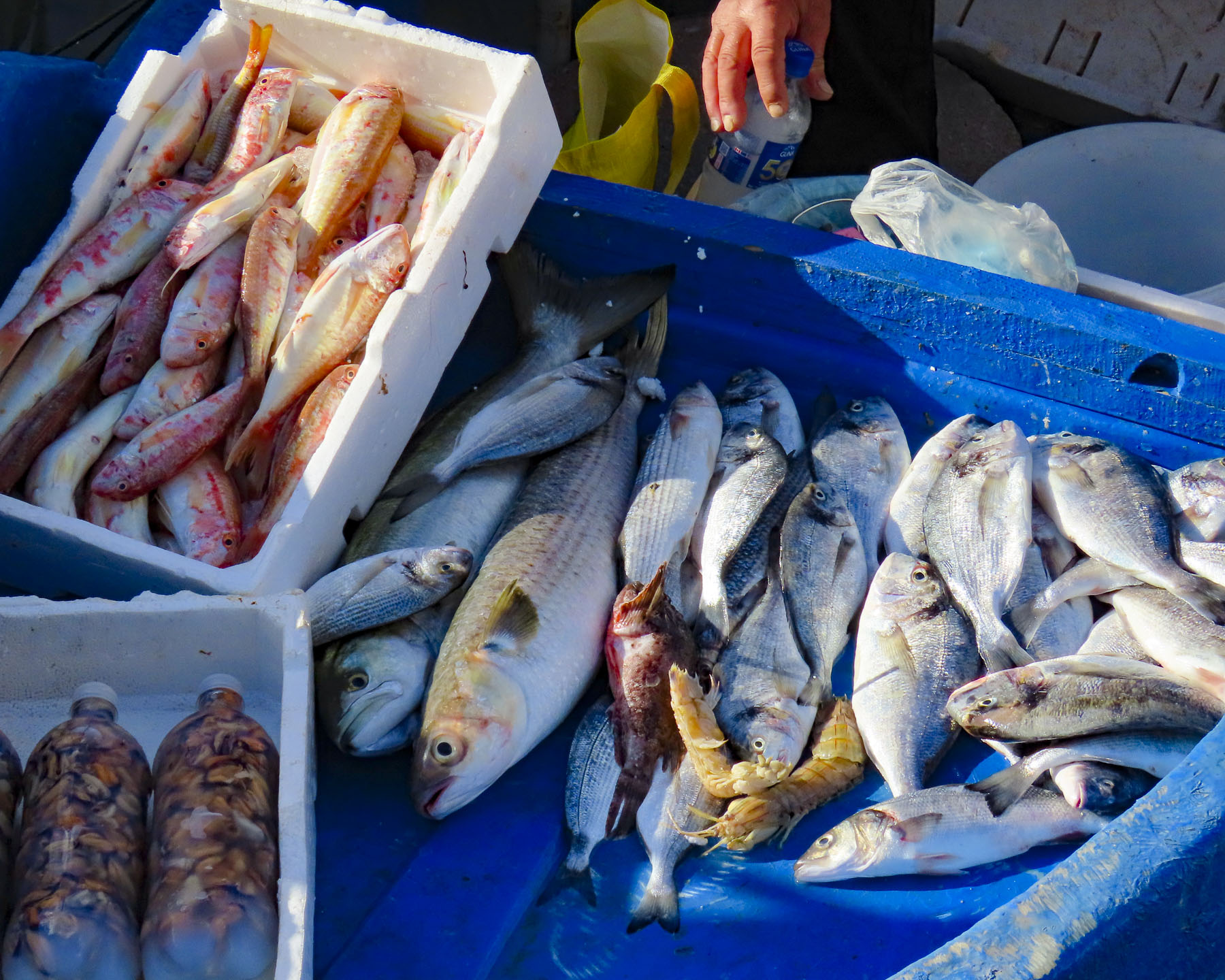
Fishermen sold their morning catch from the bows of their boats tied to the quay. A super-yacht cruised into the harbor and dropped anchor, not far offshore. Our “walk a little, then café,” philosophy brought us to the outdoor tables at Bar Restaurant Limani, on the waterfront.

Later that morning we headed south towards Greece and stopped in the beach town of Ksamil, on the Ionian Sea, to specifically visit that iconic swing set in the ocean, that’s symbolic of the area’s laid-back vibe and tranquility – at least during the day anyway. It’s set in the surf directly across from the Poda Beach Bar if you need a landmark.

The horseshoe shaped beach was a brilliant white, with gentle waves caressing the sand. The water was an inviting aquamarine that faded to shades of cobalt blue as the water deepened. Dipping our toes in the still cold Ionian Sea was as far as we got. In the background the Ksamil Islands separated us from nearby Corfu.  

An easy 15 minute drive from Ksamil, we arrived mid-afternoon to the Butrint National Archaeological Park, a UNESCO site since 1992. Parking was easily found near the entrance, by the small car ferry.

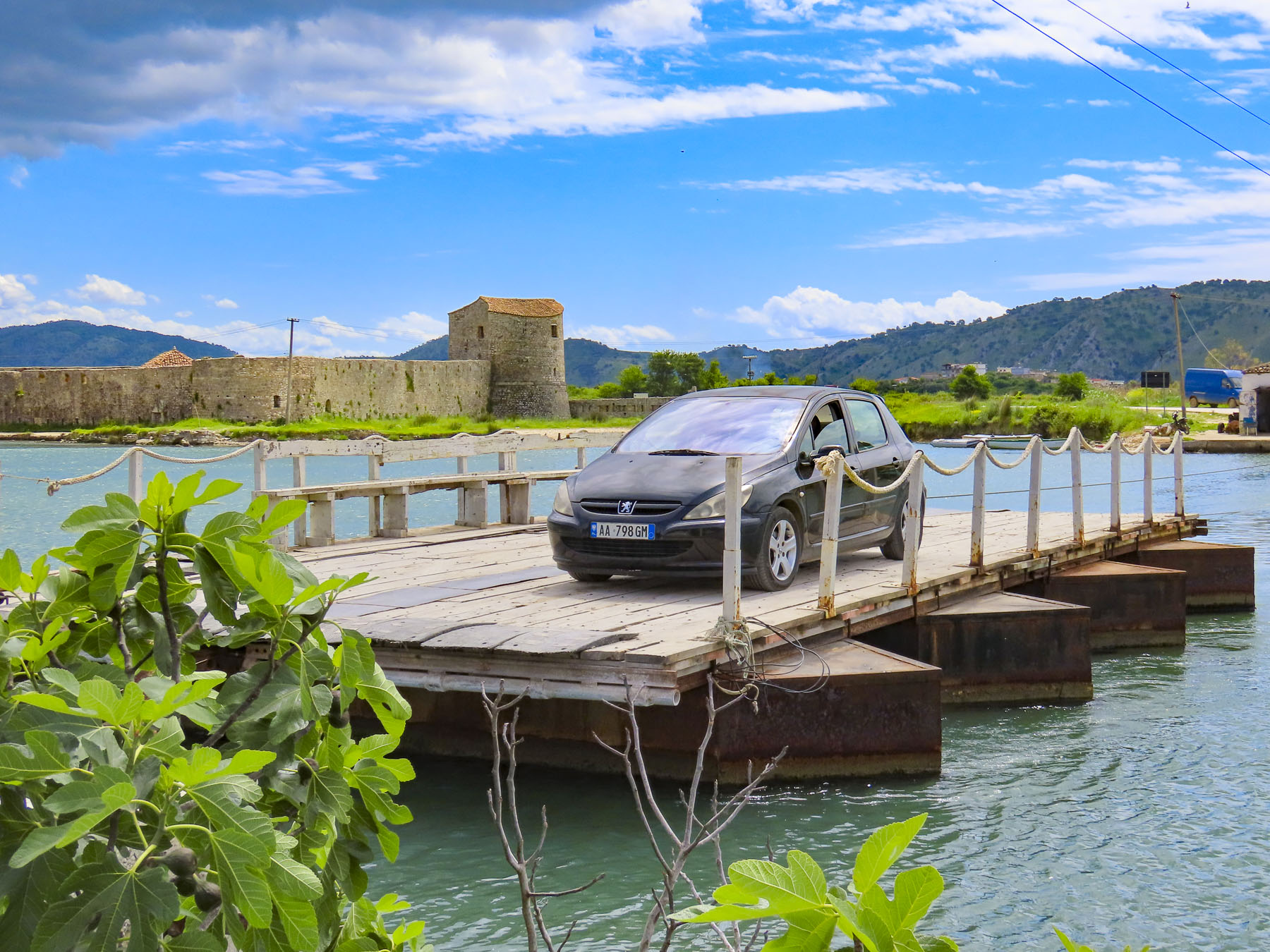
Folks who want to see the old Venetian Castle across the waterway, and those traveling farther south to Greece, need to use the ferry to cross the Vivari Channel, which feeds water to Lake Butrint, really a salt water lagoon. For several millennium it was a vital artery, protected by fortresses on both sides of the waterway, for ancient shipping fleets that sought a safe anchorage in Lake Butrint. 

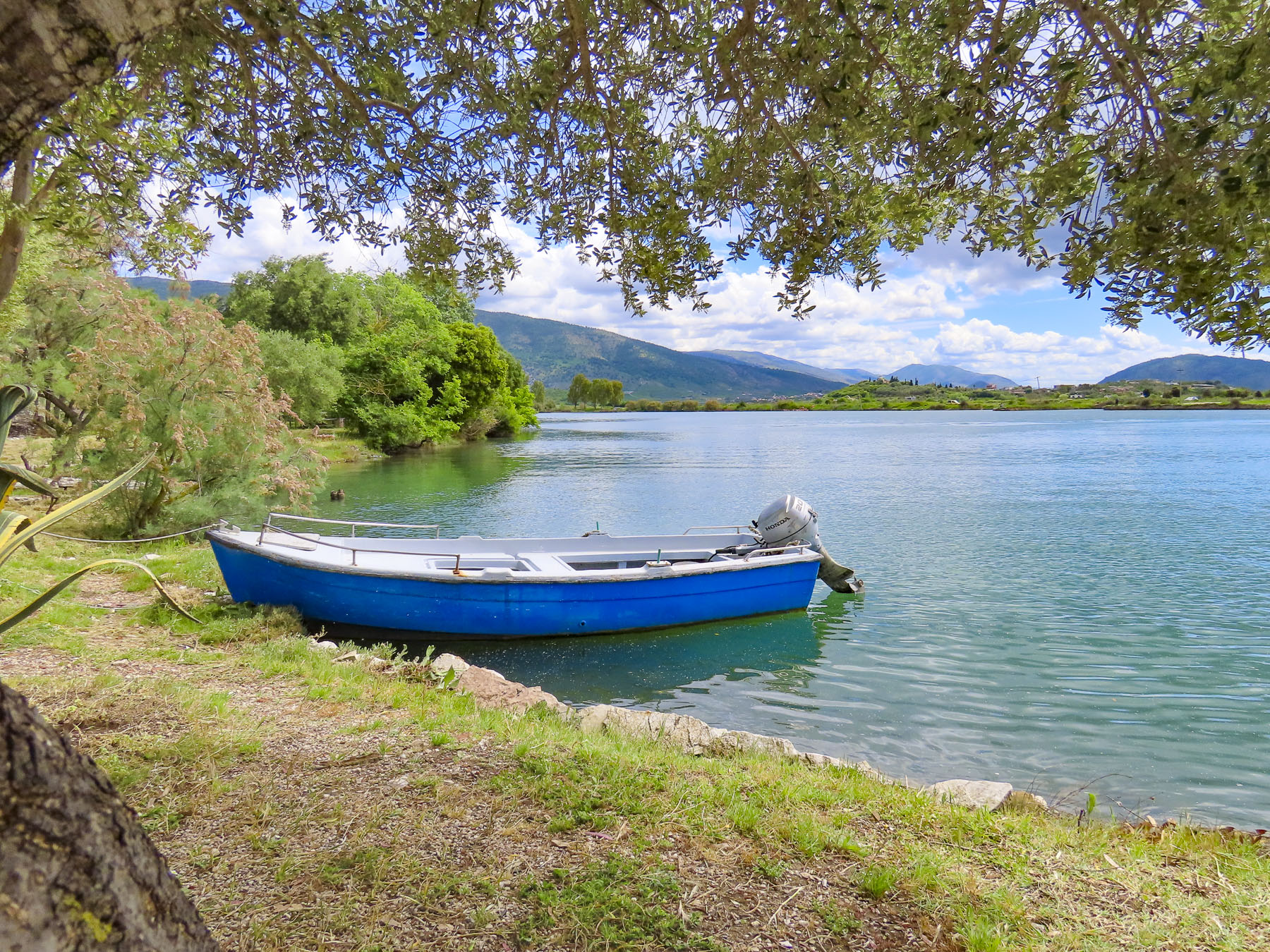
The lake is surrounded by Butrint National Park which was established in the 1990’s to protect the wetland area that is internationally recognized as a supreme habitat for many different bird and fish species. Today the Vivari Channel’s nutrient rich waters continue to support many mussel farms that raise the unique Blue Butrint mollusks. Favored for their high nutrient content, mussels were an important food stock during the lean communist years. A great place to try them is nearby at the Mussel House, run by entrepreneurial Husein Mane and his family. Proudly it’s recognized as the 19th free enterprise business registered in Albania after the fall of communism.

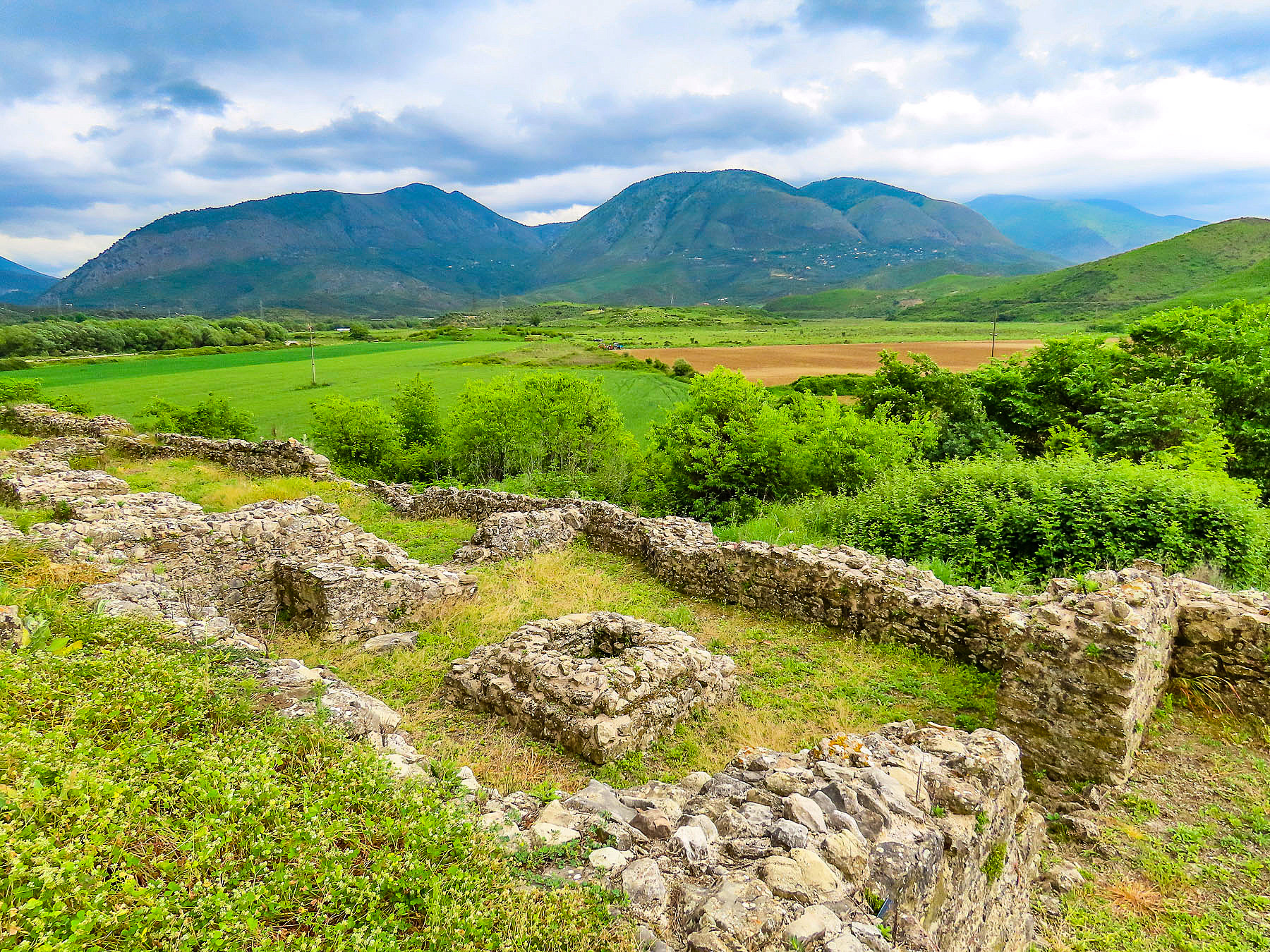
Located on a bulbous peninsula, almost completely surrounded by water, this small defensive hill has been trodden upon since the bronze and iron ages. Later an Illyrian tribe left their detritus. it’s believed the first substantial improvements were made when Greek traders from nearby Corfu established a colony on the hill and built an acropolis in the 8th BC and called it Buthrotum.

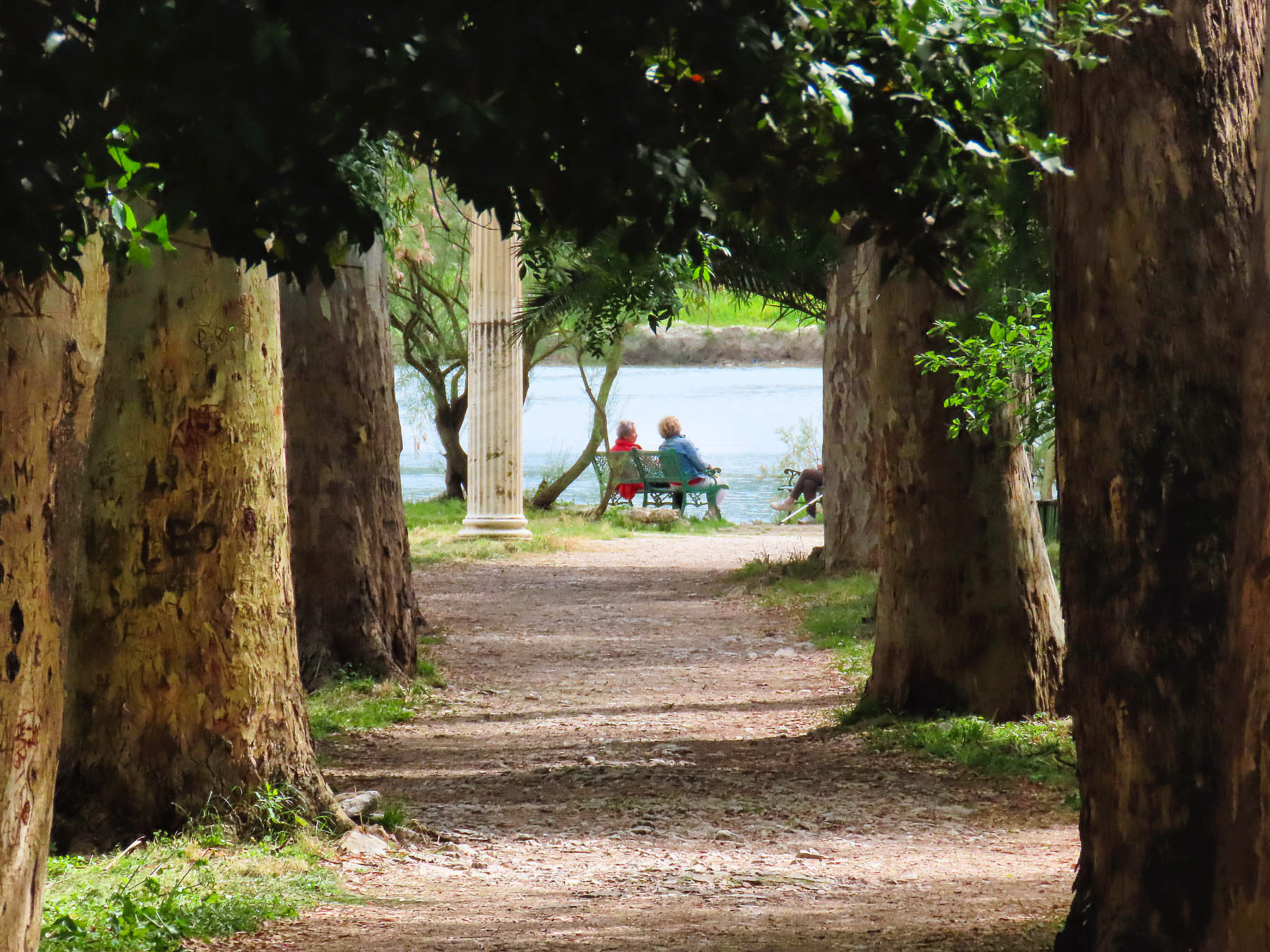
The ancient ruins are spread across a beautiful park-like setting, with dirt paths following the riverfront, and winding between the monuments, under tall shade trees. It’s the perfect locale to release your latent Indiana Jones or Laura Croft. It’s obvious from the wonderful aesthetics of the landscape why a succession of civilizations have settled the land, and why the UNESCO literature describes the site “as a microcosm of Mediterranean history.”

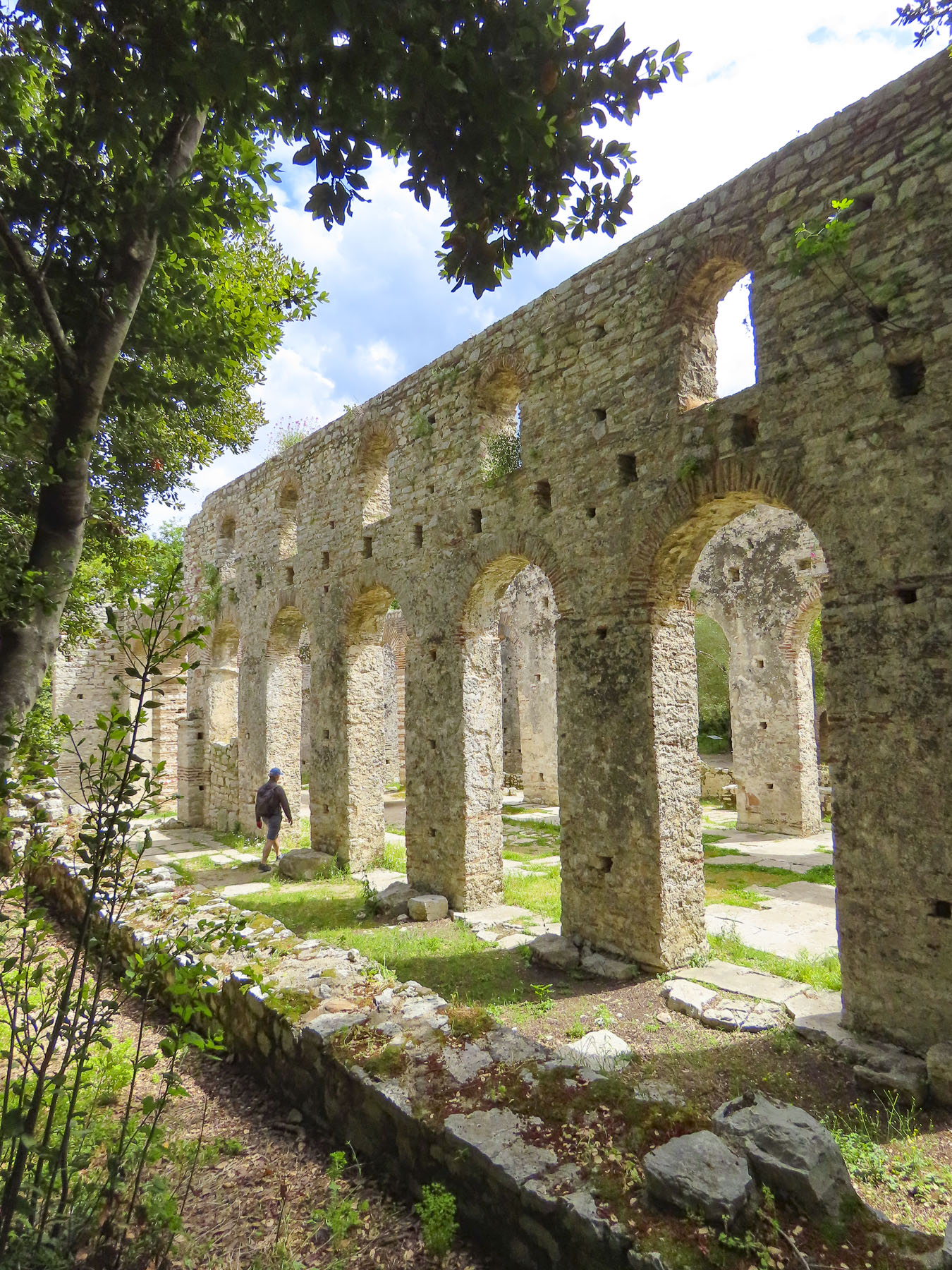
After the Greeks, the Julius Caesar arrived in 48 BC and called the city Bouthrotos. I can imagine Caesar atop the hill standing next to Pliny the Architect and asking, “Pliny, what can you do with all of this Greek rubble?” Emperor Augustus renamed the city Colonia Augusta Buthrotumhe. The city thrived under several centuries of Roman rule, its coffers full from trade with the Western Roman and Byzantine Empires. It was during this period of prosperity that a bridge and aqueduct across the Vivari Channel were built. The aqueduct, a testament to Roman engineering, spanned the waterway and continued to a fresh water, mountain spring four miles to the east. Many substantial buildings include a Forum, Roman Baths with heated water, Capitolium, a Gymnasium complex, and a circular Baptistery with a splendid mosaic floor. The floor is covered with sand to preserve it, but it is occasionally revealed for several days each year. Temples dedicated to mythological gods were eventually replaced with a Christian Basilica. Villas of the wealthy dotted the lake shore.

Charles I of Anjou of the Angevin dynasty, aka the King of Sicily, who later named himself King of Albania too, wrestled control of Bouthrotos away from the Byzantines in 1292. The Angevin dynasty ruled the city for nearly 100 years before the Republic of Venice said, “let’s make a deal,” and purchased the city in 1386. This strategic decision gave the Venetians nearly total control of the Adriatic Sea. They reinforced their intent with the construction of a Castle, now the archeological museum, atop the ancient Greek acropolis, at the highest point of the hill.  Defensive walls and towers along the shoreline, and a fort across the Vivari waterway were built to help protect their new possession, Butrinto, and harbor.  Three hundred years of near continuous conflict followed with the Ottoman empire as it fought to spread its reach across eastern Europe, Greece and the Balkans. The city finally fell to the notorious Ottoman Albanian warlord Ali Pasha Tepelena in 1799, but was soon abandoned as the marshes around the peninsula were infested with malaria carrying mosquitos. Shepherds and their flocks wandered amid the ruins until the first archeological excavations began in 1928. The dig was funded by Italy’s Fascist government headed by Benito Mussolini, with the aim to extend Italy’s historic ties to the region, and support a case for Italy’s bid to annex Albania. 

We enjoyed a wonderful afternoon exploring the ruins, and after also visiting the Apollonia Archaeological Park, we must say Butrint is a larger, and far more interesting site, w hich two thousand years ago the Roman writer Virgil described as being as beautiful as the ancient city of Troy, in his poem, Aeneid.

Back in Saranda, we watched the sunset as the ferry from Italy sailed across waters once rowed by the Greek, Roman, and Venetian galleys. We packed. The next morning, we headed to Gjirokaster.

Till next time, Craig & Donna

Albania Road Trip:   Apollonia & Upper Qeparo – A Journey Back Through Centuries

We slowed to let a shepherd guide his flock across the road to Apollonia. An hour earlier the sky was brighter as we left Berat. Our intention for the day was to visit the Archaeological Museum of Apollonia before heading to Vlora, on the coast, and then continuing south to the Llogara Pass, for epic views of the Adriatic Coast before reaching our accommodation in Upper Qeparo, a semi-abandoned, old Albanian village, for the night. But the deepening grey sky was concerning. The sheep were now grazing on tufts of grass, growing in between parked cars, in the dirt parking lot at the foot of the hill below the archaeological park. A short uphill walk got our circulation going and brightened our mood.  A large group from a bus tour followed their pennant waving guide uphill, towards ruins still hidden from view.

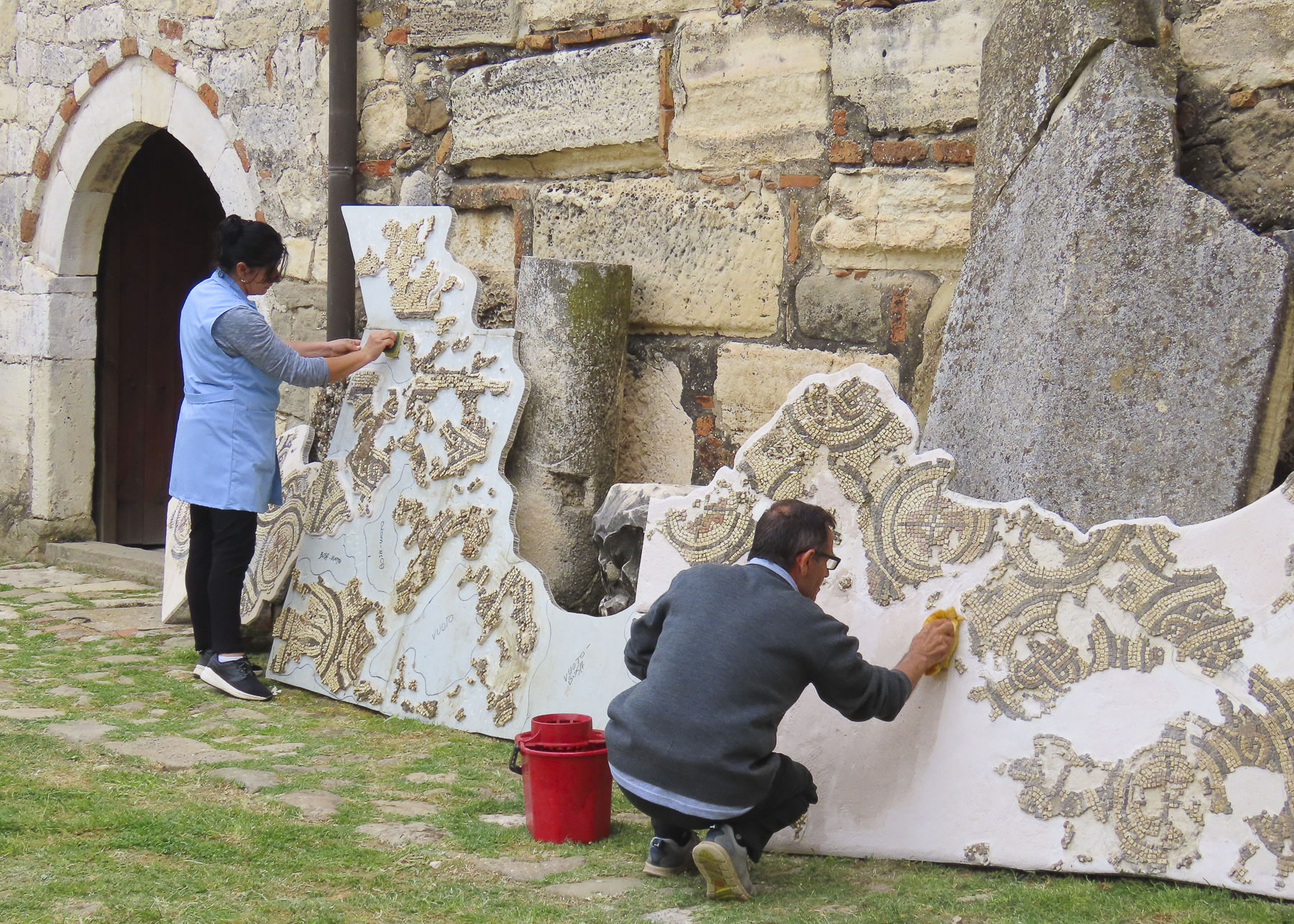
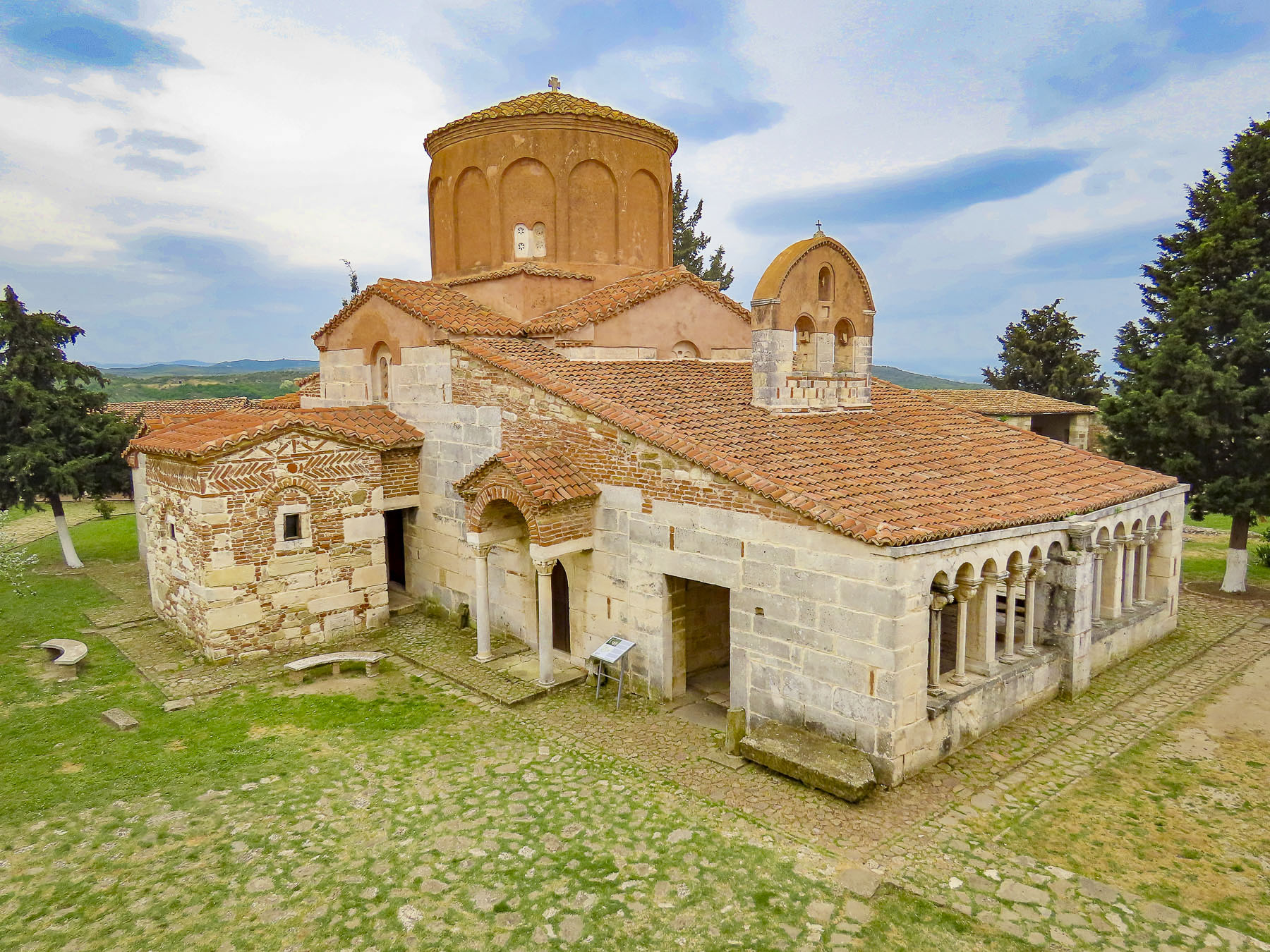
We turned in the opposite direction to investigate the Sleeping Saint Mary Church and its Ardenica Monastery, and entered its courtyard through an arched gateway with a heavy wooden door.  Outside the refectory museum, staff had propped up large sections of a mosaic floor and were cleaning them with soapy water and a scrub brush.

The church and monastery date to 1282 when the Byzantine Emperor, Andronikos II Palaiologos, ordered their construction to celebrate his army’s victory over the Angevins during the defense of Berat a year earlier. Stones for the church, monastery and the other buildings that form a large defensive courtyard were quarried from the ruins of ancient Apollina.

As we walked around, it was interesting to see parts of old pillars, capitals and decorative elements randomly used amongst stone blocks to build the exterior walls. The Albanian national hero Skanderbeg and his bride Andronika Arianiti celebrated their marriage vows here in 1451.

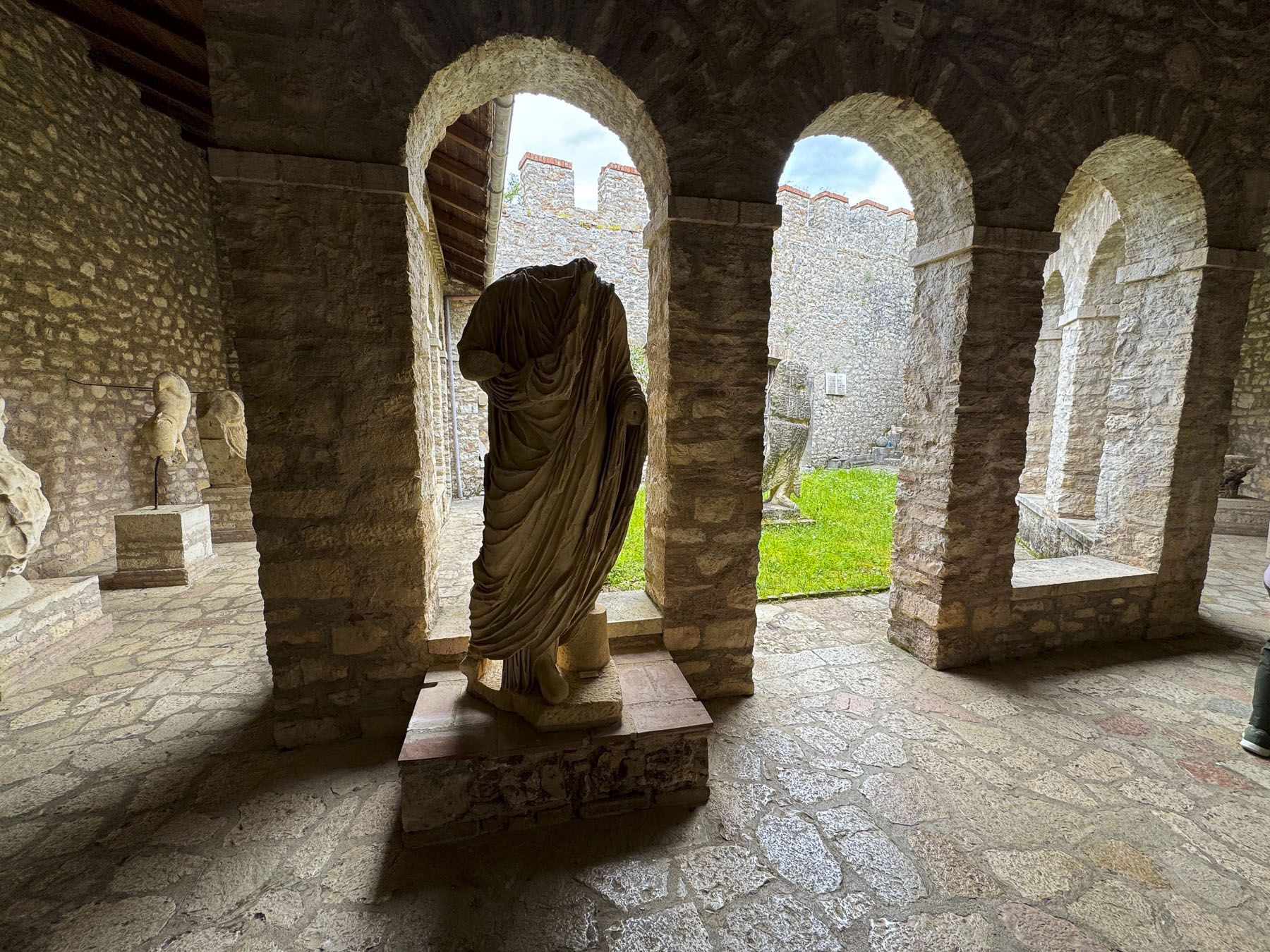
It was this historical fact, and a fast-thinking priest, in 1967, that saved the church from the communist wrecking ball of Enver Hoxha’s atheist campaign to destroy churches across the country. The monastery building now houses a fascinating collection of antiquities from Illyrian, Greek, and Roman occupants of the city.

Founded in the 6th century BC, Apollonia was a prosperous seaport on the Adriatic Sea at the mouth of Vjosa River, and a strategic link on the Via Egnatia, a Roman road constructed in the 2nd century BC that connected the seaport to Constantinople, through what are now the modern countries of Albania, North Macedonia, Greece, and Turkey. The ancient city also grew wealthy from a trade route that followed the Vjosa River valley south and ended in Thessaloniki, Greece, on the Aegean Sea. At its height Apollonia was surrounded by two miles of defensive walls that protected a population of 60,000. The importance of the city slowly faded after a 243 AD earthquake altered the course of the Vjosa River and Apollina’s large harbor, which could hold 100 ships at a time, began to fill with silt. The city was eventually abandoned in the 4th century.

The archeological park is a vast site spread across rolling hills, but today the Temple of Apollo, with only its front façade intact, is the most complete ruin. Walking up the slope behind the temple, a panoramic view revealed fertile farmland separated from the Adriatic Sea by low hills, some of which had a series of doors carved into their hillside.

These are some of Hoxha’s estimated 750,000 military bunkers that the paranoid dictator built across Albania. At the top of the hill there was a very tranquil looking outdoor café/restaurant, that we pegged as the perfect spot for a break, but unfortunately it was still closed in mid-April when we visited. Fortunately, there was a second restaurant closer to the church that served excellent coffee, and was much appreciated on this chilly, damp day.

The weather refused to cooperate with our plans to explore the waterfront in Vlora, Albania’s third largest city, and we opted instead to have a quick lunch before driving on. Parking in this beach town can be particularly challenging, even in the shoulder season, and we opted for a cash-only, pay as you enter, parking lot. Surprisingly, the attendant was unable to break the bill we gave him, and he told us to wait as he disappeared around the corner at the end of the block in search of change. There were many expensive lunch options on the elegant, palm lined Rruga Aleksandër Moisiu, which hugged the beachfront in front of towering apartments. But this was lunch and it was just too dreary to sit outside. Fortunately, we stumbled across Taverna Dangëllia, a delightful place with an open grill, that was reassuringly busy on a weekday afternoon. We ordered a variety of traditional Albanian dishes, all delicious and inexpensive. Charmingly though, the one quirky thing about the place was the DJ, who fell asleep in his chair, as his music selections played on. Maybe Raki is the new melatonin.

While we were looking forward to some great views of the Adriatic from the route through the Llogara Pass, the grey day was challenging for landscape photography, and we decided to take a faster, more inland drive to Upper Qeparo along SH76. It was a more interesting drive than we had anticipated through the Shushices River Valley before crossing over the mountains to the Adriatic coast near Himarë.

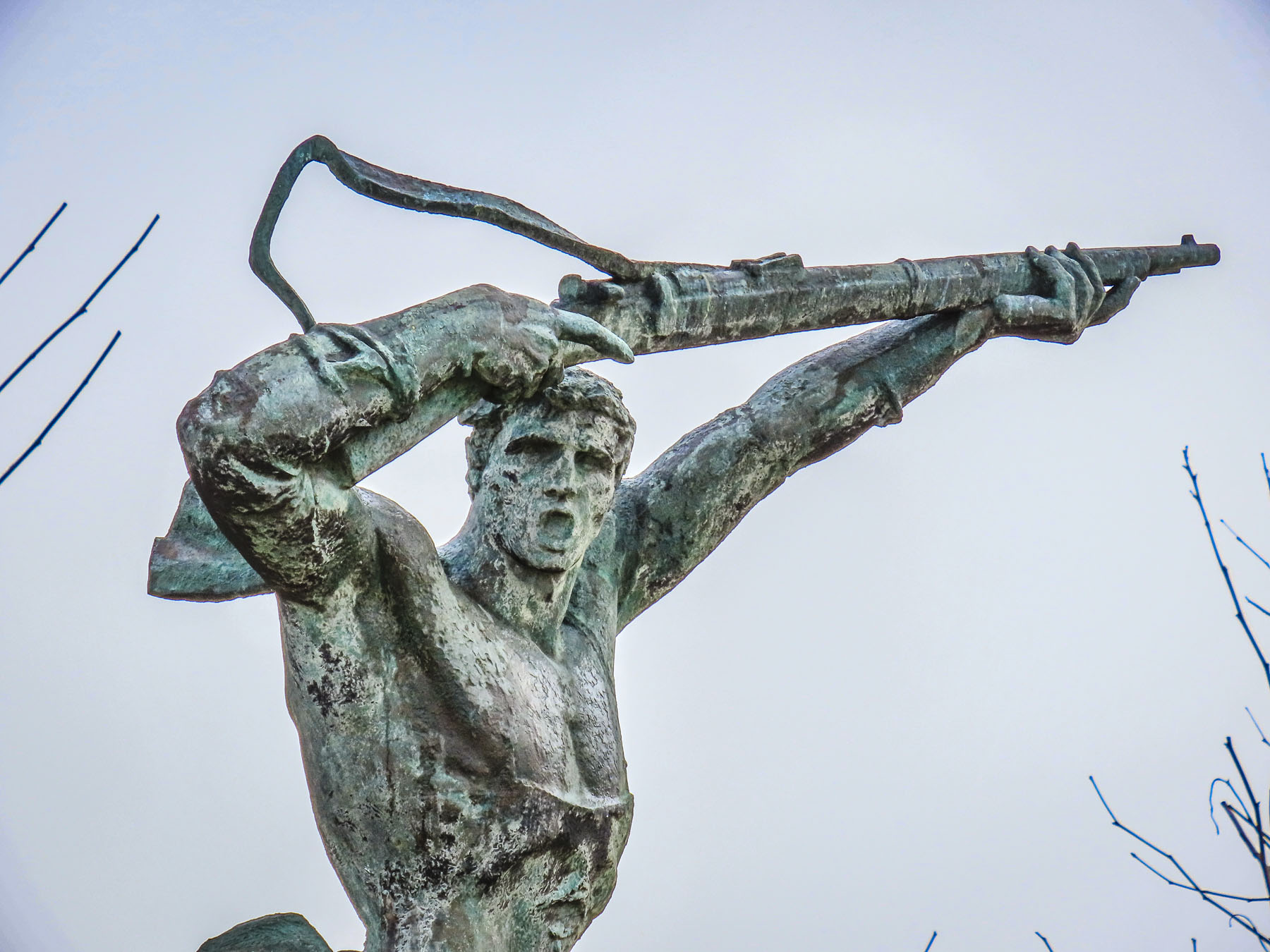
We were zipping along when we suddenly passed a colossal arched memorial set back from the road. A quick U-turn brought us back to the Drashovica Monument. Erected in 1980, the monument was designed in the soviet art style that celebrates the collective effort and commemorates the Albanian resistance fighters who in 1920 liberated Vlora from the WW1 Italian occupiers who refused to leave, thereby defeating Italy’s plans to annex the country. The monument also commemorated the Battle of Drashovica in 1943, where communists and nationalist guerilla fighters united to defeat a larger German force, during a battle that lasted 20 days. Albania has a long history of fighting for its freedom, starting with Skanderbeg’s resistance to the Ottoman invasions in the 15th century and culminated with Albania liberating itself, without the help of the Allied armies, from Nazi occupation during WWII. Behind us an elderly man led a donkey down the embankment of the river toward the water.

Farther along we stopped at a narrow, suspended footbridge that hung over the river. It was a rickety lifeline to small hamlets tucked into the mountains across the river, the footbridge being their only route to the outside world. Though by the sheer number of sheep droppings at the beginning of the walkway it’s a fair assumption that shepherds move their flocks of sheep across it when they switch grazing pastures. That would have been quite a sight to see.

Just down from the bridge, set against a mountainous background, was a small cemetery with interesting headstones. Carved or etched into the granite blocks were photographic quality portraits of the deceased. Some were just tight headshots, while others were full length pictures that captured the individual in their traditional wardrobe. We found these stone tributes very moving.

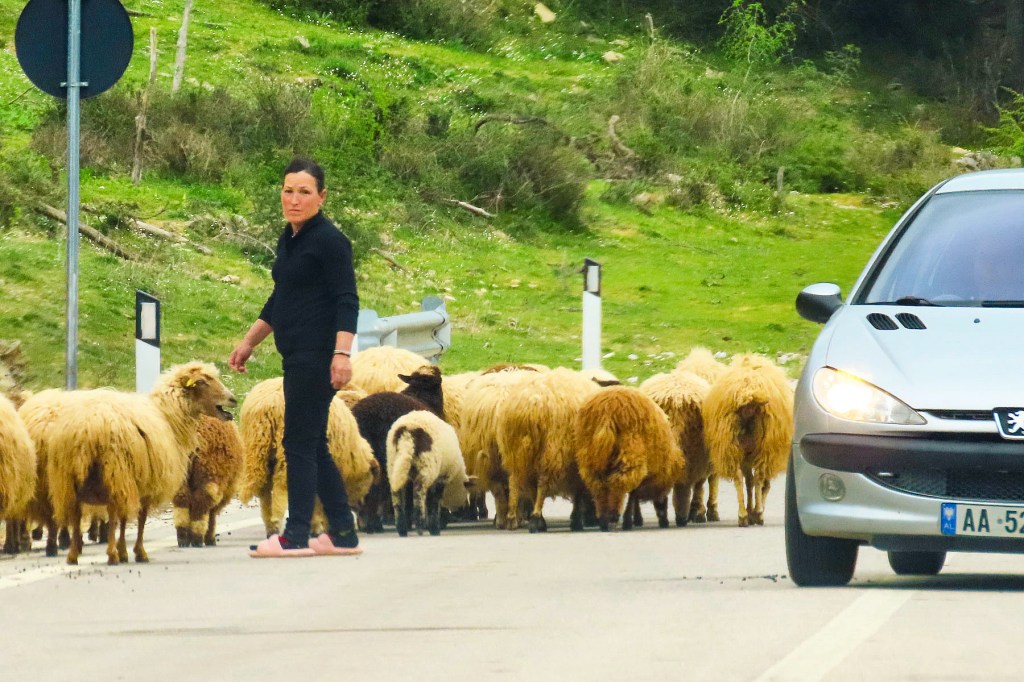
We passed several other footbridges in various stages of collapse, as if they had been caught in destructive floodwaters. There was also an ancient stone bridge in the village of Brataj that I wish we had investigated, but the footpath down to it looked a little too rough for us to navigate. Shepherds ushering their livestock across the road were frequent occurrences. Though the most memorable herder was the gal in pink slippers urging her sheep into a different pasture.

An Albanian standoff happened in the middle of a bridge as a herd of cattle stopped traffic in both directions and refused to budge from the double yellow line, their owner nowhere in sight to encourage them to mosey along.

On the coastal road a small directional sign warned of the approaching turn to Upper Qeparo. We hesitated to commit as the lane looked more like a driveway between two buildings than a road suitable to follow up into the mountains. We cautiously followed the narrow sinuous road, dotted with homes built into the steep hillside covered with ancient olive trees, uphill around blind curves. We began tooting our horn occasionally now to warn any oncoming cars of our presence, after barely avoiding a fender-bender moments earlier. It was difficult enough on this roughly paved track to reach the village and we speculated about the villagers’ hardships when they only had donkeys or horses to traverse the mountain.

Somehow the host of the small guest house we had made a reservation with overbooked, and by the time we arrived all the rooms were taken. Luckily for us, her neighbor Veronika, the owner of Te Rrapi I Veronikes restaurant across the street, also rents rooms above the tavern, and had one available for the night. The room, although basic, was immaculate, and the gleaming floors were so clean we couldn’t bear to walk on them in our dusty shoes. We left our dirty footwear at the front door, and our hostess seemed to appreciate our nod to her high standards of cleanliness.

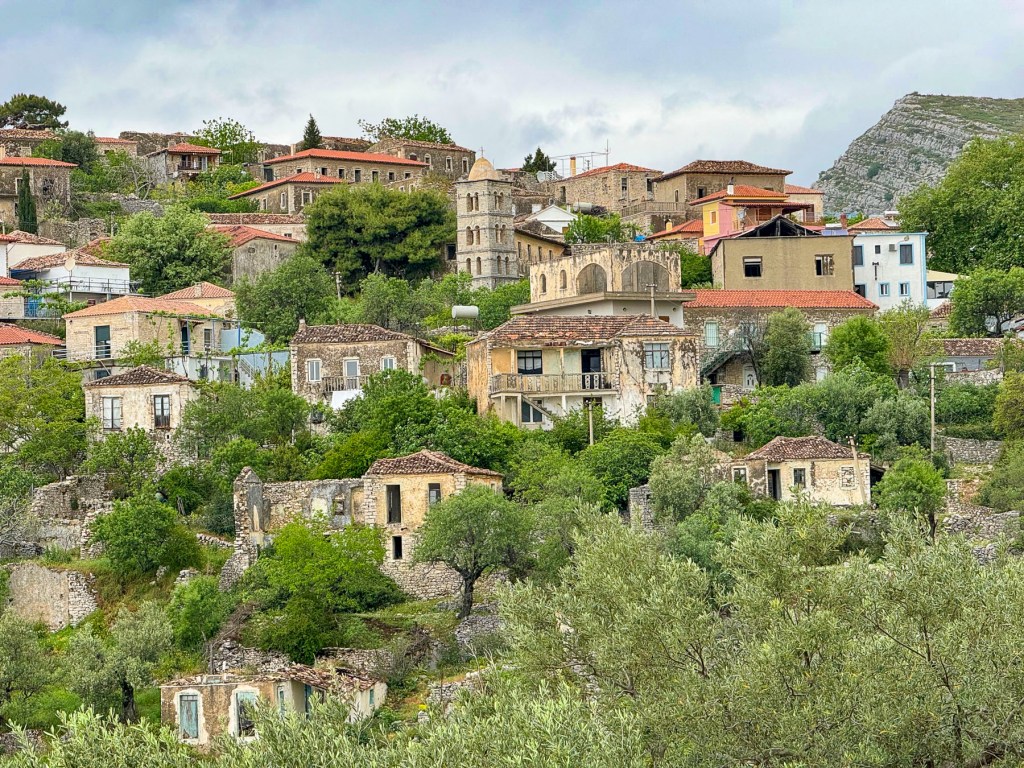
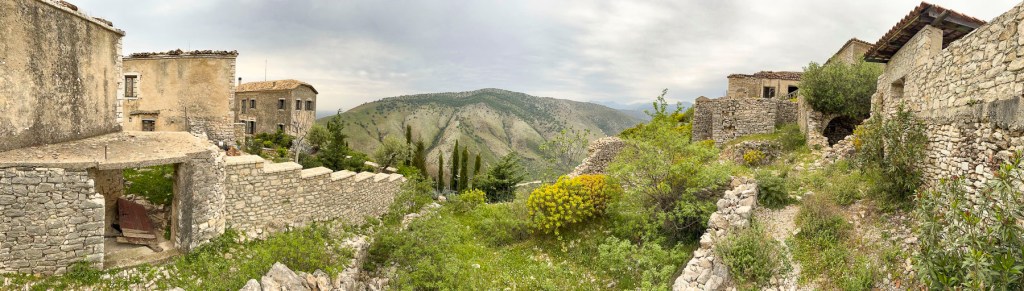
There was still plenty of time before dinner to explore, and we set off. The ancient village is set atop a 1500’ high haystack-shaped hill surrounded by steep mountains covered in scree, like an isolated volcanic island surrounded by ocean. Across the ravine on the outskirts of the village, the stone ruins of a small outpost called the Ali Pasha’s Tower, and the town’s cemetery above it, almost dissolved into the landscape in the late afternoon light. Mention of the ancient village first appears in Ottoman records of 1431, and then 1583 when it’s noted the village had 50 homes. Though archeological evidence unearthed at Karos Castle, just a short distance beyond the tower, suggests that the area has been inhabited since the Iron Age.

Sadly, the village has endured an exodus since the late 1950’s when the Albanian government built the road along the coast, thereby providing services and infrastructure to a new village, lower Qeparo, which boosted its residents’ economic prospects. The aftermath of Albania’s economic collapse in 1997 forced most of the remaining townspeople of Upper Qeparo to emigrate to countries in Europe or overseas for better economic opportunities. The old folks who stayed relied mostly on remittances from abroad to survive. The future prospects for Upper Qeparo are improving, with more tourists now frequently visiting this charming village, and former residents returning after years working abroad and reinvesting in it.

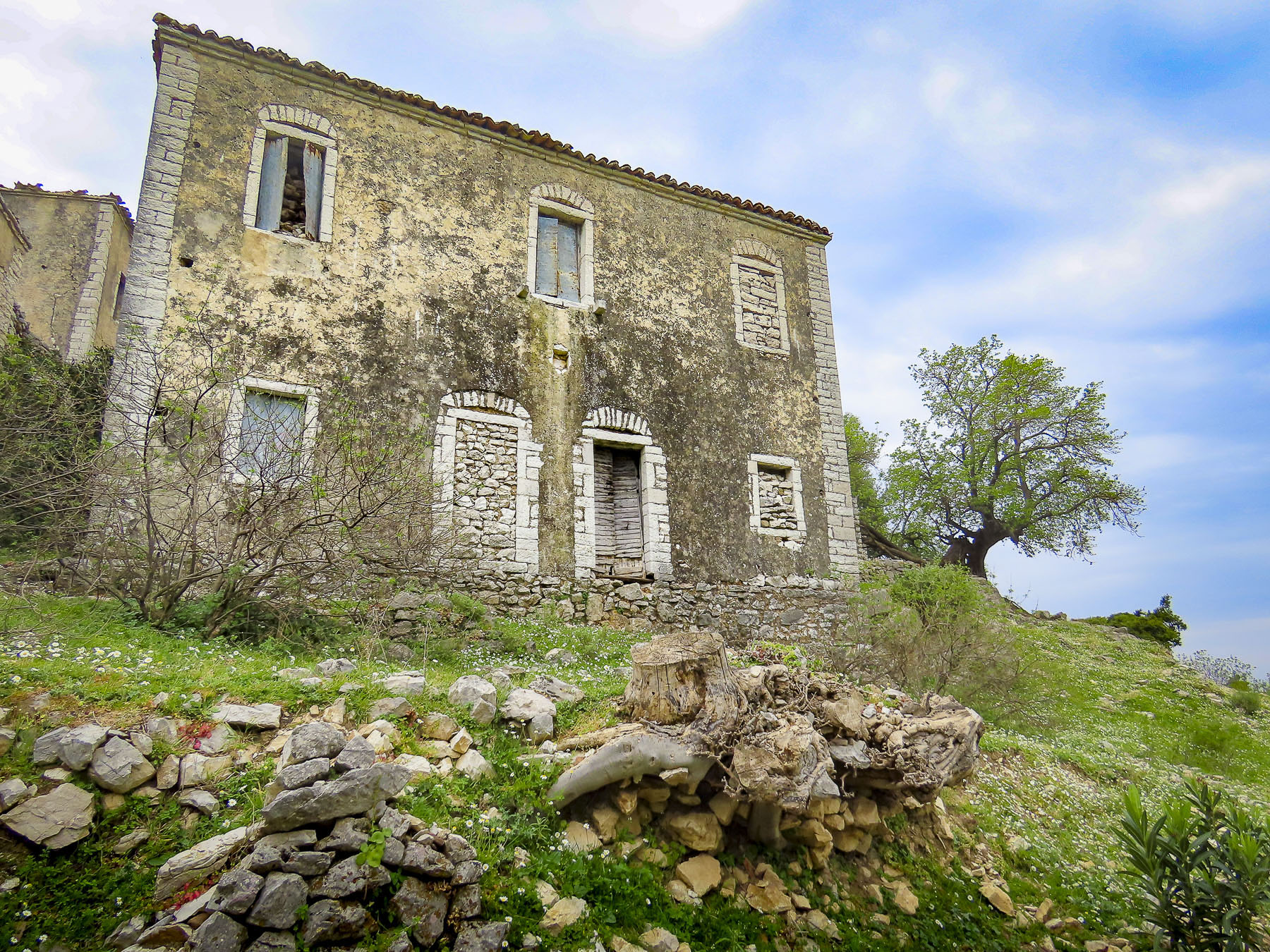
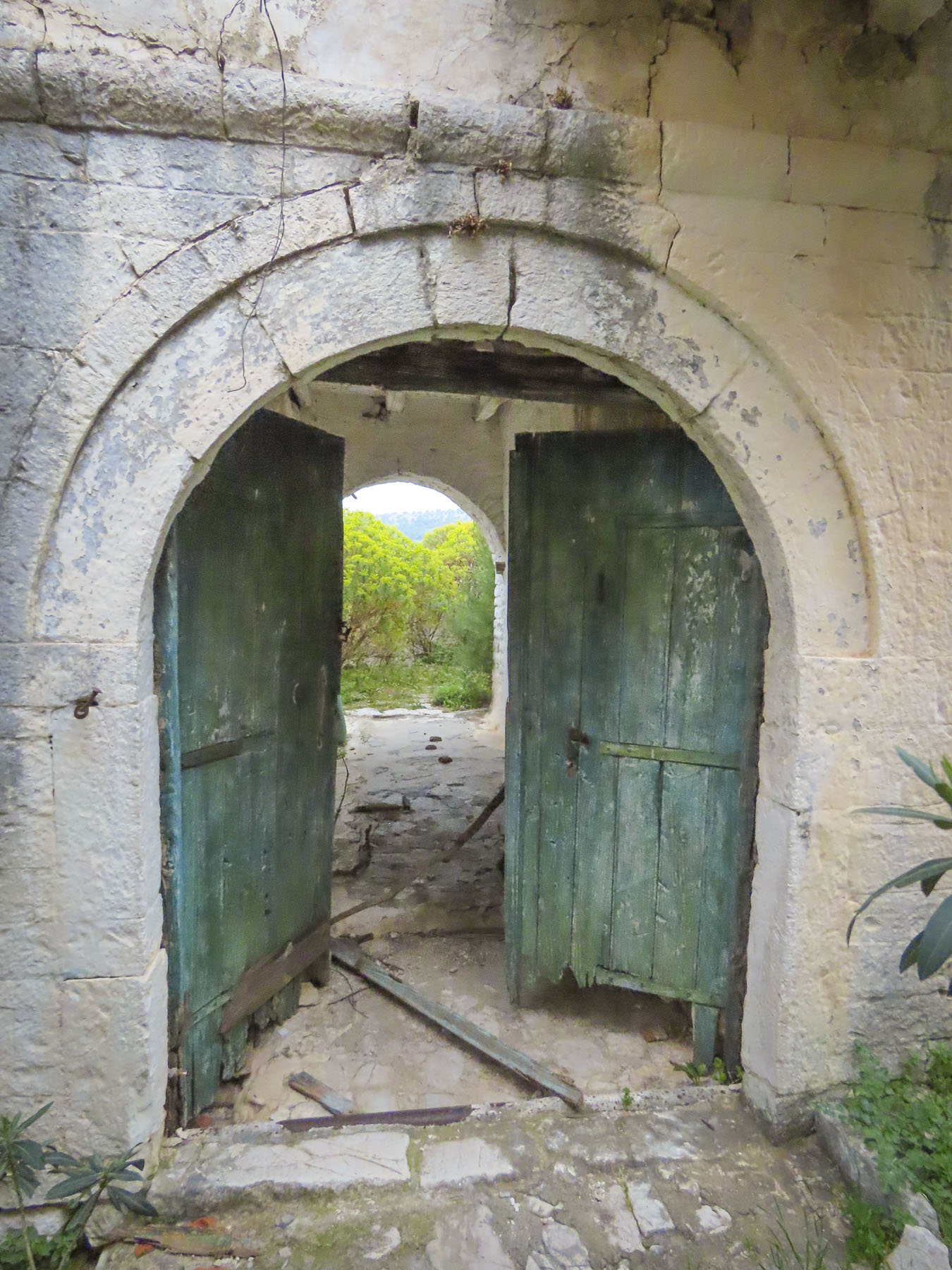
A large Billy goat commanded a boulder above us when we turned to wander the labyrinth of alleys that comprise the old town. Like a sentry, he eyed us but let us pass unchallenged. Occasionally we cut a path through abandoned homes with their roofless rooms opened to the elements, carefully placing our steps to avoid falling through any deteriorated floor beams. Sometimes we passed a freshly painted door boasting new brass hardware. A look up revealed new windows and a renovation proudly underway.

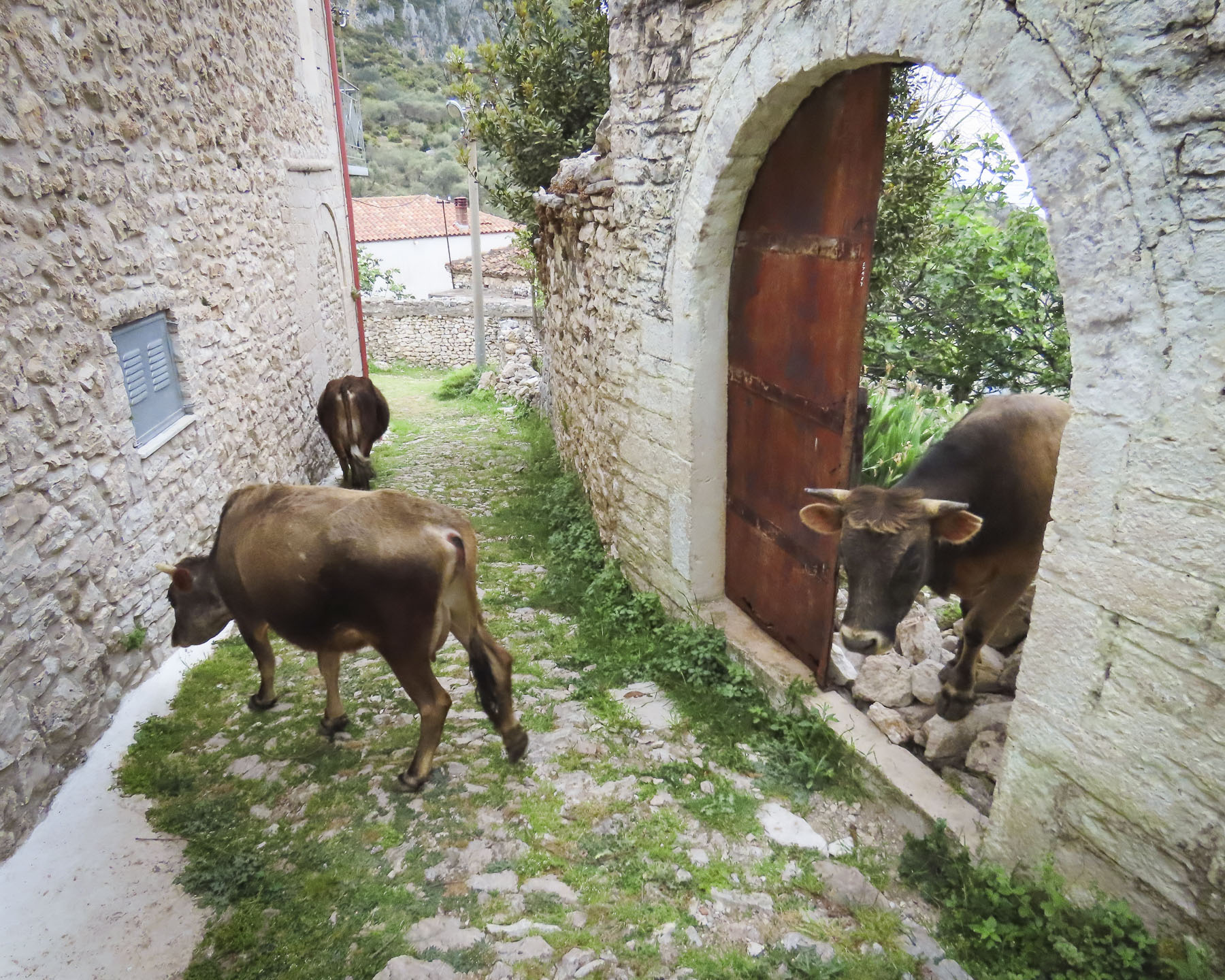
Farther along a cow, chased by her owner, entered the alleyway through the door of a long vacant home. The interior opened to the sky, and grass as thick as pasture grew where the floor used to be. Every now and then, between the buildings, we glimpsed distant views of the Adriatic Sea far below. Fig trees opportunistically grew through open windows, and untended olive trees arched over our heads. A few teenagers lazily kicked a soccer ball against the belltower base of St Mary’s Church, constructed in 1796.

Veronika didn’t offer a menu, but she enthusiastically invited us back into her kitchen where she explained the traditional dishes that she had created that day for dinner, and we were not dissappointed. Later, on the restaurant’s veranda, we capped a great day with a splendid dinner and glasses of Veronika’s husband’s homemade raki. We slept well.

Till next time,  Craig & Donna