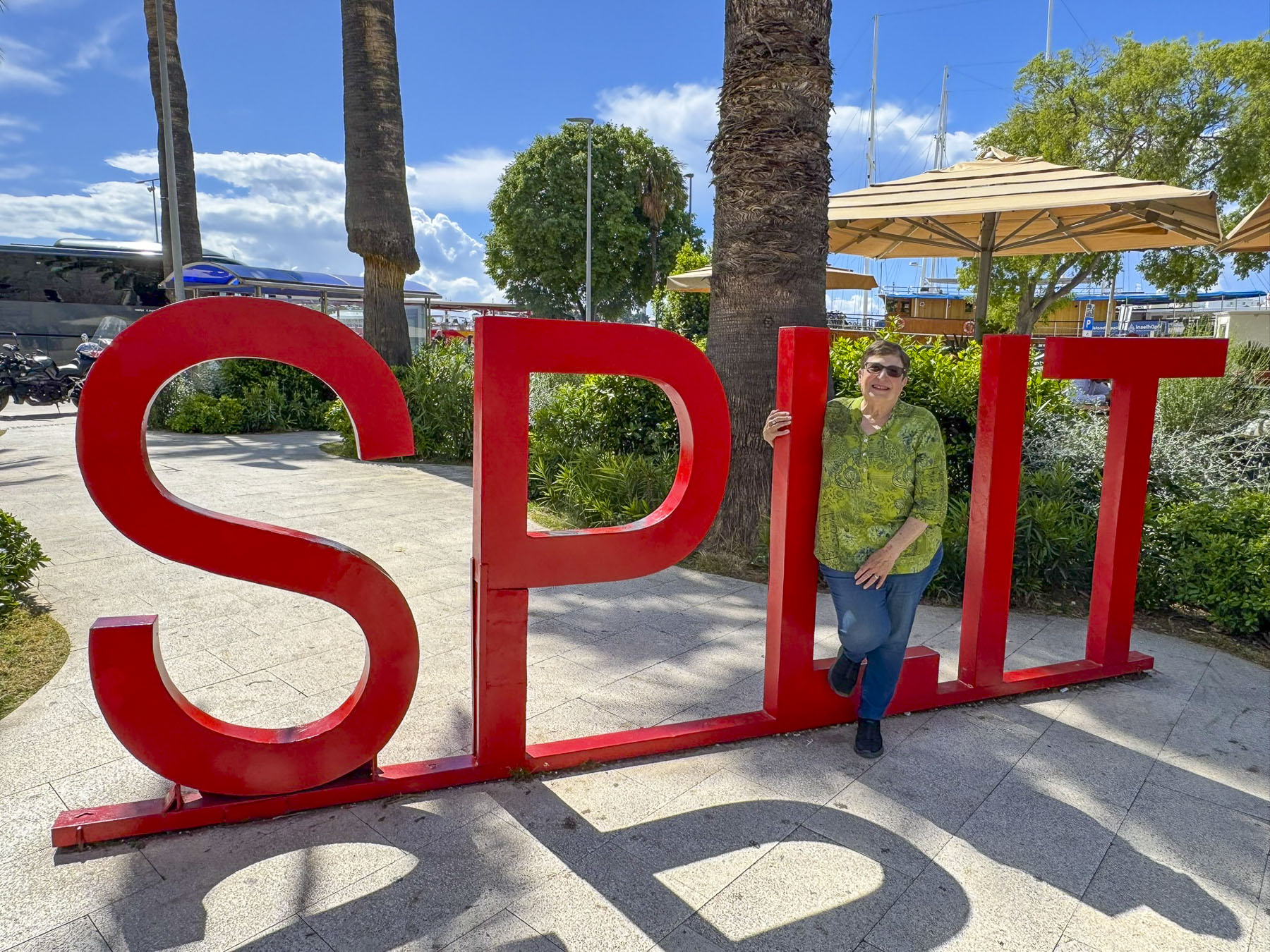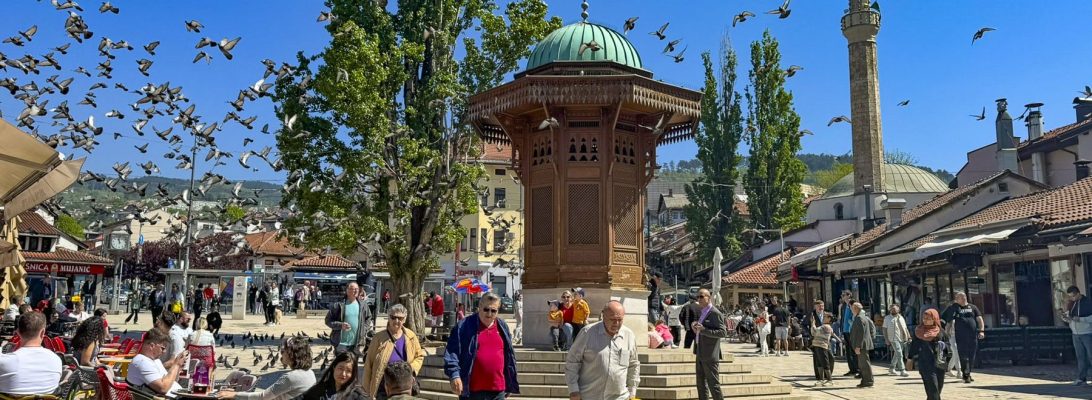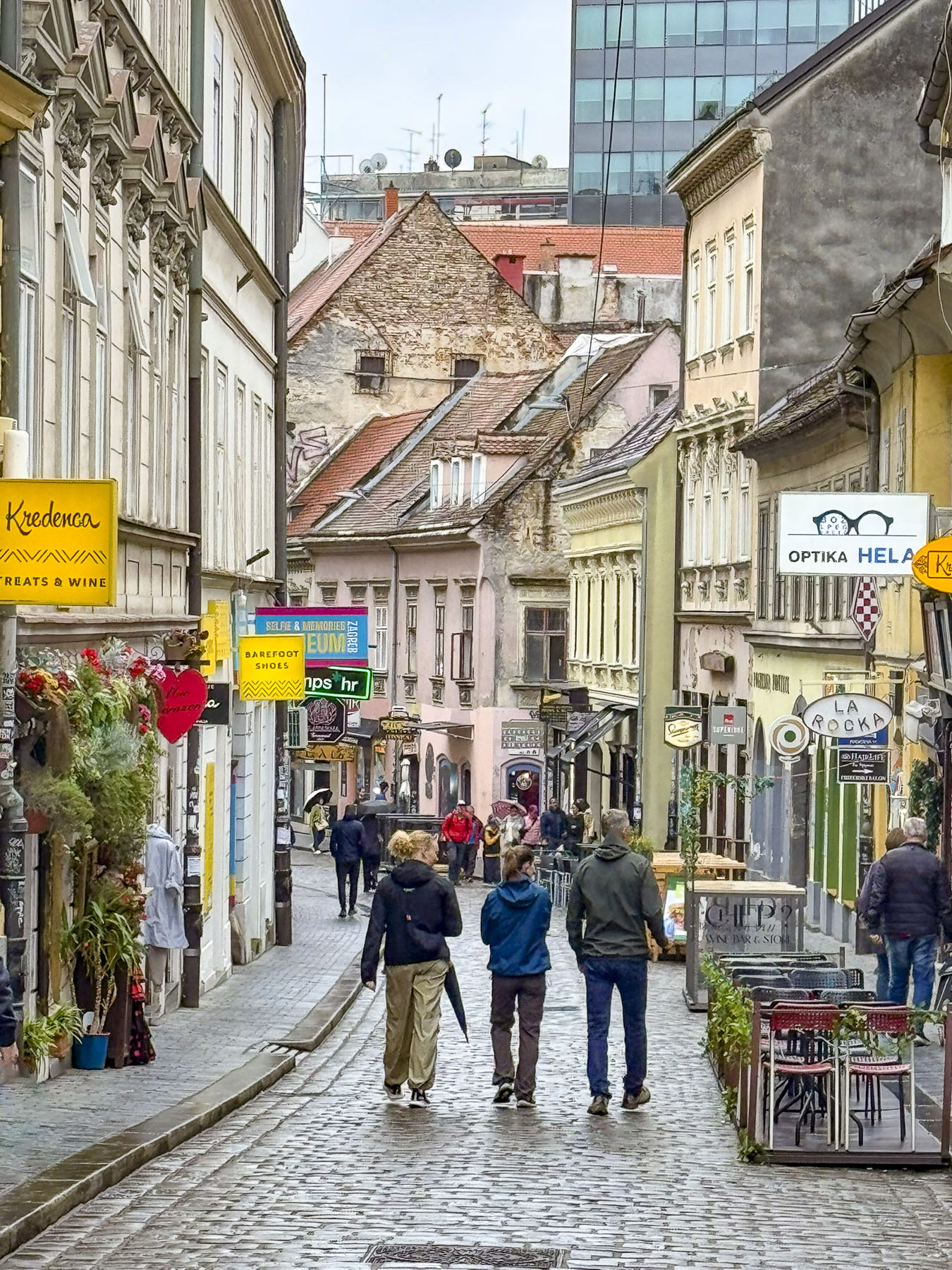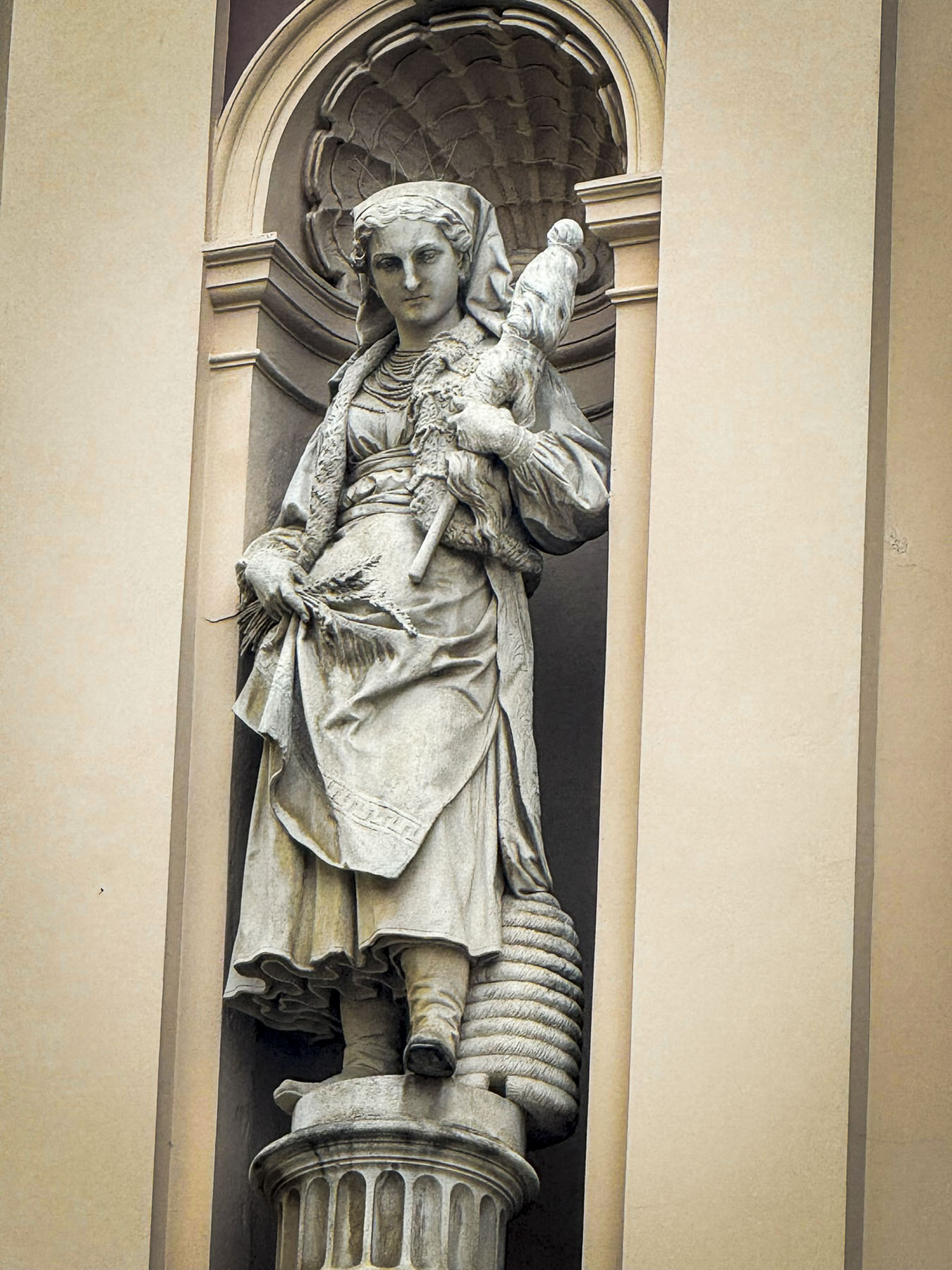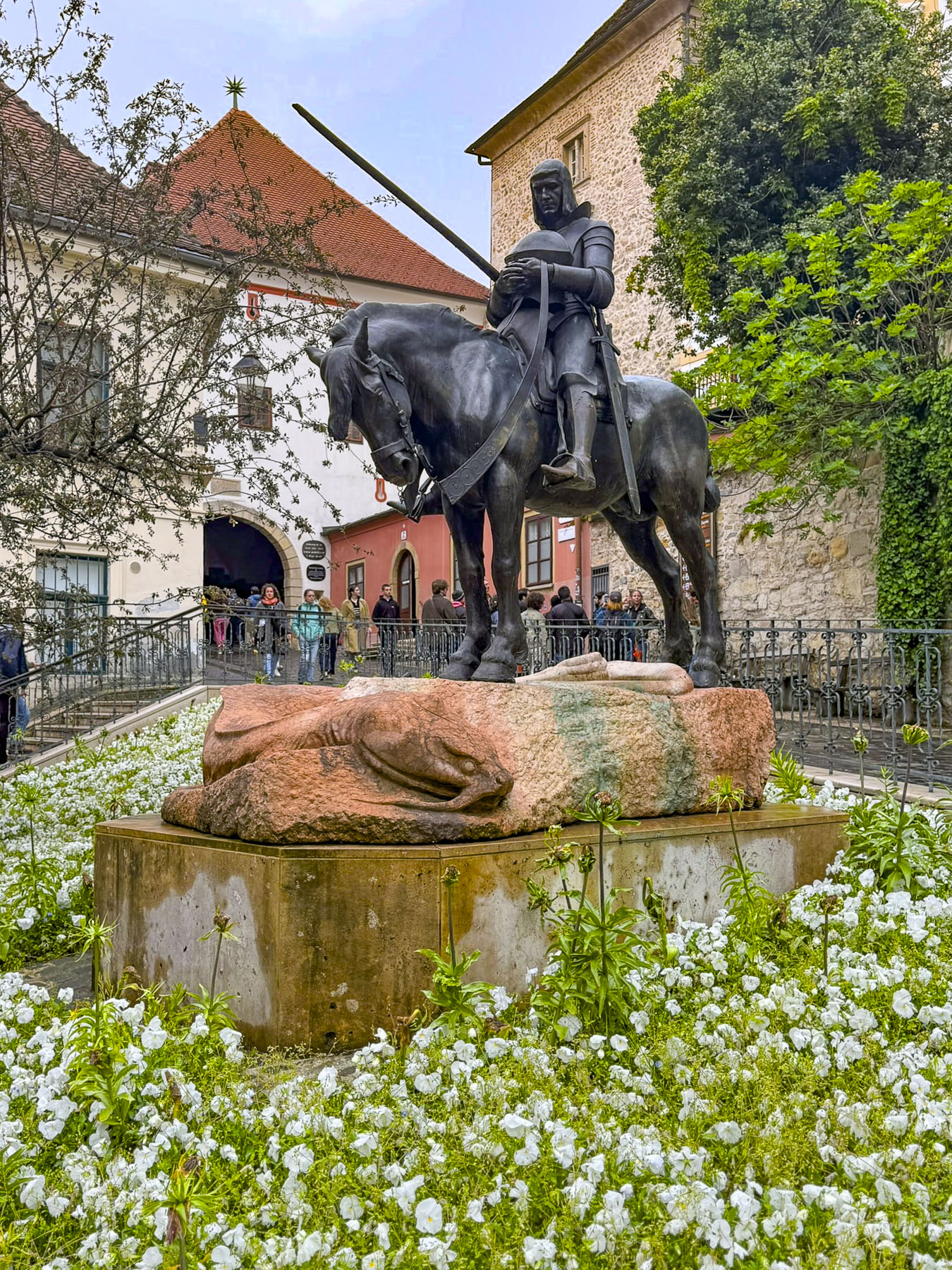
Zadar: The First Stop on Our Balkans Road Trip Through Croatia, Slovenia, & Bosnia and Herzegovina

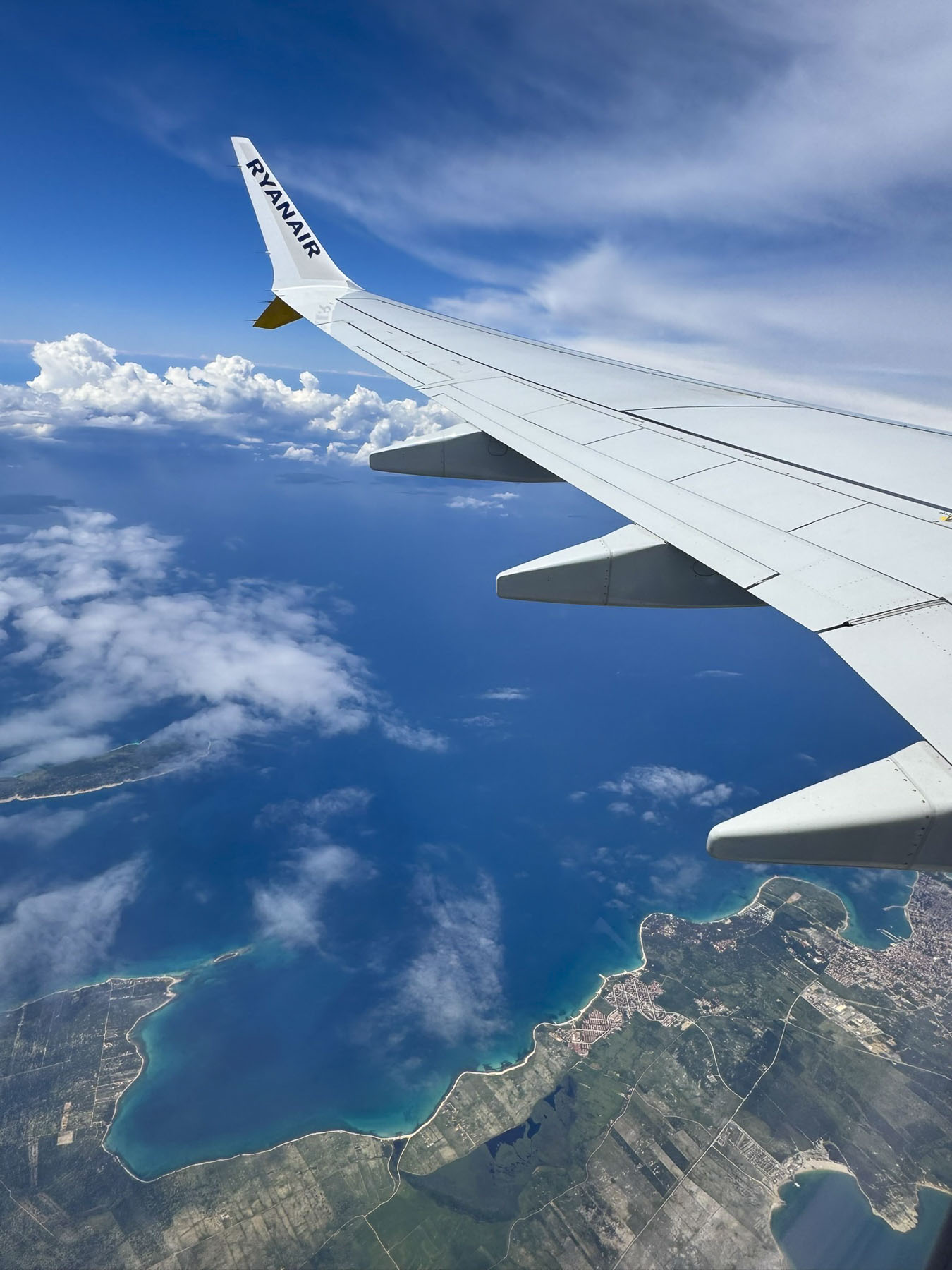
Peering down at the shimmering cobalt and turquoise blue water of the Adriatic Sea relieved the previous day’s anxiety of nearly missed connections. We encountered a long delay at passport control in Paris, before catching our connecting early morning flight to Zadar.

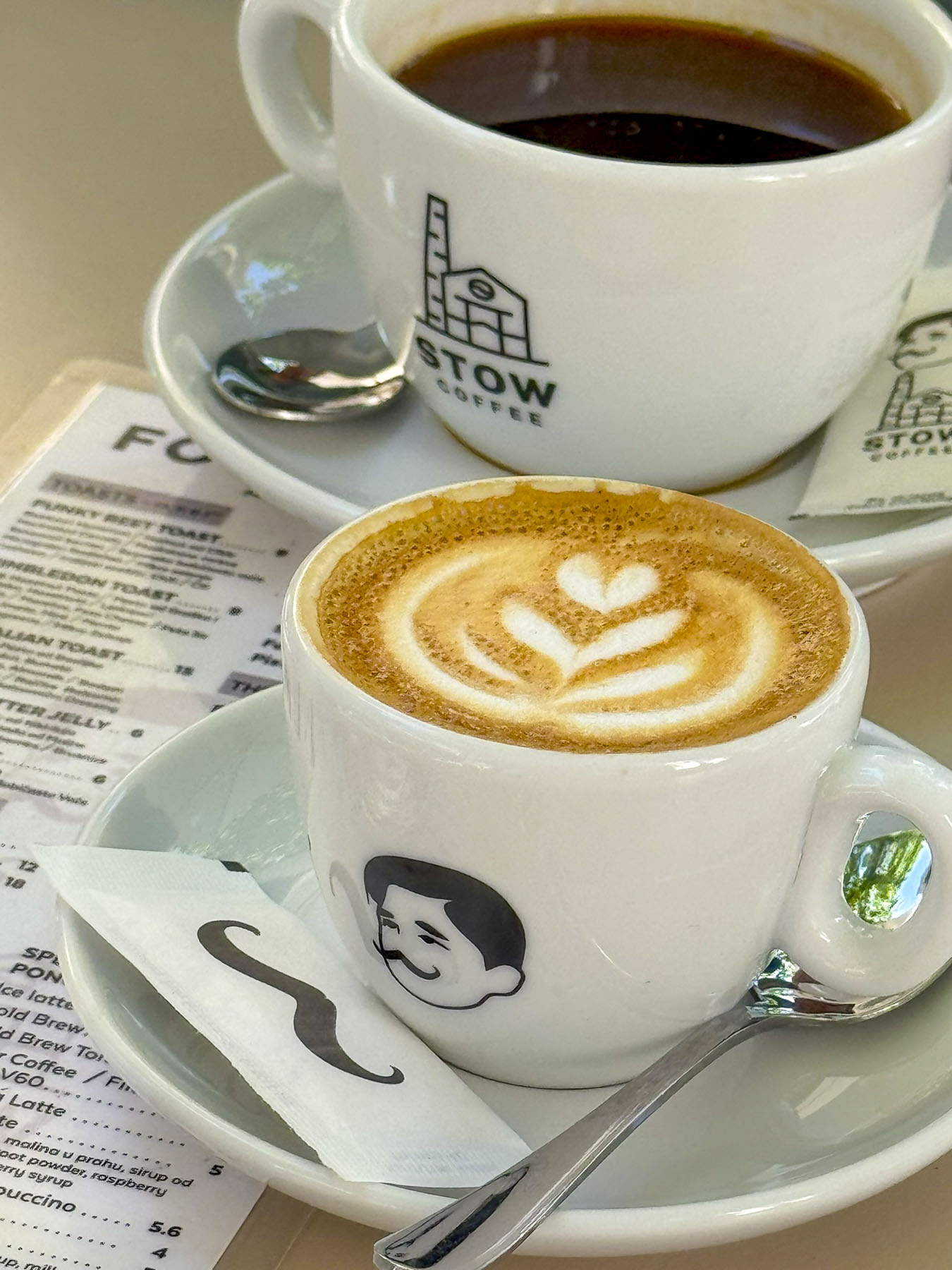
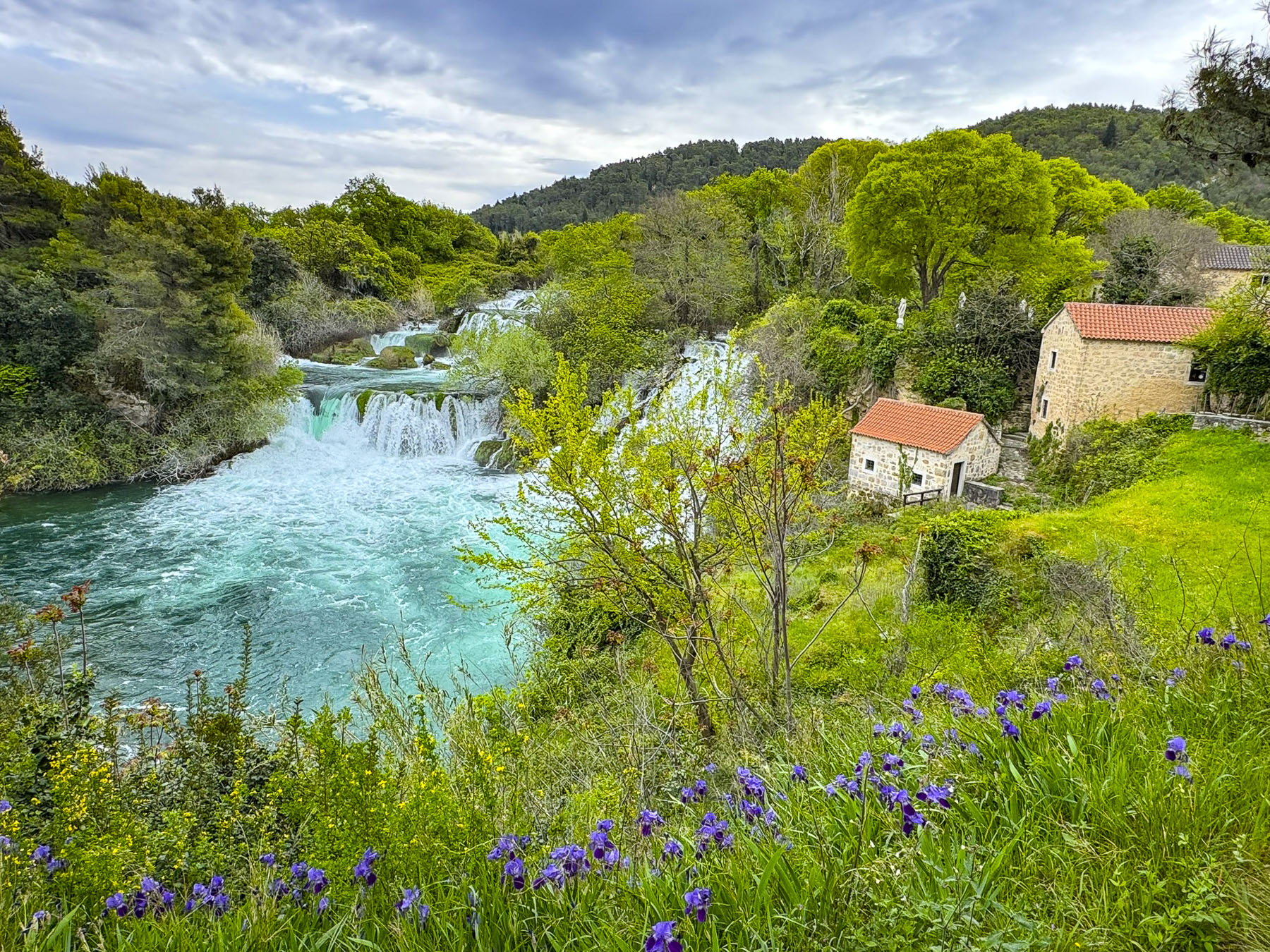
This temporary reprieve was short lived though, as we were confronted with a shuttered rental car window at the Sicily By Car booth, directly across from the small Zadar terminal. It was a Sunday morning – maybe the service at church ran long, or the coffee and pastries at the café were particularly delicious; nevertheless, the other passengers on our early morning flight who had rented with other agencies were long gone. At the terminal’s outdoor café we sipped coffee, waited, and discussed whether or not to cancel our existing reservation.  An hour passed before a car parked behind the booth, and the shuttered window was noisily cranked open. A pleasant young woman greeted us, and the morning’s delay was forgotten. Years ago, we began the habit of asking attendants at the rental car counters for suggestions to non-touristy places to eat. It appears it’s an unusual request from a customer, but folks seem pleased that we sincerely ask for their opinion. “Let me think on that, and by the time paperwork is done and I show you the car, my colleague and I will have some ideas for you.” With the names of three restaurants and a patisserie, “you should definitely try,” we headed off to see waterfalls at Skradinski Buk National Park in a nearly new small SUV, an upgrade from what we had reserved. The park was our first stop on our three-week long Croatian road trip, before our late afternoon check-in at an apartment rental in old town Zadar later.

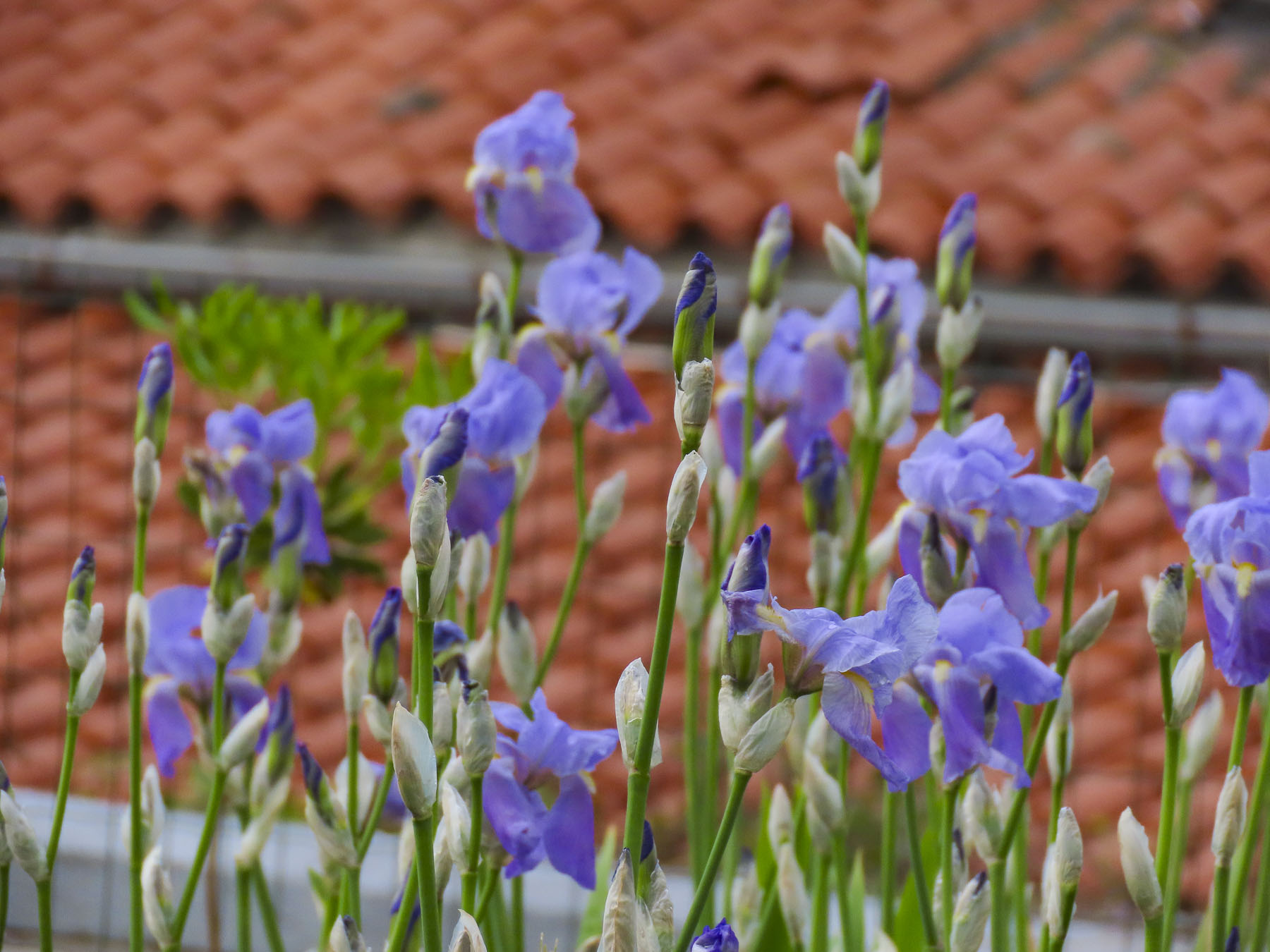
The sunny April morning was now overcast as we drove into the small village of Benković to see its hilltop castle, and indulge our “drive a little, then café,” philosophy. Unfortunately, the castle was closed and the town seemed deserted in the pre-tourist season. Down the lane from the castle fig trees were setting their fruit and the first flowers of Spring were blooming. The café remained an unfulfilled desire.

We love traveling during the shoulder seasons to avoid the crowds of summer. But one of the drawbacks is fewer, if any, restaurants/cafes are open, especially in the more rural areas.

The drive to the park along Rt56 was semi-desolate, but pretty in an austere way, and passed through Croatia’s garigue shrublands, olive groves, and pine forests. From the road as we drove past Skradin, we could see large charter yachts at their winter moorings on the Krka River, two miles from the sea, sheltering there from fierce Adriatic storms, as they waited for the warmer cruising season to start.  Across the river the road zigged and zagged up the mountainside before leveling off on a high plateau.

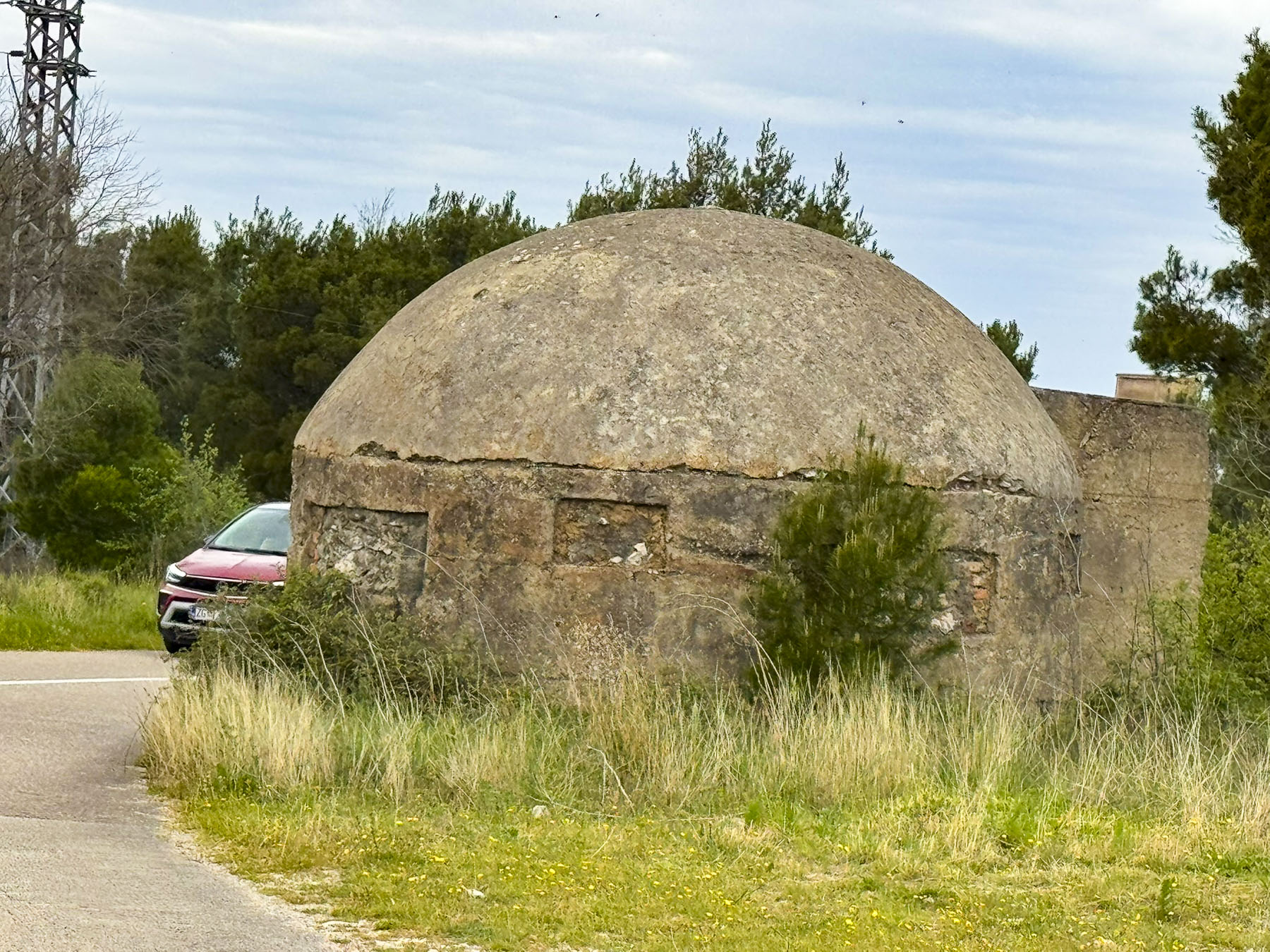
Following the signs to the national park we drove down a side road which passed a sprawling abandoned factory site, fronted with several concrete military bunkers. They were relics from the Cold War era like the ones that dot the landscape in Albania. Built in the 1930s, the IVANAL d.o.o. plant was the Balkans region’s first state-of-the-art aluminum processing complex that employed 400 people. It was confiscated by Czechoslovakia’s communist regime in the 1940’s and never upgraded or maintained. Over the decades production fell until the plant was closed after Croatia’s independence in 1991.

The parking lot at the national park was very full, considering it was a chilly Spring Sunday, but the queue at the ticket booth moved quickly. While the falls are quite a distance downhill from the entrance to the park, some folks chose to walk a route through the forest to forage for the wild asparagus that sprouts along its path from March to May.

We opted for a ticket that included a shuttle bus ride to the largest waterfall, Skradinski Buk, at the bottom of a series of equally impressive waterfalls on the Krka River, then a walk back upstream along the waterway to another shuttlebus stop for a return ride to the top of the park entrance plateau. During the summer months the national park also offers a scenic twenty-minute boat ride from the harbor in Skradin,to the base of Skradinski Buk.

The overcast day was actually the perfect weather condition to photograph the waterfalls without heavy shadows or bright highlights, and the falls were thundering, foaming with the snowmelt from the Dinaric Alps, which run through the coastal Balkans region.

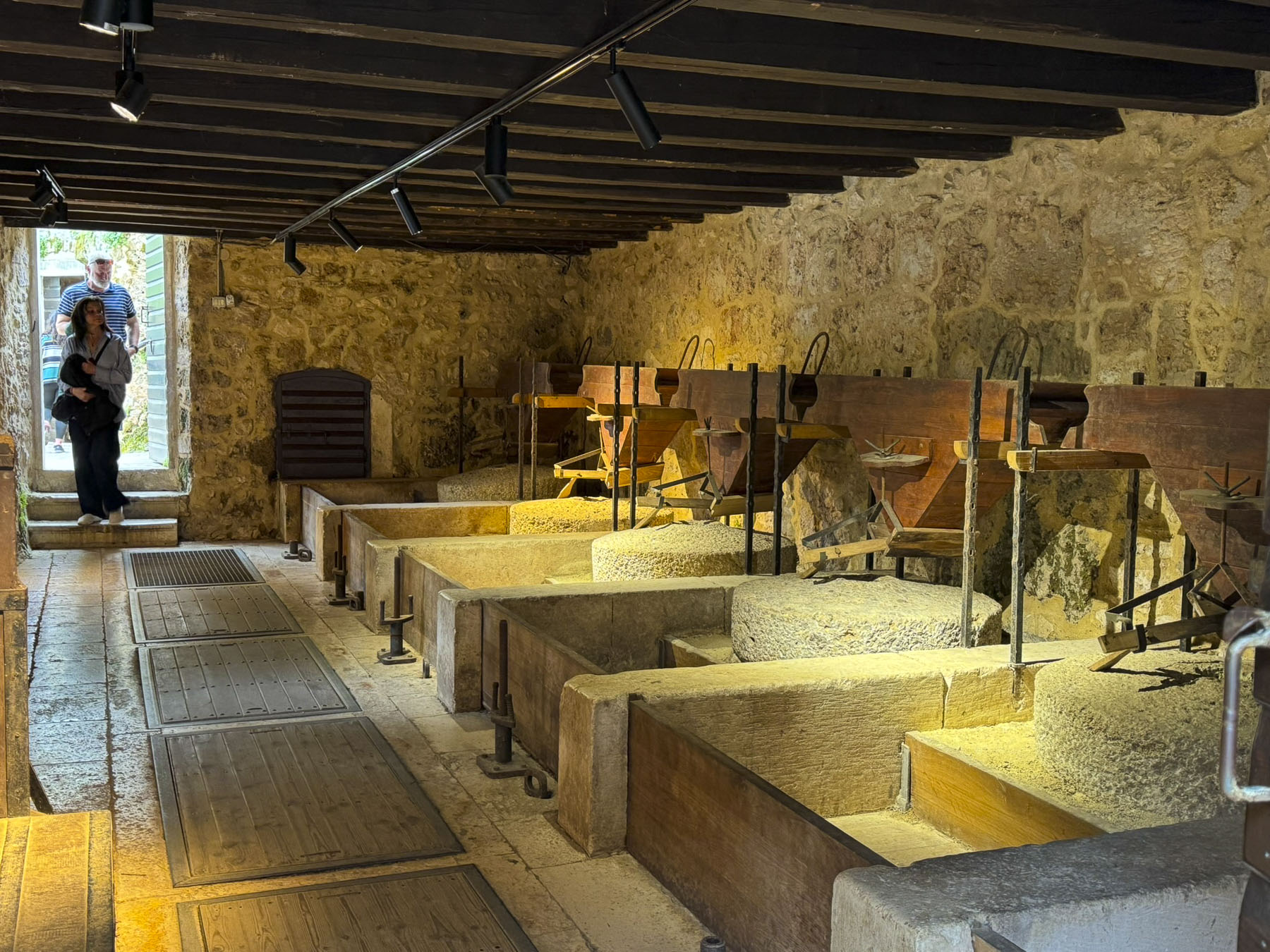
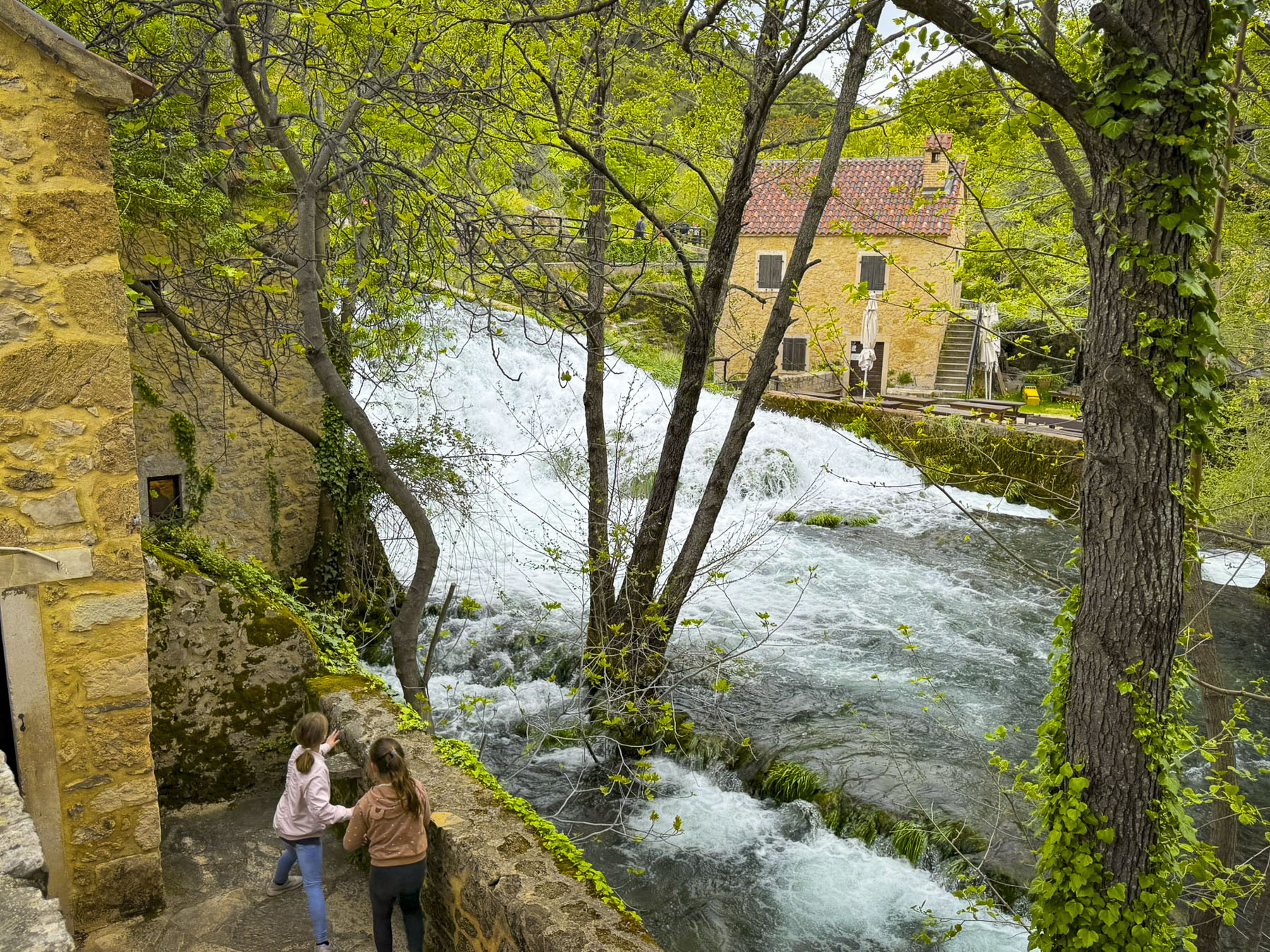
Along the way, we stopped at several restored watermills, with their mill races still intact. They were used primarily to grind locally harvested grain into flour, and to wash processed wool. A blacksmith shop also used a waterwheel to drive its furnace bellows to keep the fire hot enough to work the iron, and to power the heavy trip hammers the smith used to shape tools.

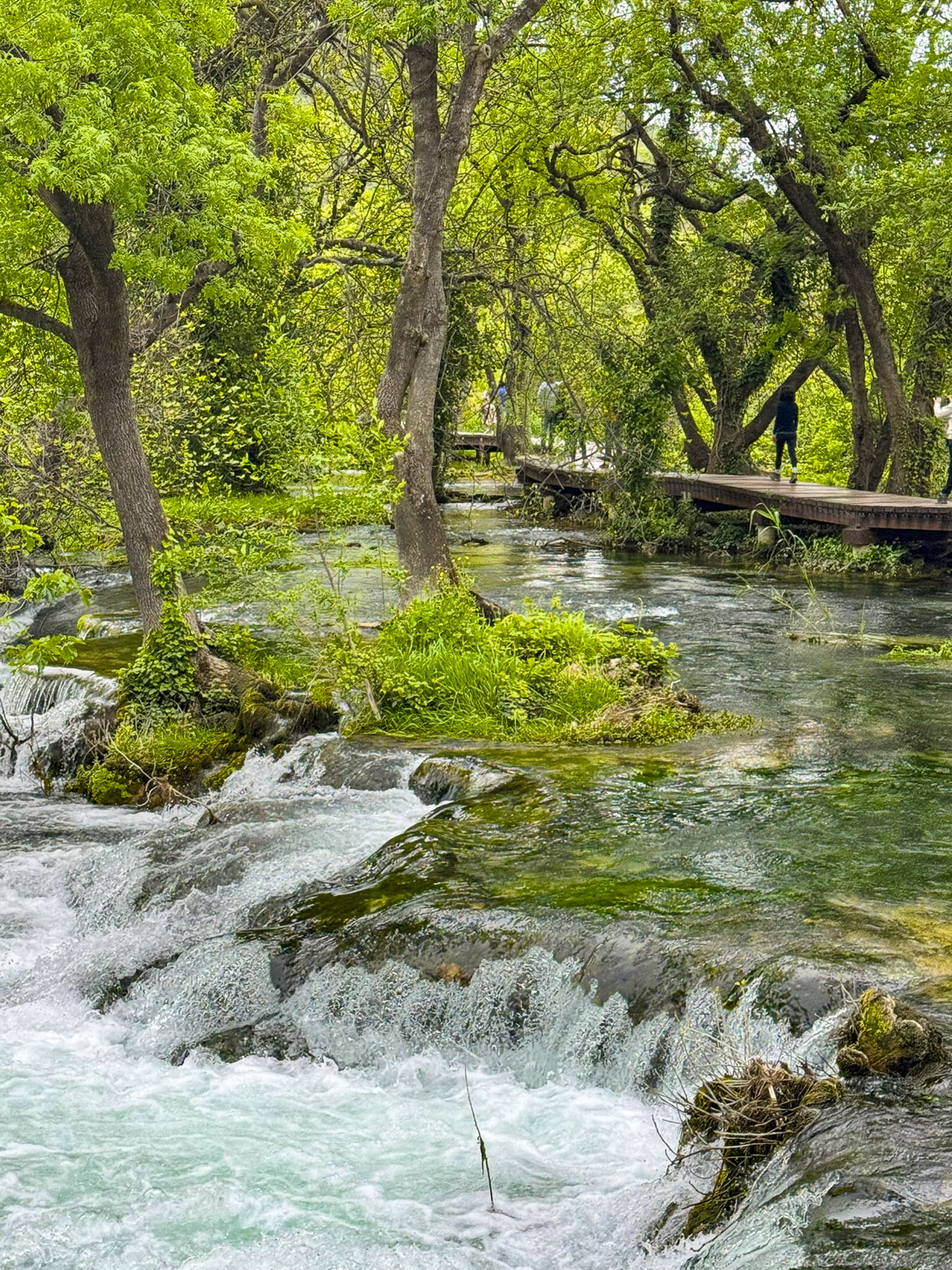
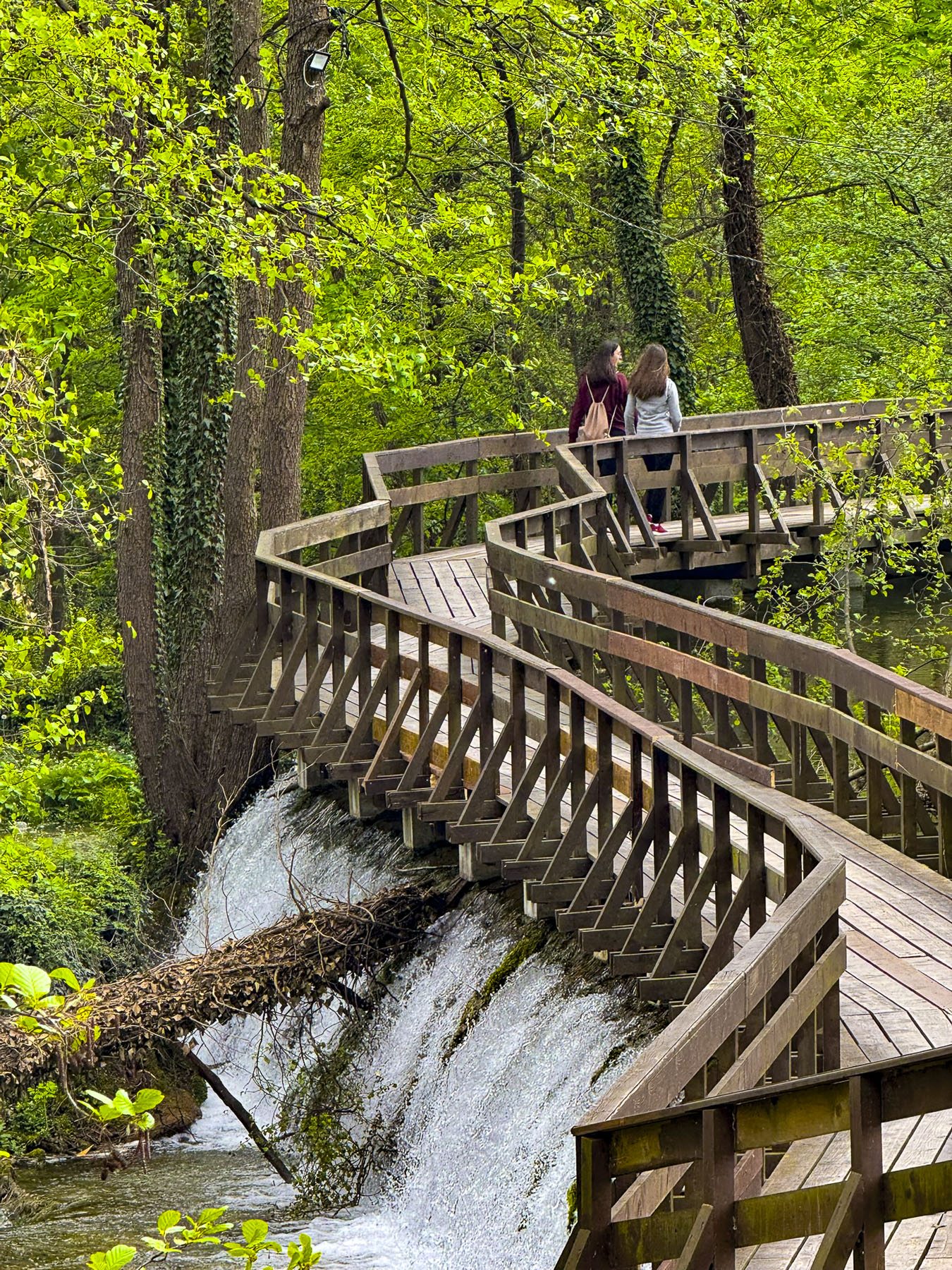
A serpentine elevated wooden walkway, without guardrails, twisted through groves of flooded forest, and kept us dry as the spring runoff rushed below us. It’s important to be aware of your footing in these circumstances, and we always waited at a wider part of the walkway for other folks to pass when the boardwalk was too narrow, to avoid fulfilling my mental image of being swept away down the rapids.

Unlike tourist sites in the United States, where everything is fenced to protect us from injury, in Europe you are expected to be responsible for yourself, and aware of your surroundings to guard against mishaps. We thoroughly enjoyed the waterfalls. We don’t see them in the coastal area at home, since we live nearly at sea level.

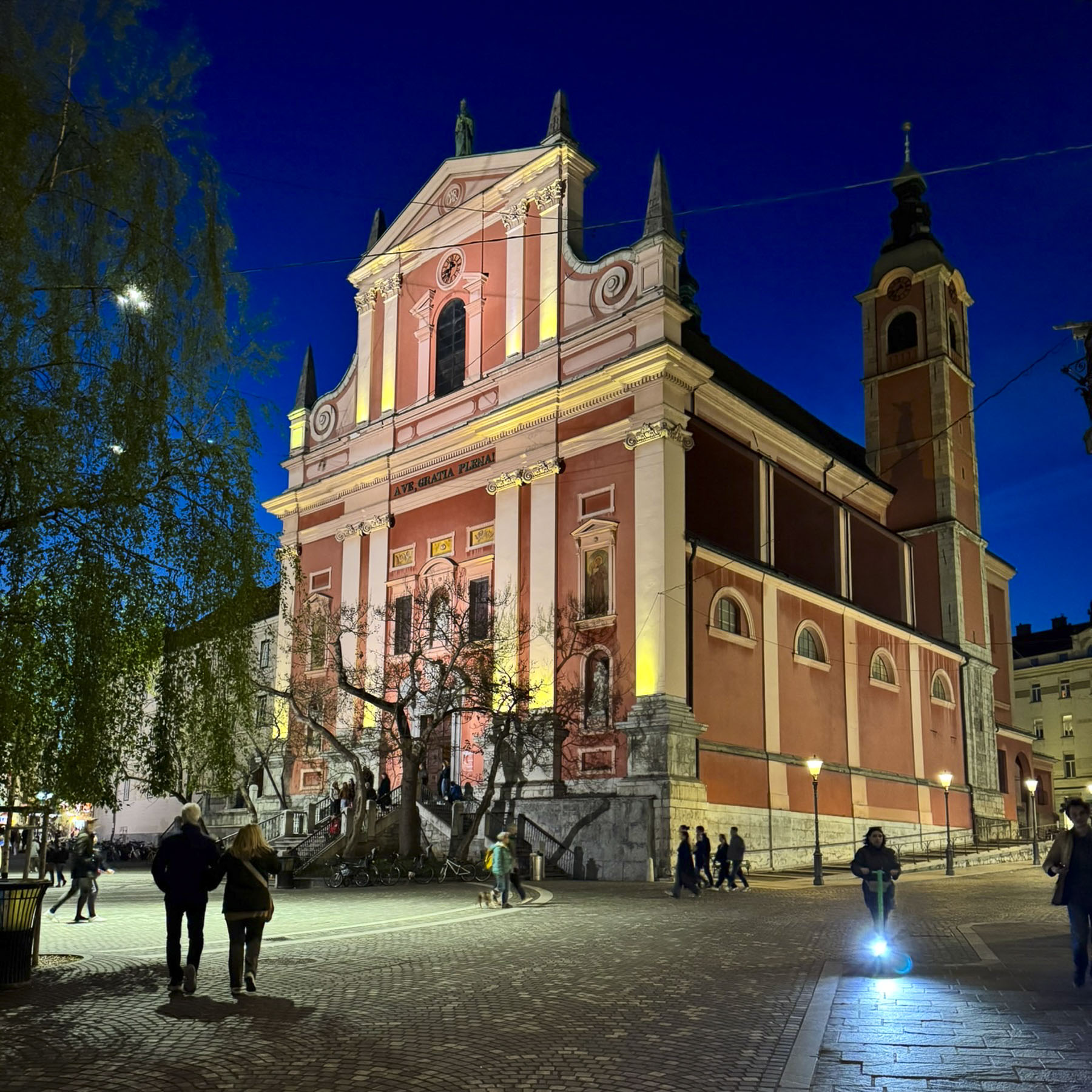
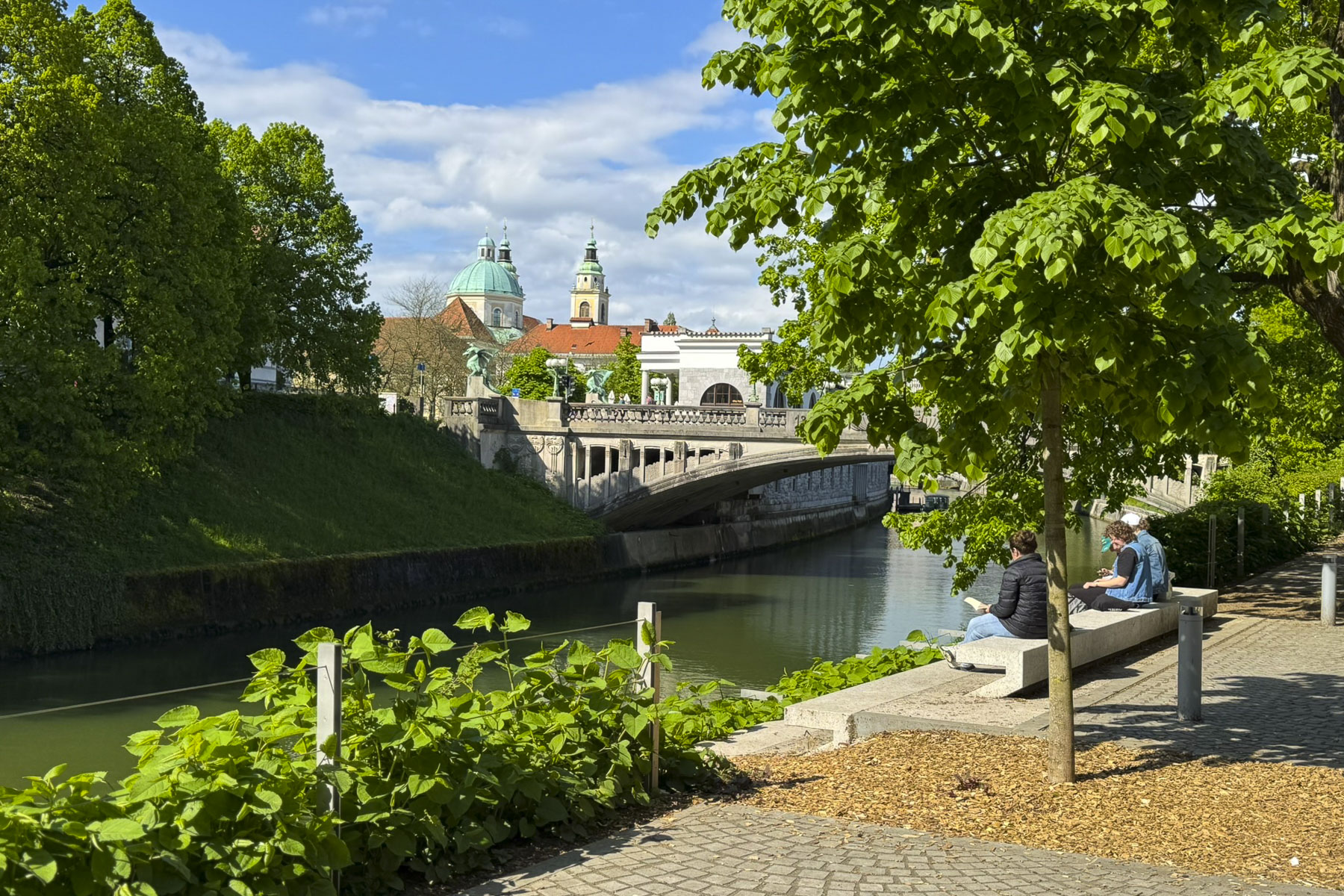
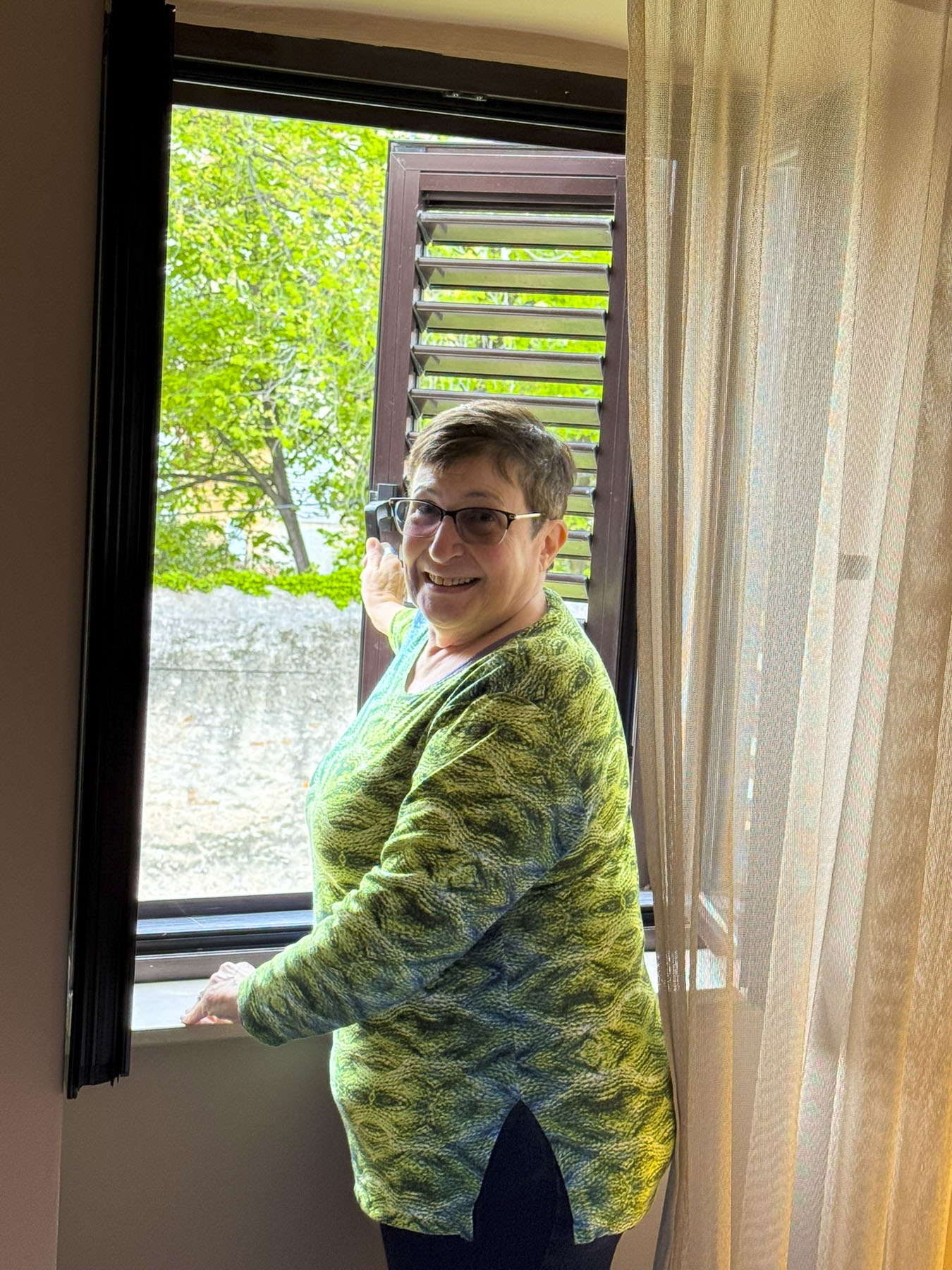
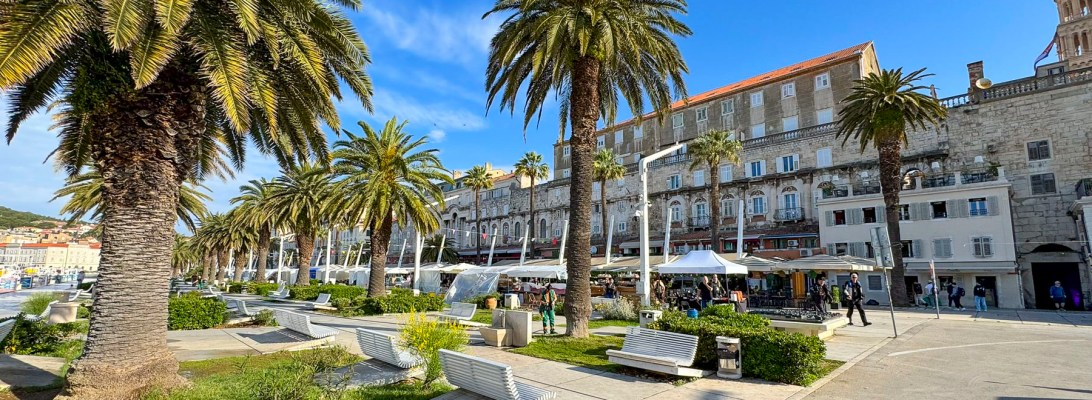
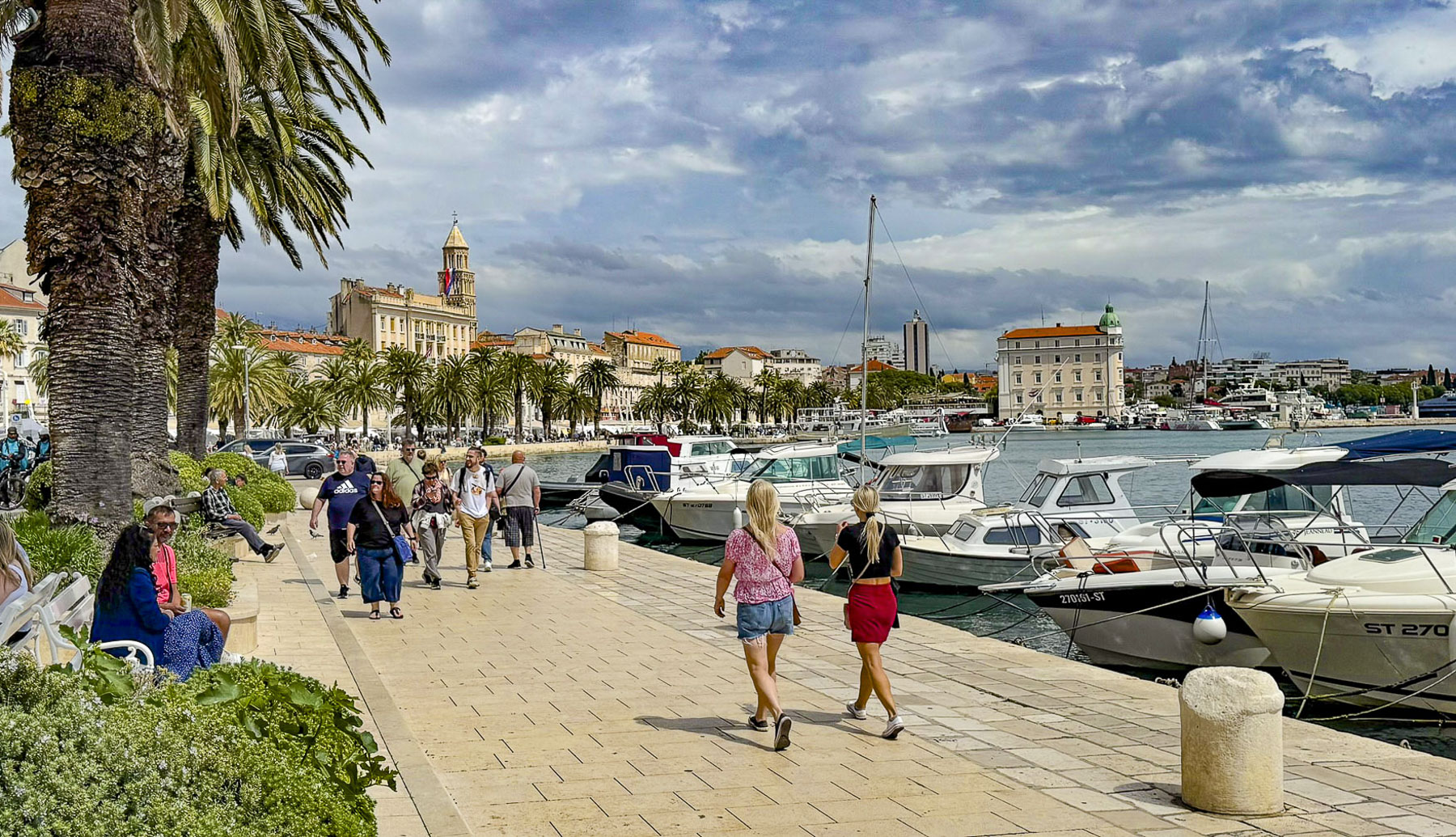
Zadar protrudes into the Adriatic, on a small peninsula, like a thumbs up sign, its once rough coastline now manicured with a sidewalk that follows its waterfront. Parking was challenging, but after circling the old town twice, we found a metered space near the Apartments Donat, our base for three nights. The rooms in the restored 700-year-old building were small. But the location, on a small lane overlooking the Cathedral of St. Anastasia and the Church of St. Donatus, was very convenient.

The manager of the building, who didn’t live on site, kindly made his parking space, next to the building, available to us for the duration of our stay. While having a rental car provides a lot of freedom, the typical 20 euro daily expense of parking in Europe can quickly add up. It’s not always possible, but we try to stay in hotels that provide free parking when we can.

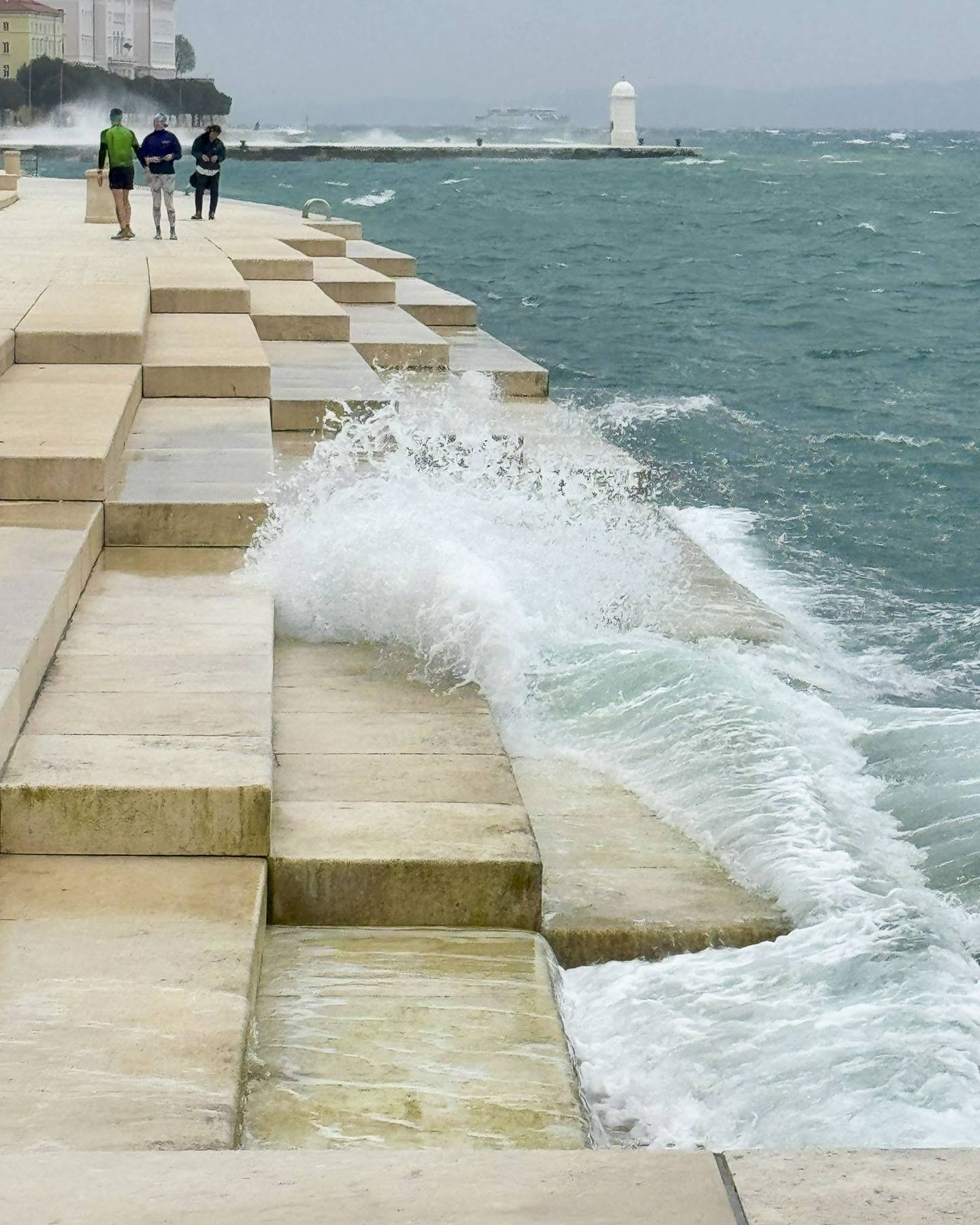
Later that day we walked along the waterfront to Obala Petra Krešimira, a jetty that was being battered by whipping winds and crashing waves, which lifted large sprays of water over anyone brave or foolish enough to venture out onto it.

Nearby, in front of Zadar’s City Hall was Morske Orgulje, the Sea Organ, an experimental architectural sound installation designed by the architect Nikola Bašić and completed in 2005 to refurbish Zadar’s waterfront which had been neglected since the end of World War Two. The design incorporates polyethylene organ pipes under the marble stairs that lead down to the water. The motion of the waves continuously forces air through these pipes to create a “harmonic symphony crested by the wind, waves, and tides,” that is vented through the rise of the steps. Visually it’s a flat surface, but as we walked across the plaza the ethereal music faded in and out moodily with the motion of the turbulent sea.

The Greeting to the Sun, a solar-powered light installation also designed by Bašić, was a short distance away, closer to the tip of the peninsula. It’s a 22m (72ft) wide disc composed of 300 multi-layered glass plates, embedded into the plaza, which you can walk across. The panels absorb solar energy during the day to turn the disk into a colorful light display in the evening.

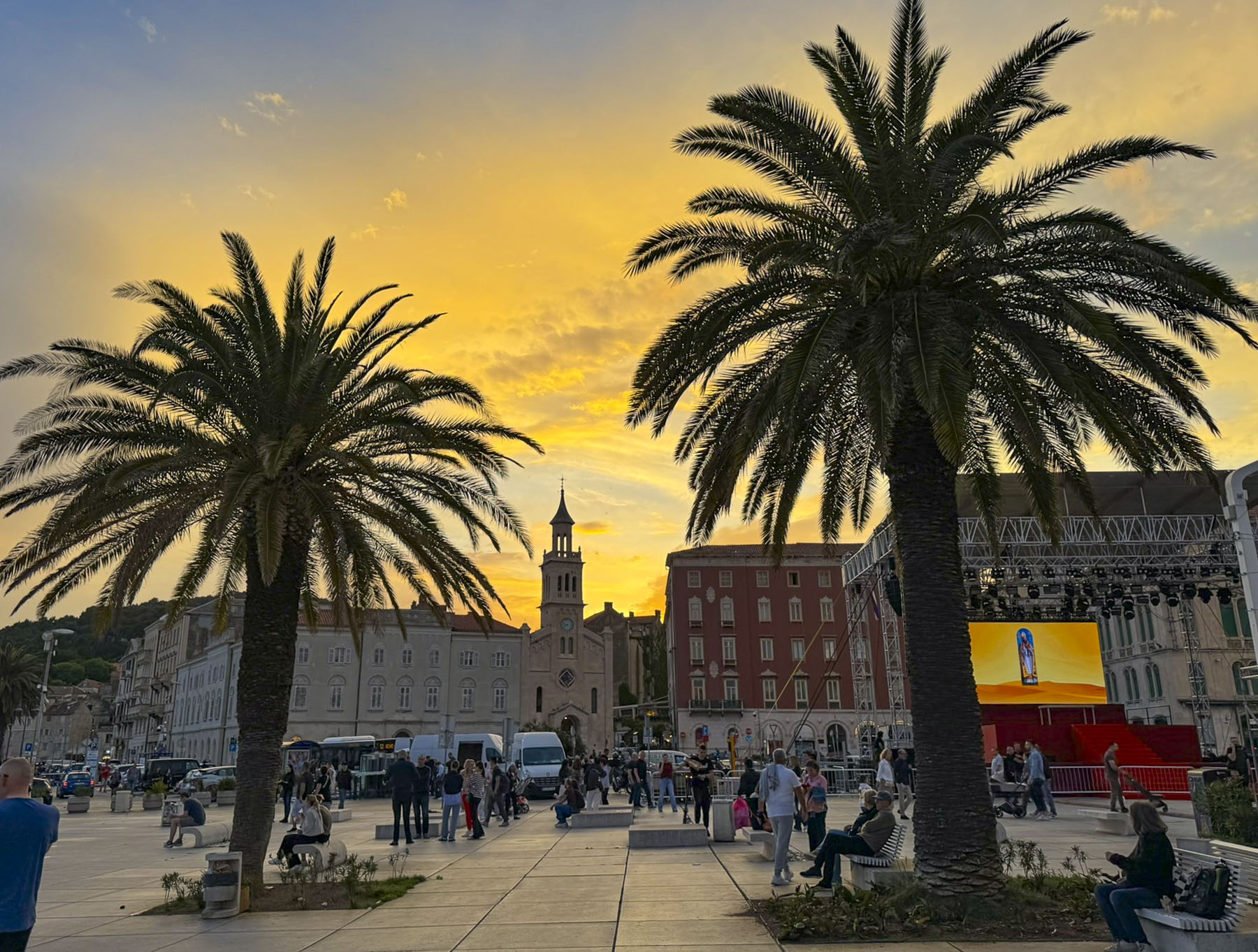
We hoped the storm clouds would begin to break apart so we could catch a scene from the spot that “Alfred Hitchcock once declared during a 1964 visit to the city as having “the most beautiful sunsets in the world.”  Alas, during our stay in Zadar the mornings were sunny, the afternoons cloudy, and our sunsets stormy and grey.

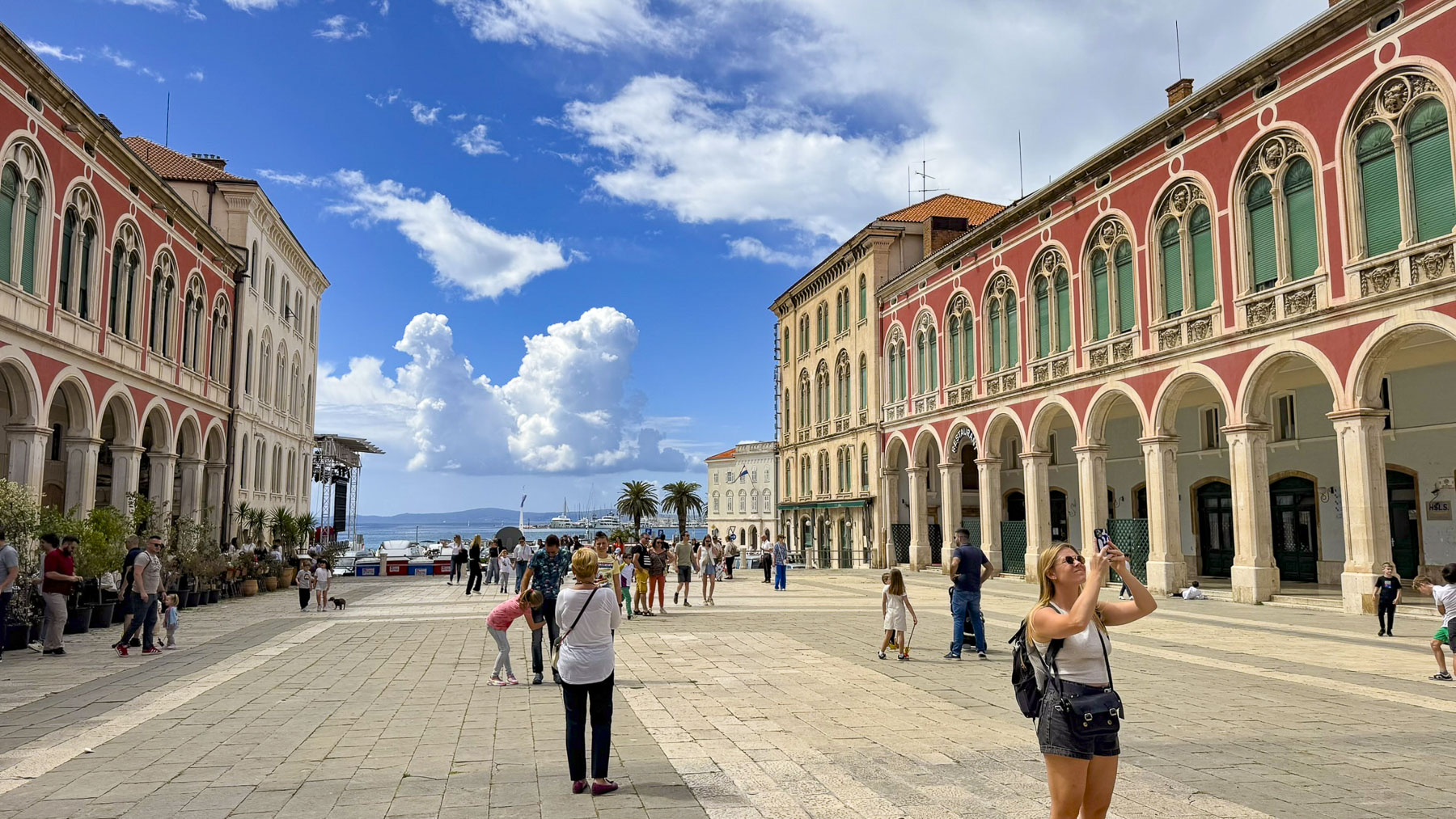
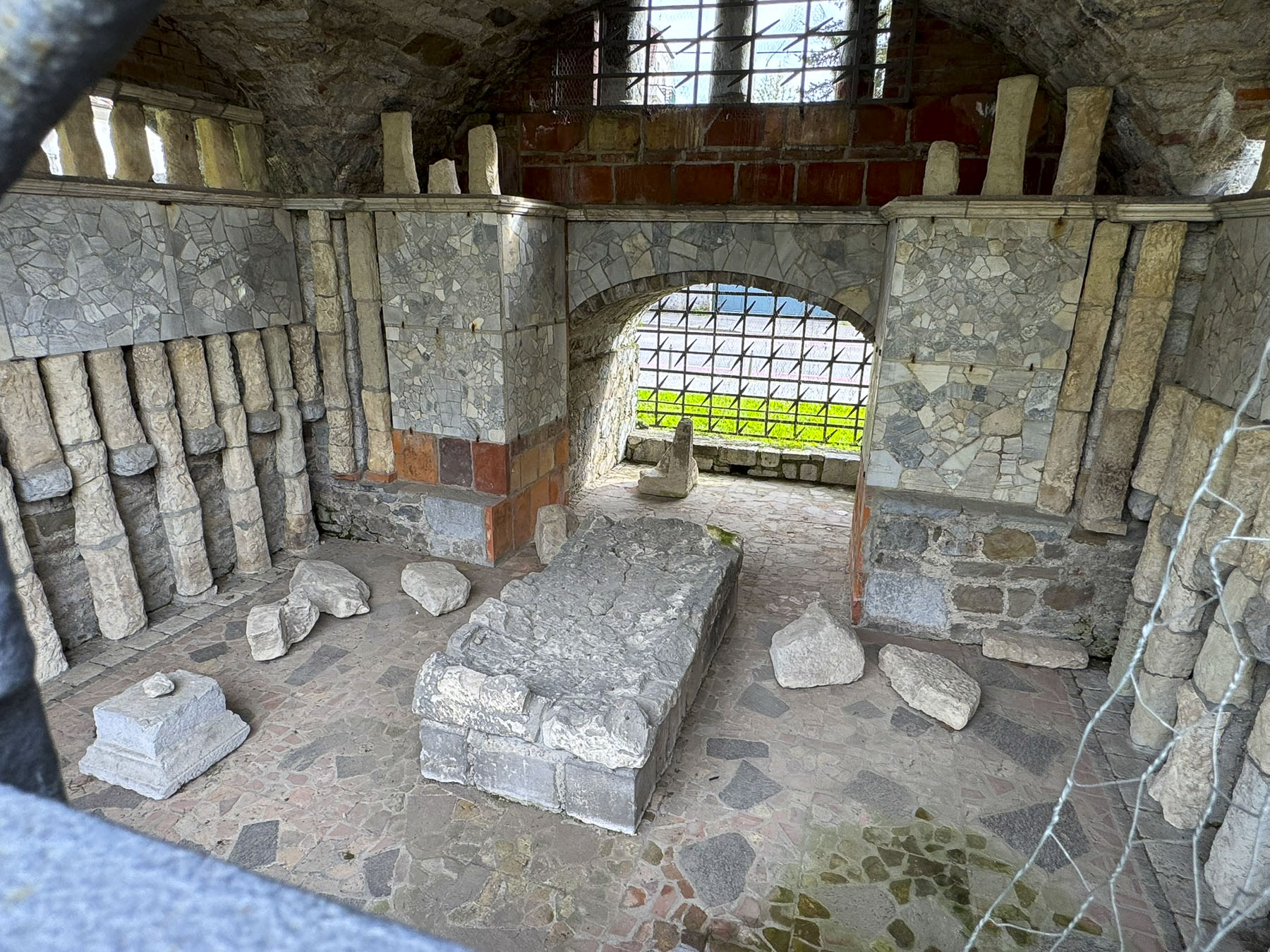
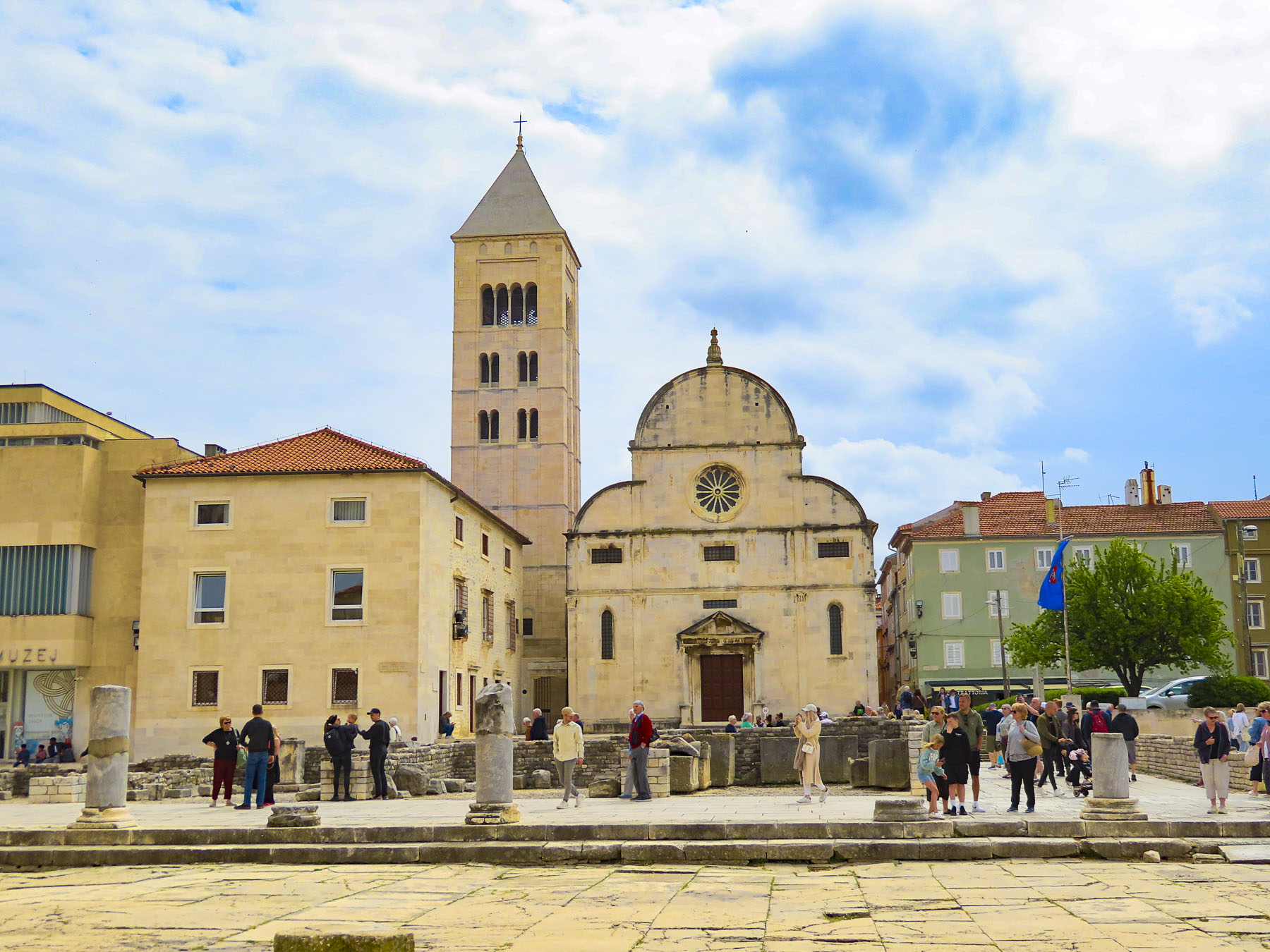
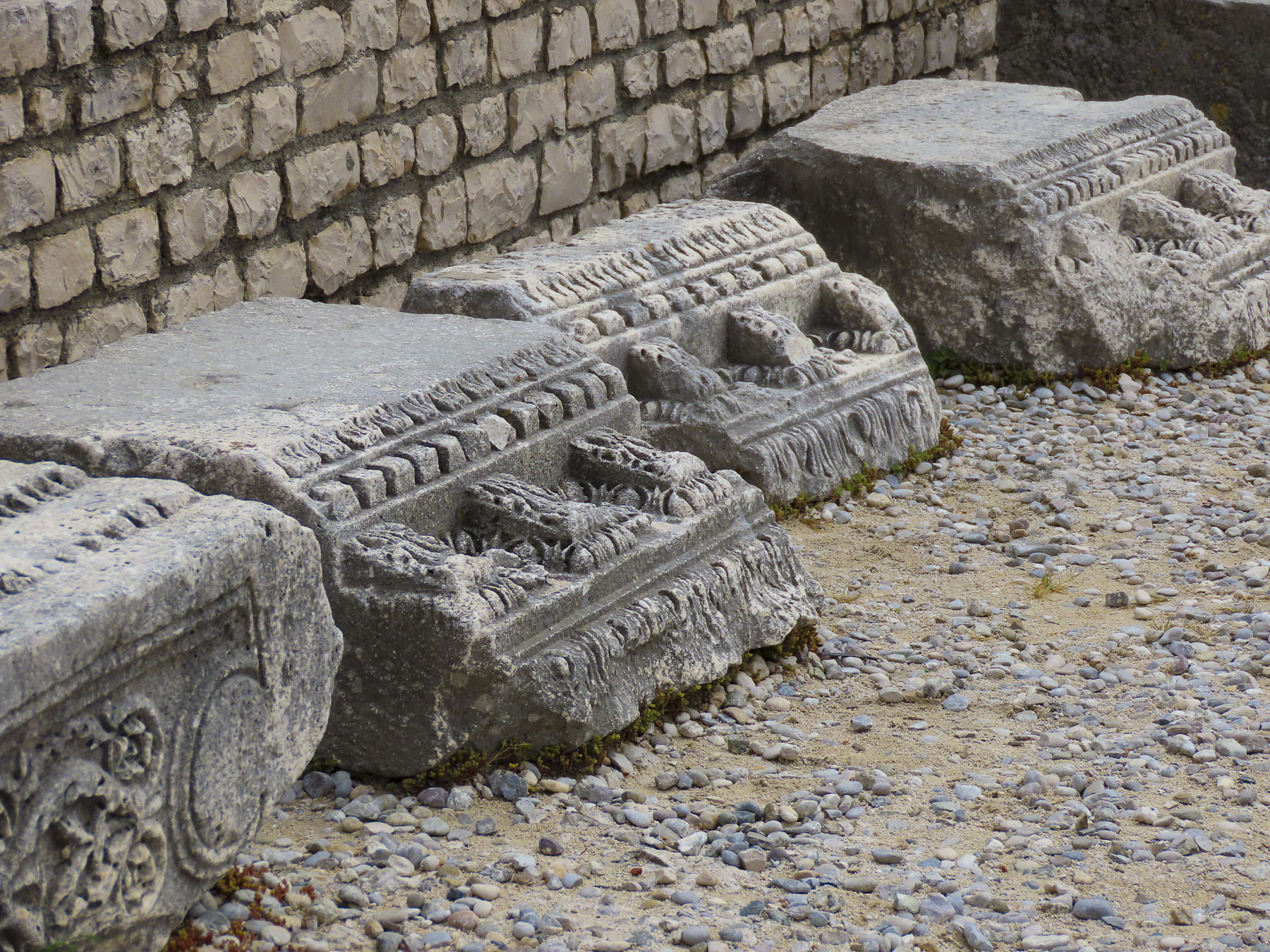
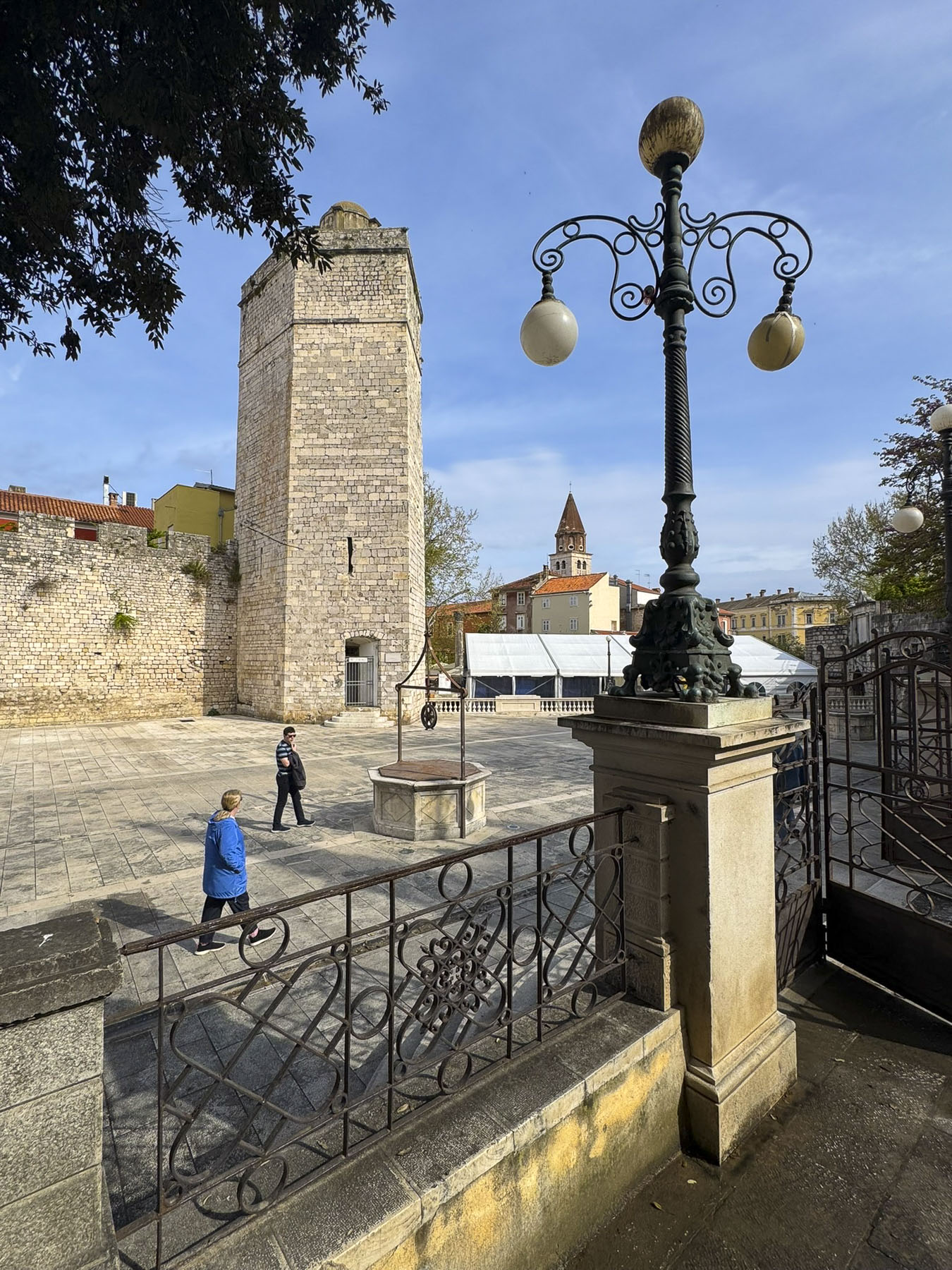
The next morning, we set out to properly explore the town, first stopping at the Roman Effigies, a collection of column sections and decorated capitals from the ancient Roman Forum, which stood in the area of Piazza Papa Giovanni Paolo (Pope John Paul II Square). The plaza itself was built over Zadar’s 16th century water cistern.

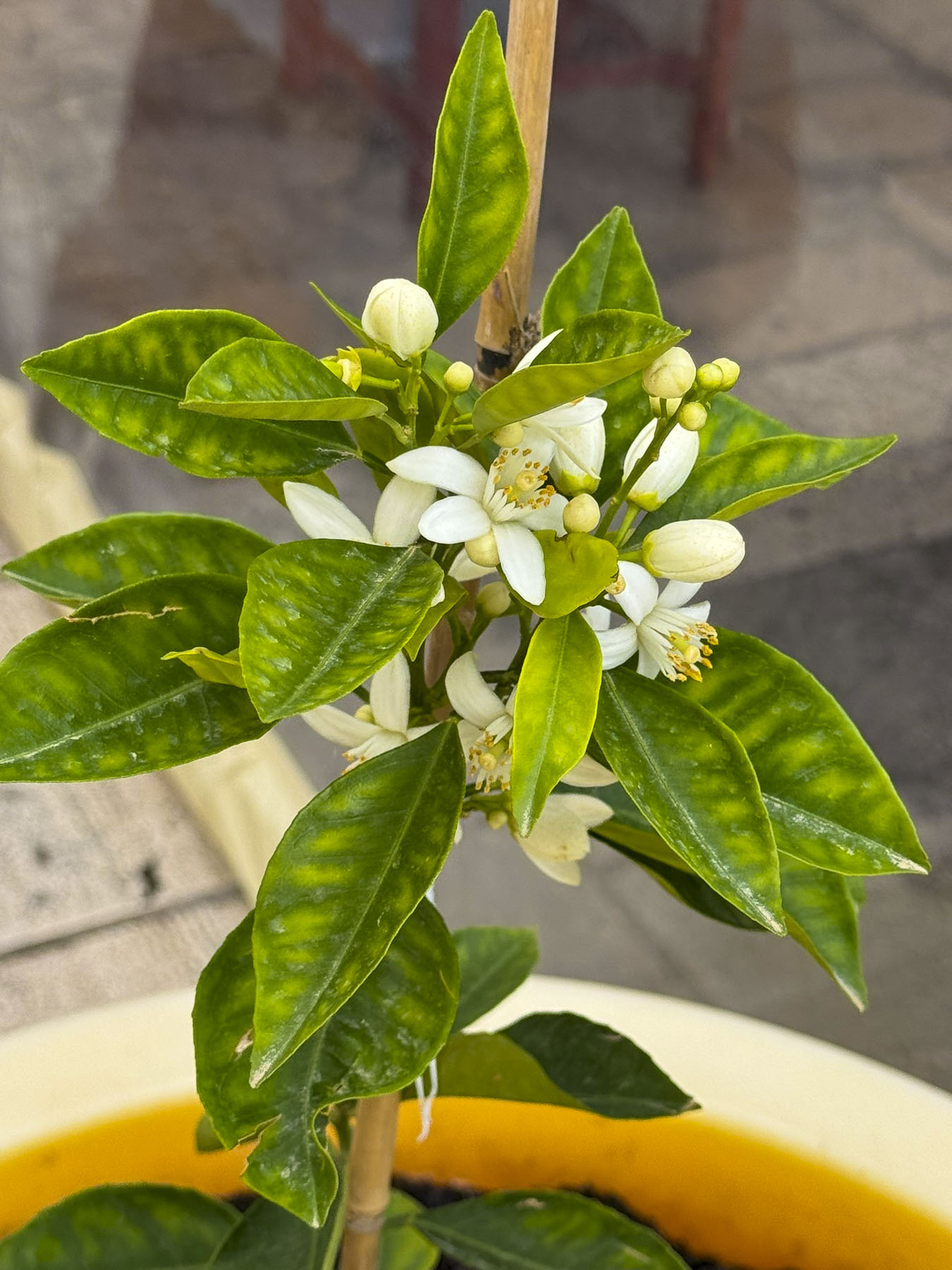
The piazza located next to the 9th-century Church of St. Donatus and the 11th-century Benedictine Monastery of St. Maria is the center point for the northern end of Zadar. The historic buildings did not open until later in the morning, so we continued down Zadar’s narrow lanes, enjoying the fragrance of orange blossoms while we strolled to Pekara Dalmatinka – Old Town Bakery, a recommendation from our friend at the car rental agency.

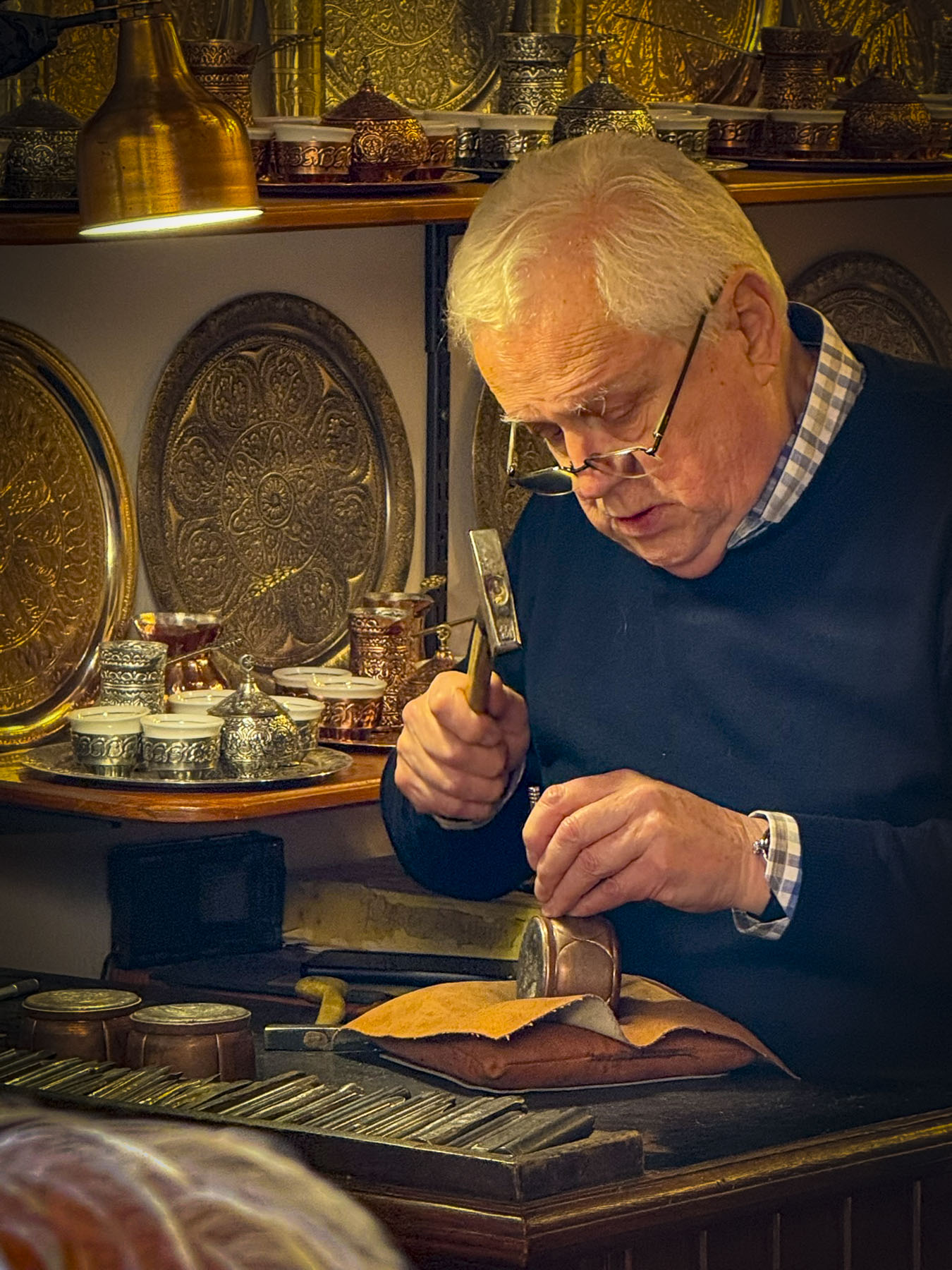
On the way, something piqued our curiosity down a narrower side alley and we detoured. There in a small workshop a craftsman was applying gold leaf to a frame. We appreciate old-world talents like this, and I asked in English, and gestured with my cell phone, if I could take a photo of him working. All was lost in translation and the man suddenly walked out, only to return a few minutes with his son who spoke English, and we chatted for a minute. Apparently, few tourists ever poked their heads into the workshop; the frame he was gilding was for a church, and his dad is a busy man, but it is okay to take his picture.

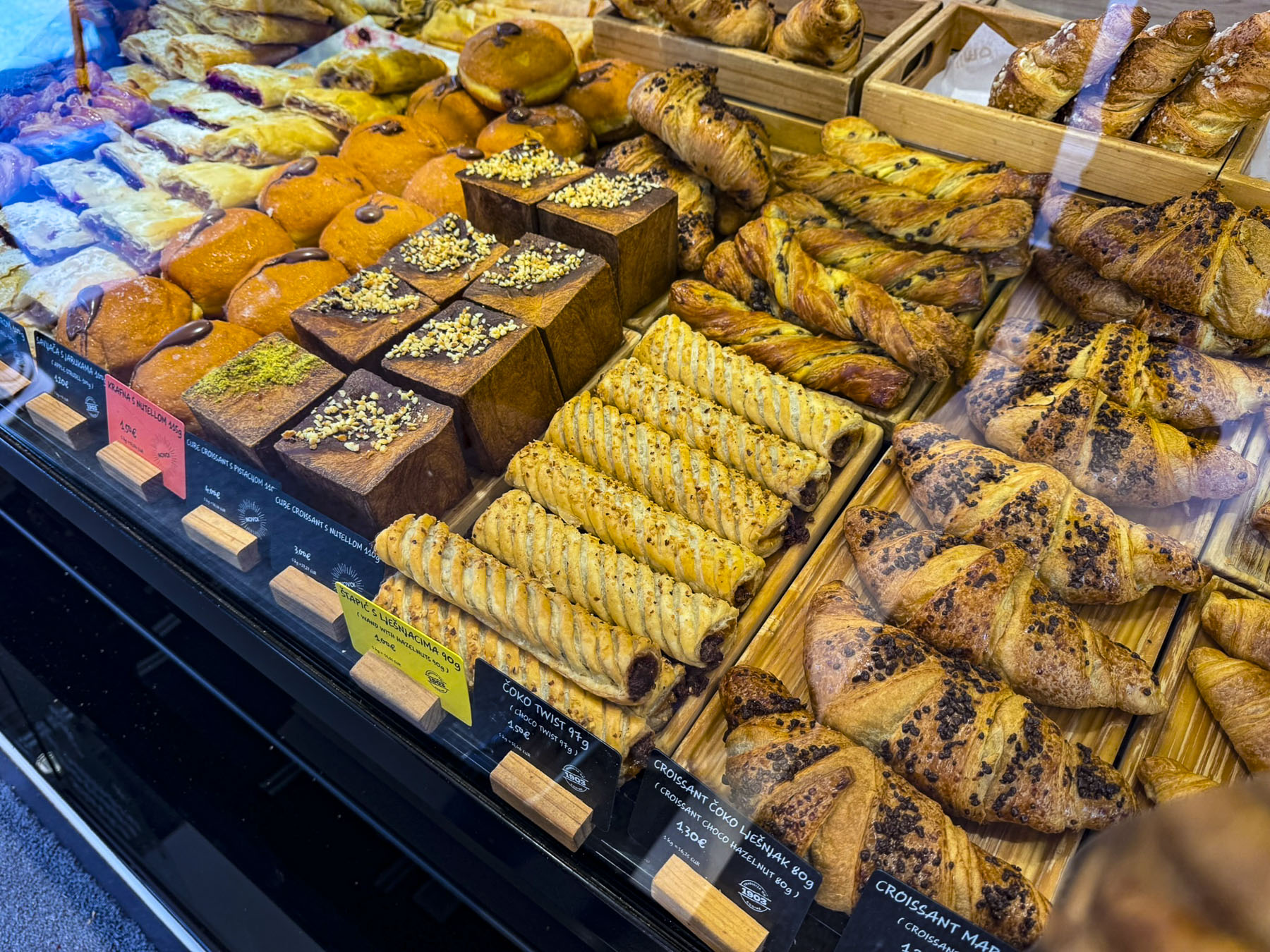
It’s a mistake to arrive hungry to a bakery that confronts you with a display case featuring mouthwatering Croatian pastries. We drooled over Kremšnita, custard cream cake; Madarica, a layered chocolate cake; Makovnjača & Orehnjača, a rolled dough pastry filled with walnuts or poppy seeds; Princes Krafne, a doughnut stuffed with luscious cream; Splitska Torta, a cake with layers of meringue, cream, almonds and figs; and of course Börek, a delicious, coiled phyllo dough pastry filled with feta cheese or spinach.

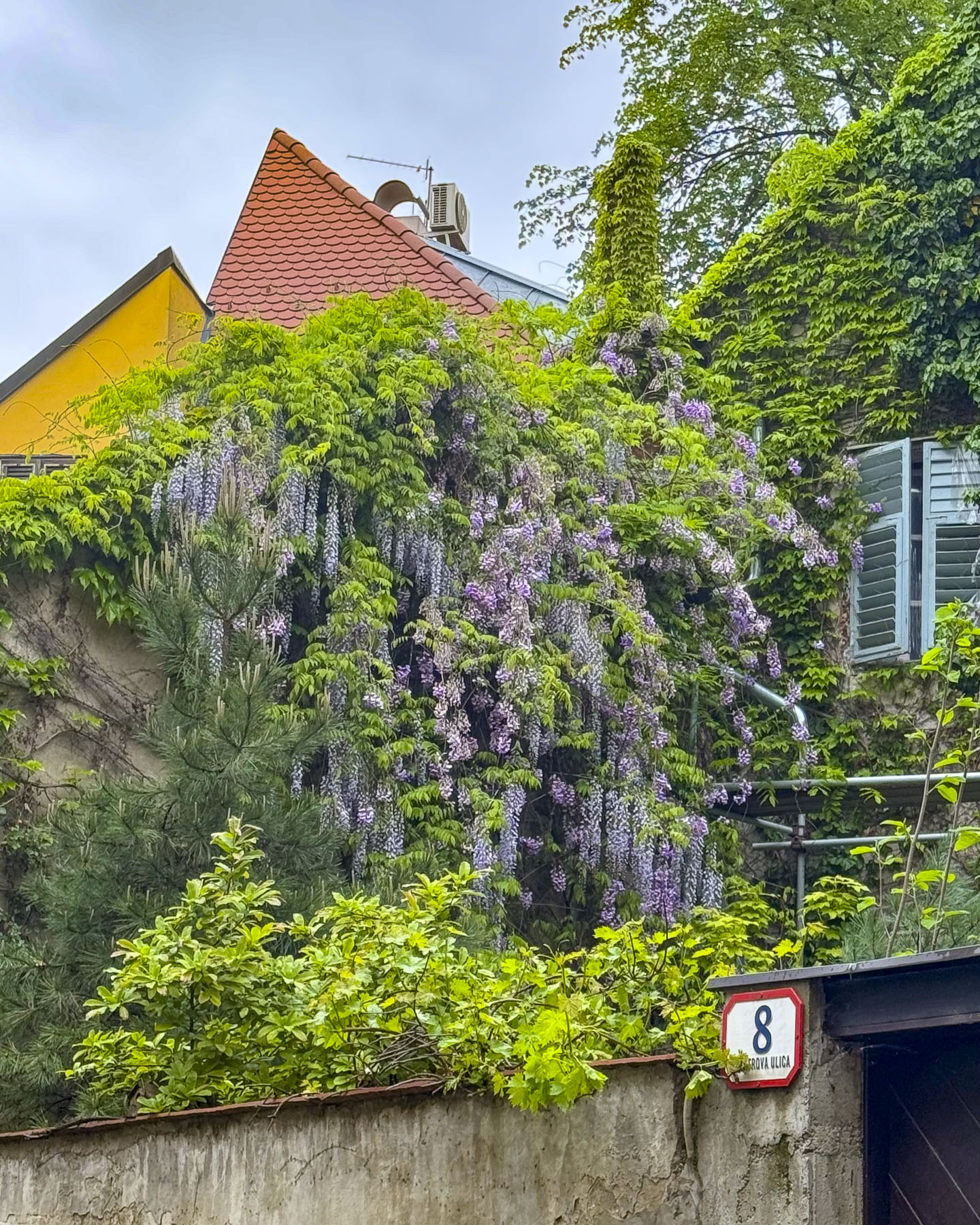
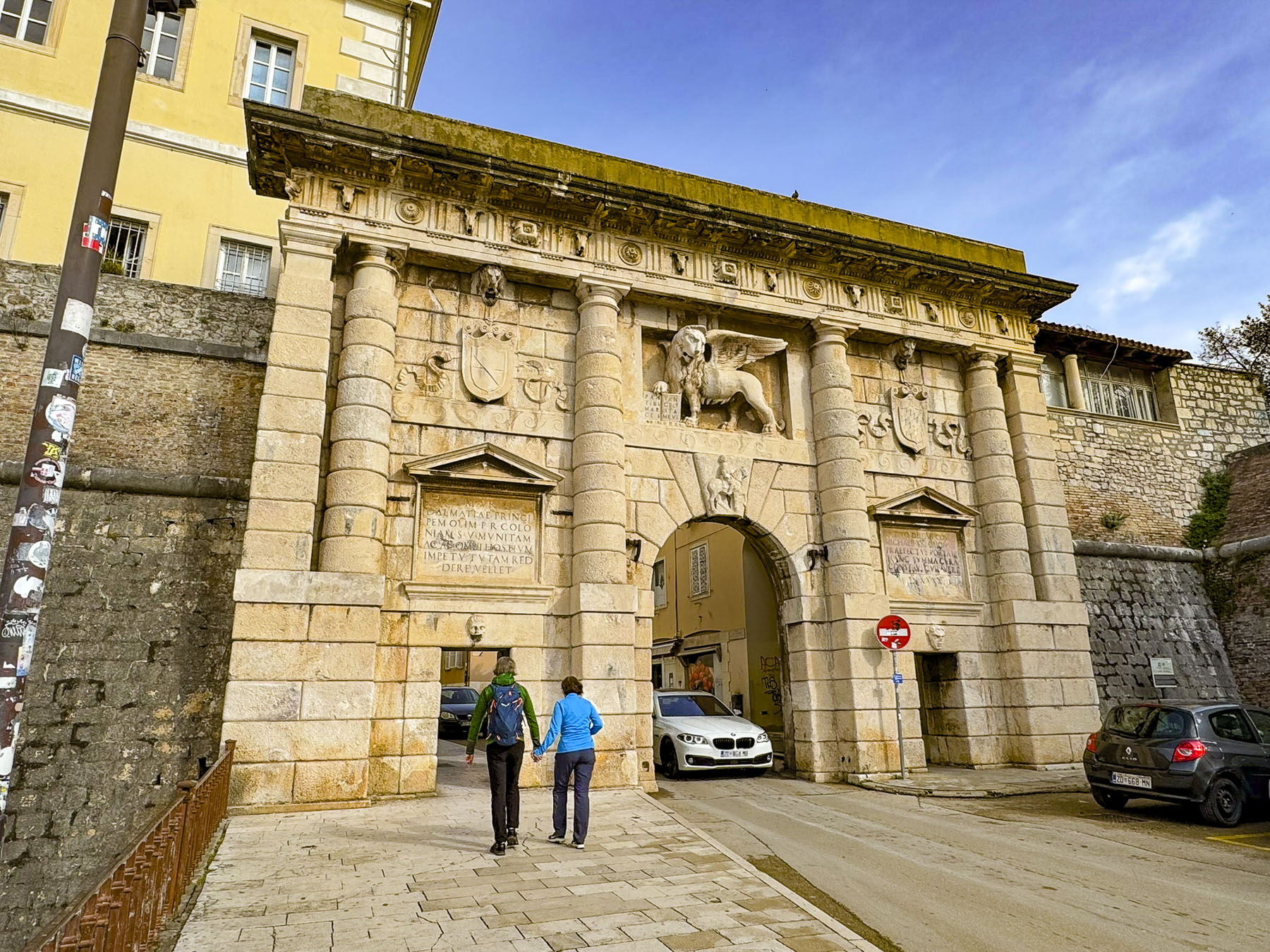
We planned to walk off our over-indulgence, and headed through Trg Pet Bunara, the Five Wells Square, to find a bench in Queen Jelena Madijevka Park. Tree branches laden with purple flowers hung over the decorative railing at the entrance to the park, which sits atop the city’s old bastion, next to the ancient Venetian Land Gate, and was the perfect spot for a morning picnic.  Built in 1573, it replaced an old Roman gate, and featured a relief of the Winged Lion of St. Mark, the symbol of the Venetian Empire, to celebrate a naval victory over the Turks. From our bench we watched a boat enter the small harbor in front of Zadar’s ancient defensive wall, a continuous activity since Zadar’s founding.

The ancient walls and gates around the city were first built by the Romans and then expanded upon by the Venetians in the 16th and 17th centuries, to defend the city from multiple attacks by the Ottoman Empire.

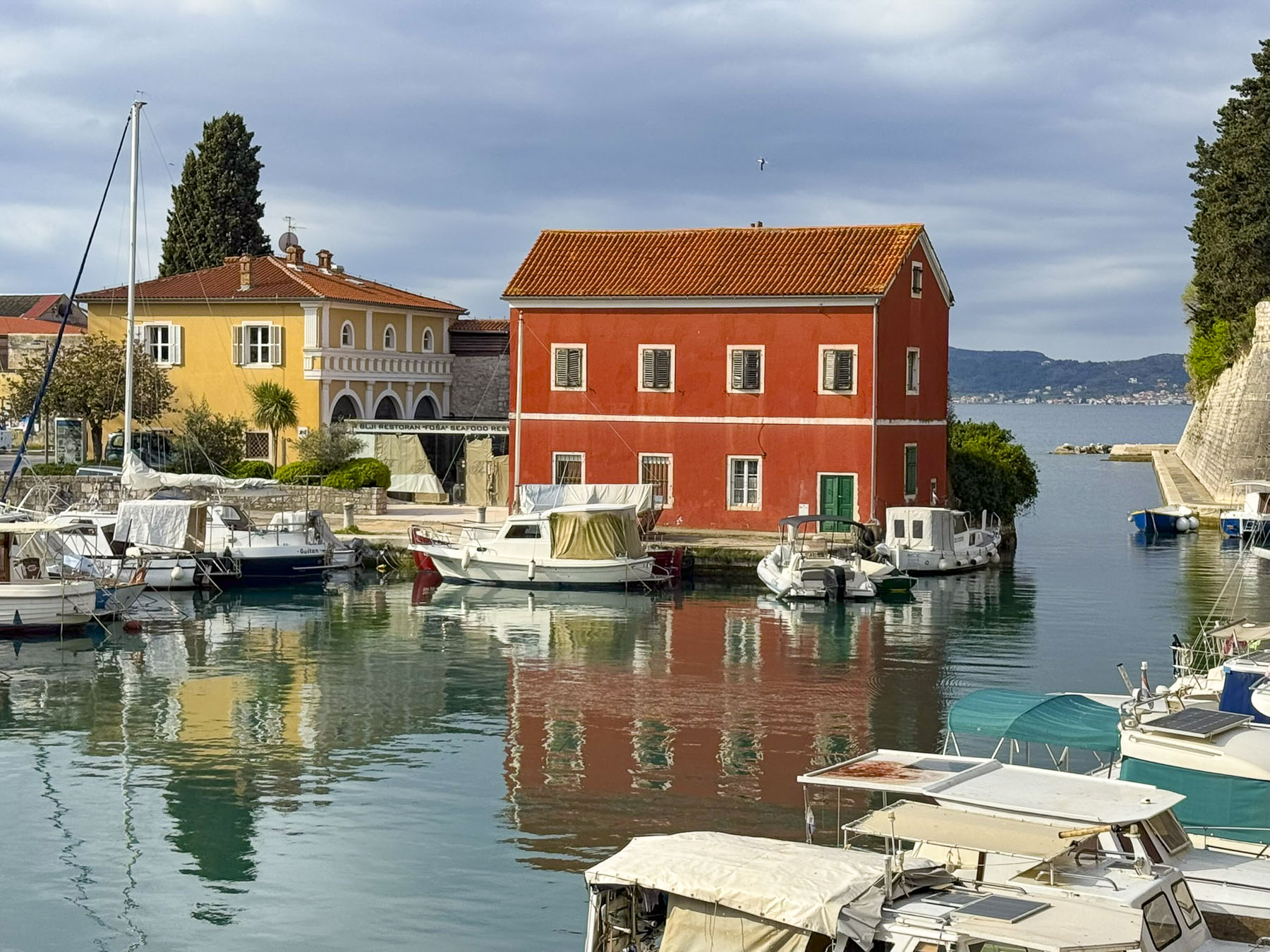
Several of the ancient gates still stand and allow passage from the old town to the ferry harbor. The top of the ramparts over the gates have been incorporated into a scenic walkway that parallels the waterfront and provides a pretty vantage point to view all the maritime activity, and some vignettes of old town Zadar.

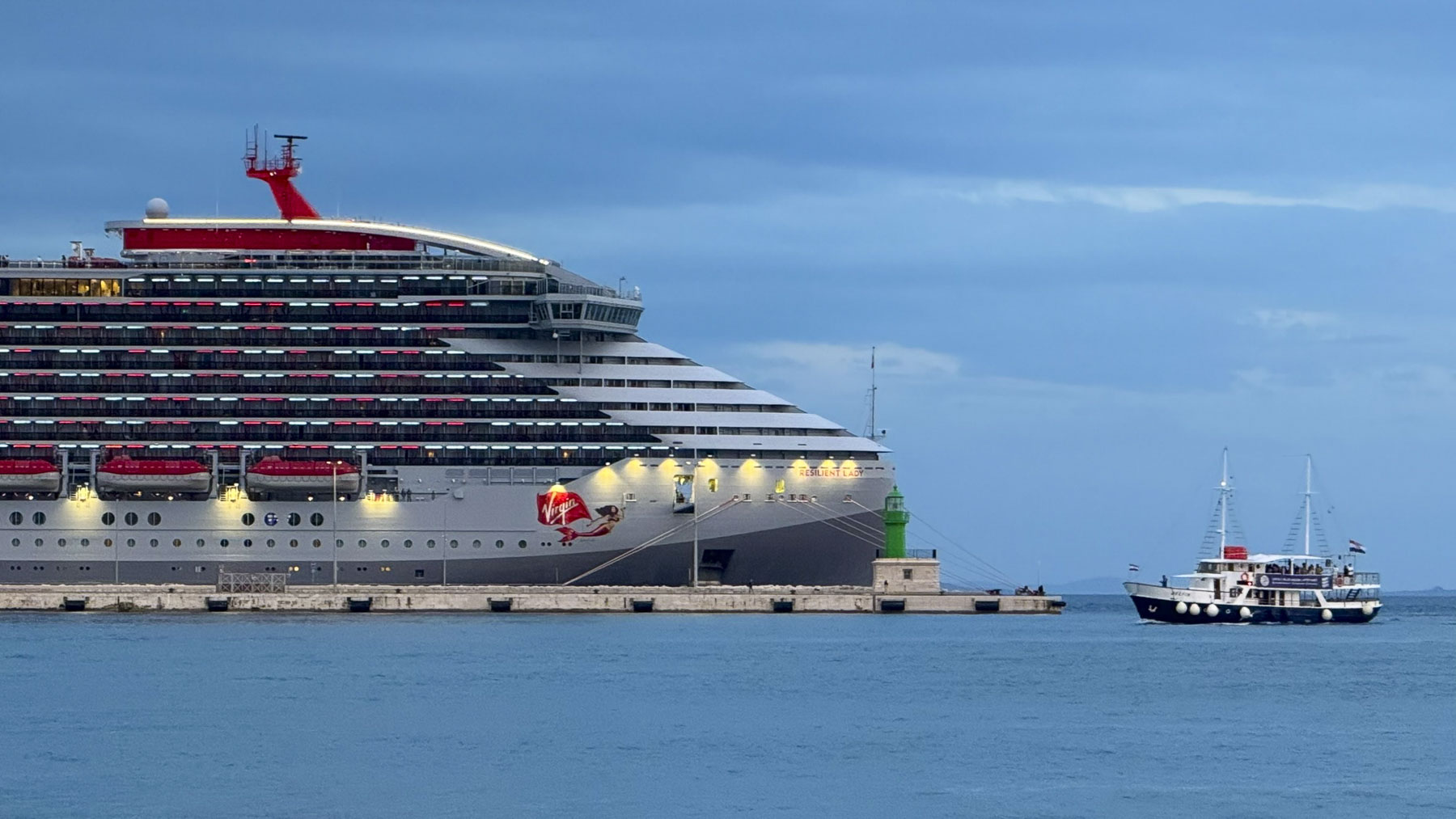
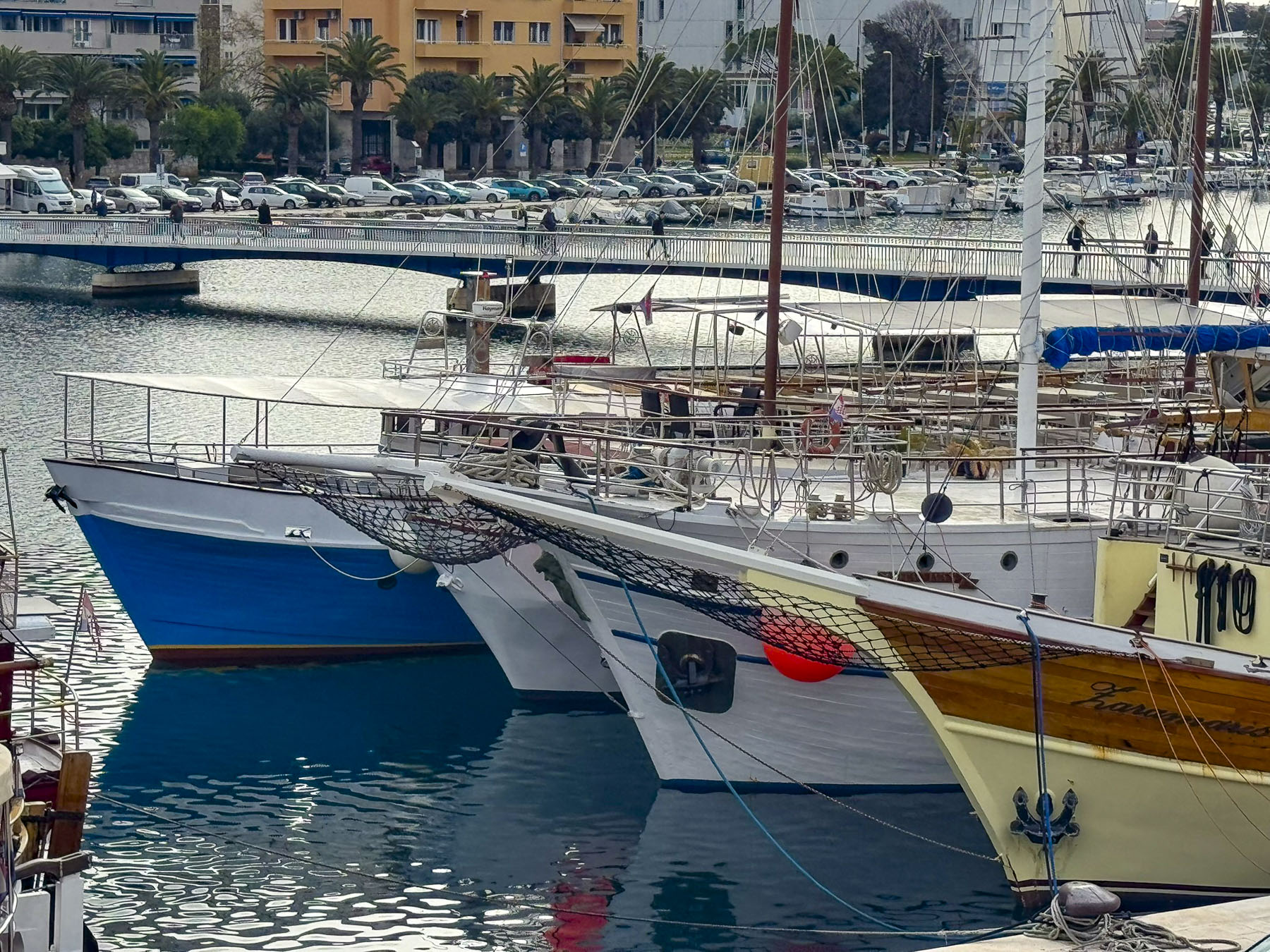
Along this walk we spotted a younger man rowing a small boat with passengers across the narrow harbor, from a small lighthouse to a staired landing on the quay. Apparently, they were on the way to work and his service, like the traghetto in Venice, provided a shortcut. A sign we discovered the next day listed the fee as 2€.

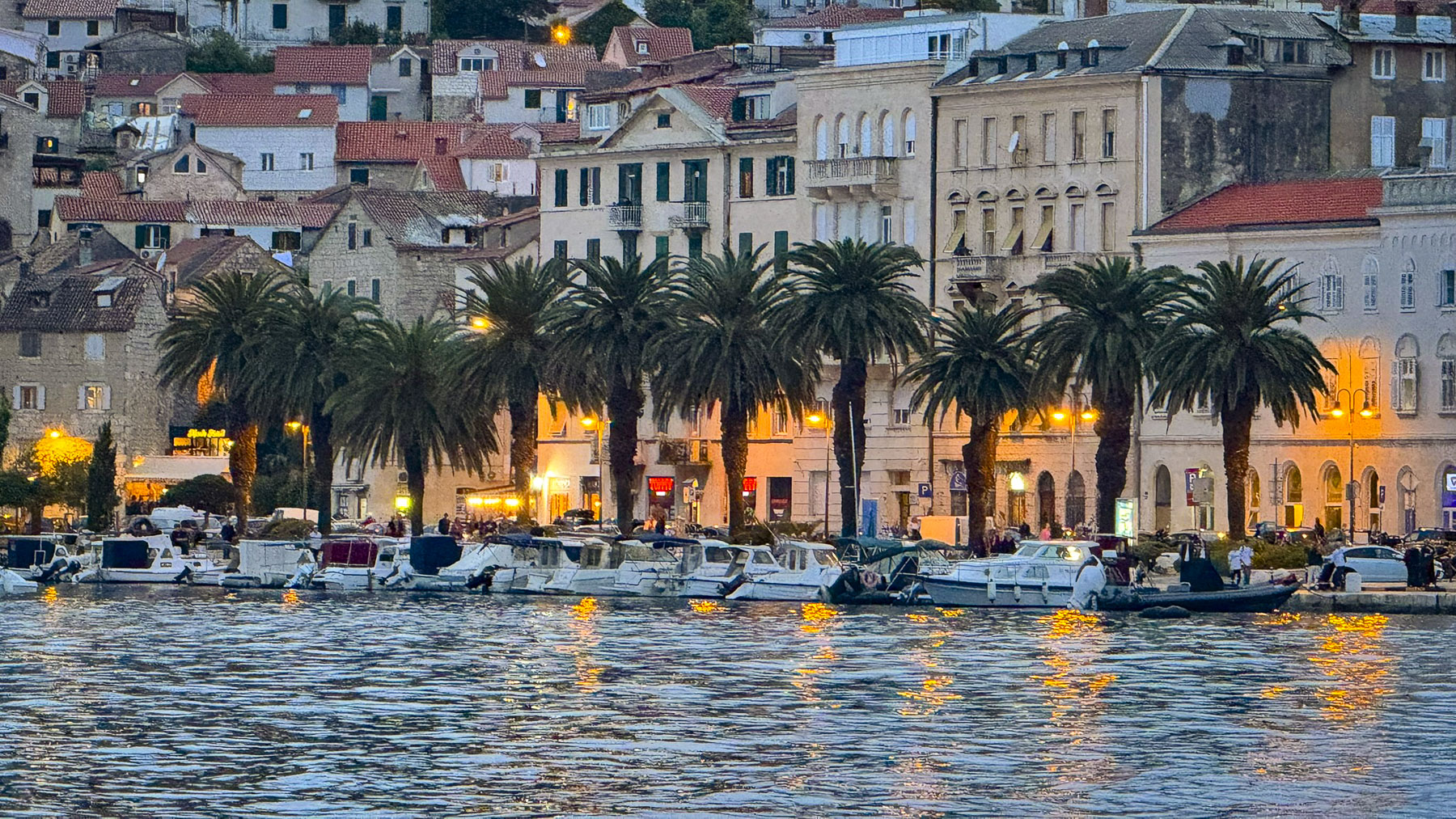
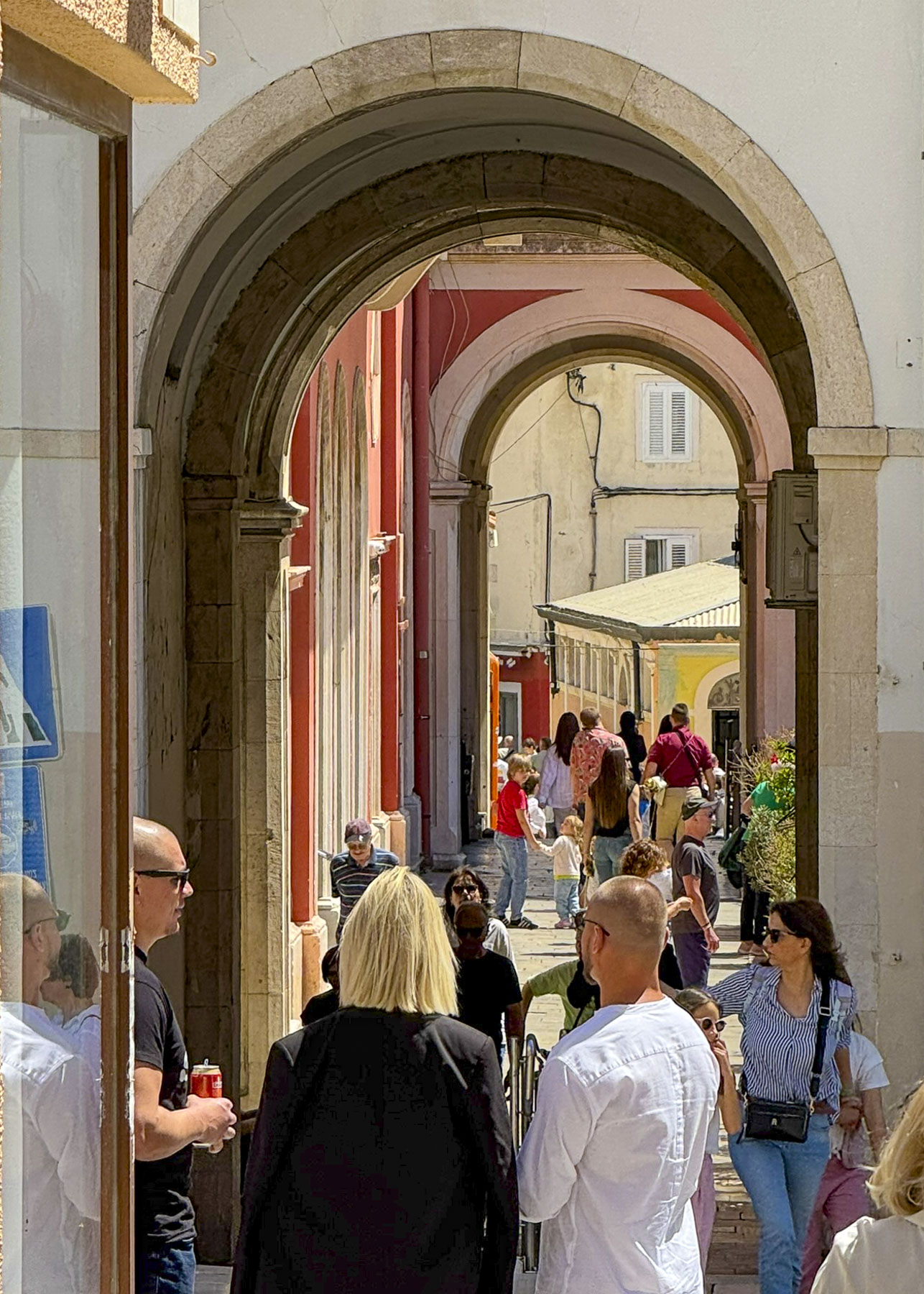
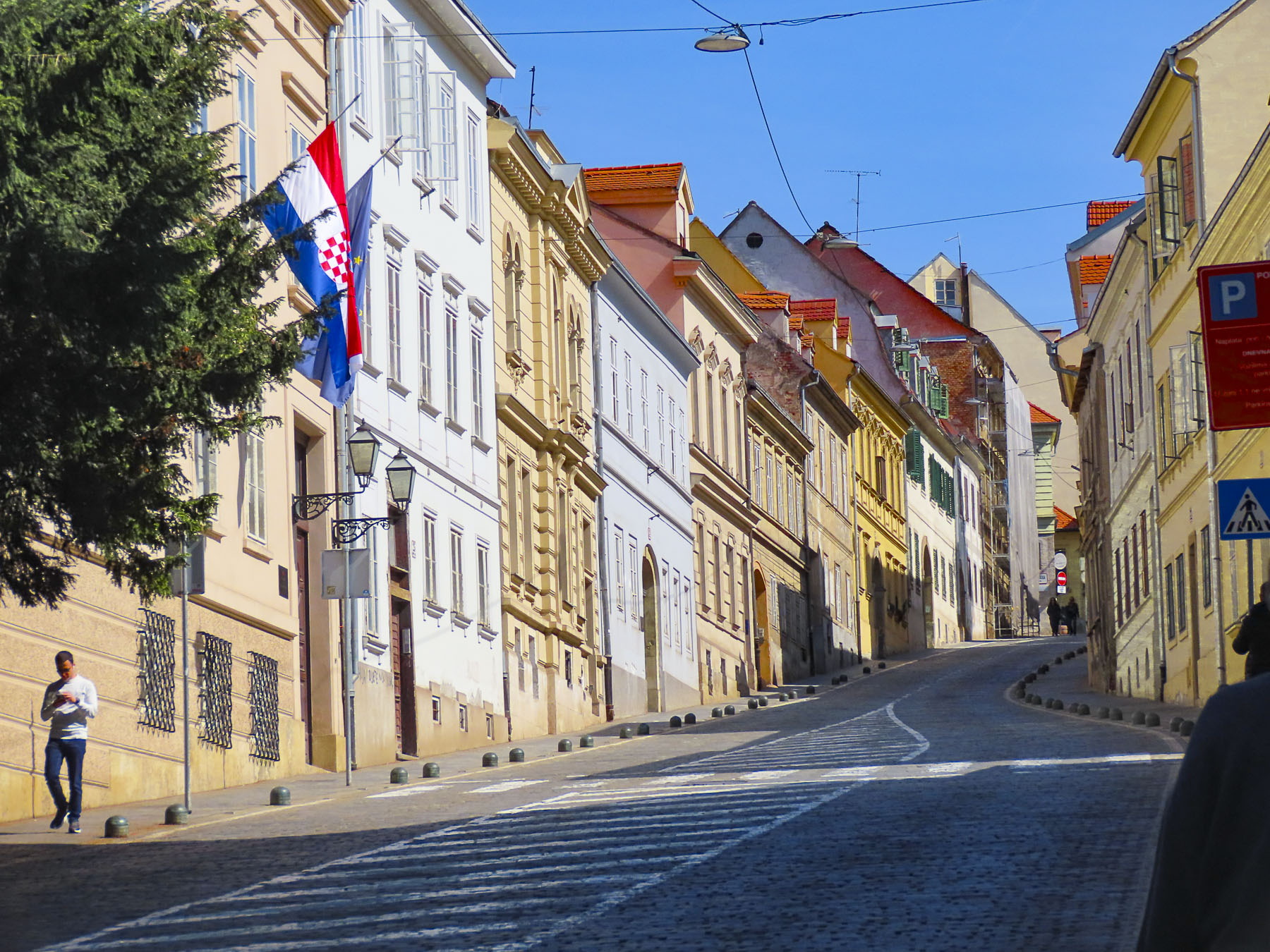
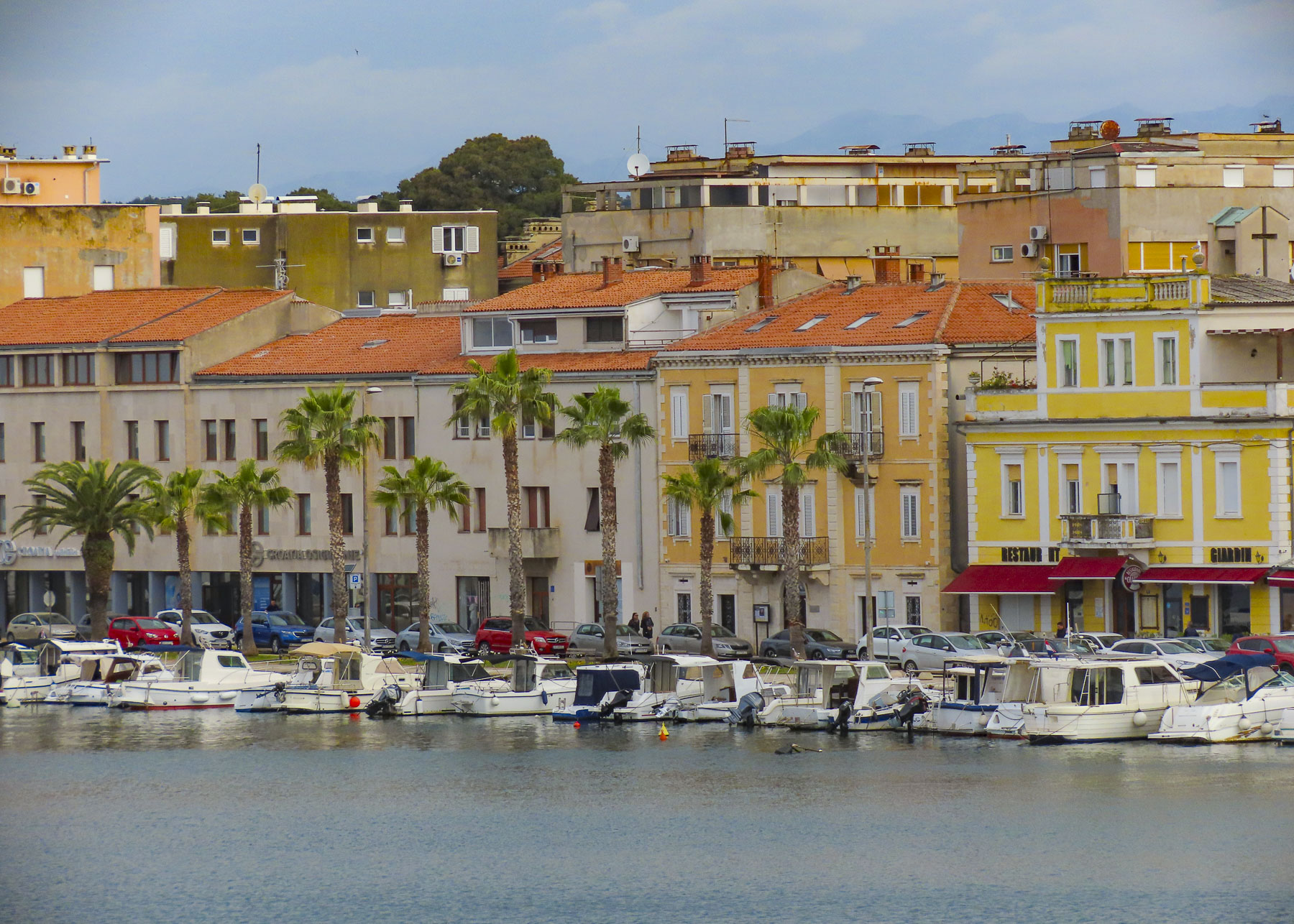
Over the years the population of Zadar has sprawled into new buildings on the mainland, unlike Dubrovnik, which has been gentrified into a theme park. Old Town Zadar, on the other hand, has some newer buildings on its peninsula, but also has many that show the patina of age, and give the town an authenticity and delightful ambience.

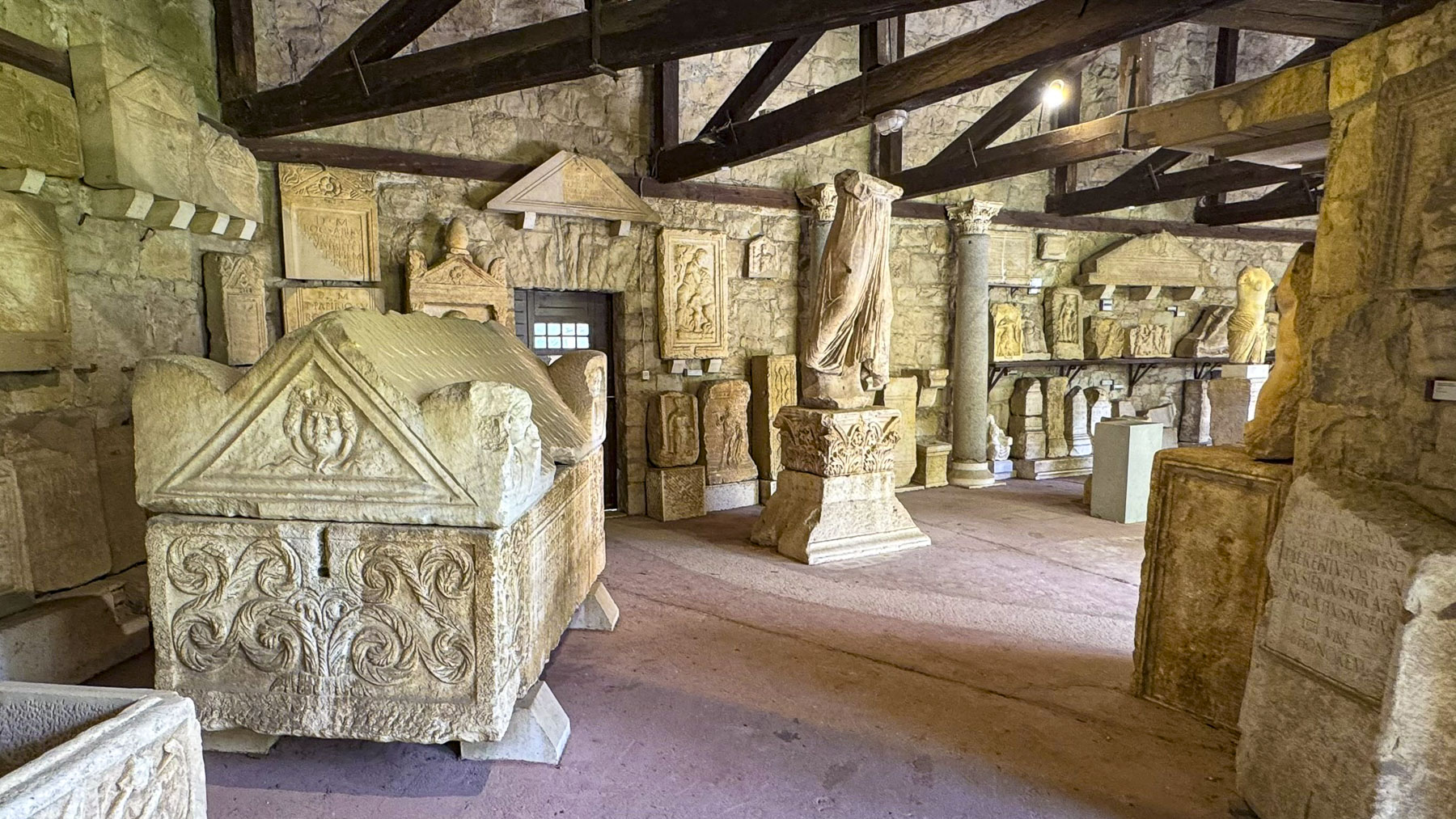
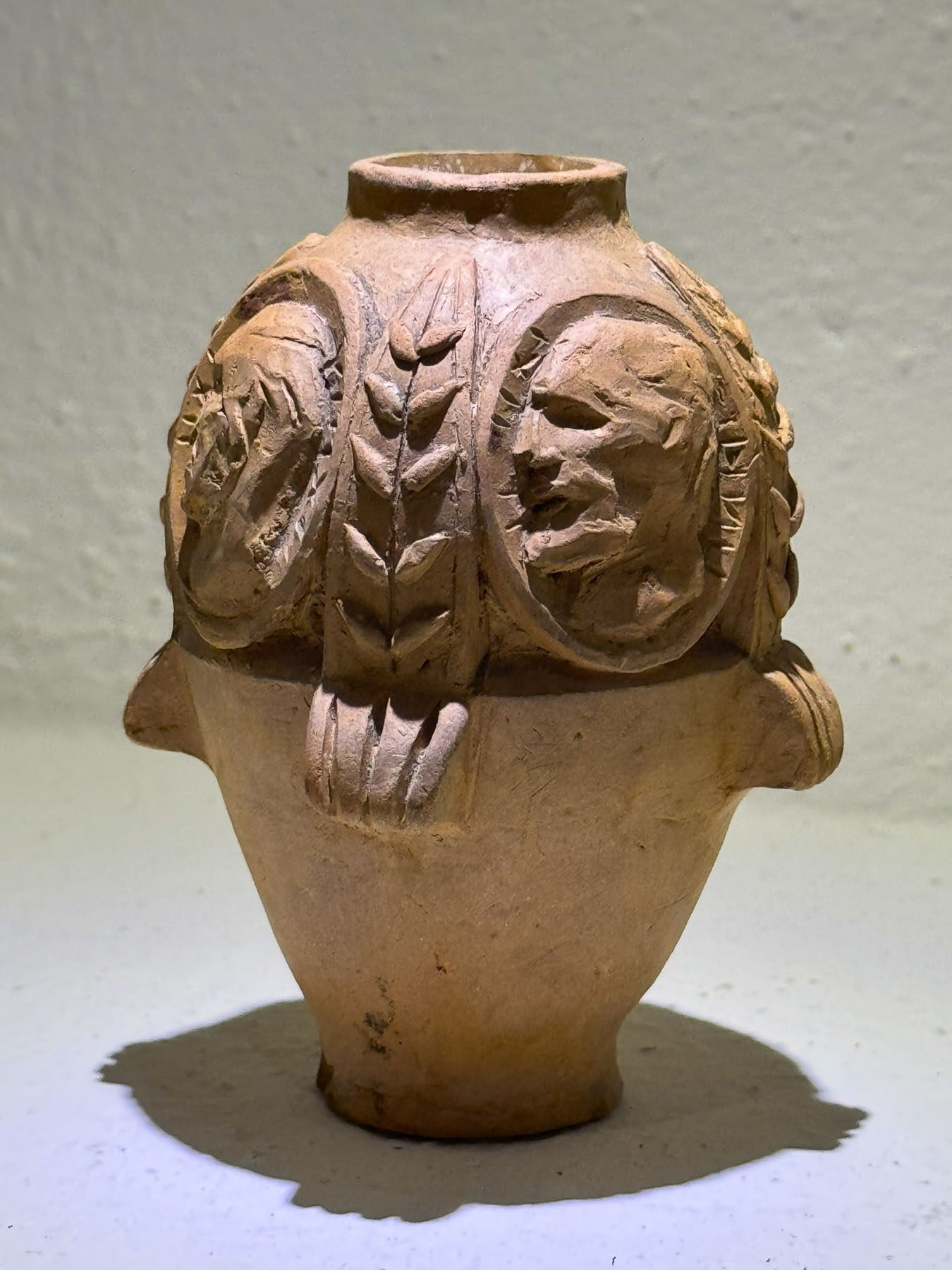
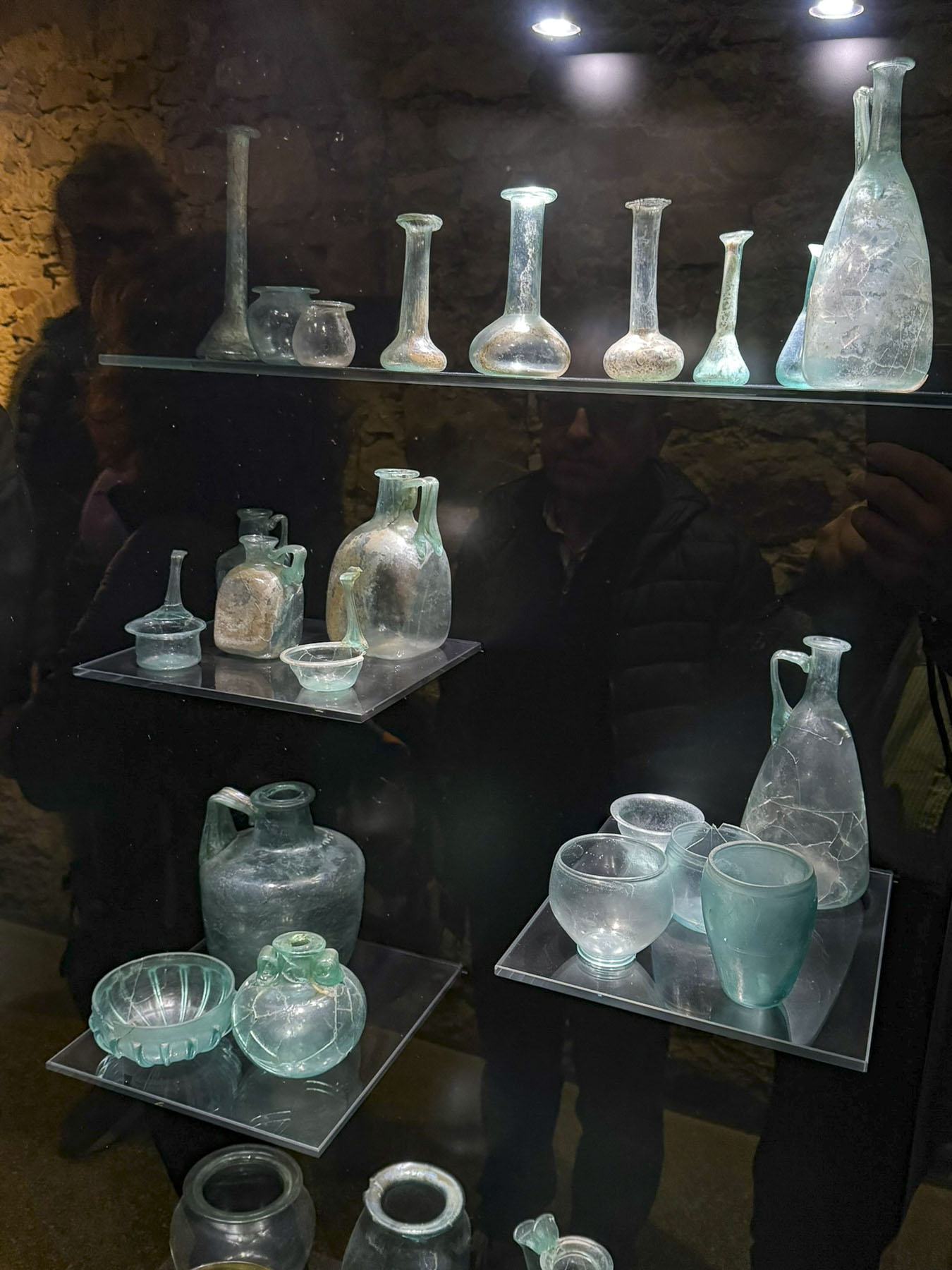
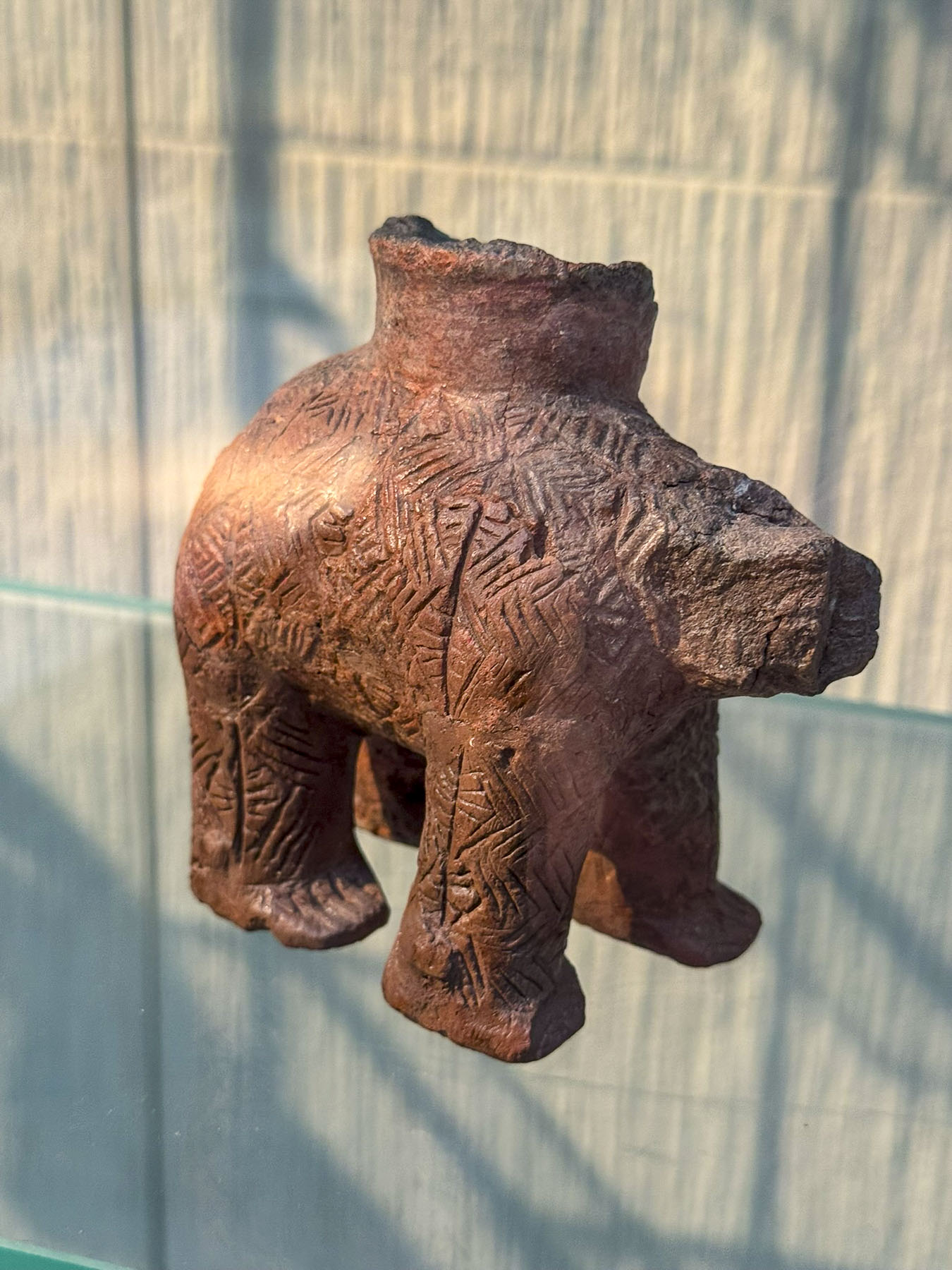
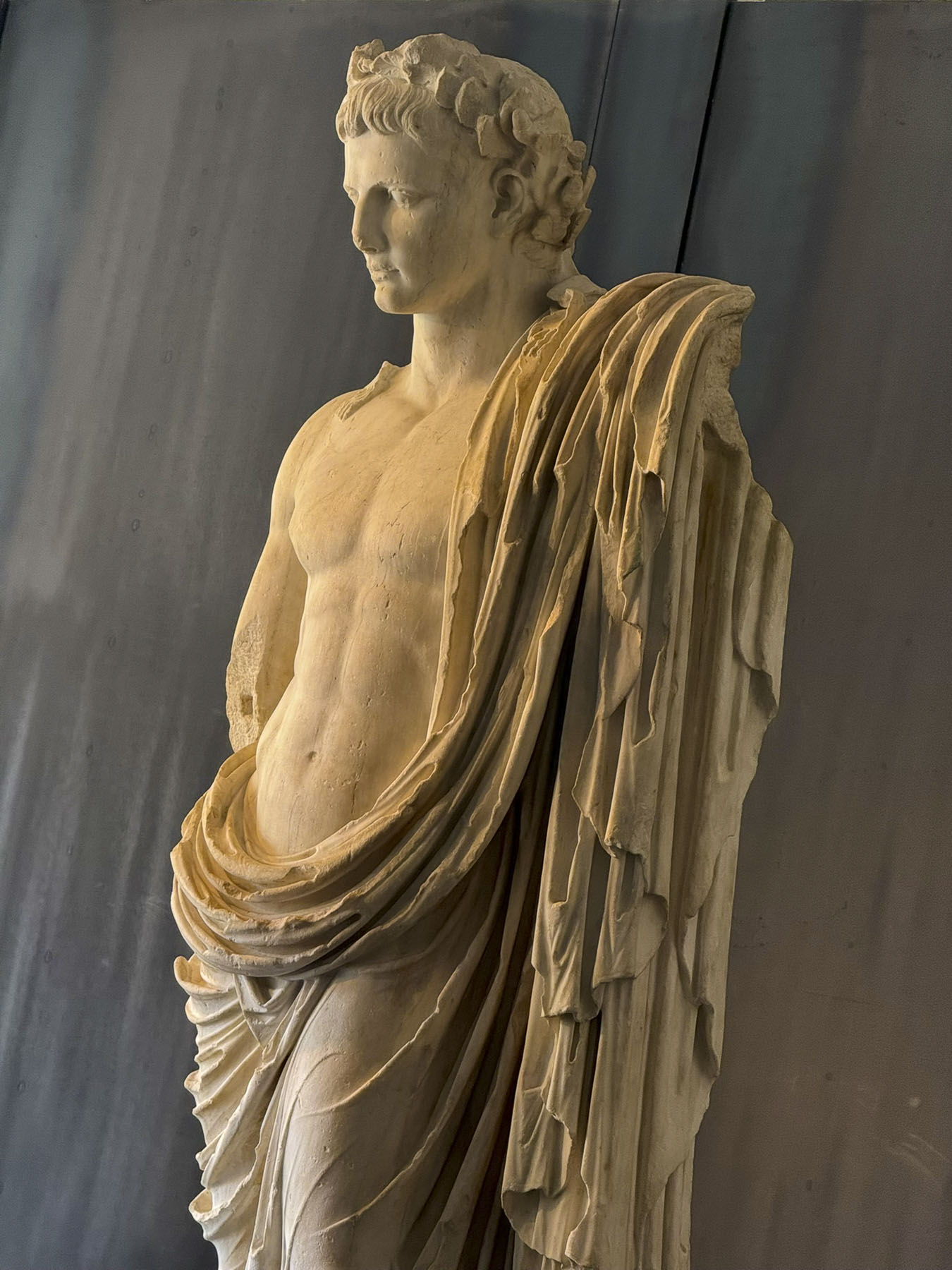
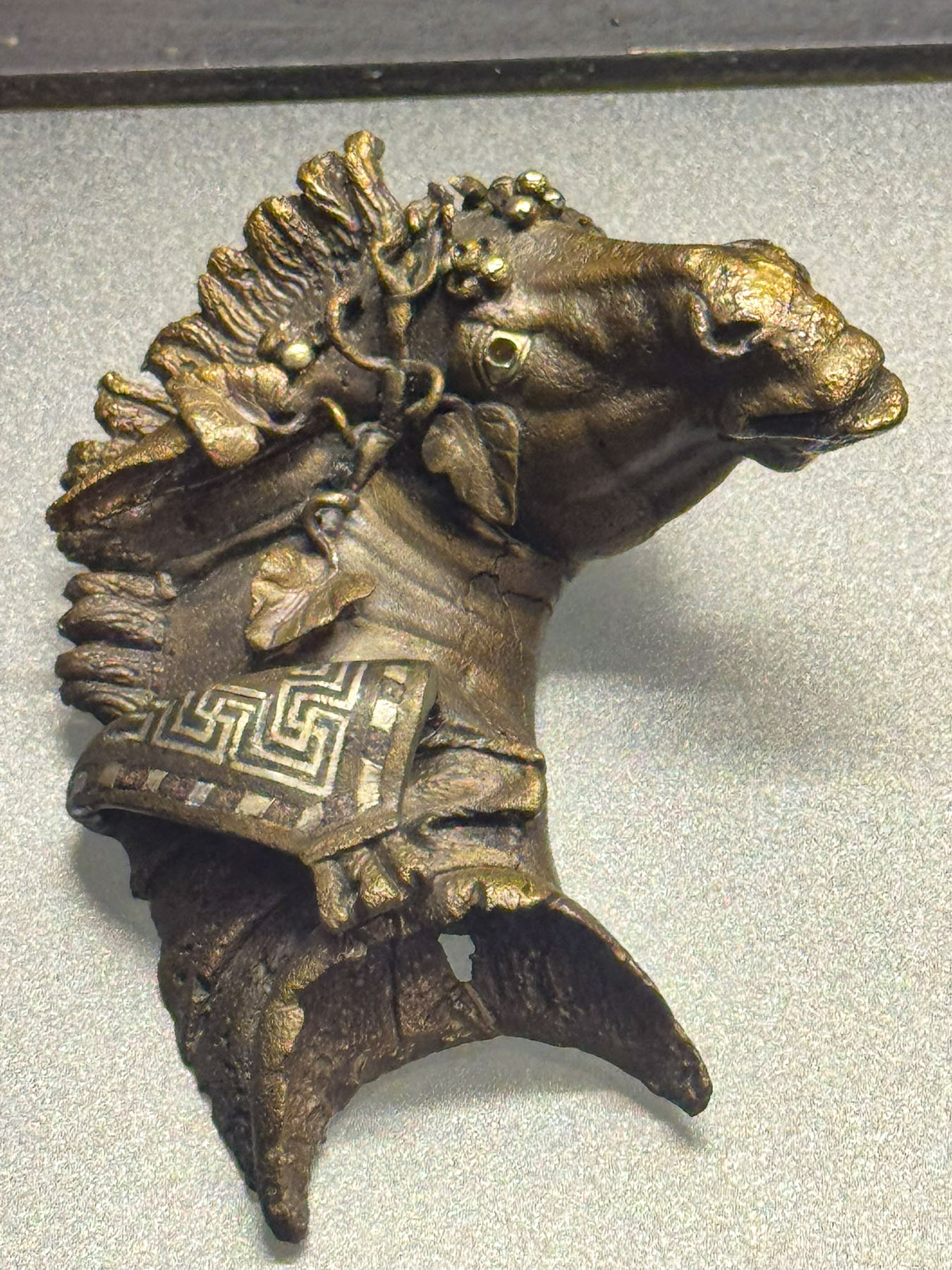
Our sunny morning was threatened with rain by noon, so we headed into the Archaeological Museum, where they have an interesting and diverse collection of ancient artifacts, statuary, and busts unearthed in Zadar, from its pre-history through the Roman Era and Venetian times. Especially unusual was the collection of Neolithic Rhytons, a  four-legged ceramic ritual vessel, from the Impresso and Danilo cultures.

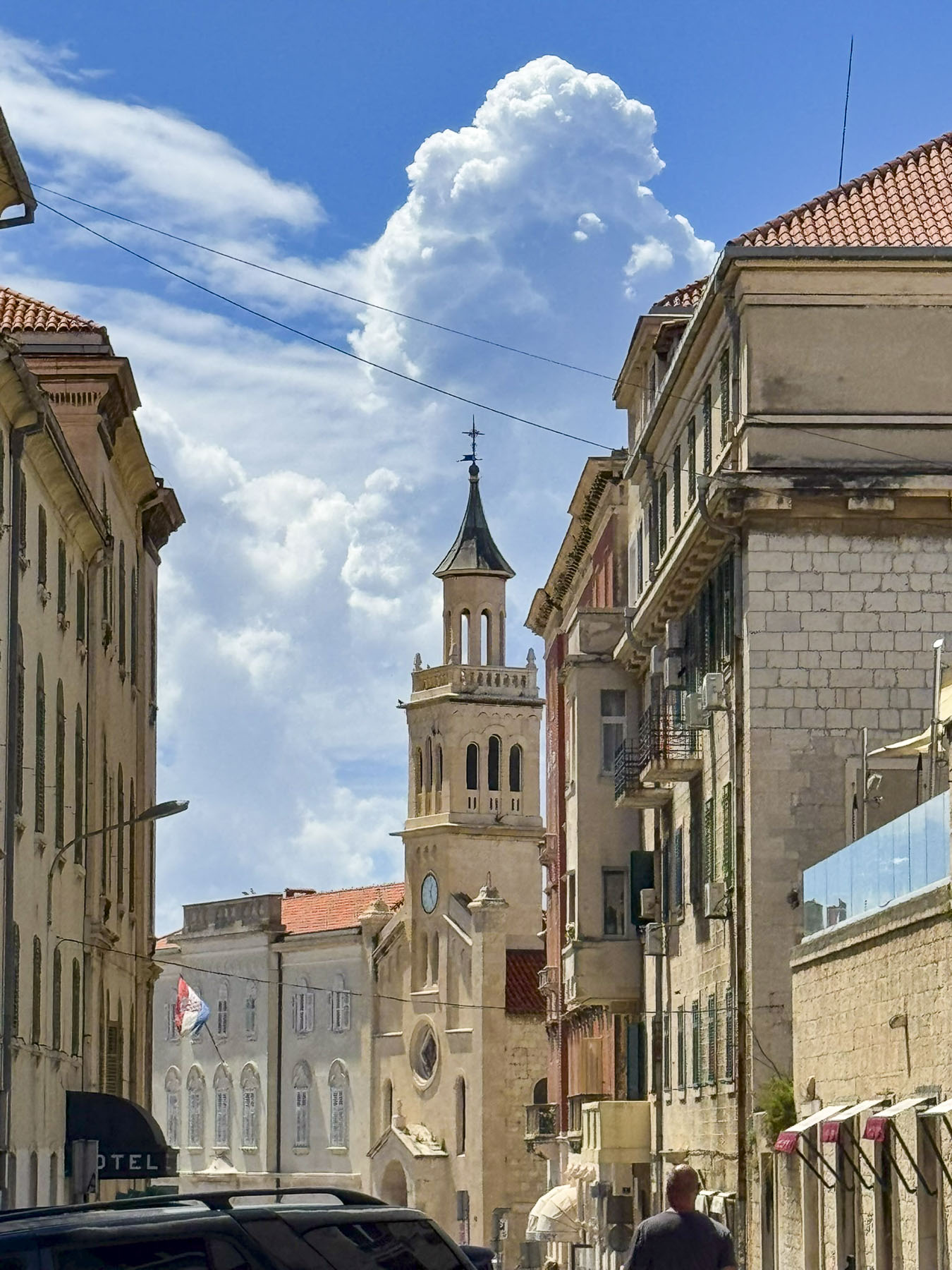
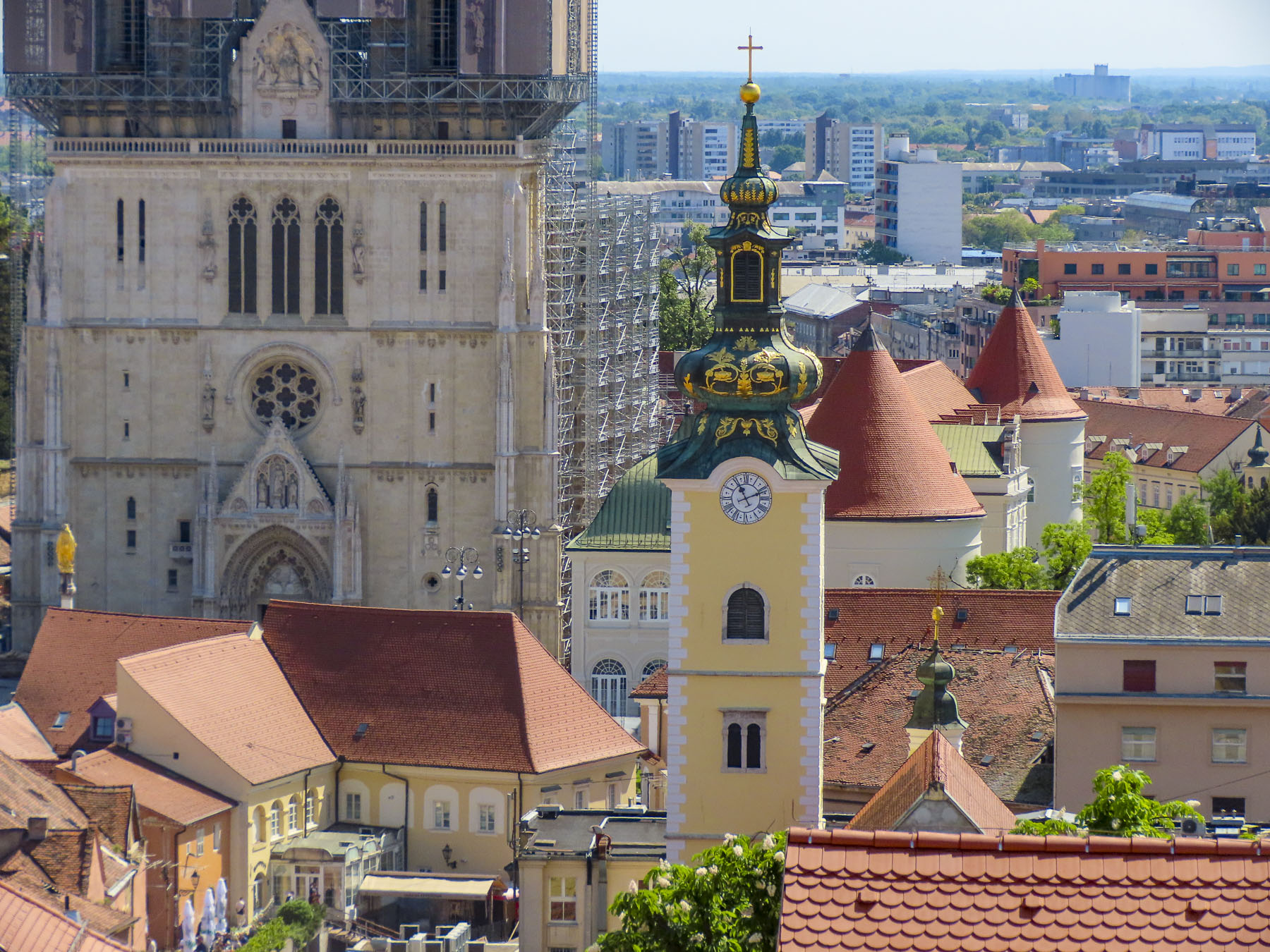
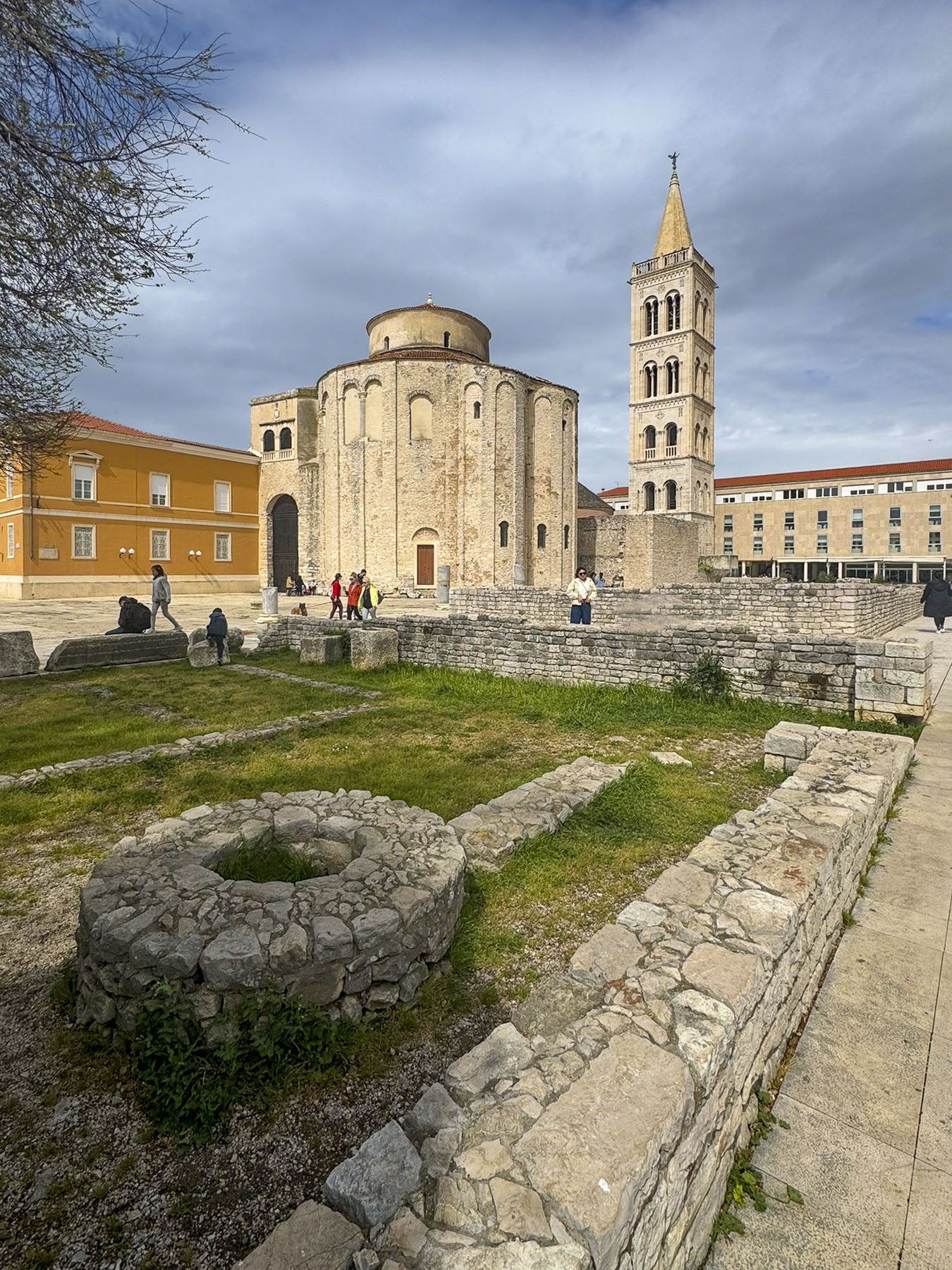
From the museum there is a good view of the Church of St. Donatus, and the belltower of Sainte Anastasie across from the ruins of the Roman forum. We’d pass these landmarks multiple times during our stay.

Fortunately, we did have good raincoats, and we scurried to Kavana Centar, a very nice café several blocks away that had some indoor tables still available and offered a reprieve from the rain. Located away from the main square, its menu was very budget friendly.

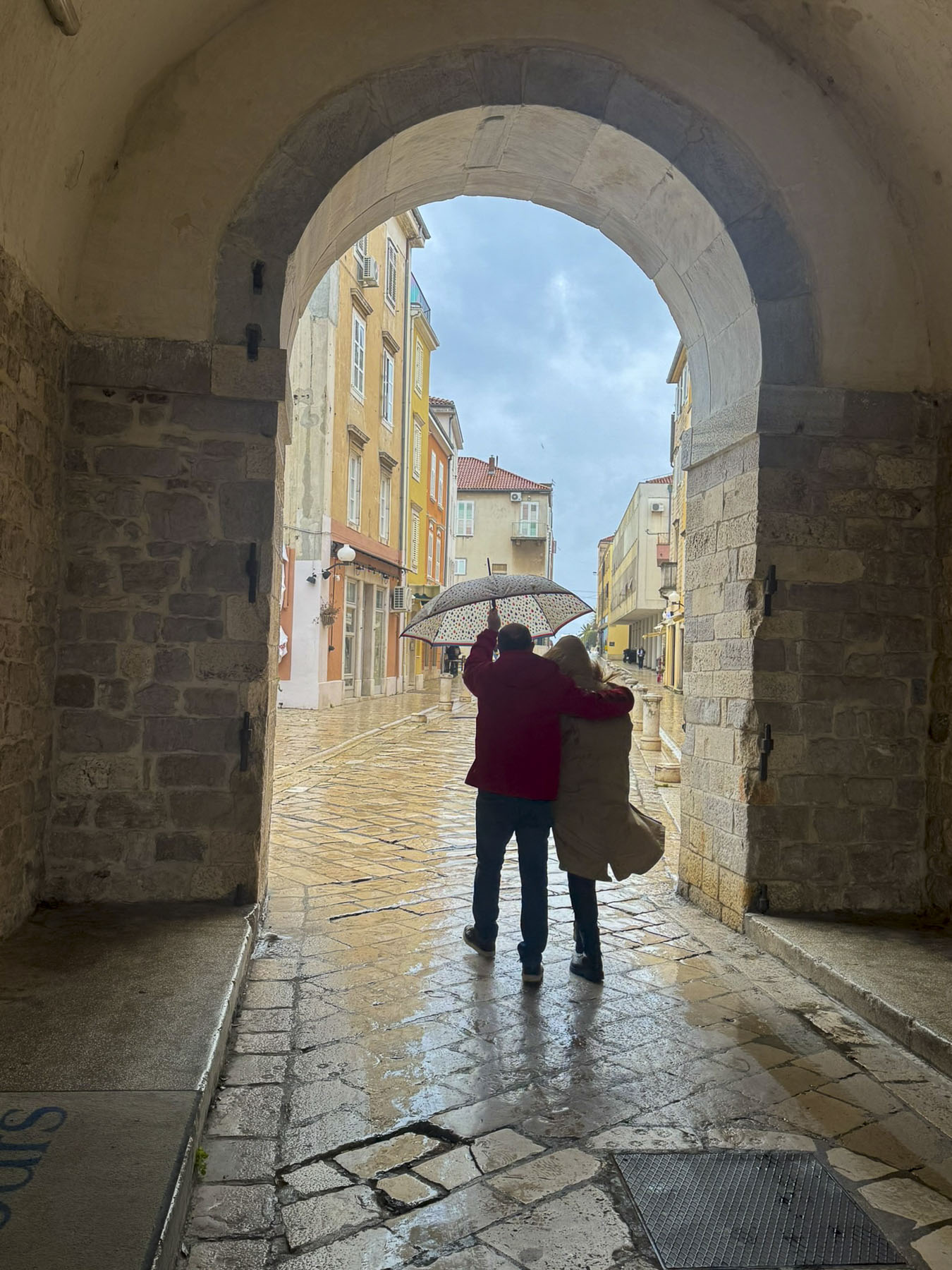
Though the rain had not stopped, folks continued on with their plans, and soon umbrellas were out everywhere.  After lunch, we headed back to St. Donatus, an unusual tall round cylinder-shaped church built during the 9th century in a pre-Romanesque style. Much of its construction utilized the ruins of the old Roman Forum, upon which it was built.

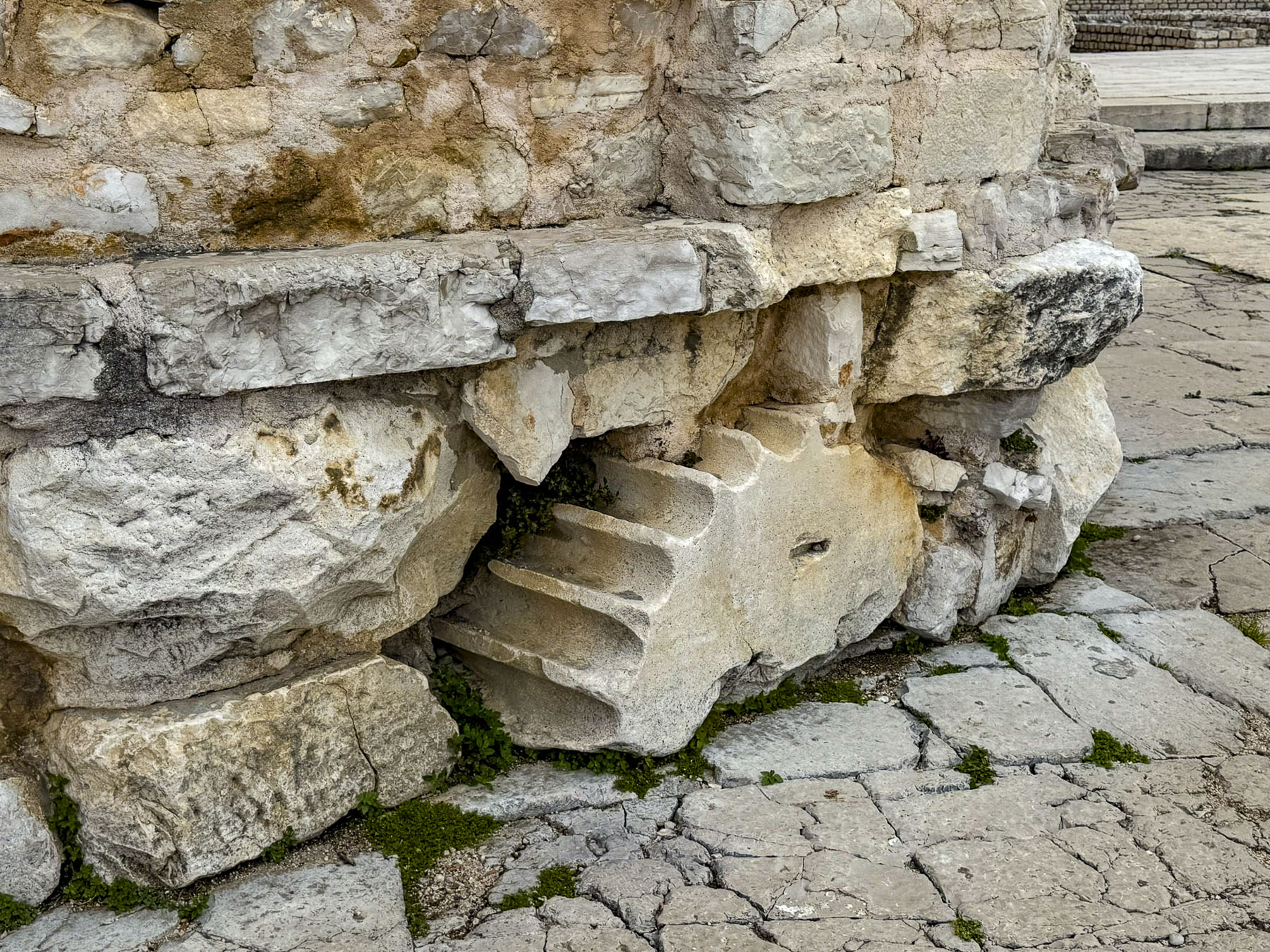
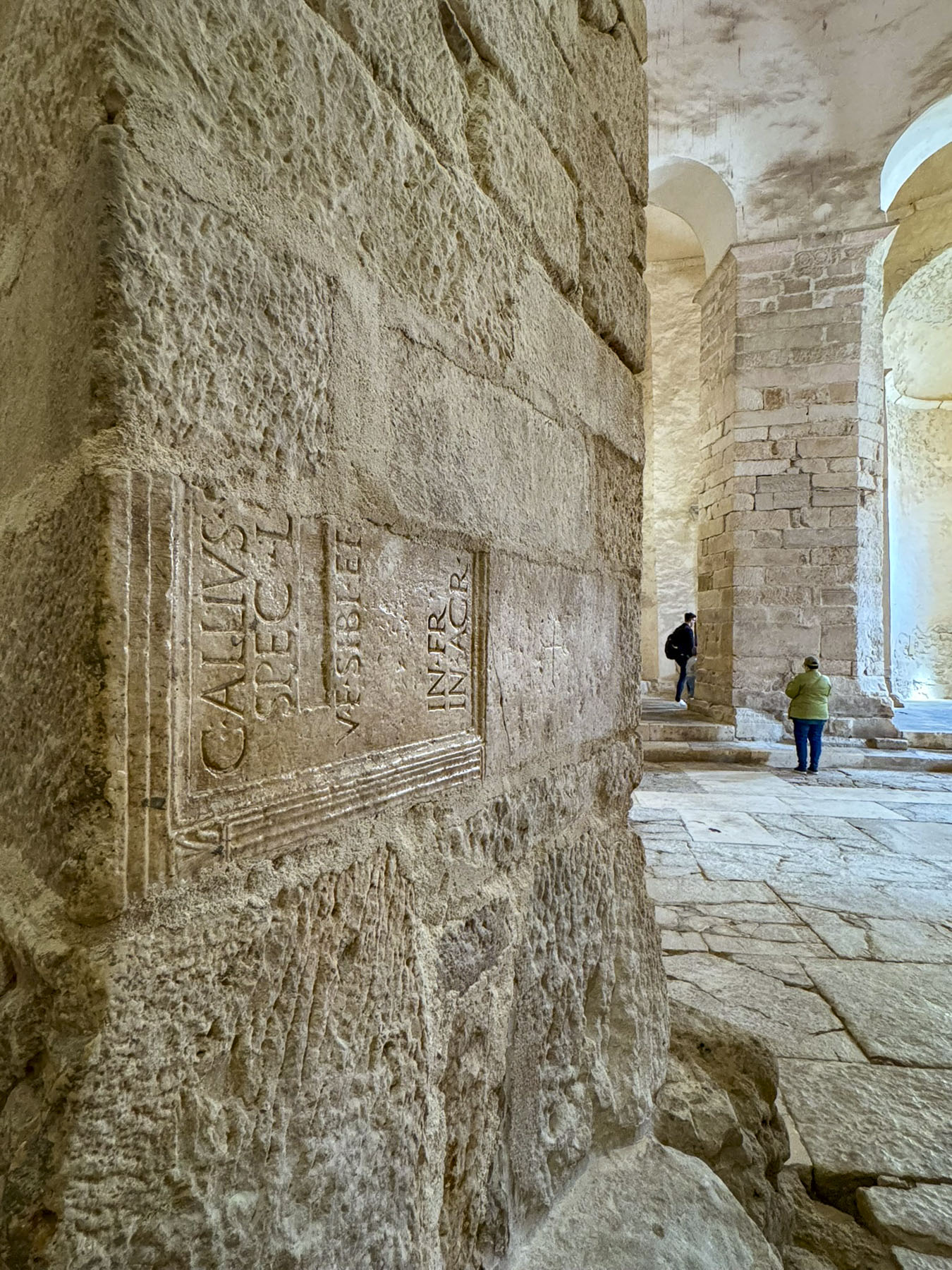
The fragments of reused columns, capitals, plinths, and cornices were used as fill, and can be seen in several exposed spots along the church’s foundation and interior. Its mammoth interior is 27m (89ft) tall, and at the top is a gallery that overlooks the space below.

The church was deconsecrated in the early 1700s, after which it was unceremoniously used as a wine cellar, warehouse, and Zadar’s first archaeological museum in the early 1900s. Nowadays, along with being a tourist site, it hosts theMusical Evenings at St Donatus, a concert series that utilizes the church’s excellent acoustics, every July.

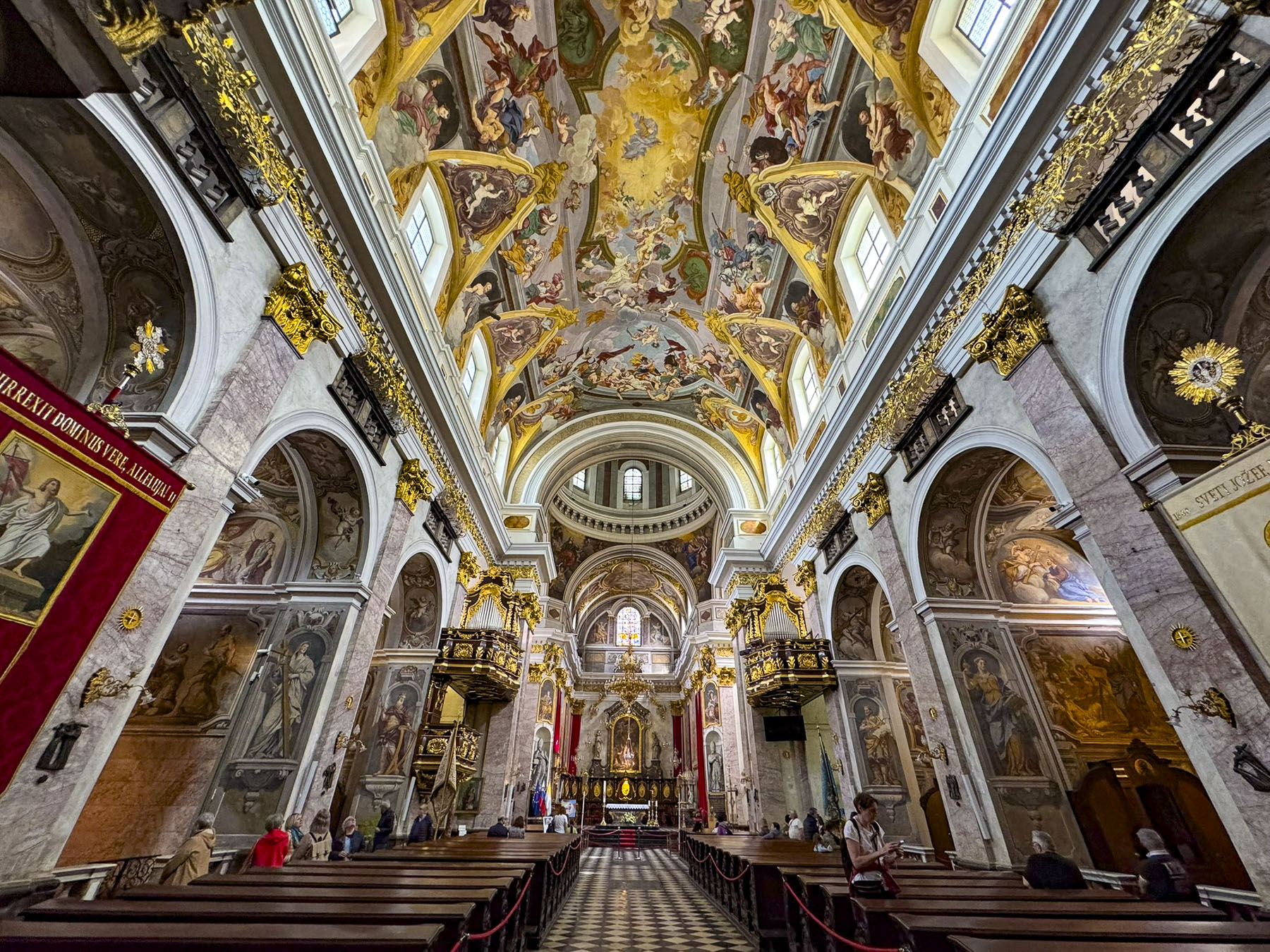
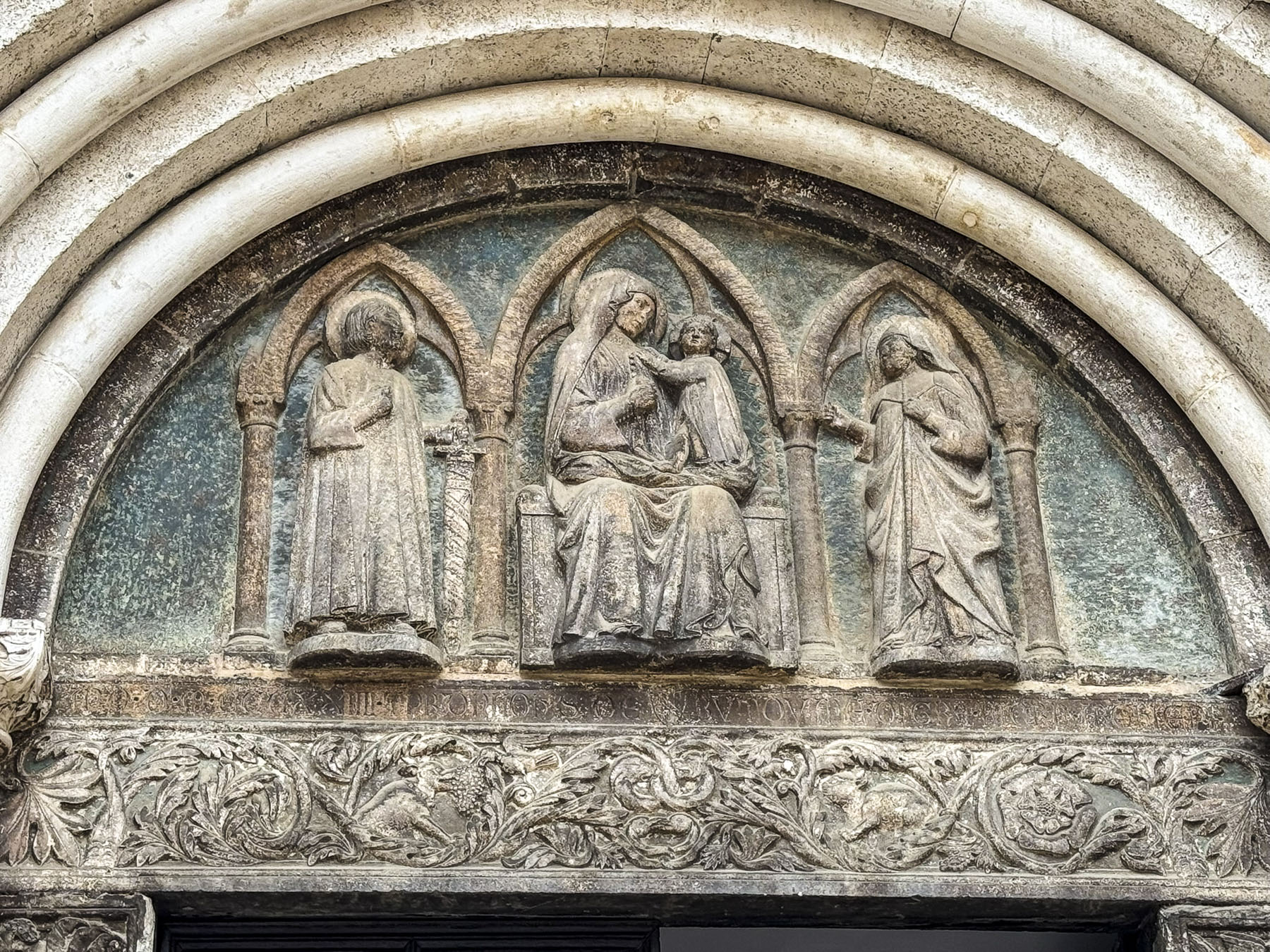
The Campanile di Sant’Anastasia, the belltower of the Cathedral of St Anastasia and its monastery, is right next to St. Donatus. The campanile was added to the church in the 15th century, four centuries after the church and its monastery were completed. During the high season it’s possible to climb the 186 steps to the top of the 55m (180ft) tall tower for a panoramic view of the city and sea. But unfortunately, in early April it was closed when we visited. Surprisingly, the entrance to the cathedral is on the other end of the building, around the corner from the belltower, and took us a few minutes to figure out its location.

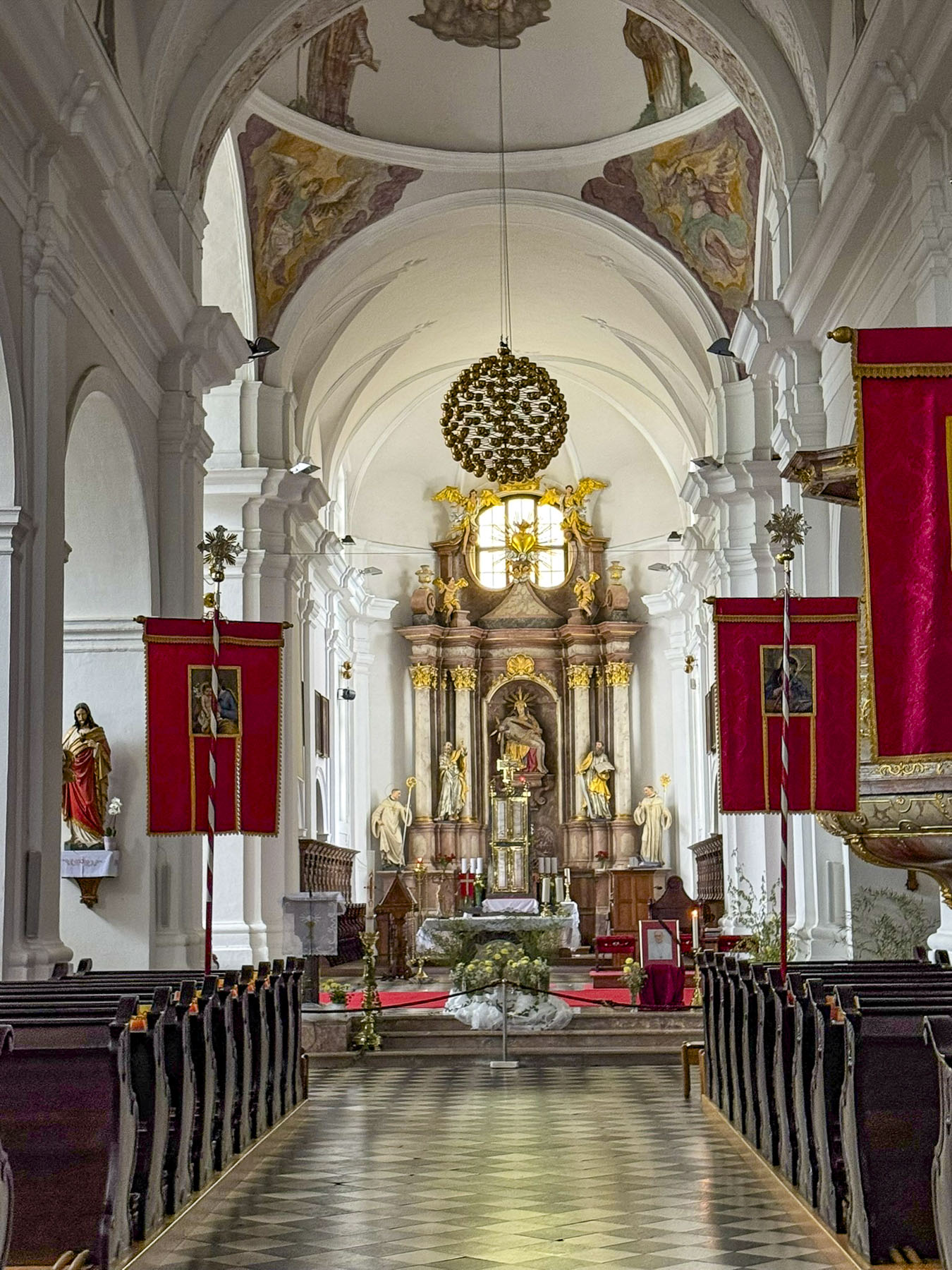
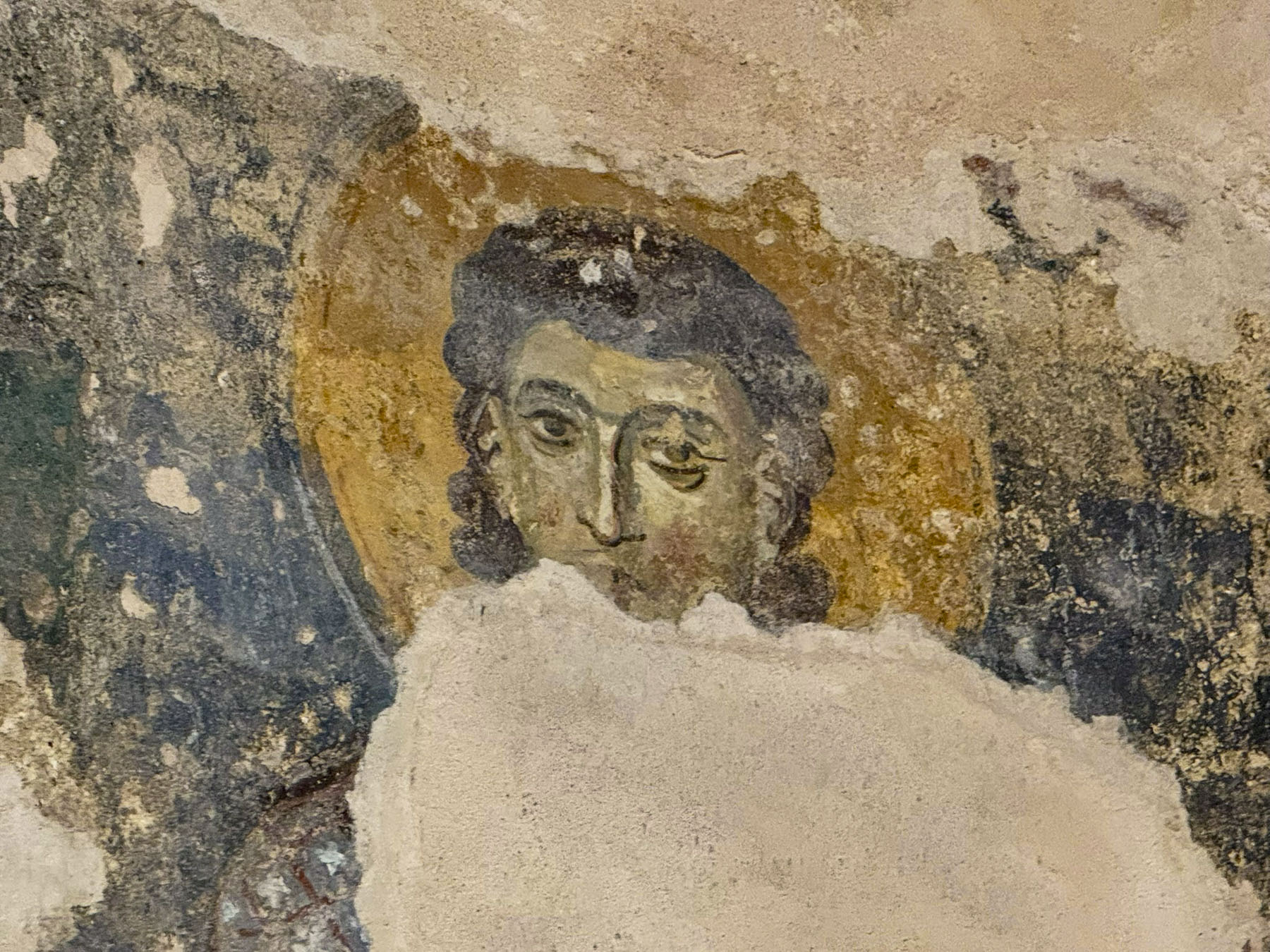
The interior of the Romanesque style church features an open timber truss roof, interesting side altars, an ancient fresco featuring what is believed to be a likeness of the saint, and the remnants of a 13th century mosaic floor, which I almost accidentally fell on, after losing my balance on the uneven stone flooring.

We could only imagine the uproar that would have ensued if I had damaged the antiquity. We wondered if our travel insurance would be of any use in this situation.

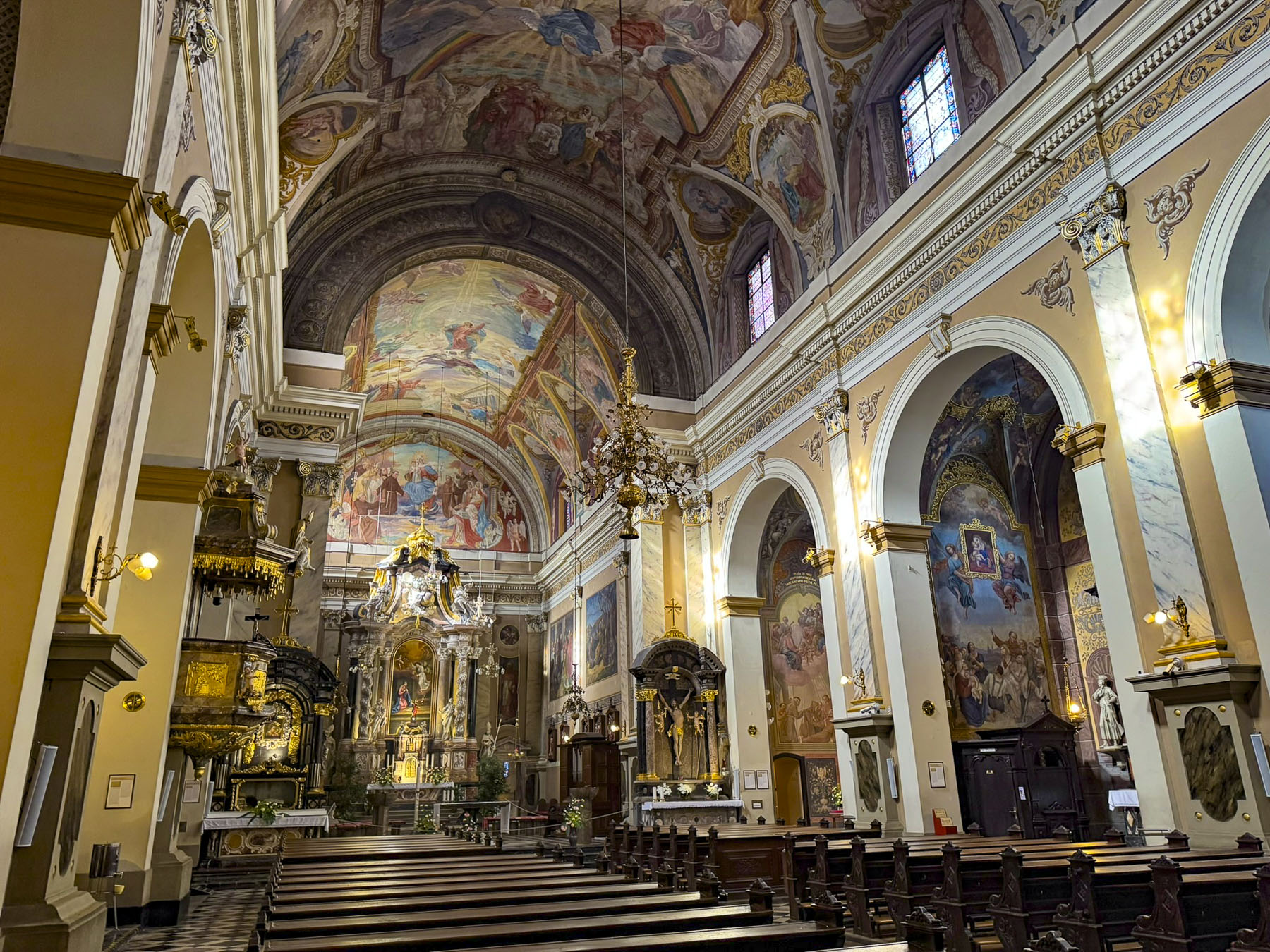
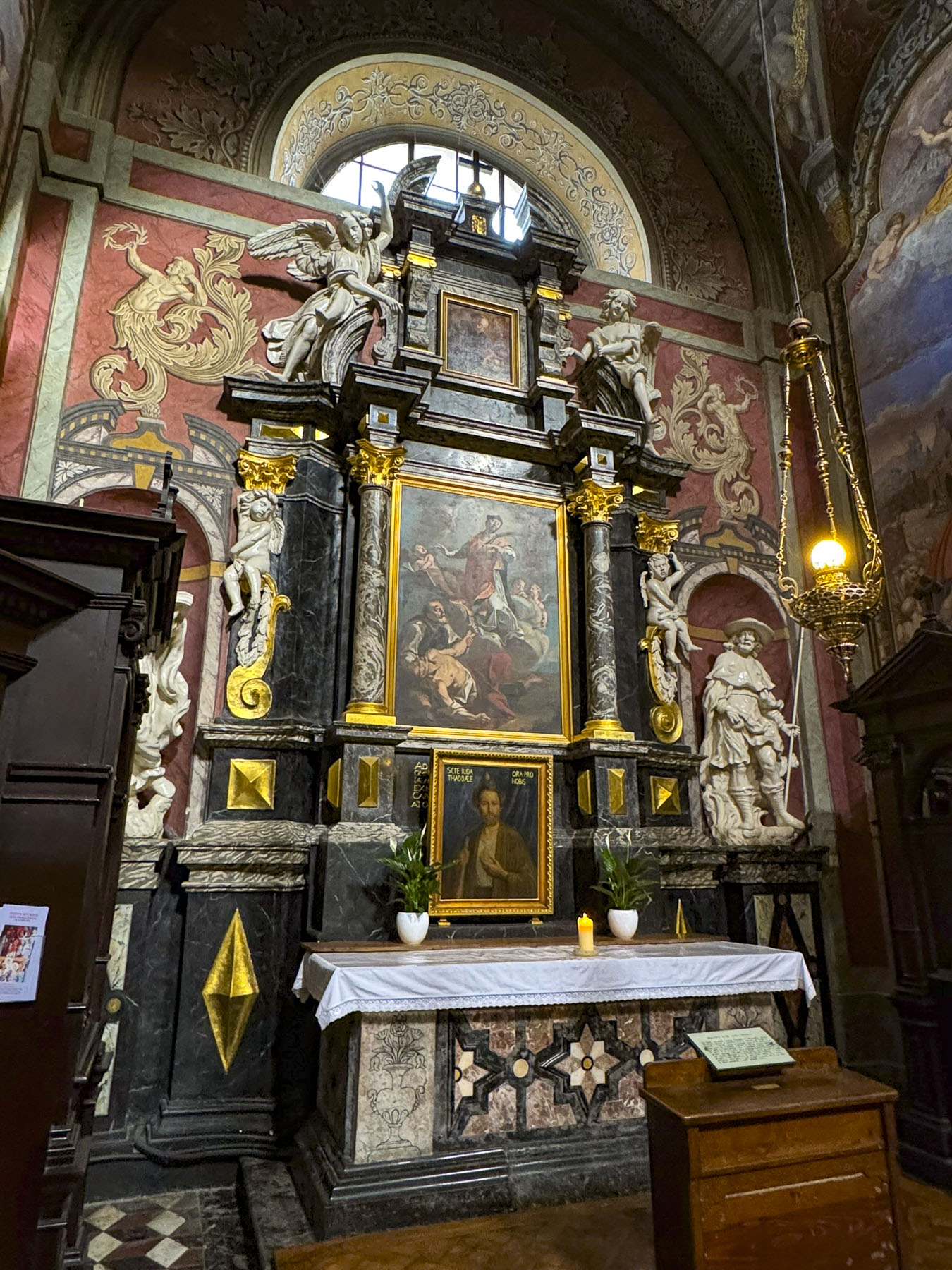
There are numerous other churches in old town Zadar. Choosing several churches and connecting the dots between them we found was a good way to see the various neighborhoods on the peninsula.

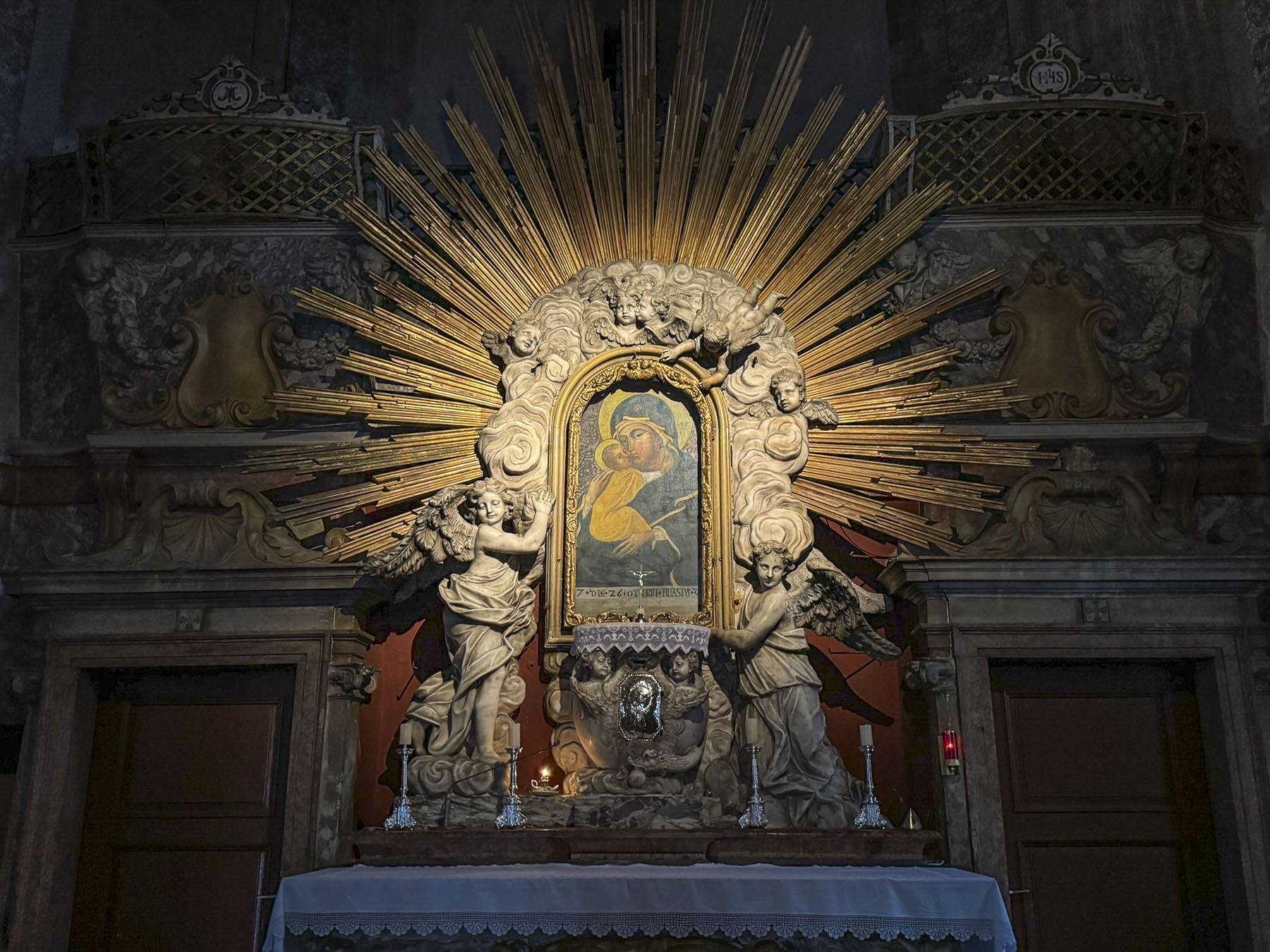
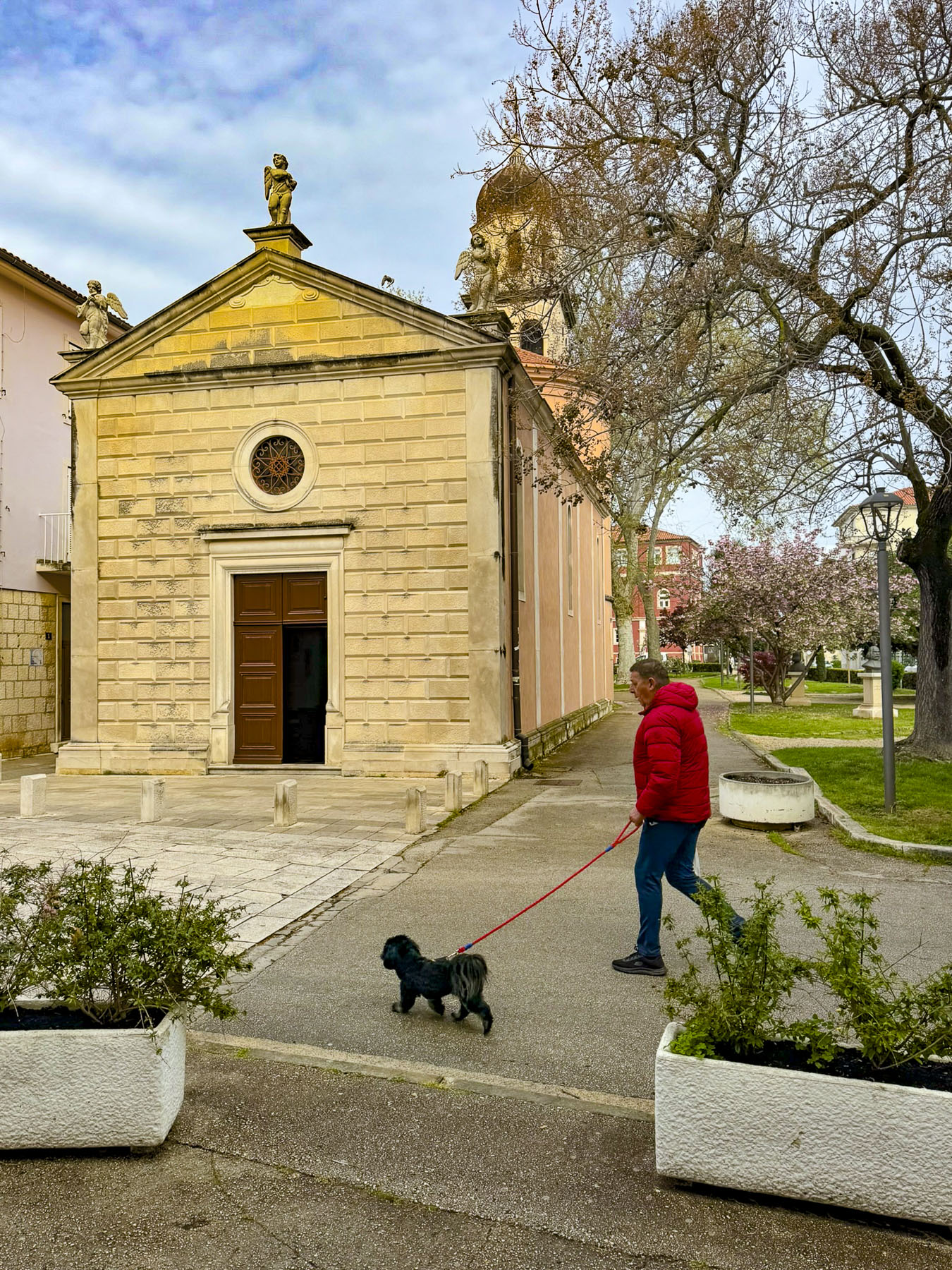
One of our favorites was the Crkva Gospe od Zdravlja, the Church of Our Lady of Health, set on the edge of a small park. Its small intimate interior was often visited by folks on their way to work in the morning.

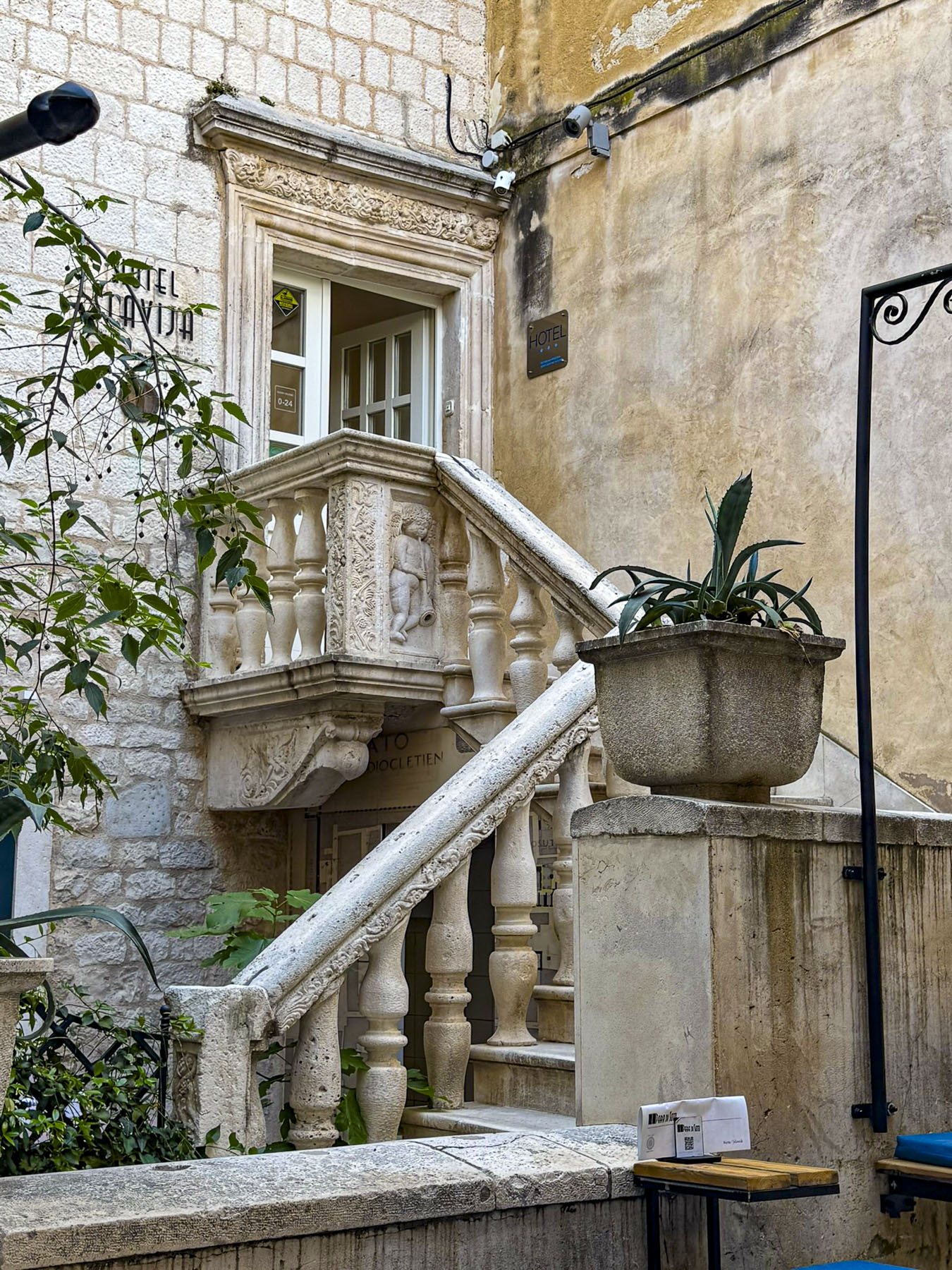
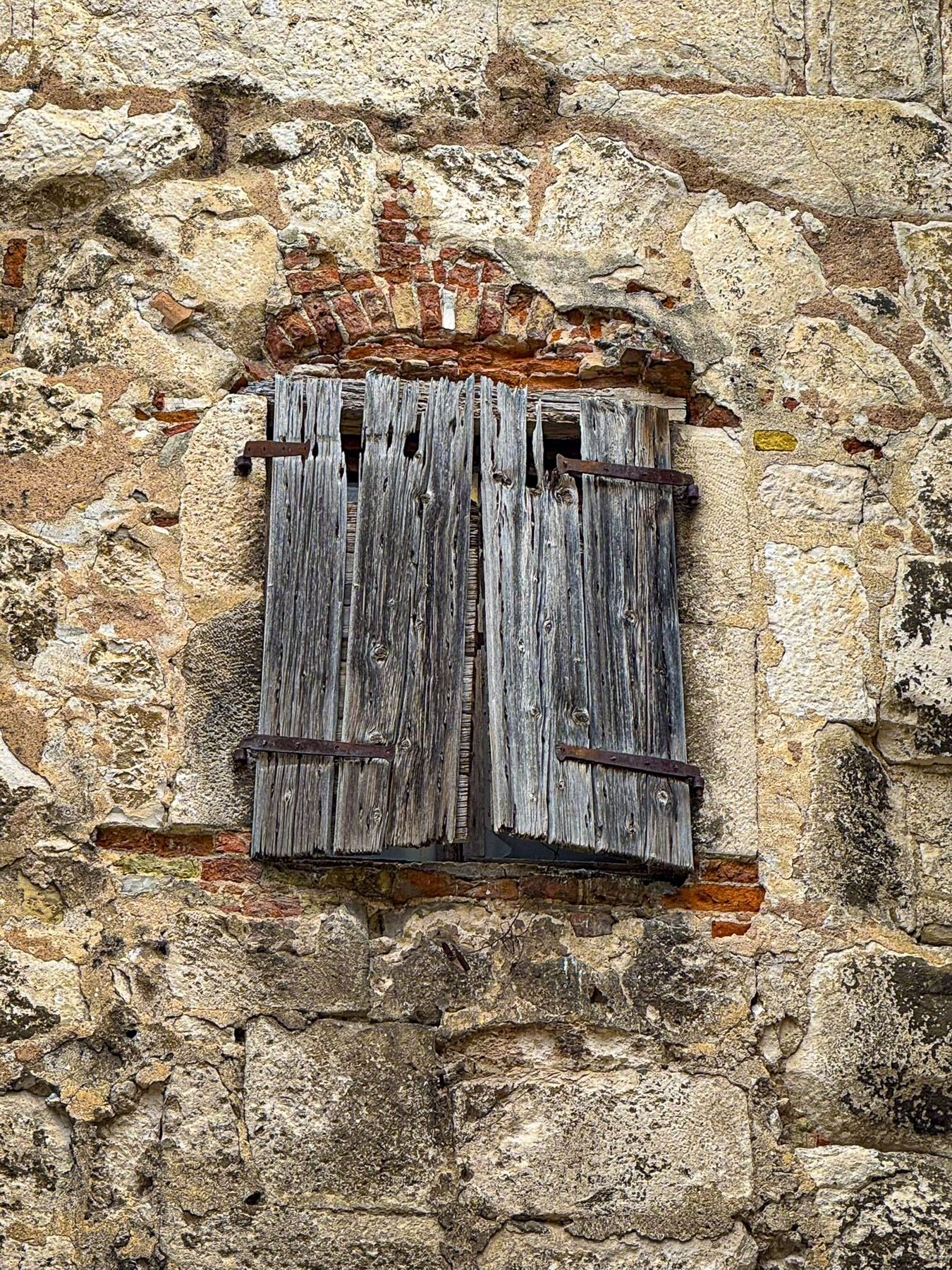
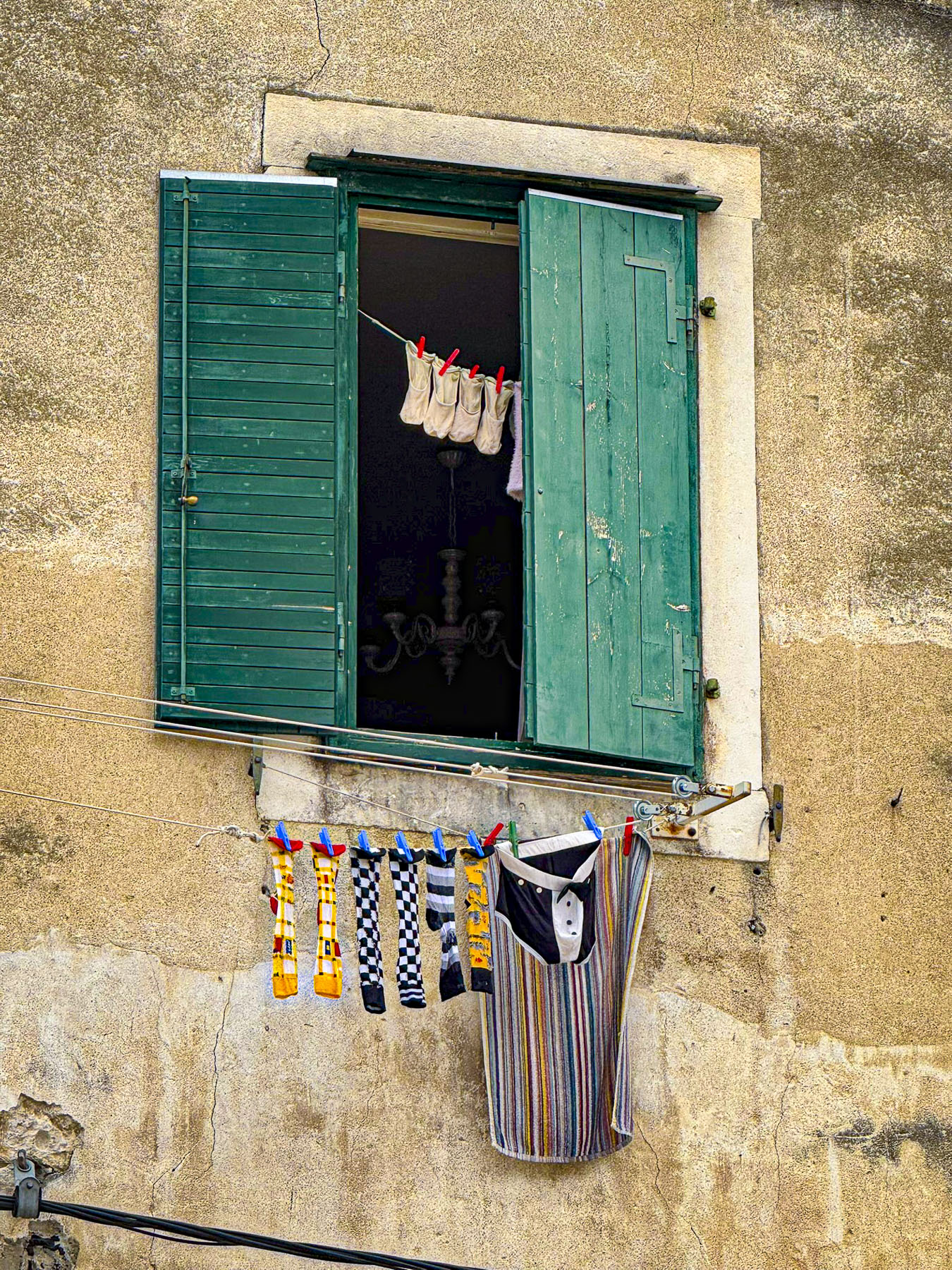
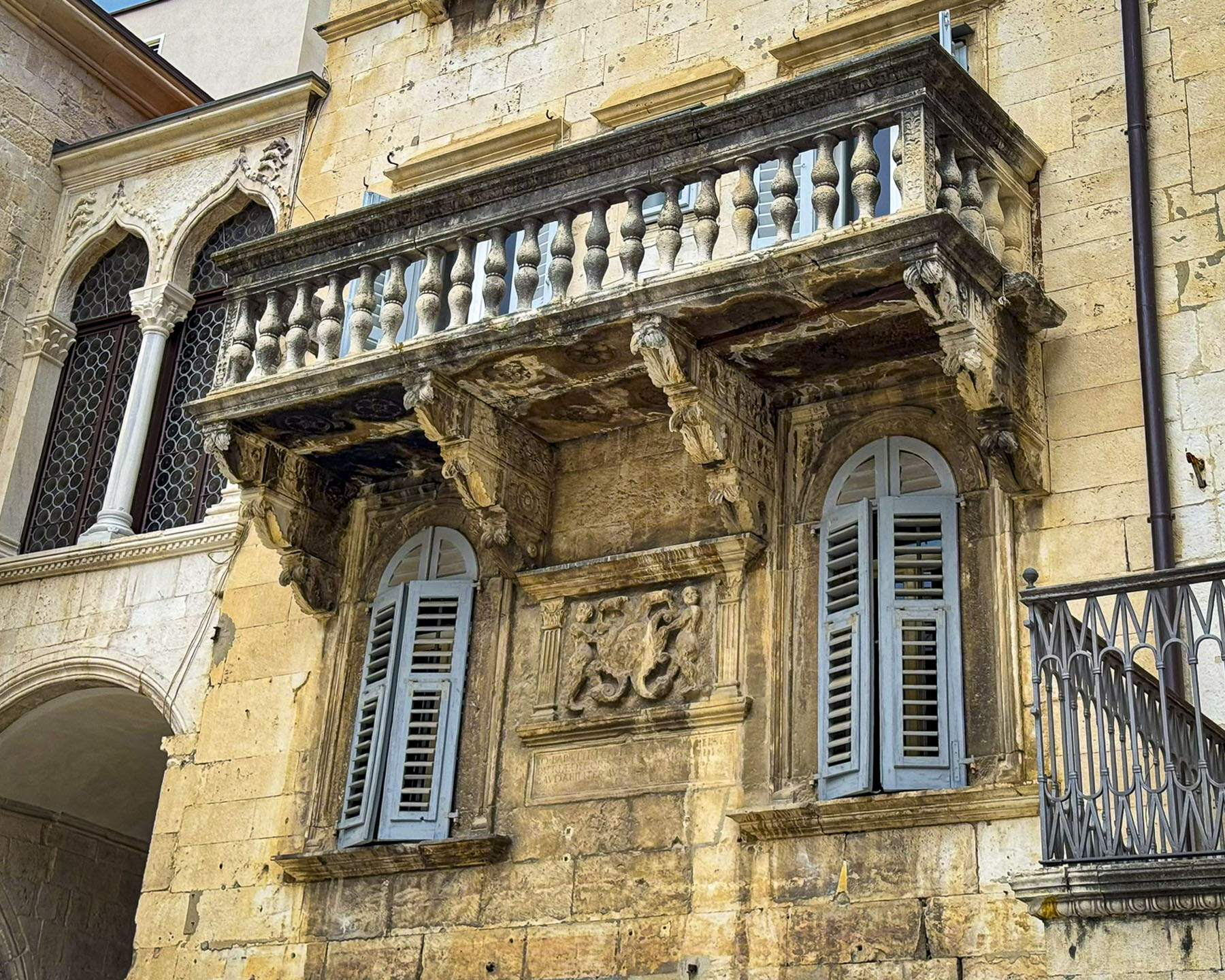
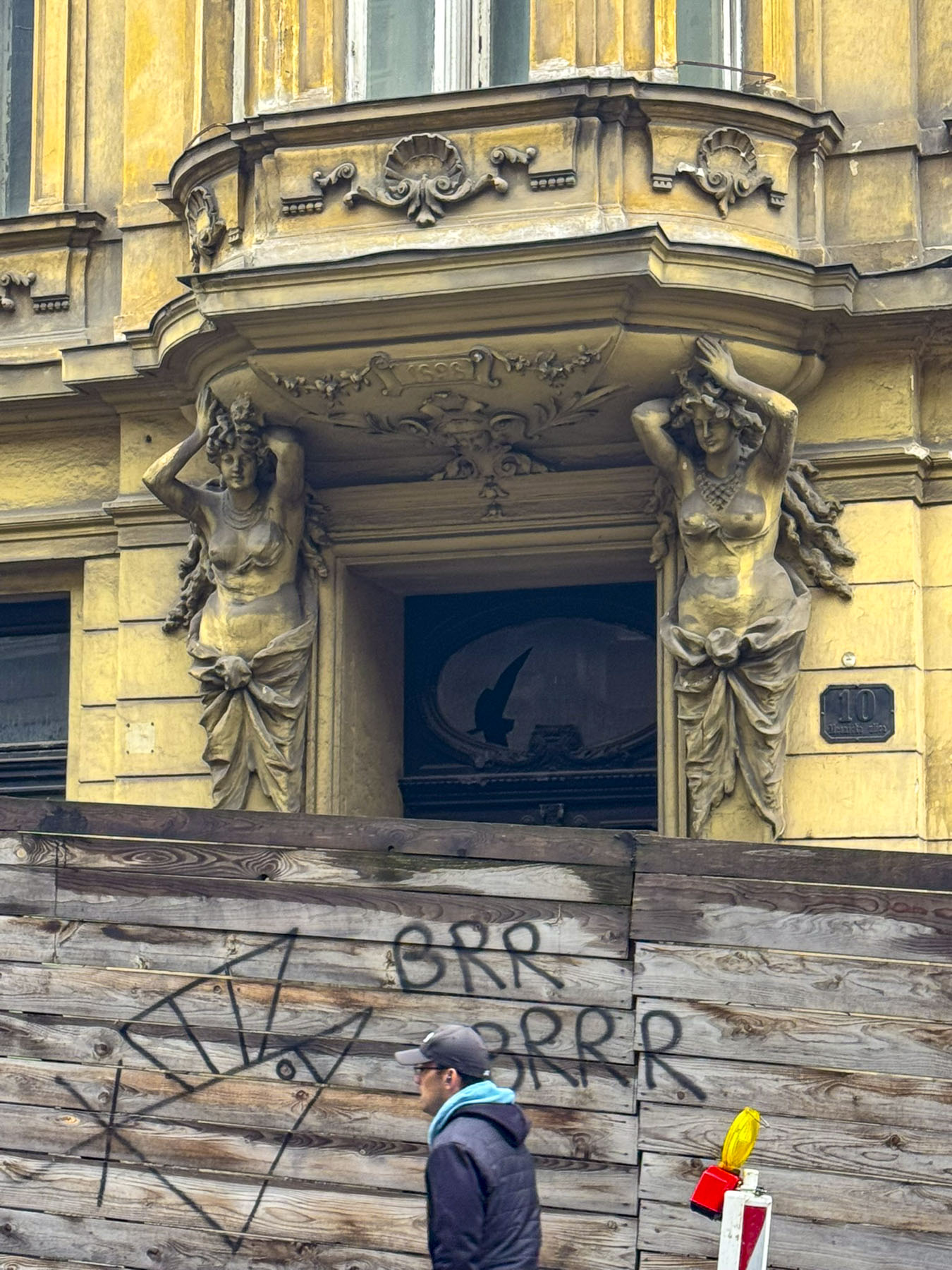
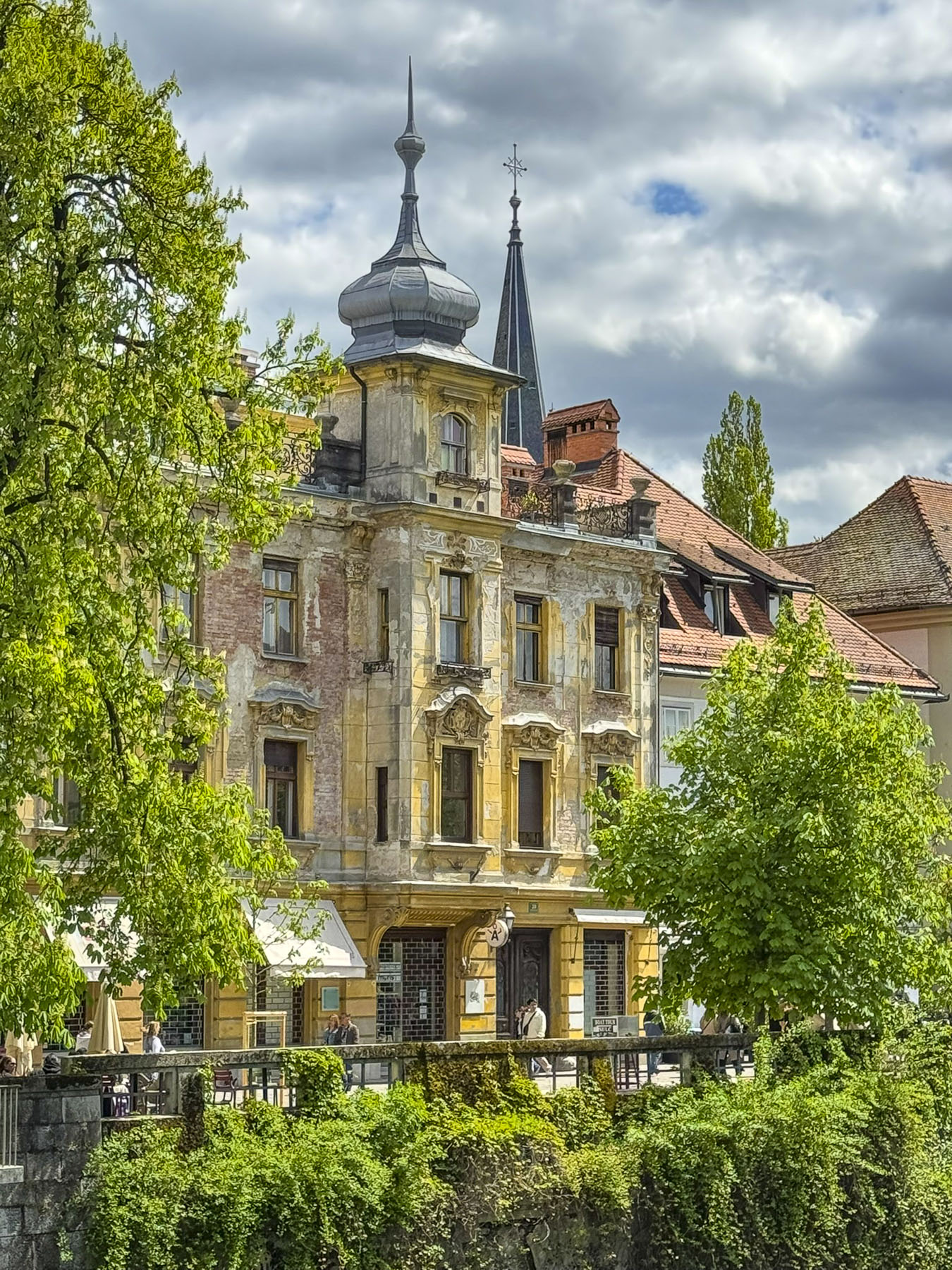
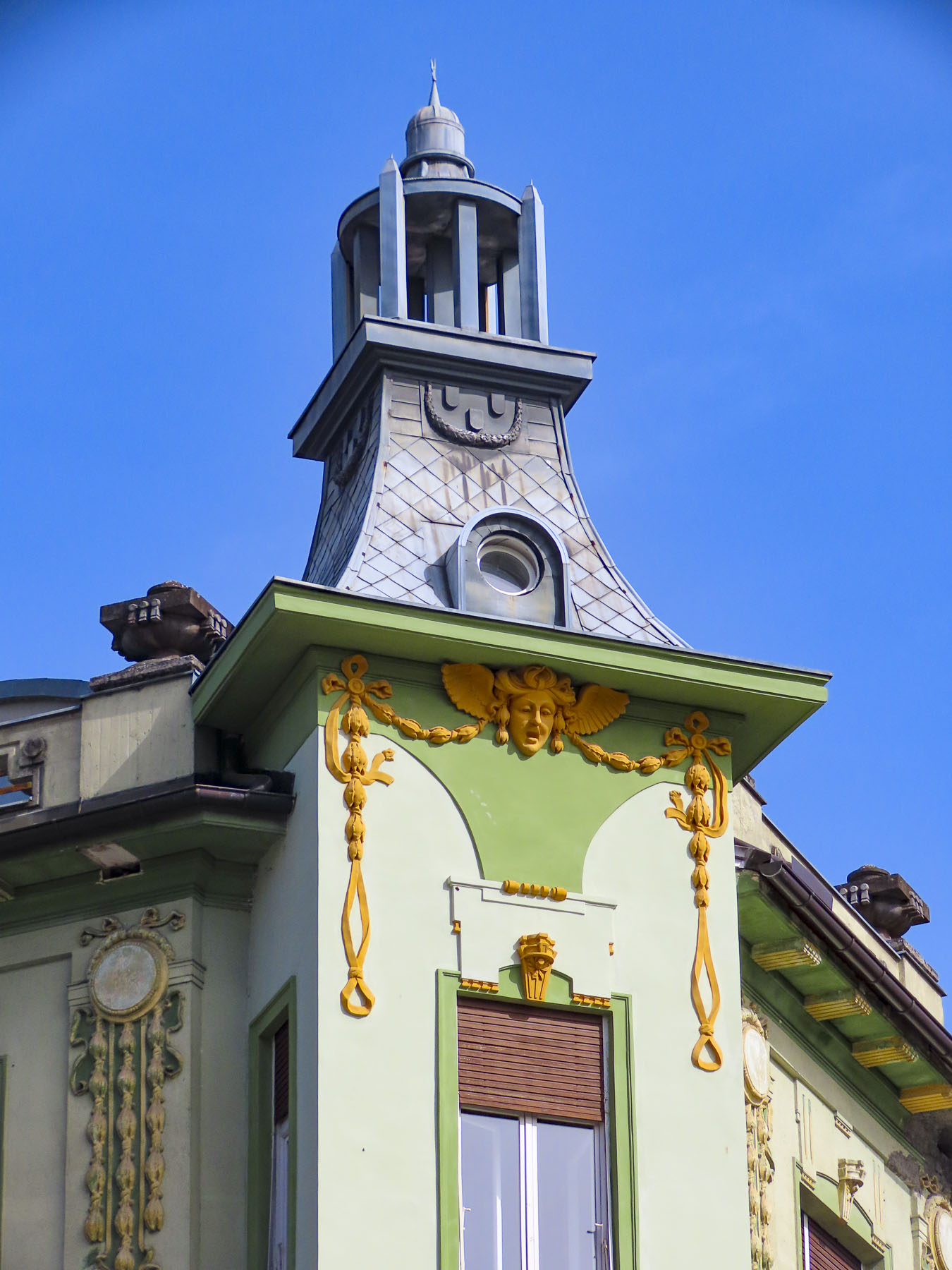
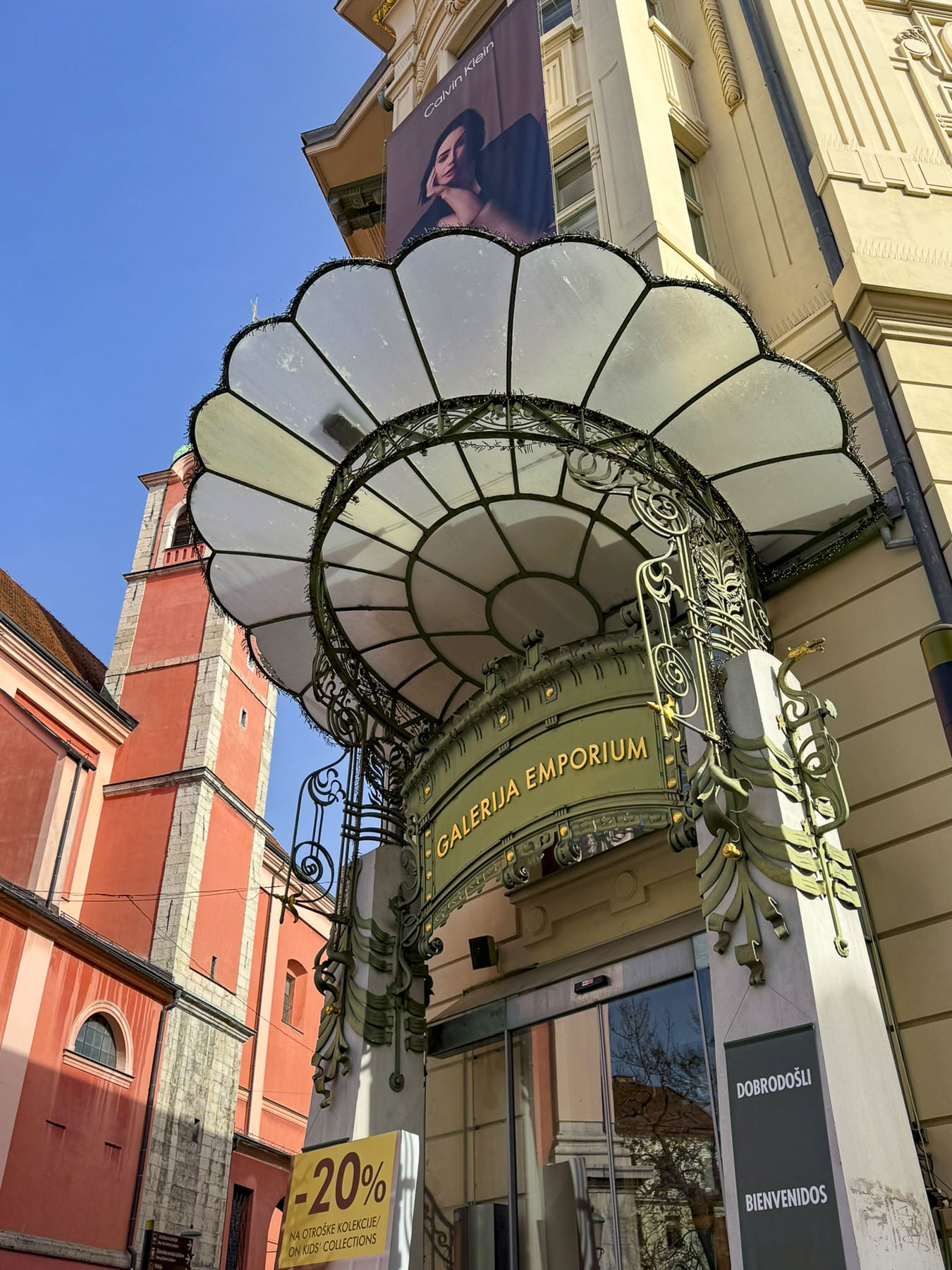
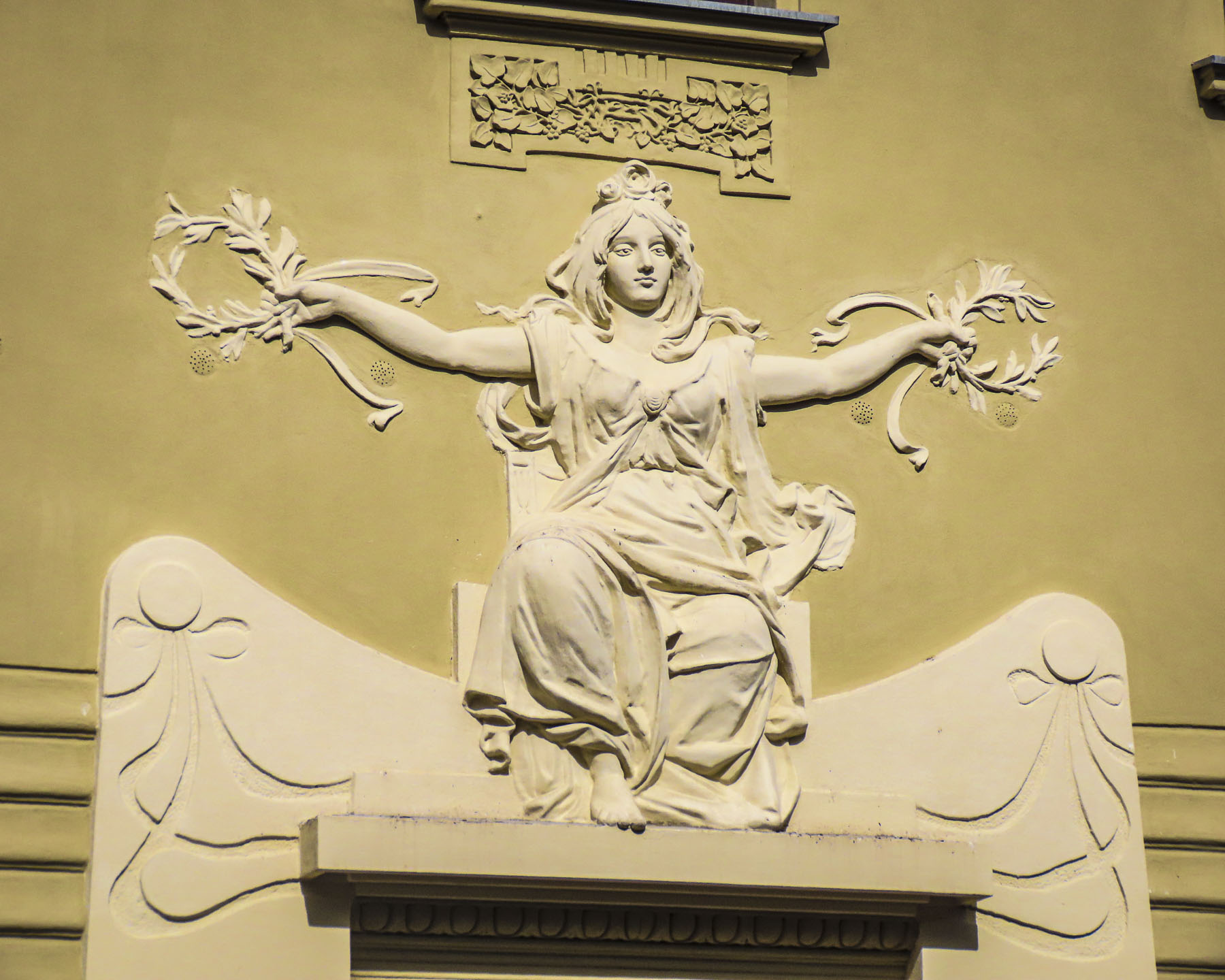
Over the course of our wanderings past random buildings, down narrow alleys, and in dim courtyards, we found examples of the many different architectural styles that have graced the city over the centuries.

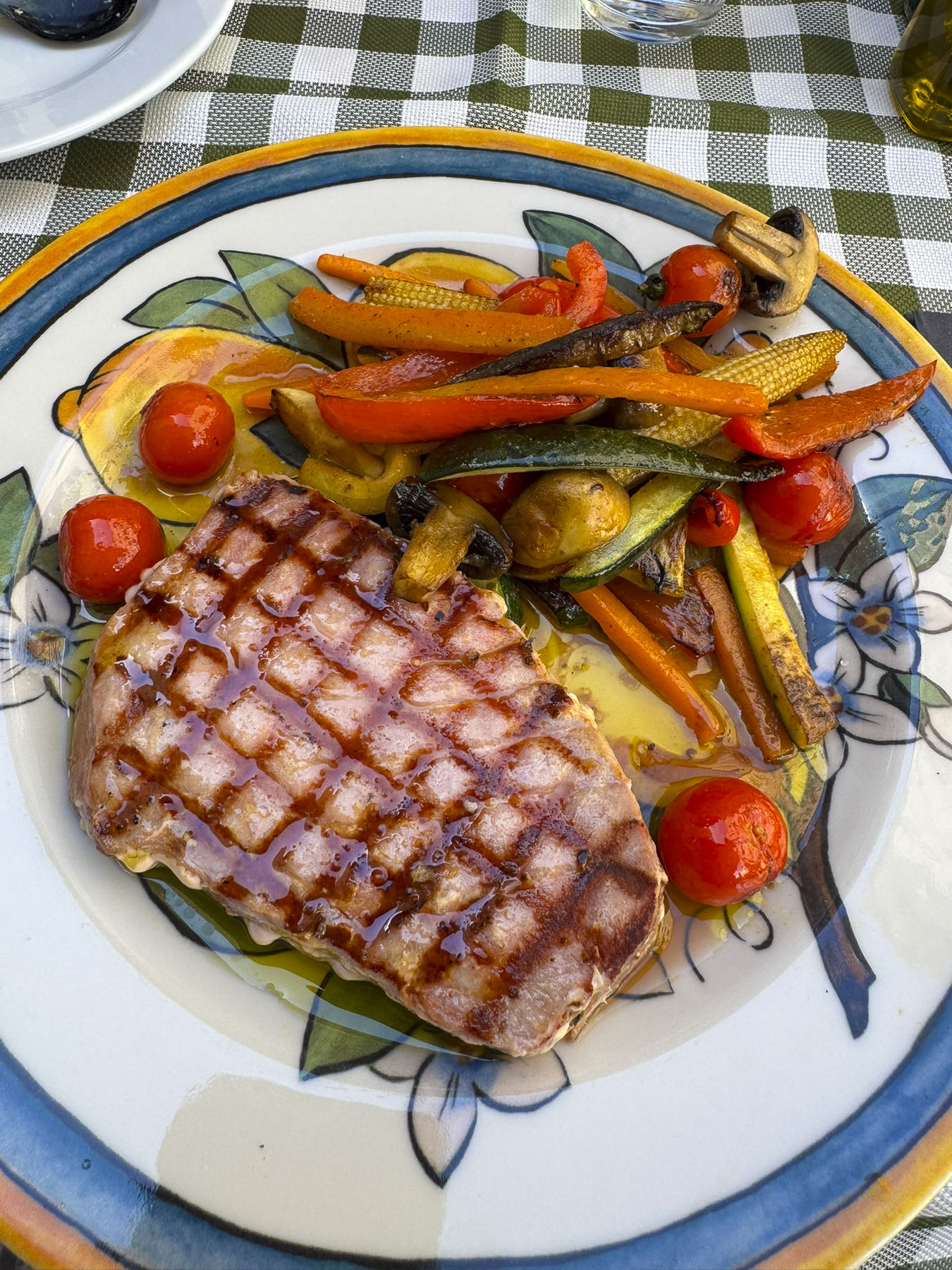
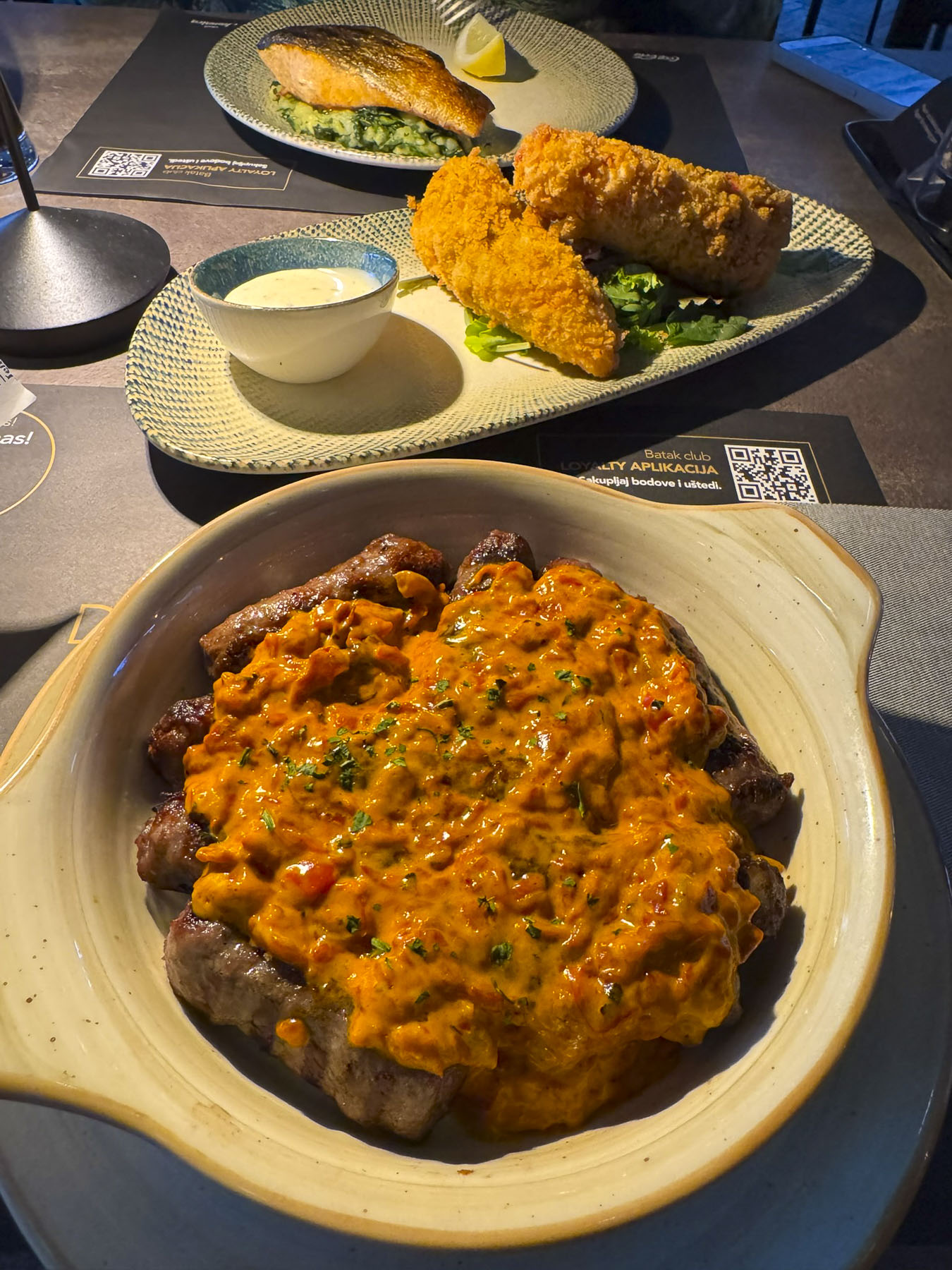
On our last night in Zadar, we drove off the peninsula to another recommended restaurant, Batak Zadar, located in a shopping center, far away from the tourist zone. We ordered several of their Croatian classics, and a local red wine. Everything was very good, and an excellent value compared to the inflated pricing of the restaurants in old town Zadar.

Though the weather could have been more cooperative, we enjoyed our three-night stay in Zadar, and found the size of the charming city just right for a short stay before the start our three-week road trip through Croatia, Slovenia, and Bosnia and Herzegovina.

Till next time,

Craig & Donna             
An Albanian Road Trip: Theth – Majestic Isolation in the Accursed Mountains & A Castle in Kruje

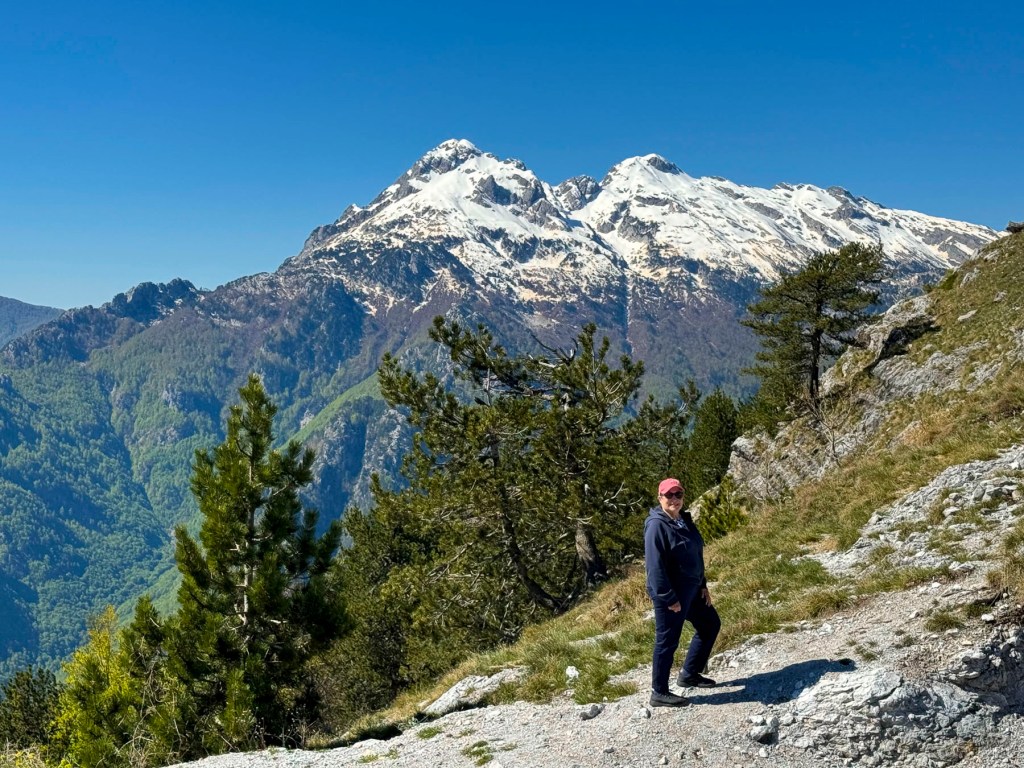
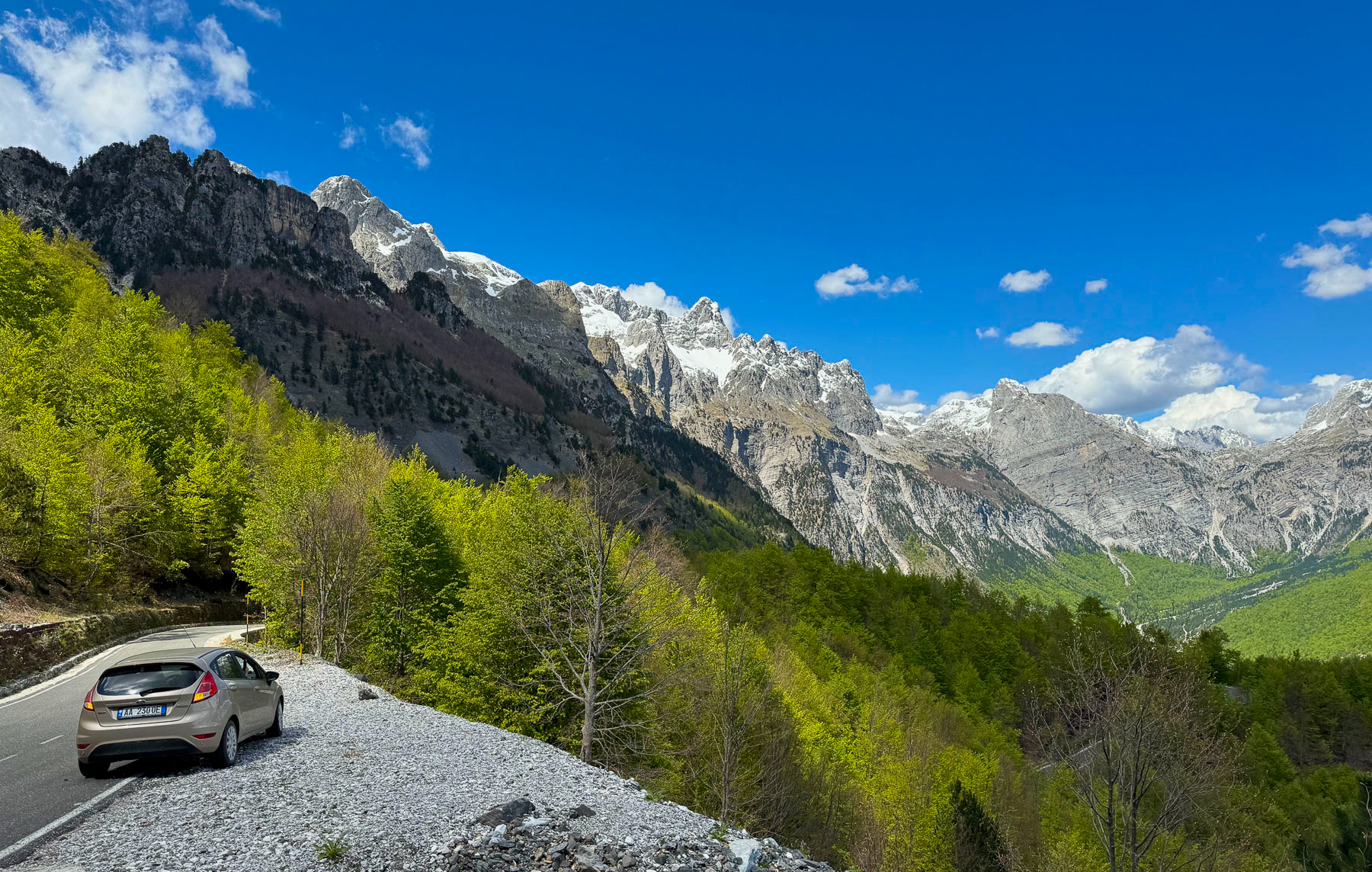
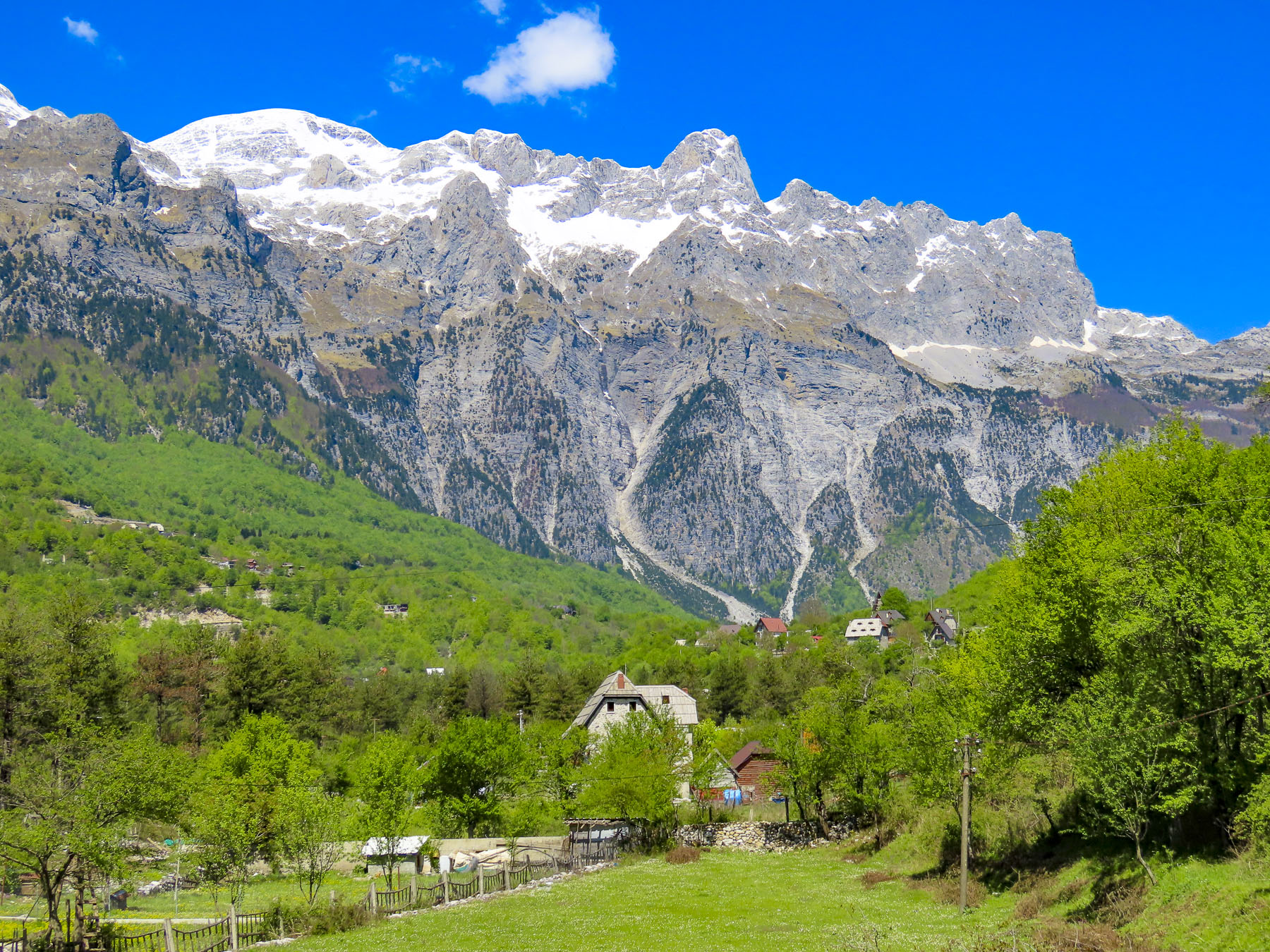
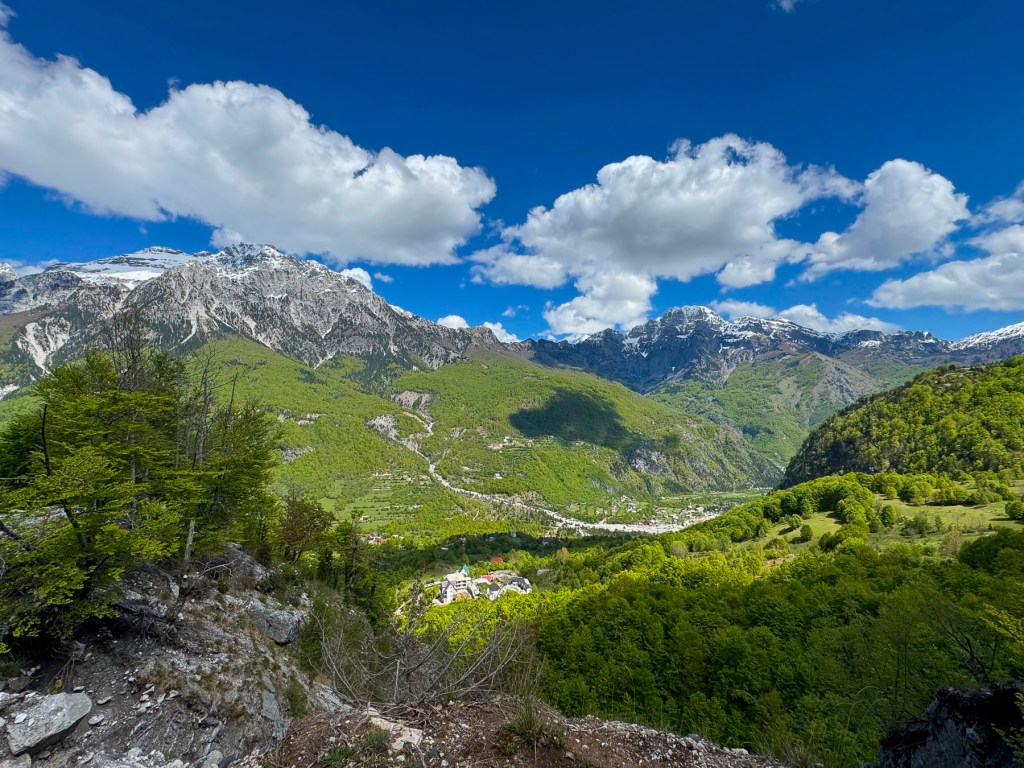
The day was crisp, the sky a clear blue, the mountains beautiful with their peaks still covered with late spring snow. We zigged and zagged our way along the infamous SH21, higher into the mountains, around many challenging blind corners and switchbacks. In spots the road narrowed to a single lane, but there were pullover areas to allow for oncoming cars to pass.  Fortunately, in late April we had the roads and the overlooks in this pristine region mostly to ourselves. The views were breathtaking. A half-hearted complaint if any, there just were not enough places to stop safely to enjoy the picturesque landscapes.

After cresting the Thore Mountain Pass, at 5,547ft the highest along the route, we stopped at the Monument commemorating Edith Durham, a British anthropologist who championed Albanian independence in the early 1900’s, and was lovingly called, “Queen of the Highlanders.” After that we could have coasted all the way into Theth, like Olympic bobsledders, but we were very judicious with braking.

Centuries ago, the inhospitable, saw-toothed mountains of northern Albania were a sanctuary for folks fleeing invaders. It’s a massive area at the southern end of the Dinaric Mountain Range, with nearly twenty mountain peaks having 9000 ft high summits, and it encompasses the border region where Albania, Montenegro, and Kosovo meet. The Dinaric Mountains are the spine of the Balkans, stretching from Slovenia through Croatia, Bosnia and Herzegovina, Serbia, Montenegro, and Kosovo before ending in Albania, where today they are called the Albanian Alps. A much friendlier name to encourage tourism than the Accursed Mountains, or “Bjeshkët e Namuna” as the original Albanian name goes.

There are three prevalent legends as to how the mountains got that original title, but hardship is at the core of each. One of the earliest legends credited the creation of the torturously steep mountains to the Devil when he escaped from Hell for a day. While there are streams and waterfalls throughout the mountains, they are not easily accessible and are often dry during the summer months. These dry conditions explained the tale of a mother fleeing her burning village. Her husband was killed in the fighting with Ottoman invaders, and she took her children into the mountains to save them from being forcibly converted to Islam. The days were hot, the terrain steep and unforgiving; her children were thirsty after three days without any water. Distraught, she cursed the mountains for causing their suffering. It’s also believed that soldiers struggling to cross the treacherous mountain terrain cursed the steep slopes, and most likely used many foul adjectives to make their point.

Footpaths and donkey trails were the only way into Theth for a millennium. The village didn’t have a school until 1917. The American Red Cross arrived in Theth in 1921 to help expand the educational opportunities in the Shala Valley. The American journalist Rose Wilder Lane tells of this school building mission in her 1922 book Peaks of Shala. Communication with the modern world didn’t expand until the first dirt track, a single lane, serpentine road that crested numerous mountain passes, was carved into the side of the masiffs that isolated the remote valley in 1936. It took another thirty years before the village received electricity in 1966.  

It is difficult to find accurate figures on the ancient population of Theth, which in some instances includes the entire Shala valley and its nine hamlets, and at other times just the village of Theth itself. But it’s thought that at the end of Albania’s Communist regime in 1991 the remote area had a population of roughly 3000 folks in 700 households, though it is much less today. Interestingly, most of these villagers claim Zog Diti as a common ancestor of the Shala tribe or clan. Oral tradition relates that the name Shala is derived from shalë, a saddle, a gift he was given by his brothers, when led his family into the northernmost reaches of the Shala Valley. They fled from the region of Pashtrik, during the Ottoman invasion of Albania in the early decades of the 15th century to preserve their Catholic faith.

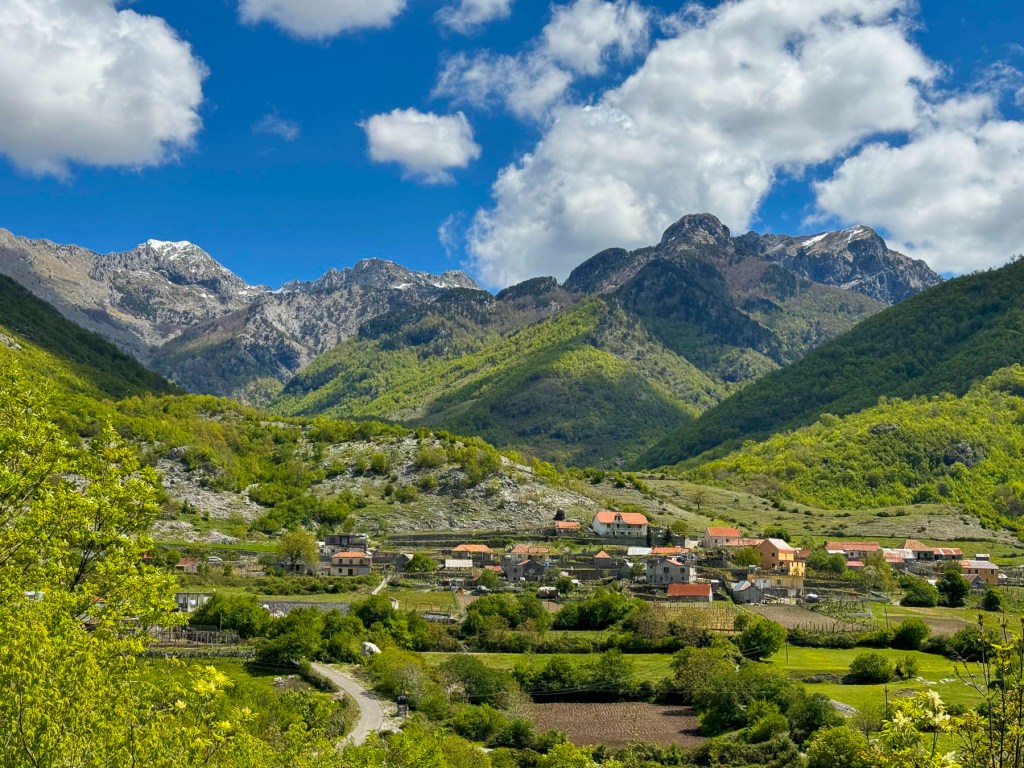
A road changes everything. While it brought progress in its early years, it eventually was the route of exodus for families seeking non-agrarian jobs for themselves and better educational opportunities for their children. It was extremely difficult to recruit teachers to live in the “wilderness.” Currently Theth has about 370 summer residents that return to support the tourist season, but only a hearty, resourceful handful of residents winter over in the often snowbound valley.

Today the village, with its modest tourist infrastructure, is the jumping off spot to pursue outdoor activities in the northern Albanian park system that includes Nikaj-Mertur Regional Nature Park, Valbona Valley National Park, and Theth National Park. This vast area encompasses many diverse ecosystems that include oak and beech forests at lower elevations that transition to pine trees and scree-covered slopes the higher up the mountains you go. The region is home to over 50 bird species, including kestrels and eagles. And if you are lucky enough you can spot gray wolves, wild goats, brown bears, and roe deer.

We arrived at the Royal Land Hotel & Restaurant as the shadows were lengthening and the sun skimmed the snowy ridge across the valley from the hotel. Just a week earlier the hotel had reopened for the season, and we, along with several other couples, were some of the hotel’s first guests of the year. After checking in, we sat at picnic tables on the terrace outside, sipping glasses of their homemade red wine, and watching the inn keeper’s son rototill the fertile dark soil of a garden plot. The sky stayed light for several more hours, but the sun had disappeared behind the mountains behind us. The lodge is very rustic with fourteen cedar-planked rooms, and a glass enclosed dining area, where each table has fantastic views of the surrounding mountains. The Inn’s restaurant is open to the public, as are most of the hotel restaurants in the valley. The family that owns the hotel was very friendly and helpful. Their breakfast buffet and home cooked dinners were delicious, with many of the items on the menu homemade or locally sourced. The sky was clear that evening and the stars brilliant across the night sky. Early the next morning, moonlight filled our room.

Hiking is the main activity in the Shala Valley, and we eagerly headed down into the village to explore the valley. Many folks choose to trek the popular Theth to Valbona trail, a nine-hour hike one way, covering 11 miles that takes you through a pristine high alpine wilderness. Being the city folks we are, we stayed in the relatively flat flood plain of the Lumi i Shalës which tumults from its source in the mountains north of the village. Near the bridge that crossed the river we spotted an understated monument that upon closer inspection commemorated the schools built by the American Red Cross in the Shala Valley.

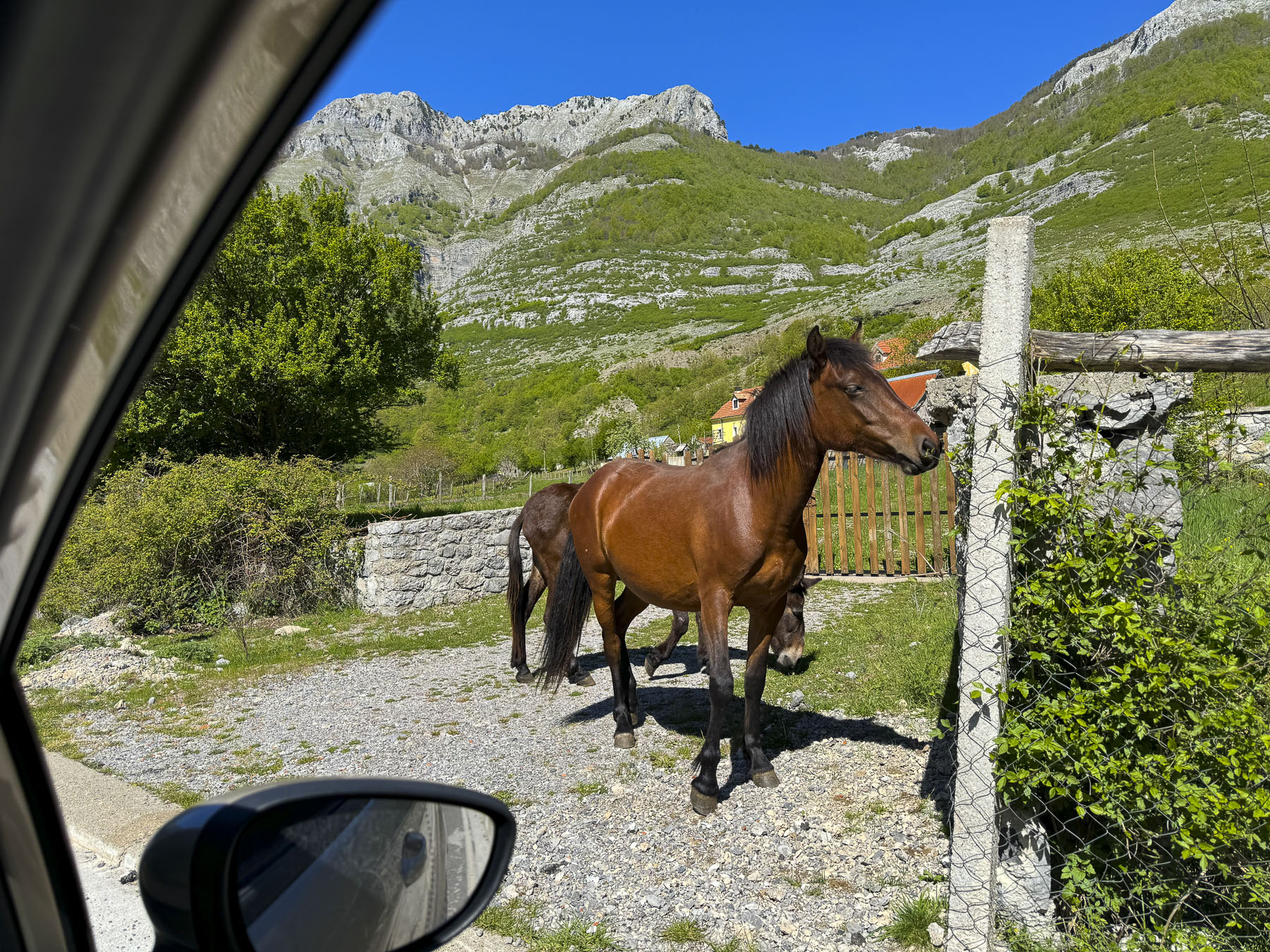
Farther along we reached Kisha e Thethit, Theth’s iconic church, and could hear music softly emanating from the Sunday service being held inside. Built in 1892, the church is a strong stone building with a steeply pitched roof, and a belltower, that looks like a small medieval castle, ready to withstand a siege. Though, during Albania’s communist era, the building was used as a health center. Nearby a sign pointed the way to the trailhead for the Theth – Valbonë hike. Sheep contentedly grazed as their shepherd checked his cell phone. Untethered horses sauntered nearby.

From the church we could see Kulla e Pajtimit, the Reconciliation Tower, or “Lock-in Tower,” and headed there. The formidable two-story stronghold, with three small windows, was built four centuries ago, and served a dual purpose; to provide shelter for the villagers in times of trouble, and to serve as the reconciliation tower, a neutral ground where disputes within the village were resolved by a council of elders. In more serious cases that involved a murder or threat of murder for revenge, the accused party would be locked in the tower for fifteen days as a cooling off period, while the elders tried to reconcile all parties affected by the crime.

This millennia old tribal custom was widespread throughout Albania and was part of the “Code of the Mountains,” that was passed down through an oral history tradition from generation to generation until it was codified in the 15th century by Lekë Dukagjini, an Albanian nobleman and contemporary of Skanderbeg, an Albanian hero. Since then, the tribal laws have been known as the Kanun of Lekë Dukagjini. The kanun has an extensive set of 1263 rules that cover everything from beekeeping to marriage and honor. It is most famously known for obligating families to partake in gjakmarrja, (blood feuds), that permitted koka për kokë (a head for a head), and hakmarrja, (vendettas), to maintain honor by seeking revenge. The heavy hand of Albania’s communist government had some success in outlawing this practice, but unfortunately, it’s still an issue for law enforcement today.

Later we stopped for lunch at the Thethi Paradise restaurant and enjoyed fresh trout, grilled lamb, and a few Korça beers, at an umbrella covered table on the patio.Surrounded by mountains from end to end, the Theth Valley was absolutely stunning and serenely tranquil in its “majestic isolation,” borrowing a phrase from Edith Durham.

The next morning, we retraced our drive across the mountains to Shkodër before continuing south to the Lezhë Castle and Kruje, where we spent the night. The drive out of the valley was just as beautiful as the drive in.

Our only companions on this quiet stretch were a flock of sheep being herded down the road, and a sow followed by her piglets crossing behind her. The drive was uneventful until the bridge over the river ahead of us was closed for road repairs, and we were directed to follow a deeply rutted farm track through the countryside for several miles. The road surface was so unforgiving that the car bottomed out several times regardless of how slowly we were going. At this point we didn’t have a cell signal, and there were no other detour signs, so we had to dead reckon our way back to the highway. The rental car company had cautioned us that they prohibited driving on dirt roads, and that we would be fined if their satellite tracking recorded us doing so. We kept our fingers crossed.

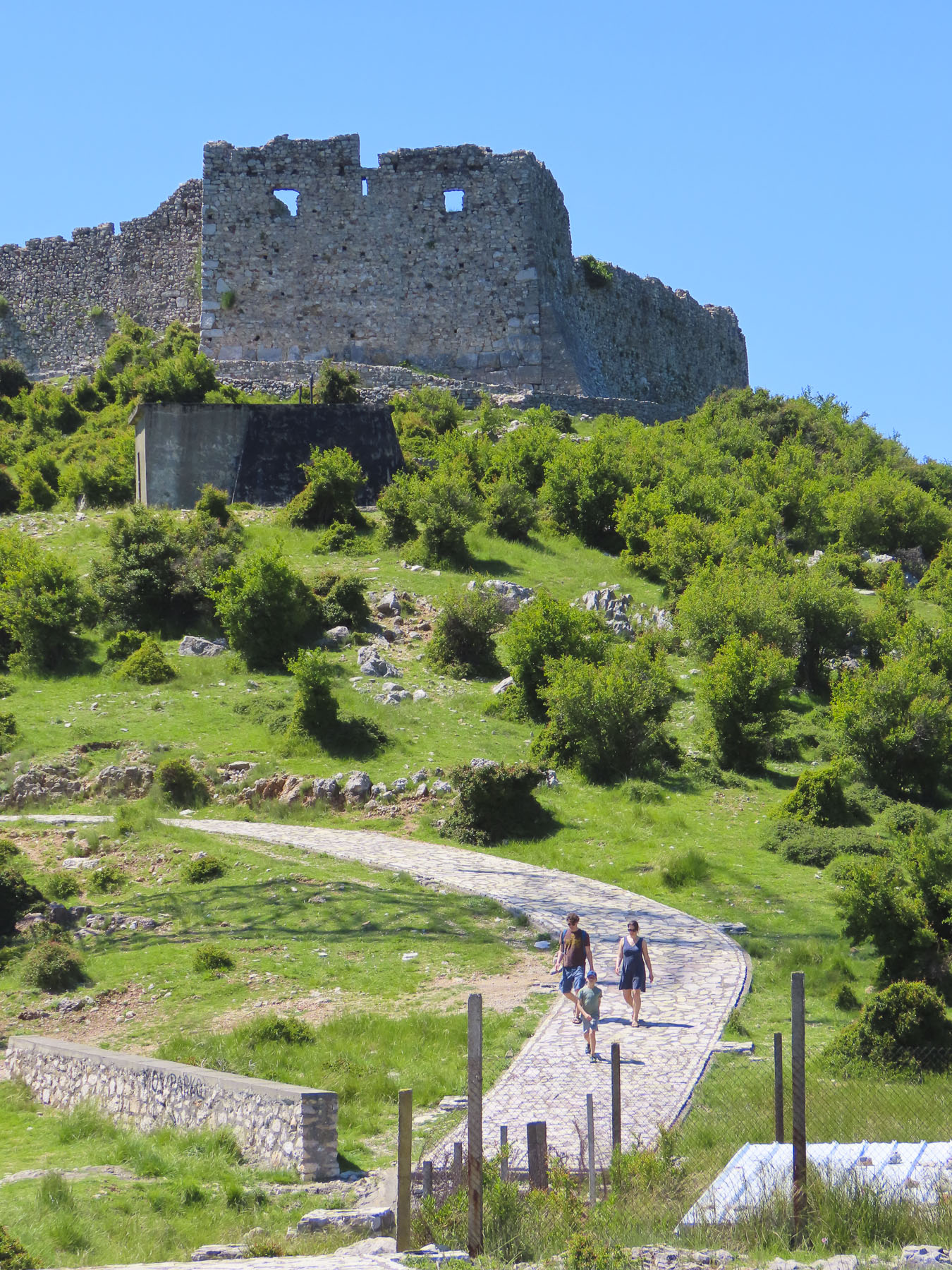
It was easy to spot Lezhë Castle, perched high on a hill, from miles away. Though getting there was a little more challenging and involved driving on some of the steepest roads we ever encountered. Think hills of San Francisco steep, but worse.

The castle had a commanding view of the surrounding terrain, though especially important was its western vista, where ships on the Adriatic Sea could be spied before they reached Albania’s shore. It was in this castle in 1444 that Skanderbeg, Albania’s national hero, rallied his countrymen to resist the occupation of the country by the Ottoman Empire. The best view of the castle was from the parking area. The area behind the walls is left in a rather rustic state with tumbled ruins and cisterns to explore. Overlooking the sea, we enjoyed a picnic lunch in the shade of the ramparts. 

The hillside town of Kruje, set high above the Tirana Valley, was our last destination in Albania. On our way to the Hotel Panorama we passed a large statue of Skanderbeg astride his steed, which commanded an overlook in a city park.

Albania’s national identify, a spirit of perseverance and resistance, is intimately linked to Skanderbeg and Kruje, his hometown. Born into the noble Kastrioti family during the early 1400’s, his parents were forced to give him to the Ottoman Empire as part of Sultan’s devşirme system. This “child tax” was to ensure a family’s loyalty to the sultan. Only one son could be taken. These children were then taught the Koran, given an education, and raised as Muslims, before being sent to serve in the Ottoman Empire’s Janissary corps, a highly trained infantry. Skanderbeg excelled as a skilled Ottoman soldier and rose through the ranks. But after a 1443 battle in Serbia he renounced Islam and escaped back to his homeland and reclaimed his title. A year later he led a league of Albanian Princes in revolt against the Ottoman occupiers. For over twenty years he rallied his fellow Albanians to repel 13 invasions, and was considered a hero throughout a Europe that feared the expansion of Islam across the continent. The citadel in Kruje was his headquarters during this time and endured three intensive sieges. Ten years after Skanderbeg’s death the castle fell and the Albanians relinquished their independence to the Ottomans for 400 years.

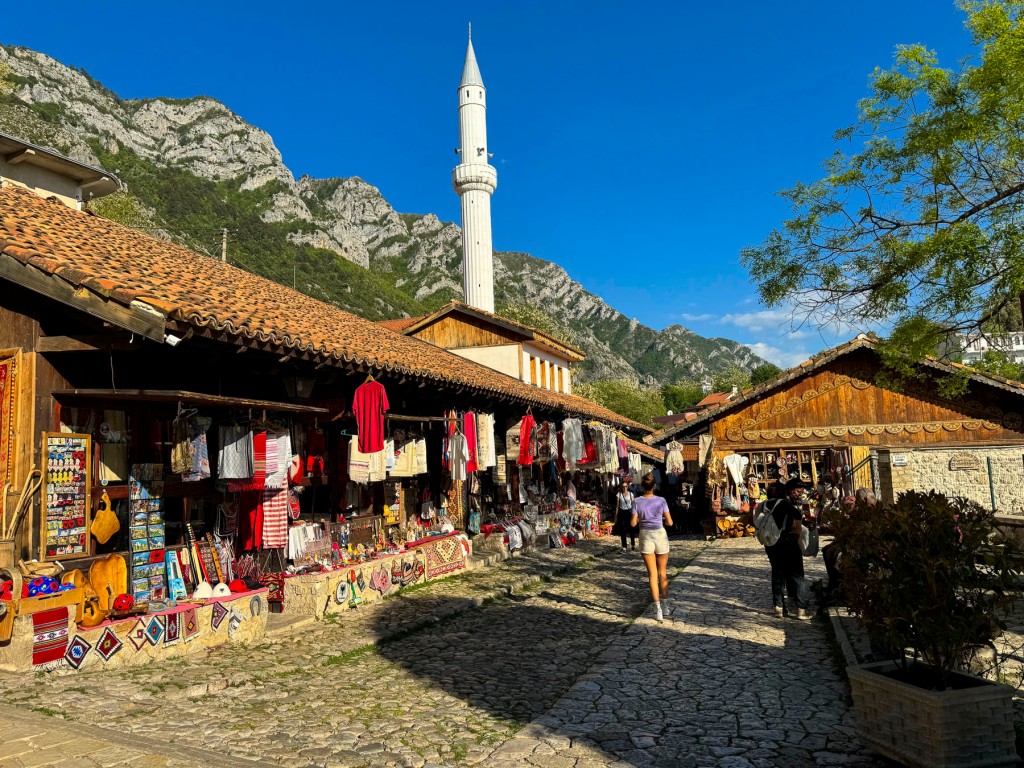
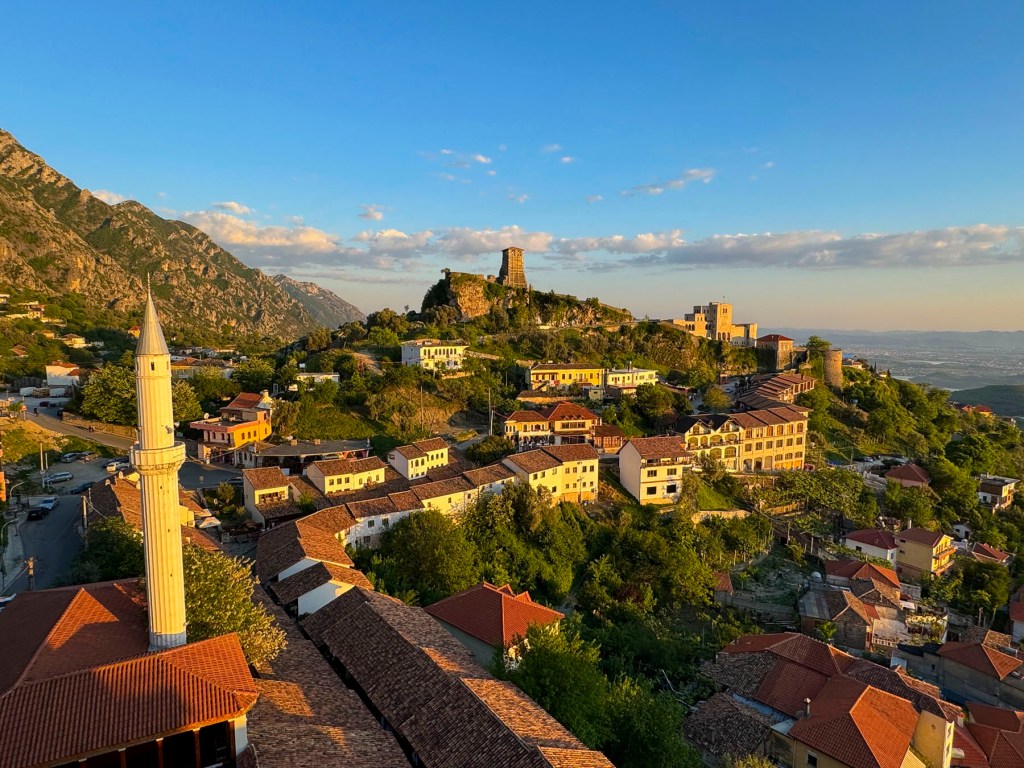
Its name said it all, and the Hotel Panorama’s guest rooms and rooftop terrace were the perfect spot for views out over the town’s ancient caravan market and Kruje castle. An arched stairway descended under the hotel from the main street and led to the historic bazaar, which is over 400 years old. A 16th century minaret towered above us.

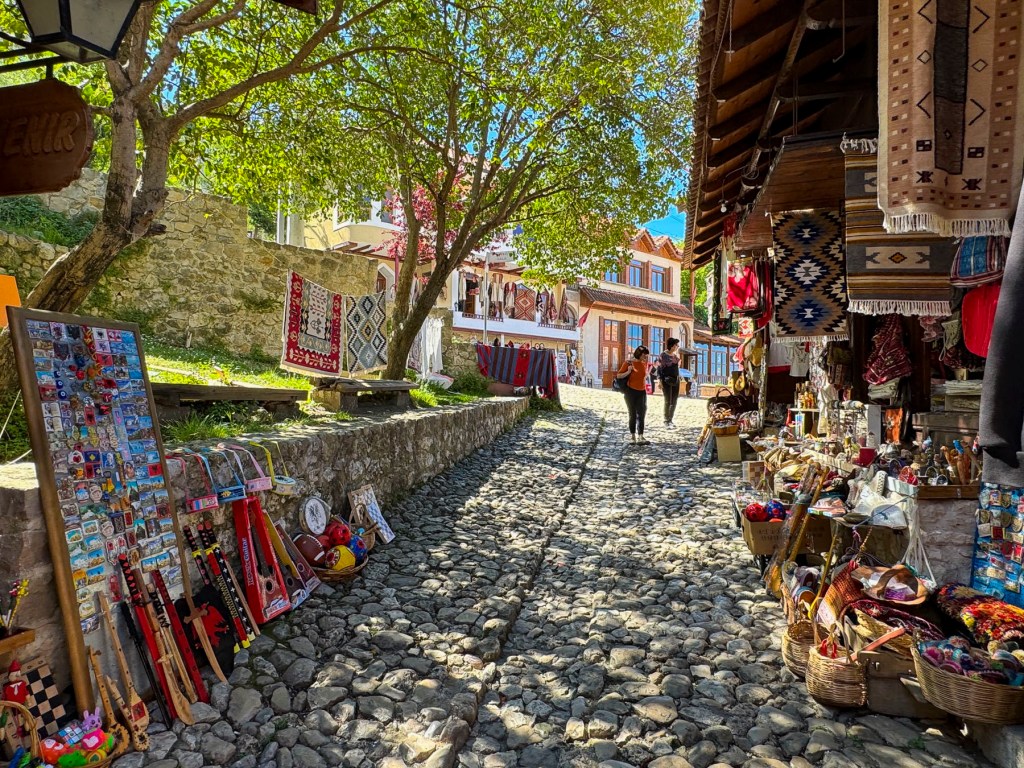
It’s believed to be the most historically accurate representation of an ancient marketplace in Albania, with its cobbled street centered with a drainage divert and canvas awnings hung from the shops, to protect shoppers from the midday sun.

In centuries past it would have had a full array of merchants offering a wide assortment of ancient everyday items, and luxuries crafted in faraway lands. Today, it’s a gauntlet of tourist themed merchandise, but we found one hidden gem, the Berhami Silver shop. The proprietor and sole craftsman, specializes in unique, intricately woven filigree jewelry.

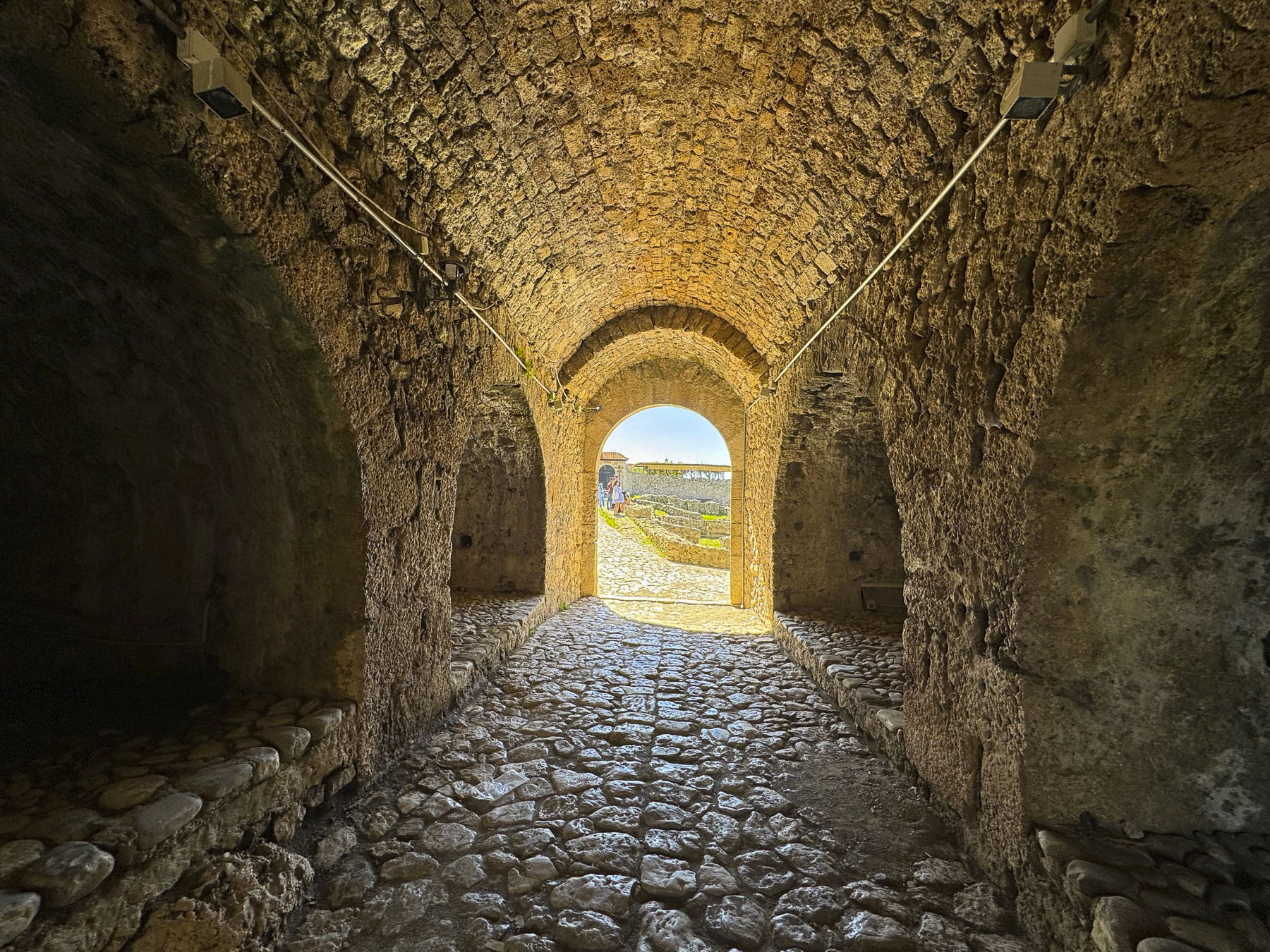
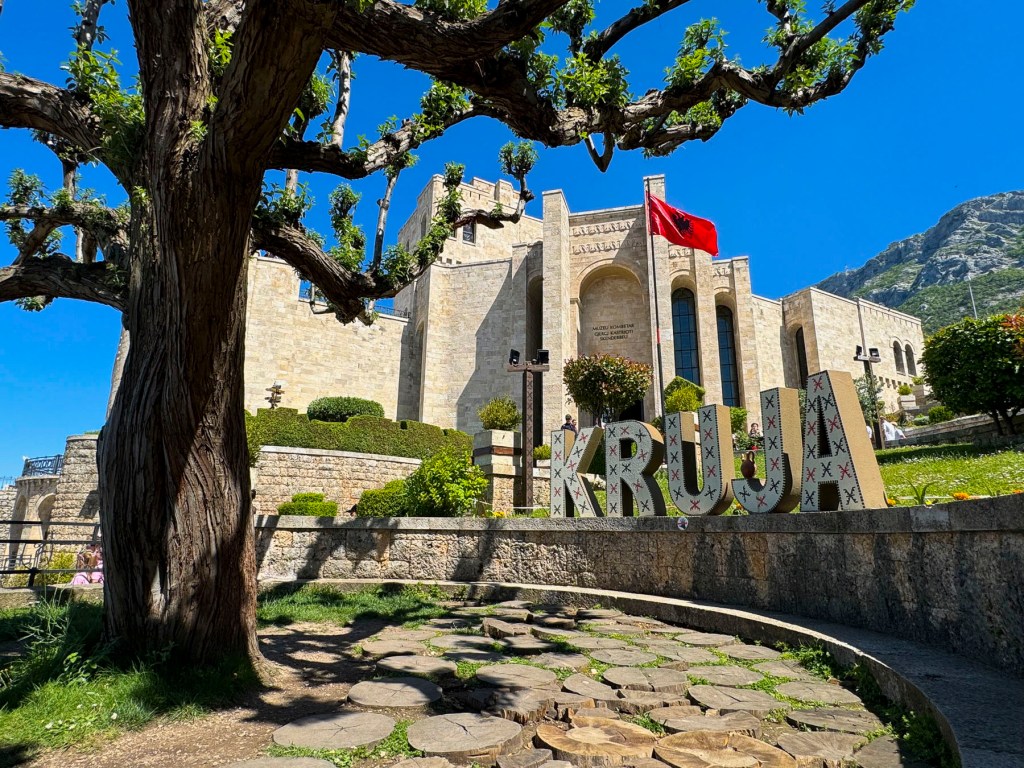
We shielded our eyes from the bright sun as we left the long, arched tunnel through the ramparts, and looked up at the Skanderbeg National Museum. Built in a historical style to reflect its surroundings, it was a majestic sight, its sandstone blocks glowing in the afternoon sun, and the red and black Albanian flag full out in the breeze.

Its exhibits feature artifacts from Skanderbeg’s era and Albania history. One of the most intriguing displays was a replica of the hero’s signature goat head-topped helmet. Albania’s flag evolved from the two headed eagle on the Byzantine Empire’s flag which flew over Albania from the 4th to 14th centuries.

The double eagle heads symbolized the unity between the Orthodox Church and the Byzantine Empire. The black eagles above the Kastrioti family coat of arms on a crimson background became the flag of rebellion when Skanderbeg raised it above Kruje in 1443. Its colors black and red represent the strength, bravery and heroism of the Albanian people.

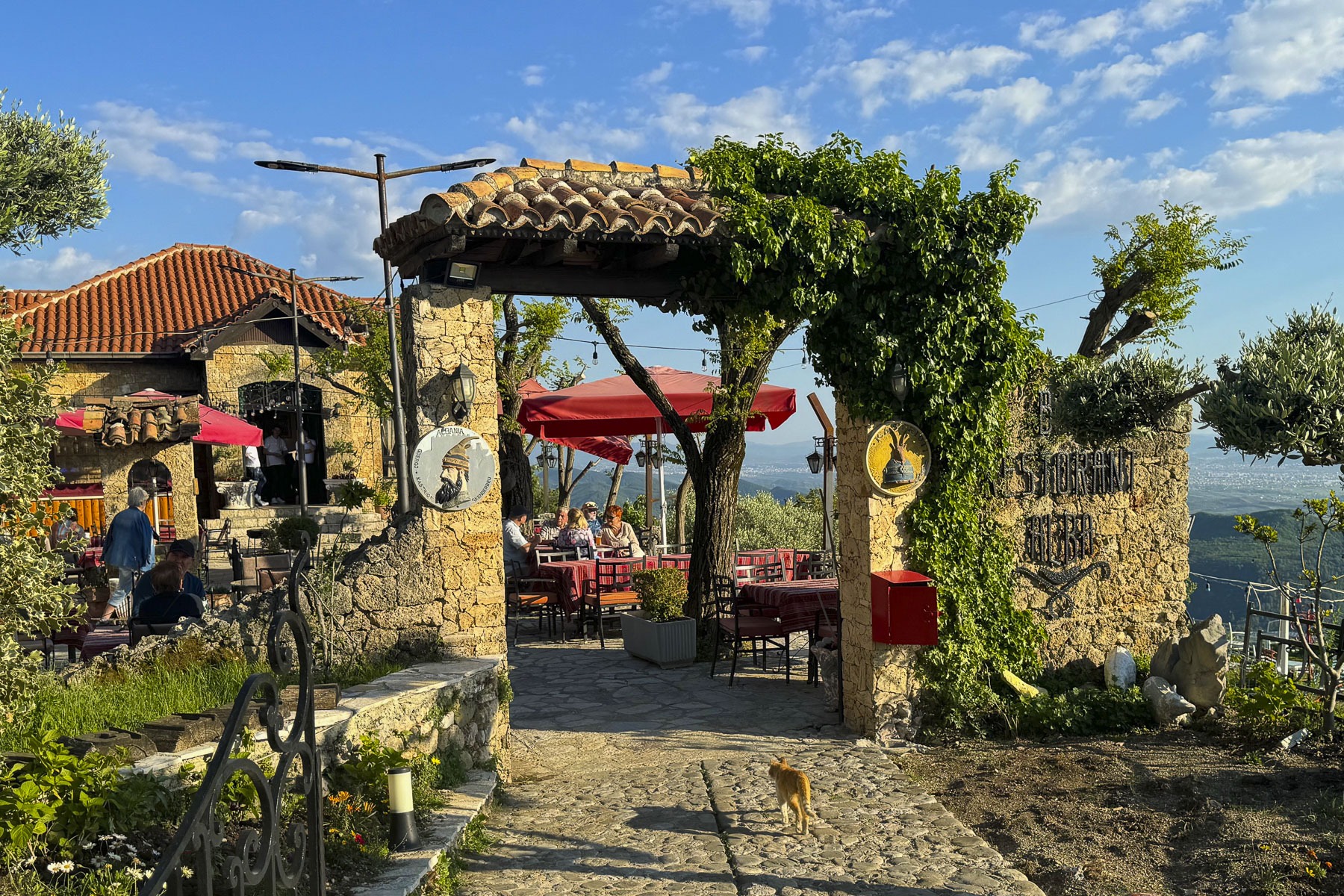
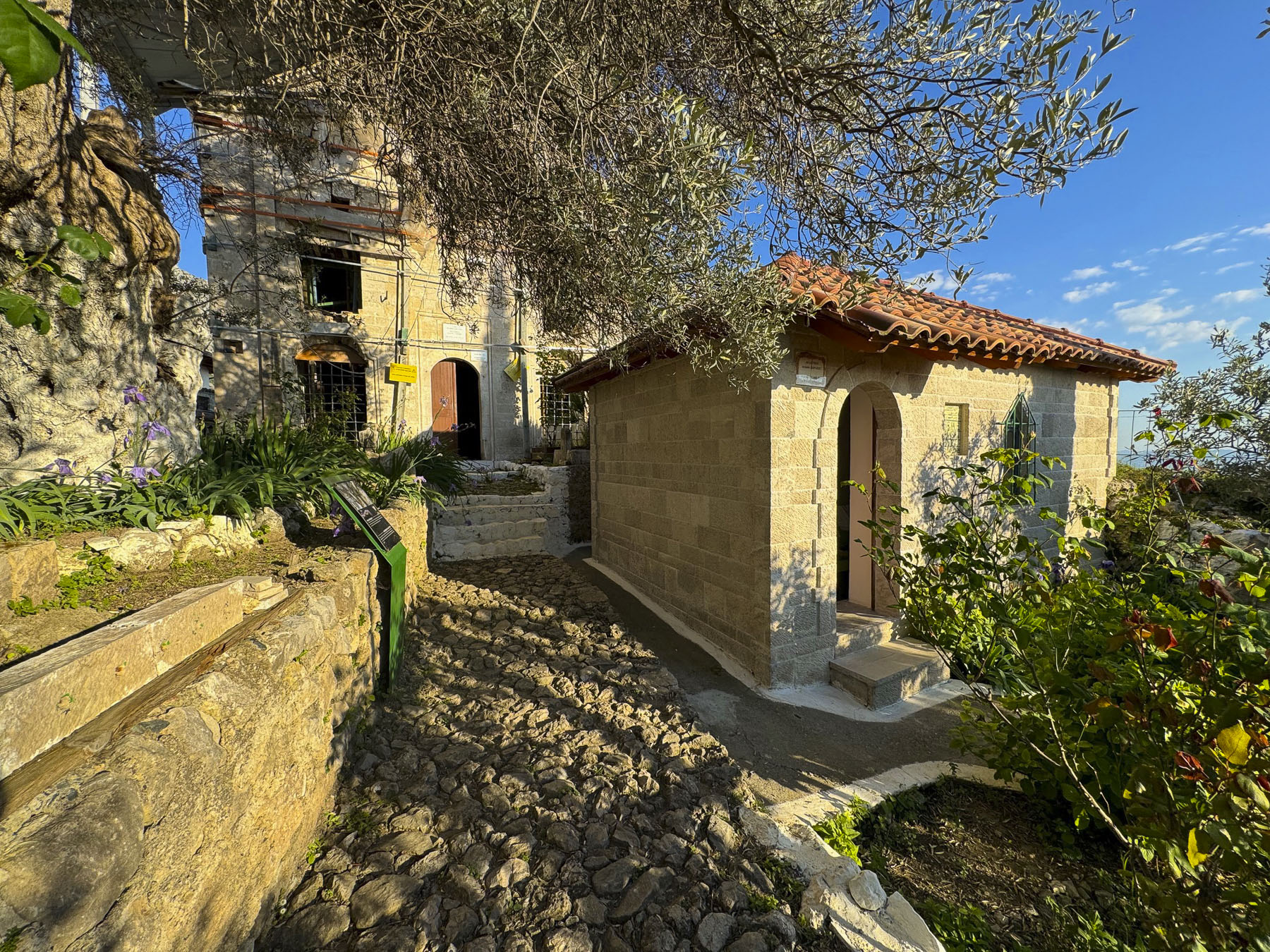
Above the castle we rested outside at a small café with an expansive panoramic view. Unaware of castle’s closing time we headed down the slope to the Tekke of Dollma, a small Bektashi Sufi shrine that contains the tomb of the mystic leader, Baba Shemimi. We reached the gate of the tekke’s courtyard just as the caretaker was about to lock the door for the day.

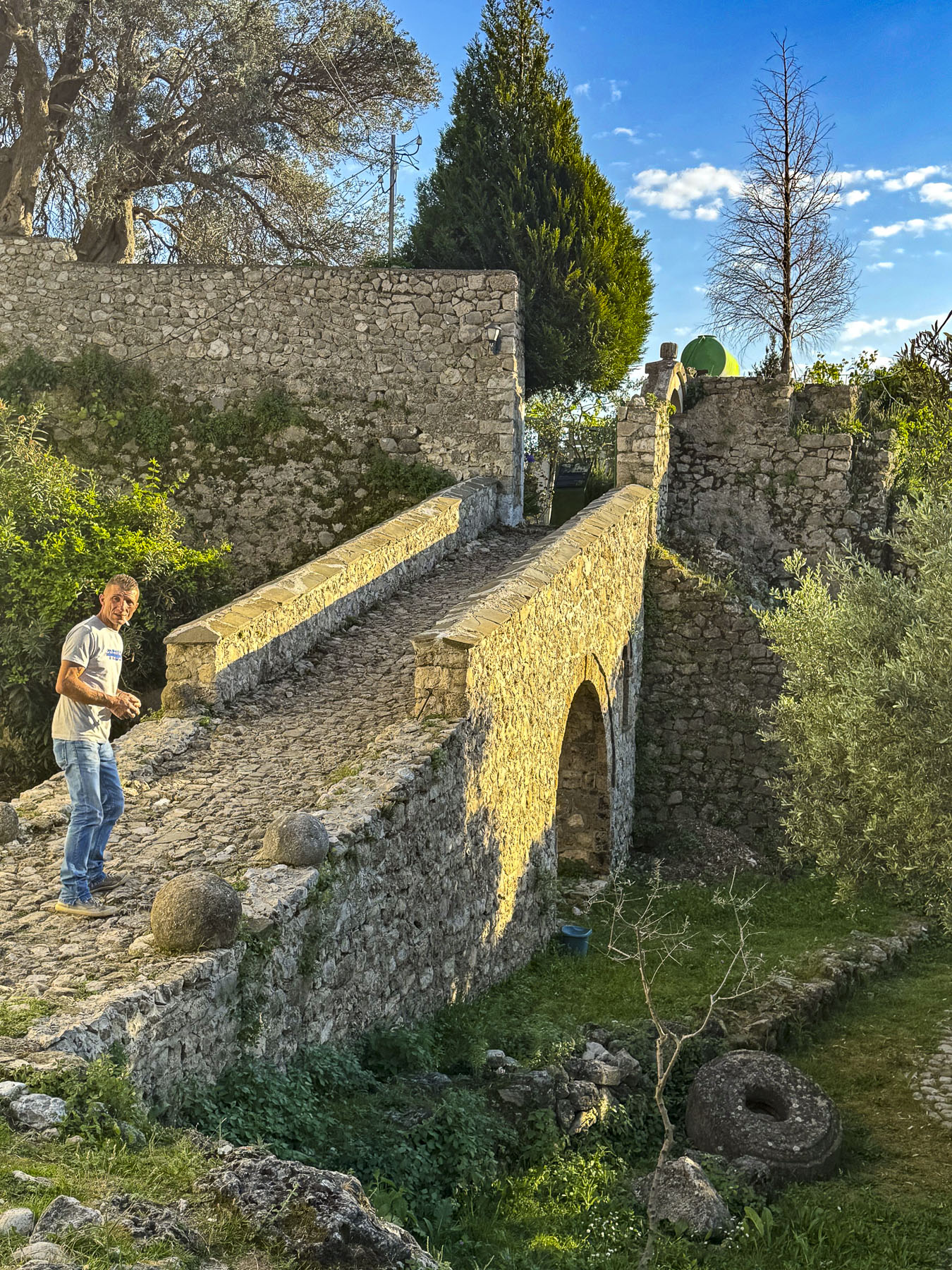
Graciously, he let us stay for a few minutes. The building was still under repair from the 2019 earthquake, but still very interesting. Legend believes the ancient olive tree in the courtyard was planted by Skanderbeg. The castle was a wonderful site to explore, and if we had had more time, we would have visited its ethnographic museum.

The sun was casting a golden glow across the hillside by the time we reached the rooftop terrace of our hotel. We clinked glasses and reflected back upon a fabulous vacation exploring Albania.

Till next time, Craig & Donna
An Albania Road Trip: On the road to Shkodër or Olives, Castles, and Lamb

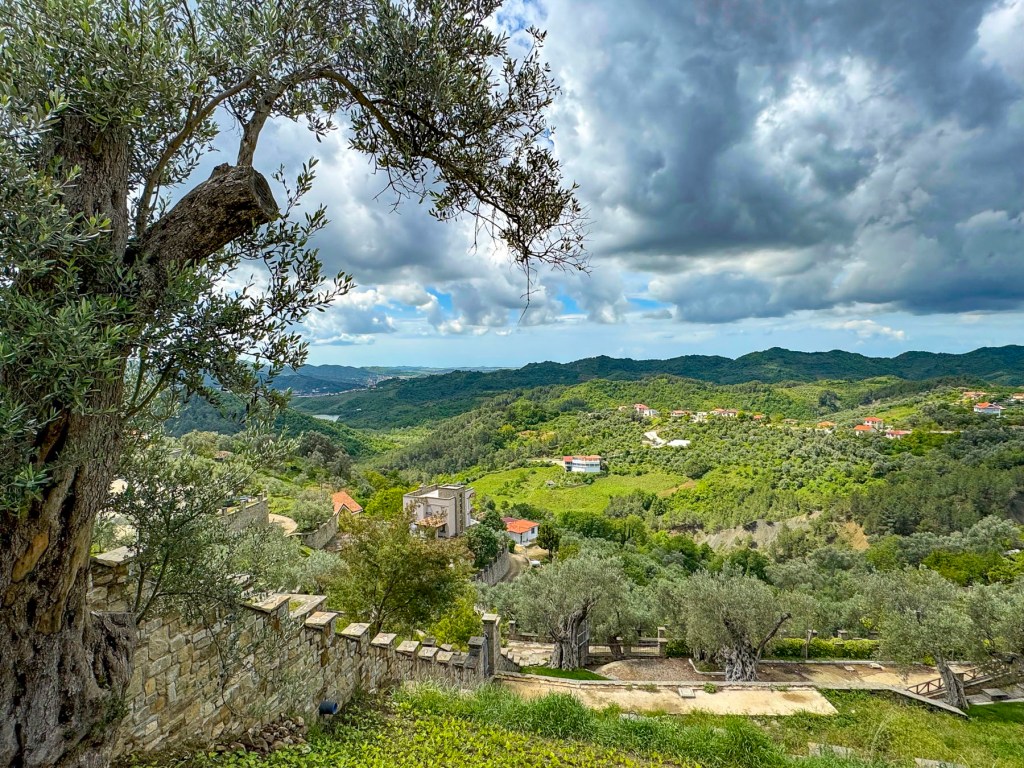
Ancient, gnarled olive trees covered the sharp slopes on either side of the road, along a narrow razorback ridge. Their silver-gray olive leaves undulated with light from a morning breeze. Some of the older trees are 3000 years old, and the fruit from the trees is believed to make the best olive oil in Albania, and is sought after by connoisseurs and chefs. An elderly man herded a small flock of sheep across the road, a common occurrence in rural Albania where it seems there is more four-legged traffic than cars.

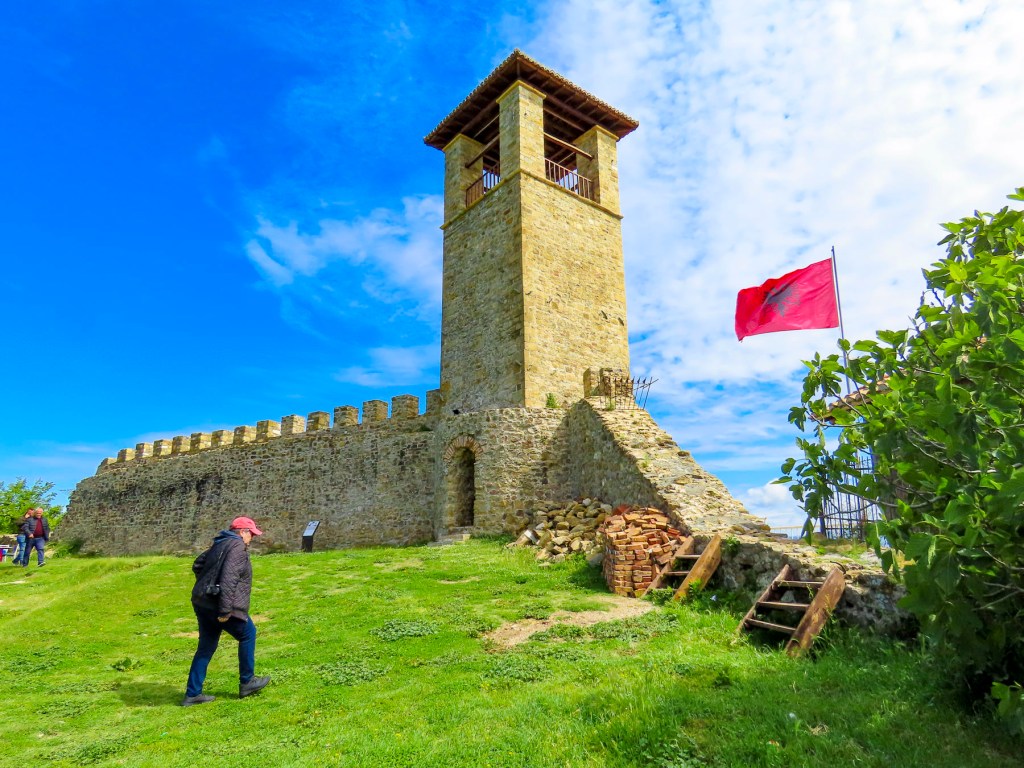
We parked and walked up a short steep lane, past a school where a coed basketball game was enthusiastically underway, to the ridge’s 1300ft summit and the Preza Fortress. The stronghold was built in the mid 1400’s and played an important role in the Albanian resistance to Ottoman rule.

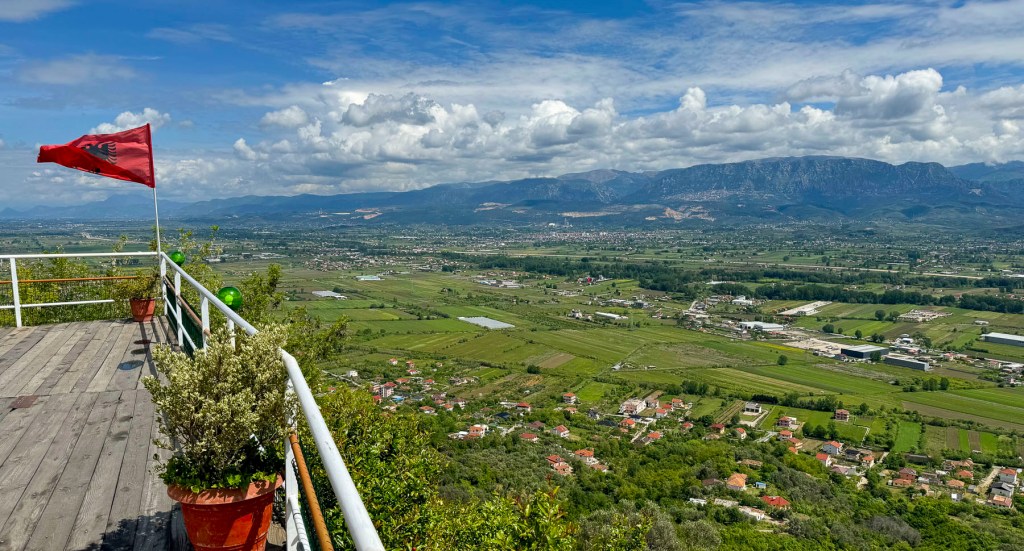
It was once a massive compound with commanding views of the broad plane of the Tirana Valley to the east. This valley was the favored north-south route for invaders, and was the fertile breadbasket of Albania since the Iron Age. Mid-week in late April we had the site to ourselves except for a group of older men, seemingly an old boys’ club, enjoying each other’s company, tucked away in a small outbuilding with a large glass window through which we could see them playing cards, drinking coffee, and reading the newspaper. Unfortunately, only one tall watch tower remains of the compound, but the panoramic view was fantastic.

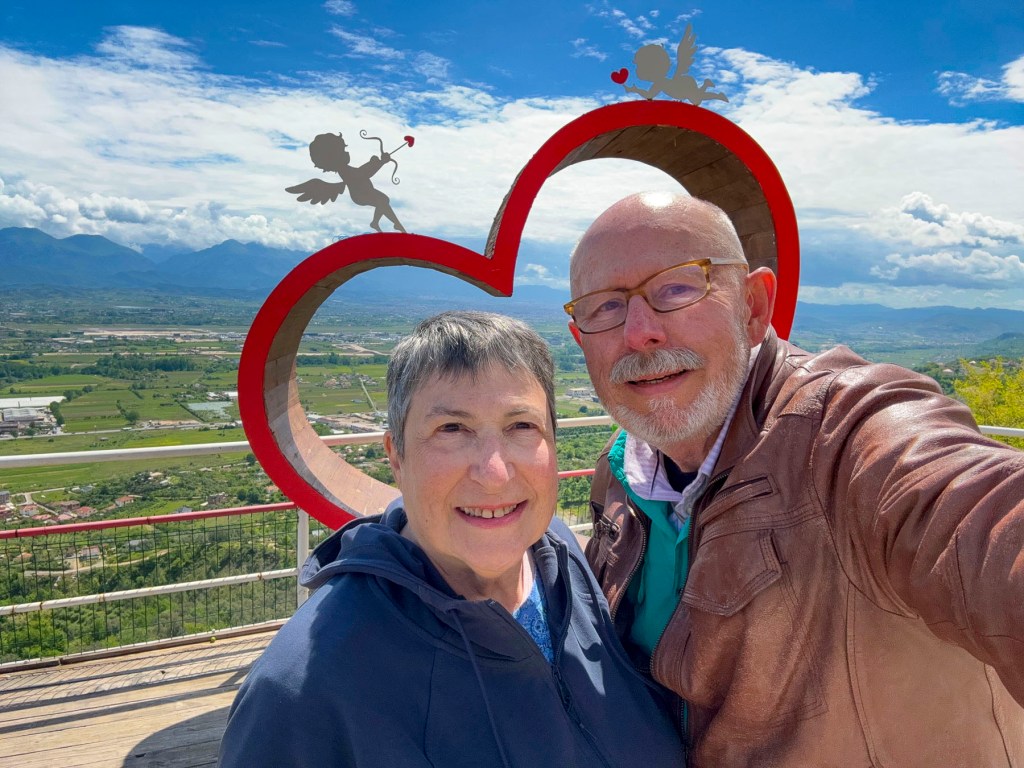
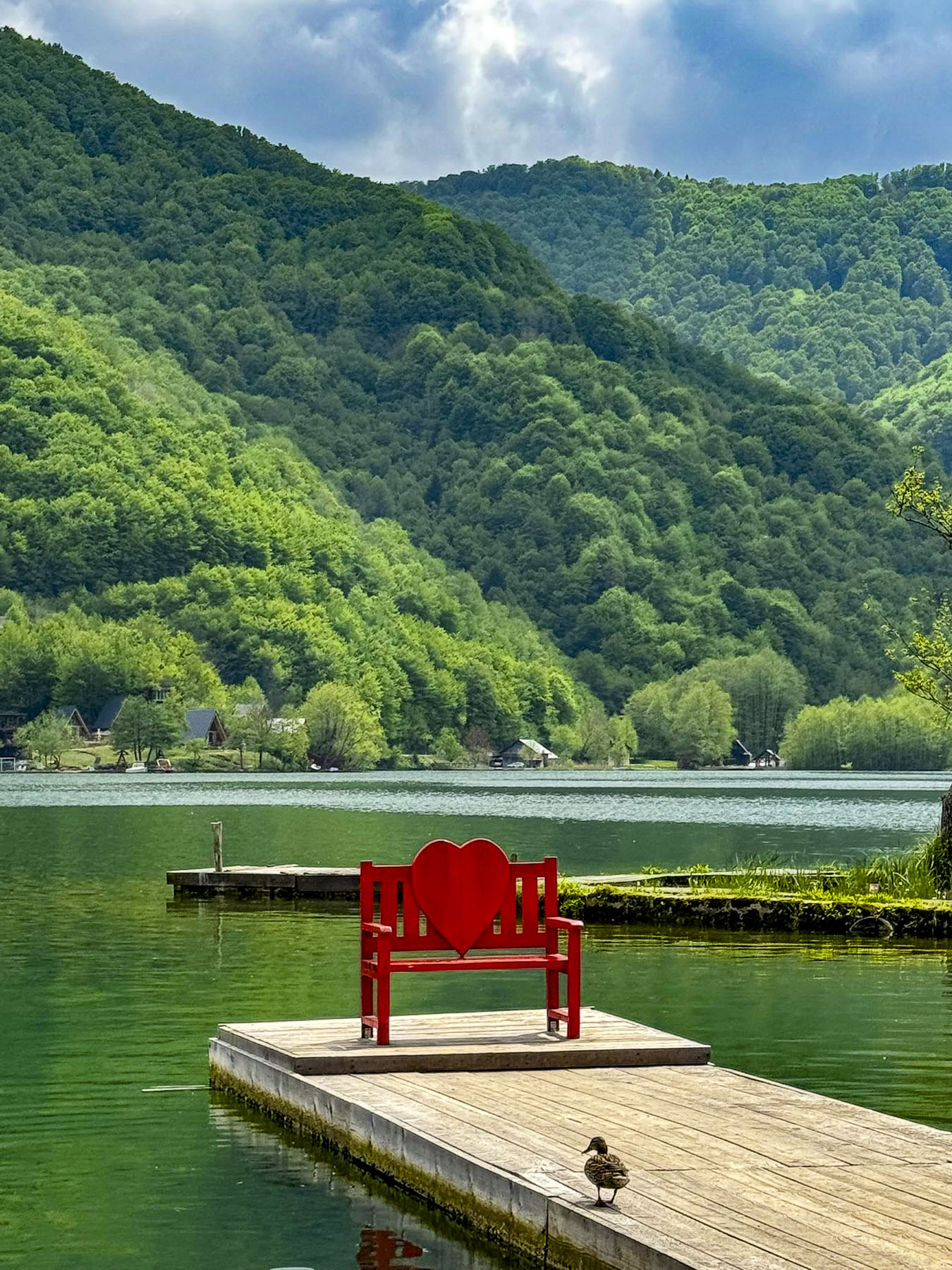
Bar Kalaja e Prezës is the restaurant at the site and was a great place to relax with a coffee and absorb the serenity of the landscape from their terraces. There was also a very large lover’s heart perched on the overlook that was the perfect spot for an Instagram photo.

We had left Durrës earlier that morning, headed toward the northern city of Shkodër, and followed the A1 north. We had been in southern Albanian for the prior two weeks and were surprised now by the amount of traffic congestion along this main artery. It was mostly due to the construction project widening the two-lane road, and the economic activities of businesses, with parking lots right next to the road which creaed all sorts of mayhem – cars were pulling off and onto the highway. There were few traffic lights. One section of the road was lined with folks selling parrots and chickens right from the curbside, while at another point men on either side of the road carried puppies up and down the traffic, offering them for sale. Fruit and vegetable stands were a common occurrence. As we’ve mentioned in our earlier blogs, we found Albanians to be very friendly. But put them behind the wheel of a car, and there is an aggressive personality shift, where they throw the driving rules out the window. I know this is a sweeping statement, but when you experience the roads firsthand, you’ll understand, and any Albanian citizen will agree with me. Driving in Albania was a blood sport – the automotive version of rugby.

The one big plus of driving along Albania’s main roads was the superb quality of restaurants attached to gas stations. In the states these are often fast-food chains or “greasy spoons,” that serve caloric, processed foods. Albanians take their cuisine quite seriously, and we found it nearly impossible to have a bad meal in the country. The key though to these roadside restaurants is to pick one where the parking lot is almost full. It’s always a good sign that the place is busy with satisfied customers. The restaurant Autogrill Emanuel, along the SH1, in Balldren was a wonderful find, and a great place for lunch. The façade was ho-hum, it is after all located at a gas station, but the inside was pleasant, and the tables were covered with linen tablecloths.

Near closing time we arrived at Rozafa Castle, parked and started to walk around a small hill that obstructed our view of the fortress. It quickly became apparent that it was too long of a trek uphill, and it would diminish our time exploring the site. Several cars passed us coming downhill and we realized we just might get lucky finding a place to park nearer the entrance. Fortunately, that was the case, but even so it was still a strenuous walk to the center of the citadel.

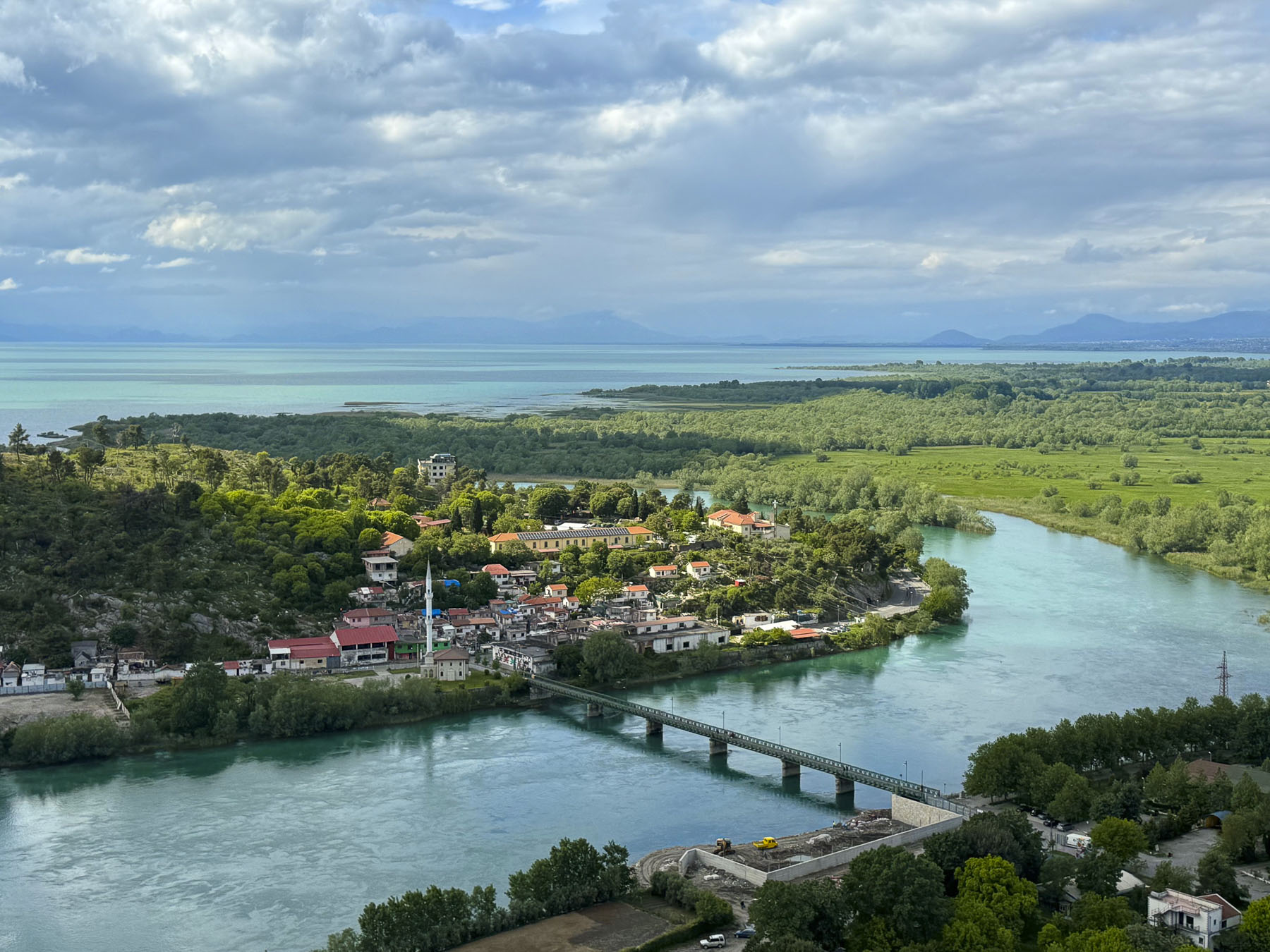
The views were fantastic. We could see for miles around, especially out over Shkodra Lake where the mountains of Montenegro rose on the northern horizon. To the east the small metropolis of Shkoder spread imposingly across the flatland beneath the foothills of Albanian’s beloved Accursed Mountains. While the panorama to the south encompassed the meandering Drin River.

The first fortifications on the hill date to the Illyrian kingdom during the 4th century BC, though archeological discoveries confirm the hilltop had inhabitants since the Bronze Age. Albania folklore is full of tales of stoic women sacrificing for their country. Though the legend of how Rozafa Castle received its name is one of the more tragic and involves human sacrifice. The tale goes that construction of the castle was beset with difficulties, walls collapsed, workers died. An oracle was consulted and advised that a woman be entombed in the castle’s wall to appease the Gods. Rozafa, a young mother, was chosen, and as the legend goes, willingly participated as long as her chest was left exposed for her infant to breastfeed. For ages afterward it was believed that the liquid dripping from the limestone stalactites on the ceiling of the ancient Illyrian gateway to the fortress was the entombed mother’s milk, and that the castle was alive with her spirit.

The Roman Empire defeated the Illyrians, and over the following centuries the fortress was controlled by an ever-evolving list of rulers that included the Byzantine Empire, Kingdom of Serbia, Lordship of Zeta, Principality of Zaharia, the Venetian Empire, the Ottoman Empire, the Pashalik of Scutari, and the Kingdom of Montenegro.  T

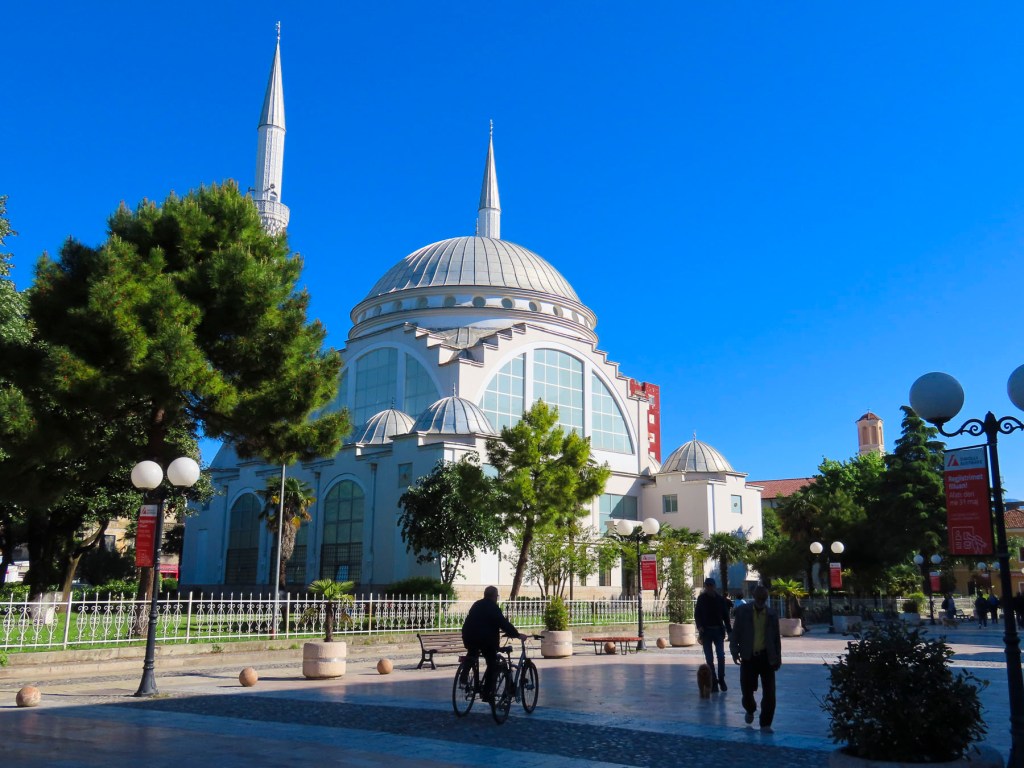
We were taken by the beauty of the old town at the Migjeni roundabout, where an intriguing cityscape included Ebu Beker Moosque’s minarets, and Kisha Katolike Frencekane’s belltower; crenellates and fountains revealed themselves. Shkodër today is Albania’s fifth largest city with a population of 102,000. Though thriving today, the city has had a tumultuous history. Most poignantly in 1967, the Communist dictator Enver Hoxha declared Albania an atheist state and banned the practice of all religions. Churches and mosques were seized and converted to other uses or destroyed. Religious leaders were executed or imprisoned for decades in brutal labor camps and prisons to break their faith. The communist regime viewed anyone who believed in religion as an enemy of the state. Family members of the accused were victimized as well, with the denial of educational opportunities, and decent jobs. Consequently, the citizens of Shkodër who cherished their religious harmony and embraced each other’s Muslim and Christian traditions, in a city where it was not uncommon for members of the same family to practice different religions or intermarry, suffered greatly under communism.

The most poignant insult was the creation of the National Museum of Atheism, an anti-religious propaganda center, in the city. While the borders of Albania were closed to the outside world, even the cities within the country were isolated from each other, and Shkodër sat alone and inaccessible in the northern part of the country. Any news it received of events in southern Albania was heavily censored. Even folks that were “free” likened it to living in a penal colony, as the town had 23 prisons, and nearly every family had someone in jail. The Sigurimi, the communist secret police, had a heavy presence in the city, and encouraged informants to denounce anyone, even for simply wearing a religious cross. Similar to Bunk’Art 2 in Tirana, the site of the Witness and Memory Museum in Shkodër documents the atrocities the communists committed against the townsfolk, in a confiscated Catholic school that was operated as an interrogation center.

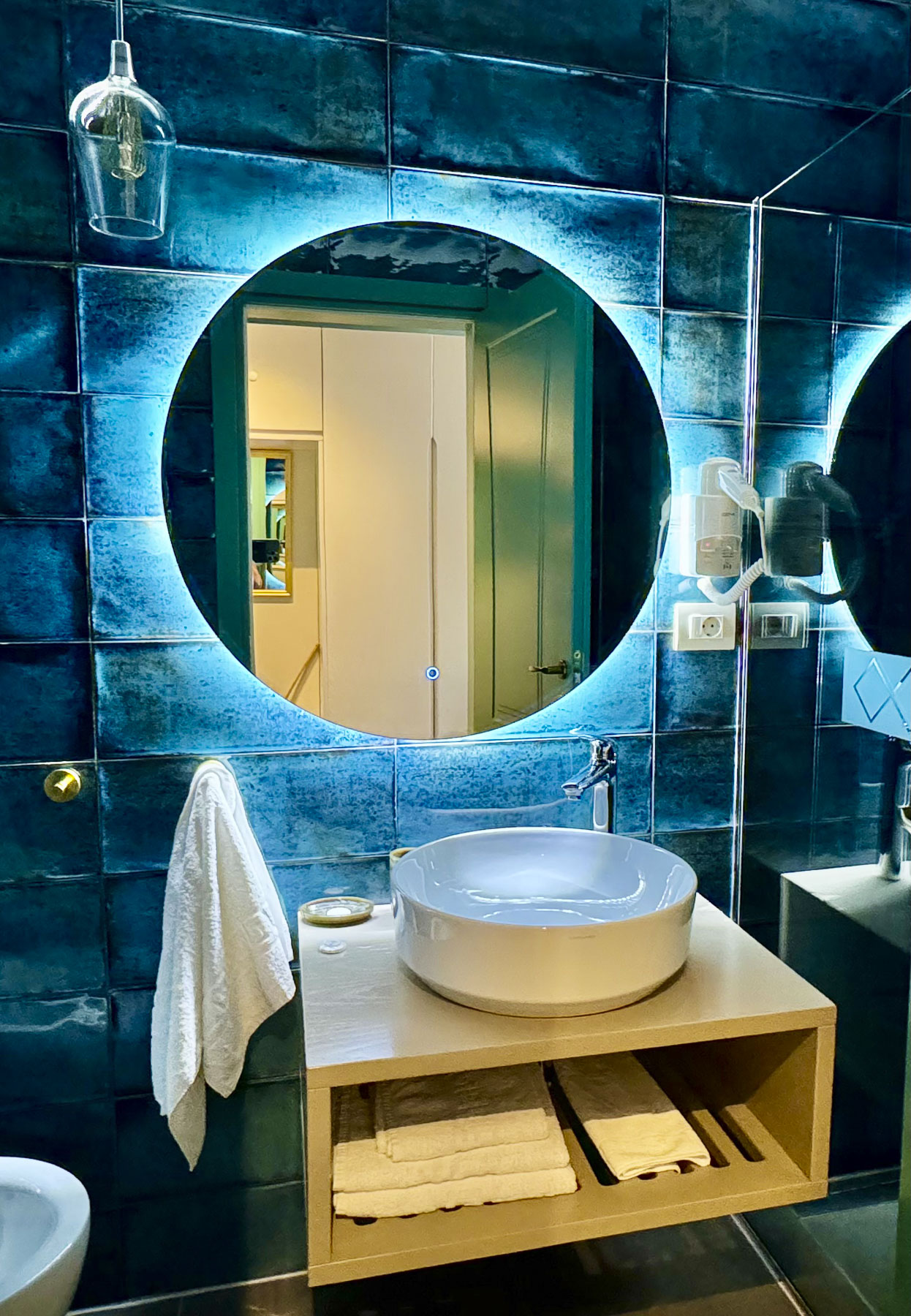
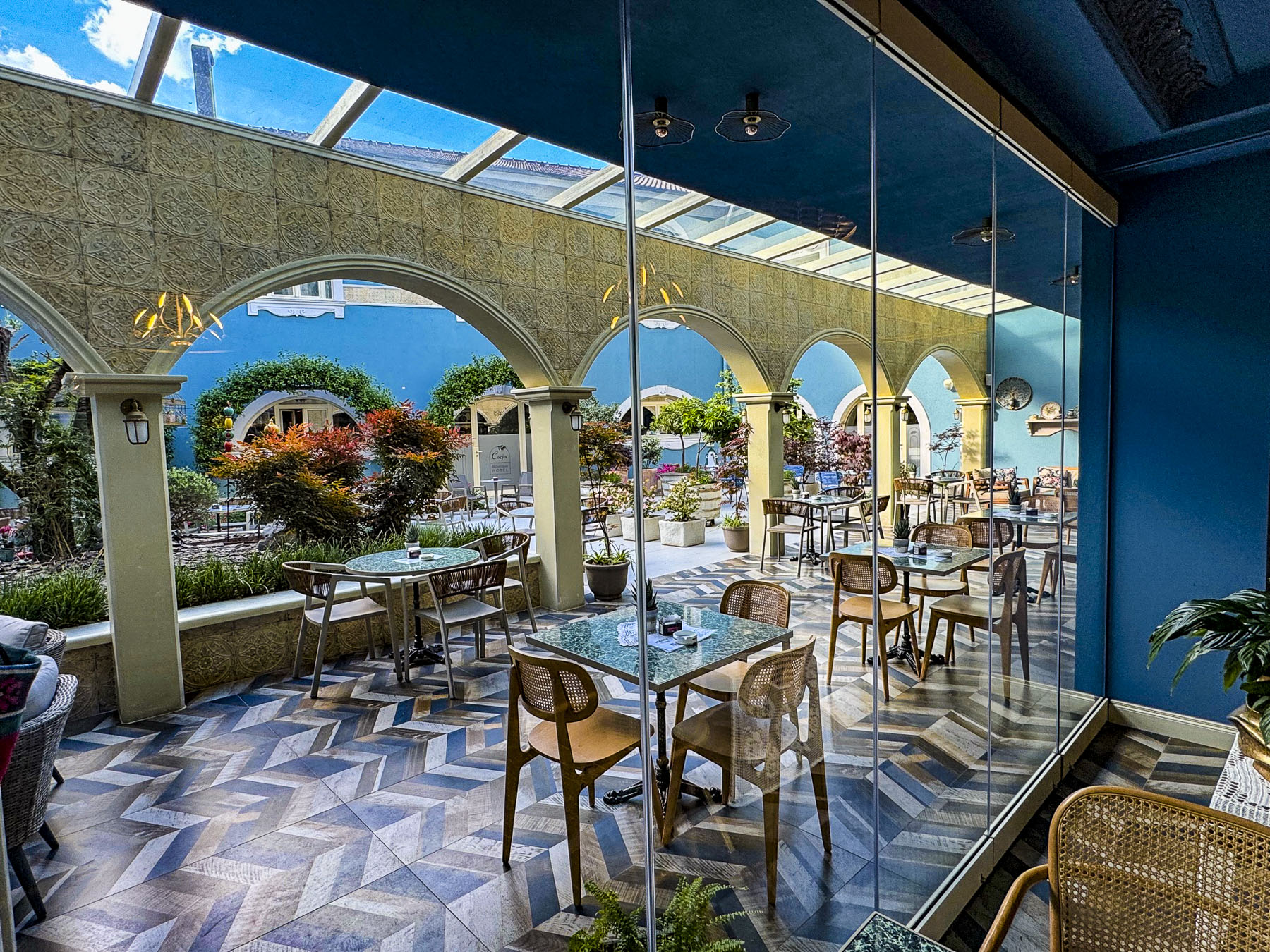
The Çoçja Boutique Hotel was only a few minutes from the roundabout, had underground parking, and most importantly was a short walk away from the pedestrian only streets Rruga Kolë Idromeno, and Rruga 28 Nëntori. We are not sure why this small 17-room hotel is only rated three-stars, but it was one of the nicest hotels we have ever stayed in. It’s a newer building that’s exquisitely well decorated, and our bathroom was a modern wonder. The staff was also very nice.

Ten thousand undergraduates attend the University of Shkodër, and the cosmopolitan city’s streets are full of students pedaling across the town’s flat roads. Their presence contributed greatly to Shkodër’s youthful contemporary vibe, that’s much different from the rest of the country. In the evenings the restaurants and cafés along the pedestrian mall were filled with their energetic enthusiasm.

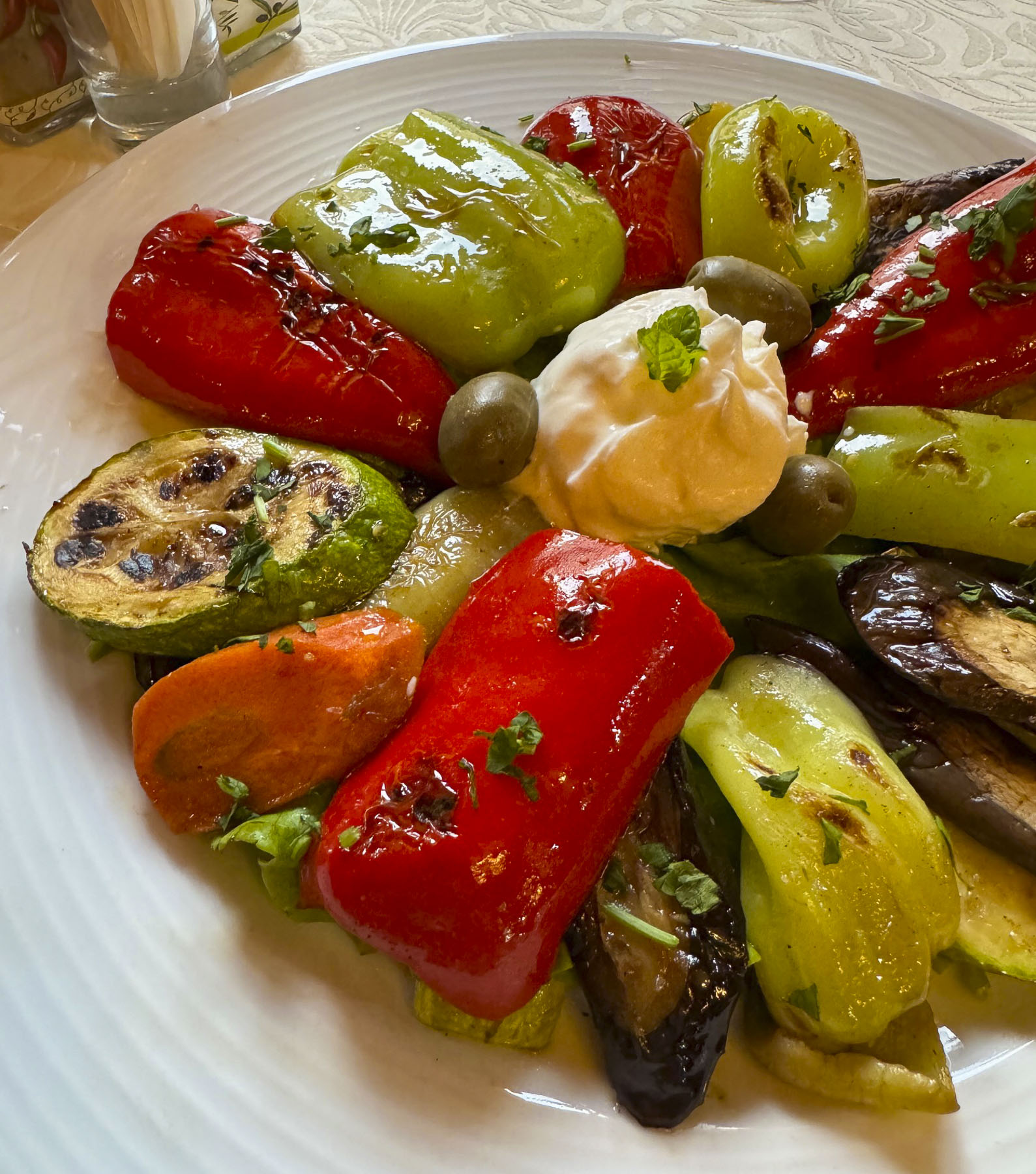
We took advantage of a warm night and enjoyed eating outside on the second-floor balcony, which overlooked the mall, at Bar Restaurant San Francisco, on Rruga Kolë Idromeno. I tried the traditional Shkodër specialty, Tavë kosi, made with lamb, yogurt, eggs, garlic, and oregano, while Donna ordered baked lamb with rice. Roasted vegetables and the house wine accompanied our dinner. All were quite good. We ordered lamb frequently while traveling around Albania, as in the states it is not offered in many restaurants, and when it is it’s very expensive.  

The next morning, we strolled in the opposite direction down the shaded Rruga 28 Nëntori, where preparations were underway for the 11th annual Hemingway Jazz Fest & Swing Marathon, that’s held at the end of April. Unfortunately, we were not in Shkodër for it, but it would have been really nice to watch folks cutting loose. Towards the end of our walk, we reached Shatërvani Park, where there were several sculptures.

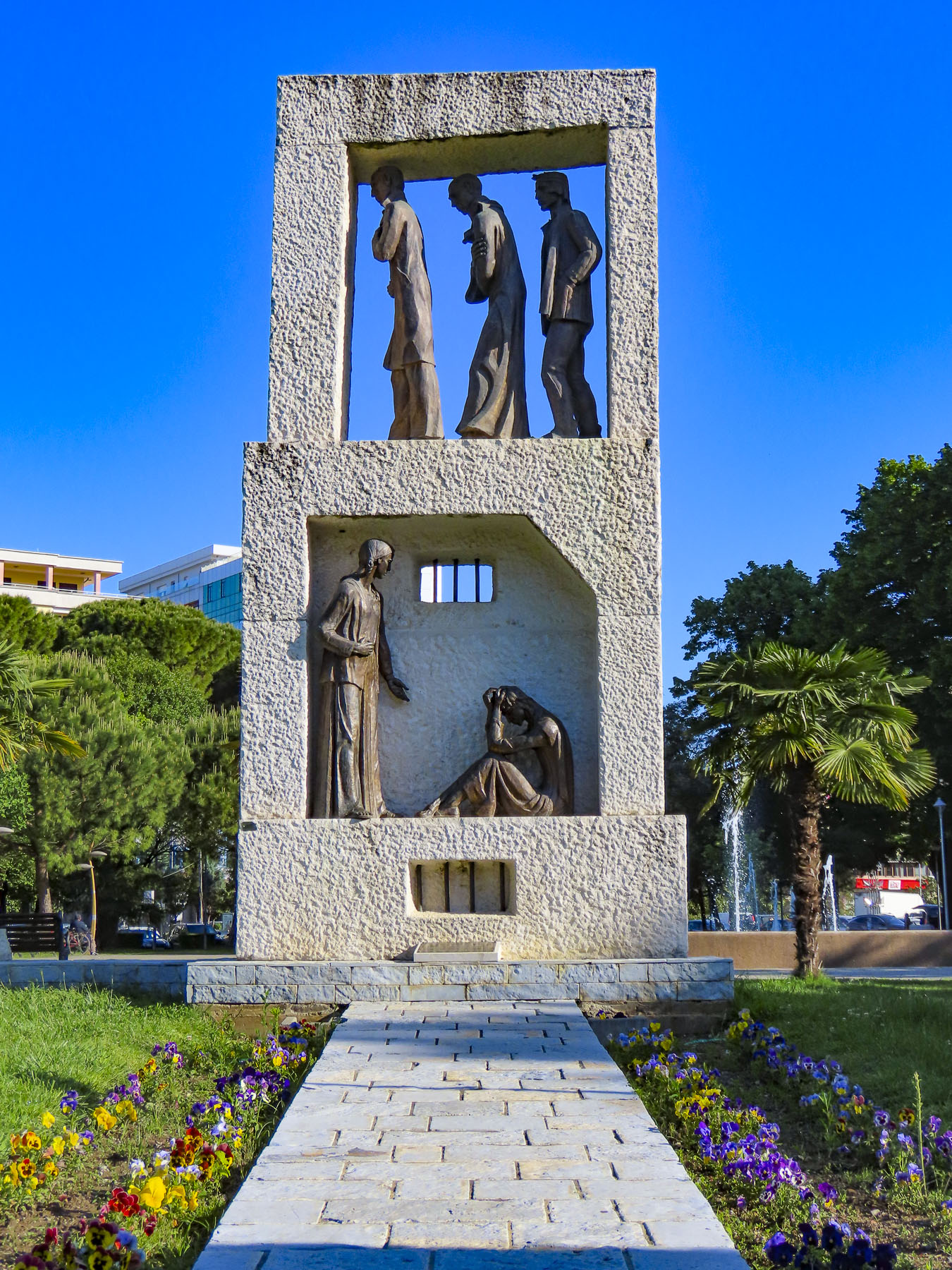
One was a whimsical and retro collection of towering, stylized dandelions, which I haven’t been able to find any information about. Nearby, across from the City Hall, stood the Monument Dedicated to the Victims of Communist Persecution.

A plaque near the sculpture states it’s dedicated to the sacrifices, and resistance the people of Shkodër made during the communist dictatorship. This is the first memorial of its kind in Albania and considered long overdue. Many think it is an important first step towards reconciling the atrocities of Albania’s communist past with survivors of the nightmare.

In hindsight two nights in Shkodër wasn’t enough time to adequately explore the city. An extra day would have allowed time to visit some of the museums in the city.

Till next time, Craig & Donna
On the Road to Durrës, Albania: or Lady Bugs, Metallic Men and a Beautiful Seaside City

Loose gravel gently slid down from the top of the earthen embankment along the road. It was the “heads up!” prelude to a small herd of goats scurrying down the slope to cross the road ahead of us. The last to cross was a young yearling goat, unsure of his footing. It was a transition day for us. We had left Lin, on the shore of Lake Ohrid, near the border with North Macedonia, earlier that morning to drive to Durrës, on the Adriatic Sea. The journey of only 90 miles, 142 km, was our longest single drive in Albania, and can be accomplished in three hours, if so desired. But with us there is always something that piques our interest and requires a detour or U-turn.

Much of the SH3 highway that connects Lin, through Elbasan, to Durrës traverses a sparsely populated remote region of Albania. Occasionally, in what seemed the middle of nowhere, we passed enterprising farmers who had set up temporary produce stands perched atop the road’s guardrails, their donkeys tied nearby. Sadly, factories abandoned after the fall of communism littered the countryside. In Prrenjas though, the artist Eljan Tanini whimsically covered the towers of a defunct nickel mine with 1,380 charming ladybugs, a symbol of good fortune and hope for the future.

On the outskirts of Elbasan we stopped for a snack at the Elita Grill, a newly opened restaurant. It was a very attractive, contemporary space, which stood as a nice counterbalance to the rustic region we had just driven through. The pastries and coffees were very good, and the prices budget friendly. Across the street, the dome of a larger-than-average Cold War era concrete bunker inched above a mechanics shop.

Entering Elbasan we passed the Xhamia e Nazireshës mosque. Across the street from it, a dreamy street mural of a child playfully dancing amidst clouds graced the side of an apartment building. Unfortunately, the traffic was too congested in this spot, and we didn’t stop. An abandoned train track paralleled most of our route from Prrenjas to Elbasan. The rail line once carried nickel ore to the Kombinati Metalurgjik, a huge industrial complex that was built with cooperation from Chairman Mao’s Chinese Communist Party in the 1970’s. The site, easily seen from the highway, now lies in ruins and is a popular spot for amateur industrial archeologists. But at its height it employed 12,000 people and produced the iron, steel and cement for Albania’s 173,000 military bunkers ordered built by the paranoid communist dictator Enver Hoxha, who feared invasion from everyone. We were getting hungry as we reached Tirana. While there were numerous lunch options available, we wanted something with easy on and off access, close to our route. With a quick google search we chose the restaurant Xhafa, which had an outside patio on a hillside that overlooked Tirana. From our experiences across Albania we found that the food was delicious no matter where we stopped. As it was here. Leaving the restaurant, we noticed a large futuristic metallic head in front of an office building next door. We are not sure, but we think the sculpture can be accredited to the Albanian sculptor, Ilirjan Xhixha.

We continued our westerly drive along SH3 until signs for Durrës directed us onto SH2. We wished we had been prepared with our cameras for what emerged next. Across the highway, the most unusual building crowned a small hill. It was seven stories tall, with a neoclassical birthday cake-like façade. On the multi-level corners of the building larger than life statues of the Illyrian Kings stood, as if they were surveying the landscape. Centered atop the colossal building was a mammoth sculpture of the great warrior Skanderbeg, the famous 15th century commander who united Albanians to rebel against the Ottoman Empire. This grand building, with its Las Vegas-type schmaltz, was the Amadeus Palace Hotel. If you enjoy quirky, off-beat things, this might be a place to check out.

We arrived in Durrës late in the afternoon, just in time to see a passenger ferry from Italy enter the harbor, as we drove along the waterfront. Parking with a rental car is always a concern, but we had asked the hotel, Ventus Harbor, where to park. “During the April shoulder season there is plenty of free parking available close to the hotel,” was the response. We are always skeptical of these easy answers, and there was street parking a short distance from the hotel. Though there was an informal parking assistant waving to drivers coming down the street, pointing as to where to park or wait as a cement truck driver readied a delivery to a construction site. We tipped him and hoped for the best. At the reception desk we told them where we left the car, and they said it would be okay, but we could also park on the pier which led to the floating hotel if we preferred. While that option was closer, it required driving through a small, pedestrian-filled shopping mall. The car stayed where we left it and was fine for two days.

Though the futuristically designed Ventus Harbor appears to float above the Adriatic Sea like a spaceship, it is in fact built securely atop pilings pounded into the seabed and connected to shore via a narrow, 300ft long suspension bridge. The hotel’s refreshing uniqueness, which contrasts so distinctively with the stone castles and villages of rural Albania, was our main reason for choosing to stay there.

Towards sunset we headed to the promenade along the seafront and were engulfed by families and friends enjoying the xhiro, the Albanian tradition of an evening stroll to relax and socialize. Fishermen cast the last lines of the day into gentle waves as we walked towards the setting sun and the Sfinksi, a small concrete step pyramid where folks gathered to watch the sun dip below the horizon as the sky faded from a fiery orange to the blue of the evening.

The city’s night skyline slowly awakened with lights, before the stars shined. It was a warm April evening and we slept well with the door to the balcony open, listening to the water lap against the pilings below us.

After breakfast we walked along the promenade into Durrës’ historic old town, which has been centered around the harbor since time immemorial. It has been Albania’s economic engine and vital link connecting Europe to Asia Minor since Greece established a trading colony there in 7th century BC. An Illyrian Kingdom followed in the 4th century BC. But it was the Roman Empire which left the most significant impact. The Romans turned the ancient town, now Illyricum, into a vital trade and military hub with the creation of the Via Egnatia, a cobbled road that crossed 700 miles through the rugged Balkan mountains to Thessaloníki, Greece, and Constantinople. Troops, merchants and religion flowed across its path. The Apostle Paul traveled this route to Durrës in the 1st century, a time when Christians were still thrown to the lions for entertainment in the coliseum across the Roman Empire. Upon the Western Roman Empire’s collapse in 476, the Byzantine Empire filled the void until the tumultuous Dark and Middle Ages brought a succession of invaders to the region. Visigoths, Huns, Bulgarians, Slavs, Normans, and Venetians conquered and fled until the armies of the Ottoman Empire arrived in the 15th century. Austria ruled for a time during WWI. Mussolini’s Fascist troops landed in the port at the start of WWII. The Albanian’s communist partisans defeated their opponents after WWII. In 1967, as if needing to put a sword into the heart of any remaining hope the people of Albania had, the communist dictator, Enver Hoxha, banned all religions, and proclaimed, in the city where the Apostle Paul preached, that Albania is “the first atheistic state in the world.” The city and country has had a turbulent history to say the least.

“Walk a little, and the café,” is a philosophy we like to indulge in, and after our stroll along the promenade past statues of gladiators, liberation fighters, and modern art we needed a break to savor a fine Spring day before reaching the ruins of the city’s ancient Roman amphitheater. The amphitheater was the largest in the Balkans and capable of holding 20,000 spectators.

We passed through a gate in the last remaining section of a defensive wall that once encircled the city. The city’s first ramparts, which stood 40ft tall and stretched for three miles around the core of Durrës, were built by the Byzantine Emperor Anastasius I, a native son, in the 5th century AD. The walls were later expanded and improved upon by the Venetians with stones repurposed from the amphitheater after it suffered irreparable damage from a devastating earthquake in 1267. During the Ottoman era homes were built over the site. Surprisingly, they were rediscovered in 1966 by archeologists surveying the area to identify sites that might be of interest to western tourists. Based on the size of its ruins, the amphitheater must have been magnificent. Sadly, the site has not been improved, and sits surrounded by apartment buildings, but it is on the short list of sites for future inclusion in the UNESCO World Heritage program. Oddly, archeology and building concrete bunkers across Albania were two of Enver Hoxha’s passions.

From the amphitheater it was only a short stroll to the Bulevardi Epidamn, Durrës’ prettiest avenue. It’s not a particularly long street, but its pleasant five blocks are lined with stately palm trees, that give it a splendid Costa del Sol vibe.

We followed it until we reached a well-preserved Venetian Tower, that was once part of the defensive wall that encircled the city, across from the harbor. It was an interesting plaza with more statutes commemorating partisan heroes and a gleaming metal sculpture of Redon, the Illyrian god of the sea, which was strikingly similar to the statue in Tirana. This statue, which nicely blends modern technology with the historical past through its use of materials, was also created by the Durrës-born artist, Ilirjan Xhixha.

Before returning to the waterfront, we detoured back towards the amphitheater, where earlier we had passed a tiny window-in-the-wall bakery, confidently named Bule’s Best Byrek in Town, and single handedly run by the formidable Bule. We bought several byrek and enjoyed them as we picnicked along the coast. The cheese and spinach ones were our favorites, and indeed were delicious, and so inexpensive. Go early, as they sell out quickly.

It was still the Spring shoulder season, and many restaurants stayed closed until the warmer weather in May arrives. We had crisscrossed Albania for two weeks by this time and were familiar with prices, but the night before we choose to dine at slightly upscale establishment, for a nice seafood dinner, that received good reviews. While our dinners were tasty, the portions were smaller than what’s typically Albanian. And it was the first time that we felt there was some tourist price-gouging happening.

For our last night in Durrës we decided to go no-frills. After much hemming and hawing we entered the Hepta Grill, a Greek fast-food restaurant, located at the base of the walkway that led to our hotel. The place was lively, the staff was nice, and the food was perfect. We left thinking we could enjoy living in Durrës.

Till next time, Craig & Donna
An Albanian Road Trip: Lin, Lake Ohrid & the Monastery of Saint Naum

Our planned route for a 3-week trip around Albania looked like a large numeral 6. After starting in Tirana, we’d head south to Berat, and Sarande, before cutting across the southeastern part of the country to Gjirokaster, Leskovik, Korçë, and Lin, on Lake Ohrid. Of course, there were numerous other stops and detours along the way, which we wrote about in our earlier blogs. But the road from Korce to Lin passed through the small city of Pogradec on the southern shore of Lake Ohrid, only 9 miles from the border with North Macedonia. From there the 10th century Monastery of Saint Naum was only minutes away. “It’s so close, and we have the car. It’s an opportunity we’ll regret not taking.”  Let’s go, we both agreed. Many day trips to the monastery originate in Tirana, but if you have a rental car, it’s less expensive than taking an organized tour. Albania and North Macedonia are not part of the European Union Schengen program, which permits unrestricted passage through member nations’ borders without stopping at a border checkpoint for a passport stamp. Traveling between Albanian and North Macedonia is done the old fashion way. Not all car rental companies in Albania allow their cars to be driven into North Macedonia. Notify the car rental company when making the reservation that you want to drive to into North Macedonia, as there are some documents needed from the car rental company: a Green Card, which is proof of international car insurance; permission from the car rental country that they are allowing the car to be driven in North Macedonia; and an International Driver’s License in Latin characters in case it is requested. At the border be prepared to show all travelers’ passports and pay a Border Crossing Fee.

Grey skies hung low over Pogradec as we headed east along SH64. Occasionally we passed abandoned Cold War era concrete bunkers along the lakefront. These were remnants of Albania’s communist dictator Enver Hoxha’s paranoia, which convinced him that Albania was surrounded by enemies, and that Pogradec would be prepared to resist an amphibious attack.

The border crossing at Tushemisht – St. Naum went very quickly, with only a few questions about our intended destinations and length of stay in North Macedonia. Minutes later we entered the manicured grounds of Saint Naum’s Monastery. Our first impressions were that we had arrived at a resort or theme park the way the souvenir shops and restaurants lined the midway as we headed to the ancient monastery.

It was built by Saint Naum, in 905, during the later part of his life, after he had spent decades spreading Orthodox Christianity and literacy throughout the Balkans as a follower of Saints Cyril and Methodius. Past the souvenir shops, boat rentals were available for rowing on the amazingly clear waters of the Black Drin spring. Its waters emerge through an underground stream from Lake Prespa, located higher in the mountains, before they flow into Lake Ohrid.

Getting closer, we crossed a footbridge and encountered our first of several splendid peacocks, roaming freely about the complex. Then there were only directional signs pointing the way around the multistory, three-star Hotel Saint Naum, which encircles the monastery on three sides, and obscured any distant view of the monastery, which commands a small knoll on the lake edge. Saint Naum is recognized as a miracle worker and healer who cured the sick as soon as they looked him in the eye. This belief in his ability to heal has inspired Christian and Bektashis Muslim pilgrims to visit the site since his death in 910. The veneration of the saint’s relics is believed to help those suffering from psychological and fertility issues.

Eventually, we found a very ancient door into the courtyard where the monastery stands overlooking Lake Ohrid. Little remains left of the original monastery. After five centuries, the current church was built atop the old monastery’s original foundation.

The interior of that 16th century church survives, but the exterior design and brickwork has been renovated numerous times over the years, and hardly shows its age. Unlike the ancient churches nearby in Voskopojë, Albania, which still carry every wound inflicted upon them over the centuries.

Inside the chapel is quite small, but richly decorated with warmly polished, intricately carved woodwork, and a gilded iconostasis created by local Macedonian craftsmen in the early 18th century. The religious frescoes that adorn the walls of the chapel were painted in 1806 by Trpo Zograf of Korçë. Many of the lower parts of the murals have been worn away by the touches of the faithful seeking blessings.

Leaving the site, we descended the knoll in a different direction and happened upon the Church of Saint Petka at the base of the hill. It’s a charming petite chapel that serves as the monastery’s baptistry. Brilliantly colored Orthodox iconography covers every inch of the walls from floor to ceiling in a celebration of faith. A comparison between the two churches was inevitable, and led us to reflect upon what the interior of the older church might have looked like ages ago.

The restaurants at the monastery complex were too overpriced for what they served, so we headed back to Pogradec for lunch. During the high season, mostly Albanian vacationers are drawn to the city’s long sandy beach along Lake Ohrid, the largest on the lake, and support a thriving hotel, and restaurant scene.

But in late April many were still closed, and some of the ones which were open didn’t have any customers. So, we opted for lunch at Pizza Restorant Artist, on Rruga Reshit Çollaku, across from the waterfront. The place was fairly busy, and to our great joy they offered an amazing variety of Italian dishes and pizza. It was some of the best Italian food we’ve had outside of Italy, and very budget friendly. Parking on the street was a little unusual as there was an authorized parking attendant that watched several blocks and ran up to us to secure payment when we pulled into a space. He gave us in return a receipt for display on the dashboard. After lunch a window display in a shop next to the restaurant caught our attention. It was the workshop of Pirro Icka, a fourth-generation woodcarver, according to the plaque in the window. Unfortunately, the shop was closed, but the window display featured some wonderfully intricate carved pieces, which would have been the perfect Albanian souvenir.

Late in the afternoon we arrived at Lin. It’s a small, isolated village on a headland that protrudes into Lake Ohrid, like a thumb up on a closed fist. We took a few minutes to scout along the narrow lane that runs the length of the village and passes a mosque and church, before it dead ends between homes near the tip of the headland. We had passed the arrow pointing to House 1960, our lodging for the night, but did not know where to park. The village seemed empty, and we had not encountered any other cars along the lane. So, I waited while Donna followed a walkway between homes and returned a few minutes later with one of our hosts, Emory. His wife, Merita, was waiting for us when we arrived at their home, an older village house, that the couple had renovated with help of their adult sons. The inn was very nice and our room stunning with a high cathedral ceiling.  Accented with gorgeous blond wood trim, it was bright and airy. In late April all the small restaurants were still closed, but Merita offered to cook meat or lake fish, caught that morning, for our dinner. The Lake Ohrid brown trout accompanied with homemade pickled vegetables was delicous.

Fishermen from Lin and other villages in Albania and North Macedonia, which surround the lake, set out early every morning in small boats to catch trout, which has been considered a delicacy, and a staple in the local communities since ancient times. Recently discovered submerged archeological evidence of a community that lived in stilt houses above the lake dates to 6500 BC, and confirms Lin as one of the oldest communities in Europe. The weather still hadn’t cleared as we went to bed, but we kept our fingers crossed for better conditions in the morning.

A brilliant blue sky greeted us and prompted a quick decision to trek to the far side of the headland before breakfast. The trail started where the lane dead ended and wove between several homes before we were out of the village. Walking along the lakeshore, the blues of the lake blended seamlessly into the sky. On the landward side the headland towered over us as we rounded the shoreline. The path was only as wide as our feet and somewhat treacherous at certain points, when a section required a rock scramble across it. The shoreline between the lake and the headland eventually widened to reveal farm plots, separated by rows of rough stone walls. Our host had mentioned the evening before that the folks of Lin pride themselves on being nearly self-sufficient. That it was an ethic and skill passed down over the generations, because of the village’s remote location. It’s a beautiful but not a particularly easy trek to the farm plots on the lakeshore, and yet we saw several older villagers carrying their tools on their daily trek to their garden plots.

Continuing back to the village we worked our way to the apex of the headland, where the ruins of a 6th century Byzantine church are cordoned off to protect a very large and well preserved intricate floor mosaic from an earlier Roman temple. Signage on the fence details the site and mentioned that the mosaics, which are unprotected from the elements, are currently covered with sand to protect them from further deterioration. The information plaque also mentioned that the mosaics are uncovered twice a year for public viewing and included the phone number of the local caretaker.

The panoramic views out over the lake from the top of the peninsula were amazing. The lake’s clear water sparkled, and dozens of small fishing boats rocked gently on small waves that rolled across its surface. No wonder Lin and its surroundings are part of the Natural and Cultural Heritage of the Ohrid Region, an UNESCO site, which recognizes the importance of the unique aquatic ecosystems surrounding the clearest and deepest lake, reaching depths of 945 ft, in the Balkans. Lake Ohrid is thought to be one of the oldest bodies of fresh water in the world, and supports a diverse variety of 1200 different plant and animal species, 200 of which are endemic to the lake.

Walking downhill back through the village we stopped to photograph a scene. It was only when we started walking again that I caught some motion in my peripheral vision and saw the freshly slaughtered cow hanging from a sturdy tripod stand, with three villagers attending to it, in front of a store that had a coffee shop sign above its door. They waved. A little farther down the lane, we passed an older woman walking up the hill carry small buckets of milk.  She must have been 15 years older than us, but she was a hearty soul and ended up lapping us three times.  When we returned to the inn Merita had some freshly baked bread and muffins waiting for us, along with a fig jam, made with the fruit from the tree in the front yard, feta cheese, butter, yogurt, and eggs sourced from various neighbors. We enjoyed our short time in Lin and wished that we had made plans to stay longer.

Back on the highway, the road rose into the mountains and we pulled over for one last look. In the fields outside the village a row of Hoxha’s bunkers sporadically emerged from the soil like mushroom caps, near where the marine archeologists discovered the submerged village on pilings.  Perhaps Hoxha’s paranoia was justified, but he was several millennia late.

Till next time, Craig & Donna
An Albanian Road Trip: Voskopoja and Korce – Snowy Mountains, Ancient Churches & a Skyscraper 

“The old timers say on a stormy day like this you can hear their cries on the wind when you pass through Borove,” our host commented mysteriously as he learned of our plans to drive along the SH75 towards Voskopoja and then Korce. Evidence of Albania’s new investments in its road infrastructure to support tourism in southeastern part of the country were visibly apparent, with bridges being repaired, as well as sections of the road being widened, and repaved along our serpentine route through beautiful, forested mountains. The mountains finally receded behind us as we coasted downhill into a wide valley with gently rolling hills.

As we rounded a bend, a tall brooding silhouette loomed over the road. The statue of two resistance fighters captured in a decisive moment of attack commemorates the July, 1943 partisan ambush of a German troop convoy through the valley, near the hamlet of Barmash. The battle raged for hours and left 60 enemy soldiers dead, and numerous vehicles destroyed.  Sadly, the second part of this event revealed itself several miles away in the larger village of Borove. Here stairs on the outskirts of the village quietly led to the top of a knoll and the Memorial i Viktimave të Masakrës së Borovës. This heart-rending site contains the graves of 107 men, women and children massacred the next day when Nazi troops returned to the area and set their village ablaze in retaliation. It’s a moving memorial, and we stayed until a pounding rain forced us back to our car.

Farther along we passed through Ersekë. It’s one of Albania’s highest towns, sitting at an elevation of 3,445 ft on a high plain, in the shadow of the Greece’s Pindus mountain range. This southeastern part of Albania is very remote, and the village so close to the Greek border, that during the communist era villagers were prevented from leaving the town, on the fear that an abandoned village on the border would invite Greek expansionism. The town is most noticeable for its well-maintained communist era minimalistic architecture.

Reaching Korce we turned west onto SH63 and headed back into the mountains, our destination, the ancient Orthodox churches of Voskopoja. Light rain turned into 3 inches of wet snow as we drove higher into the mountains. This didn’t particularly faze us as we both have decades of experience driving on wintry roads in northeastern United States. But the drastic change of weather did, considering 10 days earlier, when we arrived in Tirana we rejoiced in 80F weather for several days earlier in the month. The saving grace – there were literally no other cars on the road.

On a snowy Sunday afternoon in late April we practically had the whole town to ourselves. It was quite serene and beautiful with the fresh snow clinging to the trees, and tufts of spring greenery poking through the snow on the ground. We found Saint Nicholas Church and gingerly made our way down the puddled walkway to shelter under the exonarthex and shake the snow off our jackets before entering the sanctuary.

The walls of this covered porch area were painted with illustrative religious stories designed to visually educate the illiterate, warn the sinners, and inspire the devout, before entering the church. Sadly, the frescoes show the scars from being vandalized during the Ottoman era, but their beauty is still evident.

We had expected a caretaker to be present, though no one was around, but the door to the church was unlocked and we entered. The ancient cavernous space was barley lit with only two bare bulbs and the light from several small windows, but it was enough to see that every surface of the whole interior was beautifully illuminated in ancient orthodox iconography.

Liturgical music was faintly audible in the background as we admired the artisitic vision and faith that inspired this moving creation. Constructed in 1721, the frescoes are attributed to the painter David Selenica, and his assistants, the religious brothers Constantine and Christos.

This team also famously painted religious iconography in the monasteries on Mount Athos. It’s amazing the church survived several centuries of turbulent history, only to be atrociously used as a storage depot during the communist era. The church, as beautiful as it is, was also a little spooky with centuries of candle soot covering the walls and gilded wood-carved iconostasis. Afterwards we headed to Kisha e Shën Mëhillit, the Church of Saint Michael, 1722, just on outskirts of the village and found it surrounded with scaffolding. Though disappointed, this was an encouraging sign that restoration was under way. Unfortunately, the road leading to the Church of St. Elija, the last church built in Voskopoja in 1751, was under repair and a muddy mess that deterred us from reaching it. But we did get to view the Shënepremte Church perched on a hill above an old Ottoman era bridge. By mid-afternoon our stomachs were growling and we feared there wouldn’t be a place open to eat in the village. (This is an issue during off-season travel when many establishments close. It’s wise to bring snacks along.) Luckily, we found the Taverna Voskopojë open, and full of activity that Sunday afternoon. Their lakror, a pastry-style traditional Albanian pie, filled with ground meat or vegetables, is common to the Korçë region, and was delicious. The house wine was also very good.

First mentioned in 14th century historical records, Voskopoja was once one of the largest cities outside Istanbul, and the most important trading, cultural and religious center in the Balkans from the 1600’s to the 1800’s. It was during this height of prosperity that the city had an estimated population of between 30,000 – 60,000 and supported 26 Orthodox churches richly decorated with Byzantine frescoes; the only printing house in the Balkans; and a New Academy or Greek school. Its influence and wealth stemmed from metal smithing, wool processing and tanneries. Merchandise from these industries supplied the traders that traveled along the Tsarigrad Road. The road was an old caravan route that connected Rome to its colonies in Sofia and Plovdiv, Bulgaria, before reaching Tsarigrad, the Slavic name for Constantinople. In later centuries the route passing through Voskopoja connected it to the Venetian ports on the Adriatic Sea and Belgrade.

The armies of Rome, the Huns, and the Ottoman Empire also followed this route through Albania and in the process brought new ideas and religions with them. During the Middle Ages the Christian Byzantine Empire encouraged the spread of the Eastern Orthodox religion into the Balkans along the ancient trade route, which was most famously followed by the early evangelists Cyril and Methodius. They made tremendous inroads with the pagan Balkan tribes by leading Mass, not in Latin, but in the Slavic language, an act many church leaders in Rome considered blasphemous at the time.

Voskopoja flourished peacefully under the Ottoman Empire’s millet system, where “Christians and Jews were considered dhimmi, protected, under Ottoman law in exchange for sworn loyalty to the state and payment of the jizya, a religious tax on non-Muslims,” until the 1768. Then the Russian-Ottoman war fueled an anti-orthodox sentiment and the government in Istanbul allowed Voskopoja in 1769 to be sacked and burned by Muslim tribes from the Dangëllia region around Përmet. The city was rebuilt, but twenty years later it was attacked, and razed to the ground again by the notorious Albanian warlord, Ali Pashë of Tepelena in 1789. After this the town never recovered its former glory and folks moved away to Korce and Berat, or farther afield into Bulgaria and Romania. It received additional damage during World Wars I & II. The final blow came in 1960 when a massive earthquake leveled many of the centuries-old churches, leaving only 5 standing in various states of disrepair. Today, the surviving churches are listed on the World Monuments Fund’s Watch List of 100 Most Endangered Sites. Only 600 year-round residents live in Voskopoja now, but this hidden gem is slowly being rediscovered and recognized as an interesting tourist destination for its many cultural and outdoor activities.

We drove back towards Korce under clearing storm clouds which dramatically revealed freshly snowcapped mountains dappled in sunlight. Situated in a wide fertile valley surrounded by the Morava mountains, Korce and the lands surrounding it were once the property of a feudal family in medieval times. Like Voskopoja, it benefited from trading with the caravans that trekked across routes to Thessaloniki in Greece, Istanbul and Southern Russia.

Traces of this industrious past can still be found along the cobbled lanes in the town’s colorful, old bazaar section, where deep-rooted merchants and craftsmen now share the lanes with cafes and chic shops.

A short walk away is Albania’s second oldest mosque, the Iljaz Mirahori. It’s named after the founder of Korce, and dates from 1496. Its original minaret was taken down during the communist era and not rebuilt until 2014.

The wide pedestrian mall, Bulevardi Shen Gjergji, which runs through the center of the city, along with the town’s many parks, helped Korce earn the moniker as “the Paris of Albania,” after the city was occupied by French troops during World War I.

With French support the local region existed briefly as the Republic of Korçë, from 1916-1920. In 1887, Mësonjëtorja, or the Albanian School, opened its doors to students on Bulevardi Shen Gjergji and taught students the Albanian language. This was a milestone in the Albanian National Awakening movement of the late 1800’s because until then giving lessons in the Albanian language was done in secret since Turkish was the official language under Ottoman rule.

Across from the pedestrian mall the Katedralja Ortodokse “Ringjallja e Krishtit,” aka, the Orthodox Cathedral “Resurrection of Christ,” grandly commands a plaza. Constructed in 1995, in Byzantine Revival-style, it is the largest orthodox church in Albania and replaces the St. John Church, which Albania’s former communist regime destroyed in 1968. It has a splendid interior covered with vibrantly new, orthodox religious imagery.

Anchoring the far end of the plaza, like a lighthouse on the ocean, is a modern seven-story skyscraper, the Sky View Hotel. It is the tallest building in Korce, and its architecture is very incongruous with the rest of the city, but that difference makes it very refreshing, and symbolizes Korce’s progressive future. It also had the best vantage points from its top floor restaurant, and our room, for taking pictures of the church and the surrounding snowcapped mountains. During our stay there we were surprised to learn that we were the hotel’s only guests on a Sunday and Monday in late April. Our room was very comfortable, and we enjoyed our stay. Additionally, it was very budget friendly, free parking was available on the street, and the staff was very nice.

The next morning, we drove into the foothills above Korce to the small village of Mborja. It took only 8 minutes to get there, but when we entered the Church of St. Mary it seemed like every minute of travel time transported us back a century. There is not a definitive record of when the Church of St. Mary was built, but it’s believed the small church was first constructed in 896 to honor Pope Clement I, and is the oldest Orthodox church in Albania. Later renovations were added in the 14th century.

We had entered the small, fenced yard that surrounds the church only to find its door locked tight. Luckily, two local women were walking by and acknowledged our dilemma with that global twist of the wrist, as if opening a door with a key. They motioned for us to wait and then headed downhill to the small produce shop we had just driven by. A few minutes later the guardian appeared. An elderly gentleman, he silently unlocked the door for us and invited us in. It was a small space, made even smaller by a solid stone wall with a half door in it which led to the altar.

It was difficult to bend so low, but I crouched down and entered. Donna followed. Whack! Ouch! “What happened?” “I cracked my skull on the door jamb!”  Sympathetic to her injury, I tried to comfort her and divert her attention. “Babes, that was the kiss of God.” “Really!” “Yes, it’s in recognition for those twenty-four years of devoted service as a Methodist minister.” “Go away.” “Remember the Lord does work in mysterious ways.” A gentle elbow to my gut silenced me. Low doors were a common design feature of ancient churches built in areas prone to conflict.

The feature was used to prevent an invader from entering the sanctuary on horseback and defiling it. The compact interior was dark, but there was just enough light to see iconography on all the walls and the dome. The frescoes in the church are believed to be from the late 1300’s, and are in remarkably good condition, but the painter is unknown. The church is also an Orthodox pilgrimage site on Christ’s Ascension Day.

It was still well before noon when we reached to Kryqi Moravë, the Morovian Cross, which dramatically commands a mountain ridge above Korce. We had spotted it from miles away the other day as a ray of light caught it just right through clearing clouds. The parking area for it was only a 15 minute drive from Mborja. But the steep climb to the large cross and small chapel of Saint Elias on the ridge top took another 20 minutes.

The panoramic views over Korce, its valley, and the freshly snowcapped mountains were fantastic. You could literally see for miles all around. Back at the parking area we warmed ourselves with delicious cappuccinos at the Restaurant La Montagna. It’s a popular spot for folks to eat after spending a day hiking in the mountains.

On the way back downhill, we stopped at the Martyrs’ Cemetery on the hillside above Korce. It’s a beautiful location high above the city. The slope is lined with the simple graves of Albanian partisans who fought around Korce in WWII for the liberation of the country from German occupation. All the graves face west toward the setting sun. Many of the gravestones only contain a first or last name, and the year of death, the fighter’s year of birth unknown.

At the foot of the cemetery a monumental communist-era statue of a resistance fighter, with arm raised and fist clenched, stands victoriously over the city. It’s a powerful reminder of the ultimate price the partisans paid for what they thought would be a better future. These propagandistic communist statues can be found all around Albania and portrayed the communists as liberators, not the oppressors they truly were, who sent any political opposition to forced labor camps on trumped up charges of treason, and shot citizens who tried to escape the hardships of the regime for a better life elsewhere. It’s possible to walk from the city to the cemetery up a long stairway that starts at the top of Rruga Sotir Mero. Though the better way is to take a taxi up and walk down the stairway.

On the way back into the city for lunch in the old bazaar, we passed the Birra Korca. It’s Albania’s oldest brewery, capping its first bottles in 1928, and miraculously survived the communist decades as a state-owned business, though they ignored the old adage, “We know God loves us because he gave us beer.” The brewery and the city also host an annual Korca Beer Festival every August. It’s a week-long, city-wide event that draws thousands of folks to Korce.

In the old bazaar we sat outside at Taverna *Pazari i Vjeter* in a warm afternoon sun, and ordered, of course, two Korca beers, and some traditional dishes. Afterwards the waiter brought us Shahine plums. They are small sour green plums served as a digestive, and they were very tasty, much like a green apple. It was the first and only time they were offered to us in Albania, but if you have a chance to try them, go for it.

Till next time, Craig & Donna
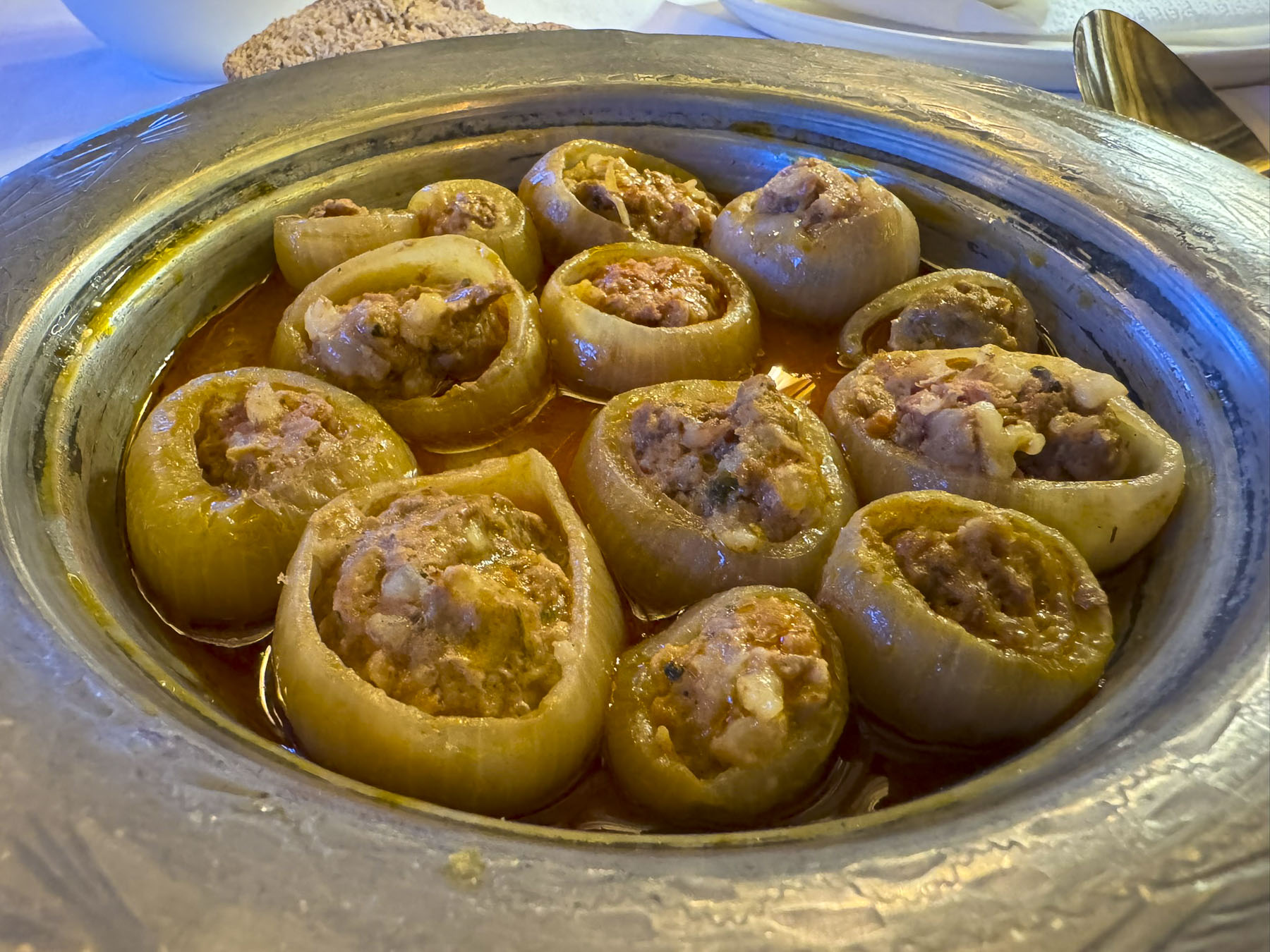
Albania Road Trip:   Apollonia & Upper Qeparo – A Journey Back Through Centuries

We slowed to let a shepherd guide his flock across the road to Apollonia. An hour earlier the sky was brighter as we left Berat. Our intention for the day was to visit the Archaeological Museum of Apollonia before heading to Vlora, on the coast, and then continuing south to the Llogara Pass, for epic views of the Adriatic Coast before reaching our accommodation in Upper Qeparo, a semi-abandoned, old Albanian village, for the night. But the deepening grey sky was concerning. The sheep were now grazing on tufts of grass, growing in between parked cars, in the dirt parking lot at the foot of the hill below the archaeological park. A short uphill walk got our circulation going and brightened our mood.  A large group from a bus tour followed their pennant waving guide uphill, towards ruins still hidden from view.

We turned in the opposite direction to investigate the Sleeping Saint Mary Church and its Ardenica Monastery, and entered its courtyard through an arched gateway with a heavy wooden door.  Outside the refectory museum, staff had propped up large sections of a mosaic floor and were cleaning them with soapy water and a scrub brush.

The church and monastery date to 1282 when the Byzantine Emperor, Andronikos II Palaiologos, ordered their construction to celebrate his army’s victory over the Angevins during the defense of Berat a year earlier. Stones for the church, monastery and the other buildings that form a large defensive courtyard were quarried from the ruins of ancient Apollina.

As we walked around, it was interesting to see parts of old pillars, capitals and decorative elements randomly used amongst stone blocks to build the exterior walls. The Albanian national hero Skanderbeg and his bride Andronika Arianiti celebrated their marriage vows here in 1451.

It was this historical fact, and a fast-thinking priest, in 1967, that saved the church from the communist wrecking ball of Enver Hoxha’s atheist campaign to destroy churches across the country. The monastery building now houses a fascinating collection of antiquities from Illyrian, Greek, and Roman occupants of the city.

Founded in the 6th century BC, Apollonia was a prosperous seaport on the Adriatic Sea at the mouth of Vjosa River, and a strategic link on the Via Egnatia, a Roman road constructed in the 2nd century BC that connected the seaport to Constantinople, through what are now the modern countries of Albania, North Macedonia, Greece, and Turkey. The ancient city also grew wealthy from a trade route that followed the Vjosa River valley south and ended in Thessaloniki, Greece, on the Aegean Sea. At its height Apollonia was surrounded by two miles of defensive walls that protected a population of 60,000. The importance of the city slowly faded after a 243 AD earthquake altered the course of the Vjosa River and Apollina’s large harbor, which could hold 100 ships at a time, began to fill with silt. The city was eventually abandoned in the 4th century.

The archeological park is a vast site spread across rolling hills, but today the Temple of Apollo, with only its front façade intact, is the most complete ruin. Walking up the slope behind the temple, a panoramic view revealed fertile farmland separated from the Adriatic Sea by low hills, some of which had a series of doors carved into their hillside.

These are some of Hoxha’s estimated 750,000 military bunkers that the paranoid dictator built across Albania. At the top of the hill there was a very tranquil looking outdoor café/restaurant, that we pegged as the perfect spot for a break, but unfortunately it was still closed in mid-April when we visited. Fortunately, there was a second restaurant closer to the church that served excellent coffee, and was much appreciated on this chilly, damp day.

The weather refused to cooperate with our plans to explore the waterfront in Vlora, Albania’s third largest city, and we opted instead to have a quick lunch before driving on. Parking in this beach town can be particularly challenging, even in the shoulder season, and we opted for a cash-only, pay as you enter, parking lot. Surprisingly, the attendant was unable to break the bill we gave him, and he told us to wait as he disappeared around the corner at the end of the block in search of change. There were many expensive lunch options on the elegant, palm lined Rruga Aleksandër Moisiu, which hugged the beachfront in front of towering apartments. But this was lunch and it was just too dreary to sit outside. Fortunately, we stumbled across Taverna Dangëllia, a delightful place with an open grill, that was reassuringly busy on a weekday afternoon. We ordered a variety of traditional Albanian dishes, all delicious and inexpensive. Charmingly though, the one quirky thing about the place was the DJ, who fell asleep in his chair, as his music selections played on. Maybe Raki is the new melatonin.

While we were looking forward to some great views of the Adriatic from the route through the Llogara Pass, the grey day was challenging for landscape photography, and we decided to take a faster, more inland drive to Upper Qeparo along SH76. It was a more interesting drive than we had anticipated through the Shushices River Valley before crossing over the mountains to the Adriatic coast near Himarë.

We were zipping along when we suddenly passed a colossal arched memorial set back from the road. A quick U-turn brought us back to the Drashovica Monument. Erected in 1980, the monument was designed in the soviet art style that celebrates the collective effort and commemorates the Albanian resistance fighters who in 1920 liberated Vlora from the WW1 Italian occupiers who refused to leave, thereby defeating Italy’s plans to annex the country. The monument also commemorated the Battle of Drashovica in 1943, where communists and nationalist guerilla fighters united to defeat a larger German force, during a battle that lasted 20 days. Albania has a long history of fighting for its freedom, starting with Skanderbeg’s resistance to the Ottoman invasions in the 15th century and culminated with Albania liberating itself, without the help of the Allied armies, from Nazi occupation during WWII. Behind us an elderly man led a donkey down the embankment of the river toward the water.

Farther along we stopped at a narrow, suspended footbridge that hung over the river. It was a rickety lifeline to small hamlets tucked into the mountains across the river, the footbridge being their only route to the outside world. Though by the sheer number of sheep droppings at the beginning of the walkway it’s a fair assumption that shepherds move their flocks of sheep across it when they switch grazing pastures. That would have been quite a sight to see.

Just down from the bridge, set against a mountainous background, was a small cemetery with interesting headstones. Carved or etched into the granite blocks were photographic quality portraits of the deceased. Some were just tight headshots, while others were full length pictures that captured the individual in their traditional wardrobe. We found these stone tributes very moving.

We passed several other footbridges in various stages of collapse, as if they had been caught in destructive floodwaters. There was also an ancient stone bridge in the village of Brataj that I wish we had investigated, but the footpath down to it looked a little too rough for us to navigate. Shepherds ushering their livestock across the road were frequent occurrences. Though the most memorable herder was the gal in pink slippers urging her sheep into a different pasture.

An Albanian standoff happened in the middle of a bridge as a herd of cattle stopped traffic in both directions and refused to budge from the double yellow line, their owner nowhere in sight to encourage them to mosey along.

On the coastal road a small directional sign warned of the approaching turn to Upper Qeparo. We hesitated to commit as the lane looked more like a driveway between two buildings than a road suitable to follow up into the mountains. We cautiously followed the narrow sinuous road, dotted with homes built into the steep hillside covered with ancient olive trees, uphill around blind curves. We began tooting our horn occasionally now to warn any oncoming cars of our presence, after barely avoiding a fender-bender moments earlier. It was difficult enough on this roughly paved track to reach the village and we speculated about the villagers’ hardships when they only had donkeys or horses to traverse the mountain.

Somehow the host of the small guest house we had made a reservation with overbooked, and by the time we arrived all the rooms were taken. Luckily for us, her neighbor Veronika, the owner of Te Rrapi I Veronikes restaurant across the street, also rents rooms above the tavern, and had one available for the night. The room, although basic, was immaculate, and the gleaming floors were so clean we couldn’t bear to walk on them in our dusty shoes. We left our dirty footwear at the front door, and our hostess seemed to appreciate our nod to her high standards of cleanliness.

There was still plenty of time before dinner to explore, and we set off. The ancient village is set atop a 1500’ high haystack-shaped hill surrounded by steep mountains covered in scree, like an isolated volcanic island surrounded by ocean. Across the ravine on the outskirts of the village, the stone ruins of a small outpost called the Ali Pasha’s Tower, and the town’s cemetery above it, almost dissolved into the landscape in the late afternoon light. Mention of the ancient village first appears in Ottoman records of 1431, and then 1583 when it’s noted the village had 50 homes. Though archeological evidence unearthed at Karos Castle, just a short distance beyond the tower, suggests that the area has been inhabited since the Iron Age.

Sadly, the village has endured an exodus since the late 1950’s when the Albanian government built the road along the coast, thereby providing services and infrastructure to a new village, lower Qeparo, which boosted its residents’ economic prospects. The aftermath of Albania’s economic collapse in 1997 forced most of the remaining townspeople of Upper Qeparo to emigrate to countries in Europe or overseas for better economic opportunities. The old folks who stayed relied mostly on remittances from abroad to survive. The future prospects for Upper Qeparo are improving, with more tourists now frequently visiting this charming village, and former residents returning after years working abroad and reinvesting in it.

A large Billy goat commanded a boulder above us when we turned to wander the labyrinth of alleys that comprise the old town. Like a sentry, he eyed us but let us pass unchallenged. Occasionally we cut a path through abandoned homes with their roofless rooms opened to the elements, carefully placing our steps to avoid falling through any deteriorated floor beams. Sometimes we passed a freshly painted door boasting new brass hardware. A look up revealed new windows and a renovation proudly underway.

Farther along a cow, chased by her owner, entered the alleyway through the door of a long vacant home. The interior opened to the sky, and grass as thick as pasture grew where the floor used to be. Every now and then, between the buildings, we glimpsed distant views of the Adriatic Sea far below. Fig trees opportunistically grew through open windows, and untended olive trees arched over our heads. A few teenagers lazily kicked a soccer ball against the belltower base of St Mary’s Church, constructed in 1796.

Veronika didn’t offer a menu, but she enthusiastically invited us back into her kitchen where she explained the traditional dishes that she had created that day for dinner, and we were not dissappointed. Later, on the restaurant’s veranda, we capped a great day with a splendid dinner and glasses of Veronika’s husband’s homemade raki. We slept well.

Till next time,  Craig & Donna
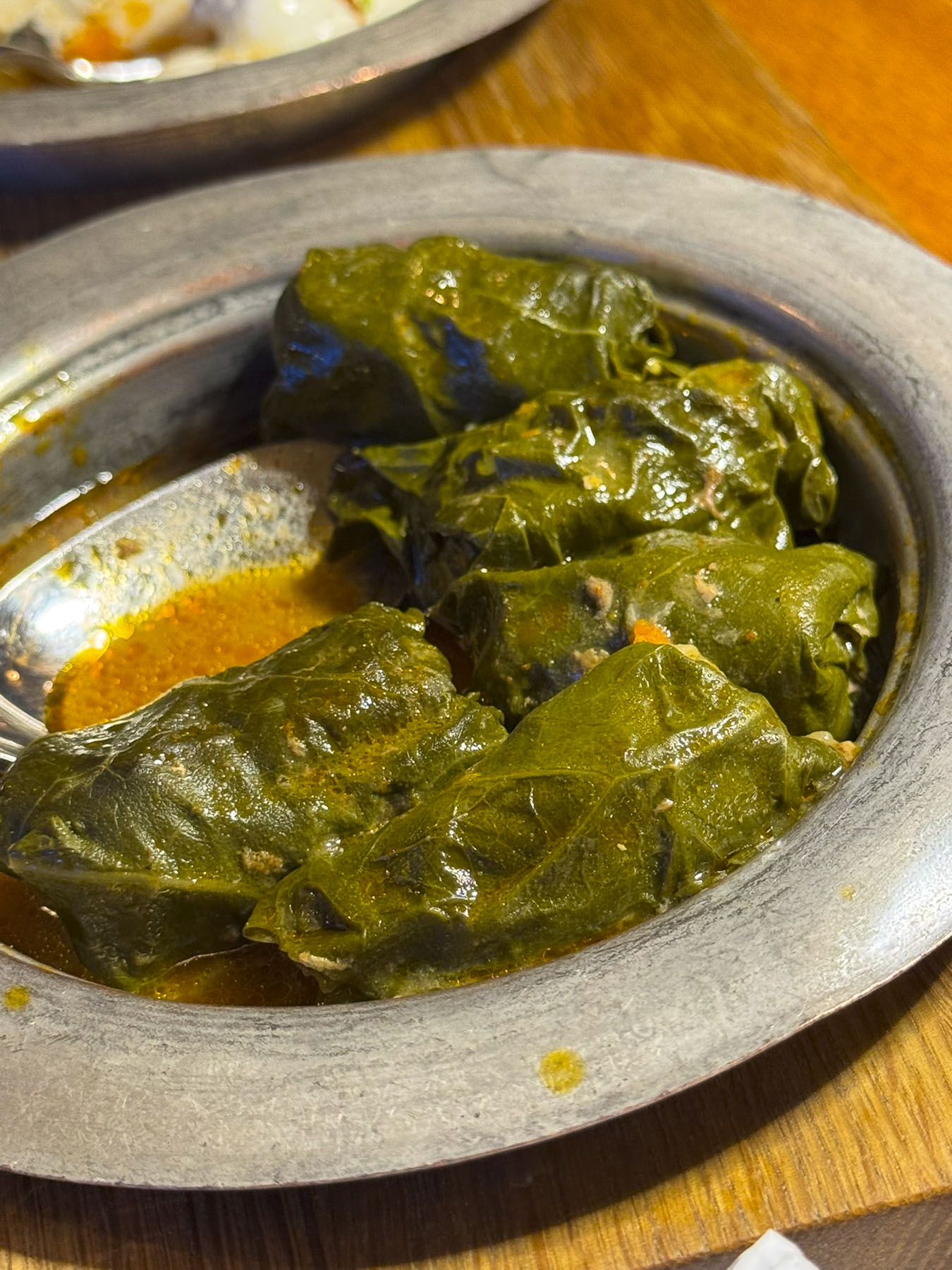
Albania Road Trip: Tirana to Berat or Skyscrapers, a Pyramid, Castles & Albania’s Worse Road

Moments before we had just flown over a crescent-shaped beach, its thin strip of sand brilliantly separating the rich, inviting blues of the Adriatic Sea from the verdant land of the Albanian coast. What we didn’t expect as we continued our descent was just how mountainous the terrain was. This turned out to be a characteristic of the land that we enjoyed tremendously, after realizing there really aren’t many straight roads in the country, and we’d be spending most of our three weeks in Albania driving winding through its mountains.

It was mid-April and 80F/26C as we sat outside the airport terminal enjoying coffees and the unseasonably warm day. “Do you really think you’ll need the thermal underwear you packed?” Donna chided, with a smile. “We’ll see,” I responded. At the rental car counter across the street, we reviewed our paperwork for the sedan and received the document we needed to drive the car into North Macedonia later on during our trip. “Now you have a city car, don’t drive on any restricted roads. The car has GPS tracking, and you will be fined if you do,” the rental agent explained. While we were aware that Albania did not have the best road infrastructure, we were not aware of road restrictions. We asked for a map showing the forbidden routes, but the agent didn’t have any, nor could he explain all the routes restricted. “Use your best judgement, if it’s a gravel road you should probably avoid it.” Which was not very helpful considering we’ve had lots of experience driving sedans to destinations that folks have said, “you’ll never make it there in that.” The rental agent also related that Albanians are very friendly, but terrible drivers. “Drive defensively!” he warned. We set off. My map app is set to default to no highways, and we followed a route along the perimeter of the airport, which also serves as an Albanian Air Force base, past a row of rusting, derelict MiG fighter jets and, for those aviation enthusiasts, several Antonov An-2, a legendary soviet bi-plane, first flown in 1947.

It was an interesting serpentine route through fields of grazing sheep, the roadway sporadically lined with irises in bloom, flowering orange trees, their scent filling the air, and fig trees laden with newly set fruit. Groups of old men sat at tables playing cards and dominos in vacant lots between mansions and shacks. A psychedelically painted, cold war era tank commanded a park along the road. As it neared the end of the workday and we got closer to Tirana, the roads became congested and wild, with drivers ignoring traffic signs and rules. Often it felt like a game of chicken with oncoming cars zipping into our lane to weave around creatively parked cars. Motorcycles were driven on sidewalks. Numerous speed bumps were the only deterrent preventing the roads from becoming the Daytona 500. In decades past, Tirana was a small town with an ancient footprint. It managed well enough during the country’s communist era when few people had the resources to buy cars. But now the city’s arteries are clogged and it’s ready for permanent gridlock due to the current number of vehicles.

With a car, there is always parking to take into consideration, and we lucked out with Lot Boutique Hotel, located on a narrow side street in the center of Tirana, because it had a small parking lot. The hotel recently had been nicely refurbished and was the perfect base for our wanderings around Tirana, the capital of Albania since 1920. Later after resting – jet lag affects us more as we age – we asked the front desk for recommendations for a traditional Albanian dinner. The young receptionist suggested two places: Ceren Ismet Shehu, a contemporary restaurant located behind the low ancient walls of Tirana Castle, in an area smartly repurposed for shopping and dining. And in the opposite direction Oda – Traditional Albanian Restaurant nearer the traditional daily market. We ended up eating at both on different nights. Each was excellent, but we preferred the simple, laid-back ambiance of Oda, its homestyle cooking, and inexpensive menu.

We’ve enjoyed all the cuisines of the different countries we’ve visited over the years, but surprisingly and refreshingly in Albania we found it very easy to eat a well-balanced meal. French-fried potatoes served automatically in other countries were replaced with the Albanian trilogy of lightly grilled vegetables: peppers, eggplants, and zucchini. And the customary salad of cucumbers, and tomatoes with brined cheese were always good. Grilled meats and fish were expertly prepared, though it was also easy to be a vegetarian sometimes and indulge in a variety of eggplant dishes.

The next morning, we headed to Skanderberg Square. Next to the Et’hem Bey Mosque, built in the early 1800s, but closed during the anti-religion decades of communism, we climbed 90 steps to the top of the 115-foot-tall Clock Tower of Tirana. For decades during the 19th century, the tower was the tallest structure in Tirana. Unfortunately, its once 360-degree view has been hemmed in by the rapid construction of new buildings nearby, but it did have a view over Skanderbeg Square, and the rooftop garden atop Tirana City Hall.

Before its renovation the plaza was a traffic circle with one side hosting a larger-than-life statue of Stalin and the other side a colossal 30ft tall sculpture of Albanian’s paranoid and isolationist communist leader Enver Hoxha. The 1991 student protests on the square, along with other demonstrations across the country, helped bring an end to 46 years of repressive communist ideology and failed economic policies. Stalin’s statue was replaced with a heroic sculpture of Skanderbeg, the 15th century nobleman who rallied Albanians to repel Turkish rule and defeated 13 Ottoman reinvasion attempts.

Hoxha’s statue was replaced with a public toilet. Centuries of conflict and resistance have defined Albania’s history and is reflected in a large, emotive mosaic above the entrance to the National Historical Museum. The Palace of Culture, the Opera & Ballet Theatre, and several government ministry buildings, designed by Italian architects in the 1930s, also line the square. Surrounding the plaza, an array of new construction projects are rapidly changing Tirana’s skyline. The city is having its moment as tourists rediscover this once isolated country, with its paranoia of the west, and shunned by its communist neighbors.

Spotting a belltower through the trees, we headed to the Resurrection of Christ Orthodox Cathedral, built between 1994 and 2002 to celebrate the revival of the Albanian Orthodox Church. It is one of the largest orthodox churches in the Balkans, and is a testament to a renewal of faith that had been outlawed under communism, when churches and mosques were destroyed or desecrated, after Hoxha proudly proclaimed Albania “the world’s first officially atheistic state.” The church is dedicated to the apostle St. Paul, who is believed to have founded the Christian community of Durrës, on the Albanian coast, during the 1st century AD.

We wandered through Rinia Park, a popular green oasis in the center of the city that is known for its Taiwan Musical Fountains, which were unfortunately still winterized when we visited. Afterwards we headed to Rruga Murat Toptani, a shady, treelined pedestrian-only lane with many outdoor cafes and restaurants, offering traditional Albanian food and various international cuisines. We enjoyed a light lunch and a local craft beer under the shade of a sun umbrella at the Millennium Garden.

Bunk’Art2, an eye-opening reminder of the perils of the despotic leader, Enver Hoxha, and the communist police state he created in order to stay in power for forty years, was nearby. It’s a large nuclear bomb-proof bunker in central Tirana, that was connected to various government ministries with tunnels for top officials of the regime to escape through. It was also an interrogation center for the Sigurimi, Albania’s Communist-era secret police force, which spied upon the country’s citizenry, and imprisoned anyone considered an opponent to Hoxha’s policies or authoritarian rule. Across the country 23 prisons were built to imprison 17,900 political prisoners.

Thirty Thousand people were sent to internment camps, and it’s believed over 14,000 were killed, died or worked to death from forced labor, often in dangerous mines. 6,000 are still missing. Often it was not just the individual who was jailed that suffered, but his family would be surveilled for years afterward, and his children would be denied educational opportunities. In Tirana the secret police kept 4,000 people under constant surveillance. The border was heavily patrolled with guard dogs and soldiers authorized to “shoot to kill,” as anyone trying to escape the country was viewed as an enemy of the state, and punishable for treason.

Only the most loyal communist families were allowed to live along the borders. Small villages were forcefully abandoned. The villagers were sent to larger cities were it was easier for the Sigurimi to watch for dissent. The mushroom shaped dome above the entrance to Bunk’Art 2 is symbolic of Hoxha’s paranoia, which manifested as a building campaign to construct an amazing 175,000 + bunkers of various sizes, across the country.  Most of them are only big enough for 2-3 people, but they were placed in strategic spots along Albania’s borders to protect the country from foreign invasion, not only from the western powers, but also from Yugoslavia or the USSR. Others were placed in the mountains, farm fields, road intersections and parks, with the intention that Hoxha’s loyalists would man them in a time of crisis.  The irresponsible cost of building the bunkers, from which shots were never fired, diverted Albanian funds away from other needed projects and ensured Albania’s position as the poorest country in Europe.  The communist government collapsed in 1991, and in the following years, more than 700,00 Albanians emigrated to find better opportunities in Europe  or farther afield.  Remittances from the Albanian diaspora to family still in the country amount to 14% of Albania’s Gross Domestic Product.

Our eyes needed a moment to adjust after resurfacing from the labyrinth of Bunk’Art 2, but if the construction boom underway in Tirana is an indication, Albania has thrown off the shackles of its communist past and is embracing the prospects of an exciting new future. Heading back to our hotel for a short rest before going to dinner we detoured into the Toptani shopping mall. A nine-story tower dedicated to the “shopping therapy” philosophy of capitalism.

The next day we headed to the New Bazaar market area, only a five-minute walk from our hotel. On the way we passed impromptu sidewalk vendors, their crops and merchandise displayed on blankets or sheets of cardboard on the street, hoping to make sales to folks before they reached the daily market. The covered bazaar centers a plaza surrounded by restaurants, cafes, cheese shops and butcher stores. Under its roof, stands filled the space with vendors selling vegetables, olives, honey, and fruit. Women crocheted wool socks as they waited for customers. We browsed tables piled with rugs, displays of tools, pottery, vinyl records, and books, along with knickknacks, questionable antiques, and surplus Albanian army helmets. The time flew by.

Tirana is a wonderful, midsize cosmopolitan city with a population of 375,000 people, with many parks, tree lined streets, and older buildings, mostly under five stories tall. New high-rise buildings rise from the old neighborhoods across the city. It was an interesting and delightful place to wander around.

We passed ruins of Tirana Castle’s ancient defensive wall, dating to the 1300s, in the park next to Namazgah Mosque, the Great Mosque of Tirana. Completed in 2019, the mosque is currently the largest in the Balkans, and capable of holding 5,000 worshippers. The Muslim community was also persecuted under Hoxha’s anti religion policies, with many religious leaders killed or imprisoned, and 740 mosques destroyed around the country.

Nearby stood the 18th century Ottoman era Tanners’ Bridge, a stone arch across the Lana River that was used by farmers to bring produce into the city and livestock to the butcher shops and tanneries along the river. Farther away we crossed the ETC Bridge, a beautiful pedestrian only walkway over the Lana that is also a free wifi hotspot. The city’s tallest skyscraper, Downtown One, a 37 story, mixed used building with a very distinguishable cantilevered and recessed façade, stood in the background.

Our destination was the Pyramid of Tirana. Planned by Hoxha to be a memorial to his legacy as the Enver Hoxha Museum, covered in gleaming white marble, it opened in 1988, three years after his death. It was designed by Hoxha’s daughter and her husband and at the time of its construction thought to be the most expensive structure ever built in Albania.

Most likely forced prison labor and compulsory labor were used for parts of the project. With the collapse of the country’s last communist regime in 1991, the museum was closed and the space repurposed as a conference center, then a NATO base. It eventually fell into disuse and was vandalized, and its marble covering stripped away. It was finally reincarnated as an IT youth center with classrooms housed in colorful blocks attached on its slope, and 16 staircases leading to the viewing platform atop its 70ft high summit. We climbed to the top and enjoyed the panoramic view.

A short distance away, Hoxha lived in a modest villa in the Blloku neighborhood.  It was a secret district during the communist era, with housing reserved for the party elite, with entry forbidden to anyone else, and its road did not appear on any maps.

The Checkpoint memorial stands in the park down the street from his residence and features a bunker, iron mine shaft railings from the infamous Spac prison, and a section of the Berlin Wall. Subtle reminders of the brutality of communism.

For our last day in Tirana, we decided to head to the outskirts of the city to check out Bunk’Art1 before continuing into the mountains to Bovilla Lake. It’s easy to miss the turn into the long single-lane tunnel that leads to Bunk’Art1, an appropriate entrance to explore Albania’s past. After walking through a seemingly forgotten park, we entered a non-descript door in the side of an overgrown slope that hides the extensive maze of corridors and rooms of Hoxha’s secret command center.

We followed a short corridor to the nuclear blast proof doors set in walls 6ft wide, and into a decontamination room. We were five stories underground in the foothills of Dajti Mountain, near the village of Linzë. There are no windows, the lights flicker, and a sign warns the power could go out at any time! It was a massive facility designed to shelter hundreds of Hoxha’s military and communist comrades, for six months, during any war.

In Hoxha’s private quarters, we picked up a phone and listened to a recording of his voice. It was a sparse apartment, more prison cell than home, that lacked any warmth. Obviously, his wife wasn’t consulted. Other rooms displayed vintage equipment and weaponry. The isolation of having to live in this depressing environment would have been psychologically damaging; fortunately, the structure was never needed for war-time use and since 2014 it’s been a museum explaining Albania’s history from liberation by the partisans during WWII through Hoxha’s communist regime. The exhibits use amazing photographs and examples of nationalist propaganda from the country’s archives to great effect. The bunkers’ large meeting hall now hosts concerts and art exhibits. Emerging from the darknes,s an amazing number of different bird calls filled the air, as if welcoming us back to the present.

Following our map’s apps instructions we followed a confusingly serpentine route across the rolling hills outside Tirana before reaching the road, SH53, that led to Bovilla Lake. In the beginning the paved asphalt road was fine, but after a while abruptly changed to graded gravel. Nothing unusual here. Though the farther we traveled into the countryside, we passed fewer cars; rather, we saw large dump trucks, laden with stone from a quarry, headed towards Tirana, filling the air with dust. The road progressively worsened the closer to the quarry we got, as the weight of the trucks pulverized the road surface and created numerous potholes that we had to slowly navigate around. We thought several times about turning back, but we had driven through the Andes in Ecuador, with a sedan, on worse roads. While the going was slow and extremely bumpy, we did eventually make it to the lake, actually a reservoir, and more importantly, Bovilla Restaurant!

The views were astounding! The restaurant was full, with hikers and day trippers from Tirana. The food was good, the beer cold. It was a journey well worth the effort. The car rental GPS tracker did flag us, and we were fined for driving on possibly the worse road in Albania. Fortunately, when we returned the car eighteen days later, after some Albanian-style dickering, we were able to politely negotiate a reduction in the fine.

There were numerous speed traps on the highway leading out of Tirana and most of the times when we passed one, officers were writing out tickets, so we drove well below the speed limit. We were on the way to Berat and it was well past our usual morning coffee break when we spotted the colorful reflection of Bashkia Belsh’s waterfront.

After parking, we strolled along the Belshi Lake shorefront past small shops and some interesting street murals to the town’s boardwalk. Being a weekend, it was full of families with young children. To the delight of many, small rideable electric toy cars were available to rent, along with balloon, ice cream and cotton candy vendors. A small ferry boat took folks on a short cruise around the lake, while others enjoyed the fine weather and strolled along the boardwalk or sat under the umbrellaed tables of the restaurants that lined it.

Closer to Berat we stopped at the Çobo Winery for a tasting that was accompanied by homemade cheeses and locally grown olives. Vintners of white, red, and sparkling wines and raki, they are regarded as one of the best wine producers in Albania.

It’s a small family vineyard with a 100-year tradition spanning four generations, that was sadly interrupted during the communist era, but since the 90s has grown production from 8,000 to 100,000 bottles per year. It was a nice break from our driving, and we enjoyed relaxing under the ancient olives trees in the their courtyard. The wines we tasted were very good and we purchased four to bring home in our luggage, and I’m happy to say they all made it back safely to the states.

We reached Berat Castle just as the golden hour was approaching. We walked along its cobbled lanes, past homes surprisingly still occupied by about 400 people who live in 13th century citadel. But its history extends much farther back, with Roman records noting capture of the castle in 200BC. Archeological evidence shows the site has been inhabited since 2600-1800BC, making it one of the oldest settlements in Albania.

We worked our way to the overlook above Berat, passing the ruins of the Red Mosque, built in the 1400s after the Ottomans captured Berat, and Kisha e Shën Gjergjit, an orthodox church that’s been neglected since the communist ban on religion.

The panoramic view from the overlook out over Berat, the Osumi River below, and snowcapped 7900ft Mount Tomorri in the distance was stunning. Walking back along the ramparts we enjoyed watching an energetic dog race along the narrow top of the wall, chasing a stick his owner tossed up for him to retrieve multiple times. On the western slope of the castle, between the outer and inner defensive walls, Kisha Shën Triadha, a beautiful red brick, 14th century Byzantine church graces the hillside.

We wanted to stay on the “City of a Thousand Windows,” hillside under the castle, but didn’t want to drag our suitcases too far up the narrow alleys, and we had a car that needed parking. With those considerations in mind The Beratino Hotel fit our requirements perfectly and was great place to stay for two nights. Recently renovated, its stone and woodwork exemplified the best of Albanian craftsmanship. Still the shoulder season, in mid-April, I think were the hotel’s only guests.

Sated from our afternoon wine tasting we walked into the newer part of Berat, now a small city of 47,000, along the pedestrian only Bulevardi Republika, next to Lulishtja park. It had a lovely Neapolitan vibe, with families enjoying the Albanian tradition of “xhiro,” to stroll with friends, relax and enjoy the outdoors after dinner. At a small shop perfectly named Bakery & Food we purchased Burek, a traditional Albanian pastry made with various meat and vegetable fillings. We purchased their spinach burek, reputed to be the best in Berat, some even say the best in Albania. The quest for the best byrek, burek, or borek in Albania might be the catalyst for a return trip to the country. Back on the balcony of our room we enjoyed a glass of wine, and the burek was delicious.

The next morning, we were up early and walked across the suspension bridge linking the old town with the southern Gorica “Little Village,” across the river. From this vantage point we spotted the Kisha e Shën Mehillit, St. Michael’s Church, an Eastern Orthodox Church, built on the steep rock face under the flag that flies above Berat. Thought to have been built in the 14th century, the setting of the red brick and stone church pricked our curiosity and we decided to hike there. The alley that led to the church was only a short distance away from our hotel but wound quickly up the hillside past homes and small inns.

We admired the strength of workers we passed carrying long wooden beams on their shoulders up the hill for a renovation project. We zigzagged higher up the hill, now looking down on the rooftops below, the trail looking like it hadn’t been trodden upon in ages. Unfortunately, the sanctuary was closed, but the views of the church with the river and mountains were well worth our effort.   

Later that morning we drove to the small town of Çorovoda, the gateway to the Osumi Canyon. It was a beautiful drive on a bright spring day, and we stopped many times along the way to photograph the scenery.

Before reaching the town, we veered off into the mountains to Ura e Kasabashit “The Bridge of Master Kasa/Kaso,” a classic high arched Ottoman era bridge constructed in 1640 across a wide stream, by the chief engineer of the Ottoman empire, at the time, Albanian architect Reis Mimar Kasemi. It was part of an ancient caravan trade route across the rugged central Albanian mountains, that connected the Adriatic Sea port of Vlorë to Berat, and Korçë before ending in the Greek city, Thessaloniki. Almost 400 years old, it surprised us that it is still standing and we followed some other tourists across it. Farther up the road from the bridge there are more abandoned military bunkers and warehouses, but we were bunkered out after Tirana and chose not to investigate them.

Our “drive a little, then café,” was way behind schedule when we stopped in Çorovoda at Drita e Tomorrit, a restaurant with a small park like setting.

South of Çorovoda there are number of fantastic viewpoints along the Osumi Canyon. The water in the canyon is an amazing turquoise and it’s easy to see why it’s a popular area for rafting and swimming in the summer.

Before returning to Çorovoda for a late lunch we stopped at Gjurma e Abaz Aliut, the Footprint of Abaz Ali, a small roadside shrine believed to have in the solid rock under its canopy an impression of Ali’s foot. Made when the Albania folk hero, with legendary strength and courage, jumped across the Osumi Canyon from this spot. The depression in the stone looked very convincing to me.

Back in Çorovoda we had an early laid-back dinner at Zgara Korçare. It’s a small restaurant with nice owners across the street from where we earlier had coffee. Their mixed grill was delicious and we enjoyed our first tastes of Birra Korça. A good refreshing light beer brewed in Albania since 1928. Gëzuar, cheers!

The next day we headed to the Apollonia Archaeological Park before driving south to the semi-abandoned village of Upper Qeparo, eager to explore the rest of this interesting and stunningly beautiful counrty.

Till next time, Craig & Donna
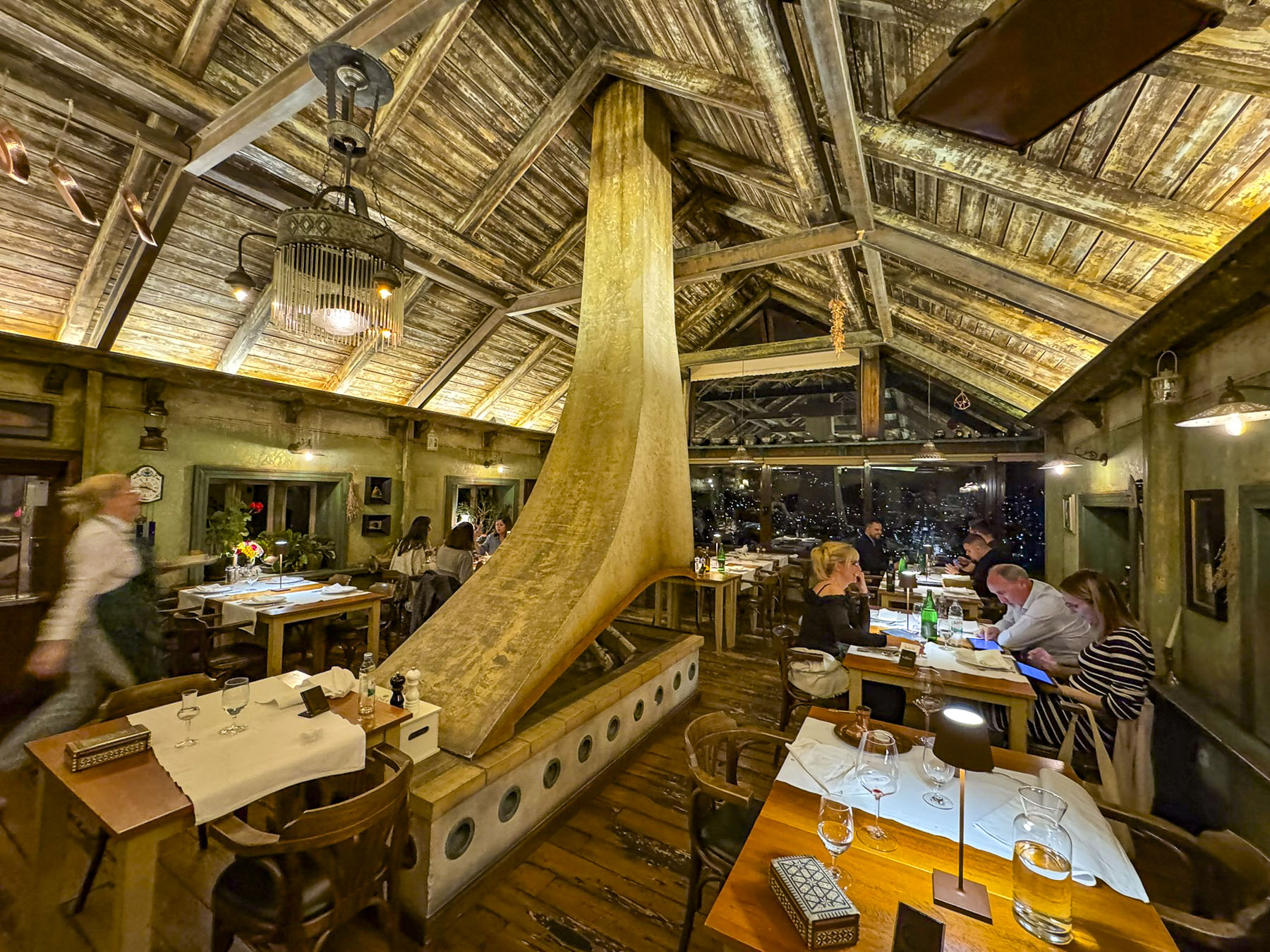
Dubrovnik: Dragons and Castles

Our first glimpse of Dubrovnik caught us by surprise as we rounded a curve on Croatia’s RT 8. Its thick limestone walls and brilliant red tile roofs, saturated with color, reflected brilliantly on cobalt blue Adriatic Sea.  Its nickname “pearl of the Adriatic” rightly earned.

Fortunately, mid-October was considered off-season and we were able to find a wonderful apartment, Old Town Sunrise Apartments just steps away from the Babic’ Bakery and the 14th century Vrata od Ploča or East Gate with its ancient drawbridge.  The agony of lugging our bags up three flights of stairs was rewarded with gorgeous views from our roof windows, since the studio apartment was directly across the harbor from Fort St. Ivana. 

We couldn’t have asked for a better location. The sunrises and sunsets were spectacular over the Adriatic and the citadel.  A brilliant Hunters’ Moon one night was an added bonus, as was watching a group of elderly friends take an early morning swim, their daily ritual.

Fort St. Ivana today houses an interesting maritime museum and aquarium, but when it was built in the 16th century its canons protected the city-state’s merchant fleet from the Venetians and Ottomans.  Over the centuries Dubrovnik’s maritime merchants rivaled Venice’s with trade representatives in Goa, India and the Cape Verde Islands off Africa’s Atlantic coast.  Its merchant fleet even traded during the Middle Ages with the English court of Elizabeth the First.
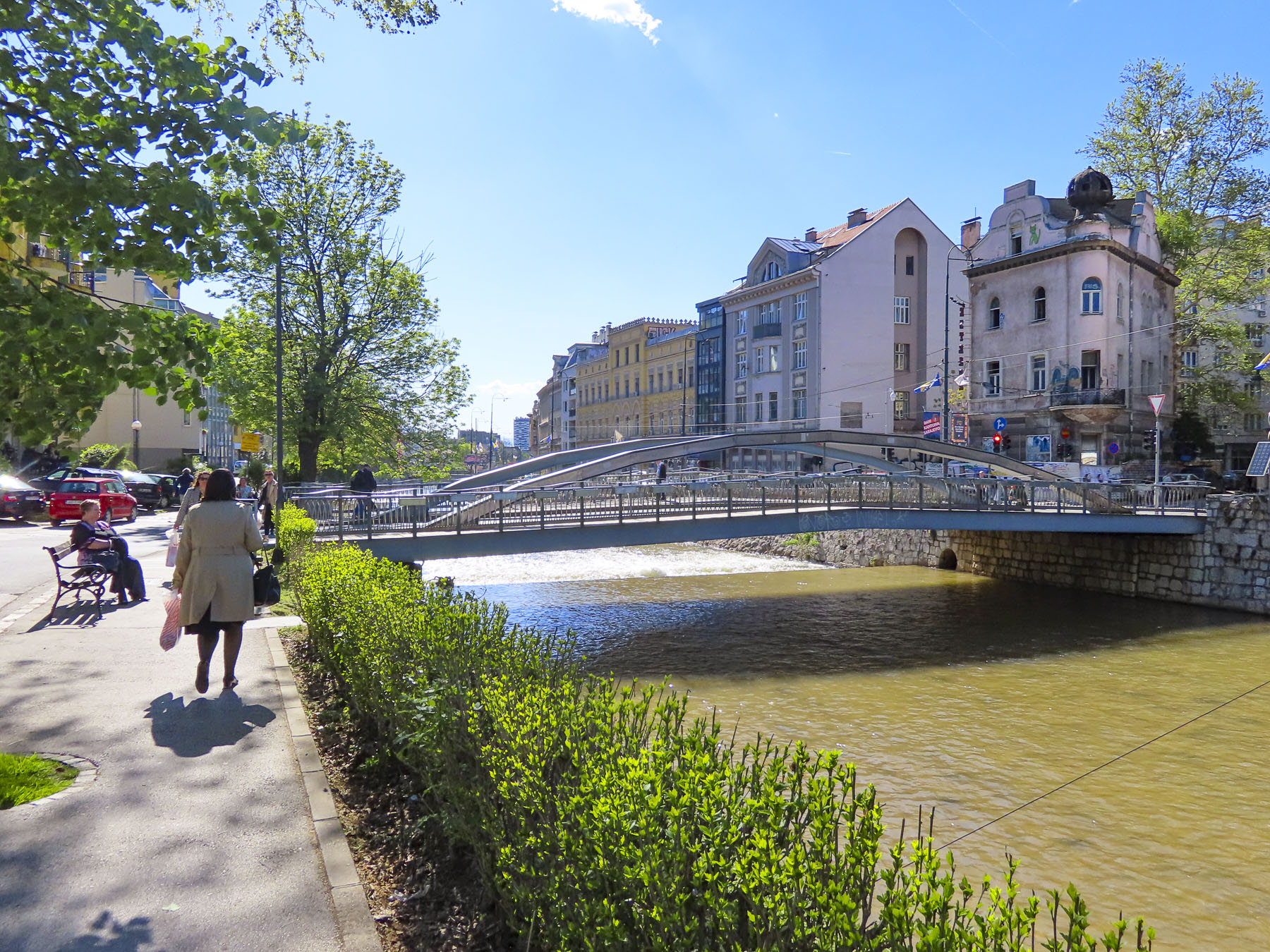
Blame it on Drogon! Since the medieval fantasy Game of Thrones was filmed in Dubrovnik the city has lost its previous reputation as an under-visited and affordable destination on the sunny shores of the Adriatic.  Ever since the TV show’s premiere in 2011 the city has become a mecca, big time, for fans eager to visit the show’s filming locations.  Thankfully, it hasn’t risen to placards of “Jon Snow slept here” or “Rhaegal roasted a nobleman on our roof” level yet.

We had been on our journey fifteen months now and aside from a brief stay in London, Dubrovnik was by far the most expensive destination.  I think this explains why we saw so many people walking down Stradun, the city’s main pedestrian boulevard, eating slices of pizza.  The impact of these high prices was especially acute since the affordability of Kotor, Montenegro (only a short drive away) was still fresh in our minds.  It was actually easier to find an affordable restaurant in London.  It was captive pricing for sure within the fortress walls that encircle Old Town and the only reprieve was to eat in the new town portion of Dubrovnik, outside the citadel. 

Stradum, aka Placa (Stradone or Corso) is the city’s pedestrian-only main boulevard, running 300 yards east to west, connecting both ancient gates and harbors on either side of town.  For us it was too pristine.  An unfair comment, as this resulted when Dubrovnik was rebuilt after the 1991 Balkans War, when the city was shelled for seven months from the top of the mountain above town. Two hundred eighty civilians and soldiers were killed during that prolonged bombardment. Today an aerial tram takes you there for panoramic views. Shrapnel scars, signs of the conflict, remain etched into the stone walls on some buildings.  But the newness of the polished limestone boulevard running past upscale shopping reminded us of an amusement park.

We were drawn into the narrow, arched alleys with steep stairs that climbed the hills and weaved through older neighborhoods on either side of Stradum. The farther away from Stradum we got, the more the crowds diminished. 

Our other alternative was to walk along the fortress walls that encircle the city for slightly over a mile.  Thirteen to twenty feet thick and towering eighty feet high in some sections, the walls once held 120 cannons to protect the city from land or sea attack.  This walk is a popular activity with fast moving tour groups, but we found if we just let them pass there would be a tranquil void until the next group which allowed us to linger in one spot for a while. 

Standing above the West Gate and looking down the Stradum was a prime view that included the circular Large Onofrio’s Fountain built in 1438 and which still supplies fresh spring water, from mountains miles away, to carved faces that spurt water. Farther down the Franciscan Church and Monastery houses the oldest continuously operating pharmacy in the world dating to 1317 in its muraled cloister. Farther along the wall there were several small cafes and stairs that lead to roped off swimming areas at the sea’s edge.

At the far end of Stradum the city’s 100 ft tall clock and belltower zooms skyward over an area that was once the city market in the 1400s. Famously the belltower has two bronze figures named Maro and Baro, zelenci (green) twins that strike the bell on the quarter, half and full hour.  Interestingly, several generations of the same family have maintained the clockworks for over 100 years. Next door the 14th-century Gothic-Renaissance style Rector’s Palace exhibits vestiges of Dubrovnik’s history. Especially noteworthy were the intricately carved exterior columns.

Across the street the statue of golden statue of Saint Blaise cradling a model Dubrovnik on his arm crowns his church.

The city’s 16th century granary and mill has undergone a beautiful and innovative renovation and now houses the Etnografic Museum Rupe. It has a prominent collection of Croatian Cultural items, particularly traditional attire from the regions surrounding Dubrovnik.

Weddings are a boisterous affair in Dubrovnik, with the bride and groom following a flag waving entourage parading through the pedestrian-only streets on the way to their church ceremony.

Walking east one morning away from the city, along Ul Frana Supila, a quiet road that hugs the water, a small village ambiance prevailed with colorful homes, flowering plants and wild pomegranate trees set into the hillside. 
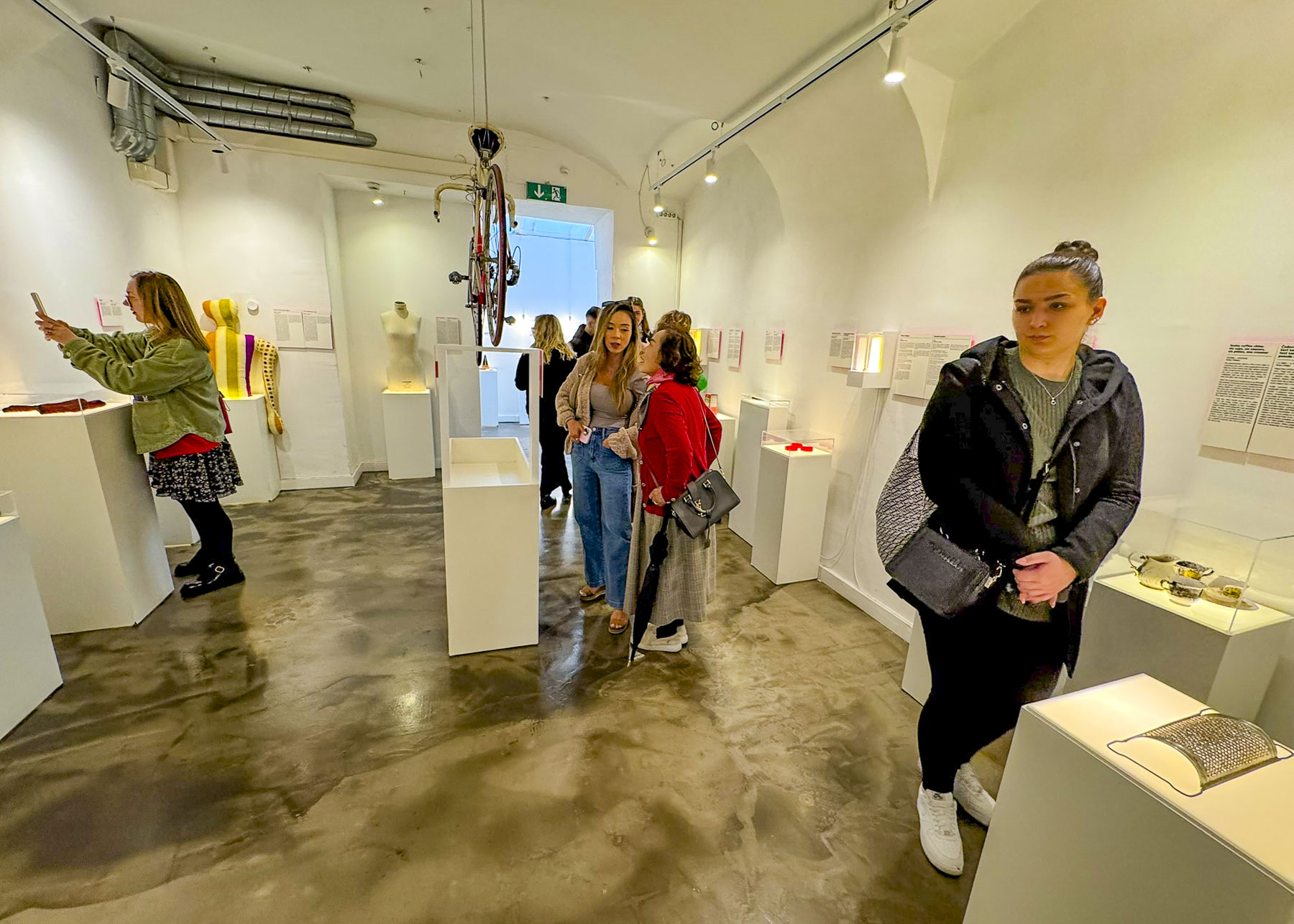
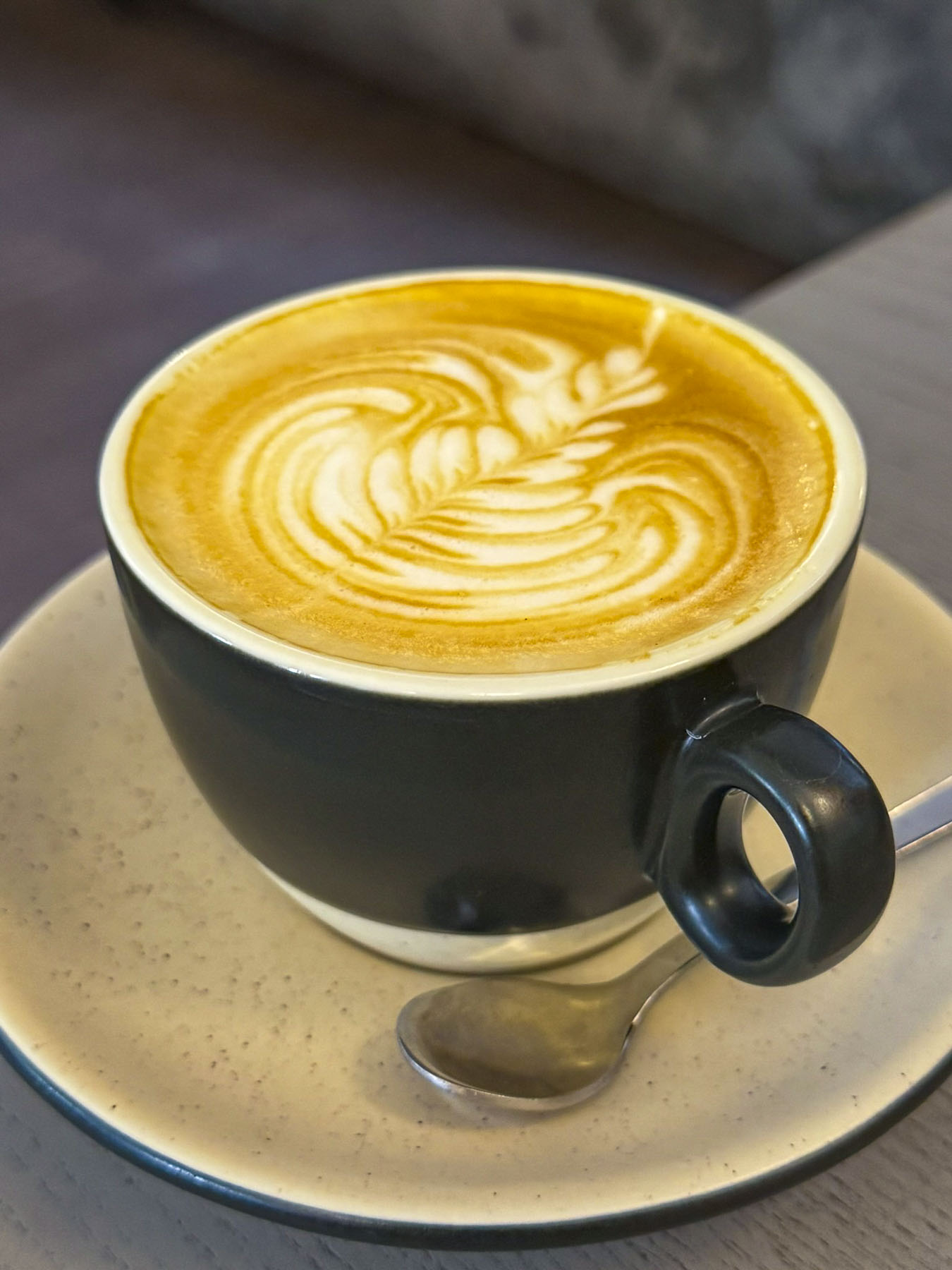
Villas for the well to do, many built on the ruins of previous civilizations, line the road, beautiful none the less. Bored? There was a rainbow-colored selection of wheels for rent at the exotic car dealer to satisfy that zoom, zoom craving. 

Eventually the road narrowed and a chain across it prevented cars from going farther along a treacherous, serpentine stretch that hugs the cliff face.  The road used to connect back to the highway near one of the scenic overlooks.  But it was determined to be too dangerous when its guardrails tumbled down the cliff into the sea.  Now only walkers and bicyclists use it to traverse a dramatic section of the coast. 

A memorial, Spomen ploča žrtvama komunističkog terora, to victims of the communist terror, stands on a curve in the road. It commemorates the lives of five young Yugoslavian partisans thrown from the cliff to their deaths by communist “liberation forces” loyal to Marshal Tito at the end of WWII.

Across from Dubrovnik’s West Gate and harbor, the 11th century Fort Lovrijenac, the “Gibraltar of the Adriatic,” sits atop a towering rock monolith 121 feet above the sea. Climbing to the top of the citadel along well-worn footpaths and stairs satisfied us with great views back across the harbor of walled Dubrovnik and kayakers paddling along in the cove below.

Many kayaking tours leave from West Harbor. Today Lovrijenac’s walls, some reaching a thickness of 39 feet, support theater and music productions during the summer months.  The dramatic setting is also the backdrop for Red Bull Cliff Diving World Series and Knightfall, a historical fiction TV drama about the Knights Templar. 


Behind the fortress, wandering the narrow lanes along the water’s edge felt like we were in a quaint seaside village.

We thought the Three-Day Dubrovnik Card was a good value for us, since it offered free entrance to six museums, two galleries and the city walls, as well as six free rides on the local buses. Staying just outside the fortress walls permitted us to avoid a premium room rate yet allowed us easy entry into the citadel early in the mornings and to find those quiet vignettes and ancient architectural details hidden amidst dramatic shadows.

 For moments we felt like we had this beautiful medieval city all to ourselves.

Till next time, Craig & Donna