

We hadn’t planned our return itinerary to Cape Town and were open to suggestions. Over the past two days, during the down time between game drives at Schotia Private Game Reserve our guide, Edward, shared his love of South Africa with us. “Did you stop at Stormsriver?” “No.” “It’s a breathtaking stretch of coast. They have cabins you can rent, right on the water, and there’s a spectacular trail with suspension bridges across the gorge.” “And the Karoo, don’t forget the Karoo and Ronnie’s.” 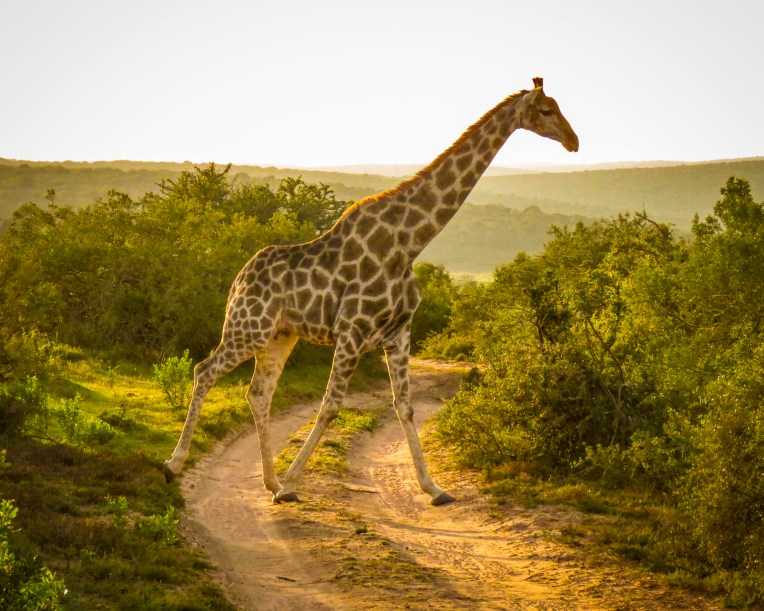 During the morning “golden hour” we watched a family of giraffe walk gracefully through the forest, nibbling thorns from the acacia trees, before saying our goodbyes. Stormsriver, it was! Backtracking through Port Elizabeth we retraced our drive past Jeffreys Bay and continued west on the N2 until we stopped to photograph the steep chasm that the Stormsriver Bridge spanned, just before the village of the same name. Mostly folks mean the Tsitsikamma National Park when they mention Stormsriver; they are synonymous with each other, the difference being the village is located far inland, just off the highway, and the park is on the coast.
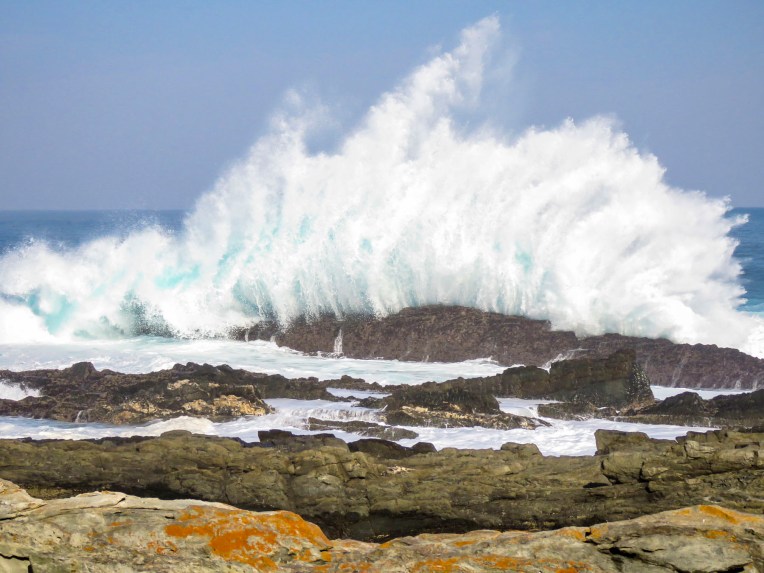
  We thought the entrance fee of $17.00 per person for international tourists was steep and we did see some cars turning away, but we had heard such tremendous recommendations we would regret it if we didn’t check it out. There was a long winding road down from the entrance gate and when we finally rounded a sharp corner, the view of the rugged coastline with crashing waves sending up large white sprays was spectacular!
  We enjoyed lunch watching and listening to thunderous waves explode against rocks only a short distance away from our table at the Cattle Baron. It’s the only restaurant in the park and was excellent, along with being very affordable. A nice surprise after the park entrance fee.
  After lunch we followed an easy section of the Otter Trail to the three suspension bridges that cross Stormsriver where it meets the sea. Reservations and a permit are required to trek the full length of this popular and strenuous 28 mile trail that follows the edge of the coastal plateau through evergreen forests, traverses boulder strewn beaches and tidal river crossings.
  Staying in designated cabins each night, it takes five days to cover the route that stretches from Stormsriver in the Eastern Cape to Nature’s Valley in the Western Cape. The reverse hike is referred to as the Tsitsikamma Trail.


We were greeted warmly by Bev and Marco, owners of At The Woods Guest House Tsitsikamma in the village. Their place is a lovingly envisioned and restored eight room B&B in what had been a carpentry workshop. At check-in Bev noticed that the clasp to the shoulder strap on Donna’s camera bag was broken and offered to repair it. A huge help, the repair has lasted eight months so far. We greatly appreciated it. We walked around the corner to Darnell Street, the village’s restaurant row, with six eateries, and sat down at Marilyn’s 60’s Diner. The place is shrine to Elvis Presley and Marilyn Monroe with movie posters, classic cars, motorcycles, juke boxes, checkered floor and chrome, lots of chrome as décor. Happy Days meets Northern Exposure, it seemed to be a clash of cultures in the woods.


The next morning we enjoyed coffee on our balcony while listening to new bird calls and hoping to spot Narina Trogan, Knysna Turaco (Loerie) and Victorin’s Warblers which inhabit this heavily forested area.  After breakfast, on our way to Nature’s Valley, we crossed over the Bloukans River Bridge, which claims to be the world’s highest bungee jump at 710ft and divides the western cape from eastern cape region. The small resort village is right on the Indian Ocean and borders the Grootrivier lagoon, which is blocked from reaching the ocean by a wide sandbar. The two waters only merge when a hide tide washes over the sand, or when heavy rains raise the level of the river and it cuts a channel through the sand to the sea.
 On the way back to the highway we stopped at Nature’s Way Farm Stall for coffee and a snack before continuing or drive to Oudtshoorn in the Klein Karoo. Located on a working dairy farm, the stand had a wonderful selection of homemade cheeses, breads, jams and chutneys – we stocked up. They also have cottages available for rent.


Passing through Plettenberg Bay we stopped at the Old Nick Village to check out their mid-week farmers market and the homeware textiles created on site at Mungo Mill, a local South African company that reinvests 1% of its profit back into community projects. There was also an interesting plant nursery and pottery shop with vervet monkeys scampering across their roofs.  Our steep ascent away from the coast began in George as we headed north on the N9/N12 twisting our way uphill through the Outeniqua Pass to Oudtshoorn. This is a challenging stretch of highway with continuous s-turns that required my constant attention. Passengers can enjoy spectacular views on sunny days that stretch for miles. If possible, drive the route towards the coast, it’s easier to stop at the scenic lookouts this way.
One thing about traveling in the off-season, things are quieter, especially on the late Sunday afternoon when entered Oudtshoorn, looking for dinner before we checked into our B&B for the night. It wouldn’t have surprised us to see tumbleweed blowing down the streets. It was too cold outside to sit by the open firepit in the courtyard of La Dolce Vita, one of the few places we found open. But the staff was friendly, the food was good, and the bartender had a sweet dog to help him keep the conversations going with the ladies.  We’ve heard of gold booms, where fortunes were made. But it was the ostrich booms in 1865 -1885 and 1902-1913 when ostrich feathers were the ultimate fashion accessory in Europe that enriched local farmers here. At one point 314,000 ostriches were being raised and their feathers were a valuable South African export, only surpassed by gold, diamonds and wool.
Today Oudtshoorn attracts outdoor enthusiasts, with the Cango Marathon endurance race and the “To Hell and Back” mountain bike race. Wine and cultural events like the Klein Karoo Nasionale Kunstefees (KKNK) a visual and performing arts festival also dot the high season calendar. The region is on the R62 Wine Route and becoming increasingly known for its port style fortified wines and brandies produced from grapes that thrive in the arid conditions of the karoo. Ostriches are still raised in the area for their meat and leather.  Die Fonteine, our B&B for the night, was a few miles north of Oudtshoorn, outside the small village of Schoemanshoek. After a delicous breakfast the next morning we enjoyed exploring the manicured grounds of this beautiful farmette. Caged song birds, chickens and sheep provided our morning entertainment. Anzue, our hostess, gave us a jar of homemade guava jam for our journey back to Cape Town, after we raved about it at breakfast. “How are you headed back? “Through Montagu.” “It’s a long stretch through the karoo, not much between towns, just Ronnie’s.”


Leaving town, we hammed it up with a jaws of death photo at the Cango Wildlife Ranch. It’s South Africa’s version of a petting zoo, where you can go cage diving with crocodiles for an adrenaline rush, if that’s your thing. The word karoo comes from the Khoisan language meaning “land of thirst” and it precisely describes the terrain along R62 which we followed. Parched, rock encrusted rolling hills and mountains covered with a fynbos of low heather-like shrubs and proteas occasionally accentuated by taller, lone trees and dry riverbeds crisscrossed the landscape. During the South African spring, in October, it bursts with flowers, but it was July, still winter. The area endures extreme heat during the summer. Fortunately for us recent winter rains had spurred some greenery to burst forth and aloe plants to bloom.
  We stopped in Ladismith, a rural farming community where Vincent, Donna’s friend from seminary, first pastored a church, and enjoyed its colonial Dutch architecture.


Watch for Stray Cattle and Wild Animal Crossing Ahead signs occasionally broke the rhythm of the terrain. Every few miles now we would pass old battered signs for Ronnie’s. Somewhere along the way they turned into signs for Ronnie’s Sex Shop!  The heat can do strange things to the mind and sometime in the 1970’s Ronnie thought a farm stand on this desolate stretch of highway through the karoo would be a good idea. Fortunately, his buddies realized it was destined for failure and would soon be another abandoned building along the road if something wasn’t done. One night they painted SEX into the name of the shop and suggested he open a bar. They saved his butt! Famous now worldwide as a dive bar in the middle of nowhere, it draws in the curious. It’s not the raunchy place the name implies, filled with frustrated farmers between ostrich roundups. A grey bearded Ronnie, now a cause célèbre, still pours drinks at the bar. It has a tired, dusty bar area filled with foreign money plastered to the walls and lingerie hanging from the ceiling, but aside from that it’s a wholesome oasis with a covered patio where you can get a decent burger with fries, ice cream and coffee along with some hard stuff if that’s your drink. It’s not worth a detour, but if you are on the R62 traveling between Barrydale and Ladismith, it’s worth the stop. Actually, it’s the only place to stop.


For some R62 conjures up thoughts of Jack Kerouac and his road trip across America from Chicago to Los Angeles along Rt 66 through the heartland of the country. Similarly, R62 connects Port Elizabeth, on the Indian Ocean, to Cape Town, on the South Atlantic, while passing through the beautiful karoo region, the core of South Africa. An epic journey for many of the folks in camper vans and cross-country motorcyclists we passed along the way. It’s an interesting, inland alternative to the N2. We zoomed past the small village of Barrydale on our way to Montagu, so we could explore the town a little before nightfall. The farming community is in a valley surrounded by the Langeberg mountain range and has many examples of late 19th century Cape Dutch architecture scattered about town. Ornate gables, thatched roofs, whitewashed walls and occasionally gingerbread trim define the style, but there are modern interpretations also.
 In a country not known for Art Deco we booked ourselves into the Montagu Country Hotel, the only original Art Deco hotel in South Africa. In the main building, lounges with fireplaces and guest rooms are filled with stylish Art Deco antiques. Contrarily, we stayed in their African lodge – after all, this is Africa – which was situated nicely in a lush garden. It was circular structure with a 20ft high thatched roof that had all the conveniences of home. The bathroom had the largest soaking tub we have ever seen that easily could have held a family of four. We wondered when the last time it was filled. Guilt about wasting water, during a drought, prevented us from using it.
 The temperature drops quickly in the mountains once the sun sets so we enjoyed a local wine, in front of a fireplace, in one of the lounges before dinner. We usually look for a less expensive alternative for dinner, but the hotels’ Wild Apricot Restaurant drew us in with elegant candlelit tables and live piano music. It was the last night of our road trip – we could splurge. With Smoked Ostrich Carpaccio and Springbok Tarta for appetizers followed by Cape Malay Bobotie and Karoo Lamb Pie as mains and a traditional Orange Malva Pudding for dessert, we were splendidly sated.


Cruising around the village before heading back to Cape Town, we found some interesting examples of colonial Cape Dutch architecture and a small suspension footbridge over the Kogsmankloofrivier. Water rushes over the road below it when the river runs high.  We followed R62 west through a small tunnel, locally referred to as the “Hole in the Wall,” that was dynamited out in the 1870’s. It’s a dramatic landmark that tells you of your arrival into or departure from the Karoo. As we left our road trip behind, we looked forward to heading to a new apartment in Cape Town.
Till next time, Craig & Donna



 Here gale force winds that blow in from Antarctica and colliding warm and cold currents build ferocious waves that can tower to 100 feet high. These seas have claimed over 140 ships since the Portuguese first sailed here in the 1500s. Within sight of the lighthouse, the most recent wreck of a Japanese fishing trawler from 1982 lies on the beach rusting away.
 We stayed the night at the
 Afterwards we headed toward Wilderness (the town not the idea,) along a route that traversed barren farmlands and coastal pine forests before skirting the coast again at Mossel Bay. We arrived in time to watch the sunset from our balcony at
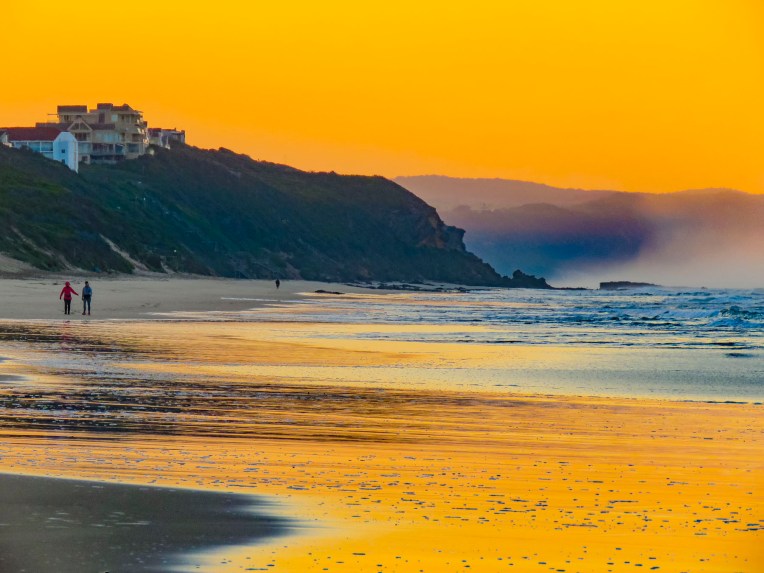
  Our room was luxurious and larger than several of the apartments we had rented on our round-the-world journey so far. We were hoping the owners, Leane & Deon, would adopt us. On our sunrise walk the next morning we only sighted a few other folks enjoying the quiet of this vast stretch of pristine beach during the winter season. We noted the considerably warmer weather, a result of the Agulhas Current which swoops warm Indian Ocean currents along the bottom of South Africa and wonderfully moderates the temperature.
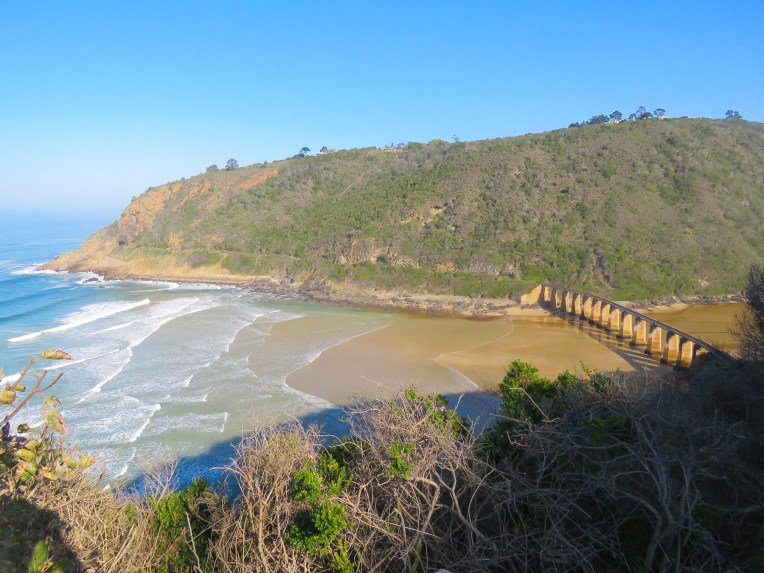
  After breakfast we backtracked on N2 to the pullover above the Kaaimans River Railway Bridge. For railroad enthusiasts this was a destination for many years to watch the Outeniqua Choo Tjoe, the last continually operating steam train in Africa, cross the tidal estuary which slowed settlers’ advance along the rugged coast. The line stopped operating in 2006 when landslides destroyed an extensive stretch of track. Today it’s an interesting photo-op.
  Further up the gorge at Map of Africa View Point, raging waters over the eons have eroded a bend in the river to resemble the African continent when viewed from the overlook on the opposite side of the chasm. The sky was empty mid-week, but across the road hundreds of paragliders launch from the grassy slope on the weekends to catch fantastic thermals and awesome views of the coast below.

 After spending hours rattling along dusty back roads we rejoiced to be on Route 2 again. A little while later we pulled over and enjoyed a late lunch and sunny afternoon on the outdoor deck of the Cruise Café, which overlooked Knysna Bay.
  We weren’t yet synched to the rhythm of life outside of Cape Town in the off-season and were surprised to find the restaurants and grocery stores in Plettenberg Bay closed when we arrived. Fortunately, we had a wonderful room with an ocean and lagoon view terrace, right on Lookout Beach, at
  The sun rose quickly the next morning from behind the Tsitsikamma Mountains, across the bay, filling our room with light. We spent the early morning slowly sipping coffee and savoring the view. Upon checkout we were delighted to find a sparkling clean car. This was a wonderful service the hotel provided for guests, and an easy way for the gardener to earn some extra money.
 We kept to a strict schedule, and limited our stops for photos today, because we needed to be at
 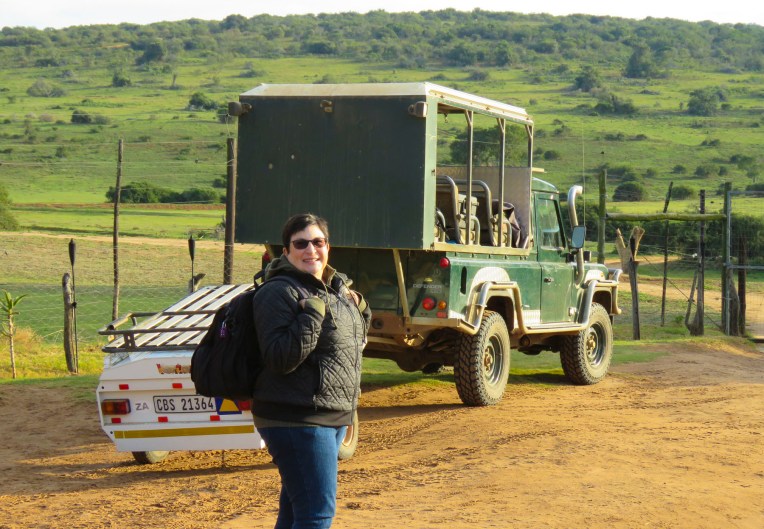 Three guides and three open-sided 4×4 Toyota safari trucks, each capable of seating 16 people, were waiting for their respective groups at the reserve’s headquarters. Wonderfully, it was mid-week in the off-season, and we had Edward, our guide/naturalist, and truck all to ourselves, while the other two trucks left with groups of six each. Schotia’s 4,000 acres of gently rolling hills, bush and forest shelter approximately 2,000 animals from 40 mammal species and its’s amazing how difficult it can be to find them.
  But that was our goal as we rattled along the rutted paths to a high vantage point within the reserve, that provided distant views of the terrain surrounding us. Scanning the vista with binoculars, Edward was searching for elephants, giraffes, antelopes and zebra. “The animals are constantly on the move. We’re never really sure where they will be,” Edward offered. He seconded with, “There’s clouds of dust being kicked up over there. Can’t tell from here what they are, but let’s go investigate.” And our overlanding began, chasing a cloud of dust that turned out to be a small herd of white faced Blesbok, a stunning antelope species we weren’t familiar with.


 Sightings of impala, kudu, wildebeest, warthogs, cape buffalo, zebra, hippos and crocodiles rounded out the afternoon.


 On the way back to the lapa we encountered the hippos we had seen earlier, now grazing far from their waterhole. Large black masses, they were barely visible when out of the headlights.
 Glasses of wine and a large, warming fire greeted us when we returned to the lapa for dinner. Inland the temperature fell quickly, and the warmth from the flames felt good.
 Darkness covered the countryside early in June, the beginning of South Africa’s winter season. Our guide had just lit the oil lamps a few minutes earlier, handed us a walkie-talkie and said, “Use this to call the owner if there’s an emergency, you’re the only folks here tonight.’’ The owner lived somewhere on the other side of this vast reserve. There were no other lights around except for the moon. The bush has a life of its own and sounds totally different in the darkness.
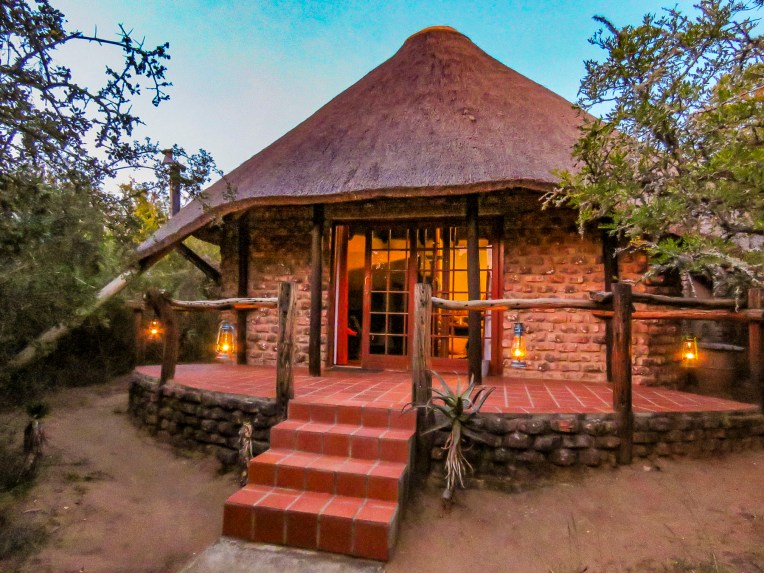 We didn’t plan on being the only folks at the game reserve during the middle of the week, but that’s one of the benefits of off-season travel. Following spring-like conditions around the globe, we’ve been able to avoid hot, humid weather and the crowds, while managing to have some wonderful experiences along the way. Tomorrow, Edward would guide us through Addo Elephant National Park.
 The eastern cape was once home to tremendous herds of elephant which were hunted by the Xhosa and the Khoe (Khoi) tribes for sustenance, and much like the American Plains Indians and buffalo it did not end well. As colonization spread across the region in the 1700 and 1800s the tribes succumbed to smallpox and were pushed into different regions, and the elephants were slaughtered to near extinction for their ivory and to protect farming interests in the region. With the killing of 1400 elephants in 1919, public opinion slowly turned. Only eleven elephants remained when Addo Park was established in 1931 with 5600 acres.
  The park was enclosed with an elephant proof fence in 1954, to protect the surrounding citrus farms from their rampages, when the size of the herd had rebounded to 22 elephants. Today the park is the third largest in South Africa and encompasses 1,700,000 acres. Home to over 600 elephants now, the reserve has expanded its mission to protect a growing number of mammal species within its borders.
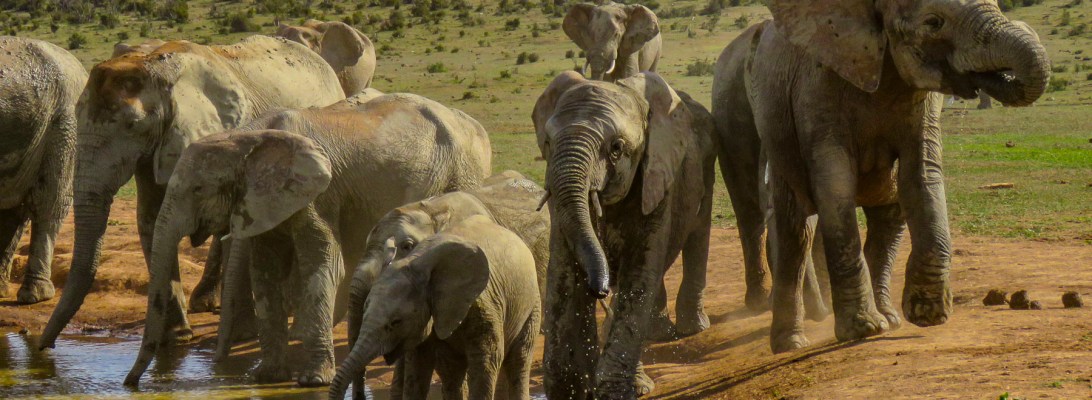
 We could have done a self-drive tour through Addo, but we thoroughly enjoyed Edward’s knowledge of wildlife and the region. It was a good decision. Sitting up high in an SUV provided better visibility into the bush, where in our small rental car we wouldn’t have been able to see much. And his timing was perfect in getting us to a waterhole just as a very large herd with calves was creating a trail of dust as it emerged from the surrounding dry bush.
 We witnessed elephants smiling as they drank. It was a tremendous experience.
 2 Suitcases for 2 years