Croatia Road Trip Part 2: The Istria Peninsula – Plitvička Jezera, Pula, and Rovinj or Waterfalls, Roman Ruins & a Saint

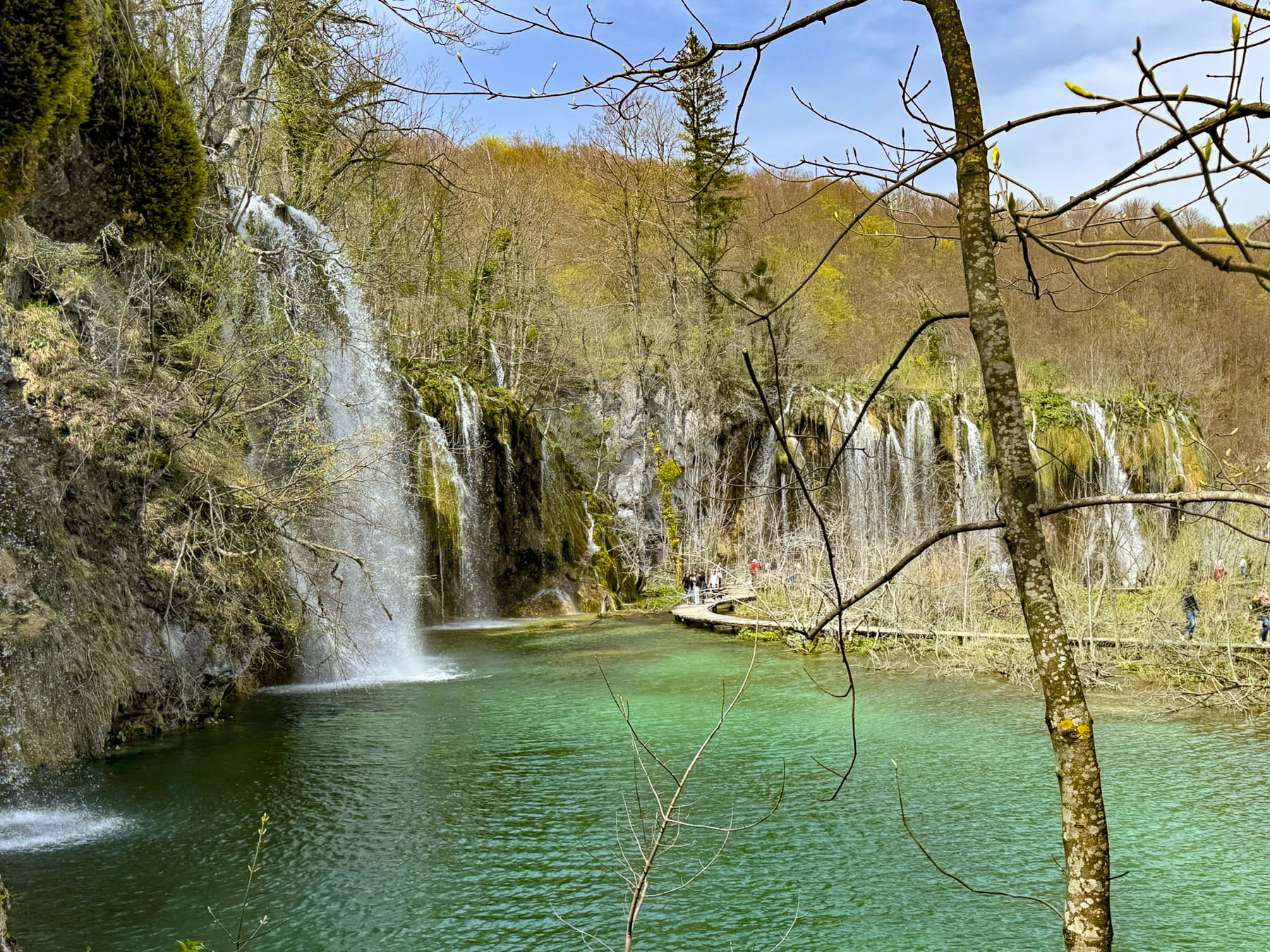
We experienced an infinite palette of blues spread across the sea, sky and waterfalls of Croatia, as if they were an artist’s inspiration, but in fact were mother earth’s creation. The emerald green, turquoise and azure arteries of the rivers were particularly enthralling; they shimmered with the changing light, almost glowing, as they coursed through their surrounding landscapes. The intense colors are the result of limestone and other mineral deposits that line the waterways, and the angle of sunlight on the water. This majestic display of nature’s wonder is on display at Plitvička Jezera National Park, just two hours from Zadar. 

Created in 1949, Plitvička Jezera was Croatia’s first national park and protects a massive 296.85 km2 (114.61 sq mi) area, situated on a plateau in the mountainous Dinaric Alps of central Croatia, that separate the inland region of the country from the Adriatic coast.

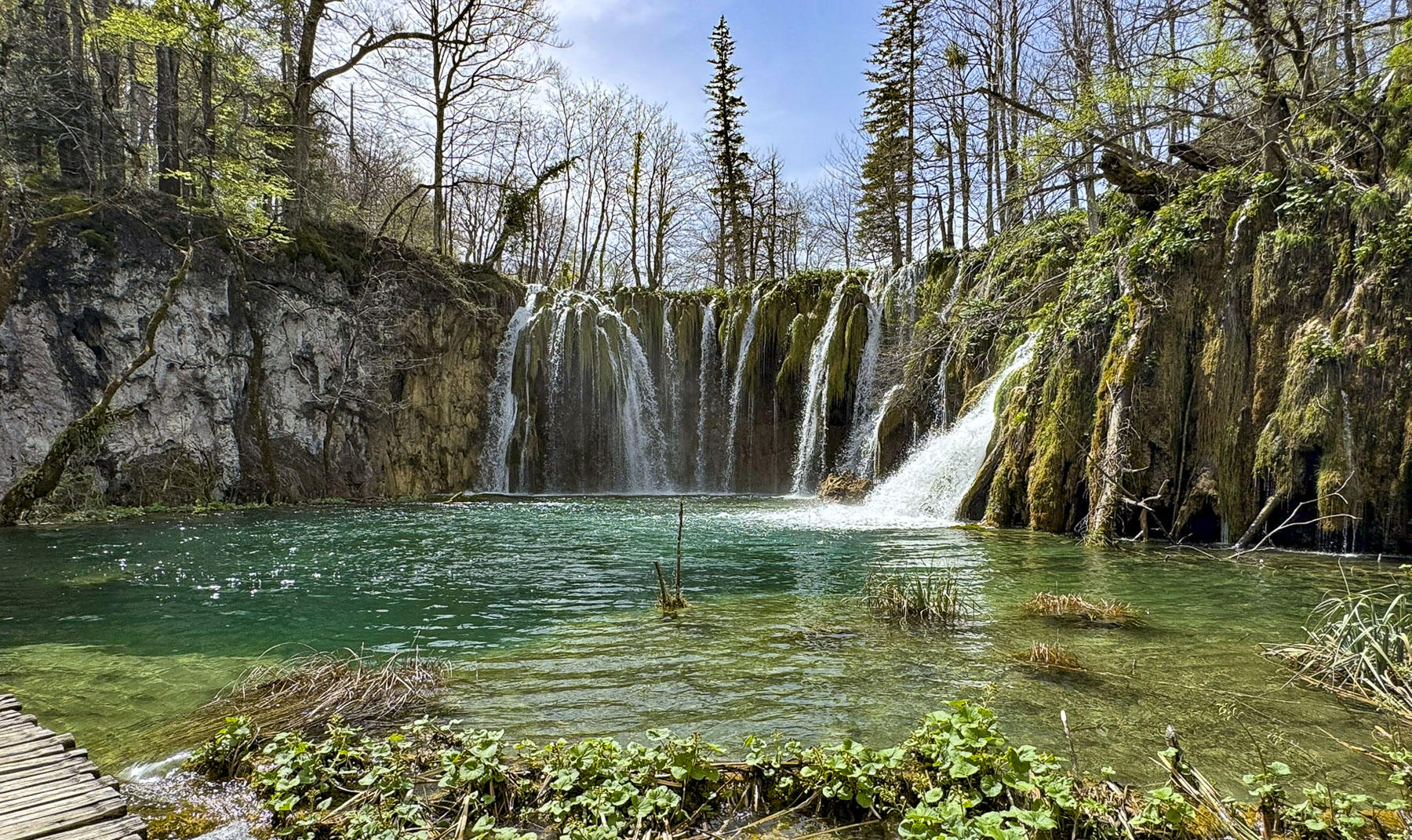
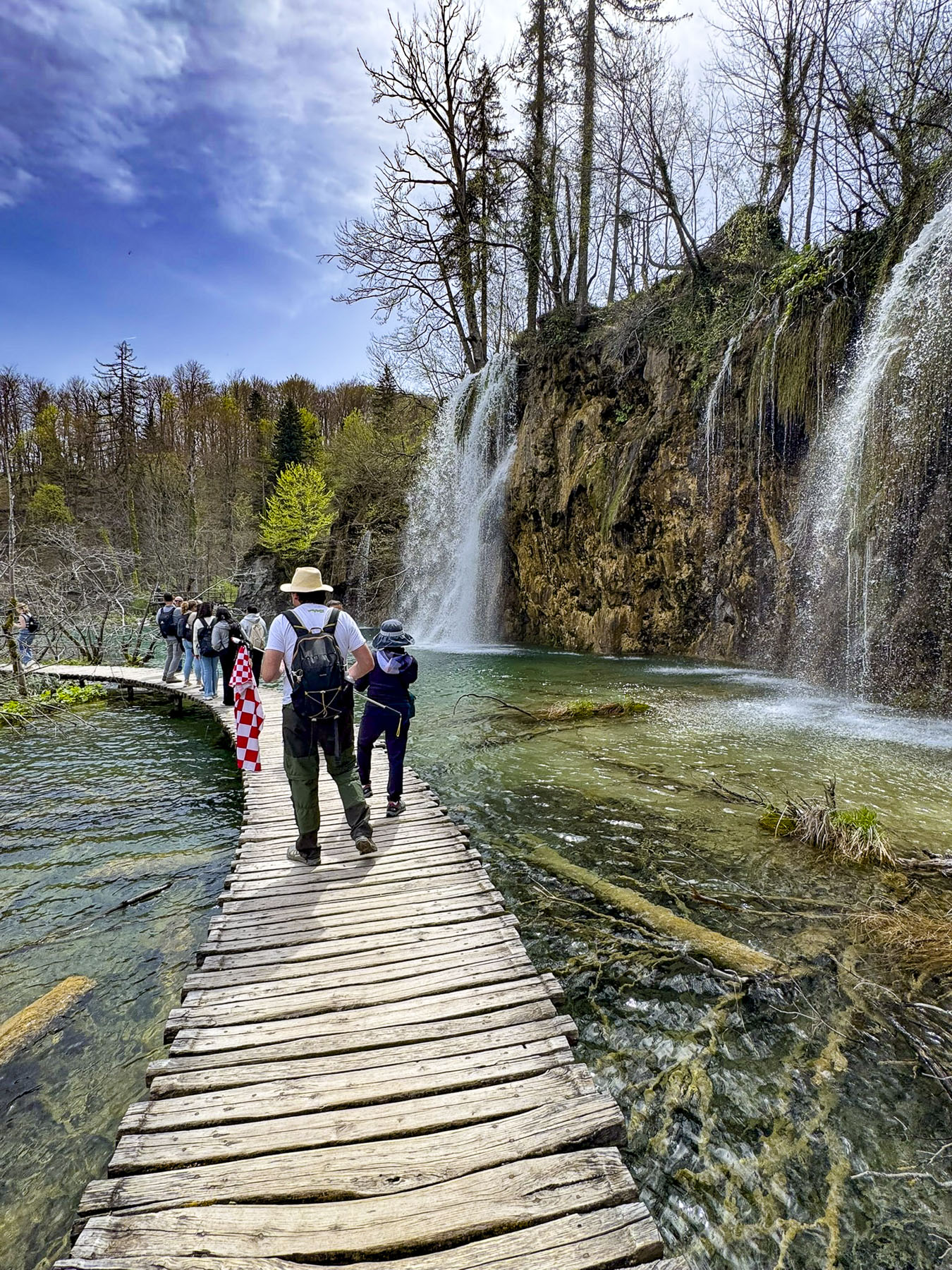
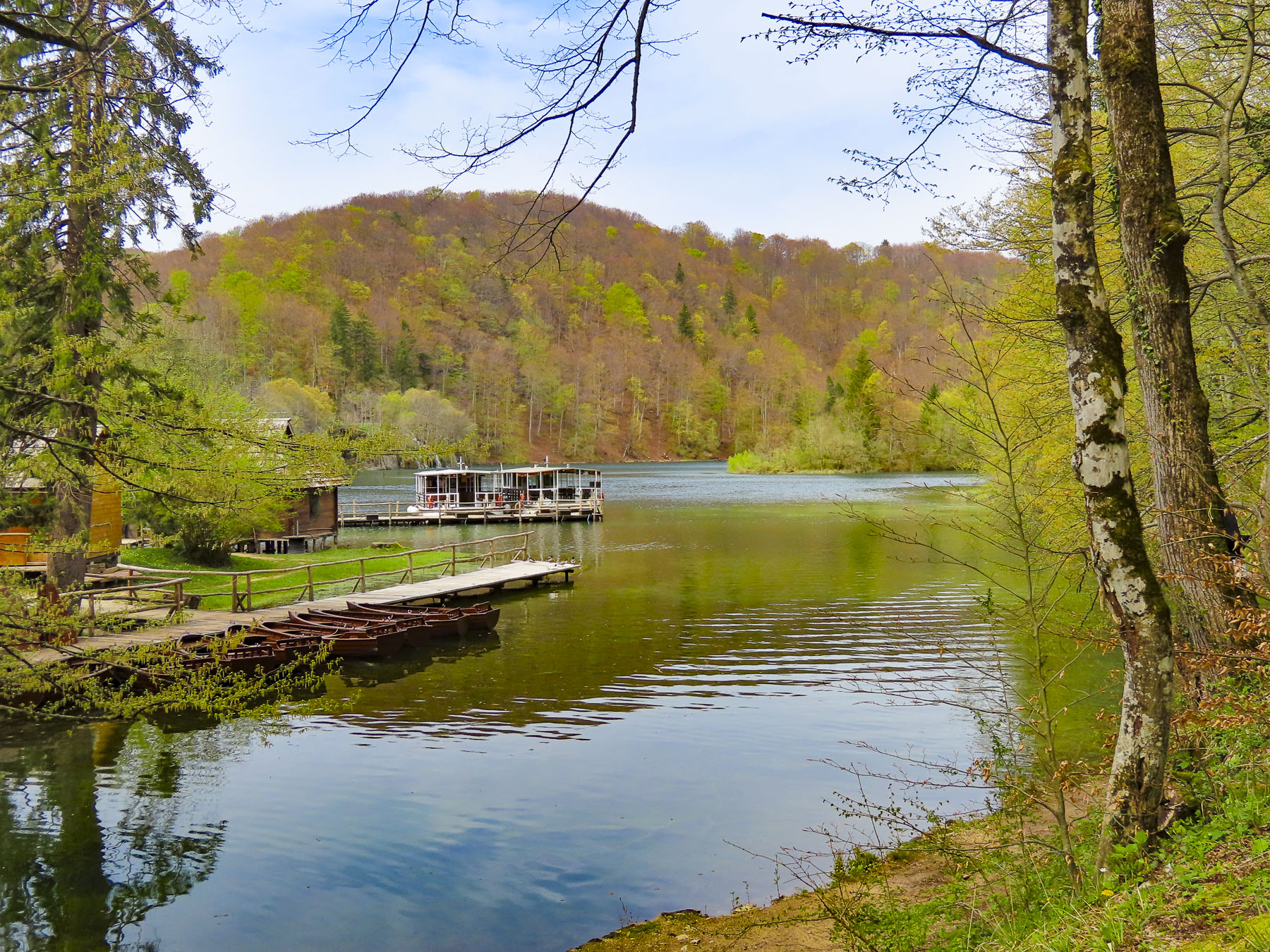
The park has 16 terraced lakes with numerous waterfalls of various heights which folks can view via a series of meandering boardwalks built across the shallow pools below each cascade. The park service has organized these walkways into eight different touring routes/programs.

We visited the park on the Wednesday before Easter, a school vacation week, and the park was busy, but not overwhelmed with visitors. Those in the know arrived early, as convenient parking vanished quickly, and it was a very long walk to the ticket booth.

We chose route E, a three hour, 5100m (3mi) circular walk through the Upper Lakes section past Veliki prštavac, and Mali Prštavac falls to Lake Prošćansko, that included a short boat ride across Kozjak Lake at the beginning and end of the trek.

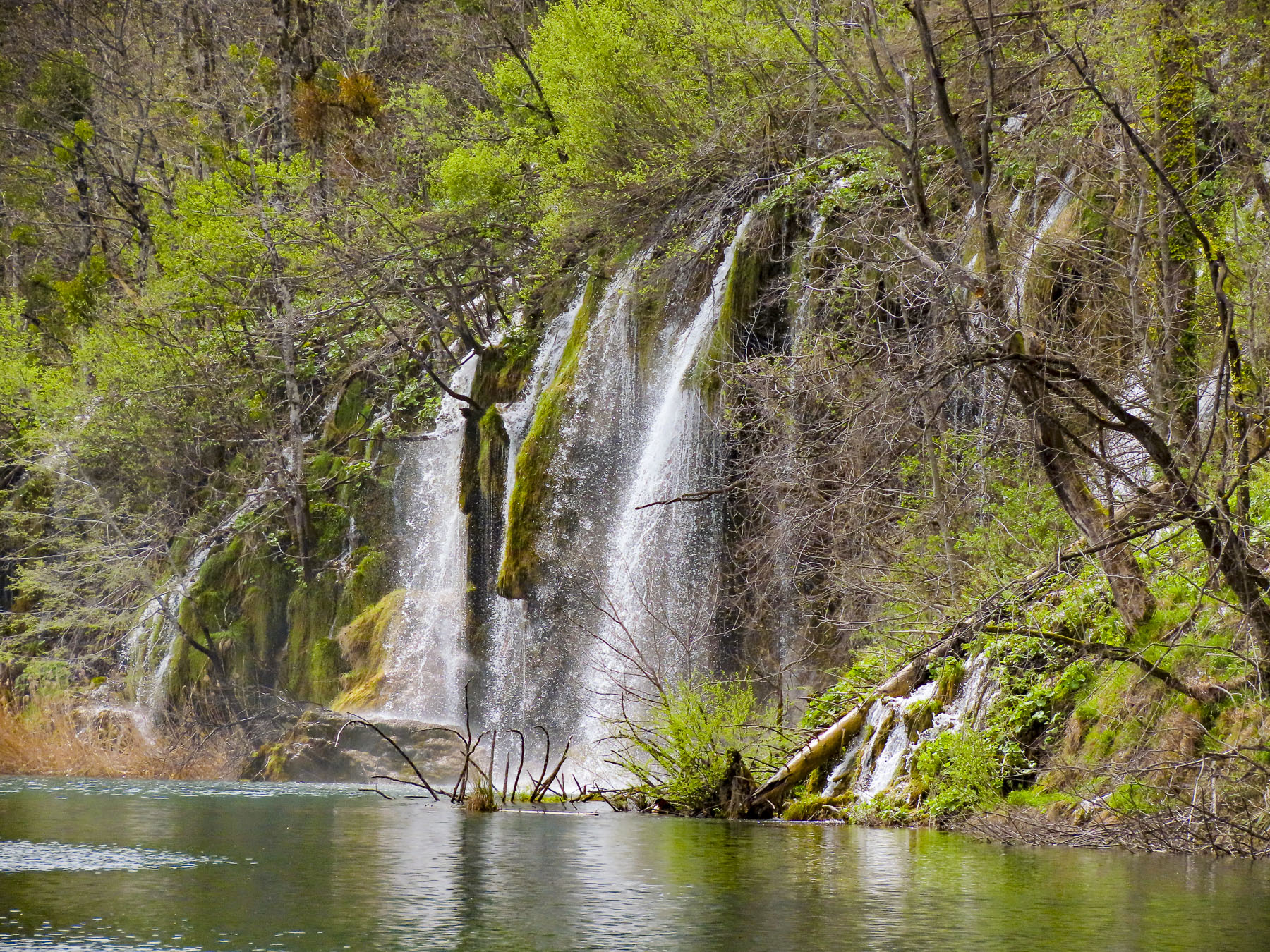
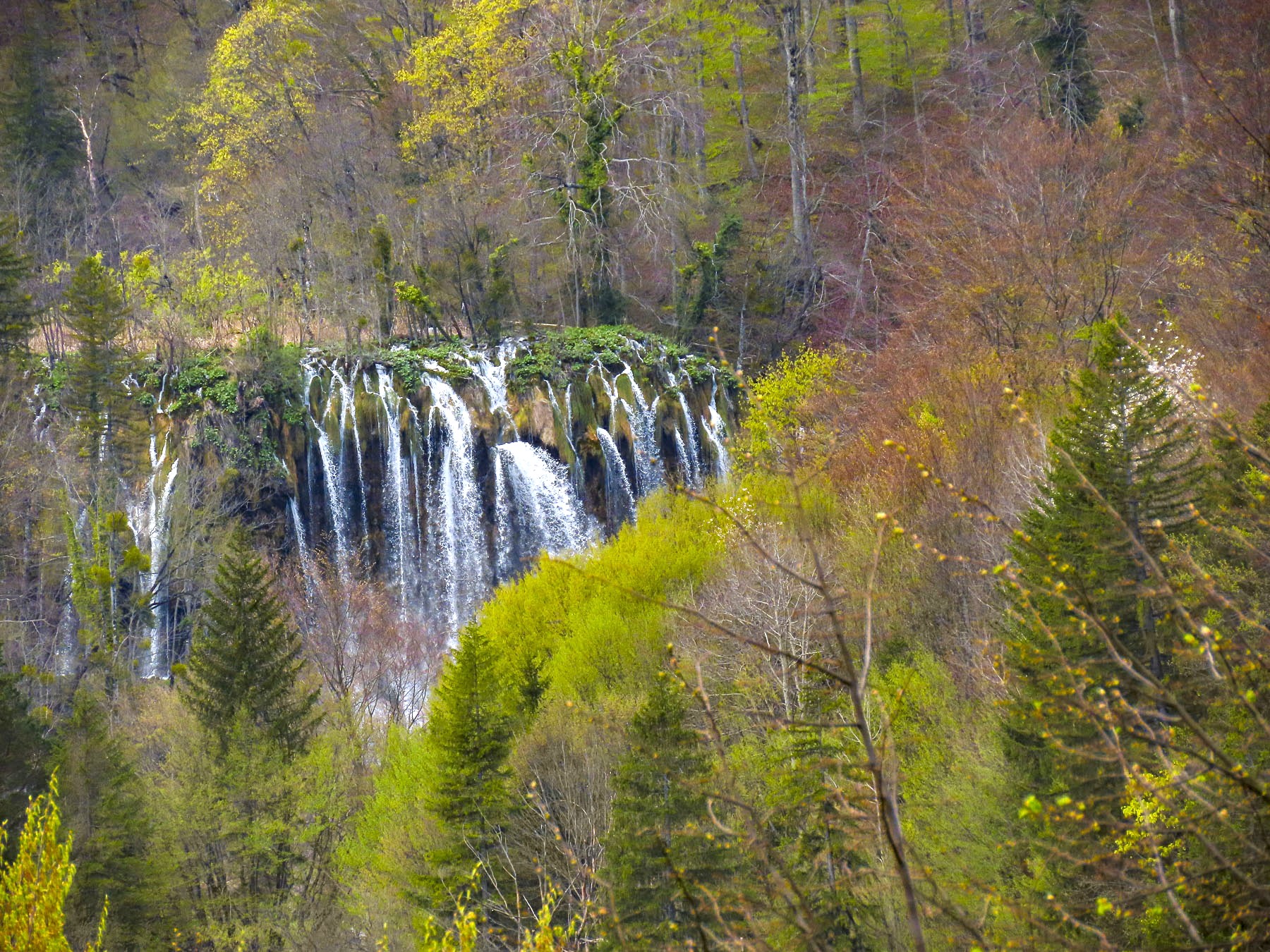
The falls were enthralling, flowing like delicate veils across the rock face of the hills. The boardwalks above the crystal-clear pools were narrow, and for the most part without railings except for sections of stairs that ascended a hillside. But the walk was very easy, and we encountered folks of all different ages, and parents carrying young children.

In mid-April the foliage on the trees in the park was just beginning to leaf out, making it the perfect season to view the falls without them being hidden by trees. Trying to take photographs of the falls, midday, without people in them was nearly impossible, and you need to be at the park before most folks arrive to accomplish that.

Our destination for the end of the day was the Hotel Katarina in Selce, a modest-sized resort village, on the Adriatic. The two-hour drive first took us through mountains covered in pine forests along Rt D52, past small villages where all the homes still had cords of wood for their fireplaces and wood stoves stacked high. Descending the mountains, the landscape slowly greened and transitioned to a rolling pastureland dotted with cows and sheep. Freshly turned gardens along the way were already planted with spring onions. Some of the small farms had roadside stands offering honey and homemade cheese for sale. It was a very pretty drive, but the roads were narrow and did not have any shoulder area to pullover to safely take photographs. Intersecting D23, we continued our descent to the coast through thinning forests then Garrigue, an evergreen shrubland well suited for the region’s hot dry summers.

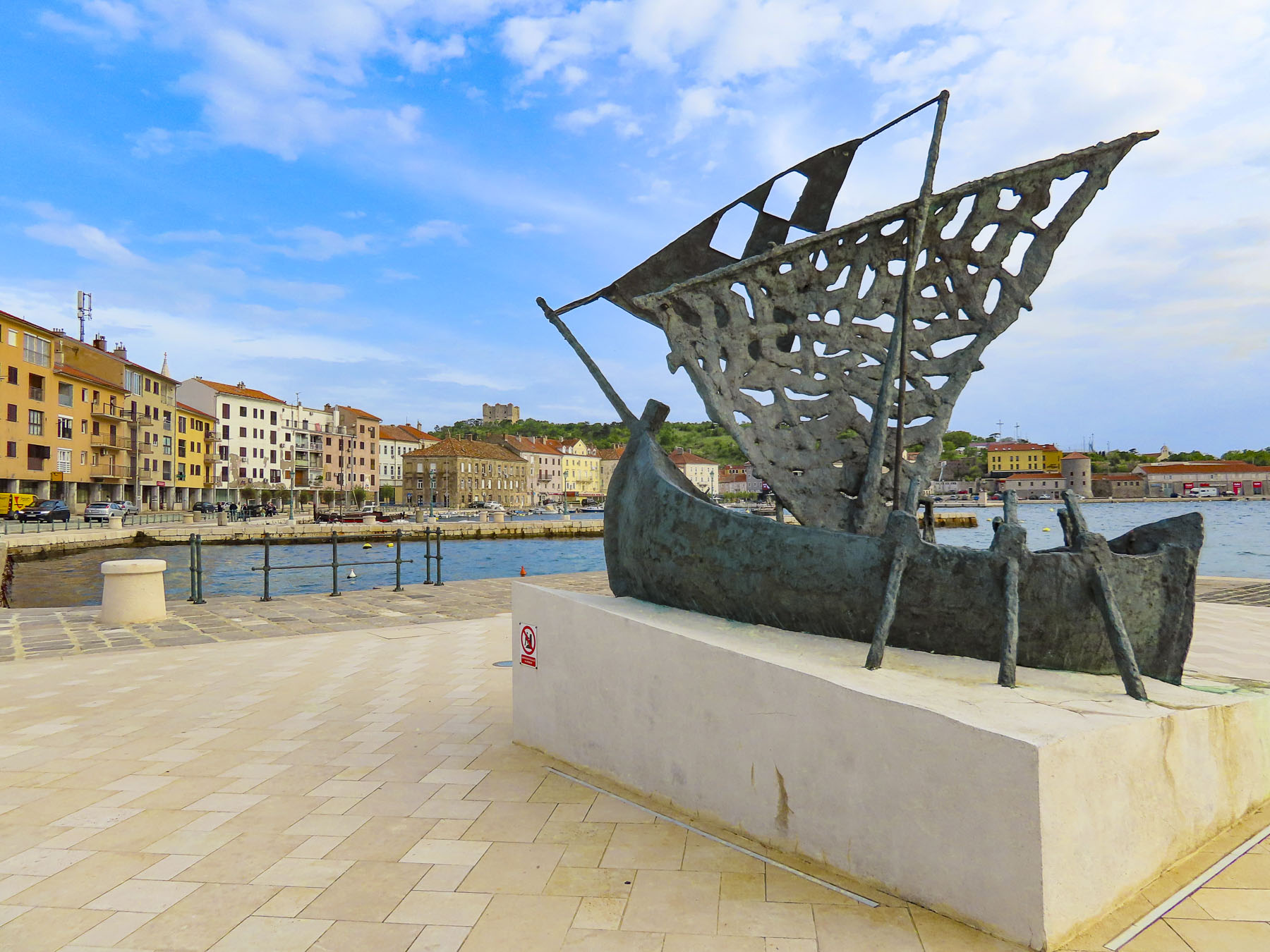
We reached the coast at Senj, the oldest town on the North Adriatic coast, with a history that goes back 3,000 years. The town is located on a crescent shaped bay under the watchful eye of the Nehaj Fortress, a 16th-century bastion that helped to keep the Croatian town independent during the centuries of Ottoman and Venetian aggression in the Adriatic Region. Unfortunately, we didn’t have time to visit the castle, which also hosts an annual three day Renaissance festival called the Days of Uskoks every July. But we did enjoy a short walk along its waterfront before continuing on.

Large modern hotels like the Hotel Katarina, which cater to tour groups, are not our first choice when we travel, but unfortunately during the shoulder seasons along the Adriatic coast many of the hotels that would normally be open during the summer are closed, and options are limited. But the hotel’s location for a one-night stay, in the town of Selce, worked well with our driving plans, as we headed to historic town of Pula, on the Istrian Peninsula.

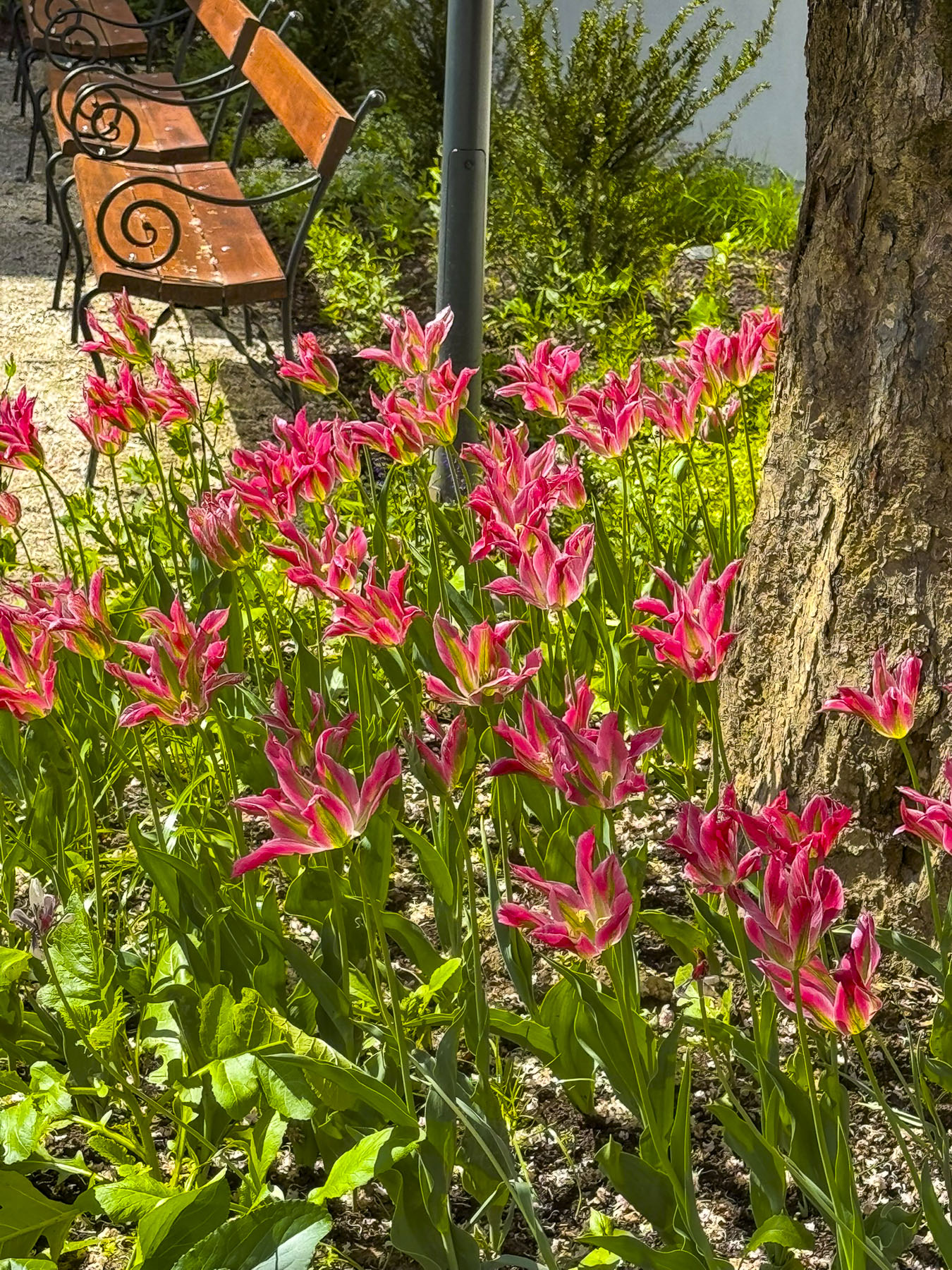
The hotel was directly across from a promenade, alive with a chorus of wonderful song birds, which we followed the next morning.  At the town’s port the walkway widened into a small plaza planted with tulips and centered with a large Easter Egg, called a pisanice.  

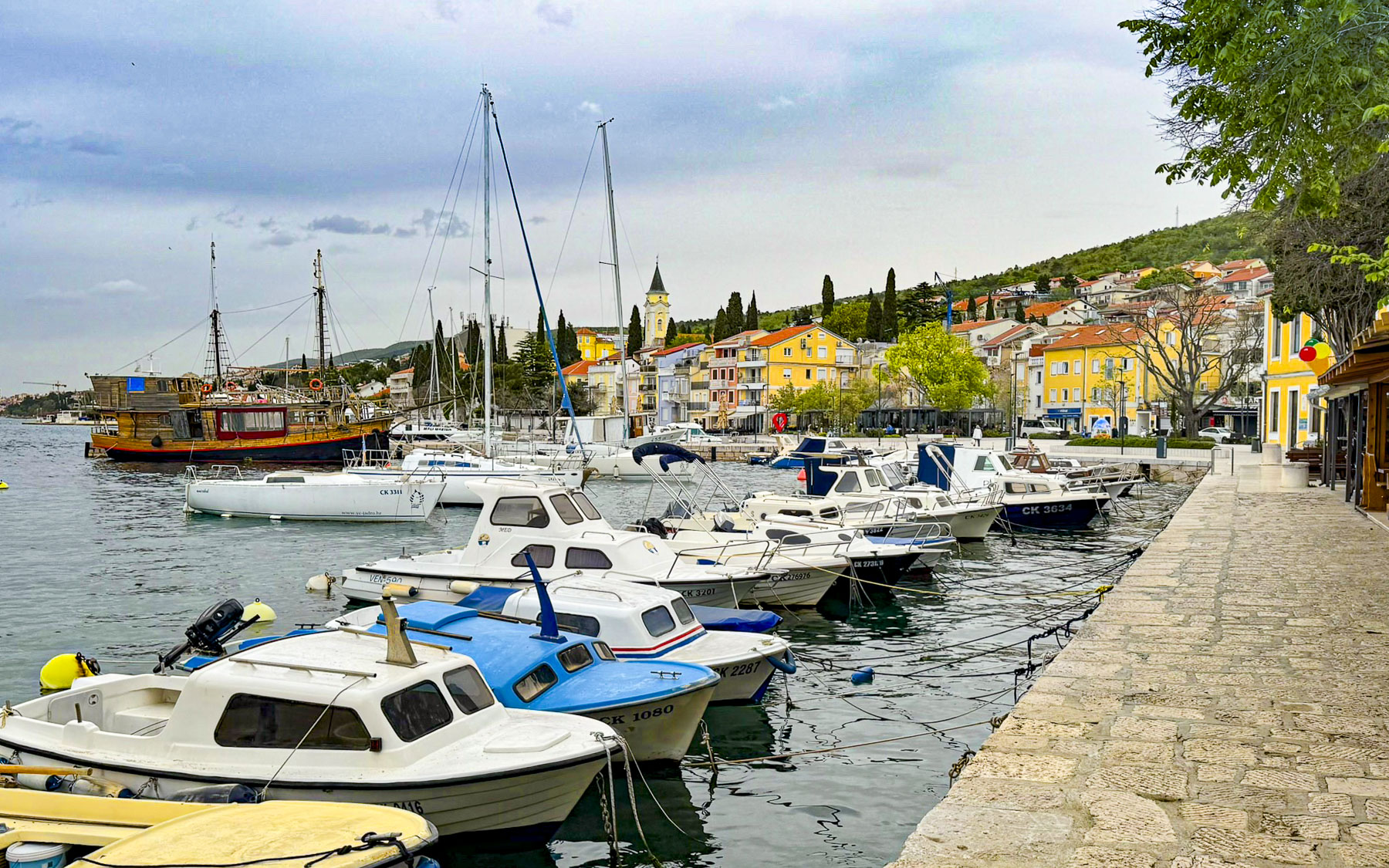
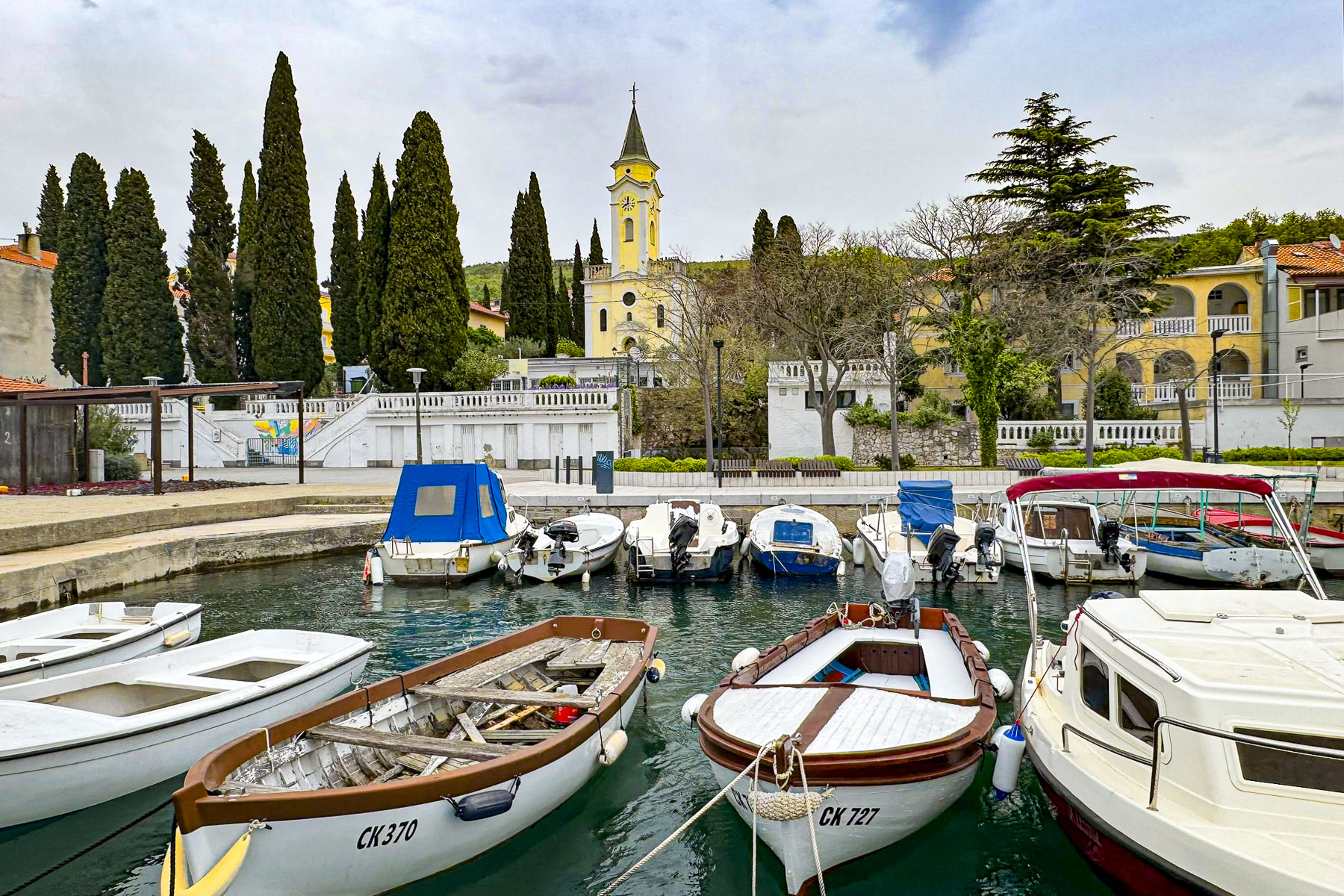
These fiberglass eggs are painted by local artists with themes that reflect the Croatian Christian traditions, and celebrations of Spring. There were numerous restaurants along the quay, but only a few of the smaller cafés were open this time of year. Even though the morning was overcast, the town’s small harbor was a colorful scene of boats and waterfront buildings.

Our drive north from Selce mostly hugged the coast and was reminiscent of Italy’s Cilento Coast along the Mediterranean in the Campagna region. We found the towns and glimpses of the sea along the Croatian coast fascinating and started to think about future return trips to the area. 

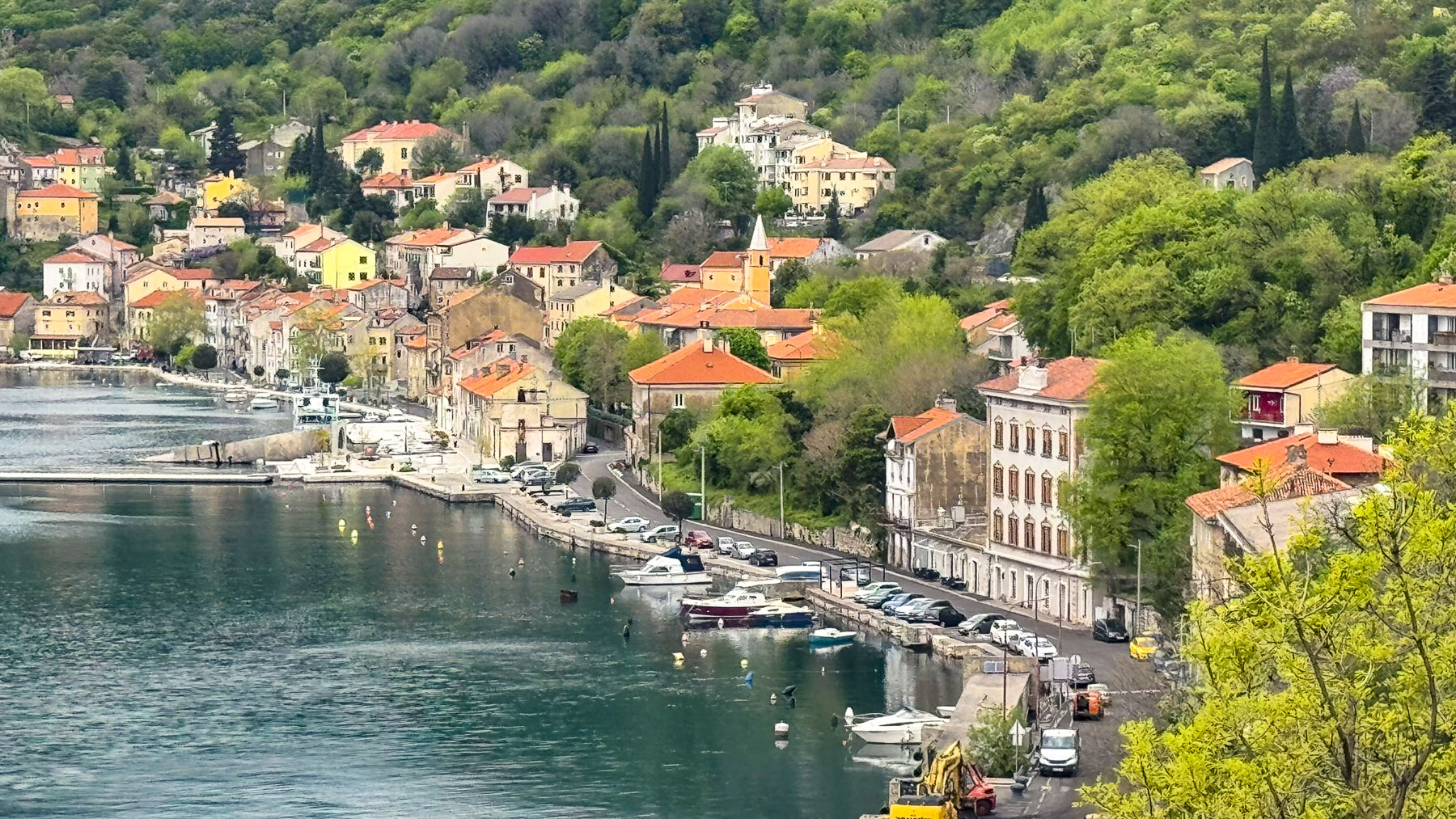
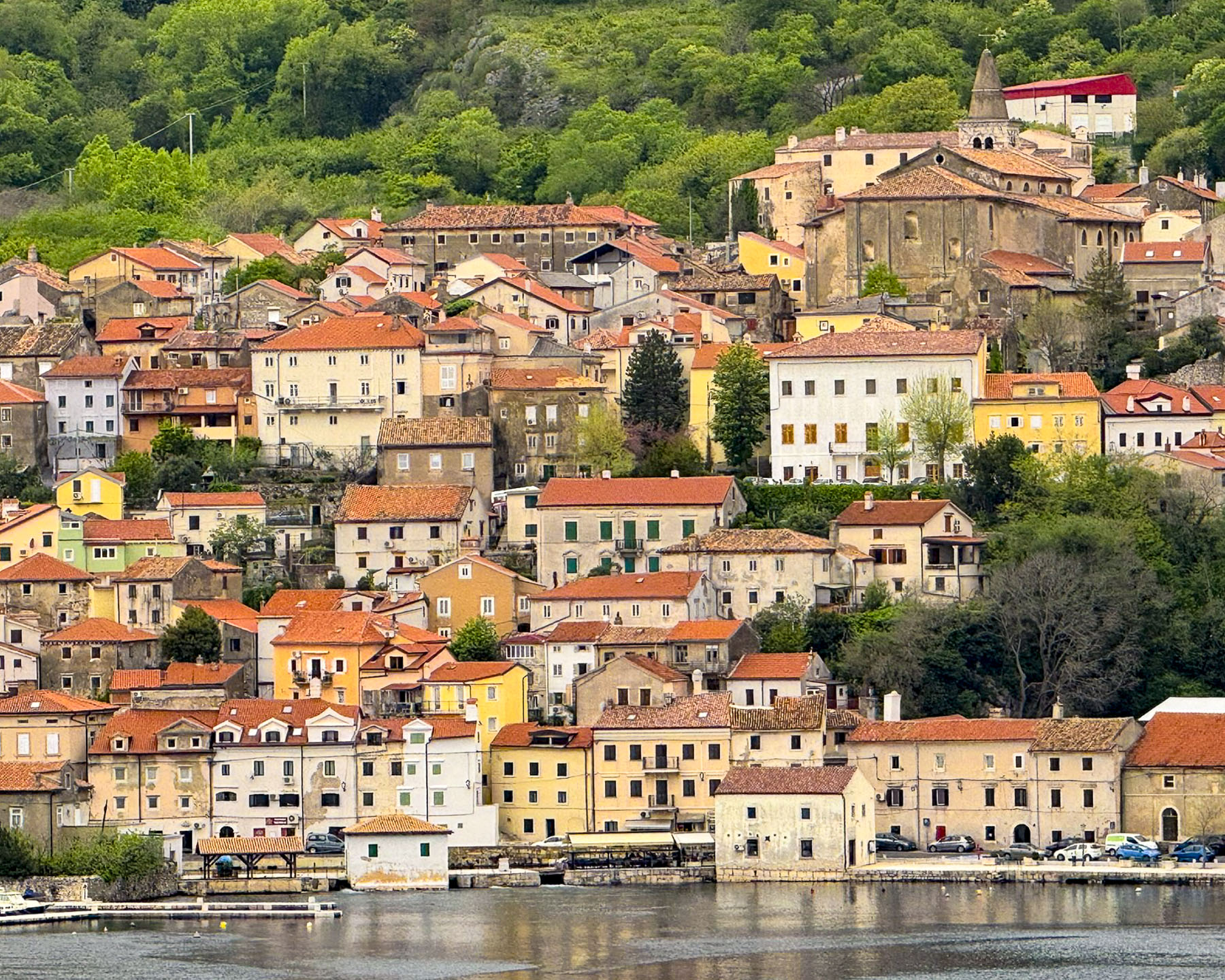
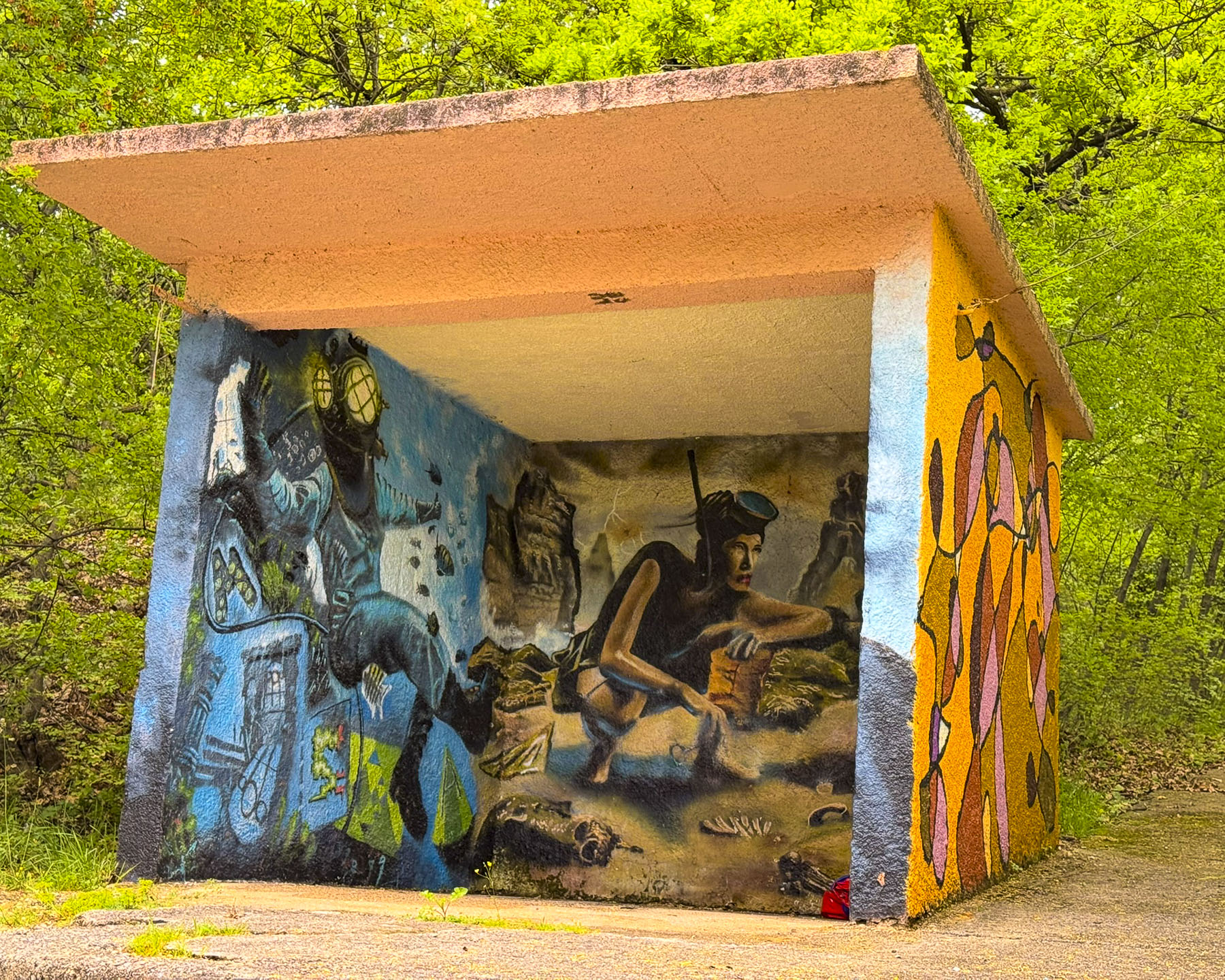
We would enjoy time  to explore in depth not just the small coastal villages like Bakar, where just beyond the village some of the bus stops along the road are covered with murals that reflected the areas maritime heritage, and Mošćenička Draga, beautifully set on a small cove, but also some of the less mentioned larger coastal cities like Jadrolinija and Opatija, which were fashionable Habsburg-era resorts in the 19th century and still retain their fine architecture. We regretted that we only had time to drive through these areas.

The Istrian Peninsula is known for the high quality of its olive oils, wine and regional cuisine which spans from light seafood entrees to hearty meat dishes and stews, the first of which we tried at Tri Murve in Plomin. I wish we could say that this was a well-researched choice, but it was a spontaneous stop, to satisfy a mutinous co-pilot, but we were pleasantly rewarded with a very wonderful lunch. On this chilly day, the temptation to linger here was overwhelming.

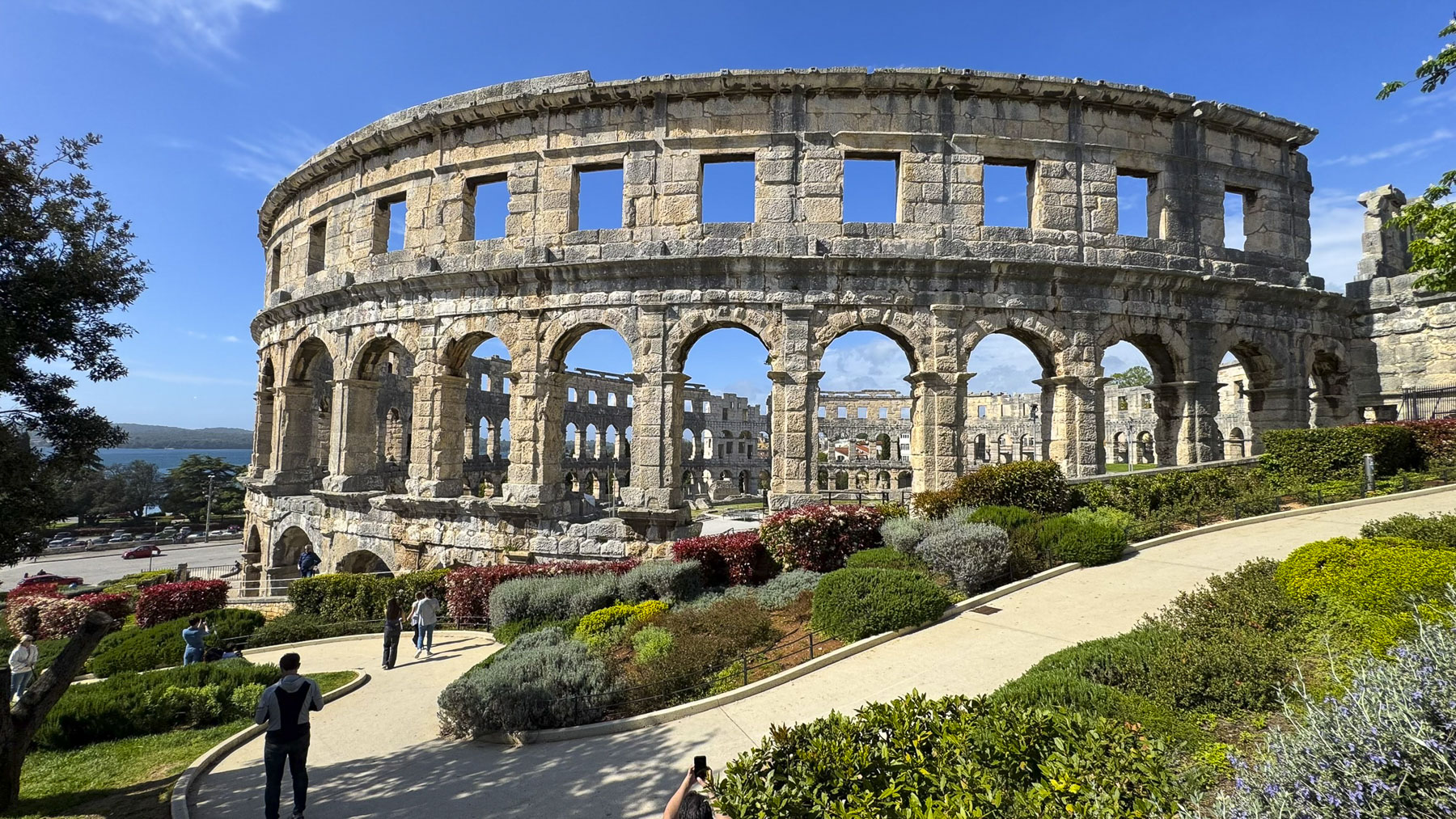
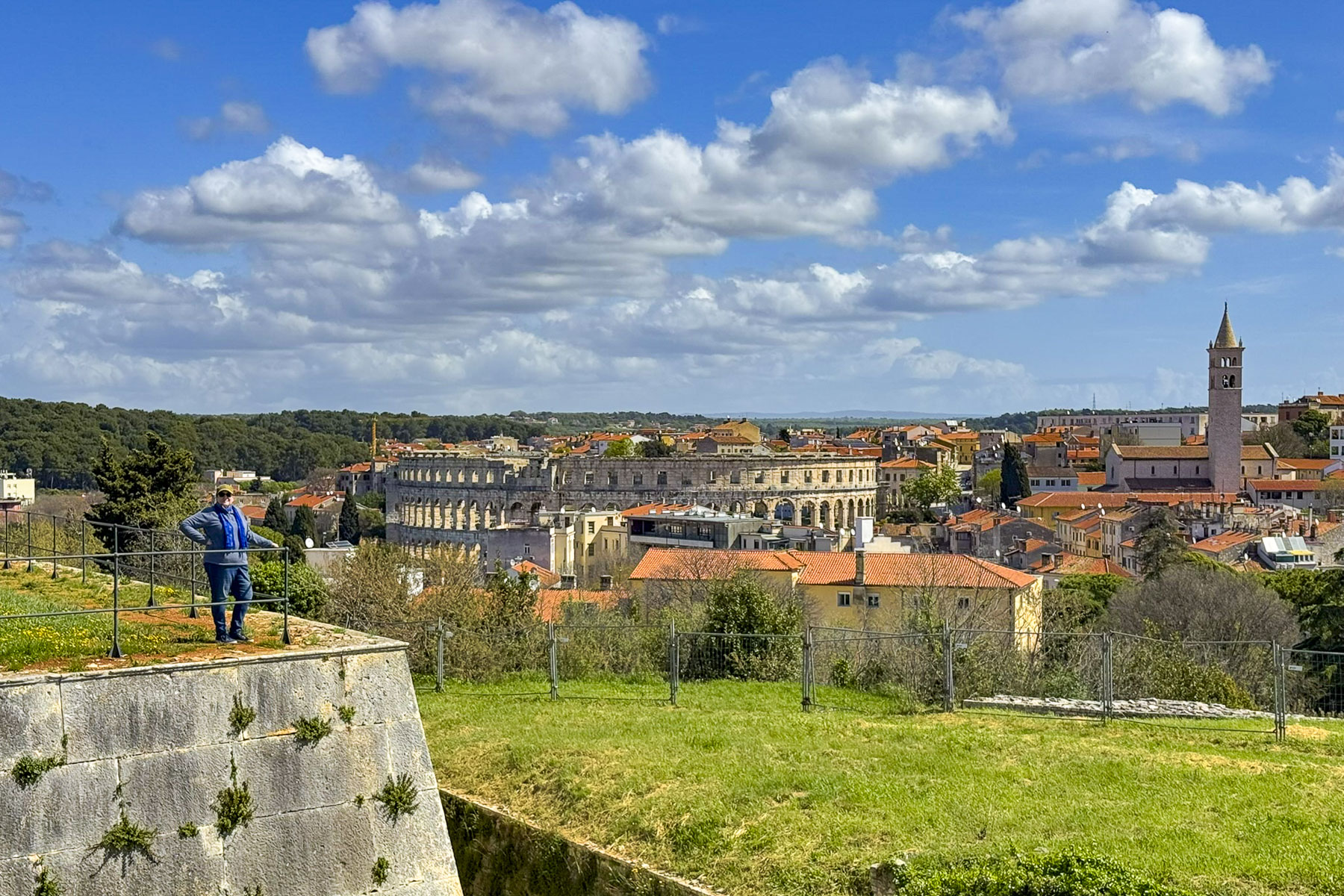
The top of Pula’s ancient Roman colosseum surged above the trees as we drove into the center of the port city. Rome’s presence in the city dates back over 2,000 years, but legend believes the city’s founding was a thousand years earlier and linked to the mythological Greek hero Jason and the Argonauts who sailed into the northern Adriatic Sea to escape the pursuit of the Colchians. The Colchians, exhausted after years of pursuing the Argonauts, feared returning home without the Golden Fleece, and founded Polai, the City of Refuge.

In the mid-1500s when Pula was part of the Venetian Empire plans were proposed to dismantle the arena and rebuild it in Venice. But they were rejected after the passionate arguments of Venetian senator Gabriele Emo, who is remembered with a plaque in the stadium. Though his efforts did not stop the removal of stones to build other structures in Pula which continued well into the 18th century. The arena, a masterpiece of Roman engineering, was originally built to seat 23,000 spectators, and is used to host a variety of events that range from film festivals to concerts and soccer matches, though its seating capacity has been reduced to a safe 7,000.

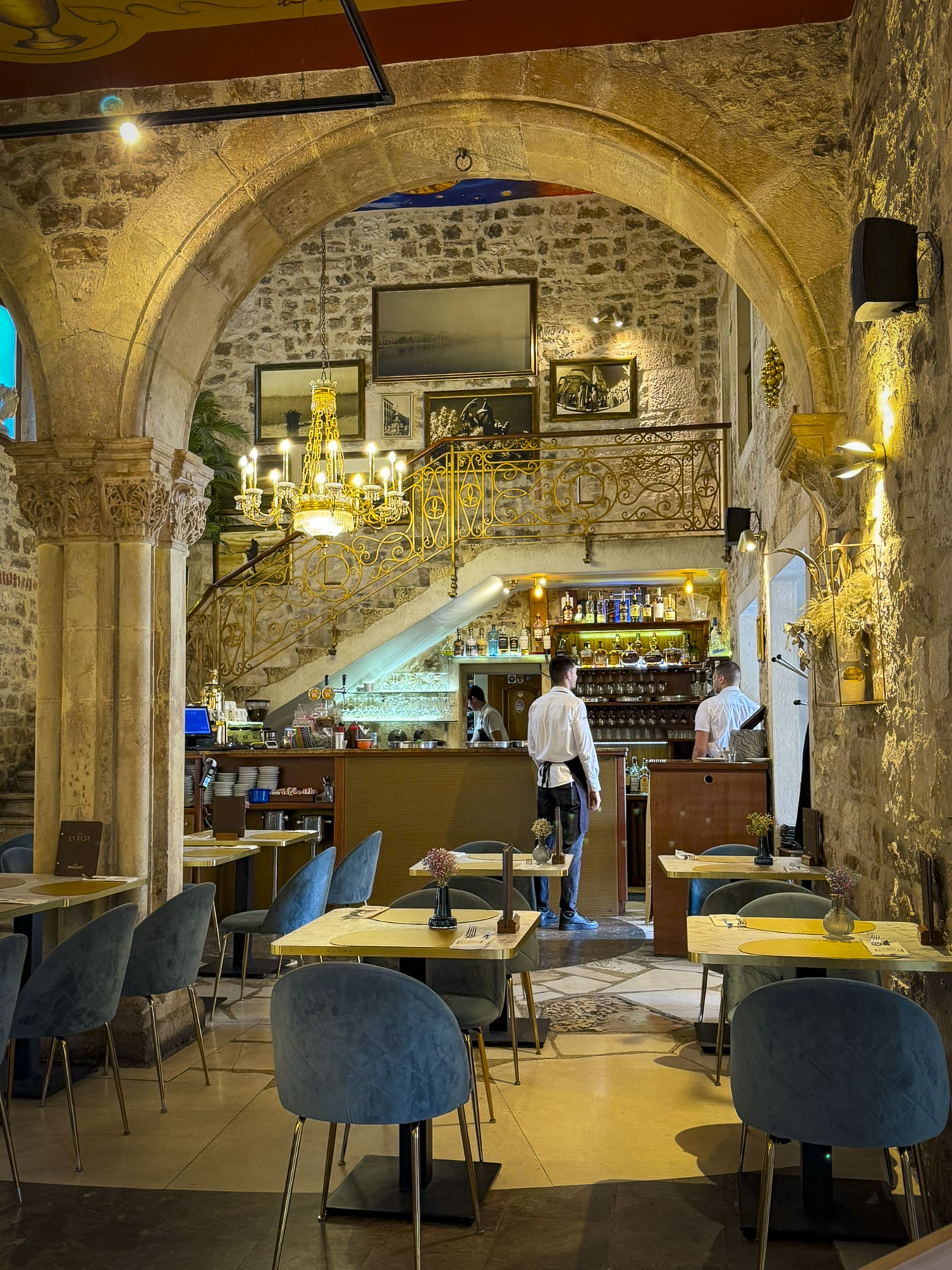
We thought we were in luck when we found a spot in an untended parking lot atop the hill near the Citadel of Pula, and the Monastery of St. Francis, only two blocks from our lodging at Luxury Flats. However, as we were lifting our luggage from the trunk a parking attendant appeared and informed us the lot was reserved for local residents with permits and we would be ticketed, but he was very gracious and gave us 15 minutes to get our bags to the apartment before we needed to move the car to a municipal paid parking lot across from the Roman colosseum, that he suggested. Finding parking for a rental car is always a task in small European cities. This one was reasonably priced, charging hourly during the day, but free after 18:00 until 8:00 the next morning. 

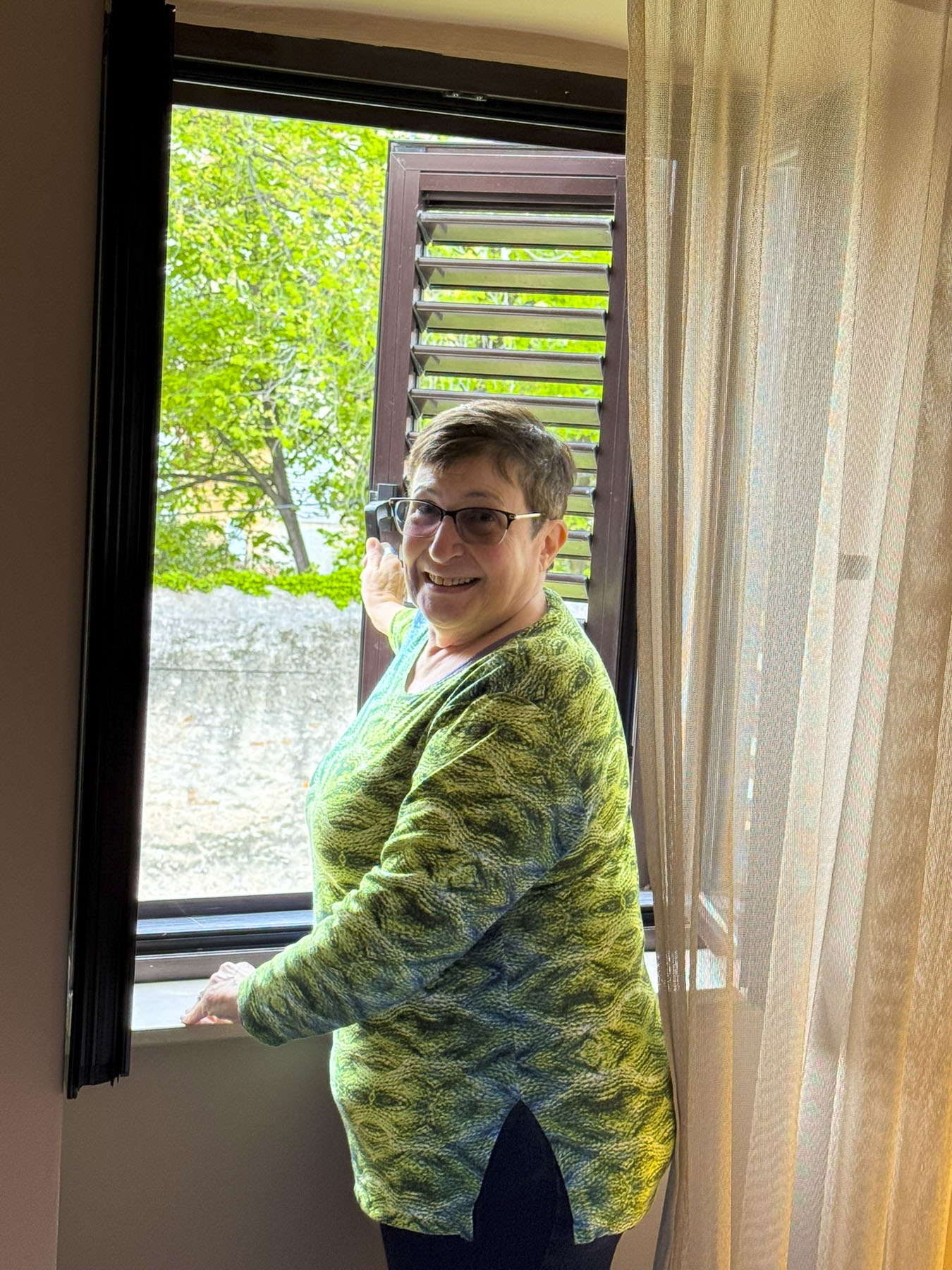
The small studio apartment we rented was modern and had a shared balcony which overlooked an orchard with a garden area that was once tended to by the nuns of the Monastery of St. Francis, next door. The monastery was built by the Franciscan Order in the 1300s and served the religious needs of the community until the country’s communist era. When the complex was then used as a military barracks, then kindergarten, before being returned to the Franciscans in 1992.

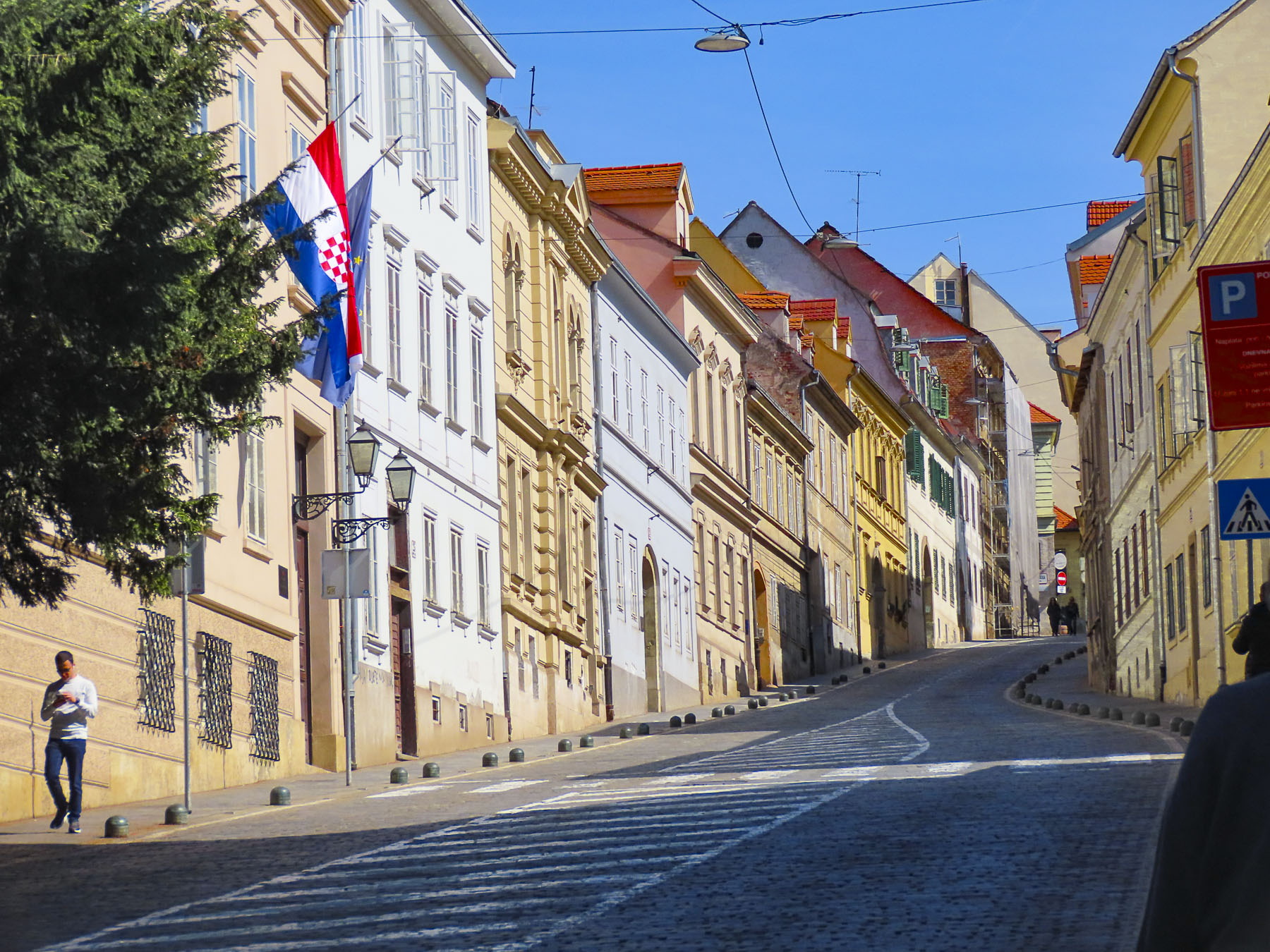
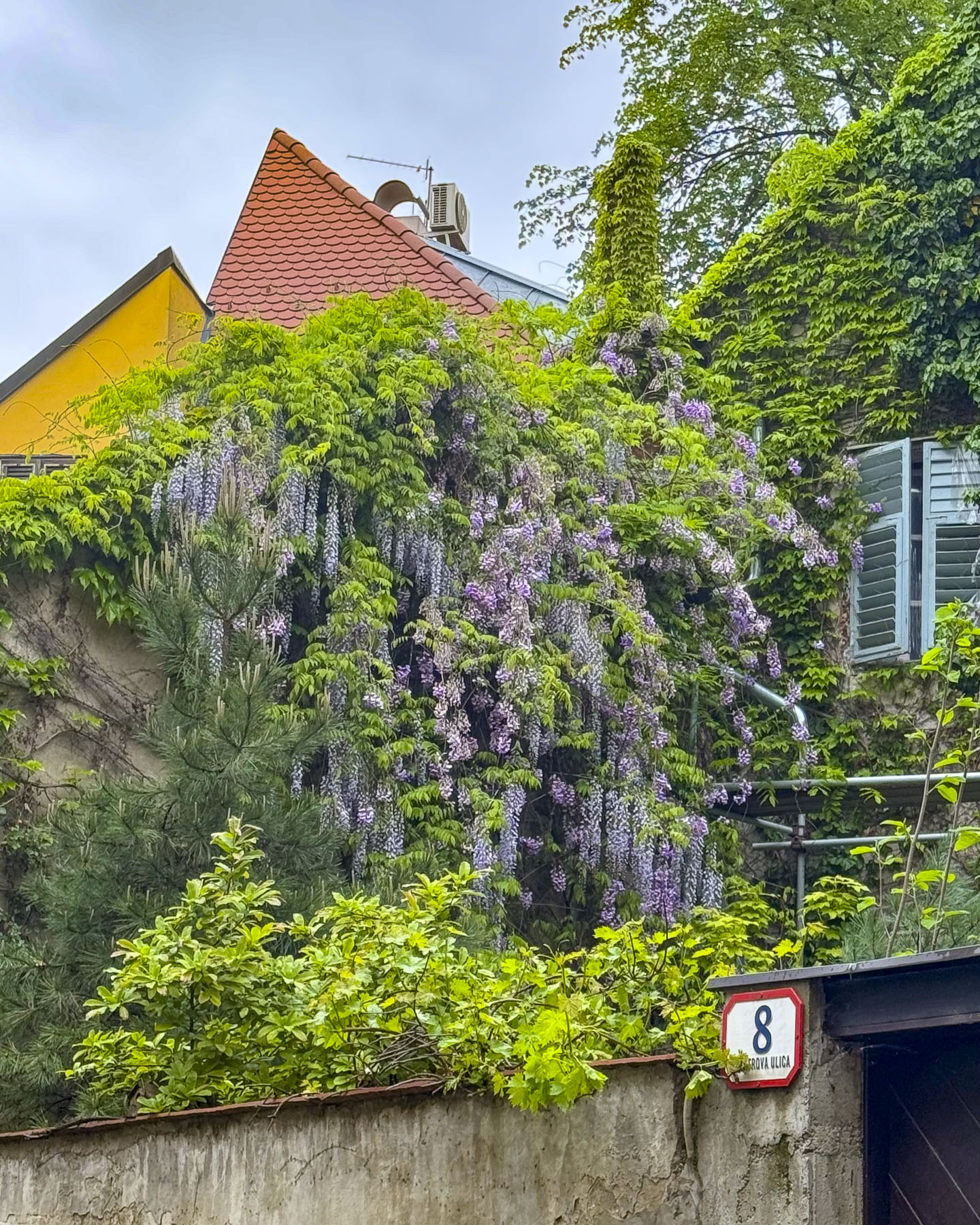
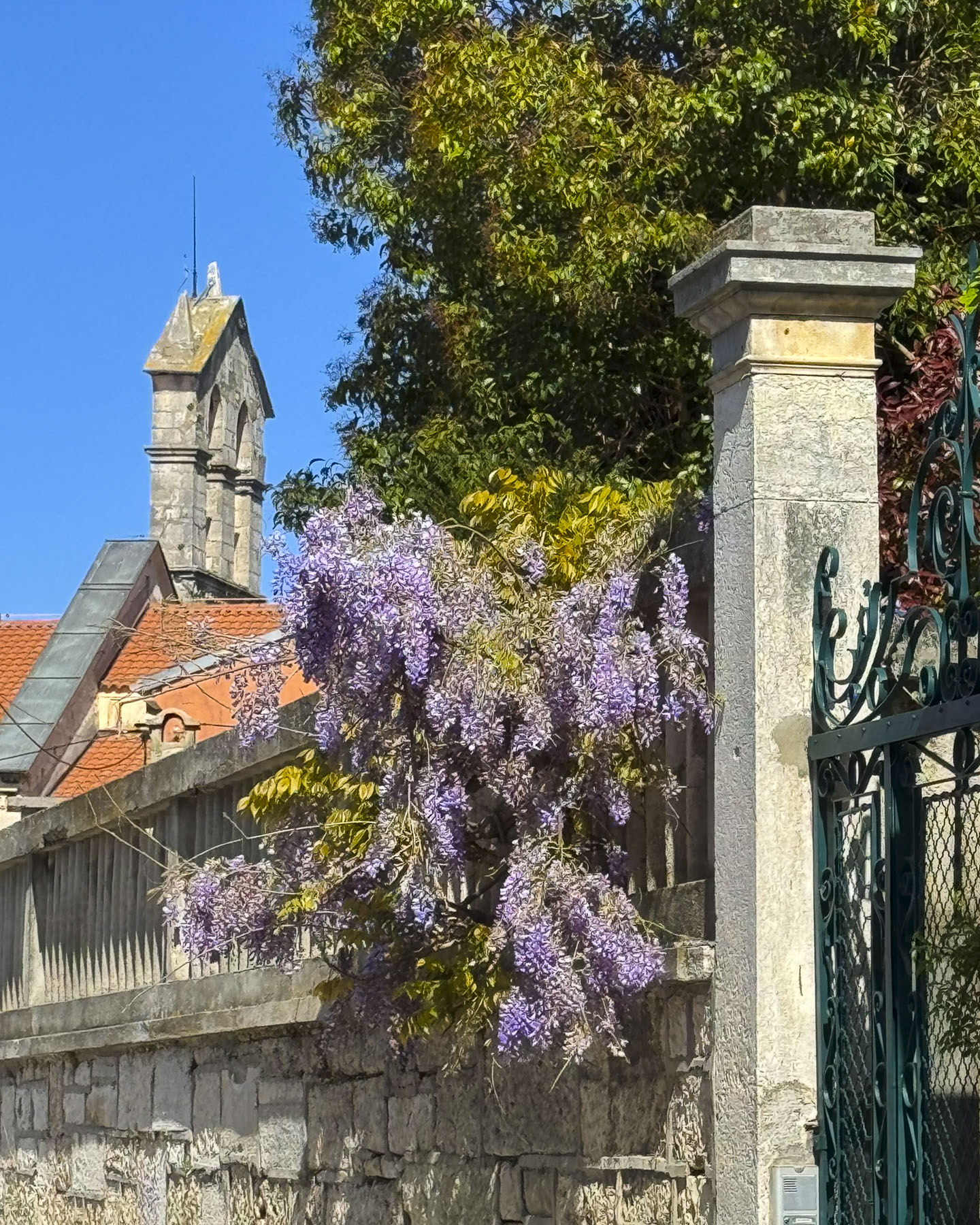
While our flat was adequate for our 3-night stay, we wouldn’t describe it as luxurious, but its location on a steep lane in the center of the historic district was excellent, being only a short walk away from everything in Pula. Wanting to take advantage of the sunny afternoon that appeared as we entered the city, we were soon out and about, walking past colorful homes and flowering wisteria along the road to the Citadel of Pula or Kaštel, as it is locally known.

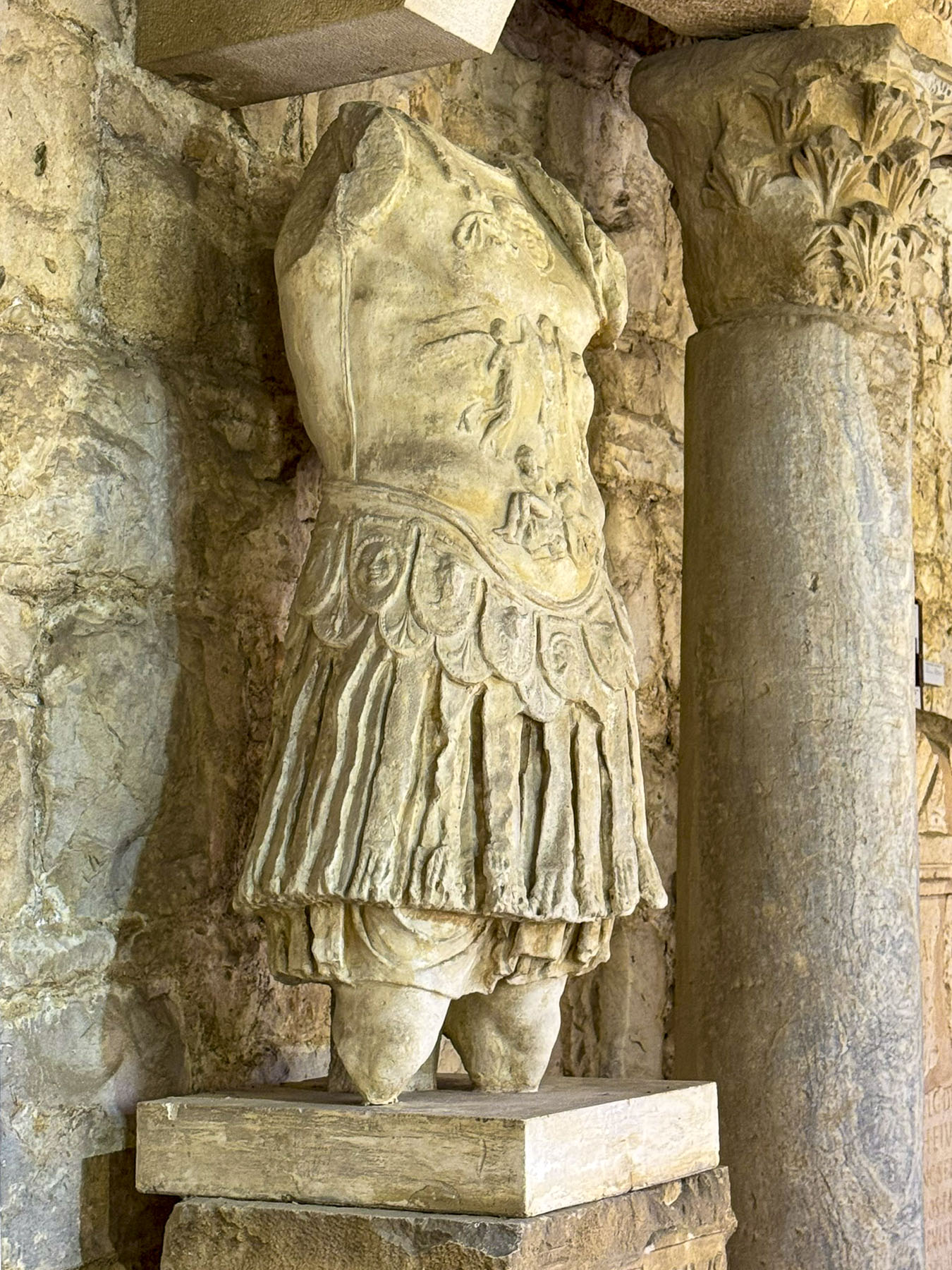
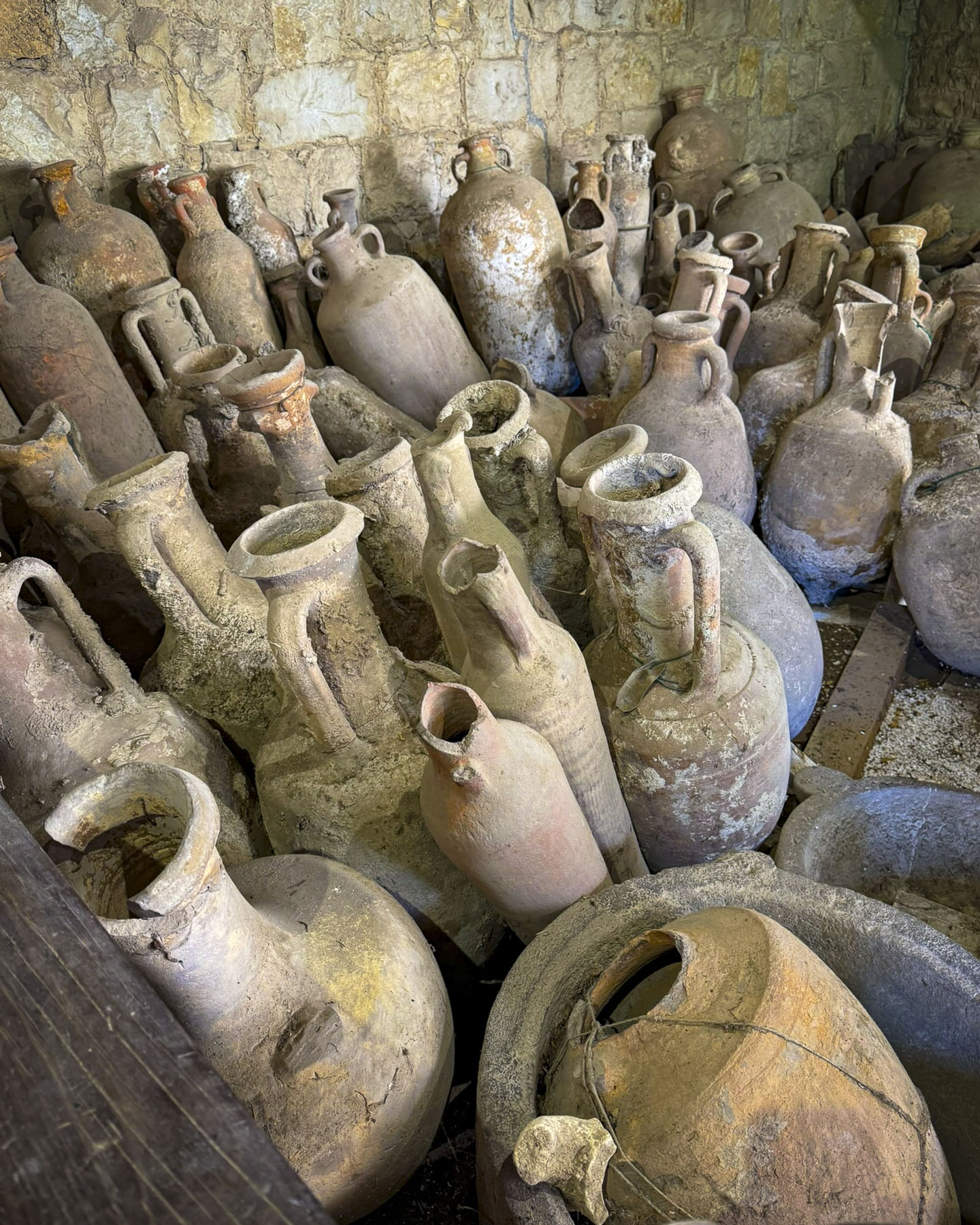
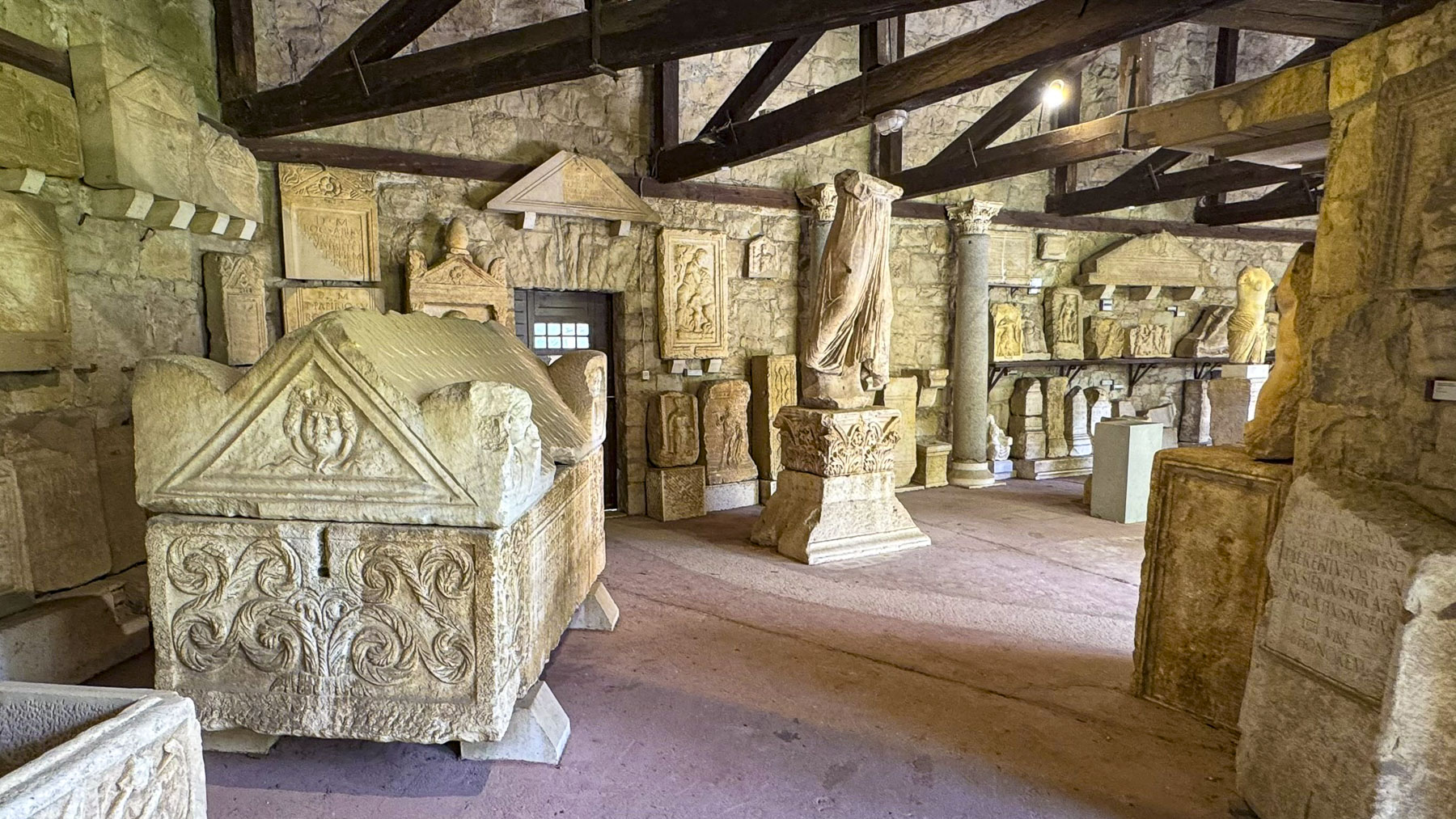
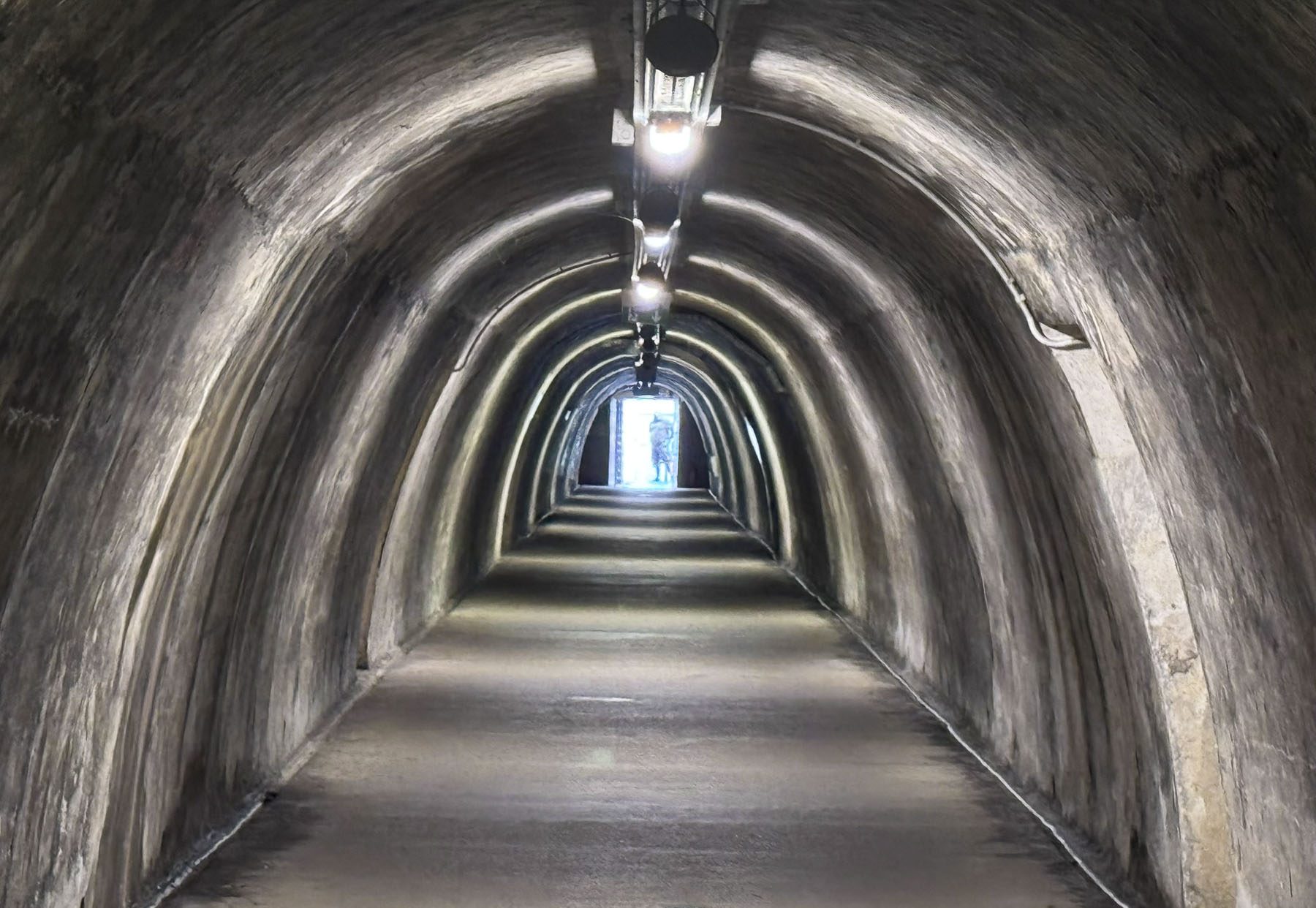
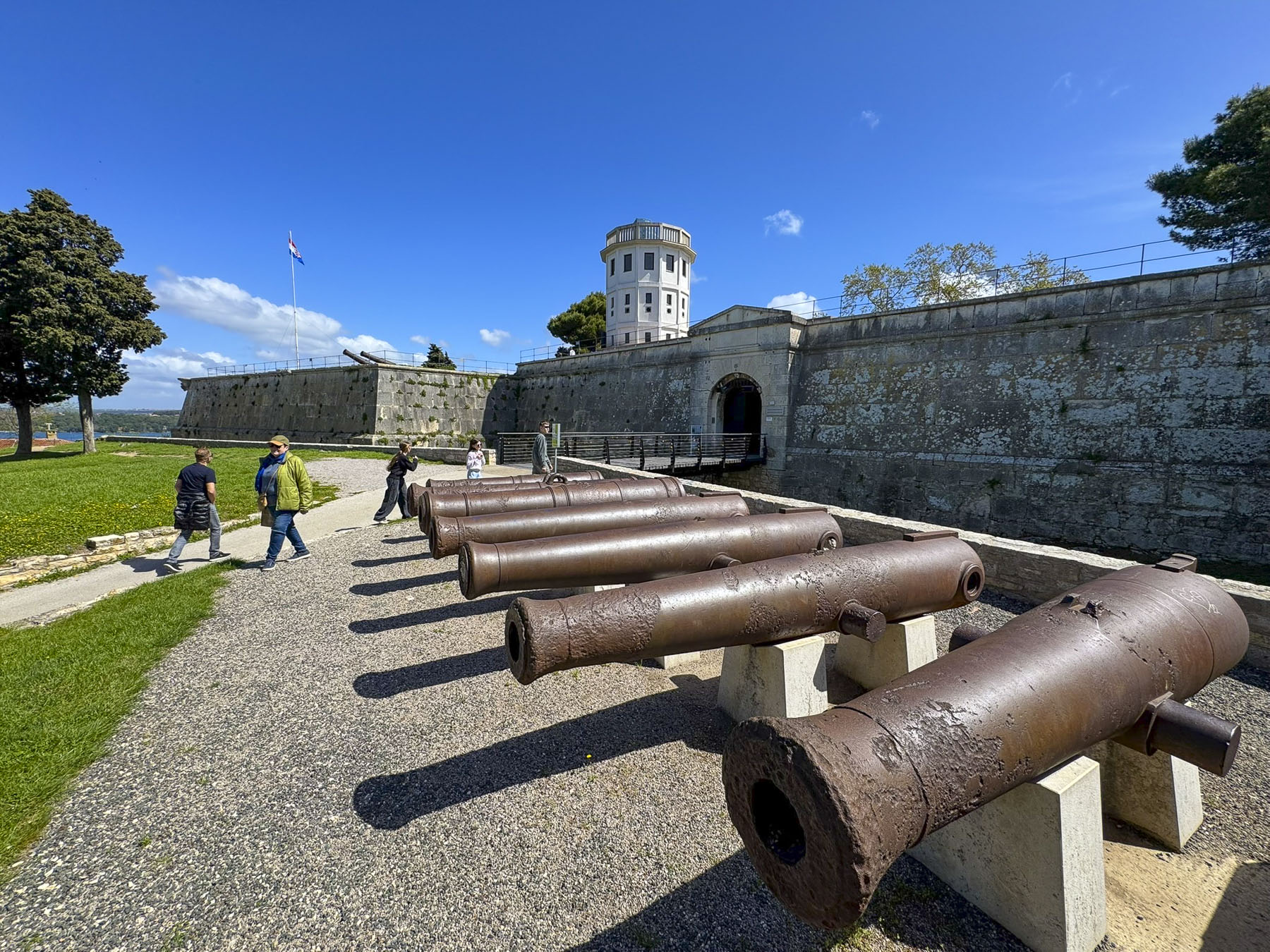
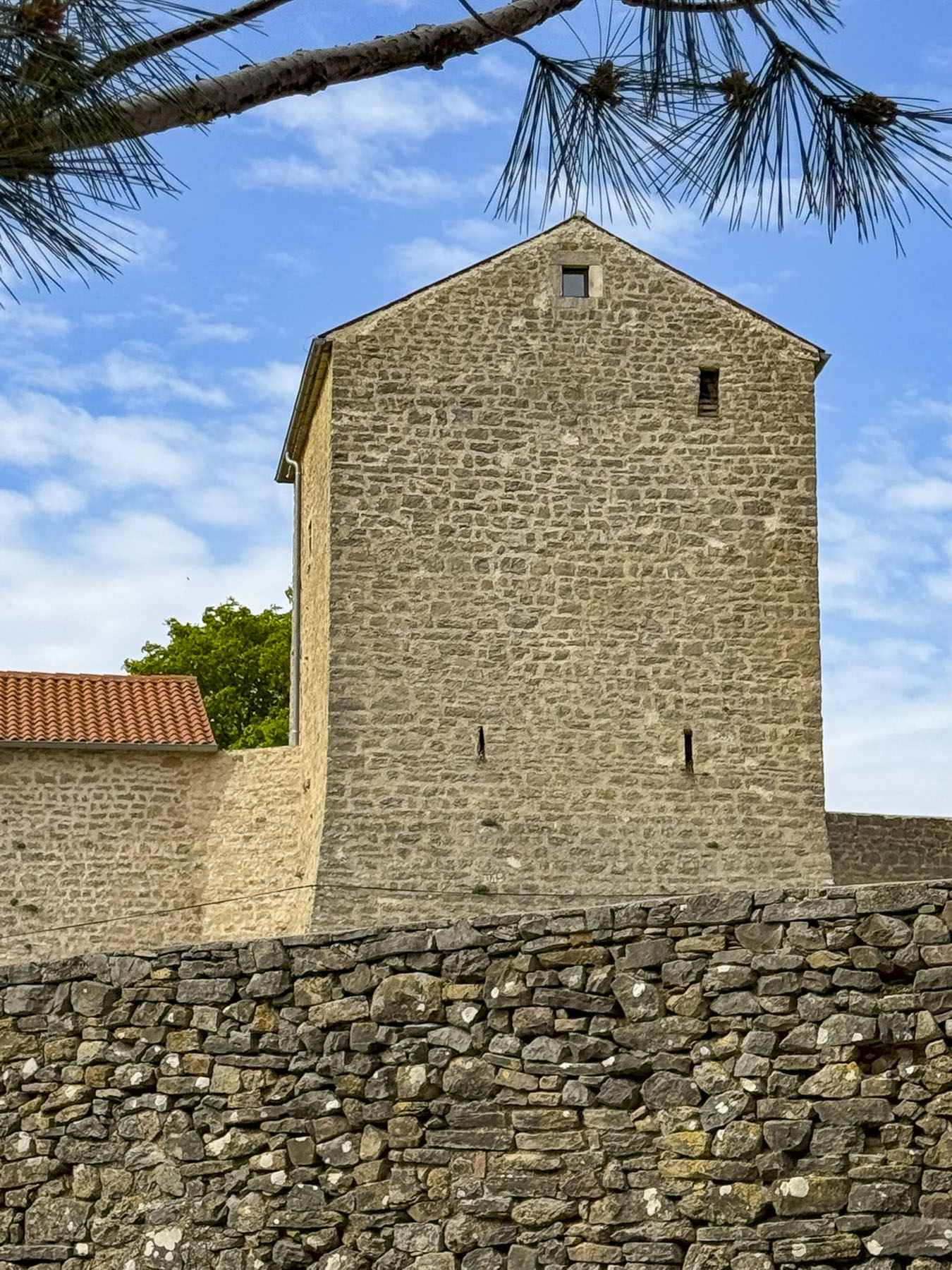
The star shaped bastion was built by the Venetian Empire in the 1500s over the ruins of an earlier Roman fortress and partially used some of the stones from the old colosseum in its construction. It has a commanding view of the harbor and the town surrounding it, and was actively used as military installation by the Austrians during WWI, who built an extensive network of tunnels under the castle known as the Zerostrasse. The tunnels were later expanded upon by the Italians during WWII, and later still, by Yugoslavia’s communist regime, to shelter 50,000 people. Unfortunately, the tunnels were closed when we visited Pula. Near the Zerostrasse’s entrance, at the bottom of the hill behind the Kaštel, there are also the ruins of a small Roman era amphitheater and museum with historical artifacts from the period. The Gate of Hercules and remnants of Pula’s ancient defensive wall are nearby.

Earlier at the Kaštel, we had noticed large idle shipping cranes in the harbor, remnants of Pula’s once important shipping industry. Now from a window in our apartment, as the night sky darkened, we could see the “Lighting Giants” as they are called, lit with colorful lights.

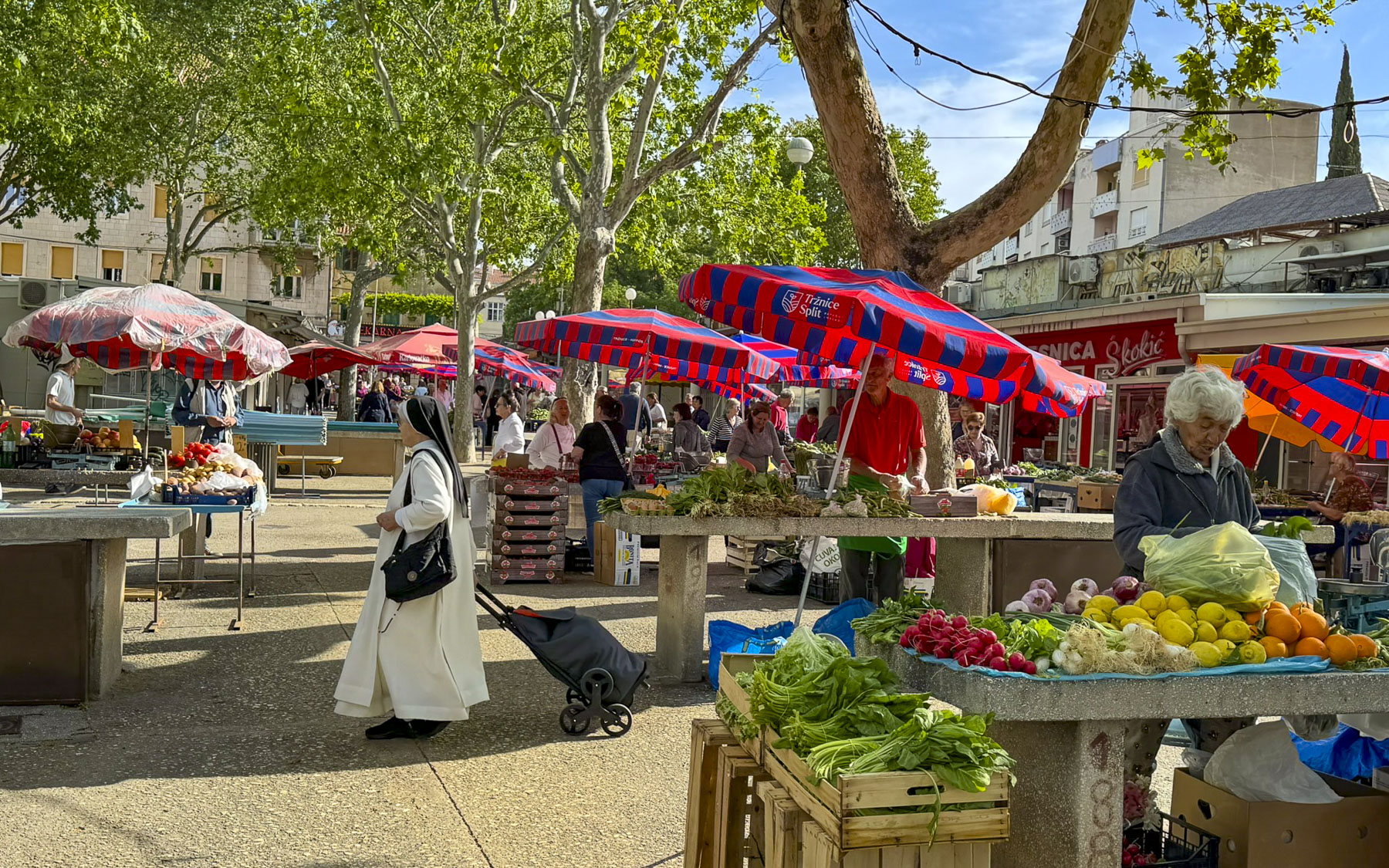
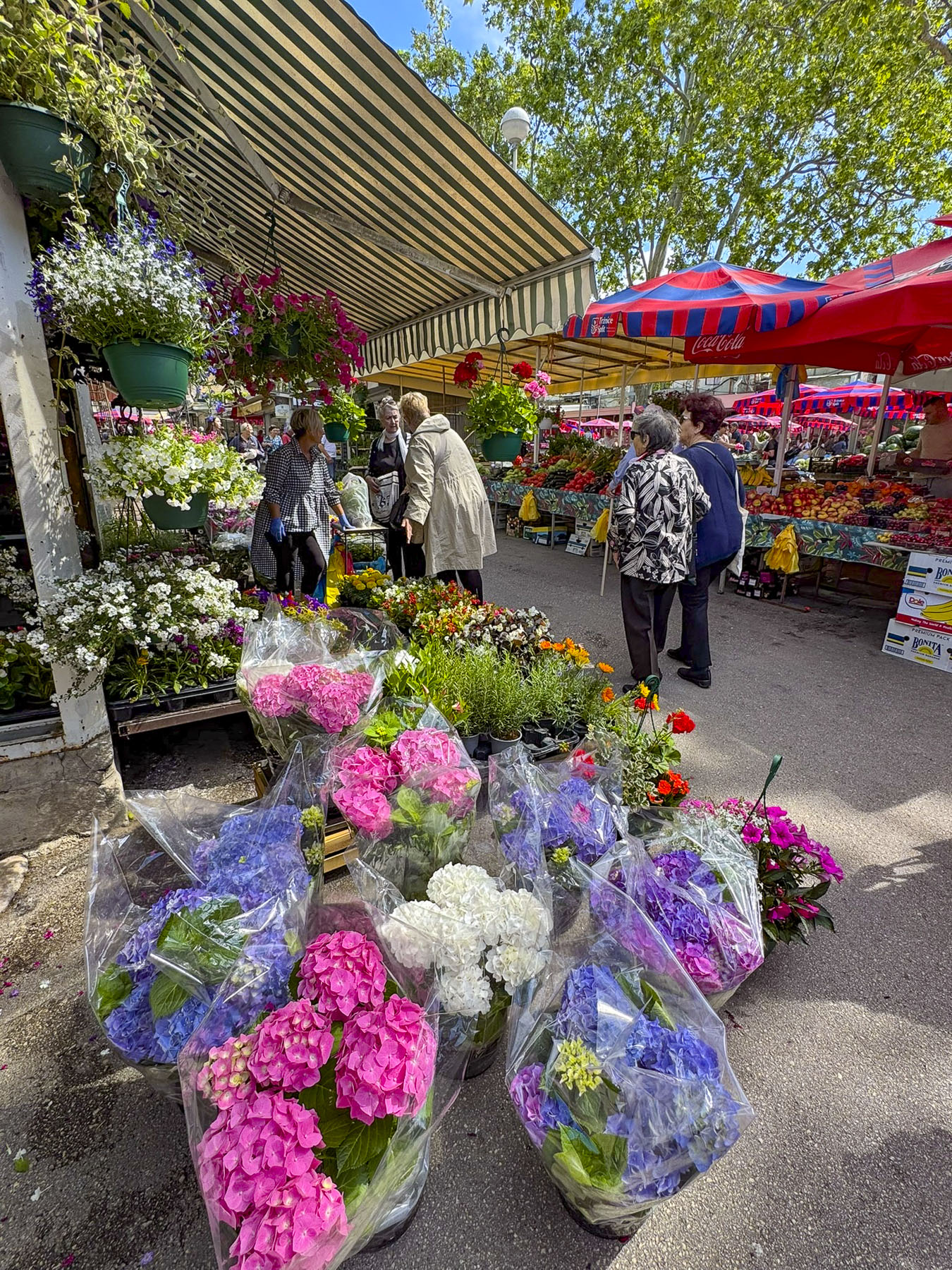
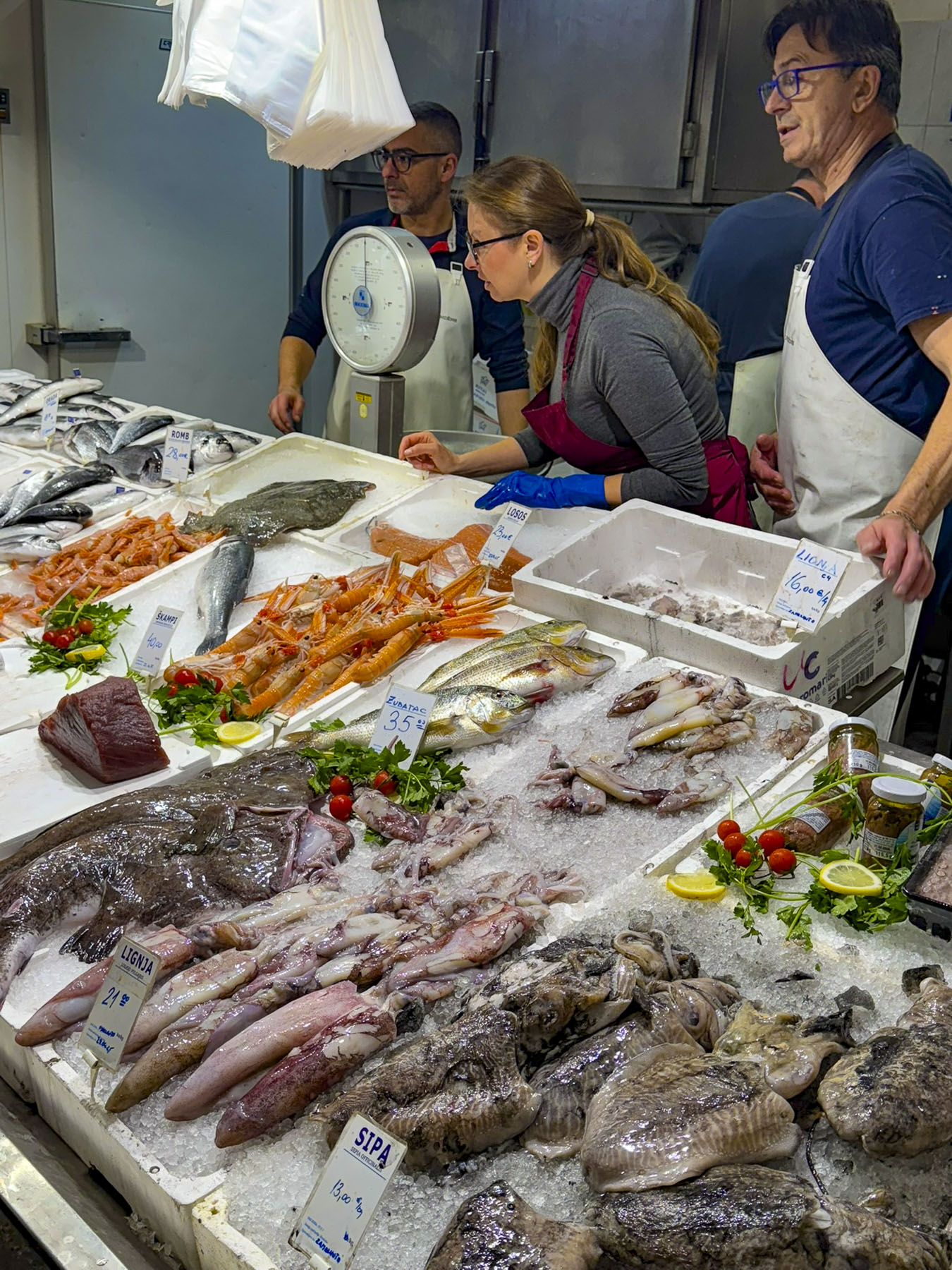
The next morning, in search of breakfast, we headed to Gradska tržnica, Pula’s traditional daily market where the seafood and meat vendors are indoors and the produce and flower sellers are setup outdoors in a shaded park. All the produce in the market looked extraordinary, and we were tempted to purchase some foodstuffs to cook later, but our apartment only had a coffee maker. Excellent pastries and coffee were found at Mlinar, an Adriatic region bakery chain, which we ended up visiting frequently during our road trip through the Balkans.

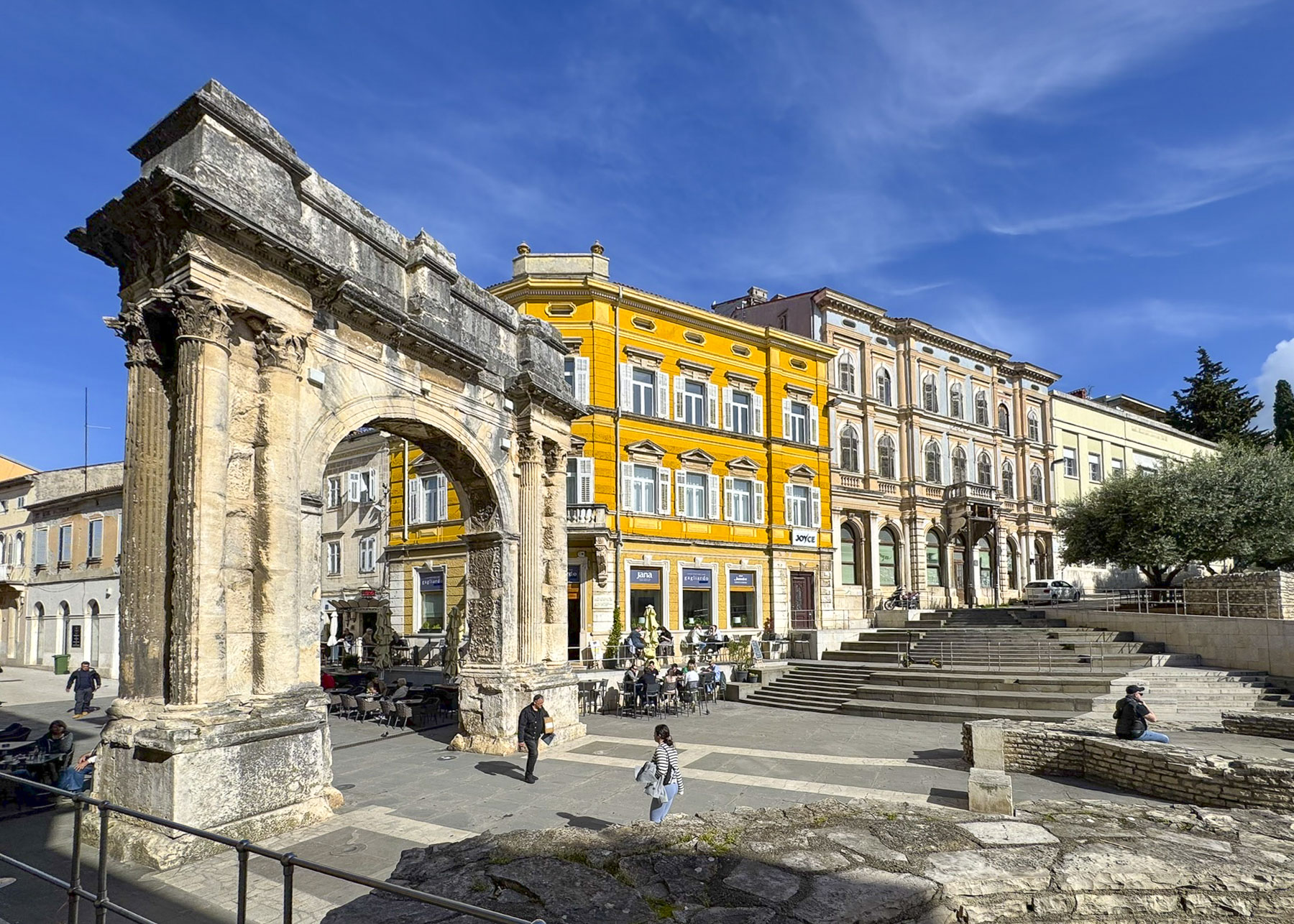
Our route took us through the Arch of the Sergii (29 BC), a Roman triumphal arch, and main gate through Pula’s defensive wall, which once stood around the city.  The ramparts were dismantled in the early 19th century, when Pula was an important naval base for the Austrian Empire, and the prosperous city needed room for expansion.    

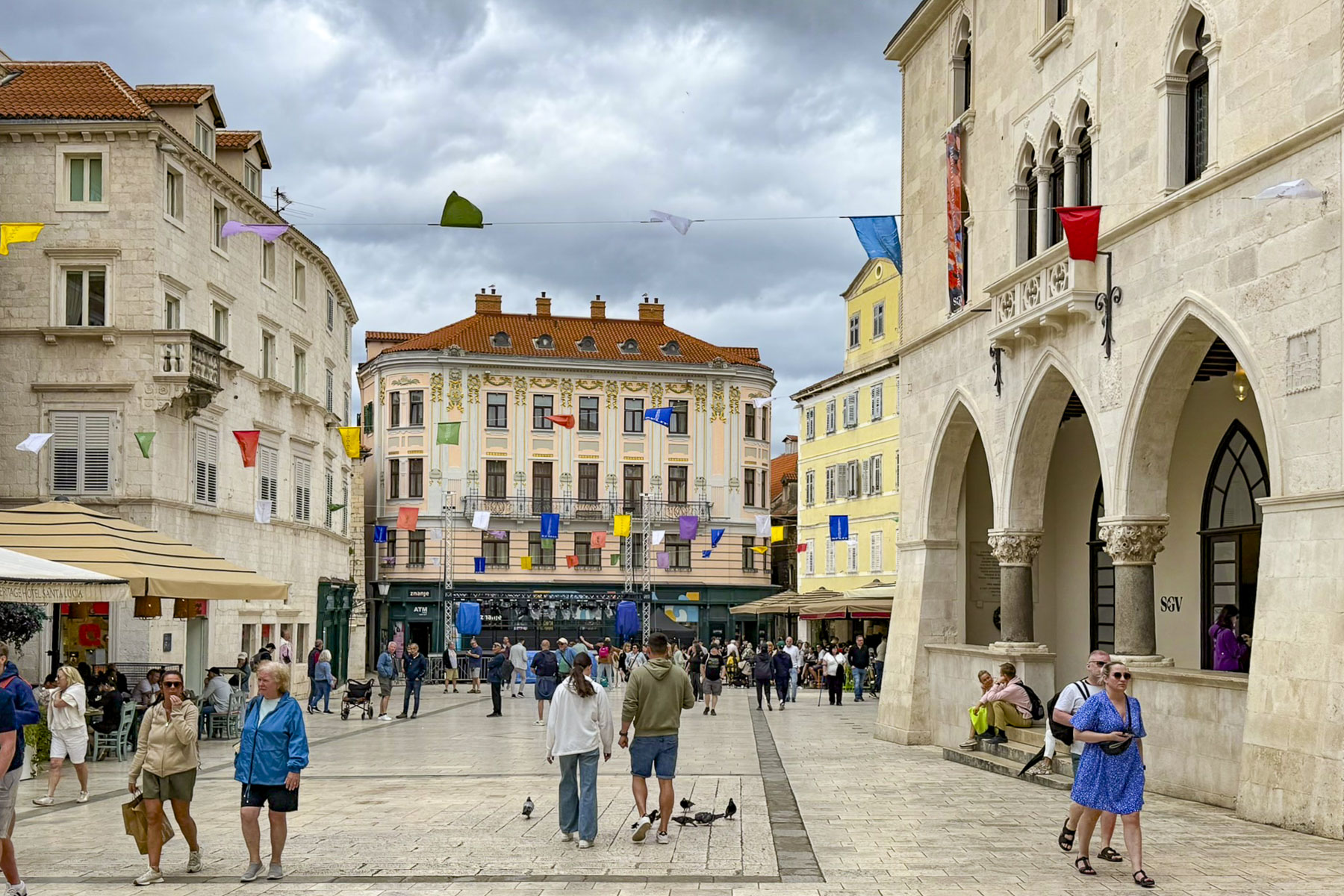
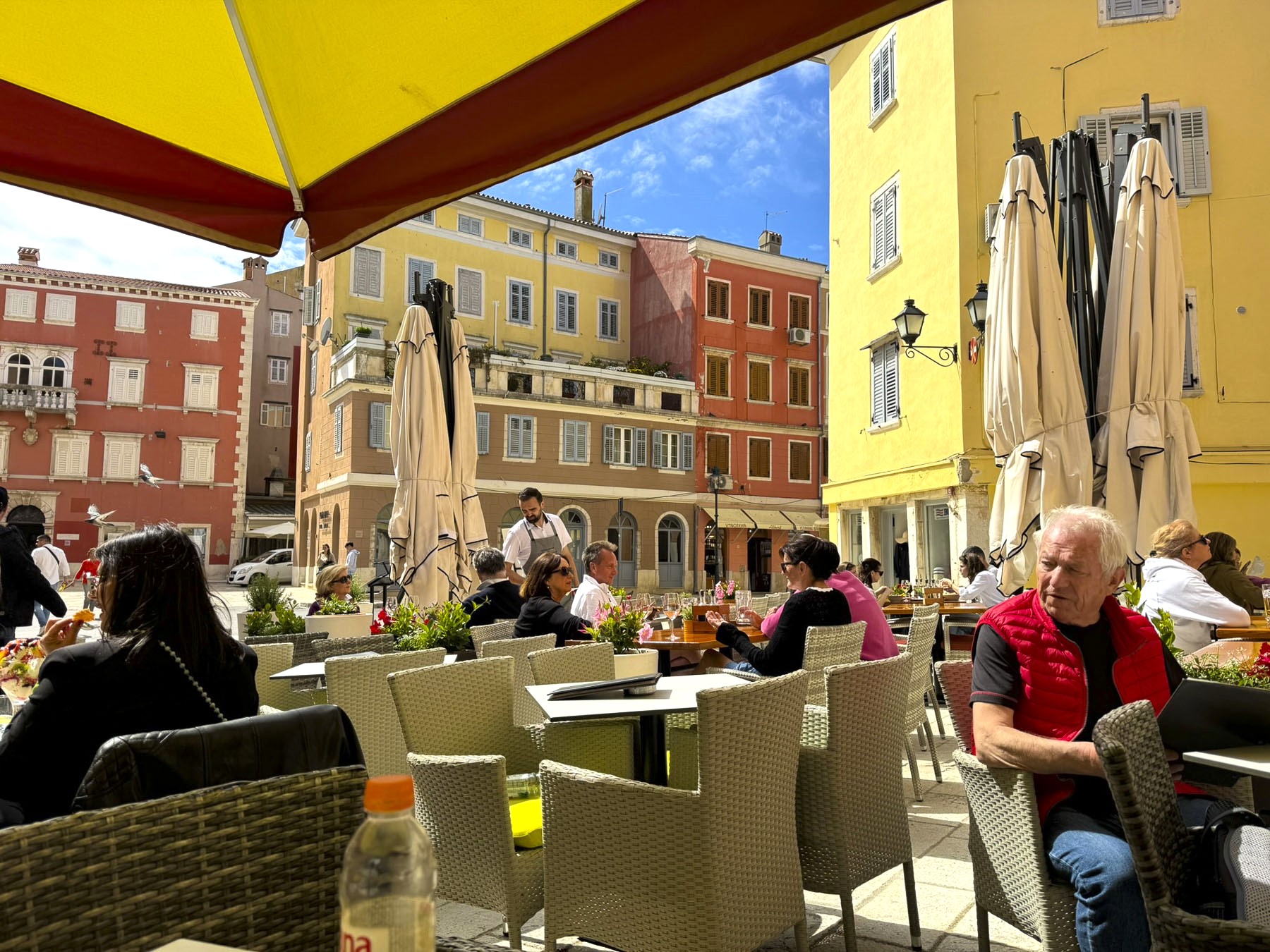
Back-tracking through the arch we walked along the pedestrian only Sergijevaca Street, Pula’s main shopping lane, to the old Roman Forum.  After 2000 plus years, the plaza is still surrounded with ancient buildings that include the 2BC Temple of Augustus, and a 13th century Communal Palace, now used as Pula’s City Hall, and remains the center of activity in this historic town. Cafés with outdoor tables lined the perimeter of the square, though the popularity of each seemed to change during the day as people sought tables in the sun to help relieve the chill of an April day. Across from a busker, folks queued up to lend an artistic hand to the painting of two large fiberglass pisanice, Easter Eggs, as part of a fund-raising event.

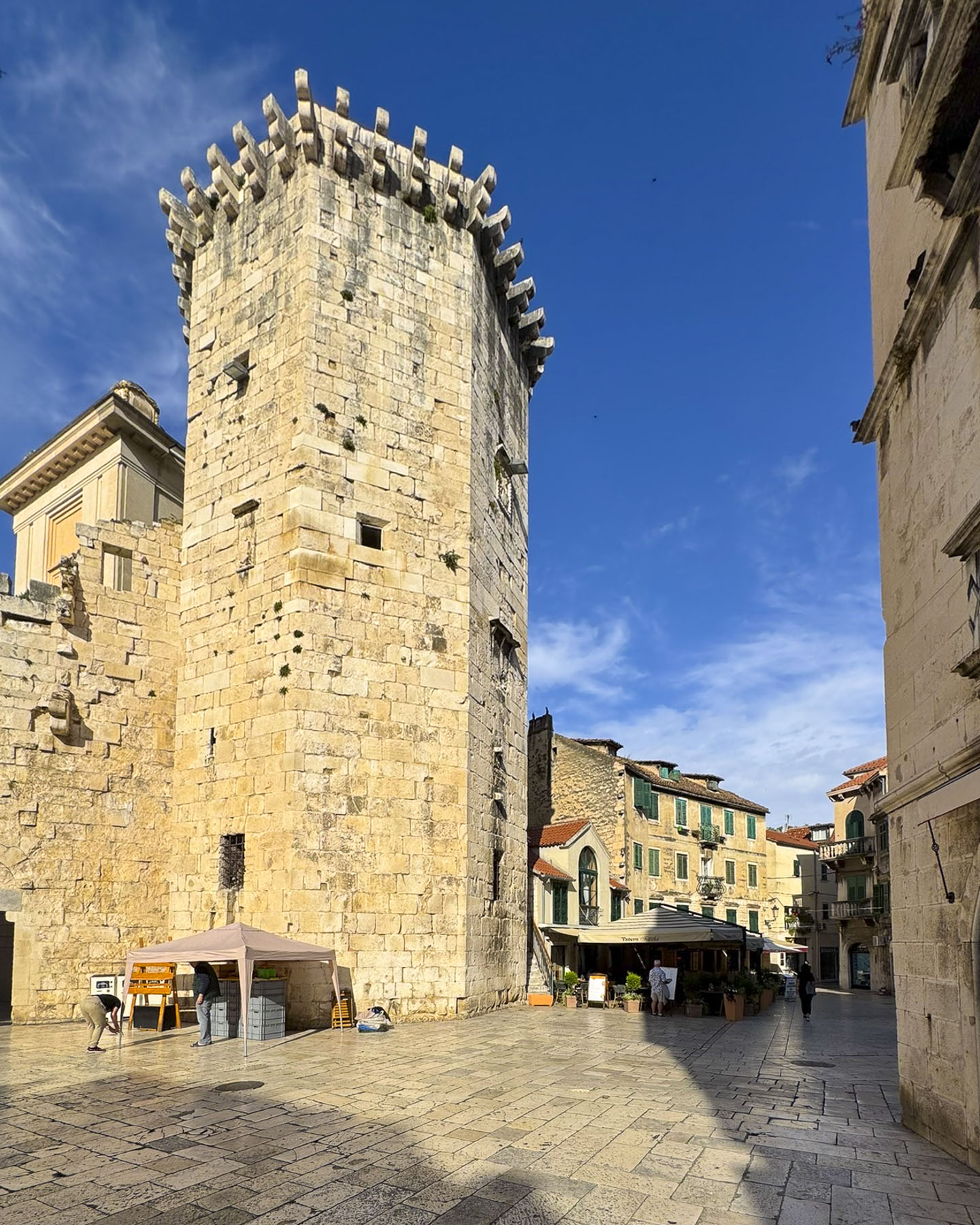
Farther along the lane, which is now called Kandlerova, curved with the base of the hill below the Kaštel, and opened into a smaller plaza in front of the Cathedral of the Assumption of the Blessed Virgin Mary, Pula’s main church. It was constructed in the 4th century over the foundation of an earlier Roman temple dedicated to the mythological god Jupiter. In the early 1700s, masons reused stones taken from the colosseum to construct the free-standing belltower in front of the church.

Next to the church was Park Jurja Dobrile, a quaint patch of greenery across from the promenade that stretches along the harbor.

It was very easy to enjoy Pula’s sites in a day and a half, so the next morning we set out for a day trip to Rovinj, less than an hour away. Olive groves and farmland graced our route through the verdant Istrian countryside.

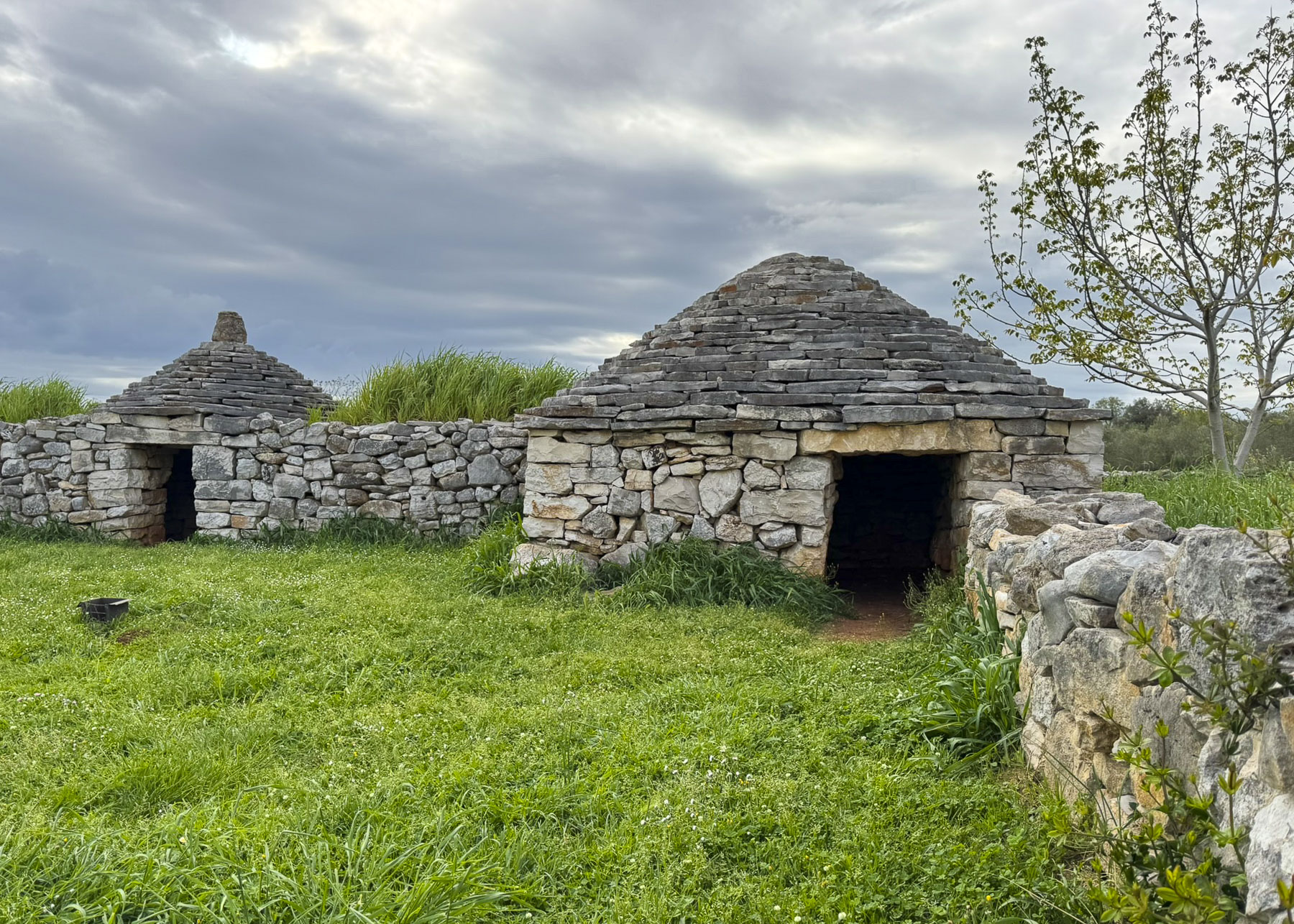
In the fields just beyond Vodnjan we noticed small round stone structures with conical roofs called Kažun. They were very similar to the Trulli we saw several years ago in the Puglia region of southern Italy. Though they share the dry-stone construction technique used to build the Trulli, the Kažun in the Istrian region are much smaller, and were mainly used to store crops, keep animals, and provide temporary shelter for farmers.

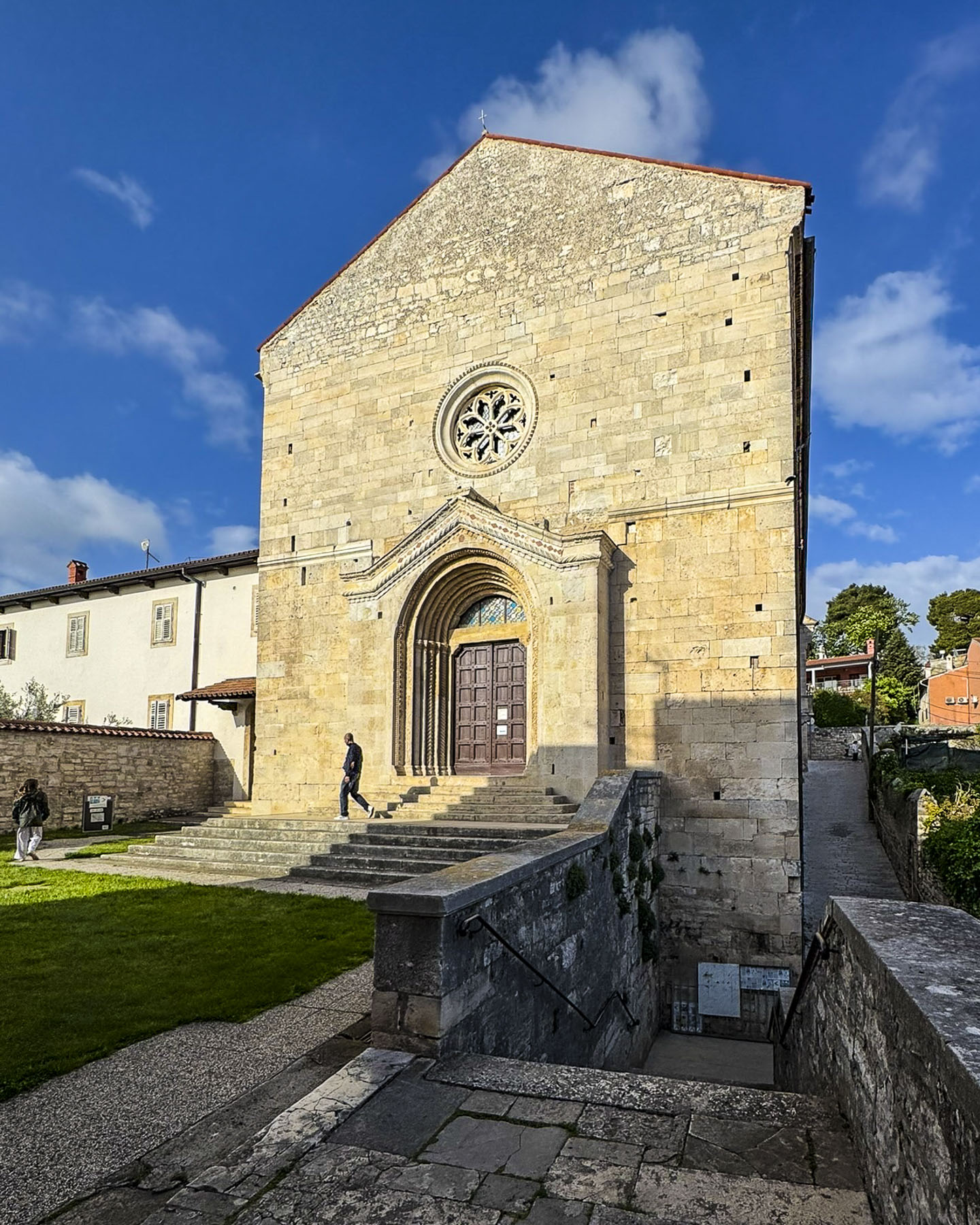
Like Pula, parking in Rovinj was limited and the large municipal lot, on the quay nearest to the old town, filled up quickly, even during the shoulder season. Fortunately, we found a parking lot on Vijenac braće Lorenzetto, a little farther away.  From there it was a steep uphill walk until we reached Crkva sv. Franje, the Church of St. Francis, and its Franciscan Monastery which date from the early 1700s.

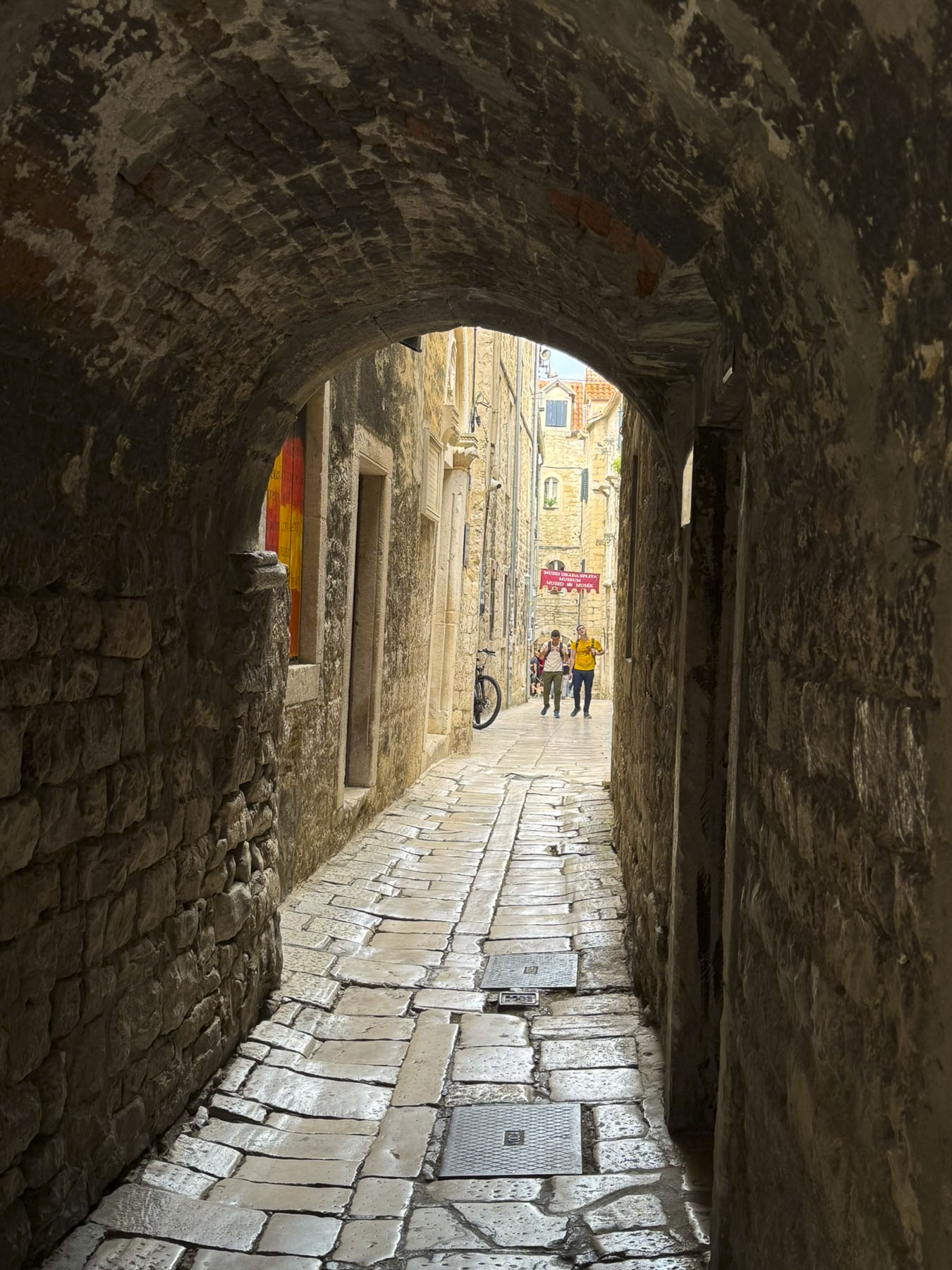
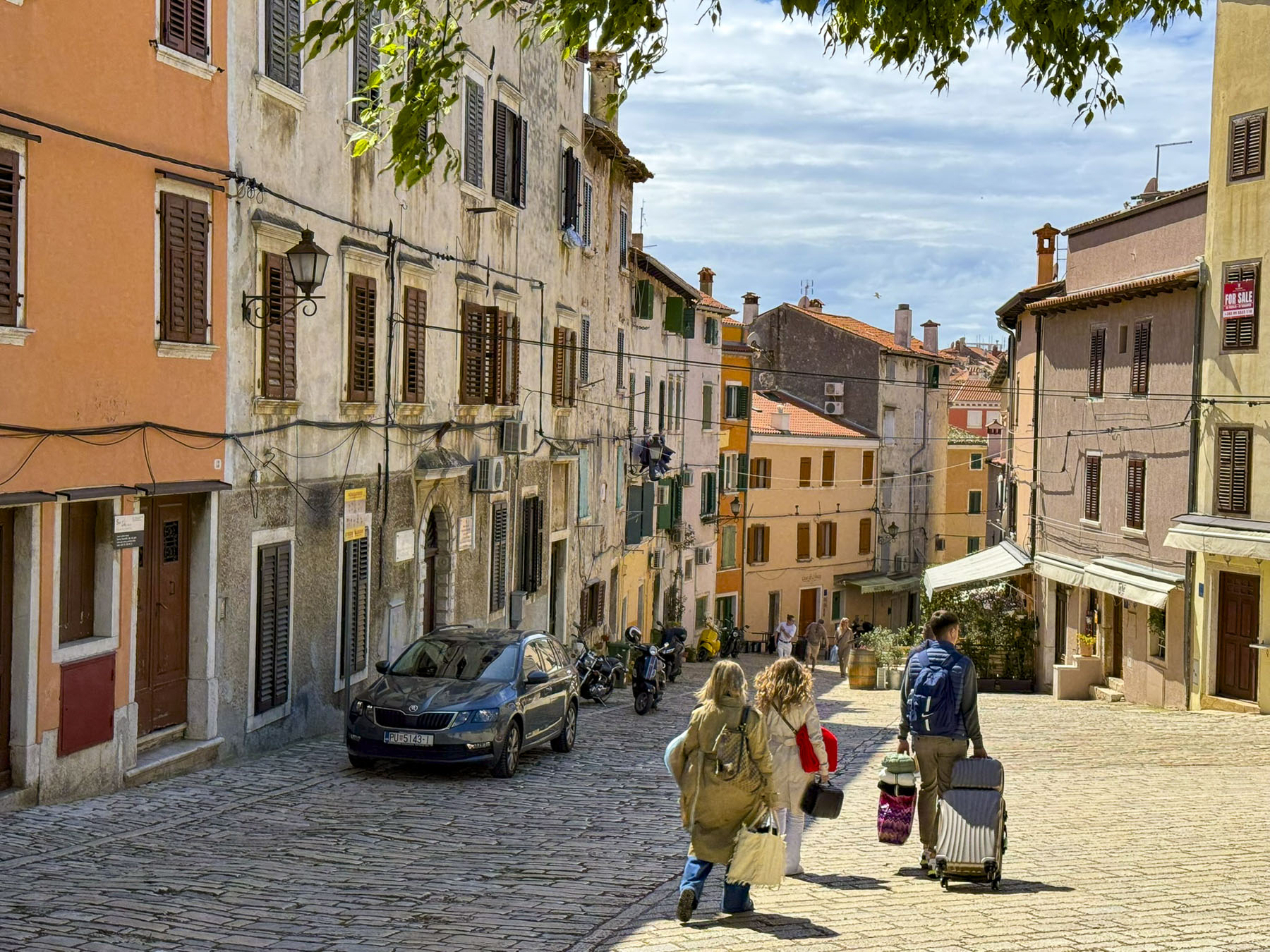
The rattling of suitcases pulled across ancient cobblestones by vacationers heading to their hotels accompanied us downhill. Surely an annoying sound, and we wondered if it was any better or worse than the hoofs of donkeys or horses, and wagon wheels clattering across the stones centuries ago.

This lane from the church passed several restaurants, but the wonderful aroma originating from Fish House Rovinj encouraged us to stop for lunch. It’s a tiny no frills seafood bar with limited seating on bar stools inside and along the wall outside. All the fish is locally sourced and purchased fresh every morning at the docks. We tried fried calamari, grilled shrimps and fish tacos. Every dish was delicious. Their staff were very nice, and the menu was extremely budget friendly considering Rovinj is a top tourist destination. The place should definitely be considered a destination spot when visiting Rovinj.

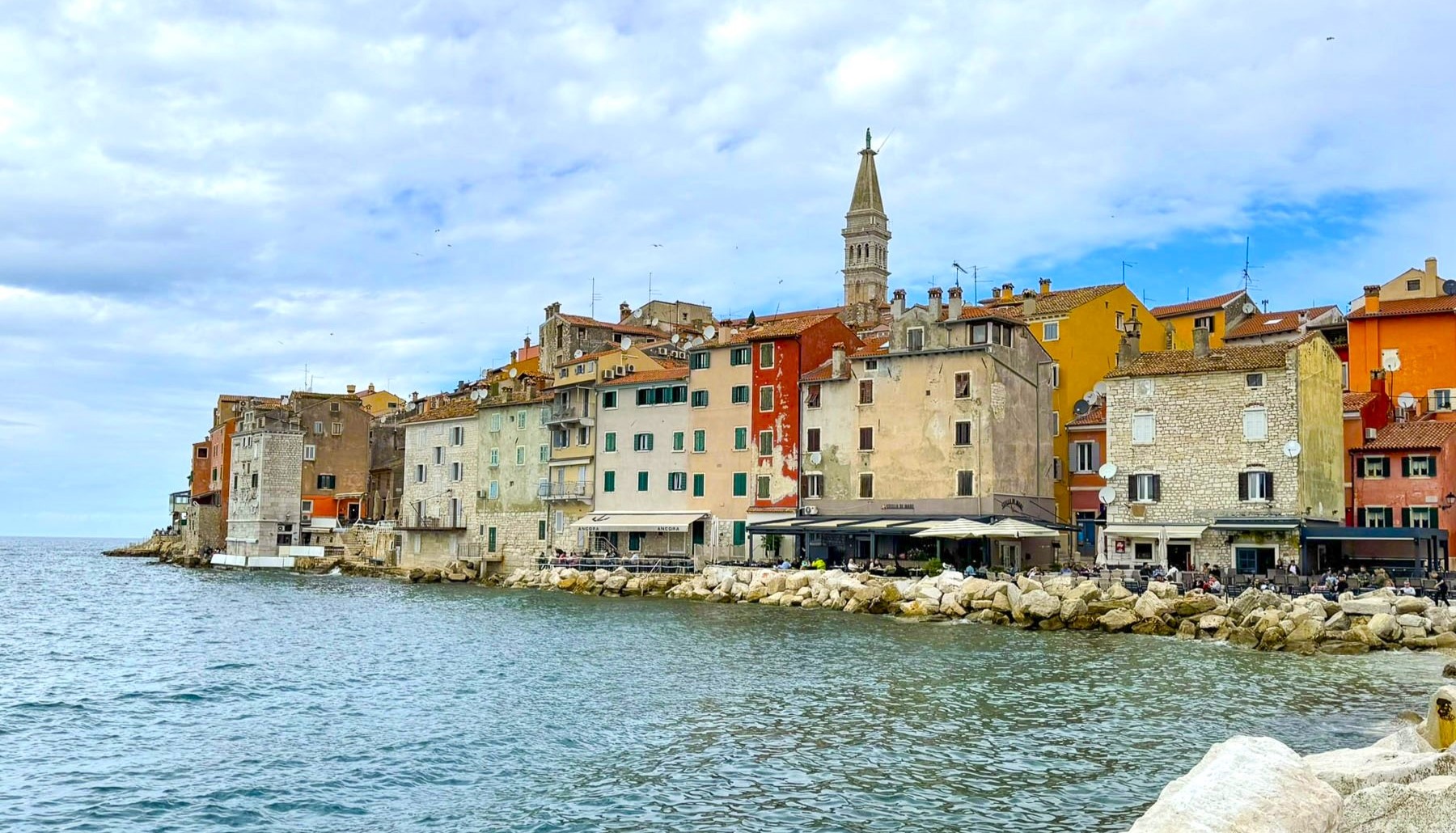
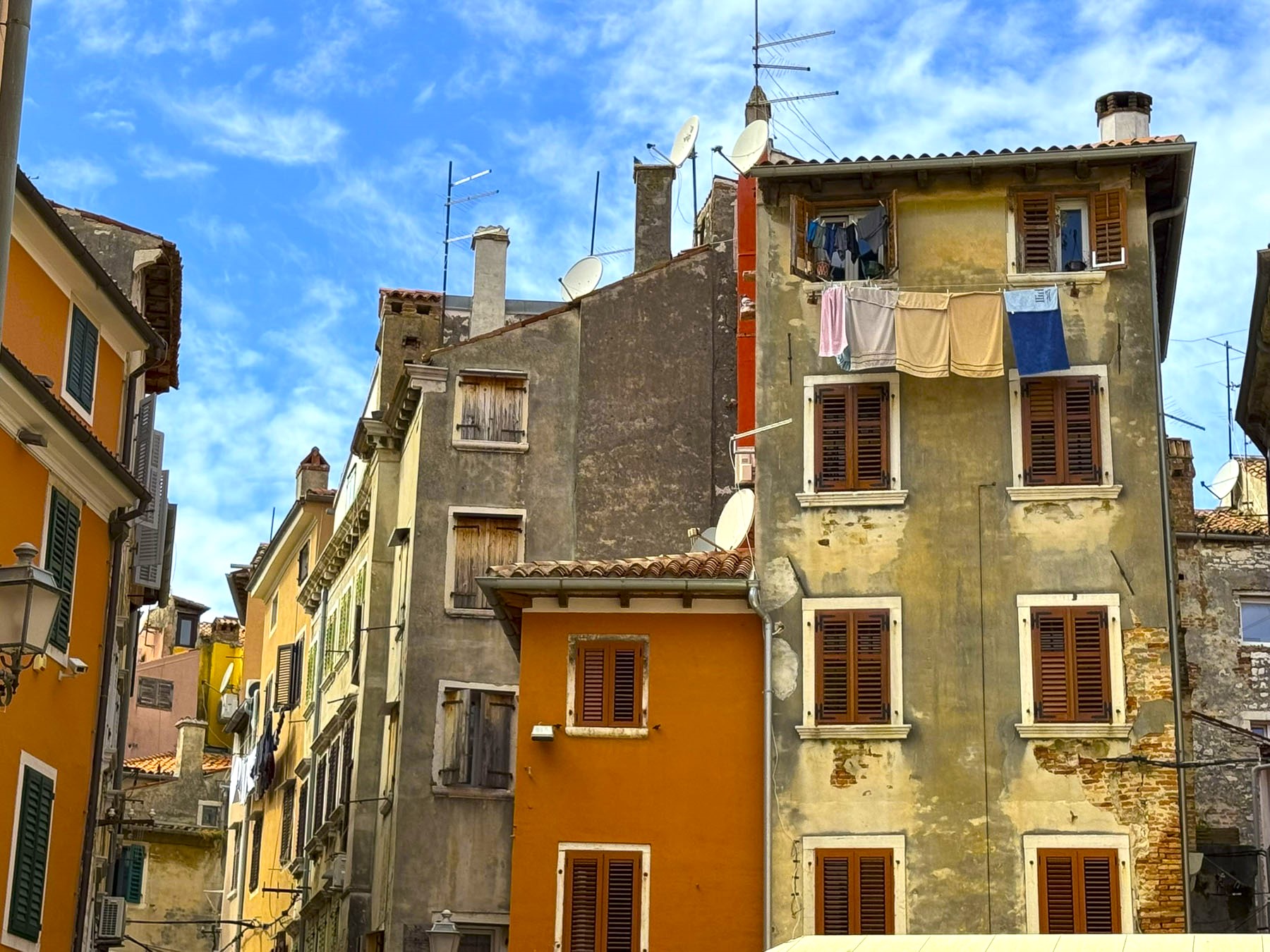
The attraction of Rovinj is its beautiful location on a small headland, that juts out into the northern Adriatic Sea, every square foot of which is covered with picturesque buildings which cascade down to the water’s very edge. The iconic picture of this 16th century merchant and fishing town is taken from the sea and captures the town, centered with the belltower of St. Euphemia’s Church at its apex, as if it was an island floating effortlessly on a horizon that seamlessly merges the sea and sky. The town was in fact an island until it the channel separating it from the mainland was filled in 1763, when the town was part of the Austrian Empire.

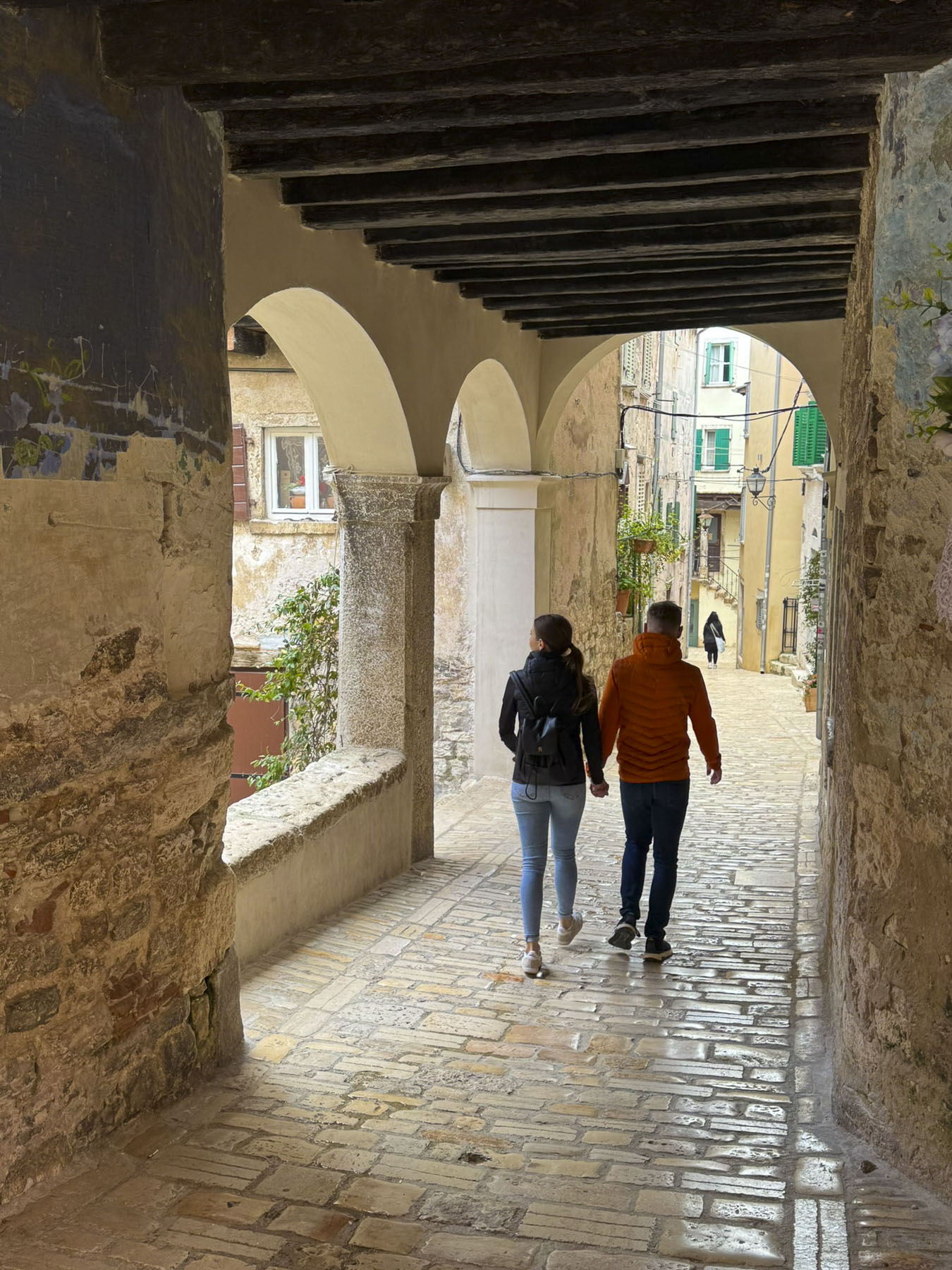
We had hoped to take our own pictures of the town from the sea, but the weather we felt was too cloudy to justify the expense of the boat trip. We contented ourselves instead with wandering along the harbor front before entering the old town through Balbi’s Arch, an old  Venetian gate, to the once walled citadel, before following the twisting stone lanes up to St. Euphemia’s Church.

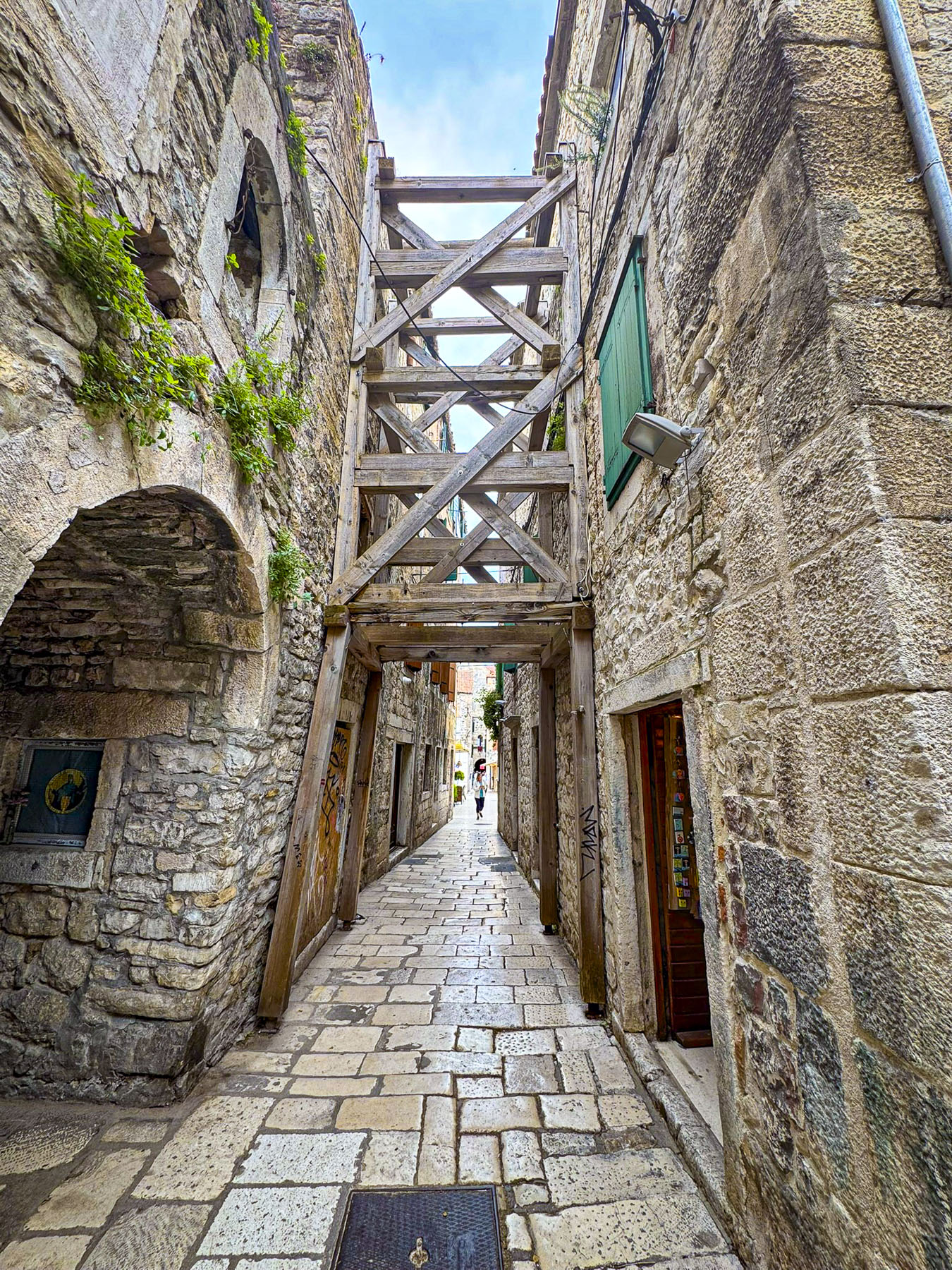
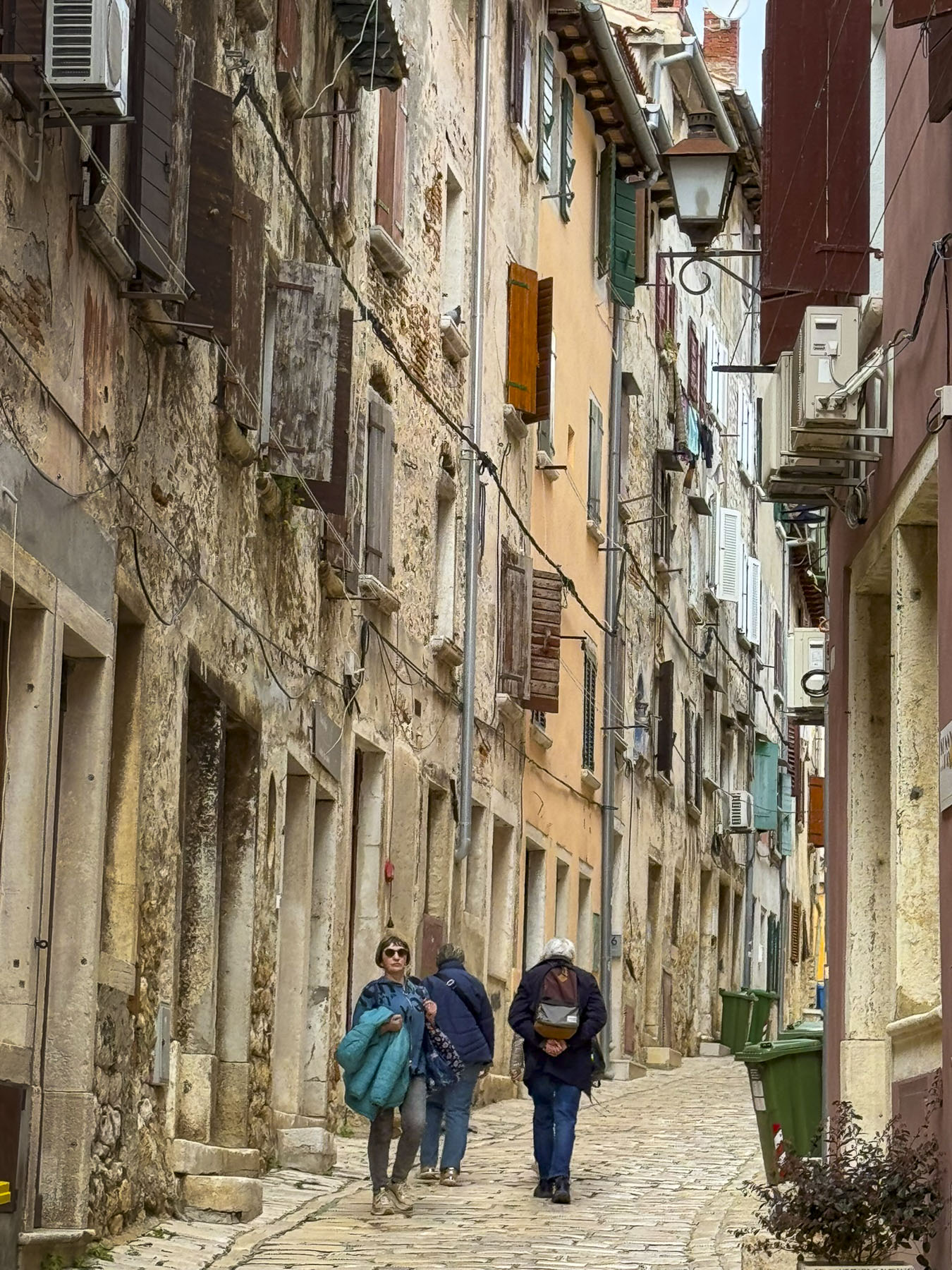
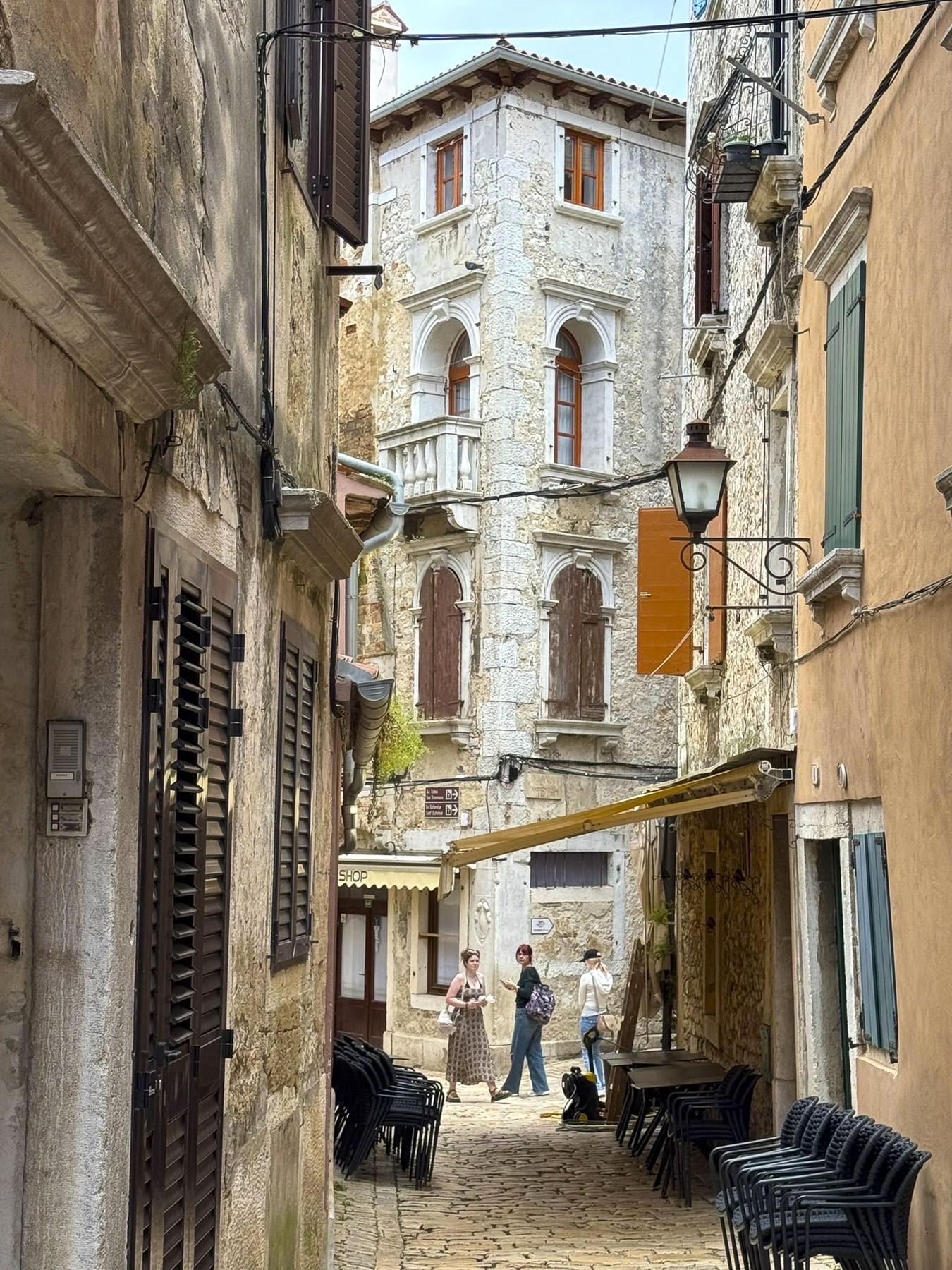
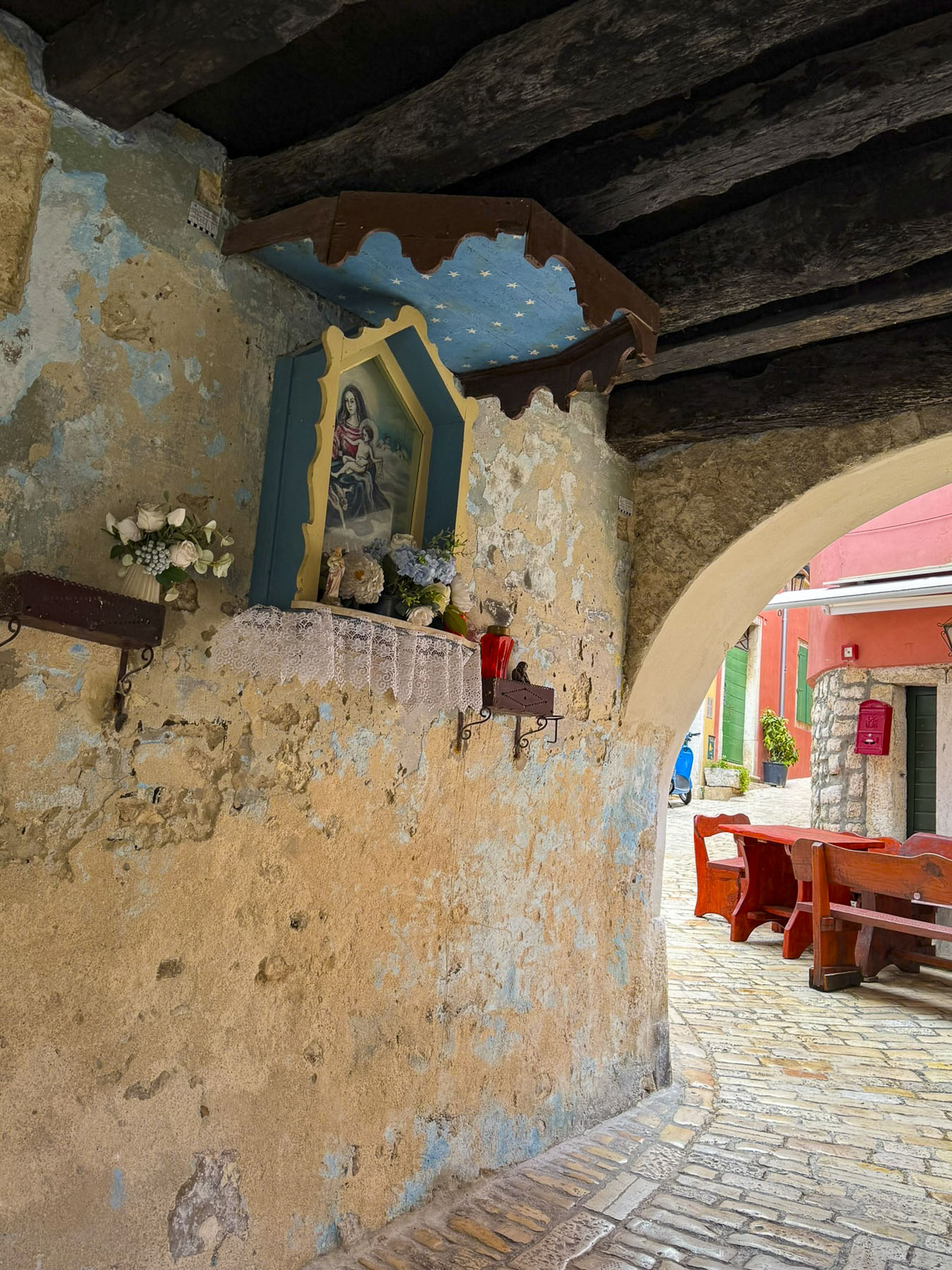
The old town was charming, and while many of the alleys have been gentrified with upscale shops and lodging above them, several retain a rawness, similar to the historic quarter in Naples, Italy.

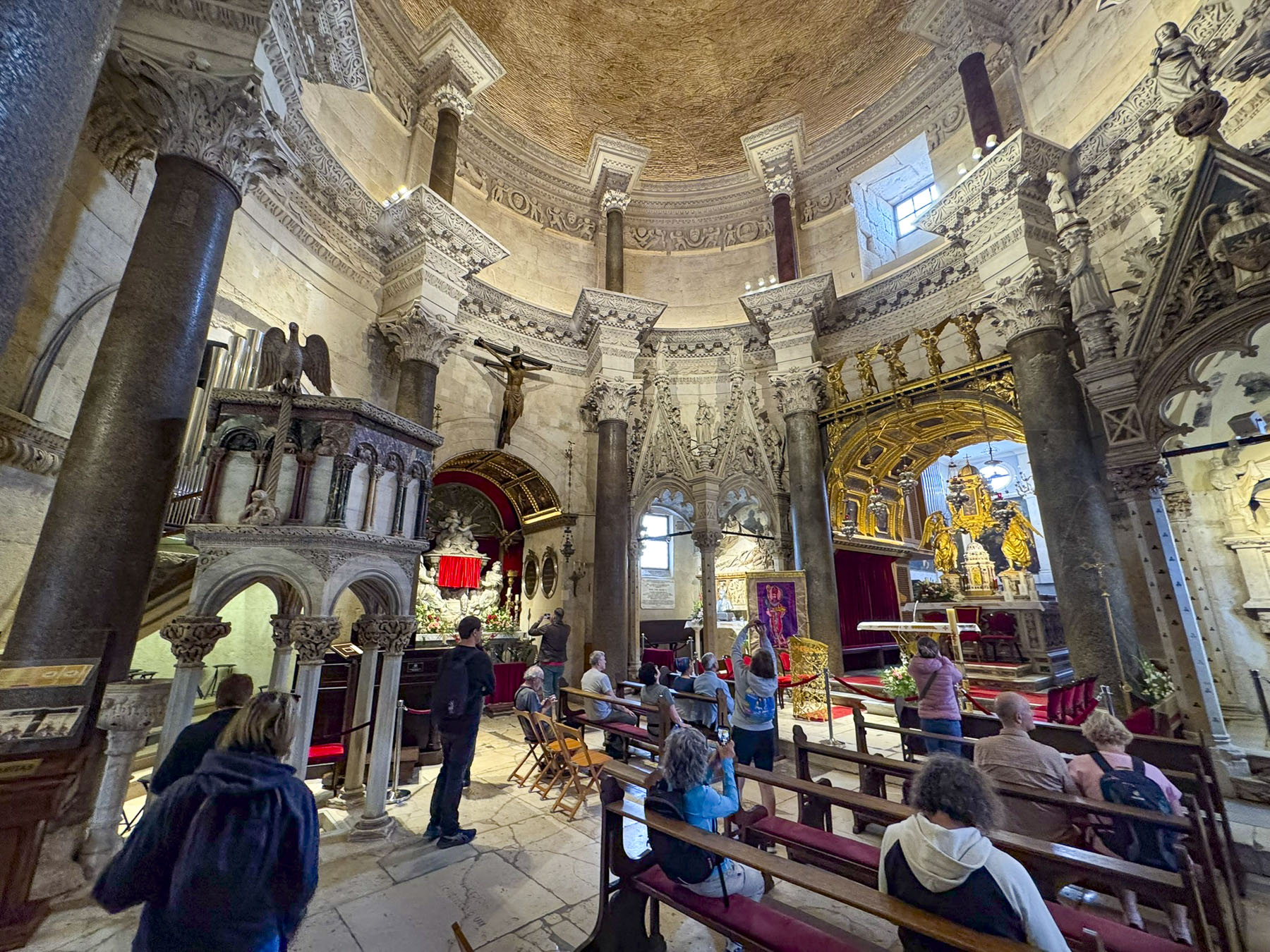
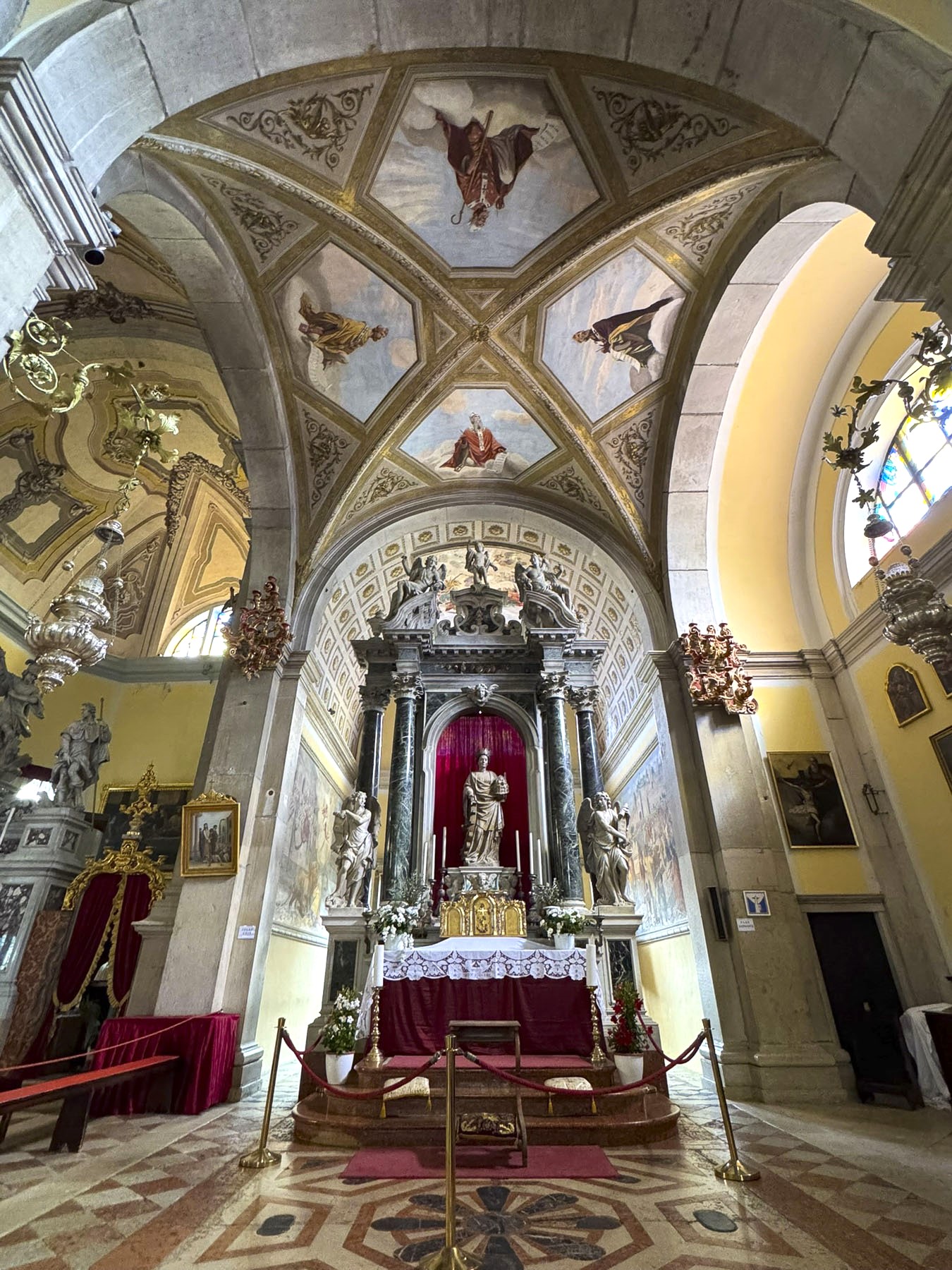
The lanes to the top of the hill twisted and rose before ending at a large plaza in front of the church. This church was constructed in the mid-1700s, to accommodate the growing city, over the foundation of a small church dedicated to St. George which was built in the mid-300s when the region adopted Christianity.

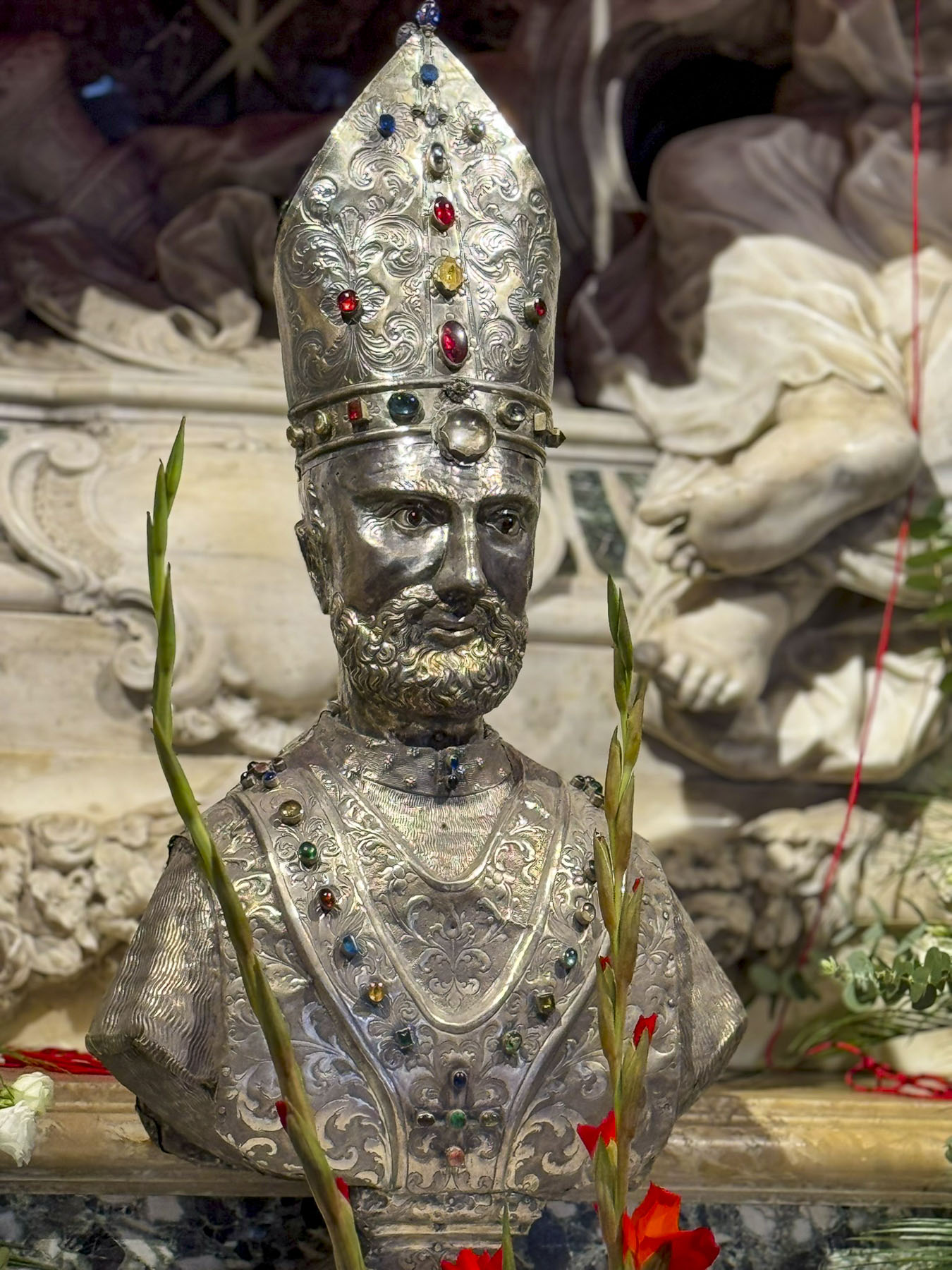
But part of the reason for the new church was to honor the miracle of St. Euphemia, a 4th century martyr, executed by the Eastern Roman Empire in Constantinople, before the empire adopted Christianity. The legend of St. Euphemia’s sarcophagus arrival to Rovinji  begins during the 700s Iconoclast heresy, when Emperor Constantine V, ordered her relics thrown into the sea. One hundred years later “fishers early one morning discovered a marble sarcophagus which had floated ashore like a stone ship. The townsfolk enlisted their strongest men, horses and oxen attempted  to pull the tomb off the beach, but to no avail.  

Miraculously, the saint presented herself to the crowd and singled out a small boy and said, “I am Euphemia of Chalcedon and I have engaged Jesus by blood. You will pull the stone ark with your body to the church at the top of the hill.” Awed, the crowd parted and watched the child pull the amazing weight of the tomb uphill. There priests slid off the tomb’s top and revealed the motionless body of a beautiful 14 year old girl. Next to her was a scroll of parchment paper with these words written on it: Hoc est corpus Euphemiae Sancte. “This is the body of Saint Euphemia.” Saint Euphemia is now the patron saint of Rovinj and her feast day is celebrated every September 16th, the day her sarcophagus floated ashore.

We had great experiences in Pula and Rovinj, and enjoyed learning about their fascinating history and legends.

Till next time,

Craig & Donna
Zadar: The First Stop on Our Balkans Road Trip Through Croatia, Slovenia, & Bosnia and Herzegovina
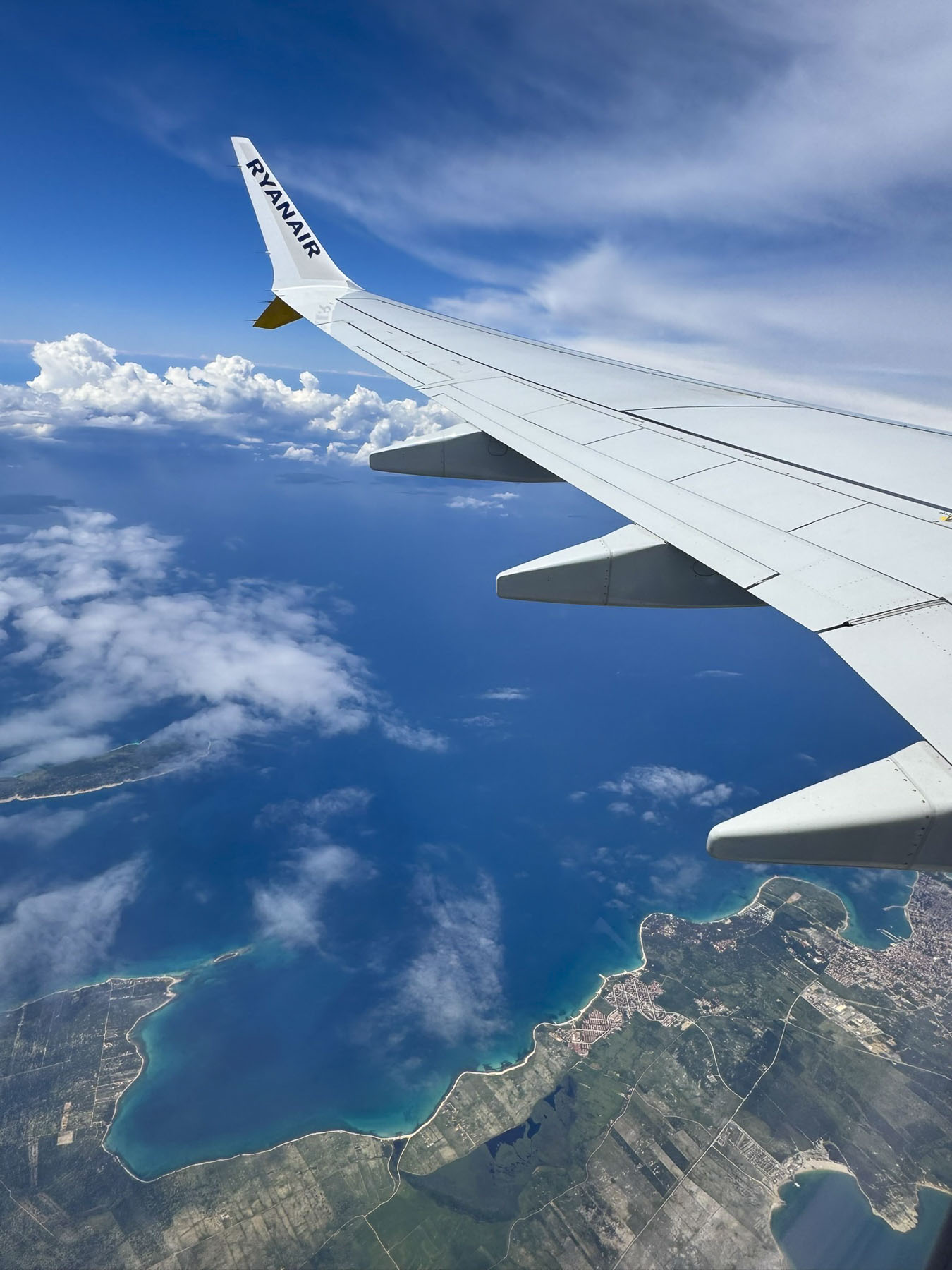
Peering down at the shimmering cobalt and turquoise blue water of the Adriatic Sea relieved the previous day’s anxiety of nearly missed connections. We encountered a long delay at passport control in Paris, before catching our connecting early morning flight to Zadar.
This temporary reprieve was short lived though, as we were confronted with a shuttered rental car window at the Sicily By Car booth, directly across from the small Zadar terminal. It was a Sunday morning – maybe the service at church ran long, or the coffee and pastries at the café were particularly delicious; nevertheless, the other passengers on our early morning flight who had rented with other agencies were long gone. At the terminal’s outdoor café we sipped coffee, waited, and discussed whether or not to cancel our existing reservation.  An hour passed before a car parked behind the booth, and the shuttered window was noisily cranked open. A pleasant young woman greeted us, and the morning’s delay was forgotten. Years ago, we began the habit of asking attendants at the rental car counters for suggestions to non-touristy places to eat. It appears it’s an unusual request from a customer, but folks seem pleased that we sincerely ask for their opinion. “Let me think on that, and by the time paperwork is done and I show you the car, my colleague and I will have some ideas for you.” With the names of three restaurants and a patisserie, “you should definitely try,” we headed off to see waterfalls at Skradinski Buk National Park in a nearly new small SUV, an upgrade from what we had reserved. The park was our first stop on our three-week long Croatian road trip, before our late afternoon check-in at an apartment rental in old town Zadar later.

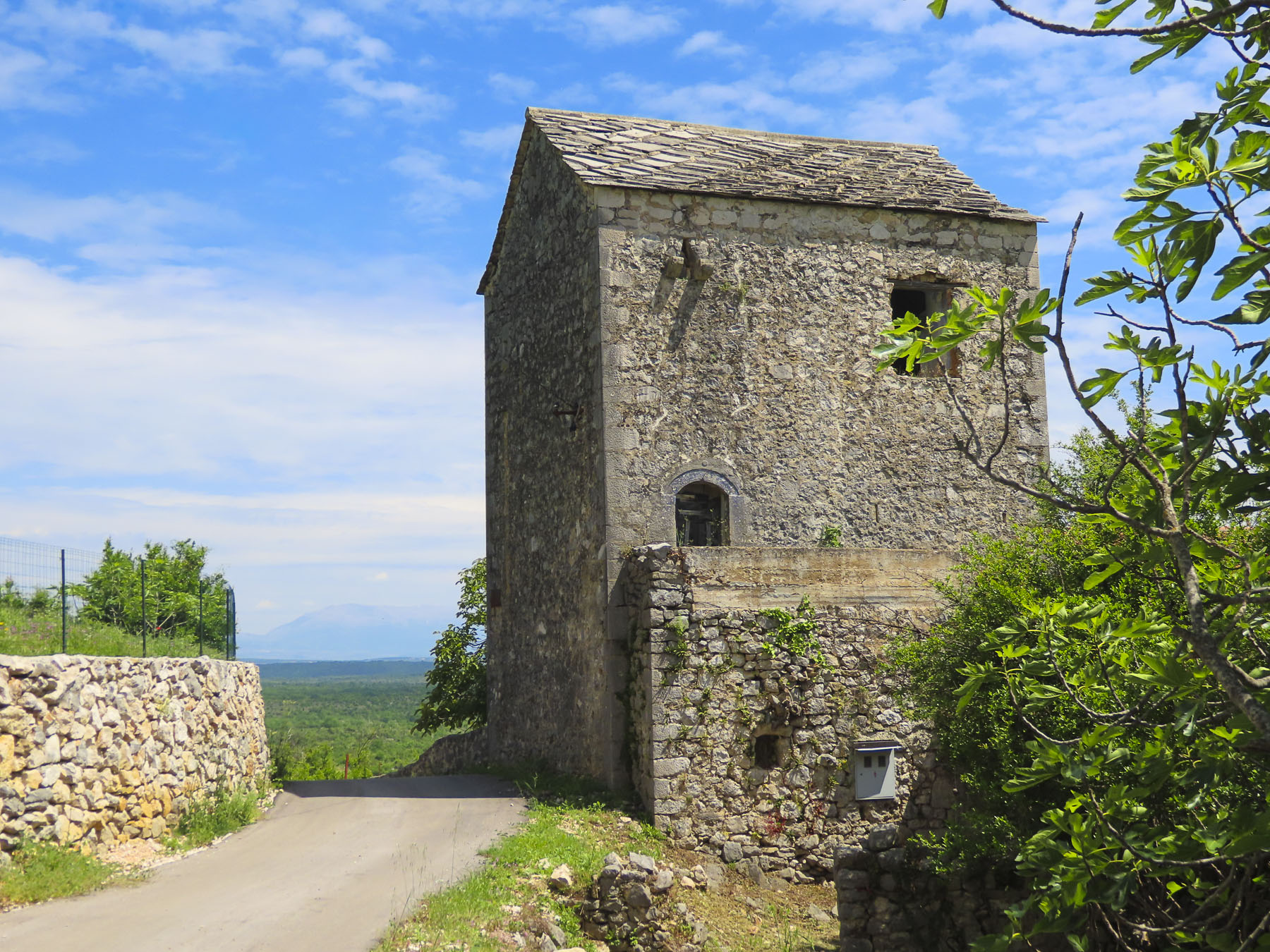
The sunny April morning was now overcast as we drove into the small village of Benković to see its hilltop castle, and indulge our “drive a little, then café,” philosophy. Unfortunately, the castle was closed and the town seemed deserted in the pre-tourist season. Down the lane from the castle fig trees were setting their fruit and the first flowers of Spring were blooming. The café remained an unfulfilled desire.

We love traveling during the shoulder seasons to avoid the crowds of summer. But one of the drawbacks is fewer, if any, restaurants/cafes are open, especially in the more rural areas.

The drive to the park along Rt56 was semi-desolate, but pretty in an austere way, and passed through Croatia’s garigue shrublands, olive groves, and pine forests. From the road as we drove past Skradin, we could see large charter yachts at their winter moorings on the Krka River, two miles from the sea, sheltering there from fierce Adriatic storms, as they waited for the warmer cruising season to start.  Across the river the road zigged and zagged up the mountainside before leveling off on a high plateau.

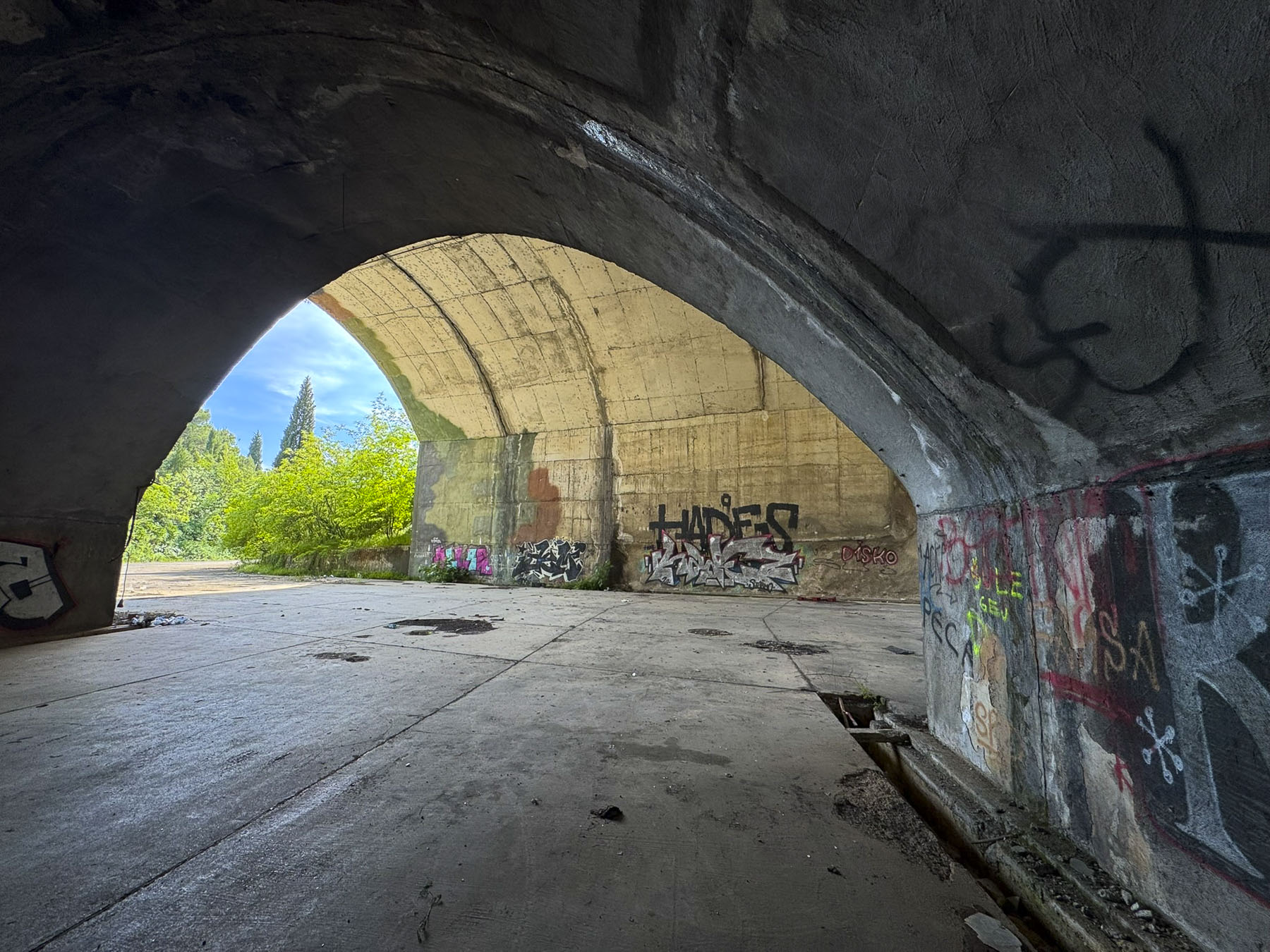
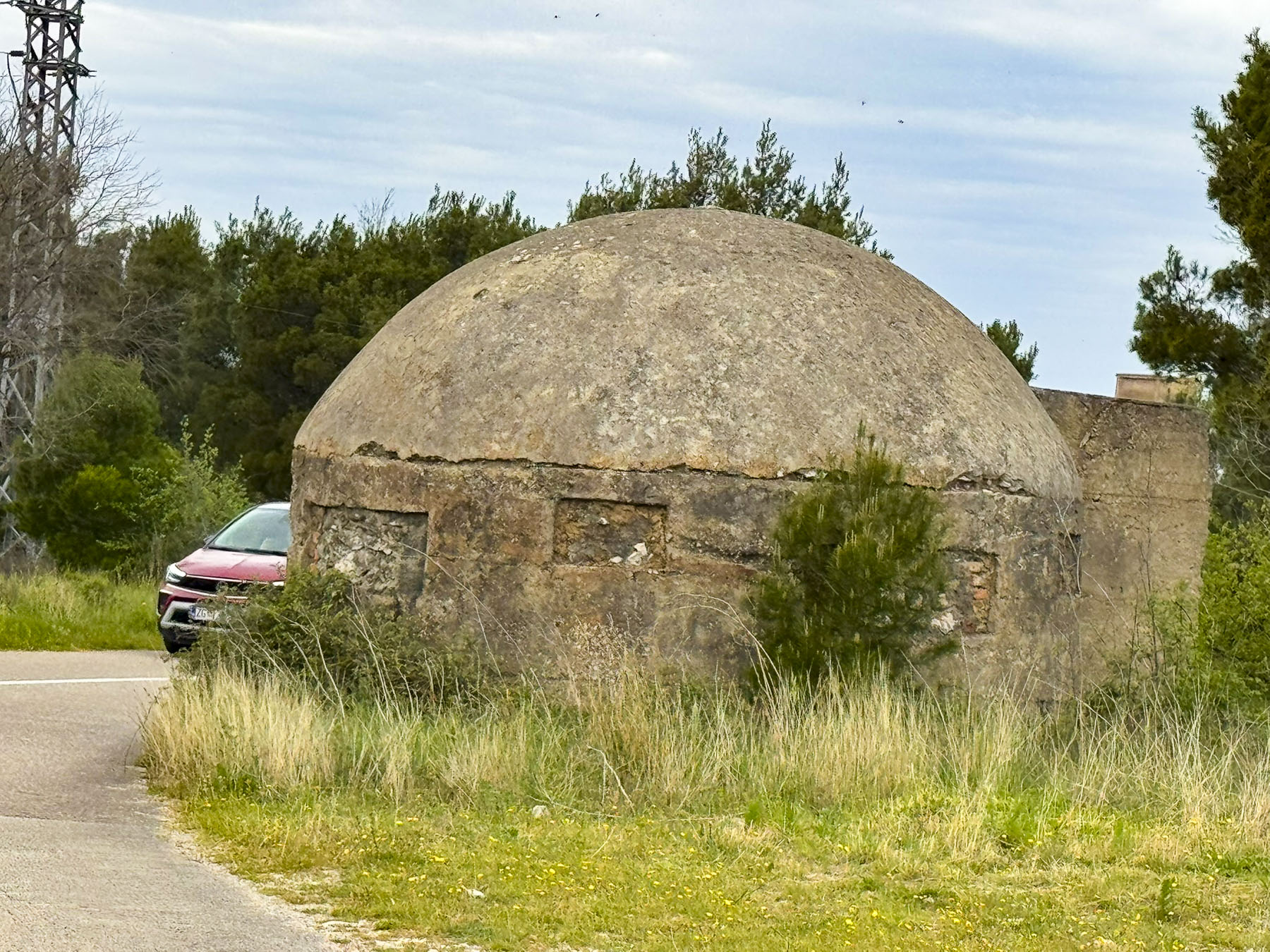
Following the signs to the national park we drove down a side road which passed a sprawling abandoned factory site, fronted with several concrete military bunkers. They were relics from the Cold War era like the ones that dot the landscape in Albania. Built in the 1930s, the IVANAL d.o.o. plant was the Balkans region’s first state-of-the-art aluminum processing complex that employed 400 people. It was confiscated by Czechoslovakia’s communist regime in the 1940’s and never upgraded or maintained. Over the decades production fell until the plant was closed after Croatia’s independence in 1991.

The parking lot at the national park was very full, considering it was a chilly Spring Sunday, but the queue at the ticket booth moved quickly. While the falls are quite a distance downhill from the entrance to the park, some folks chose to walk a route through the forest to forage for the wild asparagus that sprouts along its path from March to May.

We opted for a ticket that included a shuttle bus ride to the largest waterfall, Skradinski Buk, at the bottom of a series of equally impressive waterfalls on the Krka River, then a walk back upstream along the waterway to another shuttlebus stop for a return ride to the top of the park entrance plateau. During the summer months the national park also offers a scenic twenty-minute boat ride from the harbor in Skradin,to the base of Skradinski Buk.

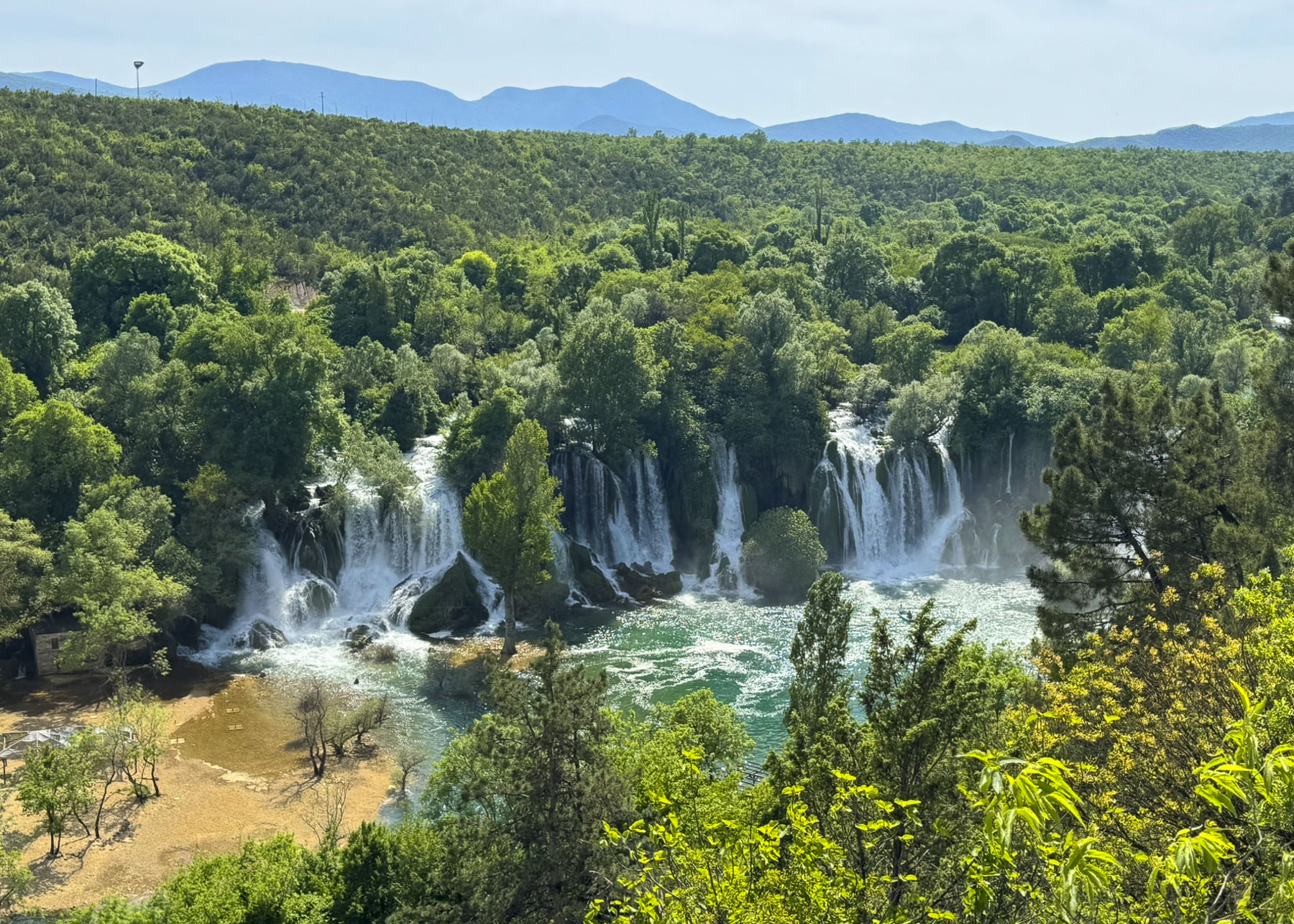
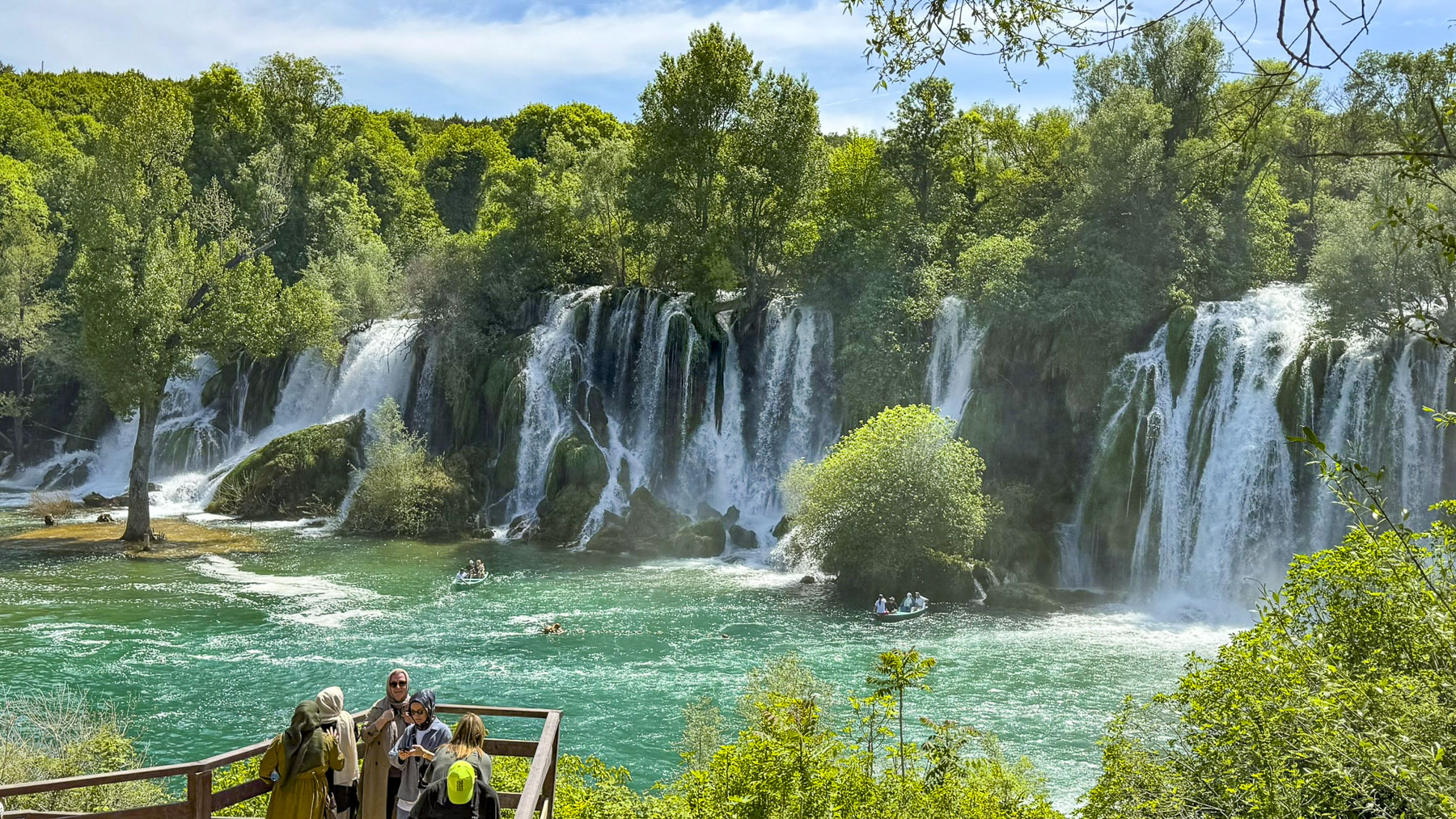
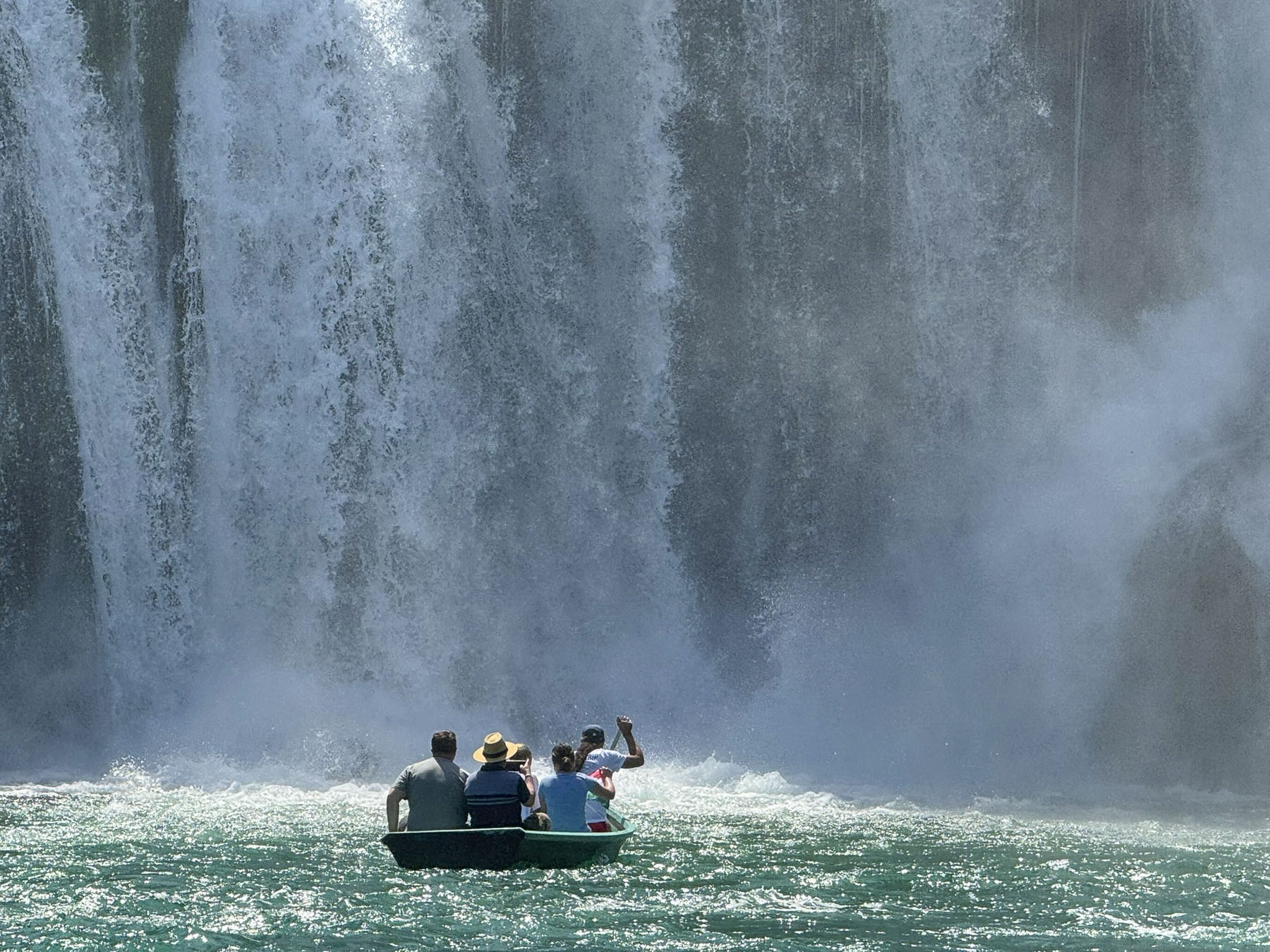
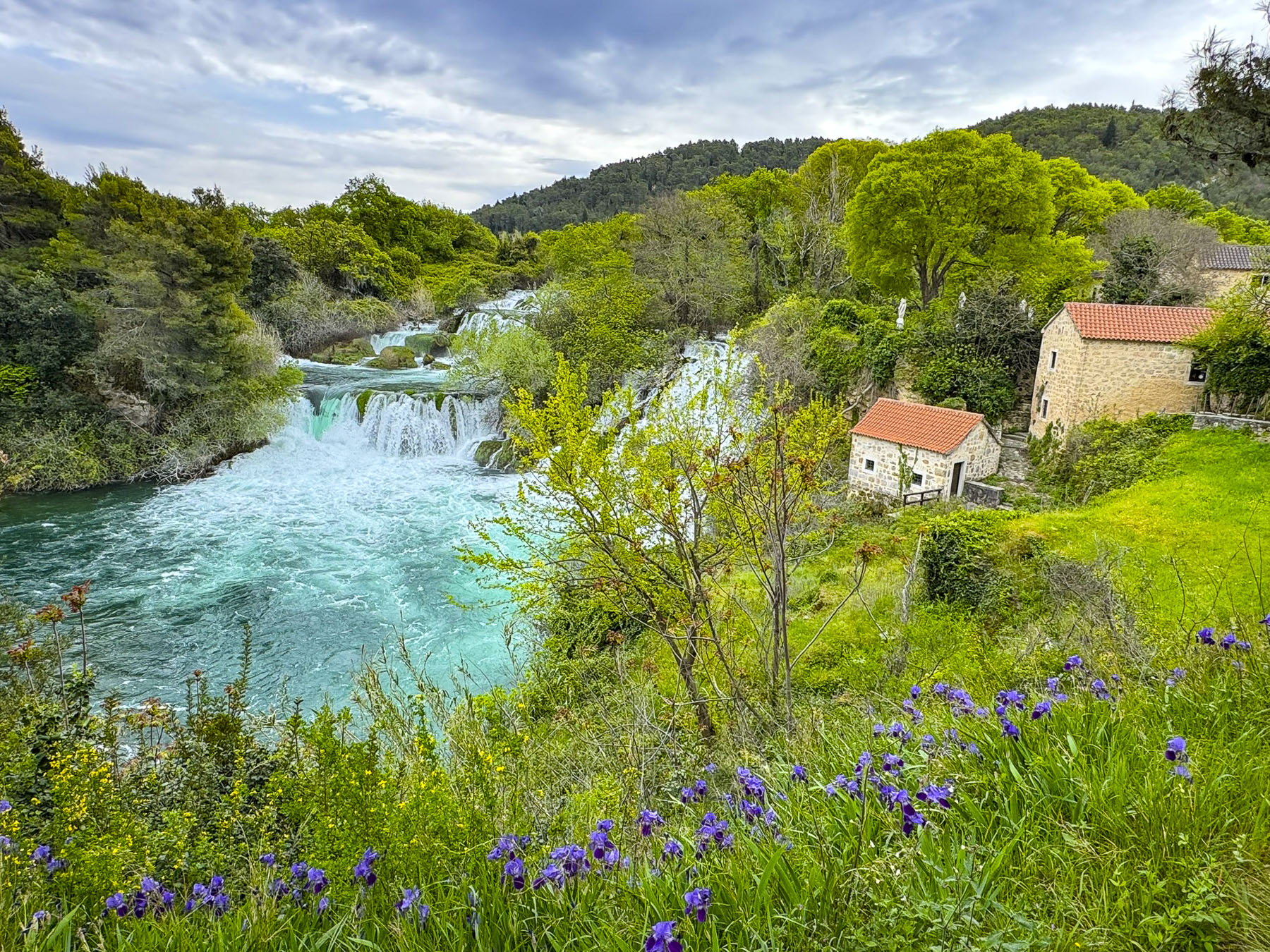
The overcast day was actually the perfect weather condition to photograph the waterfalls without heavy shadows or bright highlights, and the falls were thundering, foaming with the snowmelt from the Dinaric Alps, which run through the coastal Balkans region.

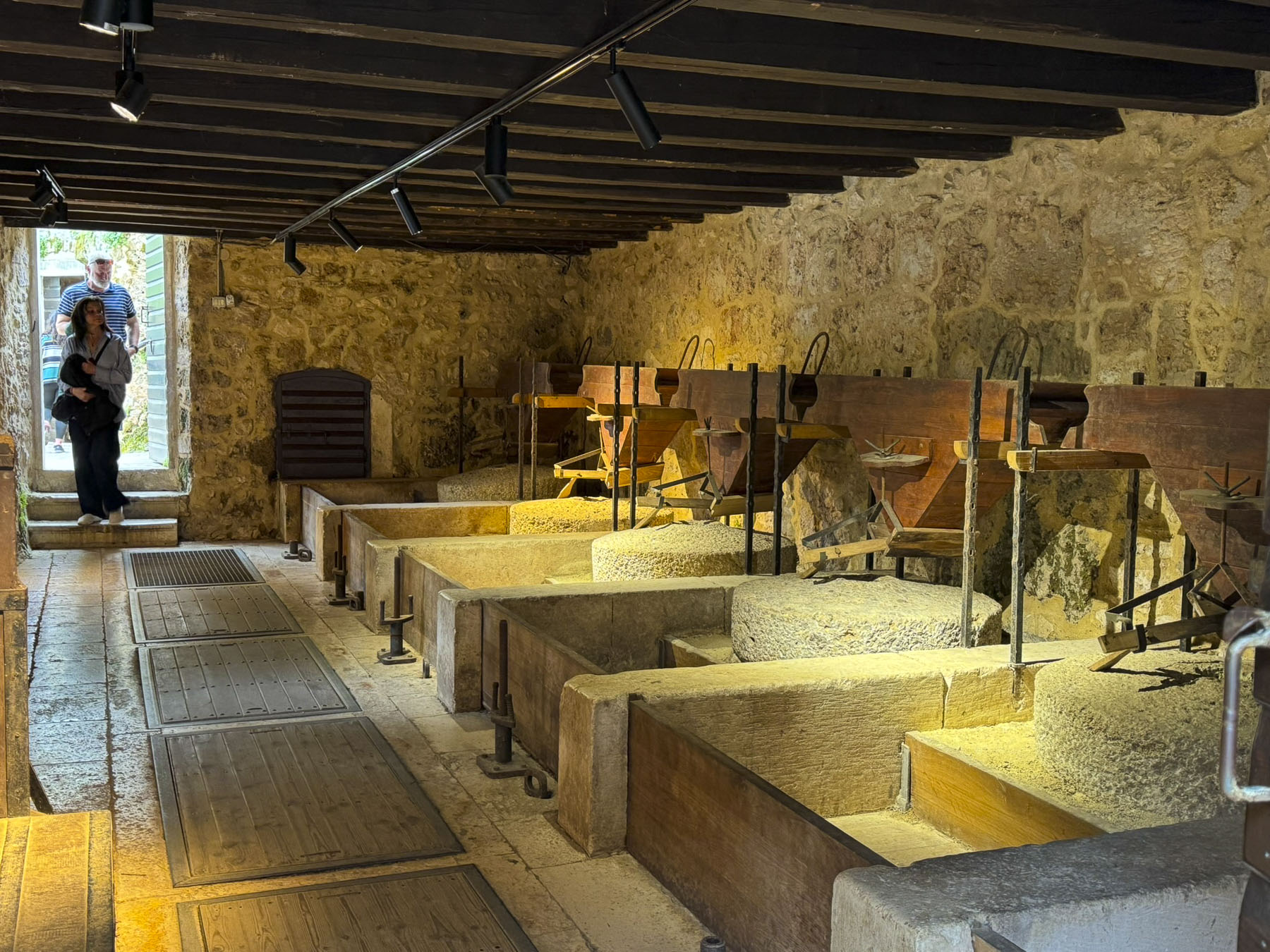
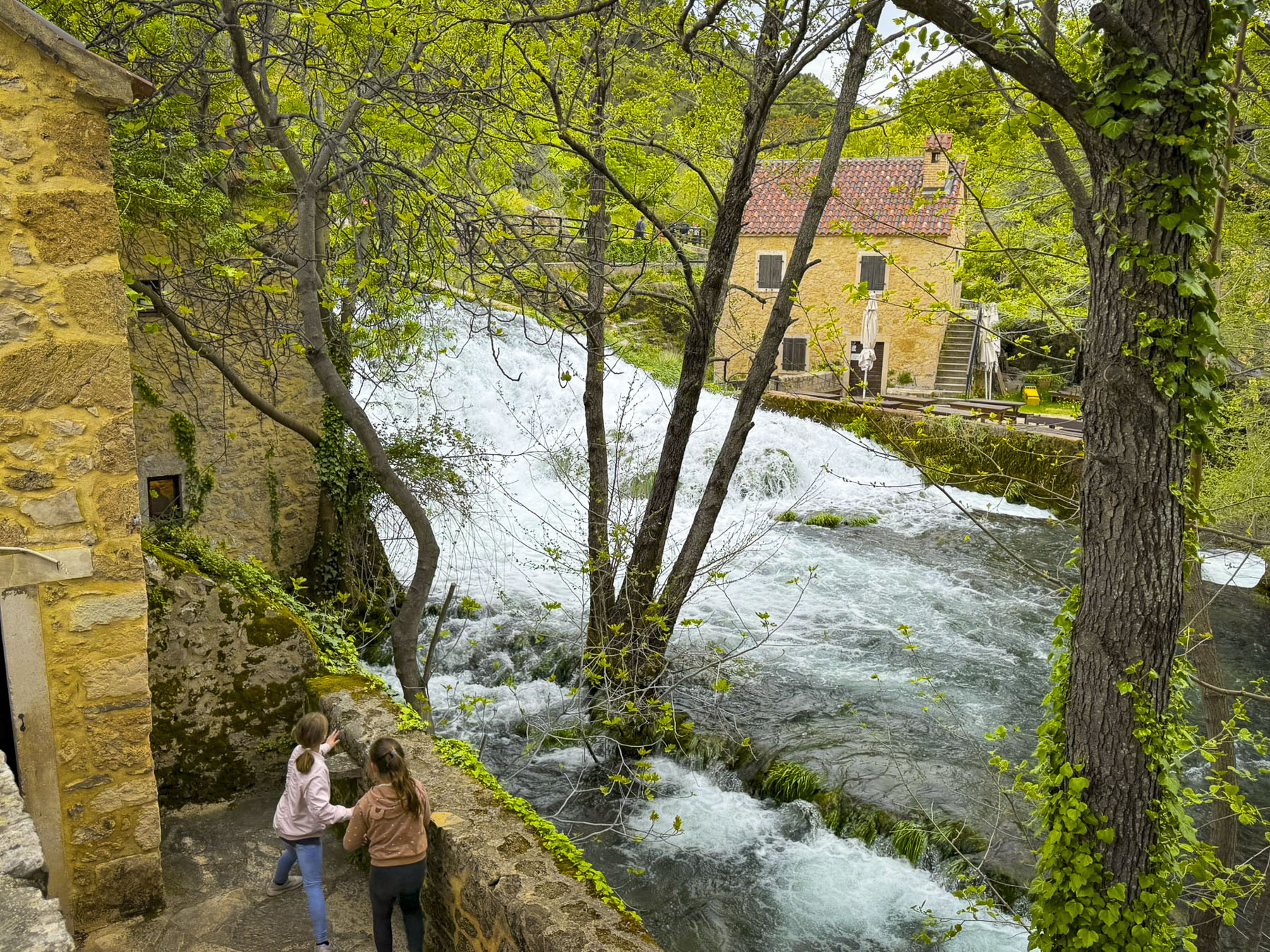
Along the way, we stopped at several restored watermills, with their mill races still intact. They were used primarily to grind locally harvested grain into flour, and to wash processed wool. A blacksmith shop also used a waterwheel to drive its furnace bellows to keep the fire hot enough to work the iron, and to power the heavy trip hammers the smith used to shape tools.

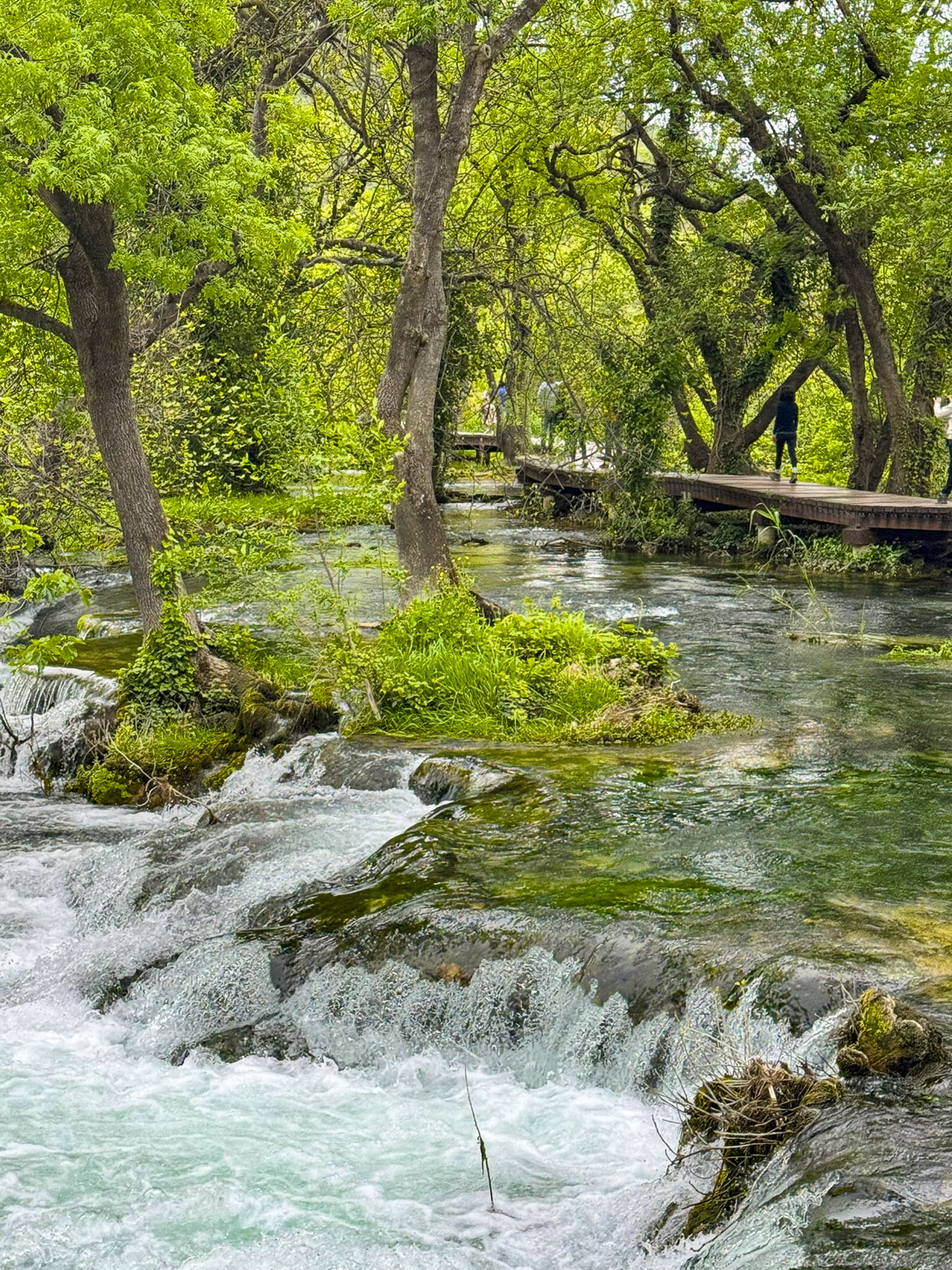
A serpentine elevated wooden walkway, without guardrails, twisted through groves of flooded forest, and kept us dry as the spring runoff rushed below us. It’s important to be aware of your footing in these circumstances, and we always waited at a wider part of the walkway for other folks to pass when the boardwalk was too narrow, to avoid fulfilling my mental image of being swept away down the rapids.

Unlike tourist sites in the United States, where everything is fenced to protect us from injury, in Europe you are expected to be responsible for yourself, and aware of your surroundings to guard against mishaps. We thoroughly enjoyed the waterfalls. We don’t see them in the coastal area at home, since we live nearly at sea level.

Zadar protrudes into the Adriatic, on a small peninsula, like a thumbs up sign, its once rough coastline now manicured with a sidewalk that follows its waterfront. Parking was challenging, but after circling the old town twice, we found a metered space near the Apartments Donat, our base for three nights. The rooms in the restored 700-year-old building were small. But the location, on a small lane overlooking the Cathedral of St. Anastasia and the Church of St. Donatus, was very convenient.

The manager of the building, who didn’t live on site, kindly made his parking space, next to the building, available to us for the duration of our stay. While having a rental car provides a lot of freedom, the typical 20 euro daily expense of parking in Europe can quickly add up. It’s not always possible, but we try to stay in hotels that provide free parking when we can.

Later that day we walked along the waterfront to Obala Petra Krešimira, a jetty that was being battered by whipping winds and crashing waves, which lifted large sprays of water over anyone brave or foolish enough to venture out onto it.

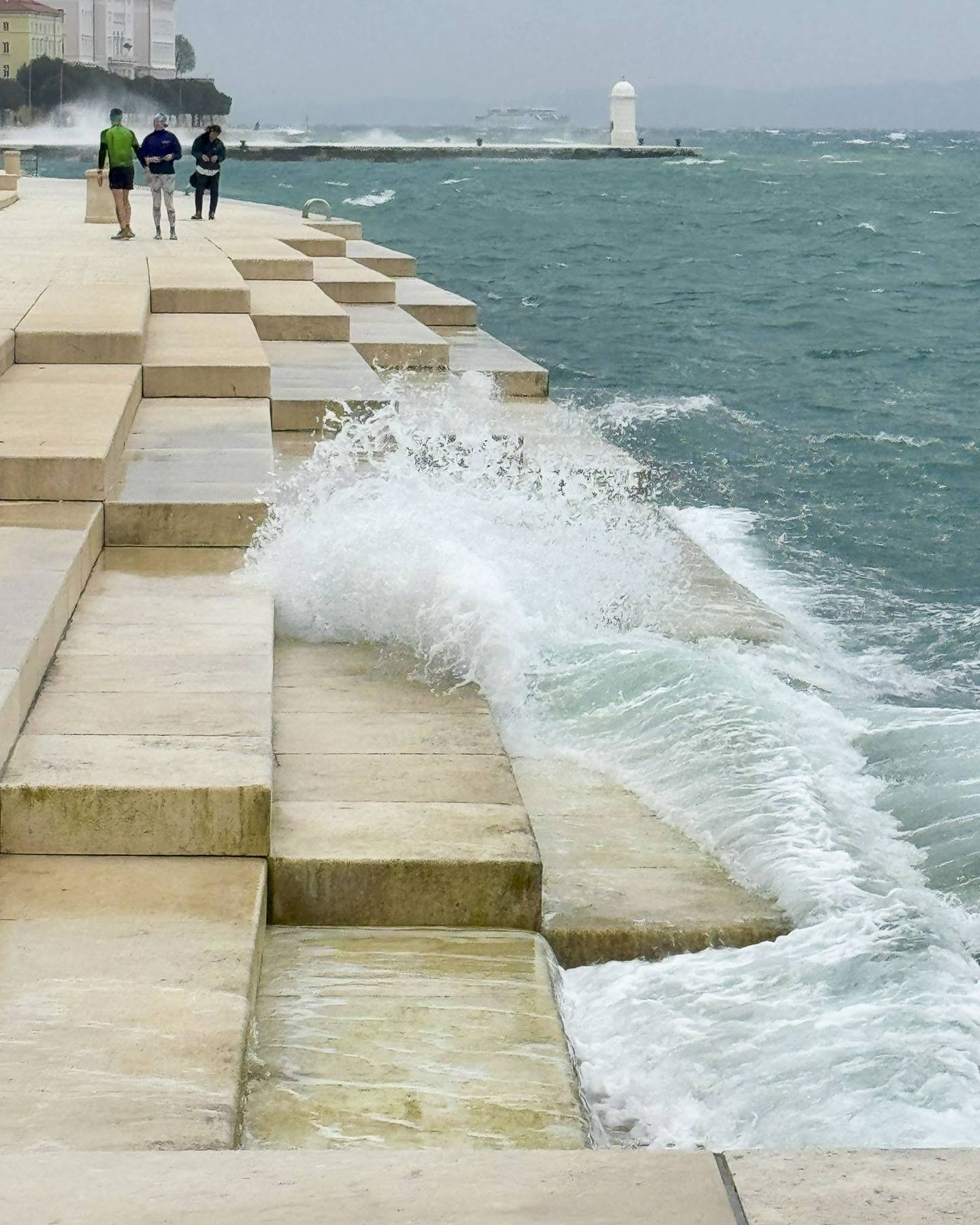
Nearby, in front of Zadar’s City Hall was Morske Orgulje, the Sea Organ, an experimental architectural sound installation designed by the architect Nikola Bašić and completed in 2005 to refurbish Zadar’s waterfront which had been neglected since the end of World War Two. The design incorporates polyethylene organ pipes under the marble stairs that lead down to the water. The motion of the waves continuously forces air through these pipes to create a “harmonic symphony crested by the wind, waves, and tides,” that is vented through the rise of the steps. Visually it’s a flat surface, but as we walked across the plaza the ethereal music faded in and out moodily with the motion of the turbulent sea.

The Greeting to the Sun, a solar-powered light installation also designed by Bašić, was a short distance away, closer to the tip of the peninsula. It’s a 22m (72ft) wide disc composed of 300 multi-layered glass plates, embedded into the plaza, which you can walk across. The panels absorb solar energy during the day to turn the disk into a colorful light display in the evening.

We hoped the storm clouds would begin to break apart so we could catch a scene from the spot that “Alfred Hitchcock once declared during a 1964 visit to the city as having “the most beautiful sunsets in the world.”  Alas, during our stay in Zadar the mornings were sunny, the afternoons cloudy, and our sunsets stormy and grey.

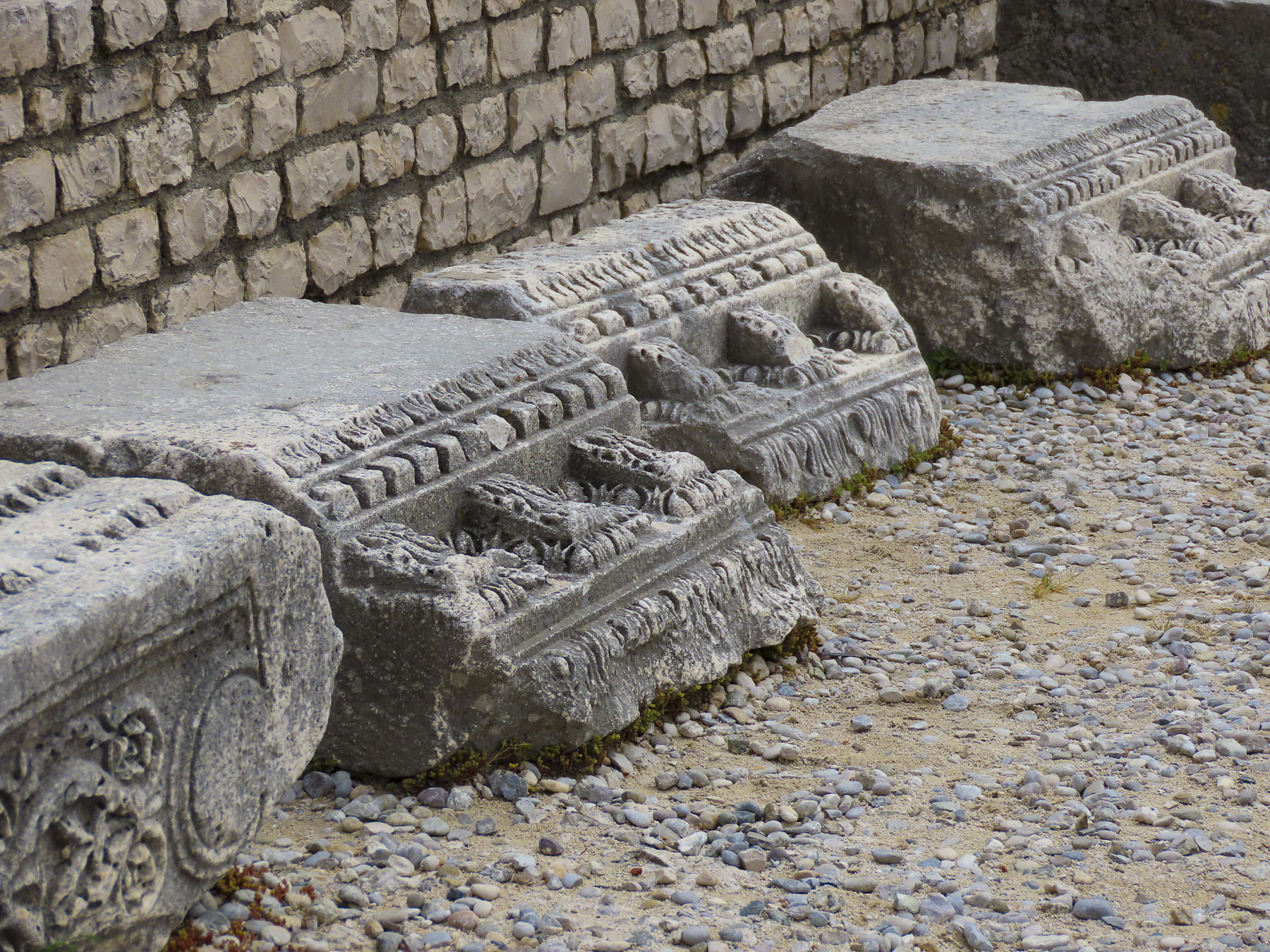
The next morning, we set out to properly explore the town, first stopping at the Roman Effigies, a collection of column sections and decorated capitals from the ancient Roman Forum, which stood in the area of Piazza Papa Giovanni Paolo (Pope John Paul II Square). The plaza itself was built over Zadar’s 16th century water cistern.

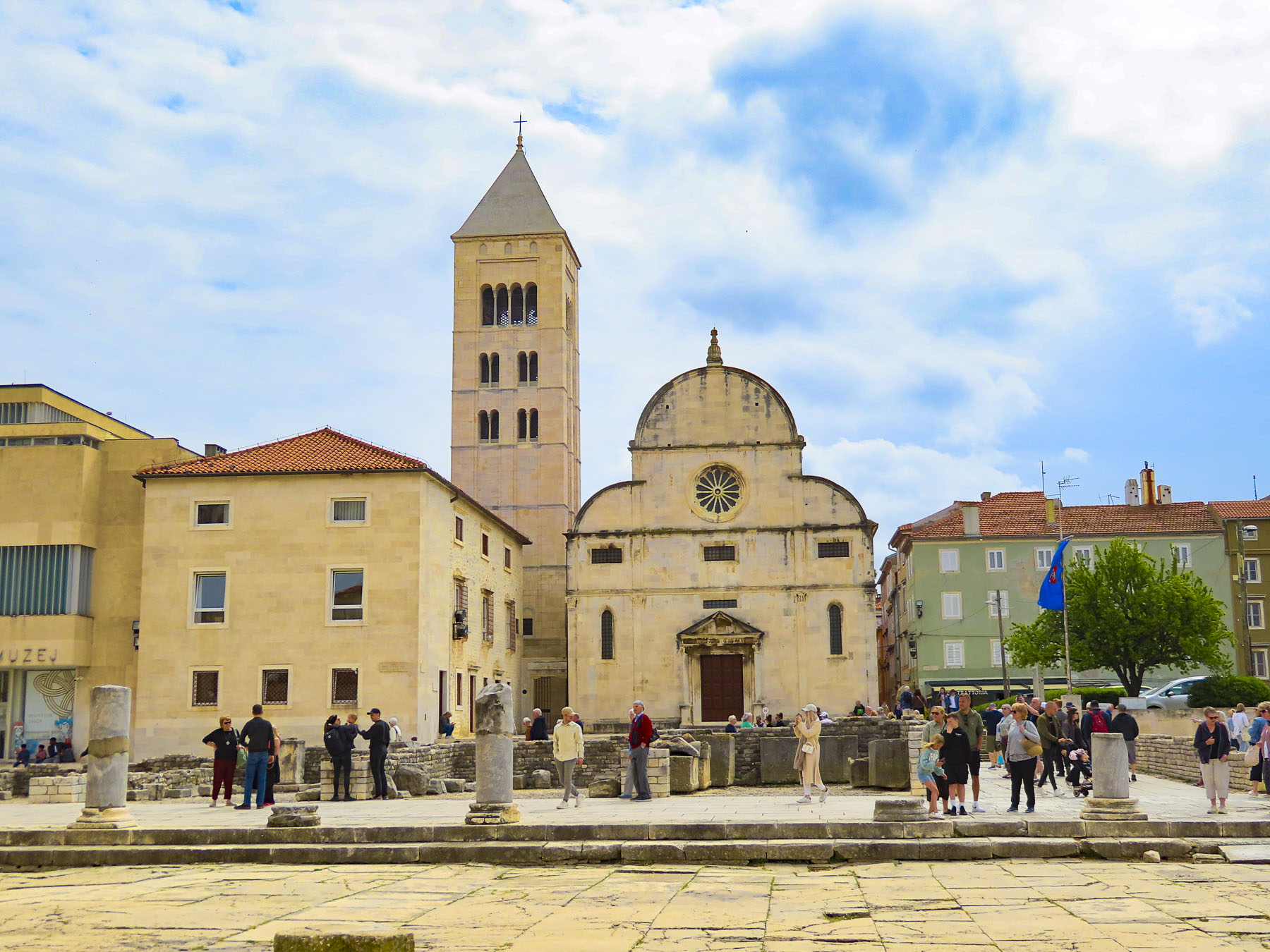
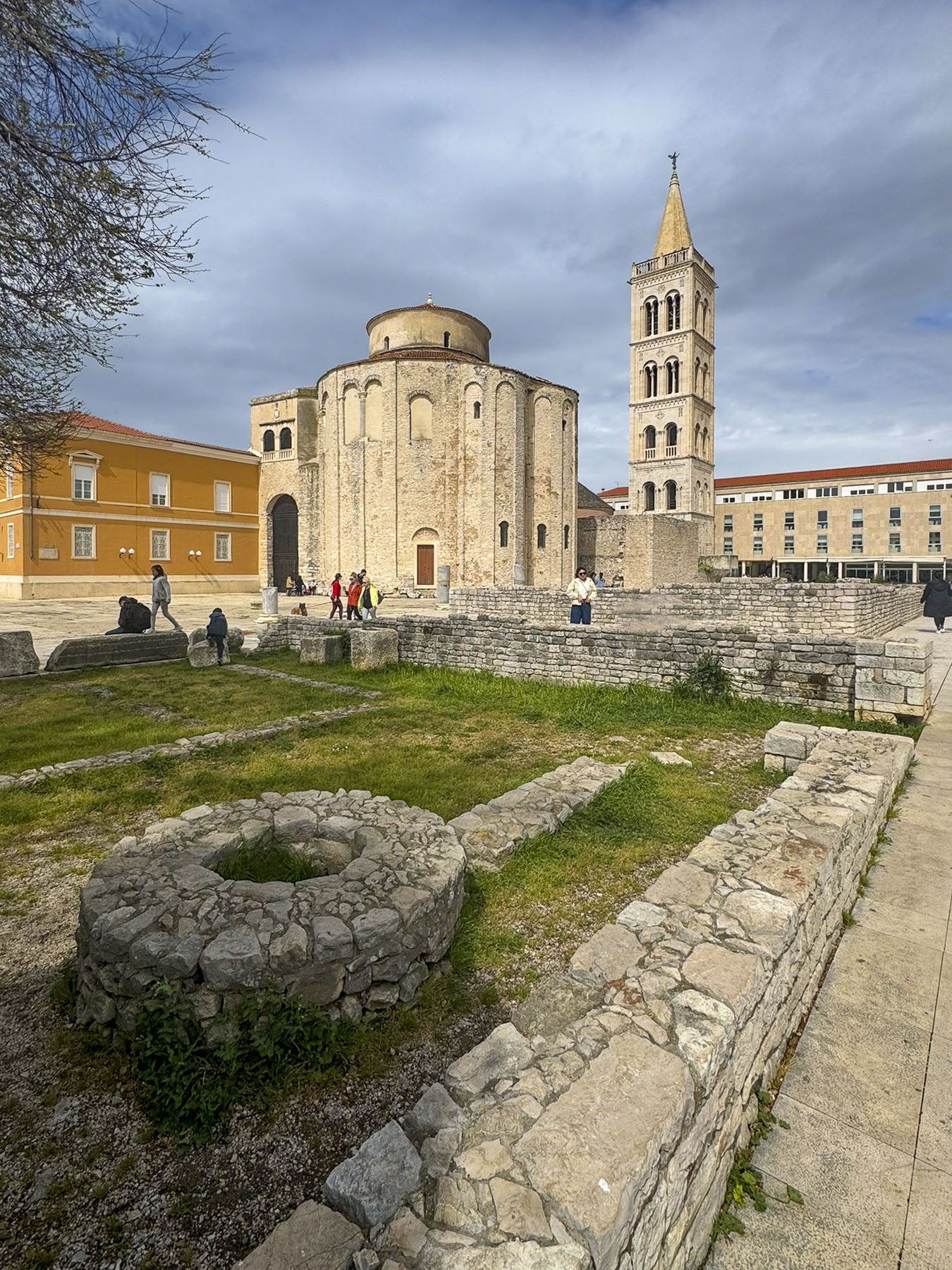
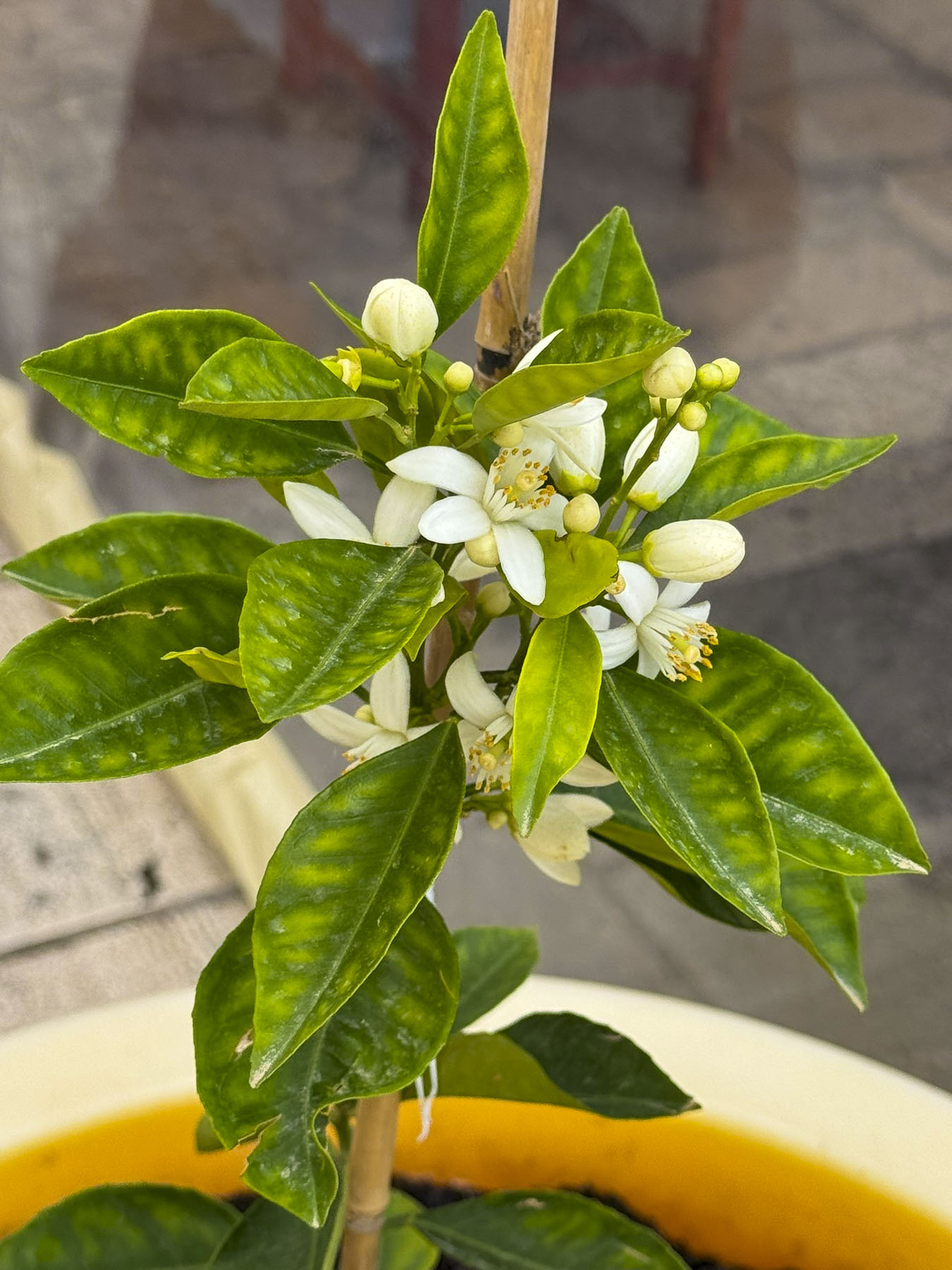
The piazza located next to the 9th-century Church of St. Donatus and the 11th-century Benedictine Monastery of St. Maria is the center point for the northern end of Zadar. The historic buildings did not open until later in the morning, so we continued down Zadar’s narrow lanes, enjoying the fragrance of orange blossoms while we strolled to Pekara Dalmatinka – Old Town Bakery, a recommendation from our friend at the car rental agency.

On the way, something piqued our curiosity down a narrower side alley and we detoured. There in a small workshop a craftsman was applying gold leaf to a frame. We appreciate old-world talents like this, and I asked in English, and gestured with my cell phone, if I could take a photo of him working. All was lost in translation and the man suddenly walked out, only to return a few minutes with his son who spoke English, and we chatted for a minute. Apparently, few tourists ever poked their heads into the workshop; the frame he was gilding was for a church, and his dad is a busy man, but it is okay to take his picture.

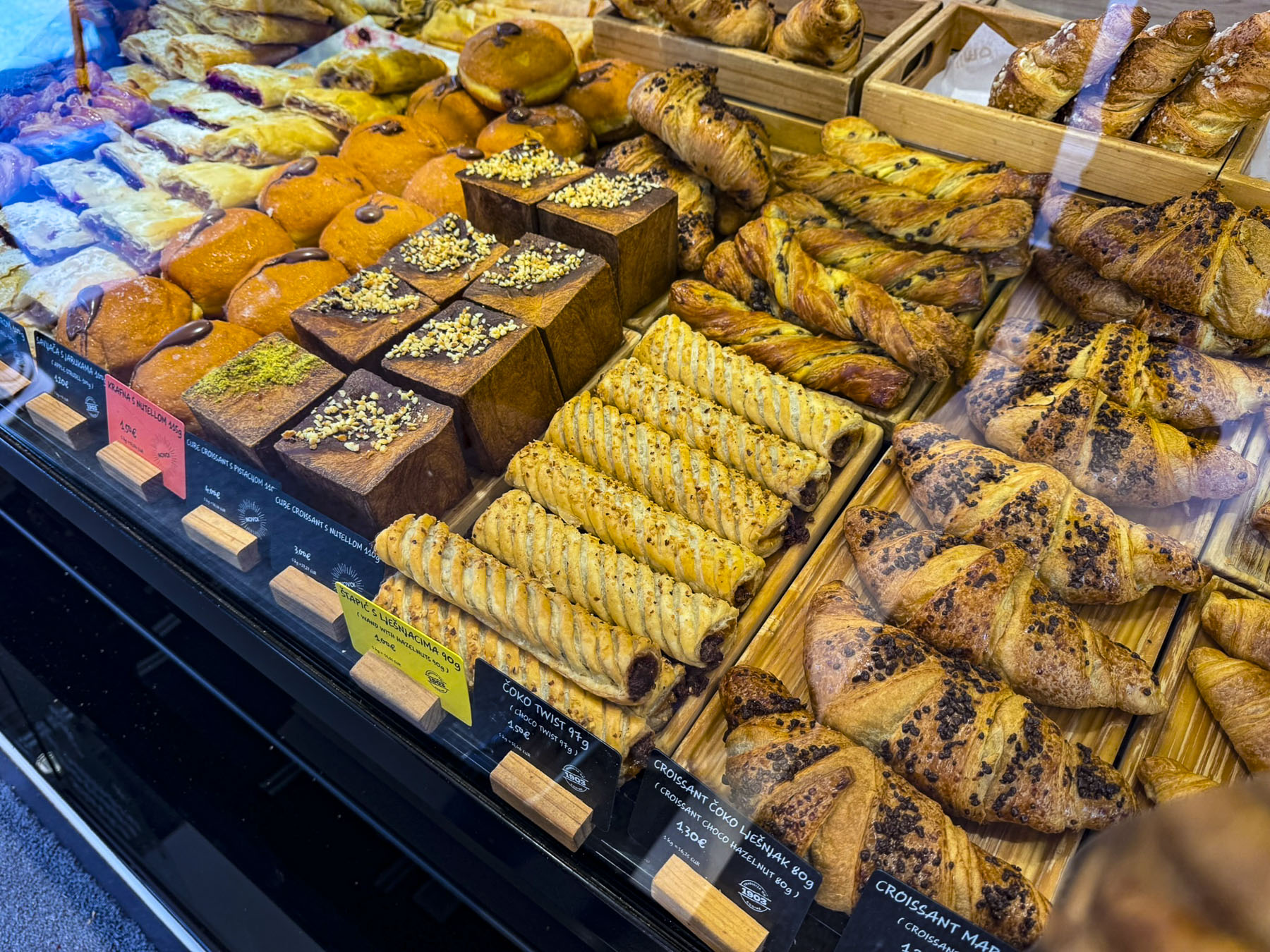
It’s a mistake to arrive hungry to a bakery that confronts you with a display case featuring mouthwatering Croatian pastries. We drooled over Kremšnita, custard cream cake; Madarica, a layered chocolate cake; Makovnjača & Orehnjača, a rolled dough pastry filled with walnuts or poppy seeds; Princes Krafne, a doughnut stuffed with luscious cream; Splitska Torta, a cake with layers of meringue, cream, almonds and figs; and of course Börek, a delicious, coiled phyllo dough pastry filled with feta cheese or spinach.

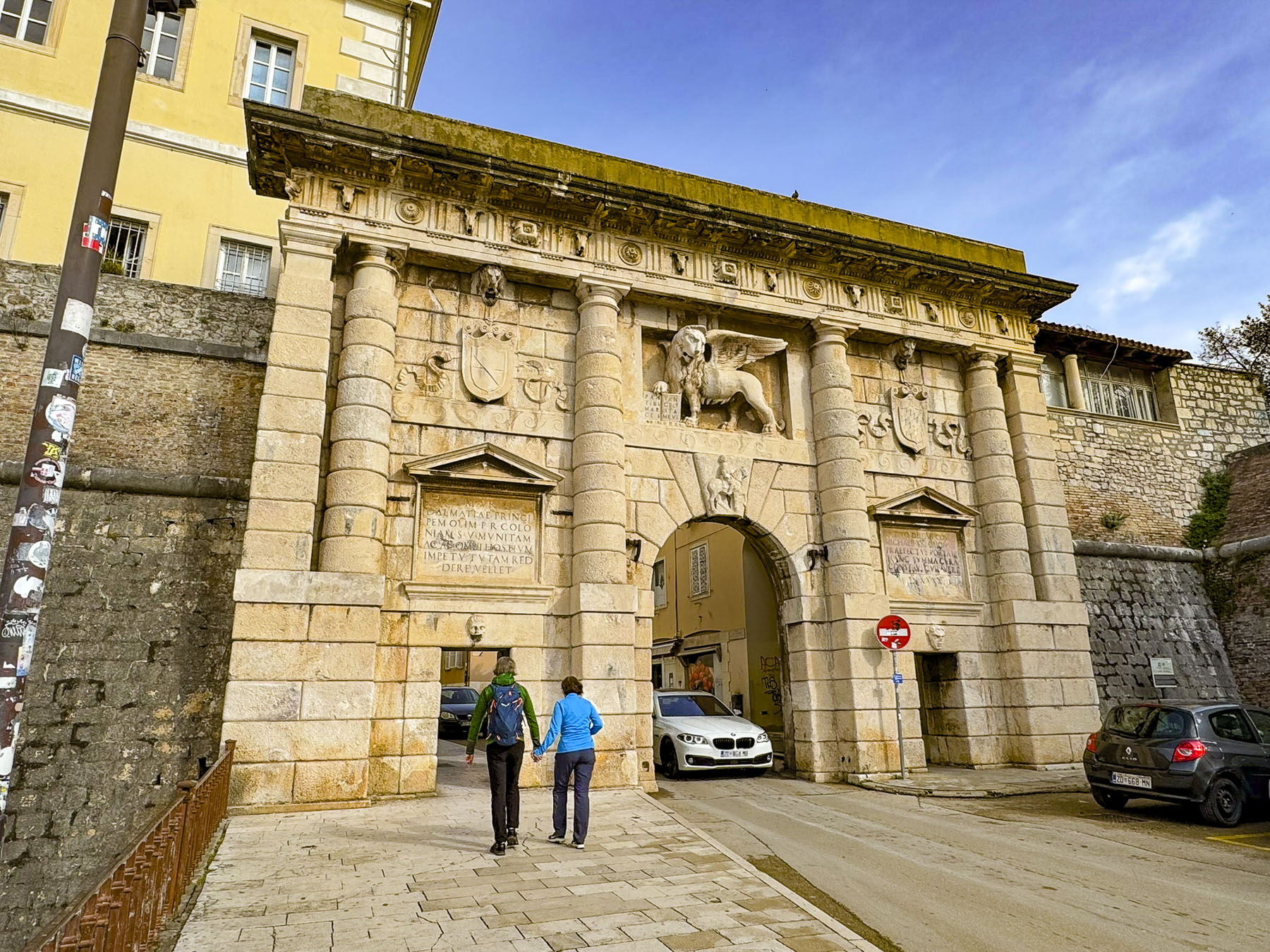
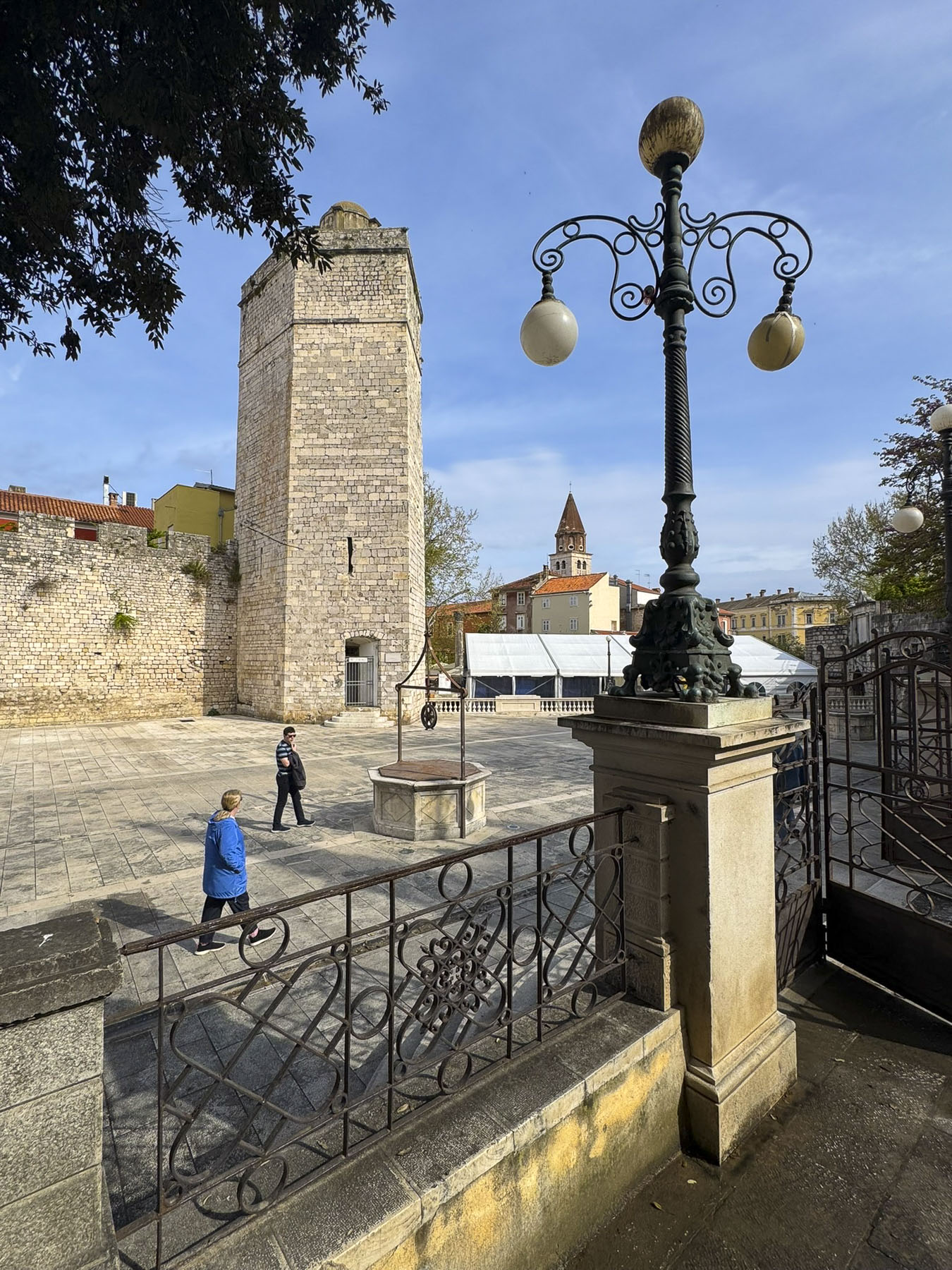
We planned to walk off our over-indulgence, and headed through Trg Pet Bunara, the Five Wells Square, to find a bench in Queen Jelena Madijevka Park. Tree branches laden with purple flowers hung over the decorative railing at the entrance to the park, which sits atop the city’s old bastion, next to the ancient Venetian Land Gate, and was the perfect spot for a morning picnic.  Built in 1573, it replaced an old Roman gate, and featured a relief of the Winged Lion of St. Mark, the symbol of the Venetian Empire, to celebrate a naval victory over the Turks. From our bench we watched a boat enter the small harbor in front of Zadar’s ancient defensive wall, a continuous activity since Zadar’s founding.
The ancient walls and gates around the city were first built by the Romans and then expanded upon by the Venetians in the 16th and 17th centuries, to defend the city from multiple attacks by the Ottoman Empire.

Several of the ancient gates still stand and allow passage from the old town to the ferry harbor. The top of the ramparts over the gates have been incorporated into a scenic walkway that parallels the waterfront and provides a pretty vantage point to view all the maritime activity, and some vignettes of old town Zadar.

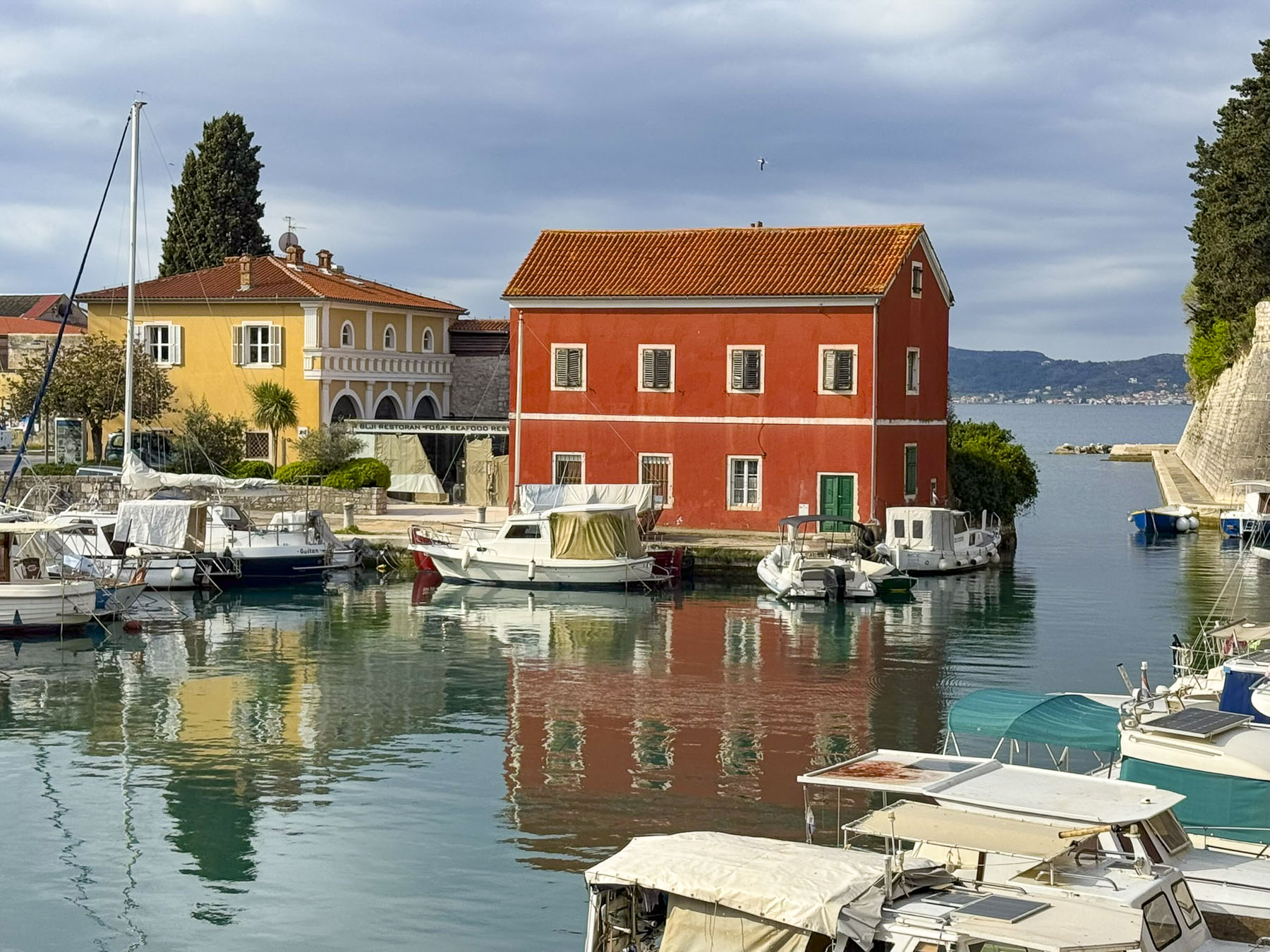
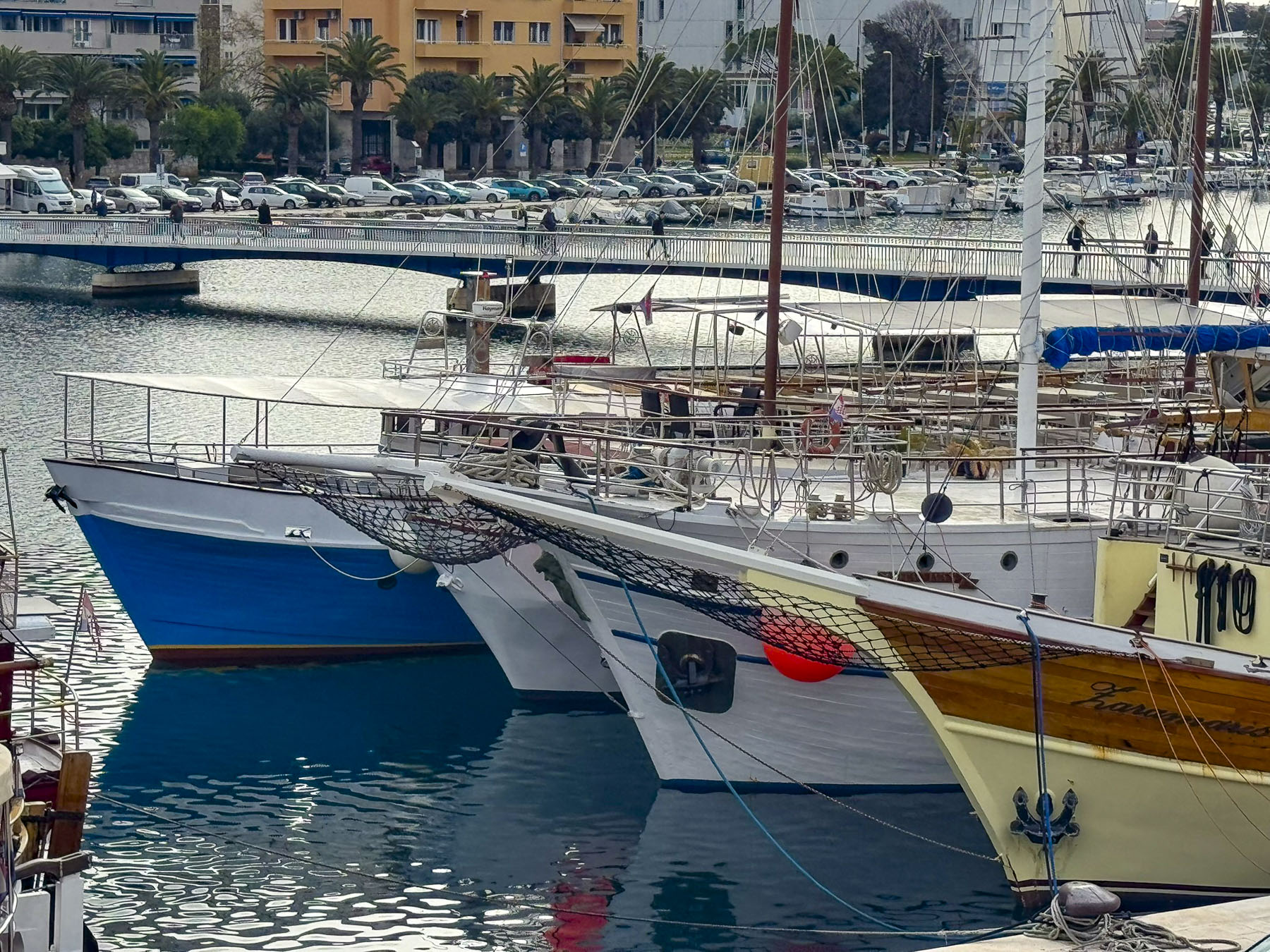
Along this walk we spotted a younger man rowing a small boat with passengers across the narrow harbor, from a small lighthouse to a staired landing on the quay. Apparently, they were on the way to work and his service, like the traghetto in Venice, provided a shortcut. A sign we discovered the next day listed the fee as 2€.

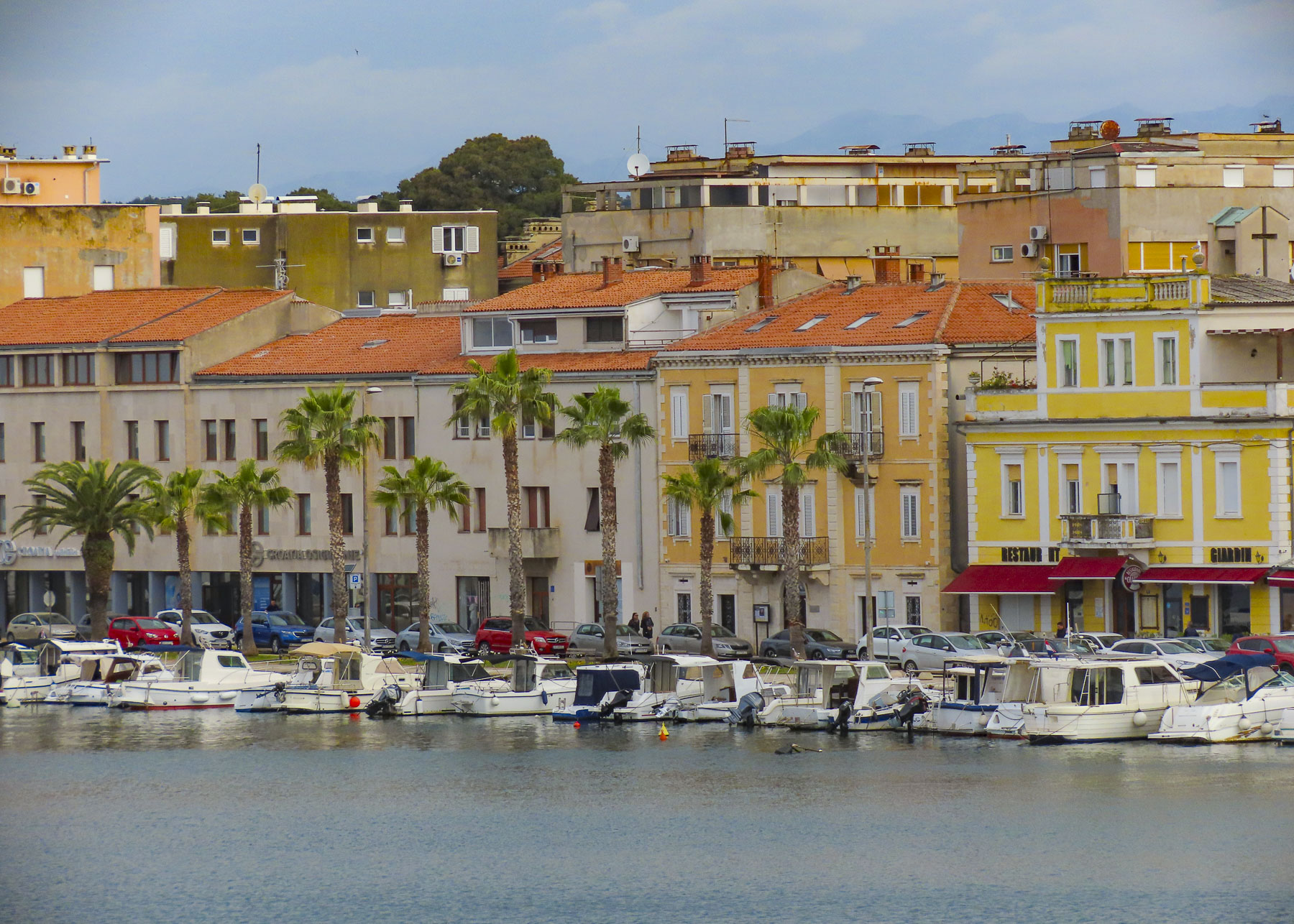
Over the years the population of Zadar has sprawled into new buildings on the mainland, unlike Dubrovnik, which has been gentrified into a theme park. Old Town Zadar, on the other hand, has some newer buildings on its peninsula, but also has many that show the patina of age, and give the town an authenticity and delightful ambience.

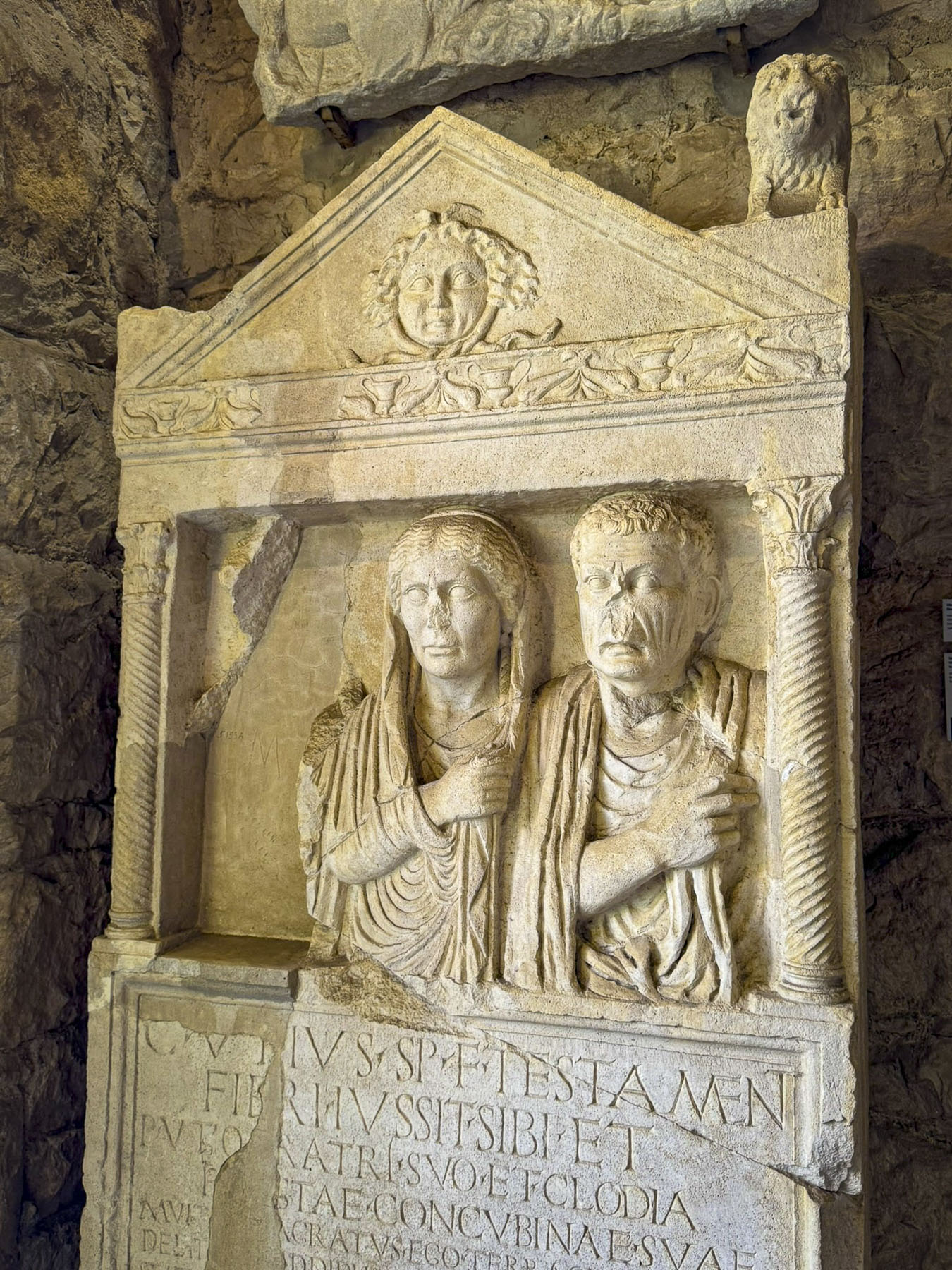
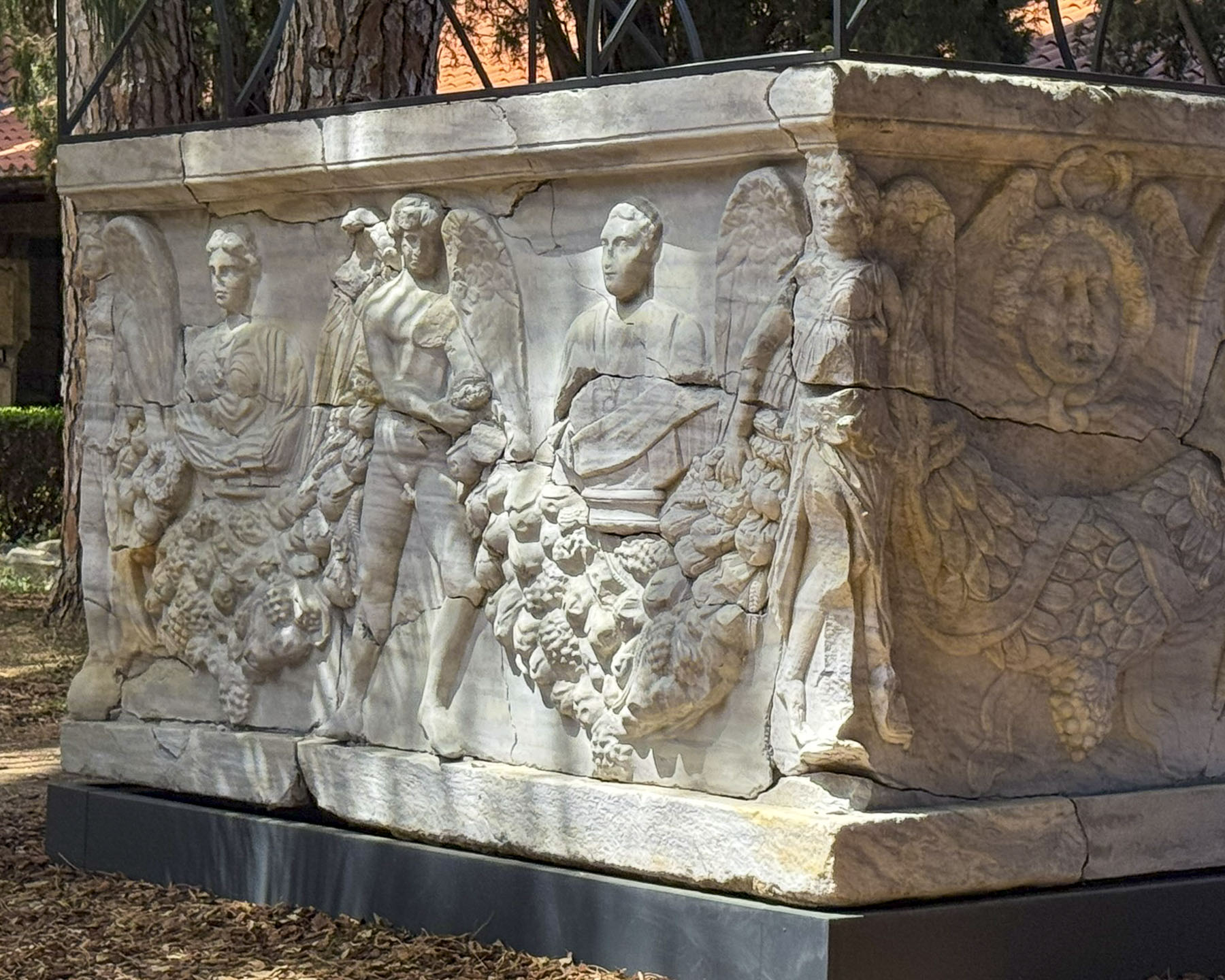
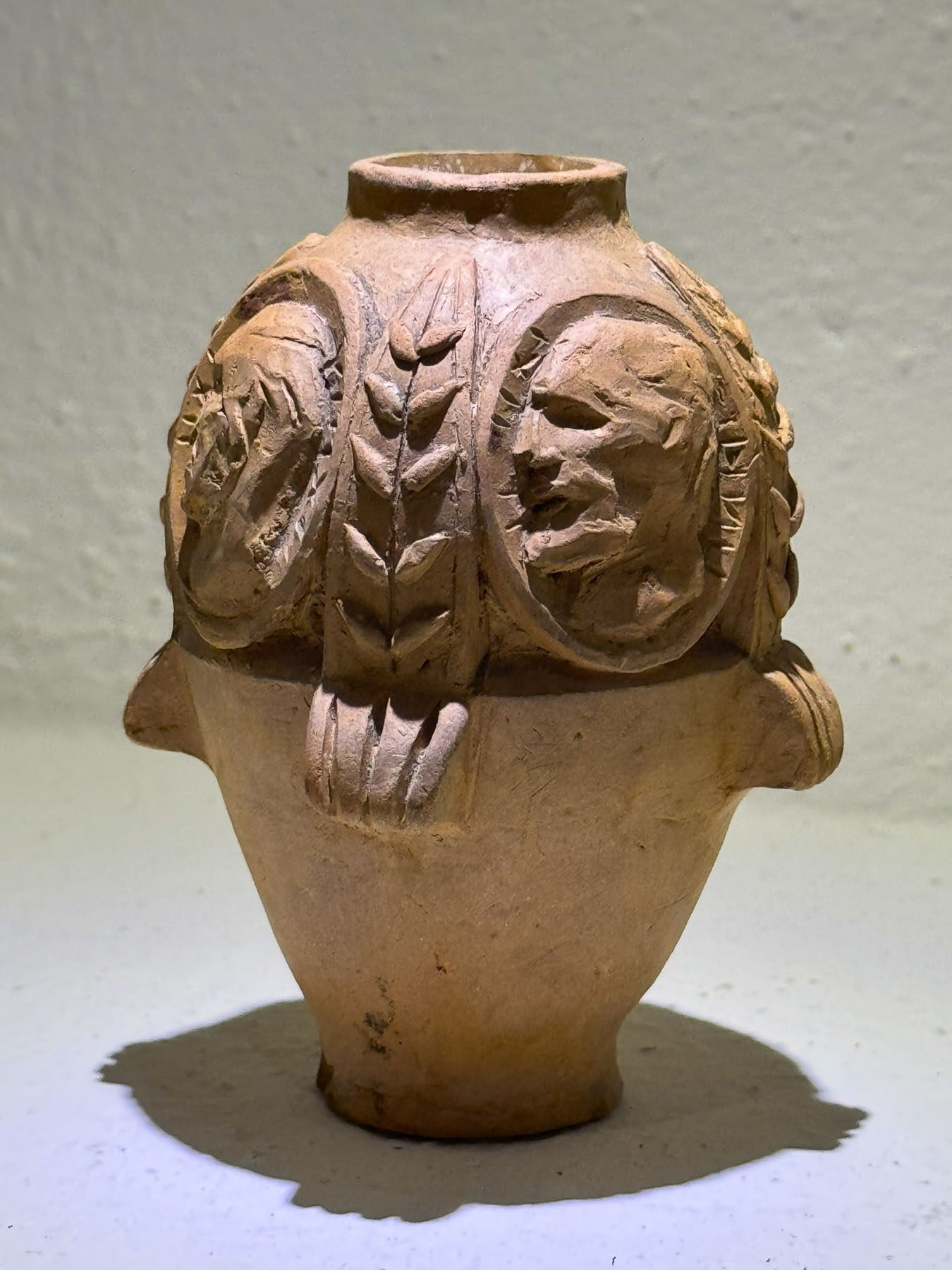
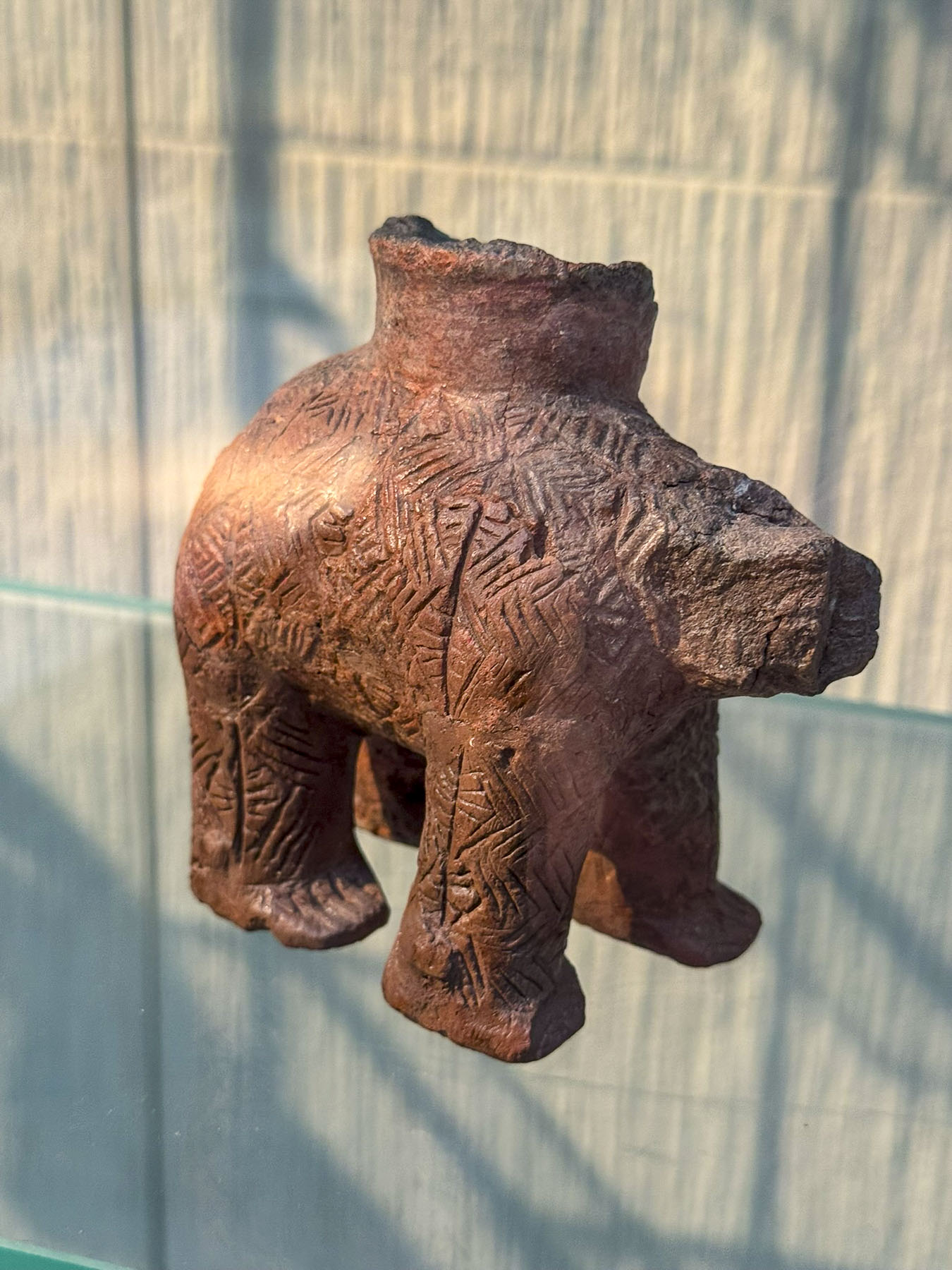
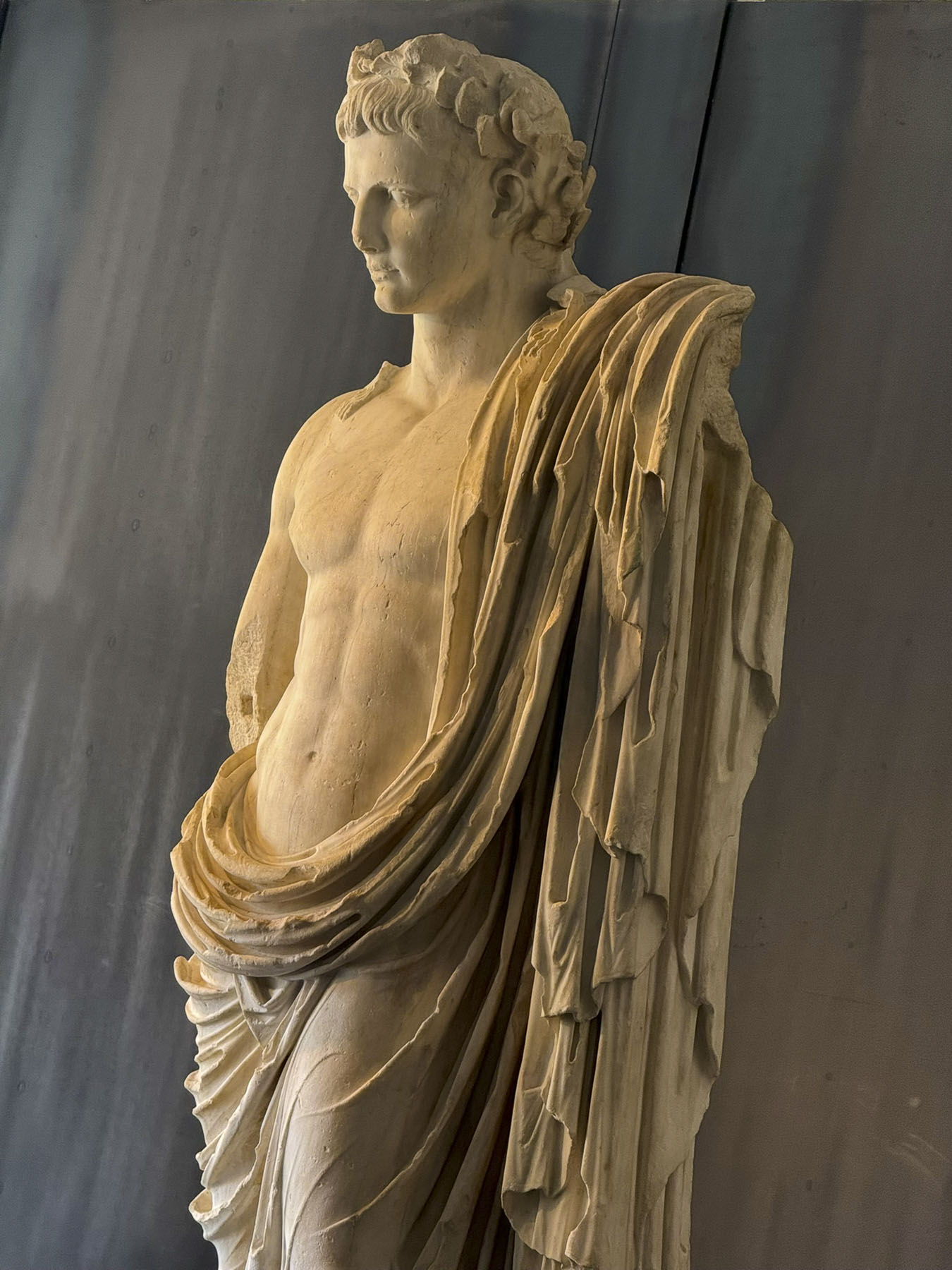
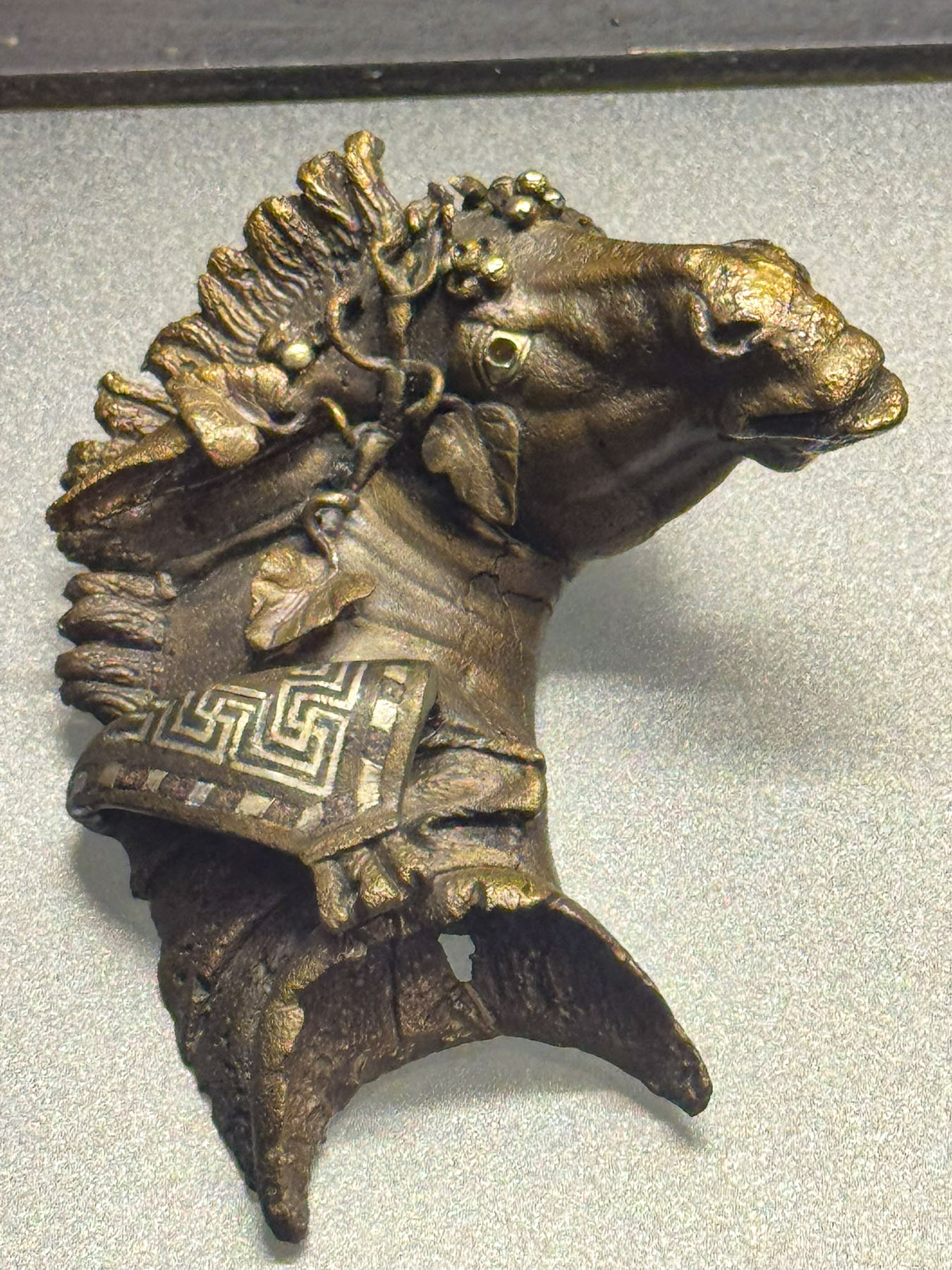
Our sunny morning was threatened with rain by noon, so we headed into the Archaeological Museum, where they have an interesting and diverse collection of ancient artifacts, statuary, and busts unearthed in Zadar, from its pre-history through the Roman Era and Venetian times. Especially unusual was the collection of Neolithic Rhytons, a  four-legged ceramic ritual vessel, from the Impresso and Danilo cultures.

From the museum there is a good view of the Church of St. Donatus, and the belltower of Sainte Anastasie across from the ruins of the Roman forum. We’d pass these landmarks multiple times during our stay.

Fortunately, we did have good raincoats, and we scurried to Kavana Centar, a very nice café several blocks away that had some indoor tables still available and offered a reprieve from the rain. Located away from the main square, its menu was very budget friendly.

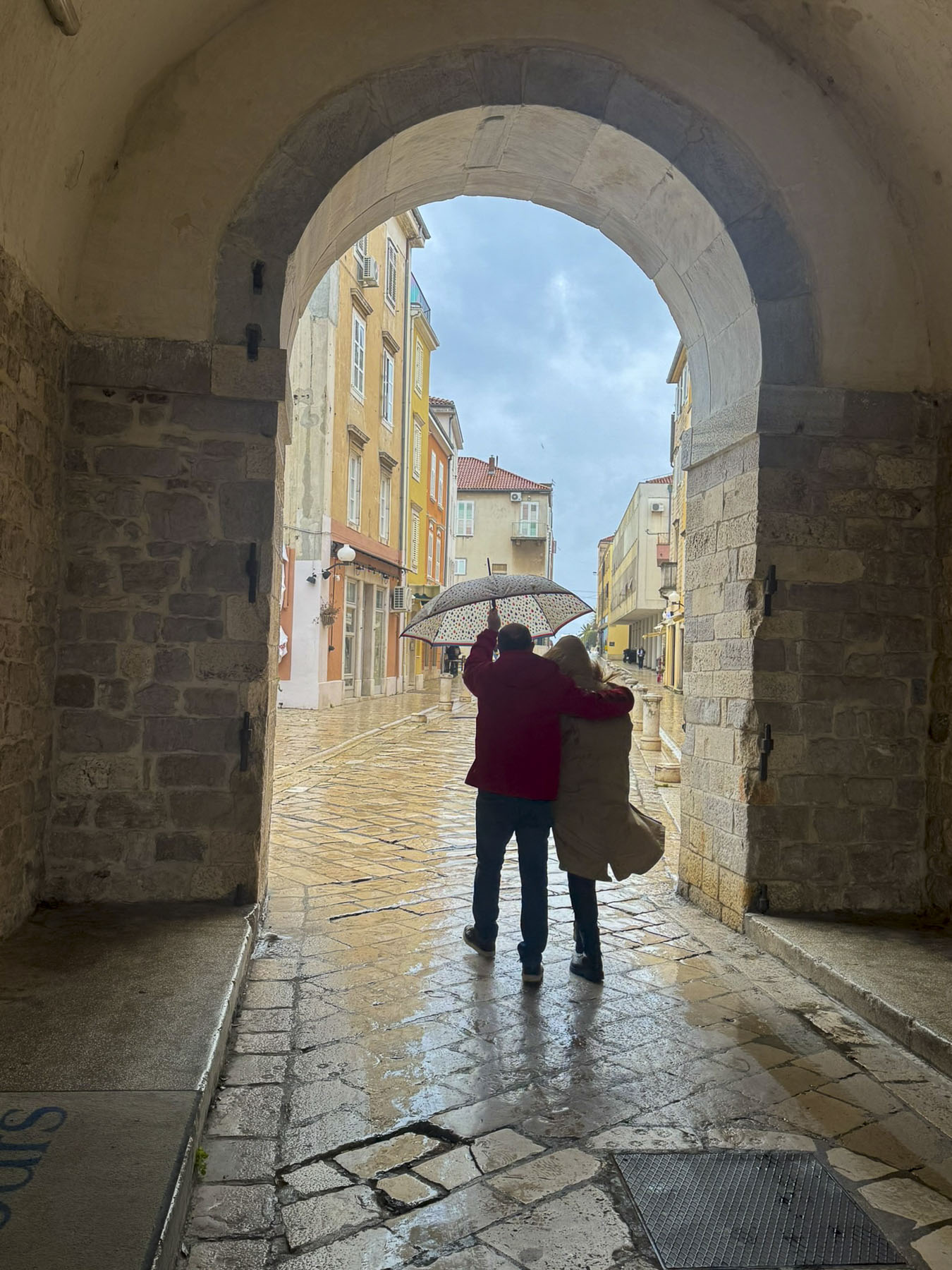
Though the rain had not stopped, folks continued on with their plans, and soon umbrellas were out everywhere.  After lunch, we headed back to St. Donatus, an unusual tall round cylinder-shaped church built during the 9th century in a pre-Romanesque style. Much of its construction utilized the ruins of the old Roman Forum, upon which it was built.

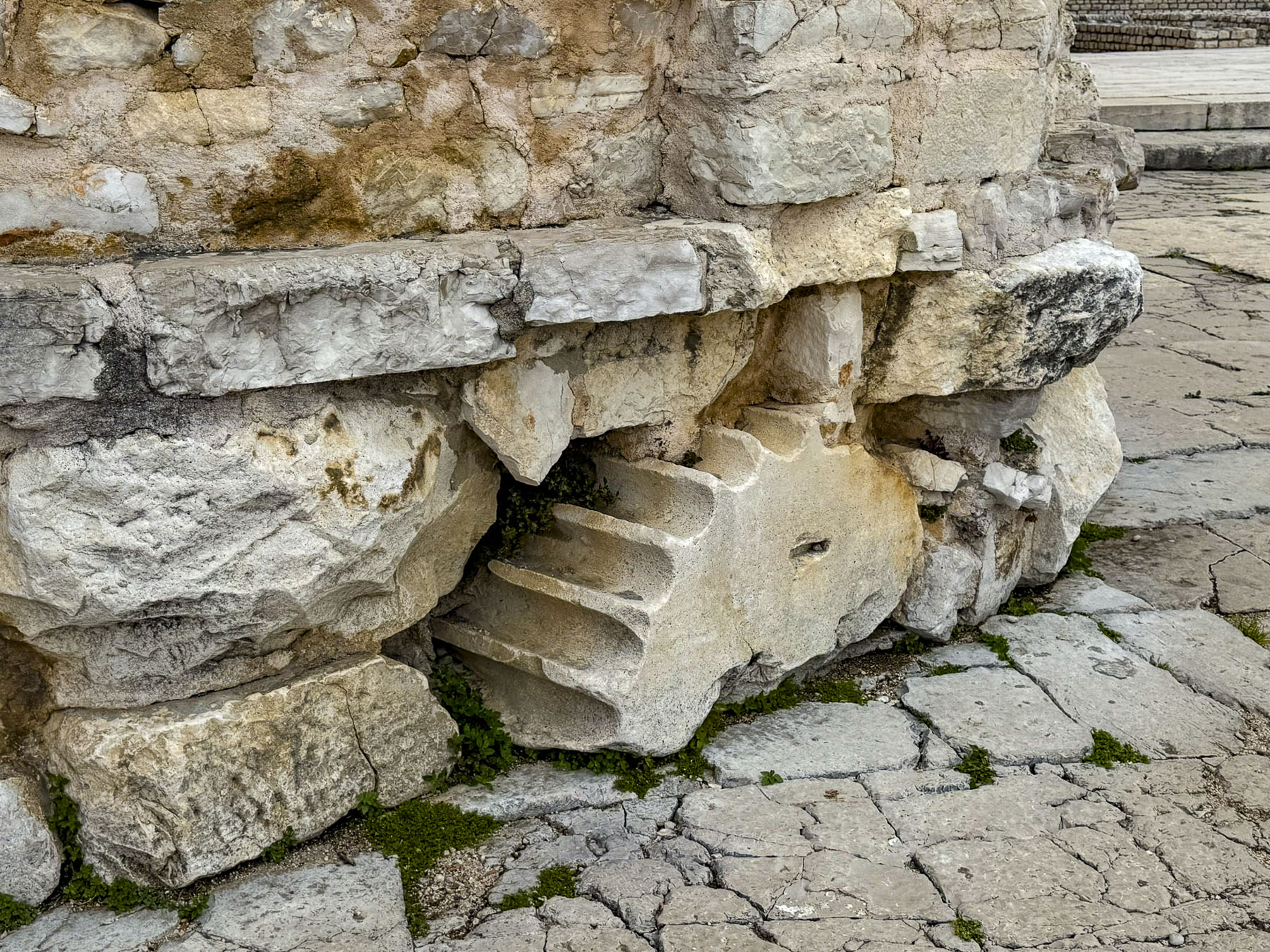
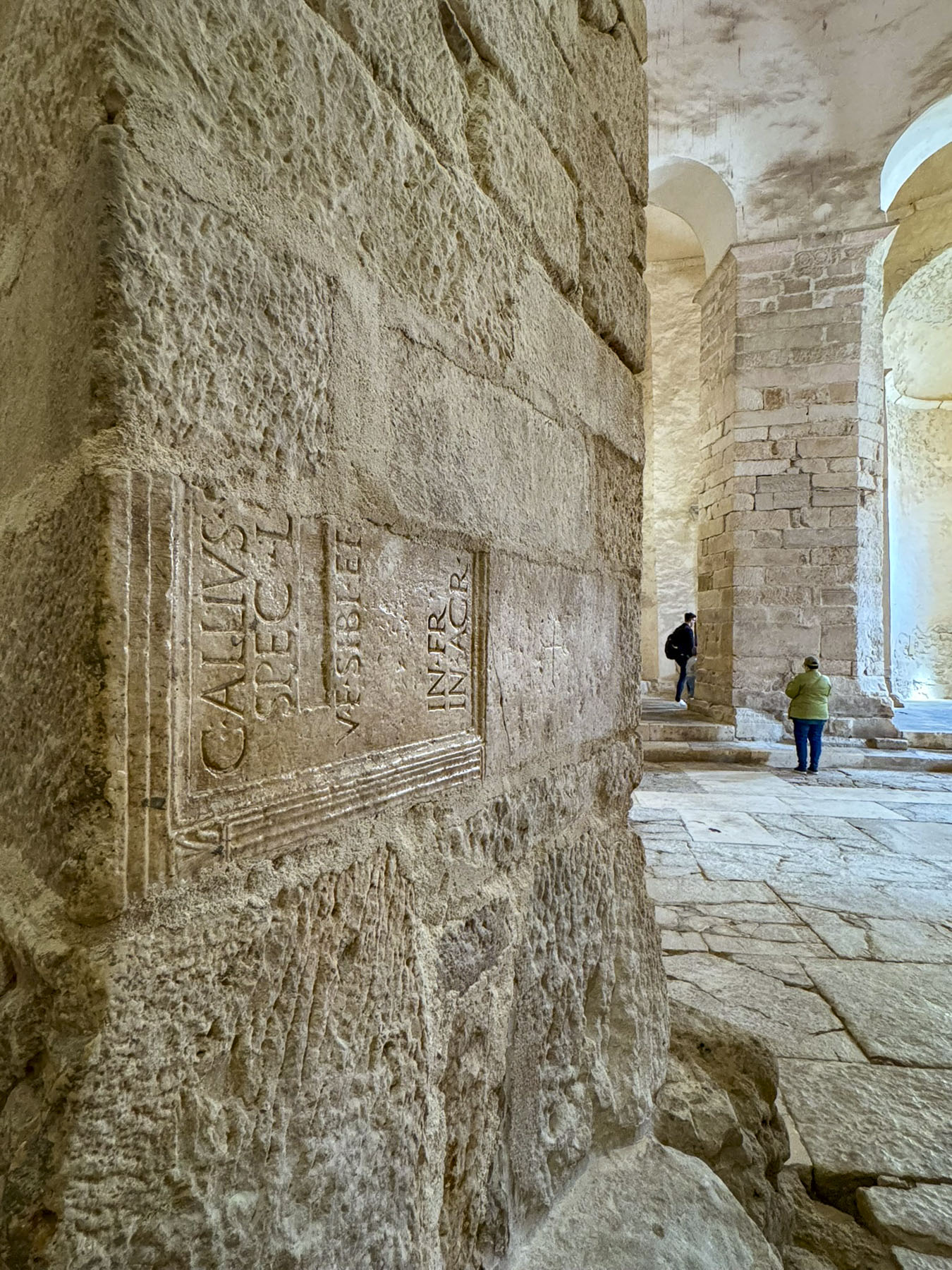
The fragments of reused columns, capitals, plinths, and cornices were used as fill, and can be seen in several exposed spots along the church’s foundation and interior. Its mammoth interior is 27m (89ft) tall, and at the top is a gallery that overlooks the space below.

The church was deconsecrated in the early 1700s, after which it was unceremoniously used as a wine cellar, warehouse, and Zadar’s first archaeological museum in the early 1900s. Nowadays, along with being a tourist site, it hosts theMusical Evenings at St Donatus, a concert series that utilizes the church’s excellent acoustics, every July.

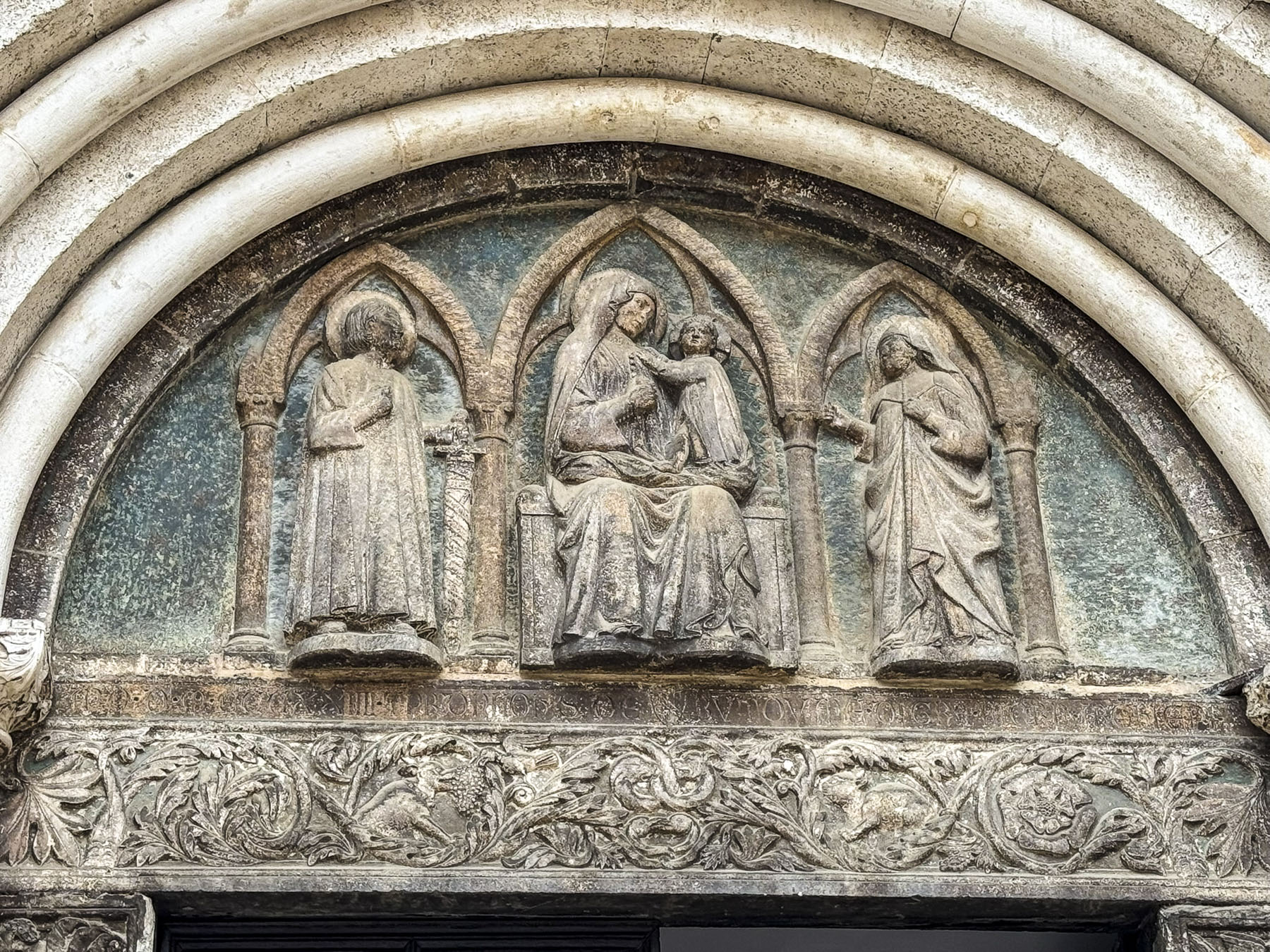
The Campanile di Sant’Anastasia, the belltower of the Cathedral of St Anastasia and its monastery, is right next to St. Donatus. The campanile was added to the church in the 15th century, four centuries after the church and its monastery were completed. During the high season it’s possible to climb the 186 steps to the top of the 55m (180ft) tall tower for a panoramic view of the city and sea. But unfortunately, in early April it was closed when we visited. Surprisingly, the entrance to the cathedral is on the other end of the building, around the corner from the belltower, and took us a few minutes to figure out its location.

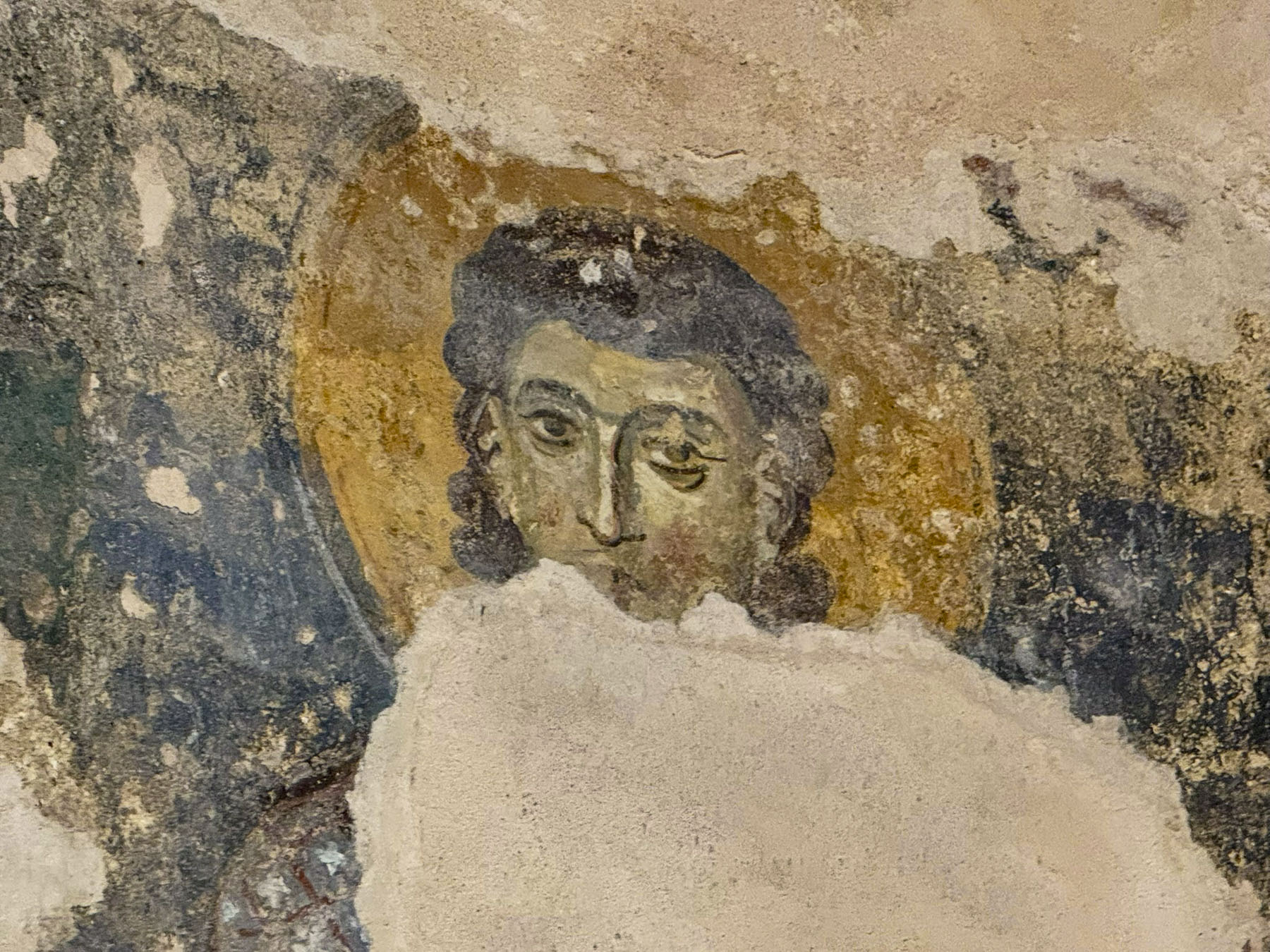
The interior of the Romanesque style church features an open timber truss roof, interesting side altars, an ancient fresco featuring what is believed to be a likeness of the saint, and the remnants of a 13th century mosaic floor, which I almost accidentally fell on, after losing my balance on the uneven stone flooring.

We could only imagine the uproar that would have ensued if I had damaged the antiquity. We wondered if our travel insurance would be of any use in this situation.

There are numerous other churches in old town Zadar. Choosing several churches and connecting the dots between them we found was a good way to see the various neighborhoods on the peninsula.

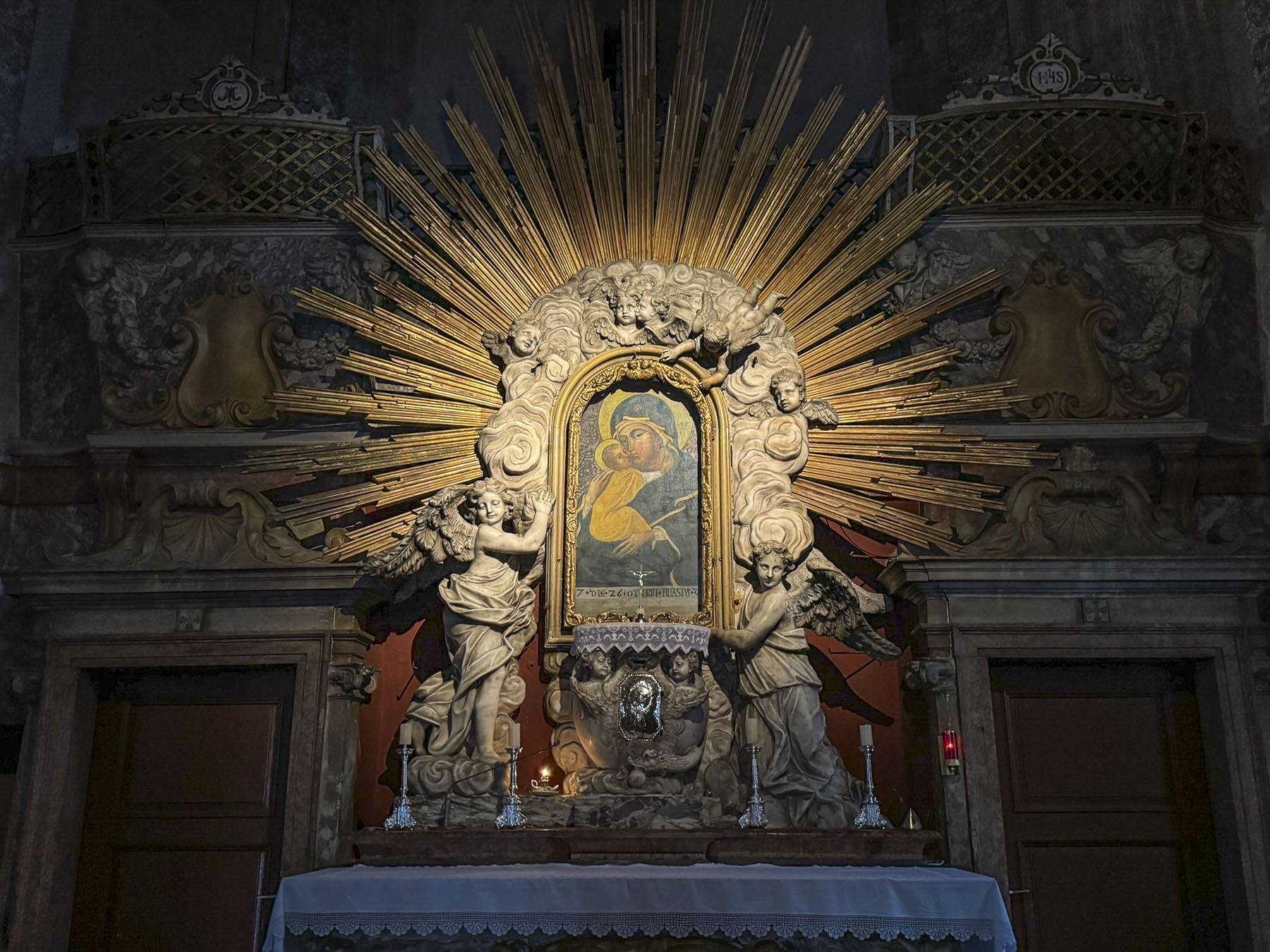
One of our favorites was the Crkva Gospe od Zdravlja, the Church of Our Lady of Health, set on the edge of a small park. Its small intimate interior was often visited by folks on their way to work in the morning.

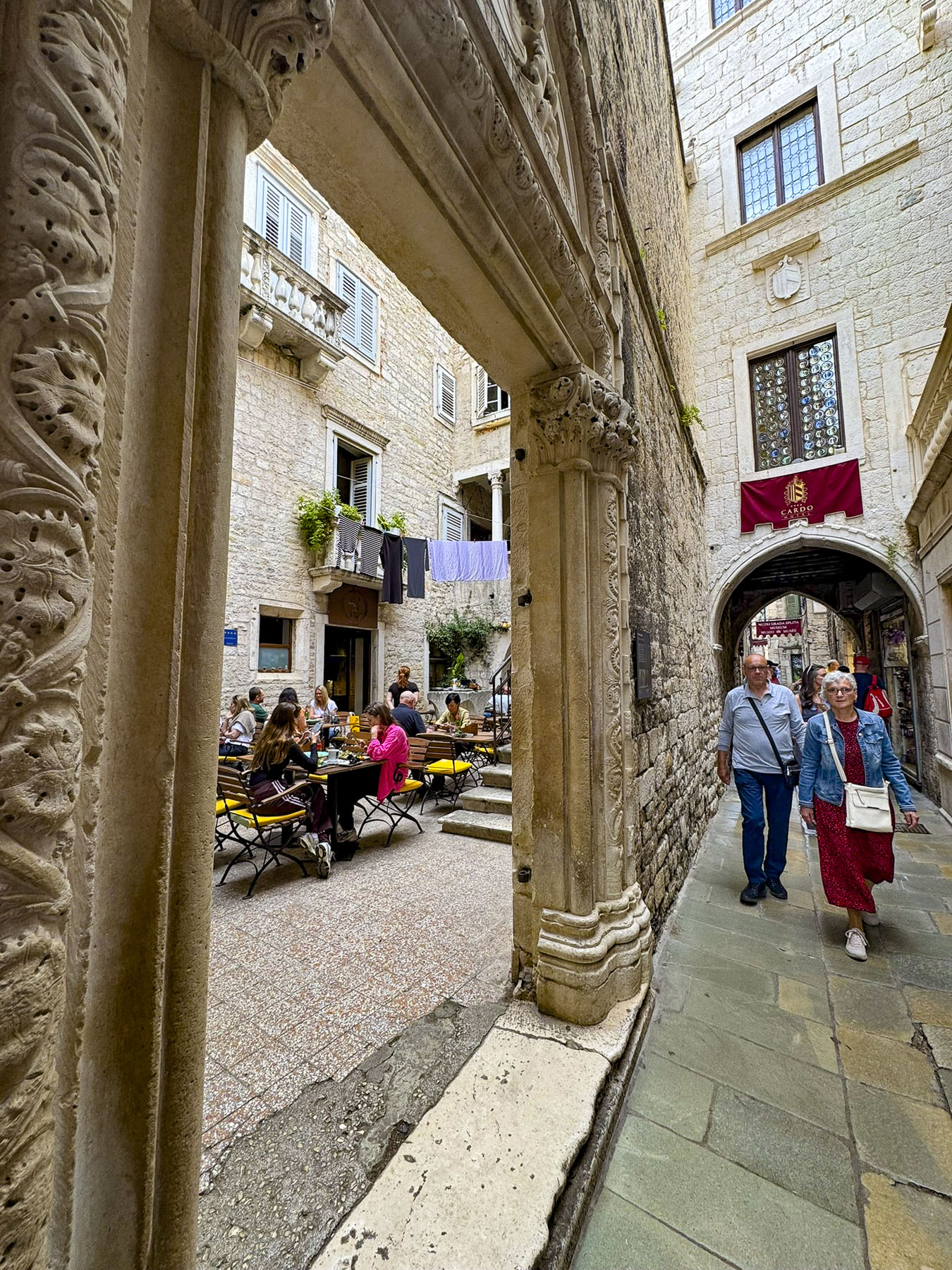
Over the course of our wanderings past random buildings, down narrow alleys, and in dim courtyards, we found examples of the many different architectural styles that have graced the city over the centuries.

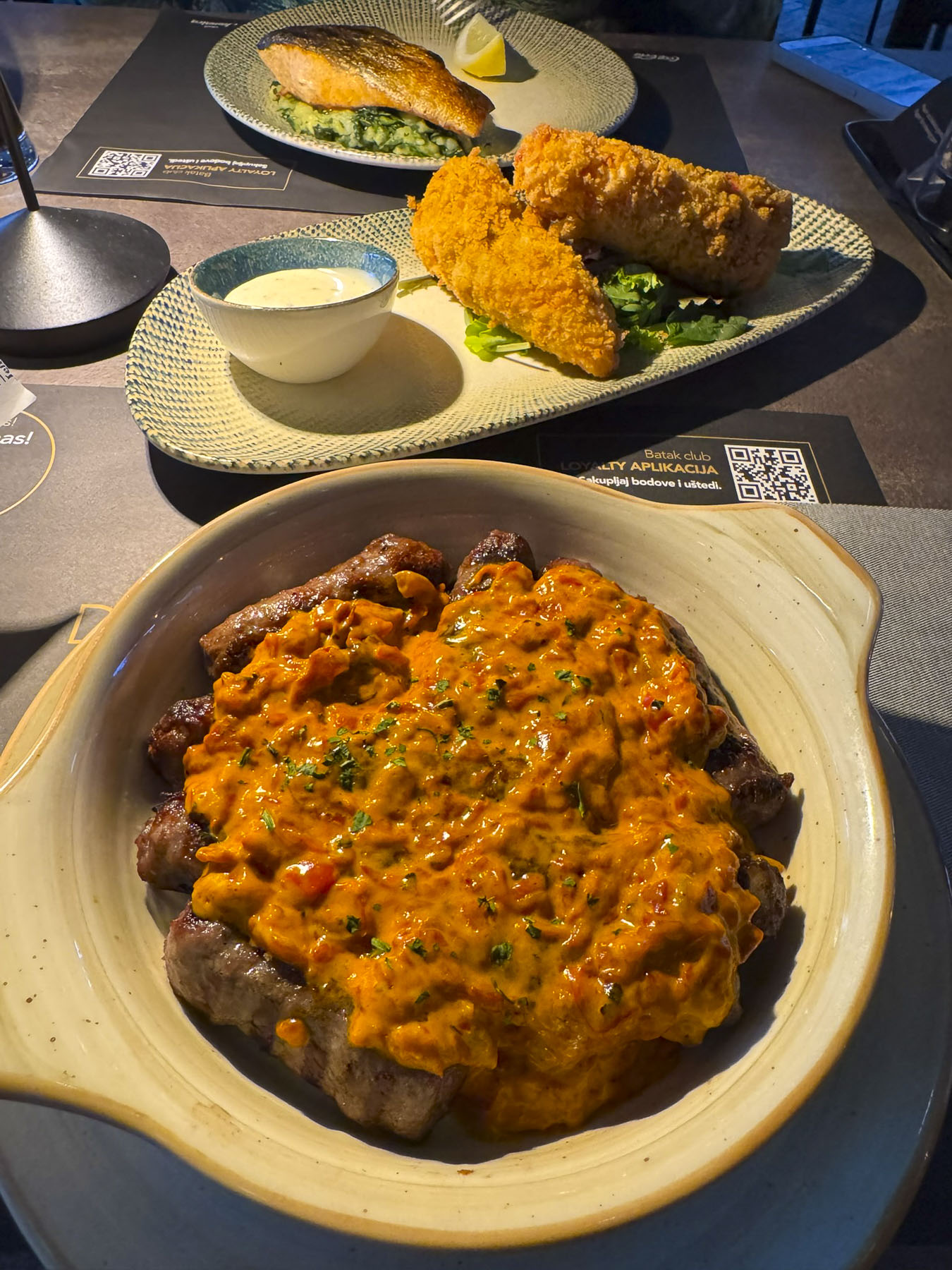
On our last night in Zadar, we drove off the peninsula to another recommended restaurant, Batak Zadar, located in a shopping center, far away from the tourist zone. We ordered several of their Croatian classics, and a local red wine. Everything was very good, and an excellent value compared to the inflated pricing of the restaurants in old town Zadar.

Though the weather could have been more cooperative, we enjoyed our three-night stay in Zadar, and found the size of the charming city just right for a short stay before the start our three-week road trip through Croatia, Slovenia, and Bosnia and Herzegovina.

Till next time,

Craig & Donna