Tram 15: More Than Just Belem

Standing in the center of the Praça do Comércio today, it’s difficult to imagine the catastrophe of the 1755 earthquake and following tsunamis that destroyed eighty-five percent of Lisbon’s buildings. Cathedrals, palaces, and bordellos (it was a seaport) collapsed and burned.  An estimated forty thousand people died. Renaissance masterpieces by Correggio, Rubens, Titian, and others were reduced to ash.  Detailed accounts of Portugal’s early history and the explorations of its famous navigators were lost when the royal archives were swept away.  Nearly 100,000 early manuscripts vanished when the libraries housing them were incinerated in the fire that lasted for five days.  From the landing, where today street entertainers perform and folks gather to dance and watch the sunset, barges were loaded with the bodies of the dead, towed out to sea and, against the wishes of the church, torched to prevent the spread of epidemic diseases. This event was so calamitous it derailed Portugal’s plans for further colonial expansion. IMG_9221The grand plazas and city center we enjoy today are the results of the visionary prime minister, the Marquis of Pombal, and his head architect, Manuel da Maia.  They presented to King Joseph I the bold idea to start afresh – to reclaim land along the Tagus River, raze what was left of central Lisbon and replace it with a grid pattern.   Wishing order to be returned to his capital, the king endorsed “the construction of big squares, rectilinear, large avenues and widened streets” and with that the new age of city planning began.

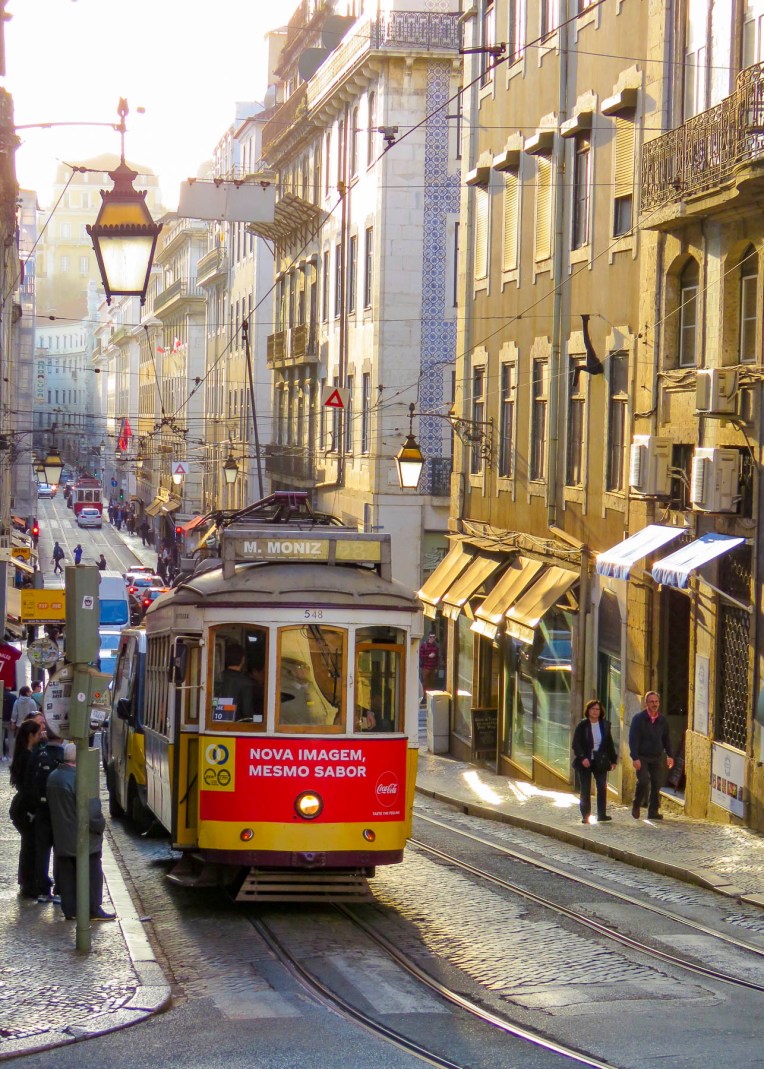
Trams 15 and 12 share the same starting point on Praça da Figueira. Tram 12 will take you on a slightly different route up into Alfama than the famous #28 does. Tram 15 will make its second stop at Praça do Comércio, head to Cais do Sodré then mostly run parallel to the Tagus River all the way out to Belem, before turning around at Algés (Jardim).  Sleek modern as well as classic trams run on this route; both are usually packed, depending on the time of day you travel.IMG_9164There is so much to do along this route that it’s easier to walk between points of interest that are close together at the beginning.  Save a trip on the tram until later, when you want to head to the LXFactory or Belem Tower, which are much further away.

Restaurants line the impressive Praça do Comércio, offering great vantage points to watch the activity on the plaza unfold throughout the day. A coffee or beer will secure your chair for as long as you wish.

Down at the waterfront folks gather to listen to street musicians, watch performance artists, and just sit to soak up the sun along a beautiful shoreline as boats cruise by.  Stone steps lead down to two tall marble pillars at the edge of the Tagus River marking the Cais das Colunas, the “door to Lisbon.” Over the centuries, royal barges with eighty oarsmen would deliver kings and other dignitaries to this portal where they were greeted with ceremonial pomp, before they paraded into Lisbon through the Arco da Rua Augusta.IMG_5212Walking along the river towards Cais do Sodré by the Ministério da Defesa Nacional – Marinha building you can see remnants of a stone wharf in the reflecting pool; landlocked now, it’s all that remains of an extensive old navy quay.  There are many places to dine in this area, but we preferred to continue onto Av. 24 de Julho to check out the street art in the area and then stop at The Time Out Market. 

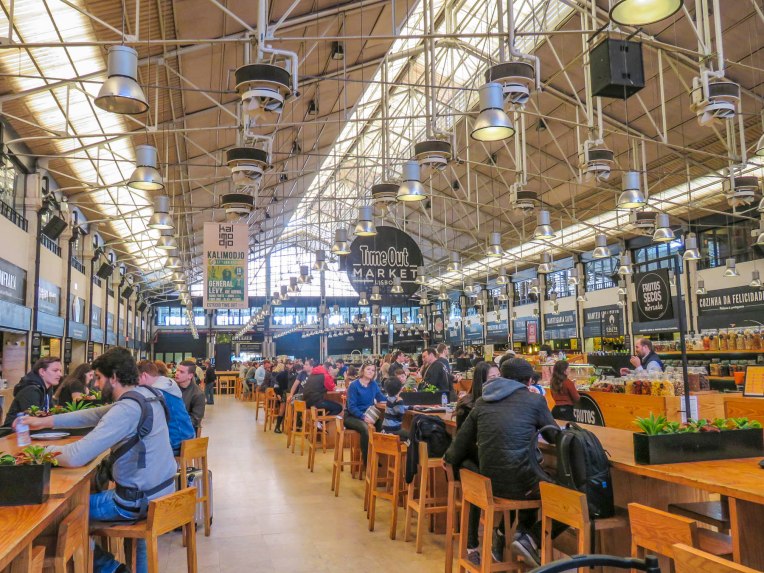
This is a tremendous food hall with a great variety of restaurants and communal seating. It’s always busy, loud and fun!  Close by, in the evenings, you’ll find the club scene on Pink Street.  If you’ve had enough of this area, funicular Bica is only a few blocks away and will whisk you back to the heights of the Baixa neighborhood where you can jump on tram 28.  Watch for the gentleman walking his pet Vietnamese pot belly pig along the funicular tracks.IMG_3322

Farther along Av. 24 de Julho, a steep set of twin stairs leads to Jardim 9 de Abril, a small, quiet park, and the Miradouro da Rocha Conde de Óbidos, which overlooks an active freight harbor.  It’s a different view of Lisbon that reminded us of the city’s long merchant marine history.  Next to the park the Museu Nacional de Arte Antiga exhibits an interesting collection of European furniture, paintings and sculpture in a revamped 17th century palace. A short walk from here you’ll find the most colorfully tiled highway exit and entrance ramp in the city, on Av. Infante Santo. IMG_5329IMG_0347One of the nicest Sundays we enjoyed was spent at the LXFactory.  This was formerly a huge industrial complex, located under the Ponte 25 de Abril bridge, that has now been revamped into a hip destination with co-working areas, boutique shops, art galleries and fabulous restaurants.  The streets where forklifts once rumbled now host a wildy popular outdoor market on Sundays with all sorts of food, jewelry and clothing stalls to wander through.

There is plenty to entertain yourself with here during the week too. With stops at the whimsical Livraria Ler Devagar bookstore, Landeau Chocolate where they only serve their legendary chocolate cake, and drinks or dinner at Rio Maravilha on the rooftop deck, under the iconic sculpture of the diving lady.  The spot is so mesmerizing we returned several times during our time in Lisbon.  The stack of colorful shipping containers and double-decker buses you’ll see from here is Village Underground Lisboa, which is also a neat place to check out.

There is just so much to explore in Belem, between the outdoor sites and the congregation of museums, that it’s impossible to cover it all in one day.  All too conveniently, tram 15 stops in front of Pastéis de Belém, the origin of those heavenly sweet custards.  The waiting line for these divine mouthfuls of temptation can lead down the street at times.  If that’s the case, enter through the exit door on the left, and walk straight back into their 400 seat coffee shop and place your order with a waiter.  The only saving grace from this near sinful indulgence is that the rest of your day in Belem requires walking, lots of walking, between sites.  Burn those calories! 

Museu Nacional dos Coches houses a marvelous display of 16th – 19th century wheeled opulence, that should have inspired the revolutionaries of the day to storm the palace and send the royals into exile. The ceremonial coaches sent to the Vatican are simply over the top. It is amazing to think that in 1905 when this collection was first opened that there were still so many royal coaches around.  Were they covered in tarps, pushed to the back of the stable and forgotten, only to be rediscovered later?

The walk along the Tagus River from the Monument to the Discoverers, built in 1960 to commemorate Portugal’s role in the Age of Discovery, to Belem Tower, which was once in the center of the river, is beautiful and long enough to temporarily tire any revolutionaries’ desire for change.  The first flight across the South Atlantic in 1922 from Lisbon to Rio de Janerio, which took 62 hours in an amphibious biplane, is also honored with a metallic sculpture that shines brilliantly in the sun.  Visit these sites early in the morning or at the end of the day to avoid the crowds.

We waited out a brief passing shower in one of the cafés adjacent to Belem Tower before working our way back into town. Stop at Museu Coleção Berardo (free on Saturdays) which displays an impressive collection of world renowned contemporary and modern artists in permanent and changing exhibitions. The visit to this museum was a refreshing break from the old-world charm of Lisbon. They also have a wonderful café that has a terrace with views overlooking the monuments along the Tagus River. It’s a very nice place to relax that is off the usual tourist path.

Visits to Museu de Marinha, naval history museum, and Jerónimos Monastery capped our day in Belem.  It’s all too easy to forget that Portugal was once a sea-going power with fleets of ships and an empire that rivaled England’s and Spain’s. This fascinating nautical museum will drive home the importance of the sea to Portugal’s livelihood, and the contributions Portugal made to the Age of Discovery.  A collection of historic royal barges will make you wonder about the court’s indulgence for extravagance. Some are so large they required forty oars to propel them through the water.

Jerónimos Monastery, started in 1501, is a treasure of gothic architecture with every surface painted or carved in ornamentation for the glory of the Holy Trinity. It’s huge and an interesting place to wander about; however, we felt it was not worth the price of its rather steep entry fee of 12.50€ per adult. Next door, just as gothic, interesting and free is the cathedral of the monastery – Santa Maria de Belém.

Within this cathedral the ornate tombs of Vasco da Gama and Manuel I of Portugal can be seen along with those of many other notable Portuguese citizens.  Near da Gama’s sarcophagus one of the stone carvers from the 1500s left his whimsical signature carved into a highly decorated column. It’s a small, upside-down face that is hidden amidst all the other decoration. Why? It’s a curiosity that tempts one to create a vibrant backstory for him. Can you find it?

With so much to do and see in Belem you might want to plan multiple visits to this captivating part of Lisbon.

Till next time,

Craig & Donna


Tram 28 – Part II: Chiado/Bairro Alto to Campo de Ourique

Starting the second part of this magical ride through Lisbon, tram 28 leaves the Praça do Comércio area from two nearby stops on Rua da Conceição, and climbs steeply around a huge curve into the Chiado and Bairro Alto districts before traveling to its terminus at Jardim dos Prazeres in Campo de Ourique.  Rebuilt after the devastating earthquake of 1755, both these districts have a totally different atmosphere than Alfama’s time capsule, reflecting a vibrant, more cosmopolitan Lisbon with fine upscale shopping, nightlife and historical monuments that often reminded us of Paris.  Praça Luís de Camões is the center of all this activity and tram 28 will drop you off amidst all the fun. There are so many things to do from this location that you might want to consider coming back here more than once. IMG_1626As if guarding the plaza, Igreja de Nossa Senhora do Loreto / Igreja dos Italianos, known as “the Italian Church” and Igreja de Nossa Senhora da Encarnação face each other with refined, simple exteriors.   The Italian Church was built in 1518 by King John V to celebrate Lisbon’s Italian community of Genoese and Venetian merchants.  The interior is lined with marble imported from Italy.
Exiting the Italian Church, you can walk right across the street into Igreja de Nossa Senhora da Encarnação to view spectacular ceiling paintings by Simon Caetano Nunes.  After the 1755 disaster, reconstruction of this cathedral lasted until 1873.  The cathedral also features several contemporary religious relief sculptures and a ceiling mural in a side chamber.

Once you’re back on the sidewalk, follow the sound of music to a small plaza. Here street musicians, performance artists and dance teams entertain crowds of tourists.   Outdoor cafes edge the plaza, which is centered by a statue commemorating António Ribeiro, a Catholic cardinal who supported the democratic movement that lead to the toppling of the military regime in 1974.  Pop into Café A Brasileira,  Lisbon’s first coffee house in 1908, with its Art Deco style interior of sculpted wood, polished brass and mirrored walls.  Many famous Portuguese writers and artists nutured their caffeine addiction here.  Poet Fernando Pessoa visited so often, he is immortalized here with a bronze statue depicting him seated at “his” table.  Immortalized in bronze, poet Fernando Pessoa sits permanently outside at “his” table.

Casa do Ferreira das Tabuletas with its ornate tile facade illustrating the sciences can be seen as you work your way to the Carmo Archaeological Museum. Set in the ruins of Lisbon’s largest cathedral before the 1755 earthquake, this small museum has a diverse collection of tombs, ceramics and mosaics along with other ancient artifacts. A few steps from its door, the viewing platform of Elevador de Santa Justa offers beautiful views of Lisbon.  Walking back to Praça Luís de Camões, pass the Guarda Nacional Republicana to watch Lisbon’s less elaborate version of the changing of the guard.

From Praça Luís de Camões you can also walk or take tram 24 up Rua da Misericordia deeper into Bairro Alto.  There is so much to do on this one street, you will want to return several times.  If you are looking to be selective about the churches you visit in Lisbon, Igreja de São Roque and its Museu de São Roque should be at the top of the list. The highly carved gilded interior was the first Jesuit Church in Portugal.  The museum exhibits an intriguing, world-class collection of Italian religious art in a contemporary setting. 

Riding a funicular tram in Lisbon is a must and the street-art covered walls of the Ascensor da Glória route are just a block from Igreja de São Roque.  It’s a pop culture experience to board the graffiti-painted tram and descend to Praça dos Restauradores.  The walls along the route have been given to the artists of Lisbon and are covered with spectacular street murals.  Older murals are painted over on a regular basis and replaced with new inspirations.IMG_5455Shady Miradouro de São Pedro de Alcântara overlooks this colorful chaos and has splendid views of Lisbon below.  From the miradouro it’s a gentle uphill walk into Bairro Alto. Fortunately, there’s no lack of places to rejuvenate yourself along the way.  For lunch we found A Padaria Portuguesa an artisanal bakery and restaurant that we would return to several times during our stay in Alfama just to buy their delicous bread.  This was especially rewarding if we combined it with buying cheese at Queijaria Cheese Shop just a few blocks away.  Listening to the proprietor describe the nuances of each Portuguese variety and offering samples to tweak our palette, we usually left with the makings for a nice picnic under the towering specimen trees of Jardim Botânico da Universidade de Lisboa, just across the boulevard.  Jardim do Príncipe Real, with its iconic trimmed cypress tree shaped to look like giant shitake mushrooms, was always a good alternative destination. 

For dessert and coffee, we’d indulge ourselves with a sumptuous visit to Bettina & Niccolo Corallo, a wonderful artisanal chocolate and coffee shop with seating for only 6-8 people.  Just down the street, in what was once an ornate, private residence, the Ribeiro da Cunha Palace has been subdivided into unique boutique stores.  The lavish, original architectural detailing can still be seen in all the shops as you wander through. If you are staying late in the area, Tapas Bar 52 is a popular place for sharing delicous, small plate creations. 

One stop away from Praça Luís de Camões, you can climb aboard funicular Bica and descend the steep hill into its gated ticket terminal on Rua de S. Paulo.  On your way down you might catch a glimpse of a middle-aged man walking along the tracks, his pot-bellied pig on a leash.  Outside the terminal you’re back on flat terrain again and only a short walk away from the Time Out Market.IMG_5363Set in a historic 1890s building in Cais do Sodré, this is a huge, lively food court with numerous restaurant choices that is very popular with Lisboans. Whatever you are craving at the time, you’ll find something satisfying here.  Next door, during the week, Mercado da Ribeira operates a central market with fish, meat and produce vendors offering Portugal’s finest products.  Brightly painted Pink Street, popular for its club scene, is nearby.IMG_3326Take funicular Bica back uphill, and around the corner you find tranquil Miradouro de Santa Catarina,  with views of the Tagus River and Ponte 25 de Abril Bridge in the distance.  The Museu da Farmácia is also located here. Also, nearby along Calcada do Combro, or just off it, are several landmarks worth quick visits.

Unimpressive from the outside, Igreja de Santa Catarina, built in 1647, has a rich, baroque style, gilded interior and impressive pipe organ.  The buildings along Rua Vale frame Igreja Paroquial das Mercês sitting prominently atop a small hill at the end of the street. First constructed in 1615, a masterpiece of tile work created in 1715 and installed on a vaulted ceiling in a small room survived the 1755 earthquake. This is one of Lisbon’s hidden treasures.  Credited to tile master Antonio de Oliveira Bernardes, the mural illustrates the Litanies of the Virgin Mary.  Ask the church attendants to open the room for you. The rest of the church is an eighteen-century reconstruction.  Down Rua Vale from the cathedral, Atelier-Museu Júlio Pomar, a small contemporary art museum, has rotating exhibits and a permanent collection of works by Júlio Pomar (1926-2018.) Some consider him to be the most influential Portuguese painter of his generation. 

A mass of sun worshippers greeted us a we stepped off the elevator at Park Bar.  Every chair in this oasis of lush greenery, hidden above Lisbon, was turned towards the sun to take advantage of the view on this early spring day.  With a quick look at the name, you think the bar is in a park, but instead it’s on the sixth-floor rooftop of a parking garage next to Igreja de Santa Catarina.  Finding the entrance was a bit challenging, since there was no signage, but once you locate the elevator or stairs inside the garage you’re set.  The place gets packed at sunset and the party grows into the night with DJ’s providing the soundtrack.IMG_6126 Heading west, tram 28 weaves through a very narrow section similar to parts of its route in Alfama, before reaching the open area around Assembleia da República. The parliament of Portugal is headquartered in a neoclassical building that was first used as a convent in the sixteenth century.  Formal gardens behind the parliament building, hidden by an imposing wall, can be seen from tram 28 or if you stand on your tip-toes and peer over.  Never immune from criticism, the politicians must endure a large satirical wall mural, painted on a nearby building, as they head to work each day.

Past the Assembleia da República the character of the city changes.  The streets widen and some multi-storied apartment buildings dot the cityscape between historical buildings.  If you are ready to picnic, Jardim da Estrela is a wonderfully landscaped park with ponds and sculptures of historic figures scattered along the walking paths. Across the boulevard, one of Lisbon’s lesser visited cathedrals, eighteen-century Basílica da Estrelaor, safeguards the tomb of Queen Mary I.  She was the first monarch to rule over a united Portugal that included Brazil.  She ordered the construction of the cathedral in 1761, as a religious obligation, after the birth of a male heir to the throne.  Unfortunately, Queen Mary outlived her son (José – Prince of Brazil) who died of small pox at the age of 27.  The cathedral also has a 500-piece nativity scene, made of cork, on permanent display.

Tram 28 ends its charming journey in the Campo de Ourique neighborhood at Jardim dos Prazeres, a small park with two cafes, in front of Cemitério dos Prazeres.  Here the tram waits for several minutes before following its route all the way back to its starting point in the center of Lisbon at Martim Moniz.   This tranquil cemetery is the final resting place for many of Portugal’s most notable citizens.  Tombs of famous fado singers, artists, architects, doctors, writers and poets share the cypress lined lanes with politicians, nobility and a variety of songbirds.  Many of the mausoleums are ornately decorated with artistic sculptures that represent the deceased’s career.  Stop in the office to get a map outlining several different self-guided tours. There are numbers on the curbs in front of some of the tombs to help cross-reference the person’s contribution to Portuguese society.  The far side of the cemetery offers views of the Tagus river and Ponte 25 de Abril bridge.

A few blocks away Mercado de Campo de Ourique has been revamped into a trendy food hall where organic and artisanal food purveyors share the space with small bars and restaurants.  It’s a great place to rejuvenate before heading home.

Lisbon is an intriguing city with an amazing variety of activities in which to immerse yourself.  There is no one “correct” way to see the city, but tram 28 offers a splendid six-mile route through this charming capitol that passes many of the top attractions.  Multiple sites are close together so it’s easy to walk from one to the other and then just hop back on the tram to cover greater distances.  Don’t expect to see everything along this famous route in one day; there’s just so much to explore and many wonderful diversions!

We loved Lisbon and can’t wait to return one day.

Till next time, Craig & Donna

Tram 28 – Exploring Alfama – Part I

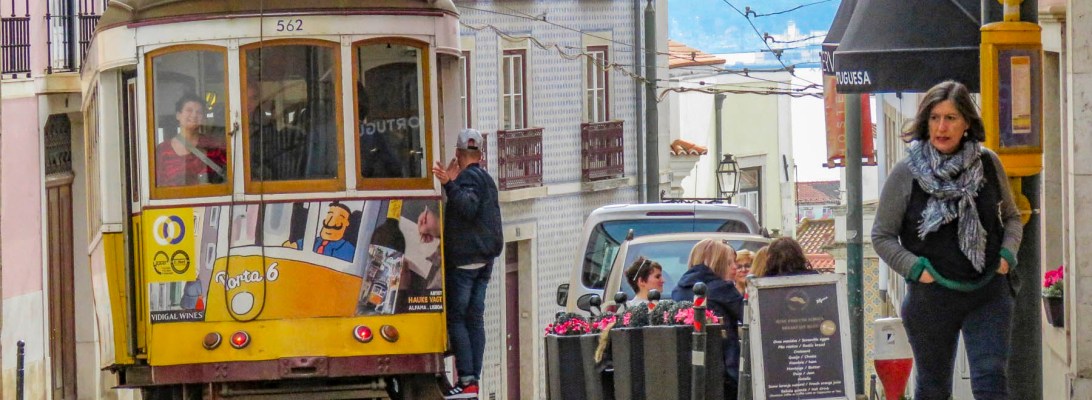
We relied heavily on the Lisbon tram system, especially tram 28 which ran very close to our Airbnb, to navigate our way around this beautiful and very hilly city.  Unlike San Francisco, the trams in Lisbon are affordable if you purchase a Viva Viagem transit card from an agent at a Metro station.  With a Viva Viagem card your fare on the trams and funiculars is 1.40€, but without it the price rockets up to 3.00€ per ride.  As you exit the arrivals terminal at Lisbon airport look to the right and you will see the sign for the Metro. Just down the escalator there is a ticket office where you can purchase your transit card and be set for your time in Lisbon.IMG_0845All the tram lines in Lisbon travel through wonderful areas, but tram 28 has become famous because it is the longest line in the city and runs near many of the tourist highlights in romantic Alfama, namely Castelo de Sao Jorge and the miradouros (overlooks) Portas do Sol and Santa Luzia.  Before heading back into the city center, it climbs into the Chiado district and ends in Campo de Ourique by the historic Dos Prazeres Cemetery.  Nearly every stop along this splendid route offers a worthy point of interest.  Being this popular, it is often difficult to get a seat on tram 28, especially if you choose to board it where it begins at plaza Martim Moniz in the center of Lisbon.  After 10AM the line of folks waiting here can be daunting and you might have to wait for several trams to fill and go before you have a chance to board.  But if you must stand, head for the back of the car – the rear of the tram offers the best views. If you can, we suggest boarding at one of the miradouros where usually many people exit the tram.  Tram 12 has a stop behind tram 28’s starting point on Martm Moniz. It will also take you to the miradouros by a slightly different route.  There is not a “correct way” to explore the diverse things along the tram 28 route.  Each stop offers multiple destinations to explore. Just pick out what you are interested in and have fun.  Walk a little then café, then repeat as many times as necessary! That’s how we do it. 

Leaving Martim Moniz, tram 28 travels up the steep, narrow and serpentine streets behind Castelo de Sao Jorge to the Graça neighborhood, often delayed by delivery trucks and double-parked cars. Normally the tram will wait patiently as this is an everyday occurrence, but occasionally the tram driver will sound his horn until the offender moves their vehicle, if he feels they are taking to long.  Reaching the top of the hill, keep an eye out for a large wall mural, Revolutionary Woman, created by the American artist Shepard Fairey, who is most renowned for his famous Barack Obama poster.

A little further along, Plaza Graça, with its everyday shops, bakeries and small outdoor cafes, offers a chance to explore a non-touristy spot for a very local experience.  From here it is a short, level walk to Jardim da Graça, Miradouro Sophia de Mello Breyner Andresen and Igreja e Convento da Graça. The convent has an interesting collection of azulejos tiles depicting 16th, 17th and 18th century missionary journeys across Portugal’s colonies that ended tragically with the martyrdom of the priests involved.  This area is a wonderful spot that is slightly off the beaten track.  The miradouro offers a great view across Lisbon that includes Castelo de Sao Jorge and the Ponte 25 de Abril bridge. The panorama is reminiscent of San Francisco.  The small café here fills toward sunset.

The next stop downhill brings you to Igreja de São Vicente de Fora and its convent. Started in 1147, just after the liberation of Lisbon from the Moors, the cathedral was finished in 1629.  It is one of the most important church complexes in Portugal. The attached museum displays a collection of religious artifacts, paintings, sculptures and Baroque azulejo tiles. If you plan a visit for a Saturday or Tuesday, just uphill through the Grand Arch connected to the convent you will find Lisbon’s best flea market, Feira da Ladra or as it was long known “the Thieves Market” spread out around Campo de Santa Clara. Our neighbor in Alfama described it as a place where you used to be able to “buy back the things that were stolen out of your car during the week.”  Today the market is very gentrified with vendors of antiques, books, CDs, toys, ceramics, clothing and handmade artisanal crafts sharing the street.  On Saturdays during the summer there is also a farmer’s market in Park Jardim Botto Machado that features organically grown food.  And of course, there are cafes around the fringes of the market. Nearby the Pantheon is visible through the shade trees and further along as you work your way towards the Tagus River, the Museu Militar de Lisboa displays a surprisingly interesting collection of military memorabilia in a wonderful mansion.

Back aboard the tram, it now continues downhill into Alfama along the narrowest part of the route, for a short distance.  The street is so narrow here you can reach out and touch the walls of the buildings as you pass through.  And if you are on the sidewalk at the time, suck it in and pin yourself against the side of the buildings.  As soon as the street widens out again you will be by Café Do Eléctrico run by a nice woman named Sandra.  This is very much a local’s place, where folks get their morning espresso before hopping on the tram and heading to work.  The coffee, food and prices here are all good, and compensate for its lack of décor.  Situated a couple of steps below street level, it’s a great place to experience the sensation that you are about to be run over by an approaching tram as it fills the doorway before suddenly turning sharply.

From this stop you can wander downhill through the maze of crazy alleys that make up Alfama. Spared the devastation from the 1755 earthquake and tsunami that destroyed the rest of Lisbon, Alfama hasn’t changed much since the times of the Moors. Head to Santo Estêvão Belvedere church, and its lesser known miradouro that you will have all to yourself; it’s a nice spot for a picnic. From here you’ll have a choice of stairways or alleys to follow deeper into the charm of Alfama. Folks still hang laundry from their windows and shout down to their neighbors below. And elderly women sell shots of Ginja, a cherry liqueur, from their doorsteps as a way to supplement their pensions. There are numerous small restaurants spread about that fill the air with the wonderful aroma of Portuguese cooking. 

Around the corner from Café Do Eléctrico, stairs will lead you up to Igreja do Menino Deus, the Church of the Child God, which was built in 1711 by king Dom João V to commemorate the birth of a male heir. In striking contrast to Lisbon’s large cathedrals, this is a very small intimate church. It’s only open on Tuesdays.  From the church you can also walk up to Miradouro Sophia de Mello Breyner Andresen or through a mural-covered alley to Castelo de Sao Jorge.

After Café Do Eléctrico, tram 28 turns sharply and climbs before leveling off and making two stops at miradouros Portas Do Sol and Santa Luzia.  You can also walk to Castelo de Sao Jorge from both stops. Many people get off the tram at these popular miradouros, so it’s a good place to board tram 28 to continue your journey across Lisbon.

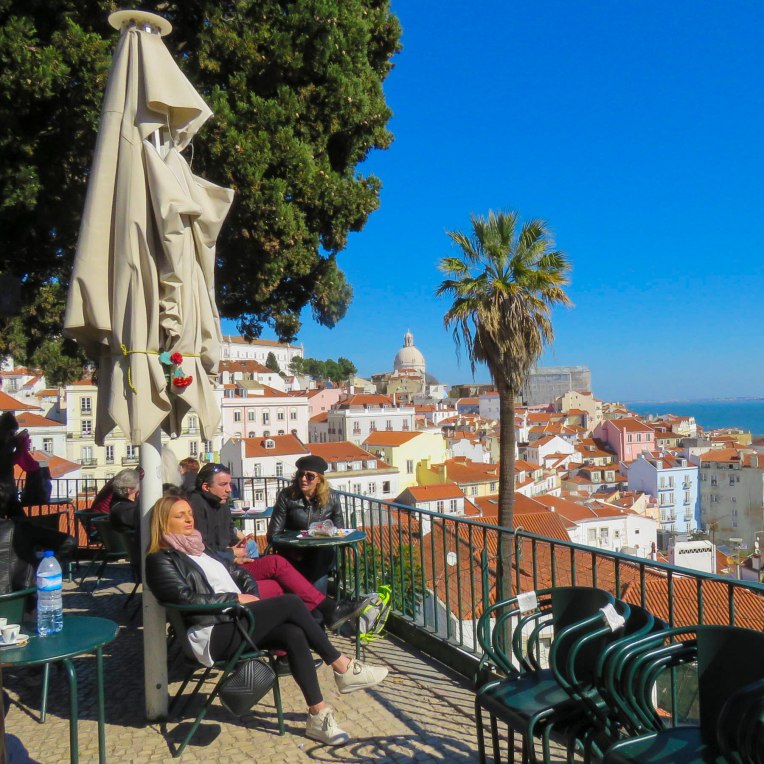
While both miradouros have awesome views of Alfama and the Tagus River, only Portas Do Sol offers outside cafes.  Just sitting here sipping wine and listening to the street musicians is a wonderful way to spend an afternoon, soaking up the experience of Lisbon. What’s really nice is that the cafes never pressure you to vacate your table; it’s yours for however long you want to sit.  Amazingly there is no price gouging either, as there easily could be at such a popular location. This seems to be true all over Lisbon. Miradouro Santa Luzia features azulejo tile murals depicting the liberation of Lisbon and a lovely vine covered arbor with azulejo tiled benches.  When you are done soaking up the sun, follow the alley next to the huge stone wall built during the time of the Visigoths, in the sixth century, down to the plaza around Igreja de São Miguel for a different bit of Alfama.

Across the tram tracks from the miradorouros is Museu da Fundação Ricardo Espírito Santo e Silva, a decorative arts museum. The museum showcases what was once the private collection of Ricardo Espirito Santo, unique pieces created in Portugal and its colonies, in an elegant eighteenth-century nobleman’s home.

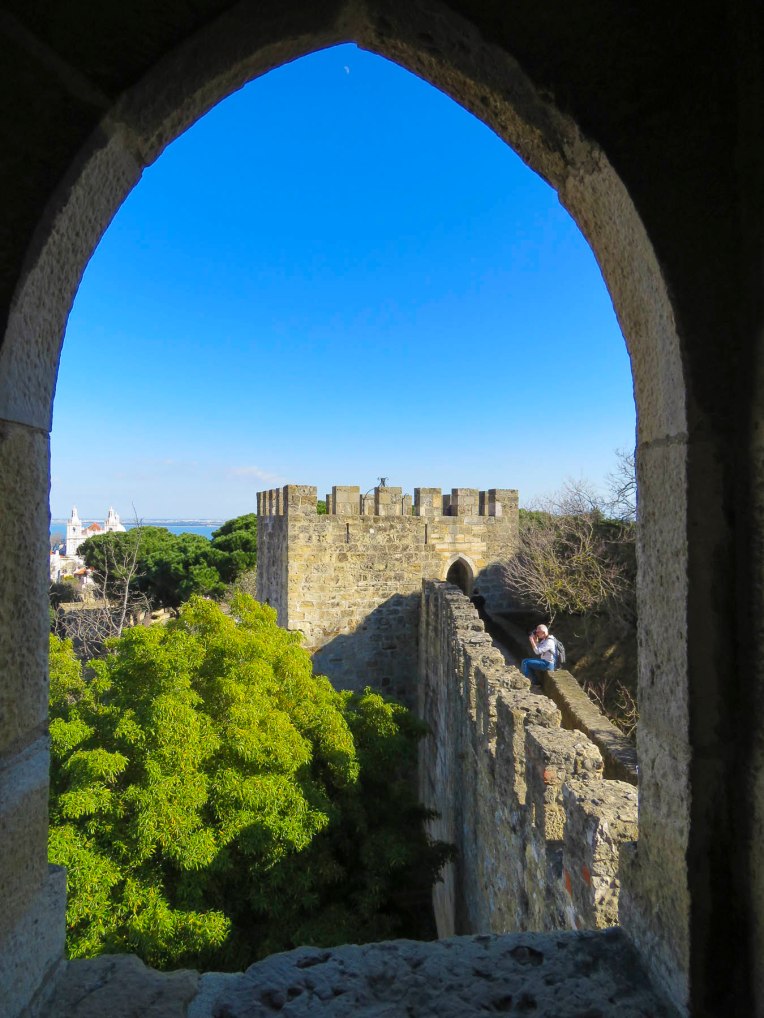
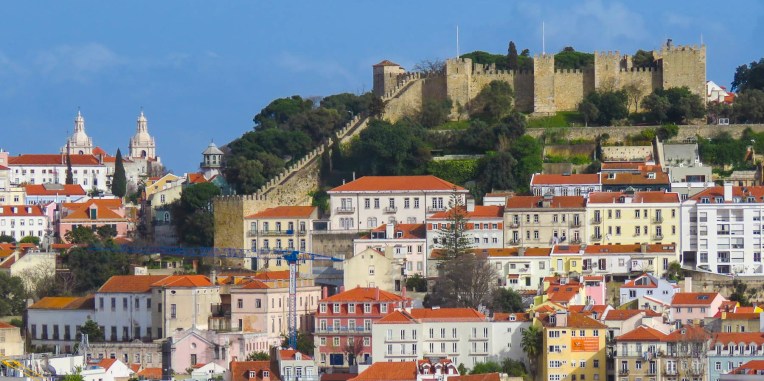
Or psyche yourself up for the hike to Castelo de Sao Jorge, a medieval Moorish castle that crowns the highest point in Lisbon and offers sweeping 360-degree panoramic views from various points along its fortress walls.  Besides scrambling along the ramparts and posing with the flock of peacocks that roams freely, there is a small museum that displays archeological items found during various excavations at the site.  The miradouro at the castle is stunning and unfortunately is only accessible with a 10€ entrance ticket to the whole site.  Viewing the setting sun from here is enchanting so time your visit accordingly.  There is a nice restaurant and a wine kiosk to help set the mood as you while away the afternoon.  Walking back to the tram line, you’ll pass ruins of a Roman amphitheater at Museu de Lisboa – Teatro Romano that you can visit.

A gentle, downhill walk from the miradouros will bring you to Sé de Lisboa, the Catherdral of Lisbon. The oldest church in the city, construction was started on the foundations of a mosque in 1147.  Surviving earthquake damage over the centuries, it features a mixture of Romanesque and Gothic architectural styles.  Next to the choir loft the Treasury museum displays a wealth of religious items that includes vestments richly embroidered with gold, ornate silver objects set with jewels and relics of various saints. Two ornately carved Gothic tombs from the 1300s can be seen in the ambulatory of the church.  The tomb of knight Lopo Fernandes Pacheco features an intricately carved beard, decorated sword and his dog by his feet.  The other tomb, that of his wife Maria de Vilalobos, features her in a finely detailed headdress reading the Book of Hours as one would before going to sleep each evening.  Excavations in the courtyard of the cloister show Roman, Visigoth and Moorish ruins.  The street Cruzes da Se next to the cathedral offers a nice level route back into the heart of Alfama.

Continuing downhill you’ll come to Igreja da Madalena which was started in 1164 and rebuilt several times over the centuries due to fires and natural disasters.  Diagonally across from the church is Queijaria Nacional, a gourmet cheese shop that features only Portuguese products.  If you are a cheese connoisseur this store is a must, and you’ll find it’s difficult to pull yourself away from the counter to continue your journey.

The next two stops bring us back to the city center near Praça do Comércio and the waterfront.  As you walk there be sure to check out the intriguing, decorative detailing on some of the buildings.

Here you can catch tram 15, usually a modern tram, to Belem to view the monuments along the river, or you can walk over to Elevador de Santa Justa, built in 1902, for a view of central Lisbon featuring Praça Dom Pedro IV with its wavy tile pattern and Castelo de Sao Jorge guarding the city.

Leaving the elevator from the viewing platform, you can walk across the ramp into the Chiado district.

We’ll continue on tram 28 through Chiado to the end of the line in Part Two.

Till next time,

Craig & Donna

Charmed by Alfama

Our driver hurried to unload our bags to the sidewalk as the famous Tram 28 waited patiently behind us, its tracks blocked by our taxi.  That’s the way it’s done on Lisbon’s narrow streets. Never the sound of frustrated drivers impatiently honking their horns, just folks courteously understanding the limitations of their intriguing city, built before anyone dreamed of modern transportation.IMG_9659The winding alleys and stairways of Alfama still retain their ancient charm as they work their way steeply uphill from the bank of the Tagus River to the Castelo de Sao Jorge, the highest point in Lisbon. Spared the devastation of the 1755 earthquake and tsunami that destroyed the bulk of Lisbon, the meandering lanes and plazas of medieval Alfama haven’t changed in a thousand years. Alfama is the second oldest neighborhood in Europe, after one in Cadiz, Spain. Archeological excavations next to the Castelo de Sao Jorge have revealed evidence of a Phoenician settlement that dated to 1200 BC, a Roman amphitheater, and walls built by the Visigoths before the Moors arrived.  Today the rumbling sound of wheeled suitcases on the cobble stone alleys echoes, almost continuously, off these walls weathered by time. Tourists make their way to newly renovated Airbnb’s, as we did, much to the concern of older residents of Alfama who worry about being gentrified out of their homes.“This part of Alfama is restricted to residents’ cars only. Your street is just two blocks down that lane,” our driver said as he pointed across the tracks. We sighed in relief, as the street to our right was very steep and we weren’t sufficiently caffeinated yet to attempt an ascent, without sherpas, of what seemed liked the foothills of the Himalayas.IMG_7194The winding alleys and stairways of Alfama still retain their ancient charm as they work their way steeply uphill from the bank of the Tagus River to the Castelo de Sao Jorge, the highest point in Lisbon. Spared the devastation of the 1755 earthquake and tsunami that destroyed the bulk of Lisbon, the meandering lanes and plazas of medieval Alfama haven’t changed in a thousand years. Alfama is the second oldest neighborhood in Europe, after one in Cadiz, Spain.IMG_7680 Archeological excavations next to the Castelo de Sao Jorge have revealed evidence of a Phoenician settlement that dated to 1200 BC, a Roman amphitheater, and walls built by the Visigoths before the Moors arrived.  Today the rumbling sound of wheeled suitcases on the cobble stone alleys echoes, almost continuously, off these walls weathered by time. Tourists make their way to newly renovated Airbnb’s, as we did, much to the concern of older residents of Alfama who worry about being gentrified out of their homes. 

Our home for the month of February was a small, one-bedroom apartment, with a college dorm sized refrigerator above a Fado restaurant, just a few guitar chords away from Miradouro Santo Estêvão Belvedere that offered views of Alfama and the Tagus river below. IMG_6896 Like our neighbors, we hung our laundry from our windows to dry.  Most evenings the melancholic melodies of traditional Fado music drifted softly down Alfama’s alleys from several restaurants nearby.IMG_7935While walking downhill was initially a good thing, it eventually led to us walking uphill and in Alfama it’s impossible to avoid.  Older folks walking with canes was a common site, since the cobblestones are so uneven and treacherous to walk on.  Choosing a career as an orthopedist almost guarantees success in Lisbon!  Fortunately, around every corner there seemed to be a mercado that carried basic items and catered to residents who didn’t want to leave their block.  We preferred to walk to the Graça district to shop at Pingo Doce, a terrific small supermarket chain, which was half a mile away.  It’s good we walked so much, as there wasn’t a bakery or pasteleria we couldn’t resist trying. They were so affordable, with prices at least seventy-five percent less than back in the States. We had a favorite butcher’s shop and seafood store.  An amazing variety of seafood was available, but our tiny kitchen barely had any prep room. One night as we prepared fish, we were surprised learn that our stove would trip the circuit breaker and plunge us into darkness if the electric heater was also on.  “Oops!” was not the word that we uttered that night as we fumbled for the circuit box in the dark.IMG_3463[31065]The wine and cheese produced in Portugal are exceptional, and an extremely good value, with each region renowned for a specialty. A very good wine can be purchased in the 10€ range, and a delicous bottle of Vino Verde, a young green wine, can be bought for less than 5€. We made destinations of recommended cheese shops, Queijaria Naçional and Queijaria Cheese Shop, and made a day out of the shopping expedition.  For chocolate lovers, a visit to the tiny shop of Bettina & Niccolo Corallo for a sweet treat and coffee is a must. Lisbon scored very high on our cappuccino, beer and wine test. The former were in the 1.50€ range, and the latter a reasonable 3.50€ a glass.  This was much more affordable than Antigua, Guatemala.  We found meals and drinks to be fairly priced all over Lisbon, even at the miradouros, the scenic overlooks.  At the famous Pastéis de Belém, where tourists would have willingly paid three times as much, the sweet pastry was less than 1.25€.

Wonderfully, tourist trap pricing seemed to be unheard of.  (We experienced only one incident of price gouging while in Portugal,  in Porto at the highly over-rated Café Majestic.) For dining in our Alfama neighborhood we tried Beco a Serio, Taberna dos Clerigos (Tavern of the Clergy), and Alfama Cellar, which was our favorite. Lisbon was culinary heaven and extremely gentle to our food budge with comparable lunches and dinners costing 50 – 60 percent less than in the States.

Considering we’ve been on the road over 250 days we have been relatively healthy.  But for Donna, a persistent sinus infection led to an ear infection and the challenges navigating the Portuguese medical system.  New to Lisbon and not knowing where to go for treatment we asked our host for recommendations.  “It will take longer to get treated at public clinic, but there is one nearby in Graça, or a private hospital.”  Arriving at Unidade de Cuidados de Saúde Personalizados (Mónicas) to a full waiting room at the clinic, the receptionist told us it would be better to come tomorrow at 8:00 in the morning to get in queue, as the day’s schedule was full already.   By chance as we were walking home, we noticed a doctor’s plaque on a door, walked in and waited patiently for the receptionist to address us.  Luckily, the doctor could see Donna later that day.  The office visit cost 65€, with a free follow-up visit, and the prescriptions only 20€.  Unfortunately, the ear infection did not clear up after the first round of antibiotics and we were advised to go to the walk-in nurse practioner clinic Centro de Enfermagem da Graça, nearby on the plaza to have the blockage evacuated.  With still no relief, the doctor sent us to an ENT, an ear, nose and throat specialist, at CUF Descobertas Hospital, a private hospital in Braco De Prata.  Outpatients enter through the emergency room and are directed to take a ticket, like in a bakery, and watch for the number to appear on the large overhead monitors in the waiting area.  Initially, we were called to the bursar’s counter to give all our information and passport number, plus a 500€ credit card deposit to secure services.  Back to the waiting area to be called to the triage room to be assessed correctly and then sent to a different waiting room, deeper in the hospital, before being called by a nurse and led through many corridors and elevators to the ENT waiting area.  A short time later we met the ENT specialist who provided a thorough ear exam, diagnosis and treatment plan.  Total – a whopping 140€ for a visit to a specialist!  This could not happen in the States even with health insurance.  Finally, back to the bursar’s counter where our credit card was refunded the unused balance.  Note: keep all your medical invoices. Our travel insurance provider World Nomads reimbursed the hospital and doctors’ visits along with all prescriptions.  Processing the claim went flawlessly online and our refund was electronically deposited. 

Exploring the different areas of Lisbon was a breeze using the tram and subway system.  Tram 28, famous only because it is the longest line in the city and hits most of the top tourist sites along its route, had several stops close to our apartment.

Purchasing a Viva Viagem transit card allowed us to pay the same rate for a ride as Lisboans.  A single use ticket on the tram was 3.60€, with the Viva Viagem card it dropped to 1.40€.  It also reduced the fare on the funiculars and Elevador de Santa Justa.  You can purchase the Viva Viagem at most subway stations that have a staffed ticket office.  We also used Uber and the local taxis; both were very reasonably priced with a trip into the city from the airport costing under 10€.  IMG_7493Residents told us this past February was unseasonably mild.  We enjoyed eating outside in the warm Spring sun as did many other tourists.  The streets seemed very busy for the “off season,” not overly so, but we couldn’t imagine what it would be like during the summer crush. 

We will share our day explorations around Lisbon in several future blogs.

Till then, safe travels.  Craig & Donna