Verona – Courtesans, Hermits and Grappa

Occasionally, I will suggest we return to a place we have visited before, to relive that good time and explore the things we missed previously, or if it was a super affordable destination.  “The world is so big. I’d rather go someplace new,” is often Donna’s response, said with a sweet smile.  But “the rule” doesn’t apply to Italy! – the land of her people.  I’ve lost count of the number of times Donna has been there, but I maintain I’ve followed along often enough to receive honorary citizenship. Let’s face it, Italy is a great place to explore, which led us to Verona, again, for a night. Anyway, it was sort of on our roundabout way to Milan.

It was late afternoon when we arrived at the budget friendly Accommodation Verona, (yes, that is the correct name) on the edge of the historic district. We double parked while the proprietor took our bags upstairs. He then hopped in the passenger seat to show the way to the underground car park and the hotel’s newly purchased garage spaces, with overhead doors to totally secure your wheels, which he was immensely proud of. It was a bit of a hike from the hotel, but the car was safe in the parking garage equivalent of Fort Knox.

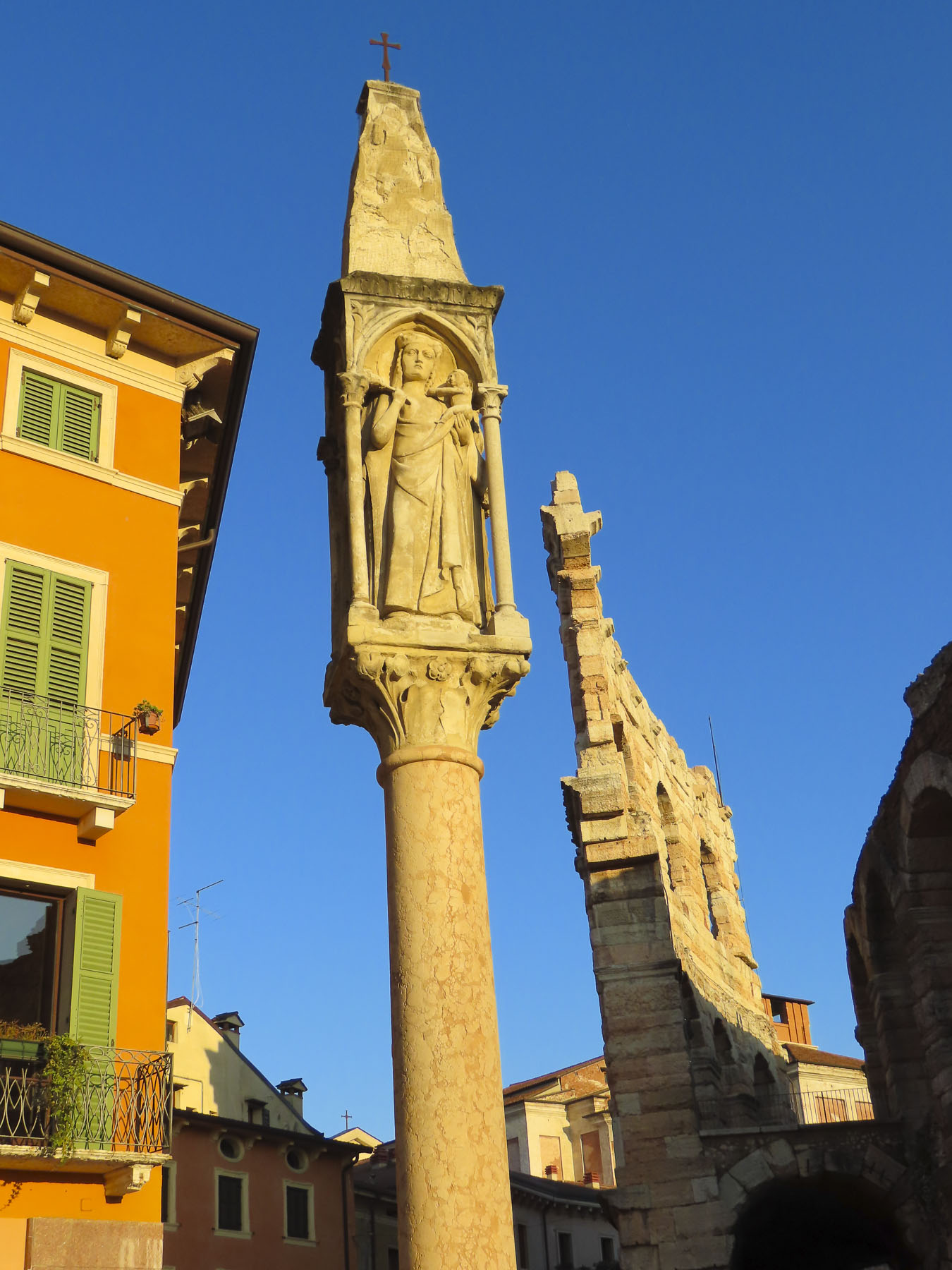
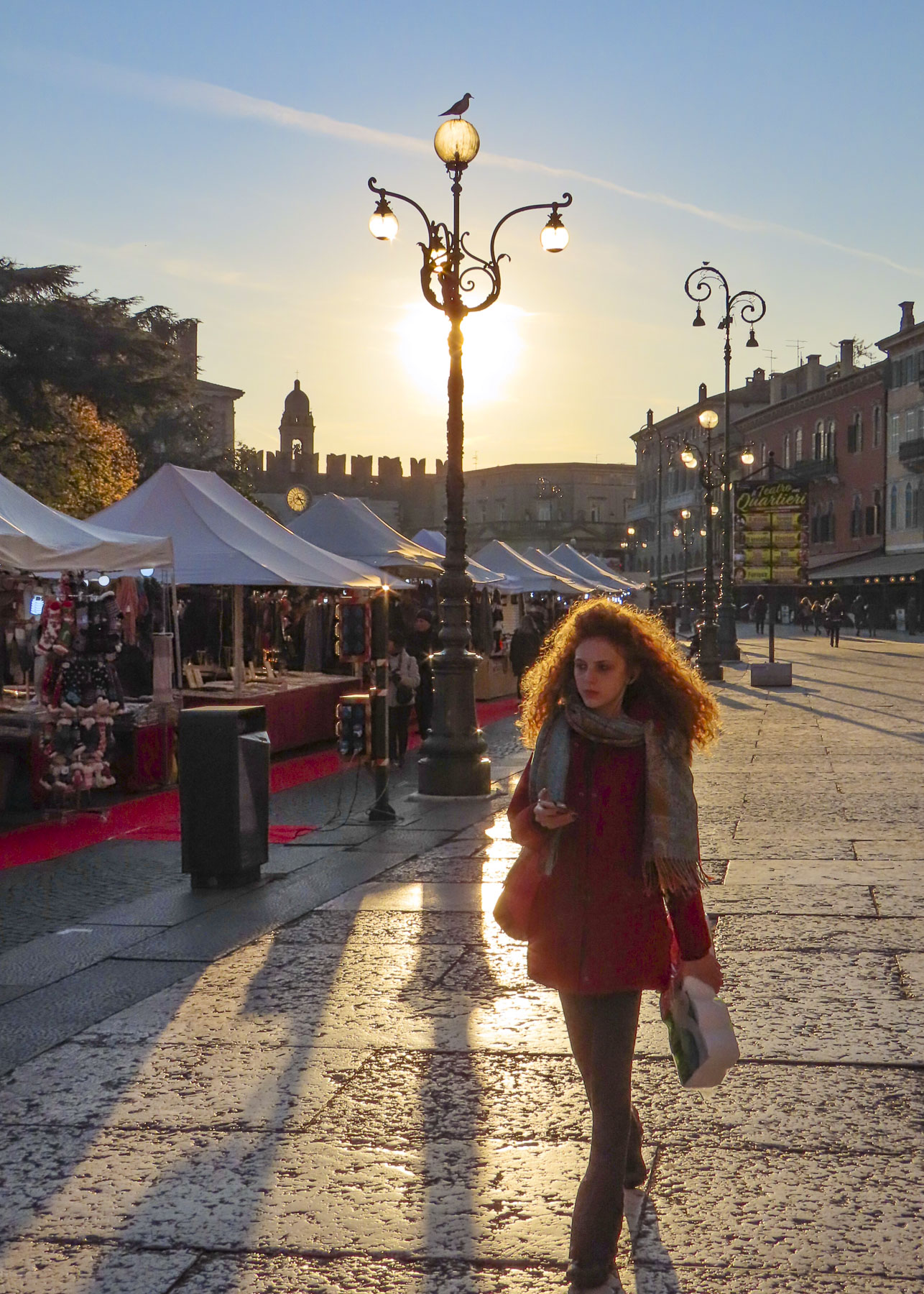
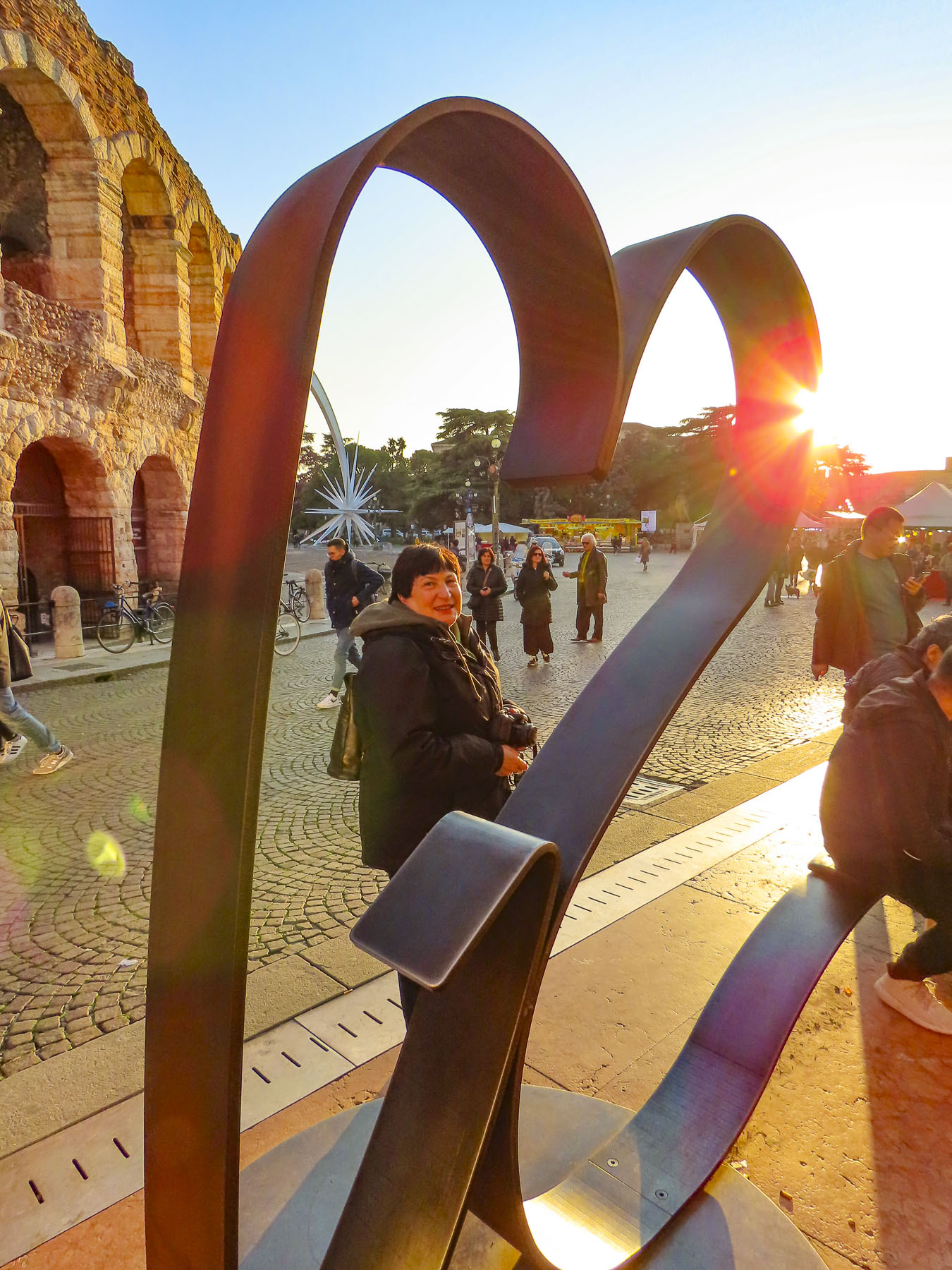
The sun was brilliant on Verona’s ancient colosseum while we sipped Aperol spritzes and shared a pizza at an outdoor restaurant on Piazza Bra, as shoppers strolled amidst the nearby Christmas market. Gone were the fake gladiators and other street entertainers who left when the weather turned colder.

It was a vastly different dining experience compared to our first dinner in Verona years ago.  Travel novices then, we were constantly referencing a travel guide by an American, that recommended sights, hotels and restaurants. With book in hand that suggested the restauranteur would treat us well and offer special prices to loyal readers of said guide, we found a delightful place on a quiet lane lined with outdoor tables and twinkling lights.  “Who?” was the response when we mentioned the guidebook. A large antipasto, charcuterie board, wine and “special price” were all agreed upon. Or so we thought.

It was one of those long, delightful European dining experiences, where the table was ours for the evening. The dinner and ambiance were great! Eventually our amiable host, carrying the largest bottle of grappa we’ve ever seen, presented a small wooden box containing the bill. “Please enjoy as much of the grappa as you like.” Drink this to ease the shock of the bill, would have been a more accurate invitation.  Grappa is a regional pomace brandy, distilled from the seeds, stems and skins left over from the winemaking process. Production is centered nearby around the aptly named village of Bassano del Grappa. This is strong stuff that, in a pinch, Italian farmers have used to fuel their tractors. A good dent was put into that bottle of grappa, as we were eventually the last to leave. Fortunately, our hotel was a short, though not very straight, giggly walk away.  Sleep was unjustly cut short the next morning when at sunrise, the glass recycling truck in the alley under our hotel window loudly emptied a dumpster of wine bottles to haul away.  The brash rattling sound of glass bottles crashing was excruciating and reverberated off the narrow alleyway’s walls for what seemed an eternity.  Thank God for espresso and Saint Drogo, the patron saint of coffee baristas. (I do not make these things up!)    
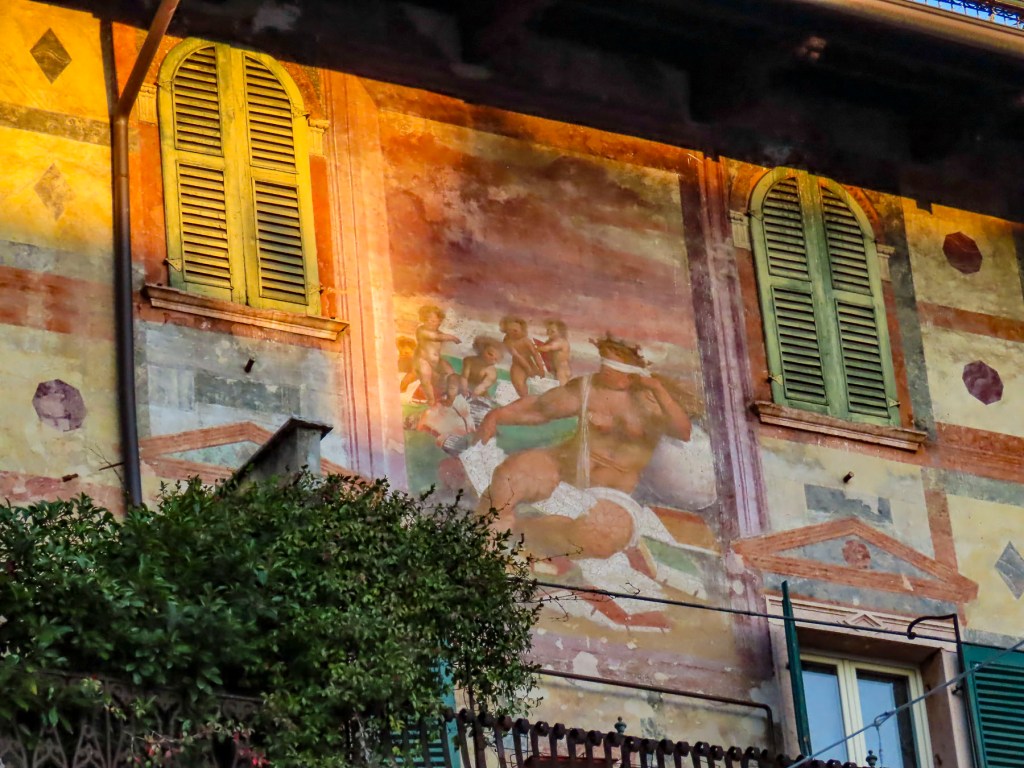
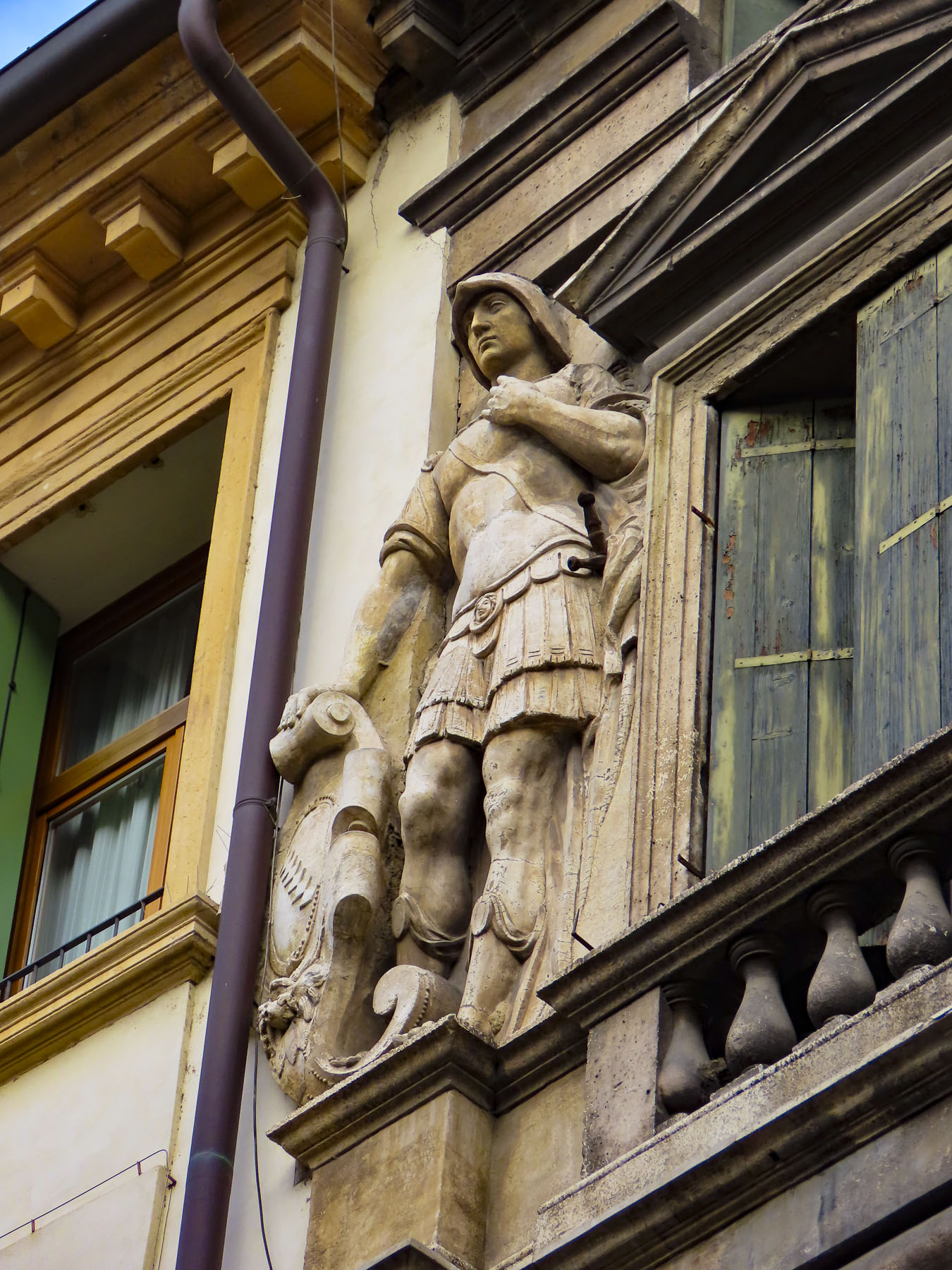
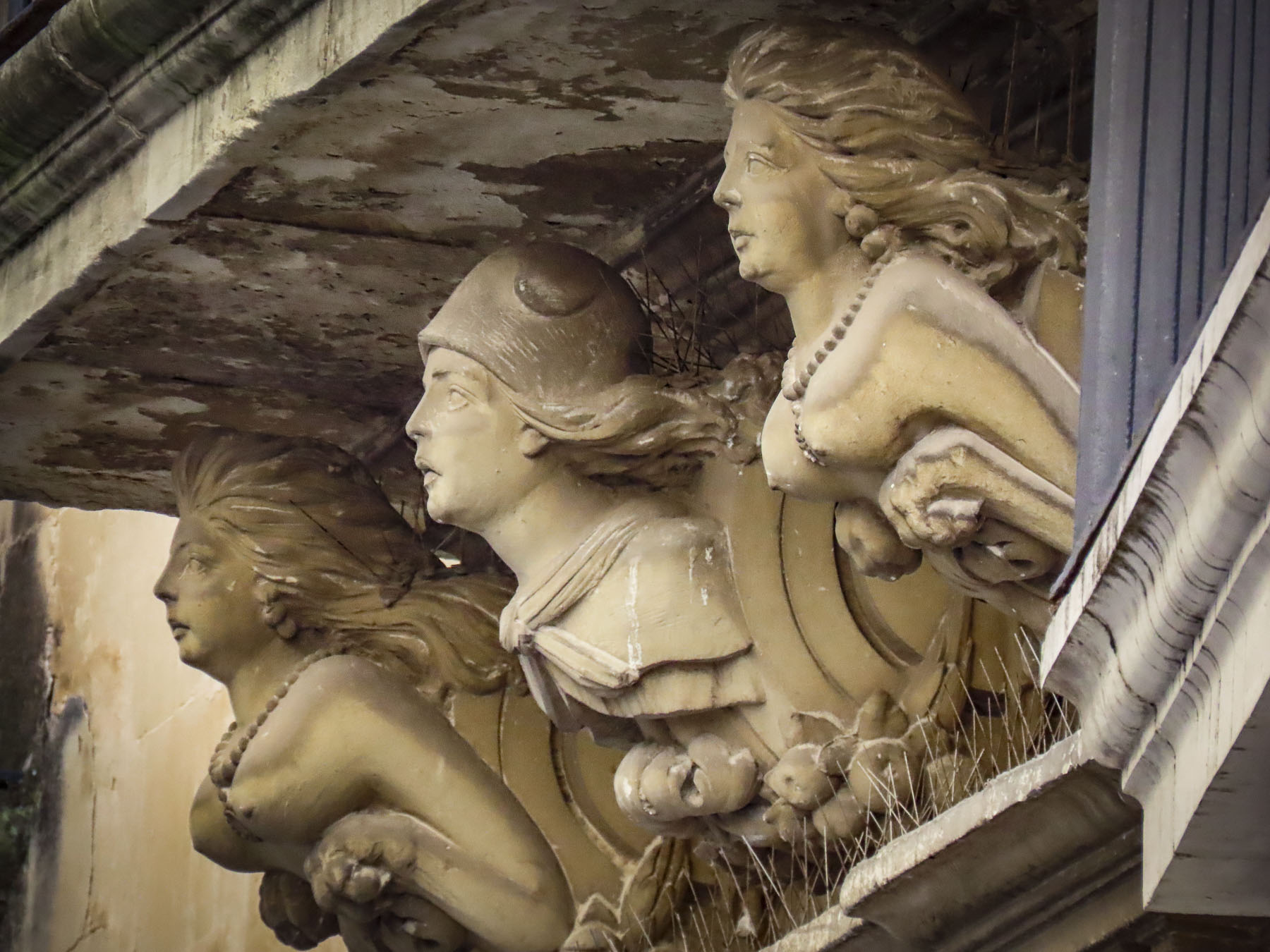
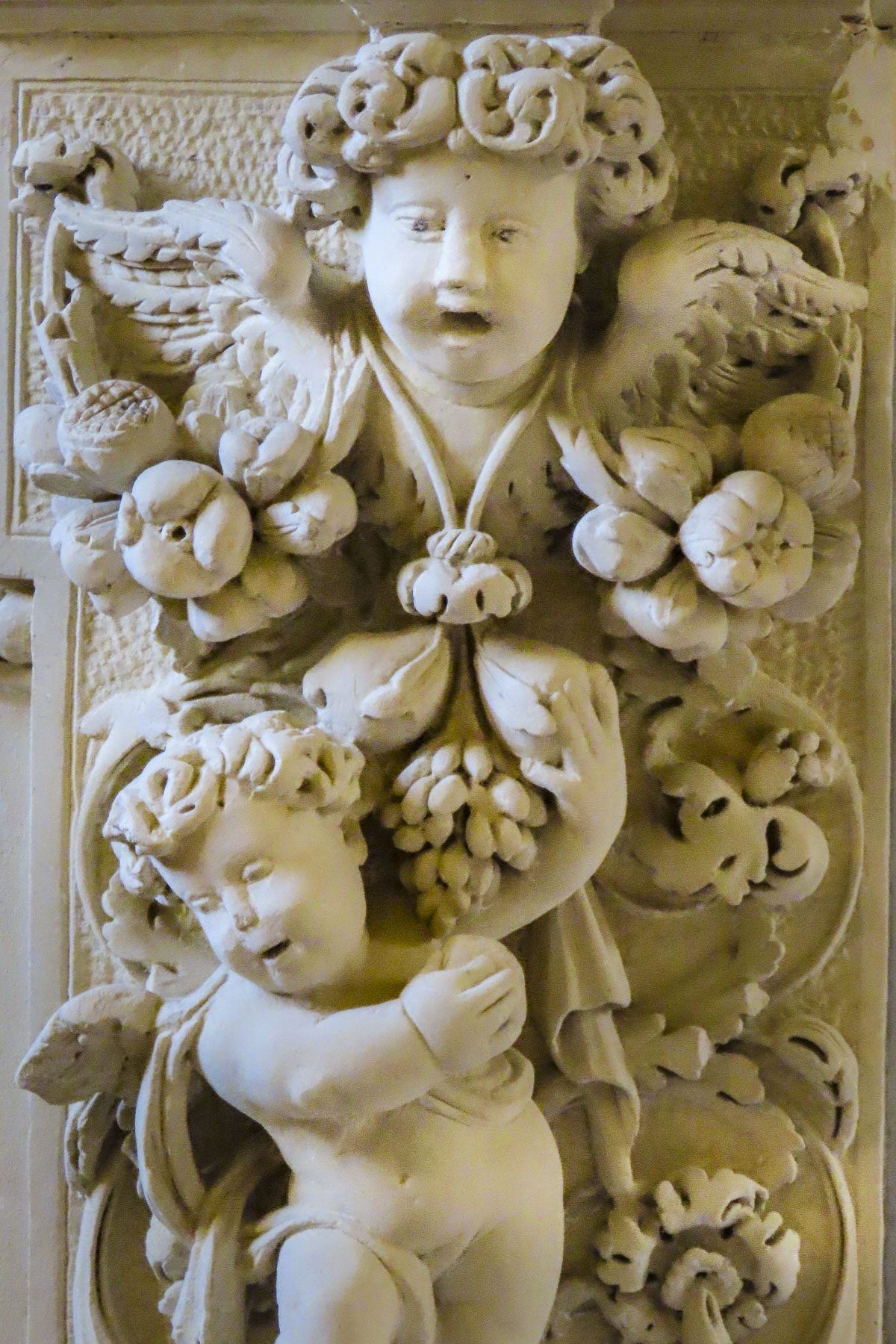
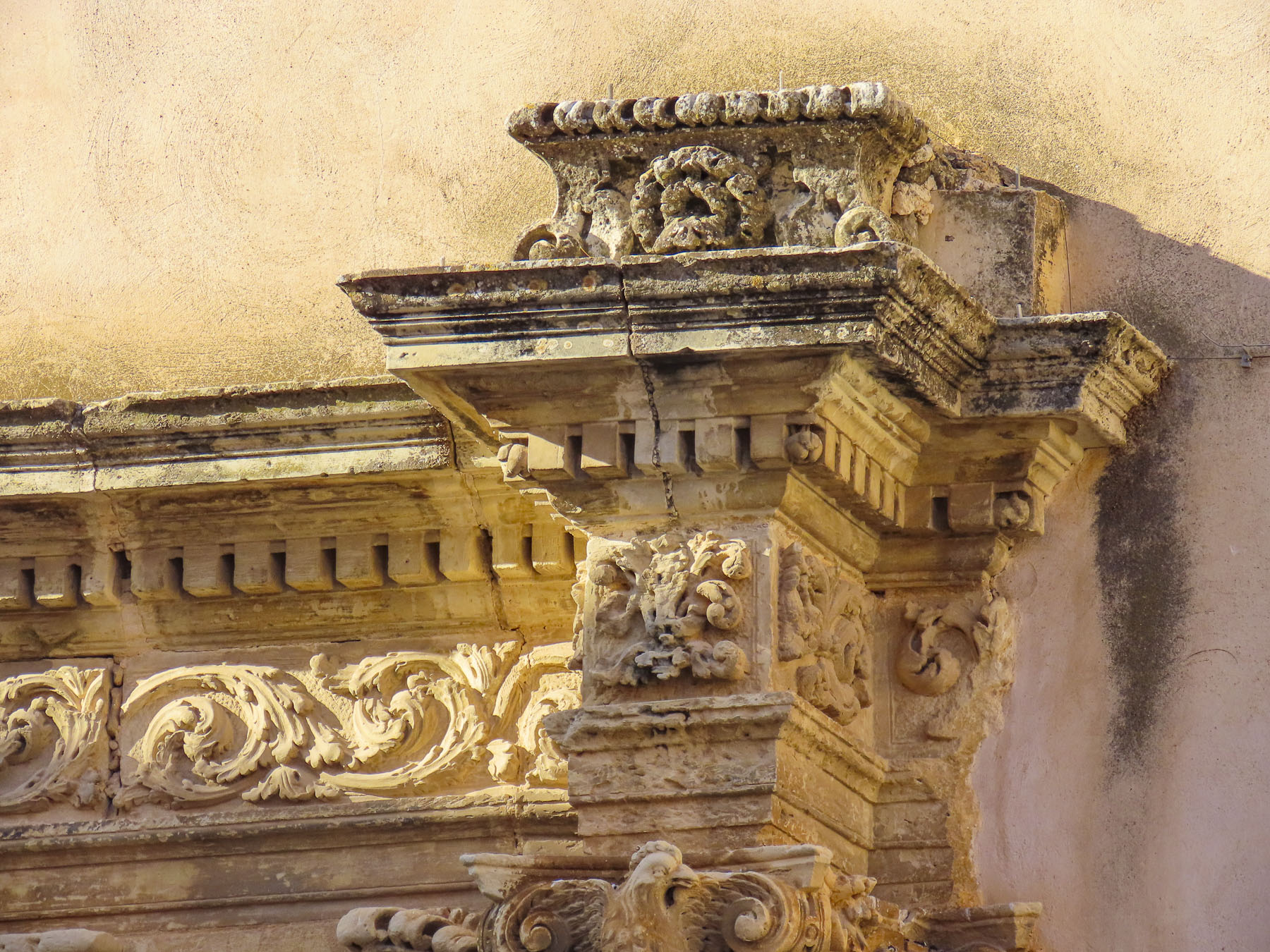
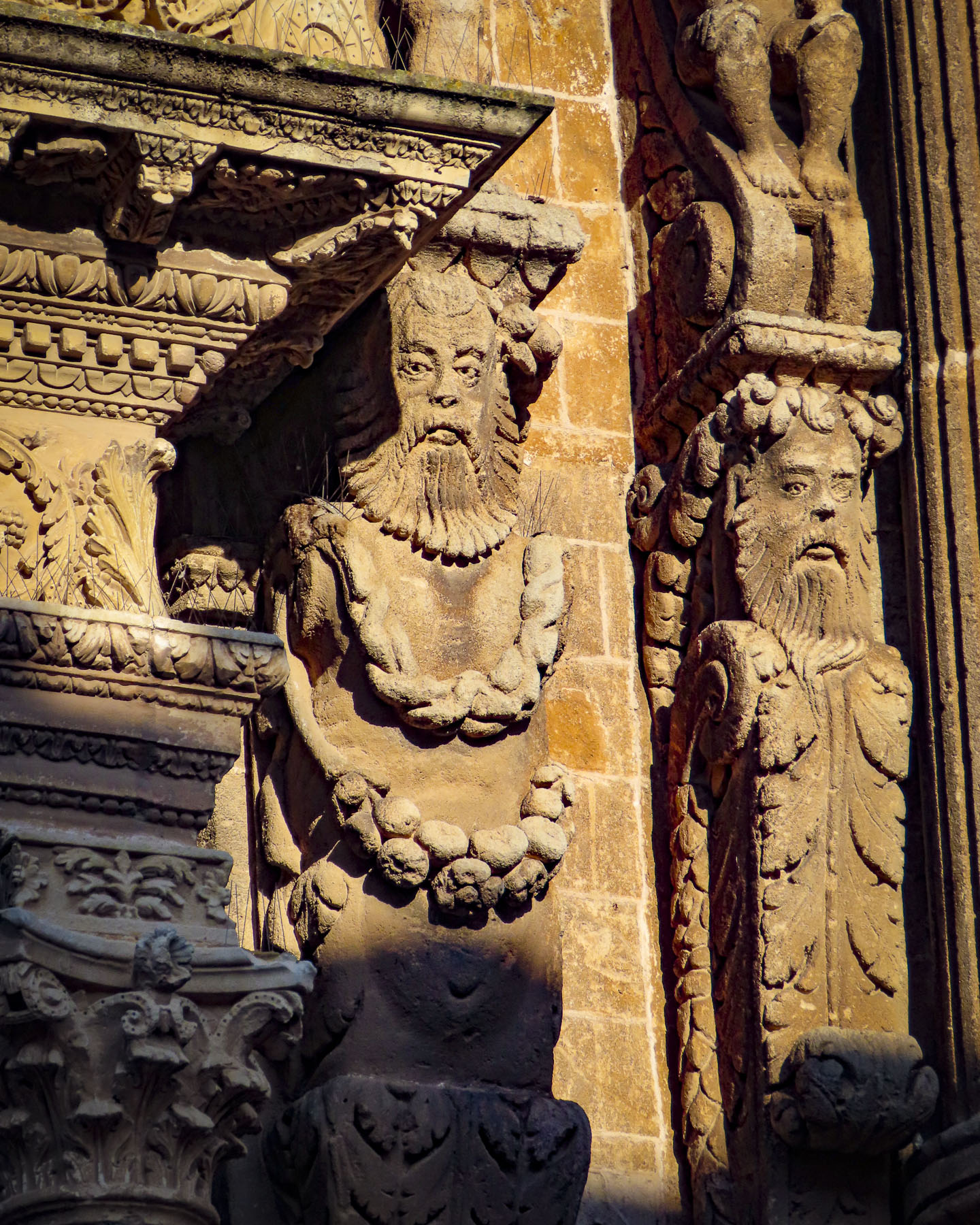
Normally hidden in deep shadows, Renaissance era wall paintings decorating ancient buildings were now revealed in the last of the afternoon’s light. Likewise, the lowering sun highlighted the fine relief sculptures adorning many of the city’s ancient buildings.

By dusk we were standing along the Adige riverfront watching the last rays of the day’s sun color the sky above the arched 14th century Castelvecchio Bridge.  Attached to the Castelvecchio fortress, the bridge was intended as an escape route for the feudal lords to flee across in case of a popular uprising or coup d’état to seek safety in the Tyrol mountains, north of the city, and for the prince’s courtesans to discreetly exit the castle.

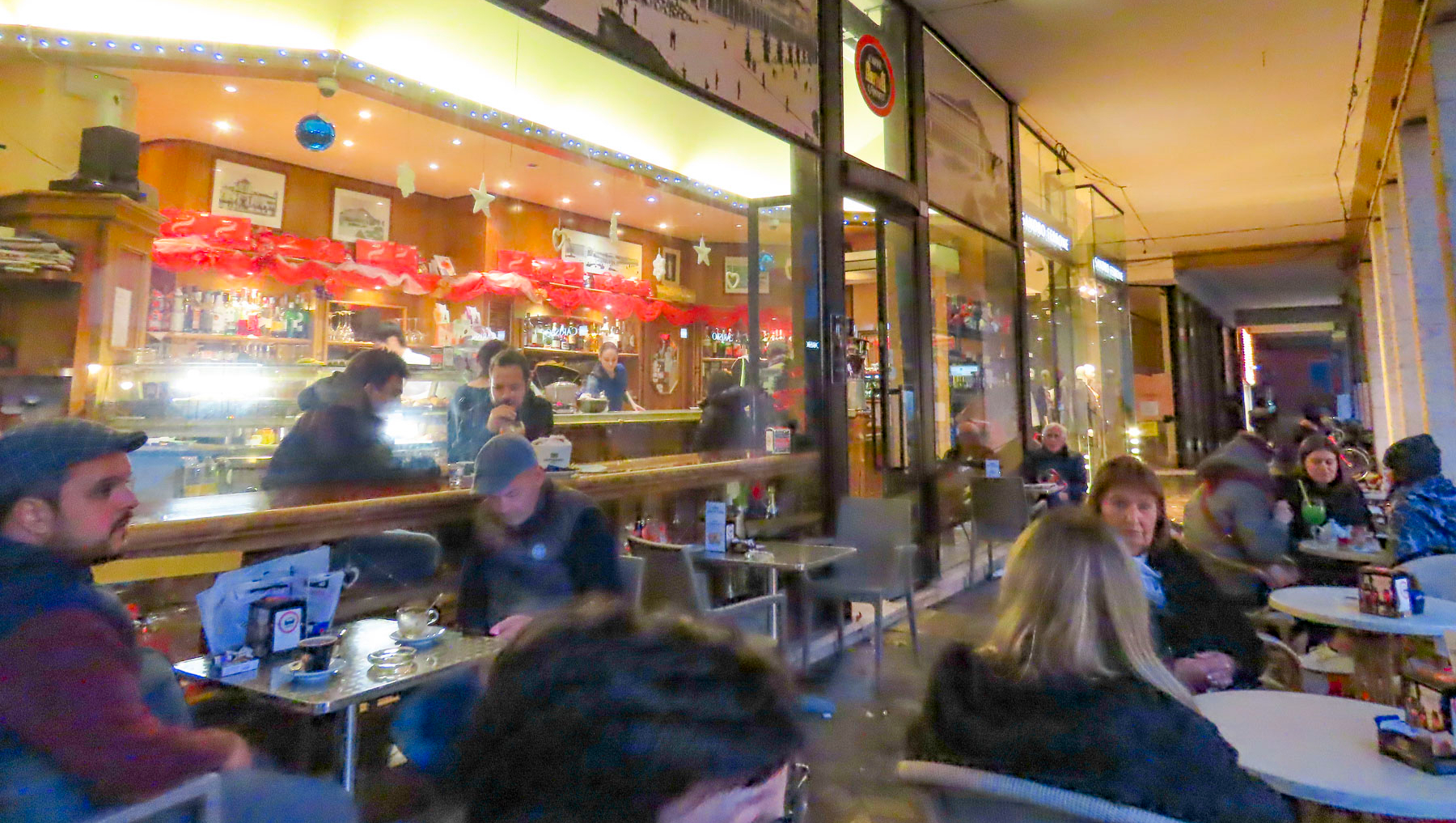
The lights of the city’s Christmas tree shined brightly through the twin arches of the Porta Borsari; built by the Romans in the 1st century AD, it was the main entrance to this once walled city. Nearby, Caffè Borsari beckoned, with its extensive list of creative coffee beverages. Maestros of the espresso machine, the baristas here are artists.
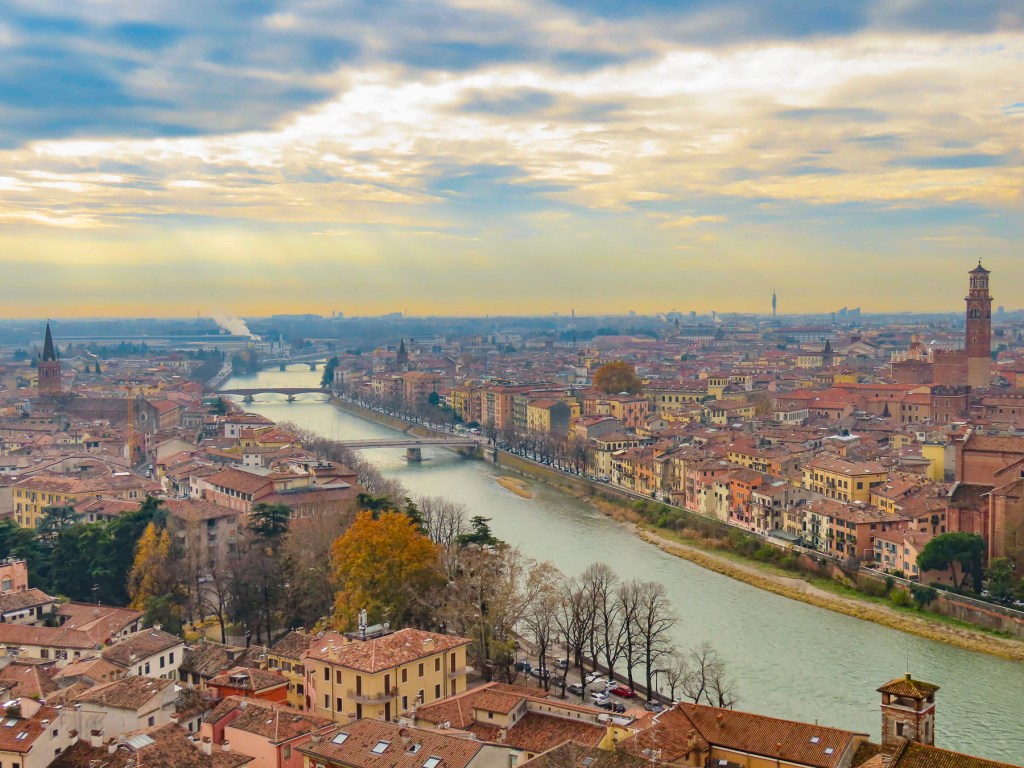
The next morning was overcast as we drove across the Adige River and made our way up a serpentine road through a forested hillside, to the esplanade in front of Castel San Pietro for the panoramic view of Verona, and its iconic Ponte Pietra bridge below.  A wonderful feat of ancient engineering first crossed in 100 BC, it has had a troubled existence, with multiple collapses caused by flooding over the centuries, and intentional destruction by the retreating Germany army in WWII. Through the various reconstructions, the builders have remained faithful to the original Roman design of five different sized arches with apertures above the pilings. The present castle on the hill was built by the Austrians in 1851 as a barracks, replacing a 400-year-old fortress blown up by Napoleon’s army in 1801. For the hearty, there are stairs from the bridge that lead to the mirador, or the Funicolare di Castel San Pietro that will whisk you to the top of the hill, should you wish to avoid the muscle aches.
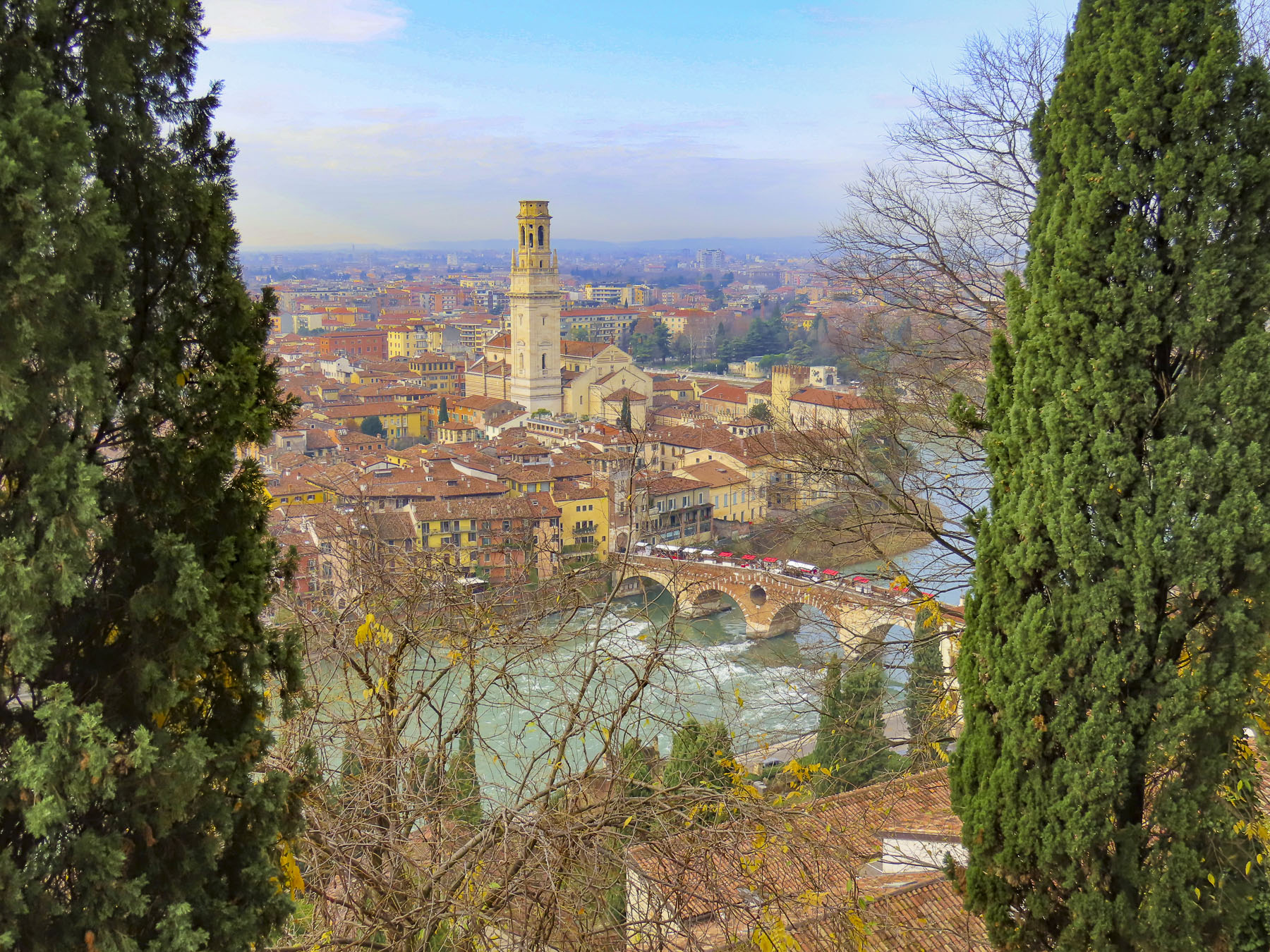
The dull sun barely broke through the clouds, but the filtered light created a serene scene reminiscent of an impressionist painter’s pastel hued landscape, soft and atmospheric.

Rounding a curve on the SS12, as we headed north, we caught our first glimpse of a snow-capped Mt. Baldo, brilliantly white against a clear blue sky. Our destination was the remote and isolated Santuario Madonna della Corona.  A pilgrimage site since 1522, legend holds that on the eve of the Ottoman invasion of Rhodes, with 400 warships and 100,00 troops, the sanctuary’s statue of the Madonna was carried miraculously by an angel from the Mediterranean island to a shallow cave on a Mount Baldo cliff edge, home to a hermitage for holy men, for safe keeping.

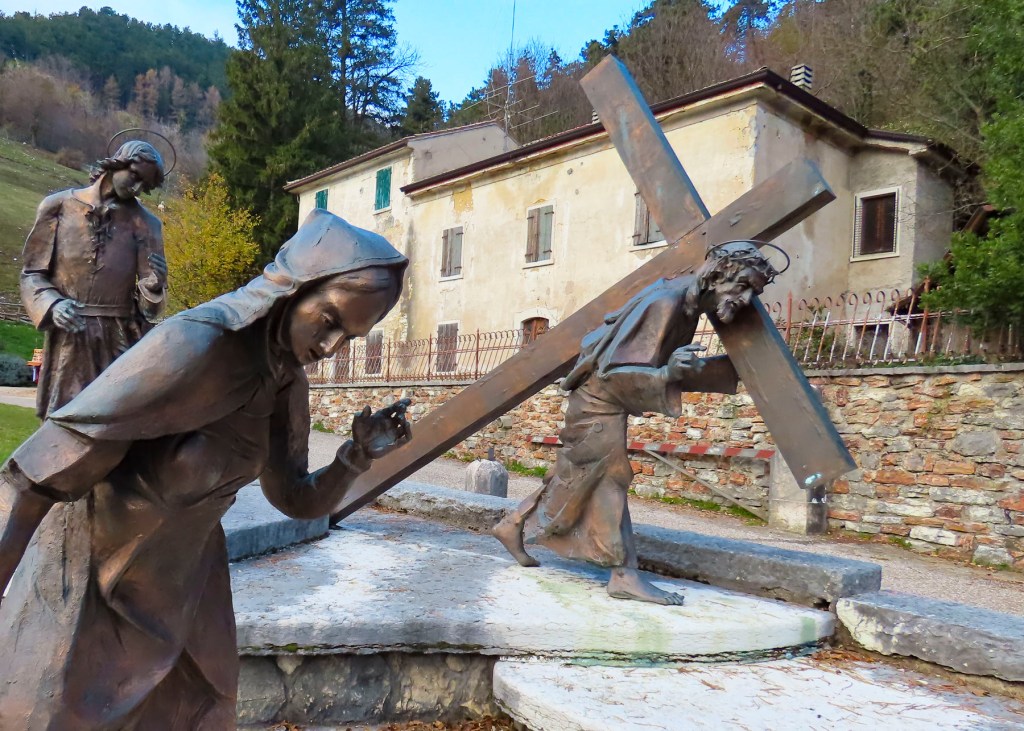
Spiazzi, the village above the sanctuary, was nearly a ghost town when we arrived mid-week in November. We found the empty parking lot for the church and high-season shuttle bus that was not running, but aside from that there was no other signage pointing the way. Taking a guess, we turned down a very narrow country lane and headed down hill, stopping when we reached a farm stand where a stoic woman, bundled up against the cold, was selling alpaca wool, sheared and spun from her flock which was corralled nearby.  Stopping, we asked if we were headed the right way and how long she would be open. A little farther on we came to the first Passion of Christ station on the Sentiero del Pellegrino, the Pilgrim’s Path.  The series of life-sized bronze sculptures depicting the stations of the cross took the devoted Italian sculptor Raffaele Bonente thirty years to create.  Whether you walk along or drive the paved road or hike the steep staired path, the stations are positioned where the routes intersect. 
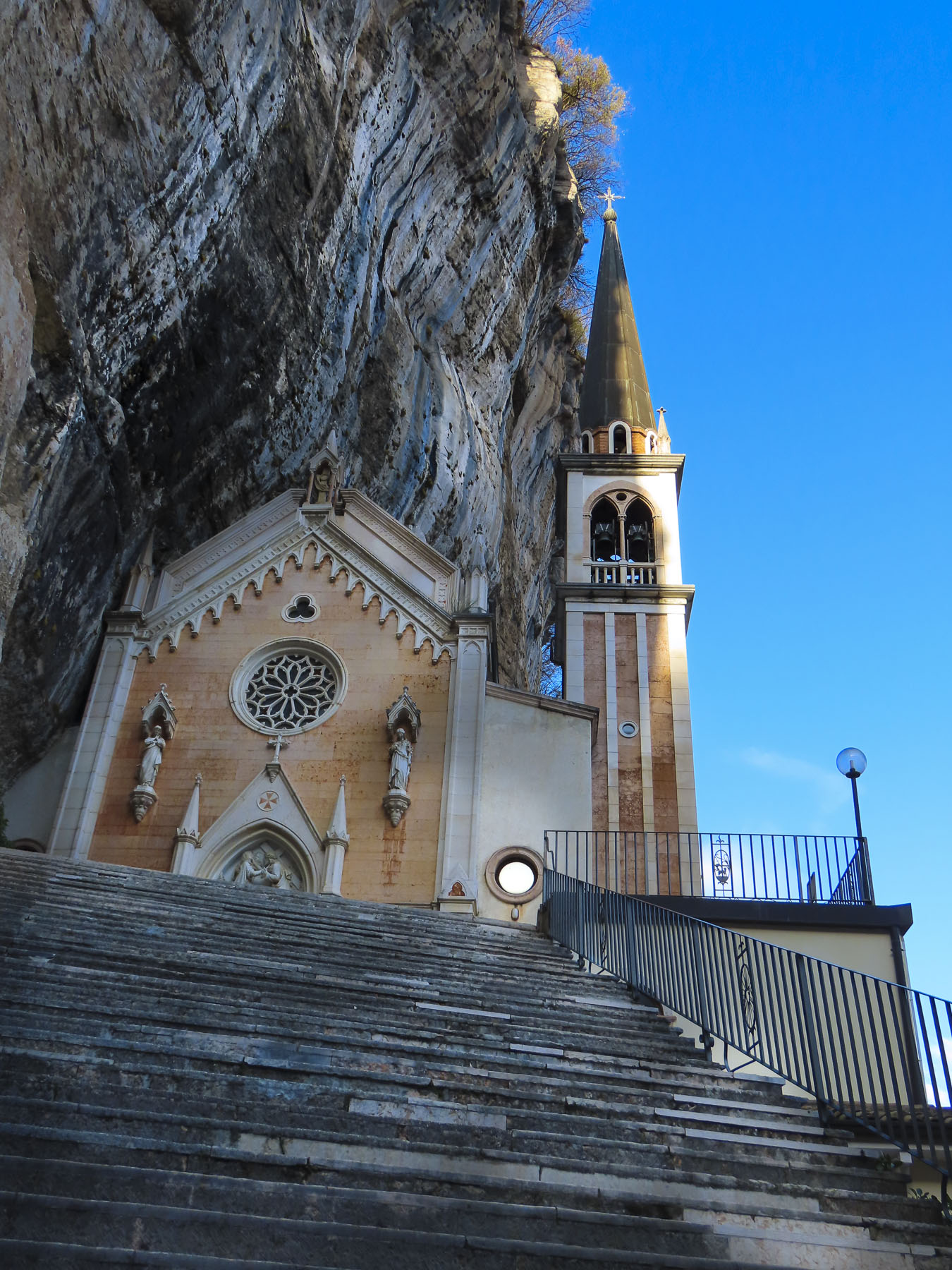
In the off-season, without any other vehicles on the road, it was easy to stop and take photos of the church that tenaciously clings to the cliffside, between heaven and earth, 2539ft above the Adige Valley. In high season the turn-around at the church is reserved for the shuttle bus, but off season we parked next to one other visitor.

The original dangerous path along the cliff edge has been obscured over time through multiple improvements and the approach to the terrace in front of the church is now through a rough-hewn tunnel carved into the cliff. Tranquility reigns here. The views across the valley were phenomenal and accompanied only by the sound of a gentle wind rustling through the forest below.  The spiritual devotion and shear physical effort to build a church in such a difficult spot attests to the deep faith and dedication of the builders. For hikers, the Sentiero del Pellegrino continues down the slope, through the valley to the village of Brentino.
Following the same route back to Spiazzi, we stopped at the alpaca farm and purchased some much-needed heavy weight alpaca wool socks, to help keep our feet warm.  Early on in our two-year journey Donna decided to start crocheting in the evenings. Wool has been purchased for various projects, mostly gifts, in Ecuador, Guatemala, Portugal, South Africa and now Italy, from an off-the beaten-path farm stand on a remote mountainside.  It was late afternoon now, but fortunately the Albergo Trattoria Speranza, located at the crossroads of Spiazzi was still serving food and has rooms if you want to stay overnight in the hamlet.  A good meal restored us for the drive to Lake Garda.

With night drawing in earlier now we reached the lakeside village of Garda at twilight.  Sunset colors lingered in the sky as we walked along the marina. A few fishermen were still casting, hoping for that last bite, and small boats gently rocked on the ripples of Lake Garda. 

The lights of a Christmas market set up along the lakefront drew us further down the promenade.  Wonderful aromas drifted from the various food stalls, making what to choose for dinner even more difficult. Mulled wine and porchetta sandwiches capped the evening.

Till next time, Craig & Donna

Reggio Emilia – Fine Food and Ancient Alleys

Seemingly never-ending waves of softly rolling hills that we viewed from the towers of San Marino, up-close now, were verdant with the new growth of winter cover crops and persimmon orchards, heavy with their delectable late-ripening orange fruit. The landscape, a patchwork quilt of autumn colors and earth tones, dotted the countryside enroute to Reggio Emilia, like the brush strokes of an impressionist painting.

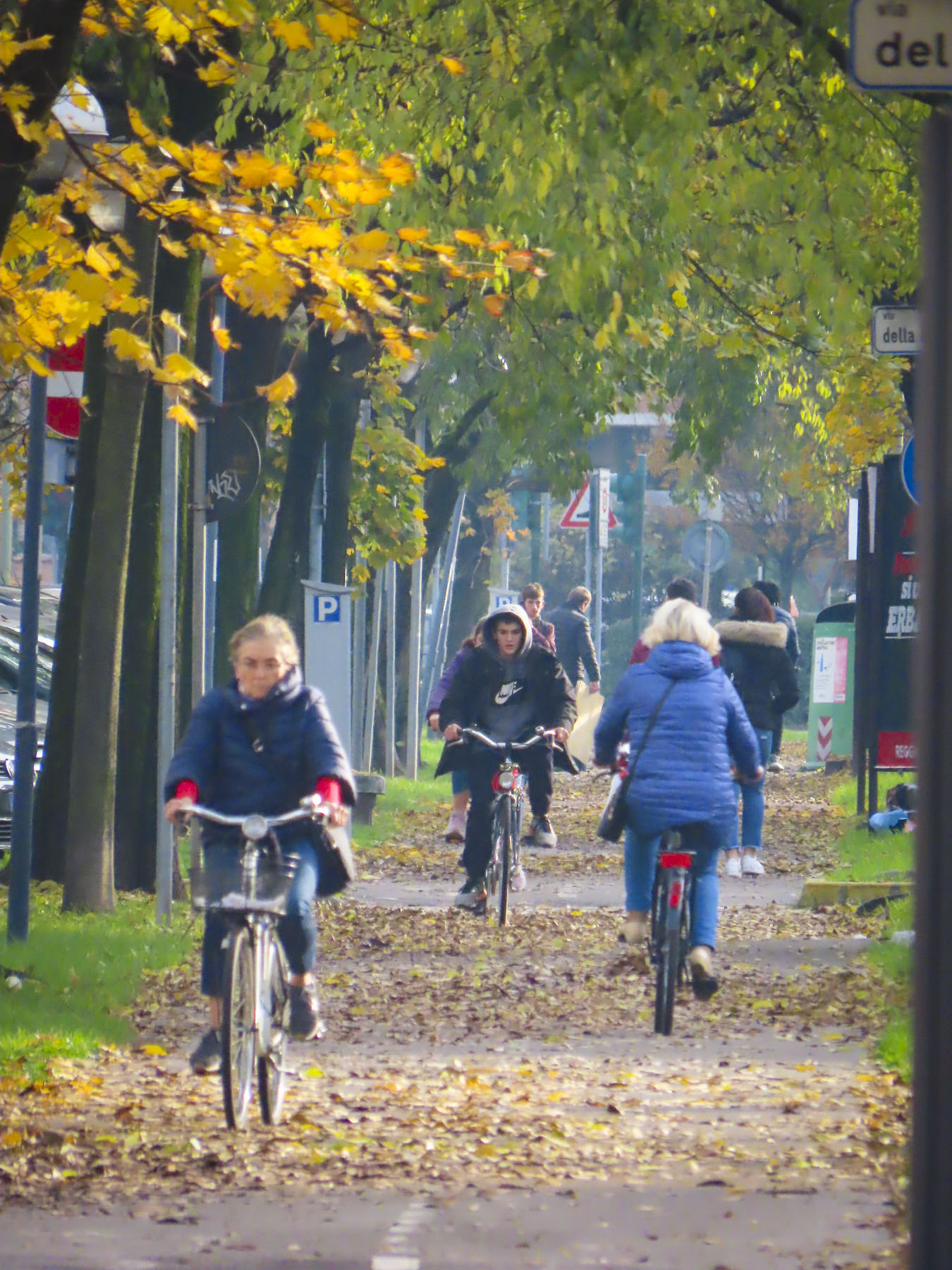
Still elegant nineteenth century villas now stand where Reggio Emilia’s ancient defensive walls once rose, until a surging population demanded city expansion in the late 1800s.  A wide boulevard lined with trees and a well-used bike path now follow its original hexagonal footprint around the bike friendly city.  Bicycling across the flat terrain of Reggio Emilia is a popular way to commute to the train station or work in the pedestrian-only historic center from outlying neighborhoods, and is supported with 125 miles of well-marked urban bike lanes.  Emilia-Romagna has set a regional goal of getting 20% of all commuters to bike to work and funding 2300 miles of dedicated bike lanes.

The Reggiani’s enthusiasm for bicycling dates back to the 1870s, when a hippodrome was part of Parco del Popolo, and continues today with fierce loyalty to area road-bicycling racing teams that compete in the historic Giro dell’Emilia that has coursed through Emilia-Romagna since the race was first held in 1909. Currently it’s an a 1.HC event on the UCI Europe Tour.

With the assistance of the receptionist at Hotel Posta we were able to park on the street, just outside the historic center, without a fee for a week. This is unheard of during high season, but it was a great savings for us that we fully appreciated.  Located in the center of the city on Piazza del Monte, across from city hall, the hotel is in the Palazzo del Capitano del Popolo, a historic building which was originally constructed in 1280 as a governor’s palace. For over 500 years, since 1472, the rooms under its crenelated roof have been used as a hotel.

It has been renovated numerous times during the centuries, but still retains the old-world charm. The room rate was quite affordable in late November and we practically had the place to ourselves. From our window overlooking the piazza we watched the ebb and flow of Reggio Emilia pass below, highlighted by a teachers’ protest, a Christmas parade, and nightly buskers who took excellent advantage of the wonderful acoustics that the small plaza offered.

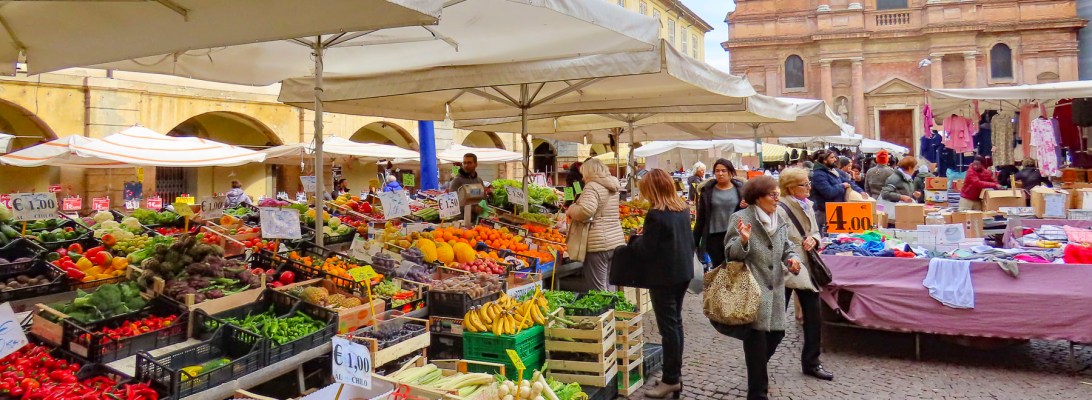
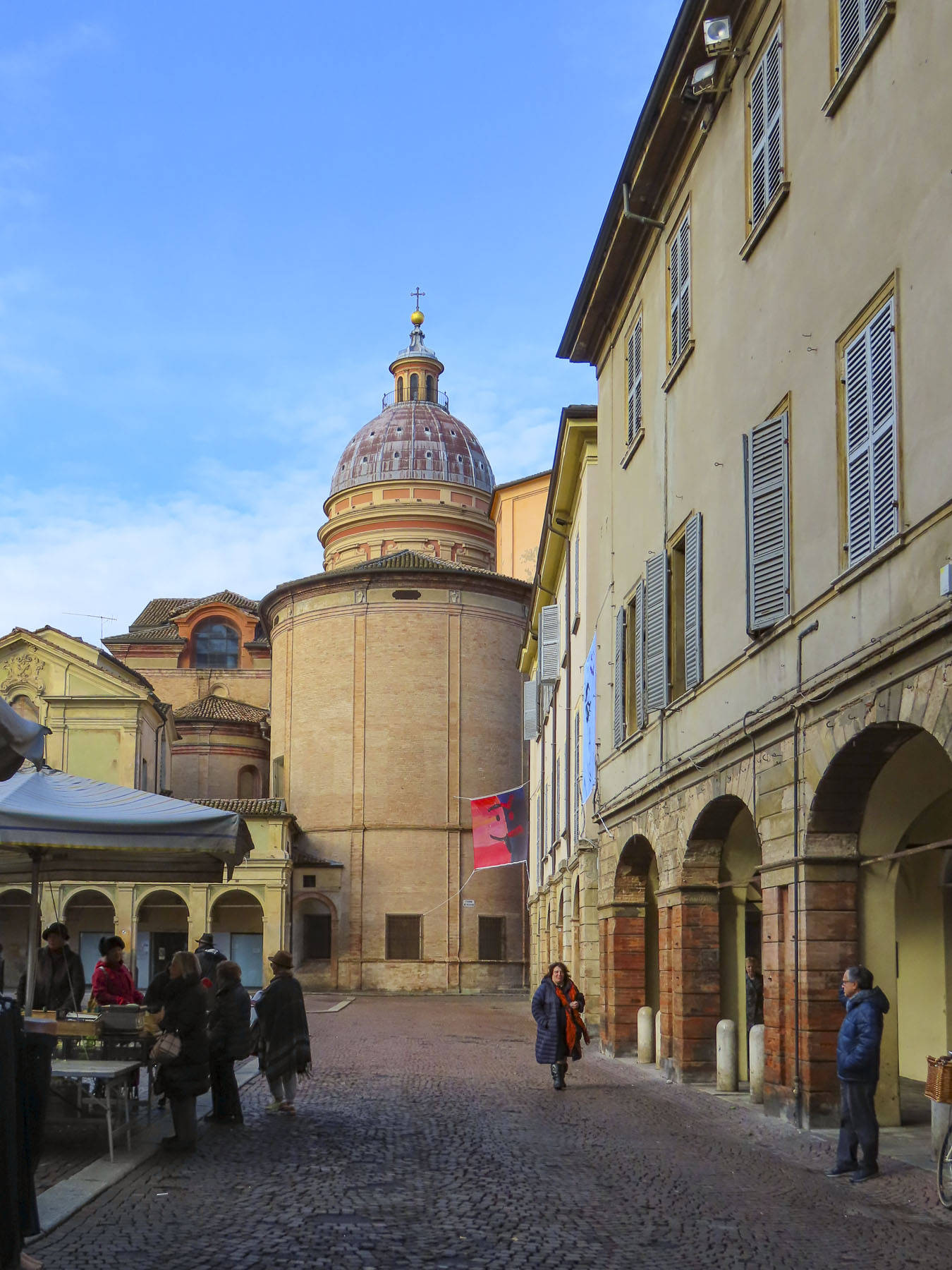
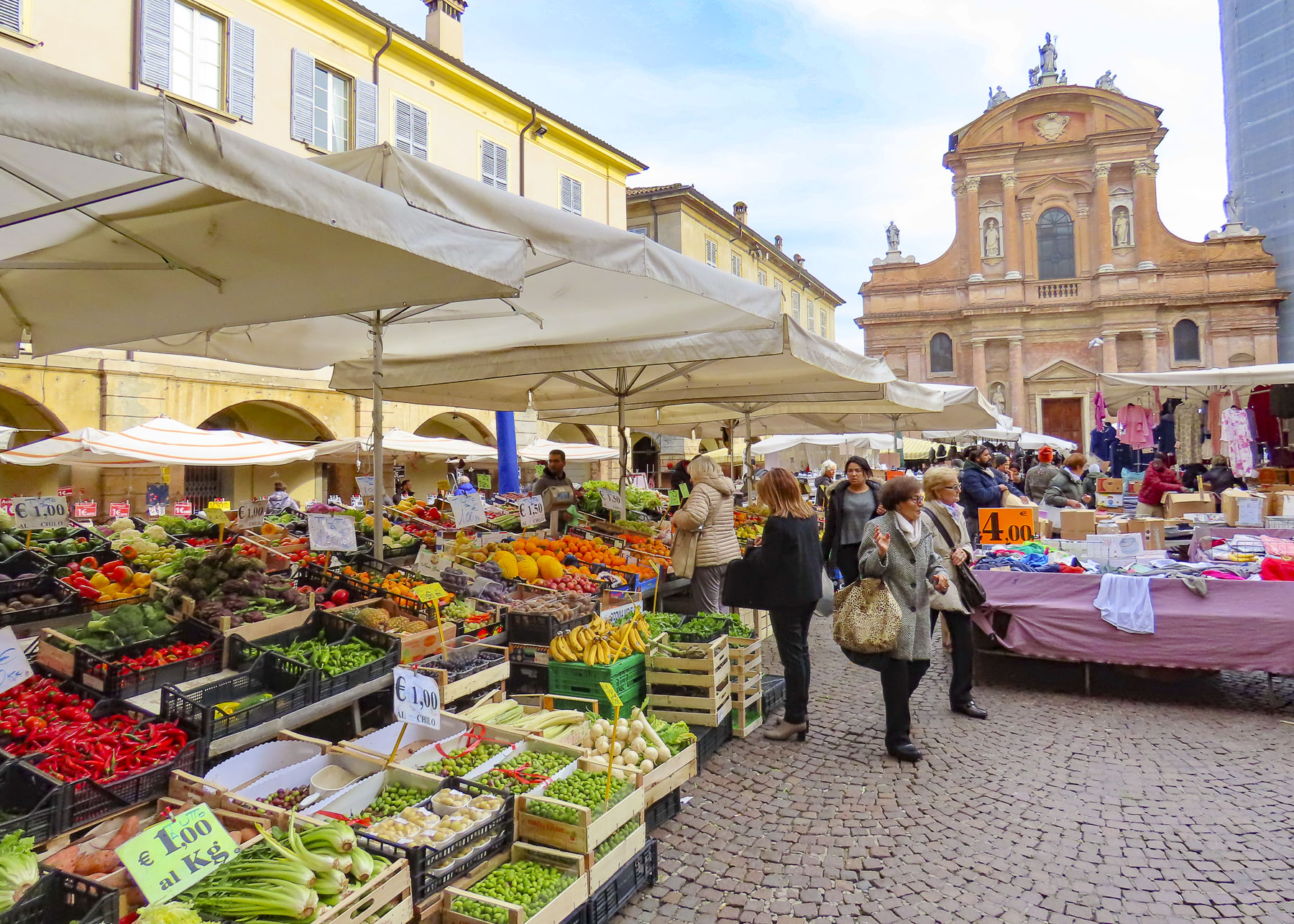
The city’s three large piazzas, Camillo Prampolini, Di Prospero, and Della Vittoria, are lined with historic buildings, churches and restaurants. During high season they would have been bustling with tourists and cafes tables would have nearly filled the squares.

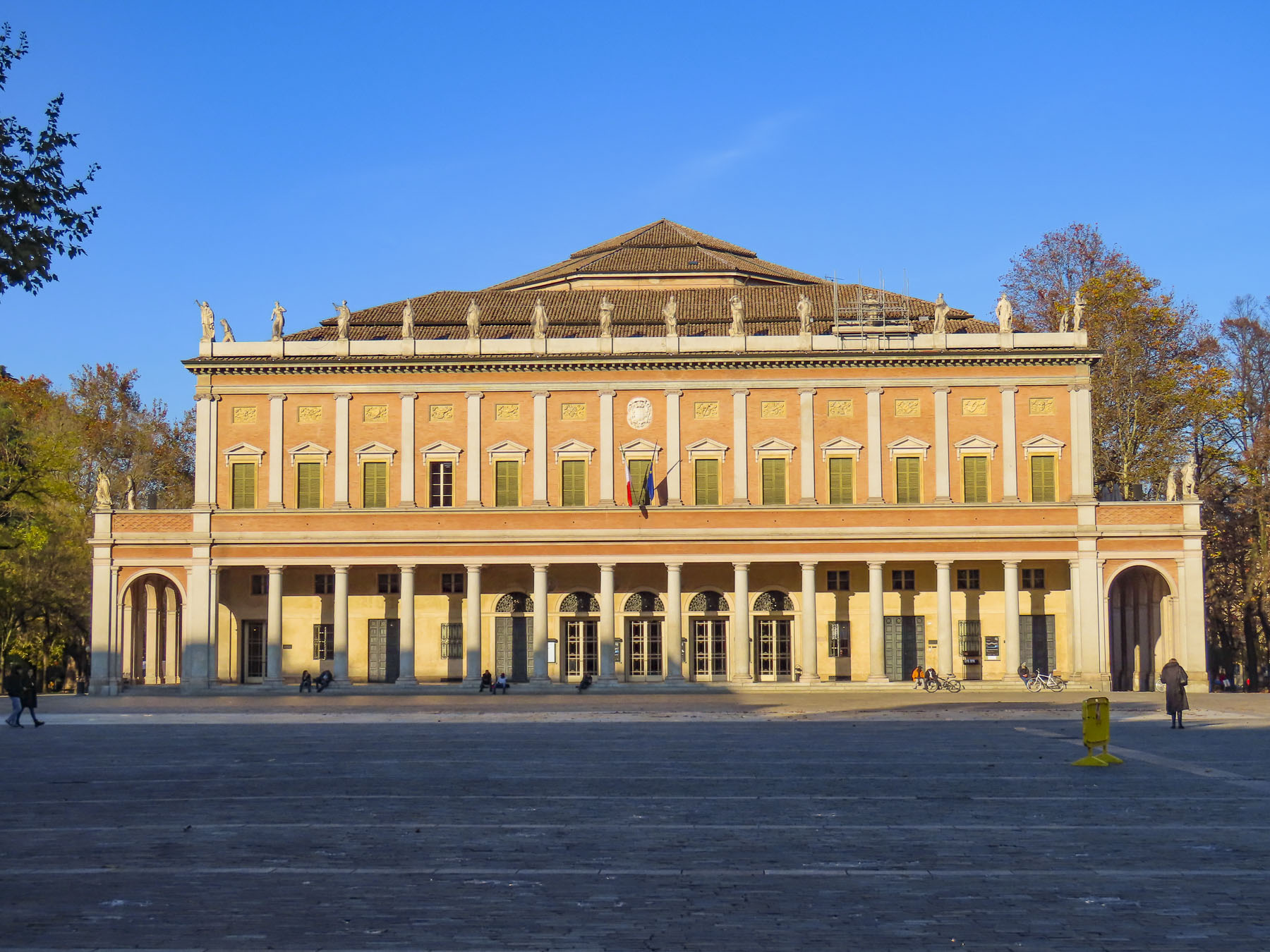
Now in late November, city workers were hanging Christmas lights from the lamp poles throughout the city and erecting a Christmas tree in Piazza Prampolini, while a large temporary ice-skating rink was under construction near the Romolo Valli Opera House. 

Bundled up against the chill now, only the hearty sat at the few tables left outside, though inside the cafes was not really much warmer. Good coffee and locally produced Lambrusco helped ward off the chill as we expanded our concept of “walk a little, then café,” during our wanderings between churches in this pleasant city. 

Cheese is our weakness and we delighted in every opportunity to try different aged Parmigiano Reggianos. (Longer aging produces a stronger or more flavorful cheese, with some cheeses aged up to 36 months for that intense flavoring.) Paired with a locally produced aged balsamic vinegar, it is a surprisingly tasteful combination.

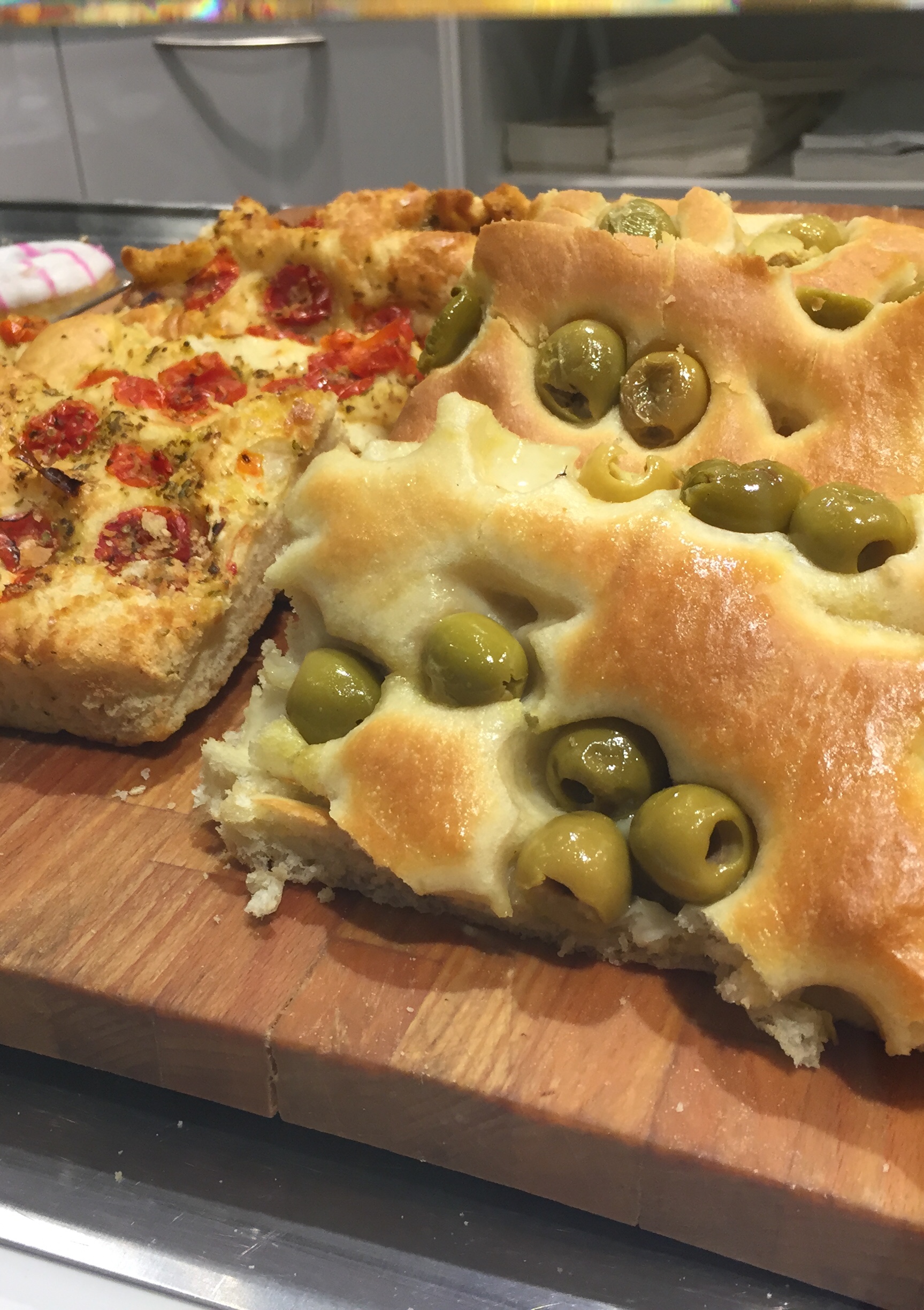
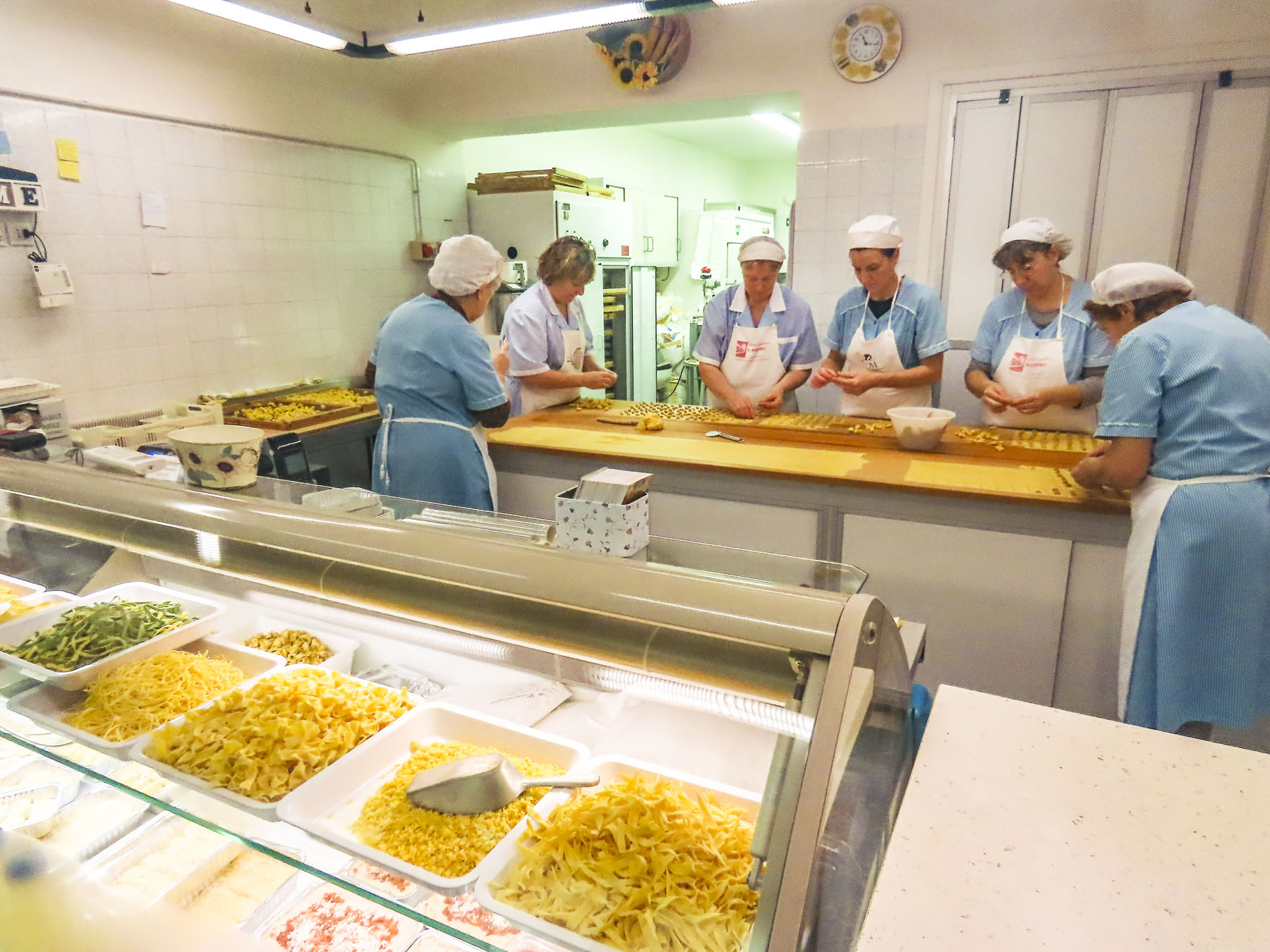
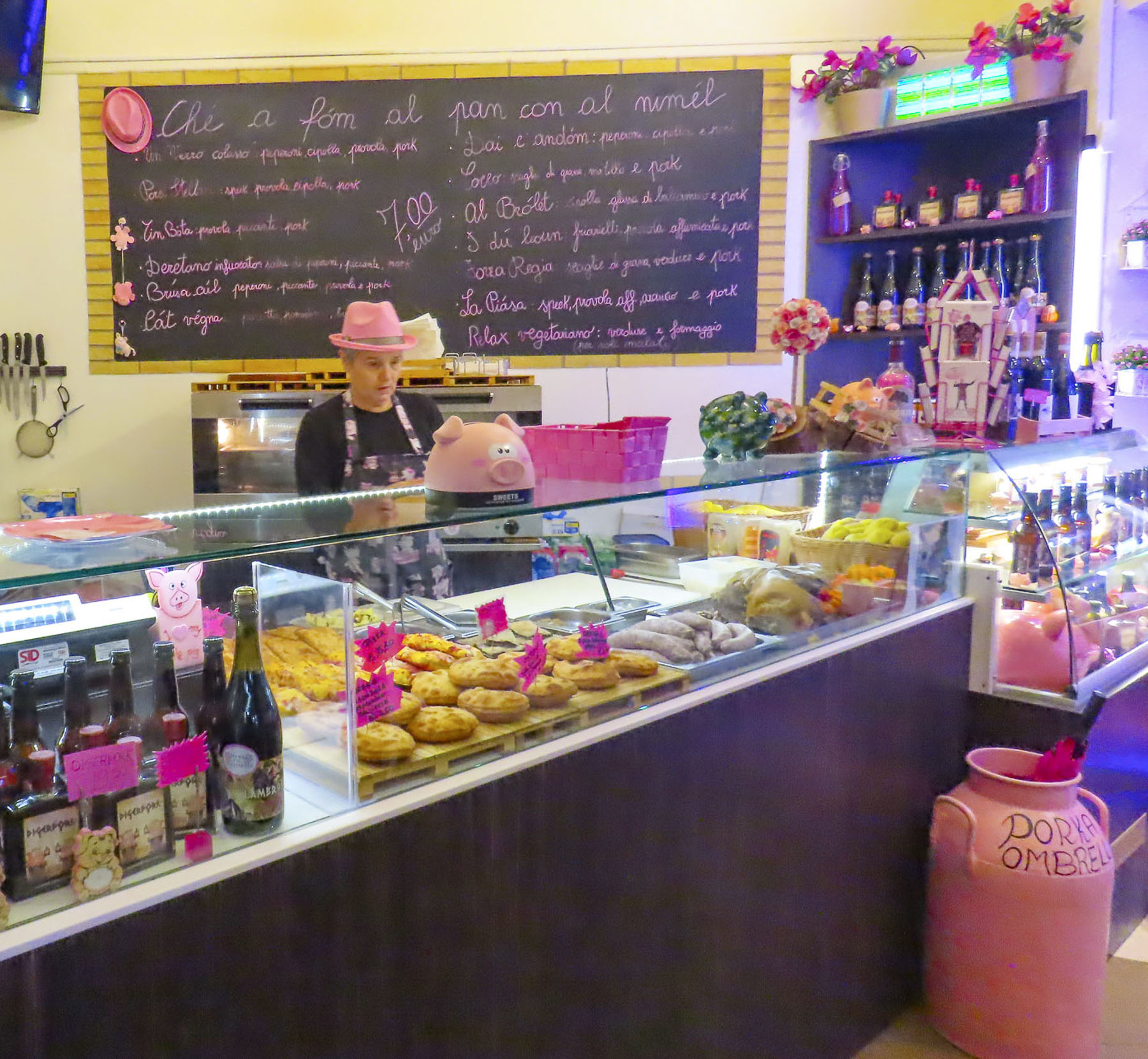
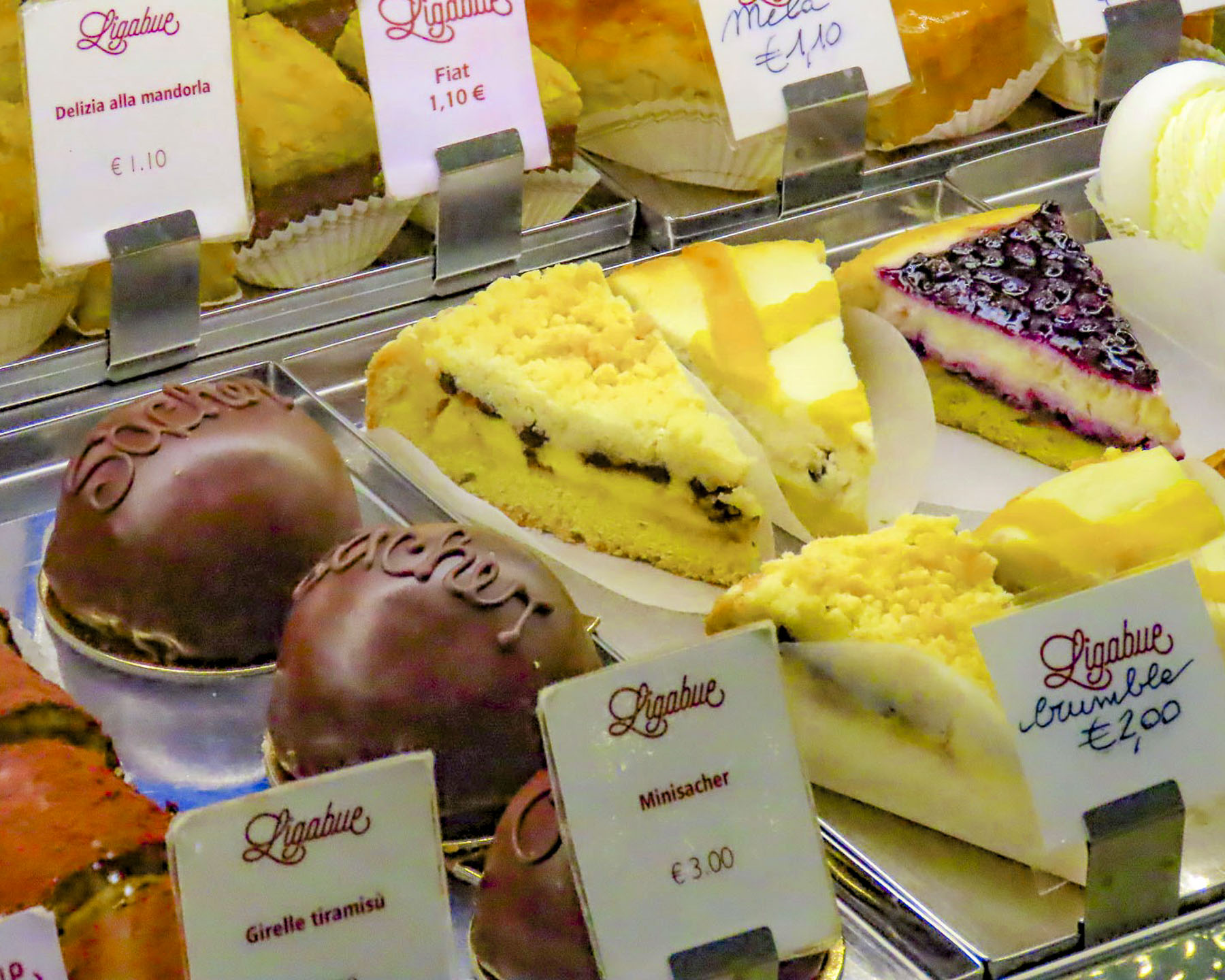
Oh, let’s just face it – Italian food is our weakness and we thoroughly enjoyed discovering the city’s cafes, bakeries, and restaurants as much as we enjoyed the city’s churches and museums.  Charcuterie boards, pastries and pasta tempted us repeatedly in this culinary temple of gastromic delights.  Here are some of our favorite places: Antica Salumeria Giorgio Pancaldi – always worth the wait for a table. Terme del Colesterolo – you have to love the name and their porchetta sandwiches. La Casalinga – a fresh homemade pasta store with super nice ladies who will stop what they are doing and make any tortellini or ravioli you request if the case is empty. Yes, we did buy some to take to our apartment stay in Milan. Dolce Charlottefor their savory and sweet baked goods. And Tabarin Osteria Popolare – even though they confused our order with the table adjacent to us it was still a wonderful dining experience.

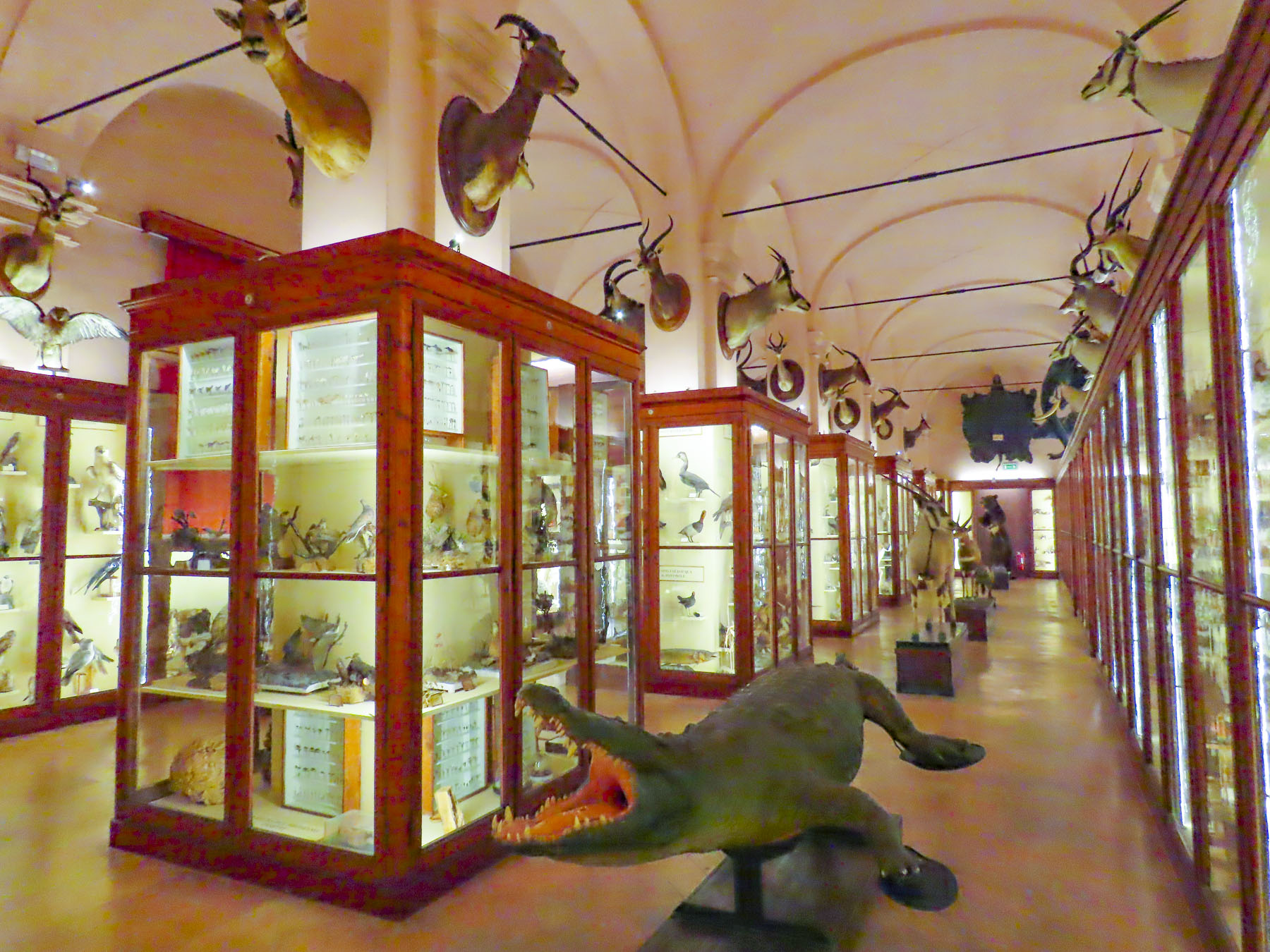
The Chiesa di St. Francesco stands on Piazza Della Vittoria adjacent to the Romolo Valli opera house. It was built in 1272 to support a Franciscan convent and monastery. The cloister was converted in 1830 into the Musei Civici di Reggio Emilia to house the private scientific and zoological collection of Lazzaro Spallanzani, an Italian physiologist (d. 1799) whose research into nutrient culture solutions advanced the scientific investigations of Louis Pasteur. 

It’s an amazing collection, still displayed as it was originally assembled, in now-antique wood and glass cases, evoking an earlier time.  There is also an extensive collection of regional archeological discoveries that was remarkably interesting.

On the Martiri del 7 Luglio 1960 plaza in front of the museum, (named for five workers killed by police during protests against a neo-fascists political party there on July 7, 1960) there is a moving commemorative monument to the 615 Reggio Emilia Resistance Fighters, both men and women, who made the ultimate sacrifice during WWII, fighting the German Army that occupied Italy.

A short distance away, next to the Romolo Valli Opera House, the Parco del Popolo, People’s Park, provided a tranquil haven speckled with neoclassical sculptures and pathways through a forest of old growth specimen trees, still holding their fall colors. The city’s ancient fortified citadel occupied this space until its demolition in 1848 to make room for the park.

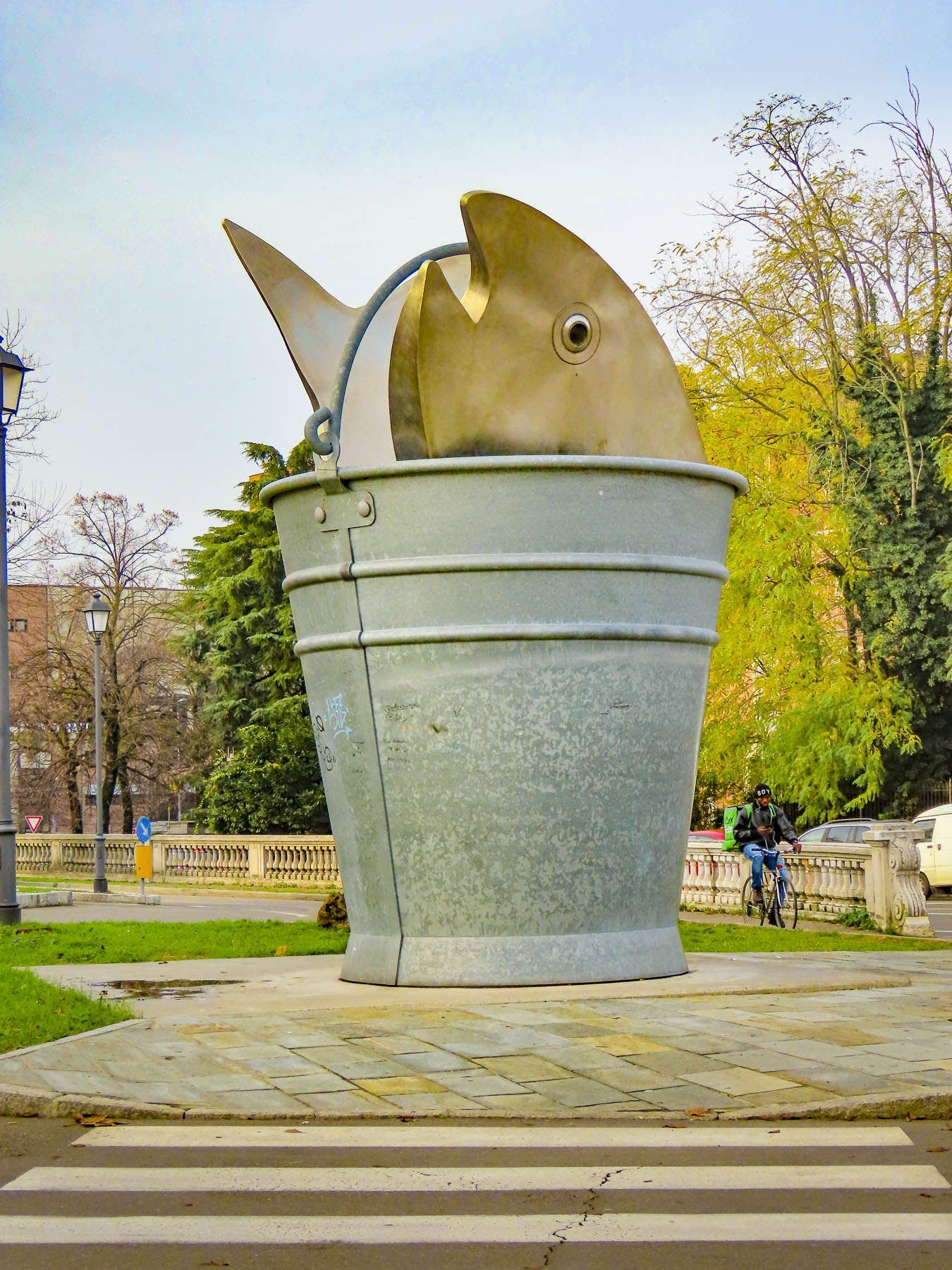
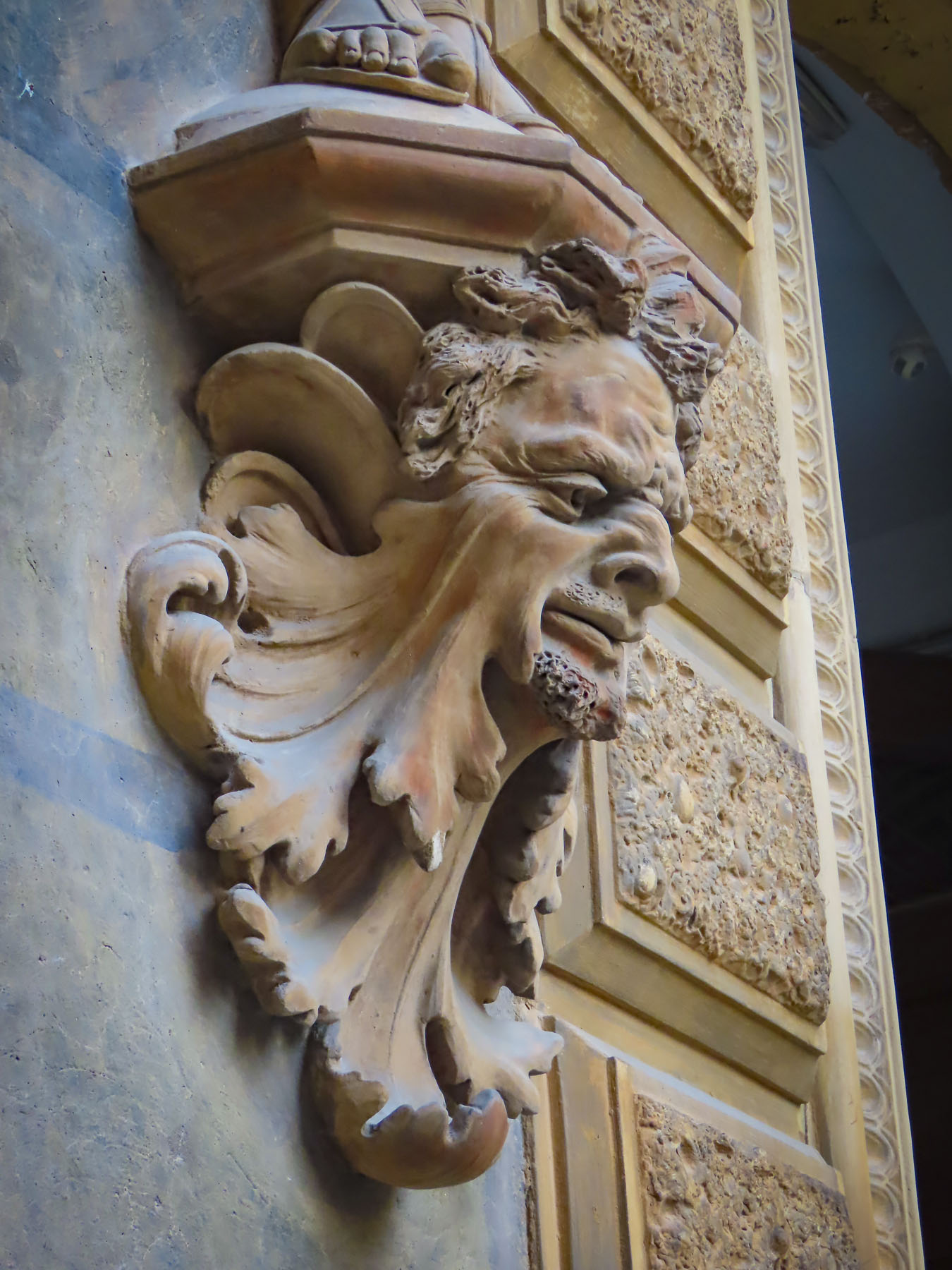
The twin arches of Porta Santa Croce, built in 1199, are now the only reminders that Reggio Emilia was a formidable walled city.  A walk there along Via Roma revealed antique architectural details and a very large, whimsical sculpture of a bucket of fish, across from a street mural at the train station.

Aside from being renown for culinary excellence, the city has a tradition of supporting academics with ties to the University of Modena that date back to 1175.  But the city’s real claim to fame is the Reggio Emilia Approach, born from the aftermath of Italy’s destruction during WWII when men and women were in the work force to rebuild the country. With this new preschool concept parents “desired for a new form of education that would ensure against future generations being brought up in toleration of injustice and inequality. Where children are valued as strong, capable, resilient and rich with wonder and knowledge.” “With a small amount of money sourced from the selling of a tank, three trucks, and a few horses from the war, and with land contributed by a local farmer and building materials from bombed-out buildings, local men and women of all ages built the first post-war preschool for young children.”  A first in Italy, it was a break with parochial education which was the historic norm.

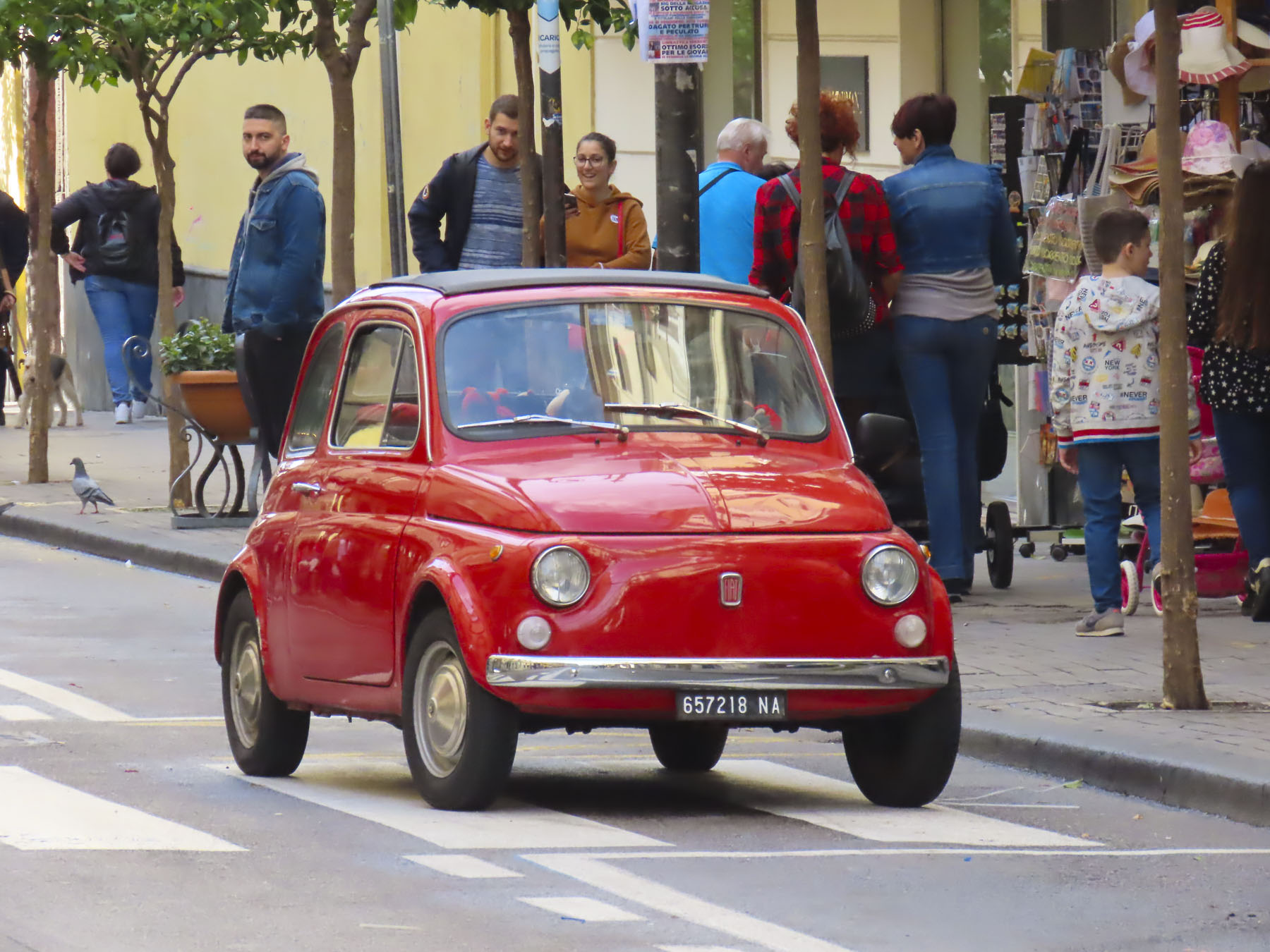
With a region that boasts about its excellent cuisine and fine wines it only makes sense, with a small leap in logic, that some of the most exotic cars and motorcycles built in the world are made in Emilia-Romagna, Italy’s “Motor Valley.” While Reggio Emilia doesn’t have any automobile factories, it’s close enough that you are sure to get the doors of your Fiat 500 rental blown off on the E35 by a passing Maserati, Lamborghini, Ferrari or crotch- rocket Ducati.

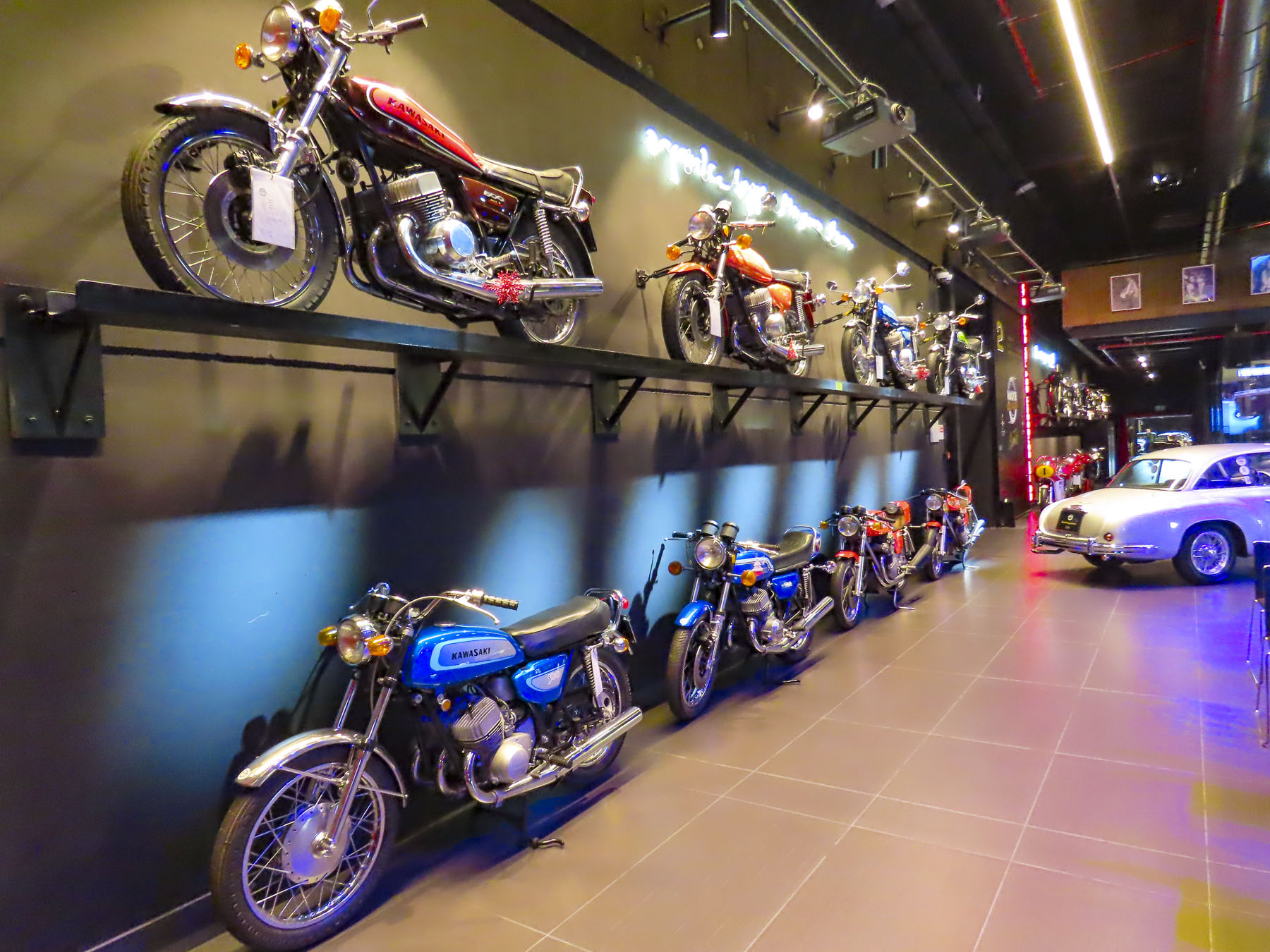
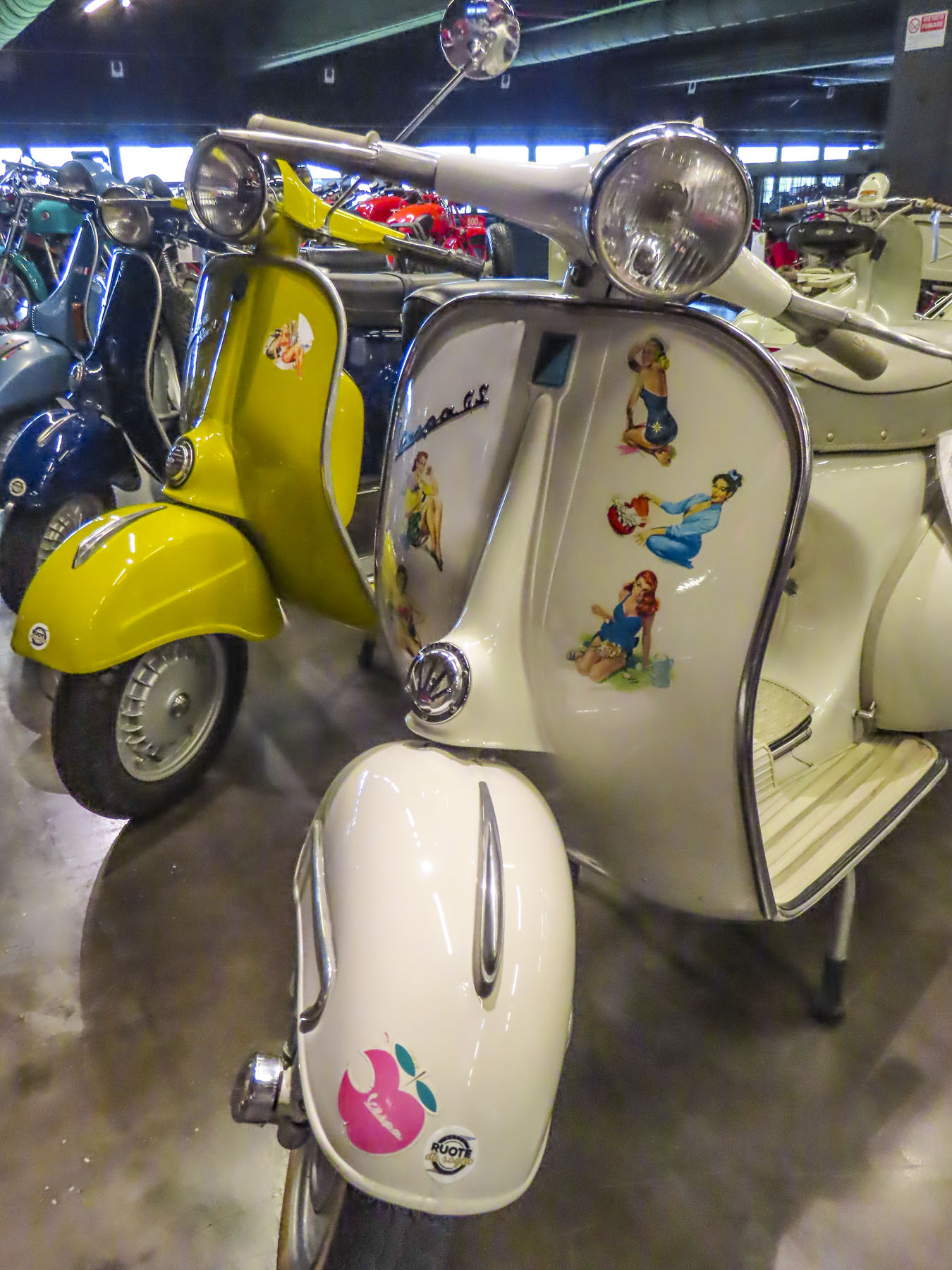
They all have museums in the region, but we spotted an advert in our hotel lobby for Ruote da Sogno, a showroom with more than 100 classic cars and 700 restored classic motorcycles and scooters, all in perfect working condition and FOR SALE! 

It was an interesting space that we wandered about freely. They also conduct traditional and online auctions., while the high-tech showroom is also available as a corporate or wedding event space.  The eclectic collection was very interesting, down to the glass refrigerator case full of champagne for auction winners to celebrate with. Vespas with a sidecar are our passion and speed. Do they ship? We asked ourselves. Zoom, zoom!

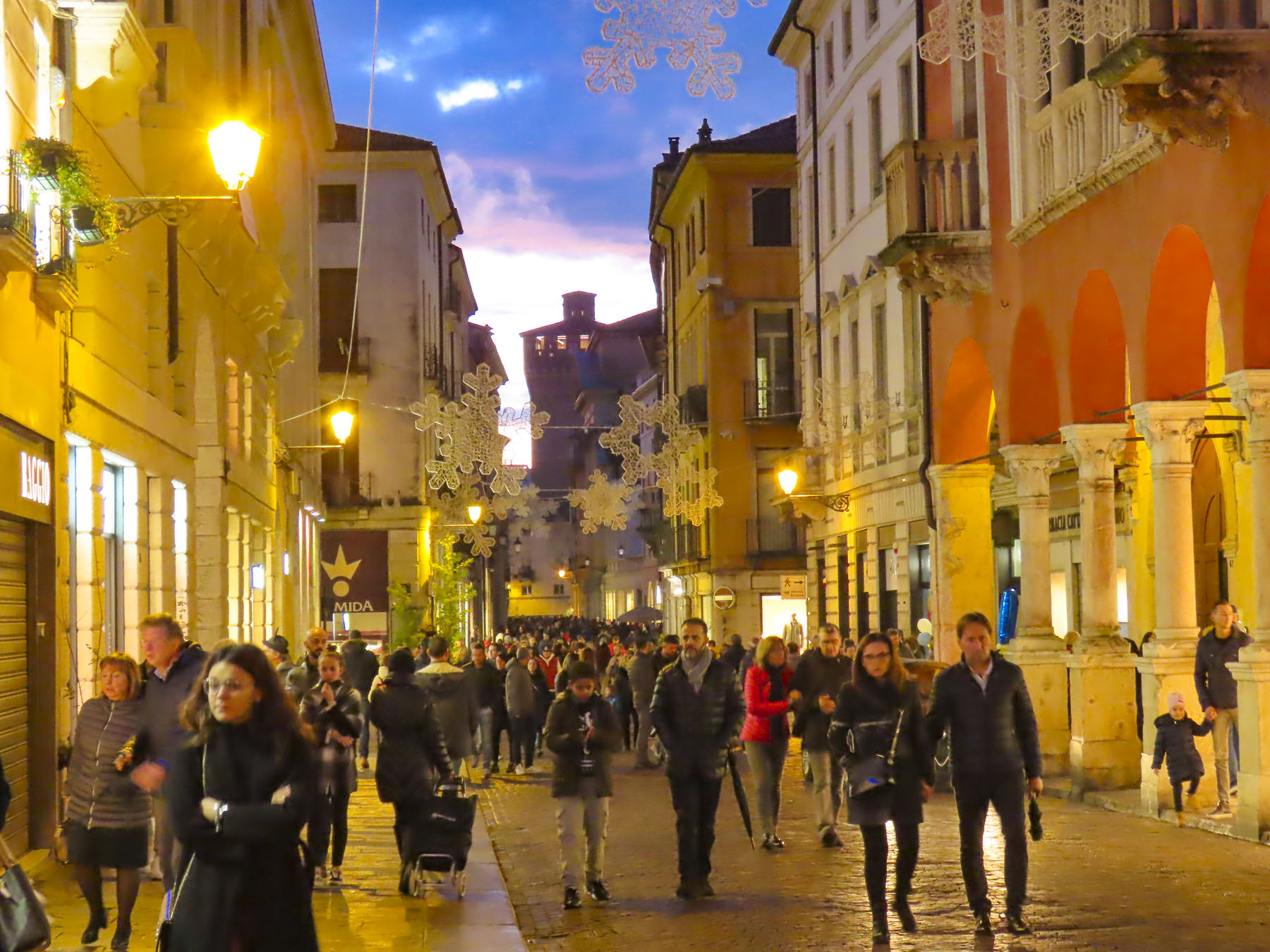
The city had completed stringing Christmas decorations down the ancient lanes and on the piazzas.  They were especially beautiful at night when the cobblestones glistened from the afternoon rain and the lights reflected off their still-wet surfaces.  The Christmas market on Piazza Camillo Prampolini was in full swing now and we couldn’t resist the opportunity to weigh down our luggage even more. After all, in late December, we would be heading back to the states to enjoy Christmas with our family.

Till next time, Craig & Donna
Vicenza – Grand Architecture, Parks & Waterscapes

Our mishaps of driving in Italy are still memorable. But they were far more forgivable and less costly before the advent of the remote video surveillance systems that Italian towns use today. Years ago, we had briefly visited Vicenza, home to one of the world’s most influential Renaissance era architects, Palladio. After a long day on the road, navigating down from the Dolomites, we drove through the old city gate under the Tower of Porta Castello, the last remaining tower of a 12th century fortress and wall that once enclosed the Renaissance city.  Today it houses an art gallery, and you can climb to the top for views of Vicenza.

The directions to the hotel were confusing and our GPS at the time was no help.  We had already stopped twice to ask the local polizia for directions, but of the four officers asked, each had a different opinion about where our obscure lane was located, which only befuddled us further.  A few moments later we realized Corso Palladio was a pedestrian-only street and we were intruding on its charming ambience. The hotel assured us they had parking, so we continued along slowly through a thickening crowd that didn’t think anything of us.  It didn’t help that the street signs were impossible to see from the car. Traveling the whole length of the street, we ended at a piazza in front of the Teatro Olimpico, designed in 1580; it’s the oldest indoor theatre in the world, with its unique original stage set still in use. It was Palladio’s last creation before his death.

Across the way two police officers with submachine guns stood by their patrol car in front of the Museo Civico di Palazzo Chiericati, known for its eclectic collection of donated art, antique furnishings and toy soldiers from the Veneto region. There was no mention of the “BIG FINES,” we had momentarily anticipated.  Instead, the gracious officers gave us a police escort to the hotel.  Parking was in the narrow lane, in front of reception.  

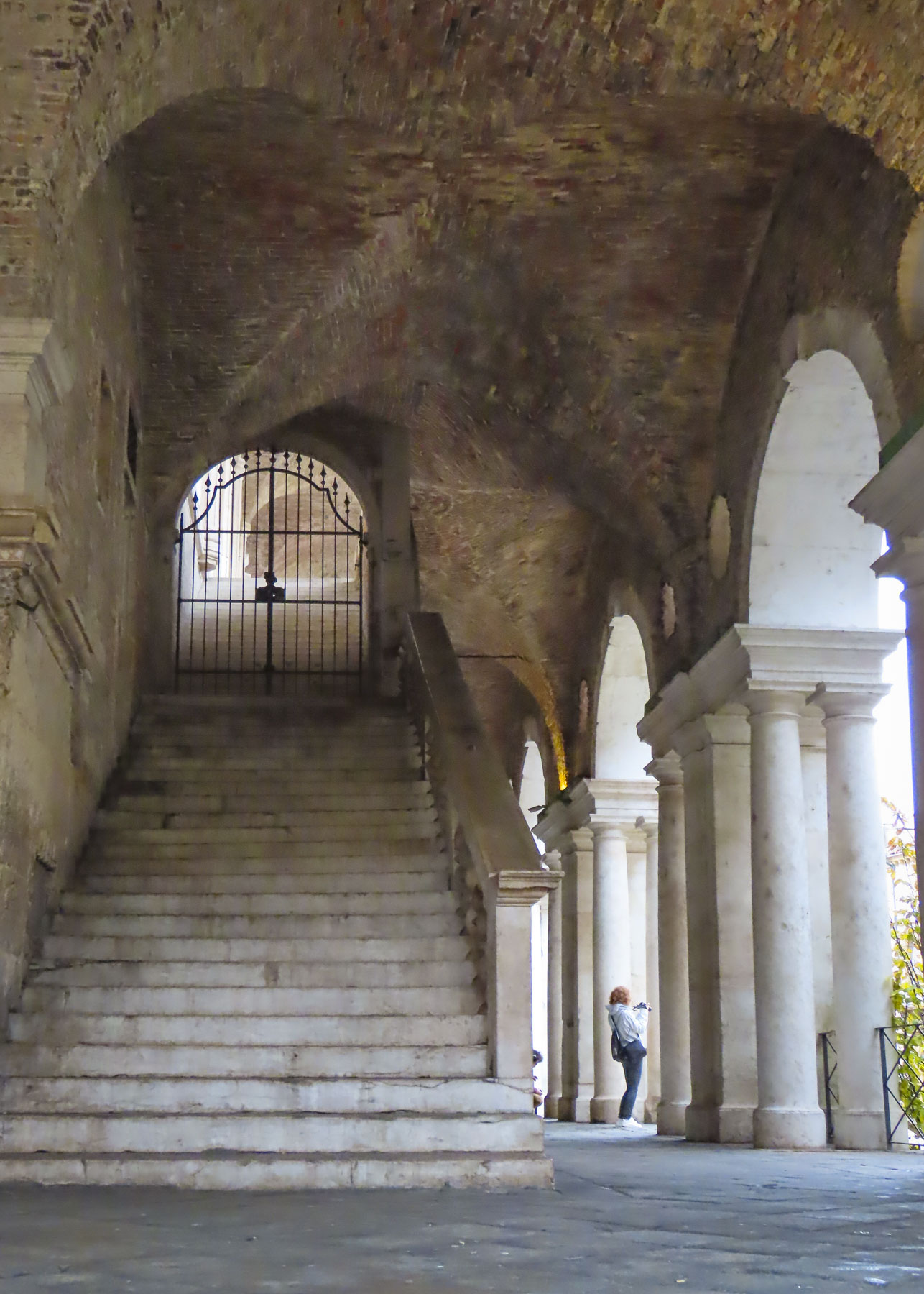
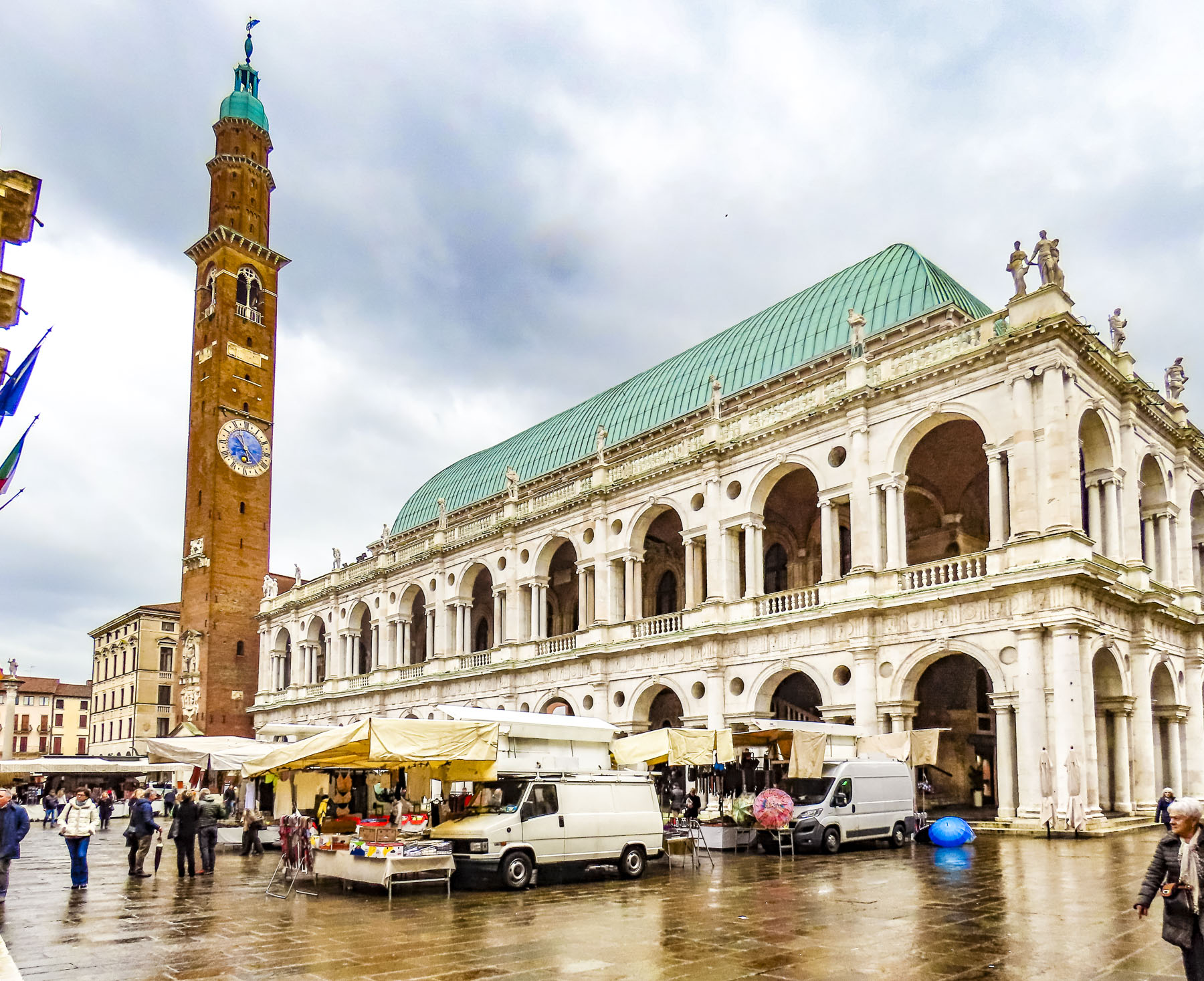
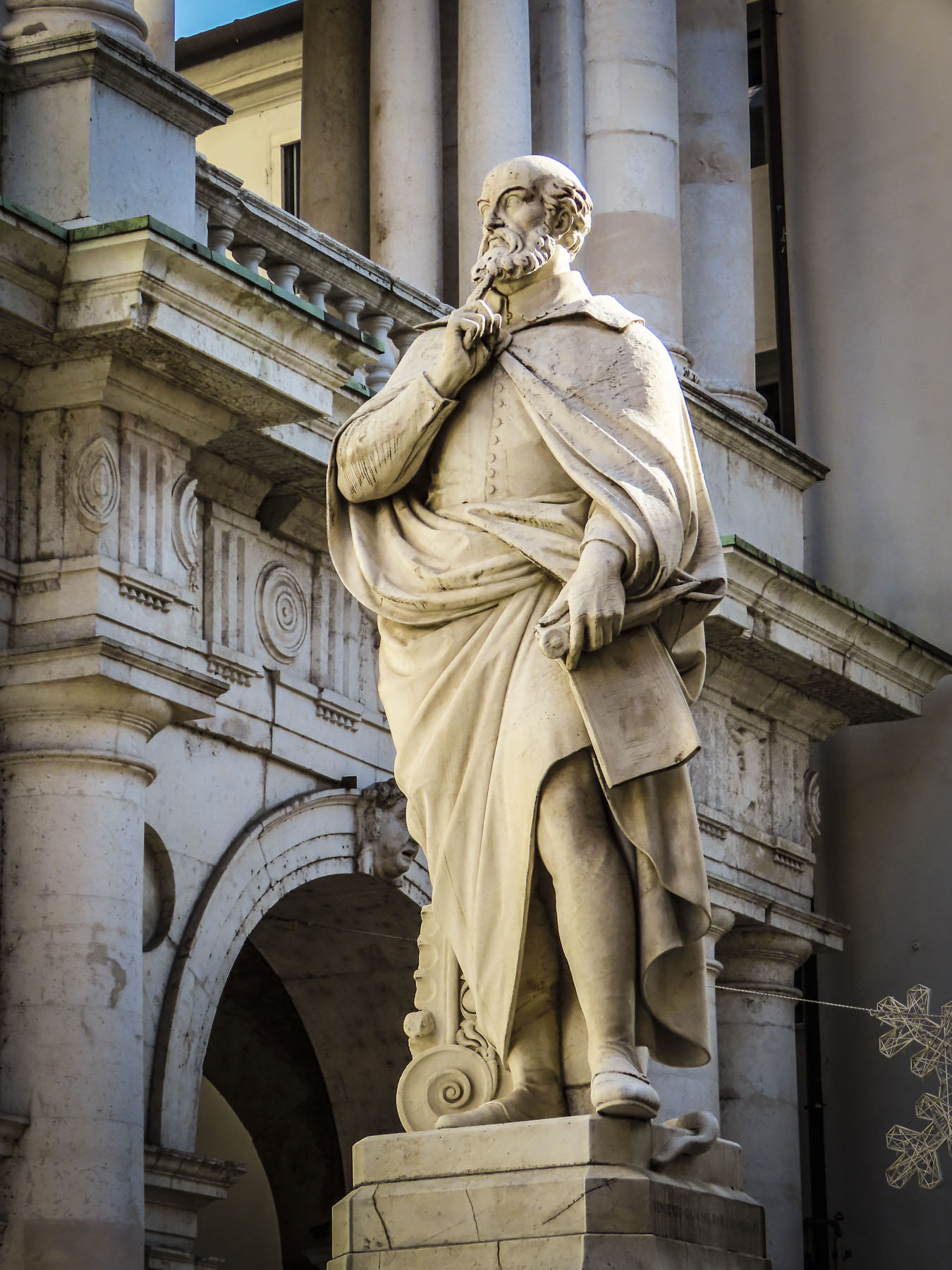
Our visit was long enough for dinner and a stroll, the next morning, around the Piazza dei Signori with its massive civic building, the Basilica Palladiana, redesigned to its present form in 1546 by the young, as-yet unknown hometown architect Andrea Palladio.  His architecture can be characterized as a refined rethinking of classical Greek and Roman temples with domed and columned buildings favoring a “harmonic Renaissance aesthetic.” The style was popular with many wealthy Italian families across the Veneto region, who commissioned him to design their palazzos. This grand style continued to be extensively influential into the 19th and 20th centuries where it was favored for municipal and government buildings, i.e., the United States Capitol Building and British Museum, among others.

Our original visit was enough time to realize the city was vastly interesting and that we had mis-planned.  Now we stay a minimum of two nights wherever we go to compensate for time lost traveling between destinations.

We figured seven nights this time should be enough to relax, enjoy the city and sample its livability.

Raised in the suburbs of New Jersey, we always shunned living in a city until we retired and sold most everything, including our cars, to finance this two-year adventure around the world.  To our surprise we now enjoy city life. Especially the walkability of smaller historic cities with their pedestrian only centers, a concept not found in the sprawl associated with urban planning in the United States.

As we neared Vicenza our shuttle driver, Fabrizio, from the Venice Airport, detoured slightly to show us two points of interest on the outskirts of the city that he thought we might enjoy, and were afraid we would otherwise miss. Parco Querini, a semi-formal large open green space with sculpture lined paths and a domed pergola, looked stunning on a late autumn afternoon. It was once the private retreat of a wealthy family and was opened to the public in the 1970s. 

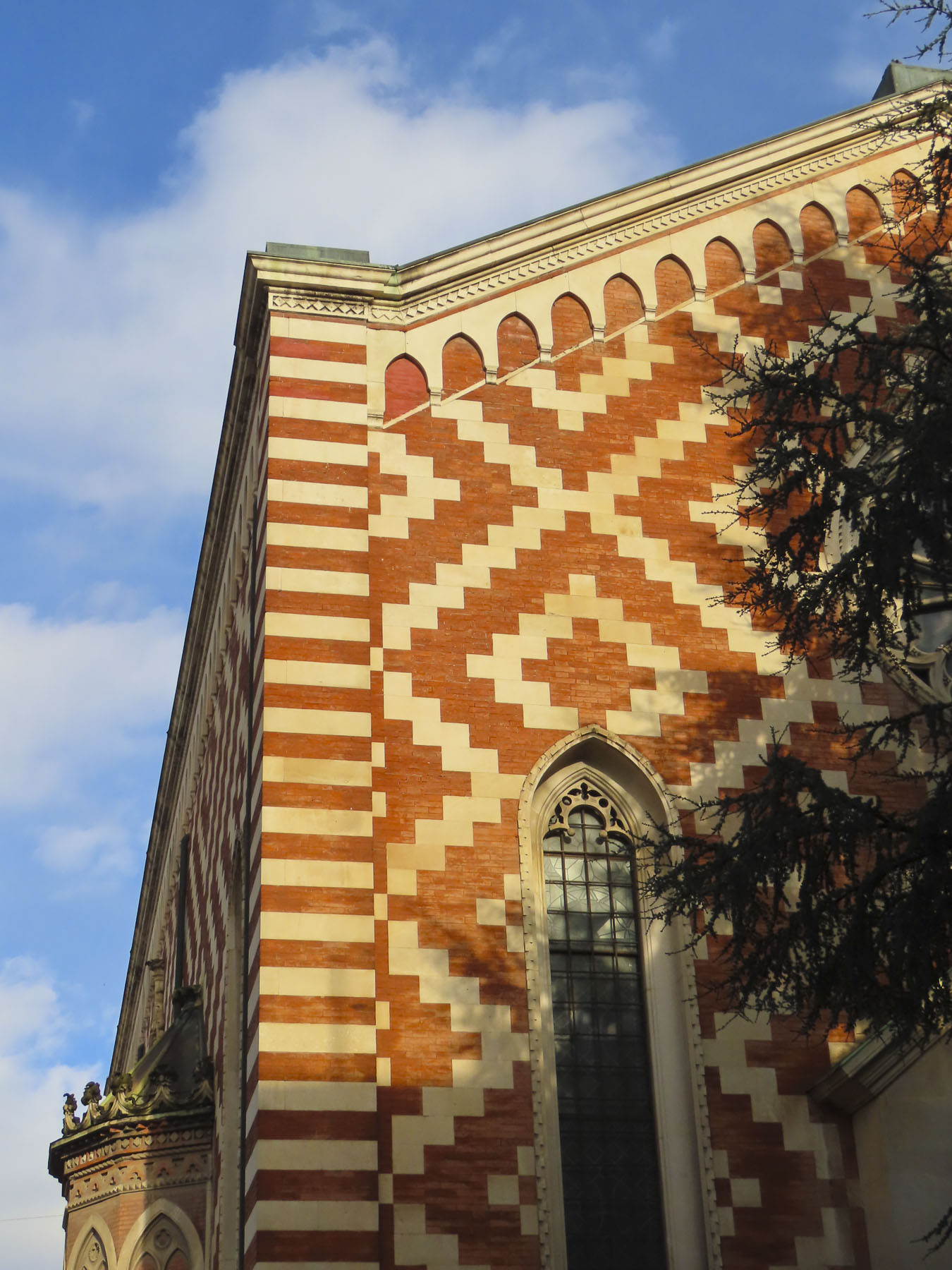
Nearer our apartment, Fabrizio took us past the red and white brickwork of the Chiesa de Santa Croce ai Carmini, with its architecturally distinctive facade. We found both sights interesting and vowed to return.

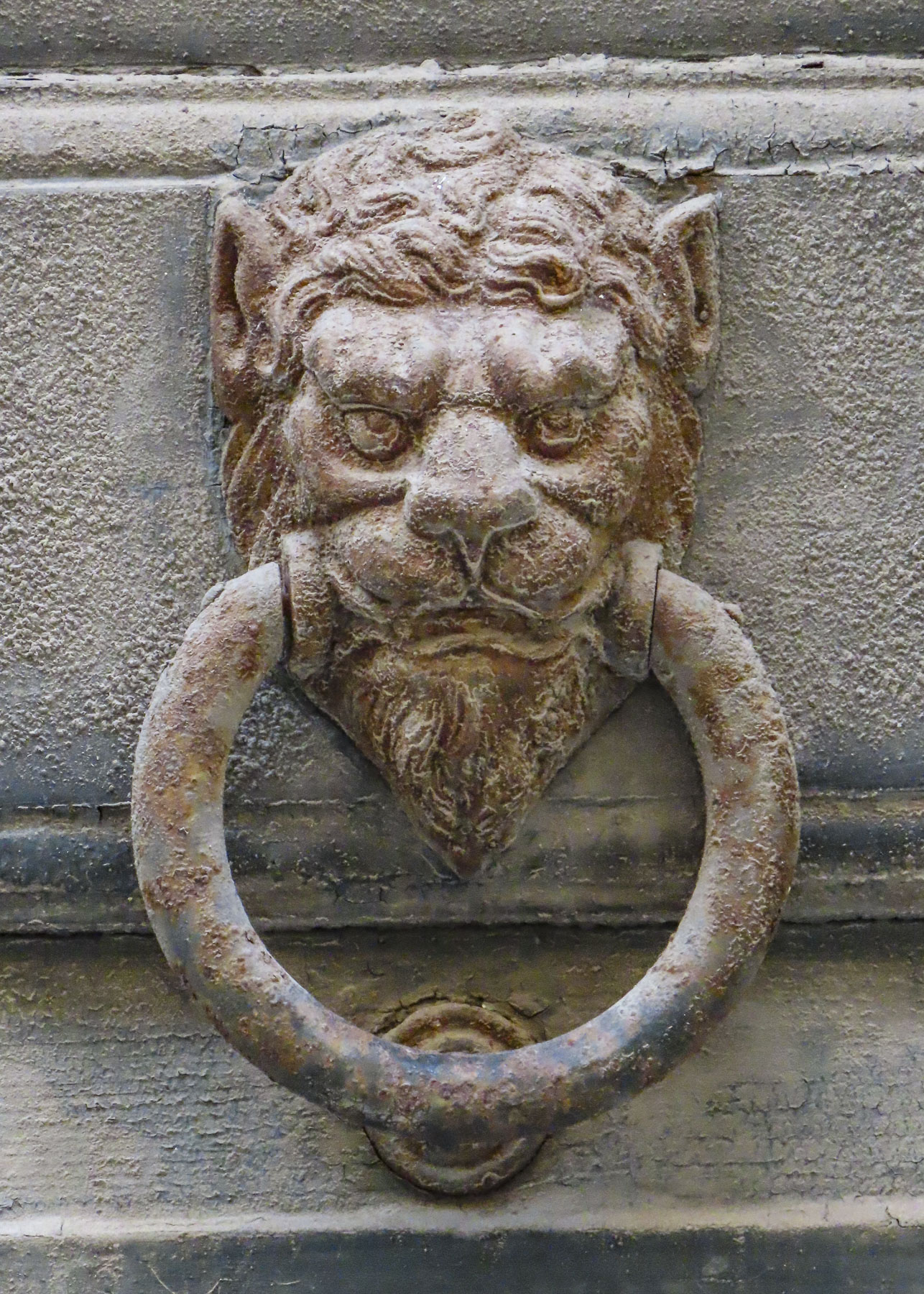
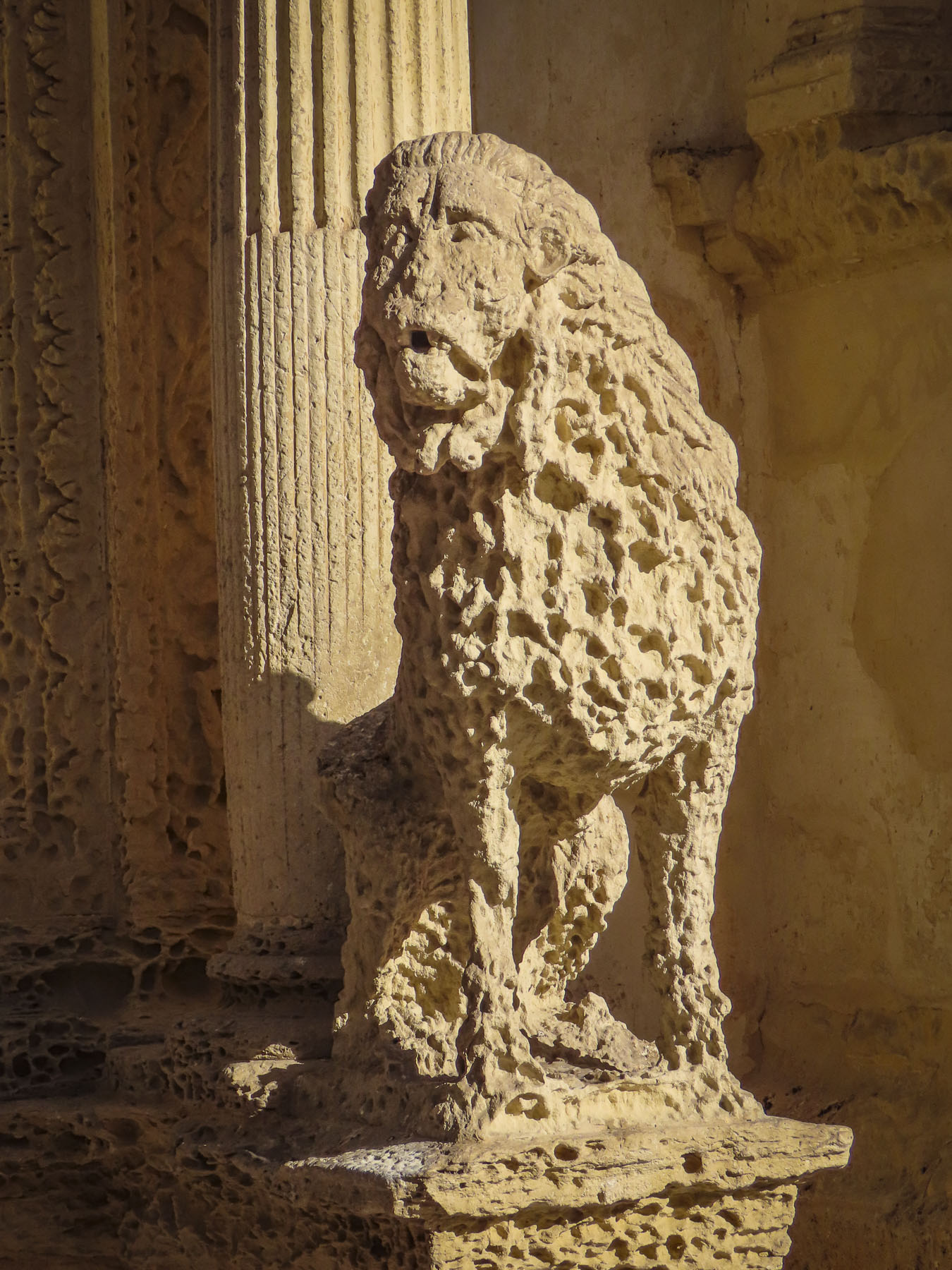
While walking to the park for a return visit, we found the Boutique Del Pane Vicenza, a delightful small bakery at the very end of Corso Antonio Fogazzaro, past the 14th century Church of San Lorenzo with its intricately carved roped portal and guarding lions that have slowly eroded with time.  Years ago in Italy, the concept of “coffee to go” or “take away” as we have in the states was unheard of. Tradition was you stood at the counter for a quick morning espresso or lingered at a table.  Attitudes have evolved and we are not sure if we agree, but this visit, with coffees and pastries in hand, we snacked in the park.

Nearby the twice-weekly artisanal farmers market, Il Mercato Campagna Amica di Vicenza, brought locally produced cheeses, wines, fruit and vegetables to new meaning with a “zero food miles” philosophy.  The artisanal baker was very popular with folks queued three deep at her counter for a chance to buy a wedge of bread from her huge country loafs.  Around the corner from the market, we found the best vegetarian restaurant we’ve ever been to, NaturaSì Silene Bio Bottega E Cucina. With truly the most flavorful and memorable vegetables.

From our apartment on Contra Motton San Lorenzo we explored the historic center of this delightfully compact, Renaissance city, where we were less than a ten-minute walk from everything. As we strolled past intriguing architectural details, we took note of what to do and where to go later in the week.  Discovering pastelería is our superpower and we put it to good use finding tasty creations to enjoy for the next morning.  Walk a little then café – repeat was a well-paced yet caloric approach that we fully enjoyed in our explorations of the city.  Though some days longer walks between cafes were needed when our belts were too tight. Donna says the solution is simply to wear elastic waist pants.

During the time of the Romans the main street in Vicenza was Via Postumia, a military road that connected outposts across Northern Italy. Later during the Renaissance, noblemen competed in Palios, horse races, on the religious festival days for Sacra Thorn and Corpus Domini, when the main street, now lined with arcaded sidewalks, was used as a racecourse. After the Second World War the street was renamed Corso Andrea Palladio, to honor the great architect for his contributions to the city, and an electric street-trolley coursed down the avenue. The Corso and the historic center of Vicenza have been pedestrian only since 1983. It remains a vital artery, with upscale shopping and restaurants connecting either end of the town and the historic sites in between. It’s the perfect street for La Passeggiata, the early evening stroll locals still enjoy. If you are looking for a traditional Italian bar along the Corso, the Gran Caffe’ with its old-world charm is the perfect place for an espresso or spritz. It attracts a diverse following, and is popular with students, professionals and a cadre of finely dressed older women who seem to be as much of an institution as the café itself.

Vicenza’s relic from Christ’s Crown of Thorns is treasured in the Sanctuary of Santa Corona, which was built by the Dominicans in the late 1200s to safekeep the extraordinary gift from the French King Louis IX to the Bishop of Vicenza. 

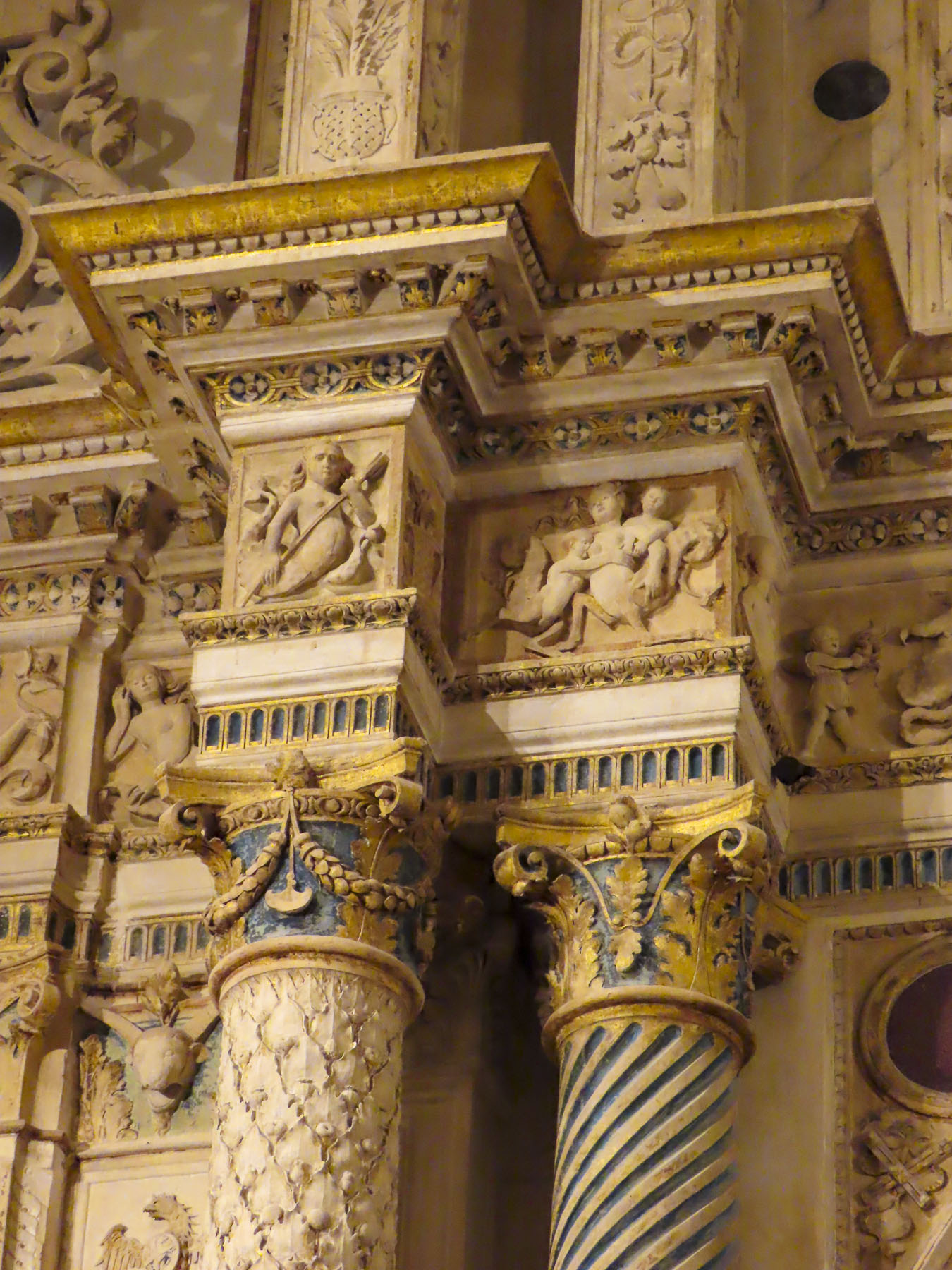
The centerpiece of the church is a beautiful altar embellished with pearls, corals, lapis lazuli and polychrome marble. Interestingly, outside hanging on the wall of the cloister is a plaque featuring a Cinta senese, an ancient Italian pig breed that is famous for its flavorful meat.

Palladio has definitely left his mark on the city with buildings of his design on almost every street – at least, it seems that way. A tour of the city wouldn’t be complete without stopping at the Palazzo Barbaran da Porto, a Palladio design built in 1570, that is now a museum with interactive exhibits and video displays as well as three dimensional models dedicated to the architect’s work.  Recognized by UNESCO in 1994 for his influential architectural aesthetic, called Palladian, twenty-four of his Palazzo designs and the city itself have been designated a World Heritage Site.

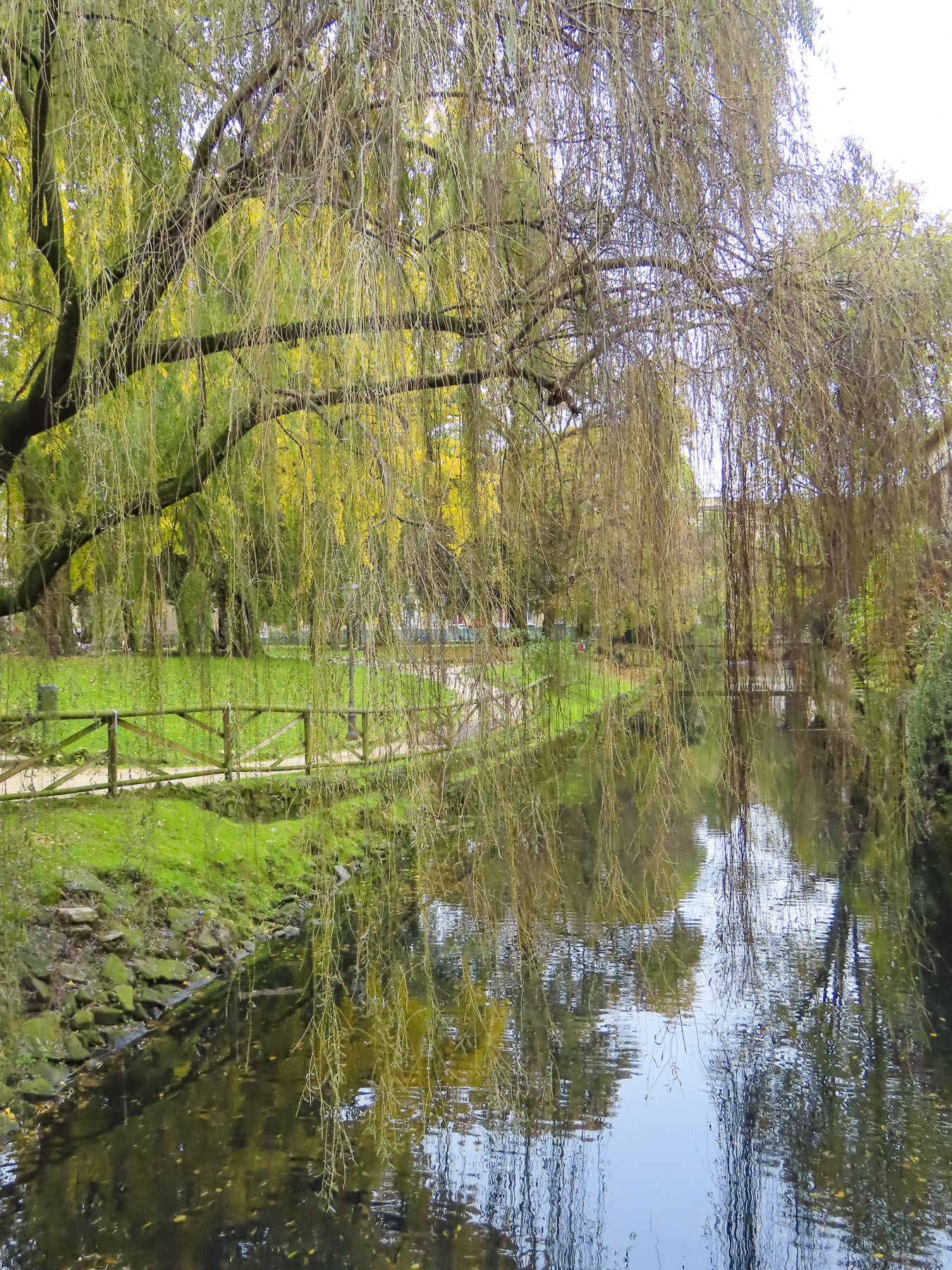
The city also has a wonderful ambience aside from his architectural masterpieces.  Waterscapes from the Ponte S. Paolo and the Ponte S. Michele over the Fiume Retrone reflect a quaint village vibe unexpected in comparison to the grand Piazza dei Signori just two blocks away.  

Pasticceria Venezia – a Vicenza dal 1964, just up from the bicycle parking on S. Paolo and near the Palladian Basilica, is a terrific place for café and a bite to eat.

On the other end of town just outside the Porta Castello, the Giardini Salvi, a treed greenspace with fountains, has been on the city map since 1580. It was the private park to the Palazzo Valmarana and in a brief moment of 16th century civic mindedness, was open to the public for a few years before being closed again for several centuries.  It wasn’t until the 20th century that the park was permanently reopened for public use.

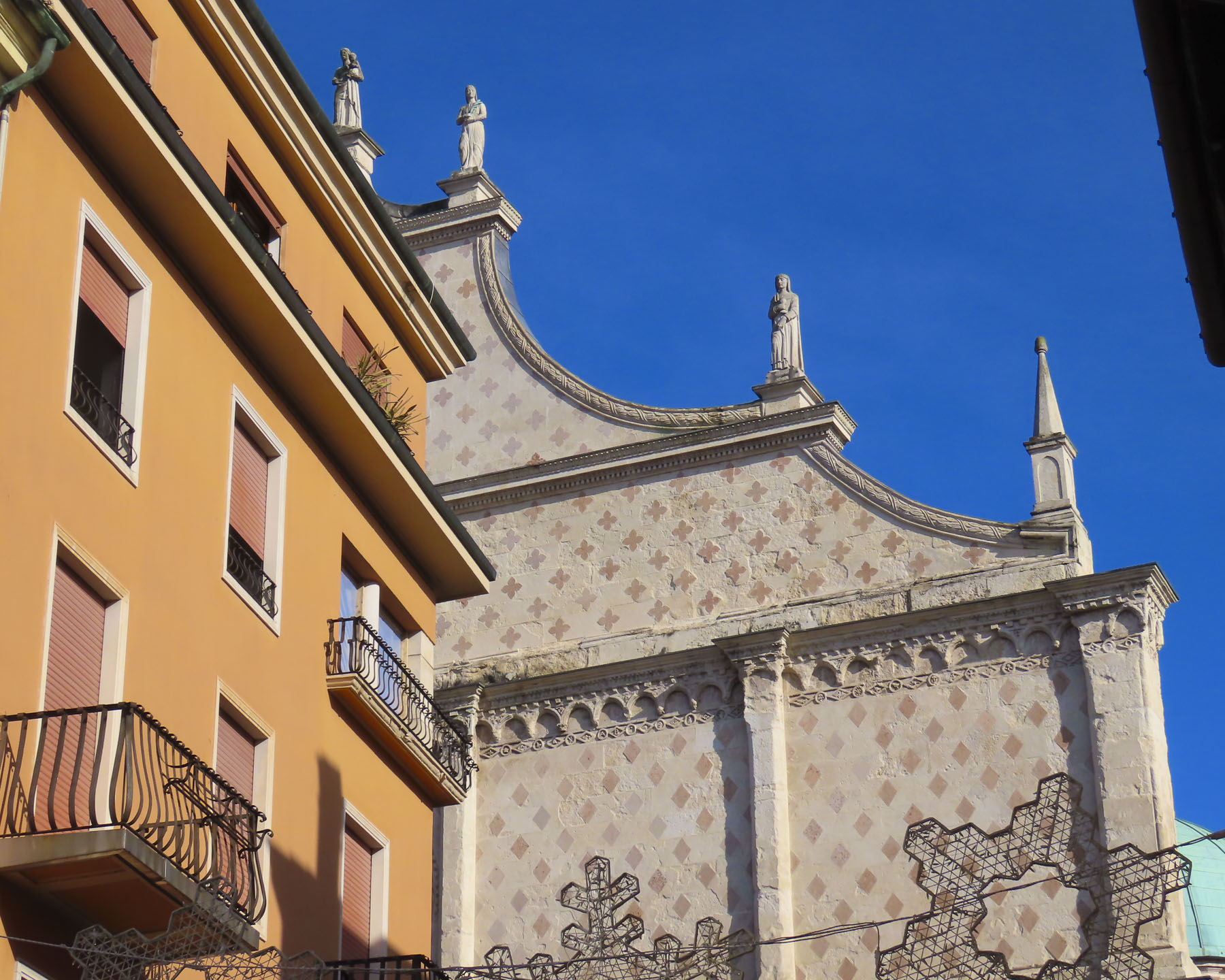
The district south of the Corso Palladio is also worth exploring with the Duomo di Vicenza, the Cathedral of Saint Mary of the Announcement, as its centerpiece.  Heavily damaged by allied bombing during the Second World War, only the original 1482 Gothic entrance façade remained, while the rest of the church had to be reconstructed.

Diagonally across the street, in the ancient Bishop’s Palace, the Museo Diocesano di Vicenza has a unique collection of Vicentine religious artifacts. Interestingly there is a large collection of fine marble spheres, some the size of bowling balls, given to a former Bishop of Vicenza as gifts.  Discovered on the other side of the piazza during reconstruction after WWII the Criptoportico Romano was the subterranean storage area of a 1st century Roman domus. As interesting as that sounds, if you’ve been in an empty, damp dark basement before, you can skip this.

Around the corner is Righetti’s, a self-service restaurant and another Vicenza institution for over thirty years, that should be experienced. Customers find their own tables and set the cutlery themselves before walking to the back of the restaurant and placing their orders, from the daily changing menu on chalk boards, directly with the cooks in the kitchen.  After dinner, the cashier counts your glasses and plates, then bills accordingly. They are open Monday through Friday for lunch and dinner, cash only.

Although the weather was noticeably cooler, we enjoyed our November off-season visit to this visually pleasing and gentle city. If you are an admirer of historic architecture, Vicenza is akin to finding a lost treasure. The bonus was the lack of large tourist groups, which we imagine could be quite smothering in this quaint city during peak travel months.

Till next time, Craig & Donna
Sicily Part One: Taorima and Castiglione di Sicilia – Sunny Ancient Lands

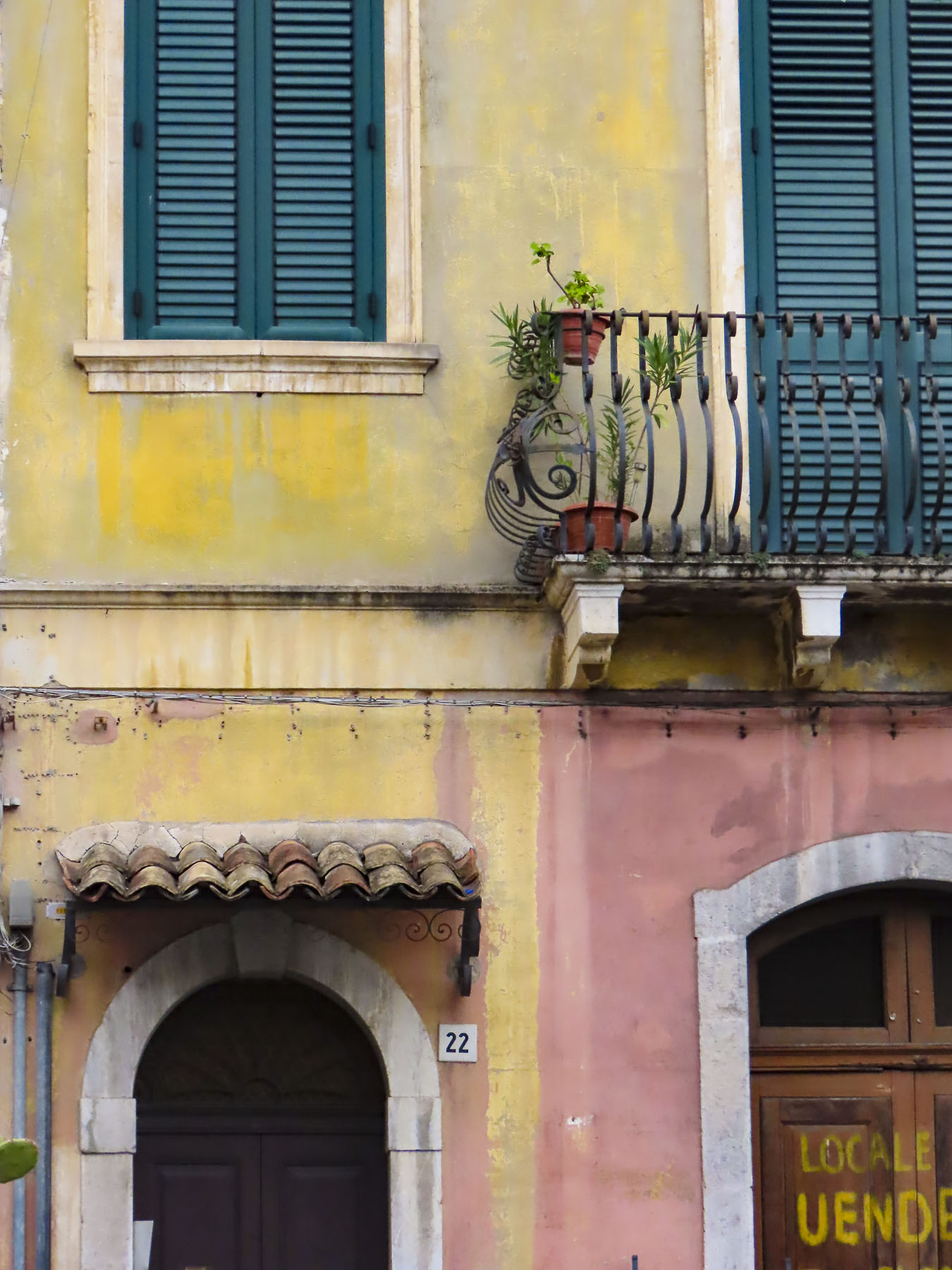
The clickity clack of our suitcase wheels reverberated through the Porta Catania, the ancient gate through a defensive wall that once encircled the town, as we pulled them past the 14th century Duomo of Taormina, over cobblestones polished smooth by centuries of use and time.  Adorned with crenelations, the church looks more like a fortress than sanctuary and seems at odds with the playful Baroque fountain in the plaza across from it.

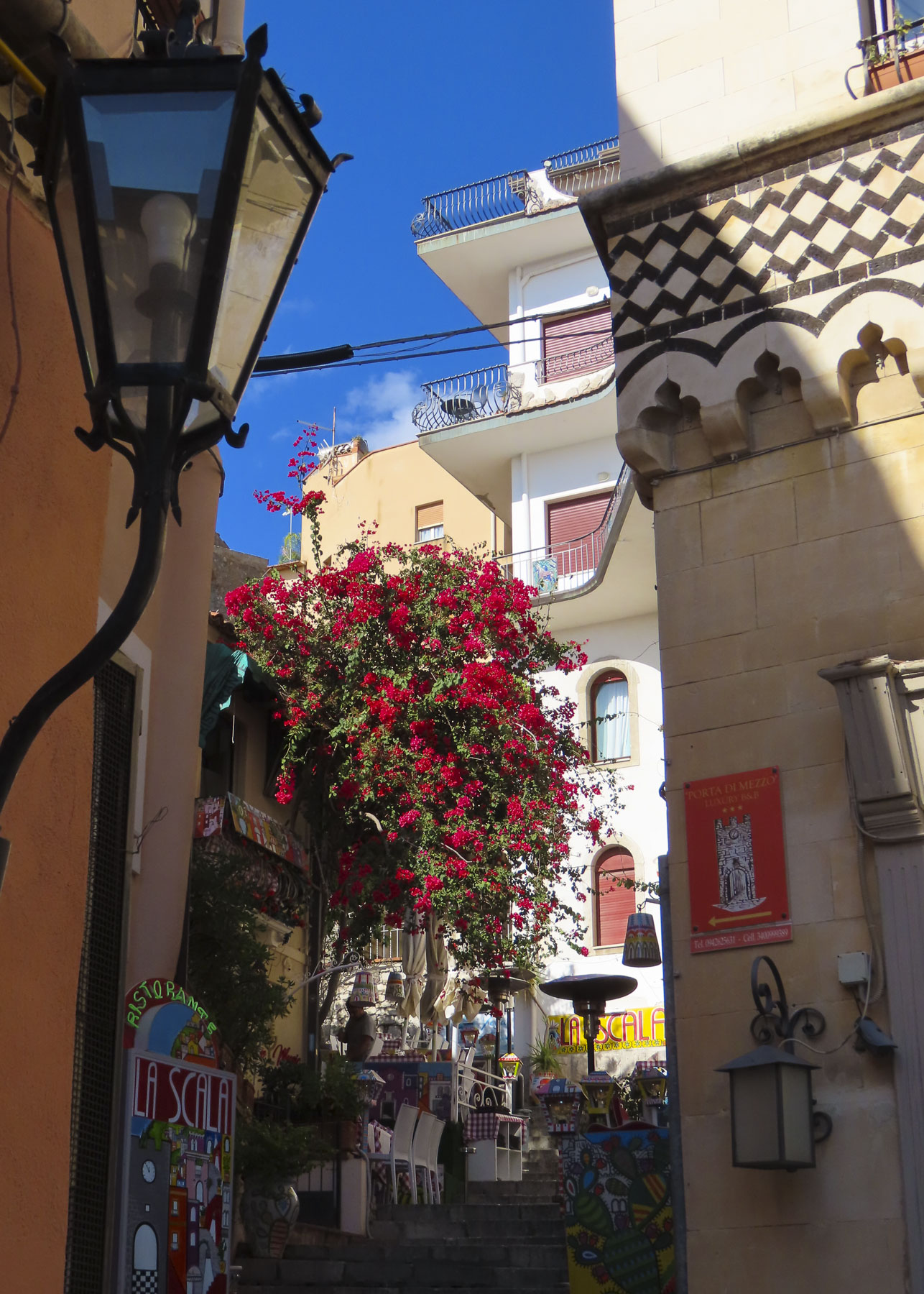
Lined with colorful shops Corso Umberto, barely wide enough for a horse cart, connects the two old entrances to the city and is pedestrian only. The adjoining steep, staired alleys were sized just right for the width of a donkey.

Meeting us at the corner, our young host graciously carried our bags up the passageway and to the third-floor room we had rented in a newly renovated guest house.  It was a compact space, but it would work if we sucked in our stomachs. Effortlessly, he trotted up two more flights to the rooftop where he showed us the kitchen, as well as distant views of the Teatro Antico di Taormina, the castle above town, and Mount Etna, all bathed in the last of the sun’s rays. 

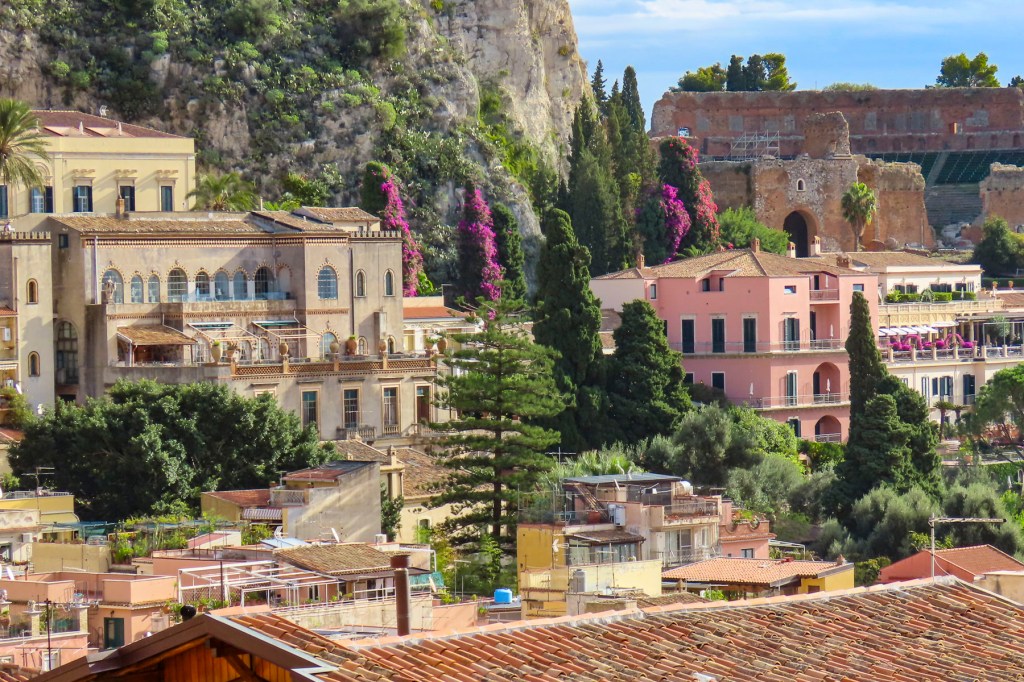
The next morning, before the day became too hot, we followed a steep switch-backed trail up the side of Mount Tauro to the Chiesa Madonna della Rocca and the Saracen Castle.  The Arab fortress is believed to be built over an ancient Greek acropolis. Unfortunately, it was closed due to disrepair, but the panoramic view of Naxos on the coast with Mt Etna in the background was phenomenal.

Sicily’s history follows Mount Etna’s turbulent eruptions – quiet for long periods then thrown into turmoil by foreign invasions.  Hanging off the toe of Italy, its large land mass pinches the Mediterranean Sea to the point that the island is only 372 miles from North Africa’s Tunisian coast. For ancient mariners sailing East to West or South to North it was unavoidable, and they collided with it.  Its easy location at the crossroads of the Mediterranean brought Phoenicians, Greeks, Romans, Vandals, Ostrogoths, Byzantines, Arabs, Normans, French, Germans, British, and Spanish for varying lengths of conquest and cultural influence. It’s an interesting gene pool for sure. 

Appreciating a good beach when they found one, the Greeks rowed ashore and established their first colony, Naxos, on the island in 734 BC.  Later siding with the city state Athens in a war against Syracuse, upon defeat the city was completely destroyed in retaliation. The survivors fled to the high ground and founded Taormina.  Visitors continue to be dazzled by their vision to dramatically construct an amphitheater on the edge of a cliff towering over the sea with Mt. Etna, an active volcano, in the background.  

Finally, Piedmontese volunteers, the red shirts of Northern Italy, invaded to unite Italy. Commanded by Giuseppe Garibaldi, the army defeated the Kingdom of Sicily whose territory extended across the boot of Italy and North to Naples.

But before that Taormina with its multiculturalism was a required stop on the “Grand Tours” of the 18th and early 19th centuries once it was mentioned by Johann Wolfgang von Goethe in his Journey to Italy. Paris, Venice, Florence, Rome, Naples and Pompeii, Athens, Istanbul, Cairo and Seville were also treasured destinations.  Remember, this was the time when all land travel was by horse-drawn carriage and water crossings by sailing ships. Think of it as an extended gap year, when young aristocrats were sent abroad for two to four years to sharpen their sensibilities and further their knowledge of the arts, antiquities and the classics.  Taormina’s big draw though, over those other sophisticated cities, was its clifftop location high above the Mediterranean that caught the cool breezes blowing in from the sea during the summer.

The Nordic invasion continued with landscape painter Otto Geleng. Exhibitions of his paintings in Paris and Berlin left critics saying such landscapes couldn’t exist and that he had an “over-active imagination.” He encouraged all his doubters to see Sicily for themselves, then returned to Taormina and opened the town’s first hotel, Timeo, in a renovated palace. His vision inspired a wave of artists, writers, and actors to visit.  In the 1920s D.H. Lawrence lived there. The books In Cold Blood and Breakfast at Tiffany’s were written by Truman Capote during his stay on the island.

The town can really name drop some famous visitors: Salvador Dali, Orson Welles, Cecil Beaton, Jean Cocteau, Rita Hayworth, Greta Garbo, Elizabeth Taylor, John Steinbeck, Cary Grant and Tennessee Williams have all worked on their tans in the golden rays of the Mediterranean sun here. 

The Taormina Film Festival, now in its 67th year, still premieres movies every June on a large outdoor screen set up in the 2300-year-old Greek amphitheater.  It attracts a new generation of sunscreen-wearing A listers: George Clooney, Catherine Zeta-Jones, Nicole Kidman, Russell Crow, Leonardo DiCaprio and Salma Hayek. Imagine watching Spiderman: Far from Home there, as Mt. Etna sputters trails of lava into the night sky in the background. Aside from the film festival, the amphitheater hosts a vast number of concerts and stage productions throughout the year.

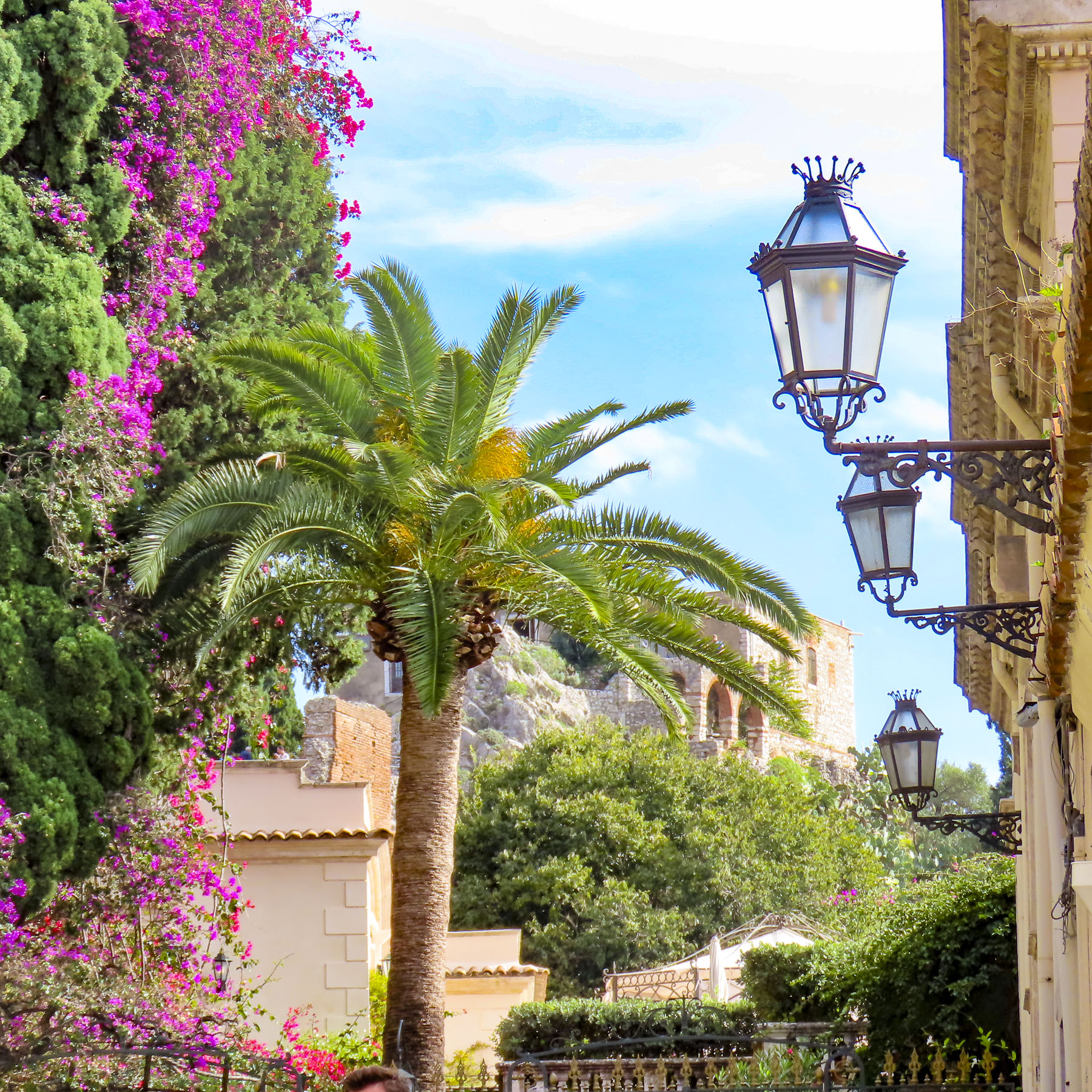
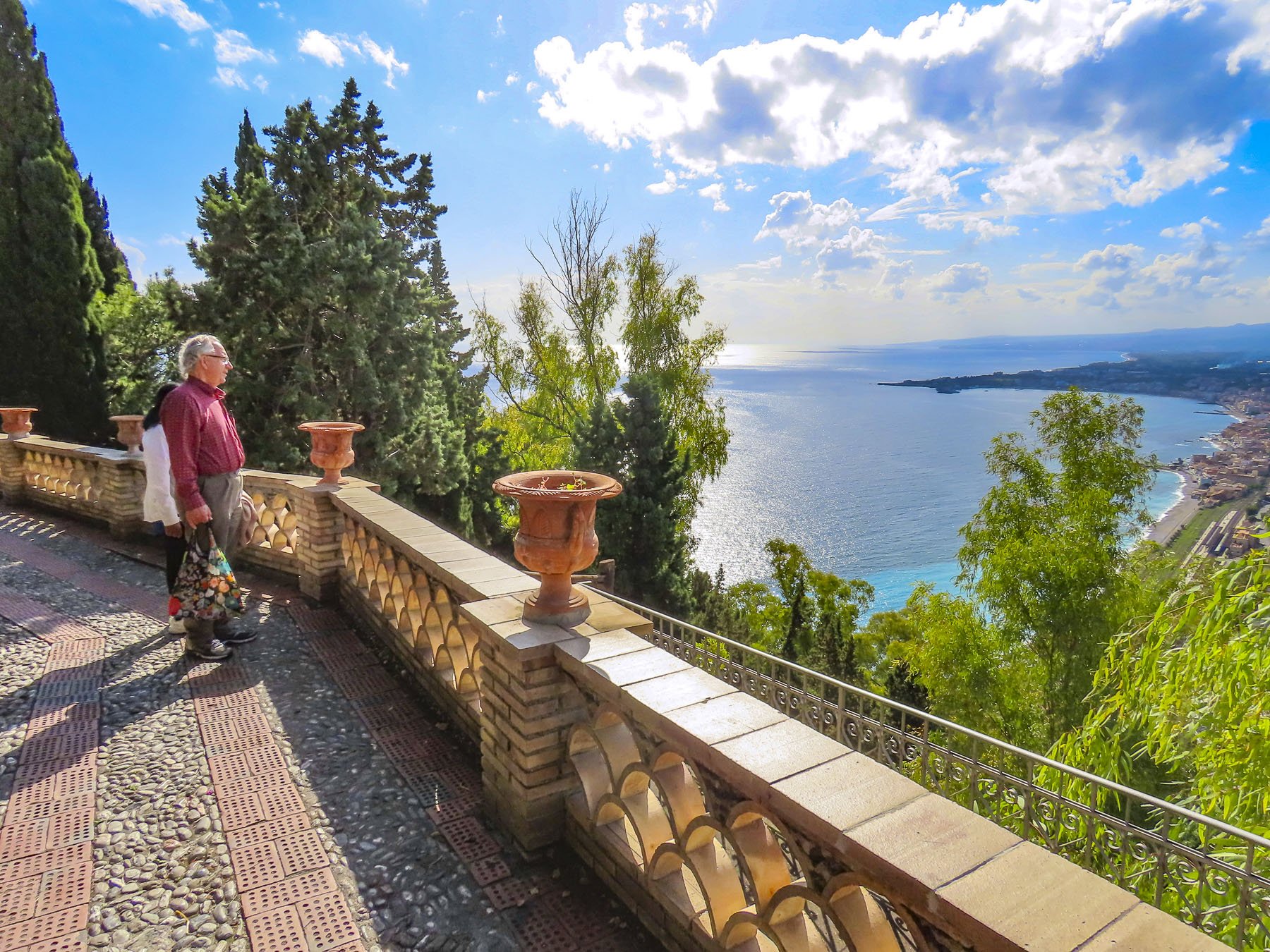
Not being on any lists, including Interpol’s or the FBI’s most wanted, we enjoyed a still warm early November day as we wandered through the Giardino Storico Ex Villa Trevelyan, now the town’s public formal garden, but once the grounds of a villa owned by a Scottish noblewoman. Lady Florence Trevelyan fled rumors of an affair with King Edward VIII, settled in Taormina and eventually married the mayor.  During our visit, intricately stoned paths along the cliff edge, with views of the sea, were still lush with blooming bougainvillea and hibiscus. Eventually they led to fanciful, ornamental architectural constructions called Victorian follies.

Rambling on, we passed an antique Rolls Royce being readied at the Grand Hotel Timeo to whisk the bride and groom away after their destination wedding. 

From the top row of seats at Teatro Antico di Taormina, the views continued to be enthralling; Mt. Etna was perfectly framed by the ancient columns of the stage. 

In the other direction, the coast toward Spisone dazzled in the afternoon sun.  Inland, the homes of Castelmola were precariously balanced to avoid sliding off their treacherous slope. 

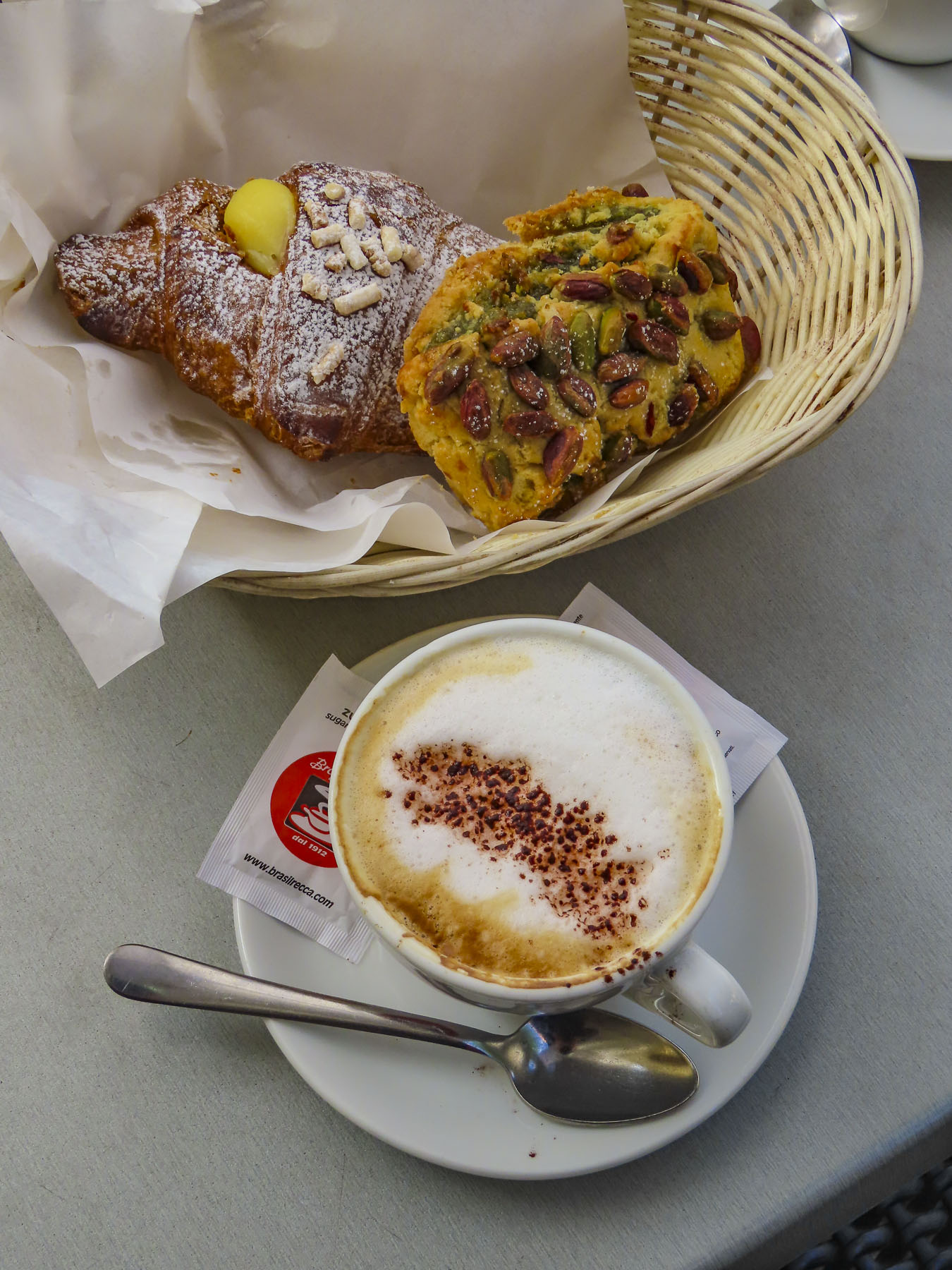
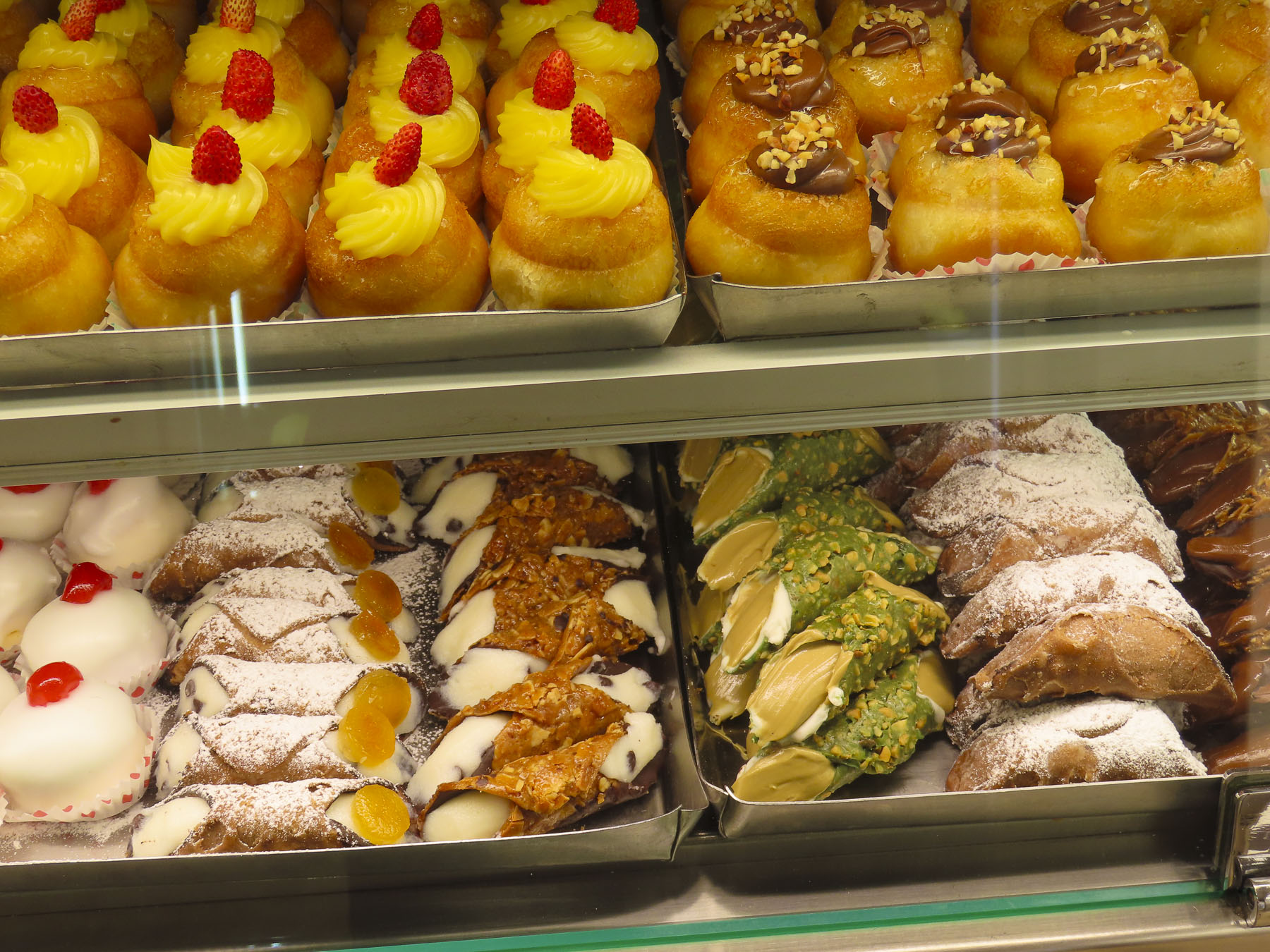
A stay isn’t complete in Taormina without multiple strolls along Corso Umberto in the mornings for café and pistachio pastries, and later in the day for pistachio Aranchino or gelato.

The broad expanse of Piazza IX Aprile, adjacent to the Porta di Mezzo clock tower and the elegant Baroque Church of San Giuseppe draws a large crowd at sunset to admire the view, and is the perfect spot to enjoy a classic Aperol spritz. 

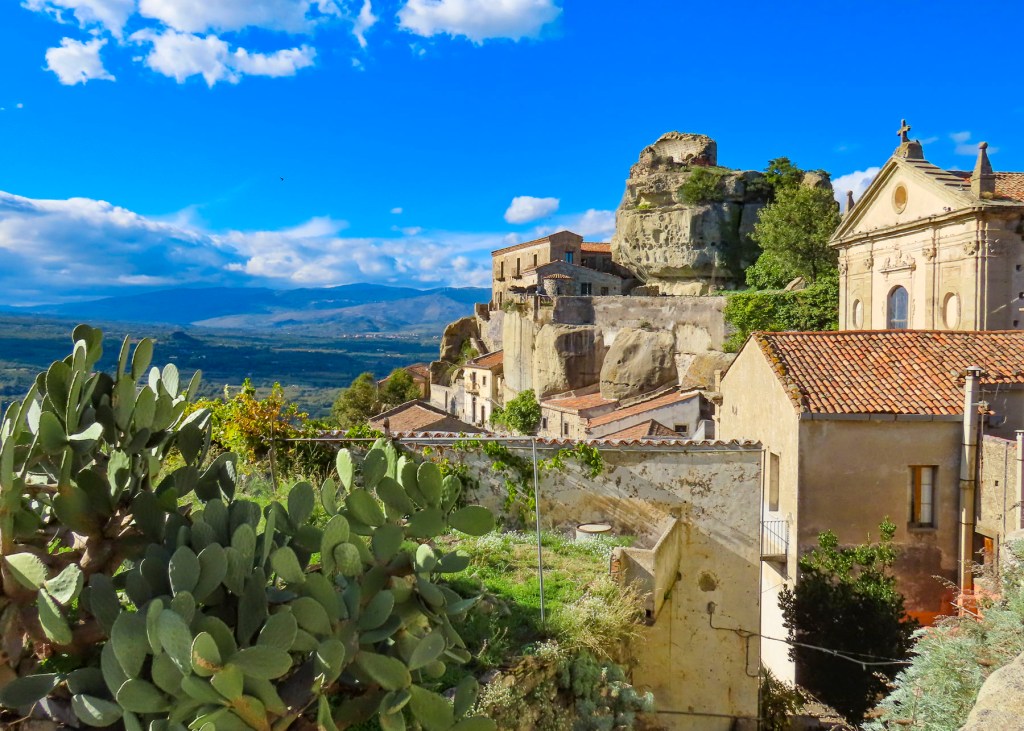
Located in the foothills surrounding Mt. Etna, Castiglione di Sicilia is on the list of most beautiful villages in Sicily. Less than an hour from Taormina, it beckoned us to visit. The scenic drive along SS185 through the Alcantara Valley was uneventful.  The fields were dormant now and farm tractors were parked to await the spring planting season. The multiple arches of Ponte San Cataldo, a historical railway bridge, graced one curve of the road.  It was now a bridge to nowhere, the train tracks at both ends long ago removed for scrap. Villages we passed showed barely any signs of life beyond a barking dog or two. 

Numerous signs for campgrounds and agrotourism farms along the route promised outdoor enthusiasts escape from city life.  Turning onto SP7i we eventually passed the rustic 12th century Norman Chiesa Di San Nicola, then crossed a small bridge over the Alcantara River, within sight of Castiglione di Sicilia.  Fed by snow melt from Mt. Etna and Nebrodi Mountains, the Alcantara River is one of the few rivers in Sicily that flows all year-round.  Over the millennia the cool waters of the river have carved a dramatic gorge through lava fields left from Mt. Etna’s volcanic eruptions.  Hiking trails above the gorge and swimming in its cool natural pools are popular summer activities in the region.

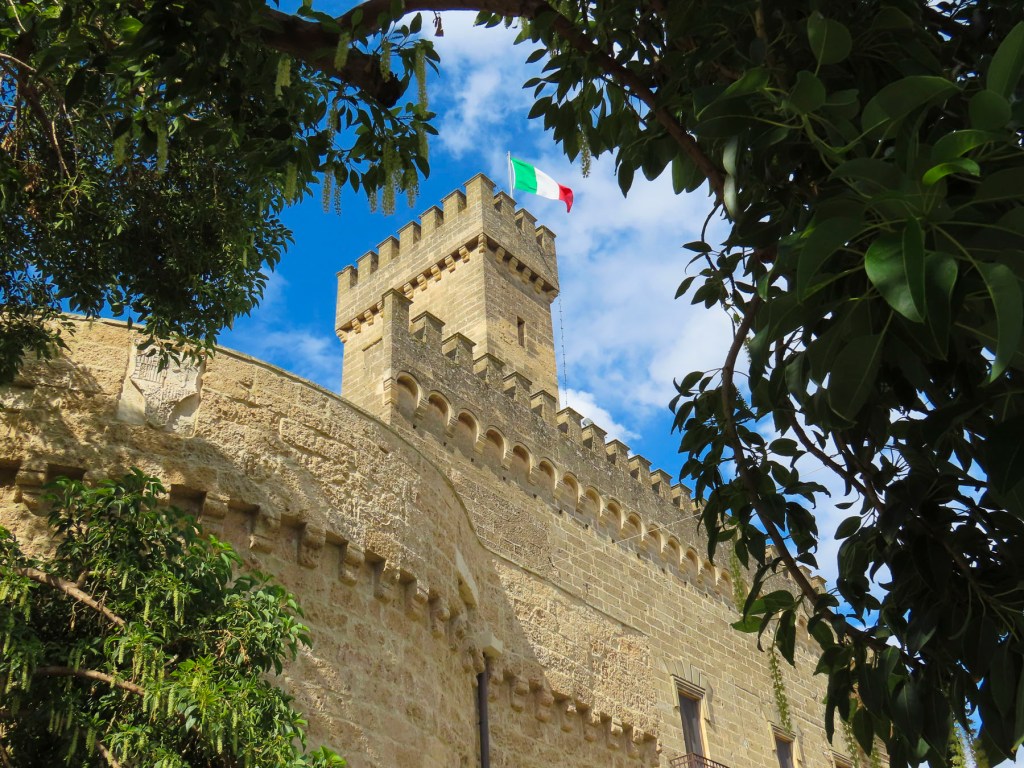
Commanding the high ground helped increase your chance of survival in the days when pillaging and plunder ruled the land.  Defenders hoped that attackers would tire and move on to an easier target. From the road in the valley, Castiglione di Sicilia looked formidable, with Castello di Lauria commanding the promontory like the rock of Gibraltar. 

Driving into the center of the village, mid-week in the off-season, we nearly had the whole village to ourselves. It felt deserted, almost as if the village had been sacked and the residents had been taken captive. We followed a warren of narrow alleys and stairways around the upper village until we reached Castelluccio, the ruins a of Byzantine tower, in a small park with an overview of the village. 

From here we spotted the belltowers of six ancient churches and monasteries that dot the hilltop. The oldest, Chiesa San Pietro, dates to 1105. Castelluccio, slightly lower than Castello di Lauria, would be our highest point in the village, since the castle was closed in the off-season. That’s the one disappointment we experience when traveling in the off-season – many points of interest are closed due to a lack of tourists.  It’s the old double-edged sword, less crowding versus less accessibility.  For the most part we are okay with this and enjoy wandering to soak up the ambiance of a locale.

A looping around the huge monolithic rock, Via Edoardo Pantano brought us to the foot of Castello di Lauria, the 12th century Norman fortress built upon earlier Greek and Roman battlements. The views of the Alcantara Valley were beautiful from this vantage point. Farther on the Basilica of Maria Santissima della Catena stood atop a wide staircase at the end of a quiet plaza. The patron saint of the town, she is believed to have saved Castiglione di Sicilia from the wrath of Mount Etna on many occasions.  Her feast day is celebrated every May with a procession through the village. 

It was mid-afternoon by the time we were ready for lunch, and our options had dwindled dramatically since arriving.  Only La Dispensa dell’Etna was still open with all the inside tables taken by a large party.  Interestingly, part of the floor of the restaurant has glass tiles that allow you to look down onto artifacts discovered during a renovation. It was a little chilly for outside dining, but we enjoyed, with the guidance of our waiter, several specialties of the Alcantara Valley. The addition of wonderful home-made house wines from the regional grapes, Nerello Mascalese and Carricante, native to the slopes of Mt. Etna, combined with the delicious food made this one of our most pleasurable meals in Sicily.  Following the Etna Wine Path might be the catalyst for future visits to Sicily. 

Till next time, Craig & Donna

South to Sicily: Part Two – Maratea to the Toe of the Boot

Normally in November we’d head to warmer climes south of the equator, but it was payback time for an extended stay in Africa, and the Italian homeland of Donna’s ancestors was calling.  We’d realized for awhile that Italy was going to be the most expensive part of our two-year journey.  Even with a very favorable exchange rate, traveling through Italy in the off-season was the best way for us to afford this portion of the trip. We’d keep our fingers crossed about Italy’s rainy season. Grey clouds hung low and were as thick as tiramisu as we neared Paestum.  Known for its ancient Greek temples dating from 550 BC, we had planned to stop there, but the day was just too damp and dreary. We drove on to Maratea.

The weather improved, with the sun occasionally making an appearance as we turned off the E45 and headed west, through a rural hilly landscape covered with trees and olive orchards, to the Tyrrhenian coast. Here again most hotels and restaurants were closed for the season, but we found a very nice, four-room Bed & Breakfast in Acquafredda, just above Maratea.  This part of Basilicata resembled the Amalfi Coast with its narrow cliff-hugging road and rocky coves.  It’s one of the regions where Italian families head to escape the crush of foreign tourists that descends on Italy during the summer months. It also makes Basilicata one of the few Italian provinces that borders two seas. The road narrowed to a single lane as we entered the old village.

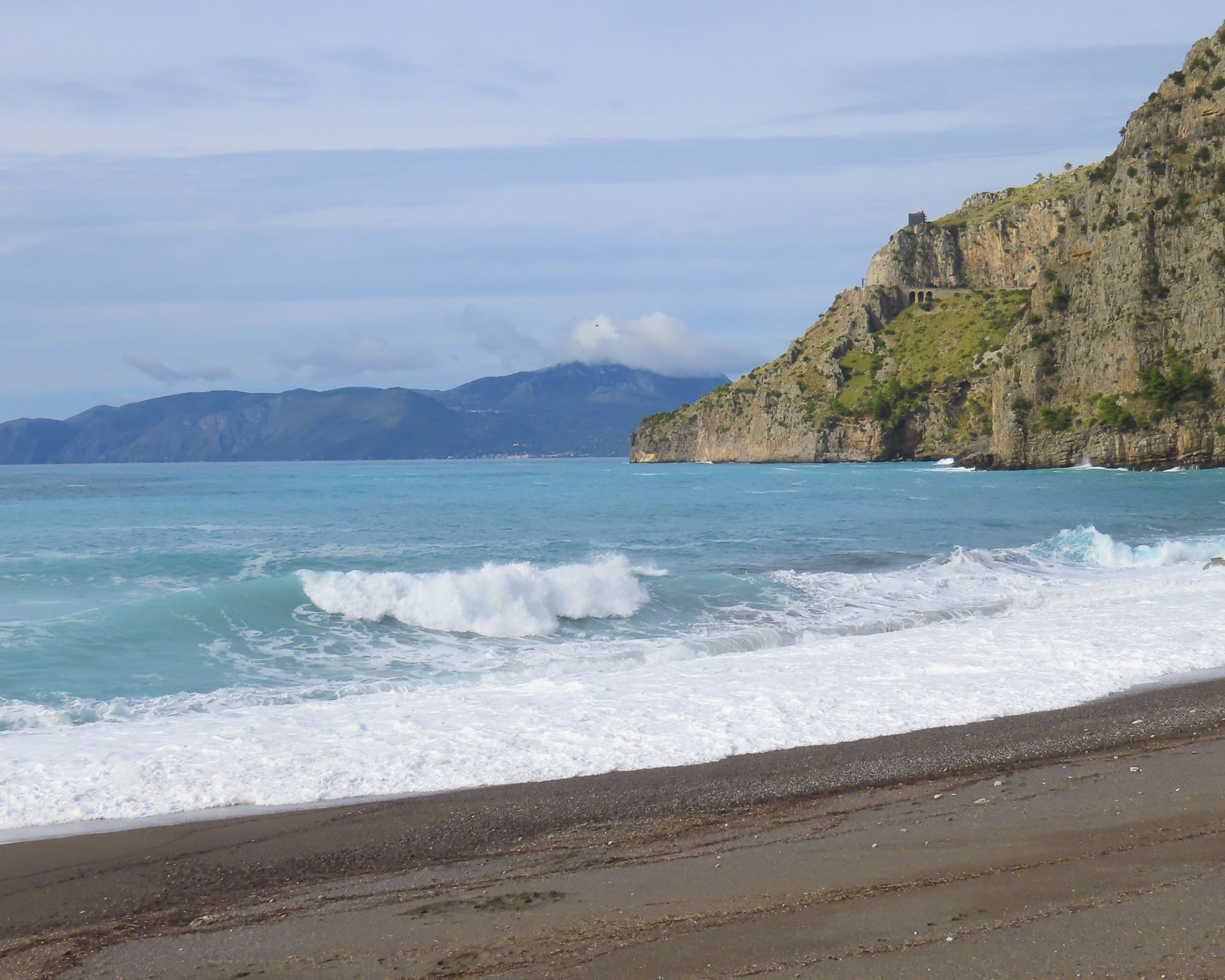
Fortunately, Donna spotted the traffic light that dictated the direction of traffic flow through the narrow passage before an oncoming bus would have forced us to back down the lane.  We had a little difficulty finding La Giara until we realized it was down at the end of a rutted farm lane more suitable for a tractor than a sedan.  Run by a gracious older couple who patiently dealt with our rudimentary Italian, the inn was wonderful, with our upstairs room having a view of the distant sea. We were the only guests. The turquoise waters and the pebbly, black sand beach of Spiaggia Acquafredda were a short walk away from the inn. We had the shoreline to ourselves one crisp morning as we walked along its frothy surf.

The sun’s golden rays were now shining on the sea as we drove along the serpentine road into Maratea for dinner. We’ve found that even though many tourist establishments are closed in the off-season there is always someone who stays open year-round to cook for his friends and neighbors.  And with their reputations online with a discerning community we’ve found that these very local places are inexpensive and great.  Ristorante Pizzeria Sapore Di Mare did not disappoint us with its variety of fresh seafood and pasta dishes, and we ended up having three meals there over two days.  Blame it on the off-season.   There were not any streetlights or shoulders along this cliff hugging road. Fortunately, there was a solid stone guardrail and no oncoming traffic when we rounded a curve and our car’s headlights lit up a man and woman raking hedge cuttings into the middle of our right lane.  A quick zig zag avoided catastrophe as screams filled the night air inside and outside of the car. Our hearts were pounding after such a close call!

Breakfast the next morning was delicious though a little strained by our lack of Italian until the husband’s eyes widened when we expressed interest in the olive oil that was served with the homemade bread. Pridefully he brought us small tastings of different olive pressings. A large olive orchard was their true livelihood, and this time of year they were busy harvesting the first olives of the season and pressing them for this coveted golden liquid.

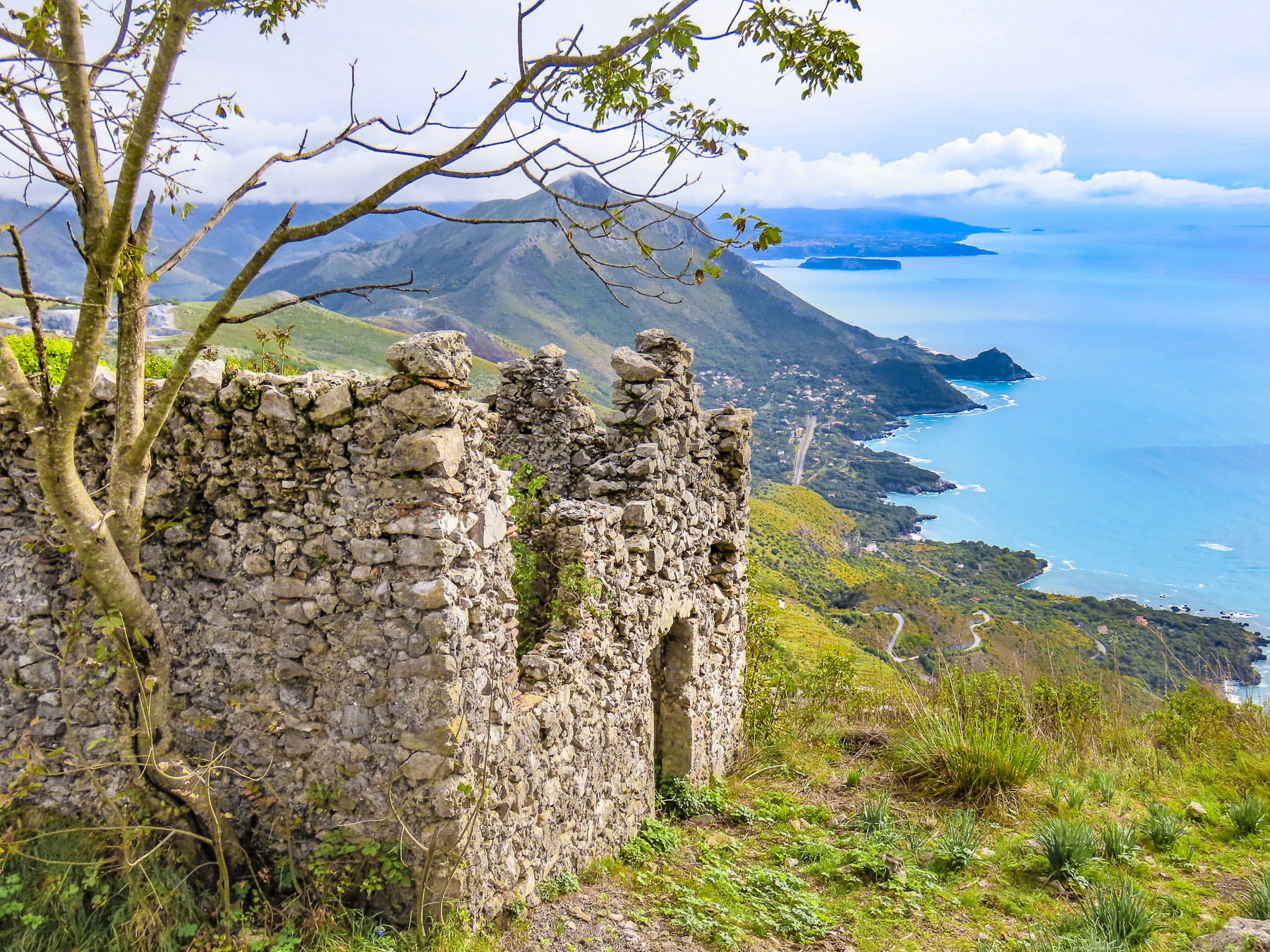
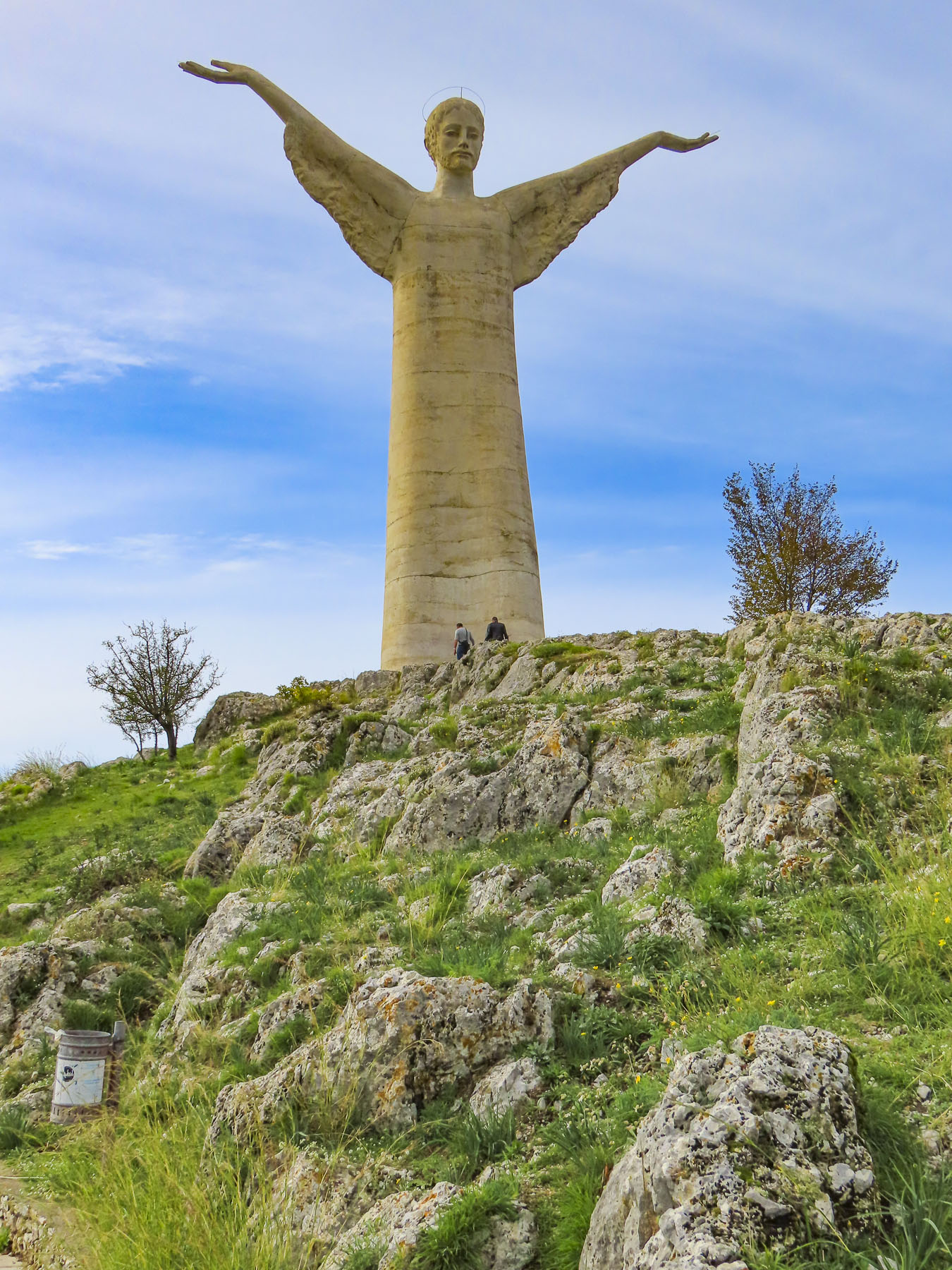
We hadn’t done much research on this part of our trip, only knowing that we would encounter some stunning coastline, so we were pleasantly surprised when we found ourselves in the picturesque, man-made harbor of Marina di Maratea.  A small port, with an assortment of pleasure craft and fishing boats, it embraces the coast under a towering 2113-foot-high Monte San Biagio. The mountain is topped with a statue of Christ the Redeemer that is visible for miles along the Tyrrhenian coast.

The day was brilliant and with café on the quay at the aptly named Bar Del Porto we planned our ascent of Monte San Biagio. We were relieved to find we could drive to the top of the mountain, a revered pilgrimage site that celebrates the fourth century martyr San Biagio who is credited with several miracles in Maratea, the most important of which was shielding the town from Charles VIII’s French cannon fire during an attempted invasion in the 1400s. As proof of his intervention, next to the altar in the basilica there is a cannonball with a mysterious fingerprint pressed into the iron; it is believed to be San Biagio’s, left there when he deflected the shot with his hands. Legend states that his relics arrived in Maratea in 723 when a ship carrying them from Turkey to Rome for safety was mysteriously stopped by a bright beam of light from the sky; the vessel was unable to sail forward until the relics of the saint were removed from the ship and brought to the mountaintop. A church was then built over the ruins of an ancient Greek temple dedicated to the pagan goddess Athena.  Maratea celebrates San Biagio’s feast day every May by carrying his silver statue from the basilica in a processional, on the shoulders of teams of men, down the steep mountainside trail. It is a journey of 4-5 hours into the center of town, through streets filled with the faithful, to Maratea’s oldest church, Saint Vitus, built in the 9th century. 

During the high season you are not permitted to drive all the way to the basilica. Instead, for a small fee, a shuttle bus delivers you to the church. In November luck was with us and we were able to zoom up the elevated switchbacks that seemed to float ethereally above the steep slope to the parking lot.  The only other vehicle in the lot was a truck belonging to workers repairing the church roof. Regrettably, mid-week, the church was closed.

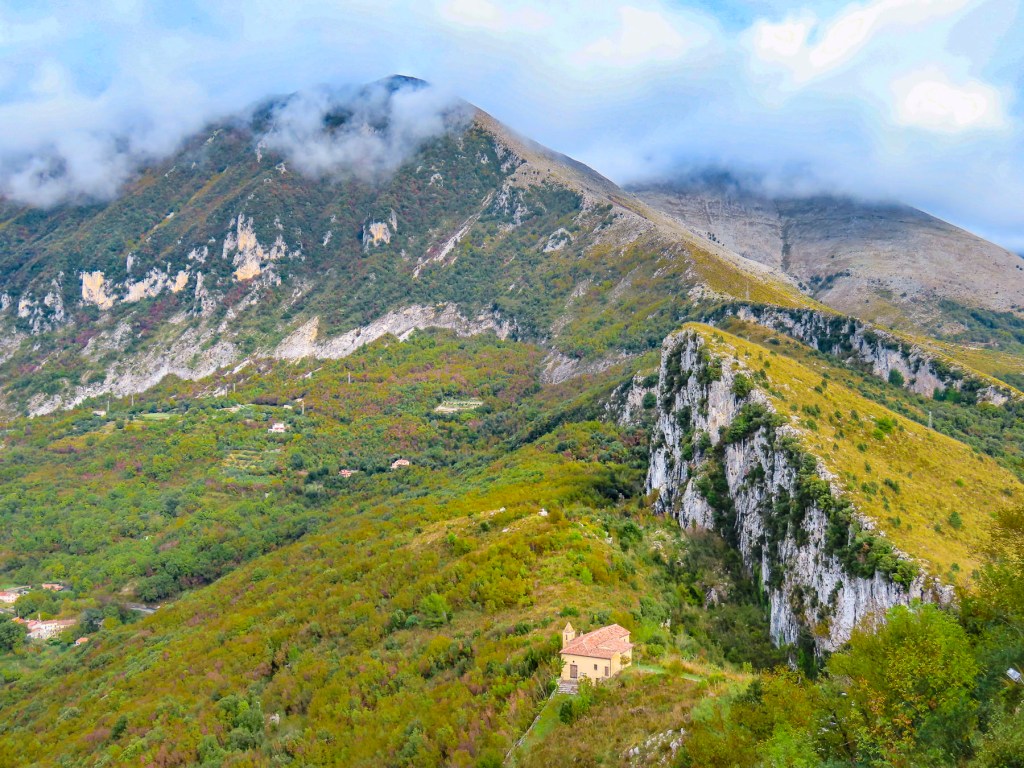
A gentle sloped walkway led to the summit past the stone ruins of old Maratea. Founded by Greeks over two-thousand years ago, they occupied the hilltop for centuries before the lower village was built in the 11th century to accommodate an expanding populace.  The landscape around the ruins was dotted with fragrant wild fennel for which Maratea got its name (from the Greek word marathus, wild fennel.) In the mountains behind the church the clouds were almost low enough to cover the tiny Hermitage of Our Lady of the Olive Trees that sits isolated in the rugged terrain.

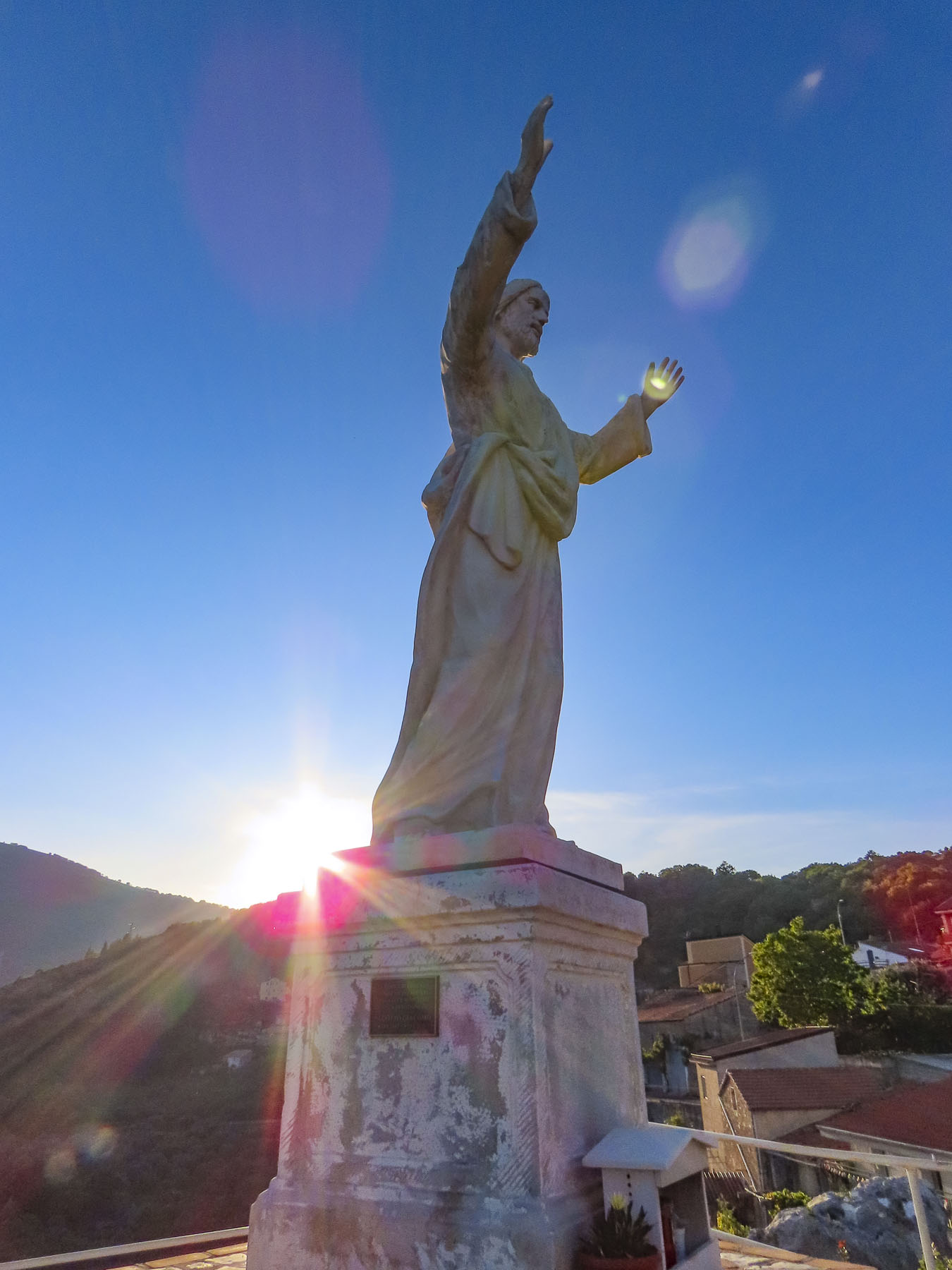
In 1963, Italian sculptor Bruno Innocenti was commissioned to create a statue of Christ to crown the summit.  His youthful portrayal of Jesus without a beard, made from poured concrete mixed with crushed marble from the famous quarries in Carrara, faces East, inland toward the rugged mountains and the church that holds San Biagio’s relics.  Standing 70ft high with an arm span 62ft wide, it is the fifth tallest statue of Christ in the world.

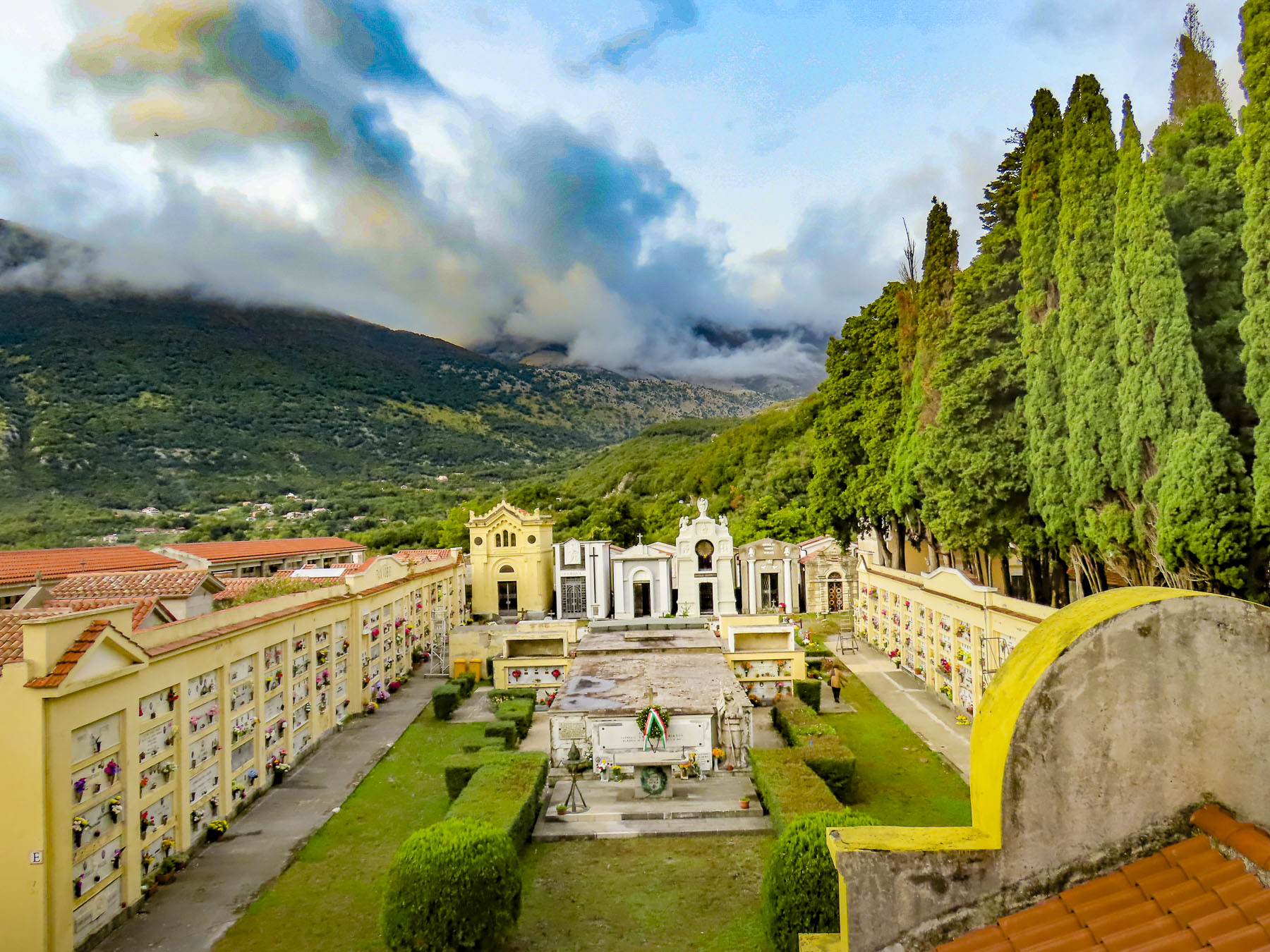
The views up and down the rugged coastline and inland were spectacular. Maratea is also known as “the Holy City of Southern Italy,” so named because the small town has 44 churches. We were excited when we spotted several tiny bell towers in the distant village from the overlook.

We spent the rest of the afternoon exploring the newer village which lines the slope of a valley that leads to the sea. Archeological evidence found in local caves reveals that the area has been inhabited since the Stone Age.

Far below the Statue of Christ the Redeemer, steep cobbled alleys branched off the main road and wove their way up the lower slope of the hill, past centuries-old homes worn by the elements.

Occasionally trees and vines sprouted through the cracked sidewalks and clutched the walls. It felt like the village was deserted. Nearing the end of the day we found a wonderful vantage point to capture the silhouette of the village and the valley against a colorful sunset.

Only a two-hour train ride from Naples, Maratea, Basilicata’s “pearl of the Tyrrhenian Sea” has stayed off the radar of foreign tourists and remains “the Amalfi without the crowds,” and one of “Italy’s best kept secrets.” It’s definitely an area worth exploring in greater depth.

The next morning, we contemplated driving 2.5 hours along the scenic coast to Lamezia Terme, where we would connect to route E45 and continue south through the Calabria region to the ferry port in Villa San Giovanni, on the toe of the boot, across from Sicily. 

Fearing I would insist on stopping too many times along the coastal route to take pictures, we opted to head inland for the drive instead.  The day got warmer as we proceeded further south through a verdant landscape of rolling hills covered with olive trees or freshly tilled fields.

Spotting the seaside town of Scilla from the highway, we decided to detour for awhile since we were making good time. Famous in Greek mythology for its legendary sea monster, Scylla, the town is set dramatically high on the cliffs that front the sea. Castello Ruffo commands a hooked promontory below the town.

Its defenses that once protected the village from invasion are now just a historic backdrop for a wide crystalline beach that sparkled brilliantly in the afternoon sun.

Back on the highway we stopped to refuel and have lunch before boarding the ferry in Villa San Giovanni to cross to Messina, Sicily.  Back in the states we would only eat at a highway rest stop if we were desperate. In Italy, we eagerly searched for them, since there we found them to be gourmet havens for travelers. They serve delicious plain or grilled panini, pizza, and of course good espresso.  They also usually have an interesting assortment of snacks for later, as well as the usual assortment of souvenirs. Yes, magnets and coffee mugs. But also a candy known as Pocket Espresso! After making our purchases, we picnicked under a tree on the edge of the parking lot which overlooked the Strait of Messina.

The powerful currents that race through this narrow strait have been legendary since the time of Homer, when Greek sailors first started to explore the unknown waters around southern Italy.  The dangerous opposing currents on either side of the strait personified in the Odyssey as the mythical sirens Scylla and Charybdis who lured unwary mariners to their deaths in their turbulent waters.  The phrase “between Scylla and Charybdis,” refers to being stuck in a difficult situation with poor options, similar to the common expression, between a rock and a hard place.

After stopping to get our ticket stamped, we drove aboard the Giuseppe Franza, operated by Caronte & Tourist, and parked on the car deck amidst a variety of large commercial and private vehicles. We stood outside on the passenger deck as the ship’s powerful engines easily pushed the 308ft ferry, capable of carrying 600 passengers and 120 cars, off the dock for the forty-minute crossing to Messina.  So different from the ancient Greek bireme that Odysseus’s men would have rowed on their journey.

Our destination was the coastal town Taormina. Fortunately, we didn’t have to row there.

Till next time, Craig & Donna
Driving South to Sicily: Part One – Herculaneum to Sorrento, or “They Have You by the Coglioni!”

The car rental agent across from the Naples train station enthusiastically informed us that we were the first drivers of a brand-new Peugeot. Leading us to a shiny set of wheels, parked on busy street in front of the office, he offered a rudimentary description of the car’s technological features, a collision avoidance system and satellite navigation that would show every radar speed camera on the Italian highways.

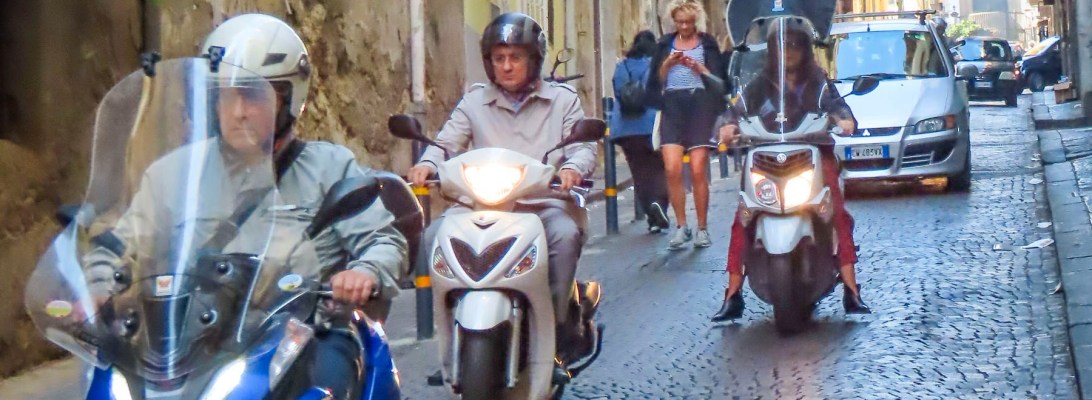
With our luggage in the trunk and a friendly wave we were off, or so we thought.  Just barely moving forward, the collision avoidance system screeched alive with alarms and red blinking threats on the dashboard display.  It happened frequently as we worked our way through heavy Neapolitan traffic. Scooters, cars, trucks and pedestrians getting close to our bumpers set the system into a frenzy of piercing alarms and flashing lights.  Nerve wracking – it felt like I was Luke Skywalker thundering along in an X-wing fighter while R2D2 whizzed with anxiety, as we tried to evade the Empire’s eradication. In reality we were in bumper-to-bumper traffic.  Fortunately, the congestion eased, and Herculaneum was only a twenty-minute drive from Naples.

We had visited Pompei years earlier, one June when Italy was having an early heat wave and the temperature was over 100F.  As interesting as Pompei was, the size of the site and the heat dampened our enthusiasm for it. This day was quite a different experience, as the weather in November was very agreeable for visiting Herculaneum.

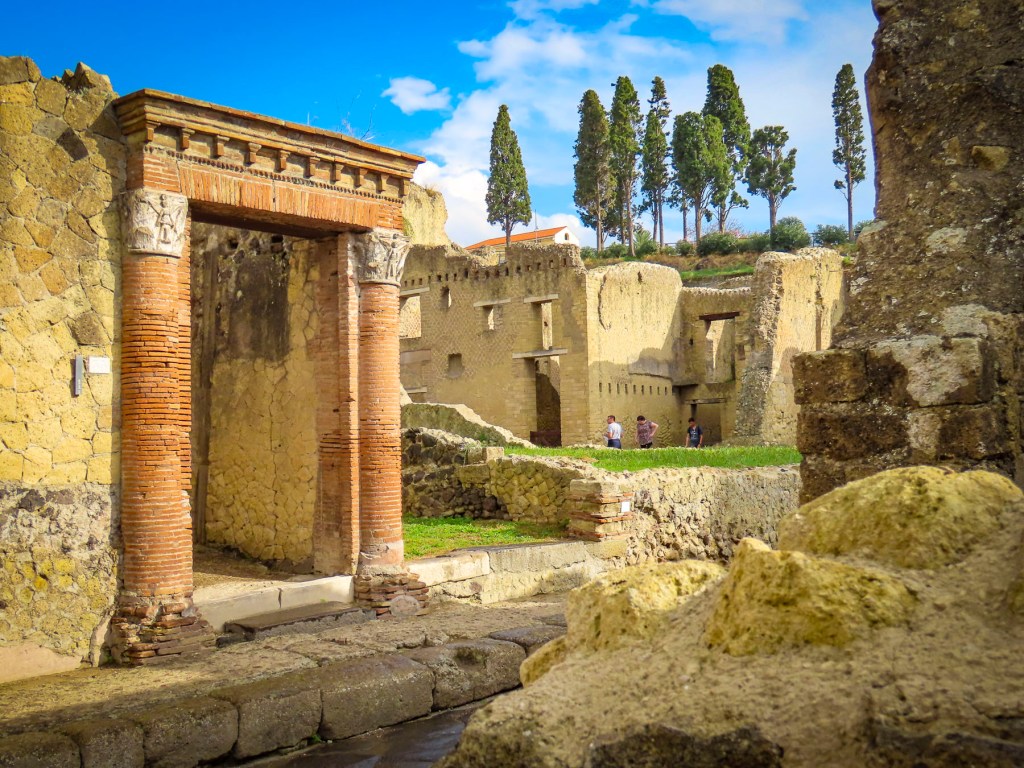
We descended into its excavated ruins, which were destroyed and covered with 53ft of ash on the same fateful night as Pompeii in 79AD.  The towering black walls of solidified ash surrounding the site reinforced the magnitude of the catastrophe. The coastal town was popular with wealthy Romans who built Domus style homes which were richly decorated with frescoes and mosaics.  Arched workshops of boatbuilders lined the shore and were the last refuge of citizens trying to flee, their agony now eternally preserved in casts of their bodies.  The massive amount of ash and volcanic rock that fell created a new shoreline on the Bay of Naples, 2000ft farther west. 

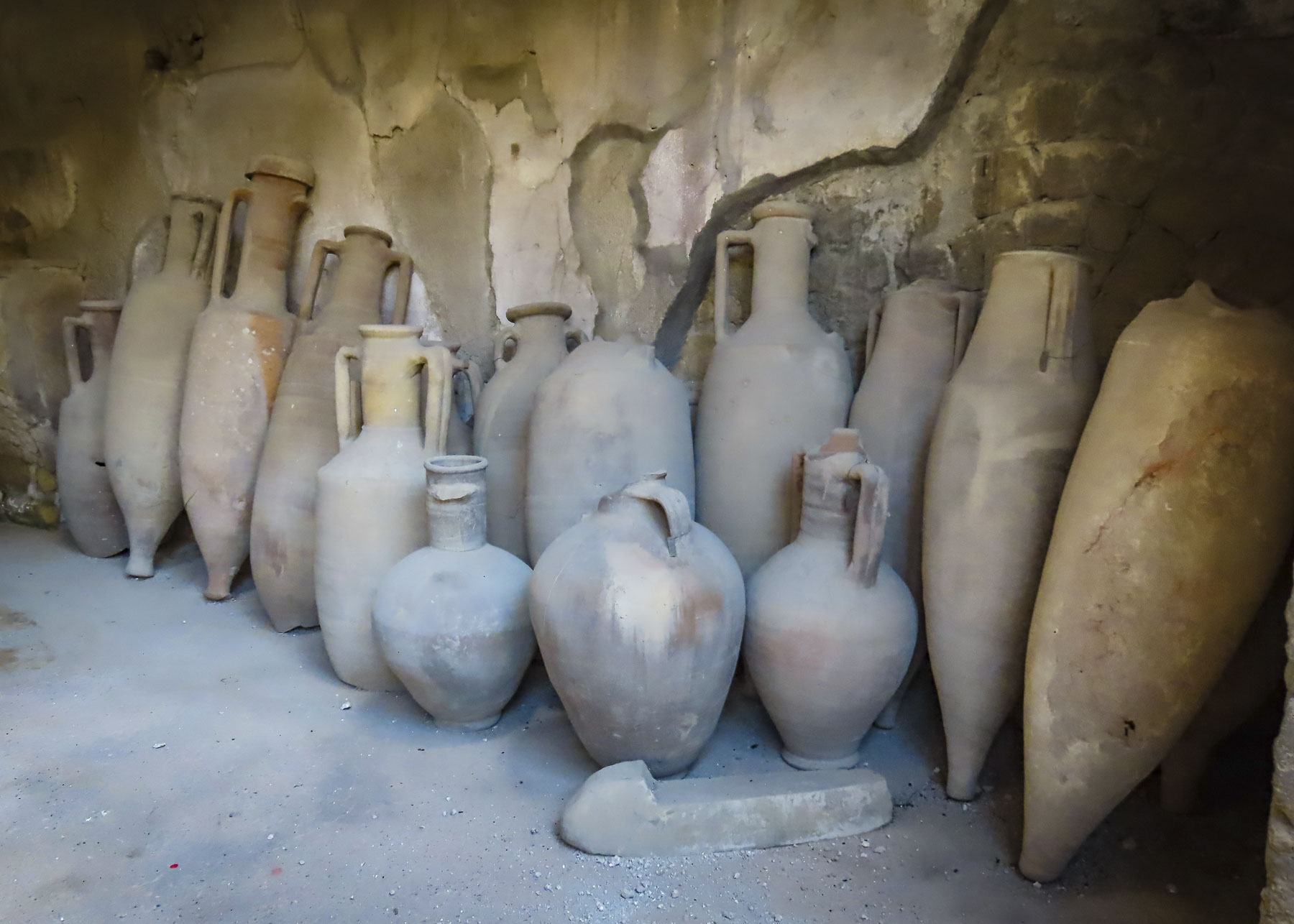
Only a fraction of the size of Pompeii, the Herculaneum archeological area doesn’t draw the immense crowds of the larger site, but is just as interesting and in some ways more so. Unlike Pompeii, which was engulfed in a scorching lava flow which destroyed most of the wood and decorative elements of the homes there, the cooler ash and poisonous gases that killed the populace of Herculaneum preserved the homes to a greater degree, leaving the wooden internal structure of buildings and their interior décors intact.  This combined with an earlier visit to the Naples National Archaeological Museum to see the finest examples of relics recovered from the ruins of Herculaneum and Pompeii provided us with deeper insight into the opulent lifestyle of the 1st century AD Roman Empire.  Herculaneum was easily explored in a half day and enabled us to continue to Sorrento in a timely manner.

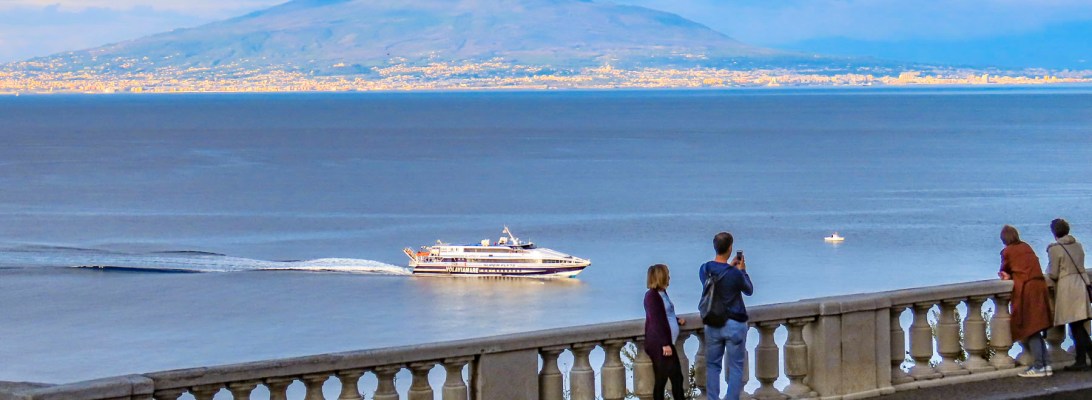
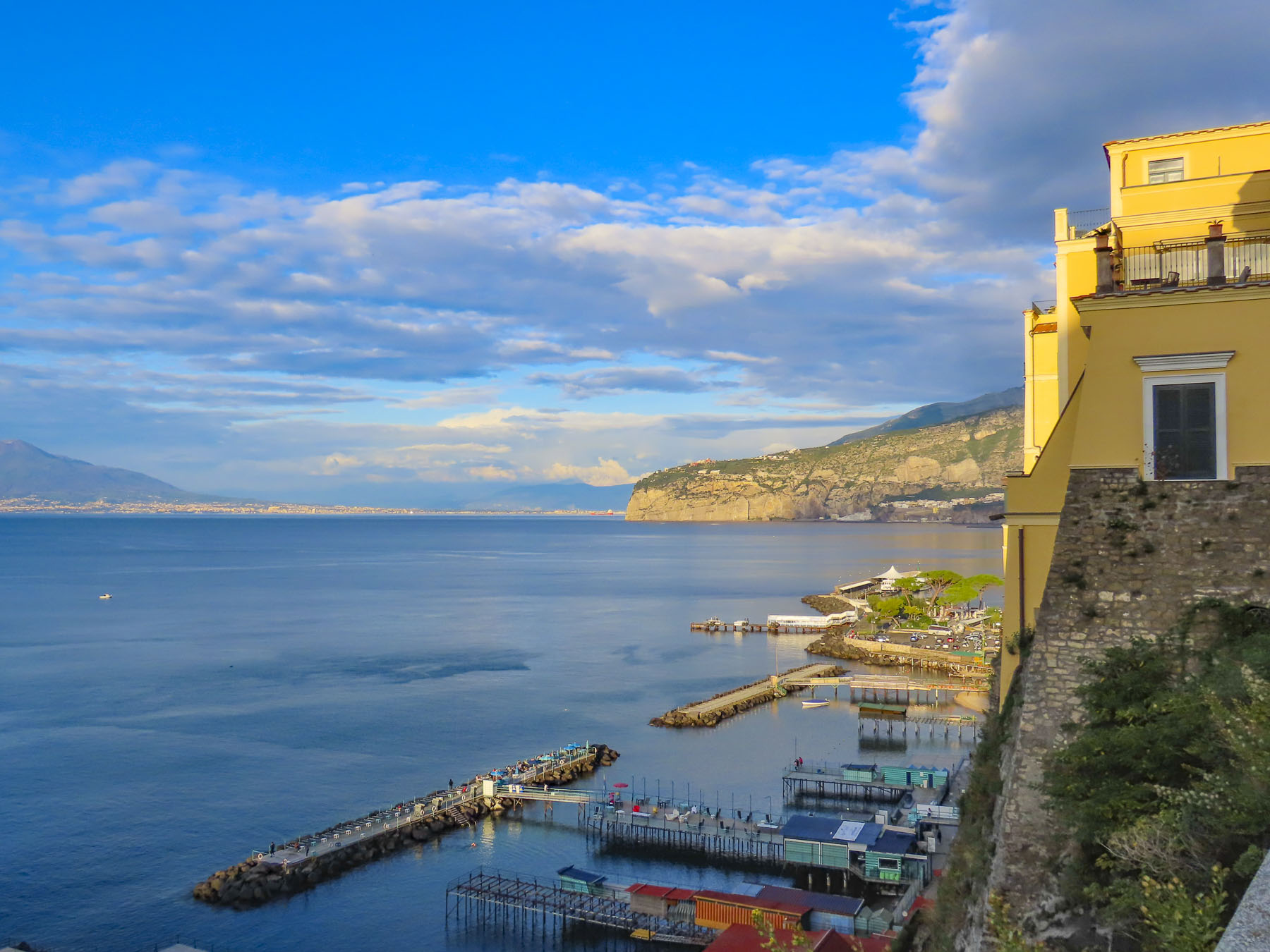
With fond memories of the serpentine Amalfi Coast from a trip a fifteen years earlier, we decided to base our new weeklong exploration of the Sorrentine Peninsula in Sorrento.  The route into town along SS145 didn’t disappoint us when rounding a cliff-hugging bend of the road revealed a view all the way out to the Isle of Capri. By staying in the largest town of the region we didn’t have to worry about seasonal closures, which unfortunately were beginning to happen in mid-November.  Only a short walk from the center of town and the waterfront with Mount Vesuvius commanding the horizon across the Bay of Naples, the lovely Villa Rosa Sorrento with its modest off-season pricing and free parking was a terrific value and perfect for us.

With our attempts at immersive travel, we avoid scratching off a list of designated tourist highlights; rather,  we explore a place seeking how to experience how folks live, the everydayness of a place, and whether we would enjoy living there. “Walk a little, then café,” is our slow travel approach as we soak up the ambience of a locale.

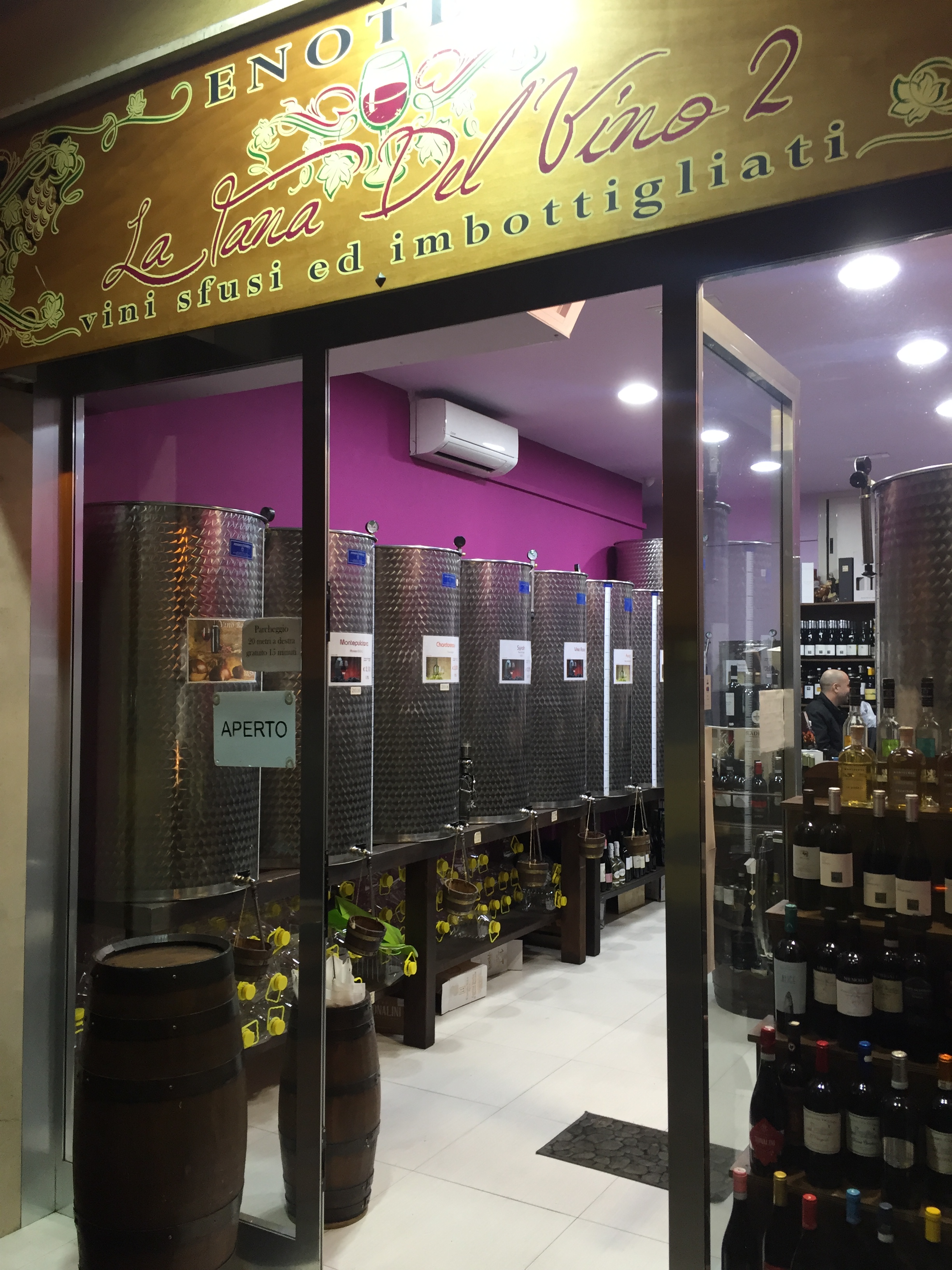
La Tana Del Vino on Via Parsano was a delightful find. This small enoteca features regionally produced wines that they decant for you from large stainless-steel vats into your own glass or plastic bottles.  A variety of red, white and rose’ wines were available, most between 3-4€ per liter.  Samples were freely poured and we very pleased with our selection of these table wines. 

Sorrento with its ferry service to Capri gears itself to the high season.  There were still tourists out and about, but the large tour buses and groups were absent in November, the beginning of the rainy season.  We ran between rain drops the best we could on several occasions. 

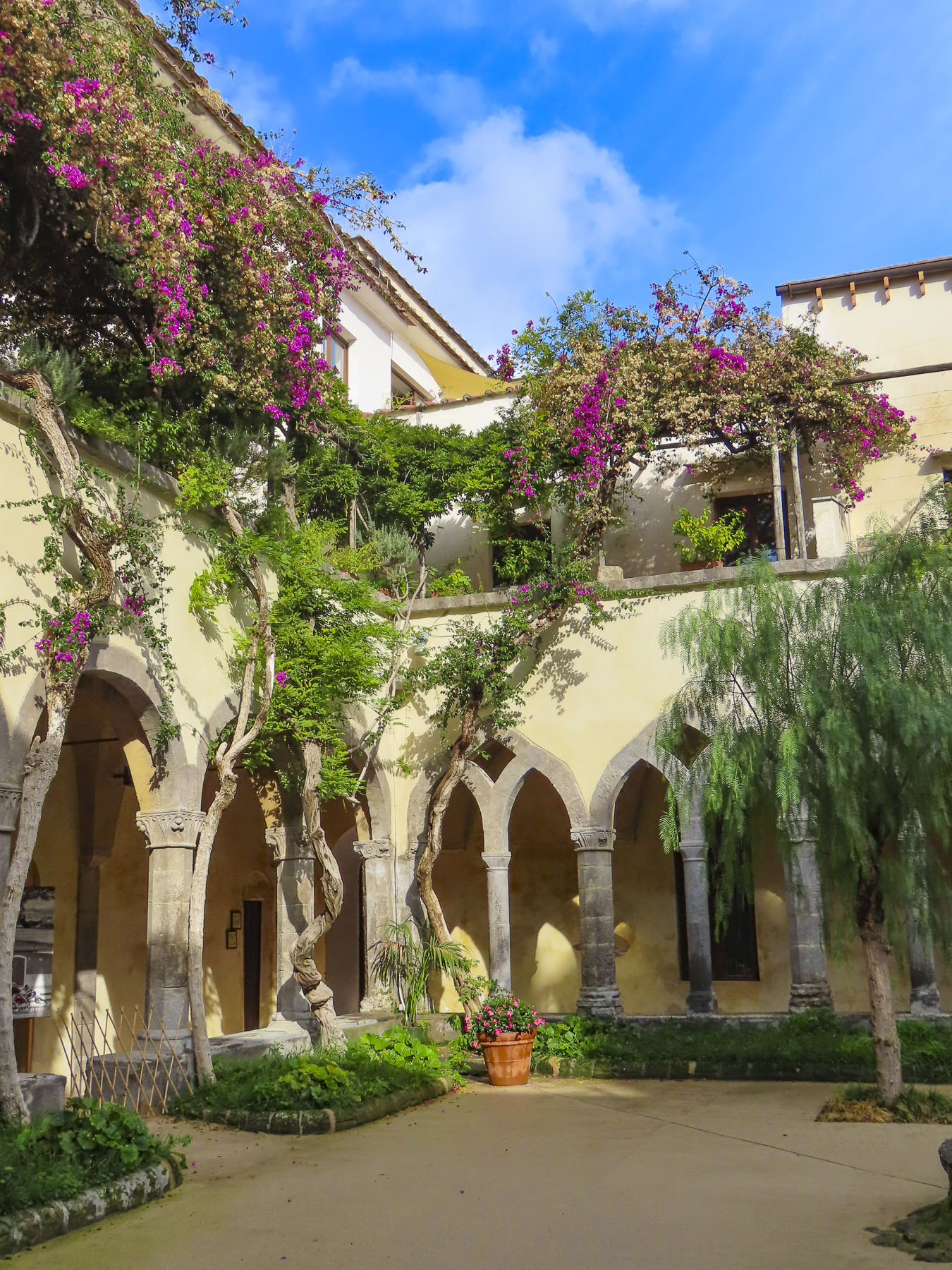
With the port as our destination for lunch, it was a pleasant stroll along near empty sidewalks to Chiostro di San Francesco, a 14th century convent with a lush, greenery-filled cloister that now hosted other activities and concerts.  On the top floor Raffaele Celentano’s photography school and gallery had a marvelous patio shaded by the canopy of stately tree. A wooden swing hanging from its branches brought smiles to the faces of many gallery visitors as they playfully took a turn.

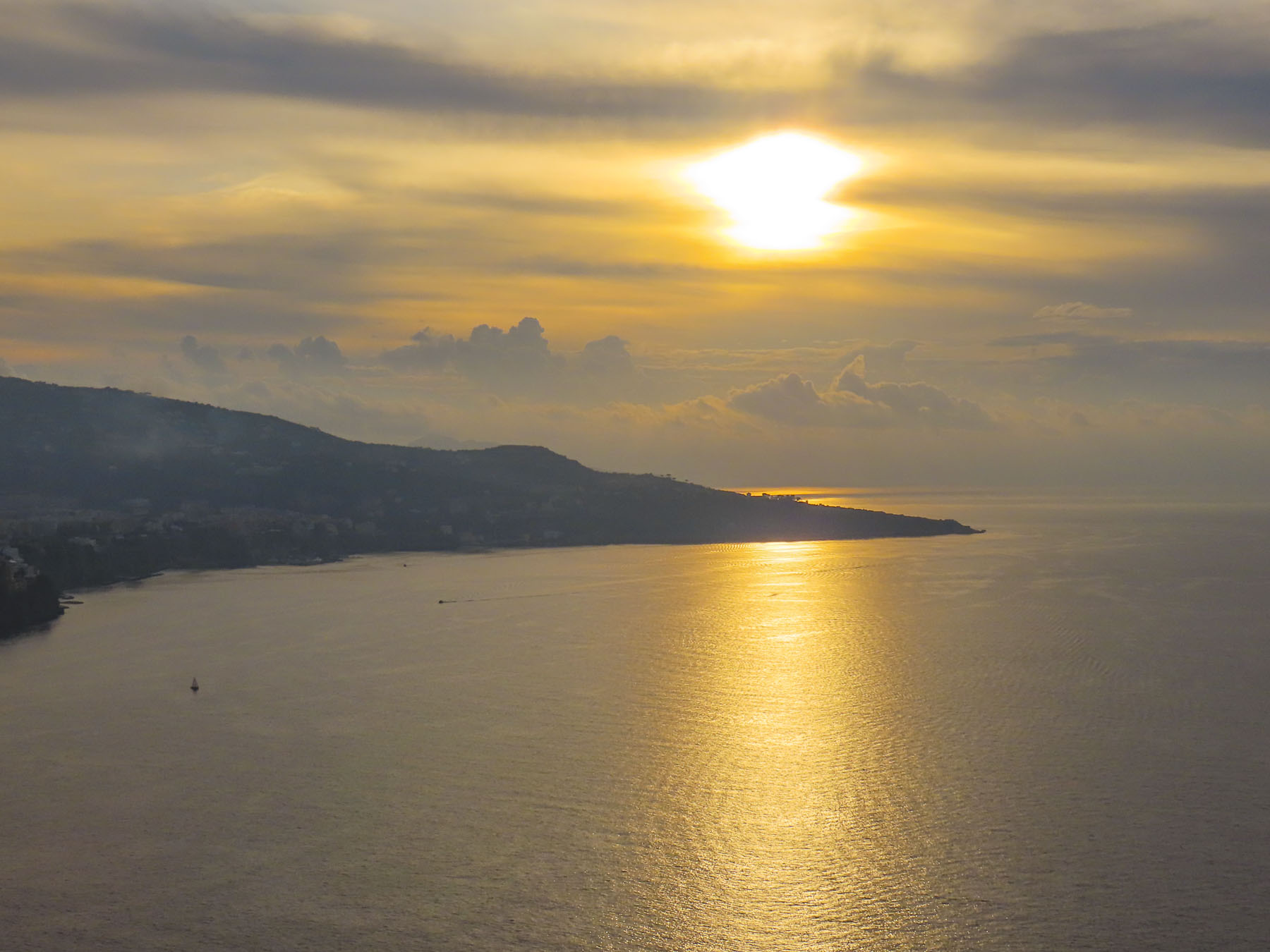
The panoramic balcony in the public garden across from the convent is a magnet for sunset worshippers.  In the garden the city operates the Sorrento Lift, two elevators that take tourists and residents down to the harbor level where hydrofoils and ferry service is available to Capri, Ischia, Positano and Naples, along with access to the beach clubs and the city’s public beach. 

After washing our clothes in various sinks for two weeks it was time for a thorough laundering, and we lugged our bundle to a laundromat in town. It was a very clean facility. We were amused to notice that the vending machine that dispensed soap products also offered a very broad selection of marijuana products as well, presumably to allay the tedium of the task.  The selections weren’t inexpensive, with many items costing over twenty euros.  This was something unique that we had never come across before in our travels.  The world is changing so quickly, but we can’t imagine dropping a twenty euro note into a vending machine for anything.

With our clothes in the dryer, we decided to head to lunch, and immediately got drenched to the bone in a sudden downpour.  Looking like water rats, we sought shelter under the awning of a pizzeria. Seeing us, the proprietor of Master Hosts (not a very atmospheric name) ushered us inside and kindly insisted we warm ourselves in front of the pizza oven.  Even if we hadn’t been so extremely grateful for his hospitality, this was some of the best pizza and wine we had in Italy, while our fingers de-wrinkled. His graciousness turned a gloomy day into a wonderful afternoon. 

Another rainy night we made our way early to La Cantinaccia del Popolo, a rustic neighborhood restaurant that stays open all year to cater to its loyal following.  Part deli, part gourmet restaurant, the open kitchen is fronted by a glass charcuterie case with an exotic display of dried meats, cheeses, pates, terrines, and olives. The gastronomic delights from the kitchen are plated in their signature deep dish pans.  Packed and noisy, with a friendly staff, delicious food, and a good house wine, this was a cozy place to enjoy the evening. Fortified with a great meal and drink, we faced a cold November rain as we walked back to our inn.  If you prefer to dine later in the evening, reservations are suggested after 8 PM.

Lemons, lemons everywhere!  Regional seafood, pasta, rice, chicken, pastry, and gelato recipes all use this tart fruit in delectable ways. And remember limoncello! The cool breezes of the Mediterranean that blow against the steep mountains of the Amalfi coast create a unique microclimate where lemons flourish and are harvested multiple times of the year, though the most desirable crop is picked between March and July.  This is a strenuous labor-intensive activity as the steep terrain requires all the fruit to be picked by hand and the heavy grates are carried out of the orchards on the backs of men. 

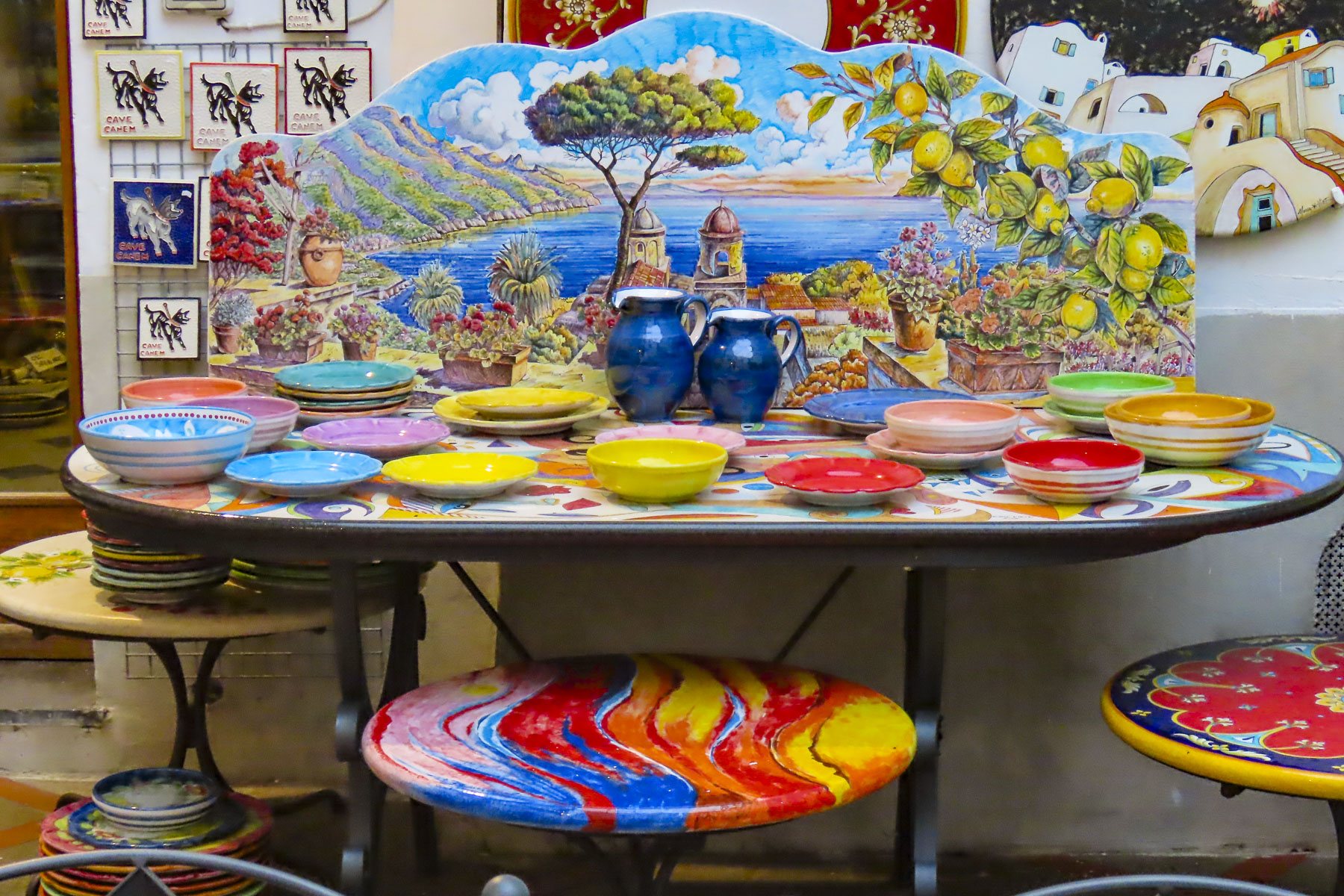
A morning drive along the sinuous coast and a turn into the mountains brought us to Ravello in time for lunch at a small restaurant with only six indoor tables.  Fifteen years ago, as a wedding present to each other, we splurged and purchased a dinnerware set of ceramics featuring the iconic Amalfi lemons, set against a rich blue background.  Over the years everyday use had taken its toll on our plates.  Fortunately, Pascal Ceramiche d’Arte was still painting our pattern and they ship internationally, so we were able to fill in a few gaps in our service.

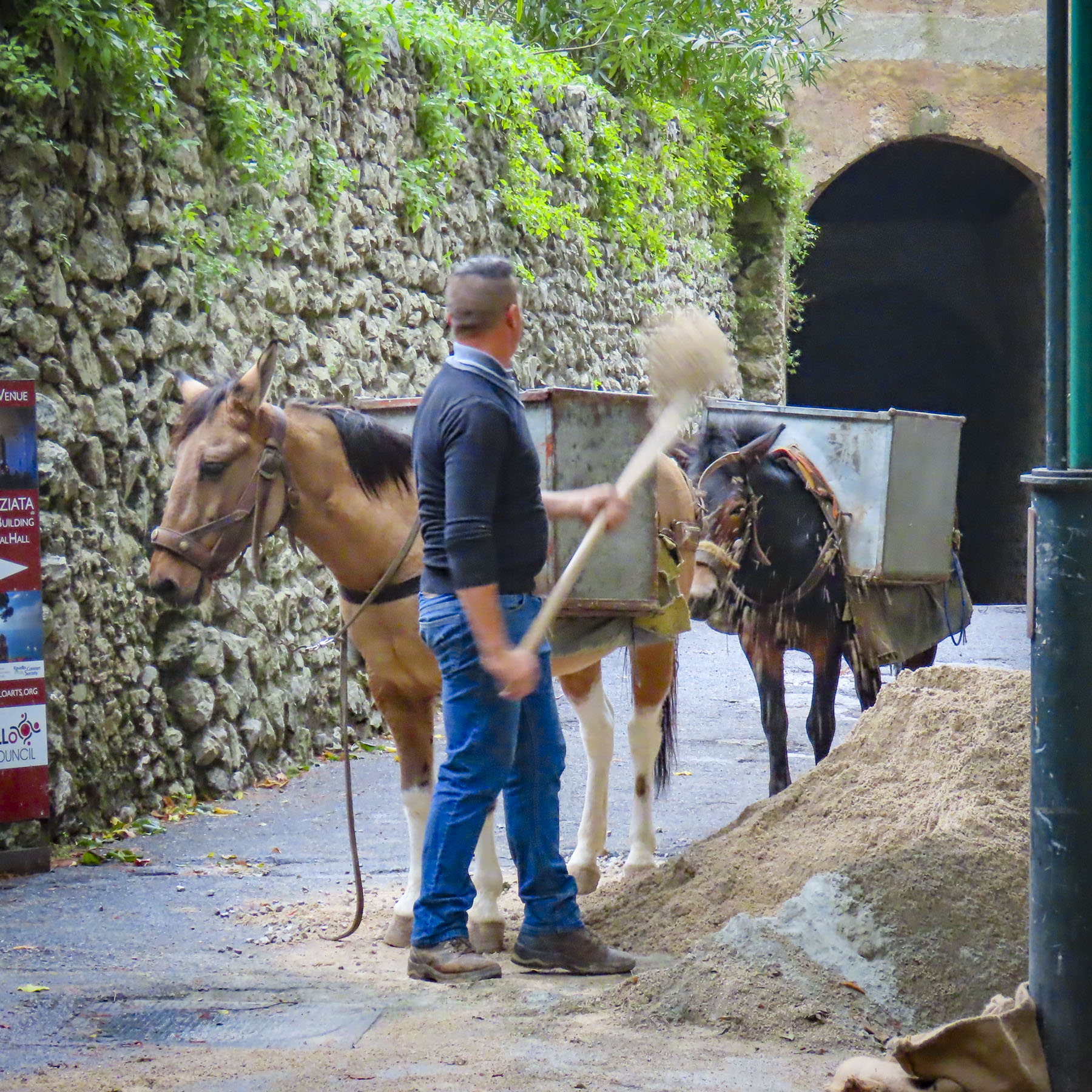
After coffee we wandered the town’s narrow, high walled lanes down the hill towards the Monastero Di S. Chiara.  Along the way we encountered a construction worker leading a team of donkeys with rigid saddlebags full of sand to a worksite, the ancient alley too tight for any vehicle to maneuver through.

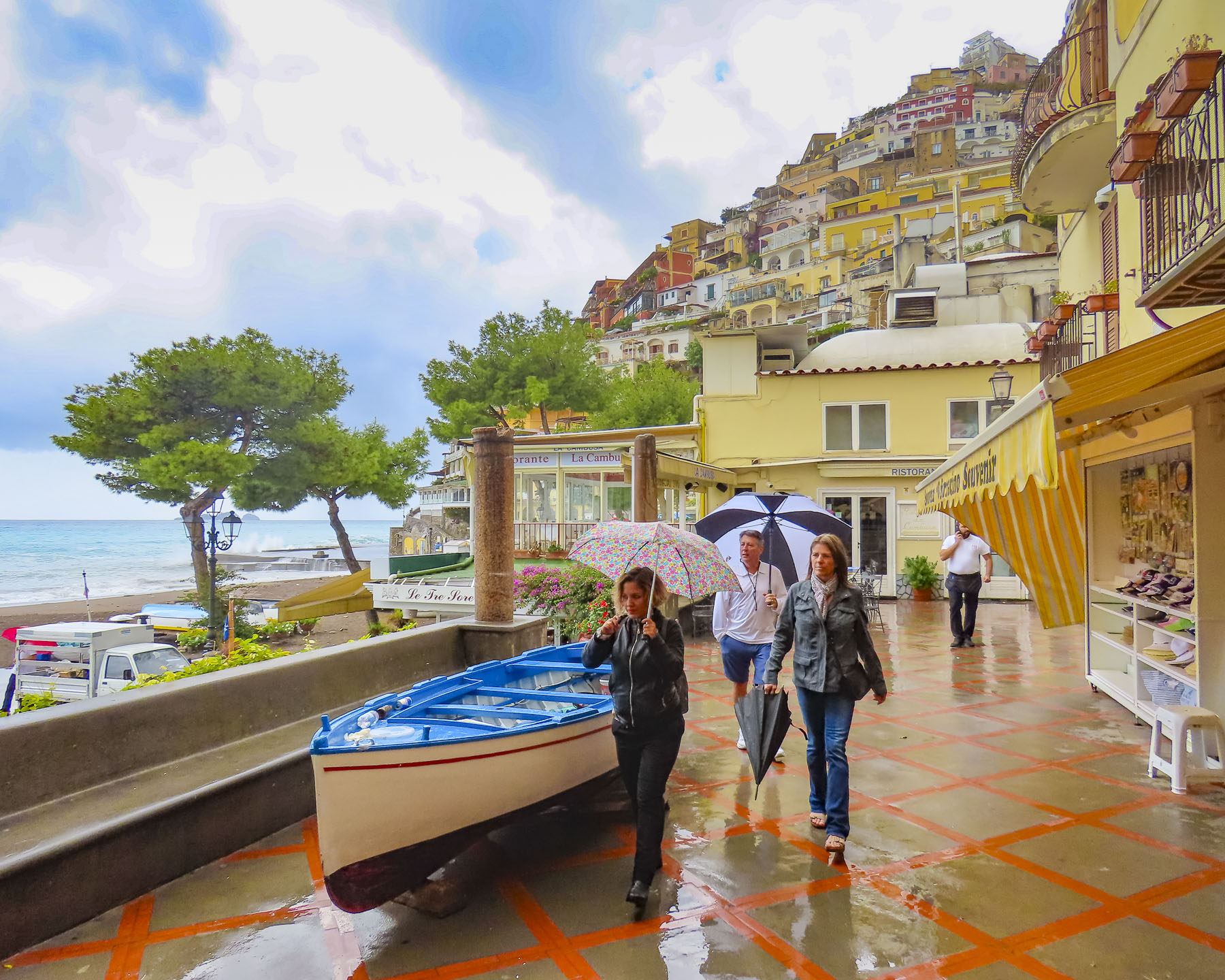
There’s no way around it, “they have you by the coglioni!” when you are trying to find a parking garage in Positano.  In this most beautiful village on the Amalfi Coast we paid through the nose for the privilege of parking.  Water, café, food and parking, even in the off season, are exorbitantly priced.  But on a sunny day, when the sky clears after a morning storm, the dramatic setting of the terraced village is at its best. Positano rises steeply into the mountains from the sea sparkling like a spectacular Byzantine mosaic, radiating light and color.  It’s well worth the splurge even if you have to eat Ramen noodles for the next three days to get back on budget.

To our delight we found a wonderful, affordable spot for a late lunch in Agerola called Jerla as we navigated our way across the mountaintop on the way back to Sorrento.

Getting there required a breathtaking drive through the numerous switchbacks of Strada Statale 366, also referred to as the Via Panoramica, that climbed through the terraced vineyards of San Michele and had incredible views of the Amalfi Coast below.

We each wanted to be in control on this treacherous road. We argued about who got to drive as we sped around the curves, and who was relegated to digging their fingernails into the dashboard.

Til next time, Craig & Donna

Naples – Historic, Gritty and Wonderful

The Italian countryside seemed to extend forever, a wonderful accomplishment for this region of southern Italy that has supported civilization for several millennia, though it ended abruptly when we rounded a highway curve and came to a halt in traffic. Naples, we had arrived.

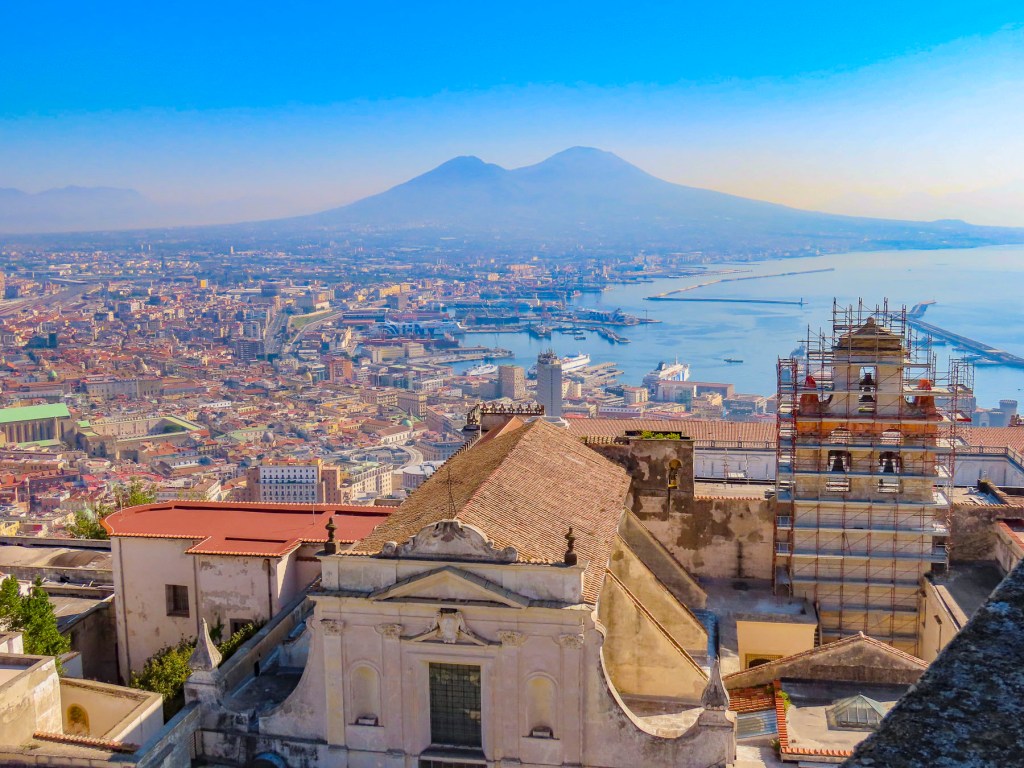
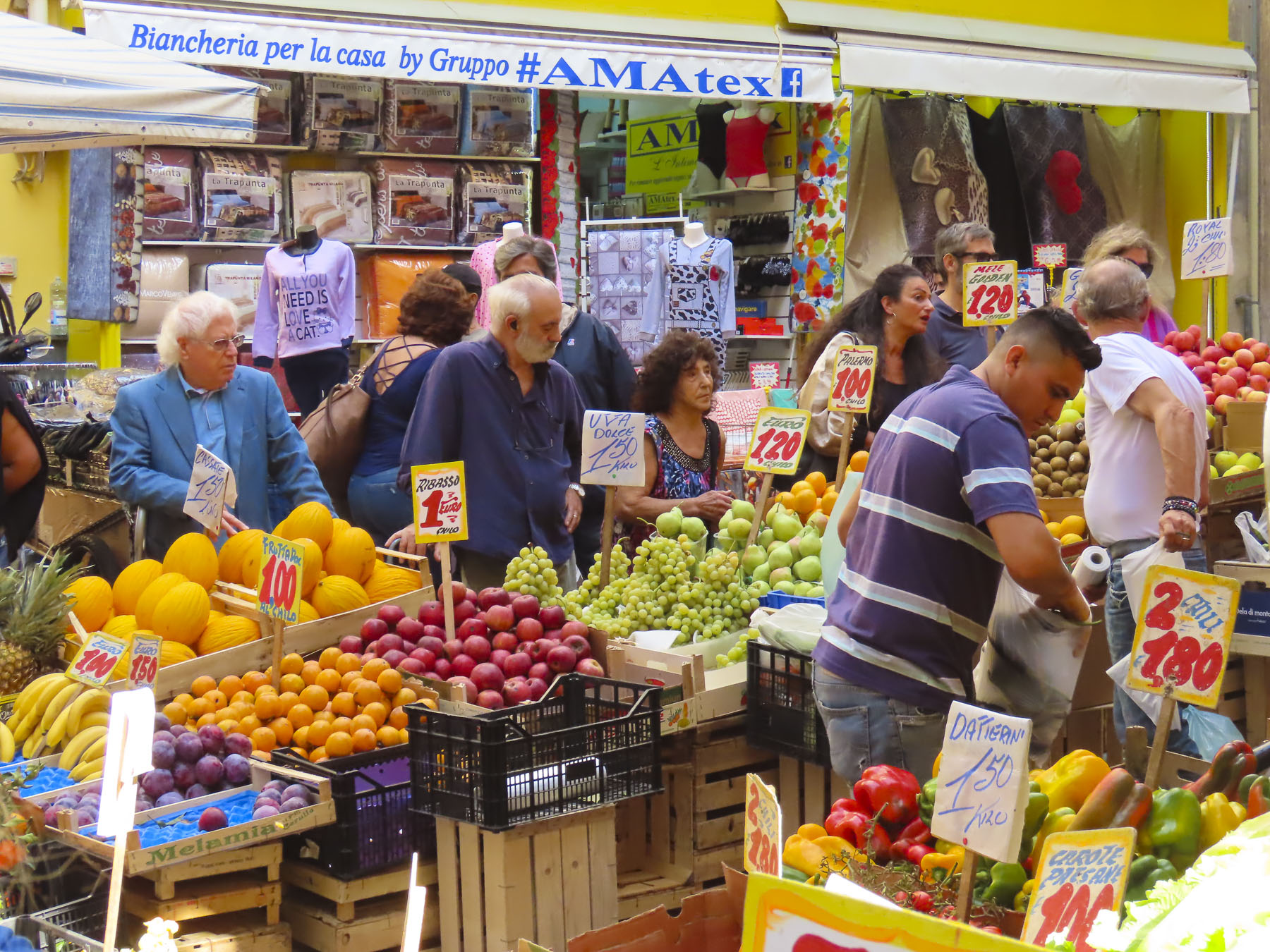
It wasn’t until we saw Naples from above that we realized the extent of this metropolis.  From our apartment in the historic center of Naples, near the Piazza del Gesù Nuovo, we walked to the daily market along busy streets lined with ancient 17th and 18th century palazzo, once noble homes of the Neapolitan elite, now subdivided into apartments, their fine architectural details often hidden under graffiti, that lined Via Pignasecca.

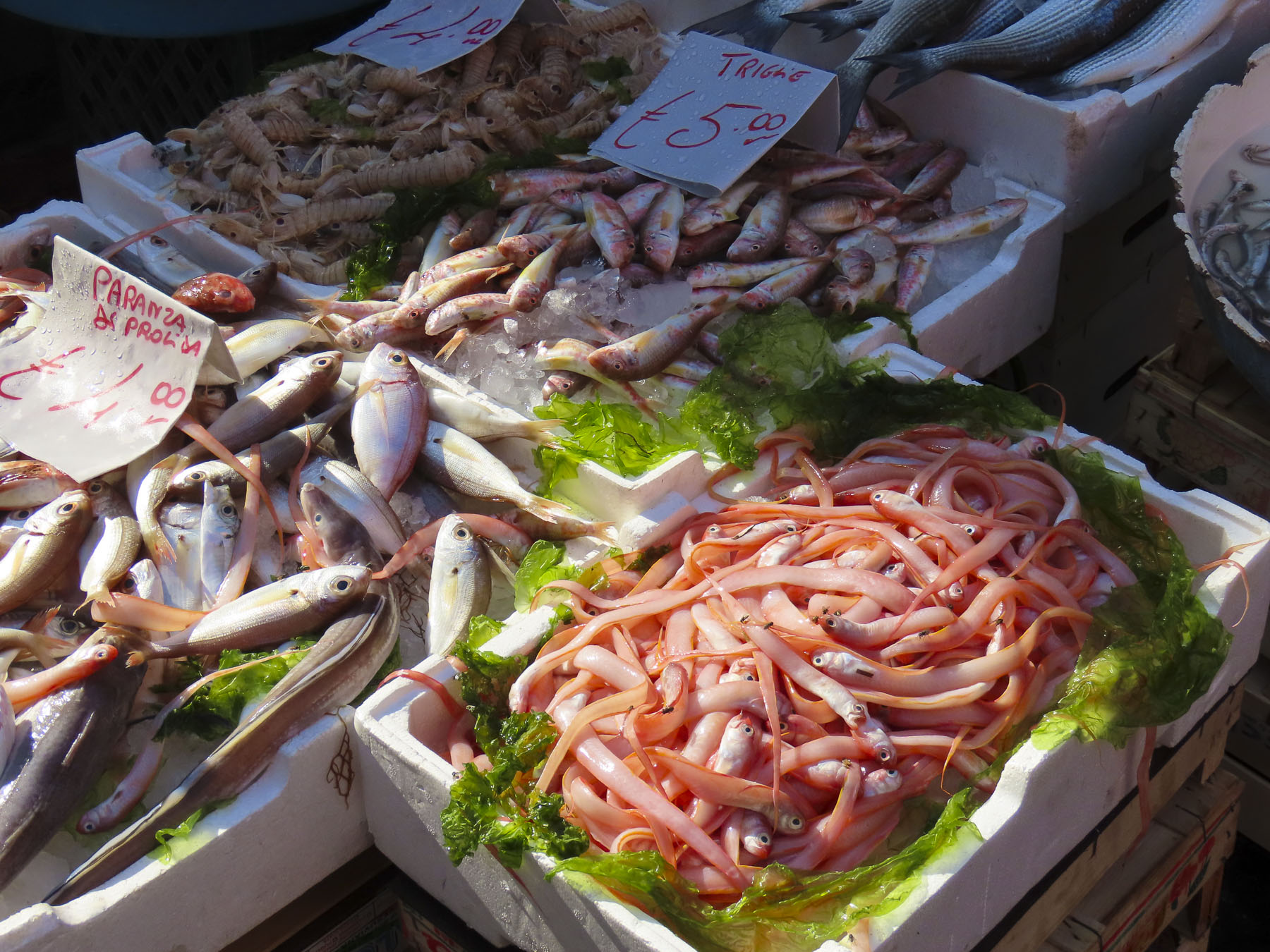
Vegetable, cheese, meat and especially bountiful seafood vendors were in a constant state of motion readying their stalls and calling aloud what was available.  It was fascinating and gritty with an underlying character of toughness that street life in Naples demands.

Everything looked wonderful as we planned dinner in our minds and agreed to return later after our day’s activity; how disappointed we were to find the street all tidied up and swept clean by mid-afternoon.  We consoled ourselves with a purchase of a bottle of Piedirosso Campania, a red Italian wine grape that is a specialty of the region. For two euros it was a good everyday wine. Later in the week we purchased a fresh tuna fillet that was excellent.

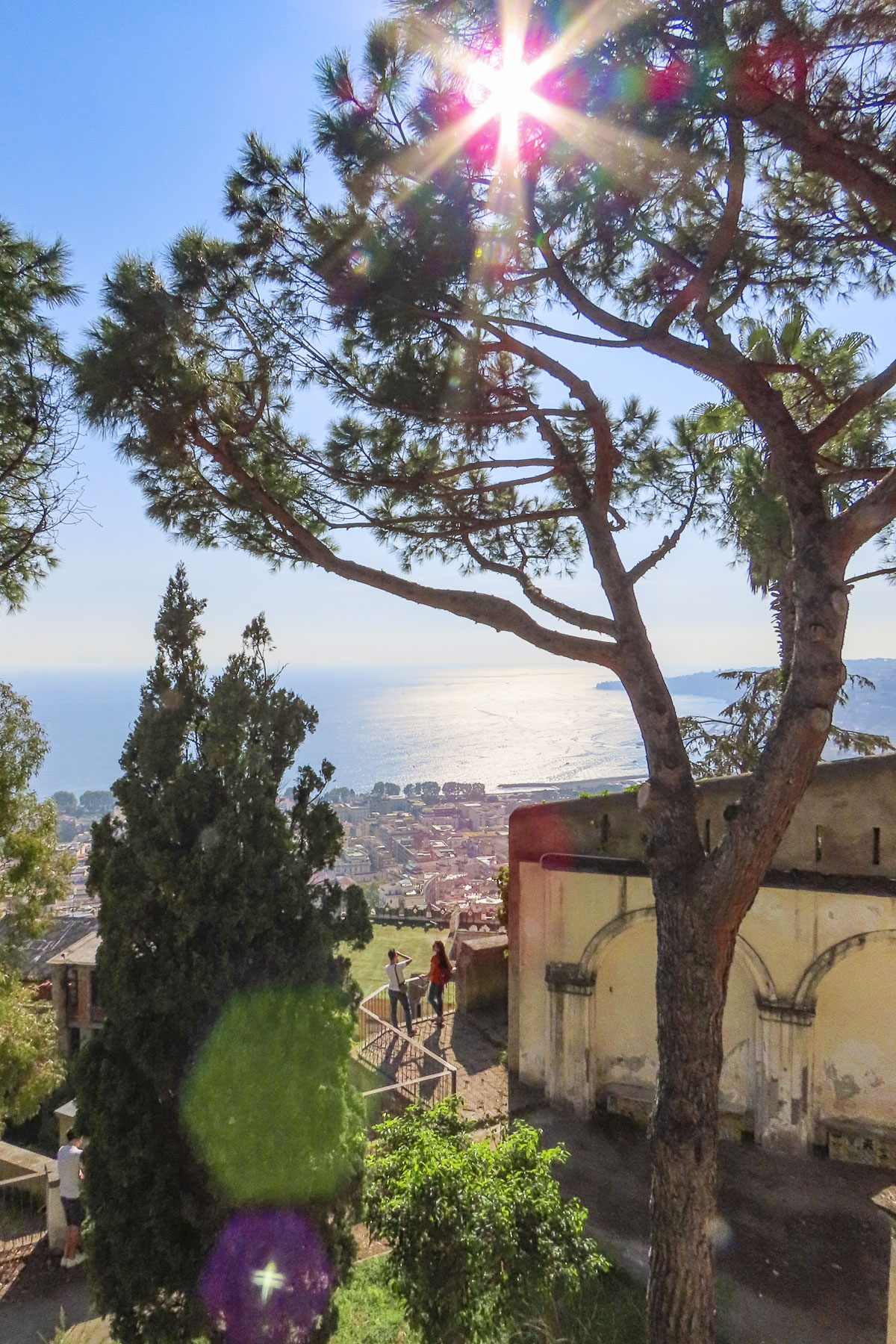
The funicular at the Montesanto train station saved us from a long and incredibly steep set of stairs that would have otherwise led us to Castel Sant’Elmo. Its six-pointed star design dates from Spanish rule of the Kingdom of Naples in the 1500’s, and is the highest point on Vomero hill.

The thirteenth century fortress dominates Naples’ skyline and has an incredible panoramic vista of the vast metropolitan area that hugs the Bay of Naples. Mount Vesuvius overshadows the scene that extends past Sorrento to the Isle of Capri.

Under the citadel walls in what was once a wealthy monastery the Certosa e Museo di San Martino exhibits a collection of art and artifacts devoted to the monastery’s and Naples’ history, in richly decorated cloisters. 

Outside the formal gardens, the paths along the cliff edge were a quiet retreat.  If you don’t feel the need to tour another fortress or monastery, the Belvedere San Martino scenic overlook offers the same views and is a very popular place to watch the sunset. 

After lunch we followed the stairs of Pedamentina a San Martino downhill to Corso Vittorrio Emanuele which cuts across the mid-section of Vomero hill above Quartieri Spagnoli, the old Spanish quarter. The district gets its name from the garrisons of Spanish troops housed there in the 16th century to quell any rebellions from the restive Neapolitan citizenry. From the sidewalk here we looked down upon canyons of TV satellite dishes and flapping laundry hanging from balconies that extended for block upon block, the sheer number of folks living above one another unimaginable.

Over centuries it has evolved to have the densest population of any neighborhood in Italy. After the second world war, post-war public housing was built for tens of thousands of displaced Italian families that fled the war-ravaged countryside, looking for work and shelter in Naples, though Naples itself was in near ruins, having been bombed over 100 times by Allied forces prior to the liberation of the Italian peninsula from Nazi occupation.  Before retreating from Naples, the Nazis destroyed all of the city’s port facilities along with the water, electricity, and gas infrastructures.  Thus began an era of poverty and destitution that was further fueled by neglect from the central government in Rome.  A century earlier, before fighting against Italian unification, the Kingdom of Naples was the most prosperous, wealthy and industrialized of the pre-unitary Italian states with the largest number of students enrolled in public schools along with the peninsula’s lowest infant mortality rate.  The city was a treasured destination of 17th and 18th century upper-class Europeans on their “Grand Tours.” The poet Johann Wolfgang von Goethe is credited with coining the phrase “See Naples and die” to reflect the city’s grandeur on one such tour.  Though I’m sure he never envisioned how a growing Mafia influence in the mid-1950’s co-opted the phrase.

We worked our way along Corso Vittorrio searching for the Giardino del Claustro, a scenic overlook, but finally gave up when we realized it was behind the entrance to a university. This wandering led us serendipitously to the Church of St. Nicholas of Tolentino where a chorus of angelic voices suddenly filled the sanctuary as we crossed its threshold, stopping us in our tracks. Seeing no one, we listened intently to the anthem, trying to determine its unseen source, until we finally heard the bellowing voice of the choir director.  We were in the school’s chapel!

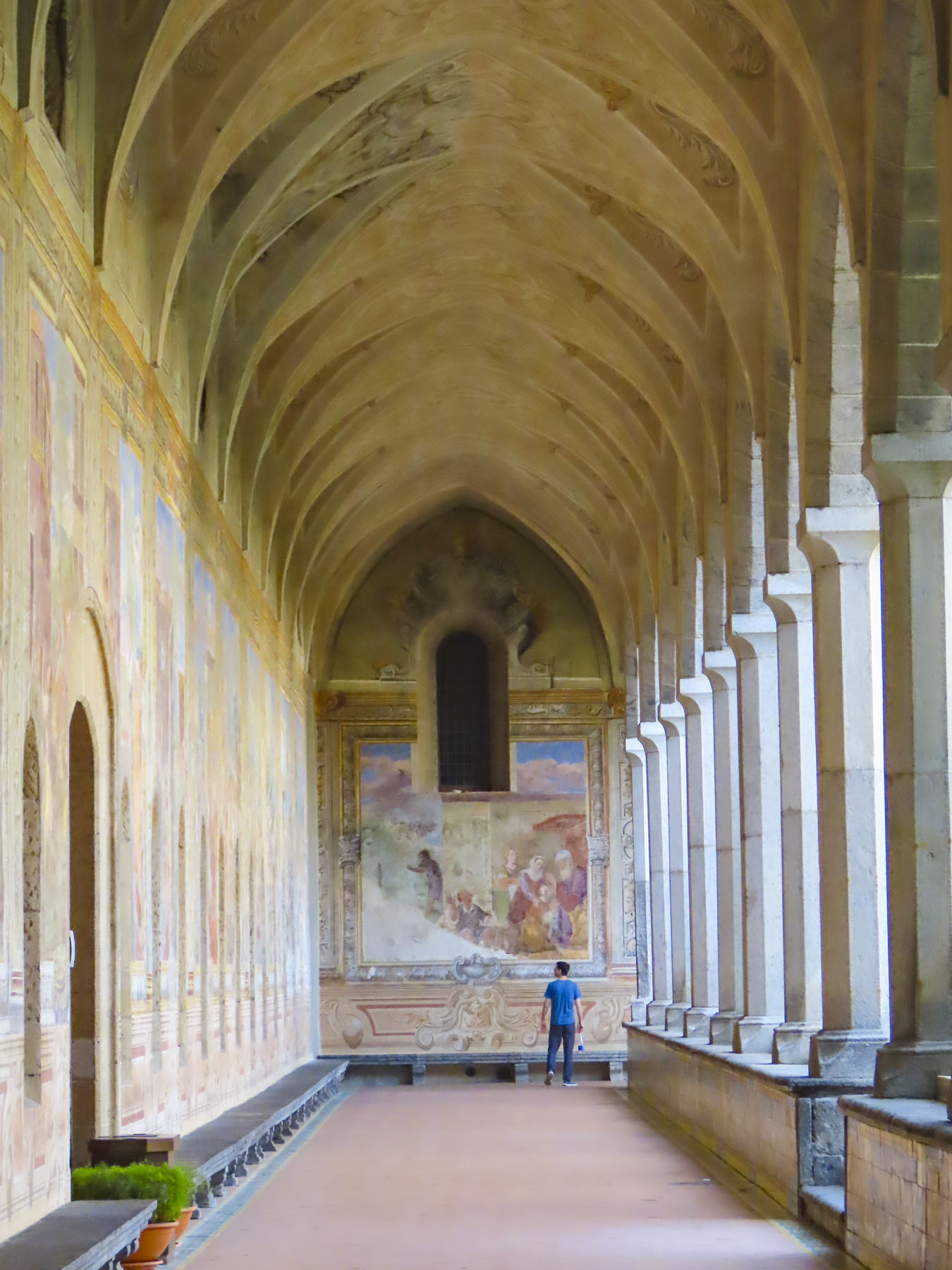
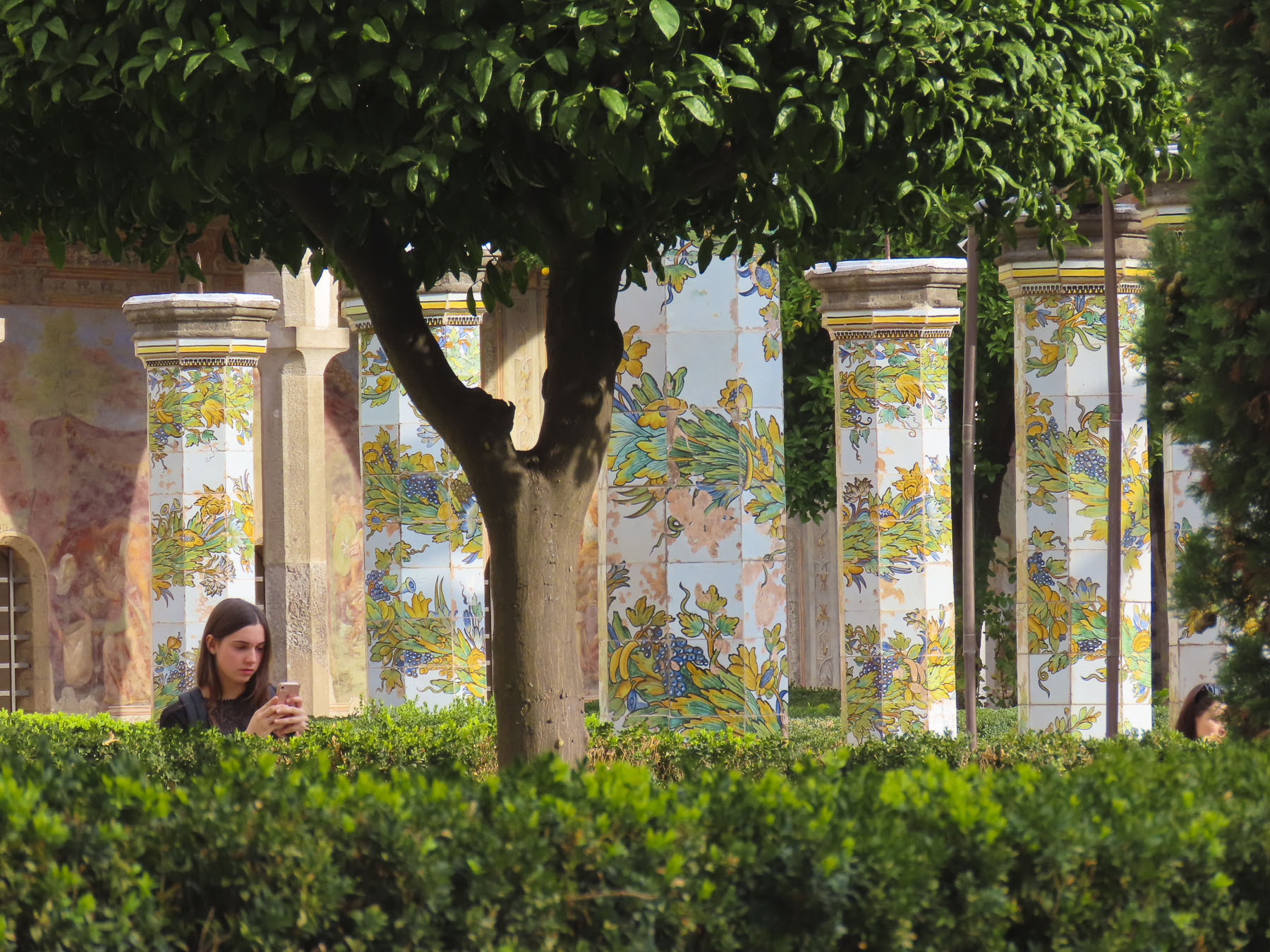
If anyplace is likely to induce a religious overdose it’s Naples. “The city of 500 domes,” reportedly has 1000 churches, five hundred of which have historical significance and I swear they are all in the ancient center of the city.  Starting at the Chiesa del Gesù Nuovo on the piazza that bears its name, we walked along Via Benedetto Croce in a large loop that brought us first to the majolica-tiled cloisters of the 14th century Complesso Monumentale di Santa Chiarato.

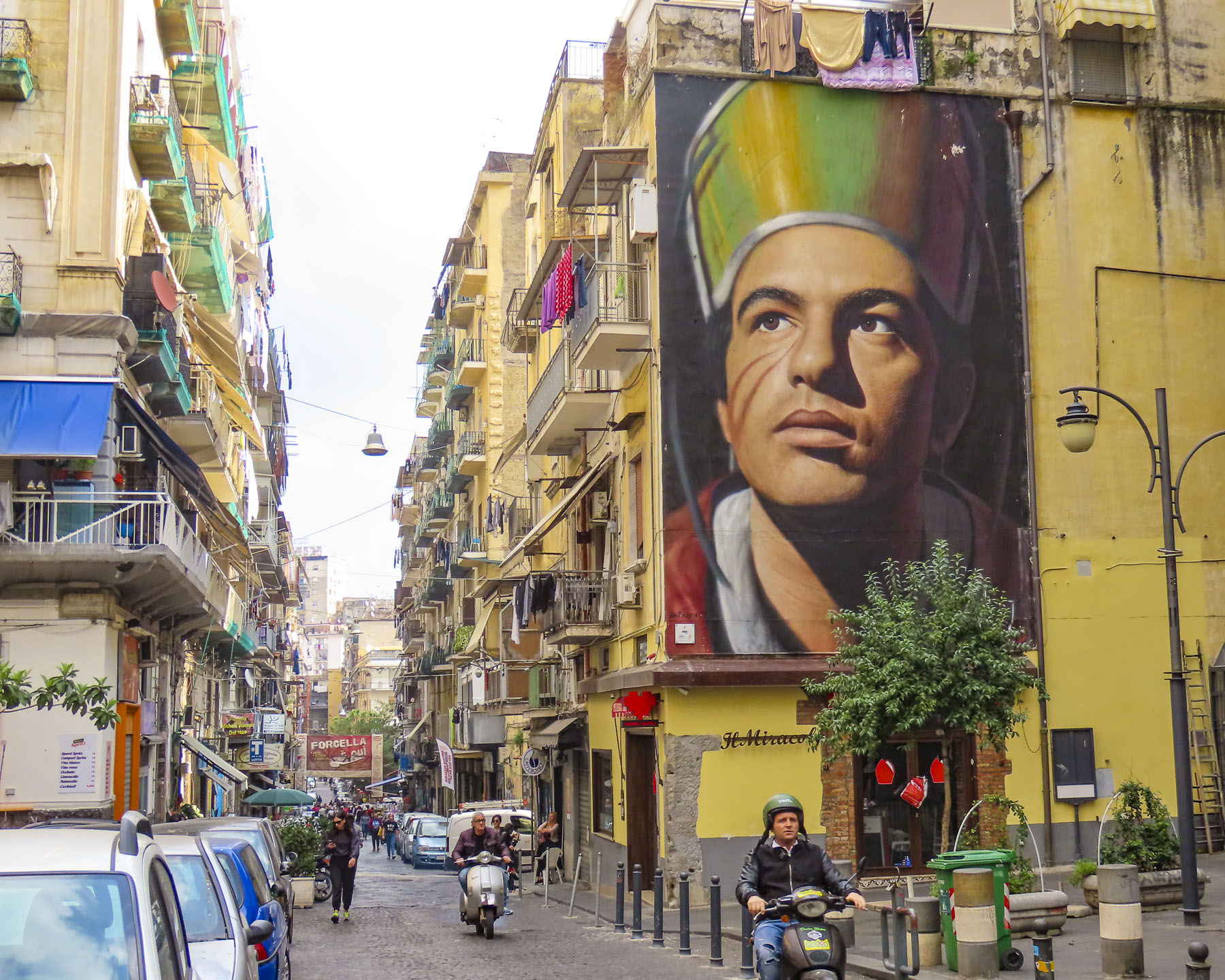
Continuing straight, we eventually came to a street mural of San Gennaro, the patron saint of Naples. This large tribute was painted in the contemporary style of Jorit Agoch, a Neapolitan graffiti artist, in 2015, above the entrance to a bar that stands next to Chiesa Parrocchiale di S. Giorgio Maggiore on Via Duomo.

Earlier we passed a small memorial to Antonio Varvella, nicknamed O’Barone, a sometimes-gruff character, a beloved homeless man who was a fixture in the historic center for many years until his death one wintry night in 2014.

Backtracking, we turned onto Via San Gregorio Armeno, a street famous for its numerous workshops that craft unique, highly detailed hand-made presepi, nativity scenes.  

Almost lost amidst the store fronts of the crèche workshops, the Church of San Gregorio Armeno has a lavish gilded baroque interior. It is a 1500’s renovation of the original 9th century church built over a Roman temple of worship to Ceres, the Roman goddess of agriculture. 

At the end of the lane, the Basilica di San Paolo Maggiore dominates the square.  

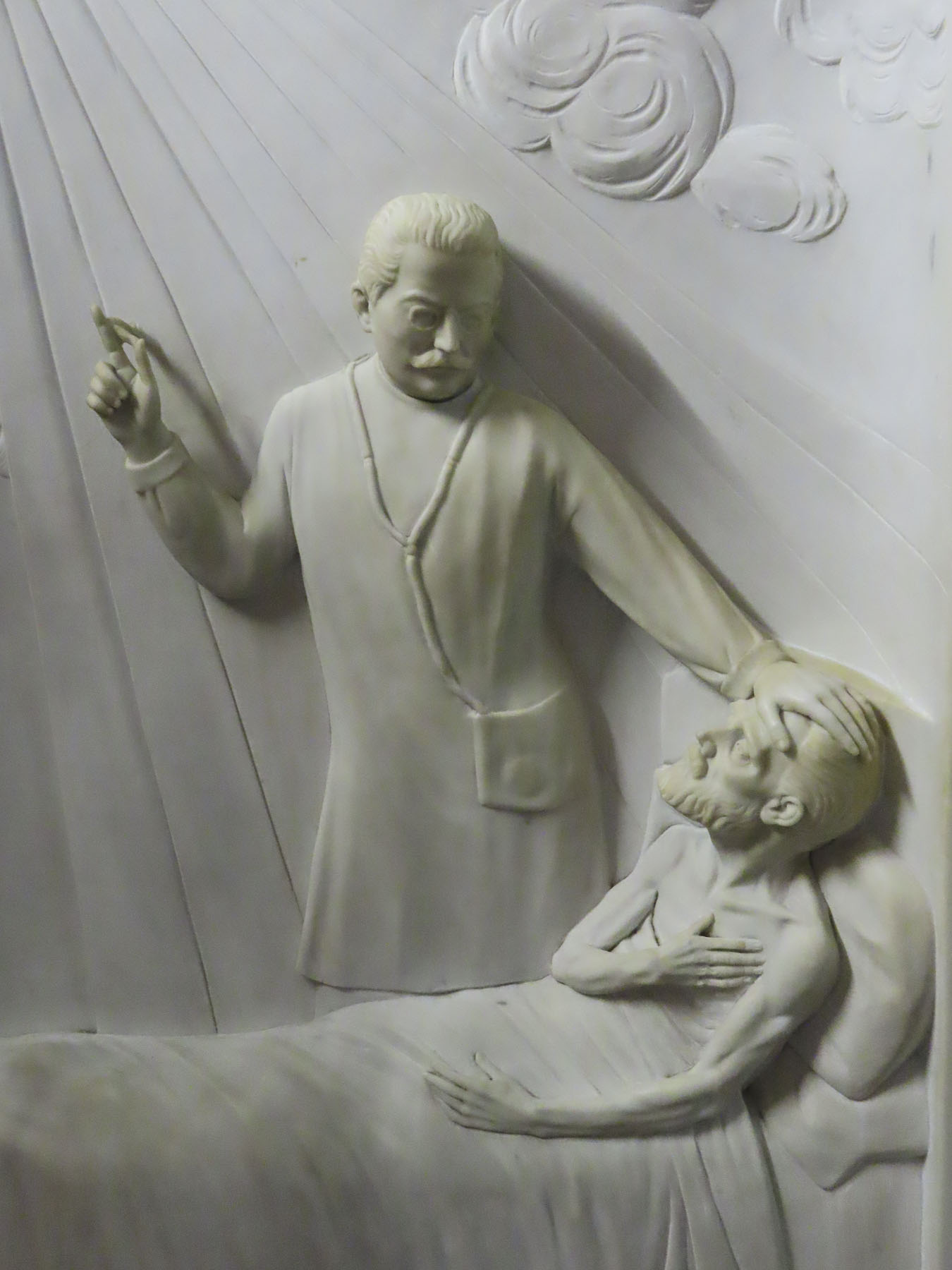
Back at our starting point we rested in front of St. Giuseppe Moscati’s statue, the hand of the sculpture shiny from parishioners holding it as they prayed for cures. A local doctor, he dedicated his life to serving the poor of Naples and is credited with many miracles. He was canonized in 1987.  

Facades of many of these churches pale in comparison to their rich interiors. If the door to the church was open, we entered. Some were grander than others, but all of them were interesting.  

Alternating with stops for café, gelato or the ever so refreshing Aperol spritz, we spent several afternoons ping-ponging our way from church to church through the center of a city that has been inhabited since the eight century B.C. when the Greeks named their colony, Neapolis. 

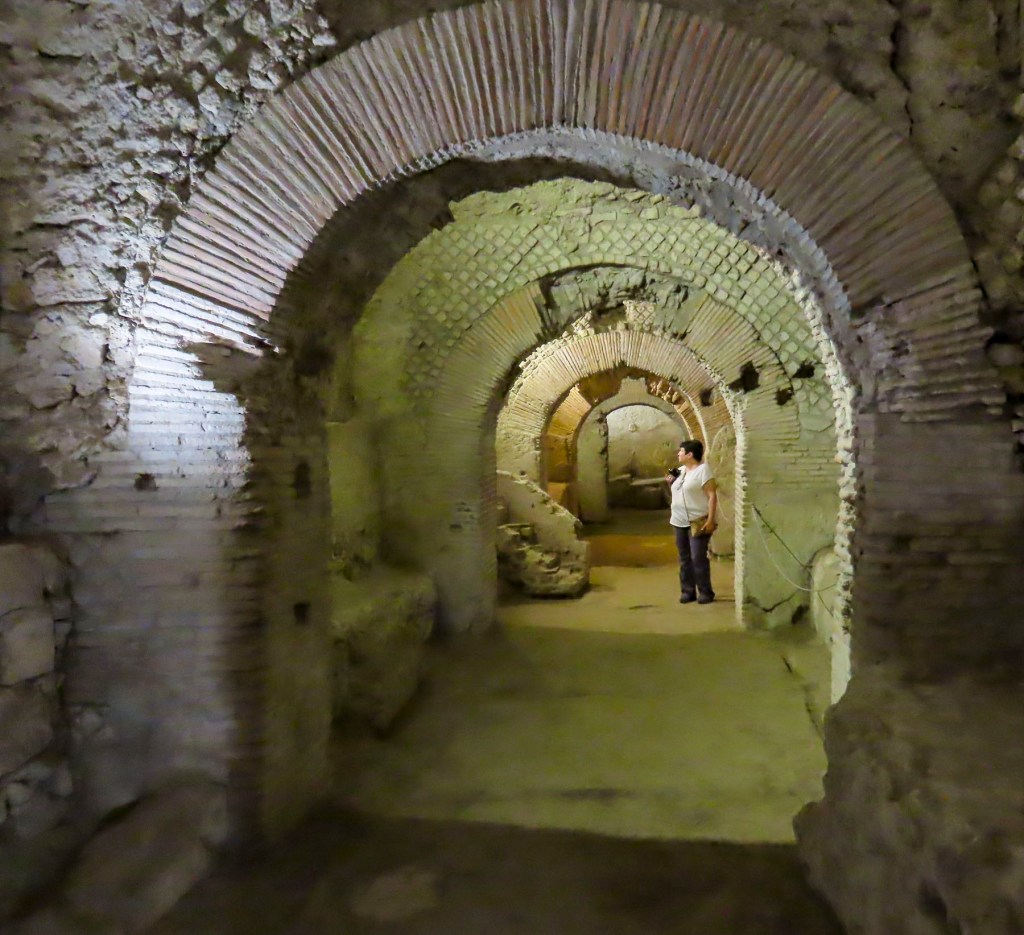
Subsequent civilizations buried the ruins of earlier ones.  The cobbled lanes and churches we toured had been built over Underground Naples, 120 feet of ancient detritus along with ruins of millennia old cisterns, aqueducts, Roman alleys and shops that spread extensively under historic and modern Naples. 

The reward for one of our daily explorations was a savory Margarita pizza from Di Matteo, recommended by our friend Marina, a lifelong Neapolitan, who affirmed, “It’s the only place my family eats pizza.”  A round pizza folded twice to form a triangle is the perfect street food, but when you order it inside and sit at a table to dine it is customary in Italy to use a knife and fork to politely carve these culinary creations that have become so popular the world over.

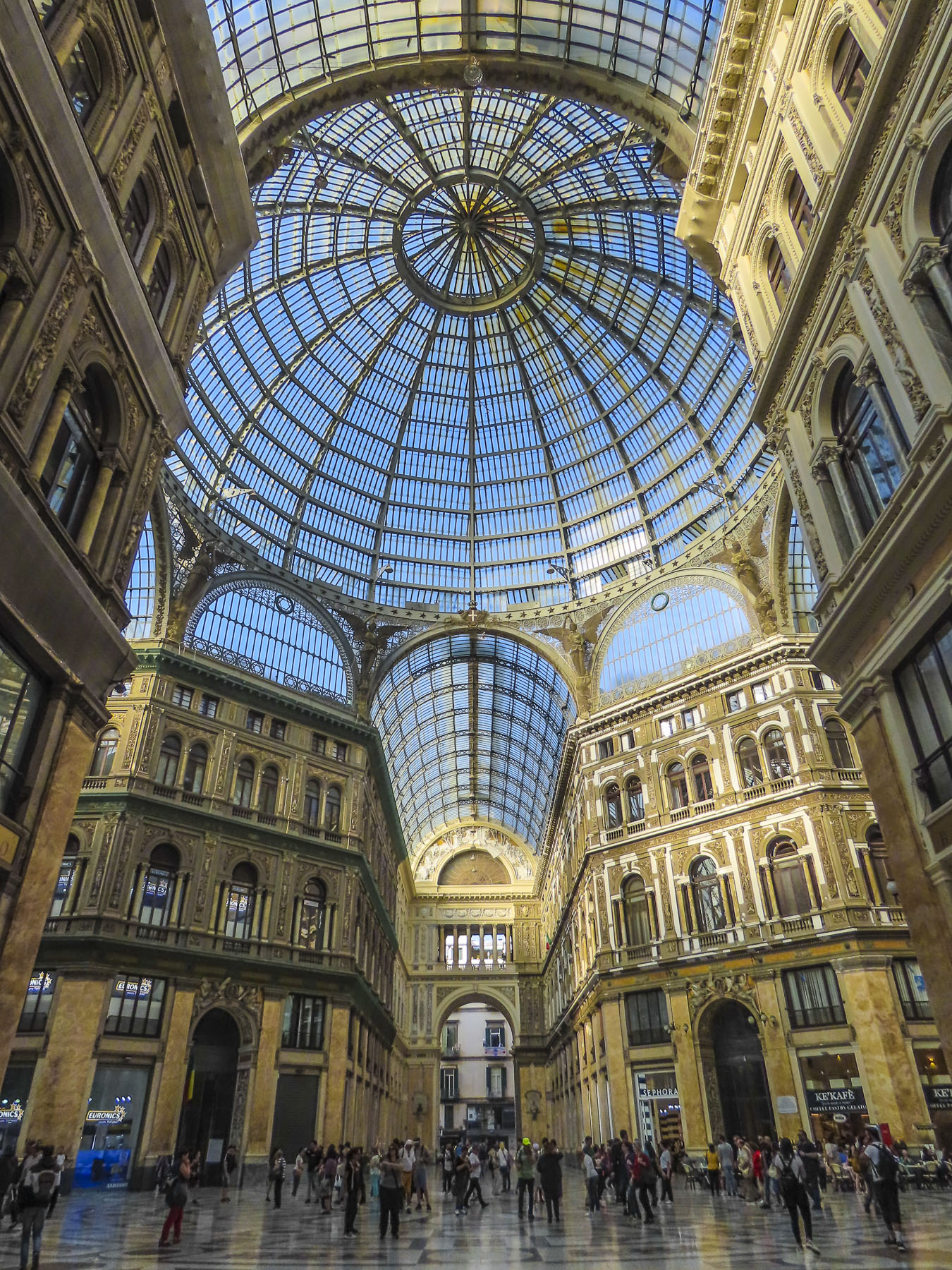
By the end of the week the hard cobblestones were fatiguing, and we decided to take a cab to Galleria Umberto, an old fashioned, glass domed shopping mall.  A five-minute trip according to Google Maps. It’s a landmark by the waterfront, near Castel Nuovo and Piazza del Plebiscito which we planned to visit afterwards.  

There were several taxis in queue at Piazza del Gesù Nuovo, all pointing in the direction we needed to go, a good omen or so I thought, as we hopped into the first cab.  Hearing our destination, the driver promptly did a U-turn, then another left turn taking us in the wrong direction. I spoke up from the backseat and pointed to the map, my question confidently waved away by the driver. “Donna, he’s taking us in the wrong direction.” “Give him a few more minutes. He’s local – maybe he knows a shortcut.” With a left turn out of the historic center the driver would have redeemed himself, and put us on a course to the waterfront. Instead, he turned right and floored it while ignoring my protest from the backseat. Finally, at a red light he rolled down his window and asked for directions from a police officer.  Oddly, the police officer made eye contact with me and winked.  A right turn brought us into a one lane road where traffic was at a standstill.  By this time what should have been a very reasonable fare was now approaching twenty euros and we were still over twenty minutes away, in the opposite direction from our destination. I believe he had intentionally taken us in the wrong direction to jack up his fee.  It was time to abandon ship. We got out in the middle of the traffic jam, and I handed him five euros.  An eruption of Italian we did not understand pursued us onto the sidewalk as we walked away, and I swear the buildings blushed from embarrassment. Never have I met a cabbie who didn’t know where a landmark was. 

A few moments later as we were walking down the sidewalk, voices called from behind. “Attenzione!”  Two smartly dressed female police officers were telling us to pay the cabbie. These officers looked serious, with handcuffs! My mind raced as I told them he was a thief, and no way was he going to extort more money from us!  Much of this intense discussion was hindered by our lack of Italian.  Twenty-three euros were now on the meter and the driver wanted to be paid.  I repeated, “no way!” multiple times.  Thank goodness for Google Maps.  With it we were able to show the officers our pickup point and what our original route should have been and the time it should have taken.  They immediately saw how deliberately off course we were. They agreed with us and reprimanded the driver and told him he was lucky he got the 5 Euros.  The police officers apologized for his behavior and were sorry that it happened to us.  From where we got out of the cab it took us an hour to walk to Galleria Umberto where two “caffé corretto,” espresso with grappa, were ordered to sooth our frustration. For this very reason we prefer to use the transparency of Uber or Lyft for transportation when traveling; unfortunately, those services were not licensed to operate in Naples.

With our Naples Pass in hand we headed to the National Archaeological Museum.  This was a wonderful museum with a fascinating collection of artifacts, ancient pottery, classical sculptures, and mosaics discovered across the Campania region.  There is also an extensive collection of antiquities from the ruins of Pompei.

Walking back to our apartment we stopped at a small bacari with a few outside tables for aperitivi, the Italian version of happy hour, to savor the golden hour as the sun began to brighten the historic buildings along the boulevard on our last day in Naples.

Sharing the afternoon with friends and sipping Aperol spritzes accompanied with small snacks called cicchetti is a ubiquitous activity in Italy and reflective of “la dolce vita,” the sweet life. It’s a tradition we plan to continue.

Cin cin! Till next time,

Craig & Donna

The Road to Naples – Driving Through Basilicata & Campania: Searching for Family History

To the south, the Ionian Sea sparkled in the distance as we left Alberobello behind and headed west along the E90.  Our destination in three days’ time – Naples. There was some family history to investigate before that, though, and we set the GPS course to Sassano on a journey to explore the ancestral village of Donna’s maternal grandmother. On the far side of Basilicata, the small hilltop village sits just inside the border of the Campania region.  This would be the culmination of a trip planned years ago, that was originally going to be shared with her mother, before her passing.  Nearer to Naples, we also planned to visit Volturara Irpina, the birthplace of her paternal grandfather. 

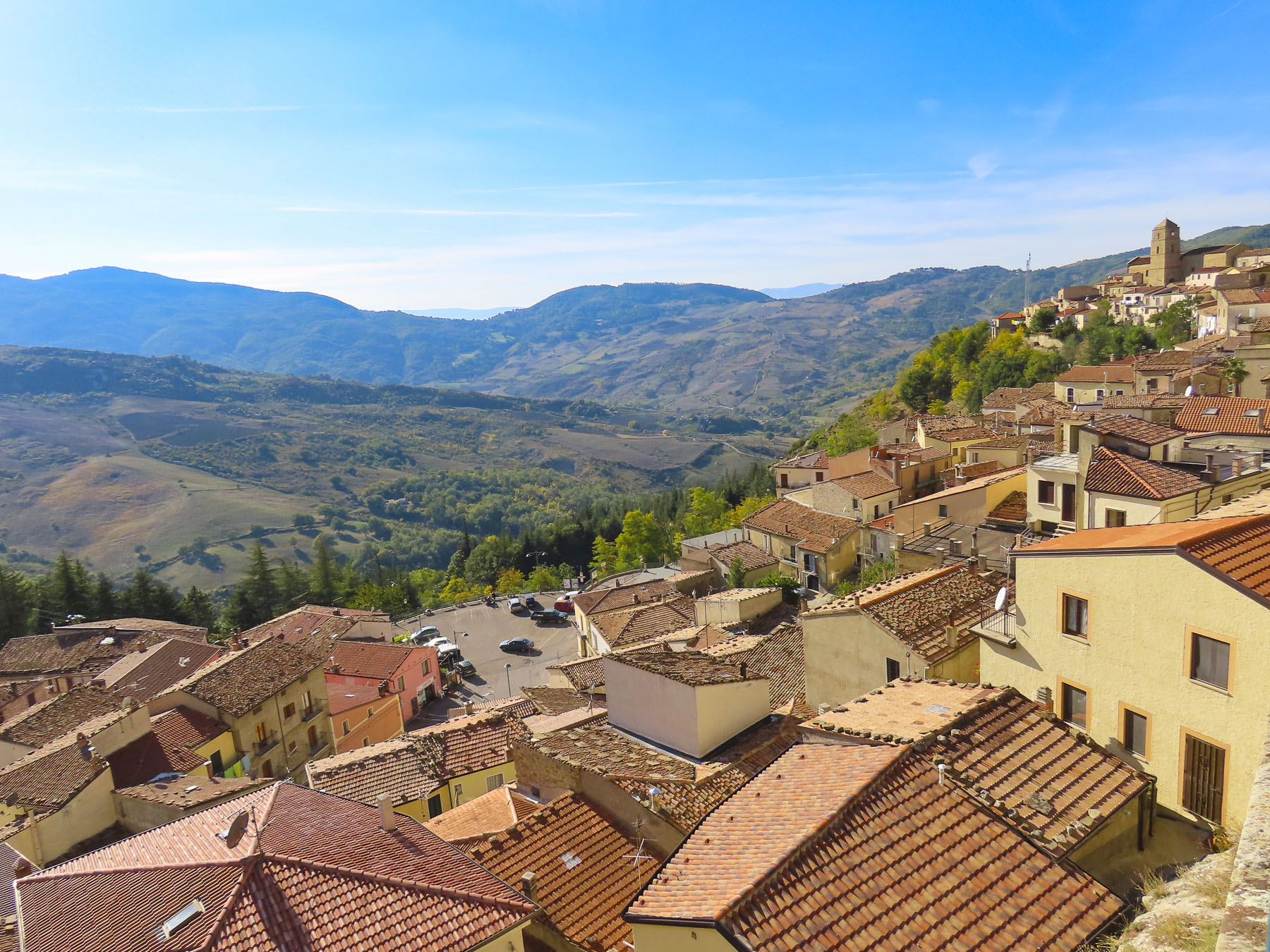
Our road trips rarely involved a direct route between destinations and this held true as we turned away from the coast and followed the E847 through the Basento River Valley into the rugged mountains of Basilicata.  Ancient hilltop villages crowned the ridges on either side of the roadway, each looking worthy of future investigation. The Basilicata region has been referred to as “Italy’s best-kept secret” by the New York Times, but it was once the realm of roving bands of brigands. Highwaymen of legend made traveling in the region notoriously unsafe after the unification of Italy in the 1870s.

Under the Royal House of Bourbon, southern Italy fought against unification.  After the war the residents were disenfranchised by unfulfilled promises; with support from Bourbons in exile and the church, which had much of its lands seized, many in opposition to the new government headed to the hills.  These brigands were informally comprised of people with different motives. Former soldiers, some nobles, criminals, peasants, and farmers filled their ranks. The most famous one, Carmine Crocco, aka Donatello, led a band of two thousand men. Your criminal is my guerilla-fighter hero. I guess it depends on which folksongs you listen to.  The region was remote, and severely poverty stricken. During the fascist era of the 1930’s and 40’s, the Basilicata region was used as an open-air prison, where political dissidents were sentenced to exile in remote villages – Italy’s Siberia.

With mountains deforested of wood for fuel, poor soil conditions for farming, an illiteracy rate of seventy percent, bleak employment opportunities in other industries and a central government dominated by northerners that ignored the region, four million Italians chose prospects for a better future and emigrated to the United States between 1880 and 1924.  Others headed to Brazil, Argentina, Canada, Australia and South Africa.  It wasn’t unusual for emigrants from the same village to head to the same new cities overseas where they continued the tradition of campanilismo, the spirit of “loyalty to those who live within the sound of your village’s church bells.” Chicago, Boston, Baltimore, Philadelphia and New York all drew huge concentrations of new immigrants eager to prosper, and societies like the Italian Welfare League helped folks adapt to a new home in a foreign country.

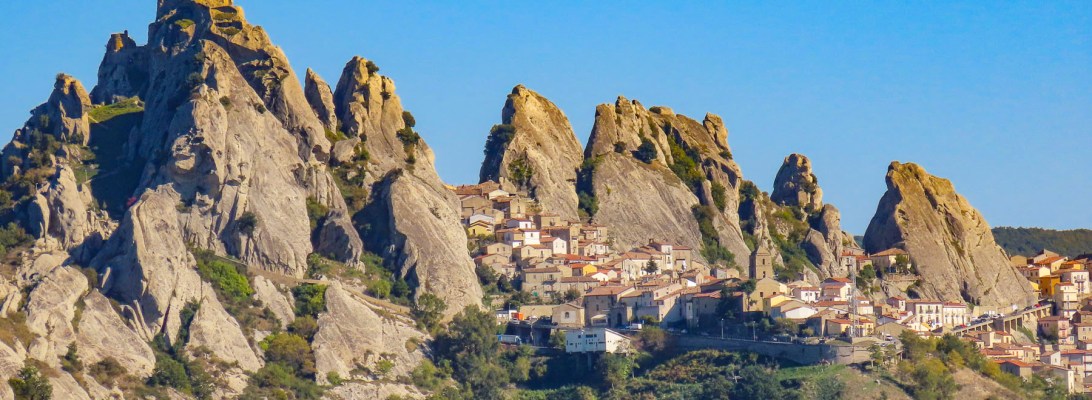
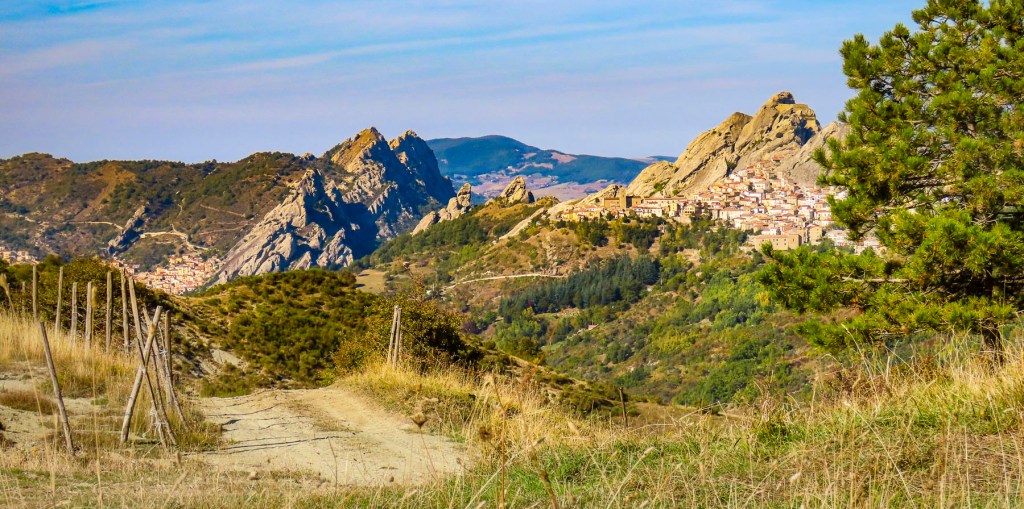
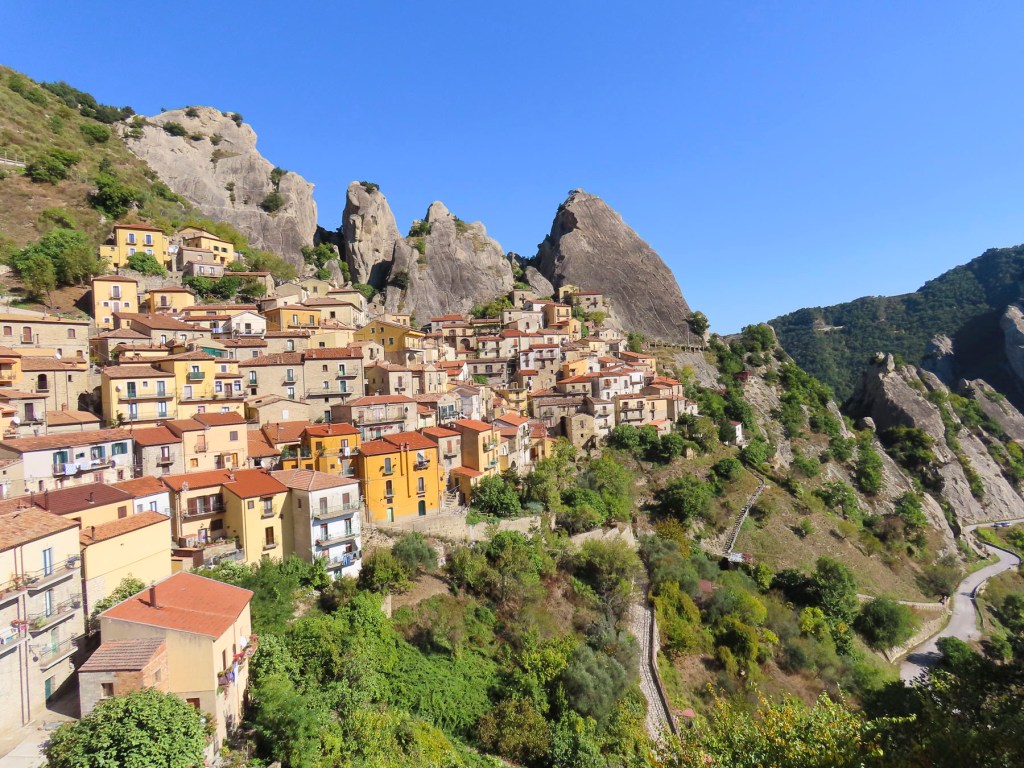
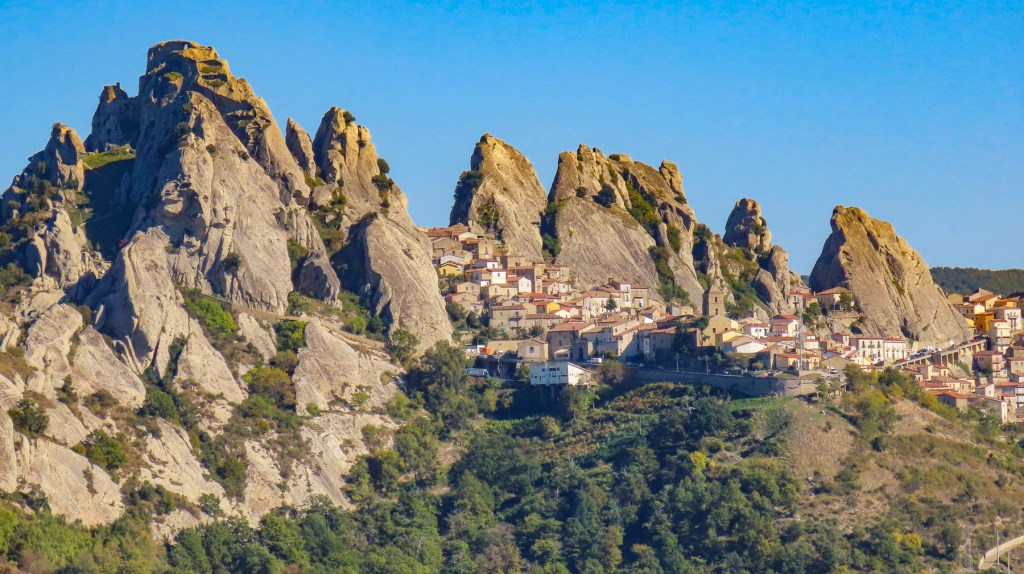
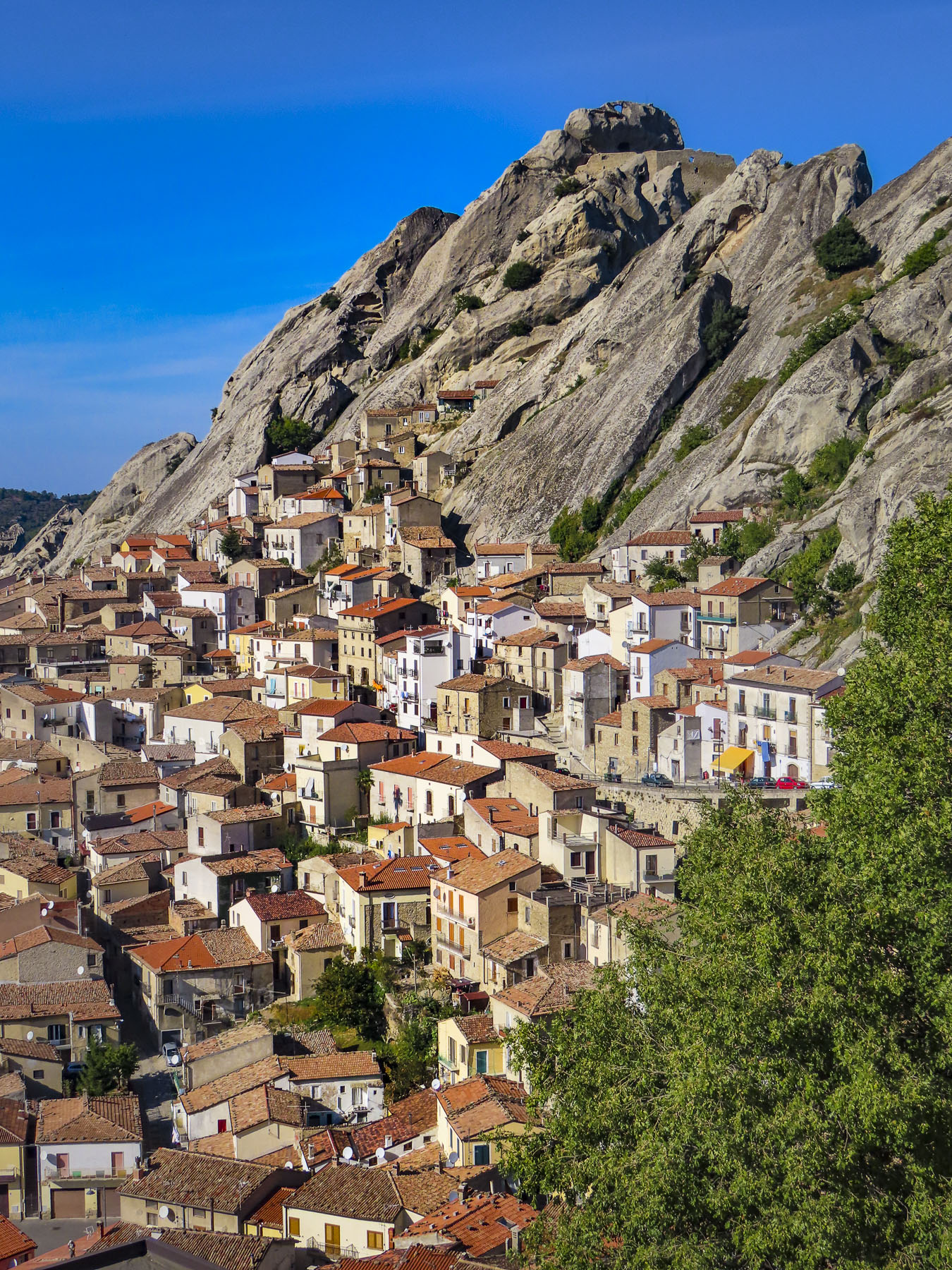
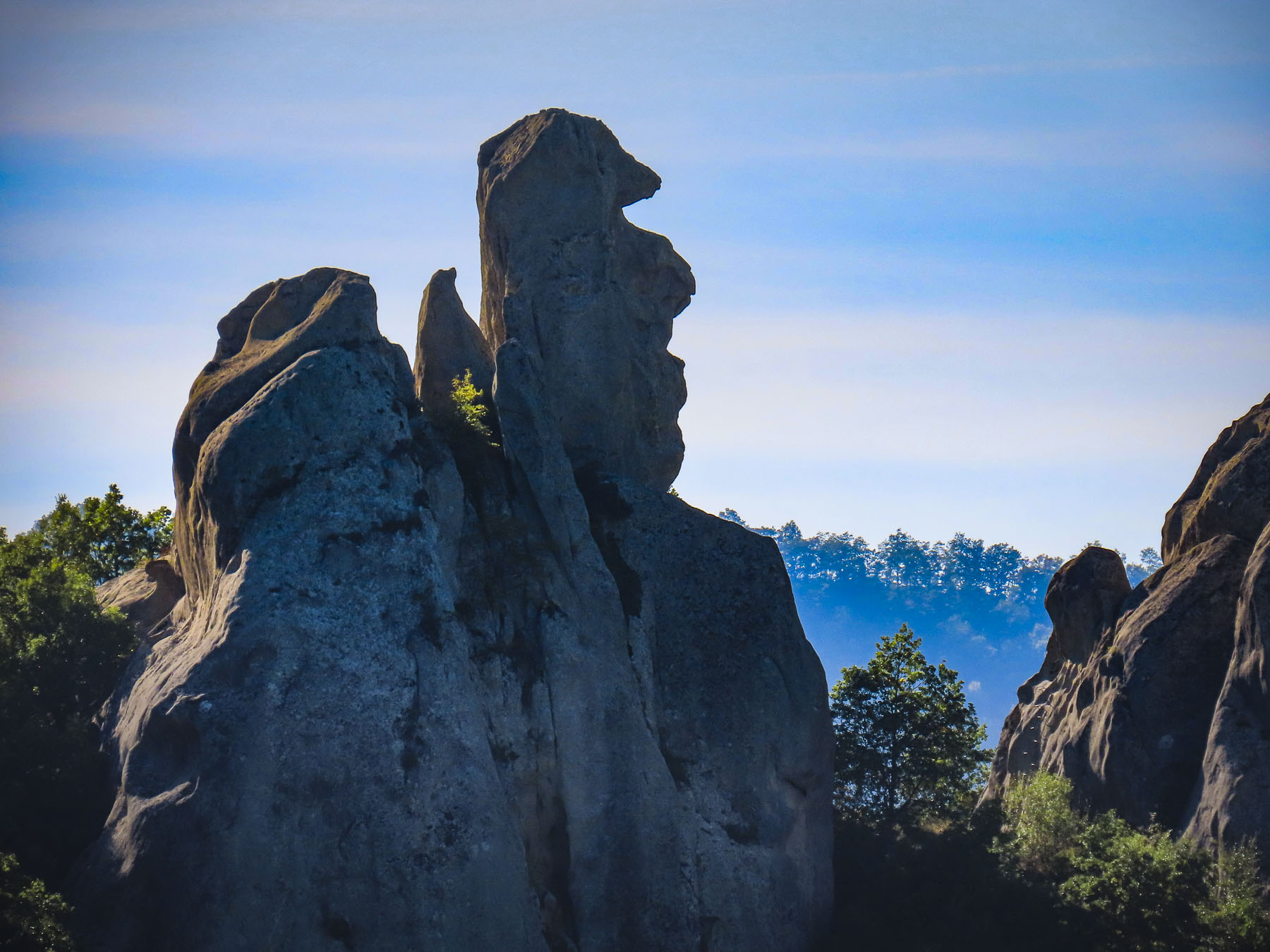
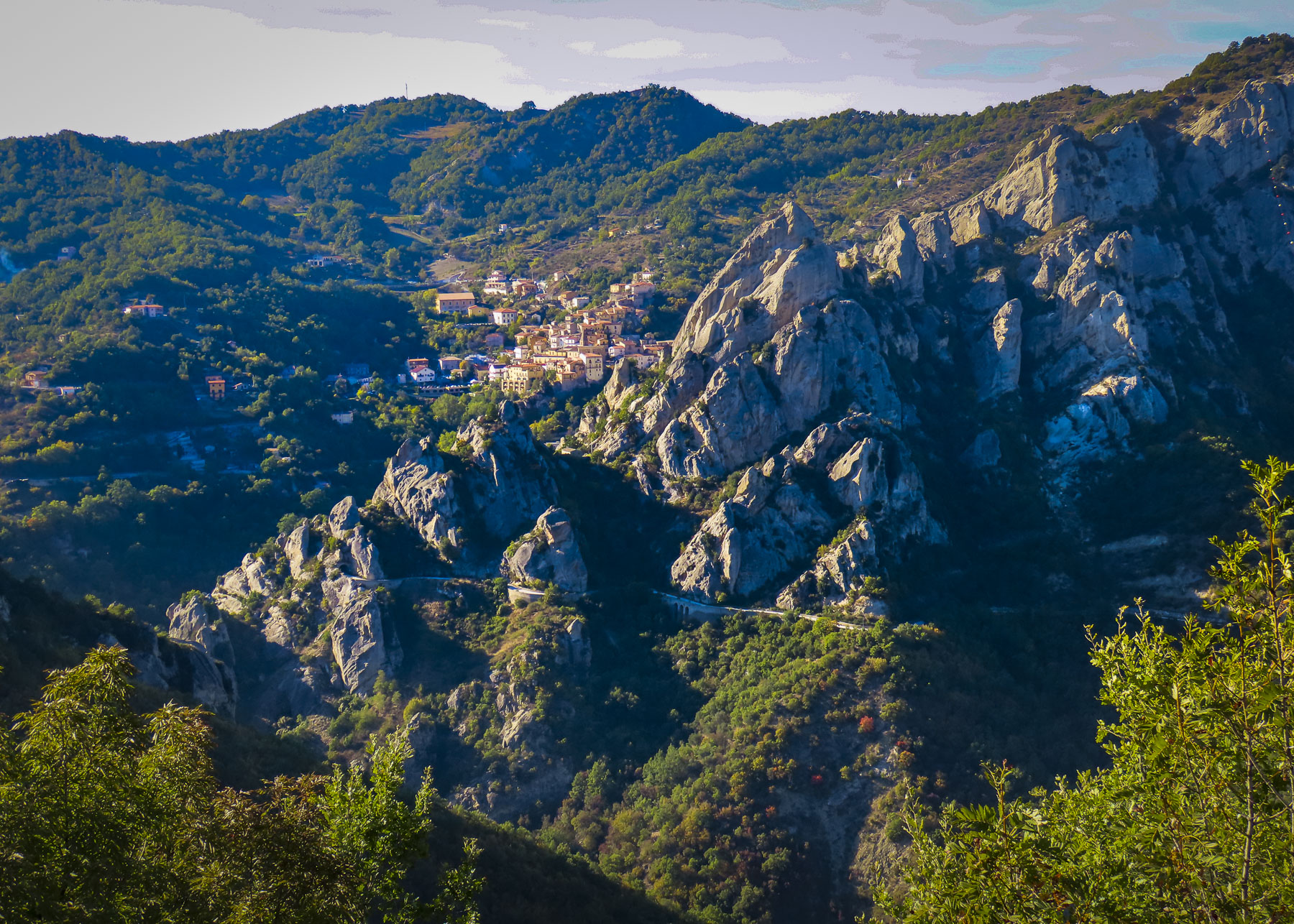
Castelmezzano, castle in the middle, between Albano di Lucania and Pietrapertosa, was our first stop. Descendants of 6th century Greek settlers in the Basento Valley fled to safety in the jaws of the Lucanian Dolomites when Saracen invaders from North Africa forced the local populace from the river valley into the mountains. The smooth sides of the tall, steep tooth-shaped outcroppings that protected the villages of Castelmezzano and Pietrapertosa were perfect for villagers to roll boulders down onto their attackers. 

The same mountains offered safe haven to the brigands of the late 1800’s.  Today the area, only two and a half hours from Naples, is part of the 67,000 acre Parco Regionale di Gallipoli Cognato, a mountainous park with wolves, foxes, porcupines, and wild boar that is a magnet for outdoor enthusiasts who enjoy camping, hiking, biking and rock climbing. 

The area is stunningly beautiful with its unique rock formations, lush forests, olive groves, vineyards, and pastures. During the spring and summer, the small villages of the region host colorful Marriage of the Trees Festivals that combine ancient pagan rites with Catholicism to celebrate fertility and hope. Mid-week in the middle of November the area was nearly deserted, and unfortunately there were not any cafes open. Hopefully, it would be different on the weekends. 

Back on the highway we speculated how interesting a future trip would be, zigzagging back and forth across the valley to explore every hilltop village, large and small. There were so many of them!  We still regret not stopping in Brienza to walk through the historic district at the foot of its 7th century castle, after its profile suddenly burst forth and filled the windscreen as we rounded a curve.

The sun was just setting as we pushed the button on the driveway gate to Affittacamere – Nonno Domenico, located in the valley below Sassano.  Check-in was smooth, but establishing our internet connection required first the involvement of the innkeeper’s teenage son and then his older sister. In the off-season, prospects for dinner were extremely limited. Though Google Maps showed many restaurants in the area, they were closed for the season. After driving around searching, we ended up having a delicious, no-frills dinner at the local pizza parlor. 

We scored big time the next morning for breakfast with our discovery of Pasticceria Tropiano Peccati di Gola & Dintorni. This bakery and café is run by two brothers, Cono and Franco, who are devoted to guiding their customers through the “consumption of sinful delicacies and coffees.”  They offer baked goods of a quality you would expect to find in Naples or Florence, not in the remote area surrounding Sassano. 

The village of Sassano rose sharply from the flat, flood plain of the Tanagro River in the Vallo di Diano, the lower slope of Monte Cervati checkered with the stacked profiles of dwellings built of stone and capped with red tile roofs. 

At the foot of the hill, the spring-fed communal laundry looked newly renovated, with updated washbasins and scrub racks.  Empty laundry detergent bottles indicated recent use.  Outside we refilled our water bottles from an ever-flowing fountain built into the terraced wall.  Basilian monks have been credited with the first construction of a fountain on this site in the 10th century when the village was founded. It’s difficult to believe in this day and age that such facilities are needed and still used. But it reflects the past poverty of the region and the plight of the elderly who still use it.  Just imagine the task of carrying a basket of wet laundry uphill, back to your home to dry.

The lane into the village rose slowly to the small central plaza, Piazza Giuseppe Mazzini, where most of the buildings looked permanently shuttered.  We parked in front of a long-closed butcher’s shop which stood yards from a war memorial that listed the village’s men that did not return from two world wars.  The only sign of life emanated from a tiny bar across the cobbled square, where the barista made small talk with an elderly pensioner sipping prosecco, while warming himself at a sunny table.  We ordered café and planned our morning. Could we find Donna’s grandmother’s home here? 

There are only steep, narrow streets called “carrare,” meaning only as wide as a cart, here. In the early 1900s they would have been filled with farm carts, donkeys, chickens, and a milk cow if you were well off.  Somewhere in the family archive, a photo exists of a young woman returning from the forest with a huge bundle of foraged wood tied to her back.  Water was gathered from the village well and carried home. Extremely hard work and no way to avoid it.

Via San Biagio was a short distance away from the plaza and as steep as expected; it curved its way uphill to a small neighborhood church bearing the same name.  Time has not been kind to the homes on the street. Many showed sign of neglect, with broken stairs and windows along with cobwebbed locks on doors that that looked like they had not been opened in decades. Donna had notes written by her mother, who had passed away only the year before our trip. The familiar clear handwriting stated that Christina D’Alessio DeGondea had lived at Number 10 San Biagio. But Number 10 didn’t exist, only Numbers 9 and 11. A mystery. Perhaps Grandma’s birthplace had been destroyed. 

With a copy of her grandmother’s baptismal certificate in hand, we backtracked past the café to the Church of San Giovanni Evangelista. The 16th century church that stands today was built atop the ruins of an earlier 11th century church destroyed by fire.  Unfortunately, the church and its office were closed during the midweek, the population of the village today only supporting Sunday services, and we missed the opportunity to view its preserved baroque frescoes.  We did catch a glimpse of its notable wooden crucifix by peering through the church’s keyhole. 

Only two hours from Naples and just one hour from the Mediterranean, parts of Sassano are showing signs of renewal with gentrification of some of the architecturally unique homes and those with views of the valley.

Walking along we came to a street named Hoboken, a city in the shadow of the Statue of Liberty only a short ferry ride away from Ellis Island and the promise of new life in America. At a small square we found a mural dedicated to those that emigrated from the village; we sat for a while and wondered about life here in the past. 

For a small village there was an amazing number of churches, but that is true of most towns in Italy. One of our favorites was the Chiesa San Michele. Located on a ridge across from the village, it had a panoramic view of Sassano and was a perfect spot for our picnic lunch. 

Cilento and Vallo di Diano National Park, the mountainous area around Sassano, is also known for its variety of wild orchids, containing 54 of the 120 varieties found in Italy. Earning the village’s second name “paese delle orchidee” – village of the orchids. It sounds so pretty, and it’s the perfect excuse to return when they are in bloom. Afterwards a caretaker at the town’s cemetery helped us search for family headstones.

The next day we drove to the neighboring town of Monte San Giacomo to explore the village of Donna’s maternal grandfather, Nunzio DeGondea. Larger, the village looked significantly more prosperous, with several small cafés and an open restaurant, Dei Tigli Di Totaro Domenico.

Without much to go on we worked our way to the town cemetery near the Santuario Di Sant’Anna on the outskirt of town to search for his family name.  As cemeteries go it was gracefully beautiful and very tranquil, though family history eluded us.  At the Sant’Anna, Donna held me by the belt as I leaned as far as I could over a low wall to pick plump ripe figs from a wild tree.

Later we searched for a large statue of Christ that we had spotted from a lower road as we drove into town earlier.  It was a good excuse for a leisurely drive around, exploring. Eventually, down a dead-end near the Chiesa Madonna di Loreto, we found it.

Not much is known about the origins of Quaglietta Castle, but it is thought to be a Norman feudal fort from the 11th century. And as intriguing as it looked from the road, I had to fight the impulse to follow the exit ramp. Next time!

Our desire to reach Naples before sunset required an early start to leave enough time to visit Volturara Irpina, roughly translated as “valley of vultures,” due to a large population of the birds that once inhabited the area until the 1900’s. The village of Donna’s paternal grandfather, or as I referred to it, DiMeo-ville. Farmacia DiMeo, Avvocato DiMeo, Clinica Medica DiMeo were all businesses lining the main boulevard and plaza around town hall. We had found her people! Folks were cordial, and since we were obviously foreigners, a few stopped to chat with us. When Donna introduced herself to one gentleman, he smiled. Making a sweeping gesture with his arm, he proclaimed, “Multo DiMeo!” Closer to Naples, the town had the feel of a relatively affluent commuter suburb. In the town park a monument paid tribute to the men of the village who died in the world wars, and the September 23, 1943, allied bombing, due to Nazis troops in the area, which caused sixty civilian deaths.  Many DiMeos were among those lost that day.

Once again, we tried to locate the home where Grandpa DiMeo lived before emigrating. We visited the town hall, but our lack of an extensive Italian vocabulary prompted the receptionist at town hall to call for assistance.  In a hopeful frame of mind, we followed a kind woman, slightly older than us, back to the archives where she opened a safe-like door and leafed through the century old, dry and torn pages of several thick volumes of town records, taking notes as she went.  We were still having difficulty communicating, though the gist of it was “your grandfather came from a neighborhood on that side of town,” as she pointed the way.  “The streets are still there; however, the names were changed decades ago.”  With several “mille grazie,” a thousand thank yous, followed by hugs all around (after all, this is Italy) we headed to of all places – Via Alessandro DiMeo. Of course! It was a long, quiet residential street with modest, well-kept older homes on the edge of town. Only a few homes looked like they had been forgotten.  What was confusing though was that off the main road there was a parallel lane and several dead-end spurs that all went by the name Via Alessandro DiMeo.  Walking the street, we stopped to take a photo of some just-harvested walnuts which an elderly man had placed in the sun to dry.  Asking of our interest in the area, he led us further down the road pointing to where the grocer and tailor shops used to be, though he did not know any DiMeos still in residence there. Parting, he insisted we take some walnuts with us. 

Slowing to find a parking space near the McMany Scottish Pub & Pizzeria I suddenly yelled “I just saw your Dad!” “What do you mean?” Donna responded in surprise. “That man could have been his twin – same hair, same nose. He even wore the same glasses. We have to ask him if he’s related.” Parking was not easy, so we circled the block, only to have lost him. The search began and fortunately two blocks on the gentleman had stopped to speak to a friend.  We quickly double-parked and introduced ourselves the best we could as he was saying goodbye to a younger man. “Ciao, il mio cognome è DiMeo,” Hello, my last name is DiMeo. His friend had stayed when he saw us approaching and interpreted our tale for him as best he could. 

Unfortunately, he had been born in a different region and there were not any DiMeos in his family tree, which was difficult to believe. He kindly posed with Donna for a photo, so we could show the folks back home. For those of you who knew Donna’s father, do you see the resemblance to the gentleman in the above right photo? The old photo on the left is Donna’s paternal grandparents, Domenico and Filomina DiMeo.

Till next time, Craig & Donna
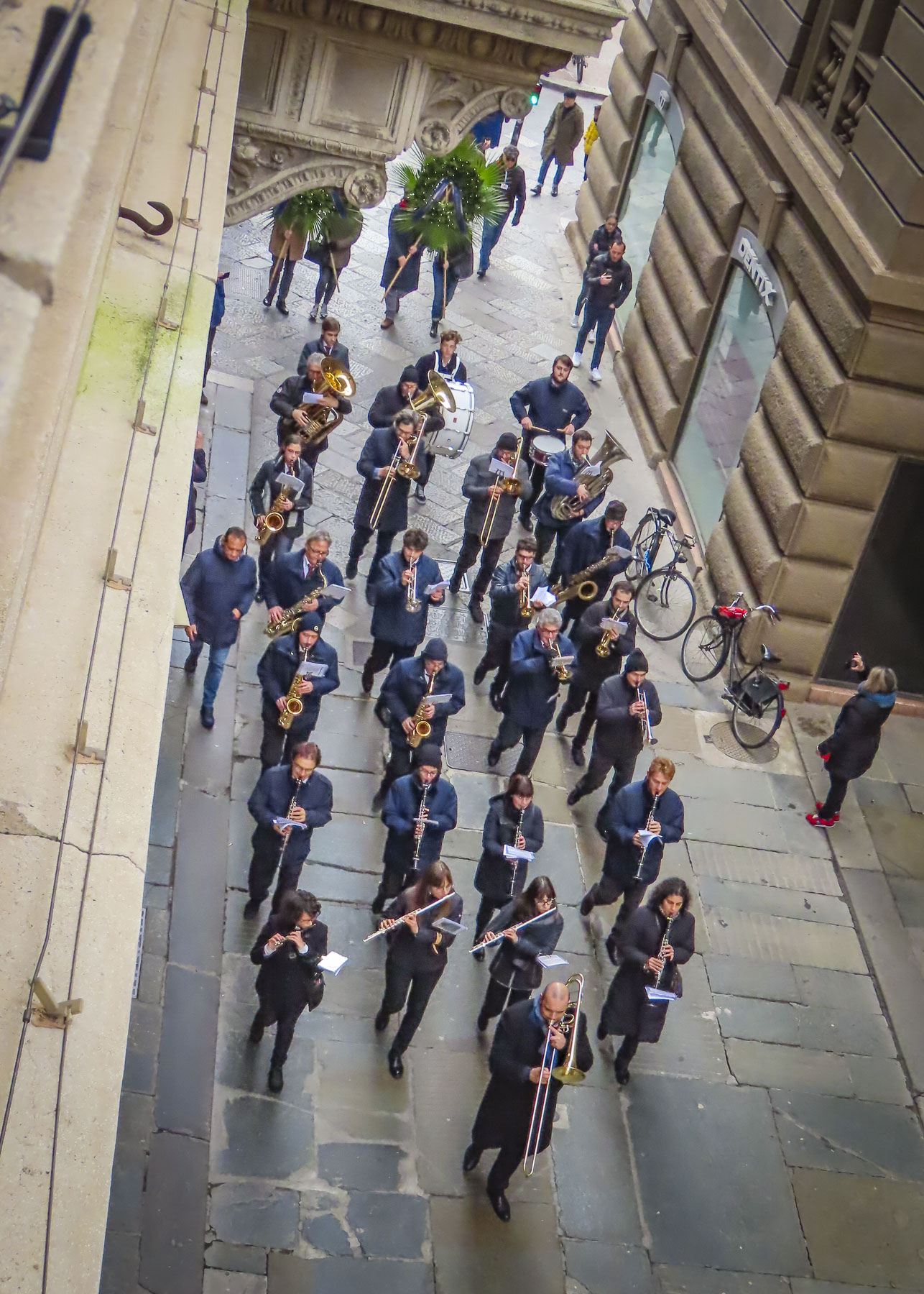
Puglia – Alberobello Part 2: Lecce and Nardo – The Florence of the South

“Signor, mio gattino si è nascosto sotto la yuan automobile ed è salito nel motore.” Roughly translated it means – Sir, my kitten ran under your car and is hiding in the engine! My racing imagination added, I will paint a pagan symbol on your car and you will be cursed for the rest of your life if she is hurt.  I exaggerate a little in jest just so you understand this was a crisis!

The night before we had agreed on an early start to Lecce to rendezvous with our friend Giulia for a day exploring her adopted city.  To help move the day along I offered to retrieve our rental car, which was parked a good distance away, uphill, across from the trullo-shaped Church of Saint Anthony of Padua which crowned the hill.

Donna is the designated linguist of the family. I on the other hand have been lovingly accused of slaughtering a fine romance language with just the utterance of a single word, on more than one occasion.

So, when I heard, “Signor, mio gattino si è nascosto sotto la yuan automobile ed è salito nel motore,” I smiled, as I really didn’t understand a word.  But two very worried young girls and their grandfather were standing next to the car and pointing at the engine.  They had placed a saucer of milk and some cat food near the front tire. I understood and joined the older girl who was on ground, looking under the car and meowing for her kitten, quite convincingly I might add. With no sign of a tail dangling from the undercarriage, I popped the engine hood expecting to find the kitten. Nothing.  I slammed the engine hood hoping the loud sound would jolt her from her hidden perch. Still nothing!  The way the car was parked close to an ivy-covered wall I wasn’t convinced that the kitten hadn’t scampered away unseen earlier.  They were signs of growing concern written on the girls’ faces and a growing crowd of onlookers.  Miming turning the ignition key, I conveyed that I needed to start the car and move it around the corner to jump the curb in order to get better access to the engine from below.  Hesitantly, I turned the starter and was deeply relieved when there weren’t any shrieks of horror from the girls or any fur flying. 

With my entourage trailing along, I drove the car around the corner and put two wheels up over the curb to give me just enough room to shimmy underneath for a closer look.  Fortunately, by this time Donna and Gary were rounding the corner in search of me. Much skinnier and a cat lover, Gary was enlisted to wiggle on his back underneath the car. “I don’t see anything. She’s not here.” I frowned, the girls frowned. “Keep looking.” Time passed. “I see her! she’s tucked up very high – let me have some food.” A few moments later, “I have her!” Beaming with joy, the girls and grandad took the kitten to the quiet sidewalk across the street and set her down on the ground.  Almost immediately, to everyone’s horror, the kitten dashed back across the road. The girls screamed and, oblivious to the traffic, dashed into the street in hot pursuit. The terrified kitten once again raced into her hiding place in the engine!  Mercifully, the second rescue was much faster, and with the kitten firmly in the hands of a local woman who assisted, we jumped into the car and sped away to Lecce.

After circling the port city of Brindisi, the highway (SS613) was a straight shot, past the Mura Urbiche architectural complex that highlights remnants of a once formidable city wall that encircled Lecce, to Giardini Pubblici Giuseppe Garibaldi pretty much in the center of the city.

Even though Lecce is located in the middle of the Salento Peninsular, that is often called the “heel of Italy,” the city has had a long bond with the sea.  Legend has it that the King of Crete, Idomene, was blown off course and shipwrecked here while returning home from the Trojan War.  He married the local Salento King’s daughter, Euippa, and named their newborn girl Lecce, after his Lycia homeland in the eight century BC.

Meter parking was available near the Garibaldi Garden, but we opted to find a 24-hour garage so that we wouldn’t have to worry about time.  Lecce has a population of approximately 96,000 folks, 16,000 of which are students. Their presence was evident with in the jovial sidewalk café life we passed as we headed to meet Giula at the tourist information office on Piazza Sant’Oronzo.  We entered the pedestrian-only historic center through an arched gate that led through the 17th century Palazzo dei Celestini’s impressive, cloistered courtyard. Once the private retreat of nuns, it now seats the regional government. Next door stands the Basilica di Santa Croce with its elaborate façade of carved demons, ogres, gargoyles, and beasts.  It’s enough to send any parishioner questioning his faith inside to seek sanctuary.  Fortunately, our timing to visit Lecce was perfect, as just the month before the façade of the basilica was still under wrap from a multi-year renovation project to freshen the sculptures after centuries of erosion.  Its architect Giuseppe Zimbalo took full advantage of the abundant local rock, called Lecce Stone, with its warm color and malleable characteristics.  His opulent Baroque style along with the lavish designs of his contemporaries is credited with earning Lecce the distinction of being “The Florence of the South” during the 17th century.  The talents of the city’s stone carvers rivaled those in Firenze. 

We had a few minutes to view ruins of the 2nd century Roman Amphitheatre that was undiscovered until construction in 1900 unearthed it. Its full size wasn’t realized until further excavation in 1938 determined it could seat 24,000 spectators.  We think it’s wonderful that ancient archeological discoveries are still happening in cities that have been continuously lived in for over two thousand years.

After joyfully greeting Giulia and making introductions all around, we sat at an outdoor café on the edge of the piazza and relished hearing each other’s adventures over the past year.  “The best way to experience the ambience of historic Lecce is to just wander slowly, discover the small details, touch the walls, enjoy the brilliant light and the warmth of the buildings,” Giulia offered as she stood to lead us through the past glory of Lecce. We followed her along shaded lanes, nearly empty of tourists in late October, past Baroque churches and shops shuttered for the afternoon siesta, still a time-honored tradition in southern Italy. “It’s quiet now, but in the evenings the historic district is transformed into a spirited hot spot. The passegiata brings families into the streets, and later the university students keep it lively with their barhopping.”

Large palazzo, with their arched entrances wide enough for a horse drawn carriage, lined the larger streets. Above, stone buttresses carved with gargoyles and animals supported balconies over the street. Interesting antique door knockers beckoned passers-by to rap on ancient doors, some so covered with cobwebs we wondered how many decades ago they we last used. We resisted the temptation.

As we turned a corner, the large Piazza del Duomo spread out before us.  Unlike other piazza in Italy where there are multiple entrances and shops, this piazza only has one way in and out.  The Lecce stone facades of the Museo di Arte Sacra (once a seminary,) Palazzo Arcivescovile (formerly the Bishops’s residence,) and Cathedral of Maria Santissima Assunta with its belltower enclose the plaza on three sides, giving it the ambience of a tranquil cloister.  The first church on this site was built in 1144 and repaired several times over the next 500 years until 1659 when hometown master architect Giuseppe Zimbalo was commissioned to rebuild the cathedral and design the freestanding 230ft tall belltower in the “Baroque of Lecce” style he helped popularize.  His burial under the altar of the cathedral reflected the honor accorded him.

Sitting on the steps of the museum, we admired the warm glow of the late afternoon light as it lit the walls across the piazza. “I would love to live there,” Giulia said, as she pointed to a small, corner terrace brilliant in the sun on an old building at the entrance to the piazza. I think there was a collective “ah, yes;” we understood.

Later in the week Giulia invited us all to visit her in Nardo, her family’s hometown.  It would be our farthest point south on the “heel of Italy.” The GPS directions from Alberobello suggested the fastest route to Nardo through Lecce, but we chose an alternative route that gave us our first glimpse of the Ionian Sea. Following backroads, we drove through vineyards and olive orchards.  Many of the orchards, though, were suffering from a deadly olive tree disease caused by a bacteria, xylella fastidiosa, that is ravishing southern Puglia and its important olive oil industry.  To curb the bacterium’s further spread drastic measures have been implemented. Infected trees and those within 150ft of it are culled from the orchard. Unfortunately, it has radically changing the landscape and farmers’ lives.

We met Giulia and her family at their winery on Via A. Volta, located just outside the historic district. Giulia’s grandfather started Cantine Bonsegna in 1964. Today her father and uncle continue vinting wines in a 1930’s era industrial building on one of the main thoroughfares of Nardo.  Wines from their vineyards in the countryside are brought into town, then pressed and fermented at the rear of the building, where they cork about 150,000 bottles of wine a year, while the front serves as a retail store.  On the second floor a wine bar is open in the evenings and specializes in small plate fare.  Their Danze della Contessa, Dances of the Countess, label was inspired by Giulia’s love of ballet. We might be slightly prejudiced, but we thought their wines were very enjoyable and definitely worth a visit to taste some fine regional wines and buy a case or two, maybe three. We purchased several bottles to enjoy during our trip, and were disappointed to learn that the Bonsegna label was unavailable in the US.

Heading into the historic district we were treated to a festive lunch at the Hostaria Corte Santa Lucia, a local favorite that specializes in “the forgotten recipes of the Salento region.” Plate after plate of mouthwatering local specialties were placed before us; our young men did justice to the platters, but were soon groaning for mercy as more and more food appeared. Mr. Bonsegna wouldn’t hear of us paying the bill, and afterward our boys marveled at the warmth and hospitality our host showed to us. “It is the Italian way,” Donna explained. “This is how I grew up – family and friends are lovingly embraced, and everyone is fed!”

We followed Giulia’s father into the old town, hugging the shade to avoid the intense sun still strong in late October.  The colors of the buildings were softer here, pastel colors chosen to reflect the nearby sea and surrounding farmlands.  Being close to Lecce, Nardo shared a similar history and the Baroque style adorns many of the town’s ancient churches.  The façade of the Church of Saint Dominic is the best example of that opulent exterior decoration, and was the only wall to remain standing after a 1746 earthquake.  

The Cattedrale di Nardo was our destination.  Partially damaged in the upheaval that shook the region, half of the 11th century church needed to be rebuilt.  Interestingly the effects of this could be seen as we looked down the center nave of the church.  The arches on either side reflected different styles.  The surviving arches were slightly pointed at their apex, while the newer ones are completely curved, a fine detail that Mr. Bonsegna enthusiastically revealed.  Farther inside, original medieval frescoes survived, untouched from the catastrophe, while along the outer wall 19th century murals replaced ones lost to the earthquake. 

Nearby the Guglia dell’Immacolata, a 100ft tall ornately carved baroque spire dedicated to the Virgin Mary, centers Piazza Antonio Salandra. “The piazza is jammed with people every December 8th to watch a fireman climb to the top and place a wreath of flowers on Mary’s head, to honor the Immaculate Conception,” Giulia shared as we crossed the piazza to a still-flowing, ancient public water fountain decorated with a relief carving of a bull. 

Legend says the fountain marks the spot where 3000 years ago settlers watched a large wild bull scuff the earth and uncover a natural spring.  Behind us stood the small Church of San Trifone, built in the 1700’s to honor the martyr who saved Nardo from an infestation of caterpillars. We were disappointed that an explanation of this odd plague was not provided.  Most likely it was an infestation of oak processionary caterpillars. Contact with their toxic hairs can trigger an asthma attack, but most often results in a severe, blistering rash that lasts for weeks. “We have it all here and yet we are still far off the tourist track,” Giula happily joked. “We get very few foreign visitors, and rarely, if ever, Americans.”

Heading back to the car we stepped through the heavy wooden door of the Aragonese Castle of Nardo. Formerly the private residence of the 15th century Acquaviva family, rulers of the fief of Nardò, a reward from King Ferdinand II of Naples.  Today the once moated fortification serves as the city’s town hall.

A very enjoyable day was celebrated and “till next time” was said over coffee before we said our farewells and drove to the seashore to find one of the numerous watch towers that were built along the Ionian coast to warn the country of imminent invasion. 

The sun was setting as we came to a stop behind a car about to turn onto the coast road. A car on the opposite side of the road turned the corner and stopped to wave at the person in front of us. Quickly both parties were out of their cars, hugging and chatting away, oblivious to us. I rolled down my window and photographed the dark silhouette of a square “Nardo tower” against an orange sky. No impatient honking, just enjoying life in Nardo.

Fino alla prossima volta – till next time,

Craig & Donna