Christmas in Milan – A Monumental Cathedral, Cemetery and Horse

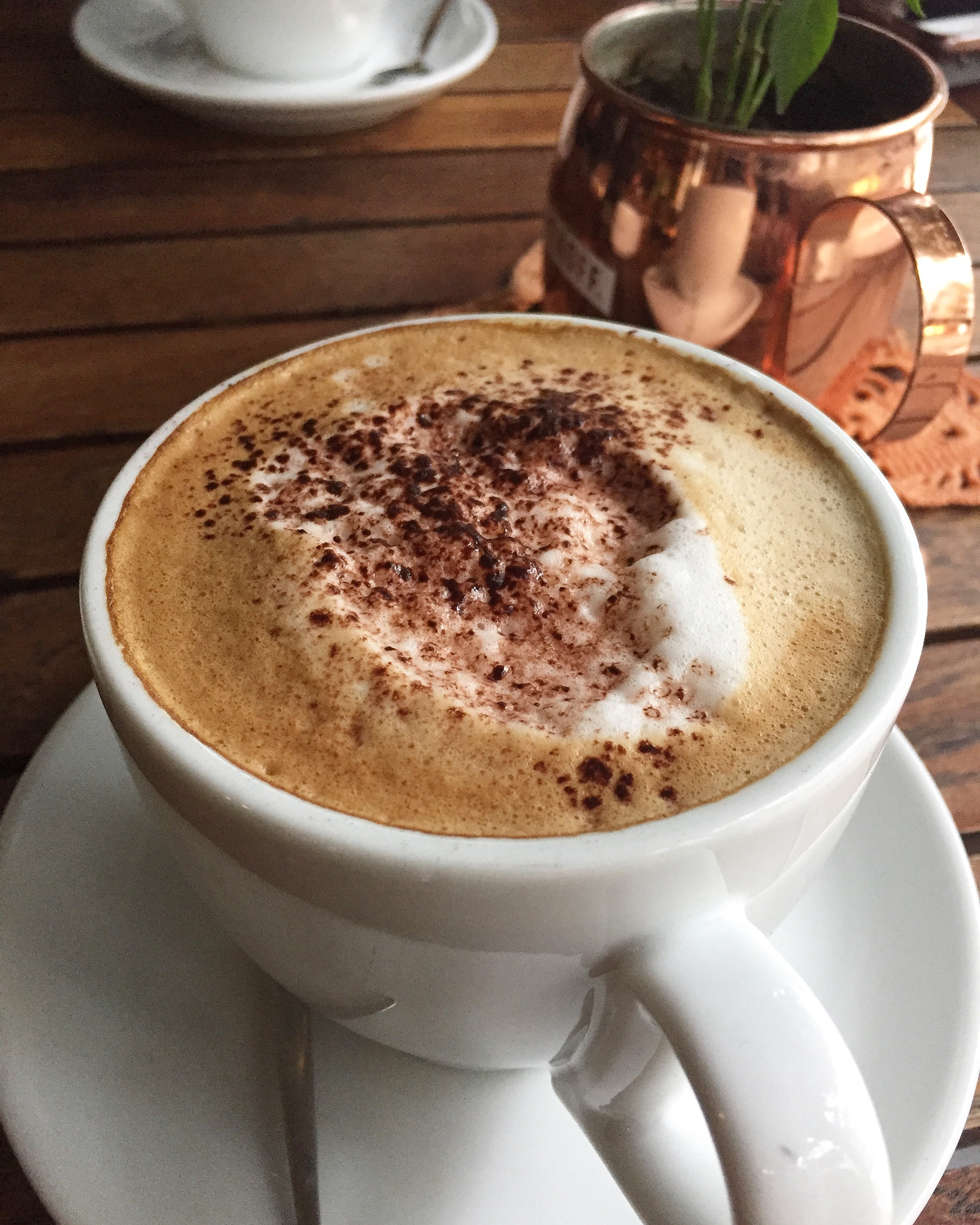
Snow started falling as we brewed the morning’s first cups of coffee on the stove using a traditional Italian Moka coffee pot.  Invented by Alfonso Bialetti in 1933, Italians readily accepted it as an easy way to make espresso at home, and it quickly became symbolic of “la dolce vita,” the sweet life and for us a pleasant morning ritual. The day before had been warmer, and bundled up we were able to take our coffee outside on the balcony of our fourth-floor Airbnb rental and enjoy a great sunset view.  This morning though, the tracks of the tram line melted through the thin blanket of freshly fallen snow and left two parallel lines, as if someone had drawn them on this new white canvas with a pencil.

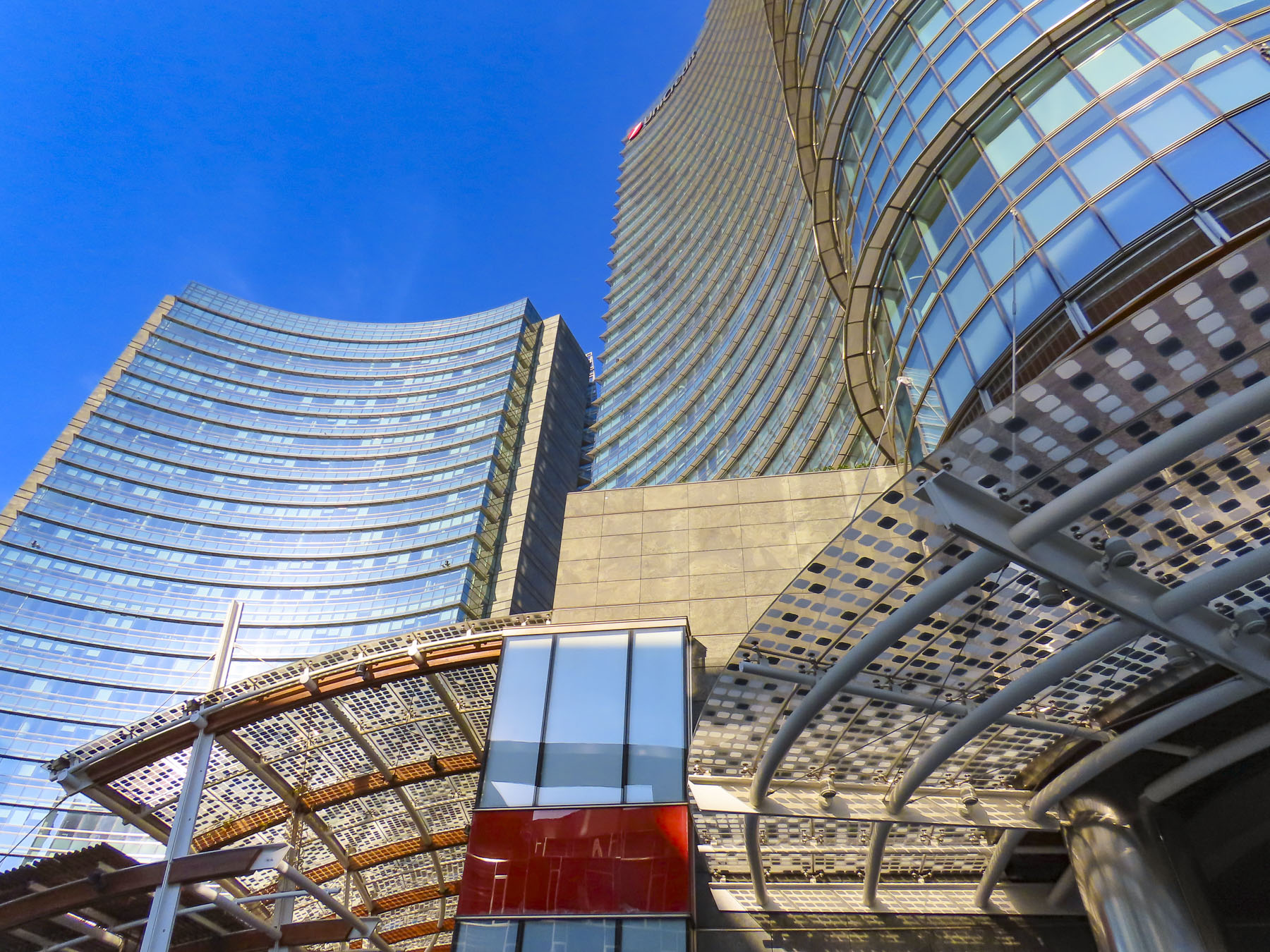
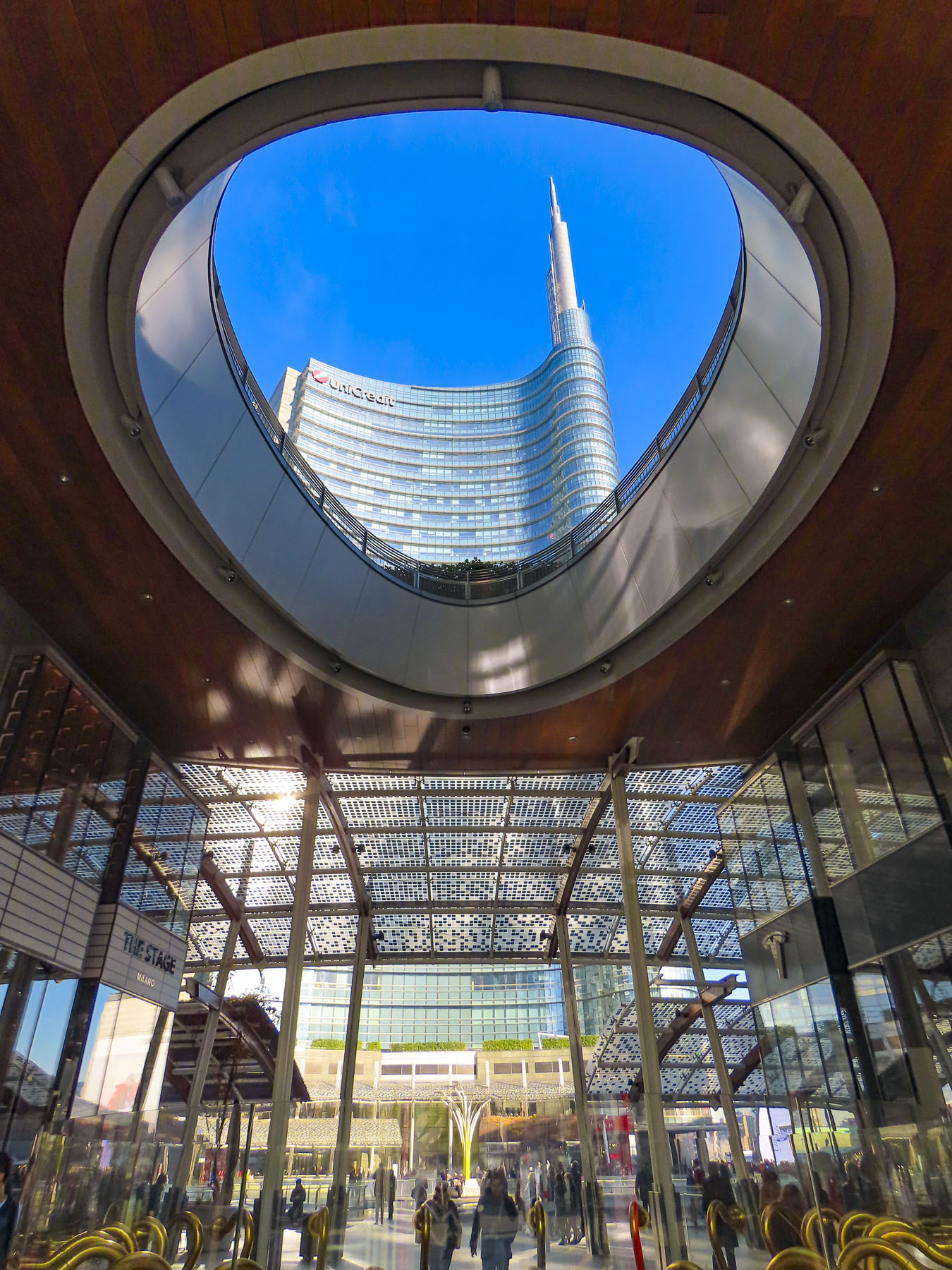
Continuing with our philosophy of slow, immersive travel, we had opted for an apartment in the Isola neighborhood.  Though far away from Milan’s city center, it was situated near the Porta Garibaldi train station and the recently built modern skyscraper complex that surrounds Piazza Gae Aulenti. The illy Caffè here was a frequent stop for comsmopolitan people-watching and excellent coffee.

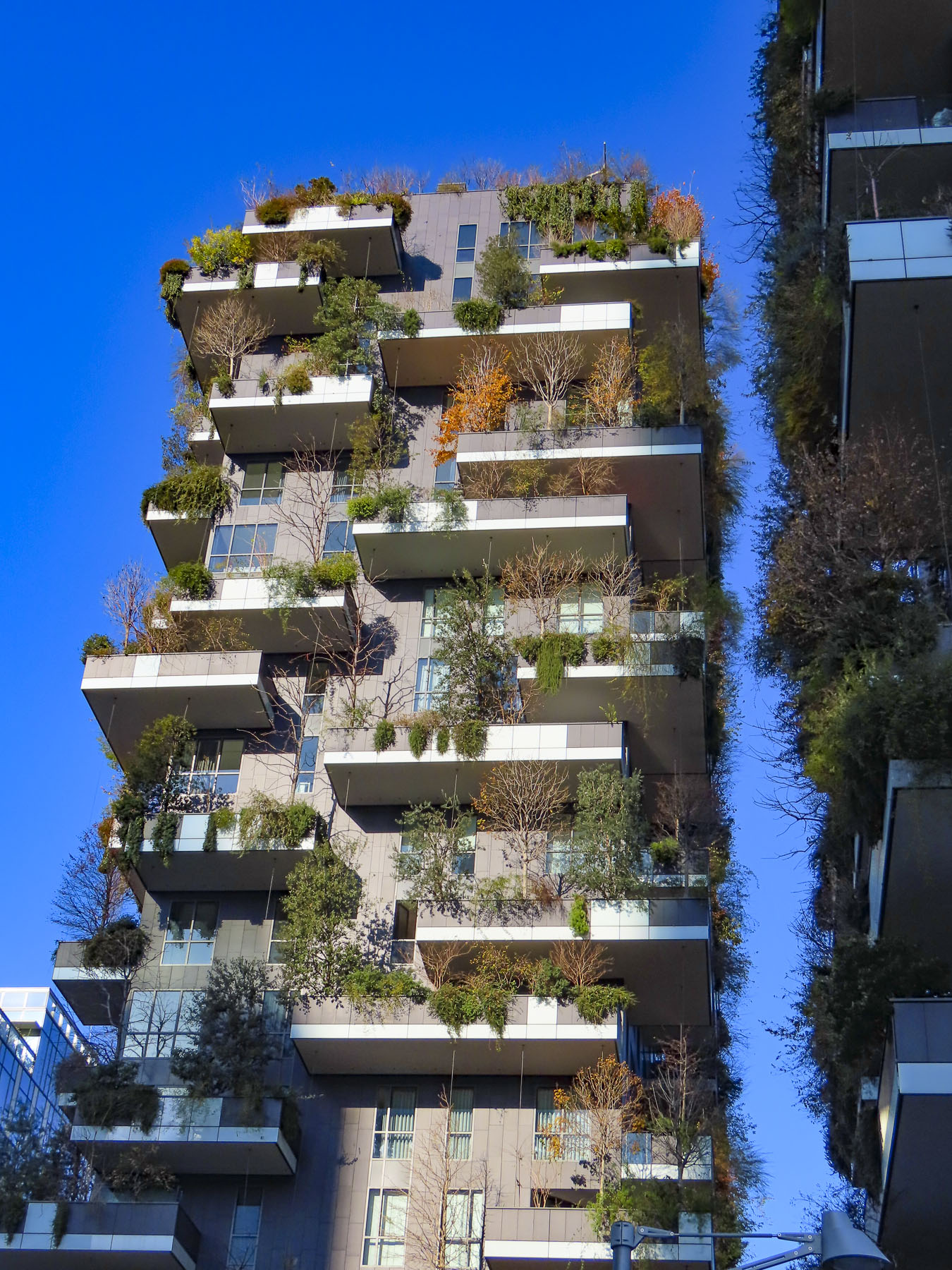
Nearby were the twin apartment towers of Boeri’s Bosco Verticale, Vertical Forest, famous for their lush foliage-covered balconies, and the Isola and Zara subway stations. The latter was only seven quick stops from the Milan Duomo.
The neighborhood also had numerous tram lines traversing it, but it was impossible to find a hardcopy map of this very extensive system while we were in Milan, though we were able to find this online map of the Milan Tram System while writing this. Ultimately, we relied on our phone’s mapping App to view our tram trips in real time and determine where to change lines to continue our journeys across the city.

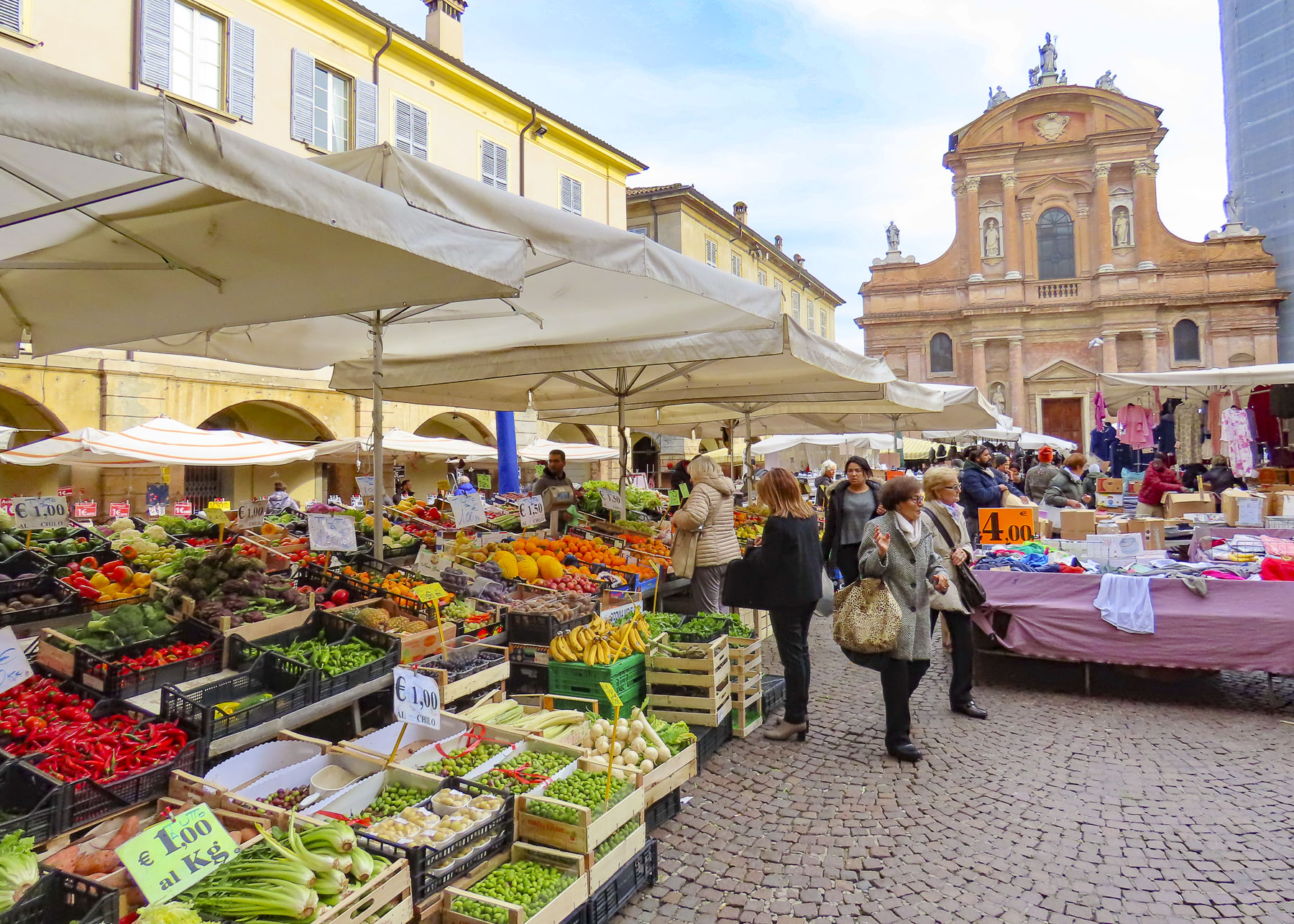
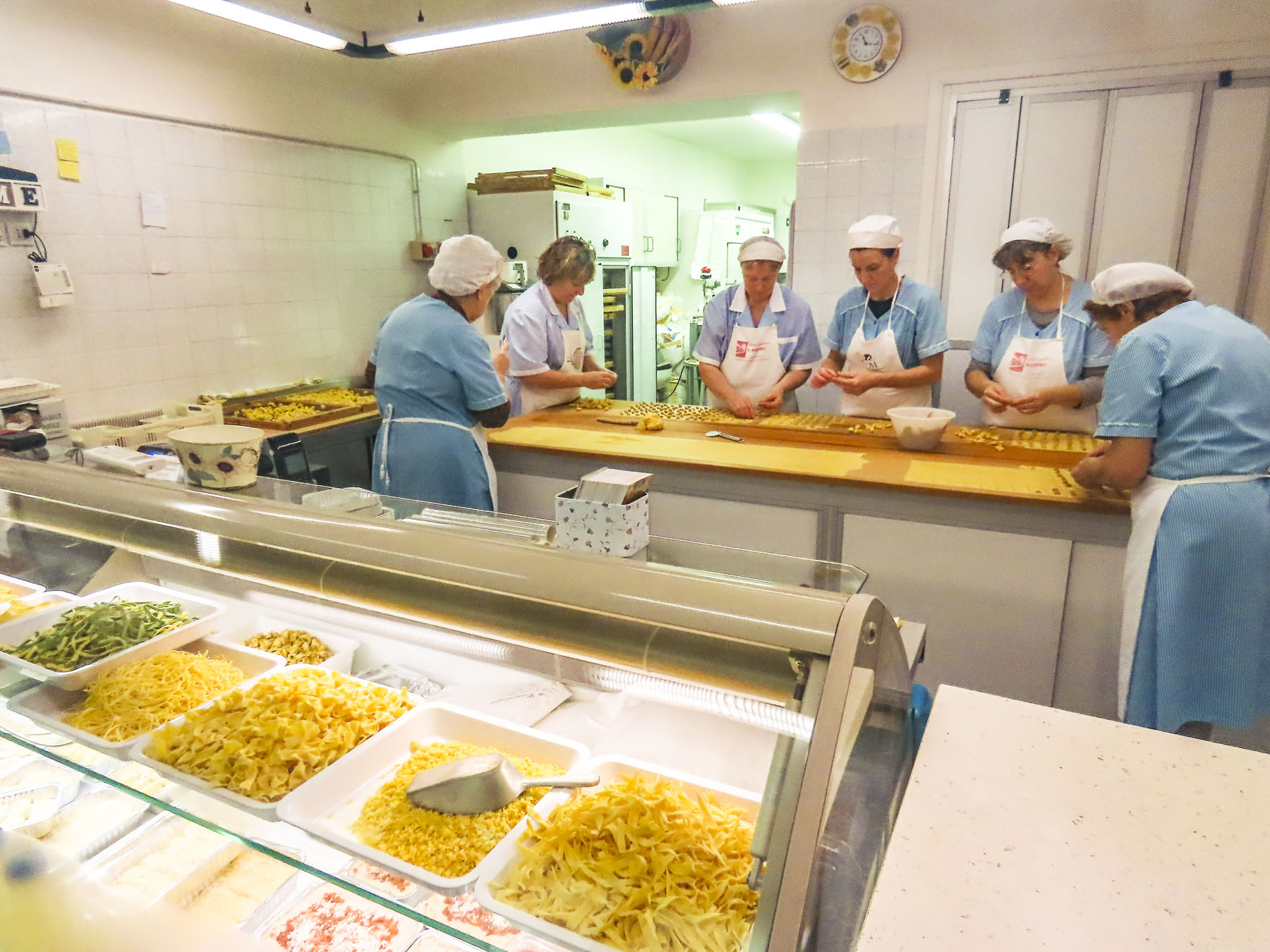
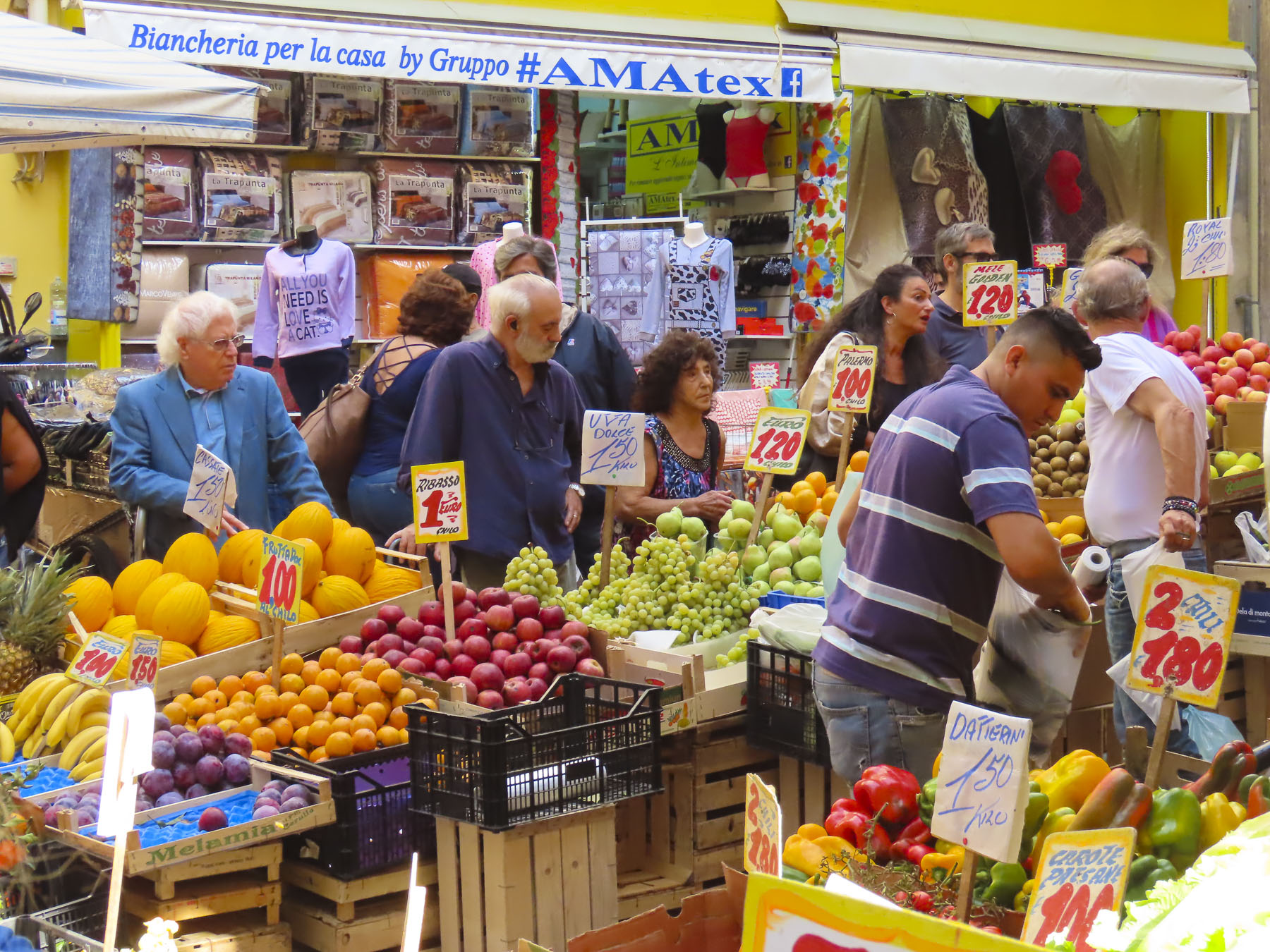
Two blocks away, the bi-weekly outdoor food market closed the streets around Piazza Tito Minniti for the bulk of the day while families shopped the stalls for fresh vegetables, cheese, meat and seafood along with socks, pants, dresses and blouses. We enjoyed this aspect of Italian life after learning its subtle nuances – for example, only the vendor touches the fruits and vegetables. There is also a protocol of queueing. Sometimes though our schedule required us to shop around the corner at La Pastaia for fresh pasta or the Penny Market grocery store, where we signed up again for another shopper club card.  We’ve done this in every city where we have stayed long term – Cuenca, Antigua, Lisbon, Cape Town and Kotor. It seems silly, but those small savings do add up and jokingly it helps us feel more like a local.

Emerging from the darkness of the subway station onto the Piazza del Duomo, we were momentarily blinded by the bright sun reflecting off the monumental cathedral that towered before us. Breathtaking in its size and capable of holding 40,000 worshippers, the cathedral is the second largest in Europe, following Saint Peter’s Basilica in Vatican City, and the third largest in the world.  Designed in 1386, the ornate and dramatic Gothic façade of the cathedral is covered with 3,400 statues and spires, which required the recruitment of hundreds of stone masons and artisans from across Europe. 

The opulent exterior belies the cathedral’s spartan interior.  While massive in scale, the interior’s gray stone walls and towering columns are cold and austere even with the soft, filtered light of beautiful stained-glass windows illuminating the space. Most moving was a ghastly sculpture by 16th century Italian sculptor Marco d’Agrate of Saint Bartholomew holding his flayed skin, depicting how he was punished for converting an Armenian King to Christianity in the first century AD.

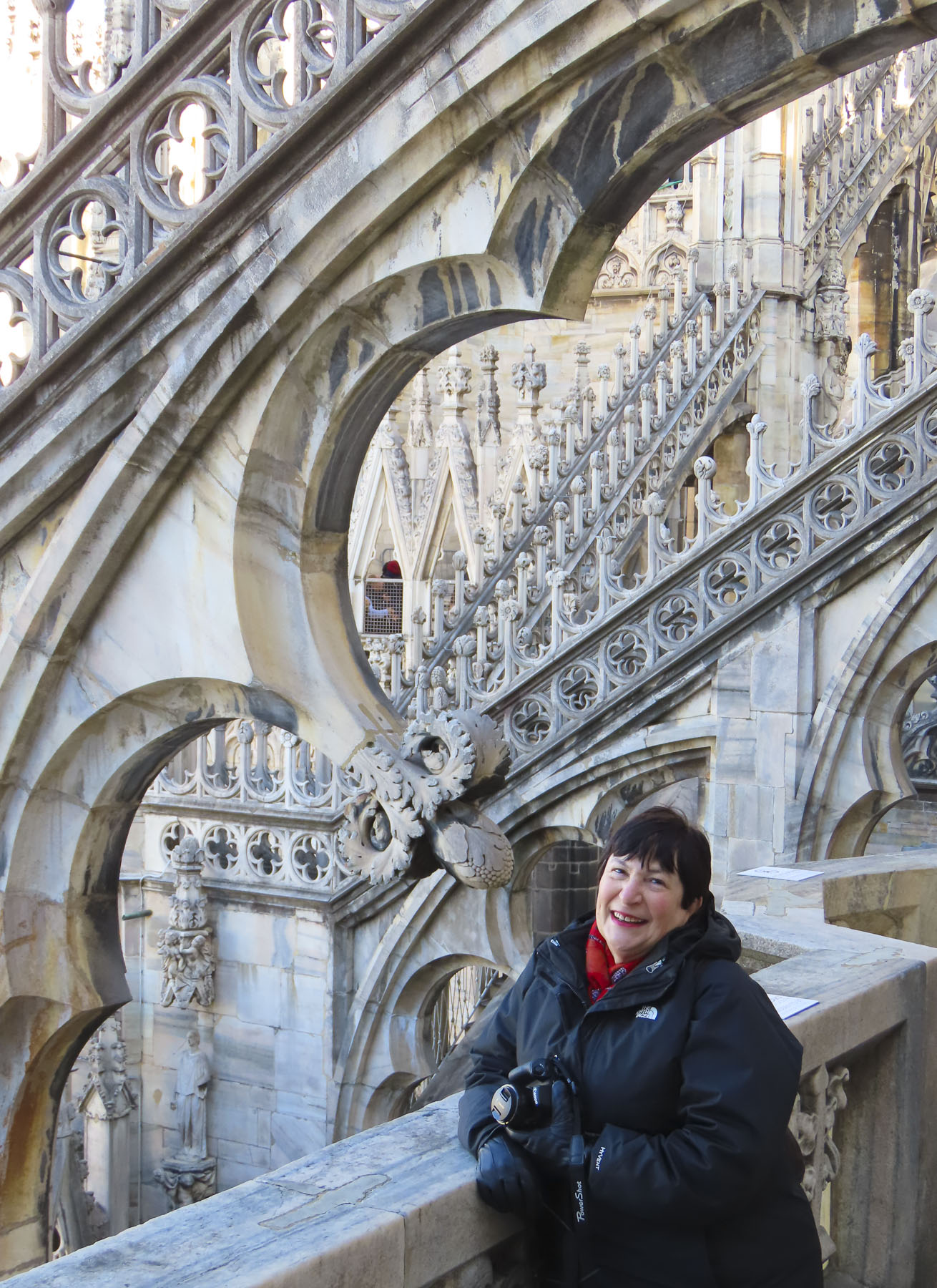
Wandering around the flying buttresses and sculpted spires on the roof of the church was the highlight of our visit to the Duomo. The day was crystal clear, and the panoramic view stretched from the Milanese skyline to the snowcapped Italian Alps. It was spectactular.

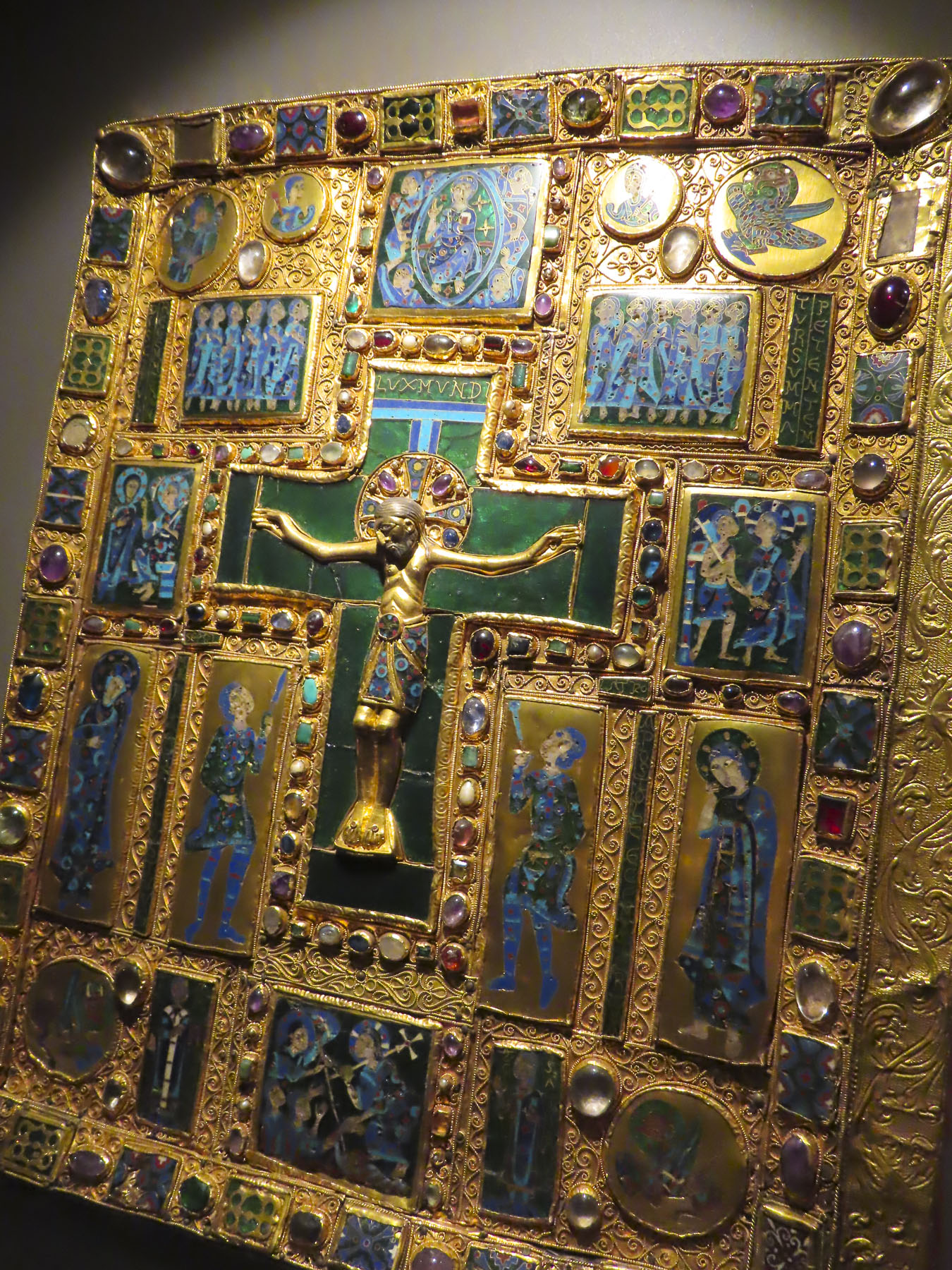
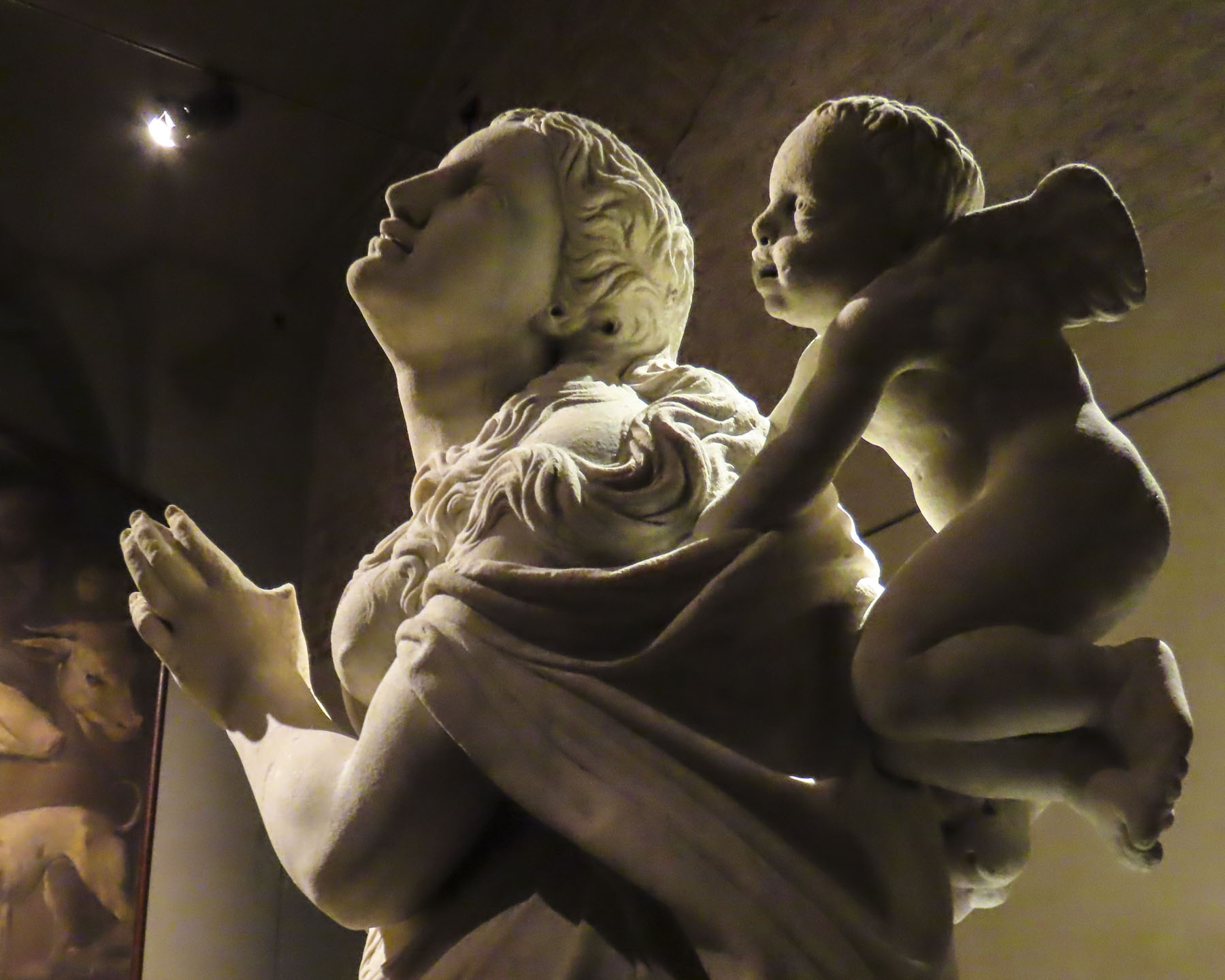
Across the plaza the Museum of the Milan Cathedral has an extensive and interesting collection of art and sculpture that at one time or another was part of the Duomo.

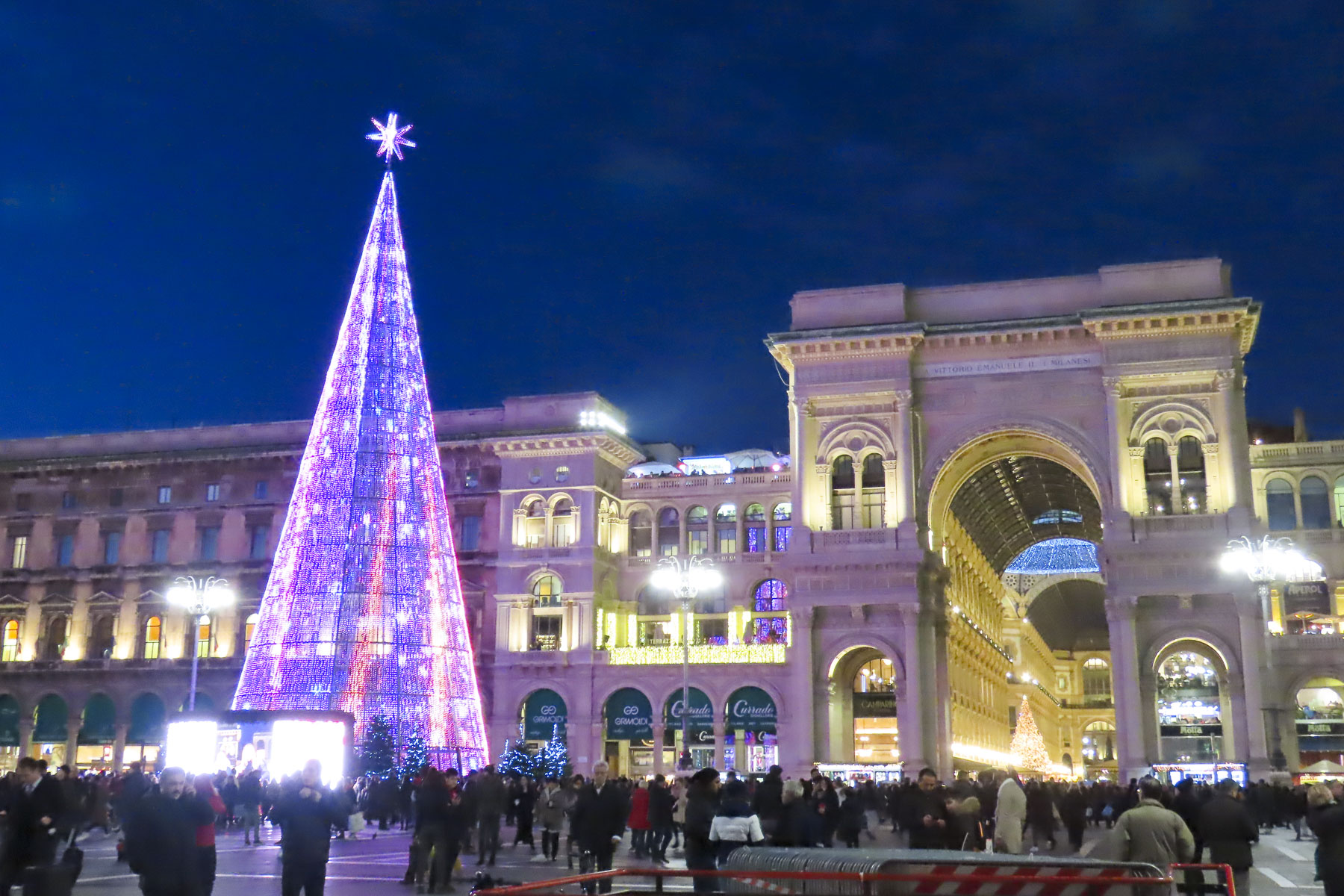
On the other side of the plaza stood Milan’s official Christmas tree, a modern conically shaped metal structure covered with thousands of multi-colored changing lights. Beyond the tree was the famous Galleria Vittorio Emanuele II, where four-story tall buildings and the promenade between them are covered with a spectacular vaulted glass ceiling.  It is considered the world’s first indoor shopping mall, built shortly after the unification of the Italian peninsular into the Kingdom of Italy in the 1860s when Vittorio Emanuele II was named king.  Lovingly nicknamed “il Salotto di Milano,” or “the living room of Milan” by the Milanese, the phrase acknowledges it’s the place to meet friends and be seen.

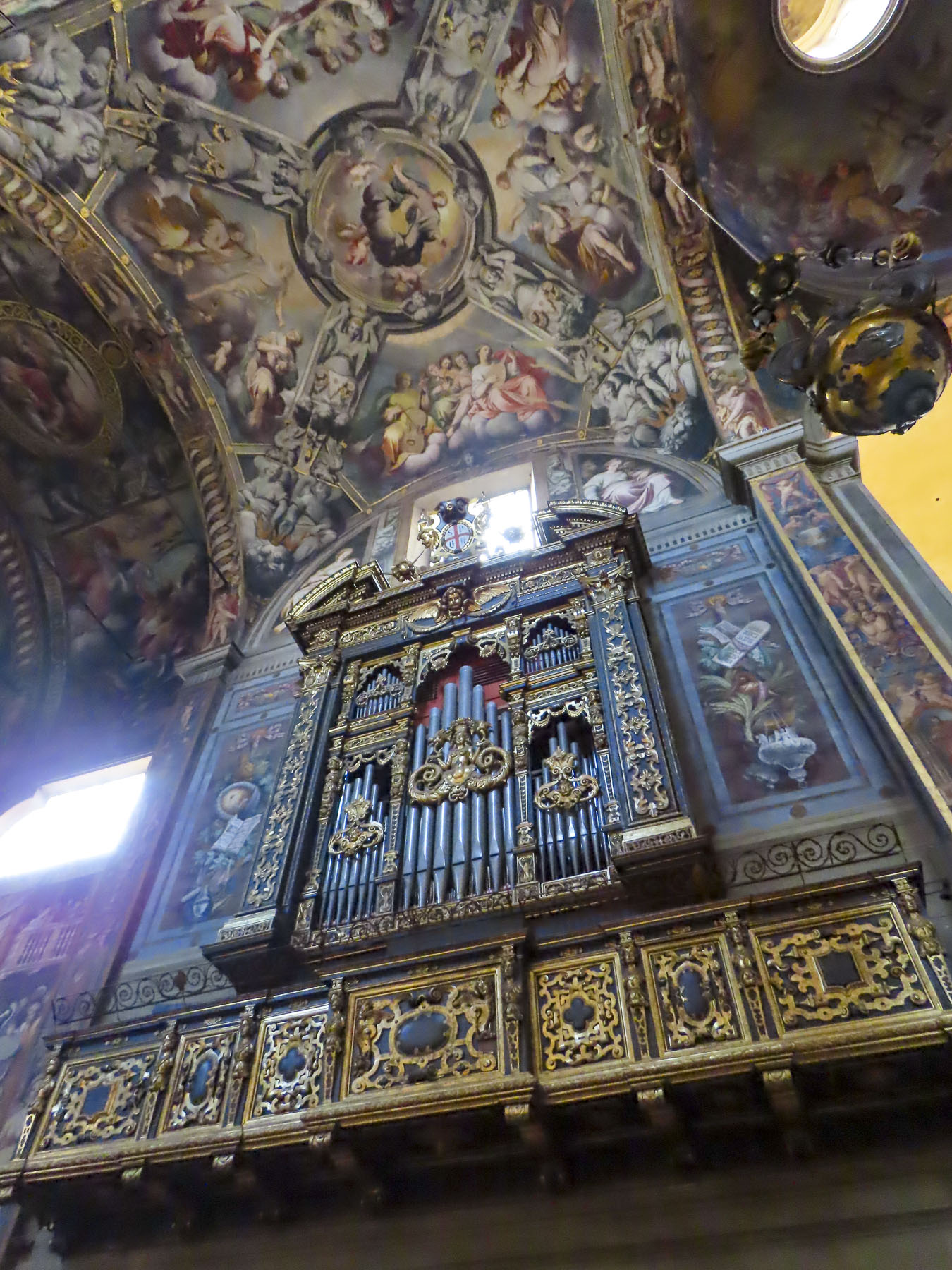
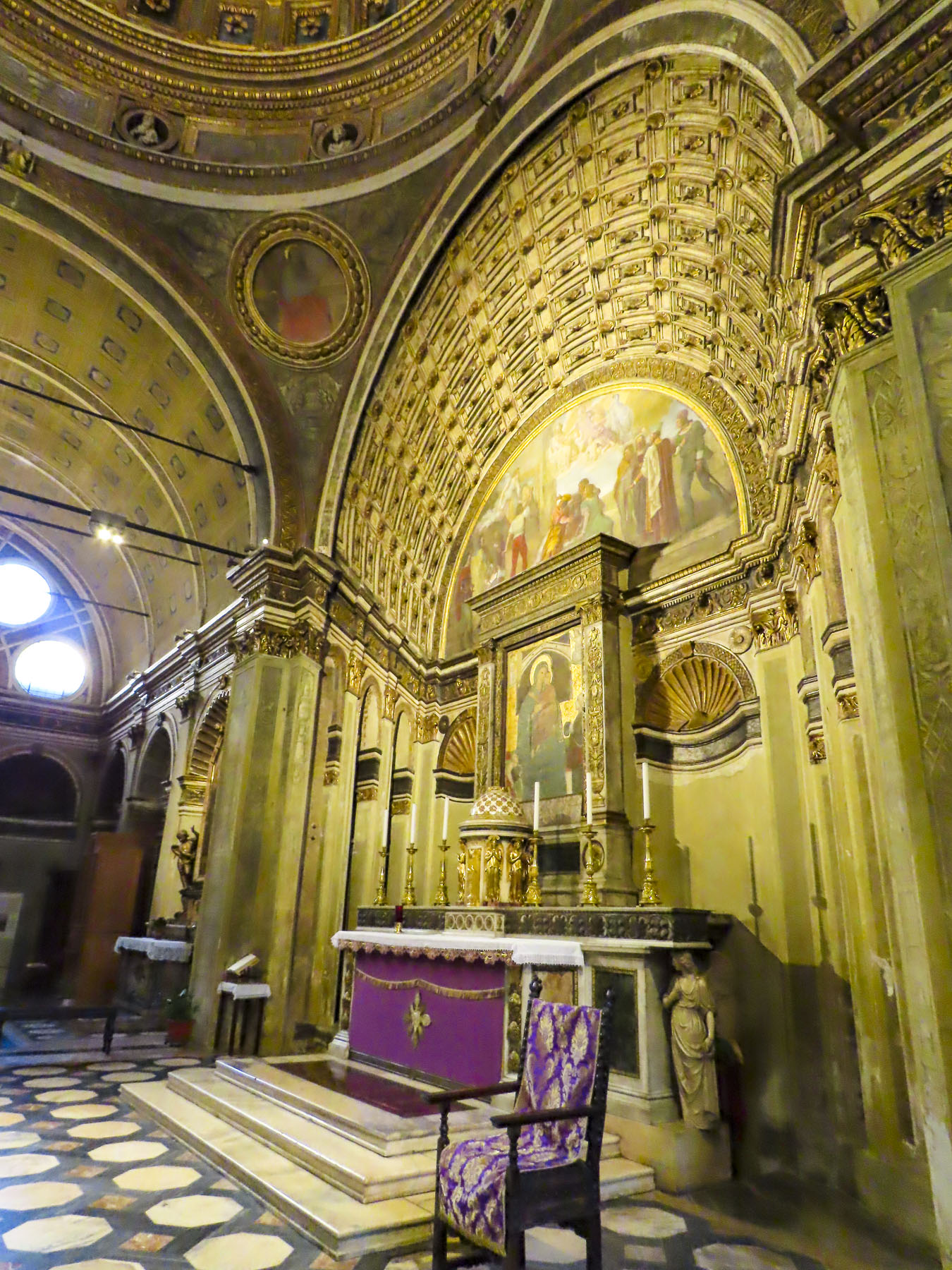
Wanting to stay in the city center till night fell, so that we could fully appreciated the Christmas lights on the tree in front of the Duomo, we wandered farther afield until we found the Chiesa di Santa Maria presso San Satiro. First built in the 9th century, the present church dates to the Italian Renaissance and  features a gilded interior and a rare example of Trompe-l’œil in a church. This painter’s effect utilizes a forced perspective to create an illusion of depth behind the altar.

After dark the plaza in front of the Duomo continued to fill with people eager to enjoy the festive mood of the Christmas season.  The Christmas tree was stunning, and its modernity nicely complimented the historic buildings surrounding the piazza.

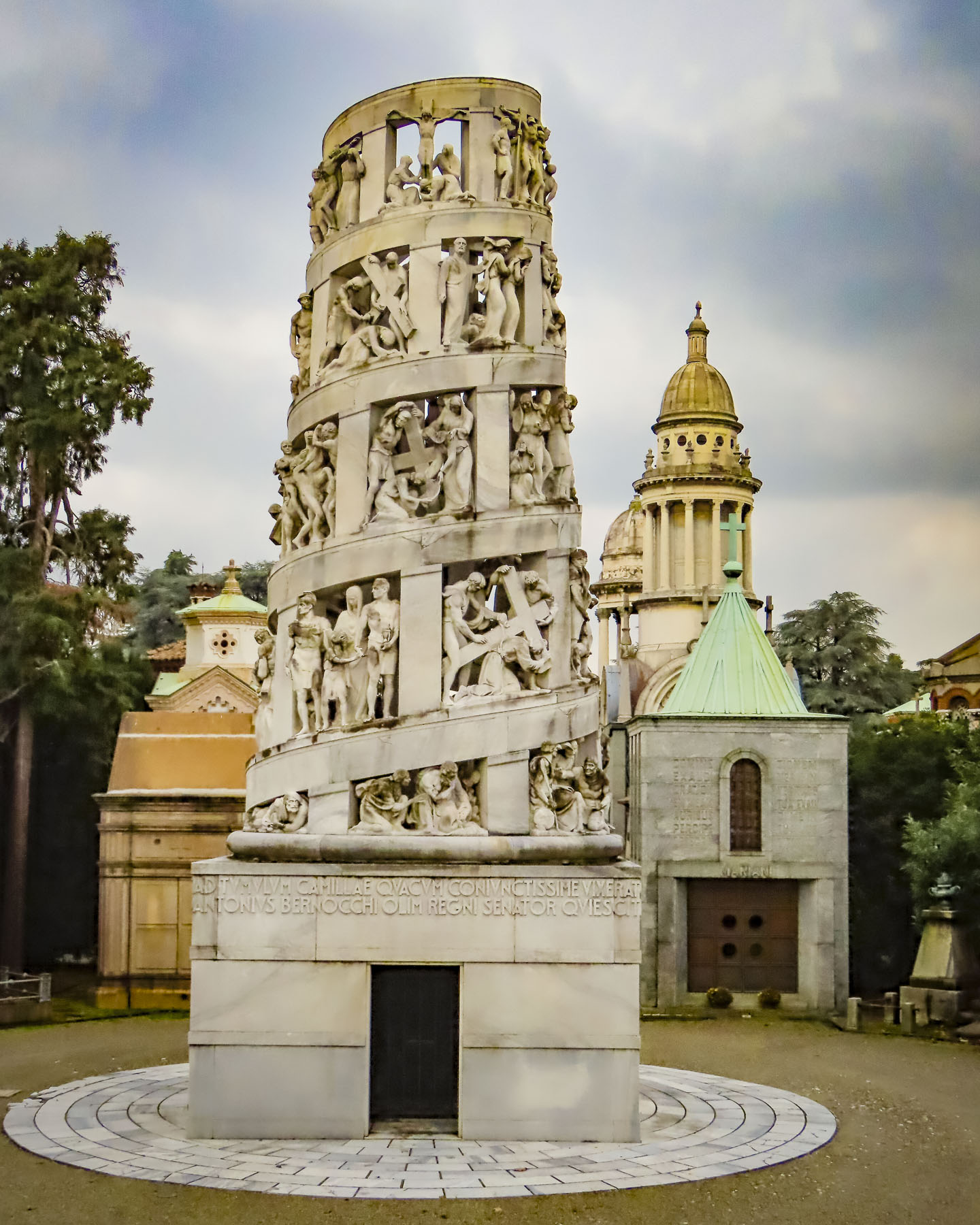
From our balcony we could see the silhouette of Tomba di Manzoni, the grand entranceway and “Hall of Fame” mausoleum for the noteworthy, though not as wealthy, Milanese who are interned at the Cimitero Monumentale. 

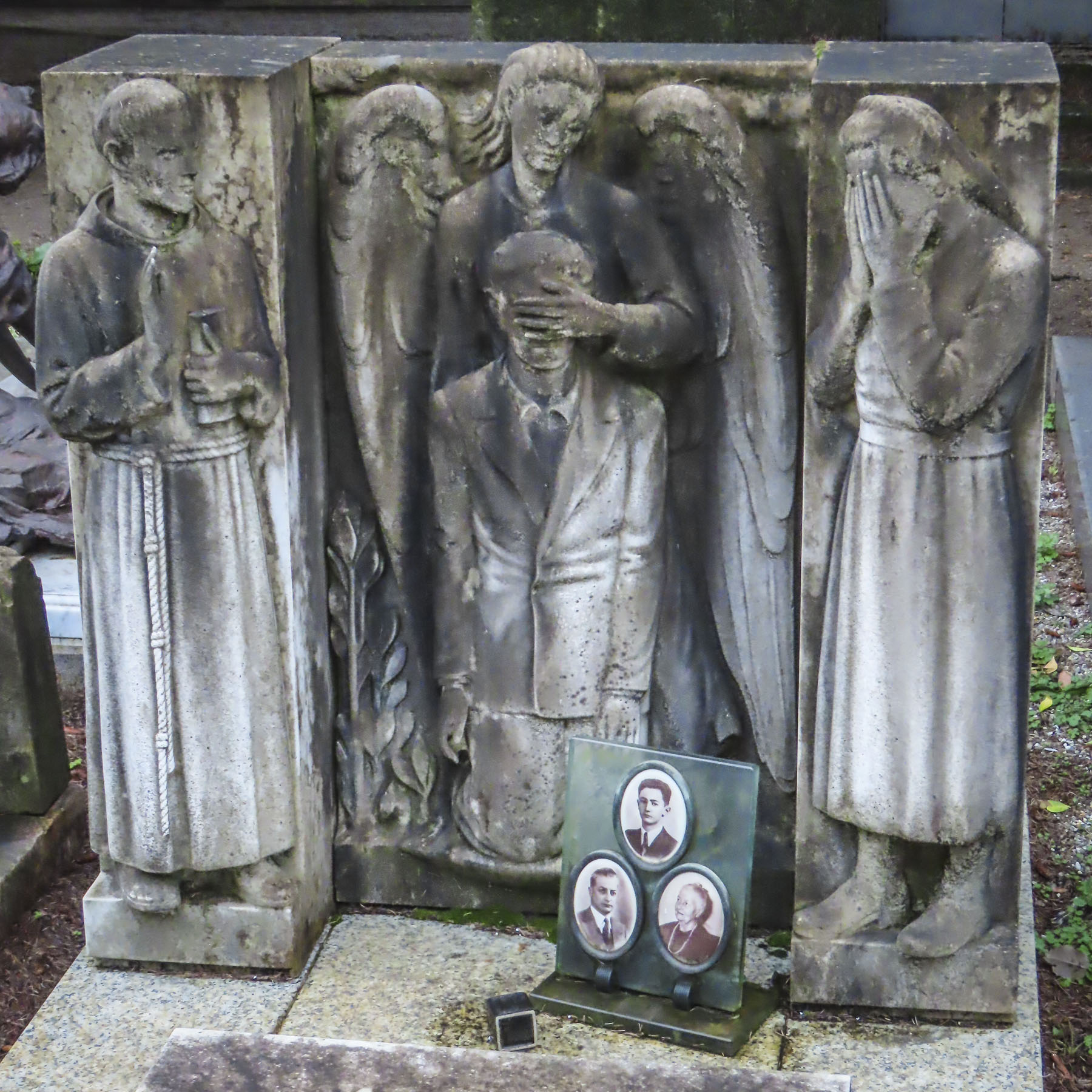
As we wandered farther into the cemetery, we realized that monumental might be an understatement. It was difficult not to confuse this extraordinarily extravagant place of entombment for an outdoor sculpture garden with memorials created by a who’s who list of famous 19th and 20th century Italian artists and architects for prominent Milanese families. 

The family names on the mausoleums also adorn roads, parks, tram and subway stations across the city. There seemed to be an afterlife version of one upmanship in play here with each monument more grandiose than the last.  As if competition or success in life was not enough and had to continue till your final committal.  It was a fascinating place to explore. Plan on spending most of the day.
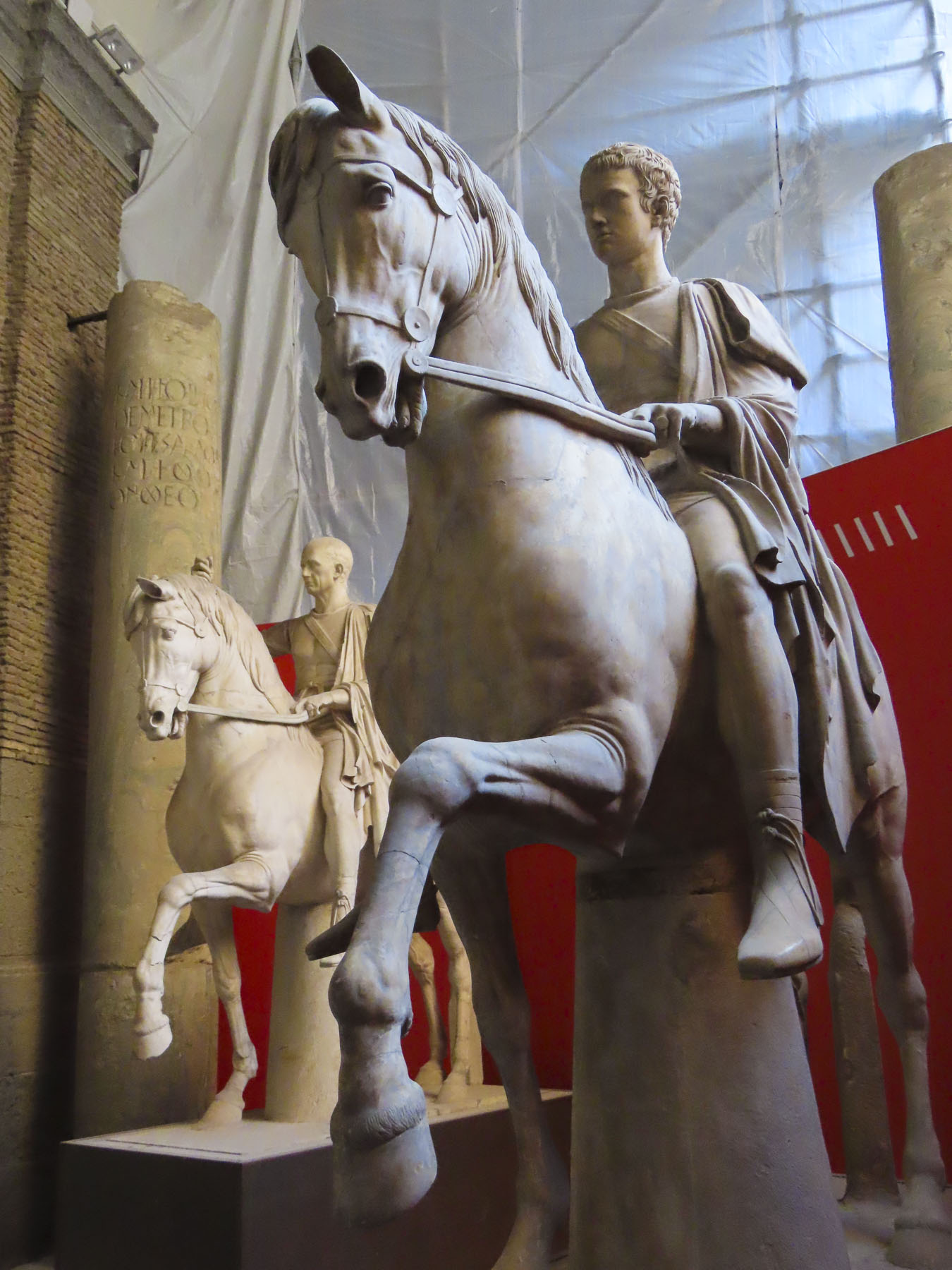
Donna’s mom had passed away the year before and one of our reasons for staying in Milan was to revisit a project her mother was instrumental in as a member of the United State’s Italian American Heritage Foundation and Leonardo da Vinci’s Horse Foundation. She helped for fifteen years in the 1980s and 90s to raise 2.5 million dollars to the see Leonardo da Vinci’s 24ft tall Il Cavallo recreated. The sculpture was finally realized by American sculptor Nina Akamu

Da Vinci was commissioned by the Duke of Milan in 1482 to create, at the time, what was the largest equestrian statue in the world, as tribute to his late father, Francesco Sforza.  The full-size clay sculpture was completed in 1491 and was waiting for its terracotta mold to be made and enough bronze amassed for its casting when the French invaded in 1499. Subsequentially, the clay model was totally destroyed by French crossbowmen who used it for target practice.
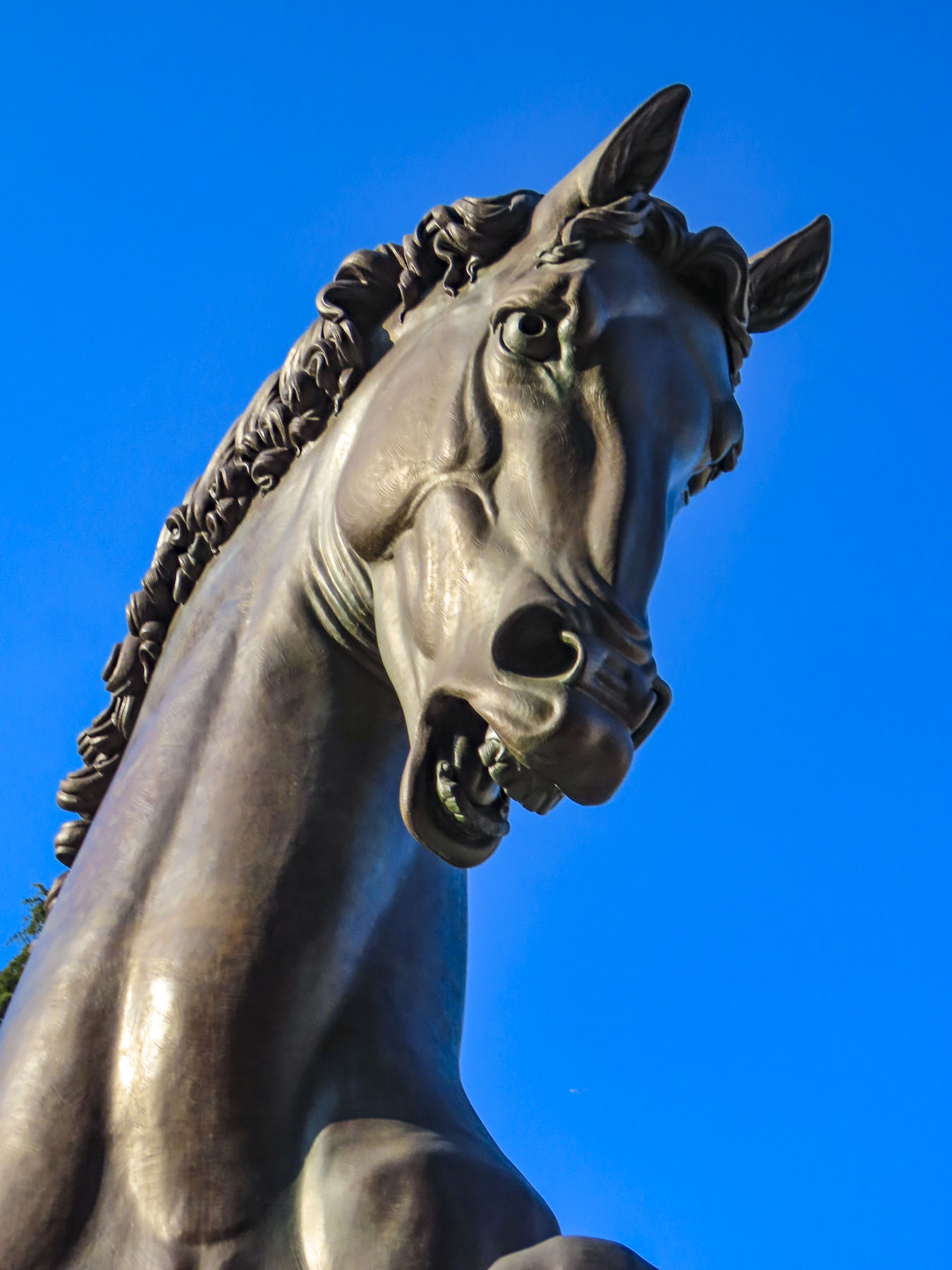
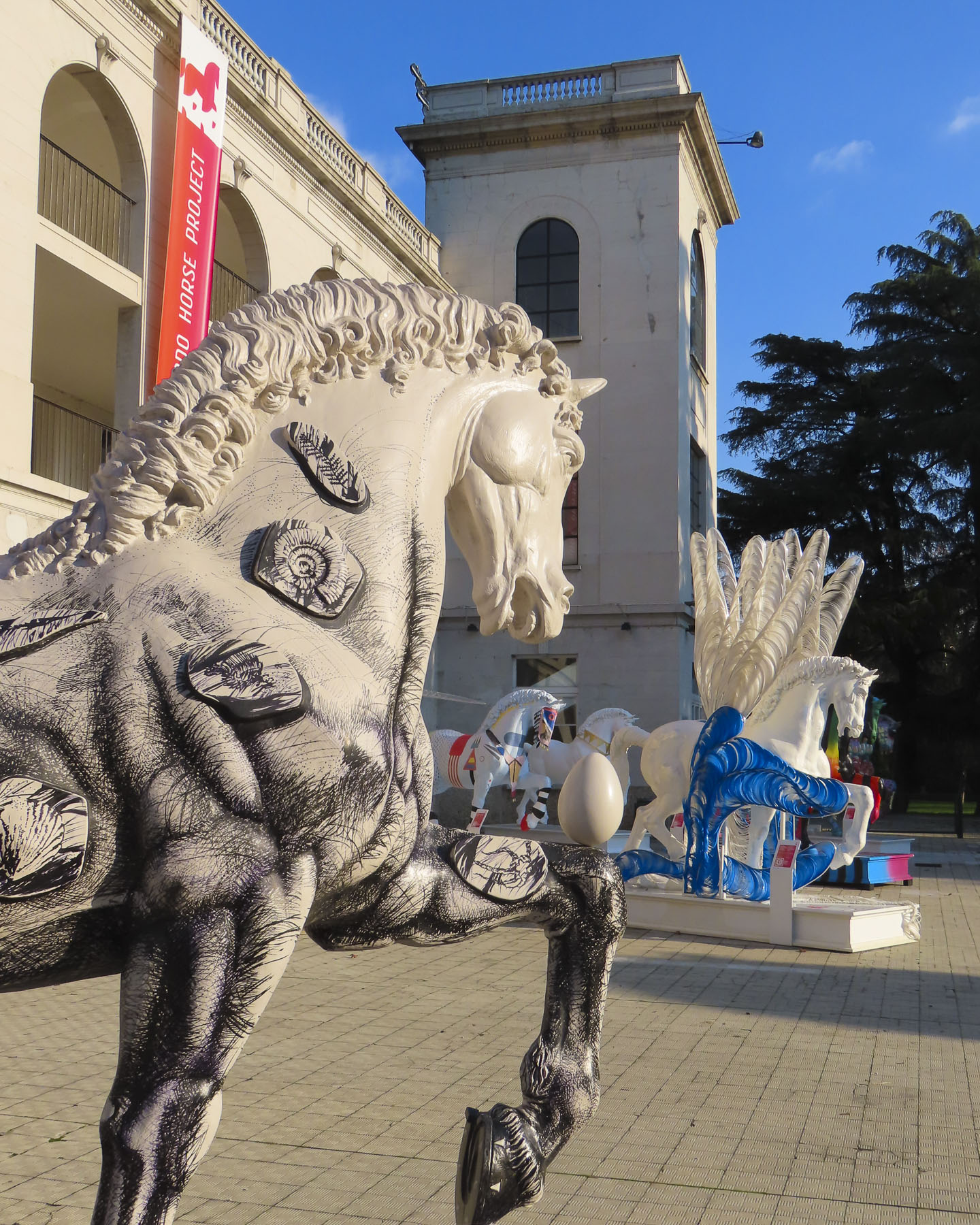
On its 500th anniversary, da Vinci’s Il Cavallo was unveiled outside the Ippodromo Snai San Siro, Milan’s famous horse racing track. Smaller artistic interpretations of Il Cavallo stand in the plaza behind it. This being modern Italy though a horse just can’t be a horse, and many were psychedelically painted and wore tutus or unicorn horns. Wonderfully whimsical, they definitely made us smile. 

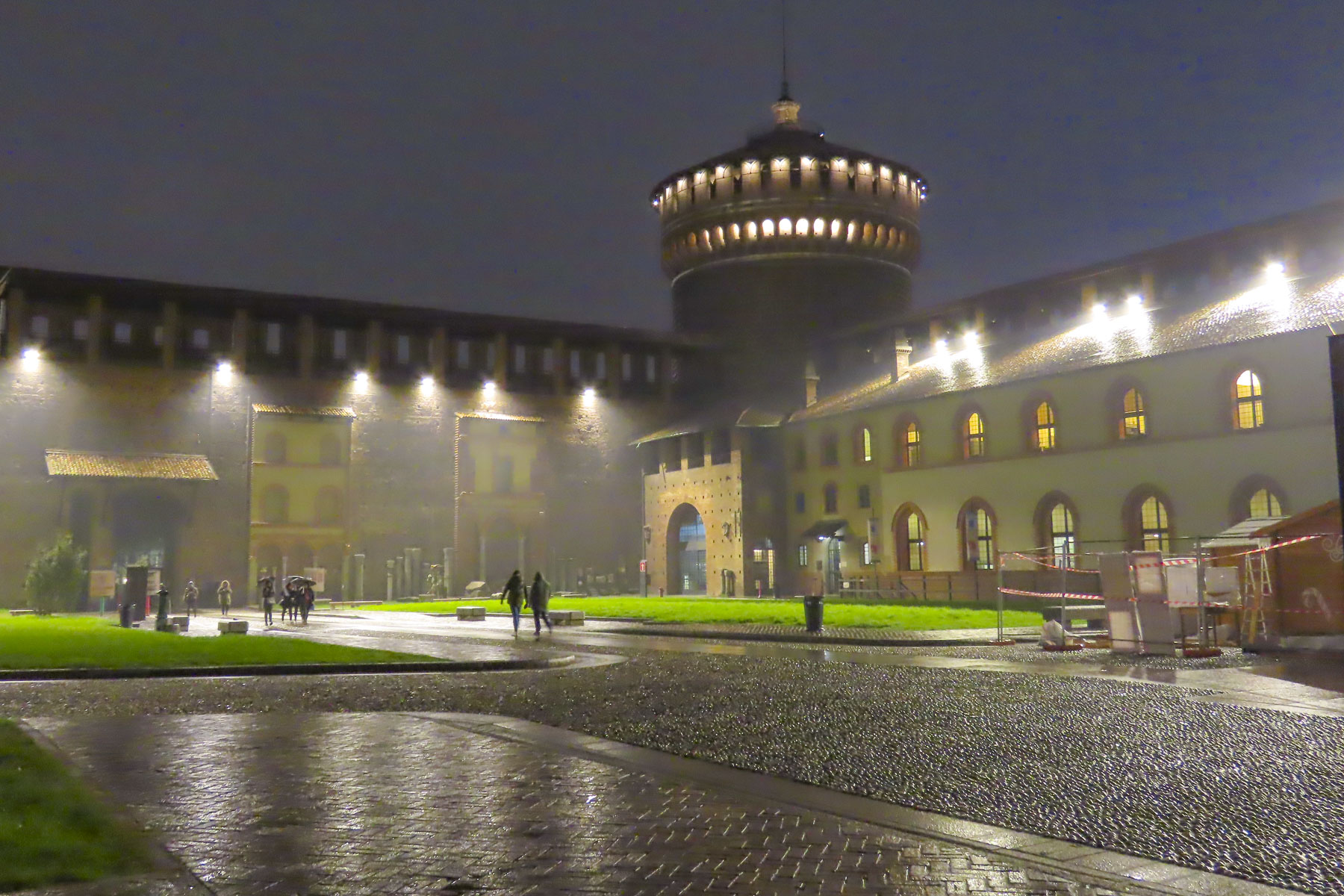
One rainy afternoon we took the tram to the 15th century Sforzesco Castle, seat of power for the Sforza dynasty that lasted only 100 years. But in that time the fortress/palace was expanded to be one of the largest citadels in Europe and filled with works of art by numerous Italian Renaissance artists.  Leonardo da Vinci, Michelangelo, Bramante, Correggio, Bernardino Zenale and Bernardino Butinone were commissioned to adorn the walls and ceilings and sculpt pieces to fill the vast space. Today the castle houses several of the city’s museums and art collections where the artists’ contributions to the palace can still be seen. A heavy fog had blanketed the citadel by closing time and was evocative of the moods cast in the historical fiction novels set in Renaissance Italy by Sarah Dunant. Later that evening we attended an Anglican Lessons and Carols service as a prelude to Christmas, then headed back to our apartment humming Christmas tunes as we window shopped.
Signs for Artigiano in Fiera, the Fair, dotted our route into Milan when we first arrived from Bergamo and piqued our interest.  We hadn’t heard of it before, but with a quick internet search realized it was the shopping event of the Christmas season in Milan. While in line to enter the center we noticed many people pulling large suitcases. Toward the end of our shopping spree, laden with purchases, we realized the bags on wheels were pure genius, and allowed the seasoned pros to carry their holiday shopping with ease. The Fiera is a tremendously popular annual, nine-day event that draws over one million visitors to the Fiera Milano, Europe’s largest exhibition center, located in Rho, just outside Milan. Folks shop for home furnishings, fashion, jewelry, arts and crafts, along with artisanal foods, wines and liquor. The sites’ nine cavernous exhibition halls were filled with vendors from 100 countries, though displays from the twenty regions of Italy occupied ninety percent of the space. Plan on spending the whole day if you hope to see everything. It was all very interesting and entertaining and truly a marathon event. From Milan it’s an easy trip on the M1 subway, which stops right at the venue.

Wanting to make our last night in Milan special, we made dinner reservations at a highly reviewed restaurant, only to be turned away into a rainy night because we arrived early as the staff was enjoying their pre-work communal meal together. (The later you dine out in Italy the more you’ll feel like a local. Though this does take some getting used to and we haven’t mastered this yet.) “Okay, we will have a drink at the corner bar and return,” we agreed.

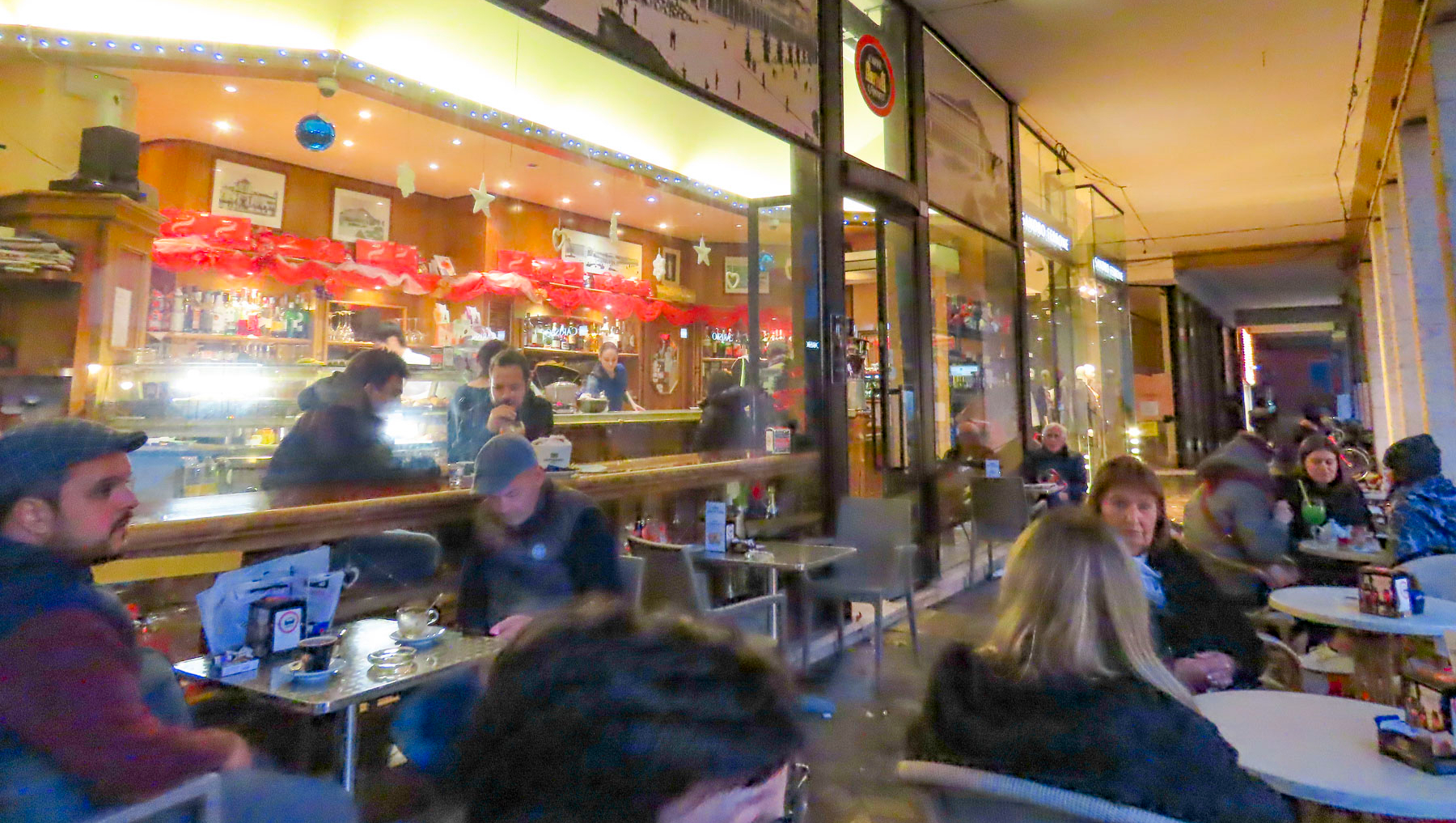
To our delight, our aperitives were accompanied by small sandwiches with chips and olives.  We had every intention of heading back to the restaurant, but our waiter was engaging, and the Aperol spritzes were very good. We spent the time watching folks fight the wind with their umbrellas through the bar’s rain-pelted window. The specular highlights from the streetlights added magic to the scene. Occasionally some groups popped inside seeking a warm reprieve from the downpour outside, shook out their umbrellas and found a seat.  Recapping our adventures, tentatively planning the next six months, and talking about Christmas with our kids back in the states, the evening flew by until the waiter said they were closing. Umbrellas up! We headed home.

Till next time, Craig & Donna

PS – The Artigiano was canceled in 2020 due to the Corona virus lock down in Italy. Hopefully, it will be allowed 2021.

Reggio Emilia – Fine Food and Ancient Alleys

Seemingly never-ending waves of softly rolling hills that we viewed from the towers of San Marino, up-close now, were verdant with the new growth of winter cover crops and persimmon orchards, heavy with their delectable late-ripening orange fruit. The landscape, a patchwork quilt of autumn colors and earth tones, dotted the countryside enroute to Reggio Emilia, like the brush strokes of an impressionist painting.

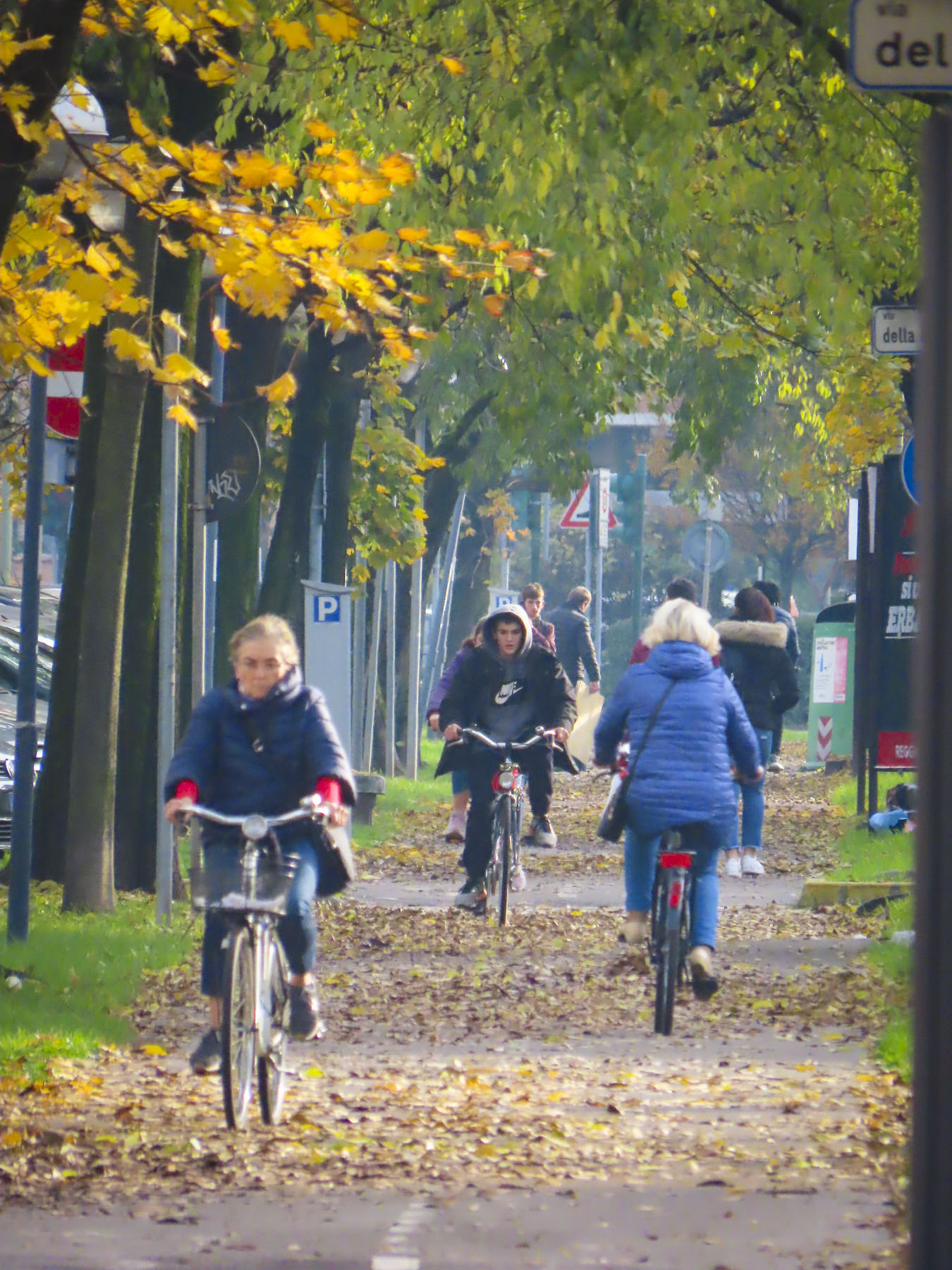
Still elegant nineteenth century villas now stand where Reggio Emilia’s ancient defensive walls once rose, until a surging population demanded city expansion in the late 1800s.  A wide boulevard lined with trees and a well-used bike path now follow its original hexagonal footprint around the bike friendly city.  Bicycling across the flat terrain of Reggio Emilia is a popular way to commute to the train station or work in the pedestrian-only historic center from outlying neighborhoods, and is supported with 125 miles of well-marked urban bike lanes.  Emilia-Romagna has set a regional goal of getting 20% of all commuters to bike to work and funding 2300 miles of dedicated bike lanes.

The Reggiani’s enthusiasm for bicycling dates back to the 1870s, when a hippodrome was part of Parco del Popolo, and continues today with fierce loyalty to area road-bicycling racing teams that compete in the historic Giro dell’Emilia that has coursed through Emilia-Romagna since the race was first held in 1909. Currently it’s an a 1.HC event on the UCI Europe Tour.

With the assistance of the receptionist at Hotel Posta we were able to park on the street, just outside the historic center, without a fee for a week. This is unheard of during high season, but it was a great savings for us that we fully appreciated.  Located in the center of the city on Piazza del Monte, across from city hall, the hotel is in the Palazzo del Capitano del Popolo, a historic building which was originally constructed in 1280 as a governor’s palace. For over 500 years, since 1472, the rooms under its crenelated roof have been used as a hotel.

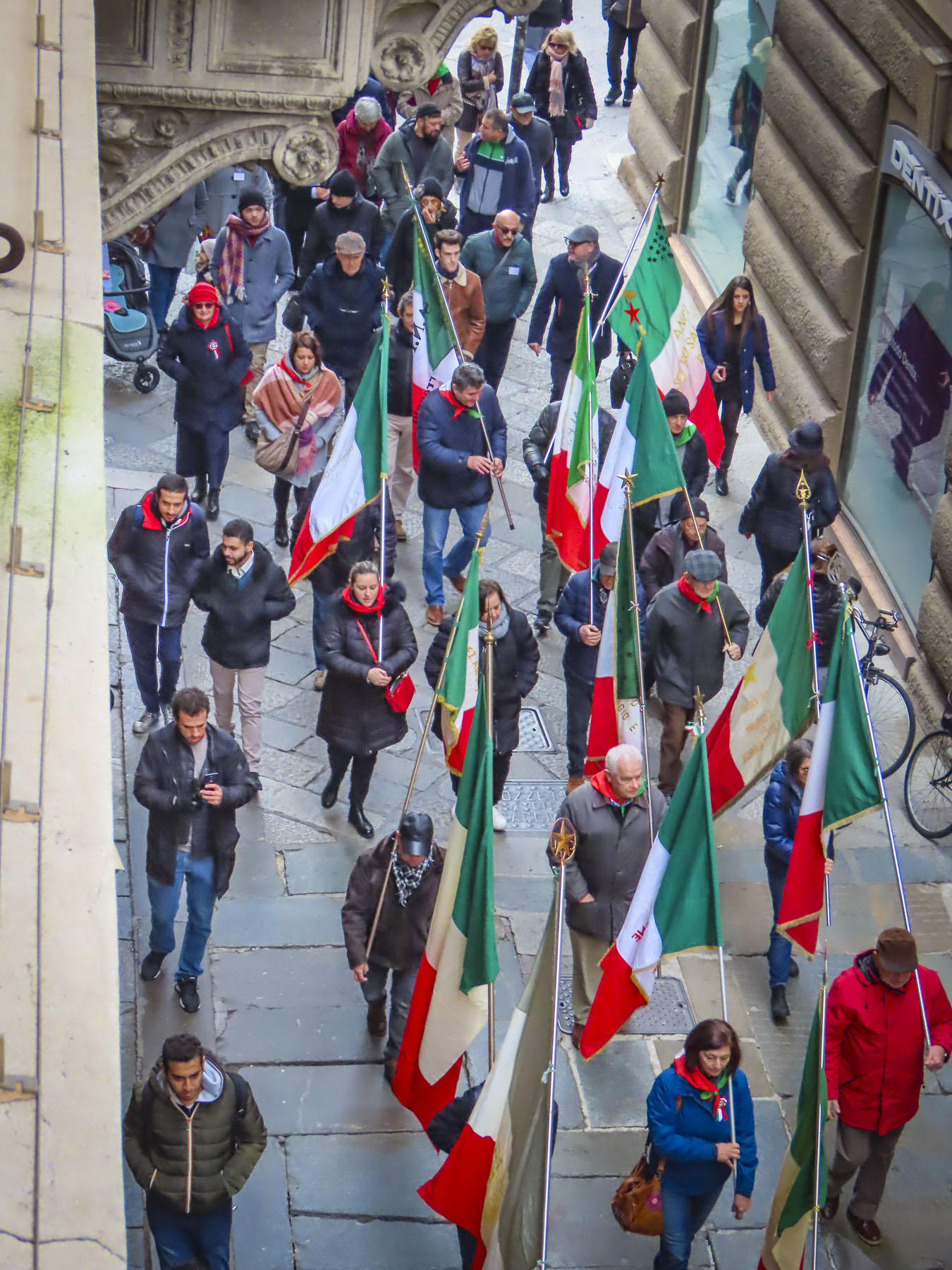
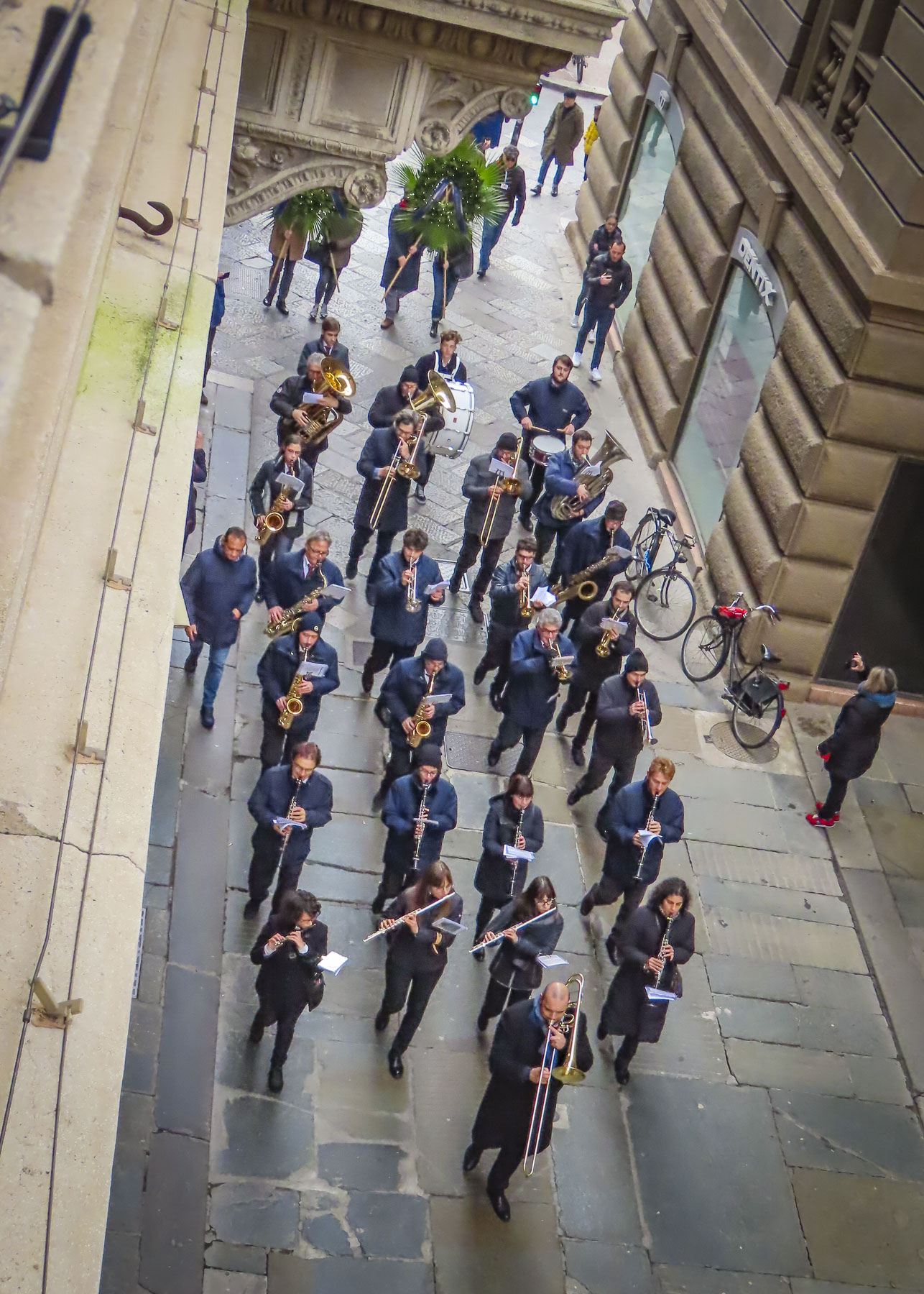
It has been renovated numerous times during the centuries, but still retains the old-world charm. The room rate was quite affordable in late November and we practically had the place to ourselves. From our window overlooking the piazza we watched the ebb and flow of Reggio Emilia pass below, highlighted by a teachers’ protest, a Christmas parade, and nightly buskers who took excellent advantage of the wonderful acoustics that the small plaza offered.

The city’s three large piazzas, Camillo Prampolini, Di Prospero, and Della Vittoria, are lined with historic buildings, churches and restaurants. During high season they would have been bustling with tourists and cafes tables would have nearly filled the squares.

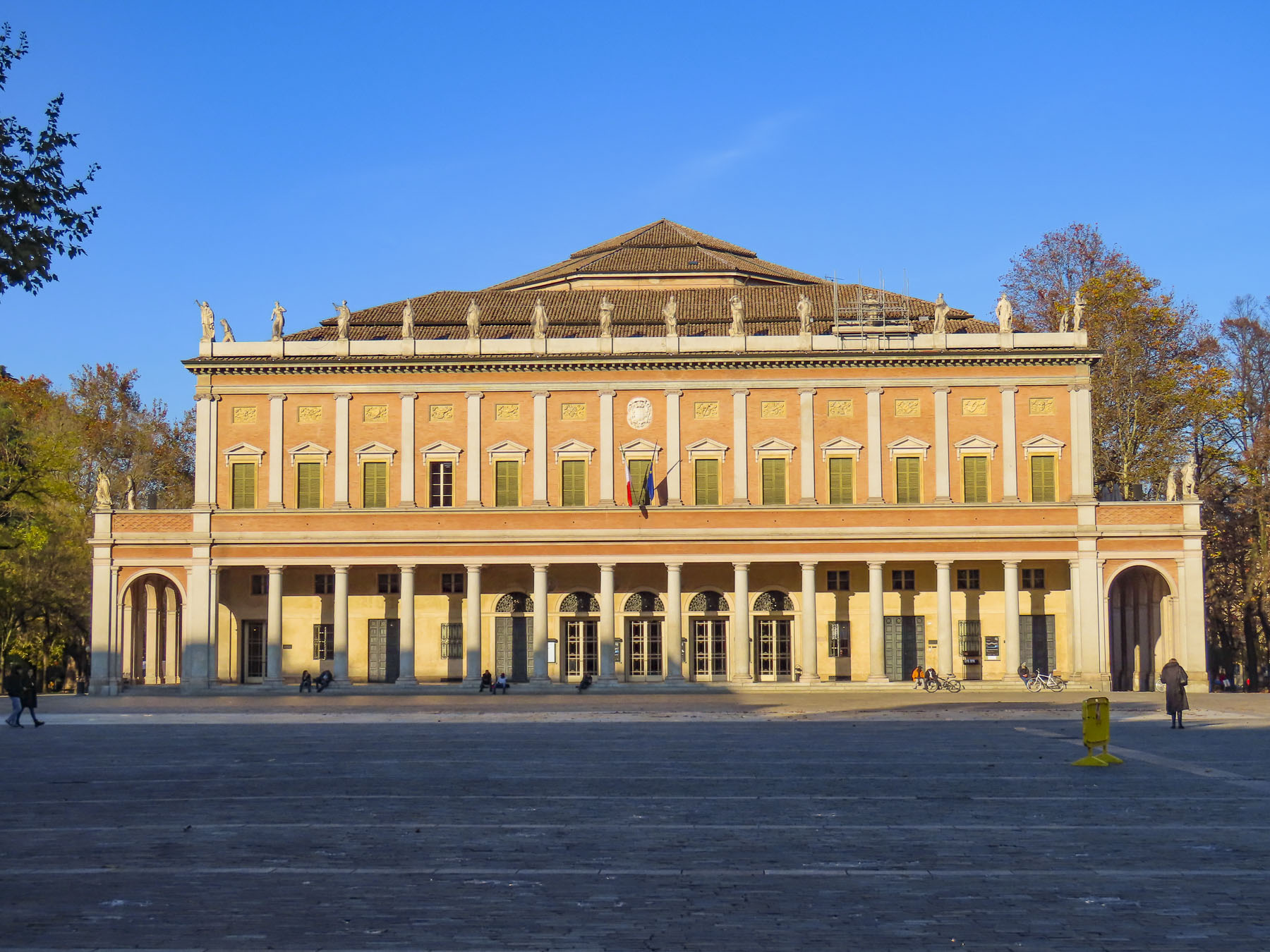
Now in late November, city workers were hanging Christmas lights from the lamp poles throughout the city and erecting a Christmas tree in Piazza Prampolini, while a large temporary ice-skating rink was under construction near the Romolo Valli Opera House. 

Bundled up against the chill now, only the hearty sat at the few tables left outside, though inside the cafes was not really much warmer. Good coffee and locally produced Lambrusco helped ward off the chill as we expanded our concept of “walk a little, then café,” during our wanderings between churches in this pleasant city. 

Cheese is our weakness and we delighted in every opportunity to try different aged Parmigiano Reggianos. (Longer aging produces a stronger or more flavorful cheese, with some cheeses aged up to 36 months for that intense flavoring.) Paired with a locally produced aged balsamic vinegar, it is a surprisingly tasteful combination.

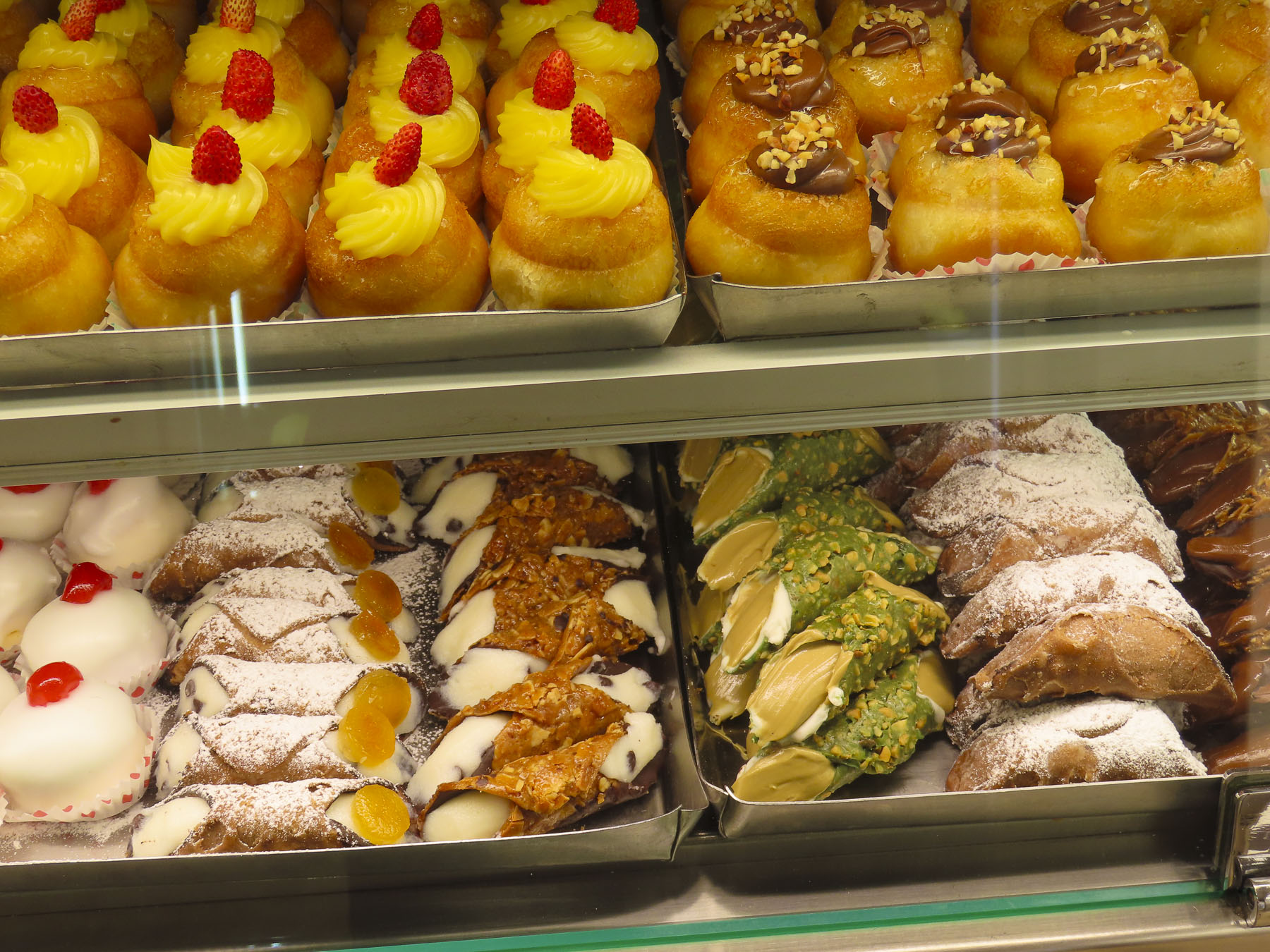
Oh, let’s just face it – Italian food is our weakness and we thoroughly enjoyed discovering the city’s cafes, bakeries, and restaurants as much as we enjoyed the city’s churches and museums.  Charcuterie boards, pastries and pasta tempted us repeatedly in this culinary temple of gastromic delights.  Here are some of our favorite places: Antica Salumeria Giorgio Pancaldi – always worth the wait for a table. Terme del Colesterolo – you have to love the name and their porchetta sandwiches. La Casalinga – a fresh homemade pasta store with super nice ladies who will stop what they are doing and make any tortellini or ravioli you request if the case is empty. Yes, we did buy some to take to our apartment stay in Milan. Dolce Charlottefor their savory and sweet baked goods. And Tabarin Osteria Popolare – even though they confused our order with the table adjacent to us it was still a wonderful dining experience.

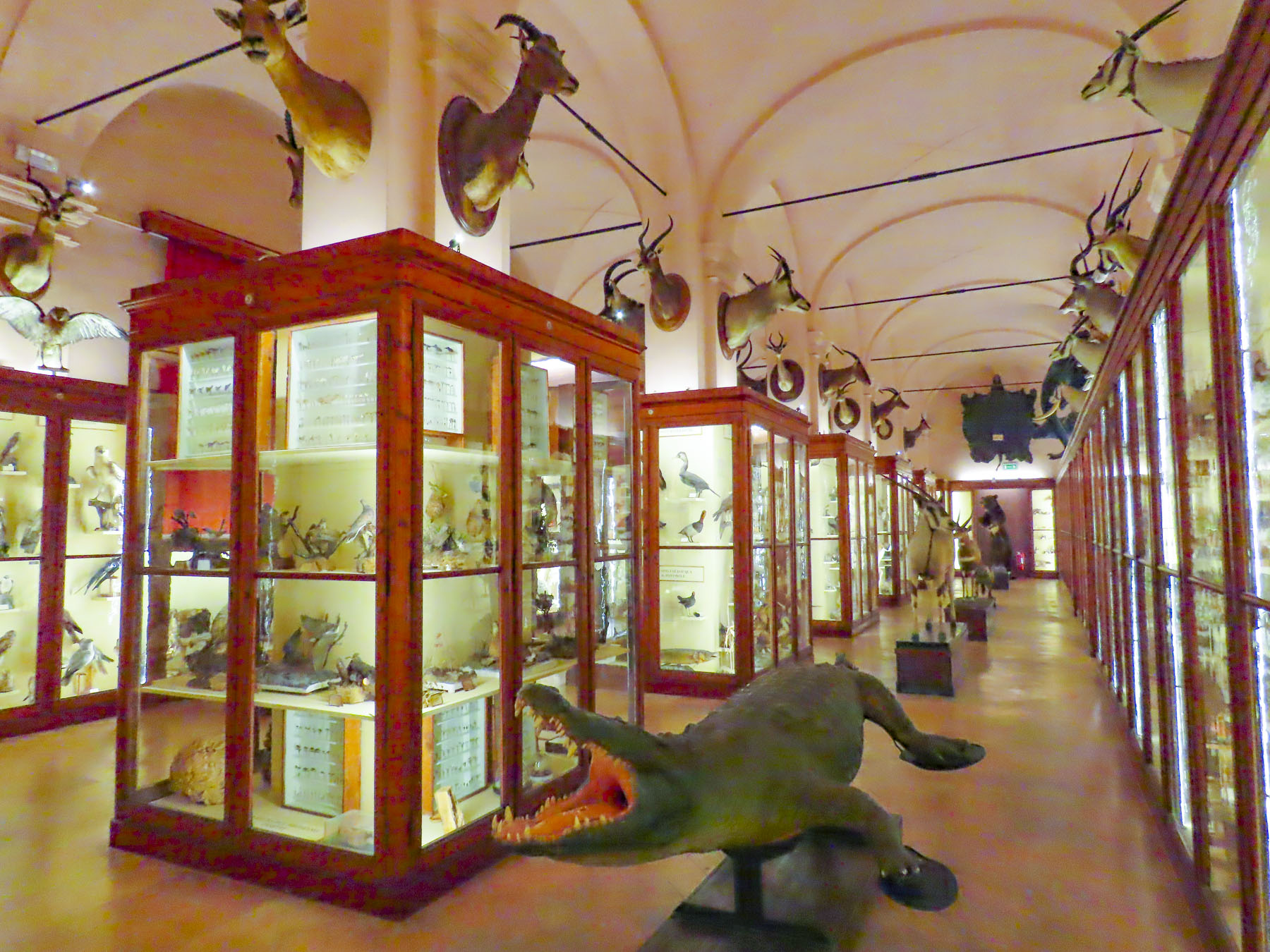
The Chiesa di St. Francesco stands on Piazza Della Vittoria adjacent to the Romolo Valli opera house. It was built in 1272 to support a Franciscan convent and monastery. The cloister was converted in 1830 into the Musei Civici di Reggio Emilia to house the private scientific and zoological collection of Lazzaro Spallanzani, an Italian physiologist (d. 1799) whose research into nutrient culture solutions advanced the scientific investigations of Louis Pasteur. 

It’s an amazing collection, still displayed as it was originally assembled, in now-antique wood and glass cases, evoking an earlier time.  There is also an extensive collection of regional archeological discoveries that was remarkably interesting.

On the Martiri del 7 Luglio 1960 plaza in front of the museum, (named for five workers killed by police during protests against a neo-fascists political party there on July 7, 1960) there is a moving commemorative monument to the 615 Reggio Emilia Resistance Fighters, both men and women, who made the ultimate sacrifice during WWII, fighting the German Army that occupied Italy.

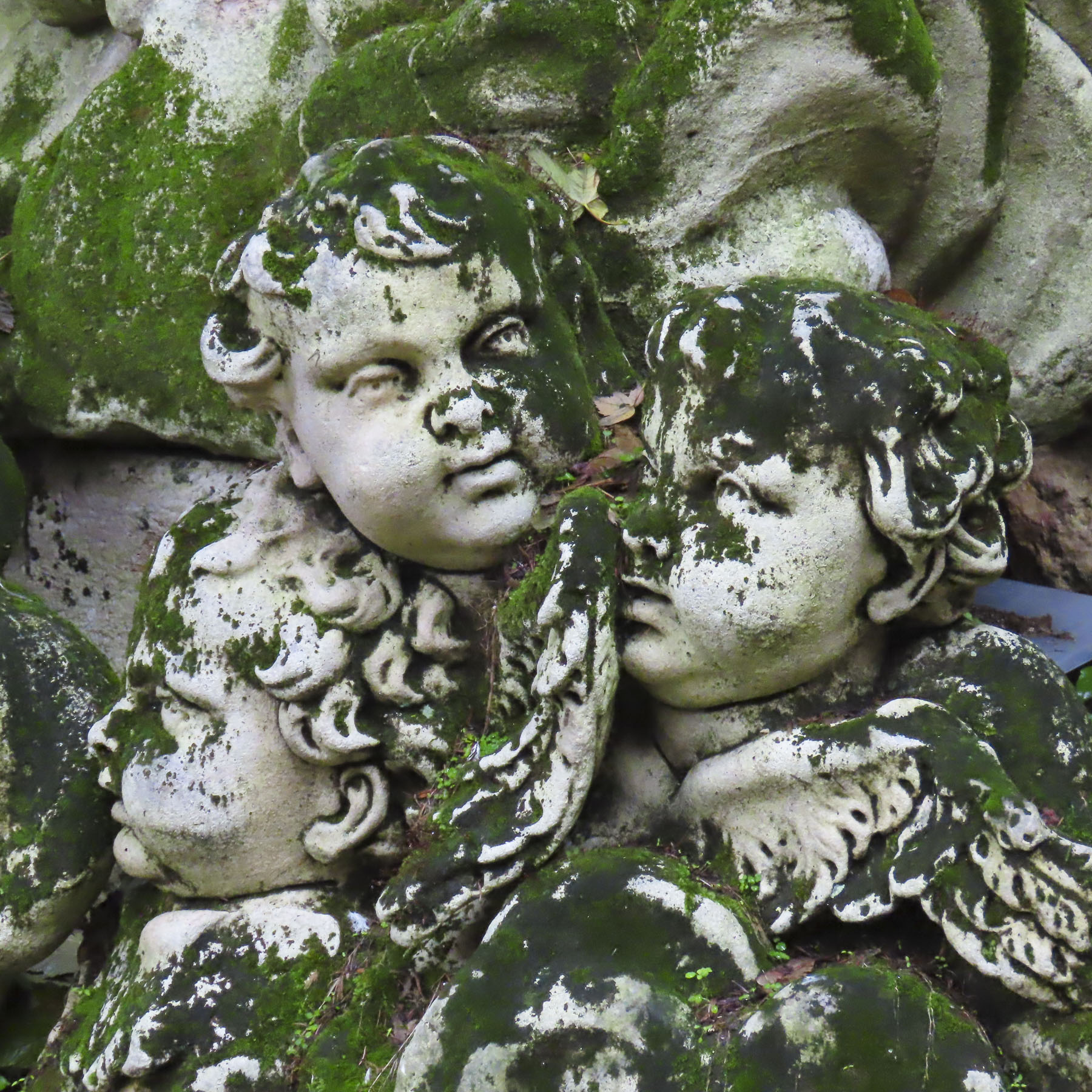
A short distance away, next to the Romolo Valli Opera House, the Parco del Popolo, People’s Park, provided a tranquil haven speckled with neoclassical sculptures and pathways through a forest of old growth specimen trees, still holding their fall colors. The city’s ancient fortified citadel occupied this space until its demolition in 1848 to make room for the park.

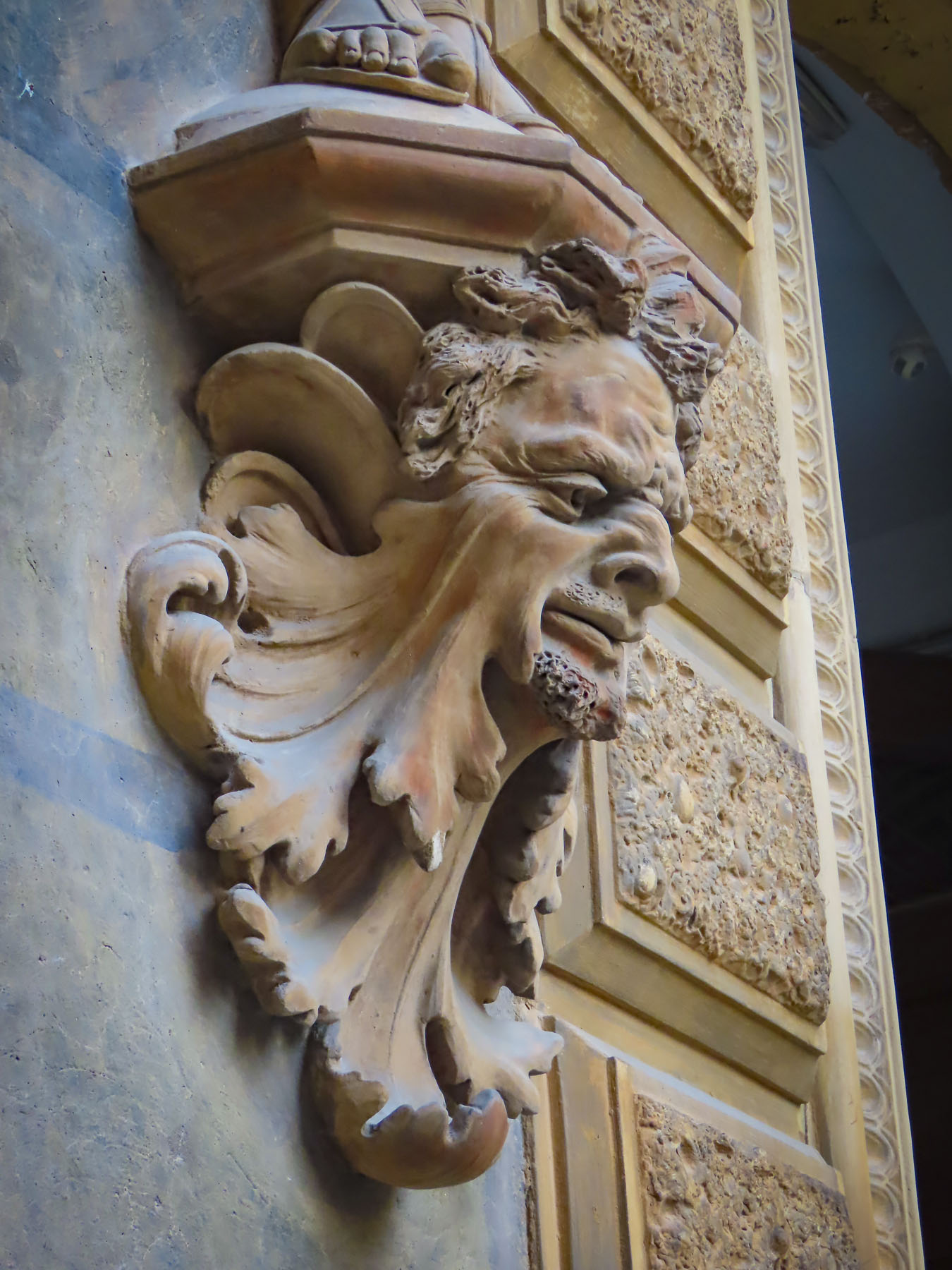
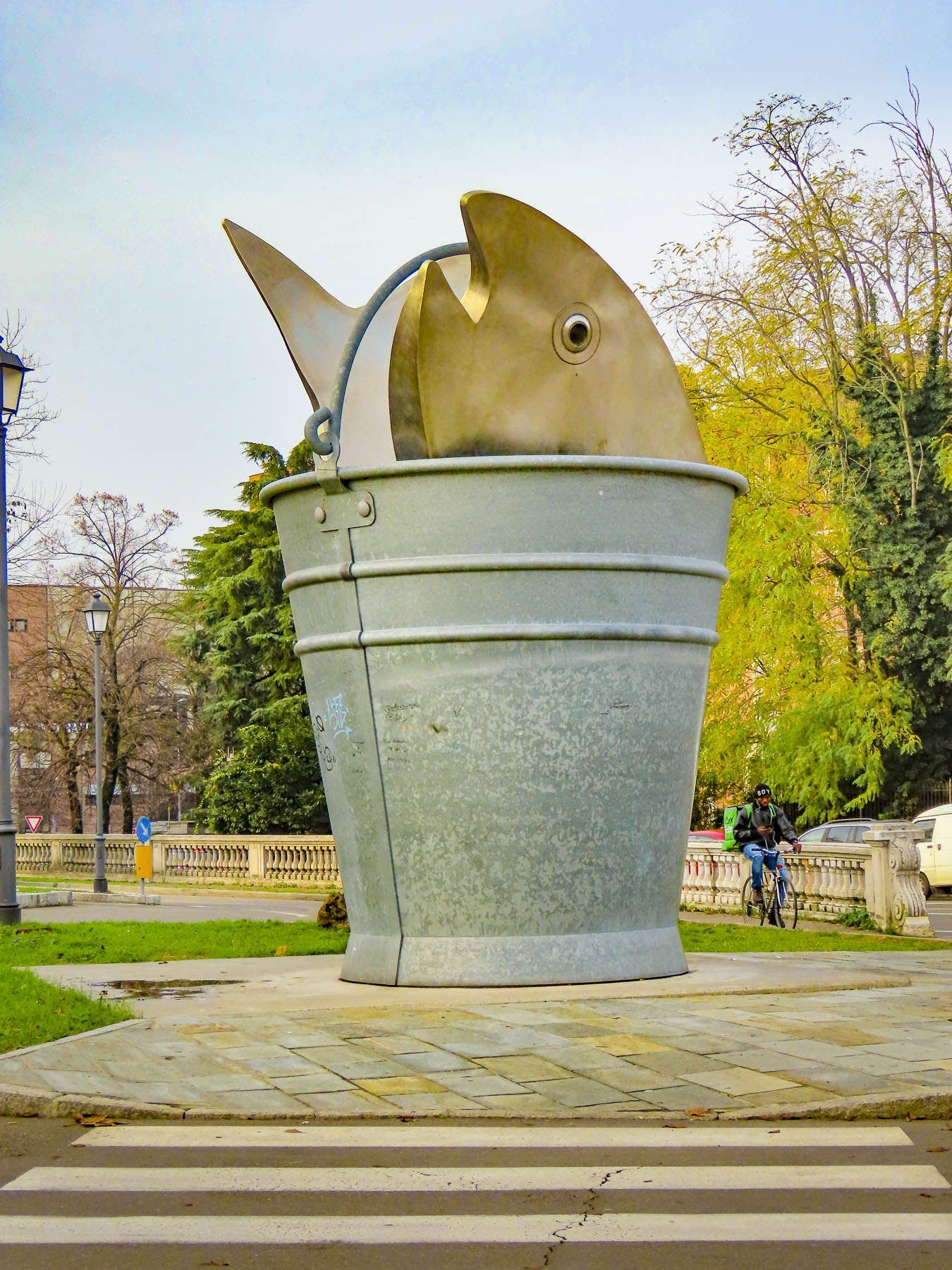
The twin arches of Porta Santa Croce, built in 1199, are now the only reminders that Reggio Emilia was a formidable walled city.  A walk there along Via Roma revealed antique architectural details and a very large, whimsical sculpture of a bucket of fish, across from a street mural at the train station.

Aside from being renown for culinary excellence, the city has a tradition of supporting academics with ties to the University of Modena that date back to 1175.  But the city’s real claim to fame is the Reggio Emilia Approach, born from the aftermath of Italy’s destruction during WWII when men and women were in the work force to rebuild the country. With this new preschool concept parents “desired for a new form of education that would ensure against future generations being brought up in toleration of injustice and inequality. Where children are valued as strong, capable, resilient and rich with wonder and knowledge.” “With a small amount of money sourced from the selling of a tank, three trucks, and a few horses from the war, and with land contributed by a local farmer and building materials from bombed-out buildings, local men and women of all ages built the first post-war preschool for young children.”  A first in Italy, it was a break with parochial education which was the historic norm.

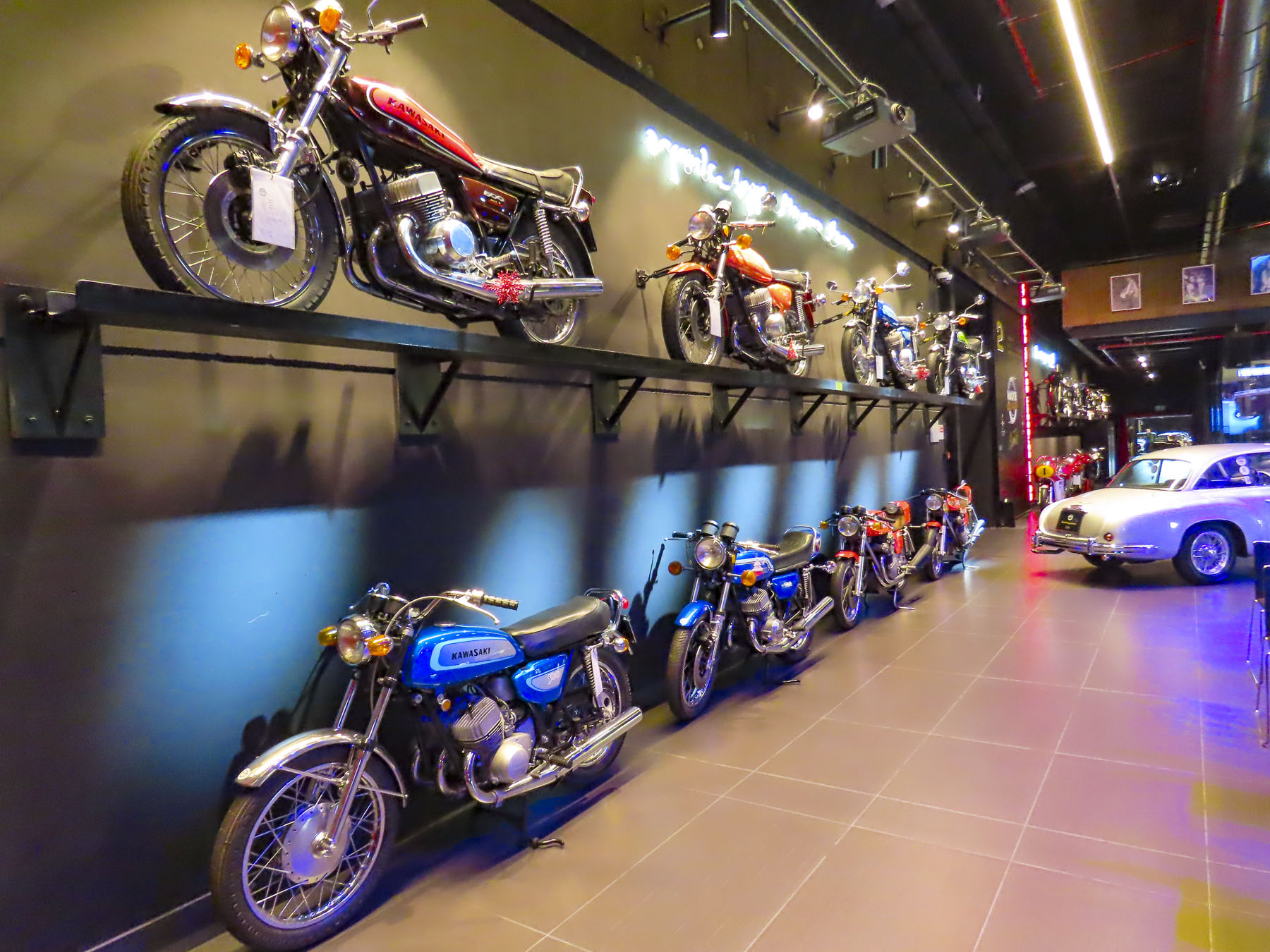
With a region that boasts about its excellent cuisine and fine wines it only makes sense, with a small leap in logic, that some of the most exotic cars and motorcycles built in the world are made in Emilia-Romagna, Italy’s “Motor Valley.” While Reggio Emilia doesn’t have any automobile factories, it’s close enough that you are sure to get the doors of your Fiat 500 rental blown off on the E35 by a passing Maserati, Lamborghini, Ferrari or crotch- rocket Ducati.

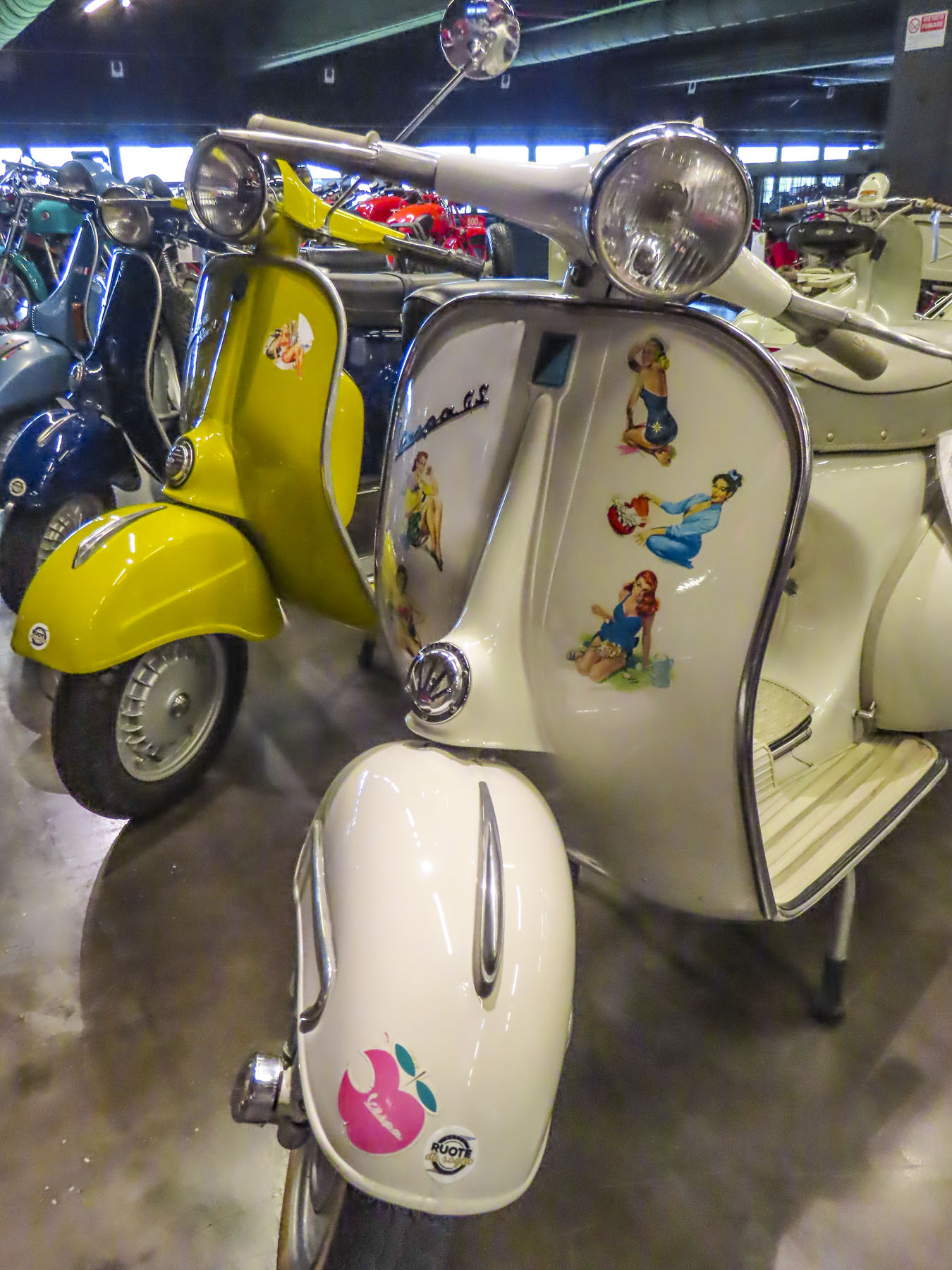
They all have museums in the region, but we spotted an advert in our hotel lobby for Ruote da Sogno, a showroom with more than 100 classic cars and 700 restored classic motorcycles and scooters, all in perfect working condition and FOR SALE! 

It was an interesting space that we wandered about freely. They also conduct traditional and online auctions., while the high-tech showroom is also available as a corporate or wedding event space.  The eclectic collection was very interesting, down to the glass refrigerator case full of champagne for auction winners to celebrate with. Vespas with a sidecar are our passion and speed. Do they ship? We asked ourselves. Zoom, zoom!

The city had completed stringing Christmas decorations down the ancient lanes and on the piazzas.  They were especially beautiful at night when the cobblestones glistened from the afternoon rain and the lights reflected off their still-wet surfaces.  The Christmas market on Piazza Camillo Prampolini was in full swing now and we couldn’t resist the opportunity to weigh down our luggage even more. After all, in late December, we would be heading back to the states to enjoy Christmas with our family.

Till next time, Craig & Donna

Ravenna and San Marino – Golden Tiles & Mountain Vistas

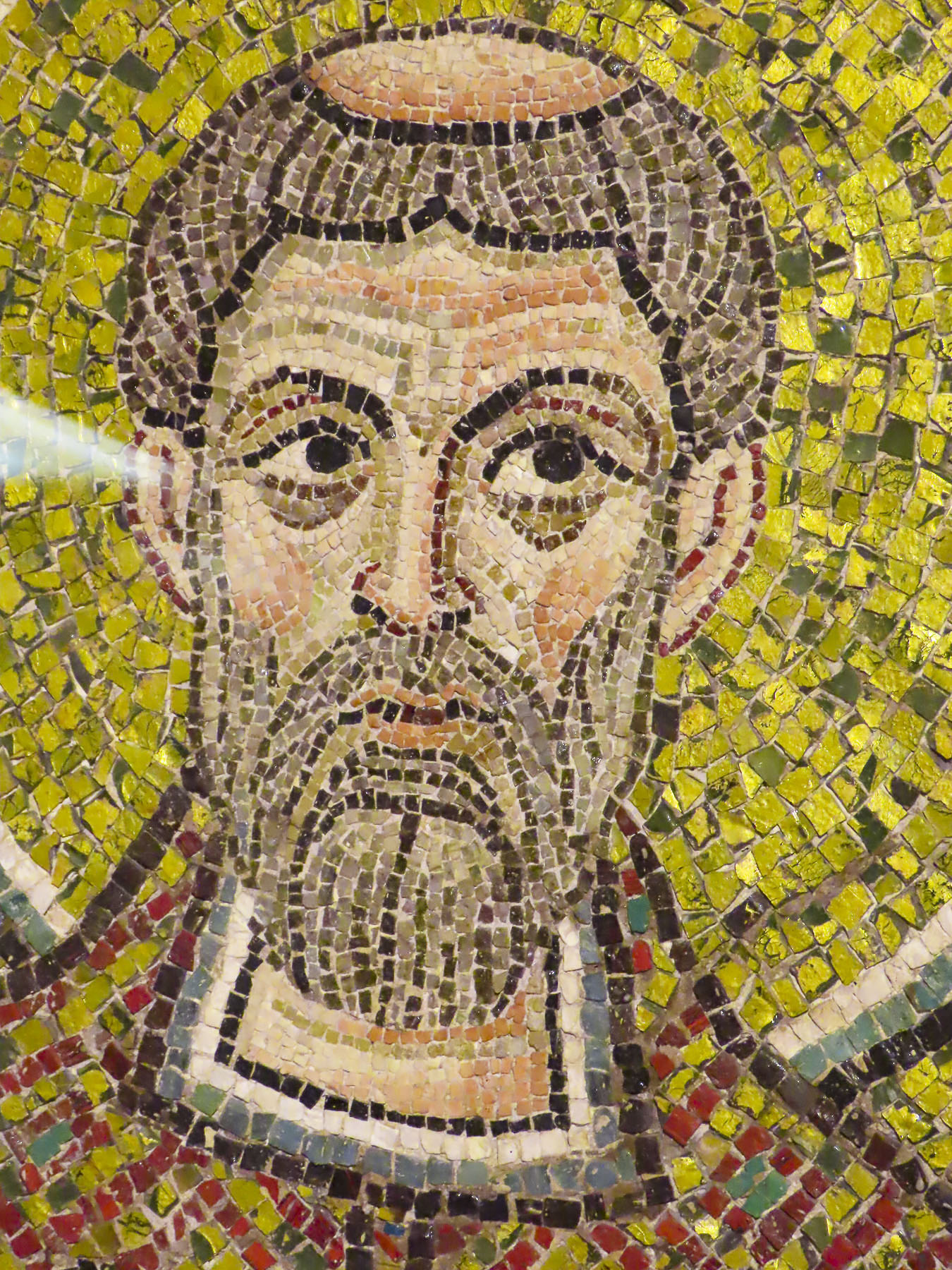
A curtain of fog blanketed our route as we traversed the Po River Valley and crossed into the Emilia-Romagna region on our way to Ravenna. The purpose – to see some of the finest Byzantine mosaics outside of Constantinople, present day Istanbul, which was once the seat of the Eastern Roman Empire. Not to be outdone, Ravenna’s golden mosaics rival Constantinople’s and were created in the 5th century when Ravenna was the capital of the Western Roman Empire after Rome’s demise. Eight churches have been recognized by UNESCO for their cultural significance as “Early Christian Monuments of Ravenna.”  Most of them are credited to a building boom by Justinian I after a reconquest of the city from the Ostrogoths in 535 that solidified Byzantine power on the Italian Peninsula along the Adriatic coast.

The valley had been the breadbasket of Northern Italy for several millennia when the Etruscans and Romans first started to drain the wetlands to expand areas for cultivation to support a growing populace aligned with city-states of the region. The spring floods from the snow melt of the Alps, Apennines and Dolomite mountain ranges replenish the valley’s fertile soil every year before pouring into the Northern Adriatic Sea.

With the belief that the valleys are always greener on the other side of the Alps, invading armies contested the area for centuries. French kings, German tribes, Galls, Hannibal with eighty war elephants, Goths, Attila the Hun, Papal armies, and Napoleon have all wanted this green acreage, and were willing to shed blood for it.

The fog had lifted, but it was still a moody day as we entered the Basilica di San Vital. The unique octagonal church was one of Justinian’s first commissions to celebrate Christianity in the city on a grand scale. The splendor of its lofty mosaics that rise from the floor, on all sides, to encompass the domed ceiling are dazzling. The golden tiles warmly reflecting the ambient light even on a dreary day.

Byzantine mosaics evolved from the Greek use of different colored river stones to create sturdy designs in ancient roads. Durable marble was preferred for its vast array of colors and was used for interiors floors in palaces.  Lasting centuries, these intricate designs are often referred to as “eternal pictures.”

The Byzantine artists’ innovation was to use physically lighter and more fragile material such as different colored glass pieces and mother of pearl, along with incorporation of gold and silver leaf. The color palette expanded with the refinement of glazed tiles.

A short distance behind the basilica stands the Mausoleo di Galla Placidia, intended as the final resting place for Teodosius the Great’s daughter. It was never used as a tomb, as she died in Rome.  The small, modest brick structure is designed in the shape of a Latin cross and is inspirationally decorated as a “prelude to paradise.” A surprisingly intimate and tranquil space, it is one of the oldest religious monuments in Ravenna dating to 430 AD.

A short walk across town, the Cattedrale della Risurrezione di Nostro Signore Gesù Cristo or Duomo of Ravenna, the Baptistery of Neon, and the Archiepiscopal Museum of Ravenna all share the same campus. Though considerably newer, the 18th century Duomo is built over the ruins of an early fourth century church and retains several early side chapels and fifth century sarcophagi.

Behind the cathedral the former bishop’s residence has been converted into a museum displaying a diverse collection of religious relics. The highlight though was the exquisitely mosaiced sanctuary, the Chapel of St. Andrew.  It was built in 495 AD for the private use of Ravenna’s archbishops.

The museum directly behind the cathedral was also interesting. with its diverse collection of religious relics and an exquisite private chapel for the bishop.

The real reward for the trek across town was the early fifth century Baptistry of Neon.  The octagon-shaped brick building appears to have settled into the ground, but in actuality, centuries’ worth of construction detritus from earlier settlements in Ravenna have raised the surrounding terrain ten feet since the structure was built. This necessitates the occasional raising of the entrance.

At the baptistry it’s all about the magnificent mosaics that adorn the dome. Above arched windows, the center medallion features John the Baptist christening Jesus in the River Jordan, followed by an encircling outer ring that depicts the twelve apostles. Astonishingly, most of the original mosaic work survives and is still intact. During a minor 19th century restoration, a mosaic artist freelanced with creative license and added the bowl that St. John is using to pour water – a scandal at the time.

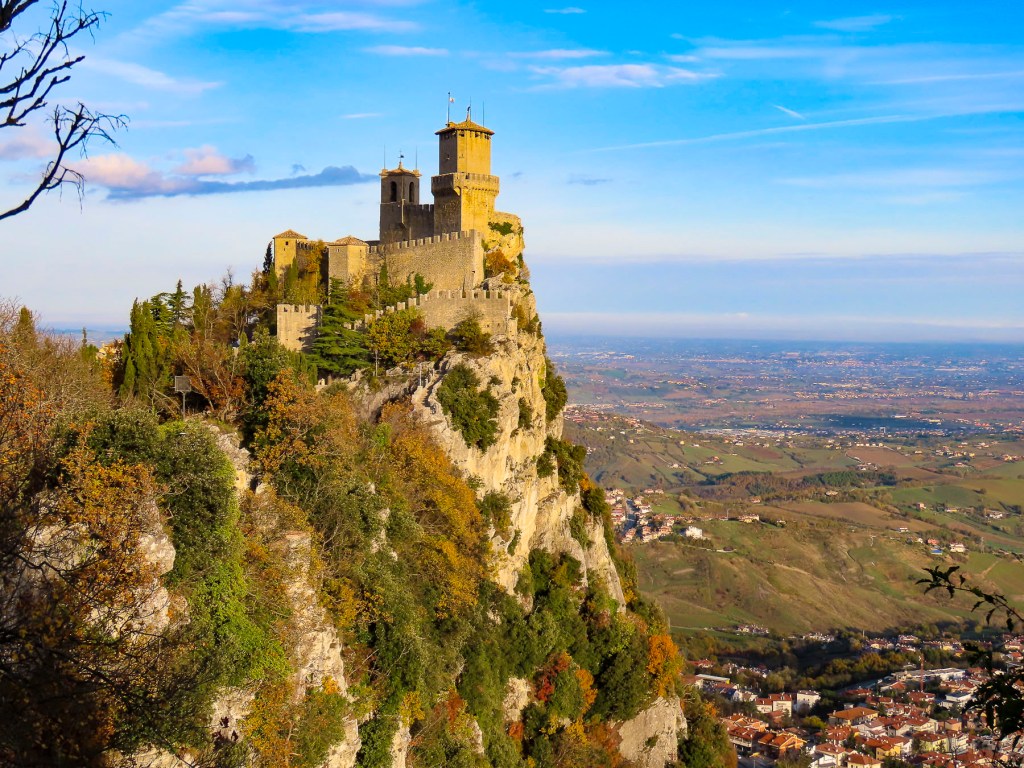
The tall ridge of Monte Titano rose above the gentle hills of the Emilia-Romagna countryside surrounding San Marino like a tall ship’s white sail on the ocean; its three fortress towers mimicked the crow’s nest atop a schooner’s mast.  The towers served the same purpose: as lookout posts, to spot any approaching threat. They have served the Republic well since its founding in 301 AD, when the Christian stonemason Marinus, who was later beatified as San Marino, fled Rimini to avoid the Diocletianic Persecutions.  Also known as the Great Persecution, it was the last and harshest repression of Christianity in the Western Roman Empire before it was accepted as the state religion in 313 AD.  The rugged terrain of the mountain provided safe refuge for the small community of followers who built a small chapel and monastery. As the community grew, a governing system evolved that included representation of each family by the head of the household in an assembly called the Arengo.  Representatives were summoned to the meetings by the ringing of the church bell. This eventually changed to a Grand and General Council which elected two Captains Regents for six-month terms. In 1861 the tiny constitutional republic bestowed honorary citizenship on Abraham Lincoln. In his acceptance letter he wrote, “Although your dominion is small, your State is nevertheless one of the most honored, in all history. It has by its experience demonstrated the truth…that Government founded on Republican principles is capable of being so administered as to be secure and enduring.” On the 150th anniversary of Lincoln’s death, in 2015, San Marino minted a ten-euro commemorative coin that highlights the great orator’s words to the tiny republic: “Great and Good Friends.”

Giuseppe Garibaldi and a band of followers received refuge in San Marino before the tide of the unification movement turned in his favor. In the 1870’s, San Marino was asked to join with the rest of the Italian peninsula. However, the good will engendered by their gracious treatment of Garibaldi prevented the tiny republic from suffering invasion after they politely declined.

Along with Andorra, Monaco and Liechtenstein, San Marino is a surviving example of a medieval city-state that was once quite common throughout Europe and especially the Italian peninsula. In such esteemed company, one would expect the place be expensively exclusive. That would have held true if we had visited during the high season. But that’s not the case in November when cold winds whip across Monte Titano. With some internet sleuthing, Donna found us a great rate at Hotel Rosa San Marino.

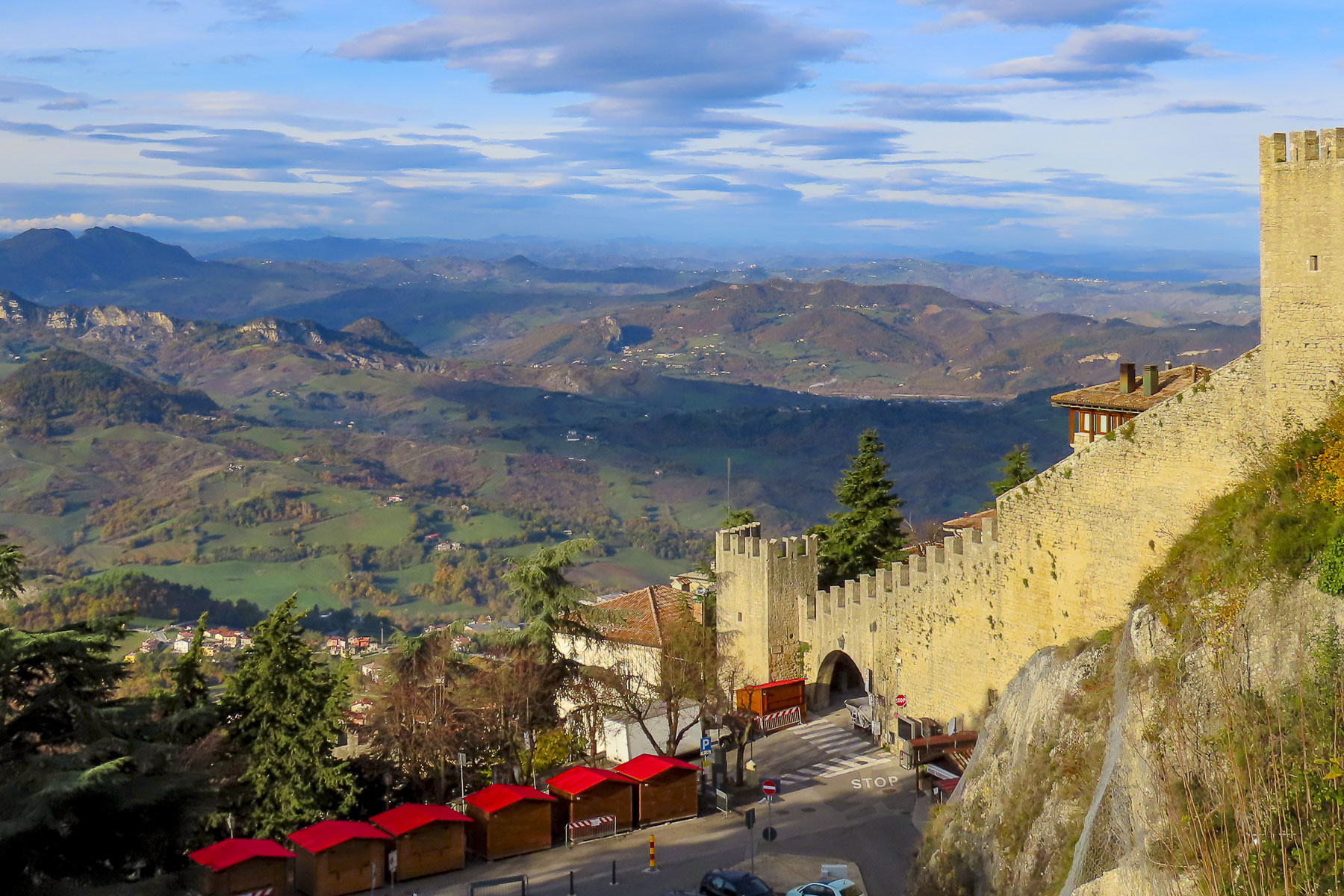
The last vestiges of autumn colors still clung to the trees that lined our serpentine route up the mountain that ended at one of the ancient city gates through a crenelated wall.  The hotel had assured us that parking was available on site when we made the reservation several months prior, but a traffic sign warned that vehicles were prohibited and to proceed no farther.  With a quick phone call to the hotel they confirmed that they would register our car with the city and that we could drive through the gate and into the historic district without any worries. 

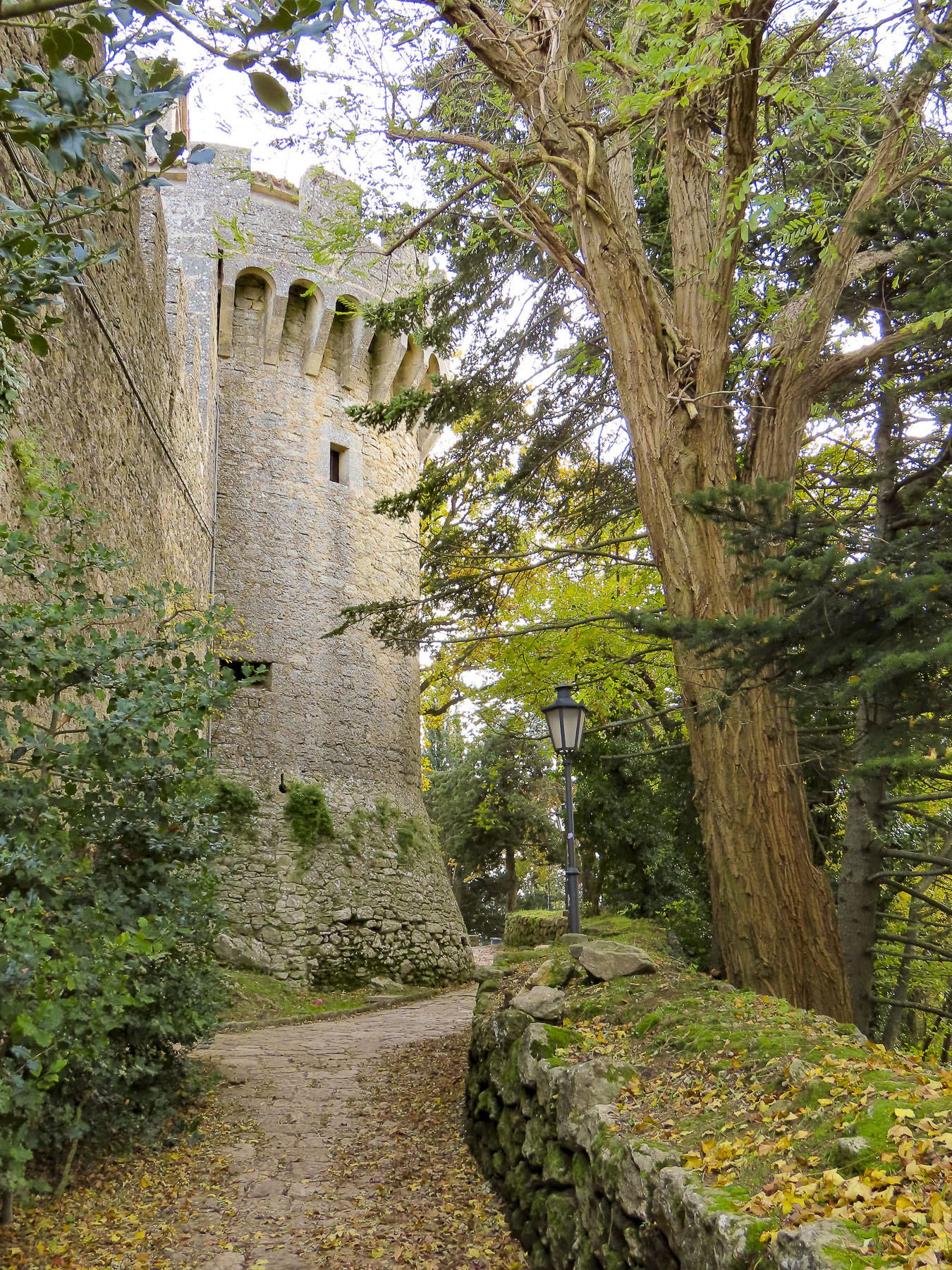
With a few tight turns between buildings, we drove higher and literally parked beneath the Guaita Tower, San Marco’s first tower and iconic fortress built in the 11th century.  Only a few steps from the paths along Monte Titano’s ridgeline, the hotel was in an ideal location to explore the mountaintop city and had wonderful views from its balcony.

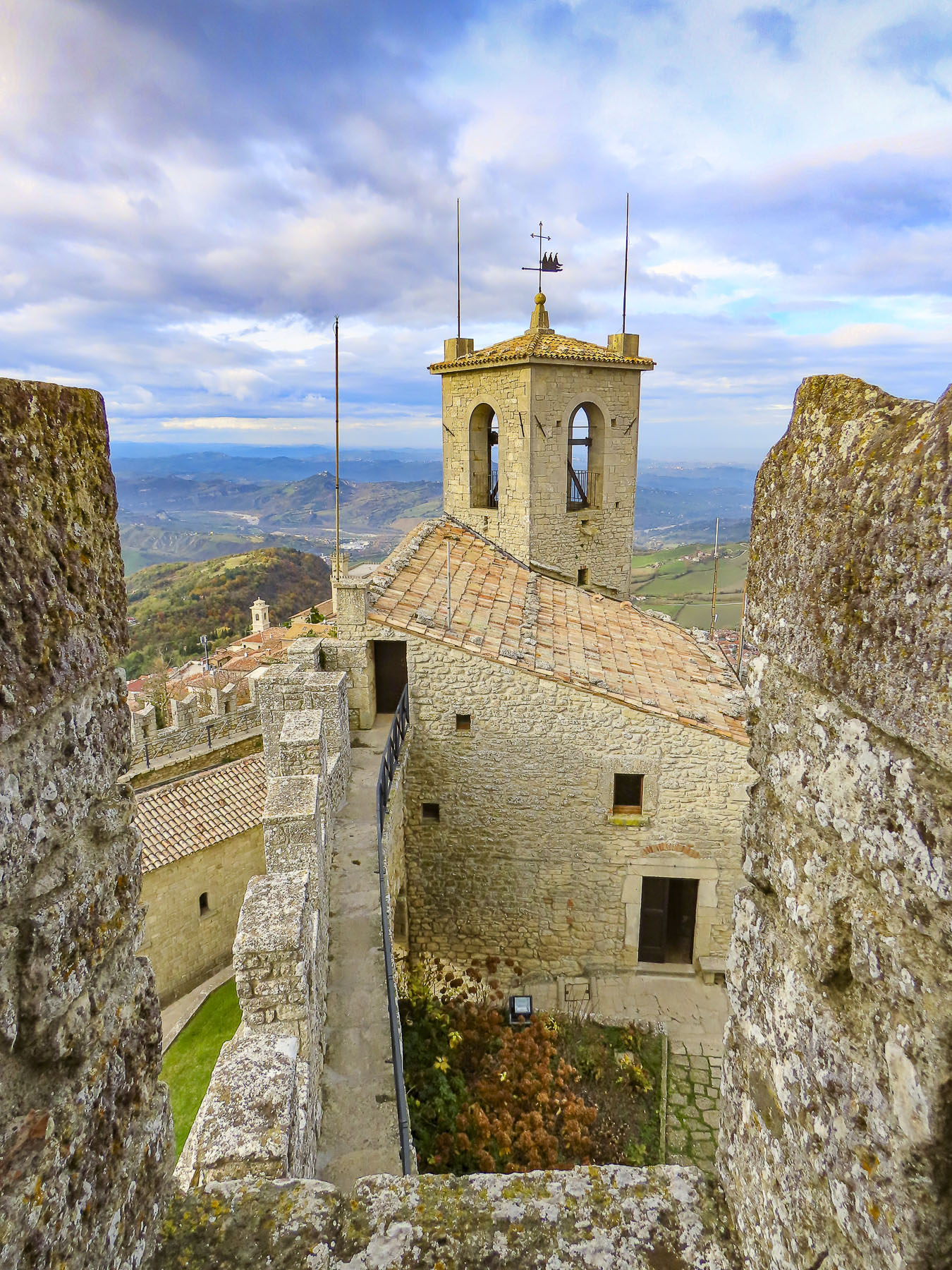
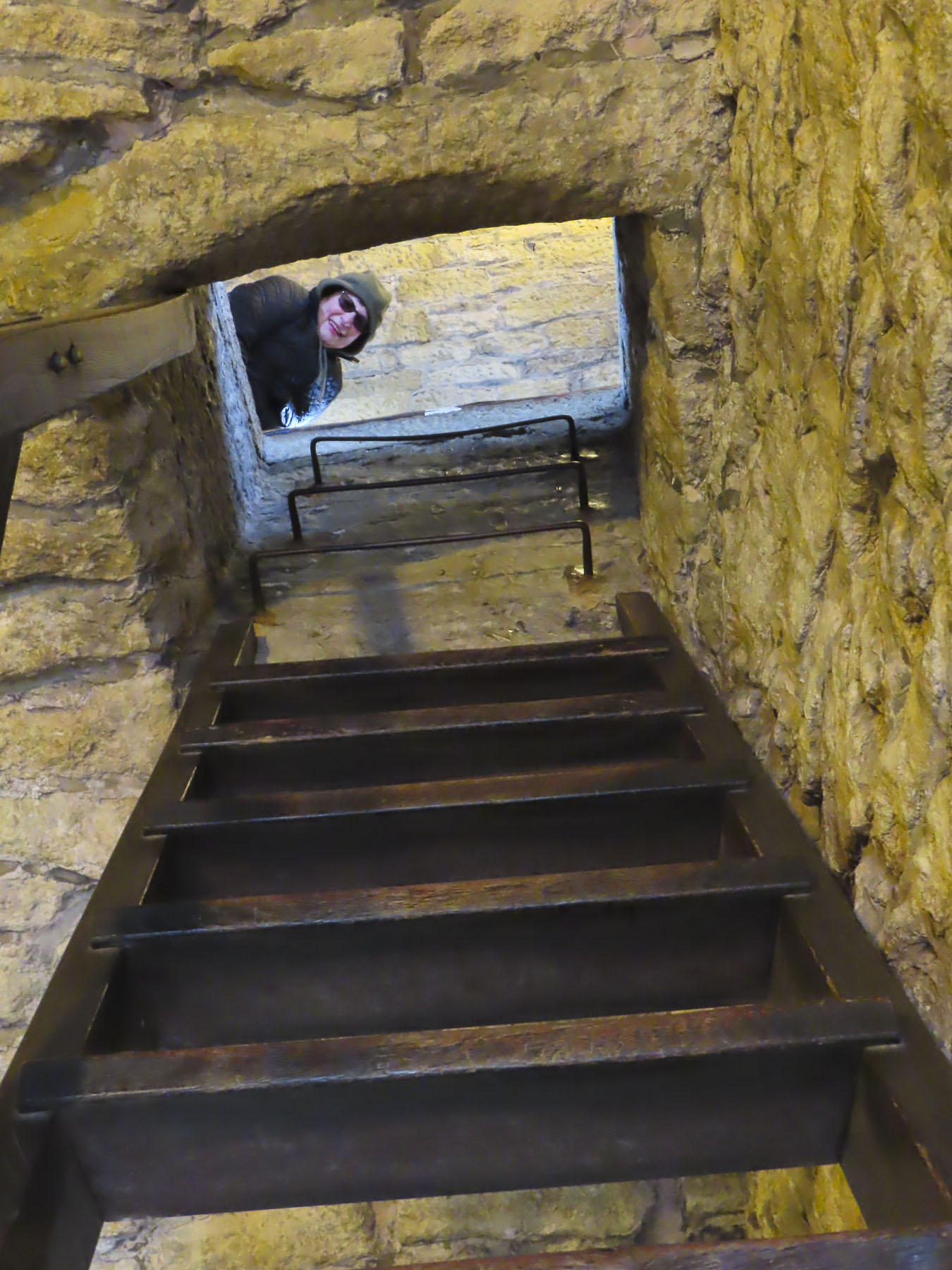
The next morning, we braved the chill wind and climbed to the top of the tower. Donna loves these vertical expeditions. Steep ladders, crumbling fortress walls, and cliffside trails don’t intimidate her. I on the other hand have a healthy fear of heights and am only emboldened with a camera in hand in order to pursue the best photo ops. Spots along the ridge trail connecting the towers were challenging for me, but extremely rewarding for the views.

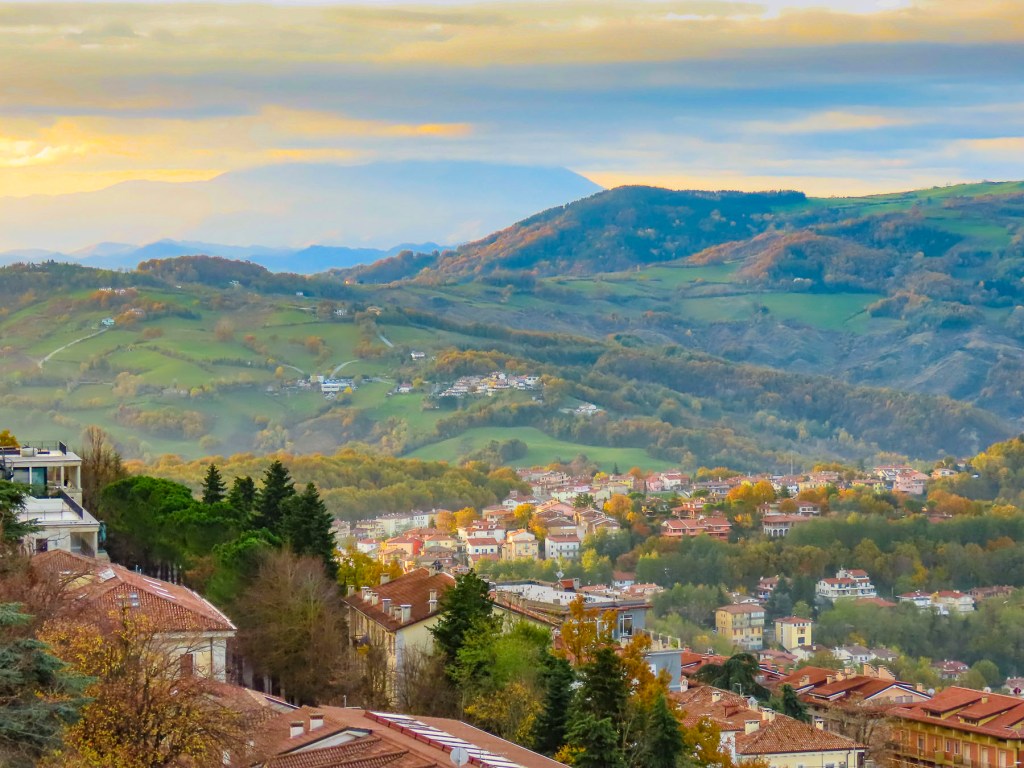
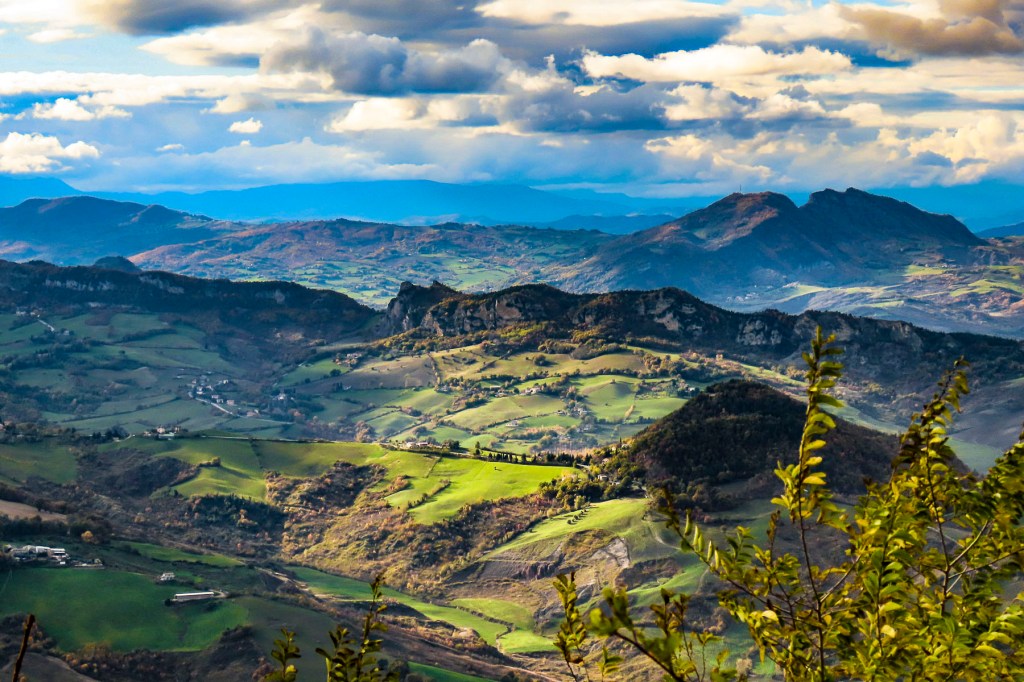
The panoramic, birds-eye-views from the tower were phenomenal and well worth my shaky knee syndrome while on the ladder to the top. The region of Montefeltro spread out below us toward all the compass points. Northward and south the gentle valleys and hills of Emilia-Romagna were saturated with the earthen tones of autumn. To the east the Adriatic coastline near Rimini shimmered on the horizon and it’s said on the best days you can see the mountains in Croatia.  To the west the borders of Tuscany, Marche and Umbria straddled the rugged Appenine mountains around the Regional Natural Park of Sasso Simone and Simoncello.  During the day the towers were manned by lookouts for signs of any approaching armies and at night to spot their campfires.

To get to the second and third towers we had to pass through defensive wall that protected the core of ancient village and cross an arched stone bridge, called the Witches Path, Passo delle Streghe, above a deep gorge that divides the ridge. It gets its name from the howling winds that whip through the high, narrow gorge and sound like voices. Allegedly, during the Dark Ages a coven of witches practiced their black magic here. More accurately though, suspected witches in San Marino were thrown to their deaths from the cliff edge. Falesia, the 13th century second tower, was built on the highest point of the ridge (2,425 ft) and used to house a garrison of crossbowmen. It now houses a military museum that showcases ancient weaponry, but was unfortunately closed for repairs during our November visit.

A small door through the Falesia’s outer wall connected to a rugged cobbled path that continued to Terza Torre, the third tower or Montale. The slender 14th century tower stands alone in a wooded area on the bow of the ridge. Built as a lookout tower and prison, the only door to the structure is twenty feet off the ground where prisoners were thrown into one large pit in the tower’s foundation.  This tower has never been open to tourists, but the scenery along the trail makes it well worth the visit.  Challenging trails off this path circumnavigate Monte Titano and eventually lead to the valley below.  The early morning and sunset light on the mountain are totally different and enhance a romantic ambience that is especially rewarding for photographers.

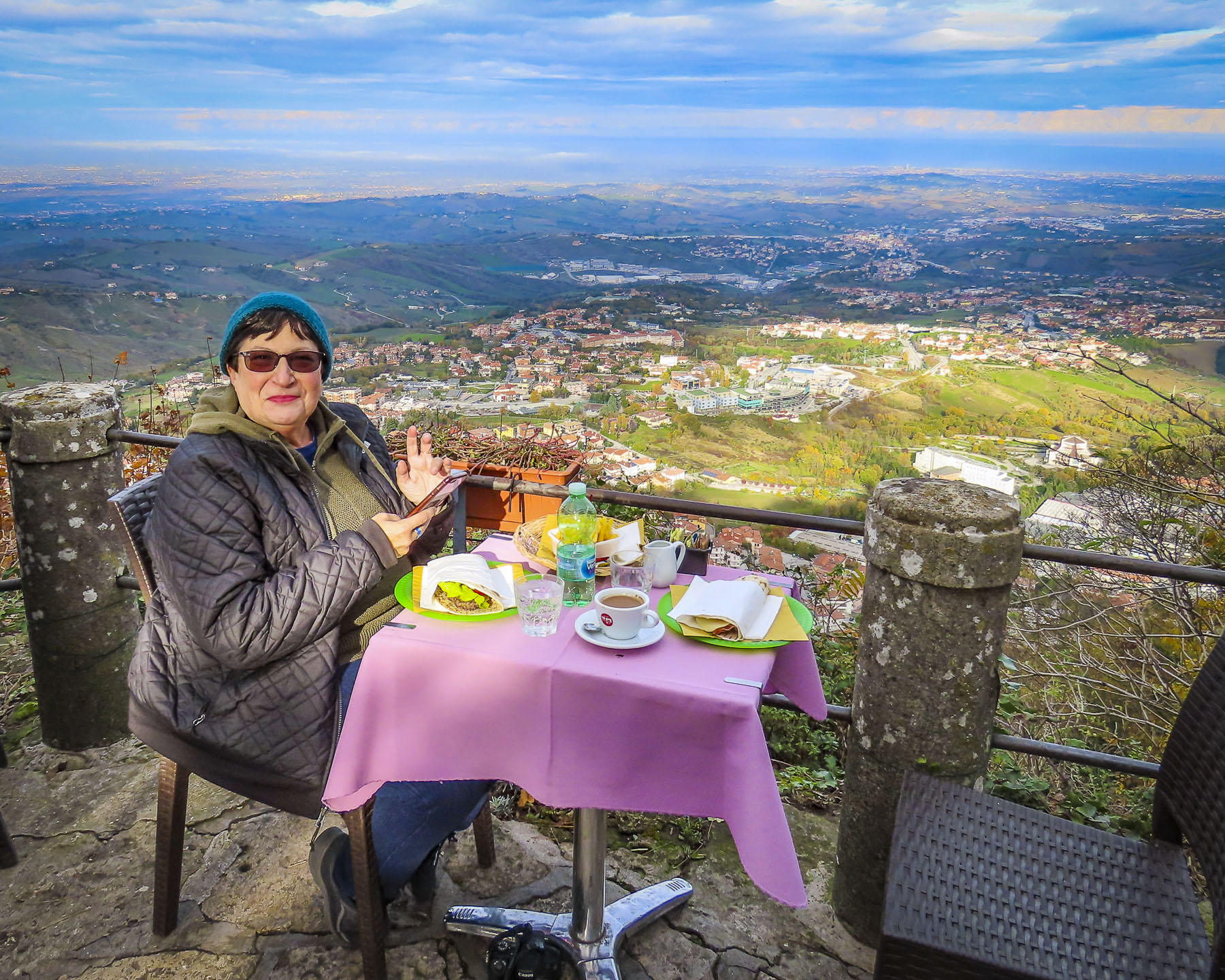
Fortunately, at the other end of the tower path there were many restaurants with indoor and outdoor seating.  Opting to eat outside on a breezy day, so that we could continue to enjoy the view, we lucked out and were able to get a table along the cliff edge that was out of the wind. Another advantage to November travel is that merchants are gearing up for Christmas. The town was very pretty with its holiday decorations, and we were just a bit early for the Christmas market, although the cute little cottages were already set up. Donna had fun browsing the shops, and found a nice commemorative: a roof tile with a miniature Christmas scene built into it.

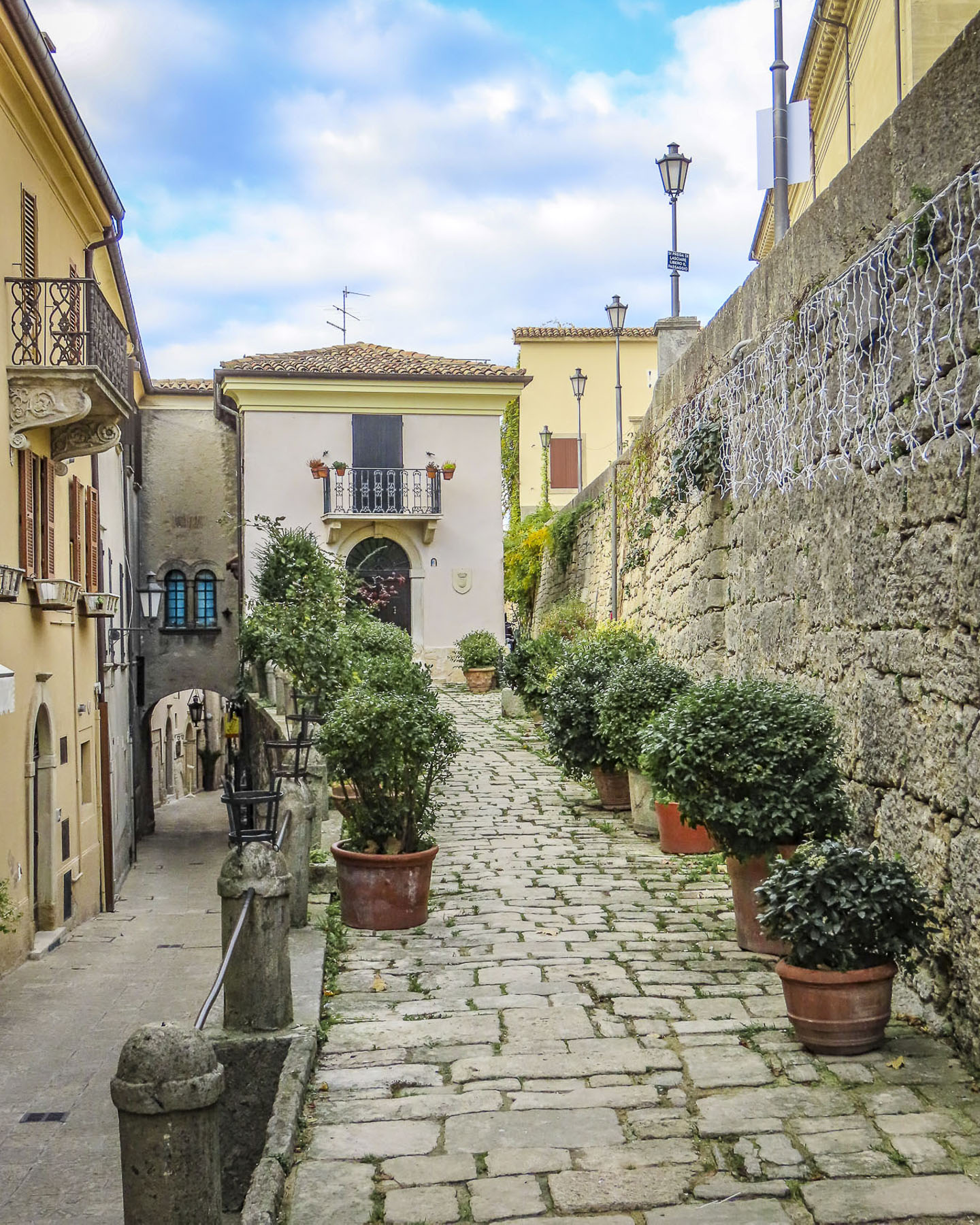
The next morning it almost seemed easier to walk the ridge trail than the steep streets of San Marino’s historic center that were giving our calf muscles a workout.

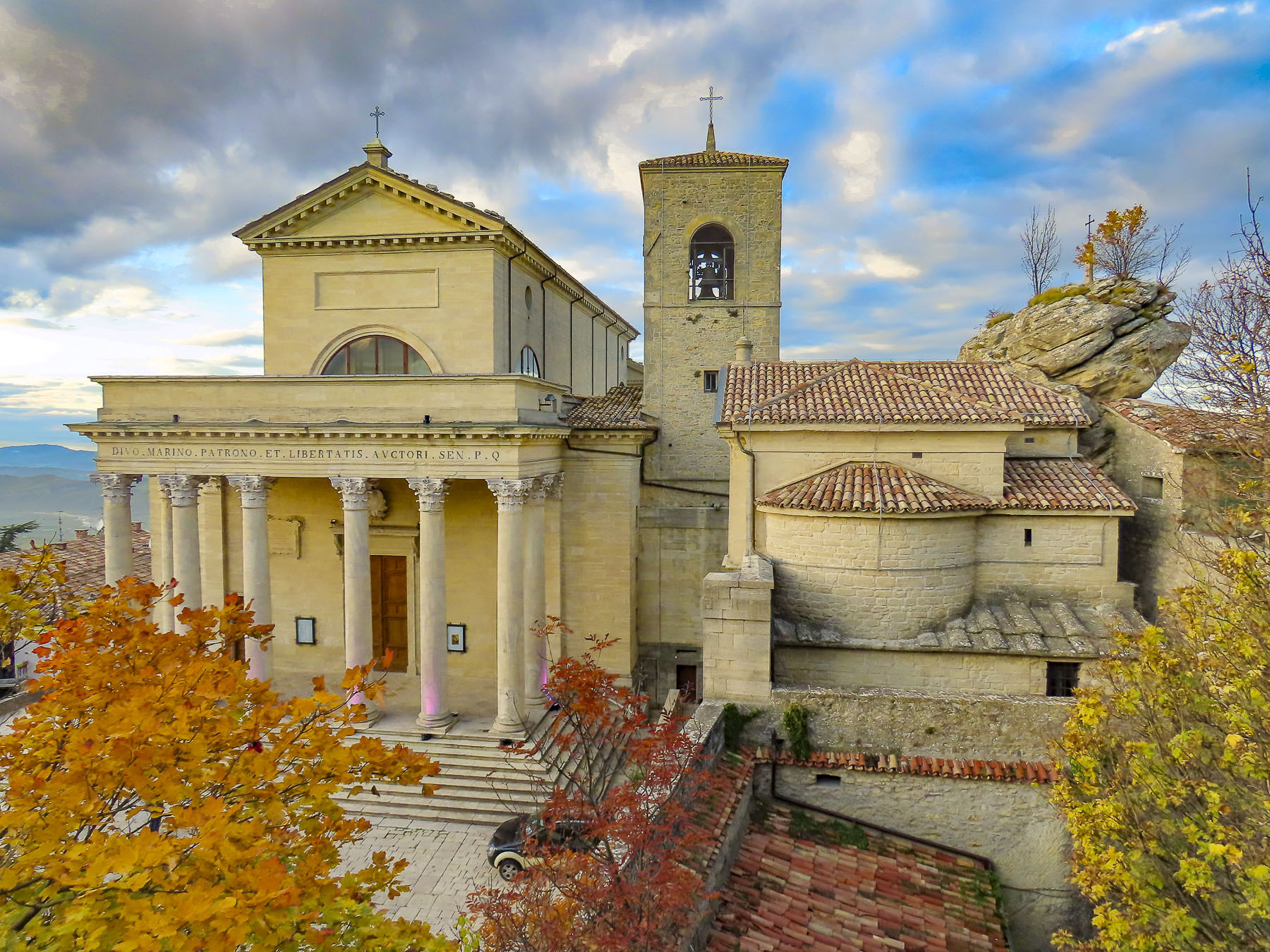
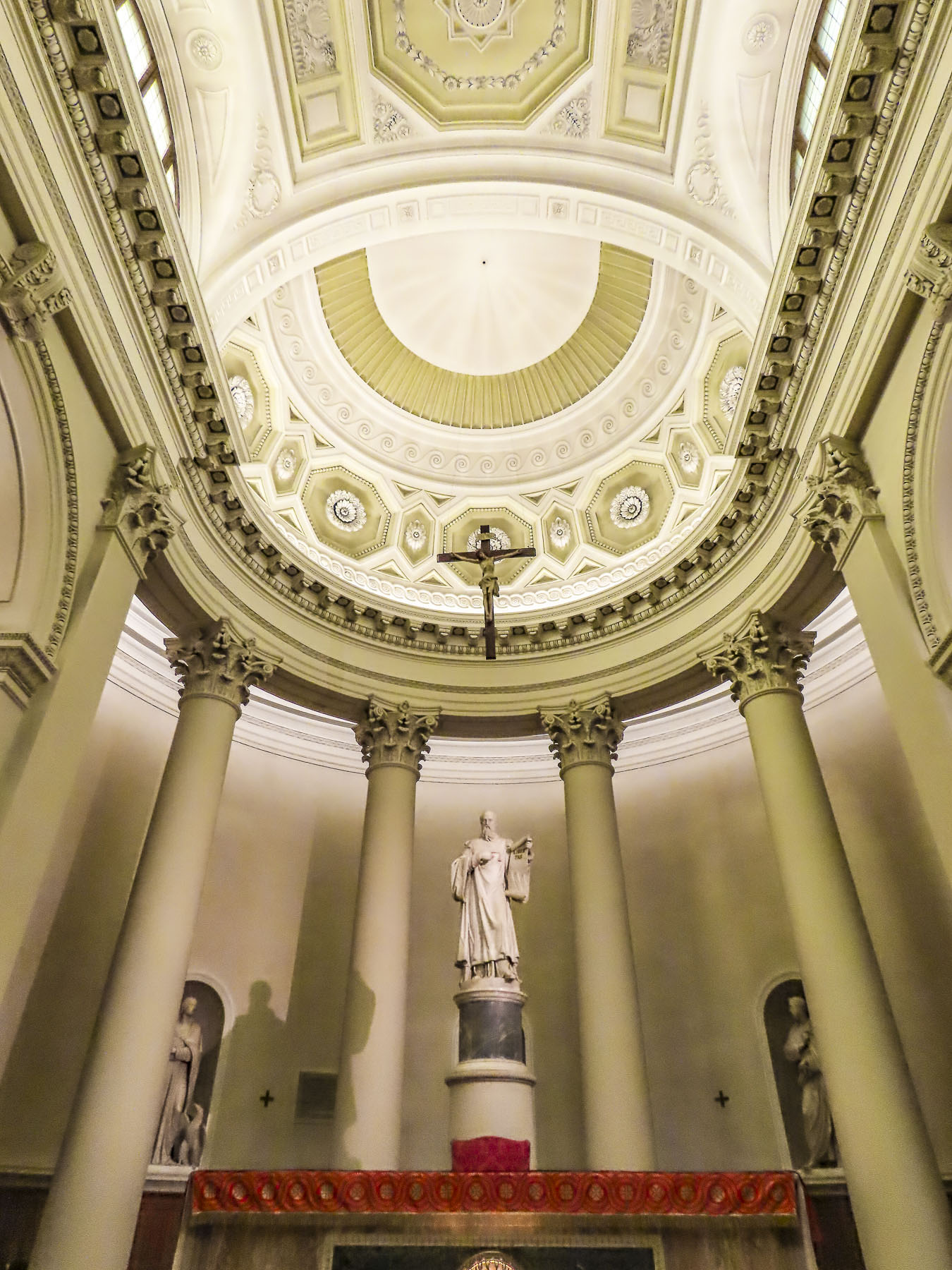
The Basilica di San Marino and the much smaller Chiesa di San Pietro stand next to each other on Piazzale Domus Plebis.  Encompassing the mountain into its structure, Chiesa di San Pietro originally dates to the 600s and has a carved stone recess that legend believes was San Marino’s bed when he first sought sanctuary on the mountain.  The basilica was rebuilt in 1826 in a Neoclassical style over the ruins of an earlier 4th century church. In the church, relics of San Marino are safely kept under the altar.

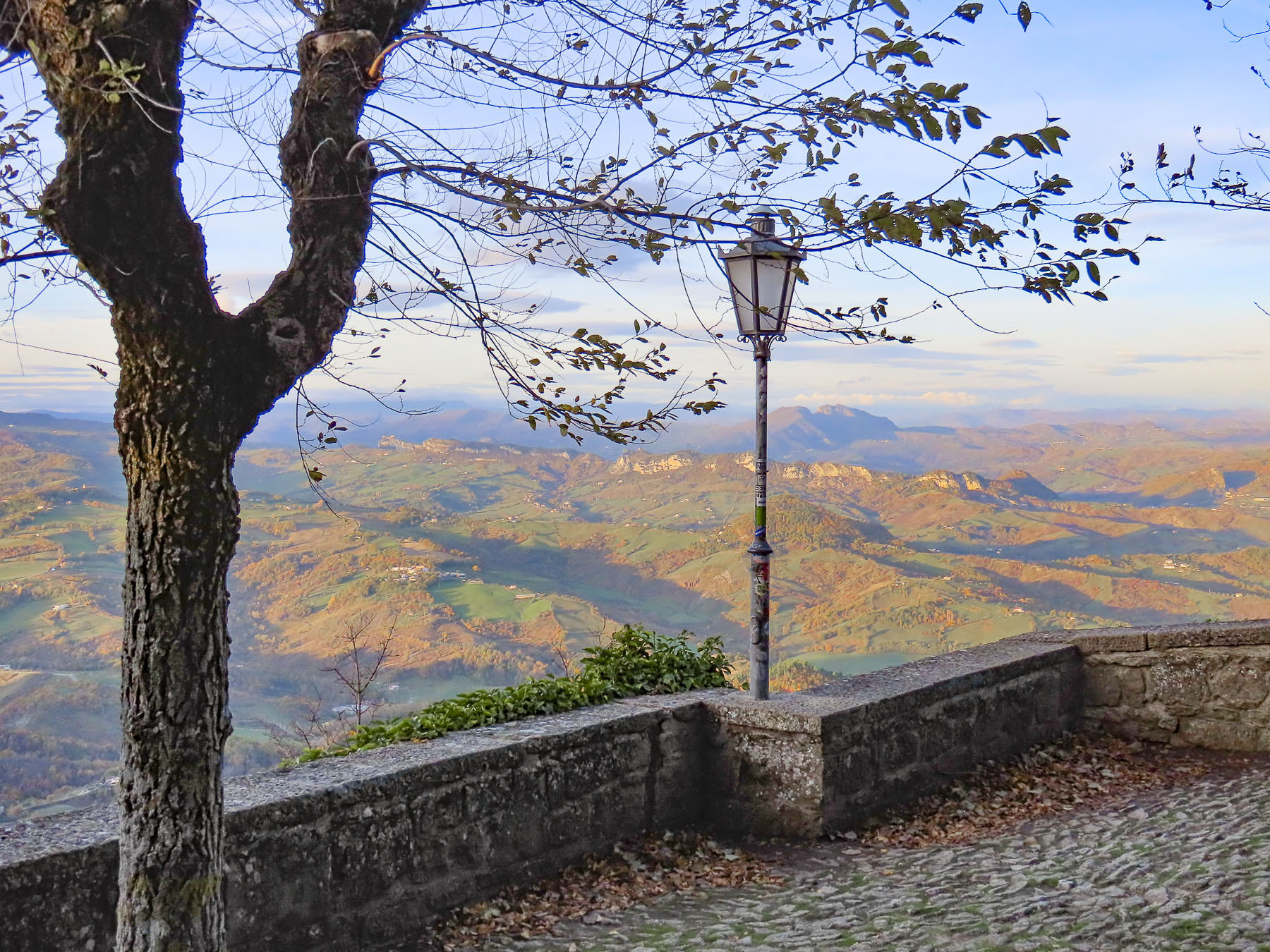
Following narrow lanes we came to the Funivia · Città (Libertà), a cable car, that can whisk tourists up or down the mountain in two minutes, to the parking lot by the Castle of Borgo Maggiore. At this end of the city the wide terrace of Contrada del Pianello offered different yet equally enthralling vistas of the surrounding countryside. The panoramas were especially dramatic late one afternoon, when the sun broke through the cloud cover and cast dramatic shadows cross the countryside.

There is no passport control when you enter San Marino from Italy, which is disappointing if you enjoy getting those passport stamps as reminders of your travels, but for diehards like us, the San Marino Tourist Office, located by the cable car station, will stamp your book for five euros.

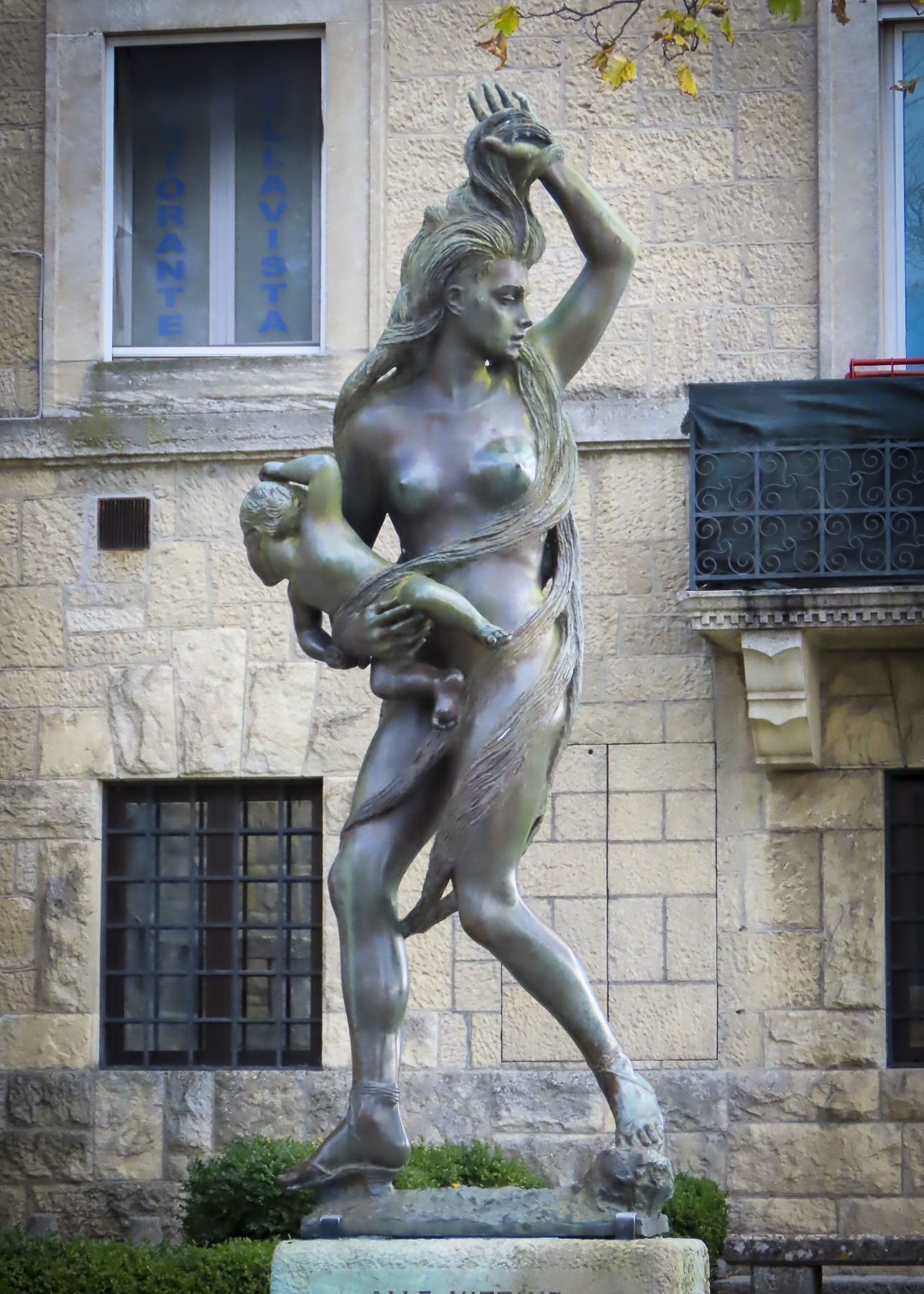
San Marino has some interesting public sculpture and the first piece we encountered was in a small park plaza across from the tourist office. The Alle Vittime Del Bombardament, depicts a young woman rescuing a small child. It commemorates the bombing of the country, a neutral territory, in June 1944 when allied forces mistakenly believed the German Army had retreated onto Monte Titano. Two hundred sixty-three Sammarinese were killed during that air raid.

Working our way to the Museo di Stato, the National Museum, we passed the old stone quarry where the country’s crossbowmen, a military unit formed in 1295, once trained. It’s still used by The San Marino Federation of Crossbowmen, a group of ceremonial crossbowmen, musicians and flag-wavers who now entertain at festivals in Renaissance dress. Further along, just before the Palazzo Pubblico, San Marino’s capital building where the Captains Regents and the Grand Council conduct the business of the country, more whimsical sculptures graced a small area with benches. 

Piazza della Libertà in front of the Palazzo Pubblico gets its name from San Marino’s own version of Lady Liberty. Sculpted from brilliant white Carrara marble, the Statua della Libertà depicts a striding female warrior, carrying a flag-draped spear and extending a hand in peace, with the three towers of Monte Titano as her crown. It was donated to the country in 1876 by German Countess Otilia Heyroth Wagener, a former Berlin ballerina, who married an Italian nobleman. This was ten years before the French Statue of Liberty was finished in New York harbor.

Adjacent to the entrance of the National Museum, the Grande Statua Nudo Femminile or the “Great Female Nude Statue,” (this title creates such an unflattering visualization for a tranquil figure and anyway the sculpture is only 5.5ft tall) by Italian sculptor Francesco Messina stands in front of the Cassa di Risparmio della Repubblica di San Marino, a bank. The bronze was purchased to celebrate the bank’s 100th anniversary.  I can just imagine the discussion around the board of directors table, “Profits are up this year, we should invest.” “Yeah, big nude sculptures are symbolic of banking success, financial stability!” “One would look good in front of the building.” “Okay, let’s vote.” I’m being sarcastic, of course, though San Marino does have liberal banking regulations and welcomes offshore accounts from wealthy individuals looking to hide their assets.

The Museo di Stato, the National Museum, has an interesting collection of archeological items discovered on Monte Titano and its surrounding territory that spans its early history, along with art and religious items.  We were not aware of it at the time, but San Marino offers a museum pass for 8€ that allows you visit all seven of the country’s national museums. It is a very good value.

It was a long uphill walk back to our hotel, but well worth it to enjoy the quaint lanes of this unique republic one last time before our departure the next morning. If you are looking for an aerial experience over the Italian countryside without renting a helicopter, a trip up Mount Titano in San Marino might fit the bill.

Till next time, Craig & Donna

Vicenza – Grand Architecture, Parks & Waterscapes

Our mishaps of driving in Italy are still memorable. But they were far more forgivable and less costly before the advent of the remote video surveillance systems that Italian towns use today. Years ago, we had briefly visited Vicenza, home to one of the world’s most influential Renaissance era architects, Palladio. After a long day on the road, navigating down from the Dolomites, we drove through the old city gate under the Tower of Porta Castello, the last remaining tower of a 12th century fortress and wall that once enclosed the Renaissance city.  Today it houses an art gallery, and you can climb to the top for views of Vicenza.

The directions to the hotel were confusing and our GPS at the time was no help.  We had already stopped twice to ask the local polizia for directions, but of the four officers asked, each had a different opinion about where our obscure lane was located, which only befuddled us further.  A few moments later we realized Corso Palladio was a pedestrian-only street and we were intruding on its charming ambience. The hotel assured us they had parking, so we continued along slowly through a thickening crowd that didn’t think anything of us.  It didn’t help that the street signs were impossible to see from the car. Traveling the whole length of the street, we ended at a piazza in front of the Teatro Olimpico, designed in 1580; it’s the oldest indoor theatre in the world, with its unique original stage set still in use. It was Palladio’s last creation before his death.

Across the way two police officers with submachine guns stood by their patrol car in front of the Museo Civico di Palazzo Chiericati, known for its eclectic collection of donated art, antique furnishings and toy soldiers from the Veneto region. There was no mention of the “BIG FINES,” we had momentarily anticipated.  Instead, the gracious officers gave us a police escort to the hotel.  Parking was in the narrow lane, in front of reception.  

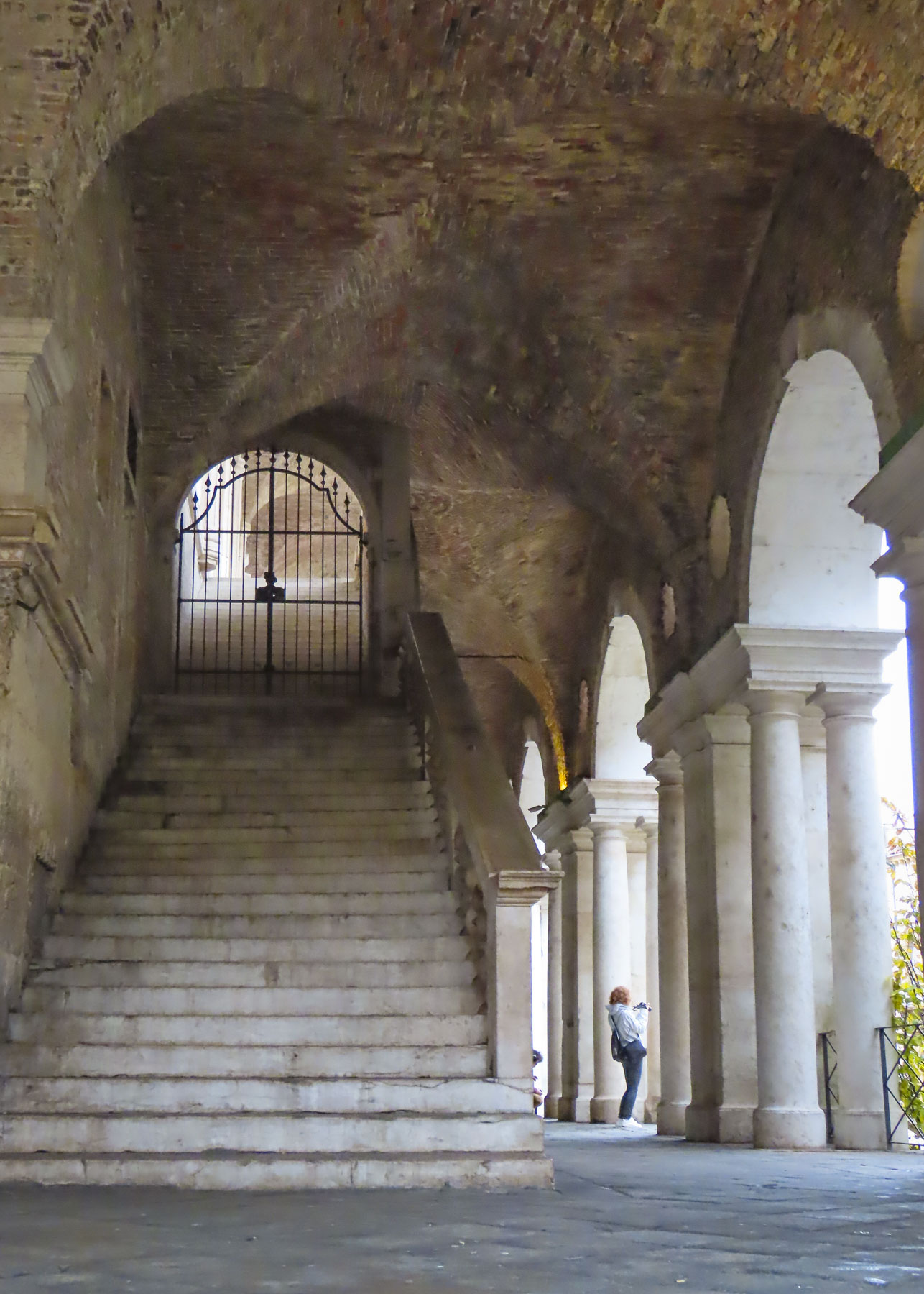
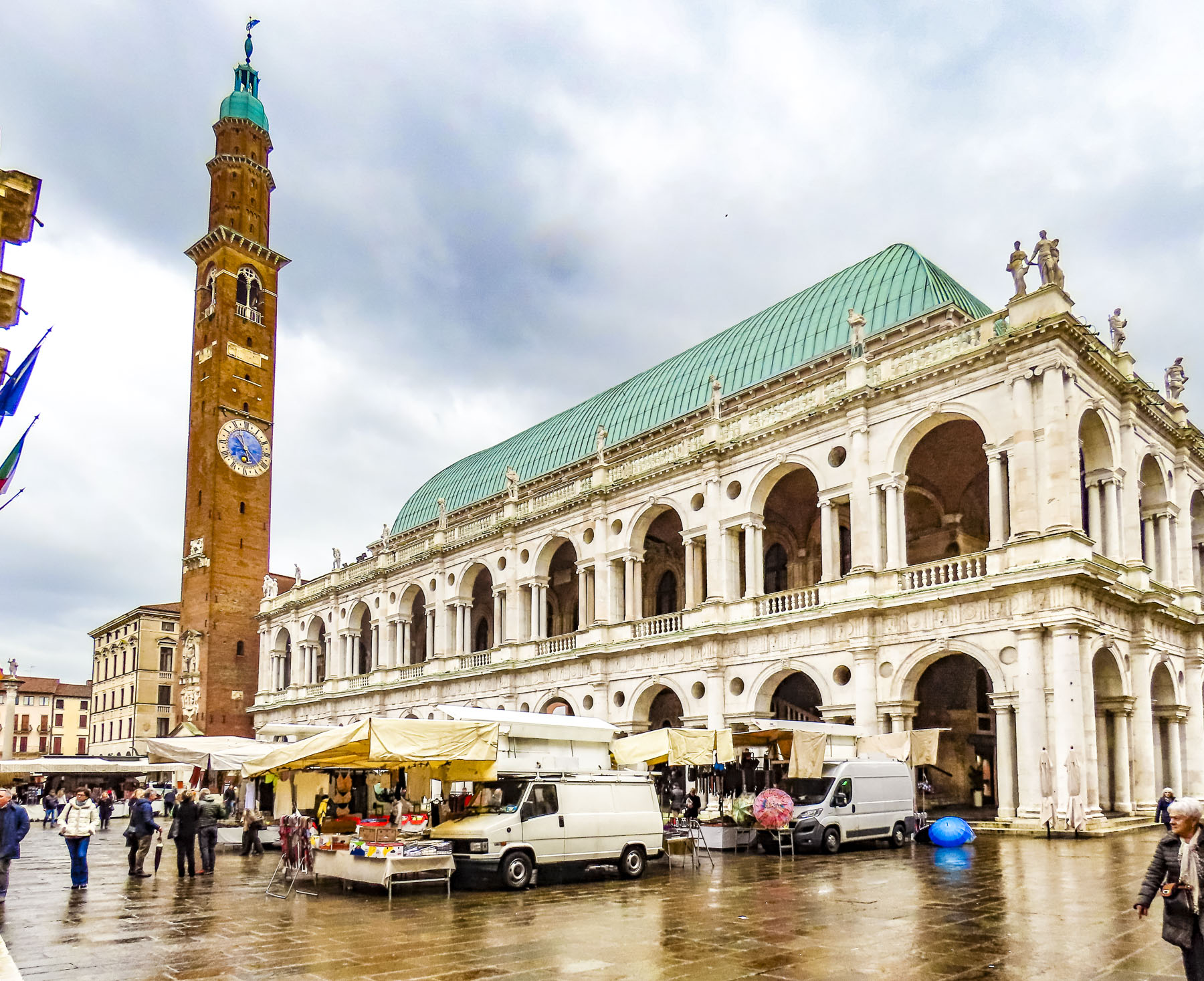
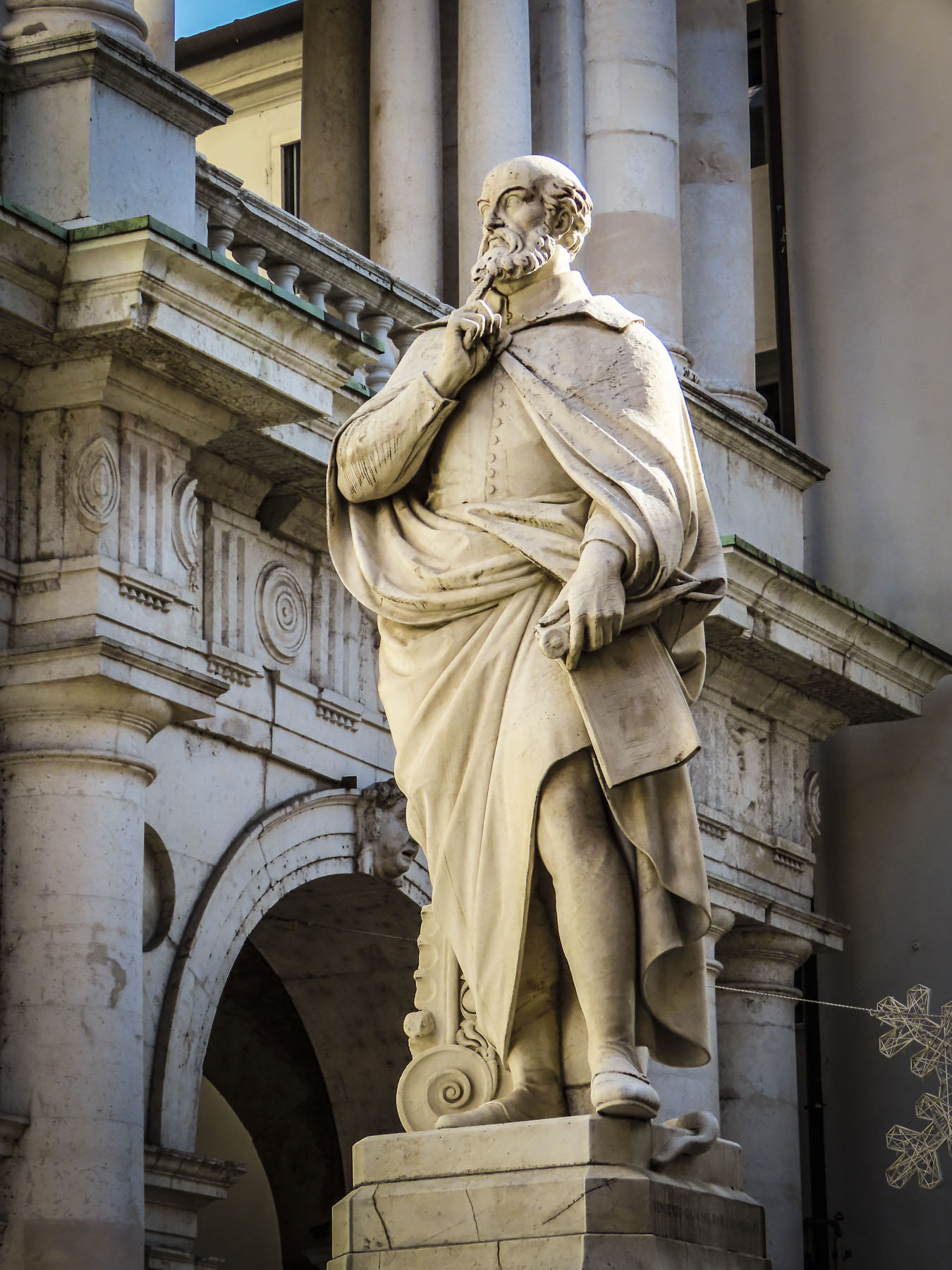
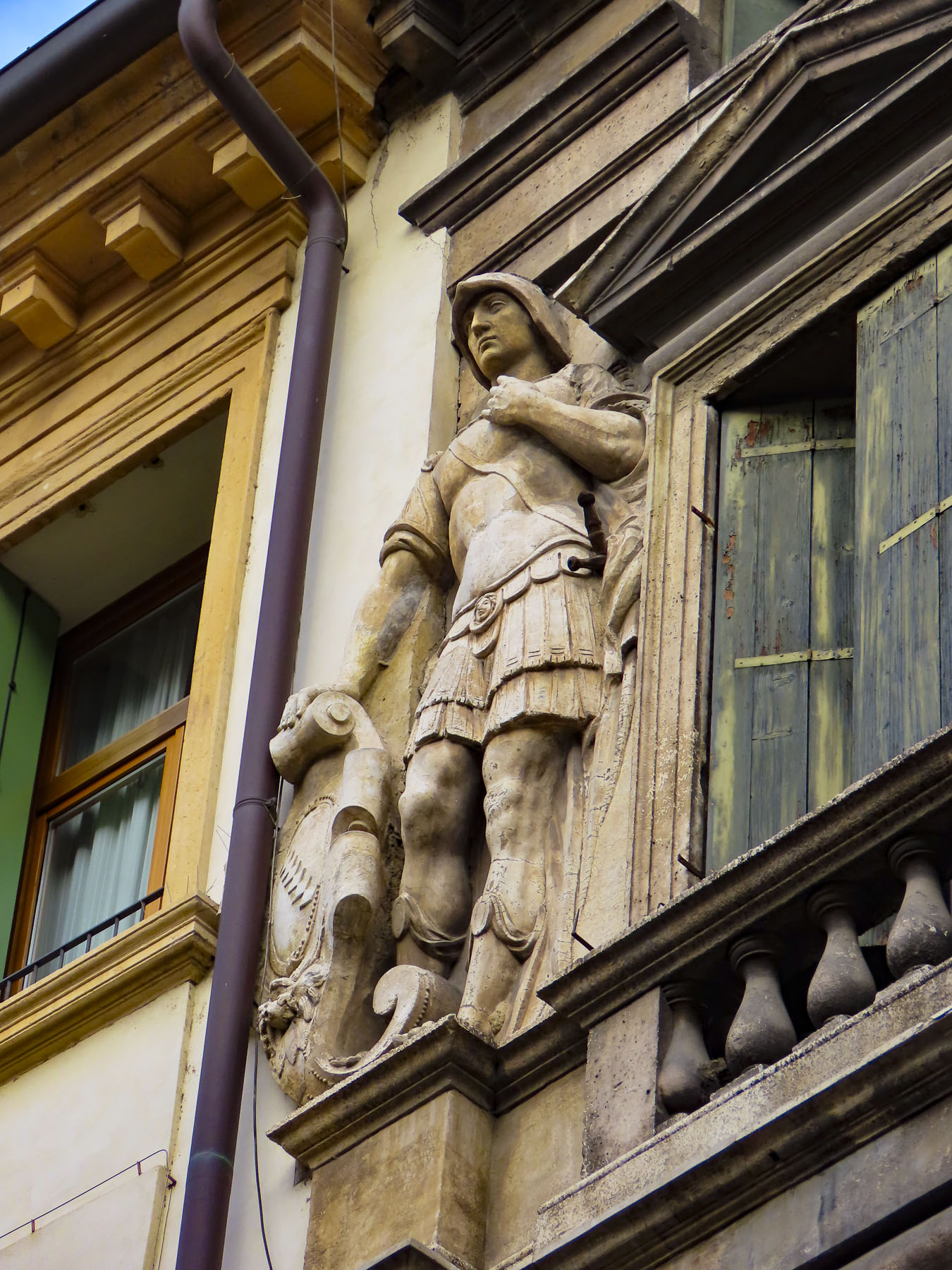
Our visit was long enough for dinner and a stroll, the next morning, around the Piazza dei Signori with its massive civic building, the Basilica Palladiana, redesigned to its present form in 1546 by the young, as-yet unknown hometown architect Andrea Palladio.  His architecture can be characterized as a refined rethinking of classical Greek and Roman temples with domed and columned buildings favoring a “harmonic Renaissance aesthetic.” The style was popular with many wealthy Italian families across the Veneto region, who commissioned him to design their palazzos. This grand style continued to be extensively influential into the 19th and 20th centuries where it was favored for municipal and government buildings, i.e., the United States Capitol Building and British Museum, among others.

Our original visit was enough time to realize the city was vastly interesting and that we had mis-planned.  Now we stay a minimum of two nights wherever we go to compensate for time lost traveling between destinations.

We figured seven nights this time should be enough to relax, enjoy the city and sample its livability.

Raised in the suburbs of New Jersey, we always shunned living in a city until we retired and sold most everything, including our cars, to finance this two-year adventure around the world.  To our surprise we now enjoy city life. Especially the walkability of smaller historic cities with their pedestrian only centers, a concept not found in the sprawl associated with urban planning in the United States.

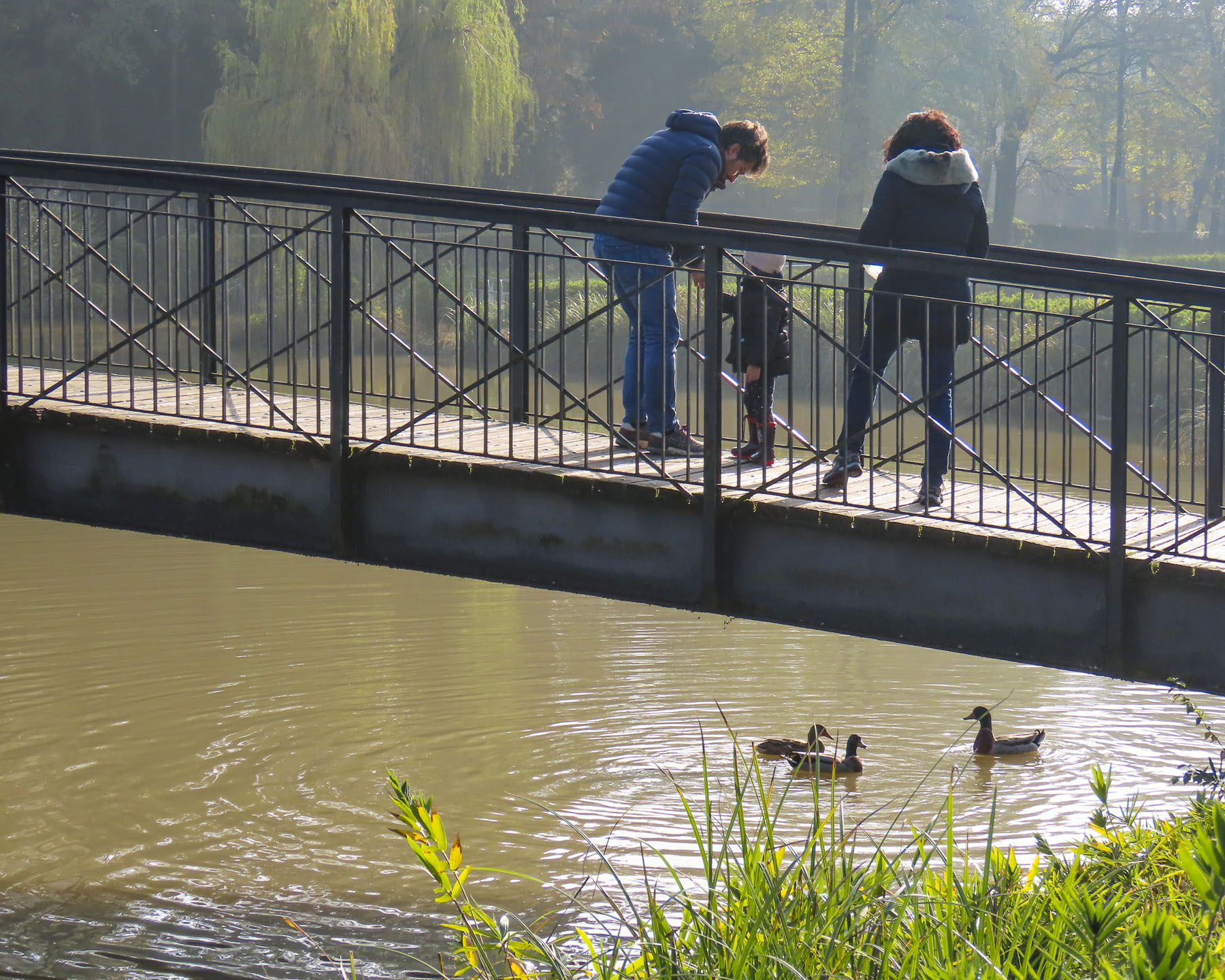
As we neared Vicenza our shuttle driver, Fabrizio, from the Venice Airport, detoured slightly to show us two points of interest on the outskirts of the city that he thought we might enjoy, and were afraid we would otherwise miss. Parco Querini, a semi-formal large open green space with sculpture lined paths and a domed pergola, looked stunning on a late autumn afternoon. It was once the private retreat of a wealthy family and was opened to the public in the 1970s. 

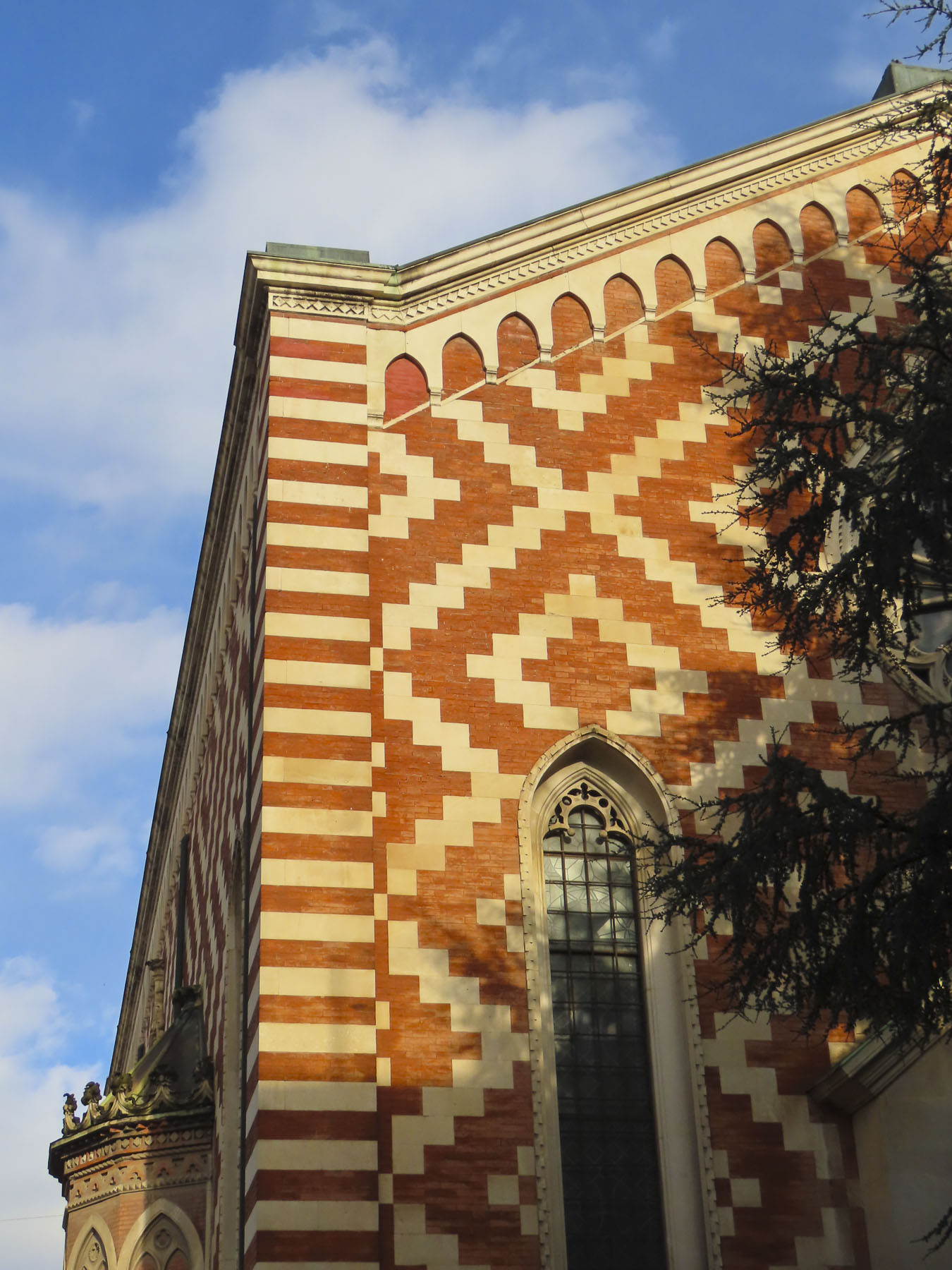
Nearer our apartment, Fabrizio took us past the red and white brickwork of the Chiesa de Santa Croce ai Carmini, with its architecturally distinctive facade. We found both sights interesting and vowed to return.

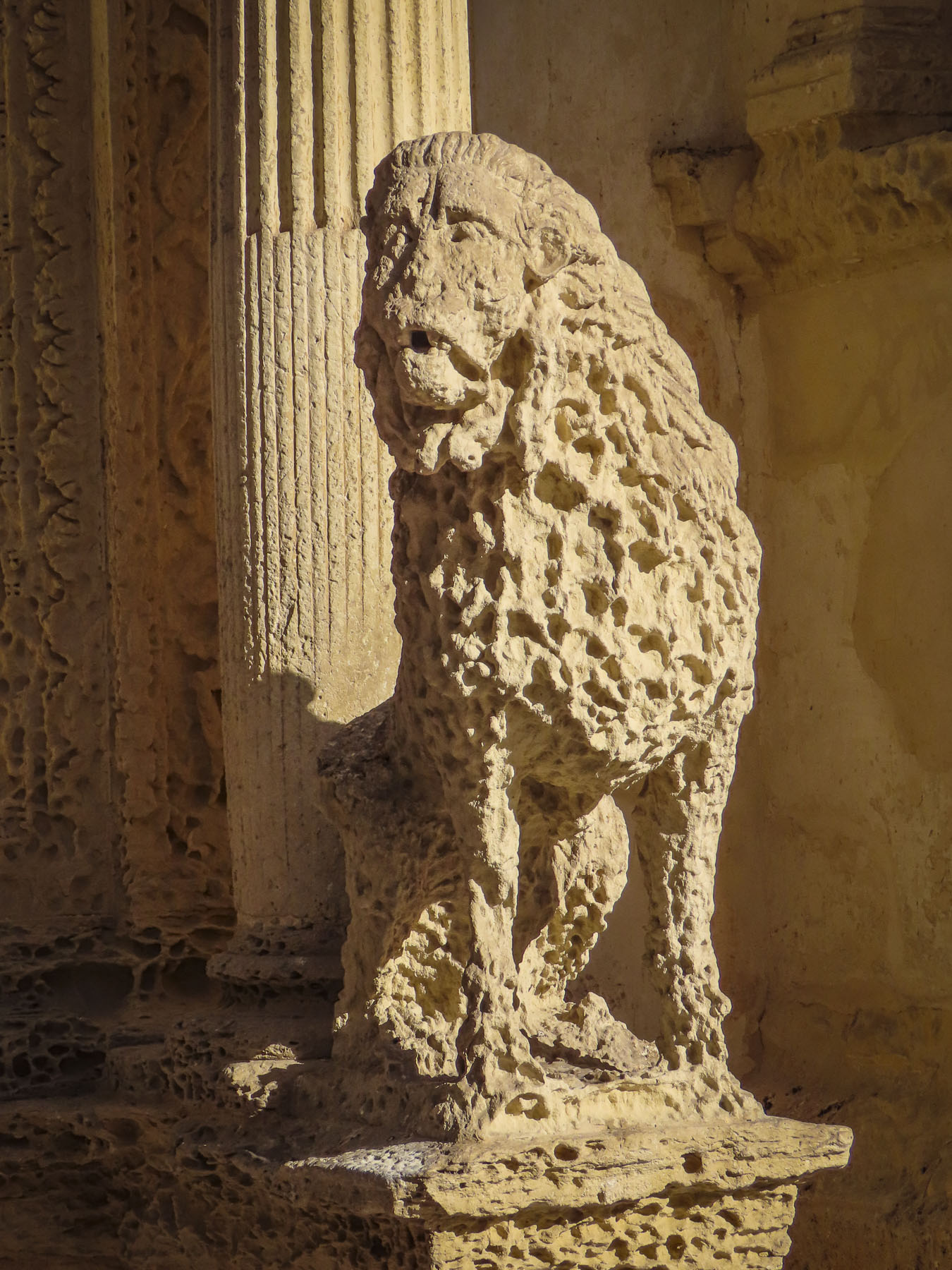
While walking to the park for a return visit, we found the Boutique Del Pane Vicenza, a delightful small bakery at the very end of Corso Antonio Fogazzaro, past the 14th century Church of San Lorenzo with its intricately carved roped portal and guarding lions that have slowly eroded with time.  Years ago in Italy, the concept of “coffee to go” or “take away” as we have in the states was unheard of. Tradition was you stood at the counter for a quick morning espresso or lingered at a table.  Attitudes have evolved and we are not sure if we agree, but this visit, with coffees and pastries in hand, we snacked in the park.

Nearby the twice-weekly artisanal farmers market, Il Mercato Campagna Amica di Vicenza, brought locally produced cheeses, wines, fruit and vegetables to new meaning with a “zero food miles” philosophy.  The artisanal baker was very popular with folks queued three deep at her counter for a chance to buy a wedge of bread from her huge country loafs.  Around the corner from the market, we found the best vegetarian restaurant we’ve ever been to, NaturaSì Silene Bio Bottega E Cucina. With truly the most flavorful and memorable vegetables.

From our apartment on Contra Motton San Lorenzo we explored the historic center of this delightfully compact, Renaissance city, where we were less than a ten-minute walk from everything. As we strolled past intriguing architectural details, we took note of what to do and where to go later in the week.  Discovering pastelería is our superpower and we put it to good use finding tasty creations to enjoy for the next morning.  Walk a little then café – repeat was a well-paced yet caloric approach that we fully enjoyed in our explorations of the city.  Though some days longer walks between cafes were needed when our belts were too tight. Donna says the solution is simply to wear elastic waist pants.

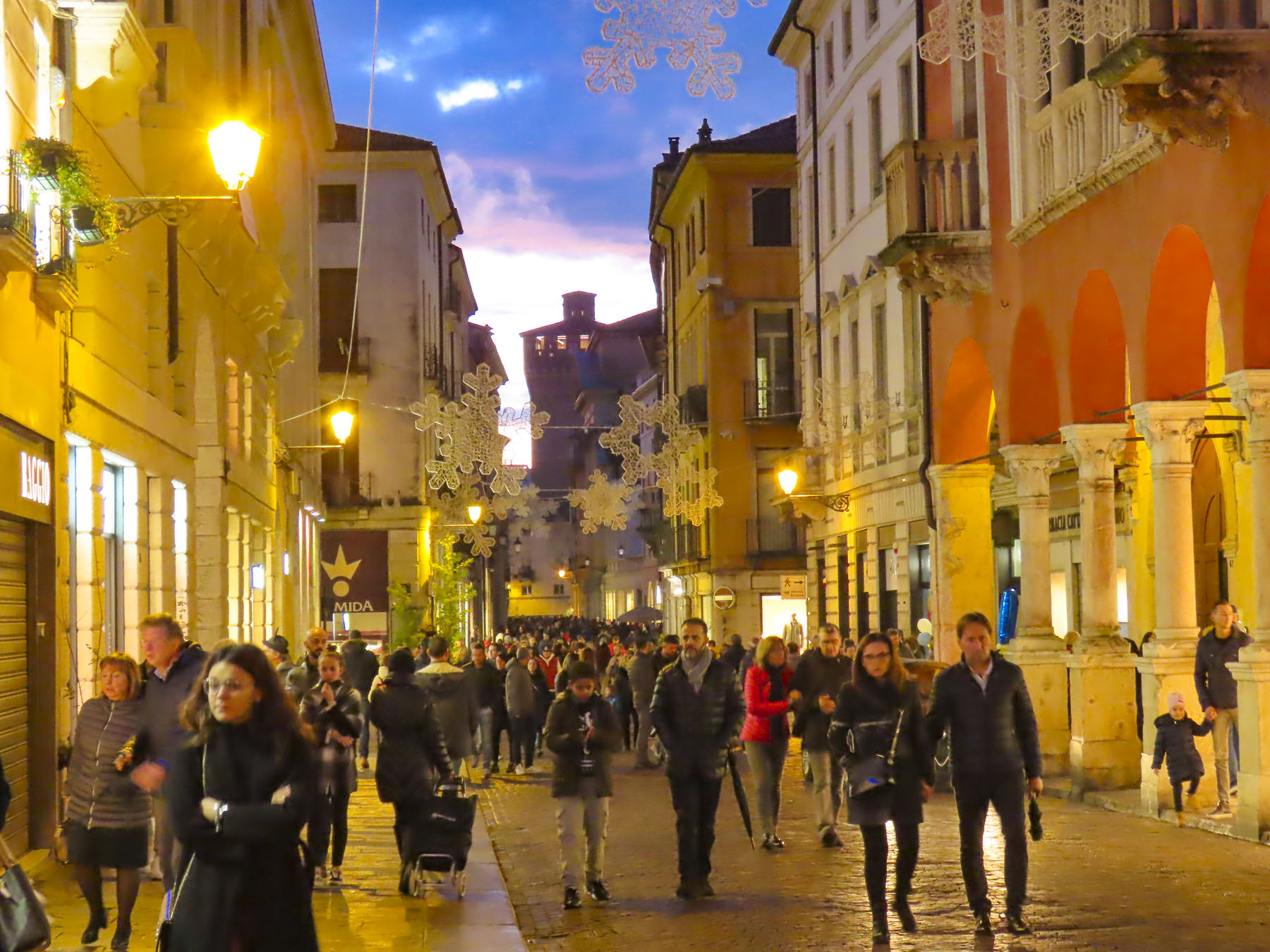
During the time of the Romans the main street in Vicenza was Via Postumia, a military road that connected outposts across Northern Italy. Later during the Renaissance, noblemen competed in Palios, horse races, on the religious festival days for Sacra Thorn and Corpus Domini, when the main street, now lined with arcaded sidewalks, was used as a racecourse. After the Second World War the street was renamed Corso Andrea Palladio, to honor the great architect for his contributions to the city, and an electric street-trolley coursed down the avenue. The Corso and the historic center of Vicenza have been pedestrian only since 1983. It remains a vital artery, with upscale shopping and restaurants connecting either end of the town and the historic sites in between. It’s the perfect street for La Passeggiata, the early evening stroll locals still enjoy. If you are looking for a traditional Italian bar along the Corso, the Gran Caffe’ with its old-world charm is the perfect place for an espresso or spritz. It attracts a diverse following, and is popular with students, professionals and a cadre of finely dressed older women who seem to be as much of an institution as the café itself.

Vicenza’s relic from Christ’s Crown of Thorns is treasured in the Sanctuary of Santa Corona, which was built by the Dominicans in the late 1200s to safekeep the extraordinary gift from the French King Louis IX to the Bishop of Vicenza. 

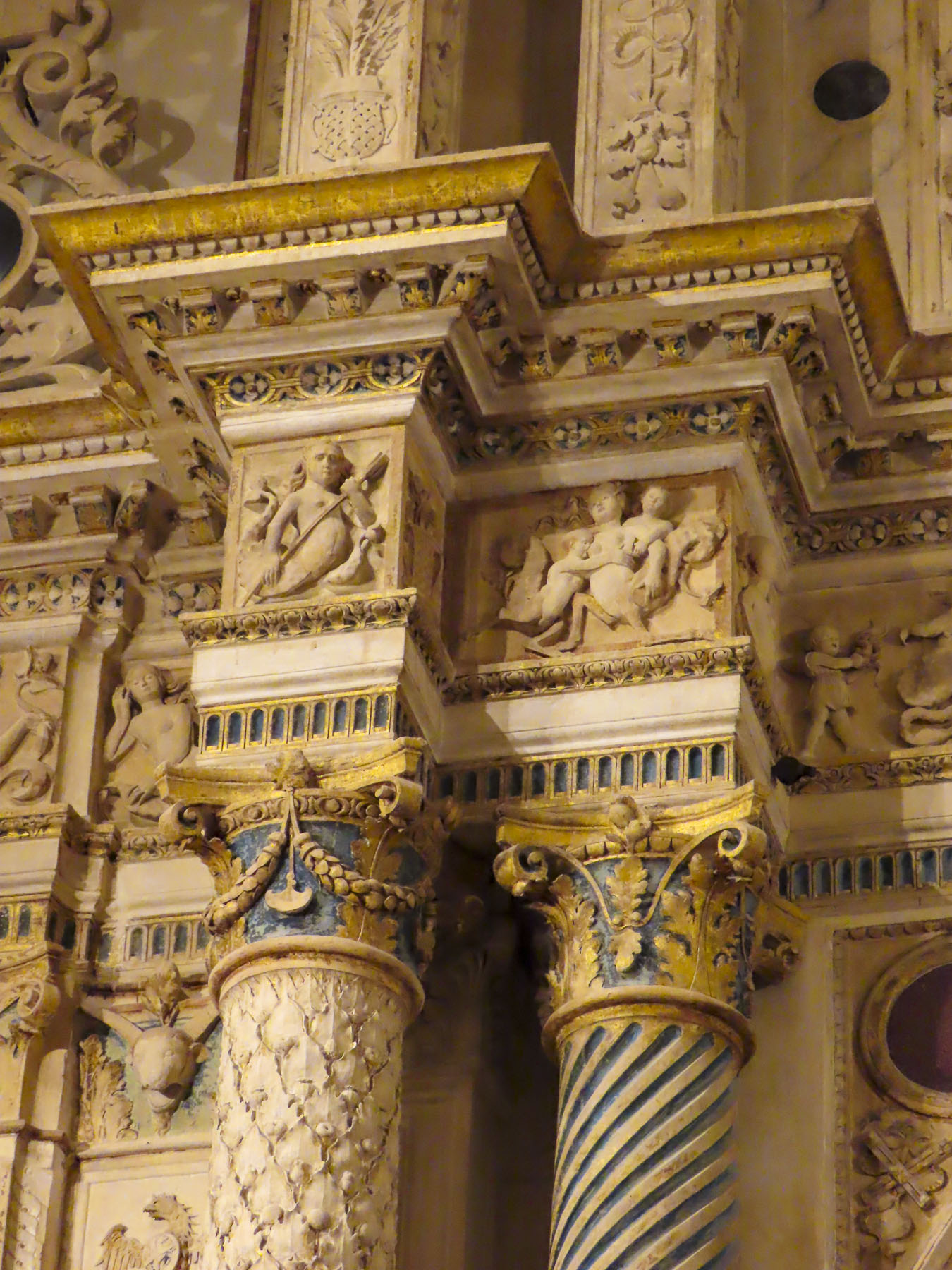
The centerpiece of the church is a beautiful altar embellished with pearls, corals, lapis lazuli and polychrome marble. Interestingly, outside hanging on the wall of the cloister is a plaque featuring a Cinta senese, an ancient Italian pig breed that is famous for its flavorful meat.

Palladio has definitely left his mark on the city with buildings of his design on almost every street – at least, it seems that way. A tour of the city wouldn’t be complete without stopping at the Palazzo Barbaran da Porto, a Palladio design built in 1570, that is now a museum with interactive exhibits and video displays as well as three dimensional models dedicated to the architect’s work.  Recognized by UNESCO in 1994 for his influential architectural aesthetic, called Palladian, twenty-four of his Palazzo designs and the city itself have been designated a World Heritage Site.

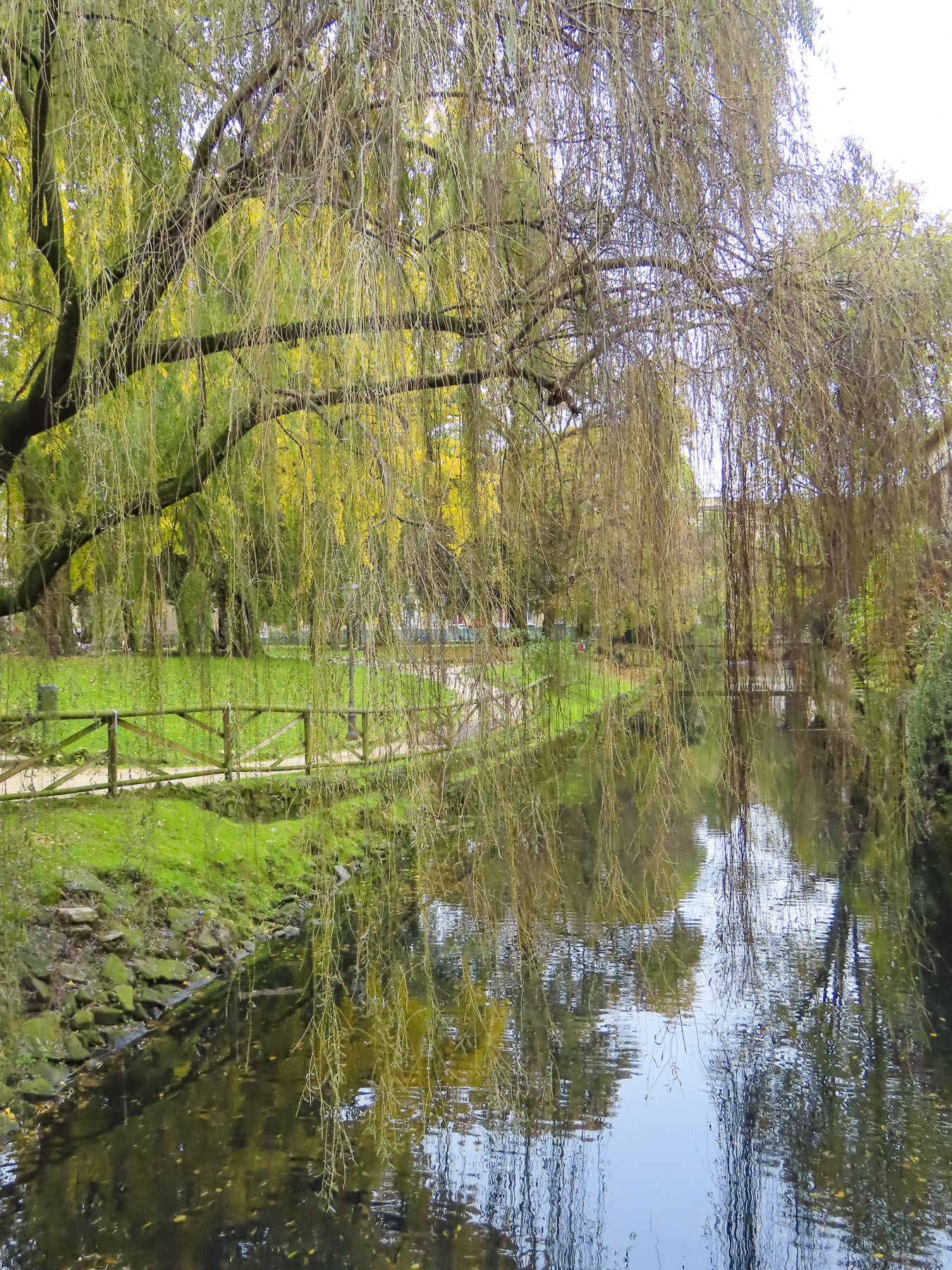
The city also has a wonderful ambience aside from his architectural masterpieces.  Waterscapes from the Ponte S. Paolo and the Ponte S. Michele over the Fiume Retrone reflect a quaint village vibe unexpected in comparison to the grand Piazza dei Signori just two blocks away.  

Pasticceria Venezia – a Vicenza dal 1964, just up from the bicycle parking on S. Paolo and near the Palladian Basilica, is a terrific place for café and a bite to eat.

On the other end of town just outside the Porta Castello, the Giardini Salvi, a treed greenspace with fountains, has been on the city map since 1580. It was the private park to the Palazzo Valmarana and in a brief moment of 16th century civic mindedness, was open to the public for a few years before being closed again for several centuries.  It wasn’t until the 20th century that the park was permanently reopened for public use.

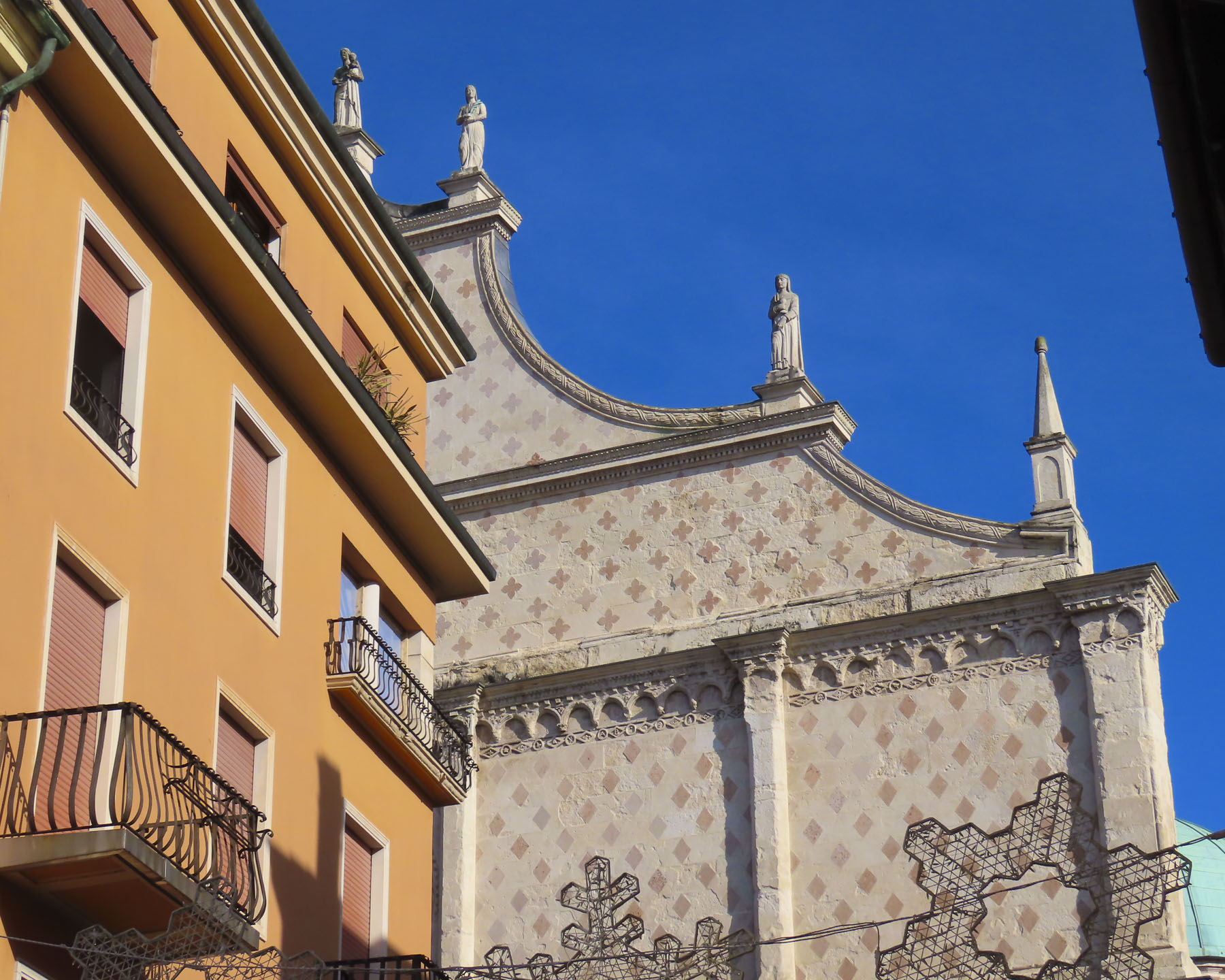
The district south of the Corso Palladio is also worth exploring with the Duomo di Vicenza, the Cathedral of Saint Mary of the Announcement, as its centerpiece.  Heavily damaged by allied bombing during the Second World War, only the original 1482 Gothic entrance façade remained, while the rest of the church had to be reconstructed.

Diagonally across the street, in the ancient Bishop’s Palace, the Museo Diocesano di Vicenza has a unique collection of Vicentine religious artifacts. Interestingly there is a large collection of fine marble spheres, some the size of bowling balls, given to a former Bishop of Vicenza as gifts.  Discovered on the other side of the piazza during reconstruction after WWII the Criptoportico Romano was the subterranean storage area of a 1st century Roman domus. As interesting as that sounds, if you’ve been in an empty, damp dark basement before, you can skip this.

Around the corner is Righetti’s, a self-service restaurant and another Vicenza institution for over thirty years, that should be experienced. Customers find their own tables and set the cutlery themselves before walking to the back of the restaurant and placing their orders, from the daily changing menu on chalk boards, directly with the cooks in the kitchen.  After dinner, the cashier counts your glasses and plates, then bills accordingly. They are open Monday through Friday for lunch and dinner, cash only.

Although the weather was noticeably cooler, we enjoyed our November off-season visit to this visually pleasing and gentle city. If you are an admirer of historic architecture, Vicenza is akin to finding a lost treasure. The bonus was the lack of large tourist groups, which we imagine could be quite smothering in this quaint city during peak travel months.

Till next time, Craig & Donna

Driving South to Sicily: Part One – Herculaneum to Sorrento, or “They Have You by the Coglioni!”

The car rental agent across from the Naples train station enthusiastically informed us that we were the first drivers of a brand-new Peugeot. Leading us to a shiny set of wheels, parked on busy street in front of the office, he offered a rudimentary description of the car’s technological features, a collision avoidance system and satellite navigation that would show every radar speed camera on the Italian highways.

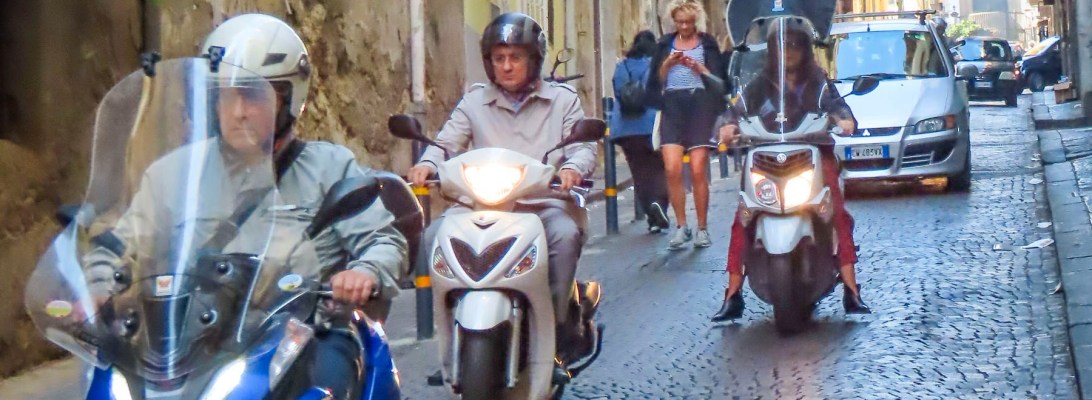
With our luggage in the trunk and a friendly wave we were off, or so we thought.  Just barely moving forward, the collision avoidance system screeched alive with alarms and red blinking threats on the dashboard display.  It happened frequently as we worked our way through heavy Neapolitan traffic. Scooters, cars, trucks and pedestrians getting close to our bumpers set the system into a frenzy of piercing alarms and flashing lights.  Nerve wracking – it felt like I was Luke Skywalker thundering along in an X-wing fighter while R2D2 whizzed with anxiety, as we tried to evade the Empire’s eradication. In reality we were in bumper-to-bumper traffic.  Fortunately, the congestion eased, and Herculaneum was only a twenty-minute drive from Naples.

We had visited Pompei years earlier, one June when Italy was having an early heat wave and the temperature was over 100F.  As interesting as Pompei was, the size of the site and the heat dampened our enthusiasm for it. This day was quite a different experience, as the weather in November was very agreeable for visiting Herculaneum.

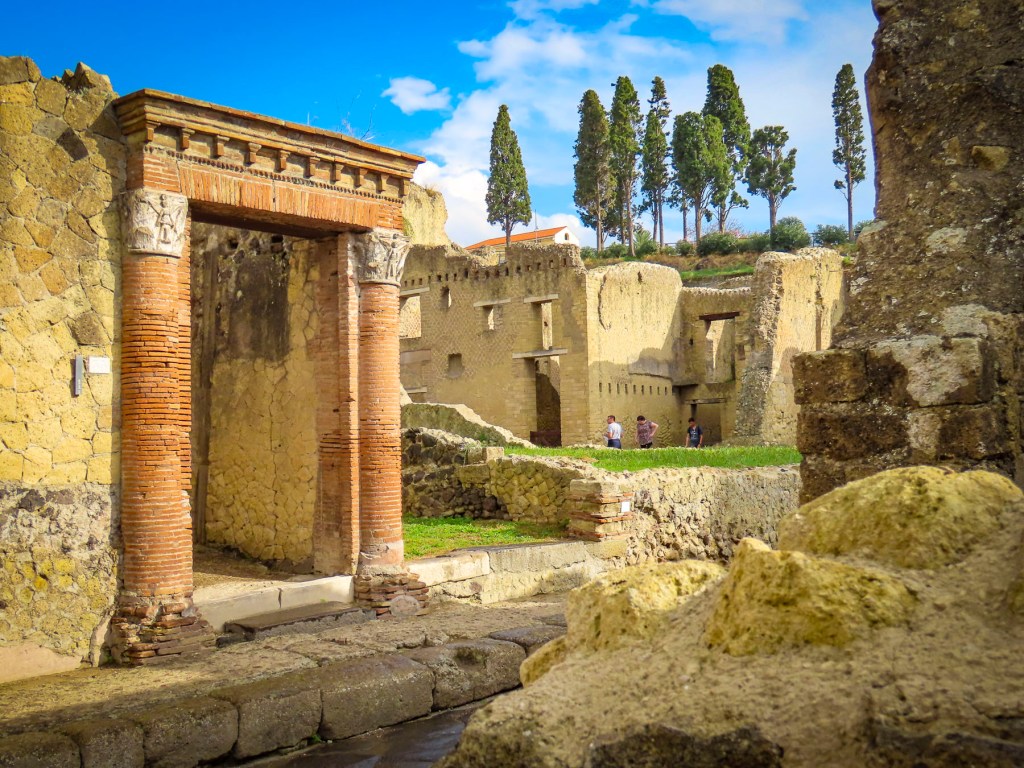
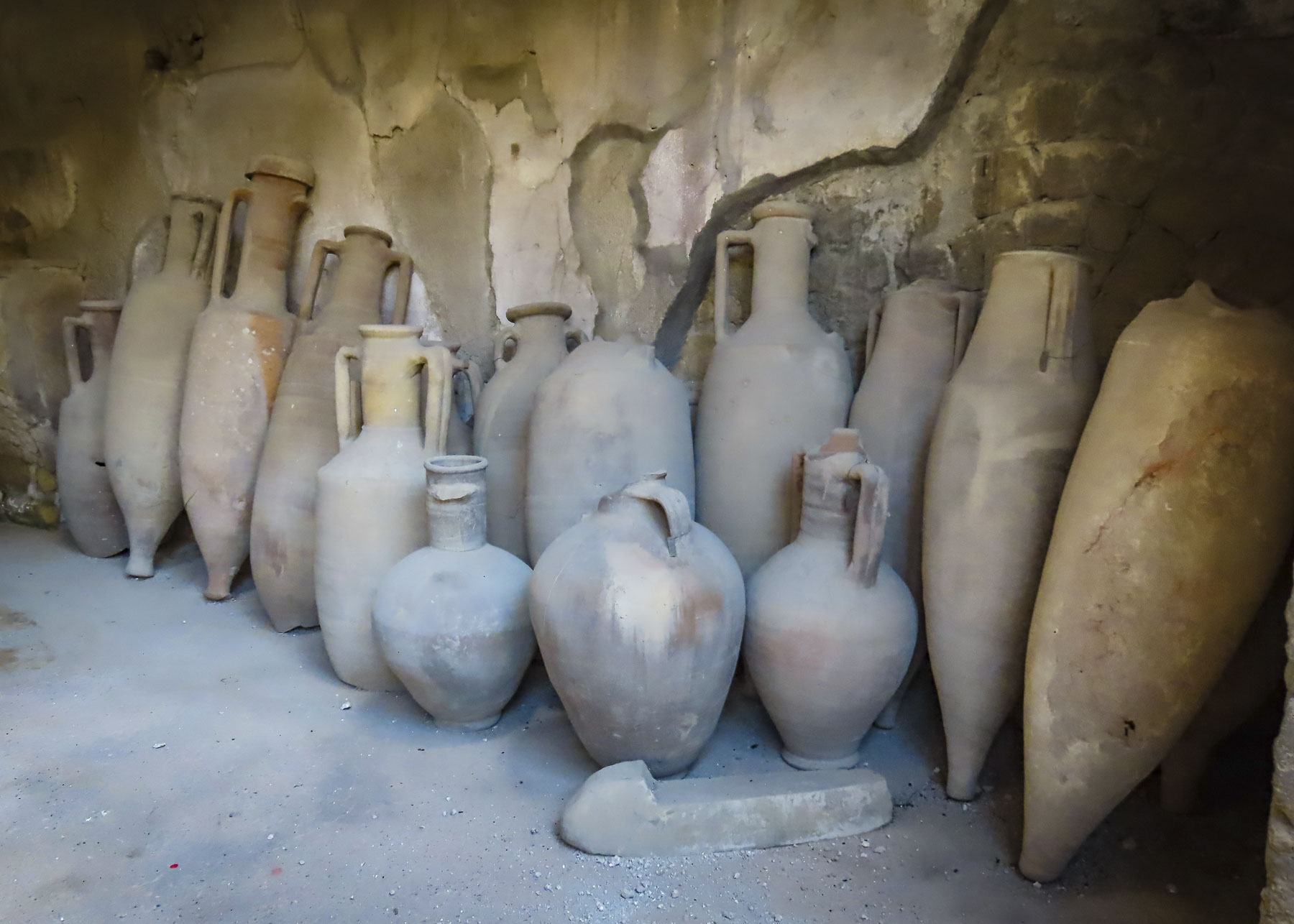
We descended into its excavated ruins, which were destroyed and covered with 53ft of ash on the same fateful night as Pompeii in 79AD.  The towering black walls of solidified ash surrounding the site reinforced the magnitude of the catastrophe. The coastal town was popular with wealthy Romans who built Domus style homes which were richly decorated with frescoes and mosaics.  Arched workshops of boatbuilders lined the shore and were the last refuge of citizens trying to flee, their agony now eternally preserved in casts of their bodies.  The massive amount of ash and volcanic rock that fell created a new shoreline on the Bay of Naples, 2000ft farther west. 

Only a fraction of the size of Pompeii, the Herculaneum archeological area doesn’t draw the immense crowds of the larger site, but is just as interesting and in some ways more so. Unlike Pompeii, which was engulfed in a scorching lava flow which destroyed most of the wood and decorative elements of the homes there, the cooler ash and poisonous gases that killed the populace of Herculaneum preserved the homes to a greater degree, leaving the wooden internal structure of buildings and their interior décors intact.  This combined with an earlier visit to the Naples National Archaeological Museum to see the finest examples of relics recovered from the ruins of Herculaneum and Pompeii provided us with deeper insight into the opulent lifestyle of the 1st century AD Roman Empire.  Herculaneum was easily explored in a half day and enabled us to continue to Sorrento in a timely manner.

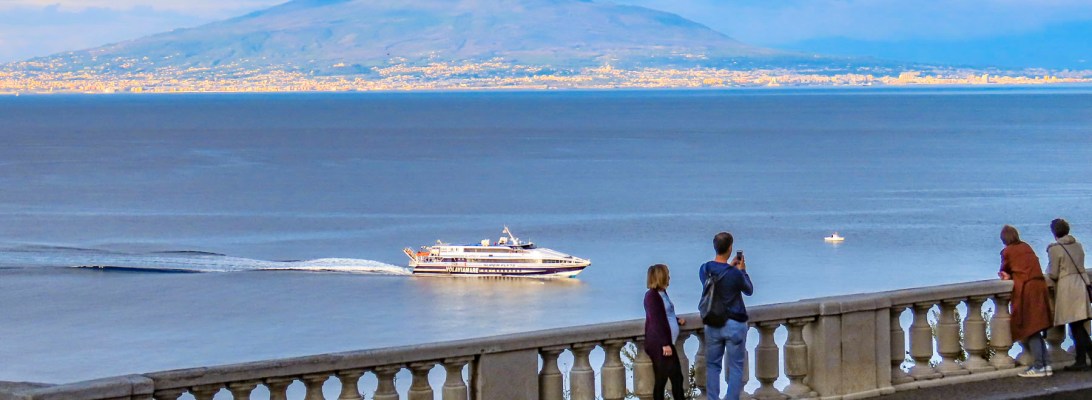
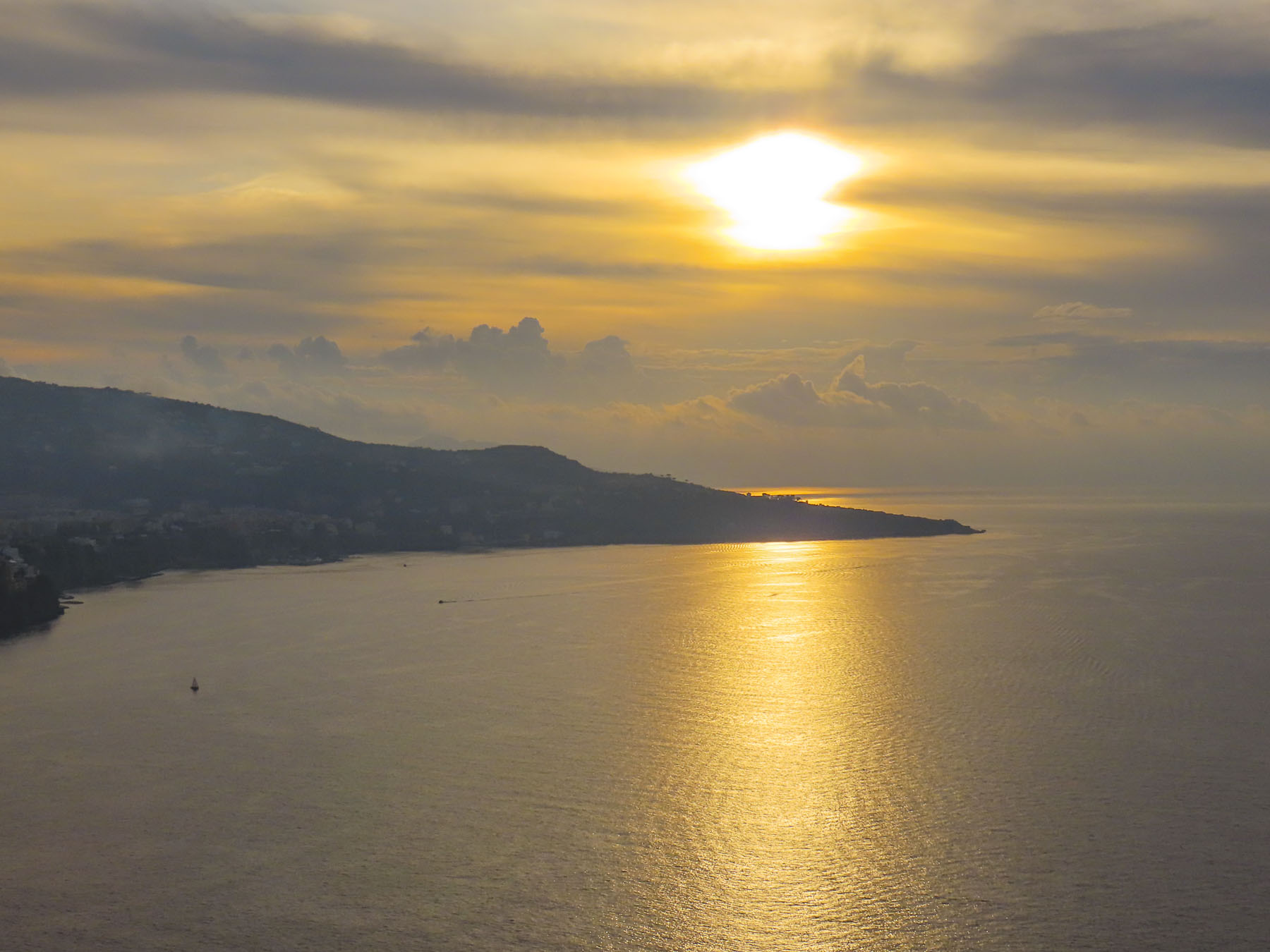
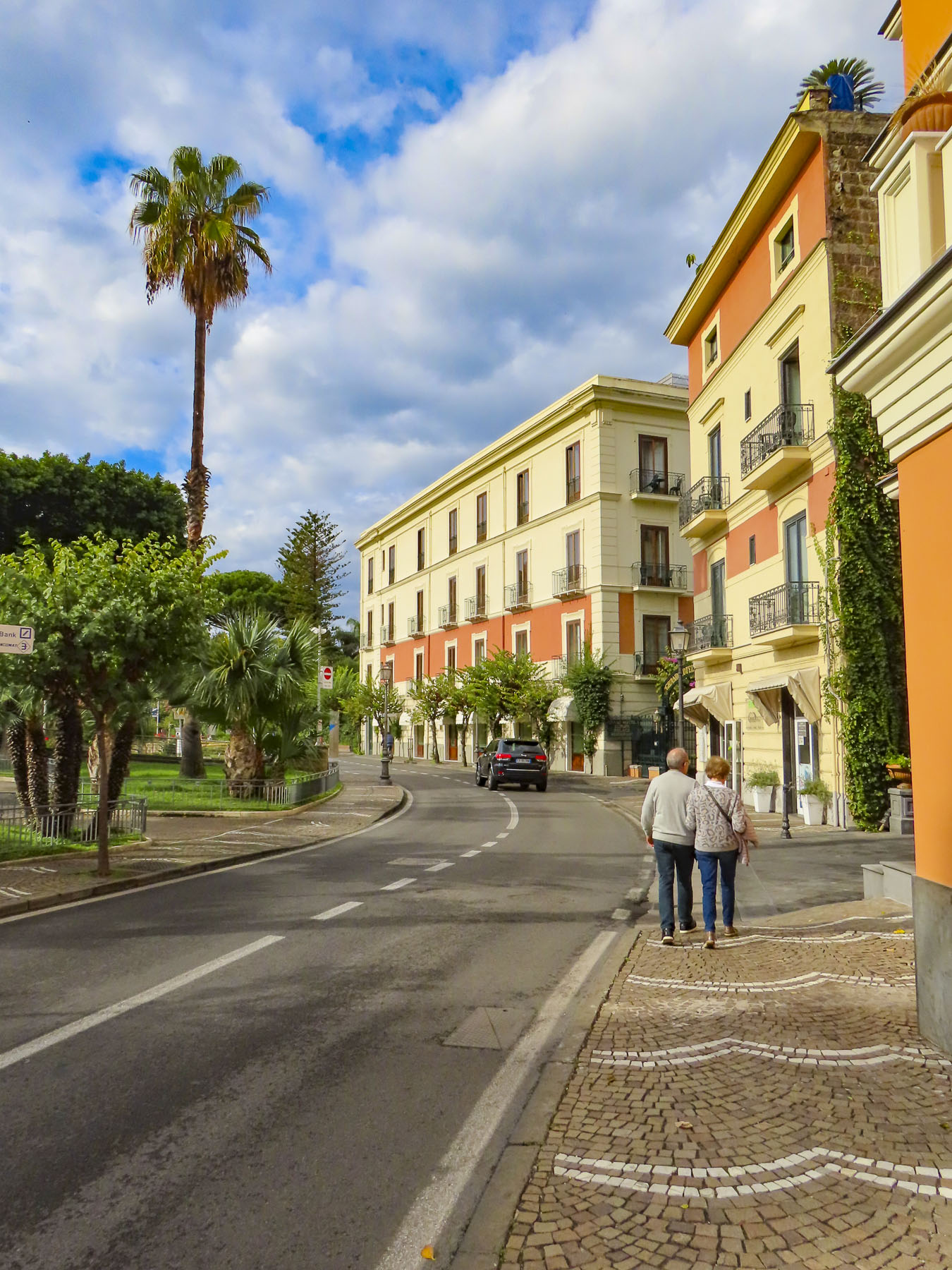
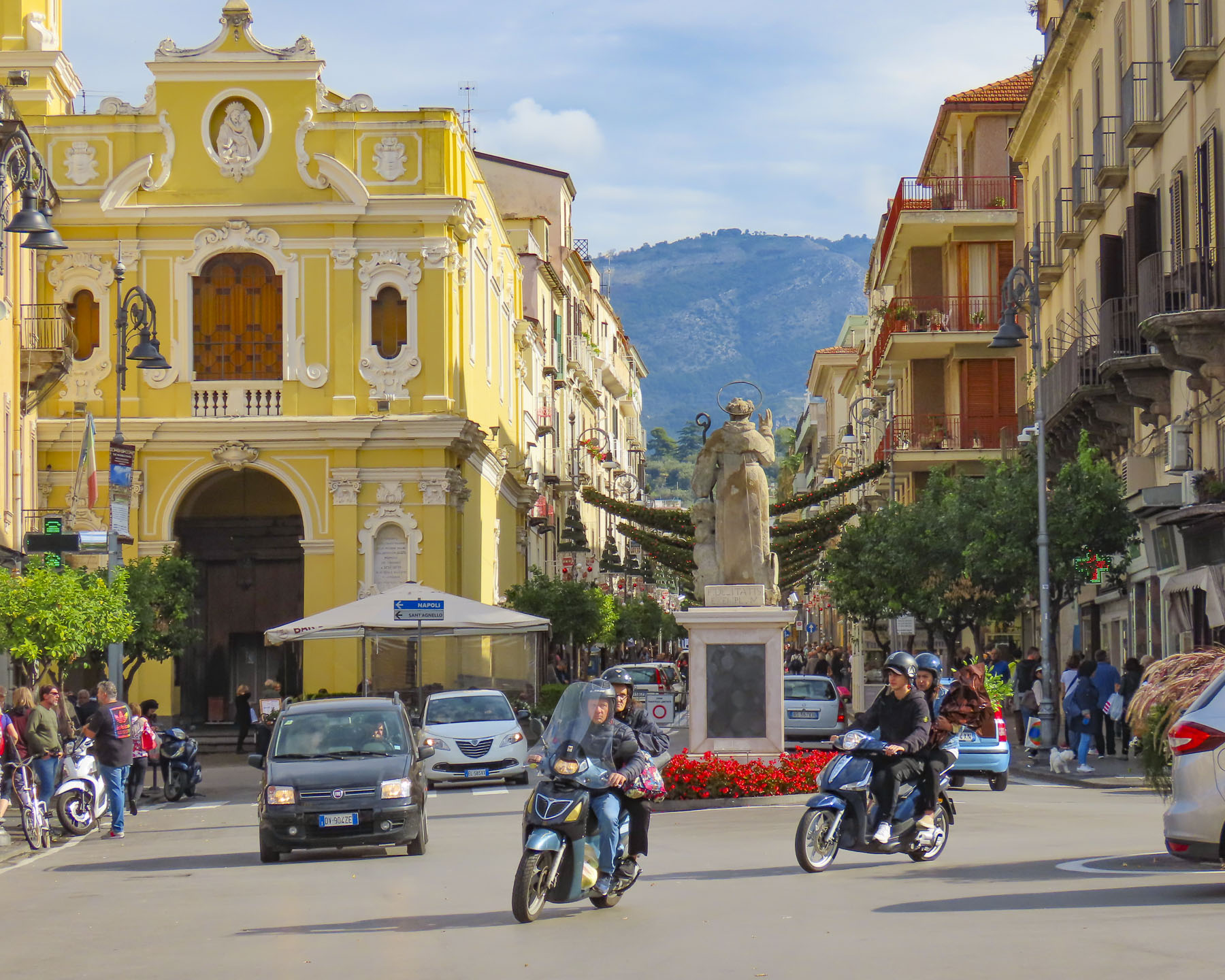
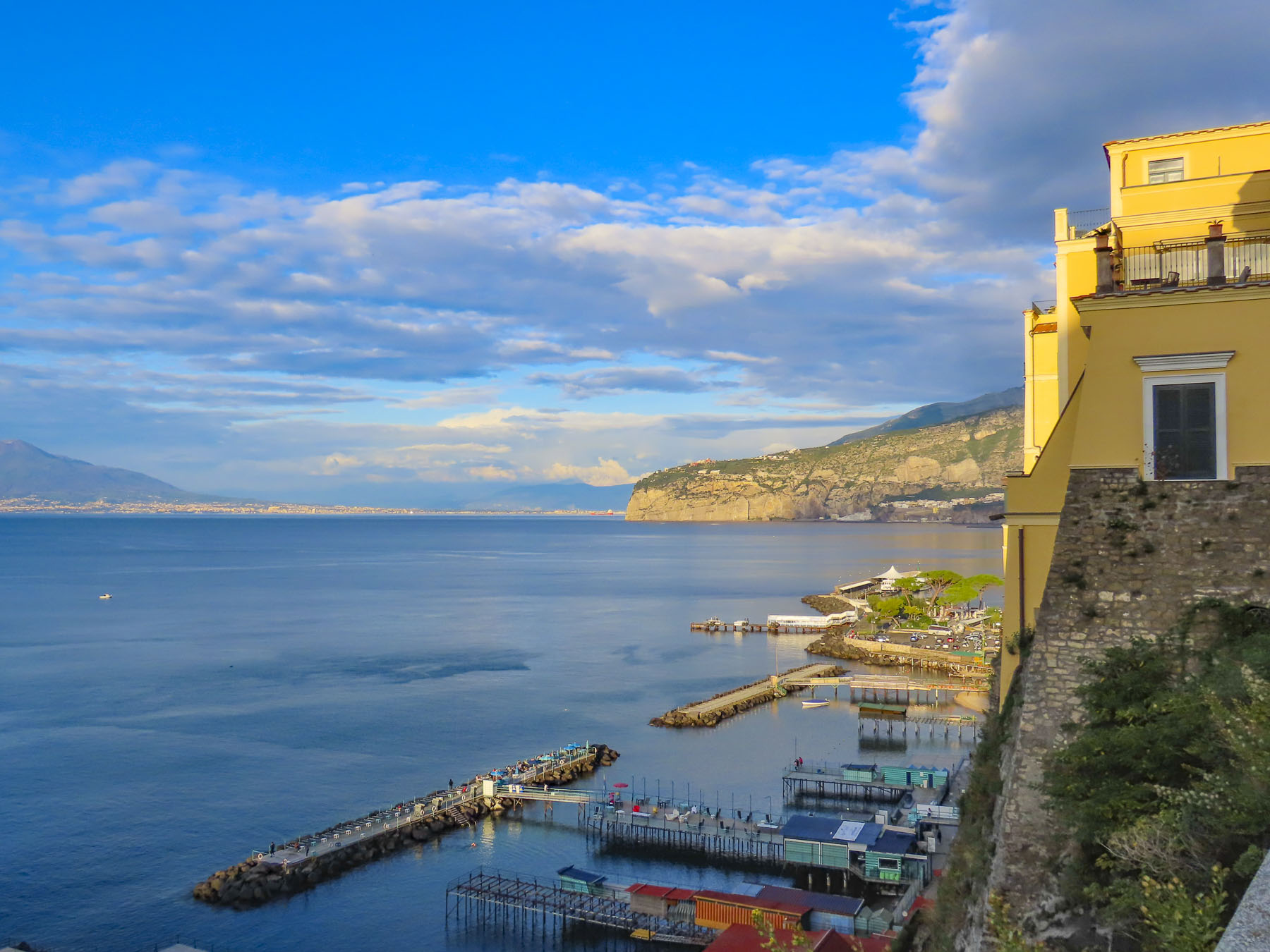
With fond memories of the serpentine Amalfi Coast from a trip a fifteen years earlier, we decided to base our new weeklong exploration of the Sorrentine Peninsula in Sorrento.  The route into town along SS145 didn’t disappoint us when rounding a cliff-hugging bend of the road revealed a view all the way out to the Isle of Capri. By staying in the largest town of the region we didn’t have to worry about seasonal closures, which unfortunately were beginning to happen in mid-November.  Only a short walk from the center of town and the waterfront with Mount Vesuvius commanding the horizon across the Bay of Naples, the lovely Villa Rosa Sorrento with its modest off-season pricing and free parking was a terrific value and perfect for us.

With our attempts at immersive travel, we avoid scratching off a list of designated tourist highlights; rather,  we explore a place seeking how to experience how folks live, the everydayness of a place, and whether we would enjoy living there. “Walk a little, then café,” is our slow travel approach as we soak up the ambience of a locale.

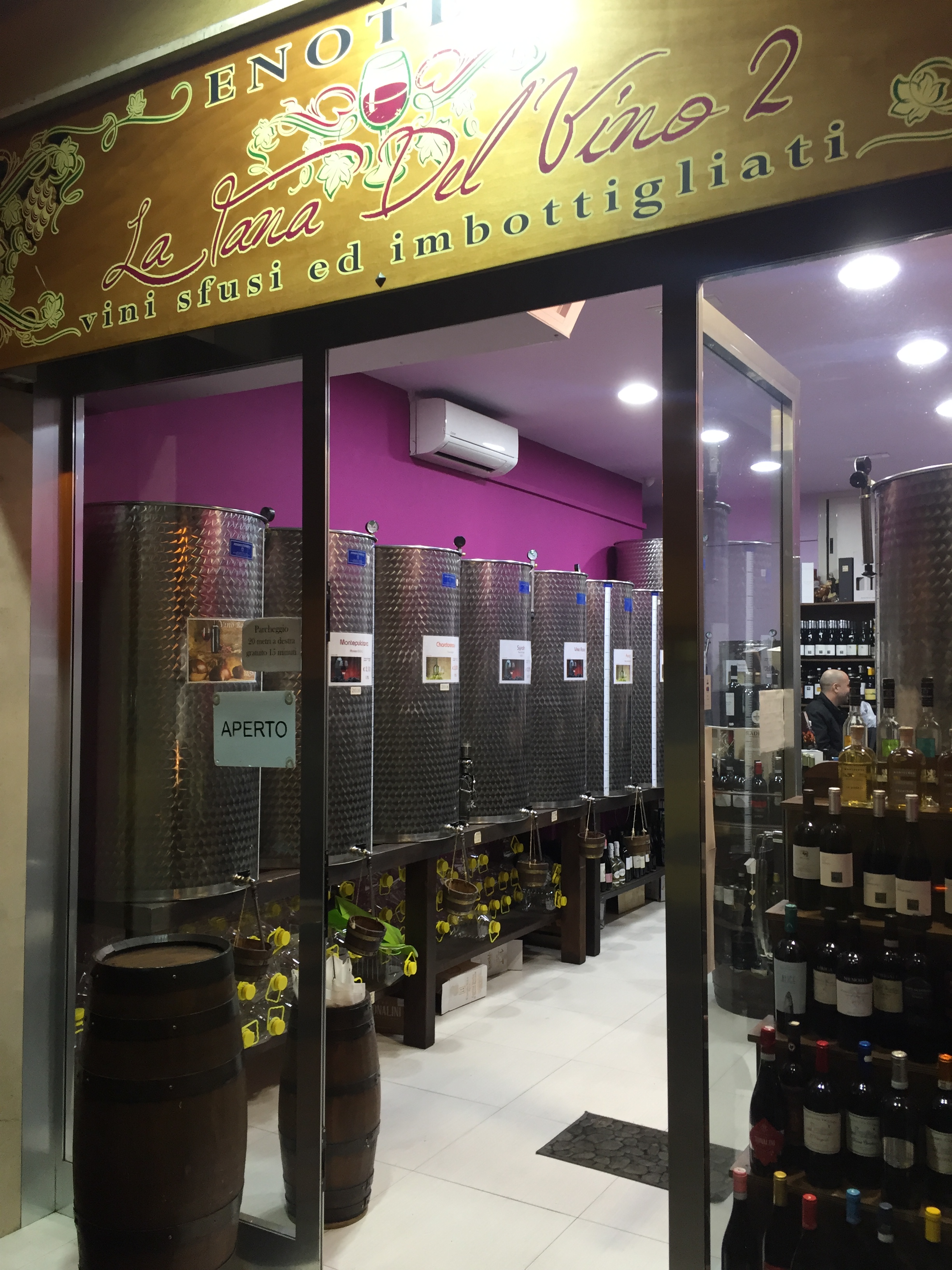
La Tana Del Vino on Via Parsano was a delightful find. This small enoteca features regionally produced wines that they decant for you from large stainless-steel vats into your own glass or plastic bottles.  A variety of red, white and rose’ wines were available, most between 3-4€ per liter.  Samples were freely poured and we very pleased with our selection of these table wines. 

Sorrento with its ferry service to Capri gears itself to the high season.  There were still tourists out and about, but the large tour buses and groups were absent in November, the beginning of the rainy season.  We ran between rain drops the best we could on several occasions. 

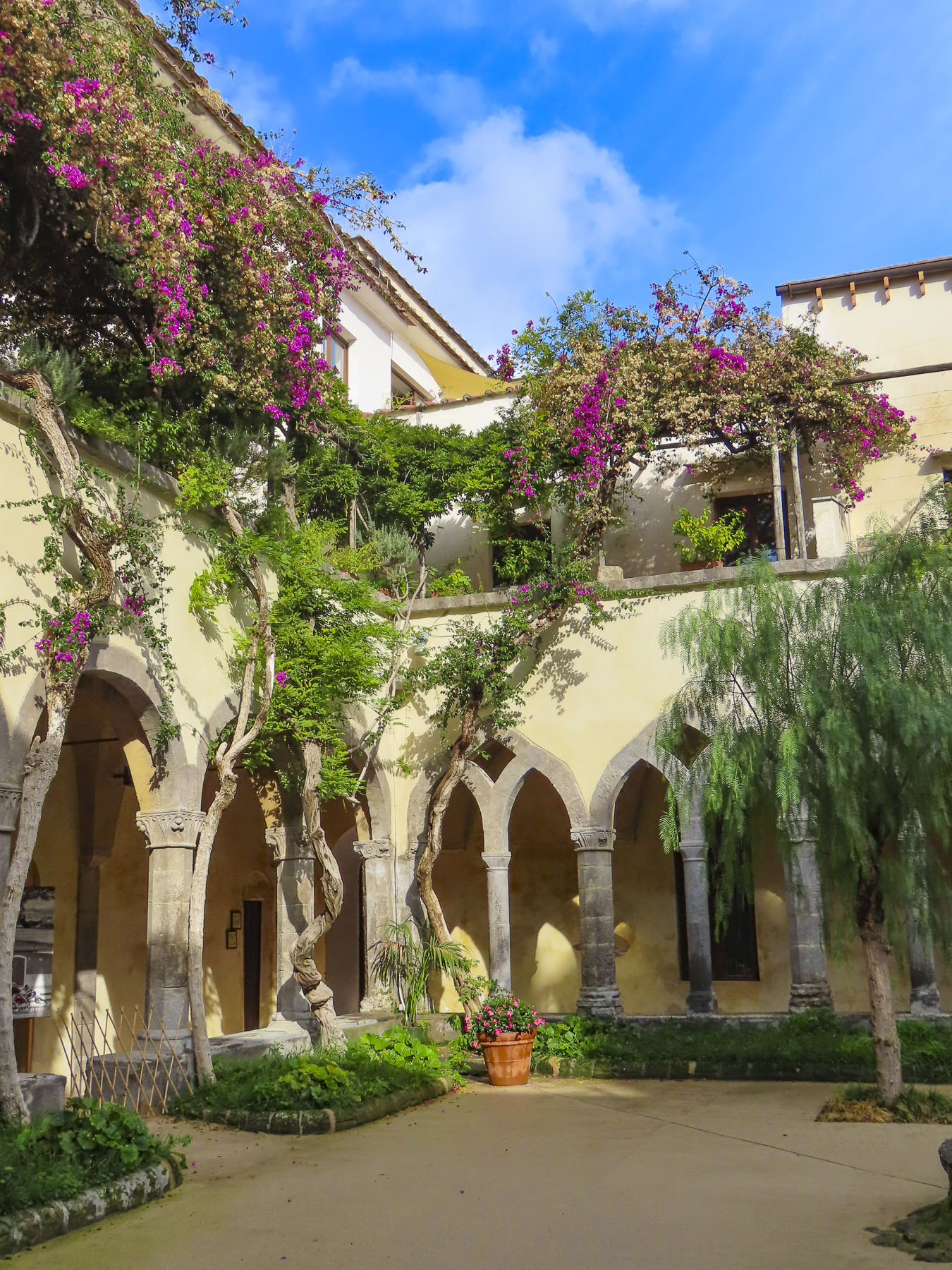
With the port as our destination for lunch, it was a pleasant stroll along near empty sidewalks to Chiostro di San Francesco, a 14th century convent with a lush, greenery-filled cloister that now hosted other activities and concerts.  On the top floor Raffaele Celentano’s photography school and gallery had a marvelous patio shaded by the canopy of stately tree. A wooden swing hanging from its branches brought smiles to the faces of many gallery visitors as they playfully took a turn.

The panoramic balcony in the public garden across from the convent is a magnet for sunset worshippers.  In the garden the city operates the Sorrento Lift, two elevators that take tourists and residents down to the harbor level where hydrofoils and ferry service is available to Capri, Ischia, Positano and Naples, along with access to the beach clubs and the city’s public beach. 

After washing our clothes in various sinks for two weeks it was time for a thorough laundering, and we lugged our bundle to a laundromat in town. It was a very clean facility. We were amused to notice that the vending machine that dispensed soap products also offered a very broad selection of marijuana products as well, presumably to allay the tedium of the task.  The selections weren’t inexpensive, with many items costing over twenty euros.  This was something unique that we had never come across before in our travels.  The world is changing so quickly, but we can’t imagine dropping a twenty euro note into a vending machine for anything.

With our clothes in the dryer, we decided to head to lunch, and immediately got drenched to the bone in a sudden downpour.  Looking like water rats, we sought shelter under the awning of a pizzeria. Seeing us, the proprietor of Master Hosts (not a very atmospheric name) ushered us inside and kindly insisted we warm ourselves in front of the pizza oven.  Even if we hadn’t been so extremely grateful for his hospitality, this was some of the best pizza and wine we had in Italy, while our fingers de-wrinkled. His graciousness turned a gloomy day into a wonderful afternoon. 

Another rainy night we made our way early to La Cantinaccia del Popolo, a rustic neighborhood restaurant that stays open all year to cater to its loyal following.  Part deli, part gourmet restaurant, the open kitchen is fronted by a glass charcuterie case with an exotic display of dried meats, cheeses, pates, terrines, and olives. The gastronomic delights from the kitchen are plated in their signature deep dish pans.  Packed and noisy, with a friendly staff, delicious food, and a good house wine, this was a cozy place to enjoy the evening. Fortified with a great meal and drink, we faced a cold November rain as we walked back to our inn.  If you prefer to dine later in the evening, reservations are suggested after 8 PM.

Lemons, lemons everywhere!  Regional seafood, pasta, rice, chicken, pastry, and gelato recipes all use this tart fruit in delectable ways. And remember limoncello! The cool breezes of the Mediterranean that blow against the steep mountains of the Amalfi coast create a unique microclimate where lemons flourish and are harvested multiple times of the year, though the most desirable crop is picked between March and July.  This is a strenuous labor-intensive activity as the steep terrain requires all the fruit to be picked by hand and the heavy grates are carried out of the orchards on the backs of men. 

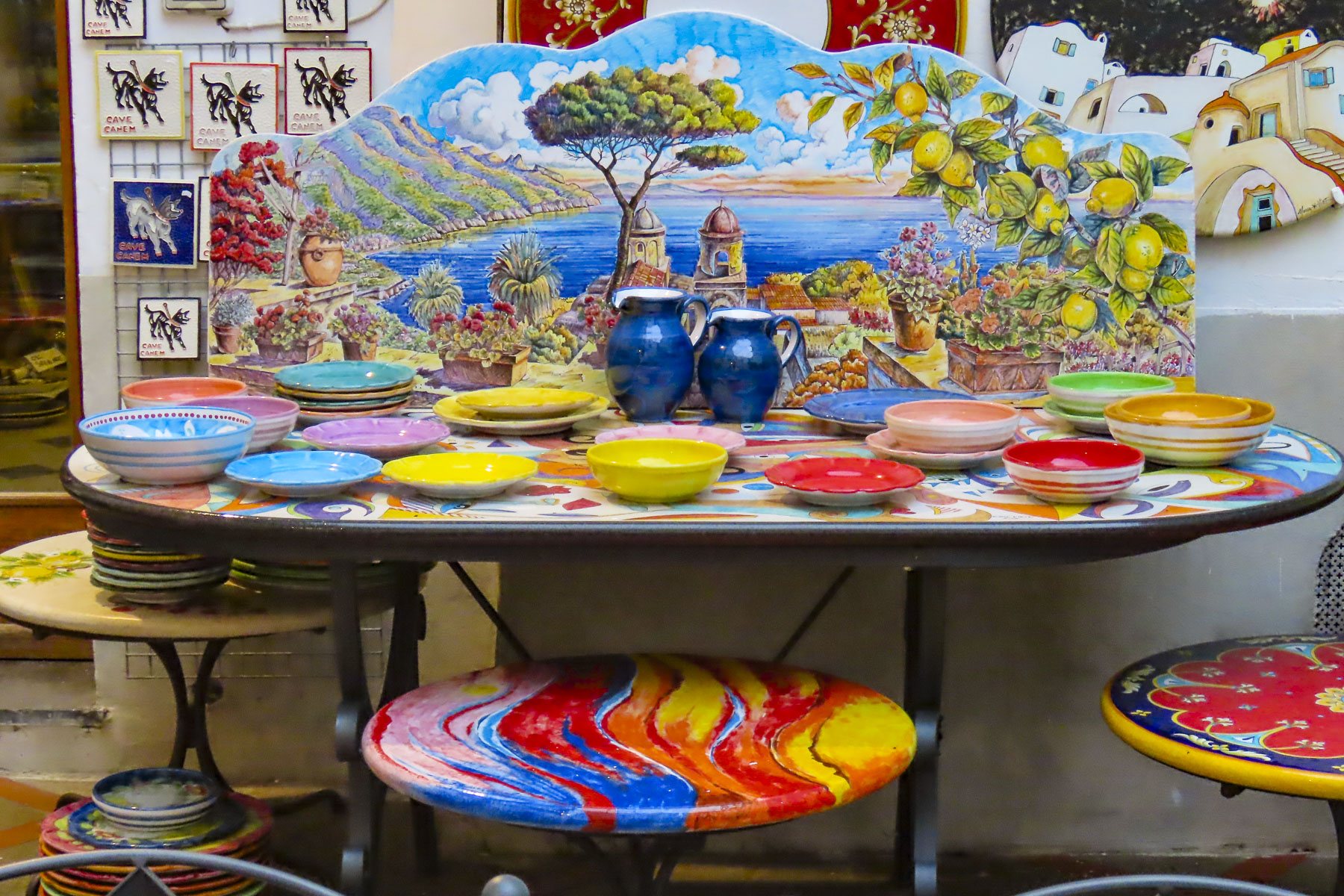
A morning drive along the sinuous coast and a turn into the mountains brought us to Ravello in time for lunch at a small restaurant with only six indoor tables.  Fifteen years ago, as a wedding present to each other, we splurged and purchased a dinnerware set of ceramics featuring the iconic Amalfi lemons, set against a rich blue background.  Over the years everyday use had taken its toll on our plates.  Fortunately, Pascal Ceramiche d’Arte was still painting our pattern and they ship internationally, so we were able to fill in a few gaps in our service.

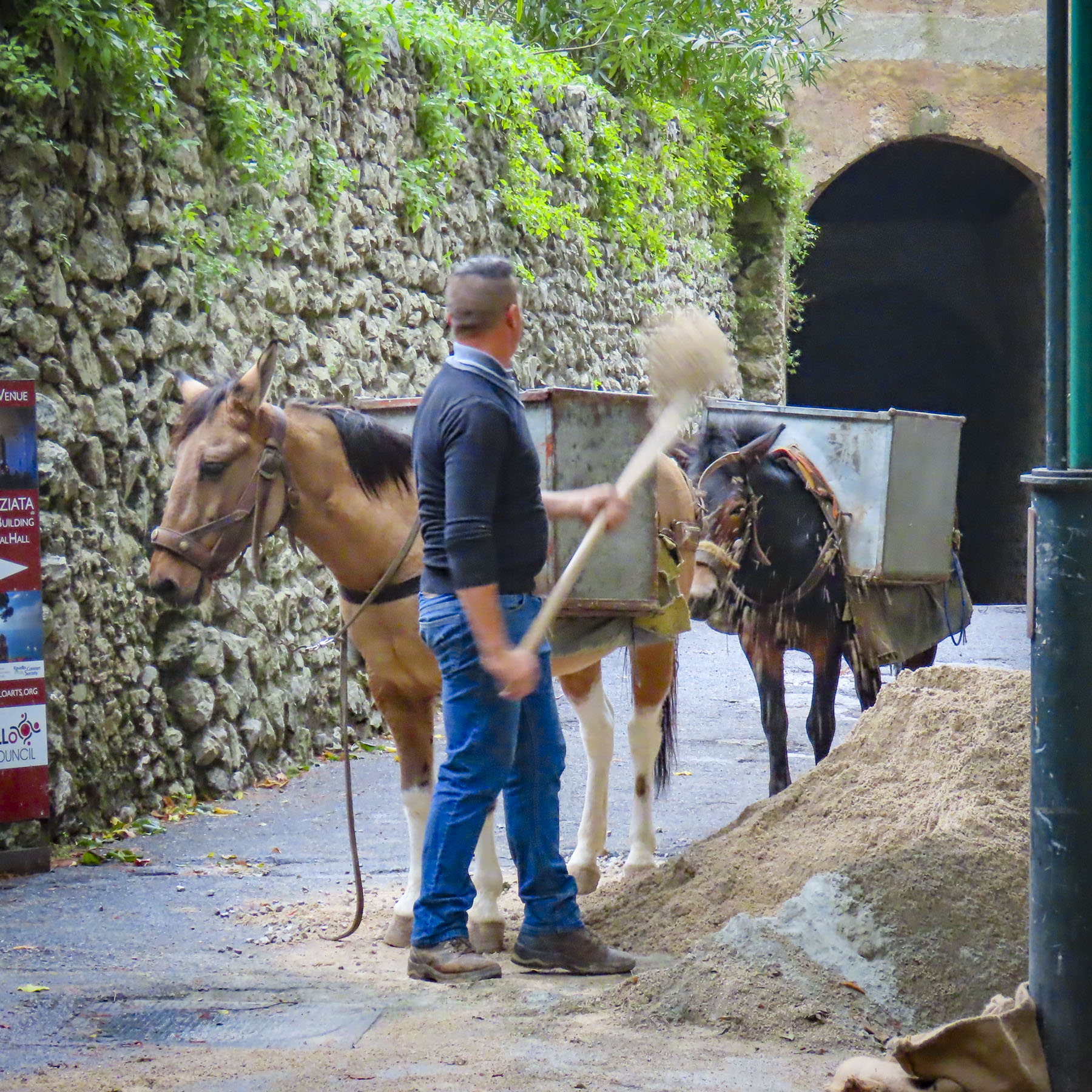
After coffee we wandered the town’s narrow, high walled lanes down the hill towards the Monastero Di S. Chiara.  Along the way we encountered a construction worker leading a team of donkeys with rigid saddlebags full of sand to a worksite, the ancient alley too tight for any vehicle to maneuver through.

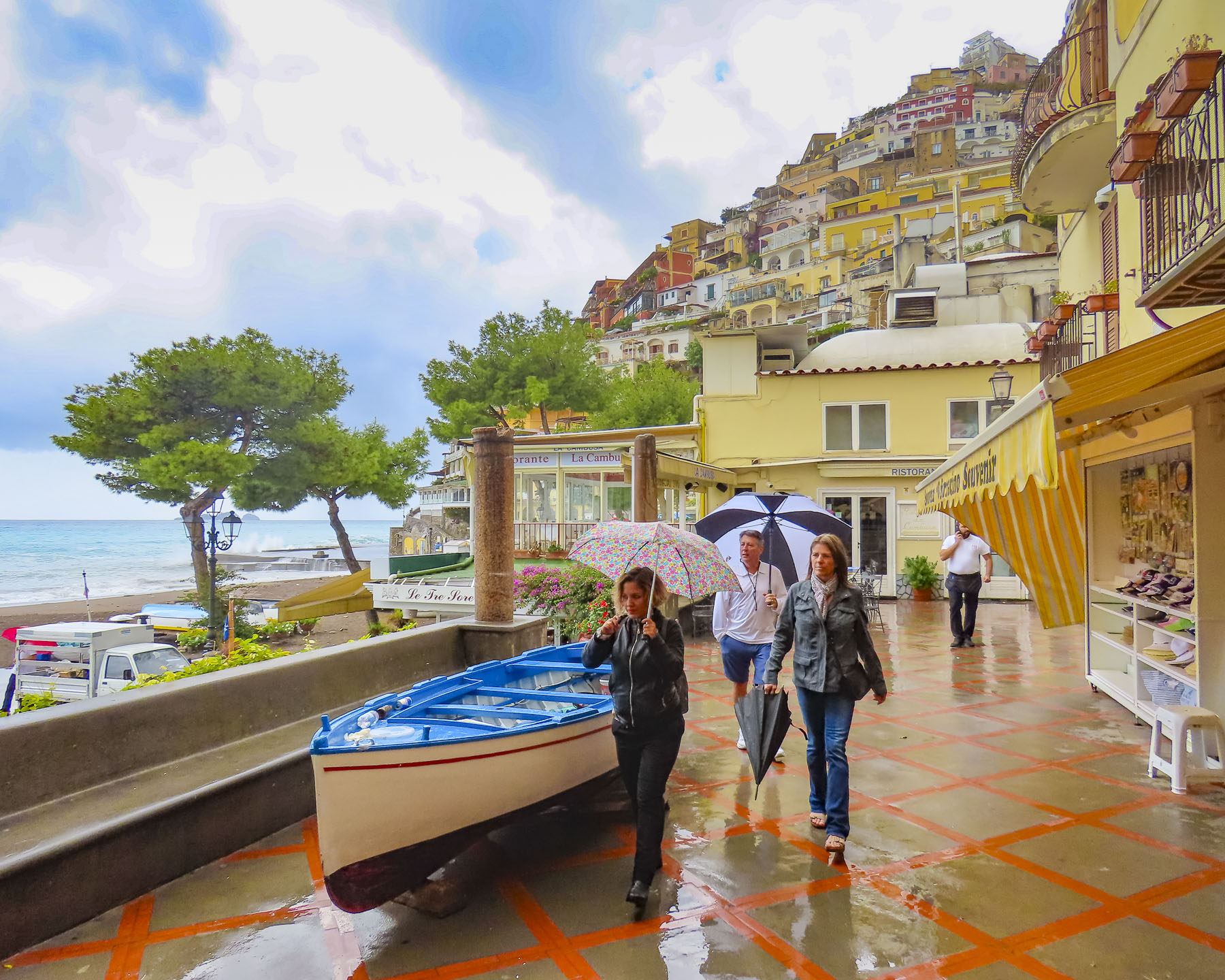
There’s no way around it, “they have you by the coglioni!” when you are trying to find a parking garage in Positano.  In this most beautiful village on the Amalfi Coast we paid through the nose for the privilege of parking.  Water, café, food and parking, even in the off season, are exorbitantly priced.  But on a sunny day, when the sky clears after a morning storm, the dramatic setting of the terraced village is at its best. Positano rises steeply into the mountains from the sea sparkling like a spectacular Byzantine mosaic, radiating light and color.  It’s well worth the splurge even if you have to eat Ramen noodles for the next three days to get back on budget.

To our delight we found a wonderful, affordable spot for a late lunch in Agerola called Jerla as we navigated our way across the mountaintop on the way back to Sorrento.

Getting there required a breathtaking drive through the numerous switchbacks of Strada Statale 366, also referred to as the Via Panoramica, that climbed through the terraced vineyards of San Michele and had incredible views of the Amalfi Coast below.

We each wanted to be in control on this treacherous road. We argued about who got to drive as we sped around the curves, and who was relegated to digging their fingernails into the dashboard.

Til next time, Craig & Donna

Naples – Historic, Gritty and Wonderful

The Italian countryside seemed to extend forever, a wonderful accomplishment for this region of southern Italy that has supported civilization for several millennia, though it ended abruptly when we rounded a highway curve and came to a halt in traffic. Naples, we had arrived.

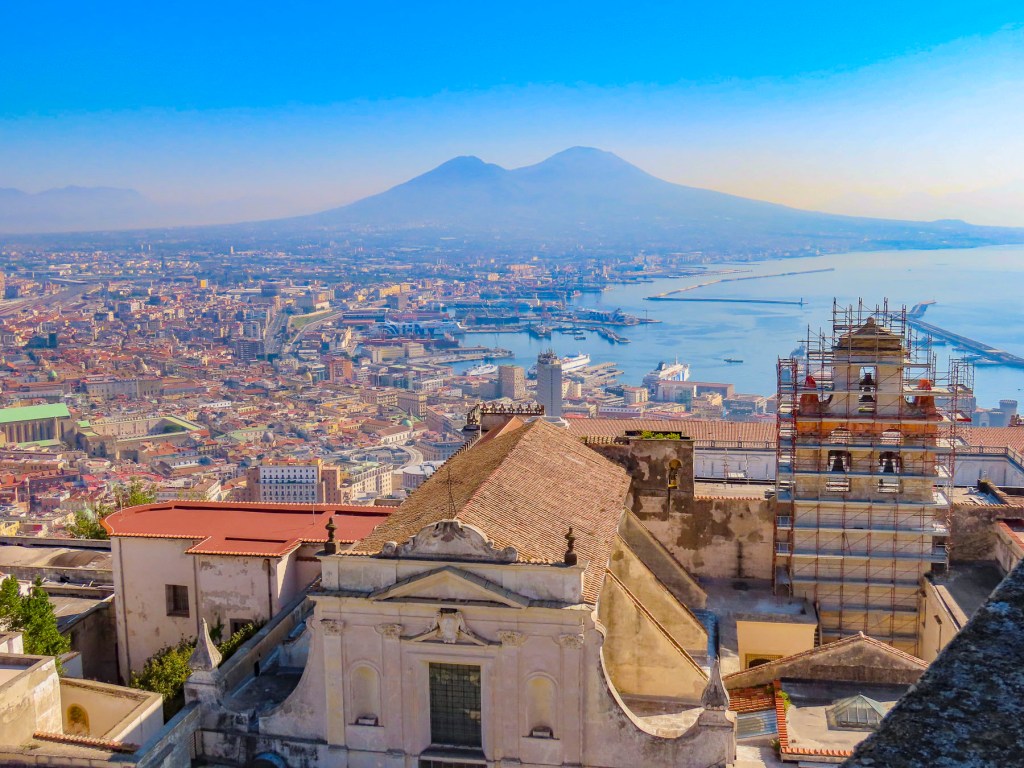
It wasn’t until we saw Naples from above that we realized the extent of this metropolis.  From our apartment in the historic center of Naples, near the Piazza del Gesù Nuovo, we walked to the daily market along busy streets lined with ancient 17th and 18th century palazzo, once noble homes of the Neapolitan elite, now subdivided into apartments, their fine architectural details often hidden under graffiti, that lined Via Pignasecca.

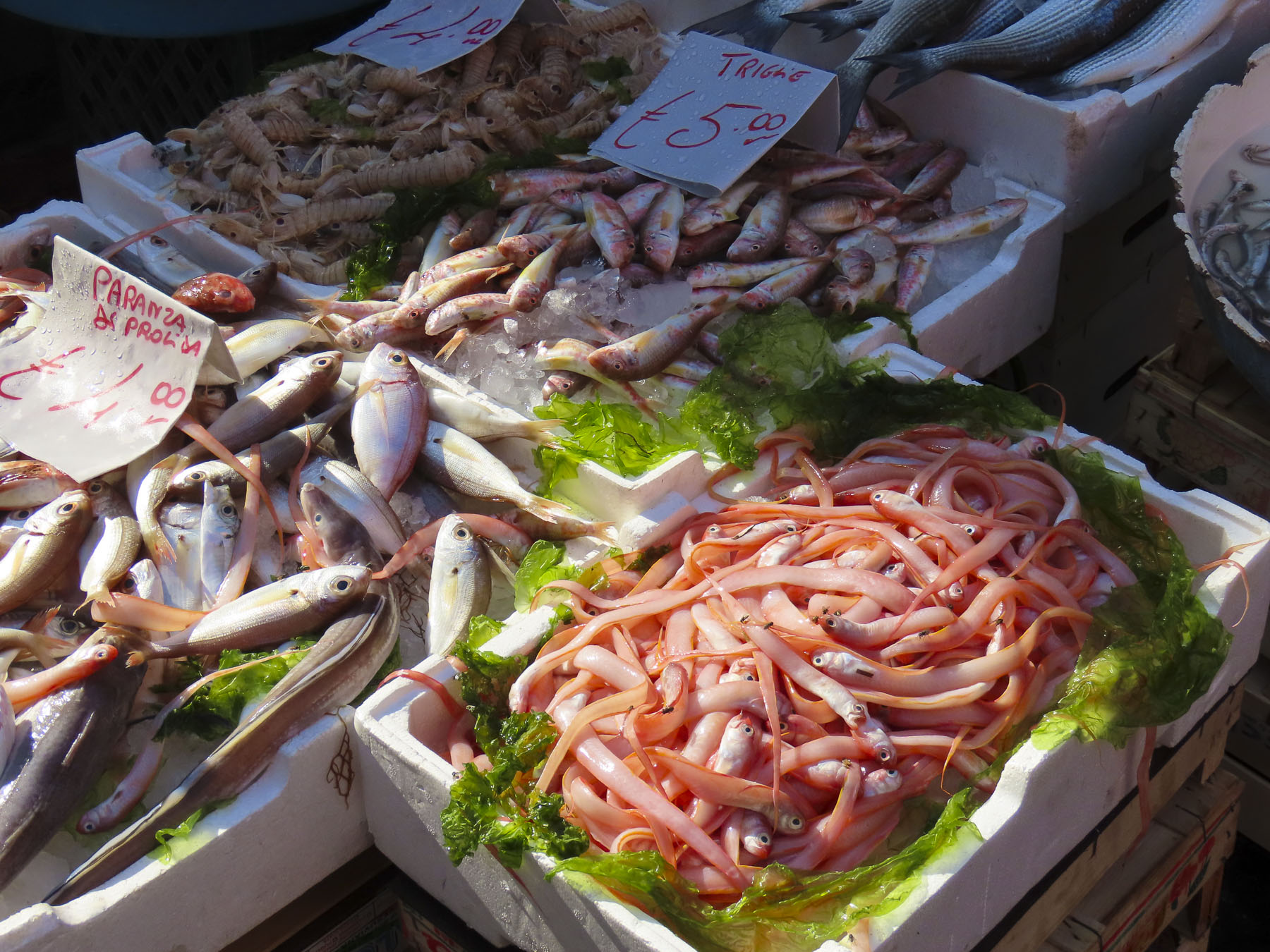
Vegetable, cheese, meat and especially bountiful seafood vendors were in a constant state of motion readying their stalls and calling aloud what was available.  It was fascinating and gritty with an underlying character of toughness that street life in Naples demands.

Everything looked wonderful as we planned dinner in our minds and agreed to return later after our day’s activity; how disappointed we were to find the street all tidied up and swept clean by mid-afternoon.  We consoled ourselves with a purchase of a bottle of Piedirosso Campania, a red Italian wine grape that is a specialty of the region. For two euros it was a good everyday wine. Later in the week we purchased a fresh tuna fillet that was excellent.

The funicular at the Montesanto train station saved us from a long and incredibly steep set of stairs that would have otherwise led us to Castel Sant’Elmo. Its six-pointed star design dates from Spanish rule of the Kingdom of Naples in the 1500’s, and is the highest point on Vomero hill.

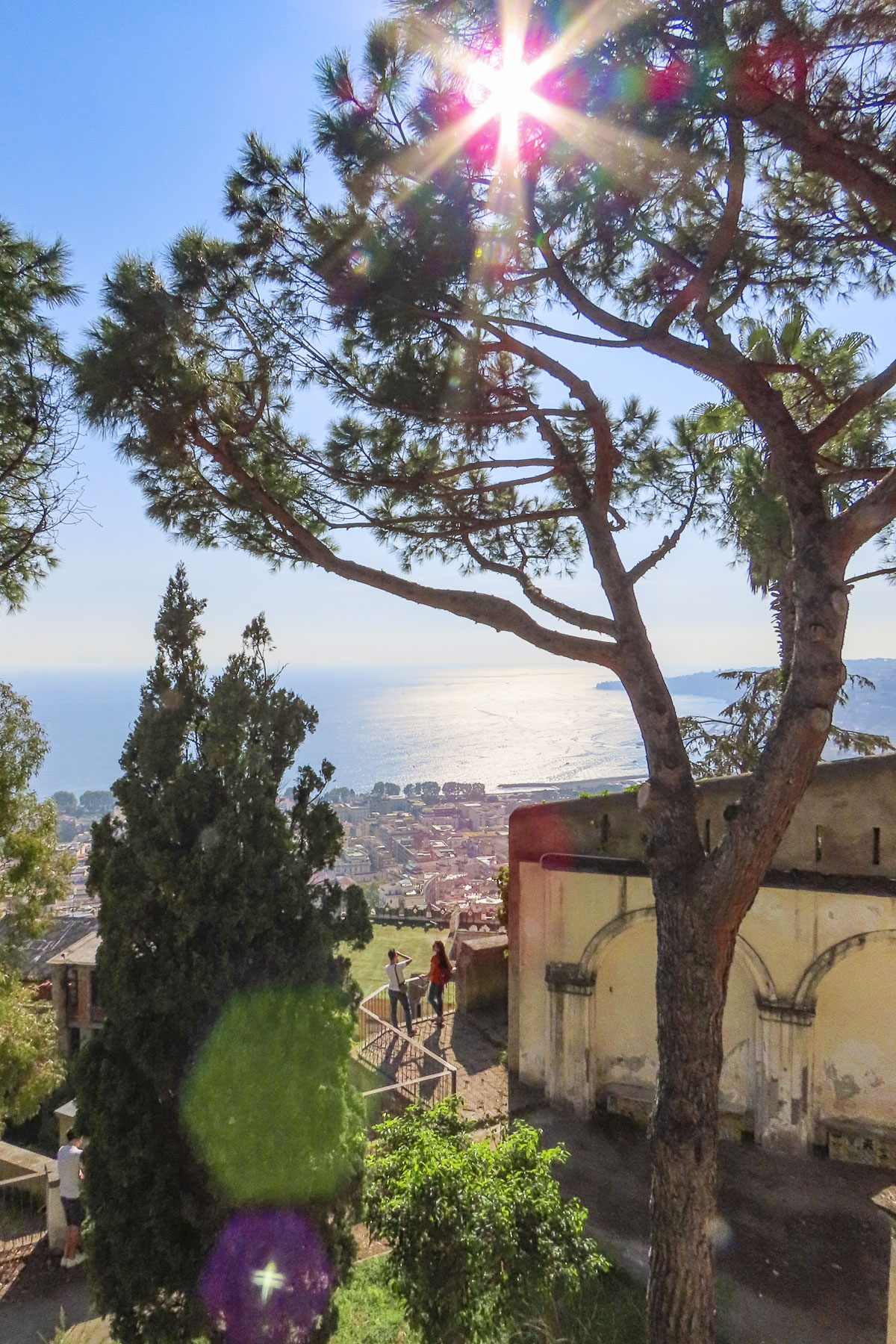
The thirteenth century fortress dominates Naples’ skyline and has an incredible panoramic vista of the vast metropolitan area that hugs the Bay of Naples. Mount Vesuvius overshadows the scene that extends past Sorrento to the Isle of Capri.

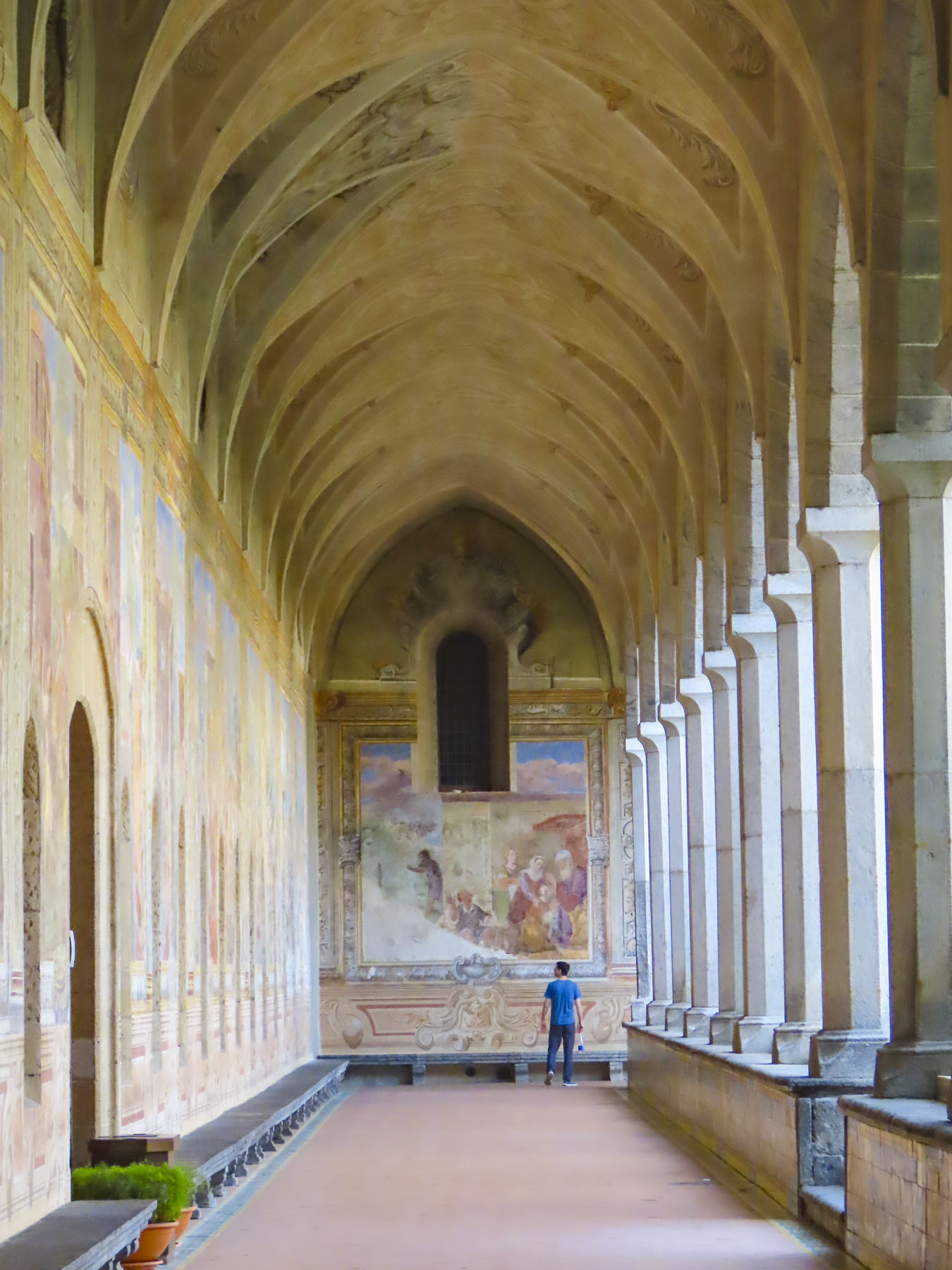
Under the citadel walls in what was once a wealthy monastery the Certosa e Museo di San Martino exhibits a collection of art and artifacts devoted to the monastery’s and Naples’ history, in richly decorated cloisters. 

Outside the formal gardens, the paths along the cliff edge were a quiet retreat.  If you don’t feel the need to tour another fortress or monastery, the Belvedere San Martino scenic overlook offers the same views and is a very popular place to watch the sunset. 

After lunch we followed the stairs of Pedamentina a San Martino downhill to Corso Vittorrio Emanuele which cuts across the mid-section of Vomero hill above Quartieri Spagnoli, the old Spanish quarter. The district gets its name from the garrisons of Spanish troops housed there in the 16th century to quell any rebellions from the restive Neapolitan citizenry. From the sidewalk here we looked down upon canyons of TV satellite dishes and flapping laundry hanging from balconies that extended for block upon block, the sheer number of folks living above one another unimaginable.

Over centuries it has evolved to have the densest population of any neighborhood in Italy. After the second world war, post-war public housing was built for tens of thousands of displaced Italian families that fled the war-ravaged countryside, looking for work and shelter in Naples, though Naples itself was in near ruins, having been bombed over 100 times by Allied forces prior to the liberation of the Italian peninsula from Nazi occupation.  Before retreating from Naples, the Nazis destroyed all of the city’s port facilities along with the water, electricity, and gas infrastructures.  Thus began an era of poverty and destitution that was further fueled by neglect from the central government in Rome.  A century earlier, before fighting against Italian unification, the Kingdom of Naples was the most prosperous, wealthy and industrialized of the pre-unitary Italian states with the largest number of students enrolled in public schools along with the peninsula’s lowest infant mortality rate.  The city was a treasured destination of 17th and 18th century upper-class Europeans on their “Grand Tours.” The poet Johann Wolfgang von Goethe is credited with coining the phrase “See Naples and die” to reflect the city’s grandeur on one such tour.  Though I’m sure he never envisioned how a growing Mafia influence in the mid-1950’s co-opted the phrase.

We worked our way along Corso Vittorrio searching for the Giardino del Claustro, a scenic overlook, but finally gave up when we realized it was behind the entrance to a university. This wandering led us serendipitously to the Church of St. Nicholas of Tolentino where a chorus of angelic voices suddenly filled the sanctuary as we crossed its threshold, stopping us in our tracks. Seeing no one, we listened intently to the anthem, trying to determine its unseen source, until we finally heard the bellowing voice of the choir director.  We were in the school’s chapel!

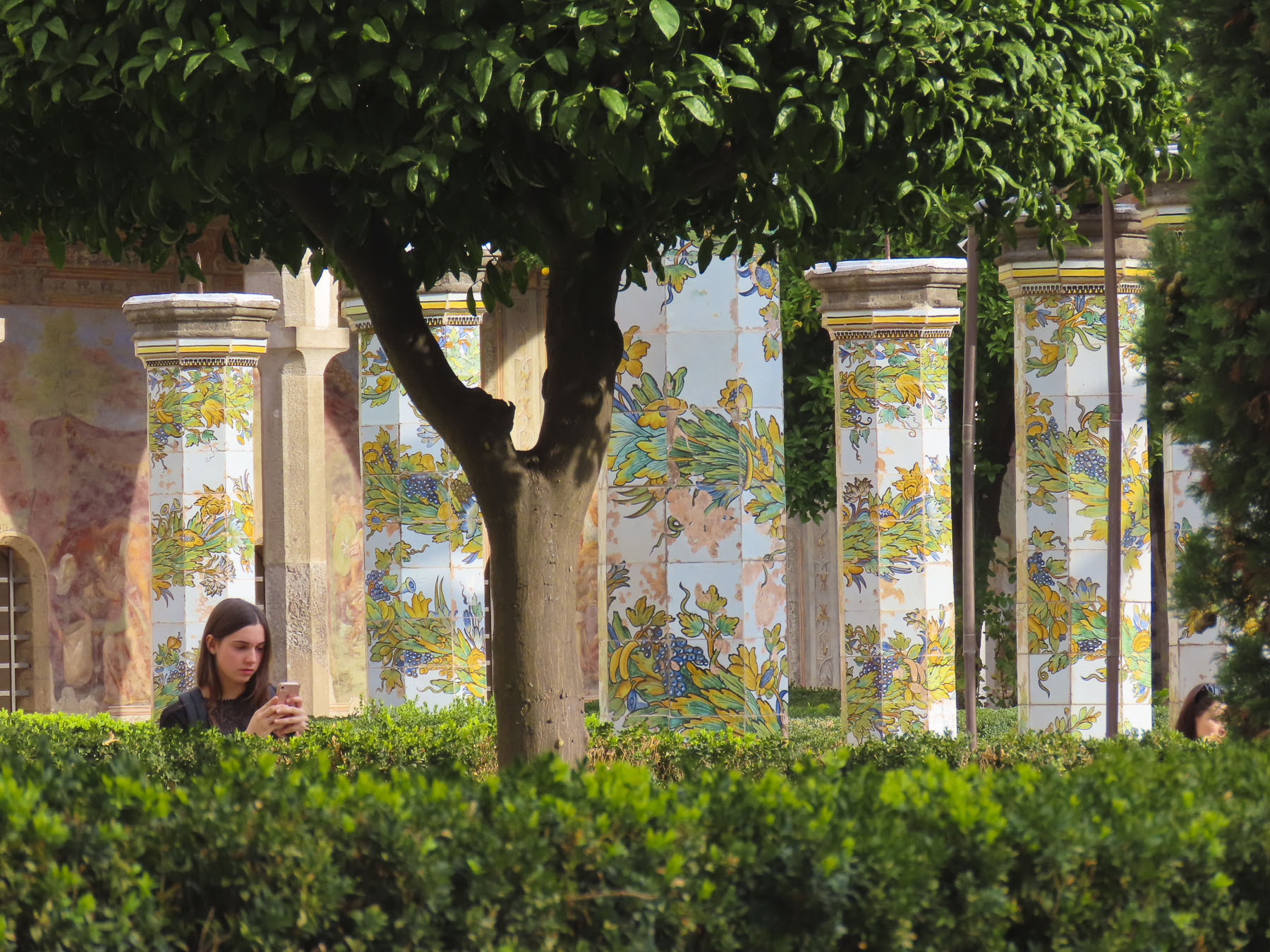
If anyplace is likely to induce a religious overdose it’s Naples. “The city of 500 domes,” reportedly has 1000 churches, five hundred of which have historical significance and I swear they are all in the ancient center of the city.  Starting at the Chiesa del Gesù Nuovo on the piazza that bears its name, we walked along Via Benedetto Croce in a large loop that brought us first to the majolica-tiled cloisters of the 14th century Complesso Monumentale di Santa Chiarato.

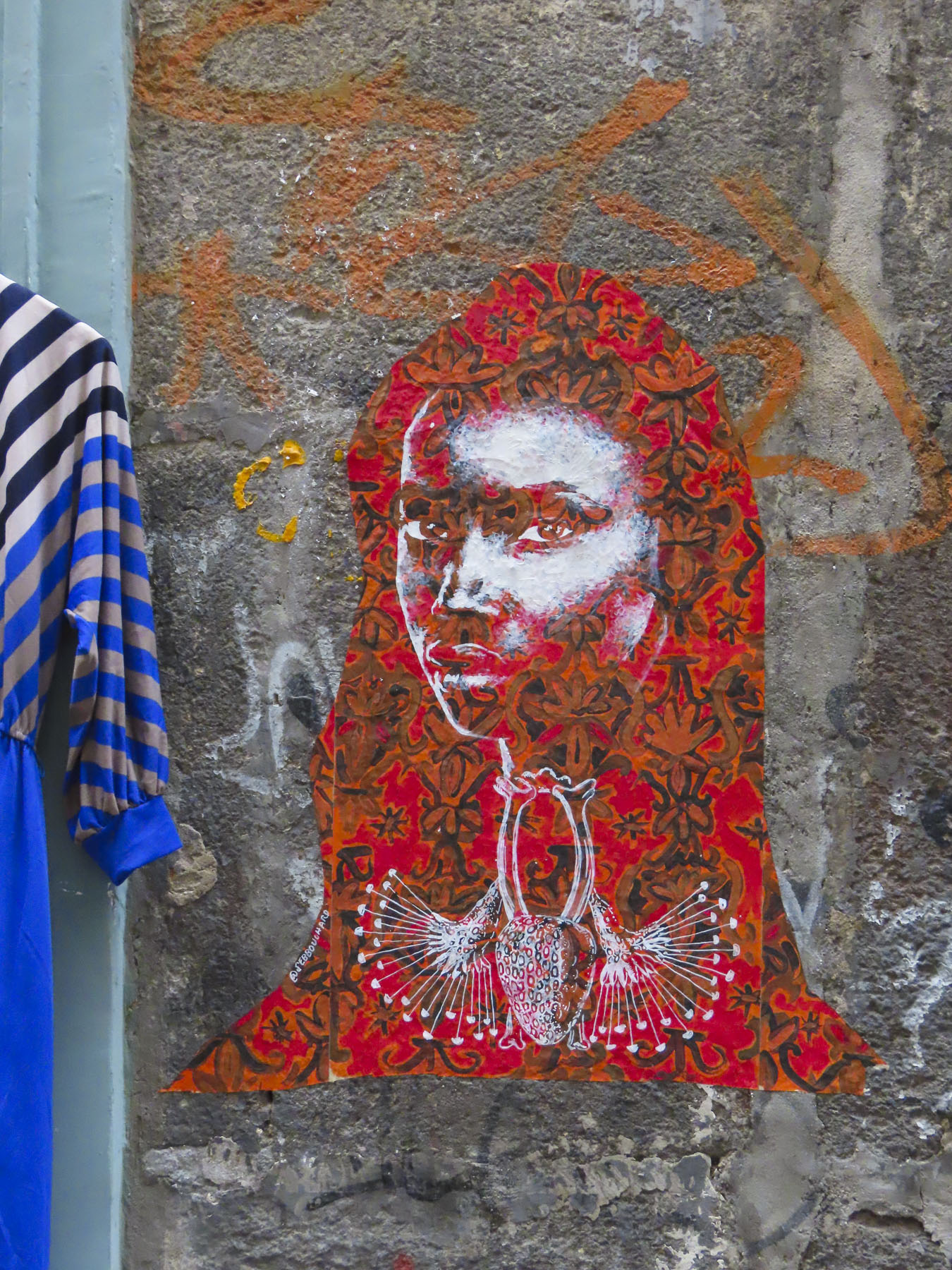
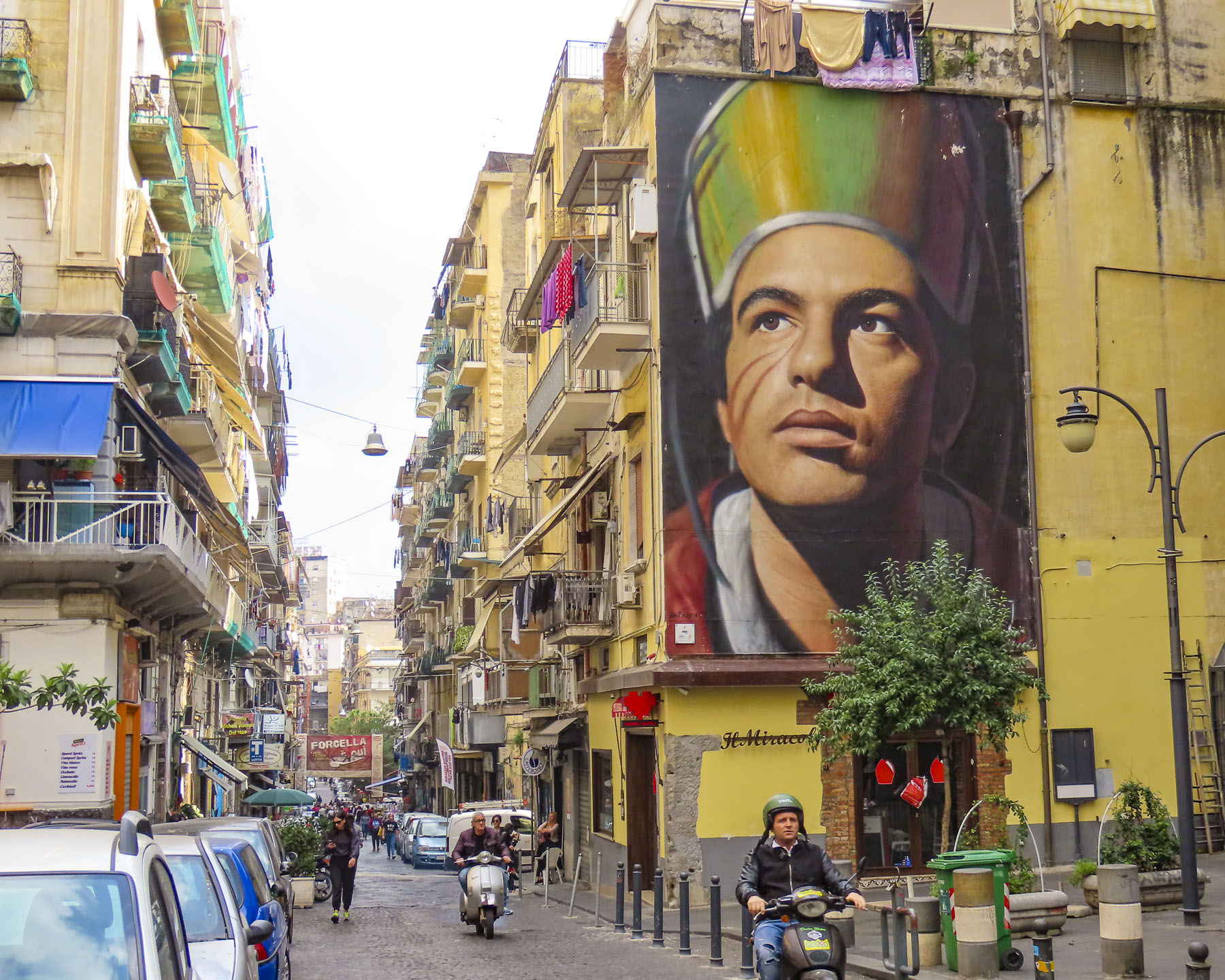
Continuing straight, we eventually came to a street mural of San Gennaro, the patron saint of Naples. This large tribute was painted in the contemporary style of Jorit Agoch, a Neapolitan graffiti artist, in 2015, above the entrance to a bar that stands next to Chiesa Parrocchiale di S. Giorgio Maggiore on Via Duomo.

Earlier we passed a small memorial to Antonio Varvella, nicknamed O’Barone, a sometimes-gruff character, a beloved homeless man who was a fixture in the historic center for many years until his death one wintry night in 2014.

Backtracking, we turned onto Via San Gregorio Armeno, a street famous for its numerous workshops that craft unique, highly detailed hand-made presepi, nativity scenes.  

Almost lost amidst the store fronts of the crèche workshops, the Church of San Gregorio Armeno has a lavish gilded baroque interior. It is a 1500’s renovation of the original 9th century church built over a Roman temple of worship to Ceres, the Roman goddess of agriculture. 

At the end of the lane, the Basilica di San Paolo Maggiore dominates the square.  

Back at our starting point we rested in front of St. Giuseppe Moscati’s statue, the hand of the sculpture shiny from parishioners holding it as they prayed for cures. A local doctor, he dedicated his life to serving the poor of Naples and is credited with many miracles. He was canonized in 1987.  

Facades of many of these churches pale in comparison to their rich interiors. If the door to the church was open, we entered. Some were grander than others, but all of them were interesting.  

Alternating with stops for café, gelato or the ever so refreshing Aperol spritz, we spent several afternoons ping-ponging our way from church to church through the center of a city that has been inhabited since the eight century B.C. when the Greeks named their colony, Neapolis. 

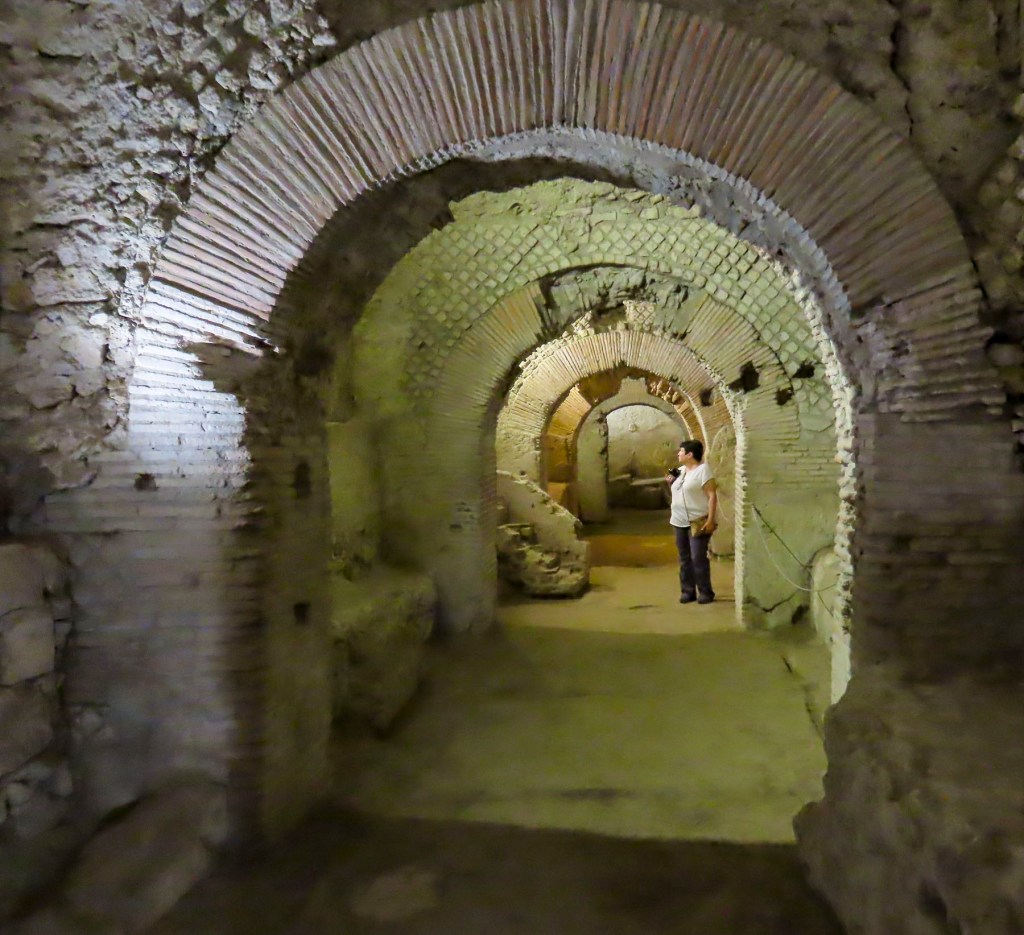
Subsequent civilizations buried the ruins of earlier ones.  The cobbled lanes and churches we toured had been built over Underground Naples, 120 feet of ancient detritus along with ruins of millennia old cisterns, aqueducts, Roman alleys and shops that spread extensively under historic and modern Naples. 

The reward for one of our daily explorations was a savory Margarita pizza from Di Matteo, recommended by our friend Marina, a lifelong Neapolitan, who affirmed, “It’s the only place my family eats pizza.”  A round pizza folded twice to form a triangle is the perfect street food, but when you order it inside and sit at a table to dine it is customary in Italy to use a knife and fork to politely carve these culinary creations that have become so popular the world over.

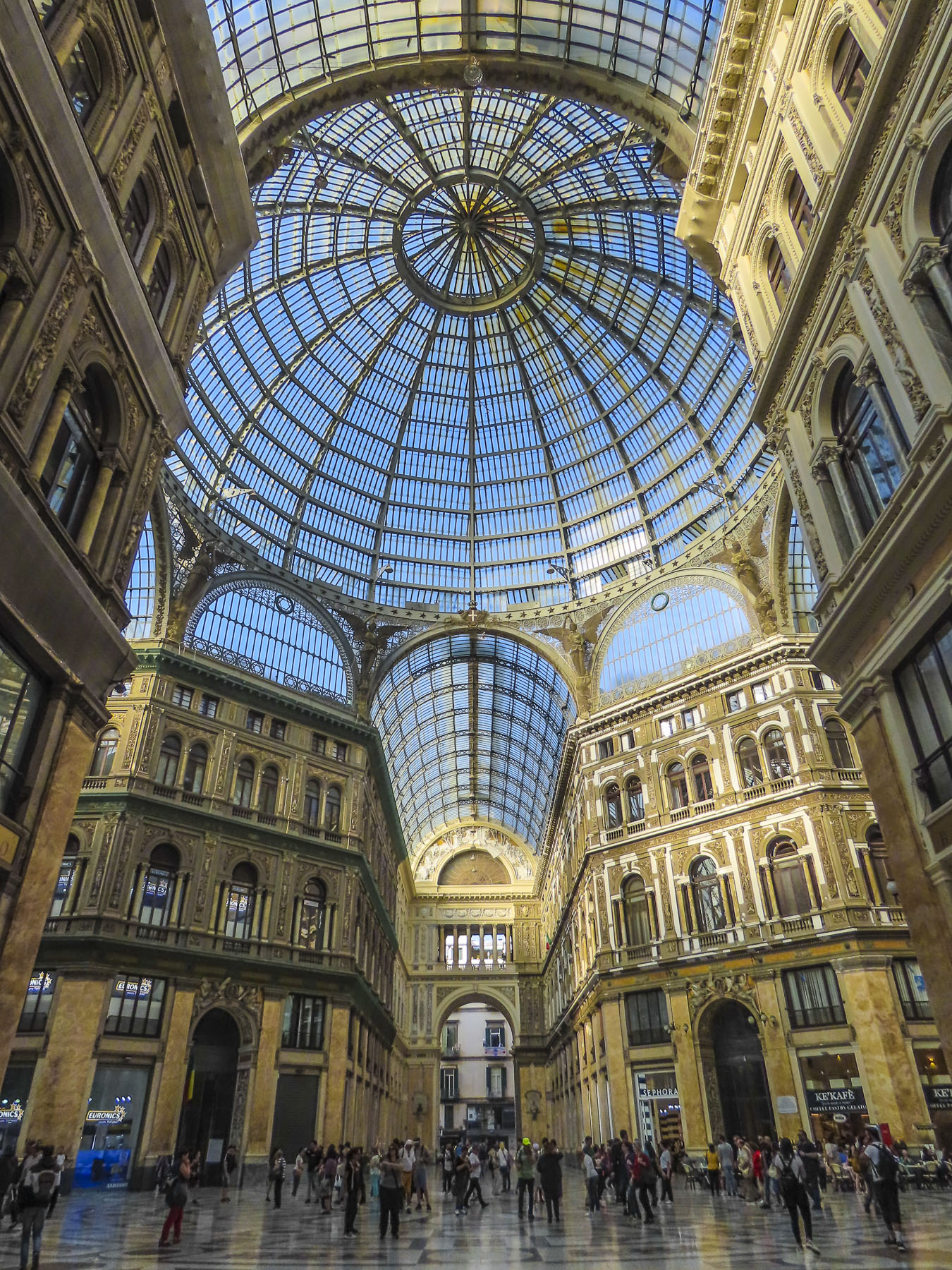
By the end of the week the hard cobblestones were fatiguing, and we decided to take a cab to Galleria Umberto, an old fashioned, glass domed shopping mall.  A five-minute trip according to Google Maps. It’s a landmark by the waterfront, near Castel Nuovo and Piazza del Plebiscito which we planned to visit afterwards.  

There were several taxis in queue at Piazza del Gesù Nuovo, all pointing in the direction we needed to go, a good omen or so I thought, as we hopped into the first cab.  Hearing our destination, the driver promptly did a U-turn, then another left turn taking us in the wrong direction. I spoke up from the backseat and pointed to the map, my question confidently waved away by the driver. “Donna, he’s taking us in the wrong direction.” “Give him a few more minutes. He’s local – maybe he knows a shortcut.” With a left turn out of the historic center the driver would have redeemed himself, and put us on a course to the waterfront. Instead, he turned right and floored it while ignoring my protest from the backseat. Finally, at a red light he rolled down his window and asked for directions from a police officer.  Oddly, the police officer made eye contact with me and winked.  A right turn brought us into a one lane road where traffic was at a standstill.  By this time what should have been a very reasonable fare was now approaching twenty euros and we were still over twenty minutes away, in the opposite direction from our destination. I believe he had intentionally taken us in the wrong direction to jack up his fee.  It was time to abandon ship. We got out in the middle of the traffic jam, and I handed him five euros.  An eruption of Italian we did not understand pursued us onto the sidewalk as we walked away, and I swear the buildings blushed from embarrassment. Never have I met a cabbie who didn’t know where a landmark was. 

A few moments later as we were walking down the sidewalk, voices called from behind. “Attenzione!”  Two smartly dressed female police officers were telling us to pay the cabbie. These officers looked serious, with handcuffs! My mind raced as I told them he was a thief, and no way was he going to extort more money from us!  Much of this intense discussion was hindered by our lack of Italian.  Twenty-three euros were now on the meter and the driver wanted to be paid.  I repeated, “no way!” multiple times.  Thank goodness for Google Maps.  With it we were able to show the officers our pickup point and what our original route should have been and the time it should have taken.  They immediately saw how deliberately off course we were. They agreed with us and reprimanded the driver and told him he was lucky he got the 5 Euros.  The police officers apologized for his behavior and were sorry that it happened to us.  From where we got out of the cab it took us an hour to walk to Galleria Umberto where two “caffé corretto,” espresso with grappa, were ordered to sooth our frustration. For this very reason we prefer to use the transparency of Uber or Lyft for transportation when traveling; unfortunately, those services were not licensed to operate in Naples.

With our Naples Pass in hand we headed to the National Archaeological Museum.  This was a wonderful museum with a fascinating collection of artifacts, ancient pottery, classical sculptures, and mosaics discovered across the Campania region.  There is also an extensive collection of antiquities from the ruins of Pompei.

Walking back to our apartment we stopped at a small bacari with a few outside tables for aperitivi, the Italian version of happy hour, to savor the golden hour as the sun began to brighten the historic buildings along the boulevard on our last day in Naples.

Sharing the afternoon with friends and sipping Aperol spritzes accompanied with small snacks called cicchetti is a ubiquitous activity in Italy and reflective of “la dolce vita,” the sweet life. It’s a tradition we plan to continue.

Cin cin! Till next time,

Craig & Donna

Puglia – Alberobello Part 2: Lecce and Nardo – The Florence of the South

“Signor, mio gattino si è nascosto sotto la yuan automobile ed è salito nel motore.” Roughly translated it means – Sir, my kitten ran under your car and is hiding in the engine! My racing imagination added, I will paint a pagan symbol on your car and you will be cursed for the rest of your life if she is hurt.  I exaggerate a little in jest just so you understand this was a crisis!

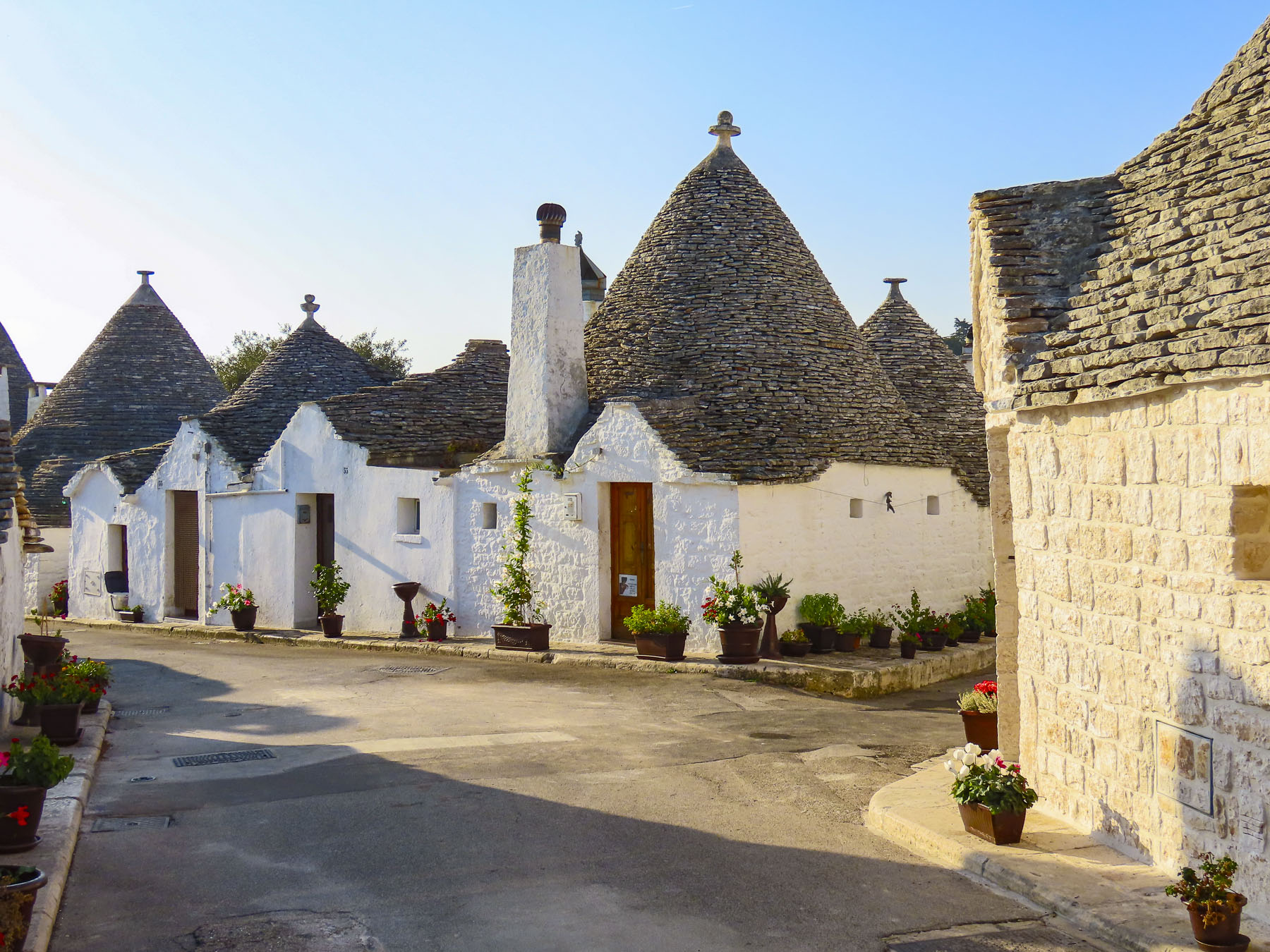
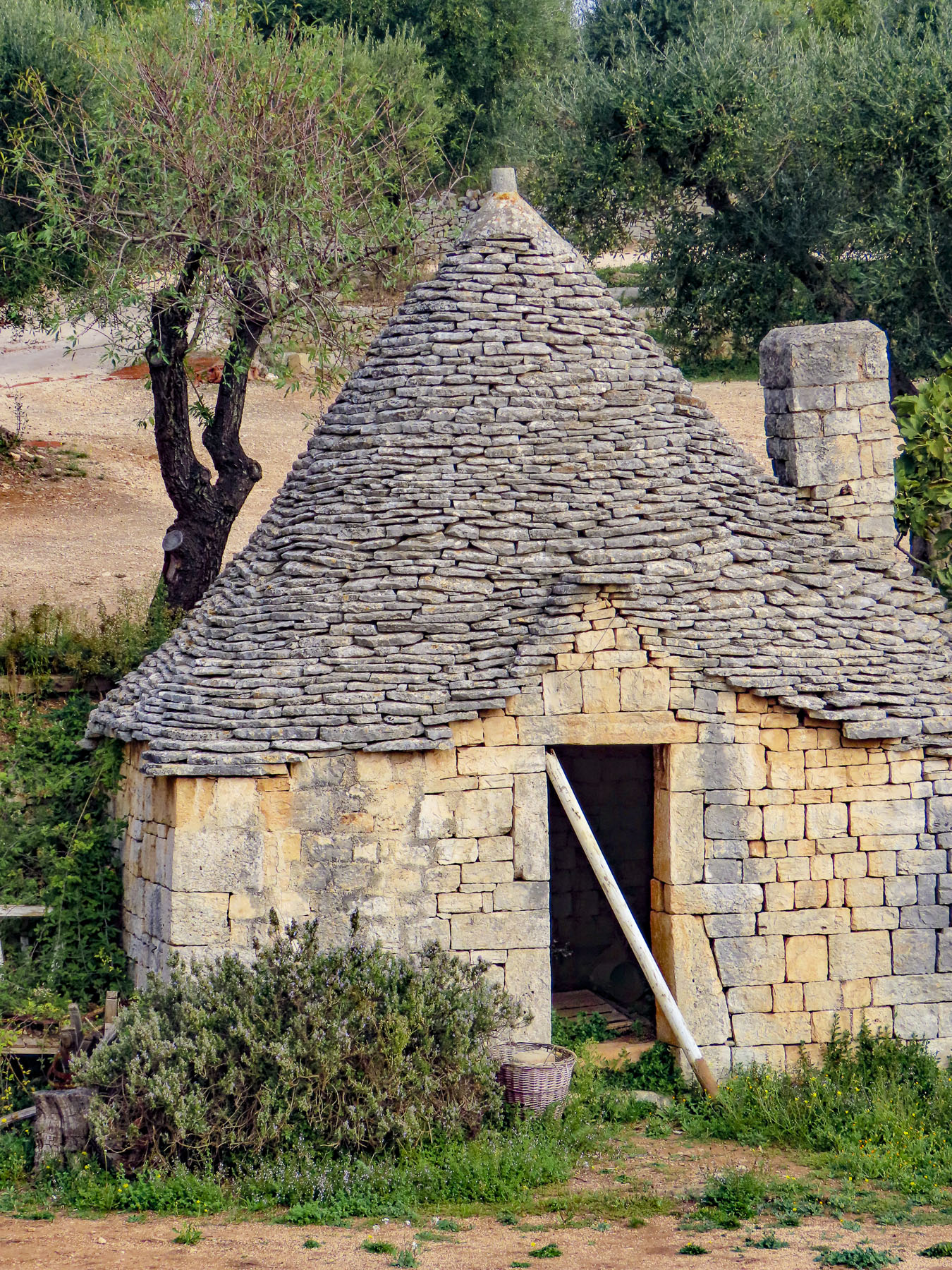
The night before we had agreed on an early start to Lecce to rendezvous with our friend Giulia for a day exploring her adopted city.  To help move the day along I offered to retrieve our rental car, which was parked a good distance away, uphill, across from the trullo-shaped Church of Saint Anthony of Padua which crowned the hill.

Donna is the designated linguist of the family. I on the other hand have been lovingly accused of slaughtering a fine romance language with just the utterance of a single word, on more than one occasion.

So, when I heard, “Signor, mio gattino si è nascosto sotto la yuan automobile ed è salito nel motore,” I smiled, as I really didn’t understand a word.  But two very worried young girls and their grandfather were standing next to the car and pointing at the engine.  They had placed a saucer of milk and some cat food near the front tire. I understood and joined the older girl who was on ground, looking under the car and meowing for her kitten, quite convincingly I might add. With no sign of a tail dangling from the undercarriage, I popped the engine hood expecting to find the kitten. Nothing.  I slammed the engine hood hoping the loud sound would jolt her from her hidden perch. Still nothing!  The way the car was parked close to an ivy-covered wall I wasn’t convinced that the kitten hadn’t scampered away unseen earlier.  They were signs of growing concern written on the girls’ faces and a growing crowd of onlookers.  Miming turning the ignition key, I conveyed that I needed to start the car and move it around the corner to jump the curb in order to get better access to the engine from below.  Hesitantly, I turned the starter and was deeply relieved when there weren’t any shrieks of horror from the girls or any fur flying. 

With my entourage trailing along, I drove the car around the corner and put two wheels up over the curb to give me just enough room to shimmy underneath for a closer look.  Fortunately, by this time Donna and Gary were rounding the corner in search of me. Much skinnier and a cat lover, Gary was enlisted to wiggle on his back underneath the car. “I don’t see anything. She’s not here.” I frowned, the girls frowned. “Keep looking.” Time passed. “I see her! she’s tucked up very high – let me have some food.” A few moments later, “I have her!” Beaming with joy, the girls and grandad took the kitten to the quiet sidewalk across the street and set her down on the ground.  Almost immediately, to everyone’s horror, the kitten dashed back across the road. The girls screamed and, oblivious to the traffic, dashed into the street in hot pursuit. The terrified kitten once again raced into her hiding place in the engine!  Mercifully, the second rescue was much faster, and with the kitten firmly in the hands of a local woman who assisted, we jumped into the car and sped away to Lecce.

After circling the port city of Brindisi, the highway (SS613) was a straight shot, past the Mura Urbiche architectural complex that highlights remnants of a once formidable city wall that encircled Lecce, to Giardini Pubblici Giuseppe Garibaldi pretty much in the center of the city.

Even though Lecce is located in the middle of the Salento Peninsular, that is often called the “heel of Italy,” the city has had a long bond with the sea.  Legend has it that the King of Crete, Idomene, was blown off course and shipwrecked here while returning home from the Trojan War.  He married the local Salento King’s daughter, Euippa, and named their newborn girl Lecce, after his Lycia homeland in the eight century BC.

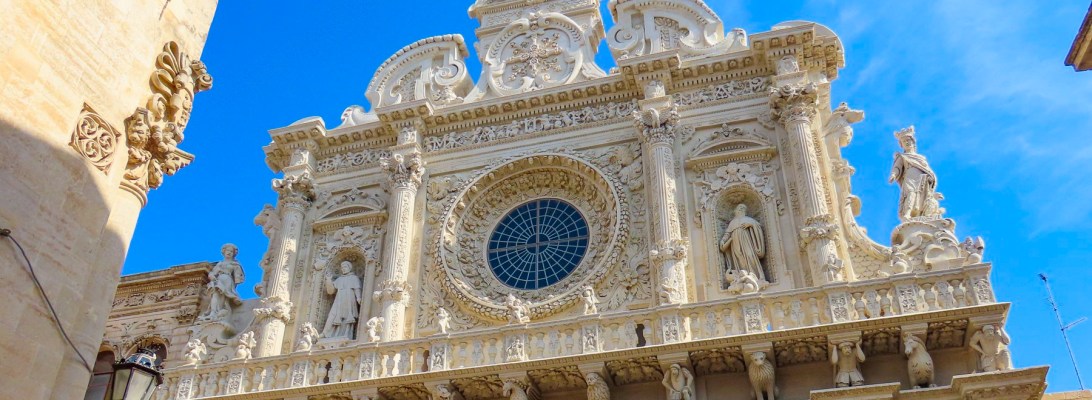
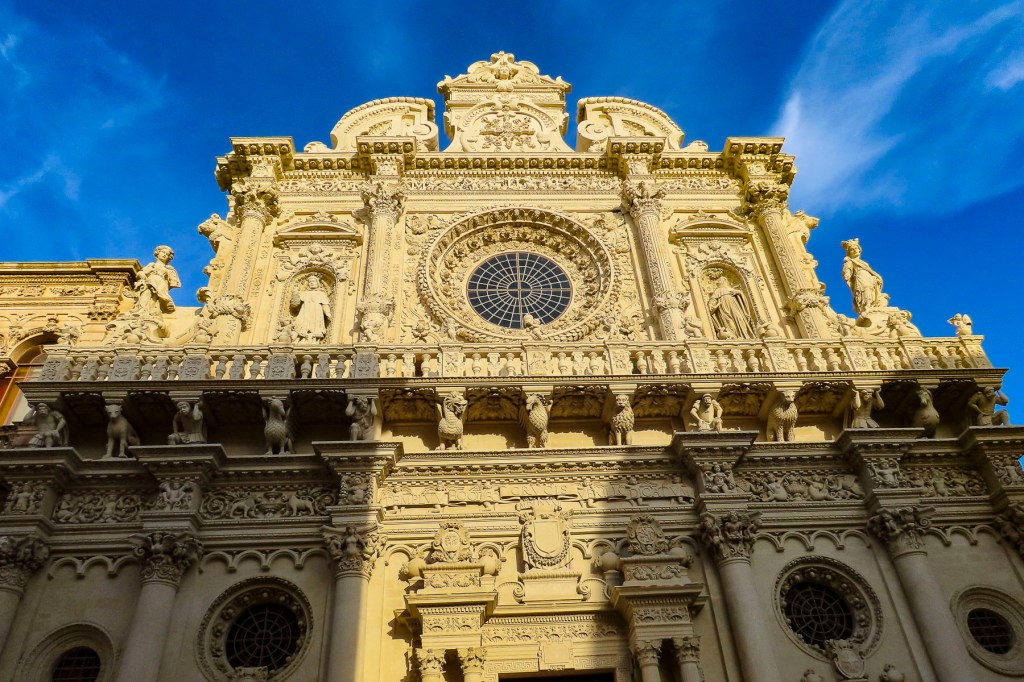
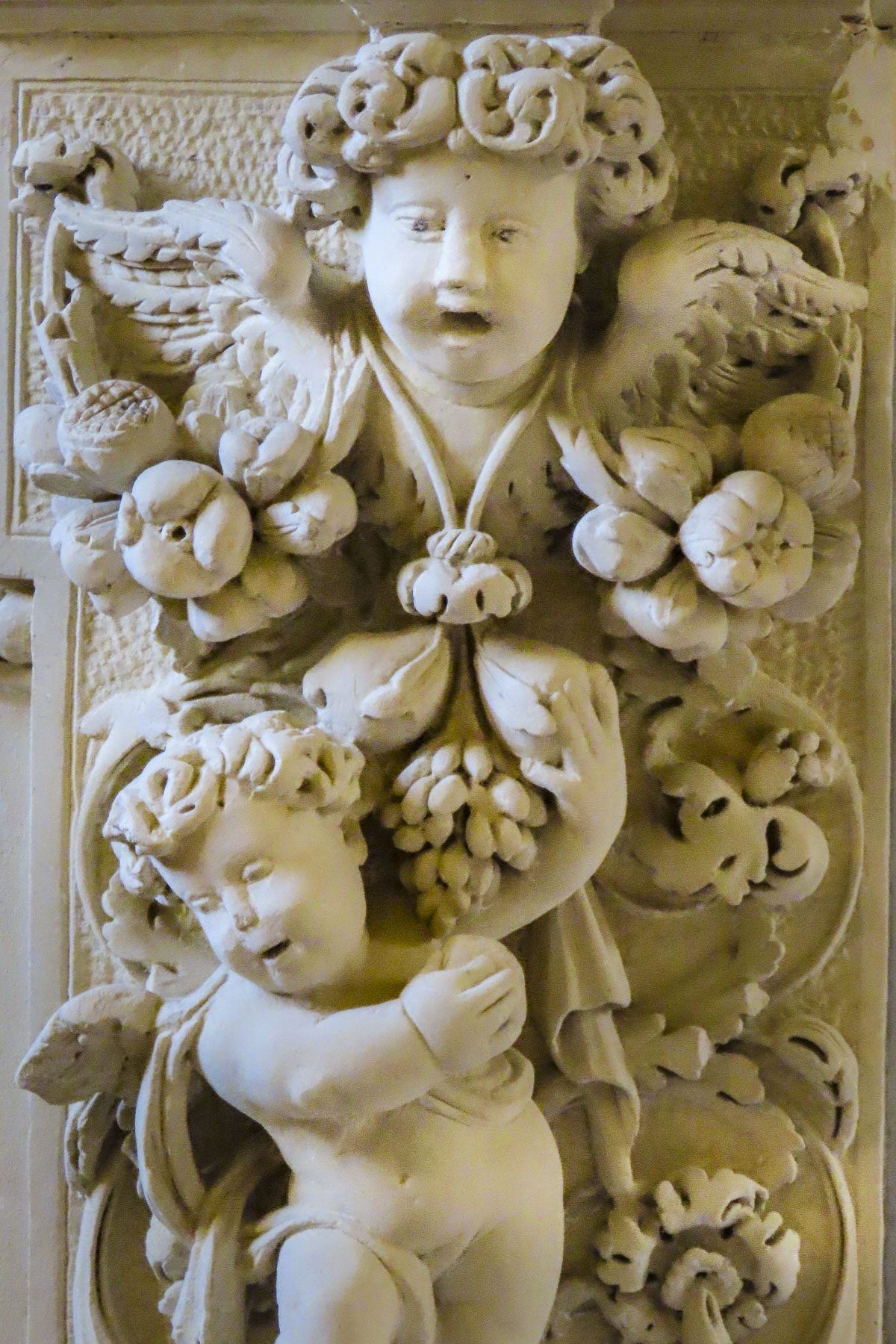
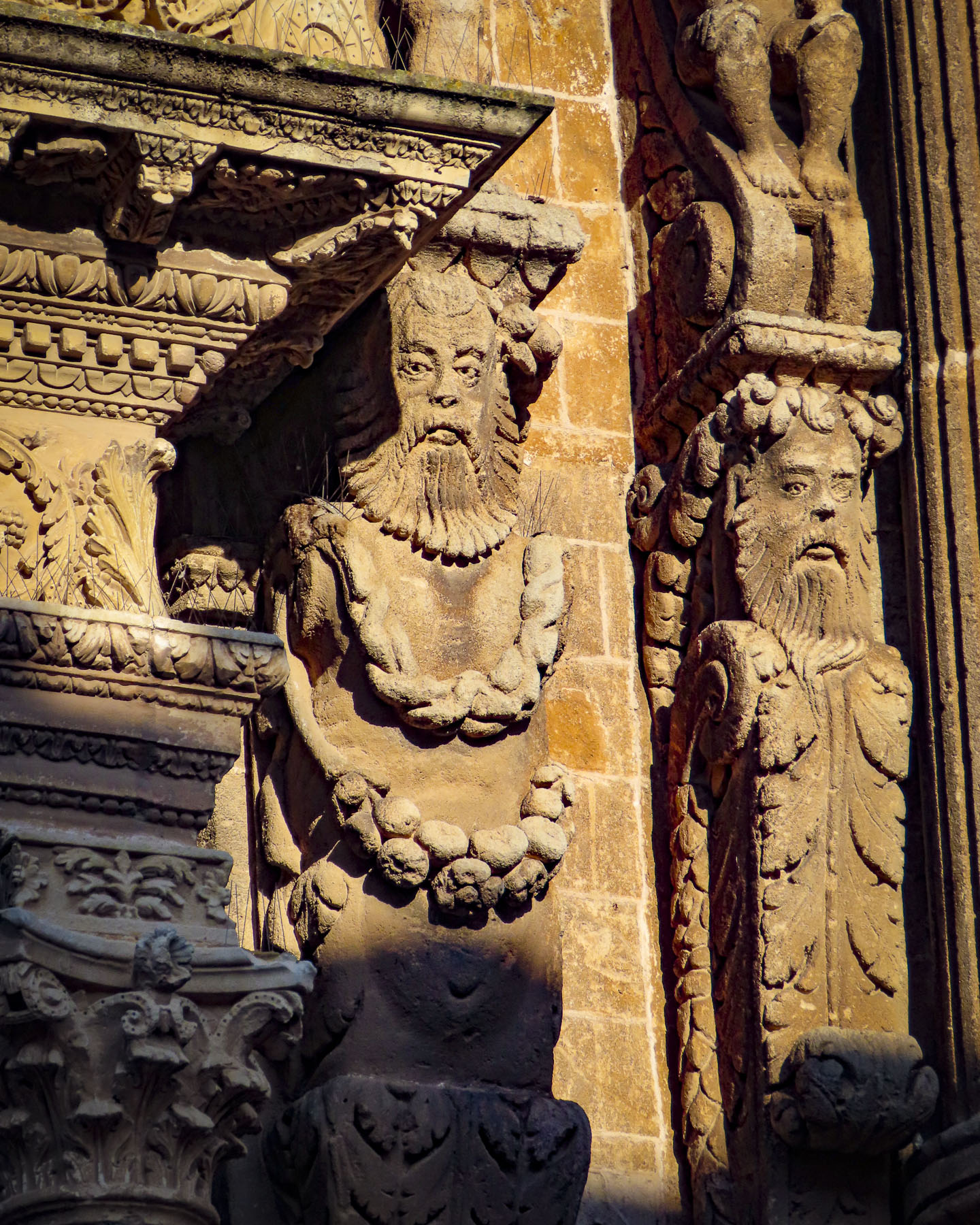
Meter parking was available near the Garibaldi Garden, but we opted to find a 24-hour garage so that we wouldn’t have to worry about time.  Lecce has a population of approximately 96,000 folks, 16,000 of which are students. Their presence was evident with in the jovial sidewalk café life we passed as we headed to meet Giula at the tourist information office on Piazza Sant’Oronzo.  We entered the pedestrian-only historic center through an arched gate that led through the 17th century Palazzo dei Celestini’s impressive, cloistered courtyard. Once the private retreat of nuns, it now seats the regional government. Next door stands the Basilica di Santa Croce with its elaborate façade of carved demons, ogres, gargoyles, and beasts.  It’s enough to send any parishioner questioning his faith inside to seek sanctuary.  Fortunately, our timing to visit Lecce was perfect, as just the month before the façade of the basilica was still under wrap from a multi-year renovation project to freshen the sculptures after centuries of erosion.  Its architect Giuseppe Zimbalo took full advantage of the abundant local rock, called Lecce Stone, with its warm color and malleable characteristics.  His opulent Baroque style along with the lavish designs of his contemporaries is credited with earning Lecce the distinction of being “The Florence of the South” during the 17th century.  The talents of the city’s stone carvers rivaled those in Firenze. 

We had a few minutes to view ruins of the 2nd century Roman Amphitheatre that was undiscovered until construction in 1900 unearthed it. Its full size wasn’t realized until further excavation in 1938 determined it could seat 24,000 spectators.  We think it’s wonderful that ancient archeological discoveries are still happening in cities that have been continuously lived in for over two thousand years.

After joyfully greeting Giulia and making introductions all around, we sat at an outdoor café on the edge of the piazza and relished hearing each other’s adventures over the past year.  “The best way to experience the ambience of historic Lecce is to just wander slowly, discover the small details, touch the walls, enjoy the brilliant light and the warmth of the buildings,” Giulia offered as she stood to lead us through the past glory of Lecce. We followed her along shaded lanes, nearly empty of tourists in late October, past Baroque churches and shops shuttered for the afternoon siesta, still a time-honored tradition in southern Italy. “It’s quiet now, but in the evenings the historic district is transformed into a spirited hot spot. The passegiata brings families into the streets, and later the university students keep it lively with their barhopping.”

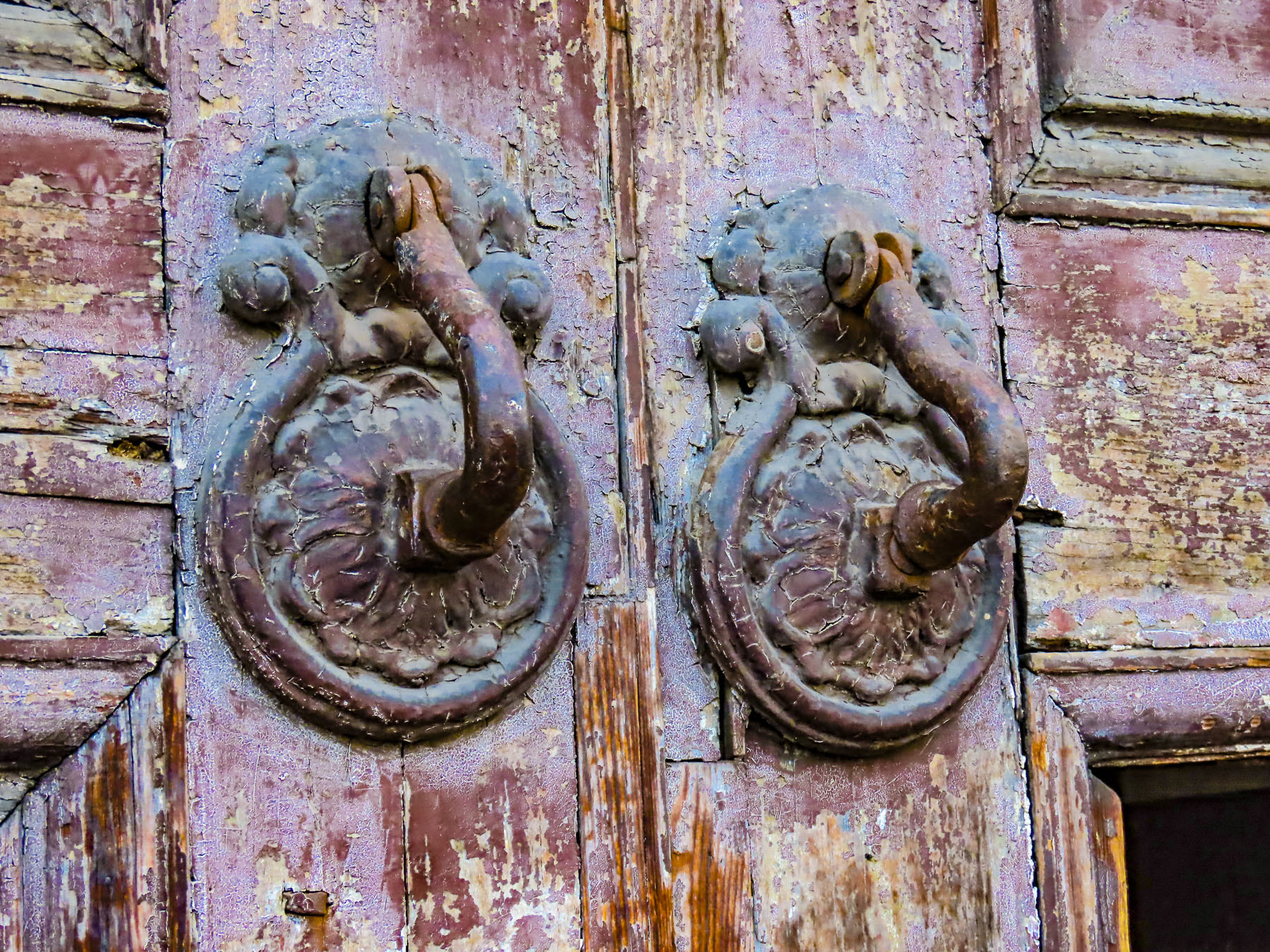
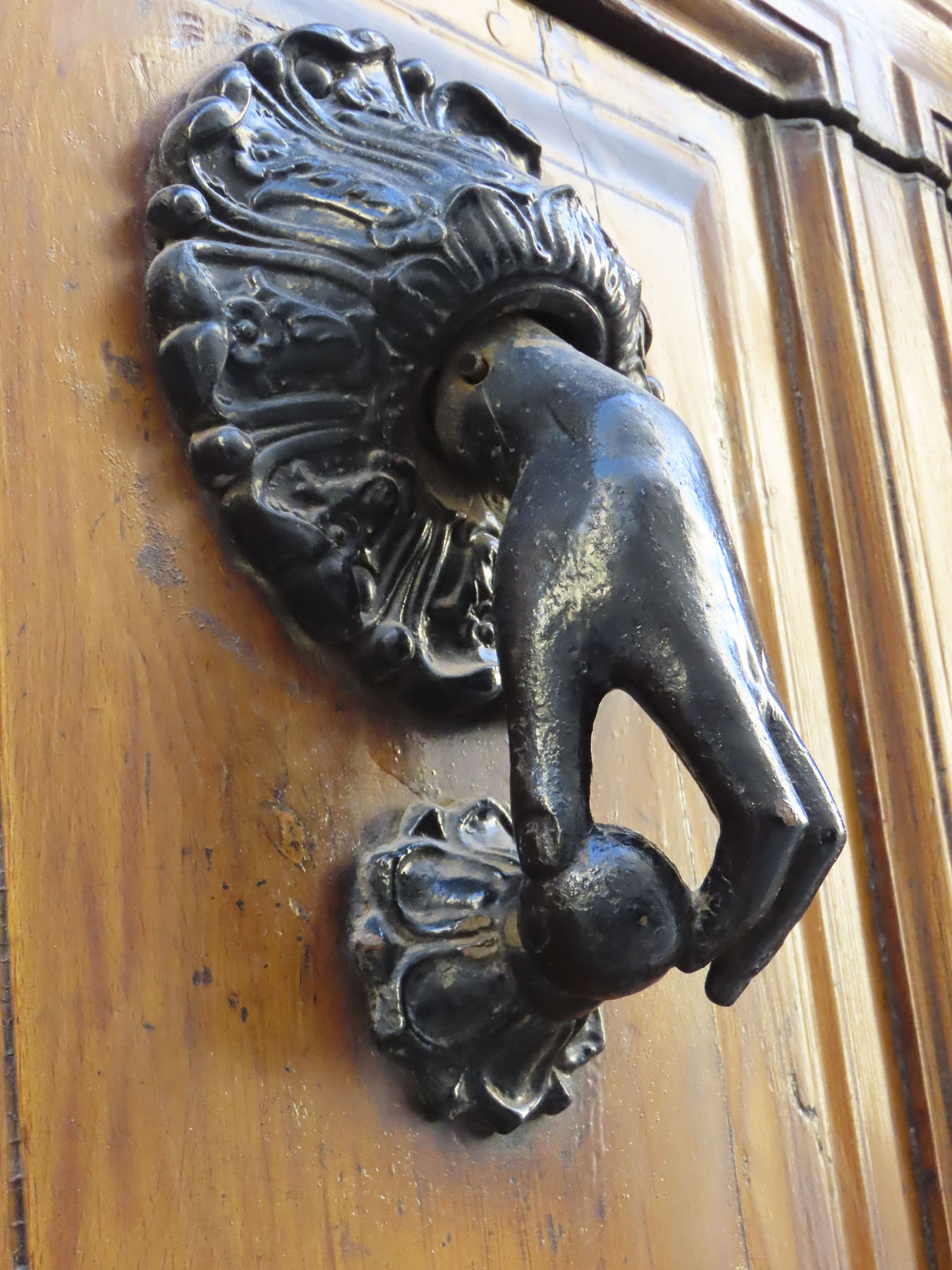
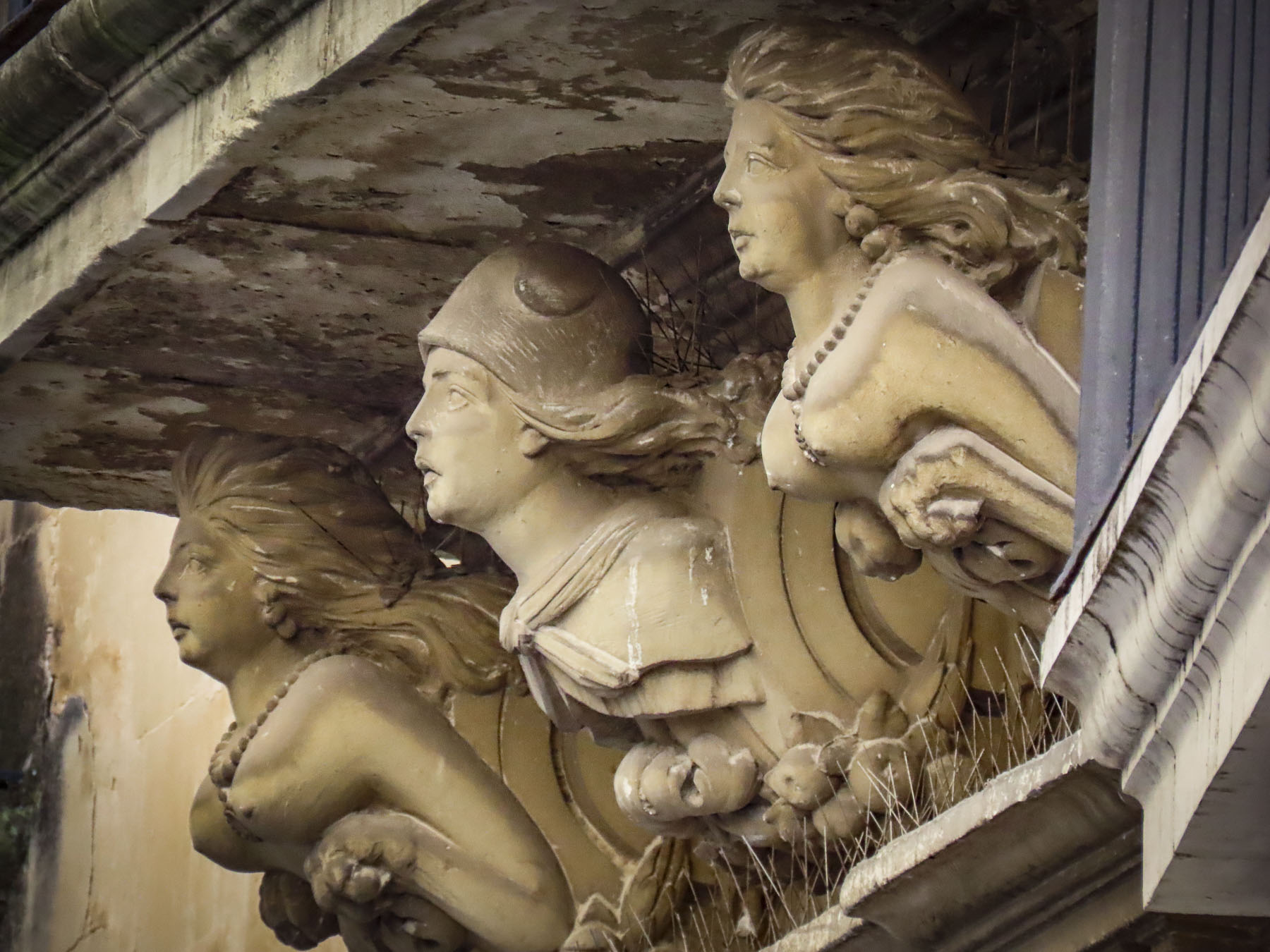
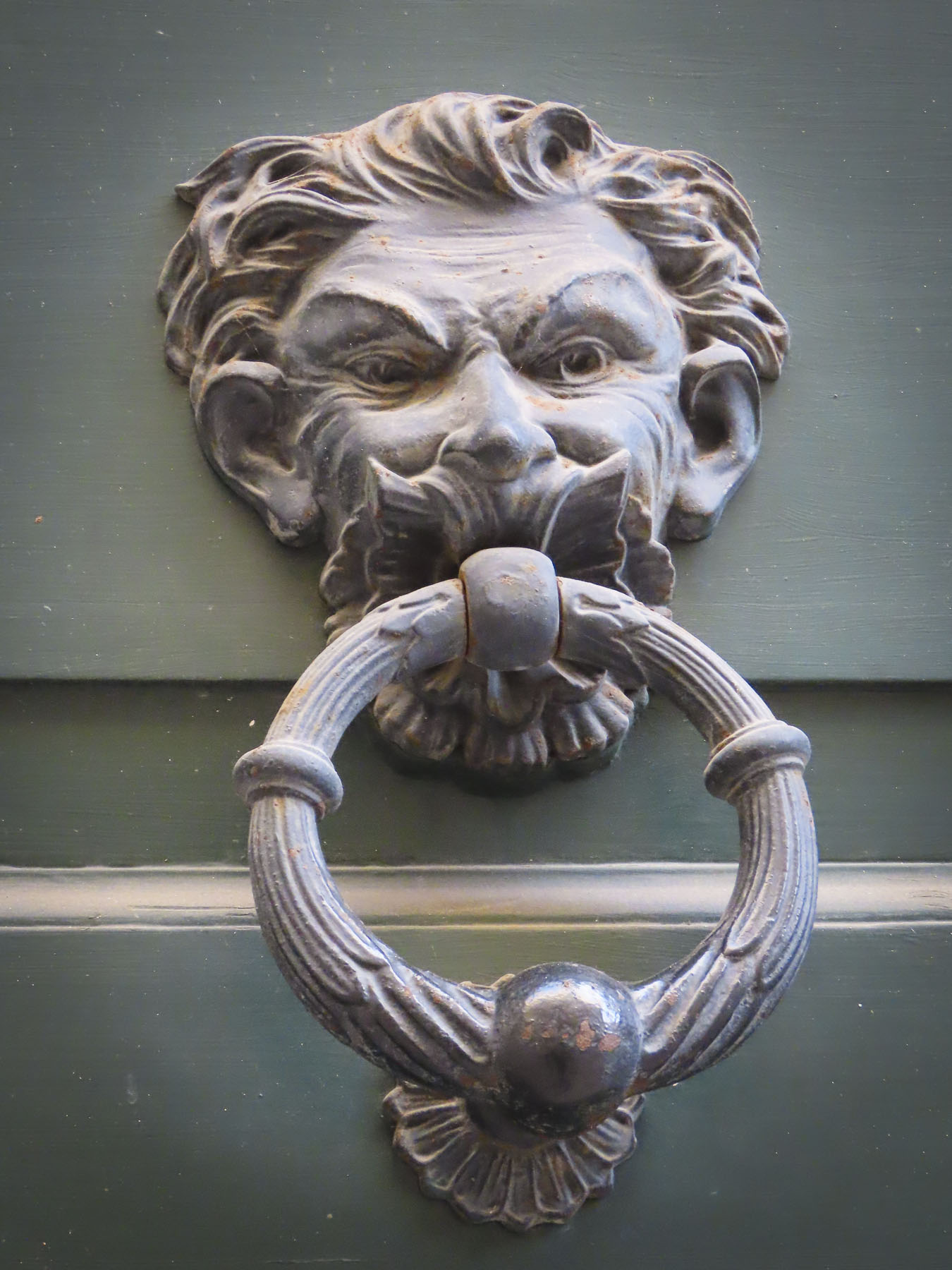
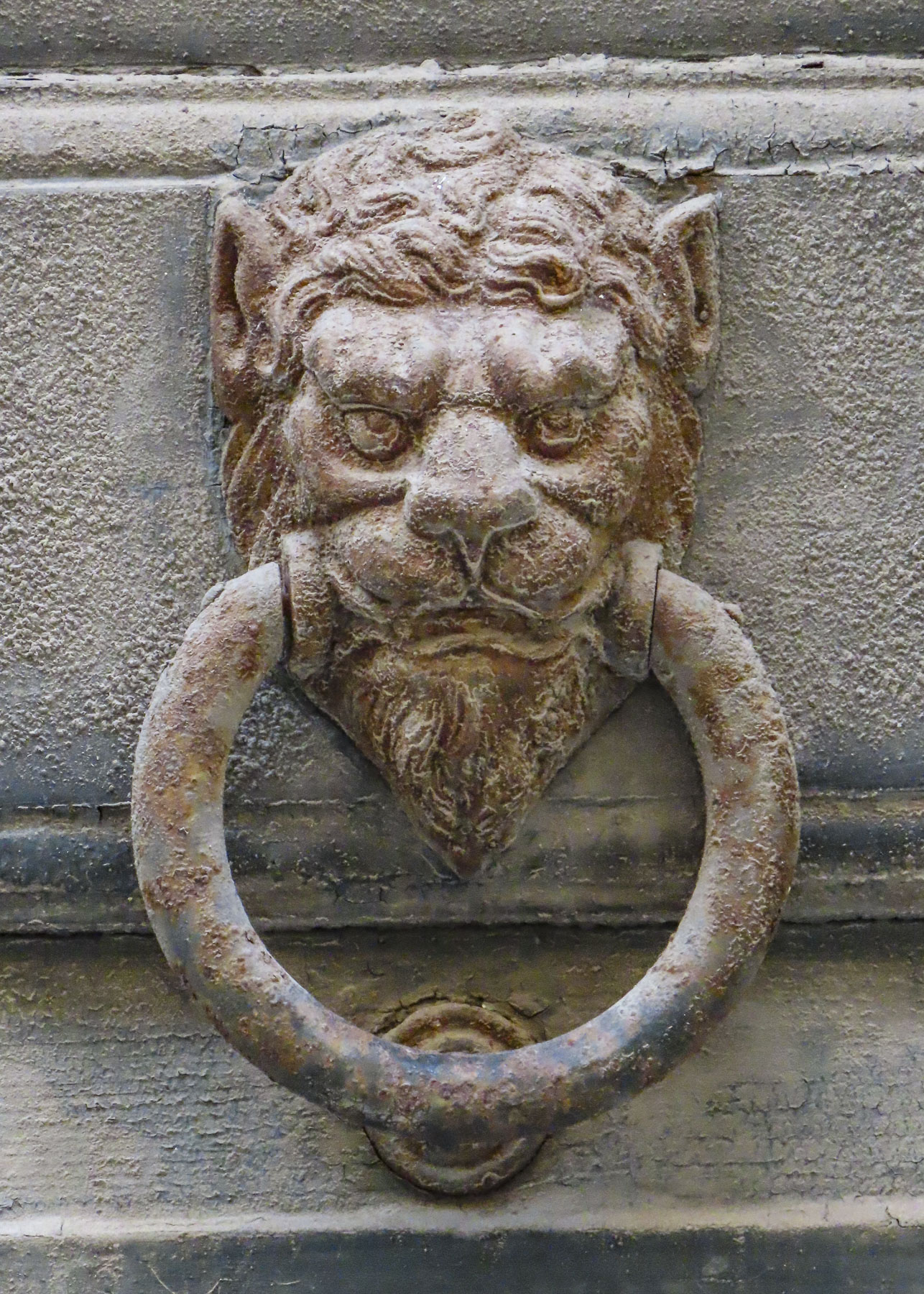
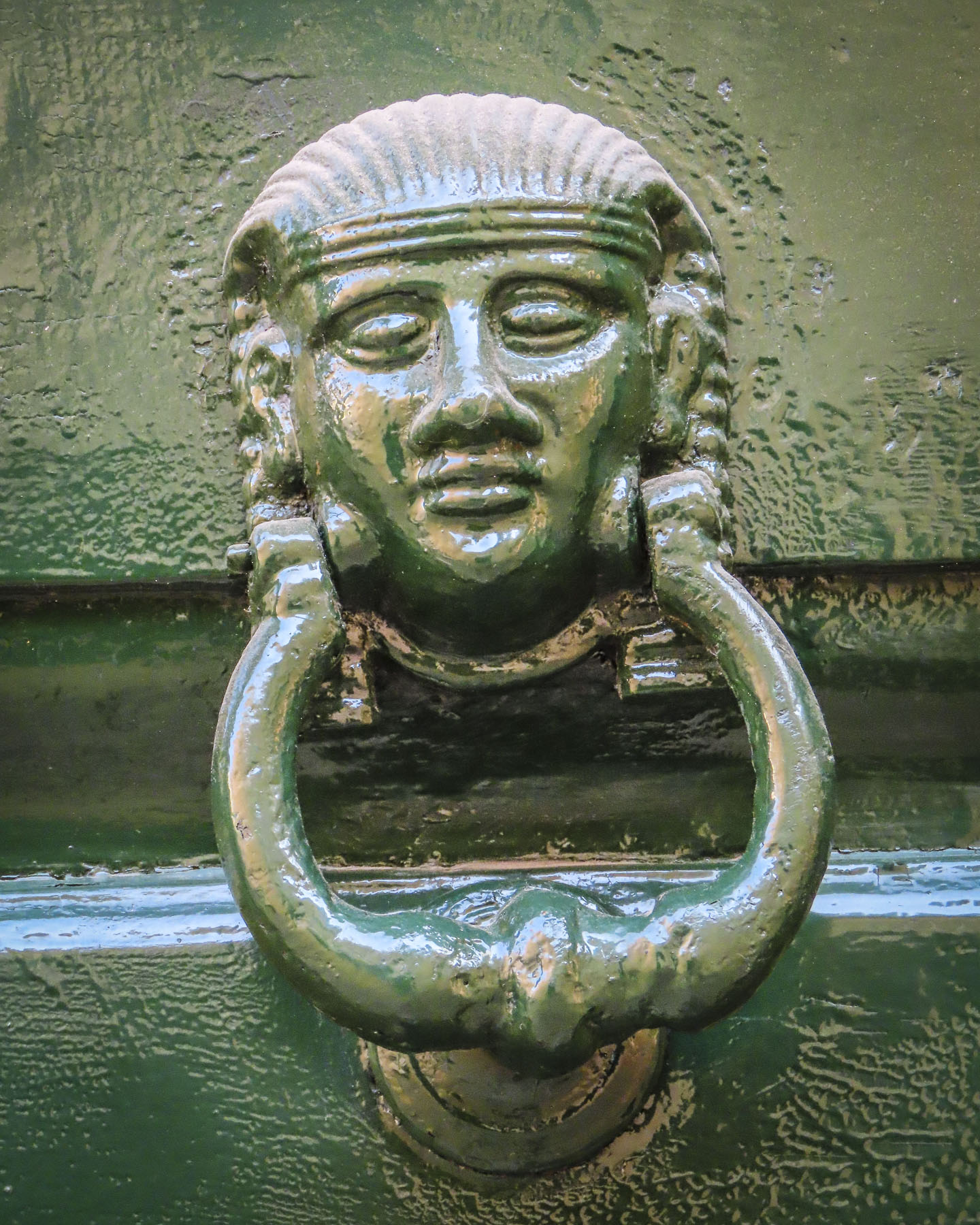
Large palazzo, with their arched entrances wide enough for a horse drawn carriage, lined the larger streets. Above, stone buttresses carved with gargoyles and animals supported balconies over the street. Interesting antique door knockers beckoned passers-by to rap on ancient doors, some so covered with cobwebs we wondered how many decades ago they we last used. We resisted the temptation.

As we turned a corner, the large Piazza del Duomo spread out before us.  Unlike other piazza in Italy where there are multiple entrances and shops, this piazza only has one way in and out.  The Lecce stone facades of the Museo di Arte Sacra (once a seminary,) Palazzo Arcivescovile (formerly the Bishops’s residence,) and Cathedral of Maria Santissima Assunta with its belltower enclose the plaza on three sides, giving it the ambience of a tranquil cloister.  The first church on this site was built in 1144 and repaired several times over the next 500 years until 1659 when hometown master architect Giuseppe Zimbalo was commissioned to rebuild the cathedral and design the freestanding 230ft tall belltower in the “Baroque of Lecce” style he helped popularize.  His burial under the altar of the cathedral reflected the honor accorded him.

Sitting on the steps of the museum, we admired the warm glow of the late afternoon light as it lit the walls across the piazza. “I would love to live there,” Giulia said, as she pointed to a small, corner terrace brilliant in the sun on an old building at the entrance to the piazza. I think there was a collective “ah, yes;” we understood.

Later in the week Giulia invited us all to visit her in Nardo, her family’s hometown.  It would be our farthest point south on the “heel of Italy.” The GPS directions from Alberobello suggested the fastest route to Nardo through Lecce, but we chose an alternative route that gave us our first glimpse of the Ionian Sea. Following backroads, we drove through vineyards and olive orchards.  Many of the orchards, though, were suffering from a deadly olive tree disease caused by a bacteria, xylella fastidiosa, that is ravishing southern Puglia and its important olive oil industry.  To curb the bacterium’s further spread drastic measures have been implemented. Infected trees and those within 150ft of it are culled from the orchard. Unfortunately, it has radically changing the landscape and farmers’ lives.

We met Giulia and her family at their winery on Via A. Volta, located just outside the historic district. Giulia’s grandfather started Cantine Bonsegna in 1964. Today her father and uncle continue vinting wines in a 1930’s era industrial building on one of the main thoroughfares of Nardo.  Wines from their vineyards in the countryside are brought into town, then pressed and fermented at the rear of the building, where they cork about 150,000 bottles of wine a year, while the front serves as a retail store.  On the second floor a wine bar is open in the evenings and specializes in small plate fare.  Their Danze della Contessa, Dances of the Countess, label was inspired by Giulia’s love of ballet. We might be slightly prejudiced, but we thought their wines were very enjoyable and definitely worth a visit to taste some fine regional wines and buy a case or two, maybe three. We purchased several bottles to enjoy during our trip, and were disappointed to learn that the Bonsegna label was unavailable in the US.

Heading into the historic district we were treated to a festive lunch at the Hostaria Corte Santa Lucia, a local favorite that specializes in “the forgotten recipes of the Salento region.” Plate after plate of mouthwatering local specialties were placed before us; our young men did justice to the platters, but were soon groaning for mercy as more and more food appeared. Mr. Bonsegna wouldn’t hear of us paying the bill, and afterward our boys marveled at the warmth and hospitality our host showed to us. “It is the Italian way,” Donna explained. “This is how I grew up – family and friends are lovingly embraced, and everyone is fed!”

We followed Giulia’s father into the old town, hugging the shade to avoid the intense sun still strong in late October.  The colors of the buildings were softer here, pastel colors chosen to reflect the nearby sea and surrounding farmlands.  Being close to Lecce, Nardo shared a similar history and the Baroque style adorns many of the town’s ancient churches.  The façade of the Church of Saint Dominic is the best example of that opulent exterior decoration, and was the only wall to remain standing after a 1746 earthquake.  

The Cattedrale di Nardo was our destination.  Partially damaged in the upheaval that shook the region, half of the 11th century church needed to be rebuilt.  Interestingly the effects of this could be seen as we looked down the center nave of the church.  The arches on either side reflected different styles.  The surviving arches were slightly pointed at their apex, while the newer ones are completely curved, a fine detail that Mr. Bonsegna enthusiastically revealed.  Farther inside, original medieval frescoes survived, untouched from the catastrophe, while along the outer wall 19th century murals replaced ones lost to the earthquake. 

Nearby the Guglia dell’Immacolata, a 100ft tall ornately carved baroque spire dedicated to the Virgin Mary, centers Piazza Antonio Salandra. “The piazza is jammed with people every December 8th to watch a fireman climb to the top and place a wreath of flowers on Mary’s head, to honor the Immaculate Conception,” Giulia shared as we crossed the piazza to a still-flowing, ancient public water fountain decorated with a relief carving of a bull. 

Legend says the fountain marks the spot where 3000 years ago settlers watched a large wild bull scuff the earth and uncover a natural spring.  Behind us stood the small Church of San Trifone, built in the 1700’s to honor the martyr who saved Nardo from an infestation of caterpillars. We were disappointed that an explanation of this odd plague was not provided.  Most likely it was an infestation of oak processionary caterpillars. Contact with their toxic hairs can trigger an asthma attack, but most often results in a severe, blistering rash that lasts for weeks. “We have it all here and yet we are still far off the tourist track,” Giula happily joked. “We get very few foreign visitors, and rarely, if ever, Americans.”

Heading back to the car we stepped through the heavy wooden door of the Aragonese Castle of Nardo. Formerly the private residence of the 15th century Acquaviva family, rulers of the fief of Nardò, a reward from King Ferdinand II of Naples.  Today the once moated fortification serves as the city’s town hall.

A very enjoyable day was celebrated and “till next time” was said over coffee before we said our farewells and drove to the seashore to find one of the numerous watch towers that were built along the Ionian coast to warn the country of imminent invasion. 

The sun was setting as we came to a stop behind a car about to turn onto the coast road. A car on the opposite side of the road turned the corner and stopped to wave at the person in front of us. Quickly both parties were out of their cars, hugging and chatting away, oblivious to us. I rolled down my window and photographed the dark silhouette of a square “Nardo tower” against an orange sky. No impatient honking, just enjoying life in Nardo.

Fino alla prossima volta – till next time,

Craig & Donna

Puglia: Alberobello – Trulli, Troglodytes and the Sea

One of the characteristics we most appreciated about traveling through Europe was the ready availability of a cup of delicious coffee, even in the most unexpected of places. The bar on the ferry from Dubrovnik to Bari came through with two tasty cappuccinos the morning after our overnight passage in a windowless cabin. As a hazy sunrise dawned over the Adriatic Sea, we sipped our revitalizing espresso and milk while the ship docked in Bari, capping an otherwise uneventful crossing to the Puglia region – “the heel of Italy” or the “spur of the boot.” 

Behind the wheel of our rental car, we passed through verdant olive groves in the Valle d’Itria, alternately known as the Valle d’Trulli or the Valley of Ancient Olive Trees. Olives trees are celebrated for their age in the region, and several top two thousand years old.  One ancient millennarian called the Elephant is 3,000 years old. The orchards on either side of the road were busy with workers covering the ground under the trees with collection nets in preparation for the olive harvest.

A little aside – we are olive aficionados. All things olive we enjoy. We have even brined our own, ordering California olives, then scoring and soaking them for three months in salt water to remove the extremely bitter oleuropein.  As tasty as they are after this process, they are downright vile beforehand, which has always made me wonder how it was determined that they were edible.  Did a starving hunter-gatherer pluck a floating olive from a salt marsh and make the discovery of a lifetime?

Farther along we sped past a farmer selling yellow melons from the back of his three-wheeled Piaggio Ape, a small truck that is ubiquitous throughout the farmlands of Italy. We did a quick U-turn to buy two from him, and they were delicious.  Our progress slowed through another small town as a brass band led funeral mourners across the road ahead of us.

Our destination was Alberobello, to meet up with three of our sons and especially to live in a trullo for a week.  This was the culmination of a decades-long desire ever since becoming aware of these enchanting, whitewashed dwellings capped with conical-shaped stone roofs with a pinnacle at the top.

Trullo comes from the Greek word for circular domed construction, tholos.  But it is thought the “a secco” style, without mortar construction technique, was brought to Puglia by North African invaders when Sicily was under Arab rule in the mid-800s or even earlier. As the Valle d’Itria surrounding Alberobello was deforested (albero bello translates as “beautiful tree”) to make way for cultivated crops and olive orchards, the building material of choice was the abundant limestone rocks removed from the fields or the wells dug beneath their homes.  The flat stones, called chiancarelle, are precisely pitched so that rainwater runs off the roof and the interior remains dry.  Their local design was firmly entrenched in the 14th century when the King of Naples granted the desolate Alberobello region to the first Count of Conversano as reward for service during a crusade. 

In a ploy to recruit tenant farmers from neighboring regions the feudal landlord offered trulli with the caveat that when the king’s tax collector visited the area, homes would be destroyed by the count’s horsemen using a rope to pull the pinnacle, a key stone, from the roof, collapsing it.  The homes could then only be rebuilt when the tax collector was safely far away.

This miserliness inflicted upon the already hard lives of the peasant farmers was to avoid payment of “new settlement” taxes by the feudal lord.  No wonder there were constant peasant uprisings. This threat literally of “the roof coming down on your head” was used to intimidate or evict rabble rousers and farmers who didn’t pay their crop share to the landowner.  As peasants’ rights changed over the centuries the homes became more permanent, though tenant farming was common in Italy until the end of WWll.

Our Airbnb trullo was located on one of the narrow, steep lanes of the Monti district not far from the Church of Sant’Antonio with its steeples mimicking the stone roofs of the surrounding homes. It was a compact space with two small bedrooms and combo kitchen/living room area.  When the front door was closed it felt like a snug cave, but fortunately the entry had a classic beaded curtain over it as a privacy screen that let in plenty of light and air when the door was open. 

The charm here was a vertical ladder that led to a hatch which opened to a rooftop patio with a grapevine, chairs, a table, and a clothesline. It was delightful and we made daily use of it, bringing coffee up the ladder in the morning and then wine to enjoy while watching the sunset. Immersing ourselves totally in the local lifestyle, we flew our laundry from the clothesline, like a proud flag symbolizing our occupation. 

It took the better part of a day to coordinate the arrival of our tribe; Craig and Gary stayed with us, while Jack and his partner Brian stayed near Matera. The plan was to tour Alberobello, visit Matera in the neighboring Basilicata region together and then spend a day in Lecce with our friend Giulia, whom we met at the very beginning of our journey, fourteen months earlier in Ecuador.

Many visitors savor all of Alberobello’s magic in one day, but if you don’t like changing hotels frequently, like us, it was also the perfect spot to base further exploration of Puglia, which is what we intended to do.

There are over one thousand trulli in the Monti district spread across seven narrow streets that twist and turn in an enchantingly confusing way, yet the area was small enough that we were never really lost.  Early in the mornings or late in the day the neighborhood had a unique ambience, with its cobbled lanes, whitewashed walls and pointed stone roofs painted with various religious, astrological, or folkloric  symbols. The latter were meant to ward off evil or ensure a bountiful harvest. Similarly, there are different thoughts about the meaning of the various shapes of the pinnacles atop the roofs. I prefer the theory that they represent the ancient stone mason’s calling card. Most of the trulli have now been converted to shops, restaurants, small inns, and rental properties. 

Across the main road at the bottom of the hill we climbed a shallow slope to a second, smaller borghi, or neighborhood, equally charming but with a more residential flavor than the Monti. The Aja Piccola is comprised of about four hundred trulli.

Farther afield on the outskirts of town we walked through Alberbello’s central cemetery.  Spanning centuries with classic tombs and modern mausoleums, the graveyard architecture presented a strikingly distinct dichotomy to the rustic trulli.

It was backroads through farmland most of the way to Matera, past larger trullo with multiple rooms, each represented by its conical roof. Some along the way were abandoned or used as barns, while others were pristinely refurbished and doubled as the farmer’s home or agrotourism business.

Matera sprang to notoriety in 1945, at the end of WWII, with the publication of Carlo Levi’s novel about his political exile to the region, Christ Stopped at Eboli, when Mussolini was in power.  He described the squalid conditions in which peasants lived together their farm animals: they inhabited caves, without electricity or running water, and diseases ran rampant.  The Italian government was internationally embarrassed by the neglect the sassi of Matera received, and in a restitution effort, relocated the entire population of some 16,000 cave dwellers from 1,500 sassi, small caverns, to a new town built on the plateau above the honeycomb of caves.

Archaeologists have determined through excavations that Matera grew from a series of water-eroded caves along the walls of the Gravina River canyon, which were first inhabited sporadically 9,000 years ago during the Stone Age.  Permanent populations have existed here since 3,000 BC, making it one of the oldest continuously inhabited settlements in Europe. 

The Romans declared Matera a town in 251 BC. Centuries later the safety of cave dwellings appealed to many during the turbulent dark ages and the populace grew as folks expanded the natural caves and randomly dug new sassi, above and below their neighbors, from the soft rock of the canyon walls.  During the Middle Ages the prosperity of the city supported many churches and convents.

In the 1200s the Cathedral of Saint Mary ‘della Bruna,’ Saint Eustace, and the Church of Saint John the Baptist were built on opposite sides of the ravine.  Prosperity continued in this area into the early renaissance.  The exterior of the some of the sassi were squared off and ornately carved with columns, while others were expanded with additional rooms and vaulted ceilings.   

Political intrigue over the centuries put Matera on the losing side of several rebellions against the various Kings of Naples. The coup de grace came in 1860 after unification with the Kingdom of Italy, when many of the lands and properties owned by the church in the Basilicata region were confiscated and sold off to wealthy aristocratic families. With support from the church, peasant opposition to the broken promises of the new Italian government grew and soon the countryside was controlled by roaming bands of brigands.  The province was too dangerous to travel through, further isolating Matera even though it was the capital of Basilicata.  Many decades of governmental neglect followed and pushed Matera into major decline.

For three decades the sassi were an abandoned no-man’s-land, the caves used as drug dens and warehouses for smugglers until the first gentrifications began with several small boutique hotels in the 1980s.  During years of renovation and exploration, 150 cave churches, 90 wine cellars and numerous cisterns have been rediscovered after the removal of debris and muck from their last use as barns and stables.

The uniqueness of Matera’s “spontaneous architecture” as it is officially called was recognized in 1993 when UNESCO named it a World Heritage site.  Further interest followed, after Matera was used as a film location to double for ancient Jerusalem in several movies: The Passion of the Christ (2004), King David (2005), and The Nativity Story (2006.) Even some scenes from the 2017 Wonder Woman were filmed there. In 2019 Matera received distinction as a European City Capital of Culture.  Today sixty percent of the sassi of Matera have been restored into small hotels, shops, galleries, and digital workspaces.  

When we arrived in Matera the historic area was hidden from our view by the buildings of the new town on the plateau above the Sassi district. We made our way to Piazza Vittorio Veneto while searching for stairs down into the ancient district. There was a tremendous WOW! factor when we emerged from a narrow alley onto a scenic panorama above the old town, the city’s silhouette frozen in time.

Around the city large surrealist sculptures by Salvador Dali stood in wonderful, whimsical juxtaposition to the surrounding monochromatic walls of the city. One day was not enough to uncover all the mystery that Matera had to offer. Hopefully, we will return in the future. 

A day at the beach, more like a day on the cliff above the beach, drew us to Polignano a Mare on Puglia’s Adriatic coast.  It’s a picturesque town known for its dramatic buildings balanced on a cliff edge that follows the sea, thirty feet below. 

The rock face is incredibly soft and over time sections have fallen into the sea creating grottos, under the homes above, that can be toured by boat.  White-pebbled Lama Monachile is a classic, small Italian beach nestled between cliffs, from which the brave dive into the calm turquoise waters of the cove. 

The quaint historic district is relatively small, and homes are painted in cooling colors which echo the sea. Alleys meander to small piazzas above the water, each with a unique view of the cliff and just large enough to support a small café with a few outside tables.  It was a brilliant sunny day, pleasantly uncrowded, and the weather was gentle enough that we could dine outside in a sunny spot during our November visit. 

Till next time, Craig & Donna

Kotor Part 4: The Ladder of Kotor, Camel Tracks and Pirates

The water barely ripples on the inner reaches of Boka Bay when a storm rages across the Adriatic Sea. The steep walls of the fjord created the perfect harbor to shelter ancient fleets of merchant sailing vessels. Three-thousand years ago starting with Greek triremes and later Roman galleys, the vessels carrying goods through the Adriatic to ports along the Mediterranean were mainly rowed.  The ancient Greeks mostly relied on free men as paid rowers while the Romans used slave labor to expand their empire and propel their merchant fleets.

The city of Kotor was essentially a land locked island until an ancient foot path was widened by the Romans in the 1st century into a cobbled road, six to eight feet wide in many places, with stone retaining walls that zigzagged up the mountain four miles and climbed 3100 ft in altitude, about a five- hour trek.  Going downhill was much faster and more difficult for the camel trains. The danger here was if the camels were going too fast and couldn’t round the tight switchbacks, lost their balance and fell off the trail to their deaths.  The camel wranglers definitely had a difficult task on this route. The caravan trail remained the only land route into Kotor until 1897, when the Austrians built the road that now leads from Kotor to Cetinje.

This early example of infrastructure improvement resulted from Rome’s war against the Illyrian Kingdom after it refused to stop their piracy of Roman merchant ships. The empire determined that an overland trade route connecting to Constantinople/Istanbul and the Silk Road from China was needed as a safe alternative.  Eventually a spiderweb of caravan trails and Roman roads spread across the Balkans. Cilician pirates in the eastern Mediterranean were also creating havoc, at one point kidnapping a young Julius Caesar on a voyage to Rhodes. Piracy continued to be a problem for the Venetians with Omis pirates in the 11th to 13th centuries and later Uskok buccaneers from Croatia pillaged along the Adriatic until the 1600s.  Barbarossa, the notorious Ottoman pirate, commanded a fleet of swashbucklers that were the scourge of the Mediterranean at this time, raiding Spanish and Venetians merchant vessels and selling Christians into slavery. European empires also tolerated and endorsed pirates as long as they were “our pirates.”  Piracy persisted on the waters of the Adriatic and Mediterranean for so long because the rugged coastline had many small islands and hidden inlets to shelter the pirates.

Romanticized views of pirates persist today with the popular adventure movie franchise Pirates of the Caribbean, featuring a beguiling Captain Jack Sparrow, and the TV series Black Sails.  Interestingly there is a Japanese anime film about fictitious air piracy on the Adriatic Sea called Porco Rosso which is based on a 1992 short graphic novel called Hikōtei Jidai (飛行艇時代, The Age of the Flying Boat). It’s entertaining and worth checking the Porco Rosso film trailer.

The afternoons in mid-October were still quite hot so we planned for an early start from our apartment in the center the historic district.  This coincided with the young parents of old town escorting their children through the still shadowed alleys to the Vrata od Škurde, the River Gate, which was constructed in 1539 to celebrate a naval victory over Barbarossa, now an Ottoman admiral. We found ourselves behind an orthodox priest holding the hand of his daughter as we crossed the first and then second bridge that spanned the Scurda.  The Scurda is a wide, shallow stream that bubbles to the surface from beneath the tall rock escarpment that the Ladder of Kotor climbs and flows into Boka Bay. This area on the far side of the bridge was for centuries the market for all the goods brought down the trail from afar or from farms in the mountains to be sold or bartered for.

The old caravan trail starts behind the waterworks where the underground spring emerges and zigzags often in the tight confining space at the bottom of the gorge. The trail continued in the shadow of once towering fortress walls now humbled by earthquakes before the ravine widened out and the distance between the switchbacks increased.  There are seventy switchbacks in total if you chose to trek all the way to Krstac pass where the trail ends near Restaurant Nevjesta Jadrana. Here you can zipline over part of the trail you just hiked up, or catch a taxi or local bus back to Kotor or onto Cetinje.  Hiking back to Kotor is also an option for the hardy.

Our plans were more modest, just wanting to hike to a vantage point above the Castle of San Giovanni, Kotor Fortress, for views over the bay.  The cobbled road and retaining walls have seen better days having been damaged in the 1979 earthquake.  While the fortress has been repaired, maintenance of the caravan trail has been forgotten.  Though many sections of it are in better shape than the stairs to the Castle of San Giovanni and not as bad as some city sidewalks across Europe. Still you need to be aware of your footing and wear sturdy shoes.

It was a gentle hike through a rock-strewn hillside dotted with grasses, small shrubs, occasional pomegranate trees and wild thyme.  Off in the distance unseen donkeys could be heard braying. The pomegranates were just ripening, but were all teasingly just inches out of reach, too far from the trail’s edge.  The views were fantastic from many spots and there were two rustic taverns to stop at along the way to rest.  The lower one was closed for the season, but the higher one referred to as the Cheese Shop, on Google maps, is located where the trail veers off towards the deserted village of Spiljari, which is located under the back ramparts of San Giovanni Fortress. 

I think we were the innkeeper’s first customers of the day, and we ordered two espressos while we rested on the shaded porch.  After serving us he crossed to a refrigerator on the other side of the room to get himself a shot of chilled rakija. Being a good host, he offered us some. It was ten in the morning.  We politely declined. Though I’m sure it would have had wonderful medicinal qualities in case of any mishaps.

The village of Spiljari is over 1,000 years old and was abandoned when its water source went dry. Now trees grow between the half walls of a dozen buildings and the ruins of the Church of St John remain standing.  The ruins of the church alone are worth the detour. 

Slowly decaying, colorful remnants of what one only could imagine were beautiful frescoes remain on walls open to the weather. 

From here you can see a ladder to a small portal in the side wall of the fortress. The Ladder of Kotor? We are not sure if the name refers specifically to this or to the climb in general.  Years ago, this was an alternative entrance into the fortress.  Now it is strictly an exit point for those who have paid the €8 entrance fee to the fortress and walked up the stairs from old town and wish to return to Kotor by the caravan trail.  Though you might be able to purchase a cold drink from an ice cooler manned by the ladder attendant.  

The sun was high in the sky when we made it above the castle and the view was spectacular. We sat for a while and imagined the history of the trail: how it conveyed ideas, merchandise, pilgrims and invaders over the centuries. 

Notably in the 1830s a team of fifty men carried an Italian billiard table up this track to the rightfully named Biljarda House, home to the beloved prince bishop and poet Petar II Petrovic. (Just imagine the amount of cursing involved in that endeavor.)  Years later when Petar II Petrovic was on his deathbed a procession carried him up this same track to the historic old capital, Cetinje.  A few months later Montenegrins would carry his successor and nephew Danilo II Petrović-Njegoš to Cetinje to rule.

And although we took many photographs on the trek up, we took even more of the ever changing view as we descended back into town.

Till next time, Craig & Donna