Road Tripping Through Andalucia: The Pueblos Blancos of Ubrique, Villaluenga del Rosario and Arcos de la Frontera

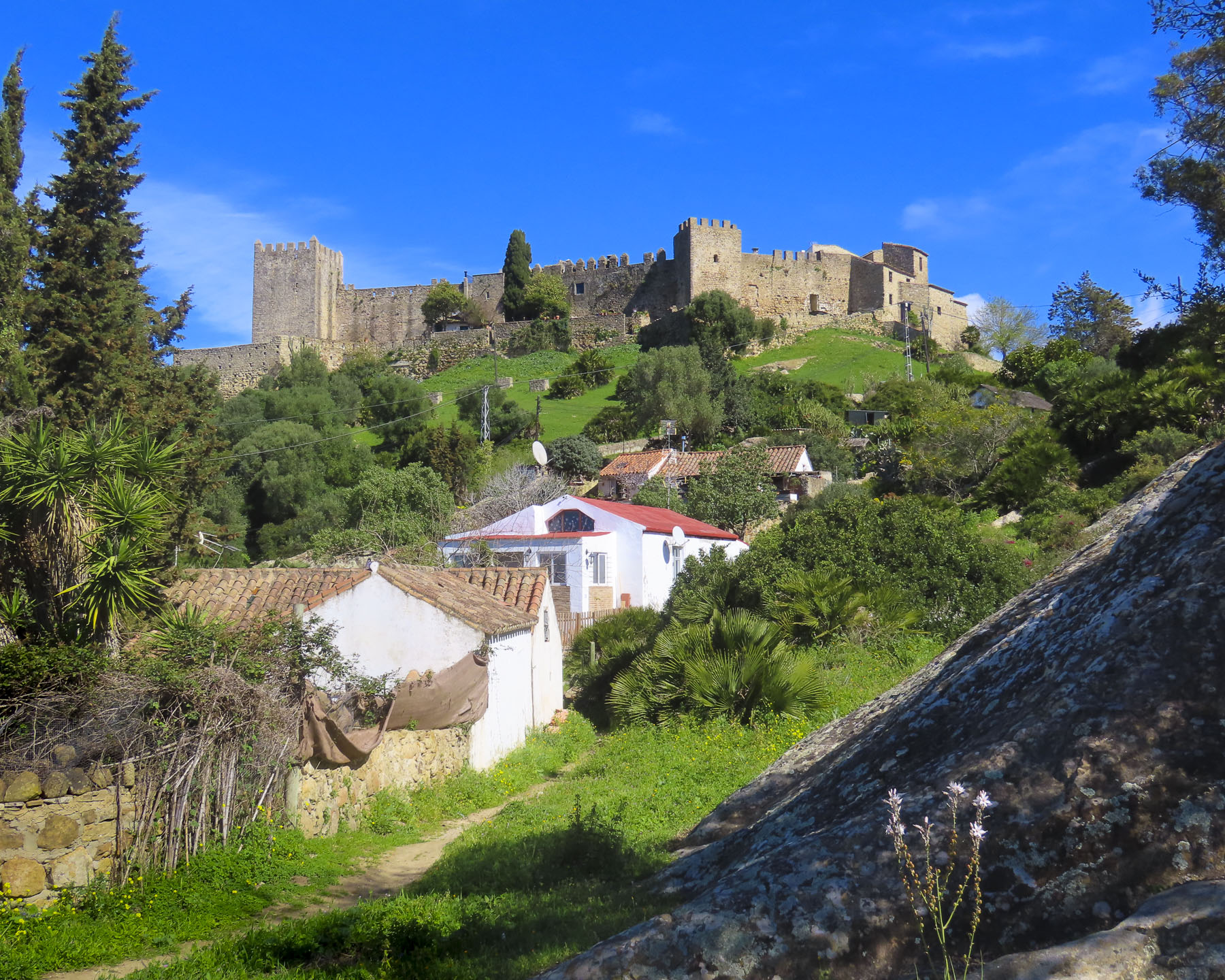
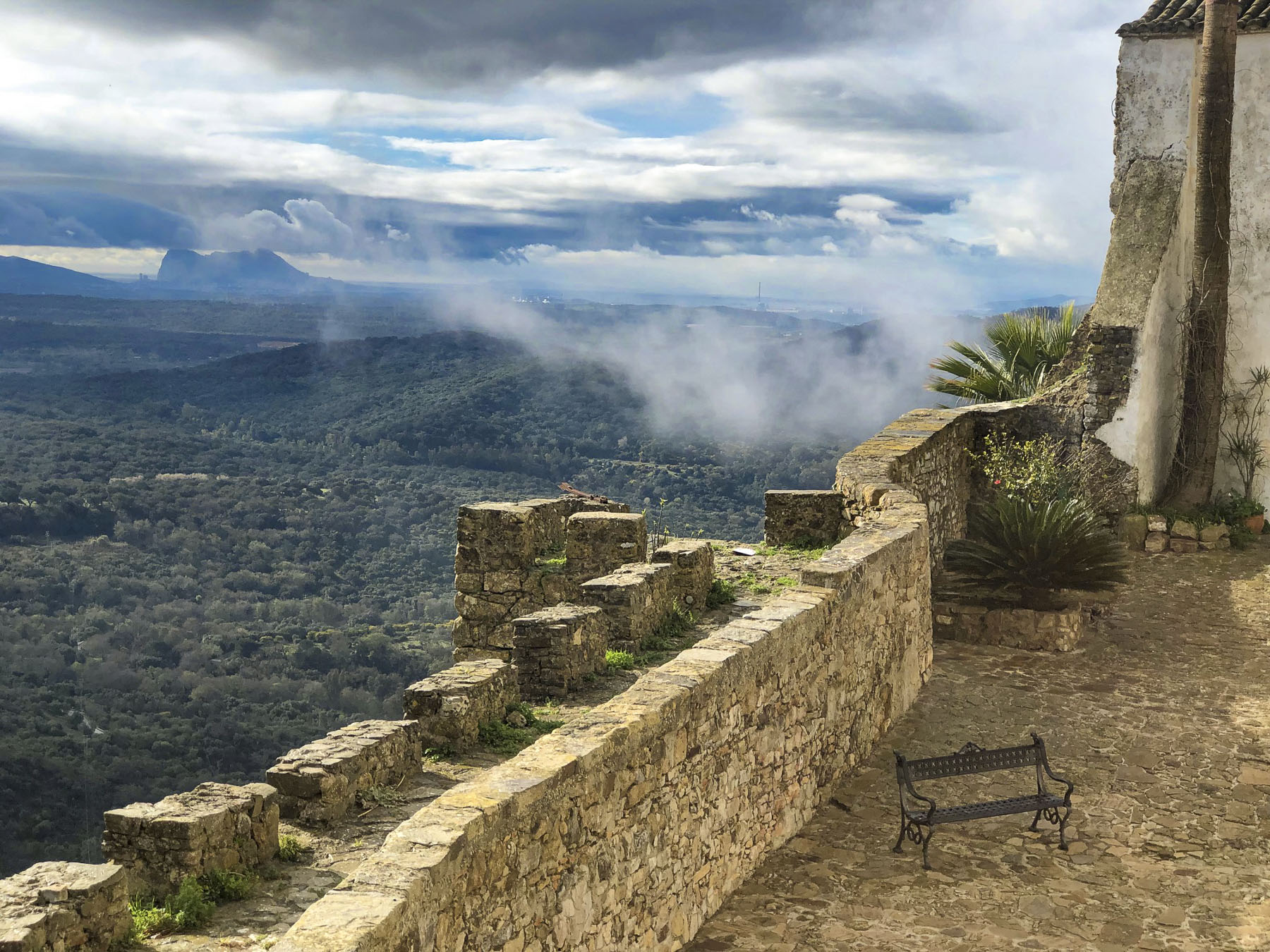
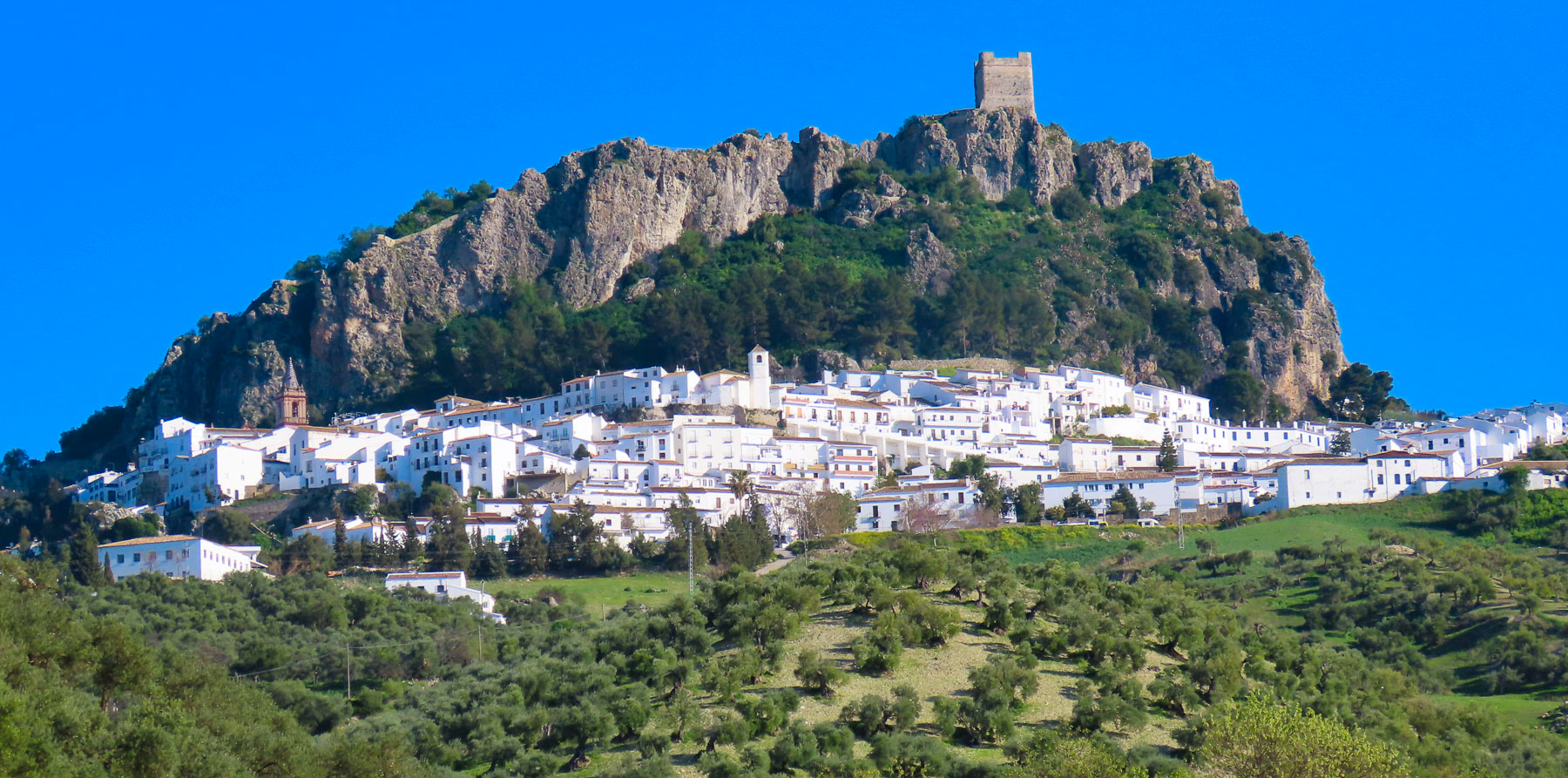
Just below the northern horizon, a white brushstroke highlighted the verdant canvas before us as we savored the view from the top of the castillo in Castellar de Frontera one last time. That swath of white slowly changed into Jimena de la Frontera as we drove closer. One of Andalucia’s famed Pueblos Blancos, the village is set on the hillside below the ruins of its ancient castle which once protected it.

In ancient times the homes in villages featured roughhewn stone masonry. Lime paint was a luxury, until its use was greatly expanded during the mid-1300’s when a bubonic plague pandemic swept through the Mediterranean countries. Residents of villages were required yearly to cover the outside and the interiors of their homes and churches with a limewash, known for its natural anti-bacterial and insecticidal properties, in an effort to reduce the spread of disease. Community inspections were done, and folks were fined for noncompliance. This mandated conformity was eventually appreciated as an aesthetically pleasing look and a symbol of meticulous tidiness. Fortunately, the custom stayed and has become an iconic signature of southern Andalusia.

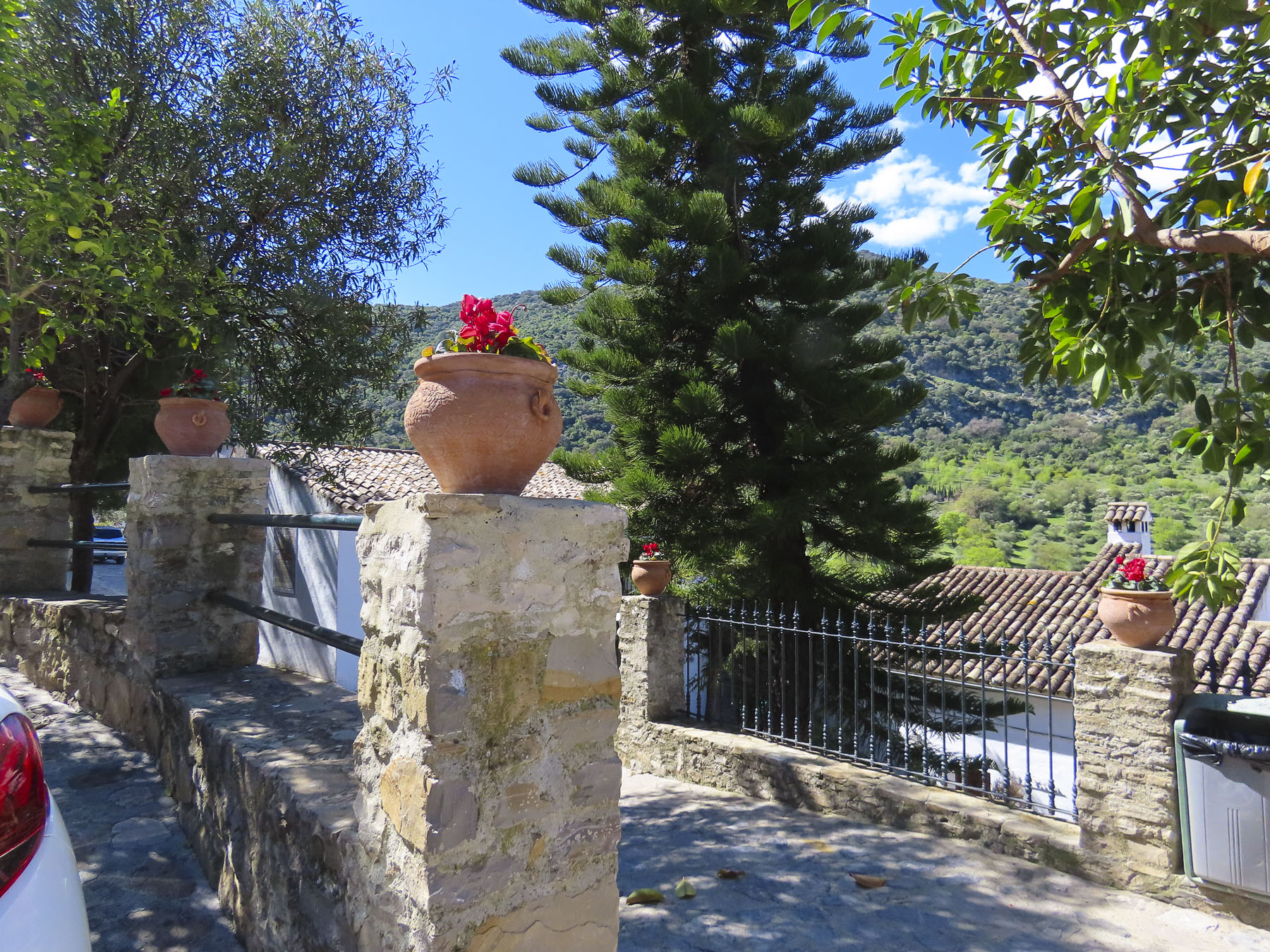
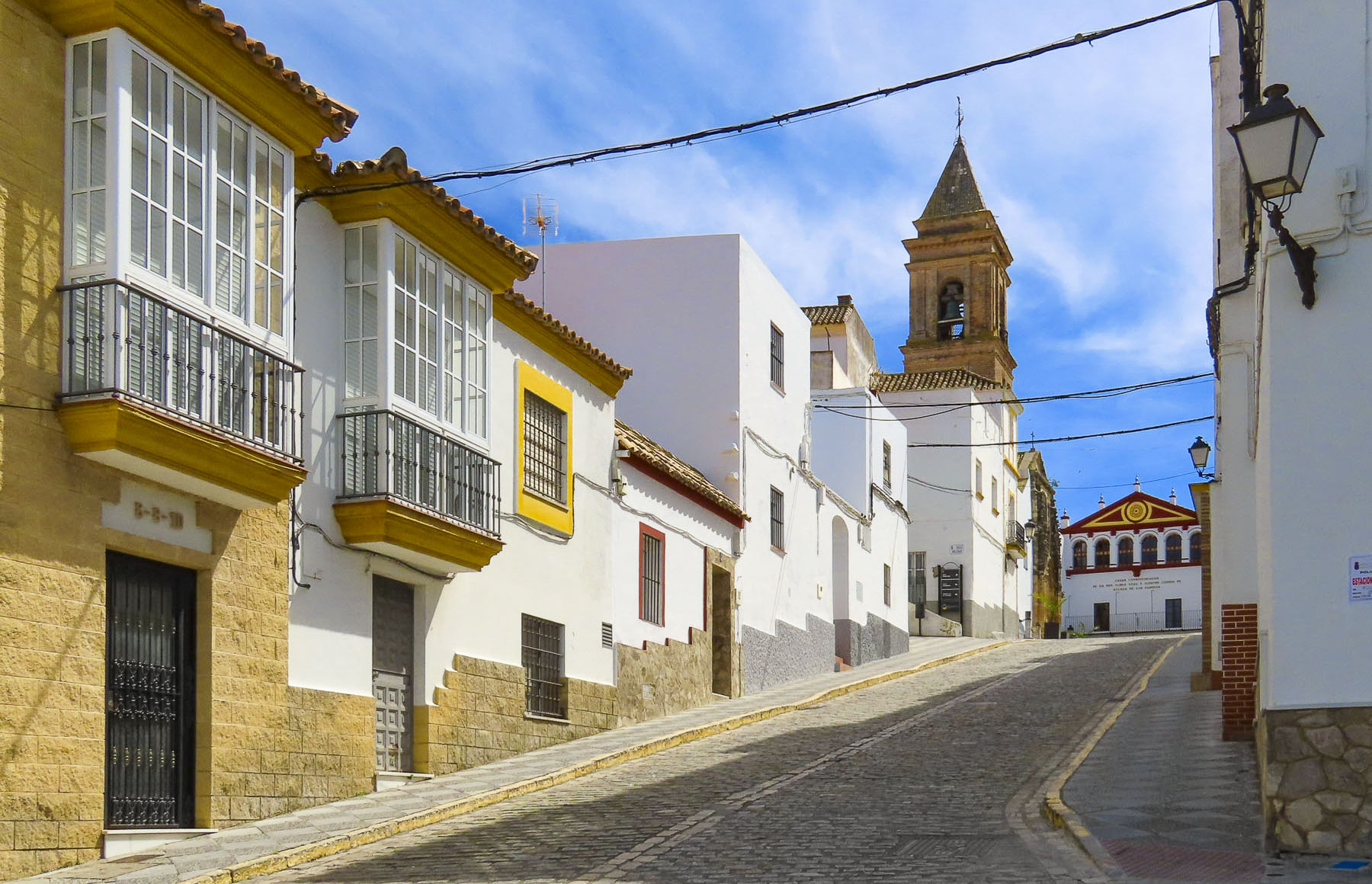
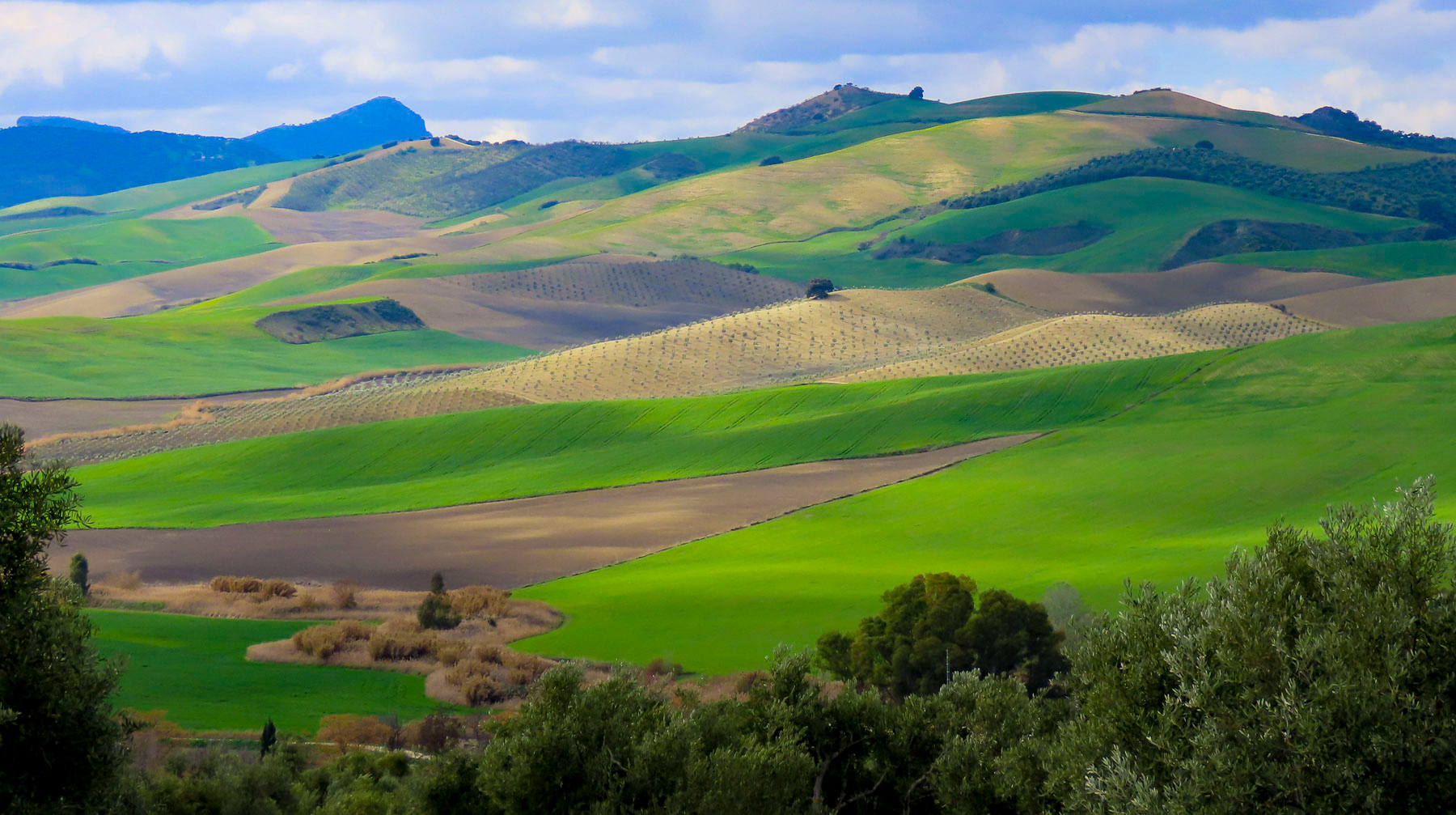
Villaluenga del Rosario was our ultimate destination for the day, but before that we would be driving through the expansive forests of Parque Natural Sierra de Grazalema and stopping along the way in Ubrique, and Benaocaz. All pueblos blancos, though all different in size, setting and atmosphere. According to our maps app the trip would take 2 hours. But it was a glorious 58-mile sinuous route through the mountains, and with several stops it took us most of the day.

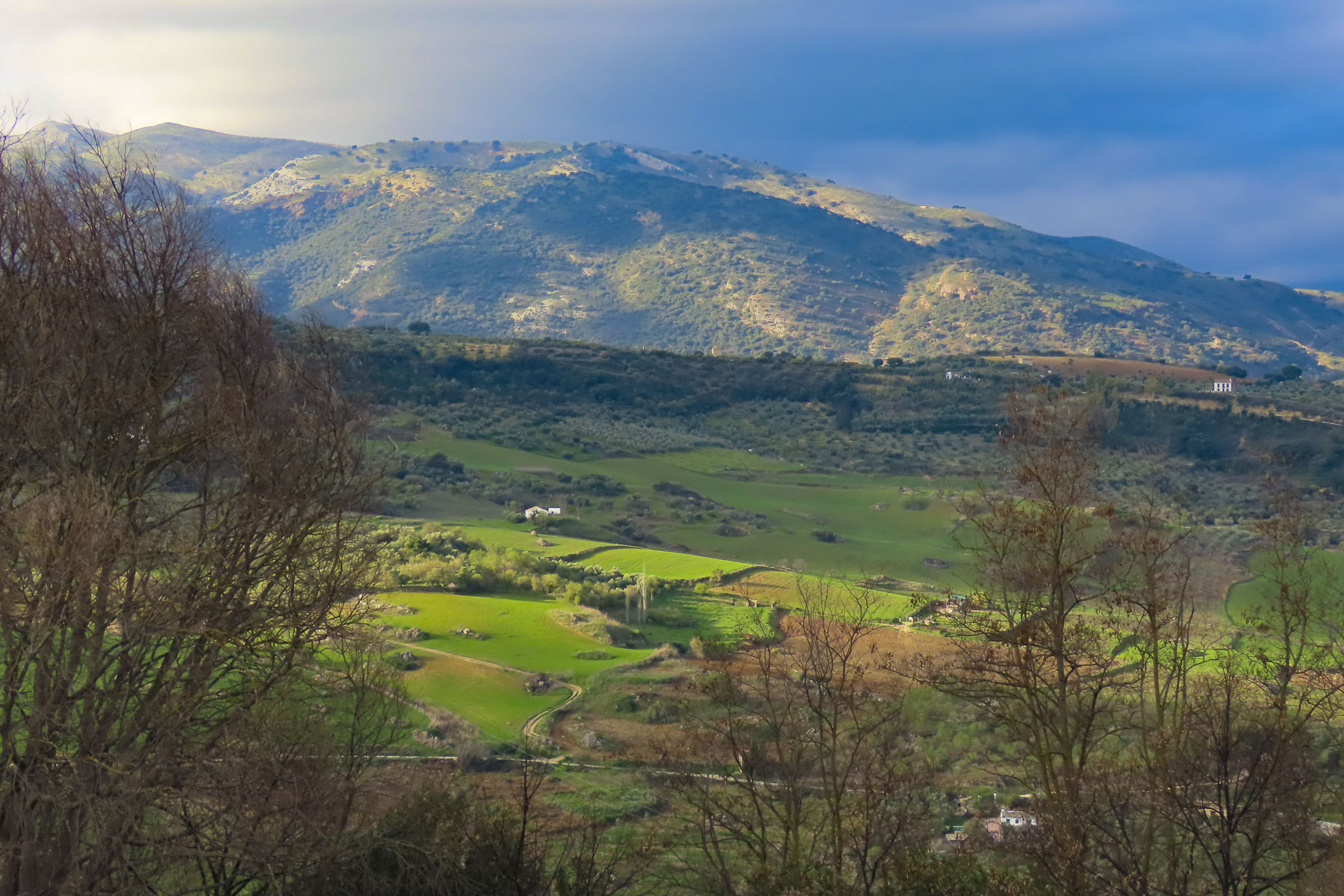
The vast 130,000-acre Parque Natural Sierra de Grazalema, with peaks reaching 5400 feet, is one of the wettest areas in Spain, receiving almost 80 inches of rain a year. This is surprising, considering that many areas in Andalucia are often used to replicate the American southwest for European filmmakers. These wet conditions over many millennia have created a dramatic karstic landscape of shear mountains, lush valleys and caves, especially Pileta Cave with its 30,000 year old prehistoric paintings. The park’s lower elevations feature forests of cork oak, carob, hawthorn, and mastic. Higher slopes transition to a landscape of gall oaks and Spanish fir, a tree species that survived the last Ice Age. This ecosystem supports a diverse fauna that contains 136 species of birds, most notably a large population of griffon vultures, and 42 mammal species, that include foxes, badgers, roe deer, otters, and Spanish ibex. And in ancient times it was the refuge of wild, now extinct, aurochs, the ancestor of the famous Spanish Fighting Bulls, toro bravo. The park has been a UNESCO Biosphere Reserve since 1977.

Farmers still harvest cork and olives amidst the rocky terrain and graze cattle, sheep, and goats within the park. This practice made for an interesting encounter when we rounded a curve and faced a VERY LARGE BULL standing in the middle of the road, adjacent to some pasture. We stopped, looked around for his farmer, but there was no one in sight. It was obvious he was the king of this domain, with no intention of moving aside until he felt like it. Slowly we inched forward and watched him eye us until he decided to saunter across the road and let us pass.

Ubrique is a large thriving town with 17,000 inhabitants set in a valley surrounded by tall peaks and steep scree slopes, its homes built above and around boulders too large to move. The town’s prosperity comes from its fine leather workshops, which account for 60% of the townspeople being employed directly or indirectly in the creation of leather products. It started simply enough with leather cases and pouches to carry tobacco and the Precise, a heavy-duty strap that allowed workers to safely carry silex stones and iron bricks.

By the mid-1700s their fine leather products and artisanal craftsmanship was recognized across Europe which fueled an export industry. The good fortunes of the town continued to grow until the mid-2000 when clients seeking higher profit margins moved their leather goods production to China and other Asian countries. Fortunately, their exodus did not last long, and they returned to Ubrique when they realized that the excellent craftsmanship in this small Andalucian town could not be rivaled by cheap labor. Today Ubrique is considered the “artisanal leather capital, “ for high-end fashion brands like Chloe, Gucci, Hermes and Louis Vuitton. “So many stores, so little time.” Of course, we shopped! The decision-making process was painful, but Donna managed to select one single beautiful purse to take home.

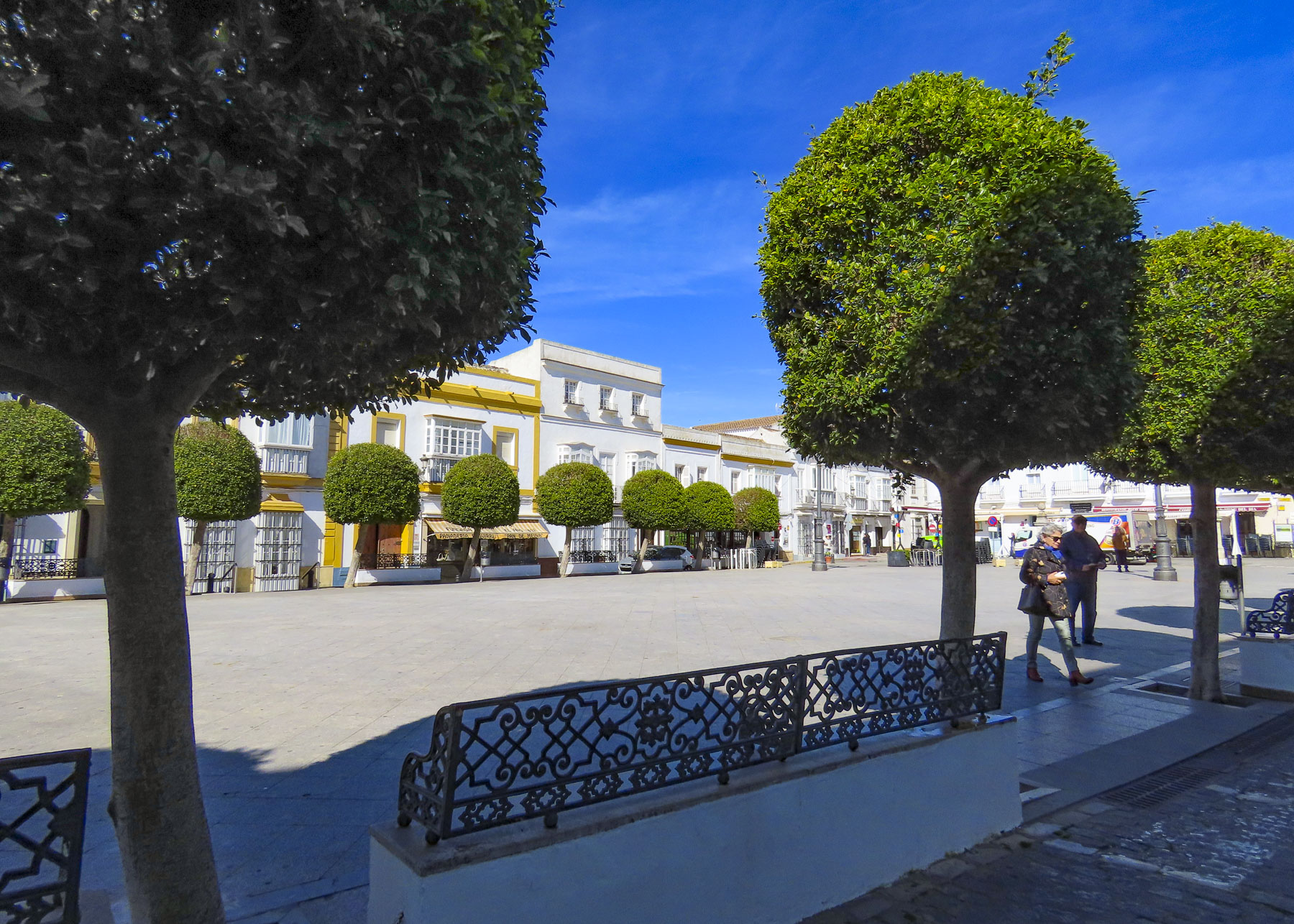
In March the twisting roads, higher into the mountains, were nearly void of traffic. Occasionally a campervan passed. Reaching Benaocaz, we parked and strolled through a nearly empty town square in search of coffee. It was a quiet weekend afternoon in the shoulder season, and few people were about, but luckily, we happened to come across Restaurante Nazari, a rustic restaurant with outside tables that had a view of the valley below the town.

Villaluenga del Rosario was only a little farther, and higher into the mountains. The village is dramatically set along one side of a narrow green valley at the base of a sheer mountain massif. The lane to our inn, the Tugasa La Posada, looked too narrow to drive down, and I was concerned about getting to a point that required backing up. A difficult task in an alley barely wider than our rental car, and there was plenty of parking above the village.  La Posada wonderfully reflects the typical inn of centuries past, with a large tavern, featuring regional recipes, on the ground level and a handful of rooms above.
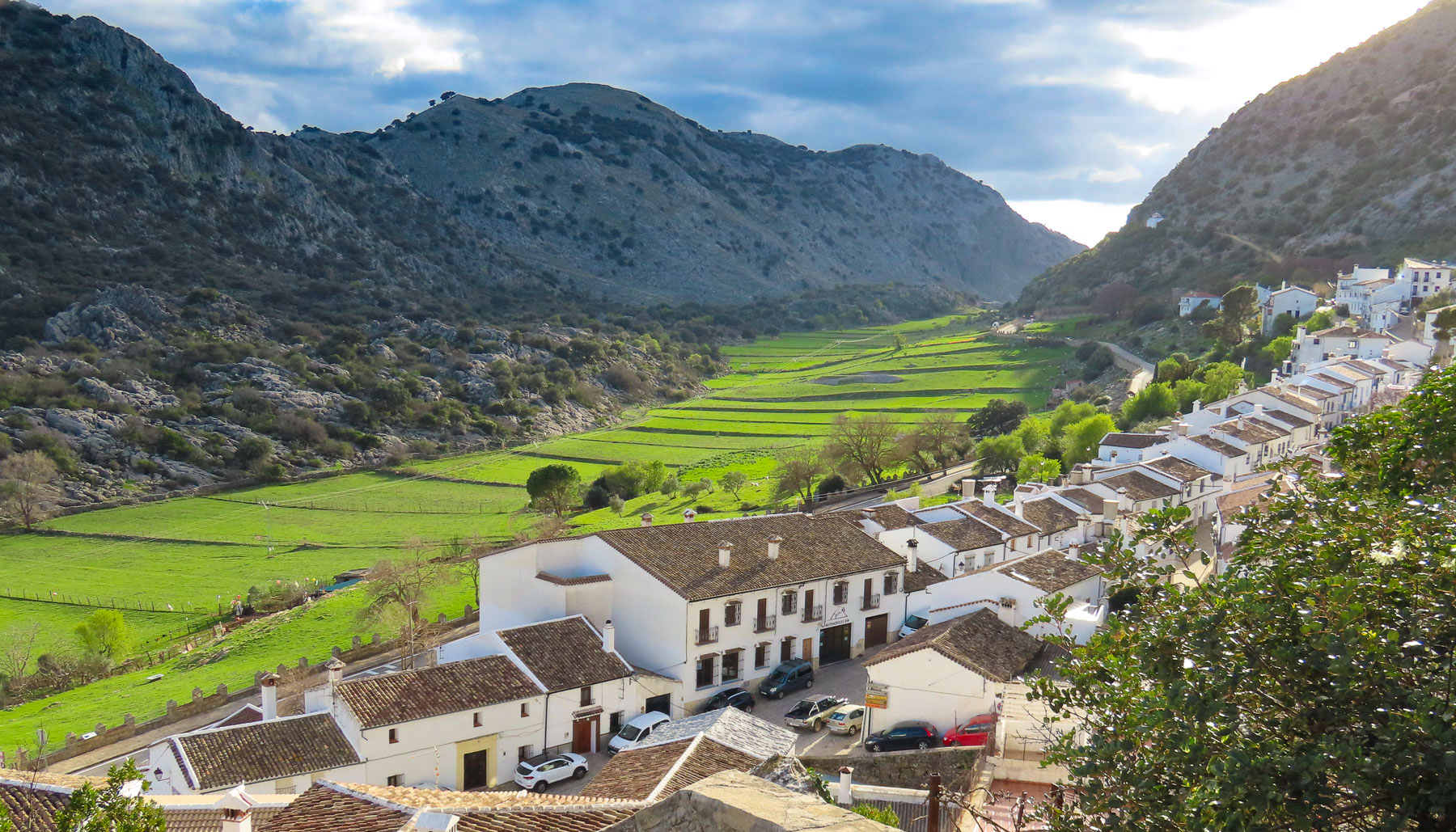
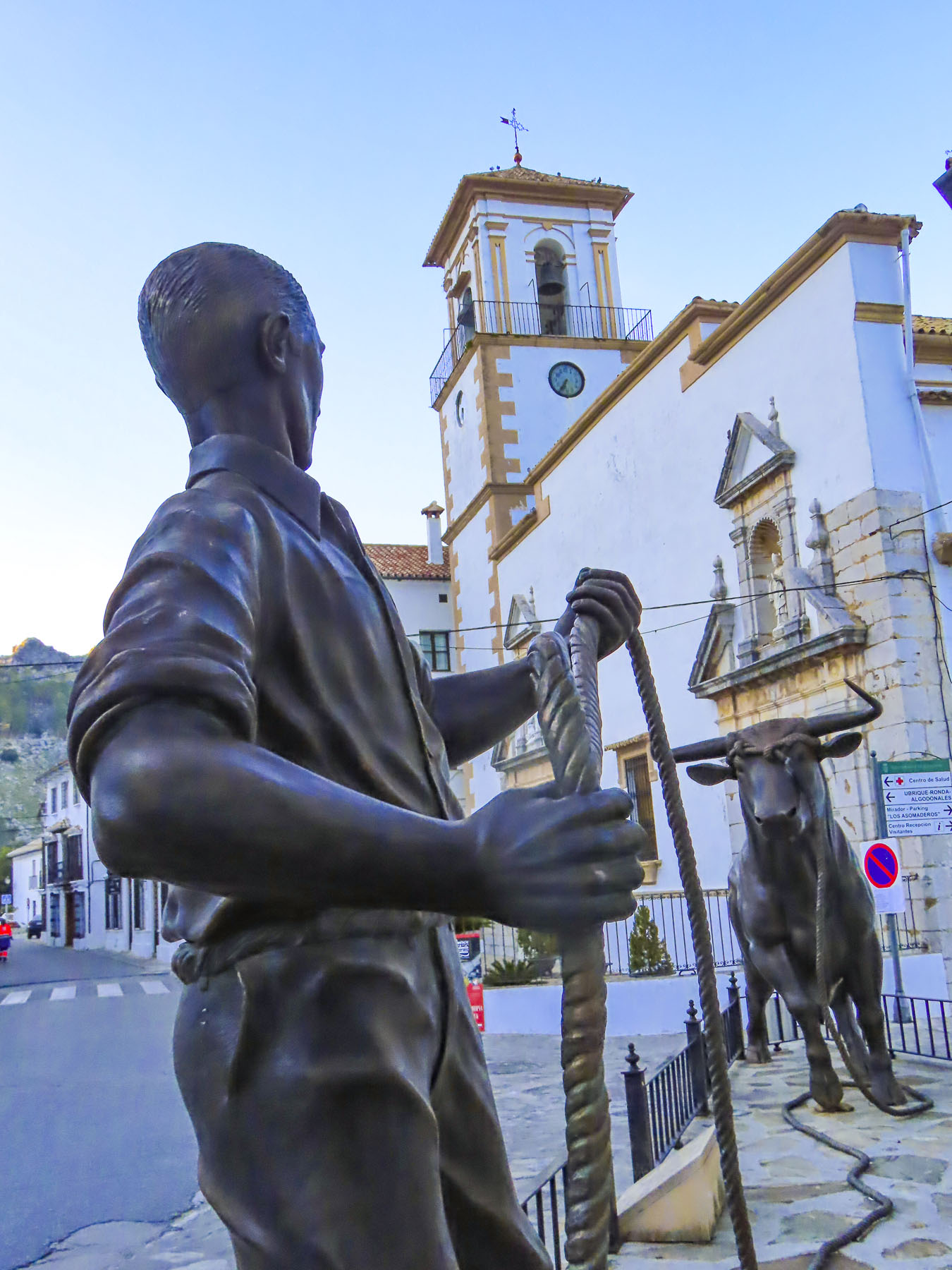
Several things are unique to this pueblo: Snowy winters are common in the Sierra de Grazalema Natural Park’s highest village, situated at an elevation of 2800ft. It is also the smallest village in the Province of Cadiz, with only 438 residents. And the village has a unique octagon shaped bullring, built around a natural rock formation, that is the oldest in Cadiz Province, dating from the mid-1700s. The exact year of construction for the bullring isn’t known, as the town’s archives were lost in a 1936 fire. Located on an important cattle trading route through the mountains, the bullring was also used as a corral during livestock festivals.
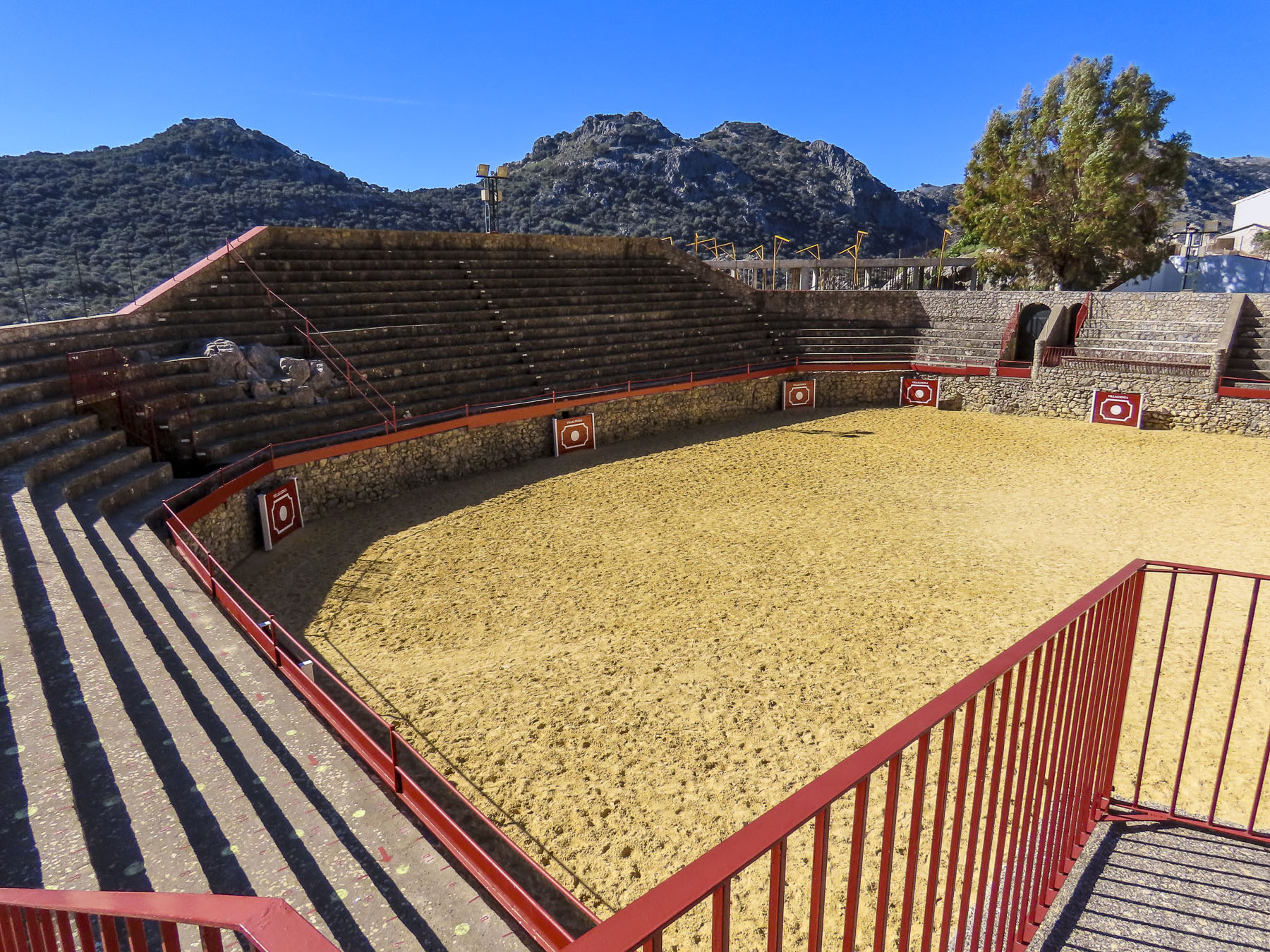
But before domestic cattle were raised in the area, prehistoric people used to pursue auroch, a wild bull that lived in the Sierra de Grazalema until it was hunted to extinction in the Middle Ages. Nearby in Cueva de la Pileta, primitive cave paintings of bulls have been dated to the Paleolithic era 27,000 years ago. The famous fighting bulls of Spain, Toro Bravo, descend from this primal auroch lineage that once roamed wild. Ancient pagan festivals often conducted a running of the wild bulls, tethered to a group of men by a long rope, through their villages before a ritual sacrifice.  “Toro de Cuerda'”(Bull on Rope) festivals, are thought to be the foundation of the modern Spanish Bull Fight, and are still held in Villaluenga del Rosario, Grazalema, and Benamahoma. With the advent of Christianity some of these pagan elements were incorporated into church celebrations of a pueblo’s patron Saint. In Grazalema the early church Christianized the practice and includes the Feast of the Bull in celebrations to the Virgen del Carmen every July. Benamahoma’s “Toro de Cuerda” is held in August during their festival to honor the town’s patron saint, Anthony of Padua.
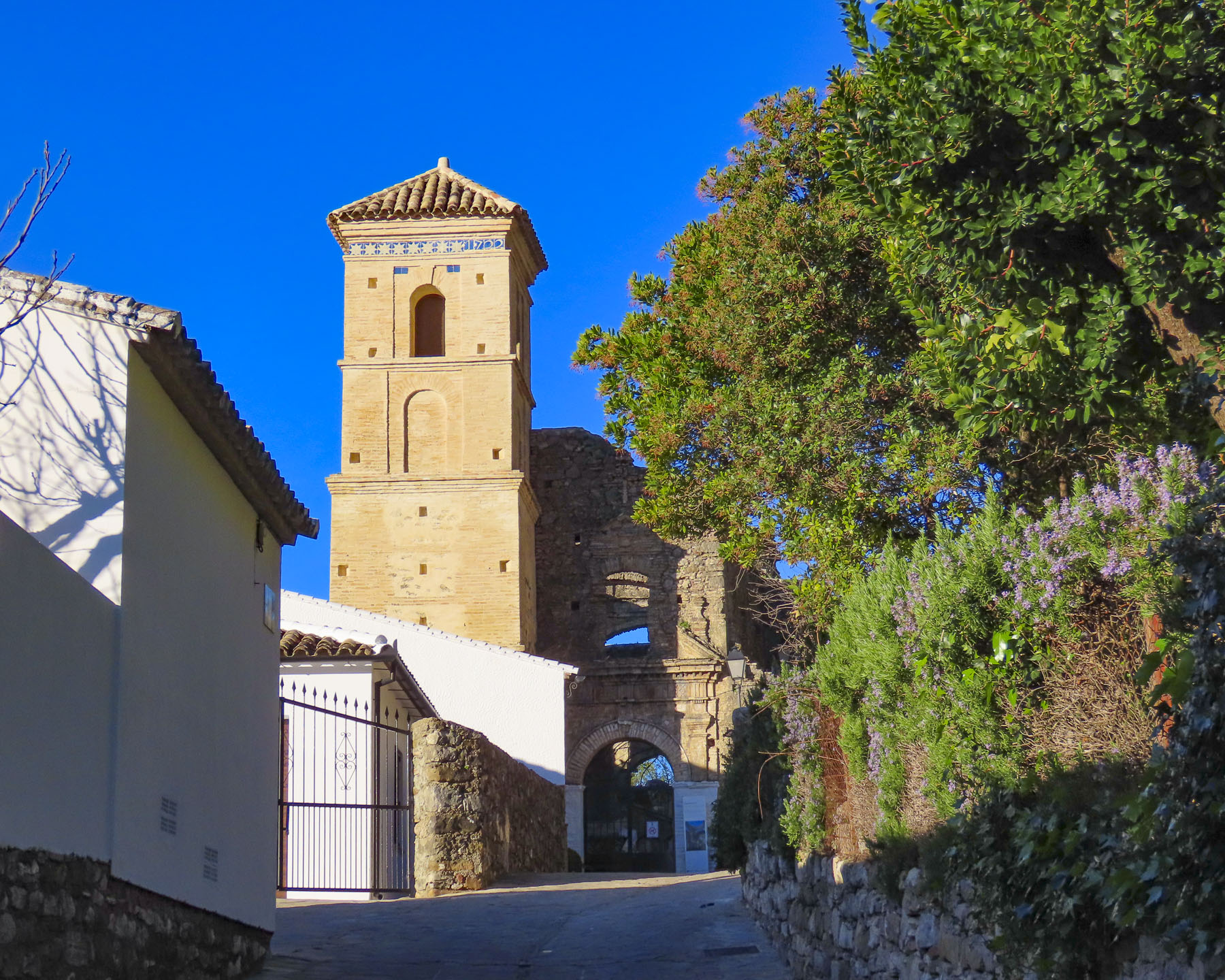
This tranquil village has gone through some turbulent times in its past. Villaluenga del Rosario, known for its woolen textiles in the 17th century, did not escape Napoleon’s destruction as his troops retreated across the mountains after they abandoned their siege of Cadiz in 1812. French troops sacked the village and torched the old Church of El Salvador. Now only the walls and roof arches remain, open to the sky. The sanctuary is now used as a cemetery.  The economy declined throughout the region in the 1800s and early 1900s, and the mountains were beset with bandits. Notoriously, José María El Tempranillo and Pasos Largos, the most infamous of the Sierra’s outlaws, would frequent the village and hideout in the surrounding caves. They are celebrated as Robin Hood bandoleros, robbing the wealthy and redistributing their stolen goods to help the poverty-stricken locals – Andalucia’s mountain justice. These same caves in the 1930s would shelter Republican resistance fighters escaping Fascist troops during the Spanish Civil War. A hiking trail, Los Llanos del Republicano, from the village to caves is named after them.

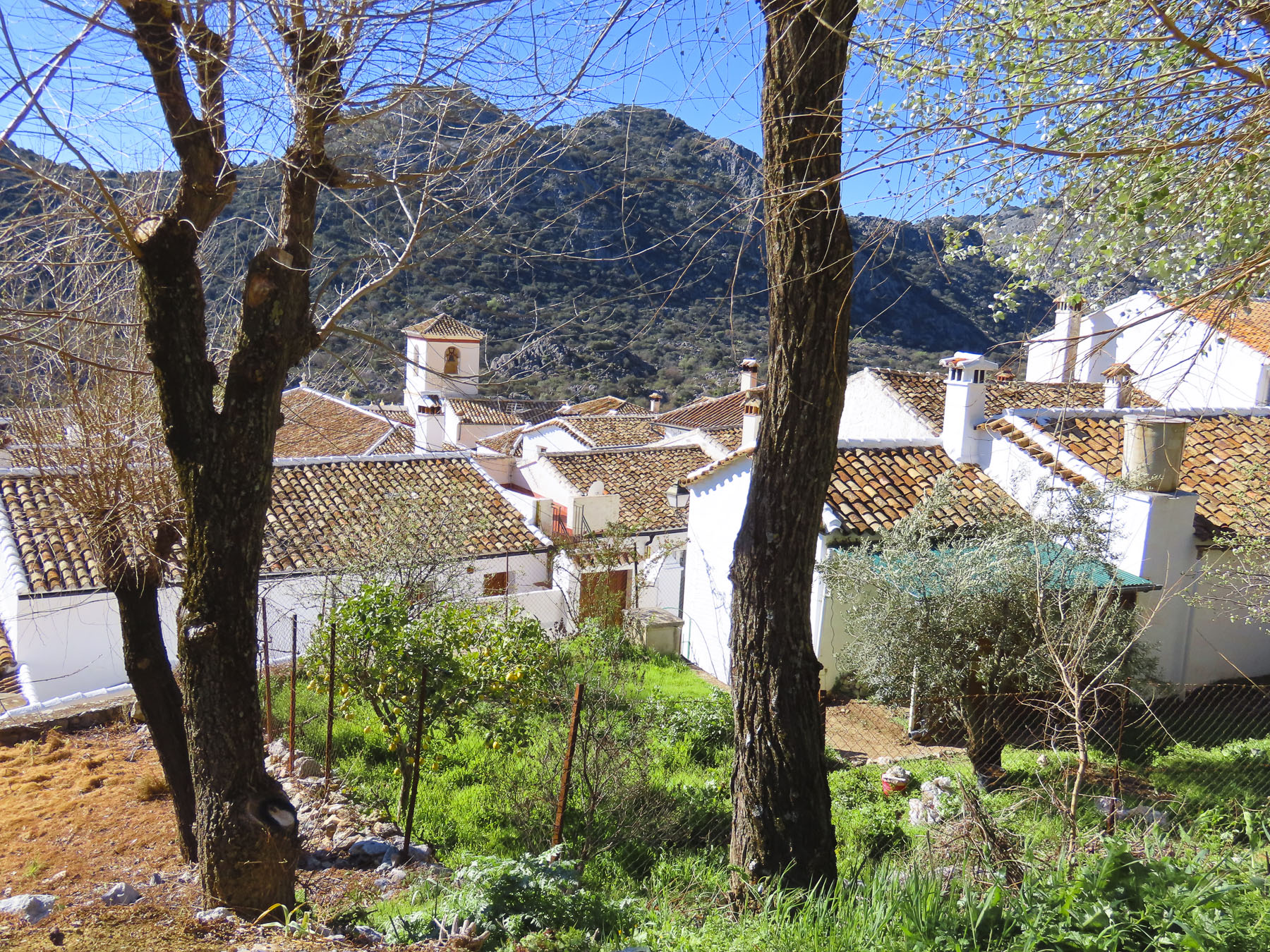
The rural population continued to emigrate, contributing to further economic deterioration until the villages’ employment prospects improved with the opening of a cheese factory, Queso Payoyo, in 1997. The Payoyo goat is an ancient breed from the Sierra de Grazalema and considered endangered. Since Queso Payoyo opened 25 years ago, its goat and sheep cheeses have received 175 national and international awards. Thirty-five farms now supply Payoyo goat and Merina grazalemeña sheep milk to the cheesemaker. Their shop just across the road from the village seems to be a Mecca for cheese aficionados. Open seven days a week, we were surprised to find it packed with customers early on a Sunday morning, when we stopped to buy some cheese before we headed to Benamahoma.

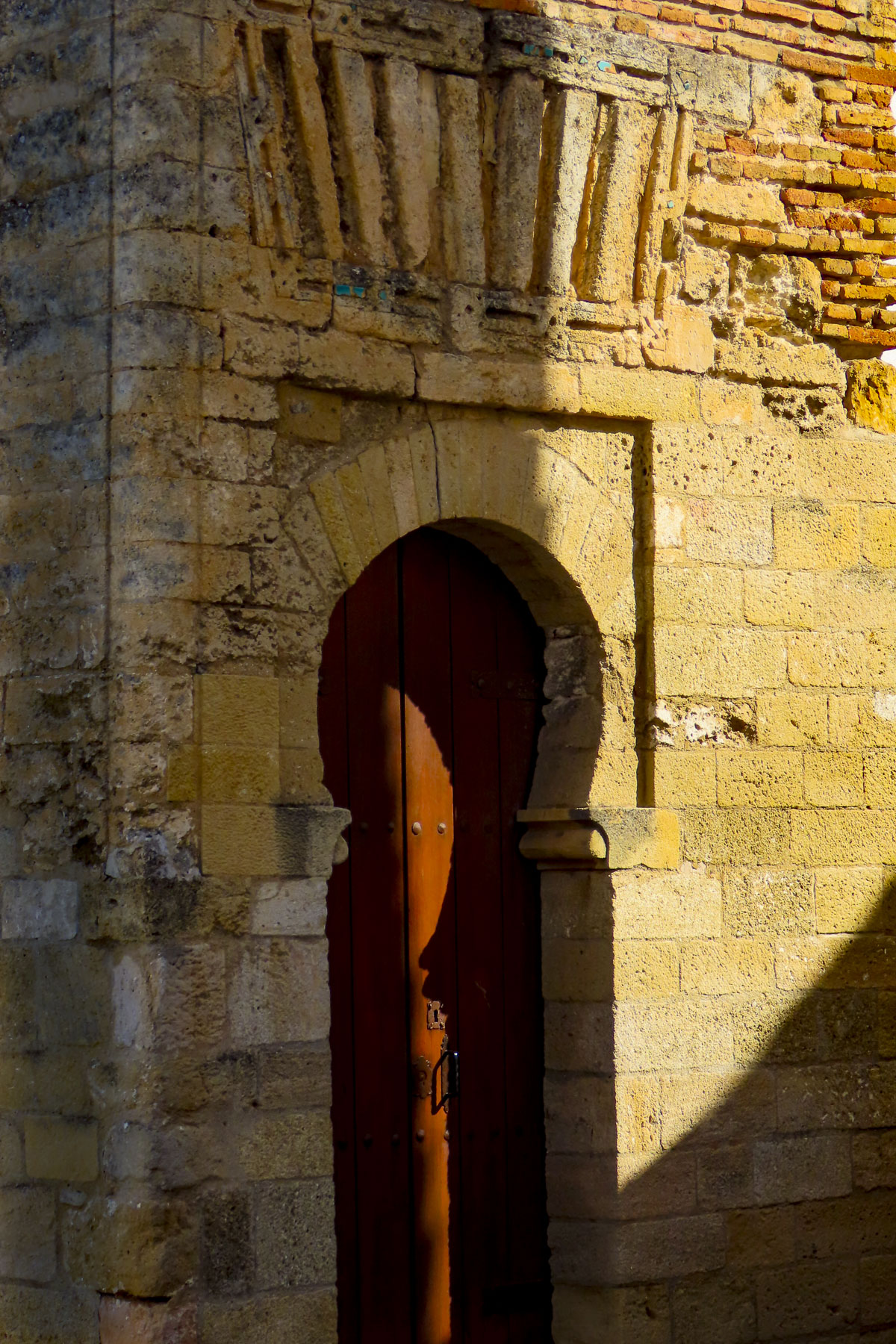
It was a beautiful crisp spring day, and we enjoyed a slow walk uphill into the village. Next to the Plaza de las Huertas the façade of the Ermita/mezquita de San Antonio, a church/mosque, visually represents Benamahoma’s complex cultural identity, with Moorish horseshoe-shaped arches and three golden spheres topped by with a gold crescent, typically seen on minarets, atop its tower.
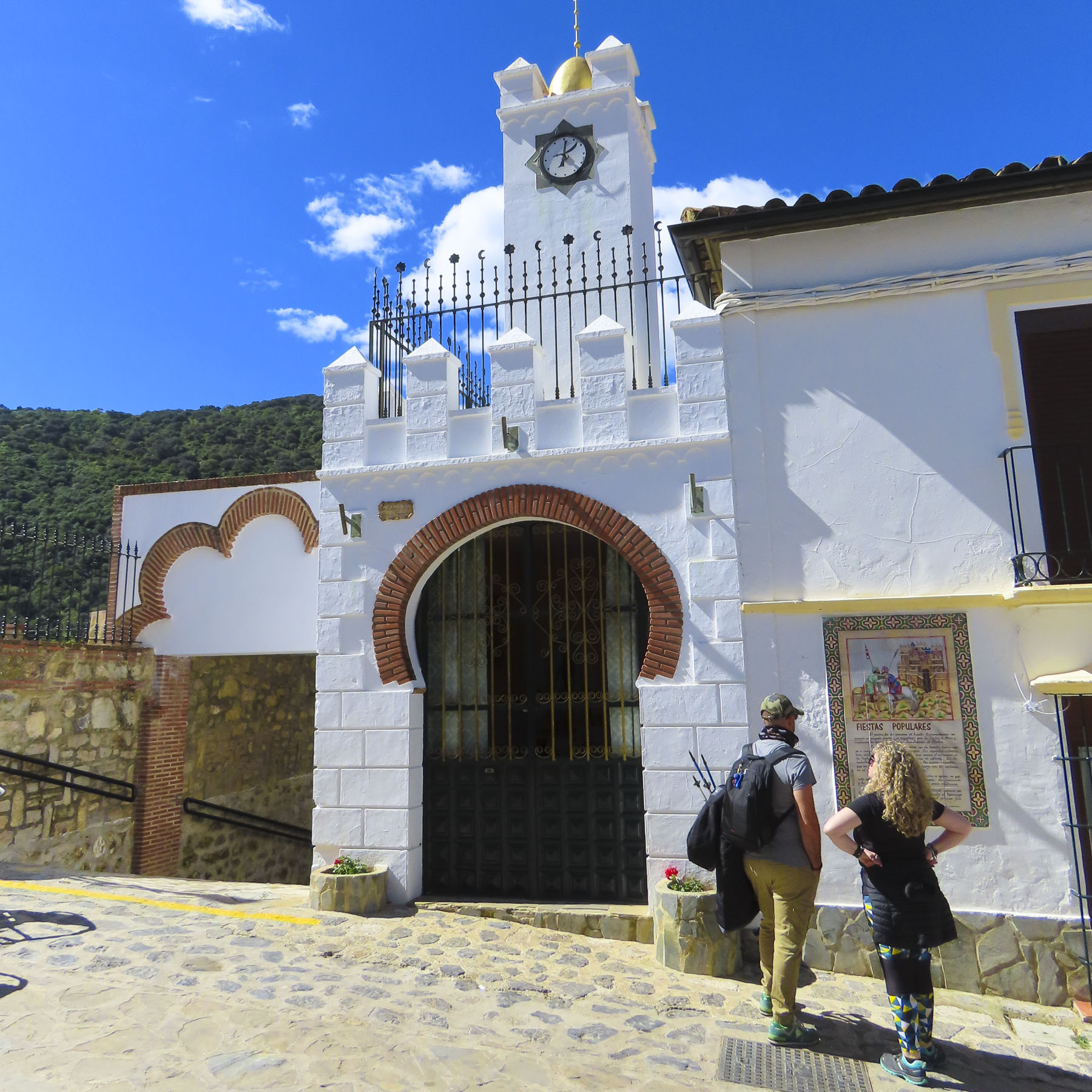
This region in Spain has a very complicated history, beginning with Alfonso X’s Reconquista which started in the mid-1200s, paused, then continued for the next 400 years with his successors. Benamahoma was the last Moorish village in the mountains to have its inhabitants expelled from the region in 1609, eighteen years after Grazalema’s Muslim villagers were forced out, though the hamlets are only nine miles apart. Their reprieve was caused by the fact that although Alfonso X and later Kings achieved military victories, they did not have enough troops to garrison each village, nor sufficient numbers of willing Christian settlers from Northern Spain to repopulate the conquered towns. Consequently, to keep the economy of the area going and subjects to collect taxes from, Moors were allowed to stay as long as their local Princes swore allegiance to a Christian King and declared themselves loyal vassals.  This did not always go smoothly and there were rebellions. Most famously the Mudéjar Revolt in 1264, when the towns of Jerez, Lebrija, Arcos, and Medina-Sidonia were recaptured and occupied by Moors for several years before Christian armies secured the towns once again. 
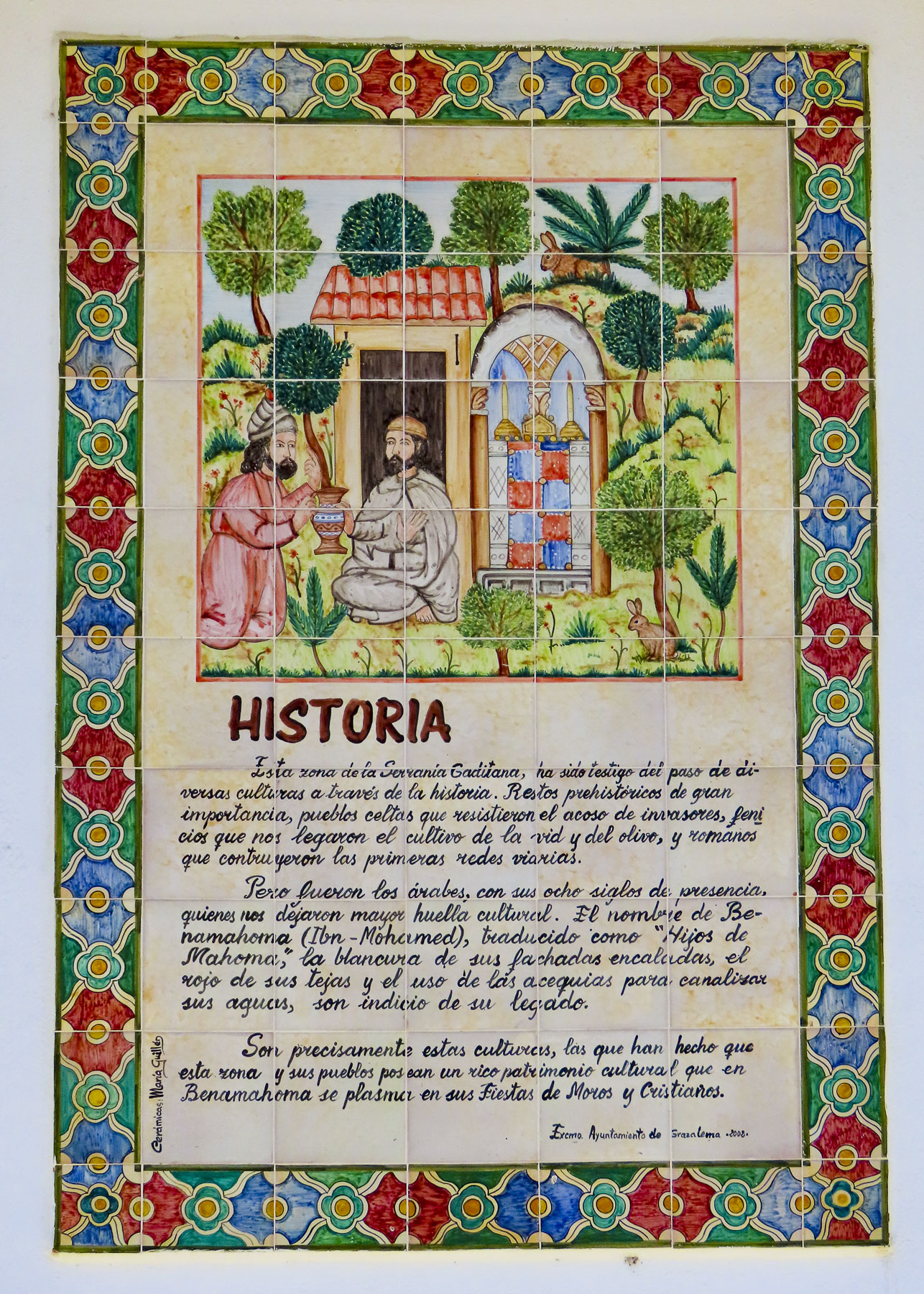
Benamahoma’s historic, pragmatic tolerance is celebrated the first weekend every August with a Moros y Cristianos Festival. Carrying swords, shields and blunderbusses, historical reenactors dressed in period clothing parade through the village to the bullring, where they then engage in mock hand-to-hand combat. The battles are won with the capture of an image of San Antonio de Padua by the Moors on Saturday and then won by Christians on Sunday with the rescue of his image. Many of the positions in the opposing armies are hereditary, the tradition being passed down from father to son, through the generations. Benamahoma is the only village in western Andalucia which celebrates this festival.

This village’s remoteness in the Sierra de Grazalema did not protect it from the atrocities committed during the Spanish Civil War. Near the bullring, in the Parque de Memoria Historica, silhouettes stand where villagers once stood against a wall before they were massacred by Fascists. Sadly, this memorial is also near the village’s second church, the Iglesia de San Antonio de Padua.
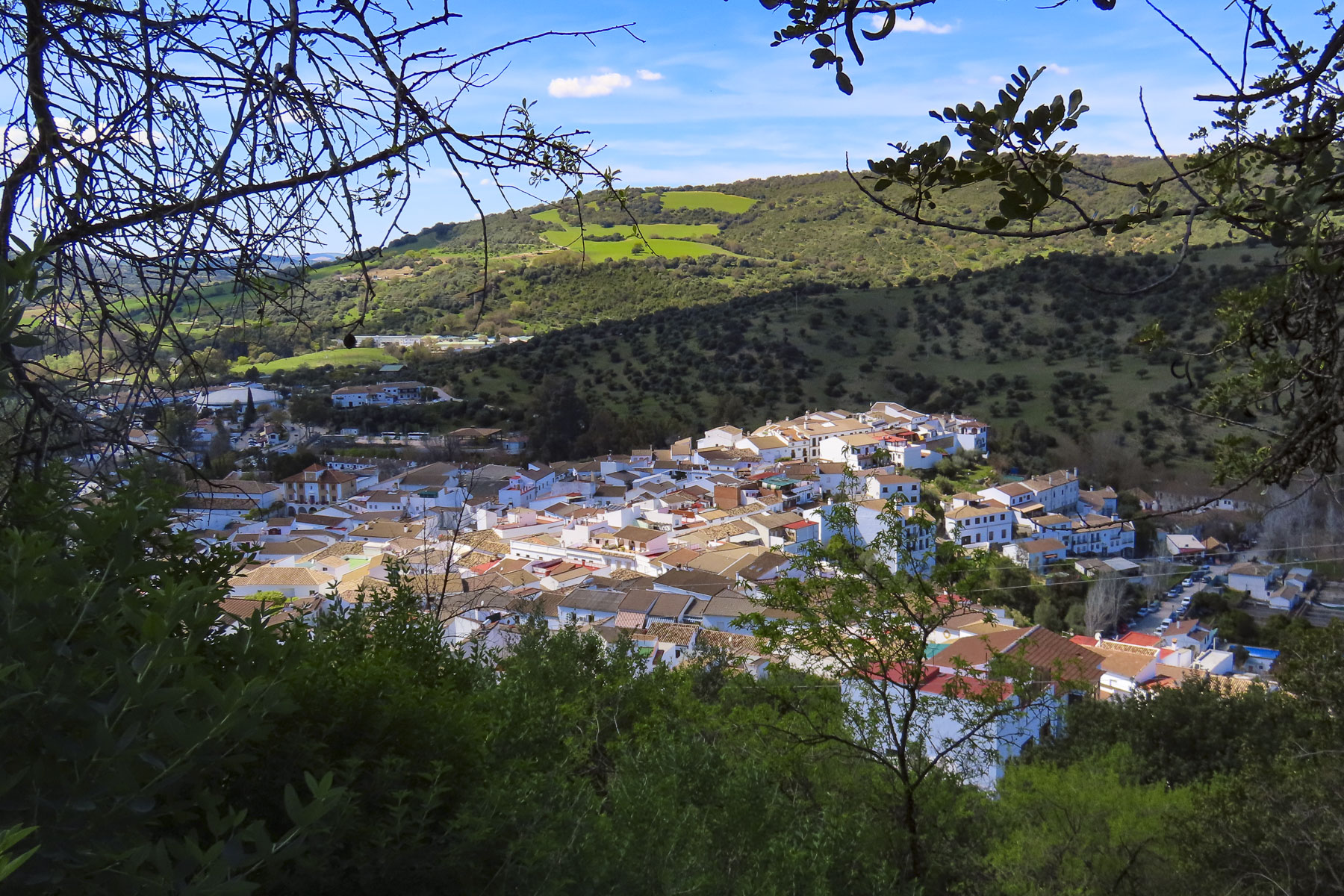
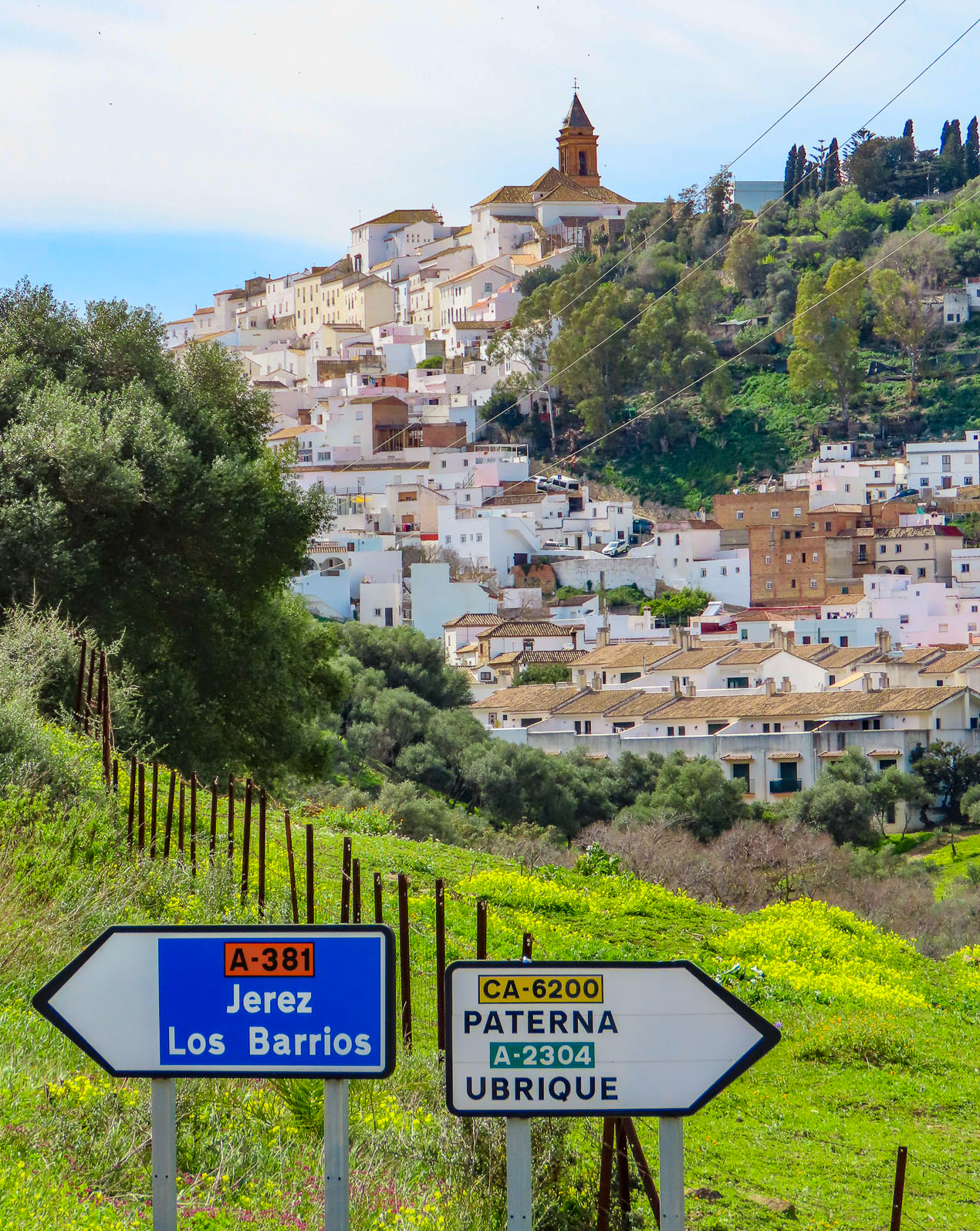
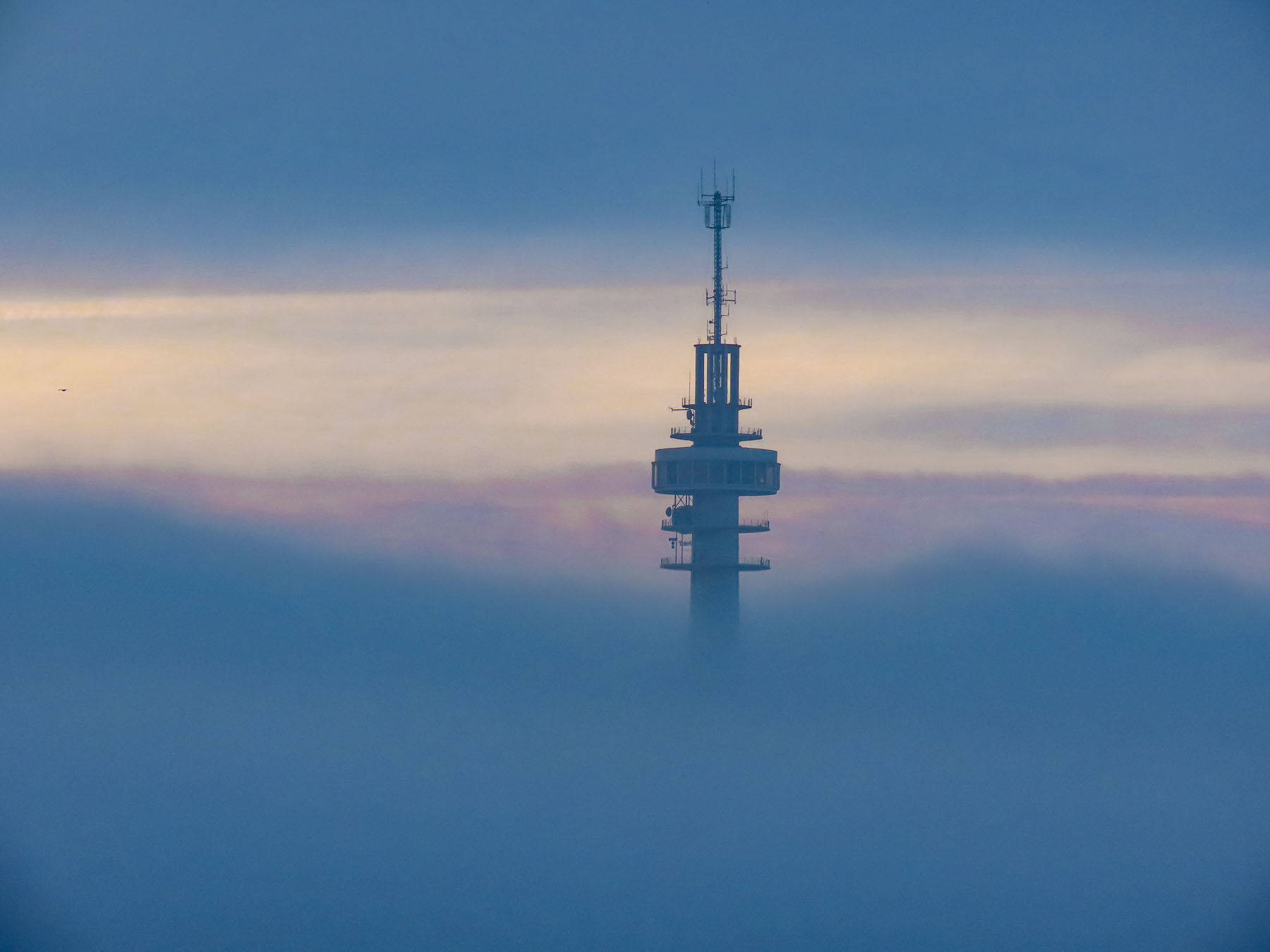
Backtracking as we headed to Arcos de la Frontera, we stopped at a radio station above El Bosque. A trail behind its tall antenna offered the perfect vantage point to capture a photo of the village below. We did not stop in El Bosque, but after catching glimpses of the village as we drove through, in hindsight we wished we had.  But there was a time constraint, we wanted to spend the afternoon exploring Arcos de la Frontera, before flying on to Barcelona the next morning. 
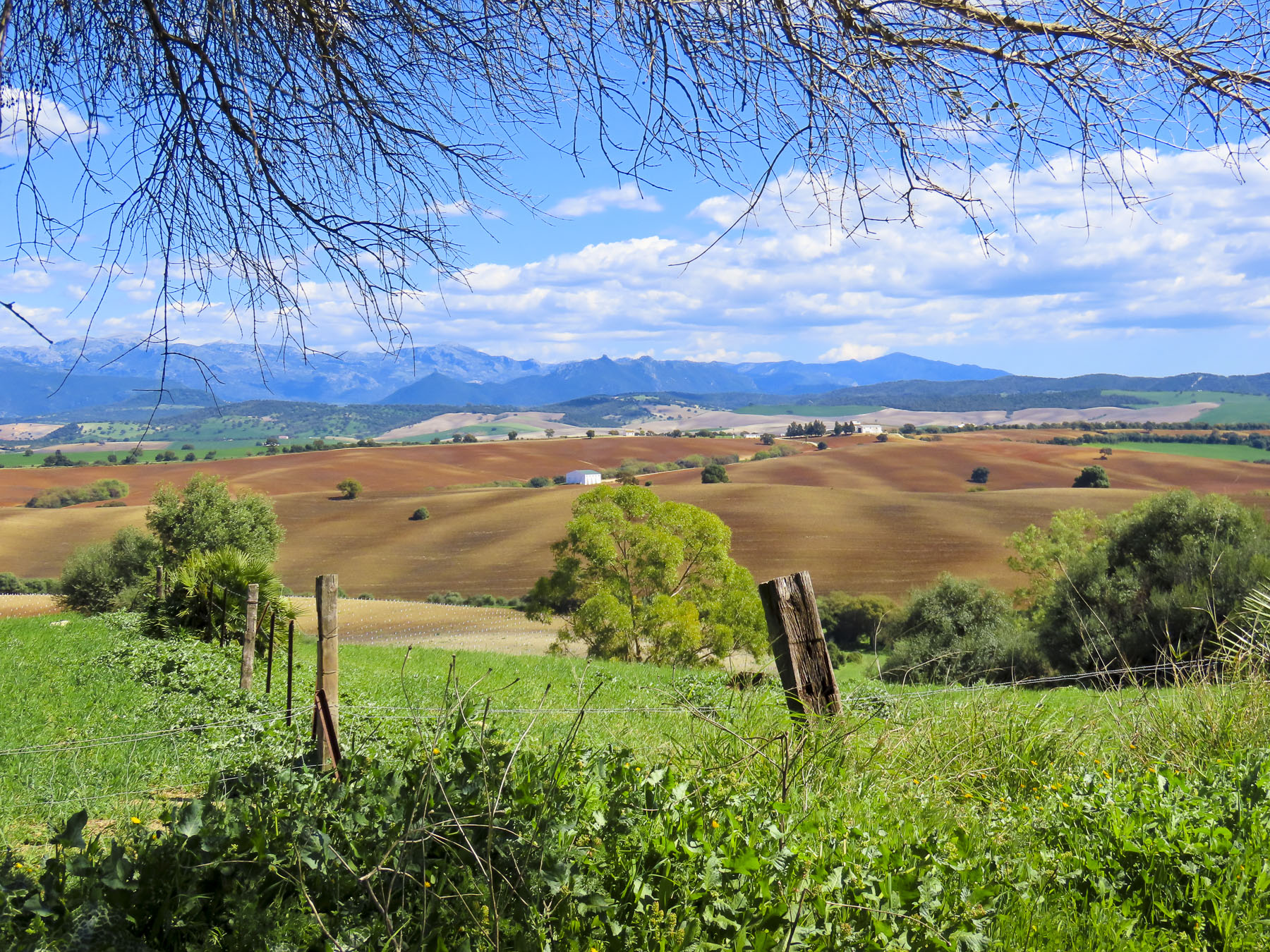
The A-372 between El Bosque and Arcos de la Frontera has to be one of the prettiest stretches of highway anywhere. With the reflection of the Sierra de Grazalema in our rearview mirrors, we wished we could have lingered longer.

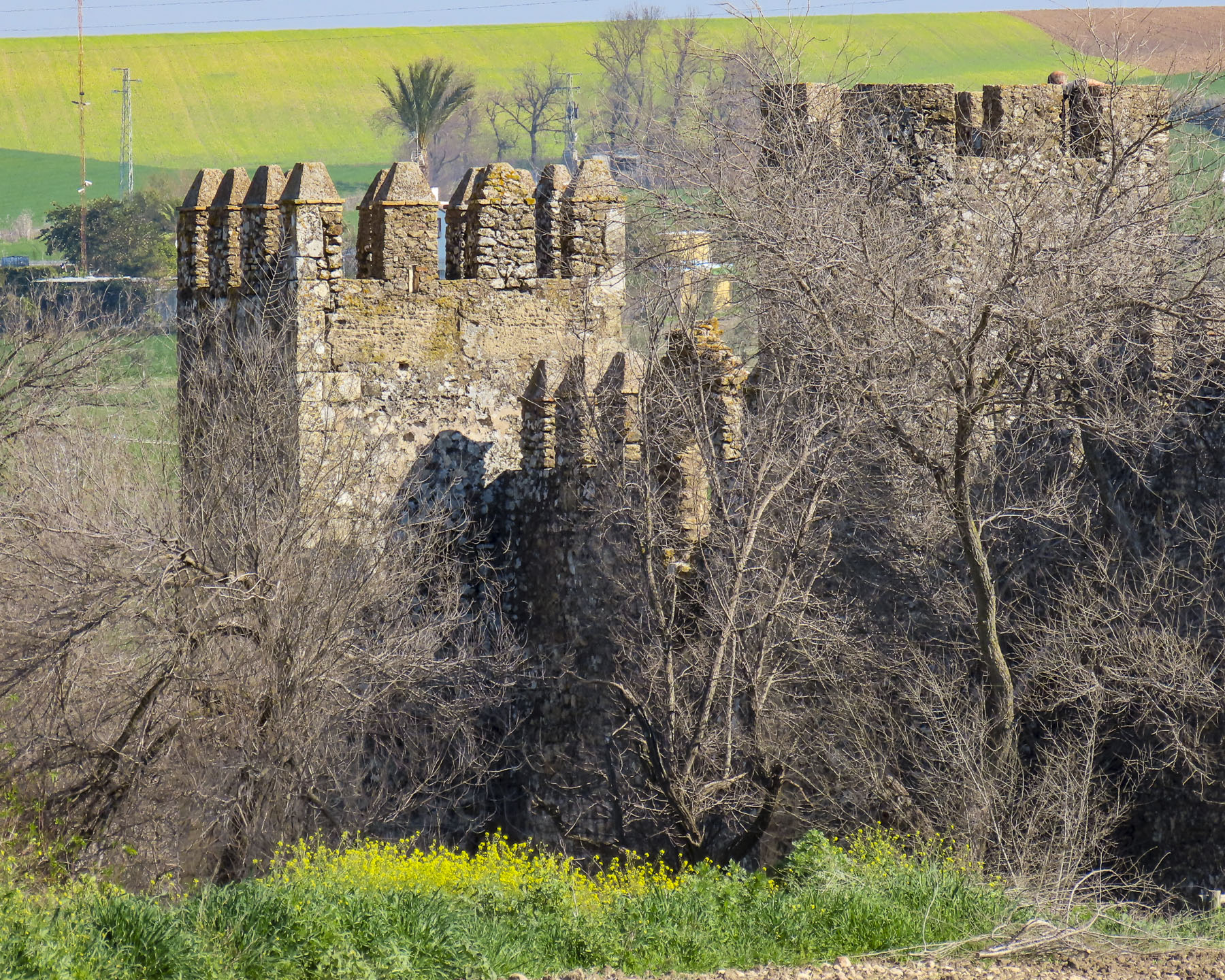
I’ve always loved maps for researching routes, finding obscure sites, and figuring out the best vantage point to capture a landscape from. This brought us to our first two stops at the Molino de Angorrill, an old mill, and the Mirador Los Cabezuelos, before we entered the hilltop citadel. Both places along Guadalete River had wonderful views of the ancient city.
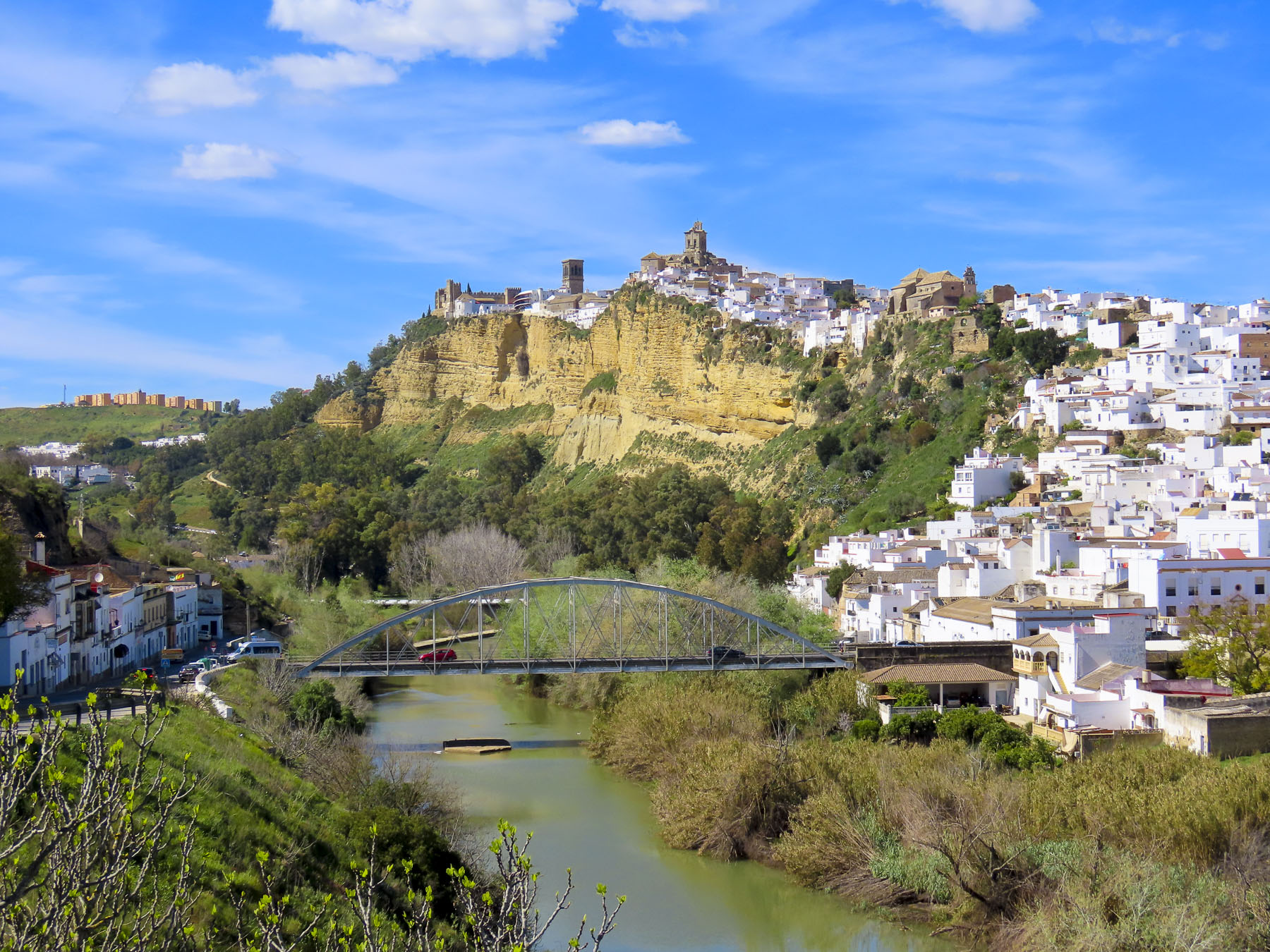
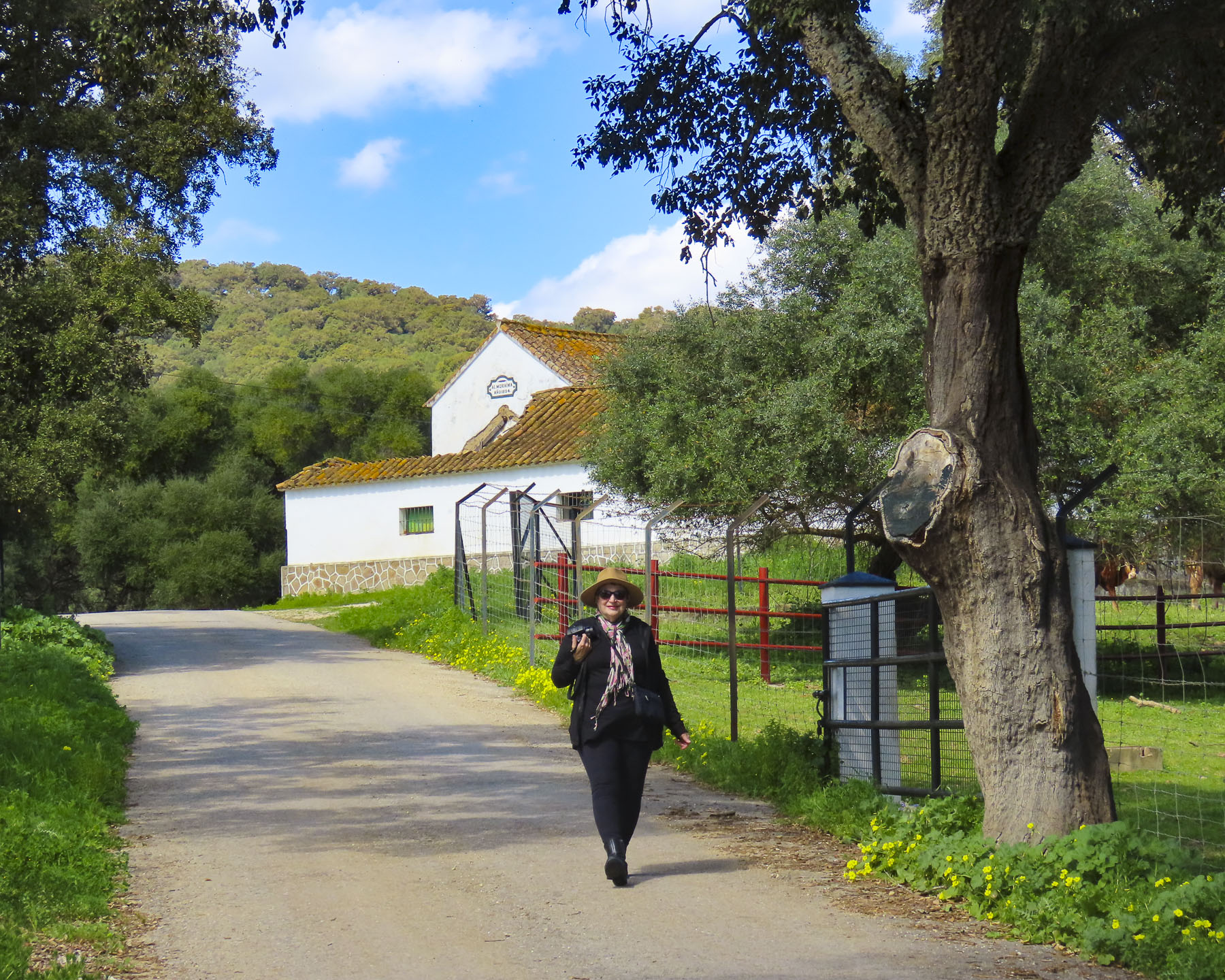
After this our map app failed us when it suggested we head the wrong way down a one-way calle into the village. We eventually found an underground parking garage at Parque El Paseo and towed our suitcases uphill to the Parador de Arcos de la Frontera.

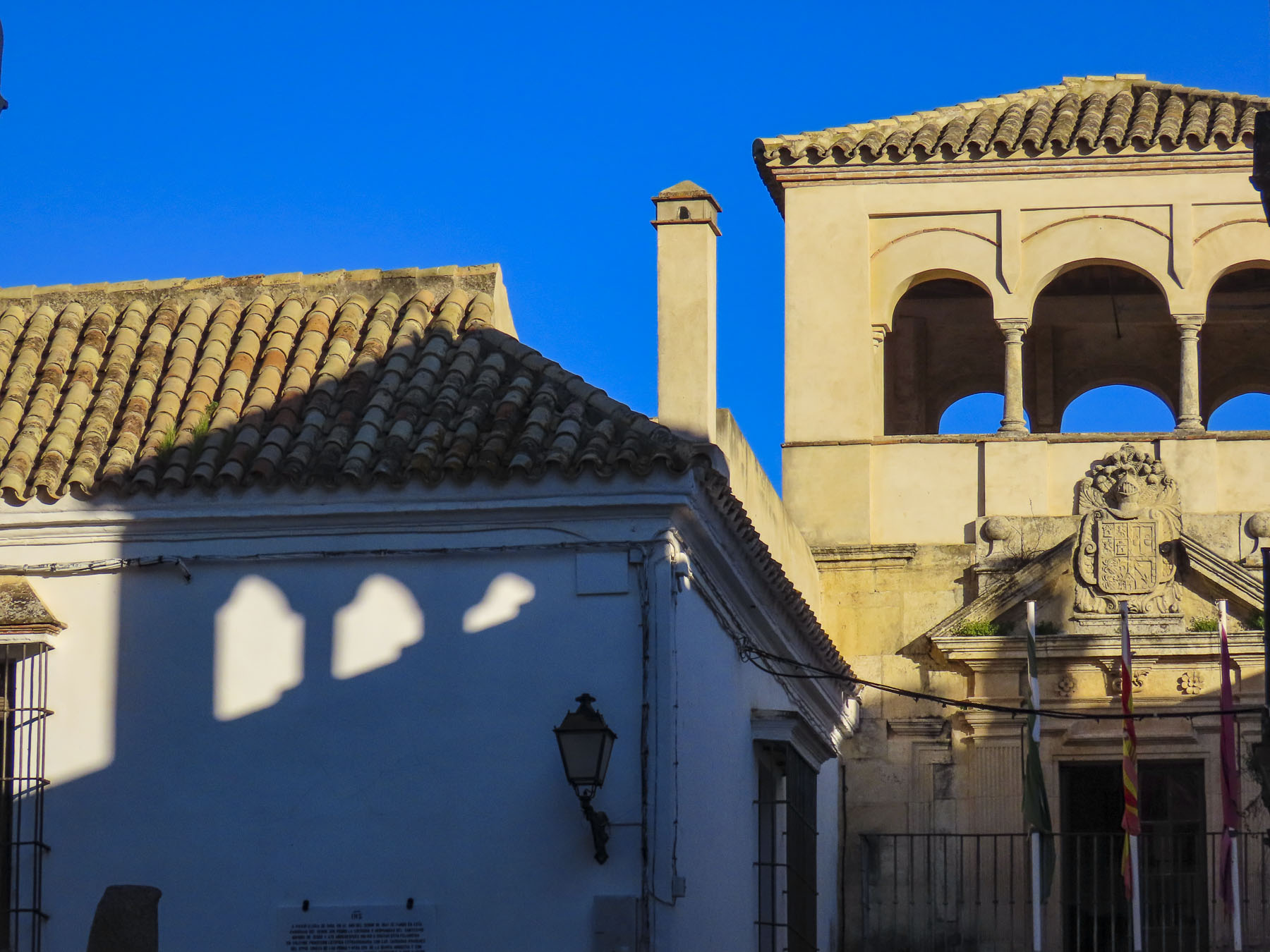
It was LONG walk, but of course we stopped frequently to take photos. Located next to the 500-foot-high Mirador Plaza del Cabildo and adjacent to the Basílica de Santa María de la Asunción and the Castillo de los Duques de Arcos, the hotel was a perfect base for a one-night stay. Formerly the Casa del Corregidov was an Andulcian palace before it was acquired by the government and renovated to be a parador in 1966.

Arcos has always been a favored spot, appreciated for its access to abundant water sources and its easily defensible position atop a cliff face. It has hosted settlements since the Neolithic period, Bronze Age, Tartessians, Phoenicians and Romans periods.

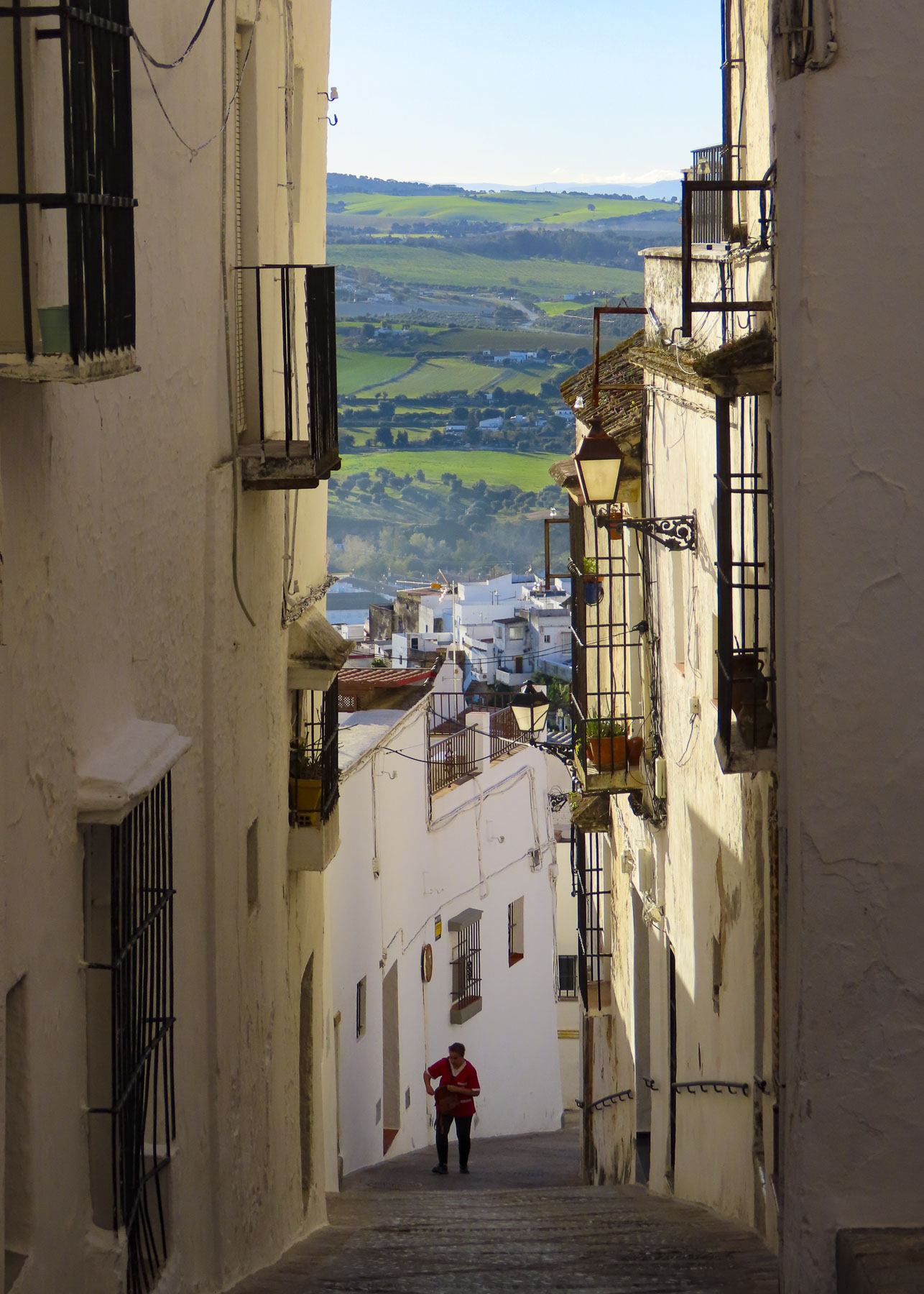
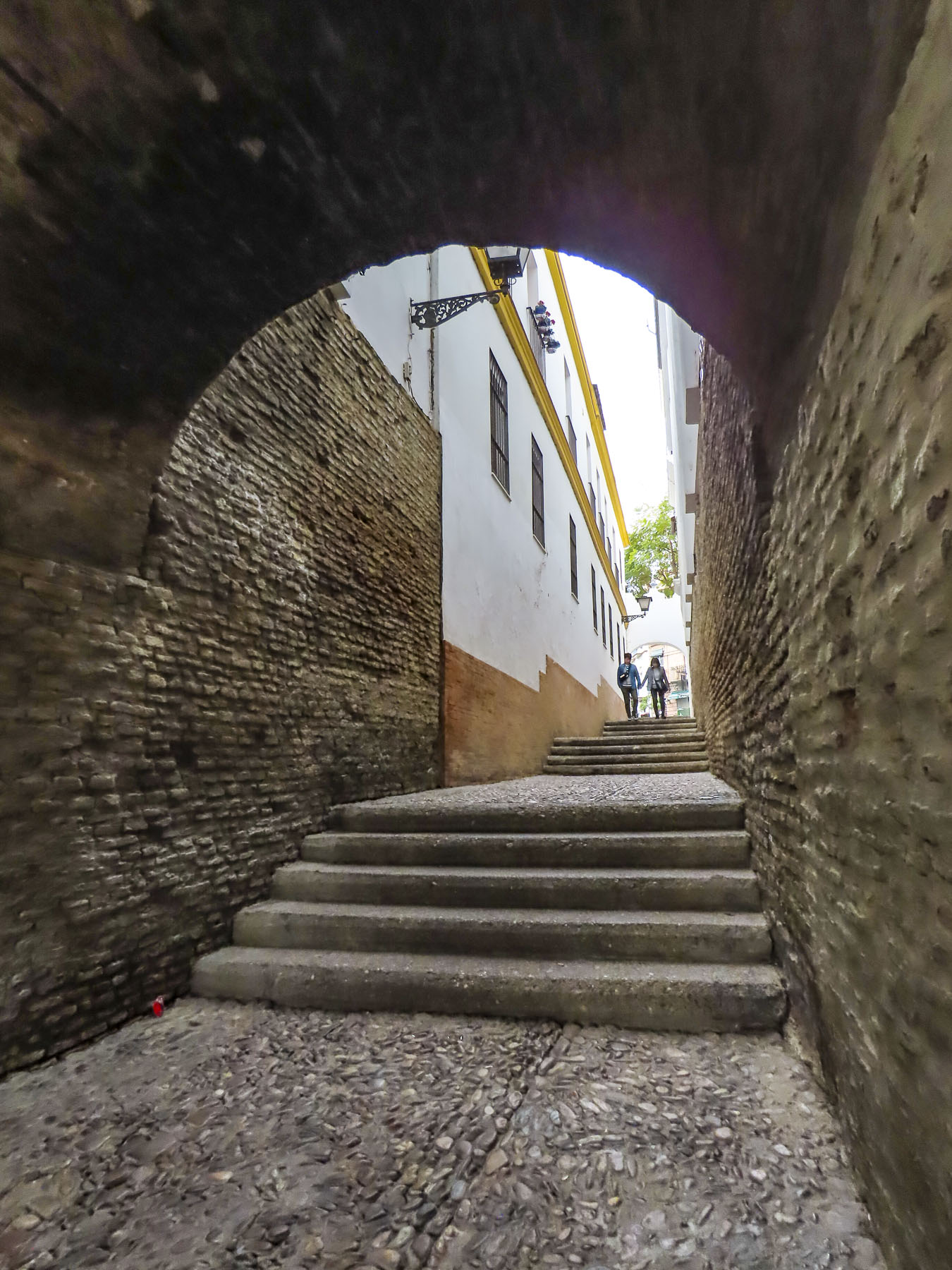
The village continued to grow under the Moors and while the facades and interior of buildings in this ancient town have changed over the centuries the original Arab footprint of the village, with its exceedingly narrow lanes has remained the same.

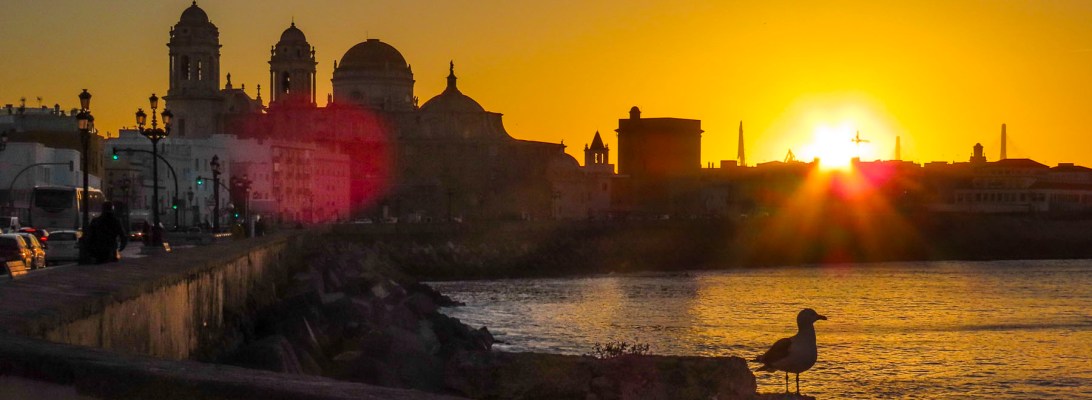
The view from the mirador and the hotel’s patio were phenomenal during the golden hour. As the sun was setting, a large flock of storks appeared over the bell tower of the Basilica and circled for about fifteen minutes before flying away. It was a magical experience that nicely capped our short time in Arcos.

The next morning, we watched the sun rise over the Sierra de Grazalema and the village’s church steeples from our hotel room, before wandering through the village’s ancient lanes one last time.

Till next time,

Craig & Donna

Road Tripping Through Andalucia: Medina-Sidonia, Alcalá de los Gazules, & Castellar de la Frontera

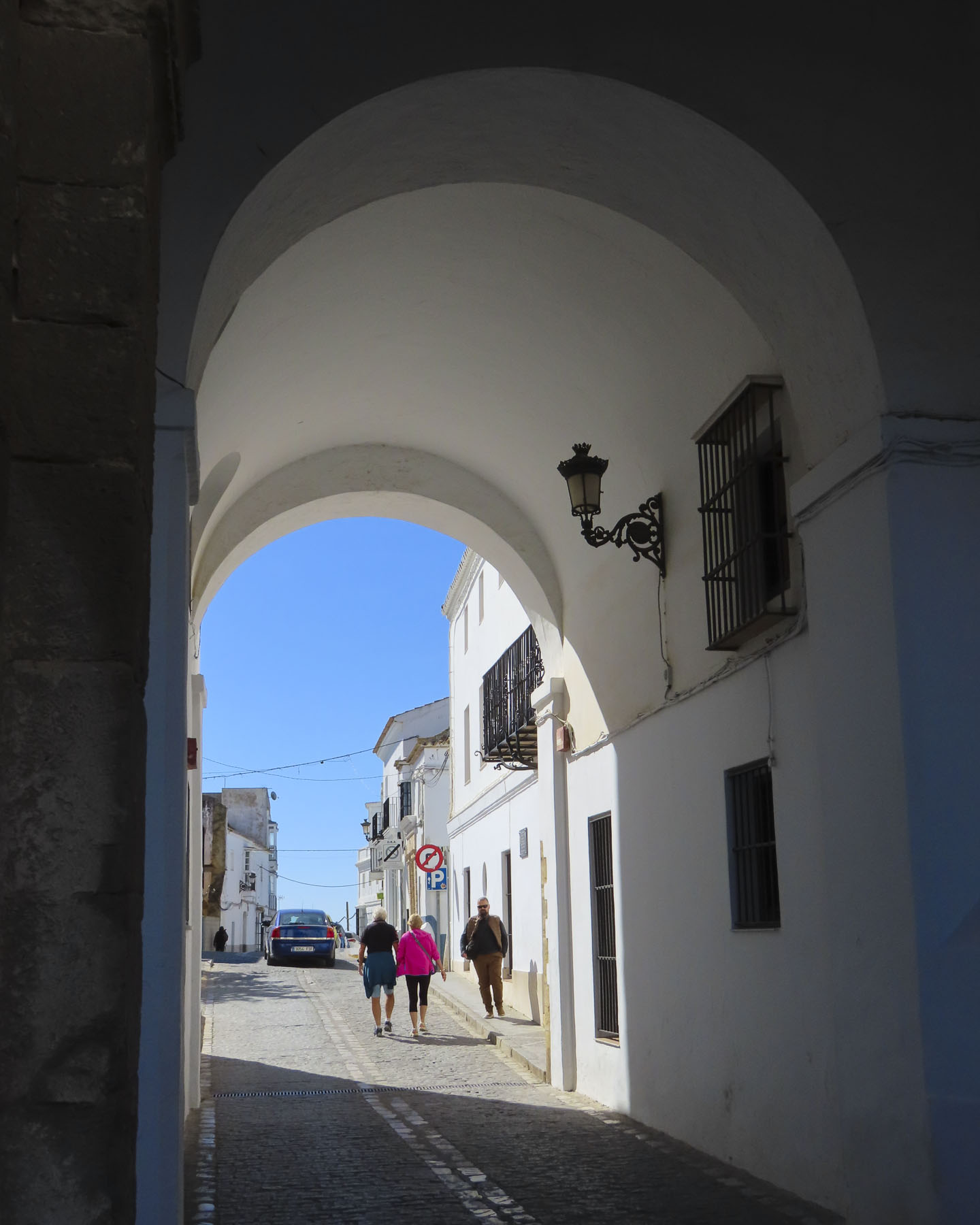
“We should tuck the mirrors in,” I said as we eyeballed the passage through the narrow arch ahead of us. We were on the Plaza de Espana in Medina-Sidonia, a forty-minute drive from Cadiz. But we couldn’t be further away, as it felt like a passage in time to centuries past as we drove into the village. Folks have lived on this hill since before the Phoenicians settled Cadiz in 1100 BC, making the village one of the oldest settlements in western Europe. But it is with the Phoenicians and later the Romans, Visgoths, Moors and finally the Spanish that the village grew. Sitting 1,000ft above the fertile rolling plains below, the highest point for miles around, the village offers incredible vistas of the surrounding countryside out to the Atlantic Ocean. The pueblo blanco we see today has its roots with the Moors in the 8th century.

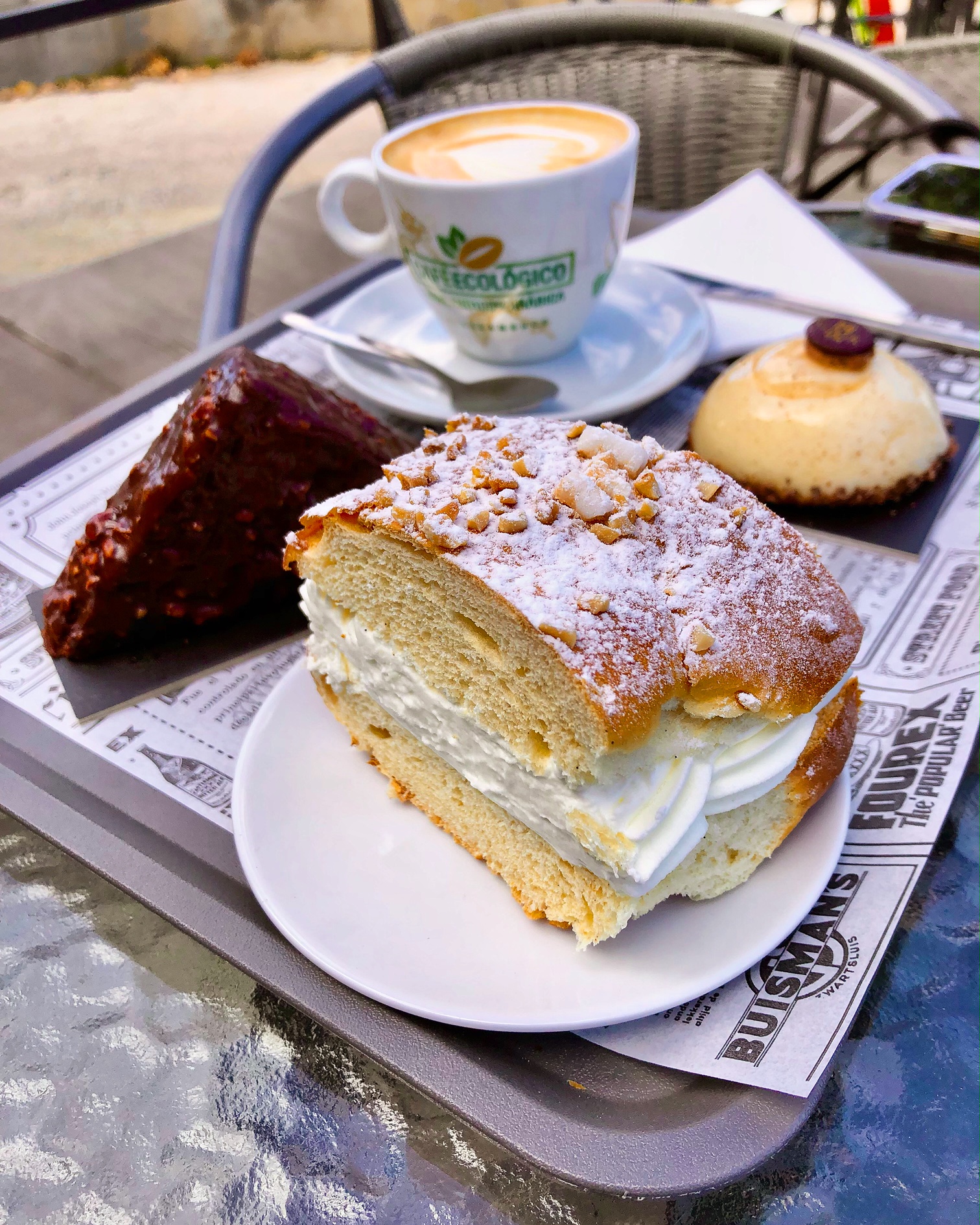
The plaza was nearly deserted when we strolled across it, mid-week in the middle of March, looking for a café. While the plaza was empty, we found a café, Restaurante Paco Ortega, bustling with activity. We ordered Tostadas de Jamón and Alfajor, a sweet gingerbread-like confectionary from the Arab period, that the town is famous for. We enjoyed the tostadas and the lively chatter of the café, but we were pointed across the plaza to Pasteleria Aromas de Medina for the Alfajor. True to its name, delicious whiffs of fresh baked pastries greeted us as we crossed the threshold of temptation. The Alfajor de Medina Sidonia was heavenly. It’s made with local honey, nuts, breadcrumbs, and a variety of spices – what’s not to like? The only question was how much to buy.

The day was really the first one of our Andalucian road-trip. Previously we had stayed for multiple days in Jerez de la Frontera and Cadiz (click to read those blogs.) Medina-Sidonia was the first of two stops, before we stayed in Castellar de la Frontera.

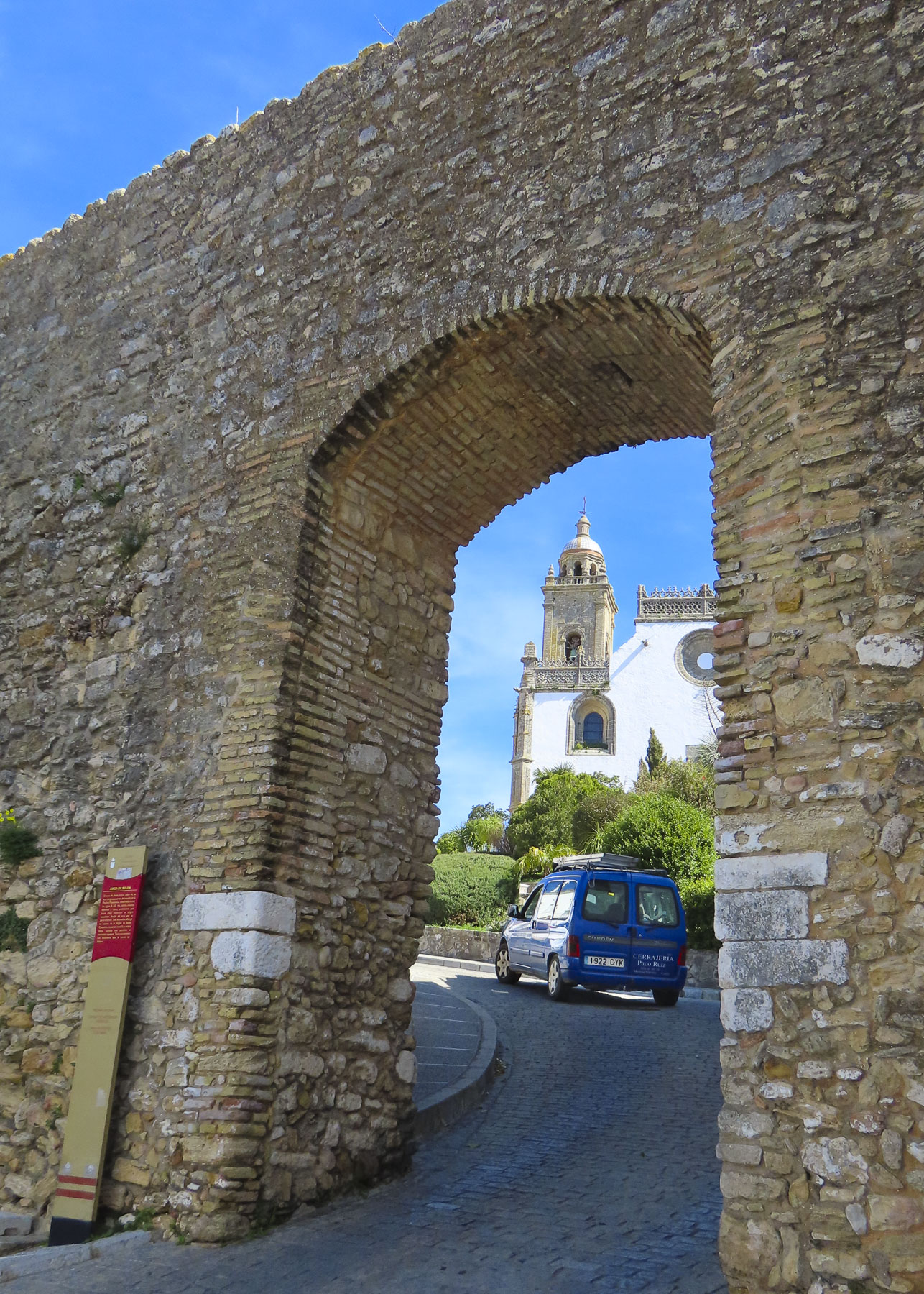
I swear the 12th century Arco de Belén, one of the original gates into the old walled Arab village, was slimmer than the one at the plaza. Located on a narrow, uphill blind curve, it took me two tries to align the car correctly for safe passage through the wall.

It’s a nice walk from the plaza in front of the cathedral to the ruins of the ancient castillo that once crowned the crest of the village. It must have been magnificent when it was the seat of the Dukedom of Medina Sidonia in the 15th century. The hereditary dukedom was one of the oldest in the kingdom of Spain and its land holdings encompassed most of Andalucia. But the castle eventually lost its significance, and its massive walls were slowly dismantled. The castle’s stones used to expand the village are now hidden behind plaster and white paint. Interestingly, the 7th Duke of Medina Sidonia was commander of the Spanish Armada that sailed to attack the south of England in 1588. Currently the 22nd Duke of Medina Sidonia resides in Madrid.

Next to the cathedral there is another set of ruins, one massive corner of which is all that is left of the Torreón de Doña Blanca, named for Doña Blanca (who was Blanche of Borbón,) the 14-year-old child bride of King Peter of Castile. They married in 1353 for King Peter to secure an alliance with France. However, there were difficulties in receiving her promised dowry. Shortly after their marriage, Peter abandoned Blanche for his lover, the Castilian noblewoman Maria de Padilla, who many believed he had married in secret before Blanche. He ordered Blanche, now officially the Queen of Castille, imprisoned in the Castle of Arevalo. In 1361 she was moved to the tower in Medina Sidonia to prevent rescue by French forces that were now battling King Peter. He ordered one of his noblemen to execute Blanche, now 22, but the knight bravely refused the king’s command, saying it was treasonous and would cause further disorder in the country. However, she was handed over to the King’s willing crossbowman, Juan Pérez de Rebolledo of Jeréz, who executed her. I can only imagine how many bags of silver changed hands. Peter only lasted another eight years on his throne until his half-brother, Henry of Trastámara, defeated him.

Built in the 16th century on the foundations of the village’s old mosque, the Iglesia de Santa María la Mayor still gracefully commands the hilltop. With Gothic and Renaissance elements inside and out, we found it to be one of the more interesting churches we had visited in Andalucia, not including Seville.

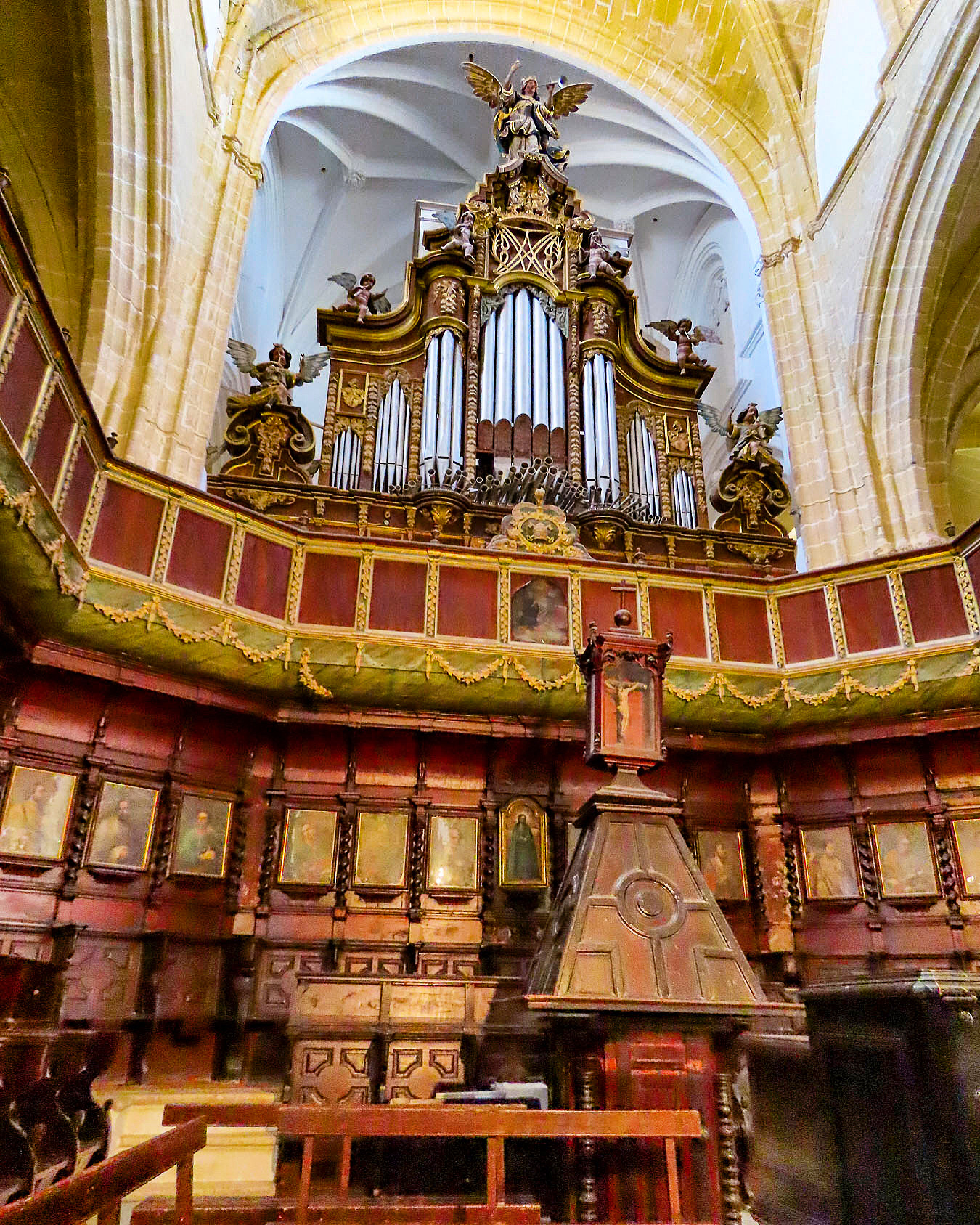
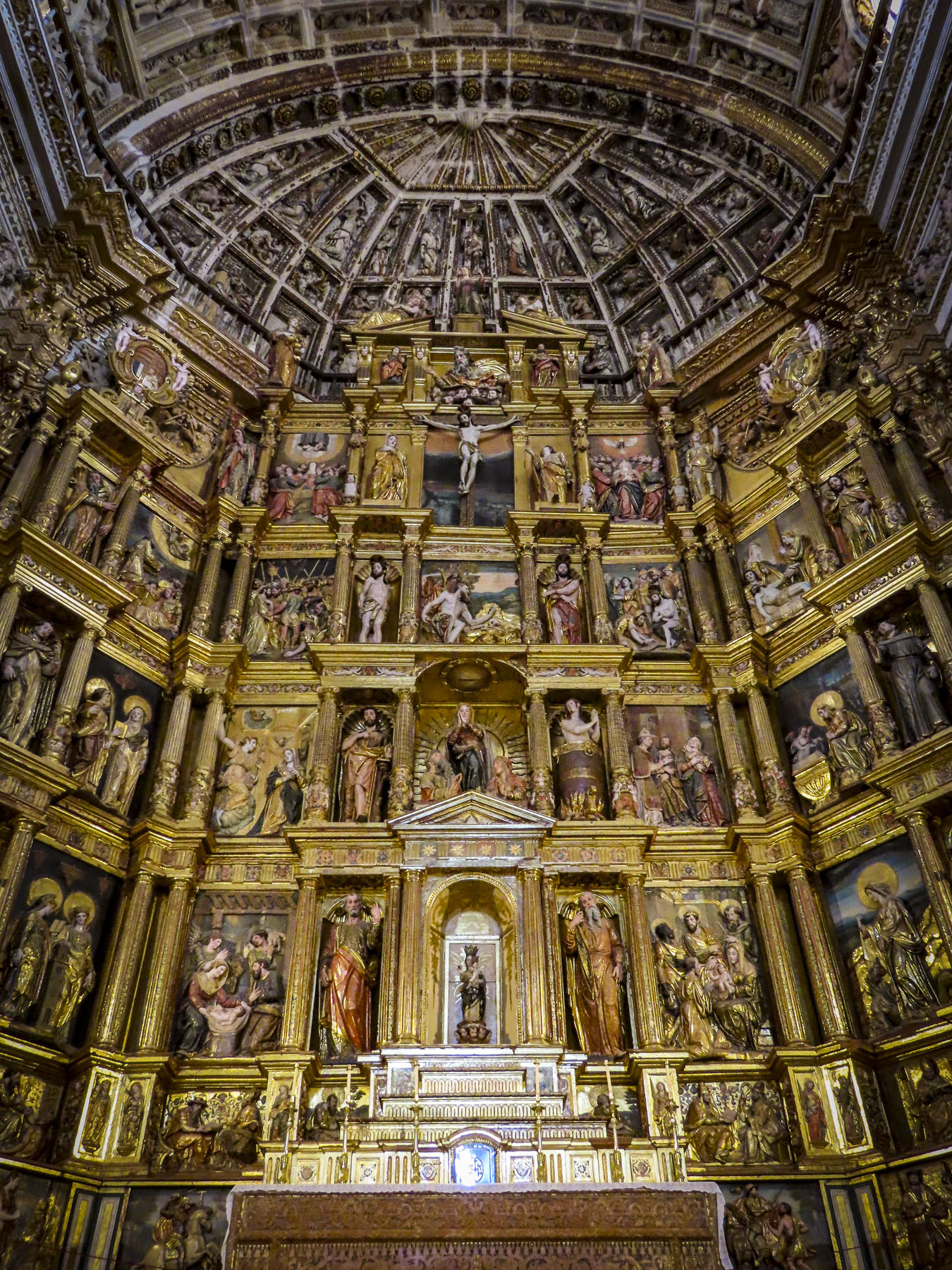
It is filled with wonderful pieces of religious art and has a very fine baroque sculpted altar, depicting stories from the Bible, and an ornate choir stall. The church also has a very nice arched cloister. The 135-foot-tall belltower, its upper portion built upon the minaret of the former mosque, was definitely worth the climb for the fantastic aerial views of the town and surrounding farmlands.

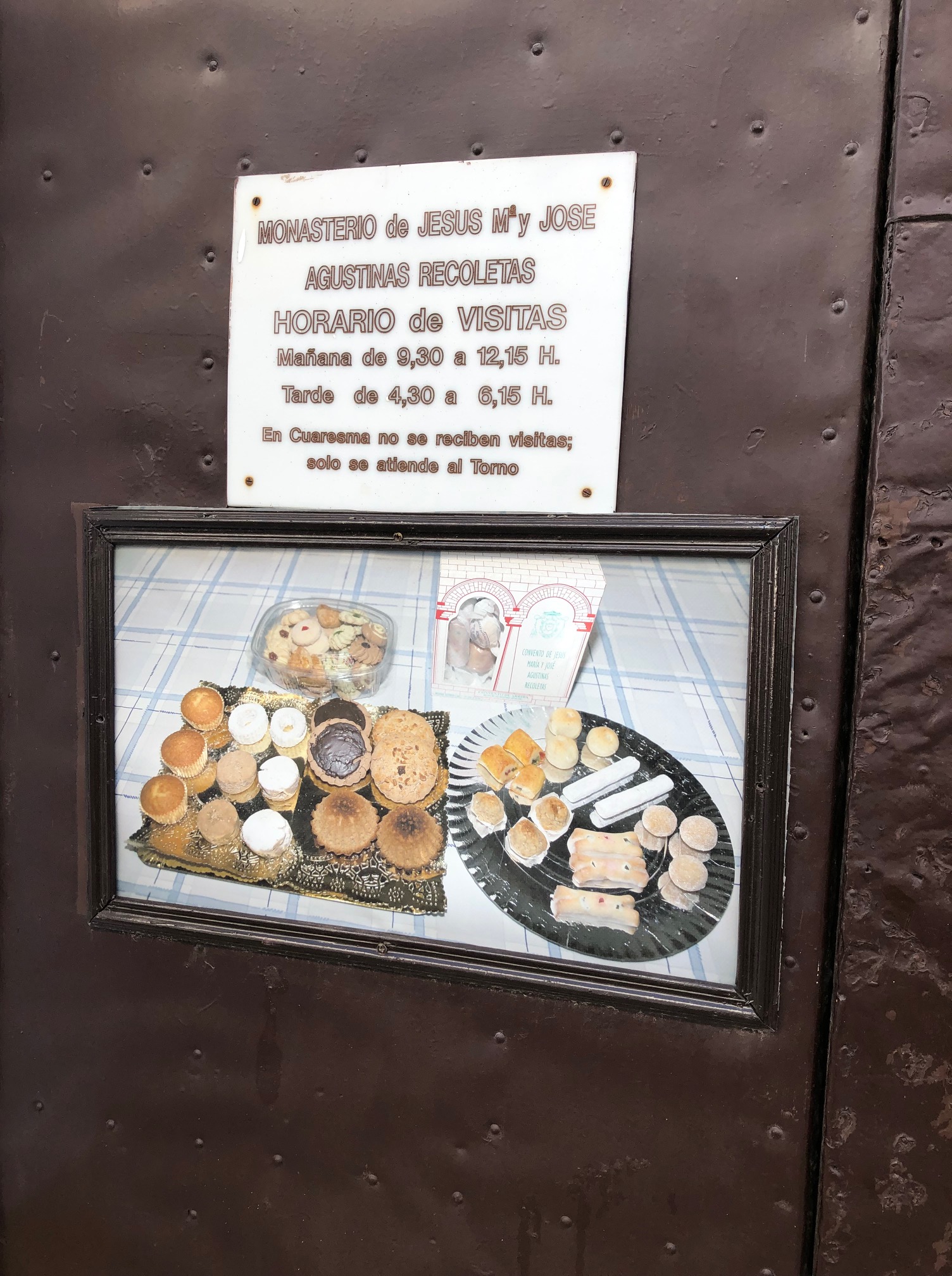
Next to the church, we were delighted to find that the Monasterio De Jesús, María Y José has a dulce turno. This is a lazy-susan type cabinet that allows you to purchase cookies and pastries made by the sequestered nuns who follow the convent’s centuries old recipes. It’s an interesting experience, talking in our inadequate Spanish through the wall to the invisible nun on the other side. We now seek out this opportunity wherever possible. The convent’s church has a noteworthy octagonal floor plan with its ceiling decorated with mural paintings.

Alcalá de los Gazules, a half hour away, was our next destination. Along with Medina-Sidonia and several other pueblos blancos, it is on the Ruta del Toro. This route through the open ranges of Cadiz Province highlights the region’s equestrian traditions on large fincas that raise Spain’s famous fighting bulls for the ring, as well as for their beef. Along the roadside here the iconic Osbourne Bull billboards playfully promote their brandy.

Rounding a curve, the hillside before us glittered with impressionistic white dots, which were nearly blinding in the midday sun. As we approached, their definition improved and revealed the old Arab village.  The ancient footprint of the town hasn’t changed in centuries. The village is composed of multiple levels of terraced dwellings built above each other, along staircases, winding narrow lanes and alleys that traced the natural topography of the hill to its apex.

One of the advantages of shoulder season travel is that it is much easier to find a parking space. The disadvantage, though, is that some sites of interest have off-season hours, which was what we encountered with the Iglesia Parroquial de San Jorge and the Castillo de Alcala de los Gazules.

Since the Romans first laid stones for a fortress, the town has had a castle at its summit. It was the Moors though who built a small but substantial fortification that used the sloping wall technique, copied from the Templars, to build the Homage Tower. This impressive tower is all that is left after Napoleon’s troops blew apart the rest of the castillo as they exited following a brutal occupation of the town in 1810.

After the Reconquista, the towns’ Moorish past was erased with the construction of the Iglesia Parroquial de San Jorge above the old mosque. Its ornate gothic façade, carved from soft stone, now shows centuries of erosion. Later with the building of the Santo Domingo monastery, in 1506, the town was decreed to be a religious learning center. Although the monastery served as a training center for priests, it was also used for centuries to hold prisoners of the Spanish Inquisition.

A few minutes outside of the village, before continuing onto Castellar de la Frontera, we stopped for a late lunch/early dinner at los Corzos. It’s a large facility with a restaurant, café, grill and charcuterie shop, all featuring typical Andalusian fare. Though it appears to be geared for tourist buses that ply the route between Malaga and Cadiz, they take their cuisine very seriously and we had a splendid lunch.

The de la Frontera attached to many village names in Andalucia refers to a region officially called “Terra Nullius,” a ‘no man’s land.’ A fluctuating border area was established in the 1200s, when the first Reconquista, led by Ferdinand III of Castile-León, ran out of resources to continue their conquests farther. For two-hundred years this was an unclaimed land, in which Christian crusaders and Islamic jihadists continued to clash.

Castellar de la Frontera, still remotely isolated in the cork forests of Los Alcornocales Natural Park, truly exemplifies a wilderness fortress; with only one serpentine road in and out, it’s many miles off the main road. Today it is one of Europe’s best-preserved examples of a medieval village existing within a castle. But in the 1960’s it was a different story, when after centuries of neglect, and a dwindling population due to emigration, the remaining residents were relocated to a newly constructed town, Nuevo Castellar, ten miles away.

In the 1970s, northern European “hippies” discovered the fine Andalucian weather and the now abandoned village, squatting in some homes, and building rough shelters outside the castle walls. The old town was eventually obtained as an investment by the Rumasa Group, Spain’s largest conglomerate and the country’s leading hotel chain in the 1980’s. Later the company’s financial troubles led the Spanish Government to expropriate Castellar. They declared it a ‘Historical and Artistic Monument,’ and invested funding to restore the old castle and its village. Today rooms in the castle and several casas in the old village are reservable through Tugasa Castillo de Castellar Tugasa is a hotel organization formed by the Cadiz regional government and operates nine hotels and nine separate restaurants throughout the province.

We didn’t realize our modestly priced (under €100) room would be ideally located in the Torre del Homenaje, the highest part of the castle with spectacular panoramic views. Getting to it was a bit of a challenge, even with the use of an elevator. The castle was built atop a huge multi-faceted rock protrusion, so that each ledge of the stone became one floor for rooms. While there are hallways from the elevator landings, they branch off and have short flights of stairs, up and down, to the rooms in various wings of castle. Signage was rather lacking, but after a few wrong turns we located No. 206.

We were further surprised when we discovered that a narrow alcove in our room, with a twist and a turn, led to a sitting area with a small bedroom. Geez, if we had known we would have invited our kids. Better still, a set of stairs led to the top of the tower – our private mirador! To the manor born, for the next two days! We enjoyed incredible views: to the west over the Guadarranque reservoir, below the village, and southeast to the Rock of Gibraltar and the coast of Morocco beyond.

“Hey Rosa,” a lanky toothless patron smiled as he yelled, “tienes clientes,” you have customers, after we stood at the bar long enough to learn the gentleman was one of the original squatters of the 70’s. Two beers were all we could get from Rosa, as the kitchen was only open on weekends until the tourist season started later that Spring. Fortunately, we had purchased some bread, cheese, and sausage at los Corzos earlier, and we still had a vermut with us from Jerez de la Frontera, so we were set for a picnic dinner.

We rose for sunrise the next morning and watched kestrals zip along the castle’s walls. Over the reservoir a kettle of griffon vultures circled for a while before flying off. The medieval village within the castle’s wall is very compact and it was easy to wander through its attractive lanes. Outside the walls we spent a good bit of time walking about looking for the best vantage points to photograph this pretty village, which is recognized by Los Pueblos más Bonitos de España as being one of the nicest in Spain.

Later for coffee we stopped at the Hotel La Almoraima, located off the only road between the old town and Nuevo Castellar. The stunning hotel is set in what once was a 1600s convent and takes excellent advantage of the orange tree-filled courtyard and surrounding old cloisters, now renovated into chic rooms.  

The convent’s original chapel has also been lovingly restored and is used regularly for weddings. The history of the architecturally distinctive tower that stands next to the cloister is vague, with some thinking it was an Arab watch tower, when this was the “Terra Nullius,” and existed before the religious complex was built. The old convent and its extensive lands, a vast 34,000-acre cork forest, eventually became the property of the Dukes of Medinaceli, who turned it into a palatial hunting estate, one of the largest in Spain.

By the 1890’s it was the destination for Spanish nobles and English aristocrats from Gibraltar, who participated in Royal Equestrian Hunts, and the Duke had a private station built on Henderson’s railway for their use. In 1922 Queen Victoria Eugenie of Spain exited at the Duke’s station and then traveled by horse drawn carriage to the estate and the ancient castillo for a brief visit. The eroded cart track to the castillo was finally improved and paved in 1924. In 1973 the 18th Duchess of Medinaceli sold the estate, which included the old hilltop castle, to the Rumasa Group. It was later seized by the Spanish government in the financially troubled 2010s and the Mexican actress Salma Hayek expressed interest in acquiring it before the government decided to manage the estate itself. I find these obscure histories fascinating!

Bar el Molino, a small taberna on the edge of Nuevo Castellar’s central plaza, was a wonderful untouristy spot. With shaded outside tables, cold beer and delicious food, our lunch was perfect. In an effort to experience as many different places as possible, we’ve started to take our after lunch or dinner coffee and dessert at a different establishment.

With this in mind we found Pasteleria Gastrokook, off by itself on the edge of town. Wow! We were so fortunate to stumble across this incredible pastry shop. This gourmet pastelería is reason enough to visit Castellar de la Frontera or even Spain. It is definitely worth a detour especially if you are near Gibraltar. We quickly conferred and declared a calorie-free day! I mean, what is the point of exploring all these distant locales without enjoying their cuisine. Geez, at our home in Georgia, USA, we can’t even find artisanal bread! I did gently chide the two cyclists that pedaled over from Gibraltar for ordering only black coffee. Surely, they would have burnt off all those calories by the time they returned to the rock. Sometimes, willpower is simply deprivation by choice.

Till next time,

Craig & Donna

.

Cadiz: Walk a little, then Café

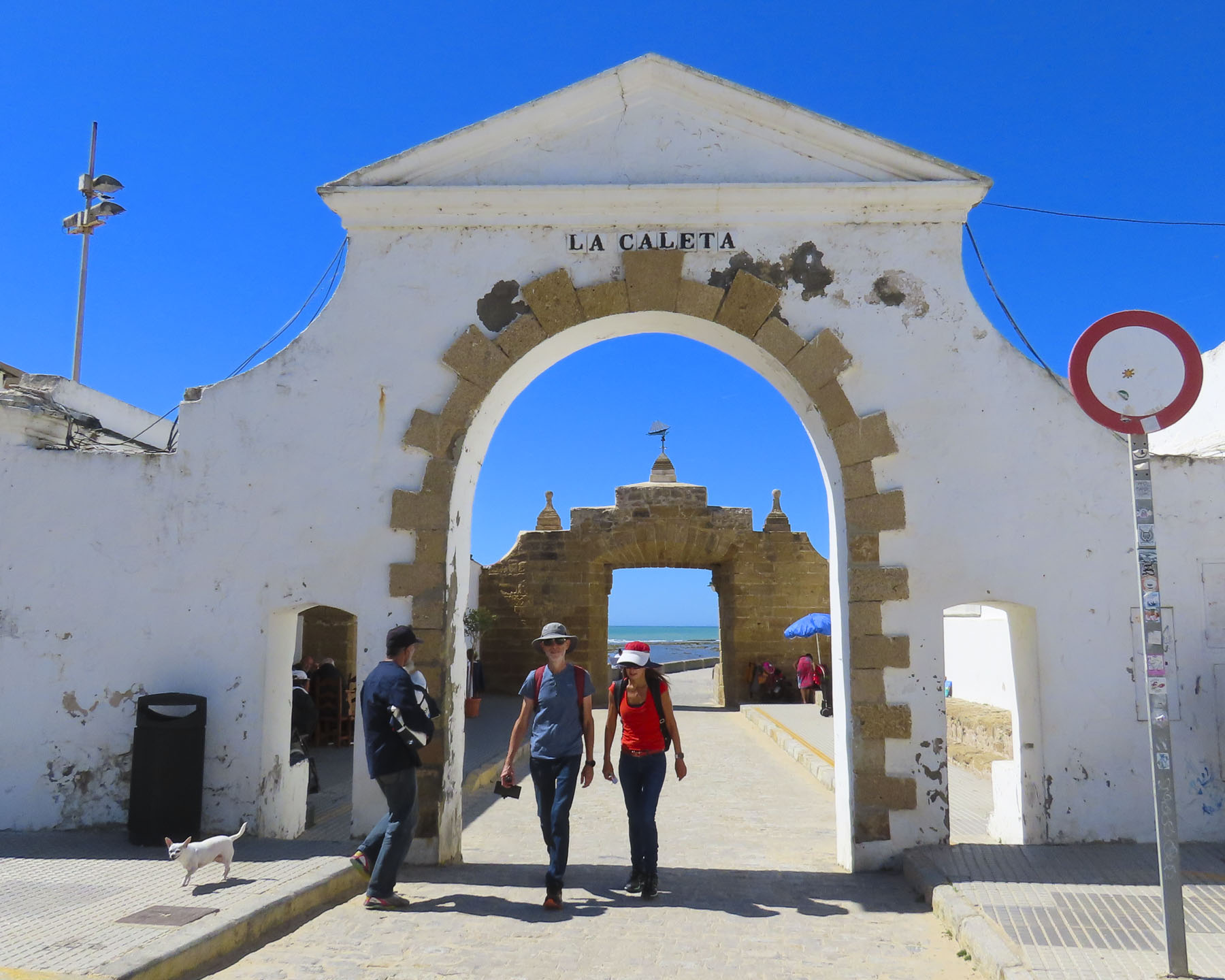
With a leisurely departure from Jerez de la Frontera, we headed towards Cadiz for four nights before continuing our road-trip through the southwest corner of Andalucia. Our friend Giulia had shared her fond memories of Cadiz with us several years ago and we were finally on our way to experience the charms of this coastal city ourselves. Situated on a narrow peninsula that juts into the Atlantic Ocean, the city’s small size appealed to us. “You won’t need a map!” Donna teased, referring to my inclination to track our every route. While the city does have several beach areas, only one, La Caleta is in the Casco Antiguo, old town district.

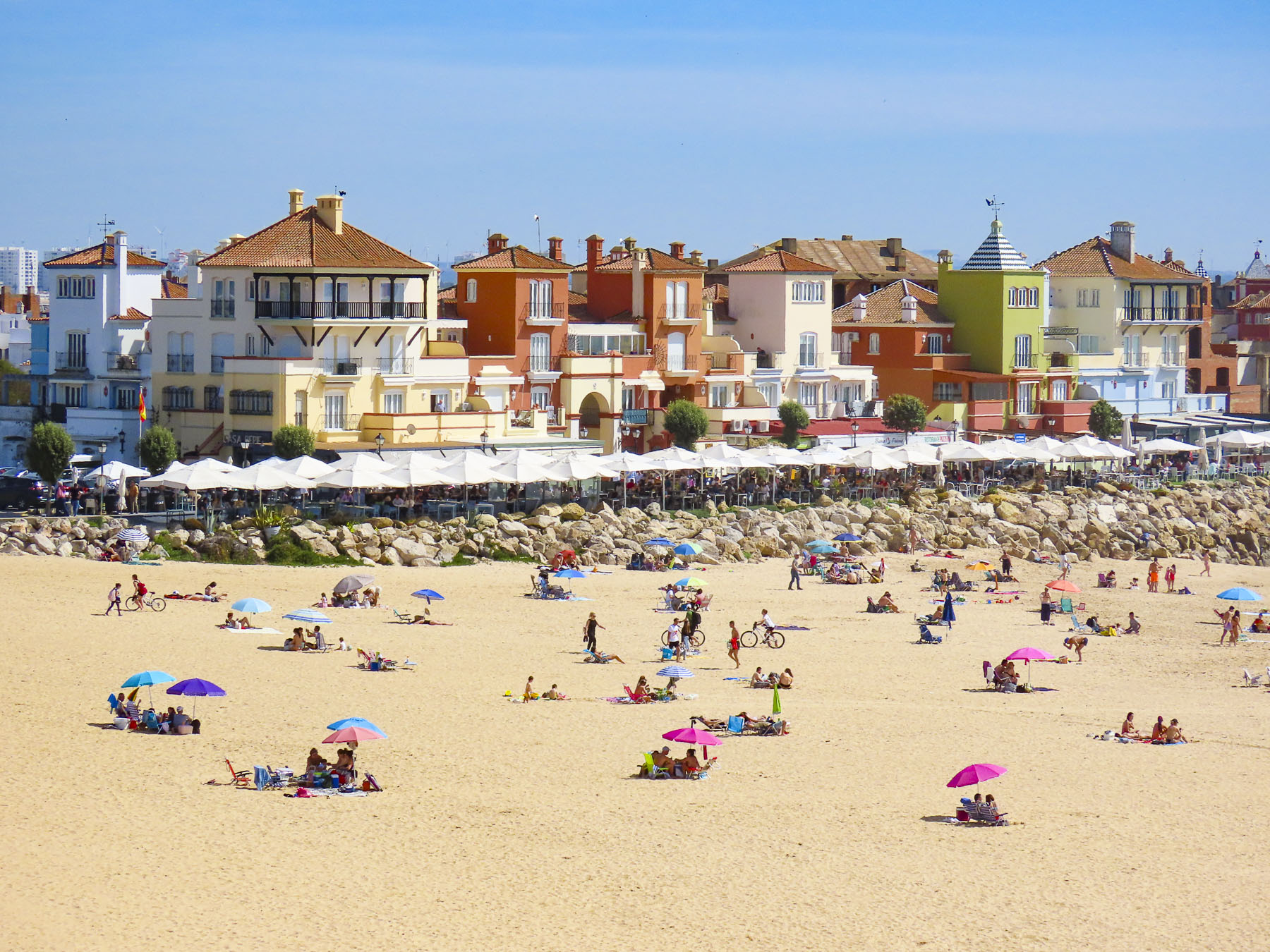
We decided to have lunch along Andalucia’s Atlantic coast before we reached Cadiz and followed the signs to Vistahermosa, an upscale neighborhood in El Puerto de Santa María that has a crescent shaped beach. It’s a wide stretch of golden sand, with the ruins of an old fortress at one end and a marina at the other.

The Sunday afternoon in March when we visited, folks were sunbathing and swimming. Offshore boaters, kite surfers, and a sailing class were enjoying the gentle waves of Cadiz Bay. We parked at the marina and strolled along the restaurants and homes that lined the breakwater until we decided on Sotavento Puerto Sherry, which offered some shade from the intense afternoon sun.

Afterwards we headed to the lighthouse that marks the entrance to the marina. If you ask locals where the best beaches in Spain or Europe are, they’ll spread their arms wide to encompass the north and south vistas along the coast and say, “aquí mismo,” right here, proud of the fact that their beaches are consistently awarded numerous Blue Flags, a European Union award for water purity and beach cleanliness, in the Mediterranean region. Though it shares the same climate as the Costa del Sol on Spain’s Mediterranean coast, with 300 days of sunshine annually, the Atlantic coast beaches have stayed relatively undiscovered by mass tourism. This is attributed to the provinces’ wilder, windswept coastline, with many nature preserves and few large tourists resorts.

When you look at a map of old town Cadiz the streets appear to be laid out in a slightly modified grid pattern. In actuality they are a confusing array of one-way streets that inhibit easily circling around the block. Fortunately, there is very little auto traffic through the historic district, as there are no sidewalks and folks treat the calles as pedestrian only thoroughfares, stepping into doorways for the occasional delivery vehicle to pass. There are expensive parking garages scattered about the city; however, if you are willing to walk a little farther, the least expensive parking areas are near Parque Genovés.

We were delighted when the elevator doors opened onto a rooftop terrace and we realized that our room was on the hotel’s top floor, which we shared with one other guest room and an outdoor bar that was closed until the high season started later in the Spring. For under $100 a night our room, with sitting area, large bath, and private patio at Hotel Las Cortes De Cádiz   was an incredible value in mid-March.

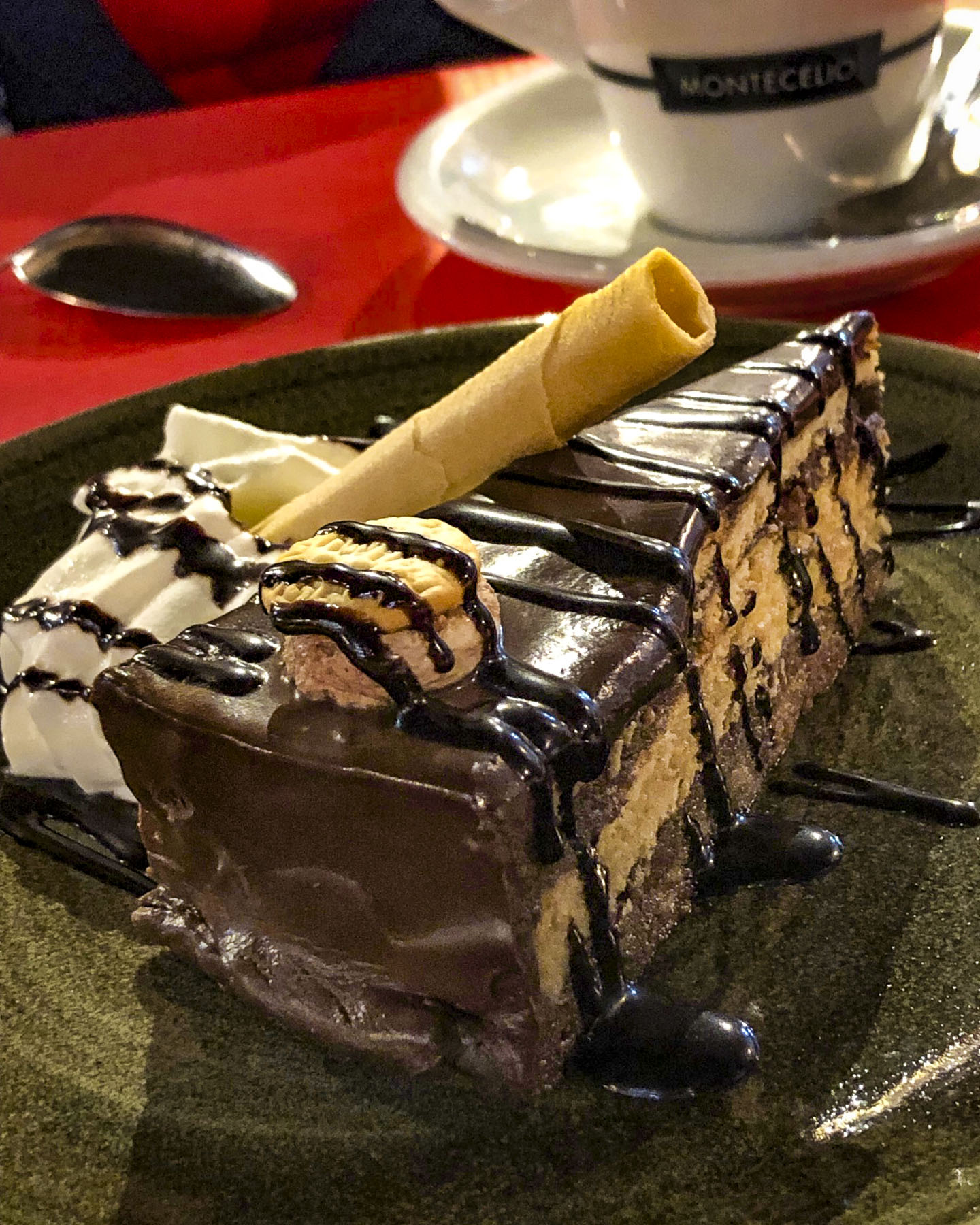
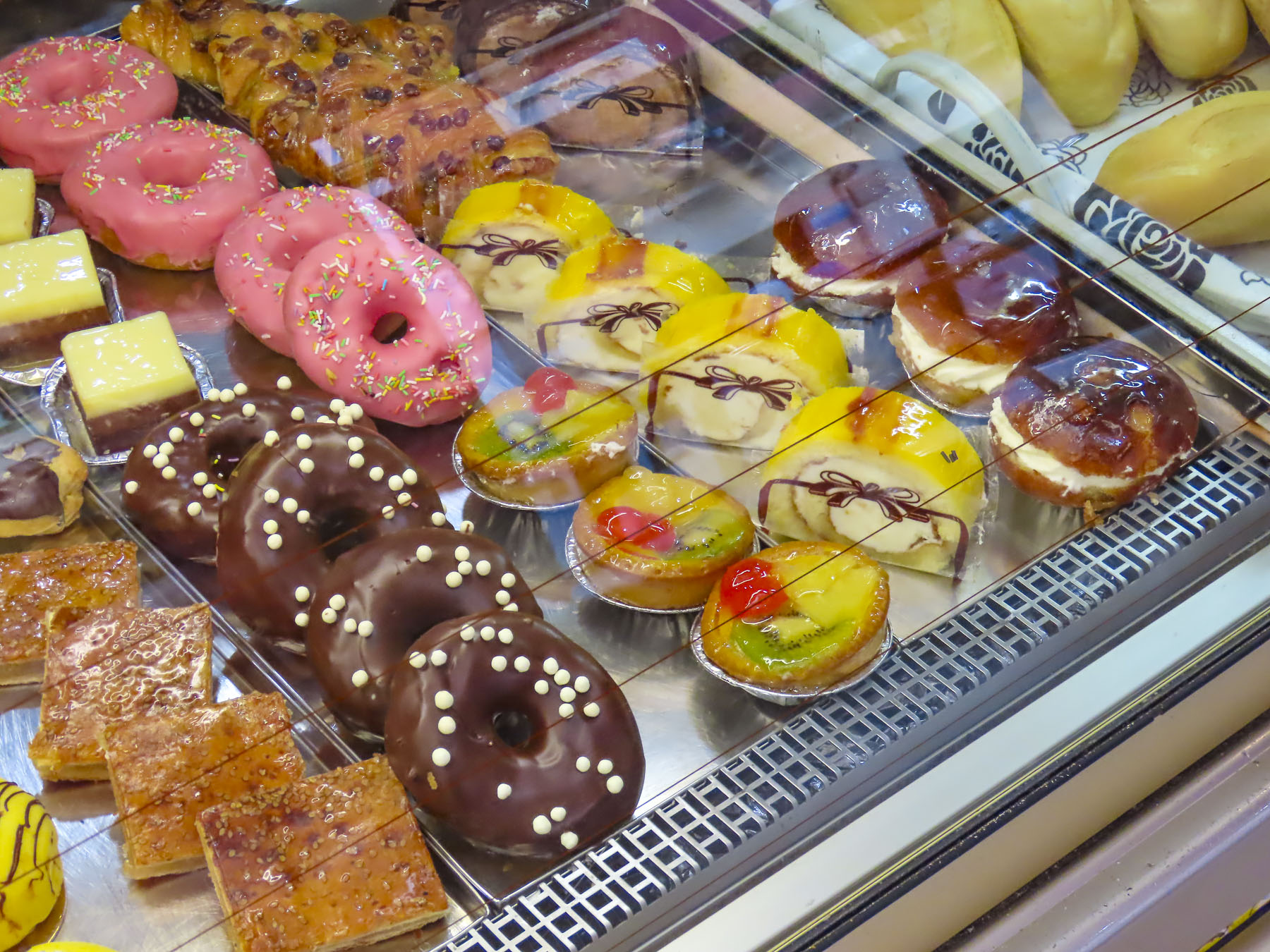
Breakfast was not included, but we had a coffee maker and I always enjoy photographing sunrise, then wandering about in the early morning hours looking for a neighborhood pastelería. Our sweet tooth was not dissappointed in Cadiz.

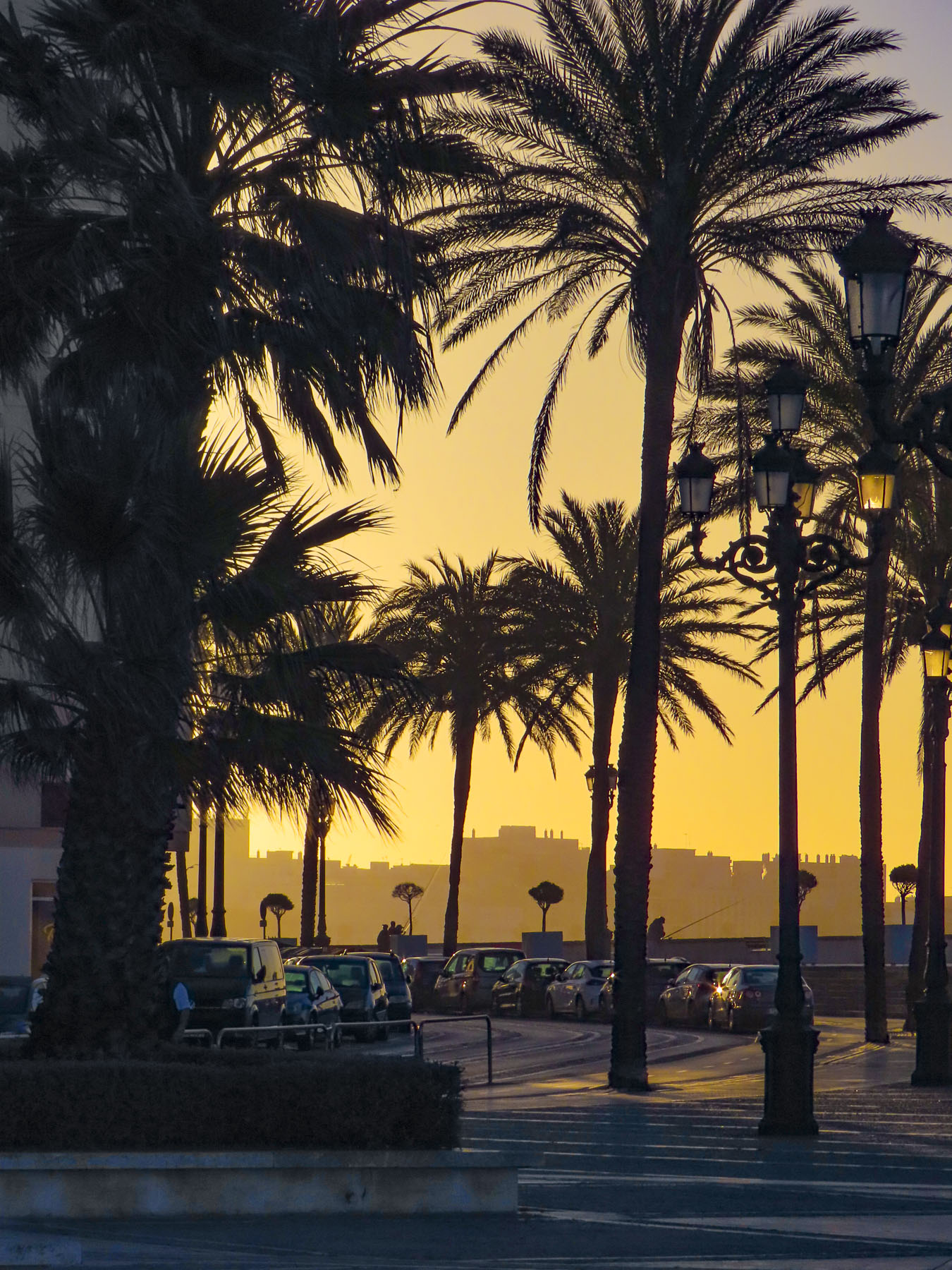
While many of the calles in Cadiz are strictly utilitarian aside from their fascinating architecture, the plazas, parks, and some strictly pedestrian only lanes are lined with palm trees, and a variety of other specimen trees collected from Spain’s far-flung empire, which lasted from the 16th to 18th century.

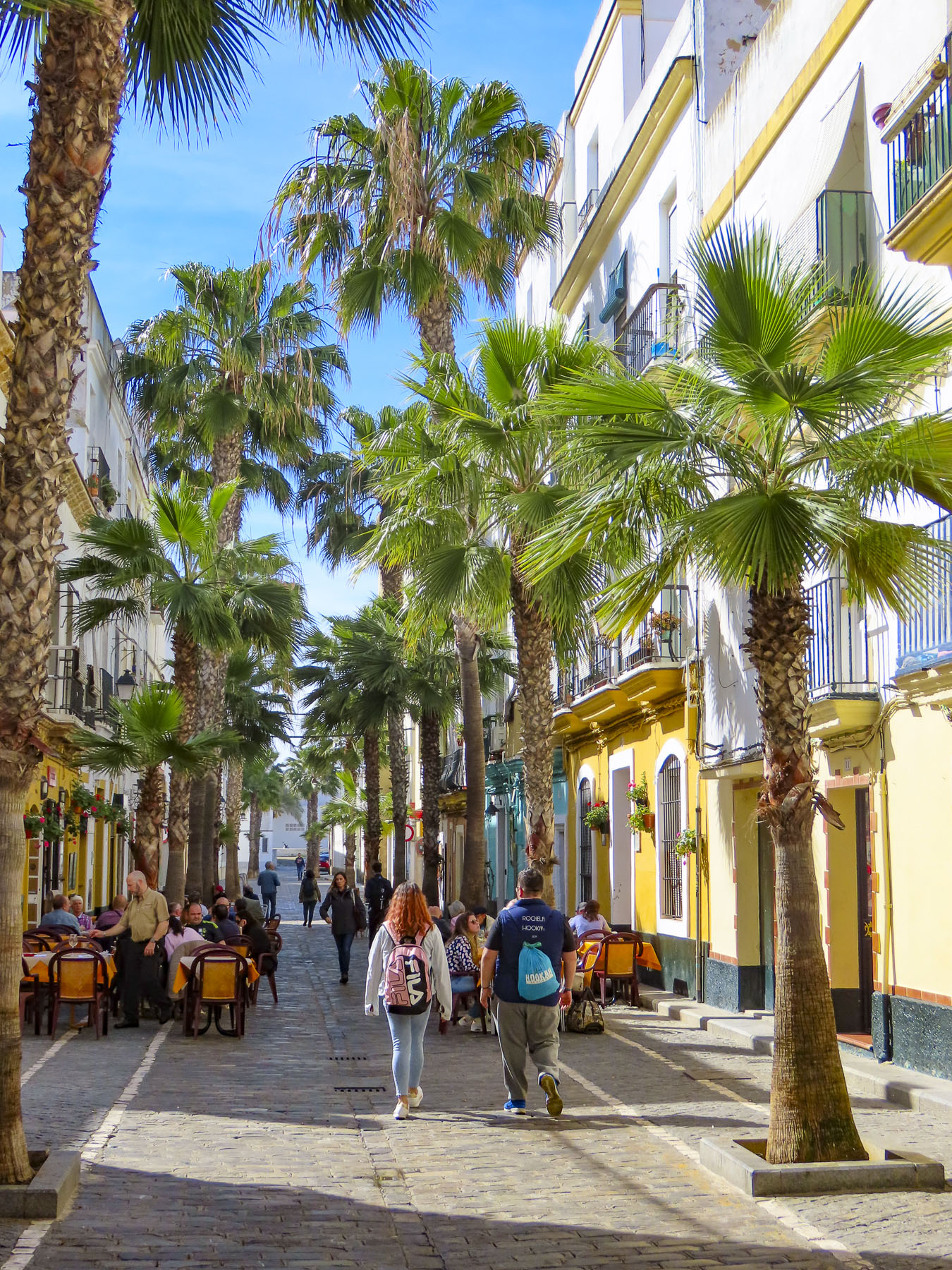
Calle Virgen De La Palma is particularly attractive with its tall palms lending a Caribbean vibe to this quiet barrio that has two of Cadiz’s best tapas bars and restaurants, Taberna Casa Manteca and Restaurante La Isleta de la Viña.

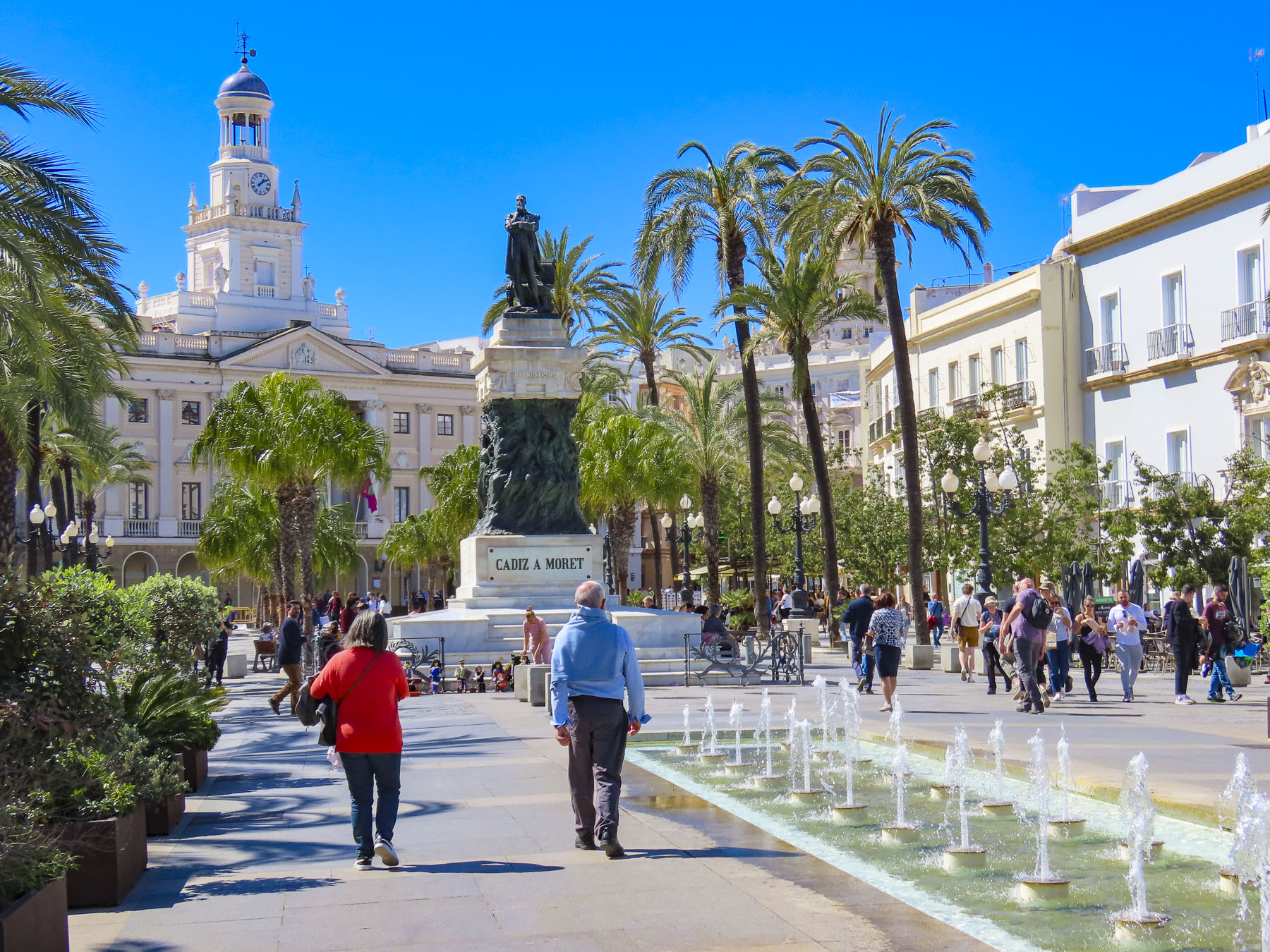
Plaza de Mina, Plaza de San Juan de Dios, and Plaza de la Catedral are especially beautiful, with the latter two also providing an Island flare to the stately stone buildings surrounding them. The Caribbean ambiance is so intense that the barrios of Cadiz are often used by the movie industry as a location stand-in for Cuba. Parts of 007: Die Another Day (2002,) were filmed at Cadiz’s La Caleta beach and Malecon.

There were two islands, separated by a natural narrow channel near La Caleta beach that extended to what is now the cruise ship harbor, when the Phoenicians landed 3000 years ago, making this the oldest continually inhabited city in western Europe. Over time the detritus of ancient Phoenician, Greek, Carthaginian, Roman, Visgoth, and Moor civilizations filled the canal and connected the two pieces of land.

Some interesting notes from the history of Cadiz:

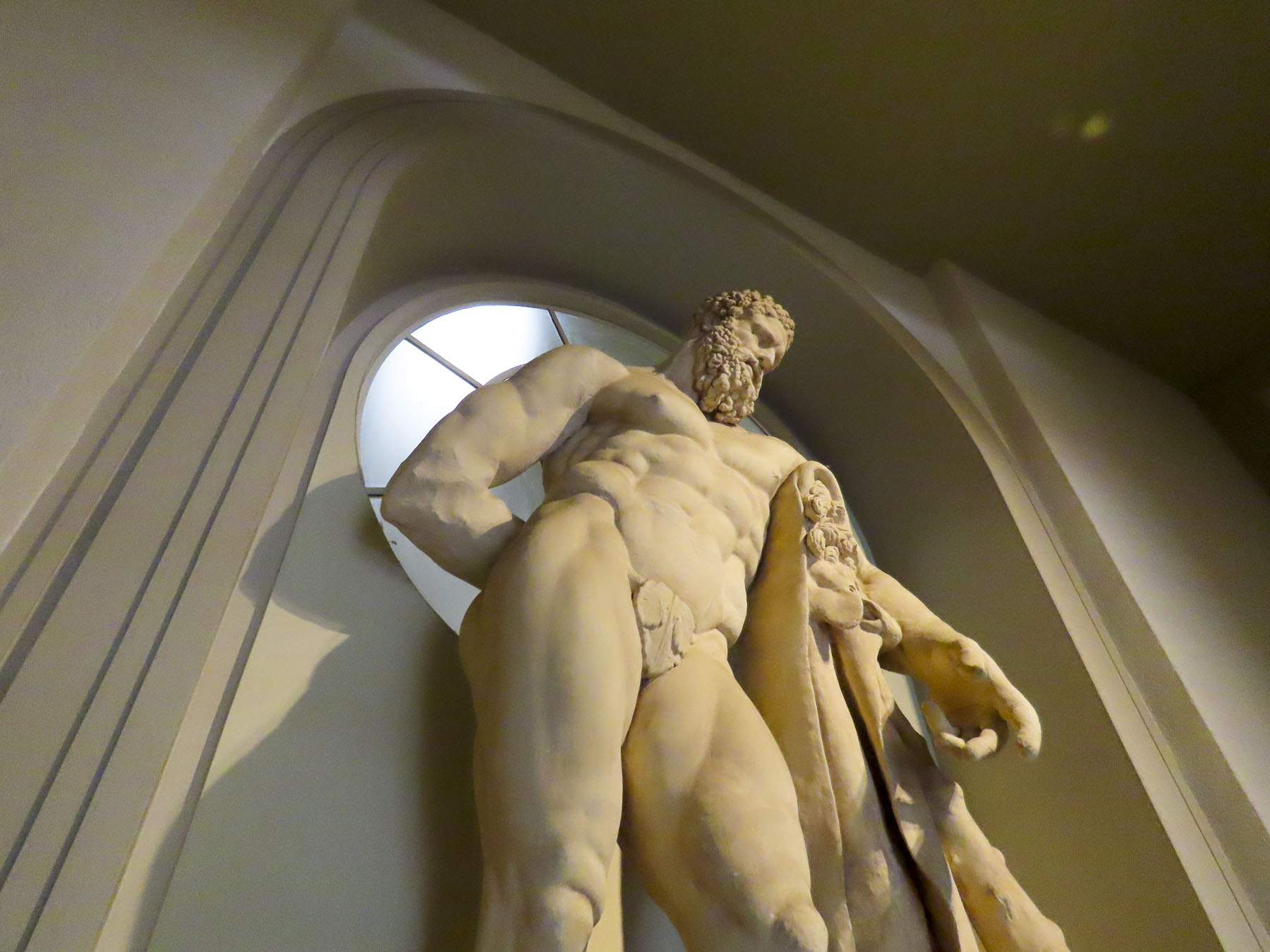
In Greek mythology Hercules needs to travel to an island called Erytheia, beyond the Pillars of Hercules, to slay the three-bodied, winged monster, Geryon. The Pillars of Hercules were thought to be the Rock of Gibraltar in Spain and Jebel Musa in Morocco at the mouth of the Mediterranean Ocean, and represented the end of the known world at the time. Cadiz is believed to be Erytheia.

Hannibal famously departed Cadiz in 218 BC with his calvary of elephants to trek across the Iberian Peninsula, the Pyrenees Mountains, and the Italian Alps to battle the Roman Empire.

During Spain’s Age of Discovery, Christopher Columbus set sail to the New World from Cadiz on his second and fourth voyages. As Spain’s closest deepwater port to its new colonies in the Americas, it subsequently became the home port of the Spanish treasure fleet and the city prospered for several centuries.

England’s favorite bad boy, Sir Francis Drake, attacked Cádiz in 1587 and pirated away 3,000 kegs of sherry, starting Britain’s long obsession with the Andalucian wine. This event prompted the city to build better fortifications.

1596 was a bad year for Cadiz. An Anglo-Dutch fleet of 150 ships with 15,000 men captured Cádiz, burning 685 homes and the old Parroquia de Santa Cruz Cathedral before they left. But the Spanish treasure ships they were after were purposely sunk by the Spaniards in the Bay of Cadiz, where the gold and silver was later recovered.

In 1805 smoke from the Battle of Trafalgar, a decisive naval engagement between a British Fleet, commanded by Admiral Lord Nelson, and a combined French and Spanish Fleet, could be seen on the horizon from Cadiz.

During the Napoleonic Wars, Cadiz successfully resisted French invasion and served as the capital of Spain for a short time.

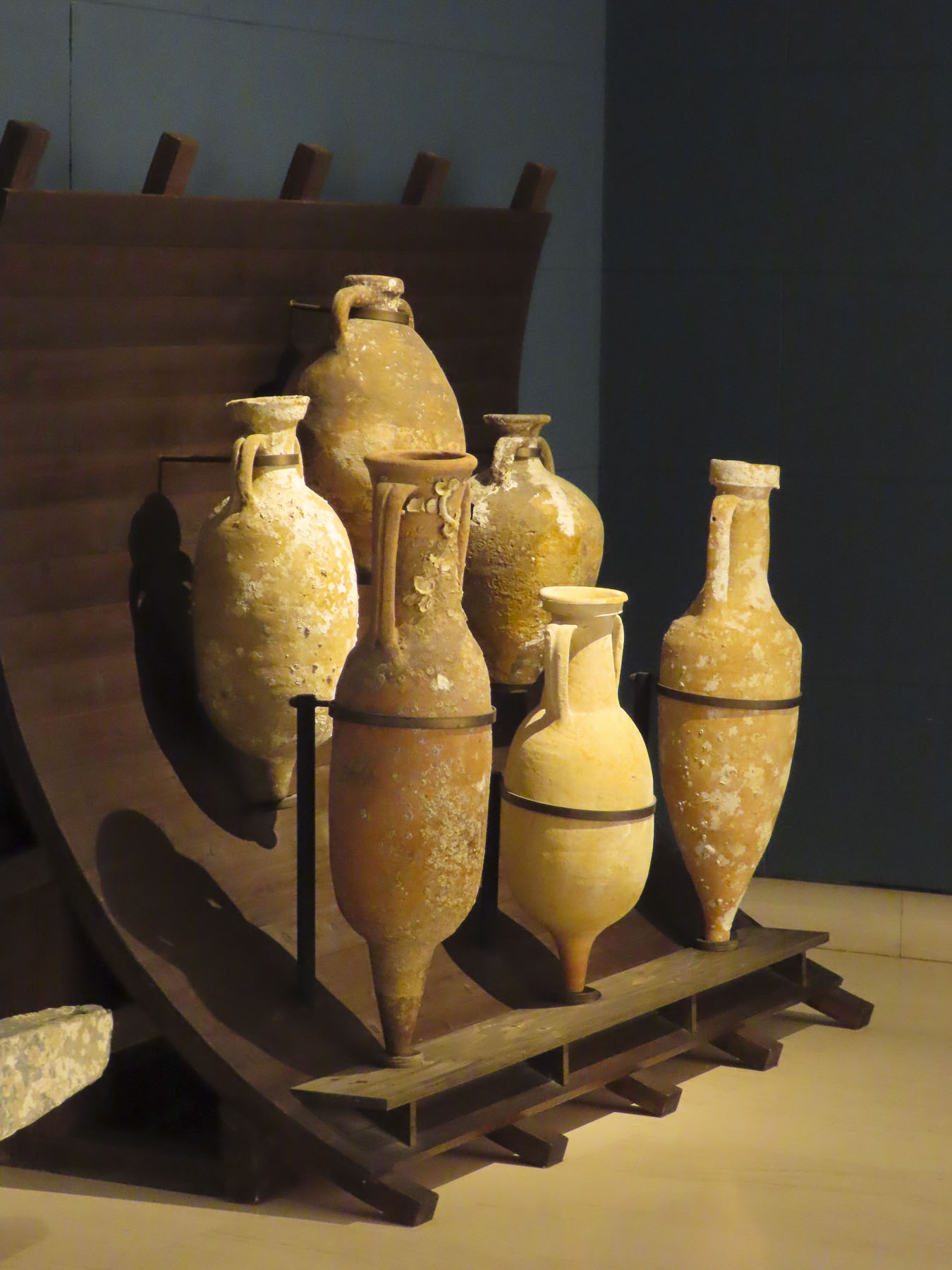
In 1887 two large 5th century BC Phoenician stone sarcophagi were discovered at the Cadiz shipyards.

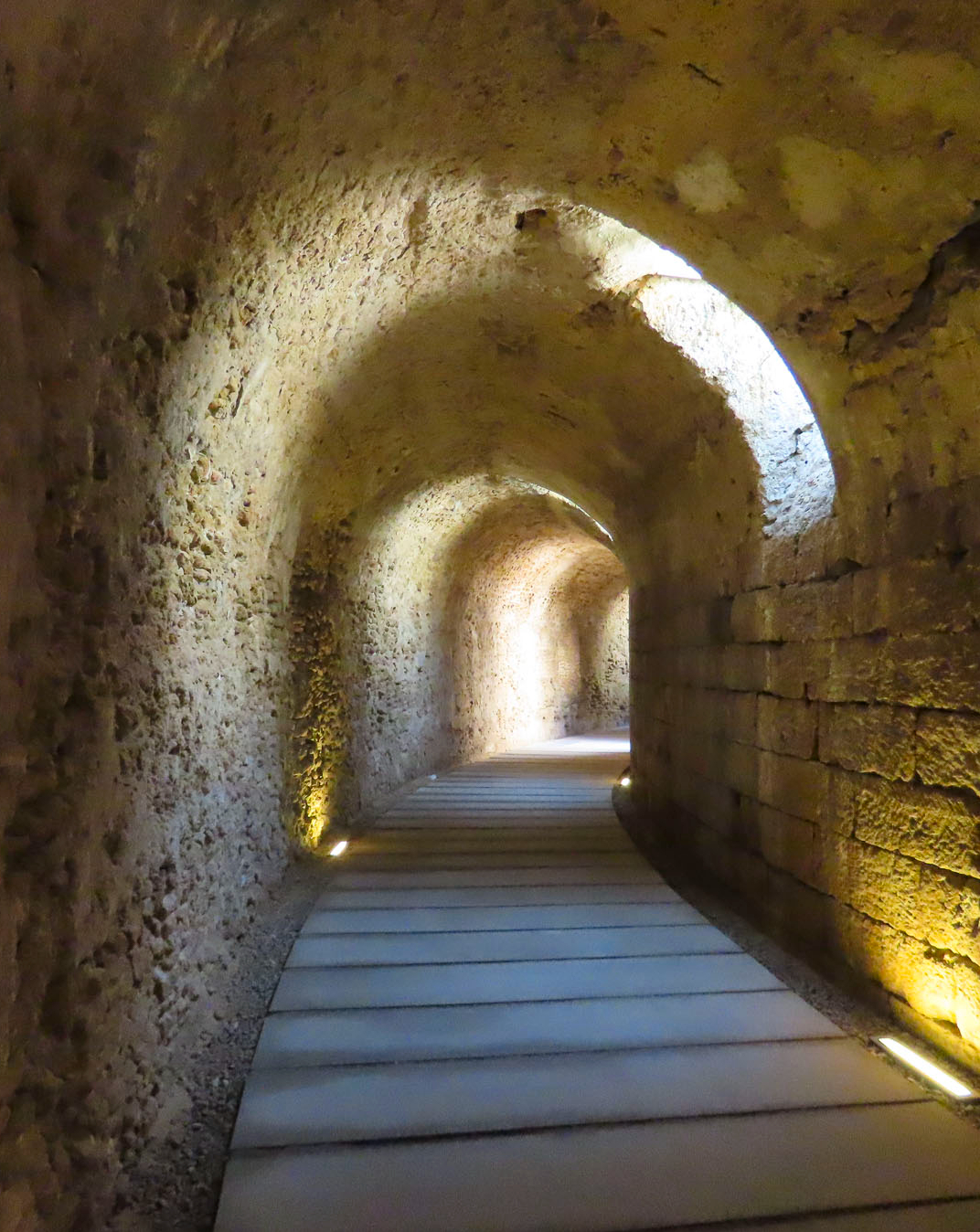
Construction crews in 1980 unearthed the ruins of a 1st century BC Roman amphitheater. Estimated to seat 10,000 spectators, the theater was one of the largest ever built in the Roman Empire.

I find these recent archeological findings fascinating, in the sense that there are still discoveries about the extent and complexity of ancient civilizations to be made, even though we’ve been living atop them for centuries.

The Cadiz Museum is a great destination and has a very interesting collection of ancient Cadiz artifacts on display. Its location on the verdant Plaza de Mina surrounded by several cafés and the excellent restaurant Mesón Cumbres Mayores was a huge bonus. At the restaurant we shared a delightful experience with a young Spanish/American couple from Oregon who were back in the woman’s hometown visiting family. “You must try the Chicharrones.” We never could have imagined that pure fat is a gourmet delight! Pork belly cooked with spices and garlic, then pressed and chilled, before being sliced paper thin, and served with a squeeze of lemon and a dash of salt. Pared with a nice Andalucian wine, it was Heaven! Obviously, this artery clogger is a tapas to share in moderation.

The urban footprint of Cadiz that we see today is a result of the reconstruction of the city after its 1596 sacking. Resilient, Cadiz was like a phoenix that continued to rise from the ashes and thrive through 200 years of pirate raids and war. Such was the power of the Spanish throne’s, “Casa de Contratación,” a contract with a city that allowed it to impose a tax of 20% on all goods, including gold and silver entering Spain from the New World colonies.

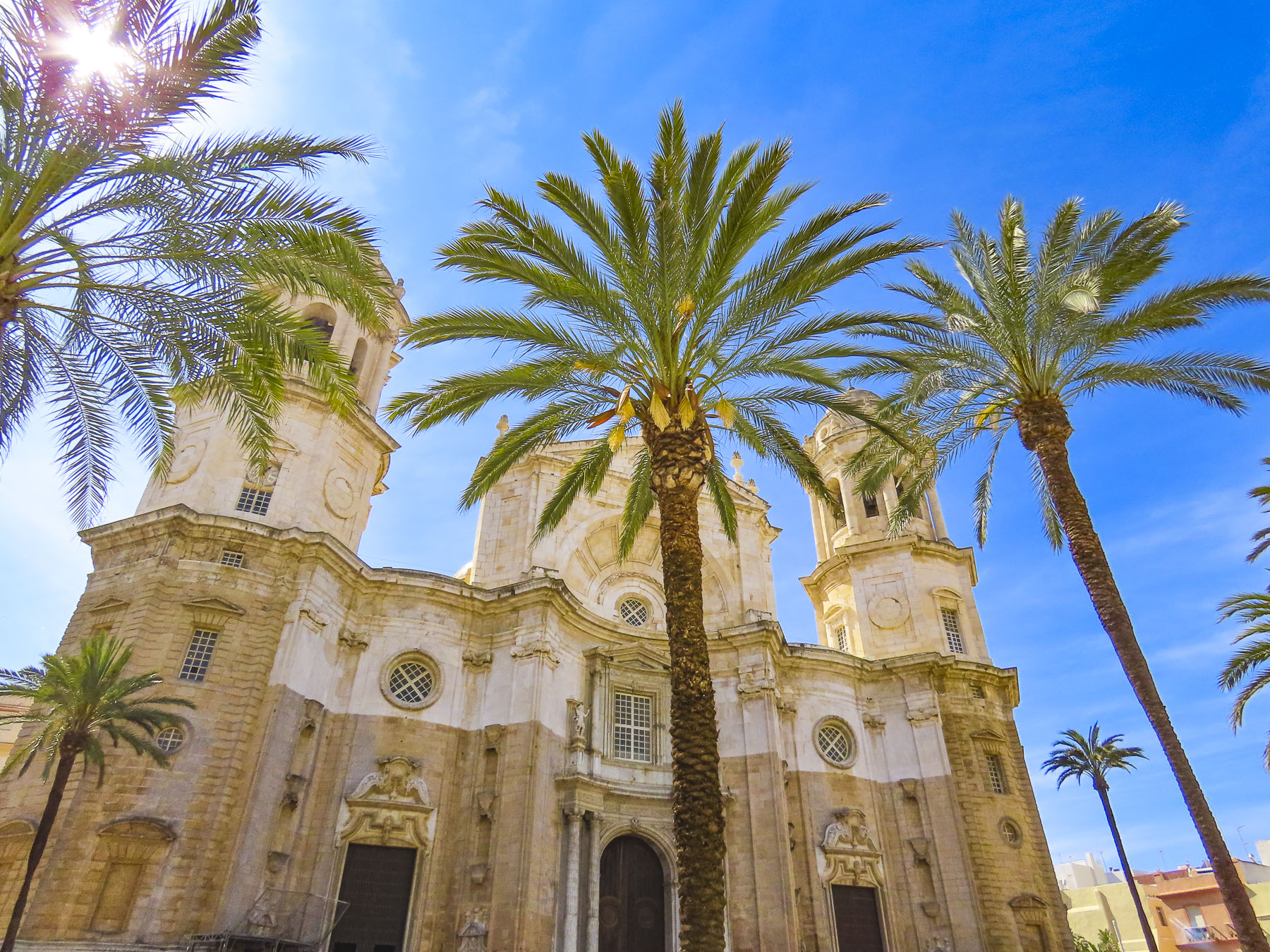
Seville previously held this coveted right before it was granted to Cadiz in 1717. With this new wealth the construction of the Cathedral of Cadiz or, as it was often called, “The Cathedral of The Americas,” was started in 1722.

The church is a huge, cavernous space in need of some maintenance as evidenced by the construction netting suspended below the arched ceiling, which still allowed smaller pieces of plaster to fall through and splinter on the marble floor. The ornately carved choir stalls are a masterpiece of wood sculpture.

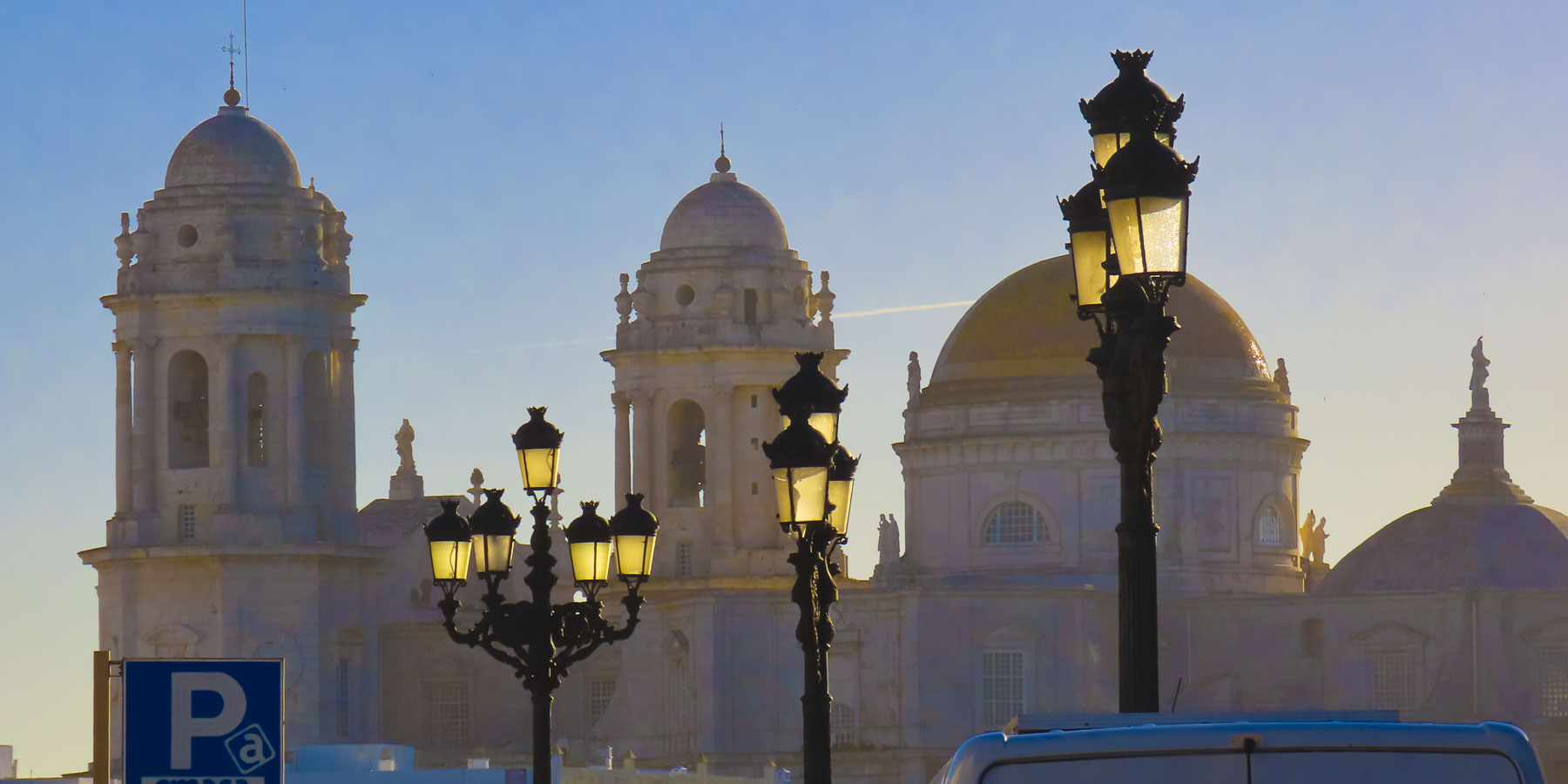
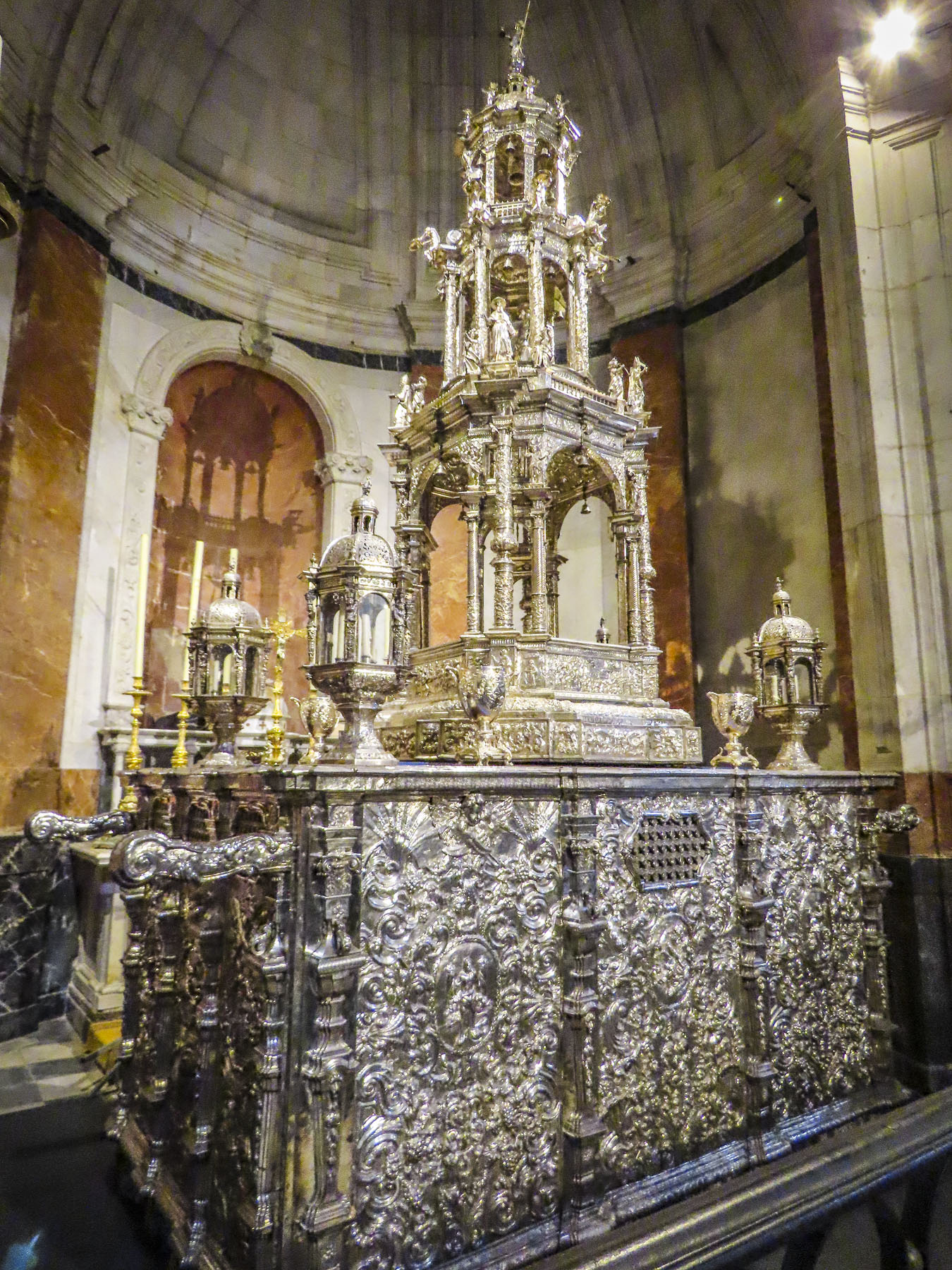
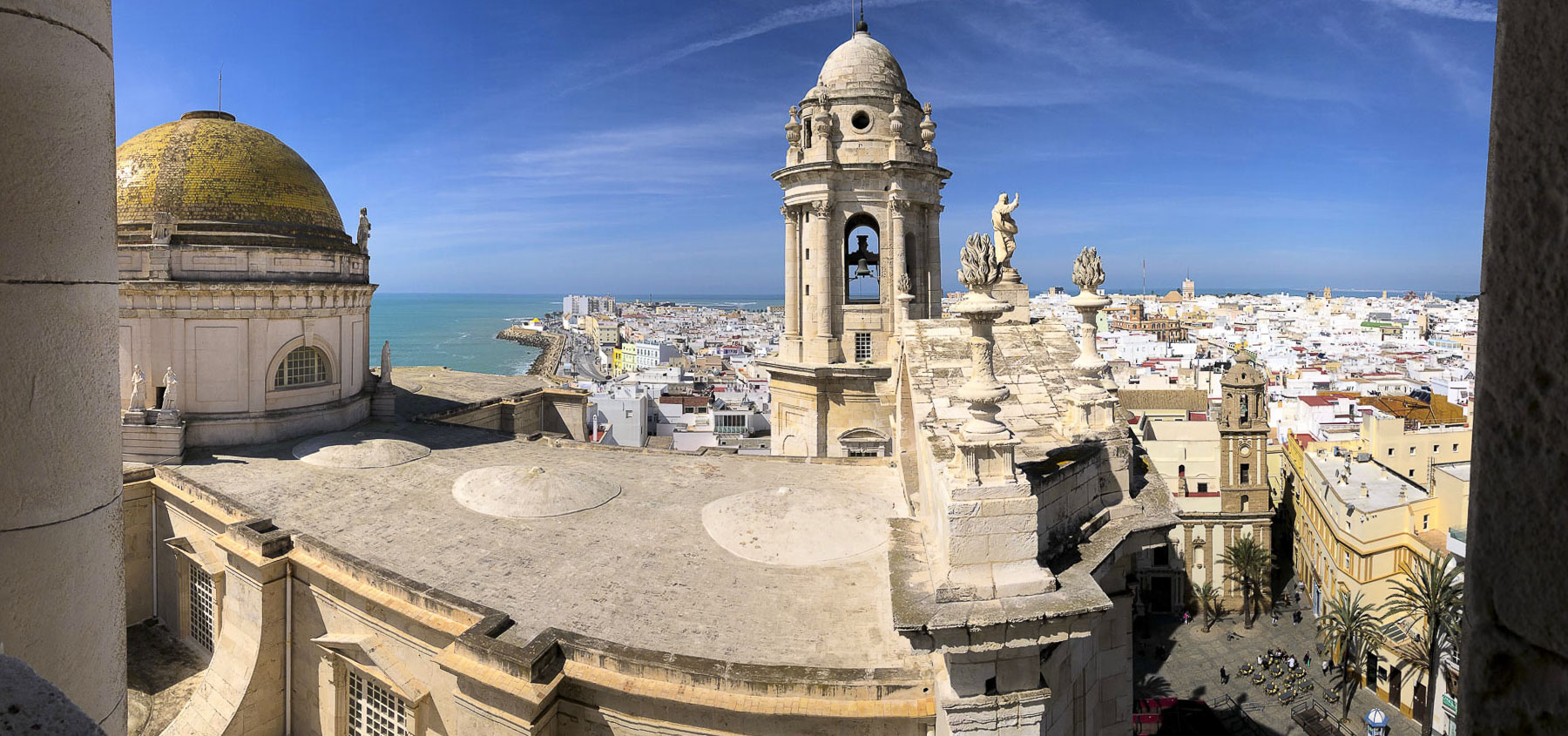
In one side chapel there is a huge ceremonial monstrance crafted with an estimated 800lbs of silver from the New World. There are also many other notable works of religious art scattered throughout this chamber. It’s definitely worth the effort to walk to the top of the church’s Levante Tower for the best panoramas of Cadiz from the highest point in the Casco Antiguo.

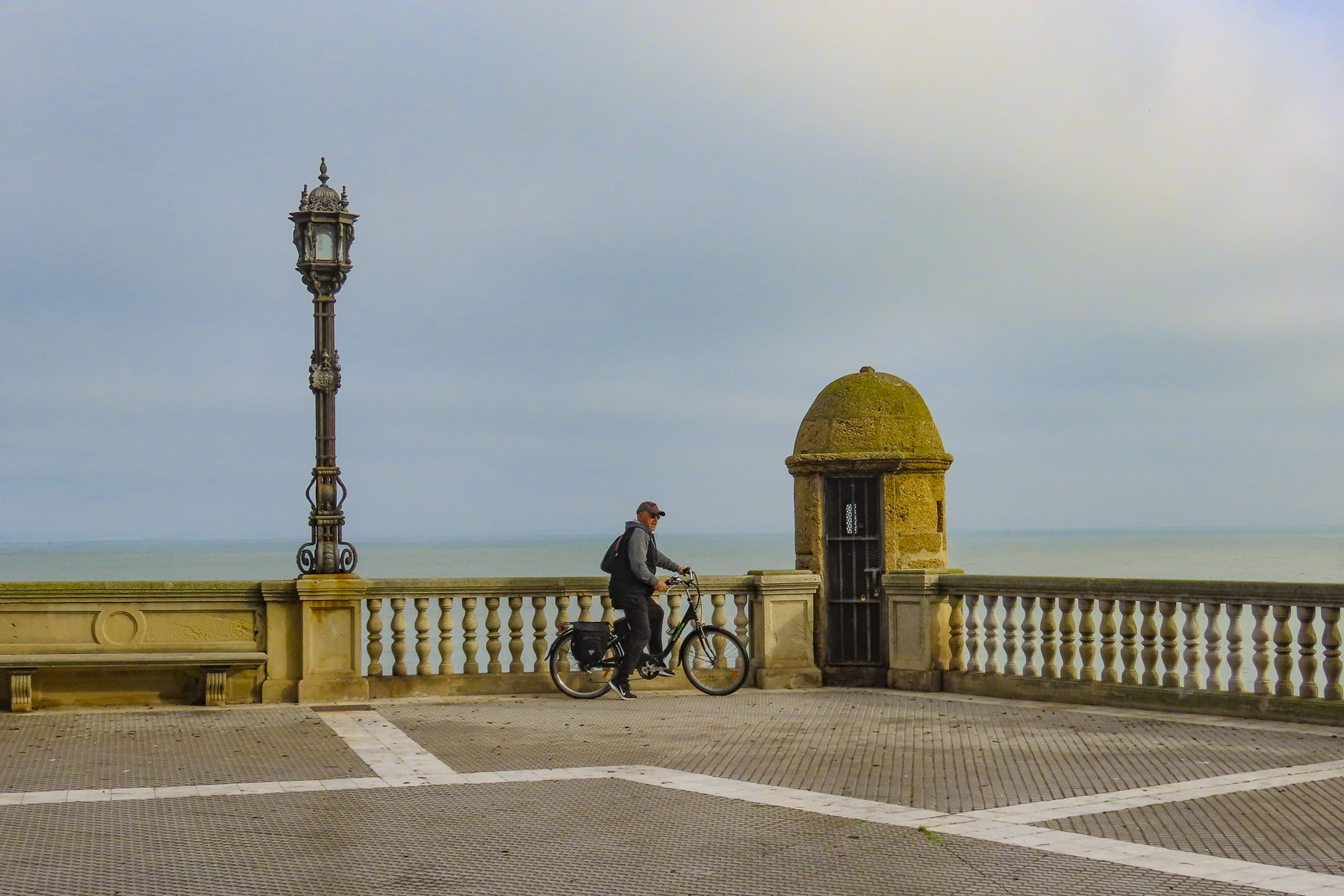
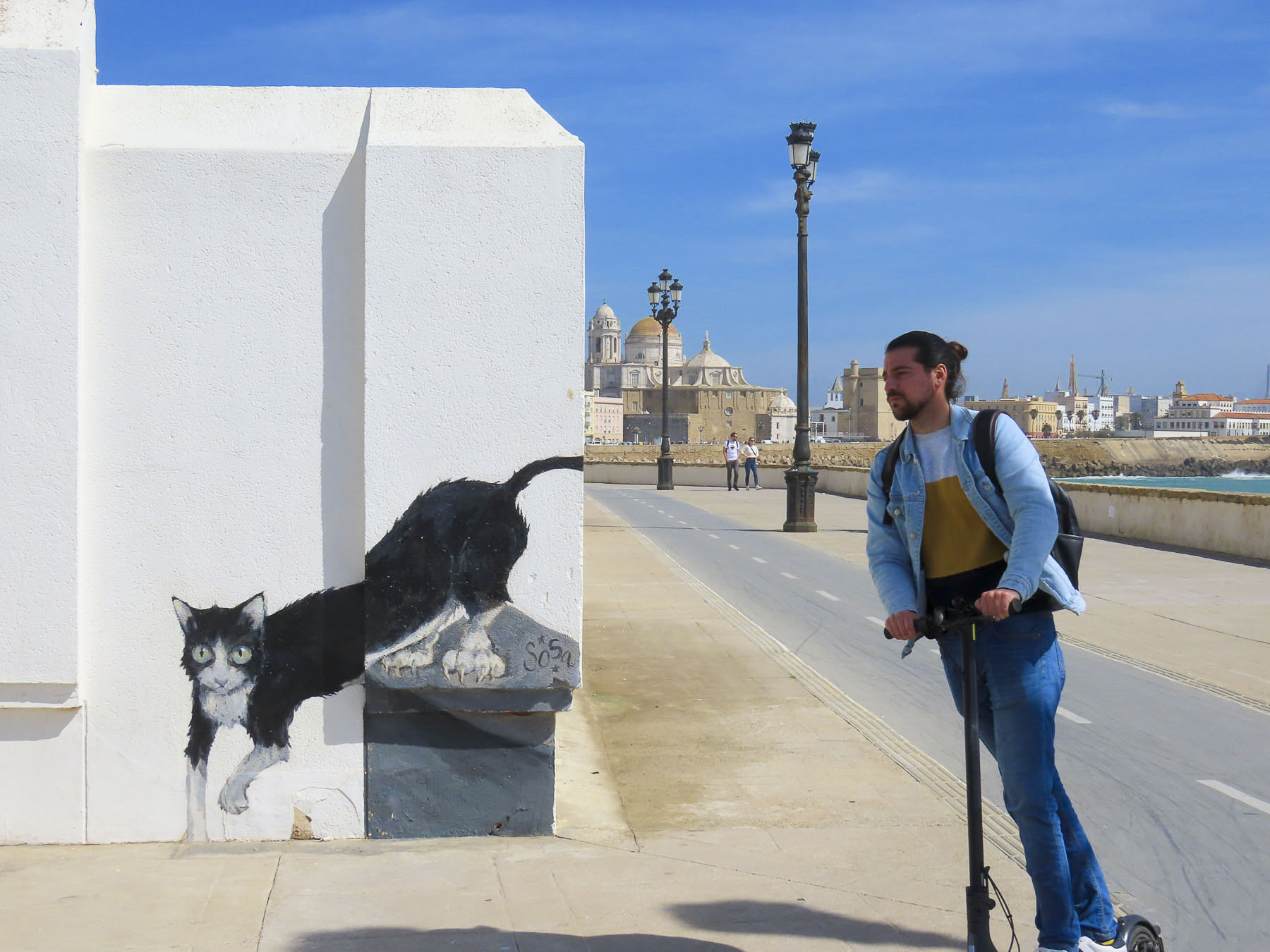
One of the nicest ways we experienced Cadiz was to walk along its seafront Malecón, a wide sidewalk that runs almost completely around the peninsula. The speedy can do it in a day. But why? Walk a little then café is our mantra.

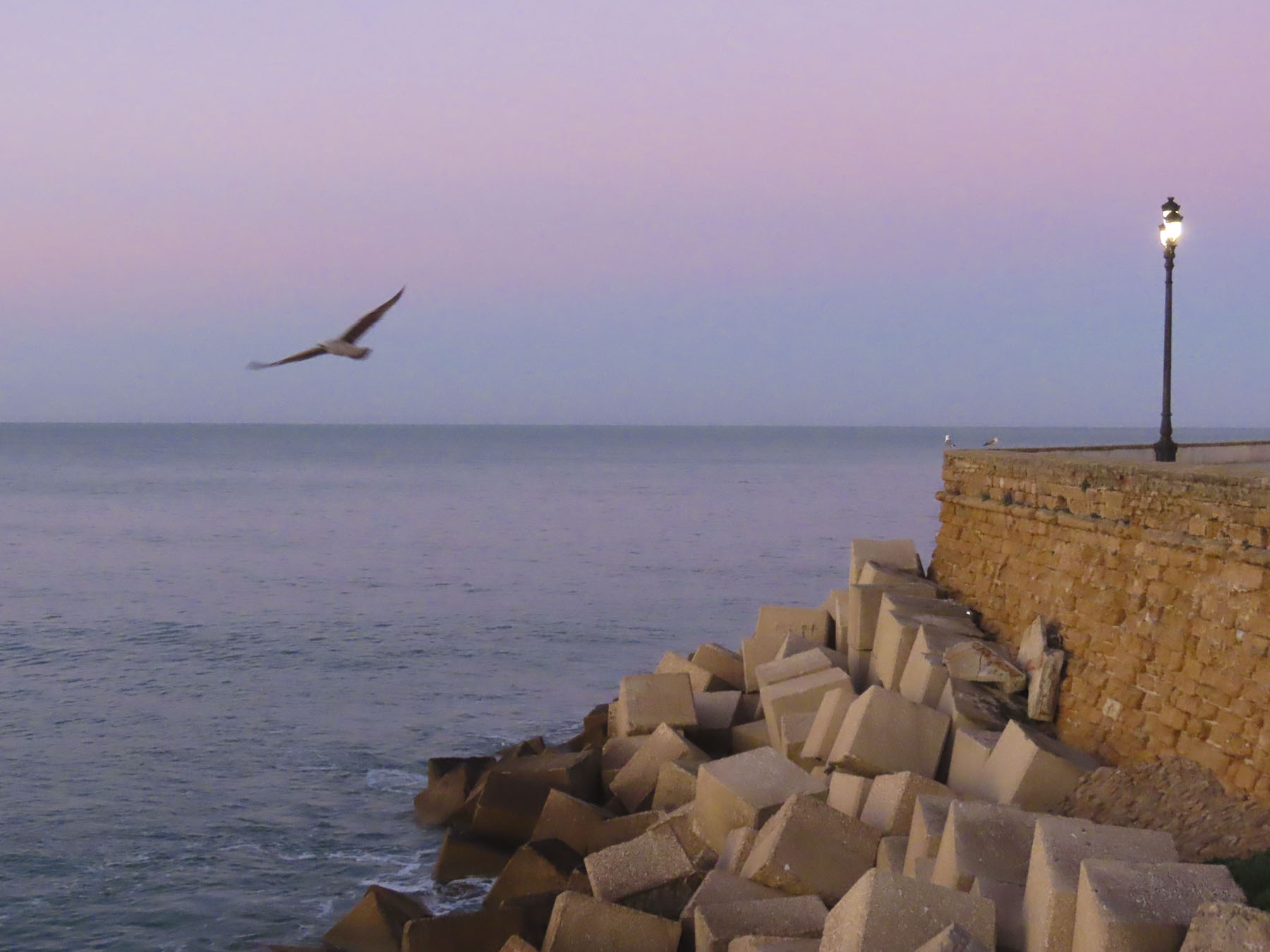
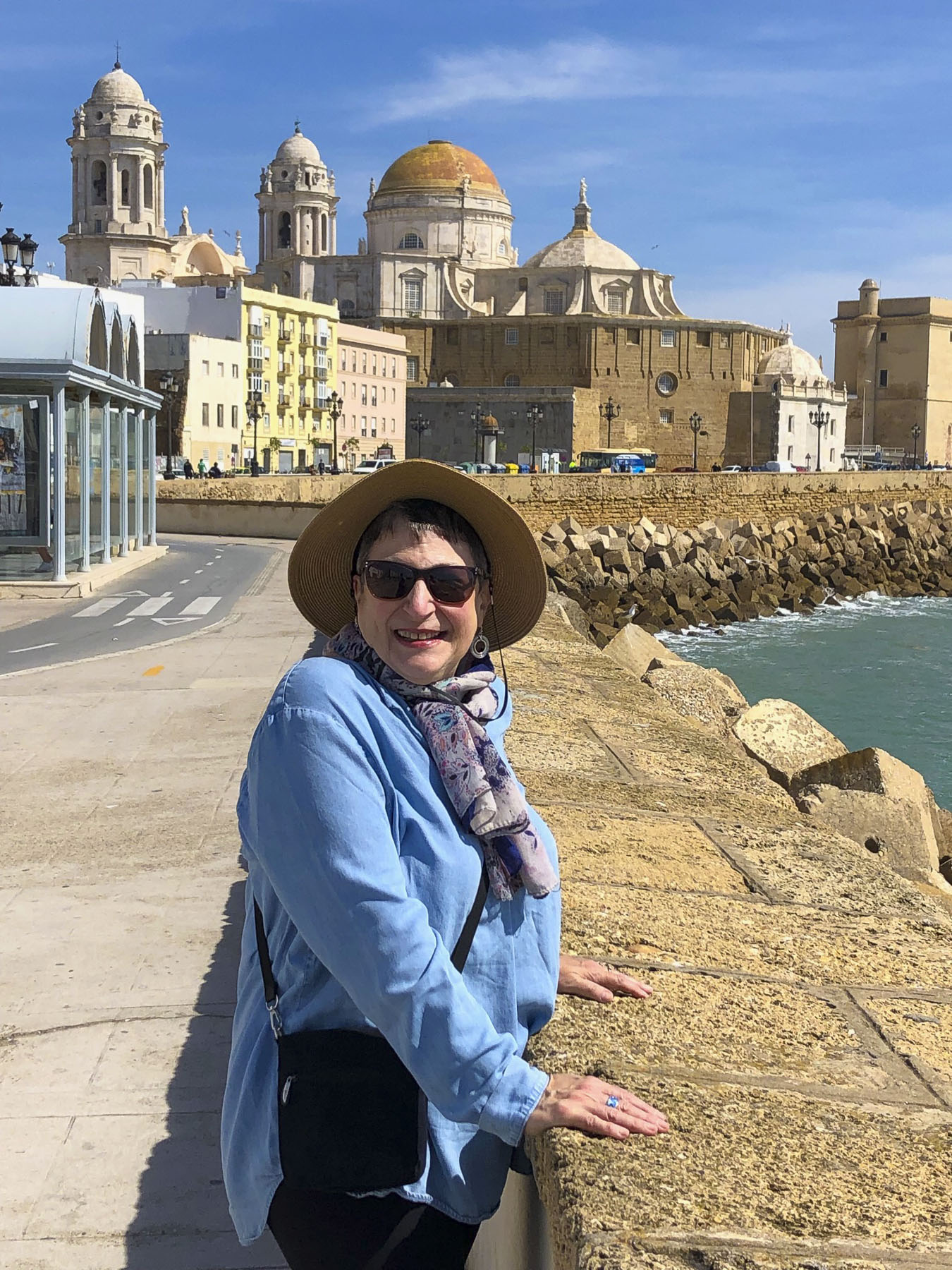
We enjoyed the brisk salt air and occasionally detoured when something caught our interest. Here we enjoyed the iconic view of the Malecón being caressed by waves as the Cathedral dominated the skyline behind it.

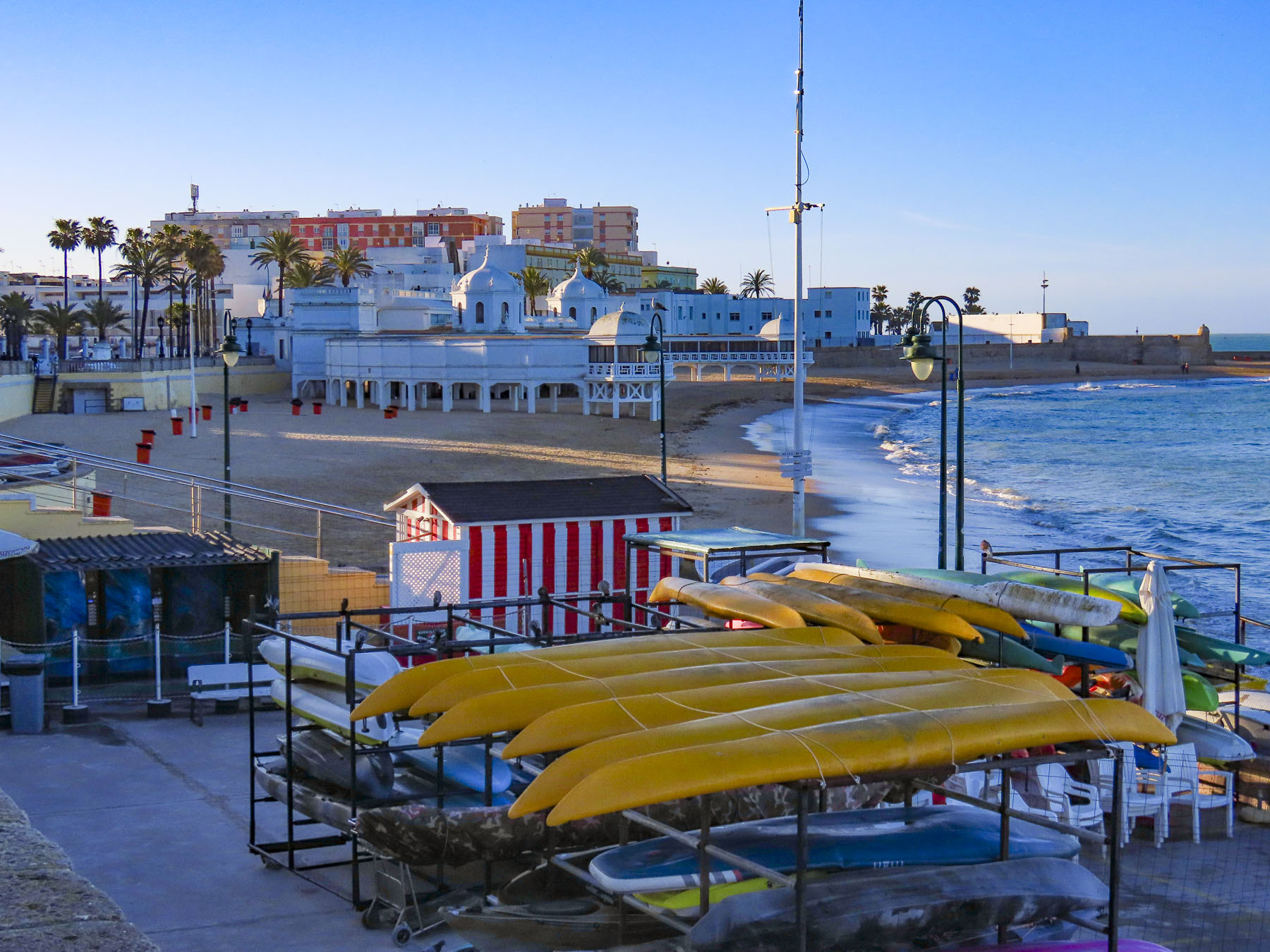
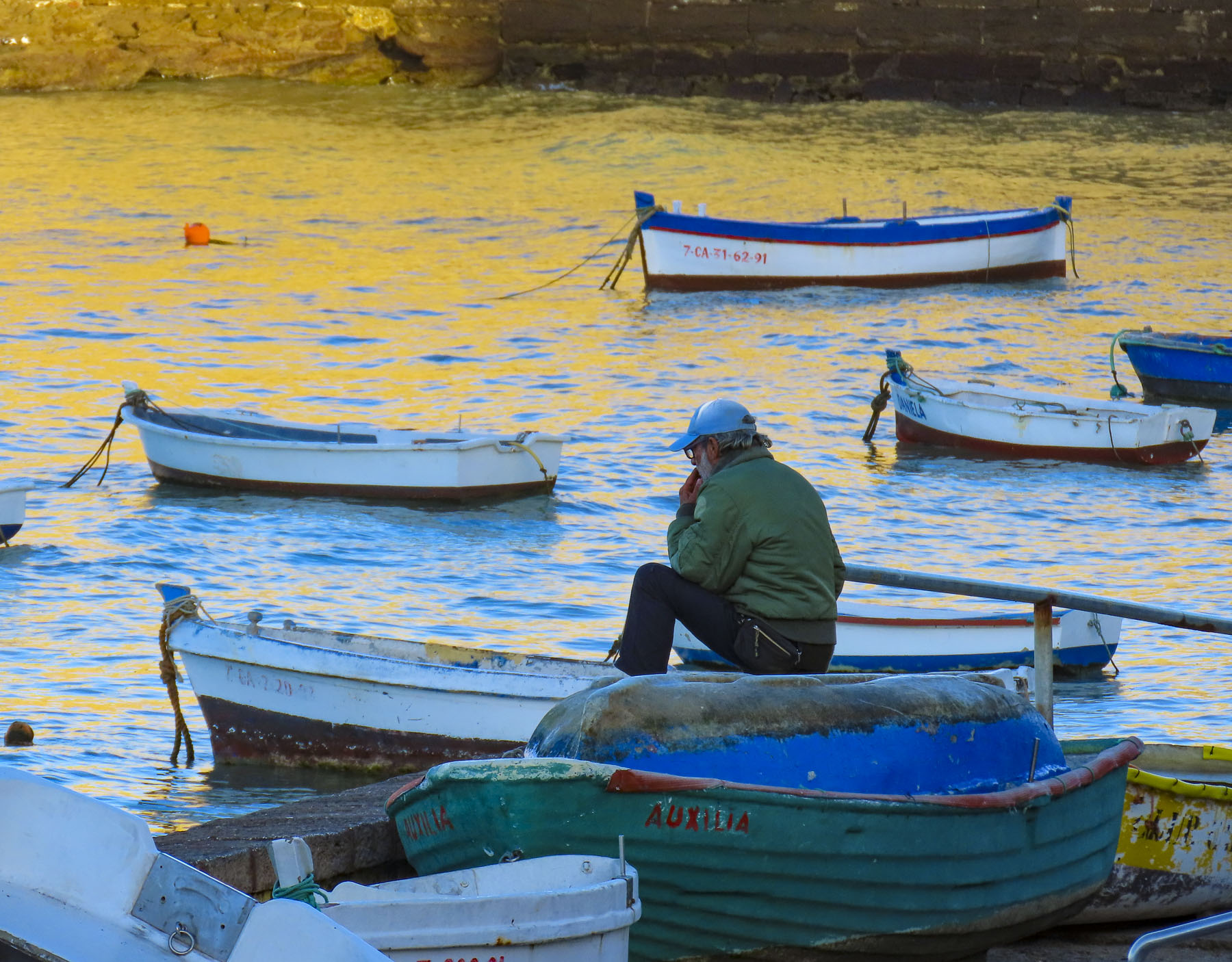
At La Caleta beach there are many chiringuitos, typical Spanish beach bars, for food, beer or a spritz. It’s okay to linger and people watch; we never were encouraged to move along. The beach is guarded by two ancient fortresses. The Castillo de San Sebastian is far offshore but can be reached on foot via a long causeway across the shallows that gets pounded with surf.  Onshore the Castillo de Santa Catalina commands the beach and has been recommissioned as an exhibit space for modern art and concerts. On the sunny afternoon in March when we visited, the beach had a good number of sunbathers enjoying a nice spring day.

Farther along, the Parque Genovés is noteworthy for a grotto, waterfall and a stately promenade of topiary evergreens that could rival Versailles.

Cadiz’s love of botanical gardens continues in the elegant Jardines de Alameda Apodaca which features formal walkways with monuments and statues, as well as fountains and pergolas. Along the waterfront, pensioners jangled fishing rods into the ocean in hopes of enticing fish to bite. There are also several grand centenarian ficus trees, with enormous branches that provide abundant shade, in this tranquil seaside park. Across from the park the pastel façade of the Iglesia del Carmén is noteworthy. While Cadiz has many churches, it is difficult to enter them, since most are open only for morning and evening mass.

Monuments celebrating the 1812 Constitution of Cádiz, Spain’s first short-lived constitution, stand in Plaza de Espana. For Europe it was a liberal document that established equality between Spanish-born Spaniards and citizens from their foreign colonies, ended feudalism, abolished the Spanish Inquisition and limited the power of the monarchy. When King Ferdinand VII returned to the throne in 1814, after the defeat of Napolean, he abolished the constitution and reinstated an absolute monarchy.

If you were a wealthy 17th century merchant in Cadiz it was popular to have a mirador tower atop your home, from which you could scan the harbor with a spyglass looking for ships that were important to your trade. Often the tops of the towers were festooned with the flags of various nations, colonies or family’s coat of arms, for a sea captain to identify and head to when he finally came ashore with news of his cargo. There were originally 160 of them in Cadiz. Several of the remaining ones can be seen from Plaza de Espana.

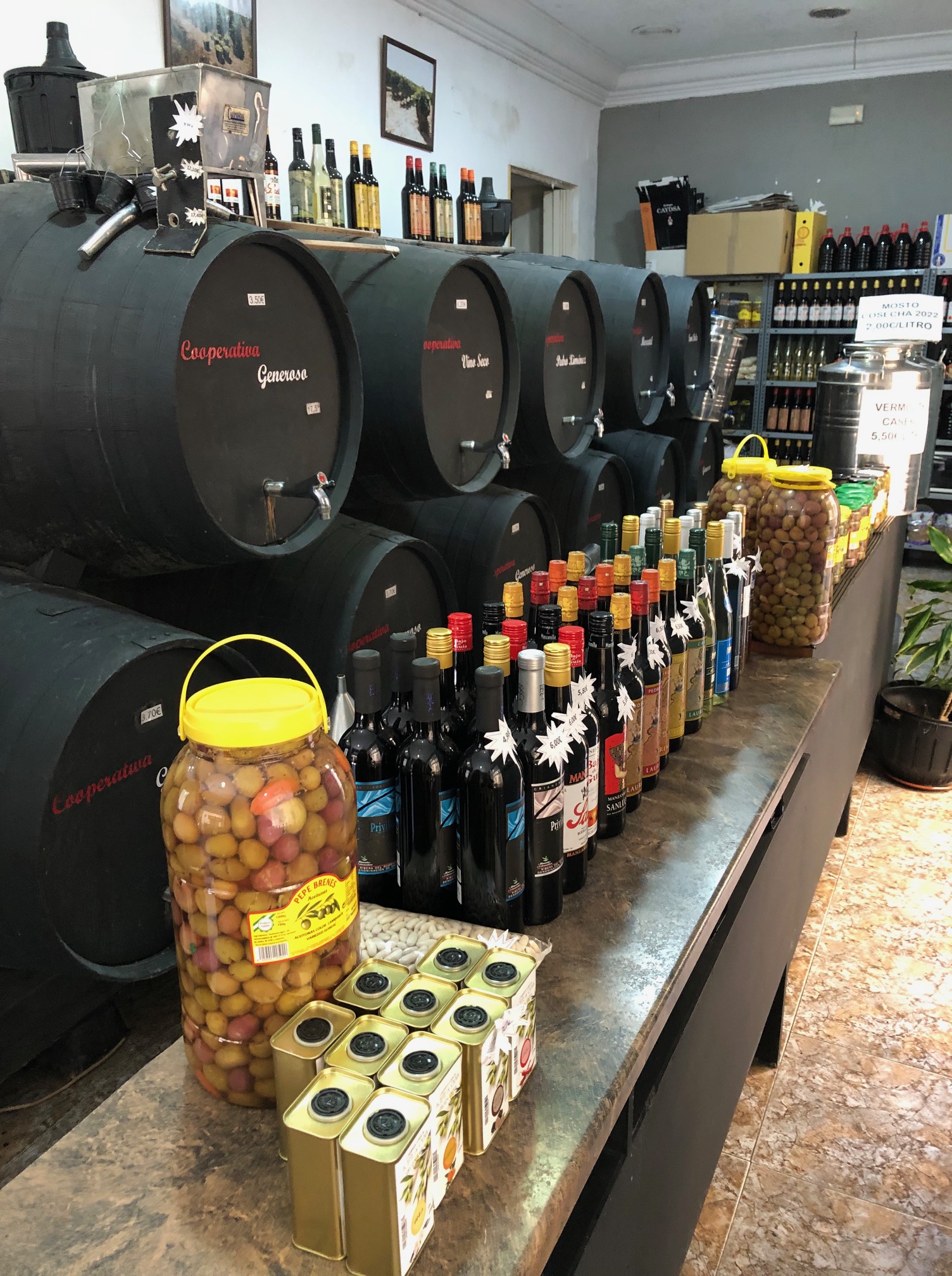
Walking back to our hotel later, we discovered a fantastic small wine shop, the Despacho de Vino Virgen de la Caridad, that specializes in Andalucian sherry, vermut and wine. Here they will fill your empty water bottles directly from the casks of wine behind the counter.

Cadiz with its touch of the Caribbean was the perfect sunny, friendly, seaside Andalucian town for us.

Thank you, Giulia, for the tip.

Till next time,

Craig & Donna

Jerez de la Frontera: Quiet and Captivating

For a moment I thought I was hallucinating, when the truck in front of us pulled away at the traffic circle and revealed a towering paranormal monster. A scene and song from GhostBusters! played through my mind. To say the least, this puffy creation was an odd introduction to a new destination, but Bibendum, or Bib, aka the “Michelin Man,” made us laugh.

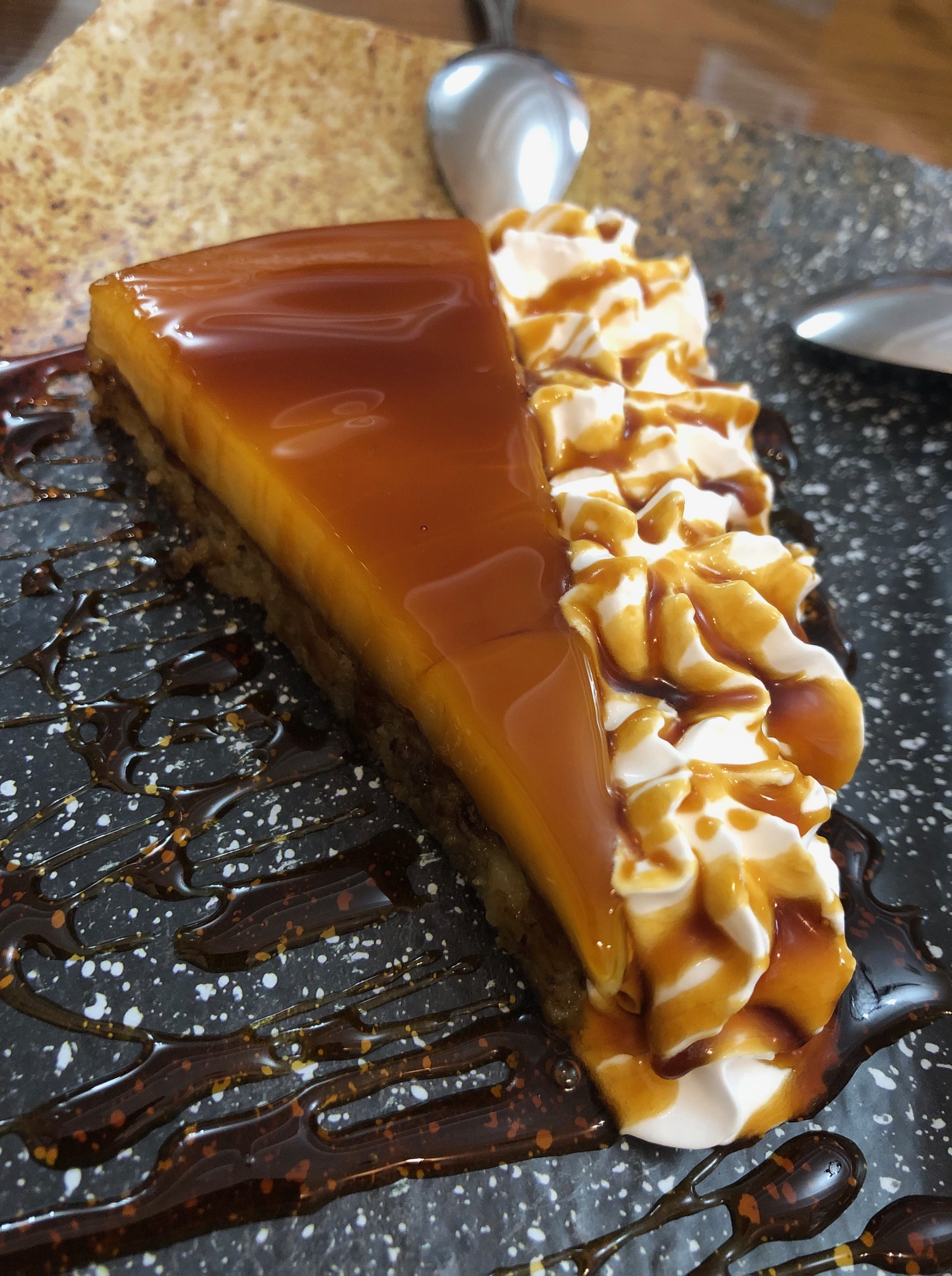
After a long day of travel, our stomachs were now growling from hunger and Donna quickly located a small neighborhood restaurant, Rincón de Castro. It was only a few blocks away from Bib, down a side street, on the outskirts of Jerez de la Frontera. Shouldering our day packs, we entered the taverna and were obviously tourists – from the puzzled looks we received it was clear they didn’t get many foreign visitors through their doors. It turned out to be a delightful meal. We apologized for our minimal Spanish, and as the waitress seated us she asked Javier, who spoke very good English, to help us through the menu. He suggested the sherry, our first glasses in Spain, an appetizer, and a main. All the dishes were very good and we were enjoying the sherry. “And with your cafe, have you tried Tocino de Cielo? It’s a traditional Jerez dessert.” The name of the dessert roughly translates to ‘heaven’s bacon’, which reflects the dessert’s color only and is a total misnomer for this wonderful flan-like creation. The nuns of Convento del Espíritu Santo have been credited with the divine inspiration for this sweet treat, first baked 600 years ago. They created a recipe to use the huge quantity of leftover egg yolks donated to the convent from the sherry producers of Jerez, who only used the egg whites to clarify their wines. The oldest convent in the city, it dates from 1430, and still stands near the Cathedral of Jerez de la Frontera, between the Bodega Tio Pepe and Bodegas Fundador. Thus began our vacation. We were off to a good start.

We hadn’t heard any buzz about Jerez de la Frontera when we started planning our March Andalucia road-trip. This was a decision sparked by a great deal on airfare. Ultimately, we were headed to Cadiz, a destination highly recommended by our Italian friend Giulia several years ago. While planning the trip, we learned that Malaga, Seville, and Jerez de la Frontera all had good regional airports. We’d lived in Seville for a month several years ago and totally enjoyed immersing ourselves in the city’s life. But this would be a short two-week adventure and we didn’t want to repeat anything. Malaga, on the Mediterranean, seemed too far and we decided we would save that city for another time. And then there was Jerez de la Frontera, which looked surprisingly fascinating, when I started clicking around Google maps. We say surprisingly, because really it gets very little notice, even though it anchors the Sherry Triangle, an area that extends from Jerez northwest to Sanlúcar de Barrameda on the Atlantic coast, and south to El Puerto de Santa Maria, near Cadiz. It’s a quiet off-the-beaten-path destination, especially in the shoulder season. Larger than Cadiz, smaller than Seville, the city was the perfect size for a three-night, two-day stay, after arriving XRY.  We don’t like to admit aging, but twenty hours of airports and flights takes a toll on us.  So now that first afternoon after we land is spent recovering: airport, rental car, food, hotel in short order.

We emerged from the underground parking at the Plaza del Arenal, onto a large square centered with a bubbling equestrian statue, surrounded by empty tables. We would learn that come 8:00 every evening this would all change when folks filled the restaurants, tapas bars and side streets around the plaza with activity.

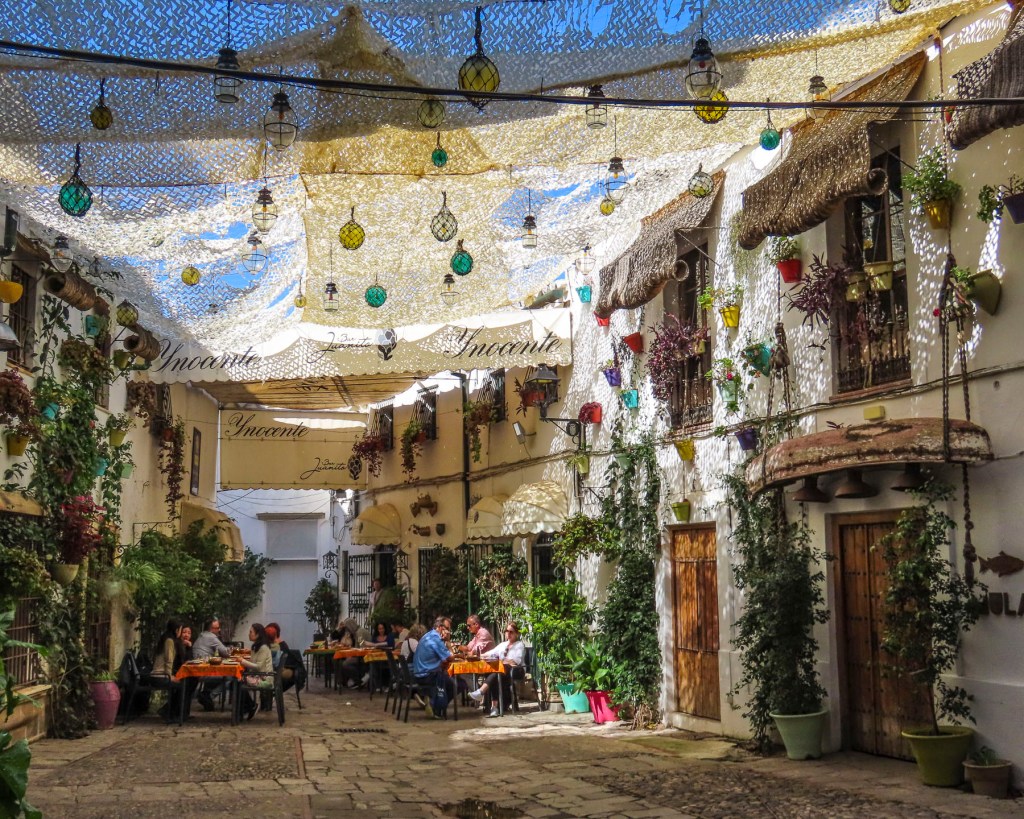
Following our host’s directions, we crossed the plaza and entered an arched alley that opened to the sky when it reached a small courtyard between the buildings. Shade netting strung across the alley created a picturesque play of light on the diners outside Bar Juanito.

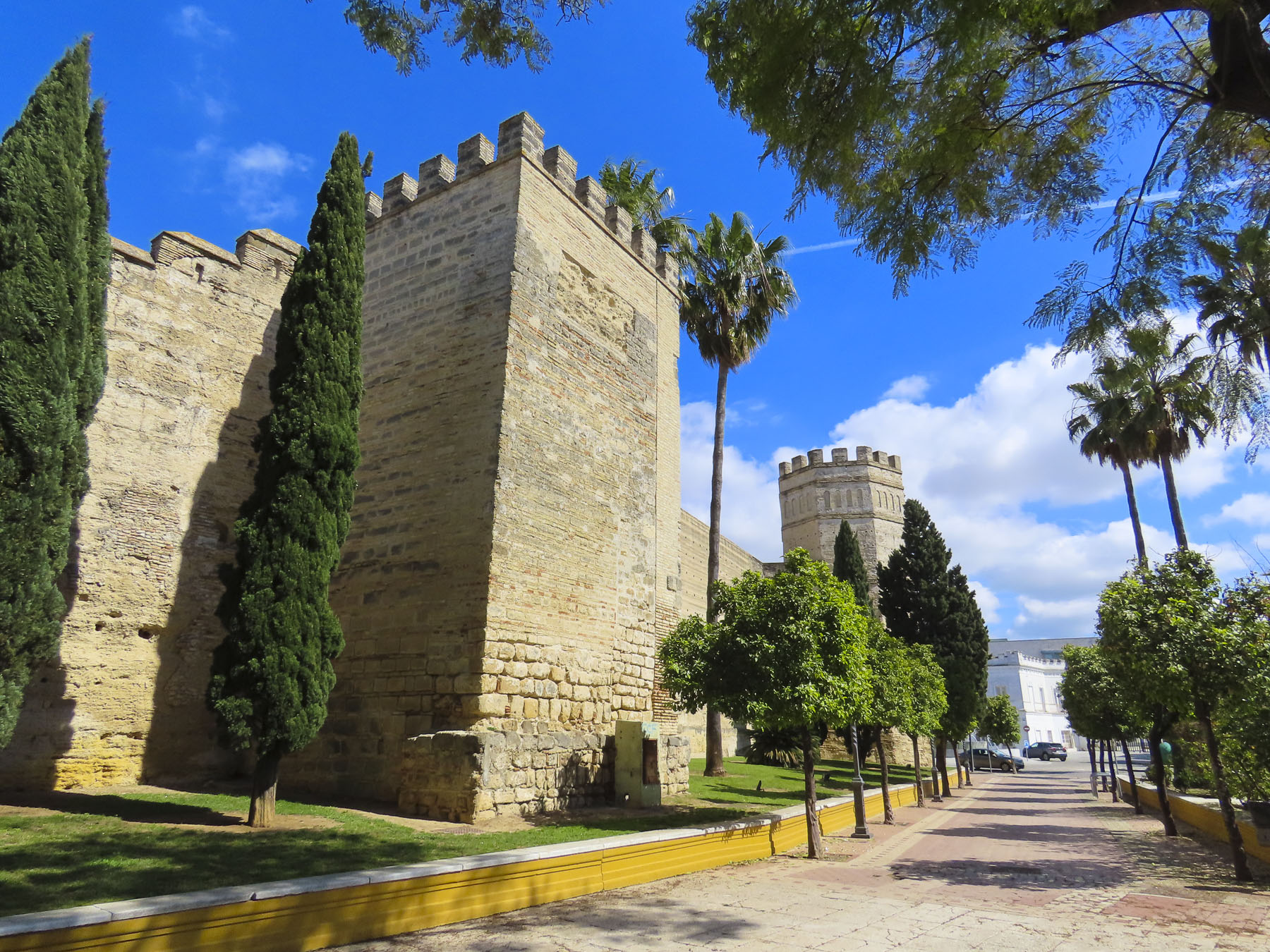
The restaurant was just around the corner from our lodging at the Palacio del Virrey Laserna, a 13th century palace that has remained in the same family for several centuries. While the name is quite impressive, being a palace and all, and it does have some nice antiques along with some interesting décor in the guest wing, it feels a little tired. Perhaps this is an unfair criticism for an ancient family home. A tour of the private part of the palace was included in our room rate. Sadly, they restrict photos in this part of the palace, which is filled with fascinating ancient memorabilia and furniture collected from Spain’s various colonies at the apex of its empire. Interestingly, in 1264, it was one of forty Moorish properties given as a reward to the knights that valiantly served King Alfonso X during the Reconquista of Jerez. Located only a short distance from the Alcazar, the old Moorish fortress, its proximity and size indicated it was once the home of an important Moor.

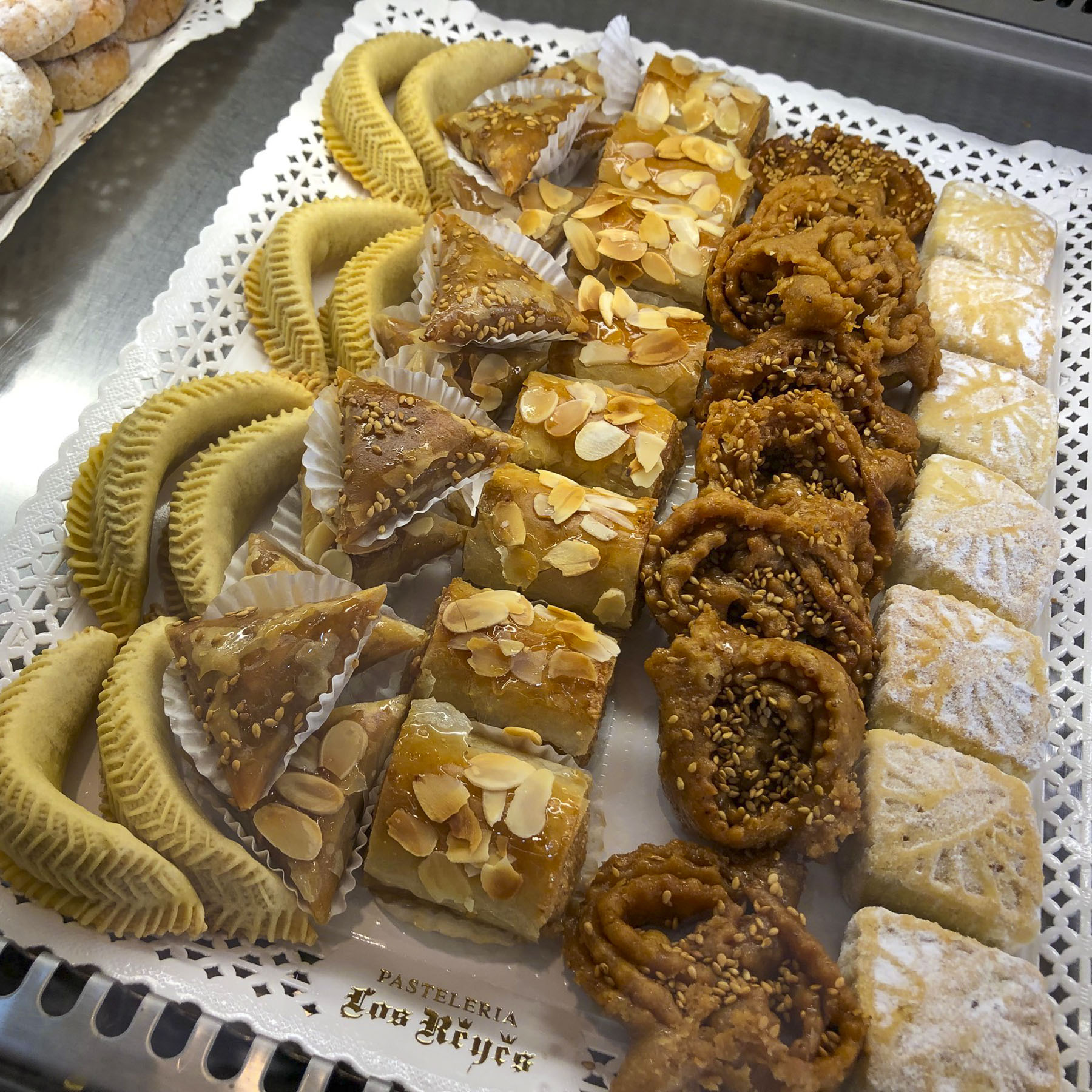
As nice as the ambience was on the Plaza the del Arenal, prices were rather steep, so the next morning we walked down a side street off the square to Los Reyes Pastelería. One of everything would have been our first choice. Yum!

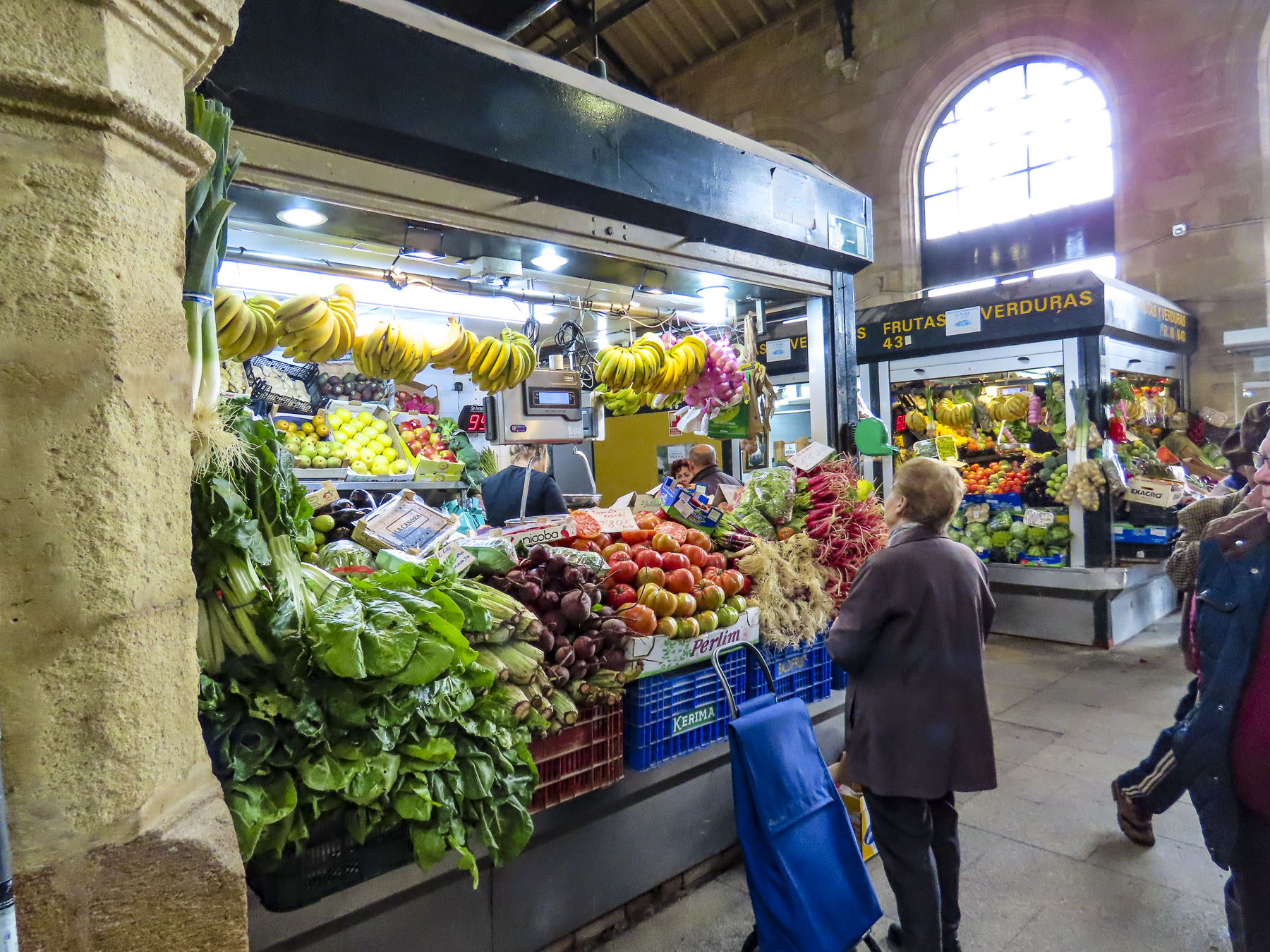
Later that morning we worked our way to the Mercado Central de Abastos, one of the oldest covered markets in Spain dating back to 1837. It has become part of our travel ritual to explore the central markets in the cities and towns we visit. The ones in Spanish cities close to the ocean are especially rewarding, as vendors display fresh seafood, shellfish, prawns and sea urchins. The Andalucia bounty doesn’t stop there. Olives, sausages, cheeses, and vegetables galore. And of course, jamon! The finest being named Pata Negra, in reference to their black hoofs. This jamon comes mostly from three villages, Jabugo, Cortegana, and Cumbres Mayores in the Sierra de Arecena mountains, two hours north of Jerez. Here the free-range pigs are raised on an organic diet of only acorns which imparts a unique flavor to the jamon. We made some purchases for a snack later.

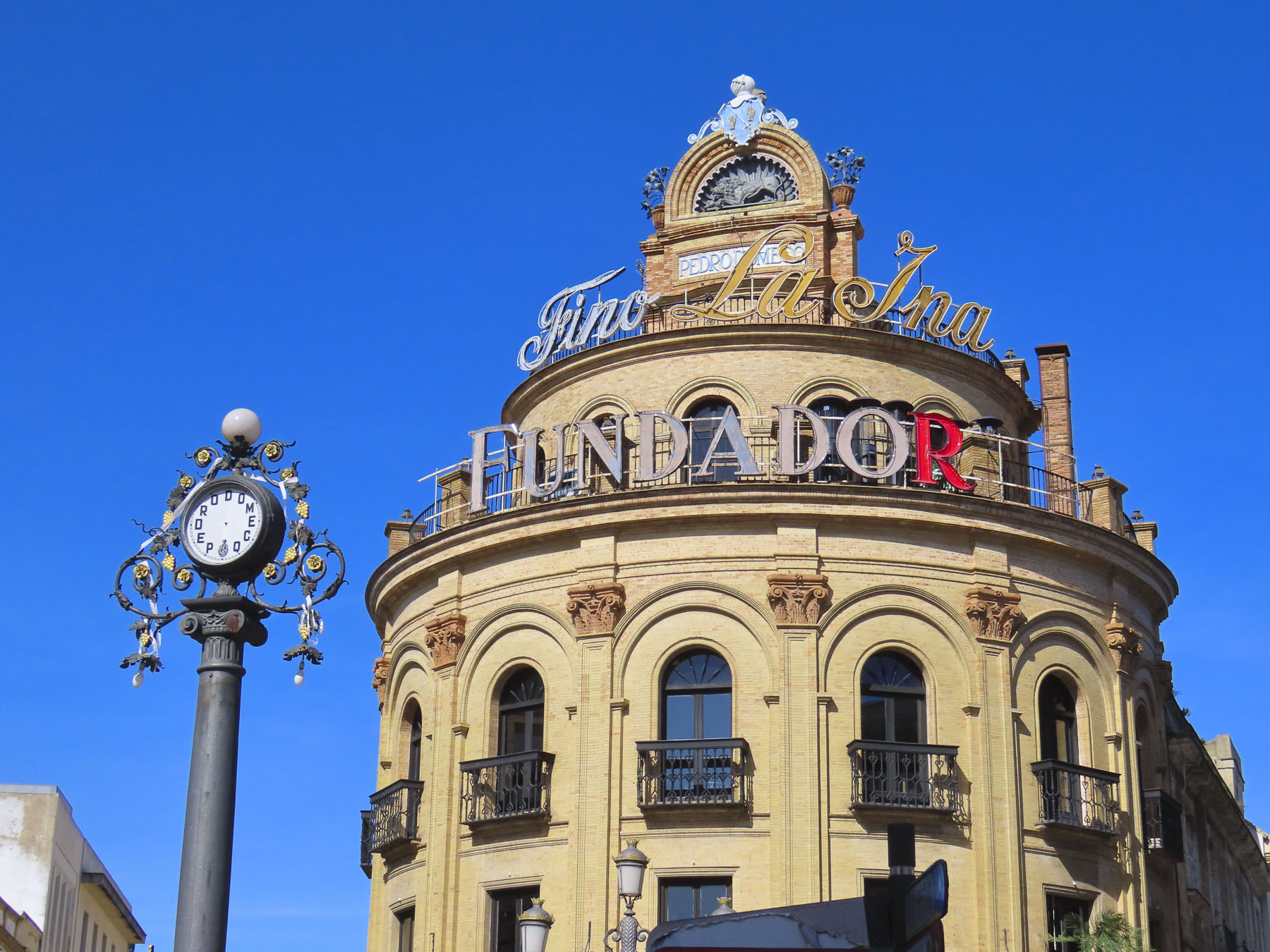
Around the corner from the market the iconic Fundador sign sits atop a historic building which is home to an equally famous 100-year-old bar named the Gallo Azul, or Blue Rooster. Known for its 6th floor semi-circular bar, interesting interior, and view of Jerez from its windows, it was unfortunately under renovation when we were in the city but is now open.

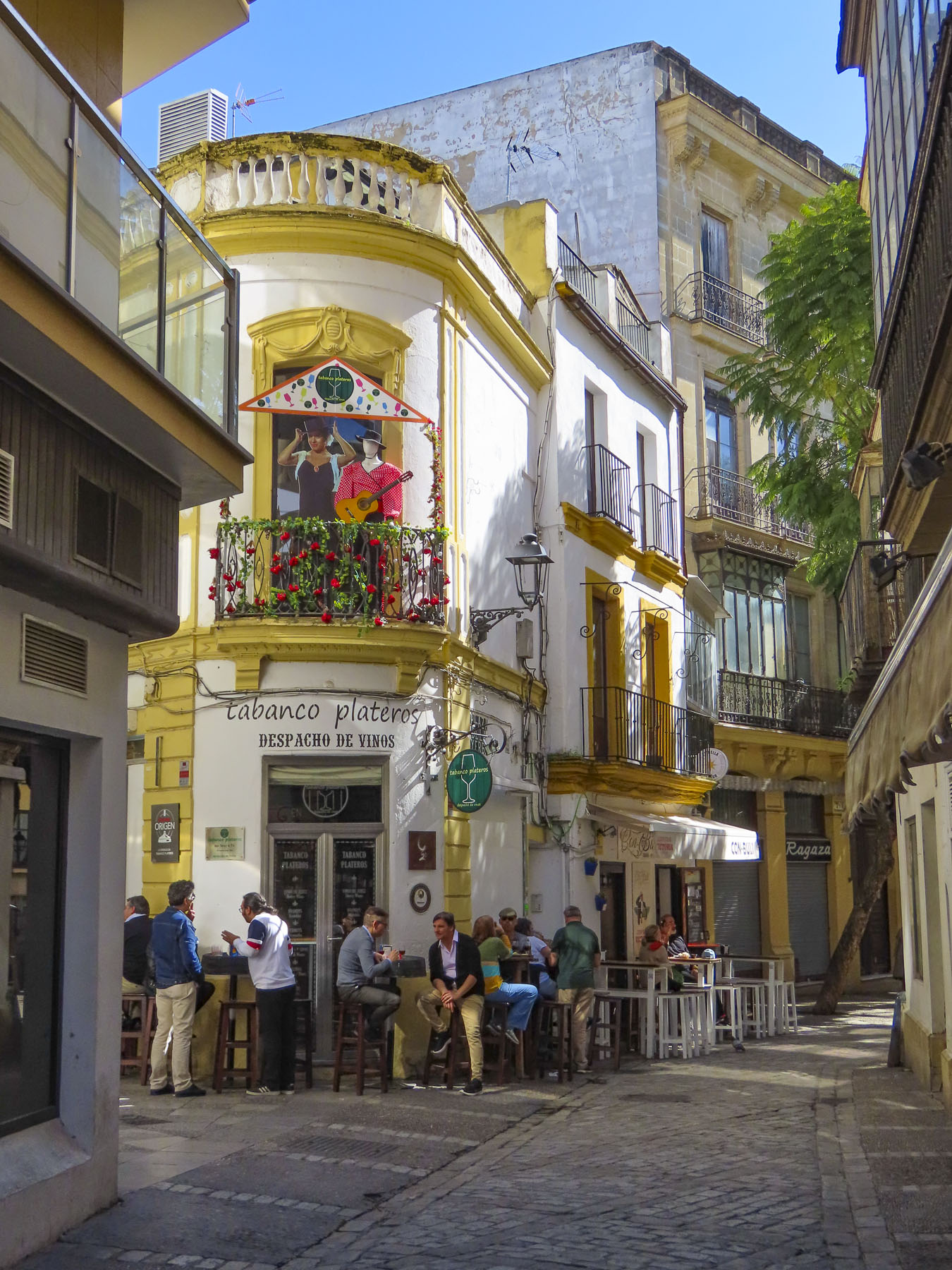
Walk a little then café was our philosophy as we wandered our way across Jerez towards Plaza de la Yerba and Plaza de la Asunción. There seems to be an infinite number of eateries across the city to the point that it feels like are more restaurants than retail shops. The dilemma is that they all look so inviting.

We were in Jerez several weeks before Easter and signs of Holy Week preparations were evident at the Plaza de la Asunción, where reviewing stands surrounded the plaza in front of the ancient City Hall and Real Iglesia De San Dionisio Areopagita. Built in 1575, during the reign of Felipe II, the façade of the old town hall is covered in ornate relief carvings depicting popular Renaissance motifs and is considered one of the finest examples of Andalusian Renaissance architecture. Though now, its weathered stonework is in need of some tender-loving care.

The church across the plaza stands in austere beauty by comparison, its simple 15th-century Gothic-Mudejar architecture the perfect backdrop for the monument to la Virgen de la Asunción, centered in the plaza before it. Interestingly, the monument was a relatively new addition to the plaza in 1952. It was created by the legendary religious sculptor Juan Luis Vassallo, from Cadiz, whose many monumental pieces can be seen atop buildings and in public spaces across Spain.

The church’s belltower was originally a civilian construction in 1447 to serve as a watchtower to spot attackers or fires. Several years later the town’s first public clock was installed on it. The inside of the church features an 18th-century baroque interior. In preparation for Semana Santa, the statue of the Virgin stood in one corner dressed in her ceremonial attire. Maybe it’s just me, but I think there was a Barbie as Scarlett O’Hara, from Gone with the Wind, theme happening?

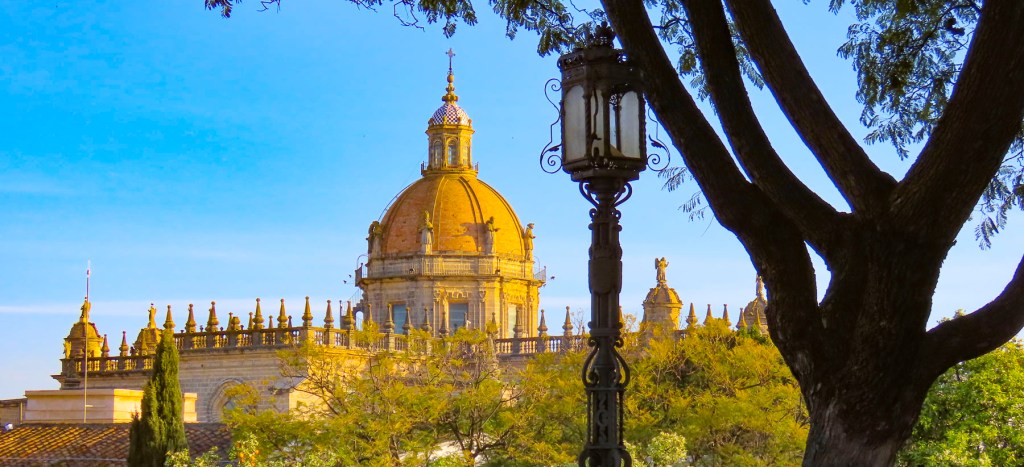
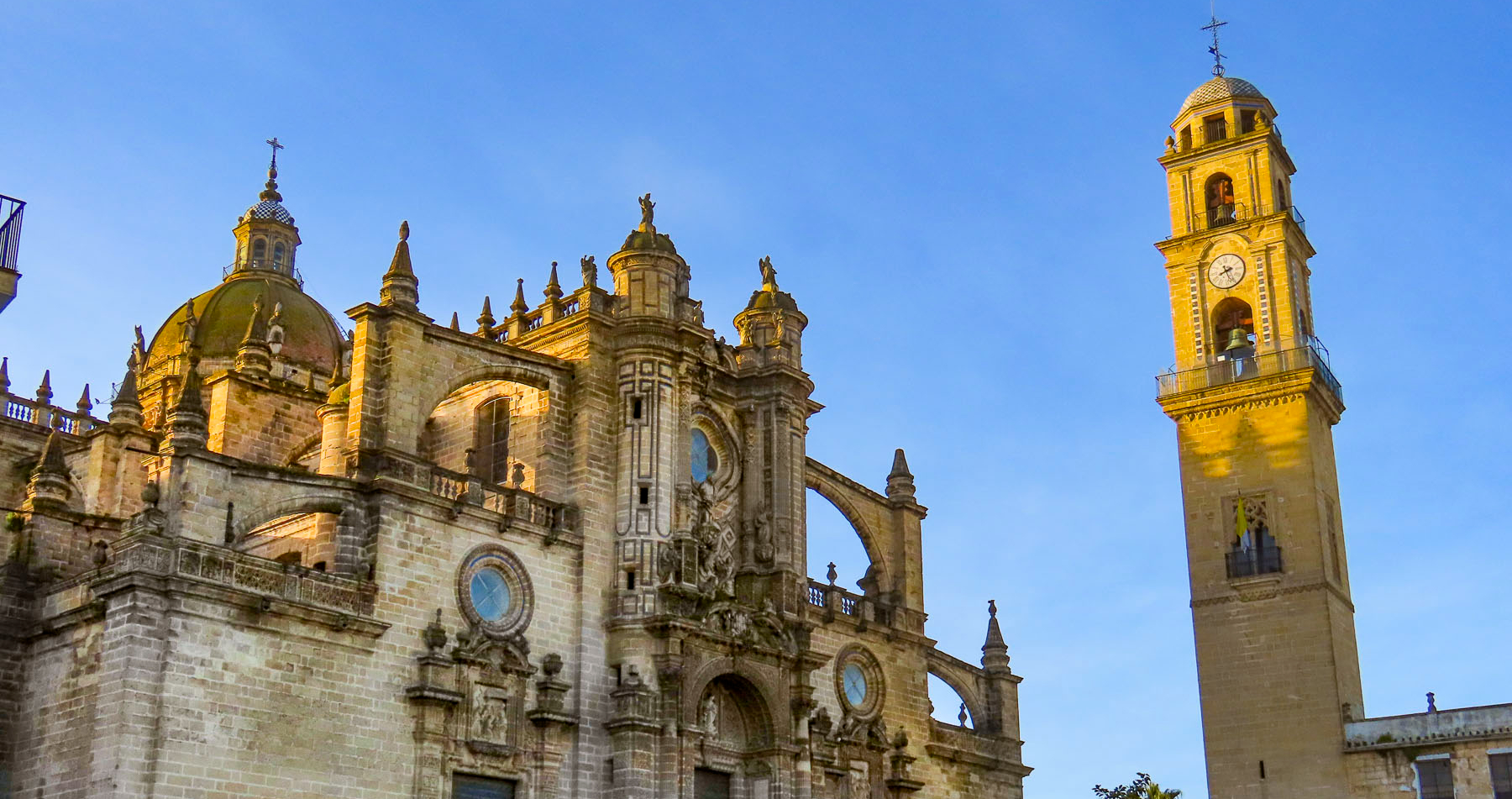
A huge church needs a significant name to match it and the Cathedral of Jerez de la Frontera / Colegiata de Nuestro Señor San Salvador successfully fills this obligation. It’s a massive structure supported with flying buttresses that we were able to get an aerial view of from the belltower across the way. It’s thought the belltower was reconfigured around a minaret that was part of the Great Mosque of Jerez before the reconquest.

With a special tax on sherry wine approved by the crown, construction of the cathedral was started in 1695. The first worship service was held sixty years later, but it would take another twenty years before the church was completed.

Inside the church is very austere, but voluminous. The soaring ceilings of the cavernous space is supported by monumental Corinthian columns, the width and height of giant sequoia trees. The huge doors on the ends of the naves dwarfed us. It was an enormous engineering feat.

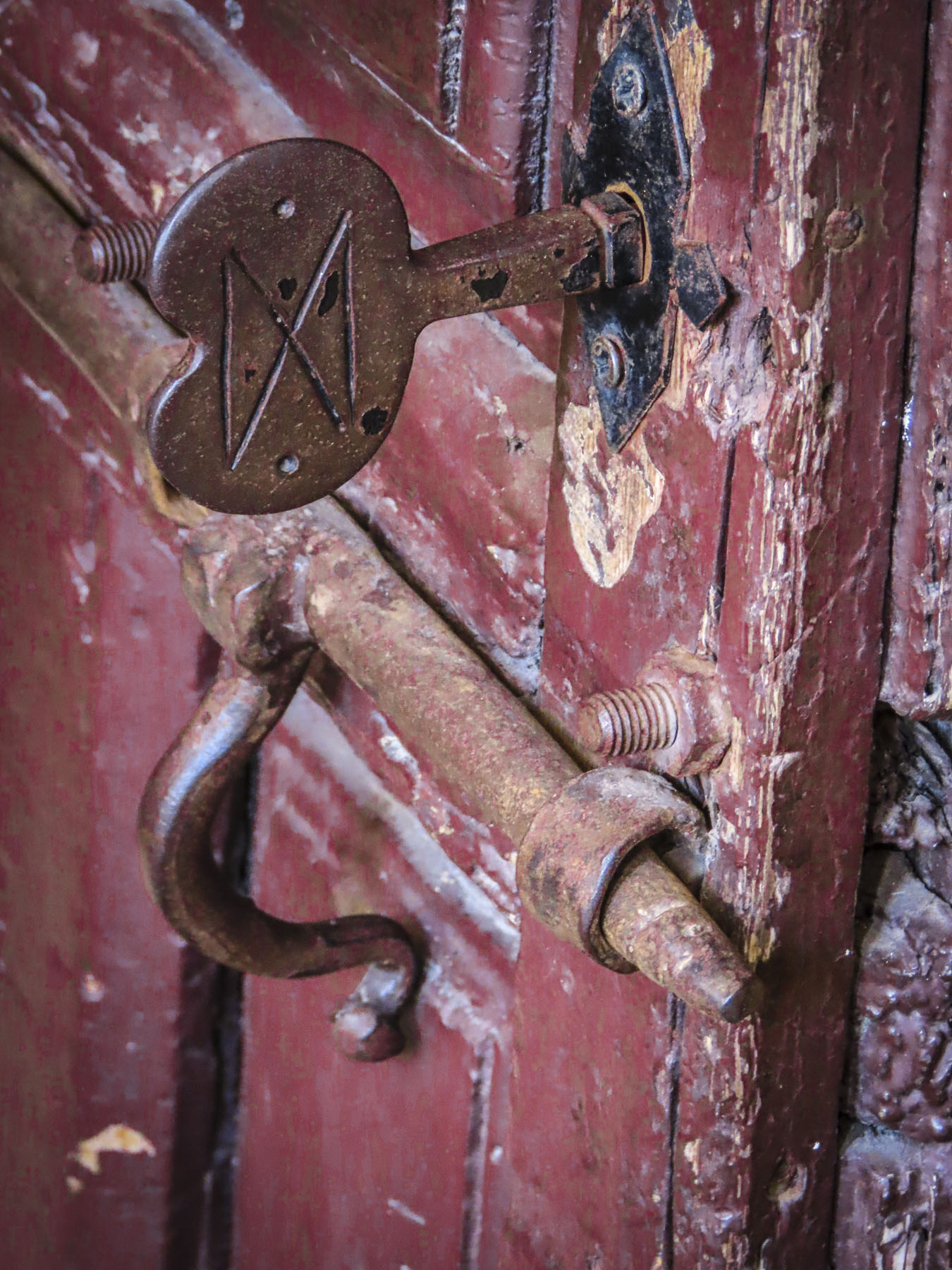
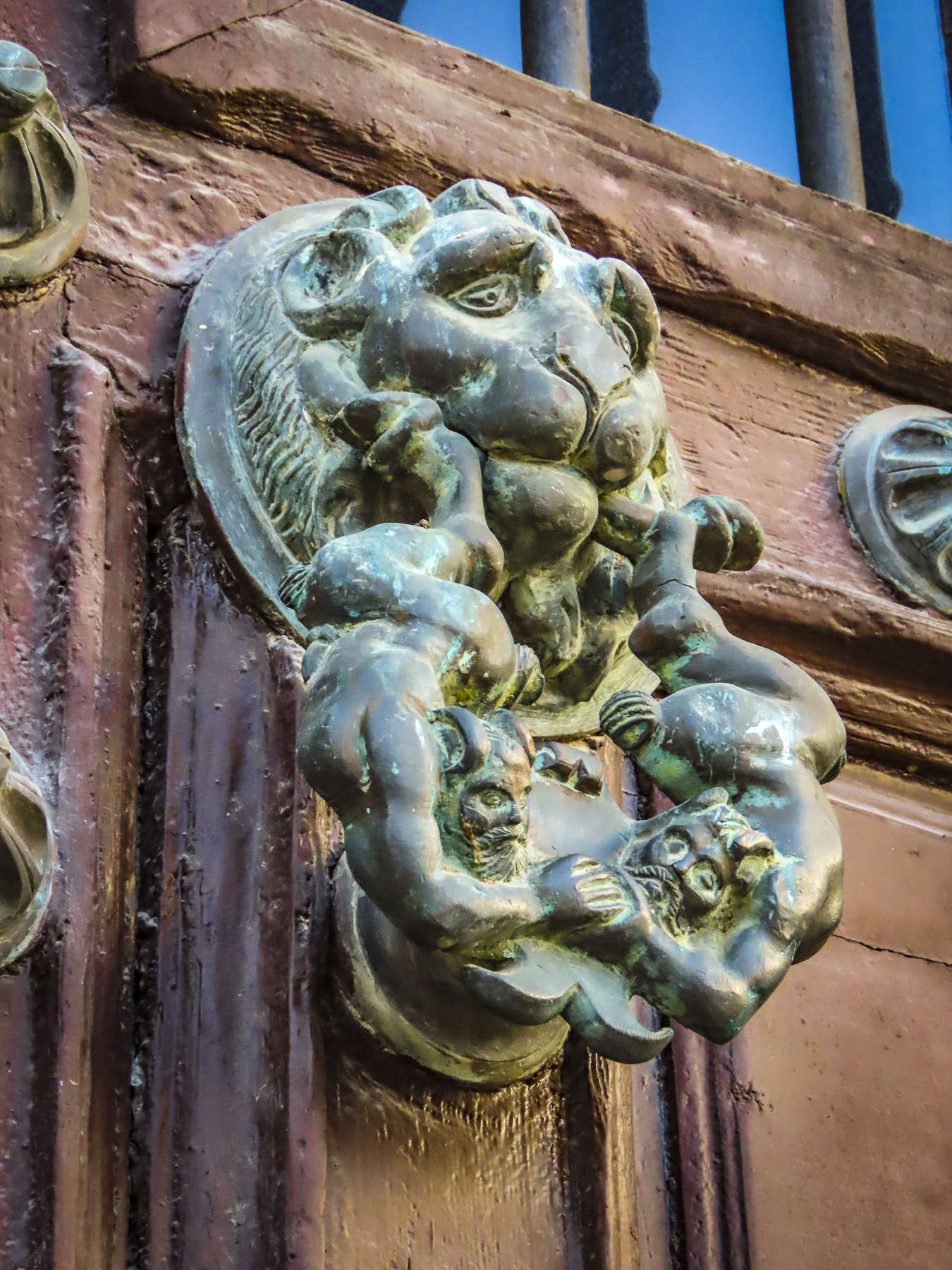
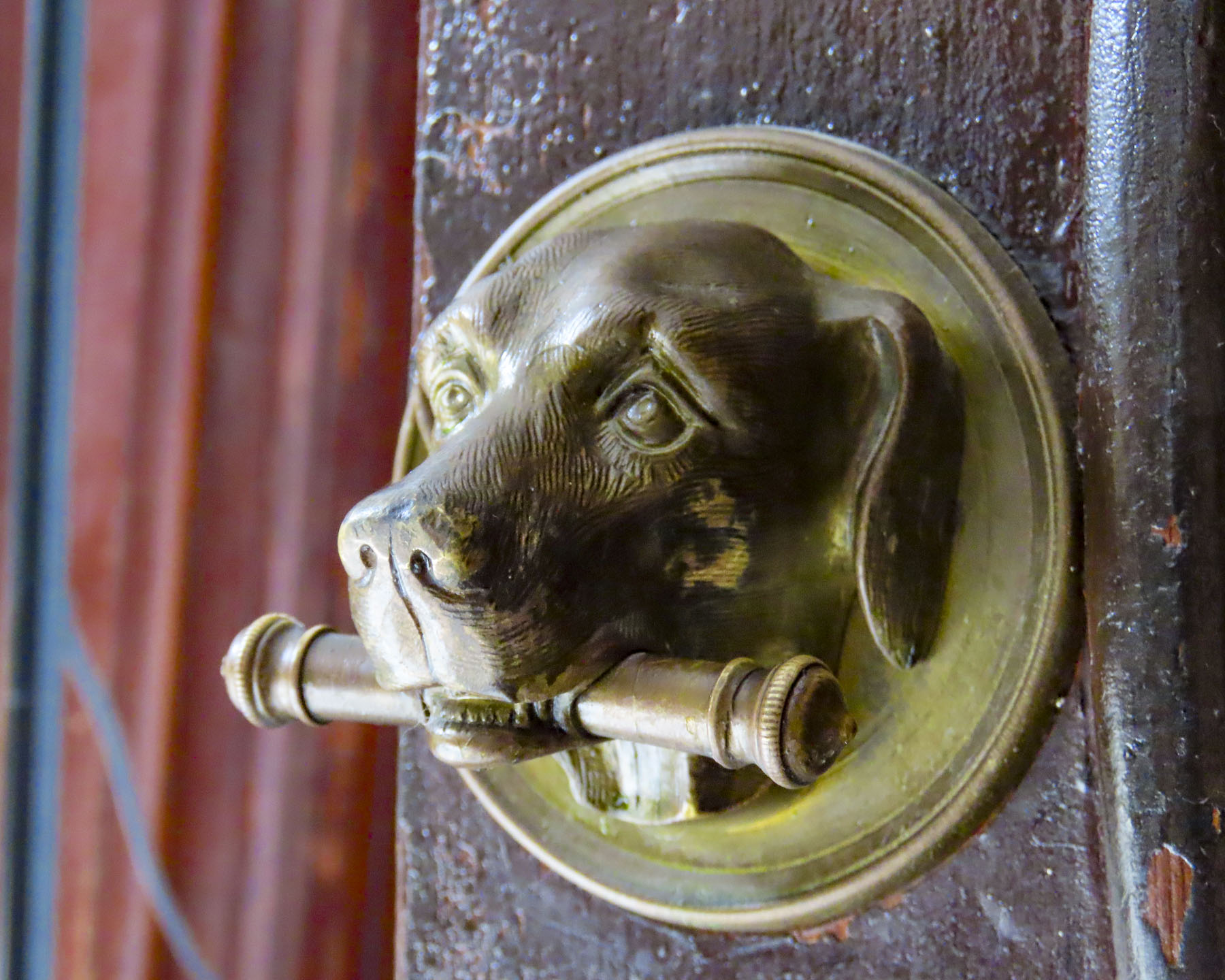
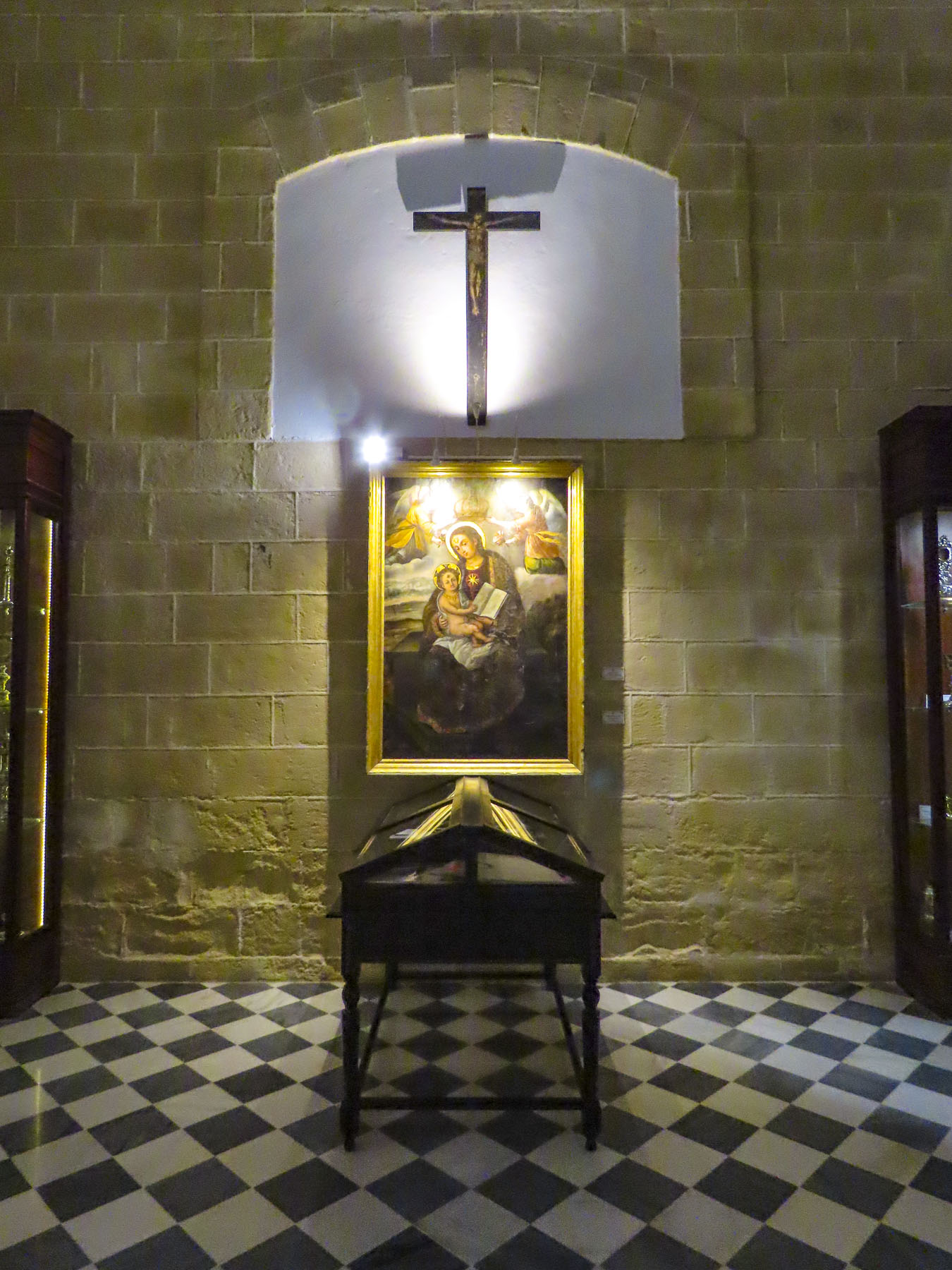
The sacristy was interesting with a display of the church’s treasure. The old-world craftsmanship in the archaic religious objects was amazing. An odd detail was two doorknobs sculpted as dog heads. We asked the attendants if they knew the story behind them, but no. They were a playful insight into the mind of God’s representative in Jerez. In one corner a small alcove revealed a nautilus staircase that spiraled aloft. Disappointingly, it was roped off and Donna was unwilling to create a diversion for me to explore further.

Walking by along the bodegas of Gonzalez Byass, famous for its sherry aging warehouses, we made our way through a lovely, shaded park to Taberna La Sureña, a small tavern across from the Alcazar. “No se permite hablar de política, religión o deportes,” roughly translated as no talk of politics, religion or sports allowed, was wisely written in chalk above the bar. It’s a small space with only three tables inside and three on the sidewalk. We snacked on two local cheeses with sausage, crunchily addictive picos (a mini dry bread stick,) and our first taste of vermut, or vermouth, that wasn’t part of a martini. It was a wonderful, flavorful revelation. Though sherry and vermouth are considered fortified wines because brandy is added after fermentation, vermut additionally gets infused with spices and aromatic herbs. Flavorful and complex, the local vermut became our wine of choice during our trip through Andalucia.

Across the way the Alcazar of Jerez beckoned for exploration. The history of all the towns in Andalucia is complex, with loosely associated tribes, Phoenicians, Romans, Vandals and Visgoths. It wasn’t until the Moorish rule of the region between the 8th and 13th centuries that Jerez underwent a period of great urban development. It was during this time that the city was ringed with a defensive wall and the Alcazar was expanded to become a fortified palace and city-within-a-city, with its own separate economy, supported by a granary, warehouses and olive presses. With the Christian Reconquista in 1264 the Alcazar became the seat of the first Christian mayors of the city and the palace was used by royal visitors. The addition de la frontera (“of the frontier”) to cities’ name reflects that this was a hotly contested region, with an expanding and contracting border for many decades.

The discovery of the Americas in 1492 brought prosperity with the export of wine to Spain’s colonies in the New World. Interestingly a conquistador from Jerez, lvar Núñez Cabeza de Vaca, survived an ill-fated expedition which explored from the gulf coast of Florida to Texas. Surviving capture and enslavement by Indians, he and three compatriots trekked across the wilderness for eight years before being reunited with fellow Spaniards along the Gulf of Baja on the Pacific coast of Mexico. In his book La relacion y comentarios del gouernador Aluar Nuñez Cabeca de Vaca, the documenting of the native American tribes he encountered is so unique that he is regarded as the first ethnologist of the American southwest.

The ancient olive oil press at the Alcazar is huge. Touring the supporting production rooms with smaller presses and underground ceramic storage vats reinforced the importance of olive oil to the local economy centuries ago. A path through the gardens led to the old hammam. Centuries ago, it must have been quite an impressive structure with cool and hot baths, surely a luxury back then. The scale of the hammam is best seen from atop the fortress walls, some of which were constructed using a rammed earth technique.

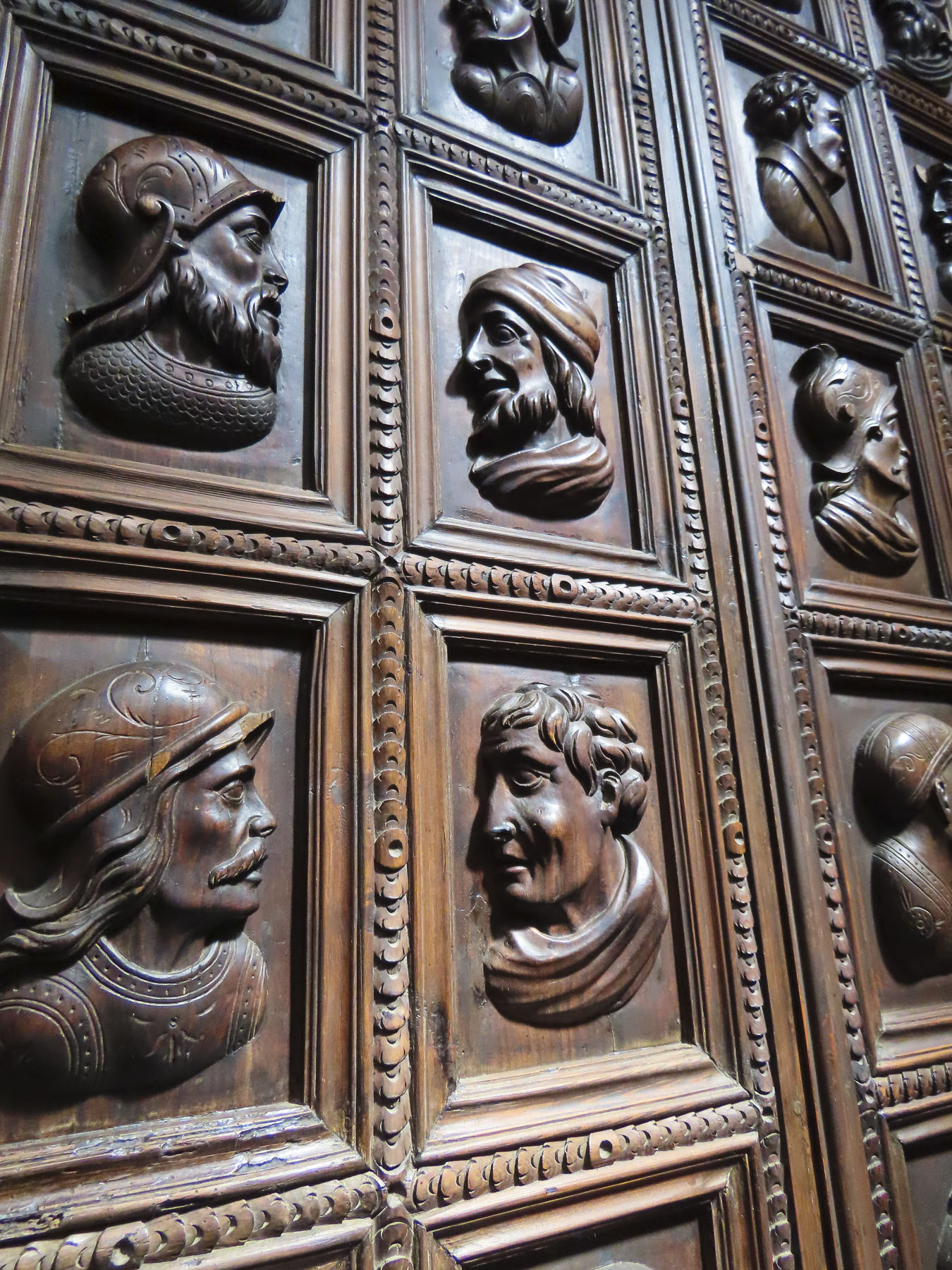
We found the palace, renovated to a utilitarian boredom, the least interesting part of the grounds. Though it did have an intriguing set of wood doors carved with the profiles of famous citizens. And on the highest level there is a nice view of the Cathedral of Jerez across the park.

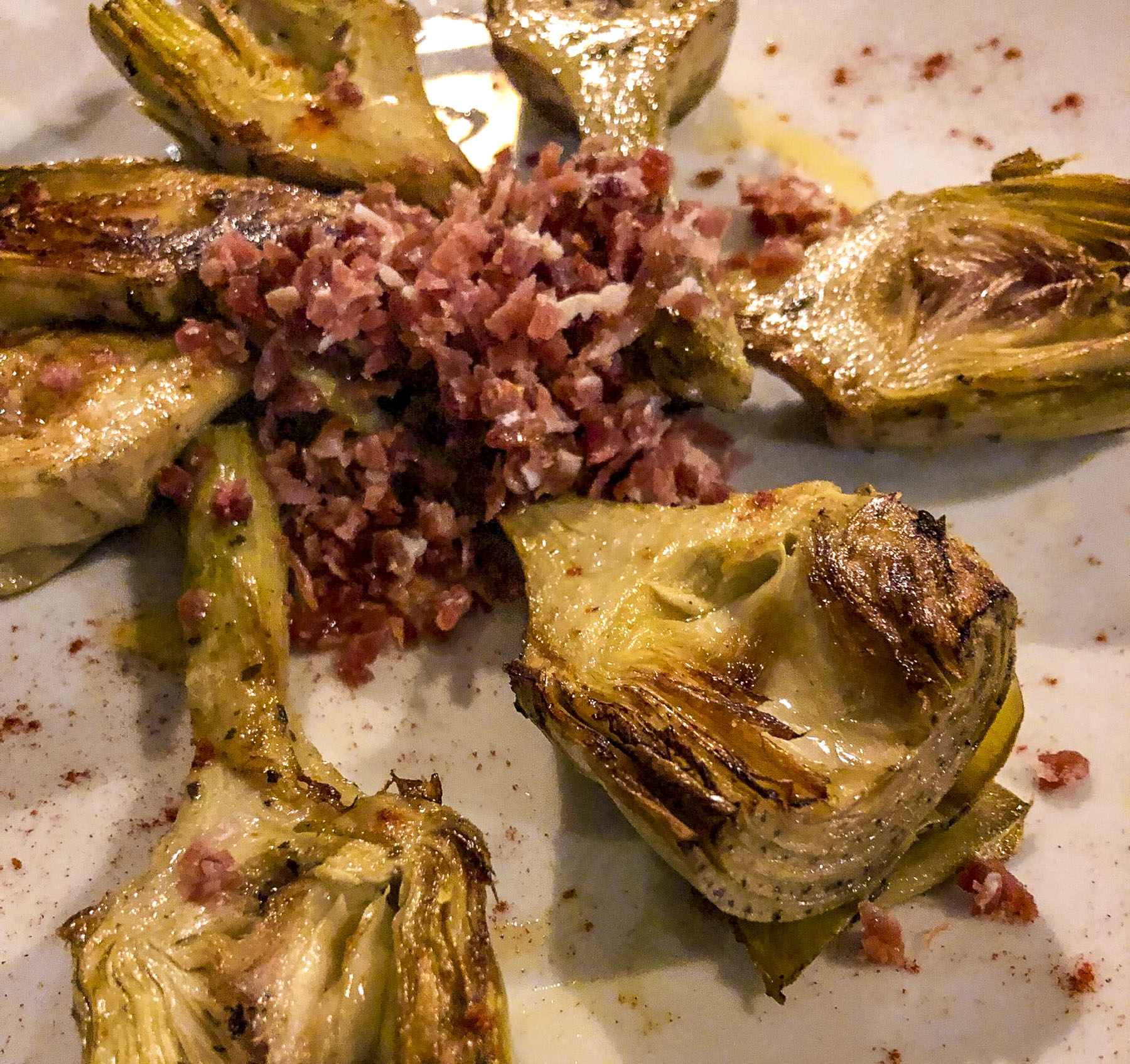
Later that evening as we strolled across town in search of elusive Alcauciles Fritos (Fried Baby Artichokes) we happened upon one of the cities’ brotherhoods practicing marching with a weighted platform before the big events of Holy Week. With military precision they followed their captain’s instructions and performed a switchback maneuver through restaurant tables that nearly blocked their route.

Down a side street near the central market, we found Tabanco La Reja, a small tapas bar far removed from the center of the city, that’s known for its local fare. The young seasonal artichokes are sprinkled with lemon juice and sea salt, then pan fried in oil over high heat until the stalks and hearts are tender, and the juices caramelized to set the flavor. They were sublime.  Flamenco music from a tabanco across the calle drifted in, the vermut was good, the evening was perfect.

Strolling back to our hotel, concert music filled the street as we passed the Iglesia Conventual de San Francisco, drawing us inside. A Brotherhood band was playing to a full church. Another pre Semena Santa event that charmed us.

Churches, churches, churches. Spain, Italy, Portugal. Everywhere a church They share that history of religious influence that so dominated the emergence of European kingdoms during the Middle Ages and Renaissance. Princes and paupers donated for that access to the stairway to heaven, enriching the church with grand architecture, priceless art, and jeweled encrusted religious iconography. Which is exactly why we visit so many of them. “Follow the money, it’s where the art is,” is how I like to phrase it.

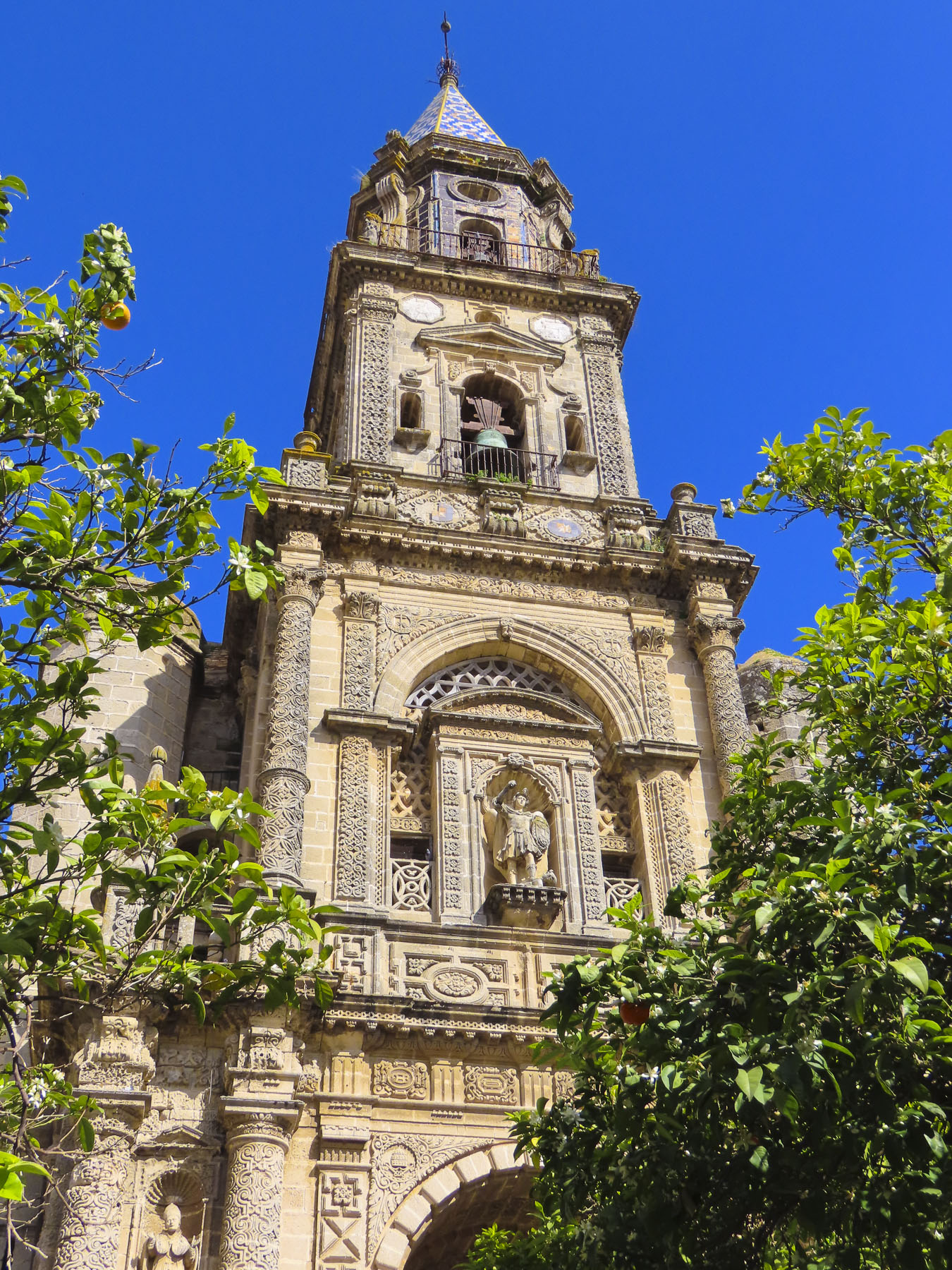
Covered in highly detailed baroque relief carvings, the Iglesia de San Miguel stood magnificently before us. Though much smaller than the Jerez Cathedral, the façade of this church and belltower are stunningly beautiful.

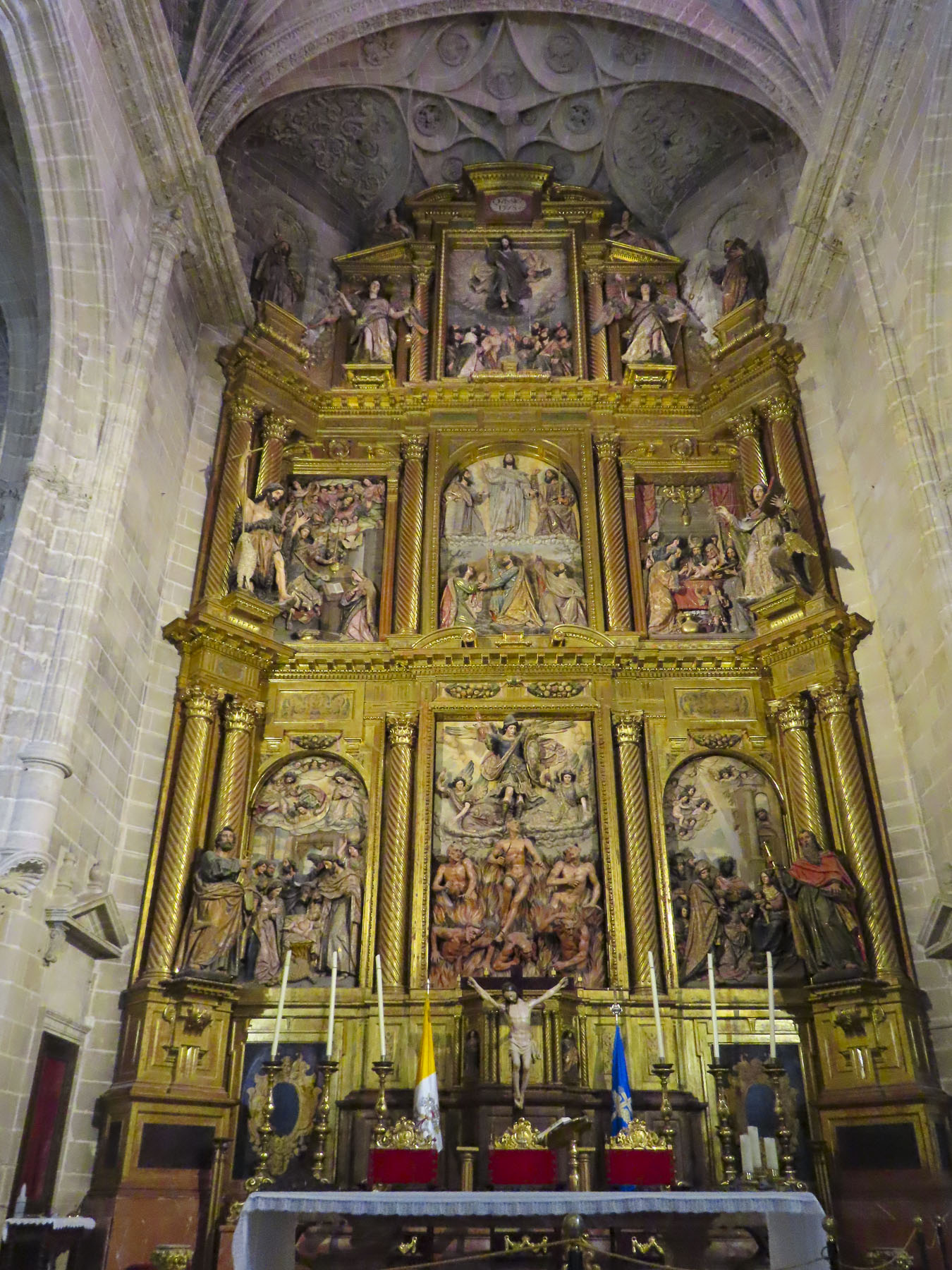
And the inside feels more intimate with a modest gilded altar. But we could only speculate on the hell fire and brimstone sermons that might have been delivered here based on a fiery retablo which dominates the church. Created by master sculptors Martínez Montañés and José de Arce, in the 17th Century, it depicts the Archangel Michael fighting very realistic devils.

Across from the church the sequestered nuns of the Convento San José Franciscanas Descalzas still operate a dulces turno, a lazy susan type cabinet, in the wall of the convent from which they sell pastries and cookies made from ancient church recipes to support themselves. It’s handy to have paper and pen to write down what you want from a list that hangs on the wall, or to use the translator app on your phone. It’s a wonderful centuries-old tradition that continues in many convents across Spain.

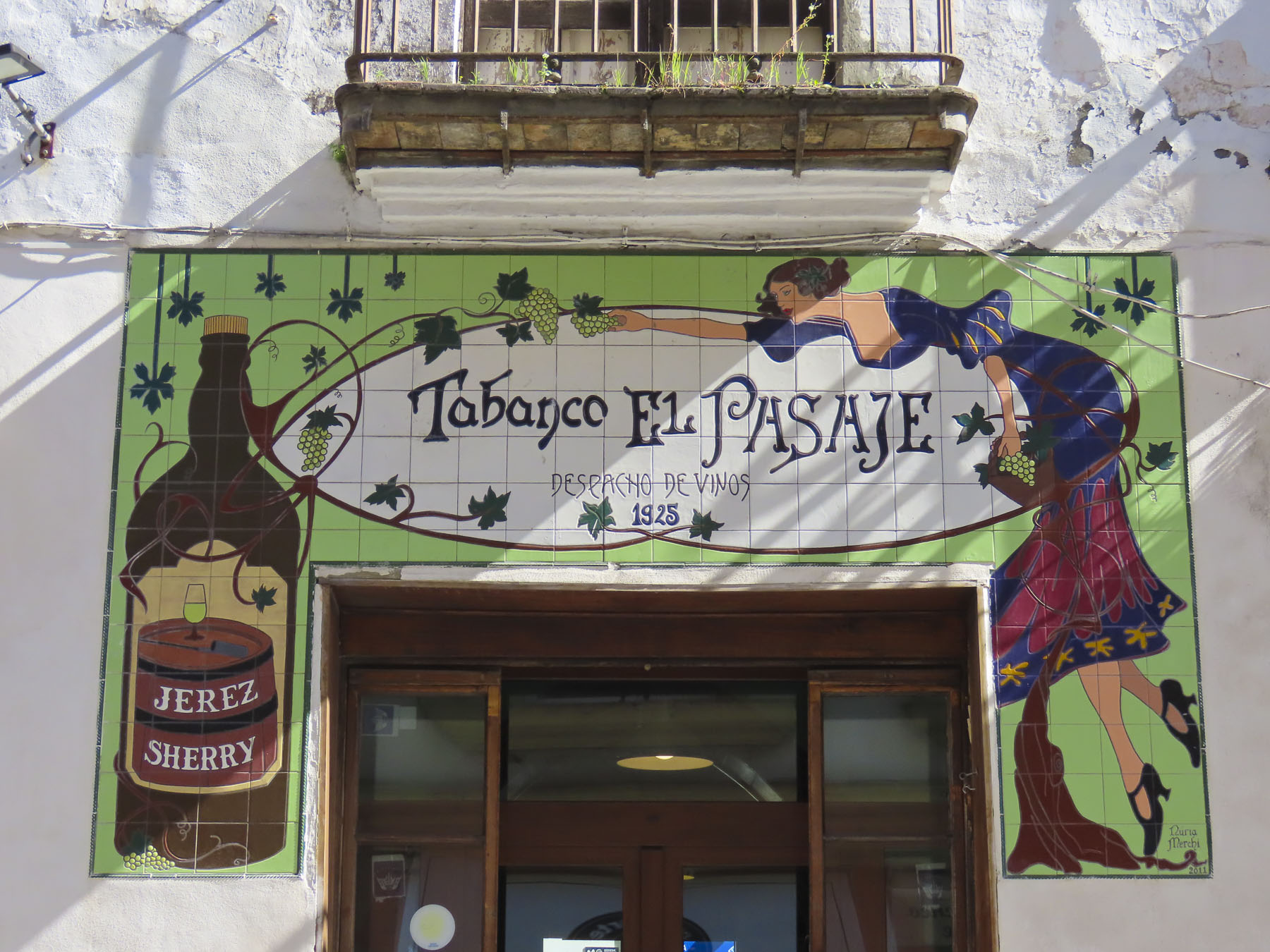
Scattered across Jerez are colorful ceramic advertising murals that usually highlight various sherries. They are all very artistic and seem to be unique to Jerez.

Touring a sherry bodega, a wine cellar, is a must in Jerez and there are several vintners in the city that offer tours, then tastings at their facilities. We chose Bodega Tio Pepe at Gonzalez Byass, basically for its convenience to other historic sites nearby. And we do admire their iconic Tio Pepe logo and advertising.

The bodega was started in 1835 by a young 23-year-old businessman, Manuel María González Ángel,  who had no experience creating wine, but he enlisted the help of his beloved Uncle Pepe to show him the ropes. Their first sherry was well received, especially in England. In appreciation for his uncle’s expertise González named their sherry Tio Pepe, “Uncle Pepe.” The iconic logo was created in 1935 , and shows a bottle dressed with a wide-brimmed hat, Andalusian jacket, and Spanish guitar to celebrate the company’s 100th anniversary. It soon became one of the world’s most recognizable advertising logos. The sherry is exported to 115 countries around the world.

The tour through the old bodegas was very interesting, as the guide explained that tiered casks never get completely emptied. The ready-to-drink aged sherry is siphoned from the bottom barrel until it is one-third-full. It is then refilled with less aged sherry from the cask above. The procedure is repeated until new wine is added to the partially emptied top cask. From start to finish the aging of sherry takes four years. In keeping with the times, the tour ended in a very hip tasting area that features various configurations of the Tio Pepe logo.

Most worthy restaurants in Jerez don’t open until 8:00PM and then seem to instantly fill up, with patrons spilling onto the street. If you have a particular spot in mind, our suggestion is to arrive when it first opens, as many do not take reservations, or try dining there for lunch. The good news is Jerez takes its cuisine very seriously and there are few places geared toward tourists. The most popular street we found was Calle San Pablo, a narrow alley filled with lively tapas bars. It’s located between the Iglesia de San Miguel and Plaza del Arenal. A walk along Calle Consistorio which starts at the plaza will also lead you past many places that will whet your appetite.

Jerez de la Frontera has a wonderful tranquil ambience. Historic with a cosmopolitan flare, the city is often overlooked by folks visiting Andalucia. This is a blessing for those that enjoy its charms.

“If God had not made Jerez, how imperfect would his work be!” – Benito Perez Galdos.

Till next time, Craig & Donna

Seville Part 5 – Road trip to Olvera & Setenil de las Bodegas

The countryside on the way to Olvera was more verdant than the earth toned landscape we traversed on our way to Zahara de la Sierra at the beginning of our road trip.  Now the hillsides were a mosaic of greens, light and soft, dark and vibrant, signaling the arrival of spring. 

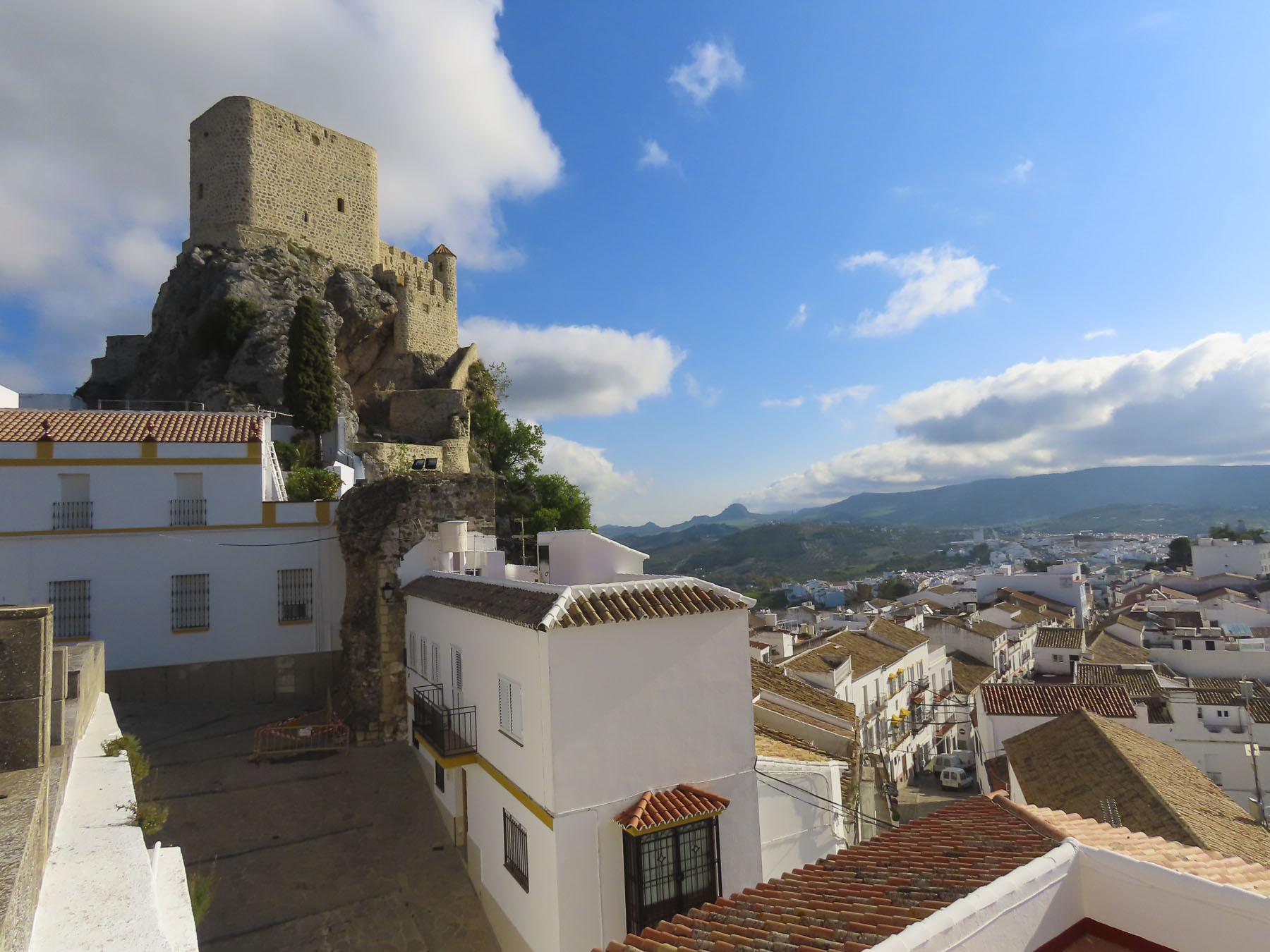
As the road curved, Olvera’s Castle and the belltowers of the town’s church broke the horizon. We are never quite sure where to park in small villages.  Worried about getting fined for a parking violation, we always opt to play it safe and find a car lot.  But the parking in Olvera was at the bottom of a steep incline below the historic castle and we just didn’t have the oomph that morning to walk from there uphill and then continue higher to the top of the tower.  With some persistence we navigated the town’s labyrinth of narrow one-way lanes into the Plaza de la Iglesia. At the apex of the village, the plaza straddles the area between Olvera’s citadel and the town’s majestic church, Our Lady of the Incarnation Parish.  Since it was still the off-season, we were in luck and found the last, barely viable parking spot on the plaza. It was a narrow space that required the driver’s side door to be parked tightly against a wall. Fortunately, I’m still limber enough to climb over the car’s center console and stick shift, with a limited amount of grunting and moaning.

The view from the mirador at the edge of the plaza was wonderful.  Incredibly, the views across the village continued to get better and better as we climbed the different levels to the top of the Castillo de Olvera, perched atop a rocky outcrop at an altitude of 2000 feet. The climax was a spectacular view of the cathedral and panorama of whitewashed homes with red tiled roofs backed by a shimmering sea of silver green foiliage. Outside the village, the surrounding olive groves harbor nearly two million trees.

Constructed in the 12th century, the castle was part of a line of signal towers along the Moorish frontier in southern Spain. The castle was expanded in the 14th century when it was captured by King Alfonso XI during the Reconquista. The castilo is one of five in proximity to each other on The Castles Route, Witnesses of the Spanish Reconquest through the Moorish Strip, a no-man’s land that separated the ancient Christian Andalusia frontier from the Arab Kingdom of Granada. The other castles on the circuit are Castillo de las Aguzaderas, Castillo de Cote, Castillo de Morón de la Frontera, and the Castillo del Hierro.

With its size and architectural presence, Our Lady of the Incarnation Parish looks more like a cathedral than just a church. The neoclassical church was started in 1823 on the foundation of an earlier dismantled, gothic- mudéjar style church and dramatically counterbalances the castle on ridge above the village.  Ordered built by The Dukes of Osuna, the feudal lords over Olvera, the vaulted interior is lined with marble imported from Italy and has many interesting religious icons. To fulfill this extravagance the Dukes diverted the town’s taxes, away from improving the village, to pay for it.  They were the last feudal lords over Olvera and declared bankruptcy in 1843 when the church was completed. Then fled, never to be seen again.

A cloudless morning in Olvera turned overcast by the time we arrived in Setenil de las Bodegas only thirty minutes later. While considered a pueblo blanco, it’s totally different from Olvera and Zahara de la Sierra where the homes ascend the steep slopes under their town’s hilltop fortress.  In Setenil de las Bodegas, whitewashed homes front caves under large stone overhangs which line both sides of a gorge, created eons ago from the erosion caused by the swift moving water.

The homes along the gorge use the mammoth natural stone ledge as their roofs. The once raging Rio Trejo is now a quiet stream in the narrow gorge, which widens into a shallow ravine where an ancient Moorish castle still guards the approach to the village.  When the Romans colonized the area two thousand years ago folks had already been dwelling in the natural caves along the gorge for several millennia. Over the centuries the cave fronts were enclosed to create the unique village that still survives.

Before touring the village, we checked into the Hotel El Almendra to drop our bags, just oustside the historic district, with the intent of driving back and finding parking closer to the gorge.  We were just about to pull out of the hotel parking lot when a group of police cars with lights flashing and sirens wailing roared past. A slower patrol car parked and blocked the hotel driveway. Folks were beginning to gather on the sidewalk. We had no idea why until a motorcycle carrying a cameraman facing backward led the first wave of bicycle racers that were a blur of pedaling color as they sped by. A continual surge of racers crested the knoll of the road and coursed downhill towards the village. The race was one leg of the annual Vuelta a Andalucia – Ruta del Sol. A five-day, 500 mile cross-country cycling event that summits 17 mountain passes in the region and attracts 600 riders. Leaving the car at the hotel, we decided to walk the half mile into the village.

By the time we reached Cuevas del Sol, Caves of the Sun, the narrow one-way road through the gorge lined with small taverns and inns, the sun was brightly shining again.  Even though the road is open to cars, it was filled with folks walking and was almost pinched closed by tables from the restaurants narrowing its width.  We found a table and enjoyed both the lunch and the warmth of the February sun.

Afterwards we walked the length of the lane through the deep chasm until a set of stairs led to the Mirador del Carmen and the small 18th century chapel Ermita de Ntra. Sra. Del Carmen.  The view from the overlook encompassed a sweeping vista of the valley filled with whitewashed pueblos stacked atop one another filling the valley to its rim. 

The Nazari Castle, the town’s 12th century Moorish fortress, still stands vigilantly on the edge of the valley, the invaders now camera-wielding tourists.  Across from it the Gothic style Church of Our Lady of the Incarnation, itself an imposing fortress-like structure, was ordered built by the Spanish Crown. It was constructed in 1505, above the town’s previous mosque, to celebrate the liberation of the village from centuries of Arab rule.  We walked back to our hotel along a lane above the gorge lined with newer buildings. 

Heading back to Seville before sunrise the next morning we stopped high above the village on the road that followed the ridge opposite the Cuevas del Sol, in one last attempt to capture the iconic pueblos of the village as dawn cast its first rays of light across the gorge.

Till next time, Craig & Donna

PS. Our 226-mile weekend roundtrip from Seville only used slightly more than a half tank of gasoline.

Cordoba & Granada – Location, Location, Location

The view from the train window was a blur of greenery, a vast landscape of undulating hills dotted sporadically with small villages and the remnants of ancient fortresses crowning the hilltops, set amidst a sea of olive trees, that seemed to spread from the wake of the speeding train to the horizon. Seventy million olive trees, 24 different varieties, covering over three million acres in Andalusia produce 900,000 tons of olive oil and 380,000 tons of table olives annually. No wonder we’ve been enjoying Spain so much – the olives are so good!

We were nearing the end of our stay in Seville, but there were still destinations outside the city we wanted to explore before we departed Spain. Being so close to the ancient Moorish cities of Cordoba and Granada, how could we not visit? Plans were made to catch an early train from Seville and spend the day exploring the major sites in Cordoba, before continuing to an Airbnb rental in Granada for three days. There were always debates about budgeting, wanting to do it all and affording it are issues we continually faced during our two-year journey, fortunately the highly discounted rate we received for booking an apartment in Seville during the shoulder season made this side trip financially reasonable.

It was 152 BC when Pliny the Realtor, standing on the bank of the Guadalquivir River, toga blowing in the wind, turned to General Claudio Marcelo, the founder of Roman Cordoba, and with the swoop of his arm across the grand vista before them proclaimed future realtors’ favorite adage, “location, location, location!”

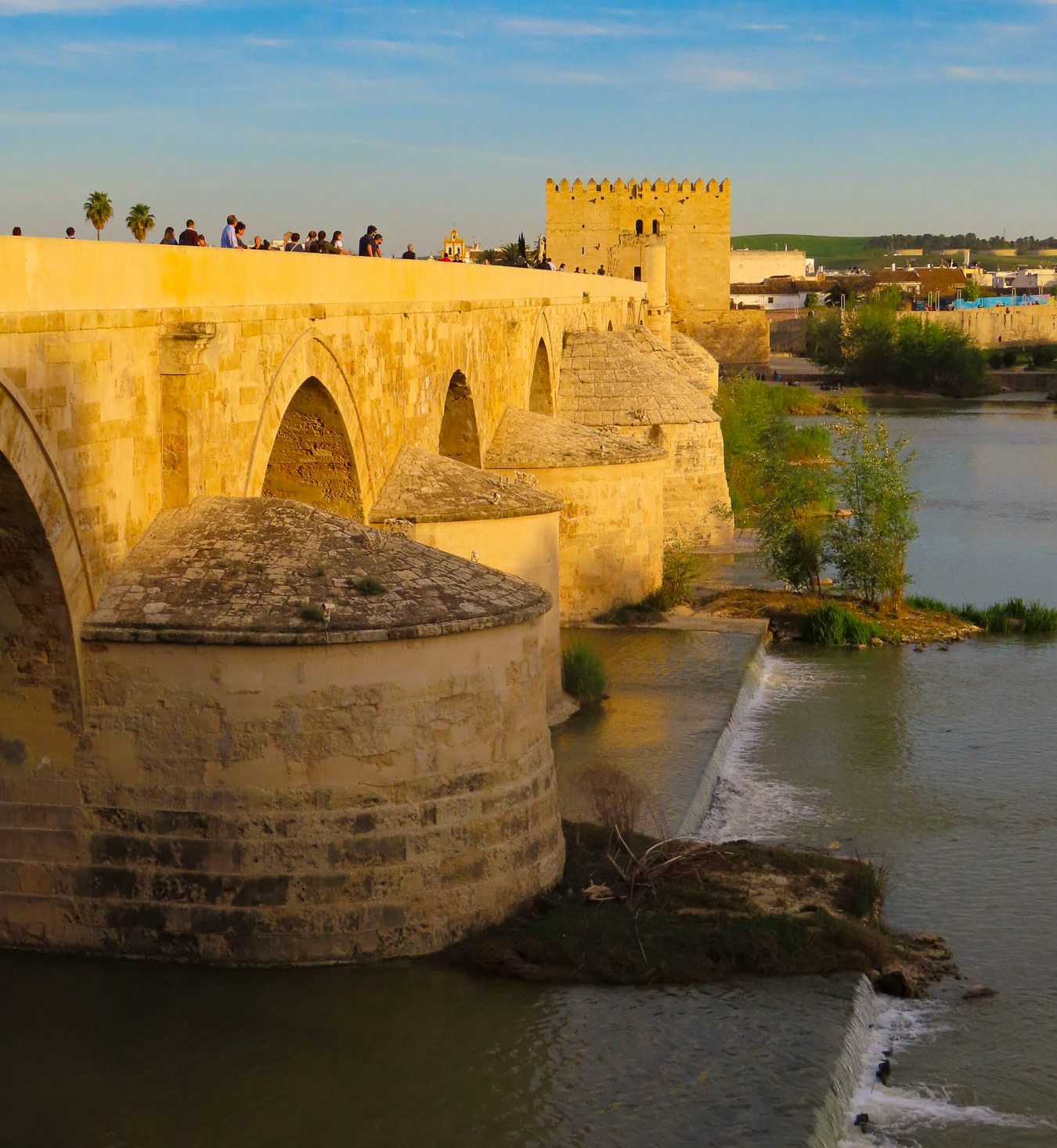
Situated along the last navigable section of the river, Granada prospered as a river port, exporting grain, wine and olives down the river to the Atlantic Ocean, where the goods were then sailed around the Rock of Gibralta into the Mediterranean Sea, eventually reaching ancient Rome. In the 1st century BC Roman engineers built a graceful, sixteen arch stone bridge that spanned 820ft across the Guadalquivir River and has been in continual use, with renovations of course, for two-thousand years.

The city continued to flourish for centuries under Visigoth rule and later Muslim conquest. In the year 1000 the city was estimated to have an enlightened and tolerant population of 450,000 Muslims, Christians and Jews, surpassing Constantinople, making it the largest city in Europe. The intellectuals of the city were renown throughout Europe for their contributions to the advancement of astronomy, medicine, philosophy, and mathematics.

Cordoba slowly lost its significance as a riverport trading center after the reconquest when the waterway eventually silted up and navigation to the city became impossible. By the 1700s its prosperity had diminished, and its population reduced to only 20,000.

Our first stop was Córdoba’s Alcazar de los Reyes Cristianos, Castle of the Christian Kings, a royal residence and fortress built in the Mudéjar-style on the site of a former Muslim Fortress. While the castle is interesting, the exquisite formal gardens were a splendid oasis, wonderfully colorful even in early March. Here Christopher Columbus initiated his negotiations with Isabella I of Castile and Ferdinand II of Aragon to finance his voyage of discovery in 1492.

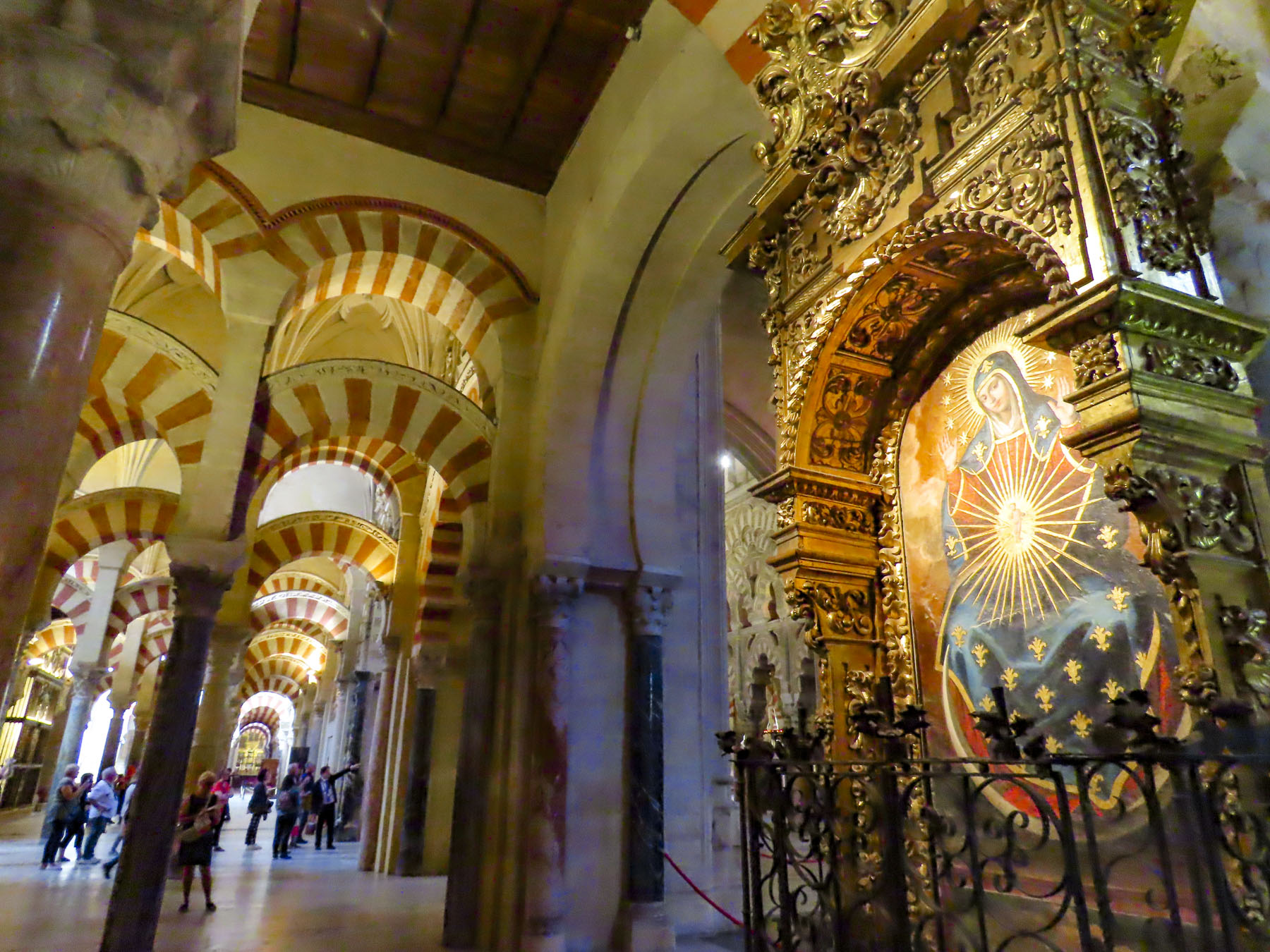
The city’s most famous landmark, the Mosque-Cathedral of Córdoba, was a short walk from the Alcazar. It’s an enormous structure occupying the equivalent of a New York City office block, part of which features an enclosed courtyard with a central fountain surrounded by an orange grove. The worn exterior was fascinating with its elaborate brickwork, and Moorish arches around the windows. The ancient doors into the space are offset by horseshoe shaped arches, a design influence copied from Visigoth architecture. Construction of the Great Mosque of Cordoba started in 786 AD and lasted for three-centuries as it was continually expanded.

Using 850 recycled Roman columns, topped with two tiers of arches, the Great Mosque of Cordoba’s prayer hall is a dazzling space with rows and isles of geometrically precise columns that seem to recede to infinity, in every direction. It was one of the largest mosques in the Muslim world when it was built.

Fortunately, in 1236 when Ferdinand III, king of Castile and León, captured the city, he was enamored with the mosque’s magnificent architecture, and he chose to leave it totally intact including the mihrab, an elaborate prayer niche in a wall that faces Mecca.

For a time, Muslims and Christians were allowed to pray in the same space. This lasted to 1499 when Muslims were expelled or forced to convert if they wished to stay in Spain. The original mosque remained unchanged until the mid-1500s when a towering high altar and choir loft were built in the center and numerous side altars were added along the exterior walls. The old minaret was finally incased within a magnificent, squared belltower.

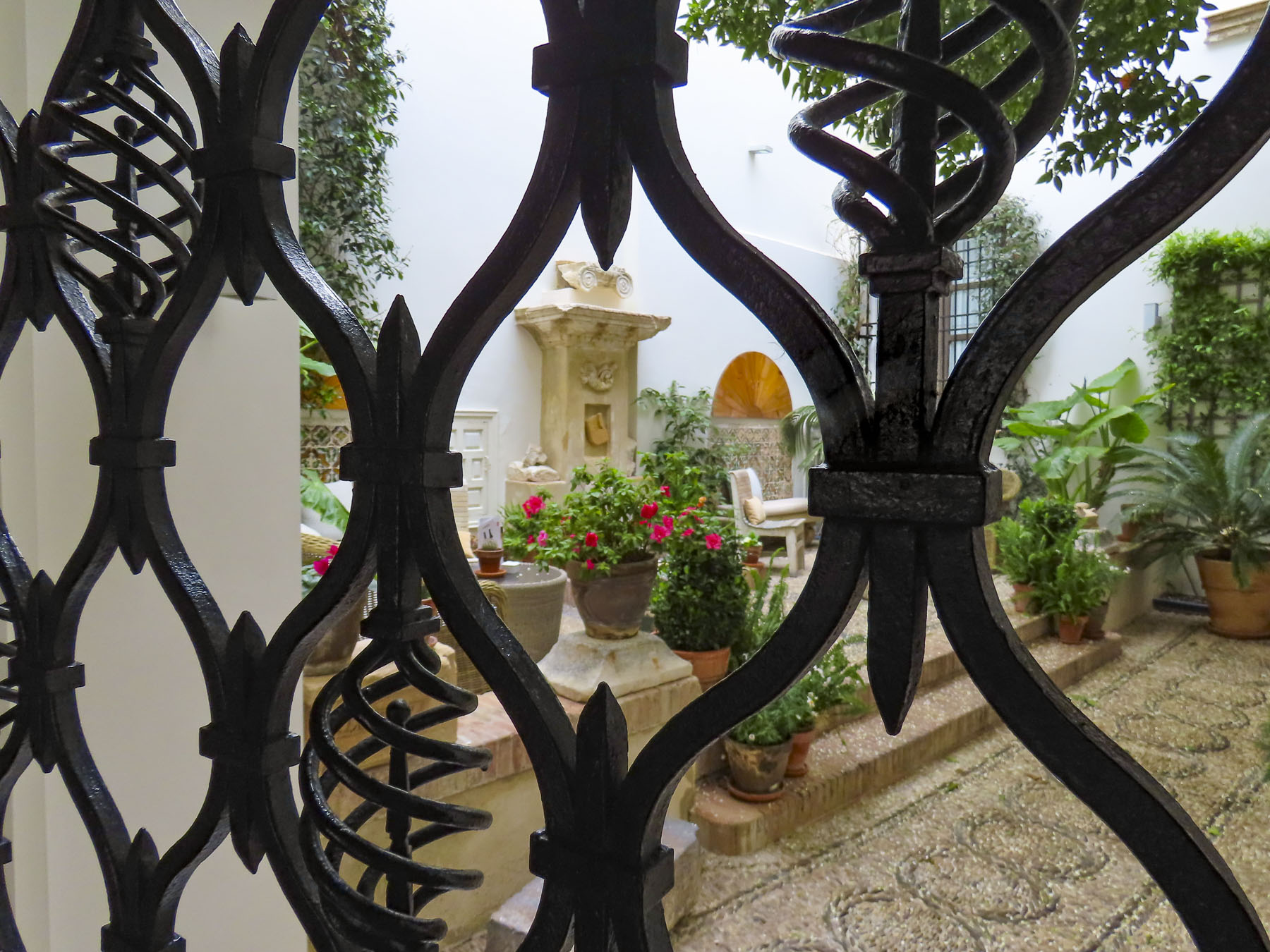
Afterwards we wandered through the narrow alleys adjacent to the cathedral, peeking into verdant courtyards that looked so lovely we were tempted to invite ourselves in, but did not.  The only thing missing were flowers in bloom. The sun was not yet high enough in the March sky to warm the cold stones and prompt the first blossoms of spring.

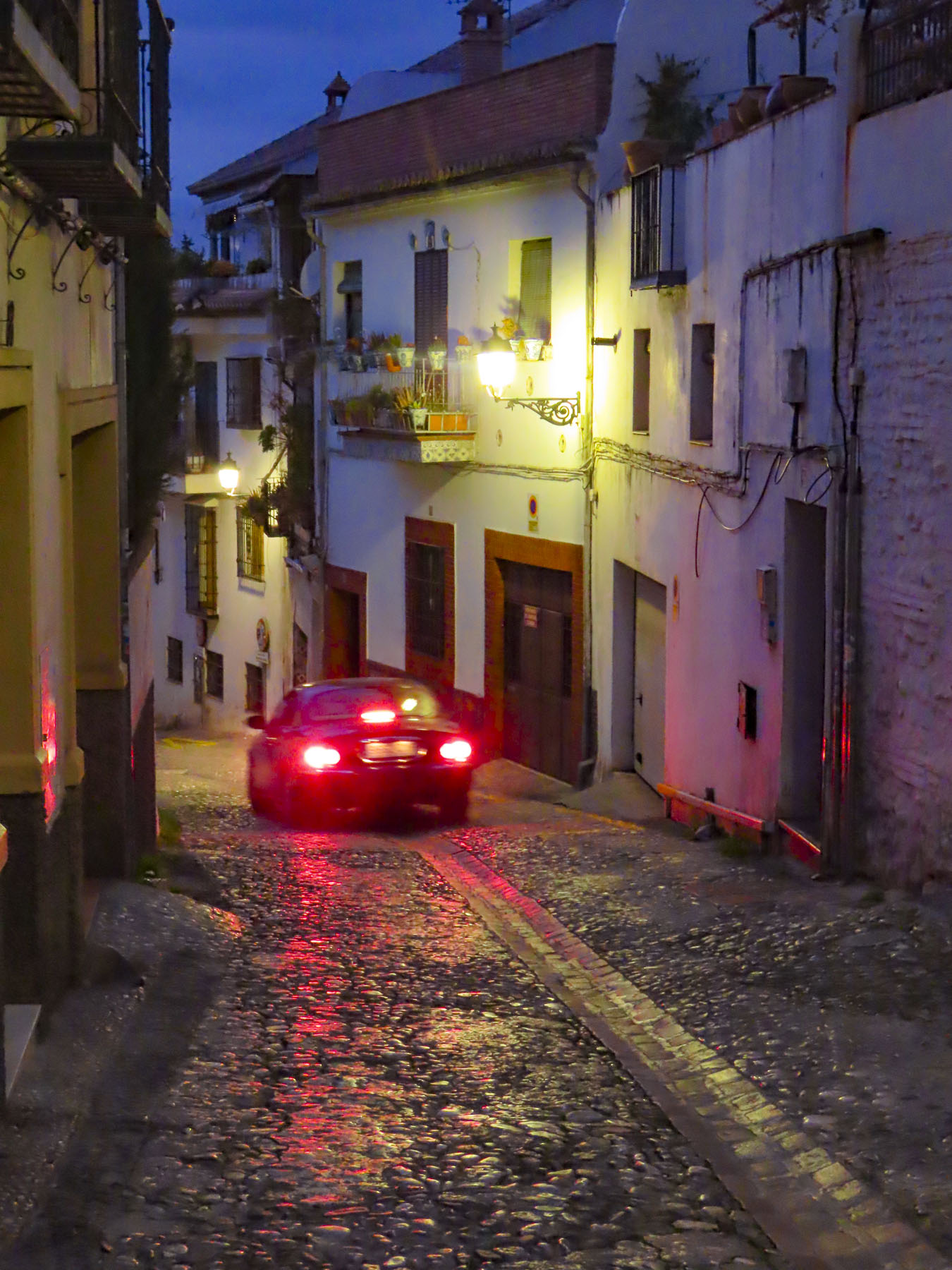
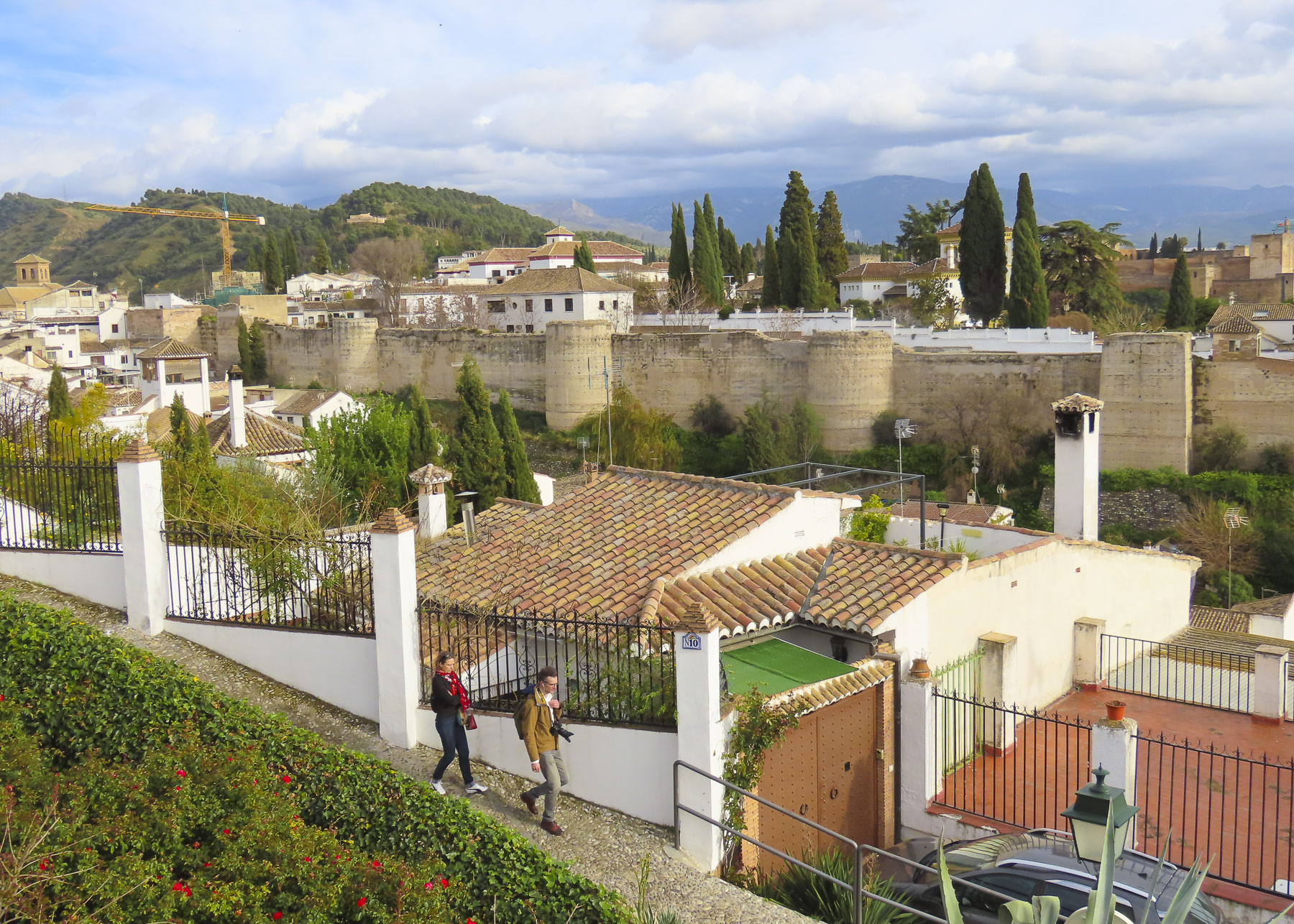
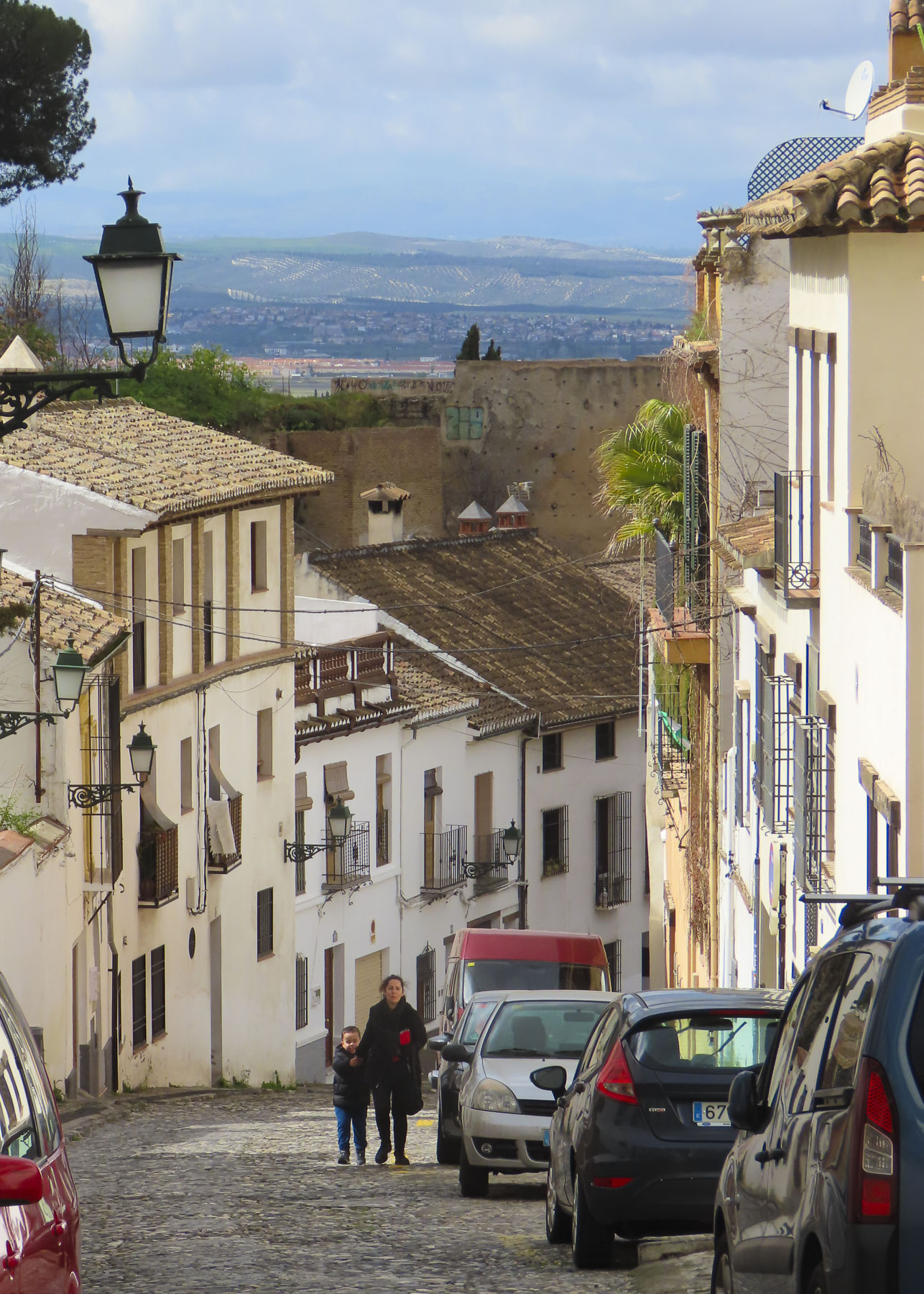
Later that evening upon our arrival in Granada we took an Uber from the train station to our rental in the Albaicín district, on Cta. de Alhacaba, a steep cobbled lane just down from Plaza Larga. It was an attractively gentrified apartment in an older traditional Spanish home, with a center courtyard, that had been divided into several units. Looking out from our window the next morning, we could see on a ridge above us the ruins of an extensive fortress wall, built during the 11th century Zirid kingdom.

Getting our day underway, we walked uphill to Plaza Larga and ventured into the traditional colmados, a small grocery store where you tell the shop clerk everything you need and they pull it from the shelf behind the counter for you. Our Spanish was minimally up to the task.

A few steps from the shop a limited section of the citadel wall containing the Arco de las Pesas has been renovated. Known as the Arch of Weights, this was an important entrance into the city where merchants had their goods weighed and taxed. Its distinctive zigzag tunnel was designed to slow and throw off balance any attacking enemy who had breached its door. The passageway’s vaulted ceiling now provides perfect acoustics for buskers. Crossing through we headed toward the Mirador de San Nicolás.

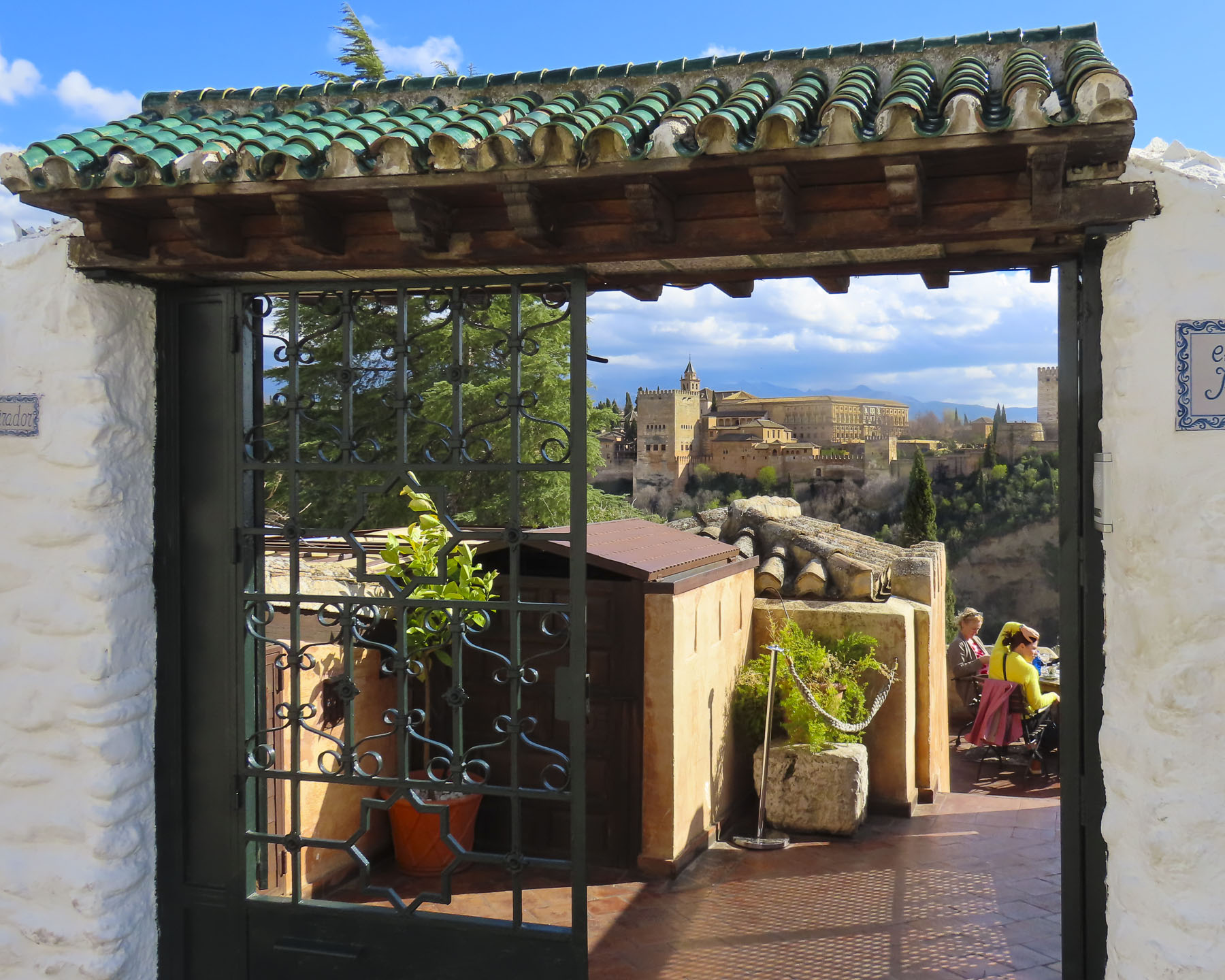
There are several overlooks on Albaicín hill, but the view of the Alhambra from San Nicolás Plaza was sublime. We stopped here several times as we explored this hilltop across the valley from the Alhambra. We enjoyed lunch and sangria on the terrace at El Huerto de Juan Ranas or dangled our legs over the edge of the mirador as the sun arced across the sky.

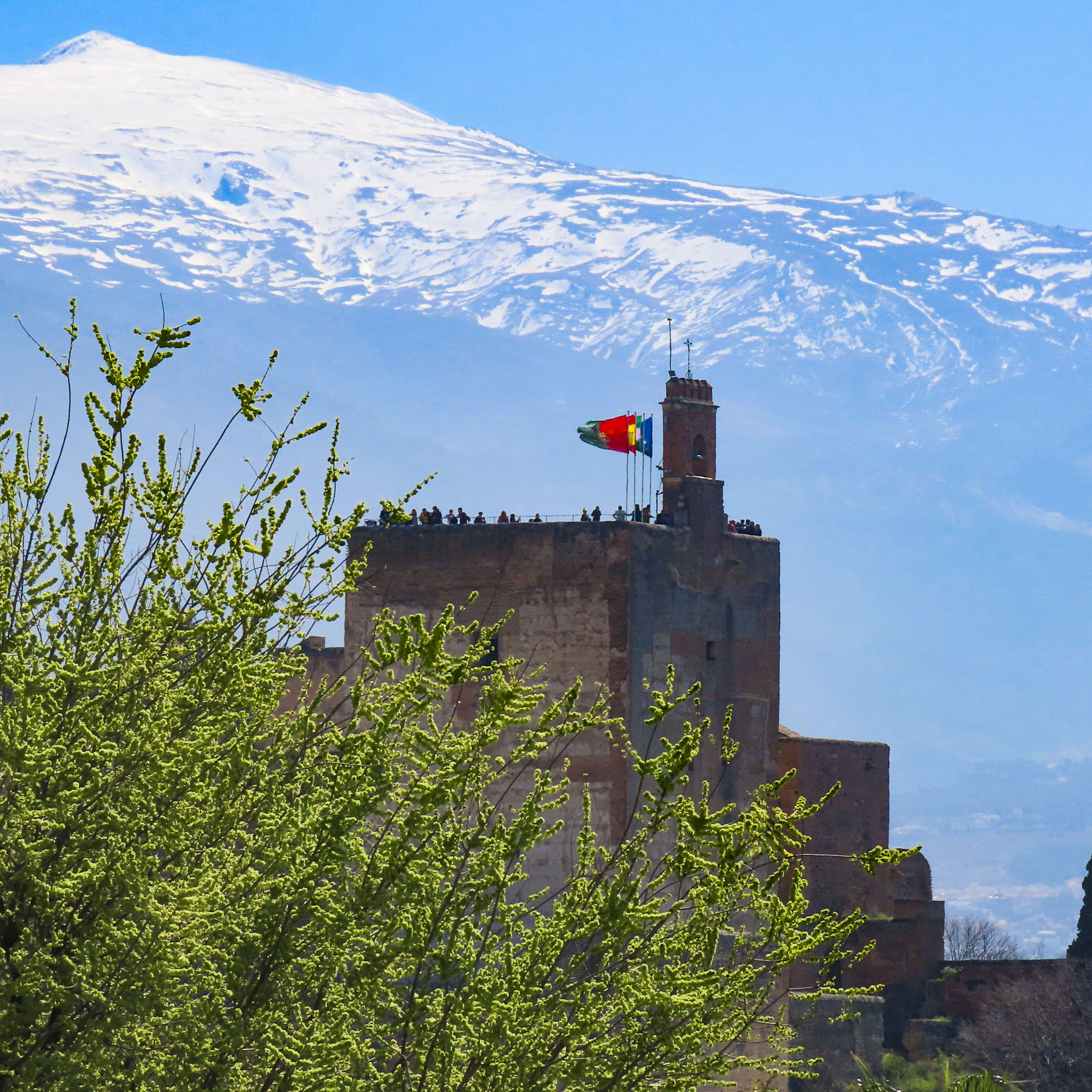
We watched the play of light change the shadows and the intensity of the red walls from which al-qal’a al-hamra, in Arabic the red fortress, takes its name.  The palace is dramatically situated on a hill, with the snow-covered Sierra Nevada Mountain Range and Mt. Mulhacén, the Iberian peninsula’s highest peak in the background.

For centuries since the Muslim time, continuing into the 1950s, muleteers ran mule trains laden with fresh produce, fish, and merchandise from the coast up over the Sierra Mountains along a vast network of trails to Granada.  Much of this 8-12 hour journey was done at night to take advantage of the cooler evening temperatures to ensure the quick arrival of perishable food.  The mountains also provided sanctuary to the maquis, resistance fighters, in the 1940s and 50s who opposed the dictatorship of General Franco after the Spanish Civil War.

The historic Albaicín district is extremely hilly, think San Francisco hilly, a severe contrast compared to the flatness of Seville and Cordoba, but the labyrinth of narrow alleys that twist up and down the ancient hillside was intriguing. The Palacio de Dar al-Horra, “Home of the Honest Lady”- the mother of the last Emir of Granada, was an interesting example of 14th century Moorish domestic architecture, with its intricate Alfarje, carved wood ceilings, verandas, and courtyard.

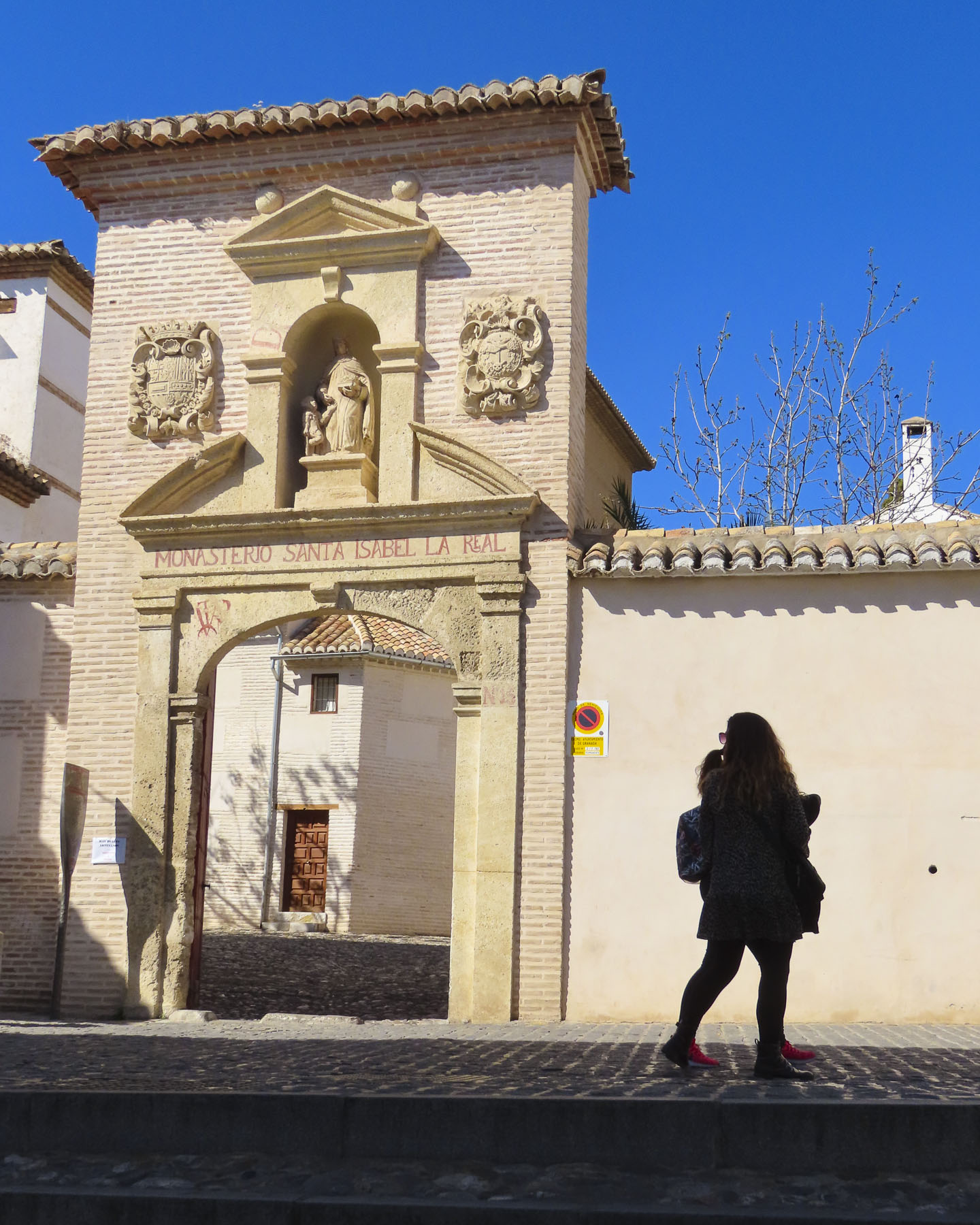
Nearby we accidentally stumbled upon the 16th century Royal Convent of Saint Isabel and entered the courtyard in hope that its church was open. Unfortunately it wasn’t, but as we wandered we discovered the “cookie door.”  Actually, it is a cabinet built into the wall of the convent with a door on each side that separates the cloistered nuns from the public. Ring the bell above the door, speak your order when someone answers and place your money in the cabinet and close the door.  You will hear the other door open and then close when your dulces have been placed inside.  It’s a sweet centuries old tradition which helps the nuns support their convent. 

We were enjoying our stroll through the whitewashed alleys as we headed down the hillside toward Plaza Nueva, when “Splat Splat!” Honestly it felt like we had been shat upon by a flock of tourist hating birds. Something akin to the Spanish version of the Hitchcock movie classic. And the smell was awful! We don’t remember exactly what was said, but quickly a well-dressed middle-aged couple guided us into an empty plaza and pulled a huge roll of paper towels out of their bag and proceeded to “help,” clean the mess off our jackets as they patted us down and attempted to pickpocket us. I wish I had been quick witted enough to yell, I KNOW KARATE!, with an intimidating scowl. At least my wife would have burst into laughter and perhaps that would have broken their concentration. It was over in a flash and they vanished.  Fortunately, we keep all our valuables under our clothing, not in any exterior pockets.  Rattled, we continued on. A beautiful city, good tapas and sangria helped our mood rebound.  Later that evening when I was reviewing the photos taken during the day, I spotted them in the lower corner of a picture taken moments before that encounter.

Bar los Diamantes and La Gran Taberna, located next to each other on Plaza Nueva, were excellent places to dine, and we tried them on separate days. At home in the states now we are making tapas inspired from dishes we tasted at both places.

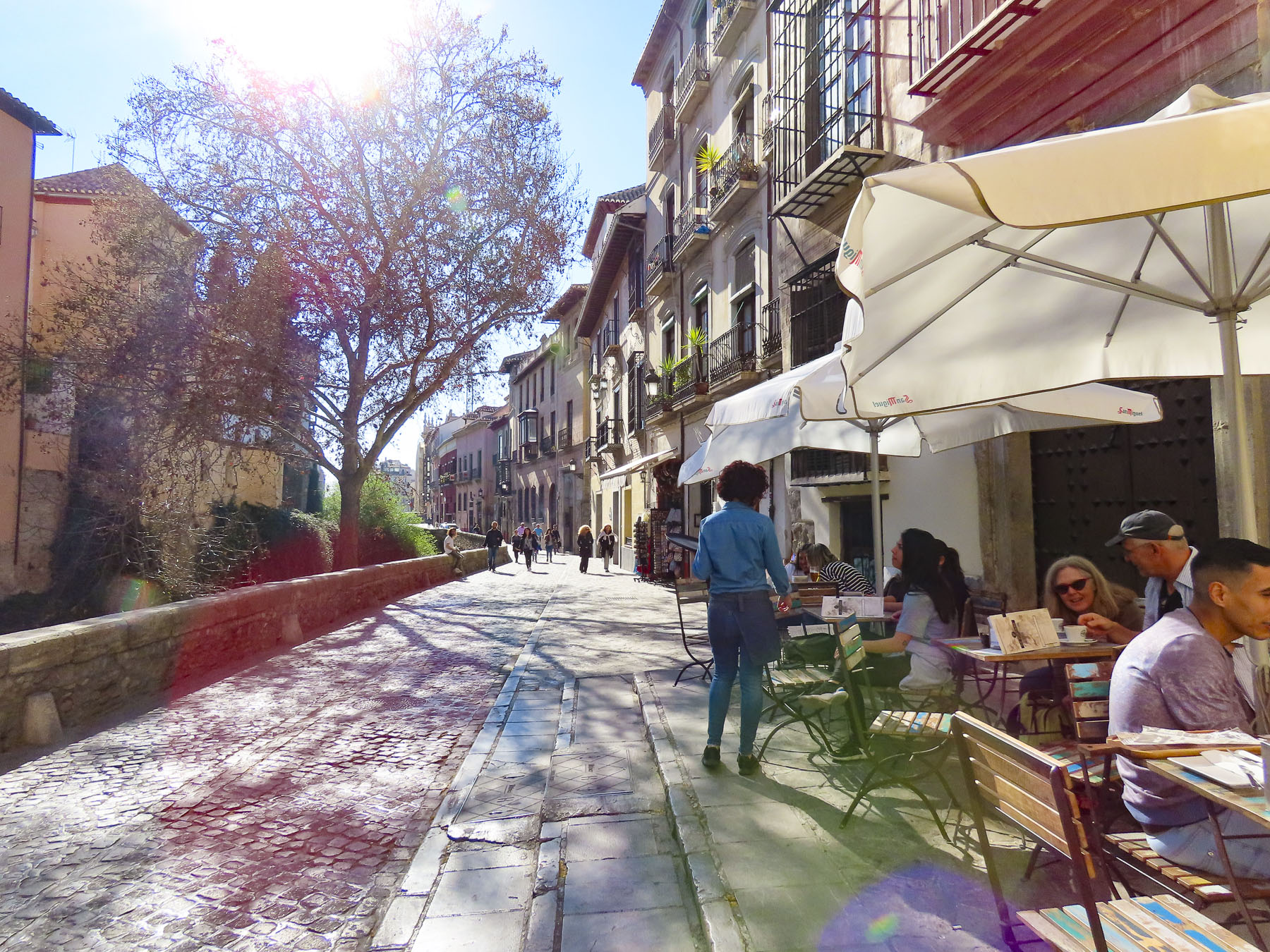
Afterwards we walked along the thin ribbon of road that follows the Darro River through this section of the old town. It’s lined with numerous historical sites and bridges that cross the river; the ambience was wonderful.

After a long day we couldn’t muster the strength to walk the steep uphill back to our apartment and opted to use the local bus. The routes in the historic section use micro-buses to navigate the ancient parts of Granada and took us pretty close to where we needed to go.

Only a limited number of people are allowed to visit the Alhambra each day, so we made reservations for a group tour early the next morning. 

As we were leaving our rental the next morning, we couldn’t extract the key from the interior lock on the front door. We can’t recall how many doors we’ve unlocked during our travels, but this was a first! Apartment doors in Europe are intriguing, especially if they are in newly renovated buildings.  The trend seems to be to install a very sturdy door with numerous deadbolts that insert into the door frame with the turn of single key.  They appear to be designed to thwart any home invasions or resist the battering ram of a S.W.A.T team. The rental agent asked us to stay at the apartment until a locksmith arrived, without offering a time.  That was unacceptable and we asked them to have the door repaired by the end of the day.  We took the key to the courtyard with us and hoped for the best. 

The Alhambra is massive and originally served as a fortress for many centuries before Mohammed ben Al-Hamar, the first king of the Nasrid dynasty arrived in the 13th century and established it as his royal residence. Each subsequent Muslim ruler continued to add and beautifully renovate every interior surface lavishly adorned yesería, intricately carved or cast stucco featuring arabesque, geometric and calligraphic designs.  Later the Christian monarchs would introduce mudejar tiles and Romanesque, Gothic and Baroque techniques to various building sprees. 

The most significant Spanish contribution to the Alhambra was the Palace of Charles the V. It is an immense renaissance style building with a two tiered colonnaded balcony surrounding a circular courtyard at its center.

Construction started in 1527 and was continually interrupted over the next 430 years and was eventually abandoned until the government dedicated funds to finish it by 1957. Somehow this amazing amalgamation of diverse architectural styles at the Alhambra creates a unique and satisfying visual harmony.

We spent the rest of the afternoon exploring the Catedral de Granada Royal and next to it the Capilla Real de Granada. Both were built over the ruins of the Granada’s Grand Mosque in the old medina after the reconquest.  The cathedral features a towering white and gold interior and a stained-glass cupola above the high altar.

The Capilla Real de Granada is a burial chamber for the Catholic Monarchs Queen Isabella I and King Ferdinand and features their ornately carved marble tomb. Joanna of Castile, Queen of Castile and Aragon, and her husband Philip I “the Handsome” of Castile, are entombed next to them in an equally elaborate sarcophagus.  The Sacristy-Museum here also displays gilded church panels, along with renaissance paintings from Flemish, Italian and Spanish artist. The monarchs’ crowns and scepter are also on display. 

Across the lane the wonderful Moorish architecture of Palacio de la Madraza, a former Islamic school dating from the 1300s, has been well preserved.

To our relief the door lock was fixed when we returned to the apartment that evening. Though to our dismay the landlord left a bill for the locksmith’s services of 150€! Attached to the invoice was a note that said the locksmith could not find any fault with the door, that it was in perfect working, and we were responsible for the bill.  We did not agree that this was our “operating error” and questioned it.  Thinking it was a maintenance issue and ultimately the apartment owners’ responsibility. There was an exchange of text messages, with the rental agent demanding payment. We refused to pay. Things deteriorated – ancient ancestors and future generations to come were flavorfully cursed.  We left early the next morning to avoid any confrontation.

With a half day to fill before our train departed, we dragged our suitcase clickity clacking over the cobblestones of the historic center as we made our way to the Basilica de San Juan de Dios. Built in the 1700s, when a seemingly unending supply of gold and silver flowed back to Spain from their colonies in the Americas, the church is a temple not only to Christ, but a shrine to all things Baroque, with every surface ornately detailed, much of it gilded. The sacristy and the other rooms behind the altar hold a museum-like collection of artwork, precious religious objects, and gold adorned reliquary.

Across the street at Candelas Bocadilleria we sat at a table in the sun and enjoyed the best churrerias of our time in Spain.

Two blocks away and two centuries older, the Monasterio de San Jeronimo (1504) stands as the first great Renaissance style achievement of Spanish architect Diego de Siloe, who was trained in Italy. He followed this with the Grand Cathedral of Granada (1528.) This royal monastery was the first in Granada commissioned by Queen Isabella I and King Ferdinand after the conquest of the city. It’s a massive structure with a two-tiered cloister surrounding a large courtyard fully planted with orange trees. 

The monastery’s main chapel is cavernous with a barrel-vaulted ceiling that leads your eye to a towering gilded high altar, minutely detailed with religious iconography. The tomb of El Gran Capitan, Fernandez de Cordoba, lies in the chapel. A hero, he is credited with several reconquests across Andalucía, and after a ten-year campaign, the surrender of Granada from Boabil, Muhammad XII of Granada, the 22nd and last Moorish Sultan in Spain.

We barely scratched the surface of all the places to see in Granada. It’s a good excuse to plan a return, our own Reconquista, of this beautiful and fascinating region in the future.

Till next time, Craig & Donna

Ronda Road Trip – The Pueblos Blancos or Blinded by the Light

Needing a break from city life we rented a car at the Santa Justa train station and within minutes we were out of Seville heading south to Ronda, one of Andalucia’s many “Pueblos Blancos,” the white villages, so called because of their uniformly whitewashed houses.  Although it was less than two hours from Seville, it took us all day due to the number of planned stops and spontaneous detours we made.

Lime paint was introduced to the region when Rome controlled the Iberian peninsular. Its use was greatly expanded during the mid-1300’s when a bubonic plague pandemic swept through the Mediterranean countries.  Residents of villages were required yearly to cover the outside and the interiors of their homes and churches with a limewash, known for its natural anti-bacterial and insecticidal properties, in an effort to reduce the spread of disease. Community inspections were done, and folks were fined for noncompliance. This mandated conformity was eventually appreciated as an aesthetically pleasing look and a symbol of meticulous tidiness. Fortunately, the custom stayed and has become an iconic signature of southern Andalusia.

Cresting a low hill on the A-375, we spotted a small castle with crenellated walls and towers in a shallow valley not far from the road. Turning towards it we followed a dirt track through farmland not yet ploughed for the Spring planting to a small intersection where the castle stood next to a narrow, babbling brook.  The history of the Castillo de Las Aguzaderas isn’t really known, but it is thought to have been built in the 1300’s by the Moors as they retreated from advancing territorial gains made by the Spanish during the Reconquista. 

Of Spain’s 2500 castles this is the only one that does not sit atop the high ground of a hill or mountain to command the surrounding terrain, but according to its historical placard, stands in a hollow to protect the spring that emerges from the earth outside its wall. With no attendant and an open gate, we were free to scramble around the walls and climb stairs in a terrible state of disrepair to the top of the castle keep for views all around. In the distance an ancient stone watchtower, Torre del Bollo, dominated a hill.

From afar the whitewashed casas of Zahara de la Sierra brilliantly reflected the sunlight like polished marble.  The homes, stacked like building blocks, rose up the hillside until they met a sheer butte. A square tower crowned the butte’s summit.

We followed the long ring road that circles the mount through the village and decided to have lunch at Meson Oñate where we were drawn to the outdoor patio that overlooks the Zahara-El Gastor Reservoir and the rolling farmland that surrounds it. 

After lunch, to work off our delicous meal, we hiked to the Castillo de Zahara, which crowns the mountaintop above the village. It was a well paved steep path at the start, but soon the slope decreased to a manageable incline that zigzagged up the mountain.  For our effort we were rewarded with stunning bird’s eye views over the red tiled roofs of the village and to the distant lake below. A tower is all that is left of a larger Moorish castle from the 13th century that was built over the ruins of a small Roman settlement that once called the mountaintop home. Barely accessible, it provided a safe haven during times of trouble. The castle had a turbulent history with its control passing back and forth several times between the Moors and Spanish. Even French troops once commanded its summit through Napoleon’s conquest of Spain during the Peninsular War that raged in the early 1800’s.

With a last-minute decision to take a longer route to Ronda, we headed into the mountains outside of Zahara de la Sierra on CA-9104, a serpentine road with steep slopes that took us into the Sendero La Garganta Verde, a rugged and wild scenic area that is known for its population of Griffon vultures, and Monte Prieto.  The wind was insanely whipping around us when we parked the car at the Puerto de las Palomas (4500ft above sea level) mountain pass and walked to an observation deck in hope of viewing some vultures.  Griffons are large birds of prey that have wing spans up to nine feet across. We were fortunate to spot some, far off in the distance before we ran back to the car, chilled to the bone.

The sun sets early when you are on the eastern side of the steep Sierra del Pinar mountain range.  The last rays of sunlight still illuminated Grazalema as we drove into the village, but the temperature dropped along with the vanishing light of a February afternoon.

We sat in the plaza and had café across the sidewalk from an interesting statue of a bull being roped.  The statue commemorates the ancient practice of hunting wild bulls. The tradition continued through the Romans and Arabs and was Christianized by the church into the feast of the bull to celebrate the Virgen del Carmen. During the festival, three times a day, a bull is released to run through the village for an hour with the men chasing after, in hopes of roping it. The beginning and end of each bull’s run is announced with fireworks throughout the day.  Sections of an old Roman road that led up into the village are still visible from the mirador on the edge of town.

Enjoying the freedom and spontaneity a rental car offers is a big plus when developing itineraries. Finding convenient and affordable hotels that have free or inexpensive onsite parking was another whole issue.  It was dark by the time we reached Ronda and we were having difficulty finding the hotel’s parking. With one last call to the hotel receptionist the garage door to their secret lair, that was our parking space, was magically revealed to us on a back alley, under the Hotel Plaza de Toros. Only big enough for six cars, our tiny Fiat 500 easily fit in its tight confines.

The next morning revealed that the hotel was in an excellent location, just a block from the town’s famous bullring, Plaza de Toros de la Real Maestranza de Caballería de Ronda, built in 1784. Aside from bullfights it has been used as an armory and calvary training grounds by the Real Maestranza de Caballería de Ronda, a noble order of horsemen in the 18th and 19th centuries.

The promenade next to bullring is dedicated to famous literary talents who were enamored with the “Ciudad Sońada” or “Dreamed City,” as Ronda is also called. While Don Quixote didn’t tilt at any windmills in Ronda, his creator Miguel de Cervantes certainly drew inspiration from the area as he traveled between villages for his day job as Royal Tax Collector. Washington Irving found inspiration in the rugged landscape of southern Spain when he traveled through Ronda in 1828 prompting him to write, “There is something in the austere presence of this Spanish landscape that wounds the soul with a feeling close to the sublime.” He also romanticized the brigands, who some saw as Robin Hood figures that lived in the mountainous terrain surrounding Ronda, and Irving was disappointed in not encountering any on his journey through Andalusia, ignoring the poverty and repressive feudal system that forced many into a life of crime. Ernst Hemingway was drawn to the machismo and pageantry of bullfighting in Ronda, where the sword and red muleta cape were first introduced into the ring by the legendary matador Francisco Romero in 1726.  Orson Welles explained bullfighting as “an unjustifiable yet irresistible, three-act tragedy.” Wells was so fascinated with this quintessential Andalusian village that he chose to be buried here on the hacienda of a bullfighter friend – “A man does not belong to the place he was born in, but to the place he chooses to die.” Spanish poet, José Agustín Goytisolo summed it up best for us with, “We sighted Ronda. It was raised up in the mountains, like a natural extension of the landscape, and in the sunlight it seemed to me to be the most beautiful city in the world.”

The mirador beyond the park overlooked olive groves and spring fields still dormant.  Past them distant mountains faded into the horizon.  The path through the mirador led to the Puente Nuevo bridge that connects the younger old town to the ancient village across the steep sided El Tajo (The Deep Cut) gorge, carved out eons ago by the rushing waters of the Rio Guadalevín.  Finished in 1793 after 34 years of construction, the new bridge isn’t so new anymore, but it was an engineering feat when it was constructed across the shear 390ft deep chasm that divided the village. It replaced a poorly built 1735 bridge that tragically collapsed after only six years’ use, killing fifty people.

Ronda is a fabulous city for walking and as we continued across the bridge into La Ciudad, Ronda’s old-town quarter, we stopped in awe, to photograph the iconic whitewashed houses that are tenuously perched atop the walls of the gorge. Precarious to the point that if their front door slammed too hard the back of the house might fall into the gorge! 

We worked our way to Plaza Duquesa de Parcent in the center of the historic district for lunch. Passing architectural details from Ronda’s Moorish and Spanish past still evident on some of the ancient buildings.

In the off-season not all of the restaurants were open, but it was a beautiful day and we didn’t mind waiting for a table in the fascinating historical surroundings. A few minutes later we were seated at a table in the sun, caddy corner between the Convento de Clarisas de Santa Isabel de los Ángeles and the Convento De La Caridad, both built in the 16th century. The classic symmetry of Ronda’s Town Hall with its two-tier colonnade anchored the far side of the plaza.  

Adjacent to the town hall the Iglesia de Santa María la Mayor is the real draw to this side of the historic district.  With two rows of covered balconies next to an adjoining former minaret turned belltower, it’s a unique façade for a church and it’s built on the foundation of a 14th century mosque. Ronda and Granada were the last Moorish strongholds in Andalusia, and the mosque was ordered destroyed after Ronda surrendered in 1485. King Ferdinand and Queen Isabel immediately ordered that a Gothic church be built upon the spot. 

The balconies on the front were added during the reign of King Felipe II in the 1500s for the well-to-do and nobles of the city to watch maestranza tournaments in the plaza, before the Plaza de Toros de la Real Maestranza de Caballería de Ronda was built. A century later the church was partially destroyed in an earthquake and the rebuilding over the next two centuries embraced a mishmash of Gothic, Renaissance and Baroque styles that sends architectural purists into a frenzy of “how could they.” Though smaller than the churches in Seville, we found the Iglesia very refreshing with its lofty interior and fabulous religious art.

Just inside one of the side entrances, a worn stone stairwell led up to a walled catwalk that wrapped around the side and back of the building. The views from it over the red tiled roofs of the old quarter seemed not to have changed for centuries.

Later that evening we explored the new town and found Grabados Somera, Shallow Engravings, a wonderful workshop and gallery filled with etchings of matadors, senoritas and Ronda, all the creations of master printmaker engraver Pedro Somera Abad. Writing this now we regret not purchasing a print as a souvenir of our time in Spain.

We eventually came across La Casa de Jamon, a gourmet store and Iberian Ham bar that will leave any carnivorous epicure salivating. Here a leg of the best jamon to take back to your casa will dent your wallet an extravagant 600€.  We never realized those acorn fed porkers could command such a price. Along with jamon, they have locally sourced sausages, wine and cheese from the Andalusia region. We decided to order a charcuterie board for dinner and we were not dissappointed with the tasty assortment presented.

The next morning we walked through the Jardines De Cuenca along a walled path that traced the course of the Rio Guadalevín through El Tajo gorge far below. Across the chasm the hanging gardens of the old palatial homes that lined the cliff edge were redolent with color. The path through the park slowly descended to the Puente Viejo; built in 1616, it is the oldest stone bridge over the river.

Across the bridge the route split to go back into La Ciudad, the old town, through the Renaissance era Puerta de Carlos V, where taxes were once levied on the wares merchants brought into the city.  Or we could go downhill to the impressive arched ruins of the Baños Arabes, a 13th century Moorish bathhouse on the outskirts of the city, that provided heated water, an impressive feat 800 years ago.

Along the river that supplied water to the Arab baths, grist mills once stood just inside Ronda’s double ring of fortress walls that protected this side of La Ciudad.  The mills ground wheat harvested from the surrounding countryside. The stones of the outer wall were repurposed long ago. Now only remnants of the massive inner wall, the last line of defense before entering the city still stands, causing us to pause and imagine its former glory. Walking under the last vestiges of Ronda’s mighty defenses, we headed back.

It was lightly raining as we strolled along Carrera Espinel in search of an interesting place for dinner.  Most of the inside tables at the restaurants we passed were taken with diners escaping the damp evening chill.  But the aroma of savory clams drew us to an outside table at Restaurante Las Maravillas, where the waiter was attentive and refueled the tower heater next to our table to help keep us warm. The dinner and wine were delicious.

Plans to visit Olvera and Setenil de las Bodegas the next day were made over dessert and coffee. It had been a long satisfying day, our “walk a little then café” evolved to “walk a little more, then bed.”

Till next time, Craig & Donna

Follow 2suitcasesfor2years on Instagram!

Seville Part 2 – Walking Through History Under the Orange Trees

One of the tenets of slow travel is the ability to revisit a place many times to savor the changes in its ambience. The Plaza de España in Parque de María Luisa was one such lively spot that we enjoyed and returned to several times. 

It is an iconic landmark for Seville with its eclectic mix of Baroque, Renaissance and Moorish architectural styles embellished with hand painted Mudéjar tiles created across the Guadalquivir River, in the Triana barrio.

Along with an expansive plaza, signature horseshoe colonnade, and boating moat, it has been a popular destination since it was constructed for the Ibero-American Exposition of 1929.  It, along with the Museum of Popular Arts and Traditions, and the Archeological Museum of Seville in Parque de María Luisa, are hubs of activity on the weekends when they fill with friends and families looking for more elbow room.

Several other architecturally interesting buildings were constructed in the park and along Paseo de la Delicias at this time to host exhibitions from countries that were formerly part of the Spanish Empire and which would later be used as consulate building. 

On the way to the park one morning, we stopped for café along the edge of Jardines de Murillo and unsuccessfully tried to order cappuccinos from a brusque waiter who replied, “No,” just no and without any further explanation turned and walked away. Confounded, we left.  This happened again several days later when we were early for a dermatologist appointment, for an overdue skin cancer screening at Hospital Fátima, a private hospital in Seville that facilitates multi-lingual medical tourism services for travelers. We used TripMedic to arrange our appointments.

We found the small café, Bar Puerto Chico, on the block behind the hospital. It was full of folks on the way to work, having the traditional Andalusian breakfast that consists of tostada, soft Mollette bread, perfectly toasted to a golden brown and drizzled with olive oil, a smear of crushed tomatoes and maybe a slice of jamon, along with coffee and zumo natural, fresh squeezed Spanish oranges.  “Dos capuchinos por favor.” The barman smiled this time when he responded with a “No,” but seemed to be delighted that two foreigners had found his establishment, when he explained that they only serve espresso or café con leche. In some local bars cappuccinos just aren’t done. Mystery solved.

Heading back into the city center, the sidewalk along Paseo de la Delicias eventually dips down, near the Escuela de Mareantes (School of Navigation) and widens to a scenic esplanade for bicyclists and walkers, that parallels the Guadalquivir River through Seville for several miles.

Speckled with buskers, sculptures, and benches, there are plenty of excuses to saunter slowly and savour the view. The river is popular with numerous kayaking and sculling clubs that launch miles upstream and then race down the river. 

The waterway on the weekends was always bustling, but even during the week there were a good number of paddlers and rowers on the water, from sunrise to sunset.

It’s also an historic stretch of river that was the Port of Seville, where galleons returning from the Spanish colonies in the Americas during the 16th and 17th centuries unloaded cargo and registered their treasure of gold and silver bullion at the Torre del Oro, tower of gold bullion.  The 118 ft tall tower dates from the 1100s and was part of the Moorish defensive wall that once encircled the entirety of ancient Seville and was the anchor point for a heavy chain that was stretched across to the Triana side of the river to control shipping.

Ferdinand Magellan launched the first circumnavigation of the world from this quay in 1519. For the 500th anniversary of this tremendous feat the city commissioned a full-size replica of his ship, the Nao Victoria, to be moored on the river.  A small vessel by today’s standards, it made us wonder how they ever succeeded in sailing around the world. 

Nearing sundown, the quay along the river fills with folks waiting to watch the sky erupt with color as the sun sets behind the bridge and Triana.

At the base of the bridge stands the lofty, wrought-iron and glass Mercado Lonja del Barranco, designed by Gustave Eiffel in 1883. It functioned as the city’s fish market for several decades before it was re-envisioned in 2014 as an upscale food hall with a contemporary, architecturally beautiful interior.  It’s definitely a fun foodie destination; it is a savory gauntlet of display cases offering the full spectrum of Spanish cuisine prepared by twenty different restautrants.  There is something delicous for everyone available here.

Aside from the completion of the Puente de Triana bridge in 1852, which replaced a well maintained 700 hundred year old Arab-designed pontoon bridge, it’s alleged that the Triana riverfront looks unchanged since Columbus recruited his sailors from the barrio.

While it still retains its authentic character, some wonderful alterations have been implemented, starting with the pedestrian only Calle San Jacinto that starts at the foot of the bridge on the Triana side. It is a lively stretch of outdoor cafes that offer an array of different cuisines.

The ruined dungeons of Castillo de San Jorge castle, located under the Mercado de Triana, are now a museum and Interpretation Center for the 300 year terror known as the Spanish Inquisition.  Nearby a short alley leading up from the river, the “Paseo de la Inquisición,” was the last walk of freedom for many before the prison door slammed behind them.

The mercado is a thriving, lively spot that draws locals for the seafood, meat, cheese and vegetable vendors, along with a slew of always busy restaurants.  We caught a lesson in buying fresh fish while waiting in line at a fish monger’s stand. “Always look at the inside color of the gills, they should be very bright,” is what we gathered as he showed several large whole fish to the customer in front of us as we waited to purchase a filet of tuna to cook back at our apartment.

One stall, which we dubbed the olive porn store, only sold decadent large olives garnished with all sorts of delicious extras.  Another booth offered artfully decorated puff pastries, which were as tasty as they were visually stunning. The mercado was a long walk from our apartment, but one of our favorite traditional markets to shop at, which we returned to several times during our six-week immersion in Seville.

We were on the Triana side of the river one late February morning and came across a crew of city workers with ladders and buckets harvesting all the softball size Seville oranges from the trees that were lining the street. The fruit was brought to the city by the Arabs in the 9th century and Seville now, unbelievably, has 46,000 bitter orange trees that produce close to six million tons of fruit annually. Most of it is sold to be used to make marmalade, but it is also an ingredient in Cointreau, Curacao, Grand Marnier and Triple Sec liquors. Oil from the bitter orange skin is used for cosmetics, pharmaceuticals, and soaps. Recently the city started using the unsold oranges in an innovative Biogas program, where the methane gas created by the decomposing oranges is used to make “clean electricity” to run a water purification plant.

Before continuing our day, we stopped for coffee at one of the cafes that line the riverfront on Calle Betis. From our previous experiences we believed it was impossible to get a bad cup of coffee in Europe. All of it is usually made to order on one of those fancy deluxe espresso machines that you see behind the bars. My wife is more the coffee connoisseur than me as I’ve been known to make a mug of coffee last all day. But that day we both had the worst cup of coffee ever and couldn’t drink it beyond our first sips. It must have been the last pot of drip coffee from the day before that was left on the burner overnight. It’s amazing how waiters can vanish; perhaps ours did from embarrassment, but this could explain the beginning of the inquisition. Bad coffee leading to misplaced aggression, we all know what happens without that caffeine.  Sympathetically the second waiter understood when we explained the situation and he didn’t request payment.

Triana was also famous for the ceramic workshops that painted and then fired in massive kilns the Azulejo and colorful Mudéjar style tiles that adorn many of the historic buildings in Seville.  Along with sailors, Triana has cultivated many famous flamenco dancers, guitarists and bullfighters. The most admired matador was Juan Belmonte who stood famously close to the bulls and was gored several times over a career that spanned 109 bullfights. His statue stands in the plaza across from the Triana Mercado and if you follow his gaze you’ll see Seville’s beloved bullring, Plaza de toros de la Real Maestranza de Caballería de Sevilla, often simply called the Maestranza, across the river. It has been holding corridas in the same ring since 1761. 

Many of the taverns surrounding the bullring are full of corrida memorabilia. Our favorite was Bar Baratillo on Calle Adriano which is also full of shops catering to the Andalusian equestrian tradition.  La Feria de Abril is a colorful weeklong festival that celebrates this Andalusian equestrian tradition with the women wearing traditional traje de gitana or faralaes (flamenco style dress), while the men wear a cordobes hat along with a fitted short jacket, riding trousers and riding boots, refered to as traje corto. Every midday during the festival a parade of carriages and riders, called the paseo de caballos, heads to the bullring to watch the best matadores on Seville’s bullfighting calendar perform. Bullfighting season in Seville starts at the end of Semana Santa, Holy Week, on Easter Day.

Farther behind the bullring the Hospital de la Caridad, founded by the Holy Charity brotherhood in the 1600s, still follows its mission to help the poor and infirm. Its beautiful baroque chapel is now a museum filled with art.

Also, in this neighborhood in Casa Morales, we found one of Seville’s oldest abacerías, a small grocery store with a small tavern in the back, on the corner of Garcia de Vinuesa and Castillejo that is still run by the same family since its opening in 1850. The bodeguita retains its original atmosphere with antique cabinetry in the store and tall, large earthen wine vats lining tavern’s walls. It’s definitely worth a stop here to try their traditional tapas or montaditos, small sandwiches.

Just off Calle Adriano one Saturday in the weeks prior to Semana Santa we came upon a Christian brotherhood training to carry their float for the holy week processional. With military marching precision, the muscular team turned the weighted float around a tight corner and continued down the block in synchronized step. 

We followed the marching band that accompanied them to a fundraiser for the brotherhood.  Very much like a church bake sale, the only difference was they surprisingly sold bottles of various liquors.

We smiled, bought one and saluted Seville’s spirit later that evening.

Salud! – Till next, Craig & Donna 

Seville Part 1 – Living in the Centro Historico

Our host had given us instructions to make our way to the Jardines de Murillo, past the historic monument commemorating Columbus’ discovery of the new world and then cross the park entering the Santa Cruz barrio through an old gate, under an elaborate balcony. It’s believed this balcony was the inspiration for a scene in Rossini’s comedic opera, The Barber of Seville, where Lindoro and his band of troubadours played a serenade below the window of the stunning Rosina.  We’d pass through this relaxing park many times during our time in Seville while heading out to explore the city or shop at the closest Supermercados MAS. An excellent small grocery store with bakery, meat, cheese, and fish departments. We signed up for their shopper’s club card!

“Continue down Calle Agua,” so called for the ancient aqueduct that ran atop the high wall that parallels its length and supplied water to Royal Alcázar of Seville, a former Moorish palace before the reconquest of Seville in the 13th century by the Castilians. “It turns and becomes Calle Vida.” A few steps down the lane Calle Judería veered off, a reminder that this was once the old Jewish quarter when the Moors ruled the city and continued until 1492 when King Ferdinand II and Queen Isabella decreed that all Hebrews be expelled from Spain.

We continued straight as the high walls of the lane narrowed to a point where walking single file was required, and the clickety-clack of our suitcases reverberated off the shadowed stone walls. With a broad smile and “Hola!” a sample of freshly toasted snacks was enthusiastically offered to us by an energetic saleswoman. It appeared that her mission was to have every tourist who passed her station sample the tasty treats created at Sabor a Espana, the shop that anchored a corner on Plaza de Doña Elvira, our final destination. Centered with a tiled fountain and surrounded by fragrant Seville orange trees, the intimate plaza was an oasis of greenery amidst the ancient stones of the old town.

Our host was waiting as promised with keys and an orientation of the apartment which we would call home for the next six weeks. It was the smallest apartment we had rented during our travels, but it had wonderful rooftop access with a super view of the plaza below and the Royal Alcázar, which was close enough for Seville football star Jesus Navas to kick a soccer ball into, if he were so inclined.

We will be the first to admit that our travels have not been in an orderly systematic approach to working our way slowly around the world. Instead, we seemed to have adopted a hybrid pinballer approach for ricochet shots to select our destinations across the globe. We wanted a location that offered a warm winter but eliminated any coastal towns for concern that a February/March stay would be too cold or damp along the oceanfront. We opted for Seville, with a population of 700,000, as an affordable alternative to staying in Madrid or Barcelona. The city was the ideal choice for an extended stay with near perfect weather and loads of interesting things to do and see within minutes of our apartment in the center of the historic district. This would have been totally prohibitive with our budget if we had booked this during the high season, but traveling in Spain during the shoulder season was very budget friendly and allowed us to immerse ourselves into the city’s cycle of activity.

A wonderful daily ritual soon emerged, with greetings exchanged with the shop attendant as she swept the cobblestones every morning or was offering samples later in the day when we passed.  Of course, we shopped there; the sweet aroma was too enticing to resist and the snacks were delicious. “We’ll walk it off,” we laughed. Then there were the tapas! Two favorite spots were La Fresquita, a tiny standing room only bar, uniquely devoted to “all things Semana Santa.” This included the playing of classical church music and the occasional wave of a smoky incense-filled censer over the countertop.  The other was Las Teresas, an old school tavern decked with polished wood and whole legs of Jamon Iberico dangling above the bar. We walked everywhere in Seville; it was the perfect city to explore by foot. Every direction proved rewarding with interesting discoveries.
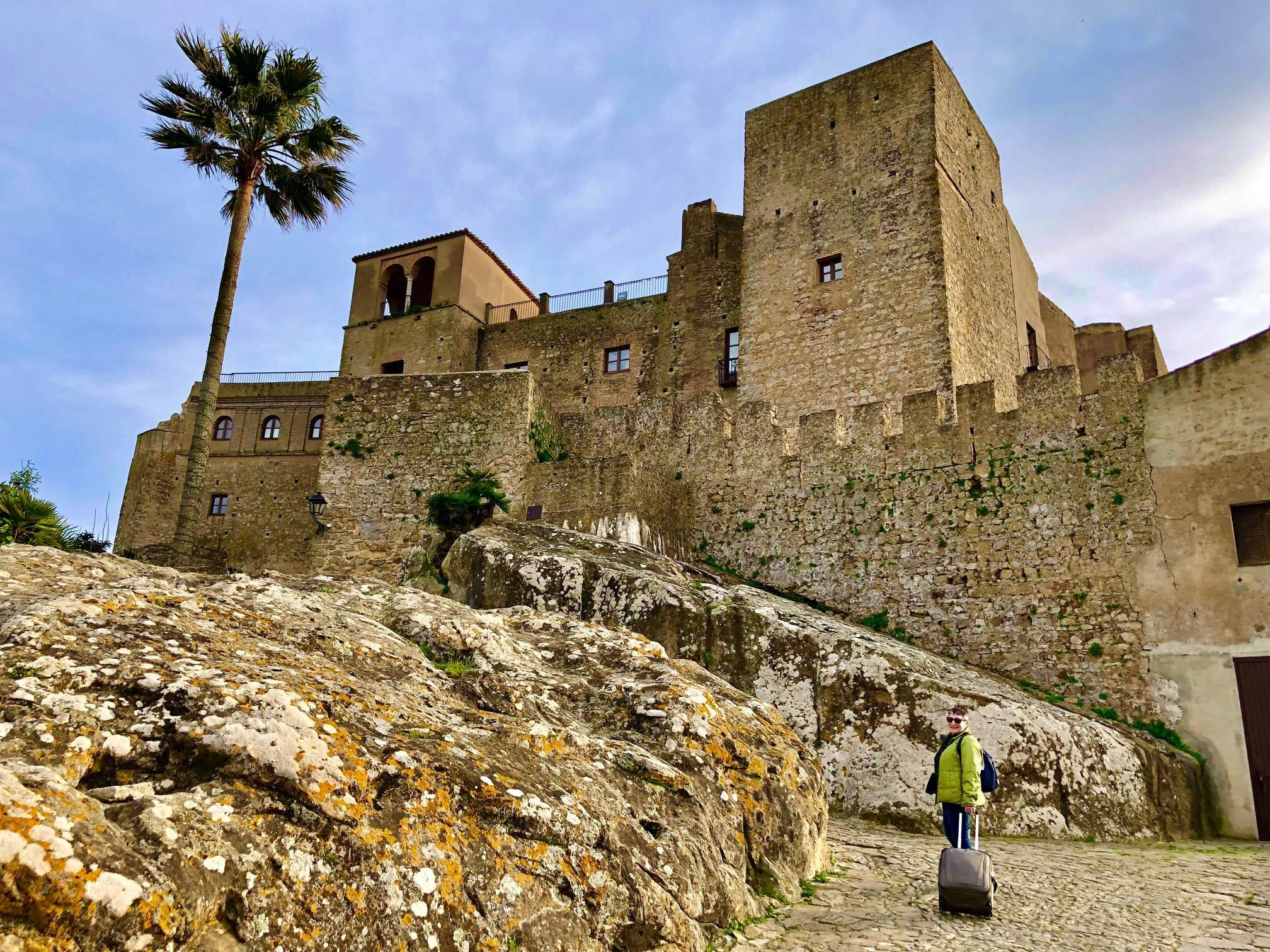
Small plazas held cafés. With their tables set in deep shade, they dotted the historic center and provided a quiet spot to just sit back and enjoy the old-world ambiance of this foreign city, with an intriguing mix of Moorish and Spanish architecture. Our “walk a little then café, then walk a little more,” approach allowed ample opportunities to enjoy the sunny days.
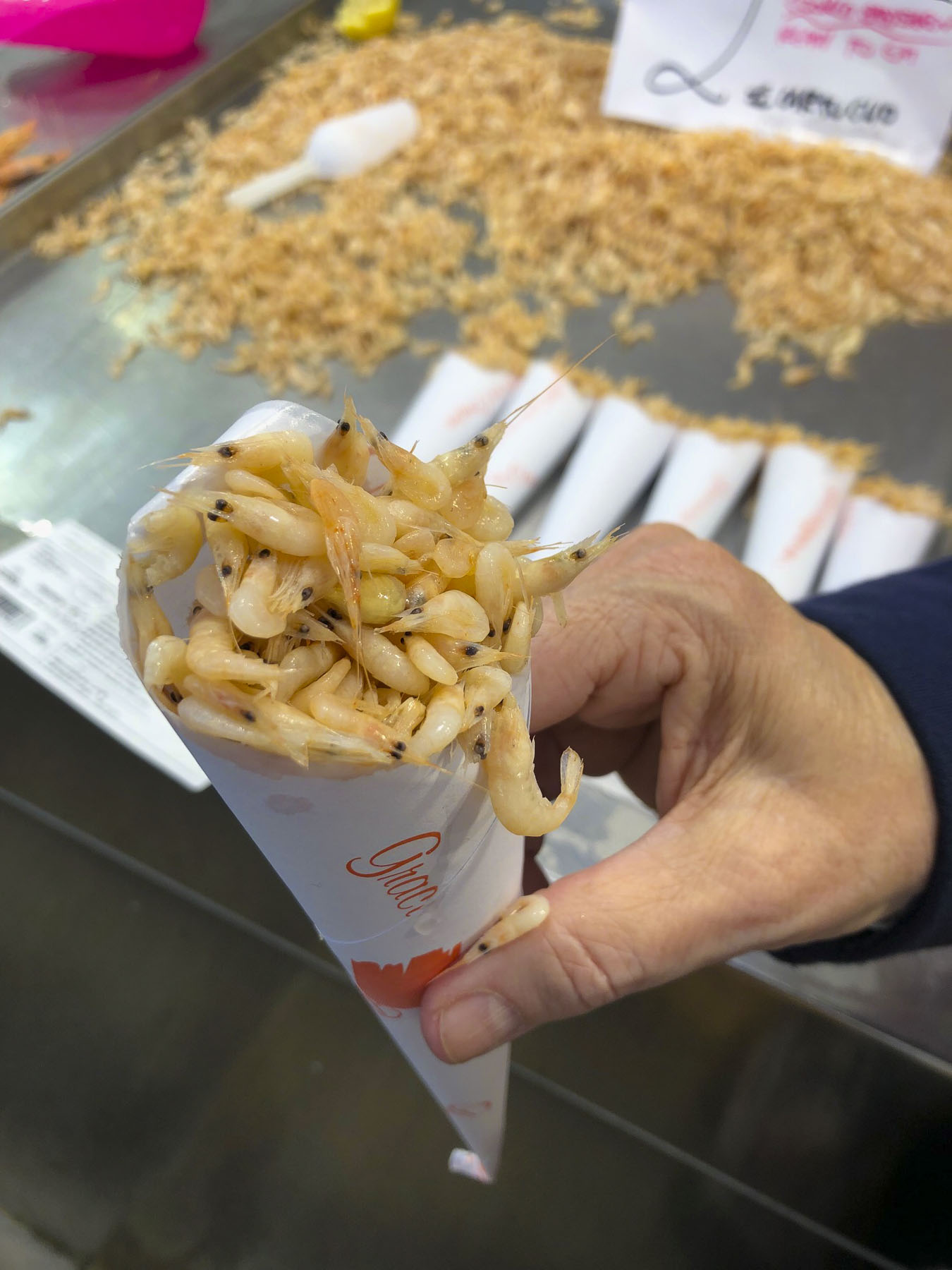
Minutes from our door an arched passage under dwellings in the old Jewish quarter opened onto the Patio de Banderas. It was once a courtyard for a tenth century Moorish palace. In the 1700s the buildings that lined it were used as an armory. Later the square was planted with orange trees and converted to a riding ring for the local gentry to use. At the far end another arched gate framed the La Giralda belltower of the Catedral de Sevilla as we exited onto the Plaza del Triunfo. Built in the twelfth century during the Almohades dynasty when the Andalusian region was still part of Muslim Spain, the tower was originally a minaret.

Its square design is based on the Moorish architecture of the Koutoubia Mosque in Marrakech. The interior does not have a traditional set of stairs for the muezzin to climb to the top for the call to prayer. Instead, it was built with a ramp wide enough for the muezzin to ride a donkey to the summit of its 167ft height. I imagine they would have had a high muezzin turnover rate if this accommodation wasn’t made to facilitate the five times a day call to prayer. After a sixteen-month siege that ended in November 1248, the Muslim forces in Seville surrendered and originally wanted to destroy the minaret before their forced relocation from the city, to prevent its repurposing for another religion. Upon hearing this ing Ferdinand III of Castile included in the terms of surrender a passage that threatened “they would all be put the sword” if the beautiful minaret were defiled in any way. In the sixteenth century a new top third was added with renaissance architectural influences that expanded its height to 337ft and included space for its array of 24 bells. Giralda, “she who turns,” is the name given to the weathervane atop the belltower, with the heroic female statue representing the triumph of Christianity. The exterior of the tower blends Islamic decorative relief sculpture, featuring floral forms, intricate geometric shapes and stylized calligraphy, with Gothic, Romanesque and Renaissance architecture. This is referred to as Mudéjar style and is prevalent in many of the historic buildings in Seville and throughout Andalusia. It is an enchanting blending of cultures and a signature of the region.

The lower part of the belltower and the Mudéjar style Puerta del Perdón gate into the Patio de los Naranjos courtyard filled with perfuming oranges is all that remains of the grand mosque that was repurposed as Seville’s first Christian cathedral after the reconquest. The old building stood until 1401 when construction started on the Catedral De Sevilla, https://www.catedraldesevilla.es/cultural-visit/ with the mission to illustrate the city’s emerging importance and wealth as a trading center on the last navigable stretch of the Guadalquivir River. The church elders offered the following inspirational instructions to the builders: “let us build a church so beautiful and so magnificent that those who see it finished will think we are mad.”

The inside of the of the church, also known as Santa Maria de la Sede, is cavernous with eighty side chapels and a ceiling that soars 138ft high. It is the third largest Christian cathedral in the world. The grandiose Gothic woodcarving of the Retablo Mayor, altar piece, is the life work of one artisan, Pierre Dancart, and gilded with an amazing amount of gold from the then newly discovered Americas.

Statues representing four kings of Spain from Aragon, Castile, Leon and Navarra are pole bearers for Columbus’ tomb, belatedly acknowledging that the explorer, who died in poverty, had made a major contribution to the Spanish Empire.

Always up for a climb, we signed on for a rooftop tour of the cathedral. Following our guide, we climbed stairs worn smooth over the centuries through ancient passageways hidden in the walls and towers to the top of the church for a beautiful view across Seville. We were grateful that we didn’t pass up a chance to walk amid the Gothic spires, flying buttresses and gargoyles that adorn the inspirational structure.

When the tour ended, we rested across from the church, on the steps of the Monumento a la Inmaculada Concepción in Plaza del Triunfo. It seems to be a rite of passage for visitors to Seville, to sit here in the heart of the historic district and soak in the ambiance of this beautiful city.

We let your minds imagine life in Seville centuries ago as horse drawn carriages, filled with tourists now, clattered across the cobblestoned square in front of the Royal Alcazar of Seville. Despite the fact that we were visiting in February, every day the queue for the Royal Alcázar of Seville was always exceptionally long, so we opted to buy our tickets and reserve an entry time online.  The same option is available for the Catedral De Sevilla.

The Plaza del Triunfo sits on what was once Seville’s ancient river port until the 900’s when the area was filled, and the Caliph of Cordoba ordered the building, adjacent to it, of the Royal Alcázar of Seville to accommodate offices of the Muslim government and the Caliph’s residence.

It’s been expanded and renovated numerous times over the centuries by both Muslim and Christian rulers. But surprisingly each successive regime savored an appreciation of the previous ruler’s Islamic architecture, intricate wall and ceiling decorations and quiet, lush oasis-like gardens. All are designed to create a sense of wonder, a key element of Islamic art. The Spanish Kings and Queens continued to admire the Muslim architectural style and imported Mudéjar craftsmen from Toledo and Granada to enhance their newer constructions which favored European Gothic, Romanesque and Renaissance architectural styles. 

The importance of the Alcázar evolved significantly as Spain’s colonization of the Americas saw the country grow into the world’s first global empire, all of it directed from this seat of power in Seville. It’s an amazing place is the best way to sum it up.  Today the Alcázar of Seville is still occasionally used as a royal residence by King Felipe VI and Queen Letizia.

Flamenco is synonymous with Seville and one of most enjoyable ways to watch it was to find a street dancer or group busking. Our favorite dancer was Charli La Tornillo. She entertained crowds many afternoons with a passionate, fiery routine near the fountain in Puerta de Jerez Square, located on the tram line not far from the Alcázar. The Jardines de Murillo and the Plaza de España were also reliable spots to find Flamenco dancers.

One Saturday morning we decided to take the tram from the Prado De San Sebastian metro station into Plaza Nueva to start our morning, a relatively short trip in a modern coach through the pedestrian only historic center on a route lined with ancient stone and fin-de-siècle buildings.

It passed Seville’s 15th-century Exchange that now houses the Archivo de Indias, which contains centuries worth of records pertaining to Spain’s colonies in the new world. We first noticed a group of elegantly attired women wearing unique fashionable hats called tocados, or fascinators, walking along Av. de la Constitución, not far from city hall, our final stop. Saturday mornings, it turns out, are when civil weddings are performed in Seville.

It was an interesting morning watching the various fancifully dressed wedding groups queue in the plaza before their assigned time. Unlike civil ceremonies in the states, which usually are lowkey events, civil weddings in Spain are occasions for fashionistas to dress to the hilt.

After the ceremonies, friends and families escorted the bride and groom to nearby restaurants to continue the celebrations.

Seville is also a popular destination for joyful, outlandishly boisterous hen parties. Participants parade through the streets, dressed in quirky outfits, to celebrate their friend and bride to be.

Seville packs a lot into a small space and every direction we headed offered something interesting. The Hospital los Venerables was just a few steps away from our front door, down the narrow Calle Gloria that opens to the aptly named Plaza Venerables. 

It was built in the 1600s as a retirement home for poor, elderly or disabled priests.  The very austere exterior deceitfully hides a wonderfully ornate Baroque chapel and interior, as well as various tranquil courtyards. Today the building is used as a museum dedicated to the Sevillian born (1599) artist Diego Velázquez.  A collection of paintings by 17th century artists Francisco Pacheco, Murillo and Bartolomeo Cavarozzi are also on display.

There was an amazing amount to see in Seville as we wandered all over the city.  We’ll share our walks across this intriguing city in a number of future blogs.

Till next time, Craig & Donna