Seville Part 2 – Walking Through History Under the Orange Trees

One of the tenets of slow travel is the ability to revisit a place many times to savor the changes in its ambience. The Plaza de España in Parque de María Luisa was one such lively spot that we enjoyed and returned to several times. 

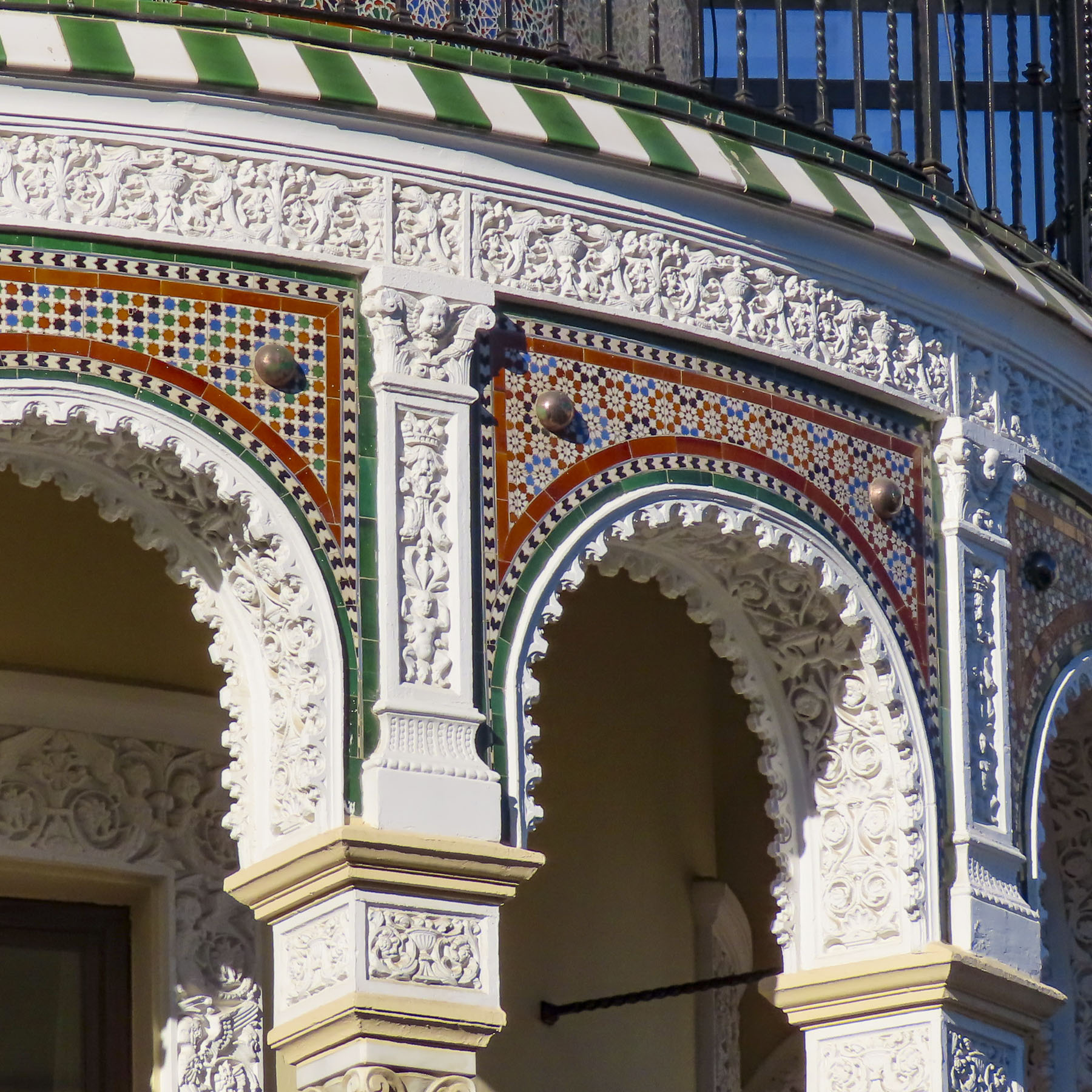
It is an iconic landmark for Seville with its eclectic mix of Baroque, Renaissance and Moorish architectural styles embellished with hand painted Mudéjar tiles created across the Guadalquivir River, in the Triana barrio.
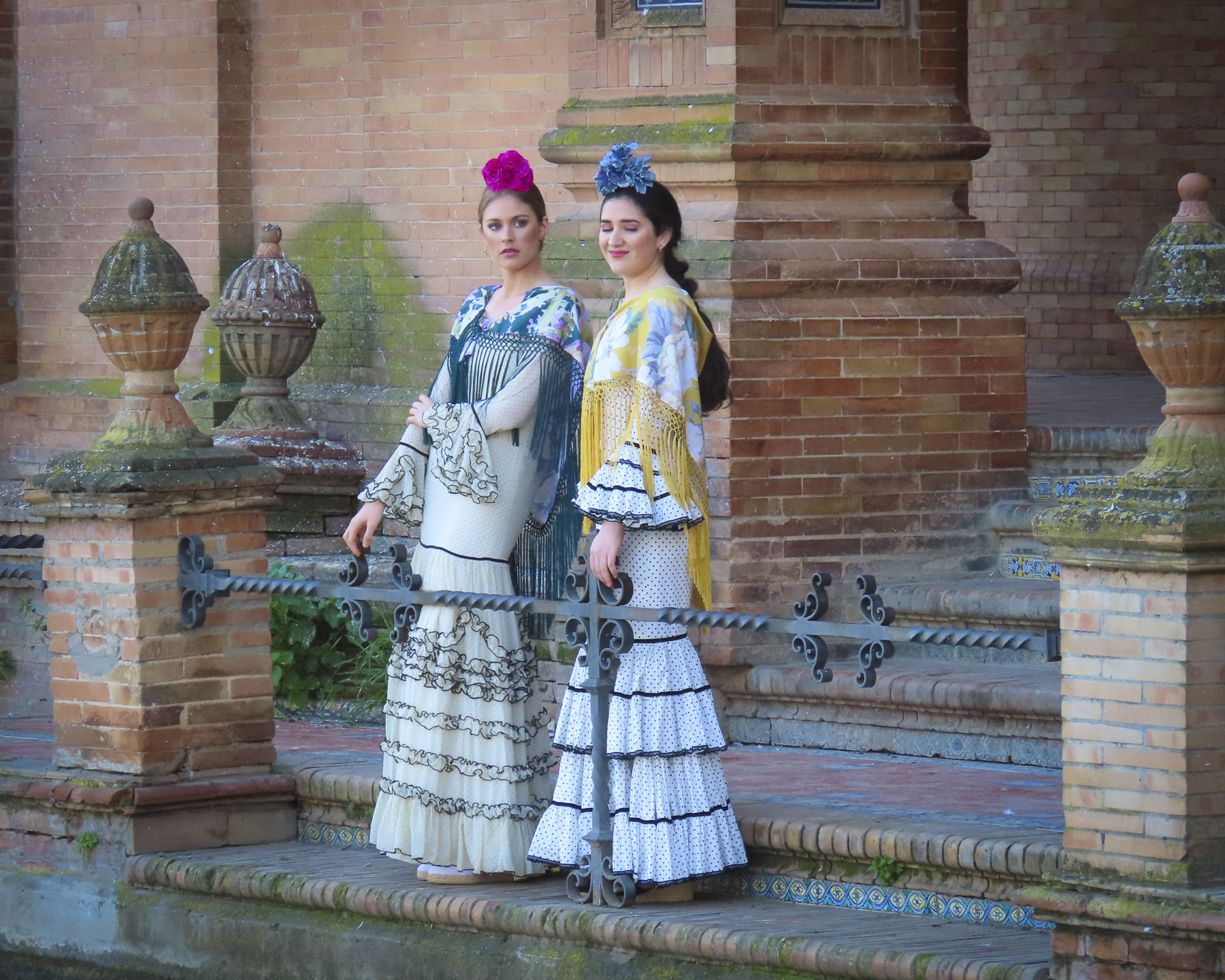
Along with an expansive plaza, signature horseshoe colonnade, and boating moat, it has been a popular destination since it was constructed for the Ibero-American Exposition of 1929.  It, along with the Museum of Popular Arts and Traditions, and the Archeological Museum of Seville in Parque de María Luisa, are hubs of activity on the weekends when they fill with friends and families looking for more elbow room.

Several other architecturally interesting buildings were constructed in the park and along Paseo de la Delicias at this time to host exhibitions from countries that were formerly part of the Spanish Empire and which would later be used as consulate building. 

On the way to the park one morning, we stopped for café along the edge of Jardines de Murillo and unsuccessfully tried to order cappuccinos from a brusque waiter who replied, “No,” just no and without any further explanation turned and walked away. Confounded, we left.  This happened again several days later when we were early for a dermatologist appointment, for an overdue skin cancer screening at Hospital Fátima, a private hospital in Seville that facilitates multi-lingual medical tourism services for travelers. We used TripMedic to arrange our appointments.

We found the small café, Bar Puerto Chico, on the block behind the hospital. It was full of folks on the way to work, having the traditional Andalusian breakfast that consists of tostada, soft Mollette bread, perfectly toasted to a golden brown and drizzled with olive oil, a smear of crushed tomatoes and maybe a slice of jamon, along with coffee and zumo natural, fresh squeezed Spanish oranges.  “Dos capuchinos por favor.” The barman smiled this time when he responded with a “No,” but seemed to be delighted that two foreigners had found his establishment, when he explained that they only serve espresso or café con leche. In some local bars cappuccinos just aren’t done. Mystery solved.
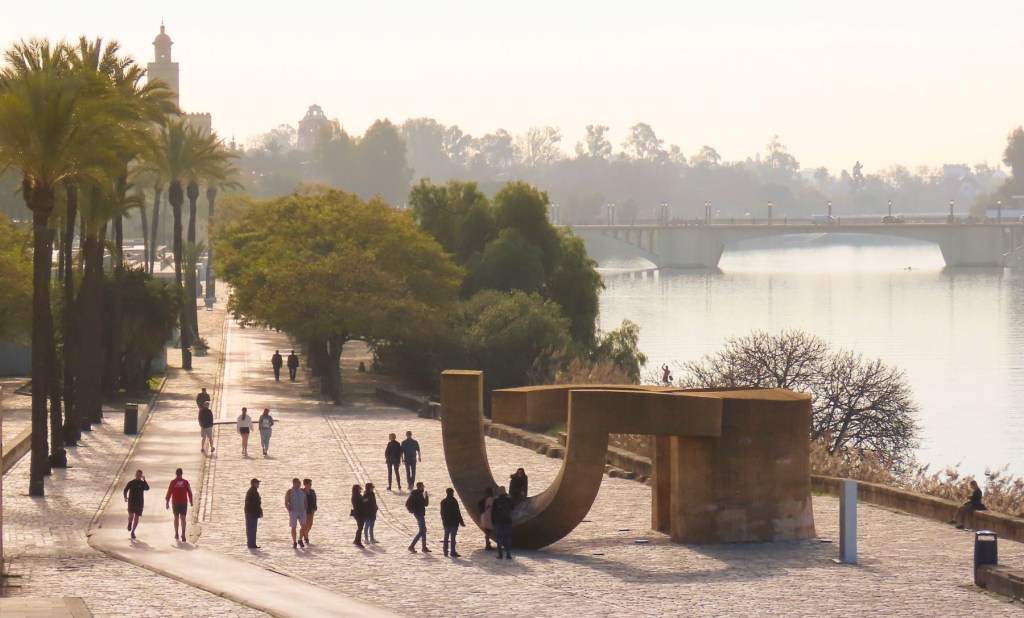
Heading back into the city center, the sidewalk along Paseo de la Delicias eventually dips down, near the Escuela de Mareantes (School of Navigation) and widens to a scenic esplanade for bicyclists and walkers, that parallels the Guadalquivir River through Seville for several miles.

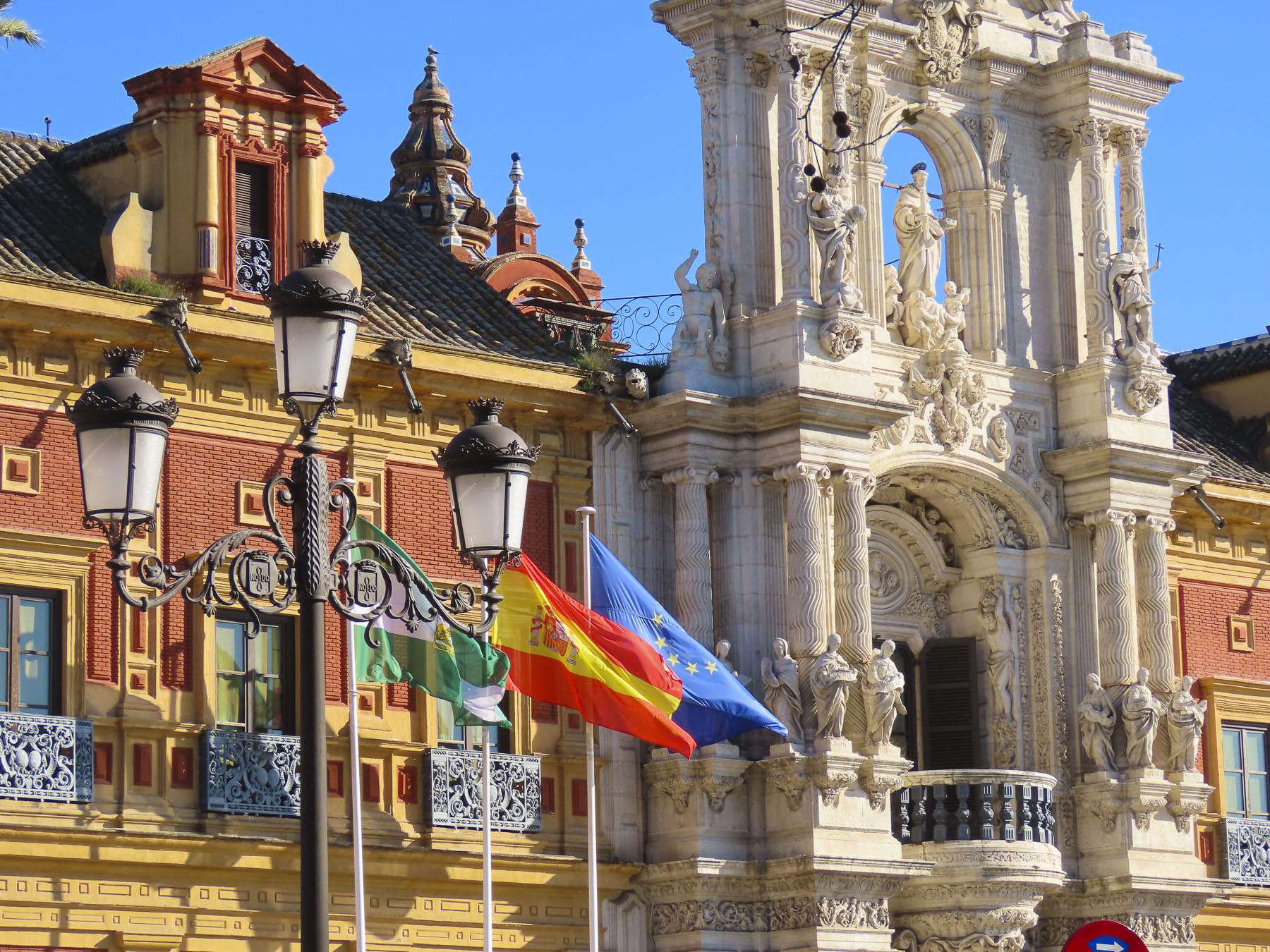
Speckled with buskers, sculptures, and benches, there are plenty of excuses to saunter slowly and savour the view. The river is popular with numerous kayaking and sculling clubs that launch miles upstream and then race down the river. 

The waterway on the weekends was always bustling, but even during the week there were a good number of paddlers and rowers on the water, from sunrise to sunset.

It’s also an historic stretch of river that was the Port of Seville, where galleons returning from the Spanish colonies in the Americas during the 16th and 17th centuries unloaded cargo and registered their treasure of gold and silver bullion at the Torre del Oro, tower of gold bullion.  The 118 ft tall tower dates from the 1100s and was part of the Moorish defensive wall that once encircled the entirety of ancient Seville and was the anchor point for a heavy chain that was stretched across to the Triana side of the river to control shipping.

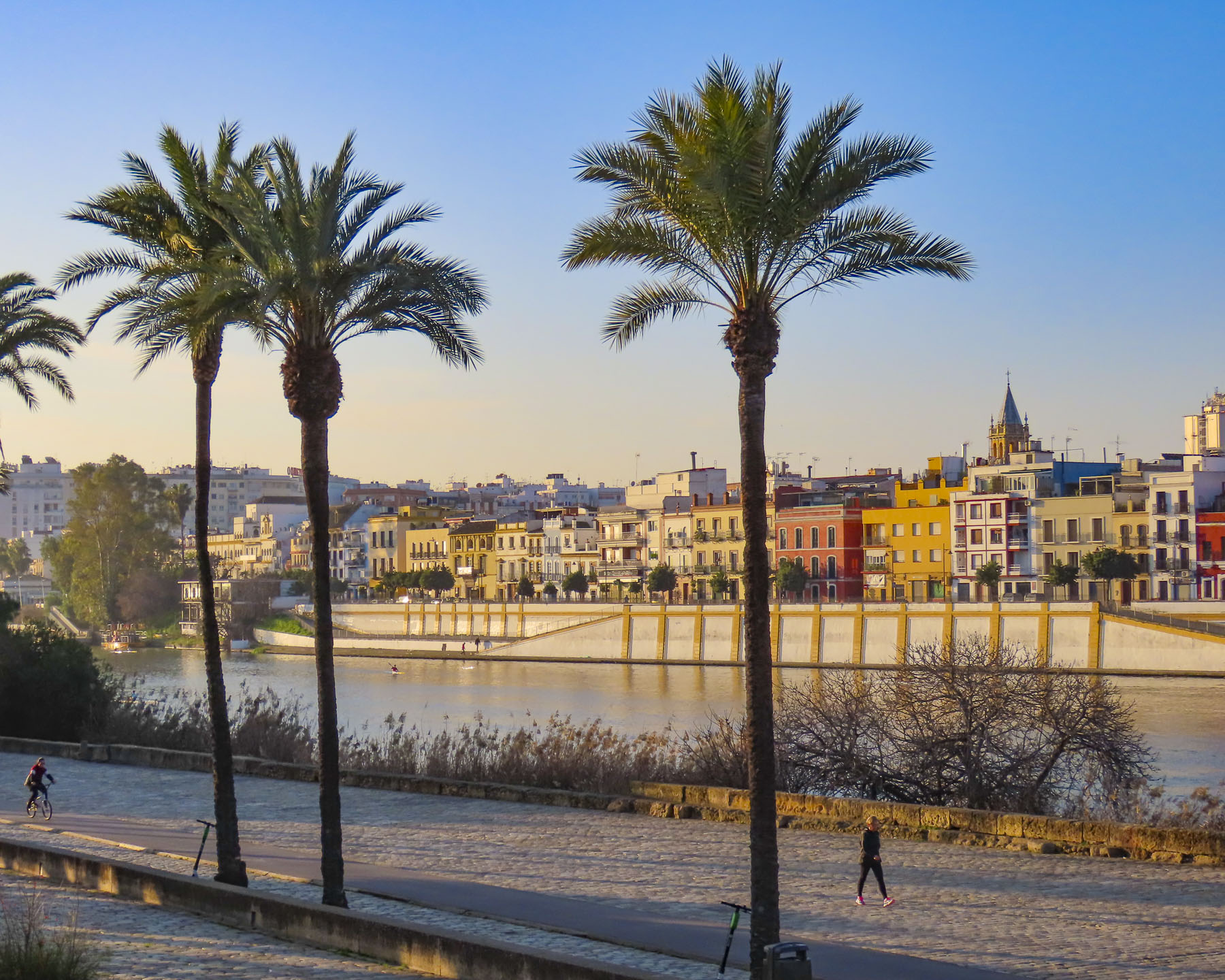
Ferdinand Magellan launched the first circumnavigation of the world from this quay in 1519. For the 500th anniversary of this tremendous feat the city commissioned a full-size replica of his ship, the Nao Victoria, to be moored on the river.  A small vessel by today’s standards, it made us wonder how they ever succeeded in sailing around the world. 

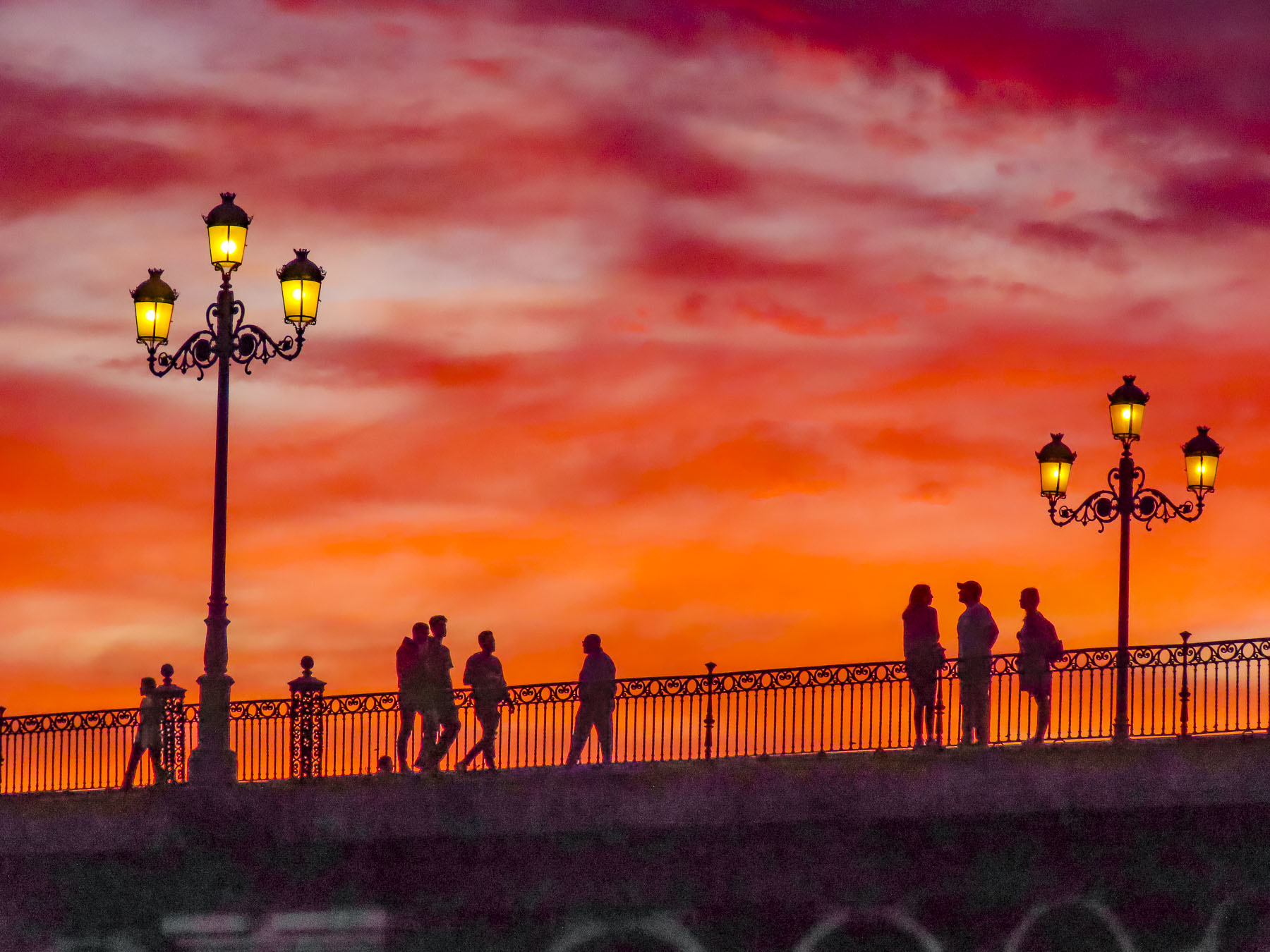
Nearing sundown, the quay along the river fills with folks waiting to watch the sky erupt with color as the sun sets behind the bridge and Triana.

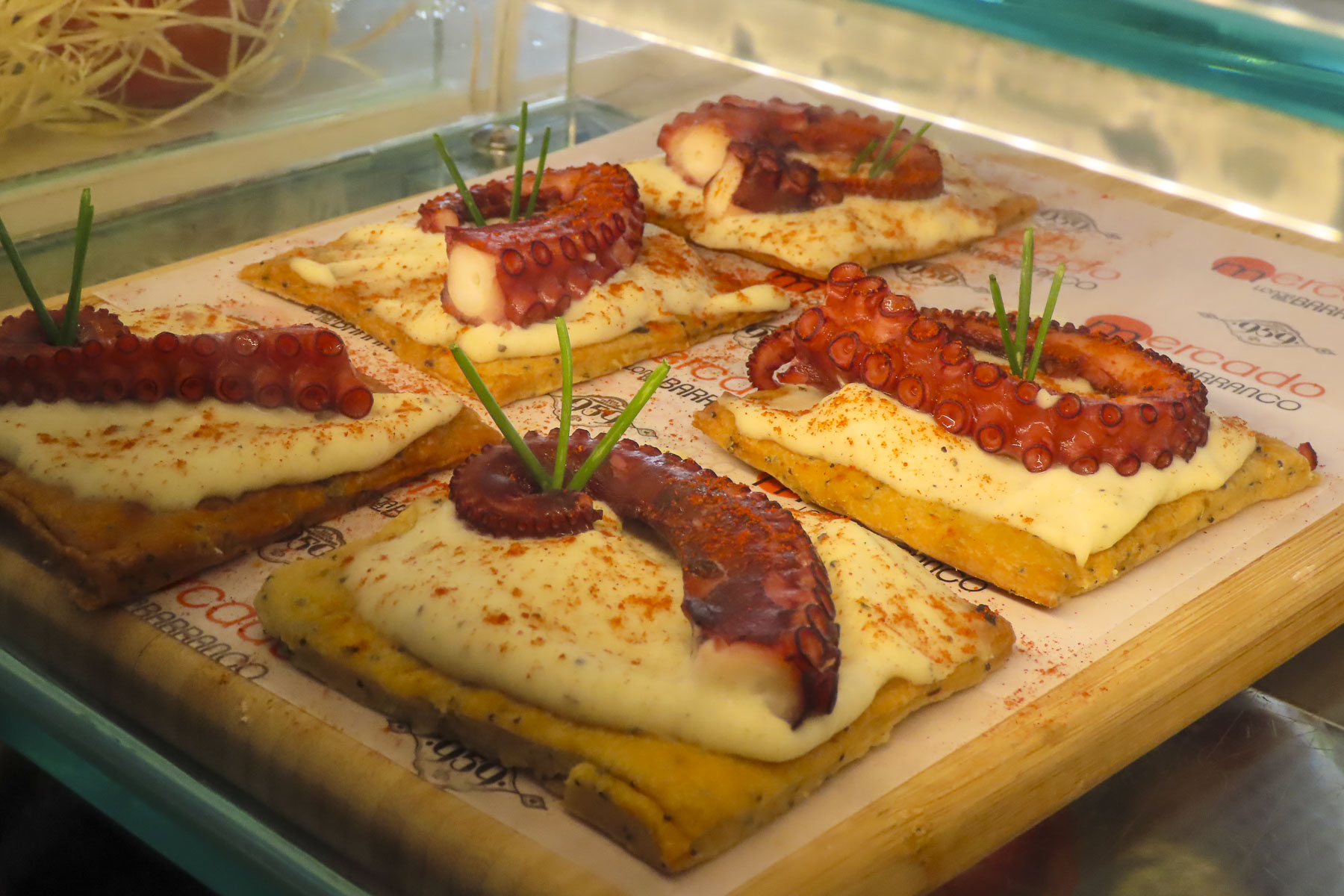
At the base of the bridge stands the lofty, wrought-iron and glass Mercado Lonja del Barranco, designed by Gustave Eiffel in 1883. It functioned as the city’s fish market for several decades before it was re-envisioned in 2014 as an upscale food hall with a contemporary, architecturally beautiful interior.  It’s definitely a fun foodie destination; it is a savory gauntlet of display cases offering the full spectrum of Spanish cuisine prepared by twenty different restautrants.  There is something delicous for everyone available here.

Aside from the completion of the Puente de Triana bridge in 1852, which replaced a well maintained 700 hundred year old Arab-designed pontoon bridge, it’s alleged that the Triana riverfront looks unchanged since Columbus recruited his sailors from the barrio.

While it still retains its authentic character, some wonderful alterations have been implemented, starting with the pedestrian only Calle San Jacinto that starts at the foot of the bridge on the Triana side. It is a lively stretch of outdoor cafes that offer an array of different cuisines.
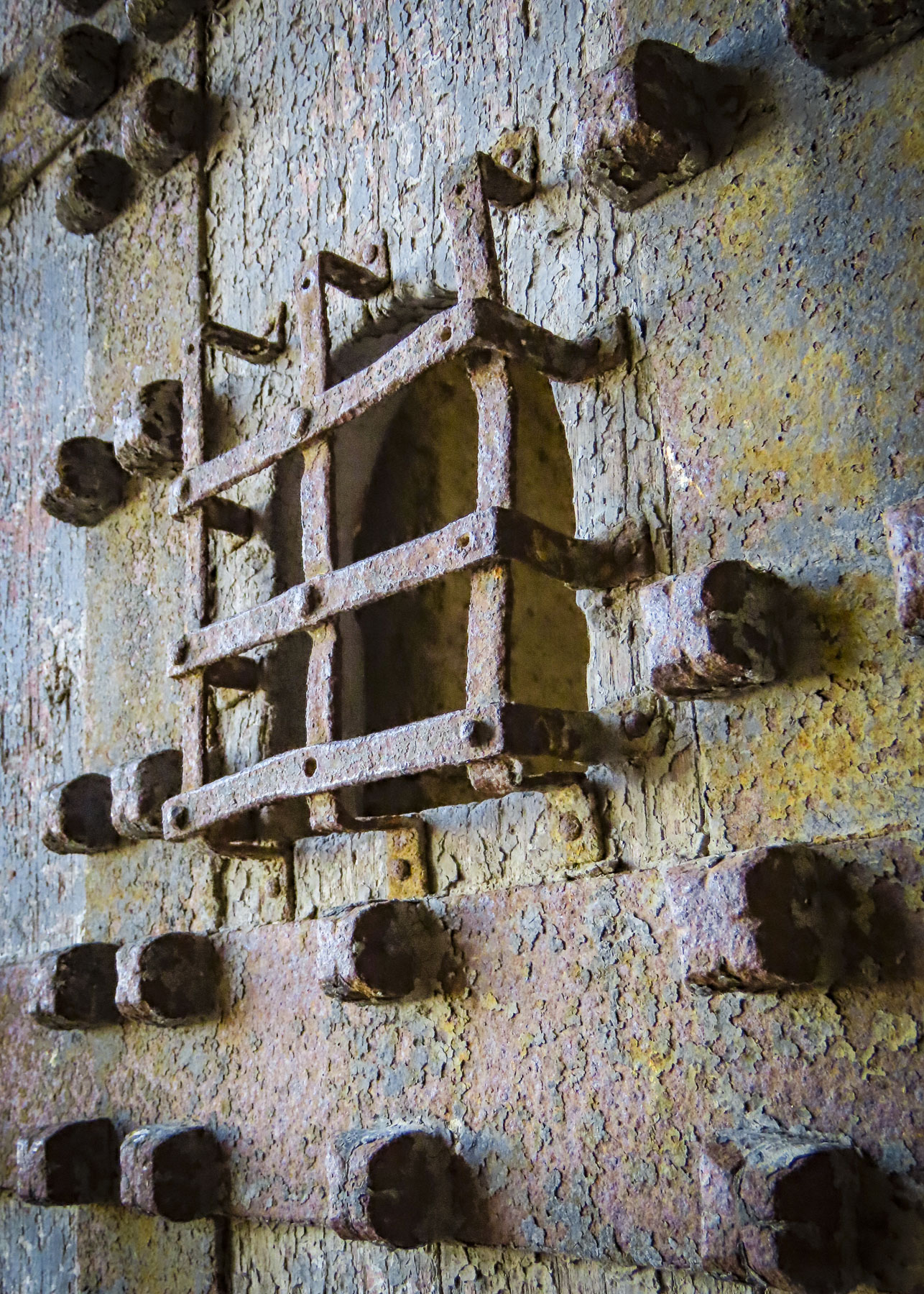
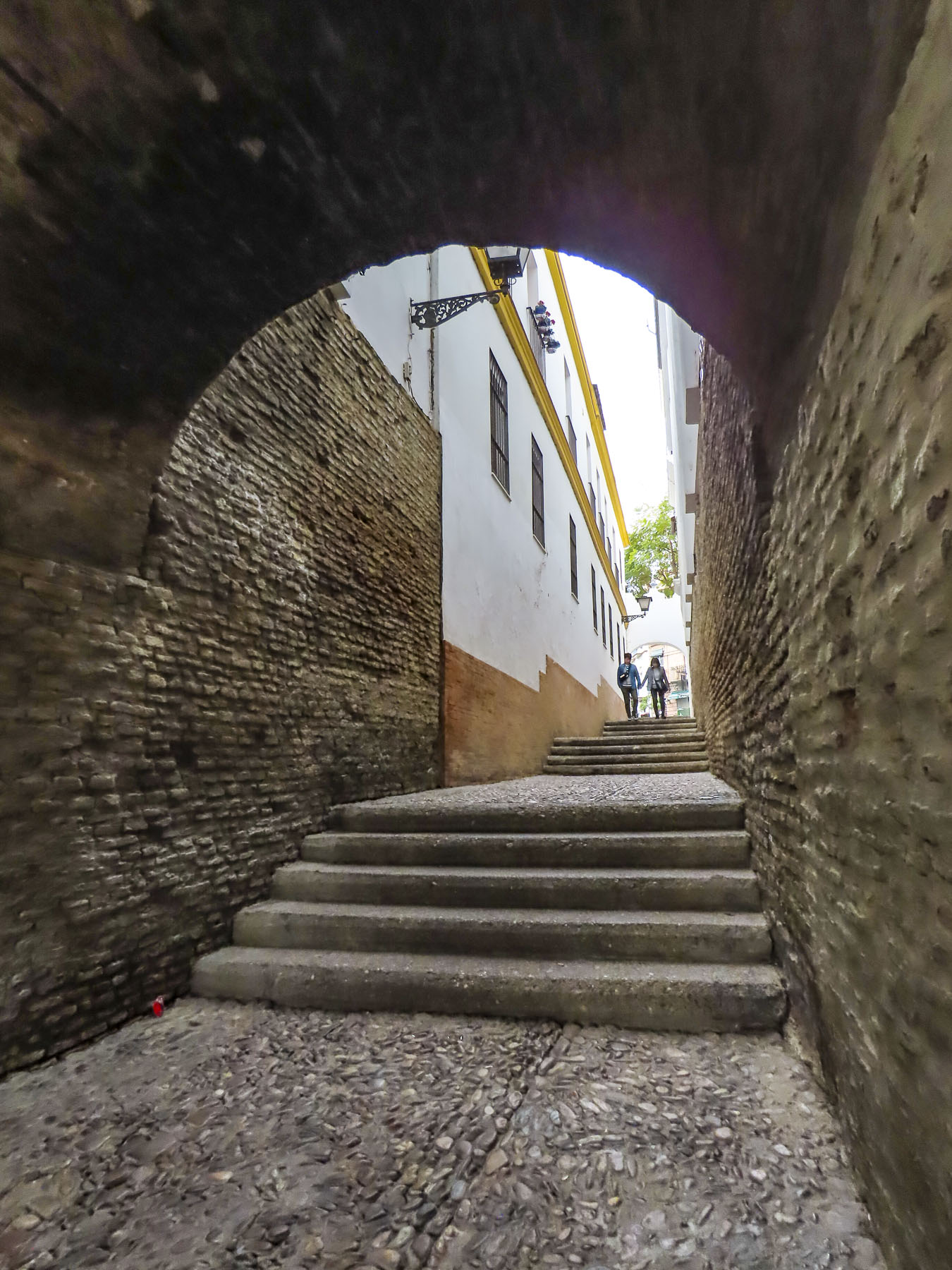
The ruined dungeons of Castillo de San Jorge castle, located under the Mercado de Triana, are now a museum and Interpretation Center for the 300 year terror known as the Spanish Inquisition.  Nearby a short alley leading up from the river, the “Paseo de la Inquisición,” was the last walk of freedom for many before the prison door slammed behind them.
The mercado is a thriving, lively spot that draws locals for the seafood, meat, cheese and vegetable vendors, along with a slew of always busy restaurants.  We caught a lesson in buying fresh fish while waiting in line at a fish monger’s stand. “Always look at the inside color of the gills, they should be very bright,” is what we gathered as he showed several large whole fish to the customer in front of us as we waited to purchase a filet of tuna to cook back at our apartment.

One stall, which we dubbed the olive porn store, only sold decadent large olives garnished with all sorts of delicious extras.  Another booth offered artfully decorated puff pastries, which were as tasty as they were visually stunning. The mercado was a long walk from our apartment, but one of our favorite traditional markets to shop at, which we returned to several times during our six-week immersion in Seville.

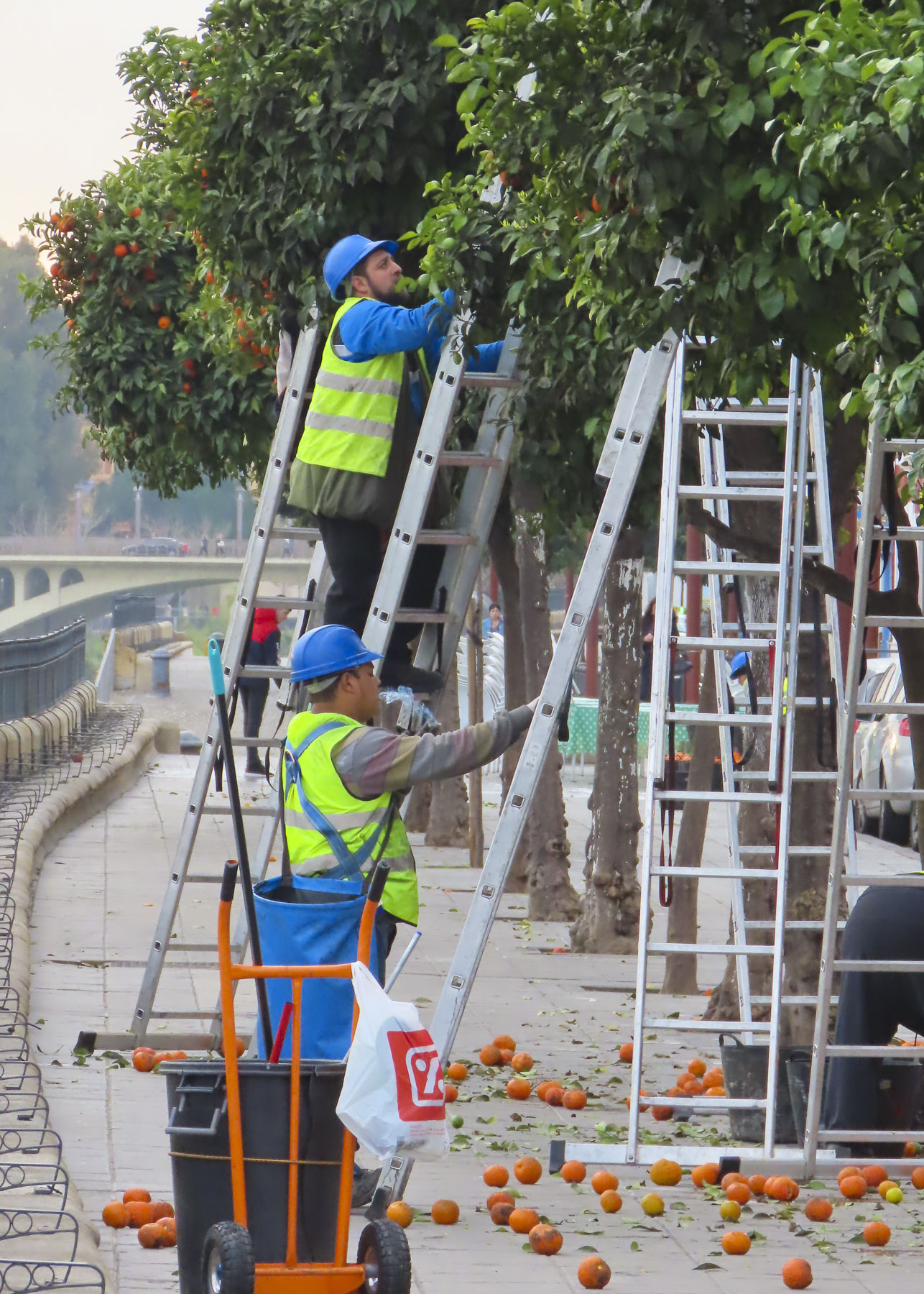
We were on the Triana side of the river one late February morning and came across a crew of city workers with ladders and buckets harvesting all the softball size Seville oranges from the trees that were lining the street. The fruit was brought to the city by the Arabs in the 9th century and Seville now, unbelievably, has 46,000 bitter orange trees that produce close to six million tons of fruit annually. Most of it is sold to be used to make marmalade, but it is also an ingredient in Cointreau, Curacao, Grand Marnier and Triple Sec liquors. Oil from the bitter orange skin is used for cosmetics, pharmaceuticals, and soaps. Recently the city started using the unsold oranges in an innovative Biogas program, where the methane gas created by the decomposing oranges is used to make “clean electricity” to run a water purification plant.
Before continuing our day, we stopped for coffee at one of the cafes that line the riverfront on Calle Betis. From our previous experiences we believed it was impossible to get a bad cup of coffee in Europe. All of it is usually made to order on one of those fancy deluxe espresso machines that you see behind the bars. My wife is more the coffee connoisseur than me as I’ve been known to make a mug of coffee last all day. But that day we both had the worst cup of coffee ever and couldn’t drink it beyond our first sips. It must have been the last pot of drip coffee from the day before that was left on the burner overnight. It’s amazing how waiters can vanish; perhaps ours did from embarrassment, but this could explain the beginning of the inquisition. Bad coffee leading to misplaced aggression, we all know what happens without that caffeine.  Sympathetically the second waiter understood when we explained the situation and he didn’t request payment.
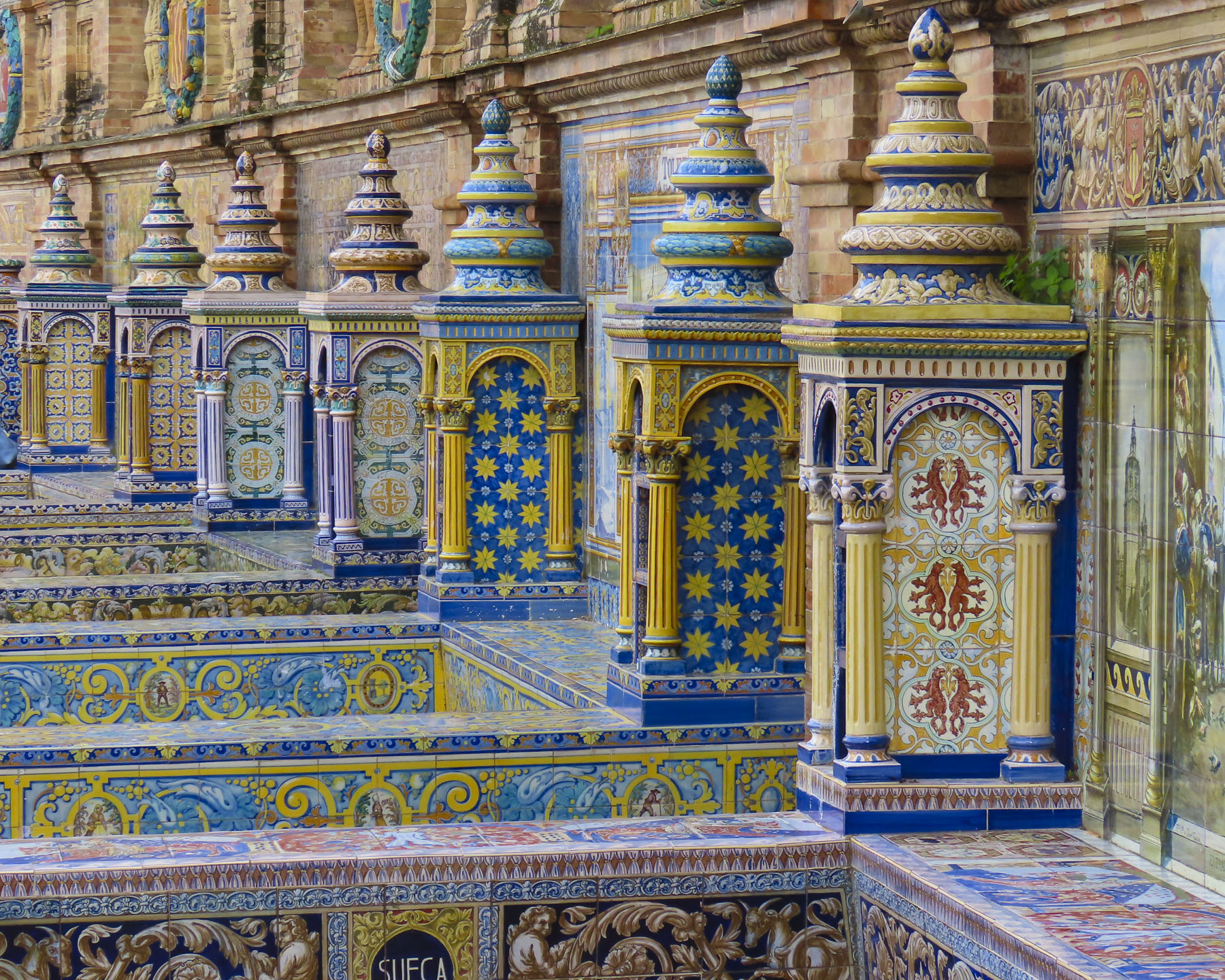
Triana was also famous for the ceramic workshops that painted and then fired in massive kilns the Azulejo and colorful Mudéjar style tiles that adorn many of the historic buildings in Seville.  Along with sailors, Triana has cultivated many famous flamenco dancers, guitarists and bullfighters. The most admired matador was Juan Belmonte who stood famously close to the bulls and was gored several times over a career that spanned 109 bullfights. His statue stands in the plaza across from the Triana Mercado and if you follow his gaze you’ll see Seville’s beloved bullring, Plaza de toros de la Real Maestranza de Caballería de Sevilla, often simply called the Maestranza, across the river. It has been holding corridas in the same ring since 1761. 
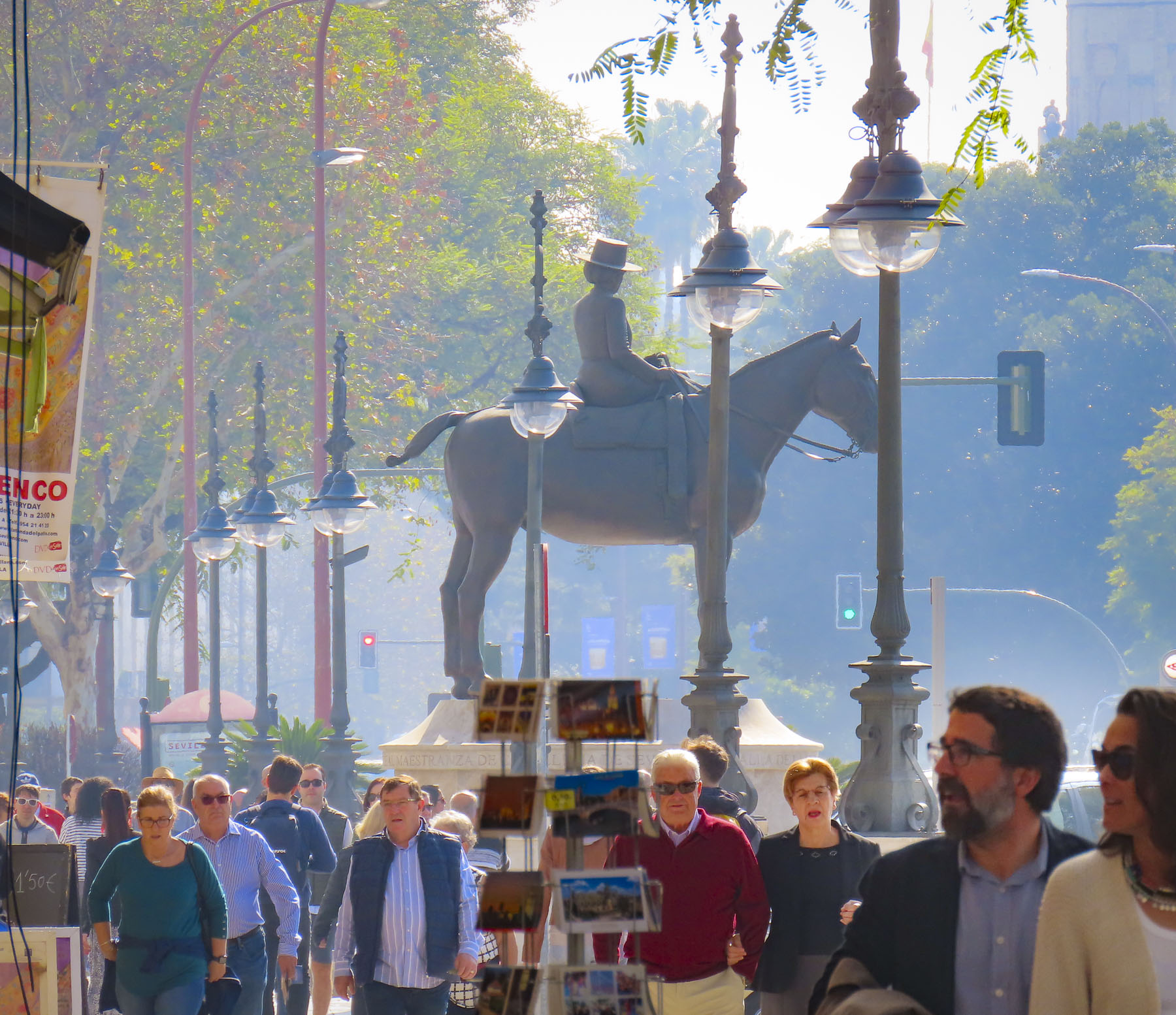
Many of the taverns surrounding the bullring are full of corrida memorabilia. Our favorite was Bar Baratillo on Calle Adriano which is also full of shops catering to the Andalusian equestrian tradition.  La Feria de Abril is a colorful weeklong festival that celebrates this Andalusian equestrian tradition with the women wearing traditional traje de gitana or faralaes (flamenco style dress), while the men wear a cordobes hat along with a fitted short jacket, riding trousers and riding boots, refered to as traje corto. Every midday during the festival a parade of carriages and riders, called the paseo de caballos, heads to the bullring to watch the best matadores on Seville’s bullfighting calendar perform. Bullfighting season in Seville starts at the end of Semana Santa, Holy Week, on Easter Day.

Farther behind the bullring the Hospital de la Caridad, founded by the Holy Charity brotherhood in the 1600s, still follows its mission to help the poor and infirm. Its beautiful baroque chapel is now a museum filled with art.

Also, in this neighborhood in Casa Morales, we found one of Seville’s oldest abacerías, a small grocery store with a small tavern in the back, on the corner of Garcia de Vinuesa and Castillejo that is still run by the same family since its opening in 1850. The bodeguita retains its original atmosphere with antique cabinetry in the store and tall, large earthen wine vats lining tavern’s walls. It’s definitely worth a stop here to try their traditional tapas or montaditos, small sandwiches.

Just off Calle Adriano one Saturday in the weeks prior to Semana Santa we came upon a Christian brotherhood training to carry their float for the holy week processional. With military marching precision, the muscular team turned the weighted float around a tight corner and continued down the block in synchronized step. 

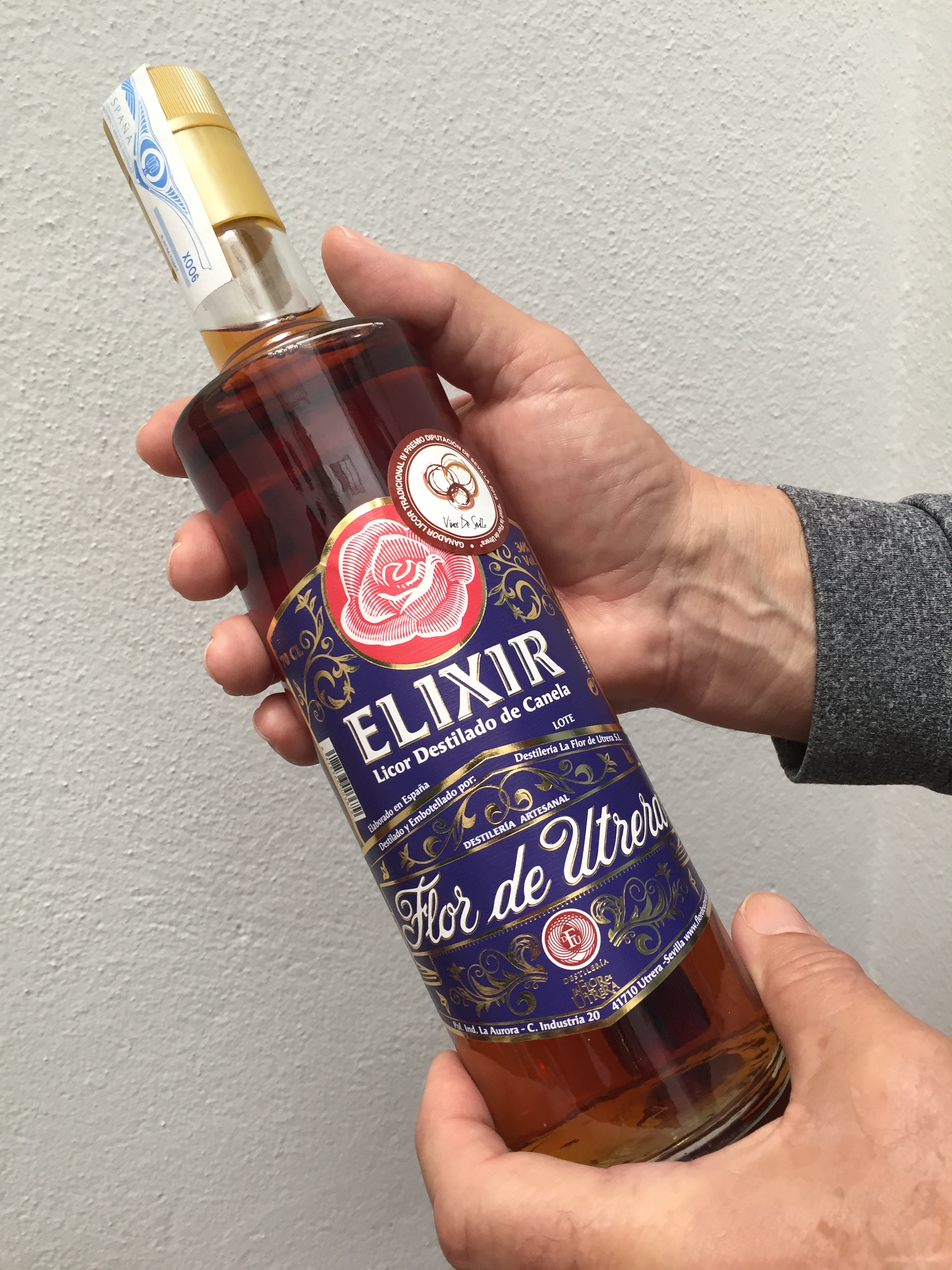
We followed the marching band that accompanied them to a fundraiser for the brotherhood.  Very much like a church bake sale, the only difference was they surprisingly sold bottles of various liquors.
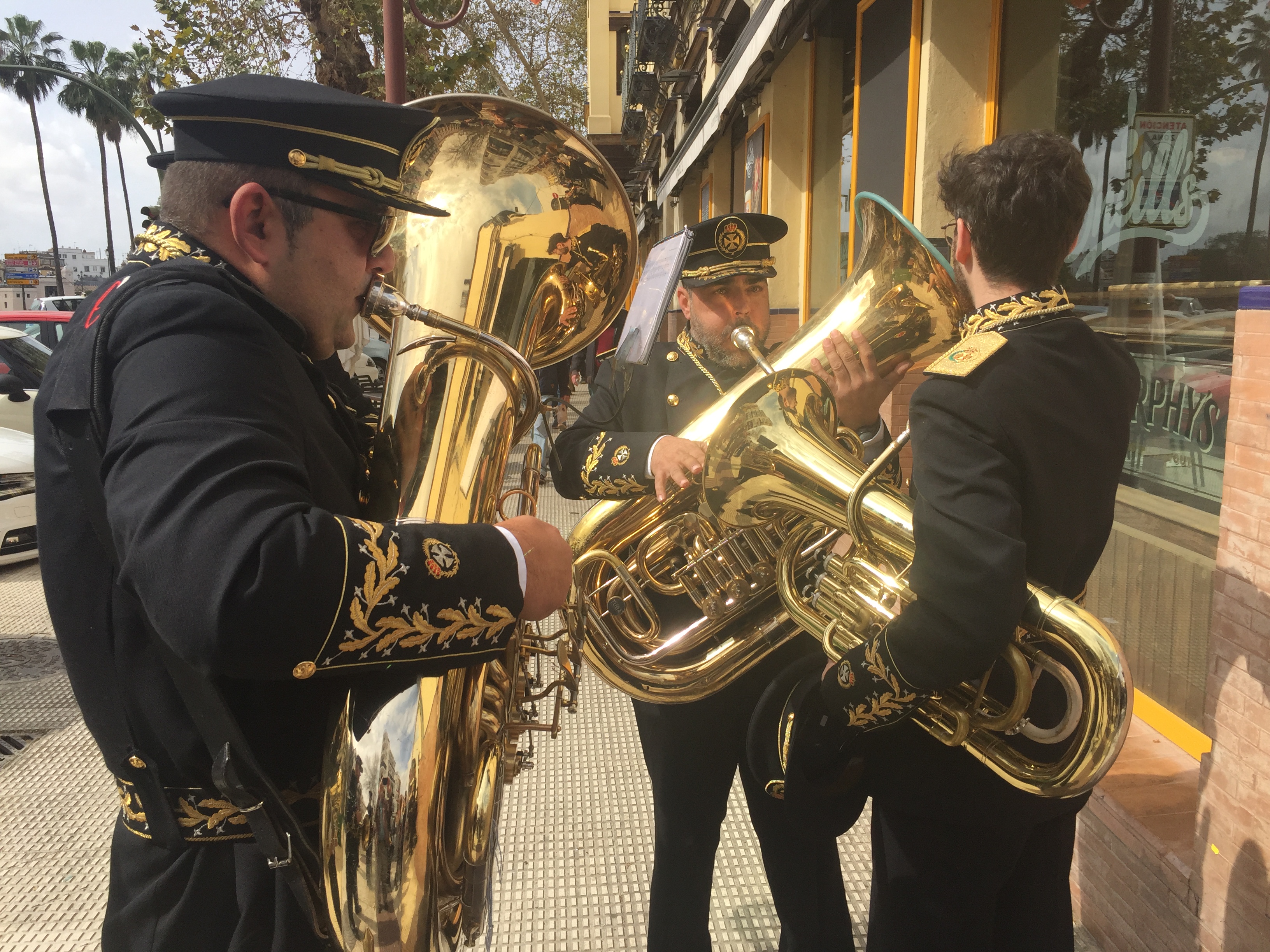
We smiled, bought one and saluted Seville’s spirit later that evening.

Salud! – Till next, Craig & Donna 

Seville Part 1 – Living in the Centro Historico

Our host had given us instructions to make our way to the Jardines de Murillo, past the historic monument commemorating Columbus’ discovery of the new world and then cross the park entering the Santa Cruz barrio through an old gate, under an elaborate balcony. It’s believed this balcony was the inspiration for a scene in Rossini’s comedic opera, The Barber of Seville, where Lindoro and his band of troubadours played a serenade below the window of the stunning Rosina.  We’d pass through this relaxing park many times during our time in Seville while heading out to explore the city or shop at the closest Supermercados MAS. An excellent small grocery store with bakery, meat, cheese, and fish departments. We signed up for their shopper’s club card!

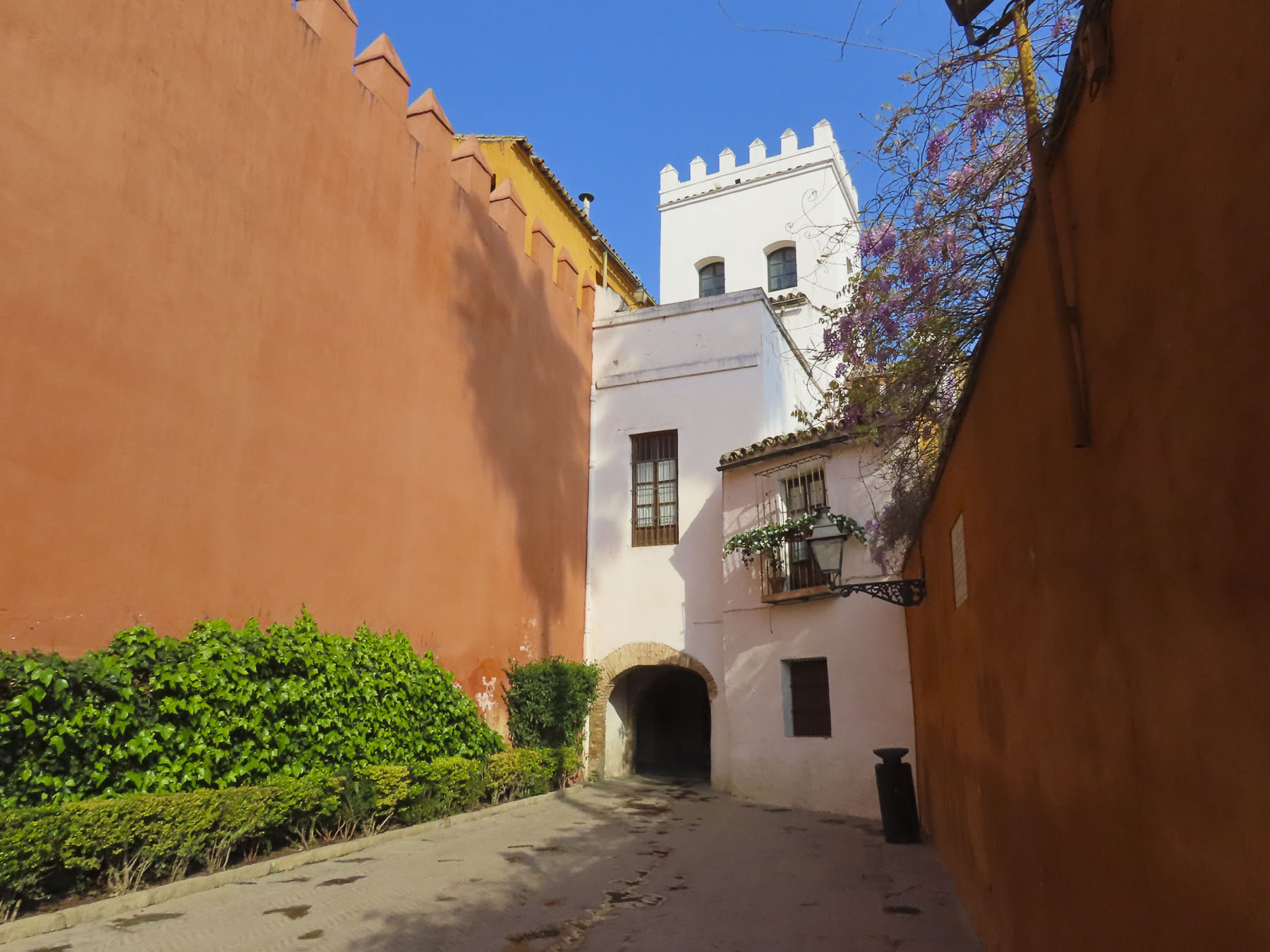
“Continue down Calle Agua,” so called for the ancient aqueduct that ran atop the high wall that parallels its length and supplied water to Royal Alcázar of Seville, a former Moorish palace before the reconquest of Seville in the 13th century by the Castilians. “It turns and becomes Calle Vida.” A few steps down the lane Calle Judería veered off, a reminder that this was once the old Jewish quarter when the Moors ruled the city and continued until 1492 when King Ferdinand II and Queen Isabella decreed that all Hebrews be expelled from Spain.

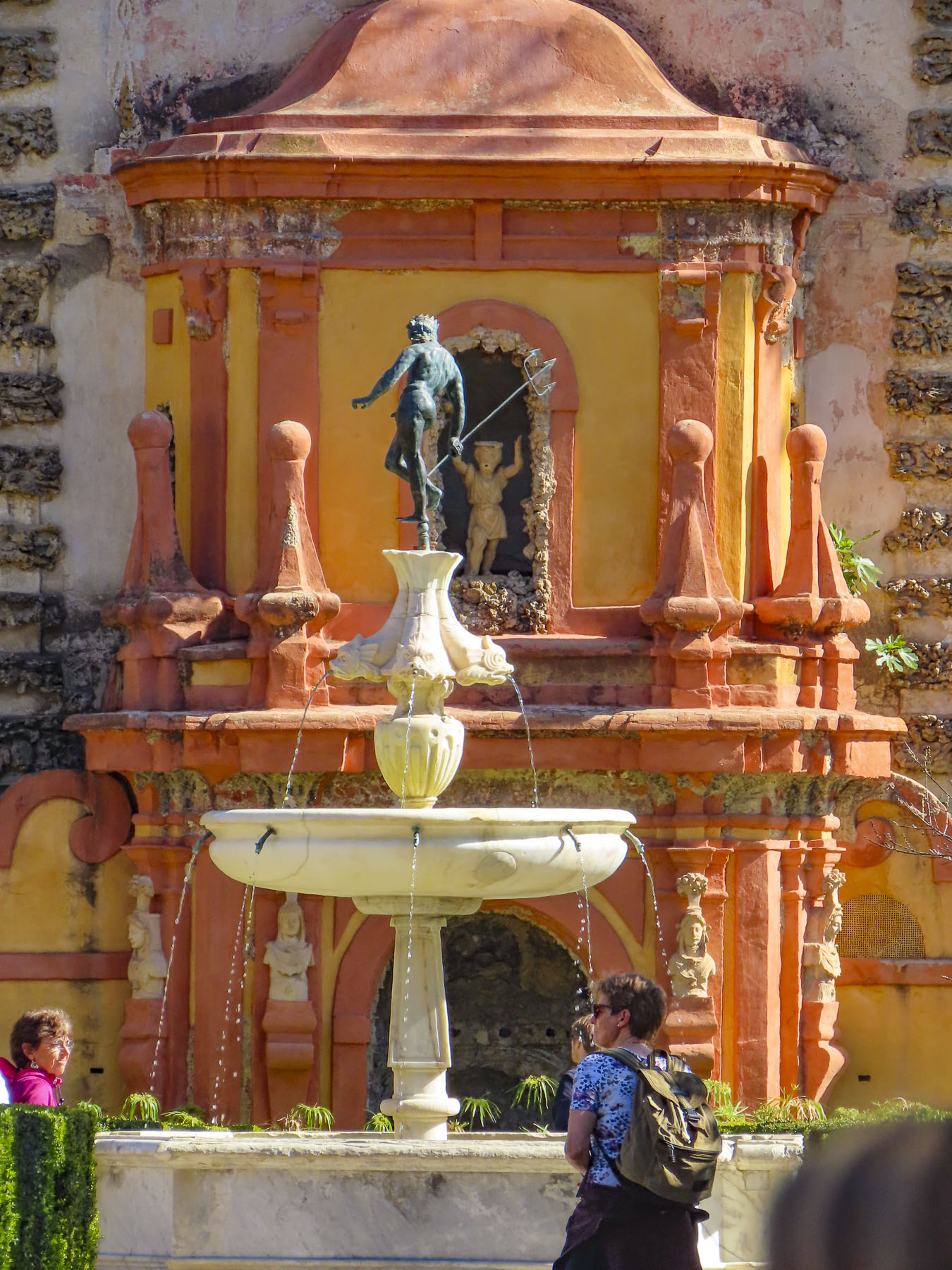
We continued straight as the high walls of the lane narrowed to a point where walking single file was required, and the clickety-clack of our suitcases reverberated off the shadowed stone walls. With a broad smile and “Hola!” a sample of freshly toasted snacks was enthusiastically offered to us by an energetic saleswoman. It appeared that her mission was to have every tourist who passed her station sample the tasty treats created at Sabor a Espana, the shop that anchored a corner on Plaza de Doña Elvira, our final destination. Centered with a tiled fountain and surrounded by fragrant Seville orange trees, the intimate plaza was an oasis of greenery amidst the ancient stones of the old town.

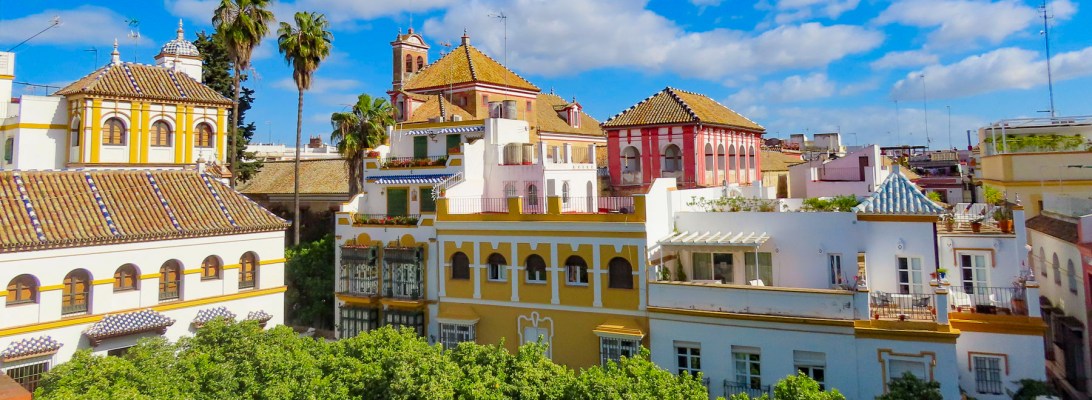
Our host was waiting as promised with keys and an orientation of the apartment which we would call home for the next six weeks. It was the smallest apartment we had rented during our travels, but it had wonderful rooftop access with a super view of the plaza below and the Royal Alcázar, which was close enough for Seville football star Jesus Navas to kick a soccer ball into, if he were so inclined.

We will be the first to admit that our travels have not been in an orderly systematic approach to working our way slowly around the world. Instead, we seemed to have adopted a hybrid pinballer approach for ricochet shots to select our destinations across the globe. We wanted a location that offered a warm winter but eliminated any coastal towns for concern that a February/March stay would be too cold or damp along the oceanfront. We opted for Seville, with a population of 700,000, as an affordable alternative to staying in Madrid or Barcelona. The city was the ideal choice for an extended stay with near perfect weather and loads of interesting things to do and see within minutes of our apartment in the center of the historic district. This would have been totally prohibitive with our budget if we had booked this during the high season, but traveling in Spain during the shoulder season was very budget friendly and allowed us to immerse ourselves into the city’s cycle of activity.

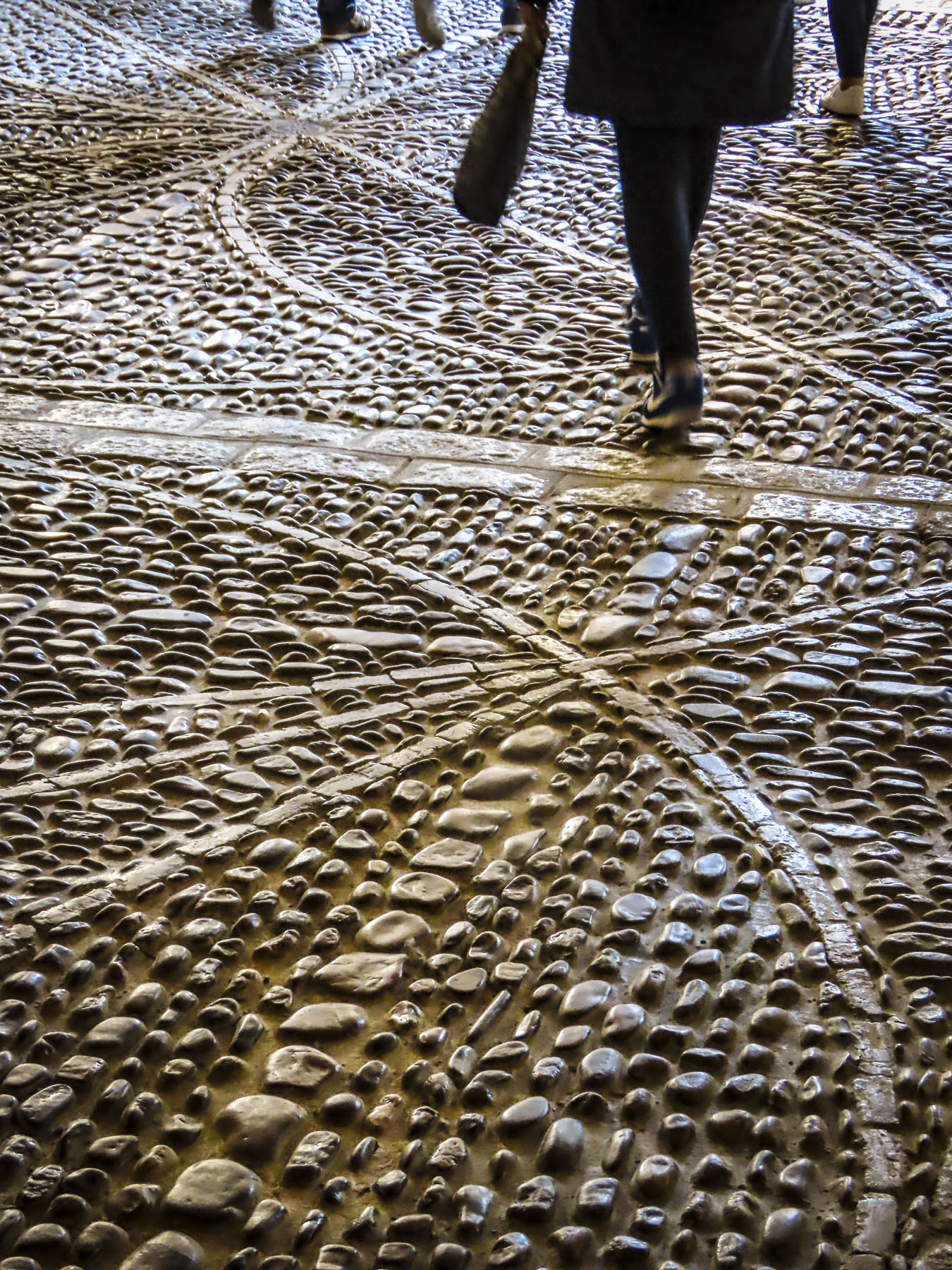
A wonderful daily ritual soon emerged, with greetings exchanged with the shop attendant as she swept the cobblestones every morning or was offering samples later in the day when we passed.  Of course, we shopped there; the sweet aroma was too enticing to resist and the snacks were delicious. “We’ll walk it off,” we laughed. Then there were the tapas! Two favorite spots were La Fresquita, a tiny standing room only bar, uniquely devoted to “all things Semana Santa.” This included the playing of classical church music and the occasional wave of a smoky incense-filled censer over the countertop.  The other was Las Teresas, an old school tavern decked with polished wood and whole legs of Jamon Iberico dangling above the bar. We walked everywhere in Seville; it was the perfect city to explore by foot. Every direction proved rewarding with interesting discoveries.

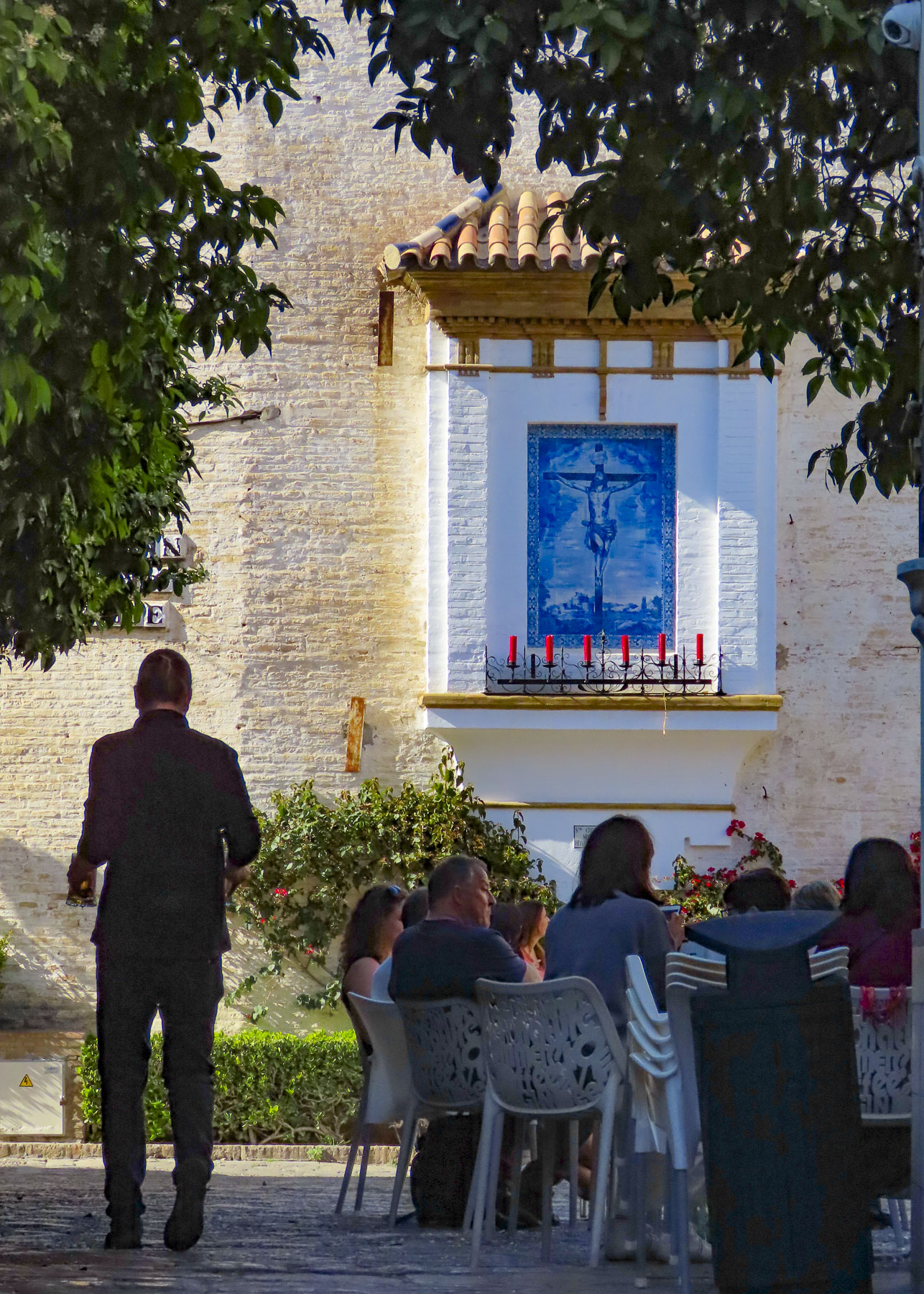
Small plazas held cafés. With their tables set in deep shade, they dotted the historic center and provided a quiet spot to just sit back and enjoy the old-world ambiance of this foreign city, with an intriguing mix of Moorish and Spanish architecture. Our “walk a little then café, then walk a little more,” approach allowed ample opportunities to enjoy the sunny days.

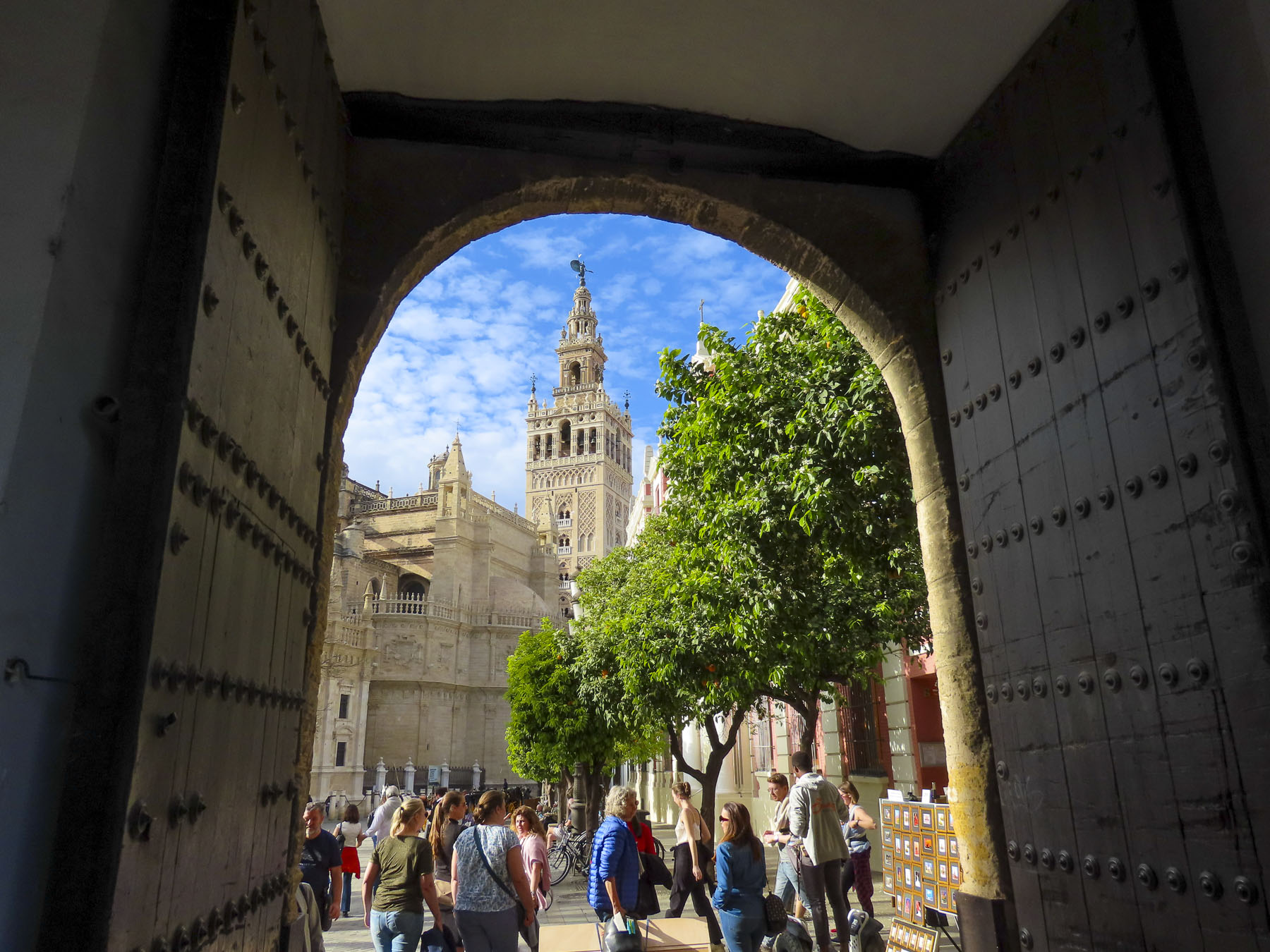
Minutes from our door an arched passage under dwellings in the old Jewish quarter opened onto the Patio de Banderas. It was once a courtyard for a tenth century Moorish palace. In the 1700s the buildings that lined it were used as an armory. Later the square was planted with orange trees and converted to a riding ring for the local gentry to use. At the far end another arched gate framed the La Giralda belltower of the Catedral de Sevilla as we exited onto the Plaza del Triunfo. Built in the twelfth century during the Almohades dynasty when the Andalusian region was still part of Muslim Spain, the tower was originally a minaret.

Its square design is based on the Moorish architecture of the Koutoubia Mosque in Marrakech. The interior does not have a traditional set of stairs for the muezzin to climb to the top for the call to prayer. Instead, it was built with a ramp wide enough for the muezzin to ride a donkey to the summit of its 167ft height. I imagine they would have had a high muezzin turnover rate if this accommodation wasn’t made to facilitate the five times a day call to prayer. After a sixteen-month siege that ended in November 1248, the Muslim forces in Seville surrendered and originally wanted to destroy the minaret before their forced relocation from the city, to prevent its repurposing for another religion. Upon hearing this ing Ferdinand III of Castile included in the terms of surrender a passage that threatened “they would all be put the sword” if the beautiful minaret were defiled in any way. In the sixteenth century a new top third was added with renaissance architectural influences that expanded its height to 337ft and included space for its array of 24 bells. Giralda, “she who turns,” is the name given to the weathervane atop the belltower, with the heroic female statue representing the triumph of Christianity. The exterior of the tower blends Islamic decorative relief sculpture, featuring floral forms, intricate geometric shapes and stylized calligraphy, with Gothic, Romanesque and Renaissance architecture. This is referred to as Mudéjar style and is prevalent in many of the historic buildings in Seville and throughout Andalusia. It is an enchanting blending of cultures and a signature of the region.

The lower part of the belltower and the Mudéjar style Puerta del Perdón gate into the Patio de los Naranjos courtyard filled with perfuming oranges is all that remains of the grand mosque that was repurposed as Seville’s first Christian cathedral after the reconquest. The old building stood until 1401 when construction started on the Catedral De Sevilla, https://www.catedraldesevilla.es/cultural-visit/ with the mission to illustrate the city’s emerging importance and wealth as a trading center on the last navigable stretch of the Guadalquivir River. The church elders offered the following inspirational instructions to the builders: “let us build a church so beautiful and so magnificent that those who see it finished will think we are mad.”

The inside of the of the church, also known as Santa Maria de la Sede, is cavernous with eighty side chapels and a ceiling that soars 138ft high. It is the third largest Christian cathedral in the world. The grandiose Gothic woodcarving of the Retablo Mayor, altar piece, is the life work of one artisan, Pierre Dancart, and gilded with an amazing amount of gold from the then newly discovered Americas.

Statues representing four kings of Spain from Aragon, Castile, Leon and Navarra are pole bearers for Columbus’ tomb, belatedly acknowledging that the explorer, who died in poverty, had made a major contribution to the Spanish Empire.

Always up for a climb, we signed on for a rooftop tour of the cathedral. Following our guide, we climbed stairs worn smooth over the centuries through ancient passageways hidden in the walls and towers to the top of the church for a beautiful view across Seville. We were grateful that we didn’t pass up a chance to walk amid the Gothic spires, flying buttresses and gargoyles that adorn the inspirational structure.

When the tour ended, we rested across from the church, on the steps of the Monumento a la Inmaculada Concepción in Plaza del Triunfo. It seems to be a rite of passage for visitors to Seville, to sit here in the heart of the historic district and soak in the ambiance of this beautiful city.

We let your minds imagine life in Seville centuries ago as horse drawn carriages, filled with tourists now, clattered across the cobblestoned square in front of the Royal Alcazar of Seville. Despite the fact that we were visiting in February, every day the queue for the Royal Alcázar of Seville was always exceptionally long, so we opted to buy our tickets and reserve an entry time online.  The same option is available for the Catedral De Sevilla.

The Plaza del Triunfo sits on what was once Seville’s ancient river port until the 900’s when the area was filled, and the Caliph of Cordoba ordered the building, adjacent to it, of the Royal Alcázar of Seville to accommodate offices of the Muslim government and the Caliph’s residence.

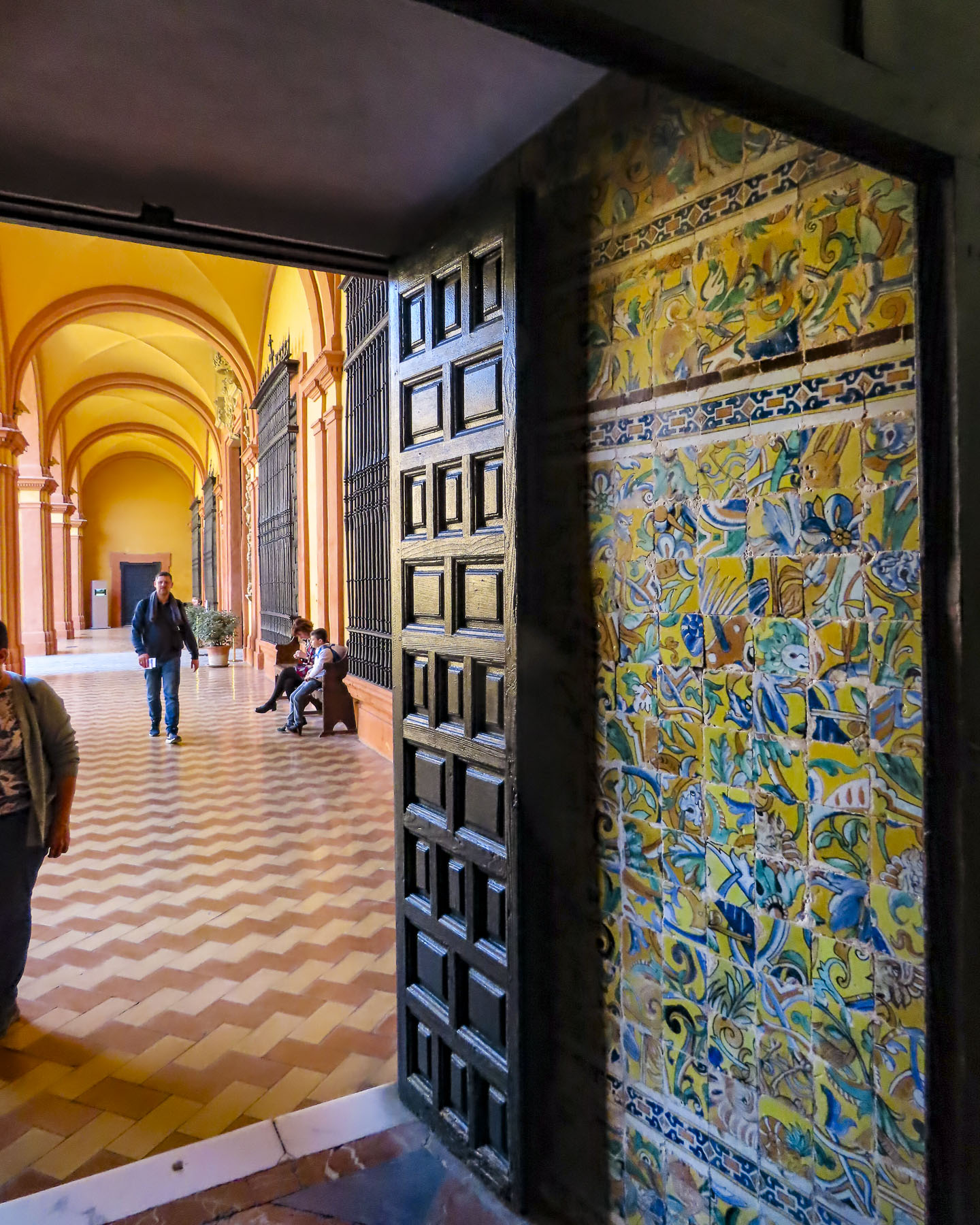
It’s been expanded and renovated numerous times over the centuries by both Muslim and Christian rulers. But surprisingly each successive regime savored an appreciation of the previous ruler’s Islamic architecture, intricate wall and ceiling decorations and quiet, lush oasis-like gardens. All are designed to create a sense of wonder, a key element of Islamic art. The Spanish Kings and Queens continued to admire the Muslim architectural style and imported Mudéjar craftsmen from Toledo and Granada to enhance their newer constructions which favored European Gothic, Romanesque and Renaissance architectural styles. 

The importance of the Alcázar evolved significantly as Spain’s colonization of the Americas saw the country grow into the world’s first global empire, all of it directed from this seat of power in Seville. It’s an amazing place is the best way to sum it up.  Today the Alcázar of Seville is still occasionally used as a royal residence by King Felipe VI and Queen Letizia.

Flamenco is synonymous with Seville and one of most enjoyable ways to watch it was to find a street dancer or group busking. Our favorite dancer was Charli La Tornillo. She entertained crowds many afternoons with a passionate, fiery routine near the fountain in Puerta de Jerez Square, located on the tram line not far from the Alcázar. The Jardines de Murillo and the Plaza de España were also reliable spots to find Flamenco dancers.

One Saturday morning we decided to take the tram from the Prado De San Sebastian metro station into Plaza Nueva to start our morning, a relatively short trip in a modern coach through the pedestrian only historic center on a route lined with ancient stone and fin-de-siècle buildings.

It passed Seville’s 15th-century Exchange that now houses the Archivo de Indias, which contains centuries worth of records pertaining to Spain’s colonies in the new world. We first noticed a group of elegantly attired women wearing unique fashionable hats called tocados, or fascinators, walking along Av. de la Constitución, not far from city hall, our final stop. Saturday mornings, it turns out, are when civil weddings are performed in Seville.

It was an interesting morning watching the various fancifully dressed wedding groups queue in the plaza before their assigned time. Unlike civil ceremonies in the states, which usually are lowkey events, civil weddings in Spain are occasions for fashionistas to dress to the hilt.

After the ceremonies, friends and families escorted the bride and groom to nearby restaurants to continue the celebrations.

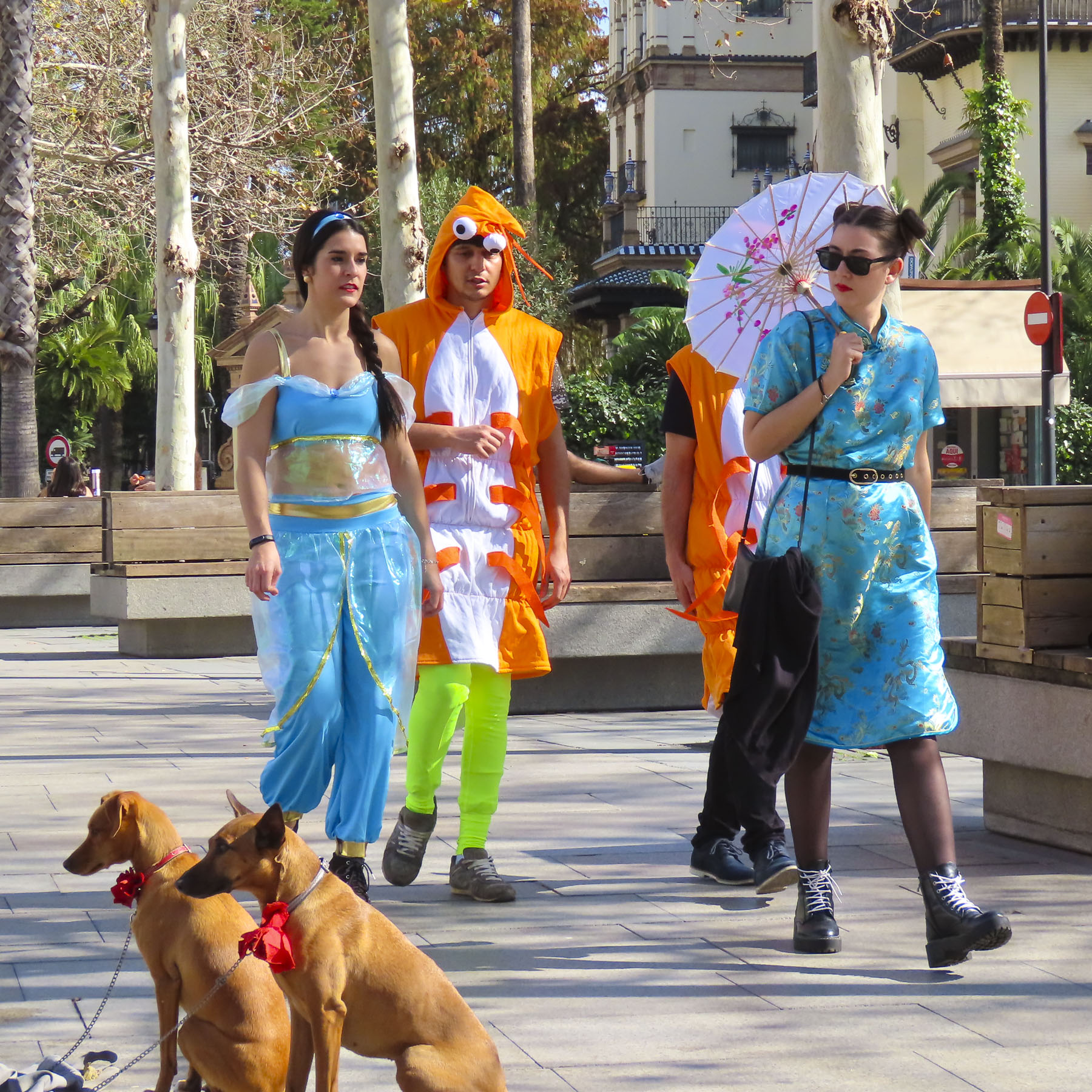
Seville is also a popular destination for joyful, outlandishly boisterous hen parties. Participants parade through the streets, dressed in quirky outfits, to celebrate their friend and bride to be.

Seville packs a lot into a small space and every direction we headed offered something interesting. The Hospital los Venerables was just a few steps away from our front door, down the narrow Calle Gloria that opens to the aptly named Plaza Venerables. 

It was built in the 1600s as a retirement home for poor, elderly or disabled priests.  The very austere exterior deceitfully hides a wonderfully ornate Baroque chapel and interior, as well as various tranquil courtyards. Today the building is used as a museum dedicated to the Sevillian born (1599) artist Diego Velázquez.  A collection of paintings by 17th century artists Francisco Pacheco, Murillo and Bartolomeo Cavarozzi are also on display.

There was an amazing amount to see in Seville as we wandered all over the city.  We’ll share our walks across this intriguing city in a number of future blogs.

Till next time, Craig & Donna

Belize – When Iguanas Fall from Trees, Head South

“Welcome aboard, folks. Our flight time to Belize is two hours and ten minutes. The weather is expected to be a balmy 80 degrees Fahrenheit today when we land,” the pilot announced as we were buckling in. Then continued with “As you know the National Weather Service has issued the very rare ‘Beware of Falling Iguanas Weather Alert’ for Miami and South Florida this morning.”  As funny as this sounds, it actually happens when the temperature dips into the thirties in Florida.  Cold blooded animals, the iguanas slowly stiffen as the temperature drops and eventually lose their grip on the tree branches they have been sleeping on and fall to the ground, stunned, where they lay immobile until the temperature rises.  Iguanas can grow quite large and may cause serious injury or death if you are unlucky enough to get struck by one of the falling frozen reptiles. It sounds like something out of a zombie apocalypse movie – be careful out there. We were delighted to be heading south again to a warmer climate after a cold and rainy November and December in Italy, which was followed by a warm-hearted, but very frigid Christmas with our kids in New Jersey.

On our final approach for landing the wing of the plane dipped to reveal a beautiful azure sea outlined with dense green jungle and brilliantly white sand beaches – and not much else – as far as the eye could see.  It was still much like it was several millennium ago when a prosperous Mayan civilization flourished, supporting an estimated population of 500,000 – 1,000,000 in the region. Columbus sailed by without stopping and landed in Honduras during his last voyage to the Americas in 1502.  Navigator Juan Diaz de Solis did not mention a landfall or discovery during his expedition in 1507 sailing from Panama to the Yucatan. Several theories suggest that the 190-mile-long Belize Barrier Reef, the largest in the northern hemisphere, was too difficult to navigate through so the Spanish fleets sailed past. We witnessed this difficulty once from the deck of a cruise ship as the captain left a snaking wake as he steered a serpentine route through the underwater obstacle course.

The first European to arrive in Corozal literally washed ashore as a survivor of a 1511 Spanish shipwreck. To stay alive, conquistador Gonzalo Guerrero offered his skills as a soldier to Mayan Chief Na Chan Kan at Chactemal, (now Santa-Rita, Corozal Town). He proved his skill as a warrior and married the chief’s daughter, Princess Zazil Há. The children from their union are recognized as the first Mestizos of Central America; theirs was the first Mayan liaison recorded by Bernal Diaz de Castillo in his memoir “The True History of the Conquest of New Spain,” written in 1568.

Guerrero defended his adopted homeland against conquest in 1531 when he helped Chief Na Chan Kan defeat the Spanish army in a battle near the Rio Hondo. Today the river is still Belize’s northern border with Mexico.  Spain never established any permanent settlements in Belize.  Gold and silver were discovered next door in Guatemala and Honduras. Belize was absorbed into the Spanish empire of Central America by its proximity to its larger neighbors, but was never colonized until the British subversively entered the territory.

The riches of the new world didn’t go unnoticed for long, but by the time English and Scottish pirates arrived on the scene in the mid-1600s, the treasure-laden flotillas destined for the Spanish crown from central America had been replaced by shipments of logwood.  Native to northern Central America, logwood or bloodwood was used by the indigenous tribes of the region to produce a vibrant red-orange dye. Mixed with other ingredients, a full spectrum of colors was possible. It grew abundantly and was exported to Spain where the cheap natural resource revolutionized the textile industry and afforded commoners a chance to have colorful wardrobes, which before was only afforded by the nobility. Gone were the days of fabrics dyed gray with soot. 

Gold or wood – it didn’t matter. Pirates were pirates and willing to steal your cargo regardless of its content, as long as there was a profit to be made, and the English textile mills were demanding logwood.  After plundering large Spanish merchant ships that sailed across the Gulf of Honduras, the pirates found safe refuge for their smaller vessels in the shallow waters behind the Belize Barrier Reef amidst its 450 cays and atolls, where they could hunt for food, get fresh water, and repair their boats.  In 1670 England and Spain signed a treaty banning piracy in the Caribbean.  The days of the infamous pirates of Belize, Edward Lowe, Captain Charles Johnson, Bartholomew Sharp, Captain Henry Morgan, and Blackbeard, were waning.  By this time English pirates had discovered Belize was full of logwood and many ex-privateers became legitimate and wealthy logwood cutters and exporters after buying African slaves to work in the miserable conditions of the mosquito-infested jungles.  Though Spain considered all of Central America as part of their empire and occasionally harassed the British logwood camps trying to evict them, the Spanish crown never established any settlements in Belize. 

In 1763 Spain signed another treaty allowing English subjects the “privilege of wood-cutting,” but still retained sovereignty over the region. Possession is nine-tenths of the law and Belize finally became the English colony of British Honduras in 1862. Mahogany had replaced logwood as the major export. Conflict with the Mayans escalated as settlers moved farther into the interior exploiting the regions mahogany forests, and forced the indigenous population from their lands by burning their villages and crops. The giant cut logs were floated down the country’s rivers to the coast and where rivers didn’t exist, small logging railroads were built to satisfy the European demand for this beautiful hardwood that was favored for fine cabinetry, furniture and shipbuilding.

Disenfranchised and oppressed, the Mayan revolted in what is called the Caste War against their colonizers. Led by Marcus Canul, a Mayan chief,  his people demanded the British pay for the crops they burnt and for the land they occupied.  In northern Belize, Canul’s freedom fighters attacked and occupied the garrison town of Corozal. The movement lost its momentum when Canul was killed during an unsuccessful assault on Orange Walk in 1872.  Long considered a rebel and criminal, he is now regarded as a Belizean hero who fought against ethnic cleansing. The deforested jungles were replaced by sugar cane, ranching and agriculture plantations.

Belize finally became independent in 1981, though The British Army still maintains a jungle warfare training facility in the country to help deter Guatemalan aggression in an unresolved border issue. Aldous Huxley once wrote, “If the world had any ends, British Honduras (Belize) would certainly be one of them. It is not on the way from anywhere to anywhere else. It has no strategic value. It is all but uninhabited.”

Today the tiny country of 400,000 supports a diverse culture descended from Mayans, Mestizos, African slaves, Garifunas, Europeans and more recently immigrants from Lebanon, Germany, the East Indies, Asia and North America with an economy centered on tourism and agriculture.  English is the official language of Belize, but it is not the first language of many with Spanish, Belizean Creole and Q’eqchi’ Maya primarily spoken, depending on what part of the country you are in.

The barrier Islands and cays where pirates might have hidden treasure now sport popular resorts on their white sand beaches. Scuba divers can explore shipwrecks, the Great Blue Hole (a marine sinkhole that is visible from space,) and the exceptional marine life found along the Belize Barrier Reef which is now a marine reserve and UNESCO World Heritage site.  Ashore the jungles and mountains continue to reveal the extent of the Mayan civilization in Belize with over 600 known archeological sites discovered so far, ranging from ceremonial caves to towering stone pyramids.

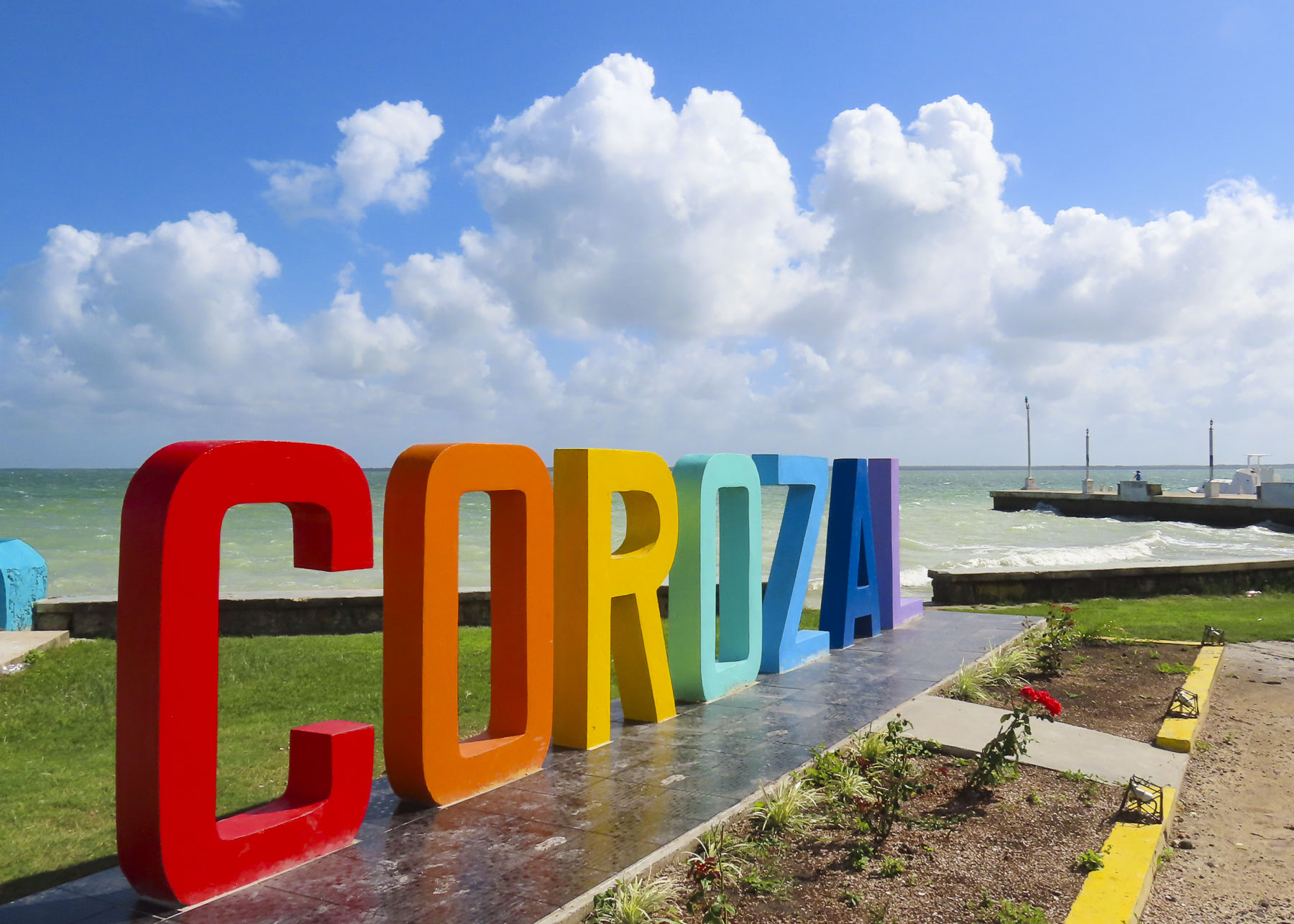
We are on the other end of the tourist spectrum and wanted something very lowkey, inexpensive and relaxing for a month. We headed to Corozal! Located on Chetumal Bay, it is the northern most city in Belize and only 16 miles from Chetumal, Mexico. It was founded in 1848 by Mestizo refugees from Mexico fleeing Mayan retribution from the Caste Wars there. It prospered exporting mahogany logs when there were still enough trees to support the timber industry. Sugarcane now fuels the economy. 

In 1955 Hurricane Janet, a category 5 storm with winds of 175mph, flattened ninety-five percent of Corozal and left 8,000 people homeless.  Surprisingly one of the few buildings left standing on the waterfront, fully intact, was the home of lumber baron John Carmichael.  It was built in the 1880’s using only mahogany.  The house is still used today as a Catholic mission. The pre-1955 wooden structures have been replaced with concrete block houses now, mostly two stories high, except the four-story Mirador Hotel, the tallest building in town.

Our ah-ha moment happened after the two-hour, inland drive from the airport, when we entered Corozal and saw the enticing turquoise waters of Corozal Bay on our way to our Airbnb rental. We drove a mile along a still bay bordered by a low battered seawall and numerous public parks dotted with palm trees.

Turning onto 2nd St. North our driver stopped in front of a flowering bougainvillea-covered wall, less than 200ft from the water, that hid the Villa Imperial Loft Apartment, our home for the next four weeks.  Our host Oscar wasn’t home at the time, but had made arrangements with Sue, another guest, who graciously led us through the flowering garden, complete with a resident mama cat and her kitten, and up the back stairs to our studio apartment. She enthusiastically answered our first questions about Corozal.

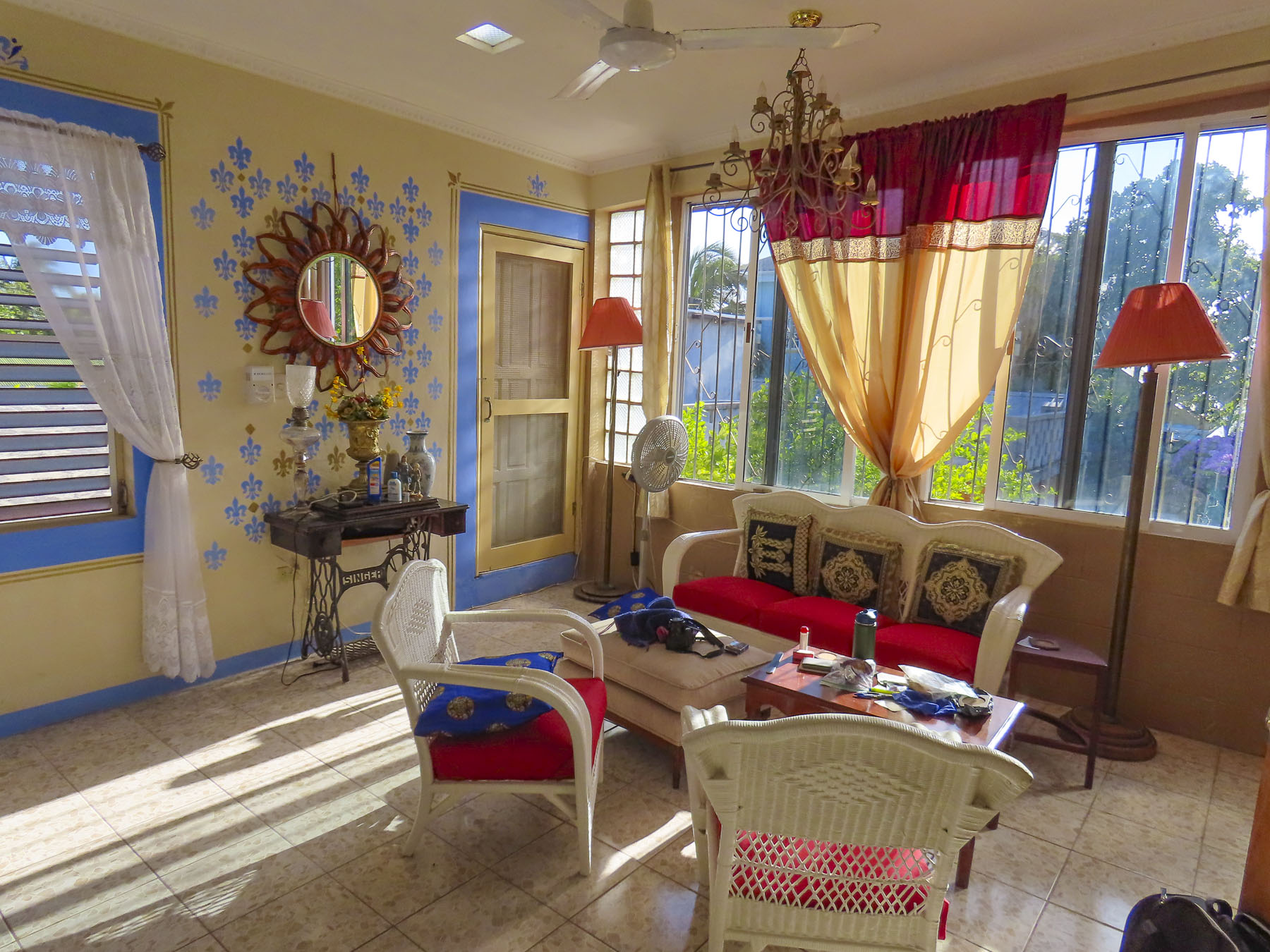
The large room was brightly painted and pleasantly decorated with an eclectic mix of antiques, reminiscent of visiting our grandparents.  A wall of windows facing east offered a glimpse of the bay, and any storms approaching, through the neighbor’s tree. Best was the kitchen across the landing at the top of the stairs. It was enclosed on three sides with just screened windows, covered with louvered shutters. In stark contrast to the apartment, it was very rustic with the feel of an old lake cabin. But we soon realized it was the perfect spot to observe the wide varieties of birds that visited the trees in the backyard, and we thoroughly enjoyed cooking and eating there.  Birding over the next month while walking along the waterfront was one of the highlights of our stay in Corozal. Spotting just a few of the 590 bird species in Belize, we saw sandpipers, great kiskadee, white-collared manakin, yellow-throated euphonia, tricolored heron, kingfisher, lineated woodpecker, great egrets, couch’s kingbird, crimson-collared tanager, black and white warbler, and the outrageously raucous plain chachalaca, which you’ll hear well before seeing them.

For many travelers visiting northern Belize, Corozal is just a brief stop on their way to or from Mexico or Guatemala, or a transfer point to catch the two-hour Thunderbolt Ferry or a flight on Tropic Air from the Corozal Airport (CZH) to San Pedro, on the barrier island, Ambergris Caye.  The town doesn’t have a beach, which has probably helped keep it off the beaten path for most tourists that visit Belize. Access to the shallow water is from stairs in the 1.5 mile long stone seawall that has not fared well against the surges of the ocean. We had read that the district has a sizeable expat community, that likes to avail themselves of all the big city options, mainly a Walmart and Sam’s Club that are across the border in Chetumal, Mexico.  But from our experiences we only encountered a handful of North Americans, surely not surging numbers that would indicate it was a sizzling hot spot for vacationing or retirement that would change the character of the town. And that’s a good thing. The joy of Corozal for us was its tranquility; there really was not much to do there aside from chilling and the occasional dip in the gentle waves of the bay.  The serenity of the seascapes compensated for the lack of activities.

We were enjoying the tropical 80-degree weather of Corozal and re-embracing our slow travel philosophy by immersing ourselves in the daily flow of life in this small coastal town. It was wonderful to see parents accompanying their uniform clad children to school every morning. Some parents drove, others walked along or bicycled with their kids. Routinely at the end of the school day an older couple pedaling a three-wheeler sold homemade popcorn to the kids or the youngsters lined up for ice cream on the porch of a home that doubled as an ice cream parlor. The kids waved to us if they noticed us bobbing in the bay across the street.

Our daily walks led to discoveries all across town, mostly culinary in nature. We were eager to find the best places to buy groceries, interesting places to eat and quench our thirst.  Most importantly, our craving for good coffee was easily satisfied directly across the street at the top of a colorful flight of tiled stairs. Here Oscar’s nephew Rudi runs the LVDM Coffee Stop on the porch of his home and makes what are easily the best cappuccinos in Corozal. He also rents two rustic villitas in his backyard. 

In town there were any number of Asian-owned grocery stores that all offered the same staples. We tended to prefer a shop called the Central Supermarket, because they were the closest place to carry our recyclable beer bottles. Diagonally across the street the city’s daily market had numerous fruit and vegetable stands, an open-air butcher, and clothing vendors. A twice weekly farmers market was held outside of town, across from the cemetery.  Fortunately, this location did not reflect negatively upon the quality of produce sold there. At a much greater walking distance, it didn’t offer any real advantage over the produce sold for the same price at the daily market. Shopping there was an early morning event and the atmosphere was very vibrant. It was here we got the first glimpse of the country’s Mennonite farming community, easily identifiable by their conservative dress and spoken Pennsylvania German. Since 1958 when they were invited to settle in Belize by the first Premiere of the country, George C. Price, the community has grown to 10,000, and they have contributed immensely to Belize’s agriculture self-reliance.

Surprisingly, even though Corozal is located right on the bay, we could not find fresh fish and had to purchase locally caught frozen fish, conch and lobster from Frank’s, a great butcher shop that makes their own sausage and offers a wide assortment of fresh beef, pork and poultry.  Directly across from Frank’s on the other side of the civic center field we found Vivi’s for wonderful meat pies.

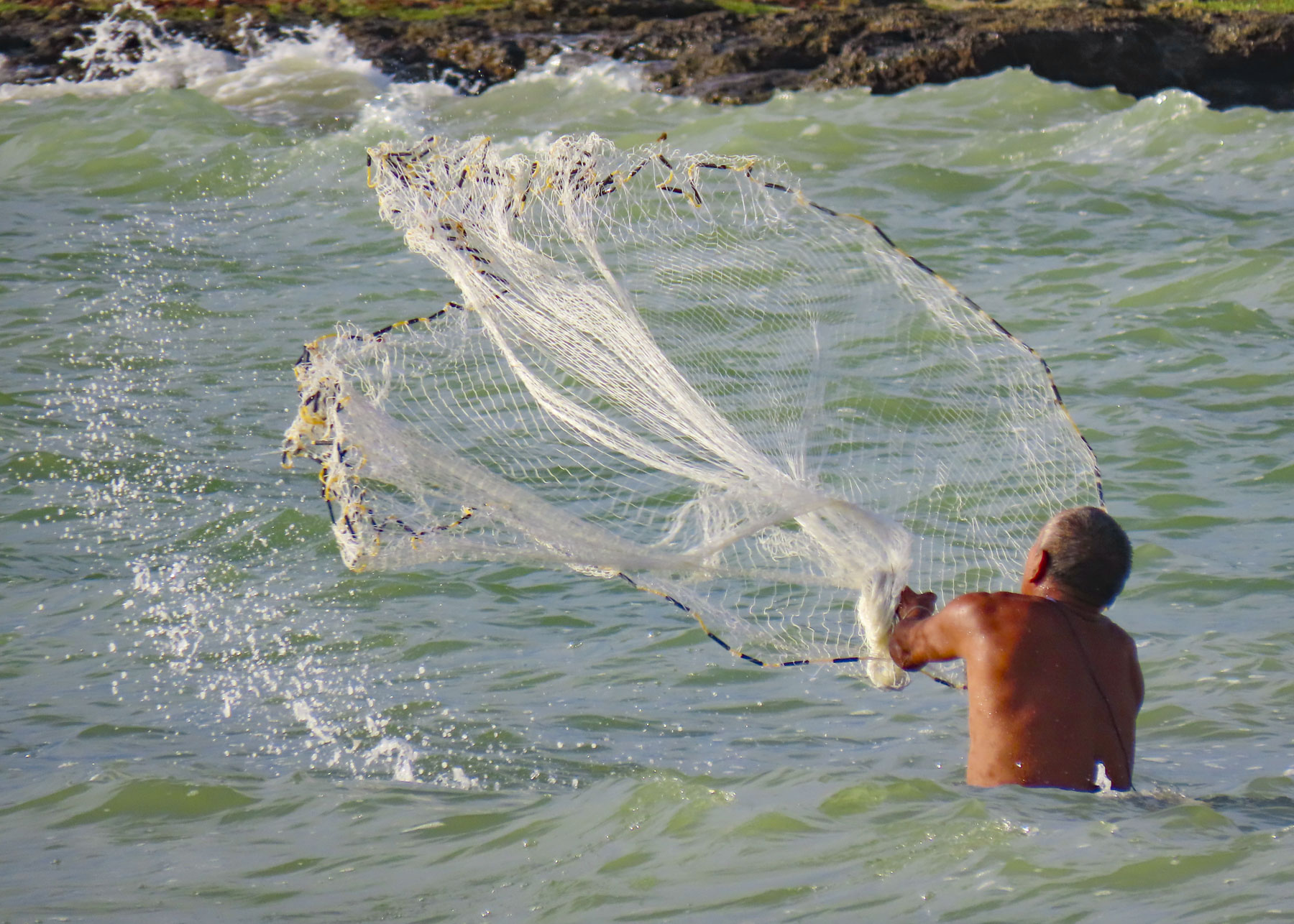
On one of our walks, we did meet a young brother and sister team carrying a five-gallon bucket on the handlebar of their bicycle. It was full of lobster and conch, caught by their father earlier that morning.  They were going door to door in the neighborhood, selling it so they could buy their school uniforms.  Of course, we purchased some, and it was delicious.

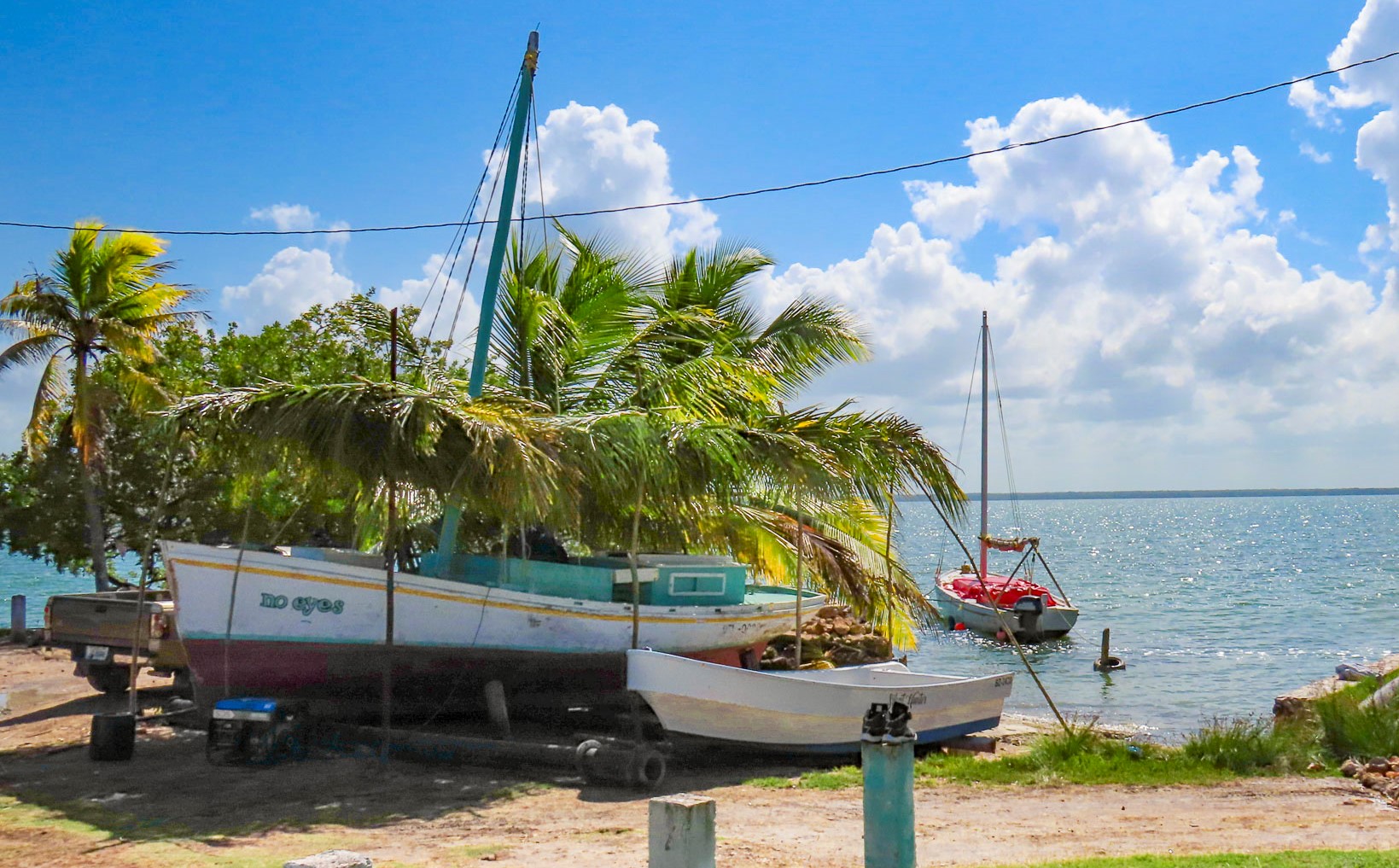
The town does not have a marina for boats, but there are spots along the bay where fishermen pull out their ancient mahogany boats for repairs.  Called sandlighters, many of these traditional sailing vessels were built across the bay in the fishing community of Sarteneja and are over eighty years old.

There were several small bakeries in town, each offering different specialties.  The Y Not Bakery, to the detriment of our waistlines, was the closest and created the best temptations. Another favorite was Caramelo Bakery across from the high school and down the street from Belcuisine, a spice factory that produces flavorful Belizean Recados mixes.

Corozal really was a rewarding foodie’s destination with numerous small taquerias and enterprising folks offering roadside barbeque. Many businesses were operated from the windows of homes, like Ruby’s, who prepared delicous ceviche then sold it through her living room window for take-away.

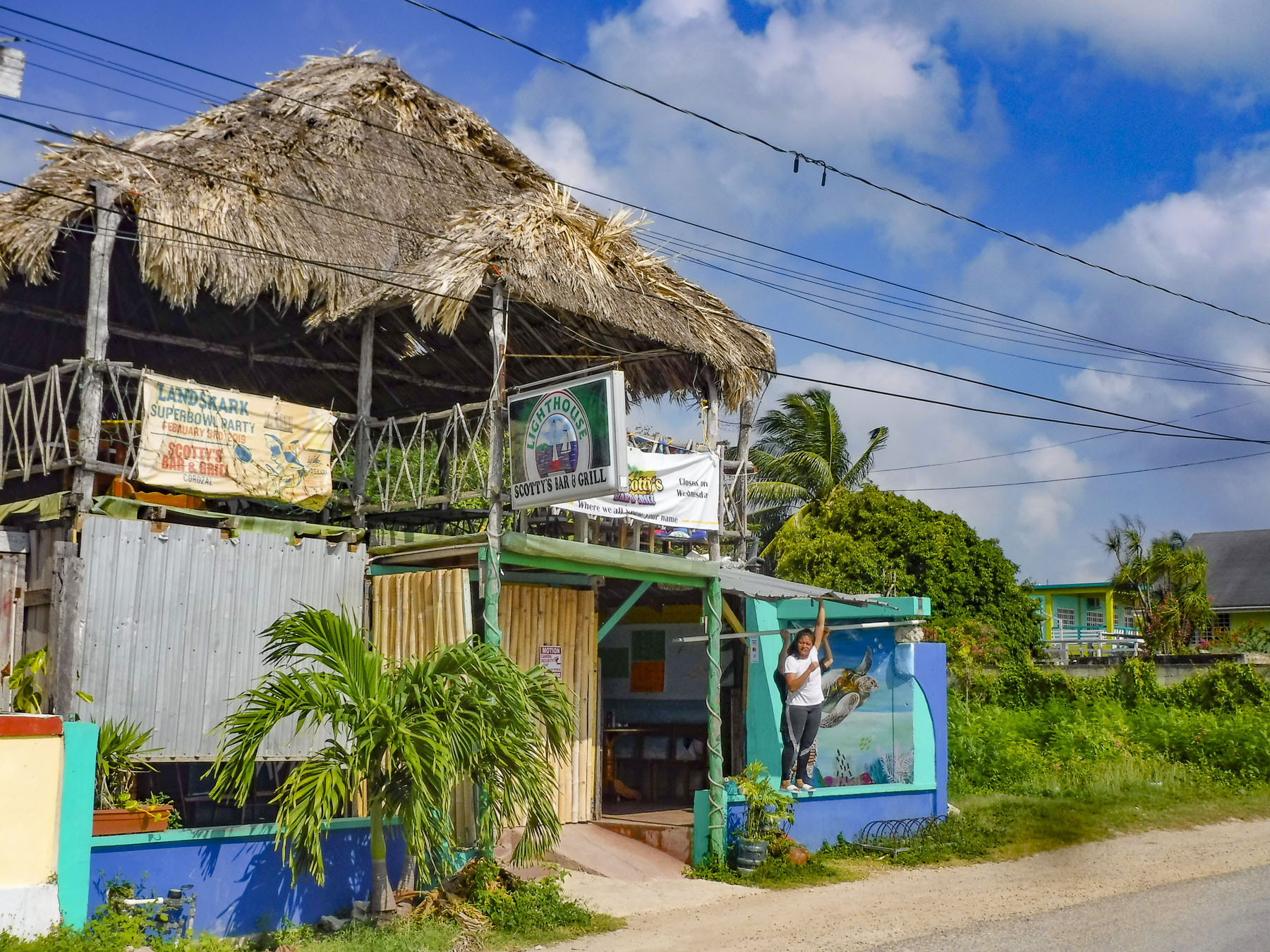
The only option for eating out was casual dining. We found June’s Kitchen and Mar’s Caribbean Garden for homecooked meals.  Directly across from the bay, Scotty’s Crocodile Cove was a relaxing spot with thatched roofs; it was an enjoyable place for a refreshing Belizean brewed Belikin beer and large burritos that could easily feed three people.  The Tortuga Grill, across from the waterfront Rainbow Park, and the Wood House Restaurant, adjacent to Miami Beach, both offered good food and views of the bay.

Corozal enthusiastically supports its art community and one Saturday a month, in the town’s Central Park, holds the Art in the Park event where local artists and craftspeople display and sell their work. It was a fun time, with live music and delicous Belizean food. It’s held between 5pm – 9pm to avoid the heat of the day.  If City Hall is open make sure to check out the fantastic wall mural depicting the history of Corozal, painted by Belizean-Mexican artist Manual Villamor.

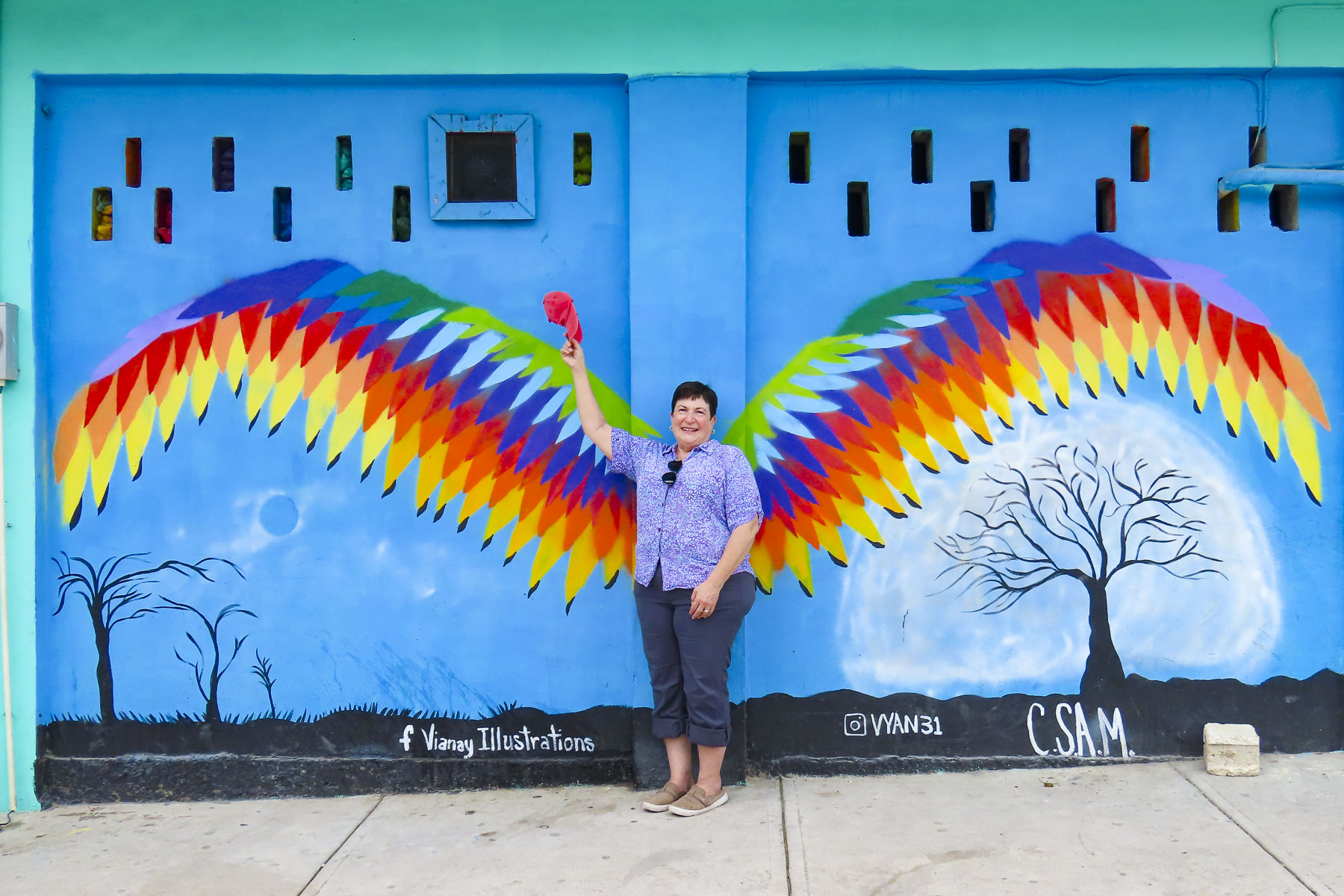
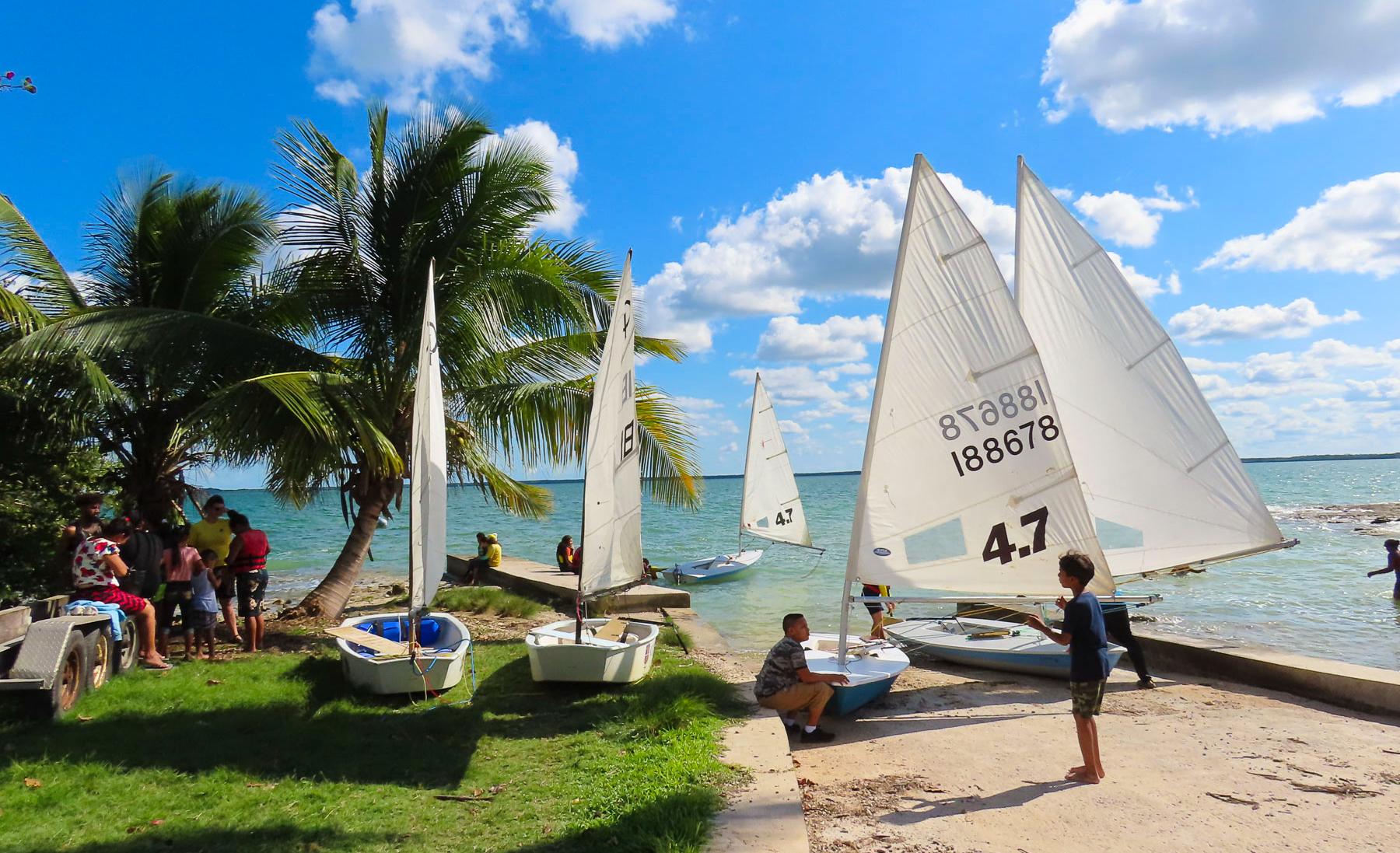
The blank concrete block walls of homes and businesses across from Miami Beach were the canvases for street artists invited to participate in the Corozal Graffiti Festival. In 2020 street mural artists from Belize, Cuba, El Salvador and Mexico were invited to enliven the walls with an “Ancient Chactemal” theme. It was a lively event with a music stage, art and crafts for sale, body painting and food vendors. On the beach, the Corozal sailing club was offering catamaran rides on the gentle waters of the bay.

There is an abundance of civic pride displayed in this small, well-kept community on Corozal Bay that is endearing. We barely scratched the surface of places to explore in Belize and were perfectly content “Snow Birds” with our choice of Corozal for a month’s worth of lazy rest and relaxation.  We’d definitely return to explore the surrounding area more fully.

Till next time, Craig & Donna

Christmas in Milan – A Monumental Cathedral, Cemetery and Horse

Snow started falling as we brewed the morning’s first cups of coffee on the stove using a traditional Italian Moka coffee pot.  Invented by Alfonso Bialetti in 1933, Italians readily accepted it as an easy way to make espresso at home, and it quickly became symbolic of “la dolce vita,” the sweet life and for us a pleasant morning ritual. The day before had been warmer, and bundled up we were able to take our coffee outside on the balcony of our fourth-floor Airbnb rental and enjoy a great sunset view.  This morning though, the tracks of the tram line melted through the thin blanket of freshly fallen snow and left two parallel lines, as if someone had drawn them on this new white canvas with a pencil.

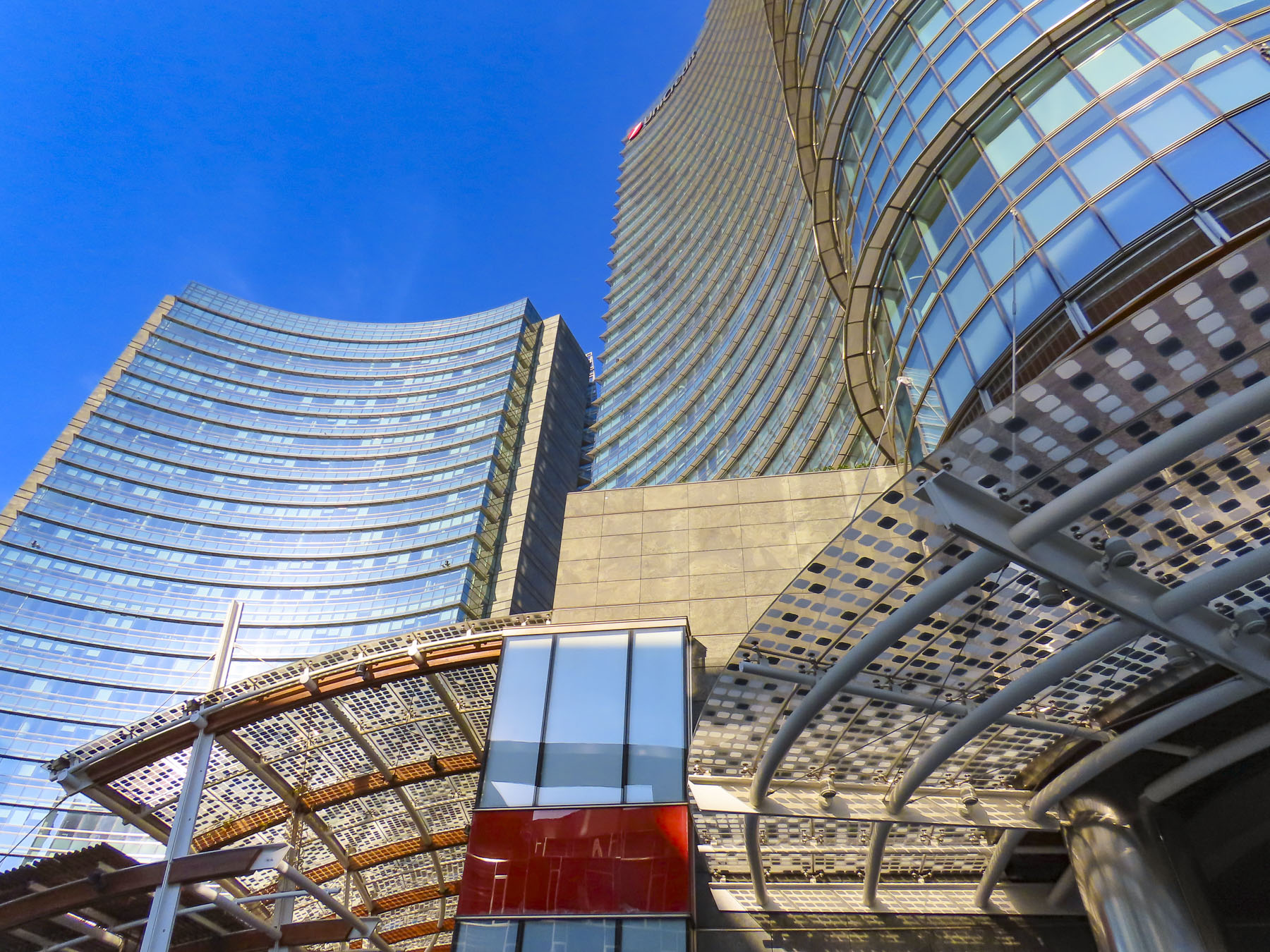
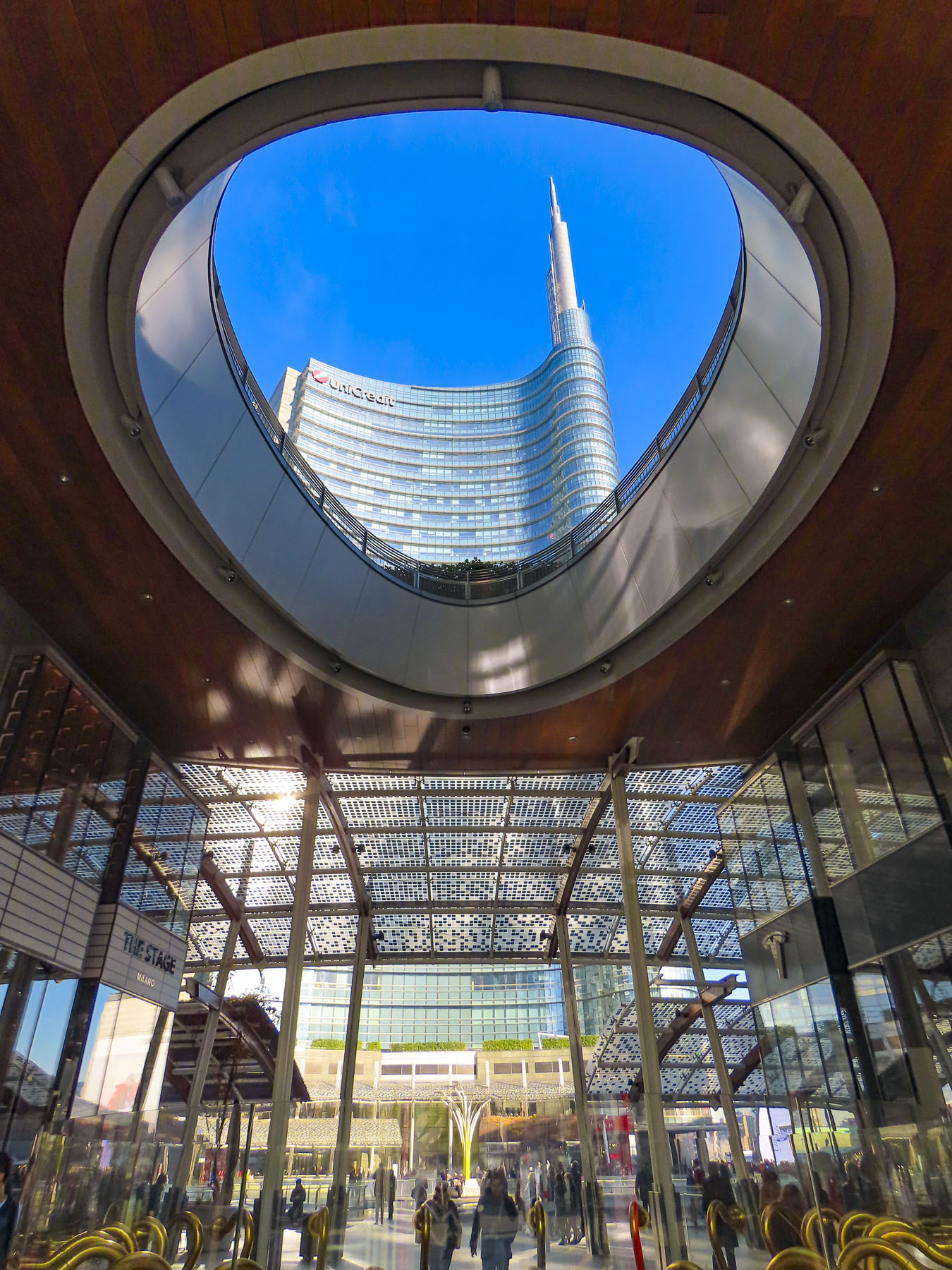
Continuing with our philosophy of slow, immersive travel, we had opted for an apartment in the Isola neighborhood.  Though far away from Milan’s city center, it was situated near the Porta Garibaldi train station and the recently built modern skyscraper complex that surrounds Piazza Gae Aulenti. The illy Caffè here was a frequent stop for comsmopolitan people-watching and excellent coffee.

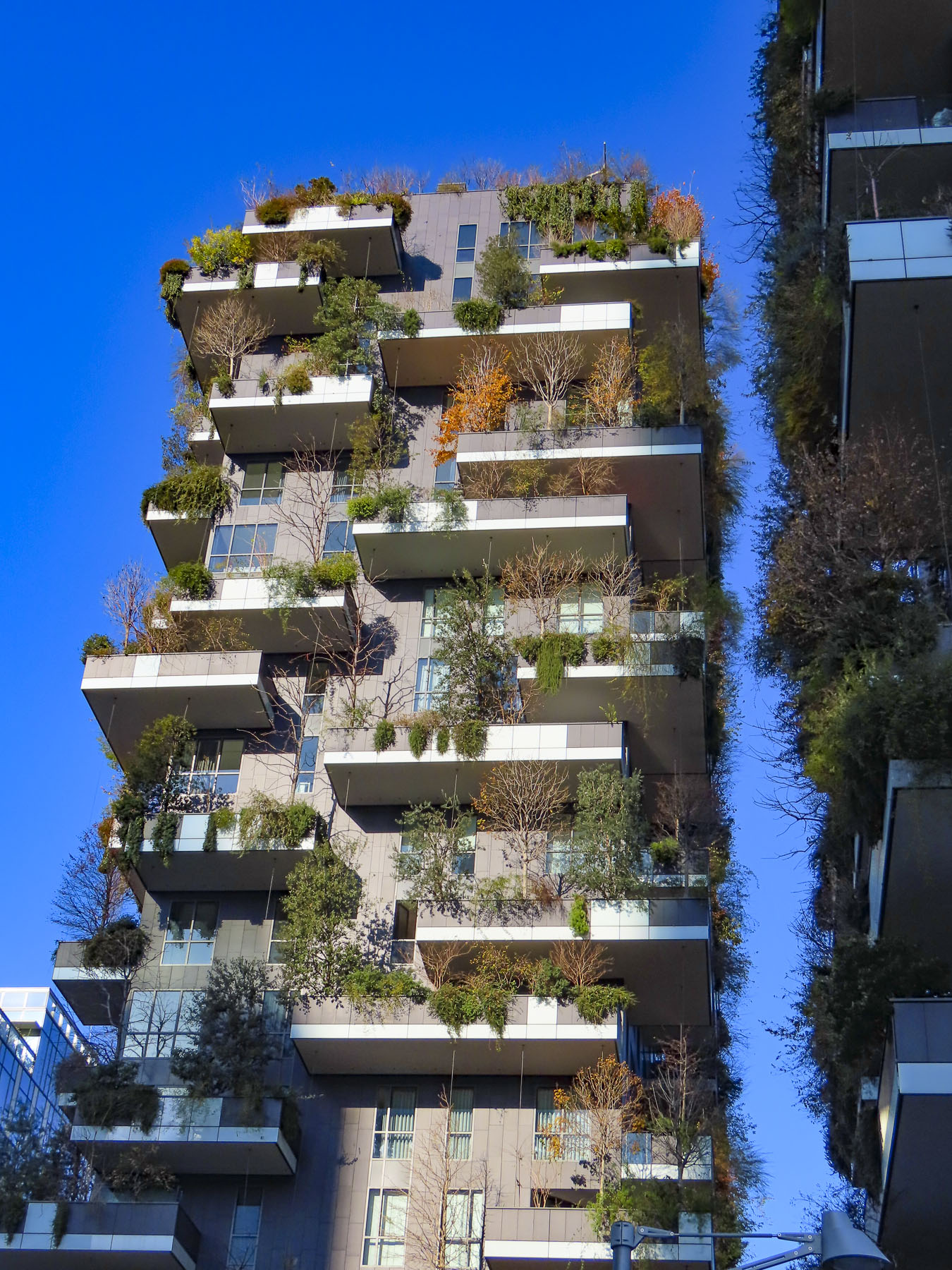
Nearby were the twin apartment towers of Boeri’s Bosco Verticale, Vertical Forest, famous for their lush foliage-covered balconies, and the Isola and Zara subway stations. The latter was only seven quick stops from the Milan Duomo.

The neighborhood also had numerous tram lines traversing it, but it was impossible to find a hardcopy map of this very extensive system while we were in Milan, though we were able to find this online map of the Milan Tram System while writing this. Ultimately, we relied on our phone’s mapping App to view our tram trips in real time and determine where to change lines to continue our journeys across the city.

Two blocks away, the bi-weekly outdoor food market closed the streets around Piazza Tito Minniti for the bulk of the day while families shopped the stalls for fresh vegetables, cheese, meat and seafood along with socks, pants, dresses and blouses. We enjoyed this aspect of Italian life after learning its subtle nuances – for example, only the vendor touches the fruits and vegetables. There is also a protocol of queueing. Sometimes though our schedule required us to shop around the corner at La Pastaia for fresh pasta or the Penny Market grocery store, where we signed up again for another shopper club card.  We’ve done this in every city where we have stayed long term – Cuenca, Antigua, Lisbon, Cape Town and Kotor. It seems silly, but those small savings do add up and jokingly it helps us feel more like a local.

Emerging from the darkness of the subway station onto the Piazza del Duomo, we were momentarily blinded by the bright sun reflecting off the monumental cathedral that towered before us. Breathtaking in its size and capable of holding 40,000 worshippers, the cathedral is the second largest in Europe, following Saint Peter’s Basilica in Vatican City, and the third largest in the world.  Designed in 1386, the ornate and dramatic Gothic façade of the cathedral is covered with 3,400 statues and spires, which required the recruitment of hundreds of stone masons and artisans from across Europe. 

The opulent exterior belies the cathedral’s spartan interior.  While massive in scale, the interior’s gray stone walls and towering columns are cold and austere even with the soft, filtered light of beautiful stained-glass windows illuminating the space. Most moving was a ghastly sculpture by 16th century Italian sculptor Marco d’Agrate of Saint Bartholomew holding his flayed skin, depicting how he was punished for converting an Armenian King to Christianity in the first century AD.

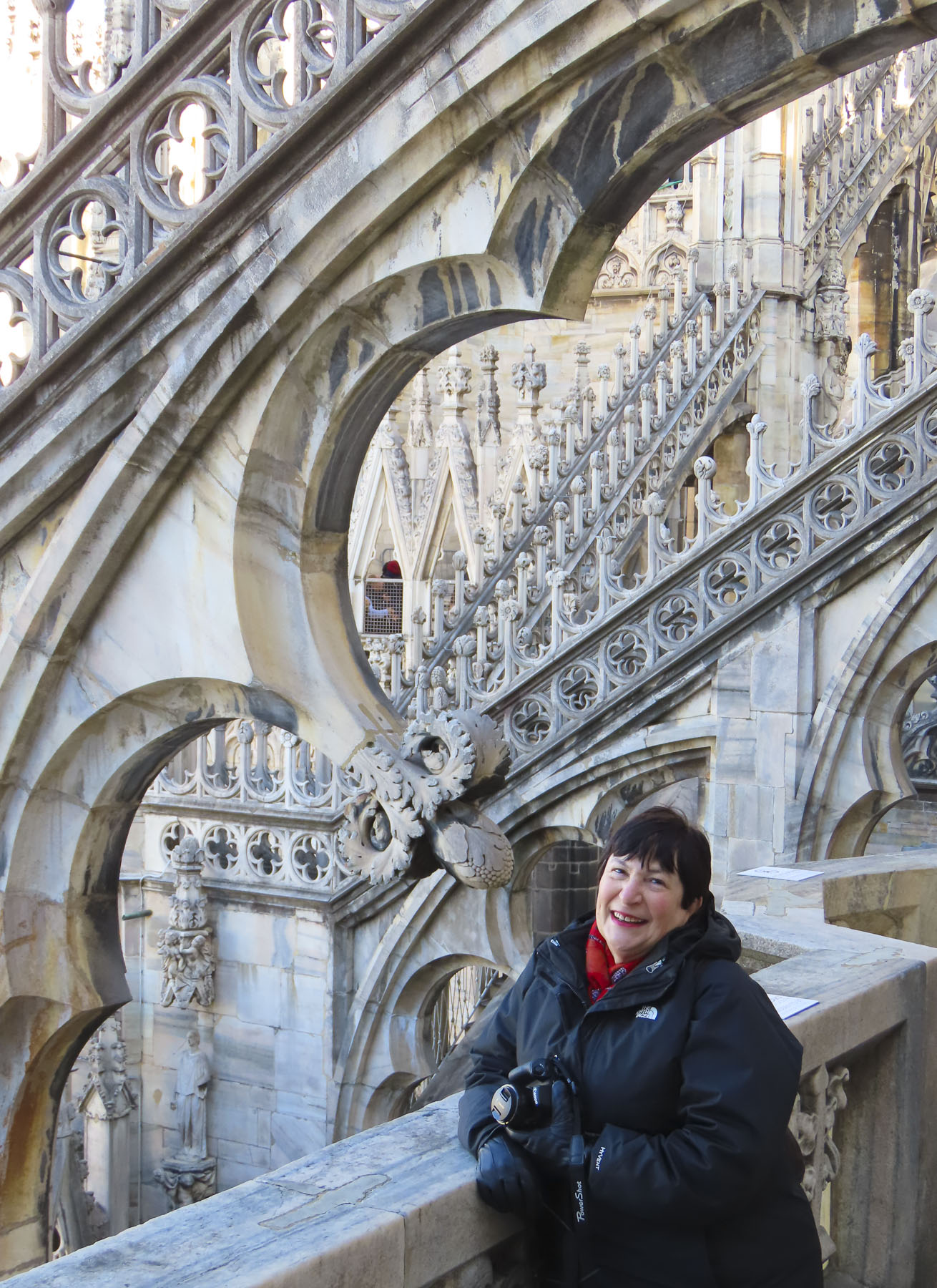
Wandering around the flying buttresses and sculpted spires on the roof of the church was the highlight of our visit to the Duomo. The day was crystal clear, and the panoramic view stretched from the Milanese skyline to the snowcapped Italian Alps. It was spectactular.

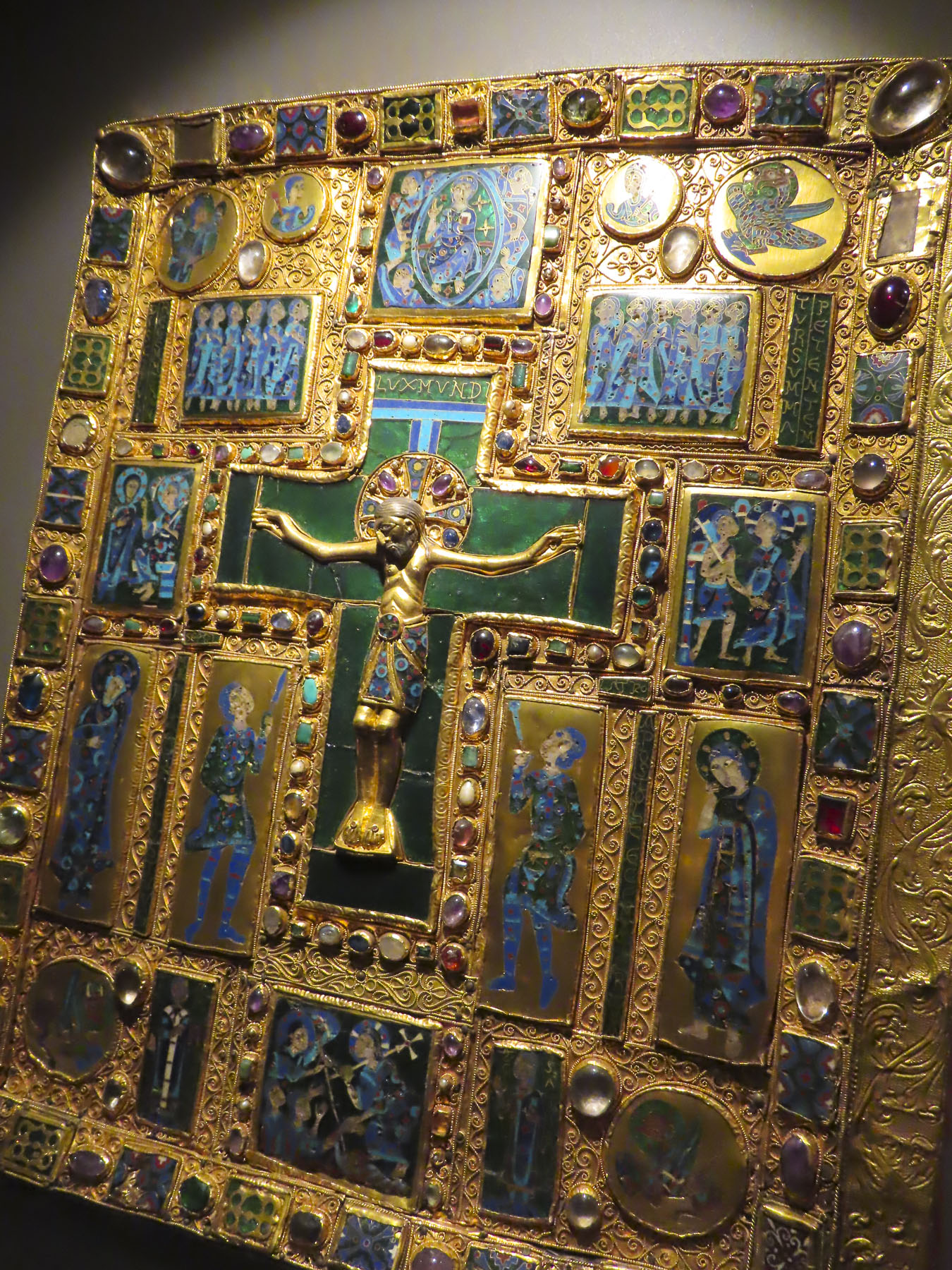
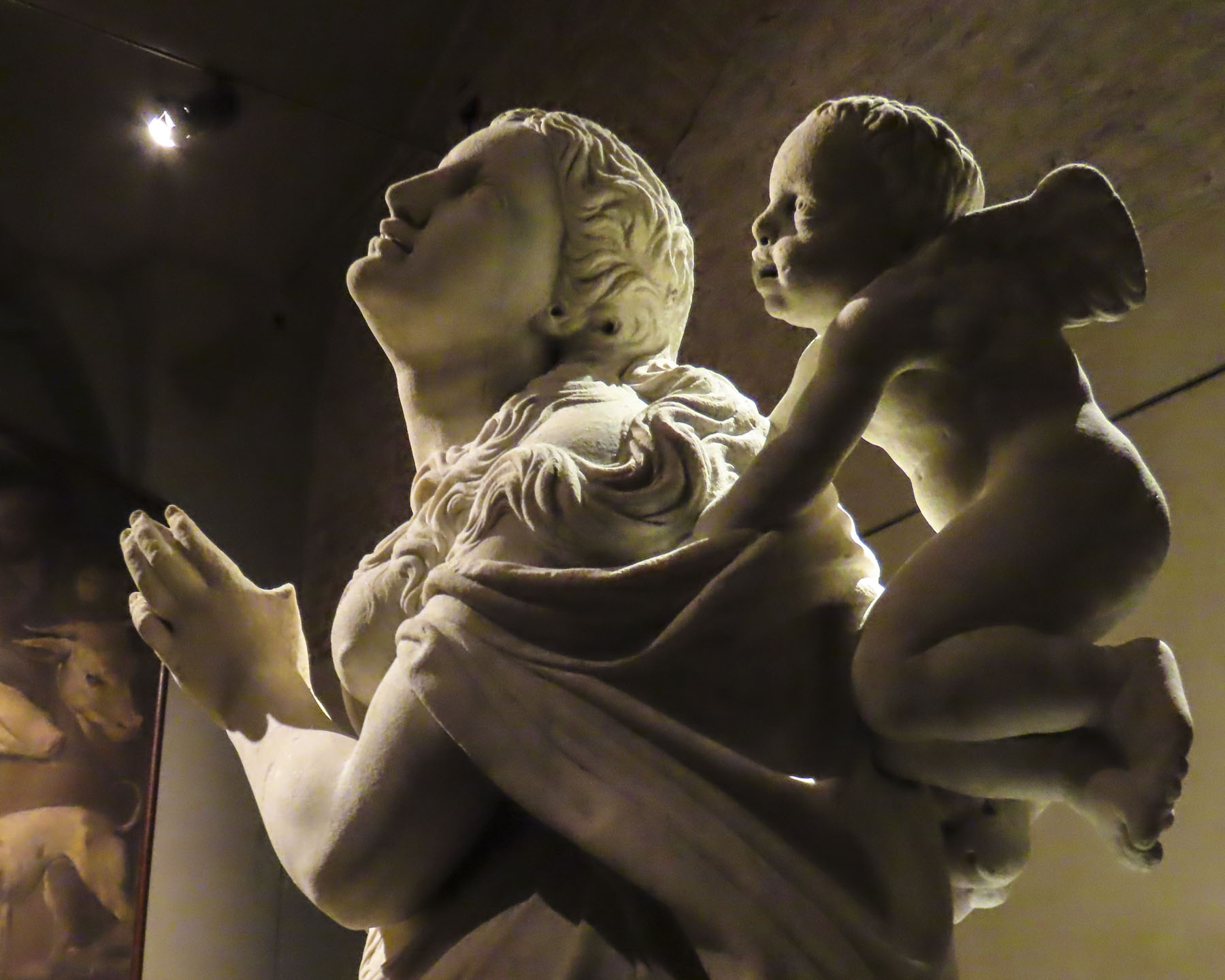
Across the plaza the Museum of the Milan Cathedral has an extensive and interesting collection of art and sculpture that at one time or another was part of the Duomo.

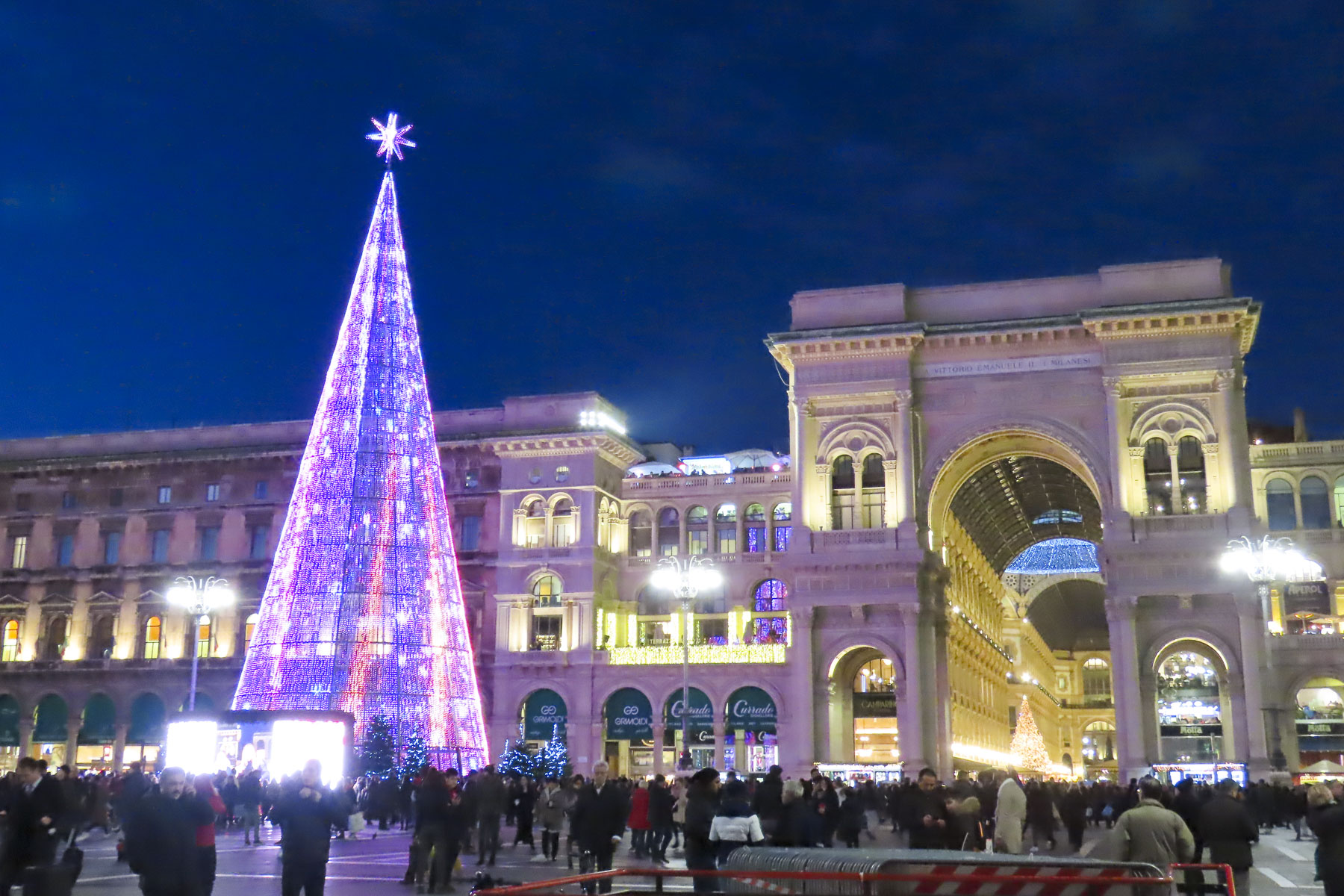
On the other side of the plaza stood Milan’s official Christmas tree, a modern conically shaped metal structure covered with thousands of multi-colored changing lights. Beyond the tree was the famous Galleria Vittorio Emanuele II, where four-story tall buildings and the promenade between them are covered with a spectacular vaulted glass ceiling.  It is considered the world’s first indoor shopping mall, built shortly after the unification of the Italian peninsular into the Kingdom of Italy in the 1860s when Vittorio Emanuele II was named king.  Lovingly nicknamed “il Salotto di Milano,” or “the living room of Milan” by the Milanese, the phrase acknowledges it’s the place to meet friends and be seen.

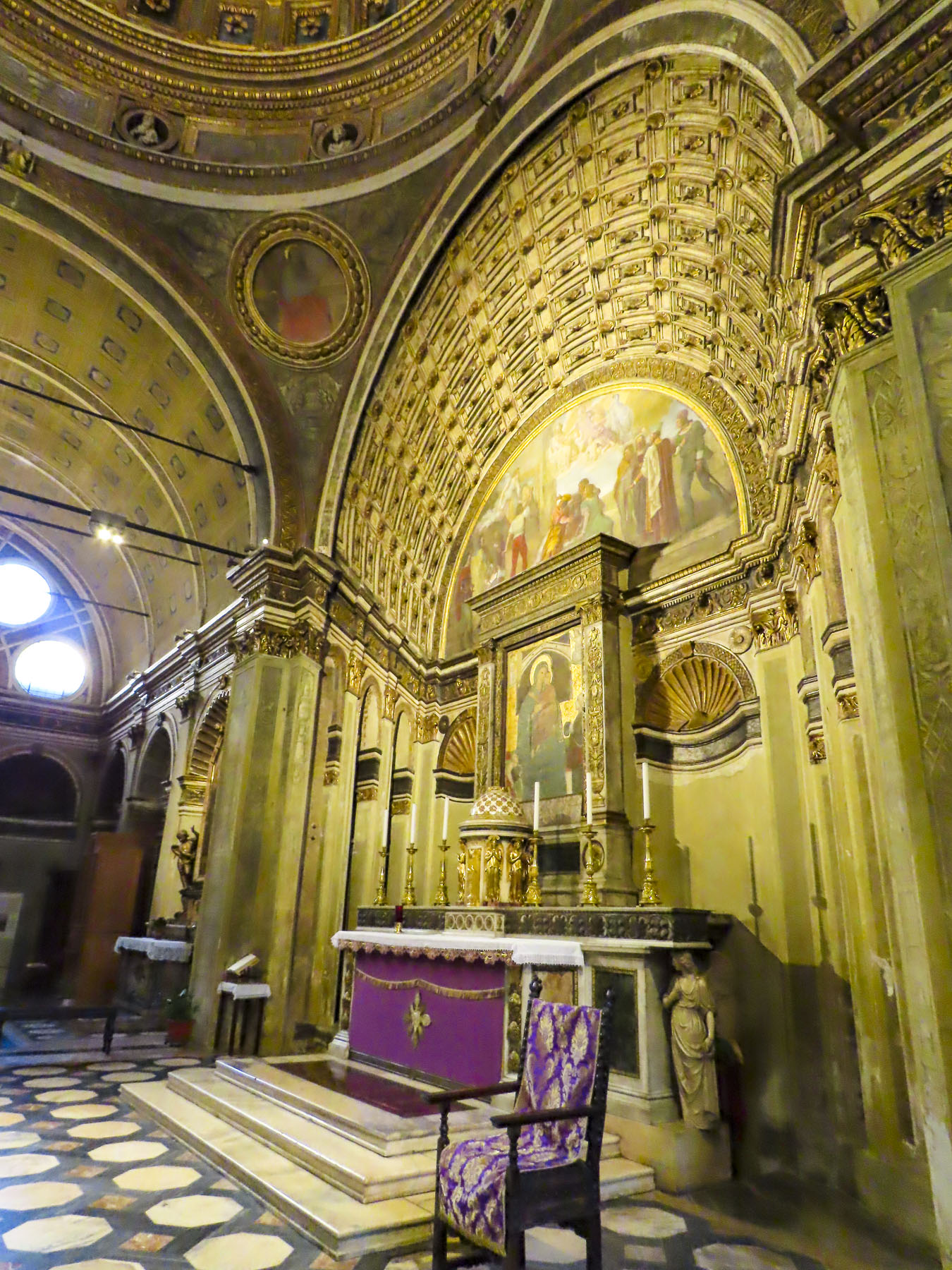
Wanting to stay in the city center till night fell, so that we could fully appreciated the Christmas lights on the tree in front of the Duomo, we wandered farther afield until we found the Chiesa di Santa Maria presso San Satiro. First built in the 9th century, the present church dates to the Italian Renaissance and  features a gilded interior and a rare example of Trompe-l’œil in a church. This painter’s effect utilizes a forced perspective to create an illusion of depth behind the altar.

After dark the plaza in front of the Duomo continued to fill with people eager to enjoy the festive mood of the Christmas season.  The Christmas tree was stunning, and its modernity nicely complimented the historic buildings surrounding the piazza.

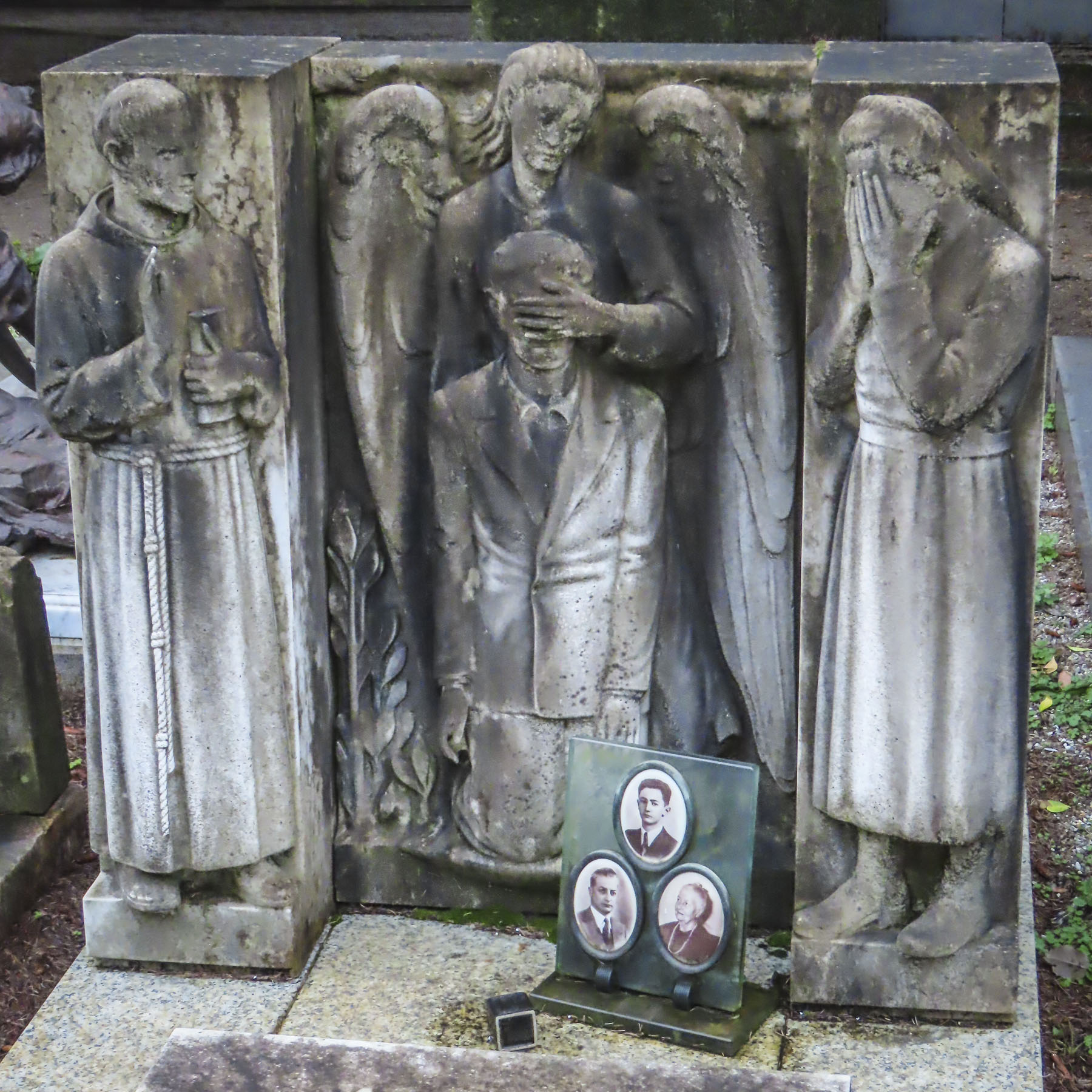
From our balcony we could see the silhouette of Tomba di Manzoni, the grand entranceway and “Hall of Fame” mausoleum for the noteworthy, though not as wealthy, Milanese who are interned at the Cimitero Monumentale. 

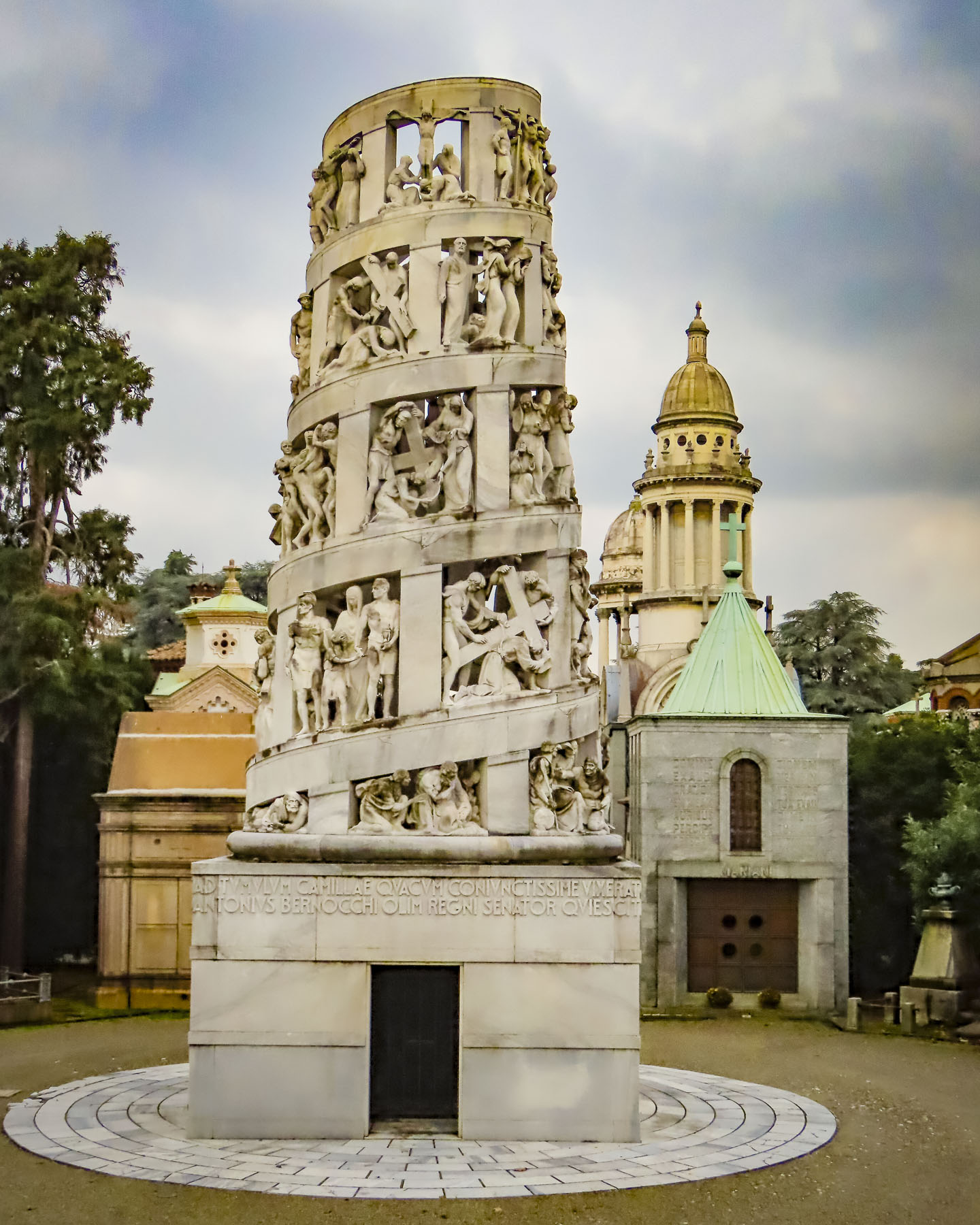
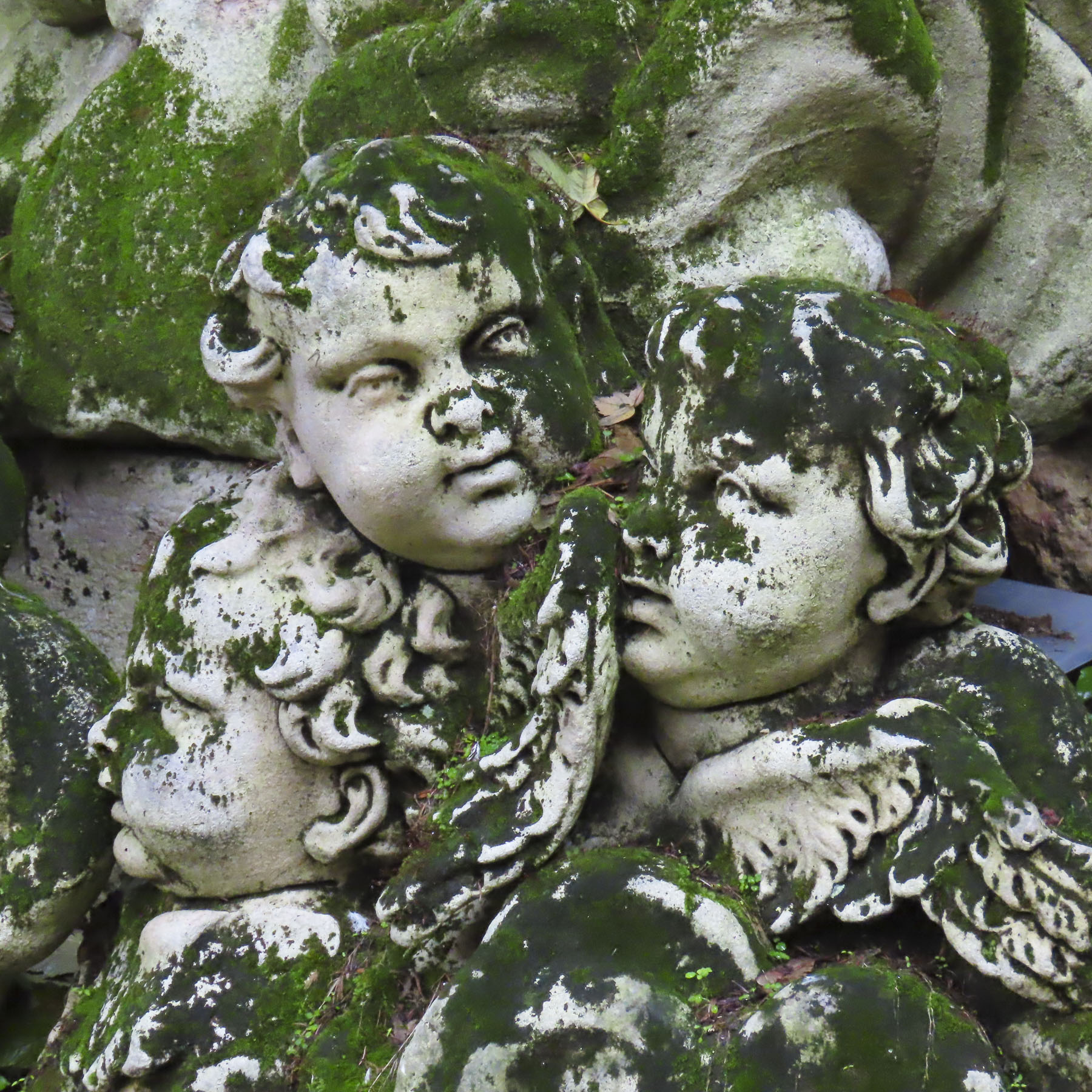
As we wandered farther into the cemetery, we realized that monumental might be an understatement. It was difficult not to confuse this extraordinarily extravagant place of entombment for an outdoor sculpture garden with memorials created by a who’s who list of famous 19th and 20th century Italian artists and architects for prominent Milanese families. 

The family names on the mausoleums also adorn roads, parks, tram and subway stations across the city. There seemed to be an afterlife version of one upmanship in play here with each monument more grandiose than the last.  As if competition or success in life was not enough and had to continue till your final committal.  It was a fascinating place to explore. Plan on spending most of the day.

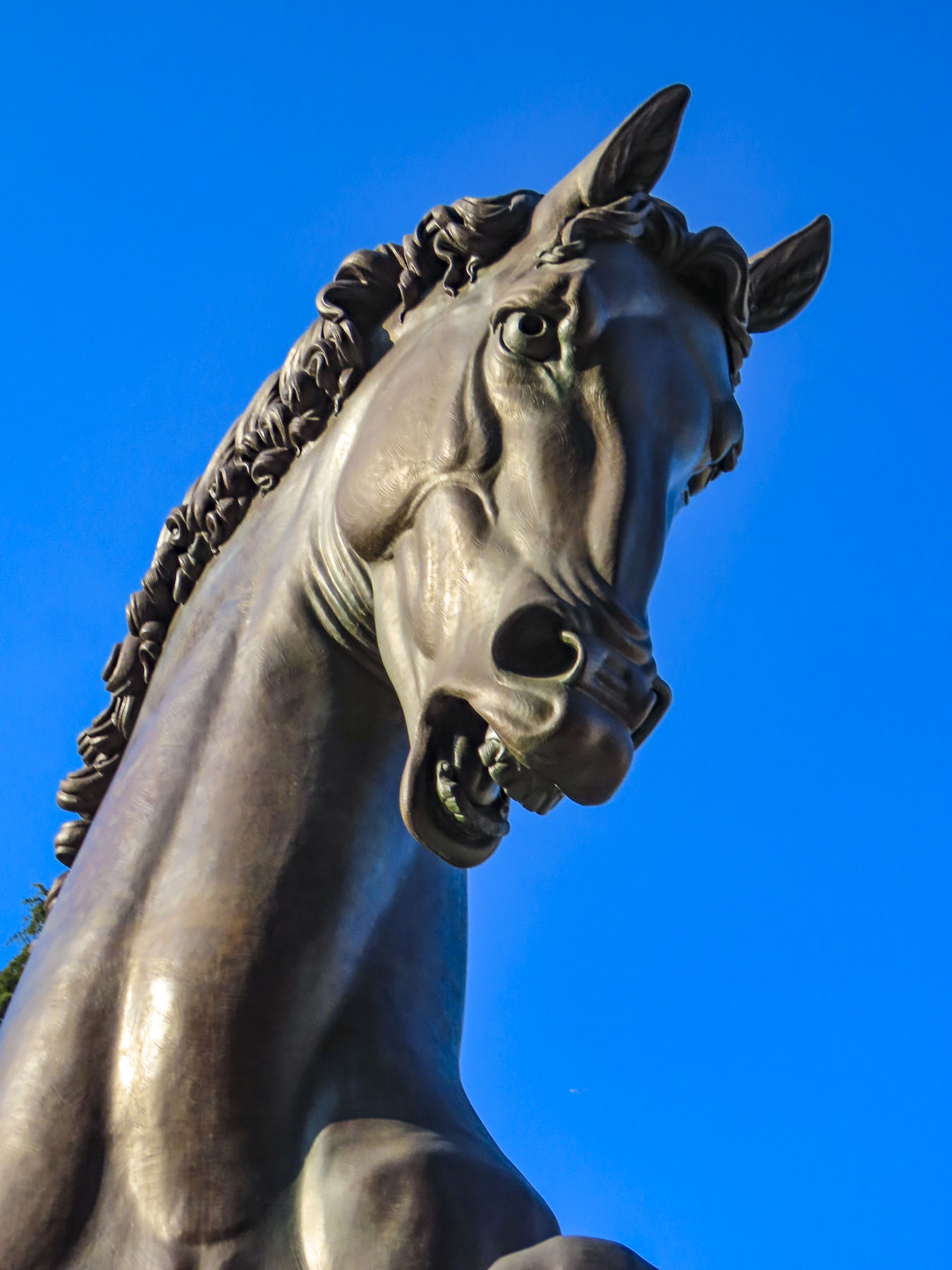
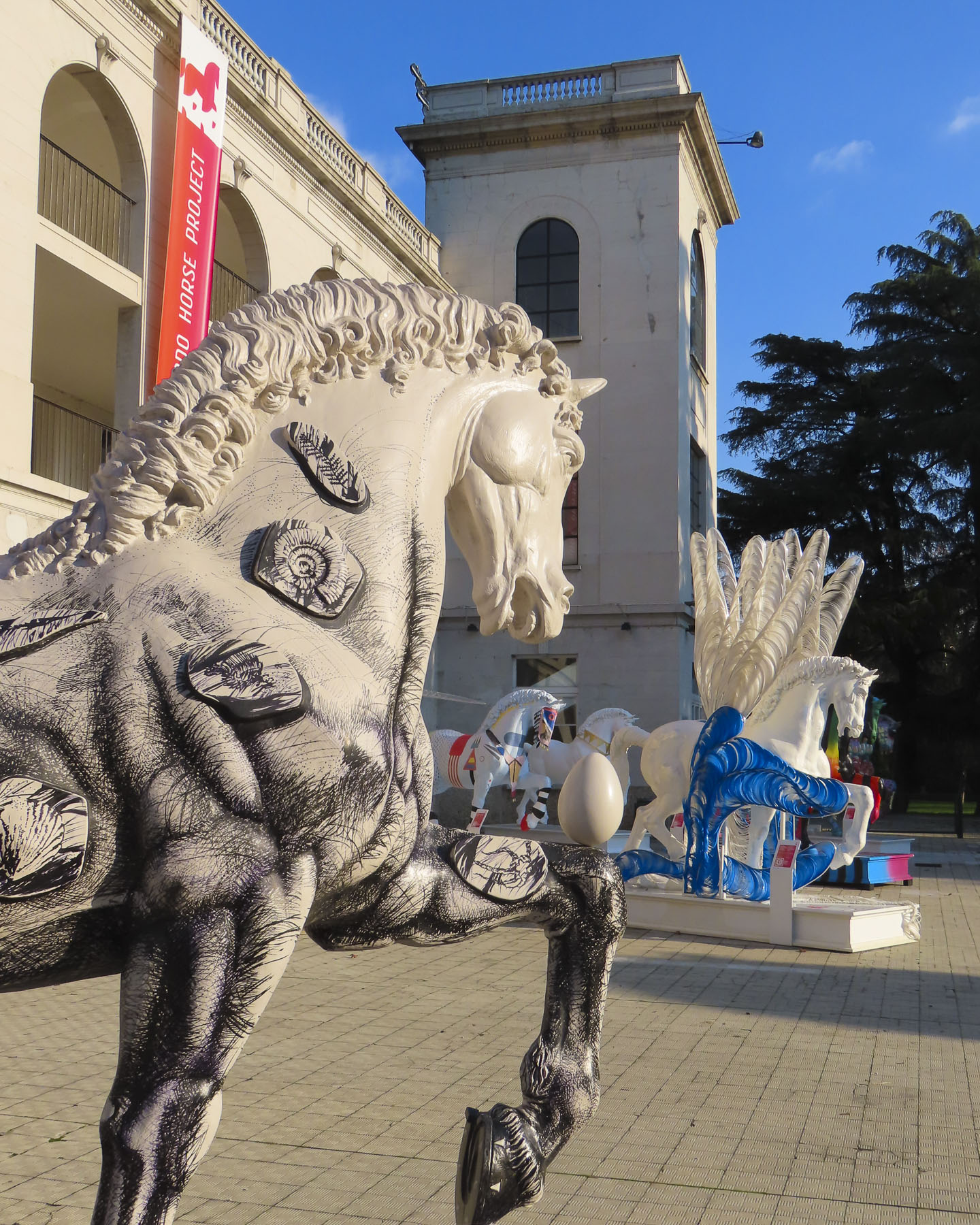
Donna’s mom had passed away the year before and one of our reasons for staying in Milan was to revisit a project her mother was instrumental in as a member of the United State’s Italian American Heritage Foundation and Leonardo da Vinci’s Horse Foundation. She helped for fifteen years in the 1980s and 90s to raise 2.5 million dollars to the see Leonardo da Vinci’s 24ft tall Il Cavallo recreated. The sculpture was finally realized by American sculptor Nina Akamu

Da Vinci was commissioned by the Duke of Milan in 1482 to create, at the time, what was the largest equestrian statue in the world, as tribute to his late father, Francesco Sforza.  The full-size clay sculpture was completed in 1491 and was waiting for its terracotta mold to be made and enough bronze amassed for its casting when the French invaded in 1499. Subsequentially, the clay model was totally destroyed by French crossbowmen who used it for target practice.

On its 500th anniversary, da Vinci’s Il Cavallo was unveiled outside the Ippodromo Snai San Siro, Milan’s famous horse racing track. Smaller artistic interpretations of Il Cavallo stand in the plaza behind it. This being modern Italy though a horse just can’t be a horse, and many were psychedelically painted and wore tutus or unicorn horns. Wonderfully whimsical, they definitely made us smile. 

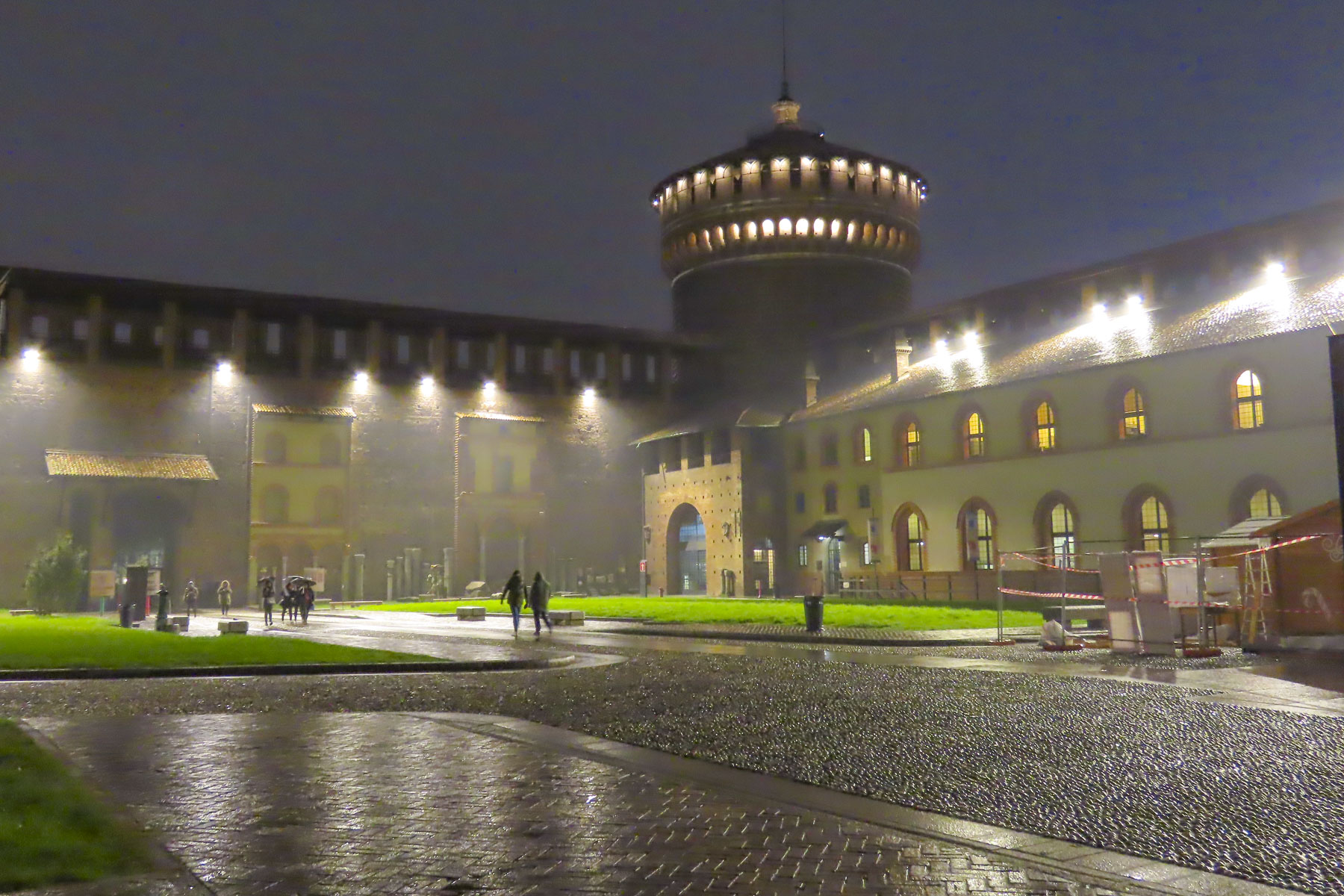
One rainy afternoon we took the tram to the 15th century Sforzesco Castle, seat of power for the Sforza dynasty that lasted only 100 years. But in that time the fortress/palace was expanded to be one of the largest citadels in Europe and filled with works of art by numerous Italian Renaissance artists.  Leonardo da Vinci, Michelangelo, Bramante, Correggio, Bernardino Zenale and Bernardino Butinone were commissioned to adorn the walls and ceilings and sculpt pieces to fill the vast space. Today the castle houses several of the city’s museums and art collections where the artists’ contributions to the palace can still be seen. A heavy fog had blanketed the citadel by closing time and was evocative of the moods cast in the historical fiction novels set in Renaissance Italy by Sarah Dunant. Later that evening we attended an Anglican Lessons and Carols service as a prelude to Christmas, then headed back to our apartment humming Christmas tunes as we window shopped.

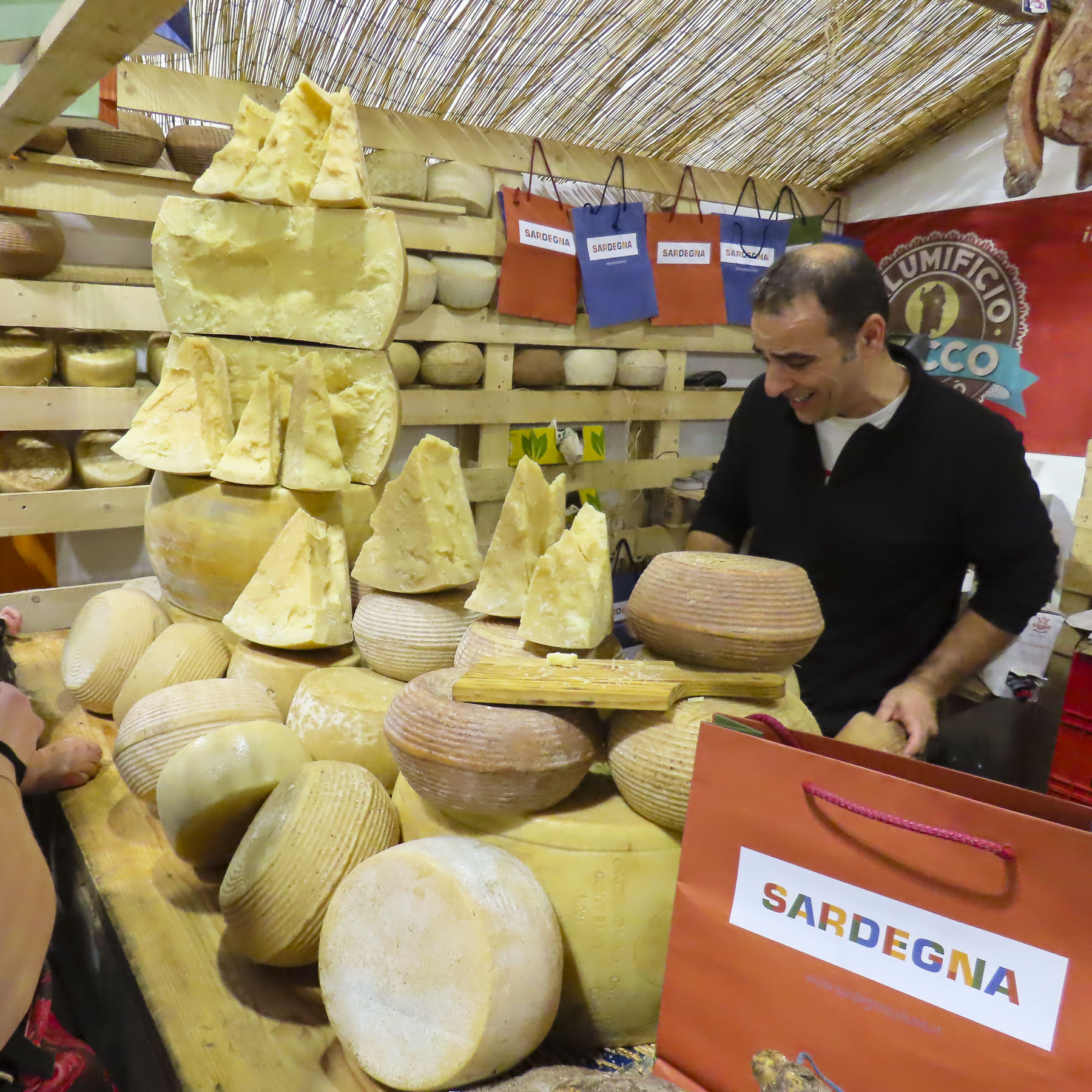
Signs for Artigiano in Fiera, the Fair, dotted our route into Milan when we first arrived from Bergamo and piqued our interest.  We hadn’t heard of it before, but with a quick internet search realized it was the shopping event of the Christmas season in Milan. While in line to enter the center we noticed many people pulling large suitcases. Toward the end of our shopping spree, laden with purchases, we realized the bags on wheels were pure genius, and allowed the seasoned pros to carry their holiday shopping with ease. The Fiera is a tremendously popular annual, nine-day event that draws over one million visitors to the Fiera Milano, Europe’s largest exhibition center, located in Rho, just outside Milan. Folks shop for home furnishings, fashion, jewelry, arts and crafts, along with artisanal foods, wines and liquor. The sites’ nine cavernous exhibition halls were filled with vendors from 100 countries, though displays from the twenty regions of Italy occupied ninety percent of the space. Plan on spending the whole day if you hope to see everything. It was all very interesting and entertaining and truly a marathon event. From Milan it’s an easy trip on the M1 subway, which stops right at the venue.

Wanting to make our last night in Milan special, we made dinner reservations at a highly reviewed restaurant, only to be turned away into a rainy night because we arrived early as the staff was enjoying their pre-work communal meal together. (The later you dine out in Italy the more you’ll feel like a local. Though this does take some getting used to and we haven’t mastered this yet.) “Okay, we will have a drink at the corner bar and return,” we agreed.

To our delight, our aperitives were accompanied by small sandwiches with chips and olives.  We had every intention of heading back to the restaurant, but our waiter was engaging, and the Aperol spritzes were very good. We spent the time watching folks fight the wind with their umbrellas through the bar’s rain-pelted window. The specular highlights from the streetlights added magic to the scene. Occasionally some groups popped inside seeking a warm reprieve from the downpour outside, shook out their umbrellas and found a seat.  Recapping our adventures, tentatively planning the next six months, and talking about Christmas with our kids back in the states, the evening flew by until the waiter said they were closing. Umbrellas up! We headed home.

Till next time, Craig & Donna

PS – The Artigiano was canceled in 2020 due to the Corona virus lock down in Italy. Hopefully, it will be allowed 2021.

Vicenza – Grand Architecture, Parks & Waterscapes

Our mishaps of driving in Italy are still memorable. But they were far more forgivable and less costly before the advent of the remote video surveillance systems that Italian towns use today. Years ago, we had briefly visited Vicenza, home to one of the world’s most influential Renaissance era architects, Palladio. After a long day on the road, navigating down from the Dolomites, we drove through the old city gate under the Tower of Porta Castello, the last remaining tower of a 12th century fortress and wall that once enclosed the Renaissance city.  Today it houses an art gallery, and you can climb to the top for views of Vicenza.

The directions to the hotel were confusing and our GPS at the time was no help.  We had already stopped twice to ask the local polizia for directions, but of the four officers asked, each had a different opinion about where our obscure lane was located, which only befuddled us further.  A few moments later we realized Corso Palladio was a pedestrian-only street and we were intruding on its charming ambience. The hotel assured us they had parking, so we continued along slowly through a thickening crowd that didn’t think anything of us.  It didn’t help that the street signs were impossible to see from the car. Traveling the whole length of the street, we ended at a piazza in front of the Teatro Olimpico, designed in 1580; it’s the oldest indoor theatre in the world, with its unique original stage set still in use. It was Palladio’s last creation before his death.

Across the way two police officers with submachine guns stood by their patrol car in front of the Museo Civico di Palazzo Chiericati, known for its eclectic collection of donated art, antique furnishings and toy soldiers from the Veneto region. There was no mention of the “BIG FINES,” we had momentarily anticipated.  Instead, the gracious officers gave us a police escort to the hotel.  Parking was in the narrow lane, in front of reception.  

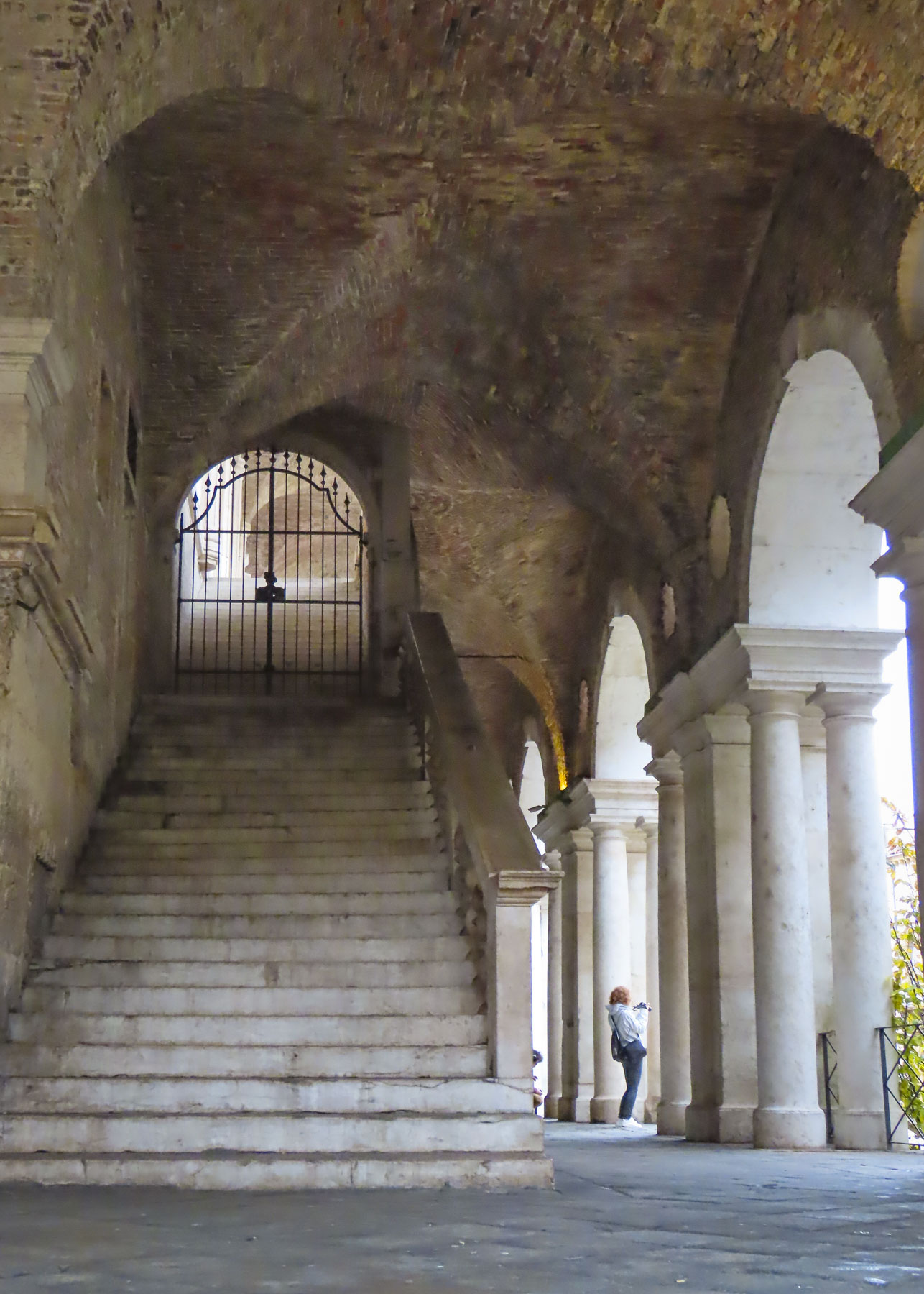
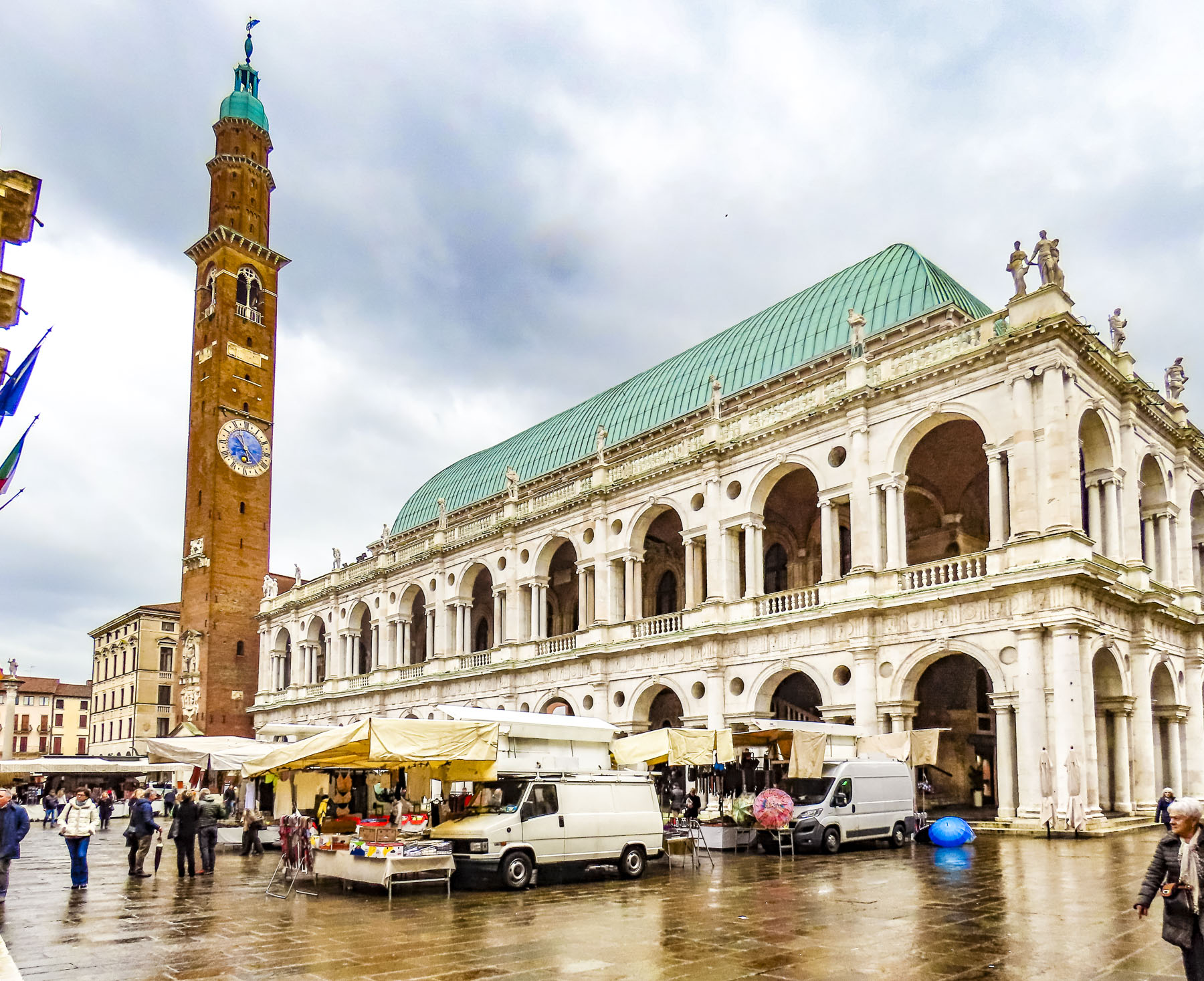
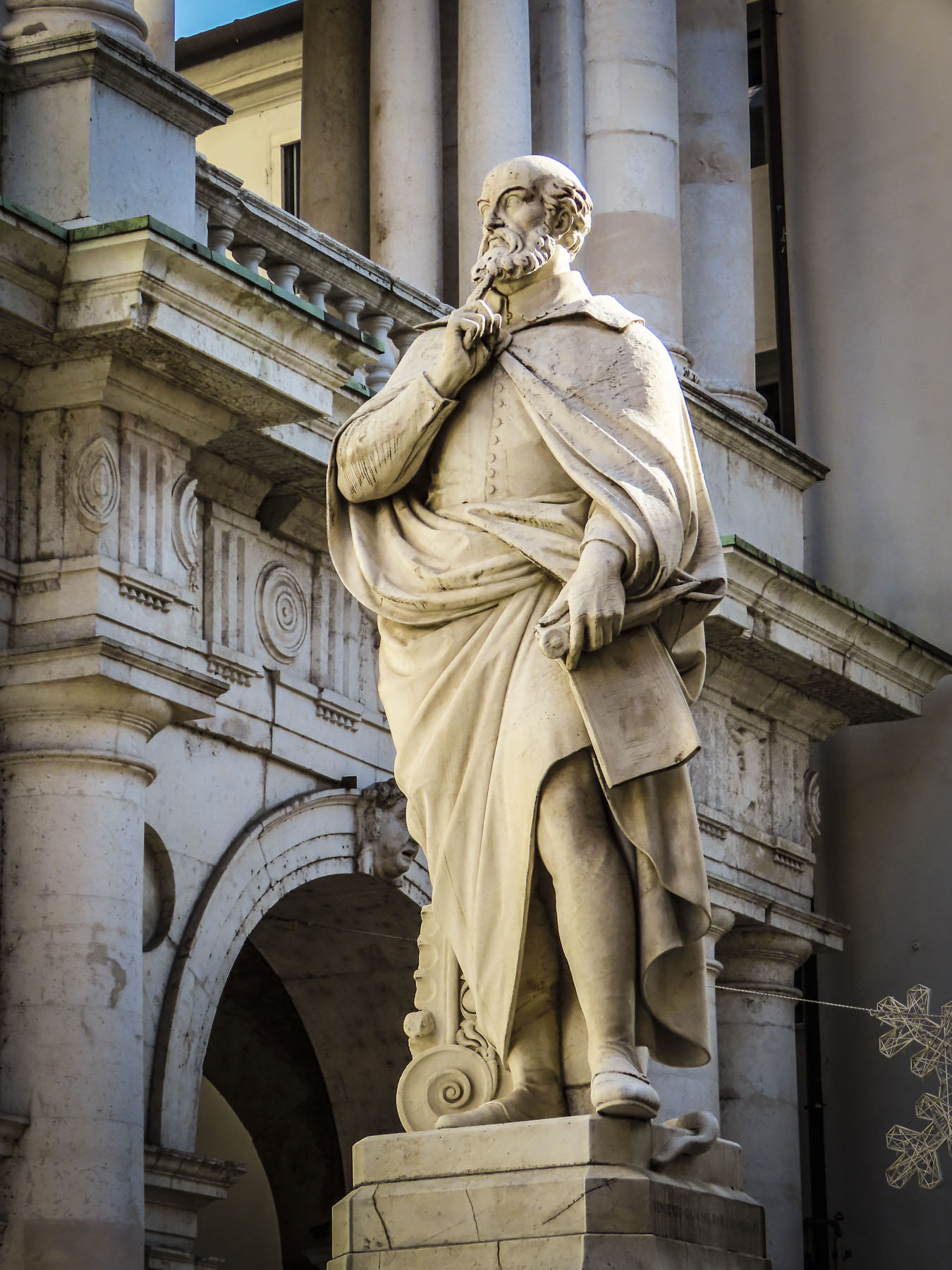
Our visit was long enough for dinner and a stroll, the next morning, around the Piazza dei Signori with its massive civic building, the Basilica Palladiana, redesigned to its present form in 1546 by the young, as-yet unknown hometown architect Andrea Palladio.  His architecture can be characterized as a refined rethinking of classical Greek and Roman temples with domed and columned buildings favoring a “harmonic Renaissance aesthetic.” The style was popular with many wealthy Italian families across the Veneto region, who commissioned him to design their palazzos. This grand style continued to be extensively influential into the 19th and 20th centuries where it was favored for municipal and government buildings, i.e., the United States Capitol Building and British Museum, among others.

Our original visit was enough time to realize the city was vastly interesting and that we had mis-planned.  Now we stay a minimum of two nights wherever we go to compensate for time lost traveling between destinations.

We figured seven nights this time should be enough to relax, enjoy the city and sample its livability.

Raised in the suburbs of New Jersey, we always shunned living in a city until we retired and sold most everything, including our cars, to finance this two-year adventure around the world.  To our surprise we now enjoy city life. Especially the walkability of smaller historic cities with their pedestrian only centers, a concept not found in the sprawl associated with urban planning in the United States.

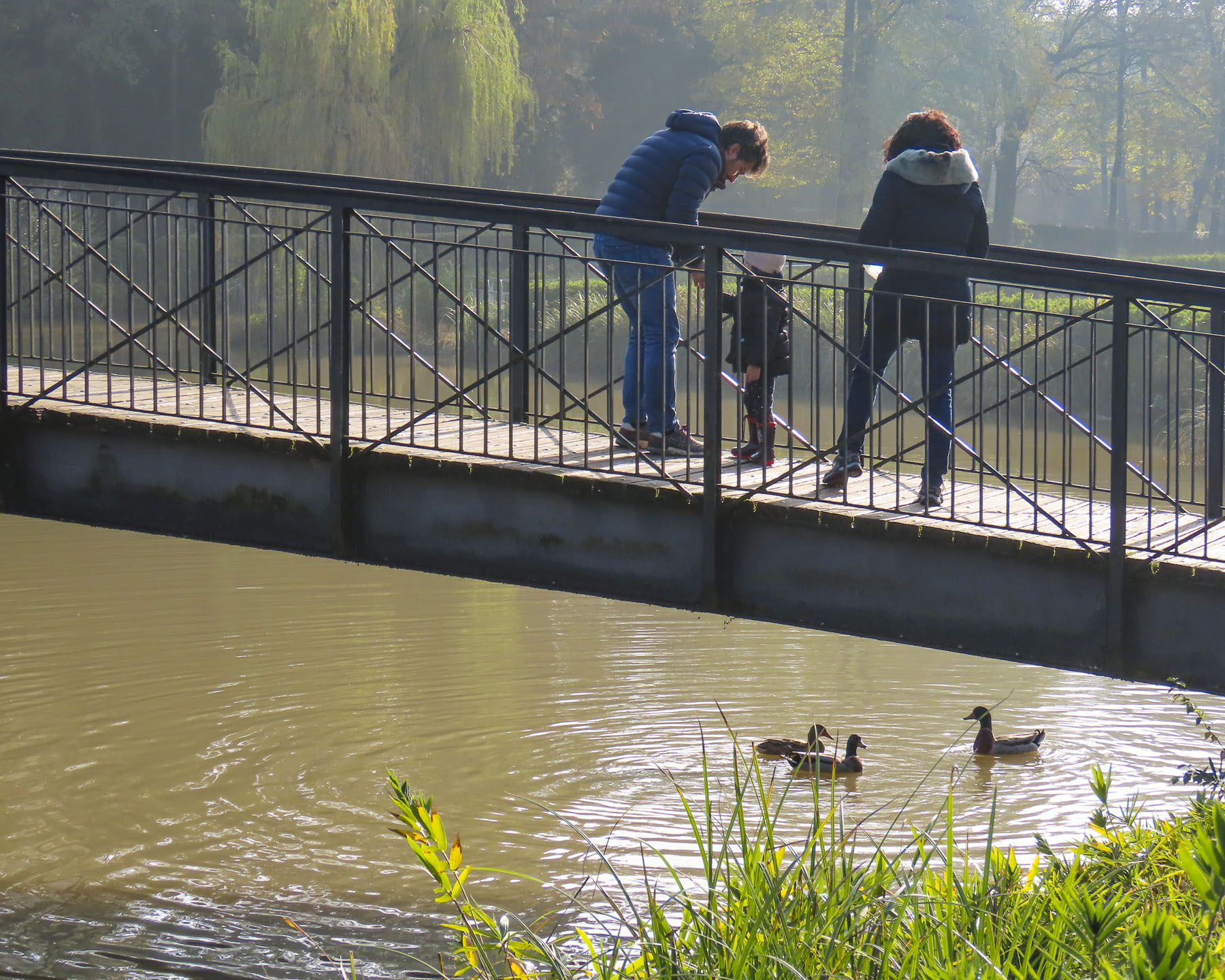
As we neared Vicenza our shuttle driver, Fabrizio, from the Venice Airport, detoured slightly to show us two points of interest on the outskirts of the city that he thought we might enjoy, and were afraid we would otherwise miss. Parco Querini, a semi-formal large open green space with sculpture lined paths and a domed pergola, looked stunning on a late autumn afternoon. It was once the private retreat of a wealthy family and was opened to the public in the 1970s. 

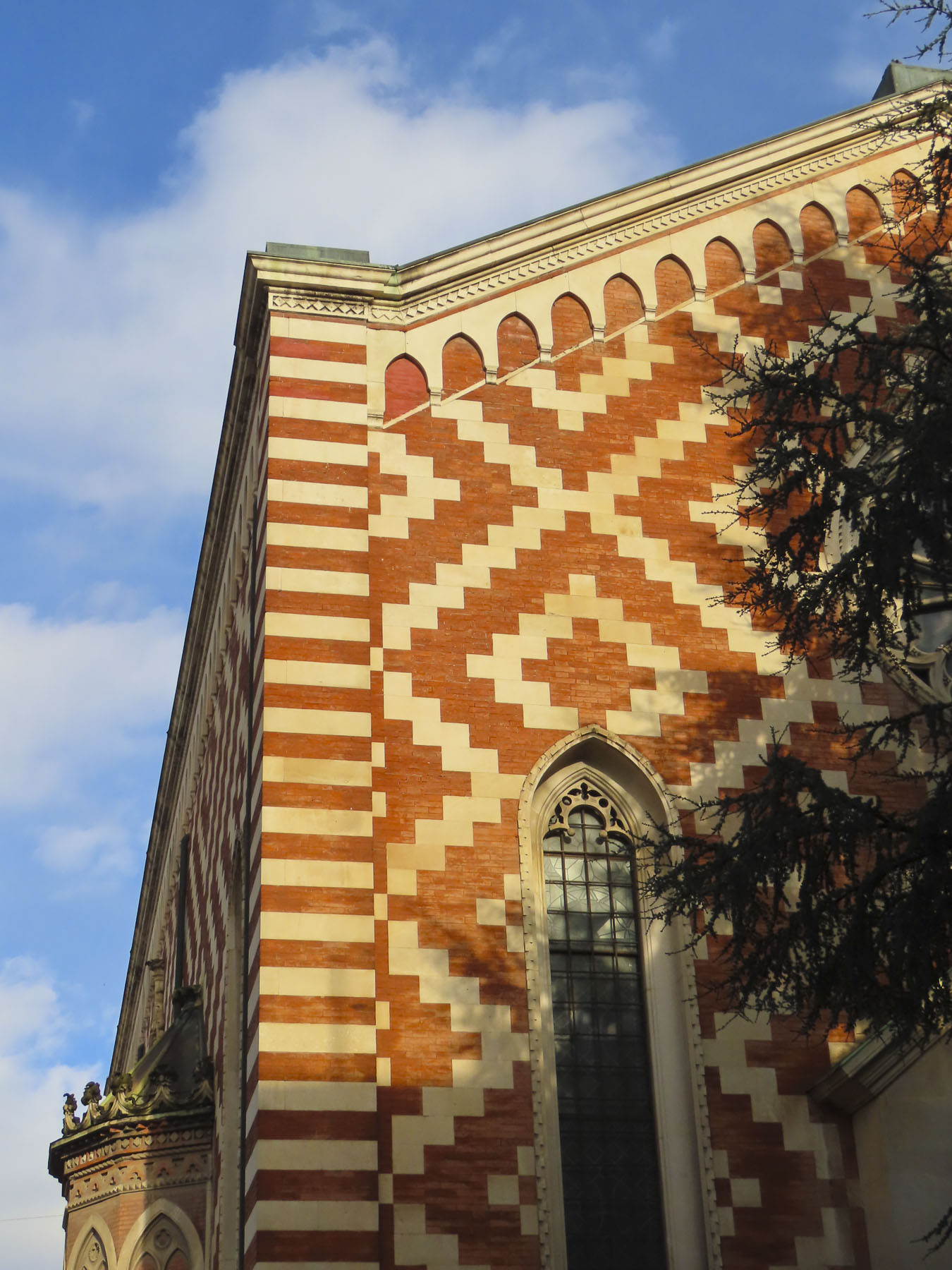
Nearer our apartment, Fabrizio took us past the red and white brickwork of the Chiesa de Santa Croce ai Carmini, with its architecturally distinctive facade. We found both sights interesting and vowed to return.

While walking to the park for a return visit, we found the Boutique Del Pane Vicenza, a delightful small bakery at the very end of Corso Antonio Fogazzaro, past the 14th century Church of San Lorenzo with its intricately carved roped portal and guarding lions that have slowly eroded with time.  Years ago in Italy, the concept of “coffee to go” or “take away” as we have in the states was unheard of. Tradition was you stood at the counter for a quick morning espresso or lingered at a table.  Attitudes have evolved and we are not sure if we agree, but this visit, with coffees and pastries in hand, we snacked in the park.

Nearby the twice-weekly artisanal farmers market, Il Mercato Campagna Amica di Vicenza, brought locally produced cheeses, wines, fruit and vegetables to new meaning with a “zero food miles” philosophy.  The artisanal baker was very popular with folks queued three deep at her counter for a chance to buy a wedge of bread from her huge country loafs.  Around the corner from the market, we found the best vegetarian restaurant we’ve ever been to, NaturaSì Silene Bio Bottega E Cucina. With truly the most flavorful and memorable vegetables.

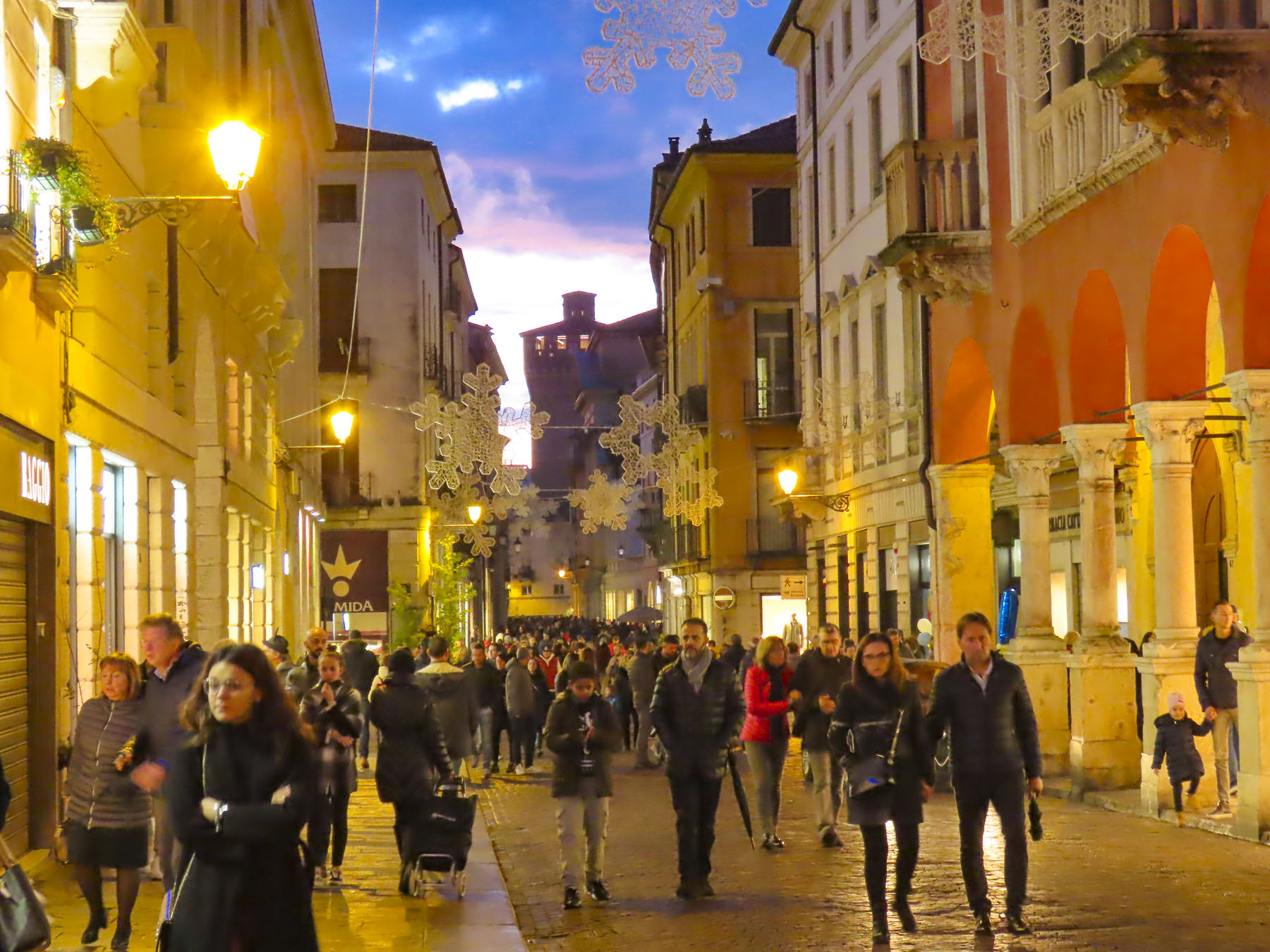
From our apartment on Contra Motton San Lorenzo we explored the historic center of this delightfully compact, Renaissance city, where we were less than a ten-minute walk from everything. As we strolled past intriguing architectural details, we took note of what to do and where to go later in the week.  Discovering pastelería is our superpower and we put it to good use finding tasty creations to enjoy for the next morning.  Walk a little then café – repeat was a well-paced yet caloric approach that we fully enjoyed in our explorations of the city.  Though some days longer walks between cafes were needed when our belts were too tight. Donna says the solution is simply to wear elastic waist pants.

During the time of the Romans the main street in Vicenza was Via Postumia, a military road that connected outposts across Northern Italy. Later during the Renaissance, noblemen competed in Palios, horse races, on the religious festival days for Sacra Thorn and Corpus Domini, when the main street, now lined with arcaded sidewalks, was used as a racecourse. After the Second World War the street was renamed Corso Andrea Palladio, to honor the great architect for his contributions to the city, and an electric street-trolley coursed down the avenue. The Corso and the historic center of Vicenza have been pedestrian only since 1983. It remains a vital artery, with upscale shopping and restaurants connecting either end of the town and the historic sites in between. It’s the perfect street for La Passeggiata, the early evening stroll locals still enjoy. If you are looking for a traditional Italian bar along the Corso, the Gran Caffe’ with its old-world charm is the perfect place for an espresso or spritz. It attracts a diverse following, and is popular with students, professionals and a cadre of finely dressed older women who seem to be as much of an institution as the café itself.

Vicenza’s relic from Christ’s Crown of Thorns is treasured in the Sanctuary of Santa Corona, which was built by the Dominicans in the late 1200s to safekeep the extraordinary gift from the French King Louis IX to the Bishop of Vicenza. 

The centerpiece of the church is a beautiful altar embellished with pearls, corals, lapis lazuli and polychrome marble. Interestingly, outside hanging on the wall of the cloister is a plaque featuring a Cinta senese, an ancient Italian pig breed that is famous for its flavorful meat.

Palladio has definitely left his mark on the city with buildings of his design on almost every street – at least, it seems that way. A tour of the city wouldn’t be complete without stopping at the Palazzo Barbaran da Porto, a Palladio design built in 1570, that is now a museum with interactive exhibits and video displays as well as three dimensional models dedicated to the architect’s work.  Recognized by UNESCO in 1994 for his influential architectural aesthetic, called Palladian, twenty-four of his Palazzo designs and the city itself have been designated a World Heritage Site.

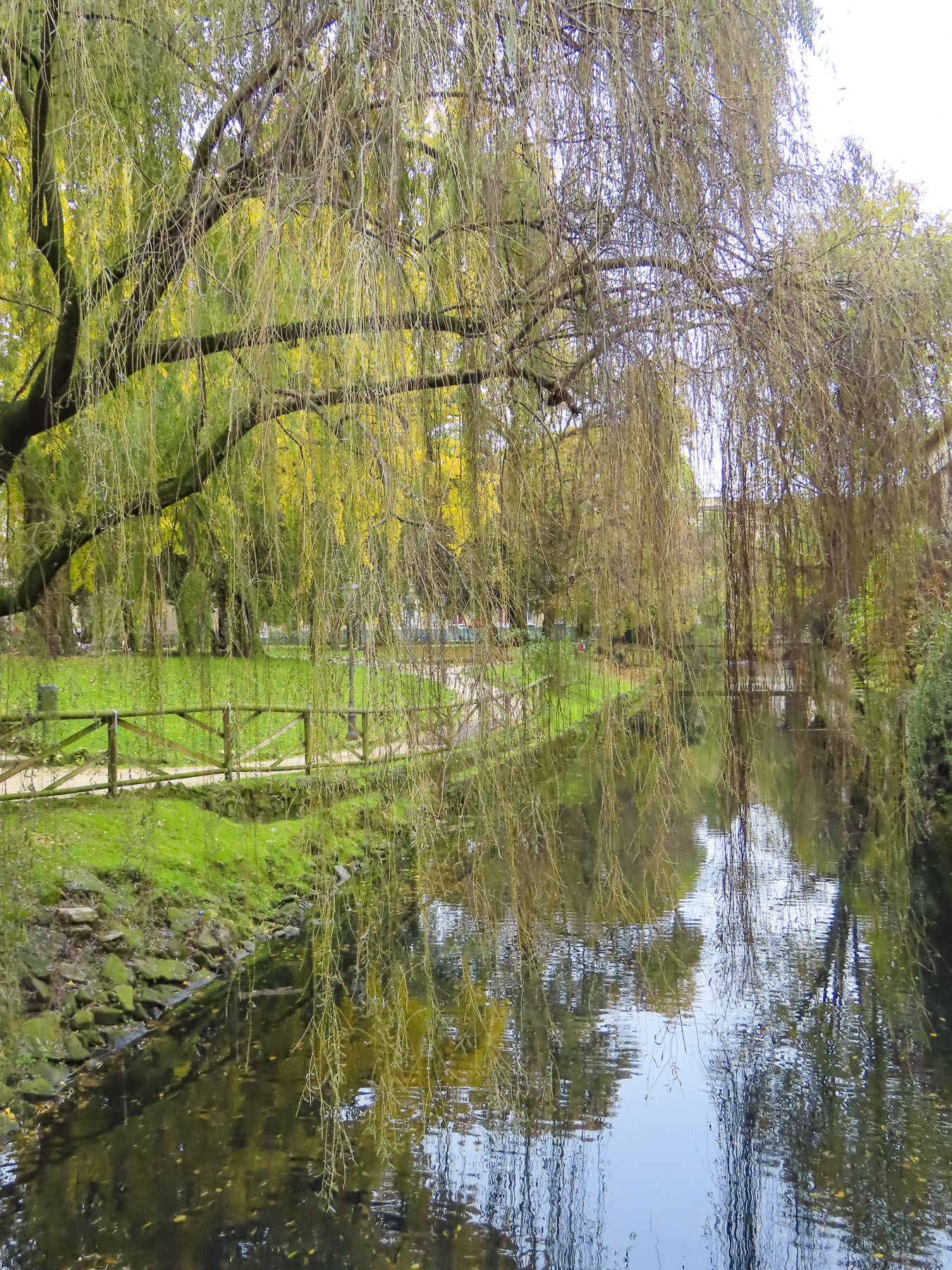
The city also has a wonderful ambience aside from his architectural masterpieces.  Waterscapes from the Ponte S. Paolo and the Ponte S. Michele over the Fiume Retrone reflect a quaint village vibe unexpected in comparison to the grand Piazza dei Signori just two blocks away.  

Pasticceria Venezia – a Vicenza dal 1964, just up from the bicycle parking on S. Paolo and near the Palladian Basilica, is a terrific place for café and a bite to eat.

On the other end of town just outside the Porta Castello, the Giardini Salvi, a treed greenspace with fountains, has been on the city map since 1580. It was the private park to the Palazzo Valmarana and in a brief moment of 16th century civic mindedness, was open to the public for a few years before being closed again for several centuries.  It wasn’t until the 20th century that the park was permanently reopened for public use.

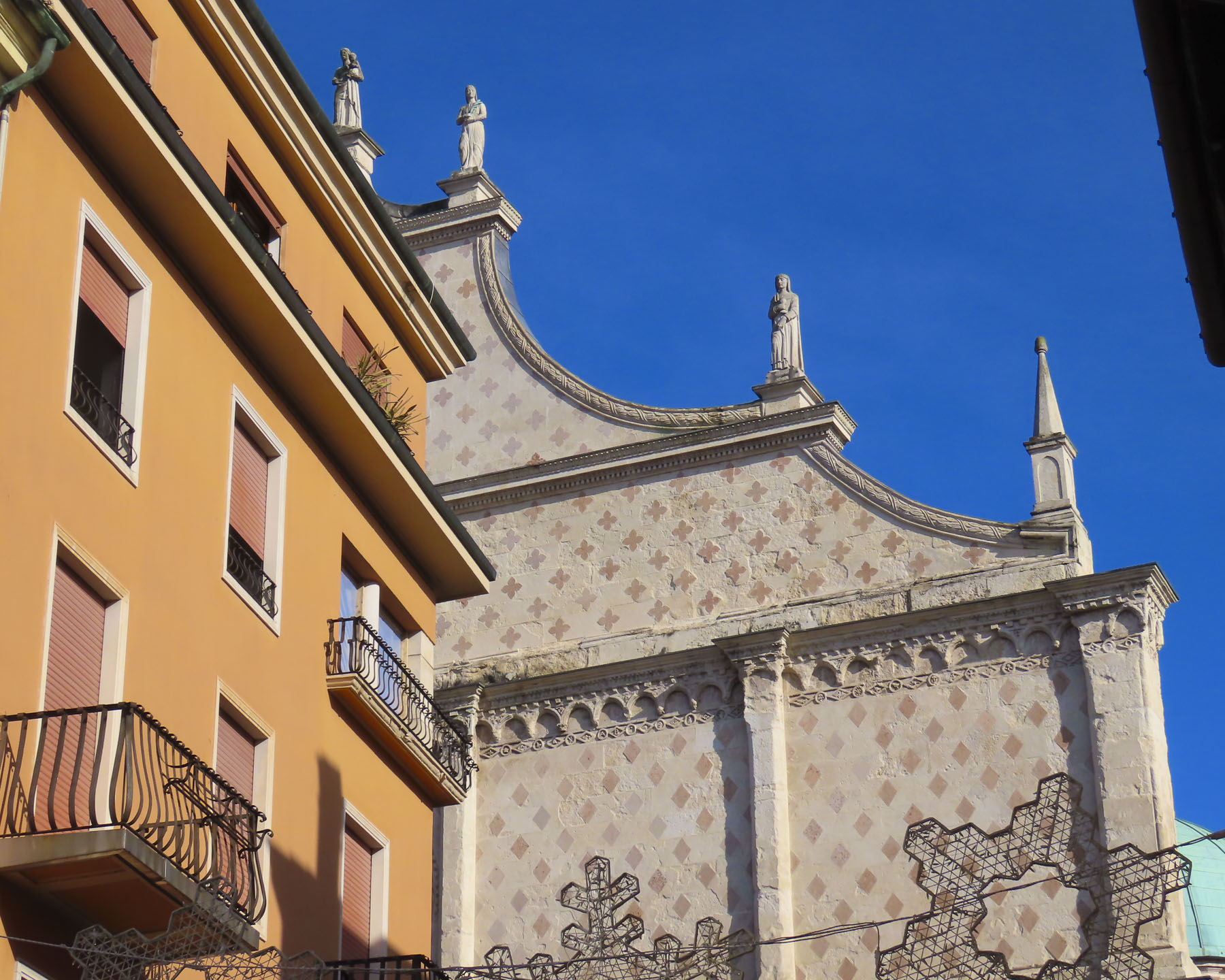
The district south of the Corso Palladio is also worth exploring with the Duomo di Vicenza, the Cathedral of Saint Mary of the Announcement, as its centerpiece.  Heavily damaged by allied bombing during the Second World War, only the original 1482 Gothic entrance façade remained, while the rest of the church had to be reconstructed.

Diagonally across the street, in the ancient Bishop’s Palace, the Museo Diocesano di Vicenza has a unique collection of Vicentine religious artifacts. Interestingly there is a large collection of fine marble spheres, some the size of bowling balls, given to a former Bishop of Vicenza as gifts.  Discovered on the other side of the piazza during reconstruction after WWII the Criptoportico Romano was the subterranean storage area of a 1st century Roman domus. As interesting as that sounds, if you’ve been in an empty, damp dark basement before, you can skip this.

Around the corner is Righetti’s, a self-service restaurant and another Vicenza institution for over thirty years, that should be experienced. Customers find their own tables and set the cutlery themselves before walking to the back of the restaurant and placing their orders, from the daily changing menu on chalk boards, directly with the cooks in the kitchen.  After dinner, the cashier counts your glasses and plates, then bills accordingly. They are open Monday through Friday for lunch and dinner, cash only.

Although the weather was noticeably cooler, we enjoyed our November off-season visit to this visually pleasing and gentle city. If you are an admirer of historic architecture, Vicenza is akin to finding a lost treasure. The bonus was the lack of large tourist groups, which we imagine could be quite smothering in this quaint city during peak travel months.

Till next time, Craig & Donna
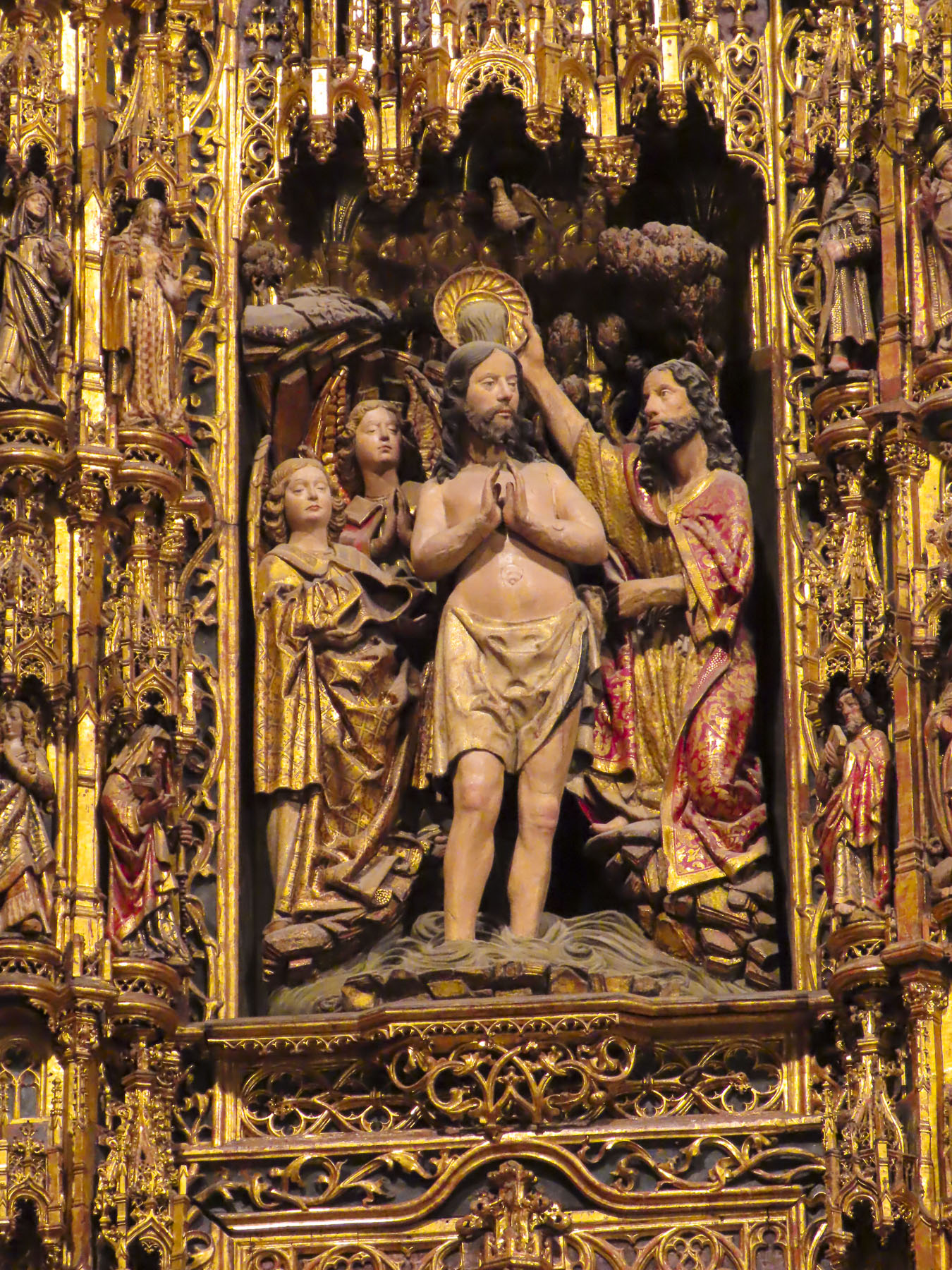
Sicily Part One: Taorima and Castiglione di Sicilia – Sunny Ancient Lands

The clickity clack of our suitcase wheels reverberated through the Porta Catania, the ancient gate through a defensive wall that once encircled the town, as we pulled them past the 14th century Duomo of Taormina, over cobblestones polished smooth by centuries of use and time.  Adorned with crenelations, the church looks more like a fortress than sanctuary and seems at odds with the playful Baroque fountain in the plaza across from it.

Lined with colorful shops Corso Umberto, barely wide enough for a horse cart, connects the two old entrances to the city and is pedestrian only. The adjoining steep, staired alleys were sized just right for the width of a donkey.

Meeting us at the corner, our young host graciously carried our bags up the passageway and to the third-floor room we had rented in a newly renovated guest house.  It was a compact space, but it would work if we sucked in our stomachs. Effortlessly, he trotted up two more flights to the rooftop where he showed us the kitchen, as well as distant views of the Teatro Antico di Taormina, the castle above town, and Mount Etna, all bathed in the last of the sun’s rays. 

The next morning, before the day became too hot, we followed a steep switch-backed trail up the side of Mount Tauro to the Chiesa Madonna della Rocca and the Saracen Castle.  The Arab fortress is believed to be built over an ancient Greek acropolis. Unfortunately, it was closed due to disrepair, but the panoramic view of Naxos on the coast with Mt Etna in the background was phenomenal.

Sicily’s history follows Mount Etna’s turbulent eruptions – quiet for long periods then thrown into turmoil by foreign invasions.  Hanging off the toe of Italy, its large land mass pinches the Mediterranean Sea to the point that the island is only 372 miles from North Africa’s Tunisian coast. For ancient mariners sailing East to West or South to North it was unavoidable, and they collided with it.  Its easy location at the crossroads of the Mediterranean brought Phoenicians, Greeks, Romans, Vandals, Ostrogoths, Byzantines, Arabs, Normans, French, Germans, British, and Spanish for varying lengths of conquest and cultural influence. It’s an interesting gene pool for sure. 

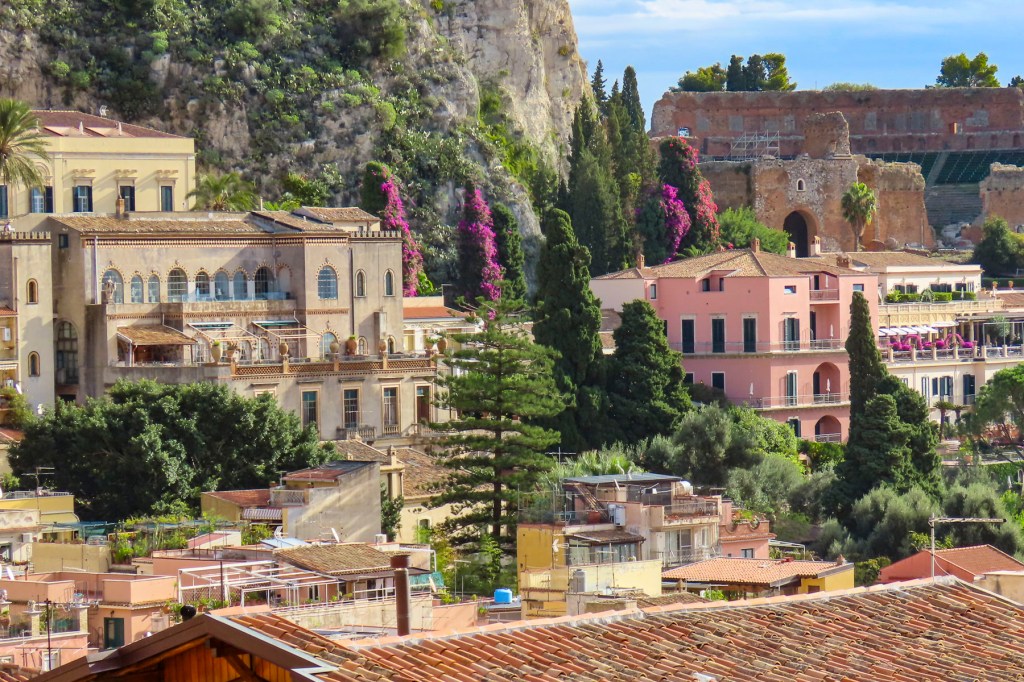
Appreciating a good beach when they found one, the Greeks rowed ashore and established their first colony, Naxos, on the island in 734 BC.  Later siding with the city state Athens in a war against Syracuse, upon defeat the city was completely destroyed in retaliation. The survivors fled to the high ground and founded Taormina.  Visitors continue to be dazzled by their vision to dramatically construct an amphitheater on the edge of a cliff towering over the sea with Mt. Etna, an active volcano, in the background.  

Finally, Piedmontese volunteers, the red shirts of Northern Italy, invaded to unite Italy. Commanded by Giuseppe Garibaldi, the army defeated the Kingdom of Sicily whose territory extended across the boot of Italy and North to Naples.

But before that Taormina with its multiculturalism was a required stop on the “Grand Tours” of the 18th and early 19th centuries once it was mentioned by Johann Wolfgang von Goethe in his Journey to Italy. Paris, Venice, Florence, Rome, Naples and Pompeii, Athens, Istanbul, Cairo and Seville were also treasured destinations.  Remember, this was the time when all land travel was by horse-drawn carriage and water crossings by sailing ships. Think of it as an extended gap year, when young aristocrats were sent abroad for two to four years to sharpen their sensibilities and further their knowledge of the arts, antiquities and the classics.  Taormina’s big draw though, over those other sophisticated cities, was its clifftop location high above the Mediterranean that caught the cool breezes blowing in from the sea during the summer.

The Nordic invasion continued with landscape painter Otto Geleng. Exhibitions of his paintings in Paris and Berlin left critics saying such landscapes couldn’t exist and that he had an “over-active imagination.” He encouraged all his doubters to see Sicily for themselves, then returned to Taormina and opened the town’s first hotel, Timeo, in a renovated palace. His vision inspired a wave of artists, writers, and actors to visit.  In the 1920s D.H. Lawrence lived there. The books In Cold Blood and Breakfast at Tiffany’s were written by Truman Capote during his stay on the island.

The town can really name drop some famous visitors: Salvador Dali, Orson Welles, Cecil Beaton, Jean Cocteau, Rita Hayworth, Greta Garbo, Elizabeth Taylor, John Steinbeck, Cary Grant and Tennessee Williams have all worked on their tans in the golden rays of the Mediterranean sun here. 

The Taormina Film Festival, now in its 67th year, still premieres movies every June on a large outdoor screen set up in the 2300-year-old Greek amphitheater.  It attracts a new generation of sunscreen-wearing A listers: George Clooney, Catherine Zeta-Jones, Nicole Kidman, Russell Crow, Leonardo DiCaprio and Salma Hayek. Imagine watching Spiderman: Far from Home there, as Mt. Etna sputters trails of lava into the night sky in the background. Aside from the film festival, the amphitheater hosts a vast number of concerts and stage productions throughout the year.

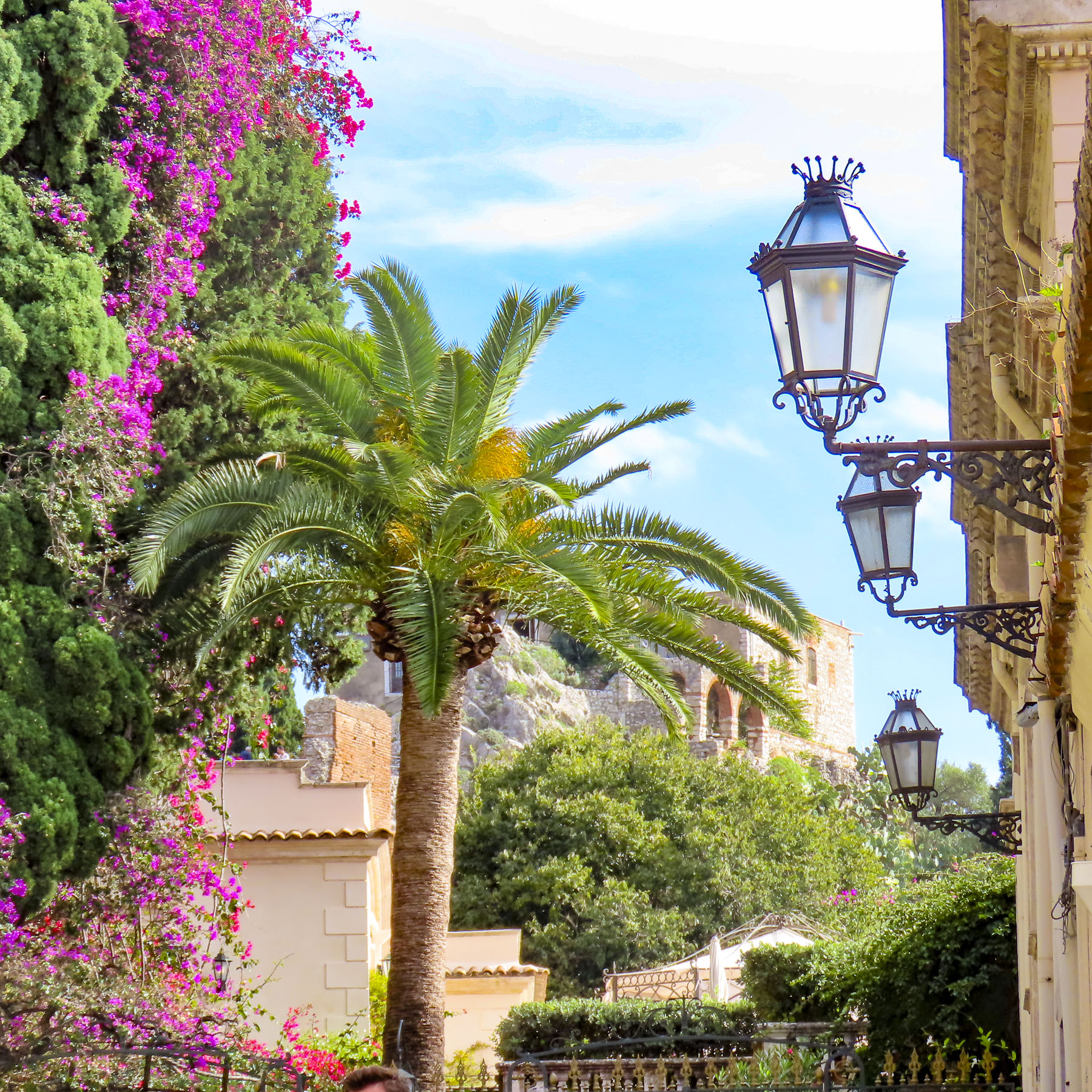
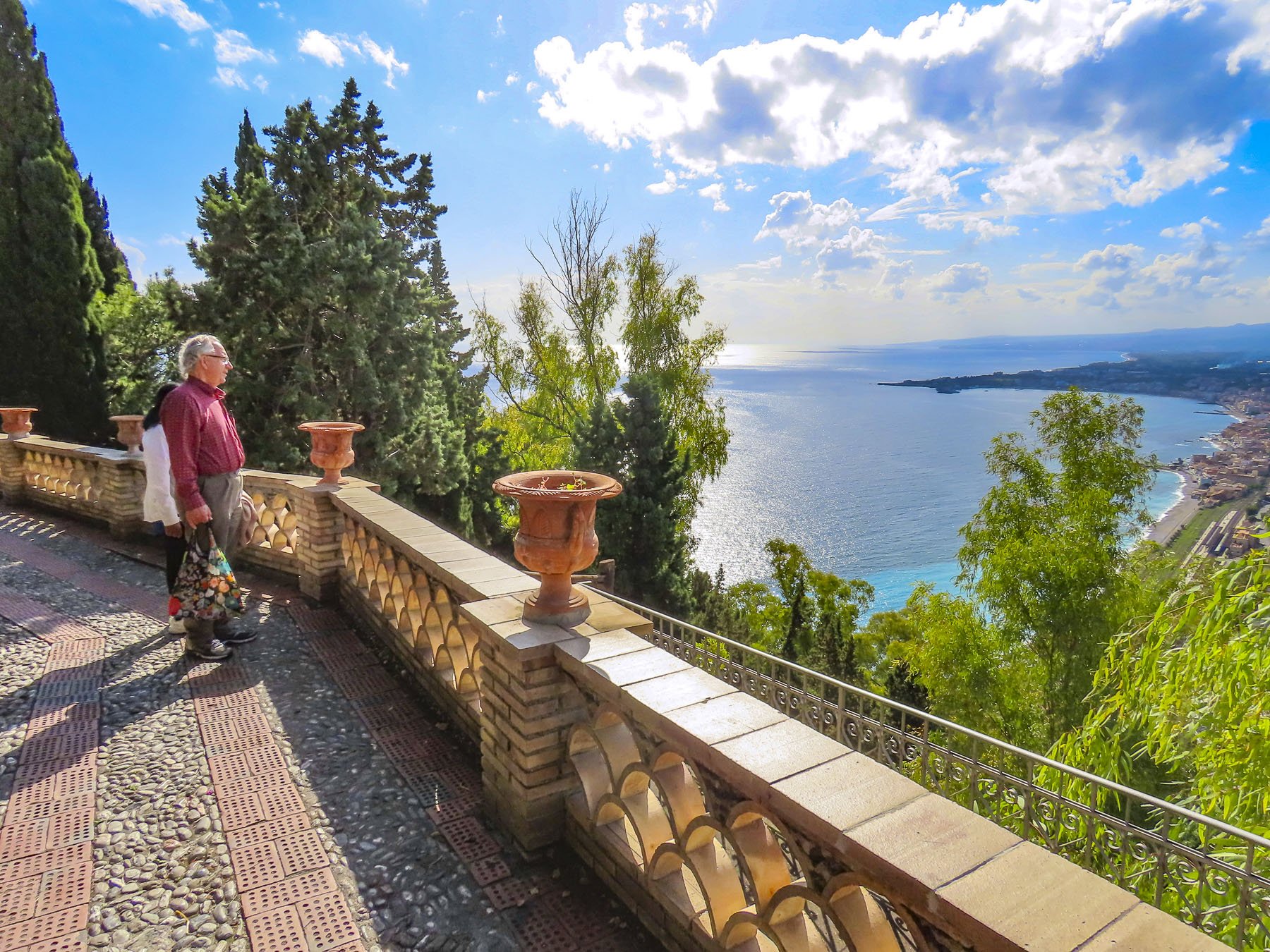
Not being on any lists, including Interpol’s or the FBI’s most wanted, we enjoyed a still warm early November day as we wandered through the Giardino Storico Ex Villa Trevelyan, now the town’s public formal garden, but once the grounds of a villa owned by a Scottish noblewoman. Lady Florence Trevelyan fled rumors of an affair with King Edward VIII, settled in Taormina and eventually married the mayor.  During our visit, intricately stoned paths along the cliff edge, with views of the sea, were still lush with blooming bougainvillea and hibiscus. Eventually they led to fanciful, ornamental architectural constructions called Victorian follies.

Rambling on, we passed an antique Rolls Royce being readied at the Grand Hotel Timeo to whisk the bride and groom away after their destination wedding. 

From the top row of seats at Teatro Antico di Taormina, the views continued to be enthralling; Mt. Etna was perfectly framed by the ancient columns of the stage. 

In the other direction, the coast toward Spisone dazzled in the afternoon sun.  Inland, the homes of Castelmola were precariously balanced to avoid sliding off their treacherous slope. 

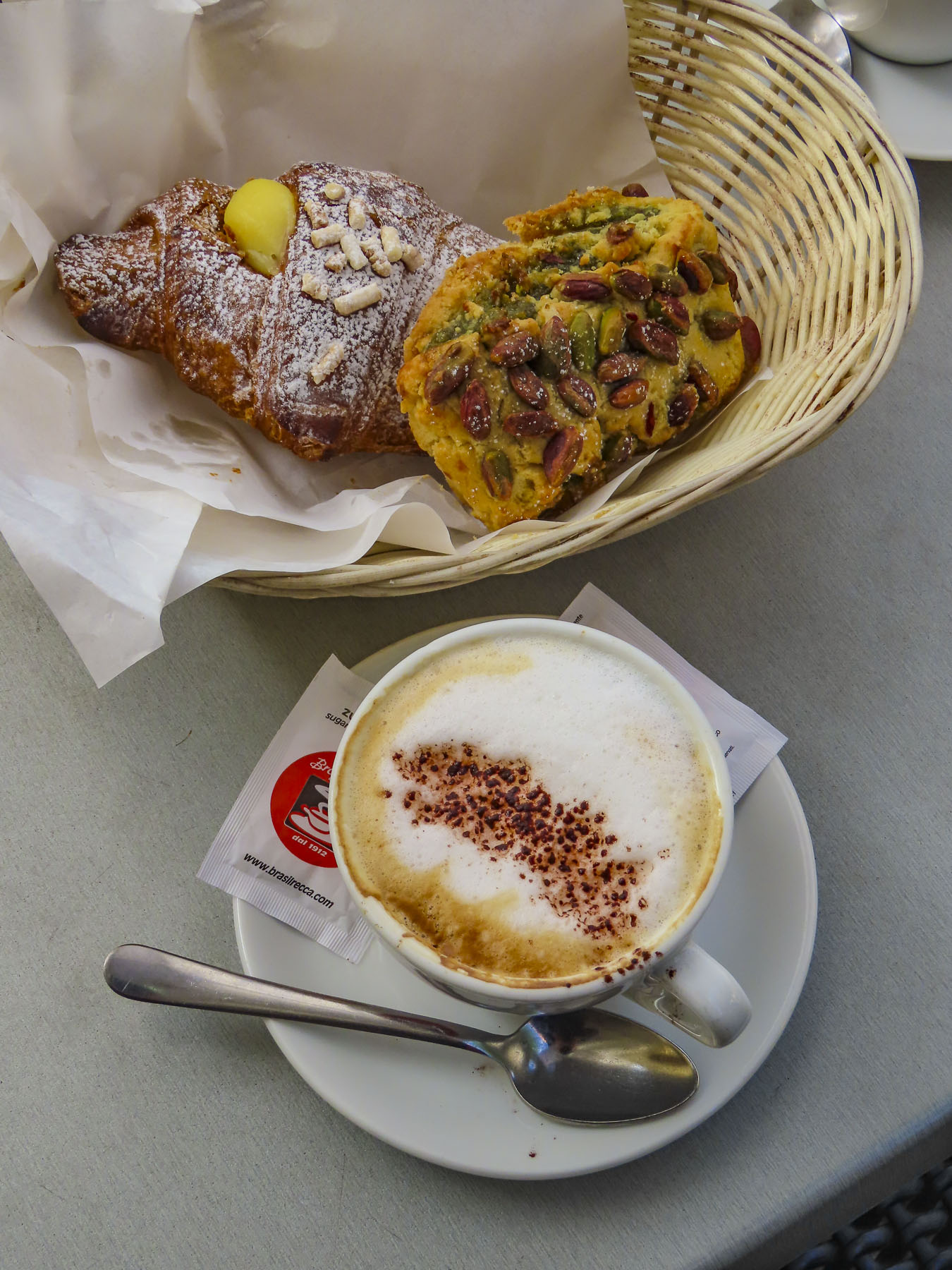
A stay isn’t complete in Taormina without multiple strolls along Corso Umberto in the mornings for café and pistachio pastries, and later in the day for pistachio Aranchino or gelato.

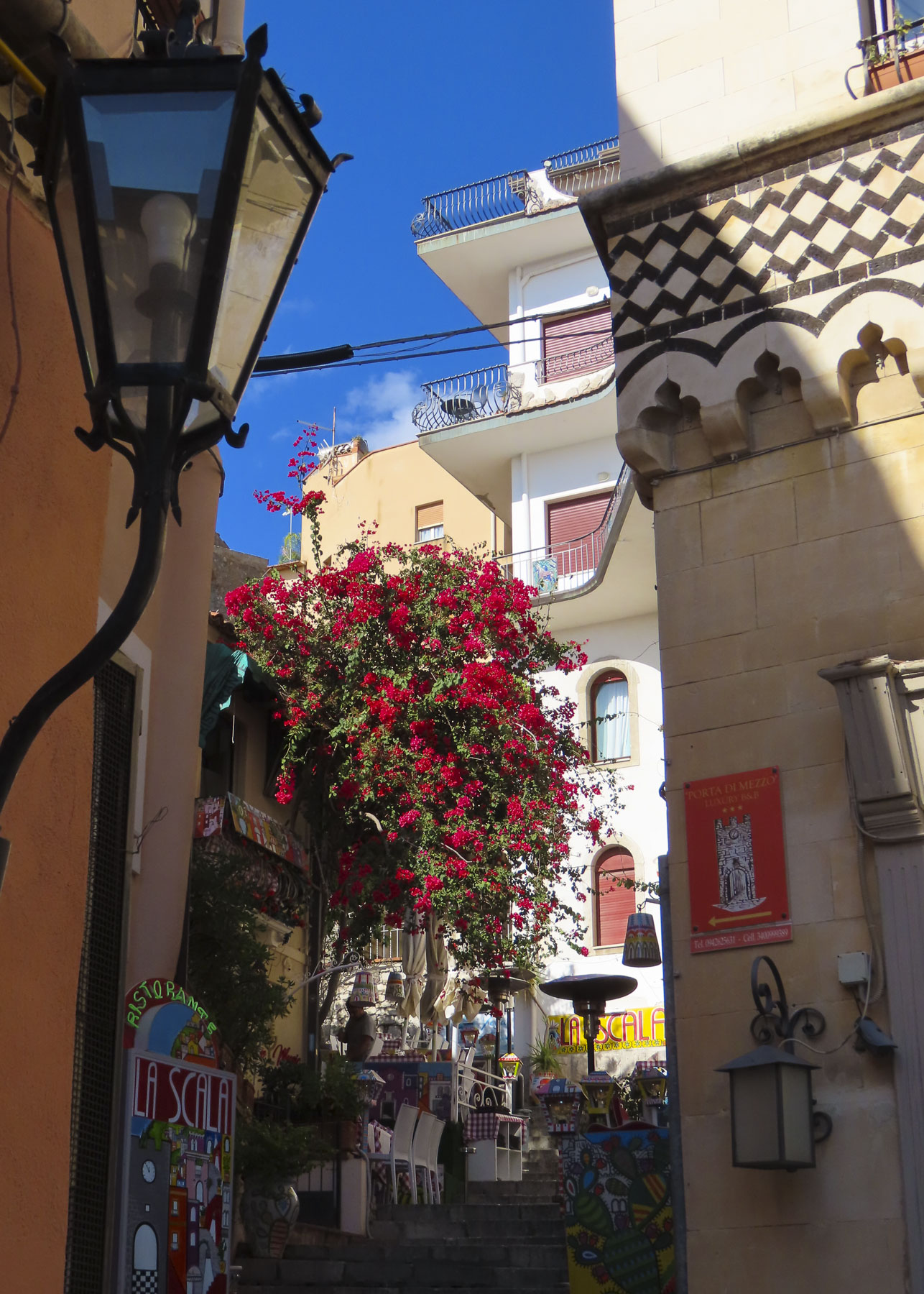
The broad expanse of Piazza IX Aprile, adjacent to the Porta di Mezzo clock tower and the elegant Baroque Church of San Giuseppe draws a large crowd at sunset to admire the view, and is the perfect spot to enjoy a classic Aperol spritz. 

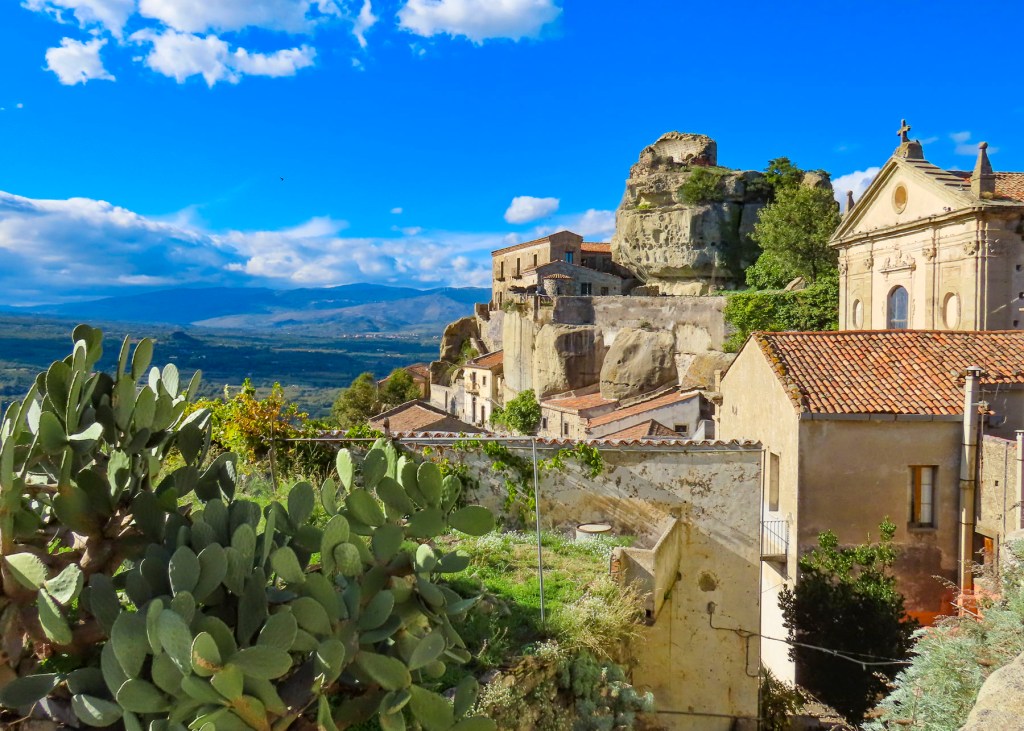
Located in the foothills surrounding Mt. Etna, Castiglione di Sicilia is on the list of most beautiful villages in Sicily. Less than an hour from Taormina, it beckoned us to visit. The scenic drive along SS185 through the Alcantara Valley was uneventful.  The fields were dormant now and farm tractors were parked to await the spring planting season. The multiple arches of Ponte San Cataldo, a historical railway bridge, graced one curve of the road.  It was now a bridge to nowhere, the train tracks at both ends long ago removed for scrap. Villages we passed showed barely any signs of life beyond a barking dog or two. 

Numerous signs for campgrounds and agrotourism farms along the route promised outdoor enthusiasts escape from city life.  Turning onto SP7i we eventually passed the rustic 12th century Norman Chiesa Di San Nicola, then crossed a small bridge over the Alcantara River, within sight of Castiglione di Sicilia.  Fed by snow melt from Mt. Etna and Nebrodi Mountains, the Alcantara River is one of the few rivers in Sicily that flows all year-round.  Over the millennia the cool waters of the river have carved a dramatic gorge through lava fields left from Mt. Etna’s volcanic eruptions.  Hiking trails above the gorge and swimming in its cool natural pools are popular summer activities in the region.

Commanding the high ground helped increase your chance of survival in the days when pillaging and plunder ruled the land.  Defenders hoped that attackers would tire and move on to an easier target. From the road in the valley, Castiglione di Sicilia looked formidable, with Castello di Lauria commanding the promontory like the rock of Gibraltar. 

Driving into the center of the village, mid-week in the off-season, we nearly had the whole village to ourselves. It felt deserted, almost as if the village had been sacked and the residents had been taken captive. We followed a warren of narrow alleys and stairways around the upper village until we reached Castelluccio, the ruins a of Byzantine tower, in a small park with an overview of the village. 

From here we spotted the belltowers of six ancient churches and monasteries that dot the hilltop. The oldest, Chiesa San Pietro, dates to 1105. Castelluccio, slightly lower than Castello di Lauria, would be our highest point in the village, since the castle was closed in the off-season. That’s the one disappointment we experience when traveling in the off-season – many points of interest are closed due to a lack of tourists.  It’s the old double-edged sword, less crowding versus less accessibility.  For the most part we are okay with this and enjoy wandering to soak up the ambiance of a locale.

A looping around the huge monolithic rock, Via Edoardo Pantano brought us to the foot of Castello di Lauria, the 12th century Norman fortress built upon earlier Greek and Roman battlements. The views of the Alcantara Valley were beautiful from this vantage point. Farther on the Basilica of Maria Santissima della Catena stood atop a wide staircase at the end of a quiet plaza. The patron saint of the town, she is believed to have saved Castiglione di Sicilia from the wrath of Mount Etna on many occasions.  Her feast day is celebrated every May with a procession through the village. 

It was mid-afternoon by the time we were ready for lunch, and our options had dwindled dramatically since arriving.  Only La Dispensa dell’Etna was still open with all the inside tables taken by a large party.  Interestingly, part of the floor of the restaurant has glass tiles that allow you to look down onto artifacts discovered during a renovation. It was a little chilly for outside dining, but we enjoyed, with the guidance of our waiter, several specialties of the Alcantara Valley. The addition of wonderful home-made house wines from the regional grapes, Nerello Mascalese and Carricante, native to the slopes of Mt. Etna, combined with the delicious food made this one of our most pleasurable meals in Sicily.  Following the Etna Wine Path might be the catalyst for future visits to Sicily. 

Till next time, Craig & Donna

Naples – Historic, Gritty and Wonderful

The Italian countryside seemed to extend forever, a wonderful accomplishment for this region of southern Italy that has supported civilization for several millennia, though it ended abruptly when we rounded a highway curve and came to a halt in traffic. Naples, we had arrived.

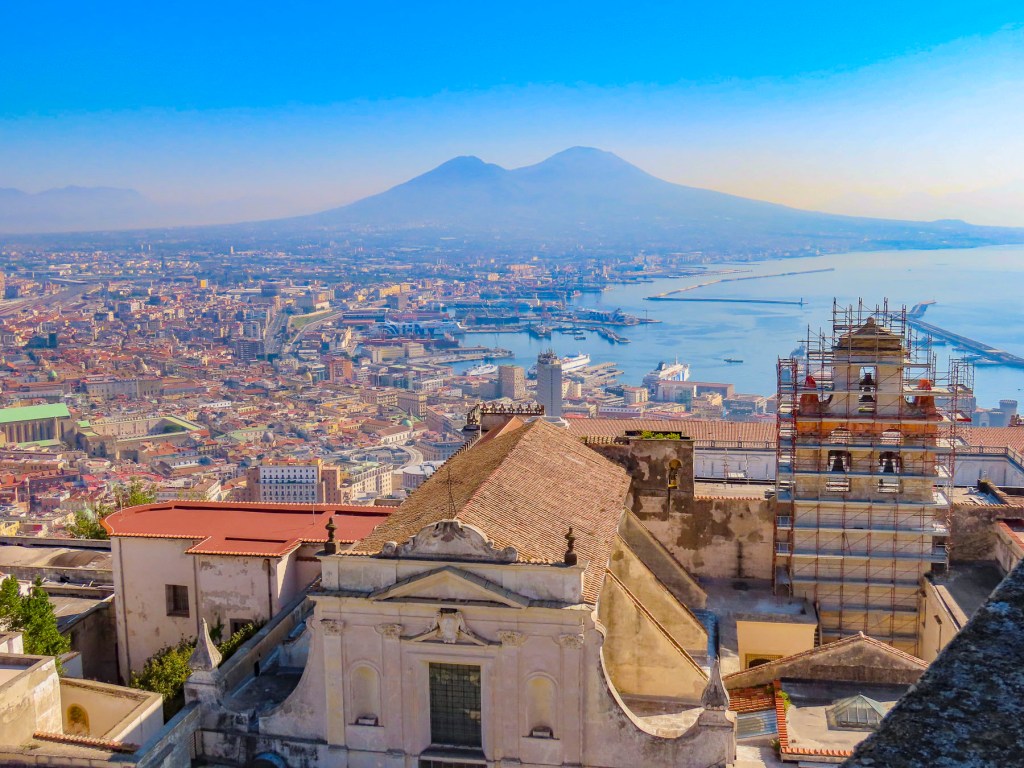
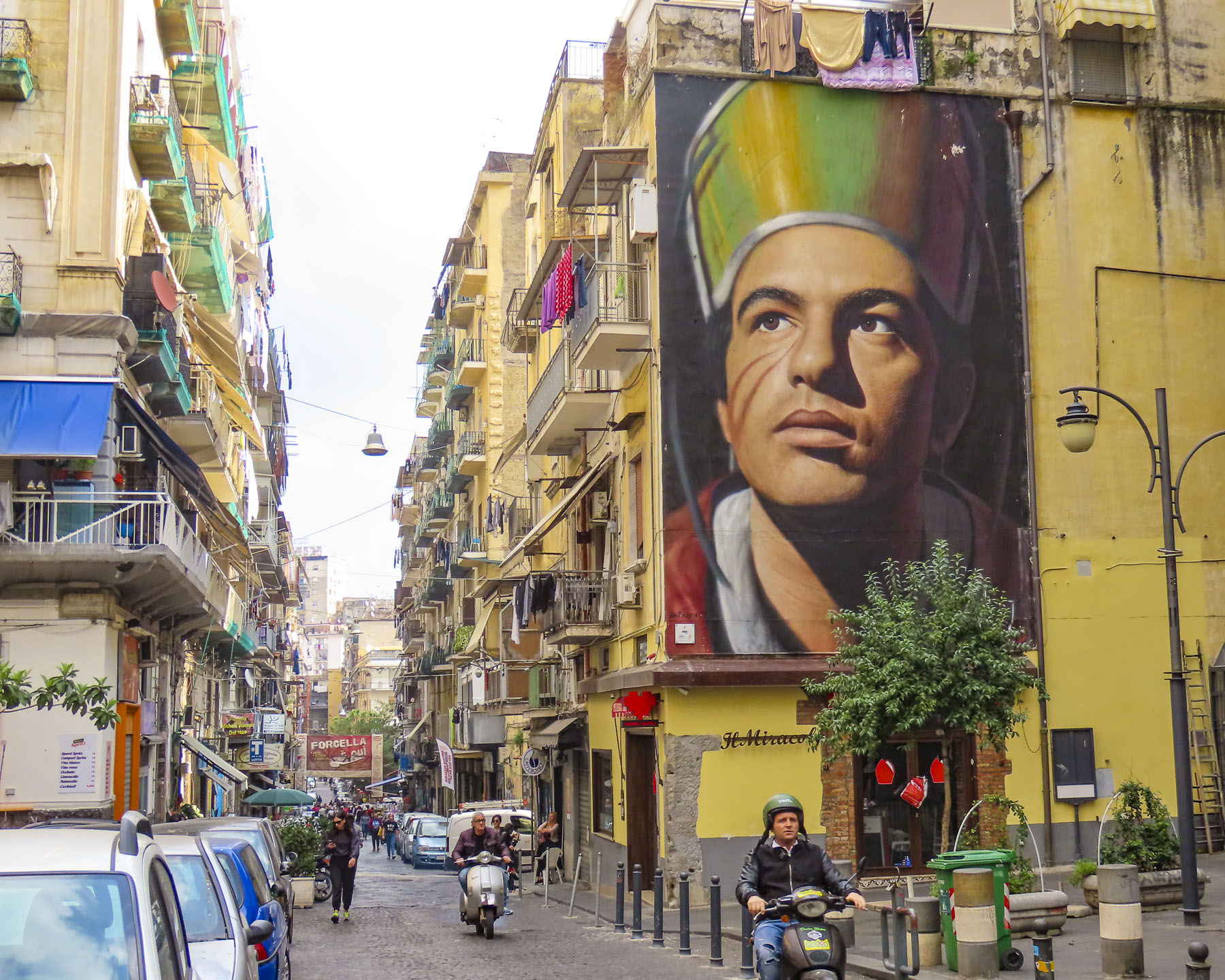
It wasn’t until we saw Naples from above that we realized the extent of this metropolis.  From our apartment in the historic center of Naples, near the Piazza del Gesù Nuovo, we walked to the daily market along busy streets lined with ancient 17th and 18th century palazzo, once noble homes of the Neapolitan elite, now subdivided into apartments, their fine architectural details often hidden under graffiti, that lined Via Pignasecca.

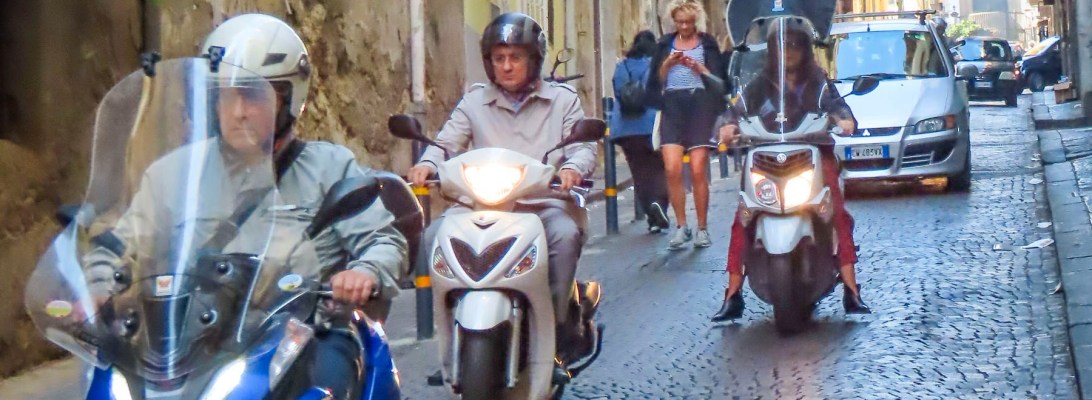
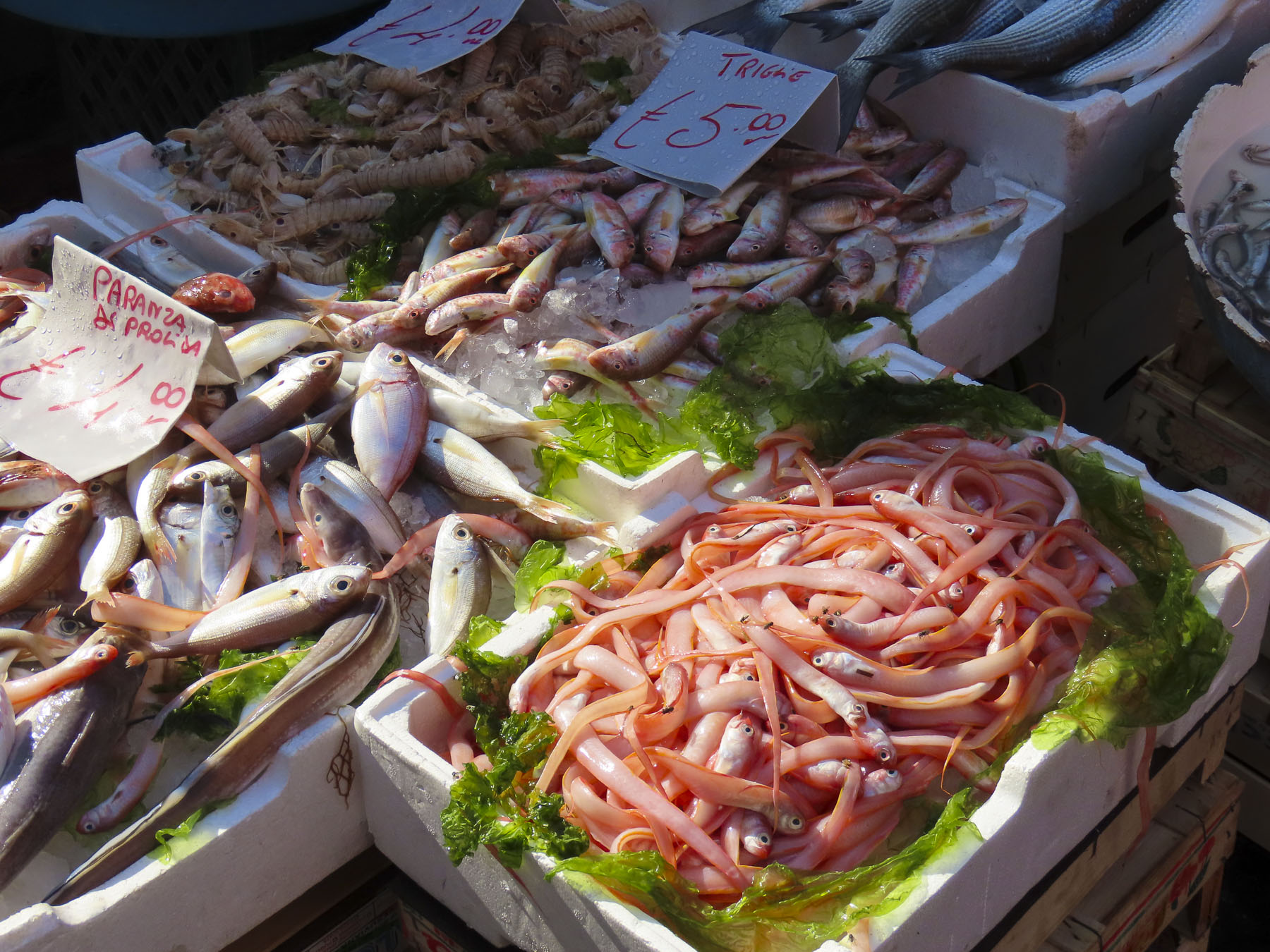
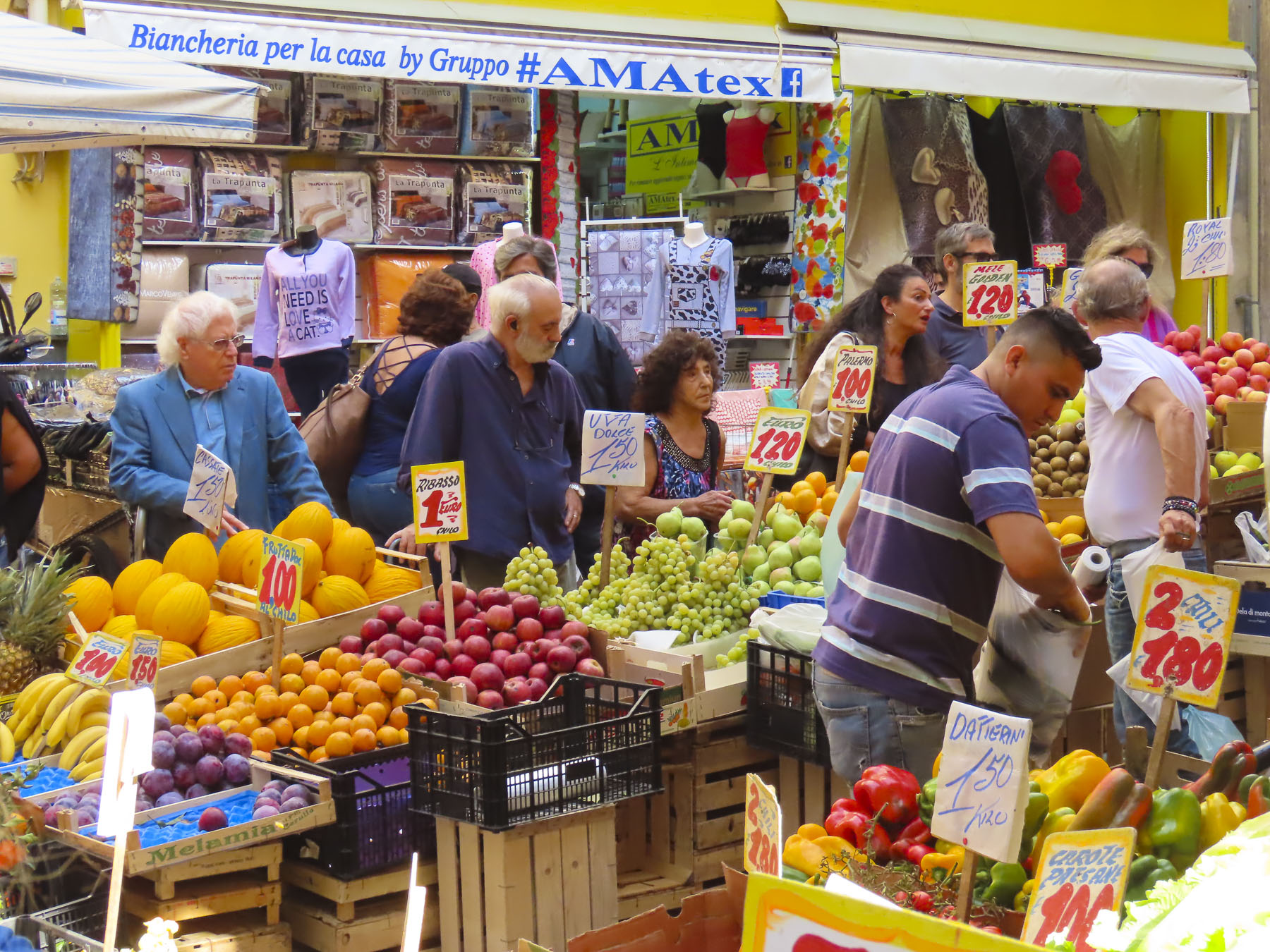
Vegetable, cheese, meat and especially bountiful seafood vendors were in a constant state of motion readying their stalls and calling aloud what was available.  It was fascinating and gritty with an underlying character of toughness that street life in Naples demands.

Everything looked wonderful as we planned dinner in our minds and agreed to return later after our day’s activity; how disappointed we were to find the street all tidied up and swept clean by mid-afternoon.  We consoled ourselves with a purchase of a bottle of Piedirosso Campania, a red Italian wine grape that is a specialty of the region. For two euros it was a good everyday wine. Later in the week we purchased a fresh tuna fillet that was excellent.

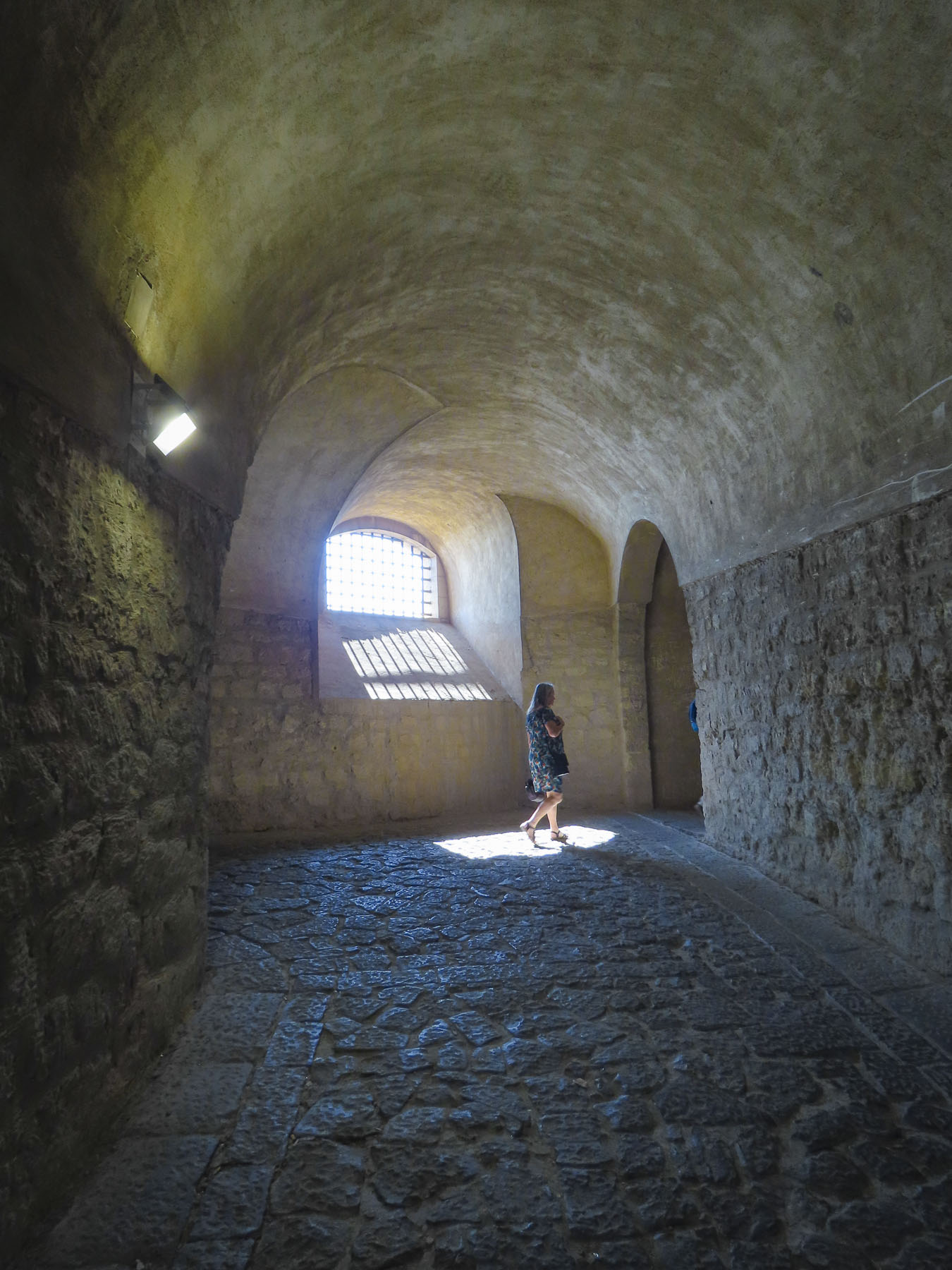
The funicular at the Montesanto train station saved us from a long and incredibly steep set of stairs that would have otherwise led us to Castel Sant’Elmo. Its six-pointed star design dates from Spanish rule of the Kingdom of Naples in the 1500’s, and is the highest point on Vomero hill.

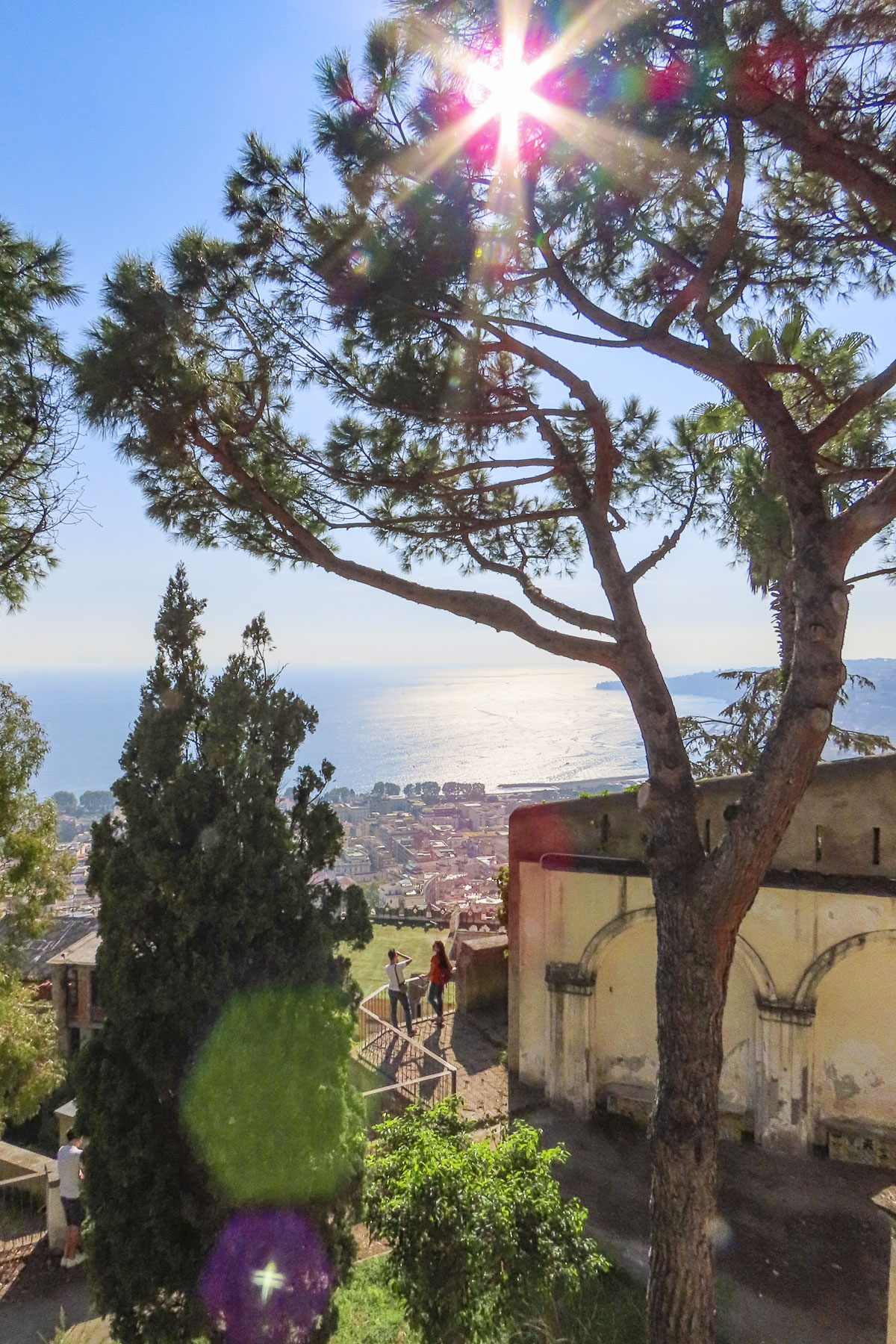
The thirteenth century fortress dominates Naples’ skyline and has an incredible panoramic vista of the vast metropolitan area that hugs the Bay of Naples. Mount Vesuvius overshadows the scene that extends past Sorrento to the Isle of Capri.

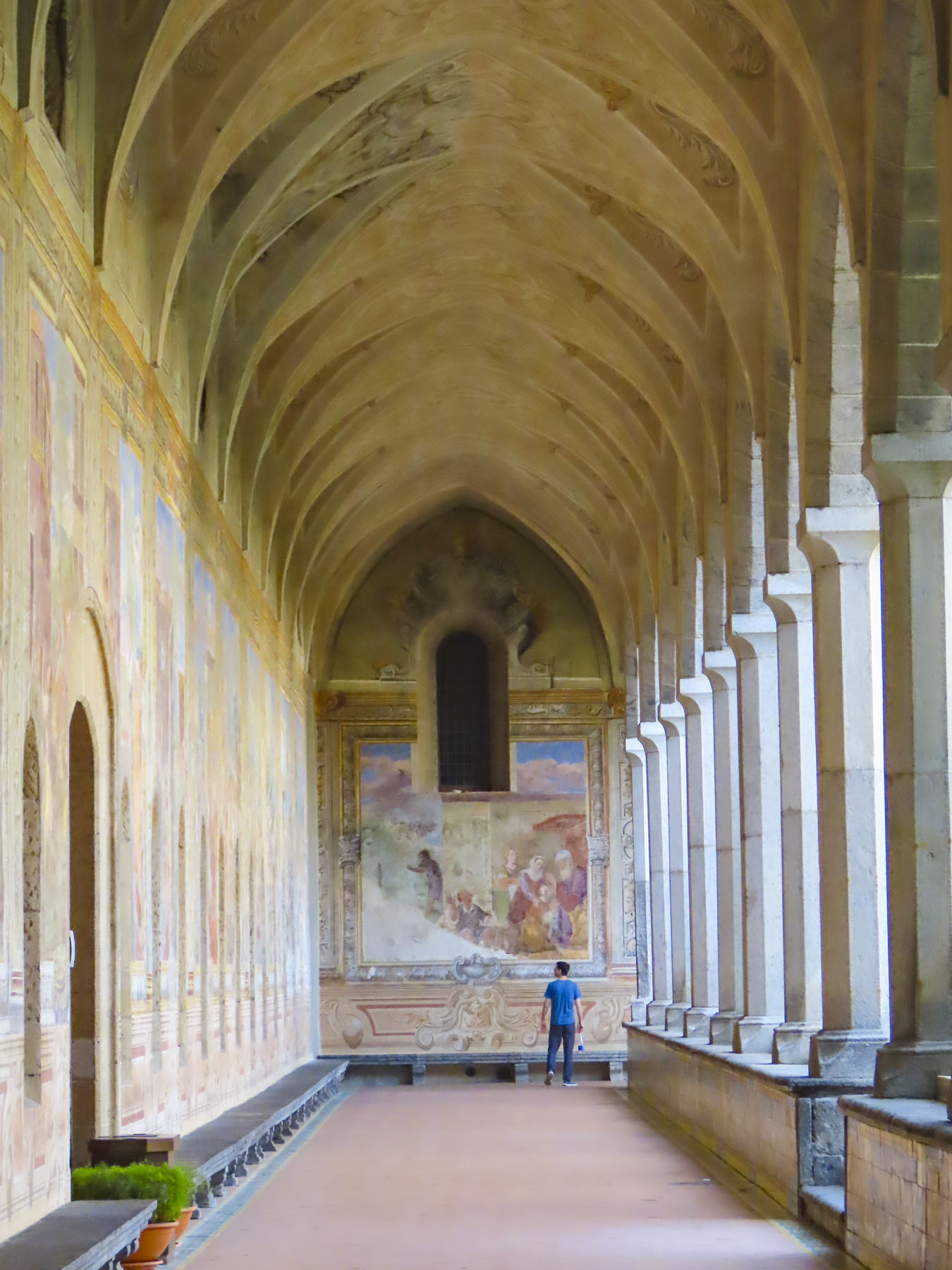
Under the citadel walls in what was once a wealthy monastery the Certosa e Museo di San Martino exhibits a collection of art and artifacts devoted to the monastery’s and Naples’ history, in richly decorated cloisters. 

Outside the formal gardens, the paths along the cliff edge were a quiet retreat.  If you don’t feel the need to tour another fortress or monastery, the Belvedere San Martino scenic overlook offers the same views and is a very popular place to watch the sunset. 

After lunch we followed the stairs of Pedamentina a San Martino downhill to Corso Vittorrio Emanuele which cuts across the mid-section of Vomero hill above Quartieri Spagnoli, the old Spanish quarter. The district gets its name from the garrisons of Spanish troops housed there in the 16th century to quell any rebellions from the restive Neapolitan citizenry. From the sidewalk here we looked down upon canyons of TV satellite dishes and flapping laundry hanging from balconies that extended for block upon block, the sheer number of folks living above one another unimaginable.

Over centuries it has evolved to have the densest population of any neighborhood in Italy. After the second world war, post-war public housing was built for tens of thousands of displaced Italian families that fled the war-ravaged countryside, looking for work and shelter in Naples, though Naples itself was in near ruins, having been bombed over 100 times by Allied forces prior to the liberation of the Italian peninsula from Nazi occupation.  Before retreating from Naples, the Nazis destroyed all of the city’s port facilities along with the water, electricity, and gas infrastructures.  Thus began an era of poverty and destitution that was further fueled by neglect from the central government in Rome.  A century earlier, before fighting against Italian unification, the Kingdom of Naples was the most prosperous, wealthy and industrialized of the pre-unitary Italian states with the largest number of students enrolled in public schools along with the peninsula’s lowest infant mortality rate.  The city was a treasured destination of 17th and 18th century upper-class Europeans on their “Grand Tours.” The poet Johann Wolfgang von Goethe is credited with coining the phrase “See Naples and die” to reflect the city’s grandeur on one such tour.  Though I’m sure he never envisioned how a growing Mafia influence in the mid-1950’s co-opted the phrase.

We worked our way along Corso Vittorrio searching for the Giardino del Claustro, a scenic overlook, but finally gave up when we realized it was behind the entrance to a university. This wandering led us serendipitously to the Church of St. Nicholas of Tolentino where a chorus of angelic voices suddenly filled the sanctuary as we crossed its threshold, stopping us in our tracks. Seeing no one, we listened intently to the anthem, trying to determine its unseen source, until we finally heard the bellowing voice of the choir director.  We were in the school’s chapel!

If anyplace is likely to induce a religious overdose it’s Naples. “The city of 500 domes,” reportedly has 1000 churches, five hundred of which have historical significance and I swear they are all in the ancient center of the city.  Starting at the Chiesa del Gesù Nuovo on the piazza that bears its name, we walked along Via Benedetto Croce in a large loop that brought us first to the majolica-tiled cloisters of the 14th century Complesso Monumentale di Santa Chiarato.

Continuing straight, we eventually came to a street mural of San Gennaro, the patron saint of Naples. This large tribute was painted in the contemporary style of Jorit Agoch, a Neapolitan graffiti artist, in 2015, above the entrance to a bar that stands next to Chiesa Parrocchiale di S. Giorgio Maggiore on Via Duomo.

Earlier we passed a small memorial to Antonio Varvella, nicknamed O’Barone, a sometimes-gruff character, a beloved homeless man who was a fixture in the historic center for many years until his death one wintry night in 2014.

Backtracking, we turned onto Via San Gregorio Armeno, a street famous for its numerous workshops that craft unique, highly detailed hand-made presepi, nativity scenes.  

Almost lost amidst the store fronts of the crèche workshops, the Church of San Gregorio Armeno has a lavish gilded baroque interior. It is a 1500’s renovation of the original 9th century church built over a Roman temple of worship to Ceres, the Roman goddess of agriculture. 

At the end of the lane, the Basilica di San Paolo Maggiore dominates the square.  

Back at our starting point we rested in front of St. Giuseppe Moscati’s statue, the hand of the sculpture shiny from parishioners holding it as they prayed for cures. A local doctor, he dedicated his life to serving the poor of Naples and is credited with many miracles. He was canonized in 1987.  

Facades of many of these churches pale in comparison to their rich interiors. If the door to the church was open, we entered. Some were grander than others, but all of them were interesting.  

Alternating with stops for café, gelato or the ever so refreshing Aperol spritz, we spent several afternoons ping-ponging our way from church to church through the center of a city that has been inhabited since the eight century B.C. when the Greeks named their colony, Neapolis. 

Subsequent civilizations buried the ruins of earlier ones.  The cobbled lanes and churches we toured had been built over Underground Naples, 120 feet of ancient detritus along with ruins of millennia old cisterns, aqueducts, Roman alleys and shops that spread extensively under historic and modern Naples. 

The reward for one of our daily explorations was a savory Margarita pizza from Di Matteo, recommended by our friend Marina, a lifelong Neapolitan, who affirmed, “It’s the only place my family eats pizza.”  A round pizza folded twice to form a triangle is the perfect street food, but when you order it inside and sit at a table to dine it is customary in Italy to use a knife and fork to politely carve these culinary creations that have become so popular the world over.

By the end of the week the hard cobblestones were fatiguing, and we decided to take a cab to Galleria Umberto, an old fashioned, glass domed shopping mall.  A five-minute trip according to Google Maps. It’s a landmark by the waterfront, near Castel Nuovo and Piazza del Plebiscito which we planned to visit afterwards.  

There were several taxis in queue at Piazza del Gesù Nuovo, all pointing in the direction we needed to go, a good omen or so I thought, as we hopped into the first cab.  Hearing our destination, the driver promptly did a U-turn, then another left turn taking us in the wrong direction. I spoke up from the backseat and pointed to the map, my question confidently waved away by the driver. “Donna, he’s taking us in the wrong direction.” “Give him a few more minutes. He’s local – maybe he knows a shortcut.” With a left turn out of the historic center the driver would have redeemed himself, and put us on a course to the waterfront. Instead, he turned right and floored it while ignoring my protest from the backseat. Finally, at a red light he rolled down his window and asked for directions from a police officer.  Oddly, the police officer made eye contact with me and winked.  A right turn brought us into a one lane road where traffic was at a standstill.  By this time what should have been a very reasonable fare was now approaching twenty euros and we were still over twenty minutes away, in the opposite direction from our destination. I believe he had intentionally taken us in the wrong direction to jack up his fee.  It was time to abandon ship. We got out in the middle of the traffic jam, and I handed him five euros.  An eruption of Italian we did not understand pursued us onto the sidewalk as we walked away, and I swear the buildings blushed from embarrassment. Never have I met a cabbie who didn’t know where a landmark was. 

A few moments later as we were walking down the sidewalk, voices called from behind. “Attenzione!”  Two smartly dressed female police officers were telling us to pay the cabbie. These officers looked serious, with handcuffs! My mind raced as I told them he was a thief, and no way was he going to extort more money from us!  Much of this intense discussion was hindered by our lack of Italian.  Twenty-three euros were now on the meter and the driver wanted to be paid.  I repeated, “no way!” multiple times.  Thank goodness for Google Maps.  With it we were able to show the officers our pickup point and what our original route should have been and the time it should have taken.  They immediately saw how deliberately off course we were. They agreed with us and reprimanded the driver and told him he was lucky he got the 5 Euros.  The police officers apologized for his behavior and were sorry that it happened to us.  From where we got out of the cab it took us an hour to walk to Galleria Umberto where two “caffé corretto,” espresso with grappa, were ordered to sooth our frustration. For this very reason we prefer to use the transparency of Uber or Lyft for transportation when traveling; unfortunately, those services were not licensed to operate in Naples.

With our Naples Pass in hand we headed to the National Archaeological Museum.  This was a wonderful museum with a fascinating collection of artifacts, ancient pottery, classical sculptures, and mosaics discovered across the Campania region.  There is also an extensive collection of antiquities from the ruins of Pompei.

Walking back to our apartment we stopped at a small bacari with a few outside tables for aperitivi, the Italian version of happy hour, to savor the golden hour as the sun began to brighten the historic buildings along the boulevard on our last day in Naples.

Sharing the afternoon with friends and sipping Aperol spritzes accompanied with small snacks called cicchetti is a ubiquitous activity in Italy and reflective of “la dolce vita,” the sweet life. It’s a tradition we plan to continue.

Cin cin! Till next time,

Craig & Donna

Puglia: Alberobello – Trulli, Troglodytes and the Sea

One of the characteristics we most appreciated about traveling through Europe was the ready availability of a cup of delicious coffee, even in the most unexpected of places. The bar on the ferry from Dubrovnik to Bari came through with two tasty cappuccinos the morning after our overnight passage in a windowless cabin. As a hazy sunrise dawned over the Adriatic Sea, we sipped our revitalizing espresso and milk while the ship docked in Bari, capping an otherwise uneventful crossing to the Puglia region – “the heel of Italy” or the “spur of the boot.” 

Behind the wheel of our rental car, we passed through verdant olive groves in the Valle d’Itria, alternately known as the Valle d’Trulli or the Valley of Ancient Olive Trees. Olives trees are celebrated for their age in the region, and several top two thousand years old.  One ancient millennarian called the Elephant is 3,000 years old. The orchards on either side of the road were busy with workers covering the ground under the trees with collection nets in preparation for the olive harvest.

A little aside – we are olive aficionados. All things olive we enjoy. We have even brined our own, ordering California olives, then scoring and soaking them for three months in salt water to remove the extremely bitter oleuropein.  As tasty as they are after this process, they are downright vile beforehand, which has always made me wonder how it was determined that they were edible.  Did a starving hunter-gatherer pluck a floating olive from a salt marsh and make the discovery of a lifetime?

Farther along we sped past a farmer selling yellow melons from the back of his three-wheeled Piaggio Ape, a small truck that is ubiquitous throughout the farmlands of Italy. We did a quick U-turn to buy two from him, and they were delicious.  Our progress slowed through another small town as a brass band led funeral mourners across the road ahead of us.

Our destination was Alberobello, to meet up with three of our sons and especially to live in a trullo for a week.  This was the culmination of a decades-long desire ever since becoming aware of these enchanting, whitewashed dwellings capped with conical-shaped stone roofs with a pinnacle at the top.

Trullo comes from the Greek word for circular domed construction, tholos.  But it is thought the “a secco” style, without mortar construction technique, was brought to Puglia by North African invaders when Sicily was under Arab rule in the mid-800s or even earlier. As the Valle d’Itria surrounding Alberobello was deforested (albero bello translates as “beautiful tree”) to make way for cultivated crops and olive orchards, the building material of choice was the abundant limestone rocks removed from the fields or the wells dug beneath their homes.  The flat stones, called chiancarelle, are precisely pitched so that rainwater runs off the roof and the interior remains dry.  Their local design was firmly entrenched in the 14th century when the King of Naples granted the desolate Alberobello region to the first Count of Conversano as reward for service during a crusade. 

In a ploy to recruit tenant farmers from neighboring regions the feudal landlord offered trulli with the caveat that when the king’s tax collector visited the area, homes would be destroyed by the count’s horsemen using a rope to pull the pinnacle, a key stone, from the roof, collapsing it.  The homes could then only be rebuilt when the tax collector was safely far away.

This miserliness inflicted upon the already hard lives of the peasant farmers was to avoid payment of “new settlement” taxes by the feudal lord.  No wonder there were constant peasant uprisings. This threat literally of “the roof coming down on your head” was used to intimidate or evict rabble rousers and farmers who didn’t pay their crop share to the landowner.  As peasants’ rights changed over the centuries the homes became more permanent, though tenant farming was common in Italy until the end of WWll.

Our Airbnb trullo was located on one of the narrow, steep lanes of the Monti district not far from the Church of Sant’Antonio with its steeples mimicking the stone roofs of the surrounding homes. It was a compact space with two small bedrooms and combo kitchen/living room area.  When the front door was closed it felt like a snug cave, but fortunately the entry had a classic beaded curtain over it as a privacy screen that let in plenty of light and air when the door was open. 

The charm here was a vertical ladder that led to a hatch which opened to a rooftop patio with a grapevine, chairs, a table, and a clothesline. It was delightful and we made daily use of it, bringing coffee up the ladder in the morning and then wine to enjoy while watching the sunset. Immersing ourselves totally in the local lifestyle, we flew our laundry from the clothesline, like a proud flag symbolizing our occupation. 

It took the better part of a day to coordinate the arrival of our tribe; Craig and Gary stayed with us, while Jack and his partner Brian stayed near Matera. The plan was to tour Alberobello, visit Matera in the neighboring Basilicata region together and then spend a day in Lecce with our friend Giulia, whom we met at the very beginning of our journey, fourteen months earlier in Ecuador.

Many visitors savor all of Alberobello’s magic in one day, but if you don’t like changing hotels frequently, like us, it was also the perfect spot to base further exploration of Puglia, which is what we intended to do.

There are over one thousand trulli in the Monti district spread across seven narrow streets that twist and turn in an enchantingly confusing way, yet the area was small enough that we were never really lost.  Early in the mornings or late in the day the neighborhood had a unique ambience, with its cobbled lanes, whitewashed walls and pointed stone roofs painted with various religious, astrological, or folkloric  symbols. The latter were meant to ward off evil or ensure a bountiful harvest. Similarly, there are different thoughts about the meaning of the various shapes of the pinnacles atop the roofs. I prefer the theory that they represent the ancient stone mason’s calling card. Most of the trulli have now been converted to shops, restaurants, small inns, and rental properties. 

Across the main road at the bottom of the hill we climbed a shallow slope to a second, smaller borghi, or neighborhood, equally charming but with a more residential flavor than the Monti. The Aja Piccola is comprised of about four hundred trulli.

Farther afield on the outskirts of town we walked through Alberbello’s central cemetery.  Spanning centuries with classic tombs and modern mausoleums, the graveyard architecture presented a strikingly distinct dichotomy to the rustic trulli.

It was backroads through farmland most of the way to Matera, past larger trullo with multiple rooms, each represented by its conical roof. Some along the way were abandoned or used as barns, while others were pristinely refurbished and doubled as the farmer’s home or agrotourism business.

Matera sprang to notoriety in 1945, at the end of WWII, with the publication of Carlo Levi’s novel about his political exile to the region, Christ Stopped at Eboli, when Mussolini was in power.  He described the squalid conditions in which peasants lived together their farm animals: they inhabited caves, without electricity or running water, and diseases ran rampant.  The Italian government was internationally embarrassed by the neglect the sassi of Matera received, and in a restitution effort, relocated the entire population of some 16,000 cave dwellers from 1,500 sassi, small caverns, to a new town built on the plateau above the honeycomb of caves.

Archaeologists have determined through excavations that Matera grew from a series of water-eroded caves along the walls of the Gravina River canyon, which were first inhabited sporadically 9,000 years ago during the Stone Age.  Permanent populations have existed here since 3,000 BC, making it one of the oldest continuously inhabited settlements in Europe. 

The Romans declared Matera a town in 251 BC. Centuries later the safety of cave dwellings appealed to many during the turbulent dark ages and the populace grew as folks expanded the natural caves and randomly dug new sassi, above and below their neighbors, from the soft rock of the canyon walls.  During the Middle Ages the prosperity of the city supported many churches and convents.

In the 1200s the Cathedral of Saint Mary ‘della Bruna,’ Saint Eustace, and the Church of Saint John the Baptist were built on opposite sides of the ravine.  Prosperity continued in this area into the early renaissance.  The exterior of the some of the sassi were squared off and ornately carved with columns, while others were expanded with additional rooms and vaulted ceilings.   

Political intrigue over the centuries put Matera on the losing side of several rebellions against the various Kings of Naples. The coup de grace came in 1860 after unification with the Kingdom of Italy, when many of the lands and properties owned by the church in the Basilicata region were confiscated and sold off to wealthy aristocratic families. With support from the church, peasant opposition to the broken promises of the new Italian government grew and soon the countryside was controlled by roaming bands of brigands.  The province was too dangerous to travel through, further isolating Matera even though it was the capital of Basilicata.  Many decades of governmental neglect followed and pushed Matera into major decline.

For three decades the sassi were an abandoned no-man’s-land, the caves used as drug dens and warehouses for smugglers until the first gentrifications began with several small boutique hotels in the 1980s.  During years of renovation and exploration, 150 cave churches, 90 wine cellars and numerous cisterns have been rediscovered after the removal of debris and muck from their last use as barns and stables.

The uniqueness of Matera’s “spontaneous architecture” as it is officially called was recognized in 1993 when UNESCO named it a World Heritage site.  Further interest followed, after Matera was used as a film location to double for ancient Jerusalem in several movies: The Passion of the Christ (2004), King David (2005), and The Nativity Story (2006.) Even some scenes from the 2017 Wonder Woman were filmed there. In 2019 Matera received distinction as a European City Capital of Culture.  Today sixty percent of the sassi of Matera have been restored into small hotels, shops, galleries, and digital workspaces.  

When we arrived in Matera the historic area was hidden from our view by the buildings of the new town on the plateau above the Sassi district. We made our way to Piazza Vittorio Veneto while searching for stairs down into the ancient district. There was a tremendous WOW! factor when we emerged from a narrow alley onto a scenic panorama above the old town, the city’s silhouette frozen in time.

Around the city large surrealist sculptures by Salvador Dali stood in wonderful, whimsical juxtaposition to the surrounding monochromatic walls of the city. One day was not enough to uncover all the mystery that Matera had to offer. Hopefully, we will return in the future. 

A day at the beach, more like a day on the cliff above the beach, drew us to Polignano a Mare on Puglia’s Adriatic coast.  It’s a picturesque town known for its dramatic buildings balanced on a cliff edge that follows the sea, thirty feet below. 

The rock face is incredibly soft and over time sections have fallen into the sea creating grottos, under the homes above, that can be toured by boat.  White-pebbled Lama Monachile is a classic, small Italian beach nestled between cliffs, from which the brave dive into the calm turquoise waters of the cove. 

The quaint historic district is relatively small, and homes are painted in cooling colors which echo the sea. Alleys meander to small piazzas above the water, each with a unique view of the cliff and just large enough to support a small café with a few outside tables.  It was a brilliant sunny day, pleasantly uncrowded, and the weather was gentle enough that we could dine outside in a sunny spot during our November visit. 

Till next time, Craig & Donna

Kotor Part 4: The Ladder of Kotor, Camel Tracks and Pirates

The water barely ripples on the inner reaches of Boka Bay when a storm rages across the Adriatic Sea. The steep walls of the fjord created the perfect harbor to shelter ancient fleets of merchant sailing vessels. Three-thousand years ago starting with Greek triremes and later Roman galleys, the vessels carrying goods through the Adriatic to ports along the Mediterranean were mainly rowed.  The ancient Greeks mostly relied on free men as paid rowers while the Romans used slave labor to expand their empire and propel their merchant fleets.

The city of Kotor was essentially a land locked island until an ancient foot path was widened by the Romans in the 1st century into a cobbled road, six to eight feet wide in many places, with stone retaining walls that zigzagged up the mountain four miles and climbed 3100 ft in altitude, about a five- hour trek.  Going downhill was much faster and more difficult for the camel trains. The danger here was if the camels were going too fast and couldn’t round the tight switchbacks, lost their balance and fell off the trail to their deaths.  The camel wranglers definitely had a difficult task on this route. The caravan trail remained the only land route into Kotor until 1897, when the Austrians built the road that now leads from Kotor to Cetinje.

This early example of infrastructure improvement resulted from Rome’s war against the Illyrian Kingdom after it refused to stop their piracy of Roman merchant ships. The empire determined that an overland trade route connecting to Constantinople/Istanbul and the Silk Road from China was needed as a safe alternative.  Eventually a spiderweb of caravan trails and Roman roads spread across the Balkans. Cilician pirates in the eastern Mediterranean were also creating havoc, at one point kidnapping a young Julius Caesar on a voyage to Rhodes. Piracy continued to be a problem for the Venetians with Omis pirates in the 11th to 13th centuries and later Uskok buccaneers from Croatia pillaged along the Adriatic until the 1600s.  Barbarossa, the notorious Ottoman pirate, commanded a fleet of swashbucklers that were the scourge of the Mediterranean at this time, raiding Spanish and Venetians merchant vessels and selling Christians into slavery. European empires also tolerated and endorsed pirates as long as they were “our pirates.”  Piracy persisted on the waters of the Adriatic and Mediterranean for so long because the rugged coastline had many small islands and hidden inlets to shelter the pirates.

Romanticized views of pirates persist today with the popular adventure movie franchise Pirates of the Caribbean, featuring a beguiling Captain Jack Sparrow, and the TV series Black Sails.  Interestingly there is a Japanese anime film about fictitious air piracy on the Adriatic Sea called Porco Rosso which is based on a 1992 short graphic novel called Hikōtei Jidai (飛行艇時代, The Age of the Flying Boat). It’s entertaining and worth checking the Porco Rosso film trailer.

The afternoons in mid-October were still quite hot so we planned for an early start from our apartment in the center the historic district.  This coincided with the young parents of old town escorting their children through the still shadowed alleys to the Vrata od Škurde, the River Gate, which was constructed in 1539 to celebrate a naval victory over Barbarossa, now an Ottoman admiral. We found ourselves behind an orthodox priest holding the hand of his daughter as we crossed the first and then second bridge that spanned the Scurda.  The Scurda is a wide, shallow stream that bubbles to the surface from beneath the tall rock escarpment that the Ladder of Kotor climbs and flows into Boka Bay. This area on the far side of the bridge was for centuries the market for all the goods brought down the trail from afar or from farms in the mountains to be sold or bartered for.

The old caravan trail starts behind the waterworks where the underground spring emerges and zigzags often in the tight confining space at the bottom of the gorge. The trail continued in the shadow of once towering fortress walls now humbled by earthquakes before the ravine widened out and the distance between the switchbacks increased.  There are seventy switchbacks in total if you chose to trek all the way to Krstac pass where the trail ends near Restaurant Nevjesta Jadrana. Here you can zipline over part of the trail you just hiked up, or catch a taxi or local bus back to Kotor or onto Cetinje.  Hiking back to Kotor is also an option for the hardy.

Our plans were more modest, just wanting to hike to a vantage point above the Castle of San Giovanni, Kotor Fortress, for views over the bay.  The cobbled road and retaining walls have seen better days having been damaged in the 1979 earthquake.  While the fortress has been repaired, maintenance of the caravan trail has been forgotten.  Though many sections of it are in better shape than the stairs to the Castle of San Giovanni and not as bad as some city sidewalks across Europe. Still you need to be aware of your footing and wear sturdy shoes.

It was a gentle hike through a rock-strewn hillside dotted with grasses, small shrubs, occasional pomegranate trees and wild thyme.  Off in the distance unseen donkeys could be heard braying. The pomegranates were just ripening, but were all teasingly just inches out of reach, too far from the trail’s edge.  The views were fantastic from many spots and there were two rustic taverns to stop at along the way to rest.  The lower one was closed for the season, but the higher one referred to as the Cheese Shop, on Google maps, is located where the trail veers off towards the deserted village of Spiljari, which is located under the back ramparts of San Giovanni Fortress. 

I think we were the innkeeper’s first customers of the day, and we ordered two espressos while we rested on the shaded porch.  After serving us he crossed to a refrigerator on the other side of the room to get himself a shot of chilled rakija. Being a good host, he offered us some. It was ten in the morning.  We politely declined. Though I’m sure it would have had wonderful medicinal qualities in case of any mishaps.

The village of Spiljari is over 1,000 years old and was abandoned when its water source went dry. Now trees grow between the half walls of a dozen buildings and the ruins of the Church of St John remain standing.  The ruins of the church alone are worth the detour. 

Slowly decaying, colorful remnants of what one only could imagine were beautiful frescoes remain on walls open to the weather. 

From here you can see a ladder to a small portal in the side wall of the fortress. The Ladder of Kotor? We are not sure if the name refers specifically to this or to the climb in general.  Years ago, this was an alternative entrance into the fortress.  Now it is strictly an exit point for those who have paid the €8 entrance fee to the fortress and walked up the stairs from old town and wish to return to Kotor by the caravan trail.  Though you might be able to purchase a cold drink from an ice cooler manned by the ladder attendant.  

The sun was high in the sky when we made it above the castle and the view was spectacular. We sat for a while and imagined the history of the trail: how it conveyed ideas, merchandise, pilgrims and invaders over the centuries. 

Notably in the 1830s a team of fifty men carried an Italian billiard table up this track to the rightfully named Biljarda House, home to the beloved prince bishop and poet Petar II Petrovic. (Just imagine the amount of cursing involved in that endeavor.)  Years later when Petar II Petrovic was on his deathbed a procession carried him up this same track to the historic old capital, Cetinje.  A few months later Montenegrins would carry his successor and nephew Danilo II Petrović-Njegoš to Cetinje to rule.

And although we took many photographs on the trek up, we took even more of the ever changing view as we descended back into town.

Till next time, Craig & Donna